Review of Speculative Epistemologies: An Eccentric Account of SF from the 1960s to the Present


Review of Speculative Epistemologies: An Eccentric Account of SF from the 1960s to the Present

Paul Graham Raven

John Rieder. Speculative Epistemologies: An Eccentric Account of SF from the 1960s to the Present. Liverpool UP, 2021. Liverpool Science Fiction Texts and Studies, 70. Hardback. 192 pg. $125.00. ISBN 9781800855410.

John Rieder’s introduction to Speculative Epistemologies aims the book at the question of “truth effects in sf” and invokes the Harawayean expansion of those initials: the field of enquiry includes science fiction and speculative fiction, of course, but also “speculative feminism, science fantasy, speculative fabulation, science fact” (1-2). The book’s heart is six close readings of stories from the genre’s subcultural margins, which Rieder hopes will “trace a history of sf that captures the increasingly feminist, racially and ethnically diverse, philosophically ambitious, and politically engaged character of [sf’s] subcultural centers of gravity from the 1960s to the present” (2). The speculative epistemologies of the title are “counter-hegemonic ways of knowing” (2), while the eccentricity of the subtitle refers not to the substitution of Hawaiian shirts and a fedora for a personality, but rather to an engagement with “multiple centers of gravity,” resulting in non-Copernican orbits such as those of comets and the like.

In other words, this is a tour of the Oort cloud of the generic solar system. Perhaps that’s not the ideal metaphor, however, given Rieder here extends the model of genre (re)formation set out in his Science Fiction and the Mass Cultural Genre System (2017; SFMCGS hereafter): an Actor-Networkish approach which “resists any monolithic, centrally organised description” (3) in favour of exploring an ever-shifting assemblage of subnetworks through which the meaning of a term such as ‘science fiction’ is perpetually under (re)construction. Which is to say that ‘science fiction’ is not the simple category identifier that it’s sometimes taken to be, nor is it exactly like a solar system—unless, perhaps, we consider solar systems over a timescale for which our mayfly lifespans make us woefully unprepared.

Nonetheless, if that’s the map we’re taking for Rieder’s territory, then his navigational rubric is a popular aphorism pulled from Shapin and Schaffer’s Leviathan and the Air-Pump (1985), a landmark work in Science & Technology Studies (STS): “solutions to the problem of knowledge are solutions to the problem of social order” (3). To this claim Rieder adds a rider of his own: “the problem of knowledge/social order is therefore also, always, the problem of narrative or storytelling” (ibid).

The waystations on this journey are six sfnal texts that foreground the social struggles—and hence the alternative ways-of-knowing—of women, Indigenous communities, and queer communities: Pamela Zoline’s “The Heat Death of the Universe” (1967); Leslie Marmon Silko’s novel Ceremony (1977); Samuel R. Delany’s “The Tale of Plagues and Carnivals” (1985); Theodore Roszak’s The Memoirs of Elizabeth Frankenstein (1995); Albert Wendt’s The Adventures of Vela (2009); and “The Camille Stories” (2016) by the aforementioned Donna Haraway. Rieder’s itinerary is not intended to be exhaustive, but illustrative, taking in some exemplary texts which subvert the hegemonic culture—but also the hegemonic sf culture—of their time, resulting in “an enormously more significant realisation of the genre’s literary and ideological potential” (4). I will not presume to judge the suitability of Rieder’s choices, here, nor critique his analyses. For one thing, I have read only two of the texts (the Zoline and the Haraway) and know one more by repute (the Delany). For another, Rieder’s reputation as a wide and generous reader precedes him, and the chapters devoted to each work in this book are testament to a body of knowledge and experience that puts my own to shame. What I can say with certainty is that he provides ample reason to seek out the stories I haven’t read, and to return to those I have.

Therefore—and given my own position within (or is it my trajectory across?) the assemblage-of-assemblages that we think of as the academic disciplinary (solar-)system—I will instead concentrate on Rieder’s framing argument and conclusion. Though a critic and author of sf, and a regular (ab)user of the scholarly toolkit surrounding the genre, I would not presume to define myself as an sf scholar first and foremost. If I am legible at all to the disciplinary system, it is as some vigorously mutant species in which the genes of futures studies and STS got mixed up, perhaps by way of a comic-book villain’s experiments with a particle accelerator. This may serve to explain why Rieder’s work usually speaks clearly to me: the theory of genre advanced in SFMCGS, for instance, makes a lot of sense to someone who, in the words of their long-suffering doctoral supervisor, “has read more Latour than is necessarily helpful”. Throw in some Haraway (as theorist as well as fabulist), the foundational work of Shapin and Schaffer, a pinch of Bakhtin and Barad, and I’m in fairly familiar territory; to then be slung outward on a trajectory that traces that territory’s potential intersection with a (small-c) catholic conception of sf as an assemblage is a mission that feels, at times, like it was written just for me.

However, that feeling dissipates somewhat when Rieder reaches his conclusions. To explain why, I must attempt to sum up the theoretical framework that takes us there, which Rieder erects around the central issue of “truth effects” (1). This argument begins with the relationship—often claimed but, as here shown, most often honoured in the breach—between the epistemic bases of science fiction and the sciences for which it was (unwisely, and regrettably) named long ago. This part of Rieder’s argument includes a quick foray through the emergence of ‘hard’ sf—here shown to be driven by a cherry-picked nostalgia for an earlier sf which had hardly existed, and resulting in a “highly targeted storytelling practice, one that caters to a well-defined, narrow audience” (11)—and the ‘soft’ New Wave counterpoint that emerged within the genre; it is also the part of the argument which I assume will be canonical to most readers here. What interests me more is Rieder’s delineation of an epistemological chasm between the reality- and truth-claims of sf-as-fiction on the one hand and science-as-non-fiction on the other. Here, the vastly different effects (and perhaps also affects) of authority and plausibility must be (re)examined within what Rieder calls regimes of publicity: “the material practices of the production, circulation and reception of discourses” (12) wherein the boundaries and protocols of ‘genre’ are built, maintained and reconfigured over time.

For Rieder, this process requires focussing on the label ‘science fiction’ as commonly used rather than as expertly defined, thus resisting pressures to purify sf of its entanglement with mass culture, and with the inextricably related techniques of advertising and market research. The latter are connected by Rieder (quite rightly) to the “fake news” phenomena of the moment, produced by the “outrage industry” as part of an assault on “the authority of evidence-based truth” (12). Meanwhile, “the real, true ‘cognitive’ power of sf” must be found “by tracing its proliferating networks of influence and association,” rather than by the aforementioned process of purification (12): the broad church that the term now represents, and its indirect and polymorphous relationship to the episteme of scientific enquiry, is precisely the result of sub-subcultural struggles within the subculture of SF itself. This dynamic is how the idea of ‘hard’ SF emerged, and—first as tragedy, then as farce?—how the more recent Puppies crusades emerged, but it is also what gave rise to the far more inclusive and radical countercurrents which Rieder is charting in this book.

So far, so good. But early in his conclusion, Rieder turns toward drawing a hard and exclusionary line between, on the one hand, both the vernacular (and liberal-hegemonic) notion of ‘science fiction’ (for which his figure is the bloated monolith of the Marvel movies franchise) and the more radical tradition that the book focusses on, and on the other hand, the post-truth narratives of the MAGA movement. He rightly notes that, while the radical tradition with which Speculative Epistemologies is concerned takes a critical and oppositional attitude to the more ‘same old capitalist technoscience, but with slightly better minority representation draped over it’ position of the liberal mainstream, the two blocs are united by a science-like commitment to evidence as the foundation of truth claims, albeit a very instrumentalised lip-service one in the latter case; the fables of the outrage industry, meanwhile, have given up any such pretence in favour of that infamous coining, ‘alternative facts.’

This argument is eminently tenable, to be clear. But I struggle with a corollary that seems to suggest that the fabulatory futures of the post-truth episteme are thereby beyond the pale in terms of the genre dynamics he has described in this and earlier works: disconnected from the somewhat-more-sciencey speculations of SF and, furthermore, undeserving of any attempt at critical engagement.

I can see where Rieder is coming from, here, not least because he sets it out clearly, referencing the circumstances of his writing the conclusion against the backdrop of the January 6th insurrection at the US Capitol. Which is to say: I don’t blame him for getting on his soapbox. But I do feel that his argument is a poor fit with the book that precedes it. It’s not contradictory, exactly, but nonetheless: to go from detailed explorations of works which illustrate the long and close relation between radical sf and the academic regimes of publicity in particular, and then to hop-skip from there, over the mainstream movies of the commercial regime, and on to a regime that doesn’t even define itself as science fiction at all—even though I would argue its futurities are, contra Rieder, demonstrably no more ‘improbable’ than those of the Black Panther movie (2018), and to its fans distinctly less so—in order to dismiss the latter as illegible to analysis and undeserving of engagement… well, it feels like one hell of a leap.

I can see the logic in holding up MAGA futurism’s refusal to debate in good faith as a reason to “acknowledge, with regret, outrage’s own practice of putting itself outside of any meaningful dialogue” (157), both academically and politically. But politics and logic are not blood relatives… and my (admittedly limited) training in pedagogy leaves me wondering whether we are (to borrow a metaphor from William G. Perry) simply stonewalling the disruptive students who’ve finally cottoned on to the first solipsistic stages of epistemic multiplicity and leaving them to be swept up by demagogues.

And if we concede that debate is impossible, engagement pointless—what then? Because regretfully allowing these epistemes the exit from metaphysics (and hence analysis) whose impossibility forms the basis of our critique of them, and hoping it will just die out if we stop looking at it, doesn’t seem like a strategy that’s going to win over the long haul. Worse, our condemnation and dismissal of these alternative futurities is exactly the effect that their authors—because outrage futures definitely have authors, or at least curators, with political positions and agendas as well-defined as any author Rieder explores in this book—would most like them to achieve. The trap has long been built in: our dismissal of these speculative epistemes—justified by reference to names that post-truth fandoms will identify as ‘postmodern neoMarxists,’ and using five-dollar words aplenty—enacts the elite disdain that those narratives already claim to be all that can be expected of us, tweeting our wokenesses in the sacred groves of radical-leftist academe. Our rejection is prophesied; as a consequence, it will be celebrated, and the division deepened. For all our faith in our own epistemological foundations, we seem unable to escape the characterisation ascribed to us by theirs.

So surely seeking to understand these epistemes with the tools we have developed to that end is better than to shrug and retreat? Certainly, they differ hugely in their truth effects from the ones with which Rieder is here concerned, but—as he observes earlier in the book—they are shaped by the same media-systemic dynamics of niche and mainstream, of marketing and seriality. Indeed, the passing mention of the Puppies crusades could even form the basis for making the case that the sf subculture was a Ground Zero for the ‘culture wars’—and it would be of a piece with the book’s stated project of studying the effect of speculative epistemologies “on the formation of identities and communities” (back cover).

Other scholars seem to be pushing in this direction, too. David Higgins’s Reverse Colonisation (2021; reviewed elsewhere in this issue), for example, shows that sf media which, at the time, were artefacts of a radical leftist (or leftish?) subcultural scene, have gone on to provide rhetorical strategies of resentment to the post-truth meta-episteme. More recently still, Sherryl Vint has described a project in which she intends to treat the adherents of post-truth futurities exactly as fandoms—a move which gestures back to the deep history of sf fandom, prior even to the ’hard’ sf controversy, as a harbor for some irrational, deeply weird, and disturbingly reactionary narratives of futurity.

None of this political meta-talk should be seen as casting any aspersions on the deep readings that Rieder has collected in this book, nor the theoretical framework within which he arranges and executes them: these, as always from this author, are exemplary, and will doubtless join my core collection of references in the field. See my quibbles instead as an intervention in a debate still ongoing, concerning how a once-marginal field of scholarship, having become much more relevant, influential, and mainstream in recent years, should best go about extrapolating its analyses and conclusions into the context beyond the texts which are its core concern. I am in no doubt that such extrapolations are worth making; indeed, I make them in my own (much less notable or exemplary) work.

But we too are in the business of truth claims effects as are, perhaps, all authors, knowingly or not. Rieder notes that Derrida—a ‘postmodern neo-Marxist’ par excellence!—observed that there can be no exit from metaphysics, and this lack of exit informs, for instance, the feminist critical engagement with a male-hegemonic science whose episteme put women under erasure. MAGA futurism may have put truth under erasure, but that’s all the more reason for us to insist on seeking it there: the very commitment to truth that supposedly defines our opposition to it surely behooves us to seek it in our opposers. The alternative can only serve to sustain the destructive division which their imaginary dreams of making canon.


Dr. Paul Graham Raven is (at time of writing) a Marie Skłodowska-Curie Postdoctoral Fellow at Lund University, Sweden, where his research is concerned with how the stories we tell about times yet to come shape the lives we end up living. He’s also an author and critic of science fiction, an occasional journalist and essayist, a collaborator with designers and artists, and a (gratefully) lapsed consulting critical futurist. He currently lives in Malmö with a cat, some guitars, and sufficient books to constitute an insurance-invalidating fire hazard.

Review of Doctor Who and Science: Essays on Ideas, Identities and Ideologies in the Series


Review of Doctor Who and Science: Essays on Ideas, Identities and Ideologies in the Series

John McLoughlin

Marcus K. Harmes and Lindy A. Orthia, editors. Doctor Who and Science: Essays on Ideas, Identities and Ideologies in the Series, McFarland & Company Inc., 2021. Ebook. 235 pg. $39.95. ISBN 9781476642000.

This collection presents a distinctly interdisciplinary set of essays, the vast majority of which testify to the significant scholarly and personal investment of their authors in Doctor Who, both as a modern series and a historical institution. As the editors themselves note, “academics tend not to write about Doctor Who unless they are also fans or at least highly engaged viewers” (14). This particular set of expert fans includes physicists, translation professionals, media and cultural scholars, astronomers, geneticists, science communicators, literature specialists, historians and more, so the collection has an interesting variety of methodological approaches beyond those usually seen in traditional literary and cultural studies. Alongside critical analyses of Doctor Who episodes are quantitative analyses of public engagement, exposition of scientific norms and cutting-edge gender and identity discourses.

Despite this open-ended attitude to content, the curatorial approach is distinctly of the modern humanities, with an emphasis on explicating Doctor Who’s complex and often illuminating relationship with issues around gender, sexual and racial representation, and empire. The editors get the question of pronouns out of the way early, mandating the use of they/them when speaking of the Doctor generally, but allowing for gendered usage when referencing a specific incarnation. Despite the potential—acknowledged by the editors—for the odd instance of grammatical confusion, this two-pronged approach is largely effective and engages admirably with the show’s own development and modern innovations in gender inclusivity.

Focus is laid on the show’s function as a science communicator, rather than simply recording instances of scientific accuracy—or inaccuracy—in specific episodes; Doctor Who can, the editors argue, serve only to proselytize for science at the “macro” level, introducing reason and scientific method as general concepts (6). Despite this, essays do occasionally go as far as equating the show’s quality with its faithfulness to real science. Elizabeth Stanway’s “Who’s Moon” talks about the show’s “recklessly indifferent” attitude toward scientific fact (41) in the 2014 episode “Kill the Moon”; lack of faithfulness to microbiological and astrophysical reality, Stanway argues, indicates “a decline in the quality of scientific and educational representation of the Moon” (41), thus introducing one of the more interesting questions raised by the collection—to what extent Doctor Who must balance its responsibility to science communication with its nature as creative fiction. Stanway frames this within the show’s influence on audience’s attitudes towards science specifically, a perspective supported and built upon by Kristine Larsen’s analysis in the same volume of the “chilling effect” (127) such shows can have on women’s participation in STEM fields. Stanway’s analysis of Google search trends is far from conclusive when it comes to demonstrating the show’s impact on viewer interest, though the inclusion of real-world events alongside episode broadcast dates is an intelligent and necessary one.

Whether it be issues of climate change, space sovereignty or gender inclusivity, one of the collection’s most compelling arguments is that Doctor Who has, for better or worse and throughout its history, contributed to public perceptions of science and scientists. The collection does an admirable job of balancing its conclusions: while Doctor Who is not without flaws, sharing many of them with the culture which gave birth to it, nevertheless the authors seem to believe that it may still serve a vanguard function. Larsen’s own essay, “The Mad Scientist Wore Prada,” offers a balanced and intriguing analysis of Rosalynn Haynes’ catalogue of feminine stereotypes as they appear in Doctor Who. Larsen’s analyses of the Rani and the Master/ Missy are nuanced and thorough, extending far beyond a simple reiteration of Haynes’ initial list; sections dealing with Missy’s emotional response to the Doctor’s friendship and her own rehabilitation are particularly astute, noting the cart-before-the-horse nature of the writing; she asks whether such an emotionally charged Master would be possible in the Moffat era were they not so overtly feminine, and the reader is inclined to agree. Larsen’s conclusion, that the presence of these stereotypes harms inclusivity, is strengthened by the recorded instances of backlash to gender inclusion in the show from fans and critics, though Larsen does acknowledge that by approaching only the “mad scientist” characters, analysis is funneled towards characters whose depiction must—by necessity—be negative.

The collection’s more niche and episode-specific studies most demonstrate the strength of passion-driven scholarship; Harmes and Scully’s close study of the “Evil of the Daleks” serial and its depiction of Victorian-era science and pseudoscience offers fascinating insights into the production methodology of old Who, the real-life emergence of professional scientists, and the demise of the amateur, gentrified scientist. Essays like Natalie Ring’s regeneration piece and Halley and Bowker’s translation study offer fun and well-rounded explorations of the real-life parallels to Doctor Who’s soft-SF themes and ideas, whilst Mike Stack offers a nuanced and intricate study of the differences between sex and gender—all framed neatly by the regenerative process.

Editorial work is largely accurate, with tables and visual information presented appropriately. A small number of typographical and grammatical oddities remain, including incorrect punctuation usage in chapter titles. In all, readers will find in this volume a varied and thoroughly researched set of essays whose topical and enthusiastic approach demonstrates the versatility and longevity of Doctor Who scholarship.


John McLoughlin is a PhD researcher at Cardiff University studying the intersection between the Exegesis of Philip K. Dick and the literary and philosophical writing of Walter Benjamin. McLoughlin is interested in cultural detritus, nonlinear approaches to art and revelation, and alternative cultural and literary perspectives. Originally from Liverpool, John is a lifelong SF fan and fine artist with a keen interest in interdisciplinary studies, plus a passion for bringing unlikely sources of meaning together.

Review of Heroes Masked and Mythic: Echoes of Ancient Archetypes in Comic Book Characters


Review of Heroes Masked and Mythic: Echoes of Ancient Archetypes in Comic Book Characters

Vincent M. Gaine

Christopher Wood. Heroes Masked and Mythic: Echoes of Ancient Archetypes in Comic Book Characters. McFarland, 2021. Paperback. 264 pg. $39.95. ISBN: 9781476683157.

In Heroes Masked and Mythic, Christopher Wood performs a detailed analysis of the parallels between the heroes of Ancient Greece and comic book superheroes of the modern era. From Achilles to Captain America, Paris to Hawkeye, Troy to Gotham, Wood demonstrates that the concerns which informed the works of Homer and Virgil are alive and well in the works of Stan Lee, Bob Kane, and Kevin Feige. These concerns include, among others, the tension between personal honor and duty to family or community; the temperance of power with wisdom; and the dangers associated with being stronger, faster, more skilled than your contemporaries. Over the course of the book, Wood draws on various examples both from antiquity and today to establish and argue his central thesis.

Wood’s book arrives when it has become almost a cliché to describe superheroes as modern myths. Batman, Superman, Spider-Man and their ilk have proved highly malleable, adapted by various creators to different media as well as different periods, reflecting changing social, cultural and political concerns as well as industrial, aesthetic and technological developments since the late 1930s. As Wood might say, this adaptability echoes the oral traditions of the Greek epic, stories that could be and have been told and retold by multiple tellers over the centuries. Comic books and superheroes have a prominent role in contemporary popular culture, largely due to the multi-billion-dollar film franchises that dominate cinemas as well as streaming services. In response to this prominence, superhero studies is a growing area of academic research, both in terms of scholarly studies and student work. Wood therefore offers a timely intervention with this in-depth study of long-standing discourses that influence the construction of narratives and characters, whether they wear tunics and brass or capes and face masks, vulnerable either in the heel or to kryptonite.

Wood’s conceit allows him to consistently perform detailed analyses of his various case studies. Over the course of fourteen chapters, with such evocative titles as “Wonder Woman: Echoes of the Amazon Warrior” and “The Hand of Fate: The Infinity Gauntlet and the Moirai,” Wood delivers some striking insights. Early on, he traces the history of myth itself, including the Ancient Greek understanding of the term and the importance of Carl Jung and Joseph Campbell on our (and Wood’s specifically) contemporary understanding of the term. He also argues that the term “hero,” while seeming self-explanatory, is also highly contingent on historical, social and political context: “Heroes, multi-faceted as they generally are, serve to define our society” (Wood, 6). As Wood identifies, what it means to be a “hero” is something that many a ‘hero’ based text has explored over time.

In “Chapter I: Captain America: An Achilles for the Modern Age,” Wood draws attention to both heroes being the most noble warrior, identified by their shields and close relationships with their male comrades. Furthermore, Wood highlights the importance of both characters being “out of time” (46). This is an interesting notion that speaks to the centrality of heroes being outsiders and also liminal, a point Wood returns to in “Chapter VI – He Who Commands The Sea: Proteus, Scamander and Denizens of the Deep.” Here Wood expands the discussion beyond individual figures, demonstrating that the epic/superhero tale relies also upon physical and social spaces. The hybridity of the aquatic warrior manifests in the home of Proteus in Greek myth, “the island of Pharos, a liminal zone, neither completely on land nor beneath the sea” (Wood, 118) as well as Marvel’s Namor, the Sub-Mariner, who “bridges the physical reams of land and ocean” (Wood, 122). The attention to location continues in “Chapter VIII – Defending the Epic City: Gotham and Troy.” In this chapter, Wood highlights moral decline in tension with architectural strength, the strong structure of Troy juxtaposed against the waning nobility of its inhabitants. Despite the sturdy walls, mighty gate and lofty towers, Wood identifies that decadence and lavishness have made the people of Troy “weak” (Wood, 147) and indeed vulnerable to violation. Wood’s argument that the siege and ultimate sacking of Troy is a form of “sexual innuendo” (Wood, 148) is persuasive and intriguing.

Chapter VIII also highlights the main problem with Heroes Masked and Mythic. While Wood’s analyses of the classical texts are insightful, modern comic book texts and their adaptations do not receive the same level of attention. Wood argues that DC’s Gotham City is comparable to Troy in terms of its corruption, but his choice of evidence seems to contradict that. Citing Batman: Legends of the Dark Knight, Vol.1 #27 (February 1992) and Gates of Gotham, Vol.1 #2 (August 2011), Wood quotes the line, “I wished to lock evil out of men’s neighborhoods and hearts. I fear that instead I have given it the means to be locked in” (150). An analysis of Gotham, whether that be in comic book, film or TV form, reveals an insular environment with only minimal connection to the outside world. Gotham seems, therefore, very different from the role played by Troy in the Iliad, a city defined by its relationship to the invading forces of the Greeks. The protector role parallel between Hector and Batman is therefore dubious, since Hector, the literal prince of Troy, defends it against the external threat, while Batman, a vigilante, defends Gotham against its “home-grown criminal forces” (250). The forces at work within a Batman story seem distinct from those in the Iliad, including the “feminine and motherly” (151) aspects of the respective cities. While Troy is to be protected but ultimately violated, Gotham degenerates and regenerates, giving “new life to both heroes and villains within her realm” (151). Wood’s own argument suggests that Gotham is far more resilient than Troy, making his parallel between the two cities as well as their respective guardians unconvincing.

Wood’s tendency to pay greater attention to the historical than the contemporary texts undermines much of his argument. This problem is exacerbated by the book being rather one note: Wood establishes the parallel and then reiterates it across his chapters. The different case studies and contexts demonstrate a wide area of research, but the critical attention to the comic book texts and their adaptations is often superficial, describing the parallels rather than exploring possible unique qualities of the different media. Furthermore, Wood’s principal type of analysis is narrative, with the basic tenets of superhero stories identified and some storylines discussed briefly. Although some panels are reproduced (pp. 52, 67, 77, 97, 109, 166-7), analysis of these visual elements is limited at best, neglecting the unique qualities of the comic book medium. Furthermore, there is very little audio-visual analysis, which would be less of a problem if the book only focused on the comic book iterations of these characters. When a crucial scene in Captain America: The First Avenger (2011) receives only a narrative summary (p. 48), it seems remiss to exclude discussion of mise-en-scene, cinematography and editing.

This omission leaves Wood’s arguments incomplete. The media forms of comic books, film and television, not to mention animation and video games, rely as much on their visual and indeed audio composition as the narrative structures, character construction and use of archetypes. When Wood does perform visual analysis, it is of antiquarian relics, such as vases, mosaics, palace reliefs and figurines (pp. 41, 56, 73, 89, 105, 108, 117). Wood’s analyses of these ancient artefacts are effective and likely to open many a reader’s eyes to ways of understanding these materials. However, within the context of the book the very strength of this analysis is frustrating because of the unexplored avenues of different forms of visual storytelling. Arguably, the comic book format itself is a continuation of the embossed shield and painted vase, a point made in the postmodern and highly referential superhero film Unbreakable (2000):

I believe comics are our last link… to an ancient way of passing on history. The Egyptians drew on walls. Countries all over the world still pass on knowledge through pictorial forms. I believe comics are a form of history… that someone somewhere felt or experienced. 

To discuss ancient visual representation but to omit contemporary forms, is a missed opportunity for Wood, especially since he demonstrates great analytical skills and    draws together different examples to support his arguments. Imagine what he could have done with more attention to comic book and cinematic visual representation.

The different types of attention to different sources highlights Wood’s position as a classical scholar, here trying his hand at contemporary media discussion. His critical framework serves to highlight the continued relevance and indeed influence of ancient history and art. Heroes Masked and Mythic is certainly useful in this regard, and Wood’s committed study is likely to be useful for scholars and students of classicism looking for ways to trace historical developments and archetypes. For scholars of contemporary media, the book may work in dialogue with studies of comic books, film and television, but on its own it serves as little more than an introduction to classicism through the gateway of contemporary superheroes.


Dr Vincent M. Gaine is an academic, film critic and podcaster based at Lancaster University. His monograph, Existentialism and Social Engagement in the Films of Michael Mann, is published by Palgrave. He has published further articles and book chapters on filmmakers and genres in the Journal of Cinema and Media Studies, European Journal of American Culture and Journal of the Fantastic in the Arts, as well as reviews and interviews for the websites the Critical Movie Critics, the Geek Show and Moving Pictures Film Club, and also discusses film and media on the podcast Invasion of the Pody People. He specialises in the intersection of globalisation, liminality and identity politics in media, and is currently researching spies, superheroes and Boston.

Review of William Gibson and the Futures of Contemporary Culture


Review of William Gibson and the Futures of Contemporary Culture

Jonathan P. Lewis

Mitch R. Murray and Mathias Nilges, eds. William Gibson and the Futures of Contemporary Culture. Iowa UP, 2021. The New American Canon: The Iowa Series in Contemporary Literature and Culture. Paperback. 290 pages. $90.00. ISBN 9781609387488.

William Gibson and the Futures of Contemporary Culture is divided into three sections: “Gibson and Literary History,” “Gibson and the Question of Medium,” and “Gibson and the Problem of the Present.” Each section has strengths, particularly in putting Gibson’s work into context with cyberpunk, post-cyberpunk, steampunk, and other genres Gibson foments and subverts.

In the “Gibson and Literary History” section, Phillip E. Wegner opens the volume with a view of SF when Neuromancer  was published, along with, Wegner notes, Samuel Delany’s Stars in my Pocket Like Grains of Sand and Kim Stanley Robinson’s The Wild Shore (all 1984). Taken together, Wegner argues, these texts “mark the past, present, and future of the practice of science fiction and the notions of the literary more generally” (22). In “When it Changed: Science Fiction and the Literary Field, Circa 1984,” Wegner successfully places Gibson, Delaney, and Robinson’s novels in the context of Orwell’s Nineteen Eighty-Four and the cultural landscape of Reagan-era popular and literary culture, including film, indie and pop music, architecture, and cultural criticism. Wegner’s essay provides a useful opening for the volume in question as it firmly places Neuromancer along-side such touchstones as Jean-François Lyotard’s The Postmodern Condition (1979) and Michel Foucault’s second and third volumes of Histoire de la sexualité (1984). As well, Wegner interestingly locates Neuromancer as an experimental, albeit realist novel, in the tradition of Joyce’s Ulysses (1922).

The second essay in the collection, “No Future but the Alternative: Or, Temporal Leveling in the Work of William Gibson” by Kylie Korsnack, likewise sets a key tone for the book by examining Gibson’s use of time-travel and disembodiment in the first work in the Jackpot Trilogy, The Peripheral (2014), as well as in the graphic novel Archangel (2017) and the displacement in time experienced by Cayce Pollard in the first work in the Blue Ant Trilogy, Pattern Recognition (2005). Korsnack effectively navigates the complex play of time and history in these works to show that “readers find themselves occupying multiple temporalities simultaneously” (61). This fractured temporality demonstrates, in both the Blue Ant and Jackpot trilogies, how characters like Cayce in Pattern Recognition and Flynne in The Peripheral find “themselves split between body and mind” while living, not just in some future, as in the Sprawl and Bridge trilogies, but in the ever-confusing now (63). The “ever-confusing now” is an apt description of Gibson’s approach to modern life, as Korsnack’s essay demonstrates in full.

The third essay, “The Shelf Lives of Futures: Williams Gibson’s Short Fiction and the Temporality of Genre” by Nilges, is a highly useful inspection of Gibson’s short stories, starting with “Fragments of a Hologram Rose,” published in 1977, that connects Gibson’s turn to realism in the Blue Ant Trilogy, or, as Wegner argues, a turn that never occurred as Gibson has always written realistic fiction about nows that have not yet been. Nilges further argues effectively that, in 1981’s “The Gernsback Continuum,” “past futures continue to haunt and influence the present. . . . [A problem] that is crucial not only for writers of science fiction but for our ability to engage with and imagine alternatives to the problems of our present” (73). Nilges thus proposes that in Gibson’s short fiction, and one can surely argue his novels as well, the future is never not really present, albeit, as Gibson has said, not equally distributed.

The fourth and final chapter in the first section of the collection, Takayuki Tatsumi’s “The Difference Engine in a Post-Enlightenment Context: Franklin, Emerson, and Gibson and Sterling,” reads the novel through the end of the Cold War, situating The Difference Engine (1990) alongside Robert Zemeckis’s film Back to the Future 3 (1990) and Steven Spielberg’s film of Michael Crichton’s Jurassic Park (1993). This essay connects the end of the Cold War to the end of “territorial clear-cut binary opposition to temporal chaotic inconsistency” (83). Further, Tatsumi argues that The Difference Engine owes a great deal of its construction to Shelley’s Frankenstein (1818) and the writings of Franklin and Emerson. This reviewer would have liked a more nuanced reading of the novel in this essay, however.

Part Two of the collection opens with Andrew M. Butler’s “‘A New Rose Hotel is a New Rose Hotel is a New Rose Hotel’: Nonplaces in William Gibson’s Screen Adaptations.” Butler’s essay is a welcome one—not enough is made in the criticism of Gibson’s adaptions of “New Rose Hotel” and “Johnnie Mnemonic” and an original, unproduced script for Alien 3, or his successful scripts for The X-Files. Butler builds from his argument in Sherryl Vint and Graham Murphy’s Beyond Cyberpunk (2010) to say that cyberspace in Gibson’s screenplays is an “outopia or non-place” like the Los Angeles of Ripley Scott’s Blade Runner (1982). For Butler, Gibson’s adaptions and original pieces work because they place their protagonists “in cities and other nonplaces they can no longer read or navigate, overwhelmed by the semiotics and forms of representation at odds with their identities, relationships, and histories” (107). One can extrapolate this analysis to much of Gibson’s work, especially the Blue Ant and Jackpot trilogies.

Maria Alberto and Elizabeth Swanstrom’s “William Gibson, Science Fiction, and the Evolution of the Digital Humanities” explores this exciting development in textual and non-textual analysis, examining how Gibson’s work foments explorations of the digital, particularly, they write, “conversations his work has prompted regarding embodiment, cognition, gender, race, and so on” (121). What the digital humanities bring to studies of Gibson’s work, Alberto and Swanstrom argue, is how, e.g., his linguistic choices and innovations have impacted SF and SF studies, as they demonstrate through lexical dispersion plots. Such data mining is useful for showing how Gibson’s work “was of special interest to science fiction scholars thinking about these issues” (126). Alberto and Swanstrom readily admit that they are not “formally trained in computational linguistics,” but their findings are strongly suggestive that further explorations of Gibson’s semantic impact on SF will be profitable (128).

Next up is Roger Whitson’s “Time Critique and the Textures of Alternate History: Media Archaeology in The Difference Engine and The Peripheral”; Whitson argues that “Gibson’s media archaeology shows that computing fundamentally transforms our experience of alternate history by illustrating the links between the human social imagination and the infrastructure of branching processes found in networked computational logic” (135). In other words, Whitson says that by examining the plays with history in The Difference Engine and The Peripheral (and, one should add, its sequel Agency [2020]), one can see just how history and imaginative narratives unfold. Further, Whitson argues that the “interlacing of platform and governance—where what was once on the periphery becomes central, utopia becomes dystopia, future becomes past, alternative history becomes our history” to suggest that forms and contents merge (141). E.g., Gibson and Sterling’s play with Babbage’s Analytical Engine and Gibson’s play with the quantum server in Shanghai that creates “stubs” in history raise ontological questions about the experience of mediated reality. Whitson’s analysis is a highpoint in section two of the collection.

Sherryl Vint opens section three of the collection with “Too Big to Fail: The Blue Ant Trilogy and Our Productized Future.” Vint’s work here connects to Wegner’s opening chapter through Gibson’s apparent turn from SF to realism and argues that this turn shows that Gibson is “nostalgic for the power of art to resist capitalism’s infiltration of social and political life, now at such a point of saturation that commodity relations have replaced all social ties” (154). Vint’s argument is successful in demonstrating this saturation through Cayce Pollard, Hubertus Bigend, and other characters who, in the particular case of Bigend, work “actively to co-opt any social or creative activity that is not oriented toward market profitability and redirect it to that end” (154). Vint’s essay is especially strong in her connection of late capitalist advertising and Gibson’s characters’ attempts to recover an ever-receding, stable reality as they seek to “escape the commoditized society of the spectacle” (158). This essay is a highlight of the collection.

Amy J. Elias reads the first novel in Gibson’s apparent “return” to SF in “Realist Ontology in William Gibson’s The Peripheral.” The Jackpot Trilogy continued in Agency and will apparently conclude in The Jackpot (Gibson’s working title for the forthcoming novel), but Elias’s interest lies in the questions raised in The Peripheral about how we experience reality through “Hugh Everett III’s 1957 many-worlds interpretation in quantum mechanics (which claims that there are many parallel, noninteracting worlds that exist at the same space and time as our own …)” (168). As a scholar deeply interested in the application of Everett’s interpretation in contemporary SF, this chapter’s analysis is highly useful; yet beyond the personal, Elias’s work cogently places The Peripheral at the center of Gibson’s interest from his earliest fiction in how the ultra-rich “third-world” or colonize the past for resource extraction in their realities, separate from the rest of us poor saps.

Aron Pease’s “Cyberspace after Cyberpunk” dovetails with Vint’s chapter and continues the exploration of Gibson’s seeming abandonment of cyberspace for the present especially resulting from the complete commodification of the Internet by “transnational corporations” (179). And yet, Pease argues, Spook Country (2007), e. g., the concluding volume of the Blue Ant Trilogy, takes as givens such cyber inventions as GPS technology in its “locutive art” that “prompts wonder initially, but later bored familiarity” like so much of Internet culture (180). For Pease, Gibson has continued his exploration of cyberspace, but the world caught up to his initial visions because he imagined them. And thus it seems that Gibson’s later characters “disregard their devices almost as nuisances, exhibiting none of the cyberpunk’s romantic attachment to machines” (180). There is, in other words, a nostalgic desire for a world before cyberspace and yet a total need for cyberspace to find meaning in the world—as in Cayce Pollard’s quest for the creators of “the Footage” in Pattern Recognition, e.g. Finally, Pease argues that, like Elias, “the Blue Ant Trilogy thus captures the emerging space of empire that subsumes the spaces of the former colonial empires” (187). Pease finally states that this seizure explains Gibson’s move from “science fiction to the science fictionalized present,” a compelling conclusion to the chapter’s interests (194).

Finally, Christopher P. Haines concludes the volume with “‘Just a Game’: Biopolitics, Video Games, and William Gibson’s The Peripheral.” Haines argues that Gibson offers “one of the most incisive critiques of gaming and financialization” in the first novel in the Jackpot Trilogy. Further, Haines says that The Peripheral’s use of time-travel is best understood through the politics of the rich using the less fortunate, as the novel’s klepts gamify the exploitation of the lower classes and the extraction of technologies from the “stubs” that carry out research and development amidst their own destruction in the Jackpot. Haines also notes Gibson’s prose style in this novel as echoing the speed of his plots: “sentences are modular and clipped, dropping subjects or verbs, coining neologisms that collapse ideas together” (207).

Among the many reasons to appreciate the collection is the focus not just on Gibson’s three completed trilogies, but his short stories, his steampunk collaboration with Bruce Sterling, The Difference Engine, the graphic novel Archangel, completed screen plays for The X-Files and the unproduced Alien 3, and three essays on the first work in the in-progress “Jackpot Trilogy,” The Peripheral. The second volume, Agency, published just before the collection, is mentioned only tangentially.

Novelist Malka Order’s foreword centers Gibson’s work in contemporary literature and the broader culture that it both anticipates and realizes. Order sets the stage for the collection with the statement that the “sense of upheaval and disconnection… is what makes his books so apt for the modern world” (xii). The uncanny, the unfamiliar, and the strange settings that open Gibson’s works, Order argues, dislocate characters and readers from the conventional and make his work so ripe, so overdue, Murray and Nilges rightly argue, for this collective assessment. The pair convincingly argue that one of reasons for the previous lack of a collection like this one is Gibson’s turn from the wild speculative fiction of his early short fiction and the Sprawl Trilogy to a more realist aesthetic in the Bridge and Blue Ant trilogies.

All three sections of the work succeed in large part because of the nuanced close readings of Gibson’s works and situating the novels especially within the contexts of Gibson’s cyberpunk and post-cyberpunk poetics. The collection is therefore highly recommended for Gibson scholars and science fiction critics more broadly. There is a wealth of Gibson scholarship in Extrapolation, Foundation, and Science Fiction Studies as well as other leading journals, with essays appearing each year. This new collection is a welcome addition to this criticism and should be a starting point for students and scholars working on Gibson going forward, building on Gary Westfahl’s 2013 monograph for Illinois UP’s Modern Masters of Science Fiction series and the recently published Routledge Companion to Cyberpunk Culture (2019) edited by Anna MacFarland, Lars Schmeink, and Graham Murphy. Mitch Murray and Mathias Nilges have curated a much-needed assemblage of critics and responses examining Gibson’s short fiction, novels, and screenplays. This collection is an important new resource for Gibson studies and should be a touchstone for his work going forward.


Jonathan P. Lewis is Associate Professor of English at Troy University in Troy, Alabama. He has published essays on Neal Stephenson, William Gibson, and others in such journals as Extrapolation and Foundation. He teaches composition, World and American Literature, and SFF. He is currently at work on a monograph examining Hugh Everett III’s Many-Worlds Interpretation of Quantum Mechanics in contemporary SF.

Review of Dangerous Visions and New Worlds


Review of Dangerous Visions and New Worlds

Mark Scroggins

Andrew Nette and Iain McIntyre, eds. Dangerous Visions and New Worlds: Radical Science Fiction, 1950-1985. PM Press, 2021. Paperback. 224 pg. $29.95. ISBN 9781629638836.

Andrew Nette and Iain McIntyre’s essay collection Dangerous Visions and New Worlds, as its title indicates, focuses in the first case on the 1960s ‘New Wave’ in science fiction, a movement whose key moments include Michael Moorcock’s editorship of New Worlds (from 1964) and Harlan Ellison’s 1967 anthology Dangerous Visions. The collection’s thirty-five-year subtitle, however, signals its larger scope and ambitions: an overview of what the New Wave made possible—an opening up of the genre to a wide variety of new voices, new thematic concerns, new formal constructions. Histories of SF invariably devote a chapter to the New Wave, describing how its writers, as part of larger counter-cultural movements in the postwar decades, reacted against an overwhelmingly white, male ‘Golden Age’ genre that avoided psychologism, elided sexuality, and prized technological and scientific extrapolation over social exploration. But they tend to read the New Wave as part of a dialectical back-and-forth within the genre, a temporary shift in priorities which would be absorbed and transcended in the following decades. Dangerous Visions and New Worlds implicitly asserts that contemporary SF— perhaps the most multifarious, diverse, and socially and politically engaged of popular cultural forms—was not just made possible by, but is the New Wave, a tsunami which never receded, but continues to buoy us up.

Sumptuously illustrated with photographs of authors, book covers, and other ephemera, Dangerous Visions and New Worlds appears at first glance more like a coffee table book than a serious overview of the genre. It contains almost forty items, which toggle between two- or three-page capsule presentations and full-length, deeply developed essays. The capsule presentations (sidebars?) tend to be brief thematic summaries or short bibliographic notes: nuclear war in SF, drugs in SF, revolution and rebellion in SF; the publishing history of New Worlds, Doctor Who novelizations, The Women’s Press and SF; and so forth.

The full-length essays—which, alas, vary widely in quality—cover an unexpected variety of topics, from the fairly canonical (J. G. Ballard’s SF work, Alice Sheldon/James Tiptree Jr., Philip K. Dick, Octavia Butler), to the relatively obscure (Hank Lopez’s Afro-6 [1969], gay SF novels of the 1970s, Denis Jackson’s The Black Commandos [2013]), to the pleasantly quirky: one doesn’t expect to find an essay on R. A. Lafferty in such a volume, but Nick Mamatas’s “God Does, Perhaps? The Unlikely New Wave SF of R. A. Lafferty” is welcome reading.

Nicholas Tredell’s “The Energy Exhibit: Radical Science Fiction in the 1960s” offers an excellent distillation of what was new about Moorcock’s New Worlds, as well as some good examinations of representative books by Brian W. Aldiss, Norman Spinrad, and Moorcock himself. In “On Earth the Air Is Free: The Feminist Science Fiction of Judith Merril,” Kat Clay provides a welcome reminder of what was really ground-breaking about the work of the anthologist and writer who by some accounts coined the term “New Wave.” Rebecca Baumann’s “Speculative Fuckbooks: The Brief Life of Essex House, 1968-1969” is a straightforward history of this SF-porno publisher, whose rather high-minded, even ‘literary’ project was undermined by its very conditions of possibility: the 1960s court cases which made pornographic fiction legal in the US resulted in a flood of easily accessible erotica, a saturated marketplace in which Essex House could not survive.

This is not for the most part an academic collection, though a few of its essays were previously published in scholarly journals. It’s good to re-read Rob Latham’s lively “Sextrapolation in New Wave Science Fiction”; others of the “academic” chapters, unfortunately, have the stuffy atmosphere of dissertation chapters. There’s a wonderful breadth and variety to the materials covered in Dangerous Visions and New Worlds, but at times the book feels just plain scattered, both in its subject matter and in the approaches its authors adopt. While essays on the Strugatsky brothers (a career overview) or Le Guin and Heinlein (comparing The Moon Is a Harsh Mistress [1966] and The Dispossessed [1974]) are informative, it seems something of a stretch to include them among the other materials here assembled.

One shouldn’t go to Dangerous Visions and New Worlds expecting something like a Cambridge Companion to New Wave SF; it’s just not that sort of book. But one would have welcomed, if not a full bibliography of materials related to the subject, at least some suggestions for further reading, and perhaps a timeline of important events and publications. And one would have welcomed a greater degree of editorial uniformity among the pieces (including some draconian cuts to some of the more wordy essays). One of the volume’s great joys, however, is its plethora of reproductions of paperback covers—literally hundreds of them, ranging from ‘60s and ‘70s updates of Golden Age pulp motifs to the mind-blowing abstractions and surreal scenes that make SF cover illustration one of the most consistently stimulating subgenres of visual art in the last third of the twentieth century.


Mark Scroggins is a widely published poet, biographer, and critic on modern and contemporary poetry. In the Fantasy/SF field, he has published a monograph, Michael Moorcock: Fiction, Fantasy and the World’s Pain (2015), and essays and reviews in Foundation, JFA, Fafnir, and the NYRSF.

Review of Science Fiction


Review of Science Fiction

R. Baker

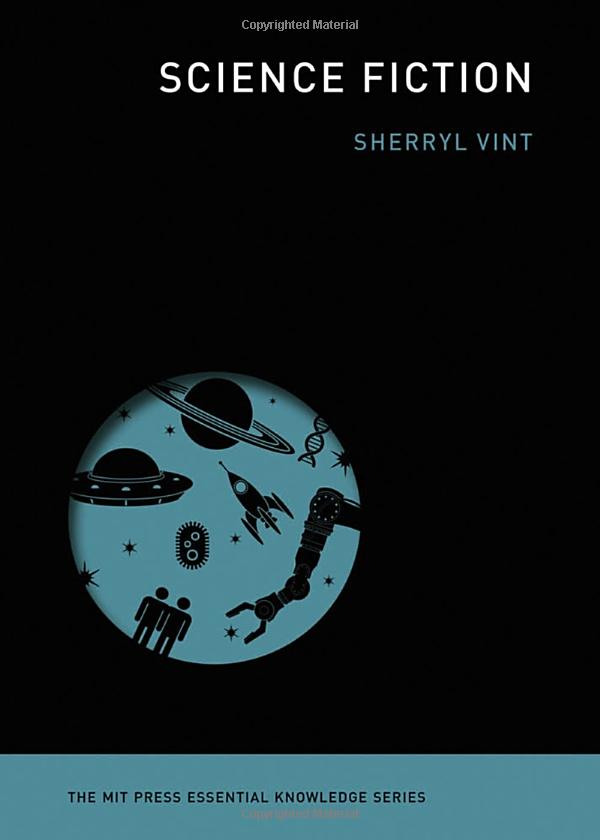
Sherryl Vint. Science Fiction. The MIT Press, 2021. The MIT Press Essential Knowledge Series. Paperback. 224 pg. $15.95. ISBN 9780262539999.

Sherryl Vint’s Science Fiction aims to provide a foundation for understanding science fiction (SF), both as a genre and as a pervasive, multifaceted cultural discourse. Surrounded as we are by rapid industrialization, hyper-networked communication, and complex sociopolitical issues, Vint writes, “it has become axiomatic to say that the world is becoming like science fiction… in ways both marvelous and malign” (2). Taking this as its starting point, the book serves as a sustained exploration of SF as a mode of thinking and cultural praxis. Deftly sidestepping arguments for yet another, ever-more-exact operational definition of what precisely SF is, Science Fiction instead takes a much more interesting track: focusing on the many things SF can do.

The overarching question, explored from multiple angles and disciplines, is simple: how can science fiction (and its derivatives) help people—from many walks of life—respond to and conceptualize the contemporary world? How and by whom is SF, and its myriad influents, being used as a powerful tool to imagine the world otherwise, both in terms of ‘hard’ science and in the service of culture, ethics, and social justice? Although Vint does her due diligence in laying the introductory groundwork of canon, influential writers, and milestones in the history of SF, she also makes it clear from the start that these histories are fraught, variegated, and messy, just like science and technology, governance and philosophical systems, and human history writ large. Vint follows many, multivocal threads of speculative possibility throughout the text, making connections between fields and time periods, and offering alternatives to common-knowledge understandings of SF and its canon. Science Fiction is not an exhaustive history of must-read works, nor does it dicker about the parameters of genre inclusion and definitional technicalities. Instead, it focuses on the outward expansion of SF and SF thinking– particularly in recent decades– and the ways it entangles itself within wider communities, discourses, and debates ranging far beyond the fiction itself. Science fiction, Vint contends, offers an important set of tools, an “everyday language” allowing people to think through and intervene in the myriad possibilities arising from “the world made otherwise” through rapid industrialization and technological change (4).

Although it would be impossible for any book to cover every aspect of SF and its offshoots, Vint nevertheless manages to enfold an impressively wide range of disciplinary fields and foci: the utopian tradition, futurology/speculative design, the colonial imaginary, AI and transhumanism, genomics and posthumanism, the Anthropocene, and speculative economics/financialization each receive their own dedicated chapter, and together make up the overarching organization of the book. However, the choice of these chapters (at the inevitable exclusion of others) is not as restrictive as one might think; each serves as a scaffold rather than a fencing-in and points the curious reader toward myriad supplemental sources. Vint is a thoughtful and courteous facilitator throughout, tipping her hat towards the various parties, artistic and cultural traditions, political agendas, scientific innovations, academic disciplines, and sociocultural impacts swirling around or bridging these conversations, even for matters she admits are beyond the scope of the book. In both form and content, Science Fiction upholds its (refreshingly pragmatic) thesis: that SF is an active and evolving mode of thought, better understood as a cultural praxis than as a static, definable canon (165).

One of the book’s many strengths is how it both actively challenges the widespread assumption that ‘hard’ SF is the gold standard to which the genre should be upheld, while also carefully tracing the history of editorial gatekeeping via which such ‘norms’ arose. Acknowledging that “there is a relationship between science fiction and science, albeit not the simple fantasy that science fiction inspired specific inventions” (45), Vint also points out the problematic, techno-determinist tendency for those in power to automatically equate all science and innovation with progress; the text offers examples of how SF (and SF scholarship) continues to have an important role in deconstructing such facile assumptions. It emphasizes the nonlinear, often co-iterative relationships between science fiction, scientists, innovators, entrepreneurs, artists, and social justice movements alike, all of whom engage, in various ways, with speculating the parameters of the possible. Vint’s straightforward, unapologetic discussion about the deeply colonial tendencies that creep through SF, on levels both historical and contemporary, is particularly well-executed here. Equally so is the book’s interest in the many countervailing voices challenging such hegemonies, particularly the rise of BIPOC, feminist, and queer SF as central to the discourse in recent decades.

Of course, an academic reader whose work focuses more narrowly will doubtless find points of contention, or problematic omissions, within a given chapter. Speaking for myself—colored by my own focus on the environmental humanities—Vint’s chapters on climate change SF, and on speculative finance/economics, felt somewhat rushed and rather curtailed in terms of complexity, particularly with regard to political critique. Indeed, despite its excellent discussion of racism and sexism in the history of SF, the book as a whole is oddly shy about addressing contemporary SF as activist praxis in terms of climate and class justice. For example, despite an extended discussion of Kim Stanley Robinson and his work that declares him “unquestionably the most important living sf writer addressing environmental themes” (134), Vint makes no mention of his (increasingly outspoken) environmental socialist politics. However, given its widely heterogenous target audience, where one can assume neither common cause nor shared vocabulary, and the book’s overall goals, the decision to remain somewhat politically hands-off is understandable. For this reason, the ‘further reading’ bibliography at the end of the book, along with a helpful glossary of terms, is an especially excellent addition.

In sum, Science Fiction is both enjoyable to read and genuinely useful as a teaching tool: equally appropriate for the undergraduate classroom, early-career scholars building knowledge foundations, and field-adjacent researchers looking for a primer on how sf intersects with their own work. The book sketches an outline of SF as a genre, and how it functions as a cognitive toolkit for the postindustrial world: a creative cultural form offering ways of thinking otherwise within the fraught, often-dystopic, technology-ridden 21st century.


R. Baker is an English PhD candidate at the University of California, Santa Barbara. Their work is situated at the intersections of the environmental humanities, contemporary science fiction, and feminist STS, with a focus on anticolonial and anticapitalist worldbuilding, particularly surrounding the social and technical infrastructures of climate justice, restoration and repair. Their current project focuses on contemporary narratives of space travel, exploration, and colonization; they are broadly interested in how these speculative scientific discourses, alongside science fiction, might also push against dominant narratives of conquest and control.