
Non-Fiction Reviews
Review of Science Fiction
R. Baker
Sherryl Vint. Science Fiction. The MIT Press, 2021. The MIT Press Essential Knowledge Series. Paperback. 224 pg. $15.95. ISBN 9780262539999.
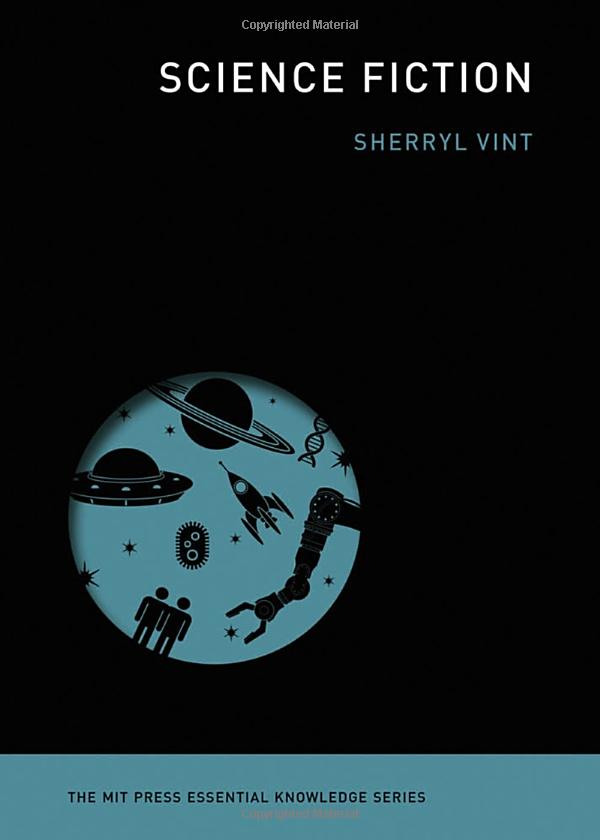
Sherryl Vint’s Science Fiction aims to provide a foundation for understanding science fiction (SF), both as a genre and as a pervasive, multifaceted cultural discourse. Surrounded as we are by rapid industrialization, hyper-networked communication, and complex sociopolitical issues, Vint writes, “it has become axiomatic to say that the world is becoming like science fiction… in ways both marvelous and malign” (2). Taking this as its starting point, the book serves as a sustained exploration of SF as a mode of thinking and cultural praxis. Deftly sidestepping arguments for yet another, ever-more-exact operational definition of what precisely SF is, Science Fiction instead takes a much more interesting track: focusing on the many things SF can do.
The overarching question, explored from multiple angles and disciplines, is simple: how can science fiction (and its derivatives) help people—from many walks of life—respond to and conceptualize the contemporary world? How and by whom is SF, and its myriad influents, being used as a powerful tool to imagine the world otherwise, both in terms of ‘hard’ science and in the service of culture, ethics, and social justice? Although Vint does her due diligence in laying the introductory groundwork of canon, influential writers, and milestones in the history of SF, she also makes it clear from the start that these histories are fraught, variegated, and messy, just like science and technology, governance and philosophical systems, and human history writ large. Vint follows many, multivocal threads of speculative possibility throughout the text, making connections between fields and time periods, and offering alternatives to common-knowledge understandings of SF and its canon. Science Fiction is not an exhaustive history of must-read works, nor does it dicker about the parameters of genre inclusion and definitional technicalities. Instead, it focuses on the outward expansion of SF and SF thinking– particularly in recent decades– and the ways it entangles itself within wider communities, discourses, and debates ranging far beyond the fiction itself. Science fiction, Vint contends, offers an important set of tools, an “everyday language” allowing people to think through and intervene in the myriad possibilities arising from “the world made otherwise” through rapid industrialization and technological change (4).
Although it would be impossible for any book to cover every aspect of SF and its offshoots, Vint nevertheless manages to enfold an impressively wide range of disciplinary fields and foci: the utopian tradition, futurology/speculative design, the colonial imaginary, AI and transhumanism, genomics and posthumanism, the Anthropocene, and speculative economics/financialization each receive their own dedicated chapter, and together make up the overarching organization of the book. However, the choice of these chapters (at the inevitable exclusion of others) is not as restrictive as one might think; each serves as a scaffold rather than a fencing-in and points the curious reader toward myriad supplemental sources. Vint is a thoughtful and courteous facilitator throughout, tipping her hat towards the various parties, artistic and cultural traditions, political agendas, scientific innovations, academic disciplines, and sociocultural impacts swirling around or bridging these conversations, even for matters she admits are beyond the scope of the book. In both form and content, Science Fiction upholds its (refreshingly pragmatic) thesis: that SF is an active and evolving mode of thought, better understood as a cultural praxis than as a static, definable canon (165).
One of the book’s many strengths is how it both actively challenges the widespread assumption that ‘hard’ SF is the gold standard to which the genre should be upheld, while also carefully tracing the history of editorial gatekeeping via which such ‘norms’ arose. Acknowledging that “there is a relationship between science fiction and science, albeit not the simple fantasy that science fiction inspired specific inventions” (45), Vint also points out the problematic, techno-determinist tendency for those in power to automatically equate all science and innovation with progress; the text offers examples of how SF (and SF scholarship) continues to have an important role in deconstructing such facile assumptions. It emphasizes the nonlinear, often co-iterative relationships between science fiction, scientists, innovators, entrepreneurs, artists, and social justice movements alike, all of whom engage, in various ways, with speculating the parameters of the possible. Vint’s straightforward, unapologetic discussion about the deeply colonial tendencies that creep through SF, on levels both historical and contemporary, is particularly well-executed here. Equally so is the book’s interest in the many countervailing voices challenging such hegemonies, particularly the rise of BIPOC, feminist, and queer SF as central to the discourse in recent decades.
Of course, an academic reader whose work focuses more narrowly will doubtless find points of contention, or problematic omissions, within a given chapter. Speaking for myself—colored by my own focus on the environmental humanities—Vint’s chapters on climate change SF, and on speculative finance/economics, felt somewhat rushed and rather curtailed in terms of complexity, particularly with regard to political critique. Indeed, despite its excellent discussion of racism and sexism in the history of SF, the book as a whole is oddly shy about addressing contemporary SF as activist praxis in terms of climate and class justice. For example, despite an extended discussion of Kim Stanley Robinson and his work that declares him “unquestionably the most important living sf writer addressing environmental themes” (134), Vint makes no mention of his (increasingly outspoken) environmental socialist politics. However, given its widely heterogenous target audience, where one can assume neither common cause nor shared vocabulary, and the book’s overall goals, the decision to remain somewhat politically hands-off is understandable. For this reason, the ‘further reading’ bibliography at the end of the book, along with a helpful glossary of terms, is an especially excellent addition.
In sum, Science Fiction is both enjoyable to read and genuinely useful as a teaching tool: equally appropriate for the undergraduate classroom, early-career scholars building knowledge foundations, and field-adjacent researchers looking for a primer on how sf intersects with their own work. The book sketches an outline of SF as a genre, and how it functions as a cognitive toolkit for the postindustrial world: a creative cultural form offering ways of thinking otherwise within the fraught, often-dystopic, technology-ridden 21st century.
R. Baker is an English PhD candidate at the University of California, Santa Barbara. Their work is situated at the intersections of the environmental humanities, contemporary science fiction, and feminist STS, with a focus on anticolonial and anticapitalist worldbuilding, particularly surrounding the social and technical infrastructures of climate justice, restoration and repair. Their current project focuses on contemporary narratives of space travel, exploration, and colonization; they are broadly interested in how these speculative scientific discourses, alongside science fiction, might also push against dominant narratives of conquest and control.


