Slavic Folklore, Communism, and Time: Lyuben Dilov


Slavic Folklore, Communism, and Time: Lyuben Dilov

Andy Erbschloe

.

Bulgarian fantasist Lyuben Dilov died in 2008, but his humanist tech-magic satires live on and provide a glimpse into a segment of Soviet-era intelligentsia who were dutifully ridiculing the excesses of the West while also lampooning their own self-appointed leaders behind a veneer of distant stars and time machines.

Translating any older book well demands familiarity with the context of its writing and the audience it was written for. But SF, in theory, should be more forgiving. Being inherently futurist and instructive or at least cautioning, it should escape its substrate and offer its audience a future less burdened by the contemporary shackles that bind reader and author alike. It’s not cynicism! Proper science-fiction just isn’t written about how great your society is now. Imagine: Let’s keep doing this! Forever! In every corner of the universe!

Following that logic, translating an old time-travel book should be even easier, in theory; especially one conveniently structured with well-known elements of Slavic folklore. Lyuben Dilov’s Unfinished Novel of a Student spans four millennia. It was submitted to the Bulgarian state publisher in 1985. And as its translator, contrary to logic, I find that it isn’t even clear if my obligation is to the readers of the ’80s, the ones of today, or the ones in the twenty-fourth century. I’m worried that it might be all three.

Over thirty years after its publication, it took about three years to translate Unfinished Novel to English. Our language changed in the thirty; and about the same amount in the three. For example, in the past, you may have been frightened to discover someone “following” you. The Oxford English Dictionary(OED) changed it in 2020 to be a good thing. In 2021, they revised the entry for “mass extinction”, so these things aren’t completely devoid of semantic consequence. Dilov didn’t write about mass extinction in this book, an unforgivable sin for any SF writer in our own era. In the 1980s, Dilov and his colleagues were tasked with writing “socialist realism” about the future as a place of universal abundance and equality. In 2022, OED added an entry for “energy poverty”.

Socialist realism, the prevailing philosophy dispersed by the Ministries of Culture of the various Soviet-ized states, saw art as a tool to build the ideal citizen, and their science-fiction was no different. There was no mandate to explore the furthest bounds of technology, only a mandate to create the ideal citizens to be responsible for that technology. So when Isaac Asimov has two robots having a conversation with each other, that would essentially be outside the genre of “speculative fiction”, the SF/fantasy of the Soviet world that utilized familiar, localized human structures like folk tales and myths.

In Unfinished Novel, the borrowed Slavic folk structure in turn borrows heavily from sci-fi tropes and scenarios. Lyuben Dilov wrote this about originality in his 1981 novel, The Missed Chance

…originality is not contained in the unrepeatableness of a given plot or situation – the question is what you express through it.

We’re fortunate for Dilov’s forgiveness. Isaac Asimov’s short story “Cal”(1991) is remarkably similar to The Missed Chance. I wonder if Asimov read the Russian translation?

I made all Dilov’s talking computers genderless, and I made other “contemporary” linguistic choices, mostly related to gender. The decidedly non-English source challenges the translator to imitate the texture of the original’s lexical choices. Translator Brian Nelson uses the term “creative imitation”. But the heaviest lifting of bringing the future of the past to this present now is matching the cadence, and that’s all in the context.

Dilov excuses himself from any technical continuity errors right from the introduction,

Let the reader not worry if some things seem unmotivated and unclear, they also seem so to the author…

and the translator asks only this same consideration because no human knows the secrets of time, right?

Well, in Slavic folklore, Baba Yaga knows them. And in Unfinished Novel, the Professor of Temporal Flight knows. Everyone who comes into contact with foreign times must have their memories wiped; everyone but him. By Dilov’s time, Soviet state atheism had degraded the Christianity that had corroded Baba Yaga’s paganism before it. So Dilov’s professor hearkens back to the dual-natured Baba Yaga of pre-Christian folklore: both creator and destroyer, bridge between the living and the dead, lacking free will. Completing the allegory, Baba Yaga is often depicted as the goddess of masculine-femine duality and of time.

But history books and propaganda movies, not only religions, are also used to nudge society towards desired change. We find that not only our hero Cyana but also her twentieth-century beloved, at various times, find employment as historians. This allows Dilov to hint that maybe historians are flawed humans too, despite whatever era they write from or about.

Another facet of Slavic folklore is the appearance of three brothers, and this is rather clearly reflected in the three men Cyana encounters off course in her malfunctioning chronolet. When faced with the unimaginable future girl and her chronolet, the first two are tried and found wanting. Just like in the tales, the third is the fool who turns out wise in the end. This one was the historian, now changed professions to, guess what… a SF writer. But rather than him saving the damsel from the dragon, it’s Cyana who comes back to retrieve him from the wastelands of the twentieth century, easily defeating the dragon (his wife) with her future judo.

Dilov did foresee Cyana’s multifunctional smart watch but not the “selfie” which entered English way back in 2014 alongside “wardrobe malfunction”. Cyana does experience “wardrobe malfunction”, however, on a few occasions along her journey: not understanding why her skirt is too short for rush hour in “contemporary” communist Sofia, or why Praxiteles shouldn’t sculpt her fully nude in tyrannical ancient Athens. This is Dilov’s take on the conflicting mores and virtues of disparate societies and how their hypocrisies, if there are any, always look sillier from a distance. And fittingly, even some of Dilov’s own ideas about decency may have already fallen out of favor by now.

Coincidentally, Dilov was the first to formulate a Fourth Law to supplement Asimov’s Three, preceding Asimov’s own Zeroth Law by nine years (The Path of Icarus (1976), Robots and Empires (1985))

Dilov excuses himself from any technical continuity errors, but he then constantly reminds the reader that you won’t get any disclaimer like that from a historian, no matter the number of their Laws.

An Excerpt from the Introduction to Unfinished Novel

In this novel, we’ll be describing the adventures of a history student from the twenty-fourth century. We’ll go on to discuss the machines of time and also time’s messes which cannot but occur when people and machines meddle in its course. Let the reader not worry if some things seem unmotivated and unclear, they also seem so to the author. For, time is the foundation of clarity in our lives – if it gets mixed up, the natural order of everything gets mixed up.

But this natural order of things is not actually natural at all. Humans have invented their own time; they’ve forged it into shelves, racks, cupboards, and chests of drawers to arrange in them, one after another, the works of their own hand – and works not made by hands too – while real, universal time is probably just one shelf with no beginning and no end, so that no matter where you set something on it, you will still never know exactly where it’s located. That’s why, with the invention of the time machine, humans would confuse only their own time, not universal time. In universal time, it wouldn’t be illegal at all for a novel like this one to not look like a novel and to begin, for example, with its third chapter instead of its first. And it is not illogical for it to remain incomplete because, even according to the laws of our thinking, for the reader of today, it isn’t possible for a given action or event which will occur in several centuries to be completed.

Therefore: do not blame the author for the mess he dared present to you! It is ours, it is human


From the Vice President


SFRA Review, vol. 53 no. 2

From the SFRA Executive Committee


From the Vice President

Ida Yoshinaga

The burgeoning excitement for our annual summer conference, evidenced by greater numbers of paper and panel proposals received for last year’s vibrant gathering in Oslo, and now for the upcoming Dresden 2023 meeting (including those submitted by in-person attendees of the latter), invigorates again the pressing question of how to expand science-fiction studies past our default Western and Global North circuits, to encompass speculative-fiction production and reception in other parts of the world.

From suggestions by members of our SFRA country representatives group, by our general membership, and by global CoFutures colleagues in Norway, we on the Executive Council have expanded these representatives to include SFRA members from China (Regina Kanyu Wang), Ireland (Thomas Connolly, pulling double duty as webmaster), Portugal (Tânia Cerqueira and Manuel José Sousa Oliveira), the Philippines (Gabriela Lee, also our At-Large Executive Committee member), in addition to adding reps of our Australia group (Yimin Xu).

Welcome representatives! If you’ve suggestions for more dedicated SFRA folk who can meet virtually 3-4 times a year; share what’s going on with sf production in their own regions, nations, or languages (such as conferences, publications, events, and trends); and advise the EC on ideas for the international future of the organization among other matters, please contact Hugh O’Connell, myself, or other members of the EC.

Here’s our current list of country reps: https://sfra.org/country-representatives/

At the International Conference of the Fantastic in the Arts a few months ago in March, the International Association for the Fantastic in the Arts BIPOC Caucus held sessions on exploring global methodologies and theories for speculative genre and media. Inspired by the annual theme that underscored contributions from Africanfuturism and Afrofuturism to our evolving discourse on fantastic and speculative arts, as well as by cross discussions that have been arising in Indigenous Futurism and Latinx Futurism, the Caucus has been trying to reach beyond the standard Suvinian and Todorovian conceptualizations of our family of non-real and semi-real genres. Researchers Suparno Banerjee, Nicola Hunt, Taryne Taylor, Candice Thornton, and Guest Scholar Isiah Lavender III discussed topics such as postcolonial and Indigenous terminologies, translation challenges, diversity of regional production, and continuity of spirituality in transnational diaspora.

This August, we expect that both the Executive Committee’s sponsored sessions will follow these worldwide sf themes. They are: two professional-development panels for early-career scholars, including one made up of international postdocs and graduate students looking for work in the global job market; and one diversity, equity, inclusion, and belonging session themed to decolonial and Indigenous Futurist speculative methodologies and related research protocols. Additionally, panel proposals accepted include one similar to the ICFA global theories/methods discussion, put together by German cultural studies scholar Sonja Fritzsche and her colleagues from Peter Lang Publishing’s World Science Fiction Series (on which board I happen to belong).

What is world science fiction? Hoping you can share your mindful, enriching responses this summer with us at TU Dresden, “disrupting” conventional imagination.


From the President


SFRA Review, vol. 53 no. 2

From the SFRA Executive Committee


From the President

Hugh O’Connell

As I look out my office window here in Boston and notice the trees starting to bud, my mind turns to two things: the end of the Spring semester and the annual SFRA conference. This year, as part of our efforts to increase the SFRA’s international representation, we’re partnering with der Deutschen Gesellschaft für Fantastikforschung (the German Association for Research in the Fantastic, or GfF) for the joint Disruptive Imaginations Conference.

After attending the virtual 2021 conference hosted by Graham J. Murphy and Seneca College and missing out entirely on the 2022 conference hosted by Bodhisattva Chattopadhyay and the CoFutures collective due to contracting Covid-19, I’m very much looking forward to attending the Disruptive Futures conference in-person, while also taking part in the virtual programming. The organizers have received a stunning number of proposals from an international pool of applicants, and we’re quite optimistic that the conference will continue the ongoing work of globally expanding the SFRA by bringing this internationally diverse array of scholars into conversation with one another.

By now, everyone who sent a proposal should have heard back from the selection committee, but if for some reason you are still waiting, please contact the conference organizers, Julia Gatermann and Moritz Ingwersen at disruptive.imaginations@tu-dresden.de. And for those attending the conference in-person, as you begin to make your travel plans, make sure to check out the resources that the organizers are providing at the dedicated conference website: https://disruptiveimaginations.com. Here, you can find information in both English and German about accommodations, getting around Dresden, and some of the special events that are being planned for both in-person and virtual conference attendees, with more information to be added as we get closer to the start of the conference. And speaking of planning, we’ll be contacting the recipients of the SFRA’s travel grants in the first week of May.

Looking ahead, we’re scheduling another European conference in Estonia in 2024, before heading back to the United States for 2025 and 2026. The SFRA depends on volunteer conference organizers; so, if you would like to see the conference come to your area, please consider putting in a bid to host the conference (the SFRA is currently taking proposals for 2027 and beyond). You can contact me directly, and I’ll be happy to discuss what hosting the conference entails and how to go about putting a proposal together. Even if you are only curious at this stage, please feel free to reach out!


Spring 2023


SFRA Review, vol. 53 no. 2

From the SFRA Review


Spring 2023

Ian Campbell

Our unevenly-distributed science fiction future continues to expand with the advent of “AI”, which is of course not AI but merely a well-trained algorithm. I spent a long Friday last week wishing I was outside enjoying spring weather but instead sitting through first a departmental, then a college meeting about how to cope with the effect of AI on student testing. Looks like we’re headed back to pens and bluebooks and oral exams. Left unsaid was the effect this will have on faculty, especially in face of the concerted right-wing assault on higher education.

But I’ll leave aside the doom and gloom and direct your attention to a couple of opportunities. We here at the SFRA Review are looking for some additional editors, both to expand our offerings and also to take the place of some of our current wonderful editors when they decide to rotate off. This is a great opportunity for an early-career scholar, whether they be ABD or a new faculty member. The workload isn’t tremendous, you’ll have plenty of creative freedom and autonomy, and you can (further) establish your bona fides by contributing to the discourse and profession. Please contact me at icampbell@gsu.edu should you be interested, and we’ll talk further.

On a more personal note, I’d also like to plug the CFP for SF in Translation, vol. 2. There have been some impressive submissions for this edited volume, but the overall quantity isn’t where we’d like it to be: two or three more chapters will help this one over the top and bring this valuable scholarship to the general public. This is another great opportunity for an early-career scholar, though in no way would we be displeased to see established experts submit chapters. Please pass the CFP around among your colleagues.


Review of Elder Race


Review of Elder Race

Lucy Nield

Tchaikovsky, Adrian. Elder Race TorDotCom, 2021.

.

Adrian Tchaikovsky’s 2021 novella, Elder Race, is a beautifully constructed cocktail of fantasy and speculative fiction. Much like Tchaikovsky’s previous works, including the Arthur C. Clarke award-winning Children of Time (2016) and the BSFA-winning Shards of Earth (2021), Elder Race considers the future of humanity away from planet Earth. The story begins on Sophos 4, a planet colonized by humanity around 1,500 years ago. Over time, the modified humans who call Sophos 4 home have forgotten their ancestors’ science and all tales of Earth, or “the otherworld,” have slowly ceased to exist (111). In the space left void of science and Earth knowledge, a new culture and language emerges in the surviving communities. It is a seemingly primitive culture, with a strong belief in magic and “ancient creators who had, the stories said, placed people on the world and taught them how to live” (35). Those who live on Sophos 4 believe that there is one of the ancient sorcerers left on the planet, the last of the Elder Race, who has lived in a local tower for centuries and can only be called upon when there is a threat from old magic, which only he can understand.

The novella’s narrative is split in two, starting with Lynesse, the fourth daughter of the Queen of Lannesite, one of the domains on Sophos 4. Lynesse leads a life she believes is purposeless. As the fourth daughter, she is far from being next in line for the throne, and her unshakable belief that she is a disappointment to her mother seems to influence her every move. She vehemently believes the old stories of her ancestor, Astresse Regent, who awoke the last of the ancients, Nyrgoth Elder. The stories say that Astresse summoned Nyrgoth Elder from his tower and together they fought the evil Magic that was awoken by the warlord Ulmoth. The ancient sorcerer banished the mechanical monster that Ulmoth controlled, and together Astresse and Nyrgoth Elder were victorious. Now that a “new power has arisen in the Ordwood that men say is a demon who steals minds,” Lynesse climbs to the Elder Tower to seek the sorcerer’s help as her ancestor did a century earlier (37).

The other half of the narrative is from the perspective of Nyr Illiam Tevitch. An “anthropologist second class of Earth’s Explorer Corps,” he is centuries old and light years from home (25). Nyr came to Sophos 4 over three centuries ago as part of a team of anthropologists; expected to observe and study the descendants of the original colonists, they were “sent to watch and not act” (147). Nyr has been alone in what remains of his team’s outpost for centuries; with “no word for two hundred and ninety-one years,” Nyr has spent most of the time sleeping, depending on the outpost’s suspension facilities to keep him alive (26). After a couple of centuries sleeping in the suspension pods in the outpost, Astresse Regent comes to him, asking for help, and against his better judgement he agrees. He falls in love with Astresse and considers staying with her. Instead, he ultimately chooses to return to his suspension pod, promising Astresse that should her family be in peril again, they can come to him. It is hard to know if he regrets his decision to leave Astresse; he thinks of her as “a woman of primitive culture who could never have understood what I am, and yet magnificent, radiant. And I had been alone for so long by then” (31). Perhaps trying to denounce the affection he once felt, he diagnoses it instead as a symptom of his loneliness.

As soon as Nyr (Nyrgoth Elder) and Lyn (Lynesse Fourth Daughter) meet, there is a jarring and undeniable language barrier and cultural differences. These lead to miscommunication and trouble understanding one another emotionally, with the differences in linguistic nuance and common vernacular (on both sides) being constantly misunderstood or overlooked. The split narrative provides insights for the reader to comprehend the intention of each character, as does much of the dialogue, but the language barrier remains intact throughout. The “linguistic chasm,” as John Folk-Williams calls it, between Lyn and Nyr is a side effect of the passing of time, but it also highlights the stark differences in belief constructs and local social norms. Many examples litter Nyr’s and Lyn’s interactions, but there are a few of note.

Nyr tries and fails to explain to Lyn and her companion, Esha Free Mark, that he is in fact not a sorcerer. There are simply no appropriate terms in Lyn’s language for what Nyr understands as “scientist,” or “scholar,” so when he states these signifiers, “in their language, these are both cognates for wizard” (85). Nyr’s hypothesis is that, should he attempt to dispel Lyn and Esha of their belief that he is an ancient wizard, he might end up saying “I’m not a wizard; I’m a wizard, or at best a wizard,” an imagined interaction that he finds less than amusing (85). Whilst this is a valid obstruction in their communication, which prevents Nyr from explaining that he is an anthropologist and not a wizard, Tchaikovsky appears to forget that the term and “scholar” and its appropriate definition do not exist for Lyn, which was a slight surprise. Throughout Tchaikovsky’s work, he shows a skill for consistency within the lore of his novels, never forgetting or making errors. However, in this novella he states that the term “scholar” referring to a specialist in a particular branch of research, does not exist for Lyn or the other inhabitants of Sophos 4, but Lyn does use the term slightly later in the text within the same context that Nyr would use it to define himself. This small, perhaps overlooked, slip was something I never thought I would notice in any of Tchaikovsky’s work and hope never to notice again (109). Regardless of this, the difficultly Nyr encounters in his attempt to explain his position continues, and he struggles on to try to explain who he is to Lyn and Esha. He decides to break the rules of anthropology, to tell the ‘true story,’ hoping that they will be able to understand (110). Unfortunately, the language barrier holds fast, and whilst he tries to explain that humans travelled to Sophos 4 from Earth, they hear something else entirely.

Nyr tells stories of humans arriving from Earth, then adapting to their new planet, engineering body modifications for humans and the native livestock, as well as the machinery used in the colonisation process, but all Esha and Lyn hear is that the Elders used “magic” to travel from the “otherworld” (111) and began “teaching the beasts and plants their place, naming them and giving them their roles,” and about the “monsters” that did the will of men (112). Nyr tries his best to remove magic from the conversation, but once he is finished, Lyn simply states, “yes, that is how we tell it,” unable to grasp the concepts he has tried so delicately and desperately to explain (115).

The juxtaposition of Nyr and Lyn is remarkably insightful. In emphasising the generational differences and language barriers, Tchaikovsky successfully dramatizes the ideas surrounding witchcraft being an early version of medical science, or the well-known Arthur C. Clarke phrase that any sufficiently advanced technology is indistinguishable from magic. In this novella, Tchaikovsky uses this concept to highlight the difficulties confronted when attempting to cross technological, cultural and language barriers, as well as dramatically different belief systems. In doing so, Tchaikovsky also illuminates the distinctions between Fantasy and SF narratives, and by blending the two genres into one novella he makes it extremely difficult to speculate on the story’s outcome. When approaching a text of either genre, one holds certain expectations or assumptions, which are immediately useless when reading a novella that combines the two.

Unlike some of Tchaikovsky’s other texts, there are fewer allusions than one might expect. Whilst there are some of the usual tropes such as suspension pods, the use of technology to regrow or augment body parts, and someone being very far from home, one might not notice the key text that influences Elder Race unless they take a look at the dedication in the front of the book. In the dedication, Tchaikovsky nods to the late Gene Wolfe and his story “Trip, Trap,” which was the novella’s major inspiration. Constructed as two intercutting narratives, much like Elder Race, the story follows Garth the son of Garth in a fantasy-medieval setting (which is not dissimilar to Lynesse Fourth Daughter) and Dr. Morton Finch, a field xenoarchaeologist investigating possible ancient spacefaring technology. Whilst the narratives are quite different, their structures, focuses on magic, generic combinations, and constructed barriers are similar. The significance of this intertextual connection reveals much about Tchaikovsky and his skills as a writer, as well as the impact of manipulating genre. In his other works, he often utilises puns or alludes to other works in a clever and whimsical way for apparently humorous reasons. However, in using “Trip, Trap” in such an opaque manner, he reveals that his skills move beyond amusing allusions, whilst also illuminating the impact one can have when they blend genres, particularly disrupting expectations and dramatizing the apparent and somewhat noticeable correlation between what can be understood as science and what is viewed as magic.

Elder Race is an emotional novella, and through the narrative Tchaikovsky does what he does best, exploring the future humans might have away from Earth. With this text, Tchaikovsky reminds us that although he has crafted inspiring and award-winning SF novels, he is also an imaginative fantasy writer. Using the inspiration of Wolf’s intercutting narratives as a starting point for his own work, Tchaikovsky creates a story with feeling, magic, and science. Whilst one might find this text frustrating due to its characters’ failure to communicate, the novel confirms what we already know: Tchaikovsky is a commanding, imaginative writer, who can master and manipulate genre is any way he sees fit.


WORKS CITED

Clarke, Arthur C. Profiles of the Future: An Inquiry into the Limits of the Possible. Indigo, 2000.

Folk-Williams, John. “Elder Race by Adrian Tchaikovsky – A Review.” Scifi Mind, www.scifimind.com/elder-race-by-adrian-tchaikovsky/. Accessed 28 December 2022.

Wolf, Gene. Storeys from the Old Hotel. Ord Books, 1995.

Lucy Nield is a PhD student and GTA in the Department of English Literature at the University of Liverpool. Her research interests include dog-culture, posthumanism and the Anthropocene within contemporary speculative fiction. She has been an organizer for the Current Research in Speculative Fiction conference at the University of Liverpool since 2019 (@CRSFteam) and is a regular contributor to The Fantasy Hive (@TheFantasyHive). Lucy is an active member of the Olaf Staple Centre (UoL), has been published in Foundation (2021 & 2022) and SFRA (2019 & 2022), with a pending chapter for Bloomsbury’s ‘Future Werewolf,’ (2023), a pending article for Comparative American Studies: An International Journal (2023), as well as a special collection with Extrapolation (2023).

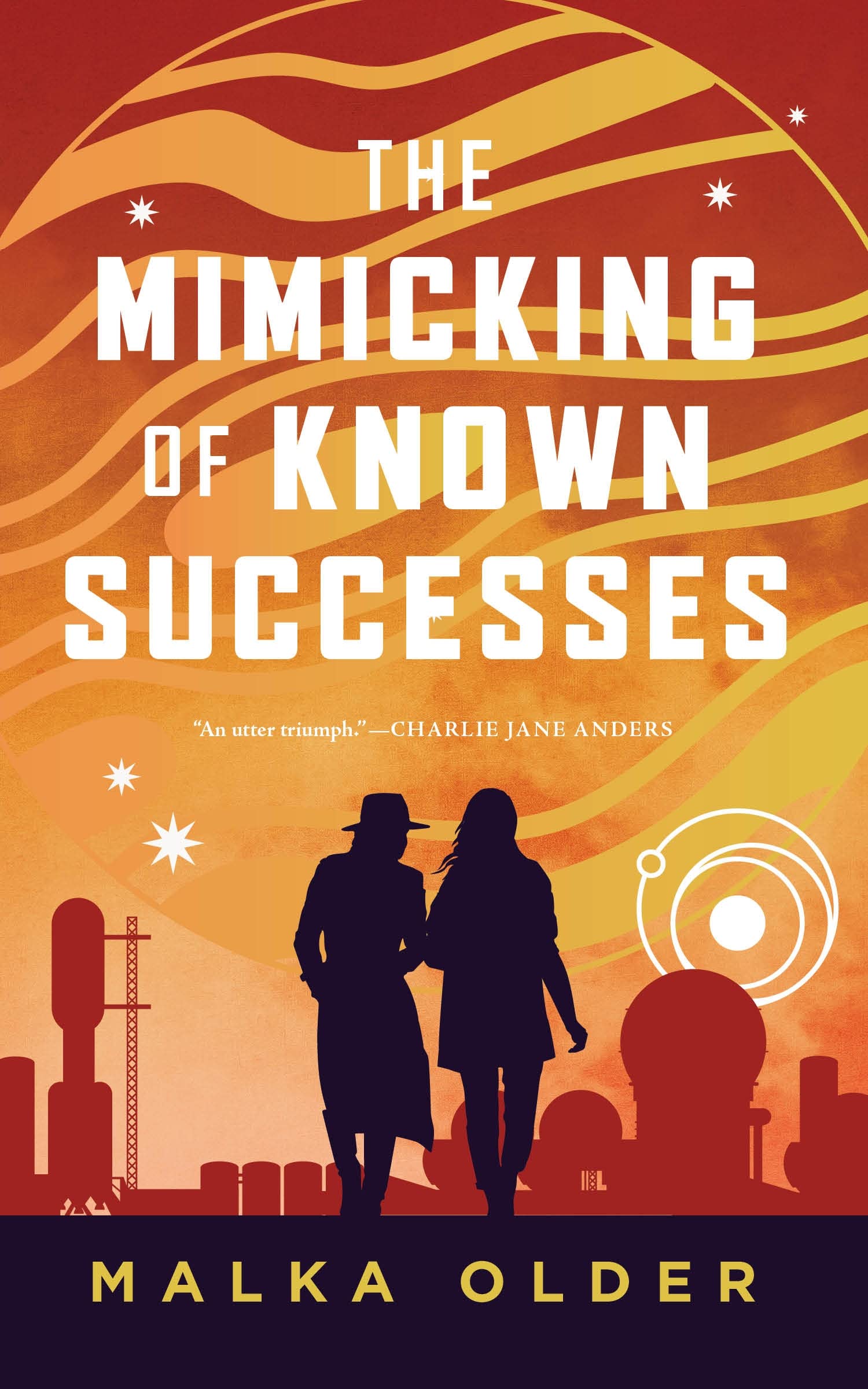
Review of The Mimicking of Known Successes


Review of The Mimicking of Known Successes

Jeremy Brett

Older, Malka. The Mimicking of Known SuccessesTordotcom, 2023.

.

The science fiction detective story is a subgenre with a most respectable line of ancestry and descent: its conventions of the world-weary sleuth or law enforcement agent, the femme fatale (or homme fatale), the uncovering of deadly secrets, the exposure of the seamy and corrupt underbelly of society—all woven into tapestries of fantastical and futuristic settings—have been explored in a myriad of works. We see it in stories ranging from Asimov’s The Caves of Steel and Dick’s Do Androids Dream of Electric Sheep? (whose noir elements became turbocharged in the 1982 film adaptation Blade Runner)to Rusch’s Retrieval Artist series, Morgan’s Altered Carbon, Mieville’s The City and the City, Chabon’s The Yiddish Policeman’s Union, and Scalzi’s Lock-In. Why the SF and detective genres have mixed in such fruitful combinations might be connected to their mutual concern with the truth of things: detective stories, from the most simplistically pulpy to the most cleverly devised, are tales of uncovering truths, the truths of personal lives, of relationships, of the motives driving people to extremes, and of how societies and their structures (governments, law enforcement, corporations, capitalism) operate in the “real world” in opposition to ideals of law and justice. The best traditions of SF also look towards the exploration of truths—how things such as scientific advancements, encounters with the alien Other, or even simple contact with the unforgiving, hard vacuum of deep space cause human beings to reexamine themselves and their place in the universe and to make revelations about the truth of our existence.

Malka Older is no stranger to stories in which the hidden is uncovered or in which truth becomes a crucial resource. Her Hugo-nominated Centenal Cycle (Infomocracy, Null States, and Plate Tectonics, 2016-2018) explores a near-future Earth whose planetwide political system consists of constantly shifting microdemocracies that depend on information flows for their very existence – the truth of which has nation-changing potential. And she has co-created/co-written several streaming serials—Orphan Black: The Next Chapter and Ninth Step Station, the latter of which is a series of literal detective stories—whose primary themes include the harm done to innocents through deliberate informational occlusion by the powerful. Drawing upon these traditions, Older brings readers a new and honorable addition to the SF detective tale: The Mimicking of Known Successes. An impactful opening sets the tone and the expansive exoticism of the novella’s setting:

The man had disappeared from an isolated platform; the furthest platform eastward, in fact, on the 4°63’ line, never a very popular ring. It took Mossa five hours on the railcar to get there, alone because none of her Investigator colleagues were available, or eager, to take such a long trip for what would almost certainly be confirmation of a suicide.

The platform appeared out of the swirling red fog, and moments later the railcar settled to a halt at what could barely be called a station. Mossa, who had not been looking forward to the long trip herself, had nonetheless passed it in a benevolent daze, looking out at the gaseous horizon that seemed abstractly static and as it moved in constant strange patterns. Once disembarked, she found the rhythm of talking to people on the platform only with difficulty. (Prologue)

At once the necessary economy of information is provided: we have a possible crime, certainly a mystery. We have a detective, one dogged and curious enough to take on a case in which others see no promise, a detective who does not relate well to other people. And we have a setting that is at once familiar to mystery readers: the investigator disembarking from a train into a crime scene. But Older immediately puts an SF spin on this by dropping the reader without warning into a world we instantly know not to be our own. Mimicking is set in a far future, where humanity has fled an environmentally ravaged Earth and set up a ring-structured colony called “Giant” that orbits Jupiter. But within this extraordinarily evocative setting, Older weaves a tale consisting of multiple strands: a “cozy” mystery (one where bloody or extreme violence is generally eschewed); a story of academic life, with all the intrigue and internal rivalries those stories tend to feature (most of the novella is set in the area of Valdegeld University, a center of scholarly tension between rival Moderns, Speculatives, and Classics); and a Holmesian pastiche, in which brilliantly cerebral and peerlessly logical Investigator Mossa teams up with Classic Scholar Pleiti, the novella’s narrator and source of emotional comfort, occasional inspiration, and eventually, romantic connection for Mossa.  

Several kinds of truths are laid bare over the course of Mimicking. The most obvious and relevant to the detective genre of which the novella is unquestionably a part, is that of the mystery itself: the whereabouts and fate of arrogant Scholar Bolien Trewl, last seen at the very platform Mossa arrives at as the story opens. But moving farther along the novella’s ring, Moss and Plieti also uncover truths about their own needs for romantic human connection—it is heart-wrenching to watch Pleiti hesitantly expressing, if only to herself, her desire for Mossa while Mossa responds for much of the novella with tempting, teasing closeness that belies her own deep yearning. In the end, the most profound truths may be less the ones that come at the end of a chain of evidence or a series of clues, and more the ones that reveal things about ourselves as living, connected human beings. In a scene close to the novella’s end, Mossa and Plieti confront their mutual attraction, something both characters take pains to avoid before this pivotal moment.

“Mossa. Mossa. You are doing important work. And – and –  and I don’t know anything about Investigator culture, but I could tell your colleagues respect you, admire you even. And you have your own home in this beautiful city. You have changed since university, even if not exactly in the way I – and mostly – and mostly I don’t care.”

“You don’t?”

I should have, I knew that, but I couldn’t. “I don’t.”

“Does that mean – do you mean – Plieti, might I kiss you?”

“Yes,” I said in a rush, and threw my arms around her.

But the most crucial truths within the novella’s own universe involve rival interpretations of humanity’s future in space. The eventual return to a reconstructed Earth is a common dream on Giant—much of the story, for one, circles around the Koffre Institute for Earth Species Preservation, a sanctuary for genetically-reconstructed Earth plants and animals maintained as a resource for the eventual reseeding of a renewed Earth. It is a topic of crucial importance, but on Giant beliefs in its immediacy and practicality become the source of extreme and dramatic tension. As a Classical Geography Scholar, Pleiti studies ancient Earth history as part of a long-range collective plan to re-create the old Earth, but other factions see the truth elsewhere. Pleiti exclaims to a rival Scholar at one point, “You are going to overturn years, decades of planning for Earth reanimation, delay the time when we can finally go back” to which her enraged colleague replies, “It’s never going to be Earth!… Not the Earth that you Classicists deify! It’s never going to be exactly like it was before, and that means you’re never going to be willing to let us get back there.”

Which truth about humanity’s return home is closer to objective reality? Does a colony-wide reconstructive endeavor planned and carried out over decades, if not centuries, better resemble the truth of the situation, or should impulsive, individual decisions rule the day? The truth, as with most things, lies somewhere in the middle, Older tells us. Or, as Mossi puts it, “[A]ttempting to approximate an idealized past is most certainly both futile and foolish, but individually disrupting what absolutely must be a collective endeavor is no better, and selfish as well.” The same sort of collectivist vs. individualist tension marks Older’s Centenal Cycle, and we also see echoes of it in detective fiction, where individual decisions based on impulse and passion and idiosyncratic interpretations of the truth give birth to crime, and where lone investigators must solve crimes for the common good. It is in these concerns with the tensions of warring truths, as well as the expertly drawn Holmes-Watson relationship of Mossa and Pleiti, that we see how beautifully and skillfully The Mimicking of Known Successes follows in the footsteps of the best of both SF and detective fiction.


Jeremy Brett is an Associate Librarian at Cushing Memorial Library & Archives, where he is both Processing Archivist and the Curator of the Science Fiction & Fantasy Research Collection. He has also worked at the University of Iowa, the University of Wisconsin-Milwaukee, the National Archives and Records Administration-Pacific Region, and the Wisconsin Historical Society. He received his MLS and his MA in History from the University of Maryland – College Park in 1999. His professional interests include science fiction, fan studies, and the intersection of libraries and social justice.

Discard as Extractive Zone in Chen Qiufan’s Waste Tide


Discard as Extractive Zone in Chen Qiufan’s Waste Tide

Paromita Patranobish

A draft version of this article was presented at the LSFRC conference on SF + Extraction in October 2022. Warm thanks to the panelists and participants, especially Dr. Lyu Guangzhou for their insightful comments and questions. This article has also benefited from the Bucknell Humanities Centre’s Summer Institute workshops held in June 2022. Warm thanks to fellow participants at the Institute, especially Dr. Sarah Gorman and Dr. Rebecca Gordon for their helpful comments on my ongoing work on waste in postcolonial speculative fiction.

In her book Pollution Is Colonialism (2020), Max Liboiron argues for a revised genealogy of environmental toxicity through an emphasis on its connection with colonial history. Departing from critical readings of environmental pollution that locate it within an unspecified and generalized configuration of the Anthropocene, Liboiron identifies in waste a patently postcolonial dynamic, highlighting the ways in which colonization functions through the appropriation of land for settlement, resource mobilization, or outsourcing of unwanted and superfluous matter and populations in order to enforce normative social spaces and their strictly regulated borders. The calibrated logistics that control the large-scale outsourcing of industrial discard–as well as consumer waste to third-world countries and indigenous reserves under the guise of remediation, recycling and management–is, as Liboiron demonstrates, an articulation of contemporary iterations of Western imperial domination and control. Waste and its associated networks of cross-border disposal, landfilling, and overseas recycling legislate global infrastructures within which racially, semantically, and materially marked bodies flourish or perish. Kathryn Yusoff (2018), similarly elaborates on the connections between territorial epistemes and colonial ideologies, showing how colonial geology (be it as the disciplinary production of knowledge about planetary strata or practices of mining, fracking, and archaeological excavations), share a common metaphysical framework. This framework is based on the characterization of land as passive, inert, and brute matter and the extension of these attributes to the body of the colonized other whose labor, as a purely nonhuman resource, can be freely appropriated because it is deemed devoid of human moral and ethical qualifications. Liboiron and Yusoff both point to the dynamic interrelation between ecocidal toxicity, extractive institutions and practices, and the production of certain kinds of resource bodies, both human and nonhuman, as nodes on a matrix of exploitation and control. As Zygmunt Bauman (2004) has persuasively demonstrated, a liquid paradigm of disposability emerges in contemporary neoliberal times as a common threshold for both designating and disenfranchising certain populations, particularly in the Global South, with regard to access to basic infrastructural, medical, and legal facilities, and of relegating them thusly to a (dehumanized) state of discard. In Bauman’s analysis, this deprivation of the conditions that ensure normative personhood doesn’t just accrue as an abstract ideological decision about who or what qualifies for the position of a life worth saving or sustaining. Rather, it is capitalism’s specific petropolitical imaginary and its attendant mechanism of the combustion and metabolization of matter by turning it into potential sites of extraction and biochemical transformation into fuel– including and preeminently into labor-as-fuel– that leads to conditions of deterioration and the expendability of bodies both human and nonhuman.

Thus, if waste and its associated technologies of disposal, management, and remediation serve as mechanisms of extractive capitalist assertion, is it also possible to conceptualize geographies of waste as enabling forms of situated knowledge and sustaining provisional place-based idioms of subjectivity, community, and coexistence that defy available disciplinary and epistemic framings? How might the epistemic and semantic resources of speculative imaginaries, particularly those emerging out of non-Western/indigenous/Global South cultural landscapes that absorb the bulk of capitalism’s toxicities, offer new spatial and ontological articulations? Ones that don’t posit waste as what needs to be put away or fed into cycles of profit and use, but rather reconfigure waste as generative of ecologies of precarity and precarious dwelling, fostering ethical challenges to the anthropogenic megalith of the autonomous, individual subject? If pollution, habitat loss, and ecological devastation are the primary modalities through which extraction’s territorial ramifications materialize at a planetary and species-wide level, how might local responses and vernacular resistances deploy these extraction and extinction zones in creative, even subversive ways? Myra J. Hird (2021) calls such methods micro-ontologies of matter and meaning: viruses, symbionts, bacteria, algae, and plankton—can we think of them as forms of relational survival in entropic environments, providing alternative expressions of life as vibrational intensities and Spinozist affective valences? In a lecture on the subject of science fiction and waste, Chen describes the catalyst for Waste Tide as a deeply personal and disturbing experience of visiting the e-waste recycling district of China’s Guangdong province. He offers a blueprint for the novel in a recollection of this experience:

There, I noticed that everything is chaotic and disorganised, and the waste disposal workers are unprotected and directly exposed to this polluted environment. They try to find recyclable metal components containing a certain amount of rare earth among the discarded cables or electronic parts. Such business has caused serious damage to the local environment of Guiyu. Soil, water and even the air are all contaminated and eroded by the electronic wastes, not to mention the impact on unprotected workers, who are the most direct victims of environmental pollution. (2021)

Based on the nightmarish reality of Guiyu, Chen’s fictionalization is informed by a need to adhere to and anchor literary narrative in the contingency and proximity of specific, mappable, analytically and affectively approachable socioeconomic contexts of precarity, violence, and exploitation. Such a narrative also destabilizes established liberal humanist frameworks for addressing the contentious questions of agency, personhood, rights, and belonging that are at the core of such precarious formations and that involve multiple entangled actants, sites, and histories. Only by securing this discomfiting proximity between the narrative affordances of fabulation and the gritty reality of contemporary neoliberal sacrifice zones and their necropolitics of toxicity, can we conceptualize new decentralized, multiscalar counterhegemonic modes of apprehending and narrativizing social realities. This particular mode of engaging science fiction as critique is what Chen calls “science fiction realism” (2021).

Extraction in conjunction with and as performed by discard is present in multiple iterations in Chen Qiufan’s speculative dystopia, Waste Tide (2013, English translation, 2019). These comprise the destruction of habitats, ecosystems, and species through pollution, illegal dumping, and the contamination of native lands by imported industrial waste; coerced proximity to and symbolic interchangeability with lethally toxic discarded matter enforced upon laboring bodies; exploitation of vulnerable bodies and species for hazardous scientific experimentation; neoliberal algorithmic nexuses of data mining, surveillance, and neural, affective, and perceptual manipulation/control of technophilic subjects and societies; overexposure of precarious populations to regimes of digital and chemical addictions; and transhumanist cultures of prosthetic enhancement manufactured and marketed by corporate conglomerates. In the text, military-industrial waste is both key to decoding the complex cartography of globalized neoliberal apparatuses of ownership, profit, and control, and an underlying conceptual and material link connecting the multiple nodes of mobility, dispersal, access, and transformation that constitute deregulated, free-market economics.

Waste in the novel has a bifurcated structure, existing, on one hand, as the massive amounts of often unmonitored and illegally transported electronic discard exported out of affluent Western nations and dumped into poverty stricken areas that house recycling centers; and as the contamination of and irreversible damage to bodies, lands, and local flora and fauna by the seepage of toxic substances: heavy metals, plastic, and chemicals generated during processes of disassembly. The “waste people,” (lajiren, literally “garbage people”) the novel’s migrant workers who inhabit these necropolitical discardscapes, living and working under abject conditions, become synecdochic bearers of ecological exploitation and dispossession, their contaminated bodies mirrored in various mutant nonhuman and cyborg forms of life from rapidly breeding jellyfish and deformed radioactive marine life to Pavlovian remote controlled chipped dogs that respond to wireless signals.

In the stratified and divided world of Silicon Isle, the working class is not only equated with waste, their bodies seen as sites of disgust and ghettoized into unsanitary slums; these bodies also simultaneously become sites of alien and abject embodiment. As Lyu Gungzhao has demonstrated with reference to the novel’s exposition of the plight of migrant communities under contemporary capitalist regimes:

The “environmental concerns” that Chen Qiufan spoke of cannot be detached from the general context where a “waste space” is constructed for economic purposes, a place in which numerous precarious jobs are created, mainly for migrant workers without appropriate occupational training and protection. They are the victims not only of environmental crises and pollution but also of their jobs, their dislocation, and the capitalist system, which combine to bring forward all the problems—of which “environmental concerns” is just one of many. (311-12)

These strange corporealities often involve, as we see early in the novel, the mass of discarded prosthetics, augmented body parts, faux sexual organs, and virtual reality devices that the recyclers have to decompose in order to extract precious rare earth metals used in batteries and circuits. Whether it is the dislocated hand of an industrial robot that clamps onto and crushes a young worker, the infected helmet that–when compounded with the protagonist’s toxic neurochemistry–creates a posthuman, postdigital viral consciousness, or an abandoned robot that is animated by synaptic command and human reflexes, Waste Tide traces the trajectory of consumerist pleasure and fantasies of biological transcendence and incessant technologically mediated enhancement of human life in the Capitalocene as an extractive process: an extension of what Jason Moore identifies as capitalism’s pyromaniac drive to subject everything in its path, including planetary matter itself, to metabolic combustion in order to generate usable energy for interminable growth. The figure of prosthetic implants demonstrates how the extractive logic distills and disperses itself inwards from the plantation’s territorial demarcation of valuable and appropriable resource-catering to industrial modernity’s scheme of national progress, to the neoliberal production of neural subjects whose bodies, pleasures, habits, and interiorities become sites for the extraction and mobilization of consumer capitalist knowledge, modification, and control. The prosthetic waste that travels to sweatshops of disassembly where it instrumentalizes an extractive regime based on the exploitation of debt-laden, economically unstable resource and labor-rich lands of the Global South for the steady maintenance and development of the consumer capitalist military industrial complex, is thus already embedded in a larger extractive topography that Martin Arboleda (2020) calls a “planetary mine,” a transnational infrastructure that not only commoditizes as resource, lands, labor, ecologies, and geological strata, but also mines cognitive, epistemic, affective and perceptual fields on both ends of the circular economy.

In the novel, waste, more specifically electronic and biotechnological waste, is both a constellated figure that serves as an instrument of neoliberal geopolitics, as well as a site for new multispecies encounters and entanglements that destabilize ontological boundaries between human/animal, organic/inorganic, and flesh/machine. Further, the novel examines waste as an example of heterogeneous and hybrid formations that, through recurrent disruptive assaults on hegemonic attempts to construct stable borders and sanitized homogeneous interiors, resist being eliminated or forgotten. Waste Tide’s setting is Silicon Isle, an ironically named fictional prototype of South China’s Guiyu region in Guangdong Province, the world’s largest e-waste disposal and recycling center. Here, waste isn’t a mere marginal phenomenon occupying designated out-of-sight spaces of containment; rather, waste constitutes the very material and (as the text demonstrates) corporeal and neural infrastructures within which lives, forms of livability, and livelihoods are determined. Likewise, the toxic colonization of waste is not limited to geography alone, but extends to the bodily and psychic scapes of the inhabitants of Silicon Isle, derogatorily called waste people. As Chen Kaizong, one of the novel’s central characters, poignantly describes, the bodies of the waste workers acquire a porous interchangeability with pollution. At a corporeal level, this exchange literalizes the very erosion of their identities as qualified humans that the biopolitics of extractive capitalism seeks to accomplish as a justification of the appropriation of their dehumanized labor as a source of abstract, nonhuman energy:

He saw the pallid, sickly complexions of the young women and their rough, spotted hands, the result of corrosive, harsh chemicals…. He thought of Mimi; thought of her guileless smile, and underneath, the particles of heavy metal stuck to the walls of her blood vessels; thought of her deformed olfactory cells and damaged immune system. She was like a self-regulating, maintenance-free machine, and like the other hundreds of millions in the high-quality labor force of this land, she would work day after day tirelessly until her death. (124)

In A Billion Black Anthropocenes, Kathryn Yusoff observes that the conversion of labor into a resource under colonialism’s extractive logic is preceded by a metaphysical extraction of the qualities associated with human personhood, thus reducing the colonial subject to a form of pure raw material equatable with mineral ores and plantation produce, and thus legitimately exposable to the same kinds of violence and metabolization. This logic is extended in Chen’s text to the workings of toxicity on bodies exposed to injury and harm. The metaphysical extraction of personhood is accompanied in Silicon Isle’s contested terrain by a permeation, and in the apotheosis of novel’s dystopian telos, transplantation of human anatomy by waste matter to create new posthuman corporeal assemblages. The posthuman in this instance, however, is not a transcendent or idealized paradigm informed by fantasies of anthropocentric perfectibility. Rather, the posthuman abject produced by waste’s contagious vectors of becoming is an open-ended ontology harboring unpredictable boundary crossings and reactions between disparate species, materialities, and technologies. If proximity to lethal waste constitutes a capitalist strategy of depersonalization, the extractive implications of this process become generative, the text shows, of diminished or minor scales of existence beneath the threshold of the anthropocentric subject.

We see this process embodied in two of the novel’s ephebic subjects: the waste girl Mimi and the son of the leader of one the three dynastic clans who share ownership of Silicon Isle. While toying with a strange prosthetic contraption, Mimi is infected with a virus that tampers with her cognitive and sensory capacities. This virus, as we are later informed, is a zoonotic organism originating in the cranial matter of a brutally dismembered primate who is part of a laboratory experiment for inventing life-augmenting neural implants for humans. The same helmet infects and renders comatose the youngest member of the Luo clan. While the boy’s uncontaminated body reacts to the virus by shutting down, in Mimi’s case, the presence of metal particles in her blood accumulated through the manual handling and inhalation of synthetic substances produces a form of neurological hyperactivity, leading to the production of a secondary and autonomic techno-virological consciousness. The key to Mimi’s brain is a fictional Cold War military technology based on remote chemical warfare, the eponymous Project Waste Tide that uses a hallucinogenic drug to immobilize the enemy by producing delusions and psychological terrors. We learn that Project Waste Tide’s postwar toxic terrorism mutates into a commercial enterprise that uses the same military formula to create new kinds of neurological capacities in mammalian brains. Thus, within the novel’s speculative imaginary faux organs, are sites of complex ontological enmeshment between human corporeality: body fluids and secretions,  skin, tissue, and hair residue, and nonhuman forms of proliferation–virological and other microorganic life that develop and travel through such discard. As carriers of fleshly remnants and facilitators of new kinds of relational accommodations between inorganic and organic forms, discarded prostheses become commentators on the necropolitical regime of neoliberal capitalism where bodies, body parts, identities, digital data, algorithmic code, viral forms, and inorganic matter are mobilized as interchangeable units in a common transnational flow of information and profit. The zoonotic virus that originates in the brain of a lab animal used for a grizzly experiment remains inactive in Mimi’s brain until her torture with a VR device stimulates it and renders her into a cyborg capable of projecting her consciousness to external nonhuman bodies.

Waste Tide takes the biopolitical interchangeability between persons and discards through which capitalist societies organize the allocation of resource and power and explores the implications of this interpenetration for a radical reconceptualization of personal autonomy and bounded individuality. The infected brain emerges as a posthuman assemblage of human, animal, viral, and technical agencies whereby the crisis of the normative person becomes a site of ecological and social justice. The discard in this scenario is a specific kind of object indexing economic systems of exploitation and profit but also acting like an object bearing its own chemical, physical, structural, and aesthetic intensities. Waste’s tangled materiality, or what Josh Lepawsky has eloquently described as its archipelagic structure: “These discardscapes are a kind of archipelago—patchy, uneven, and not necessarily coherent” (15), also making it generative of specific articulations of subjectivity. Within waste’s material economy and spatial arrangements exist new fragmented processual and unstable norms for the configuration of new idioms of subjecthood that are not constructed along linear, unified models of development and heredity but are premised instead on processes of dismantling, incoherent connections and asymmetrical relations between disparate components–immanent assemblages that are engendered by discard’s “thing-power,” “the curious ability of inanimate things to animate, to act, to produce effects dramatic and subtle” (Bennett 6).

In Waste Tide, discard offers a semantic and epistemic paradigm for the subject which, unmoored from metaphysical claims to transcendence and humanist anthropocentric pretensions to god-like omniscience and rationalist mastery, is reconfigured in low, abject, minor, and diminutive registers of being and action. In the face of the minoritarian and relational ontology of trash that harbors both the exhaustion and entropy of depleted totalities, the humanist subject is reduced and rendered down as a remnant of Anthropocene fossil capitalism’s pyromania, becoming (in response to the planetary scale of its destruction) an exercise in diminishment. This paradoxical reconfiguration of the historical subject under the cognitively disorienting challenges of the post-Holocene era is termed by Morton and Boyer (2021) a “hyposubject,” a conceptual innovation that both destabilizes the universalist assumptions undergirding the (white, male, protestant, heterosexual) subject as the prototype of anthropos, while also establishing a paradigm of diminished subjectivity as an ethically open and epistemologically receptive formation that can, in turn, offer what Joanna Zylinska (2020) calls minimal ethics as a form of attunement, care, interdependence, and exchange with environments under peril, ruination, and duress.


NOTES

[1] From the transcript of Chen’s public lecture organized by the London Chinese Science Fiction Group on 12th August 2019, and accessed at https://vector-bsfa.com/2021/03/10/chen-qiufan-why-did-i-write-a-science-fiction-novel-about-e-waste/ (date of last access: 14.01.23) See also Vector 293: Chinese Science Fiction, Spring 2021


WORKS CITED

Angus, Ian. Facing the Anthropocene: Fossil Capitalism and the Crisis of the Earth System. NYU Press, 2016.

Arboleda, Martín. Planetary Mine: Territories of Extraction under Late Capitalism. Verso, 2020.

Bauman, Zygmunt. Wasted Lives: Modernity and Its Outcasts. Polity, 2017.

Bennett, Jane. Vibrant Matter. Duke University Press, 2010.

Chen, Qiufan. Waste Tide. 2013. Translated by Ken Liu, Tor Books, 2019.

—. “Chen Qiufan: Why did I Write a Science Fiction Novel about E-Waste?” Interview with Guangzhao Lyu, Angela Chan, and Mia Chen Ma. Vector, vol. 293, 16 Mar. 2021.

vector-bsfa.com/2021/03/10/chen-qiufan-why-did-i-write-a-science-fiction-novel-about-e-waste/

Accessed on 1 December 2022.

Codeluppi, Martina, “Smog and the Psyche: Chen Qiufan’s Reading of the Urban Anthropocene.” Writing Chinese: A Journal of Contemporary Sinophone Literature, vol. 1, no. 1, pp. 60–81. http://doi.org/10.22599/wcj.35

Foster, John Bellamy, and Brett Clark. The Robbery of Nature: Capitalism and the Ecological Rift. Monthly Review Press, 2020.

Foster, John Bellamy. Capitalism in the Anthropocene: Ecological Ruin or Ecological Revolution. Monthly Review Press, 2022.

Healey, Cara. “Estranging Realism in Chinese Science Fiction: Hybridity and Environmentalism in Chen Qiufan’s ‘The Waste Tide.’” Modern Chinese Literature and Culture, vol. 29, no. 2, 2017, pp. 1–33.

Hird, Myra J. Canada’s Waste Flows. McGill-Queen’s University Press, 2021.

Hua, Yuanyuan “The Dual Alienation in Waste Tide.” Comparative Literature Studies 1, vol. 57, no. 4, December 2020, pp. 670–685. https://doi.org/10.5325/complitstudies.57.4.0670

Jiang, Jing. Found in Translation: “New People” in Twentieth-Century Chinese Science Fiction. Columbia University Press, 2021.

Jiang, Qian. “Translation and the Development of Science Fiction in Twentieth-Century China” Science Fiction Studies 119, vol. 40, pt. 1, , March 2013, pp. 116-132. DOI:10.5621/sciefictstud.40.1.0116.

Jiang, Yuqin. “Ecotech, Alienation, and Science Realism in the Chinese Cyborg Novel Waste Tide.” Comparative Literature Studies, vol. 57, no. 4 pp, 1 December 2020, pp. 655–669. doi: https://doi.org/10.5325/complitstudies.57.4.0655

Lepawsky, Josh. Reassembling Rubbish: Worlding Electronic Waste. MIT Press, 2018.

Li, Hua. “The Environment, Humankind, and Slow Violence in Chinese Science Fiction.” Communication and the Public, vol 3, no. 4, 2018, pp. 270–282. https://doi.org/10.1177/2057047318812971

—. Chinese Science Fiction During the Post-Mao Cultural Thaw. University of Toronto Press, 2021.

Lyu, Guangzhao. “Waste People and the Vampiric Society.” Extrapolation, vol. 62, iss. 3, 2021, pp. 309–329. doi:10.3828/extr.2021.17.

Ma, Mia Chen. “Rethinking the Urban Form: Overpopulation, Resource Depletion, and Chinese Cities in Science Fiction.” Ecocriticism and Chinese Literature: Imagined Landscapes and Real Lived Spaces, edited by Riccardo Moratto, Nicoletta Pesaro, and Di-kai Chao. Routledge, 2022.

Malm, Andreas. Fossil Capital: The Rise of Steam Power and the Roots of Global Warming. Verso, 2016.

—. The Progress of This Storm Nature and Society in a Warming World. Verso, 2020.

Morton, Timothy and Dominic Boyer. Hyposubjects: On Becoming Human. Open Humanities Press, 2021.

Moore, Jason W. Anthropocene or Capitalocene?: Nature, History, and the Crisis of Capitalism. PM Press, 2016.

—. Capitalism in the Web of Life. Verso, 2015.

—. “Wasting Away: How Capitalism Lays Waste to the Web of Life, and Why It Can’t Stop.” Working Paper, World-Ecology Research Group, Binghamton University, October 2022.

—. “Marx and the Historical Ecology of Capital Accumulation on a World Scale: Comment on Hornborg.” Journal of World-Systems Research, vol. 6, no. 1, pp. 134-139, 2000.

Ooi, Yen. “Translating the Chinese Monster in Waste Tide.” Science Fiction in Translation: Perspectives on the Global Theory and Practice of Translation, edited by Ian Campbell. Palgrave Macmillan, 2021, pp. 237-261.

Patel, Raj, and Jason W. Moore. A History of the World in Seven Cheap Things: A Guide to Capitalism, Nature, and the Future of the Planet. Verso Books, 2020.

Song, Mingwei and Theodore Huters. The Reincarnated Giant: An Anthology of Twenty-First-Century Chinese Science Fiction. Columbia University Press, 2018.

Song, Mingwei. “After 1989: The New Wave of Chinese Science Fiction.” China Perspectives, vol. 1, 2015, pp. 7–13. doi:10.4000/chinaperspectives.6618.

Wark, McKenzie. Molecular Red: Theory for the Anthropocene. Verso, 2016.

Xiong, Christine. “Rethinking the Cyborg in Chen Quifan’s Waste Tide.” Foundation 139, vol. 50, no. 2, 2021, pp. 75-89.

Yusoff, Kathryn. A Billion Black Anthropocenes or None. University of Minnesota Press, 2018.

Zylinska, Joanna. Minimal Ethics for the Anthropocene. Saint Philip Street Press, 2020.


Chunks, or a Tin-Opener’s View of Late Capitalism


Chunks, or a Tin-Opener’s View of Late Capitalism

Graham Head

The title of this essay is intended not only to reference the sweet, canned pineapple that I use to string my argument together, and which is one partial focus of the paper, but also reflects that the argument itself comes in, well, chunks.

When, early in Robert Heinlein’s 1958 juvenile novel, Have Spacesuit Will Travel, the protagonist, Clifford, or Kip, tells his father that he is set on going to the moon, the latter answers ‘fine’—but the method is up to Kip. He cites a novel he is reading in which the protagonists try several routes to open a tin can of pineapples:

…when he told me I could go to the Moon, but the means were up to me, he meant just that. I could go tomorrow—provided I could wangle a billet in a space ship.

But he added meditatively, ‘There must be a number of ways to get to the moon, son. Better check ’em all. Reminds me of this passage I’m reading. They’re trying to open a tin of pineapple, and Harris has left the can opener back in London. They try several ways.’ He started to read aloud and I sneaked out – I had heard that passage five hundred times… (Heinlein, Spacesuit, 6)

This was the last of Heinlein’s juveniles published by Scribner’s. In these books, as Farah Mendlesohn argues, he attempts to guide and instruct his audience, assumed to comprise mostly of boys in their early teens, as well as to entertain. For Mendlesohn, this is perhaps his most ‘quintessential’ juvenile, in addition to being a political novel (Mendlesohn, 48, 90-91). It was written after a period when he’d been working on what eventually became the 1961 novel Stranger in a Strange Land, and a year before Starship Troopers would be released. Kip’s dad is one of Heinlein’s all-knowing omnicompetent father-figures, so, again, we might well expect the book to contain some messages.

The book Kip’s dad is reading is Jerome K. Jerome’s 1889 comic novel, Three Men in a Boat. As he mobilises Jerome’s description of his three characters’ desire for a tin of sweet-fleshed pineapples, he apparently deploys it as a basic narrative of desire motivating entrepreneurial action. Invention, innovation, and adaptation to circumstances are key, and it’s true that these are themes in Heinlein’s novel. In the next chapter, in fact, Heinlein describes how Kip tries to win a trip to the moon by entering a competition to write an advertising slogan for ‘Skyways Soap,’ depicting in loving detail how he mass-produces his competition entries.  It seems the conquest of space—or a trip to the moon, at least—is supported by active entrepreneurship and improvisation.

However, looked at another way, this passage from Jerome is a rather strange choice:

We are very fond of pine-apple, all three of us. We looked at the picture on the tin; we thought of the juice. We smiled at one another, and Harris got a spoon ready.

… There was no tin-opener to be found.

Then Harris tried to open the tin with a pocket-knife, and broke the knife and cut himself badly; and George tried a pair of scissors, and the scissors flew up, and nearly put his eye out. While they were dressing their wounds, I tried to make a hole in the thing with the spiky end of the hitcher, and the hitcher slipped and jerked me out between the boat and the bank into two feet of muddy water, and the tin rolled over, uninjured, and broke a teacup.

… Harris rushed at the thing, and caught it up, and flung it far into the middle of the river, and as it sank we hurled our curses at it… (Jerome 116-117)

The desire for pineapple is certainly a parallel to Kip’s wish for the Moon, but Jerome’s protagonists completely fail to open the tin, despite their many attempts. They don’t achieve their aim. They are wounded in the process, and they are clearly figures of fun, not entrepreneurial exemplars. They give up. It is possible that Kip’s father is just tone deaf to what he is saying, but it is perhaps worth looking further. Has he simply offered a rather unhelpful parallel, or is Heinlein hinting at something more?

Jerome’s novel was hugely popular when it was published, a best-seller that seemed to tap into the spirit of the times. His characters and the events he describes touched a chord; they were of the moment. And canned pineapples were a relatively new innovation. They had only just become widespread in Britain, and available to nearly all classes of society, in the previous decade. Perhaps, then, it is worth looking at the means of production of those tins of pineapples.

The first pineapple in Europe was brought over from the Americas by Columbus. For many years afterwards, because of the difficulties of cultivation in a European climate and the fact that the fruit would often rot during long voyages, it was the preserve of the elite classes. Large hothouses were built in the estates of the landed gentry, and it became a symbol of wealth and elite privilege, as well as an object of epicurean—and occasionally sinfully erotic—desire. Early in the nineteenth century, faster and more reliable transport from the Americas made a trade in pineapples to Europe practical. At the same time, more people built hothouses, to grow the fruit in all weathers. Pineapples slowly stopped being the preserve of the very rich and became accessible to the middle classes. Dickens’ titular David Copperfield sees piles of the fruit for sale in London (Dickens, 215), although they remain, for many, an inaccessible object of desire.

By 1850, 200,000 pineapples were being unloaded on the London docks every year. The main source of imported pineapples in this period was the Bahamas, where, by the end of the 18th century, pineapple cultivation had supplanted the pre-eminence of cotton. Following the abolition of slavery in 1834, many ex-slaves were essentially forced to become share croppers, leasing the land for pineapples from a landlord and surrendering up to half of their profits to them in return. It was a pretty miserable existence. They also had to deal with those who marketed and transported the fruit, who would rarely give them a fair price. With the increasingly successful trade with Britain, tens of thousands of acres on the islands of New Providence and Eleuthera were given over solely to the production of pineapples. But development was still paternalistically organised by the ruling British state. Finally, in 1876, a method was devised for canning pineapples. This eased the difficulties of transport and made the fruit available to the masses all year round. A further massive expansion in production and trade occurred as a result. By 1885, over a million pineapples were exported annually, and it was the main crop of the colony. The cultivation of the fruit continued to grow, extending significantly beyond the West Indies to the Azores and North Africa, as well as to Hawaii. There is, of course, no mention of this industrialisation of extraction and production in Jerome’s novel. Ten years later, however, in Wells’ 1897 novel The War of the Worlds, there is a suggestion that this relationship is understood.

… I will not tell the needless trouble I had breaking into that house… nor how I ransacked every room for food, until just on the verge of despair, in what seemed to me to be a servant’s bedroom, I found a rat-gnawed crust and two tins of pineapple. The place had been already searched and emptied. In the bar I afterwards found some biscuits and sandwiches that had been overlooked. The latter I could not eat, they were too rotten, but the former not only stayed my hunger, but filled my pockets. (Wells 142)

Wells’ unnamed narrator, tired, hungry, and in hiding from the Martian invaders, chances upon two tins of pineapples in a ruined Surrey house. In mordant opposition to Jerome’s use of the same food a few years earlier, these tins have already been ignored by previous scavengers and hold no interest for the hungry refugee. Situated as they are in an ironic narrative that casts the white, moneyed English as the invaded and brutalised people, this is a telling intervention. Wells’ narrator encounters an industrialised foodstuff that symbolises civilisation, technological advancement, and national power, but also colonialism and exploitation. At the very least, alongside his destruction of the home counties, Wells intends to signal the demise of the comfortable lives of Jerome’s protagonists. There will be no more pleasure-seeking on the Thames. This is a novel that takes colonialism as a key subject, making it hard to believe that Wells didn’t also intend the tin of pineapples as a handy signal of the end of the European hegemony. That said, not every SF use of the tinned fruit is an indicator of colonialism. For example, in George R Stewart’s 1949 novel, Earth Abides, the survivors of a worldwide apocalypse value the tins primarily because they keep their contents safe from predating rats. The tins are valued because they securely preserve their contents. (Stewart 114).

That said, not every SF use of the tinned fruit is an indicator of colonialism. For example, in George R Stewart’s 1949 novel, Earth Abides, the survivors of a worldwide apocalypse value the tins primarily because they keep their contents safe from predating rats. The tins are valued because they securely preserve their contents. (Stewart 114).

Robert and Virginia Heinlein visited a large-scale pineapple cannery in Hawaii as part of their 1953 world tour, and thus had a sense of the scale of cultivation. Many indigenous plants and animals had been swept aside in the mass planting of the fruit, but in writing about this visit, Heinlein professed only a profound pleasure in the development of the island and supported the industrialisation of production (Heinlein, Tramp, 333-334). So is it really reasonable to think that the darker side of pineapple cultivation was also in his mind, when he wrote the novel?

Well, just possibly, because Spacesuit, like The War of the Worlds, is amongst many other things a novel about colonisation and colonialism. Kip, wearing the spacesuit he won in the soap slogan competition and which he has carefully refurbished, is kidnapped by alien—the evil ‘Wormfaces.’ A hostile, spacefaring race, they are scouting the Earth with the intent of invasion and taking it over. They are colonisers. And,  to continue our discussion of food, they eat humans. It is impossible for Kip, or the other humans around him, to face up to these creatures; if they give an instruction, there is no possibility of rebellion; it must be obeyed. The Wormface aliens have technology well beyond that of humans, enabling travel to Pluto in only five days. Resistance is only possible with the support of another alien, the Mother Thing, who turns out to be a kind of interstellar policeman.

This places Kip and Peewee, the preadolescent girl who is his fellow-prisoner, in the role of the colonised and the oppressed. And if there is a clear parallel in the book to the failed attempts of Jerome’s boating holidaymakers to open a tin of pineapples, it may lie in Kip’s repeated failed attempts to escape his captivity. He tries several different avenues, including a march across the lunar surface, improvising with their shrinking oxygen supplies, as well as various attempts to escape his cell on Pluto. Innovation and improvisation are shown to be the province of the prisoner, not just the entrepreneur. At one point, in fact, as Kip is fed from tin cans, he manufactures one into a crude knife, hammering it flat with a second can, creating a weapon of resistance from Wells’ symbol of colonisation.

Eventually, Kip and Peewee are rescued by Mother Thing’s colleagues and taken to the star system of Vega to recover. The Mother Thing’s race is far more advanced than that of the Wormfaces; they are members of an enormous civilisation that covers three galaxies (our own and the Magellanic Clouds). They have intergalactic travel and some form of time travel. Once healed, the children are taken to a court in one of the Magellanic Clouds for judgement of both humanity and the Wormface aliens—and if anything, questions of colonisation and exploitation become more insistent. This court judges whole races. Those who are deemed a threat to the great multigalactic civilisation are sentenced to ‘rotation’ into another space without their sun: an act of summary racial genocide. The Wormfaces are found guilty, and despite their aggressive defiance and hatred, are sentenced to death in this way. Part of their defence reveals their contempt for the indigenous humans:

The Wormfaces had been operating in their own part of space engaged in occupying a useful but empty planet, Earth. No possible crime would lie in colonizing a world inhabited merely by animals. (Heinlein, Spacesuit, 150)

Then it is time for the humans to be judged. Kip has already, in all innocence, given the Vegans something of a potted history of human civilisation, as he understands it—a rather warts and all account. The Court also has the power to reach back in time and pluck other examples of the human race out of the past: a Roman soldier (Iunio), who is a legionnaire from the garrison at Eboracum (York), and a Neanderthal from prehistory. The latter is timorous, and is eventually recognised as not of the same species as the humans, so is sent back. Iunio, however, part of the Roman force colonising England, sees everyone else, including the children, as barbarians, uncivilised, and beneath him. He offers to buy Peewee as a slave. He has been guarding the building of a wall in the North, where the weather is awful:

The climate there was terrible, and the natives were bloodthirsty beasts who… didn’t appreciate civilisation—you’d think the eagles [i.e., the Romans] were trying to steal their dinky island… (Heinlein, Spacesuit, 146)

Iunio’s views closely parallel those expressed by the Wormfaces. Both see the indigenous inhabitants they are supplanting as less than human, as bestial. Humans may in fact be no better than the Wormfaces.

This very act of extracting people from the past may suggest a reification of John Rieder’s notion, when discussing The War of the Worlds, that the confrontation of humans and Martians is a kind of anachronism, an incongruous co-habitation of the same moment by people and artifacts from different times. He cites George Stocking’s 1987 Victorian Anthropology:

Victorian anthropologists, while expressing shock at the devastating effects of European contact on the Tasmanians, were able to adopt an apologetic tone about it because they understood the Tasmanians as ‘living representatives of the early Stone age,’ and thus their ‘extinction was simply a matter of… placing the Tasmanians back into the dead prehistoric world where they belonged’. (Rieder, 5, ellipses in original)

To the Wormfaces, the humans are animals, invisible. To the Three Galaxies they are children. They are infantilised—as indicated, overtly, by the very name of the Mother Thing who befriends the hero. In each case they occupy the position of indigenous peoples in the face of invaders.

Both the Wormfaces and Iunio end with a defiant, threatening, and self-centred outburst at the galactic court. It is something of a shock to the reader, that when Kip is called to give evidence, he ends in the same fashion. Condemned out of his own mouth, this suggests he is little different from the colonisers. Despite that, the humans are reprieved. In a sense, their infantilisation saves them, as it is hinted in the court that they are a young race that might be trained to know better. The paternalistic galactic empire is judging the human race, rather as the British—at the time the novel was written—were judging their colonies. “It’s the same all over Africa… Africa is growing up… And in all the countries which have been under British control they are being given their independence as soon as they are able to manage their own affairs. (Daniell and Matthew 48)” However, Heinlein also likens the three galaxies to Hawaii in their isolation (Heinlein, Spacesuit, 141). So it may be that, as their decisions are based more on security than justice, he is suggesting they have something of the America of the 1950s about them. Not claiming to be colonisers themselves, but still perhaps setting themselves up to police the whole world.”

It is now, finally, possible to understand Heinlein’s choice of passage from Three Men In a Boat. The frustration of Jerome’s boaters is reflected in Kip’s frustrations with his captivity, but more widely, humankind appears to be curtailed in its desire to drive into space; the novel challenges the notion that humans can expand without check. It takes on one of the pervading monomyths of the genre, and it refutes the notion that humankind will forge into space and build a galactic civilisation there. There are people living there already, and they are dangerous. And humankind has no solution for that.

We can’t have the pineapples.

Admittedly, little of this concern with the colonising urge comes through Kip’s narrative voice, which remains that of a can-do American chap who has just finished high school. He’s bright and brave, he knows engineering and science, and has enough Latin to speak with an ancient Roman. The novel remains, at heart, a juvenile story of derring-do. He defeats the evil aliens, travels to other galaxies, and saves the human race from extinction. The entrepreneurialism noted at the start remains throughout. So I’m not arguing that the main thrust of the novel comprises a paean against colonialism; rather, that this remains as a troubling undercurrent running alongside the main narrative. And, I suggest, a helpful symbol of that parallel current is that pesky tin of pineapples.


NOTES

[1] The material in this section is drawn from Beauman, ch. 9-10 and O’Connor, ch.3.


WORKS CITED

Beauman, Fran. The Pineapple: King of Fruits. Vintage, 2005.

Daniell, David Scott and Jack Matthew. Flight Five Africa: A Ladybird Book of Travel Adventure. Loughborough, Wills and Hepworth, 1961.

Dickens, Charles. The Personal History of David Copperfield. Penguin, 1966.

Heinlein, Robert A. Have Spacesuit – Will Travel. New English Library, 1975.

—. Tramp Royale. Ace, 1992.

Jerome, Jerome K. Three Men in a Boat (To Say Nothing of the Dog). Penguin, 1957.

Mendlesohn, Farah. The Pleasant Profession of Robert A. Heinlein. Unbound, 2019.

O’Connor, Kaori. Pineapple: A Global History. Reaktion, 2013.

Rieder, John. Colonialism and the Emergence of Science Fiction. Wesleyan University Press, 2008.

Stewart, George R. Earth Abides. Gollancz, 1950.

Wells, H.G. The War of the Worlds. Everyman, 1993.

Graham Head is an independent researcher living in London. 


Violating the Ecotopian Promise: Reading Colonial Extraction in Amitav Ghosh’s The Living Mountain


Violating the Ecotopian Promise: Reading Colonial Extraction in Amitav Ghosh’s The Living Mountain

Jasmine Sharma

Speculative fiction offers a critical insight into our present reality through alternative forms of representation. It incorporates exquisite facets of science, fabulation, fantasy, and magical realism to transform familiar reality in order that we think upon it afresh, as outsiders. Today, the post-pandemic market is flooded with voluminous works of speculative fiction, which invite readers and critics alike to posit culturally urgent contemporary questions pertaining to the future of humanity. The text I analyze here includes dynamic bio-wars and biopiracy, ecological crisis amid rising capitalism, and aquatic and alpine pollution due to malfunctioning industrial setups. This eventually leads to contagious viral exposure, environmental contamination, and the extensive migration of indigenous populations.

Amitav Ghosh’s The Living Mountain: A Fable for our Times (2022) is a work of ecotopian speculative fiction that our century direly needs. Traversing his earlier fiction and non-fiction works such as The Hungry Tide (2004), The Great Derangement: Climate Change and the Unthinkable (2016), The Gun Island (2019), and The Nutmeg’s Curse: Parables for a Planet in Crisis (2021), the author writes an interesting dream tale to chart the history of the human-environment relationship. Delineating the disastrous impacts of ecological imperialism and colonial extraction, the book attempts to capture the unanticipated stimulation of an ecocide amid the growing avidity of the masses. By the end of the tale, Ghosh presents a sharp critique of anthropocentric voracity at the cost of environmental degradation as well as the dire need for humans to reconnect with nature and its bounty.

The link between humans and the environment dates back thousands of centuries. Literary studies intensify this link with impeccable plots, fascinating narratives, and struggling characters postulating explorative ideas to spread educative awareness. This interdisciplinary bent towards environmental and ecological themes in literature has, over the years, led to the establishment of the ecocritical school of thought. However, its premises for theorizing and interpreting are not limited to reading the romantic and deep, ecological ideas of the sublime and the wilderness, but also extends to the issue of environmental struggles against the more dominant paradigms of development, science, technology, displacement of indigenous populations, and colonization. In The Ecocritical Reader, Cherly Glotfelty foresees “Ecocriticism becoming a multi-ethnic movement with stronger connections made between the environment and the issues of social justice and when a diversity of voices are encouraged to contribute to the discussion” (xxv). Further, in his 1999 essay, “The Ecocritical Insurgency,” Lawrence Buell reflects on the unleashed potential of ecocritical studies, noting: “The untapped opportunities (of postcolonial ecocriticism) are still much greater than the achievements thus far. For example, India offers distinguished traditions of environmental historiography, ecological science, and environmentalist thought as well as a rich literary archive that engages environmental issues; but ecocriticism has not, so far, tapped very deeply into it” (710). Ghosh’s later writings, including the one under present study, epitomize the ecosophical spirit that Buell discusses around two decades back. It encompasses an urgent call for the preservation of natural ecosystems while censuring the misuse of environmental resources.

“Ecological imperialism” refers to the “violent appropriation of indigenous land to the ill-considered introduction of non-domestic livestock and European agricultural activities” (Huggan and Tiffan 3). However, Ghosh’s fable features much more than the use of non-domestic livestock and agricultural farming. It depicts a categorically determined and gory plunder of the living mountain, enough to invite the reverence of nature. This macabre pillage consequently leads to the physical, psychological and, at the end, epistemological conditioning of colonized communities leading to their consequent downfall.

Extractive colonialism, or “colonial extraction,” characterizes the diplomatic mediation between the colonizers (the Anthropoi) and the colonized (the Varvaroi, or the indigenous communities) with the purpose of slashing out the latter from their natural habitat and, instead, extracting raw materials, natural history specimens, and ethnographic artefacts from the newly colonized reserve. In the essay, “Decolonizing Conservation Policy: How Colonial Land and Conservation Ideologies Persist and Perpetuate Indigenous Injustices at the Expense of the Environment,” Liara Dominguez and Colin Luoma argue that the “separation of indigenous people from their natural environment was a crucial component of colonization” (1). In fact, “the widespread plunder of natural resources was a hallmark of colonization. Nature was something that was to be commodified in order to enrich the colonial power. In turn, indigenous were treated as business enterprises, with seemingly unlimited resources to exploit” (5).

Ghosh’s shortest book ever, this slender volume of 35 pages has much to unravel about the zeal to conquer nature and its subsequent aftermath. Unlike his previous works, which present a historical account of real-life ecological communities, The Living Mountain holds a speculative mirror to the harsh reality of the present and advances a caveat against this hegemonizing cycle. Critiquing anthropological capitalism, the narrative is a commentary on the growing megalomania that, if not interrupted, may lead to an ecological crash.

Crafted as a fable that employs literary metaphors of the aesthetic and the sublime, this enthralling masterpiece engenders strong emotions of awe and wonder in its readers. The presentation of its fascinating content in prosaic stanzas further adds a creative dimension to the overall reading experience. Devangana Das’s emblematizing illustrations supplement the narrative, making it vitally comprehensive to its textual audience. In fact, each illustration could be read in parallel to the semantic idea introduced henceforth. The fable begins with the voice of an unnamed narrator introducing her book club buddy, Maansi. Both of them share a common interest in engaging in thought-provoking discussions through regular reading exercises. Each New Year, they choose a subject and commit themselves to reading and discussing it in the next twelve months. The narrative gains momentum as soon as Maansi introduces the term, ‘Anthropocene,’ for the upcoming year. ‘Anthropocene’ is a grippling term that they cannot even pronounce correctly at first, but look forward to researching and laying hold of a suitable reading list. In the meantime, the narrator waits for Maansi’s response until, one fine day, her message pops up on the screen. This message invites the readers to get ready for a captivating tale of the living mountain, the breathing Mahaparbat that protects its dedicated population from natural disasters and enemy attacks.

From here on, the fable unfolds as a dream that Maansi visualizes after digging into the term, ‘Anthropocene.’ In the dream lies the crux of the fable that the author beautifully delineates:

In my dream I was a young girl growing up in the valley that was home to a cluster of warring villages high in the Himalaya. Overlooking our Valley was an immense, snowy mountain, whose peak was almost always wreathed in clouds. The mountain was called Mahaparbat, Great Mountain, and despite our differences all of us who lived in the Valley revered the mountain: our ancestors had told us that of all the world’s mountains ours was the most alive; that it would protect us and look after us- but only on condition that we told stories about it, and sang about it, and danced for it- but always from a distance (7).

This ‘distance’ indicates a plea for cordial interactions between nature and humans. It admonishes the people of the valley (or any foreign settlers) against exploiting its scenic beauty and ecological abundance. In fact, nobody is allowed to set foot on its holy slopes, as then the mountain wouldn’t protect its people, but may instead punish them in unimaginable and horrendous ways. At the same time, the Mahaparbat is the home of exotic herbs and minerals, adding to its divine charm that the inhabitants aim to maintain at all cost. However, things undergo a drastic change when colonizers get to know about the magical resources of the mountain and attempt to plunder its heavenly abode.

On the surface, Ghosh’s fable appears as a speculative tale of colonization. With no specifically named characters (except Maansi, who recalls her dream), the narrative presents counteractive ideologies. On one side stands ‘Anthropoi’ (a term Ghosh uses for the colonizers who desire to exert anthropocentric control over the mountain), and the other side is occupied by ‘Varvaroi’ (the original inhabitants of the valley) who have faith in the power of the mountain and desire to preserve its deific status. The ideological clash between the two forms the central argument of the narrative. At first, both groups struggle to maintain the interest of their respective community. The Anthropoi dominate the Varvaroi and, despite all warnings, set foot on the living mountain to ransack its bounteous resources. The Varvaroi, on the other hand, try their level best to believe in the folklore of their sanctified ‘Mahaparbat,’ but the day isn’t far off when they, too, become victim to Anthropoi greed. And finally, the moment arrives when both join hands and target the living mountain to fulfil their avaricious intentions. The author describes this change of attitude as:

Our eyes were drawn inexorably to the Anthropoi as they ascended Mahaparbat’s mysterious, glistening snows. We watched spellbound as they pulled themselves with their ropes and tackle…The lives of the Anthropoi seemed infinitely more exciting than our own wretched existence down in the Valley…As time went by, our attitude towards the Mountain began to change- our reverence slowly shifted away from the Mountain and attached itself instead to the spectacle of the climb. Gradually as the spectacle took the place that the Mountain occupied in our hearts, we burned with the desire to ascend those slopes ourselves (19).

This shift in perspective signifies the impending anthropocentric doom that the Anthropoi and Varvaroi fail to realize. None of them actually care about the Great Mountain. What matters is who climbs higher and conquers its precipitous slopes. This eventually leads to a fanatical and competitive urge to defeat their opponent without considering the robustness of the Living Mountain. In fact, climbing high intoxicates each of the climbers and makes them desperate to reach its topmost point. In reciprocation, what untwines is the scathing wrath of the ‘Mahaparbat,’ the epitome of sentient nature itself, in the form of devastating avalanches and landslides that sweep away a vast number of valley inhabitants.

However, deep down, ‘The Living Mountain’ is a learning lesson that resonates with human actions. It bears testimony to the insatiable greed of humans, which can lead to cataclysmic consequences. This makes Ghosh’s fable a touchstone of contemporary concern, requiring uncompromising attention and a diligent acumen to be able to dissolve the disastrous hegemony of man over nature. In fact, the tale is much more than a post-pandemic cautionary speculation on the affront to truth that we chose to peripheralize or, more precisely, ignore. In fact, it calls for a persistent understanding of the ecological misconduct that we have unconsciously added to our everyday activities. Thus, The Living Mountain manifests as an extant truth that we are born with and continue to reap its harvest. It reiterates itself in each one of us through Maansi’s dream, which we still fail to think upon.

Still, we cannot miss the author’s ustopia as we read the final sentences of the fable: “How are you? she cried. How dare you speak of the Mountain as though you were its masters, and it were your plaything, your child? Have you understood nothing of what it has been trying to teach you? Nothing at all?”. These sentences add a two-fold perspective to the fable: first, they highlight the harsh repercussions that anthropocentric greed meets in the face of an environmental catastrophe and, second, they anticipate a promising transformation of human ideology through eco-friendly actions. In short, the fable provides a remarkable opportunity to the readers to reprimand ecological mismanagement and encourage the sustainable use of environmental resources.

Macroscopically, Ghosh’s fable encapsulates the epistemological essence of sustainable development. It creatively directs its audience to explore the United Nations’ agenda of Sustainable Development Goals 2030, thus making it equally interesting for development policy critics. In particular, it focuses on Goal 15 of the charter, which promises to “protect, restore and promote sustainable use of terrestrial ecosystems, sustainably manage forests, combat desertification and halt the reverse land degradation and halt diversity loss” (“Sustainable Development Goals 2030”). This acts in conjunction with the Indian Biodiversity Act (2002), which “provides for conservation of biological diversity, sustainable use of its components and fair and equitable sharing of all benefits out of the use of biological resources, knowledge and for matters connected therewith or incident thereto” (“Indian Biodiversity Act”), the Rights of Nature, which is “grounded in the recognition that humankind and Nature share a fundamental non-anthropocentric relationship” (“Rights of Nature”), and other similar manifestos implemented by global governments. Each of these memorandums reaffirm our ‘Mother Earth’ and its ecosystems as a common expression that we equally share and which, therefore, must be treated with respect by all.

A lucid expression of Ghosh’s perspectival agency, The Living Mountain creatively acknowledges the interrelation between humans and ecology. It re-establishes our neglected connection with Mother Earth and calls for the revitalization of the ecosystem. The author, through a circular and fantastical narrative, laments the poignant deterioration of the planet. Through this engaging fable, Ghosh records a contemporary global scenario of environmental adversity that caters to the massive outreach necessary for the optimal protection of our ecosphere. The Living Mountain is a remarkable read for those interested in speculative fiction and ecotopian narratives. It motivates its audience to adopt eco-friendly practices of preservation and sustenance. Entangling the past, present, and future into a well-knit web, this fable sets the groundwork for a sustainable human-nature interaction today, tomorrow, and henceforth.


WORKS CITED

Buell, Lawrence. “The Ecocritical Insurgency.” The John Hopkins University Press, vol. 30, no. 3, 1999, 699-712.

Dominque, Lara and Colin Luoma. “Decolonizing Conservation Policy: How Colonial Land and Conservation Ideologies Persist and Perpetuate Indigenous Injustices at the Expense of the Environment.” Land, vol. 9, no. 65, 2020, 1-22.

Ghosh, Amitav. The Living Mountain. HarperCollins Publishers, 2022.

Glotfelty, Cherly and Harold Fromm. The Ecocritical Reader: Landmarks in Literary Ecology. The University of Georgia Press, 1996.

Huggan, Graham and Helen Tiffin. “Green Postcolonialism.” Interventions, vol. 9, no.1, 2009, 1-11.

“Indian Biodiversity Act.” The Biological Diversity Act, 2002- India Code. https://www.indiacode.nic.in/bitstream/123456789/2046/1/200318.pdf. Accessed 28 August 2022.     

 “Rights of Nature.” Rights of Nature Law and Policy. http://www.harmonywithnatureun.org/rightsOfNature/#:~:text=Rights%20of%20Nature%20is%20grounded,actions%20that%20respect%20this%20relationship. Accessed 19 August 2022.  

“Sustainable Development Goals 2030.” Sustainable Development- The United Nations. https://sdgs.un.org/2030agenda. Accessed 25 August 2022.


New Materialist Considerations about The Man from Mars by Stanislaw Lem


New Materialist Considerations about The Man from Mars by Stanislaw Lem

Malgorzata Kowalcze

Although Stanislaw Lem’s works comprise a variety of genres (Lethem), it is his abundant contribution to the genre of science fiction that he is arguably most recognized and appreciated for. This paper discusses the writer’s very first SF endeavour, the novel The Man from Mars, which was forgotten for half a century after it had been first published in 1946 in the magazine Nowy Świat Przygód ( “The New World of Adventures”), and has not been translated into English in extenso to date. Lem’s juvenilia is a ‘first contact’ story (Lethem) which raises the question of the inmost desires of two species of intelligent beings, namely, humans and Martians, in which multidimensional extraction plays a major role. Importantly, the book touches upon issues which are central for new materialist research, such as blurring the borders between human and non-human, inherent vitality of matter and agency of objects, to name but a few; and therefore selected concepts of the new materialist theories shall constitute the main framework of my considerations.

The novel is written in a rather light tone, as if the author was playing with words and ideas, not quite aware of the grim and complex undertones lurking in the ostensibly simple story. It reveals the author’s disbelief in the possibility of humans effectively communicating with aliens, which is a repeated theme of Lem’s narratives. “Mutual hostility between humans and Martians appears to be inevitable and forejudged” one critic observes, adding that the novel is actually not about an attempt at communication, but about a fight with aliens, a sort of a trial humanity and its values are subjected to (Jarzebski 478). That makes the Polish writer’s narratives similar to H. G. Wells’s stories which often revolve around the motif of a confrontation between two dissimilar civilisations and therefore it is not without reason that critics point to Wells’s War of the Worlds as the source of Lem’s inspiration for the book.

In the novel, a spaceship from Mars with peculiar substances and species, but most importantly, with a strange machine on board is found. The machine, which is in the shape of a metal cone with several coiled tubes attached to it, turns out to be intelligent and endowed with not only agency, which according to Katherine Hayles is the condition of subjectivity (Hayles 22), but personality as well. A group of scientists carry out a number of experiments, dissecting it and attempting to communicate with it, with the purpose of extracting from it whatever information can possibly be obtained:

So that’s the way it is: that guest from Mars can bring humanity many benefits . . . and even more misfortunes. So a few people gathered and contributed the necessary money, resources and knowledge with the following purpose: to get to know the essence of this stranger . . . messenger from another planet, communicate with him, find out if he knows a lot about us, what technical or mental superiorities he has over us, to use them for the benefit of the public, or, if necessary, to destroy him. (Lem 70)

The Martian is referred to interchangeably as ‘machine,’ ‘creature,’ ‘man,’ or ‘Areanthrop,’ which testifies to the scientists’ original ambiguity regarding its ontological status. There are numerous material, structural, and cognitive dissimilarities between the alien and humans, and yet those differences do not prevent them from recognizing certain qualities that both species share and are intimately and inalienably connected with. First of them is the disposition of perceiving the other as a resource, rather than as their equal and a potential partner of a fair exchange. At the heart of both species’ attitude towards their surroundings appears to be the propensity to extract whatever might be of value and whatever increases their power or influence. The actual purpose for obtaining power over the other species remains unspecified in the novel, but Lem’s narrative suggests that it would serve further extraction rather than creating a mutually beneficial relationship.

Martian and Earthmen’s affinity is also established by their organisms’ originating from the same substance. Despite their physical differences, both species are the forms of life generated by ‘plasma,’ which developed differently on the two planets:

…organized plasma on Mars went a different way than the one on Earth: here by means of evolution it had to develop for itself the locomotor system, the digestive system, the system to interact with the environment, that is, the sensory organs and the nervous system, and on Mars it was different, much simpler. A thinking, but rather infirm, plasma was formed that accelerated evolution by making for itself a machine to move, see, hear, and to protect itself from destruction. (Lem 58)

Karen Barad’s coinage ‘intra-action’ (Barad 248) aptly conveys the nature of that ontological connection, as it emphasizes its inalienability and the reality of both entities’ participating in the same material substratum: “The neologism ‘intraaction’ signifies the mutual constitution of entangled agencies. That is, in contrast to the usual ‘interaction,’ which assumes that there are separate individual agencies that precede their interaction, the notion of intra-action recognizes that distinct agencies do not precede, but rather emerge through, their intra-action” (Barad 2007, 33). Not only are entities intimately unified by the fabric of their material existence, but their very existence is actively formed by intraactions with other entities and their meaning emerges from the intraactive ‘mattering’ of matter: “The world is intraactivity in its differential mattering” (Barad, 2003, 817). At the beginning of the novel the scientists perceive humans as fundamentally different from the stranger and argue against using comparisons and attempting to “humanize this creature too much” (Lem 27); they are willing to understand the creature in its specificity, independently from the human context. As the plot develops, however, their initial attitude changes dramatically and they seem appalled by the fact that the behaviour of Areanthrop resembles human behaviour in many ways.

The two species are intraconnected with each other not only ontologically, but also epistemologically and ethically. Although the human language is unintelligible for the machine, it is revealed that the cognitive processes taking place in their brains are comparable, and the scientists manage to work their brain currents on the Areanthrop’s brain directly, without the intermediate ways (Lem 70). As they become subject to the same procedure by the alien, they too are made privy to the creature’s mind, his memories of Mars included.  Interestingly, what each of the humans can see in the machine’s mind is different – some images are more disturbing than others, as if tailor made for each individual on account of their knowledge, experience and intelligence. One of them, the professor can see beautiful creatures living on Mars who flee in terror the moment “the Lord of Mars, the Areanthrop appears” (93). Then another scientist asks: “So they too…? . . . They too have taken over the surface of the planet and are exterminating other animals?” (93). Apparently, Martians are as unable to see intra-material connections between themselves and other species as humans are and display drives which are similarly destructive to their own planet and its inhabitants. The actions of Martians the professor observes in his vision are ‘unintelligible’ to him and ‘without purpose’ (94), but when he describes them, they strike one as being strangely analogous to human actions – taking over the planet and destroying those elements of the natural environment which come in the way. Nature is disturbingly absent from the plot, which takes place essentially on the premises of a laboratory, and peculiarly present at the same time, manifesting itself in the very corporeality of the protagonists as well as in the figments of their imagination. The most disturbing of the professor’s visions involves some unfathomable barbarity which fills him with terror an which “demolished his understanding of everything” (96). When inquired by others about the nature of the atrocities he witnessed, whether, perhaps, Martians “drink blood, maybe slaughter or eat one another? (…) we know that from the earthly relationships and what else can possibly appall us?” (96), the professor does not get to reply. The reader is left to their own ideas of what these terrifying images might have been.

Notably, the novel was written during or right after the World War II and remnants of the horror of war—fear of unexpected threat that may come any moment or of a destructive weapon of unknown origin that one cannot protect oneself from – can be vividly sensed in it. It is somewhat surprising, therefore, that in The Man from Mars Lem presents humanity favourably, as if in an attempt to confront the trauma and disillusionment with the human ‘nature’ that the war produced. He depicts ethical issues the scientists take into consideration while conducting their experiments, the care they have for one another, as well as for the Areanthrop, whereas the alien comes across as callous, cunning and determined to obtain his evil goals. In the face of the creature’s malice and serious threat it poses to the Earth the scientists are left with no choice but to destroy it together with the whole laboratory.  Such a ‘black and white’ ethical assessment of differences gave way to a much more nuanced and ambiguous depiction of inter-species relationships in Lem’s later works, in which: “Lem goes to great lengths to avoid the facile extremes of describing Contact as a meeting of antagonists bent on pillaging of each other’s troves of scientific secrets . . . or, conversely, a handshake across space between cosmic comrades who inhabit different but amicably disposed utopias” (Swirski, 170). Nevertheless, like in his later works, in The Man from Mars Lem’s approach to the subject and his tone is far from moralizing (Glinter), as the author’s perception of relationships between humans and aliens are complex and his message ambiguous.

One of the central themes of the novel is subversion of the dualism animate vs. inanimate in the way it presents selected material objects. The alien as such, although a machine is treated as an animate creature due to its sentience and intelligence. But there are also other objects which occupy a sort of liminal space between the animate and the inanimate, e.g.:

It was something hard and cold, but it twitched at once, began to squirm in my hands, and became warm, so that I let go of it involuntarily. It fell on the table and froze in its old form. – A seemingly metallic substance endowed with excitableness – the doctor declaimed with half-closed eyes – It destroys all our notions of living matter and the difference between the animate and the inanimate… (Lem 31)

In such a depiction of material objects resonates new materialist perception of them which focuses on matter’s inherent agency. Jane Bennett’s vital materialism highlights this particularly aptly: “By ’vitality’ I mean the capacity of things—edibles, commodities, storms, metals—not only to impede or block the will and designs of humans but also to act as quasi agents or forces with trajectories, propensities, or tendencies of their own” (Bennett viii). Other concepts regarding the animate vs. inanimate relationships that the novel anticipates are the ones of Donna Haraway, Karen Barad or Timothy Morton; Lem’s work also vaticinates the approach of object-oriented ontology as well as that of cyberpunk fiction (Lethem). Undermining of the human vs. non-human dualism and that subversion includes two processes: humanizing of an object and objectification of a human being. The first one is exemplified by the Areanthrop itself—it is the product of plasma, which becomes capable of using a mechanical ‘body’ to exhibit behaviour so similar to the one of a human being that ultimately is treated as such by other characters. The second process is illustrated by the character of one of the scientists, Mr Fink, who is transmuted by the alien into an involuntary ‘machine’, a zombie of sorts, acting mechanically and following instructions given to him by the Areanthrop. The latter motif alludes to the trauma of treating the human body as a resource that characterises war, and the World War II in particular: soldiers’ bodies serving as a weapon, human body parts (hair, skin) extracted in Nazi concentration camps, where brutal experiments on humans were carried out. But what resonates in the novel as well is the lack of human exceptionality, Lem appears to be suggesting that the human body is just one of many forms matter (or in this case, plasma) takes, and there is nothing inherently unique about it. The human body can be manipulated with and extracted just like other bodies on the planet Earth. One’s intelligence does not make them special either, since it is not limited to our planet only; the Areanthrop is an intelligent life form as well, and much more advanced technologically to that. What is more, the author’s perception of intelligence strikes the reader as being far from entirely favourable, as it is intelligence which enables one to come up with most refined methods of subjugation, as Swirski insightfully observes: “Most likely a civilisation sophisticated enough to develop means of interstellar communication will also have developed other technologies, including military” (170).

We are unable to effectively communicate with aliens or to really understand the intricacies of their motives, just as the scientists can understand the technology the Areanthrop uses to some extent only. It goes without saying, however, that we are intimately intraconnected with them by means of participating in the same material substratum—matter—which is multidimensional, agentive, creative and in a way uncanny as well. Human and non-human creatures from other planets can differ biologically, culturally, historically and technologically, which might make it impossible for them to feel connected, and yet the way in which they behave, certain tendencies and propensities which appear to sort of spring from the very ‘structure’ of their constitution reveal their existential likeness. Oddly, and sadly, the propensity to extract and utilize whatever can possibly be reached is presented as a cross-species quality, a survival strategy which needs to be limited, otherwise it turns destructive to the object of extraction and, paradoxically, to the subject of extraction as well. Although seemingly uncomplicated and naïve, The Man from Mars proves to be touchingly insightful about the intricacies of human cognitive processes and impulses, of one’s intuition as well as of their rational thinking, creating a surprisingly holistic picture of a human being, and making the Areanthrop, the alien, look not as alien, as one would assume.


WORKS CITED

Barad, Karen. Meeting the Universe Halfway. Quantum Physics and the Entanglement of Matter and Meaning. Duke University Press, 2007.

—. “Posthumanist Performativity: Toward an Understanding of How Matter Comes to Matter”. Signs: Journal of Women in Culture and Society, vol. 28, no. 3, 2003, pp. 801-831.

—. “Quantum Entanglements and Hauntological Relations of Inheritance. Dis/continuities, Spacetime Enfoldings, and Justice-to-come.” Derrida Today 3, no. 2, 2010, pp. 240-268.

Bennett, Jane. Vibrant Matter. A Political Ecology of Things. Duke University Press, 2010.

Glinter, Ezra. “The World According to Stanislaw Lem.” Los Angeles Review of Books, December 2016, https://lareviewofbooks.org/article/world-according-stanislaw-lem/

Hayles, Katherine. “(Un)masking the Agent: Stanislaw Lem’s ‘The Mask’”. The Art and Science of Stanislaw Lem, ed. Peter Swirski. McGill-Queen’s University Press, 2006, pp. 22-46.

Jarzębski, Jerzy. ”Lata czterdzieste”. Stanislaw Lem Dzieła, Tom XX, Biblioteka Gazety Wyborczej, 2009.

Lem, Stanisław. Człowiek z Marsa. Stanislaw Lem Dzieła, Tom XX. Biblioteka Gazety Wyborczej, 2009, pp. 477-484.

Lethem, Jonathan. “My Year of Reading Lemmishly.” London Review of Books, vol. 44, no. 3 February 2022, https://www.lrb.co.uk/the-paper/v44/n03/jonathan-lethem/my-year-of-reading-lemmishly.

Swirski, Peter. Stanislaw Lem. Philosopher of the Future. Liverpool University Press, 2015.