Mutating the Margins: A Disability Studies Reading of the Undertheorized in/Human in SF


Mutating the Margins: A Disability Studies Reading of the Undertheorized in/Human in SF

Michael Dale Stokes

Thanks to a history of disease, injury, and immolation, my body has been scrutinized using all sorts of technology: x-rays, magnets, ultrasounds, even swallowing highly reactive alkali metals. In all of this internal reflection, I’ve come to learn that mine is a mutant body. My mutations are not detrimental or life threatening; they’re barely even apparent without the aforementioned medical scrutiny. I have supernumerary floating ribs, ​​os peroneum (extra foot bones), and a circulatory system that can spontaneously cause tiny, needle-like crystals of acid to form in my joints.

Thinking about this body I have, I often slip into the language and sensationalism of science fiction. This process reflects historic treatments of the genre by Darko Suvin, Samuel Delaney, and others. Science fiction provides an aesthetic and logical framework for transforming my understanding about the world and my place in it. One qualifying metric for being a human adult is having 206 bones. With my extra ribs and foot bones, I have 210. Am I a human, and if not, what am I?

By the logics of the society I exist in, I am, of course, human. In Western logics of humanity, I am quickly identifiable by characteristics around which the category of human was formed. White. Masculine. Seemingly able-bodied. Educated. These boundaries which position me within the category of man are used, consciously and unconsciously, to exclude people. The work I do in sf follows the genre through a particularly mutagenic window to track the ways in which it reified and altered the boundaries of “Man” through repeated questioning of the category. I do so by focusing on an undertheorized, dismissed, and yet ultra-present archetype—the mutant—as a means to test and shift these boundaries.

Testing the boundaries of humanity causes discomfort in presumed-to-be-human readers by threatening the assumed stability of their identity. When the boundaries are tested, the reader faces a conceptual threat: either they find themselves outside of what it means conventionally to be human, or they must extend their care and understanding to beings they didn’t previously recognize as human.

In contrast to extensively documented and categorized encounters with alien others in sf, the category of the mutant is largely absent from the large sf histories that shape the field such as Adam Roberts’s The History of Science Fiction, Brian Alidss’s The Trillion Year Spree, and Alexi and Cory Panshin’s The World Beyond the Hill. In Aldiss’s seven-hundred-page text, the term “mutant” appears nine times; in Roberts’s five hundred and thirty-seven pages, it appears ten; and in the Panshin brothers’ work, a whopping twenty-one. While sf of the first half of the twentieth century, as well as all of the twentieth century’s sf production, utilizes mutants frequently, they are an under-discussed and under-theorized figure within sf.

Using disability studies and the aesthetics of science fiction, it is possible to mobilize a reading of the figure of the mutant as a category that is striking and under-theorized precisely because it denies or otherwise defies resolutions that the alien offers. I use Ato Quayson’s work on aesthetic nervousness and Tobin Siebers’s theories of disability aesthetics to question how disabled characters and narratives shape readers’ understanding of mutation over time. Quayson’s work on aesthetic nervousness focuses on the ways in which disability short-circuits readers’ perception of a narrative while charging the experience affectively. Such oscillation of shock and mis/recognition opens the texts up to new readings of presumptions about how bodies ought to be displayed, read, and rendered as symbols. Tobin Siebers’ work on Disability Aesthetics (in the book of the same name), argues that variety—and to that end disability (which is defined by variance, deviance, variety, difference, and other positively and negatively charged terms)—is central to the appreciation of aesthetic elements. I carry this further to argue that disability is central to science fiction which relies on a variety of bodyminds to stimulate and otherwise shock readers. Mutation is the recognition and acceptance of variance among humanity—anathema to practices of separating and isolating which sf enacts. The figure of the mutant cannot be made binary from the human precisely because it is born of humanity. The mutant resists resolution precisely because it is unpredictable; it stumbles into the narrative weighed down by centuries of ableist assumption, tripping over the one-way narrative of Western progress, and twitching through its performance of the eugenic bogeyman. 

The threat of the alien bears resolution: it can be triumphed over, succumbed to, rendered knowable, or returned to the box as utterly arcane. The mutant lingers. The mutant is the unseen and unknowable variable that arises through the countless repetitions the pulp genre offers. The mutant is the only means to creating the superman while simultaneously carrying the risk of species-wide contagion. Indeed, it is the mutability and uncertainty of the mutant as a category that grants it both broad aesthetic appeal and limited resolution. 

The 1950 short story “Born of Man and Woman” by Richard Matheson is introduced by the Robert Mills, the editor of The Magazine of Fantasy & Science Fiction,as featuring a “protagonist who tells it with a mind such as you have never met, housed in a body you have never imagined” (Mills 108). This story, which is told in the first-person perspective of a mutant, ungendered child narrates the abuse visited upon them by their parents for not looking “like mother and father. Mother says all right people look like they do” (Matheson 109). Mutants, here and wherever they appear in science fiction media, highlight key twentieth-century anxieties about supposedly “non-normative” and “wrong” human reproduction, and feature a dissonant aesthetics that quickly excites, stimulates, and discomforts readers. Matheson’s story concludes with the mutant plotting retribution against their abusive parents: “I will screech and laugh loud. I will run on the walls. Last I will hang head down by all my legs and laugh and drip green all over until they are sorry” (110). In this climax, the body “never imagined” by the editor—and presumably never imagined by the audience—becomes a threatening spectacle. It is fearsome, it is grotesque, and it is far more complicated than is first apparent. In the concluding paragraphs, the reader is asked to choose sides again given new information: Should the reader embrace a gender-defying, multi-limbed, green-spewing mutant, or the horrified suburban parents who violently punish non-normativity? In this way the story’s surprise ending becomes an affective shock and reversal: How can the audience find kinship or connection with a mind like they have never met and a body that they have never imagined?

Yet, this excitement and thrill of experiencing the unimaged and unimaginable is a core element of the aesthetic experience of science fiction. As a genre, science fiction has been utilized as a way to perceive and theorize the unknown and to make it knowable and understandable. Darko Suvin, in Metamorphoses of Science Fiction, defines science fiction as “an interaction of estrangement and cognition” facilitated by a novum, or a new thing (37). Mutants insist and provide evidence that variation is not a new thing—even when not apparent to empirical observers. As such, the mutant defies cognitive separation between the now and the new. It insists that the audience is a responsible party (much like a parent) in shaping speculative futures. This responsibility is the driving force behind the affective impact of the mutant. While other figures are marked by alterity, isolation, and otherness, the mutant insists on an immediate relationality to the audience. Mutants and mutation are often defined by their connection to and deviation from the norm. 

This discomforting engagement with mutation is evident in Matheson’s work. The child of the story is at first at least somewhat recognizable as some form of “human.” They have language that they use with some proficiency. They have relationships with their parents who provide some care and comforts in the form of a bed and a magazine. Their parents, however, are also abusive and cruel. All of these traits make for an empathetic and caring connection. In the conclusion of the story this extension of care is troubled when it is revealed to the reader that they have offered human-care to a mutant with too many legs and that drips green goo. It is in this moment that the reader must reconcile their empathy and care with a figure who is beyond their definition of humanity.

It is in this shuddering revelation that I hope to better understand what mutants do to the boundaries of humanity, how mutants trouble the category of the human, and how their presence in science fiction changes aesthetic and cultural assumptions about humanity. I also work to draw out the connections between literary mutants and the self-aware mutative practices of science fiction authors and publishers. Campbell himself discussed his editorial mutations in 1938 to better align sf with human perception. Disabled editor of Amazing Ray Palmer frequently leaned toward stories of psi, freakishness, and mutation. Mutation is frequently a marker taken on by disparate authors of SF, as comes up in The Proceedings of the Institute for Twenty-First Century Studies. In a rhetorical condemnation of conservatism among writers of science fiction, Phil Farmer remarks: “Strange, isn’t it, that a field supposedly dedicated to the future, to mutation, has so many conservatives, die-hards, and fossils in it” (139).

Thinking across the mutants of the page, mutants on the silver screen, mutants bound in comic panels, and their mutated creators, I follow the ways disability studies informs understandings of mutation, and how mutation provides practices for shifting the boundaries of who and what qualify as human. 


WORKS CITED

Cogwell, Theodore R. Proceedings of the Institute for Twenty-First Century Studies. Advent, 1993.

Farmer, Phil. “Phil Farmer.” The Proceedings of the Institute for Twenty-First Century Studies, Advent:Publishers / ReAnimus Press, 2020, p. 139.

Matheson, Richard. “Born of Man and Woman.” The Magazine of Fantasy & Science Fiction, edited by Robert Mills, July 1950, pp. 108-110.

Mills, Robert. Introduction to “Born of Man and Woman.” The Magazine of Fantasy & Science Fiction, edited by Robert Mills, July 1950, p. 108.

Quayson, Ato. Aesthetic Nervousness: Disability and the Crisis of Representation. Columbia UP, 2007.

Siebers, Tobin. Disability Aesthetics. University of Michigan Press, 2010.

Suvin, Darko. Metamorphoses of Science Fiction: On the Poetics and History of a Literary Genre. Yale UP, 1979.

Michael Dale Stokes is a scholar whose work engages with the complex entanglements of disability narratives, science fiction/horror, race, and culture. He is a Ph.D. candidate at Michigan State University and co-founder of the HIVES Research Workshop and Speaker Series. His work focuses on the literary figure of the mutant in science fiction pulps, film, and comics between 1904 and 1964. Michael’s work has been published in The Museum of Science Fiction’s Journal of Science Fiction and The Journal of Analogue Game Studies.

Delhi at the Margins


Delhi at the Margins

Aishwarya Subramanian

In this paper, I talk about two short stories by Vandana Singh, both set in Delhi, which is also my home. Delhi is generally understood to be made up of seven, overlapping, older cities which were built by various dynasties from the eighth century CE (Biswas Sen 360). When, in 1911, New Delhi was created as the capital of British India, the move was understood as an attempt to legitimize British rule within a lineage of power in the subcontinent (360). I mention this because this paper is part of a larger project examining how recent speculative fiction set in Delhi builds its understanding of this affinity to power into its portrayal of the city.

I focus on one particular aspect of that power: space, both where we are located in space, and how we move through space. Spaces associated with New Delhi in particular are often used in Indian political discourse as a metonym for cultural and political power–those familiar with Indian politics might recall the use of terms like “Lutyens’ Delhi” (the central, administrative area of the city, designed by Edwin Lutyens) in this context. 

I start off with a couple of scenes from Vandana Singh’s story “Delhi,” first published in 2004, and told from the perspective of Aseem, a man who is sometimes able to see visions from the city’s past and future. 

The girl he is following is just another Delhi University student looking for a bargain, trying not to get jostled or groped in the crowd, much less have her purse stolen. […]

She parts with her money with a resigned air, steps out into the noisy brightness and is caught up with the crowd in the street like a piece of wood tossed in a river. She pushes her way through it, fending off anonymous hands that reach for her breasts or back. (23)

This scene is set in the Delhi I grew up in; a young woman walking along a crowded street, and very aware of the possibility of sexual assault. To many of us, particularly women from crowded cities, this tentative negotiation of public space is very familiar. As Srila Roy has demonstrated, Indian women’s access to public space is in a constant state of negotiation (74); it’s perhaps understandable that this story about walking through Delhi is told from the perspective of a man, though as an unhoused person Aseem also frequently finds his right to public space challenged.

Later in the story, Aseem meets a woman from the future; an immigrant to a future Delhi, which she refers to as “The Immaculate City.” The woman has “heard many stories about the fabled city, and its tall, gem-studded minars that reach the sky, and the perfect gardens. And the ships, the silver udan-khatolas, that fly across worlds” (32). Yet while the powerful may “fly across worlds,” that doesn’t seem to be true of everyone else. The woman has lost her documentation, a dangerous thing in this future, and one that causes her to panic about the possible consequences to her: “They say you must have papers. Or they’ll send me to Neechi-Dilli with all the poor and the criminals” (32). “Neechi-Dilli,” literally lower Delhi, turns out to be the world of the dispossessed that Aseem sometimes glimpses in his visions while underground on the Delhi Metro. Though in this future, the division of space appears vertical rather than horizontal, as in Aseem’s present, movement for ordinary people is constrained by paperwork, as well as fear of gendered, caste, class, or religious violence. [1]

While clear boundaries affect movement through the city, “Delhi” depicts the space of the city itself as fundamentally unstable. Singh invokes the image of the seven medieval cities upon which Delhi is built, and Aseem’s visions ensure an overlaying of temporalities so that all of Delhi’s past and future cities are present at once. Here, the boundaries of the city are both constantly in flux and potentially predatory:

The city’s needs are alien, unfathomable. It is an entity in its own right, expanding every day, swallowing the surrounding countryside, crossing the Yamuna which was once its boundary, spawning satellite children, infant towns that it will ultimately devour. Now it is burrowing into the earth, and even later it will reach long fingers to the stars. (38)

Delhi’s outward expansion also extends its politics of power and exclusion. The space of the city itself seems to deny the possibility of transformation, or of a more egalitarian social order. Compare this with another opening image, from Singh’s story “Indra’s Web,” first published in 2011: 

Mahua ran over the familiar, rock-studded pathway under the canopy of acacia trees, her breath coming fast and ragged. She would have to stop soon, she wasn’t as young as she used to be, and there was a faint, persistent pain in her right knee—she loved this physicality: heart thumping, sweat running down her face in rivulets, the forest smelling of sap and animal dung, grit on her lips from the dust. The forest was where she got her best ideas; it was an eternal source of inspiration. (125)

There’s none of the negotiation of space that we saw in the previous story; Mahua’s freedom of movement allows for this description to both be very physical but also allows the character to be distracted by several ideas that are unconnected to her personal safety.

“Indra’s Web” takes place in Ashapur, a near-future, sustainable utopia. We are told that this settlement, whose name means “city of hope,” was a former slum on the edge of Delhi, populated by climate refugees from Bangladesh. Throughout the story we’re reminded that all residents have the freedom to travel through the space, and an understanding that all have a stake in their home. A meeting of residents trying to solve a problem with a malfunctioning solar tower, for example, involves “arguments and discussions in Hindi, English and Bangla: Salman, deep in conversation with Namita and Ayush; Hamid, a young trainee who had once begged on the streets as a child, patiently explaining the situation to the boy who had brought the tea” (129). Shortly after, we meet “a sleepy boy . . . one of the former street urchins” (133) in the control room of the suntower. This is a radically egalitarian vision of the city as accessible to all of its citizens, both in its spaces and in the process of its governance. 

Within the story, Ashapur is an outlier, a visionary experiment whose residents are still having to convince outsiders of its viability. It is significant that Ashapur can only exist on or outside the boundaries of Delhi itself, that change on this scale can only be realized when we leave the space of the imperial city altogether.

Despite this, I want to argue that there are some significant commonalities across these two stories. The notion of the titular web underpins “Indra’s Web”; it’s in the myconet that Mahua listens to as she runs, the solar energy grid, and the networks and webs of ideas and emotion between humans and the world they live in. Like Aseem in “Delhi,” Mahua has an unusual perspective—her apophenia ensures that the reader is constantly reminded of the interconnectedness of her world. In “Delhi,” Aseem struggles to come to terms with his own place within a vast network of relationships across time and space. Yet the story ends with a coming-to-terms and a renewed commitment to his place within that network; “looking out for his own kind, the poor and the desperate, and those who walk with death in their eyes” (“Delhi,” 38). Like Mahua, he visualizes the system he’s a part of as a network; in his case, a satellite image of “knots of light [. . .] stretching tentacles into the dark” (38).

In her recent essay, “Utopias of the Third Kind,” Singh returns to this metaphor of webs and weaving:

The metaphor of weaving is particularly natural for me, having grown up with the songs of the fifteenth-century Indian mystic poet and weaver Kabir, so it makes sense to me that we are weaving the world and simultaneously being woven by it, into being, into change! And this leads me to another realization, that proto-utopias of the Third Kind may sometimes exist here and now without our noticing—in temporal, embryonic ways, in small spacetime pockets even in colonial and capitalist spaces. These pocket proto-utopias, at once individual and collective, exist briefly in the places and moments when we sense—when we make and are made by—the relationships that make the world whole (33).

And this is key in the context of some of the conversations I heard at the 2023 SFRA conference—that utopias can exist at many scales, can be specific and relational and interlinked, can exist at the margins of power. Singh draws for her metaphor on Kabir; I want to invoke one of his contemporaries and juxtapose Ashapur with “Begumpura,” the utopian city imagined by the fifteenth-century Bhakti poet Ravidas. This “Sorrowless City” is one in which there is no pain, no property ownership, no difference in status (“none are third or second—all are one”). “Begumpura” is an unusual poem for a Bhakti poet in that there’s no mention of god; the utopia it imagines is an earthly one (Omvedt 106). And crucially, it is a utopian space, whose denizens “do this or that, they walk where they wish, / they stroll through fabled palaces unchallenged. / Oh, says Ravidas, a tanner now set free, / those who walk beside me are my friends” (this translation by John Stratton Hawley and Mark Juergensmeyer [qtd in Omvedt 106–107]). Ravidas, from an oppressed caste, imagines walking “unchallenged” through space; a world where, as Omvedt notes, “the rich and privileged castes cannot impose restrictions of place upon the subordinated castes and the poor” (107). But beyond this he also imagines walking with others; there’s an extending of kinship and connection. And beyond its resonance with Singh’s two stories, this is the act of citizenship, in its sense of “city dweller.” I think of the work of Teresa P. R. Caldeira, for whom citizenship is an active commitment to and reimagining of the city, and of adrienne maree brown’s work. 

There’s a lot more to be said about the model of utopia that Singh is proposing in that essay, and how/where it intersects with other conversations about speculative fiction, activism and utopia, and what this means for the future Delhis we might imagine, but that is beyond the scope of this paper. 


NOTES

[1] Reading this exchange in the context of India’s recent Citizenship Amendment Act is particularly chilling.

WORKS CITED

Biswas Sen, Lipi. “From Cybermohalla to Trickster City: Writing from the Margins of Delhi.” Journal of Postcolonial Writing, vol. 54, no. 3, 2018, pp. 360–371.

brown, adrienne maree. Emergent Strategy. AK Press, 2017.

Caldeira, Teresa P. R. City of Walls. U of California P, 2001.

Omvedt, Gail. Seeking Begumpura: The Social Vision of Anticaste Intellectuals. Navayana, 2009. 

Roy, Srila. “Breaking the Cage.” Dissent, vol.  63, no. 4, 2016, pp. 74–83.

Singh, Vandana. “Delhi.” 2004. The Woman Who Thought She Was a Planet and Other Stories. Zubaan, 2008. pp. 19–38.

—. “Indra’s Web.” 2011. Ambiguity Machines and Other Stories. Small Beer, 2018, pp. 25–134.

—. Utopias of the Third Kind. PM Press, 2022.

Dr. Aishwarya Subramanian is an assistant professor of English at O.P Jindal Global University in Haryana, India. Her research encompasses popular and genre fiction, children’s literature, spatiality and postcolonial nationalisms, with a particular focus on post-imperial Britain. Her recent work can be found in Comparative Critical Studies, Space and Culture, The Lion and the Unicorn, and Jeunesse.


Calling from the Margins of Perception in Contemporary Chinese Science Fiction


Calling from the Margins of Perception in Contemporary Chinese Science Fiction

Bo Ærenlund Sørensen

As a genre, science fiction aids our mental exploration of what new technologies may do to human subjectivity, family relations, state-society dynamics, and to our embodied selves. Such new technological inventions often augment human sensory capabilities, allowing individuals or governments to look through walls, read the thoughts of others, or curse us with infinite recall. In this paper, I’m interested in the opposite, namely in science-fiction stories where human sensory capacities, instead of being augmented, come to seem problematic; where what is at the center of the story is not the expansion of the sensory apparatus, but rather a curious and often painful inability to make sense of sensory input. Or, to put it differently, I wish to examine what we find at the margins of human perception and thought in Chinese science fiction. One example of a story where communication is sonic rather than semantic can be found in this snippet from Hao Jingfang’s Invisible Planets

The tongue and the ear have the most meaning on Chincato. For the people of this planet, speech is not a mere way to pass the time, but a necessity for existence. [. . .] The Chincatoans do not have eyes or any organs that sense light. They rely on sound to locate one another. Their ears are both for listening and observing. Actually, to be precise, they don’t have ears. They listen with their entire body. [. . .] So all day long, the Chincatoans talk and listen without pause. They emit sounds to feel the presence of others, and also to let others know of their own existence. They cannot be silent. Silence is dangerous and makes them panic. [. . .] Some children are born with defects in their voice organs. These children almost cannot survive. They’re always in danger of being run over by others much bigger and faster. And then no one would even know such a child once existed. (215f) 

I should say at the outset that this is work in progress and that it is part of a larger project about sensory perception in twentieth-century Chinese history. For this paper, however, I focus only on the topic of hearing in contemporary Chinese science fiction. I limit myself even further, namely, to discussing works by contemporary science fiction writer Han Song, who also works as an editor for the mainland Chinese news agency Xinhua. 

Han Song’s short story “Submarines” begins as follows:

It was an early autumn night. Loud noises woke me from sleep, and it seemed as if the whole city had boiled over. My parents dressed me quickly, and we hurried out the door, heading for the river. We became part of a surging crowd whose thumping footsteps and worried cries were like exploding firecrackers on New Year’s Eve. I was so scared that I covered my ears, unsure what was happening. (121)

What has so perturbed the adults is the arrival of submarines in the local river, but the memory is clearly coded into the memory of the protagonist-child primarily as an auditory event. The entire story is told in the form of a flashback leading up to the catastrophic conflagration that swept from submarine to submarine and that none of the resident villagers did anything to prevent. This haunting event, did not, however, so the narrator repeatedly assures himself, affect his subsequent life in any way: 

A sense of unresolvable solitude gripped me, while I knew also that my own future would not be affected in any way by what I was seeing. [. . .] Morning finally arrived. Dim sunlight revealed lifeless hunks of blackened metal drifting everywhere on the river. In scattered rows, circles, clumps, they reflected the cold, colorless light, and the air was suffused with the decaying odors of autumn. The city-dwellers brought forth cranes to retrieve the wreckage of the submarines from the river and trucked the pieces to scrap metal yards. The whole process took over a month. After that, no submarines came to the Yangtze River. (122f)

Obviously, when a narrator repeatedly tells you that a particular past event is unimportant, you know that this narrator is misreading himself or herself, as our memory does not obsess over unimportant trivialities. What I find interesting in this story is how Han Song manages to let the events unfold almost without dialogue and almost without sense-making. Equally interesting is the shift in sensory modality: the story starts out as an unnerving audible event, but by the end, sounds seem to have been drained from the scene to be replaced by the painstaking reinstitution of orderliness by cleaning up the landscape visually. Through the youthful narrator’s matter-of-fact relating of details, Han Song suggests that what has imprinted itself on the mind of the narrator are sensory perceptions, which have never been processed into schemes of meaning. This may account for the fact that the impressions still seem so raw and consequential to the narrator, despite protestations to the opposite. 

Another Han Song story in which sounds play an even more central role is “Regenerated Bricks.” In this story, which plays out in the aftermath of the terrible Sichuan Earthquake of 2008, the debris left by the earthquake is used as building materials for new bricks which are described as very crude-looking, but they become very highly sought after because they emit sounds of muffled whispering. People who put their ears to the bricks are not able to make out what the murmuring voices are saying, and this seems to be exactly what makes the bricks into such pleasurable objects. 

Throughout the story, voices are of central importance, but it is usually not the meaning of what is said or shouted that matters, but rather the voice as a sonic object. An example of this is when the architect desperately tries to have various factories produce bricks that fulfill his specifications: “Should I call a second time to make sure they got it right? We discussed it a bit and decided not to call, since we feared that if we called again they would add too much straw. My feeling was this: ultimately my tone of voice determined the proportions” (7).

Another example comes a few pages later when it does indeed turn out that the factory has messed up another batch of bricks: 

More cement had been added, but now there was no time. Things did not look good, and yet another woman came out, her combat style completely the same as that at the factory. But now I had some experience, and with a shout from me she retreated. The proprietor of the workshop realized there was some mistake, and even though his intentions had been good, he had done wrong, so his tone was very mild. (10)

Here we see once again how communication is not decided by semantics, but by the sonic properties of what is said, shouted, or murmured. As the architect becomes increasingly involved with the production of the bricks, he turns into a hybrid of machine, birthing mother, and undulating swamp. He momentarily seems to transgress the boundary between life and death, and as he begins to groan like the nefarious landmass, the land of the living is reduced to a state of anxious listening. 

His face was as pale as tinfoil, as if he were a ghost and let the yellow moonlight shine brightly into the tent. The architect seemed to be pondering how he had managed to turn himself into a brick, and a brick that would immediately begin asexual reproduction and rapidly produce great numbers of buildings so as to allow any conscious bipeds to move into as soon as they could [. . .] A silly gray smile crossed the architect’s face, as if he were in labor, and an intermittent moan issued forth from his mouth, as if from a swamp. And behind him and the villagers, outside the tent, was a dense blackness, land that, although it had endured grievous wounds, was still rich and abundant and was arrogantly clearheaded as it casually pressed down upon the bodies of the dead, looking at them as if listening to a joke. The living dared not utter a sound. (11)

A multitude of related examples can be found in works by Liu Cixin, Xia Jia, and Chen Qiufan—which are in some ways different and in some ways similar. What is central in all of them is that sounds play a very important role, and that sound as physical presence very often trumps the semantic content of speech. The plots of these stories are ceaselessly driven forward by the sonic, but for the characters in the stories the meaning of the sounds remain opaque, leaving them to deal only with the effects of the sounds. If we employ Darko Suvin’s idea that science fiction is characterized by cognitive estrangement, we might say that in these stories cognitive estrangement is performed by sounds figuring as powerful sonic agents, yet remaining somehow marginal to the sense-making of the characters. How to interpret this is the topic for the longer version of this paper. 


NOTES

[1] In the case of Rallya, her age introduces a third barrier, as the reader has to assume that she has entered menopause.

WORKS CITED

Han Song. “Regenerated Bricks.” The Reincarnated Giant: An Anthology of Twenty-First-Century Chinese Science Fiction, edited by Mingwei Song and Theodore Huters, Columbia UPPress, 2018, pp. 3–44.

—. “Submarines.” Broken Stars: Contemporary Chinese Science Fiction in Translation, edited and translated by Ken Liu, 1st edition, Tor Books, 2019, pp. 113–122.

Hao Jingfang. “Invisible Planets.” Invisible Planets: Contemporary Chinese Science Fiction in Translation, edited and translated by Ken Liu, Tor Books, 2016, pp. 199–218.

Suvin, Darko. Metamorphoses of Science Fiction: On the Poetics and History of a Literary Genre. Yale UP, 1979.

Bo Ærenlund Sørensen, a graduate from the Danish Academy of Creative Writing, holds a B.A. in comparative literature, an M.A. in history, and a DPhil in oriental studies from the University of Oxford. He is currently employed as assistant professor of China Studies at the University of Copenhagen. He has previously worked at Novo Nordisk and at the Danish Broadcasting Corporation. His general research interests include modern Chinese history and literature, global history, cognitive literary studies, memory studies, and digital humanities. He is working on a translation of contemporary Chinese science fiction into Danish.


Queer Time in Space: Helen S. Wright’s A Matter of Oaths and Non-reproductive Futures


Queer Time in Space: Helen S. Wright’s A Matter of Oaths and Non-reproductive Futures

Sabina Fazli

In 2017, Bloomsbury republished Helen S. Wright’s science-fiction novel A Matter of Oaths, which had originally appeared in 1988 with Methuen in the United Kingdom and Popular Library in the United States. The novel unfolds a space operatic vision of opposing galactic empires and a cyberpunk technology that harnesses pilots’ minds to power spaceships. On her website, Wright features the novel’s new cover and a short passage titled “A Question of Covers,” commenting on the original editions and their choice of cover design: in the 1980s, both publishers, Wright points out, engaged in White- and agewashing, rendering the main male protagonist White on both cover illustrations, and depicting the main female protagonist as a young woman rather than close to retirement.

These instances of visual packaging that disregard the text’s diverse cast of characters highlight the norms at play in the genre and marketplace. Moreover, the presence of a conventionally attractive man and woman on the Popular Library edition’s cover implies a heterosexual romance that the novel does not bear out. The relative but belated success in 2017 suggests a sense of untimeliness: what seems to have been a marketing conundrum in the late 1980s now situates the novel squarely in a wave of women-authored SF, concerned with the speculative politics of gender, sexuality, and race as well as the entanglements of human and machine. In the same vein, blurbs by Ann Leckie and C. J. Cherryh on Wright’s website illustrate how the republished text chimes with contemporary sensibilities in 2017.

The short preface by Becky Chambers introducing the re-published text draws on this notion of timeliness. Chambers frames Wright’s novel as having come “too early” for her as a young reader. As a queer child looking for fiction resonating with her experience, Chambers writes: “I didn’t read A Matter of Oaths when I should have. . . . I needed this book a decade later, when I was devouring the written side of science fiction like I’d been starving my whole life prior. But by then, A Matter of Oaths was out of print” (Chambers 1). Chambers goes on to inscribe the novel in a feminist and queer archive claiming Wright as a forgotten precursor of recent SF like her own: “Female leads, queer characters, characters of colour—these did not spring forth from the 2010s, Athena-like, a stunning new dawn in the realm of science fiction” (3). Instead, she holds, readers and writers need to remember and recover the writing of marginalized authors and acknowledge their contribution, despite their absence from the canon and bestseller list: “we have a short memory, we humans. It’s a definite trait in the science fiction community, and a particular irony, as we revel in thinking as far out as we can” (2). This brief look at the novel’s publication history illustrates how it jarred with contemporary notions and sensibilities governing the marketplace in the 1980s. Chambers’s preface and Wright’s own website both draw on notions of timeliness and temporal misses in the way that the novel mis/aligns with particular moments. This throws into relief themes that recur in the novel itself. Biographical time, temporal disjunction, and memory and the archive play a crucial role in the plot, bridging text and paratext in a surreptitious crossing.

My reading of A Matter of Oaths focuses on the way that time in the novel is bent into queer time to accommodate the protagonists’ identities and relationships in a hopeful reconfiguration of the SF trope of immortality. This temporal biographical anomaly is at the root of the central conflict and emerges as the surprising discovery at the end of the novel. The novel opens with Rallya, the aging commander of a spaceship, taking on a new officer, Rafe, who has been “identity wiped” because he has allegedly broken his oath of serving only one of the immortal twin emperors ruling over the galaxy. He joins Rallya’s ship, falls in love with a crewmate, Joshim, and becomes the target of assassination attempts, which neither of the characters can explain. The narrative starts to cover not only the present, but also the past as Rafe and his friends and lover try to recuperate the memories of his life before they had been erased. It turns out that he had been kidnapped and identity wiped by the Old Emperor to spite the New Emperor, who had been Rafe’s lover. These memories resurface because Rafe’s present lover looks exactly like the New Emperor, an unwitting doppelgänger, and a coincidental mnemonic trigger. Eventually, in an instance of dramatic irony, Rallya realizes that the reason for the emperors’ interest in Rafe is that he, too, is immortal, a fact that Rafe is ignorant of.

This constellation pits different biographical and temporal trajectories against each other: Rallya stubbornly clings to her position on the ship but will eventually have to appoint a successor. Her aging is explicitly framed as embodied physiological deterioration, for example, when “her hip was troubling her. The surgeons talked about the inevitable effects of age, suggested drugs that would keep her out of the web, and were surprised when she would not listen to them” (Wright 26). At the same time, Rallya is an important character and mover in the story, occupying a position of power and agency. Although the depiction of her aging seems ordinary in the SF setting, her prominence in the story is extraordinary in that it centers on an aging yet still desiring female body. Joshim provides another foil for the ordinary and extraordinary biographical chronologies embodied by Rallya and Rafe. As an adherent of Aruranism, he believes in reincarnation and engages in mnemonic techniques to remember his previous lives, which the text suggests is successful. The plot is organized around the puzzle of Rafe’s memories and their recuperation, which entails an active recreation of his identity. With every newly recalled detail about his past, his relationship with Joshim and the other protagonists shifts. This recuperation relies on guesswork from flashbacks, déjà vu moments, dreams, and a trance induced through a ritual inspired by Aruranism. The halts, gaps, and jumps in this reconstruction are juxtaposed with the ‘official time’ of documents pulled from the Empires’ archives and reproduced at the beginning of chapters. While the recovery of Rafe’s past is a creative process animating the plot and keeping relationships in suspense, it also drives home the idea of identities and memories as unstable markers. My brief summary already assembles different configurations of time that may run parallel or across each other: end-less and end-stopped biographical trajectories, cyclical and remembered time, and fixed and official calendar time. Although the text may be productively mined for any of these, I specifically focus on Rafe’s immortality and how it is couched in the queer, that is, emphatically non-reproductive time of ‘webbing.’

These different ‘times’ play out in a horizon in which sexual reproduction as the main structuring element of ‘straight time’ is missing. This absence is over-determined in the text: Firstly, the sexual relationships among the crew are almost exclusively gay, and secondly, participating in ‘webbing,’ that is, in piloting spaceships by fusing the crew’s bodies and minds with the ship comes with the inevitable side-effect of infertility. [1] This emphasis on non-reproductivity becomes even more obvious when considering how ‘webbing’ is imagined in terms of intimacy and sexual pleasure. The web as a technological device and a metaphor is lifted from cyberpunk but, I would argue, Wright modifies its meaning. The web room is a special part of the spaceship where the members of the crew submerge themselves in a gelatinous liquid and connect their bodies’ neural systems with the ship’s conduits to control it. The web designates both this virtual space and the artificial modification of the webbers’ bodies that allows them ‘to web.’ The effect is not a renunciation of the body, as in cyberpunk, but the joyful embodied experience of exclusive sociality in terms of sexuality: 

In the web, your brain was linked to the body of the ship, your nerves carried sensations that nonwebbers would never know. You only had to loosen the chains of discipline a little to tap the web’s full potential, to create new sensations, to explore new pathways through your extended body, a body that encompassed your companions in the web as their bodies now encompassed you. (Wright 129) 

Thus, unlike the cyberpunk trope of virtual reality as a refuge from or for the body, there is a continuity between the intimacy of the web and the corporeal romantic and sexual relationships lived by the participants outside it. Both spaces complement each other and both present versions of queer, non-dyadic, non-monogamous sexual pleasure. Significantly, in this constellation, sex is always non-reproductive because infertility is an inevitable side-effect of webbing, a fact that is never raised as a ‘problem,’ but as a scientific if inconsequential fact. Instead, ‘family’ is created through affinity and allegiance, epitomized in the eponymous collective oaths that signify elective kinship.

The web as a queer space also codes gay pasts. The webroom bears overtones of historical bathhouses: it teems with the “tangle of bare skin, dark and pale, brown, yellow and red” (35) around tubs, showers, and locker rooms that are also the site of erotic encounters. The material infrastructure of the ‘web’ thus gestures towards earlier historical spaces of gay culture and public sex which functioned as utopian subcultural pockets of possible futures (cp. Muñoz 33ff). The web figures as a queer knot of virtual space-time that carries echoes of the past and transposes them into the far future so that it connotes images that elasticate its meaning by drawing in the present and ghostly past of actual queer places and times.

In this context, Rafe’s immortality may be framed as the expression of queer temporality through a generic trope that is turned into a hopeful and reparative image. The chrononormative (Freeman 3) progress of the individual from childhood and youth to maturity, marriage, reproduction, and death underwrites the trajectory of the bildungsroman following the male subject gradually growing into heterosexual and national citizenship. Within and aslant this time, however, exists queer time, “unscripted by the conventions of family, inheritance and childrearing” (Halberstam 2) and instead organized around subcultural “transient, extrafamilial and oppositional modes of affiliation” (154). This appears affectively asynchronous to straight time through delays, repetitions, and a utopian charge that reaches beyond the straight horizon of history and generation into what Muñoz describes as “anticipatory illumination of queerness” (22). A Matter of Oaths offers a queer timescape for its plot to unfold, in which the structuring elements of generation and reproduction are irrelevant. Instead, Rafe’s posthuman lifespan signifies biography beyond chrono- and heteronormativity. The Old Emperor, another immortal, is described as having a “face alarming in its apparent youth. A thousand years or more older than Ayvar [the New Emperor]; he looked as if he had been frozen as a gauche adolescent” (Wright 238). Suspended in puberty, he literalises Halberstam’s epistemological centering of youth to understand the “alternative temporalities” of queer subculture that forego chrononormative adulthood (Halberstam 2).

As the most prominent gay character in the novel, Rafe’s ‘chronic condition’ also emerges as a reparative metaphor. First published in the late 1980s, the text suggests “the temporalities of HIV” (Dean 77) as another horizon in which to understand the trope of immortality. Tim Dean describes the affective temporal disjunction that infection engenders as “death sentence time” (80) to capture the uncertainty and asynchronicity of living with HIV. In this context, Rafe’s immortality also figures as a utopian image of survival against all odds whose temporal hyperbole contrasts sharply with the reality and experience of “death sentence time.” Alexis Lothian has made a similar argument about the vampire’s immortality in relation to indigeneity (discussing Jewelle Gomez’s The Gilda Stories), writing that “the stretched-out life narratives of immortality . . . breed futures for communities whose past has been lost or stolen” (123). A Matter of Oaths proffers a similar reparative reading that values queer temporalities through speculative metaphor.


NOTES

[1] In the case of Rallya, her age introduces a third barrier, as the reader has to assume that she has entered menopause.

WORKS CITED

Chambers, Becky. Introduction. A Matter of Oaths, by Helen S. Wright. Bloomsbury, 2017, pp. 1–3.

Dean, Tim. “Bareback Time.” Queer Times, Queer Becomings, edited by Mikko Tuhkanen and E. L. McCallum. State U of New York P, 2011, pp. 75–99.

Freeman, Elizabeth. Time Binds. Queer Temporalities, Queer Histories. Duke UP, 2010.

Halberstam, Jack. In a Queer Time and Space. Transgender Bodies, Subcultural Lives. New York UP, 2005.

Lothian, Alexis. Old Futures. Speculative Fiction and Queer Possibility. New York UP, 2018.

Muñoz, José Esteban. Cruising Utopia: The Then and There of Queer Futurity. New York UP, 2019.Wright, Helen S. A Matter of Oaths. Bloomsbury, 2017.

Sabina Fazli is a postdoc in the collaborative research centre Studies in Human Categorisation at Mainz University, Germany, where she is working in a project on popular and independent magazines at the Obama Institute of Transnational American Studies. She is co-editor of a German-language handbook on magazine studies published in 2022. Sabina received an M.A. in English literature, comparative literature, and cultural anthropology and a Ph.D. in English literature from Göttingen University. Her thesis was published as a book in 2019 as Sensational Things: Souvenirs, Keepsakes, and Mementos in Wilkie Collins’s Fiction. She has taught and published on speculative fiction, with an article on popular steampunk forthcoming in Neo-Victorian Studies


“It’s Better to Hope than Mope”: Evaluating the Biopolitics of Hope in The Year of the Flood and The Tiger Flu


“It’s Better to Hope than Mope”: Evaluating the Biopolitics of Hope in The Year of the Flood and The Tiger Flu

Sababa Monjur

Living on a Damaged Earth

The concept of a ‘margin’ has a significant resonance in speculative fiction, as the marginalization of human and sub/non-human others is closely associated with the Anthropocene discourse, which is frequently questioned by SF authors. Margaret Atwood in The Year of the Flood and Larissa Lai in The Tiger Flu portray the complex realism of the Anthropocene emphasizing techno-capitalism and petro-culture by highlighting the cultural meanings of ecological crisis in North America. Instead of presenting the apocalypse either as a future happening elsewhere or as a backdrop for the dystopian setting, both Atwood and Lai foreground it as an ongoing crisis. The marginalized community in each novel, the God’s Gardeners and the Grist Sisterhood, respectively, are placed at the forefront of the resistance against unethical use of biotechnology not only because of their exposure to the techno-capitalist society’s exclusionary practices, but also because their ethical stance is situated at the polar opposite of their respective biopolitical regimes that have unleashed the Waterless flood and the Tiger flu upon humankind. Drawing heavily on Donna Haraway’s theories, my ecofeminist reading of the selected texts scrutinizes first, how Atwood and Lai attempt to relocate agency by dissolving boundary-making practices that produce marginalized subjects and justify exclusion, systemic violence, dehumanization, and mass killing of those who are dubbed by Rita Wong as “extra-legal” (111), people who are either unregistered and undocumented (i.e., the Grist sisters are denied ‘human’ status) or structurally downtrodden (i.e., the Gardeners are labeled as religious fanatics). Secondly, since chaos has the subversive potential to challenge and destabilize the socio-political order, I will discuss how the God’s Gardeners and the Grist sisters use their marginalized status to resist the exploitation and to bring positive change for the humans as well as their planetary partners. 

Addressing the importance of building kinship in turbulent times, Donna Haraway begins Staying With the Trouble by stating that “[w]e—all of us on Terra—live in disturbing times, mixed-up times, troubling and turbid times” which is why it is required “to make kin in lines of inventive connection as a practice of learning to live and die well with each other in a thick present. Our task is to make trouble, to stir up potent response to devastating events, as well as to settle troubled waters and rebuild quiet places” (1). She further explicates:

Kin is a wild category that all sorts of people do their best to domesticate. Making kin as oddkin rather than, or at least in addition to, godkin and genealogical and biogenetic family troubles important matters, like to whom one is actually responsible. Who lives and who dies, and how, in this kinship rather than that one? What shape is this kinship, where and whom do its lines connect and disconnect, and so what? What must be cut and what must be tied if multispecies flourishing on earth, including human and other-than-human beings in kinship, are to have a chance? (2)

Following this line of thought, I argue that the aforementioned communities initiate epistemological rethinking to relocate the agency of the sub/non-human and ensure their survival on a damaged earth.  

The Biopolitics of Hope

To begin with, in The Year of the Flood, Toby, a former Gardener and one of the protagonists, elaborately discusses how the God’s Gardeners, through their eco-religious teachings, try to familiarize the anthropogenic crisis as an aspect of the human condition to the privileged Compound citizens, who are not directly affected by the crisis, and to the marginalized Pleebland dwellers, who are unaware that they are victims of it. The Gardeners intend to include everyone in their faith-based system, as the cult is based on inclusion rather than extraction, which is why Adam One questions the validity of human-centered thinking: “Ours is a fall into greed: why do we think that everything on Earth belongs to us, while in reality we belong to Everything” (Year 63). Keeping the sixth mass-extinction in mind and maintaining awareness of the corporate bioterrorism, the Gardeners believe that another ecological disaster will soon destroy the human race: “God had promised after the Noah incident that he’d never use the water method again but considering the wickedness of the world he was bound to do something” (26). Hence, their prediction of the Waterless Flood turns out to be a plague that only kills the humans but does not affect any other species: “We God’s Gardeners are a plural Noah [. . .]. We must be ready for the time when those who have broken trust with the Animals—yes, wiped them from the face of the Earth where God placed them—will be swept away by the Waterless Flood” (110). Interestingly, in Adam One’s proposition, Noah and the ark are amalgamated: “My body is my earthly Ark, / It’s proof against the Flood; / It holds all Creatures in its heart, / […] It’s builded firm of genes and cells, / And neurons without number; / My Ark enfolds the million years” (111). It is also noteworthy that Adam One emphasizes memorizing the extinct animals as a way of saving those creatures from disappearing completely: “[W]e Gardeners will cherish within us the knowledge of the Species, and of their preciousness to God” (110). The Gardeners and their children are taught that saying the names of the species is “a way of keeping those animals alive” (376). Furthermore, Toby’s recalling of the pre-Flood era reveals how the Gardeners relied heavily on nature and natural others for food, medicine, and other resources.

In contrast, the Grist sisters in The Tiger Flu are genetically modified parthenogenic clones, manufactured by a techno-capitalist corporation called Jemini. One of the protagonists and a Grist sister Kirilow Groundsel informs the readers that Jemini supplied these clones as factory workers to HöST Light Industries where they were used as test subjects for techno-scientific experiments. One of the clones fled the factory eighty years ago and founded the Grist Village for the ‘free’ sisters. Kora Ko, the other protagonist and a Saltwater City dweller, recounts that the Grist sisterhood is believed to be a myth by the inhabitants. Despite living in a city that is governed and exploited by the HöST technocracy—a corporate monopoly that manipulates the inhabitants “in its own best interests” (Flu 3)—Kora and the citizens do not acknowledge the fact that their lives are not much different from the so-called factory workers. Regardless of dividing the Saltwater Flat into several quarantine rings to control the spread of the Tiger flu pandemic, people keep dying. Hence, survival plays a pivotal role in The Tiger Flu. Feeding on people’s desire to live, the CEO of HöST, Isabelle Chow, introduces her yet-to-be-perfected technology called LiFT and promises the flu-infected men that by uploading their consciousness to the mainframe satellite, LiFT can ensure virtual immortality. Eventually the readers learn that, on one hand, Isabelle’s beloved Marcus Traskin owns the tiger bone wine business and consumption of the wine causes the flu, while on the other,  Isabelle uses the infected Tiger men, the small community of men who survived the flu and are taken care of by Marcus, as test subjects for LiFT. Moreover, Isabelle does not mind capturing and murdering the Grist sisters as she believes that Grist DNA can help improve and perfect her technology. Similar to the God’s Gardeners, the Grist sisterhood chose not to rely on contemporary technology that exploits people. As Kirilow elucidates, “[t]his strange killing and rebirthing is Salty business. We Grist sisters have no faith in such things. If the body is dead, then so is the woman, whatever these occultist Salties think they have copied” (232). Eventually, Kirilow helps Kora to understand how Isabelle has been exploiting humans and sub/non-humans alike.  

Even though Kora comes from Saltwater City and Kirilow from the Grist village, they overcome their mutual hatred and decide to work together to stop Isabelle from killing huge numbers of people. Kora is fatally injured participating in  their resistance movement. In a largely unexplained way, Kirilow performs a surgery to upload Kora’s mind to LiFT and ultimately her consciousness becomes a part of the batterkite—a genetically modified oceanic creature with tentacles. Kirilow plants one of the batterkite’s tentacles on the soil that transforms into a Starfish tree. As a Starfish tree, Kora is capable of reproducing vital organs. The final chapter of the novel, which takes place 156 years after the deadly incident, reveals the new beginning where Kora identifies as a Starfish and reminds the new Grist children that her transformation has been painful. Yet, she embraces her identity as the establishment of the Starfish orchard ensured the eradication of older forms of forced organ transplantation and violence. Kora Tree is therefore the epitome of revitalization of life and inclusion of sub/non-human beings, and transgresses the dualistic binaries as she is a conscious life form that is capable of communication and can provide replaceable vital organs infinitely. 

The Year of the Flood confirms that there are other survivors who might have a chance to rebuild a civilization from the ruins of the past while living harmoniously with the Crakers. In contrast, The Tiger Flu ends with the establishment of a new Grist Village where the Starfish tree grows replacement organs, effectively abolishing the necessity to forcefully harvest organs from the Starfish sisters; therefore, older forms of violence are non-existent. Kora Tree, thus, reminds the children of the new village what she and Kirilow had to go through to establish the compassionate society: “You must remember my pain, as I remember yours” (327).  

The remaining humans of the post-apocalyptic worlds manage to build a new, less individualistic, more inclusive society that recognizes the relational interdependence of all living things—both human and sub/non-human. Despite the bleak scenarios that center on the impact of techno-capitalist discourse and exploit the marginalized sub/non-human ones, the selected speculative fictions point towards the possibilities of reconstructing a better world and providing strategies for narrating non-anthropocentric realities. Hence, I conclude that by revising and rethinking the exclusionary practices and relocating agency, a better future can come for humans and non-humans alike within and beyond a North American context.


WORKS CITED

Atwood, Margaret. The Year of the Flood: A Novel. Virago Press, 2010. 

Haraway, Donna J. Staying with the Trouble. Duke UP, 2016.    

Lai, Larissa. The Tiger Flu. Arsenal Pulp Press, 2018.   

Wong, Rita. “Troubling Domestic Limits: Reading Border Fictions Alongside Larissa Lai’s Salt Fish Girl. BC Studies, no. 140, Winter 2003-04, pp.110–122. DOI: https://doi.org/10.14288/bcs.v0i140.1694

Sababa Monjur is currently enrolled as a doctoral student at Philipps University Marburg, Germany. She completed her M.A. in North American studies from the same institute. Her research interests include SF, popular culture, gender studies, environmental studies, and ecofeminism. The latter area is the focus of her dissertation. She is the recipient of the ICCS Graduate Scholarship 2022.


Review of The Computer’s Voice: From Star Trek to Siri


Review of The Computer’s Voice: From Star Trek to Siri

Bryce L. King

Liz Faber. The Computer’s Voice: From Star Trek to Siri. University of Minnesota Press, 2020.Paperback. 226 pg. $27.00. ISBN 9781517909765.

In The Computer’s Voice: From Star Trek to Siri, Liz Faber discusses gendered representations of what she terms “acousmatic computers” (4) throughout science fiction film and pop culture, by which she means forms of artificial intelligence without a human-presenting body, with the consequence that their voice is their defining feature and means of expressing gender. Faber argues that the gendering of these computer voices both reveals historical attitudes towards gender while also pushing the social boundaries surrounding gender binaries and norms. Faber utilizes psychoanalytic feminist theory and sound studies to analyze these norms because the intersection of these schools of thought offers not only an interpretation of gender relations but also of power relationships through womb and phallic iconography. By analyzing voice, Faber outlines the ways in which video-synchronized sound is linked to characterization and therefore the structuring of the narrative. Faber studies the ways in which bodily-based engendering is projected onto bodiless computers to argue that, through this contradiction, there occurs a conflict in both the challenging and promotion of gender essentialism as well as the implementation that the engendering of the acousmatic computers results in the gendering of their roles in our lives and our media. Essentially, if an inherently non-gendered entity such as a computer can have gender, it pushes us to recognize that gender is constructed.

The introduction recounts the Turing test and its relations to gender studies, and then Faber states that she aims to cover the whitewashing of classic science fiction films; however, throughout the rest of the chapters, this latter ambition seems to reappear infrequently at best, not being directly addressed until chapter 5. She goes on in the introduction to summarize the evolution of sound in film and the auditory properties of stereo technology. Faber asserts that the imageless characters such as these acousmatic computers often hold more power than robotic characters with physical bodies in their narratives due to their production of tension, their evocation of the unknown, and their disembodied omnipresence, all stemming from their ability to be heard but not seen. She then discusses the link between cinematic sound and Freudian/Lacanian theories, relating these frameworks to how science fiction depictions of technology are impacted by their time of conception. We understand the future through our present, and thereby classical Hollywood cinema reflects castration anxiety and serves as the fantasy realm of male subjectivity. Because the acousmatic computer oftentimes represents or evokes the castrated woman, it also represents trauma, explaining why oftentimes the viewer does not identify with the computer, but instead with the other embodied characters.

In chapters 1 and 2, Faber analyzes acousmatic spaceship computers including the foundational HAL9000 from 2001 (1968), the U. S. S. Enterprise from Star Trek: The Original Series (1966-69), and the Enterprise-D from Star Trek: The Next Generation (1987-94), along with their parodic counterparts from Dark Star (1974), Quark (1977-78), and Moon (2010). Though Faber does a thorough job of describing the mise en scène of these works, it is beneficial for the reader to have seen the films themselves, because these chapters heavily focus on Freudian iconography as well as color theory. She argues that acousmatic spaceships represent the paradox of the primordial uncanny, the womb. HAL9000 in his masculinity, phallic queerness, and sterility reflects the active trauma of birth, while the Enterprise represents the warm passive female womb in her domesticity and subjectivity; thus, the good Oedipal desirable mother and the bad inhospitable traumatizing mother dichotomy are invoked. In both representations, however, gender roles remain within the norm socially. Yet despite this dichotomy, both gendered voices are projected onto the same idea of the mothership, complicating these seemingly stable gender norms. The parodies Quark, Dark Star, and Moon alleviate the cultural anxieties of trauma in birth, the threat of castration, and gender instability through their reestablishment of typical gender roles and comedic license. These chapters serve as an important basis for the study of gender in acousmatic computers throughout the text.

In chapters 3 to 5, Faber focuses on terrestrial acousmatic computers, which is to say vocal computers in films taking place on Earth as well as acousmatic computers that reflect male subjectivity. Chapter 3 specifically focuses on the dystopian paternal creator/computer films of the 1970s utilizing the films: Colossus: The Forbin Project (1970), THX 1138 (1971), Rollerball (1975), and Demon Seed (1977). Faber excellently outlines and connects the phallocentric power relations between the films’ respective acousmatic computers in relation to the oedipal complex and technophobia, entailing that the son now identifies with the father out of fear of the castrated mother. However, considering the sexual power dynamic between Dr. Forbin and the computer Colossus could have made for a more interesting reading rather than simply studying the father/son, creator/creation dichotomy of the film. Chapters 4 and 5 center on the films Tron (1982), Electric Dreams (1984), Fortress (1992), Smart House (1999), the television series Eureka (2006-12), and Iron Man (2008). Faber discusses the masculine and feminine-coded computers of these texts in order to identify the cultural anxieties of women leaving the domestic space for the workforce, cementing heteropatriarchal gender roles while also encouraging the entrepreneurial rival sons of the 1970s to take on the dominant paternal power role in the 90s. Faber discusses the heavily hetero-erotic scenes between feminine computers and their human male dominators but ignores the homosocial undertones of male humans to male computers. Ultimately, Faber proves that the construction of gender is as much vocal as it is visual.

Lastly, chapter 6 circles back to the evolution of Siri as promised in the title, as well as including analyses of The Big Bang Theory (2007-2019) and Her (2013). Faber again analyzes color and its relationship to gender in the film, linking Her with 2001 and the previously discussed texts. Faber argues that the desire for the viewer to view is made up for by their ability to hear the acousmatic computer. Faber discusses this through Her,emphasizing not only the gendering of acousmatic computers but also the sexualization of them. Samantha, an artificially intelligent virtual assistant akin to Siri, then by vocal means experiences her gender, her sexualization, her sexual awakening, and her sexual relationship with Theodore. Faber relates The Big Bang Theory to the hilarity of engendering and romanticizing computers through their voice. Although she discusses The Big Bang Theory first, it may have been more effective to discuss the television series after the film Her in order to reconvey earlier arguments about how comedy allows for social anxieties and discomforts regarding technophobia and gender to be expressed and alleviated. Then using the television series and film as a segue since both mediums feature acousmatic computers meant to mirror Siri, Faber contends that within the confines of our current language we are not equipped to mediate “the multiplicity of gendered subjectivities we construct every day” (181). The liminality of the internet calls into question the stability of our heteropatriarchal social structure the same way that a disembodied, but gendered computer questions what we perceive as the essential sex of gender; without a body, gender must be constructed and, more importantly, constructed through vocality. Siri then has embodied social anxieties and typical female passive subservient roles, but in her absence of body has become a real-life technological example of acousmatic gender construction. Thus not only has Siri’s voice been gendered but also her role in our lives, reflecting and perpetuating current ideologies of gender essentialism. Through the previous examples of what a gendered computer could sound like, we have come to recognize Siri as feminine even though she herself is programmed to respond that she has no gender.

Faber works from a strong foundation of previous scholarship while offering invaluable insight for further psychoanalytical feminism and sound theory within science fiction, making this book a great resource overall, but even useful on the micro-level of individual film readings in relation to their respective chapters. Faber’s strength, though it might seem repetitive to some readers, is her ability to optimally and efficiently structure her argument and individual chapters in a way that progresses through the decades from the 1960s to the modern day while giving historical context at the beginning of each chapter, then recommunicating what aspects of the previous chapter she is going to build on, then carrying out a psychanalytical reading of the texts, closing with a summary of what she has just analyzed and a snippet of what the next chapter holds in store. Though she could have stressed the potential queerness and repeated whiteness of certain cultural gender roles and anxieties, Faber makes a particularly strong argument for the vocal engendering of science fiction’s most popular and most obscure computers.


Bryce King is an MA graduate student and instructor at Florida Atlantic University with a concentration in SF and Fantasy. Her master’s thesis debates the limitations of environmental and feminist thinking within The Witcher series, and she is a proud working member of Heartwood Books and Art, an antiquarian and rare bookseller. Bryce is a proud cat mom and Star Wars fan.

Review of Biology and Manners: Essays on the Worlds and Works of Lois McMaster Bujold


Review of Biology and Manners: Essays on the Worlds and Works of Lois McMaster Bujold

Jerome Winter

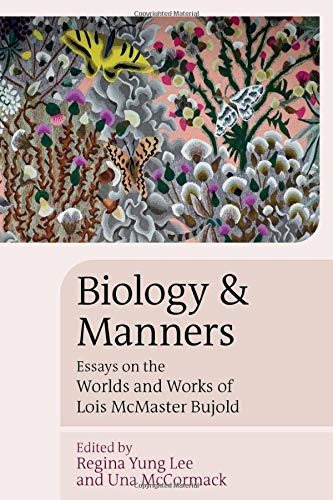
Regina Yung Lee and Una McCormack, editors. Biology and Manners: Essays on the Worlds and Works of Lois McMaster Bujold. Liverpool University Press, 2020. Liverpool Science Fiction Texts and Studies 64. Hardcover. 320 pg. $120.00. ISBN: 9781789621730. Ebook ISBN: 9781789627534.

By any reasonable critical scorekeeping, the fan-favorite work of Lois McMaster Bujold has been sorely overlooked by sf academics; however, happily enough, that critical neglect seems to be now becoming quickly corrected. A winner of six Hugo and two Nebula awards, whose numerous books—including one massive space opera series and two fantasy series, not to mention the many novellas and short stories—had sold by one estimate over two million copies by 2010, Bujold received only approximately a dozen scholarly articles devoted to her work until the mid-2000s, as meticulously shown in Robin Anne Reid’s history of Bujold scholarship that begins the current volume. In roughly the last decade, however, there has been one in-depth monographs on Bujold, Edward James’s Bujold entry in University of Illinois Press’s Modern Masters of Science Fiction series; some focus on Bujold in thematically organized books such as John Lennard’s Of Sex and Fairy; and two essay collections on Bujold, including an entry, edited by Janet Brennan Croft, in McFarland’s Critical Explorations in Science Fiction and Fantasy series, in addition to the present volume under review, Biology and Manners, edited by Regina Yung Lee and Una McCormack, which takes its title from the subtitle to Bujold’s A Civil Campaign: A Comedy of Biology and Manners (1999).

The reasons for the critical neglect have been subject to fascinating speculation. Is it a lack of sustained interest in feminist utopias? Is it because of the military sf elements? Is it the widespread critical disdain for space opera? Is it her uncool focus on parenting? Is it her whiteness? My more humdrum suspicion, though, is a less conspiratorial one; I agree with Reid’s argument that there is a “growing disparity between the [sff] genres’ growth in multiple mediums and the number of academics specializing in a marginalized field” (14). It is hard to discount the fact that a vast amount of sf literature and media goes largely unstudied for no more complicated justification than an embarrassment of riches in cultural production dwarfing the random, stringent contingencies of the niche, non-commercial market of academic publishing. Such a harsh reality, of course, means we should celebrate all the more when a worthy new author, text, or movement does begin to receive more extensive and concerted scholarly treatments, as has clearly been occurring with Bujold. There is a lot of interesting thematic and theoretical overlap across this whole essay collection; however, the collection is ostensibly divided into an introduction section of two essays on said emergence of Bujold studies and five more sections of two or three essays each, focusing respectively on “Bujold’s Women,” “Heroes’ Journeys,” “Potential Futures and Imagined Pasts,” “Holy Families,” and “Beyond the Books.”

One pronounced focus of this anthology as a whole is on critically overlooked aspects of Bujold’s two high-fantasy series, The World of the Five Gods (2001-21) and The Sharing Knife (2006-2019), especially its representations of gender and sexuality. Regina Yung Lee’s essay “Untimely Graces”  reads the widowed protagonist of Paladin of Souls (2003), Ista dy Chalion, and her pointed failures to fit conventional normative scripts as recuperating the character as covertly queered. Likewise, Caitlin Herington, in “You Wish to Have the Curse Reversed?”, argues that the Chalion novels resist the arrogation of women to the stereotyped roles of dutiful mother, wife, or daughter. Moreover, in “The Shape of a Hero’s Soul,” C. Palmer-Patel limns the Chalion novels for the tension between prophetic destiny and heroic freedom in their high fantasy conceit of mortals channeling divine avatars, stressing that Lady Ista’s active invoking of supernatural fate subverts charges of passivity endemic to this trope. Despite Bujold’s stated protestations that she is no “unconscious gonfalonier” (113) for feminist viewpoints, Sylvia Kelso nevertheless productively examines the four novels in the Sharing Knife series for their unique contributions to women’s writing, especially their rewriting of masculinized romantic quest story structure.                   

Tackling the conjunction of biology and manners from a different emphasis than exclusively one of gender and sexuality, Joanne Woiak’s “Pain Made Holy” narrows in on the torture-victim Castillar Lupe dy Cazaril from The Curse of Chalion (2001) as a figure whose hellish suffering challenges both ableist presumptions of what counts as legitimate embodiment and also subverts some of the prerogatives of disability studies that broadly advocate for more normalizing portrayals of the differently abled instead of an overriding focus on care or healing. Reid’s second essay in the collection, “The Holy Family,” also draws on disability studies to analyze The Curse of Chalion and its prequel The Hallowed Hunt (2005) as well as the more recent Penric and Desdemona series of novellas (2015-2021). Reid argues that the depiction of spiritual visions in these works resists hegemonic narratives about ability, gender, and sexuality. Meg MacDonald, in the essay “Bastard Balances All,” also discusses the Penric and Desdemona series in terms of queer theory but adds to the discussion Bujold’s fashioning of an antiauthoritarian theology.

The Vorkosigan Saga (1986-2016), a primary focus of Croft’s essay collection, also receives the due attention of a handful of essays in this book. In “Quiet Converse,” Katherine Woods pairs A Civil Campaign with Jane Austen’s Mansfield Park (1814) to suggest Cordelia Naismith, Miles Vorkosigan’s mother, is not the boring character some readers have dismissed her as, given her subtle cultivation of multiple identities as captain, refugee, mother, and hidden power behind the regent. In “Queering Barrayar,” Jey Saung reads the more recent novel Gentleman Jole and the Red Queen (2016) and the pregnancy-sidestepping novum of the uterine replicator, which has long been a keystone in the extrapolative world-building of the Vorkosiverse, for its opening up of utopian personal and public alternatives to normative biological temporalities. Oppositely, Ally Wolfe’s “Womb with a View” examines the early novel Ethan of Athos (1986) for its nuanced critique of the heterotopia of a misogynist all-male society also extrapolated from the uterine replicator. More broadly, blending visions of the future and the past in the merging of cod-medieval fantasy and space opera tropes, the Vorkosigan books enact an estranged time warp, a “futuristic feudalism” (171), as Sarah Lindsay writes in an analysis of the very first Miles book, The Warrior’s Apprentice (1986).

Expanding beyond the authorial focus, Jennifer Woodward and Peter Wright’s “The Naismith Strategem” explores Genevieve Cogman’s Bujold-themed tabletop role-playing game, The Vorkosigan Saga. Woodwood and Wright demonstrate how this game ludically systemizes Bujold’s intricate universe into a playable format, even to the point of assigning point values to characters that reflect the stigmas that often pervade feudal male-dominated and heterosexist monocultures. Kristina Busse’s “Canon Compliance and Creative Analysis in the Vorkosigan Saga Fan Fiction” reverses Bujold’s own stated endorsements of fan fiction to show how specific forms of Vorkosigan fan fiction—namely, in the slash, alternate universe, and Mary Sue subgenres—deeply engage with Bujold’s novels. Regardless of the belated scholarly recognition of Bujold’s work, these last two essays suggest that the growth of an active fandom that critically appreciates Bujold’s achievement continues apace.


Jerome Winter, PhD, is a full-time lecturer at the University of California, Riverside. His first book, Science Fiction, New Space Opera, and Neoliberal Globalism, was published by the University of Wales Press as part of their New Dimensions in Science Fiction series. His second book, Citizen Science Fiction, was published in 2021. His scholarship has appeared in The Oxford Handbook of Science Fiction, Extrapolation, Journal of Fantastic and the Arts, the Los Angeles Review of Books, Foundation, SFRA Review, and Science Fiction Studies.   

Review of Monstrous Women in Comics


Review of Monstrous Women in Comics

Brianna Anderson

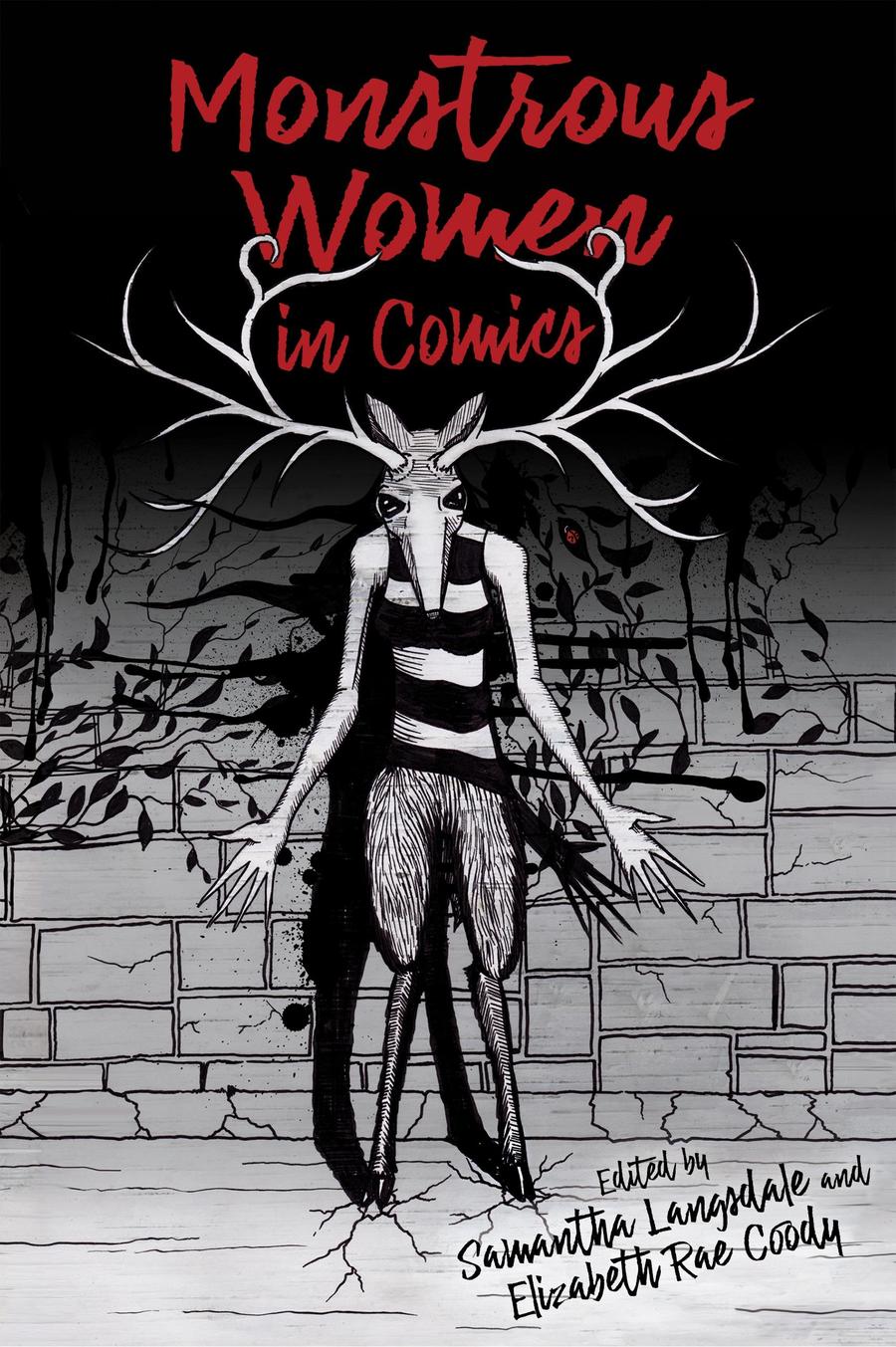
Samantha Langsdale and Elizabeth Rae Coody, eds. Monstrous Women in Comics. University Press of Mississippi, 2020. Horror and Monstrosity Studies Series. Paperback. 296 pg. $20.99. ISBN 9781496827630.

Monsters have played a pivotal role in comics across genres and throughout time, with strange, boundary-crossing creatures and people populating the panels of pulp, superhero, and even romance comics. Creators frequently code these monsters as female, provoking important questions about the intersections of ability, femininity, maternity, race, and sexuality with representations of monstrosity and the Other in comics. In Monstrous Women in Comics, editors Samantha Langsdale and Elizabeth Rae Coody assemble fifteen essays that take up these pressing topics, focusing particularly on the ways that depictions of female monsters in comics contribute to the dehumanization, marginalization, or empowerment of women. As Langsdale and Coody note in their introduction, the chapters “explore not only the ways monstrous women evoke damaging cultural norms in patriarchal contexts, but also how constructions of woman as monster contain within them the potential to destroy the systems of thought that are productive of such norms” (5). The collection covers an impressive array of transnational comics, with analyses of popular Western characters like Batgirl and Harley Quinnappearing alongside readings of Bolivian, Chinese, and Japanese graphic narratives. Despite this expansive scope, each chapter follows a similar structure, beginning with a rigorous text-critical analysis of a comic or a selection of comics “in order to ask how the monster makes meaning within the text(s) and what it means for the monster to be coded as a woman” (5). Building on these close readings, the chapters interrogate how monstrous women connect to broader social and cultural anxieties and discourses surrounding gender and sexuality. Prominent feminist and monster studies scholars like Barbara Creed, Jeffrey Jerome Cohen, Julia Kristeva, and Margrit Shildrick serve as common touchstones for many of the analyses, and the richly interdisciplinary collection also draws on critical race studies, disability studies, queer studies, and other disciplines. Langsdale and Coody organize the essays thematically into five sections that explore different facets of female monstrosity: power, embodiment, childbearing, childhood, and performance.

Part One, “The Origins, Agency, and Paradoxes of Monstrous Women,” posits that female monsters evoke fear and unease in (often male) comics audiences due to their paradoxical nature. Langsdale and Coody note the characters examined in this section “actively choose monstrosity and exhibit agency that rejects normative femininity” and “are neither wholly empowered nor entirely disenfranchised” (6). Coody’s contribution, “Rewriting to Control: How the Origins of Harley Quinn, Wonder Woman, and Mary Magdalene Matter to Women’s Perceived Power,” contends that the “multivocal”—or repeatedly rewritten—origin stories of Harley Quinn and Wonder Woman reveal shifting cultural and patriarchal discomforts surrounding empowered, boundary-crossing women. Coody extends her analysis to the biblical figure Mary Magdalene, demonstrating the trans-disciplinary possibilities of her approach.  In “Exploring the Monstrous Feminist Frame: Marvel’s She-Hulk as Male-Centric Postfeminist Discourse,” J. Richard Stevens similarly addresses monstrous women in superhero comics, surveying representations of female empowerment and feminist discourses in over 800 appearances of She-Hulk in comics published between the 1980s and 2015. While comics fans and scholars have frequently lauded She-Hulk as a “feminist ideal,” Stevens reveals that the character engages only superficially with other female characters and second-wave and third-wave feminism, a fact that the author attributes to her mostly male creators and readers (31). As a result, Stevens concludes that She-Hulk “articulates the paradoxes and challenges of female agency in a hypermasculine public sphere,” namely the superhero comics industry (31). Finally, in “‘There is More to Me Than Just Hunger: Female Monsters and Liminal Spaces in Monstress and Pretty Deadly,” Ayanni C. H. Cooper analyzes the connections between abjection, beauty, and violence in the two titular comics. She argues that the monstrous heroines challenge conventional ideas of “acceptable femininity” through their liminal positionality and paradoxically gain empowerment through abjection. Together, these chapters highlight the complexities of monstrous femininity and demonstrate how audience expectations, artwork, and larger cultural movements shape representations of monstrous women.  

The chapters included in Part Two, “The Body as Monstrous,” focus on the intersections of disability, embodiment, and sexuality with female monstrosity. Stefanie Snider’s chapter “The (Un)Remarkable Fatness of Valiant’s Faith” examines the radical potential and limitations of heroine Faith Herbert/Zephyr’s fatness. Media outlets promoted Faith as the first fat superhero, yet her fatness largely goes uncommented on in the first sixteen issues of the 2016 series. Snider contends that Faith’s fatness somewhat challenges stereotypical representations of superheroines as able-bodied, conventionally attractive, and feminine, but the comic’s failure to explicitly address her visible fatness “can induce a normalization that makes invisible the power of representation and resistance that comes from her body size and shape” (80). The chapter encourages readers to envision the transformative potential of comics that would celebrate fat bodies instead of normalizing or stigmatizing them. Next, in one of the book’s most compelling chapters, “New and Improved? Disability and Monstrosity in Gail Simone’s Batgirl,” Charlotte Johanna Fabricius explores representations of able-bodiedness and disability in the first six issues of Gail Simone’s controversial New 52 Batgirl run, which cured Barbara Gordon/Oracle’s paralysis. Fabricius contends that the comic perpetuates harmful narratives about disability by portraying the villains as disabled monsters who Barbara must defeat. Moreover, Barbara’s victories over these villains parallel her own road to recovery as she transforms from a paralyzed woman to the able-bodied Batgirl. As a result, Fabricius argues that the comic’s “promise of monstrosity as disruptive remains unfulfilled, and the coding of disability as monstrous and other remains uncontested” (95). Finally, in “Horrible Victorians: Interrogating Power, Sex, and Gender in InSEXts,” Keri Crist-Wagner draws on queer theory, quantitative frequency, and visual rhetoric to analyze the relationship between gender, power, queerness, and violence in Marguerite Bennett’s horror comic InSEXts. The series centers on two queer Victorian women who transform into monstrous insects and enact violent vengeance on men who harm women. Crist-Wagner creates two tools, a “Diamond of Violence” and a “Scale of Escalating Romance,” to evaluate how the women’s “twofold monstrousness”—their physical insect transformations and their queerness—“allows them to cause material impact and damage to the patriarchy and to change their world and circumstances, almost completely without punishment” (110-111). By closely analyzing monstrous female bodies through several disciplinary lenses, these chapters highlight how monstrosity can unsettle power structures, while also demonstrating how these narratives can reinforce harmful stereotypes about aberrant bodies.

Part Three, “Childbearing as Monstrous,” explores the abject horrors of maternity and pregnancy. In “Kicking Ass in Flip-Flops: Inappropriate/d Generations and Monstrous Pregnancy in Comics Narratives,” Jeannie Ludlow explores how comics about abortion, childbearing, and motherhood can challenge or reinscribe binary notions of birth and pregnancy. For instance, she criticizes Leah Hayes’s Not Funny Ha-Ha: A Handbook for Something Hard for depicting abortion as always traumatic and shameful, perpetuating the stigmatization of abortion and ignoring the positive experiences of many real women. By contrast, A. K. Summers’ graphic novel Pregnant Butch: Nine Long Months Spent in Drag disrupts notions of normalcy and appropriateness by depicting pregnant queer bodies. By analyzing several texts from different genres, Ludlow demonstrates how comics can use grotesque and monstrous representations to promote more nuanced views of reproductive choices. Next, Marcela Murillo’s chapter “The Monstrous Portrayal of the Maternal Bolivian Chola in Contemporary Comics” analyzes representations of chola mothers in three Bolivian comics: Corven Icenail and Rafaela Rada’s La Estrella y el Zorro, Álvaro Ruilova’s Noche de mercado, and Rafaela Rada’s Nina cholita Andina. Murillo provides a detailed historical overview of political and structural discrimination suffered by cholas, indigenous Aymara or Quechua women who have historically occupied a marginalized position in Bolivia. Though Bolivia has recently adopted pro-indigenous policy changes, the three analyzed comics negatively portray chola mothers as monstrous and subaltern. Moreover, Murillo reveals how the comics use similar visual and narrative strategies to juxtapose the monstrosity of the cholas with the European femininity of their offspring, revealing larger anxieties surrounding gender and indigeneity in Bolivia. In the section’s final chapter, “The Monstrous ‘Mother’ in Moto Hagio’s Marginal: The Posthuman, the Human, and the Bioengineered Uterus,” Tomoko Kuribayashi discusses representations of posthuman femininity in Moto Hagio’s science fiction manga Marginal. The manga’s biologically engineered heroine, Kira, and her relationships with her male lovers invite readers to consider “whether the posthuman future will bring with it a radical reorganization or even total erasure of sexual differences and of gender roles and dynamics” (155). Despite this radical proposition, Kuribayashi concludes that the manga ends on a less empowering note by depicting Kira as reliant on her male partners, suggesting that men will continue to control and exploit posthuman women and their fertility. This section effectively illustrates both the transformative potential and limits of monstrous maternity, which can expand or trouble binary notions of childbirth and pregnancy.

Part Four, “Monsters of Childhood,” centers on comics that feature female monsters who reject conventional associations of women as devoted caretakers of children. In the fascinating chapter “SeDUCKtress! Magica De Spell, Scrooge McDuck, and the Avuncular Anthropomorphism of Carl Barks’s Midcentury Disney Comics,” Daniel F. Yezbick contends that the shapeshifting, villainous duck Magica De Spell threatens both the privileged protagonist Scrooge and, by extension, the larger patriarchal structures of Barks’s comic universe. Examining Magica’s abject monstrosity, hyper sexualization, possible queerness, and transgressive behavior, Yezbick argues that the character demonstrates Barks’s ambiguous attitudes toward women and, by extension, the larger Disney empire that owns his creations. In “On the Edge of 1990s Japan: Kyoko Okazaki and the Horror of Adolescence,” Novia Shih-Shan Chen and Sho Ogawa analyze representations of adolescent anxieties, female sexuality, and monstrosity in three of Kyoko Okazaki’s manga: Pink, River’s Edge, and Helter Skelter. Though Okazaki’s representations of monstrous women potentially “reinforce the nexus between monstrosity and women’s sexuality,” her characters also productively “allow us to interrogate the capitalist construction of femininity and reproduction in 1990s Japan” (205). Lastly, in “Chinese Snake Resurfaces in Comics: Considering the Case Study of Calabash Brothers,” Jing Zhang traces the historical development of the transgressive figure of the snake woman in Chinese culture and then provides a close reading of Snake Woman, the monstrous antagonist who terrorizes the child protagonists of Shanghai Animation Film Studio’s animation and comic series Calabash Brothers. Zhang links Snake Woman to larger traditions in Buddhism, Confucianism, and Taoism and insists that the character “is not a simple force of monstrous evil; she is a complex character with roots in traditional Chinese folklore and medicine, and a more sympathetic interpretation is possible” (218).

Finally, Part Five, “Taking on the Role of the Monster,” explores how women can embrace their monstrosity to resist patriarchal social norms. In “Monochromatic Teats, Teeth, and Tentacles: Monstrous Visual Rhetoric in Stephen L. Stern and Christopher Steininger’s Beowulf: The Graphic Novel,” Justin Wigard draws on adaptation, monster theory, and visual rhetoric to examine shifting visual representations of Grendel’s mother in Beowulf retellings. Closely analyzing Stern and Steininger’s phallic depiction of the woman’s body, Wigard argues that the comic reveals enduring heteronormative anxieties about empowered women, concluding, “Ultimately, the text suggests that even with one thousand years of progress, insidious patriarchal fears about female sexuality, power, and agency still pervade the human consciousness as modern adaptors perpetuate a cycle of monstrous (visual) rhetoric” (224). In “Beauty and Her B(r)east(s): Monstrosity and College Women in The Jaguar,” Pauline J. Reynolds and Sara Durazo-Demoss contend that The Jaguar’s animal-like monstrosity reinforces the marginalization that the Latina superheroine experiences as an international college student in troubling ways. Finally, in “UFO (Unusual Female Other) Sightings in Saucer Country/State: Metaphors of Identity and Presidential Politics,” Christina M. Knopf reveals how Mexican American heroine Arcadia Alvarado resists the monstrous othering that occurs in both American politics and the science fiction genre. This concluding section provides nuanced readings of the complexities of female monstrosity, which can serve as both a source of resistance and oppression.

Together, the fifteen chapters provide an expansive exploration of representations of monstrous women in graphic narratives from a diverse range of cultures and genres. Comics, feminist, and monster studies scholars alike will find valuable insights in the volume, and the collection serves as a strong model of effective interdisciplinary, transnational scholarship.


Brianna Anderson is a PhD candidate in the Department of English at the University of Florida. She is currently writing a dissertation that examines representations of environmental issues and youth environmental activism in children’s and young adult comics and zines. Her research has appeared in Studies in Comics and The Lion and the Unicorn and is forthcoming in The Comics Grid.

Review of Fighting for the Future: Essays on Star Trek Discovery


Review of Fighting for the Future: Essays on Star Trek Discovery

Vincent M. Gaine

Sabrina Mittermeier and Mareike Spychala, eds. Fighting for the Future: Essays on Star Trek Discovery. Liverpool UP, 2020. Hardback. 352 pg. $130.00. ISBN ‎9781789621761.

Star Trek is one of the world’s longest running science fiction franchises, yet it has attracted relatively little academic attention considering its longevity and transmedia presence. Fighting for the Future: Essays on Star Trek Discovery is the first critical study of Star Trek: Discovery, the franchise’s first small screen output in over a decade. The essays in this volume cover the show’s first two seasons, across four themed sections that offer studies on the role of Discovery within the Star Trek franchise, different forms of storytelling both in canon and fanon, the negotiation of otherness, and queer readings of the show. It is especially useful that this collection considers Discovery within the larger franchise as well as a specifically post-network Star Trek. Valuable points are made on this topic by Michael G. Robinson, who identifies key aspects of Discovery in relation to its contemporaries in sci-fi television. Robinson’s essay, “These are the Voyages?: The Post-Jubilee Trek Legacy on the Discovery, the Orville, and the Callister,” performs an in-depth industrial analysis of Discovery’s production, distribution, and consumption, and makes an effective comparison between Discovery, The Orville (2017-) and the Black Mirror episode “Callister” (2017) in terms of which is most “Trek,” identifying their various complexities.

Other highlights in the collection include Will Tattersdill’s “Discovery and the Form of Victorian Periodicals,” which compares Discovery’s serialized structure with that of Victorian periodicals, featuring strong references to wider generic and narrative tendencies as well as consumer understanding. Another insightful discussion of consumer engagement comes from editors Sabrina Mittermeier and Mareike Spychala, who in “Never Hide Who You Are: Queer Representation and Activism in Star Trek: Discovery,” analyze queer representation and advocacy. Their succinct yet detailed argument of queer representation across Star Trek contributes to multiple debates by taking account of the tensions between representation, the overall tenets of Star Trek and the commercial demands of television, as well as the interplay between product and fandom, including the voices of actor activists (“actorvists”).

Several essays in the collection critique the ostensibly liberal humanist politics of Star Trek, illuminating entrenched attitudes and beliefs both in the franchise and American popular culture more widely. In “‘Into A Mirror Darkly’: Border Crossing and Imperial(ist) Feminism in Star Trek: Discovery,” Judith Rauscher gives an astute analysis of how Star Trek deploys and reinforces stereotyping and imperialism, with particular attention to the seduction of feminism by imperialist fantasy. Torsten Kathke gives a similarly insightful discussion of liberalism and its problems throughout Star Trek in “A Star Trek About Being Star Trek: History, Liberalism and Discovery’s Cold War Roots.” One of the strongest chapters in the collection is Henrik Schillinger and Arne Sonnichsen’s “The American Hello: Representations of U. S. Diplomacy in Star Trek: Discovery.” Their discussion of how Discovery confronts and complicates diplomacy in Star Trek is contextualized with a history of US diplomacy, especially in the 21st century. This complex analysis of contradictory elements leads to a critical and nuanced discussion of how Discovery utilizes notions of diplomacy to explore the values and ethics of the Federation, and by extension, the United States.

While much of the collection is strong, there are some shortcomings. Multiple typos throughout the book suggest rushed copy-editing, and the multiple riffs on “boldly going where no [INSERT NOUN] has gone before” get a bit tiresome. More specifically, several of the essays offer superficial and unconvincing arguments. Sarah Bohlau’s chapter, “‘Lorca, I’m Really Gonna Miss Killing You’: The Fictional Space Created by Time Loop Narratives,” offers some interesting links to PTSD within the context of Discovery’s time loop episode but is overall rather descriptive. Lisa Meinecke discusses Discovery’s device of a spore drive as a metaphor for connections and posthuman identity in “Veins and Muscles of the Universe: Posthumanism and Connectivity in Star Trek: Discovery,” and while Meinecke synthesizes an impressive array of theories, the chapter largely describes the show’s narrative and misses the opportunity for an in-depth analysis of posthumanism. Another missed opportunity is “To Boldly Discuss: Socio-Political Discourses in Star Trek: Discovery Fanfiction” by Kerstin-Anja Munderlein. Munderlein argues that the reflection of Star Trek’s socio-political content in fan fiction is inextricable from the show, but the analysis is excessively quantitative and appraising rather than critical. Perhaps most troubling is “The Conscience of the King Or: Is There in Truth No Sex and Violence?” in which John Andreas Fuchs performs a rather superficial analysis of sex and violence in Discovery and other Star Trek instalments. Various inconsistencies in Fuchs’ chapter suggest inadequate care, a problem further compounded by a lack of nuance and context as well as a condescending tone.

Due to the limited content of Star Trek: Discovery, there is some overlap in terms of what the authors discuss. The Mirror Universe comes up more than once, as Andrea Whitacre’s “Looking in the Mirror: The Negotiation of Franchise Identity in Star Trek: Discovery” analyzes Discovery’s reworking / reiterating of Star Trek’s tension between inclusion and exclusion. Whitacre delivers particular insight into how the Mirror Universe works as a place to work out alternatives to and problems with the ethos normally presented in Star Trek. In a similar vein, Ina Batzke’s chapter “From Series to Seriality: Star Trek’s Mirror Universe in the Post-Network Era” identifies the importance of the Mirror Universe as a device of seriality which allows for the problematization of Star Trek in the post-network context.

Another recurring feature is a focus on particular characters, especially Michael Burnham (Sonequa Martin-Green), with various chapters discussing the identity politics of race, gender, and sexuality. Amy C. Chambers highlights that “Star Trek Discovers Women: Gender, Race, Science, and Michael Burnham,” in her discussion of the under-representation of black women in science fiction and scholarship, with an insightful focus on the figure of the woman scientist and the ideas of gendered science. Another perceptive commentary on Discovery’s protagonist is the “Interview with Dr. Diana A. Mafe on ‘Normalizing Black Women as Heroes,’” who identifies the representative strategies embodied by Burnham as well as how she is negotiated with other female characters on the show. Female roles within the structures of Starfleet and Star Trek are also the focus of Mareike Spychala’s “Not Your Daddy’s Star Trek: Exploring Female Characters in Star Trek: Discovery.” Spychala notes that Discovery goes further than previous iterations did with gender and gender relations through close attention to presentation and costume and persuasively argues for the show’s new forms of femininity, such as new roles for mothers.

Whit Frazier Peterson uses Afrofuturism to critically interrogate the philosophy of Discovery in “The Cotton-Gin Effect: An Afrofuturist Reading of Star Trek: Discovery.” While Peterson’s overall approach to technology as an intrinsic tool of oppression is interesting, the final argument that draws a parallel between the cotton-gin and Discovery’s spore drive is too rushed to be persuasive. A similar problem occurs with Si Sophie Pages Whybrew’s “‘I Never Met A Female Michael Before’: Star Trek: Discovery between Trans Potentiality and Cis Anxiety,” which identifies Discovery’s problematic framing of non-cisheteronormativity as alien and therefore Other, but offers a rather stretched argument over the character(s) of Ash Tyler/Voq (Shazad Latif) being a metaphor for trans-gender identity. More persuasively, Sabrina Mittermeier and Jennifer Volkmer also discuss Tyler/Voq in “‘We Choose Our Own Pain. Mine Helps Me Remember’: Gabriel Lorca, Ash Tyler, and the Question of Masculinity.” Mittermeier and Volkmer persuasively link Discovery’s construction of masculine identity to contemporary practices of masculinity as well as trauma studies and make excellent use of interviews to illustrate actors’ approaches to characters.

Whit Frazier Peterson uses Afrofuturism to critically interrogate the philosophy of Discovery in “The Cotton-Gin Effect: An Afrofuturist Reading of Star Trek: Discovery.” While Peterson’s overall approach to technology as an intrinsic tool of oppression is interesting, the final argument that draws a parallel between the cotton-gin and Discovery’s spore drive is too rushed to be persuasive. A similar problem occurs with Si Sophie Pages Whybrew’s “‘I Never Met A Female Michael Before’: Star Trek: Discovery between Trans Potentiality and Cis Anxiety,” which identifies Discovery’s problematic framing of non-cisheteronormativity as alien and therefore Other, but offers a rather stretched argument over the character(s) of Ash Tyler/Voq (Shazad Latif) being a metaphor for trans-gender identity. More persuasively, Sabrina Mittermeier and Jennifer Volkmer also discuss Tyler/Voq in “‘We Choose Our Own Pain. Mine Helps Me Remember’: Gabriel Lorca, Ash Tyler, and the Question of Masculinity.” Mittermeier and Volkmer persuasively link Discovery’s construction of masculine identity to contemporary practices of masculinity as well as trauma studies and make excellent use of interviews to illustrate actors’ approaches to characters.

Although the perspectives and critical approaches vary, the reader may wish there was more material to talk about. The problem of limited material is most apparent in the section on Queering Star Trek. While it is valuable to highlight the dearth of queer representation in Star Trek, the three essays overlap in their discussions of the same few episodes. Season 3 of Discovery would have offered more material, and the writers and editors may have rejoiced or bemoaned the further forms of representation in that season. Perhaps ironically for a book entitled Fighting for the Future, it might have been improved by waiting for that future to arrive.

Despite these shortcomings, the essays of this collection are insightful and diverse and indicate a promising critical future for Discovery and Star Trek as a whole. It is likely to be of use to scholars interested in Star Trek and post-network television as well as various forms of narrative and representation. As Discovery and indeed Star Trek as a whole continues to develop, the reader may find themselves hoping for a second edition of this volume that explores the subsequent seasons as well as further iterations of this ongoing and continually rich science fiction mythos.


Dr Vincent M. Gaine is an academic, film critic and podcaster based at Lancaster University. His monograph, Existentialism and Social Engagement in the Films of Michael Mann, is published by Palgrave. He has published further articles and book chapters on filmmakers and genres in the Journal of Cinema and Media StudiesEuropean Journal of American Culture and Journal of the Fantastic in the Arts, as well as reviews and interviews for the websites the Critical Movie Critics, the Geek Show and Moving Pictures Film Club, and also discusses film and media on the podcast Invasion of the Pody People. He specialises in the intersection of globalisation, liminality and identity politics in media, and is currently researching spies, superheroes and Boston.

Review of Pop Culture for Beginners


Review of Pop Culture for Beginners

Kania Greer

Jeffrey Andrew Weinstock. Pop Culture for Beginners. Broadview Press, 2021.  Paperback. 310 pg. $46.92.  ISBN: 9781554815657 (paperback) 9781770488113 (PDF)

Asking someone to define pop culture is like asking someone to define what a dog is: meaning that depending on who you ask, you may get a very scientific answer or something more general in terms of what a dog looks like or types of dogs. The same is true for pop culture. Some people will define it based on current trends or ideations while others will focus on the more esoteric assumptions of the genre. As a result, the understanding of and study of pop culture becomes a difficult task, especially for those new to the field. Jeffrey Weinstock’s book, as the title suggests, provides the reader with a great primary resource which could be useful to beginning scholars and those needing a refresher.  For both beginning teachers and  seasoned scholars of pop culture the foundational lens which Weinstock brings serves to break apart the mystery of pop culture and make it relatable, understandable, and accessible to all.

Most people, by the time they reach higher education (and especially the further they go up the education ladder), become far removed from what originally brought them to pop culture, namely entertainment. Academics tend to become focused on the meaning of pop culture and thereby are often seen as taking the entertainment and joy out of it. This is where Weinstock’s book can help. By getting back to basics, Weinstock acknowledges the fast paced, ever changing face of pop culture but also encourages one to dive deeper into what pop culture is and what it means, both individually and for groups. 

The book is divided into two sections: The Pop Culture Toolbox (Chapters 1-4), which I refer to as the “academic” chapters, and The Pop Culture Units (Chapter 5-10) or what I refer to as the “practitioner” chapters. In Chapter 1, Weinstock hooks us in by trying to define pop culture but also making us rethink what we understand pop culture to be. For example, he starts Chapter 1 with the statement that pop culture as a definitive term is “elusive…of a single, clear definition” (pg. 4).  From here he goes on to address the myriad of influences that make up pop culture, ultimately landing on “pop culture [being] something people seem to know when they see it” (pg. 11).  While this may leave some people shaking their heads and wondering if there will be a definition, rest assured it is in there. However, what is beneficial is the periodic breaks in information he scatters throughout the chapters to ask the reader questions. Titled as “Your Turn”, he stops the flow of information to ask the reader to reflect on what they have read. Weinstock appears to understand how people learn and that they need time to digest and process information. His questions are designed to be examined from an individual perspective in order to acknowledge one’s own influences, tastes, biases, and lens. This element takes this chapter (and others) to a higher level of understanding as I was no longer reading for information but rather reading for understanding and decoding of my own perspective.

Chapter 2 takes us on a more academic journey helping us to understand the way culture is formed and how we signify information (signs). This semiotic approach is further broken down into not only our own connotation of what we see but also the denotation of those same signs. To better understand this approach, Weinstock uses common everyday signs like tattoos to further illustrate his meanings, making the concepts relatable and easy to process. Chapter 3 takes us into theories of viewing culture and examines the perspective by  which culture can be examined (post-colonial, feminist, critical race, etc.) but does so in such a way as to remind the reader of the lens by which each of these theories views culture. Weinstock’s purpose here is to inform the reader that each pop culture offering can be viewed through multiple approaches and each of these becomes part of a larger understanding. Through this chapter he succeeds in breaking down these theories into relatively easy to understand bite sized pieces to shed light on differing viewpoints. This is perhaps one of the best chapters in the book as it takes the theories back to basics and serves to define and give substance to some theories I had created my own meaning for rather than fully understanding.   

Chapter 4 is the last of what I call the “academic” chapters, in terms of chapters imparting information. This chapter really looks at pop culture in terms of authenticity, appropriation, structure, and subcultures. For example, as Weinstock puts it there is an almost “cultural imperative to ‘be yourself’” (pg. 87), but even this can cause dissonance when we consider which self to be: work self, spouse self, friend self, etc. The challenge is determining what is meant by authentic to each person. In relation to this is the idea of cultural appropriation and how members of one culture can appropriate (or misappropriate) another culture. This creates lines which are “murky” (pg. 90) between appreciation and misappropriation. When thinking about subculture, Weinstock challenges the reader to dive deep into cultural nuances. What makes one science fiction fan different from another? Don’t all punk rockers like the same music?  Examples can be found in subcultures of “subversive” (pg. 104) groups like “bikers, skaters, punks, goths…” (pg. 104) who can be categorized as anti-culture, but each holds its own in terms of representation. Just as valid, however, are other subcultures including science fiction subcultures like “Potterheads… Trekkies, and so on” (pg. 105). In this way subculture becomes even more specialized and an “expression of personal taste” pg. 105). At the end of each of the “academic” chapters, there are suggested assignments which could be easily incorporated into classrooms. Each of the assignments serves to help students examine pop culture from their own lens but also encourages students (and faculty) to think outside of their preferred focus to examine how culture is viewed by others. 

The “practitioner” chapters (5-10) break down the sub-genres of pop culture and dive deeply into their influences and meanings. From television to fandom each chapter details what is meant by the sub-genre, asks questions throughout, and then gives a sample essay at the end.  This breakdown gives equal weight to most sub-categories of pop culture and allows students to focus in on their favorite, for deeper study, or to take a little-known sub-genre and investigate it. These essays are beneficial for driving home the points made throughout the chapter. I found these essays some of the most enjoyable reading throughout the book. While Weinstock acknowledges the “term-limits” (my words) of the pop culture references in these essays, I believe they can be valuable in helping students and faculty rethink pop culture for many years. As with chapters 1-4, there are suggested assignments in each chapter and suggested readings.  Lastly, there is Chapter 11, which challenges readers to ”extend the approach adopted [in the book] to a different popular form” (pg. 277). Readers can use the book as scaffold to develop their own questions which challenge interpersonal thinking and viewpoints on culture.

Weinstock does a great job of introducing and reintroducing pop culture and does so in a relatable, humorous, and enjoyable way; in fact, I often forgot I was reading a textbook. While he presents an academic study of pop culture, he does so without abandoning the mystique and enjoyment most people find in pop culture. He challenges readers/students to examine their own cultural lens while encouraging us to think outside of the story presented to develop larger meanings. This book would be an excellent introductory book for pop culture studies (or really any studies) as it is easy to digest, thought-provoking, and just plain fun. Having said that, I study the intersection of science fiction and science interest (how does science fiction draw people to science), and I found this book a nice refresher and reminder of the broader contexts I am researching. Therefore, I recommend it to all academics, from those just starting to those who have been in the field for a while.

Kania Greer currently serves as the Coordinator for the Center for STEM Education at Georgia Southern University.  She studies the intersection of science fiction and science fact by people who attend science fiction conventions.