Review of Ethical Futures and Global Science Fiction


SFRA Review, vol. 52, no. 4

Nonfiction Reviews


Review of Ethical Futures and Global Science Fiction

Tristan Sheridan

Zachary Kendal, Aisling Smith, Giulia Champion, and Andrew Milner, editors. Ethical Futures and Global Science Fiction. Palgrave McMillan, 2020. Studies in Global Science Fiction. Ebook. 335 pg. $79.99. ISBN 9783030278939.

Ethical Futures and Global Science Fiction belongs to the Studies in Global Science Fiction series, edited by Anindita Banerjee, Rachel Haywood Ferreira, and Mark Bould. This particular entry emphasizes non-Anglophone literatures in its ethical examinations of futurity within the SF genre and builds off of existing scholarship within the cli-fi and utopian subgenres as well as postcolonial theory. From its first chapter, “Science Fiction’s Ethical Modes,” Ethical Futures seeks to examine the ethical underpinnings of the SF genre, raising the question of “whether SF has a predisposition to a particular ethical outlook” (3). While the author of the chapter, editor Zachary Kendal, acknowledges “the politically and socially regressive traditions of American pulp SF”—traditions often founded in colonialist and fascist ideologies—the collection as a whole stresses how vital SF is as “a primary mechanism—perhaps the primary mechanism—by which our culture imagines its possible futures, both positive and negative,” as Andrew Milner states in a later chapter, “Eutopia, Dystopia and Climate Change” (8, 77). Indeed, careful envisioning of the future may be more relevant now than ever given impending environmental catastrophe, a relevance that Ethical Futures seeks to emphasize, given its final chapter on the modern prevalence of dystopian narratives in contrast to utopian narratives: Nick Lawrence’s “Post-Capitalist Futures: A Report on Imagination.” If we look to fictionalized versions of the future as a guide when moving towards our own, as Ethical Futures purports, it becomes especially important to incorporate non-Anglophone literature and to decenter Western perspectives when conceptualizing futurity.

Divided into four parts—Ethics and the Other, Environmental Ethics, Postcolonial Ethics, and Ethics and Global Politics—Ethical Futures offers both historical overviews in reoccurring themes throughout SF futurisms, such as Joshua Bulleid’s “Vegetarianism and the Utopian Tradition,” as well as close readings of individual texts such as Jamil Nasir’s Tower of Dreams (1999) and Ahmed Kaled Towfik’s Utopia (2008) in Anna Madoeuf and Delphine Pagès-El Karoui’s “Cairo in 2015 and in 2023.” The collection does significant work to unseat the colonialist dogma that many of SF’s most prominent texts have historically operated under, building off of scholarship such as John Rieder’s Colonialism and the Emergence of Science Fiction (2008) in addition to Fredric Jameson’s work on utopian narratives. It does so not only by arguing for anti-colonial and anti-capitalist alternatives, but also by identifying the underlying commonalities between SF and other postcolonial efforts: both literatures “seek alternate futures for the human race, both look beyond the joint nightmare of colonial modernity, both are profoundly involved in future thinking, and both offer a clear platform for the utopian,” as Bill Ashcroft observes in “Postcolonial Science Fiction and the Ethics of Empire” (165). The range of literatures covered in Ethical Futures is extensive, including French, Macedonian, Haitian, Mexican, and Indian literature; however, they are frequently analyzed alongside those from the Anglosphere; futurism and ethics are what most tie this collection together.

The essays contained within Ethical Futures are in clear conversation with one another thematically, even across the differing sections, although these potential connections are often left unexplored more explicitly due to the nature of the collection and its lack of direct collaboration among authors. For instance, Ashcroft’s analysis of the Oankali’s ethical culture in Octavia Butler’s notable Xenogenesis series would have benefitted from Kendal’s own discussion of ethical obligation towards the other earlier in the book, as the alien Oankali and their drive to “seek [otherness], investigate it, manipulate it, sort it, use it” echoes the totalizing ideology that Kendal problematizes as violent and imperial in his critique of Asimov’s Foundation trilogy and Zamyatin’s Мы (We [1920-21]) (172). Even so, Ashcroft still reaches the conclusion that the Oankali are not as morally superior to humans as they initially appear to be on the basis of their lack of ethical “responsibility to otherness,” rather than their totalizing efforts towards the other (179). It is a strength of the collection nevertheless that its individual pieces have clear intersections and develop one anothers’ arguments, however inadvertently. Some essays could be more fully developed, such as Lara Choksey’s examination of Nalo Hopkinson’s Midnight Robber (2000) in relation to dependency work and the politics of care; her argument would have been improved had it explored—or even directly mentioned—the novel’s theme of labor as a practice which its protagonist turns to in order to heal from her trauma, in direct opposition to Hopkinson’s representation of the postcolonial state of Toussaint and its desire to avoid work altogether in the aftermath of slavery. This exploration would have neatly connected to Lawrence’s discussion of automation in the book’s concluding chapter, but it is worth noting that Choksey makes a compelling argument about the role of feminized labor in decolonial states.

On the whole, Ethical Futures makes meaningful contributions to the study of utopian and dystopian literatures and reminds its audience of the importance of collectively imagining a future that is less destructive than our present. Even as Ethical Futures contains thoughtful analysis of dystopian literature and does not begrudge said literature of its abilities to offer needed insights regarding our ethical responsibilities in the present, it is significant that Ethical Futures spends its concluding chapter on the relative absence of modern utopian literature. As Lawrence observes, “there is no outstanding example of utopian thought in the twenty-first century that has achieved success on a mass scale” (318). The final question that Ethical Futures raises, then, regards our seeming inability or unwillingness to imagine beyond the destructive systems under which we live and therefore our turn to dystopian fatalism over utopian hopefulness. In doing so, Ethical Futures marks itself as relevant not only to academic scholarship, but to all those who seek to imagine a better future than the one toward which we seem to be heading .


Review of Terry Pratchett’s Ethical Worlds: Essays on Identity and Narrative in Discworld and Beyond


SFRA Review, vol. 52, no. 4

Nonfiction Reviews


Review of Terry Pratchett’s Ethical Worlds: Essays on Identity and Narrative in Discworld and Beyond

Maria Alberto

Kristin Noone and Emily Lavin Leverett. Terry Pratchett’s Ethical Worlds: Essays on Identity and Narrative in Discworld and Beyond. McFarland, 2020. Paperback. 155 pg. $39.95. ISBN 978-1476674490.

There is no getting around this fact—Terry Pratchett’s work is funny. Powerfully amusing, we might even say, in every sense of the term. However, as any of his multitudinous readers could also report without a second’s hesitation, Terry Pratchett’s work is likewise thoughtful, deliberate, and nuanced, offering pointed satire, incisive social commentary, and gentle moral reflection filtered through the worldview of witches, watch-members, and other fantasy characters whose experiences both replicate and reveal our own.

Likewise, Kristin Noone and Emily Levin Leverett’s 2020 collection Terry Pratchett’s Ethical Worlds offers an illuminating—and, honestly, just plain fun to read—addition to the growing body of scholarly work on Pratchett’s oeuvre. Noone and Leverett characterize their work as an exploration of the means through which Pratchett “constructs an ethical stance that values and valorizes informed self-aware choice, knowledge of the world in which one makes those choices, the value of play and humor in crafting a compassionate worldview, and acts of continuous self-examination and creation” (2).  These four themes, the editors and their contributors find, run throughout Pratchett’s canon, from his well-known Discworld novels and co-authored Good Omens (1990) to more clearly science fiction works such as Strata (1981), the Long Earth series (2012-2016), and the less-discussed short story “#ifdef DEBUG + ‘world/enough’ + ‘time’” (1990). From the introduction onward, too, Pratchett’s interest in forms of intertextuality, identity, and genre-switching is also noted and explored (1-2). As Noone and Leverett point out, Pratchett constructs worlds and narratives “in which questions of identity, community, and relations between self and other may be productively discussed, debated, and reshaped” (4), in turn leading to their definition of the “ethical worlds” named in this collection’s title: rich, multifaceted “fantasies in which language always matters, stories resonate with the past and the future, and the choices characters make reflect the importance of self-aware and ongoing acts of compassion and creation” (4).

Overall, collection contributors build from a shared interest in Pratchett’s inventiveness and creation—of secondary world(s), of language, and of characters’ selves as well as our own—to offer nine chapters drawing from a diverse range of critical lenses and perspectives. Here readers will find highly-enjoyable pieces examining acts of creation in science fiction (ch. 1), hypermasculinity and adaptational influence (ch. 2), the ethics of choice (ch. 3), free will and growing up (ch. 4), Old English influences (ch. 5), identity construction through language (ch. 6), rhetoricity and magic (ch. 7), “golempunk” and ownership of the means of production (ch. 8), and grappling with the ethics of neomedievalism and aftershocks of colonialism (ch. 9).

In their introduction, Noone and Leverett identify three primary strands of Pratchett scholarship—one apiece focusing on his genre fiction writing, his YA authorship, and his Discworld stories (2)—and position this collection as an attempt to bring various elements of these strands together. In this light alone, the collection is a success. For one thing, while the Discworld novels do feature heavily here, most of Pratchett’s work also receives mention—and in many cases, full chapters—that are characterized by as much attention and detail as his most well-known work. Noone, for instance, looks to Pratchett’s early science fiction and its depictions of acts of creation, maintaining that these texts “offer insight not only into prototype versions of the later Discworld but into the evolution of Pratchett’s moral stance” as these develop across genres and narrative forms (3). As Noone correctly notes here, Pratchett’s work as a fantasy or a YA author, as often prioritized by those existing strands of scholarship, is greatly enriched when considered in light of his science fiction roots, where we find him first sketching out the ethical stances and foundations that he would build later works upon.

For another thing, the chapters that do focus on Pratchett’s best-developed and most extensive work, Discworld, also span a wonderful variety of the characters, narratives, and locations that readers encounter in Ankh-Morpork and beyond. This collection’s contributors bring their insights to familiar faces from Tiffany Aching and her community (friends and enemies alike) to Cohen the Barbarian and his complicated relationship with violence, the Watch and their different arbitrations of justice, and Moist von Lipwig and the technological advances he reluctantly shepherds into the big city. In so doing, the collection thus reiterates the sheer range of subjects to which Pratchett brought his stance on compassionate, self-aware, and humorous creation: capital-b Big topics that include gender roles, the dangers of sexual and gendered essentialism, war and warfare, the legal and justice systems, capitalism, and the all-too-common violence of minority communities’ integration into even heterogeneous societies. It is quite a balancing act, to give these topics the space and thoughtful treatment they deserve in the limited word count of single chapters—particularly while also extricating them from the writing and perspective of a cis, white male author from a former colonial world power, radical as his worldview was and beloved as he himself is—but this collection and its chapters do so admirably.

Finally, and very aptly indeed, I also found that this collection is just a delight to read. Its ambitious project and often complex topics are bolstered by contributors’ obvious enjoyment of the texts themselves, which shines through in the writing of just about every chapter. While definitely an academic work, complete with the criticism and bibliographic work that entails, Terry Pratchett’s Ethical Worlds: Essays on Identity and Narrative in Discworld and Beyond also struck me as accessible and exciting, one of those uncommon works of scholarship that I would also pick up on a rare day off just to enjoy seeing rich new perspectives on a favorite fantasy world.

All things considered, this collection’s emphasis on compassion, creation, and self-awareness, as Pratchett uses genre fiction and its attributes to broach such topics, is well worth a read. Those interested in examinations of the fantasy genre (and in particular, continuations of work by Farah Mendlesohn, Edward James, and John Clute) or seeking out complications of its science fiction counterparts will appreciate the collection’s focus, while those still keeping #TerryPratchettGNU alive and well will value its thoughtful revisitation of a gentle giant in the genre.

Maria Alberto is a PhD candidate in literature and cultural studies at the University of Utah. Her research interests include adaptation, popular culture, digital media, and fan studies, and her recent work includes essays in Mythlore, M/C Journal, and Transformative Works and Cultures, as well as forthcoming book chapters on digital-born romance, fan studies methodology, and queer readings of Tolkien’s legendarium. At this very moment, she is probably working on her dissertation on “canon” in popular culture texts or playing D&D. Either way, coffee is definitely involved.

Review of AKB48


SFRA Review, vol. 52, no. 4

Nonfiction Reviews


Review of AKB48

Amber A. Logan

Galbraith, Patrick W. and Jason G. Karlin. AKB48. Bloomsbury, 2020. Print. Paperback. 144 pg. $22.95. ISBN 97815013411379.

AKB48 is a short monograph that is part of the broader series of books called “33 1/3 Japan.” This series aims to provide a deep dive into contemporary Japanese popular music, ranging from the soundtrack of Cowboy Bebop (the classic anime series) to the music of Hatsune Miku (a vocaloid star). This particular volume provides an in-depth analysis of the girl group AKB48 (so named because of its origins in the Akihabara district in Tokyo, and the originally intended 48 group members). While the subject matter of the book is analyzed academically, the content is fascinating enough (and the size of the book small enough) to appeal to a more general audience—particularly if they are fans of the band, or of Japanese popular culture more generally.

Formed in 2005, AKB48 is now the most commercially successful female group in Japan (which is itself the second largest music market in the world). This popularity alone is not necessarily worth scholarly analysis, but clearly Patrick W. Galbraith and Jason G. Karlin, the authors of this book, saw behind the success of AKB48 a greater and more fascinating business model in contemporary Japanese pop culture. This business model relies upon the idols monetizing their fans’ enthusiasm and affection through personalized interactions and fan-led elections to determine which girl gets top billing. The authors then utilize critical theory to extrapolate beyond this specific idol group to speculate about Japanese culture and beyond.

From the group’s beginning, the idols cultivated a sense of personal connection with their audience; AKB48’s slogan is literally “idols that you can meet” (ai ni ikeru aidoru). Their humble beginnings were in a small Akihabara theater where live performances took place in front of intimate crowds where idols could make eye contact with individual fans. Fans are encouraged to see themselves as supporters of a specific idol by calling out her name at live events, buying her specific merchandise, and visiting her at the special hand-shaking events where fans can both see their favorite idol up-close-and-personal and be seen by her, as well. The catch? Hand-shaking may only be accessed with the purchase of CDs packaged with special tickets for the events. To take things even further, AKB48’s overseeing company designed a General Election which allows fans to vote on which idol gets the top spot in the group—not unlike the highly successful American television show American Idol, in which fans participate in voting for their favorite singer. Again, fans must purchase CDs with special ballots inside in order to participate in the General Election, allowing the group to monetize the fans’ devotion to their particular idol and their desire to support her—both emotionally and financially.

Galbraith and Karlin point out that this style of interactive support is a key example of affective economics, which involves harnessing the power of a relatively small number of enthusiastic loyalists to monetize the relationship between them and their objects of desire. Some fans will buy hundreds of copies of the same CD in order to buy the chance to vote for their favorite idol; the actual content of the CDs, the music product itself, becomes secondary or even trivial. In fact, the idols are not known for being skilled singers or performers; instead, they are beloved for their relatability, their vulnerabilities, their intense striving to do better—hence making them girls who need the fans’ support in order to succeed.

In essence, the idols are selling a relationship between themselves and their fans, similar to how in Japanese host clubs, the host (while actively convincing the patron to buy expensive food or drink) is selling the perceived relationship between host and patron, demonstrating yet another example of how affective economics are at play in Japanese culture. But even if the specific appeal of AKB48 seems largely limited to Japan, the rise of idol groups in South Korea demonstrates how this phenomenon is not specific to Japan.

AKB48 provides a fascinating look at the history of idols in Japan and how they led to the success of AKB48 in recent years. While the book clearly would appeal to fans of AKB48, pop idols, or the Japanese music scene in general, the authors do an excellent job of connecting the specifics of the band’s business model and social interactions to broader concepts of business, marketing, economics, psychology, and sociology. AKB48 could be used as an engaging case study for any of these fields, as well as for students of Japanese culture or music studies.

Amber A. Logan is a university instructor, freelance editor, and author of speculative fiction. In addition to her degrees in Psychology, Liberal Arts, and International Relations, Amber holds a PhD in Creative Writing from Anglia Ruskin University in Cambridge, England. Her thesis “Men Who Lose Their Shadows: from Hans Christian Andersen to Haruki Murakami” examines the intersection of fairy tales and near-future speculative fiction, and her debut novel The Secret Garden of Yanagi Inn will be published in October 2022.

Review of Child and Youth Agency in Science Fiction: Travel, Technology, Time


SFRA Review, vol. 52, no. 4

Nonfiction Reviews


Review of Child and Youth Agency in Science Fiction: Travel, Technology, Time

Adam McLain

Ingrid E. Castro and Jessica Clark, eds. Child and Youth Agency in Science Fiction: Travel, Technology, Time. Lexington, 2019. Hardback. 304 pg. $105.00. 9781498597388. Paperback. $42.99. 9781498597401. EBook. $40.50. 978149859739.

The conceptualization of children as agents has been an often-overlooked factor in academic conversations. This collection, edited by Ingrid E. Castro and Jessica Clark, contains twelve essays that serve as an excellent introductory point for those studying depictions of agency in science fiction. It also sets the stage for further development by beginning specific lines of inquiry and creates theoretical foundations by which future studies can interrogate cultural conception of the child and childhood. Although the collection lacks in its theoretical engagement with science fiction as a genre, favoring the application of sociological theories of agency and childhood to a chosen text, the essays provide arguments about child and youth agency that can be brought into many future studies of science fiction.

The introduction by editors Castro and Clark and the first chapter, Joseph Giunta writing about Stranger Things (2016- ), lay an excellent groundwork for the rest of the collection. Castro and Clark establish the dearth of scholarship on children in science fiction. Giunta’s chapter further elaborates this history of children’s agency by outlining the “‘new’ sociology of childhood, [which] embraces agentic youth and their active participation within hierarchies of social order” (25). This “new” sociology of childhood—that children are beings that fully act in and influence the world—is the foundation on which the essays engage with their chosen science fictional texts. Indeed, none of the essays argue that children do not have agency: a core supposition in each essay is that the actual agency of children is often overlooked, and therefore, almost all the essays outline how the characters in their chosen texts use agency. However, most of the essays don’t take the added step of detailing how the use of agency then affects the theory of agency or genre of science fiction.

For many of the essays, agency is most visible in oppositional acts. In Jessica Clark’s riveting assessment of masculinity and boyhood in the anime film Akira (1988), Clark declares that the use of agency shows that “adult status, political authority, and ideological principles are all questioned and transgressed” (123, emphasis mine). This transgression of strictures, systems, and hierarchies around the characters is what forms the ability to see the character’s agency at work. Similar to Clark, Megan McDonough argues that each book in Suzanne Collins’s Hunger Games trilogy (2008-2010) “culminates in one major agentically defiant act against the powerful government in charge” (134–35, emphasis mine); for McDonough, then, agency is about defiance and is thus a reaction to power. This approach to agency always already assumes agency as an act of opposition: a response rather than a decision. Essays like Clark’s and McDonough’s do well at showing agency, but in future studies, we must consider how an agency that emphasizes “impacting” or “subverting” rather than being in and of itself might hide some forms of agency.

Agency is also outlined in the relationship between child and parent. In Kip Kline’s chapter on Back to the Future (1985), Marty McFly is given power over not only himself but also his parents in a reading of his use of time travel as reversal of who determines whose futures: McFly becomes the metaphorical head of his family as he changes the past to align his present with his wants and desires. Kwasu David Tembo and Muireann B. Crowley look at the relationship between the X-Men characters Jubilee, X-23, and Wolverine, arguing that Jubilee and X-23 make agential actions but that those actions are always marked by Wolverine’s influence, the cultural experience of gender, or the influence of the bio-power of the controlling hegemonies. Whereas Tembo and Crowley find a frustration of agency within this relationship, other chapters, like Joaquin Muñoz’s chapter on Ender’s Game (1985) and Castro’s essay on David R. Palmer’s novel Emergence (1984), find agency in the rebellion against parents or figures of authority. Muñoz argues that in Ender’s Game, the protagonists “operationalize their agency for gaining power and control over their respective situations” (223); in other words, for Muñoz, the agency of children exists in an exerted influence on surroundings, contrary to what is controlled by the adult characters. In Emergence, Castro argues that the posthuman and biological relationships (e.g., with animals, with the surrounding world) is a place in which agency finds “purchase and context within their new intersectional and interdependent relationship” (259); in other words, a child’s agency is not determined only by a relationship with adults but by the child’s contextual world. The relationship of parent and child is also seen in Stephanie Thompson’s argument that youth agency in Ernest Cline’s Ready Player One (2011) and Neal Shusterman’s Unwind (2007) is found in the child’s transgression and subsumption of the adult’s role of home provider.

This relationship between child and adult as space for agency creation is navigated in different ways in Erin Kenny’s article on fanfiction of The 100 (2014-2020) and Jessica Kenty-Drane’s essay on Black Mirror (2011- ). Kerry’s article shows how the fanfiction communities that navigate and imagine diverse sexualities of youth characters in The 100 gain power over the narrative and their own sexualities by using their agency to pen alternative couplings than what the adult creators of The 100 intended. Kenty-Drane writes about how adult authors fear and speculate children’s use of technology as potentially binding of agency in two Black Mirror episodes. While these articles aren’t necessarily about how children gain power or voice through their use of agency, as in other articles, they do show agency as an interaction and conversations between adults and youths.

The collection is a good tool to establish one’s self in the conversation of agency in children and youth. However, even though the collection centers itself on science fiction, the theory of science fiction seems secondary to arguments about the conception of agency. While the texts considered in the collection are all science fictional in nature, the science fiction nature of the texts isn’t discussed. The collection favors describing agency and what that means to our cultural conceptions of agency to its engagement with science fiction as a field. This choice, then, leaves room for further investigations between conceptualizations of children’s agency and theorization about science fiction media, especially those that speak to science fiction studies and science fiction as genre.

Adam McLain is a MA/PhD student in English at the University of Connecticut. He researches and writes on dystopian literature, legal theory, and sexual ethics. He has a bachelor’s degree in English from Brigham Young University and a master of theological studies from Harvard University.

Review of Reconfiguring Human, Nonhuman and Posthuman in Literature and Culture


SFRA Review, vol. 52, no. 4

Nonfiction Reviews


Review of Reconfiguring Human, Nonhuman and Posthuman in Literature and Culture

Anelise Farris

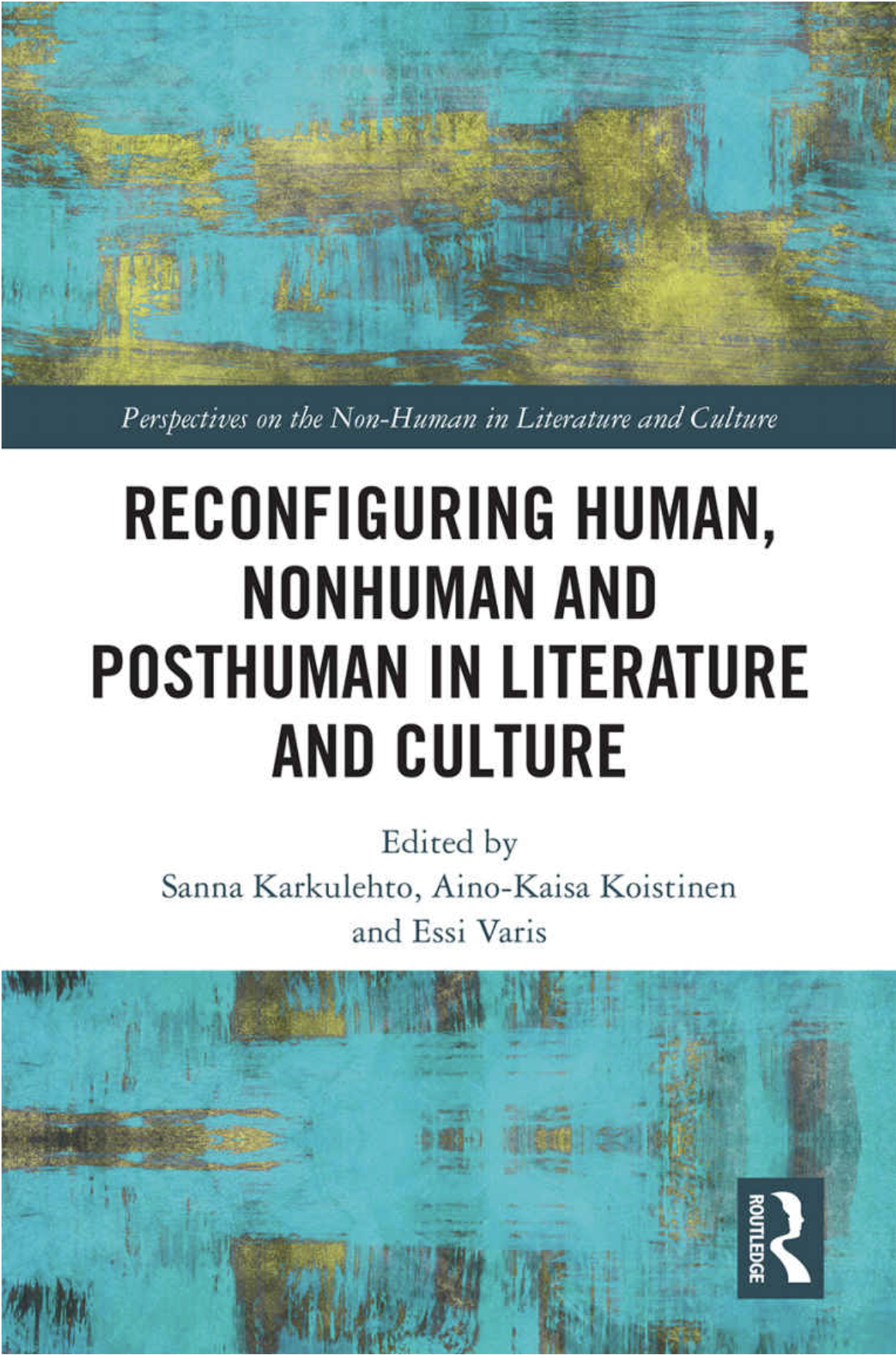
Sanna Karkulehto, Aino-Kaisa Koistinen, and Essi Varis, editors. Reconfiguring Human, Nonhuman and Posthuman in Literature and Culture. Routledge, 2019. Perspectives on the Non-Human in Literature and Culture. Hardcover. 400 pg. $160.00. ISBN 9780367197476.

A post-anthropocentric worldview rejects the primacy of human beings and seeks to encourage more ethical cohabitation between humans and nonhumans. In this vein, the anthology Reconfiguring Human, Nonhuman and Posthuman in Literature and Culture offers a collection of essays that aim to encourage serious reflection on the intra-action of various forms of matter.

The editors, Sanna Karkulehto, Aino-Kaisa Koistinen, and Essi Varis, acknowledge that this line of inquiry has become increasingly popular across disciplines as the destructive impact of human life on the planet can no longer be ignored (1-2). However, what sets this collection apart is its literary and cultural studies methodology and its subsequent attention to both real and imagined figures. They argue that art’s capacity to induce reflection on “subjective, embodied aspects of (nonhuman) experience…is likely to have notable epistemological and ethical repercussions” (5)—in ways that other disciplines are not able to achieve.  In addition to effectively demonstrating the need for such an approach, the editors’ introduction identifies the significance of narrative studies to the processes by which posthumanism, and by extension new materialism, interrogate forms of embodiment.

The anthology is divided into five sections. The first section contains essays that focus on theoretical and methodological concerns. In the opening chapter, Carole Guesse, questioning whether literature can ever really be posthumanist, ponders what a literary studies framework has to offer posthumanism. This chapter is followed by essays on the summoning of nonhuman entities through art and engaging in a mode of reading called “becoming-instrument” (57).  This latter chapter in particular, by Kaisa Kortekallio, offers a useful way for thinking through the essays in the second section, which reflect on the depiction of nonhuman characters in a variety of media: comic books, video games, and children’s literature. Each of these chapters posits that fictional characters “can be used as a tool for approaching other, actual or imaginary, nonhuman creatures” (Varis 87). In their chapter “Wild Things Squeezed in the Closet: Monsters of Children’s Literature as Nonhuman Others,” Marleena Mustola and Sanna Karkulehto conclude that such a tool (like a monster in a children’s book) reconfigures the boundaries between humans and nonhumans through the cultivation of empathy. The third section addresses the relationship between humans and nonhuman animals. Mikko Keskinen opens the section by positioning the deceased dog narrator in Charles Siebert’s Angus (2001) as a hybrid, “quasi-human character” (159). Similarly, the other chapters in this section examine the transboundary relationship between humans and pigs, as well as disabled humans and guide dogs.

The fourth section analyzes the agency afforded to human-created machines. Among calls for “renewed narratives about digital machines” (Collomb and Goyet 203) and “resisting the capitalist agenda of colonialism and docile subjectivity available for the player in Minecraft” (Huuhka 220), Patricia Flanagan and Raune Frankjœr offer the most distinctive chapter in the anthology: “Cyberorganic Wearables: Sociotechnical Misbehavior and the Evolution of Nonhuman Agency.” They contend that the “techno-genesis of the body [via wearable technology]…has the potential to foster interconnected ways of understanding our place within the Neganthropocene” (Flanagan and Frankjœr 236). The chapter is filled with images of cyberorganic technology like the Bamboo Whisper, and the authors make a compelling case for how such wearables force us to rethink what it means to be human, nonhuman, and everything in between. Thoughtfully placed, the final section, which consists solely of Juha Raipola’s “Unnarratable Matter: Emergence, Narrative, and Material Ecocriticism,” considers the limitations of seeking to understand that which is not human through a narrative lens. 

As evidenced by the range of content contained in this collection, the diverse texts and modes that are addressed is commendable. As with any anthology, some of the essays are stronger than others, but this is a collection that conveys a sense of cohesion, of each chapter being essential and in conversation with each other, in a way that anthologies don’t always achieve. If there’s a weakness, it’s that the contents vary in terms of their accessibility both stylistically and in their subject matter. Accordingly, this is a collection for the posthumanist scholar who is already well-versed in posthumanist thought. Despite the heavy subject matter, however, there is a refreshing sense of playfulness to Reconfiguring Human, Nonhuman and Posthuman in Literature and Culture that manages not to undermine the urgency of the topic but instead demonstrates the imaginative potential for more ethical cohabitation. Ultimately, this is a significant contribution that reminds us what art and literature have to offer an endangered planet.

Anelise Farris is an Assistant Professor of English at the College of Coastal Georgia, as well as the Faculty Advisor of Seaswells, the Art and Literary Magazine. Her research interests include genre fiction, disability studies, folklore and mythology, popular culture, and new media. She has presented her work internationally and actively publishes in her fields of study. She holds a PhD in English and the Teaching of English from Idaho State University, in addition to an MA, a BA, and a Graduate Certificate from George Mason University, where she studied literature and folklore.

Call for Papers: Conservative/Right-Wing Science Fiction


Call for Papers: Conservative/Right-Wing Science Fiction

The Editorial Collective


Editor’s Note: We are extending the deadline for this symposium in order to further publicize it: we did not receive the volume of submissions this topic deserves, and encourage scholars of SF to consider submitting a proposal.

While the dramatic resurgence of conservative, right-wing, and openly fascist movements became more visibly mainstream once the Trump 2016 campaign began to develop momentum, the SF world had already been introduced to this growth in unapologetically right-wing discourse via the controversies surrounding the various Puppies movements and their attempts to hijack the major awards in the years immediately prior. With the dramatic success of right-wing movements in the years before and since 2016, we of the SF community are well-suited to explore the works and worlds of SF created by right-wing authors as well as authors estranging right-wing discourse.

The SFRA Review is interested in short papers addressing conservative/right-wing SF in all its manifestations: literature, film, other media, games. We are also interested in papers addressing the science-fictionality of right-wing discourse outside of explicitly SF media.

  • Papers should be from 3000-5000 words in length, with references in MLA style and few if any discursive footnotes.
  • Our primary areas of interest are how right-wing discourse manifests in SF, how SF estranges right-wing discourse and how 21st-century conservative discourse takes on a science-fictional aspect.
  • Papers by conservative writers, or papers that take a conservative stance on works or the genre of SF, are absolutely welcome. Racism, etc., will not be tolerated, but a good-faith conservative argument is well within the purview of this collection.
  • Papers that engage with conservative theorists or media figures are also absolutely welcome, insofar as the papers address the science-fictionality of their discourse. Again, good-faith argumentation is our goal here; so long as the argument of the paper itself does not engage in (e.g.) gender essentialism, we welcome papers that address such tropes in the writing/speech of conservative theorists or figures.
  • Papers that engage with conservative/reactionary approaches by fandom to changes in works, genres or the overall discourse of SF, broadly defined, are also welcome.
  • Metacommentary about (e.g.) the Puppies is welcome; however, we are more interested in literary analysis, in the broadest sense, of works of SF and/or right-wing discourse.
  • Much right-wing SF is of questionable literary quality: we are less interested in papers whose primary rationale is to point this out than we are in how and why right-wing tropes manifest or are estranged in works of right-wing SF or discourse.
  • Images should be at least 2000 pixels wide; given that this is literary analysis, the exceptions to copyright for fair use will apply.
  • Please send email to Ian Campbell (icampbell@gsu.edu) with the subject line SFRA Conservative SF and a brief description of your paper by 15 September 2022. Any other queries should be sent to this address, as well, with the same subject line.
  • Complete drafts are due 15 February 2023.
  • Edits will be due 15 April 2023.
  • Papers will be published in the Spring 2023 issue (53.2) on 01 May 2023.

We sincerely hope that you will be interested in what we feel is an important aspect of SF in these current times and encourage you to submit.