Dystopias in the Trump Era: Anti/Immigration and Resistance in CALEXIT


SFRA Review, vol. 52, no. 1

LSFRC 2021 Papers


Dystopias in the Trump Era: Anti/Immigration and Resistance in CALEXIT

Anna Marta Marini

Approaching the 2016 United States presidential election, writer Matteo Pizzolo developed the idea for a comic book that could reflect the growing political anxiety experienced in the Californian borderlands, as well as the reality at the United States-Mexico border. Drawn by Amancay Nahuelpan and published by Black Mask Studios in 2017, Calexit [1] (stylized as CALEXIT) is a dystopian story set in a near future, two years after the re-election of an autocratic president who ordered the deportation of all immigrants and deployed the National Guard to occupy sanctuary cities and enforce the law. The order sparked dystopian warfare between California’s liberal cities and conservative exurbs, respectively forming the Pacific Coast Sister Cities Alliance (including Tijuana) and the Rural Sovereign Citizens Coalition. Directly confronting both the National Guard and the neofascist vigilante Bunkerville Militia, an armed citizen movement called Mulholland Resistance fights for immigrant rights led by ruthless Zora Donato. Unwillingly involved in the conflict, smuggler Jamil—accompanied by his crow-shaped AI drone Livermore—is bound to take Zora to a secret militant camp on the border. In the attempt to annihilate the resistance and capture its leader, extremely violent confrontations ensue under the command of deportation enforcer Rossie—who at the same time lives with his Latinx wife and children in San Diego, raising the topic of existing Latinx conservative anti-immigrant stances as well. Filled with popular culture references, the comicbook directly engages with contemporary activist and political movements—evidently referring to the controversial notion of a “Calexit” [2] secession of California. The construction of the dystopian context outlines a forebodingly realistic fictional civil war within California, as parallels with actual extrajudicial border enforcement practices can be drawn. The collected edition is also rounded out with a series of interviews done by the author with local activists, political figures, and investigative journalists whose takes on the 2016 electoral campaign Pizzolo found valuable.

Make California American Again: Discourses of the Trump Era

Calexit’s plot starts halfway through the second mandate of a fictional unnamed president, whose authoritarian administration has focused on the deportation of any undocumented immigrant. As a consequence of California’s rebellion against the presidential executive order, any foreign-born citizen whose documentation was issued by Californian institutions is also bound to deportation, regardless of their status.

The references to Donald J. Trump’s 2016 electoral campaign and subsequent presidency are very clear, both visually and verbally. The comic book opens with a page focused on the president’s speech, announcing his upcoming visit to California and promising that he is not “gonna let murderers and illegals hold [American citizens] down” (3, Fig. 1). The few sentences evidently reproduce some of Trump’s most recurrent discourse strategies and speech patterns, including the use of an informal register. The reference to recognizable, widespread images depicting Trump at his presidential lectern is evident; possibly for its recurrency during his administration, this specific configuration of silhouette and suggested gesture has become one of the most used images on the internet, often turned into memes and mocking gifs.

Figure 1: CALEXIT (3).

Right from the first page, a Manichean view of reality is outlined through the autocratic president’s words, just as it happened during Trump’s administration. Trump’s discursive strategies and patterns have elicited Orwellian comparisons (Rodden 261-263), and his administration was based on what Gardiner has called “demographic dystopia” or the notion of an impending demographic shift for which White citizens would soon become a minority in the American society (Gardiner 64-68). Such a conviction clearly shapes White nationalist and supremacist fears of a possible loss of the privileges intrinsic to the majority status, supporting the “anti-immigrant sentiment embodied by Donald Trump” (Chan 62) and the related historical anxieties peculiar to the dominant class. Furthermore, Trump’s penchant for discursive strategies related to populism and post-truth has helped structure concepts that, in a much dystopian way, “presuppose the existence of universally shared, accepted ‘truths’ pre-2016 which shroud the pre-Trump, pre-Brexit period in a myth of munificence and objectivity” (De Cock et al. 4). The constant mention of “fake news” and denial of patent facts gave a dystopian prominence to mis- and disinformation, favored by new technologies and the consequent false content manipulation and dissemination (Guarda et al. 5-6). The illusionary certainty that Trump’s discourse offered to the electorate—and kept on fueling throughout his mandate, despite the lack of concrete, effective action—“[fed] on and fortifie[d] a deeply emotional rejection of existing social elites, constantly affirming he will not stop at anything in the defence of ‘his’ people” (De Cock et al. 5).

A fundamental pivot of Trump’s discourse is embodied by the United States-Mexico border and immigration issues related to it, fueling—with the help of mainstream media channels—the rooted fears of an impending immigrant “invasion” and the “evidence” of crimes perpetrated by immigrants against American citizens. Drawing on Juri Lotman’s definition of the semiosphere and the expansion of it by scholars who have intersected it with the notion of political hegemonic discourse (see, for example, Selg and Ventsel, “Towards a Semiotic Theory of Hegemony”), I argue that the United States-Mexico borderlands can be conceived as the embodiment of the boundary of the U.S. cultural semiosphere—its peripheral part as opposed to the core embodied by the national Anglo monoglossic dominant heritage. In the dystopian scenario imagined by Calexit, the disruption and boundaries that intersect and characterize the peripheral part of the semiosphere become tangible. The clash between two factions that in a way exist in reality and cohabit the geographical, institutional space represented by California, in this dystopian take becomes so strained that the fracture is irreparable and a civil war ensues.

The type of dialectic discourse proposed by Trump embodies the discourse that aims at defining and preserving the semiospheric core. The dominant semiosphere is evidently self-descriptive, according to an idealized set of values, cultural references, and signs, which are reflected in a sociocultural hierarchy. Trump’s discourse exacerbates the preexisting U.S. political core discourse, that has been—often and more or less overtly—a nativist discourse. Policies focused on immigration and the border infrastructure have represented a central issue since the 1980s with the implementation of immigration regulation measures, followed by the start of the actual building of a border infrastructure in the mid-1990s. The turn of the screw represented by the aftermath of the 9/11 terrorist attacks strengthened the security measures at the borders, leading to the creation of the Immigration and Customs Enforcement (ICE) agency in 2003. The Trumpian wall discourse is just an oversimplification, a symbol embodying this preoccupation with the definition of what is inside and what is outside the border of the U.S. semiosphere. The border is not directly shown on the pages of Calexit, but its presence is underlying throughout, as the notion of the boundary as a locus of invasion and disruption marks the story.

As Ventsel has stressed, politics “can be conceptualised as a practice for creating, reproducing and transforming social relations that cannot themselves be located at the level of the social” (9). Politics are a direct expression of the power of discourses, since problems related to the political sphere are intrinsically social, connected to “the definition and articulation of social relations in a field criss-crossed with antagonism” (Laclau and Mouffe 153). The necessity to affirm a “new” post-truth national identity intrinsic to Trump’s and his supporters’ discourse relies on the perceived necessity to reestablish the cultural homogeneity of the system, which corresponds to the U.S. dominant cultural core. Such perceived need of rearticulation of the core—and White culture as predominant—possibly “stems from the change of culture’s position due to its inner or outer factors. In most cases the main causes for intensification of identity creation are external effects” (Selg and Ventsel, “An Outline” 465). Clearly, the borderlands embody the external influences perceived as threatening, as the immigrants’ entrance and integration could lead to the tainting of American values and heritage.

Calexit does not only refer to Trump and his discourse, but also to the White supremacist groups that supported him throughout his mandate. Any operation that would be perceived as too controversial if carried out by federal institutions is handled by the Bunkerville Militia, a sort of vigilante group operating more or less overtly in connection with deportation officials. Its members are openly Nazi, they engage in local criminal activities, and they are characterized as indulging in drug use, prostitution, and in general violence, markedly masculine activities—despite the fact that the actual mind behind their new leader Crowbar is one of his girlfriends. When the National Guard accidentally tracks Zora, the agents directly call Crowbar to inform him, as he has been—extrajudicially—put in charge of the pursuit and capture of the resistant faction’s leader by Rossie. The chief deportation enforcer for the federal government purposely provokes extremely violent confrontations between the antagonist factions, in order to justify a consequent brutal intervention of the National Guard. He is ruthless and collaborates directly with the Bunkerville Militia to get the “dirty work” done, but he also visits members of the Mulholland Resistance to convince them of the uselessness of their fight—thus fomenting internal division. Significatively, at the same time Rossie’s private life contradicts his ideological convictions: he has a Latinx wife and children who live in a secluded villa in San Diego. This raises the topic of the existence of Latinx conservative anti-immigrant stances, since his wife is a stern supporter of his job and its consequences. The comic book delivers a not too veiled reference to public figures who promote discourses and ideologies that do not necessarily correspond to their personal life, and in general the double standards that often characterize the political elite.

Extremism and Dystopic Resistance

Dystopian narratives have been characterized by the attempt to identify “a utopian horizon that might provoke political awareness or effort” (Moylan 163), a motive that might elicit political resistance against the grim scenarios in which the characters are forced to move. Dystopian resistance upholds forms of what Moylan has defined as “utopian hope,” contemplating the possibility of radical social change based on the resistant characters’ refusal to abide by the rules imposed by the dominant strata of society. Clearly, not all approaches to resistance bear the same commitment or lead to the same achievements. Building on Baggesen’s notion that dystopian pessimism and its consequent reactions can be either resigned or militant (Baggesen 36), it can be argued that the construction of most dystopian narratives revolves around the opposition between an imposed hegemonic order and a counter-narrative resisting the dominant system. In particular, the dystopian fiction focusing on the construction of a totalitarian regime lends itself to parallels with reality and the articulation of storylines that draw on political action and its ethics. As Jones and Paris’s study has demonstrated, “totalitarian-dystopian fiction heightens belief in the justifiability of radical political action” (982). Faced with dystopian narratives, the study subjects’ responses highlighted the fact that in such circumstances violence seems necessary and even legitimate to subvert the totalitarian system (982-983). Due to the political charge of the narrative and the articulation of the opposition to the violation of values of democracy and equity, the performance of acts of resistance is often portrayed “as admirable (even when not or only partially successful) and readers are expected to empathize with the protagonist and even imagine how they themselves might fight such value violations” (972). Furthermore, gendered dystopian fictions seem to be marked by “a subversive and oppositional strategy against hegemonic ideology” (Baccolini 519). The construction of Zora’s character seems to be purposely exaggerated toward violent extremism to convey the main idea underlying the comic book: alleged neutrality does not exist, as inaction and refusal to take a stance is per se favoring the totalitarian system.

In the premises of Calexit’s story, it is said that the “ultimate betrayal” triggering the repressive occupation of California and the reaction of the local conservative fringes is the fact that the Pacific Coast Sister Cities Alliance—besides being formed by sanctuary cities in the U.S. territory—also included Tijuana. The inclusion is seen as inadmissible by the White supremacist, nativist segments of Californian society. In the detailed reconstruction of the dystopian context written by Pizzolo, when Tijuana joined the alliance the president felt that he could “no longer tolerate what is becoming an international conflict and decide[d] he must invade California” (106). The main character voicing this type of discourse is the enforcer-in-chief Rossie, who is leading the occupation and exploiting a paramilitary group such as the Bunkerville Militia to make the most of the local conflict. Through Rossie, the government delegates operations to an extremist civilian organization, to resolve situations by violent means that would be extrajudicial for the state to exert—even within a state of exception. Contextualizing the comic book and its dystopian depiction of an ongoing, real political climate, such delegation reminds of the existence of civilian vigilante groups patrolling the United States-Mexico border. This kind of organization started to appear along the boundary in the mid-1970s and falls within the spectrum of so-called neo-vigilantism (Brown 127-129), as they involve some types of cooperation with the federal and local enforcement. Among them, it is worth remembering the Minuteman Project, which attracted the attention of the media in 2005. Part of the broad anti-immigrant movement, these groups are unauthorized and yet to an extent condoned by border enforcement agencies such as the Border Patrol and ICE. As Doty has highlighted, the civilian border patrols interpret the border as “a war zone” and prominently employ imagery and rhetoric inherent to war and combat (125)—as the members of the Bunkerville Militia do.

Opposite the Bunkerville Militia, the Mulholland Resistance is a movement constituted by citizens fighting for immigrant rights and led by Zora Donato, who is a queer and now-illegal Mexican immigrant cyborg. She lost a leg in a past confrontation, she is very assertive and convinced of the necessity to fight the state repression and extrajudicial deportation with any possible means. The comic book starts with a sequence in which her adoptive parents are threatened to make them reveal her location; as a consequence of their reluctance, her father is killed and his head is sent to the resistance group in a box. Besides being marked by harrowing experiences, Zora is depicted as an extremist figure. If the resistance on the one hand is armed and its components defend themselves violently against the National Guard and the militia, on the other hand she does not know where to stop. During confrontations she does not stick to the agreed plan to just repel the guards without attacking them and without provoking an exchange of fire. On the contrary, she attacks the guards first, provoking the killing of several members of the resistance.

Figure 2: CALEXIT (68).

Zora’s stance is first made clear in a dialogue with a fellow activist, taking place on the ruins of a house whose militant owners were shot to death in a conflict that escalated when she opened fire on the National Guard. While her companion is appalled by her minimization of the casualties and insists that militants “won’t fight, certainly not if they think we’re just throwing bodies at the occupying army” (68), Zora opposes his view. She explains that—as it happened “in the French-Algerian war”—casualties among the resistance fighters serve as inspiration for others to join the cause, and thus more people will take part in the fight out of indignation if they see militants die (68, Fig. 2).

When Zora and Jamil are stopped at a road check—and the guards communicate their location to the leader of the Bunkerville Militia—she reacts by shooting one of the guards in the face and the reader is left with the two of them waiting for the confrontation with the militia. A dialogue ensues between them, and the smuggler realizes suddenly that the Mulholland Resistance was not aiming to get Zora to safety at the camp on the border. Rather the group was trying to get rid of her due to the damages she provoked, as her extremist views and approach to the resistance have been revealed to be too dangerous for them. If this explanation exposes the questionable consequences of her uncompromising stance, Pizzolo does not condemn them. Her character is, to an extent, constructed around the aforementioned perception of the admirable value intrinsic to the fictional dystopian resistance, whose violent acts are justifiable when perpetrated against repressive opponents. The framing of her violent resistance within the totalitarian order allows—and leads—the readers to reconcile to its consequences and accept her violent yet nearly suicidal mission.

Of Monsters and Caves: A Criticism of Neutrality

In between the two extremes represented by the Bunkerville Militia and the Mulholland Resistance, Jamil embodies the subjects that—despite being to an extent involved daily in the conflict—do not want to take a clear stance and thus juggle their relationships with both factions. Unwillingly involved in the conflict, Jamil is a smuggler working for whoever pays him, often providing National Guard agents with antidepressants and illegal drugs. He knows his way around the conflict areas, and he can move freely between the territories controlled by either the resistance or the National Guard. Albeit suggesting a critical view on the enforced occupation, Jamil seems to embody a kind of character that recurs in dystopian fiction, who “negotiate[s] a more strategically ambiguous position somewhere along the antinomic continuum” (Moylan 147).

On several occasions throughout the comic book, Jamil stresses out that he does not care to express a political position, he maintains connections with both factions for business, having “problems with no one,” and that he is in the “not-making-enemies line of work” (53).

Figure 2: CALEXIT (102-103).

This approach of course provokes a clash with Zora, leading to an argument during which she justifies her extremist position and plans to fight her antagonists (102-103, Fig. 3). She believes that a violent insurgency is necessary to stimulate awareness in the public and that it is necessary to face directly the enemy, or “monsters” as she calls them, otherwise nothing will ever change. She accuses Jamil as being delusional—as other people like him are—and she says “you wanna believe if you’re just patient, everything will go back to normal. If you’re just patient, the monsters will go back into their caves” (102). She clearly hints at the fact that White supremacist groups cyclically resurge and that they are never really defeated, punished, or condemned by the dominant core of the US cultural semiosphere. When Jamil says that he is “fucking neutral. That’s my job,” Zora replies that her job is to make “sure no one’s neutral” (102). Not taking a stance would already be a non-neutral position per se, but she highlights the fact that he sells drugs to depressed extremists while telling himself that that is a neutral position.

Despite his reluctance, it becomes impossible for Jamil to avoid getting involved in the conflict and, consequently, being forced to take a position in it. Unwittingly, Jamil happens to be the person in charge of delivering the severed head of Zora’s father to the resistance; militant members thus leverage his involvement to trick him into removing Zora, lying on the plan to smuggle her to a secret camp on the border. Shortly after being caught by the National Guard, he unwillingly stands by her side, assuming the political weight of his purported neutrality and eventually taking a position. The main message of the comic book seems to be, indeed, a condemnation of self-declared neutrality and a denunciation of the real consequences of the refusal to position oneself, especially for personal interest or individual “peace of mind.”

The conflict articulated in Calexit is based on a power asymmetry between the totalitarian core and the dissident boundaries of the fictional semiosphere it is set in. It is political, cultural, and ideological altogether, and it touches upon shared values and ethical issues; the deliberate avoidance to take a stance would betray implicitly a connivance with the dominant side of the conflict. The construction of the dystopian context outlines a forebodingly realistic fictional civil war within California, as parallelisms with actual extrajudicial border enforcement practices are evident. Despite the violent scenario, Calexit brings to life a dystopia aimed at celebrating the spirit of existing pro-immigrant resistance and—in Pizzolo’s words—encouraging the readers to “look fascism in the face and challenge it” (CALEXIT 109; “2017’s most dangerous comic”).

NOTES

[1] For the purpose of this paper, the collected edition of CALEXIT (published by Black Mask in 2018) will be used as reference.

[2] For a brief recap of the debate channeled by the Yes California independence campaign (2015) see for example Chloe M. Rispin, “Could California Secede? A Philosophical Discussion.”

WORKS CITED

Baccolini, Raffaella. “The Persistence of Hope in Dystopian Science Fiction.” PMLA, vol. 119, no. 3, 2004, pp. 518-521.

Baggesen, Søren. “Utopian and Dystopian Pessimism: Le Guin’s ‘The Word for World Is Forest’ and Tiptree’s ‘We Who Stole the Dream’.” Science Fiction Studies, vol. 14, no. 1, 1987, pp. 34-43.

Brown, Richard Maxwell. Strain of Violence-Historical Studies of American Violence and Vigilantism. Oxford University Press, 1975.

Chan, Edward K. “Race in the Blade Runner cycle and demographic dystopia.” Science Fiction Film and Television, vol. 13, no. 1, 2020, pp. 59-76.

De Cock, Christian, et al. “What’s He Building? Activating the Utopian Imagination with Trump.” Organization, vol. 25, no. 5, Sept. 2018, pp. 671-680.

Doty, Roxanne Lynn. “States of Exception on the Mexico–U.S. Border: Security, ‘Decisions,’ and Civilian Border Patrols.” International Political Sociology, vol. 1, 2007, pp. 113-137.

Gardiner, Steven L. “White Nationalism Revisited: Demographic Dystopia and White Identity Politics.” Journal of Hate Studies, vol. 4, no. 1, 2005, pp. 59-87.

Guarda, Rebeka F., et al. “Disinformation, Dystopia And Post-Reality in Social Media: A Semiotic-Cognitive Perspective.” Education for Information, no. 1, 2018, pp. 1-13.

Jones, Calvert W., and Celia Paris. “It’s the End of the World and They Know It: How Dystopian Fiction Shapes Political Attitudes.” American Political Science Association, vol. 16, no. 4, 2018, pp. 969-989.

Laclau, Ernesto, and Chantal Mouffe. Hegemony and Socialist Strategy: Towards a Radical Democratic Politics. Verso, 1985.

Lotman, Juri. “On the Semiosphere.” Sign Systems Studies, vol. 33, no. 1, 2005 [1984], pp. 205-229. Translated by Wilma Clark.

Moylan, Tom. Scraps of the Untainted Sky: Science Fiction, Utopia, Dystopia. Westview Press, 2000.

Pizzolo, Marco. “2017’s Most Dangerous Comic: Writer Matteo Pizzolo on Golden State Secession Series Calexit.” Interview by Will Nevin. AL.com, July 11, 2017. http://www.al.com/living/2017/07/2017s_most_dangerous_comic_wri.html. Accessed 15 Oct. 2021.

Pizzolo, Marco, writer, and Amancay Nahuelpan, artist. CALEXIT. Black Mask Studios, 2018.

Rodden, John. “The Orwellian ‘Amerika’ of Donald J. Trump?” Society, no. 57, 2020, pp. 260-264.

Selg, Peeter, and Andres Ventsel. “Towards a Semiotic Theory of Hegemony: Naming As Hegemonic Operation in Lotman and Laclau.” Sign System Studies, vol. 36, no. 1, 2008, pp. 167-183.

—. “An Outline for a Semiotic Theory of Hegemony.” Semiotica, vol. 182, no. 1/4, 2009, pp. 443-474.

Ventsel, Andreas. Towards Semiotic Theory of Hegemony. Tartu University Press, 2009.

Anna Marta Marini is a Ph.D. fellow at the Universidad de Alcalá, where her main research project delves into the representation of border-crossing and the “other side” in U.S. popular culture. Her research interests are: critical discourse analysis related to violence (either direct, structural, or cultural); the representation of borderlands and Mexican American heritage; and the re/construction of identity and otherness in film and comics, particularly in the noir, horror, and (weird) western genres. She is currently the president of the PopMeC Association for US Popular Culture Studies.
My Body, My Data: Orwell, Social Media, and #MeToo


SFRA Review, vol. 52, no. 1

LSFRC 2021 Papers


My Body, My Data: Orwell, Social Media, and #MeToo

Adam McLain

“Big Brother Is Watching You” is the doublethink watchword that shadows over the dystopian world of George Orwell’s Nineteen Eighty-Four. Big Brother, the created, semi-dictatorial, full-totalitarian nickname for the governmental surveillance machine, has become a nomenclature in today’s society for the government observing its citizens and enforcing its will over them. In the book and various media adaptations of Orwell’s dystopia, Big Brother is usually a fictitious non-entity, a presence that is always present but never a specific character, either vested in a representative like O’Brien or given representation in a TV screen that the characters watch and that in turn watches the characters. However, in the 2016 video game Orwell and its 2018 sequel Orwell: Ignorance Is Strength, the audience takes the spot behind Big Brother’s TV screen and becomes an operator, a part of the institution that runs the surveillance software Orwell. In this paper, I layer the positionality of various groups in Nineteen Eighty-Four and Orwell and bring them into conversation to create a theoretical matrix of interaction that can be applied to online activism. I use this matrix to approach how social media and the #MeToo movement use and abuse two specific types of bodies—that of the survivor of sexual violence and that of the survivor’s data—to enact sexual justice and legislative and cultural change.

Important to this paper is positionality. Positionality is a critical tool that was developed through epistemology, in which it discussed things as they were and are in relation to each other—the nature of their position (“Positionality”; Rowe). Other schools of thought have used positionality as a way to critique and interrogate their respective problems and questions. For example, in race, gender, and sexuality studies, positionality is used as a method to determine how one approaches their view to determine their intersectionality; in other words, an author’s biases, viewpoints, and background position their approach to a text, a problem, or a question, influencing the conclusions they draw and the arguments they make (Mikkola). Positionality is used in this paper to determine how character and audience are employed and relate to each other in a book and a video game, two different types of media that both require the attention and engagement of an audience who can invest themselves in the created world where the events of the plot take place.

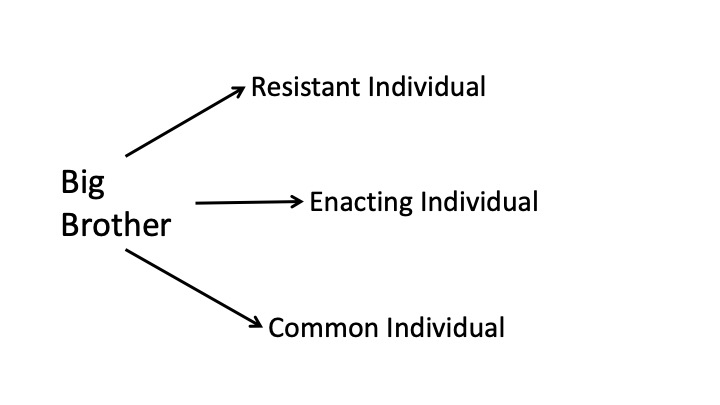
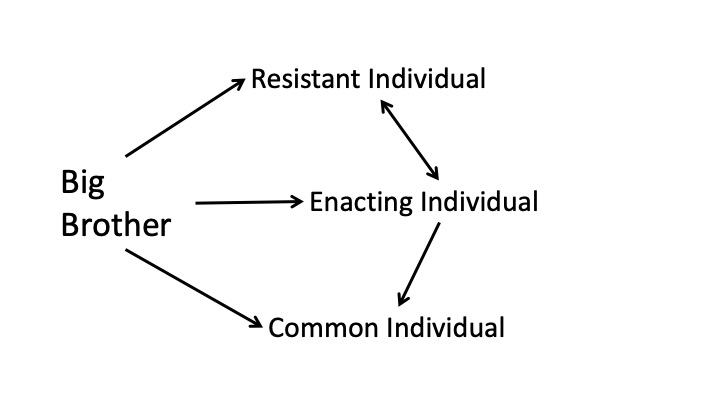
In the story world of Nineteen Eighty-Four, Big Brother is an autonomous nightmare who represents the government. Big Brother acts upon the citizens of Oceania, while Winston, a citizen once ignorant to being acted upon, is awakened as a resistant individual to Big Brother and the various governmental ministries. While the individual and Big Brother are enmeshed in this clash of the oppressor and the oppressed, Winston, O’Brien, and Julia become the ways the reader understands the relationships between the oppressor and the oppressed in Oceania. In addition, the proles, or common folk, exist within a nebulous field of knowing they are there but never given life through character. Four positionalities, then, arise from these points of intersections: the imaginary system of Big Brother; the Resistant Individual, who seeks to undermine the influence of the government (Winston and Julia); the Enacting Individual, who brings about the will of the system (O’Brien); and the Common Individual, who lives within the system with no seeming desire to change or disrupt the system (Fig. 1).

Figure 1: Representation of the three different groups that Big Brother affects in Nineteen Eighty-Four.

Along with their individual positionalities within the novel, each has relational positions to Big Brother and each other. Big Brother exerts influence over them all, as Fig. 1 shows, while the workers within the ministries and those resistant to the ministries position themselves against each other. I emphasize the relationship to Big Brother because of the hierarchical and almost-omnipotence that Big Brother exerts over the other relationships. Whereas the different individuals contend with each other, Big Brother still oppresses all. Big Brother is situated as observant, omnipresent, and almost omniscient (even though, within the novel, Big Brother hasn’t yet completely penetrated the minds of the people). This positionality, then, places Big Brother over these people, gathering information on them, directing them, and being aware of almost every action. Between the three individuals, the interaction becomes more complicated, as the resistant and enacting individuals interact with each other in a battle of oppression, and the enacting individual affects the common individual’s daily life through legislation and enforcement. Thus, a nexus or network of interactions is formed of the positions of each character that is both dependent upon Big Brother’s influence and interdependent and interactive between the positionalities (Fig. 2).

Figure 2: Lines drawn to show positionality and interaction between the various individuals Big Brother influences.

Yet outside the story world, Big Brother is not the only observer. The positionality of the reader, who observes the events of the story world through screen or page, is important to consider as well. The reader observes from an almost omniscient perspective, out of time and page, able to move back and forward through the events depicted in the novel and experience the text through their own imagination; therefore, the story world’s system of interrelated positionalities becomes encircled by a solid line to indicate that it is within itself, as the reader is placed without the story, affected by and affecting the way the narrative is understood (Fig. 3). The reader, although outside the contained system of the book, makes assumptions about the world, develops relationships with the characters, and envisions the words on the page, thus interacting, engaging, and being influenced by the contained story world.

Figure 3: The system of interactions between Big Brother (BB) and the various individuals are enclosed in a story world that the Reader interacts with.

The positionality matrix of the 2016 video game Orwell skews the reader-text positionality matrix of Nineteen Eighty-Four (Figs. 1-3) by an important dynamic: instead of the audience passively observing Big Brother through the entryway of the book, they are now the active player who both acts as Big Brother and enacts Big Brother’s will. Hence, in the representative Fig. 4, the game world’s circle is dotted and porous. Within the game world, a freelance, outsourced employee of the Nation is hired to work as an investigator of the bombing of a public square. Managing a flow of information through the new aggregate software Orwell, the investigator-player collects data on individuals through access to news sources, social media, personal communications, and desktop computer access, and then uploads various data connected with a character to the system, which provides it to an operator. The positionality of the player and the investigator is meant to be foreign, unconnected, and distant from the software to present a veil of objectivity, yet the character is still engaged in the story, interacting with it as the player interacts through the character. However, a firm line is drawn for the story to unfold: the game is linear rather than open world, even though within that linear trajectory, many decisions can be made by the player.

Managing the player-investigator’s efforts is the operator, who resides on the other side of Orwell’s screen. The operator in Orwell is Symes, a nod to the text on which it is based. Symes can only send the investigator-player messages and cannot receive any from the player-investigator; all Symes receives is the aggregated data that is input into the Orwell system by the player-investigator. The legislative and state directive is that anyone who is plausibly involved in a crime has state action performed against them. So, once the investigator-player establishes in Orwell that a person is a target—due to the collected data and the story the operator weaves from those data—the operator activates law enforcement to arrest that person. Thus, both the operator and the player-investigator make up a form of executive government as they develop a narrative with the data and information gathered to make consequential decisions on truth and reality.

In addition to the investigator and the operator using the Orwell system to discover who set off a terrorist bomb in the Nation, various hackers and activists seek to undermine Orwell throughout the game. The game simulates these hacks of Orwell by freezing the screen or messing up the language on the player’s computer. The collected data are, for the first part of the game, on the activists and hackers to discover who is the cause of a terrorist bombing; but soon, the data collection grows out of control and the player must gather data on the operator and government officials, along with the hackers. As mentioned before, this makes the gamer’s experience different from the reader’s experience. Instead of dealing with a closed-off story world, the gamer must interact with a game world that takes over the real-world computer and has in-game consequences.

Even with these interactive differences, the operators, personal data, and activists map on to the positionality from the source text. The resistant individuals are the activists, the enacting individuals are the operator and the investigator, and the common individuals are the data gathered. In this reading, data become simplistic but also subversive, just as the proles are the masses who have the capability to be used to overcome the government. Indeed, the efforts of the operator, player-investigator, and hackers/activists are subsumed into the gathering of data—of each other’s data and of their own data. At the end of Orwell, the player has four branching paths to gather data on: (1) the operator (now a high-end government official who would lose her job if her data were aggregated into Orwell; Orwell gets shut down); (2) the hacker-activists (incriminates the hacker as a threat to the nation; Orwell is accepted for use within the Nation; the investigator becomes an advisor); (3) the player-investigator (Orwell is taken down because it cannot be trusted, since the player-investigator can narrate data in a way of self-incrimination, thus proving it to be a flawed system); or (4) on all of them (in which the player tries to incriminate the government official, fails, and Orwell is brought to the public’s knowledge to neither positive nor negative feedback). However, even as these operate with each other, the system is not closed as in the book’s system (Fig. 3). The player-investigator represents a human being playing the game and a character within the game; this interaction creates the porous boundary between what is happening in the game and what occurs outside the game (Fig. 4).

Figure 4: The system within Orwell places the player (P) interacting on the investigator character (Inv.). The investigator acts on the Orwell data aggregate system (BB [Big Brother]/Orwell), which has multiple lines of positionality toward the operator, personal data, and the hackers/activists.

Point of view and positionality, then, are very important in the video game. The interface is not a first-person shooter or an RPG-style game; instead, the game emphasizes the player doing the work of inputting information into the data aggregate system. The simulation of this aspect makes the player culpable and invested by the end of the game, since the data the player uploads affect the outcome. Indeed, this interaction could cause greater instigation for players toward activism and resistance, as they live out in the game world the consequences of a surveillance and that data are points of information that are then woven into narratives for action, rather than points of truth in and of themselves. Thus, this collapse of player and investigator, player and character, and their relationship to the Orwell system as seen in Fig. 4, shows an actionability that is not as strong within the contained system of positionality in Nineteen Eighty-Four. Whereas Nineteen Eighty-Four is an expression of a fear of surveillance, Orwell becomes a potential catalyst for action against a surveillance state.

The two systems—George Orwell’s closed book system (Fig. 3) and Orwell’s porous player-investigator system (Fig. 4)—provide two matrices of positionality and power to then investigate the positionality of social media that needs to be understood as online activism is sought more and more for societal improvement. In the case of the #MeToo Movement, a positionality matrix brought into conversation with Nineteen Eighty-Four’s and Orwell’s systems will elucidate the potential cost that bringing to light the interconnectedness of sexual harassment and violence through social media has on survivors’ experiences.

When survivors add #MeToo to a post, they are integrating their story with millions of other sexual violence survivors around the world. The hashtag allows the poster to join in a chorus of other voices that agree that they too have had sexual violence enacted against them. The act of posting with the hashtag performs three vital actions that resist cultural assumptions and attempt to change cultural understanding of sexual violence: (1) reveals actions usually kept silent; (2) creates a community through the network-system automation of a hashtag on social media websites that connects various public posts; and (3) raises awareness and heightens the discourse around the subject through trending topics that can keep a conversation going for days, months, and years.

While these three activities are necessary for resistance, a matrix of positionality shows that the act of hashtagging also re-enacts upon a data body—a social media account that represents the tangible body typing the post—by the communal demand and personal action of the hashtagger (Fig. 5). In brief: the survivor chooses to express to the community through a hashtag that sexual violence has occurred to their physical body. The hashtag connects them to a community that can interact with them—a back and forth of likes, retweets, shares, and comments. The hashtag not only connects the post to a community, but also to a greater public—sometimes even if the person shares their post privately (e.g., screenshots and word of mouth can spread a person’s private posts farther than the supportive communal interaction of allowed followers). The hashtag also allows data aggregators to collect, collate, and correlate the hashtag into statistical or marketable data.

Figure 5: The contained system of the social media platform allows the post (#MeToo) of the survivor (S) to interact with a community, the general public, and data aggregation. The survivor who posted #MeToo is entering the post into the social media system.

Thus, a matrix of positionality of online posting is formed with a solid line around it to show an enclosed system. The circle in Fig. 5 represents the cohesive system within a social media website that the survivor’s #MeToo post enters when they join the resistance against rape culture and sexual violence by speaking up. The matrix is similar to the one formed with Nineteen Eighty-Four, in which the reader is outside this internal system that is attempting to work itself out. The #MeToo post can be seen as its own body that, like Winston or Big Brother, is interacting within the system. This is not to say that #MeToo is morally or ethically similar to Big Brother, but rather positionally similar. The #MeToo post affects the rest of the interactions as the central figure to enacting the system of positions.

Social media is not simply contained within itself; it is devised to be social and shared. Thus, instead of a contained system, the social media activist must understand that social media created a system with a porous boundary. The survivor still uses their digital, data body to send out the post with #MeToo into the social media system, but the community, public, and data have the potential to escape that system as the stories and information pass through the social media boundary (Fig. 6). This porous boundary allows #MeToo to be used to make cultural change, but it also spreads the post beyond controllable means. Once the hashtag is placed on to a post, the survivor loses control of their body again, the violence enacted on it being repeated, retweeted, and reformed through various means (from political activism to incel jokes).

Figure 6: Instead of a contained system, social media is an open system that allows those outside the system to interact with what is posted and to then use it elsewhere, as depicted with the dotted-line circle.

This porous boundary, then, shows that the social media post is not its own creation, divorced from the creator, but rather forms two interconnected bodies, that of the survivor (S) and that of the survivor’s social media presence (#MeToo), just as Orwell has the player and the character as two interconnected bodies. Fig. 5 makes sense when considering the data body created by the survivor, but with sexual violence, physical bodies are affected along with data bodies, and Fig. 6 shows that the knowledge of sexual violence can be spread beyond what the system.

Additionally, like the interaction between player-investigator and the Orwell system in Orwell, the #MeToo system can be expanded to include the action on the survivor’s physical body—the sexual violence—as the instigator of the entire system (Fig. 7). Just as a game’s story cannot be played without a player, #MeToo would not exist without sexual violence. In this way, we must be aware that as the collective conscious of culture encourages social media activism on behalf of cultural change, the act of #MeToo is re-ascribing violence upon survivors as they remember, reflect, and re-engage with the violence that occurred on their physical body through their digital, data body. While #MeToo can be used as an empowering moment of taking control of their body, it can also be their body being lost again to the maelstrom of social media, as retweets, quote tweets, shares, screenshots, and more take the empowering moment and twist it to other individual wills. There is resistance and power in using a hashtag to form unity and solidarity in experience, but it also reifies an act of violence upon a body, both reminding the survivor of the violence enacted against their physical body and having that same violence enacted on the data body formed through their social media interaction.

Figure 7: The porous system of social media where #MeToo is shared is performed by the survivor (S), but #MeToo and the category of survivor would not be without the first act of sexual violence (SV) on the survivor’s body.

This insight is not meant to stop social media activism; it is meant to encourage activists to take a moment’s pause to consider what choices of resistance do to bodies seen and unseen. In outlining these systems, I am acknowledging what might be gained and what might be lost in taking certain actions to resist and change a cultural system. These systems help activists to realize that the effects of an action have costs, and as we attempt to change culture, the desired effect and affect can expand beyond what was first envisioned or what was first instigated by an action. Indeed, these systems elucidate the need for both critical action and communal compassion in our attempts to resist.

WORKS CITED

Mikkola, Mari. “Feminist Perspectives on Sex and Gender.” The Stanford Encyclopedia of Philosophy, edited by Edward N. Zalta, 2019. https://plato.stanford.edu/archives/fall2019/entries/feminism-gender/

Orwell. Steam, 2016.

Orwell: Ignorance Is Strength. Steam, 2018.

Orwell, George. Nineteen Eighty-Four. Secker & Warburg, 1948.

“Positionality.” Gender & Sexuality Dictionary. http://www.dictionary.com/e/gender-sexuality/positionality/

Rowe, Wendy E. “Positionality.” The SAGE Encyclopedia of Action Research, edited by David Coghlan, and Mary Brydon-Miller, SAGE Publications, 2014, pp. 628. doi:10.4135/9781446294406.n277.

Adam McLain is currently a Harvard Frank Knox Traveling Fellow, studying twentieth-century dystopian literature and the legal history of sexual violence in the U.K. He earned a master’s of theological studies in women, gender, sexuality, and religion from Harvard University, and a bachelor of arts in English literature from Brigham Young University.


Controlled (Post)Human Bodies in Minister Faust’s War & Mir, Volume I: Ascension


SFRA Review, vol. 52, no. 1

LSFRC 2021 Papers


Controlled (Post)Human Bodies in Minister Faust’s War & Mir, Volume I: Ascension

Zita Hüsing

Questioning In/Equalities

Minister Faust’s self-published and under-researched science fiction (SF) novel War and Mir, Volume 1: Ascension (2012) addresses the attempted control of (post)human bodies within fictional systems of biopolitics. As the first novel in a trilogy, the narrative recounts the turbulent story of the human protagonist Harq, a man in his thirties, who is suddenly confronted with a powerful princess, an intergalactic system of power, life beyond earth, and a journey through space. This description positions the novel as a fascinating SF space opera, a genre which scholar Sherryl Vint describes as a narrative filled with “thrilling space battles, heroic masculinity, stunning technology, and imperiled women,” while it also relies on the fulfillment of prophecies and the presence of “a mysterious force” (2). In this regard, the novel shares many narrative parallels with George Lucas’s famous Star Wars saga, a movie series that spans over four decades (2). The saga also includes a variety of masculine heroes as well and introduces the “force,” which imbues Jedi knights with their powers.

However, Vint’s description of the genre can be misleading or interpreted as incomplete since Faust’s novel also includes a critical commentary on systems of power and possible abuses of hierarchical structures. As I observe, the novel emphasizes and condemns the horrific enslavement and mistreatments of predominantly black bodies. I elaborate through the example of War & Mir how the larger genre of SF works as an important tool of social critique which makes systemic racism visible. I compare the political treatment of the (post)human bodies in Faust’s novel to the treatment of black, disenfranchised people who suffer amongst systems of discrimination and racism across borders. The Canadian novel includes racist structures with regards to the treatment of othered black bodies that are similar to those in the U.S. antebellum South while it also reveals how racism and black diaspora moves beyond borders and into space. Accordingly, Alexander Weheliye rightfully asserts that “questions of humanity . . . have relied heavily on the concepts of the cyborg and the posthuman,” while at the same time not taking into account “race as a constitutive category in thinking about the parameters of humanity” (8). While presenting an inherently racist system, Faust’s novel reflects upon the interests of leading powers in maintaining regulatory mechanisms over the life and death of these bodies. The novel arguably approaches bodies as a biopolitical problem whose control demonstrates an exertion of power in an inherently racist system, which is interested in maintaining regulatory mechanisms over life and death.

The narrative focuses on representations of black diaspora by introducing the characters Harq and Thagó. I contend that the two black men are central to the racial framing of the novel. When the protagonist Harq is confronted with the revelation of an unknown universe filled with foreign species, and unknown systems of power, he slowly begins to investigate and question the mechanisms of the regulations in place. Similarly, this analysis is going to investigate Faust’s narrative, which represents attempts to control bodies within fictional systems of biopolitics that use biopower to control human and non-human populations. The French philosopher Michel Foucault famously introduced the theoretical concept of biopolitics in his lecture “Society Must Be Defended.” In his lecture, Foucault provides the broad definition of biopolitics as the “State control of the biological” productivity of bodies (1440). Importantly, Foucault’s construct of biopolitics does not consider systemic racism. While referring to the nineteenth century, he situates man as a living being who is under the control of the state who has the “power’s hold over life,” also known as “biopower” (1440). In Faust’s novel, Harq experiences various systems of such “biopower.”

On his journey to foreign planets, Harq not only becomes aware of his lack of control over his own (post)human body, but he also witnesses an excessiveness of wealth enabled by enslavement. Importantly, I investigate the portrayed bodies as ‘posthuman’ because of the transformative aspects of the ontological explorations of the human. Rosi Braidotti provides a useful definition of the complex term ‘posthuman’:

The posthuman predicament is such as to force a displacement of the lines of demarcation between structural differences, or ontological categories, for instance between the organic and the inorganic, the born and the manufactured, flesh and metal, electronic circuits and organic nervous systems. (90)

Thus, the posthuman concerns the transgression of binaries between human and non-human, between subject and object, and to take it one step further while considering insights from Critical Race Theory (CRT), between free and enslaved bodies. The posthuman attempts to move away from a human-centered, anthropocentric approach. In conjunction with Foucault’s observations on biopolitics, Braidotti offers an insightful observation of bodies as liminal, taking on blurry ontological positions. While Foucault observes the control of a state over human bodies, I inquire whether his theory is applicable to posthuman bodies as well. I ask: How are posthuman bodies controlled in Faust’s narrative and by whom? Zakiyyah Iman Jackson also calls attention to the fact that early posthumanist scholars of the 1990s “sidestepped the analytical challenged posed by the categories of race, colonialism, and slavery” (671). It is problematic that race as a critical term is absent in much posthumanist discourse (Ellis 7). Therefore, a CRT investigation of “the relationship among race, racism and power” and its critical engagement with “the very foundations of the liberal order” serves as a guide throughout this analysis (Delgado and Stefancic 3). Thus, this essay establishes linkages between Foucault’s observations, posthumanist thought, and constructions of racism.

While especially focusing on the treatment of children as slaves, the sexual exploitation of bodies and the control over bodies through systems of racism and sub-human re-categorization, this essay discusses the dehumanization of posthuman, ‘othered’ bodies. In this context, I investigate the co-dependent but isolated enslaved groups of humans and numans in Faust’s novel within the framework of CRT. In comparison to humans, numans are the only other sentient population in the universe apart from humans (Faust46). Posthumanism continues to rapidly evolve while establishing connections to fields such as postcolonialism, animal studies, queer studies and CRT (Jackson 674). “Numans” appear almost virtually indistinguishable from humans, apart from their skin marks. They are the only other sentient population in the universe apart from humans and are responsible for abducting humans from earth (Faust 46). In comparison to humans, numans are the only other sentient population (46).

Uncovering Biopolitical Hierarchies: Harq’s Journey and Awakening

Harq begins his journey in his home on earth in Edmonton, Canada. He finds out that his friend Thagó is indeed a Suftem, or “a former human who was abducted from earth and was raised by monks” on a planet called Quorodis (Faust 37). His friend Thagó enlightens the confused Harq by describing to him the knowledge of Yuthi, a mysterious, magical knowledge of the universe (73). This knowledge is comparable to the dark side of the force present in the Star Wars franchise and already touches upon constructions of biopolitics since power is inextricably linked to knowledge as Foucault observes (1444). Similarly, Weheliye suggests the idea of “a technological assemblage of humanity, technology circumscribed here in the broadest sense as the application of knowledge to the practical aims of human life . . . of what it means to be human in the modern world” (12, emphasis added). The technological assemblage and the dark force of the Yuthi thus signifies the idea of a powerful knowledge that commands the fictional universe in Faust’s novel. In a biopolitical hierarchy, the Yuthi finds itself the mediator and facilitator of such a hierarchy. Thus, Harq suddenly finds himself in a traditional SF scenario of cognitive estrangement due to his introduction to an unfamiliar “novum” of knowledge that forces him to re-establish his world-view (Vint 38).

Following this incredible discovery of life beyond earth, mysterious men chase Harq and Thagó. The two escape these alien “terrorists,” who nonchalantly kill humans in their pursuit with their technologically advanced weaponry, resulting in “people hitting the ground like cows electro stunned in slaughterhouses” (Faust 26). This violent description points to a comparison of humans to chattel. Similarly, in his Notes on the State of Virginia, Thomas Jefferson compares the African American slave to “distributable” or “moveable” thing, to an “animal whose body is at rest, and who does not reflect, must be disposed to sleep of course” (144, 146). With this comparison between the enslaved and animals, Jefferson exemplifies the dehumanization of the enslaved and excuses slavery. Faust’s narrative thus begins a similar description that dehumanizes human bodies, referring to humans as disposable bodies, a notion that continues throughout the narrative.

After freeing the beautiful and seductive Princess Azir Utto and journeying through outer space in a tumultuous journey, Harq arrives on the planet Tuwitl. In a plot twist, Azir Utto turns out to be the controlling monarch of Tuwitl, a space associated with extraordinarily cruel power structures. Azir Utto enslaves humans whose only “freedom is death” (Faust 95). Thus, on his first journey into space, Harq witnesses an excessive amount of wealth enabled by the enslavement of humans. At the top of this hierarchy are so-called “numans” like Princess Azir Utto who profit from the physical labor and involuntary sexual exploitation of the enslaved. Harq learns that numans are responsible for abducting and enslaving humans from earth (46).

Enslavement as Racial Biopolitical Violence

However, in Faust’s narrative, Azir Utto struggles to maintain her power. As a monarch, the princess attempts to combine a system of medieval sovereignty with biopolitical control on the overarching structure of the astriarchy, the “(m)ajor political, economic power” in the solar system (40). Harq’s companion, the Suftem priest Thagó regards himself as a protector of the Astriarchy, the underlying “star kingdom” or “star order” (38). Furthermore, the Suftem complicate the power structures as a government-sanctioned religion that prays to a powerful entity named “the Glory” (45). The narrative thus also hints at the possibility of an underlying theocracy structure that enforces a racist treatment of humans by numans. For instance, the Suftem theology states that “human are the degenerate reprobate miscegenates from an ancient misflowering, purely material beings lacking Souls, whereas the very Nature of Numans is glorious, consisting of and imbued with the Divine, radiation from deepest interior the celestial Immanence that is the essence of sublime Consciousness’” (172). The theology bears similarities to racist power ideologies (like the ones mentioned in Thomas Jefferson’s Notes on Virginia) that utilize biological racism and prejudices to distinguish humans from “non-human” slaves. Overall, it becomes apparent that many of the various power structures in place share the characteristics of dominating and controlling human bodies. Additionally, War & Mir inhabits underlying systems of racism and sub-human categorizations, which further the biopolitical power structures.

Thagó shares his suspicion that the princess is indeed a saiyarkutlet, or unempathetic “soul-eater,” a being that craves power (127). This attribution of insatiable power to the character Azir Utto certainly reflects the sovereign’s power and the biopolitical structures at play. Thagó elaborates (in his local dialect):

Saiyarkutlet not having conscience. Maybe you go back far enough, maybe they are being manipulators of us all since long-ago time, since first-times. Making the systems, societies, making all of us slaves to them, making us livestock on their farm. (127)

He evokes here Foucault and the biopolitical control over the productivity of bodies, but he is also again evoking U.S. notions of chattel slavery due to the comparison of human and enslaved bodies as a livestock. This description establishes enslaved human bodies in War & Mir as “posthuman” because their treatment as dehumanized slaves moves beyond an anthropocentric approach to the human. Their position displaces “the lines of demarcation” between “ontological categories, for instance between the organic and the inorganic,” between the free and the enslaved body (Braidotti 90). Due to their treatment as slaves, the humans take on a new, posthuman ontology, one which is emphasized due to their exploitation within systems of biopolitical control.

War & Mir demonstrates underlying systems of racism and sub-human categorizations which further the biopolitical power structures. Thagó recalls: “Over centuries, steal dozens-dozens-thousands. Breed millions of babies, and enslave them, too” (Faust 41). The breeding or “production” of enslaved humans is hence essential to maintain the biopolitical hierarchies. Additionally, the abduction of “millions of babies” also reveals that Tuwitl’s power system especially exploits children (41). One of them is Ti-Joto, a young boy in whom Harq takes a protective and parental interest. The human child grew up in Turwitl and in an Anakin Skywalker-like twist, he evokes the pity of Harq. When Harq first thinks about freeing and adopting Ti-Joto he is confronted with the harsh bureaucratic reality of his endeavor. His companion MarAset elaborates: “You’ve gotta buy him and then free him yourself. But even then it’s not over because if we freed him here, he’s got no savings, nowhere to love” (106). MarAset reveals that the system of biopolitics on Tuwitl is highly bureaucratic and difficult to disrupt due to its complex and entangled structures.

Desperate, Ti-Joto violently attempts to break out of the system after being asked to submit himself sexually to a guest on Tuwitl with his mother. This demand reveals that the system enforces sexual enslavement. Sexual encounters become a matter of biopolitical regulation. After Ti-Joto’s resistance to sexual exploitation, the princess condemns him to participate in the Taïzahfohn, an obscene gladiator-like tournament where spectators watch children massacre each other (96). In addition to the sexual regulations, the Taïzahfohn seems like the ultimate grotesque embodiment of the biopolitics in place, a control over human bodies in Hunger Games fashion, so to speak. The event evokes the question if our societies similarly are increasing to switch off between an “all work” to “all play” mentality, a change which might be amplified by the presence of information technologies (Haraway 300). The competition demonstrates here how the Princess’s sovereignty over death is opposed to the regularization of life by technologies of biopower (Foucault 1446). In systems of biopower which do not include the sovereign’s power, death can be reconceptualized by technologies of biopower as being less ritualized and hidden away.

After winning the Taïzahfohn, “the coliseum screams [Ti-Joto’s] name, worshipping him with their collective hatred” (Faust 102). The hatred directed towards Ti-Joto reveals that despite his win, he is still regarded as sub-human due to the fact that he is a human. Ti-Joto’s discrimination indicates parallels to systemic racism. Indeed, War & Mir reflects how “race can be placed front and center in considerations of political violence” (5). When Harq ultimately decides to free Ti-Joto from his state of oppression, he encounters Ti-Joto’s mother. After Thagó elaborates his intentions to free Ti-Joto, she demands payment for her son, which Thagó submits to. In this short glimpse of her, Ti-Joto’s mother is thus portrayed as unempathetic and marked by the capitalist exploitative system of Tuwitl. She lets her son go, but not without re-evaluating his material worth as a body in the system. His mother positions his body as a consumer good or ‘capital’ in an economic context.

The example of Ti-Joto demonstrates how the biopolitical hierarchies on Tuwitl are maintained by representing humans as less or othered through the employment of racist mechanisms of dehumanization. I connect the dehumanization of the enslaved to Weheliye’s idea of “racializing assemblages” (3). In the prominent work Habeas Viscus, Weheliye interprets racialization as a “conglomerate of sociopolitical relations that discipline humanity into full humans, not-quite-humans, and nonhumans,” thereby facilitating the process of othering (3). In particular, black bodies are stereotypically described as akin to the non-human or animal. Similarly, Barbara Johnson observes: “Many entities that could be—or later are—defined as persons are represented as non-persons in the eyes of the law: slaves and fetuses and corporations, for example. Does it mean they are things? Not necessarily” (2). Racism reflects this struggle of which “humans can lay claim to full human status and which humans cannot” (Weheliye 3). With this inquiry Weheliye points towards “the layered interconnectedness of political violence, racialization, and the human” as well as the ‘thingification’ of human bodies (1). Likewise, Faust’s work successfully asks questions about the complex power structures of master/slave relationships, of the sovereign’s power dynamics in an intergalactic system which is also marked by what Foucault determines as structures of biopolitics or the control of the productivity of bodies.

Faust’s work critiques the complex power structures of master/slave relationships and of sovereign power dynamics in an intergalactic system. Especially on Tuwitl, bodies are transformed into “private satisfaction- and utility-maximizing machine(s)” (Haraway 306). Furthermore, Faust’s novel positions racism as a systemic problem that is deeply embedded in these structures. In fact, systemic racism can be read here as furthering the biopolitical power structures. This reading is especially relevant for SF narratives in general. SF creates a safe distance to discuss prevalent issues of race and power while being able to critique and challenge present structures with loosened metaphors (Vint 5). It remains important to continue investigating the “triangulation of race, sovereignty, and the human” within SF (Nyong’o 253). I found that SF novels like War & Mir remind us that a technically advanced fictional universe does not necessarily imply an equally “advanced” social treatment of bodies within that same universe. Our goal now is to criticize the systems at hand to dismantle them for a more socially equitable future.

WORKS CITED

Agamben, Giorgio. Homo Sacer: Sovereign Power and Bare Life. Stanford University Press, 1998.

Braidotti, Rosi. The Posthuman. Polity, 2013.

Delgado, Richard and Jean Stefancic. Critical Race Theory: An Introduction. 3rd ed., New York University Press, 2017.

Ellis, Cristin. Antebellum Posthuman: Race and Materiality in the Mid-Nineteenth Century. Fordham University Press, 2018.

Faust, Minister. War & Mir, Volume I: Ascension. Narmer’s Palette, 2012.

Foucault, Michel. “Society Must Be Defended: From Chapter 11. 17 March 1976 (Biopower).” The Norton Anthology of Theory and Criticism, edited by Vincent B. Leitsch, 3rd ed., Norton, 2018, pp. 1440-1450.

Haraway, Donna. “A Cyborg Manifesto: Science, Technology, and Socialist-feminism in the Late Twentieth Century.” The Cybercultures Reader, edited by David Bell and Barbara M. Kennedy, Routledge, 2000, pp. 291-324.

Jackson, Zakiyyah Iman. “Animal: New Directions in the Theorization of Race and Posthumanism.” Feminist Studies, vol. 39, no. 3, 2013, pp. 669-685.

Jefferson, Thomas. “Query XIV.” Notes on the State of Virginia. 1785, edited by Frank Shuffleton, Penguin Books, 1999, pp. 137-155.

Johnson, Barbara. Persons and Things. Harvard University Press, 2010.

Nyong’o, Tavia. “Little Monsters: Race, Sovereignty, and Queer Inhumanism in Beasts of the Southern Wild.” GLQ: A Journal of Lesbian and Gay Studies, vol. 21, no. 2, 2015, pp. 249–272.

Vint, Sherryl. Science Fiction: A Guide for the Perplexed. Bloomsbury, 2014.

Weheliye, Alexander G. Habeas Viscus: Racializing Assemblages, Biopolitics, and Black Feminist Theories of the Human. Durham and London, 2014.

Zita Hüsing is a Ph.D. candidate at Louisiana State University. She received her M.A. in English literatures and cultures and her M.A. in North American studies from the University of Bonn in Germany. Her primary area of research is twentieth- and twenty-first-century American literature with an emphasis on science fiction studies. Her critical approaches include the posthuman, critical race theory, and critical disability studies.


Crips Claim Space: Disabled Writers Resist Eugenicist Ideology Through Science Fiction


SFRA Review, vol. 52, no. 1

LSFRC 2021 Papers


Crips Claim Space: Disabled Writers Resist Eugenicist Ideology Through Science Fiction

Laura Alison Nash

Humans shape the future in many ways, from developing technology to advocating for policy change to manipulating genetic material and beyond. In her book Emergent Strategy: Shaping Change, Changing Worlds, adrienne maree brown even suggests writing science fiction is one way to shape the future:

Art is not neutral. It either upholds or disrupts the status quo, advancing or regressing justice. We are living now inside the imagination of people who thought economic disparity and environmental destruction were acceptable costs for their power. It is our right and responsibility to write ourselves into the future. (197)

Science fiction presents a ready medium for imagining possible futures, but as brown asserts, it isn’t neutral. Science fiction can reinforce harmful societal structures, as well as disrupt them.

American science fiction tends to reinforce eugenicist ideology, particularly regarding disability. [1] Consider the 1997 science fiction film Gattaca. In the world of Gattaca, most parents rely on genetic selection to reproduce. “In-valids”—those conceived and born without genetic intervention—face tremendous barriers. In-valid protagonist Vincent Freeman dreams of going to space. He knows he’ll never be chosen, no matter how hard he trains and studies, so he turns to the black market. “Valid” Jerome Morrow agrees to sell Vincent genetic material. Armed with Jerome’s blood, sweat, and urine, Vincent successfully tricks his way to becoming an astronaut.

Gattaca reveals societal anxiety about disability. When Vincent’s employers finally schedule him for a mission, Jerome remarks, “They’re sending you up there, for Christ’s sake. You! Of all people!” He comes across as both impressed and disgusted, revealing ingrained genoism. Raised in a genoist society, Jerome feels so inadequate after winning a silver medal, he steps in front of a bus to attempt suicide, becoming paralyzed in the process. Then, when Vincent is finally on his way to Saturn, Jerome successfully commits suicide, incinerating himself. Thus, Gattaca falls prey to the kill-or-cure trope. As described by Jay Timothy Dolmage in Disability Rhetoric, “Just as a loaded gun shown in the opening scenes of a movie will eventually be fired, a disabled character will either have to be ‘killed or cured’ by the end of any movie or novel in which they appear” (34-35). The kill-or-cure trope perpetuates the belief that disabled lives aren’t worth living.

America demands ever more able and productive citizens. In “Cripping Neoliberal Futurity,” Kelly Fritsch observes, “the child of reproductive futurism is not only able-bodied, but must also be better than able-bodied or able-minded” (14). Gattaca illuminates this reality—neoliberal society’s reliance on hyper-ability to fuel an obsession with continuous improvement and productivity. It even offers some critique of it. But the film fails to give a glimpse of a brighter, more just alternative. One in-validcheats his way to success through persistence and identity fraud, but he doesn’t lift anyone else up in the process. Another man kills himself rather than continue to live with a disability. Were led to view Vincent as an exception to the rule:one man with sufficient drive to achieve his dreams within a broken system, but no hope of changing the system, and absolutely no hope for disabled people.

Disabled people deserve a different kind of science fiction story. Not only do we deserve disabled characters who survive into the future; we deserve disabled characters who thrive. Though they haven’t yet reached mainstream audiences, these stories do exist. Disabled writers like Nisi Shawl, Mia Mingus, Erika Hammerschmidt, and John C. Ricker have gifted us with science fiction stories that confront eugenicist ideology and envision brighter futures for disabled people.

Confronting Eugenicist Realities

In her short story “Hollow,” Mia Mingus describes a community of disabled people—or “UnPerfects”—living on a planet called Hollow. Years ago, on Earth, UnPerfects staged a revolution, briefly taking over the government. After only a week, the New Regime seized power and sent all UnPerfects to camps, torturing and murdering many of them. Then a leader of the New Regime had a baby—an UnPerfect baby—and, suddenly, they called off the slaughter. The New Regime put the remaining UnPerfects on a space shuttle and launched them to Hollow, where biodomes had already been established. It’s clear that the leaders of the New Regime assumed the UnPerfects would die; it was simply more palatable to send them to space than continue to commit genocide, particularly when they realized they would have to slaughter their own children. Instead, the UnPerfects thrived and built a beautiful, accessible city.

Mingus spends a few paragraphs with a character named Seva, who sits on a couch remembering and grieving. At three years old, her family left her in an institution and never returned, not even to visit. Seva’s experience mirrors the experience of thousands of disabled people. Throughout the 1900s, U.S. doctors and social workers persuaded mostly poor and immigrant families to send their children to state-run institutions, convincing them that institutions could provide better care and relieve the family’s financial burden. In some ways, sending the UnPerfects to Hollow functions similarly to sending disabled people to institutions, removing them from family and community, banishing them from sight. “They couldn’t bear to look at us,” says a character named Rex, “but they couldn’t bring themselves to continue killing us” (“Hollow” 113).

Kea’s Flight, a novel written and self-published by wife and husband Erika Hammerschmidt and John C. Ricker, has a similar premise to “Hollow.” A couple hundred years in Earth’s future, protagonist Karen tested positive in-utero for a high likelihood of developing Asperger’s syndrome. Her embryo was removed, cryogenically frozen, and placed on a spaceship with thousands of other embryos that had also tested positive for developmental disabilities. Once in space, en route to a planet named New Charity III, the embryos resumed gestation. Karen and her fellow rems (short for removals) grew up in transit to New Charity III, expecting to arrive when they turned twenty-one years old. They’re also accompanied by non-disabled “benevolent guardians” (BGs) tasked with caring for the rems and the ship. As they age, Karen and her friends feel more and more stifled by the structures imposed by the BGs and slowly become aware of how likely the mission is to fail. It becomes clear that Earth didn’t equip them to survive, but rather constructed a spaceship with cheap technology to get disabled embryos off an overpopulated Earth as quickly as possible.

The spaceship, which the rems call the Flying Dustbin because of how Earth threw them away like trash, parallels an institution in several ways. As an illustration, I employ Oregon’s state institution, Fairview Training Center, which was in operation from 1908 to 2000. The Oregon Public Broadcasting documentary In the Shadow of Fairview paints a vivid picture of Oregon’s state institution for “the feeble-minded, idiotic, and epileptic,” which was representative of similar institutions across the United States. Former patients describe it as a prison, overcrowded and underfunded, rampant with abuse and neglect, in which residents were forced to take psychotropic medication and perform unpaid labor. The people committed to Fairview had little control over their own lives, subject to strict schedules and cruel punishments. Many underwent forced sterilization before they were permitted to leave the institution. In Kea’s Flight, Hammerschmidt and Ricker describe a fictional world clearly influenced by a very real experience like the one at Fairview. The rems are kept to strict schedules and constantly surveilled. If they make a simple misstep, robots appear and drag them to re-education rooms where they’re forced to watch propaganda for hours. At meals, each rem receives an energy bar and nutrient fluid calculated for their body size, infused with psychotropic medication and contraceptives. If they refuse to eat, a robot force feeds them. The BGs consistently cover up fatal accidents, including an explosion and technical malfunctions. Similarly, Fairview attempted to cover up accidents and injuries, rape, and murder. An investigation eventually led to the closure of Fairview in 2000, and many similar institutions across the United States have also closed, but de facto institutions still exist in other forms, like psychiatric hospitals, group homes, and prisons. Kea’s Flight imagines how these institutions might continue into the future.

Like the characters in “Hollow” and Kea’s Flight, the characters in Nisi Shawl’s short story “Deep End” have also been sent to colonize another planet. However, they weren’t expelled from Earth due to disability. Instead, they’re expelled from Earth because they’ve been convicted as criminals. Psyche Moth is a prison ship. Each passenger’s mind has been downloaded into “freespace,” destroying their original body, and uploaded into a clone of a wealthy individual from Earth. Due to the systemic racism of the criminal justice system and wealth inequality, most prisoners are Black or Brown, while the bodies their minds are uploaded into are White. (While privileged people remain safe on Earth, they are intent on spreading their genes throughout the universe.) This results in dysphoria, as prisoners feel unsettled in their new, unfamiliar bodies. In addition, several of the prisoners experience health concerns. For example, the main character, Wayna, develops unexplained shooting pains.

“Deep End” reflects difficult truths about the U.S. incarceration system. In “Disabling Incarceration,” Liat Ben-Moshe speaks to criminalization, institutionalization, and psychiatrization as a continuum, facets of a unified carceral system. They work together to remove “undesirable” people from communities. It’s not uncommon for people to move from one carceral location to another (e.g., from prison to a psychiatric hospital). One reason for this: “the prison environment itself is disabling” (13); prisons cause mental and physical harm. “Deep End” points to this reality. Several of Psyche Moth’s prisoners become disabled after they’re downloaded to cloned bodies, and the ship AI refuses to take their pain and health concerns seriously, simply prescribing rest. People currently and formerly incarcerated have reported similar treatment by prison staff, who refuse them medical attention and medication. By writing from Wayna’s point of view, Shawl emphasizes the absurdity of this treatment. Wayna’s health, along with her fellow prisoners’, is in the metaphorical hands of a cold, rule-abiding AI.

By reflecting on eugenicist realities from disabled characters’ points of view, the authors of these three stories draw attention to the inhumanity of institutions, incarceration, and other practices that sought, and continue to seek, to erase disabled people. The pain and grief, love and hope expressed by the characters humanizes them. This is a subversive act. As Eli Clare writes in Brilliant Imperfection, “Many of us have been seduced into believing the need to eliminate disability and ‘defectiveness’ is intuitively obvious” (27). Too often, stories are a part of this seduction, dehumanizing disabled people by relegating them to stereotypes. But the disabled characters in “Hollow,” Kea’s Flight, and “Deep End” aren’t the disabled characters we’ve grown to expect. Instead, Mingus, Hammerschmidt and Ricker, and Shawl write disabled characters who experience a wide range of emotions, have complex relationships, and fight tooth and nail for survival and liberation—humans worthy of life.

Envisioning Crip Futures

NASA requires astronauts to meet rigorous qualifications. Minimum standards for applicants include academic achievement and professional experience in engineering, science, or mathematics; vision correctable to 20/20; blood pressure and height requirements. Final-round applicants undergo a week of personal interviews and medical screenings. Successful astronaut candidates spend two years in strenuous training and evaluation, at the end of which NASA still may not select them for a mission (“Astronaut Selection and Training”). In short, one must be both hyper able-bodied and able-minded to become an astronaut. But what if hyper-ability isn’t a necessity for astronauts? As Rose Eveleth writes in “It’s Time to Rethink Who’s Best Suited for Space Travel,” “If you want to find people who are the very best at adapting to worlds not suited for them, you’ll have the best luck looking at people with disabilities, who navigate such a world every single day.” She uses the example of the Gallaudet Eleven, a group of deaf men engaged in a series of tests during the early 1960s to learn how humans might function in space, specifically chosen for their imperviousness to motion sickness. Eveleth also points to people who use ostomy bags, a medical device that could solve the problem of human waste management in space, as well as people who use wheelchairs, who are already familiar with modes of propulsion employed by astronauts in zero gravity. It seems many disabled people would make excellent astronauts.

We see this reversal of expectations in “Hollow.” The characters know the New Regime didn’t expect them to survive their journey to Hollow. In a turn of events, the UnPerfects do more than survive. They thrive by transforming the planet’s previously constructed living spaces to meet their needs: “They built new adaptations for their chairs, lifts, canes, crutches, braces, and their UnPerfect bodies, without thought to what was allowed or having to rely on the Perfects to do so” (Mingus, “Hollow” 118). Having escaped the ableist barriers imposed by the Perfects back on Earth, the UnPerfects build a city more accessible and welcoming than they’ve ever experienced before. This is a glimpse of what could be possible not only in the future on a distant planet, but here and now on Earth, if we recognized disabled people as leaders and offered supports rather than impediments.

Similarly, in Kea’s Flight, the non-disabled BGs so underestimate the rems that they don’t notice a group of friends organizing a coup right beneath their noses. Karen’s special interests in linguistics and chess lead her to create a secret language using a game board so she and her friends can communicate about illicit topics in plain view. Her boyfriend, Draz, uses his coding prowess to hack into the ship’s systems, allowing the rems to slowly gain more control over the ship’s operations. He uses his skills multiple times to fix lethal malfunctions, saving everyone. And when they discover their destination, the planet New Charity III, is uninhabitable, their friend Lefty’s knowledge of astronomy and mathematics allows them to chart a new course. The characters’ neurodivergent traits—special interests, hyper focus, pattern recognition, etc.—facilitate the rems’ survival and eventual takeover of the Flying Dustbin.

The idea that disabled people would make excellent astronauts and space colonists is a more literal interpretation of these stories. Another read considers the elements of space travel, colonization of extraterrestrial planets, and the genre of science fiction itself as symbols representing futurity. Space travel, both real and fictional, is inextricably tied up in visions of humanity spreading throughout the solar system and galaxy. One argument for space colonization: the survival of our species. If an extinction event occurred on one planet, at least humans would live on somewhere else in the universe. This raises many questions, of course. One question I’m concerned with here: Who would be chosen to colonize space and carry our species into the future? Extrapolating from NASA’s astronaut selection criteria, only the hyper-able-bodied and able-minded would find their way onto other planets, resulting in a eugenicist project. For now, space colonization is a distant possibility, opening space for dreaming, a screen onto which we can project our imagination, our hopes and desires. So much could change in the next hundred or thousand years, which is why science fiction stories about space travel and colonization provide fertile ground for envisioning different ways of living. Hammerschmidt and Ricker, Mingus, and Shawl take advantage of this fecundity to plant visions of communities where disabled people thrive.

Despite their limiting environment, the characters in Kea’s Flight create a community of friends. They gather almost every day to converse via Karen’s game board language. When dangers emerge, they look out for one another; they support each other to find courage and joy in the face of seemingly insurmountable challenges and loss. The rems’ complementary strengths and weaknesses, and their love and respect for one another, enable them to pull off a successful coup. While only Draz possesses the necessary hacking skills to manipulate the ship’s surveillance and navigation systems, each friend brings value to the group. Even Chris, who is frequently critical and picks fights, is still valued among the friends. They may grow frustrated and angry with him, but they don’t discard him. Their loyalty pays off near the end of Kea’s Flight when Chris attacks a robot, sacrificing himself to draw attention away from his friends. If not for him, they wouldn’t have made it to the ship’s engine control room.

Mainstream American society places a premium on capitalist productivity, esteeming bankable traits and skills over other, less lucrative skills. Neoliberal rhetoric dubs people with profitable traits and skills “productive members of society” and without placing “burdens on society.” Far too often, disabled people are labeled “burdens.” In contrast, disability justice affirms “that all bodies are unique and essential, that all bodies have strengths and needs that must be met … we are powerful not despite the complexities of our bodies, but because of them” (Berne). This is a direct challenge to eugenicist ideology, recognizing that every person is valuable and brilliant, including people who don’t have “marketable” skills or who have cantankerous personalities, like Chris. According to author of Care Work: Dreaming Disability Justice Leah Lakshmi Piepzna-Samarasinha, true access is a “radical act of love” (76). It means we give each other access even when we don’t like each other; no one gets tossed aside, and that benefits everyone.

Shawl also emphasizes the beauty and complexity of relationships in “Deep End.” At the beginning of her story, Wayna enjoys a close romantic relationship with two lovers: Doe and Thad. Doe’s mind, like Wayna’s, has been downloaded into a clone body, but Thad’s mind still only exists in freespace. Doe and Wayna visit him there, where they can interact with each other, appearing as their old selves. However, a crack forms in their relationship when Wayna starts experiencing pain. Doe hesitates to have sex with Wayna in her new physical form, worried she’ll hurt Wayna, and Thad suggests she remain in freespace with him. “I wasn’t sure I wanted to [download my mind] anyway,” he says. He adds sarcastically: “Now it sounds so much more inviting? ‘Defective body?’ ‘Don’t mind if I do’” (129). In the end, Thad and Doe decide to remain in freespace, while Wayna chooses to descend to Jubilee in her clone body. Wayna establishes a new community with new friends and lovers. She builds rapport with other people experiencing the same sudden onset disability, and they swap tips and tricks for managing the pain. Shawl doesn’t suggest that Wayna feels any rancor toward Doe and Thad as she grows apart from them; she simply forms new relationships with people who share her experience and meet her needs.

Karen Hammer speaks to this phenomenon of bonding over shared experiences in “A Scar is More than a Wound: Rethinking Community and Intimacy Through Queer and Disability Theory.” Hammer examines how the character Jess in the novel Stone Butch Blues and the author Riva Lehrer of personal essay “Golem Girl Gets Lucky” “use the surface of the scar to build community and intimacy” (167). In both pieces, the characters endure exclusion and abuse: Jess because she doesn’t conform to gender expectations, and Lehrer due to her physical disability. Yet, for Jess and Lehrer, “common vulnerability creates an opportunity to embrace a sense of interdependence through mutual precarity” (Hammer 159). They build strong, caring relationships with others based on common traumas. Hammer refers to this bond as “queer/crip kinship.” While Shawl only mentions Wayna’s newfound kinship in passing—“She met prisoners who had similar symptoms, and they traded tips and theories about what was wrong with them” (132)—it reads as critical to Wayna’s decision to continue in physical space. Crip kinship leads to community and resilience.

Mingus’s story also emphasizes kinship. In the second scene of “Hollow,” Mingus zooms in on a poignant exchange between three characters. Ona, Prolt, and Al Dwihn return from working in the garden, harvesting food to feed their community, and they check in with one another. Ona wipes the dirt and drool from Prolt’s hands and arms and adjusts his leg to relieve pain. They all discuss how a new tool may help to ease Ona’s soreness. The interaction comes across as casual camaraderie, a moment that’s been repeated hundreds of times before and will happen many more times in the future. I associate this scene with a term Mingus herself coined: “access intimacy”: “Access intimacy is that elusive, hard to describe feeling when someone else ‘gets’ your access needs” (“Access Intimacy”). These characters are relaxed around one another; caring for one another is normalized, nothing special or remarkable about it. Except, in the context of our present-day lived reality, it is remarkable.

Mainstream American society values independence. We denigrate anyone who relies on other people or systems to meet their needs, from disabled people who rely on care work to families who rely on SNAP or food pantries. Piepzna-Samarasinha offers the example of “emergency-response care webs that happen when someone able-bodied becomes temporarily or permanently disabled, and their able-bodied network of friends springs into action” (52). These types of care webs mobilize and burn out quickly when able-bodied friends expect the disabled friend to convalesce quickly and regain their independence. This approach to care hinges on a selective lens—a lens that filters out the connections and supports we all rely on. None of us thrive alone; we’re deeply interconnected and dependent on one another in different ways. All three stories discussed here magnify this truth and demonstrate that we’re better off when we embrace interdependence, whether it manifests as taking advantage of varied skill sets to meet a common goal, bonding emotionally through a shared experience, helping each other meet basic needs like nutrition and hygiene, or something else.

Readers may not expect to read science fiction and take away lessons about relationships, intimacy, and interdependence. Science fiction generally recalls feats of engineering, advancements in science and technology, relationships on the scale of galactic diplomacy, and war. In comparison, human relationships come off as mundane. But what if paying attention to and developing relationships in this way is what humans need to survive into the future? “What ableism hides, as does every other interconnected system of oppression, is that our survival as disabled people instills us with powerful wisdom that is necessary now more than ever for our human and planetary survival” (Skin, Tooth, and Bone 95). Disabled science fiction authors offer tools and skills for the continuation of our species.

Conclusion

In Disability Theory, Tobin Siebers observes that even though history has unfailingly shown us human beings are fragile and mortal, we’re convinced that we can achieve perfect health and immortality in the future (7). Western science fiction habitually reinforces this belief, portraying future societies capable of manipulating genes, eradicating disease and disability, and even super-enhancing ability. These visions of the future influence our behaviors in the present. They encourage us to selectively abort fetuses that may be born disabled, spend millions of dollars on researching cures rather than improving quality of life and making society more accessible, and engineer robotic exoskeletons so people with spinal injuries can “walk.” Disabled people don’t have to accept these futures. We can write our own.

Let’s envision vibrant crip futures until we can taste, hear, smell, feel, see, and intuit them. Let’s dream about disabled people thriving on Earth, in space, in fantasy worlds and alternate realities, and share those dreams with everyone. Disabled people deserve futurity; we won’t be eliminated.

WORKS CITED

Ben-Moshe, Liat. “Disabling Incarceration: Connecting Disability to Divergent Confinements in the U.S.” Critical Sociology, vol. 39, no. 3, 2013, pp. 385-403. journals.sagepub.com/doi/full/10.1177/0896920511430864.

Berne, Patty. “Disability Justice – a working draft by Patty Berne.” Sins Invalid, 9 Jun. 2015. www.sinsinvalid.org/blog/disability-justice-a-working-draft-by-patty-berne.

brown, adrienne maree. Emergent Strategy: Shaping Change, Changing Worlds. AK Press, 2017.

Clare, Eli. Brilliant Imperfection: Grappling with Cure. Duke University Press, 2017.

Dolmage, Jay Timothy. Disability Rhetoric. Syracuse University Press, 2014.

Eveleth, Rose. “It’s Time to Rethink Who’s Best Suited for Space Travel.” WIRED, 27 Jan. 2019. www.wired.com/story/its-time-to-rethink-whos-best-suited-for-space-travel/#:~:text=Ashton%20Graybiel%20to%20help%20test,11%20men%20through%20countless%20tests.

Fritsch, Kelly. “Cripping Neoliberal Futurity: Marking the Elsewhere and Elsewhen of Desiring Otherwise.” feral feminisms, Issue 5: Untimely Bodies, Spring 2016. pp. 11-26.

Gattaca. Dir. Andrew Niccol. Sony Pictures, 1997.

Hammer, Karen. “A Scar is More than a Wound: Rethinking Community and Intimacy Through Queer and Disability Theory.” Rocky Mountain Review, vol. 68, no. 2, Fall 2014. pp. 159-176.

Hammerschmidt, Erika and John C. Ricker. Kea’s Flight. 25 Aug 2011.

In the Shadow of Fairview: full documentary. YouTube, uploaded by OPB, 11 Dec. 2020, www.youtube.com/watch?v=jrlmlAJIV7c.

Mingus, Mia. “Access Intimacy: The Missing Link.” Leaving Evidence, 5 May 2011.

leavingevidence.wordpress.com/2011/05/05/access-intimacy-the-missing-link/.

—. “Hollow.” Octavia’s Brood: Science Fiction Stories from Social Justice Movements, edited by adrienne maree brown and Walidah Imarisha, AK Press, 2015, pp. 109-121.

National Aeronautics and Space Administration. “Astronaut Selection and Training.” NASAfacts. www.nasa.gov/centers/johnson/pdf/606877main_FS-2011-11-057-JSC-astro_trng.pdf.

Piepzna-Samarasinha, Leah Lakshmi. Care Work: Dreaming Disability Justice. Arsenal Pulp Press, 2018.

Shawl, Nisi. “Deep End.” Shattering Ableist Narratives, edited by JoSelle Vanderhooft, vol. 7, Aqueduct Press, 2013, pp. 120-133. The WisCon Chronicles.

Siebers, Tobin. Disability Theory. The University of Michigan Press, 2008.

Sins Invalid. Skin, Tooth, and Bone—The Basis of Movement is Our People: A Disability Justice Primer, Second Edition. 2019.

Laura Alison Nash is a neurodivergent writer, artist, and freelance communications specialist living in Portland, Oregon. She recently graduated from the Pacific Northwest College of Art with an M.A. in critical studies and an M.F.A. in applied craft + design. Visit lauralisonash.com to learn about her ongoing projects.


Living Beyond Stonelore: Suturing towards Multi-epistemic Literacy in N.K. Jemisin’s The Broken Earth


SFRA Review, vol. 52, no. 1

LSFRC 2021 Papers


Living Beyond Stonelore: Suturing towards Multi-epistemic Literacy in N.K. Jemisin’s The Broken Earth

Danny Steur

The Fifth Season (TFS), the first novel in N. K. Jemisin’s The Broken Earth (TBE) trilogy (followed by The Obelisk Gate [TOG] and The Stone Sky [TSS]), opens with the imaginatively forceful promise to not succumb to dystopic pessimism: “Let’s start with the end of the world, why don’t we? Get it over with and move on to more interesting things” (1). Dreaming up other possible worlds and otherworldly possibilities is, of course, central to speculative fiction: Jemisin’s trilogy envisions liberatory potentialities and contemplates today’s modern/colonial order, as it thematizes the intertwined oppression of racialized subjects and extractivist environmental relations. Other scholars have argued that TBE imagines a non-exploitative relationality to the environment (Miguel 471; Iles), notably through orogeny: the “ability to manipulate thermal, kinetic, and related forms of energy to address seismic events” (Jemisin, TFS 462). However, an expressly decolonial reading of Jemisin’s narrative remains absent, despite the coloniality of Jemisin’s storyworld, wherein orogenes (people with orogenic ability) are enslaved by the imperial power of Sanze. Therefore, I perform a decolonial reading of the series, addressing especially the ethico-politics of the non-imperial community Castrima, and argue that TBE unsettles the coloniality of being through the formation of a multi-epistemic literacy.

Below, I outline a decolonial, Black feminist framework to appraise the coloniality of Jemisin’s storyworld. Subsequently, I address how previous posthumanist readings of the series obscure the racialization central, to Jemisin’s narrative, using Afro-Indigenous critiques of posthumanism, which often employ Sylvia Wynter’s characterization of Eurocentric conceptions of humanity as a “liberal monohumanism” whose subject is “Man” (Wynter and McKittrick 11, 9). Following Wynter’s provincialization of Western humanity, I read orogenes as performing an alternative humanism—specifically Julietta Singh’s dehumanism, which unsettles Man’s rationality of mastery. I read the underground community of Castrima as enacting a dehumanist becoming, which allows it to initiate a multi-epistemic dialogue. It thus sutures the mode of being propagated by Sanze and its “stonelore” (rules that guide communities [Jemisin, TFS 4]), with a decolonial humanism, to form a multi-epistemic literacy that enables a responsible ethico-politics of entanglement.

Imagining ‘The Human’ beyond Man

Foundational decolonial scholar Aníbal Quijano contends that  “the model of power that is globally hegemonic today presupposes an element of coloniality” (533). Quijano formulates modernity and coloniality as coeval concepts, a binomial that Rolando Vázquez summarizes: “while ‘Modernity’ . . . enacts the dominant way of worlding the world, ‘Coloniality’ expresses the absenting of the other” (189). Decolonial critique therefore strives to humble modernity’s (purportedly universal) narratives and Eurocentric knowledge (with Eurocentrism comprising a particular rationality of knowledge [Quijano 549-550]), while fostering the opportunity to listen to suppressed knowledges (Vázquez 184). The central axis of modern/colonial power is race: a technology of domination that installs hierarchies within humanity (Quijano 533).

Black studies further develops race as a hierarchizing mechanism. Wynter  pointedly provincializes Eurocentric humanity: “our present ethnoclass (i.e., Western bourgeois) conception of the human, Man, . . . overrepresents itself as if it were the human itself” (260)—though Man presents but one genre of humanity. Alexander Weheliye subsequently theorizes race as a hierarchizing mechanism with the notion of racializing assemblages, which “construes race . . . as a set of sociopolitical processes that discipline humanity into full humans, not-quite-humans, and nonhumans” (Habeas Viscus 4). Because of the dehumanization affected by racializing assemblages, simply conscripting excluded subjects into Man cannot undo their subjugation: “to become human without qualification, you must already be Man in its idealized form, yet Man, understood simultaneously as an achievement and bio-ontology, implies whiteness and specifically nonblackness” (Jackson, Becoming Human 33).Therefore, the very definition of humanness requires rethinking (Wynter 268). Various authors develop alternative humanisms, such as Weheliye’s juridically-oriented notion of habeas viscus, which attends to the ways “the law pugnaciously adjudicates who is deserving of personhood and who is not” (Habeas Viscus 11). Man’s juridical systems cannot guarantee justice, because their selective functioning precisely facilitates the violence inflicted on those touched by racializing assemblages (124). Black speculative fiction presents fecund ground for articulating alternative humanisms, by complicating Western notions of personhood (Schalk 3), and its “stubborn epistemological logics of human domination” (Brown 7).

Decolonizing the Stillness

TBE unfolds on the acerbically named continent of the Stillness, whose lands move unceasingly. Its people therefore live “in a perpetual state of disaster preparedness” (Jemisin, TFS 8), under the threat of apocalyptic seismic activity that could trigger Fifth Seasons: winters that can last centuries and render the Stillness uninhabitable. The continent is sparsely populated by comms, “unit[s] generally corresponding to one city or town” (459). Though the Old Sanze empire has mostly withered, “in practice, most comms still follow Imperial systems of governance, finance, education, and more” (464). The coloniality of Sanze’s power thus persists, as does a coloniality of knowledge in stonelore: stories instructing comms on surviving Seasons, which advise comms to banish orogenes. Orogeny, the ability to perceive (to “sess” [465]) and redirect seismic activity, is an ostensibly useful ability considering the Earth’s continuous dynamism. However, orogenes (derogatorily called “roggas” [462]), are considered a non-human species. A Sanze council ruled that “though they bear some resemblance to we of good and wholesome lineage, any degree of orogenic ability must be assumed to negate its corresponding personhood” (TOG 258)—the Stillness’s juridical assemblages only selectively grant humanity. Orogenes are subjected to the Fulcrum, an institution that effectively enslaves them to control the Stillness’s ever-moving lands. While orogenic ability is distributed across abilities, genders and sexualities, the systemic marginalization of orogenes particularly echoes African-American experiences of racialization (Iles sec. 4.1). It is therefore fitting to read the exploitation of orogenes through the prism of Black feminist theory.

The Fulcrum is supervised by an order of Guardians, superhumanly strong persons implanted with pieces of Father Earth, making them obey his will: the Earth is alive and sentient, and wars with humanity because the ancient civilization of Syl Anagist exploited its resources. The Guardians are one of TBE’s various not-quite-human figures, with the most inhuman undoubtedly being Stone Eaters: a “sentient humanoid species whose flesh, hair, etc., resembles stone” (Jemisin, TSS 413). Through these different figures, TBE contests a simple notion of humanity. The series’s central narrative concerns Essun, an orogene who escaped the Fulcrum. She tries to find her kidnapped, orogenically gifted daughter Nassun, who, faced with the violence inflicted on orogenes, decides to end the world’s injustices by destroying the world. Essun instead strives to end the Seasons, repair the Earth and save her daughter. Thus, both hoping to overthrow the oppressive systems enslaving orogenes, mother and daughter eventually face each other. Ultimately, Essun sacrifices herself to save Nassun, making the estranged daughter decide against her destructive determination and instead fulfill her mother’s regenerative aims. The series, which describes the impending Fifth Season in a striking apocalyptic register, ends on a hopeful note, with the Fulcrum destroyed, the Guardians gone, and a truce made with Father Earth. What lies ahead for the Stillness is building the world anew—which requires decolonizing its modes of living and knowing.

Provincializing Posthumanism

Despite the persistent coloniality of the Stillness, previous authors have not engaged the series through an expressly decolonial perspective, even as they point out the colonial qualities of Jemisin’s storyworld. The Stillness’s coloniality is connected to its ecological cataclysms: María Ferrández San Miguel writes that TBE presents “the subjugation and exploitation of certain groups . . . and of nature” as coeval (474). For instance, Syl Anagist exploited a group of genetically engineered proto-orogenes, “to enslave the world itself” and harvest its resources (Jemisin, TSS 335). However, the Earth destroys Syl Anagist, initiating the Seasons to wipe out humanity. Both Alastair Iles and Miguel observe that TBE thus connects the exploitation of marginalized groups to that of Earth: what must follow from the series’s conclusion is a different relationality to both orogenes and Earth. Concretizing this relationality, Miguel argues that the series proposes the “possibility of regeneration in the figuration of the posthuman being and the promotion of a posthuman form of ethics” (474). Miguel thereto reads the series’s not-quite-human figures as posthuman configurations that “radically expose and threaten key dualisms of the Western philosophical tradition” (481), especially showing the entanglements between nature and culture.

Though I agree with Miguel’s reading in many respects, I contend that reading the series’s characters as posthuman obscures its focus on racialization. Though considering ‘the human’ a discriminatory term, Miguel’s reading of Jemisin’s characters as posthuman subjects suggests that within posthumanism the dehumanization suffered by orogenes (and their real-world counterparts historically and today) becomes irrelevant. Even as they are enslaved by their exclusion from Man’s humanity, posthumanism can incorporate these dehumanized peoples, and thereby it solves the problems plaguing pre-posthumanity. This reasoning then obscures the theme of racialization, and arguably undoes its critical potential. Miguel contends that Jemisin’s “figures of hybridity embody the liberatory potential of the posthuman” (481), but we do well to heed Zakiyyah Jackson’s cautioning “against a quixotic celebration of hybridity”; she demonstrates that:

the transgression and subversion of . . . boundaries is at least as central, if not more fundamental, to the production of [antiblackness] as the semblance of an absolute distinction. . . . Antiblackness does not require choosing one strategy—strict boundaries or hybridity—over the other. (Becoming Human 156)

Considering hybridization a liberatory means overlooks its weaponization within Man’s reservoir of antiblackness. Therefore, reading TBE’s dehumanized subjects as hybrid figures does not necessarily undo the subjugation effectuated by the racializing assemblages of the Stillness.

Moreover, various Afro-Indigenous critiques demonstrate the epistemic limits of posthumanism, contending that it remains predicated on whiteness and liberal humanism. As Laura Forlano summarizes, these critiques find it unproductive “to speak of the posthuman when so many people . . . have not been historically included in the category of the human in the first place” (28)—which is why Weheliye urges posthumanists to consider other humanisms rather than entirely discarding the human or equating it with Man (“‘Feenin’” 40). Jackson finds that posthumanism “continues to equate humanism with Enlightenment rationality”—but “is it possible that the very subjects central to posthumanist inquiry . . . find their relief outside the epistemological locus of the West?” (“Animal” 673). Indigenous feminist Zoe Todd answers this question affirmatively, while identifying a tension between Indigenous thought either “not being acknowledged at all,” or it being distorted and misrepresented by appropriation into Eurocentric frameworks (9). To work responsibly, I therefore acknowledge my embeddedness within Eurocentric frameworks. Though I do not employ Afro-Indigenous knowledges directly but rather secondary sources dialoguing with such knowledges, I nonetheless treat the strands of thought I engage carefully and with accountability, to “take responsibility for the epistemological and ontological worlds we enact” (Sundberg 40). 

Orogenes Beyond Man

Thus, departing from posthumanism’s limits, to return to the question of humanness. Rather than reading TBE’s differentially humanized figures as posthuman, I read them as performing a humanism beyond Man. The subjugation of orogenes reflects the racializing assemblages that hierarchize humanity: Stills represent Man, and through racializing assemblages they exclude orogenes, Guardians (both not-quite-humans), and Stone Eaters (nonhumans) from their professedly universal humanity. Regardless, many dehumanized figures proclaim their humanity. For instance, Hoa, a Stone Eater accompanying Essun, forcefully returns the question when Essun doubts his humanity:

“Are you human?”
At this, [Essun] cannot help but laugh once. “Officially? No.”
“Never mind what others think. What do you feel yourself to be?”
“Human.”
“Then so am I.” . . .
“Uh, not anymore.”
“Should I take your word for that? Or listen to what I feel myself to be?”
(Jemisin, TOG 281-282)

Hoa again stakes out an alternative humanism when he makes amends with a rival Stone Eater, who could not reconcile his humanity with his immortality: “Stubborn fool. There is the despair of ages on his face, all because he refuses to admit that there’s more than one way to be human” (TSS 391). TBE thus opens up different ways of being human, and contests the immutability of notions of ‘the human.’

To concretize the humanism of Jemisin’s characters, I turn to Julietta Singh’s definition of dehumanism, which aims to unsettle the modern/colonial rationality of mastery. Singh considers mastery a pervasive dimension “in the fabric of modern thought, subjectivity, and politics” (2), an impetus that “relentlessly reaches toward the indiscriminate control over something—whether human or inhuman, animate or inanimate” (10). Dehumanism instantiates a mode of non-masterful, vulnerable relationality: “a practice of recuperation, of stripping away the violent foundations (always structural and ideological) of colonial and neocolonial mastery that continue to render some beings more human than others” (4). Because dehumanism multi-directionally extends into non-masterful entanglements (145), I follow two relations in TBE, specifically in non-imperial comm Castrima: their environmental submersion, and their relational, decolonial governance.

Environmental Immersion and Relational Becoming

Led by orogene headwoman Ykka, Castrima is a comm (community) where orogenes and stills live together without enslaving orogenes. Notably, it remains non-imperial through its relationality to its environments: it is located underground. Rather than the ecological mastery of domination (Singh 12), they thus establish a relation of immersion. Macarena Gómez-Barris critiques modern/colonial extractivist mode of ecological domination (5), and describes a non-masterful alternative in Afro-Indigenous cosmologies that “live alongside and within intangible geographies by cultivating rather than domesticating them” (38). To escape Sanze’s reach, Castrima resides in an underground geode: conventional comms would not inhabit this space because of the dangers posed by Earth’s non-stop motions, but when it is inhabited by orogenes, the geode protects Castrima—orogeny powers the geode to perform tasks like filtering air and water. Castrima thus enacts a non-masterful, submerged relationality to the environment instead of ransacking their environment, refusing an extractivist relation that “reduces, eliminates, and destroys [the environment’s] heterogeneity” (Gómez-Barris 108).

Castrima’s non-exploitative relationality to orogenes additionally indicates a non-masterful entanglement enacted throughout the series: a practice of relational becoming. This is reflected, firstly, in the novels’ narrative form. The Fifth Season switches between three characters: Damaya, Syenite, and Essun, though the former two are revealed to be earlier phases in Essun’s life. However, The Fifth Season relates the stories of Damaya, Syen, and Essun not chronologically but in parallel: a narrative form that reflects how her enslavement has fractured Essun’s identity, as “often occurs when identities are—through a combination of violence, historical precedent, and social constructs—determined for a marginalized people” (Wickham 392). TBE’s unconventional second-person narration reiterates this fracturing: Jemisin denotes Essun as ‘you,’ which simultaneously addresses the reader and establishes an intimacy with Essun (Wickham 396). Damaya’s and Syen’s stories are instead narrated in third-person perspective, further distancing Essun from her previous lives. Additionally, the formal emulation of Essun’s fractured identity “problematize[s] the sovereign ‘I’, [by putting] the liberal humanist Self at risk” (Jackson, Becoming Human 81). By fragmenting Essun’s story and addressing her and the reader as ‘you,’ Jemisin upends the liberal sovereign ‘I,’ unsettling the presuppositions of Man’s subjecthood and its sovereignty—a form of mastery and “a dangerous ideal as it stands in opposition to the recognition of relationality” (Becoming Human 146).

By upending the liberal sovereign Self, TBE enables a dehumanist relationality that is also enacted through its dynamic narration. Singh describes dynamic narration as:

upturning and reshaping those narratives that have cast us as particular kinds of subjects[:] dynamic narration moves us [towards] a politics of entanglement from which other world relations can begin to flourish. Dynamic narration is therefore a gesture toward dehumanism—an act of narratively inhabiting the gaps and fissures of our own subjective constructions [to] refuse the violence of splitting ourselves off from the less agreeable aspects of our being. (120)

TFS inhabits the interstices of Essun’s fractured subjectivity, forcing her and the reader to reconcile the different aspects of her identity, such as when she meets talented orogene Alabaster again after many years. Alabaster has only known her as Syenite, and so her past returns: “he returns his attention to you. (To her, Syenite.) To you, Essun. Rust it, you’ll be glad when you finally figure out who you really are” (Jemisin, TFS 446). In truth, Essun is all of her identities and dynamic relations, as TOG beautifully illustrates: “After all, a person is herself, and others. Relationships chisel the final shape of one’s being. I am me, and you” (TOG 1). Essun is herself, Damaya, and Syen, as well as those she encounters. Such fundamental relationality, then, can only engender an ethico-politics of individual, collective and ecological care and responsibility.

Castrima’s Suturing toward Multi-Epistemic Literacy

The notion of responsibility finally brings me to multi-epistemic literacy. Gayatri Spivak, writing on human rights discourses, proposes to view not rights as a remedy to global wrongs, but rather responsibility. Nikita Dhawan summarizes: “We need to move from ‘rights-based cultures’ to ‘responsibility-based cultures,’ wherein instead of responsibility for the other, we are responsible to the other” (501). Whereas (juridical) responsibility forthe other reinforces hierarchical relations, a responsibility to the other enables listening to the “call of the other” (Spivak 152). Singh advocates vulnerable listening as a practice to “produce new forms of engaged entanglement with and beyond ourselves” (139), which productively aligns with practicing a multi-epistemic (Kuokkanen 155), or, in Spivak’s terminology, transnational literacy that aims to counter discontinuities between elites and the subalternized (Dhawan 499). Within this practice, Spivak proposes the concept-metaphor of suturing: weaving together different epistemic positionalities and practices to “undo the weaving of centuries old patterns of oppression” (Macdonald 48). Castrima illustrates listening and “learn[ing] to learn from below” (Spivak 170): unconventionally, its leadership mostly consists of orogenes, and even a Stone Eater is asked as council (Jemisin, TOG 22). Castrima thereby breaks with Sanze’s coloniality of power/being/knowing.

Essun’s experiences with Ykka further illustrate epistemic exchange through listening. Though Essun is trained by the Fulcrum, Ykka, an orogene without formal training, practices orogeny in ways Essun cannot: “She’s a feral. . . . And yet there is a solidity to her, [an] implication of strength . . . which makes you doubt your Fulcrum-ish assessment of her” (355-356). Essun’s framework cannot grasp Ykka’s abilities, a different realm of orogenic sensibility. Essun realizes that “orogeny isn’t about rank” (28), and consequently humbles her perspective:  “Maybe [Ykka] couldn’t shift a pebble because who . . . needs to shift pebbles? That’s the Fulcrum’s way of testing precision. . . . Maybe she failed your tests because they were the wrong tests” (359). Humbling her framework then enables Essun to learn from Ykka to sensibilize herself to magic, which Essun previously failed to do: “Alabaster failed to teach it to you because he was like you—Fulcrum-trained and Fulcrum-limited. . . . Ykka, feral that she is, with nothing to unlearn, was the key all along. If you hadn’t been so arrogant. . .” (363). Essun demonstrates Dhawan’s assertions about decolonizing philosophy: beyond integrating marginalized knowledges, what is needed is “a reorientation of our normative commitments, wherein instead of familiarizing ourselves with the unfamiliar, we face up to the greater challenge of defamiliarizing the familiar” (Dhawan 501). Essun’s recognition of the Fulcrum’s epistemic limits illustrates how recognizing “the limits of our power to know opens up possibilities of other practices of decoding ethics” (501). Humbling hegemonic perspectives and working towards multi-epistemic literacy enables new ways of being and knowing—and only through this multi-epistemic practice can Essun save the world. TBE thus dramatizes the process of suturing towards multi-epistemic literacies: Essun establishes a reciprocal practice, as she not just broadcasts the Fulcrum’s ways but learns to listen, thereby displacing Sanze’s coloniality of being and knowing.

Conclusion

Recognizing the coloniality undergirding the storyworld of N. K. Jemisin’s Broken Earth trilogy, I offered a decolonial reading of the series. Whereas posthumanist approaches inadvertently obscure the racialization central to Jemisin’s narrative, and furthermore remain predicated on the liberal humanism and Eurocentrism that TBE precisely unsettles, I read Jemisin’s variously dehumanized figures as performing a humanism beyond Man. Reading TBE through a dehumanist lens illustrates how the series upends the logics of mastery and instead works towards a relational, decolonial ethico-politics. The non-imperial comm Castrima especially highlights vulnerable entanglements with both the environment and dehumanized others, and I have subsequently read its practices as enacting the formation of multi-epistemic literacy. To unsettle the coloniality of being and knowing, a reciprocal multi-epistemic practice is necessary, which entails responsibility and listening to the call of the other—and, crucially, humbling one’s own epistemic positionality. TBE shows the imperial knowledge of the Fulcrum to be but one modality of practicing orogeny, not a universal understanding of this ability. Paralleling the series’s illustration of multi-epistemic practices, throughout this article I attempted to demonstrate not only how different conceptual frameworks produce different readings, but also how we may in academic practice traverse multi-epistemic challenges responsibly and accountably, without erasing Afro-Indigenous knowledges. In this particular instance, this entails not so much incorporating subjugated knowledges but rather defamiliarizing established, Eurocentric frameworks and their institutional privileges through decolonial critique.

WORKS CITED

Brown, Jayna. Black Utopias: Speculative Life and the Music of Other Worlds. Duke University Press, 2021.

Dhawan, Nikita. “Can Non-Europeans Philosophize? Transnational Literacy and Planetary Ethics in a Global Age.” Hypatia, vol. 32, no. 3, 2017, pp. 488-505, doi:10.1111/hypa.12333.

Forlano, Laura. “Posthumanism and Design.” She Ji: The Journal of Design, Economics, and Innovation, vol. 3, no. 1, 2017, pp. 16-29, doi:10.1016/j.sheji.2017.08.001.

Gómez-Barris, Macarena. The Extractive Zone: Social Ecologies and Decolonial Perspectives. Duke University Press, 2017.

Iles, Alastair. “Repairing the Broken Earth: N.K. Jemisin on Race and Environment in Transitions.” Elementa: Science of the Anthropocene, vol. 7, 2019, doi:10.1525/elementa.364.

Jackson, Zakiyyah Iman. “Animal: New Directions in the Theorization of Race and Posthumanism.” Feminist Studies, vol. 39, no. 3, 2013, pp. 669-685.

—. Becoming Human: Matter and Meaning in an Antiblack World. New York University Press, 2020.

Jemisin, N. K. The Fifth Season. Orbit, 2015.

—. The Obelisk Gate. Orbit, 2016.

—. The Stone Sky. Orbit, 2017.

Kuokkanen, Rauna. Reshaping the University: Responsibility, Indigenous Epistemes, and the Logic of the Gift. UBC Press, 2007.

Macdonald, Molly. “‘Suturing’ as a Concept-Metaphor.” Parallax, vol. 17, no. 3, 2011, pp. 46-55, doi:10.1080/13534645.2011.584414.

Miguel, María Ferrández San. “Ethics in the Anthropocene: Traumatic Exhaustion and Posthuman Regeneration in N. K. Jemisin’s Broken Earth Trilogy.” English Studies, vol. 101, no. 4, 2020, pp. 471-486, doi:10.1080/0013838X.2020.1798138.

Quijano, Aníbal. “Coloniality of Power, Eurocentrism, and Latin America.” Nepantla: Views from South, translated by Michael Ennis, vol. 1, no. 3, 2000, pp. 533-580.

Schalk, Samantha Dawn. Bodyminds Reimagined: (Dis)Ability, Race, and Gender in Black Women’s Speculative Fiction. Duke University Press, 2018.

Singh, Julietta. Unthinking Mastery: Dehumanism and Decolonial Entanglements. Duke University Press, 2018.

Spivak, Gayatri Chakravorty. “Use and Abuse of Human Rights.” Boundary 2, vol. 32, no. 1, 2005, pp. 131-189, doi:10.1215/01903659-32-1-131.

Sundberg, Juanita. “Decolonizing Posthumanist Geographies.” Cultural Geographies, vol. 21, no. 1, 2014, pp. 33-47, doi:10.1177/1474474013486067.

Todd, Zoe. “An Indigenous Feminist’s Take On The Ontological Turn: ‘Ontology’ Is Just Another Word For Colonialism: An Indigenous Feminist’s Take on the Ontological Turn.” Journal of Historical Sociology, vol. 29, no. 1, Mar. 2016, pp. 4-22, doi:10.1111/johs.12124.

Vázquez, Rolando. “The Museum, Decoloniality and the End of the Contemporary.” The Future of the New: Artistic Innovation in Times of Social Acceleration, edited by Thijs Lijster, Valiz, 2018, pp. 181-195.

Weheliye, Alexander G. “‘Feenin’: Posthuman Voices in Contemporary Black Popular Music.” Social Text, vol. 20, no. 2, 2002, pp. 21-47.

—. Habeas Viscus: Racializing Assemblages, Biopolitics, and Black Feminist Theories of the Human. Duke University Press, 2014.

Wickham, Kim. “Identity, Memory, Slavery: Second-Person Narration in N. K. Jemisin’s The Broken Earth Trilogy.” Journal of the Fantastic in the Arts, vol. 30, no. 3, 2019, pp. 392-411.

Wynter, Sylvia. “Unsettling the Coloniality of Being/Power/Truth/Freedom: Towards the Human, After Man, Its Overrepresentation—An Argument.” CR: The New Centennial Review, vol. 3, no. 3, 2003, pp. 257-337, doi:10.1353/ncr.2004.0015. Wynter, Sylvia, and Katherine McKittrick. “Unparalleled Catastrophe for our Species? Or, to Give Humanness a Different Future: Conversations.” Sylvia Wynter: On Being Human as Praxis, edited by Katherine McKittrick, Duke University Press, 2015, pp. 9-89.

Danny Steur is a graduate student in the Media, Arts and Performance Studies Research Master’s program at Utrecht University. He obtained his Bachelor of Arts in media and cultural studies cum laude and presently pursues his interests in contemporary cultural theory, post- and decoloniality, and the imaginative criticality of speculative fictions. 


Review of Hidden Wyndham: Life, Love, Letters


SFRA Review, vol. 52, no. 1

Nonfiction Reviews


Review of Hidden Wyndham: Life, Love, Letters

Dennis Wilson Wise

Binns, Amy. Hidden Wyndham: Life, Love, Letters. Grace Judson Press, 2019. Paperback. 276 pg. $14.95. ISBN 9780992756710.

At this point, it seems almost obligatory for anyone who mentions John Wyndham’s life to begin by quoting his reputation as science fiction’s “invisible man.” Although not as mysterious as Elena Ferrante, nor as reclusive as J. D. Salinger and Thomas Pynchon, Wyndham nonetheless let personal reticence become a defining feature of his public identity. In fact, his best comparison is probably to C. S. Lewis. For most of Lewis’s life, the Oxford fantasist cohabitated with a woman two decades his senior, the mother of a friend who died during the First World War, and neither friends nor his brother Warnie (with whom Lewis was quite close) ever knew the precise nature of their relationship. Considering Wyndham’s deep-set disdain for religion, this comparison with Lewis would probably have irked him. It remains apt, though, and so his “hidden” life thus forms the main subject for Amy Binns’s snappy new biography, Hidden Wyndham. For the most part, her research derives from the Wyndham Archive at the University of Liverpool. Among other documents and paraphernalia, this collection holds over 350 private letters between Wyndham and his long-term partner Grace Wilson. In addition, Binns puts her journalistic training to good use, especially when studying the earlier portions of Wyndham’s life. For example, she supplements her biography with primary source material from newspapers and court cases; these documents detail the bitter, contentious, and distressingly public legal wrangle that embroiled Wyndham’s self-destructive father George Harris against his (then) wife’s upper-middle-class family of “new money” industrialists. To this traumatic and shameful scandal Binns attributes much of Wyndham’s extreme personal reserve.

Overall, Binns’s biography paints a compelling picture. As much as newspaper gossip about familial conflict may have affected the young Wyndham, she also chronicles his equally traumatic education in the British public schooling system. After her divorce, Wyndham’s mother Gertrude spent her life living in hotels, and she consequently shunted her two sons—Jack and Vivian—through a series of boarding schools where pervasive bullying made their young lives almost unbearable. The only exception for Jack was Bedales, a “school for snowflakes” as Binns calls it (45), but still a desperately needed safe haven. While not terribly good at providing its students a quality education, Bedales created precisely the sort of nurturing, stable environment that Gertrude’s two children otherwise wholly lacked. This school would have a lasting influence on Wyndham. As Binns notes, the last name for the character Michael Beadley in The Day of the Triffids (1951) was created when Wyndham conflated the name “Bedales” with that of its visionary and highly progressive headmaster, J. H. Badley.

After her account of Bedales and a series of desultory and quickly abandoned careers, Binns then chronicles Wyndham’s move into the Penn Club at London—basically, a “slightly more adult version of Bedales” (65). There, Wyndham retained just enough money from his mother’s inheritance to drift along aimlessly as he tried, with mixed success, to break into the American pulp SF market. At the Penn Club in 1930, however, Wyndham also met Grace Wilson, a teacher and a major source of interest for Binns. The famous secrecy of Wyndham, says Binns, stems from more than just a scandalous family history—it also stems from the unusual nature of Wyndham and Grace’s relationship. Before marrying in 1963, they’d already been secret lovers for over a quarter century. As a teacher, Grace was legally barred from marrying until 1938, but neither person much respected the institution of marriage anyway. Wyndham in particular believed marriage had “a crippling effect on women’s personalities” (72), enforcing a dependency on men that was entirely anti-feminist. As proof, Binns points to Gordon Zellaby from The Midwich Cuckoos (1957), numerous short stories such as “Dumb Martian” (1952), but also to Wyndham’s mother Gertrude. For most of her life, Gertrude rotated between male protectors—from father, to husband, to father again—without once accomplishing anything worthwhile with her privilege. In fact, although “Jack never breathed a word against” his mother in hundreds of letters, Binns argues with some (though not complete) convincingness that Wyndham’s novels “tell a different story” (136)—namely, that Gertrude’s absenteeism explains the dearth of quality maternal figures in Wyndham’s work.

Still, Binns saves her most ambitious claim for the end of her book—the idea that Grace Wilson served as the inspiration for all of Wyndham’s pro-active, feminist heroines. On a rhetorical level, this reserve by Binns represents an interesting choice. I suspect it betokens her awareness that such a rigid, one-to-one biographical correspondence might strike some readers as a reach—a largely intuitive leap from the available evidence rather than a concrete, uncontestable fact. Yet, because she saves this claim for the end, readers need not trip themselves up with this claim as they’re reading. Nonetheless, the Grace thesis structures the entirety of Hidden Wyndham. As Binns’s subtitle indicates, her book focuses on “life, love, letters.” Although Binns cannot avoid discussing the novels and short fiction, literary criticism takes second stage to Wyndham’s long, monogamous romance with Grace. For instance, long portions of Part Two, which covers the years 1939–1945, are only reprinted extracts from Wyndham’s war letters to his lover, almost as if to demonstrate through an abundance of reproduced primary source material that Grace did, in fact, shape and center Wyndham’s emotional life. Indeed, much as with Binns’s belated forays into literary criticism, Part Two focuses less on the Second World War itself, which Binns avoids contextualizing or describing in detail, than on revealing the painful separation inaugurated by that war between Wyndham and Grace—an anguished, painful time for them both. Yet as the letters show, Grace undeniably served as Wyndham’s main psychological support.

Now, though, is probably a decent time to mention the elephant-in-the-room of Wyndham scholarship. Within SF circles it’s long been known that David Ketterer, an academic, has been writing a biography of Wyndham since the mid-1990s—in fact, the entry on Ketterer for The Encyclopedia of Science Fiction even drolly observes that this “full study is awaited with impatience” (Nicholls). Yet, throughout the entirely of Hidden Wyndham, Binns applies a certain cautious circumspection in regard to her fellow biographer. On one hand, she mentions Ketterer explicitly in her acknowledgements, citing his “excellent research” and his graciousness in allowing her to read “some” of Grace Wilson’s personal diaries (284; see also 79, n. 24). On the other hand, Binns cites relatively little of that “excellent research,” and when she does, she generally limits herself to purely factual details. The most glaring silence concerns Ketterer’s almost 9,000 word article on Wyndham for The Literary Encyclopedia. Any direct comparison between that article and Hidden Wyndham, however, quickly reveals why: Binns devotes large sections of her biography to challenging many of Ketterer’s key interpretations.

The most obvious sore point involves the status of Grace Wilson herself. For Ketterer, she and Wyndham were merely “good companions,” and he firmly denies that Grace was the love of Wyndham’s life. His main evidence stems from a comment in one of Wyndham’s rare interviews. In 1961, when asked why he has remained a bachelor so long, the author replied that although he’d met the right person twice, each time the lady had met someone “righter.” Ketterer takes this statement at face value, so he attempts to identify (however tentatively) those two “Mrs Rights.” Binns, however, considers Wyndham’s statement a red herring, a classic case of misdirection. After all, why would Wyndham blurt out the truth to a reporter after concealing it for decades, and when publicly revealing their unmarried relationship would cost Grace “her job and reputation” (218)? To my mind, the more plausible interpretation lies with Binns, but her disagreements with Ketterer hardly stop there. At one point, Binns admits to submitting Wyndham’s birth certificate to a professional genealogist, who verified its authenticity (36, n. 11). With deliberate vagueness, her footnote merely mentions that “another researcher” has questioned its validity, but she is clearly referring to Ketterer here, who asserts in his revised Literary Encyclopedia article that “90-something-per-cent proof” exists for Wyndham being born out of wedlock; a later article in the journal Foundation presents Ketterer’s reasoning in fuller detail. Obviously, Binns finds this reasoning unsubstantiated by the evidence.

From my outsider’s perspective, Binns’s need for critical discretion in Hidden Wyndham—her dancing around any direct challenge to Ketterer—recalls a little something of A. S. Byatt’s novel Possession (1990), a book that depicts the hotbed of tensions and jealousies that can sometimes arise between literary biographers. Notably, although Ketterer permitted Binns to read some of Grace Wilson’s diaries, he uncharitably refused her access to the entire collection. One can only hope that if Ketterer ever publishes a rebuttal to Hidden Wyndham—and I myself would consider a second biography worthwhile—that rebuttal would not avail itself, even partially, of information denied to Binns by Ketterer himself. In any event, Hidden Wyndham remains an edifying, highly readable account of one of British SF’s major 20th-century writers, and Binns does an admirable job in conveying the inner life of someone cagily reticent about that inner life. Even if the usefulness of a strict identification between Grace Wilson and Wyndham’s most ardently feminist heroines can be debated, especially in terms of literary criticism, Grace’s central importance to Wyndham himself seems undeniable. All told, any scholar interested in Wyndham’s work should be glad to have this valuable biography by Binns as a resource.

WORKS CITED

Ketterer, David. “John Wyndham.” The Literary Encyclopedia. First published 7 Nov. 2006, http://www.litencyc.com/php/speople.php?rec=true&UID=4820. Accessed 19 Dec. 2021.

—. “When and Where Was John Wyndham Born?” Foundation: The International Review of Science Fiction, vol. 42, no. 115, Summer 2012/2013, pp. 22–39.

Nicholls, Peter. “Ketterer, David.” The Encyclopedia of Science Fiction. Updated 25 Oct. 2021, https://sf-encyclopedia.com/entry/ketterer_david. Accessed 19 Dec. 1921.

Dennis Wilson Wise is a lecturer at the University of Arizona, and he studies the links between epic fantasy and political theory. Previous articles have appeared in journals like Tolkien Studies, Journal of the Fantastic in the ArtsGothic StudiesLaw & Literature, Extrapolation, and more. Currently, he’s assembling a critical anthology, now under advance contract from Fairleigh Dickinson University Press, called Speculative Poetry and the Modern Alliterative Revival. Wise is also the reviews editor for Fafnir, which in 2020 became the first academic journal to win a World Fantasy Award.


Review of Unstable Masks: Whiteness and American Superhero Comics


SFRA Review, vol. 52, no. 1

Nonfiction Reviews


Review of Unstable Masks: Whiteness and American Superhero Comics

Kristin Noone

Guynes, Sean and Martin Lund, eds. Unstable Masks: Whiteness and American Superhero Comics. Ohio State UP, 2020. New Suns: Race, Gender, and Sexuality in the Speculative. Paperback. 274 pg. $29.95. ISBN 9780814255636. PDF ISBN 9780814277508.

Unstable Masks: Whiteness and American Superhero Comics, edited by Sean Guynes and Martin Lund, sets out to discuss the interstitial relationship between whiteness, American culture, and comic book superheroes, considering the complex intersections of identity, representation, narrative, production and consumption, and historical and cultural contexts for the production of American superhero comics. In this powerful and timely collection of scholarship, contributors from a variety of backgrounds explore the production, audience, and reception of superhero comic books as a means to engage with questions of what it means to be American and to be heroic, how deeply the superhero figure remains imbricated within the discourses of whiteness in the United States in the twentieth and twenty-first centuries, and the great power and great responsibility of actively working to dismantle predominantly white cultural constructions of heroism.

Unstable Masks is divided into three sections, grouped by theme; each section focuses on a particular way of reading or historicizing the relationship of whiteness to the American superhero comics genre, and the sections build upon each other in a thoughtful and wide-ranging sequence. Frederick Luis Aldama’s Foreword, “Unmasking Whiteness: Re-Spacing the Speculative in Superhero Comics,” emphasizes the importance of speculative genres such as superhero narratives in shaking up complacent spaces and exploring questions of freedom and shared experiences, providing an overall context for the discussion to come; in their Introduction, “Not to Interpret, but to Abolish: Whiteness Studies and American Superhero Comics,” Sean Guynes and Martin Lund bring together comics scholarship, critical race studies and whiteness studies, the election of American President Donald Trump and the question of American “greatness,” and the Black Lives Matter movement to vividly demonstrate the critical importance of this discussion at this present cultural moment. Guynes and Lund invoke Frantz Fanon’s Black Skin, White Masks to explore masks as an ongoing metaphor (reflected in the title Unstable Masks): the identity nonwhite people must successfully perform in a white-dominated society becomes connected to the masks and performative identities of the superhero, examples of which will be examined in the following chapters.

The first section, “Outlining Superheroic Whiteness,” contains essays that work together to think about whiteness as inherent to, and also problematic for, American superhero comics; the essays in this section explore comparisons and constructions of characters across time and storylines in order to establish an overall sense of what “whiteness” means in relation to comics. Osvaldo Oyola’s essay “Marked for Failure: Whiteness, Innocence, and Power in Defining Captain America” performs a comparative reading of two versions of Captain America, Steve Rogers and Sam Wilson, to conclude that Sam is set up for failure in the role due to his inability to harness the symbolic whiteness of “Captain America,” suggesting that Sam Wilson’s story challenges readers to acknowledge the deep antiblackness inherent in American cultural systems, including the comics industry itself. In “The Whiteness of the Whale and the Darkness of the Dinosaur: The Africanist Presence in Superhero Comics from Black Lightning to Moon Girl,” Eric Berlatsky and Sika Dagbovie-Mullins read the first Black Lightning series (1977–1978) alongside the more contemporary Moon Girl and Devil Dinosaur (2016–2017) to conclude that even in supposedly postracial characterizations, stereotypes of primitivism, hypersexuality, and criminality persist, which serve to define heroism by contrast, aligning the superhero with whiteness. Jeremy M. Carnes continues this discussion of the savage/civilized binary, and its role as a tactic of settler colonialism, in “’The Original Enchantment’: Whiteness, Indigeneity, and Representational Logics in The New Mutants,” and Olivia Hicks’s contribution “Fearfully and Wonderfully Made: The Racial Politics of Cloak and Dagger” examines a specific example of the constructed nature of whiteness in the context of Reagan’s America, demonstrating the ways in which the idealized white femininity of the character Dagger showcases the form of American whiteness that has historically profited from yet also disavowed black labor. Following this close historical reading with an expansion into crossovers and status-changing comics events, Shamika Ann Mitchell argues in “Worlds Collide: Whiteness, Integration, and Diversity in the DC/Milestone Crossover” that even in an event meant to highlight diversity, in which DC’s heroes combine forces with the racially diverse superheroes of the Milestone universe, whiteness and white heroes remain centered and prioritized. Finally, José Alaniz concludes this section with “Whiteness and Superheroes in the Comix/Codices of Enrique Chagoya,” reading the politicized art of Enrique Chagoya in terms of Gloria Anzaldúa’s concept of “border consciousness,” the space of ambivalence created by a clash of cultures; in Chagoya’s art, Alaniz suggests, the repurposed superhero might function as a symbol of empowerment but also an implement for critique of both a dominant white culture and hypermasculinity.

The second section, “Reaching toward Whiteness,” expands the discussion by delving into the instability and contingency of whiteness, noting the ongoing and precarious negotiations of who gets to be considered white in America; essays in this section investigate the ways in which comics frame whiteness in relation to other articulations of race and ethnicity. Esther De Dauw’s “Seeing White: Normalization and Domesticity in Vision’s Cyborg Identity” focuses on the cyborg hero Vision, noting that the cyborg can perform white masculinity successfully, but the performance is always a construction, an active suppression of Otherness, that ultimately leads to failure and even potential villainy, which in turn suggests that only whiteness can achieve the truly moral lifestyle. In ““Beware the Fanatic!”: Jewishness, Whiteness, and Civil Rights in X-Men (1963–1970),” Martin Lund carries this investigation of morality and whiteness into early X-Men comics, concluding that these stories do attempt to engage with civil rights issues, particularly in Lee and Kirby’s awareness of the struggles of Jewish-American life, but follow a liberal assimilationist line rather than a radical one, fail to truly empathize with the oppressed, and ultimately read as a negotiation between different shades of whiteness. Similarly, Neil Shyminsky examines the storylines of “Decimation” (2006) and “Avengers vs. X-Men” (2012) to argue in “Mutation, Racialization, Decimation: The X-Men as White Men” that the X-Men remain privileged—predominantly white, wealthy or with access to wealthy mentorship, and physically attractive according to American cultural ideals—and remain indebted to a social order that privileges whiteness; if the X-Men or other mutants do attempt to reject the white American hegemony, Shyminksy observes, then they are necessarily figured as villains within the storyline. Finally, Sean Guynes, in “White Plasticity and Black Possibility in Darwyn Cooke’s DC: The New Frontier,” offers a detailed and eloquent reading of Cooke’s work as a form of critical nostalgia that attempts to re-envision the past and think through questions of DC Comics’s racial legacy, potentially opening up more possibilities for the black superhero, but simultaneously emphasizing the fundamental whiteness of existing superhero comics and characters.

The final section, “Whiteness by a Different Color,” links discussions of apprehension, negotiation, and acceptance to one of the most well-known superhero tropes: the secret identity. Essays in this section examine the secret identity in terms of fluidity and invisibility, as connected to whiteness and the privileges that being white can afford. Yvonne Chireau’s “White or Indian? Whiteness and Becoming the White Indian Comics Superhero” draws attention to the numerous white comics characters who become “White Indian” superheroes, arguing that these heroes reinforce white supremacy tropes by appropriating the Native American identity part of their transmutation into saviors. Continuing the discussion of cultural appropriation, Matthew Pustz examines the complicated legacy of white martial arts superheroes in “A True Son of K’un-Lun”: The Awkward Racial Politics of White Martial Arts Superheroes in the 1970s,” focusing on the characters of Iron Fist and Richard Dragon in the context of the 1970s explosion of interest in the martial arts in America to demonstrate the ways in which whiteness implicitly bestows flexibility, adaptability, hyper-competence, and true understanding, in contrast to a flattened and generic portrayal of Asian characters. Eric Sobel’s “The Whitest There Is at What I Do: Japanese Identity and the Unmarked Hero in Wolverine (1982)” carries this examination into Wolverine’s complex relationship with Japanese culture, observing that Chris Claremont and Frank Miller’s Wolverine is shown to more successfully embody qualities of an imagined Japan than any Japanese characters; while the storyline attempts to portray Wolverine as simply a worthy man who takes on non–culturally specific qualities of virtue, regardless of race, he is nevertheless always a white man in perfect health, morally and physically exceptional, making his connection to marginalized identities difficult to defend. Finally, in “The Dark Knight: Whiteness, Appropriation, Colonization, and Batman in the New 52 Era,” Jeffrey A. Brown concludes that the New 52 Batman comics, in particular Grant Morrison’s Batman Incorporated, offer a surface-level depiction of superhero diversity at a global level, but in fact perpetuate an ideology of white privilege through Bruce Wayne’s appropriation of exotic skills and Batman’s neocolonial approach to enlisting foreign heroes to serve as supporting characters in his personal vendetta, ending the section overall with a fitting critique of the way in which this narrative mirrors DC’s—and by extension the American capitalist—corporate attitude toward these foreign heroes, simply abandoning them once they had served their purpose for the wealthy white American hero.

Noah Berlatsky, in the Afterword “Empowerment for Some, or Tentacle Sex for All,” connects the films Birth of a Nation (1915) and Black Panther (2018) to Octavia Butler’s Xenogenesis trilogy to offer a poignant overview of the ways in which “superness” (259), like whiteness, has always been dependent on a world in which some people are more equal than others, and to suggest that if whiteness can be decentered and detached from superpowered heroes, then perhaps empowerment will be possible for everyone. This ending note of hope is precisely why Unstable Masks is an important and powerful book: wide-ranging in terms of texts and time periods, but eloquently connected to the present cultural moment in America (and beyond), and profoundly significant for thinking through how we might reconceptualize the heroes we construct for our future.

Kristin Noone is an English instructor and Writing Center faculty at Irvine Valley College; her research explores medievalism, adaptation, heterotemporalities, fantasy, and romance. In 2018 and 2019 she received the National Popular Culture Association’s Two-Year College Faculty Award, as well as the Kathleen Gilles Seidel Award, administered by the International Association for the Study of Popular Romance, for travel and research support in Australia. She is the editor of the essay collections Terry Pratchett’s Ethical Worlds (2020) and Welsh Mythology and Folklore in Popular Culture (2011),  and has published on subjects from Neil Gaiman’s many Beowulfs to depictions of witchcraft in Terry Pratchett’s Discworld to Arthurian references in World of Warcraft. She is currently working on a book-length study of Star Trek tie-in novels as sites of cross-media and cross-genre contact.


Review of The Metabolist Imagination: Visions of the City in Postwar Japanese Architecture and Science Fiction


SFRA Review, vol. 52, no. 1

Nonfiction Reviews


Review of The Metabolist Imagination: Visions of the City in Postwar Japanese Architecture and Science Fiction

Baryon Tensor Posadas

William O. Gardner. The Metabolist Imagination: Visions of the City in Postwar Japanese Architecture and Science Fiction. University of Minnesota Press, 2020. Paperback. 224 pg. $24.99. ISBN 978-1517906245.

An argument could be made that the idea of Japan holds an outsized position within the formation of the megatext that constitutes the science-fictional imagination. This goes back to the beginnings of the genre, with Japan’s rise as an imperial power at the turn of the twentieth century prompting the popularization of yellow peril and future war narratives that served as one of the precursor genres to science fiction, which later sees a revival in the techno-orientalisms of cyberpunk in the 1980s as Japan came to be perceived as an economic rival to the United States. Yet despite this prominence, only a handful of scholarly monographs on Japanese science fiction in the English language—Takayuki Tatsumi’s Full Metal Apache (2006), Steven T. Brown’s Tokyo Cyberpunk (2010), Motoko Tanaka’s Apocalypse in Contemporary Japanese Science Fiction (2014), to name a few—have been published to date.  

William O. Gardner’s The Metabolist Imagination is a very welcome and much needed addition to this short list, not only providing sustained discussions of historically noteworthy works of Japanese science fiction that have not seen much attention in English language scholarship, but, more importantly, also offering a multilayered scaffolding for articulating the historical and critical significance of these texts. At the center of Gardner’s discussions is the project of reconstructing the intertextual linkages between avant-garde architecture and the genre of science fiction. Taking the example of the cross-pollination of ideas between the Metabolist movement in postwar Japanese architecture and the postwar development of Japanese science fiction as his point of departure, The Metabolist Imagination presents a compelling case that their respective engagements with questions of futurity—first under the historical condition of postwar reconstruction in the aftermath of the Second World War, then followed by the subsequent neoliberal turn—call attention to how both of these sites of imaginative work perform their own respective practices of cognitive estrangement.

Gardner explains that a central tenet of the Metabolist group of young architects—which includes figures who have since become well known in their own right, such as Isozaki Arata, Tange Kenzō, Kurokawa Kishō, and others—was a project of an open utopianism in urban design. As articulated in their manifesto Metabolism 1960: Proposals for New Urbanism, they believed that architecture is better understood not as the design of fixed permanent structures, but as a process that remains flexible to future growth and potential transformation. Drawing inspiration from both the Japanese historical legacy wherein cities were frequently destroyed and rebuilt in the aftermath of fires and earthquakes and from the modular designs emerging out of the developments in space exploration, avant-garde architects in Japan imagined such projects as massive megastructures that enclosed whole cities akin to space habitats, or buildings constructed out of capsules like cellular structures that could be organically expanded or reconfigured as needed.

In Gardner’s argument, it is this emphasis on a temporal dimension to architecture that serves as the basis for its interface with science fiction, writing that “the work of the Metabolist group of architects investigated here includes a significant narrative dimension” that invites reading them in conjunction with their contemporaries in science fiction (2). In other words, the works of the Metabolist architects did not simply parallel those of science fiction authors, but were in themselves cognitively estranging projects in dialogue with other writings conventionally classified as science fiction. For Gardner, this collaboration culminates in the 1970 Osaka World Expo, which featured—placed in the same space—the imagination of the future city expressed especially in the capsule architecture that was prominently featured throughout the various exhibits and the visions of the future by science fiction authors like Komatsu Sakyō and Tezuka Osamu (both of whom participated in the event). As Gardner notes, not only did the World Expo shape the trajectory of Japanese science fiction since as later cyberpunk narratives responded to the techno-utopian visions it presented, its media coverage outside of Japan arguably also prefigured the techno-orientalist image that would come to be ascribed to Japan in the 1980s. As such, an argument can be made that the 1970 Osaka World Expo also played a role in the subsequent development of Anglophone science fiction, in effect opening up a space to consider the stakes of Gardner’s discussion beyond the confines of Japan.

Although The Metabolist Imagination does not quite fully explore these transnational ramifications, there is something to be said for its recognition of this possibility. In part, this is because even as the field of Science Fiction Studies can be criticized for its relative neglect of Japan shaped by its Eurocentric (if not even Anglocentric) historical legacy, on the flipside, the treatment of science fiction within the field of Japan Studies often exhibits a tendency towards what Hajime Nakatani has called a “Japanological neurosis,” wherein something like “Japanese science fiction” is treated as a singular coherent entity and subjected primarily to a hermeneutics of national allegory (Nakatani 528). In the end, if there is one strength in particular to Gardner’s discussion, it is precisely its deft avoidance of this trap that Nakatani identifies, opening new lines of intellectual inquiry. Indeed, in putting into active conversation the discourses of architecture and science fiction, The Metabolist Imagination offers an effective demonstration of Istvan Csicsery-Ronay’s contention that science fiction is not merely a “genre of aesthetic entertainment” but has become “a form of discourse that directly engages contemporary language and culture, and that has, in this moment, a generic interest in the intersections of technology, scientific theory, and social practice” (Csicsery-Ronay 4). In doing so, it provides a blueprint for articulating science fiction as something that is no mere object of cultural hermeneutics, but is itself a mode of critical practice of intellectual inquiry.

WORKS CITED

Csicsery-Ronay, Istvan. The Seven Beauties of Science Fiction. Wesleyan University Press, 2008.

Nakatani, Hajime. “Combating the Japanological Neurosis. Review of Robot Ghosts and Wired Dreams: Japanese Science Fiction from Origins to Anime.” Science Fiction Studies, vol. 3, no. 3, Nov. 2011, pp. 525–28.

Baryon Tensor Posadas is an associate professor in the Department of Asian and Middle Eastern Studies, University of Minnesota. He is the author of Double Visions, Double Fictions: The Doppelganger in Japanese Film and Literature. His current research focuses on the intersections of science fiction and empire in the Japanese context. 


Review of The Monster Theory Reader


SFRA Review, vol. 52, no. 1

Nonfiction Reviews


Review of The Monster Theory Reader

Lars Schmeink

Jeffrey Andrew Weinstock, ed. The Monster Theory Reader. U of Minnesota P, 2020. Paperback, 600 pg. $35.00. ISBN 9781517905255.

If you subscribe to the theory that Mary Shelley is a key figure in the genesis of science fiction, then it is only a small step to claim that the figure of the monster is as central to science fiction as it is to horror. In fact, Vivian Sobchack has commented on monsters as the primary moment of “congruence between the SF and the horror film” at which it is hard to “make abrupt distinctions between the two genres” (30). Monsters can be found in science fiction; because SF pushes the limits of what it means to be human, it breaks down categories of human/alien or human/machine. And the monster, as a cultural marker, “is the harbinger of category crisis” (40), as Jeffrey Jerome Cohen points out in his “Monster Culture (Seven Theses),” the flagpole text of The Monster Theory Reader and the fulcrum of monster theory as an academic discipline. Editor Jeffrey Weinstock has chosen to place Cohen’s text before and outside the main structure of 23 essential essays that form monster theory, because it is the one text that “named a field” (1) and thus brought it into being. As Weinstock explains, monster theory might have been present in many different fields and approaches to a variety of texts, but it wasn’t until Cohen’s 1996 intervention that the field was named.

In his introduction, Weinstock then goes on to give a genealogy of the field, moving through both history and disciplines to explain the variant approaches that congealed around Cohen’s terminology: teratology, mythology, and psychology (4). Supported by medieval and classical texts, Weinstock explores both scientific and supernatural explanations for how monsters come to be, moving from “supernatural theories” to “hybridization, maternal impression, accident and what we today would call genetics” (5). In his excursion into mythology a similar duality of both scientific rationale and superstition informs early mythological theories about monsters, from “monstrous races” (14) as culturally misunderstood by early European explorers to “mythical creatures” (17) and “cryptids” (20) falling somewhere between zoology, showmanship, and ignorance. In the last part of his introduction, Weinstock then moves towards psychology and its focus on human behavior and our contemporary understanding of monstrosity as a cultural and political category that can be used and abused for specific purposes.

It is important to note that The Monster Theory Reader is not a handbook on monsters themselves—for that I would recommend Weinstock’s other editorial work The Ashgate Encyclopedia of Literary and Cinematic Monsters (2014)—but an exploration of what cultural impact monsters have on us and how the liminal position they inhabit maps onto different social categories or identities. Theory is the key term here, and Weinstock makes clear in his structure that the 23 previously published essays all comment on specific themes. Under the heading of “The Monster Theory Toolbox,” six essays introduce the basic building blocks of engaging with monster theory. Here, you can find the by far oldest entry in Sigmund Freud’s discussion of “The Uncanny” from 1919. Other well-known essays include Julia Kristeva’s “Approaching Abjection,” and the film theoretical explorations of monstrosity by Robin Wood and Noel Carroll. For science fiction scholars most intriguing in this part is definitely Masahiro Mori’s rarely found critique of near-human replications of the human (for example in digital renderings of humans) in “The Uncanny Valley.” The text is immensely important to understandings of artificial humans and fears of our becoming-machine. 

The six essays that follow under the heading of “Monsterizing Difference” each address monstrosity as a tool to marginalize and separate specific groups of people. Accordingly, each chapter addresses the relation between monstrosity and an othered group, separated by religion, sexuality, or race. In terms of science-fictionality, I want to emphasize the essay by Annalee Newitz that addresses race issues in contemporary zombie fictions, which is one of the current discussions of how to address this particular monster: “The Undead: A Haunted Whiteness.” For more on this nexus, an earlier and very similar work to this one in the University of Minnesota Press’ catalogue comes to mind: Sarah Juliet Lauro’s Zombie Theory: A Reader (2017).

The third part of the reader then gives room to seven essays on “Monsters and Culture,” broadening the scope of cultural commentary by including approaches to psychology, religion, terrorism, migration and so forth. Each of these is more concise in topic than the essays in the parts before, and they help to focus on the cultural specificity of monsters, on how they function for unique purposes. Lastly, the reader closes with four essays that move beyond the general understanding of monstrosity and “show us how monsters can be figures not just of fear but of hope” (Weinstock 30). In this last part, then, the science fiction scholar can find explorations of how monsters come to embody posthuman potential and help us embrace otherness—highlighted in essays by Donna Haraway (“The Promises of Monsters”) and by Patricia MacCormack (“Posthuman Teratology”).

In all, the essays collected here for a very reasonable price are perfect for use in college classrooms of both horror and science fiction scholars. Bringing them together in such a well-organized manner and rounding them out with an insightful introduction is an important step to moving the subfield of monster theory into the high cultural critical theory curriculum and should be applauded.

WORKS CITED

Sobchack, Vivian. Screening Space: The American Science Fiction Film. New York: Ungar, 1993 [1980].

Lars Schmeink is currently Leverhulme Visiting Professor at the University of Leeds. He has inaugurated the Gesellschaft für Fantastikforschung and has served as its president from 2010-19. He is the author of Biopunk Dystopias (2016) and the co-editor of Cyberpunk and Visual Culture (2018), The Routledge Companion to Cyberpunk Culture (2020), Fifty Key Figures in Cyberpunk (2022) and New Perspectives on Contemporary German Science Fiction (2022). 


Review of The Shape of Fantasy: Investigating the Structure of American Heroic Epic Fantasy


SFRA Review, vol. 52, no. 1

Nonfiction Reviews


Review of The Shape of Fantasy: Investigating the Structure of American Heroic Epic Fantasy

James Gifford

Charul Palmer-Patel. The Shape of Fantasy: Investigating the Structure of American Heroic Epic Fantasy. Routledge, 2020. Routledge Research in American Literature and Culture. Hardcover. 188 pg. $140.00. ISBN 9780367189143.

Charul Palmer-Patel shows a nearly encyclopedic scope in her innovative study of the formal traits of American Epic Fantasy, ranging across primary texts rapidly and with fluency. This book will delight readers with a similar breadth of reading in mainstream bestselling fantasy fiction from the 1990s onward while potentially dizzying some outsiders, but she is consistently engaging. The capaciousness of her argument in relation to primary materials is commendable even if some readers may skim the case studies by sticking to the critical arguments. Palmer-Patel is also specific in her scope and purpose: using the mainstream bestsellers in American fantasy fiction across twenty years from 1990 to 2010 to identify the key structural traits of the Heroic Epic as a sub-genre. This sets her work both parallel and contrary to many of the dominant trends in critical work on fantasy. Palmer-Patel echoes (while critiquing) the structuralist tendencies of Farah Mendlesohn’s focus on rhetorics, an approach echoing all the way back to E.M. Forster’s argument against defining the genre, and also follows in its path with a focus on structure (not form) in order to define a sub-genre. The focus on the epic and the heroic paired with a structuralist method places Palmer-Patel in line with the preponderance of major critical work from Rosemary Jackson and Tzvetan Todorov to Brian Attebery and C.N. Manlove while at the same time forcing her to break with them because “studies of Fantasy fiction have become dated” (13) and seem to largely end historically where her study begins. This leads to a critique via Paul Kincaid of Mendlesohn because “her choice of texts may lead to her criticism of the form” (12) and kindred implicit revisions of others. This is, in itself, enough critical complexity for one project, but she has a twinned thesis. This second thesis is continually present yet not with the same direct concision as her primary aim: the centrality of prophecy and determinism to the Heroic Epic sub-genre she identifies, which suggests an interest less focused on “form” itself than it is in “form” as a sublimation of “ideology.”

This second thesis emerges immediately after the Introduction and shapes all of the subsequent chapters. She begins her project with Lois McMaster Bujold’s The Curse of Chalion (2001) based on “prophecy” and the “destined hero” (19), thereby broaching the contradictions of determinism and free will in fantasy’s tropes. This, in effect, is the “shape” of American heroic epic fantasy. It remains constant across the book through to the final chapter on David Eddings, in which she contrasts her attention to the shape of free will and fate against Tzvetan Todorov’s more dialectical focus on history in a straight-forward conflict followed by the temporary stability of a new synthesis (159). In the first instance, the fine distinction between fate and free will comes via Manlove and Mendlesohn, with Palmer-Patel’s innovation being a dispute against her precursors who contend that “The hero does not have free will in a narrative driven by prophecy” (Mendlesohn 42; quoted in Palmer-Patel 19). This leads her to argue prophetic foreknowledge is not determinism so much as it is a matter of interpretation, but not the dodge that not knowing how to interpret determinism dissolves its conflict with free will. While Palmer-Patel then moves into archetypal criticism, mainly based on Frye and Campbell, she returns again and again to prophecy and free will without engaging with its long theological basis. There are, however, some thorny questions here. The argument uses Mendlesohn’s and Richard Mathews’s (contradictory) contentions that free will sits at the heart of The Lord of the Rings (1954-1955), although reference to the closing gestures to prophecy in The Hobbit (1937) would be helpful. In Tolkien, however, this conflict between fate and free will is bridged through Christian theology’s long conversation about Providence, which leaves space for both. Palmer-Patel’s most striking example in the chapter is not from Bujold, however, but comes from Terry Goodkind’s Wizard’s First Rule (1994), in which the heroes fulfill destiny only by rejecting it. Of course, this does not actually undermine the problem since choosing what is destined (or choosing what is not) does not alter determinism. What is fascinating, though, is Goodkind’s fixation on a libertarian/Randian concept of freedom shaping his work’s response to the theme of predestination and prophecy.

Once this twinned focus is established in the first chapter, Palmer-Patel proceeds to matters of time in Mercedes Lackey’s The Fairy Godmother (2004). Here, the defining twist for fate and free will comes not through the subversion of interpretation as the problem surrounding fate but rather time itself. To Palmer-Patel, the paradox between fate and free will is structural, and that structure “captures and rearticulates current theories of time” (35). Some of this, with gestures to quantum mechanics and Stephen Hawking (35–38) or a light-cone charting of Campbell’s the Hero’s Path (40), may tread close to old memories of the Sokal affair, but the metafictional analysis this opens for Lackey and Robert Jordan in the third chapter is very productive. At the same time, as the work on Jordan turns to Brian Sanderson (the subject of Chapter 8) twinned again with the problem of interpretation of fate, new questions emerge. She focuses on how a protagonist’s interpretation of fate mirrors our interpretation of plot and structure, both as a form of prefiguration, akin to the seeming oddity of working hard to prevent the impossible and bring about the inevitable. That oddity reveals the essentially ideological nature of fate in these instances, unveiling not the inescapability of Providence so much as our social systems of belief. This approach leads her to argue “the hero is confronted with a choice or an alternate path which provokes epistemological questions where the hero comprehends and then accepts or rejects their own identity” (61). The draw here is toward a fantasist not included in the study but whose literary and philosophical work is deeply concerned with subjectivity, consciousness, and determinism: R. Scott Bakker, who also fits Palmer-Patel’s timeframe but is Canadian not American (despite studying in the USA and publishing his novels there first).

With these critical successes in the study, there are also components likely to garner critique. Palmer-Patel’s reliance on archetypal criticism in her excavation of the “shape” of fantasy recalls many hesitations, from poststructuralist challenges to these kinds of grand narratives to the self-conscious use of Campbell’s works by authors after the famous promotion of it by George Lucas, who hosted Bill Moyers’ interview with Campbell on Skywalker Ranch (later becoming a bestseller published as The Power of Myth just two years before the start of Palmer-Patel’s period of study). We know that many of the authors in Palmer-Patel’s study are or were conversant with Campbell’s work and archetypal criticism generally, perhaps most especially Campbell’s early book The Hero With a Thousand Faces (1949) that would prefigure his four volume magnum opus, The Masks of God (1968). Some of Palmer-Patel’s authors acknowledge this in interviews, and others like Eddings make it more overt in their manuscripts. However, some readers will be old enough to remember (or had professors old enough to be committed to archetypal criticism to know) why archetypal criticism fell from academic favor in the same moment as it gained its greatest popular appeal. The mainstreaming of postcolonial and poststructuralist critical work in the 1990s prioritized attention to forms of difference that an archetypal method makes difficult by prioritizing forms of similarity. This means that some of the ways Palmer-Patel employs Frye and Campbell may jar particular groups of readers. While we have poststructuralist psychoanalytic theory, Palmer-Patel’s contention that “Campbell’s psychoanalytic approach suggests that acts that seem to be accidental are a result of suppressed desires” (2) may generate disagreement around “psychoanalysis” and the return of the repressed or sublimation. A Jamesonian understanding of psychoanalysis as the ideological manifestation of a bourgeois mode of production would also offer an alternate interpretation to her assertion that “this is not a result of suppressed desires, but instead an active declaration of free will” (24). Such a declaration could, especially in this historical moment, be aptly understood as a surrender to the coercive ideological forms of neoliberalism and its conflation of choice with freedom. These same rifts emerge again when Campbell returns in relation to messianism and David Farland (81) or the fact of repetition as the monomyth’s implicit messianic mode (164).

The closing chapter on Eddings offers an effective culmination of the project, both in terms of Palmer-Patel’s analysis based on the refinements each of the preceding chapters made possible, as well as Eddings’s own self-conscious play with choice, determinism, and dialectical history across The Mallorean (1987-1991) series (the subject here) and its precursor The Belgariad (1982-1984). This is especially effective given Eddings’s relative exclusion from fantasy criticism. As Palmer-Patel notes, the characters realize and discuss the problems of repetition, free will, and determinism. That Eddings would be the subject of the conclusion to the study is not surprising given the extent to which his works consider repetition, archetypes, prefiguration, and choice as their central themes (and as anticipated in his teaching notes held in his archives at Reed College – these are prevalent themes in his fiction precisely because they were central concerns in his critical study of literature as a professor). In a sense, Palmer-Patel’s critical summation sits in parallel with Eddings’s, with both pointing to time, open form, and an ideological nostalgia for the Edenic in the “nostos” of return in Eddings’s epilogue to The Seeress of Kell (1991): “And so, my children, the time has come to close / the book. There will be other days and other stories, / but this tale is finished” (171; quoting Eddings 374), which Palmer-Patel interprets as the “novum” enacted in repetition by a new cycle implied in “other days and other stories” (171). What strikes one here is Eddings making overt the contrition and repetition compulsion (back to psychoanalysis) in his series: he and his wife Leigh lost custody of their adopted son and daughter then spent a year in jail after being convicted of physical abuse, for which the books seem some ongoing impossible attempt at recuperation, healing, or reconciliation. This is not merely an opportunistic observation. The “novum” with which Palmer-Patel closes inevitably reminds the reader of Darko Suvin’s work, which reads fantasy very differently and considers a very different sense of history, determinism, and dialectics. The newness of exploring the traumatic past through a fresh repetition and a new cycle may be an expression of free will (conjuring up the willful “fort/da” game of little Hans in Freud’s Beyond the Pleasure Principle), but it is also the traumatic repetition compulsion crushing the free choice of the self, for which the “unexpectedly new” is also the failure to recuperate the repeated past and to move forward.

A number of minor infelicities are worth noting, ranging from “James [sic] Campbell” (22), missing adverbial forms and past tenses (161), misspelled character names (165), and some repetitions in the Index (185). These are minor slips inevitable in the nature of the production of Routledge’s series. Palmer-Patel excels in her fluid ease with the primary texts of her study and her demand that fantasy criticism do more and extend its scope to a metacritical frame. Anyone at work on contemporary fantasy should respond to her challenges in The Shape of Fantasy. Her call for an extension of the critical “canon” on fantasy in order to respond to work of the past twenty-five years is entirely convincing. It can only be imagined what a computational “distant reading” of the sub-genre would reveal about its traits, which might both support and surprise Palmer-Patel’s work. Regardless of the supports or surprises it may bring, any future work on heroic epic fantasy as genre will need to contend with this book.

James Gifford is Professor of English at Fairleigh Dickinson University – Vancouver Campus. He is the author and editor of several books, including A Modernist Fantasy: Anarchism, Modernism, & the Radical Fantastic (ELS Editions, 2018), Personal Modernisms: Anarchist Networks & the Later Avant-Gardes (University of Alberta Press, 2014), and Of Sunken Islands and Pestilence: Restoring the Voice of Edward Taylor Fletcher to Nineteenth-Century Canadian Literature (Athabasca University Press, 2022). Find him on Twitter @GiffordJames.