Review of Bunjevac’s Bezimena


Review of Bacurau

Dominick Grace

Bunjevac, Nina. Bezimena. Fantagraphics, 2019.


Before I get to specifics, readers should be warned that this graphic novel includes explicit sexual imagery and disturbing themes: it focuses on issues of sexual violence and consent. It tells the story of a young man who follows a woman home after finding her lost sketch book. When he discovers that the sketchbook includes graphic depictions of him engaging in sex with her and with others, he enacts the scenarios. By the end of the book, we are told that, in fact, the sketchbook belonged to a young girl who was sexually assaulted and murdered, along with two other girls, apparently by our protagonist. Readers who find this subject matter distressing should beware, and anyone should think carefully about whether this is an appropriate book for classroom use.

Bezimena, Nina Bunjevac’s third graphic novel, is an extended surreal narrative in which the line between reality and fantasy is not so much blurred as obliterated. Bunjevac identifies the myth of Artemis and Sipriotes, the gender-bending tale of Sipriotes being punished for an attempted rape by being transformed into a woman, as an inspiration. The book also echoes the myth of Diana and Actaeon, the voyeur transformed into a stag and torn apart by his own hunting dogs after seeing the naked Diana bathing in a pool. The fable of the king who puts his face into a bowl of water, finds himself in another world and another body, living another life until he removes his face from the water and is restored to himself, is also a clear inspiration. Fairy tales, especially ones such as Little Red Riding Hood, also inform the action. The work is dense, complex, and allusive—as well as elusive—requiring readers to try to make sense of the story themselves, rather than spelling it out.

The work’s obliqueness is evident from the beginning, in the frame device of two disembodied voices—the only voices to speak in the entire text—whose dialogue consists of the story we read as told by one to the other. The voices manifest as word balloons on black pages, one speaking from “below” the page (the tale-teller) and “above” the page (the auditor). We know almost nothing about who they are or what their relative locations mean. The tale teller recounts the story of a priestess who indulges in the habit of “perpetual and needless suffering” until Bezimena thrusts her face into the pool (or perhaps river—again, readers are left to judge, and how one interprets the moment may vary depending on what sort of body of water one assumes this is) by which she has prostrated herself. This act causes her spirit to separate from her body and to be reborn into a male infant in an entirely different environment, an uncannily detailed yet unidentified European city in what appears to be the early twentieth century. The boy, Benny, is an obsessive voyeur and masturbator whose childish fixation with fellow classmate “White Becky” re-emerges when, as a young man working at the zoo, he sees a woman he is sure is “White Becky.” The similarity of the names Benny and Becky, and the overt symbolic implications of the epithet “White,” are among the many ambiguities of this text that invite readerly. It is her notebook that “Becky” perhaps loses (or perhaps deliberately abandons) that serves as the catalyst for the tale. Impossibly, the sketchbook depicts events before they have happened—sexual fantasies involving voyeurism, bondage and arguably non-consensual sex—that Benny feels compelled to act out exactly as they are illustrated.

Here, perhaps, is the book’s most overtly metafictional and fantastical conceit. Bunjevac’s art is meticulously detailed, using heavy stippling to create an almost photographic effect. Most of the pages feature single images, and all the pages with pictures are devoid of words: the narrative voice occupies the verso pages, otherwise black, while the accompanying pictures appear on the recto pages, though there are occasional wordless, two-page spreads. The illustrations also frequently frame or enclose the figures, foregrounding our recognition that they are pictures, even as they depict events. Though the pictures depict actions, they are also frequently designed to appear staged and static—as drawings, rather than as depictions of life. The line between the sketchbook Benny finds and the story we are reading largely vanishes as we read.

Even the blurred reality thereby created is further compromised with the narrative twist that occurs when Benny is arrested on suspicion of murder, and the sketchbook suddenly transforms into one filled with a child’s drawings, not with the explicit sexual images Benny has seen and used to enact his fantasies. All evidence to support Benny’s version of events disappears, in effect, and readers are left to determine whether he has fantasized the whole thing, rationalizing his murders with his elaborate scenario, or whether he has been victimized by some inexplicable force. The frame narrative of the priestess apparently being punished for her self-inflicted needless suffering, the unidentifiable disembodied voices sharing the tale, and the various myth and folk echoes certainly invite readerly speculation.

Indeed, the most intriguing thing about this book, perhaps, is its interpretive openness—though that is arguably also its most disturbing characteristic. In an afterword, Bunjevac offers a personal account of two sexual assaults she suffered, inviting readers to contextualize what they have read in light of real-world sex crimes. However, the book is far from a dogmatic or polemical critique of rape culture, Instead, it raises troubling questions about desire and gender. What one is to make of the fact that the putative rapist/murderer is represented as being the spirit of a female in a male body remains open. How one is to read White Betty—a virginal victim, a temptress who takes pleasure in the transgressive sex imaged in her sketchbook, a femme fatal who leads Benny to his doom—remains open. How we are to read Benny—victim of primal urges he cannot control, monster, victim of external manipulation and scapegoat for crimes he has not really committed (facing certain conviction for his crimes, Benny hangs himself and finds himself back in the priestess’s body)—remains open. The book is simultaneously intriguing and disturbing. It is an exceptional achievement, refusing to offer pat or even palatable answers to the questions it raises. It could engender fruitful discussions about several different discussions, but students would need to be warned in advance about what they were being asked to read.

Review of Bacurau


Review of Bacurau

Joe Brace

Bacurau. Dir. Juliano Dornelles, Kleber Mendonça Filho, 2019.


Set “a few years from now” in the sertão or caatinga, an arid region in Brazil’s northeast of xeric shrubland and thorn forests, Bacurau is a lush, hyperreal sci-fi Western about a community under siege. In the eponymous village of the title, named after the nightjar, a community has drawn together to mourn the loss of its matriarch and wise woman Carmelita. Some, like granddaughter Teresa, have travelled a long way to be there. Her journey through the surrounding outback demonstrates the extent to which her home has been isolated, the dirt roads lead past rusted police cars and collapsed school buildings. In Bacurau itself however the inhabitants are thriving, a well-attended school and bustling market defy the attempts of the state to strangle the settlement by cutting off its water supply. The arrival of a vote-hunting local politician, Tony Jr, demonstrates the immutable contempt of the inhabitants for their would-be leaders. Forewarned of the encroaching caravan of political lackeys and bodyguards, the inhabitants go to ground, hiding anything worth stealing and transforming their vibrant town-centre into a ghost town. Worse is to come however when a group of heavily armed Americans arrive and begin picking off the villagers. To face this existential threat, they are forced to turn to Lunga, a heavily made-up, androgyne bandit and his gang of outcasts to help defend their home.

In setting up the conflict between this homogenous, white, heterosexual kill-team of Americans and the racially, sexually and gender diverse inhabitants of Bacurau the film evokes the battle-lines drawn up in Jair Bolsonaro’s Brazil, which has seen the wealth and privilege of the coastal cities explicitly pitted against minorities and the interior of the country. The assassinations, which are performed with the state’s collusion (the Americans’ local fixers turn out to be Assistant Federal Judges) immediately recall the 2018 murder of gay, black politician Marielle Franco as well as the worst excesses of the military dictatorship. The “day after tomorrow” setting of the film suggests less a worsening of the social contract in Brazil and more of an uninterrupted continuation of the power relations that have existed since colonial times. Bacurau’s museum contains weapons and photographs from the time of the cangaceiros, autonomous bandits from the early 20th century who, for a time, defied the government and affected a violent and carnivalesque form of wealth distribution in the sertão. A photograph of the severed heads of cangaceiro folk heroes Lampião and Maria Bonita presages the revenge that their spiritual heir, Lunga, will take on the Americans in the museum itself. Afterwards, as the blood is mopped out the front door, the curator instructs the cleaning team to leave the bloodied handprints on the walls and they become part of the permanent display, the museum is an active site able to assimilate and process new history, recalling Michael Taussig’s ideal of a museum that “combine[s] a history of things with a history of people forced by slavery to find their way through these things,” in total contrast to the “dead and even hostile places, created for a bored bourgeoisie.”

The appearance of a flying saucer, the casual dream-like way the villagers come together in sexual congress and the wild alien landscape of the caatinga might, in another film, suggest the exoticizing lens of a “magical realism,” an absurdist “New World” fantasy-land where anything is possible and where, to quote Robert Kolker, the viewer is “assur[ed] that meaning need not upset assumptions or endanger tranquillity.” This illusion is thrust aside by the film’s desire to communicate the practicalities of how Bacurau survives, how it gets its water and the dismissal of the UFO by the gardener Damiano as a drone in disguise. In fact, the inhabitants are hyper alert to the reality of their situation. The Americans by contrast, are disturbed by the bloodstained clothes of villagers they have already killed hung prominently on a washing line, they shake their heads at this vulgar allusion to the violence that has gone before and brand them “savages.”

The Americans have in fact misunderstood the situation, perceiving the withering away of the state from the village as a situation passively accepted by the villagers rather than one they actively connive in. Like the Malagasy “almost rebellion” described by David Graeber in Lost People, the community has simply become self-sufficient and ignores all but the most invasive attempts from the state to make contact. The Americans are so complacent about the ease with which they will extirpate their “prey” that they have devised a point-system just to keep the killing interesting. On the other hand, the villagers, though distraught, are quickly able to assimilate events into their understanding of the world. The mass taking of psychotropic seeds (presumably morning glory) before the final showdown, allows them to circumvent the externally imposed “logic” of the state and the Americans and defy the presupposed outcome of the encounter. When the cringing Tony Jr. is captured, he tries to appeal to reason, telling them that now they have “got themselves into deep trouble.” “We have taken a powerful psychotropic drug,” replies the schoolteacher, “and you are going to die.”

The violence in the film, sanguinary but never sadistic, links the narrative both to the mass state reprisals of the 19th century in Brazil (including the punitive expeditions against escaped slave settlements, or mocambos, and the utter destruction of egalitarian, separatist communities like Canudos) and to the contemporary cohesion of state and organised criminal violence, described by Sayak Valencia in Gore Capitalism as “necroempowerment.” The film offers a cathartic imaginary counterpoint to this violence in the form of the bawdy, horizontalist and autonomous community in Bacurau. Other than this it offers no direct political message, where one might expect an evocative textual postscript describing the current situation in Brazil the merely notes that, “this production created 800 jobs.”

By deliberately unrooting the story temporally (whenever the film is watched, it will always be set “a few years from now”) the film speaks to a continuing set of conditions in Brazil rather than simply projecting a critique of today’s politics into tomorrow’s world. This detemporality allows the film to offer a vision of radical resistance that is not tied to a specific set of conditions. Bacurau is not about Bolsonaro’s Brazil, or it is but only as much as it is about Lampião’s Brazil, the Brazil of the runaway slaves, or the Brazil of the coming water crisis. Setting a piece of science fiction in a specific future is the surest way to defang its message and turn it into a wry milestone for nostalgic audiences. Bacurau, by contrast, is forever possible, forever just around the corner.


WORKS CITED

Taussig, Michael. My Cocaine Museum. U of Chicago P, 2004.

Kolker, Robert. A Cinema of Loneliness. Oxford UP, 2011.

Graeber, David. Lost People: Magic and the Legacy of Slavery in Madagascar. Indiana UP, 2007.

Valencia, Sayak. Gore Capitalism. The MIT Press, 2010.

Review of Wade Roush’s Twelve Tomorrows


Review of Twelve Tomorrows edited by Wade Roush

Dominick Grace

Wade Roush, editor. Twelve Tomorrows. MIT Press, 2018. Paperback, 276 pp, $19.95. ISBN 9780262535427.


Twelve Tomorrows is volume five in a series begun in 2011 with TRSF, and the first to be published in book form rather than as an issue of Technology Review magazine. A more accurate if less streamlined title might be Eleven Tomorrows and One Yesterday, as the book includes only eleven new stories, and a new retrospective on the life and career of Samuel R. Delany. The remit of the series, as explained on the series website is to offer “original stories that explore the role and potential impact of developing technologies in the near, and not-so-near future.” A Delany retrospective might not seem to be the ideal fit for that remit, since Delany’s importance is arguably more for his innovations in style and in social extrapolation, rather than specifically in speculation about scientific innovation, but on the other hand, he is one of SF’s major figures, and more can always be said about him. The eleven stories come from diverse hands, including several well-known SF names (e.g. Elizabeth Bear, Liu Cixin, Paul McAuley, Nnedi Okorafor, and Alastair Reynolds) as well as from upcoming figures and writers not usually associated with SF. The overall quality of the anthology is consistent, but perhaps more narrow in focus than its stated goal would suggest. While it is unsurprising that implications of computer technology innovations should loom large, the anthology would be more diverse and more fully meet its aim of speculation about developing technologies if the stories tackled a more broad range of topics. Roush indicates in his introduction that he generally banned dystopian stories because he likes his “SF with a dose of hopefulness. […] Pessimists don’t invent vaccines or build moon rockets [ix]; however, several of the stories here are more cautionary than celebratory, and a few are outright dystopian. 

Several are about AI, or variations thereof, again unsurprising at this juncture. One of the few overtly dystopian tales here, McAuley’s “Chine Life,” offers a far future in which AI has mostly supplanted humanity and has split into factions, one of which wants humanity eradicated and the other of which ostensibly wants to help, but literally colonizes the bodies of human beings in order to do so. McAuley here offers a neat sort of twist on invasion/colonization. Somewhat differently, Clifford V. Johnson’s “Resolution” (told in comics format, a welcome innovation, though John’s style is functional) offers something of a variation, imagining a future in which an alien invasion goes unnoticed because the aliens (who are apparently incorporeal) have passed themselves off as the AI the protagonist thought she had developed. Bear’s story, “Okay, Glory,” is about a wealthy recluse whose AI is hacked into believing there has ben a catastrophe in the outside world, so confines him to his impregnable fortress of a house, until he pays the hacker/extortionists $150,000,000. The cautionary tale about the susceptibility of computer tech to hacking is competently enough handled, if not new, but the story suffers from a major plot hole: if one expects to be paid a huge pile of money, one must leave the person they are extorting a way actually to get to the money. Sarah Pinsker’s “Caring Seasons” also involves smart tech (whether actually AI or not is not spelled out) run amok, as it presents a retirement facility in which the medical protocols designed to protect residents instead become the tools that imprison them. J.M. Ledgard’s “Vespers” imagines the first interstellar spaceship, run by an AI that spends the story ruminating about its situation. Almost half the stories here, therefore, are essentially variations on a theme. As such, this group represents a suite of stories that might be considered in tandem in a classroom to discuss how SF deals with AI.

Most of the rest of the stories also play on the implications of computer tech, in one way or another. Ken Liu’s “Byzantine Empathy” presents an intriguing story about attempts to co-opt cryptocurrencies to serve charitable ends—or, conversely, to allow one charitable organization to become the most powerful charitable organization in the world—by melding social media and giving. Liu Cixin’s “Fields of Gold” (which might also be connected to the AI stories) posits that the accidental launch of a woman into space on a doomed voyage may become something that would unite the world in an attempt to reach the stars, but we ultimately learn that the real woman is long dead and replaced by a computer simulation, when the rest of Earth catches up and sends out a ship that can catch up to hers. Reynolds’s “Different Seas” carries remote control to an extreme by positing humanoid helpers that can be inhabited remotely to aid people in crisis. The story includes an ironic twist that is perhaps unnecessary. Malka Older’s “Disaster Tourism” might be seen as a complementary piece, as it involves the use of drones in rescue work, when an inexplicable infection breaks out.

Only the remaining two stories carry us any distance from computer tech, S.L. Huang’s “The Woman Who Destroyed Us,” and Okorafor’s punningly titled “The Heart of the Matter.” The former deals with a medical innovation that allows for the tweaking of brains, which can allow for the cure of mental conditions, or simply for self-improvement. Whether such tech makes one more truly oneself or whether it transforms people into something else—whether this is an advance created by a Frankenstein, or a genuine boon to humanity—is treated with some nuance. The story is neither a stereotypical warning about science daring to tread where it ought not, nor a paean to advancement, though it perhaps skews in the latter direction, as it is narrated from the point of view of a woman who initially views it as the former and hopes to destroy its creator but who comes ultimately to see value in the procedure. “The Heart of the Matter” explores age-old fear of scientific advancement by representing the replacement of a Nigerian President’s heart with an artificial one as something that inspires superstitious fear in some—a fear exploited by a would-be usurper, who takes advantage of credulous equations of new technology with witchcraft.

Overall, then, this is a strong volume that does indeed offer speculations about new and emerging technology. The stories are all solid, if thematically and stylistically for the most part fairly staid (I imagine many readers will have recognized familiar themes and plot points in the brief precis above). The book is possibly useful for a course on SF and tech, or on contemporary trends in SF.

Review of Stephen King’s The Institute


Review of The Institute by Stephen King

Dominick Grace

Stephen King. The Institute. Scribner, 2019. Hardback, 576 pp. $30.00. ISBN 9781982110567.


The Institute, Stephen King’s most recent novel, is one of his few books that might arguably be regarded as SF, or at least SF-adjacent. King’s work usually falls squarely into the horror category, but SF tropes occasionally assume central roles in his books (e.g. though clearly horror, The Tommyknockers’ monsters are the aliens—or the ghosts of aliens—associated with a spacecraft that has been buried for millennia, a plot device many will recognize). Of these, the most frequent are paranormal abilities such as telepathy, telekinesis, precognition, and other powers of the mind, which are usually permitted in SF despite having little in the way of scientific justification. Indeed, King’s career began with Carrie (1974), ostensibly horror but focusing on a teen-aged girl with telekinetic powers, rather than on fantastical creatures or monsters. The Institute is another such novel, this time focusing on children possessed of telekinetic or telepathic power who are being kidnapped and dragooned into the service of a shadowy organization for ends that remain obscure until well into the book, providing a modicum of expense. Surprisingly, the organization in question is not The Shop, as long-time readers might have anticipated, since it was The Shop who came after pyrokinetic Charlie McGee in Firestarter (1980) and who turned up to mop up at the end of The Tommyknockers.

Thematically, though, the novel most clearly hearkens back to The Dead Zone (1979). Johnny Smith, that novel’s protagonist, acquires a precognitive ability that allows him a glimpse onto a potentially apocalyptic future, one that he decides to prevent by assassinating Greg Stilson before he can become President and begin a nuclear war. Smith’s solo mission is institutionalized in this latest novel, as the unnamed Institute kidnaps children with paranormal abilities and experiments on them (in ways that effectively amount to torture) in order to use their precognitive abilities to foresee potential future catastrophes and then their telepathic and telekinetic abilities to kill those who will cause said catastrophes. Doing so quickly uses up these children, effectively destroying their conscious minds, leaving behind only shells whose remaining mental powers serve as the battery for weaponized telepathy and telekinesis.

The idea of using precognitive abilities (or of other ways of gathering information, such as time travel) to engage in first-strike prevention is far from new in SF. Nor is the idea of children with special abilities being used (whether with their consent or without) being trained to intervene in world events—Marvel’s X-Men perhaps being the pre-eminent example. King’s take on these ideas is perhaps less original than it is a synthesis of possibilities. He uses it to comment on the extent to which ostensibly good ends can be used to justify increasingly horrifying means. The argument Institute leader Mrs Sigsby, among others, makes, is that the work they do has saved the world multiple times, because by combining the knowledge they glean from precognitives with the powers they can exploit and enhance in the telepathic/telekinetic children, they can use those mental powers to kill those who would create disasters.

However, King’s focus is on children who have been kidnapped, and who have also usually also had their families murdered during the kidnapping—protagonist Luke Ellis has been represented in the media as a runaway who slew his family, as a way not only of eliminating parents who would look for a lost child but also as a way of tainting Luke should he ever escape. Their training is often indistinguishable from torture. As a result, readerly sympathy is clearly aligned with them, to make the figures running the Institute (and, we can assume, those running the numerous other facilities around the world, that we learn about later in the book) come across as monstrous. And since for much of the book, we do not know why these children are being used the way they, we are readers are further encouraged to side with the children. Furthermore, all the characters on the side of the Institute, with one exception, are depicted, to a greater or lesser extent, as sociopathic or otherwise morally corrupt. That their essentially evil (for want of a better word) behavior may itself be caused by or at least enhanced by toxic psychic contamination bleeding into their own heads as a side effect of the experimentation and exploitation they inflict on the children may be read as a metaphor for how power corrupts.

King therefore largely games the system, leaving little room to consider whether the ends do indeed justify the means. Here, they clearly do not. In the current world of rising nationalism and authoritarianism (and King is vocally anti-Trump) this is not necessarily a bad message. It’s just not a very subtle one. But then, King has never been renowned for his subtlety.

Review of Timberlake’s Landscape and the Science Fiction Imaginary


Review of Landscape and the Science Fiction Imaginary by John Timberlake

Patrick Whitmarsh

Timberlake, John. Landscape and the Science Fiction Imaginary. Intellect, 2018. Paperback, 250 pages, $28.50. ISBN 9781783208609.


If readers were to judge John Timberlake’s Landscape and the Science Fiction Imaginary by its title before cracking the book open, they would be in for a pleasant surprise. One may anticipate accounts of environments and settings in various works of science fiction, and although Timberlake does take such elements into consideration, his primary argument concerns neither environment, setting, nor landscape per se, but vision. More specifically, he examines the ways that both sf and non-sf works construct visual relationships with their diegetic environments, or landscapes. Timberlake refers to this relationship as “ocularity,” which connotes a historical dimension as much as a physical, or spatial, one: “it is shaped by a futurism based on the extrapolation of emergent technological tropes, grounded in historically extant forms” (4-5). This ocular relationship emerges, according to Timberlake, by way of what W. J. T. Mitchell calls “landscaping,” or the assimilation of anachronistic or futuristic images into one’s historical perspective, and Timberlake effectively connects Mitchell’s term to William Gibson’s famous, quasi-apocryphal suggestion that the “future is already here, it is just not evenly distributed” (qtd. in Timberlake 4). One almost wishes Timberlake’s book was titled Landscaping the Science Fiction Imaginary, if such phrasing didn’t give the impression of a how-to book about maintaining lawns on alien planets.

Indeed, Timberlake’s chapters focus less on the particulars of landscape aesthetics than on perceptual discrepancies of scale, as in the first chapter, “Land of the Giants.” Moving easily from ancient mythology to postmodern cinema, Timberlake examines how fluctuations in physical size influence social relations, yielding a tragic framework in which physical environments exhibit an “elemental indifference” to human presence (47). He performs a similar temporal leap in chapter two, building a conceptual bridge between Francisco Goya’s The Game of Pelota (1779) and contemporary digital gaming. Timberlake makes the compelling claim that Goya’s decision to place modern players within ancient ruins “can be read as a form of virtual projection,” effectively anticipating the contained temporalities of late-twentieth-century gaming media (58). Such moves reveal the nuanced, and occasionally understated, methodology of Landscape and the Science Fiction Imaginary. Less a study of sf per se, it rather illuminates in sf a visual imperative that Timberlake argues is at work “across the centuries,” connecting works as diverse as Goya’s painting and video games such as Metal Gear Solid (73).

The remaining chapters examine ocularity in post-1945 visual media: specifically, the drawings of Chris Foss, photographs by Yosuke Yamahata, and Pavel Klushantzev’s and Chesley Bonestell’s “fictions of science” (123). It’s in these chapters that the book’s methodology shines, as Timberlake explores the science-fictional dynamics of artistic impressions, photography, and film sets. Of the figures listed above, the one closest to science fiction is Foss, whose drawings and book jacket designs draw explicitly on sf iconography. Timberlake argues that Foss’s work exhibits an accelerationist vision of the technological present, depicting vaguely familiar objects as though they occupy a decrepit, decaying future. In his treatment of Foss’s drawings and Yamahata’s horrific photographs of post-detonation Nagasaki, Timberlake uncovers a key strategy of uncanny futurity: “all the commonplaces of science fiction,” he writes, “but rendered with a curious familiarity” (80). The estranging experience of the Japanese survivors photographed by Yamahata derives from “the destruction and horror visited upon them in their regular haunts and domiciles” (104). For Timberlake, the import of such ocular extrapolation lies in its capacity for unfolding present material conditions into potential realities.

In this respect, images act as a way for these artists to schematize cultural attitudes about history and the world, and the recurring attitude that Timberlake returns to is the one we experience toward our place in the cosmos, culminating in his final chapter’s discussion of spatial expanse in works ranging from Frederick Sommer’s Arizona Landscape, 1943 to Sebastian Cordero’s film Europa Report (2013). According to Timberlake, the ocularity of such works allows spectators to experience the scale variance that occurs between, for example, human political conflicts and the awareness of our insignificance in the cosmos, embodied in the juxtaposition of human subjects against desert vistas and interstellar gulfs. He elucidates this science-fictional dimension through discussions of numerous examples, from the fiction of Philip K. Dick to works of contemporary sf cinema. The structure of Timberlake’s approach may be a caveat for readers seeking an in-depth and focused study of sf as a genre, whether in literature or film. It certainly attends to numerous sf texts, yet Landscape and the Science Fiction Imaginary is more interested in what might be called the science-fictional dynamic of visual media, and although its approach can be (and often is) directed toward works of sf, they aren’t the author’s central focus.

Perhaps understandably, given Timberlake’s frequent pinballing between various works, it can sometimes feel as though certain examples are treated too briefly, or abandoned too hastily. Yet the connections between sf and non-sf texts feel justified and often prove illuminating when considering the author’s emphasis on landscaping and ocularity. They would be even more effective, however, with a bit more attention to the critical discourse surrounding visuality and its relationship to science and observational media. One noticeable omission is Martin Willis’s Vision, Science, and Literature, 1870-1920: Ocular Horizons (2011). Although focused on literature, Willis’s discussions of ocular media and their impressions of scale are certainly relevant for Timberlake’s ambitious study. Also noticeable are the book’s many unfortunate typographical errors, some of which interfere with sentence-level meaning. These errors range from missing or incorrect words (of in place of as, for example) to long sentence fragments that inevitably draw the reader’s pace to a halt. Admittedly, these can’t be blamed entirely on the author, but one wishes that a bit more time had been spent proofreading the manuscript.

These small quibbles notwithstanding, the conceptual gravity of Timberlake’s study is undeniable, and his compelling readings make Landscape and the Science Fiction Imaginary a valuable contribution to the field of sf criticism and visual media theory.

Review of Benford, et al.’s Bridges to Science Fiction and Fantasy


Review of Bridges to Science Fiction and Fantasy: Outstanding Essays from the J. Lloyd Eaton Conferences edited by Gregory Benford, Gary Westfahl, Howard V. Hendrix, and Joseph D. Miller

David N. Samuelson

Gregory Benford, Gary Westfahl, Howard V. Hendrix, and Joseph D. Miller, editors. Bridges to Science Fiction and Fantasy: Outstanding Essays from the J. Lloyd Eaton Conferences. McFarland, 2018. Paperback, 263 pp, $49.95. ISBN 9781476669281.


In 1979, scholars and authors of science fiction and fantasy literature first met in Riverside, California, for a conference sponsored by the University library’s enormous collection of speculative literature. Hosted by George Slusser and others, each three-day affair typically focussed on one broad aspect of the field and led to a volume of papers. Annual at first, it later became more sporadic and peripatetic, ending in 2017.

Scholarship in this area is hampered by a vast creative landscape and the largely imitative nature of its creations, which many social and literary scholars dismiss. Exceptions always plague generalizations about science fiction (“sf”) and fantasy, a problem exacerbated by their spread beyond the U.S. and growing popularity on film and streaming tv. The core of all literature, fantasy was not recognized as a distinct literary genre until the rise of realism, and did not produce much commentary before the 1960s. A subset of fantasy, sf is Eaton’s usual focus, excluding future studies, technological forecasting, urban planning, and a variety of “topias,” let alone sword-and-sorcery, ghost stories, and other recyclings of the supernatural. Often renovated by new scientific discoveries and dismissals of old ones, sf sometimes revives its own lost dreams, and the spectre of deconstruction hovers over the entire enterprise of the humanities, reminding us that the ultimate value of literature and criticism may lie more in questions raised than arguments settled. Omitting essay titles and chronological order, what follows on a thematic spectrum summarizes principle arguments, adding some personal reactions, comparisons, and evaluations.

Genre

Patrick Parrinder locates sf’s parentage in the literary epic vs. the “costume dramas” of romance typical of fantasy. Noting the anti-humanism of Wells’ “scientific romances,” he sees both speculation and prophecy in The Time Machine (1895), his prime example. Broadening the scope, Eric S. Rabkin sources fantasy in the human need to use words and tell stories to understand virtually anything (including science). Given the fallibility of our senses, language, and cultures, fantasy is an inevitable admixture of everything we think we know. Probing even more deeply, Stephen Potts shows Stanislaw Lem’s Solaris (1961) positing that nothing can be known for certain about that alien planet’s global life form, implying the same limits apply to us and our world. Even empirical evidence is interpreted variably across cultures and over time.

Science and Aliens 

David Brin’s wandering essay recognizes that mastering new science is difficult but privileges science (searching for what may be) over engineering (how to deal with it). Asking if we are running out of subject matter for “hard” (science-based) sf,. he claims that “what if” stories may prepare us for future reality, which I think it is minimally adumbrated in, and seldom invented for the fiction itself. 

For Gregory Benford the alien or strangeness is sf’s primary theme. Reliance on comparisons and metaphors assimilates it to the familiar, or uses Modernist “trapdoors” like those of Philip K. Dick, and Star Trek reduces it to engineering problems. The truly alien in Solaris, however, challenges humanistic conceptions of reality. Depending on conventional scales relying on sense impressions, science may never be certain, but sound extrapolation placed in context relies also on data, i.e. objects, causes, qualities, and especially math.. Benford’s afterword says new forms of beacons help us seek aliens, and recognizes the effects of economic limits, ours and theirs. 

Poul Anderson shows how he builds an alien world and how setting impacts the nature and actions of characters. Fantasy worlds also need cohesion, but they are less inventive than historical, ahistorical, even playful, with exceptions for mental worlds like those of Phillip K. Dick and private myths exemplified by Ursula K. Le Guin and Lewis Carroll. John Huntington sees sympathizing with aliens as all but impossible; our inherent hostility to the other makes a benign alien a contradiction in terms. Aliens may be too different to conceptualize, like Tweel in Stanley Weinbaum’s “A Martian Odyssey (1934).” My sense is that Tweels’s apparent trouble expressing emotions may reflect our social and psychological perception.

Human Limitations 

“Nonsense” terms (as in Lewis Carroll) illustrate for Joseph D. Miller fun for its own sake but also the necessary ambiguity of description. In another slight piece, Gary Westfahl finds food distasteful in many sf futures, which approximate a “hospital” environment. Taking a different angle on food, Paul Alkon finds cannibalism in sf and fantasy distinctly estranging and grotesque. Class-determined, it suggests tribal or even alien behavior, from Swift’s “A Modest Proposal” (1729) to vampires and Wells’s Morlocks, and several works by Robert A. Heinlein. Extremely rare, tales of self-consumption usually involve deprivation, but in Komatsu’s”The Savage Mouth” (1968) future science shows it as deliberate and almost complete.

Befor the contemporary rise of sf and modern medicine, H. Bruce Franklin shows how women had been largely superior healers, their herbal skills leading incompetent male medics and Church officials to brand them as witches. The deaths of Mary Shelley’s mother and children may have led to her killing off both “mothers” of Elizabeth Frankenstein, and the whole human race in The Last Man (1826). Real science effects medical cures today, but sf mostly blames technology for apocalyptic plagues, with the exception of AIDS. Franklin’s afterword recognizes that post-mortal characters today as in Ghost in the Shell (2017; manga 1989), recall Frankenstein, and names only warfare and climate change as today’s manmade plagues, not acknowledging the rise of Ebola and germs’ increasing resistance to antibiotics. 

Mediating between human lifespans and the scope of the universe, Robert Crossley finds a minimal attempt to overcome mortality in museums, libraries, cathedrals and even the city of Rome (in The Last Man). Like the Palace of Green Porcelain in The Time Machine, reliquaries in Last and First Men (1930), Earth Abides (1949) and Riddley Walker (1980) (1980) both reveal and deprecate human vanity. Childhood’s End (1953) nd The Drowned World (1962) enlarge and deepen the perspective beyond Earth as we know it. His afterword cites more recent books portraying sf’s museum function, and points out that even sf itself now has a place in museums. 

N. Kathleen Hayles finds immortality narratives embody their opposite, but cyber immortality opens new vistas and questions. “Embodied virtuality” provides continuity with an on/off switch and variable memory (comparable to time travel alterations). William Gibson’s cyberspace is crowded, and its point of view literally creates characters. Cyber immortality even inverts biological gender: immersion is treated as female, male as escape. Her afterword sees today’s cyber reality as more implausible and interesting than even sophisticated fiction depicts. 

As in Bernard Shaw’s Back to Methuselah (1922) Frederic Jameson’s turgid and verbose essay inevitably finds in longevity a metaphor for class struggle. Extended life recasts morality and forecasts ultimate boredom, for which death is a solution. Frank McConnell sees little interest in the failures of technological and theological immortality. Remembered speech, story promises a kind of immortality, but even stories require closure. Dave Bowman becomes Starchild, but 2001 (1968), Dune (1965), and Blade Runner (1982) all face mortality. Sf stories present a gnostic and pastoral phase before the “homecoming” of death.

Visual SF

Vivian Sobchack says American sf films typically address, displace or condense male fear and desire in action and dreams, despite some counter examples. In a technological world the U.S. treats as masculine, biological sex is rare, distracting, or displaced racially or mechanically. Ships penetrate space and alien takeover is rape; even Ripley in Alien (1979) is masculine in ship routine and battle scenes, though she is stripped at the end.. Her lengthy afterword argues that after 9/11 (America’s castration) abnegation replaced repression, while perpetual danger, ambiguity, weakness, time travel do-overs, and selfies increase as in The Edge of Tomorrow (2014). Reaction to disaster is muted, males more nurturing, and women more prominent although “othered.” Teenage disaster flicks feature female protagonists, albeit with repressive older females, while abjection is clearly denied in The Martian (2015) with its helpful female administrator.

In their discussion of comic books and “bandes dessinees,” Danielle Chatelain and George Slusser compare French and American treatments of space travel. French illustrations once treated rockets as trains, and their juvenile comics follow Verne’s emphasis on nuts-and-bolts. American comic books retain flying man characters, while spaceships in French cover art are often metaphors for regressive and inward-looking adult stories using space as a mental image.

Kirk Hampton and Carol MacKay praise the late Richard Powers’s paperback cover art, typically fusing flesh and technology, progressing toward abstraction and surrealism comparable to that of Yves Tanguy . Much of it treats sf as reaching toward the unknowable or the end of time. His portfolio Spacetimewarp (1983) also sparkles with witty commentary. Afterword: The internet and numerous blogs have increaaed wider sharing of his work which includes larger canvasses and has had wide-ranging influences. [Why cut this?]

Howard Hendrix shows Omni magazine gentrifying sf fiction publications in the 1960s. Slick in size and material, it was more general, sexy, and expensive, aimed at an older, wealthier and more cosmopolitan audience. Reflecting late capitalism and the global economy, its postmodern posturing merged fiction with other elements, but its proportion of content focusing on science and the future gradually shrank. Cyberpunks were its stepchildren, apolitical, amoral, valorizing the status quo, while digest magazines preserved traditional sf and its warnings and social criticism. His aftereword reaffirms that conclusion without mentioning other slicks that have surfaced, mostly emphasizing fantasy and cinema.

Canonical Issues

Rebuked for teaching and writing about sf, and even for departing from the sf canon, Marlene Barr argues that reading sf, especially women authors, challenges the feminist dystopia of the patriarchal world. Pointing to Donald Trump, her afterword reaffirms her feminist argument, but has little to do with sf.. The perpetual hostility to sf of the academic canon is ironic for Thomas Shippey. Its inherent novelty challenges conservatism, yet Modernist academia loves other kinds of novelty. Darwinism in The Island of Dr. Moreau (1896) inverts Odysseus’ encounter with Circe, discounting significant differences between man and beast. The Time Machine also forecasts a blasphemous upending like that of Gulliver’s Travels (1726), dismissing predecessors, challenging authority (i.e., imperialism), and promoting the authority of science. While Postmodern theory rejects all authority, engineer elevated sf is intertextual, building on other sf and on science.

I agree with Carl Freedman that the “Two Cultures and the Scientific Revolution” (1959) pales next to the 19th century debate between Thomas Henry Huxley and Matthew Arnold. He shows that F.R. Leavis and C. P. Snow understood little of each other’s positions, although both showed a preference for Tolstoy and 19th century realism. Both physics and Modernism were already inaccessible to lay audiences, and sf’s attempt to mediate between the “two cultures” was itself estranging, His afterword: finds Leavis’s reputation higher and Snow’s lower, while mutual incomprehension remains. He does not acknowledge that sf and fantasy may have become more popular and understood since midcentury.

This collection is not a “best of,” but it documents the spectrum of scholarship and analysis of sf and fantasy as it became a cottage industry. Few of these articles were groundbreaking even when first presented, but this volume collects in one place the growth of scholarship and criticism in the field, which should be of interest to libraries, scholars, teachers and even some fans whose curiosity runs in that direction.

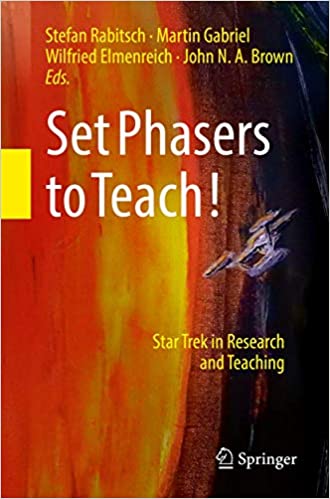
Review of Rabitch, et al.’s Set Phasers to Teach!


Review of Set Phasers to Teach! Star Trek in Research and Teaching edited by Stefan Rabitsch, Martin Gabriel, Wilfried Elmenreich, and John N.A. Brown

Bruce Lindsley Rockwood

Stefan Rabitsch, Martin Gabriel, Wilfried Elmenreich, and John N.A. Brown, editors. Set Phasers to Teach! Star Trek in Research and Teaching. Springer, 2018. Paperback, 236 pages, $39.99. ISBN 9783319737751.


The four co-editors of Set Phasers to Teach include three Austrian academics specializing in American Studies, History, and Computer Science, respectively, and one independent scholar and consultant (John N. A. Brown) specializing in UX (User) Research. All appear to be enthusiastic supporters of the feedback between Star Trek in all its iterations and the scientific and academic communities. This enthusiasm is reflected in the heading of their Preface: “‘Engage!’ Science Fiction and Science Inspire Each Other and Move Society Forward” (ix). Their fifteen contributors lay out in fifteen distinct and concise essays the variety of ways in which specific episodes, events and characters, and the overall themes and trajectory of the franchise facilitate this positive feedback loop.

The format and layout for each essay in the book includes original illustrative cartoons highlighting the theme of each essay, an abstract with keywords, a brief “Editors Log” summarizing the thesis of the essay, and illustrative quotations from specific episodes of one or more Star Trek episodes. Essays are broken down with informative subtitles, and contain Works Cited (Endnotes) and sometimes additional Recommended Readings and in-text footnotes. 

The appendices are comprehensive lists of every Star Trek episode (through Discovery, Season 1) and film, listing them by Season, Episode, Title, Stardate, Director, Credited Writers, and Original air date, all derived from Wikipedia and the Memory Alpha Wiki. This information will enable a reader interested in following up specific themes and episodes mentioned in the essays to track them down and facilitate streaming them (or excerpts) for use in teaching and research.

The editors and authors make good use of available primary sources (the episodes and films) as well as commentary by contributors to their creation, and scientists, astronauts, and others who have commented upon the influence of Star Trek on their own lives and work. The emphasis is on the power of narrative to, as they quote Gene Rodenberry remarking in the Introduction to Star Trek: The Next Generation Technical Manual, “show humans as we really are. We are capable of extraordinary things” (xi).

The essays cover a wide range of topics, including using Star Trek to teach literature by highlighting its frequent uses of and references to classical literature, and the ways episodes can be used to bring out themes such as self-sacrifice, revenge, and pride (Elizabeth B. Hardy, at 9). Erin K. Horáková provides an illuminating essay and critique of how the series engages “with Post-war American Jewish Identity” (13-27). Stefan Rabitsch explores the role of the original series in translating American culture to tell “modern morality plays” in the historical period of the Cold War when America was replacing Britain in a “benevolent” role as “protector and defender of the western world” (29-43). He notes, “Even though the original run ended in 1969, the Star Trek formula was such that it could easily be adapted to changing contexts by virtue of the frontier’s inherent metaphorical characteristics while supported by a stable utopian world of scientific progress and discovery” (39).

“How to Name a Starship: Starfleet between Anglo-American Bias and the Ideals of Humanism,” by Martin Gabriel (43-50), argues that the dominance of Anglophone names of Starships “shows us that the ethnocentric traditions of the twentieth century, maybe even an imperialist approach to cultural history, were vivid throughout the production of the franchise” (49). 

“The Computer of the Twenty-Third Century: Real-World HCI Based on Star Trek,” by Gerhard Leitner and John N. A. Brown (51- 61), explores how the Human-Computer Interface (HCI) was portrayed in the original series, how it inspired further developments, and what remains to be done to address reliability, security and privacy concerns, and ease of use, concluding “despite the many examples of advanced HCI that already exist in the home, we are still very far from the twenty-third century. . . That said, one of the next steps has already been taken. It is now possible to have reliable and secure voice-based interaction that seems natural and intuitive to the user, provided designers and developers are willing to take the time needed to build it” (60). In the context of the challenge to aircraft safety posed by the recent crashes of the Boeing 737 Max attributed at least in part to software updates, loss of pilot control over aircraft computer systems, and training failures, this essay is a particularly interesting contribution to the collection.

Other essays explore the energy system that propels the Enterprise and other Starships, comparing the required power to the available power on Earth itself (63-70); the relationship of Starfleet to pre-modern societies and the role of the prime directive (71-81); and the way Star Trek has inspired innovations in science and technology, citing the 2017 Qualcomm Tricorder XPrize and the close relationship of the franchise to NASA (83-93). Carey Millsap-Spears presents an exploration of the use of Star Trek in teaching rhetoric and process writing while addressing the concerns and issues facing the LGBTQ+ Community in the context of a college composition course, developing research and critical thinking skills (95-105).

Additional essays address “Using the Borg to Teach Collective Computing Systems” (107-115); “Telepathic Pathology in Star Trek” (117-124); and an intriguing proposal for a better designed Video Game based on Star Trek after an assessment and critique of the games previously released since 2000 (125-135). Vivian Fumiko Chin presents a thorough review of the critical literature and interesting discussion of “Cognitive Science and Ways of Thinking About Narrative, Theory of Mind, and Difference” that explores the use of examples from Star Trek to introduce students to these concepts and ways of thinking about empathy and respect for difference, using Spock’s mind meld with the Horta in the original series (TOS) episode “The Devil in the Dark” as one example (1371-47).

In “La Forge’s VISOR and the Pictures in Our Heads,” Nathaniel Bassett gives a review of the critical literature and an explanation of the role of media studies and how socio-technical systems help mediate our experiences (149-160). In a concluding essay, John N. A. Brown discusses anthropology-based computing (ABC), cognitive bias, and the use of Star Trek to teach about scientific thinking (161-172). He observes, “A scientific thinker separates their personal perception of their own self-worth from their faith in what they think they know. They do this by assuming they are wrong and asking others to check their work. . . And that is the purpose of teamwork in Star Trek: using many minds to improve ideas. In this way they show us how to seek new facts and new information; to boldly disprove ideas that everyone has believed before” (171).

Together these essays make an entertaining and rewarding overview of the many ways one can employ Star Trek in teaching and research. They can be deployed at all levels of education, regardless of discipline or areas of expertise. The book is printed on acid free paper, is well designed, and presents its materials in a manner accessible to a general reader while giving guidance for further research to faculty and students alike. It deserves to be widely read.

One omission from my perspective is any discussion of the use of Star Trek in teaching about legal issues, which has been explored on a number of occasions, e.g., Paul Joseph and Sharon Carton, “The Law of the Federation: Images of Law, Lawyers and the Legal System in Star Trek: The Next Generation,” 24 U. Tol. L. Rev, 43 (1992); Michael P. Schartf and Lawrence D. Roberts, “The Interstellar Relations of the Federation: International Law and ‘Star Trek: The Next Generation,'” 25 U. Tol. L. Rev. 577 (1994); “Law, Literature and Science Fiction: A Symposium,” Bruce L. Rockwood, editor, 13 Legal Studies Forum 267 (1999). Perhaps the editors will bear this in mind if they pursue a follow-up collection, since the subject will continue to attract fans and scholars alike.

Review of Lothian’s Old Futures: Speculative Fiction and Queer Possibility


Review of Old Futures: Speculative Fiction and Queer Possibility by Alexis Lothian

Kristen Koopman

Alexis Lothian. Old Futures: Speculative Fiction and Queer Possibility. New York UP, 2018. Paperback, 352 pages, $30.00. ISBN 9781479825851.


It would be easy for Old Futures to feel scattered, covering as it does a century’s worth of source material, three different forms of media, and theory ranging from traditional SF criticism to fan studies. Yet somehow Lothian not only pulls it off, but makes it seem effortless.

Lothian’s framing argument is that futures in science fiction have historically written out queerness in favor of timelines depending on implicit heterosexual reproduction, and that queer counterfuturisms instead nurture visions of new possibilities for science, technology, gender, and race. This argument is broken down into a series of roughly chronological case studies, following an introduction that covers the theoretical basis of the book: a chapter on eugenics and reproduction in feminist utopias, a chapter on gender’s relationship with violence and fascism in dystopias written between the two World Wars, a chapter on Afrofuturistic writings in response to eugenics, a chapter linking speculative pleasures to modes of estrangement, a chapter on the (sadly few) queer SF films that create new ways of engaging with the world, and a chapter on fanvidding and remix culture as responses to visions of the future. These chapters are interspersed with three shorter digressions that show how the theories and insights of the previous chapters may be applied to other works.

While Old Futures of course draws upon traditional SF criticism (including the obligatory explanation of why the author chose to use “speculative fiction,” its associated critiques, an expression of hope that the work won’t get pigeonholed into genre-studies, and so on), the breadth of its engagements is truly impressive, as is its depth. Each chapter provides precisely the background needed to understand the particular case studies without becoming repetitive, and so each chapter could easily stand alone. Nevertheless, the chronological organization and consistent throughline of queer futurity keeps the book as a whole from feeling disjointed.

The standout chapters are the first, “Utopian Interventions to the Reproduction of Empire,” and the last, “How to Remix the Future.” The first chapter deftly unpacks the implicit reliance of most futurisms on heterosexual reproduction, noting that visions of futures are frequently visions of worlds for future children. Although the utopias studied in the chapter are feminist, Lothian points out that feminism at the time was deeply tied to other political projects: definitions of scientific and technological progress with undercurrents of eugenics, colonial visions of European futures, and the relationship between the rhetoric of futurity and contemplation of the present. These themes set up a status quo that is then critiqued in the third chapter, although both chapters stand alone well. “Utopian Interventions to the Reproduction of Empire” may be of particular interest to scholars in the medical humanities or science studies, due to its careful illustration of the eugenic values embedded in its cases.

The sixth chapter, “How to Remix the Future,” discusses the role of remix culture in refashioning narratives in mass media to present alternative visions of queer futures and to critique implicitly regressive creative decisions by makers of media. Lothian suggests that fan remix practices (such as the case study of fanvidding) may constitute (or at least contribute to) critical fandom, which counters the view of fandom as unquestioning consumption of media in favor of resistive readings and refiguring narratives. Lothian’s case study of the Firefly fanvid “How Much Is that Geisha in the Window?” is a particularly well-done analysis that is a welcome addition to fan studies. 

Yet Lothian takes this engagement with fan studies a step further and describes her own process taking up the practice of fanvidding in order to make critical contributions to fandom (in this case, Battlestar Galactica). This not only shows that Lothian takes fandom seriously as a means of critically engaging with media, but hopefully marks a path for other scholars to follow in her footsteps. As Lothian notes, fan remix practices such as vidding may provide avenues for scholars to better articulate theories and criticism of media, particularly for marginalized people; this can be seen both in the critiques of gender and heteronormative desire that Lothian describes in her own work and the racial critique of Firefly that she analyzes.

Old Futures is not without its weaknesses. The introduction, by doing much of the theoretical work of the entire text, is dense and abstract compared to seeing the theory in practice in the following chapters. The good news is that in sequestering it all in one place, it frees the other chapters to read much more easily; however, when reading the whole book through, it may be disproportionately slow going. Many of the concepts highlighted in the introduction also simply make more sense when utilized in more concrete analysis later on, which may be an artifact of the book seemingly being the author’s dissertation adapted into a monograph.

Additionally, the chapter on SF film lacks the thematic cohesion of previous chapters. This may be because the films, in Lothian’s analysis, are more focused on futurity, speculation, and politics than the traditional tropes of science fiction. While I have no objection to an expansive definition of SF, it is telling that Lothian’s analysis largely hinges on the depictions of the future in its two case studies (Jubilee and Born in Flames). The analysis is insightful in unpacking the futures depicted on-screen, but the tools of SF criticism that have been used in previous chapters are absent here, and I remain unconvinced that this analysis looks at these films as SF. Lothian does note that there is not exactly an abundance of queer SF film, but nevertheless, this is likely to be the chapter that is least useful to those looking for SF criticism.

Overall, Lothian has constructed an admirable volume that I have already begun recommending to colleagues. This is her first book, and it bodes well; I look forward to seeing what Lothian does next.

Review of Palumbo’s A Dune Companion


Review of A Dune Companion: Characters, Places and Terms in Frank Herbert’s Original Six Novels by Donald E. Palumbo

Kara Kennedy

Donald E. Palumbo. A Dune Companion: Characters, Places and Terms in Frank Herbert’s Original Six Novels. McFarland, 2018. Paperback, 189 pages, $35.00. ISBN 9781476669601.


Donald E. Palumbo’s A Dune Companion: Characters, Places and Terms in Frank Herbert’s Original Six Novels is number 62 in the Critical Explorations in Science Fiction and Fantasy series, of which Palumbo is a co-editor. The book offers less of a new critical commentary on the Dune series and more of an updated version of Palumbo’s arguments from two previous articles published in 1997 and 1998 and a book published in 2002, followed by a compilation of information from the series in an encyclopedic format.

The book is divided into two sections: a long introduction on ecology, chaos-theory concepts and structures, and the monomyth and their presence in the series, and a companion of characters, places, and terms. Both sections achieve their aim: the former to prove the existence of aesthetic integrity through consideration of chaos-theory concepts and structures present in the novels, and the latter to remind readers of characters and events. However, the two parts lack cohesion, which perhaps is unavoidable when including a type of glossary that is not intended to offer commentary or analysis.

For the reader wondering about the mention in the title of the original six novels, the introduction immediately addresses the reason for this focus: they have an “extremely-high level of aesthetic integrity” and an “unusually deep interrelationship between form and content” derived from the relationship between the ecological theme and fractal structure that other texts based in the same universe do not (1). The introduction proceeds to present a persuasive argument with ample evidence, examples, and direct quotations to show how these novels contain myriad elements of chaos theory and the monomyth. It is divided into two sections, the first on the ecological theme and chaos theory, and the second on the monomyth as fractal pattern, with a short conclusion that brings all of the arguments together. 

Although the introduction explains key terminology and theories before showing how the series aligns with them, some of the concepts could have been made more accessible to readers. Chaos theory is presented as the idea that, despite real-world systems being irregular and complex, there are laws that govern phenomena like populations, weather, and biological systems, and that complex dynamical—or nonlinear—systems are made up of interlocking feedback loops. Feedback loops are explained as a process in which the behavior of one element affects the behavior of others, such that when part of the system’s output returns as input, this then affects the output, and the process keeps continuing. Palumbo offers fractal geometry as the best-known manifestation of chaos theory, wherein a geometric procedure can be used to generate images that replicate similar structures but are not necessarily identical. The use of examples such as snowflakes—which may look identical but have tiny differences—and the branching that occurs in nature—which can be found in circulatory and bronchial systems as well as in plants—helps make the ideas more understandable, but it would have been helpful to have further explanation of them. Having introduced these concepts, Palumbo then states that the Dune series contains a fractal architecture and a fractal reiteration of plot structure, themes, and motifs, which ultimately serves to represent its universe as a dynamical system. Through this, Palumbo argues, the series’ key theme of ecology and its core concept of chaos theory are then reinforced. Palumbo makes an important note that Herbert published his first Dune novels before chaos theory was identified in the 1970s and 1980s. This shows not only that Herbert was ahead of his time, but also that science fiction authors can extrapolate scientific concepts before they are formally articulated by scientists. 

The introduction then proceeds to analyze the many variations of the fractal structure or images in the series, which readers can see signaled by the repetition of the fractal metaphor in phrases like “plans within plans,” “tricks within tricks,” “wheels within wheels,” and others (8). It examines the occurrence of this structure in the series as a whole, in each of the novels individually, and in characters, and how this structure reiterates Joseph Campbell’s theory of the monomyth. It also discusses how the repetition of themes such as metamorphosis into the Other, secrecy and disguise, and death and rebirth are subsumed into the monomyth structure and further reinforce the fractal structure. Each aspect of the argument contains numerous examples from the series and interweaves concepts from chaos theory and ecology for additional support. There is also attention and detail provided for lesser-studied characters like the Tleilaxu, which makes for a balanced discussion. 

The section on the monomyth examines the recurring elements of the monomythic hero as evidence of the existence of a clear fractal structure. It provides a brief overview of Campbell’s monomyth and the stages of the archetypal hero’s adventure, and then traces their appearance in the series. It notes some of Herbert’s unusual choices, including at times having the monomythic hero be a secondary character rather than the protagonist, and enabling female characters to share in the hero’s role. Palumbo’s attention to female characters again shows an ability to create a balanced discussion inclusive of a variety of characters and groups. Overall, although an analysis of fractal structures may be a dry topic, readers interested in the series can expect to find a new appreciation for Herbert’s writing craft based on Palumbo’s insights and extensive use of detail.

The companion / encyclopedia section of the book provides a useful reference guide to the series. It does the at-times challenging work of compiling the few details or clues Herbert gives, which offers a helpful consolidation of information as well as a reminder of characters and terms the reader may have forgotten about. Particularly valuable is the note about which book the information is derived from for each entry. An unfortunate issue is the presence of dozens of typos and other errors in spelling and tense consistencies in the entries. In addition, some entries seem overly brief in relation to their importance; for example, the entry for Voice consists of only 22 words, while the entry for krimshell fiber consists of 38 words. Reading it straight through shows the repetitive nature of some entries, but it is unlikely to be read this way when consulted as a reference work. It would be good as a reference source for researchers, especially those without access to digital copies of the texts.

Review of Campbell’s Arabic Science Fiction


Review of Arabic Science Fiction by Ian Campbell

Steven Holmes

Ian Campbell. Arabic Science Fiction. Palgrave, 2018. Studies in Global Science Fiction. Hardcover, 322 pages, $89.99. ISBN 9783319914329.


Editor’s note: Ian Campbell is an editor of SFRA Review. I confirm as editor that he has had no involvement in the preparation of this review for publication.


SF scholars who are interested in how SF in Arabic may differ from or critique Anglophone SF may at first wonder why Ian Campbell has such a sustained emphasis on Darko Suvin throughout Arabic Science Fiction. Suvin certainly is a formative figure in genre theory discussions about science fiction, although he is not quite as in vogue in contemporary science fiction studies as he once was. Nonetheless, Campbell sees Suvin’s conception of cognitive estrangement as significant for understanding Arabic SF and for Arabic-language SF scholars. As a result, Campbell’s project is an examination of the manifestations of cognitive estrangement in Arabic Science Fiction (ASF), and one of his central arguments builds off of Suvin directly.

Campbell presents his conception of ASF as working off “double estrangement,” which reflects the “total lack of legal protections for freedom of expression in the modern Arabic world” (6-7) and that consequently “Arab writers in all genres, especially the canonical literary fiction to which ASF aspires, have learned to conceal their critique under layers of story in order to provide plausible deniability in the face of scrutiny by the regime” (7). ASF aims toward social criticism in order to be taken seriously as art. The “double” in “double estrangement” deals with the perception of science and technology; that is, ASF “draws attention to the drop-off in scientific and technological innovation in the Arab world since the glory days of Arab/Muslim dominance” (10). ASF stories may critique the state from a post-colonial perspective, but they critique the culture for reliance on mysticism. Campbell presents this concept as a way of signaling that readers may struggle to understand the intended critique of ASF works due to the works’ critiquing multiple vectors of society simultaneously, so that there may not be one central point but several. Likewise, ASF will not tend to have analogues to Golden Age SF works, given the differences in production and audience.

The book is divided into eleven chapters. The introduction sets up the considerations of Suvin and “Double Estrangement” that shape the rest of the volume. Chapter 2, “Postcolonial Literature and Arabic SF,” outlines why ASF may be understood as “manifestly a postcolonial literature: it is produced in formerly colonized states, for readers in and from these states” (21) and thus is distinct from many works of postcolonial literature written in English by authors living in diaspora. In chapter 3, “Arabic SF: Definitions and Origins,” Campbell draws from Ada Barbaro’s work to discuss four genres of classical Arabic literature that serve as proto-SF: philosophical works that use voyages to pose arguments, adventure voyages, the utopian tradition, and mirabilia, which is a genre that focuses on real or imaginary places or events that challenge human understanding. Chapter 4, “Criticism and Theory of Arabic SF,” tries to establish a coherent framework for the relatively minimal amount of Arabic SF criticism. Partly this involves dealing with the issue of diglossia, the consequence of which is that most ASF, since it is written in the Modern Standard Arabic used for literature, is rendered “the nearly exclusive province of a small class of highly educated people” (79). That is, instead of being built on a pulp background, Arabic SF has as its audience primarily an educated and elite audience. These first four chapters do a great job of setting up the myriad ways in which ASF operates in an entirely different rhetorical and literary situation from commercial western SF.

The remaining chapters each focus on case studies. As has been the case throughout Campbell’s study, for several of these works, there is no English translation. This makes Campbell’s study essential for the scholar but somewhat less accessible for a teacher who might be thinking about texts to include in a syllabus. Chapter 5 returns to the central concept of “double estrangement” regarding Egyptian author Nihād Sharīf’s The Conqueror of Time (1972). It is a political allegory that also estranges “Egyptian society as stagnant, figuratively frozen in its obsession with the past” (119) through the novum of cryogenics. Chapter 6 focuses on two novels by Egyptian scholar Mustafā Mahmūd and the exploitation of the peasantry by urban elites. Unfortunately, even Mahmūd’s The Spider (1965), which is regarded as the first ASF novel, is hard to get access to in Western markets. Chapter 7 presents Ṣabrī Mūsā’s The Gentleman from the Spinach Field (1987) as comparable to Aldous Huxley’s Brave New World (1932), in depicting a character trying to escape a dystopian reality and failing to find a sustainable alternative. Chapter 8 discusses Aḥmad ‘Abd al-Salām al-Baqqāli’s The Blue Flood (1976). Campbell argues that al-Baqqāli uses some of the same themes as Mahmūd, but places Western culture as an additional point of view, allowing him to critique reformers “for their inability or refusal to question their patriarchal assumptions” (219). Chapter 9 focuses on Ṭālib ‘Umrān’s Beyond the Veil of Time (1985), which, unlike many of the aforementioned works of science fiction, takes place on a foreign planet. Here Campbell argues that although the novel is superficially trite, it works as particularly effective estrangement for the educated elite readership of ASF, especially their belief that an alternative to despotism can emerge without violence. Chapter 10 focuses on a three-novel series by Kuwaiti author Tība ‘Ahmad Ibrāhīm, characterized by Campbell as the only notable female writer of ASF before the 2000s. Campbell argues that Ibrāhīm’s novels serve to show a transition in ASF, where narratives about the effect of technology, modernity, and colonialism do not need to be “cordoned off from everyday life” (278); that is, ASF is starting to become slightly more direct. 

For the scholar, Campbell’s study does an excellent job of exploring how works of ASF from a range of different countries (Kuwait, Egypt, Syria) have approached the literary demands and political risks of writing speculative fiction meant to critique the existing regimes and cultural programs. The primary frustration for the reader is likely not to be with Campbell’s analysis, but with the reality that many of these novels will remain largely inaccessible to the west. Nonetheless, scholars who want to understand the specific challenges of the emergence of science fiction in postcolonial settings would do well to explore Campbell’s volume.