The 2025 Hugo and Nebula Nominees
The Editorial Collective
The following is an edited discussion from our Discord site, wherein each of us who had the opportunity to read a given novel had the chance to comment on it. The questions at stake here are what each novel says about the state of SF in these times, and whether and how it did or not deserve a nomination for a major award. We begin with a more general discussion, then move to each text in turn. Some texts are absent because nobody had the opportunity to read them.
Ian Campbell: Could each of you please drop a couple of paragraphs giving your take on the awards nominees and winners overall? What do these picks say about the state of the discourse? What is your take on how so many of these are way more fantasy than SF?
Dominick Grace: I have read only three of the nominees. Of them, Only Adrian Tchaikovsky’s Alien Clay really qualifies as SF. Vajra Chandrasekera’s Rakesfall has SF elements but might be better considered as science-fantasy, or perhaps as slipstream. John Wiswell’s Someone You Can Build a Nest In is straight medievalesque fantasy—set on an Earth-analogous world without conforming particularly realistically to medieval Earth in terms of politics or social practices. To be frank, when reviewing the list of nominees, I had a difficult time choosing which ones to read for our discussion, since few of them seemed to me to be SF—those on the Hugo list perhaps slightly more so. (While I prefer SF to Fantasy, I like fantasy fine, but I do tend to think that an SF award should go to a book within the genre). My impression from the list and without a comprehensive review of the books published in 2024 is that SF seems to be on the decline, at least in literary form, with fantasy or hybrid genre works emerging as more prevalent. I am inclined to think that the general swing to the right, not only (but especially, certainly) in the USA, is a factor in this shift. SF can be a hopeful genre, but even in hopeful mode it tends to have a critical perspective on the real world. While fantasy can also have such a perspective, it is much more free to offer escape rather than confrontation with an increasingly uncomfortable reality.
That Wiswell’s novel won the Nebula is for me the clearest indication that, in the case of that awards committee, at least, an implausible normalizing of the other via true love outweighs serious consideration of the real and concerning issue of the (mis)treatment of non-binary, trans, and other atypical people in contemporary Western society.
The novel uses a shape-changing monster that identifies as “she” and who breeds by planting eggs in a human, which eggs upon hatching then consume the host, as a metaphor for the queer other. Rather a risky move, but not so much when the novel simply hand-waves the problems away when the creature, Shesheshen, finds true love and conveniently has her eggs destroyed, so she won’t have to face whether using her love as an incubator will be necessary.
Indeed, even the most narratively complex of these three books, Rakesfall, fails (IMO) to offer any deep or thought-provoking commentary on our postmodern, post-truth world, preferring instead to use a glib narrative voice (a failing of all three books I read, actually) and metafictional/self-reflexive and linguistically playful style—which, to me as a reader, anyway, blunts most of the claim to serious speculation the novel might have had. It has a lot of fascinating and complex ideas in it but just doesn’t seem to do much with them.
So, my feeling based on what I have read is that we seem to be moving into (or back into) a world in which the “award-worthy” books give themselves some contemporary relevance by touching on current hot-button topics (LGBTQ, for instance, or post-truth authoritarian America, as Tchaikovsky is clearly doing in Alien Clay) but which focus more on being entertaining/amusing than thought-provoking.
Leimar Garcia-Siino: I think you’ve hit it right on the head, Dom. In fact, I might go a bit further and say it comes across as a little performative, not the novels themselves, but on the part of the awarding committees. They’re seeing a novel with queer people in it, and nominating it just because. If it had been yet another vampire/werewolf/demon/monster hetpair, it would likely have been overlooked. Could it also, in part, be a result of politics? SF has always skewed political, and things are really effed right now. Is it that there’s fewer SF novels or is it the Hugos trying to keep the peace?
Dominick: That is an intriguing thought. I doubt that politics is gone from the genre, but I did not read much new this year, so it could well be that there are still books like that, but they didn’t get nominated. To be Fair, Alien Clay is political, but its narrative voice is so arch and self-aware that (for me, anyway), the novel’s seriousness gets somewhat blunted.
Virginia L. Conn: I have to agree with Dom and Leimar here about the general state of awarded SF (I hesitate to say the state of SF in general) on two fronts: one, the general decline of what I would consider “science fiction” as a result of the global shift towards the right, and two, the (perhaps) overcorrection of the awards committee and readers to reward those publications that, from an identity perspective, resist that rightward shift.
So there’s a few things going on here that I think contribute to the aforementioned problems, many of which are not necessarily “literary” in nature. The primary issue—and the issue from which most others grow—is that at a cultural level we’re experiencing a collective loss of hope in the possibilities afforded by “the future” (as an abstract concept) and the role of either technoscientific or sociopolitical developments to measurably improve outcomes. It might be painting with too broad a brush to say that SF authors, readers, and scholars are more critical of technology than the general public (certainly there are far too many techno-optimists to make a blanket statement like this, anyway), but it’s almost inarguable that the real-life technological developments available over the last, say, five years have almost all come with their fair share of detriments along with whatever labor-saving or quality-of-life improvements they offer. How can you be excited about the possibility of artificial intelligence or its transformative possibilities when we know that it has accelerated ecological destruction at a staggering rate; functions only by incorporating and erasing the work of millions of practicing artists and creators; encodes and reproduces human biases while naturalizing them as “objective;” and has functionally destroyed the neural pathways, dopamine receptors, memory capacity, and critical thinking skills of an entire generation in a few short years of exposure?
Even though SF doesn’t necessarily need to focus on technology (or even necessarily science, however we might want to define that), it seems fairly correlative that increased suspicion of the technological agents typically associated with progress, futurity, and/or development would result in writers, readers, and awarders being suspicious of and turning away from any text that does foreground these elements. Thus, the escapism of fantasy.
The other major social element from which a lot of these issues stem is a loss of societal “objectivity”—if (IF) we understand SF as something that estranges us from the world, that means we have to have a shared understanding of that world in the first place. There’s been an explosion of research over the last few decades showing a precipitous decline in public trust in social institutions (see the Pew Research Report’s multi-decade investigation into public trust in government if you want to be shaken down to your boots) and an increased siloing of opinions. How can a piece of media estrange us if we’re already living in conceptually different worlds? Again, it’s easier to displace the narrative and not deal with the reality on the ground, as well as much safer in terms of not antagonizing different identity groups, if authors don’t assume a shared world from which it is possible to be estranged at all.
Which leads to the last point, which I think Leimar already addressed nicely. We (I’m using an inclusive we [that I know has many exceptions] to refer to SF fans, authors, readers, awarders, reviewers, publishers, etc.) WANT to live in a world where queer people, trans people, people of color, religious and ethnic and cultural minorities, the disabled, the neurodivergent, the Other, etc. etc. etc. have a place in the future we’re imagining (a good one, at that). So often, however, this desire to engage with different kinds of identities and lived experiences becomes flanderized as an impulse to ONLY show uncomplicatedly “good” characters, storylines, or outcomes, with anything else being labeled problematic. I didn’t read Someone You Can Build a Nest In, but based on y’all’s discussion of it, I wish they’d depicted Shesheshen as a predator. That would’ve made for a much more exciting and interesting story.
Pretending that queer or trans people are ubiquitously good or unproblematic or simple does an incredible disservice to the nuances of people’s lived experiences and is just as objectifying as pretending they’re all straightforwardly evil or immoral. It seems as if their very inclusion (and especially when their experience OF their identity is the focus) is enough to be considered for an award. If we can’t grapple with complicated identities or experiences, then all that’s left is a fantasy world whether it’s intended to be fantastic or not.
Leimar: Yes to all of this, Virginia! AND, to complicate matters even more, because we’re still in the (relative) beginning stages of queerness reaching mainstream culture, ‘queer’ stories are still being largely told about queerness instead of with individuals who happen to be queer. This makes this one single aspect of identity and humanity the main or even sole defining characteristic. Which means, we [at mainstream levels] still can’t tell stories where queer or trans people are not ubiquitously good or problematic. Look at the travesty that is Emilia Pérez, where her transness and her criminality get horrendously intertwined!
Maybe in part it’s also because we [contemporary society] are so bad at discussing “other”: it’s all one big bucket, so that a “bad” person is as much “other” as a neurodivergent person, or non-white person, or queer person, etc. Which then, if I may indulge in some shower-thoughts thinking, kind of circles back to SF and estrangement. What is or isn’t SF right now? The richest person in the world tinkered with his platform’s AI so much it’s now calling itself MechaHitler and it’s about to get installed into the self-driving death machines. Concentration camps are being used in the US and we’re on the brink of civil war. The whole world right now is either on fire or flooding, while corporations lay off thousands of employees in favor of AI. What is the “self” that SF is to reflect back to us—who are we??—and what is the “other”?
Dominick: This last point hits on what I found something of a weakness in Alien Clay. Initially, the complex alien symbiotic creature(s) seemed to me delightfully alien, even though I knew where the plot was going. By the end, however, their integration with the human seems not to make much of a fundamental difference to humanness—it just seems to offer a greater sense of connectedness with, and a greater knowledge of, other humans, with Tchaikovsky going to some lengths to try to take the curse of mind control or a hive mind off the table. So, the “other” basically just ends up being able to show us a better version of the “we”—those “we” who stand for free thought and workers’ rights, of course, and those “others” of “we” that “we” can be morally and ethically certain of not being a good ideological fit justly destroyed, natch.
Leimar: Pivoting the discussion, after reading through several of the descriptions and responses to the other novels, I’m getting the impression most fall under “very interesting idea, poorly executed”, and the reasons tend to suggest an amateurishness, immaturity, or outright bad writing practices on the part of the authors. I have to wonder about the state of publishing houses and their in-house editors—are they not giving authors good feedback? This is frankly something I’ve been noticing for a few years. It’s not that any of these novels’ premises is lacking: they seem to be offering interesting takes and world dynamics that unfortunately go underdeveloped and even invalidated by the handling of the plot.
Dominick: I agree, and will whisper, the same is increasingly true of academic writing: I am often appalled at the quality of the writing I see in pieces I am asked to referee or to review.
Ian: I’ve noticed this with both academic writing and fiction. I think that for younger people, a work of fiction seems somewhat inauthentic if it’s not told in kind of a snarky, informal tone. I blame fanfic, which I find absolutely unreadable in general but millions of people would disagree. As for academic writing, I actually kind of welcome it, not bad quality writing but a somewhat less formal tone. I’m writing a book chapter here in the background, and I had already noted that I now write in a much more conversational tone than I would have five years ago. Generally shorter and less complex sentences, not using fifty-cent academic words unless I really need to, that sort of thing.
A good specific answer would be contractions. I used to feel it necessary to turn it’s into it is, but no longer care, and then I got pushback from a book editor a couple of years ago, that would I go and change all the contractions, and was kind of baffled as to why it was important. I did manage to get a y’all’d’ve into a journal article recently, and really enjoyed that.
Leimar: I agree that it’s almost definitely the fault of fanfiction. And don’t get me wrong, I love fanfiction, I’ve been reading it for 25 years, and have written it too. But fanfiction is meant to be indulgent: it’s intrinsically an act of indulgence. It’s desire: for certain fictional relationships, for plotlines, to be part of it, to participate and belong within the thing you like. And that’s fine; that’s the purpose of that medium. But SF fiction has the potential to be waaaay more than that: to be unconstrained by indulgent desire. But I guess if all you’re reading is self-indulgent fanficky stuff (and, let’s be honest, most pop fiction is this anyway), then it’s harder for authors to distance themselves from those impulses.
Dominick: I have no objection to academic writing that eschews prolixity and generally obfuscatory terminology (heh). When I say bad writing, I mean things such as subject/verb agreement problems, basic confusion of vocabulary (e.g. I have seen palate for palette more than once), mixed constructions, word choice errors, etc.—the sort of thing I spent my career trying to beat out of my students (well, not literally). Every now and then, I will see some term in a paper or book I’m reviewing, scratch my head, check a few dictionaries, do a Google search, and eventually just add a comment that says, “?”
Ian: Oh, I see what you mean. A lot of what I review is people writing in English about literature in Arabic, and who usually aren’t native speakers of English, so I usually overlook all that unless the overall document is unreadable. Mostly, my response to the journal will focus on their argument, and then I’ll say “and the whole thing needs a copyedit by someone fluent in both English and this person’s native language”. So my sample of writing by native English speakers is likely skewed.
James Knupp: My overall impression of this year’s nominees both based on what I’ve read personally and everyone’s reviews here, is that the fandom overall is taking a very hard shift into fantasy or very light sci fi. I have multiple ideas for why this is happening, but chiefly among them is the current political climate driving to the right and fandom being more often left leaning. The big villains of real life right now tend to be right wing politicians and tech billionaires. New tech innovations today are often only celebrated by other tech execs and such as the way they’re utilized in people’s daily lives actually makes things lower quality, more stressful, etc. It’s very tempting to retreat into a genre where those tech innovations don’t need to be part of the narrative. I’ve been reading a lot of 80s and 90s sci fi recently on my quest to finish all the Hugo and Nebula winners, and it’s striking how much those novels are about new ventures and overcoming the downsides of advancement but acknowledging their realities. You’re not seeing a lot of that now in regards to current tech.
As for quality of the actual writing, I have to echo the sentiment others have said that fanfic has heavily influenced things. I’m not a fanfic person, but I have read plenty of it and listened to many successful authors go on about how much fanfic opened the doors for many current authors. And I think that’s genuinely good, but it feels like we’re getting to the point of the machine feeding itself. You have authors who started off doing fanfic, and then their readers did fanfic of them and became authors themselves, and the style became fixed into a main one of the genre.
It’s already been touched on that there’s a lot of POC and LGBTQ representation in this year and recent years. The only addition to that I really have is that I think we’re seeing maybe a peak of the backlash to the Sad Puppies campaigns from several years ago. People took that movement very personally and retreated into their fandoms in a protective manner. That movement was gross and deserved to be purged like it was, but it definitely has made people probably more aware of representation in awards than they used to be. Whether this is an overcorrection or not is not for me to say, but it’s just my theory.
Ian: I agree that a lot of the shift into fantasy has to do with an overall sourness toward tech—a sourness I think is completely justified. We live in a particularly grim Black Mirror episode these days, where all innovation is sucked up by about four corporations and immediately enshittified and/or turned against us. I don’t use Facebook all that much, but I have all kinds of filters installed on it over and above my regular adblockers, so nearly all of what I see is just what my friends are up to. Install the FB Purity extension, though it doesn’t work on a phone. But I was at my dad’s house and actually needed to find something on Facebook, and logged in, and my gods what a horror of ads and right-wing drivel. I don’t think there are a meaningful number of fans out there who really still think that technological innovation is going to make things better. Therefore, all SF has to be Candy-Coated Happiness(tm) or else a grim fighting retreat against encroaching authoritarianism—and Palantír is spying on all the kids who might Hunger Games the
whole thing.
Another reason for the turn toward fantasy is that mid-tier fantasy is a lot easier to write than mid-tier SF. You’ve got to do your research to write quality SF, even if you’re willing to handwave things like FTL travel, but for fantasy, so long as it’s internally consistent, it holds together just fine even if the central premise is ludicrous. I think this is an undermentioned aspect of the turn toward fantasy.
With respect to representation, it’s both the blowback to the Puppies and also a form of recognition that SF blatantly excluded writers who weren’t white men for decades, and that we ought to foreground other folks as a form of recompense. As a journal editor whose last name is Campbell, I feel a real responsiblity to make sure we’re not doing that sort of exclusion. And the truth of the matter is, I like SF from other cultures or perspectives. I don’t care if Space Captain Chadjaw is into dudes instead of women: if it’s a well-told story, that’s great. Do I want to read explicit same-sex sex scenes? No, but I don’t want to read straight ones, either. Same goes for SF from previously-colonized cultures: it’s valuable to read these perspectives. In fact, the only thing I really liked about Rakesfall was how it put Sri Lankan mythology/history in there and didn’t sugarcoat it or explain it too much. Deal with it, blanco—or however you say blanco in their language.
But to paraphrase Virginia, the problem with representation is that it often leads to a lack of dramatic tension. If your book is going to center on (say) trans people, then I know from the minute I pick up on it what the dramatic stakes are: nobody is going to write a novel where the trans people are the villains, because the uproar would wreck them. Though in point of fact it would be interesting to have an SF society where gender fluidity is the norm and the guy who just wants to Be A Man is oppressed. Iain M. Banks’ The Player of Games does a decent job with this, where everyone else in the Culture thinks the protagonist is a real weirdo because he’s never been a woman. To be clear, I’m not saying that we should have villainous trans, or black, or indigenous or whatever, people as a group, but I also think that we’ve not yet got to the point where most writers feel free to put in a major role a person from an oppressed group who also happens to be a terrible person.
Someone to Build a Nest In
Ian: This was the winner, somehow, so let’s begin with it.
Dominick: I found it unimpressive. Not bad, just… well, meh. The plot becomes increasingly implausible as the book proceeds, most notably with how Homily seems so easily to swallow (no pun intended) the fact that her beloved eats her dead sister (murdered by Homily—but it’s ok, she deserved it) in front of her, and then disguises herself as said dead sister. Sorry, spoilers. The inherently destructive nature of the creature is conveniently disposed of when the only eggs she ever has get used to poison the evil monster, thereby avoiding the thorny issue of the necessity of breeding by planting eggs in a human body that will, you know, get eaten by the eggs, which will then go at each other until only one survives. Instead, by the end, we have a “monster” (and tiny protoplasmic offshoot) saved by love, with a hint of masochistic self-loathing.
The writing is uneven—if anything, weakening as the book proceeds. I’m not too worried by some of the violations of realistic depictions of a medievalesque environment—I suppose you can imagine a medieval world rife with silly superstitions and a healthy fear of the other that nevertheless is ok with LGBTQ+ folk, complete with terminology such as enby and allosexual—but I do tend to trip over medievalesque folk talking about goons (a 20th century American word) or things getting hairy. The politics of normalizing different sexualities is fine, but I don’t feel like the book gets beyond the level of an after-school special level of addressing those politics. (Do they still make after-school specials, or am I talking to the ancient?)
Leimar: Just finished it: by the end, I was begging for release! I’m going to try to form some cohesive and reasonable thoughts on it as opposed to a rant (although it’s so underwhelmingly meh that I’m not sure I could even muster a rant).
The good: The premise of the novel is, I think, quite interesting and unique, though certainly has tendrils (hehe) from other narratives. I very much appreciate the attempt at centering a fantasy story around the monstrous creature, and to have them have a conception of family and love that is alien to us humans. I also like the attempts at representing queerness (though I agree with you Dom, that representing queerness as the monstrous other is problematic). But the ideas of genderlessness and genderqueerness, of gay love, and of asexuality, being shown as not what’s outside the norm is refreshing. Homily isn’t mistreated by her family for being gay and Shesheshen’s concerns about her relationship with Homily is less about her being asexual than about her not knowing “how to human”.
I think that if I was in the 13-15 age bracket, I would enjoy the novel a lot more (i.e., if I had less experience reading good fiction). Outside of the gore (and, maybe it’s that I’m old enough to remember when descriptions of bodies being torn apart weren’t considered too much for teenagers), the novel is extremely easy to read—mostly uncomplicated and uninteresting in its narrative style. I would definitely have thought it was YA.
The not so good/meh/ugh: I said mostly uncomplicated, and that’s true generally. There are passages, though, of painful “cleverness” that come across as amateurish, tryhard, and self-indulgent. For example, early in their travels, Homily and Shesheshen encounter some highway robbers. Their names are Aristocracy, Kleptocracy, and Plutocracy. As Shesheshen considers killing them, the narration (which is supposed to be from her point of view) quips: “If she thrust two bones out through her shoulder and under the man’s wooden mask, through that collar, Plutocracy would bleed out before he could define his form of government.” The levels of cringe are off the charts! These kinds of ridiculous sentences occur throughout, and it’s jarring how it disrupts suspension of disbelief entirely. Then there’s Homily’s family, and her siblings: Catharsis, Epigram, and Ode. [pain pain pain] Later, at the end of the novel, when Homily and Shesheshen have a “child”, it’s named Epilogue. How clever. Gold star.
However, what makes the novel a slog for me is the nonsensical plot choices, the fanficky ship writing style, the way what should be difficult and compelling problems are waved away, and the atonal jumps from overly sentimental feeliest-feelings that ever were felt to absurdist comedy. Homily is injured and is bleeding out and Shesheshen needs to take her somewhere safe so she employs the help of Laurent—a wealthy young man who likes being threatened(??) and who had previously tried to kill her—to go to her cave-ruins and make it hospitable. When she and Homily arrive, the area has been cleaned, and now there’s candles and throw rugs everywhere!
Or when Homily and Shesheshen stay at a tavern and the latter, who barely interacts with humans except to eat them, decides the thing to do right then would be to dance with Homily, because she’s so pretty. It reads like clumsy fanfiction. And don’t get me started with the ways Ode and Epigram are dealt with, or the reveal about the Baroness, or Shesheshen’s egg-sac, or the sudden I actually want to keep this accidental clone-offspring as a child thing.
So, yeah. Long story short, it wasn’t my cup of tea and I struggle to understand how this is award-worthy.
Ian: Up to a certain point, I was willing to accept the twee. I get it, you’re trying to mimic the Gideon the Ninth tone or something fanfic adjacent, I’ll roll with it for a while. I agree that the initial conceit was pretty good: let’s tell the story from the monster’s POV.
But it couldn’t stick to this, at all. Give me the monster’s POV, and since it’s been clearly established that the monster hibernates until it’s time to eat, then sneaks to the edge of town and vanishes someone, then by consequence the monster has to be almost completely ignorant of human culture. At first, this is done reasonably well: we can figure that the one part of human culture the monster does know is knights/warriors showing up to try to kill her, so even if she gets a bunch of it wrong, it’s still within the bounds of good storytelling. Once she gets to town, however, she knows way too much way too quickly about human culture. I kept saying how does the hibernating monster have any idea about this, let alone the correct idea? I quickly became more and more disappointed—and it wasn’t as if the book was remotely award-worthy to begin with. Now, it was verging on just bad fanfic.
And then I got to that exact scene, about the candles and throw rugs, and was just like oh hells no and put it down.
I’m having trouble understanding how so many of these janky, poorly-written books get nominated for awards. This can’t possibly be the cream of the crop. None of them is quite as bad as The Terraformers, which I’m still salty about, but there’s no universe in which this novel should have been within sniffing distance of an award nomination. Like, it could have been made comic that the monster had no idea how to act like a human. But they had a dance-off and suddenly she’s got expertise in socializing. Gah.
[we are merciful and will spare you our exchange of cat pictures]
Leimar: On the subject of queerness, I feel Wiswell, rather unwittingly (and I don’t know how the other novels do, as I didn’t have a chance to read them), painted himself into a corner by wanting the happy ending. If the monstrous protagonist is a queer representative, then the message being sent (again, I think, unintentionally by him) is that if queer folks are so monstrously other, we should exorcise parts of what makes us different (and dangerous?), and conform to some kind of nuclear family structure. Two parents and baby makes three!
Dominick: Yep, that’s how it felt to me. There MUST have been a better way to solve the problem, assuming the use of a human-eating shape-shifter as your queer stand-in, than basically wishing it away.
Leimar: Even using fanficky tropes, I actually would have preferred if Homily was given the choice to become a nest and she was like, “you know what? I’m not entirely opposed”, and then they discovered (again, fanficky-deus-ex-machina type) that what Shesheshen had misunderstood was the extent of “making a nest inside someone”: that there’s a safe way to do it. Maybe something to do with how she healed Homily. Anything, anything! would be better than destroy the eggs and completely abandon your deepest belief about family.
I’d also be more charitable toward it if he had explored what should be a self-shattering revelation for Shesheshen (but the narrative doesn’t actually delve into Homily’s familial abuse either except as oooooh it’s soooo sad! her family is awful!). It would have been nice if both of them had a conversation about how both of them created these unhealthy conceptions of love, family, and duty as a result of their parents’ abuse and selfishness. But nope.
Dominick: Agreed. Since Shesheshen’s personal experience of birth is all we really have to go on, and it was evidently abnormal, there was certainly room for a resolution that fell between Homily getting eaten and the magic hand-waving. Not sufficiently thought through, perhaps because “love” is supposed to be enough?
Ian: I put the book down about a third of the way through, so I was still reading it as a fairy tale from the monster’s POV, not as an estrangement of queerness. In my defence, most of the queer people I know are anything but predatory, so I wasn’t really making the link; I was just trying and failing to make it through a book that had an interesting premise but absolutely failed to deliver. Now that I reflect upon it, I can see where you’re coming from, but it makes the book seem even less well-constructed. Just like black folks typically know way more about white culture than white folks do about black culture, queer folks typically know way more about straight culture than the converse. This is a matter of survival: know enough, and you’re likelier to be able to see trouble coming when you encounter the hostile parts of those cultures. So it would have made way more sense from the start to have the monster know about human culture, in order to make the parallel. Don’t get me wrong: queer people are under real and serious threat in the real world by this gang of evil clowns, so it makes sense for the awards committee to want to foreground this and respond to it. I just didn’t think the book was worth finishing, let alone rewarding.
Alien Clay
Dominick: Narrator/narrative voice: irritating. Not sure why so many writers these days seem to think their narrators should have a glib, bantery way of speaking, even when describing horrific events. Tchaikovsky does speak to this briefly when he has his narrator say that if he wasn’t trying to be funny about it, he’d be crying. But then, that just foregrounds my second problem with the narrative voice: who is the narrator telling this story to? First person narratives usually don’t invite that question, but Tchaikovsky does; he makes his narrator address the implied reader, as here from chapter 22: “I’m jumping ahead now, I know. But there are more tales of the march to come, don’t worry.” Now, maybe in the last 40 pages, I will discover that there is indeed an audience, but so far, all these nods to I’m telling a story of what happened are just (to me) inessential nods to meta.
I am fond of first contact stories, so the fact that this story addresses contact with a profoundly alien life and tracks the difficulty in coming to understand it/an understanding with it, appeals to me. Tchaikovsky acknowledging that the typical human approach is profoundly flawed is also a good touch (burn the vegetation, don’t even really consider that maybe killing everything to study it isn’t great). The Mandate, with its ideology trumps fact approach to science, is also timely, given the egregious politicization of science we have been seeing recently, not to mention the authoritian trend in certain governments. Nevertheless, the Mandate seems (with 40 pages left to complicate this) like a pretty cookie-cutter tyranny. All I can really say about it is, it believes humanity is the centre of the universe, and science should prove that; and that everything is binary: you are with us or an enemy, etc. And as for the plot itself, I doubt I am alone in figuring out what was actually going on with Kiln life within the first several chapters (again, there are 40 pages or so that could pull that rug from under me, but I doubt it will happen). So, despite the premise being one I liked, the book doesn’t really offer any surprises. I still am liking it better than Rakesfall and Someone, but it seems not much more of an award-worthy book. Since Tchaikowsky seems to bang out two or three books a year, I guess I shouldn’t be surprised to find something formulaic and underdeveloped in this one.
Ian: His book about a fantasy M*A*S*H* military hospital is actually really good.
Dominick: I’ve now finished the book, and nothing in the final pages substantially changes what I’d said already. The final chapters perhaps try too hard to pound the point in, about colonialism and what it can breed, and the resistance of those colonized by the planet they tried to tame leading to a reverse expedition is the ending I entirely expected. The novel plays somewhat interestingly with the long-standing notion of alien invasion in the form of entities—pods, spores, whatever—that can insert themselves into humans and, maybe, turn them into something else. Still not, IMO, an award-worthy book.
Asunder
Ian: This was my favorite among all these, and a much better-written book than all of them. I would have absolutely voted for it as the winner. Would I necessarily have picked up a fantasy quasi-romance novel were it not part of this awards discussion? Probably not, but I’m glad I did.
The novel is set in the fairly typical basically medieval but made early modern by magic type of fantasy world. Environmentally more or less identical to Earth, inhabited also by an indigenous or authochthonous set of quasi-deities who were then hunted more or less to extinction by an invading/colonizing society. There’s also another set of aliens? demons? who trade power for service. This sounds like a bunch of clichés, but is in fact all very well done and organic. Our protagonist has power as a “deathspeaker” due to a bargain made with one of these entities: she can speak with the recently dead, but this power is mostly unused in the narrative. Near the beginning, she tries to rescue a man, a diplomat from the invading society, but can only take his essence/spirit into herself. He’s there, and conscious, while she goes about the quest of trying to sort out how to split them asunder while keeping them both alive. The relationship between her and the man in her head is very well-crafted, to the extent that I was able to willingly suspend my disbelief the whole way through. Of course, they fall for each other while living in the same head, as one does, but this is well-executed, too.
Of the books on this list that I’ve read, this is the most clearly SF rather than fantasy, which is saying a great deal. There’s magic in this world, but it’s the kind of techno-magic where things are laid out in circuits and works more or less like engineering: it can be taught, though it’s evident that some have more talent for it than others. The magic isn’t cognitive in the original Darko Suvin sense of cognitive estrangement, but it satisfies Freedman’s cognition effect, or is at least satisfaction-adjacent.
It’s a fun, exciting story: I stayed up late because I wanted to finish it. The world makes sense, the characters are solid, the ending is landed well. My only real critique of it is that I don’t think it’s doing much in the way of estranging our own society. Sure, there’s a Colonialism Is Bad trope going on, but it doesn’t really map onto our world in any significant way—and for that matter, what remains of the indigenous deities are just awful, terrible people. If I really want to stretch the estrangement, I could argue that the novel depicts how a colonizing culture reproduces its conditions of existence within the minds of the subaltern people it dominates, but honestly, it’s an adventure story far before it’s any of that. And it’s a good one. Is it the Best SF Novel of 2024? Hardly: I’m as confused as any of us as to why this list is dominated by fantasy and by YA-adjacent works. But it’s a good novel, one that I’d totally recommend to people, especially younger readers.
Michael Pitts: I just finished the novel, and I must say that I feel a bit out of my element since I rarely jump into fantasy fiction. What I appreciated about the novel, however, is its emphasis upon friendship and community within a setting scarred by colonization, fundamentalist religious sects, and class divides. The novel withstands the temptation to give our protagonist or her friends a happy and predictable resolution to their story. Instead, she emphasizes the compromises they must make, the efforts they must make to understand and sympathize with each other, and the probability that their end will not be some joyous conclusion. Hall does a wonderful job of world-building here with competing gods, Eldritch horror-influenced characters and rituals, and fascinating gadgets derived from the workings of the supernatural, but I think its major win is this emphasis upon hardship, compromise, and friendship during an era of continued, tremendous historical trauma.
Ian: One of the things that made me really appreciate this book was its sly portrayal of sexuality. We have our protagonist, and within the first couple of chapters she has a man living in her head. Then, we introduce two other women, her childhood friend and the scholar, and it’s really obvious that both of them have giant crushes on the protagonist. So I jump to the conclusion that there’s going to be some kind of three-way romance or antagonistic love triangle, and I’m maybe gritting my teeth about it, not because it’s same-sex but because I generally prefer my SFF to downplay romance.
But then the book plays beautifully with my expectations, and it becomes clear over the middle section that our protagonist is the Oblivious Straight Girl meme. The text gives me all kinds of clues that both of these women are really interested in her, and she just breezes through them: she sees what the women are doing but never jumps to they’re doing it because they have a crush on me. Nope: she just focuses on the man in her head and the romance comes from there. It becomes pretty funny by about two-thirds of the way through the text: oh, there’s the scholar batting her eyes, she must have dust in them. So, kudos for that.
Book of Love
Virginia: I can really see this being a very divisive book for a lot of reasons.
First of all, it’s 600+ pages and, as the debut novel from someone known for her short fiction, that’s going to be a hard sell for a lot of people. I, personally, would take a 600-page novel that stands alone over a 200-page “first in a series” at this point, though, so I can’t say this was a problem for me. When I first picked this up, I was so reticent to even begin, because it sounds, on the surface, like a collection of YA tropes held together with spit and fanfic familiarity. A li’l Stars Hollow-esque town where magic both mundane (music is magic, love is magic, having a home is magic, etc. etc. etc.) and supernatural (well, gods are definitely magic) is taking place amidst a bit too self-aware banter from all sides. Three teenagers! Who are chosen by fate for something greater than themselves! And discover unknown power in the process! The potent combo of an ethereally-hot-but-ethically-suspicious guy paired enticingly with a confusingly-boring-and-normal-guy-but-wow-they’re-so-intertwined-there-must-be-something-more-to-him-than-meets-the-eye-AND-HOW having a nice gay romance for eternity just off-screen (Good Omens shippers, I’m looking at you).
Ian: That’s a lot of hyphens.
Virginia: However, despite my initial hesitation based on the description alone, I soon found that this is a book ABOUT teenagers, by someone extremely familiar with all the tropes, pitfalls, and expectations surrounding YA (and romance, and fantasy) literature, that is not FOR teenagers. There’s a lot of complicated things to say about the ongoing YA-ification of science fiction (which this emphatically is not, more on that later) but without dealing with any of the nuance of it, I don’t think I could have sat through 600 pages of a YA novel without tearing out my hair. Luckily, this isn’t that. Link does a great job of writing a very adult piece of literature (hey, she won the Pulitzer for a reason!) that’s about young people without assuming her audience is at the same level of reading comprehension. It’s smart, it’s funny, it’s infuriating sometimes, these characters are little shits, and I really enjoyed the pace at which information is parceled out without infodumping or holding the audience’s hand.
The story broadly follows one single narrative arc: three teenagers died, and a year later, they’re back. No one remembers that they were dead except for their music teacher (the aforementioned confusingly-boring-so-you-know-there’s-more-there guy), someone who appears to be the devil (the hot one), and themselves. The novel covers their attempts to find out what happened to them a year ago, what’s happening now, and what larger scheme they’re a part of, all while attempting to blend in to their families and lives. These teenagers are, to a one, little shits. I love it. They make terrible choices and draw infuriating conclusions and act like they collectively share one single brain cell that they have to take turns with and honestly, it’s just nice to read about actual teenagers. They’re not supposed to be endearingly quirky, they just kind of all suck in the way all teenagers suck (sorry to any teens reading this—I say this as a former shitty teenager, myself). Of course, if you don’t like reading about frustrating people (this is very much to say that these are not anti-heroes in any way, which would make this a different kind of story), 600 pages of that would be a…lot (Goodreads reviews seem pretty divided on this front).
I will say that this is emphatically not science fiction; it’s solidly magical realism/fantasy. It very explicitly deals with magic (variously described as the same feeling as when you’re performing music, when you’re in a flow state with work, what it feels like to look at someone with love, etc.) that isn’t attributable to some kind of repeatable mechanism. It’s not particularly estranging in the Suvinian sense; it’s basically the Gilmore Girls universe with a bit more focus on race relations and the later introduction of a literal god. That’s fine if you know what you’re going into, but the most estranging thing in this book is the kinds of names bands have that no one blinks an eye at coupled with what pizza toppings they have available to them on a daily basis (fennel and preserved lemon: are you kidding me?).
One thing that I eventually found tedious was the way the author signaled that she as the author was aware of internet culture and signaling her in-group recognition with references to such—eventually to the expense of characterization. It happens frequently before this, but this is the exact moment I lost patience with it: why would a five-year-old in 2024 reference a famous line in a movie (Elle in Legally Blonde, “What, like it’s hard?”) beloved of a particular millennial feminist and frequently memetically deployed line used to indicate a gatekept/reified objective was actually quite easy to acquire/accomplish by an overlooked/(typically socially) devalued source? This Legally Blonde reference signals the author’s expected readership, not reinforces characterization (admittedly the 5 y/o is a unicorn magical construct at this point in the text so it may not even be worth worrying so much about consistency of characterization).
Anyway, I really liked it and I found a lot of the revelations and conclusions very satisfying, but I can definitely see it being a divisive book. It’s inarguable that it’s well-written, and that alone (sorry to be mean!), even aside from content-level divisiveness, makes it worth reading compared to a lot of the other and previous nominees.
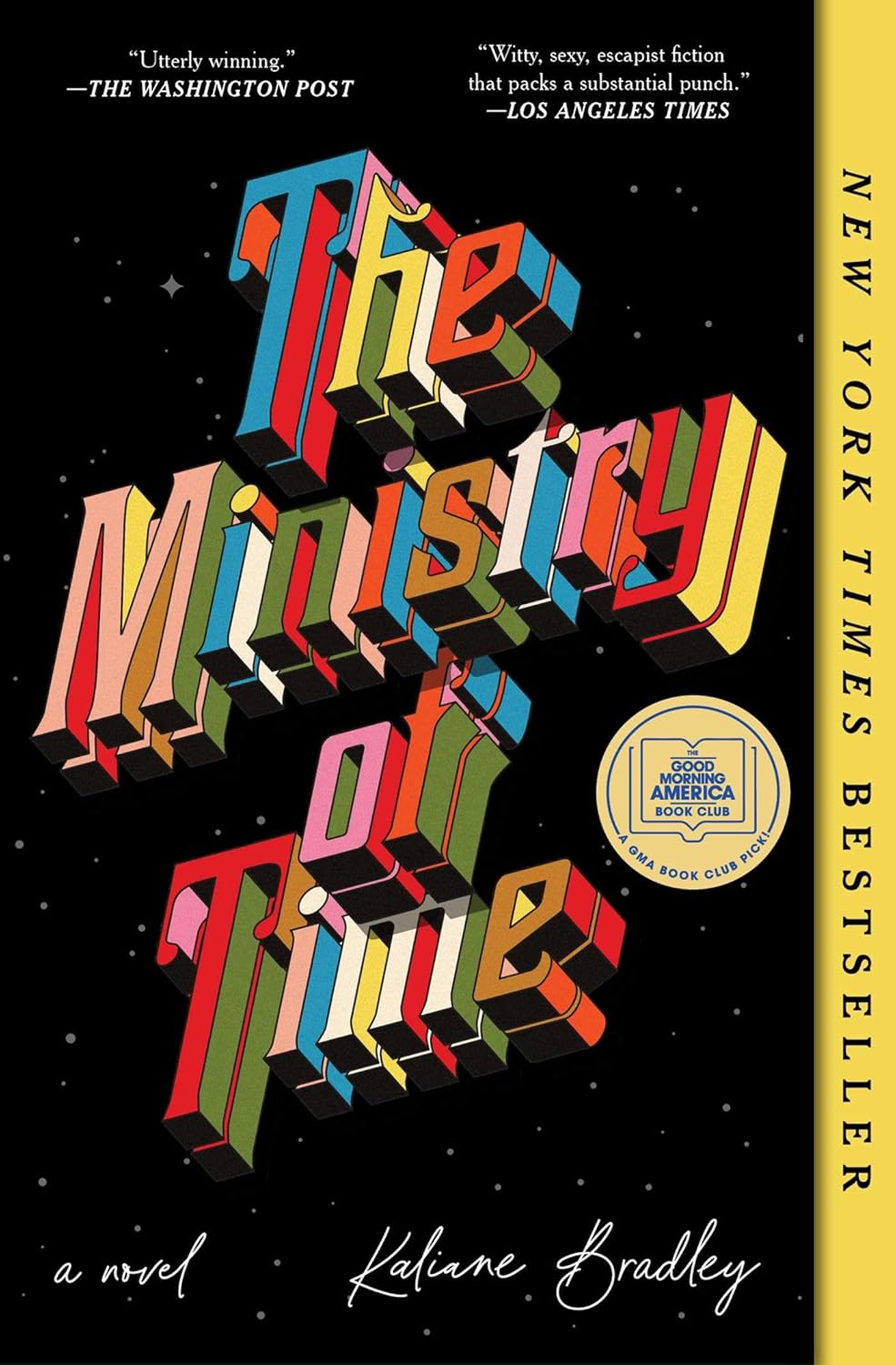
The Ministry of Time
Ian: This novel had a lot going for it, and I really enjoyed it up until the final act, which is very lax and unsatisfying. The premise is that certain people are able to time travel, and that there is a British intelligence agency that carefully selects people who are missing and presumed dead in their own timeline and brings them forward to a near-future London where climate change has started to take hold in earnest. The protagonist is a British woman whose parents were refugees from Cambodia: her job is to serve as the 21C liaison for one of these travellers, who are all British from the fourteenth through nineteenth centuries. Her traveller is a naval officer and polar explorer from the mid-19C.
Most of the book is very good. The tension rests on the relationship between the two of them. He is very take-charge, British empire, unsentimental, pretty racist and sexist at the core, and she is someone who’s absorbed and embraced many of the opposite points of view. This novel does a much better job of portraying “I grew up in Britain, but I’m not white, so many people will never regard me as truly British” than Babel did: Ministry of Time shows us this rather than spending a lot of time telling us, and the way the character is portrayed gives us a lot of nuance and ambivalence, whereas Babel just wore the author’s shoulder-chip to the intense detriment of the story. The protagonist is quickly able to recognize that despite his antediluvian views on certain subjects, our naval officer is a person of genuinely good character. In addition, she can’t help but find his take-charge unsentimentality very attractive, while at the same time being cranky with herself for finding it attractive. It’s all very well done.
And then we get to the final act, which is terrible. I would have been absolutely willing to read the story of their relationship as the entirety of the book, but an ill-advised decision to shoehorn an adventure plot into the story renders it trite. There is a group of people from even further into the future who are trying to mess up the Ministry of Time, in an attempt to mitigate the catastrophic post-climate-change conditions in their own future, and once this happens, we move quickly into tedious I’m my own grandpa type bootstrapping that other time travel works have done rather better. Rarely have I gone so quickly from very much enjoying a story to wanting to put it down.
Sleeping Worlds Have No Memory
James: I’m just going to give my quick thoughts and let my more in-depth takes wait till there’s other commentary to compare with. First off, this was barely SF-adjacent. There’s a mysterious technology, but it’s more magic coded than anything else, and that’s about it. It gave more steampunk fantasy vibes than anything else, without explicitly being steampunk. This was one of the most frustrating books I’ve read in a while because there was an interesting plot, but it was buried beneath really bad prose and mediocre dialogue. A lot of the reviews for this book described the writing as poetic, which they all seem to think means drown everything in verbose descriptions. Oftentimes, I would forget what exactly was being described because some of the descriptors would go on for so long and become so abstract.
Michael: I agree here, James. I just finished the book, and—after reading this and Asunder— I feel out of my element, since both novels are very much fantasy texts, which I rarely read. I feel that my critique is limited since I just am not immersed in fantasy fiction, but the writing style seemed a not-so-great attempt at implementing the noir genre, or at least aspects of it, into a steampunk fantasy setting. The absurd opening parts in which the protagonist constantly mentions not drinking before going on a ridiculous, self-absorbed alcoholic binge for days on end because he may not succeed in his task reads like an adolescent romanticizing the self-destructive qualities of a male hero. The descriptions were definitely a distraction. The world, though, was really interesting to me: the magic, colonial history, and intrigue made for an engaging read, but the language and actions of the protagonist at times frequently make it hard to enjoy.
James: I forgot about the alcoholic binge drinking coming after he went on about not drinking! I felt at times the dialogue also suffered from a bit of “MCU snark.” Too often characters would be in high-drama situations, emotions tense, and then someone would make a snarky remark that just felt very out of place. The geopolitics were honestly fairly well done, but the pace that things moved made it hard to appreciate them more. And really the ending was so out of nowhere that it just really wrecked the tension the author had managed to build in the last third or so of the book.
Ian: I tried thrice with this and failed each time. It wasn’t a bad setup at all: high-ranking official who did the right thing is exiled to become responsible for a huge and over-budget project, and everyone is hostile to him because their power depends on the project. But it was very amateurishly written, both the prose and the organization. I put it down the first time after someone was described as thirty-thirty-five instead of thirty to thirty-five, then tried again and got to the “exiled people have magical technology”, and then after another very brief stint, it hit me that the central plot, the building of a tower, made absolutely zero sense, and that was it for me.
It is nothing like an award-nominated novel, and I get that the committee was rewarding it for having the exiled people in there and addressing it directly as genocide, but that level of representation was just drowned in bad writing.
Rakesfall
Dominick: I need to preface my remarks on this one by noting that 1) I am not generally enamored of twentieth and twenty-first century “literary” writing. Give me Tolkien over Joyce, Chandler over Faulkner, etc. (exceptions duly noted); and 2) I am especially not enamored of postmodern writing (again, exceptions duly noted). This reads like a theory student decided to go wild. When I hit the following passage, “It imbricates us and implicates us, plotless, fragmented, atomized,” in the extensively meta introductory bit, I thought, “can always already be far behind?” It was not. I will have more thoughts later, more specifically about this book.
Ian: I’ll defend Faulkner to my last breath, but what you said.
Dominick: Alright, I’ve finished. My feelings are mixed—there were bits I did enjoy a fair bit, such as the story about the dead who just sort of hang around after death, have jobs, etc.—but overall it left me cold. There are things to admire here. Chandrasekera is well-read (or so he seems to me—it’s not every day you see John Webster’s Duchess of Malfi referenced, for instance, and I was glad to see it) and has a heck of a vocabulary. I had to look up “baryonic,” among other words. There were passages I thought were well-written and effective. And Chandrasekera has a very inventive mind—there are possibly too many interesting concepts in here to resolve into coherence. In addition to nanotech, genetically redesigned humans, intergalactic colonization (though the novel remains Earthbound), terraforming (or reforming, perhaps, since it is Earth we see being rebuilt), multiple instantiations of characters, sometimes at the same time, the walking dead, ghosts, demons, gods, and other sf and fantasy standbys, we have such things as a baryonic and nonbaryonic grandmother, who cannot perceive each other and can occupy the same physical space simultaneously. So, lots of meat in the soup. On the other hand, too often the meat seems merely to have been waved over the soup than fully immersed and allowed to permeate. For instance, the baryonic grandmother: how/why is she baryonic? If she therefore exists on some other plane than the regular humans, how can she have any biological connection to the characters? The novel does not deign to answer (or even pose) such questions, which gets to my problems with it.
I mentioned in my prefatory note on this book that neither contemporary “literary” nor postmodern writing are overly appealing to me, and Chandrasekera is very fond of the tics and conventions of both. The novel seems far less interested in being a novel than in being about fiction—the sort of knowing, self-reflexive and frequently meta distancing from telling a story to playing with fictional tropes that, for me, no longer is very appealing. On the one hand, one might say that Chandrasekera is ambitious and experimental, with his narrative frame of creatures identified as ghosts watching what they conceive of as a TV series (apparently) which is (apparently) actually events in the real world mediated for them, his dipping into various narrative modes—drama, the detective story, the Scheherezadean tales within tales, the ghost story, etc.—his time frame of millions of years, and so on. However, for me, none of it seems to come together or weave back into something coherent. The “frame” is dropped after the opening segment; the mystery story peters out without resolution; the nested tales peter out; the pastiche of dramatic form modeled on Webster fades away, etc. Everything seems provisional, open to revision, irreducible to coherent meaning—tres tres post-modern. Even whether the “real” world in this novel is real is subject to interrogation. By the end of the book, I was wondering whether I should be reading all of the action as taking place inside an enormous computer simulation of reality, a reading the book seems to invite without foreclosing on.
Consequently, for me as a reader, the characters seemed to exist as cutouts to fit the “reality is subjective/mutable” thesis, and the events to have no meaning except as a sequence of events that may or may not mean something, depending on one’s frame of reference.
In short, not my cup of tea. I have avoided bringing in specific examples or quotations, to keep this comment from getting excessively long. Also, I look forward to others’ thoughts, especially if you had a more positive experience of the book than I did.
Ian: I eagerly anticipated this, and was thoroughly disappointed. I read The Saint of Bright Doors almost immediately before it, and was blown off my feet: Bright Doors deserves every ounce of praise it received. So I was ready to open this and be transported… and it’s just what my daughter would call “mid”. Everything Dom says I concur with, here. There are many dropped threads, there’s a big dollop of ungrounded High Modernist prose that doesn’t improve the story, the characters did nothing for me. It shared with Babel, another winner, the feel of let me tell you (at length) instead of show you about postcoloniality, and it really suffers from this. Whereas in Bright Doors, Chandrasekera gives you a really nuanced and gorgeous portrait of a (post)colonized subject coming to the metropole, Rakesfall repeatedly bludgeons you over the head with a very reductive take on the issue.
I did like the dead, though: I parsed them as being people who could no longer exist under the near-total domination by the (ex?)colonizing society: that because they were too imbued with their original culture, they fell out of the dominated society.
It seemed clear to me by about halfway through that Rakesfall is not the follow-up to Bright Doors, but rather a novel Chandrasekera wrote prior to Bright Doors and couldn’t get published: once he became a hit, he was able to tidy this up and publish it. Good for him, but while the book isn’t bad; it’s just not award-nomination good.
I should be extremely clear here that to the absolute best of my ability, my mostly-negative opinion of Rakesfall has nothing to do with its being written by someone from a formerly colonized society, or with being at least partially about (de/post)colonization. On the contrary, I think SF (the novel is barely SF-adjacent) would benefit from more of both.
A Sorceress Comes to Call
Ian: This was the first of the nominees I read, and I spent the entire time wondering why on earth it was nominated. It’s… competent, I suppose. The story is set in a quasi-18th-century world, where magic is quite rare but present and effective. It’s told through the POV of the sorceress’s daughter, who has been dominated (sorcerously and otherwise) by her mother into obedience. The mother, a commoner, needs to marry a rich man to support herself in luxury, so she masquerades as a noblewoman fallen on hard times in order to seduce the lord of the manor. The lord’s middle-aged sister is not fooled, and undertakes a plan to remove her ensorcelled brother from the sorceress’s control: the plan ultimately ropes in the daughter, who has begun to figure out that her mother is horrible.
At no one point in this story was I thinking well, that played with my expectations. By about one-third of the way through, I wrote down the rest of the plot on a scrap of paper, and got all but a few details correct. I found it boring and tedious to get through, because I already knew what was going to happen. There’s nothing innovative or even all that interesting about this story: it’s not SF by any stretch, it doesn’t perform any real estrangement, it does nothing with calling form into question. What prompted anyone to nominate this?, is what I kept asking myself.
It did take me way too long to suss out that the story is an inverted retelling of the Goose Girl fairy tale, but the actual goose girl (the sister) and the daughter are separate people, here, which distracted me from the parallel. When I read the book, it seemed as if the writer had just cooked up on the spur of the moment that the sister was an accomplished tender of prize geese, and then didn’t bother to go back and work this into the beginning of the book so it didn’t appear to come out of nowhere.
I usually call this Goldfinching a book, after Donna Tartt’s very disappointing novel of the same name: the author doesn’t bother to go back and smooth out the introduction of this suddenly-critical piece of information. In Tartt’s book, it becomes important to the plot about three-quarters of the way through that the narrator’s Manic Pixie Dreamgirlfriend’s actual boyfriend grew up on some kind of ashram or commune, but the book is so lazily written that Tartt didn’t then go back and insert this information when we first meet the boyfriend. In fairness to Kingfisher, I was supposed to have been clever enough to pick up on the fact that this is a retelling of the Goose Girl story and expected geese to be there: the horse’s name in both stories is Falada. In my defence, I think I read the original story when I was about fifteen. Also, the novel just isn’t all that good. As with Spear from last year, did we really need a retelling of this story?
The one aspect where I think the novel does deserve a lot of praise is in its portrayal of the sorceress: it’s a very accurate and detailed depiction of a psychopath, one that gets all the details right, especially with respect to the psychopath’s interiority and how they can or cannot fool others. Impulsivity, grandiosity, violence (she murders a lot of people, but it’s boring, because almost all of it is off screen) and the inability to consistently keep the lies straight over time: grandiose narcissism leads to lack of attention to detail. In fact, now that I think about it—and I’ll Goldfinch myself and not go back and act as if I’d planned this all along—maybe this is the estrangement function of the novel, given that we here in the USA are now ruled by a grandiose narcissist and psychopath whose lack of attention to detail is really beginning to affect his approval ratings.
James: I just finished this myself and I find myself agreeing pretty much wholeheartedly with your assessments. It’s a perfectly fine book, but it’s so far from award-worthy I’m confused as to why it got nominated at all. There really was never anything to subvert my expectations, and while I definitely didn’t predict the plot as well as you seem to have, too many of the “twists” I was able to see coming a mile off. That Penelope the ghost would be the one to embody wine felt so obvious the moment Lord Evermore was deemed to not be right. He was portrayed more opposite of him than Penelope, where multiple passages were dedicated to her personality.
I also found that there’s seems to have been a desire by Kingfisher to incorporate Cordelia’s father into the plot in some meaningful way, but ended up deciding against it, and like your Goldfinching, just never went back to clean up the prior references to him to make it feel less like a point of emphasis. The little bit at the end where Cordelia ponders trying to track him down and dismisses it felt like a bad attempt to make it meaningful. I guess that’s actually more an inversion of Goldfinching than anything really.
Like I said, it’s not a bad book, it’s just so surface level that I would never consider nominating it. It’s clearly not SF, and it feels more like a beach read fantasy. Something quick and easy to get through on your downtime on vacation, not something to really take in and consider. I will give it credit like you Ian in its portrayal of sorcery and sorcerers. Very grounded and I appreciated the limits to their abilities that made them feel dangerous but not all powerful. And the narcissism and manipulation were very well written.
Final Thoughts
Virginia: I think there’s something fundamentally different going on in the publishing and awarding world right now that has developed as a result of social media, broadly understood. Not to invoke Stuart Hall or Pierre Bourdieu too strongly, but it seems to me that the kinds of texts being recognized and rewarded (which are qualitatively different than the kinds of texts being written more generally) are more about signaling a certain in-group affinity than evincing literary quality or adhering to any kind of genre definitions. We could argue ad infinitum about whether those genre definitions (or how we measure literary quality) are valuable in and of themselves, but given the media landscape in which contemporary SF is being published, they have to appeal to the most terminally online among us in order to turn a profit. And as long as publishers are in the business of turning a profit (they are—no need for us to get Marxist about whether or not this ought to be true; objectively these texts are products that their publishing houses require to reach a minimum expected threshold to invest in their publication in the first place), they need to appeal to the largest audience of readers possible, and those audiences are online. Anyone with even a passing familiarity with online discourse communities such as booktok or Goodreads knows that what you read and how you position yourself vis-à-vis that text signals belonging within certain groups and encodes information about one’s own identity. So are we really surprised that this discursive turn is evident in the current crop of authors’ own writing?
Ian: omg now I need to go back and reread Bordieu.
Dominick: I read Virginia’s summative statement before beginning my own, so I will begin by saying that her consideration of how the online world is having a significant impact on how/for whom fiction is produced—and what will sell—is very persuasive to me. Indeed, I had considered beginning my own summative comment by wondering whether, being 62, I have had my tastes too thoroughly formed by the SF of previous decades to be able to appreciate fully what current writers—or anyway, current writers who don’t seem to me to resonate with SF through, say, the 1980s—are doing. Which of course does not delegitimize what they are doing; it just makes me generally cool (or worse) to it. Ian’s reference to The Terraformers leaving him still feeling salty a year later hits home to me—a novel that deals with the kinds of things I have often enjoyed in earlier SF, but not in a style or structure that I find speaks to me. When I read current/recent SF, the stuff I tend to like is what, say, Anne Leckie, or Jo Walton, or Peter Watts, does—they write books of genuine Sf (sometimes very thoroughly so) that without much modification (maybe moreso for Watts) could have been published twenty or thirty years ago, or more, but without feeling dated today (to me, anyway). Indeed, Jo Walton reminds me somewhat of one of my favourite SF writers, Phyllis Gotlieb.
That said, it’s perhaps not surprising that, for me, a book that did not get nominated for either award but that hews much more closely to my own preferences in the genre, The Mercy of Gods, by James SA Corey, would have seemed worthy of nomination. Yes, it’s first in a series; yes, it’s more or less a doorstop (over 400 pages), but it’s far more rigorously SF (to my taste) than any of the nominees I read this rear, it’s grounded in a reënvisioning of the biblical Book of Daniel (I often enjoy SF that echoes older works, as Dan Simmons did with Chaucer, for instance, or Silverberg did with Philoctotes, though not so much so for what Veronica Roth did with Antigone). It’s space opera with high stakes, well-conceived aliens, good adventure, relevant thematic elements, etc. Fundamentally old-fashioned, basically, while also being up-to-date.
Leimar: I’m of two minds concerning this year’s nominees. On one hand, I’m very appreciative of anti-gatekeeping practices, the expansion of what stories are told and who tells them, the breaking of genre boundaries beyond the established [read: antiquated and restrictive] canon, and the overall infusion of new ideas/concepts/experiences [of true novum]. As a queer vaguely-shaped-woman POC individual, I have long been tired of reading the same types of tropy genre-problems plaguing the same type of tropy genre-protagonists. Therefore, whether it be clumsy course-correction on the part of the awards committee or even outright tokenism, I can’t help but feel a small sense of “hey, at least…”.
But on the other hand and precisely because of that, I also feel frustration with the nominees this year (particularly the one I was able to read fully, Nest). We need science fiction stories, not just safe escapist fantasy; we need nuanced, complex, and even uncomfortable and fearless representation; we need writing that isn’t indulgent fanficky MCU/Whedon-snark. I suppose, to echo Dom, my tastes also skew to Leckie, Walton, Jamisin—even TJ Klune, if we’re including easier-read fantasy-leaning fiction, though none of them had SF novels published in 2024. That said, Klune’s Somewhere Beyond the Sea (solid fantasy, 2024) explores complex queerness and the what makes a monster a monster question far more directly and uncompromisingly than Someone You Can Build a Nest In.
James: I think comparing the Hugo nominees to Nebula nominees is helpful in that one is fan awarded and the other is in a sense peer-awarded. And in this year’s comparisons, it seems like there’s a lot of overlap in opinion here that true SF is being pushed out of award discussions for more fantasy or SF-lite works, often with very similar themes: anti-imperialism, representation, anti-capitalist, etc. This is not inherently bad, but it does feel like certain themes need to present to get consideration right now rather than pure literary merit. That makes sense for a fan awarded prize, less so for peer-awarded. There’s a lot more diversity now in the representation of characters and authors (good) but less diversity in style or stories, which I personally don’t believe to be good. It feels like there’s less nuance to many of these nominees, where their central message is very obvious from the forefront and never very subtle. I didn’t feel I got challenged into new thinking much while reading. My personal favorite of 2024 that I felt should have been in every award list, Absolution, by Jeff VanderMeer, was a real challenging read in a good sense. It was by far the most unique read of last year for me, and involved characters who were incredibly complicated and could never been easily categorized as good or bad. Yet it didn’t make it to either of Hugo or Nebula shortlists (it did make the Locus, Dragon, and LA Book prize short lists, and the series it is part of made the Hugo Best Series shortlist).
VanderMeer seemingly shares much of the politics of fandom as a whole, but Absolution didn’t focus on those themes, and instead was a complex story with unreliable narrators that ends inconclusively (much like the rest of the Southern Reach series). It would have stuck out like a sore thumb to these other works which had much more straightforward plots and characters with obvious themes. The best way I can describe the latest nominees is “comfort” fiction, and a big part of that may truly just be a response to the pressures and anxieties many readers are dealing with in the real world right now.
Ian: Just to be clear, my objection to The Terraformers wasn’t on its structure, or even really its style, but rather that it was unbearably poorly written. I do think Virginia is correct: that award nomination committees are now catering, consciously or otherwise, to online communities, and these communities are dominated by Extremely Online people, who almost as a rule lack nuance and will shout down complexity in favor of bumper-sticker logic. These books represent marginalized peoples, so they must be good, is the argument that seems to be being made. I’m absolutely willing to read about marginalized peoples, but I want the books to be complex and nuanced even if they’re quite different from the kind of 80s SF I grew up on. And these… aren’t. I’m not an Extremely Online person and frankly can’t stand them, so it’s understandable that the books they choose as worthy of award nominations aren’t at all to my taste, except Asunder, which still wasn’t really what I’d think of as nomination-worthy. I’ve read both Mercy of Gods and Absolution, and agree that they’re far better than anything here.
The question is, what can we do to re-introduce nuance and complexity, all without (being perceived as) re-whitewashing SF? I’m certainly not going to go onto Goodreads, which I abandoned long ago as hopelessly toxic, or Tik Tok, about which the less said the better, and argue with Extremely Online people about how yes, that book does represent marginalized communities, but it’s also at best mediocre and oversimplified, and fantasy rather than SF. There are so many things I’d rather do, even including my regular job. I don’t know what the answer is, here, but I do wonder to what extent the sort of books that are nominated by Extremely Online people actually sell well. I’ll bet that Mercy of Gods was read by hundreds of thousands more people than any of these nominees—and I think that’s a legitimate concern.
Leimar: And perhaps we’re all doing old man yells at cloud [or insert Principal Skinner’s “no, it’s the children who are wrong”] because we’re not the target audience? That said, I’d argue that being Terminally Online limits and atrophies people’s worldviews, and we should be able to expect award-winning authors to engage in more worldliness(?) than that, and be better read, and better edited, and better structured, right?
Ian: We are the target audience, or at least a target audience. I think that’s the (or a) source of the cognitive dissonance here, that people who have been SF fans for years or decades are not well-represented by these nominations.
Leimar: Fair. I meant it more along the lines of, maybe 20-year-olds are the audience?
Ian: I think I mean like one of several audiences, but right now they’re drowning out everyone else. Better than Sad Puppies, that’s for certain.
James: So I still heavily use Reddit, and the r/PrintSF sub has a lot of obnoxious bro-style bitching about minorities and such in SF, but one thing I think someone pointed out there that is meaningful is that there are so many different awards now, you can almost always find an award that will have winners catered to your interests more. The Hugos and Nebulas are easily the most recognizable, but there are many others that will be more based on actual literary merit.
Ian: The dominant discourse on r/PrintSF has bloody awful taste, that’s for certain. No, Blindsight and Hyperion are not the two best SF books ever written. I don’t even think they’re very good. In fairness to them, though, they’re not so much bitching about minorities in SF as they are overvaluing a kind of dude-centric ideas-over-character SF.
James: Yeah, that’s actually a fairly accurate depiction of the discourse there. I really never participate in the discourse, just lurk and occasionally second a book recommendation.
Ian: Probably the best way to use Reddit.
Again, we want to hear your thoughts on these nominees, on the state of SF, anything you’d care to add. Hit us up at icampbell@gsu.edu.