Review of Ahmed’s RoboCop


Review of RoboCop by Omar Ahmed

Dominick Grace

Omar Ahmed. RoboCop. Auteur, 2018. Constellations Studies in Science Fiction Film and TV. Paperback. 117 pp. $15. ISBN 9781911325253.


It is disappointing, though no longer surprising, to see an academic book so riddled with compositional errors and infelicities as this one is make it into print. One can find writing problems—sometimes more than one—on many pages in this book. These range from the relatively minor (e.g. recurrent problems with punctuation, or inconsistent italicizing of titles—especially problematic when the main character and the movie have the same name) up to sentence-level issues. On page 25, for instance, a sentence says the opposite of what it evidently means: “A departure from the whiteness of the American Western is reversed by the presence of a black sergeant”; presumably, the black sergeant’s presence reverses the whiteness of the Western, so a departure from that reversal would in fact restore said whiteness. On the following page, we read, “By having Reed refuse the advances of the lawyer signifies both his authority as an honest blue-collar lawman and establishes the power he exercises over the precinct” (26). Such sentences suggest, at best, inept revision, but the problems seem more basic and extensive than that. For instance, a sentence such as “[Outland] reworked Alien’s theme of the merciless corporation with a deceptively savage rapt” (49) is simply incomprehensible (unless “rapt” as a noun has some specialized meaning that escapes me—and the dictionary). Incorrect or eccentric word choices are especially problematic; for instance, we read of an “apocryphal clash” (93) between Boddicker and RoboCop, when, presumably, “apocalyptic” might be the intended word, but if so, it’s not really an appropriate word in that context, either. That such extensive and basic slips, whether merely accidental or the result of poor writing, survived the editing and proofing process is disheartening. Nor do such problems encourage one’s faith in the content; if writing problems are so pervasive, can we rely on what the book is actually saying to be accurate? A professionally-published book should not be this riddled with basic errors.

Such problems are especially unfortunate, as a short (under 100 pages of actual text), basic reader such as this could be a useful and inexpensive tool for undergraduate students. The frequently casual and subjective tone of this book suggests that its target audience is the general reader or student rather than the more seasoned academic, though Ahmed certainly shows that he has done his research. Despite its brevity, the book does show a good range of scholarly influences and cites reasonably extensively from earlier work on RoboCop. Unfortunately, though, the book lacks an index, so tracking how Ahmed uses his sources (and even where in the book key scenes or characters are discussed) is a bit of a challenge.

The book is divided into four chapters, plus an introduction and afterword. The first chapter focuses on “Genre Mutations,” and explores the generic hybridity of the film. Its main focus is the ways in which RoboCop plays on the tropes of the Western, though other genres, such as horror, noir, and the cyborg film, are also considered. RoboCop’s echoes of the Western have been explored before, but Ahmed’s reading provides some additional insights. His comments on race, for instance, are of value, though the blackness of corporate drone Johnson is oddly ignored.

The second chapter, “Neo-fascist Corporate Bodies,” addresses the film’s politics, especially its ambivalent treatment of RoboCop’s relationship with OCP. The focus here is perhaps a bit fuzzy—more on ambivalence than on constructing a reading—but again, Ahmed has some interesting things to say, albeit arguably more for those less familiar with the critical tradition. Chapter three, “American Jesus,” is potentially the most interesting but also the least successful, as it does not have a sufficiently sharp focus on the film itself.

The final chapter, on “The Legacy of RoboCop,” offers a brief account of how the film was initially reviewed (more positively in England than in North America), how it was marketed and franchised, and how it might be seen in relation to some of Verhoeven’s later films, notably his other SF films: Total Recall (1990), Starship Troopers (1997)—which together with RoboCop tend to be viewed as a loose SF trilogy, the former of which is overrated and the latter of which is underrated, according to Ahmed—and The Hollow Man (2000), Verhoeven’s final SF, and final Hollywood, movie. The shortness of each chapter does not allow for close or detailed reading, so generally the book offers limited insights. All the books in this series are similarly brief, so Ahmed cannot be faulted for the limitations the brevity imposes, but nevertheless, the book is unable to offer much depth or detail.

Overall, the book would work best as a basic introduction to the film for undergraduates, if not for the extensive writing problems. Those already steeped in the critical tradition surrounding the film, or SF film generally, may find occasional insights and useful rehearsals of the film’s key elements, notably its satirical and subversive agenda, but will not find much new. However, I cannot advise assigning this book for students, either, given its extensive compositional problems. Overall, then, this is not a book I can recommend, for either the advanced or the beginning scholar.
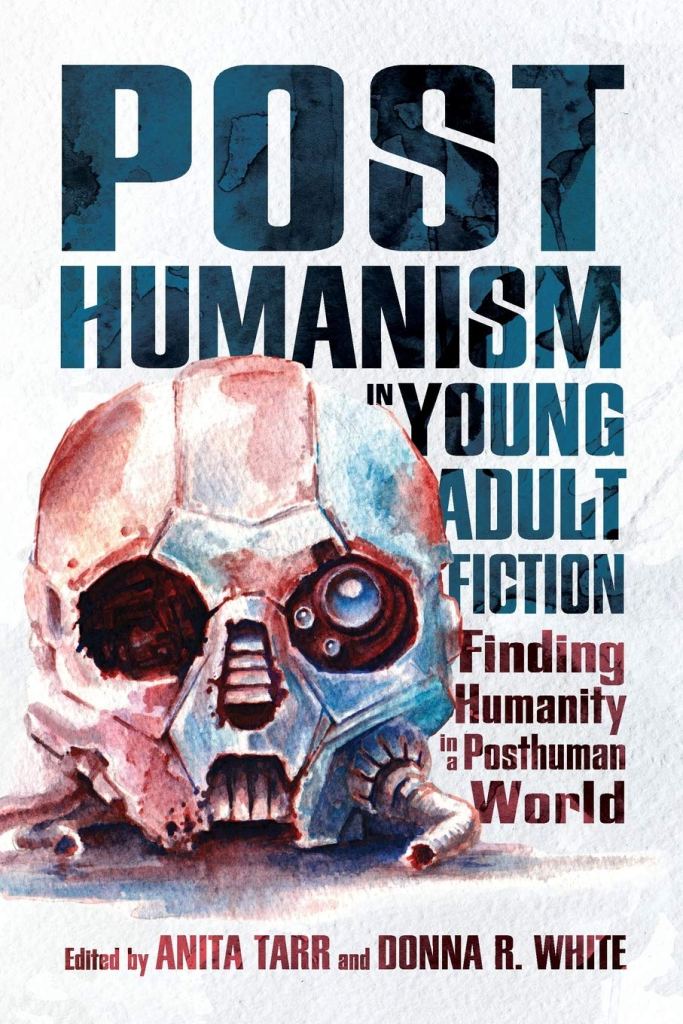
Review of Tarr and White’s Posthumanism in Young Adult Fiction: Finding Humanity in a Posthuman World


Review of Posthumanism in Young Adult Fiction: Finding Humanity in a Posthuman World edited by Anita Tarr and Donna R. White

Anelise Farris

Anita Tarr and Donna R. White, editors. Posthumanism in Young Adult Fiction: Finding Humanity in a Posthuman World. University Press of Mississippi, 2018. Hardcover. 290 pp. $70. ISBN 9781496816696.


Since the 19th century, liberal humanist thought has encouraged the view that the ideal human being is unified, authoritative, and entirely autonomous (and generally male, white, and heterosexual). Not only does this favor a certain type of individual, but it also promulgates speciesism and fails to account for the ways in which our bodies interact with other forms of matter and different environments. Posthumanism, in contrast to traditional humanism, approaches the human as a hybrid, boundless subject. Through this lens, scholars critically examine the relationship between human beings and their environment, technology, and other species. 

In Posthumanism in Young Adult Fiction: Finding Humanity in a Posthuman World, editors Anita Tarr and Donna R. White have compiled twelve essays that emphasize the unique applicability of posthumanist thought to the study of young adult literature, where issues related to the changing body are paramount. Following a comprehensive yet concise introduction in which Tarr and White define the many forms of posthumanism, the collection is divided into four parts. Part one, “Networked Subjectivities,” includes two chapters that theorize a posthuman understanding of subjectivity—one that moves away from the singular self to an ethical understanding of one’s plurality. Mathieu Donner, in his reading of Octavia E. Butler’s Mind of My Mind (1977), questions the possibility of achieving unity without sameness, and Shannon Hervey reflects on social media as a type of collaborative, networked self-writing.

“The Monstrous Other: Posthuman Bodies,” the second part of the collection, contains five chapters that deal with adolescent bodies that are transformed either through magic or medicine. Several of the chapters look at material embodiment in Marissa Meyer’s Cinder (2012) and Julianna Baggott’s Pure (2012), while others look at Leigh Bardugo’s Grisha trilogy (2012-present), Michael Grant’s Gone series (2008-present), and works by Nancy Farmer. A unifying concern among the chapters in this section is how to manage the dangers inherent in an increasingly technologized society. Part three, “Posthumanism in Climate Fiction,” collects Lars Schmeink’s “Coming of Age and the Other: Critical Posthumanism in Paolo Bacigalupi’s Ship Breaker and the Drowned Cities” and Phoebe Chen’s chapter “Posthuman Potential and Ecological Limit in Future Worlds.” Both of these chapters are concerned with posthumanism as a political movement with a zoe-centric worldview and agenda. The final part, “Accepting/Rejecting Posthumanist Possibilities,” features three chapters that cover both film and literature: Ridley Scott’s Prometheus (2012), Lev Grossman’s The Magicians (2009), and novels by China Miéville. 

As evidenced here, the collection as a whole provides interdisciplinary insight into a significant number of understudied young adult texts. Posthumanist theory is dense and complex, and this collection offers an accessible and beginner-friendly introduction to the discipline. From defining key terms and the different branches of posthumanist thought to drawing attention to key scholars in the field—such as Pramod K. Nayar, N. Katherine Hayles, and Cary Wolfe—the introduction does an excellent job of preparing readers for the chapters included here. That said, for scholars familiar with posthumanism, the theses and general observations made by the authors are in danger of coming across as obvious or derivative. 

Many of the chapters included here still find themselves asking, in a very basic manner, what it means to be human, to be posthuman. Consequently, the authors speak to the same theories and conversations that have been in circulation for the past few decades, without providing us with new readings, just merely old readings of new texts. One of the more novel points the collection posits is that posthumanism must incorporate liberal humanism into its being, “as part of the assemblage” (White 153). What this necessitates, however, remains unresolved.

There are several other problematic aspects of Tarr and White’s collection, the first being that there is a sustained attention to technology as disturbing and negative. Although posthuman bodies are nothing new, the proliferation of technology and climate change has forced us to acknowledge posthumanist concerns with greater urgency. Yet, for some reason, this reality—as presented in this collection—is regularly regarded with distrust and fear. A lone voice among the host of scholars here, Lars Schmeink, rightly urges readers to recognize the “possibility of utopian hope in the face of dystopian systems” (177). 

The second major concern involves the application of the label young adult to texts that do not necessarily fall into that category: Ridley Scott’s Prometheus and Lev Grossman’s The Magicians. Torsten Caeners, in his chapter on Prometheus, spends only one sentence defending the inclusion of this text in a YA collection. Caeners holds that it is young adult fiction because “it focuses on one of the major themes of young adult fiction . . . finding one’s identity” and is “readily available to all audiences” (199). Not only does this present a simplistic understanding of YA literature, but it also broadens the category to such an extent that nearly any text can be read as young adult. Meanwhile, Tony M. Vinci, in his reading of The Magicians, offers no reason whatsoever for reading Grossman’s series as young adult. It is, and always has been, marketed as an adult series, and to include it here merely because it’s a magic school story suggests, once again, ignorance of what young adult literature entails. 

It is difficult to recommend the collection Posthumanism in Young Adult Fiction: Finding Humanity in a Posthuman World, especially at the price point. For individuals unfamiliar with posthumanist theory, the introduction is valuable, and the third part on climate fiction provides the best example of the positive potential of posthumanist thought. However, for a handful of essays, the collection, for individual purchase, is passable. It would be best suited for university libraries, as individuals can pick and choose what to take from the collection. While recognizing the possible dangers that technology can bring, we in the (post)humanities must begin to move forward and cultivate a positive, hybrid understanding of embodiment—something that, unfortunately, this collection illustrates is not likely to happen any time soon.

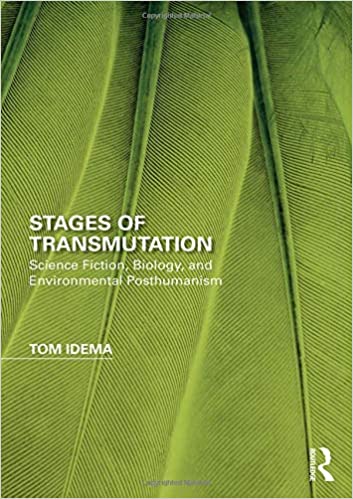
Review of Idema’s Stages of Transmutation: Science Fiction, Biology, and Environmental Humanism


Review of Stages of Transmutation: Science Fiction, Biology, and Environmental Humanism by Tom Idema

Nathaniel Doherty

Tom Idema. Stages of Transmutation: Science Fiction, Biology, and Environmental Humanism. Routledge, 2018. Hardcover. 176 pp. $140. ISBN 9780415788229.


Part of the Perspectives on the Non-Human in Literature and Culture series, Tom Idema’s Stages of Transmutation: Science Fiction, Biology, and Environmental Posthumanism roots itself squarely in contemporary European posthumanism (with a feminist inflection). Idema’s introduction helpfully sketches out what he means by the term “posthumanism,” noting specifically the strain of posthumanism preoccupied with transformation and relationships between species and environments. From here the chapter proceeds to define and situate the book’s central premise, outlining the idea of environmental posthumanism as it manifests in Octavia Butler’s Lilith’s Brood novels (1987-89), Greg Bear’s Darwin’s Radio (1999), Jeff VanderMeer’s Southern Reach trilogy (2014), and Kim Stanley Robinson’s Mars Trilogy (1992-99). Each chapter pairs a few key, usually somewhat current and innovative, scientific concepts with Idema’s reading of a primary SF text in order to suggest that human transformation in response to environment can be read productively through the lens of environmental posthumanism in both fiction and science. Because Idema brings his scientific sources into relief through heavy use of citation, this text can serve as a primer on the scientific background of environmental posthumanism or as an introduction to the resonances between science and general posthuman thought.

Idema’s idea is that certain SF texts interface with posthumanist reevaluation of humanity through an emphasis on reduced anthropocentrism. Environmental posthumanism comes into focus when this anti-anthropocentric change is brought about by human characters’ interaction with their environments. When Idema lays out his uses of “stages,” on which these transformations are elaborated, the book encounters one of its few weak points. This idea of several stages—temporal, spatial, epistemological—complicates the book’s central argument about environmental posthumanism in a way that is sometimes more distracting than illuminating. One of Idema’s obvious strengths, however, is his ability to weave a relationship of interpretive collaboration between innovative scientific approaches and science fiction narrative thought. Idema reads science fiction as a “privileged literary genre for thinking about environmental change in a posthuman vein” (7).

In the introduction to Stages of Transmutation, Idema lays out the background of his environmental posthumanist approach, emphasizing the work of Rosi Braidotti in particular, and provides a short but detailed history of SF narratives that engage heavily with the idea of environment. He then traces the development of environmentally-oriented strains of posthumanism in contrast to strains that are focused specifically on technological innovation. This sketch also distinguishes both forms of posthumanism from transhumanism, a movement identified by posthumanist thinkers like Rosi Braidotti and Cary Wolfe as distinguished by its disinterest in revising the role of “the human” in philosophical, social, and governmental landscapes in favor of maximizing human agency. Idema notes an increasing visibility, in contemporary scientific thought, of approaches that de-center genetics in favor of interactions between organisms and the environment. These approaches are frequently linked to environmental posthumanism throughout the text; particularly the focus is on empirical science’s overlap with philosophy and science and technology studies. The introduction closes with a consideration of the roots of resistance to the idea of environmentally-driven human transformation in anthropocentric religious, civic, and scientific traditions.

The first chapter is titled simply “Introduction,” resonating with the central focus of the chapter, which is a refinement of concepts surrounding just who counts as a responsible actor in mutually transformative ecological relationships. Idema takes the scientific work of Susan Oyama and pairs it with Kim Stanley Robinson’s Mars trilogy, weaving them together around the idea of terraformation. In Idema’s reading, the trajectory set by Oyama’s thought is important for the notion of “intra-actions,” a way of understanding the mutually-constitutive aspects of the relationship between organisms and their environment. Oyama and several scholars following her lead contribute evidence of the responsiveness of the genetic code to its surroundings, de-centering theories that position genetic transformation as the cause of environmental change. Idema identifies this dynamic in Robinson’s Mars trilogy as “the tension between anthropocentric and ecocentric perspectives” which “is . . . played out in the contrast between human focalization and (quasi-)scientific narration” (63). For the Mars trilogy, this means that the central scientists’ attempts to terraform Mars become impossible to disentangle from the process by which Mars “areoforms” the humans introduced to it. The striking novum, in Idema’s understanding, is the humans’ nearly total mastery of physics, biological manipulation, and both genetic and mechanical engineering. Even with this mastery, the humans find it impossible to control the evolution of the Martian environment without being changed by it, both socio-politically and biologically. Idema argues that this entanglement of politics and biology is how Oyama’s oeuvre and Robinson’s trilogy work together to push science and science fiction into the realm of environmental posthumanism. For Idema, science and politics become necessarily interconnected as a result, in opposition to what he terms the modern idea of science as an apolitical realm of objective observation.

Chapter two is less cohesive and more focused on using literature to explicate environmental posthumanism. Casting Bear’s Darwin’s Radio as a work of “informed speculation” allows Idema’s reading of the novel to be a stage for a broad claim about SF in general: that it is the imaginary creative space in which informed authors actually contribute to both literature and science by pushing the boundaries of science more broadly than is allowable in the laboratory. Science Fiction, when written by a scientifically well-informed author, acts as a laboratory for thought experiments that help both SF and science improve. Darwin’s Radio is particularly suited to Idema’s purpose because it illustrates different approaches to science’s relationship with institutions. The chapter contains a detour through the fruitful but meandering pathways of Deleuze & Guattari’s A Thousand Plateaus. While this allows Idema to provide a thorough primer on the concept of “nomad science,” which is relevant to his point in the chapter, the explication is too long at six and a half pages, moving too far afield of the discussion of Darwin’s Radio. 

Chapter three’s primary claim is that Jeff VanderMeer’s Southern Reach trilogy dramatizes the dissolution of the apparatus of androcentric epistemology and communication that structures humanity in the 21st century through the physical and mental transformation of the central characters. Idema links this narrative pattern with what he identifies as the trilogy’s postmodernist pastiche of genres. This literary-critical observation works alongside a series of contemporary scientific approaches that emphasize the capacity for the environment to function as an actant that displaces the human, and human knowledge constructs like literary genres, from the center of epistemological relevance. Stuart Kaufman’s theory of evolution and Rosi Braidotti’s ethics of sustainability are particularly important here. Kaufman’s theory mirrors Idema’s reading of the activity of the environment in the trilogy, and Braidotti’s ethics offer a lens through which to read one central character’s willing engagement, even fascination with, forces and processes outside the individual that seemingly dissolve and transform the very concept of individuality. 

In chapter four, Idema’s central literary argument is that Octavia Butler’s Lilith’s Brood “is an exploration of interspecies relationality and subjectivity that fundamentally questions anthropocentrism” (139). This interpretation rests on the argument that the trade of genetic material for survival between the Oankali—extraterrestrials with inborn genetic engineering abilities—and Earth’s few surviving humans is not coercive in a colonialist or capitalist sense because the Oankali are also profoundly changed by the exchange and do not have full control over the process of blending their genome with that of the humans. As a result, at the end of the trilogy, there has been a merger between humanity and the Oankali that allows both to coexist where before both would have died out. Idema does not manage to completely refute the understanding of the Oankali as coercive because he does not directly approach the Oankali’s control over which humans are allowed to be involved in the process of deciding or the coercive nature of the offer to exchange or die out. Idema’s argument that comparing the trade to biotechnological capitalist exploitation ignores textual details is more convincing given his elaboration of the unpredictable results of the species merger and how the human insistence on confrontation and the value of both purity and separatism is mirrored between resistant human characters and readers that emphasize the coercive aspects of the bonding. Calling the reader to face the ways in which their thinking is limited in exactly the same way as characters’ is a convincing rhetorical move. Idema manages to explain the discomfort elicited by, and depicted in, the Lilith’s Brood trilogy in a way that leaves the discomfort intact but makes its profound interpretive weight clear. His use of Braidotti’s posthuman ethics alongside Donna Haraway’s work on companion species renders his identification of the uncomfortable and profound interconnection forged between species as the primary novum of the series convincing.

Overall, Stages is a very useful work for scholars interested in both science studies and science fiction. This work’s occasional lack of clear transitions between ideas and vocabulary of different disciplines should be forgiven given the complexity of the task Idema has attempted in this slim volume. Working through those challenges will be rewarding.

Review of Greene and Heter’s Westworld and Philosophy: Mind Equals Blown


Review of Westworld and Philosophy: Mind Equals Blown edited by Richard Greene and Joshua Heter

Robert J. Creedon

Richard Greene and Joshua Heter, editors. Westworld and Philosophy: Mind Equals Blown. Open Court, 2019. Paperback. 298 pp. $19.95. ISBN: 9780812699913.


Westworld is an HBO series that goes beyond the Westworld (1973) and Futureworld (1976) movies and the short-lived Westworld (1980) TV series with their format of sex and violence over strong writing. We see the evolution of AI to the emergence of a new species by the end of the first season. This series is rich with philosophical concepts with episode titles like “The Bicameral Mind” and “Dissonance Theory” as well as its intertextual elements, notably its many Shakespearean references. Such a series screams out to be included in the Popular Culture and Philosophy series.

As I prepared for this review, I wrote a list of the topics to expect while watching the series and waiting for the book to arrive. This is volume 122, which makes it the ninth I have read. This volume didn’t disappoint as it covers all the topics I expected from the Westworld series and previous volumes of this philosophy series. The chapters were well-written and edited to be clear and concise within their standard 10 page format. Each addresses classical and modern philosophy as reflected in the actions and dialogue of the Westworld characters. The book is an easy read and employs an effective and distinct formula of introducing a concept in each chapter and exploring it in relation to the series. This formula is a great aid for teaching and provides with each chapter the basis of a good lesson. Furthermore, the ten-page essays can provide students with bite size lessons that make reading more enjoyable and palpable.

The first half of the book focuses on the first season primarily. The first six chapters delve directly into the concepts of identity, self-awareness and shared reality that are the essential to any discussion of AI. While there are a couple of minor editing errors, the writing and the arguments remain clear. These chapters cover in detail the familiar topics I expected to see addressed and are extremely well done. However, the chapter on evil, “When Bad Things Happen to Good Hosts (and Good Things to Bad Guests),” is confusing, as the chapter does not provide bridging support between the concepts of Susan Neiman and the concept of evil. The writer seems to want readers to discover the connection on their own, without the guidance that the earlier chapters provide. This technique doesn’t work well in this format and is very jarring to readers who have bought into the format of previous chapters. It is very unclear whether this is an editing or a writing issue as the chapter seems to have missing information. 

The chapter “Justice or Pleasure” changes things up delightfully, as it dives into the world of Westworld by relating it to the 1980 Westworld TV series. The chapter “Just Desserts or Just Rebellion” provides an insightful treatment of the just war philosophical argument. It is especially valuable, as Westworld is not a grand epic war but instead explores conflict on a smaller scale, offering a useful venue for discussing themes of war, rebellion and revolution in grittier environments and situations. This deeper look at the conflict as explored in the series will be a highlight to anyone interested in military science fiction, fiction or nonfiction. The rest of the book explores newer ideas, including the significance of the Hosts as Simulacra in relation to the concept of slavery. The final few chapters expand on the format with topics not often seen in the series. Although it felt like everything is covered earlier, these later chapters are a wonderful surprise with these enlightening unique treatments of those concepts. 

This volume is a great read for anyone who has followed this HBO series, as it goes beneath the action to explore the ideas and issues raised as the characters evolve. It is clear that all the individual writers did their homework and reviewed some of the interviews with the cast and creators to delve deeper into their concepts before writing. This book would be useful for for any first year philosophy or drama/writing student to explore how the show addresses concepts of consciousness, free will, and the mechanics of change. It carries readers beyond HBO’s ‘sexposition’ form of storytelling to get to the real adult content of thoughts, ideas and concepts. The ten-page chapter format makes these chapters great ways of introducing larger concepts, providing common ground for readers who lack expertise in philosophy. The majority of the chapter writers have used the formula effectively and crafted essays that provide useful lessons. One of the basic theories of learning is to relate new ideas to previous knowledge; these chapters do so effectively, thereby creating or improving understanding for all readers, whether scholars or new learners, though the book is more useful for such novices. Most chapters could be used in a classroom setting above grade 11, although the show content is adult. This book covers large concepts such as self-identity, person versus non-person, pain creating change, freedom of choice, ability to have self-knowledge, just wars, and shared reality. Different chapters could therefore be useful across a wide range of classes and disciplines. 

For anyone who is truly interested in philosophy, science fiction, writing or the Westworld TV series specifically, this is a great book for studying philosophical concepts. This is one of the strongest of the books I have read in this series; it will go on my shelves prized not only for the clarity of its chapters but also for the clarity it has brought to me after reading them. This volume is an excellent first step into this series.

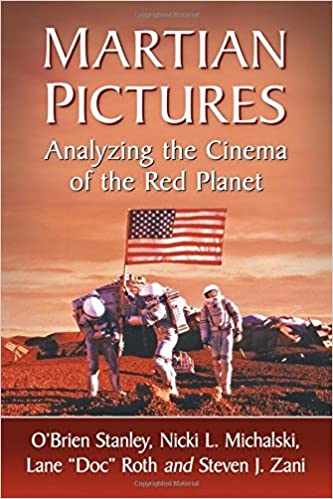
Review of Stanley, et al.’s Martian Pictures: Analyzing the Cinema of the Red Planet


Review of Martian Pictures: Analyzing the Cinema of the Red Planet by O’Brien Stanley, Nicki L. Michalski, Lane Roth, and Steven J. Zani

Thomas J. Morrissey

O’Brien Stanley, Nicki L. Michalski, Lane Roth, and Steven J. Zani. Martian Pictures: Analyzing the Cinema of the Red Planet. McFarland, 2018. Paperback. 246 pp. $49.95. ISBN: 9780786498932.


As a life-long Marsophile and having reviewed Robert Crossley’s comprehensive Imagining Mars: A Literary History and Visions of Mars: Essays on the Red Planet in Fiction and Science, edited by Howard V. Hendrix, George Slusser, and Eric S. Rabkin, and having been drawn by this book’s clever title, I jumped at the chance to read and review a new text on Martian cinema. However, the experience was not entirely satisfactory. 

Martian Pictures is a collection of thirteen essays that are reworked versions of conference papers amalgamated into a single critical text. The chapters are subdivided into three parts: ‘Exploring Mars,” “Invaders from Mars,” and “Mars and Society.” The main text is preceded by a short essay on the book’s origins, a Preface and Introduction; a Martian filmography, an extensive list of references, and an index follow. Thirteen well-chosen black and white stills from film and TV illuminate the text.

Quoting several times from Hendrix et. al., the Introduction imagines Mars as a blank canvas onto which are projected images of human frailty and the precariousness of our planet’s biosphere. These projections are shaped by the interaction between film and audience and the need for Hollywood to psyche out the audience in pursuit of success at the box office. If I am reading the authors’ intentions accurately, then these points need further discussion and consistent reinforcement in the main text. 

The chapters in Part One focus respectively on three major themes: the similarities between Martian and combat films., the role of deviant thinkers in bringing about successful missions, and the depiction of space agencies modeled on NASA. Chapter One is a rapid review of Martian film since WWII emphasizing the evolution of the genre from the Cold War-obsessed 1950’s to the early twenty-first century with its extensive Martian exploration and societal fear that science is in danger of running amok. Chapters Two and Three focus on the role of the prevalence of non-conformist characters that save the day, including those who thumb their noses at NASA, a situation best illustrated by The Martian (2015).

Although the topics are important and the theories employed to explore them interesting, the chapters do little to solidify the book’s central themes and are not user-friendly. Phrases like “as mentioned above” (32), “as mentioned in Chapter One” (36), or “as mentioned earlier” (42) occur far too frequently, especially when accompanied by lengthy plot summary without many strong transitional sentences between paragraphs. Repetitive plot summary is an issue throughout the book.

The three chapters in Part Two are loosely connected by the theme of Martian invasion. Chapter four considers the Martian as Other. Of note is the discussion of how the perennially hostile Martians of films like Invaders from Mars (1986) and Independence Day (1996) contrast with Martians as mirror images of ourselves in the 1980 TV adaptation of The Martian Chronicles and Spielberg’s War of the Worlds (2005). Chapter five offers an engaging treatment of serials in general and Zombies of the Stratosphere (1952) in particular. I do not know why 1938’s Flash Gordon’s Trip to Mars is not included since it would fit here very well. Chapter Six does what the book does best, apply theory—in this case mythic criticism—to Martian texts. The Prometheus myth has played a key role in SF since Frankenstein: or the Modern Prometheus gave birth to the genre in 1818. The film chosen for discussion is Prometheus (2012), which has nothing to do with Mars. The argument is that there are Martian films that also rely on the myth but not as well as Prometheus does. 

The third section consists of seven chapters, more than half the book’s total. Topics include class, gender, climate and comedy, among others. Chapter Seven is an ambitious discussion of feminist utopia/dystopia, especially the stories of Eve and Lilith, and their application to Martian films. The individual film discussions are convincing, as is the chapter’s conclusion. The brief chapter on climate (eight) celebrates the few Martian films that are concerned with environmental issues. Think about Kim Stanley Robinson’s Mars trilogy and you will get a good idea of just how much richer print SF is when it comes to climate. 

Total Recall figures in two chapters, one of which is about capitalist exploitation and the other of which focuses on Philip K. Dick’s short story “We Can Remember it for You Wholesale” (1966) and the 2012 remake of the 1990 film. The authors see the ending of the 1990 film as a victory over capitalist hegemony, which I think is too simple a reading of this rhetorically complex movie and its final scientifically farcical or dream-like scene. 

The chapter on Mars and religion (ten) is consequential. Much of the discussion concerns Ray Bradbury’s classic novel The Martian Chronicles (1950) and the 1980 mini-series derived from it. The authors recognize the genius of Bradbury’s text and never claim that the TV version is its equal. The authors tell us that Bradbury called the 1980 production “boring,” a judgement with which it is difficult to quarrel, then write that “for our purposes, the religious themes and messages of the book and series are relatively similar, so perhaps major differences in other respects are not necessarily important” (156). I disagree; the other differences are quite important; however, the discussion of the Father Peregrine episode—a filmic representation of “The Fire Balloons”—and the transformation of a hapless Martian into a suffering Christ is well done. These events are more effectively adapted than are most of the installments in the mini-series. 

Although Martian Pictures does a good job of cataloging a large number of video productions, some quite obscure, the book has a rhetorical looseness that a unified critical text should not have. In this sense, it has not made the complete transition from a collection of conference papers to finished critical book. There is much to be learned here about the fascinating filmic history of Mars, but the book really should have had one more round of editing for clarity. 

Review of Malley’s Excavating the Future: Archaeology and Geopolitics in Contemporary North American Science Fiction Film and Television


Review of Excavating the Future: Archaeology and Geopolitics in Contemporary North American Science Fiction Film and Television by Shawn Malley

Pedro Ponce

Shawn Malley. Excavating the Future: Archaeology and Geopolitics in Contemporary North American Science Fiction Film and Television. Liverpool University Press, 2018. Hardcover. 232 pp. $120. ISBN 9781786941190.


In the epilogue to Excavating the Future, Shawn Malley’s provocative and fastidiously researched monograph on archaeological motifs in several contemporary science fiction mainstays, the author updates us on the war on terror, a central backdrop to the fictional narratives he has scrutinized in the preceding chapters: “As I compose this on St. Patrick’s Day of 2017, Iraqi and coalition forces are poised to recapture the city of Mosul, the last major ISIS stronghold in northeastern Iraq” (191). Malley’s self-reflexive envoi is as striking for what it omits as for what it remarks; given his engagement with the geopolitical truths obscured by the hunt for authentic artifacts, it’s surprising that he would not invoke the ongoing contest over truth and authenticity taking place just across the border from his academic post in Quebec. 

As I compose this review, on the other side of the Canadian border, we have just buried the 41st U.S. president, amidst a deluge of favorable comparisons to the 45th. Before nostalgia for the first and second Bush administrations has a chance to overtake us, however, we would do well to follow Malley’s scholarly trajectory: deriving a perspective on the present by assiduous scrutiny of the framing past. 

Before Malley gets to the second Bush administration, his study takes us to the cradle of civilization, via the history and mythology surrounding Babylon. The human heritage associated with the ancient city and its Mesopotamian environs, as well as the threat to this heritage presented by the war on terror, implicates the stakes of preserving its artifacts for posterity. But this stewardship, a significant part of the U.S. mission after 9/11, is not without strategic value in the larger conflict between West and East. Malley unearths telling parallels between the war and preservation efforts mounted around the second Gulf invasion. Just as the Department of Defense issued a deck of cards featuring images of Iraqi “most wanted” in 2003, four years later, DOD’s “Legacy Resource Management Program issued its own deck of cards, this time representing archaeological sites in Iraq and Afghanistan [featuring] instructive slogans about the archaeologically rich terrain upon which soldiers are fighting and to which they should feel historically and culturally connected” (36). 

Even more suggestive than the links between soldiering and stewardship in the theater of war are their contemporaneous representation in SF film and television. Central to this representation is the pursuit of ancient artifacts that do much more than drive the plot, according to Malley’s introduction: “as a source of objectified temporality in SF, archaeology is a critical tool for unearthing the contradictions and fissures of political discourse displaced into imagined futures” (3), as well as “an important critical medium for teasing out ideological subtextures of historical representation within the genre” (7).

Malley culls from several fan favorites to make his points: Stargate SG-1 (1997-2007), Smallville (2001-2011), and the rebooted version of Battlestar Galactica (2004-09). Other choices might seem more questionable—the SyFy channel original film Manticore (2005), the second installment of Michael Bay’s Transformers reboot (2007), the pseudo-documentary series Ancient Aliens (2009- ), and Ridley Scott’s disappointing Alien prequel Prometheus (2012). More often than not, though, Malley makes these and other excavations of the future richer through his rigorous historical and theoretical framing. The titular monster in Manticore is unleashed by Iraqi insurgents in possession of a looted magic amulet. More than a topical creature feature, the film exposes the uncomfortable synergies between military occupation and the media, between hearts and minds and shock and awe: “Sanitizing the archaeological past of its association with dictatorship, the SF telefilm implicitly exonerates the destructive effects of Operation Iraqi Freedom and the West’s invention of WMDs. Like the Iraqi extras in this film, the material remains of Mesopotamia play bit parts in cultural spectacles of propriety and control” (42). Malley observes a similar dynamic at work in Transformers 2, in which director Bay “repositions archaeological ‘landmarks’ separated by hundreds of kilometres into a single diegetic field” to represent a battle scene around the Great Pyramid at Giza (66). This aesthetic displacement is just another form of cinematic violence that resonates with the structural violence obscured by the spectacle. Observes Malley, “Tongue-clacking goat herders, whooping Bedouins with their camels, and ubiquitous squawking chickens are atmospheric and anachronistic extensions of the pyramid, a monolithic Orientalist chronotopic threshold waiting activation by [hero] Sam [Witwicky], the Autobots, and the U.S. military” (67).

Malley’s reading of Indiana Jones and the Kingdom of the Crystal Skull (2008) invites comparisons between 9/11 and its cataclysmic precursor in the American mind: the mushroom cloud. Malley discerns this parallel when archaeologist Jones witnesses a nuclear test in Nevada:

If in the moment the audience confuses Jones staring in awe at the detonation with our mediated ground-level views of the towers collapsing in inverted mushroom clouds, the ghostly apparition of the crystal skull is a crystal ball for a post-9/11 America experiencing resurgent Cold War anxieties in the form of nuclear brinksmanship with terrorist states like Iran, Pakistan and North Korea.

101

The rebooted BSG and Prometheus gain depth, if not complete coherence, from Malley’s cybernetic reading. In the former, the Galactica itself is an artifact which preserves what remains of humanity after Cylons attack. The search for Earth that galvanizes the narrative is replete with excavations for other artifacts that serve as guides, not just to a new home planet, but to the intertwined destinies of humans and the enemy cyborgs they created. “In BSG,” notes Malley, “archaeological sites are places of assembly, contestation and ultimately critical reflection on the dangerous antagonisms and imperial politics that have brought humanity to the brink of extinction” (147). And by going into the intertextuality between Prometheus and the 1962 film Lawrence of Arabia (the archaeological classic that the cyborg David watches avidly as the crew of Prometheus sleeps), Malley makes a strong case that the film’s real plot is not about the human past but the cyborg future: “If Prometheus ultimately fails to break radically from the parasite of franchise mythology, the film does gesture towards a cyborg subjectivity beyond recycled myths of biological or mechanical reproduction” (185), adding that “[h]aving given birth to an alien life form herself, [Dr. Elizabeth Shaw, the sole human survivor at the film’s conclusion] is also a cyborg, suggesting a co-evolutionary future alongside [David] her artificial companion” (188).

Invoking such heavy-hitters as Roland Barthes, Jean Baudrillard, and Homi Bhabha, Excavating the Future is best for scholars or advanced students already acquainted with a fair amount of theory. Nevertheless, Malley maps rich territory at the intersection of literature, media studies, history, and geopolitics.

Review of Bolton’s Interpreting Anime


Review of Interpreting Anime by Christopher Bolton

Chris Reyns-Chikuma

Christopher Bolton. Interpreting Anime. University of Minnesota Press, 2018. Paperback. 336 pp. $24. ISBN-13: 9781517904036.


Over the past 25 years, anime has continuously attracted not only fans but also academics. Bolton’s brilliant book joins a growing collection of outstanding academic works about Japanese animation, such as those by Anne Allison, Jacqueline Berndt, Ian Condry, Thomas Lamarre, and Susan J. Napier, as well as works in Japanese by Murakami Takashi, Otsuka Eiji, and Azuma Hiroki, most of which are rarely translated. That these texts converge in Bolton’s study is one of its major strengths. Being both a Japanologist and a comparatist, Bolton is able to read and bring together rich Western texts like Lamarre’s, Lacan’s, and Jameson’s with scholarly works written in Japanese, sometimes to corroborate or complement each other and at other times to challenge prevailing Western views on anime and Japanese culture. 

Although younger than its Anglo-Saxon counterpart, Japanese science fiction (SF) has been prevalent in literature and other media since the 1960s, especially in anime. Although anime covers all genres (historical, romantic, erotic, pornographic, etc.), SF, with its subgenres like mecha and cyberpunk that originated as anime, is ubiquitous. As a specialist in Japanese studies, Bolton also has expertise in SF. He is the author of two books on the subject, one on avant-garde writer Abe Kobo (2009) and another, Robot Ghosts and Wired Dreams, Japanese Science Fiction from Origins to Anime (2007), for which he served as co-editor. He is also a founding member of the editorial board of Mechademia, the academic journal on anime.

In Interpreting Anime, Bolton has chosen six SF anime, some already famous, to make a case for the richness of these “texts.” He begins by asking, “What can anime do that other media cannot?” (6), and although I would argue that his answer to this question is not convincing, his chapters are nonetheless thorough and illuminating. Bolton argues that what most long-feature anime do best is to strike a balance between immersion and distanciation. The shortcomings of this argument are that the question is too general, and he inevitably focuses only on examples that support his thesis. The question asked in the title of the last chapter, “It’s Art but Is It Anime?” (233), is revealing: Miyazaki’s artful animation would not be considered anime because they tend to be mostly immersive. Similarly, one could argue that some American animations, which are not mentioned at all, could also be interpreted as using the same balancing technique (see for example Eric Herhuth’s Pixar and the Aesthetic Imagination, 2017). Therefore, readers are not given a satisfying answer to his too general question about anime.

Undeniably, Bolton’s hermeneutical methodology (obvious from its book title) provides sophisticated arguments and analysis that should convince the few remaining skeptics who are unconvinced that popular media/genre is potentially as rich as our literary texts. To this, Bolton adds two strong specificities. The first one is that he analyzes not only narrative devices and dialogues but also visual language in a very detailed, precise, and convincing way. The second is that, being also a comparatist, Bolton performs “text” analysis within a comparative paradigm by comparing the same narrative in various media, i.e., anime with theatre, manga, TV anime, and novels. However, Bolton emphasizes the abundance and richness of self-reflective symbolic devices, such as the mirror and the half-opaque window, as an insightful postmodernist reader-scholar, but what of the immense majority of other viewers who are not academics? We see here the weak point of his study: the absence of the readers’ agency within these insightful interpretations. Hence, in Chapter 4, when he first considers the otaku in his analysis, it is to make “it” (the otaku) play a role inside the “text” as another distancing device. Interestingly, Bolton sees the otaku not as a “separate group or even a separate way of reading but to describe a potential in any viewer and any viewing—the potential to have a third eye open as we become aware of the artifice or artificiality, and become able to see ourselves watching the text” (156). This otaku reading would be more idealized, “a mode of reading associated particularly if not exclusively with anime and its viewers” (168). Moreover, the author favors progressive critical readings rather than conservative ones, or rather he favors the tensions between these two readings, when most people might see one or the other in the anime but not both.

In Chapter 6, after using Lamarre’s subtle hermeneutical methodology, Bolton directly mentions other methodologies, such as Allison’s and Condry’s ethnographic approaches. He then addresses Otsuka Eiji’s character and “grand-non-narrative” (216) interpretation, as partly integrated by Marc Steinberg in his media studies approach, by writing, “With their ideas about the decline of individual narratives and individual auteurs, and/or the need to focus more broadly on characters, collaborations, franchises, and commercial contexts, the critics above position their work variously as a supplement, alternative, or replacement for the kind of interpretive close readings of individual anime and individual directors practiced in this book” (217). He then considers whether we can combine these two approaches by evaluating three different franchises of Blood. His answer, although well-rounded, is not completely convincing. 

To conclude, this book is a very useful and enlightening reading for many scholars and students of literature and media. This is especially true for those without much knowledge about Japan and/or anime. But, as the book insists, if students, like anime fans, read in a more participative way through the balancing act of immersion and distancing, anime (and other media) studies need to integrate their points of view. In his book, Bolton uses “we” a lot; however, if “we,” as academics, still want a grand narrative of tolerance and social progress, we need to teach and write not only through lectures, regardless of their quality, but from the students-readers-viewers-fans-producers’ perspectives also.

Review of Rickman’s Philip K. Dick on Film


Review of Philip K. Dick on Film by Gregg Rickman

Terence Sawyers

Gregg Rickman. Philip K. Dick on Film. Arrow Books, 2018. Paperback. 176 pp. $29.95. ISBN 9780993306082.


Gregg Rickman is an established commentator on Philip K. Dick who occupies contradictory positions within the broad community of Dick fans and scholars. On the one hand, Rickman’s retrospective psychoanalysis of Dick in To the High Castle, Philip K. Dick: A Life, 1928-1962 (1989, repeated in truncated form on page 114 of this text) is treated with much suspicion within this community of fans and scholars. Yet he remains a trusted source of first-hand material and collector of Dick anecdotes. Furthermore, Rickman moves between the spheres of academic and non-academic publishing, a boundary that is traversed by only a select few Dickian commentators.

Rickman’s liminality is relevant when approaching his recent monograph Philip K. Dick on Film, as there is some slipperiness when trying to establish the best contextual frame from which to review it. Even the title is suggestively ambiguous. Is this a book about Dick’s attempts to make films and contribute to TV shows, Dick’s own opinions of film as an art form, or the adaptation of Dick’s work into film by third parties? Ultimately, all three of these positions are touched upon, though the latter represents the primary focus.

Rickman’s text can be divided into two sections, with the first comprising chapters one through five and covering Dick’s biography, a discussion of Dick’s major themes and an insight into Dick’s relationship with Hollywood and filmmaking more generally. These chapters offer a neat overview to the key debates in Dick studies as well as providing some keen insights from Rickman. The little over four pages dedicated to Dick’s biography succinctly introduces the reader to Dick’s biographical highlights as well as communicating the complexities and contradictions that make Dick’s biography so exciting. For a casual fan of Dick who is interested in why media organisations keep returning to his literature as a source for film and TV adaptations, these early chapters are a helpful roadmap. While the more dedicated Dick scholar may fail to find anything new in these chapters, they will appreciate both the chapters’ concision and the many suggested routes (trailheads) of further investigation.

However, chapters six through twelve discuss the direct adaptations of Dick’s fiction into film and TV, and for those interested in Philip K. Dick, film studies, or adaptation studies, these chapters will disappoint. This is due to three problematic positions that inform Rickman’s methodological approach. First, he engages in a comparative analysis that heavily favours Dick’s fiction as an originary source. Following this form of analysis, any adaptations must strive, and ultimately fail, to “live up” to the original. This tautological argument is not uncommon in cycles of fandom, and therefore is not unheard of within SF studies; the “original” is always best at being the “original.” The argument’s circularity makes it uninteresting and provides no opportunity for serious discussion.

Second, Rickman purports to be offering readers a juxtaposition of his own comments and Dick’s (hypothetical) opinions on the various film and TV adaptations. This interpretative strategy seeks to extrapolate the opinions of a deceased writer based on his extant commentary. As dangerous as this strategy is, and in the case of Dick it is fraught by added complications due to his well-documented capriciousness, one needs to ask whether it is at all interesting. This approach assumes the primacy of the star-author as a site of meaning-making and authority (at the expense of critics, scholars, readers, and fans) and by contemporary standards is an outmoded method of engaging with texts, adapted or otherwise.

Third, Rickman takes for granted that contemporary commercial filmmaking is in an “unhappy state” and he rests this reductive criticism on rather narrow shoulders (89). For Rickman, the formulaic nature of storytelling is the primary cause of a creeping mediocrity that has been developing within Hollywood since the 1980s. Rickman goes on to argue that, although there are many vectors via which these formulae have been disseminated, the primary method is via screenwriting manuals, and he reserves particular attention for the successful 2005 manual Save the Cat! by Blake Snyder.

There are many problems with this claim, and it reveals a writer who is not conversant in the history of film, the current debates in film studies, or the contemporary reality of commercial filmmaking. To tease out just one of these problems, it exposes a logocentrism that assumes films can be equated with their scripted antecedents, reducing the complexities of an audio-visual text to nothing more than its content or story. The irony here is that Dick’s fiction has highly repetitive qualities that often follow a generic formula. A reduction of Dick’s fictions to their story and a map of their plot points (“beats”) will emphasize sameness while overlooking what distinguishes Dick from other SF writers or Dick’s stories from each other.

Turning to the formal qualities of this monograph, the publisher, Arrow Films, has not helped here, with poor editing, formatting, and design choices. For example, an error where the wrong film is referenced and inconsistent use of footnotes, that sees some tangential anecdotes footnoted and others left within the text, should have been picked up on and corrected before publishing. From a formatting perspective, inconsistency is again the watchword, with the footnote superscripts switching between grayscale and salmon. While throughout the body of the work the font oscillates between grayscale and black, sometimes within the same sentence. These inconsistencies are very distracting for the eye while also undermining the legitimacy of the work.

As part of the design, cover pages from Dick’s published fiction are interspaced throughout the text. As nice as these are to see, they bear no relevance to either the overall aims of this monograph or to the specific sections that they are included within. This is an odd design choice that stands in contrast to the book’s cover, which includes an arresting panoply of icons from the various Dick adaptations under discussion. These cover pages highlight the confused focus of a text that seems trapped between what it sought to talk about, the film and TV adaptations of Dick’s literature, and what it couldn’t help talking about, how much Rickman likes Dick’s literature.

Review of Lee’s Exploring Picard’s Galaxy: Essays on Star Trek: The Next Generation


Review of Exploring Picard’s Galaxy: Essays on Star Trek: The Next Generation edited by Peter W. Lee

Todd L. Sformo

Peter W. Lee, editor. Exploring Picard’s Galaxy: Essays on Star Trek: The Next Generation. McFarland, 2018. Paperback. 262 pp. $39.95. ISBN 9781476666617.


While I don’t recall much about an essay I read in the 1990s on Gilligan’s Island, I do recall one line: “linguistically speaking, Gilligan owns the island.” So when I came across the title Exploring Picard’s Galaxy, ownership of the galaxy sprang to mind. In a way, the 15 essays in this book have something to do with ownership, not of the galaxy, of course, but of interpreting that unique SF state of being: humanity’s historical future. According to P.W. Lee’s Introduction, this volume commemorates the 30th anniversary of The Next Generation (TNG) and is the first book to “solely” employ TNG as a “lens” (2) on issues ranging from government to multiculturalism (Part I), identity to gender (Part II), and martial arts to music and history itself (Part III). Since SF is a comparative argument on human progress, each essay considers the historical future as baseline, assessing whether both the real present and the TNG galaxy live up to ideals 24th century human progress. 

As comparative argument, the essays tacitly grant that TNG represents the progress a “fantasized humanity has made” (64, Achouche. Also see the chapters by Olaf Meuther and by Justin Ream and Alexander Lee), but the authors most often see a lack of advancement, with the culprit being the imposition of 20th century values upon the 24th century; hence, all three parts of the book, to varying extents, consider the Federation and its enlightened values as a starting point for comparisons with recent history, including the Cold War (Anh T. Tran), the Reagan Era (Simon Ledder, et al.; Bruce E. Drushel), and the economics of network TV (Katharina Thalmann). 

The essays, especially in Part I, find that the socio-political climate of the 1980’s and early 1990’s is reflected in the narrative and characters but also highlight differences. Alex Burston-Chorowicz points out Picard’s inconsistency when responding to other cultures, sometimes by non-involvement and other times with a more colonial attitude, perhaps informed by U.S. foreign policy during the Reagan Era. The episode “The Neutral Zone,” on the other hand, “reinvent[s]” (16) the Cold War, contrary to real world events. Alexander Simmeth shows “the future is not always ‘better’ than the past” (241) when focusing on “Journey’s End.” Here, the Federation orders Picard to resettle Native American descendants. Larry A. Grant’s essay on the Prime Directive (PD) questions its “unenlightened form of sovereignty” (29) that has a close association between real world concepts of national sovereignty and unlawful intervention, mentioning the delayed response to the genocide in Rwanda. While no direct connection is made between Rwanda and TNG, Grant judges that blind adherence to the PD is not the solution. Tran focuses on a single topic—the policing of civil society by the FBI, noting similarities to the Tal Shiar and Deep Space Nine’s Section 31. In three separate essays, Erin C. Callahan, P.W. Lee, and Jared Miracle discuss changes made to Yar’s character leading to her “unnecessary feminization” (173). Citing interviews with Denise Crosby and others as primary evidence, these essays in general describe the transformation of Yar as due to interference by the network, imposing conservative Reagan Era values in the hopes of higher ratings. 

In Part II, a few authors begin their comparative analysis with a theoretical approach. Ledder, et al. examine “biopolitics” via Foucault, noting that TNG allows for heterogeneity in race and abilities, contrasting to more culturally homogeneous, and therefore, restrictive, societies such as Klingons, but concluding that “TNG produces an ambivalent position” (109). Ream and A. Lee cite Hegel to make the case of TNG accepting Others by subsuming them under the rubric of a “utopia of bureaucracy” (75). Joul Smith considers previous interpretations of Troi as stereotypes and reinterprets the “Troi Effect” as a positive sign of mental health awareness in comparison to other media depictions of mental health. Thalmann contrasts Kirk and Picard, noting the latter’s heroism as multi-dimensional, more vulnerable, cut from a more fatherly, diplomatic cloth than Kirk’s. This essay then questions the growth of the “Action Picard” in the ST movies. Technological advance is taken up by Meuther in relation to rights and the definition of life within the patriarchal federation and matriarchal Borg. Drushel uses the historical association between villainy and gender to examine the behavior of particular characters, concluding there is insufficient evidence to make this connection and stating, “[t]o be fair, one must acknowledge that the failure of the producers of [TNG] to populate the cast with identifiable lesbian or gay characters has many plausible justifications” (162). I was left with the impression of a scientific paper acknowledging the lack of statistical significance to reject the null hypothesis. 

Part III of the book differs from I and II in that it attempts to trace the 24th century’s use of 20th and 21st century’s humanities and history. Miracle’s martial arts essay emphasizes the bat’leth developed by Dan Curry and the coinciding rise in mixed martial arts in Ultimate Fighting Championships in relation to TNG’s extended portrayal of Klingon martial arts. Tom Zlabinger’s chapter highlights the personal growth of Picard and Data as explorers of the physical and the ephemeral through music making. Simmeth analyzes the “appropriation of history” (245) in TNG, including a critique of capitalism as narrative technique for exploring human progress. 

While the essays raise interesting questions about science fiction and society, I have two concerns that distract from the book: 1) the promise of wide-ranging scholarship is sometimes unfulfilled, primarily due to the use of broad historical periods and nominally mentioning philosophical concepts without adequate critical attention; 2) some essays are slow to get to their main point, listing peripheral details and summarizing characters or incidents without leading to insightful analysis. Overall, however, the essays interestingly teeter on a fulcrum of inferential history that swings between humanity’s conjectural future and ownership of our flawed, recent past. When the inferred future is unrealized in the show, it is due to contemporary norms and values being imposed upon it. These essays highlight our imperfect selves in TNG, revealing the present values we must struggle with to come closer to the ideal.

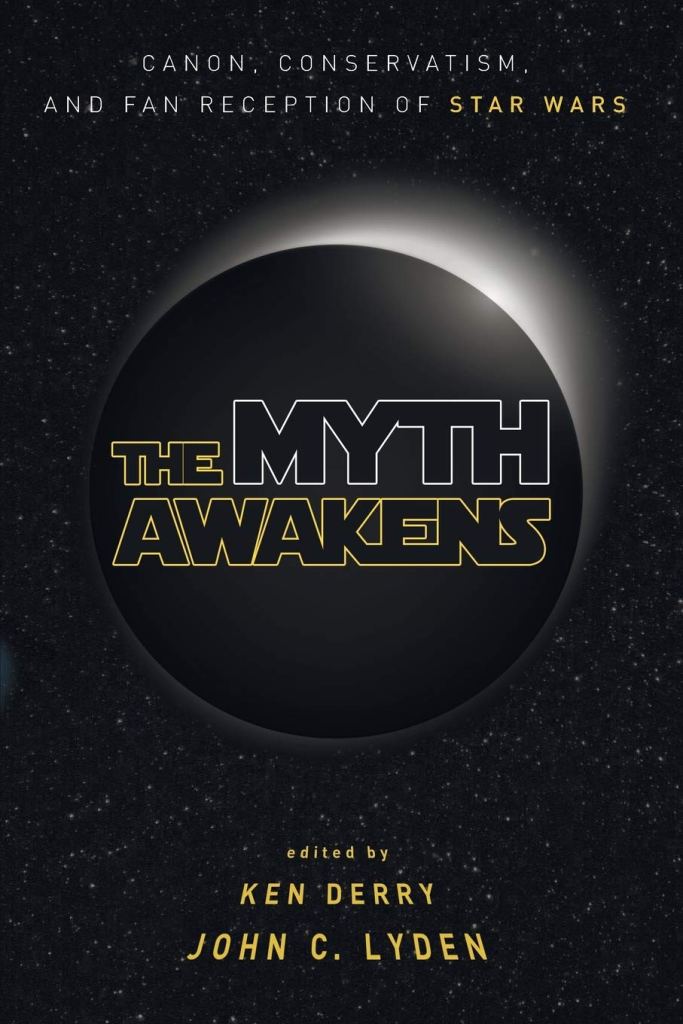
Review of Derry and Lyden’s The Myth Awakens: Canon, Conservatism, and Fan Reception of Star Wars


Review of The Myth Awakens: Canon, Conservatism, and Fan Reception of Star Wars edited by Ken Derry and John C. Lyden

Jessica Stanley

Ken Derry and John C. Lyden, editors. The Myth Awakens: Canon, Conservatism, and Fan Reception of Star Wars. Cascade Books, 2018. Paperback. 186 pp. ISBN 9781532619731.


The Myth Awakens: Canon, Conservatism, and Fan Reception of Star Wars collects chapters that explore fan receptions of the Star Wars saga, focusing primarily on Episode VII: The Force Awakens (2015). While the title suggests discussions of conservatism, most chapters focus on close readings and fan reception of Star Wars in a concise, easy-to-digest manner. The result is a diverse and engaging collection that would be of interest to both scholars and students interested in science fiction or fandom.

The introduction, written by editor Ken Derry, positions Star Wars within the context of religious studies and myth, and makes a case for why scholars may want to consider the franchise as a means of “lowering the stakes” when discussing controversial issues like violence, good/evil, and morality (9). 

The first two chapters of the book both make use of Joseph Campbell’s monomyth. In Chapter 1, “The More Things Change: Historical and Political Context and The Force Awakens,” John C. Lyden argues that while A New Hope (1977) and The Force Awakens are, at their core, very similar films, the way fans receive them is vastly different due to changes in society and politics. Lyden explains that both liberals and conservatives read their own politics and current events into A New Hope, and that while the same may be true of The Force Awakens, its moral ambiguity points to a larger shift in political climate. 

Chapter 2, “The Brightest Shadow: From Fighting Darkness to Seeking It,” by Lindsey Macumber, explores Darth Vader and Kylo Ren in terms of their relationship to Campbell’s shadow archetype. In one of the clearest and most concise chapters, Macumber provides a definition of the shadow archetype and its function in myth, arguing that confronting the shadow is a necessary part of growth for characters and viewers. The author explains that Darth Vader once served this purpose, but that in The Force Awakens, Kylo Ren fails to fit the archetype. Macumber ends the chapter by connecting Ren to current culture, noting that his arc provides an opportunity for audiences to navigate contemporary situations “where the evil of […] real life villains is not the result of principle or conviction, but of reactionary impulsivity” (45).

The next two chapters both address gender and female representation in Star Wars. One of the standout chapters, “’Leia the Hutt Slayer’ and ‘Rey the Next Generation Badass Boss Bitch’: Heroism, Gender, and Fan Appreciation,” argues that calling Rey the first female hero in Star Wars discounts Leia’s contributions to the saga. Chris Klassen uses Campbell’s definition of heroism and Valerie Estelle Frankel’s “heroine’s journey” as the framework to analyze Rey and Leia’s contributions to the Star Wars narrative. She argues that Rey and Leia are both heroes in different ways, with Rey representing Campbell’s hero and Leia representing Frankel’s. Rey follows a journey similar to Luke’s, positioning her both as a role-model and a target for derision from fans who believe she should not be placed in the same role as male characters. Leia wields a different kind of power through her leadership and political acumen, positioning her closer to Frankel’s Great Mother figure. Both characters, Klassen argues, serve to broaden the definition of heroism. Chapter 4, “I’ve Heard That Somewhere Before: The Myth-Making Implications of Han and Leia’s Theme,” by Kutter Callaway, analyzes the use of music in The Force Awakens, focusing on the leitmotif of “Han and Leia’s Theme.” The chapter addresses the complicated function of gender in Star Wars, and Callaway asserts that the franchise has always been as much, if not more, about the women characters than the men. Callaway argues that the use of the “Han and Leia Theme” in the controversial The Force Awakens hug scene between Leia and Rey helps to shift the franchise in that direction.

The fifth and sixth chapters focus on race in the Star Wars saga and the Expanded Universe. Chapter 5, “The Racism Awakens,” attempts to spark a dialogue about racism in Star Wars. Daniel White Hodge and Joseph Boston begin the chapter by summarizing the complicated relationship between Hollywood and race, defining the Black character tropes most common in films, and then applying them to Finn in The Force Awakens. According to Hodge and Boston, on the surface, Finn’s character represents a positive change in the Star Wars franchise, but upon examination, Finn and other Black characters fall into several of the Black character tropes and are products of hyper-tokenization. The authors contend that the lack of representation in Star Wars, paired with the racially charged fan response to characters like Finn, reveal deep issues within the franchise. Chapter 6, “Do or Do Not: There is No Try: Race, Rhetoric, and Diversity in the Star Wars Universe,” compares identity and representation of race in The Force Awakens and the Star Wars Expanded Universe. Joshua Call explores Finn’s portrayal, noting similar issues of agency and tokenization as the previous chapter. He juxtaposes these issues with the “normalization of diversity” in the game Knights of the Old Republic, arguing that the games provide a space for fans to see themselves in the Star Wars universe (102).

The final three chapters center on canon and fan communities. Chapter 7, “Ritual, Repetition, and the Responsibility of Relaying the Myth,” focuses on George Lucas’s complicated relationship with his films and their fans. Justin Mullis defines fans as “those who consume media and who are actively and willingly consumed by it,” and explains that the Star Wars fandom is not the first to conflict with the creators (109). He charts Lucas’s many revisions of the films which led to his rejection by fans and asserts that part of the success of The Force Awakens was due to the sense of comfort and familiarity created by its similarities to the original film. 

Chapter 8, “Memory, History, and Forgetting in Star Wars Fandom,” focuses on the collapse of the Expanded Universe after Disney’s purchase of the Star Wars franchise and George Lucas’s multiple film revisions. Using theories from the “first generation of fan studies,” Syed Adnan Hussain argues that when Lucas or Disney imposed new rules on the canon, rather than erasing part of the fandom’s collective memory, the moves created splinter factions, not unlike those that arise in major religions (136). Hussain asserts that understanding these various traditions of fandom is essential to truly understanding Star Wars fandom. 

In Chapter 9, “The Ion Canon Will Fire Several Shots to Make Sure Any Enemy Ships Will be Out of Your Flight Path: Canonization, Tribal Theologians, and Imaginary World Building,” Kenneth Mackendrick argues that Star Wars provides a means of understanding canonization in a religious context. He argues that canonization relies on the interpretation of an authoritative interpreter and then allows for world building through cooperation by fans. 

As an edited collection, The Myth Awakens flows together seamlessly thanks to the chapter organization, overlap in critical approaches, and overall tone. The approaches to gender, race, and fandom can easily be applied to topics outside of Star Wars, making this an excellent collection for emerging scholars and university libraries.