Navola


Review of Navola

Ian Campbell

Bacigalupi, Paolo. Navola. Alfred A. Knopf, 2024.
Version 1.0.0

This competently written pseudo-historical fantasy novel is a textbook example of essentially everything that’s wrong with book publishing under late capitalism. I’m going to thoroughly spoil the novel here and also likely make it appear that Bacigalupi is my primary target, but he’s not: it’s the industry, the structure, not the individual. The story is set in an alternate-world version of the Italian Renaissance. Davico di Regulai is the only son and heir to a great and powerful banking house. The first three-quarters of the text centers around Davico’s being simply too nice and decent a person for the role that has been chosen for him by his patrimony. He’s kind, sensitive, naïve and open in a culture that values viciousness, indifference, cynicism and duplicity. He rather wishes he could become a physician and help people: he’s quite aware that he’s a bad fit for what he’s supposed to be. This is in no way a terrible setup for a good story. Either Davico is going to find a way for someone else to replace him so he can go pick mushrooms and heal people, or he’s going to grow into the role, lose just as much of his naïveté as he needs to in order to thrive, and take the banking house one step closer to domination. Or he’s going to grow into the role of patriarch/CEO but do it in a kinder, gentler fashion. But none of this happens; in fact, by the end of this 200k-word novel, we only get to the first couple of scenes of Act Two of how this sort of story typically works. I found myself nearly finished, thinking “well, this is all going to need to get wrapped up in a hurry, here”, and then it… doesn’t, really.

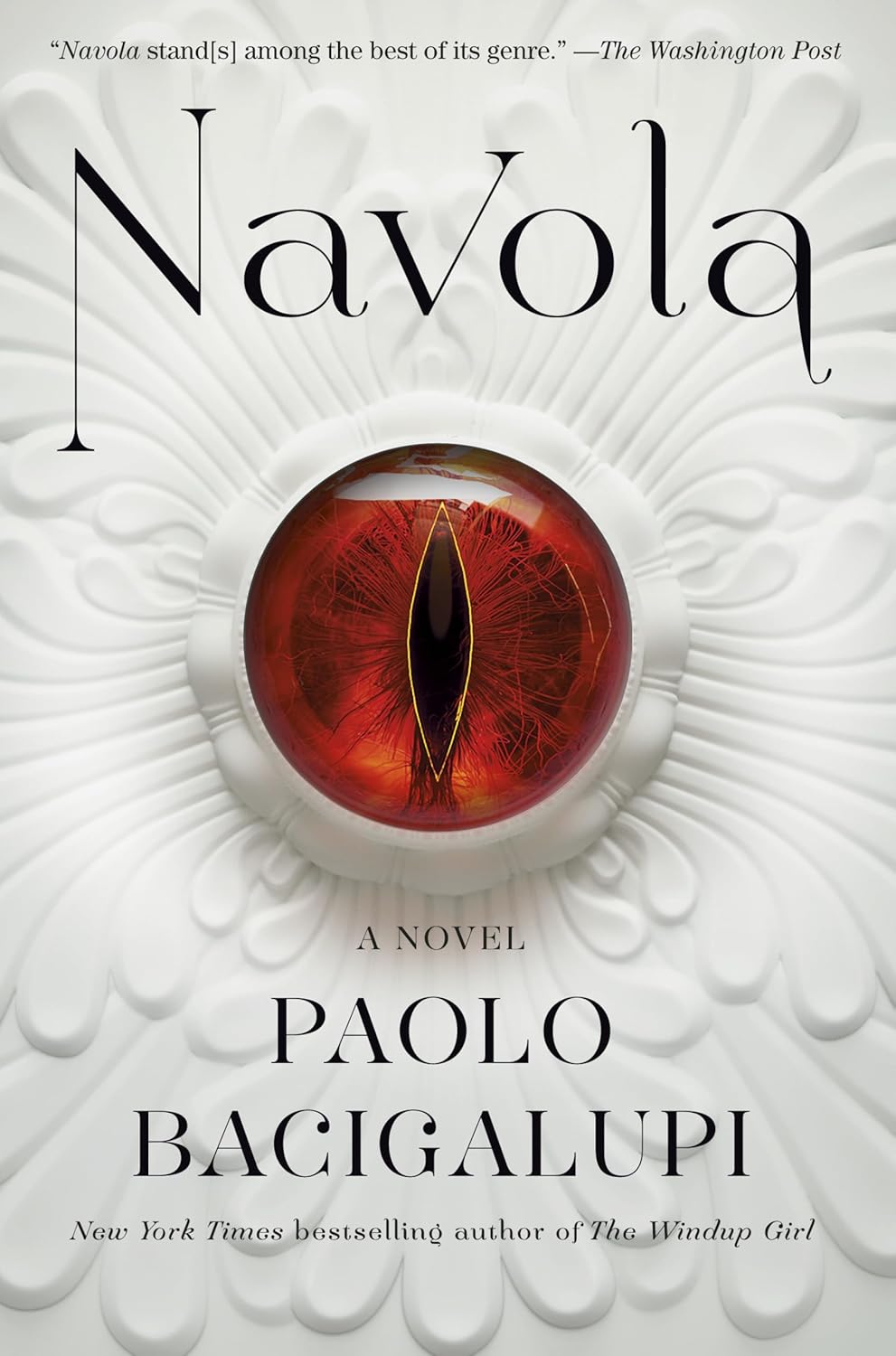
The initial chapters foreground a magical artifact in this otherwise non-magical world. Davico’s father has acquired at tremendous expense the eye of a long-dead dragon and has placed it on his desk as a symbol of his power and wealth. Davico comes to view the eye differently: he can sense the dragon’s dormant power and consciousness and is constantly fascinated by the glowing orb. The text does not explain why Davico in particular senses power through the eye, when neither his father nor any of the minions, allies, and rivals who sit across the desk from his father look at it as anything more than a trophy. We’re to infer, I suppose, that his sensitivity is the reason for why the eye reacts differently to him, but like many things in this story, we don’t get a clear explanation. Were I feeling charitable, I’d argue that Davico’s general head-in-the-clouds demeanor prevents him from looking too closely into the matter, and this is reflected in the text. The eye does enter into the final act of the story, or rather, what would be the final act were it a complete story.

Yet, aside from the eye, this world is mundane. Herein lies the true problem with Navola: it is much too close to our own world and yet too different to be literature worth the name. When I first picked up the book, I flipped to the first pages of actual text and so missed that there was a map before the first chapter. As I worked my way through the first third of the text, I kept thinking “this is a pastiche of our own world”. I was willing to accept pseudo-Italian city-states separated by rough terrain, on the premise that this was going to be an estrangement of the Italian Renaissance, and the developments in the book were going to defamiliarize me just enough with our own world to give insight into… any number of aspects of the time and place, such as how and why art flourished so much or how modern banking arose, etc. Compare Navola to, e.g., Neal Stephenson’s Baroque Cycle, which hews closely to our own world save for a few characters and does real work in not only telling a banger of a story but also providing a great deal of food for thought about how attitudes toward science and economics shifted during the late seventeenth and early eighteenth centuries.

Bacigalupi’s story takes so very long to get going, and is so filled with endless, loving detail about how this society functions, that an experienced reader of SF or fantasy is going to expect a similar payoff, only maybe with a dragon. But “the Italian Renaissance was real cutthroat” doesn’t justify a buildup this long. Why was it cutthroat? What was it about the city-states’ relative freedom from domination by larger imperia or kingdoms that produced such an environment? How did the flourishing of arts and culture dovetail with politics and economics? None of these questions is answered or meaningfully addressed by the text.

It was at this point that the kingdom of “Cheroux” to the northwest is introduced, and some part of my eyeroll made tangible led me to finding the map in the front material. Oh, look: it’s the Mediterranean, only some catastrophic event, distant enough in the past to be mostly legendary, has erased Greece, Turkey and the Balkans and left empty sea in their place. The city-states look more or less like Italy; Cheroux is in the place of France. Navola is simultaneously too close to and too uninvolved with our own world to function as a work of literature. The first three-quarters of the text is constantly filled with pseudo-Italian words for things. I’m proficient enough in Italian to be able to read a book or hold a conversation in the language, and nearly everything was just the regular Italian word but with one or two letters different: this was both very distracting and, like most of the rest of Navola, fundamentally very lazy writing, though in fact the sentences are lovingly constructed and very smoothly edited.

There are two effective ways to write a fantasy novel that estranges the Italian Renaissance and makes us rethink what we understand about the time and place. One of them is to do what Stephenson did with northwestern Europe during the Baroque period: carefully research everything, get the times, dates and personalities right, then insert fictional characters through whose points of view the action takes place, all as a means of showing us what it was like for the dominant paradigm to shift from ancien regime to something approaching the Enlightenment. There are ample sources on the events and personalities of the Italian Renaissance and the long history of French meddling in the affairs of northern Italy for Bacigalupi to have done this. The other way to write such a novel would be to give us some completely different world, mundane or magical, that reproduces the conditions of existence of the Italian Renaissance: geography gives rise to city-states whose main source of income and power is trade and banking rather than production, and while their internal rivalries usually dominate, they can unite to fend off larger powers. They might even have dragons. Consider, for example, the Song of Ice and Fire series, which Martin has stated has its roots in the real-world Wars of the Roses, but is its own, internally-consistent world (with dragons) that can be read as its own world without reference to its estrangement of English politics of the era, but which becomes that much better if you’ve read too many of Shakespeare’s history plays.

Yet, Navola does neither of these; rather, it’s a (very) thinly disguised version of our world without the depth, and it’s one that doesn’t give us any meaningful insight as to what the Italian Renaissance was really like. The real Renaissance gives us all kinds of vivid, three-dimensional people about whom quite a bit is known, but in Bacigalupi’s text the only person we get to know is Davico, who in fairness is a carefully drawn and internally consistent character. His father is a caricature; he has friends who each have one trait; the family’s household is generic but perhaps for the spymaster. The actual de’ Medicis were much more interesting. The text makes constant reference to the Navolese being “twisty” people, always concealing their true plans, but the novel doesn’t go anywhere with this: there’s no reflection on what it means to be twisty other than that Davico can’t pull it off, and the text isn’t twisty in form nor content, either.

For example, one way in which this world does differ significantly from ours is that it’s a fundamentally pagan society. There’s a monotheistic church, but it’s more first-among-equals than truly dominant: there’s also a whole pantheon of gods that have magisteria and mythology that is both detailed within the text and referenced by the characters. And to Bacigalupi’s credit, this is all done quite well. It just doesn’t go anywhere. The real Italian Renaissance was dominated from top to bottom by Catholicism: look at the intrigues of the Borgias to make one of their own the pope. Look at the art. If a fantasy novel that is a work of literature is going to change this and make its analogue of Italy polytheistic, that needs to tell us something about the role of monotheism in the events and paradigm of the time and place. But it doesn’t: it’s just lore and worldbuilding. It’s actually interesting and plausible, but irrelevant to any estrangement value the novel might have. The same goes for the giant gaping hole where Greece, Turkey and the Balkans used to be, which is not detailed with the same care as the polytheism. Remove those lands from the world, and then the novel can estrange how much of the Italian Renaissance had to do with refugees from recently conquered Constantinople fleeing to Italy. Guy Gavriel Kay’s Children of Earth and Sky series actually does this, though it too suffers from being both too close and not close enough to our world. But in Navola, the Italian traders and bankers just do business with the lands on the periphery of the sea.

There’s also a long subplot in the novel where Davico grows up with a “sister”, Celia, who is in fact the daughter of a family his father has removed from the power structure. It’s never clear quite why his father brings her into the family: is she a hostage, or the natural child of the father? Throughout the first three-quarters of the book, we consistently see that Celia is far better at twisty intrigue than Davico is. It’s easy to think “oh, they’re going to get married, and Davico can be the genial patriarch while Celia is the power behind the throne with a knife up her sleeve”, or else have the two of them think this and then we find that they’re actually half-siblings.

But none of this happens at all: the novel plays with our expectations, but very poorly. At the three-quarter point, Davico’s father’s adversaries pull off a surprise plot, and nearly every character we’ve met gets killed, including the father. Celia pulls a Villainous Heel Turn out of nowhere and blinds Davico, then completely disappears from the book. The adversaries put Davico in the oubliette, from which he gradually plots a way to get close enough to the dragon eye and use it to see through to effect his escape. The novel then ends rather abruptly with his riding off into the woods to plot his revenge. And it becomes clear that Navola is not a story at all, but rather the first installment in a cash-cow million-word series.

This is what I mean when I say that this novel represents everything that’s wrong with modern publishing. Somewhere out there, an unpublished writer has meticulously researched the Italian Renaissance and written a wonderful stand-alone historical fantasy about it: Lorenzo de’ Medici, Action Hero. Somewhere else, a different unpublished writer has written a wonderful fantasy novel with city-states and bankers and so forth, set in its own world that doesn’t look like Italy. I want to read both these books. Yet they won’t be published, because their authors have no track record and those two novels are both outside the bounds of easily-categorizable marketing copy. Rather, the publishing industry, concerned only with shareholder value, has let Bacigalupi publish a long prologue, and then marketed it with “by the Hugo and Nebula award winner.” I’ve read The Windup Girl, and while it evidently gets some details about Thai culture wrong, it’s a remarkable text that deserved the awards. I’ve taught it to undergrads three times now, and it’s a real, complex estrangement of colonialism, climate change and a host of other things. So, when I needed a beach book a couple of weeks ago, I thought “this will be good”, and it’s… not. It’s not bad, per se, but it’s basically the notes for an undergrad’s D&D campaign. I want to be clear here that I don’t blame Bacigalupi. It’s difficult to write award-winning literature, and were I such a writer, I’d absolutely jump at the chance to write something much easier and know I’d make a lot of money from it because of my past writings. I blame the industry that only answers to the profit motive and puts sales over quality.

Ian Campbell is the editor of SFRA Review.
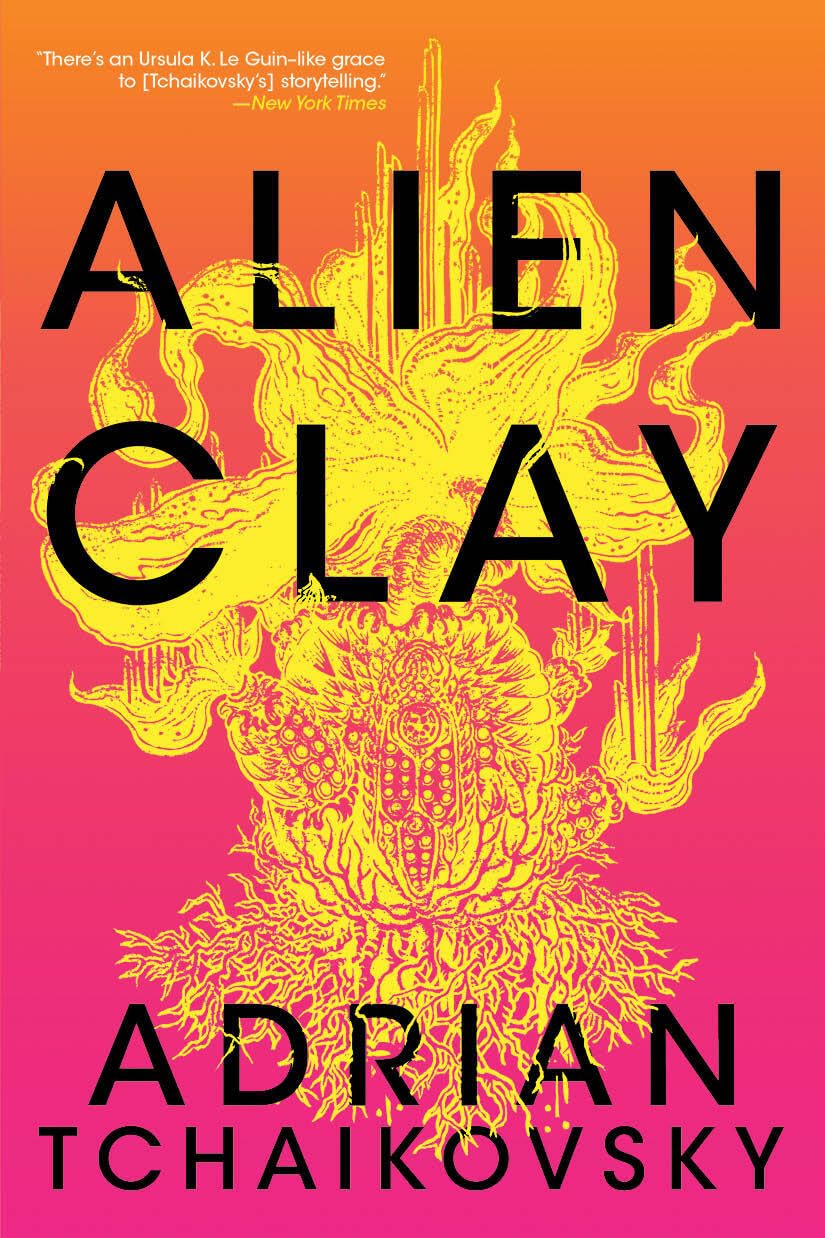
Alien Clay


Review of Alien Clay

Zorica Lola Jelic

Tchaikovsky, Adrian. Alien Clay. Tor, 2024.

Version 1.0.0

Adrian Tchaikovsky is an award-winning science fiction and fantasy writer whose series The Tyrant Philosophers and recent novels Service Model and Alien Clay are among the 2025 Hugo Award finalists. Alien Clay is a dystopian vision of future Earth. This is a work of science fiction that falls within the subgenre of exploration. Dr. Arton Daghdev lives in a country that is ruled by a totalitarian regime called the Mandate. Tchaikovsky traverses not only through alien space and biology, but he also pushes the boundaries of the human capacity to let go of individual freedom for the prosperity of the group or humanity as a whole. Admittedly, this novel was written in the aftermath of the COVID-19 pandemic, and it is difficult to avoid making that connection while reading it since the narrator is a scientist. Nevertheless, the reader embarks on this strange journey across time and space guided by Daghdev, an ecologist who researches exoplanets and alien life forms (albeit theoretically). However, Daghdev finds it difficult to conform to the Mandate’s one-minded political agenda. Therefore, he is forced to become an underground rebel who is, ultimately, convicted of high treason, imprisoned, and shipped to a penal colony located on planet Kiln, which is located fifty light years away from Earth. The beginning of the novel tugs at the readers’ political strings, challenging them to think about how far they would go to defend their beliefs. Furthermore, Tchaikovsky entertains the notion that suppressing academic freedom will undoubtedly lead to an Orwellian future.

As all admirable authors of science fiction do, Tchaikovsky introduces not one but two nova in order to lure the reader into the interestingly crafted Kilnish world. The first novum is the process of dehydrating the body in order to create body husks that are preserved for the remainder of the journey. Once the ship reaches its destination, the husks are re-hydrated and dropped in pods to the planet’s surface. This first novum is very much reminiscent of the old science fiction novels in which the technology is not exhaustively explained, and the workings and details are left to the reader’s imagination. The second novum is planet Kiln. Tchaikovsky uses his imagination, skills, and abundance of biological knowledge to describe an alien world that builds, destroys, and rebuilds itself. The Kilnish microorganisms and macroorganisms are by far the most amusing part of the novel. The world building is done in a satisfying way and is better developed than the characters. Even though the focus of the writing in the novel is on the object, as it should be in science fiction, Tchaikovsky does not leave his characters flat, and the readers are able to empathize with Daghdev and his companions as they endure the perils on Kiln. The readers do not have a problem with sympathizing with Daghdev during his plight; still, the last chapters of the novel oscillate between sympathy and empathy. At certain points, it is simply impossible for the reader to feel what the main character is feeling and emotionally going through.

Tchaikovsky writes the novel in such a way that every part of the journey, every day of life on Kiln is a game of Russian roulette, and the prisoners are, regrettably, less fortunate if they win. For the most part, the story unfolds in chronological order, while the last third of the novel is different since it presents current events in the camp with frequent flashbacks of the last seven days the group spends in the Kilnish wild. The flashbacks also show the Kilnish ecosystem in more detail, how life works on the planet, and how and why it slowly assimilates human biology into its own. Evolution on Kiln does not follow the Darwinian pattern, but this is not uncharted territory for Tchaikovsky since he already experimented with the merging of alien and human biology in Cage of Souls and simian and alien biology in Children of Time. This hybridization introduces an unachievable utopian thought because it is not in human nature to willingly submit to complete altruism. In the end, all of humanity may be assimilated by the Kilnish civilization. Daghdev’s utter elation is juxtaposed with the reader’s sheer horror of such a possible outcome and the unparalleled devastation that could happen to people on Earth. Tchaikovsky leaves it as a possibility; although, it seems that there is little to doubt when it comes to Daghdev’s determination to free humanity and give it the ultimate gift any scientist can bestow upon his people—the gift of infinite knowledge.

Tchaikovsky addresses some of the topics that he has written about in his previous works: rationality, volition, freedom, and individualism. He also addresses the posthuman in the biological sense, which differs from the traditional writings of posthuman technology. In this novel, readers can see an example of complete altruism and what it means to willingly let go of all individuality and any sense of personal freedom for the greater good. He challenges readers to let go of their anthropocentric arrogance and envision a world in which becoming a part of the Kilnish civilization means embracing collective life, thinking, and purpose. When it comes to literary theory, Alien Clay is also presentist even though it happens in the future. One cannot read it without thinking about various “mandates” that exist in today’s world, political hypocrisies, and all the freedoms that democratic societies promise but somehow fail to truly deliver. Toward the end, the reader circles back to establish answers to the elementary musings of science fiction (and philosophy) concerning what it means to be human and free. Finally, it is worth mentioning that the most appealing part of this novel is that Tchaikovsky adhered to the basic rule of this genre and took the “what if” and, just for a moment, let it become a “why not.”

Zorica Lola Jelic, Ph.D. is Assistant Professor at the faculty of Contemporary Arts in Belgrade, Serbia. She teaches English as a Foreign Language, Business English, Shakespeare, and English Drama. She earned her degrees in Shakespeare studies but also loves to write about presentism as a hermeneutical approach and science fiction. She has published scholarly papers, coursebooks, and enjoys attending professional conferences.

Alliance Unbound


Review of Alliance Unbound

Edward Carmien

Cherryh, C J, and Jane S Fancher. Alliance Unbound. DAW Books, 2024.

Version 1.0.0

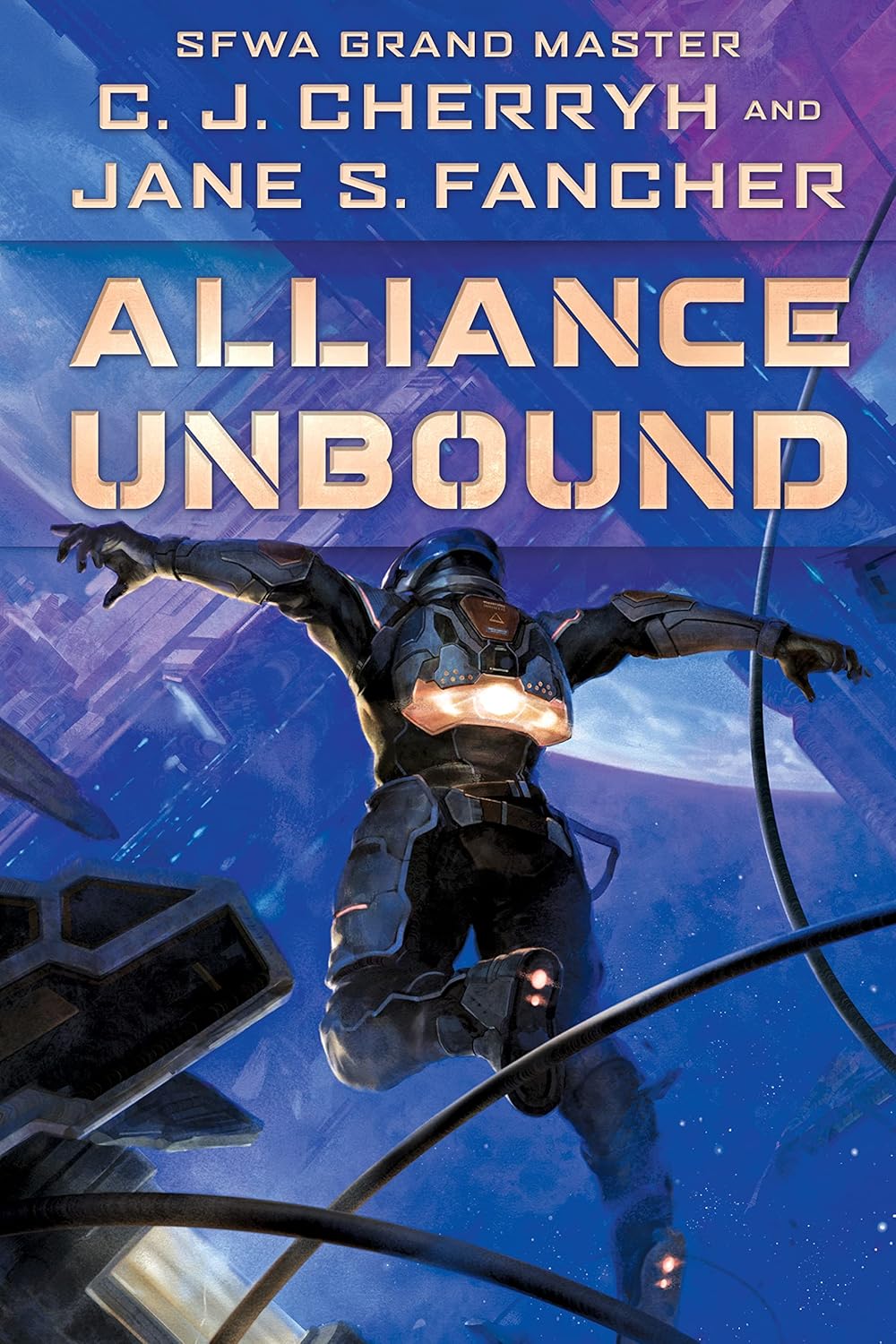
In this second book of the “Hinder Stars” sub-series, C.J. Cherryh and Jane S. Fancher pick up the story as the merchanter super-ship Finity’s End (with guests from Galway aboard) arrives at Pell, the star system home to Downbelow Station and a key location of future history told later in the timeline of the Company Wars. Readers wishing to skip directly to this novel find a thorough recapitulation of Alliance Rising early in the novel (62-77).

The Neiharts of Finity’s End embody merchanter royalty of unimpeachable lineage, descended from the pre-FTL crew of a famed sub-light “pusher” ship. They arrive to accustomed luxury at Downbelow Station, including shopping, extensive gardens, and even the “Downers,” a sapient humanoid species acting as part of the station’s workforce. Their guests from Galway experience the sights as “rustic cousins in the big city.” Their home station, Alpha, seems rustic by comparison. Ross Monahan, escapee of the Earth Company thugs who pirated Galway at the end of Alliance Rising, faces sensory disorientation as holograms, part of the theme-park atmosphere at the “sleepover” (hotel) where the spacers reside on station, cause issues of concern for the navigator.

One part vacation spree and one part investigation leads to fun but also an abridged stay as trade goods come to light that strongly suggest a trade route not among the known paths trade takes here in space far from Earth (Sol system). Finity’s End hands off its cargo duties to other ships and heads for the unknown, bringing to bear classic tropes of earlier Cherryh novels, such as the dangers and stresses of space travel found in Pride of Chanur. They collect an ally in the shape of another merchanter, and counting Galway crew onboard Finity’s End this constitutes a deliberative body for the new Alliance, a union of merchant ships devoted to the idea that ships trading among the various stars inhabited by humanity be crewed by merchanter families, not Earth Company employees or Azi (cloned humans) from Cyteen.

Dangerous FTL travel leads the Neiharts and their Galway guests to an abandoned station in risky space at a binary star system. But Olympus Station, no longer abandoned, hosts no fewer than four ships: two mystery merchanters (the remaining holdouts who haven’t signed with the Alliance), a pusher ship that took a decade or more to get to this station (which isn’t the first to have done so), and a mystery FTL vessel of unusual design, evidently hauled here at sub-light speed by the pusher ship, a vessel ominously named not after a famous Earth explorer as with previous pusher ships, but after the Wellington that beat Napoleon. And here Cherryh and Fancher drop a shoe familiar to longtime Cherryh readers: the family names of the two merchanters. Bellagio rings no bells for this reader, but Mallory certainly does.

Signy Mallory, the captain of the Earth Company carrier Norway, leads a storied existence in the years to come. As one of Cherryh’s standout characters, along with Morgaine, Emory, and Pyanfar Chanur, the simple mention of the name “Mallory” in this historical context raises hairs on the back of the knowing reader’s neck.

The crisis of the novel brings together the senior captains of Finity’s End, Ross Monahan, who is cosmically sensitive to the moods of stars and how they impact FTL travel, and his lady love, Jen Neihart. The mystery merchanters don’t sign on with the Alliance: to them, any connection with Cyteen is too much connection. Then, the captain of the pusher vessel attempts a coup de main independent of the otherwise non-violent “big meeting” that closes the novel. The mystery FTL ship undocks and Ross Monahan’s quasi-supernatural ability to hear the stars speak reveals much about that experimental ship’s fate. The novel closes as the Alliance ships head back to familiar ports with the extraordinary news of their discovery, and the Earth Company’s continued and expected treachery, in hand.

The obvious theme of “colonialism is bad” carries on in Alliance Unbound. The significantly named Rights of Man from the previous novel is invoked in the “big meeting” that closes this novel. Joined by the resonant phrase “Mother of Mankind,” meaning Earth, the ongoing demands of the Imperial Center toward the colonies remain clear. Between the “rights” Earth, or Sol holds dear, and the implied parental role illustrated by “Mother of Mankind,” no outcome appears possible other than war. This makes sense, as the history of that war, written and published decades ago, stands canonically in previous publications such as Downbelow Station. In Cherryh and Fancher’s “Hinder Stars” background, ownership posited as consequential to the origin of the colonies vies with theories of self-determination consequential to those who own the means of production.

That these works represent Space Opera seems obvious. Yet, Cherryh and Fancher’s evocation represents a pleasantly intellectual take on the genre. In exploring Downbelow Station’s gardens, which include actual trees, the authors convey the essential difference of humans adapted to life as merchanters, hauling essential cargos using FTL “jump” technology. Even more than humans adapted to life in space stations, these adaptations make Ross Monahan reflect how “He didn’t belong to this place, didn’t want to belong. It was beautiful… but as far from his experience as the void of space” (110). To this character these natural, organic elements alienate as much as fascinate. In this “history of the pre-war period” novel, weapons seem rare and on a human scale. When one ship wishes to damage another, it uses a tool meant for another purpose. Those hoping for a ripping space battle leave disappointed. Readers who enjoy bathing in well-reasoned science fiction rejoice.

Alliance Unbound reads better than the award-winning book that comes before it, but as a series novel (and not a standalone work, as many are in the larger Company Wars context) readers may find it difficult to see its qualities standing on its own. Characters do more interesting things in more interesting environments. Ross Monahan takes on qualities of damaged but interesting Cherryh characters from prior books such as Rimrunner’s Ramey, Sandor Kreja of Merchanter’s Luck, or Heavy Time’s Dekker, and his ability to hear the stars echoes the almost witchy abilities of Capella from Tripoint. As a text in a literature class, the connections relevant to Alliance Rising apply here: colonialism writ in the stars and a hint of the social stresses on human relationships among spacers who experience time-dilation as part of their ordinary working lives. If the human relationships in Alliance Rising were tamer than in other Company Wars novels, then in Alliance Unbound they are tamer still, if only because fewer pages carry such interactions.

“To our patient readers…you know why.” This dedication follows the previous novel’s dedication to editor and publisher Betsy Wollheim. It makes sense, then, that this second novel contains helpful inclusions such as a map and a list of stellar coordinates and lists of distances from sundry relevant stars in light years. Headed “For Our Fellow Nerds,” this material delights. In the text itself such distances rarely appear in the text: “It’s a long jump,” or “It’s a short jump” might, and the essential distance in light years between Earth and Alpha station represents a key plot point. Do readers need this information? No. The narrative provides all a reader needs. But this peek behind the curtain entertains nevertheless. Cherryh, and now Fancher, show us how it’s done. Immersive science fiction, with every speculative detail honed and clear and sharp, gifts readers with maybes, what ifs, and who-da-thunk-its, all done so realistically that after a few days’ immersion one looks around and carries the story in one’s own mind, guesses where it might go, or ponders elements not narrated. May we see ever more.

Edward Carmien, Ph.D. teaches writing and literature at Mercer County Community College in New Jersey. He started his academic journey as a member of the Popular Culture Association, but soon found a truer home in the SFRA. A lapsed poet, short story writer, game designer, and novelist, his first publications were game-related working as a freelancer for TSR, Inc. After appearing in the fiction anthology EARTH, AIR, FIRE, WATER he earned membership in the SFWA. He has won awards for his fiction and non-fiction, edited a volume of essays about writer C.J. Cherryh, and lives with his family near Princeton, New Jersey.

Alliance Rising


Review of Alliance Rising

Edward Carmien

Cherryh, C J, and Jane S Fancher. Alliance Rising. DAW Books, 2019.

Version 1.0.0

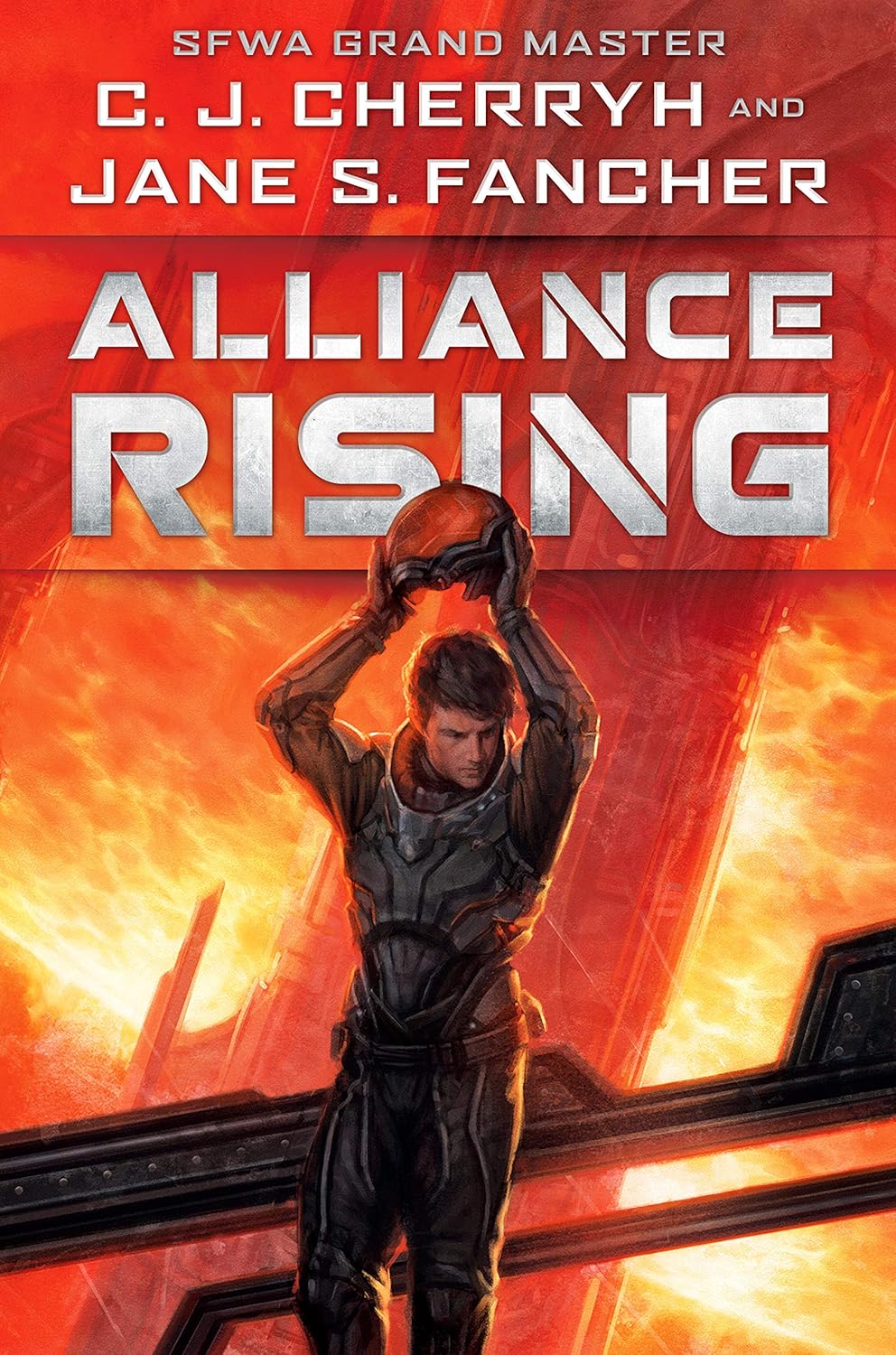
C.J. Cherryh, recipient of the Hugo, Nebula, Prometheus, Locus, and others, joins her spouse and longtime partner Jane S. Fancher, winner of the Prometheus Award, in a return to the Alliance-Union universe. In this set of dozens of novels, short story collections, music, and a tabletop wargame, Cherryh and Fancher recount a history over vast ranges of time and space. Humanity’s extra-planetary colonization and inevitable loss of control of these colonies makes up a significant focus of the series. Sequences of the narrative lacking a focus upon humans are common in these texts, which act as a variant of Larry Niven’s “known space” but include far greater detail and stylistic and content variety. Part of the Alliance-Union universe presents stories related to the Company War. These novels range from Devil in the Belt (in which Earth system asteroid belt miners are recruited into new Earth Company warships) and the much-awarded Downbelow Station to 1997’s Finity’s End. 2019’s Alliance Rising and 2024’s Alliance Unbound, dubbed the “Hinder Stars” sub-series, serve as prequels to the Company Wars.

Cherryh and Fancher’s world, always complex, focuses on socio-economic stresses in a system undergoing radical change. Centuries of commerce and exploration under control of the Earth Company using sub-light ships (an extensive history of ship comings and goings exists online) alter in mere years as Faster than Light (FTL) ships, invented far from Earth, increase the tempo of change. Earth, already isolated from colonies it no longer really controls (and some it never controlled), will in decades begin constructing a fleet of FTL warships… but those are other stories. Three factions vie for control over Alpha Station, Earth’s second extra-solar station: loyalists of the Earth Company (one inescapably thinks of the East India Company), a powerful faction of FTL merchanters, and local Alpha Station merchanters and administrators who understand the local economic environment and who are Earth Company only in theory.

The Earth Company officials want their expensive FTL ship The Rights of Man, a ship name redolent with symbolism as the thing does not work, to continue receiving maximal resources and be retained under the control of the Company. The merchanters seek signatories to a new treaty as they form an Alliance. Cherryh’s readers know what’s coming in the chronologically later Downbelow Station. Alpha Station merchants and executives seek a way forward in challenging economic times; at their “Hinder Star,” they stand to be bypassed like Radiator Springs or any of the dozens of real towns left high and dry by the Interstate system in the United States. The complexities of the three-way struggle play out in adminstrivia, in dockside brawls and assignations, and in the creation of a self-perpetuating merchanter culture, one which will in future forestall any challenge to their “families run ships, not governments” credo. In typical Cherryh, and now Cherryh and Fancher fashion, complexity heats until the pot bubbles over, all with the promise of future crises to resolve in later texts.

Is this Space Opera? Calling this and other books in the common background Space Opera does them some disservice. Here, spaceships do not make noise in space; if their engines quit, they do not coast slowly to a stop, and delta-V really means something. This is not Star Wars. Yet we are concerned at least in some part with the princes and chieftains, kings and queens, appointed administrators and ship captains, the elite of the societies enmeshed together here, a signal of the Space Opera genre. Cherryh appears in Hartwell and Cramer’s 2006 The Space Opera Renaissance and arguably strides across much of the definitional space it creates with her 80-odd book publications (17-18). That she often eschews the rippin’ space battle—her Merchanter’s Luck takes place at a time when the turncoat Signy Mallory takes on the remnants of the Earth Company fleet gone piratical and abandoned by Earth, but the battle on display is psychological and takes place inside the main character’s head—is well known, and Alliance Rising follows in those footsteps. There is drama aplenty, but at the human level, in the romance and bureaucratic infighting and let’s-make-a-deal venues, not in the maneuver and missile venues. Characters sweat their big decisions in bed, at their desks, or gathered together in a bar, not in glowing, high-tech nests of screens or Jefferies Tubes.

Liz Bourke ably reviewed this text in 2019 for Locus, noting some issues with diversity, that the book seemed rooted in an 80’s sensibility, with limited variety of perspective (“Liz Bourke Reviews Alliance Rising by C.J. Cherryh & Jane S. Fancher”). Certainly, the novel is less interpersonally adventurous than other work by Cherryh. Devil in the Belt stands as a clear inspiration to the Expanse books and series, with its polyamorous spacer humans (though as one might expect, given the publication date, without contemporary poly terminology) and matrilineal merchanter clans. The people of Alliance Rising form tamer relations, though the “sailors in port” aspect of the FTL ship crews is in full flow. Accidental or purposeful? The cultural markers of later books also come later in the in-universe chronology, making it possible for Cherryh and Fancher to gauge social evolution at a more traditional stage in the history they recount here.

The text could serve in a college-level literature course, particularly an advanced level course able to undertake the more advanced themes of colonialism, the rights of those who do the work vs. the rights of capital, and the matters William H. Stoddard raises in his appreciation of Alliance Rising, which won the 2020 Prometheus Award for best novel. “The rights of man, in a nonfigurative sense, are what this novel is about,” he observes (“Liberty, evolving self-government and the Rights of Man”). Whether undergraduates can be tempted by a work so focused on the internal remains to be seen. The dedication suggests why this novel exists at all: Cherryh and Fancher celebrate Betsy Wollheim, still at the helm of storied DAW Books (which, in days of yore, was a publisher of distinctive, yellow-spined paperbacks), reflecting a fifty-year plus friendship and professional association. May their work continue ever after.

Edward Carmien, Ph.D. teaches writing and literature at Mercer County Community College in New Jersey. He started his academic journey as a member of the Popular Culture Association, but soon found a truer home in the SFRA. A lapsed poet, short story writer, game designer, and novelist, his first publications were game-related working as a freelancer for TSR, Inc. After appearing in the fiction anthology EARTH, AIR, FIRE, WATER he earned membership in the SFWA. He has won awards for his fiction and non-fiction, edited a volume of essays about writer C.J. Cherryh, and lives with his family near Princeton, New Jersey.

The Blaft Book of Anti-Caste SF


Review of The Blaft Book of Anti-Caste SF

Paromita Sarkar

Samuel, R.T., Rakesh Khanna, and Rashmi Ruth Devadasan, editors. The Blaft Book of Anti‑Caste SF. Blaft Publications, 2024.

Version 1.0.0

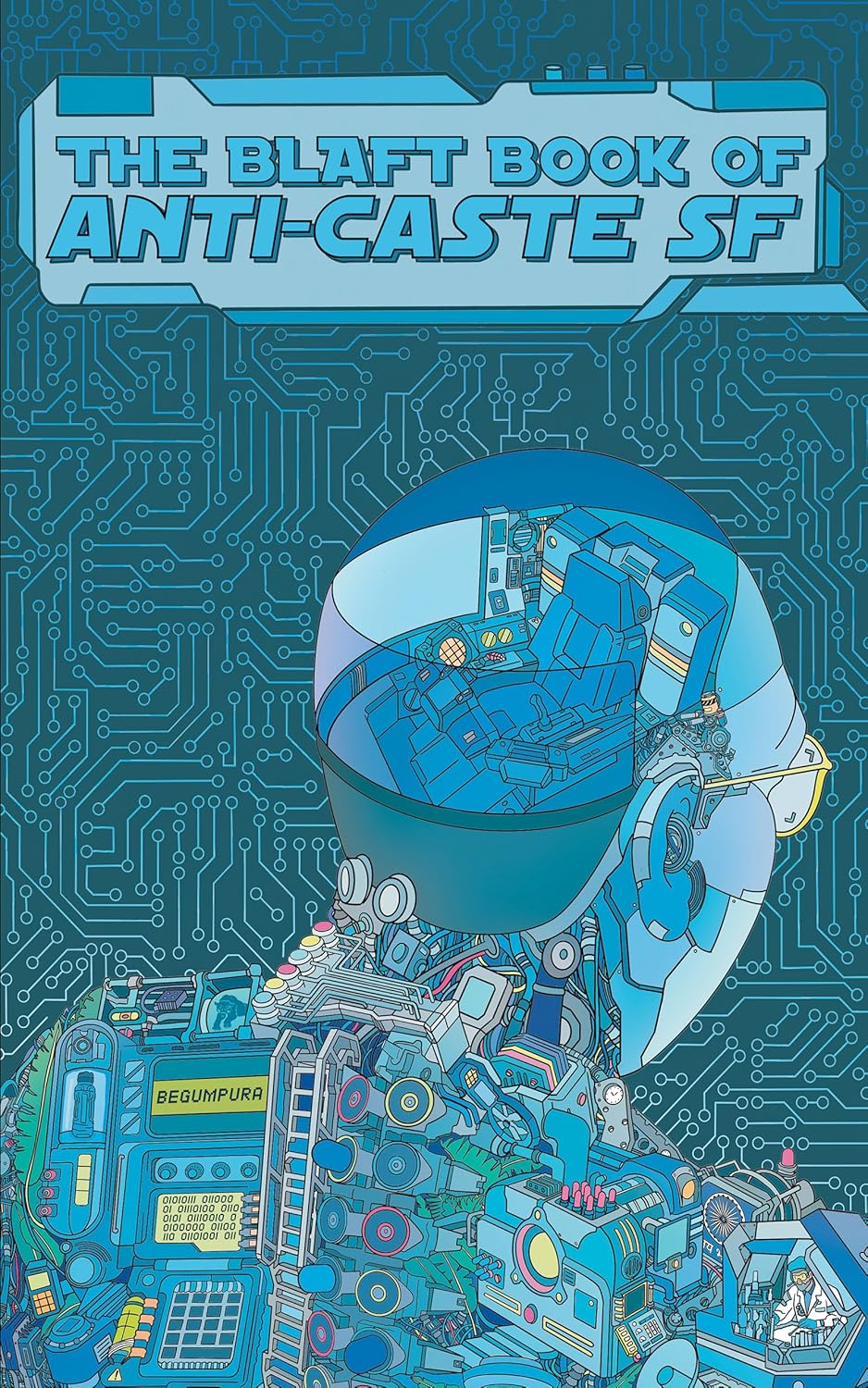
The big blue stature of The Blaft Book of Anti-Caste SF (2024), lined up on any shelf, cannot go unnoticed. The moment you pick it up, Priyanka Paul’s beautifully illustrated Mecha Ambedkar—set against a background of circuit networks—greets you, carrying the iconographies of the Indian anti-caste movement on its back, moving toward Begumpura, the utopian casteless city envisioned by Saint Ravidas. In the next few seconds, as you flip through the pages for a quick glance, you’re likely to stop and look—either because of the comics strewn in between, the unexpected mix of established and emerging writers, or simply because the story titles are so compelling. If not the playful ‘Meen Matters’, then the solemn and arresting ‘In the Extreme Silence of Agrahara’ is bound to intrigue you.

The 428-page anthology, edited by R.T. Samuel, Rakesh Khanna, and Rashmi Ruth Devadasan, and published by Blaft Publications, is a riot. It stares back at you. It jolts you. It urges you to read it. The unabashed attention the book’s visual aesthetics demand is matched by a form and content that refuse to be “structured” or “formal” in any traditional sense. Disrupting the standard idea of an anthology, this collection seeks to expand beyond the textual, including works that interrupt any illusion of narrative unity—graphic stories, a speculative magazine, and stories that refuse closure. The visual and the textual intersect through audacious ideas, opening up a new form of anti-caste thought and resistance. This form does not rely on a retrospective historicization of Dalit movements, nor is it a speculative veneer imposed artificially upon them.

The violence of caste is crucial in understanding the radical potential of the anthology. The caste system, a form of systemic violence and social stratification, has long afflicted South Asian societies, such as India. These social stratifications, historically codified in ancient texts like the Manusmriti or The Laws of Manu, have been used as methods of marginalizing and humiliating various Indigenous and caste communities under the umbrella term ‘Dalits’ or the Broken—a term used by Jyotirao Phule, a historical anti-caste writer and activist from Maharashtra, India. The term has historically been contested. Kanshi Ram, for instance, referred to such communities as ‘Bahujans’, the Marathi word for majority (Chandra 148).

Akin to experiences of African American communities in the United States, both caste in India and race in the US have been prevalent sites of comparative scholarship, building an ‘afro-dalit’ scholarship (Prashad), present in interactions of anti-race activists like W.E.B. DuBois and anti-caste activists like B.R. Ambedkar. These experiences have been vocalized and politicized often in fiction and autobiography. The civil rights and anti-racism group Black Panthers from the U.S., in fact, was a key inspiration in the formation of Dalit Panthers, an anti-caste organization founded by JV Pawar and Namdeo Dhasal, in the 1970s (Satyanarayana and Tharu 61). Writings from or about such communities have relied on an ‘authentic’ aesthetic, as Sharankumar Limbale, another prominent Dalit writer and activist, suggests. Many of these works have utilized realism or the autobiography as a mode. For those interested, a powerful and prominent example is Joothan (1997) by Om Prakash Valmiki as well as the anthology of Marathi Dalit voices, Poisoned Bread (1992) edited by Arjun Dangle. The Blaft Book continues vocalizing such experiences of caste and of pitting oneself against the system of caste. The anthology moves away from an apparent ‘authentic’ and ‘realistic’ mode to an exploratory one, like speculation or science fiction—similar to the practices of Afrofuturism (continuing political solidarities across cultural movements) and the works of Samuel R. Delany, Octavia Butler and Nnedi Okorafor that reconfigured Black histories and futures. Recent scholarship on other marginalized futurisms such as Chattopadhyay’s “Manifesto” suggests a rising pattern of works and movements that vocalize marginalized experiences while reorienting the SF form: a new form of possibilities and ‘playfulness’ emerges where SF and its tropes too become suspect (17). The anthology’s publication adds another dimension to the scholarship on Futurism. It tackles the problem of introducing these historical and political experiences into the speculative mode and vice versa, bringing forth a collection that is expansive in frame.

As an experimental and pioneering anthology, the mix of writers is particularly interesting, with about thirty-two writers across boundaries of space, time, and languages. The inclusion of writers like Bama, Gogu Shyamala, Gouri, and P.A. Uthaman gestures toward an already extant speculative imaginary within works of Dalit and anti-caste writers, though they are rarely read as SF writers in India, which (popularly) remains shaped by a Hollywood-inflected Sci-Fi temperament. Through this anthology, Blaft reorients how we read these writers, even as it expands the contours of the genre itself. Speculative fiction here becomes porous, leaking across literary categories, voices, languages, and temporalities. The very form of the anthology resists any settled or stable identity. Jumping across writers—past, present, and emerging—the book traces the evolving possibilities of writing anti-caste thought into the speculative, the fantastical, and the futuristic.

This porosity is not just temporal but spatial. The collection moves across terrains: from Dalit subjectivities in the rural settings of Bama’s “Korali” or Gogu Shyamala’s “The Phantom Ladder” to the urban nightmares and dystopias of Gouri’s “The Demon That Sits On Your Chest” or Yukti Narang’s “Kitchen Glob”; from the spectral silence of an afterlife Agrahara by Aswathy K. Raj to the nightmarish vision in Snehashish Das’ “Death of a Giant in a Godless Country” or Gautam Vegda’s short story series from ‘Supernova’ to “Vultures on Mars”; from the digital and outer spaces of comics like Yeswanth Mocharla’s “Looly Cooly”—featuring a delivery-boy with “monster-anger”—to Bakarmax’s (alias Sumit Kumar) “Spacewali,” about a “kaamwali” in India’s space lab and to Kunal Lokhande’s provocative take on a gaming channel turned religious sect in ‘Sanatan Gaming’. Even when it comes to stringing together an SF adventure, the anthology does not disappoint; the Birthday Gurlz in “Meen Matters” by Rashmi Ruth Devadasan remain memorable in a post-apocalyptic zombie-filled Chennai.

In all these stories, caste is constantly altered and ridiculed to expose its structures. These distinct spaces do not function as sites of just cognitive estrangement, as they might in traditional SF. Rather, they are loud, grounded anti-caste assertions that echo beyond the present—to ridicule, mourn, rage against it. It is bleak, yes, but it is also powerful: a declaration that caste does not dissolve even in outer space, or in death, or in data. Instead, its haunting continues.

The peculiar thing about caste in today’s digital India is this: to envision a caste-free space, one must first speak of caste. Yet, to speak of it is often seen as propagandist, anti-meritocratic, or non-factual—unless, of course, it comes in the form of a popular casteist slur, an endogamous matrimonial startup, or an innocuous display of caste pride masked as ancestral heritage. Over the past decade, caste has steadily permeated the digital space—through both subtle gestures and overtly violent threats. In parallel, affirmative caste conversations and movements have continued reclaiming these spaces, resisting the overwhelming presence of digital Brahmanism with counter-assertions, memorialization, and imaginative world-building. Artist-activists have become ever more present—and ever more vulnerable—but they persist, intervening nevertheless.

The rise of Dalit and Bahujan creators within these popular digital and speculative spaces points toward new futures for the anti-caste movement. It is into these popular terrains that The Blaft Book of Anti-Caste SF enters—not merely as a literary or political intervention, but as a disruptive method of imagining caste itself. At one of the book’s launches, Rahee Punyashloka, one of the authors, used the term, “audacity” when talking about the anthology. Later that evening, of all the things I remembered when reading the recently bought anthology, the term “audacity” stuck around. To play “audaciously” in these spaces is not just stylistic—it is tactical. This anthology is not just an intervention into the publishing sphere of Indian science fiction; it is a conceptual reorientation of how caste is written, imagined, and published. It shifts from the realist or life-writing modes traditionally associated with Dalit literature, toward a poetics of speculation, friction, and rupture. Here, the anthology hits its mark most forcefully.

The comics embedded within the prose narratives do not simply supplement the written word—they interrupt it. They disrupt the expectations of the reader, and in doing so, make visible an imaginary of anti-caste possibilities that refuses to conform. The fictional magazine insert—“Margin Mag” by Sudarshan Devadoss and MK Abhilash—and Punyashloka’s piece further challenge the anthology’s unity, by functioning as a meta-text that speaks both within and beyond the volume. “Margin Mag” imagines a future in which Dalit history is publicly commemorated with hopeful anti-caste/anti-discrimination WhatsApp updates and ads for anti-bias devices like “FairEar”, while Punyashloka in “The R.V Society for Promotion of Underground Sci-Fi Writings” talks about encountering the anthology’s call for stories and journals the intimate, messy process of writing anti-caste speculative fiction itself. These disruptions are not digressions; they are structurally integral to the work’s method of expression.

Blaft Publications is one of the few independent publishers in India committed to bringing regional pulp and popular fiction into the literary mainstream. In the past, titles like The Blaft Anthology of Tamil Pulp Fiction and Ghosts, Monsters and Demons of India have foregrounded the mythic, the folkloric, and the marginal in English translation—reclaiming stories that have long existed outside elite literary circles. Their latest anthology of anti-caste speculative fiction, a community project clearly put together with care, extends this legacy with quiet precision. The anthology does not seek to offer narrative closure or stable resolutions. It resists unity, embraces disorder, and insists on the porousness of genre, of time, and of caste itself. Its stories speak from and across differences of borders, languages, and spaces—from the ghostly rural, to the fragmented urban, to digital futures, and imagined post-caste presents often encountering, embracing or enduring science and technology. It opens up not only what caste has been but what caste could mean in speculative registers—how it might linger, mutate, or be abolished in these worlds we have not yet built. The promise remains, though only partly fulfilled. Blaft’s new anthology is a groundbreaking chapter in South Asian SF and anti-caste literature; the full potential of the endeavor awaits to be realized, hopefully further opening up dialogues between anti-caste thought and speculative fiction across contexts and borders.

WORKS CITED

Ambedkar, B. R. Letter to W.E.B. Du Bois. Circa 1946. W.E.B. Du Bois Library, University of Massachusetts Amherst. South Asian American Digital Archive (SAADA), digitized by Gary Tartakov, https://www.saada.org/item/20140415-3544.

Chandra, Kanchan. Why Ethnic Parties Succeed: Patronage and Ethnic Head Counts in India. Cambridge University Press, 2007.

Chattopadhyay, Bodhisattva. “Manifestos of Futurisms.” Foundation: The International Review of Science Fiction, vol. 50, no. 2, 2021, pp. 8–23.

Du Bois, W.E.B. Letter to B.R. Ambedkar. 31 July 1946. W.E.B. Du Bois Library, University of Massachusetts Amherst. South Asian American Digital Archive, digitized by Gary Tartakov, https://www.saada.org/item/20140415-3545.

Prashad, Vijay. “Afro-Dalits of the Earth, Unite!” African Studies Review, vol. 43, no. 1, 2000, pp. 189–201. JSTOR, https://doi.org/10.2307/524727. Accessed 9 June 2025.

Satyanarayana, K., and Susie J. Tharu, editors. The Exercise of Freedom: An Introduction to Dalit Writing. Navayana Publishers, 2013.

Paromita Sarkar (she/her) is a writer and a researcher based at Jawaharlal Nehru University in India. She explores the intersections of speculative fiction, anti-caste thought, and media in India. Her areas of interest include Science Fiction, Marginality Studies, Futurism, Cinema Studies, and Popular Culture. She has presented her research on Afrofuturism, marginality, science fiction, and popular culture, at national and international conferences

Daredevil: Born Again


Review of Daredevil: Born Again

Jeremy Brett

Scardapane, Dario, Corman, Matt, and Ord, Chris, creators. Daredevil: Born Again, Season 1. Marvel Studios, 2025.

Version 1.0.0

The themes of Marvel’s restarted gritty superhero show Daredevil are made manifest (indeed, quite unsubtle) in the opening credits, which depict (to the strains of contemplative theme music that quickly grow pensive) the crumbling away of the old—images of Daredevil’s iconic horned helmet, Daredevil’s criminal archenemy Wilson Fisk/Kingpin (Vincent D’Onofrio), Lady Justice, the steeple of Matt Murdock’s beloved church, a sign for ‘Nelson Murdock Page, Attorneys at Law’, the Statue of Liberty—only for the fragments to reassemble into a reborn Matt /Daredevil (Charlie Cox). What was, now passes away as both Murdock and Fisk look to reidentify themselves both within and beyond traditional systems of governance and control.

But the central theme of the show is not merely resurrection, but instead a revolving and returnto the same point of existential origin as multiple characters attempt to remodel themselves but find, in doing so, that efforts at personal transformation often expose the adamantine and unchanging core of one’s character, motivations, desires, and vulnerabilities. For both Murdock and Fisk, a jarring act of personal violence inspires a personal reexamination of themselves and the worlds in which they have traditionally moved. In Fisk’s case, it is his having been betrayed and shot in the face by his protégé/ward at the conclusion of Marvel’s Echo (2024)     —that trauma caused him to temporarily abandon his criminal career and his beloved wife Vanessa (Ayelet Zurer), rethink his life’s priorities, and inspire an ultimately warped and misguided need to “serve the city”. For Matt, this process begins in the opening minutes of the show, where his best friend and law partner Foggy Nelson (Elden Henson) is gunned down in front of their mutual friend Karen Page (Deborah Ann Woll) by Matt’s old adversary Benjamin Poindexter/Bullseye (Wilson Bethel). An enraged Matt, clad as Daredevil, violates the traditional superhero code of restraint by deliberately tossing Bullseye off a roof and nearly killing him. It is a moment of existential crisis for Matt, a character already known (as a practicing Catholic) for his frequent wrestling with guilt and angst. Gone from this series is the lighter and more comical, yellow-suited Matt viewers enjoyed briefly in 2022’s She-Hulk: Attorney at Law.

The series asks us to consider whether we can truly escape our deepest motivations, the things that drive us to be who and what we are. In the remaking, do we reveal our actual selves?  Both Matt and Fisk want to be ‘better’ than they were, but whether they can in such an imperfect world that both produces and rewards moral compromises becomes the through-line theme. Master criminal Fisk runs for and becomes the Mayor of New York City, and he does so at least in part with the sincere motivation of helping the city he loves to reach a place of safety, citing the growing presence of masked vigilantes as a symptom of NYC’s illness. No one in this political climate will miss the relevance of a felon gaining vast political power in part by finding scapegoats to blame for a supposed breakdown in law and order. But though Fisk may act with legitimate concern for the city’s welfare, he also manipulates the city’s government and political processes to serve not only his and Vanessa’s criminal empire but his internalized hatred for Daredevil and, by extension, all costumed heroes who work outside the system and therefore his iron control. Fisk’s innate need to dominate curdles his better impulses and by the series’ conclusion drives him to overtly license police brutality, stage a societal breakdown via cutting power to the entire city, and finally, declare martial law. As he notes to Vanessa, “I ran to serve the city, but…opportunities present themselves.”

Matt’s attempts to change are even more profound. His near-murder of Bullseye and the tragedy of Foggy’s death drives him to permanently eschew his Daredevil identity in favor of  pursuing justice through more traditional means, within the established legal system. But the system is profoundly broken, prompting an inquiry into the role of superheroes in a world where the justice and political systems can be so corrupted that they no longer serve the innocent. Captain America: Civil War (2016) introduced, through the Sokovia Accords, the idea that powerful people might require institutional control to prevent mass casualties and destruction caused by their actions, but Daredevil: Born Again suggests a necessary role for extralegal protectors when the law or system fails. Of course that role is integral to the image of the superhero and has been at least since Superman’s debut in 1938, but it takes on a special significance now, at this moment in US history when social and economic inequality are at dismayingly high levels and police violence criminally so—should people with powers circumvent established avenues and become, as Fisk calls them, purposely using a loaded term, “vigilantes”? Matt over the course of the series returns to this question, at first fervently denying the necessity for a masked hero when the legal system he serves as an attorney is in place, but by the conclusion this denial has crumbled. The series shows audiences the reality of an unequal system in a powerful scene in episode 4 (“Sic Semper Systema”) between Matt and one of his indigent clients, who is angered by the unfairness of a structure that grinds up people like him and denies them dignity, autonomy, or fair chances at rehabilitation. And late in the series Matt returns to being Daredevil in order to stop serial killer Muse (Hunter Doohan), a murderer that Fisk’s cops cannot find. But the primary reason Matt finally accepts his inner drive to do right and protect the people of his city is Fisk’s weaponizing of corrupt elements of the NYPD by creating an Anti-Vigilante Task Force—ostensibly to capture criminals like Muse—that answers only to him. People sworn to serve justice willingly bow instead to corrupt power and give themselves over to Fisk in exchange for free reign to exercise brutality against perceived enemies of Fisk, the city, and themselves. Crises bring forth the heroes needed to fight them.

The ‘street-level’ Marvel heroes have almost always been set apart from the world-threatening or cosmic levels of narrative that dominate the MCU; though Matt during Daredevil’s Netflix years fought his share of faceless ninjas and a mystically resurrected Elektra, his most savage battles have always been against the ruthless and violent criminal appetites of the all-too-human Fisk. That dynamic is characteristic of the MCU in general, where the most chilling and emotionally complex villains have never been Thanos, or the Kree, or Cassandra Nova, but human beings with familiar motives such as Fisk, Kilgrave, “Cottonmouth” Stokes, or Erik Killmonger—people who operate (to a degree) on our own recognizable and relatable levels and utilize casual, up-close cruelty against fellow humans. That sort of ground-level intimacy also provides additional dimensionality to another of Daredevil’s concerns: the moral complexities of heroism. Like anything else, heroism can be a corrupting and corruptible idea: a number of NYPD cops in the series wear the skull insignia of their ironic folk hero the murderous Frank Castle/Punisher (Jon Bernthal), seeing Frank as a legend and a role model for stopping crime. These heroes of their own stories commit vicious assaults—including the shooting of masked hero Hector Alaya/White Tiger (Kamar de los Reyes)—even in the face of Frank’s clear and utter contempt for them. Despite Matt’s offering that Frank might truly be of service to people by saving lives, Frank knows himself and his broken nature, and is not nor ever will be a hero. But tragically, other people desiring to free their inner savagery will always find models on which to imprint, and can always weave false heroism out of selfishness.

The ‘street-level’ Marvel heroes have almost always been set apart from the world-threatening or cosmic levels of narrative that dominate the MCU; though Matt during Daredevil’s Netflix years fought his share of faceless ninjas and a mystically resurrected Elektra, his most savage battles have always been against the ruthless and violent criminal appetites of the all-too-human Fisk. That dynamic is characteristic of the MCU in general, where the most chilling and emotionally complex villains have never been Thanos, or the Kree, or Cassandra Nova, but human beings with familiar motives such as Fisk, Kilgrave, “Cottonmouth” Stokes, or Erik Killmonger—people who operate (to a degree) on our own recognizable and relatable levels and utilize casual, up-close cruelty against fellow humans. That sort of ground-level intimacy also provides additional dimensionality to another of Daredevil’s concerns: the moral complexities of heroism. Like anything else, heroism can be a corrupting and corruptible idea: a number of NYPD cops in the series wear the skull insignia of their ironic folk hero the murderous Frank Castle/Punisher (Jon Bernthal), seeing Frank as a legend and a role model for stopping crime. These heroes of their own stories commit vicious assaults—including the shooting of masked hero Hector Alaya/White Tiger (Kamar de los Reyes)—even in the face of Frank’s clear and utter contempt for them. Despite Matt’s offering that Frank might truly be of service to people by saving lives, Frank knows himself and his broken nature, and is not nor ever will be a hero. But tragically, other people desiring to free their inner savagery will always find models on which to imprint, and can always weave false heroism out of selfishness.

But more positively, Matt reframes the concept of hero to center it not around a single costumed figure, but as a collective popular phenomenon. At the series’ conclusion, with Fisk exercising draconian control over the city, Matt decides not to attack him in traditional superheroic fashion and, rather, begins to raise an army of resistance among the ordinary people of New York. Instead of a lone hero, he embodies a call to mass heroic action. As he says in his final words of the season,

I can’t see my city. But I can feel it. The system isn’t working. And it’s rotten. Corrupt. But this is our city. Not his. And we can take it back, together. The weak… The strong… All of us… Resist. Rebel. Rebuild. Because we are the city. Without fear.

Daredevil: Born Again argues that heroism is not, indeed, should not, be the province of a single powered individual (nor even an elite team like the Avengers), but the collective effort of people working together to resist corrupt institutions and to change them to better suit the societies those institutions were created to serve. One important detail of the series is that, more so than any other MCU production, it is marked by frequent shots of New York City streets and people, with frequent commenting (via the website reporting of BB Urich [Genneya Walton]) by New Yorkers about Fisk, Daredevil, and their own fears about/faith in the city. New York City and the people who make it what it is are equal participants in the series with Matt, Fisk, or anyone else. There is a popular sentiment in Daredevil that we have not yet seen in the MCU, and that sentiment and its concomitant social relevance gives the series particular significance. It should prove a profitable source of study for scholars studying the evolution of the superhero trope or those interested in the ways in which popular culture reflects and amplifies the concerns of our time.

Jeremy Brett is an archivist and librarian at Cushing Memorial Library & Archives, Texas A&M University. There he serves as Curator of the Science Fiction & Fantasy Research Collection, one of the largest of its kind in the world. Both his M.A. (History) and his M.L.S. (Library Science) were obtained at the University of Maryland, College Park. His professional interests include science fiction, fan studies, and the intersection of libraries and social justice.

Dune: Prophecy, Season 1


Review of Dune: Prophecy, Season 1

Giaime Lazzari

Adapted for television by Diane Ademu-John and Alison Schapker. Legendary Television / HBO, 2024..

Version 1.0.0

Legendary Television / HBO’s Dune: Prophecy series expands the universe created by Frank Herbert with a prequel set 10,000 years before the events of the first Dune novel, focusing on the origins of the Bene Gesserit sisterhood during the tumultuous period following the Butlerian Jihad. Based on Sisterhood of Dune (2012) by Brian Herbert and Kevin J. Anderson (who also serve as executive producers) and positioned as a prequel to Denis Villeneuve’s Dune movies (2021 and 2024), the series explores the early machinations of the enigmatic order of women whose genetic breeding program and political manoeuvring would eventually shape the destiny of the known universe. The series’ narrative centers on sisters and Reverend Mothers Valya and Tula Harkonnen (played by Emily Watson and Olivia Williams) and their involvement in the nascent Bene Gesserit, tracing how personal vendettas and political necessities transform into the cold, calculated practices that define the sisterhood in Herbert’s original novels. In the course of season one’s six episodes, Valya and Tula must overcome social and supernatural forces that threaten the stability and the political prominence of the Sisterhood: the growing suspicions of Emperor Javicco Corrino (interpreted by Mark Strong), the rift between the Harkonnens and the other Great Houses, the haunting violent legacy of the Sisterhood itself, and a new enemy who seeks to oust them from the Imperium (played by Desmond Hart).

Dune: Prophecy enters a television landscape already transformed by prestige science-fiction series based on classics of the genre, such as Isaac Asimov’s Foundation (Apple TV, 2021) and Liu Cixin’s 3 Body Problem (Netflix, 2024). However, the series positions itself not merely as a television adaptation, as it was the case for previous Syfy-produced series Frank Herbert’s Dune (2000)and Frank Herbert’s Children of Dune (2003), but an expansion of the Dune universe itself by focusing on aspects only alluded to in the original hexalogy as well as in the current cinematic revival of Dune. For this reason, Prophecy is in itself a valuable addition for any scholar working on the Dune universe, particularly when inscribing it in a multimedia framework. Spawning licensed game boards (six, as of 2025), video games (six, as of 2025), graphic novels adaptations and expansions, Dune has established itself as one of the most relevant and successful multimedia franchises in decades, particularly after 2021 Villeneuve’s adaptation, and Dune: Prophecy offers new material to consolidate and expand it.

Within the Dune world, Prophecy’s positioning is particularly significant as the narrative navigates the aftermath of the Butlerian Jihad—humanity’s rebellion against thinking machines and a foundational event in Herbert’s universe. The series contextualises the rise of the Sisterhood precisely as the human response to the banning of the rebellious intelligent machines: faced with the impossibility of omniscience and objectivity, and thus of avoiding deceptions and intrigues, the Great Houses of the Imperium employ—or deploy—the Sisterhood-trained Reverend Mothers as ‘truthsayers’ capable of discerning truth from lies. This post-Butlerian setting allows the series to explore themes of technological ethics and societal reconstruction that may resonate with contemporary political and societal anxieties around artificial intelligence as well as broad epistemological concerns on the relationship between truth, post-truth, and political power.

What distinguishes Dune: Prophecy within the science fiction contemporary television landscape is its deliberate centering of female power structures within an feudal interstellar society. Where Herbert’s original novels presented the Bene Gesserit as an already-established force operating in the shadows of a patriarchal empire, Prophecy examines the sisterhood’s formation as a response to and subversion of male-dominated, patrilineal power structures. The series thereby engages with feminist science fiction traditions established by SF writers like Ursula K. Le Guin, Octavia Butler, Élisabeth Vonarburg, and Margaret Atwood, who, among others, similarly explored how female-centered societies might evolve within—or against—patriarchal frameworks. However, rather than creating a straightforward utopian feminist vision, Prophecy portrays the early Bene Gesserit as morally complex, violent and manipulative, and their accumulation of power as driven more by survival necessity than by altruistic concerns for humanity’s future. In this perspective, the show’s exploration of the Bene Gesserit’s evolution offers particularly rich ground for academic analysis of gender and power in SF.

The Bene Gesserit occupies a paradoxical position, wielding immense influence through their manipulation of bloodlines and politics while simultaneously presenting themselves as merely ‘servants’ (truthsayers) to the great houses. Prophecy illuminates the origins of this strategic self-effacement, depicting how the early sisterhood learns to transform apparent submission into covert domination precisely by being able to recognise—and to effectuate—the distinction between truth and lies. Within this scheme, the series’ portrayal of the tension between the exclusively patrilineal noble houses and the matriarchal Sisterhood raises questions about how women’s bodies and minds become sites of political contestation, and how genetic lineage intersects with gender in determining authority.

Dune: Prophecy is not without flaws. At times, for instance, it sacrifices Herbert’s philosophical depth for more conventional television tropes, such as plainly explanatory dialogues, unnecessary cliffhangers, overuse of dramatic music to signal suspense. At times, it also feels burdened with overly ambitious, almost cinematic, shots. While this provides visual continuity with Denis Villeneuve’s Dune films, Prophecy seems to resort to these techniques in order to complement its lack of interest for material environments the characters inhabit. Where Herbert’s original work meticulously detailed the ecological systems and physical environments of planets like Arrakis, Prophecy offers sweeping cosmic vistas without grounding them in tangible planetary contexts. This environmental disconnection represents a significant departure from one of the most distinctive aspects of Herbert’s universe, where human politics are inextricably shaped by their material surroundings. The series also exhibits the fundamental tension between expositional density and narrative propulsion that characterizes adaptations of Herbert’s work—an inherent challenge when translating the encyclopaedic world-building of the Dune universe into the temporal constraints and visual grammar of episodic television.

Giaime Lazzari is a translator and a PhD candidate in French Literature at Trinity College Dublin, recipient of the Claude and Vincenette Pichois Research Award (2024-2028). His research focuses on language and space in the works of David Bunch, Joanna Russ, Daniel Drode, and Monique Wittig. He previously earned joint Master’s degrees from University of Bologna and Université Paris-Nanterre, with a dissertation on ecology and geophilosophy in Frank Herbert’s Dune. His professional experience includes serving as Junior Lecturer at Université Paris 8 Vincennes—Saint Denis.

The Arrival of the Fittest: Biology’s Imaginary Futures, 1900-1935


Review of The Arrival of the Fittest: Biology’s Imaginary Futures, 1900-1935

Paul March-Russell

Jim Endersby. The Arrival of the Fittest: Biology’s Imaginary Futures, 1900-1935. The University of Chicago Press, 2025. Paperback. 424pg. $37.50. ISBN 9780226837567.

Version 1.0.0

One of the key aspects of Jim Endersby’s magnificent study is the emphasis he places upon ‘participatory culture’: the extent to which different audiences reinterpreted and made use of the new—and as yet incomplete—theory of mutations, generating cultural meanings that went beyond its initial formulation in 1901 by the Dutch botanist Hugo de Vries. As a result, Endersby’s analysis foregrounds the historical moment in which these reinterpretations and new uses were made. His book, though, is itself a participant, and an intervention, in the history of mutation theory which, as Endersby clarifies, has had a long, enduring afterlife even though de Vries’s account was largely discredited by 1930. Reading this book now, in the current context of neo-eugenics; demands for racial and sexual purity; the dismantling of the state in the name of efficiency; technological boosterism; and the distorting media effects of celebrity and propaganda, it is hard not to have a sense of déjà vu. History, by itself, does not repeat, but those who do not read history—who regard it, like the high prophet of efficiency Henry Ford, as ‘bunk’—are condemned to repeating its mistakes (usually at other peoples’ expense). The salutary effect of Endersby’s book, as detailed and as comprehensive as it is, is that it goes beyond a mere historical account and addresses concerns that are vital to the culture in which we currently participate. By revealing how contentious, unstable and, in many respects, downright wrong scientific knowledge was in the early twentieth century, Endersby compels us to also question the supposed certainties that are currently being trumpeted in the age of the ‘tech-bro.’

Joshua Glenn, on behalf of his series of MIT Press reprints, has dubbed the period 1900 to 1935 ‘the Radium Age.’ Yet, as Endersby convincingly argues, it should really be called ‘the Mutation Age,’ so powerfully did de Vries’s theory capture the public imagination. At the heart of its meteoric rise, dramatic decline and trailing iridescence was a single question: how did new species emerge? Although Charles Darwin’s theory of natural selection, still hotly contested and disputed by biologists at the start of the twentieth century, had indicated how certain species survived, it failed to explain how new species arrived. Since the process of natural selection was incalculably slow, how could new variants take hold without being swamped by the dominance of pre-existing biological forms? The apparent failure of Darwin’s theory to explain this discrepancy suggested that, if Darwinism was not totally wrong, it was seriously flawed, and open to new or resistant theories.

This space generated not only competing versions of Darwinism—alongside Darwin himself, there was still the legacy of Jean-Baptise de Lamarck’s theory of inherited characteristics as well as the work of Darwin’s contemporaries such as Francis Galton, Ernst Haeckel, T.H. Huxley, Herbert Spencer, Alfred Russel Wallace, and August Weismann—but also contested definitions and usages of keywords, most notably, that of ‘evolution’ itself. Endersby pays particular attention to the concept of ‘experimental evolution’: that the process of evolution could not only be studied by experiment but also intervened in and accelerated. In a rebuff to historians of science, Endersby shows, both in his main text and the appendices that examine the contents of over 150 science textbooks published between 1900 and 1932, experimentalism was not primarily associated with the rediscovery of the work of Gregor Mendel. Mendelism, and the realization that the answer to the question of how new species arrived was a new theory of heredity based upon Mendel’s focus on hybrids and Darwin’s natural selection, only gradually took hold after T.H. Morgan’s work on fruit flies in the 1910s. As Endersby notes, even as late as the mid-1920s, biologists such as Julian Huxley were still conflating Morgan’s discoveries with de Vries’s theory of mutations: something that even Morgan and his colleagues did themselves.

However, the other key factor in de Vries’s greater popularity was that his work was simply more exciting and sensationalistic than Mendel’s plodding and seemingly esoteric observations with pea plants. Into the space opened up by the irresolution of Darwin’s theory poured the new journalistic literature, hungry for attention-grabbing novelties. Endersby draws extensively upon concepts such as bricolage, familiar from fan and subcultural studies, to show how ideas, still contested and unproven within the scientific community, slid into popular discourse and became entangled with other cultural and political ideologies. In a further critique of his own discipline, Endersby demonstrates that a narrow focus on the work of scientists, as evidenced by the elite readerships for scientific papers and academic journals, offers a drastically one-sided account of how scientific knowledge was popularly understood. Instead, although de Vries’s description of apparently spontaneous plant mutations was not translated until the 1910s, the idea was appropriated by US magazines a decade earlier. In an era of mass circulation and limited copyright laws, the thrilling concept of sudden mutations was rapidly disseminated, often in apocalyptic terms that declared the end of Darwinism and the revelation of how the evolutionary principle could be seized and manipulated. Whilst on the one hand, mutation theory seemed to offer the possibility of developing new foods at the expense of Malthusian fears of overpopulation, on the other hand (as Endersby shows), the apocalyptic rhetoric enmeshed with both theosophical ideas and the peculiarly Californian pseudo-religion of ‘New Thought’ in claiming that scientific discoveries, such as those by de Vries, could revive the occult knowledge of Chaldean wisdom and presage a new developmental stage in human consciousness. Although Endersby’s focus is on biology, his analysis dovetails with how physics and mathematics were also viewed in the same period as part of a spiritual awakening, for example, the role of theosophy again in Mark Blacklock’s 2018 account, The Emergence of the Fourth Dimension.

This odd mix of American can-do and mystical otherworldliness was embodied by Luther Burbank. Endersby compares Burbank’s experiments with new plant species with his near-contemporaries, fellow botanist Lewis Hyde Bailey and electrical inventor Thomas Edison. Bailey, unlike Burbank, retained a pastoral view of nature: that the natural world was inherently good and morally sustaining, but that humanity’s role was to work with nature and cultivate it for the greater good of human need. Consequently, although Endersby portrays Bailey as a more conservative figure than Burbank, he nonetheless embodies what Endersby calls the ‘biotopian’ tone of the popular literature: a forward-looking view in which nature is not there to be managed but actively intervened in and reshaped for the progress of human society.

Burbank, like Bailey, was portrayed as a simple folksy figure—sensitive, caring, even maternal—but in his ruthless destruction of aborted experiments, Burbank also appeared to be indifferent to the natural world except as a vessel for human needs. His relentless approach led Burbank to being compared with Edison, the epitome of the engineer paradigm, as Roger Luckhurst has argued in relation to pulp SF, but (like Edison) Burbank was also called a ‘wizard’: the very folksiness attributed to him also seemed to describe a mystical wisdom, an ancestral knowledge that came from working with the very processes of natural development. Although such descriptions were patently false (one of Burbank’s chief proponents was Garrett P. Serviss, author of the Wellsian rip-off, Edison’s Conquest of Mars [1898]), Burbank was nevertheless content to go along with them. Again, like Edison, he was a ruthless and talented self-promoter, riding the wave of boosterism that was a keynote of the popular journalism. Whereas de Vries also attempted to promote himself through the same channels, he was hampered not only by his non-US identity but also by his academic background; Burbank’s lack of formal training was actually an advantage by playing up to his public image as an untutored, supposedly natural genius. In fact, as Endersby drily observes, nearly all of Burbank’s results were disasters, but that didn’t stop US governmental departments throwing lucrative contracts in his direction or academic institutions falling over themselves to be associated with him (although Burbank’s idiosyncratic and undisciplined approach proved a nightmare for his more professional colleagues). Who knows what might have happened if Theodore Roosevelt or W.H. Taft, so impressed by Burbank’s vaunted skills, had offered him a place in their administration, maybe heading up a department of national efficiency? Instead, as Endersby deftly describes, Burbank’s rhetoric of weeding out undesirable elements and cultivating previously unsophisticated ones neatly overlapped with the racialist discourse surrounding the contemporaneous US invasion of the Philippines.

As Burbank’s fame eclipsed de Vries’s initial popularity, calling into question public understanding of what constitutes ‘science’ or a ‘scientist,’ whilst also extending the biotopian impulse afforded by mutation theory, a very different trajectory emerged in Britain. Endersby takes as his starting point T.H. Huxley’s Evolution and Ethics (1894), arguing that while Huxley rejected the idea of nature as innately good and viewed it instead as a plastic, material resource for human need, he was constrained by the Malthusian reinterpretation of original sin: that humans were inherently competitive and destructive. How could nature, on the one hand, be repurposed and improved at the expense, on the other hand, of the human desire for violence and conflict? Was it possible to not only intervene in the natural world but also human nature, if the ends justified the means?

As Endersby concedes, Huxley’s exploration of this ethical dilemma was inconclusive, but in the process, he outlined not only the terms of the argument to be taken up by his successors but also supplied a science-fictional (and residually Christian) imaginary: the bio-engineered future as a new Eden; a planned and cultivated garden that complemented the visions of Bailey and Burbank. This garden imagery, though, is profane rather than sacred, populated with artificially grown hybrid species. In describing the perversity of this biotopian nature, Endersby slightly misses a trick by not also noting the contemporaneous imagery of the hothouse flower that runs through the Decadent writing of the same period or, indeed, Arthur Symons’s description (only a few months before Huxley) of Decadence’s ‘spiritual and moral perversity’ as ‘a new and beautiful and interesting disease.’ H.G. Wells’s The Time Machine (1895), to which Endersby turns, is also in dialogue with the Decadent movement—the Eloi as lotus eaters, the Morlocks as vampiric predators—whilst Men Like Gods (1923), a central text for Endersby, fully embraces the artificial paradise favored by both Huxley and Symons. Endersby also glosses over the post-WW1 context of Men Like Gods, a vitriolic riposte to such apocalyptic novels as Edward Shanks’s The People of the Ruins (1920) and Cicely Hamilton’s Theodore Savage (1922), but convincingly sets it alongside such key speculative essays as J.B.S. Haldane’s Daedalus (1924) and J.D. Bernal’s The World, the Flesh and the Devil (1929). One of the most important aspects of Endersby’s analysis is the extent to which he troubles the blanket use of ‘eugenics’ to describe these writings. Whilst Wells’s infamous winnowing of African and Asian peoples in his essay Anticipations (1902) embodies some of the worst aspects of negative eugenics, both Men Like Gods and the essays of Bernal and Haldane either switched to more positive forms of eugenics or rejected the pseudo-science altogether, famously proposing, for example, the uses of artificial reproduction.

Both Bernal and Haldane had published in the pioneering pamphlet series To-day and Tomorrow, which sought to communicate both a world of ideas and competing visions of the future to a curious general audience. This democratization of scientific thought is also explored through Endersby’s extensive analysis of science textbooks, to which Wells contributed via The Science of Life (1929), his collaboration with his son G.P. and Julian Huxley. Besides detailing how The Science of Life offers a non-fictional counterpart to Men Like Gods, Endersby convincingly demonstrates how textbooks not only kept alive the now discredited theory of mutations but also preserved its authority by setting it alongside the more accepted theories of Darwinism, Mendelism and heredity.

Textbooks and pamphlets, seemingly more temperate than the hyperbole of popular journalism yet nonetheless infused with the same biotopian vision, were an important interpreter for political activists. Whilst Darwinism, in the form of social conservatives such as Galton, Haeckel and Spencer, seemed to offer a biological justification for the status quo, its emphasis upon the perversity and mutability of nature also lent succor for those seeking the overthrow of capitalism or patriarchy. Yet, the gradualism of natural selection, although approved by reformers such as Ramsey MacDonald, was anathema to more radical campaigners. Consequently, de Vries’s mutation theory, by declaring the spontaneity of change, seemed like a gift, and it rapidly became recommended reading (in one or other popularized form) for those on the revolutionary Left. Endersby pays particular attention to Charlotte Perkins Gilman’s Herland (1915) as both a feminist and socialist utopia which, unlike Edward Bellamy’s Looking Backward (1888) or William Morris’s News from Nowhere (1890), actively argues for the re-engineering of nature. Although Endersby examines the Darwinian roots for Gilman’s racism, he balances this ideological blemish by stressing the extent to which she viewed gender as a cultural category and (like other turn-of-the-century feminists, it might be added) appropriated Darwin’s concept of sexual selection as a means of female intervention.

Another demographic for the textbooks were the young, predominantly but not exclusively male, readers of the early pulp SF magazines such as Amazing Stories. Just as he deftly alludes to fan and subcultural studies as part of his interdisciplinary approach, Endersby makes respectful use of critics such as Samuel R. Delany and Paul Kincaid to consider pulp SF as a discourse that effectively rehearses many of the themes that preoccupy his earlier chapters. In a survey of writers from David Keller and Jack Williamson to John Michel and Clare Winger Harris, Endersby explores not only how the concept of mutation was reinterpreted as part of an exciting series of optimistic technological visions but also how it informed the participatory culture of First Fandom: the so-called ‘backyard’ of the letter pages overlapped with Hugo Gernsback’s encouragement for readers to pursue their own ‘backyard science’ like miniature clones of Burbank. There is more that could be said here about Gernsback’s support of technocracy—a 1930s movement that has acquired contemporary relevance thanks to the fascist sympathies of Elon Musk’s maternal grandfather—but Endersby wisely leaves that for other writers to investigate.

Endersby contrasts the emergent pulp SF with the post-Wellsian scientific romances of J.D. Beresford, Julian Huxley and Olaf Stapledon. However, whilst Stapledon’s Last and First Men (1930) clearly utilized the speculative visions of Bernal and Haldane, Endersby also observes how Stapledon’s work, alongside Wells’s Star Begotten (1937), influenced its US counterparts. To that end, Endersby pays close attention to how Huxley’s ‘The Tissue-Culture King’ (1926) was reframed within the pages of Amazing Stories, and how Beresford inserted a scientific dialogue into The Hampdenshire Wonder (1911) for its US publication, so as to clarify the origins of the mutant prodigy. (I will admit I was unaware of the details of this addition when I wrote about the novel in my own Modernism and Science Fiction; equally though, Endersby pays less attention than he might to Beresford’s usage of Henri Bergson’s ‘creative evolution.’) Leaping forward to such movie franchises as the X-Men, Endersby astutely observes that it is SF which has kept the folk-science of mutation alive long after the original theory’s demise; an observation that could have been developed further by noting how Stapledon’s concept of homo superior passed into the wider culture via David Bowie’s song ‘Oh! You Pretty Things’ (1971).

In his conclusion, Endersby addresses the elephant in the room, Aldous Huxley’s Brave New World (1932), but does so by emphasizing that what Huxley offers is not a eugenic but a bio-engineered future, coupled to Pavlovian conditioning, which critically reflects the optimistic visions of Wells, Haldane, Bernal and his own brother Julian. Endersby tends to downplay, though, Huxley’s own complicity in these same ideologies which adds greatly to (at least for this reader) the unpleasant ambiguity of his novel. However, in noting that Brave New World is ultimately a satire on the Americanization of modern life, Endersby observes that it can also be read as a critique of the hollow promises of Luther Burbank (albeit written by an elite English intellectual). Despite these criticisms, though, Huxley tended to side with the burden of ancestral heredity, the dilemma that his grandfather had contended with, rather than the potential of speculative heredity as proposed by his brother. Endersby concludes that the cultural effect of novels such as Brave New World is to dissuade us from intervening in nature—that nature, somehow, knows best—whereas existential crises such as climate change dictate that intervention, in recognizing and embracing the perversity of nature, may actually be the right course of action.

Lavishly illustrated, engagingly written, and beautifully packaged by the University of Chicago Press, The Arrival of the Fittest is a substantial achievement. Its capacious approach to the subject is testament to both the generosity and humility of its author. This is interdisciplinary research of the highest order: it transforms our understanding of the period into more complex and subtle forms whilst also setting a high bar for those to follow. Meeting that challenge would be the perfect response for a work that dramatically alters how we view the cultural field of the early twentieth century.

Paul March-Russell is editor of Foundation: The International Review of Science Fiction and co-commissioning editor for Gold SF (Goldsmiths Press). His most recent book, J.G. Ballard’s Crash (Palgrave Macmillan), was shortlisted for the BSFA Awards in 2025.

Fantastic Cities: American Urban Spaces in Science Fiction, Fantasy, and Horror


Review of Fantastic Cities: American Urban Spaces in Science Fiction, Fantasy, and Horror

David K. Seitz

Stefan Rabitsch, Michael Fuchs, and Stefan L. Barndt. Fantastic Cities: American Urban Spaces in Science Fiction, Fantasy, and Horror. UP of Mississippi, 2022. Paperback. 322 pg. $35.00. ISBN 9781496836632.

Version 1.0.0

MANTIS (1994-5) is perhaps best remembered for having brought one of the first Black superheroes to American television. Starring Carl Lumbly as the scientist turned vigilante Miles Hawkins, MANTIS piqued my interest as a child with a burgeoning interest in geography due to its memorable vision of security and surveillance in the dystopian metropolis of Port Columbia. In “The Eyes Beyond,” Hawkins must overthrow the City Eye, a fascistic, panoptic supercomputer, whose spherical lair made inventive use of the iconic dome of Vancouver, British Columbia’s Science World as a filming location. To this day, the booming voice of the City Eye, voiced by Malachi Throne, still occasionally haunts my dreams, perhaps summoned by the police helicopters I regularly hear overhead living in downtown Los Angeles.

Cities provoke fantasy, and speculative fiction has long been a powerful site for both reiterating and interrupting ideological common sense about relationships between urban space, race, class, violence, and power. Yet it is only recently that the city of speculative fiction has been afforded the sustained collective attention it deserves as an object of analysis in its own right. Originating in a 2014 American studies conference in Europe, Fantastic Cities gathers sixteen essays from scholars of film, literature, history, and urban studies examining visions of the urban in science fiction, fantasy, and horror, with a principal, though not altogether exclusive, focus on cities in the United States.

The volume opens with a first-rate theoretical essay by editors Stefan Rabitsch and Michael Fuchs that surveys cities’ seeming ubiquity and recurrence in speculative fiction and enumerates some recurring characteristics of the Fantastic City. Understanding cities’ imagined incarnations, they argue, matters because fantasy is so constitutive of “the world we know”. (14) Shaped by conventions, but assembling and juxtaposing forms of life in sometimes-unexpected configurations, Fantastic Cities are at once national and transnational, vertical and horizonal, and simultaneously bounded, expansive, and mobile.

Perhaps most crucially, Rabitsch and Fuchs contend, Fantastic Cities are palimpsestic, “in perpetual flux of (de)construction and (re)development, constantly redefined”. (25) This invocation of the figure of the palimpsest is an important early indication of this volume’s potential interest to critical geographers as well as literary and film scholars, as the physicality of the palimpsest’s persistent traces accords well with contemporary human geography’s materialist approach inquiry into the contested production of urban space. To undertake a palimpsestic inquiry into fantastic urban space is also a necessarily ethico-political project, requiring an openness to being haunted by remainders, ghosts whose presence is never fully erased.

The editors of Fantastic Cities are to be commended for the consistent standard of rigor and accessibility met by all the contributions, which are organized into sections on imagination, apocalypse, freedom, and ecology. Yet the volume’s most successful chapters are arguably those that embrace the palimpsestic approach outlined in the introduction, holding in consistent tension cities’ simultaneously material and fantastic dimensions, and remaining in meaningful dialogue with the normative and critical as well as descriptive aims of contemporary American studies as a field that has been revolutionized by critical political economy, a postnationalist turn, and the rise of critical ethnic studies.

Carl Abbott’s contribution, for instance, persuasively explicates Kim Stanley Robinson’s critical optimism about cities—which are so often troped in speculative fiction as spaces of alienation and anomie—as sites of experimental coalitions and provisional solidarities across race and class. From Washington, D.C. to Orange County to New York City to Mars, Robinson figures cities as places where people make do amidst the quotidian emergencies of climate change, capitalist development, and an overgrown military-industrial complex. In such perilous places and times, Abbott observes, Robinson nevertheless holds out hope and imaginative space for forms of urban “community animated by vigorous democracy”. (75) Chris Pak’s chapter, on visions of terraforming in the work of Robinson, Arthur C. Clarke, and Frederick Turner, takes a complementary angle, considering how fantastic cities can give rise to human relationships to nonhuman nature on terms that exceed capitalist and anthropocentric logics.

Though its source material hardly shares such optimism, Jacob Babb’s treatment of Colson Whitehead’s novel Zone One (2011) is equally sophisticated. For Babb, Whitehead’s zombified New York is at once apparently “postracial” and brutal in its treatment of both zombies and the workers tasked with “clearing” the city of them. In such a grim scenario, Babb speculates, “Whitehead seems to be telling us that the only hope… is to abandon hope and face the bleakness”. (99) Jeffrey Andrew Weinstock’s chapter, on the vampire films Only Lovers Left Alive (2013) and A Girl Walks Home Alone at Night (2014), likewise finds considerable bleakness in extractive urban capitalist landscapes. That both films present sympathetic protagonists who eke out nourishment, beauty, enchantment, and pleasure however they can, Weinstock astutely suggests, renders “the vampiric taking of blood… preferable to the capitalist creation of human misery”. (115)

Three other chapters distinguish themselves in their theoretically rigorous dialogues with postnational and hemispheric visions of American Studies. María Isabel Pérez Ramos brings the cutting-edge decolonial criticism of Walter Mignolo to bear on dystopian visions of desert cities in the U.S. Southwest, praising writers like Leslie Marmon Silko and Rudolfo Anaya, who turn to Indigenous and Chicanx ancestral knowledges for viable alternative visions of eco-futurity. J. Jesse Ramírez’s interpretation of Peruvian American director Alex Rivera’s dystopian film Sleep Dealer (2008) intervenes in longstanding debates on alienation in Marxist science fiction criticism, rightly insisting that cognitive estrangement is always relative, and materially anchored in specific histories and geographies of race, class, and nation. And James McAdams finds in Samuel Delany’s novel Dhalgren (1975) experimental, innovative, and radical visions of social selfhood that become possible only in a postnational urban America—an American city in which “the social mythology America has created for itself [is] removed”. (192)

As an urban geographer and American studies scholar with a foot (or at least a few toes) in science fiction studies, I read Fantastic Cities with great interest. The book’s accessibility makes its eminently teachable. In fact, I began referring undergraduate students to it before I had even finished it. Although not every chapter excited me as much as those foregrounded in this review, as is perhaps inevitably the case for anyone reading an edited volume cover-to-cover, the volume fully succeeds in bringing the city from the background to the foreground of speculative fiction studies, and will no doubt be an important touchstone for subsequent research.

David K. Seitz is Associate Professor of Cultural Geography in the Department of the Humanities, Social Sciences, and the Arts at Harvey Mudd College in Claremont, California and extended faculty in the Cultural Studies Department at Claremont Graduate University. He is the author of A Different ‘Trek’: Radical Geographies of ‘Deep Space Nine’ (University of Nebraska Press, 2023) and essays on Star Trek published in the Los Angeles Review of BooksJacobin, Science Fiction Film and TelevisionGeopoliticsThe Geographical Bulletin, and Psychoanalysis, Culture, and Society. He lives in Los Angeles.

Bioware’s Mass Effect


Review of Bioware’s Mass Effect

Dominic J. Nardi

Jerome Winter. Bioware’s Mass Effect. 1st ed. Palgrave Macmillan, 2023. Palgrave Science Fiction and Fantasy: A New Canon. Hardcover, Ebook. 96 pg. $44.99. ISBN 9783031188756. eBook ISBN 9783031188763.

Version 1.0.0

Bioware’s Mass Effect is an unexpected but welcome entry in this Palgrave series on canonical texts in science fiction and fantasy. Jerome Winter’s book achieves Palgrave’s stated goal of “destabilizing” traditional notions of the canon by placing the videogame franchise alongside more traditional classics of the genre such as Frank Herbert’s Dune (1965). Winter focuses on the first three Mass Effect games—released between 2007 and 2012 (and remastered in 2021)—in which players control Commander Shepard using third-person shooter and roleplaying mechanics to rally the galaxy against Lovecraftian space monsters known as Reapers. Winter explores the thematic and narrative elements of this trilogy, but also focuses on how the unique interactivity of videogames enhances and complicates the storytelling.

Winter situates the Mass Effect trilogy within the “well-worn conventions of the SF genre, specifically the familiar subgenre of space opera” (2). Yet, while he notes that space opera has influenced videogames since at least 1962, the trilogy stands out as unique both for its embrace of genre tropes and its subversion of those tropes. Mass Effect echoes the pulp sensibilities of authors such as E.E. “Doc” Smith, and indeed contains direct allusions to those texts, but rejects their “cardboard characters, black-and-white morality, torturous plotting, and dated ideological baggage” (4). Instead of retreading the pulp-era trope of human colonization of exotic planets, humanity in Mass Effect is a junior partner in an established galactic civilization.

The first chapter of BioWare’s Mass Effect focuses on the text’s unique features as a videogame, combining analysis of the skill-driven shooting gameplay and narrative agency afforded by the player’s ability to choose dialogue options. Indeed, the game’s binary morality options—in which players can choose ‘paragon’ or ‘“renegade’ responses at critical points in the story—bestows meaningful agency on players by allowing them to exercise their unique political, social, and personal values. Mass Effect uses this mechanic to force players to engage with problematic space opera tropes, such as the implicit xenophobia in how these stories depict insectoid alien species. Winter pushes back against the perennial moral panic about videogames by citing BioWare data showing that 92% of players chose paragon options (17).

Winter then examines the Mass Effect trilogy’s treatment of politics, which he interprets as a “blistering satire of modern war” and “neo-missionary eco­nomic colonialism” (29-30). Unlike most military shooter videogames, Mass Effect does not glamorize violence as the only or necessary response to threats. Indeed, depending on the player’s choices, some of the nonplayer characters’ arcs undercut traditional justifications for vigilante justice. The story even underscores the importance of diplomacy, righting historical wrongs, and overcoming bigotry as the player must build an alliance of alien species against the Reaper threat. Mass Effect also points out the economic injustices caused by corporate exploitation in ways its pulp-era predecessors rarely did.

This chapter provides a helpful corrective to stereotypes about the politics of videogame storytelling, but perhaps overstates the extent to which Mass Effect subverts genre tropes. The Citadel Council, the story’s equivalent to a galactic government, refuses to heed Shepard’s warnings about the Reaper threat, leading the player character to join the human-supremacist militant group Cerberus in the second game to continue the fight. The final game clearly rejects Cerberus’ worldview and requires the player to defeat the group, but continues to perpetuate genre tropes depicting soldiers as uniformly honorable and political institutions as untrustworthy or ineffectual. The human representative to the Council even ends up betraying the player character and the anti-Reaper alliance in the third game.

The third chapter of BioWare’s Mass Effect covers one of the most celebrated aspects of the Mass Effect trilogy, namely its commitment to diversity and inclusion. Players can choose the gender of their character, with a female version of Commander Shepard that challenges the default straight white male option in military shooters. Winter situates this version of Shepard in the tradition of female science fiction action heroes such as Ellen Ripley in Aliens (1986). The game also has homosexual characters and LGBTQ-coded romance options, allowing players either to roleplay based on their own sexual identity or to explore sexualities different from their own. Importantly, Winter notes that players still confront story content dealing with sexuality and discrimination even if they choose to play as a straight white male Shepard.

The book concludes by showing how Mass Effect incorporated contemporary real-world extrasolar planetary science into its world-building, making it a vehicle to educate players about astronomy. The later games have options to scan planets for mineral resources, which provides scientifically plausible information about the planet’s atmosphere and geology. The games leverage this scientific research to inform the evolution of the aliens that populate the galaxy. These exotic planets and species have the defamiliarizing effect typical in science fiction, while the scientific plausibility helps maintain the player’s suspension of disbelief.

Other books in this Palgrave series typically start with biographical information about the author and historical context of the canonical text, but the Mass Effect trilogy is the product of a corporation with a team of writers and developers. Winter spends little time in chronicling the history of the BioWare studio or its staff. This approach is probably necessary for analyzing a text with so many creators, especially as no single auteur had creative control over the whole story (the lead writer left midway through the series). Bioware’s Mass Effect engages more with authorship in the chapter about representation, where Winter quotes several BioWare writers who defended the studio’s commitment to LGBTQ representation against backlash.

Winter’s decision to cover only the original Mass Effect trilogy is understandable for a Palgrave series focused on individual canonical texts, but it does have the effect of overlooking key texts in the franchise that would complicate his analysis. The fourth game, Mass Effect: Andromeda, revives the older colonialist and discovery genre tropes that Winter claims the trilogy eschewed. The player character goes to a new galaxy to terraform planets for human habitation while rescuing the Angara, an alien species coded as ‘noble savages.’ At the same time, the game also builds on the trilogy’s then-groundbreaking LGBTQ representation with more options for same-sex romances, including five bisexual characters. Both the pulp-era tropes and LGBTQ representation were controversial with players at the time, albeit for different reasons. Winter’s brief treatment of two tie-in novels to the game suggests fascinating possibilities to interrogate genre tropes and settings. A coda to Bioware’s Mass Effect that engaged with Andromeda and other tie-in media would have been appreciated and helped clarify the extent to which Winter’s analysis of the original trilogy applies to the rest of the franchise.

Bioware’s Mass Effect is a concise and persuasive argument for treating the videogame trilogy as part of the science fiction canon—the only interactive media so far covered in this Palgrave series. Readers unfamiliar with Mass Effect might be surprised to learn about its thematic depth, subversion of genre tropes, and engagement with sexual identity. Those familiar with the games might learn how Mass Effect draws from and challenges a long tradition of space opera.

Dominic J. Nardi received his PhD in Political Science from the University of Michigan and teaches about human rights at George Washington University. He coedited The Transmedia Franchise of Star Wars TV (Palgrave, 2020), Discovering Dune (McFarland, 2022), and Studio Ghibli Animation as Adaptations (Bloomsbury, 2025). He has written academic articles about politics in Blade Runner and Lord of the Rings, and has been a guest on various podcasts to discuss science fiction. He has played through the Mass Effect trilogy twice.