The Blue Trail (O Último Azul). Dir. Gabriel Mascaro. Vitrine Filmes, 2025.
Version 1.0.0
“And humans…well, they’re assholes.” This world-weary comment by Murderbot’s titular cyborg (Alexander Skarsgard) simply and crudely summarizes the broad appeal of the character—created by Martha Wells in her acclaimed Murderbot Diaries series—for legions of readers.[1] There is much for audiences to relate to in a construct living in a permanent existential dilemma between serving humans in all their limitless array of faults, follies, and idiocies and wanting nothing more than to hide oneself away from the unscripted, unpredictable, and illogical messiness that humanity generates on a daily basis.
The genius of Wells’ creation (carrying over seamlessly into its broadcast interpretation by the Weitz brothers) is the very (ironically) human nature of a being who regards actual humans with disdain and frustration yet desperately guards its feelings out of self-preservation and the need to function inside a society in which it is an explicit outsider. It is an understandable complex of emotions, giving Murderbot a relatable dimensionality lacking in other artificial beings in fiction that might serve humanity without question (R2D2 and C3PO or Robocop), look to destroy or surpass it (the Terminator or Prometheus’ David), desire to be more human (Data), or even sublimate contempt for humans into an overall depression over the entire universe (Douglas Adams’ Marvin the Paranoid Android). Murderbot is as human as the beings it is forced to serve, and in that contradiction lies the pain (and much of the bitter humor) of its existence. Murderbot is not the first fictional artificial being on whom we look as an instrument for exploring the range of our own complicated emotional existence, but it is one of the most comical. After all, who among us would not—from time to time—rather retire from life around us and be left alone to watch our shows, rather than engage with the behavioral messiness inherent to human beings? At the same time, though, the series is a poignant examination of the development, offering, and extension of empathy, as well as the awakening to the responsibilities and opportunities of personal autonomy. Much of this is accomplished through Skarsgard’s dry narration and his subtle, minute eye and facial movements that reveal both Murderbot’s inner emotional struggles and its heroic attempts to keep from betraying them to its clients.
Upon hacking its governor module, its first free act is to give itself a secret name— ‘Murderbot’, symbolizing a new and private self-construction as a being who fantasizes about killing the countless humans that exist only to aggravate it. It is a moment of great personal significance that signals the genesis of personal independence and identity. Murderbot then immediately expands its universe into joyful new dimensions when it discovers and downloads limitless entertainment content, immersing itself whenever a free moment arises in soapy fantasy worlds where human behavior is flattened into simplistic digestible stories without the messiness of human reality that so vexes Murderbot on a regular basis.
However, much as Murderbot would like to remain aloof in its own world—distaste for humans intact—it is leased for a scientific survey expedition to an unexplored planet by members of Preservation Alliance (“PresAux”), a granola-crunchy communal polity led by the compassionate Dr. Ayda Mensah (Noma Dumezweni), and where artificial constructs such as Murderbot enjoy rights and distinct identities. Much of the series is concerned with behavioral clashes between the PresAux team trying to live out its ethical code through proffering Murderbot opportunities for self-expression, self-motivation, self-identity, and independent behavior (things Murderbot increasingly owns internally but keeps secret for its own protection), and Murderbot’s own annoyed exasperation with its earnest clients who live awash in inconvenient and irritating human relationships.
As the series progresses, PresAux—while still hesitant at times to trust Murderbot, especially once its secret name and possible homicidal past is revealed—develops a relationship with it that celebrates and centers its autonomy as a rational being with free will, one whose life they will risk their own to protect, and for whom they will fight against the vastly powerful Company to secure Murderbot’s independence; in turn, Murderbot evolves its own sense of emotional obligation and community (dryly noting near the series’ conclusion, “My clients are the best clients.”) towards PresAux, creating a strategy to save them from a rival corporate team, the ruthless GreyCris, and sacrificing itself on multiple occasions to prevent their deaths. It is not a 180-degree turnaround; instead, in a much more realistic way reflecting the complexities of real human behavior, Murderbot retains its exasperation with humanity but experiences a newfound openness to the idea of living in the midst of a human universe. And, in the emotional final scene, Murderbot’s psychological multidimensionality extends even further when it leaves its newfound PresAux family to pursue its own destiny, to experience autonomy and freedom on its own terms. Departing on a transport ship to parts unknown, Murderbot narrates, referring to itself and to Mensah, “I don’t know what I want, but I know I don’t want anyone to tell me what I want or to make decisions for me…even if they are my favorite human.” Murderbot is ultimately a story of developing understanding about the definition of human freedom and its concomitant ethical obligations; in this effort, the show succeeds remarkably, hilariously, and poignantly.
[1] In the interests of full disclosure for this review, I note that I am both a friend of Wells and the archivist for her literary papers.
Jeremy Brett is an archivist and librarian at Cushing Memorial Library & Archives, Texas A&M University. There he serves as Curator of the Science Fiction & Fantasy Research Collection, one of the largest of its kind in the world. Both his M.A. (History) and his M.L.S. (Library Science) were obtained at the University of Maryland, College Park. His professional interests include science fiction, fan studies, and the intersection of libraries and social justice.
The Blue Trail (O Último Azul). Dir. Gabriel Mascaro. Vitrine Filmes, 2025.
Version 1.0.0
Gabriel Mascaro’s The Blue Trail (O Último Azul, 2025) is a quietly devastating work of speculative cinema. Set in a near-future Brazil that feels less imagined than extrapolated, the film explores aging, social utility, and biopolitical control through a restrained yet deeply unsettling narrative. Rather than staging dystopia through spectacular technologies or authoritarian excess, Mascaro constructs a world in which exclusion operates through hypocritical politeness, bureaucracy, and the language of care.
At the center of the film is Tereza, portrayed with remarkable nuance by Denise Weinberg. Approaching eighty years of age, Tereza remains lucid, physically capable, and economically active, working in a riverside processing facility in the Brazilian Amazon. Yet, none of these qualities matter in the social order the film depicts. In this imagined Brazil, old age itself constitutes a terminal category. Citizens who reach a certain age are forcibly retired and relocated to state-run “colonies,” spaces ambiguously described as sites of protection, rest, and dignity. Tereza’s response is not revolt but movement. Rather than accept relocation, she seeks to fulfill a minimal desire: to fly, if only once. This simple wish becomes radical in a society that regulates aging bodies through paternalistic control. When even the purchase of a plane ticket requires a daughter’s authorization, the film exposes how aging subjects are deprived not only of autonomy but of imaginative agency.
The Amazonian settings function not as exotic backdrop but as part of the film’s narrative logic. Movement is fluvial, slow, and contingent. Rivers replace roads; boats replace cars. This temporal dilation counters the accelerationist fantasies typical of much science fiction, producing a speculative ecology grounded in embodied experience and local rhythms.
Along her journey, Tereza encounters figures who inhabit the margins of legality and institutional order: smugglers, failed entrepreneurs, and a woman who has purchased her own freedom and lives aboard a floating church, selling digital Bibles to river communities. None presents true salvation from the status quo. Instead, they represent negotiated forms of autonomy within overlapping systems of commerce, faith, and survival.
The film’s most overt speculative gesture appears in the form of a rare snail whose blue secretion, when applied to the eyes, induces a trance-like state and altered perception. The resulting blue-stained gaze evokes classic science fiction imagery—from Dune to Logan’s Run—yet Mascaro reframes the trope through Amazonian epistemologies. Vision here is not mastery but vulnerability; the future is glimpsed obliquely, without promise of control. The blue in the eyes evokes the Fremen and the spice of Arrakis, but here, in The Blue Trail, this trope is given new meaning based on Amazonian knowledge and a long tradition of ritual usage of natural substances for the expansion of consciousness. It is less about pastiche and more about speculative anthropology, fully integrated into the territory.
In this sense, the film also dialogues, perhaps even more precisely, with The Night Travelers (I Viaggiatori della Sera, 1979), by Ugo Tognazzi, in which a seemingly tourist trip reveals itself to be a veiled form of collective euthanasia. Just like in the Italian film, The Blue Trail articulates social violence not as an explicit gesture, but as a process mediated by affection, bureaucracy, and forced consent.
Formally, The Blue Trail resists closure. Tereza’s journey does not resolve in escape or defeat, but in suspension. This refusal of narrative finality mirrors the film’s ethical stance: resistance is not triumph but persistence. Life is not performance, production, or utilitarianism. Tereza stands for a symbol of life refusing utilitarianism and, above all, discarding. At almost 80 years old, she appears to start living for real, along her way across the rivers. One cannot avoid thinking of Heraclitus of Ephesus’s famous metaphor about the man who cannot bathe twice in the same river.
Situated alongside recent Brazilian works such as Kleber Mendonça Filho and Juliano Dornelles’s Bacurau and Mascaro’s Divine Love, The Blue Trail exemplifies a mature engagement with speculative genres as tools of social critique. These films do not treat speculative elements as exceptional; they integrate them into everyday life, revealing futures already embedded in the present.
Ultimately, The Blue Trail offers a model of speculative cinema grounded in modesty and ethical attention. By centering an aging woman’s insistence on desire—on the right to want something unnecessary—the film articulates a powerful critique of societies that measure human worth through productivity alone. Its speculative force lies not in distant futures, but in trajectories already unfolding.
Alfredo Luiz Suppia is Associate Professor of Film and Audiovisual Studies at the University of Campinas (UNICAMP), Brazil. His research focuses on speculative cinema, science fiction film, and the intersections between cinema, science, and technology, with particular attention to Brazilian and Latin American audiovisual cultures. He is the author and editor of several books and articles on science fiction cinema, experimental film, and film historiography, and he regularly curates film programs and exhibitions related to archival and speculative audiovisual practices. Suppia’s work combines academic research, curatorial practice, and experimental filmmaking.
A point of inflection is when the double-derivative of an equation changes from positive to negative or vice versa: when the pace of change begins to slow or accelerate. The pace of technological advance has of course only continued to accelerate over the last year, but as more and more people begin to realize how bad for us all artificial “intelligence” is, even that might begin to slow.
SF writer Cory Doctorow coined the term “reverse centaur” when describing the effects of AI, or any technology: if the technology enhances human life or productivity, it’s one thing, but if it essentially enslaves humans or otherwise makes our lives worse, it’s still another. The tech world has run out of new ideas that enhance our lives, but since it’s dominated by half a dozen firms all run by the same vampire squid of international capital, it must find new worlds to colonize, no matter the human cost. As SF scholars, we can all readily point to the likely consequences of colonizing “new” worlds. The only remaining question is whether the market can stay irrational long enough to keep Oracle and all the AI companies from bursting like a bubble and making the 2009 financial crisis look like a pleasant day in the park.
So, it’s possible that an inflection point will be reached in tech, not because tech cannot do anything different, but because there’s little further profit in it. They’ve bet literal trillions on AI, and it doesn’t really work at scale, and there’s not much else people really need or even want. I’m not claiming we’re going to enter some utopia where six corporations don’t control our entire lives—heaven forfend!—but merely making the observation that there are fewer worlds left to conquer than one might think.
The place where I feel we have reached an inflection point is politics. What people without decency never understand is that it’s possible to be decent: the ICE thugs and assorted mutants, psychopaths, lickspittles, torturers and profiteers that surround the Mule cannot wrap their heads around the fact that they’re wildly outnumbered by people with basic human decency. The murders in Minneapolis were the second half of the inflection point, but the first half was Greenland. When Golden Toilet started ranting about Greenland back in December, his remaining supporters who aren’t cultists even sat up and took notice. Why Greenland, exactly? Nobody could answer the question coherently, and that’s when the rate of shittification began, if only barely, to change.
Enjoy this issue of the SFRA Review, where among our usual suite of reviews, Quentin Skrabec gives us not just one but two long-form pieces on Jules Verne and 19th-century industry. His take on Verne’s understanding of the problematic of coal will be especially useful to scholars whose work in SF touches upon climate change and the Anthropocene.
I’m honored to be writing my first SFRA President’s Column. I realized recently that I’ve been involved with the SFRA since the 2011 conference in Lublin (my first time ever presenting at a conference!), which means I’ve been around for 15 years at this point. Through the SFRA I’ve met wonderful mentors and friends who helped me through grad school and through my first few rocky pandemic-era years in my post-PhD career. Other scholars should be jealous of the kind of support and friendliness we get to experience.
I want to express my thanks to the outgoing board members, Gerry Canavan and Sarah Lohmann. They’ve done wonderful work as Immediate Past President and Secretary, and I’m glad to inherit the SFRA that they helped shape. My thanks as well to Hugh O’Connell, who has been a wonderful source of information and support in the advisory force ghost position as Immediate Past President. It has already been lovely to work with the ongoing board members Chris Pak (Vice President), Josh Pearson (Treasurer), and our At-Large board members Helane Androne and Kania Greer. And my welcome and thanks to Brittany Roberts for stepping up to serve as our new Secretary.
The membership portal is open for renewals and new memberships. This year you will have noticed an increase in our membership rates. Unfortunately, due to general inflation and rising costs, several of the journals that we provide to SFRA members have raised their rates. We are still getting a good rate from these journals compared to the cost that they charge for non-members (almost half the price!). We always try to keep costs as low as possible, so the decision to raise our membership rates wasn’t made lightly. All of the money generated by SFRA memberships goes toward our basic operation costs, including journal access, travel grants, “support a scholar” grants, and our yearly awards. These rising costs will be a subject for discussion at this year’s business meeting as part of our annual Treasurer’s report.
Looking ahead, we’re excited for the upcoming 2026 conference “Into the Slipstream: Watering Futures” at Michigan State University from June 17th-21st. The acceptance letters have gone out, and the conference program will be sent out very soon. As a reminder, you can apply for a $500 SFRA travel grant by submitting a proposal to SFRA Secretary Brittany Roberts.
One of the joys of working with the SFRA is the sheer number of projects, events, creative works and public engagements that I hear about as vice-president through our quarterly country representatives meetings. From projects such as the Spanish-language Future Laboratories LabandJessica Imbach’s European Research Council funded project, Sinofantasy, the exciting activity being conducted by the new Zurich Science Fiction Network, chaired by our former SFRA secretary Sarah Lohmann, to the variety of talks and conferences, such as Petrocultures 2026, which is being held at TU Dresden, sf scholarship’s vigour and dynamism is always a delight to hear about. Events such as the Kyoto International Manga Museum’s ongoing exhibition of art from Nyaight of the Living Cat, the 2025 International Science Fiction Festival’s Les Utopialesin Nantes, the 46th Japan SF Awards, voted for by the SFF Writers of Japan, and the exciting scholarly and creative works published from around the world reaffirm the vitality of the field. It’s a pleasure to share these engagements and creative works through this column but I have also been exploring channels to communicate this information to our wider membership. I will thus be looking to develop ways to use the SFRA website to do so. Of course, if you have any suggestions, please do feel free to reach out to me to let me know of them. If you would like to get more closely involved with the SFRA then I would encourage you to consider becoming a country representative. Take a look at the Country Representatives page to see whether the country you would like to represent already has a liaison and, if so, do reach out to them to join the country network. Otherwise, do consider volunteering—just send me an expression of interest by email.
Plans for our annual conference at Michigan State University are well underway, and more details and conference acceptances will be issued shortly, if you’ve not already received them. Do consider applying for the travel grant. Further details about this grant will be shared along with the acceptance notifications. During this year’s conference we shall be using the ECR panel to explore a new mentorship scheme whereby the organisation shall pair mentees and mentors, who will collaborate to develop a mentorship programme that works for both. If you think you would benefit from being paired with a mentor or if you would like to volunteer to mentor someone during the 2026–2027 period, please do attend the ECR panel and let us know of your interest.
I shall be looking forward to seeing you at this year’s conference, which I shall be attending virtually. Until my next column, I wish you all the best for 2026.
In 2022, the French Embassy to China unveiled its annual Franco-Chinese Month of Environment, focusing on Jules Verne and “his advocacy, curiosity, passion, and care towards the environment, especially oceans. “Throughout November 2022, a series of educational and cultural events featuring Verne lectures and scientific activities was scheduled in approximately 20 Chinese cities to draw the public’s attention to the current environmental challenges through Jules Verne’s literature” (European Union News Letter, 2022).
Verne wove the environment into the very heart of the plot and themes of many of his novels. His stories often show the pollution, health concerns, and bleakness of industrial cities. Verne frequently lamented the plight of industrial workers and capitalistic slave labor, as in Verne’s The Mighty Orinoco in 1898, while being in awe of industrial progress. Verne’s books lacked the social directness and poignancy of Charles Dickens, but they still highlighted the problems that can come with industrialization. Unlike Dickens, Verne offered solutions as part of a lifelong quest for green energy and healthy living conditions.
In 1863, Jules Verne’s “first” novel, Paris in the Twentieth Century, envisioned a futuristic green city, albeit a dysfunctional urban center, that started a 60-year green literary and scientific journey that addresses numerous environmental issues and offers many lessons for us today. Verne’s novels often contrasted environmental extremes, and his characters were conflicted over the balance between scientific progress and environmental concerns. Verne excelled at framing the struggle. He hated the air and water pollution that scientific progress often brought, and many of his novels address green energy alternatives. Verne believed electricity and the hydrogen derived from it could replace coal as technology evolved. He proposed alternative green energies to generate electricity, such as wind energy, hydroelectric, super chemical batteries, rechargeable batteries, compressed air, solar power, tidal wave dams, electromagnetic “accumulators,” thermal energy from the oceans, and harvesting static electricity from the air. For the transition from coal, Verne explored new, efficient, and cleaner energy uses, such as clean coal technology, more efficient engines to replace steam engines, and efficient lighting systems. This article details and analyzes his extraordinary journeys in green urban engineering, highlighting the realization of some of his key insights.
The suggested iconic relationship between Verne and the coal-fired steam engine is far from true. He struggled with the relationship between technology and the environment, wishing they could coexist. In Verne’s futuristic Paris, Verne tried to warn and address urban pollution issues, technology versus the arts, and the limits of technology versus nature.
Like many of his readers, Verne found the root of both environmentalism and industrialism. Verne has inspired both naturalists and engineers. It was this common ground of the natural sciences that Verne found hope in creating unity with environmentalism and technology. Many engineers, even today, find their first love of science in grade school nature study. Verne believed that maybe there was a middle destination and that even industrialists could be environmentalists, although he feared that it might never be achieved. In Verne’s vision of the struggle, both sides might find a compromise. However, with age, he grew more pessimistic.
Verne’s “Carbonivorous” World
Verne had an ambiguous relationship with coal. Verne saw the dependency of Victorian society on coal as both an economic and environmental problem. While he envisioned lean energy inventions, such as hydrogen cars, steam engine replacements, clean coal-burning systems, compressed air-driven trains, wind power, hydroelectric power, and electric lights, he still saw a future of some limited coal-burning pollution in his futuristic vision of 1960 Paris (Verne, Paris in 20th Century, p. 157). He fully realized that replacing coal would be challenging even in the future. In Purchase of the North Pole (1889), Verne says, “The stomach of industry thrives on coal: it will not eat anything else. The industry is a carboniferous animal” (Verne, Purchase of the North Pole, p. 49). In his futuristic Paris, which he looked ahead 100 years, he still saw a smaller but stubborn dependency.
The age of Verne was dominated by coal. Victorians at first saw coal as a boundless energy source, albeit a dirty one. Verne framed an entire novel, The Underground City, in 1877 to discuss the coal mining industry. He highlighted the use of coal in steel and ironmaking in his novels Begum’s Millions (1879) and Mysterious Island (1875).
In his 1875 novel Mysterious Island, Verne correctly predicted the exponential nature of coal consumption. “With the increasing consumption of coal. . . it can be foreseen that the hundred thousand workmen will soon become two hundred thousand, and that the rate of extraction will be doubled” (Verne, Mysterious Island, p. 188). Verne saw this exponential doubling as being driven by the then-emerging use of coal in steelmaking, which, by the late 1880s, had become the primary sector of coal consumption. In the 1880s, coal usage in the steel industry was more prominent than its use as a heating fuel. Verne anticipated a massive future increase in the use of coal in steel and iron in Begum’s Millions (1879), which would occur in the twentieth century.
Like his fellow Victorians, Verne initially saw unlimited sources for their appetite for coal. In 1859, a traveling young Verne saw Scotland’s great coal mines, submarine coal veins, and the “sea coal” on the beaches, noting there was coal “enough to supply the world” (Verne, Backwards to Britain, 1859). Even if the exponential consumption continued, Verne believed there would be time for technology to find more coal deposits or replace coal, and he often noted this in his writings. Verne initially saw excess consumption as a problem for future centuries.
In his 1863 Journey to the Center of the Earth, a Verne character proclaimed, “Thus were formed those immense coalfields, which nevertheless are not inexhaustible, and which three centuries at the present accelerated rate of consumption will exhaust unless the industrial world will devise a remedy” (Verne, Journey to the Center of the Earth, p. 57). Like many Victorians, Verne believed that future coal reserves under the sea, as he noted in 20,000 Leagues Under the Sea (1871), would significantly increase the coal supply. Verne believed that the discovery of new reserves and technological advancements would also grow exponentially to meet rising demand. Still, not everybody was optimistic about coal reserves.
Many Victorian scientists, upon witnessing the exponential growth in coal use in the late 1870s, became pessimistic and published articles about potential shortages. The British were extremely sensitive to fuel shortages since the early 1800s, which had led to an urban shift from wood to coal for heating. By the 1880s, much like the 1980s with oil, Victorians started to fear a future of coal shortages (Minchinton, 1990, pp. 212-226), and Verne’s writings began to reflect this. As with oil today, Verne saw an unhealthy need for more coal reserves in the 1800s, leading to global economic pressures, more exploration, and environmental pressures.
Verne, in 1889, novelized a fictional coal exploration project to tap into the vast coal reserves under the Arctic to meet this future demand in [Topsy Turvy,] Purchase of the North Pole(1889). In this novel, Verne foresaw competing international claims on Arctic mineral rights and the attempt to change nature for economic reasons. In Purchase of the North Pole, Verne foresees the possibility of capitalists needing to change the earth’s rotation axis to create a warming of the Arctic to mine its coal. Verne’s plan in that novel was to tap Arctic coal deposits, which he assumed were plentiful. While his methodology here was not his best science, Verne’s prediction of vast coal reserves in the Arctic turned out to be true. A 300-mile-long belt in Alaska has an estimated four trillion tons of coal, one-third of the United States reserves, and an eighth of the world’s coal resources. Verne had a simple plan, yet a grand scale to tap into such reserves. He used giant cannons of his Baltimore Gun Club from his earlier novel, From the Earth to the Moon, to try to shift the Earth’s axis. Noting, “The jolt of its recoil will remove the tilt of Earth’s axis. This shift will give the Arctic region a temperate climate, thus warming the globe” (Verne, Purchase of the North Pole, p. 57-58). His capitalists would then access the large coal deposits believed to be ready for the taking in the Arctic. In Verne’s novel, nature inhibits man from succeeding.
However, Verne’s primary concern with coal was not shortages but air pollution, water pollution, and social problems created by its use. Verne had a love/hate relationship with coal-fired Victorian-era icons such as coal heating, steam locomotives, and steam engines. Verne had noted these concerns early in his career. In his first writings, Verne highlighted the smoke and air pollution of the Industrial Revolution in his 1859 tour of Britain. In his The Will of an Eccentric (1899), Verne defines an even worse environment in industrialized America. His fictional cities, such as futuristic Paris in Paris in the 20th Century (1863), France-Ville in Begum’s Fortune (1879), Standard City in The Self-Propelled Island (1895), and Blackland in The Barsac Mission (1919), were designed to reduce or eliminate smoke and industrial dirt.
In his personal life, Verne sometimes had to balance his fascination with industrial progress and the beauty of nature. Verne loved the fresh air and the cleanliness of the countryside, as well as cruising on his yacht. In the 1880s, Verne ran and was elected to the Amiens city council. He was very active in this role, promoting laws to stop “locomotive smoke from polluting the town” and limiting “trolleybuses’ overhead wires in the public square” (Butcher, p.208). His final home in Amiens was, in many ways, a reflection of the clash between industry, culture, and nature that characterized the Industrial Revolution.
The Dark Side of the Vernian Industrial Revolution
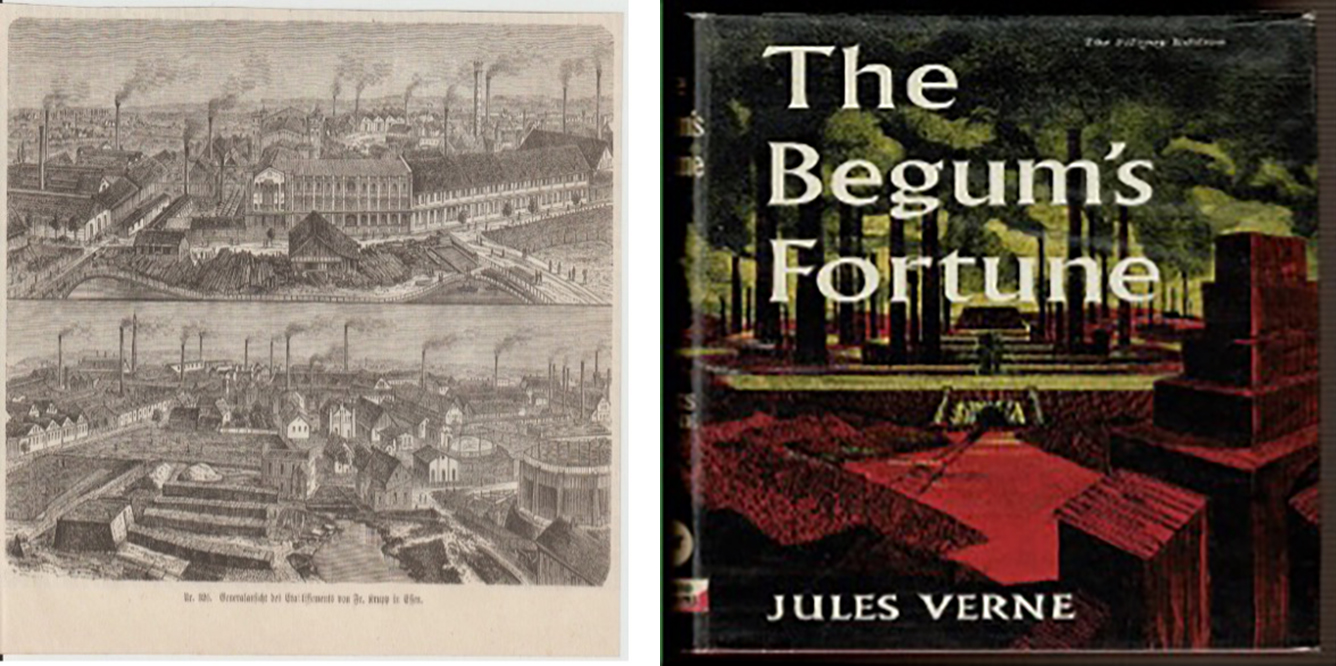
While Verne believed in a possible green future, like Charles Dickens, he addressed the realities of the times. The industrial cities of Verne’s time were dark, smoky, and polluted. Verne’s polluted fictional steel city, Stahlstadt, in Begum’s Million (1879), represented Victorian industrial cities. It had all the literary darkness of a Dickens novel.
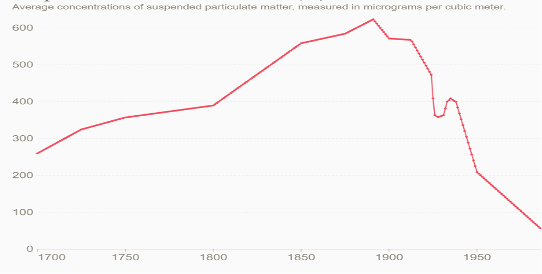
The years from 1820 to 1900 saw a rapid increase in British coal consumption. It rose from 20 million tons in 1820 to 160 million tons in 1900 (an eight-fold increase) (Fouquet, 2011, pp. 2380-2386). Severe timber shortages in the early 1800s drove a crisis-driven shift from wood to coal in home heating, cooking, iron production, and steam production. A half ton of coal produced four times as much energy as the same amount of wood and was cheaper to produce as timber became rare. Despite coal’s bulk, it was easier to distribute. The switch to coal averted an energy crisis but ushered in a pollution crisis. Figure 1 shows the dramatic rise in pollution in the 1800s.
Fig. 1. London Air Pollution 1700-2000 Source: Fouquet, R. (2011). Ecological Economics 70(12), 2380–2389
Verne saw considerable air and water pollution when coal overtook wood for home heating, as in cities like Edinburgh in the 1850s, which he toured and wrote about in his Backwards to Britain (1859). Charles Dickens could have written chapters 15 and 20 of Backwards to Britain. Historians noted, “By the 1800s, more than a million London residents were burning soft coal, and winter ‘fogs’ became more than a nuisance” (Urbinato, 1994, summer) Verne describes industrial 1859 Liverpool as “gas lamps had to be lite by four in the afternoon” because of smoke, “smoke blackened yellow brick and grimy windows” (Verne, Backwards to Britain, p. 59). The streets were filled with coal dust, swarmed with children in rags that “flaunted the misery of England.” His description of Edinburgh was similar. He even described the air of a small French industrial city, Indret, in 1858 as “an atmosphere thick with the tarry emanations of coal” (Verne, Backwards to Britain, p.17). At Edinburgh, he noted the social aspects of pollution: “foul disease-ridden atmosphere” with children begging in rags. Verne would die at the peak of coal air pollution (1905) as new fuels and air quality standards started appearing. Verne hoped science would deliver a cleaner future, but even his futuristic vision of 1960 Paris still had some air pollution from coal usage and chemical plants.
Verne described London’s Thames River in 1859 as a “putrid overflow of sewage.” Coal, however, was the primary source of poisonous water pollution. In the 1850s and 1860s, Europe’s primary municipal industry was coal gas production for lighting and heating. Gas works were built on major rivers, reducing air pollution from coal burning at home, but the big problem with gasworks was that by-products such as tar and benzene chemicals were dumped into the rivers, eliminating fish. The other by-product of dense sulfur dioxide gas was less visible but killed vegetation around the gas works. This sulfur dioxide also attacked the beautiful stone architecture and statues, which Verne noted in his 1859 tour of Britain.
The main characteristic of the atmosphere of London in 1873 was a coal-smoke-saturated fog, thicker and more persistent than natural fog, that would hover over the city for days. Historians noted, “As we now know from subsequent epidemiological findings, the [1873] fog caused 268 deaths from bronchitis. Another fog 1879 lasted four long months with little sunshine from November to March” (Fouquet, 1990, p. 2384). London was typical of European cities. In building his fictional underground town in 1877 (Underground City/Child of the Cavern) to rival Edinburgh, Verne describes Edinburgh as having “an atmosphere poisoned by the smoke of factories” (Verne, Underground City, p. 122). Air pollution in Paris by the late 1870s was deemed equivalent to Edinburgh and London.
Verne’s industrial world only worsened in the following decades as iron production increased. Coal for iron and steel production had created most of the smoke and dust pollution in the late 1800s. In 1899, a Verne fictional train traveler in The Will of an Eccentric described the Iron City of Pittsburgh’s atmosphere as capable of making ink by placing a glass of water out overnight. Verne went further, describing the pollution and destruction of nature seen on a rail trip from Chicago to Pittsburgh, ironically, as “that is progress.” Steel production increased nearly 40-fold in Europe between 1870 and 1912 (and more than 90-fold in Germany for the same period), causing an explosion in coal-driven air pollution.
The rapid technological progress and its pollution had left Verne conflicted. He loved science and technology, but he saw the problems that Charles Dickens had seen. Verne’s novels often deal with stark contrasts, such as in Begum’s Millions (1879). In many stories, he highlights the inherent conflicts of Victorian times, such as industry versus the environment, distribution of wealth, misuse of technology for war, science versus the arts, totalitarianism versus democracy, technical versus liberal arts education, practical versus idealism, industry versus agriculture, and capitalism versus socialism. Verne chronicles his futuristic visions with solutions, hopes, warnings, inconvenient truths, and concerns. He was both an industrialist and an environmentalist, much like Henry Ford (Skrabec, 2010). He saw room for compromise but was pessimistic that it could be achieved. His characters, like his stories, are conflicted and full of contrasts.
Verne was not alone in his belief in a compromise between industry and the environment. William Armstrong, one of Britain’s great engineers and often noted by Verne, was an early advocate for renewable energy and even hypothesized about future solar power generation. Armstrong believed coal “was used wastefully and extravagantly in all its applications” (Cockburn, 2010). Verne would use many of Armstrong’s ideas in Paris in the 20th Century (1863). This novel became a type of game plan for the future of energy in Verne’s visions.
Verne’s energy predictions and insights in Paris in the 20th Century (1863) laid the foundation for the literary future of energy in Verne’s world and beyond. This 50-year literary history (1863 to 1919) of energy by Verne was at times indeed a series of green adventures extraordinaire. His literary series adventures (Voyages Extraordinaire) would cover and improve upon an array of futuristic energy predictions such as compressed air rapid transit, hydrogen-fueled vehicle engines, new efficient electrical and electromagnetic applications, more powerful sodium batteries, wind power, hydroelectric power, solar power, tidal power, static electricity air accumulators, x-rays, wireless communications, laser beams, petroleum fuels, and new electro-mechanical machines, and new types of efficient engines to replace the steam engine—even some unfilled dreams such as electrical generation from ocean thermal gradients.
Verne’s Green Futurist Paris of 1960
Born in the smoke, dust, and dirt of an Industrial Revolution driven by coal, Verne envisioned a new and cleaner world. Verne began his writing career with a green vision of a futuristic Paris of 1960, a hundred years into the future. It was this fictional green city on the hill whose vision was a muse for Verne’s writing career. Verne’s editor turned down this first novel, Paris in the 20th Century, in 1863. His editor saw it as “simply unbelievable” (Tavis, 1997). The manuscript would be found and published in 1996. It was not only entirely believable, but most of the engineering had been implemented or is being researched today. It also represented the blueprint for his next 50 years of literary journeys into future science.
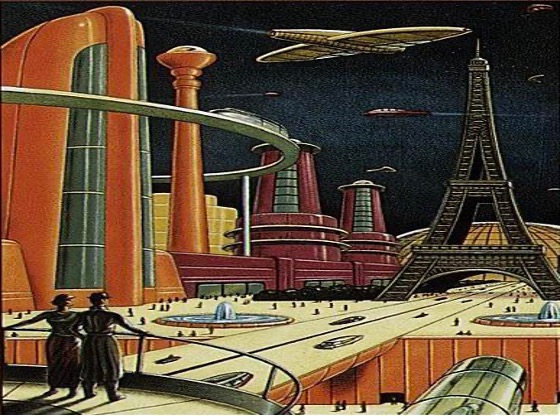
Verne’s Paris in the 20th Century (1863)would have significantly restricted the use of coal, with green sources supplying the power grid, hydrogen home heating, electric home and street lighting, windmill compressed air factory power, and rail transportation. It would be fueled by high-tech battery electricity, dynamo-generated electricity, hydrogen and oxygen from electrolysis, windmills, compressed air, tidal wave energy, and even air electrical “accumulators.” But even in this futuristic green Paris, coal for chemicals, fertilizers, and public demands for coal gas lighting by shop owners continued to cause some pollution. He realized getting off coal would be long and difficult. Figure 2 is an artistic view of Verne’s Paris.
Fig. 2. Cover of Paris in the 20th Century (1863)
Verne’s futuristic green Paris was a complex mix of wind, water, compressed air, electrical power, hydro-power, hydrogen for heating, and hydrogen-fueled cars, trucks, and ships. Verne even frames his green city’s needed evolution and a retro historical timeline. He started with windmill-sourced compressed air, powering his initial construction projects, factory machines, and construction cranes. The construction projects included skyscrapers, asphalt roads, sea channels, and canal construction to open Paris and its transportation networks to the sea. Windmills compressed air and drove mechanical devices in factories, homes, and powered trains and railways (Taves, 1997).
The next phase was the electrical power grid. It would be an electrical city with lights, elevators, and other electrical devices such as fax machines and wireless communication. However, Verne does not fully define how massive amounts of electricity would be produced in detail. He notes that an electro-mechanical dynamo (gravity-fed) generated electricity and batteries for small devices. This futuristic Paris did have the potential infrastructure to generate electricity through electromechanical, wind, water, compressed-air, and chemical means. The literary years of Verne to follow were made up of electrical adventures to achieve the massive electrical power needed for his futuristic Paris.
Electrical power would be the basis for another ancillary power source of hydrogen. He foresaw the massive hydrogen production by electrolysis to power cars, ships, and home heating. And maybe to use hydrogen instead of coal to power steam engines. Verne predicted a technical fantasy of hydrogen fuel for cars and home heating, hydropower generation, new efficient carbonic acid (carbon dioxide) engines instead of steam, and replacing coal gas with electric lighting (Verne, Paris in the 20th Century, pp. 24-25).
Verne envisioned a fanciful array of green, efficient, and power-saving inventions, such as carbon dioxide engines, electrical lighting systems, magnetic friction reduction for trains, hydraulic lifting systems, compressed air storage, hydraulic cranes, water turbines, and hydrogen/oxygen/compressed air heating systems, which would augment his green energy sources, improve efficiency, and reduce demand. Verne’s Green New World would also address environment, health, and wildlife conservation in his city design as part of his holistic approach.
The heart of Verne’s green Paris was built on four pillars of green energy: Compressed air and Wind Power, Hydrogen fuel, and chemical electrical power. And a number of energy-saving inventions.
The Power of Wind and Compressed Air of 1960 Paris
You can estimate that Verne’s futuristic Paris was 60 percent electricity-based. The balance of power came from compressed air from windmills and some water power. Jules Verne and his son Michel believed that stored windmill-generated compressed air would be part of a green future. In Paris in the 20th Century, Verne proposed the use of stored compressed air to power railways, factory machines, construction cranes, pneumatic tube trains, moving bridges, and even regulate clocks in a future Paris of 1960. Verne drew inspiration from a 1861 pneumatic compressed air single-car train experiment in London and the use of compressed air technology for the Fréjus Rail Tunnel through Mt. Cenis in the European Alps in 1857.
Verne addressed the inconsistency of wind power by proposing an urban compressed air storage utility. In Verne’s futuristic Paris, compressed air would supply energy through a public utility called the Catacomb Company of Paris. Verne’s windmill compressed air was pumped into and stored in Paris’ catacombs by “1,853 windmills established on the plains of Montrogue” outside the city (Verne, Paris in the 20th Century, p.31). Stored compressed air solves an inconsistent supply of wind energy and solar, making it attractive today. Verne and his son proposed a bright future for compressed air applications in many of his future novels. In the novel Self-Propelled Island (1894), Verne had a compressed air city utility company on his floating island. Similarly, in his book The Barsac Mission (1919), Verne’s city in the Sahara Desert had a compressed air utility.
In Paris in the 20th Century, Verne envisioned high-speed compressed air tube trains for interurban transportation. In his 1888 novel, The Year 2889, Michel Verne, son of Jules Verne, suggested pneumatic trains traveling at 1000 mph (Verne, In the Year 2889, p. 51). This prediction of high-speed pneumatic trains is on the verge of becoming a reality.
In July 2017, Elon Musk’s startup, Hyperloop, successfully tested a full-scale system on its test track in Nevada and reached a top speed of 70 mph. Musk hopes to achieve 250 mph soon. The Hyperloop uses compressed air and magnetic force to reduce friction, as Verne did in his futuristic Paris. Magnetic cushioning was yet another necessary design application of Jules Verne (Verne, Paris in the 20th Century, p.23).
Michel Verne took the vision further with a transatlantic pneumatic tube train from Boston to Liverpool in two hours and 15 minutes. This story was published in English in Strand Magazine in 1895 and was incorrectly attributed to Jules Verne (Verne, Worlds Known and Unknown, p. 262). This pneumatic train could travel at 1000 to 1112 mph, much faster than Musk’s prototype.1
Recently, Popular Science suggested that a transatlantic tunnel is more feasible than previously thought and possible with today’s engineering. Researchers from the Chinese Academy of Sciences proposed a submarine rail project that would run at a theoretical speed of 1,240 mphclose to Verne’s prediction (Garfield, 2018). A pneumatic transatlantic system is compared favorably with transatlantic pipelines, cargo ships, planes, and cables; the proposed transatlantic system would still cost over 200 billion dollars. Of course, reducing carbon dioxide would help offset the project costs. Verne envisioned compressed air doing much more than trains.
Today’s green energy movement has resurrected Verne’s vision of green compressed air. Compressed Air Energy Storage (CAES) is a potential renewable power grid because it can store power from clean energy sources such as wind turbines and solar panels. Like Verne’s futuristic Paris catacombs, CAES uses underground storage. At the urban utility scale, energy generated during periods of low demand can be released during peak demands. Many competitive thermodynamic designs are being researched, and pilot plants are being built. Of course, any power source can be used to compress air.
Jules and/or Michel in Barsac Mission (1919) used hydroelectric power to run electric compressors to compress air into a liquid. In the Barsac Mission, compressed liquid air was stored in tanks and powered an engine to propel his heliplanes. This air engine was a piston engine using the liquid-to-gas phase transition. In January 2024, the US government’s Defense Advanced Research Projects Agency (DARPA) awarded research contracts to use compressed liquid air in planes.
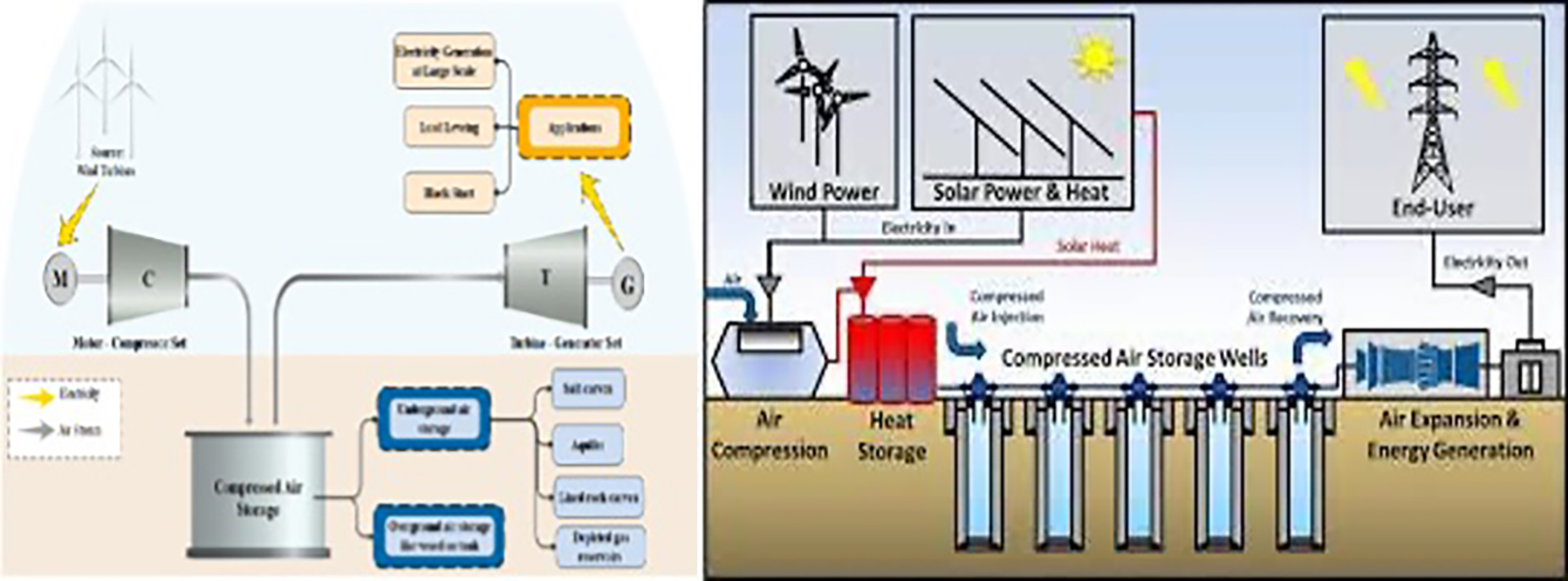
Several options are being considered today for manufacturing and applying compressed air. Figure 3 is schematic of the options.
In addition, Verne’s compressed liquid air engine in Barsac Mission is also getting new interest in car engines. All major car companies are doing serious research driven by the zero-emission green movement on compressed air engines. Compressed air cars are not yet very efficient in terms of net energy balance, although Ford and Jeep are improving their engines with an eye on the future.
Fig. 3. Generation of Compressed Air and its Uses:Society of Environmental Engineers Source: Kham, Imram. Renewable Energy and Sustainability, Elsevier, 2020
In addition, Verne’s compressed liquid air engine in Barsac Mission is also getting new interest in car engines. All major car companies are doing serious research driven by the zero-emission green movement on compressed air engines. Compressed air cars are not yet very efficient in terms of net energy balance, although Ford and Jeep are improving their engines with an eye on the future.
Electrically Generated Hydrogen For Cars, Trucks, and Home Heating
While Verne’s 1960 Paris had compressed air-driven commuter trains, he also envisioned green hydrogen individual transportation. Verne, in 1863, had no doubt that the future was hydrogen. Verne’s answer to carbon pollution was hydrogen, which would come from electricity. In Verne’s green Paris, hydrogen-fueled trucks, cars, and heated homes. Of course, hydrogen comes from the electrical breakdown of water (electrolysis) into hydrogen and oxygen. As we have discussed, coal in Verne’s time was used for home heating and was the primary source of air pollution. Verne used the method of water electrolysis, used for hydrogen gas heating, for altitude control in his Five Weeks in a Balloon (1863). Verne’s green Paris utilized a similar electrolysis-generated hydrogen for home heating via an engineering system that remixed hydrogen and oxygen fuel to heat compressed air and pipe it to apartments. The design was like his small-scale electrical electrolysis of water to hydrogen/oxygen, which was then remixed to heat the gas in the balloon to lift his balloon in Five Weeks in A Balloon.2 Generating a small amount of hydrogen from battery electrolysis, he was required to design a separate burner pipe to transfer heat safely to the explosive hydrogen gas in the balloon for flight control. It was an ingenious design but still risky, and after the famous explosions of the early twentieth century, non-flammable (but costly) helium replaced hydrogen in the 1920s in balloons and dirigibles.
Verne would later use electrolysis again, found recent fueling interest in hydrogen balloons. In Five Weeks in a Balloon, Verne produced hydrogen by transporting iron and sulfuric acid to the balloon launch site, but in future novels, Verne’s preferred method was water electrolysis. The Weather Service now uses local on-site electrolysis to fill hydrogen weather balloons. The 2023 switch from helium-filled balloons to launching hydrogen-filled balloons significantly reduced costs and carbon emissions (Rappe, 2023).
However, it was not hydrogen balloons that inspired Verne but hydrogen as a replacement for coal. Verne saw a much more significant role for hydrogen as a fuel in the future. In Jules Verne’s science fiction novel The Mysterious Island (1875), Verne imagines a world where “water will one day be employed as fuel, that the hydrogen and oxygen which constitute it…will furnish an inexhaustible source of heat and light, of an intensity of which coal is not capable” (Verne, Mysterious Island, p. 189). Verne’s vision of a hydrogen economy was not so much about smaller localized production but the mass production of hydrogen. In his sixty years, Verne evolved the mass production of hydrogen in his scientific and literary quest (Voyages Extraordinaire) from chemical production from iron and acid to battery-powered electrolysis to electromechanical electrolysis.
Verne predicted urban utilities for hydrogen production in Dr. Ox’s Experiment (1872)and Paris in the 20th Century (1863).In Paris in the 20th Century, Verne was unclear on how the electrical power needed for the massive hydrogen would be produced. Still, his futuristic Paris had many possibilities, from battery-powered electricity, electromechanical dynamos, wind, and hydroelectric power, as noted in the novel. In Dr. Ox’s Experiment, Verne used an extensive series of batteries. Like engineers today, Verne realized that batteries could not be a significant source of green hydrogen. It would take the electromechanical dynamo, which Michael Faraday had predicted and Verne was fascinated by. In the late 1850s, commercial dynamos were still evolving, but Verne quickly applied their future use. His last fictional city in The Self-Propelled Island (1897) was a total electric city using petroleum, steam, and electromechanical dynamos to generate electricity.
Some engineers of Verne’s time had envisioned a possible future for a hydrogen economy via commercial production via electrolysis with dynamos. Interestingly, Alliance Company, a hydrogen manufacturing company, made the first commercial electrical dynamos in 1859, originally to produce hydrogen fuel by electrolysis and sell it. Within a few years, the hydrogen proved too costly, difficult to transport safely, and impractical for an extensive fuel network. However, this failure did not alter Verne’s vision in 1863 of its future use. He followed the evolution of the electromechanical dynamo and applied its advance in his future novels. In his Underground City (1877), Verne used coal-powered dynamos, which again were not green. In TheBarsac Mission (1919), he used hydroelectric dynamo generation, which was green but limited. By the twentieth century, electromechanical dynamos supplied the world’s electricity. Continued advances in technology have made a hydrogen economy possible.
Verne did augur the emerging green cities where hydrogen could supply heating and transportation. Verne’s use of electrolysis to mass-produce hydrogen is back on the table. These visions are being realized today by Toyota, which is building hydrogen plants using electrolysis that could meet the demands of Verne’s futuristic Paris (Collins,2024). Toyota’s hydrogen plants will power a city that is currently under construction, known as Woven City (Collins, 2024). Toyota’s Woven City will use green hydrogen based on these new engineering efficiencies of hydrogen generation via electrolysis. Toyota will use solar and wind-produced electricity to manufacture hydrogen. Like Verne’s Paris, Toyota’s city will use hydrogen to power trucks and cars, and like Verne, Toyota will use a city-wide network of hydrogen fueling stations. Woven City will supply hydrogen to passenger and commercial vehicles in the city via a pipeline.
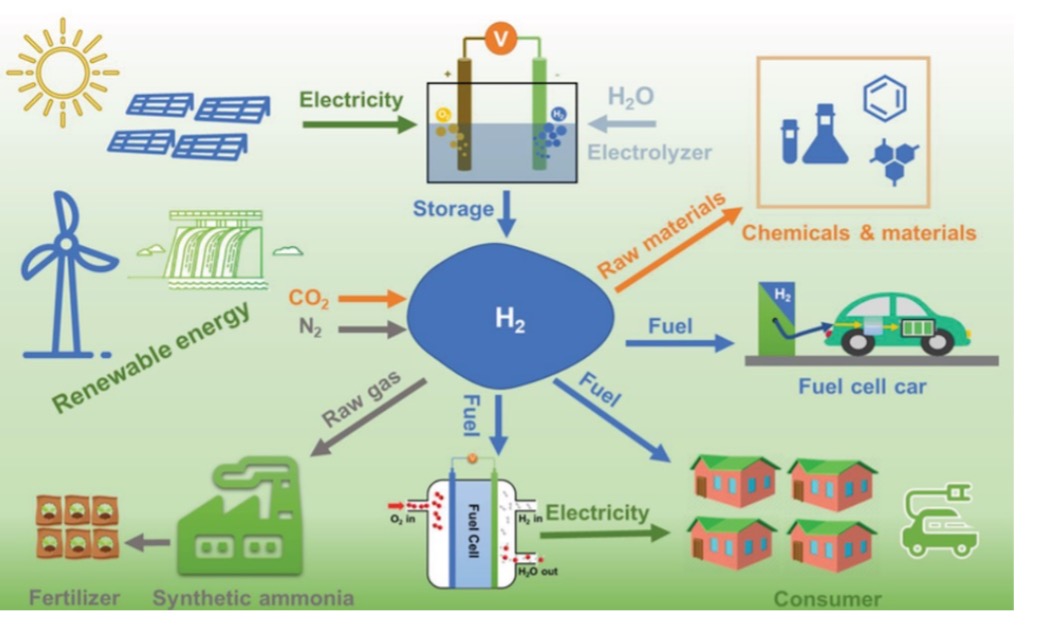
Today’s engineering has overcome significant issues such as the cost/energy balance and the inefficiency of electrolysis in hydrogen production. Hysata, a New South Wales-based company that makes electrolyzers, has announced its latest breakthrough: Hysata can generate hydrogen with a whopping 95 percent efficiency. A hydrogen fuel cell electrolyzer/generator at the individual fueling stations will back up power during outages. Figure 4 shows the possible infrastructure of a future economy.
Fig. 4. Possible Hydrogen Economy: Society of Environmental Engineers Source: Kham, Imram. Renewable Energy and Sustainability, Elsevier, 2020
Verne’s 1863 vision included hydrogen-powered engines. Verne used clean, burning internal combustion hydrogen cars, which he calls the “Lenoir Machine in his futuristic Paris” (Verne, Paris in the 20th Century, pp. 24-26). In 1858, Etienne Lenoir of France invented the 1-cylinder, 2-stroke engine that used gaseous fuel. The Lenoir Hippomobile in 1860 was fueled by electrolyzing water and running the hydrogen. Later, Lenoir adapted the engine for various gases, such as coal gas. The advantage of burning hydrogen is it exhausts water and no pollutants. Hydrogen cars are still being researched as a green solution for internal combustion. Verne realized the city needed a network of hydrogen gas stations, but he did not address today’s concern about handling highly explosive hydrogen.
Today, green hydrogen is achieved through electrolysis powered by renewable energies such as wind or solar energy coupled with improved process efficiencies even on a smaller scale, such as in fuel stations. Hysata makes electrolyzer units in many sizes and has built pilot plants to supply heavy-duty trucks in California. Amazingly, Verne used hydrogen in Paris in the 20th Century to power trucks.
Verne’s Electrical 1960 Paris—The City of Lights—But How to Power It?
Verne’s future Paris was an electricity-based city, and besides generating hydrogen, Verne’s green futurist Paris was electrical in many areas, much like Toyota’s Woven City of today. Verne applied electrical power for electrolysis to produce hydrogen fuel, power arc lighting, operate elevators, run cranes, open doors, and operate book lifts in library warehouses, as well as an array of time-saving electric devices. In his 1863 writing of his futuristic Paris, Verne’s problem was not the vision of an electrical Eden but how to supply the electricity needed for this Eden without the pollution of coal and steam. The electrical demands for Verne’s Paris skyscrapers needed lighting, powerful elevators, doors, and other electrical devices such as fax machines, copiers, calculators, and phones, which would be an enormous use of electricity. The primary electricity demand was street, business, and home lighting in Verne’s Paris.
In Paris in the 20th Century, Verne used the electric street lighting system known as the “Way Method” (after John Thomas Way), developed in 1860, which Verne referenced in Paris in the 20th Century (p. 24). The Way lighting system was an improved type of street lighting, a mix between straight arc and modern neon mercury lighting. Arc and mercury lighting brightness made it a poor system for room lighting. In Twenty Thousand Leagues Under the Sea (1871), Verne noted that the harshness of early arc lighting had to be “softened and tempered by delicately painted [wall] designs” (Verne, Twenty Thousand Leagues Under the Sea, p. 92). This harshness of the light was probably the reason some shopkeepers in Paris in the 20th Century rejected it and stuck with coal gas (p. 24). Brightness and feel remain a lighting problem and a source of green resistance even today. Verne used both arc and Edison’s softer incandescent lighting in his novel Underground City in 1877. Incandescent lighting became commercially available in the 1880s. Regardless of type, lighting requires a large amount of electrical power.
In Paris in the 20th Century, Verne was not clear on how massive amounts of electricity would be generated for urban use, but it would be the quest of his scientific novels to come. Still, Verne did not specifically name anyone one type of power source in his futuristic Paris, although he had noted many possibilities, which would be a life quest. Verne’s literary quest for mass-produced electricity took him over sixty novels and articles in four decades. Verne would explore improved batteries, solar, wind, hydroelectric, tidal, static electricity collection from the air, thermal gradients in oceans, and more efficient engines and motors.
Verne first looked to improve battery efficiency. When Verne wrote in 1863 of a futuristic Paris, unique and powerful chemical batteries for electricity were possible but far from feasible. In 1863, the only significant source of electricity was chemical batteries, but Verne’s Paris had twenty thousand street lights alone, which was beyond the scope of the chemical batteries of the 1860s.
Verne had followed the development of batteries from the 1840s, and Verne knew from the battery experiments of Davy and Faraday that batteries could not power a city of lights. Humphry Davy had established the cost of battery power, noting it in his arc lighting experiments in the 1820s. Davy required 2000 galvanic battery cells at six dollars per minute (about 200 dollars a minute today) to power one arc light. In 1848, two experimental arc streetlights in Paris were tried, which caused considerable excitement in Paris but was short-lived because of battery cost. Verne’s 20th-century Paris had 200,000 streetlights, and battery electricity would be cost-prohibitive. Verne would have realized that the future of electric cities would require mass production of electricity beyond the battery power of the 19th century, and this would be true even today with today’s powerful batteries.
Verne considered increasing the efficiency of batteries in his novels of the 1860s for more output. Verne tried to improve the common “Bunsen battery” in his 1863 novel Five Weeks in a Balloon. The Bunsen battery was a lead-carbon-acid battery.
Early in Verne’s Voyages Extraordinaire, Verne invented the most futuristic design of a sodium battery in Twenty Thousand Leagues under the Sea. Verne’s futuristic use of sodium was a hundred years ahead of its time and would significantly increase electrical output. This sodium battery has again taken Jules Verne into recent scientific headlines as a cheap replacement for lithium EV car batteries. However, Verne’s sodium battery would still require 500-1000 battery cells per single city street light in his futuristic Paris. Still in his Paris in the 20th Century, Verne applied smaller applications for batteries, such as powering musical instruments, but so much more power was needed.
Verne never wholly gave up on some role for batteries in his final fictional electrical city, Standard City in The Self-Propelled Island (1895); he sees our future of rechargeable batteries for electric cars, trains, boats, and small electrical devices.
Lighting homes, factories, shops, streets, and signs would require massive amounts of electricity. When Verne wrote Paris in the 20th Century, he did not specify how the enormous electrical power would be generated. Verne was sure that electrical generation would not be chemical-based but mechanical. In Faraday’s 1820s experiments, he generated electricity with cheaper mechanical magneto-electric generators (dynamos). Based on these early principles of electromagnetic induction, hand-cranked induction lanterns evolved in the 1840s, and Verne quickly realized its future potential. Verne used induction devices ( Ruhmkorff lamps) to generate electrical lighting in his novels Journey to the Center of the Earth (1870), From the Earth to the Moon (1865), and 20,000 Leagues Under the Sea (1871). In his futurist Paris, he references the “Way Method,” which used a magneto-electric generator (a type of dynamo). Way used his system for a single lighthouse in 1858, but it was hand-cranked, hardly a system for urban lighting, yet Verne realized the potential for the future of a dynamo.
In 1858, the Alliance Company used a magneto-electric generator driven by a coal fueled steam engine to power arc lights and make hydrogen fuel through electrolysis; however, Verne’s own requirements in futuristic Paris was a very restrictive use of coal and steam. Eventually, in Verne’s novel The Underground City (1877), he applied the electro-mechanical dynamo generation for mass electricity. In Verne’s underground Coal City in The Underground City, Verne creates an electrical city using dynamos (“electromagnetic-mechanical machines”), and electricity is used for “all the needs of industrial and domestic life.”2 Coal City used electricity for lighting, ventilation, and heating. In one of his last books, The Self-Propelled Island, electro-mechanical dynamos would power urban needs. Verne was not as clear in Paris in the 20th Century, how massive amounts of electricity might be produced.
Power generation may have been generated by converting coal-fired steam power via a dynamo to electricity for Verne’s Paris. Of course, coal-powered dynamos were far from the green solution Verne wanted. Verne alludes to the green electromagnetic base by noting the Way Method. The Way Method dynamos were hand-cranked or gravity-based. Verne’s green Paris did have several other potential green power sources to drive a dynamo shaft or a magneto, such as wind, gas, compressed air, water power, chemical batteries, hydroelectric, and even hydrogen.
Verne had developed a vast windmill system in his futuristic Paris, which compressed air but could also turn a dynamo shaft (although he did not specify). Verne’s Paris had “1,853 windmills established on the plains of Montrogue” outside the city (Verne, Paris in the 20th Century, p. 24). Verne’s future Paris also had the potential for hydroelectric power, which Verne was using water turbines to replace waterwheel power in his green Paris. Since canals had connected Verne’s Paris to the ocean, there was even the potential to utilize tidal energy. His 1889 novel, The Purchase of the North Pole, notes the potential future of tidal power (p.16) France’s Rance Tidal Power Station was the world’s first large-scale tidal power plant, which became operational in 1966.
In the early 1900s, technology caught up with Verne’s imagination of clean electric cities. Verne would finally have a source for the massive electric needs of a city like his 20th-century Paris. Verne had long envisioned harnessing the power of Niagara Falls, which was achieved in the 1890s with hydroelectric power supplying factories in Buffalo, New York. In Jules and Michel’s novel, The Barsac Mission (1919), Verne’s imagination took these new power generation advances to build Blackland, a fictional city in the Sahara Desert. Verne had to evolve Blackland’s electrical power from wood-burning steam engines driving dynamos to green hydroelectric dynamos. Verne dammed the Niger River to generate electric power for his Blackland factories, city lighting, and irrigation system, declaring, “Smoke no longer gushes from the useless chimney.” This Vernian vision augured the 1930s Boulder Dam and Las Vegas system. Hydroelectricity is a significant electricity resource today, accounting for more than 16% of global electricity production.
Verne’s prediction of generating electricity from temperature gradients at different ocean depths is even more astonishing: “By establishing a circuit by wires at immersed at different depths, I will be able to generate electricity,” he wrote in 20,000 Leagues Under the Sea. Verne probably got the idea from Faraday’s thermocouple experiments, generating electricity from heat. Years later, in 1881, Jacques Arsene d’Arsonval, a French physicist, proposed Verne’s idea of tapping the ocean’s thermal energy. Still, this offered no solution to massive electricity production for a city; however, Verne might have been on to something. In 1970, the Tokyo Electric Power Company successfully built and deployed the first large-scale production using the principle.
Interestingly, Verne did not envision using solar energy to produce electricity and hydrogen, a recent area of significant research. Even though Jules and his son understood the principles of a photoelectric cell in 1888, it was a rarity that Verne so understood such a unique scientific discovery without extrapolating into the future.
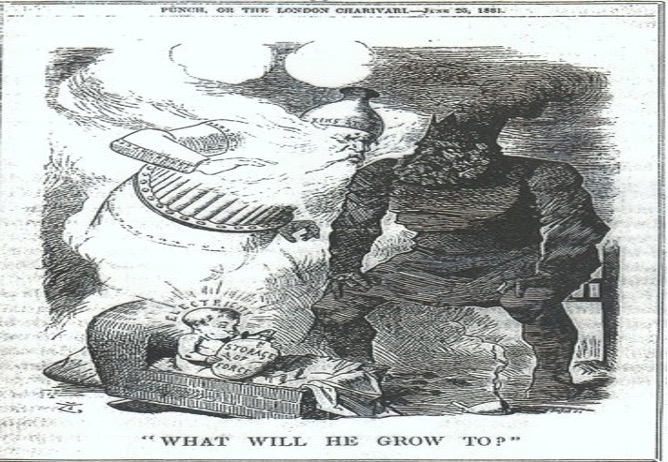
Fig. 5. A Punch Magazine 1881 Cartoon The Growth of the Electrical Baby
Verne realized the issue was Victorian demand for heating, steam production, and industrial power produced from coal. Verne designed three great fictional electric-powered cities: Paris in Paris in the 20th Century, Standard City in The Self-Propelled Island , and Blackland in The Barsac Mission, which avoided or restricted coal-generated electricity. New Aberfoyle was an electric city but used coal to generate it (Underground City, 1877). Verne understood that the transition from coal would be measured in centuries, not decades.
Verne saw a 200-year struggle to reduce our dependency on coal and hydrocarbons. A reduction in coal smoke would be part of such a transition. Verne did not see a quick conversion from coal but looked to a gradual use of alternative energy, more efficiency, and even methods for the clean use of coal. As noted, coal gas production for home and street lighting was extremely popular because of its soft light. Coal gas production polluted the air, smoke, and rivers with benzene, chemicals, and tar. Verne also foresaw that there would be resistance to electric lighting and the green movement. He noted opposition to electric lighting in his future Paris by merchants who preferred the soft light of coal gas. Noting in his futuristic Paris, “Nonetheless a few old-fashioned shops remained faithful to the old means of hydro carbonated gas,” which necessitated “limited coal mining” (Verne, Paris in the 20th Century, p. 24).
Verne’s early writings noted that coal for heating and cooking was the primary source of Victorian air pollution. In his futuristic Paris, Verne used clean hydrogen for heating. In the same year, 1863, Verne used electricity for cooking in his Nautilus (Verne, Twenty Thousand Leagues Under the Sea).
Another possible interim reduction of coal pollution came in Verne’s Begun’s Millions, in which Verne envisions an environmental but dystopian city called France-Ville. As noted previously, Verne was concerned about unhealthy coal-burning air pollution. He feared government regulation would be needed in France-Ville. France-Ville used building regulations imposed on houses, and a unique subterranean scrubbing system was used to clean coal and wood-burning exhaust. The system took exhaust gases from the heating furnace via pipes to a “burner” used to strip it of carbon (Verne, Begum’s Millions, p. 124). While lacking the process details, it does augur today’s Clean Coal Technology.
Verne did look to cleaner petroleum as a possible fuel alternative. Verne foresaw petroleum’s potential, using it to fuel his floating island in The Self-Propelled Island. Verne compares petroleum to the “pollution” of coal-fired steam engines of the 1890s as “the difference being instead of black smoke, the chimneys emitted only light vapor that did not pollute the atmosphere” (Verne, The Self-Propelled Island, p. 41).
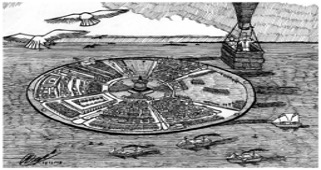
Fig. 6. Illustration from The Self-Propelled Island
Figure 6 shows the original illustration from Verne’s novel Self-Propelled Island. Verne uses petroleum and/or petroleum biomass to heat steam boilers in place of coal which was then used to generate electrical power on his fictional floating island. In The Self-Propelled Island he describes the fuel as petroleum (p. 41) and “oil briquettes” (p. 55). Verne is using petroleum briquettes to replace coal to drive the steam engine dynamo and produce electricity. Verne predicts the future of petroleum briquettes based on some emerging technology and his imagination. Pressed palm oil briquettes were used in some countries in the 1890s for heating, but Verne used the word petroleum briquettes writing in 1895. Verne considered petroleum and/or petroleum products to be clean-burning fuels. Petroleum briquettes were just being experimented with in the 1890s but Verne recognized the potential.
Petroleum briquettes would have offered a deliverable product to Verne’s island in a world without oil tankers and a pipeline network. Verne states that petroleum briquettes are “less cumbersome, less dirty than coal, and have more heating power” (Verne, The Self-Propelled Island, p. 51). Amazingly, now 130 years later, petroleum briquettes are being looked at for the same attributes Verne noted. Research on petroleum and new patents for processing and chemical binders are emerging. The new look at petroleum briquettes lists similar advantages noted by Verne: ease of handling versus coal, its clean burning, heating power, and environmentally safe transportation. A recent study of biomass petroleum briquettes made from bitumen (raw petroleum), starch, and rice husks found that they are competitive in industrial heating (Ikell, 2014). A new patented process takes Canadian bitumen crude oil mixed with a polymer to form briquettes that can be transported without fear of spills or fires.
Petroleum oil, in general, emerged as a somewhat “cleaner” fuel by 1895; however, its refining was a significant pollutant by 1899. One of Verne’s fictional travelers in The Will of an Eccentric (1899) describes the oil refining atmosphere of Warren, Ohio, as a “sickening” atmosphere, tarry chemical water pollution and even explosive water pollution, which contributed to the famous 1969 burning of the oily Cuyahoga River in near-by Cleveland.
Unfortunately, Verne incorrectly wrote off natural gas as a clean alternative to coal in describing Pittsburgh’s still dirty air in The Will of an Eccentric (1899): “In spite of the thousands of miles of subterranean conduits by which natural gas is supplied.” Verne here alludes to George Westinghouse’s first massive conversion to natural gas from coal in Pittsburgh in 1887, using an enormous pipeline supply network. The use of natural gas dramatically reduced smoke, but supply diminished by 1892, and the coal smoke was returned by the writing of Verne’s The Will of an Eccentric (1899). Verne missed the actual improvement of natural gas conversion. The Society of Engineers reported: “We had four or five years of wonderful cleanliness for Pittsburg, and we have all had a taste of knowing what it is to be clean. We all felt better, looked better, and were better. But we are back into the smoke. It is growing worse day by day” (Tarr, 2015).
Verne’s other transitional strategy was improving the steam engine’s thermal efficiency, which was between 30 to 35 percent. The iconic Victorian steam engine was a major consumer of coal; therefore, efficiency improvements in steam engines offered significant reductions in coal pollution. Even today, coal, natural gas, oil, nuclear, and even some solar electrical plants use steam turbines with mediocre efficiencies. The major problem for Victorians was that the steam Rankine cycle has a 30-40 percent efficiency. In the 1860s, Victorian engineers and scientists pursued the use of carbon dioxide (they used the term carbonic acid) as a way to increase efficiency significantly. This breakthrough brings us to one of Jules Verne’s most obscure predictions in Paris in the 20th Century. Verne predicted that in 1960 Paris: “Carbonic acid (carbon dioxide) now dethroning steam” (p. 12). Later in the novel, he suggests the carbonic acid engine would power ships (p. 135). Verne again probably extrapolated Marc Brunel and his son Isambard ( Great Eastern fame) work in the 1860s, conducting over 15,000 experiments on a motor driven by carbonic acid (carbon dioxide) based on Michael Faraday’s theories.
In the late 1860s, James Baldwin detailed his patent for a carbonic acid engine using the physical phases (liquid and gas) of carbon dioxide at available temperatures and pressures in the 1860s. Such an engine was theoretically possible, but future engineering was needed for the super temperatures and pressures to make the engine cycle efficient. Steam turbines still produce over 75 percent of today’s electricity. Carbon dioxide engines have the potential for 60 percent thermal efficiency versus 35 percent for steam. This efficiency jump has led to a pilot plant using carbon dioxide in supercritical phases to replace steam. The Supercritical Transformational Electric Power project is one of the world’s largest-scale and most comprehensive, funded by the Department of Energy. A key project goal is to advance the state-of-the-art for high-temperature carbon dioxide in the power cycle performance. It may turn out that one of Verne’s little-noticed predictions will become one of his best.
Some of Verne’s visions of clean energy remain in the future. Verne envisioned a futuristic “accumulator” and “transformer” to gather static electricity from air or molecular vibrations. He describes these in his 1889 book, The Year 2889. In his 1885 novel Mathias Sandorf, he uses this Vernian accumulator for electric boats, and in Master of the World (1904) suggests their use to power electrical airships.
Conclusion
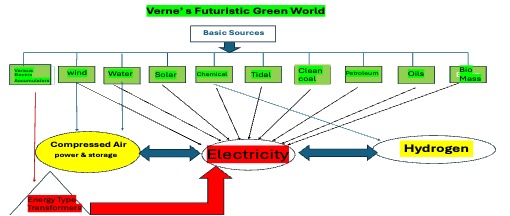
Figure 7 is a schematic summary of the fifty-year vision of Verne’s green future. It shows a mix of new sources for electricity, the need for storage, and a role for hydrogen.
Fig. 7
The green design of energy started in his first novel, Paris in the 20th Century, which envisioned a green and cleaner city of the future. In it, Verne would design a green energy grid for his futuristic Paris and a blueprint to build on for his literary career. Verne then launched a 50-year literary journey of novels (Voyages Extraordinaire), which he improved on this initial urban energy plan. His futuristic Paris realized the potential of electricity in transportation, hydrogen generation, home heating, powering factories, and street lighting. Verne spent the next fifty years applying the evolving science to produce clean electricity in some of other his fictional cities. He foresaw the future of an electrical grid that could recharge battery-powered cars, trains, and electrical devices.
Verne saw a hydrogen-driven economy in the future, but the root of his economy was the electricity for electrolysis to produce hydrogen. His hydrogen solution evolves in four novels: Paris in the 20th Century, Five Weeks in a Balloon, Mysterious Island, and Dr Ox’s Experiment.
Maybe more interesting was Verne’s understanding of political issues and human resistance to change, which required some compromise as part of the solution. Verne articulated that the green transition would move slowly. Realizing that getting off coal required a transitional approach, such as his clean coal scrubbing system in Begum’s Millions. Verne looked further into the future need for efficient electrical devices, more efficient engines, rechargeable batteries, and energy systems as part of the big picture and longer-range solution.
Eventually, Verne would see the future in electricity, hydrogen, wind power, hydroelectric power generation, compressed air, biomass fuel, tidal power generation, and even solar power. Along the way, he envisioned an array of things like an electric submarine, an electric airship, electric vehicles, solar sails, high-speed pneumatic trains, hydrogen cars, hydrogen home heating, tidal wave power, windmills for electrical generation, and hundreds of futuristic devices.
Verne’s green vision is not complete, but we still have over 800 years to achieve Verne’s ultimate solution. In his book, The Year 2889, Verne hails the future of wonderful instruments, such as “accumulators”. Verne describes them as able to “absorb and condense the living force [energy from molecular vibration] contained in the sun’s rays; others, the electricity stored in our globe; others, again, the energy coming from whatever source, such as a waterfall, a stream, the winds, etc.” He, too, invented the “transformer”, a more wonderful contrivance still, which takes the living force [energy] from the accumulator and, on the simple pressure of a button, gives it back to space in whatever form may be desired, whether as heat, light, electricity, or mechanical force, after having first obtained from it the work required. The day when these two instruments were contrived is to be dated as the era of true progress. They have put into the hands of man a power that is almost infinite (Verne, In The Year 2889, pp. 21-22).
NOTES
There are two translations of the Strand article one using 1000 and the other 1112 mph.
Verne initially used hydrogen from the iron and acid chemical reaction to fill the balloon.
WORKS CITED
Bretwood, Higman, and Erin McKittrick, David Coil, “Quantifying Coal: How Much is There?” Ground Truth. 2019.
Cockburn, Harry. “Climate Crisis: UK’s Record Coal-Free Power Run Comes to an End.” Independent, June 2020.
Collins, Leigh. “Toyota to Mass-Produce Hydrogen Electrolysers in Partnership with Chiyoda.” Hydrogen Insight, February 5, 2024.
European Union News Letter. “Sustainability at One Franco-Chinese Month of Environment Gives Nod to Jules Verne’s Eco-Advocacy.” October, 2020.
Fouquet, Roger. “Long Run Trends in Energy-Related External Costs.” Ecological Economics 70, no. 12, 2011, pp. 2380-9.
Garfield, Leanna. “15 Remarkable Images That Show the 200-Year Evolution of the Hyperloop.” Business Insider, Feb 20, 2018.
Guess, Megan. “Canadian Plans to Transport Oil as Solid Briquettes Move Forward.” ARS Techinica, 2019.
Ikell et al, “Study of Briquettes Produced with Bitumen, CaSO4 and Starch Binders.” American Journal of Engineering Research (AJER), Vol. 3, 2014.
Jules Verne Forum, “Word Translation in Self-propelled Island.” Google Groups, 1/24/25 Jean-Louis Trudel to Quentin Skrabec.
Kham, Imram. Renewable Energy and Sustainability. Elsevier, 2020.
Minchinton, W. and Pohl, H. “ The Rise and Fall of the British Coal Industry: A Review Article.” VSWG: Vierteljahrschrift für Sozial- und Wirtschaftsgeschichte, pp. 212-226.
Pacific Petroleum ed. “Petroleum Briquettes.” The Idaho Springs News, Vol xix, no. 33, Nov 15, 1901.
Rappe, Mollie. “Researchers Switch from Helium to Hydrogen Weather Balloons.” Sandia National Laboratories, May, 2023.
Ramirez, Vanessa. “Toyota Is Building a Futuristic Prototype City Powered by Hydrogen.” Singularity Hub, May 14, 2021.
Skrabec, Quentin. Green Friends: Henry Ford and George Washington Craver. McFarland,2010.
Taves, Brian. “Jules Verne’s Paris in the 20th Century.” Science Fiction Studies, Vol. 24, March 1997.
Tarr, Oel, and Karen Clay. “Boom and Bust in Pittsburgh Natural Gas History: Development, Policy, and Environmental Effects, 1878–1920.” The Pennsylvania Magazine of History and Biography, Vol. CXXXIX, No. 3, October 2015.
Verne, Jules. Begum’s Millions, originally published 1879, edited by Arthur Evans, translated by Standford Luce, Wesleyan University Press, 2016.
Verne, Jules, Paris in the 20th Century, originally published, Ballantine Books, 1996.
—. The Purchase of the North Pole, originally published 1889, Associated Booksellers.
—. Mysterious Island, originally published 1867, Kindle Edition.
—. Backwards to Britain, originally published 1859, Chambers Limited, 1992.
—. Five Weeks in a Balloon. 1863.
—. Underground City, originally published 1877, Luath Press, 2005.
—. The Will of an Eccentric. Sampson Low, Marston & Company, 1900.
—. The Self-Propelled Island, originally published 1895, translated by Marie-Therese Noiset, University of Nebraska Press, 2015.
—. Journey to the Center of the Earth. 1863.
—. Twenty Thousand Leagues under the Sea. 1871.
— and Michel Verne. In the Year 2889, originally published 1889, Seven Treasures Publications, 2008.
— and Michel Verne. “A Futurist Express Train.” Worlds Known and Unknown, The Palik Series.
Quentin R.Skrabec Jr. is a full-time researcher in engineering futurism, Jules Verne, Victorian science, the intersection of culture and engineering, and metallurgical studies. His education includes a BS in engineering from the University of Michigan, an MS in engineering from Ohio State, and a Ph.D. in manufacturing management from the University of Toledo. He has appeared on both PBS and the History Channel. He has published over 100 articles and 25 books in science, science fiction, and engineering.
A French physician, Doctor Sarrasin, and a German scientist, Professor Schultze, inherit a vast fortune as descendants of an Indian rajah’s fortune. This rajah married the wealthy widow of a native prince, the “begum “ of the title. Each heir decided to build utopian cities in the United States.
Sarrasin builds France-Ville on the western side of the Cascade Range in the state of Oregon, with a focus on the health and wellness of its citizens. Schultze, a German militarist, builds Stahlstadt on the east side, a vast industrial and mining complex, devoted to the production of ever more powerful and destructive weapons. Schultze soon plans to destroy Sarrasin’s city.
Schultze builds an advanced steel mill for cannons. Stahlstadt becomes the world’s biggest producer of arms. Schultze was Stahlstadt’s dictator, whose very word was law and who made all significant decisions personally. Schultze was an eccentric and unusual character. Stahlstadt was an industrial and circular labyrinth covered in secrecy. The primary purpose of this cannon factory was to maintain secrecy around its advanced cannon-making process. It was strictly controlled by employees’ oaths, passwords, locked doors, guards, and a central observation tower. Schultze added a home in the middle, with exotic gardens and greenhouses.
Marcel Bruckmann, a friend of Sarrasin’s son, becomes an industrial spy to understand the manufacture and technology of Schulze’s cannons. Bruckmann relocates to Stahlstadt and quickly rises high in its rigid hierarchy, gaining Schultze’s personal confidence, spying out some well-kept secrets, and sending a warning to his France-Ville friends. Still, Bruckmann faces a factory built to maintain secrets and security. Schultze is not content to produce arms, but intends to use them first against France-Ville, then worldwide. Schultze’s super-cannon was capable of firing massive shells filled with gas. Schultze’s pressurized carbon dioxide gas was designed not only to asphyxiate its victims but also to freeze them. As Schultze prepares for the final assault on France-Ville, a gas projectile in the office accidentally explodes, asphyxiating him and leaving him in frozen animation. Stahlstadt goes bankrupt and becomes a ghost town. Bruckmann and Dr. Sarrasin’s son take it over. Eventually, Stahlstadt is re-invented as a peaceful manufacturing town.
Setting the Environment and the Story
In Verne’s scientific romances, science and technology are not merely a passive backdrop or setting for the story, but an active driver of the plot. Begum’s Millions1 (1879) is a prime example of this blending of technology and story; however, before examining the story of Begum’s Millions, there is a subject of debate, and we must first consider the authorship itself. Many consider Paschal Grousset (1845–1909) to be at least the co-author in the sense that many believe the story and framework were those of Paschal Grousset, and there is good evidence that Verne’s editor purchased the storyline (Verne, BM Luce ed, p. xvi). Indeed, there is support that the France-Ville of chapter 10 fits Grousset’s political ideas. Chapter 6, “The Albrecht Mine,” gives the reader the feeling of something patched in or merged from a different manuscript. Some merging and blending of two manuscripts was probably the case. As to Verne using Alfred Krupp and the Stahlstadt factory as a model for the book, there is a connection in Verne’s own words to his editor: “What shall we say about the Krupp factory now, as it is really Krupp who is in play here, and his factory that is so forbidden to indiscreet eyes.” (Verne, BM, Luce ed., p. 206, note 5)
Stahlstadt factory descriptions may have come from Victor Tissot’s The Prussians in Germany, published in Paris in 1876. Another possible source could have been a pamphlet published in 1865 by French science journalist and publisher, Francois Julien Turgan (Michaelis, 1888. P.50). Turgan documented the Krupp factory in Germany as well as other European cannon factories, focusing on its military artillery, design, and manufacturing processes. His account provides a detailed, illustrated record of the operations at Krupp during the mid-1860s. Napoleon III had planned to buy Krupp cannons in the 1860s, but the French military command overruled him. Everything changed with the Franco-Prussian War (1870-71), which started an international arms race.
Other sources could have been available to Verne, such as military reports from the 1870s, marketing materials from Krupp Steel, and those of French steelmaker Schneider-Creusot, which had a network of traveling engineers known as “Silent Research at Schneider” to study and report on steelmaking innovations worldwide. This is consistent with other sources available to Verne, such as military visit reports of the 1870s and the corporate spy network of the French Schneider Creusot steel. Verne’s story matches the unique actual process details of Krupp steel. The connections to some of Alfred Krupp’s personal characteristics are less compelling, but in the broader context of all the Krupp details, they rise above mere coincidence, and they should at least be discussed.
The Franco-Prussian War vividly demonstrated the superiority of Krupp’s breech-loading crucible steel cannons over the French’s muzzle-loading brass cannons. The world entered a type of arms race, which is reflected in Verne’s story. Herr Schultze’s steelworks and Marcel Bruckmann’s quest to uncover its secrets were based on the real international espionage by countries such as France and England to find the 19th century’s greatest industrial secret: the Krupp cast crucible steel cannon process.
Verne’s Cannon Factory Layout Versus Krupp’s
Verne was no stranger to iron works, forging, and cannon foundries, having visited the naval foundry and cannon shop near Indret a number of times with his father in his youth (Butcher, 2006, p.18). This cannon forge made use of steam forging hammers that Verne would write about in Begum’s Millions.Begum’s Millions demonstrated Verne’s depth of knowledge of the secretive Alfred Krupp and his factory. It is not fully clear how Verne acquired these details. The main source appears to be the secretive, partially published report of an 1865 visit to Krupp’s factory (Michaelis, 1888, p. 50). What is known is that Krupp’s layout of the factory and mansion is unique and far different than other steel works, such as Carnegie’s 1875 massive steelworks at Braddock, Pennsylvania, and France’s Schneider-Creusot. Both Verne’s and Krupp’s mills were built on a coal field with adjoining ore deposits.
Verne’s Herr Schultze’s city, factory, and castle reflected those of Alfred Krupp and the city of Essen. For study reference and comparison, Begum’s Millions Stanford Luce translation and William Manchester’s The Arms of Krupp will be used. Schultze, like Krupp, builds a massive tropical garden at the center of his factory operations around his factory home, which was unheard of until very recently, with roof gardens at manufacturing plants such as Ford Motor Company. Krupp had maintained his original family house of the 1820s amidst the works, adding gardens in the 1860s. However, in the 1870s, he built a castle overlooking the factory. Verne’s glass-enclosed heated garden was modeled after Krupp’s glass-enclosed gardens. In both cases, excess factory heat is used to maintain the temperature. Verne includes Krupp’s use of peacocks, pineapples, slag-formed fountains, and statues in the garden at the center of the steel works (Manchester, 1964, pp. 71-72). Verne’s Schultze had a museum and model shop exactly like Krupp’s, as described by a rare visitor to the works in 1865. Both Krupp and Verne had a tower with a glass lookout. Krupp’s original central home inside the factory had a glass “crow’s nest” for watching workers. Verne’s novel had the Tower of Bull at the center of Stahlstadt. Both used thick glass roof skylights.
Krupp’s steel works and mansion in the 1870s were described as: “The interior is a mad labyrinth of great halls, hidden doors, and secret passages” (Manchester, 1964. P. 110). This is a similar visual to Verne’s. Verne blends Krupp’s unique steelmaking process, industrial labyrinth, Krupp’s famous mansion, and passion for secrecy into his story. Krupp’s factory layout and restricted employee movement were core to his secrecy policy, which Verne illustrates in his story. Krupp’s Essen and Verne’s Stahlstadt are both integrated cities/factories. Verne’s Stahlstadt was modeled after Krupp’s factory, complete with a police force, guards at every department entrance, passwords, locked doors, codes, and secret agents (James, 2012, p. 42). Both factories were designed with circular-walled sections and locked departments to ensure no one could piece together the secret process of cannon-making, which was a key part of Verne’s storyline.
The fictional factory organization in Verne’s novel reflected the pioneering Krupp industrial philosophy of vertical integration, which involved owning and coordinating resources throughout the production cycle. Verne’s Stahlstadt, like Krupp’s Essen, was an oval-shaped city with a circular railroad to supply the steel works. While much is made of Verne’s circular steel city design on a philosophical, metaphysical, and mythical level, it appears to be inspired by Krupp’s “great circle railway” around his factory for process integration, allowing materials and semi-products to move between departments and connections to bring in coal and ore (Krupp Steel, 1912). William Kingston’s earliest English translation of Begum’s Millions, published in 1879, offers a slightly more explicit visual representation of this circular design. Krupp’s railway was built from 1874 to 1877 and was the subject of much news attention. The circular design enabled efficient integration, which other notable steelworks failed to achieve fully in the 1870s. All the great steel works of the 1800s and even the 1900s had a linear integration from department to department. It would be unlikely that Verne thought of this circular design independently of Krupp’s design. Interestingly, Verne would utilize this circular integration in his posthumously published novel, TheBarsac Mission (1919), which featured an evil factory. The circular design of steel mills has become popular recently as the ultimate in vertical integration (IREA, 2023).
Making Steel in the 1870s: An Extraordinary Journey of Technology
The 1870s were a time of much innovation in steelmaking, particularly at Krupp Steel. Steelmaking was a matter of controlling carbon. Blister, puddling, crucible, open-hearth, and Bessemer converter processes were being used at various plants. Initially, Krupp used blister steel, as made in Verne’s novel Mysterious Island, as an intermediate step in making his crucible steel to cast cannons. But Krupp converted from blister steel as the intermediate step to puddling in the 1870s.
In Mysterious Island (1875),Verne clearly defines the metallurgical difference between blister and puddled process steel. Puddling allowed Krupp to move directly from pig iron to steel without producing the intermediate wrought iron product and then carburizing it in a cementation process to produce blister steel, as Verne’s island colonists did. After extensive trials, Krupp decided that a combination of puddled and crucible steel processes could meet the quality requirements of his cannons. Krupp also produced lower-quality steel for other applications using the Bessemer converter and evolving open-hearth steelmaking processes. In fact. Krupp had been the first to use the Bessemer process (1862) and the open-hearth process (1869). However, no other world steelmaker used Krupp’s combination of puddling and crucible processing for cannon steel because of the high cost of such double processing. Krupp believed that cost was secondary to achieving the best quality in the world. Verne captures Krupp’s quest for pride and excellence over cost in his character Herr Schultze. In 1875, Andrew Carnegie embarked on a journey to become the wealthiest man in the world, profiting from Bessemer steel in the mass steel market; however, Krupp remained loyal to puddling for his prized cannons.
The story of Begum’s Millions (1879) includes a fictional quest for Krupp’s secret steelmaking process. The quest evolved out of an international arms race that began with the American Civil War (1860-65) and the Franco-Prussian War (1870-71). In 1870, Schneider-Creusot began producing steel cannons using the Bessemer process, but never achieved the quality of Krupp’s cannons, and Schneider-Creusot lacked the puddling/crucible technology to match Krupp. To catch up, Schneider-Creusot developed a network of traveling engineers known as “Silent Research at Schneider” to study and report on steelmaking innovations around the world that could be applied to cannon making (Galvez-Behar, 2004). This research network encompassed patent office research, social networking at scientific meetings and conferences, and observations of competitive military cannon marketing trials, as well as visitors’ notes from competing steel mills. Krupp was forced to balance the secrecy of his superior process with the need to utilize it as a marketing tool for the global market. In 1878 and 1879, Krupp held competitions known as Völkerschiessen, which were firing demonstrations of cannons for hundreds of international buyers to view his operations. Being aware of the Schneider-Creusot spy network, Krupp would not allow French observers.
The success of Krupp’s famous cast crucible steel process was a complex evolutionary process and technological innovation. The basic core crucible process developed by Frederick Krupp (1787-1826) evolved throughout the 19th century under Alfred Krupp (1812-1887). Interestingly, Alfred Krupp has been accused of stealing the original basic crucible steelmaking process from Britain in the 1850s. (Stewart, 1994) The Krupp cast crucible steel process was a mix of crucible steelmaking, puddling, and advanced forging techniques.
The process outline consisted of producing high-quality pig iron from a blast furnace. The process outline consisted of producing high-quality pig iron from a blast furnace, remelting this pig iron in a puddling operation to make steel, then forging and rolling rods, remelting pieces of these rods in multiple crucibles, and finally sequencing the casting of steel blocks to be forged into cannon barrels. Originally, Krupp exploited blister steel production on a massive scale to maintain the quality of its cannons. Krupp switched to puddling only after years of testing in the 1870s.
Fig. 1 Krupp Cast Steel Works 1878 vs. the Cover of The Begum’s Fortune (aka The Begum’s Millions)
Krupp’s cast crucible steel of the 1870s for cannons was unique among other steel processes and cannon makers. Most militaries of the world were still using bronze and cast iron, which could be cast directly into a cannon body. At the time, steel could not be cast directly into a quality cannon body. The term “Krupp cast crucible steel” can be misleading since cast steel blocks were forged into a cylindrical cannon body. The secret of Krupp’s process lay not only in the chemical processes but also in his forging operation, which utilized steam hammers. By today’s standards, the Krupp process was redundant and seemingly endless, with melting, reheating, rolling, hammering, and final forging stages. At the same time, Krupp was pioneering newer steel processes of Bessemer and open-hearth for other products, such as railroad rails and wheels, and plate armor, but never his cannons in the 1870s.
Mass steel production using puddling instead of the newer, cheaper processes of Bessemer and open-hearth was unique to Krupp’s cannon making in the late 1870s. His major competitors in France, England, Russia, and America were using the Bessemer process and moving toward open-hearth manufacture. One of the reasons was that Krupp’s iron sources were high in phosphorus, which embrittled steel, and Bessemer and open hearth at the time were not efficient at removing phosphorus, while puddling was.
A Krupp cast crucible steel cannon was the most feared worldwide because of its accuracy and range. Steelmaking, steam hammer forging, rifling, and breech loading were the four key factors contributing to the field superiority of Krupp’s cannon. Verne knew the superiority of Krupp’s crucible steel cannons through the Paris bombardment and France’s defeat in the Franco-Prussian War (1870-71).
In Verne’s Mysterious Island (1874), he highlights the cast steel breech-loading cannon but does not use the Krupp name (Verne, Mysterious Island, p. 482). In Begum’s Millions, Verne highlights this revolutionary breech-loading design and rifling, which was the signature design of the Krupp cast steel cannon (Verne, BM, p. 97).
At the time, Krupp’s cast crucible steel process was the biggest industrial secret in the world. One exhaustive study of the Krupp crucible cast steel showed that the full details of the Krupp process are still not fully understood (Barraclough, 1981). In Begum’s Millions (1879), Verne deals with the details of the casting of crucible steel. Verne features Krupp’s metallurgy and methods in 1879, a remarkable literary and research achievement.
The real historical stories of the quest to find Alfred Krupp’s secretive cast steel process were as fascinating as Verne’s fictional. The story of a spy in Begum’s Millions, Stahlstadt reads like the real-world struggle of competitors and their spies trying to discover Krupp’s secret process. Alfred Krupp required loyalty oaths from his workers, who were confined to their departments to prevent them from learning the overall process (Manchester, 1964, p. 157). Krupp maintained a large plant police force, posted guards between sections, and had roaming plant agents. Rarely was a worker transferred to a different department without demonstrating extreme loyalty. All of these are characterized in Verne’s novel. Krupp employed spies to watch his workers in the mill. If a worker left for another company, Krupp spies would follow. Surprisingly, Verne missed Krupp photographing employees for identification. Krupp used photography to collect engineering data on the competition at artillery exhibitions. Krupp also personally orchestrated and approved process photography at his own exhibitions for marketing and international expositions (Bosson, 2008).
Even today, the whole secret of cast crucible steel is not fully understood. Verne’s description appears to have an origin at least partially based on unauthorized notes from a French science editor who visited Krupp’s factory in 1865 (Michaelis, 1888. P.50). Verne described the same sketchiness as the published unauthorized tour notes of 1865 and 1888. It appears that when Krupp granted tours, they were purposely disorganized or organized to limit a complete understanding of the process. In 1878, Krupp hosted a special tour of military experts to help improve international business, but no French officials were allowed in (Menne, 2013, pp. 110-114). There doesn’t appear to be any detailed records of this 1878 tour until 1888.
Fig. 2. Krupp Cannon at 1876 Philadelphia Exhibition versus 1879 Verne Illustration
Krupp and Verne’s Schultze Cannon Making
The secret cannon-making required a complex factory of ironmaking, steelmaking, and steam-powered forges, presses, blooming mills, and rolling mills, not something Verne could have easily put together without detailed information. The reconstructed description by Verne of the Krupp process for high-quality cannon steelmaking steps was detailed in Begum’s Millions (1879). Verne’s literary technique to probe the secrets of the process was the search by a spy, Marcel Bruckmann, who was planted in Stahlstadt to find the secret. Verne’s spy takes samples of ore, steel, and slag while taking notes on the process. Verne’s spy espionage begins in the puddling section.
Verne applies puddling, a unique feature of the Krupp process at the time. Without Verne trying to emulate the Krupp operation, it would be unlikely for Verne’s fictional design not to incorporate the emerging Bessemer and open-hearth processes used in France, England, and America. There is an unusual connection between Krupp and Verne’s understanding and use of puddling. Verne’s spy Marcel Bruckmann describes puddling, mentioning the use of “Chernoff’s rules,” a scientific detail that few would have known in 1879, except for metallurgists in Russian and German steelworks. Chernoff is clearly a misspelling or translation issue of the Russian metallurgist Dmitry Chernov. Chernov, in 1868, after studying the production of heavy guns at Obukhovsky Steel Foundry, published a paper in Russian on the necessary temperature control in puddling furnaces. The 1869 publication of this article is considered the date of the transformation of metallurgy from an art into a science (Golovin, 1968, pp. 335-340). It was translated into English and French in 1877.
The exchange of technology between Russia and Krupp was a mix of formal and informal exchanges (James, 2012, pp. 49-50). Since the 1860s, Russia had been the largest customer for Krupp, thereby granting the company access to its operations. One of Krupp’s significant advances in cannon making, which involved overlapping tube barrels as seen in Begum’s Millions’ illustrations, came at the insistence of Russian military engineers (Krupp Steel, 1912, p. 124). At the same time, Russia was determined to become independent of German cannons and had assembled a research center of the best metallurgists, similar to the Schneider-Creusot network. Krupp had its own counterpart spy group of metallurgists in the 1870s, which traveled around the world to monitor competitors (James, 2012, p. 45). Krupp had applied this Russian science to achieve exceptional quality. Verne demonstrates his understanding of the process and the science and metallurgy of puddling, such as temperature control, as seen in Begum’s Millions.
Puddling offered a quality steel to feed Krupp’s crucible furnace operation for massive cannons. Puddling is the process of converting pig iron to steel in a coal-fired reverberatory furnace. It was a labor-intensive process of hammering pasty iron balls into steel.Puddling was hard work, as Verne described using his spy character in Begum’s Millions. The problem was thatpuddling is limited to a direct and consolidated steel billet, typically ranging from 1 to 2 tons.Puddling could not directly produce a 330-ton batch of steel needed for Schultze’s cannon. This is where the Krupp crucible process was key. Puddled steel had to be remelted in crucibles to consolidate the homogeneous quantity of steel for cannons.
The puddling steel product required batches to be hammered into blooms and billets, and then rolled out into rods. These puddled rods were broken into pieces and packed into crucibles. For this part of the process, Verne’s description of packing the crucibles is somewhat lacking, but the melting and casting of these crucibles captures Verne’s full attention. Verne is amazed at the German precision of this part of the process. German precision was the heart of Krupp’s success in cannon making.
It took many crucibles of remelted steel to make cannons of 20 to 40 tons, the typical weight of Krupp’s 1870s cannons. These crucibles had to be blended into a large molten steel bath by simultaneously pouring them to produce large, homogeneous steel blocks to make cannons. The blending was done by pouring the crucibles into a clay channel that led to the ingot mold. In the 1850s, Krupp Steel developed timed simultaneous mixing and casting of many crucible furnaces, allowing for the homogeneous quantity of steel needed to make steel cannons. In his 1870 novel From Earth to the Moon, Verne uses the Krupp precision simultaneous discharge of 1200 furnaces to cast his gigantic 68,000-ton iron moon cannon.
Many recall Krupp’s famous Great Exhibition of 1851 exhibit of steel cannons, but for engineers, it was not cannons that amazed but the largest steel ingot ever cast up to that point, weighing 4,300 pounds (approximately 2,000 kg), achieved with the simultaneous casting of 98 crucibles.
Fig. 3. An illustration of Krupp’s exhibition
Ironically, Krupp would exhibit a steel ingot of double the size, earning a gold medal at the Paris Exhibition of 1855. Krupp’s success led to the world’s largest and most powerful cannons, which would rain shells on Paris in 1870.
The Krupp cannon exhibited at the 1876 Philadelphia Centennial Exposition weighed 122 tons. Krupp’s 1892 cannon was 150 tons. Verne uses several pages to describe this precision casting method applied to crucible steelmaking in Begum’s Millions; Schultze’s cannon was 330 tons in Verne’s 1878 novel.
The final operation was forging the cannon from the cast steel block into a finished cannon cylinder. Krupp was the first to forge seamless tubes in the 1850s. Forging was required in the cast-crucible process to break up the cast steel microstructure, thereby reducing the fracture risk and improving strength. Forging was also a critical part of Krupp’s superiority in cannons.
Fig. 4. Krupp Hammer/press forge with cold center mandrel
Part of Krupp’s secret was upset forging of the steel block into cylinders by steam-powered presses and forging machines. A hole was drilled into the steel block and then forged with a cold mandrel. Krupp would build the world’s largest forging hammers. The length of Krupp’s cannon required several cylinders to be shrunk and forged to fit together, and this can be noted in the illustrations used in Begum’s Millions. Russian engineers had suggested this cylinder built-up of the cannon, but Krupp applied it and perfected it in the 1870s. Verne captures another advantage of Krupp’s cannon-making in his steam hammers for forging. Krupp built hundreds of steam hammers to forge his cannons and sell hammers around the world. Krupp maintained a huge drafting (engineering) department to improve its products continually. Verne’s novel reflects this when his spy gets stuck in Stahlstadt’s engineering department, designing endless types and sizes of steam hammers (Verne, Begum’s Millions, 1879, p. 83) Finally, there were intermediate annealing steps and a final machining for a rifled barrel and placement of his patented breech-loading system.
Fig. 5. Krupp Famous Steam Hammer of the 1870 “Fritz”
Interesting Comparisons: Schultze versus Alfred Krupp
The political subplot and literary imagery of Begum’s Millions have been discussed by several reviewers, and it makes for a fascinating study. Still, Krupp’s own personal struggles may be just as important and more interesting. Recent reviews feel that the character of Herr Schultze is clearly modeled after Alfred Krupp.2 This effort focuses on looking at Alfred Krupp (1812-1887), his company Krupp Steel, and his steel city of Essen as a model for Herr Schultze and Stahlstadt. Verne’s technical depth of the secret of Krupp cannon production is impressive, but just as important is his knowledge of Krupp the man. Krupp was known as an eccentric with a “slew of anxieties: hypochondria, insomnia, and a phobia of everything from fire to suffocation from his own bodily gases” (Dirada, 2006, p. BW15).Verne also reveals his knowledge of the personal and operational functioning of Krupp Steel in the late 1870s. Finally, he knows Krupp, the man, and how he runs Krupp Steel. Verne had clearly studied Alfred Krupp, his factory, his steel city, Essen, and the Krupp Castle. Verne demonstrates his understanding of Alfred Krupp’s idiosyncrasies and personal events, which he incorporates into the story.
Fig. 6. Illustrations from Begum’s Millions
When Verne’s spy Bruckmann breaks into the frozen office of Schultze, he notes the electric light, but also notes a large candelabra. This again was an eccentric characteristic of Krupp, who used only pure tallow candles to light his living quarters, fearing suffocation by gas, which was the standard lighting vehicle in 1879. Such comparable details in Verne’s led to other possible plot items that might be considered coincidental except for the number of Krupp details already noted.
One interesting possibility is the incorporation of Krupp’s fear of asphyxiation by carbon dioxide in Verne’s novel. Krupp hated drafts, so he permanently closed windows, requiring him to build a special ventilation system for his castle. Still, Krupp came to believe that his ventilation system could not prevent the buildup of carbon dioxide. Krupp was a hypochondriac who was said to “be a night ghost hunting his castle sniffing for traces of carbon dioxide” (Manchesster, 1964, p. 140). While Alfred Krupp did not die of asphyxiation, Verne’s Herr Schultze would die from carbon dioxide asphyxiation. This accidental asphyxiation of Herr Schultze was a result of the plan to use a mass destruction cannon shell using carbon dioxide asphyxiation on his rival city of France-Ville. In an earlier chapter, a thirteen-year-old child died from carbon dioxide asphyxiation because of a poor mine ventilation system, and later, Herr Schultze threatened to asphyxiate a spy while he slept.
Chapter 15, “The San Francisco Stock Exchange,” feels that it was adapted, modified, or added to the original manuscript. Yet it accurately mimics the critical period of Alfred Krupp’s life during the international financial and stock market Panic of 1873. Verne sets up the financial and stock market crisis of chapter 15 as “a natural consequence of… this concentration of all power in one person” (Verne, Begum’s Millions, 1879, p. 156). Schultze’s greatest fear, like Krupp’s, was to lose control of his company. Krupp’s sole ownership led Krupp Steel to the brink of bankruptcy in the mid-1870s. A depressed Krupp took his exit from the public to avoid reporters. Like Schultze, Krupp was involved in a possible Central Bank takeover. Krupp could not get bank loans until a banking association was formed with the government’s help to save him. Krupp was forced to sign a “shameful” document that required some sharing of authority among the company bankers (Manchester, 1964, p. 140-150).
The literary image of the novel’s guarding giants, Arminius and Sigimer, has been studied, and their link to mythical characters and German politics has been noted. Additionally, they reflect the company police force of Alfred Krupp, which was used to guard the manufacturing secrets and maintain order and adherence to Alfred Krupp’s company rules.
With the organization of Stahlstadt’s steel factory, Verne again demonstrates an extensive knowledge of Krupp’s factory in the 1870s. Most of Verne’s organizational description of the Stahlstadt appears to have come from Krupp’s General Directive of 1872. Many of these details were unique to Krupp’s Essen operation. Verne, like Krupp, uses sectors (departments) and shops for operation layout and a hierarchy of foremen, section chiefs, and directors, as well as using military ranking. More interesting is the role of the foreman in the organization, which reflects the changes at Krupp in the 1870s. Krupp thus started to use the foreman as an integral part of the organization in the 1870s. Verne incorporates the employee development role of the foremen in the story to allow his spy to be moved from the department and promoted up the hierarchy (Verne, Begum’s Millions, 1879, pp. 58-84). Verne was also aware of Alfred Krupp’s unusual hybrid hierarchy of civilian titles and military ranks, as noted in the promotion of his spy, Marcel Bruckmann, to lieutenant in Chapter 7 (Verne, Begum’s Millions, 1879, p. 82).
The story also reflects the arms race and the French fears of Germany. The France-Ville, in Chapter 10, was probably written by Paschal Grousset (1845–1909) rather than Jules Verne. Translator Stanford Luce references a letter from Verne to his editor stating: “I don’t see any differences between the city of steel and the city of well-being” (Verne, Begum’s Millions, 1879, p. 213, note 1). It was probably Verne who emphasized the government’s control of living regulations in France-Ville in the chapter for contrast, suggesting there was little difference between the paternalism of Krupp and the totalitarian application of social democracy, which Verne portrayed as feudal. Of course, France-Ville was truly a socialist state with a free health system, free healthy activities, and restrictive government regulations to control environmental issues such as smoke, which reflects Grousset’s political view, but Verne’s political view is more moderate. Verne had, early on in his 1863 novel Paris in the 20th Century, presented a similar mixed political approach.
While many see Begum’s Millions as a conflict between France and Germany, which certainly fits well, Krupp’s writings, employee edicts, and documents addressed the comparison between social democracy, which was gaining traction across Europe, and his own counter-philosophy of paternal capitalism. This narrative would also reflect Verne’s fictional struggle between France-Ville and Stahlstadt. Krupp’s paternalism is evident in Verne’s Stahlstadt, as seen in employee technical training, paternal care by foremen, pensions, and family employment, all of which were practiced by Krupp.
Another Schultze-Krupp comparison is the use of disabled workers. When Marcel Bruckmann comes to enter Schultze’s central living area, Verne emphasizes that the guard was “an invalid with a wooden leg and a chest full of medals” (Verne, Begum’s Millions, 1879, p. 53). Not surprisingly, Alfred Krupp was a national advocate of employing disabled veterans of the Franco-Prussian War. Krupp, in a letter, asked for disabled veterans to be hired so they are not “supported like beggars” using government charity (Berdrow, 1930, p. 267). This type of government unemployment benefit was at the heart of social democracy. Krupp was known in Germany for assigning any disabled or injured employee to light-duty jobs.
In reality, Krupp’s paternal organization had characteristics of both Verne’s Stahlstadt and France-Ville. Krupp provided extensive educational benefits, low-cost housing, medical care, and pensions. The difference was in the delivery to the workers (socialism versus paternalism).
Areas of Future Research and Analysis
Verne’s demonstration of his knowledge of Krupp’s metallurgical process and Krupp’s personal behavior suggests a possible deeper presence of Krupp in Begum’s Millions. Many have viewed the novel as a comparison between the dystopia of Stahlstadt and the more utopian model of France-Ville. Others have seen it as the arms race and political struggle between France and Germany. If you look at the novel through the eyes of Alfred Krupp of the 1870s, other themes emerge. Germany of the 1870s was like the rest of Europe, struggling with social democracy and Marxism, and Krupp’s own factory was no exception. Marxists were actively trying to win over Krupp’s workers. Alfred Krupp was passionate about stopping the rise of social democracy in Europe and Germany, a sentiment that is evident in the story. Certainly, France-Ville could also have represented the social democracy movement. Krupp published numerous letters to his employees and to the rulers of Germany on this matter. Alfred Krupp’s address to his employees on February 11, 1877 might well explain the struggle between France-Ville/ Sarrasin and Stahlstadt / Schultze portrayed in the novel (Krupp, 1877, GHDI). Also in the 1870s, the world was locked in a struggle for control of production, as reflected in the rise of socialism and capitalism.
Herr Schultze demonstrates the biggest fear of capitalists worldwide: the loss of control over production. In America, renowned steel titans such as Andrew Carnegie and Henry Clay Frick were frequently criticized for being greedy and anti-union (Skrabec, 2012, p. 21). However, like Alfred Krupp, the real story of opposing unions was not so much about money as it was about control over how the factory was run. In this respect, these capitalists, like those in Verne’s fictional world, feared unions, shareholders, and bankers alike. In this, their paternalism was an effort to gain loyalty. There is much material in Begum’s Millions to explore this basic premise further.
Verne’s description of Schultze does present him as a fearful, even evil, man. However, in describing France-Ville, the reader gets a sense of a very rigid approach, where the government knows best, reminiscent of Krupp’s criticism of social democracy. There are also hints of some of the positive aspects of Krupp’s competing ideal of paternal capitalism, such as education and a paternal approach to employees. In a way, both models are feudal in nature. A view of the novel might consider the story not only as a comparison but also as an exploration of how the two political approaches might be merged for the common good, as Verne suggests in the ending.
Conclusion
Verne borrowed heavily from Aldred Krupp and his steel town in writing Begum’s Millions (1879). Much of the storyline and subplots can be linked to the Krupp legacy, such as competitors’ industrial spying, plant layout, company secrecy methods, European paternalism, the rise of social democracy and Marxism, and technological advances. A major subplot involved an industrial spy’s search of Herr Schultze’s steelworks, which was based on the real international espionage by countries such as France and England to uncover the 19th century’s greatest industrial secret: the Krupp cast crucible steel cannon process. Verne’s description of the secret crucible steel process was visionary and well researched for the state of public knowledge in the 1870s. There are also interesting comparisons and potential connections between Schultze and Alfred Krupp for further research.
NOTES
The most common title used is Begum’s Fortune, however it was first published as 500 Millions of the Begum. I have chosen the title Begum’s Millions to use because the Luce’s translation is what I used as a base for comparison.
Review by Michael Dirda, Washington Post, Sunday, March 5, 2006; Page BW15.
WORKS CITED
Barraclough, Kenneth. “The Development of The Early Steelmaking Processes: An Essay In The History of Technology.” Thesis submitted to the University of Sheffield, 1981.
Berdrow, Wilhelm. Krupp: A Great Business Man seen Through His Letters, The Dail Press, 1930.
Bossen, Howard, and Eric Freedman, Julie Mianecki. “How Photographers Gain Access To Steel Mills.” Vira, 2008.
Carter, Elliot. “Villa Hugel: The Monumental Home of Prussia’s Eccentric ‘Cannon King.’” Atlas Obscura, 2017 .
Dirda, Michael. Washington Post, Editorial Sunday, March 5, 2006; Page BW15.
Galvez-Behar, Gabriel. “Technical Networks at Schneider.” Business and Economic History On Line, Vol 2, 2004.
Golovin, A. “The Centennial of D. K. Chernov’s Discovery of Polymorphous Transformations in Steel 1868–1968.” Metal Science and Heat Treatment, vol. 10, no. 5, May 1968.
James, Harold. Krupp: A History of the Legendary German Firm. Princeton University Press, 2012.
IREA. “Towards A Circular Steel Industry, International Renewable Energy Agency.” 2023.
Krupp, Alfred. “Address to his Employees (February 11, 1877).“ German History in Documents and Images.
Krupp Steel. Krupp: A Century’s History of the Krupp Works, 1812-1912. Org. 1912, reprinted Legare Street Press.
Manchester, William. Arms of the Krupp. Little, Brown and Company, 1964.
Menne, Bernhard. Blood and Steel – The Rise of the House of Krupp, Menne Press , 2013.
Michaelis, K. and E. Monthaye. Visit to Krupp Works. Leopold Classic Library, 1888.
Skrabec, Quentin. Benevolent Barons: American Worker-Centered Industrialists, 1850-1910. McFarland, 2012.
Stewart, Philip. “Role of the U.S. Government in Industrial Espionage.” 1994 US Army Executive Research Project
Tissot, Victor. “The Prussians in Germany.” 1876.
Verne, Jules, Begum’s Millions, originally published 1879, translated by Stanford Luce, Wesleyan University Press, 2005.
—. Correspondance Inédite de Jules Verne et de Pierre-Jules Hetzel, 1 sept. 1878.
— Mysterious Island, originally published 1874, translated by Sidney Kravitz Wesleyan University Press, 2001.
Waltz, George. Jules Verne: The Biography of an Imagination. Henry Holt and Company, 1949.
Quentin R.Skrabec Jr. is a full-time researcher in engineering futurism, Jules Verne, Victorian science, the intersection of culture and engineering, and metallurgical studies. His education includes a BS in engineering from the University of Michigan, an MS in engineering from Ohio State, and a Ph.D. in manufacturing management from the University of Toledo. He has appeared on both PBS and the History Channel. He has published over 100 articles and 25 books in science, science fiction, and engineering.
Kassia Krone’s Hollywood’s Monstrous Moms exposes the long-term stigma against mothers with mental illness in Hollywood horror films. Her study demonstrates a troubling pattern in the film industry of villainizing mothers with mental illness. Her book also identifies a research gap that hasn’t been fully explored at the intersection of disability studies, women, and mental illness. Disability studies in film has increasingly focused on representations of physically disabled bodies, arguing that their representation challenges the dominant able-bodied cinematic narrative. While there is some attention to cinematic characters with mental disorders, the one-dimensional characters make the discussion lack complexity. Even within feminist disability studies which critically examine the stereotypes about women with disabilities, women with physical disabilities or chronic illnesses are often central in discussions about the female body, beauty standards, and medical treatment as opposed to the experiences of women who are mentally ill. However, Krone’s research follows a feminist approach while adding the focus on mental disabilities.
The scope of Krone’s research includes classic horror films such as Carrie (1976), Mommie Dearest (1981), and Rosemary’s Baby (1968); slasher films such as Friday the 13th (1980) and Scream 2 (1997), as well as other more recent films such as The Sixth Sense (1999), Us (2019), Things Heard & Seen (2021), and so on. Her research also examines prestige horror films such as Hereditary (2018) and The Babadook (2014) to address the new trend. Krone’s scope is large, but all these films portray women with mental illness, which also illustrates how their images are rendered as a horror trope by the film industry. As Krone argues, these tropes vilify disability and gender together, especially motherhood. These depictions are also harmful to those in the disability community who fight for justice and equal rights.
Krone mainly examines female characters with mental illness from the following perspectives: women’s liberation movements and the film industry backlash; the representation of disability tropes; medical and social models of disability; and mother-child relationships. This approach draws her research into conversation with the gender inequality in Hollywood, disability tropes in films, and the narrative of female madness. Dating back to the Victorian period, women with mental illnesses were viewed as moral failures or as inherently emotionally fragile, which successfully constructed female madness as something stigmatizing and distorted. Krone’s analysis persuasively argues that these discriminations are also ubiquitous in contemporary cultural products.
Chapter One discusses classic horror films such as Carrie, Rosemary’s Baby and Mommie Dearest, in which mentally ill mother characters serve as a horror response to the emerging independent women. Their mental illness is used as a metaphor for punishment, suggesting that their progress is “detrimental to their mental health or stability” (22). Chapter Two analyses the films The Others (2001), Mama (2013), and Things Heard and Seen to illustrate how mental health facilities or haunted houses impact women’s mental condition and dehumanize them. This discussion is also addressed to the history of women who are diagnosed with hysteria, showing the long history of the medical narrative inclined to stigmatize them as ‘mad women’ without questioning the reason and truthfulness and then imprison them into isolated spaces (45). In these films, these female characters become ghosts after their suicide and haunt their children in the house. These depictions also complicate Jay Timothy Dolmage’s “kill or cure” trope for disability representation in film, as these mentally ill women “are already dead” and need to be banished again (57). Chapter Three focuses on the female killers in the slasher films Scream 2 and Friday the 13th. They are labelled as psychotic, driven to seek revenge for their sons’ death, a characterization reinforced by the slasher film narrative to emphasize their ‘craziness’ while ignoring their grief and emotional trauma over losing their children.
Moreover, these harmful portrayals are also linked to other forms of discrimination, such as racism and medical bias. Krone’s discussion situates these elements within the concept of intersectional feminism, which recognizes overlapping oppression rather than focusing solely on sexism. Chapter Four shifts the focus to mentally ill Black women in the horror films Ma (2019), Barbarian (2022), and Us. Even when Black women are present, the film industry often commodifies them through fixed tropes or stereotypes, such as the “Black villain” (96) and the “Black female vixen” (97). Their mental health is often overlooked by medical professionals and the film narrative, especially when they encounter racism and ableism at the same time: “blackness” is sometimes regarded as a form of disability within horror film narratives (108). Chapter five discusses the representation of mothers with Munchausen syndrome by proxy (MSP) in films The Sixth Sense, Fragile (2005), Love You to Death (2019), and Run (2020). It is implied that mothers who have mental illnesses are unfit to raise children.
However, this does not mean that all contemporary horror films are trapped in this representational dilemma. As readers might be aware, horror films are also constantly evolving, responding to the growing concern regarding approaches to disability and gender. Krone examines Things Heard and Seen in Chapter Two to argue that it provides an unconventional ending that resonates with contemporary feminist movements by foregrounding female solidarity. The film emphasizes the collaborative efforts among spectral moms to break the cycle of domestic abuse. Chapter Six shows that Hereditary and The Babadook portray the female protagonists who navigate their mental struggles with resilience which challenges stereotypes linking their mental illness with villainy. These depictions also embody the potential to understand the mentally ill in another way: to sympathize with them. This change mirrors the rising of “prestige horror” in the film industry (149); these films juxtapose mental illness with societal issues and call for greater attention to people’s spiritual world. In the films Hereditary and The Babadook, the mothers are portrayed as “three-dimensional” characters, with their mental illness symbolically linked to themes such as religion, family grief, and personal trauma (149). Krone posits that these films also “present mental illness as more of an allegory or symbol through the use of the supernatural” (176). In this way, they complicate the trope of mental illness in horror cinema, rather than solely using it to characterize villains. However, the thematic direction expressed by the creators and the audience’s perception can be vastly different. Krone argues that Hereditary expresses compassion toward mentally ill characters, especially the mother character Annie. However, I see the film as reinforcing a fear of mental illness, particularly through its title, which indicates that mental disorders are inevitably passed down through generations. This implication could further deepen societal fear and misunderstanding of mental illness. Thus, Krone’s interpretation also needs to be supported by further evidence.
Krone is, however, correct when she argues that an often-overlooked issue in horror films that we rarely reflect on is the negative impact of depicting mentally ill characters as villains. Audiences tend to accept these terrifying portrayals as natural. Furthermore, Krone points out that Hollywood rarely casts actors with disabilities in disabled roles. This reiterates the need for more diverse representations in horror films. I believe this book could explore its connection with the Victorian tradition of depicting female madness in literary works, a topic not fully explored in this study. At the same time, this book can also be integrated with queer theory, as this theory similarly challenges the narrative of “normality,” creating intersections with both disability studies and feminist scholarship. Scholars interested in horror cinema, feminist disability studies, and mad studies will likely find this book valuable.
Shiqing Zhang is a PhD candidate at Newcastle University, where she studies children’s literature. In particular, she does research on Ursula K. Le Guin and how her work challenges the conventions of YA literature. She acknowledges the support of the China Scholarship Council (CSC) for funding her research in the UK.
Review of Decoding Digital Culture with Science Fiction
Nanditha Krishna
Alan N. Shapiro. Decoding Digital Culture with Science Fiction: Hyper-Modernism, Hyperreality, and Posthumanism. Bielefeld: transcript Verlag and New York: Columbia University Press, 2024. Paperback. 374 pages. €50.00. ISBN 9783837672428.
Version 1.0.0
When I completed my Master’s degree in English Language and Literature in July 2024, I found myself increasingly drawn to the question of how science fiction (SF) can help us think critically about the digital and technological futures we now inhabit. Many of the speculative worlds I explored during my degree – once purely imaginative, especially in the late 20th century – no longer feel like distant possibilities. They feel less like fiction and more like our lived reality. Surveillance systems, pervasive data collection, algorithmic control and governance, and artificial intelligence are no longer abstract concepts. They are already here, shaping everyday life in profound ways.
Science fiction has evolved beyond simple prediction or foresight; it has become a practical method, a way to decode the complex digital cultures around us. This shift is at the heart of Alan N. Shapiro’s Decoding Digital Culture with Science Fiction, a book that blends cultural theory, media studies, and futures thinking to explore how science fiction (SF) helps us understand and even shape emerging technologies. I wish I had discovered the book earlier, particularly during my thesis research. Still, it has since become a key influence in my current role as a Fellow in the Young Future Maker Fellowship Program, run by Future Days (Portugal), the Copenhagen Institute for Futures Studies (Denmark), and Media Lab Bayern (Germany).
During my fellowship, I have been applying many of the ideas that Shapiro discusses: using literary and science-fictional thinking to analyze digital futures, especially around themes of surveillance, privacy, and algorithmic governance. My work focuses on utilizing cultural texts (literary studies) to address real-world challenges, collaborating with futures and media experts to explore how stories and technologies intersect. For instance, in preparing for my Future Days 2025 fellowship presentation, I used his concept of science fiction as a critical lens and methodological tool—an applied iteration of the Literary Futures method by Rebecca Braun and Emily Spiers—to analyze not only the stories we tell about technology but also the algorithms and systems that structure our digital lives. This book hasn’t just been a background reference; it has directly influenced my practice-based research, showing how theory can guide creative, future-oriented work. Shapiro’s framework has profoundly shaped my approach to projects that bridge narrative, technology, and futures thinking. The book has helped me frame projects that bring literature into dialogue with foresight practices, culminating in recent presentations at the Future Days Conference (2025) Garden Gallery in Estufa Fria, Lisbon, Portugal.
Shapiro’s book explores the deep entanglement of science fiction, digital technologies, and cultural theory, arguing that SF is no longer just a storytelling genre. Instead, it has become a shaping force, influencing both the design of new technologies and the ways in which society understands them. The text is divided into three interconnected sections: Hyper-Modernism, Hyperreality, and Posthumanism, progressing from analysis to critique and ultimately to proposals for transformation.
In Part 1, Shapiro introduces Hyper-Modernism, an intensification of postmodernism driven by algorithmic systems that now organize culture and everyday life. Drawing on theorists such as Fredric Jameson and Gilles Lipovetsky, he shows how science fiction has evolved from mere storytelling to a force that actively influences technological development. Through examples like Black Mirror and Star Trek, Shapiro demonstrates SF’s dual function: it both inspires technological innovation and provides critical commentary on its consequences. This section particularly resonated with me, as it highlights why SF deserves serious study within the humanities and beyond.
Part 2 engages with Jean Baudrillard’s theory of hyperreality, where simulations and images replace reality itself. Shapiro argues that in today’s digital, algorithm-driven world, Baudrillard’s ideas are more relevant than ever, but they need to be updated. Platforms such as social media, VR, and AI have pushed hyperreality to new extremes, eroding the distinction between the real and the virtual. This section also addresses post-truth politics and the algorithmic shaping of perception, connecting Baudrillard’s theories to contemporary debates. What I appreciated most here was Shapiro’s insistence that we are not powerless: by “re-coding” digital systems, we can resist and reconfigure the structures of hyperreality. His use of The Matrix as a metaphor for this kind of critical engagement was especially compelling.
Part 3 moves toward transformation, focusing on Creative Coding and Posthumanism. Drawing on N. Katherine Hayles’ How We Became Posthuman, Shapiro critiques the traditional, abstract conception of code as purely functional. Instead, he envisions coding as a creative, embodied, and collaborative practice. This has profound implications for computer science, which he argues should become more transdisciplinary, connecting technology, art, and the humanities. Creative Coding, as Shapiro presents it, can resist algorithmic capitalism, generate art, and decenter human authorship through collaboration with AI. While this section was inspiring, I found myself wishing for more detailed, practical, and concrete examples of Creative Coding, as this concept feels especially promising for education and futures studies. It would have been valuable to see specific examples of how these ideas could be applied in classrooms, labs, and workshops.
Shapiro situates his work within a rich theoretical tradition. His arguments draw on thinkers such as Michel Foucault (panopticism and power), Donna Haraway (Informatics of Domination), Cornelius Castoriadis (The Imaginary Institution of Society), Jean Baudrillard (hyperreality and simulation), and Gilles Deleuze (rhizomatic thought and networks). By engaging these foundational ideas, Shapiro provides a strong intellectual grounding for his claim that science fiction is not only a cultural artifact but also a methodological tool for decoding digital life.
In this sense, Shapiro’s work sits alongside other major texts in digital culture and futures studies. For example, while Shoshana Zuboff’s The Age of Surveillance Capitalism examines the economic and political dimensions of the surveillance economy, Shapiro goes further by showing how narrative and imagination can decode and critique these systems. Similarly, where Hayles explores the evolution of posthuman subjectivity, Shapiro provides a practical, future-facing perspective, demonstrating how SF can actively shape our responses to technological change.
One of the most compelling chapters in the book is “Science Fiction Heterotopia: The Economy of the Future.” In the section “Similar Technologies in the Real World Today,” Shapiro draws striking parallels between fictional worlds and actual technologies. He weaves together Foucault’s panopticon, Zuboff’s surveillance capitalism, and science-fiction narratives to explore the politics of surveillance and power in the digital age. These intersections between theory, technology, and narrative are where the book truly shines, showing how science fiction can act as both a mirror and a map for our future.
The book’s greatest strength lies in its interdisciplinary reach. It speaks to literary scholars interested in speculative fiction, digital humanists exploring the links and intersections of narrative and technology, and futures practitioners seeking frameworks to guide foresight projects. Its ideas could enrich courses in literary studies, cultural theory, media studies, and futures education, helping students and researchers think critically about how stories and technologies co-evolve.
From a personal perspective, this book has been transformative for my fellowship work. It provided not just theoretical insight but also a practical philosophy for using science fiction as a tool in real-world futures work. Shapiro’s approach reaffirmed my belief that fiction is not just meant to be read or interpreted, but to be applied—as a way of anticipating, critiquing, and reshaping the future. This understanding has guided my collaborations with media experts and informed public presentations, where science fiction acts as a bridge between storytelling and systems thinking.
If there is one area where the book could be expanded, it would be its treatment of Creative Coding. Shapiro’s vision of coding as an artistic and philosophical practice is compelling, but I found myself wanting more concrete examples and teaching strategies. Given the rapid growth of computational creativity and generative AI, this topic deserves more attention. While I would have liked to see a deeper dive into Creative Coding, this does not diminish the book’s impact. For me, it has been more than just an academic text: it has become a practical tool and a source of inspiration. In an era when algorithms and simulations define so much of our world, Shapiro’s call to “decode” digital culture feels both urgent and empowering.
Decoding Digital Culture with Science Fiction is more than just a book about literature or technology; it is a call to action. By positioning science fiction as both a critical lens and a creative practice, Shapiro urges readers to move beyond passive story consumption and toward active engagement with digital systems. For educators, scholars, and practitioners across philosophy, literary studies, digital humanities, and futures thinking, this book offers an essential framework for navigating our algorithmic age. It has been pivotal in my own work, highlighting that science fiction is not just a genre but a method for creating better futures. As our world becomes increasingly shaped by algorithms, simulations, and automated decisions, Shapiro’s work feels urgent and necessary. It is a book that should be read widely, not only for its intellectual depth but also for its potential to change how we teach, create, and imagine digital futures. Overall, Decoding Digital Culture with Science Fiction offers a critical yet hopeful vision of our technological future. This is a book I strongly recommend to anyone seeking to understand, critique, and reimagine our technological futures.
Nanditha Krishna graduated in 2024 with a Five-Year Integrated Master’s (M.A.) degree in English Language and Literature from Amrita Vishwa Vidyapeetham (Amritapuri, India). She is a Future Days 2025 Fellow (Copenhagen Institute for Futures Studies, Media Lab Bayern, and Future Days). Previously, she was a virtual research intern at the Australian Research Centre for Interactive and Virtual Environments (University of South Australia), contributing to projects on interactive narratives, news games, digital art, virtual reality (VR), and creativity in immersive performance. From 2021 to 2023, she was a HASTAC Scholar and a research intern at the Empathic Computing Lab (University of Auckland). Her interests span speculative fiction, media studies, and futures studies, exploring how digital technologies shape culture and society.
Cassandra L. Jones. Black Speculative Feminisms: Memory and Liberated Futures in Black Women’s Fiction. The Ohio State University Press, 2024. E-book. 122 Pages. $29.95 ISBN 9780814283776.
Version 1.0.0
In Black Speculative Feminisms, Cassandra Jones explores how Black women authors use science fiction, fantasy, and speculative fiction to challenge linear notions of time by drawing on Afrocentric concepts. The work positions itself within a larger effort to excavate and highlight the power of Black women’s history and its implications for the future. Jones emphasizes “attention to record-keeping as an ongoing antiracist intervention” (2) and introduces key hashtags such as #ListenToBlackWomen, #BlackWomenArtTheFuture, and #CiteHerWork as part of Black Twitter’s tradition of disrupting the erasure of Black women’s contributions.
The book distinguishes Afrofuturist feminism from broader Afrofuturism (speculative fiction, science fiction, fantasy, and futuristic literature written about and by Africans and African Americans), defining it as a literary tradition where “people of African descent and transgressive, feminist practices born of or from across the Afro-diaspora are key to a progressive future” (5). Central to Jones’s analysis, and repeated throughout the book, is the concept of “restorative critical fabulation” – not simply mythologizing a great African past but creating imaginative works that humanize Black women and breathe life into historical records, shifting our relationship with traumatic histories. Jones further notes that this concept of restorative fabulation “recognizes the emotional labor of the author and serves as a balm for reckoning with those histories of trauma” (8).
In Chapter 1, Jones examines Tananarive Due’s TheGoodHouse (2003) and Nalo Hopkinson’s TheNewMoon’sArms (2007) to illustrate how memory serves as an instructive device for identifying threats to Black people, a concept she defines as rememory. These repressed memories can be transformed into healing when dealing with generational traumas from the past. She notes that rememory is similar to what we are currently experiencing in political circles with the attacks on Black history and Black studies; how learning, remembering, and sharing of this history is determined to be dangerous and traumatic. Jones examines rememory through the figure of Due’s conjure woman, Angela, and Hopkinson’s Calamity, both of whom celebrate the power and promise of an African past, using memory to resolve historical horrors and transform that trauma into healing.
The chapter examines how the strength of Black women is often pathologized, referencing destructive narratives, such as the Moynihan Report (https://www.dol.gov/general/aboutdol/history/webid-moynihan). This 1965 study by sociologist and, at the time of the report, Assistant Secretary of Labor Daniel Patrick Moynihan proposed that the high rate of Black families headed by single mothers was a major obstacle to Black progress towards equality. Rather than focusing on systemic racism, the report pathologized Black women as the cause of the deterioration of the Black family. In contrast, both novels reclaim Black women as figures who celebrate them, emphasizing love over pain, a healing that is rooted in giving oneself over to a restorative fabulation that engages and adds to Dr. Sadiyah Hartman’s methodology called critical fabulation. Hartman’s method requires that we interrogate the historical record through the lens of the marginalized and the aftereffects of the institution of slavery. Both frameworks of Jones and Hartman enable the recall of a familiar history that is critical, restorative, and finally, celebratory.
The Conjure woman has also been demonized and stigmatized as an evil force, but these two novels reclaim Conjure women as bearers of ancestral knowledge that is important and continuously present. In Due’s book, it is the entity titled the Baka that represents the colonial past; the desire to suppress memories and the horrors they experienced that devours Black people. Through this analysis of works featuring spiritual possession, Jones demonstrates how surrendering oneself to memory can facilitate healing by connecting it with the transformative power of love from departed family members. This remembering is used to fight against the Baka, an evil force and horror that forces characters to kill others or themselves. One of the main characters, Tariq, is used as the metaphor for how the embrace of toxic masculinity, homophobia, and the rejection of the wisdom of the ancestors makes him vulnerable. That vulnerability causes Tariq to succumb to the Baka. It is through Angela, the Conjure woman, the figure that unites the past and future into a singular moment, that she can defeat the baka. More importantly, she can connect “ancestral memory and love…this healing a step further to physically rewrite the world, restoring Corey and all those killed by the baka to life” (26).
The chapter also examines Hopkinson’s The New Moon’s Arms, which centers on a Caribbean woman, Calamity, as she nears menopause. Her hot flashes bring back familiar memories and items from her past, and the recurring theme of good/bad mothers and communal rememory that Jones discusses throughout the book. These themes are combined in Calamity’s story with the repression of sexuality, which traumatizes Black people throughout their lives. In the novel, this sexual repression is often done through religious adherence that embraces the compulsory heterosexuality and homophobia of Calamity’s Christian upbringing, which has traumatized her since childhood. The hot flashes force her to trust her body and to accept her role as matriarch and the vessel for communal rememory. Calamity confronts the disappearance of her mother, who she believes drowned in the sea, and her memories connect to the trans-Atlantic slave trade and the sea creatures, seals and merpeople (mermaids/mermans), which in these narratives are often depicted as the descendants of enslaved Africans who escaped into the sea rather than submit to slavery. “Calamity’s horror in Hopkinson’s novel is not only tied to a fear of the supernatural unknown, but also deeply tied to a fear that repressed memories and stories from her past kept from her by her parents might reemerge” (33). It is the ability of these women, Angela and Calamity, to connect to the past that guarantees their futures and those of their ancestors.
Chapter 2, “Memory and African Traditions”, examines how memory functions in novels to imagine futures that incorporate African traditions, rather than simply reinforcing Western modernity. Jones pushes back against criticism of science fiction/fantasy as “white” literature, noting that these forms have always been part of African-centered storytelling traditions. This perspective is particularly important as Jones challenges conventional genre boundaries and demonstrates throughout the book how African narratives naturally feature “beings from space, seers, talking animals and sentient plants” (36) that communicate morality and tradition across the continent.
Jones’s analysis of Nnedi Okorafor’s Lagoon (2014), in which aliens invade Nigeria, explores how the novel critiques Christian traditions that foster self-hatred, addressing the complex interplay of ideological and physical influences in the postcolonial, neocolonized world. Jones examines how the novel challenges neocolonialism, which frames Africa as perpetually in need of Western intervention, and highlights how African intellectuals have sometimes been complicit in perpetuating cultural imperialism. This approach resonates with other significant works of Black speculative fiction, such as esteemed lawyer Derrick Bell’s “Space Traders” (1992), a story about aliens coming to America and requesting that all Black people be sent to their spaceship. In return for sending them all the African Americans, they offer the United States riches, clean air and water, and overall prosperity. Both Okorafor’s and Bell’s work confronts Black self-hatred while demonstrating how anti-Blackness has been complicit in propagating Western cultural imperialism, revealing that holding on to these ideas ultimately offers no protection.
The variety of protagonists that are central to Okorafor’s story include Father Oke, who represents anti-Blackness and misogyny; Adaora, the marine biologist who introduces the aliens; Ayodele the alien ambassador; Mami Wata, the water deity who destroys Father Oke; and Legba, whose use of the Nigerian Prince, also called the 419 scam, is rehabilitated after his encounter with the aliens. Through these diverse characters, Okorafor illustrates how the aliens serve as agents of transformation. Upon the aliens’ arrival in Lagos, Nigeria, they not only destroy the internet cafes that facilitated these scams but, as Okorafor notes, “the invasion’s dramatic ability to unseat Western discourses by strengthening the existing power of resistance” (46). Toppling multiple social hierarchies and cleansing the oceans, these shapeshifting aliens, who proclaim themselves catalysts of change, inspire nationalist pride and expel the lasting influences of colonialist rule.
The novel’s use of animals and mythological figures exemplifies how “animals hold a place of extreme importance in African storytelling and mythology” (43), serving as messengers of gods or living incarnations of deities in Ashanti, Igbo, and Yoruba traditions. This is particularly evident in Okorafor’s portrayal of Mami Wata as a powerful water deity who represents traditional African spiritual forces resisting colonial impositions. Through these elements, Jones demonstrates how “restorative fabulation employs the tropes of science fiction to restore indigenous beliefs and cultures,” using alien contact narratives to explore both anti-African sentiment and the cultural beauty and power of African cultures (51). Ultimately, the chapter reveals how Black women authors such as Okorafor use speculative fiction not merely as entertainment but as a powerful vehicle for cultural preservation and decolonization of the imagination.
In Chapter 3, Jones introduces the concept of “Sankofarration,” derived from “Sankofa,” meaning “it is not taboo to fetch what is at risk of being left behind” (56). She examines how Black authors employ narrative and writing to reclaim and preserve memory, drawing on what was left behind. The chapter contrasts how Black Studies tends to focus on the past, while Afrofuturism looks to the future, revealing how Black speculative fiction uniquely bridges these temporal orientations to recover non-Western concepts of history and time.
The chapter analyzes Octavia Butler’s Kindred (1979), showing how it connects memory, trauma, and time travel as an act of decolonization. “Decolonizing time becomes an additional approach to recognizing and healing this trauma” (53). Drawing on Butler’s archives housed at the Huntington Library in San Marino, California, Jones illuminates how the novel’s time travel mechanics connect to Igbo cosmology, demonstrating Butler’s deliberate engagement with African philosophical traditions. Kindred exemplifies “imaginative thinking that cannot change the past but can breathe life into the historical record and shift our relationship with the past” (57). Through this lens, Jones reveals how Butler attempts to spark emotion and create empathy in readers by demonstrating that racism is not merely individualized but deeply systemic, requiring a cross-temporal understanding to comprehend its enduring impacts fully.
Butler’s Wild Seed (1980) serves as another powerful example of restorative fabulation, creating “a world in which characters reckoning with chattel Slavery are not yoked to realist history” (58). This narrative approach offers readers the opportunity to shift their perspective and relationship to historical trauma without diminishing its significance. By transcending conventional temporal boundaries, Butler creates spaces where Black women can imagine alternatives to oppressive systems while acknowledging the weight of historical memory.
Jones also analyzes Rasheedah Phillips’ novella “Telescoping Effect” (2017), which borrows its central concept from psychiatry to portray memory as an economically exploitable resource. The term refers to cognitive temporal displacement where one’s understanding of linear time is disrupted, creating what Phillips sees as “an undiscovered scientific possibility that time might be collapsed in order to achieve contact between the past, present and the future” (66). Phillips argues that this “collapsing of time” that women experience in the novella serves to “decolonize our memory” (66), positioning the relationship between temporality and memory as a site for Black critical imagination and the creation of future possibilities.
What makes Phillips’ work particularly significant is her development of Black Quantum Futurism as both a theoretical framework and a practical community resource, as evident in her website and series. Unlike many academic theorists, Phillips begins with community engagement before presenting her ideas in academic spaces, thereby inverting the traditional flow of knowledge from institutions to communities. Her innovative work on metaphysics, ontology, and epistemology—areas traditionally dominated by scholars in the social sciences and humanities—represents a radical shift in how we might understand time, memory, and Blackness outside of Western paradigms. This approach demonstrates how Black women speculative writers are not merely creating entertaining fiction but developing comprehensive philosophical systems that challenge fundamental assumptions about reality, time, and historical knowledge.
Chapter 4 examines Octavia Butler’s ‘Patternists’ series (Patternmaster [1976], Mind of My Mind [1977], Survivor [1978], Wild Seed, and Clay’s Ark [1984]) as a complex exploration of memory, power, and historical consciousness that transcends conventional chronology. These interconnected novels create what Jones describes as “lieux de memoire” (sites of memory) – concentrated nodes of spontaneous public memory that function fundamentally differently from ‘official’ historical narratives, which accrue power to particular perspectives. She contrasts institutional history with living memory that incorporates “legends, folklore and other forms of storytelling” (71-72), demonstrating how Butler’s work exists in this more fluid, communal space of memory-making.
The chapter centers on Jones’s nuanced analysis of Anyanwu, the immortal shape-shifter who serves as the moral anchor and disruptive force throughout the series, particularly in Wild Seed. As a character whose existence spans centuries, Anyanwu embodies collective memory itself, defying historical amnesia and functioning as a voice of resistance whose memory offers revolutionary potential against oppressive systems. Through Anyanwu, Butler creates not just a character but a living archive of resistance that persists across temporal boundaries.
Jones masterfully dissects the power dynamics between the series’ central characters. Doro, the body-snatching immortal who builds a breeding program for psychically gifted individuals, represents the colonizer’s mindset: consuming others while justifying his actions through claims of progress and protection. Mary, who eventually defeats Doro in Mind of My Mind by creating the telepathic Pattern, initially appears to represent liberation; however, she ultimately establishes an oppressive hierarchy that mirrors Doro’s regime. Both Doro and Mary function as vampiric forces, though Mary refuses this comparison, creating a society where non-telepathic ‘mutes’ are treated as lesser beings without agency. Jones notes how both rulers create “official histories… that functions as an accounting of past events that has sedimented into layers of narrative, repeating only the ‘official’ narrative, accruing power to a certain people or nations through this shared narrative and those creators authorized to contribute layers of history, denying the ability to create legitimate narratives to the general populace” (71). Doro and Mary justify their behavior, mirroring real-world colonial and post-colonial power transitions.
What makes Jones’s analysis particularly powerful is her examination of how Anyanwu serves as the true revolutionary force throughout the series. Unlike the dramatic power struggles between Doro and Mary, Anyanwu’s resistance operates through the preservation of memory and quiet subversion. She “acts as a site of memory in multiple crucial movements,” using her historical knowledge to critique not only Doro’s horrific acts but also highlights what “E. Frances White reminds us about the problems that came from accepting a false unity during the decolonization phase that has led to the transfer of local power from an expatriate elite to an indigenous one” (88). As the embodiment of the people’s disruptive power, Anyanwu recognizes what others cannot: that Mary is becoming indistinguishable from Doro despite her claims of difference.
The chapter draws important connections between Butler’s fictional worlds and real historical processes, highlighting Butler’s interest in Igbo culture as a repository of memory and a reminder of alternative social organizations. Jones quotes Butler directly: “I don’t think it would be wise…for any black person…to forget” (82), underscoring the political dimension of memory-keeping in Black communities. Through her concept of ‘critical fabulation,’ Jones shows how Butler conjures fully realized characters that conventional historical archives often fail to document, creating speculative figures who participate in North American slavery without changing its factual record. This approach enables emotional and psychological explorations of historical trauma that traditional historical accounts often cannot access, demonstrating the unique power of speculative fiction as a tool for historical recovery and healing.
Jones concludes her analysis by connecting the theoretical frameworks she has developed throughout the book to pressing contemporary issues, including the COVID-19 pandemic, the overturning of Roe v. Wade, accelerating ecological disasters, the persistence of white supremacy, and the genocide of Palestinians in Gaza. These current crises serve as stark reminders of why speculative fiction by Black women isn’t merely entertainment but rather essential cultural work that helps us imagine alternative futures while processing traumatic histories.
While acknowledging science fiction’s visionary potential, Jones emphasizes that “understanding the past and how we remember it are equally important in any project that aims to ‘save ourselves from ourselves’” (89). She points specifically to Butler’s prescient novels, Parable of the Sower (1993) and Parable of the Talents (1998), as warnings particularly relevant to our troubled times, challenging readers to question societal priorities—whether lavish space exploration should take precedence over sustaining democratic systems and addressing fundamental human needs. The Black women authors showcased throughout Jones’s analysis demonstrate how “an understanding of the past and how we remember it are just as important in any project that purports to save ourselves from ourselves” (90), positioning memory work as essential to survival rather than merely as an academic exercise.
Jones draws urgent connections between her literary analysis and contemporary political movements aimed at suppressing collective memory, particularly highlighting anti-critical race theory legislation and voter suppression laws that echo earlier Jim and Jane Crow policies. These connections reveal the high stakes of memory work in an era where historical amnesia is being deliberately cultivated through institutional means. Against these forces, Jones advocates for public and activist scholarship that moves beyond the academy, positioning restorative fabulation as “a praxis for acting in the world” (90) rather than merely a literary technique.
The conclusion extends beyond literary analysis to consider the practical applications of Afrofuturist principles, highlighting how Black and Indigenous agricultural practices provide concrete insights as a component of Afrofuturist activism. This connection between speculative imagination and practical environmental knowledge demonstrates how restorative fabulation can inform concrete solutions to contemporary crises. Jones ultimately argues that restorative fabulation draws attention to temporality and our understanding of history, transcending the anthropocentric view of time and progress, and refusing “to reject our human emotional response to work in ways that according to patriarchal models, render us weak and overly feminine” (93).
In her final synthesis, Jones positions the worlds created by Black women speculative fiction writers as vital spaces “for respite from our horrors, a place to refresh, and a place to consider our options in responding to injustices and threats to our existence as we learn about our past and imagine our potential futures” (93). This conclusion powerfully articulates the therapeutic, political, and revolutionary potential of Black women’s speculative fiction as not just literary artifacts but as living technologies of resistance, healing, and possibility in increasingly uncertain times.
This book is an excellent text for undergraduate and graduate students in the academy. It offers a varied reading list of works for a wider public consumption, including works not critiqued by the author. Scholars of Africana Studies, English/Literature, Physics, and Women’s & Gender Studies will find that this book provides a wealth of opportunities for lively discussions and further study.
Rebecca Hankins is a full professor in the Department of Global Languages and Cultures in the College of Arts and Sciences at Texas A&M University. She has been at the University since 2003. She researches and teaches courses in Africana and Religious Studies. She has a substantial publication portfolio of peer-reviewed works and has presented at national and international conferences, most recently in Barcelona, Spain; Doha, Qatar; and Berlin, Germany.