Review of The Shape of Fantasy: Investigating the Structure of American Heroic Epic Fantasy


SFRA Review, vol. 52, no. 1

Nonfiction Reviews


Review of The Shape of Fantasy: Investigating the Structure of American Heroic Epic Fantasy

James Gifford

Charul Palmer-Patel. The Shape of Fantasy: Investigating the Structure of American Heroic Epic Fantasy. Routledge, 2020. Routledge Research in American Literature and Culture. Hardcover. 188 pg. $140.00. ISBN 9780367189143.
Charul Palmer-Patel shows a nearly encyclopedic scope in her innovative study of the formal traits of American Epic Fantasy, ranging across primary texts rapidly and with fluency. This book will delight readers with a similar breadth of reading in mainstream bestselling fantasy fiction from the 1990s onward while potentially dizzying some outsiders, but she is consistently engaging. The capaciousness of her argument in relation to primary materials is commendable even if some readers may skim the case studies by sticking to the critical arguments. Palmer-Patel is also specific in her scope and purpose: using the mainstream bestsellers in American fantasy fiction across twenty years from 1990 to 2010 to identify the key structural traits of the Heroic Epic as a sub-genre. This sets her work both parallel and contrary to many of the dominant trends in critical work on fantasy. Palmer-Patel echoes (while critiquing) the structuralist tendencies of Farah Mendlesohn’s focus on rhetorics, an approach echoing all the way back to E.M. Forster’s argument against defining the genre, and also follows in its path with a focus on structure (not form) in order to define a sub-genre. The focus on the epic and the heroic paired with a structuralist method places Palmer-Patel in line with the preponderance of major critical work from Rosemary Jackson and Tzvetan Todorov to Brian Attebery and C.N. Manlove while at the same time forcing her to break with them because “studies of Fantasy fiction have become dated” (13) and seem to largely end historically where her study begins. This leads to a critique via Paul Kincaid of Mendlesohn because “her choice of texts may lead to her criticism of the form” (12) and kindred implicit revisions of others. This is, in itself, enough critical complexity for one project, but she has a twinned thesis. This second thesis is continually present yet not with the same direct concision as her primary aim: the centrality of prophecy and determinism to the Heroic Epic sub-genre she identifies, which suggests an interest less focused on “form” itself than it is in “form” as a sublimation of “ideology.”

This second thesis emerges immediately after the Introduction and shapes all of the subsequent chapters. She begins her project with Lois McMaster Bujold’s The Curse of Chalion (2001) based on “prophecy” and the “destined hero” (19), thereby broaching the contradictions of determinism and free will in fantasy’s tropes. This, in effect, is the “shape” of American heroic epic fantasy. It remains constant across the book through to the final chapter on David Eddings, in which she contrasts her attention to the shape of free will and fate against Tzvetan Todorov’s more dialectical focus on history in a straight-forward conflict followed by the temporary stability of a new synthesis (159). In the first instance, the fine distinction between fate and free will comes via Manlove and Mendlesohn, with Palmer-Patel’s innovation being a dispute against her precursors who contend that “The hero does not have free will in a narrative driven by prophecy” (Mendlesohn 42; quoted in Palmer-Patel 19). This leads her to argue prophetic foreknowledge is not determinism so much as it is a matter of interpretation, but not the dodge that not knowing how to interpret determinism dissolves its conflict with free will. While Palmer-Patel then moves into archetypal criticism, mainly based on Frye and Campbell, she returns again and again to prophecy and free will without engaging with its long theological basis. There are, however, some thorny questions here. The argument uses Mendlesohn’s and Richard Mathews’s (contradictory) contentions that free will sits at the heart of The Lord of the Rings (1954-1955), although reference to the closing gestures to prophecy in The Hobbit (1937) would be helpful. In Tolkien, however, this conflict between fate and free will is bridged through Christian theology’s long conversation about Providence, which leaves space for both. Palmer-Patel’s most striking example in the chapter is not from Bujold, however, but comes from Terry Goodkind’s Wizard’s First Rule (1994), in which the heroes fulfill destiny only by rejecting it. Of course, this does not actually undermine the problem since choosing what is destined (or choosing what is not) does not alter determinism. What is fascinating, though, is Goodkind’s fixation on a libertarian/Randian concept of freedom shaping his work’s response to the theme of predestination and prophecy.

Once this twinned focus is established in the first chapter, Palmer-Patel proceeds to matters of time in Mercedes Lackey’s The Fairy Godmother (2004). Here, the defining twist for fate and free will comes not through the subversion of interpretation as the problem surrounding fate but rather time itself. To Palmer-Patel, the paradox between fate and free will is structural, and that structure “captures and rearticulates current theories of time” (35). Some of this, with gestures to quantum mechanics and Stephen Hawking (35–38) or a light-cone charting of Campbell’s the Hero’s Path (40), may tread close to old memories of the Sokal affair, but the metafictional analysis this opens for Lackey and Robert Jordan in the third chapter is very productive. At the same time, as the work on Jordan turns to Brian Sanderson (the subject of Chapter 8) twinned again with the problem of interpretation of fate, new questions emerge. She focuses on how a protagonist’s interpretation of fate mirrors our interpretation of plot and structure, both as a form of prefiguration, akin to the seeming oddity of working hard to prevent the impossible and bring about the inevitable. That oddity reveals the essentially ideological nature of fate in these instances, unveiling not the inescapability of Providence so much as our social systems of belief. This approach leads her to argue “the hero is confronted with a choice or an alternate path which provokes epistemological questions where the hero comprehends and then accepts or rejects their own identity” (61). The draw here is toward a fantasist not included in the study but whose literary and philosophical work is deeply concerned with subjectivity, consciousness, and determinism: R. Scott Bakker, who also fits Palmer-Patel’s timeframe but is Canadian not American (despite studying in the USA and publishing his novels there first).

With these critical successes in the study, there are also components likely to garner critique. Palmer-Patel’s reliance on archetypal criticism in her excavation of the “shape” of fantasy recalls many hesitations, from poststructuralist challenges to these kinds of grand narratives to the self-conscious use of Campbell’s works by authors after the famous promotion of it by George Lucas, who hosted Bill Moyers’ interview with Campbell on Skywalker Ranch (later becoming a bestseller published as The Power of Myth just two years before the start of Palmer-Patel’s period of study). We know that many of the authors in Palmer-Patel’s study are or were conversant with Campbell’s work and archetypal criticism generally, perhaps most especially Campbell’s early book The Hero With a Thousand Faces (1949) that would prefigure his four volume magnum opus, The Masks of God (1968). Some of Palmer-Patel’s authors acknowledge this in interviews, and others like Eddings make it more overt in their manuscripts. However, some readers will be old enough to remember (or had professors old enough to be committed to archetypal criticism to know) why archetypal criticism fell from academic favor in the same moment as it gained its greatest popular appeal. The mainstreaming of postcolonial and poststructuralist critical work in the 1990s prioritized attention to forms of difference that an archetypal method makes difficult by prioritizing forms of similarity. This means that some of the ways Palmer-Patel employs Frye and Campbell may jar particular groups of readers. While we have poststructuralist psychoanalytic theory, Palmer-Patel’s contention that “Campbell’s psychoanalytic approach suggests that acts that seem to be accidental are a result of suppressed desires” (2) may generate disagreement around “psychoanalysis” and the return of the repressed or sublimation. A Jamesonian understanding of psychoanalysis as the ideological manifestation of a bourgeois mode of production would also offer an alternate interpretation to her assertion that “this is not a result of suppressed desires, but instead an active declaration of free will” (24). Such a declaration could, especially in this historical moment, be aptly understood as a surrender to the coercive ideological forms of neoliberalism and its conflation of choice with freedom. These same rifts emerge again when Campbell returns in relation to messianism and David Farland (81) or the fact of repetition as the monomyth’s implicit messianic mode (164).

The closing chapter on Eddings offers an effective culmination of the project, both in terms of Palmer-Patel’s analysis based on the refinements each of the preceding chapters made possible, as well as Eddings’s own self-conscious play with choice, determinism, and dialectical history across The Mallorean (1987-1991) series (the subject here) and its precursor The Belgariad (1982-1984). This is especially effective given Eddings’s relative exclusion from fantasy criticism. As Palmer-Patel notes, the characters realize and discuss the problems of repetition, free will, and determinism. That Eddings would be the subject of the conclusion to the study is not surprising given the extent to which his works consider repetition, archetypes, prefiguration, and choice as their central themes (and as anticipated in his teaching notes held in his archives at Reed College – these are prevalent themes in his fiction precisely because they were central concerns in his critical study of literature as a professor). In a sense, Palmer-Patel’s critical summation sits in parallel with Eddings’s, with both pointing to time, open form, and an ideological nostalgia for the Edenic in the “nostos” of return in Eddings’s epilogue to The Seeress of Kell (1991): “And so, my children, the time has come to close / the book. There will be other days and other stories, / but this tale is finished” (171; quoting Eddings 374), which Palmer-Patel interprets as the “novum” enacted in repetition by a new cycle implied in “other days and other stories” (171). What strikes one here is Eddings making overt the contrition and repetition compulsion (back to psychoanalysis) in his series: he and his wife Leigh lost custody of their adopted son and daughter then spent a year in jail after being convicted of physical abuse, for which the books seem some ongoing impossible attempt at recuperation, healing, or reconciliation. This is not merely an opportunistic observation. The “novum” with which Palmer-Patel closes inevitably reminds the reader of Darko Suvin’s work, which reads fantasy very differently and considers a very different sense of history, determinism, and dialectics. The newness of exploring the traumatic past through a fresh repetition and a new cycle may be an expression of free will (conjuring up the willful “fort/da” game of little Hans in Freud’s Beyond the Pleasure Principle), but it is also the traumatic repetition compulsion crushing the free choice of the self, for which the “unexpectedly new” is also the failure to recuperate the repeated past and to move forward.

A number of minor infelicities are worth noting, ranging from “James [sic] Campbell” (22), missing adverbial forms and past tenses (161), misspelled character names (165), and some repetitions in the Index (185). These are minor slips inevitable in the nature of the production of Routledge’s series. Palmer-Patel excels in her fluid ease with the primary texts of her study and her demand that fantasy criticism do more and extend its scope to a metacritical frame. Anyone at work on contemporary fantasy should respond to her challenges in The Shape of Fantasy. Her call for an extension of the critical “canon” on fantasy in order to respond to work of the past twenty-five years is entirely convincing. It can only be imagined what a computational “distant reading” of the sub-genre would reveal about its traits, which might both support and surprise Palmer-Patel’s work. Regardless of the supports or surprises it may bring, any future work on heroic epic fantasy as genre will need to contend with this book.

James Gifford is Professor of English at Fairleigh Dickinson University – Vancouver Campus. He is the author and editor of several books, including A Modernist Fantasy: Anarchism, Modernism, & the Radical Fantastic (ELS Editions, 2018), Personal Modernisms: Anarchist Networks & the Later Avant-Gardes (University of Alberta Press, 2014), and Of Sunken Islands and Pestilence: Restoring the Voice of Edward Taylor Fletcher to Nineteenth-Century Canadian Literature (Athabasca University Press, 2022). Find him on Twitter @GiffordJames.

Review of Posthuman Biopolitics: The Science Fiction of Joan Slonczewski


SFRA Review, vol. 52, no. 1

Nonfiction Reviews


Review of Posthuman Biopolitics: The Science Fiction of Joan Slonczewski

Bruce Lindsley Rockwood

Bruce Clarke, editor. Posthuman Biopolitics: The Science Fiction of Joan Slonczewski. Palgrave, 2020. Palgrave Studies in Science and Popular Culture. Hardcover. xiii+187 pg. $71.97. ISBN 9783030364854. Ebook ISBN 9783030364861.

The Preface to this collection of essays on the work and significance of the novels and other texts by Joan Slonczewski nicely sums up its purpose as addressing the “sustained output of major science fiction by a working scientist” that is “a fairly rare phenomenon” (v). The novels under discussion include the foundational A Door into Ocean (1986), its three successor novels in the same universe—Daughter of Elysium (1993), The Children Star (1998), and Brain Plague (2000)—and The Highest Frontier (2011). There is also discussion of Slonczewski’s textbook Microbiology: An Evolving Science, co-authored with John W. Foster and Erik R. Zinzer, now in its fifth edition (Norton 2020), her pedagogy as a Professor of Biology integrating sf into her teaching, and her blog https://ultraphyte.com/. Clarke says that the purpose of the volume is to “ratify and consolidate the professional literature on Slonczewski’s creative accomplishment and to suggest further lines of engagement” while noting that “our need for the reflective ethical practice” of her work has “never been greater” (vi).

The collection of essays, some previously published, begins with a “virtual group conversation” (1) between Slonczewski and the contributors to the text about the themes that inform her work, such as her interest in microbes and the possibility of an arsenic based ecosystem which she portrays with the planet Prokaryon in The Children Star. Stating “My entire writing career has focused on the question, ‘What does it mean to be human?'” (7), Slonczewski wants “to expand our traditional view of ‘human’ to include simians (gorilla hybrids), sentients (human-like machines), and intelligent microbes” (8).  Her interests include “fact denialism” as portrayed by the Centrist Party in The Highest Frontier, molecular biology, religion, tolerance, the invention of creationism by 20th century Christian revivalists, symbiosis and complexity, and nonviolence.

The conversation sets the stage for seven essays that explore these themes in her work in detail: “Posthuman Narration in the Elysium Cycle,” by Bruce Clarke; “A Door into Ocean as a Model for Feminist Science,” by Christy Tidwell; “”Then Came Pantropy’: Grotesque Bodies, Multispecies Flourishing, and Human-Animal Relationships in A Door into Ocean,” by Chris Pak; “Bodies That Remember: History and Age in The Children Star and Brain Plague,” by Derek J. Thiess; “Microbial Life and Posthuman Ethics from The Children Star to The Highest Frontier,” by Sherryl Vint; “The Future at Stake: Modes of Speculation in The Highest Frontier and Microbiology: An Evolving Science,” by Colin Milburn; and “Wisdom is an Odd Number: Community and the Anthropocene in The Highest Frontier” by Alexa T. Dodd.

Collectively, these essays provide a comprehensive overview of the plots, characters, ideas and conflicts presented in Slonczewski’s deeply thought-through fictional universe, spread out in time and space as reflected in the first four of these novels. Implicit back stories unfold and provide lessons for the role of empathy and sharing as the question of what is human or posthuman are explored in each volume. Clarke points out in his comprehensive overview that the Elysium cycle is enormous: 4 books, 1600 pages of text, covering over 1000 years, and exploring a variety of species, some that live a normal human life span, some practically immortal, some with silicone circuits  that think  in microseconds, and microbes whose lives are over in hours or weeks. The diversity of size and time scale permits Slonczewski to explore “social organization, political praxis and personal autonomy in a posthuman world” (18). A Door into Ocean explores the conflict between the patriarchal planet Valedon and the “sharers” of the Moon Shora, who possess “life shaping” techniques the Patriarch of Torr wants (21-22). Clarke argues that Door is a “deep critique of modern humanity” (23): “Composed in the final years of the Cold War amidst the nuclear brinkmanship of the Reagan era [it] [. . .] brilliantly transposes the threat of human self-destruction from the nuclear to the genetic arena. An all-female society is invisibly armed with weapons ‘too deadly to be used’ other than as planetary applications of their preserved powers over the forms of life” (26).

Daughter of Elysium, the next novel in the Elysium cycle, tells of the fall of Torr (which turns out to be Earth) and the emergence of a planetary community called the Free Fold. On Shora mechanical servos are “cleansed” on “suspicion of sentience,” but one servo is given refuge on a Sharer raft under a Sharer treaty with the long-lived Elysians who have come to live on Shora, paving the way for recognition of machine intelligence as sentient (31-35). Clarke concludes with a summary of the first contact discovery of intelligent microbes and their role in preventing the terraforming of the arsenic based planet Prokaryon in The Children Star, and the conflict over competing communities of microbes that lead to human fear of being controlled by them in Brain Plague.

Each of the succeeding essays grapples with Slonczewski’s texts in distinct ways, adding to the complexity and insights found in her work. Tidwell focuses on the relative lack of women among STEM students, faculty and scientists, and the role of Slonczewski’s novels in providing a corrective to this situation. Tidwell proposes that three competing approaches to feminist views of science are reflected in SF of the 1970s and 1980s: “rejecting science, attempting to control it, and embracing it” (49). Examples of the first kind of writers she cites include Sally Miller Gearhart, Dorothy Bryant, and Judy Grahn. Examples of the second kind of feminist SF, exploring how women can do science differently or even better than men, include Joanna Russ’s The Female Man (1975) and Sherri S. Tepper’s The Gate to Women’s Country (1988). Tidwell’s “third significant approach” to feminist science accepts science but rejects it as male “without simply reversing the terms of an unequal power structure” (51). Examples she cites include Kate Wilhelm’s The Clewiston Test (1976), Anne McCaffrey’s Dinosaur Planet (1978), Janet Kagan’s Mirabile (1991), and Mary Robinette Kowal’s The Calculating Stars (2018).

Tidwell argues that there are problems with each of these often overlapping approaches, and that Slonczewski’s A Door into Ocean “neither rejects science [. . .] nor ignores feminist critiques of science. The novel illustrates the possibility of a feminist science that is not built on femaleness or femininity, does not simply invert the power structure or leave the structures of science unchanged” (52). Instead, it shows a “realistic feminist science” that acknowledges women’s past and present contributions, “challenges dichotomies and hierarchies,” and makes explicit “the political and ethical ramifications of its choices” (52). Tidwell argues that the narrative illustrates scientific principles but with an “emphasis on the organic” that “recognizes the importance of the natural world and places the scientist within that world rather than above or outside it” (56). One goal of “feminist intervention in the sciences [. . .] must involve critique of the narratives and metaphors we already rely upon. [. . .] The Sharers’ use of metaphor illustrates this kind of responsibility” (60).

Pak argues that Slonczewski uses pantropy to “question the values and assumptions that underlie the pursuit of terraforming. [. . . ] The grotesque imagery [. . .] is fundamental to the text’s challenge to colonialist domination embodied in industrial approaches to terraforming. The pantropic subjects and ecology of the planet Shora offer an alternative conception of habitation centered on responsiveness to other lives” (65-66). Through a close textual reading of A Door into Ocean, Pak “explores what it means to be an amborg subject made up of individuals whose relationships are predicated on both response and respect” (81).

Thiess focuses on The Children Star and Brain Plague to examine issues in the meaning of history and bodily aging, comparing a near immortal Elysian who wants to terraform Prokaryon with both the life shaped children who have relatively normal human life spans that are brought to colonize the planet, and the short-lived microbial life forms that already inhabit the planet. Thiess argues that in Slonczewski’s “ecofeminist Elysium novels, matters of embodiment highlight the displacements of the history that is to be rewritten by the powerful. Moreover, in paying special attention to bodies for which a range of ages is important, this novel [. . .] can be read as drawing attention to the shortcomings of cultural theorizations of embodiment that exclude age in discussions of intersectional gender, race, sex, and orientation” (86). The Elysium Cycle “presents a biological narrative in which naturally aging bodies [. . .] call attention to the biological limitations of the human” (87).

Vint notes that “Rethinking our species beyond the limiting frameworks of the human and into the expanse of the posthuman has become a central focus of scholarship in the humanities, much of it attentive to our entanglement with the lives of other species” (111). After reviewing the literature of the posthuman in the works of Haraway, Wolfe, and Braidotti, she cites Anna Tsing’s argument that becoming posthuman may be necessary for “collaborative survival” (112). This becomes her thesis in a close reading of The Children Star, Brain Plague and The Highest Frontier, which she argues offer “a compelling model of Tsing’s ethics of collaborative survival” (113). She includes a section on “Microbial Political Life” that discusses the idea that the human body is a supra-individual because of the microbiome that lives within it, citing the work of Lynn Margulis, Hird and Landecker. This section on the research on horizontal gene transfer in microbial life provides a scientific foundation for the fictional microbial lives portrayed in The Children Star and Brain Plague, and the concept of the invading Ultraphytes in The Highest Frontier (114). Vint continues with a close reading of each text, concluding that “Slonczewski’s fiction offers us a posthuman ethics whose transformations aspire far beyond the mere augmented bodies of her characters” (129).

Milburn examines the “self-reflexive” pedagogy sf provides through a reading of The Highest Frontier and Slonczewski’s co-authored textbook, Microbiology: An Evolving Science. He notes that each “suggests that speculation is a double-edged sword, describing both the future-generating and future-confining forces of our world. But the virtue of sf is that it can teach us to see the difference and imagine better” (134). Slonczewski is quoted as suggesting that “My science fiction offers a way out—a way forward” (140), reminiscent of Frederik Pohl’s remark to me that one of the purposes of sf is not to predict but to prevent the future. Milburn then does a stimulating deep dive into how Slonczewski uses sf to teach and motivate students, and to promote the practice of creative speculation in doing science. Slonczewski’s “praxis: fiction, science, and ethics” is, he argues, essential for the “adventure of education [. . .]. With nothing less than the future at stake” (155). Milburn clearly believes this, reflected in his excellent and comprehensive notes and references.

Dodd pursues a thorough analysis of the role of community, wisdom, humility and a willingness to listen across difference through an insightful and close reading of The Highest Frontier. Politics, the meaning of the Anthropocene, religious conservatism, and fear of the invading ultraphyte are all explored in what is also a clever academic and political satire, the first in a projected new trilogy. Dodd provides a solid discussion of the origin, literature and implications of the term Anthropocene, and then examines the plot of the novel through sections on Community, Wisdom and Humility, and Mary the Ultraphyte, before coming to an assessment of Gaia and Human Responsibility: “Mary, as an ultraphyte, can serve as yet another example for humans. Humans, like ultra, have harmed the Earth. But if we can learn to adjust to our new role as the dominant species and become a wise community, maybe we can save the earth” (175). The essay concludes with an exploration of the possibility that there is another solution to human problems, out there in space.

Collectively, these essays provide a marvelous starting point for the continued exploration of the significant work of Joan Slonczewski, in sf, science, education, and as a moral spokesperson for our troubled times. Published in January 2020 just as the novel coronavirus has us all huddling in place, with the science and policy recommendations of public health criticized by ignorant leaders in several countries, and the challenge of the Anthropocene doubling down on a myriad of challenges facing us all, survival of a human, or posthuman, community remains in doubt. The fiction of Joan Slonczewski addresses this in significant ways and merits continued academic study as well as incorporation into undergraduate and graduate courses. Posthuman Biopolitics is an excellent collection.  It should be in every academic library, and one can only hope a less expensive paperback version will be available in the near future to kickstart further work.

Bruce Lindsley Rockwood, Emeritus Professor of Legal Studies at Bloomsburg University, Pennsylvania, is a long-time member of SFRA, having served as Vice President (2005-2006), and regularly writes reviews for SFRA Review from his retirement home in Midcoast Maine. He has taught and published on law, literature, climate change and science fiction, and attends SFRA and WorldCon with his wife Susan when possible (most recently in Montreal, Spokane, and the June 2021 virtual SFRA).


Review of Dread Trident: Tabletop Role-Playing Games and the Modern Fantastic


SFRA Review, vol. 52, no. 1

Nonfiction Reviews


Review of Dread Trident: Tabletop Role-Playing Games and the Modern Fantastic

Clare Wall

Curtis D. Carbonell. Dread Trident: Tabletop Role-Playing Games and the Modern Fantastic. Liverpool UP, 2019. Liverpool Science Fiction Texts and Studies. Hardback. 256 pgs. ISBN 9781789620573. $120.00.

Dread Trident: Tabletop Role-Playing Games and the Modern Fantastic contributes to a growing body of interest in game studies and adds to Liverpool’s UP’s substantial series on science fiction and fantasy criticism by including a work exploring tabletop role-playing games (TRPGs). Several recent works in game studies have offered examinations of role-playing games including José P. Zagal’s and Sebastian Deterding’s edited collection, Role-Playing Game Studies Transmedia Foundations (2018), and Jon Peterson’s The Elusive Shift: how Role-Playing Games Forged their Identity (2020). Dread Trident distinguishes itself in its specific focus on TRPGS (as opposed to digital games) and its exploration of them through the literary and cultural aspects they draw on from science fiction and fantasy literature in their realized worlds, adding critical exploration to a range of gametexts and their universes. Carbonell’s focus on written gametexts as archives of popular culture makes a significant contribution to this still underrepresented area of academic study, especially in its examination of them through the lenses of the modern fantastic and trans/posthumanism to draw academic attention to the spaces for creative world/character building and game-play experience through the gametexts and modes of embodied play.

Carbonell examines six popular TRPGs through literary and cultural studies approaches to their hybrid modes of gameplay that engage both digital and analogue elements. A central aim of Dread Trident is to explore how our understanding of the modern fantastic is expanded through theorizing gametexts as foundational mechanisms that give rise to realized worlds through their settings, forms of gameplay, and mechanics. Carbonell concentrates his analysis on analogue gametexts and their combinations of draconic (fantastic) and post/transhuman (science fictional) genre tropes to argue that they provide a means of mediating the technologized existence of modern reality through the embodied gameplay. Carbonell weaves this hybridity into his analysis by positing a “draconic-posthuman figure” that he argues is essential to contextualize the modern fantastic (18). By engaging with posthumanist modes of thought, Carbonell suggests that these realized fantastic worlds are built through complex hybrid combinations of digital and analogue tools, enacting, a “process of posthumanization” that directs attention to the “spaces in which subjects emerge” (3). Dread Trident’s extensive study of analogue games makes a compelling argument for the significance of gametexts and their tools for putting the modern fantastic into context with our contemporary, highly technologized ways of being in the world by creating complex spaces where these fantastic and posthuman subjectivities can develop and exist.

Dread Trident is structured in the form of case-studies where each chapter focuses on one modern game system or gametext, placing these gametexts/series alongside works of fiction and broader genre and pulp movements in modern fantasy, science fiction, and horror in order to contextualize the draconic and posthuman elements that emerge through engaged play in the game-worlds. Carbonell examines several well-known TRPG games/game series spanning fantasy, science fiction, weird, science fantasy, and horror genres including Eclipse Phase (2009), Dungeons & Dragons (1974-present), World of Darkness (1991-2006), Call of Cthulhu (1981-2014), Warhammer 40000 (1987-Present), and Numenera (2013) to ask, “what do TRPG gametexts and tools reveal in their clarification of the modern fantastic?” (51). For Carbonell, the answer is that these games offer a space where the self might be fashioned through the spaces created by their embodied gameplay and their combinations of analogue and digital game tools.

Those approaching Dread Trident from the perspective of genre theory may take issue with Carbonell’s elision of fantasy and science fiction into opposite poles of a shared umbrella of the modern fantastic—a fact that he acknowledges. However, Carbonell’s use of gametext archives in Dread Trident enables him to observe the generic shifts in the fantastic occurring in games through many editions and settings over time, including recognizing the way that both draconic and posthuman elements manifest across games occupying different genre categories. An example of this is in his chapter “Worlds of Darkness” where he traces the use of reimagined Gothic tropes from the original World of Darkness (WoD) game settings of the 1990s, Vampire: The Masquerade (1991) and Werewolf: The Apocalypse (1992), to the Weird tropes of the more recent edition of WoD, Chronicles of Darkness (2015), which focuses game exploration on uncovering truths about the hidden and indescribable God-Machine entity. Carbonell contends that this movement offers an example of the Gothic transitioning into cosmic horror and supports his argument for increased attention to TRPG texts by offering a means of examining them for their reflection of changing representations of tropes and fantasy/horror/science fiction features through their archive of gametext editions.

Carbonell’s case studies demonstrate a great depth of knowledge of the gametexts and the archives of tools, manuals, content, and fan contributions that have become parts of these fantasy, horror, science fiction, and weird TRPG worlds. His critical examination of the multiple elements of the gametexts in their structure, imagined realities, mechanics, and engagement of players makes a convincing case for them as valid objects of academic attention, especially in their interconnections and contributions to literary and popular culture. A few of Dread Trident’s chapters also include discussions of literary works including Bruce Sterling’s Schismatrix stories, China Miéville’s Bas-Lag trilogy, and H.P. Lovecraft’s fiction. Carbonell dedicates an entire chapter to examining the legacy of H.P. Lovecraft in the Call of Cthulhu TRPG game series in terms of both the Mythos crossing from a literary world into a gametext and Lovecraft’s materialism and impulse to categorize in rich description—an impulse which Carbonell argues is also reflected in early TRPGs. While these chapters that combine analyses of gametexts with works of science fiction and fantasy literature help establish the connections and differences between the approaches to and realization of worlds in the literary fantastic and TRPG gametexts, they are successful to varying degrees. Dread Trident’s chapter on Eclipse Phase balances a pairing of it with Bruce Sterling’s Schismatrix stories to facilitate further understanding of the latter’s genre-blurring of the draconic/fantasy aspects with those of the posthuman through Sterling’s posthuman embodiments. This blending results in the advanced technology in the game operating “in the same manner as the marvelous in fantasy roleplaying games” (71), thus creating a space for the emergence of imagined post/transhuman subjectivities under the myth of living in a singularity future. However, Carbonell’s chapter examining Numenera alongside works by China Miéville, Jorge Luis Borges, Gary Wolfe, Thomas Ligotti, and HBO’s first season of True Detective lacks the same coherency in its focus.The chapter offers insightful ideas about each of these works and their rich and complicated settings’ relationships to the fantastic—especially the evolution of the weird and new weird—but so much is packed into the chapter that it lacks the clarity and cohesion of other chapter in the monograph and would have benefitted from greater critical attention to Numenera itself.

One of the most effective chapters in Dread Trident is Carbonell’s chapter on Dungeons & Dragons’ multiverse, which focuses its attention on the large archive of Dungeons & Dragons (D&D) gametext editions and settings as well as how that multiverse of shared world expands through fan-created materials and the inclusion of digital media and game tools. This chapter also demonstrates Carbonell’s extensive knowledge of the game’s archival history as he traces its evolution from its earliest editions into an assemblage multiverse where the current 5th edition “encourages new forms of entertainment beyond those found in the sourcebooks” (107). Further discussions of multiple media forms in the subsequent chapter on the World of Darkness series discussing the success of Vampire: The Masquerade and its spin-off video game, television show, graphic novels, collectible cards, and fan-created content help highlight the significant—and often overlooked—influence that TRPGs are having on the fantastic across diverse types of media and in shaping fan communities. Carbonell’s recognition of these areas of cross-pollination between TRPGs and other media opens a space for further examinations on the flow of creative content across fan, popular culture, and creator communities in game studies, as well as expanded work on the effects of hybrid tools on TRPG styles of play, experience, and world creation. The presentation of the interconnections of science fiction and fantasy as two poles of the modern fantastic and the genre blurring that occurs within many of these TRPG gametexts and their realized spaces also speaks to the benefits of including role-playing games in academic studies of the fantastic, something that will hopefully increase in prevalence as the diversity and influence of these TRPG games continues to expand.

Overall, Dread Trident offers a theoretically rigorous and informative exploration of its focal gametexts and the use of game archives to critically explore how the modern fantastic as a genre evolves in them over time. Carbonell’s approach to theorizing these gametexts as using digital and analogue tools to generate realized worlds which “encourage creativity and agency for the broadest number of persons, as well as the expansion of these fantasy spaces across a variety of platforms” (29) is innovative and compelling.

Dread Trident is best suited to more advanced levels of study and those working specifically in genre studies, popular culture, and game studies due to the complexity of the literary and cultural theories involved in approaching the different case studies including theories of genre, trans- and posthumanism, and embodiment. The arguments regarding embodied space in these realized worlds and the combinations of posthuman with draconic tropes in these games also makes it of interest to those working in posthuman studies. While Dread Trident would have benefitted from more attention to laying out the direction and reasoning behind each chapter to better connect its many arguments, it does make an effective case for TRPGs as objects of academic study within SF/F studies, especially in Carbonell’s applications of genre and posthuman theory to tabletop role-playing gametexts and tools and the imaginary spaces they create. Carbonell’s monograph offers those working in game studies an informative scholarly examination of several iconic TRPGs, and it will hopefully be joined by many future works drawing academic attention to the growing diversity, depth of content, and creative spaces emerging from the TRPG community.

Clare Wall is a Toronto-based educator and independent scholar. She holds a PhD from York University in English Literature. Her research interests include contemporary posthuman climate fiction, nonhuman agencies, and ecologies of the future. Her academic writing appears in The Canadian Fantastic in Focus (2014) and the forthcoming anthology Interrogating the Boundaries of the Nonhuman: Literature, Climate Change, and Environmental Crises (2022). Clare’s creative contributions appear in the cyberpunk role-playing game expansion The Veil: Cascade (2018).


Review of Cyberpunk and Visual Culture


SFRA Review, vol. 52, no. 1

Nonfiction Reviews


Review of Cyberpunk and Visual Culture

Kerry Dodd

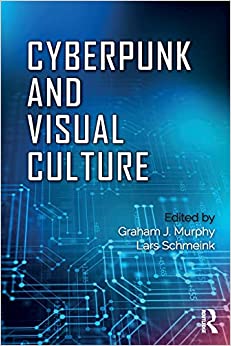
Graham J. Murphy and Lars Schmeink eds. Cyberpunk and Visual Culture. Routledge, 2018. Paperback. 326 pg. $54.95. ISBN 9781138062917.

Cyberpunk is undeniably part of our cultural fabric and has never been more visually recognizable since the 1980s than it is today. Not just a SF sub-genre craze, Cyberpunk informs contemporary technological development and lies at the heart of many mainstream realist media representations. The troubled launch of Cyberpunk 2077 (2020) catapulted ‘Cyberpunk’ into prime-time news headlines and ironically revitalized cultural awareness of the genre via the very neoliberal crunch culture that it notionally interrogates. Cyberpunk and Visual Culture, edited by Graham J. Murphy and Lars Schmeink, has in many ways only become more critically relevant, then, since its release, particularly given the pandemic’s fast-forwarding of labor and leisure into virtual spheres which have reinforced global concerns towards technological accessibility. Murphy and Schmeink’s edited collection of 15 essays commendably engages with a profusion of media formats to highlight the visual styles iconic to Cyberpunk and argue for the centrality of such aesthetic paradigms within contemporary ‘realistic’ settings. Through this targeted focus the selected chapters exhibit a coherence of thought and criticism that is often lost within other broader collections, marking this title as both an important contribution to critical debate and companion to our current Cyberpunk-inflected times.

Part I begins with the intersection between text and image in the visualization of Cyberpunk futures, extrapolating from Gibson’s iconic description of the sky being ‘the color of television, tuned to a dead channel’ as a refocusing of criticism between graphic and prose mediums. Christian Hviid Mortensen’s opening chapter astutely notes that Gibson’s vision of the future now feels anachronistic to contemporary readers, where the more common blue hue of untuned channels unwittingly inverts the original visual. Focusing on ‘gonzo-journalism’ in the graphic novel Transmetropolitan (1997-2002) Mortensen grapples with the retrofutures left behind by technological change and deploys Marshall McLuhan’s concept of the ‘anti-environment’ to demonstrate how the text’s blending of media-anachronism and media-futurism can create a space that is ‘necessary to effect needed social observation, if not social critique’ (13). Timothy Wilcox’s subsequent chapter continues this exploration through ‘failures of imagination’ via the comic book series The Surrogates (2005-2006) by shifting the focus on the materiality of Cyberpunk futures. Through a discussion of the text’s eponymous surrogate robot bodies Wilcox critically examines the importance of visualizing physical re-embodiment to reveal the everyday manners in which we encounter ourselves and others via posthuman materialities – an important consideration that is often lost within criticism amidst the emphasis on ‘cyber’ futures, but one that should equally consider the non-human and ecological consequences of such speculations. Murphy’s own chapter meanwhile provides a compelling extended study of animal representation and motifs in Boom! Studios’ comic book adaptation of Do Androids Dream of Electric Sheep (2009). Opening with an eloquent demarcation of how Do Androids is not necessarily a classic Cyberpunk text but is both influential to and of that milieu, Murphy demonstrates how the original novel and graphic adaptation define empathetic understanding via animal husbandry and cruelty – a refreshing reading of an oft-cited text that emphasizes a consideration of how Cyberpunk’s imagination impacts beyond the human. Stina Attebery and Josh Pearson follow by considering the importance of fashion and style within the table-top role-playing game Cyberpunk 2020 (1998), shifting the discussion of visuality from cyberspaces and cityscapes to the centrality of self-expression and personal image to Cyberpunk through an exploration of precarious social identities within metropolitan spaces. While this chapter illuminates an oft-overlooked aspect of the field, there is only a brief engagement with the text’s concerning conflation of bodily modification with a ‘humanity cost’ (that causes anti-social behavior) which would have benefitted from a more nuanced consideration and additional reflection of the capitalist driven generation of fashion waste. Paweł Frelik concludes the section by examining the interplay between light and Cyberpunk visions of the future. Astutely noting that many SF texts are predicated on a future of energy abundance, Frelik demonstrates how the ‘near-absolute absence’ of any explanation of such plenitude ‘rings loud’ from a contemporary perspective (94). Focusing on a variety of textual media, the chapter emphasizes how light’s integral presence to Cyberpunk aesthetics is not only a retrofuturistic imagination of outdated neon technology but also emblematic of the genre’s complicated relationship to contemporaneous social-political tensions.

Part II explores virtual and visual terrains, tracing developments of both the digital gaze and rendering of cyberspaces. Christopher McGunnigle begins with the cyborg posthuman body in the RoboCop franchise through an examination of the titular character’s digitally overlaid sight as a form of ‘subjective shot’ (107). Moving from a consideration of the ‘male’ to ‘cyborg’ gaze, McGunnigle examines how the series challenges traditional conceptions of hypermasculinity and disembodiment to configure and reclaim human subjectivity in symbiosis with cybernetics. The discussion crucially avoids tackling who programs and controls such a gaze, however, which given historic discriminatory practices around face ID recognition underscores the necessity of understanding the biases that underpin algorithmic sight. Ryan J. Cox’s subsequent chapter meanwhile provides a detailed analysis of Makoto Kusanagi within the Ghost in the Shell film (1995) and Stand Alone Complex anime series (2002-2005). Contrary to early hacker idealism towards cyberspace being free from the trappings of embodied prejudice and persecution, Cox astutely demonstrates how Kusanagi is a far cry from disembodied freedom and is rather subject to and a participant of meat space ideologies. Kusanagi’s own repeated inhabitation of bodies with similar physical characters then is ‘not an attempt to seal the rupture between ghost and shell, it is an act of self definition’ (136) that affirms the centrality of the body to enduring paradigms of self-expression. Mark R. Johnson’s following chapter explores historic visualizations of cyberspace within video games, poignantly noting that such landscapes represent fundamentally digital objects—data comprised of zeros and ones—through human visual paradigms. Focusing on the utilization of space, color and shape within various depictions, Johnson moves from early grid-based systems to more contemporary avatar renderings in a study that highlights a lack of creative re-imagining towards virtual spheres. The discussion itself however is predominantly descriptive and limited in scope, particularly as the chapter could have formed the foundation for a more convincing argument towards the potential of revitalizing how humanity visualizes and encounters cyberspace. Stephen Joyce’s chapter, however, complements the previous discussion by focusing on the potential of video games to replicate Cyberpunk agentic tensions between gameplay freedom and narrative control in the Deus Ex (2000-2016) franchise with a specific focus on Deus Ex: Human Revolution (2011). Joyce argues that the players’ navigation of the game as a form of cyberspace encourages their immediate immersion within transhumanist values and demonstrates not only the medium’s reflection of contemporary social-technological debates but also the ‘cost’ of such capitalist driven depictions, where ‘the “free choice” of transhumanism is never as free as it seems’ (167). Cyberpunk video game’s potential for capitalist critique therefore stems from a fault that ‘lies not in the medium but in ourselves’ (171), where nuanced criticism of the processes that have led to deregulated market control are more effective than arguments towards nebulous concepts without any proposed alternative. Jenna Ng and Jamie Macdonald close Part II by focusing on a distinctly recognizable ‘cyber’ future in the video game Watch Dogs (2015) where all electronic devices are connected to the ctOS (Central Operating System) surveillance-state metropolitan network. Shifting from traditional discussions of jacking into cyberspace, the authors demonstrate how contemporary data-driven systems represent an entwinement of virtual and ‘real’ spaces, one that the game’s hacker-protagonist Aiden utilizes to subvert the ctOS system and forge his own sense of urban agency. This discussion however avoids directly challenging the rather simplistic representation at the heart of Watch Dogs hacktivism, where Aiden is seemingly able to control the cityscape and freely access central databases in a manner that is divorced from contemporary practice.

Part III draws the collection to a close by focusing on Cyberpunk as a form of SF realism, where visions of the future reflect more upon the contemporary moment than any distant possibility. Evan Torner shifts the discussion away from American and Japanese stereotypes by introducing two often overlooked examples of German Cyberpunk films – Kamikaze 1989 (1982) and Nuclearvision (1982) – which resonate with the concerns articulated elsewhere in the collection. Torner demonstrates how the deeply pessimistic tone of both films, particularly within their late cold war context, offers a moral and ethical ambiguity that is frequently lacking in Hollywood depictions, where glamourous and gritty portrayals of technological liberation or servitude will often depend upon the audience’s own socio-political views in a manner that fails to query ‘whose interests are supported by which technologies’ (210, original emphasis). The danger therefore lies in systems that are notionally beyond self-reflective critique, causing Torner to ask, in a very meta-cyberpunk manner, ‘what makes the white western male incapable of grappling with these systems of his own creation’ (209). Mark Bould’s following chapter further critiques the anglophonic bias of mainstream Cyberpunk media through both the genre’s blindness and marginalization of African people, Africa and its diaspora. While Bould notes that aspects of his cited examples may ‘look very familiar to western eyes’ (231)—as shown via the work of Nadia El Fani, Sylvestre Amoussou, Jean-Pierre Bekolo and particularly the Holloywood-esque spectacle of Neil Blomkamp’s cinematography—his movement between the molar and molecular scales pinpoints how ‘they use those pieces to play an often different game’ (231). He poignantly concludes that ‘no matter how things fall apart, the center will find ways to hold’ (231), and when we consider that this ‘center’ not only represents colonizing hegemony but equally deracinated global corporations then the impetus of such a critique is not only urgent but globally relevant. Anna McFarlane’s following chapter returns to the blurring between representation and reality through Katherine Bigelow’s Strange Days (1995) and Zero Dark Thirty (2012), persuasively arguing that the latter may not appear as a traditional Cyberpunk film but does undeniably return to thematic and cinematographic aspects that are central to the director’s wider work. For McFarlane both films are positioned either side of the epochal millennial shift, where Strange Days sees the future as something potentially horrifying and wonderous while the ‘post’ 9/11 response at the heart of Zero Dark Thirty struggles with the prospect of an optimistic future. The different reflections of virtual reality, surveillance monitoring, remote viewing and the tone central to both films crucially returns to the increasing manners in which the contemporary moment is both visualized and represented via Cyberpunk motifs. Sherryl Vint expands upon this notion in an excellent chapter that explores the fusing, or collapsing, of material and virtual environments in a range of military-sf films that continually align warfare with digital game culture. As Vint notes, the audience’s perceived ability to differentiate what is real from representation lies in our expectation of what cyber-, military and game space should look like, where the inversion of topographical expectations in such films as Ender’s Game (2013) and Source Code (2011) reinforces technological and ethical concerns around being unable to distinguish artifice from authenticity. From this Vint draws connections to contemporary remote warfare in the film Good Kill (2014) by illustrating how drone combat physicalizes such an anxiety in contemporary terms and thus underscores the importance of sf critical studies to a cultural appreciation of a present built upon Cyberpunk visualizations. Schmeink draws the collection to a close with an afterword that appropriately focuses on counter visuality and Cyberpunk’s fundamental relationship of seeing and being seen within cities, cyberspaces and posthumanism.

While some chapters are more persuasive in their cultural and critical argumentation than others, the writing throughout is consistently engaging, making it accessible to Cyberpunk novices or enthusiasts and is a testament to the rigorous work of the editors. Far from treading pre-established ground, Cyberpunk and Visual Culture proves the enduring relevance of Cyberpunk visuality to understanding the ‘reality’ that surrounds us daily. Certainly, it would have been productive to see further discussions of texts more contemporaneous to the book’s release—as only a handful of chapters discuss media released in the early to mid-2010s—but this title is undeniably an excellent guide to our constantly developing cyberpunk present and will surely be a steadfast companion for those who look to take this research further.

Kerry Dodd completed his PhD at Lancaster University, UK. His thesis, entitled “The Archaeological Weird: Excavating the Non-human,” examined the intersection between archaeology and Weird fiction. Focusing on the cultural production of the artefact encounter, his thesis explored how archaeological framings can offer a re-conceptualization of object ontology through the Weird. He is currently working on a monograph that explores the representation of materiality and objects in archaeological fiction. Kerry also works more widely in the fields of Science Fiction (particularly Cosmic Horror and Cyberpunk), the Gothic, and glitch aesthetics.


Review of The Routledge Companion to Cyberpunk Culture


SFRA Review, vol. 52, no. 1

Nonfiction Reviews


Review of The Routledge Companion to Cyberpunk Culture

Michael Pitts

McFarlane, Anna, Graham J. Murphy, and Lars Schmeink, editors. The Routledge Companion to Cyberpunk Culture. Routledge, Taylor & Francis Group, 2020. Hardcover. 474 pg. $225.40. ISBN  9780815351931.

The Routledge Companion to Cyberpunk Culture, edited by Anna McFarlane, Graham J. Murphy, and Lars Schmeink, aims broadly, as outlined in the text’s introduction, “to track cyberpunk’s diversity and far-reaching influence” (xx). Made up of contributions from more than fifty scholars, the sizable anthology is divided into key three sections: Cultural Texts, Cultural Theory, and Cultural Locales. The first section is made up of traditional analyses of the cinematic and literary roots of cyberpunk and notably replaces examinations of typical works such as Neuromancer (1984) and Blade Runner (1982) with other texts such as Pat Cadigan’s Synners (1991) and Charles Stross’s Accelerando (2005). Containing theoretical assessments of disparate topics such as identity, ecology, class, and political power, the second section of the anthology, Cultural Theory, explores cyberpunk through the lenses of diverse theoretical frameworks including queer theory, Afrofuturism, and feminism. The final segment, Cultural Locales, complicates assumptions that cyberpunk is an Anglo-American mode constructed through the appropriation of other cultures’ imagery and tropes. As this companion emphasizes, cyberpunk, though perhaps initially a North American phenomenon, has manifested in pivotal ways within various polities. The essays making up Cultural Locales examine these cultural manifestations of cyberpunk and their relationships to the complex systems operating within and influencing these societies. This anthology is a valuable resource due to its close examinations of cinematic and literary manifestations of cyberpunk and for its analyses of identity and the political actions of cyberpunk media in relation to discussions of governing power, ecologies, and class. It is additionally pivotal due to the questions it raises about cyberpunk as a global phenomenon that reflects and shapes our understanding of living in the 21st century (xx).

This companion continues the work of scholars interested in cyberpunk as a method for better understanding contemporary life. Unique to this collection is its emphasis upon cyberpunk as not simply a genre of writing but instead “a cultural formation, a means of engaging with our 21st-century technocultural age” (xx). Recognizing the limitations of treating this phenomenon as a mere literary school, Anna McFarlane, Graham J. Murphy, and Lars Schmeink construct a broader framework for their collection and therefore widen discussions concerning the relationship between cyberpunk and contemporary culture. Since Bruce Bethke initially utilized the term in his short story “Cyberpunk,” published in a 1983 issue of Amazing, and Bruce Sterling edited an influential collection of fiction under this classification, Mirrorshades: The Cyberpunk Anthology (1988), cyberpunk scholarship has flourished but maintained a predominant focus upon literary and cinematic generic functions. Larry McCaffery’s edited collection Storming the Reality Studio: A Casebook of Cyberpunk & Postmodern Science Fiction (1992), for example, drew together the fiction of contemporary writers and the critical commentaries of scholars to diagnose cyberpunk as the quintessential postmodern literary form through which writers use the resources of a fragmentary culture to comment on how technology shapes modern life. While subsequent major collections such as The Cambridge Companion to Science Fiction (2003) and The Oxford Handbook of Science Fiction (2014) contain minor sections focused upon cyberpunk, The Routledge Companion to Cyberpunk Culture is a significant resource for scholars due both to its predominant focus upon this cultural formation and its recognition of cyberpunk’s influence and presence outside literary and cinematic borders.

Emphasizing such a far-reaching impact and manifestation of cyberpunk, this anthology is best suited for scholars seeking a helpful companion for undergraduate courses focused on this topic or emerging scholars desiring a guiding resource through this cultural terrain. Moving beyond the most influential cyberpunk texts, it provides a broader understanding of how cyberpunk permeates disparate genres and media including video games, music, fashion, role-playing games, manga and anime, comic books, novels, and films and therefore enables scholars to re-envision cyberpunk as not merely a North American genre of speculative fiction but instead in a more accurate sense as a global response to late capitalism. This companion additionally provides theoretical tools for young scholars and students seeking to better understand how to interrogate cyberpunk as a tool for negotiating a complex, technocultural age. By providing key critical works utilizing various theoretical foundations including feminist, race, and queer frameworks, this anthology acts as an ideal tool for young scholars and students seeking an entry point into discussions surrounding this cultural formation and its commentary on identity in 21st-century societies. Though a somewhat limited resource for advanced scholars versed in the history, theoretical apparatus, and cultural products of cyberpunk, The Routledge Companion to Cyberpunk is a valuable collection for developing scholars seeking a broad understanding of this cultural phenomenon.

Michael Pitts is assistant professor at the University of South Bohemia. He specializes in masculinity studies, queer theory, SF studies, and utopian studies. His articles have been published in Extrapolation and The European Journal of American Studies and his first monograph, Alternative Masculinities in Feminist Speculative Fiction: A New Man, was published by Lexington Books in 2021. 


Review of Tolkien’s Cosmology: Divine Being and Middle-earth


SFRA Review, vol. 52, no. 1

Nonfiction Reviews


Review of Tolkien’s Cosmology: Divine Being and Middle-earth

Adam McLain

Sam McBride. Tolkien’s Cosmology: Divine Being and Middle-earth. Kent State UP, 2020. Hardcover. 304 pg. $55.00. ISBN 9781606353967.

Many books on J. R. R. Tolkien and religion focus on the religion of the man himself. They attempt to piece together how Tolkien’s Catholicism and Christian faith are interwoven into his text, seeing Christianity as a driving force of the books or as intricately hidden within the hundreds of pages of drafts, published texts, and notes Tolkien left. Instead of approaching Tolkien’s work as representative of Tolkien’s personal religion, Tolkien’s Cosmology seeks to understand the religion within the texts as religion itself rather than representative of another. McBride takes upon himself a large and daunting task of describing not only the cosmos of Tolkien’s universe but also how that cosmos involves itself with the machinations of Tolkien’s terrestrial world. In this explanation, McBride finds himself grappling with a large pantheon of gods, an author’s deft touch on a text to allow divine intervention, and soteriological and eschatological questions answered in primary and extraneous texts. As an approach to the cosmology, this text provides a stunning grasp of the complexities and vastness of Tolkien’s texts, while allowing for newcomers to this vast universe to be welcomed into its wide depths.

McBride uses his text to provide descriptive analysis of Tolkien’s mythology. Throughout much of the text, McBride describes, outlines, and summarizes the pantheon of gods (including Eru Ilúvatar, the supreme deity, and the pantheon of gods and minor deities), the genesis of creation, the divine intervention of the gods throughout Arda’s history, and the eucatastrophe of the end to the world. For example, in describing the understanding of deity in Arda, McBride coins the term polytheistic monotheism: worshipping one ultra-deity (Eru), while also engaging with, believing in, and praying to minor deities, who at times can supersede the ultra-deity in the centrality of worship from lower beings. This term helps McBride explain how, throughout its history, the divine influence on the world can be seen not just through Eru’s machinations but also through the efforts of other deities who can be believed to be the singular God or one of many gods, depending on the person or people who are worshipping (chapters 1 through 4 deal with explaining and expanding how polytheistic monotheism influences Tolkien’s universe). Additionally, McBride delves into and examines the themes of evil (chapter 5), death (chapter 6), and the end of the world (chapter 7), three topics that religion, generally, should be able to at least address. In these examinations, McBride shows his argumentative finesse, engaging with scholars who have attempted to examine these topics and using his new framework—a cosmology scaffolded by all the works of Tolkien—to show the differences a new view makes.

To approach Tolkien’s oeuvre, a scholar must decide how to incorporate the copious extant notes and drafts. While many scholars of Tolkien have approached his work as developing across the course of his writings, McBride chooses to engage with Tolkien’s work in its totality. Instead of tracing the chronological development of ideas, McBride unites all of the ideas, from notes to early drafts, to envision a cohesive cosmology, mythology, and theology throughout Tolkien’s work. This effort helps McBride build a pantheon for the books themselves, writing an in-universe revelation of what could be; however, it stifles the understanding of Tolkien’s books as Tolkien’s creation. Instead, in forming this cosmology, McBride almost becomes coauthor with Tolkien, not necessarily exegetically or eisegetically engaging with the world but rather working with Tolkien to form an understandable cosmology.

Although McBride’s book’s genesis comes from Tolkien’s assertion that The Hobbit (1937), The Lord of the Rings (1954/1955), and The Silmarillion (1977) contain and discuss religion, McBride spends little time problematizing or recognizing the fraught history of the term and the study of it. Indeed, he simply says there is religion and continues forward into a descriptive analysis of the deities and their interactions with the world. As a result, scholars of religion have a foundation in McBride’s book upon which to understand fantastical and created religions, while also using Tolkien’s work to further the study of religion. Tolkien’s Cosmology, then, can be seen as laying a good groundwork for many future articles and books on the subject.

This robust description and analysis of Tolkien’s cosmology will aid any Tolkien researcher and scholar of fantasy literature in approaching not only his work as a whole and his entire created world but also any other attempt by authors at worldbuilding. Indeed, McBride’s engagement with not only the published source material but Tolkien’s archive of notes and drafts provides insight into the mind of one of the twentieth century’s greatest creators. His astute analysis, humbled through awareness of his different methodology, provides grounds on which the novice and experienced author can discover new things about Tolkien’s work. McBride’s text is meant to be one that supports wandering without getting lost.

Adam McLain researches and writes on dystopian literature, legal theory, and sexual ethics. He is currently a Harvard Frank Knox Traveling Fellow, studying twentieth-century dystopian literature and the legal history of sexual violence in the UK. He has a bachelor’s degree in English from Brigham Young University and a master of theological studies from Harvard Divinity School.


From the President


SFRA Review, vol. 51, no. 4

From the SFRA Executive Committee


From the President

Gerry Canavan
Marquette University


Thanks so much to everyone who participated in the elections, and thanks to Ida Yoshinaga and Jessica FitzPatrick for taking on new leadership roles on the executive! Thanks also to everyone who worked on and voted to support the new bylaws, which will take effect over the course of the next year and allow the organization to evolve in ways that I believe will be to the benefit of us all (including the election of new “at large” members to the executive board and the establishment of a standing conference committee). Thanks also to Sonja Fritzsche and Hugh O’Connell, who will be rotating off the executive at the end of the year; your work has been so important and vital in these very challenging years for the organization and I want you to know how grateful I am to both of you for stepping up as you have on behalf of the group.

I hope by now you’ve seen the teaser for SFRA 2022, which will be headed up by Bodhisattva Chattopadhyay of the University of Oslo in collaboration with the CoFutures research group and the “Theory from the Margins” project. (If you haven’t seen it, it’s here: https://twitter.com/co_futures/status/1446007301148659713). The full CFP will be out soon. I could not be more excited about this opportunity for SFRA; the Theory from the Margins group has a staggering global reach and can put our collective in conversation with people we haven’t begun to dialogue with yet. We will have to bring our A games to Oslo.

A quick technical note: Membership renewals will be turned off the SFRA site beginning Monday, November 1 in prepared for our migration off Wild Apricot to a new host. More on this as it develops!

As always, please reach out to me or to Sonja Fritzsche with any calls for papers, conference announcements, special issues of journals, and more that you’d like us to promote; I’m very happy to put work from SFRA members in front of as many eyes as we can manage. I can be contacted at gerry.canavan@marquette.edu or via the @SFRANews Twitter. Stay safe and I hope you have a terrific end to the semester, and I look forward to when we can all meet again in person soon.

Introduction: Composing Trans-Indigenous Futures


SFRA Review, vol. 51, no. 4

Trans-Indigenous Futurisms


Introduction: Composing Trans-Indigenous Futures

Jeremy M. Carnes

I still remember, early in my Ph.D. program, when a colleague mentioned the collection Walking the Clouds: An Anthology of Indigenous Science Fiction, edited by Grace L. Dillon (Anishinaabe). This collection was my own first real foray into the world of Indigenous sf. It was the first time I considered “the excitement and depth of Indigenous futurisms—the responsibility of each moment, each fold, each time, imagined or not, because each imagined moment contains within it already our presence, not our absence. The visibility of Indigenous space-time creates an event horizon we can all slip into, a responsibility we all share” (Dillon 239). In so many ways, Indigenous sf has built around that same activist call so popular in the Idle No More and #NoDAPL movements, “We are still here.” Indigenous sf is inherently anti-colonial in the assumption that Indigenous peoples are and will continue to be a part of the future, as opposed to colonial notions of their disappearance.

Thus, as indicated by its anti-colonial nature, Indigenous sf is inherently different from sf in the Euro-American tradition. As Dillon notes, “Writers of Indigenous futurisms sometimes intentionally experiment with, sometimes intentionally dislodge, sometimes merely accompany, but invariably change the perimeters of sf” (3). Indeed, notions central to Euro-American sf are distinct experiences within Indigenous worldviews, from relations between human and other-than-human beings, to temporalities and spatialities, to technologies and that ever-problematic specter of “progress.” Indigenous sf pushes at the boundaries of the possible in the past, present, and the future; it alternatively considers connection through time, space, and technology; it reconsiders the structures of oppression stemming from settler colonialism and capitalism. But perhaps more than anything it considers the question posed by Joshua Whitehead: “What better way to imagine survivability than to think about how we may flourish into being joyously animated rather than merely alive?” (11).

From Cherie Dimaline’s (Métis) The Marrow Thieves, a story about connection and the power of one’s language in a future that looks so much like the past, to Claire G. Coleman’s (Wirlomin Noongar) Terra Nullius, a tale that extends the label of victim in order to rethink settler colonialism and its attendant labels, to Daniel H. Wilson’s (Cherokee) Robopocalypse, a story that reconsiders the affordances of technological advancement as well as its many dangers, Indigenous sf is continually pushing and prodding our expectations and considerations of the generic underpinnings of sf itself. In many ways then, Indigenous sf embodies Mohawk scholar Audra Simpson’s conceptualization of “refusal,” which she defines as “a political alternative to ‘recognition,’ the much sought-after and presumed ‘good’ of multicultural politics” (11). Rather than stories that remain palatable to settler readers, Indigenous authors enshrine political Sovereignty for Indigenous communities, an inherent right that outlasts the seemingly indestructible towers of the settler colonial fortress. Even in the face of further oppression, as in Dimaline’s novel, Indigenous authors understand “that as long as there are dreamers left, there will never be want of a dream;” they consider “just what we would do for each other, just what we would do for the ebb and pull of the dream, the bigger dream that [holds] us all” (231).

This special symposium, titled “Trans-Indigenous Futurity,” draws on the seminal work of Grace Dillon as well as Indigenous literary scholar Chadwick Allen (Chickasaw) to consider sf and futurities across. For Allen, trans-Indigenous scholarship is about “purposeful Indigenous juxtapositions” which help “develop a version of Indigenous literary studies that locates itself firmly in the specificity of the Indigenous local while remaining always cognizant of the complexity of the relevant Indigenous global” (xix). One of the joys of editing a special section like this one is the ways that authors take an idea and expand beyond what I could ever have imagined. The trans of trans-Indigenous comes to mean beyond the spatial and the temporal, the familial or ancestral, the (para)normal, the ontological, the epistemological. Perhaps I shouldn’t be surprised. Allen notes the possibility of this prefix, trans, when he writes, “trans-Indigenous may be able to bear the complex, contingent asymmetry and the potential risks of unequal encounters borne by the preposition across. It may be  able to indicate the specific agency and situated momentum carried by the preposition through. It may be able to harbor the potential of change as both transitive and intransitive verb, and as both noun and adjective” (xiv-xv). While I came into this issue expecting to consider the relationality between the global and the local, the authors of these essays have pushed my own thoughts, and the scholarship of Indigenous sf and futurity, further.

I consider the contributions of this symposium in three interrelated sections. Works in this first section focus on the way Indigenous futurities are always defined by the present and relationships to the past. These contributions reflect on the legacy of boarding schools in the United States and Canada, paying particular attention to the ways past events can help us re-evaluate the work possible through sf. In Melissa Michal’s short story “Ghost Hunt” and reflective essay “On Writing Ghost Hunt and Preparing My Own Spirit,” we come face-to-face with this palpable and sordid history of residential schools or boarding schools, which focused on the violent assimilation and “re-education” of Indigenous children. Michal’s story, written before the devastating news of unmarked mass graves found at Kamloops Residential School, St. Eugene’s Mission School, and Marieval Indian Residential School, examines what it might be like to encounter the spirits of children like these. Through a futuristic story about friendship and connection, even across the boundary of life, Michal reminds us, “The system isn’t made for our healthy passage through education. It was and is still made for our demise.” E. Ornelas’s contribution, in similar fashion to Michal’s, considers the history of boarding schools through the specific story of Louis Ornelas, the author’s grandfather and survivor of the Sherman Institute located in Riverside, California. In working through this history, one not shared by their grandfather, Ornelas considers an experience of disassociation as associating with her grandfather’s story through what Dillon, among others, calls Native slipstream. According to Dillon, Native slipstream “views time as pasts, presents, and futures that flow together like currents in a navigable stream. It thus replicates nonlinear thinking about space-time” (3). For Ornelas, then, chrononormativity is an understanding of temporality that does not, indeed cannot, contain or explain Indigenous communities and ancestries. Native slipstream, then, becomes a form of methodology for Ornelas, rather than just a subgenre of Indigenous sf.

The second section of this symposium, containing a single essay by Nicole Ku’uleinapuananiolikowapuhimelemeleolani Furtado, considers the ways the past affects our relationship to the present through the continuities of violence in settler colonialism.  Furtado’s contribution analyzes Christopher Hakunahana’s film Waikiki as an example of what scholar Lawrence Gross calls Post-Apocalyptic Stress Syndrome. Furtado follows Dillon in noting that the apocalypse is not a coming event in the future, but an event past and present for Native communities. The apocalypse has already happened, is already happening (Dillon 8). The structure of settler colonialism is itself the structure of the apocalypse for Indigenous peoples the world over. Furtado contends that Waikiki highlights the colonial reality of Hawaiʻi obscured by the tourist imaginary of “paradise.” The end of worlds through the settler colonial machine embeds cycles of trauma, alcoholism, homelessness, and violence within Native Hawaiian communities. As such, the future of the apocalypse, the futurity of sf, is also contained within the present of Indigenous sf.

The third and final section of essays for this symposium is comprised of essays that explore stories of the future, which can help us to understand the pasts and presents. These contributions examine place, language, epistemology, and the Anthropocene in order to highlight the stories of present and future joy, hope, love, connection, community, and kinship. Malou Brouwer and Camille Roberge offer a particularly trans-Indigenous methodological approach in their consideration of Wapke, an sf collection of stories by Indigenous authors writing in French. They rightly argue that a collection like Wapke is itself trans-Indigenous in the juxtapositions of various Indigenous communities, yet Brouwer and Roberge are particularly interested in the interplay these juxtapositions have on the local relationships between Indigenous languages and French as well as Indigenous considerations of the temporal contra settler ones. By privileging these juxtapositions of the collection, Brouwer and Roberge show the ways that these stories “build tomorrows rooted in Indigenous resurgence by creating alternative temporalities and reflecting on linguistic diversity.”

For Kelsey Lee, studying speculative fiction from Indigenous communities is incomplete without including work by and about the arctic, which she argues is a landscape often incorrectly viewed and valued by settler sf authors. Lee examines two texts—Moon of the Crusted Snow by Waubgeshig Rice (Wasauksing Nation) and “Wheetago War II: Summoners” by Richard Van Camp (Tłıchǫ Nation)—noting the ways the landscape in these stories functions different from novels like Mary Shelley’s Frankenstsein. Rather than the arctic landscape operating as villain or antagonist in these texts, the horror is and always will be the settler colonial mentality at work in settlers and their desire, sometimes implicit and sometimes not, for the erasure or death of Indigenous bodies, communities, and lifeways. Whether post-apocalyptic or not, the beast, the monster is the one that has been here for 500 years.

In his essay, Jesse Cohn considers the very definitional fabric of sf and Indigenous sf by returning to an influential definition by Darko Suvin that focuses on the “interaction of estrangement and cognition” in a setting “alternative to the author’s empirical environment.” Cohn notes the subjectivity of Suvin’s definitional moves, a subjectivity that becomes even more pronounced when considering the markedly different relationship Indigenous communities have to the genre conventions and markers of sf. Examining what he calls “rhetorics of incredulity” and “rhetorics of believing,” Cohn argues that Indigenous sf is itself a multifaceted genre that has within itself various approaches to considering story and futurity, among other things. Perhaps, then, the trans-Indigenous is also, as Allen notes, about considering genre across these differences.

Finally, Abdenour Bouich offers a trans-Indigenous reading of two novels: Joseph Bruchac’s (Abenaki) Killer of Enemies and The Interrogation of Ashala Wolf by  Ambelin Kwaymullina (Palyku). Bouich first analyzes each text to highlight the ways these authors conceptualize a future defined by disconnection between humans, other-than-humans, and the land. Bouich then considers the ways that these authors, within the bleak societies of their respective post-apocalyptic futures, construct visions of possibility for Indigenous communities and ways of knowing, which have, especially since the onset of colonialism, privileged ways of seeing beyond the “end of the world.” In one way then, we can consider these novels within our current epoch of the Anthropocene as indications of the importance of attending to Indigenous knowledges and forms of relationality between humans, other-than-humans, and the land.

These essays, when taken together, highlight the complexities of temporality, relationality, the arc of settler colonialism, and the tradition of resistance in Indigenous sf. Ancestors of Indigenous communities are always present, even in their pastness, teaching, affecting, speaking and resisting; under the veins of capitalist “beautification” there are sinister layers of mire and muck defined by violence, poverty, and settler oppression in areas like the “paradise” of Hawaiʻi; and the future is something worth considering, not just for the potentialities of decolonial moves, but for the returns to Indigenous knowledges and lifeways crucial to a future beyond the end. The texts examined here, and the essays themselves, show that Indigenous authors composing Indigenous futures is about composing the then, the now, and the yet-to-come in one bundle, offering it up as a gift to ancestors, to relations, and to descendants. For, as Thomas King (Cherokee), writes, “The truth about stories is that that’s all we are” (2).

WORKS CITED

Allen, Chadwick. Trans-Indigenous: Methodologies for Global Native Literary Studies. University of Minnesota Press, 2012.

Dillon, Grace L., editor. Walking the Clouds: An Anthology of Indigenous Science Fiction. The University of Arizona Press, 2012.

Dimeline, Cherie. The Marrow Thieves. Cormorant Books, 2017.

King, Thomas. The Truth About Stories: A Native Narrative. University of Minnesota Press, 2003.

Simpson, Audra. Mohawk Interruptus: Political Life Across the Borders of Settler States. Duke University Press, 2014.

Whitehead, Joshua, editor. Love After the End: An Anthology of Two-Spirit and Indigiqueer Speculative Fiction. Arsenal Pulp, 2020.

Jeremy M. Carnes (he/his) is a settler scholar and Visiting Lecturer in the Department of Writing and Rhetoric at the University of Central Florida. His research is focused in Indigenous studies and comics studies. He is an associate editor for SFRA Review and reviews editor for Studies in American Indian Literatures. He is co-editing a collection titled The Futures of Cartoons Past: The Cultural Politics of X-Men: The Animated Series and is currently at work on his first book on comics by Indigenous creators and the affordances of comics as a visual medium for considering land-based practices by Indigenous communities.


“Papa and the Steam Rifle”


Papa and the Steam Rifle

Suzanne Church and Stephen Kotowych


Papa promised to design and build me a steam rifle for my eleventh birthday. One that would fire straighter and farther than the gunpowder rifles my friends received for their eleventh birthdays. 

“You will carry the best possible weapon in your hands.”

I smiled up at him. “Merci, Papa.”

“My Georges deserves the best, the moment he becomes a man, oui?”

Oui, Papa.”

“Since the English attacked us over the Montréal Question, all able men must be prepared.”

I nodded, but kept my fears to myself. I was less enthusiastic than my older brother, Rollan, to go to war. News of the Question had spread to our corner of Quebec. The airship factories in Quebec’s largest city had joined the underground revolution, secretly shipping parts to the United Kingdom’s great enemy, the German-Boer Alliance. 

While the Anglos in Canada welcomed the United Kingdom’s fight against the Alliance, we Quebecois felt only sympathy for them in their struggle against Queen Victoria and the forces of her empire. Once the Dominion of Canada’s answer to the Montréal Question became clear—our troops massed on the Ontario border, Her Majesty’s Navy blockading le Fleuve Saint-Laurent and staged troops in New Brunswick for invasion—partisan groups soon sprang up to defend us, declaring alliance with the German-Boers, and demanding a Quebec free from the self-centered English-speaking conservatives.

The Anglos in Montréal fled west to Ottawa, or south to Vermont as refugees, fearing reprisals and the inevitable bombardment by the Royal Navy.

The previous Saturday afternoon, I witnessed Papa’s first test of my rifle. The bullet shot out of the barrel in a spectacular explosion of steam and lead. I stood with my mouth open and Papa took the Lord’s name in vain. In a good way, of course, he dared not incur Maman’s wrath.

The re-charge cycle took slightly more than two seconds, but I could fire up to twelve times before the pressure dropped too low for the gun to function. So many rabbits and foxes would come home as meat because of the quality of my weapon. Like Papa, I would bring food to our table. My steam rifle would keep us fed, as men were meant to do.

Venez ici,” Maman shouted from the front porch. “Dinner, Georges.” Then she coughed. And coughed.

I wished that she wouldn’t yell. Too many times she struggled to find her breath afterwards.

Oui, Maman,” I shouted, hurrying to her side, and offering my handkerchief. She smiled and waved her own, which was always stained with her blood, no matter how many times she washed it in the large pot on the stove.

“Papa?” she managed to ask between coughs.

“He’s almost done for today. The rifle is nearly finished.”

She shook her head, but said no more. So many women scoffed at guns, as though men treated them as toys rather than tools. How else did she expect our family to eat?

Papa washed up, sat at the table, and Maman spoke her thanks to God.

We all looked up, and Papa said, “I’ve a mind to make a steam hand-pistol as well.”

“No!” Maman’s eyes blazed. “The boy is too young for such nonsense.”

“Not for Georges.” Papa devoured a huge mouthful of stew before he continued. “For Rollan. The design is nearly identical, save for the barrel’s length.”

Maman made the sign of the cross. “Rollan, bless his soul, must have no more excuses to die.”

“The British rushed to land their ships in Nova Scotia and New Brunswick,” said Papa. “They made a huge error. If our forces don’t dispatch them by Christmas, then les patriotes will bring airships from Montreal to finish them before Rollan is truly in peril.”

“Unless the Americans choose a side.” Maman coughed again and said no more.

I stared at Rollan’s empty chair, amazed at the changes to our dinner table since he’d left us.

Rollan wouldn’t be eighteen for three more weeks, but that was old enough for les patriotes, who enrolled him in basic instruction without a second thought. That way, he could join his compatriots on the train to New Brunswick on his birthday.

Maman noticed me staring at Rollan’s place, and said, “We all miss your brother. But God will watch over him.” She made the sign of the cross again and whispered a prayer.

She hadn’t been well these past weeks, so she’d missed the honor of sewing Madame Moussa’s party dress for the November festival. It was strange, seeing her at the dinner table without her stitching an arm’s length away. Madame had engaged the services of Maman’s rival seamstress, Agathe Travail, instead. We would miss the pennies. And our thin stew tonight spoke the truth of our misfortune.

Agathe’s son, Francois, was in my grade, his birthday the same day as my own. His father had already purchased a gunpowder rifle for Francois, and he’d brought it to the schoolhouse, two days before, hidden inside his long wool coat, to show it off behind the coal shed before our teacher rang the morning bell.

Francois’s rifle fired true, but the calibration was a little off and he was forced to repeatedly re-adjust his targeting. I would spend more time picking up the rabbits I’d hit than I would adjusting my aim. After Papa finished tinkering with the trigger action, of course. He didn’t want me blowing off a finger because the design had been rushed.

“My steam rifle is more precise,” I’d boasted to Francois that morning.

My friend had shaken his head, and said, “The tanks for steam guns are noisy and heavy.”

“But the weapons are more accurate.”

“They’re cumbersome and unreliable.”

“No, they aren’t.”

“Then why don’t les patriotes use them? Such weapons could give us the edge against the British Empire and their Anglo supporters here.”

Such questions had been debated in our household many an evening before Rollan left. The smoke from the tiny steam engine could give away one’s location, if one was trying to hide from attack, Rollan argued. Yes, but the engine need only be engaged once the steam reservoir emptied, my father would counter. The whistling was loud but so was the explosion from any gunpowder rifle, I offered once, earning a smile and tousle of my hair from Papa.

So many times, I’d wished I’d paid more attention to Papa’s explanations about his steam micro-engine’s design. It seemed near impossible to produce steam in such a tiny chamber, and store it under enough pressure to shoot a bullet out the barrel. And yet Papa could manipulate the tiny parts, assembling them in the right fashion with care and love.

Perhaps his love was the underlying reason why the guns could not be produced in large numbers. Too many men would rush the job, and then, of course, fingers would be lost. Or worse.

My papa was a genius. I licked the stew drippings from my plate, wiped my mouth, and defended his work. “Both Rollan and I will be invincible with our new weapons at hand.”

“Unstoppable, at best,” Maman corrected. “None of us are invincible. We all die, don’t we?” She coughed after that, so hard and for so long that her handkerchief was soaked with her blood.

“Rest, Maman,” I told her, nudging at her elbow in the manner that made her smile. I relished her joy, especially as her health deteriorated. The thought of losing my mother made my throat close and my heart ache.

I felt close to crying, but men didn’t cry. I had only days until I became one.

Maman’s cough would never improve. One of her last wishes was for the town elders to hurry and build a Catholic Church in Mégantic, so she might be put to rest in consecrated soil. Our small town, south of Québec City, had only been founded fifteen years previously, when the CP and QC Railway junctions were completed, connecting us to Montréal and Saint John.

Maman coughed once more, bringing my attention back to our table. Papa was staring at her with more worry than he normally displayed. 

He said, “Georges, your steam rifle will be ready on Sunday for your birthday.”

“No.” Maman spoke the word quietly but with such intensity that Papa and I bit our lips. “No gun worship in the house on the Sabbath.” Again she made the sign of the cross, but said no more.

“Saturday evening, then,” said Papa. “I’ll take you to the woods myself and we’ll catch Sunday’s dinner.”

Maman smiled at the promise. Papa and I tried to contain our enthusiasm.

Dinner was turnip and squirrel pie, so light on the squirrel that it tasted sour. Or perhaps it was the flour that Maman had used to fashion the crust. Rats had gnawed and soiled our last sack of flour, down in the cellar where Papa kept Grand-Père’s locker and Maman stored her baubles for church, if she was ever able to attend a proper Mass again and resume taking regular communion.

I finished my serving and asked for seconds, knowing we might not eat again until I caught a meal. Maman showed no pleasure at my eagerness to eat, no doubt dreading my upcoming gift.

Sure enough, Papa finished his meal, excused himself, and headed out to his work shed. When he returned, he held my steam rifle in his hands, cradled inside a soft, brown cloth.

“Here she is. Joyeux anniversaire, Georges.”

Beaucoup de joie, sincère,” said Maman.

I reached out and with my heart pounding, took the steam rifle and the cleaning cloth into my hands, stroking the cloth along the barrel. “Merci beaucoup!” I could hardly contain my eagerness as I added, “Can we head out to the woods, Papa?”

He said, “Now? In the dark?”

I nodded. “We could take our packs, sleep outside. My first hunting trip. So that we might celebrate from the earliest moment of my birthday.”

Papa looked to Maman and they exchanged glances I couldn’t decipher. Finally Papa smiled and said, “Oui. A hunting expedition. But we’re to return as soon as we have enough meat for our feast. I don’t want to leave Maman for too long.”

Before either parent could change their minds, I hurried to my bed-corner to pack a roll with supplies for a night in the woods. The air felt damp with rain, and the ground was still a mixture of the green of fall grasses and the oranges, reds, and browns of autumn’s fallen leaves.

“We’ll head to the shores of Lac Mégantic,” Papa told us both. Then I heard him whisper words to Maman. Hiding in the shadows, I watched them embrace. In our small home, privacy was difficult to find, but I gave my parents what I could.

When Papa and I were ready, we headed out the door, him with his gunpowder rifle and me with my new steam one. 

The moon was low and about half-to-full, giving us enough light to walk with. My roll was heavy and burdensome, but I barely noticed, so excited to be on the cusp of my transition to adulthood. I wondered if Rollan had felt this way when he and Papa had celebrated his eleventh birthday. Rollan possessed Maman’s pious disposition and tended to keep his feelings close to his chest. I wondered what he and his fellow partisans-in-training were doing this night. 

Was he holding his own rifle tight to his chest like a lover? Did soldiers sleep outdoors or only in their hideaways? He had only sent us one letter so far and the details had been frustratingly brief:

October 20, 1899.

Soon, the New Brunswick front. I’m healthy, perhaps more than I’ve been since the summer I worked at the mill with you, Papa. They push us all hard, through the days and sometimes the nights as well. Soldiering requires a fit body and mind. Although there has been no mention of the health of our souls, Maman. I pray for you all each night.

Love and prayers, 

Rollan.

I wondered if there would still be a war when I turned eighteen. But such ponderings were dangerous, taunting the darkness of hell with the un-Christian allure of battle.Papa reminded me of the hunting rules as we walked. We must wait until we were safely beyond town limits, stick to lands without fences, and always say a Hail Mary before pulling the trigger so the soul of the animal was welcomed into His kingdom. The last rule was a sign of Papa’s love for Maman and her devotion. Papa’s parents had been more grounded, the first of their families to work at the mill and not count on farming to feed their kin.

Grand-Père, like Papa, had been so smart-minded that he tinkered and experimented when he could make the time. All of his best inventions, though, had been of little use in a logging town like Mégantic, so they remained in his trunk in our cellar. 

My mind could not stop racing, from rule to rule, story to story, Rollan to Maman to Grand-Père and back to Papa. Then my nose caught the smell of open water.

“We’re close?” I asked quietly.

Papa nodded. “We must stop speaking now, Georges. So as not to scare our prey.”

I nodded, hoisting my rifle a little higher in my grip.

We moved through a heavily forested patch, the brambles catching at our trousers, and then Papa held me back, pointing at his lips to shush me.

Up ahead, we could hear activity. A great deal more commotion than a herd of deer or warren of rabbits could produce. Papa motioned for me to crouch down, so I did, following his movements until we came close to the lake’s shoreline.

Soldiers! Hundreds of them.

I scanned their camp, eager to find a sign of Rollan, in case we’d stumbled upon one of his training exercises.

Except that my brother was miles and miles away.

Papa grabbed my arm tightly, pulling me back the way we’d come. When we’d reached the thick woods once more, we dodged this way, and that, always staying low.

Then Papa found an overhang of granite that created a small cave-like enclosure from the elements. He gestured for me to wait while he checked for trouble within. When he returned, he pulled me inside, signaled for me to set down my pack, and then spoke in hushed tones.

“Americans,” he said.

“How do you know?”

“Their uniforms. The symbols on their sleeves are not Dominion or of the Empire.”

“How could they be here?” I asked. “So far from the New Brunswick border?”

“I think the Americans have finally chosen sides, and I fear it makes them more foe than friend. War has come to our doorstep.”

My eyes opened wide with shock. Our townsmen would be caught in the middle and our soldiers were too far away to help us.

Papa said, “Did you see their airship?”

I shook my head.

“It was well hidden; the air-sacks partly packed away so that they looked like mounds of cloth. But the gondola was too distinctive to miss.” 

Papa reached out his hands, and gestured for my steam rifle. “Its range and aim is superior to my own,” he explained. “I will only fire if I must. You have my word, Georges.”

“Can I come?”

“No. It’s too dangerous. You wait here.”

“I don’t want to wait.”

“Young men listen to their fathers. They don’t squabble like immature boys. And you’re a young man now, Georges.”

Understanding my responsibility for the first time, I nodded.

Papa patted my head and said, “I’ll learn more and then come back for you.” He kissed both my cheeks, in the same manner he’d used to say goodbye to Rollan on his soldiering journey. 

I waited in that small cavern, holding the gunpowder rifle close to me, wondering if I would ever see my brother or Papa again. The thought of their deaths was too much to bear.

Thrusting my bedroll over my shoulder, I hurried out of the cave. The mud held Papa’s footprints well and with the assistance of the half-moon’s light I was able to pick and find my way.

Up ahead I heard grunts and a commotion. Abandoning caution, I raced through the woods and caught sight of Papa and a soldier battling to take control of my steam rifle. The soldier knocked Papa to the ground and grabbed hold of the steam rifle, but before the frightful man took two steps I dove at him, my whittling knife in hand. With a desperate slash I raked the back of his leg, cutting through his pants and into flesh.

The man screamed and turned, but Papa was quick. He shoved the man to the dirt, covered the soldier’s mouth to keep him quiet, and then said, “Georges. Look away.”

I had already defied my father once and could not do so again. I turned my back and listened to the sound of the struggle. 

Papa said, “It’s safe now, Georges.”

I turned and looked at the man. His slashed throat oozed his red lifeblood, painting red-brown into the fallen leaves and mud. I reached for the steam rifle but Papa snatched it first.

“We must hurry,” he said. “Before this scout is missed.” Blood stained Papa’s left sleeve and dripped from his fingers. 

“You’re hurt,” I said.

“It’s not bad. Maman will sew it later.”

“I’m scared, Papa.”

Moi, aussi.”

We hurried back toward Mégantic, taking a different route, closer to the railroad tracks. Papa explained that we should watch for trains. Make sure one of them wasn’t full of the enemy, ready to overrun our town.

Mégantic was so small. A fraction of the size of places like Québec City or Montréal. What could our community’s men do to ward off an advancing army?

Papa and I said little on our hurried trek. No trains came and soon we were back in Mégantic, close to the station and the local inn.

I followed Papa inside and listened while he told the drinking men about what he’d seen. Too many of the patrons had not seemed surprised, as though they’d also stumbled across the troops at the lake. Many hurried out to take up arms against the enemy. The ones who remained lifted their tankards and laughed. Men like them—hard-muscled lumberjacks and rail-men—mistrusted the words of thinkers like Papa.

Finished with our warning, we rushed home. I flew through the front door, shouting for Maman, words streaming out of me about the soldiers, the airship, and my heroism in the face of danger. I wondered why she wasn’t sewing at the table.

Nor did she hurry from her bed to meet me by the hearth.

“Maman?” I called.

No answer.

I considered rushing to the shed, but she would never venture out there when Papa wasn’t home.

“Maman?”

I ran to her room, and then my bed-corner but she was nowhere inside our home.

Then I saw blood droplets. Near the front door and on the handle.

I ran outside and found another trail of blood, this one leading towards the privé. Papa must’ve seen it, too, because I could hear his voice coming from that direction.

“Papa?”

He emerged into the light from the house, Maman limp in his arms.

“Clear the table, Georges.”

I hurried to do as he asked. Papa gently placed her on the hard table’s surface, rolling his coat and placing it under her head. I reached for her hand and found it cold.

Frigid.

I yanked my hand away. Tears filled my eyes and I managed to ask, “Papa?”

“She’s strong. Très forte.” He pressed his face to hers, kissed her lips, and said, “I can’t lose you, my love.” But I knew. Her hand was too cold. Maman was already lost to heaven. Like my mother and brother so often did, I made the sign of the cross and began to faintly murmur a Hail Mary for her. Then a second.

Papa did not join my litany. Instead, he wept and shrieked, kissing her cold body and begging her to come back to him. His behavior frightened me. 

For hours we mourned Maman in our own ways. I snuck into their bedroom to touch a few of her trinkets–her hairbrush and mirror. Papa would not stop crying and touching her body. I wanted to shout at him to leave the flesh alone, that the heat of the fire had caused her to begin to smell. But even I could not admit that Maman’s body could spoil so.

At dawn, the sounds of airship fans and gunfire drowned out Papa’s wailing, distracting us from our sorrow.

Battles that occur in towns the size of Mégantic don’t last long. We were soon under the control of the American Army, bolstered by men from the New England militia. Papa did not return from the mill on Tuesday, and I was forced to live with François and his family. 

Smart men like Papa could create more technology, better ships and weapons to spread the invasion deeper into Quebec, like Maman’s blood turning her handkerchiefs brown. 

The British and Canadians had expected a fight against poorly trained partisans, not a battle against professional soldiers. They were totally unprepared. After a month of fierce fighting between the American invaders and the Dominion and British troops, much of Quebec and the whole of the Maritimes fell to the Americans.

They had come to restore stability, claimed the new military governor of Québec. They had come to protect life and liberty from the British invaders, he explained from amid the still-smoldering ruins of Montréal.

But the Americans showed no sign that they would leave us to our own devices.  

The British would be back, the Americans said; the situation was too unstable for them to leave. The military bases they began to build were for our protection, as was the call for martial law.

Everyone I knew whispered how the Americans had pounced on our rebellion as an excuse to gain control of the St. Lawrence and perhaps to finally annex the whole Dominion of Canada.

A package arrived at school one day, addressed to me. Rollan had been killed along the New Brunswick front and someone had sent me his personal items. The most precious was the crucifix mother had given him, so that their God might protect him from a bullet. I wore his crucifix from that day forward. Not because I had suddenly grown closer to Maman and Rollan’s God, but because I loved and missed them both so much.

I poured all my faith into my clever and resourceful father. He would make more steam rifles. And pistols. Whatever uses he could think up for steam that seemed to help the invaders. But I knew him. He would build falsities that would cut off fingers or blind men with backfires.

My faith was firmly enmeshed in my belief that one day, one of Papa’s steam inventions would allow him to escape and find his way back to me. In the meantime, I shall devote my attention to my studies so I might create a steam masterpiece of my own.

Between them, Suzanne Church and Stephen Kotowych have a Writers of the Future grand prize win, Spain’s Ictineu Prize, and an Aurora Award for short fiction, Canada’s top SF prize. As individuals they have published dozens of stories in venues like Clarkesworld, Interzone,OnSpec, Intergalactic Medicine Show, numerous anthologies, and had work translated into a dozen languages. They both live in Canada.


“Wireheads”


Wireheads”

Michael W. Clark


“It’s not fair.” Broad Back was from Earth. He liked sunrises. Even though it was officially morning, he couldn’t tell if it was morning or dusk on the Second Grade. The space platform was stationary. The sun was always in the same place. Hot on one side, cold on the other. It was a procedure to generate electricity, the heat gradient. Of course, most of that power was used for the artificial gravity (AG) generators. But the AG wouldn’t be necessary if they just spun the platform. Keeping it properly spinning would require 10% of the power needed for the AG. The spin wasn’t done because the leaders of the platform didn’t like the stars moving in circles. The citizens called the platform “the Second Grade” because the leaders acted like second grade schoolteachers to everyone. The leaders clearly didn’t care; the citizens weren’t really anything more than staff to the leaders. They were under paid because of a lack of respect. The Second Grade’s main revenue generator (RG) was teenager rehabilitation. It was why Broad Back was on a station without a sunrise or sunset.

Broad Back was one of those teenagers in need of rehabilitation. Of course, he hated the place. “The sun is always right there.” He pointed at the sun. The platform’s dome components filtered the light and radiation, so it was at the proper level for most humans. The Second Grade was further away from the sun than the Earth, so Sol was much smaller than he was used to. The AG on the platform was set at 0.75 G. Clients from Earth were fitted with a belt that augmented the platform gravity to 1 G immediately around them. There were no superpowers on the Second Grade. Only the leaders had power on the Second Grade. The diurnal cycle of day and night was maintained though by a migration from one side of the platform to the other. The Second Grade was riddled with routine. Routine was part of the rehabilitation. Broad Back walked with the other clients. Walking everywhere was part of the routine. Broad Back scratched at the back of his neck. “Hate this too.”

“Scratch not.” Phalyn whispered. “Implants are expensive. To replace is extra fee.” Phalyn was no Earther. It showed in her physique. She was born in microgravity. Her belt augmentation reduced gravity further. Everyone had a right to their own gravity. It was written in the contract.

“Gov pays. What would caring matter?” Broad Back didn’t put a tone in his voice. They were monitored every moment. A harsh tone was demerit worthy.

“The family. The family balance sheet. The Gov will reconcile.” Phalyn’s tone was always moderate. Her volume always low. In a space craft, quiet was the only privacy available. Where she was from, all citizens were quiet.

Binky was a smartass. He was proud of it. “Why bother with Earth geography? If it will just change?” He smiled at the teacher. The other client-students remained quiet. They didn’t think they were smart and none wanted to be an ass.

“Over millions of years, yes. You are correct, but that is not relevant to this class, or the question I asked.” The teacher reached over to the sky board class rooster. She pushed the red button beside Binky’s picture. “You know the rules. You know the consequences. A demerit is appropriate.”

Binky’s smile evaporated. He started to cry. The teacher scanned the class; the client students looked at their desktops and nothing else.

After dinner, there was a free period lounge. The lounge was large. There was popcorn, salted with no butter. There were videos of all kinds. There were video games. All covered by their tuition. The video games were unused by the most recent client students. Broad Back, Phalyn, and Binky watched a CGI animation that was on when they sat down. It was full of action, loud and brightly colored with little dialogue. Each animated situation lasted less than ten minutes. It was attention span appropriate. It was in the contract too. Binky laughed at all of it, Broad Back only once and a while, but Phalyn never laughed. She just ate the popcorn. There was no amusing food where she came from. Food was rationed. Food added mass. Food used fuel. Fuel was rationed too.

With the sounding of the bell, they all walked back to the dark section of the platform where their beds were. Broad Back wanted to rub his neck where the implant was, but what happened to Binky made him reconsider such behavior. Phalyn had been correct this morning: it was against the rules. In their beds, supine was the only position. On the ceiling above, written in the appropriate language, was “Sweet Dreams!” It was there even when the lights were out. And then, there was bliss. It was like floating in a warm bath. It was like eating too much but not feeling full. It was like a touch by your mother. A long touch. It was disorienting. Even though Binky started to cry, Broad Back remained with bliss. As did Phalyn. Demerits reduced the duration of the bliss event. It was one of the rules. Bliss was rationed here.

The teacher pointed at Broad Back. “Where are you from?”

Broad Back blinked. His face reddened. “An Earth dome.”

“On which continent?” The teacher didn’t smile. The classroom A/C moved her hair slightly.

“The Americas.” Broad Back was concerned about getting a demerit so he answered immediately and briefly.

“North or South?”

Broad Back frowned at his answer. “North.”

“Which dome?”

“Southwest dome.” Broad Back was breathing heavier.

“Good. What did you do there?”

Broad Back blinked back a tear. He wasn’t sure what was happening. “I watched the weather most of the time. I liked the sleet the best. The way it crashed on the dome. I could hear the thumps.”

“Did you ever wonder what made sleet differ from rain?” Still no smile on the teacher, but no frown, either.

Broad Back almost cried. “No. Both fell from the sky.”

“Both are water.” The teacher nodded. “Not curious about what makes them act differently or about the Earth weather? The constant storms. The Gore – Schmitt Ice age?”

Broad Back shook his head.

“But you have heard of it?” The teacher was beginning to smile.

Broad Back swallowed while nodding.

“Have you heard of Dopamine Deficiency Syndrome?” She raised her eyebrows.

Broad Back nodded again. “DDS. Yes. The reason I am here.”

The teacher smiled. “Yes. Yes. It is why you are not curious. Did you ever wonder why you were not curious?”

Broad Back looked around the classroom. None of the student–clients were doing anything other than looking at the desk’s top. He swallowed. “Curious about not being curious?” He knew it would generate a demerit. He closed his eyes.

“Very good. Very good. To my point, exactly.” She smiled and clicked her tongue.

Broad Back opened his eyes, slowly. “I, it, was relevant?”

“Yes. Exactly relevant. Very appropriate. You see class, questions related to the topic are what we desire.” She waved her hands in the air before the bell rang. “Class dismissed.”

The student–clients were slow to respond. The teacher had never smiled before. Class had never gotten out early before. It was confusing. Confusion made them all hesitate. But when the teacher left the classroom, they all thought it was appropriate for them to leave too. Also, the bell had just rung.

Binky was annoyed, so annoyed. “I ask a question, demerit. You ask a question, reward. I don’t get it.” He was keeping his voice down, so the tone didn’t matter.

Broad Back shrugged. “Me neither.”

“Teacher’s pet.” Binky muttered.

Phalyn ate the popcorn. She even crunched quietly. “Relevance. She said relevance.”

“Not the questioning, but the question?” Broad Back looked at the monitors in the lounge. They were functional and functioning.

Binky went to turn something over, but he knew the monitors were monitoring. “I didn’t want to come here.”

“No one asked me.” Broad Back turned to Phalyn. “Anyone ask you?” Phalyn shook her head. “I was told on the way here it was for the good of humanity.”

“What does that mean?” Binky rolled his eyes. “Was that relevant enough?” Binky stared at one of the monitor cams. It didn’t reply. It never did.

“Curiosity required.” Phalyn said with a mouthful of popcorn. “Relevant curiosity.”

“It is stupid.” Binky burst out. Two of the monitors cams turned to focus on Binky. Now, there were three. Binky started to cry. Broad Back and Phalyn looked at the CGI dancing in the screen. Another monitor cam focused on Binky. Now, there were four. But to everyone’s surprise, bliss came to everyone this night. No tears necessary.

Broad Back’s mother was crying. She sat where he usually sat and watched the weather. She was too upset for the weather. She had never left the Earth. She had never left North America. Her status and education level kept her in the dome. She ventured out very seldomly because of the severe weather. Her son, Broad Back, though: he was in space now. His status had changed. The Administrator had changed it, not her. She had won the privilege to have a child in a lottery. A year without contraception was the actual prize. Population in the dome had to be controlled. It was by mandatory contraception food additives. She had gained 20 pounds that year. The food seemed to taste better then. She didn’t get pregnant until the last month. She put in an extra effort to get Broad Back. She knew who the father was only by the genetic tests.

She cried for him. He was her goal in life. But now he was in space being cured. She didn’t think he was ill. He just liked to watch the weather.

“The human race needs inventors.” The Administrator had told her.

She had not disagreed. “You want Broad Back to be an inventor?” She had never met anyone who was an inventor. She just knew the dictionary definition.

The Administrator smiled, knowingly. They all gave that same expression to her. She hated it but never said anything to them about it. “We want him to want to be an inventor. Good inventors are very difficult to find.”

“Do they get lost, easily?” She was confused with what was being said. She only understood that they wanted to take Broad Back into space and that she had no power to stop them.

The hated expression came back. “Dopamine Deficiency Syndrome causes a loss in curiosity. No invention without curiosity.”

Again, she didn’t disagree. “Isn’t there a pill?” There were pills for every mood.

“We need relevant and sustainable curiosity.” The Administrator had a different smile. “Treatment is necessary.”

“But I won the Lottery.” She started to cry at that moment and hadn’t stopped since.

“Good luck is a rare item, too.” Back was the hated expression.

So, she spent her free time sitting where he had sat watching the weather. She cried harder when there was sleet. It was his favorite. “But I was told not to ask too many questions and I haven’t. Isn’t asking questions curiosity?” She didn’t understand a great many things. That made her cry, too.

Broad Back was thinking of his mother less and less. He never had a problem with learning the class material. It had been the assignment. He always did the assignments. Phalyn hadn’t had any trouble, either. Binky just did what got him by without punishment. He never asked the right questions but finally they weren’t the wrong questions. He was satisfied with that. Broad Back, though, started to wonder about the gravity augmenter. Even though it could stand up to water without damage, Broad Back started taking his gravity augmenter off when he took a shower. It was the shower water drops. They didn’t look like the ones on Earth. It had to be something with gravity effecting the water. When he took off the device for the first time, he hit the ceiling of the shower. He felt so powerful. It made him laugh to feel that way. The shower was the only time they had privacy so he only experimented with gravity there. He wasn’t sure if it was against the rules, but he was cautious about it. He final asked Phalyn. “Have you taken off your augmenter?”

Phalyn paled. She shook her head. “I would die, I think.”

Broad Back nodded slowly. “Yes, yes. It is not the same. Yes.” Broad Back wasn’t confused. It made sense. “Is there a rule against it?”

Phalyn frowned. “Doesn’t need to be. It is dangerous.”

“So, no punishment likely.” Broad Back smiled.

Phalyn frowned more deeply. “What are you thinking?”

“Why walk if you can fly.” He nodded. “Tomorrow. You will see.” With the bliss sleep came quickly. His excitement didn’t keep him awake.

Broad Back had found the device’s power circuit breaker. He didn’t need to take it off his person, just switch off the power. The next morning, he walked to the light side up to the open area of the central park. Then he switched off his gravity augmenter and jumped high and long. He made it all the way across the park before anyone noticed. Everyone usually looked down. But Broad Back’s yell of glee made everyone look up.

“How did you get over there?” Binky shouted. It was a reasonable neutral question.

Broad Back just leaped back to them. All the student-clients laughed. Laughing was appropriate. Then they all looked at the Administrator for a sign of disapproval. The Administrator didn’t show any negative reaction. Broad Back didn’t wait and leapt to the other side of the park. Broad Back was breathing heavily from excitement more than effort. “What is gravity? I have to find out.” He was surprised at how he felt. He wanted to know how it worked. The artificial gravity and real gravity. The science section wasn’t until the afternoon. It was disappointing.

Broad Back switched the augmenter back on and walked the rest of the way with the other student-clients. They walked in their approved ques but they were noisy now, giggling and yelping for no reason. Broad Back just smiled quietly. He had pushed enough for one day, he thought. An Administrator was standing at the school entrance. She waved at Broad Back to come with her. This action quieted everyone. They all looked back down as they entered the school. Broad Back walked to another building behind the female Administrator. Broad Back could only think, “Blissless night.” But he so enjoyed the leap. It was worth it.

“Where am I?” Broad Back had never been in this section of the Second Grade.

“Excellent!” The older female Administrator snapped. “Such progress.”

The younger male Administrator nodded. “Good question. This module in front of you is the artificial gravity generator.”

Broad Back’s eyes widened. “Really? How does it work?”

The older female Administrator clapped her hands. “It is not a simple answer, but we will be working here with you. Is that something you would enjoy?” She emphasized the last word.

Broad Back smiled. “I certainly would.”

“Excellent!” was said by all.

Phalyn didn’t understand Binky’s anger. She was happy for Broad Back. He was happy so she was happy. “But you don’t care about gravity, do you?” She spoke in low tones. She was afraid of bliss demerits. Binky cared about them too.

“It’s not gravity!” Binky pulled off his augmenter and immediately collapsed. He too was born in microgravity.

“It is.” Phalyn said softly.

Binky turned the augmenter back on and stood up. “Why him and not me? That’s an appropriate question.” Binky was breathing heavily from his anger.

“We don’t define appropriate.” She sighed. She didn’t quite know what was appropriate herself. Binky jumped up at the video game monitor. He pulled at it but it was firmly anchored to the wall. “How does this work?” He yelled. “That’s what you want to hear.” He tried to smash the screen with his fist but only hurt himself. It made him cry. Phalyn started to cry, too. She wanted to go back home. She didn’t care about the treatment. She wanted to be with her family. Binky had no family. It didn’t matter to him. But they both cried in the corners of the lounge. Everyone else had left when Binky got loud. Broad Back wasn’t in this section anymore. He had advanced. Phalyn missed Broad Back too. There were no goodbyes. Broad Back’s leaps had been the last she saw of him. When she asked about him, the reply was hurtful. The Administrator had said. “He has moved ahead. He must be quarantined. So, he won’t be contaminated. His progress must be maintained.” She hadn’t told Binky the last part. He was upset enough.

Broad Back couldn’t sleep the first night. He was so excited about learning the artificial gravity generator. He didn’t care about the bliss. It occurred to him that it was artificial bliss just like the artificial gravity. He touched the relays on his neck and smiled. “How do these work?” He really wanted to know, just to know. It made him laugh. Only much later in the night, when he was getting tired, did he think of Phalyn. “Hope you will complete the treatment ok.” He said to the ceiling. There was nothing written there. Only a three-dimensional projection of the galaxy and its billions of stars. Broad Back watched the stars slowly move and fell asleep.