Review of Science Fiction and Psychology


SFRA Review, vol. 52, no. 2

Nonfiction Reviews


Review of Science Fiction and Psychology

Sue Smith

Gavin Miller. Science Fiction and Psychology. Liverpool UP, 2020. Liverpool Science Fiction Texts and Studies 62. Hardback. 304 pg. $120.00. ISBN 9781789620603.E-Book ISBN 9781789624717.

In Science Fiction and Psychology, Gavin Miller explores the intersection of science fiction and psychological discourses as they change and shift across different historical moments. Starting with the late nineteenth century and the emergence of “science fiction as a type” and “psychology as a discipline” and ending with the “‘psychologicalization’ of Western society” in the 1990s, when the rise of neuroscience marked the “decade of the brain” (13-14), Miller covers five key schools of psychological thought and asks: what is psychology doing in science fiction, and conversely, what is science fiction doing in psychology? Within this framework of inquiry, Miller explores the importance of understanding the place of psychology in science fiction literature as well as the potential role of science fiction to narrativize psychology theory and practice (39). As Miller argues, it is science fiction’s kinship with psychology and its process of “cognitive estrangement” that the convergence of the two is crucial for realizing the impact of social oppression and its practices on human differences, such as gender and race (40).

Structured to cover the emergence and development of both disciplines, Science Fiction and Psychology consists of an Introduction and five chapters: Chapter 1 “Evolutionary Psychology,” Chapter 2 “Psychoanalytic Psychology,” Chapter 3 “Behaviourism and Social Constructionism,” Chapter 4 “Existential Humanistic Psychology,” Chapter 5 “Cognitive Psychology,” and finally the Conclusion, “Science Fiction in Psychology.” Testimony to Miller’s expertise in the field of psychology and science fiction, the Introduction carefully outlines the book’s purpose, which is to introduce and juxtapose dominant narratives of psychology with their alternative counter-narratives as they appear in science fiction. Miller explains that his book does not offer a comprehensive overview of the subject matter but should be treated as a starting point to stimulate further research. Chapters are sequenced in chronological order “in relation to each school as they emerged over time, from proto-psychologies to psychology as a newly emerging science” (41). 

The first chapter covers evolutionary psychology and references John Tooby and Leda Cosmides’s work on human selfishness, aggression, and survival of the fittest of the 1980s. Miller also looks to earlier schools such as Social Darwinism and socio-biology to examine the anti-utopian thread found in works such as H.G. Wells’s The Time Machine (1895) and Octavia Butler’s The Parable of the Talents (1998). Examined in these two texts is human progress hampered by a re-activated dormant evolutionary mechanism that destroys any hope for an idealised vision of a civilised society in the future. To offer a contrast to this view, Miller turns to Naomi Mitchison’s book, Memoirs of a Spacewoman (1962), whose take on evolutionary biology draws upon John Bowlby’s “attachment theory” to offer a “renewed feminist ethic of compassion” for “estranging our dominant ethical systems” (42). As Miller explains, Mitchison’s feminist interpretation offers a more hopeful vision of a human society that is open to others.

In the second chapter, Miller turns to the school of psychoanalytic psychology and Freud’s anti-utopian, Nietzschean idea of civilization as a thin fragile veneer “concealing displaced instinctual gratification” (42). Here Miller explores the edict that the human mind is incompatible with society as the psychological drive is to break free from social constraints to access unfettered desire (81). The science fiction works chosen for analysis are Barry N. Malzberg’s The Remaking of Sigmund Freud (1985), Ursula K. Le Guin’s The Word for World is Forest (1972), and Daniel Keyes’s Flowers for Algernon (1966) (42). In his analysis of these three narratives, Miller discusses the shift from Freud’s anti-utopian vision of humanity and the inability to change, to exploring the creative imagination of the collective consciousness in Le Guin’s Jungian text of connection and transformation. Finally, Miller focuses on Keyes’s examination of the social values attached to cognitive difference and intelligence in Flowers for Algernon and the consideration of the existential potential of being and becoming(81–123). At this point, Miller reveals how science fiction does not faithfully adopt psychology as it is presented in society but creatively sifts through and adapts elements for its own narrative purposes, challenging the discursive authority of Freud’s pessimistic prognosis of society (126).

In Chapter 3, “Behaviourism and Social Constructionism,” Miller discusses how science fiction is informed by two psychological paradigms that insist on the malleability of human psychology. Examining behaviourism, Miller explores B.F. Skinner’s near-future utopian novel, Walden Two (1948). Also questioning Skinner’s behaviourist model, Miller turns to Anthony Burgess’s A Clockwork Orange (1962), Ursula K. Le Guin’s The Lathe of Heaven (1971), and William Sleator’s House of Stairs (1974). Next, in considering social constructionism, Miller examines the issue of contingency and unpredictability alongside science fiction’s tendency to allow the experimental thought of dissolving present psychological and cultural givens into an alternate future scenario. Texts that typify such a thought experiment are Joanna Russ’s The Female Man (1975), Edmund Cooper’s 1972 novel Who Needs Men?, and Naomi Mitchison’s Solution Three (1974). As Miller explains, the three texts chosen explore utopian and dystopian reconstructions of gender relations, but remain troubled by issues of nature and cultural diversity (43).

In Chapter 4, Miller looks to “Existential-Humanistic Psychology” and its anti-systematic school of psychological thought that questions behaviourism and psychoanalysis for its reductionist accounts of humans governed by biological and instinctual drives. Miller’s discussion draws on the work of Viktor Frankl and Abraham Maslow to examine proto-discourses such as Vincent Hugh’s I Am Thinking of My Darling (1943), which critiques an “emerging ideal of personal authenticity” to question “the American Dream” in 1940s New York (44). A later postwar example that Miller examines is Marge Piercy’s Woman on the Edge of Time (1976), which critiques the instrumental tendencies of mainstream psychology.

In Chapter 5, “Cognitive Psychology,” Miller examines the founders of cognitive theory in psychology and science from George Miller and Noam Chomsky to Ulrich Neisser in order to look at Jack Finney’s Invasion of the Body Snatchers (1955), which uses earlier proto-cognitivist discourses to contend that “the mind as machine” operates like “a biased, limited capacity information processor” (44, 205). Looking further at science fiction texts that unsettle ideas about everyday perception, Miller analyses Ian Watson’s The Embedding (1973), Samuel R. Delany’s Babel-17 (1966), and Ted Chiang’s “Story of Your Life”(1998). The aim of focusing on these texts is to explore how science fiction has asked broader questions about “the nature and accessibility of ultimate reality” (44). In this chapter, Miller examines science fiction that asks whether we ever have access to an authentic reality or whether it is always in a process of construction and prone to faulty perception (203-204).

Finally, in the conclusion, “Science Fiction in Psychology,” Miller discusses the potential of deploying science fiction tropes within official psychological literature at a popular and scholarly level.  In particular, Miller examines the way science fiction can be exploited in psychology as a didactic tool, as he cites psychologists such as Sandra and Daryl Bem, Randy Thornhill and Craig Palmer, and Steven Pinker, who readily use speculative narratives of the future to “legitimate their particular psychological claims” (44).

To sum up, Science Fiction and Psychology is a rich, densely-argued study in how science fiction and psychology overlap and share the critical power to examine the human condition through the lens of historically situated psychological discourses and science fiction’s key concepts of the novum (plausible innovations) and cognitive estrangement.  It is a book for an academic audience, for students studying medicine and literature and/or the medical humanities and science fiction, as well as those interested in popular science fiction culture. Science Fiction and Psychology is incredibly detailed and painstakingly outlined in its aims and goals, which is to initiate an inquiry into the fruitful intersection of science fiction and psychology. Importantly, Miller’s work is perceptive about the potential of science fiction to foreground the shifting attitudes that accompanied new movements in psychology during different historical moments. In his account, science fiction does not slavishly adopt accepted views of psychology but instead, intended or not, Miller demonstrates how science fiction uses psychology in thought experiments that either reveal the inherent contradictions of social formations in modern society or plainly work to question and oppose them. As Miller affirms, “Wittingly, or unwittingly, psychology allows the telling and performance of narratives based on supposedly real, or imminent, psychological technologies–stories that, like those of literary science fiction, take the reader to an estranged, critically distanced, version of their own reality” (258).                  

Sue Smith’s interest is in disability in cyborg fiction.  She has written articles that primarily intersect the cyborg soldier, disability and medicine.  Her most recent article is an essay on Imperator Furiosa that features in JLCDS’s Science Fiction Special (14:4).


Review of Radical Botany: Plants and Speculative Fiction


SFRA Review, vol. 52, no. 2

Nonfiction Reviews


Review of Radical Botany: Plants and Speculative Fiction

Kelli Shermeyer

Natania Meeker and Antónia Szabari. Radical Botany: Plants and Speculative Fiction. Fordham UP, 2020. Paperback. 314 pg. $32.00. ISBN: 9780823286638.

For Natania Meeker and Antónia Szabari, plants are “engine[s] of social critique and speculation” (16), always already exceeding human categories and ways of being. In their argument, vegetality and speculative fiction share a foundational characteristic: a strangeness that both withdraws from human systems of meaning and fuels our imaginations, enabling us to contemplate possible futures.

The authors’ comparative archive, too, evades traditional categories of scholarly study, as they read texts across time, language, and medium, looking at cultural productions from early modern libertines, experimental filmmakers, critical theorists, and contemporary novelists. Meeker and Szabari uncover a genealogy of what they call “radical botany” that begins in the seventeenth century, demonstrating how the posthuman is already present in the early modern.

From radical departures from standard taxonomical orthodoxy to a reimagining of Romantic vitalism, the first several chapters of Radical Botany trace an emergent modernity anchored, as Meeker and Szabari argue, in shifts in the vegetal imaginary. The first chapter, “Radical Botany: An Introduction,” outlines the shape of their inquiry and how it relates to previous scholarship in critical plant studies, including that of Michael Marder, Jeffrey Nealon, and Natasha Myers, among other areas of critical theory. Meeker and Szabari argue that while theories and representations of “vegetal beings” (13) are significant to the rise of Western modernity, their influence has often been overlooked in favor of the animal model—hungry and desiring—that has dominated our perception of the modern subject.

The second chapter, “Libertine Botany and Vegetal Modernity,” demonstrates how Guy de La Brosse and Cyrano de Bergerac imagine plants as useful figures for a humankind that is now, post-Copernicus, coming to terms with the fact that it is not the center of the universe. For these writers, plants both undermine anthropocentric narratives and inspire curiosity (and, in the case of Cyrano’s work, enable various erotic encounters). Plants also activate utopian speculation, as Meeker and Szabari argue in Chapter Three, “Plant Societies and Enlightened Vegetality,” through the intermingling of science and fiction in eighteenth-century fictions that use plant life as “a basis for imagining a better human existence” (56). The authors find a nascent biopolitics embedded in Ludvig Holberg and Charles-François Tiphaigne de La Roche’s fictions, especially in the writers’ portrayals of natural and biological processes, including reproduction, as “objects of social control” (69). Plants in these fictions offer suggestive models for human society; however, their preoccupation with cultivation, growth, and manipulation engenders new forms of violence, as well.

Chapter Four, “The Inorganic Plant in the Romanic Garden,” crosses the pond to find in the work of Edgar Allen Poe and Charlotte Perkins Gilman an alternative to Romantic vitalism and its accompanying veneration of the garden as the model for interconnectedness and political community. In the Romantic garden, plants are essentially animalized and thus understood as containing some interior desire that draws them into economies of human sympathy and identification. In contrast, Poe’s “Fall of the House of Usher” (1839), the chapter’s primary focus, explores the horror of the inorganic plant, vegetal sentience utterly indifferent to humans yet capable of transforming our consciousness.

Rather than view the possibilities of vegetal vitality with horror, filmmakers Jean Epstein and Germaine Dulac, whose work is explored in the fifth chapter, “The End of the World by Other Means,” look with excitement toward how plants can be powerful tools for transforming audiences. For Epstein and Dulac, the plant is an avatar of modernity (139), a figure for cinema’s “alien logic” (116), or an embodiment of a queer perception, and (nonhuman) bodily geometry (138). The filmmakers share with writer Collette an interest in the time-lapse films of Jean Comandon, such as “La germination d’un grain de blé” (ca. 1922), which makes the germination of a grain of wheat perceptible to the human eye—at least through the mediation of the camera lens, which itself creates a hybrid of human/nonhuman points of view. In contrast to Epstein and Dulac, Collette sees horror in the instrumentalization of time-lapsed images of plants, which she argues removes them from the realm of human identification and “poetry” (142).

Collette’s ambivalence leads into Chapter Six, “Plant Horror: Love Your Own Pod,” which looks at Don Siegel’s and Philip Kaufman’s versions of Invasion of the Body Snatchers (1956 and 1978). Instead of reading the films as representations of paranoia about authoritarianism and standardization (146), Meeker and Szabari argue that they are connected to a longer speculative tradition that attributes to plants an inorganic vitality that cannot be captured by animal models of being.  The pods in both versions of Invasion bring about homogenization, but also, especially in Siegel’s version, allow us to explore desire outside of the bounds of the human and experience a “vegetal striving” that connect to plants’ capacity for proliferation. Here the authors return to Chapter Three’s interest in biopolitics, examining how plants can become “representatives of neoliberalism” (163) as the ability to intervene in the reproduction of life itself gives rise to economies focused on limitless growth. (Perhaps this point links Radical Botany to Rebekah Sheldon’s somatic capitalism, though the authors don’t cite her work). Despite that reading, the authors conclude that the Invasion films gesture toward a model of ecological thinking that postdates them—one where separations between self and other, or natural object and human subject, no longer organize our relationship to the world.

The final chapter, “Becoming Plant Nonetheless,” examines the way that thinkers, artists, and writers employ the plant to spur on feminist politics and a critique of capitalism: modes of inquiry ready and willing to challenge (if not dispose of) models of the self that reveal inherent sexism and heteronormativity. What if plants destabilize our world-making efforts rather than augment them? The chapter’s objects of study range widely and include Deleuze and Guattari’s rhizome as a radical botanical figure, artwork by Jessica Rath, and feminist speculative plant fictions by Anne Richter (“Un Sommeil de plante” [1967]), Ursula K. Le Guin “(Vaster than Empires and More Slow” [1971], The Word for World is Forest [1972]), and Han Kang (The Vegetarian [2007]). Meeker and Szabari conclude by reflecting on how the vision of hybridity that Jeff VanderMeer renders in his Southern Reach trilogy (2014) affirms ecologically committed, feminist, and antiracist political projects (200). Plants are, finally, our “guide to the end of the world” (201), ushering us toward political and social possibilities yet uncharted.

One of the book’s earliest moments—a discussion of the tension between plants’ apparent passivity and their ability to participate in the world—suggests a road not taken, or possible extension, for Radical Botany’s argument. Here Meeker and Szabari are in conversation with the field of performance and ecology, particularly with artist-activists like Beth Stephens and Annie Sprinkle (“Ecosex Manifesto”), and Genevieve Belleveau and Themba Alleyne, whose eco-fetishism shares Radical Botany‘s interest in the oscillation between plant agency and passivity. The relevance of Radical Botany to performance studies underscores one of my favorite aspects of Meeker and Szabari’s work: their rich and flexible archive that connects science, theories of art, visual and textual media, historical periods, and literary traditions and colorfully illustrates their vision of vegetal beings as enticing partners in lived experience that always retain an uncanny liveliness, never fully assimilable into human economies of meaning and desire.

This varied archive and the genealogy of speculative botanical texts it uncovers are the book’s most distinctive contributions to plant studies. The idea that nonhuman beings are both relevant to human world-imagining and a kind of impersonal materiality withdrawn from human concerns is not a new argument in posthuman theory, nor is the idea that speculative texts can aid us in imagining better worlds; however, the braid of speculative fiction, botanical texts, and the emergence of modernity is a compelling one and makes the book well worth reading and thinking with.  

Kelli Shermeyer is the visiting assistant professor of dramaturgy at the University of Oklahoma. Her current research focuses on the nonhuman in contemporary theater and performance.


Review of Planet Auschwitz: Holocaust Representation in Science Fiction and Horror Film and Television


SFRA Review, vol. 52, no. 2

Nonfiction Reviews


Review of Planet Auschwitz: Holocaust Representation in Science Fiction and Horror Film and Television

Vibeke R. Petersen

Brian E. Crim. Planet Auschwitz: Holocaust Representation in Science Fiction and Horror Film and Television. Rutgers University Press, 2020. Paperback. 280 pg. $37.50. ISBN 9781978801608. EBook ISBN 9781978801622.

Planet Auschwitz joins the many estimable works on the representation of the Holocaust, and it adds to the discussion about how to approach and partake in the grim repertoire of Holocaust imagery. The volume traces conversations among Holocaust scholars and survivors, particularly those that focus on the representations of the Holocaust, while it produces its own arguments grounded in thorough film and TV analyses. One of the unspoken questions Crim addresses in this work is “Who owns the Holocaust?” i.e. who can represent it?—a question that deserves much more attention than it commonly gets considering the pervasive use of its imagery.

Eli Wiesel acquiesced that media was indeed needed to educate future generations, but warned that the Holocaust was un-representable. Crim is of the opinion that integrating Holocaust imagery into genres of popular culture may be instrumental in engaging those audiences previously intimidated by the historical Holocaust (6), facilitating a useful reflection and discussion among non-witnesses.

Planet Auschwitz establishes early on that Weimar Culture was the fertile ground for Nazi anti-Semitism and that its films (Metropolis [1927] and Nosferatu [1922], in particular), created a repository of images for future uses. Crim is a historian, and the volume is about history—a particular part of history—and how its representations take on different shapes according to the current context.

The volume consists of an introduction, six chapters, a conclusion, notes, a bibliography, and an index. The first four chapters examine horror cinema and television and look at the way Holocaust imagery has been employed in plots that incorporate historical trauma and address injustice and great acts of cruelty.  In zombie movies like The Walking Dead (2010-), Crim employs Primo Levi’s concept of “Muselmann”—a camp prisoner whose humanity was systematically and deliberately rooted out—as a trope of the collapse of civilization and its rules. The Muselmann and the Holocaust appear as the lingering proof of trauma and violence in Sidney Lumet’s 1964 film The Pawnbroker, that is set in a society ignorant of and indifferent to the Holocaust—a returning accusation from Crim. HBO’s series The Leftovers (2014-17) is analyzed as a meditation on survivors’ guilt and discloses how historic traumas are mapped on the representation of survivors. Chapter Three, entitled “Nazi Monsters and the Return of History,” is a very convincing demonstration of the cross-fertilization between our un-mastered past, modernity’s complacency about this past, and our Holocaust-beset popular culture. The FX channel’s American Horror Story (2011- ) series is the example here. Characters lifted out of the Holocaust’s own horror stories, based on Josef Mengele, Ilse Koch, or SS officers, intersect with a passive humanity suffering from history amnesia. Many “heroes” are camp survivors or victims of similar atrocities. Nazi vampires are sentient monsters driven to turning the globe into a wasteland.

Obstinately persisting images of Third Reich horrors indicate that evil forces are lurking in the periphery of a seemingly restored world. According to Planet Auschwitz, American horror films such as The Omen (1976), Rosemary’s Baby (1968), and The Shining (1980) suggest that structural forces and institutions that supported the Third Reich are alive and well through our own complacency, powerlessness, and complicity (125). The end of the horror section presents us with an interesting reading of The Shining as Kubrick’s “ongoing struggle with the Holocaust” (140).

The final section of the volume, Chapters Five and Six, examines science fiction film and TV narratives, among them Starship Troopers (1997), the Star Wars franchise (1977- ), and The Man in the High Castle (Amazon 2015- ). These works demonstrate Astrofascism, that is, highly functional societies that have adopted fascist aesthetics and ideology (142). Crim proposes that science-fictional fascism often functions as “the other” (141), thus propping up the actual capitalist status quo, and he asks what consequences the consumption of fictional fascism may have. For example, Star Wars’s Empire perpetrates Holocausts as a matter of course, but it looks seductively good doing it.

Crim uses the Blade Runner and Terminator movies, Battlestar Galactica (2004-09) and Westworld (2016- ) TV series to explore humanity’s troubled and mediated relationship with cyborgs. It is perhaps the darkest of all the chapters, because it buttresses what his previous analyses have gradually made clear: humanity and whatever it shapes in its image, cannot, or perhaps even does not want to, escape its enduring legacies of slavery, colonialism, racism, and genocide.

There are few weaknesses in this volume. Not all of Crim’s analyses are equally convincing. I am thinking here of the section on Westworld. Moreover, there are too many extensive plot lines for this reviewer’s liking, and one finds a strangely unkind and out-of-character remark about Rosa Luxemburg on page 177. That apart, Planet Auschwitz is a decidedly timely work, appearing at a time when neo-fascist and neo-Nazi discourses are again circulating through Western culture, often, regrettably, unconstrained and with impunity. It tells a cautionary tale when it demonstrates, like other works on the same theme, that many users of Holocaust imagery are seduced by its spectacularity and monumentalism and prefer to cut the images off from their historical context. In most of the examined texts, Crim is quick to point out that what accompanies the monumentalism of the parades, uniforms, art, etc. is also an undressing of our current culture’s lack of compassion, absence of investment and accountability, and an always present racism—which brings us back to whether the Holocaust is representable at all. Crim’s insistence that Holocaust images, when embedded in popular culture, can facilitate cognizance of an event that otherwise just becomes a metaphor for horror is clearly laid out in this first-rate volume. His research is up-to-date and meticulous, demonstrating his long familiarity with the complexities and vicissitudes of modern German culture.

Dr. Vibeke Rützou Petersen (PhD German Studies, NYU, 1985) is Professor Emerita of Women’s Studies at Drake University. She has presented and  published extensively in areas of Weimar culture, German literature, New German Cinema, and German science fiction.


Review of Midwestern Strange: Hunting Monsters, Martians, and the Weird in Flyover Country


SFRA Review, vol. 52, no. 2

Nonfiction Reviews


Review of Midwestern Strange: Hunting Monsters, Martians, and the Weird in Flyover Country

Mark Soderstrom

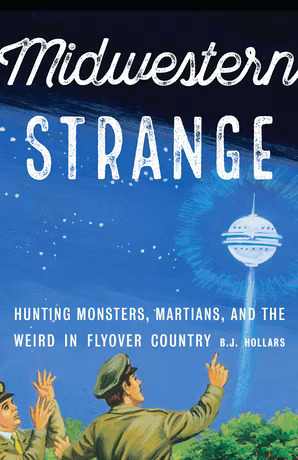
B. J. Hollars. Midwestern Strange: Hunting Monsters, Martians, and the Weird in Flyover Country. U of Nebraska Press, 2019. Paperback. 224 pg. $19.95. ISBN 9781496215604.

I fell in love with the title of B. J. Hollars’s book Midwestern Strange, and am glad to review it as I also hail from the Midwest. Among other things, it’s the land of the big roadside attractions—the Corn Palace; the Largest Ball of Twine; and pop culture debutantes like the giant Paul Bunyan featured in the movie Fargo (1996) or the House on the Rock shown in Neil Gaiman’s American Gods (2001). Hollars here spins a charming narrative travelogue of his “year of living strangely” (1) detailing his visits to and researches into sites of the strange throughout the Midwest.

The book is divided into three sections: Monsters, UFOs, and The Weird. Each section is again divided into three case studies set up in procedural investigatory fashion. They include such tales as Oscar the Turtle, the Minot UFO sighting, and the grandaddy of Midwest controversies (one that divides families and actually has its own museum), the Kensington Runestone. Each case study provides historical context, a travelogue to the strange site in question, interviews with local informants and experts, as well as the author’s personal connection to the event. These personal memoirs are perhaps the most endearing aspect of the book. Here Hollars describes his childhood fear of Oscar the Turtle:

[By] the time I turned five I knew to fear northern Indiana’s murky lakes[…] . Where others saw nothing, I saw the dark and impenetrable water. And within it, an antediluvian monster, dead-eyed and licking his lips[…] . While my friends all believed their monsters lived under their beds, I knew mine lived just below the waterline. (37-38)

The personal memories and travel narratives restore to the reader the sense of wonder in the strange and unknowable. Similarly, the use of the prosaic Midwest as the site for fieldwork pokes gentle fun at the history of anthropology and exploration narratives. The author’s familial self portrait, with the author behind binoculars, his young son in a monster t-shirt, and younger daughter in swim goggles, is a gentle parody of the self portraits of the figurative “heroic colonial explorer” in the “native wilds.”

The sections are not equal in strength. The UFO section is the weakest, while the section on monsters and the finale of the Runestone were the strongest. It is not a coincidence that the strongest sections were those in which the local communities used the strange incidents to develop what public historian Tammy Gordon calls community and vernacular exhibitions: Turtle Days in Churubusco, Indiana; The Mothman Museum in Point Pleasant West Virginia (which Hollars admits is a bit far afield for those of us who are Midwestern purists); the appearance of the Hodag as a community icon in Rhinelander, Wisconsin; and the Runestone Museum in Alexandria, Minn. In the words of some of Hollars’s informants, these community celebrations of their respective strange heritages give their towns “a dot on the map.” (49) Hollars provides wonderful examples of community heritage practices and the process of memory and identity creation that are easily the book’s best folklife chapters.

The less compelling chapters are built around UFOs. The participants’ desire to prove UFOs’ existence and their desire to be taken seriously are less narratively gripping. Describing the followers of The X Files’ Mulder is not as engaging on the written page as showing them was on TV. Hollars’s wonderful wit is not as evident (save when he is joking about space pancakes). And unfortunately, some of Hollars’s larger assertions here about the nature of knowledge and science are troubling. While it is true that the communities of UFO adherents and other paranormal investigators engage in behaviors that are often similar to the practices of scientists (publishing, peer critique, conference presentations), such similarities do not necessarily make them “outsider” scientists. While a few years ago I might have been more charmed by the assertions that paranormal investigators are just unappreciated scientists yearning for recognition, in these days of anti-vaxxers, doubletalk defending disingenuous practices in COVID-19 prevention, and QAnon, I am calling on my knowledge of Thomas Kuhn, whose The Structure of Scientific Revolutions leads me to recognize that understanding scientific change and different knowledge paradigms does not make every such paradigm equal in scientific status or utility.

Still, Hollars’s observations on why we find the strange so compelling and how our embrace of curiosity and capacity for belief enhance our humanity are inspiring. In a book filled with tales about oddities such as a disappearing dinner-table-sized turtle, a reader might not expect such lofty observations on human nature and capacity.

The interdisciplinary nature of this project is its greatest strength. It is part history, part popular cultural studies, part folklore—it partakes in the forms of travel narrative, memoir, creative nonfiction, journalism, and ethnography. As someone who teaches in an interdisciplinary program, I admired its freedom and boldness in crossing boundaries. I will shelve this book with other authors like Sven Lundqvist, Tom Engelhardt, and Carol Spindel, whom I recommend as examples for my students wanting to do creative nonfiction/memoir projects.


Review of Pluriversal Politics: The Real and the Possible


SFRA Review, vol. 52, no. 2

Nonfiction Reviews


Review of Pluriversal Politics: The Real and the Possible

Pedro Ponce

Arturo Escobar. Pluriversal Politics: The Real and the Possible. Translated by David Frye. Duke UP, 2020. Cloth. 232 pg. $99.95. ISBN 9781478007937. Paper ISBN 9781478008460.

I was disappointed to learn that Arturo Escobar’s Pluriversal Politics is not a handbook for accessing alternate worlds—at least not in the familiar sense. Obliquely, this might be Escobar’s point. From Continuum (2012-2015) to 12 Monkeys (movie 1995; TV series 2015-2018) to The Man in the High Castle (2015-2019), the focus on narratives navigating multiple realities is searching for the right world, or the struggle to restore characters to their original place and time. Escobar begins with the assumption that we already inhabit a “pluriverse,” “the idea of multiple worlds but also to the idea of life as limitless flow” (26). If we fail to perceive this flow, it’s because alternate possibilities for existing are obscured by anthropocentrism, colonialism, and the manufactured needs of capitalism. While Escobar’s vision of co-existing, autonomous worlds never leaves Earth, readers will nevertheless be taken on a philosophical journey that will leave them sobered, at times perplexed, yet quite possibly inspired.

Escobar begins with a fundamental question: “are we really the autonomous individuals we imagine ourselves to be?” (5). Certainly, this is how many have learned to see the world. Development and progress, as global values, are predicated on individual choice—of work, living space, and products to consume. Over the course of subsequent chapters, Escobar convincingly demonstrates how modern individualism, far from being an innate condition of contemporary reality, is rather one possibility among many that has prevailed only because it forecloses other worldviews:

What does “being realistic” mean? It means believing that in the final analysis there is a single correct way to see and understand things (based on rationality and science); believing that these (our) universal truths must prevail against all others, which in our view are less correct, or false; being convinced that we live in a world made of a single world, and being shocked by the opposite possibility; and being sure that the truth of this single (usually Western) reality—which obviously we all share, as we should!—is the space from which we ought to promote our projects (whether they be for becoming very rich or for resisting capitalism). (6)

The problems we face as a planet, in other words, cannot be solved using the frameworks and practices that caused them in the first place. It’s not enough to resist if resistance is merely exchanging one form of individualism for another.

There are certainly precedents for thinking outside the individualist box. In Buddhism, for instance, there is no self, only being in relation to everything else: “nothing exists intrinsically; everything is mutually constituted” (19; Escobar’s italics). Other examples cited by Escobar implicate technology and the theorizing of Western knowledge. Cybernetics troubled the separation of observer and observed, implicating both in systemic relation: “This conclusion still remains at the center of debates about the real: to know is to transform yourself and the unfolding universe” (22). The developing field of political ontology “provides a space for studying the relationships between worlds, including the conflicts that result when different ontologies or worlds strive to preserve their existence in their interactions with other worlds, under asymmetric conditions of power” (25). And Foucault—an essential companion on this trip—discerned a fundamental structure to discourses, and in doing so illuminated possibilities beyond those that prevail, as in the example of discourse around Third World “development”: “What does it mean to assert that development began to function as a discourse; that is, that it created a space in which only certain things could be said or even imagined?” (51).

Ultimately, the precursors that most inform Escobar’s study/manifesto go all the way back to the beginnings of humanity as we know it:

inhabiting (habitar) can be defined as the recurrent associational interaction between living things and their environment, creating the conditions for well-being. For a good portion of their history, humans knew how to practice this form of inhabiting the habitats they found. This ethos began to crack with the Greek polis, with its geometrical forms and layouts, conceived by humans who had begun to think of themselves as superior to and apart from the natural world. Here began the long civilizational journey of the Western ontology of separation and dominion over the natural world; the habitat is transformed into ‘an out-of-focus, scarcely noticed background’ to the polis and its function of inhabiting. (154)

This prevailing ontology is contrasted with the knowledge it suppresses in order to circumscribe what passes for reality, what Escobar calls “the cosmovisions of the original peoples in many parts of the world” (15). These include groups in northwestern Colombia who practice “a relational ontology based on the idea that territories are living beings with memories, spaces in which the sacred and the everyday are lived experiences, possessing their own rights, which embody their relationships with other beings and the ways they interrelate with them” (16). In a narrative set piece, Escobar imagines a father and daughter navigating the Colombian rain forest via the Yurumanguí River, in a canoe made from the mangrove tree, using knowledge of the river’s tides, and traversing an environment rich in other species on their way home: “Ethnographers of these worlds describe it in terms of three contiguous worlds (el mundo de abajo, or infraworld; este mundo, or the human world; and el mundo de arriba, or spiritual/supraworld). There are comings and goings between these worlds, and particular places and beings connecting them, including ‘visions’ and spiritual beings” (71). Rather than treat such knowledge as an object of curiosity or “enlightened” dismissal, Escobar sees it as another form of ontology that calls instead for engagement, one pluriversal link among many that potentially impacts our collective history, politics, and culture. In contrasting one possible way of life with another, Escobar’s intent is not to romanticize these cultures, which is merely another form of centering modernity: “those who defend place, territory, and the Earth are neither romantics nor ‘infantile.’ They represent the cutting edge of thought, for they are attuned to the Earth and to justice, and they understand the central issue of our historical moment: the transitions to other models for living, toward a pluriverse of worlds” (44-45).

 (North) American readers may read Escobar with skepticism. If you’re reading this in the midst of 2021’s ongoing pandemic and political division, you might understandably have a problem with a scholar who encourages readers to think outside of science and the rational. In response, Escobar might remind us of what a pluriverse is: distinct worlds that co-exist as part of the same system. He might also respond with a simple question about our current state of individuality and consumption: How’s that working out for you?

Pedro Ponce is the author of The Devil and the Dairy Princess (Indiana University Press), winner of the 2020 Don Belton Fiction Prize. He teaches writing and literary theory at St. Lawrence University.


Review of Science Fiction and Catholicism: The Rise and Fall of the Robot Papacy


SFRA Review, vol. 52, no. 2

Nonfiction Reviews


Review of Science Fiction and Catholicism: The Rise and Fall of the Robot Papacy

Dominick Grace

Jim Clarke. Science Fiction and Catholicism: The Rise and Fall of the Robot Papacy. Gylphi, 2019. SF Storyworlds. Paperback. 292 pg. $29.99. ISBN 9781780240848.

Jim Clarke tackles an ambitious topic in Science Fiction and Catholicism; though he notes that “this study […] tracks a series of historical narratives about how Anglophone literary sf has dealt with Catholicism in the late twentieth century” (4), he in fact traces the overlap between Catholicism and SF back to the Middle Ages and provides a formidably-researched analysis of how ideological conflicts between Catholicism and Protestantism have (mis)informed the treatment/representation of Catholicism in SF. (He also considers a few texts that are arguably earlier than the “late twentieth century” framework.) His assertion in his conclusion, that Catholics, rather than representatives of other religions, have featured more prominently than representatives of other religions as rigid antagonists of irrational revelation is because of the “role which faux Catholicism has played in sf as the genre’s Other, a role foisted upon actual Catholicism by an anti-Catholic literary tradition which dates back to the post-Reformation pamphlet wars” (251). He argues that “Catholicism, perhaps of all the world’s faiths, has demonstrated the most interest in topics close to sf interests, most specifically the possibility of alien life. In return it has been rewarded with a significant though largely malign presence within the corpus of sf works” (251). While these might seem like tendentious claims—and indeed, Clarke has nothing to say about how non-Catholic manifestations of Christianity (e. g. the Gileadean regime in Atwood’s The Handmaid’s Tale [1985], to name but one example) also are common in SF—Clarke’s extensive exploration not only of SF but also of the history of the Catholic Church provides strong support for his arguments. The overlap between those deeply conversant with SF traditions and those with deep knowledge of European intellectual history is perhaps smaller than it should be. Those already well-steeped in both will not be surprised by much that Clarke says, but for those lacking such twin expertises, this is an eminently useful book.

Especially important here are Clarke’s introduction and the first chapter, “Critical Mass: How Catholicism Became Science Fiction’s Counter-Narrative,” which between them take up close to a quarter of the book, and in which he builds a well-researched and thorough exploration of how an understanding of the Reformation’s influence on how Catholicism came to be represented in literature (not only in SF but more generally, including in important antecedent genres such as the Gothic) lies beneath recurrent patterns in how Catholicism is treated in SF. Readers who know the SF but not the history will find these chapters extremely useful. Clarke follows with three further chapters, each focusing on a particular popular SF subject and considering examples of how Catholic perspectives on those issues have figured in SF, and how those perspective compare (or contrast) with what the Catholic Church has actually had to say on these subjects. Again, Clarke’s contextualization of SF representation with the Catholic Church’s actual positions is often very illuminating because his focus is not just on works of SF but on how they can be seen in dialogue (or debate) with actual Catholicism.

Chapter two provides the book’s subtitle: “The Rise and Fall of the Robot Papacy: Catholicism and Machine Intelligence.” Chapter three looks at “Missionaries to Alien Utopias: Exotheology and Catholicism in Science Fiction.” Chapter four, “Unwriting the Reformation: Anti-Catholic Uchronias in Science Fiction,” explores alternate versions of or analogues to the Catholic Church in alternate worlds narratives such as John Brunner’s Times without Number (1969), Keith Roberts’s Pavane (1968), Kingsley Amis’s The Alteration (1976), and most intriguingly, Robert Charles Wilson’s Julian Comstock: A Story of 22nd Century America (2009), among others. His discussion of Wilson is perhaps the most intriguing element of his book, as he sees in the novel “what may be a new juncture for sf—the depiction of a future made up entirely of allied or warring conservatisms” (247). For Clarke, Julian Comstock is a novel that “actively turns its back on the Enlightenment, progressive science and political liberalism, and additionally, rejects sf’s characterization of itself as a product of the Enlightenment in opposition to conservative Christianity” (248). Time will tell as to whether Clarke’s bold claim about how this novel may have established a new paradigm going forward for how SF deals with Catholicism plays out, but it makes for a rousing final argument in this insightful and readable book.

Libraries with extensive SF holdings should acquire a copy of this book. Teachers of courses on the intersection between SF and religion will find it a valuable resource. Scholars interested in the topic will also find much worth careful thought here, as well—and possibly, a few more SF books to add to their to-read pile. I know I did.

Dominick Grace is Professor of English at Brescia University College in London, Ontario. His main area of research interest is popular culture, especially comics and Science Fiction.


Review of American Utopia: Literature, Society, and the Human Use of Human Beings


SFRA Review, vol. 52, no. 2

Nonfiction Reviews


Review of American Utopia: Literature, Society, and the Human Use of Human Beings

Adam McLain

Peter Swirski. American Utopia: Literature, Society, and the Human Use of Human Beings. New York: Routledge, 2020.  Paperback, 256 pg. $44.95. ISBN-13: 978-0367144340. EBook ISBN-13: 9780429032004.

Peter Swirski’s American Utopia: Literature, Society, and the Human Use of Human Beings is a whirlwind journey through the many aspects of “utopia.”  Along with literature, Swirski brings in history, psychology, sociology, and economics to ground America’s long-lived utopian fantasy. Early in the book, Swirski introduces the authors on whom he focuses, his proclaimed four horses of the utopian apocalypse, as the authors “take on the mantle of social reformers by diagnosing the pitfalls of social reform” (39). Those authors are Thomas Disch, Bernard Malamud, Kurt Vonnegut, and Margaret Atwood.

The book is divided into five parts with each part consisting of three chapters. Part One: Utopia, Eutopia and Youtopia covers the history of the concept of “utopia” from Thomas More’s 16th century book to modern real world examples of utopian attempts, examines the history of utopia in America with a special focus on the 1960’s, and lays out the book’s thesis statement and the author’s methodology going forward. Swirski sees utopia as a diagnostic tool for society and not a prognostic tool as others in the past have treated it. In other words, utopia is a question for how society might function when various types of social engineering are applied, and not the answer to those experiments. His methodology is to ask questions regarding human nature vs. nurture, whether humans can be bioengineered to be better, and how Big Data might work with utopia in the 21st century. 

The remaining four parts of the book are each focused on one author. Each of the four authors serve as a different critique of utopia, starting with Disch’s social engineer who becomes Malamud’s social engineer stymied by biology. Vonnegut reverse-engineers humans, and Atwood bioengineers an entirely new species and abandons humans altogether. Within each of these sections, the first chapter is devoted to a biographical sketch of the author and a focused reading of a key work using utopia as a lens. The second chapter positions the work within its own literary context, highlighting influences and shared tropes. Finally, the third chapter of each section moves into the present by looking at current (or at least recent) American socio-political trends with the author’s work serving as a framework. 

Part Two: Dischtopia looks at Thomas Disch’s work 334 (1972). Swirski uses Disch’s utopia to highlight utopia’s often used trope of social engineering via education. Then he takes an interesting turn in the third part of the section when he ties social engineering to Big Data. It’s an unexpected examination of how the age of Big Data is successfully social engineering Americans on a large scale in a way that education has been unable to. Swirski argues that Big Data will eventually remove choice, or the need for choice, because an algorithm will decide everything, a type of utopian hedonism. Swirski sees the loss of decision-making agency as both utopian (the algorithm is never wrong because the data is the data) and hedonism (people are no longer tasked with making decisions for themselves) that could lead to a reduction in critical thinking and critical activity by privileging passive consumption. From here Swirski discusses what he sees as the fallacy of Universal Basic Income versus a Utopian Basic Income. A Universal Basic Income allows room for social engineering due to existing wage gaps, something akin to the Chinese Social Credit System.  A Utopian Basic Income would be based on a more equitable redistribution of wealth throughout all social classes that would remove wage gaps.  Finally, Swirski talks about how the US is the current example of the undemocratic democracy of Athens and that the US democracy is based on income inequality which adversely affects the happiness of the population. The discussion here is adventurous and highly enlightening.

Part Three: Pantopia introduces the reader to Bernard Malamud’s God’s Grace (1982). Here Malamud’s utopia examines the tribalism that is inherent when one pits social engineering against biology. To connect this to current America, Swirski discusses cultural memory and proverbs. Swirski’s interest in proverbs lies in their lasting power and how that longevity runs counter to our Snapchat world. Swirski posits that religion might be a by-product of adaptive biology in the brain. He further points out that the United States has a high level of religious participation and that a high level of religious engagement might be one of the causes of the extensive social problems plaguing the country because the human brain seeks to find agency, even supernatural agency, to explain away phenomena. Of the author discussions, this one might be the weakest. While the connections to proverbs and the novel are solid, it’s less clear how God’s Grace completely relates to American utopia.

Part Four: Uchronia focuses on Kurt Vonnegut’s Galapagos (1985) while also touching on Timequake (1997) and Cat’s Cradle (1963). It’s not always clear which novel Swirski is discussing, which could be very confusing for someone who isn’t well-versed in Vonnegut. Vonnegut’s utopia is about reverse engineering evolution in order to inspect the quality of the human brain. Swirski takes this opportunity to explore the tension between the individual and society at large. In order to facilitate the discussion, game theory is posited as the opposite of decision theory as a means of understanding the irrational versus rational when it comes to decision making. To further elucidate his discussion, Swirski introduces the game Prisoner’s Dilemma to highlight strategic give and take.  Players in the Prisoner’s Dilemma can work against one another or attempt to cooperate depending on the scenario. In terms of utopia, it becomes clear that cooperation is the best way to establish a utopia, but in America we undervalue niceness and tend to wield capitalism like a boot to the throat. While this does not make cooperation impossible, it makes it difficult. It is the way the country has evolved.

Part Five: Biotopia concentrates on Margaret Atwood’s Oryx and Crake (2003). Whereas Vonnegut reverse engineers evolution, Atwood’s utopia results in bioengineering an entirely new species. Not surprisingly, Swirski connects this to current technologies such as CRISPR, genetically modified food, clones, genetically modified animals, and humans pushing evolution. Part of Swirski’s point in this chapter is that we are unaware of the potential side-effects we may sow as we play with genetics, especially considering the history of eugenics. Humans are the agency for change and human nature will dictate the success or lack of success that a utopia might reach.

Overall, American Utopia: Literature, Society, and the Human Use of Human Beings is a fast-paced, highly informative read. The connections Swirski makes between the literary texts, utopia, and current American society are fascinating and varied. One minor quibble is that some of the section titles within the chapters can be confusing. Many of them are tongue-in-cheek literary references that aren’t explained in the context of the chapter or section. This book should appeal to those interested in the specific authors as well as those who are interested in utopia and utopia’s place in American culture.

Jennifer Kelso Farrell is an Associate Professor at the Milwaukee School of Engineering. She has degrees from the University of Montana, Montana State University, and Louisiana State University. Her writing has appeared in the Journal of Popular Culture and Foundations. Her book Lewis Carroll, Linguistic Nonsense, and Cyberpunk: An Alternate Genealogy for Science Fiction was published in 2008. Currently she resides in Milwaukee, WI with her husband and their three-legged cat, Bomba, who is a survivor of the Beirut explosion.


Review of Invoking Hope: Theory and Utopia in Dark Times


SFRA Review, vol. 52, no. 2

Nonfiction Reviews


Review of Invoking Hope: Theory and Utopia in Dark Times

Adam McLain

Phillip E. Wegner. Invoking Hope: Theory and Utopia in Dark Times. University of Minnesota Press, 2020. Paperback. 264 pg. $28.00. ISBN 9781517908867.

The hope of this review of Phillip E. Wegner’s Invoking Hope: Theory and Utopia in Dark Times, or rather this non-reading of Invoking Hope, is to not fall into the trap of the review, or the anti-reading, as the author states in his introduction: the moralizing criticism “aimed either at dissuading engagements on the part of later readers or, at least, narrowing and directing the avenues down which any future non-reading might travel” (9). Indeed, approaching a book that is so interwoven with theory and utopia can be rather daunting, for in reviewing such a delightfully dense and enjoyably ensconced text, I will most assuredly not touch on all the positive aspects of the project nor critique and construct as many future narratives and critical impositions as are possible. The main takeaway I have from Wegner’s work is that those interested in utopia, reading, or the world in general should read it; it is a book that crosses academic boundaries and allows us to refocus our efforts on striving for a better, even utopian, world.

As Wegner is very clear about in his introduction, Invoking Hope is written as a response to a(n) (un)certain time and a (non-)specific event: the 2016 inauguration of a media and real estate mogul as the President of the United States. Wegner does not necessarily make his book an anti-Trump text; instead, he weaves together a series of essays, split into two parts, that shows readers how to use utopia to (non-)read and then (non-)reading utopia through disparate texts. He wishes to show how an act of reading can be a utopian act that subverts and overcomes—by living through—even the darkest of times.

Wegner’s approach to utopia and the current moment is theoretical and philosophical rather than historical or practical (meaning a step-by-step instruction guide). This methodology is seen beautifully in the first chapter, in which he outlines a Greimas semiotic square, realized through the work of (and Wegner’s work on the work of) Fredric Jameson, to approach the Chicago school of New Critics; he then uses this approach to read with Alain Badiou’s Plato’s Republic (2013), itself a translation and re-reading (or re-writing/non-reading) of Plato, and collectively shows that one of the fundamental problems with democracy, especially in the United States, is its emphasis on individual economic prosperity rather than collective political good. Wegner, then, creates the theoretical apparatus needed to show how, with semiotic square and Lacanian orders mapped onto each other, he is able to read, or rather non-read, utopian genres in order to invoke hope.

Having established a semiotic approach to utopia, he further engages in this conundrum in chapter two by arguing for the art of non-reading, as formulated by Pierre Bayard and his reviewers. Non-reading, for Wegner, is what people do when they approach a text through literary criticism; they are at both times reading the text and remembering the text as they write their own text. He then proceeds to non-read More’s Utopia (1516) to show that “utopia is located in Utopia, More’s book itself, and most particularly in the figure of a dialogue it offers us” (84). This non-reading of Utopia echoes through the rest of the book as Wegner approaches texts as utopian inside and as the text itself, rather than attempting to create or formulate a utopian mindset or utopian way of approaching the world around them.

Establishing this practice of non-reading allows Wegner to move beyond an ethical reading, which he does in the subsequent chapters. Instead of trying to read morality out of a text, then, he is attempting to non-read utopia through the text. This effort is seen in his recapitulation of the Henry James–H. G. Wells debate during the modernist period, in which James considered novels to need strict rules, while Wells was open to more fluid motion within a text. While James, for some time, won this debate, which led, in Wegner’s argument, to the rise of ethical reading and the New Criticism discussed in the first chapter, he shows how his non-reading can overcome this approach to four specific genres: the universal history, the kunstlerroman or artist’s story, the comedy of the (re-)marriage, and the science fiction. He concludes that utopia is “never no-where, an imagined perfected future, but in fact always already potentially exists in the concrete now-here, in our collective fidelity to the project of making a world we so desire rather than a world we fear” (218): indeed, the hope of utopia that is invoked in the use of theory in the book is the striving toward the future that comes from non-reading, as Wegner shows as he non-reads such unique and seemingly unconnected texts as Du Bois, “Babette’s Feast” (1950), 50 First Dates (2004), 2312 (2013), and Cloud Atlas (2004).

While the theory in the book is astute, diverse, and vast, much of the book is rooted in and heavily relies on the work of Fredric Jameson. This reliance makes sense: Wegner’s career has been focused on Jameson’s work as the central thinker with whom he engages. And yet, it seemed as if Jameson had something to say about every single topic in which Wegner engaged. In this way, then, parts of the book feel to be utopia and theory through Jameson rather than through Wegner. Thus, I read Invoking Hope as a new and innovative text that synthesizes many literary and utopian schools of thought in brilliant ways, and it is a part of Wegner’s project, seen through his other work (Imaginary Communities [2002], Life Between Two Deaths [2009], Shockwaves of Possibility [2014], and Periodizing Jameson [2014]), that continues to develop Jameson’s (and Wegner’s) thinking together. The book does invoke the hope needed during dark days that have passed and the dark days of the future as we collectively move toward utopian ideals and theoretical advancements.

Adam McLain researches and writes on dystopian literature, legal theory, and sexual ethics. He is currently a Harvard Frank Knox Traveling Fellow, studying twentieth-century dystopian literature and the legal history of sexual violence in the UK. He has a bachelor’s degree in English from Brigham Young University and a master of theological studies from Harvard Divinity School.


Amongst You, We Are the Witnesses of Withering: Hungarian New Weird Spatial Formations in the Short Fictions of Lilla Erdei, Balázs Farkas, and Attila Veres


SFRA Review, vol. 52, no. 1

On the Edge: The Fantastic in Hungarian Literature and Culture


Amongst You, We Are the Witnesses of Withering: Hungarian New Weird Spatial Formations in the Short Fictions of Lilla Erdei, Balázs Farkas, and Attila Veres

András Fodor

Introduction

The weird as an approach to writing presents a relatively new angle to write about reality in contemporary Hungarian literature. From its conception in 2016, The Black Aether fanzine gathered authors who incorporate the weird into their fiction. The fanzine supports and adheres to the Lovecraftian interpretation of the weird, but this paper argues that the presented authors have started to diverge from this perspective. Lilla Erdei, Balázs Farkas, and Attila Veres introduce the New Weird to the Hungarian audience in The Black Aether. The editor-in-chief editor of The Black Aether has considered the three as noteworthy authors in the Hungarian New Weird. Their methods differ from each other; however, all of them attempt to negotiate Hungarian literary characteristics with features of the English-speaking literary world. The former literary motifs function as a base that incorporates gritty realism in which (over)use of substances and apathy in political and social issues are typical responses to past and present crises and traumatic experiences, where other coping mechanisms are absent.

The Black Aether also functions as a devoted community for the Hungarian Lovecraft fans. There is another fanzine, Azilum, which was also started in 2016. It is dedicated to other weird fiction authors that are “Lovecraftian” in their stylistics. It publishes translations from lesser known contemporaries of Lovecraft, his not yet translated essays, and also contemporary weird authors such as Thomas Ligotti, Laird Barron, and Caitlín R. Kiernan. It compiled three anthologies dedicated to the weird fiction of the twentieth century. Furthermore, the Hungarian H. P. Lovecraft Society gathers the fans of Lovecraft and organises events to advertise and celebrate him. Galaktika, the Hungarian SF magazine, has also started to accept texts that can be considered as weird fiction.

This paper explores the changes of the spatial formations in the narrative spaces in the short fictions of Lilla Erdei, Balázs Farkas, and Attila Veres. The paper identifies spatial changes in an interpretive framework that is based on the works of Henri Lefebvre and Edward Soja, but considers narrative space as a spatial system where subjects have to constantly relate to one another and negotiate their positions. The texts present non-anthropomorphic and monstrous others as the successful negotiators, who infiltrate and subvert the spatial systems.

In its conception, the GABO Publishing House decided that its anthology of Az év magyar science fiction és fantasynovellái [The Best Science Fiction and Fantasy of the Year] should follow the footsteps of Jonathan Strahan’s The Best Science Fiction and Fantasy of the Year. Their idea was to provide an opportunity for the flourishing Hungarian science fiction, fantasy, and horror scene to get published in this form, as there is a relative lack of platforms to publish short stories in these genres. This is not the first attempt to produce such anthologies: some of them are thematically connected (Hungarian folk tales in 77–Hetvenhét) or set in a shared secondary world of a role-playing game (M.A.G.U.S), or more focused on science fiction and dystopias such as anthologies that are edited by Sándor Szélesi, Tibor Jobbágy, and Tibor Fonyódi. Furthermore, István Nemes played a significant role in popularising science fiction, fantasy, and horror by compiling short fiction collections from the 1990s. There is another anthology from the GABO Publishing House that focuses on horror and weird fiction and is thematically connected to gasping. The book titled Légszomj [Gasping] was published in 2021. 

Weird Fiction in Hungary

This paper understands weird fiction as an approach to writing. In defining weird fiction, it relies on the understanding of China Miéville from the 2009 The Routledge Companion to Science Fiction where he writes, “Weird Fiction is usually, roughly, conceived of as a rather breathless and generically slippery macabre fiction, a dark fantastic (‘horror’ plus ‘fantasy’) often featuring nontraditional alien monsters (thus plus ‘science fiction’)” (510). In addition to that, this paper echoes H. P. Lovecraft’s position on weird fiction from his seminal 1927 essay “Supernatural Horror in Literature,” which explains that the weird tale consists of:

something more than secret murder, bloody bones, or a sheeted form clanking chains according to rule. A certain atmosphere of breathless and unexplainable dread of outer, unknown forces must be present; and there must be a hint, expressed with a seriousness and portentousness becoming its subject, of that most terrible conception of the human brain—a malign and particular suspension or defeat of those fixed laws of Nature which are our only safeguard against the assaults of chaos and the dæmons of unplumbed space. (305)

Lovecraft defines it as “‘the literature of cosmic fear’ [that] undercuts post-Enlightenment rationalism and posits instead the co-existence of other worlds and supernatural forces” (qtd. in Weinstock 179), which as Weinstock argues, “unsettles both confidence in the modern scientific method and human pretensions to grandeur” (180). Furthermore, Benjamin Noys and Timothy S. Murphy suggest that “Lovecraft drew on modern science and on modernism to craft a weird fiction that was ‘nonsupernatural.’ Lovecraft, a keen amateur scientist and an antiquarian, creates an unlikely ‘bridging’ between an idealized past and a traumatic modernity. In the process he figures a strange ‘median’ position that is at once avant-garde and anterior to modernity” (120). Already in Lovecraft, the interstitial situation of weird fiction had been established.

Furthermore, weird fiction remains in strong connection not just with modernist modes, but also with the Gothic. Carl H. Sederholm points out that “both the Gothic and the weird thrive on themes of excess and transgression.” He adds that “[t]he Gothic and the weird interrogate the world in ways that powerfully demonstrate human limitations both in terms of understanding our place in the world and also how we perceive reality in the first place” (165.). Sederholm continues that new weird “embraced weird fiction’s general tendency to interrogate the human experience of the world and the cosmos and added to them an interest in exploring how human beings perceive the world” (161). It jettisons and subverts the anthropocentric perspective; consequently, the interrogations “point readers toward fundamental problems of representation and reality” (164). In the case of Gothic, Ljubica Matek argues that the “Victorian Gothic domesticates Gothic figures, spaces, and themes so as to locate its horrors within the world of the contemporary reader” (17). But it is never domesticated and normalised. In overcoming anthropocentrism, weird fiction relies on two approaches through which it achieves that. On the one hand, Carl Freedman points out that weird fiction is “fundamentally inflationary in tendency . . . to suggest [that] reality . . . [is] richer, larger, stranger, more complex, more surprising—and, indeed, ‘weirder’—than common sense would suppose” (14). On the other hand, Noys and Murphy argue that based on Robert Aickman’s observation “weird fiction . . . can also pursue what Samuel Beckett called the way of ‘impoverishment’ (qtd. in Knowlson, 352), reducing our world to a ‘shivering void’” (Noys and Murphy 118). 

This paper connects the Hungarian New Weird to the Finnish Weird, a notion Johanna Sinisalo coined in 2011 by arguing that these:

Courageous writers . . . are producing touching, believable and memorable stories that can’t easily be pigeonholed as belonging to any pre-existing genre. Common features of their work include the blurring of genre boundaries, the bringing together of different genres and the unbridled flight of imagination. . . . They—or perhaps I should say we—are weird and proud of it. In fact, the trend is so clear that we should give it a name all of its own: suomikumma, ‘Finnish Weird’. (n.p.)

Jussi K. Niemelä provides an elaborated approach toward the Finnish Weird, when she proposes that it is:

an umbrella term that encompasses all diagonal, that is to say, non-realistic approaches to any story we can’t label as science fiction or fantasy without being unjust to both the author and the readers. There might be, and usually are, quite a lot of realistic ingredients in the story, but something odd happens all of sudden that sheds a diagonal light on that reality and this is where the ‘weird’ steps in. (16) 

Consequently, this paper interprets Hungarian New Weird fiction as an amalgamation of the English and the Finnish Weird with strong connection to the Hungarian literary convention. While the paper should also suggest wider implications in the relations between the Hungarian New Weird and the post-Austro-Hungarian Weird, [1] it has no space to pursue this topic in its present form. The Hungarian New Weird incorporates features of horror, fantasy, and occasionally science fiction, but presents its reality differently from realist fiction. It shares characteristics with the Hungarian literary convention such as the excessive overuse of substances (e.g., alcohol), the feeling of powerlessness by being constantly subjected to authority, and the inescapable nature of the constantly oppressive Hungarian reality. Moreover, apathy in political and social issues is a typical response to past and present crises and traumatic experiences, where other coping mechanisms are absent. Traumas are never resolved, they are kept forefront to be exploited in order to gain political power. Therefore Hungarian New Weird fiction functions as a set between mimetic and non-mimetic literature, and it also presents a counterpoint to the Hungarian literary convention as it presents alternative readings of Hungarian reality. The three authors discussed in this study introduce the impossibility of the weird in the Hungarian literary convention as a valid explanation for events in the consensual reality. The examined short stories feature another space that either reveals a more intricate narrative world than the focalizor-narrator can understand or allows a peak behind the veil of the narrative space where everything becomes insignificant, thus, both approaches to overcome anthropocentrism are present. As a corollary, this new interpretation vitiates familiarity, undermines the anthropocentric vantage point, and then introduces the feeling of estrangement and awe.

This sensation of the weird is described by Mark Fisher as it “is constituted by a presence—the presence of that which does not belong” (103, emphasis in the original). Fisher declares that the weird allows “us to see the inside from the perspective of the outside” (10). He asserts that the weird spurs the “fascination with the outside, . . . which lies beyond standard perception, cognition and experience” (7). In the context of narratology, the diagonal perspective of the weird provides the interpretation of the narrative space that it “is ripped and unfinished. Moth-eaten, ill-made” (“Afterwierd” 4447). This lack of wholeness is noticed in the construction of narrative space. These apertures remain concealed as long as the anthropocentric vantage point is in a power position in the construction of the spatial formation of the narrative space. Once the anthropocentric vantage point can no longer establish its power position in a form of complementary distribution, through the prism of the weird “the world is always-already unrepresentable, and can only be approached by an asymptotic succession of subjective pronouncements” (“Weird Fiction” 512).

Spatial Formations

The interpretation of narrative space is through language, which formulates different spatial relations and mediates everything through them. This paper interprets the relation between weird fiction and language based on Farah Mendlesohn’s taxonomy. In her book, Rhetorics of Fantasy, Mendlesohn identifies and then concentrates on “the means by which the fantastic enters the narrated world” (13). The platform for these processes is language. I understand “rhetorics” in the Mendlesohnian sense of the word, which is a narratological viewpoint, a specific locatedness through which the focalizor-narrator attempts to make sense of the fictional reality of the narrative.

Subjects with agency participate in the construction of narrative space. This composition consists of three elements: place, space, and their corollary, the spatial system. The narrative space forms a spatial system that is a constantly ongoing negotiation between place and space. Each subject with an agency functions as a place; its position within space has to be negotiated. Place is subordinated to space and is interpreted as a meaning-making element of space. I interpret place “as experiential, or as tied to the human response to environment,” therefore, “place is integral to the very structure and possibility of experience” (Malpas 31, emphasis in the original). Space and the spatial system are subjected to negotiation as their constituting subjects’ social and political power allows them to be. Otherwise subjects are jettisoned from them, they experience nothing, and are rendered as others. The spatial system is the result of the negotiations of its participating subjects. 

The success of the negotiations into space depends on the subject’s place. Political and social preconceptions play a significant part in the success. Places maintain space through the negotiation of its constituting subjects. These debates are “political in every way: governed in favour of particular interests, biased in their affordances and allocations, shot through with calculative logics and mechanisms designed to distribute unevenly, and arenas of considerable power struggle” (Amin and Thrift 207, emphasis mine). From the viewpoint of the subject, the spatial system becomes apparent after the successful negotiation of place and its insertion into space. The social and the political negotiation reveals the social and political dimension of the spatial system.

The subject’s realisation of the spatial system stems from the change of social and political framework that is identified as the Lefebvrean notion of representations of space. Lefebvre describes them as they “are tied to the relations of production and to the ‘order’ which those relations impose, and hence to knowledge, to signs, to codes, and to ‘frontal’ relations” (33). Edward W. Soja in Thirdspace: Journeys to Los Angeles and Other Real-and-Imagined Places identifies a part of the spatial system with the same functions, which he terms “Secondspace.” He explains it as it is a “regulatory and ‘ruly’ discourse,” a representation “of power and ideology, of control and surveillance” and “also the primary space of utopian thought and vision, of the semiotician or decoder, and of the purely creative imagination of some artists and poets” (67).

The ultimate part of the spatial system is the lived space that “is the dominated space which the imagination seeks to change and appropriate” (Lefebvre 40). Lefebvre identifies representational space as part of “space [that is] . . . directly lived through its associated images and symbols” (ibid.). It “overlays physical space, making symbolic use of its objects” (39). On the one hand, representational space originates from the interpretation of the Firstspace through the lens of Secondspace. Consequently, it is both material and theoretical. On the other hand, it surpasses this identification and invites, as Soja argues, “all other real and imagined spaces simultaneously” to come together in Thirdspace (69). My interpretation of Thirdspace is that it is both abstract (imagined) and manifested (real) part of the spatial system; includes “subjectivity and objectivity, the abstract and the concrete, the real and the imagined, the knowable and the unimaginable, the repetitive and the differential, structure and agency, mind and body, consciousness and unconsciousness, the disciplined and the transdisciplinary, everyday life and unending history” (Soja 56–57). The Thirdspace becomes infested by the sensation of the weird. The impossibility becomes possible that is realised in the successful negotiation of entities from the other space.

Hungarian New Weird in the GABO anthologies

Lilla Erdei’s first book came out in 2003, titled A ​halálművés [The Death Artists], her second one was published in 2007, A ​Nap gleccserei [The Sun’s Glaciers], her third in 2008, A ​vendég [The Guest], and the last in 2009, Veszélyes ​helyek [Dangerous Places]. She writes short fiction, poems, and novellas. She studied comparative literature at the University of Szeged, focusing on dystopias. Moreover, she has been publishing articles in relation to the topic of her PhD studies. In her interviews, she mentions Stephen King, Edgar Allan Poe, and H. P. Lovecraft as inspiration. [2]

Balázs Farkas regularly writes fiction and non-fiction. He reviews movies, series, and books. He won the Zsigmond Móricz Literary Scholarship in 2015. He has four books out via different publishing houses (Nyolcasok [Eights] (2013), Ismétlés [Repetition] (2016), Lu purpu (2019),  short-listed for the Péter Zsoldos Award,and Ugatás [Barking] (2020)) and two more were self-published (Embertest [Human Body] (2018) and Maszkabál [Masquerade] (2021)[). His short fiction has been accepted by literary and genre magazines in Hungary. Four of his texts have been translated into foreign languages: one into Polish, three into English. Occasionally he translates into Hungarian. His translations of Ambrose Bierce, Lord Dunsany, and W. F. Harvey have been included in Azilum

Attila Veres wrote a novel,  Odakint sötétebb (2017), and a short-story collection,  Éjféli ​iskolák (2018), which won the Perished UFO Award in 2020. His fiction has been welcomed by literary and genre magazines alike such as The Black Aether magazine and kulter.hu. He writes in Hungarian and English. His story “Méltósággal viselt” [The Time Remaining] was included in the The​Valancourt Book of World Horror Stories 1, which is among the finalists of ​World Fantasy Award. He works as scriptwriter, his script of Egy másik életben [In Another Life] (2020) won the best adapted script for TV movie award of the Hungarian Movie Award. One of his examined short stories, “A világ helyreállítása” [The Reconstruction of the World] won the Péter Zsoldos Award for a short story in 2021.

The intrusion of unknown entities into the narrative space is one of the main features of the examined short stories. The first anthology (2018) includes three short stories from the authors. Balázs Farkas’s “A nevetés íze” [The Heckler] is about a young, indecisive stand-up comedian who discovers some strange movements in the interstitial space among people during one of his routines. A visitor approaches and offers him an opportunity to get on stage in a theatre, where his show is always well-received. Attila Veres’s “Fekete talán” [The Black Maybe] presents a deconstruction of the traditional Hungarian pig slaughter. A family of three spends a holiday in the Hungarian country, where they have their one of a lifetime experience helping the locals in the slaughter. Lilla Erdei’s “A jégkorszak tanúi”[The Witnesses of the Ice Age] is set in post-apocalyptic Hungary, whose climate has changed for the worse. The protagonist escapes from the attack of this clever climate.

This paper explores two texts from the anthology of 2019. Lilla Erdei’s “A tökéletes hívás” [The Perfect Call] is a story about a young woman in her thirties, who works in a call centre, where she sells language courses. One day, she makes the perfect call. It goes awry and she starts to sense that there are other forces at work during her conversation with the customer. Attila Veres’s “Horváth Etele – A nagy kacagtató élete és kora” [Etele Horváth – The Life and Times of the Great Jokester] recalls a forgotten, yet ominously known and allegedly beloved comedian in a poorly written article format. The person has no written record, they lurk in the memory of their viewers, which results in the incongruity in the reader’s mind of being the uncanny and well-respected comedian of the previous era.

In the 2020s anthology, all three authors are included. Balázs Farkas’s “A végtelen” [Unending] focuses on the idea of transition between life and death. A solemn, unnamed city dweller has been taken by a taxi through the city to stay at a hotel and wait for further instruction to be moved to the next stop. Attila Veres’s “A világ helyreállítása” [The Reconstruction of the World] invites the reader to join in the endeavour of a community to reconstruct order in the world. It is both a follow-up of an initiation ritual and a manual how to convince and involve people to join this cause. Lilla Erdei’s “Cunciróka” [Stone Foxy] introduces the reader to the depth of odd adoration of red-haired women on an online platform. The narrative follows a young woman who investigates the sudden disappearance of her girlfriend, who belongs to that group.

The spatial formation of the narratives in the 2018 anthology suggests a typology in which the idea of other space emerges as a counterpoint to consensual reality of the narrative space. There are two approaches to the introduction of other space. The one that Farkas and Veres follow is where the narrative space is complemented by another one, a weird space from which unknown entities intrude. In Farkas’s text, the protagonist moves to that space, where he receives a liquid compressed from the laughter he induced in his audience. The narrative space consists of bars, festivals, and a theatre. All of them echoe the Foucauldian idea of heterotopias in their operating methods as they “are something like counter-sites, a kind of effectively enacted utopia in which the real sites, all the other real sites that can be found within the culture are simultaneously represented, contested, and inverted” (Foucault 24). In Veres’s narrative, the creatures to be slaughtered arrive from that space. Therefore, the texts present twofold movements between two spaces: from the outside to the inside, and vice-versa. Both of them incorporate the classical Lovecraftian framework, [3] where the outside intrudes to the consensual reality of the narrative space. But Farkas’s text also exceeds this by inserting the focalizor-narrator in that unknown space. The case of Erdei differs from the previous texts. She constructs a narrative space that is an other space. Its features recall consensual reality, however, narratological details point toward a radically different reality, a secondary world.

The texts in the 2019 anthology approach space from a diagonal angle. They highlight the importance of the negotiation of places to the spatial systems. Its corollary is always an intrusion from the outside. Both narratives rely on the movement in which an entity from the outside intrudes the consensual reality of the narrative spaces. Consequently, the spatial formation of these texts becomes weird. Erdei’s story depends on the protagonist’s linguistic acts, where she convinces her customers to buy a language course. Although in these sorts of negotiations the result is favourable, against the unknown, she cannot succeed. Veres introduces his main character as a transgressive one, providing many occasions in which this entity appears in two places at the same time. This suggests that he successfully negotiates himself into the spatial system of narrative space; furthermore, it bends the laws of physics.

In the 2020 anthology, the strategy of the authors slightly changes. In Veres’s and Erdei’s stories, the characters argue themselves to the outside from the previously known spatial formation of the narrative spaces, consequently, they move contrary to the previous practices from earlier years. All of the short stories include a non-place, a concept coined by Marc Augé, which refers to liminal spaces where all of the previously acquired identities are annulled. In these spaces there is only one power position that cannot be challenged by the characters. Farkas sets his narrative space precisely in this liminal space, in a hotel that has no distinctive marks, and from which the newly dead travel toward the unknown. The text seems to echo his previous strategy: the narrative space consists of a known space that is left behind by the protagonist to move to the threshold of the other space. The narrative space in Veres’s story signifies a conscious choice to intrude then change the spatial formations of the consensual reality of the narrative space. In the text, Veres does not specify the locality of the room that functions as a pivotal step in the process of the applicants becoming an active member of Reconstructionist community, but provides a wide array of possibilities to choose from, suggesting that the room is also a non-place that is controlled by the Reconstructionist community. Erdei’s text includes the cyberspace provided by Facebook and hints at the liminal space in which the protagonist’s girlfriend is stuck.

The Hungarian New Weird functions as a possibility to subvert and question the Hungarian consensual reality. This amalgamation of weird approaches examines the Hungarian consensual reality and sheds different light on it. These short stories present the impossibility as possible, which is realised in the successful negotiation of unknown entities from the other space into the narrative spaces. Farkas, Erdei, and Veres take different approaches to achieve the sensation of the weird. Their other spaces intrude the narrative space and overcome consensual reality in them. These narrative spaces suggest a richer, yet occasionally bleaker, Hungary than consensual reality has it.

NOTES

[1] For instance, Franz Kafka, Bruno Schulz, Alfred Kubin, and Stefan Grabiński.

[2] József, Tomasics. “Black Aether interjúk – Erdei Lilla.”. The Black Aether, 8 Dec. 2018,. https://www.theblackaether.com/2018/08/12/black-aether-interjuk-erdei-lilla/. Accessed 28 August 2021. 2018.

[3] The language becomes disoriented and/or highly metaphorical to express the changes in the narrative space.

WORKS CITED

Amin, Ash, J. and Nigel Thrift. Seeing Like a City. Polity Press, 2017.

Fisher, Mark. The Weird and the Eerie. Repeater Books, 2016.

Foucault, Michel. “On Other Spaces.” Translated by Jay Miskowiec, Diacritics, vol. 16, no. 1, 1986, pp. 22–27.

Freedman, Carl. “From Genre to Political Economy: Miéville’s The City and the City and Uneven Development.” CR: The New Centennial Review, vol. 13, no. 2, 2013, pp. 13–30.

García, Patricia. Space and the Postmodern Fantastic in Contemporary Literature The Architectural Void. Routledge, 2015.

József, Tomasics. “Black Aether interjúk – Erdei Lilla.” The Black Aether, 8 Dec. 2018, https://www.theblackaether.com/2018/08/12/black-aether-interjuk-erdei-lilla/. Accessed 28 August 2021.

Lefebvre, Henri. The Production of Space. Translated by Donald Nicholson-Smith, Blackwell, 1991.

Lovecraft, Howard Phillips. “Supernatural Horror in Literature.”  At the Mountains of Madness. Random House, 2005, pp. 298-474.

Malpas, Jeff. Place and Experience: A Philosophical Topography. Routledge, 2018.

Massey, Doreen. For Space. SAGE, 2005.

Matek, Ljubica. “Who Owns the City? China Miéville’s The City and the City as an Urban Gothic Dystopia.” Studies in Gothic Fiction vol. 6, no. 2, 2020, pp. 17–26. 

Mendlesohn, Farah. Rhetorics of Fantasy. Wesleyan University Press. 2008.

Merrifield, Andrew. “Place and Space: a Lefebvrian Reconciliation.” Transactions of the Institute of British Geographers, vol. 18, no. 4, 1993, pp. 516–31.

Miéville, China. “Afterweird.” The Weird: A Compendium of Strange and Dark Stories, edited by Ann VanderMeer and Jeff VanderMeer, Corvus, 2011, pp. 3609–617. 

—. “Weird Fiction.” The Routledge Companion to Science Fiction, edited by Mark Bould, Andrew M. Butler, Adam Roberts, and Sherryl Vint, Routledge, 2009, pp. 510–15.

Niemelä, Jussi K. “Finnish Weird from the Land of the North.” Finnish Weird 2014, edited by Jerrman, Toni. Helsinki Science Fiction Society, 2014, pp. 10–39.

Noys, Benjamin, and Timothy S. Murphy. “Introduction: Old and New Weird.” Genre, vol. 49, no. 2, 2016, pp. 117–34. 

Sederholm, H. Carl. “The New Weird.” Twenty-First-Century Gothic, edited by Maisha Wester and Xavier Aldana Reyes, Edinburgh University Press, 2019, pp. 161–73.

Sinisalo, Johanna. “Weird and Proud of  It.” Books From Finland, 5 Sept. 2011, https://www.booksfromfinland.fi/2011/09/weird-and-proud-of-it/. Accessed 23 July 2021. 

Soja, Edward W. Thirdspace: Journeys to Los Angeles and Other Real-and-imagined Places. Blackwell, 1996.

Weinstock, Jeffrey Andrew. “New Weird.” New Directions in Popular Fiction, edited by Ken Gelder, Palgrave Macmillan, 2016, pp. 177–99.

András Fodor is a PhD Candidate at the University of Szeged, Faculty of Arts, Doctoral School of Literature in Hungary. He has been publishing reviews and short stories since 2010 mainly in his native tongue, Hungarian. In 2016 he won the JAKKendő Award for his manuscript collection of short stories, A mosolygó zsonglőr (The Smiling Juggler), which was published later in the same year. His research interests are spatiality, cities, the New Weird, and China Miéville.


“The Last Issue of Interplanetary Asteroid Mining Meta-Journal”


The Last Issue of Interplanetary Asteroid Mining Meta-Journal

Mario Daniel Martín


Translated from the Spanish by the author. This story originally appeared in Number 11 of TerBi, Revista de la Asociación Vasca de Ciencia Ficción, Fantasía y Terror, pages 73-84. The author would like to acknowledge the assistance of Sarah St Vincent Welch, who helped him de-Spanish the English of this translation.

Trope: Last Issue of Interplanetary Asteroid Mining Meta-Journal

Category: Brain to Brain 1-d Open Message  

Subcategory: Text-only Pamphlet

Code: δ1256Sagg23mondragón44FCSS7θΐΦΩ

Date: 23 Saggiatore, 1256AG (21 December Greg-2820)

Physical Location of First Release: Asteroide Mondragón

Author: Undisclosed (triple δ-anonymity)                           

Language: HS-Broca-I-Classical-English

Neuro-induction devices: Not applicable

3D Synesthetic Simulation: Not available

Multisensory Arrangements: Disconnected

Genital Pathway Stimulation: Disabled

Parsing Instructions: This text message is composed of 6 parts. An optional quotation (MC-0), and 5 compulsory sections (MC-1 to MC-5) are to be read in the provided order. No response or acknowledgment of parsing is required.

Rebroadcasting Status: Unknown (δ-encrypted)

Message Content 0: Quotation (Optional).

Of all these Formes of Government, the matter being mortall, so that not onely Monarchs, but also whole Assemblies dy, it is necessary for the conservation of the peace of men, that as there was order taken for an Artificiall Man, so there be order also taken, for an Artificiall Eternity of life; without which, men that are governed by an Assembly, should return into the condition of Warre in every age; and they that are governed by One man, as soon as their Governour dyeth. This Artificiall Eternity, is that which men call the Right of Succession.

Thomas Hobbes, Leviathan (3BG; Greg-1651)

Message Content 1: Preface

This is a one-dimensional text-only pamphlet from the Space Farm Arcadia Conglomerate in the Trojan Walden IV Belt. We are using this archaic channel of dissemination to avoid the monitoring of its source of redistribution. We apologise for the lack of multi-sense meta-data. We recommend delta-encrypting when rebroadcasting the information inside the orbit of Jupiter.

To avoid confusion about the dates mentioned in the pamphlet for those residing outside the Thoureauvian Conglomerate, we have included after the standard Galilean date the corresponding date in the obsolete Gregorian calendar.

Message Content 2: Purpose of this pamphlet

Pope Urban MVIII, the Solar System Leader of the Coalition of Leviathanian Companies and Royal Chief Executive Officer of the New Australia Mining Company, announced today in his residence in Kalgoorlie IX the closure of the scientific meta-journal Interplanetary Asteroid Mining in its neural-induction multi-sensory format. The closure has been linked to the recent acquisition, and subsequent cultural refurbishment, of the Jovian Open Space University by a consortium led by the China-Cola Corporation and the New Australia Mining Company.  

As a group of scientists residing inside and outside Asteroide Mondragón, we want to repudiate this unjust measure. Also, we would like to make it known that an inter-galactic formal complaint will be lodged with the Interstellar Court of Alpha Centauri by the Thoreauvian Free-thinking Sentient Being Coalition condemning the meta-journal closure and the subsequent blocking of its archives.

Message Content 3: A brief history of the meta-journal

The journal was first published in bi-dimensional e-paper flexible display format in 955AG (Greg-2519), under the name The Interdisciplinary Journal of Asteroid Mining. The publication quickly became one of the most influential free-inquiry scientific journals in the homo-homo scientific explosion of the 9th and 10th centuries after the long climate-change-induced Penumbra Scientifica (or Scientific Dark Age) in the societies of our source planet. The open character of the journal was clear in the editorial of its first issue: ‘We aim to make asteroid mining accessible to all terrestrial sentient beings, and to stimulate the peaceful use of space resources for the benefit of science’.

The journal can be undoubtedly credited with providing the tools and discussion platform for the Terran conquest of the Inner Solar System. It also defended the now almost completely extinct assumption that space was the inheritance of all Terran inhabitants and their extra-terran descendants, irrespective of their genetic configuration and cognitive uplifting history.

The technological changes that saw the rise of neural-reasoning mental-induction science dissemination platforms in the late-10th century required the journal to change its name to Interplanetary Asteroid Mining Meta-Journal. There were many scientific milestones influenced by the meta-journal under its new name. It was a strategic outlet for the distribution of extra-solar first contact negentropic thermo-ethic information in 998AG (Greg-2562), and it coordinated the election of Terran representatives to the Proxima Centauri Treaty that resulted in the conditional incorporation of the Solar races to the Via Lacteal Scientific Confederation in 1003AG (Greg-2567). In the internal reconfiguration of Solar politics and scientific priorities caused by the rapid absorption of alien science, its most remembered achievement was, undoubtedly, the push to change the Solar System Unitarian Calendar to equate year zero with the birth of Galileo Galilei (1556 in the old Gregorian calendar) which was only successful among some planets and asteroids of the Thoureauvian Conglomerate. Unfortunately, the area of the Solar System controlled by Leviathanian companies preferred the Fordian calendar, and some of the Free asteroid-states inside the orbit of Venus still use the Gregorian calendar.

The meta-journal has a history of tolerance, showing an open approach to the socio-genomic changes of the 11th century, though it always had some critics. It was the first scientific meta-journal to appoint a Neanderthal-homo as editor of its Hominid sub-meta journal in 999AG (Greg-2563), and strongly supported the crucial intergalactic judicial case to grant full consciousness rights to homo-cetaceans and homo-canines in 1002AG (Greg-2566). It was also the first scientific meta-journal to produce specialised multi-sensory access options in non-brocal languages in 1017AG (Greg-2581), which eventually spawned a series of sister-meta-journals in most Solar languages. However, the Rodent and Pachyderm Leagues never agreed to create sister meta-journals in their languages, and have routinely dismissed the publication as an outlet for legitimating homocentric expansion and hegemony.

Today’s closure of the Interplanetary Asteroid Mining Meta-Journal can only be interpreted as a deliberate attack on multi-speciesism. The announcement is only available in homo-sapiens-based broca-I languages. And the behaviour of Urban MVIII in the last decade suggests that there could be other motives behind the decision to cancel access to one of the key sources of Terran science, in effect, it can be argued that it is the final step in rewriting scientific history to boost the personality cult of the new Pope.

Message Content 4: A brief biography of Pope Urban MVIII

Originally born in the provincial Jovian Greek Abbott Point Asteroid as Nikita-Mustafa Arredondo-Li in 944AG (Greg-2508), Pope Urban MVIII won his first reincarnation in the Broken Hill L4 branch of the New Australia Mining Company (henceforward NAMC) for being a scientist when he was only 99. He credits himself with being the chief mental architecture engineer in the legendary scientific team that pioneered the use of nano-carbon tubes with platinum and iridium axon skeletons in the quantum cerebellum GJ-88, the base of most reincarnation quantum cerebellums in operation today. A closer look at the scientific publications of the time in private repositories shows that he was consistently a third author in the papers published then, and he was clearly not the leader of the research team behind the momentous discovery. After the NAMC acquired the rights of the meta-journals Reincarnation and Transhumanism, Longevity Nature and Neuro-resurrective Science, Arredondo-Li obliterated them from the public record.

A neural-induction communication in Volume 368 of Interplanetary Asteroid Mining Meta-Journal outlining the procedures of implantation of the quantum cerebellum GJ-89 in homo-chimeric resurrections to speed-up the creation of new mining workforces was the only remaining evidence of the modest role the Pope had in this breakthrough. All witnesses of these facts, including the leading co-authors of the original papers, however, have been purged from the NAMC scientific institutions and denied quantum reincarnations in the Hominid Empire II. Consequently, they cannot complain about the new Pope’s crude attempts to rewrite history.

Arredondo-Li was subsequently reincarnated two times in different administrative roles during the expansion of the New Australia coalition of asteroid-states to the Hildas, when he became Chief of the Board of Directors of the new overarching company-state. He is credited with the drafting of the pact that allowed China-Cola, and its associated companies to get control of the Board of Elders in the Hominid Empire I. This resulted, among other things, in the monopoly of the mining of the Hildas and the Jupiter Greek asteroids by the NAMC after the Jovian Lagrange 5 War (better known as the Free-speech War), that restricted the exercise of open access science to the Jovian Trojan Asteroids.

Pope Urban MVIII is no stranger to controversy. In spite of being the viviparous offspring of a Hobbesian homo-homo mental police father and one of his homo-bonobo sexual slaves, he chose to reincarnate as a pure homo-sapiens entity from his first reincarnation onwards. He also changed his name to Clive Joh Abbott-Palmer and refused to speak ape-based broca-II languages in public. When accused of being a human-supremacist by the Thoreauvian Chimpanzee-Bonobo Ecological Trust in the Trojan Walden Belt League he simply responded that he had the right to moral enhancement. He later justified his choice of a homo-sapiens corporal configuration as the only way to rise in the ranks of the NAMC, a fact that is even more necessary today after he himself changed the citizenship laws of the company to require all the directors and prelates to have purely hominid brain power and corporeal configurations in 1055AG (Greg-2619). This was extended in 1078AG (Greg-2642) to the civic charities run by the New Australia Public Service.  He controversially excluded homo-kangaroos and homo-emus from the top ranks, in spite of their symbolic materialistic importance in a period of rapid expansion of the company-state to the Hildas and the massive increase in chimeric migration to the space farms that provided the ATP fuel for the increased sentient capital acquired.

Arredondo-Li’s attempt to exclude homo-dingos from the New Australia Regal Army in 1080AG (Greg-2643), however, was repudiated by a large rebellion inspired by the homo-panda rebellion of the China-Cola Imperial Army in 1079AG. After the rebellion of his own homo-Thylacine praetorian guard in 1082AG, homo-marsupials and homo-canines again became prominent in the middle ranks of the NAMC. Some of them were even allowed to progress to the corporate elite, especially in the frontier asteroids of the Hildas L3 frontier, where in 1096AG (Greg-2660) a homo-echidna was ordinated as a governor-bishop in spite of her refusal to reincarnate in a homo-sapiens configuration. In spite of this and other similar cases, hominid (mainly sapiens) assimilation after promotion remains the norm in New Australia.

As a corporate Solar System royal, Arredondo-Li (or Professor Abbott-Palmer, as he insisted on being called publicly) is predominantly remembered as the orchestrator of the ascendency of NAMC as the leading mining company in the Solar System (mainly through the destruction, acquisition or forced amalgamation of other asteroid mining companies and cooperatives). It is estimated that by the 1090s, seventy percent of the space farms’ building materials in the new frontier between the orbits of Jupiter and Saturn were provided by the NAMC. The company also secured the exclusive rights for the planetisation of Saturn in 1098AG (Greg-2662), and the controversial dismantling of its rings to provide the water needed for the colonisation of the area.

The rapid expansion and forced amalgamation of independent free asteroid-states in the Greek L4 Jovian area and the new Saturnine frontier after the usurpation of Enceladus generated the need to manage a large number of prisoners and refugees, which were derived to penal colonies scattered through the company dominions, and later to franchised penal facilities in second-tier companies such as Monsanto-Burma or K-Mart-Colombia. In 1108AG (Greg-2672) the NAMC ventured into providing penal colonies for other non-mining companies and the recycling and mental retraining of chimeric and hominid sentient capital. Their mental police also franchised the cultural assimilation techniques that made it feared and revered throughout the Hominid Empire I. In fact, it has been argued that the systematic disregard of the Charta of Chimeric Rights by the enforcing consent arms of the NAMC and its close ally China-Cola created the conditions for the creation of the primate-centric Hominid Empire II.

Under Abbott-Palmer’s iron fist management, the NAMC also branched into religious-entertainment and genital technology, especially after the hostile take-over of the Berlusconi-Vatican Corporation during the collapse of the Inter-planetarian Trade-Stock Market in Ganymede in 1124AG (Greg-2688). The Amphibian Coalition denounced his subsequent transformation of the leading company of The Religiosity League into a propaganda machine for the Tantra-Biblical Movement, which, after the schism of the San Sissino Synod of Terran Churches of 1156AG (Greg-2720), effectively obliterated spirituality from the Hominid Empire II. The so-called God-spot genes were replaced with tantra-ecstasy genes in all the humanoid-based sentients, who were forced converts to Tantra-Christianity. The subsequent acquisition of the Lust and Sensibility senso-drama chain from the Disney-Monaco Corporation in 1188AG (Greg-2797) has also been linked to the need to expand the market for genital upgrading technology among the hyper-sexed newly converted chimeric masses.

In spite of his known anti-chimeric views, Abbott-Palmer stated that the new company (that resulted from the incorporation of these religious entertainment entities into the New Australia conglomerate) was open for business with all Solar System companies and Free states, irrespective of the percentage of hominids in their management ranks. This allowed him to peddle the perpetual-erection-double-penises and anal-lubrication technology that made NAMC the first exporter of those sexual enhancement devices in the Solar System since 1204AG (Greg-2768).

Abbott-Palmer is also known as a military strategist. During his second reincarnation he successfully fought with the Solar coalition that ended the brief extragalactic Vogon Empire invasion of the Jovian moons. He credited himself with leading the Solar forces in the recovery of Ganymede, even when Thoreauvian forces were the first to take over moon’s presidential palace in the last offensive against the Vogon invaders.

Following becoming a signatory to The Inter-Galactic Peace of Andromeda, Abbott-Palmer was reincarnated as a hyper-homo-sapiens-sapiens. He promptly obtained the necessary votes from all Leviathanian companies operating between the Jovian and Martian orbits to be anointed Solar System Pope in 1255AG (Greg-2819). More importantly, his choice of the papal name of Urban MVIII generated a great controversy among the dwindling free scientific community, as it was the first time since the birth of the scientific method that the name of Urban was recycled to name a Hominid Pope. The fear that this would harm the free exchange of scientific ideas, which we expressed at the moment of his anointment, has been fully realised less than eight Terran months after the Pope’s ascension. The purchase and prompt closure of Interplanetary Asteroid Mining Meta-Journal is another of his long list of explicit symbolic gestures to stir the hominid masses across the Solar System against multi-speciesism. In a brief communiqué, he declared ‘free-loading hominid technological information is over’. Additionally, he rebuffed the Canonical Catholic Church apology on the Galileo Affairin 428AG (Greg-1992) and promised a return to the obsolete Gregorian calendar in the whole extent of the Solar System, which was interpreted as another provocation in the Thoureauvian Conglomerate. Urban MVIII also expressed that rodent, pachyderm, equine and cetacean chimeras should stop complaining and that, instead, they should be grateful for their genetic uplifting. He is quoted to have said ‘without the help of the hominids, they would still be cannibalising each other in the Terran swamps.’

Message Content 5: A call to action

There is a call lead by Cetacean Asteroid Mining, a sister-meta-journal legally residing in the Asteroide Mondragón since 1213AG (Greg-2777), to repel the closure and restore the Interplanetary Asteroid Mining Meta-Journal archives. The call includes a request to return the benefits of space colonisation to the inheritance of all Solar System sentient beings, and not just a minority of homo-sapiens and their homo-canine and homo-marsupial allies. The call has also been strongly supported by the Eusocial Interplanetary Fraternity (and their associated meta-journal Social Insect Asteroid Recycling), as well as the Feline League, the Porcine, Bovine & Equine Guild, the Argonautoidea-Octopodoidea Network and the Bird-Dinosaur Solar Coalition (and their associated scientific meta-journals).

Science is not just a tool to reverse-engineer the magic of the alien races or to mine methane-rich planetesimals in the Oort Cloud. Nor is it just a way of having a better simulated orgasm with your favourite stellar porno-diva/o. Science is a legitimate pursuit of all the Solar System Species. It brought us to the most remote corners of our Solar environment and it is allowing us to reach and colonise neighbouring stars. More importantly, it allowed us to survive the self-destructive path of the traditional Hobbesian homo-homo anti-ecological cultures which converted our source planet into an unrecoverable rubbish bin. We encourage all our fellow scientists, irrespective of their chimeric configuration, to defend Classical Open-Source Science at this crucial moment in the history of Solar intelligence.

Cetacean Asteroid Mining has also produced a senso-documentary on the History of the Asteroid Mining Meta-Journals to exemplify what was best in Thoureauvian Terran Cultures. It also contains an attached video-manifold with a supplementary multi-sensory chronology of the development of Thoreauvian scientific achievements, including an unbiased account of the uplifting of most Terra-based species. You will be able to access it by telepathing the 1256AG (Greg-2820) archive of the Phi-Dolphin Eco-Network, where you will also find multi-sensory-hyper-link copies of the now repudiated Sustainability Pact of Terran Churches of 659AG(Greg-2223) and the badly disregarded Solar Declaration of Chimeric Rights of 1032AG (Greg-2596).

If joining this intergalactic formal complaint doesn’t jeopardise your future reincarnation prospects, we urge you to support the move, as scientists of all species have already done, and to disseminate this pamphlet among fellow researchers, scholars, digital personas and technologists. However, if open support for this cause puts the prospects of pursuing Classical Open-Source Science at risk in your area of enterprise, or will make you an easy target of the hominid mental police, simply wait until more decisive action is required in the predictably turbulent times to come. 

End of message δ1256Sagg23mondragón44FCSS7θΐ -ΦΩ

Mario Daniel Martín is an Honorary Associate Professor in the School of Literature, Languages and Linguistics at The Australian National University. As a creative writer, he has published 12 books (4 novels, 4 books of poetry, 2 of short stories and 2 of theatre plays) as well as more than 70 individually published short stories and poems. His latest novel, “La inevitable resurrección de los cerebros de Boltzmann” can be downloaded from the website of Ediciones Ayarmanot in Buenos Aires: https://www.edicionesayarmanot.com/p/la-inevitable-resurreccion-de-los.html