“How Long is the Road?”


“How Long is the Road?”

Anthony Sheenard
Translated by Gergely Kamper


How long is the road in metres
from the sun down to the blood-orange?
–Pablo Neruda

The two of them were sitting on top of a hill near the city staring at the distance where they knew the sea was stretching.

“They wanted to take a sample of Jensen,” Kathlen said. “The fool walked into a zemota-park to take a look around and they attacked him just like that.”

She laughed so hard she cried. Her laughter was missing the easiness of candor, though, it was somehow forced. Kathlen felt it wasn’t all right and paused. Only a faint, sad smile lingered on in the corner of her mouth.

“He couldn’t get himself out,” she went on in a more withheld manner. Meekly even. “He tried to talk them out of it but in the end the only thing he could do was run. Which would have been okay, but he couldn’t find the way out, and he would still be tumbling up and down between the nestbeds if he hadn’t realized in the nick of time that the number of the zemota nests decreases farther from the sea. I’d told him about this some time ago and he remembered.”

Kathlen glanced at the small squatting zemon next to her.

“This is the time for taking samples,” Artonoto said. He shaped the earthly sounds clearly in the hoarse, whispered voice of the natives.

“Yes, but Jensen is human. What could they do with his cells? This is not how we produce our offspring.”

“This is the time for taking samples for everyone living here. Whether they be from your race or mine. The night is due soon… The sky is getting dark above everyone who lives here now.”

Kathlen folded her arms around her legs and laid her face on her knees. The sun, red seal of wax, hung low in the sky above the distant horizon of woodland. The sun, around which a year equaled a day, as the planet only revolved twice while it navigated around its star.

After ten months of daylight, night was dangerously close. Darkness and frost, which also meant death for the natives. The earth woman couldn’t answer the small zemon; she was just sitting there next to him, and fell asleep. She hadn’t slept for twenty-eight earth hours, and although she had got used to the rhythm of life on the planet, these twenty-eight hours exhausted her both physically and emotionally.

Later, when she woke up, she was alone. She felt awkward as she stood up. She adjusted her clothes and hurried to Artonoto’s home. The zemon was out, and he didn’t even leave a message as to where he had gone.

“And he left alone?” Kathlen was astonished.

“That’s how it is,” another zemon whispered. He spoke like Artonoto: he could hardly make himself understood. He must have learnt it during a unification and may have never used it since. Kathlen leant closer. Natives only reached as high as her waist.

“Where could he have gone?” she asked.

“He may be looking at the forest… Many are looking at the forest now.”

The woman pulled herself upright, and set off among the tube-like, adjoined, erratically winding homes to find Artonoto.

In the distance the trees cracked as the sun lowered its weight on the forest. She was heading in that direction. She found the little zemon faster than she’d hoped she would.

“A trick of the light,” Kathlen said.

“No,” whispered Artonoto and he waved his hand around. From the top of the look-out tower they could see quite far. “The trees are rematerializing. They’re gathering light now. It’s as if their hearts were starting to beat. Up till now they had just stood there, but soon they’ll possess souls. The gates of the fields of the overworld are being opened… Look!”

Kathlen didn’t answer. She had been near the mystic forest, not too close, though, as she didn’t want to offend the zemons’ faith. Then she hadn’t seen any light filtering from the roots of the trees. Neither sacred, nor simple. On the other hand, the natives have much more complex eyes, and this is their world.

“The wind,” she said, “bends the tops of the trees. Nothing happens, but the wind is rising. The wind moves the branches.”

Artonoto didn’t look at her.

“I know,” he said.

Kathlen felt ashamed.

“They’re standing guard,” the zemon added with heartfelt piety. “They’ve been standing guard there for centuries, for millennia even, and they’ve seen all our generations. They may be older than even your race. They’re as old as the universe.”

The woman knew that the forest was inconceivably old, but there was no way he could believe that they were born together with the planet. She didn’t say a word, though. The doubts of science had no say in this matter. The zemon was preparing for death… and he was no different from a human preparing for death.

He was afraid.

As the night approached, the cold arrived in waves from the dark side of the planet. The air had become agreeably mild, at least mild for the earth woman after the long months of unbearable heat.

Artonoto was shivering with cold.

“Let’s go down,” he breathed.

Five hundred steps led from the look-out tower to the ground.

From up there the exhausted ball of fire seemed to provide some more time for the forest, but at the bottom of the tower they were greeted by the sight of trees burning in the light of the setting sun.

The city of the zemons was unusually empty. Kathlen made a remark on that.

“This is so because of the separation,” Artonoto whispered, and he started towards the inner streets. “It’s only natural.”

“Why don’t you stick together?” Kathlen asked.

The zemon chose not to tell her that even the assumption was considered rude. Only a human could ask anything like that. A nice, lovely human.

“Sample taking and then preparation. You’ll have to get ready for the road.”

“Together. As you live, as you think, as you feel. What if you went together, everybody with their spiritual companion?”

Artonoto shook his head like humans do.

“No. We share the light, but we keep the darkness to ourselves. We must tread the road to the overworld alone.”

They were ambling on deserted streets. Kathlen and the tiny zemon by her side with small, limping steps. The town was a maze. It had only one face that looked the same wherever she went, and if she stretched a bit, above the pipes she could see the arching grey or sometimes pink stone roofs, and she could perceive how far this system of tubes reached before it turned back to bite its own tail.

“Where are we heading?”

She couldn’t make sense of the answer.

“Who to?” she tried again.

“I’d like to present you with something.”

Kathlen was watching Artonoto. The zemon was walking on the edge of the lengthened shadows of the walls, on the borderline of light and shadow. The red of the sun took over everywhere: it descended from the sky and settled on the city like a gloomy dream.

One that you can never avoid whether you want to dream or not.

They proceeded through familiar and unfamiliar parts of the city. Kathlen had long been tired, and Artonoto looked exhausted as well. By their own measures the zemon was very old, and he was aging ever faster. She considered carrying him, but even if she was strong enough, she respected him too much to dare suggest anything like that. They walked on in silence.

“Here we are.” Artonoto suddenly stopped.

Kathlen looked around for familiar signs that might help her find out where they actually were. She was sure she’d been here before, but she’d met so many zemons through Artonoto, so many seemingly identical natives, and now she had no idea which one of them they were visiting.

“I’ve already brought you here on a few occasions. True, that was a long time ago,” Artonoto helped. “To Okava’s home.”

Okava was waiting for them in the door covered with a thick curtain. He used to be an abrupt, fast breathing little zemon, but by now his movements had slowed down, and he even seemed smaller as his back got bent. This is just the exterior, she warned herself, but Okava (like Artonoto) became reserved, somehow more distant than he had been a few months before when Kathlen had first met him.

Kathlen had to crawl into the zemon’s home on all fours. It was but a single room, although a two-story one. The furniture and all the objects in the room were made of stone. Pulling her legs under her she knelt down. Her head almost touched the ceiling anyway. Meanwhile Okava took a shapeless object off one of the shelves and gave it to Artonoto, who handed it over to the woman.

“He had fetched it himself from the spreading dark side,” Artonoto whispered.

“What is this?” she asked.

“A flower. It blooms early in the evening and radiates light. It had to be covered.”

Kathlen knew what the approaching night meant to the natives, and now watched the two zemons dubiously.            

“He crossed the boundary of light?”

“He entered the nowhereland,” Artonoto nodded. “Night brings death, and death brings night… And still, Okava crossed the line. He had planned it for long, but he could do it only after the night had crept up from above the eastern sea to the mainland.”

Kathlen was studying the small package in her hands, and she wasn’t about the lift the shawl that was covering it for the world.

“Even in the night, this is the present of our sun,” Okava interrupted quietly. “May it remind you of us.”

“You have no idea how much you have given us.” Artonoto turned away. “You’ve told us about your world, about the people. And I can’t even take this with me.”

Kathlen suddenly felt a lump in her throat.

Outside, the sun was slowly diving under the horizon. Above, the sky was ripped apart, the clouds were the gaps, foam on the back of the blood red sea.

She waited for Artonoto outside the house. Though she had been introduced to the secrets of the zemons’ unification, and she had been present on a few such occasions, now she chose to leave the room. After this one the separation will be final.

Okava didn’t inquire where they were going, and Artonoto didn’t say. Everything that they had ever offered each other during their lives was taken back now. Artonoto couldn’t see with Okava’s eyes any more, he couldn’t hear with his ears, and he couldn’t feel anything through the other. They were separated.

 “Okava was the imagination,” Artonoto whispered later. “Everyone thought I was the imagination, but they were wrong. I was the hand and the mouth…”

Kathlen remained silent.

By then the forest had overcome the sun.

Every city in the west had its own forest, which meant three enormous forests on the only continent of the planet.

 “Go home,” Artonoto whispered.

 “No.”

 “You’re tired.”

 “Just like you. I’m not going.”

Artonoto bent his head aside and looked Kathlen in the eye.

“Why aren’t you going to leave me alone?”

They were rambling aimlessly in the city, but Artonoto didn’t speak any more. The zemons avoided them because of the woman. The streets were deserted now, the natives were trying to find their place, and started towards the forest… They feared they wouldn’t have the strength later.

Kathlen felt the tiredness, too. Although the long walk and the time that passed hung heavily on her shoulders, and her legs were aching, she was faithfully following Artonoto. Once she tried to start a conversation.

“How did Okava dare to cross the boundary? To enter the territory of darkness?”

“Only tradition is stopping us,” the zemon whispered without turning back.

“I thought some ancient fear is what holds you back.”

“That may well be so.”

The kizant was a scrub-like plant which was cultivated outside the city for its fruit, but Kathlen knew that for humans only the leaves proved edible. Artonoto led Kathlen to an orchard of kizants. He himself didn’t eat anything; he was just staring at the woman.

The fruit was sickly, anyway, and fell off at the slightest touch. The taste of the leaves had changed, they’d lost their moistness and were crackling painfully when her teeth started grinding them.

“It would be pointless to head westward,” Artonoto whispered. “The sea is the boundary. We are born out of the sea, the zemota nests are placed there, and that is what would stop us if we wanted a longer life. If we intended to follow the sun. Or the spin of the planet as you suggested.”

Kathlen knelt by his side.

“A long time ago,” the zemon continued, “darkness brought on death. Now darkness rises within ourselves, not in the sky. It is not the night that overcomes us, but our faith. The sentence that is passed is written in our own souls. And that’s something we cannot run away from.”

“You could build ships,” Kathlen said. “In our world there’s a story of a man who built the largest ark in the world so that he’d be able to survive the flood with all the animals. You could survive the night. Together we would build several ships… Plenty of ships. With the aid of human genetics, we could extend your lifespan. I would help you find the antidote for aging, and then you could see your children hatch from those nests.”

She’d been saying that for weeks, but the zemons didn’t accept her proposal. Kathlen had even conducted secret experiments, but the lack of support hindered her efforts so much that she had no chance to make much progress. Not one of the natives was willing to help her. Had they learnt what she was getting at, they might have made her and Jensen leave the planet.

“No one would board those ships.” Artonoto shook his head. “You know it as well as I do.”

Far away in the distance the sun finally slipped under the horizon for another half a year. Fear filled Kathlen’s heart. She turned around.

Behind them, in the east, the dark ribbon of night unfurled.

“Do you know how long you’ll be staying? You and Jensen?” Artonoto asked. They were once more sitting on top of the hill, on the silky, drying canopy of plants. Kathlen may even have slept some while Artonoto was watching the long stretch of fields that were full of small figures trotting towards the forest. The twilight had taken their faces and their names. They were but shadows, feeble, fragile, tired, lonely shadows.

Kathlen pretended not to have heard the question.

“Until the first stars appear.”

Some of those on the field collapsed and they had to stand up without any help from the others. They toiled and strained themselves but not one of them remained lying there.

“It’s far too late,” Artonoto sighed. “They’re the last ones. Most of us have reached the haven. They’re resting now.”

“Okava must have seen the stars,” Kathlen noted quietly.

“He’s seen them, and he showed them just before the separation… But I want to see the lights of the night with my own eyes, and I want to know that one of them is your star.”

“My star.” Kathlen produced a faint smile and lay back on the grass. “Where’s my sun?”

“The stars give us nothing. It was you and Jensen that first told us about the stars.”

“And you…?”

“It can’t be taken from us, neither from those following us. We’ve bequeathed it to the generation after our death. The knowledge lies dormant in the zemota nests.”

From behind their backs the dark ribbon sent grey troops to seize the sky. Even if the night arrived as a murderer, it wouldn’t interfere with the offspring of the zemons. With their inheritance.

The sample takers had already trusted the zemota nests to the stream in the sea that would carry them after the sun, and in which the tiny creatures would hatch. They’d spend the first part of their lives in the water. They’d swim around the planet. They’d start from the western shore of the continent but they’d arrive at the eastern shore – together with the dawn.

“I’m glad you’ve been with us,” Artonoto whispered. It was a very human confession. Tears filled Kathlen’s eyes.

She had long stopped counting how many times she was on the brink of weeping.

“I’m glad, too, that I could be here. With you.”

They were silent for some time.

 “I’m grateful. No one had ever taught me as much about the world as you did…”

Ever since the sun had sunk under the trees it had been gradually becoming colder and colder. Artonoto curled up, shivering with cold. Kathlen put the covered plant on the ground and folded her arms around the zemon.

“From the tower perhaps we could still see the sun,” she said.

“No. It’s a long way away. And I… I’d like to see the stars now… For the first and last time.”

Two colors had taken over the sky by now – grey and red. Two entwining giant specters that stole the physical presence of objects, along with the third specter, the wind. Gentle movement, dazzling shadow-play turned transient into eternal.

The growing blackness of the sky had nothing to do with the mating of the red and the grey: it was conceived as the child of outer space. And it brought on death.

“Do you know how long you’ll be staying? You and Jensen?” Artonoto asked. They were once more sitting on top of the hill, on the silky, drying canopy of plants. Kathlen may even have slept some while Artonoto was watching the long stretch of fields that was full of small figures trotting towards the forest. The twilight had taken their faces and their names. They were but shadows, feeble, fragile, tired, lonely shadows.

Kathlen pretended not to have heard the question.

“Until the first stars appear.”

Some of those on the field collapsed and they had to stand up without any help from the others. They toiled and strained themselves but not one of them remained lying there.

“It’s far too late,” Artonoto sighed. “They’re the last ones. Most of us have reached the haven. They’re resting now.”

“Okava must have seen the stars,” Kathlen noted quietly.

“He’s seen them, and he showed them just before the separation… But I want to see the lights of the night with my own eyes, and I want to know that one of them is your star.”

“My star.” Kathlen produced a faint smile and lay back on the grass. “Where’s my sun?”

“The stars give us nothing. It was you and Jensen that first told us about the stars.”

“And you…?”

“It can’t be taken from us, neither from those following us. We’ve bequeathed it to the generation after our death. The knowledge lies dormant in the zemota nests.”

From behind their backs the dark ribbon sent grey troops to seize the sky. Even if the night arrived as a murderer, it wouldn’t interfere with the offspring of the zemons. With their inheritance.

The sample takers had already trusted the zemota nests to the stream in the sea that would carry them after the sun, and in which the tiny creatures would hatch. They’d spend the first part of their lives in the water. They’d swim around the planet. They’d start from the western shore of the continent but they’d arrive at the eastern shore – together with the dawn.

“I’m glad you’ve been with us,” Artonoto whispered. It was a very human confession. Tears filled Kathlen’s eyes.

She had long stopped counting how many times she was on the brink of weeping.

“I’m glad, too, that I could be here. With you.”

They were silent for some time.

 “I’m grateful. No one had ever taught me as much about the world as you did…”

Ever since the sun had sunk under the trees it had been gradually becoming colder and colder. Artonoto curled up, shivering with cold. Kathlen put the covered plant on the ground and folded her arms around the zemon.

“From the tower perhaps we could still see the sun,” she said.

“No. It’s a long way away. And I… I’d like to see the stars now… For the first and last time.”

Two colors had taken over the sky by now – grey and red. Two entwining giant specters that stole the physical presence of objects, along with the third specter, the wind. Gentle movement, dazzling shadow-play turned transient into eternal.

The growing blackness of the sky had nothing to do with the mating of the red and the grey: it was conceived as the child of outer space. And it brought on death.

The first star shone brightly but modestly. Kathlen gently shook Artonoto’s shoulder and showed it to him. When the old zemon turned around, and allowed his face to be seen, Kathlen was aghast.

“You’ll have to carry me a short distance,” Artonoto whispered.

 “I will.”

“Let’s wait some more, though.” Artonoto was practically entranced by the only star that ruled the sky. “Where are the others?”

“They’ll come up soon.”

“Suns, like ours?”

“Not this one. It’s only a planet.”

They waited but Artonoto lost his patience. He felt the urge to go and there was nothing he could do to fight it. He tried to hang on as long as possible, but he could just not be left behind.

 “Now,” he said suddenly. “Pick me up, please.”

The field, now immersed in infinite calm, didn’t care for the lean, tall figure that was tumbling towards the forest with its burden. A single shadow in sight and beyond. Kathlen’s steps were becoming shorter and shorter, but the forest hardly came any closer…

“Do the roots of the trees glitter?” the zemon suddenly asked, and he started to squirm in Kathlen’s arms.

“They’re still very far…”

About a hundred steps away from the forest Artonoto asked the girl to lay him down on the ground. A second star appeared. Kathlen held up Artonoto’s head.

“Another planet, right?”

“Yes.”

“I’ll stand up, you’ll see.”

“I believe you.”

“I’ll be met by warmth and lucidity.”

Artonoto was gasping for air. The girl was kneeling by his side watching the little zemon fight his age. As the last trace of daylight, the floating red robe vanished, Kathlen realized the glow spreading from among the roots.

The small creature struggled to his feet, and gathering all his strength, he started for the last few yards alone.

The trees stood far apart, still, their roots and branches made up an entangled mesh. Though the roots were rigid they slid under one another like winding tentacles. The trunks were huge, rock-like giants that reflected the several millennia they had survived. It seemed impossible to capture all of it with just one glance. The foliage started as high as a human head, and the bottom was straight as if it had been cut. Some bare branches broke this order, turning it into a chaos.

Artonoto held the protruding roots, and either climbed over or slid under them while he was heading deeper and deeper into the forest.

“Stay,” he called back feebly. “I’ll find my place.”

“No,” Kathlen answered, and she climbed after him.

“You can’t come any further. Look, how it shines. Nice place.”

“I’m coming with you.”

But Kathlen was unable to follow the zemon as fast as he was crawling with what was left of his strength, and she lost sight of him among the high arches of the roots. The intruding fog blurred her vision.

“Wait! Artonoto!”

The fog was whirling coldly. The light came from the pits at the roots of the trees. In this mystic glow the roots cast ghastly shadows as they strived upwards.

The sound of rolling stones came from the right. Kathlen turned her head, but her eyes were deceived by the reality transformed by the peculiar light.

“Artonoto! Stop! Stop for a moment!”

She slid through under a bunch of roots and kept struggling forward. From the foliage leaves were falling down.

“Just for one word.”

Kathlen slipped on the treacherous surface, and she only avoided falling into a pit by grasping at a root at the last moment. As she grabbed the root, she peeled off some of the bark. From the wounded tree pale magenta drops pearled.

She tumbled past two more trees then stopped, exhausted. She perceived no movement and no sounds. She’d lost track of Artonoto. Darkness had fallen, and the little zemon came here to die, as generation after generation had come since the beginning of time.

They had to meet their death alone by following the sun when it dived under the horizon to promise eternal life in another distant realm.

Kathlen was cold now. The cool drops of sweat drew icy lines along her spine. From the foliage frost set upon her and she suddenly realized that the roots were radiating heat.

This heat, just like the light, streamed from the pits under the trees, through the gaping openings on the surface. Kathlen was sitting on a root swinging to and fro. She kept repeating a nursery rhyme but even she wasn’t aware which of the many she had learnt as a child. She was cold and she had no idea where she was.

The ever-thicker shower of the falling leaves was accompanied by a strange rustling noise.

Jensen would be looking for her, he surely would. And he’d have no problem finding her. Only the plants and the two of them would be alive on this blasted continent.

The light radiating from the pit under her feet was cut off for a blink. It looked as if something stirred down there in front of the source of the light.

Kathlen froze and was waiting for another blink. The first one was too feeble, too uncertain in this ghostly twilight under the cover of the whirling roots, in the ever so heavy shower of leaves.

The light flickered for a second time. If possible, it was even more uncertain—faster and ghostlike. Maybe nothing but an illusion.

Still, hope returned for Kathlen. She took a step, tumbled, and fell over a high protruding root, and into the pit. She slid to the bottom of the hole on her side.

“Artonoto!” she shouted desperately and faced the hole gaping at the bottom of the delve.

There was no answer. Nothing moved in the sharp light filling the delve.

She started digging. She tried to make the hole bigger. Her fingers touched cool, moist earth. When the hole was large enough for her hand and arm to get in, Kathlen lent closer.  The giant old tree silently watched from above.

“Artonoto!”

Did she hear something?

“Artonoto!”

It was really warm down there, but the blinding white light had a strange, distressing effect.

Voices and more voices came from the depth. Not words, but sighs and whispers. Without really knowing what she was up to, Kathlen pushed forward. Meanwhile the trees were bare, their leaves riding on the wind.

After she had fallen through the gap, Kathlen rolled down on a slope. She arrived headfirst. Though a bit dizzy, she felt all right.

As she looked up, she suddenly felt a strong, putrid smell. The smell of corruption, sweet blood, and something unknown: the smell of death.

Kathlen was retching. Everything that had ever been earthlike in this world had come to nothing now. She slowly pulled herself upright. In the incredibly intense light radiating from the stones at her feet she caught a glimpse of a body lying on the ground.

The cave was enormous, she could hardly see the opposite wall. It was freezing. It wasn’t a passage to a better world, as the natives thought. It didn’t lead anywhere. The ceiling was made up of roots, among which some slight tremor started, but Kathlen took no heed, as her attention was occupied by the body in front of her.

She took a step towards it. The movement above her head was getting more and more lively. Drops fell on her face.

Kathlen discovered more humps a bit further. Their outlines suggested that other zemons lay there. She convinced herself, though, that she could only see large stones.

The body lying in the middle was wet from the liquid dripping on top of it and reflected the light. Strings of fiber kept falling on the body and on Kathlen’s head.

She took two more steps.

The zemon was lying on his belly and his face was turned towards a distant corner. Kathlen realized, though, that it wasn’t Artonoto lying in front of her. She didn’t have to stoop and turn him around to take a closer look: she just knew that it wasn’t him.

Suddenly Kathlen had a feeling like she had just woken from a dream. The smell gripped her stomach again and penetrated her mind. She gasped. She had hardly stood up when something jumped on her back, and she fell on her knees. As she stretched her arm to reach for something solid, she touched the dead zemon. Her palm became smeared, the pieces of the bark wriggled as if they were alive.

It felt like a snake sliding along her spine. She crawled away from the carcass, and she only dared to look back then.

She screamed. The roots seemed to be alive as they were wriggling wildly like the legs of a spider. She was lying under the thorax of the imaginary monster. But they were only roots, though not ordinary ones. Their outer bark hung like torn rags uncovering the naked flesh of the tree that was sweating some sort of grey phlegm. Something seemed to be moving behind the cover of the roots.

Meanwhile more and more drops fell from above. The unknown liquid started to burn Kathlen’s hands and face. She tried to wipe it off with her sleeve, but soon her clothes were soaked, too. The pieces of bark, like giant worms, were coiling, trying to get under her skin. She felt a minor dose of electric shock.

She looked around for the way out, but she couldn’t see the gap anymore. She was turning about hopelessly; the walls had dissolved in the dim light. Kathlen had lost her orientation and felt claustrophobia taking over.

She heard her own voice shouting for help while trying to tear the living, wriggling pieces of bark off her skin. The drops falling from above had turned the isolated little puddles into an unbroken body of whirling muddy water that covered the radiating stones. It was darker and darker in the pit.

She could still not see the exit; it was covered by leaves.

She chose one side of the pit at random, climbed as high as she could, and as she had no use of her eyes she tried to feel for the passage to freedom with her fingers. Every now and then she slid on the slippery ground, and she didn’t dare to hang on to the roots wriggling above her. She tried hard not to be sick, but there was no way she could keep the nauseating smell out of her nose. After a few minutes of desperate exploring, she was covered with a thick layer of mud.

She grabbed mud, and only mud. She felt her prison eternally sealed, the time that passed seemed like centuries. Kathlen kept on struggling in the cold, stinking darkness. Panting, with tears in her eyes, she was scraping the ground. Leaning on her elbows she didn’t feel her hands anymore. All her life she’d never felt so squalid.

The pit seemed to have shrunk. The liquid at the bottom was coming up, the roots were coming down, and even the earthen walls seemed to be pushing closer and closer. Kathlen was convinced they’d tumble over and bury her. She was choking, her muscles cramping helplessly.

Her fingers grasped leaves – her arm suddenly disappeared in the opening. The unexpected movement and surprise made her pause for a moment and that was enough for her to lose balance and start sliding down the slope. She couldn’t find anything to hold on to, her nails were gauging deep tracks in the wet clay, and she would have shrieked if she’d had the strength to do so.

Someone grabbed her hand and steadied her in the nick of time. Kathlen’s feet found some solid ground and she started climbing. She held on tight to her savior, who was hidden from her by the thick canopy of leaves covering the exit. His touch was telling, though: it wasn’t human, it wasn’t Jensen.

“Artonoto,” Kathlen moaned. “Artonoto.”

She pushed her head through the leaves then managed to squeeze her shoulders out. She still couldn’t see anything, but as the smells had released her she now felt more or less relieved.

It wasn’t Artonoto that saved her. A tiny zemon was standing in front of her, one she’d never seen before. A weary looking unknown zemon late for his own death. Kathlen staggered to her feet, looked down on him and mumbled something in their language.

Later she never remembered what she might have said.

The zemon gently touched Kathlen’s waist to show that he’d like her to step aside. She wished she could hold him back but obeyed without saying a word.

At first she thought she’d tell him what was going on down there, what would happen to anyone descending into the pit: no warmth, no peace, but gluttonous haste and murderous timelessness. In the end she didn’t have the nerve to say anything. The words just didn’t come.

Kathlen stepped aside and silently watched the zemon as with slow, calculated motions and with an odd, expectant smile on his face he descended into the pit. In a matter of seconds leaves rolled on the hole again closing the lid over this strange tomb.

Through the now bare branches Kathlen looked up to the austere sky. Above the forest whished the first wave of an approaching gale. “The moon. When does the moon rise?” Kathlen asked barely mouthing the words. She sat on the ground and wept.

The flower was as beautiful as could be. Kathlen was standing wrapped up in her coat outside her house, holding the pot in her hands. Jensen had flown to the sunny side for a few hours, but she’d chosen to stay. Something had held her back.

The clear sky was full of stars. After the winds that accompanied the darkness, even the thunders that brought the frost had passed by now.

The flower was radiating crimson light.

Jensen had found both of them easily. On the little screen of the biometer she was the lonely yellow dot on the black background. After he’d taken her out of the forest, he went to find the flower she’d left on one of the hills west of the town. Kathlen seemed to be beside herself demanding him to do so. The wind had blown the shawl off the pot and the dim light it radiated made it easy to find the flower. It was shining lonely on a downtrodden field where nothing was alive now. It would have been far too early.

“Fodder,” Jensen said after Kathlen haltingly told him her story. “This is how the trees make it through the winter. On one hand they squeeze out all the fluids so they can’t freeze… On the other, it’s active secretion… It happens elsewhere.”

They were sitting on a desolate world talking.

“…the leaves drift in, too,” Jensen went on. “The wind sends them in. They decay and are absorbed.”

The spaceship that had been sent for them was nowhere to be seen but Kathlen was constantly spying the sky for it.

“Ghost forest,” she said softly. “It feeds on itself and the zemons. Scavenger trees…”

“Yes. Only these trees survive. They are the only ones that don’t have to retreat to their bulbs, their seeds or underground or into the sea.”

“Ghost forest,” repeated Kathlen.

Yellow and red glowing from the south announced that the fluorescent flowers of the night would grow there until the next storms arrived. She took a closer look and saw that the blooming, glowing field in front of her stretched as far as the horizon.

Suddenly the frosty night wind arrived and tore all the flowers apart.

Only one remained: the one Kathlen protected.

Now she was shivering with cold with her flower in her hands in a ghost town. She could have accompanied the man to the sunny side, but she didn’t feel strong enough. This is how they’d started exactly a year ago: by studying the newborn offspring escaping to the ocean from the zemota nests. They’d discovered the towns and knew that those small creatures were somehow linked to them.

It was then that Kathlen chose Artonoto. She studied him, got to know him, and she was there when this stage of the zemons’ lives came to an end. And after a painful metamorphosis as fully developed and conscious beings he and the other creatures of his species took possession of those towns, the tube-like houses and the knowledge their ancestors had left them. Childhood ended, and Artonoto, who had then long been much more than just a creature to study, became a co-worker, a friend – someone inseparable from Kathlen.

At least they’d thought so for a long, long time.

They’d learnt a lot from each other, the human and the zemon. Slowly, clouds floated in front of the stars depriving the moonless night of this lonely planet from the comforting light of distant suns.

Kathlen turned around. She was on her own in this corridor of the space cruiser. She hurried along the empty walls with the covered pot in her hands.

She had already prepared the isolated cabin for her flower in the botanic garden: a square yard of separated world. Earlier she’d asked Jensen whether the plant would survive in the artificial environment, and he assured her that it would be all right, and she might have two or three flowers the following year. Nevertheless, it would rarely bloom, only for a short period after half a year of daylight at the arrival of the half-year-long night.

It may bloom in the dark, Kathlen thought, but it is the child of that star, too.

She took the flower out of the pot with a small ball of earth and planted it into its new dwelling. She flattened the soil, sprinkled over it a few handfuls of that dry pale blue grass-like something that covered the fields on the planet. She pulled her hands out of the protective gloves reaching through the glass and drew a curtain over the window of the little chamber.

Having done that, she could have switched on the lights in the garden, but didn’t. She went over to the window, and for a long time she was just watching the planet. They were hovering above the sunny side. Below them there was the endless light blue ocean, an unfathomable body of water.

How different the boundary between light and darkness was from up here! To get outside a world full of life is to get outside life itself and to leave time behind.

“I’ll be leaving you,” Kathlen said out loud to the planet, to the continent, to the ocean, to the trees, to the new zemota generation, which, wandering under the water was waiting for the chance to set foot on the continent in half a year’s time. She turned away from the window. With a single glance she took in the earth trees and bushes crowded in the garden of the space cruiser. “We’re going home… Home.”

Sándor Szélesi (Anthony Sheenard) is a multi-award-winning Hungarian SFF and crime fiction writer, screenwriter, and editor, and the head of the Hungarian Writer’s Alliance’s SF Division since 2018. He is the author of over thirty novels and over a hundred short stories.
From the Editor


SFRA Review, vol. 52, no. 2

From the SFRA Review


Spring 2022

Ian Campbell
Editor, SFRA Review


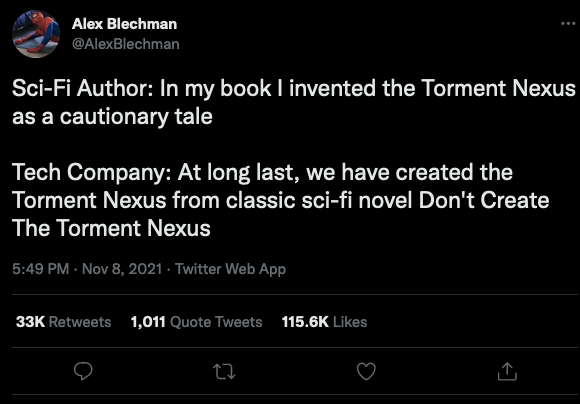
As I write this, the ghastly oligarch Elon Musk has just purchased Twitter, the ghastly platform for racism, misogyny, and encroaching fascism. Twitter can, if extremely carefully curated, be a medium for discovery, but mostly, a tremendous amount of energy is spent by people trying to earn the title of Cleverest Person of the Last 30 Minutes. I suppose I can hold out hope that un-banning Golden Toilet’s account will result in another Trump/Biden election, which is the only way we’re going to stave off Braindead Gilead for another four years. Musk and Twitter are both part of a Bad Science Fiction future. We wanted space communism and jetpacks; we got uncharismatic oligarchs and micro-rants. I wanted to find a source where someone discussed this at length, but the first thing I found was, of course, a Tweet:

I have a special loathing for Musk because, in addition to everything else questionable about him, he claims to be a fan of Iain M. Banks’ Culture novels and to have read them multiple times: he’s even named some of the SpaceX ships after ships in the novels. While it’s definitely amusing to see a rocket recovery ship called Of Course I Still Love You, it’s also clear that he either didn’t understand the books or has chosen to serve as a counterexample. In the Culture, everyone has the freedom to do as they wish; many people have speculated that Musk is buying Twitter purely so that he can ban the account of the teenage boy who tracks Musk’s private jet. More than anything, Musk is the villain from a Banks novel. Specifically, he’s Joiler Veppers from Surface Detail: an archcapitalist with vile appetites who profits from the suffering of others. Had we the technology to capture people’s mindstates after death and send them to a digital hell, Musk would surely try to leverage it—but of course, we already have Facebook and whatever the Metaverse is going to be.

In this issue of SFRA Review, we have elements of a better SF future: specifically, the second half of our Hungarian Futurisms symposium. We very much hope that in some way, the essays, fiction and reviews herein can help us to understand how things might, could or should be better.

From the President


SFRA Review, vol. 52, no. 2

From the SFRA Executive Committee


From the President

Gerry Canavan

I could not be more excited by the Oslo conference—Bodhi Chattopadhyay and the CoFUTURES group have planned a simply incredible event (including an ambitious hybrid structure, half a dozen keynotes, nearly 200 presenters from six continents, and no conference fee!) that I really think will put our organization on the map in a new way. The conference registration page is now live at https://sfra.org/sfra-2022-conference/sfra-2022-conference-registration/ for both presenters and non-presenting attendees so I would ask you to sign up and let me know if you have any issues or concerns. (Presenters must be members of SFRA, so be sure to renew your membership as well.)

Thank you to Bodhi and to CoFUTURES for everything you’ve done and are doing for SFRA.

We are moving forward with our plans to expand the executive committee. We have issued recent calls for the outreach director and the web director and will name those new officers soon; we are also reaching out to people we believe might make a good development officer and seeing if they have interest and capacity to take this on. Aisha Matthews has generously agreed to chair the new conference committee, and will be working with the organizers of recent conferences, as well as the 2023 and 2024 conferences, to set policy and guidelines for future SFRA conferences; she will also help us select a site for 2025 and beyond. (Thank you Aisha!) Perhaps most importantly, our elections this fall will include votes for president and secretary under the new guidelines, and will also include one-year pilot terms for the new “at-large” exec seats; this one-year pilot will help ensure that procedures and expectations are clear in time for the scheduled at-large election (for the full three-year term) in 2023.

This fall’s election will of course also mark the end of my time as SFRA President and my assumption of the “Immediate Past President” role. I look forward to assisting the new exec in that new position, but I’ll look back very fondly on my time as SFRA president (despite all the COVID-related chaos that dominated the last three years). Thank you all for the trust you’ve placed in me these last three years, and thank you for all the work you all do to keep SFRA humming. See you in Oslo!


From the Vice President


SFRA Review, vol. 52, no. 2

From the SFRA Executive Committee


From the Vice President

Ida Yoshinaga


As we head to our first truly hybrid conference, in Oslo and online this summer, it is my pleasure to facilitate a follow-up discussion on diversity and inclusion for the global SF studies community that is the Science Fiction Research Association. Last year’s organizers—in response to critical, helpful feedback on the conference program by our membership—started this conversation on how our association can perform social justice in its institutional practice in addition to appreciating it in textual analyses. We hope to become the sort of organization that puts the “Co” in “CoFuturisms,” in other words.

Such conversations have been transpiring in traditional academic disciplines as well as our modest field of speculative/fantastic studies. Diversity, equity, inclusion, and belonging (DEIB) issues are not exclusive of other, related discussions we have been holding among the SFRA Executive Committee—for instance, how to widen our scope of country representatives so as to include more participants who are not from the Global North. How to conduct better outreach to members of non-traditional class-, gender-, sexuality-, age-, ability-, and other thriving communities of intellectuals, educators, and artists who love our family of genres. How to support our rich breadth of scholars through more extensive networking and mentorship activities as well as improved travel and research funds. And so on.

At SFRA 2022 this summer, there will be a DEIB panel that invites you to share suggestions and proposals for widening the reach of our organization, for making it more safe and encouraging to join for diverse thinkers and creatives in SF studies, and for reflecting conscientiously on the outcomes of such efforts as we move together into the future. I take my lead from observing other academic associations—for instance, the Society for Cinema and Media Studies, which in the mid-2010s advanced a free trial 2-year membership for Indigenous scholars as a way to signal a welcoming space for Native, Aboriginal, First Nations, and similar researchers. For many, an SFRA membership might come secondarily after signing up to belong to a key association in one’s discipline (e.g., the MLA or ASA)—or inter-discipline (e.g., in the field of Native studies, NAISA; or of film/media studies, SCMS), as the case may be. For “alt-ac” researchers and adjuncts; for BIPOC and first-generation college-graduate scholars; for LGBTQIA faculty and storytellers working under varied social conditions, how do we facilitate membership in a vibrant, nourishing organization, so as to be competitive with other associations?

Come with your concrete suggestions for practice, policy, evaluation, finance, organizing. Come with your experiences with, and knowledge of, other associations’ (or programs’/ institutions’) imaginative, effective DEIB changes. If you can, reduce it to ONE page—outline, paragraph summary, bulleted list—to share online onscreen and in our Oslo meeting room with fellow attendees. And come with your curiosity for the future.


Review of Raised by Wolves, season 2


Review of Raised by Wolves, season 2

Daniel Lukes

Aaron Guzikowski, creator. Raised by Wolves, season 2. HBO Max, 2022.

The most obvious fact to state about Raised by Wolves (RBW) is that it’s a Ridley Scott production: he is one of its executive producers (via his production company Scott Free), and he directed the first two episodes of Season 1; his son Luke Scott (director of the underrated android flick Morgan, 2016) also directed episodes 3,4 and 10. Ridley Scott’s vision is all over RBW, so much so that it could almost take place in the extended Alien universe. If xenomorphs were to make their appearance somehow among the crowded gallery of grotesque creatures and entities that already populate RBW, it would hardly be a surprise. Aesthetically, RBW shares much with the underrated Ridley Scott Alien prequels, Prometheus (2012) and Alien: Covenant (2017), with their muted and somewhat drab tones, colors turned down approaching grayscale, and a preponderance of dark, dimly lit settings.

Set in a future following a war between two factions: theocrats (named Mithraic, after an ancient Roman mystery cult) and atheists, which has decimated the planet, the show follows the vicissitudes of two androids, “Mother” and “Father.” This somewhat hapless couple has been sent to planet Kepler-22b to raise a family of human children, away from the pernicious influence of the Mithraic, who have also reached the planet in a colonist ship named the Ark of Heaven. Though RBW follows the various and often bloody conflicts between the Mithraic and the atheists, most of the action is filtered through Mother and Father’s struggles to keep their family together and their children alive on this barely habitable and unpredictable planet. Mother, it turns out, is not a mere service model android, but actually a weapon of mass destruction, a “Necromancer,” used by the Mithraic and reprogrammed by atheist hacker Campion Sturges. Mother’s violent—even genocidal—side comes out when she is provoked. Her actions provide one of the first moral dilemmas the show poses, and it is questionable whether Mother can really ever come back from her decision to exterminate circa-1000 Mithraic in the name of protecting her family.

RBW is science fiction of the “grimdark” variant, a type of sci-fi that stems from the world of tabletop game Warhammer 40,000, and one that generally depicts a Nietzschean universe: cold, mechanical, uncaring of human plight. In recent years, WH40K and grimdark have both been seized upon cynically by the Alt-Right, even though WH40K was originally born as a critique of heartless 1980s Thatcherism. Into this context comes RBW and its neomedievalist portrayal of future theocracy that directly recalls WH40K’s Roman Empire-influenced “Imperium” and worldbuilding. Its somewhat low-key title relates to the mythical founder of Rome, Romulus, and his brother Remus, being raised by a female wolf. RBW’s central theme of faith vs. atheism is treated in a direct and explicit way that brings to mind more the British atheist tradition (from Monty Python’s The Life of Brian to Richard Dawkins and Christopher Hitchens) than how contemporary US television typically handles faith and religion, with multiple characters here openly declaring that God (known in the show as “Sol”) does not exist and is only a myth.

What lies at the heart of RBW are its android characters. Mother, expertly played by Amanda Collin, is an android for the ages, up there with Schwarzenegger’s Terminator,  Haley Joel Osment’s creepy child in AI, and of course the Alien franchise androids—Ian Holm as Ash in Alien, Lance Henrikson as Bishop in Aliens, and Michael Fassbender as David in Prometheus/Covenant. Tellingly, Mother and Father are powered by the same milky-white “fuel blood” spilled everywhere by Ash in his famous death scene. Whether in caring or terrifying “Necromancer” mode, Mother commands attention, and is perfectly complemented by the warmer, more caring identity of Father (brilliantly played by Abubakar Salim) with his awkward dad jokes and attempts to keep the peace. The androids in RBW have something of a classic comic feel to them: Mother and Father’s bickering are often only one step away from a Samuel Beckett play, and other androids and AIs such the medic Karl (Carel Nel) in S1 and S2’s sentient quantum computer The Trust (Michael Pennington), with their varying degrees of comic relief and Britishness, feel at one remove from a Monty Python sketch, or perhaps rather the Terry Gilliam of Time Bandits or Brazil.

Leaving behind the harsh deserts and valleys of Season 1 and their uncanny rolling mountaintop clouds—both seasons were beautifully shot on location in South Africa—Season 2 is set around an atheist colony in the tropical zone. This season often feels like a cyborg reworking of Shakespeare’s The Tempest. The sea (made of acid) is ever present. Characters flit about in the countryside, appearing and disappearing at will, with Kepler-22b as a new “brave new world that has such people in it,” and a character even being directly called “Tempest.” By the end of S2 though, the mysterious “entity” pulling strings in the background, the “Prospero” in a way, has yet to be revealed. S2’s uncanny, retro-futurist ambience recalls the original Star Trek, with characters stumbling around an alien landscape, though with the exoticism toned down, and also brings to mind early 1980s UK TV shows like Day of the Triffids or The Tripods.

The presence of Mother’s seventh child, a biomechanical “world serpent”, cements the show’s status as a weird retelling of the Genesis narrative. Asking the important questions here, RBW wonders: “What if God were an alien? And what if religious scriptures were a set of instructions for events yet to occur, on another planet?” As the assorted characters make their way around this very strange Garden of Eden, the show probes and negotiates the porous boundaries between animal, human, posthuman, and A.I. When young Campion (Winta McGrath), named after the android’s “creator” Campion Sturges (Cosmo Jarvis), falls in love with the android Vrille (Morgan Santo) and wishes to welcome her into his family, though he faces strong resistance, the show’s logic is firmly on his side. Likewise, the discovery that the planet’s humanoid creatures, of which there are land and acid ocean-dwelling variants, are devolved humans, feels like a piece of poetic Darwinian reverse engineering.

RBW juggles many big themes—domesticity, child-rearing, settler colonialism, survivalism, precarity, grief, our increasing reliance on A.I.—and S2 expertly balances them with unpredictable plot twists, and visuals that are beautifully-rendered and often on the edge of body horror. While not relentlessly meta like The Boys or Mr. Robot, RBW can perhaps be compared to series like Yellowjackets, Tales from the Loop, Dark or Archive 81 for its ominous sense of impending doom introduced into the humdrum of daily life, bringing together the epic and the domestic. Whereverit goes next, RBW is a relevant and welcome addition to the SF canon at a time when everyday life often has the feel of a slow-motion apocalypse.

Daniel Lukes is Communications Officer in the Bieler School of Environment at McGill University. He has a PhD in Comparative Literature from New York University, and his reviews have appeared in Extrapolation, The Journal of the Fantastic in the Arts and Utopian Studies. He has published three books of non-fiction, and his next book will be Black Metal Rainbows (PM Press, 2022).

Review of I’m Your Man [Ich bin dein Mensch]


Review of I’m Your Man [Ich bin dein Mensch]

T.S. Miller

I’m Your Man [Ich bin dein Mensch]. Dir. Maria Schrader. Perf. Maren Eggert and Dan Stevens. Majestic Filmverleih, 2021.

Maria Schrader’s German-language film I’m Your Man [Ich bin dein Mensch]belongs to a by now familiar enough subgenre in science fiction, that of the robot rom-com. Schrader, however, crucially reverses the typical gender dynamics of the genre’s long fembot-filled history. In film, this tradition stretches back at least to Bernard Knowles’s 1949 farce The Perfect Woman and includes more recognizable titles such as John Hughes’s 1985 cult teen sex comedy Weird Science and Spike Jonze’s 2013 film Her, all of which electronically recast the Ovidian myth of Pygmalion and Galatea, the sculptor’s beloved statue come to life. While there is some precedent for this specific premise—the 2014 Disney Channel Original Movie by Paul Hoen called How to Build a Better Boy is one example—I’m Your Man is also notable for the ways it confronts the male gaze undergirding so many stories of eroticized gynoids under the leadership of a woman director, still such a rarity in the world of science fiction film. Students and scholars interested in media representations of artificial intelligence and/or androids will therefore find the film a must-see addition to the ever-widening corpus of such works.

Alma (Maren Eggert) is a recently single academic leading a team working at the Pergamon Museum in Berlin on ancient Sumerian cuneiform tablets as some of the earliest surviving expressions of the human artistic imagination. At the beginning of the film she has already agreed—ostensibly as an exchange of favors with the academic administrator who controls their institution’s purse strings, but possibly for other, more personal motivations as well—to offer her services as an expert evaluator of a new line of romantic companion robots that impeccably imitate a human appearance. Based on a personalized psychographic profile, her own “perfect man” has been created to become an ideal romantic partner. The result is a suave android who introduces himself as Tom (Dan Stevens) and begins showering her with transparently cheesy compliments. “Don’t you like compliments?” he observes with concern, already beginning to adjust his behavior according to her responses. “Do you believe in God?” Alma counters, and, in the way of the old chatbot SmarterChild and many of our contemporary digital assistants, Tom opts for a classically noncommittal deflection: “This is hardly the place to discuss such a question.” Alma thus enters her fixed-length trial period with Tom filled with intense skepticism about the initiative, and her expert report, we are told, will assist policymakers in determining whether such androids will be permitted “to marry, to work, to get passports, human rights, or partial human rights.” The narrative that ensues does indeed hit many of the narrative beats familiar from the romantic comedy, but always with the additional layers of complexity that arise from the science fictional premise. Tom doesn’t simply have to win the more than reluctant Alma’s heart; succeeding or failing at this preprogrammed objective counterintuitively has implications for his very personhood.

In 1950, Alan Turing famously proposed his “imitation game” as a self-consciously imperfect but infinitely more practical replacement for the difficult question “Can machines think?”: could a computer persuade a human subject in a double-blind setup that a fellow human was speaking on the other end of the line? In his own 1995 Pygmalion novel Galatea 2.2, Richard Powers waggishly makes a further substitution, replacing the conventional Turing test with the more specific question of whether a neural net trained on the Great Books could pass the comprehensive exam for a master’s degree in English literature. The roboticists in I’m Your Man have set themselves a no less difficult challenge: it is not the hard problem of consciousness as such that they seek to solve, but instead the hard problem of love, or rather, of romantic and not simply sexual attraction. In the future that the film imagines, fooling the senses is easy, even cheap, with holograms and the androids alike as indistinguishable from humans as Ridley Scott’s replicants. The goal here is much more than a “basic pleasure model,” however, and the kind of uncanny valley that Tom must bridge to reach Alma and win her heart has more to do with the mysteries of human desire, memory, and emotion than any physical stiffness or inhuman jerkiness.

And try to woo Alma Tom does, and try and try. “Failed communication attempts are crucial for calibrating my algorithm to you,” he says good-naturedly upon learning that unsolicited advice about how to improve her driving is perhaps not the optimal way to a woman’s heart: “These mistakes will happen less and less.” Eggert’s performance as Alma communicates an extreme wariness towards Tom at all points and in all ways. After all, not only does she find herself suddenly cohabiting with a strange man, he isn’t even a man, but an unprecedented and unpredictable technological creation: “your thing, your dream partner.” Perhaps more threateningly still, Tom represents a something or someone she might allow herself to fall in love with if she isn’t constantly on her guard. In the first half of the film especially, we see Alma recoil the most viscerally at being told what she likes, that her desires can be solved via algorithm: “You are attracted to men who are slightly foreign,” Tom informs her, explaining his British accent. Such exchanges speak to one of the film’s major thematic concerns, the implications of the algorithms that, visible or not, already run our lives in an increasing number of ways. Along with Alma, we don’t like the idea of being turned into data, or thinking of ourselves as a series of data points in some mainframe to be manipulated and exploited by multinational corporations according to demographic profiles that fit us all too well. Schrader’s film recognizes that the real-world AI revolution of the past decade or so has relied not only on the neural nets and self-teaching algorithms we hear so much about, but fundamentally also on big data as a key component of its formula for success. When Tom locks eyes with Alma, his cerebral processes work on the problem of her heart through access to “mind files from 17 million people.” What’s at stake in falling in love—or not—with a machine seems to have as much to do with our relationship as individuals to new forms of mass computation and abstraction that needn’t achieve self-awareness to have tremendous implications for human life and human lives.

Science fiction stories from the past century and more have given us a number of artificial women manufactured unselfconsciously for a male gaze. This film invites us to consider what might change, in the end, when the genders of the Pygmalion-Galatea relationship are reversed, and when, as in I’m Your Man, the artificial romantic partner is manufactured to fulfill the individualized desires of a particular heterosexual woman. The conclusion of the film may finally be as open-ended as the hard problem of consciousness (or romance), but overall I’m Your Man is certain to provoke much thought and discussion among many different audiences.

T. S. Miller teaches both medieval literature and modern science fiction as Assistant Professor of English at Florida Atlantic University, where he contributes to the department’s MA degree concentration in Science Fiction and Fantasy. Recent graduate course titles include “Theorizing the Fantastic” and “Artificial Intelligence in Literature and Film.” He has published on both later Middle English literature and various contemporary authors of speculative fiction. His current major project explores representations of plants and modes of plant being in literature and culture.

Review of The Matrix Resurrections


Review of The Matrix Resurrections

Sándor Klapcsik

The Matrix Resurrections. Dir. Lana Wachowski. Warner Brothers, 2021.

The Matrix, which was directed by the Wachowskis and released to worldwide acclaim in 1999, became a landmark in the history of science fiction cinema. An epitome of cyberpunk, it popularized postmodern philosophy and 1980s science fiction for a wider audience. Together with its turn-of-the-millennium contemporaries, such as George Lucas’s Star Wars: Episode I – The Phantom Menace (1999) and Peter Jackson’s The Lord of the Rings (2001), it paved the way for a new phase in Hollywood cinema, which intensively intends to mesmerize the audience by science fiction and fantasy spectacles. It featured revolutionary visual effects, such as the upgraded version of bullet time, and also became a landmark in the media history of home entertainment, since the special gimmicks on its DVD edition helped to popularize the DVD format (Jenkins 94; McFarlane 106). By creating a “collage of… high cultural and low cultural allusions and genres” (Barnett 366), for example, directly displaying Jean Baudrillard’s theoretical book Simulacra and Simulation, it became a favourite of young scholars whose education was dominated by postmodern continental philosophy. Hence – at least temporally – the film managed to bring closer scholarly research on high culture and popular culture (Barnett 365). With the exception of the animated anthology The Animatrix (2003), the sequels mostly disappointed the audience and critics alike. Nevertheless, with its sequels and interrelated comics, short stories, and computer games, the Matrix saga became an important early example of multimedia franchises and transmedia storytelling (Jenkins 21, 93-130).

Since then, many of the cyberpunk extrapolations have turned into our reality and the young scholars have grown up. These days, selling DVDs serves a niche market of collectors only and multimedia franchises and transmedia storytelling are the standard. The question arises then: how—and as for the anti-nostalgic sceptics (for example, Bradshaw; Cameron), why—to make a sequel more than twenty years after the first film and roughly eighteen years after the heyday of the franchise?

As successful recent additions to the Batman saga such as The Joker (2019) indicate, movies based on superhero comics can always place their characters into a different era or a new mise-en-scène, thus forming variants on the same theme without scruples. In contrast, as the struggling sequels of the Terminator saga demonstrate, science fiction franchises that want to revive old stories face a bigger challenge, since they cannot ignore the duties and restraints of nostalgia. As Svetlana Boym indicates, nostalgia can be either restorative, that is, serious and reconstructive, or reflective, humorous, sarcastic and ambivalent. As for the latter, “This type of nostalgia is ironic, inconclusive and fragmentary” (Boym 50). Forming a perfect embodiment of restorative nostalgia, Denis Villeneuve’s Blade Runner 2049 (2017) proves that it is possible to create a beautiful and relatively meaningful pastiche to pay homage to the original story, which both the critics and the audience can appreciate. Terminator Genisys (2015) taught us that another possibility is to produce a self-reflexive, playful, fannish, somewhat goofy sequel, which the fans mostly enjoy, while the majority of critics patronizingly pan (see, for example, Hersko) and the general audience distantly tolerates or more-or-less ignores. With The Matrix Resurrections, Lana Wachowski chose the latter path, following the bumpy road of reflective, humorous and ironic nostalgia. 

Ironic and self-reflexive elements, multiple embedded stories and images, as well as moments of breaking the fourth wall, were already tangible in the first Matrix film. Surveillance footage, television screens, references to Bruce Lee’s iconic gestures and Hollywood clichés, addressing the audience directly, and other elements of parody saturated the film. Nevertheless, the cyberpunk themes, which were relatively fresh in Hollywood cinema, together with the revolutionary visual effects, managed to make the audience temporarily disregard or suspend the irony. Alternatively, the audience viewed the movie with a double vision: we saw that it was a goofy, banal, self-reflexive film, but it was refreshingly new at the same time. Thus, it is only logical that if Lana Wachowski’s 2021 sequel did not bring to light fresh themes and revolutionary visual effects, but kept or even increased the intensity of parody, the result would be a significantly more comic and self-reflexive film. This explains the mixed, and mostly negative, reviews: for a few critics, The Matrix Resurrections is a sarcastic and ironic production that shows once again how digital surveillance, social media, and Hollywood filmmaking impact our lives. For many others, the film is a childish, clichéd, badly executed farce which can acquire cult value only due to its relatively faithful repetition of characters and plot elements.

 As already highlighted in the marketing materials and trailers, the 2021 film revolves around déjà vu and reflective nostalgia. The opening sequence is an uncannily re-enacted version of the opening sequence of the first Matrix film. In this new version, different actors play the roles of policemen and agents, uniforms are more up-to-date, and Ellen Hollman appears as the reflection of the original Trinity character (Carrie-Anne Moss). The commentaries of the hackers who peek into this scene also emphasize that there is something wrong with the repetition. As gradually explained, the re-enactment is a “modal,” a test environment for computer games, and the hackers who monitor this are fans of Neo’s story depicted in the first three films. Soon after this, one of the fans who watches the uncanny repetition, Bug (Jessica Henwick), meets the re-embodiment of Morpheus (originally played by Laurence Fishburne and this time by Yahya Abdul-Mateen II). She is just as happy to see Morpheus – who at this time appears as an agent in the “modal” – as a devoted fan is happy to meet an actor of a beloved television show or film; she even hugs him when it turns out that they are both fans and seekers of the long-lost Neo. It is easy for the audience to become disoriented and captivated by the multiple embedded levels in the renewed opening sequence. Yet, at the same time, the fannish and somewhat naïve enthusiasm expressed by the characters results in a burlesque parody.   

The film is at its best when it self-reflexively mocks consumerism, reboots, and remakes. As verbalized in the film, “Reboots sell,” perhaps because “Nothing comforts anxiety like a little nostalgia.” A crucial and memorable sequence describes Thomas Anderson (Keanu Reeves), a successful but somewhat burnt out game developer who invented the fictional Matrix-themed video game series, which is part of the new matrix, the current version of the computer simulated dreamworld to keep humanity under control. He intends to refuse the task of adding a new sequel to the already finished world of his award-winning video game series—but his boss and Warner Brothers insist, and they will make a sequel, entitled Matrix 4, with or without the contribution of the creator. This is followed by a brainstorming by a think-tank, the development team of Matrix 4, which comes up with various and sometimes contradictory explanations why the original game was impactful. Here the story is blatantly, perhaps all too blatantly, making fun of its own production process and the various intellectual and pseudo-intellectual reactions to the previous Matrix movies, which were, in fact, embraced and accentuated by the Wachowskis (Jenkins 99-100).

Other remarkable and tragicomic scenes depict the ordinary life of the disillusioned Thomas Anderson, that of Tiffany-Trinity (Carrie-Anne Moss), who eventually becomes more powerful than ever, and revolve around The Analyst (Neil Patrick Harris). The latter, after masquerading as Andersons’s psychotherapist, reveals himself to be the master of the current matrix. In a way similar to Agent Smith (Hugo Weaving) in the first film, Harris’s speeches are often ideologically revealing about consumerism, and at the same time, they inject additional humour into the film. The lives of Anderson and Tiffany are saturated with reflective nostalgia insofar as they search for their original selves, home and stories, but they need to realize that the target of their nostalgia “is in ruins or, on the contrary, has just been renovated and gentrified beyond recognition” (Boym 50). Their previous romantic love story has been transformed into an extremely popular and commercialized computer game, Zion was destroyed by a war, and the new city of the resistance, Io, is much less rebellious and “human” than Zion was. For example, while in the first Matrix film the freedom fighters needed to eat tasteless food and only the traitor character Cypher (Joe Pantoliano) enjoyed his simulated juicy steak, in Io, humans and embodied computer programs cooperate to cultivate genetically resurrected, and supposedly delicious, fruits.

To sum up, The Matrix Resurrections features many self-reflexive moments, Easter eggs, multiple embedded worlds, playful references to the Matrix saga, strong female characters, and a relatively complex storyline with quite a few plot holes. True, the new Matrix film is not as revolutionary and does not impress the audience as much as the first film did. But it clearly does not intend to. The first film warned the audience of the increasing digitalization and upcoming artificiality of our environment. The fourth film reminds the audience of the omnipresent digitalization, consumerism, and artificiality of our environment. Further, it intends to mock reboots, remakes, and sequels, and unmask how the entertainment industry exploits our nostalgic inclinations. The Matrix Resurrections is perhaps even more postmodern than the first Matrix film was (Barnett 363-366)—which does not mean that it is successful or excellent. Perhaps its postmodernity even marks it as somewhat outdated, less comprehensible and enjoyable, at least for the younger audiences. However, this should make it, to some extent at least, worthy of scholarly research and teaching.

REFERENCES

Barnett, P. Chad. “Reviving Cyberpunk: (Re)Constructing the Subject and Mapping Cyberspace in the Wachowski Brothers’ Film The Matrix.” Extrapolation, vol. 41, no. 4, 2000, pp. 359-374.

Boym, Svetlana. The Future of Nostalgia. New York: Basic Books, 2001.

Bradshaw, Peter. “The Matrix Resurrections Review – Drained of Life by the Hollywood Machine.” The Guardian, Dec 21, 2021, pp. 17. ProQuest, https://www.proquest.com/newspapers/matrix-resurrections-review-drained-life/docview/2612183571/se-2?accountid=17116

Cameron, Charles. “Why Resurrections Hurts The Matrix Franchise More Than Revolutions Did.” Screenrant. https://screenrant.com/matrix-resurrections-hurts-franchise-more-revolutions-why/.

Hersko, Tyler. “Terminator: Genisys Feels Like Disappointing Fan Fiction.”  Reno Gazette – Journal, Jul 10, 2015, pp. 1. ProQuest, https://www.proquest.com/newspapers/terminator-genisys-feels-like-disappointing-fan/docview/1695156532/se-2?accountid=17116

Jenkins, Henry. Convergence Culture: Where Old and New Media Collide. New York: New York University Press, 2006.

McFarlane, Brian. “The Matrix: Cult Classic or Computerized Con?” Screen Education, no. 41, 2006, pp. 105-110.

Sándor Klapcsik is an assistant professor at the Technical University of Liberec, where he conducts research on acculturation and stereotypes in migrant cinema. He earned his PhD at the Cultural Studies Department of the University of Jyvaskyla, Finland, in 2010. He was a Fulbright-Zoltai Fellow at the University of Minnesota, did a long-term research at the University of Liverpool and at the Department of the Sociology of Culture, University of Lodz. His book Liminality in Fantastic Fiction: A Poststructuralist Approach was published in 2012.

Review of Foundation, season 1


Review of Foundation, season 1

Jari Käkelä

Goyer, David S. and Josh Friedman, creators. Foundation. Season 1, Apple TV+, 2021.

When it was announced that Asimov’s famously un-filmable Foundation would finally be turned into a television series, online sf forums filled with excitement but also with fears over seeing another “inspired by” blend in the vein of Alex Proyas’s infamous I, Robot. Now that the first season has concluded, it is clear that, while Goyer and Friedman’s Foundation is in many respects closer to the original, it does not attempt a scene-by-scene adaptation of Asimov’s work, nor does it go for a condensed but rather faithful adaptation such as Villeneuve’s Dune. There are major changes, criticized by many (see e.g. Bricken), but in spite of its issues, the TV adaptation seems to retain some of the spirit of the original.

Much of the appeal of Asimov’s original is in the sense of witnessing vast sweeps of history. Some of this comes from Asimov modeling the fall of the Galactic Empire on Edward Gibbon’s The History of the Decline and Fall of the Roman Empire (1776–89), and the TV version certainly injects elements of the Roman Empire into the storytelling. Overall, though, at the core of Asimov’s original were the notions that the ebb and flow of historical forces always surpass the individual, and that scientific calculation of the course of human history—through the fictional science of psychohistory—allows for the engineering of the course of future history. In Asimov’s work, the Foundation begins developing into a new Galactic Empire through stages that mirror the historical developments of the United States from the times of first European settlers to the early twentieth century. Along the way, this evokes undertones of Frederick Jackson Turner’s “Frontier Thesis,” and the metaphorical exile from a corrupt old empire turns into an analogy of revitalizing American expansionism and Manifest Destiny (see Käkelä 2016 for extensive discussion of these themes).

Goyer’s TV adaptation retains the central situation of the story: Psychohistory has revealed that the center of human civilization, the Galactic Empire, is headed toward a collapse—and the mathematician Hari Seldon’s scientific Foundation is placed on the distant planet of Terminus. In Asimov’s original, the plot was mostly on an intellectual level, even if the characters themselves often reflected the space cowboy traits of pulp sf. The TV version, on the other hand, brings the action to the physical plane, even as it goes for a more inclusive outlook with its casting (see Kaye) and updates several key characters, such as Salvor Hardin (Leah Harvey) and Gaal Dornick (Lou Llobell), into black women. In addition to the goal of making Asimov’s galaxy full of people more diverse, his dialogue-heavy approach was deliberately exchanged for heightened action and emotional appeal by the showrunners (Jackson).

As a result, the TV version’s dynamic of storytelling evokes blockbuster action up to the point where Leah Harvey’s Salvor Hardin considers the book-version Hardin’s slogan “Violence is the last refuge of the incompetent” an “old man’s doctrine,” and approaches the situation with action hero one-liners such as “I want to see what violence we can muster.” While viewing violence as a valid solution reflects the showrunners’ background in superhero franchises and sf action, it does also seem to subvert Asimov’s fundamentally non-violent message of letting the greater rationality prevail instead of physical force. The implications of this change certainly warrant further critical attention: The show seems to consider Asimov’s antiviolence a naïve ideal of shaping history from behind the scenes without having to become emotionally invested in it yourself—perhaps implausible in the post-9/11 world. There is potential for sociocultural, racial and gender commentary, but it could be explored further if this extends beyond giving the black female protagonist the active, traditionally white, masculine power of the action hero—and if the show goes beyond rehearsing the stock Hollywood formula: violence equals emotion.

Finally seeing Asimov’s series on screen is part of the appeal with the adaptation, and it does look gorgeous. Significant attention has gone to the visual aspects of the TV show, and the details are full of small references to the sf megatext. The added storylines that deal with the Galactic Empire also reflect a variety of motifs in more contemporary works of sf (themselves influenced by Asimov’s original). For example, the Star Bridge space elevator—the crown jewel of the Galactic Empire’s technological prowess—borrows profusely from Kim Stanley Robinson’s Mars trilogy. In both, the massive piece of infrastructure is similarly destroyed, up to the spectacular image of its falling cable wrapping around the planet—even if in the adaptation its function is to provide a pointed 9/11 moment to the story. In visual details, there are also more subtle cues such as Salvor Hardin’s ground car, reminiscent of Luke’s at the beginning of Star Wars, and the arid desert of Terminus that evokes images of Tatooine and similar science-fictional desert planetscapes. The addition of mystical/religious elements also seems to hark back to motifs such as the Force in Star Wars and messianic elements in Dune. The representation of the Empire itself, on the other hand, takes visual cues from illustrations in pulp magazines, creates a sort of comic book version of the Roman Empire, and mashes these together with echoes of totalitarian monumentalism—all filtered through the stylizing lens of Apple’s futurism-style seen in their product design.

The visuality of the show certainly works to signal the massive scope of the original, but in addition to its attitude to violence, the first season of the TV adaptation breaks away from Asimov’s version through its emphasis on individual agency. Asimov himself did contradict his premise that characters would only be instruments of the larger Plan and historical movements as he created characters that were sort of Carlylean Great Man versions of pulp heroes. However, in the adaptation, Hari Seldon even directly says that the “entire galaxy [is] pivoting around the actions of an individual.” In Asimov’s version, a more overt focus on the individual only arose when he started to retroactively connect his Robot series to the Foundation universe in novels such as Foundation’s Edge (1982), Foundation and Earth (1986), Prelude to Foundation (1988), and Forward the Foundation (1993). Right from the start, the TV adaptation draws on all of these, and privileges individual genius as the source of action. Turning Gaal Dornick from a minor character in Asimov’s original into a central protagonist is the most obvious element of this change. Even Seldon acknowledges her “sort of intuitive processing ability that puts [her] ahead of the math.” Dramatizing Gaal’s ability to “feel the future” commits the adaptation to the agency of exceptional individuals far beyond the original. In so doing, it also seems to suppress Asimov’s reliance on scientific understanding as the basis for action, and instead tilts towards an approach that seems to reflect the 21st-century self-help culture of discovering your inner strength.

While committing to individual agency from the start, the TV version shifts the original’s treatment of violence and politics also on the level of society. For example, Asimov’s original revels in the masterful, but essentially nonviolent, manipulation by which the Foundation solves its first crisis during which the surrounding “barbarian kingdoms” of Anacreon and others threaten to annex Terminus. Asimov’s original rather gleefully narrates how the Foundation weaponizes its techno-scientific knowledge and psychological understanding to manufacture a religion by which to control their less-educated neighbors. The TV series, on the other hand, bypasses these kinds of exploitations. Instead of resolving their first crisis by tricking the “barbarians” into submission, the Foundation first engages in violent combat but ultimately survives by taking their neighbors seriously and offering them a more equal role in the Foundation’s future. It seems that the cunning manipulations are present only on an individual level through various battles of wills, not in the larger societal impact of the Foundation.

Manipulation as a method of governance has not entirely disappeared from the adaptation, but it is now used by the old Galactic Empire and works to highlight its unviability. This is most clearly present in the storyline invented for the TV adaptation where the Empire is headed by clones of the original emperor. Effectively, this manipulation is a workaround for the emperor’s mortality, but it becomes a metaphorical dramatization for the Empire’s stagnation where literally the same (cloned) white man stays perpetually in power. Relegating ethically more questionable elements of utilitarianism to the falling empire, the TV series rather neatly bypasses many of the most glaring ethical issues of Asimov’s original by not letting the ‘good guys’ use devious means to attain their goals. Modernized attitudes are visible even in the Anacreonians who scold the Foundationers for calling them “barbarians, just a convenient slur for anyone not like you.” Through these kinds of meta-level comments on Asimov’s original, the TV series distances itself from the original’s dated colonialist infantilization of subjugated nations. This change also begins to deconstruct the way Asimov meshed his references to Gibbon’s history of Rome with the imagery of American expansionism and later policies of civilizational imperialism. 

Still, even this change does not come without its problems. While the series makes a conscious effort to transfer Asimov’s WWII and Cold War metaphors to the present, portraying the Anacreonians through stereotypical post-9/11 representations of Middle Eastern terrorists complicates the TV series’ mission of inclusion. Dramatically, making Anacreon an Afghanistan analogy of sorts does allow for a plotline where the series can then present a rectification of the dynamic of recent decades in real-world history—by admitting the ostracized nations to a level playing field and engaging with them in actual cooperation. Nevertheless, even there the TV series still implies that the Western world-associated Foundation is needed to enable the agency of other nations on the world stage.

As the TV adaptation draws on all of Asimov’s Foundation universe, it also creates links similar to his 1980s retcon to his Robot stories. Although Apple apparently does not have rights to Asimov’s Robot stories, the character of Demerzel (Laura Birn), the 10.000-year-old robot assisting the emperors, is set up as similarly significant for the upcoming seasons. In Asimov’s connected Robot-Foundation universe, Demerzel was of course a disguise for his most famous robot character, R. Daneel Olivaw, who had become by the end of Foundation and Earth a primus motor of sorts for the whole retconned storyline. The TV show certainly shows a similar desire to connect everything, but it remains to be seen how much of this storyline the showrunners will retain.

Overall, already the first season makes it clear that the series is aiming to become something that stands on its own, apart from Asimov’s original stories. This is most apparent in the way the TV adaptation has begun to steer away from Asimov’s more cynical instrumentalism and utilitarian conception of history. Instead of recreating the original’s exploitation of people with less access to knowledge, endless chains of master-subject relationships and precarious balances of terror, the TV version seems to be aiming toward societies with more lasting and egalitarian stability. In a sense, though, Asimov’s original tension between determinism and free will has not disappeared; it has merely shifted, complicated by the increased focus on emotion, to a tension between mystical individual intuition and communal scientific work in building a better future. Apple has renewed the show for season 2, and Goyer has talked about going for at least 8 seasons. Time will tell how the upcoming seasons address the emerging, new tension between mysticism and science, but it will also be interesting to see if the fundamental optimism about humankind’s ability to set aside old animosities in the first season will be darkened by the currently looming shade of a new cold war in the real world.

REFERENCES

Bricken, Bob. “They Said Foundation Couldn’t Be Filmed, and It Still Hasn’t Been,”

Gizmondo, 23 Sep. 2021, https://gizmodo.com/they-said-foundation-couldnt-be-filmed-and-it-still-ha-1847731204. Accessed 30 March 2022.

Carlyle, Thomas. 1841. On Heroes, Hero-Worship and the Heroic in History. Teddington: Echo Library, 2007.

Jackson, Matthew. “How Do You Make a Millennia-Spanning Tale ‘Emotional’? Foundation Producer David Goyer Explains in New Clip,” Syfy Wire, 21 Sep. 2021, https://www.syfy.com/syfy-wire/foundation-behind-the-scenes-video-greatest-science-fiction. Accessed 30 March 2022.

Kaye, Don. “Foundation: Why Isaac Asimov’s Estate Approved Modernizing the Sci-Fi Classic,” Den of Geek, 24 Sep. 2021, https://www.denofgeek.com/tv/foundation-isaac-asimov-estate-approves-apple-tv-series/. Accessed 30 March 2022.

Käkelä, Jari. The Cowboy Politics of an Enlightened Future: History, Expansionism and Guardianship in Asimov’s Science Fiction, University of Helsinki, 2016, URL: http://urn.fi/URN:ISBN:978-951-51-2405-0


Jari Käkelä is a PhD in English Philology (2016) and currently works as a lecturer at the University of Helsinki. He has published articles in Extrapolation and Journal of the Fantastic in the Arts, among others. His previous research has focused extensively on Isaac Asimov’s work, and his more recent research includes looking at authors such as Kim Stanley Robinson and Sarah Pinsker through the continuum of the Golden Age.

Review of Kipo and the Age of Wonderbeasts


Review of Kipo and the Age of Wonderbeasts

Steven Holmes

Sechrist, Radford, creator. Kipo and the Age of Wonderbeasts. Netflix, 2020.

In season 3 of Kipo and the Age of Wonderbeasts, the protagonists are joined by a band of singing mutant k-pop narwhals, a point which, in and of itself, highlights the show’s particular blend of absurdist humor (the series also features singing lumberjack cats and tuxedo-wearing frogs), commitment to diverse representation, and expansion of the contours of what “post-apocalyptic media” can mean or entail. The series is set in a post-apocalyptic earth where “mutes,” or mutated forms of conventional earth animals have either gained sentience and taken on human-like community structures, or become extremely large, forcing humanity to live in underground bunkers. When the series’ protagonist Kipo’s (Karen Fukuhara) bunker is attacked by a “Mega Monkey,” she’s separated from her father and the rest of her human community and has to learn to survive on a now foreign surface. Kipo befriends surface-dwellers Wolf (Sydney Mikayla), Benson (Coy Stewart), and the mutant insect Dave (Deon Cole) in her quest to reunite with her father. Along the way, she learns that she herself is a “mute,” causing an identity crisis and forcing her to learn to control new jaguar-related powers. She in turn works to reconcile the human and “mute” communities.

The series, produced by DreamWorks Animated Television and animated by Studio Mir certainly feels in keeping with both, especially when compared to DreamWorks’ contemporaneous She-Ra and the Princesses of Power (2018-2020) and Studio Mir’s earlier The Legend of Korra (2005-2008). The comparison to She-Ra and the Princesses of Power seems particularly on point, given that both series focus on a young female protagonist navigating a set of powers she doesn’t fully understand in the midst of a vibrantly-colored post-apocalyptic landscape. Both series also share voice talent (Karen Fukuhara voices Kipo and also Glimmer in She-Ra).

Kipo and the Age of Wonderbeasts is never the “first” in any of the areas where it could be considered breakthrough. It’s not the first to take the post-apocalyptic setting of Earth as the venue for a light-hearted fantasy-like adventure—that would at least be Adventure Time (2007, 2010-2018). It’s not the first series to use mutations as a foil for racism or other phobias—that would be X-Men (1992-1997 for the children’s animated series, and the earlier incarnation in the comics). And it’s not the first children’s television series to have a character acknowledge they’re gay through dialogue—that would be 6teen (2004-2010). But, in being a polished, well-produced action series on Netflix, with all three seasons released in the midst of the first year of the shut-downs from the Covid-19 pandemic, Kipo and the Age of Wonderbeasts offers a bold, fresh new take that blends these various elements. It may end up being, if not a better-known, then at least fondly-remembered series that executed these elements well during a particularly rough year.

The main series arc focuses on the struggle to reconcile human and mute communities, a particular challenge given that the lead antagonist for the first two seasons, the mutated mandrill Scarlemagne (Dan Stevens), was experimented on as a child and seeks to enslave or annihilate the humans who once experimented on him. The most remarkable aspect of the series is perhaps the emphasis on series lead Kipo’s efforts at peacemaking, which more often revolve around finding common ground and friendship among the various “mute” communities rather than achieving victory through physical violence. While the series arc at this point may risk seeming humdrum given the decades-long prevalence of the very similar premise of the X-Men franchise in animation, comics, and film, it nonetheless still serves as an effective vehicle for the characterization of Kipo and her friends.

The series was nominated for a GLAAD award for its handling of Benson, one of Kipo’s friends who happens to acknowledge he’s gay through dialogue. Unlike 6teen, which broke that benchmark through a one-off character for a single episode, Benson is a lead supporting male role that remains significant through all three seasons. In later seasons, his crush becomes his boyfriend. But his queerness is never the subject of the main plot, and never feels like tokenism. It is, perhaps, refreshingly banal. He just is gay, and that’s not even the most interesting element of his character (that would be his friendship with Dave, the mutant insect). The representation of Benson doesn’t break any barriers that haven’t been broken before, especially when compared to Steven Universe (2013-2019), but the lack of backlash that Kipo received for its depiction of Benson will hopefully signal to other studio executives that they can stop hand wringing so much about LGBTQ+ representation in children’s animation, as there was in Adventure Time (where there were years of development before Cartoon Network would allow the queer relationship between Princess Bubblegum and Marceline to see any progress).

Between She-Ra and the Princesses of Power and Kipo and the Age of Wonderbeasts, there has been a significant departure from the years of “grimdark” that defined the idea of “post-apocalypse.” After decades of The Walking Dead and the legacy of Cormac McCarthy’s The Road (2006), children’s animation is showing that post-apocalyptic media can be colorful, fun, and upbeat.

Kipo and the Age of Wonderbeasts is relevant to scholars of children’s media and LGBTQ+ studies as an exemplar of the transformation possible in the medium of animation after the decades of preceding transformational works. Although works like Steven Universe may be more groundbreaking, it’s works like Kipo and the Age of Wonderbeasts that solidify transformations in the medium, and that exemplify the changing definition of “normal,” both in terms of the directness with which characters’ sexual identities are managed as well as in audience acceptance of those topics. The series weaves together a multiracial, multicultural constellation of intelligent beings that by the series’ conclusion, with the exception of the antagonist of the third season, agree to live and work together past their prejudices, and in this respect its utopianism and optimism serve as a sharp relief to many contemporary works of post-apocalyptic speculative fiction. Kipo and the Age of Wonderbeasts suggests that a movement away from “grimdark” can be accompanied with positive depictions of LGBTQ+ characters—and singing k-pop narwhals.

Dr. Steven Holmes is a lecturer at the University of Hawaiʻi at Mānoa, where he is currently finishing a book project entitled Exploding Empire: Imagining the Future of Nationalism and Capitalism. His publications include articles in Studies in the Fantastic, The Written Dead: The Zombie as a Literary Phenomenon, War Gothic in Literature and Culture, and Gender and Sexuality in Contemporary Popular Fantasy. He teaches classes on argumentative writing, science fiction, fantasy literature, digital art, and Shakespeare.


Review of The Falcon and the Winter Soldier


Review of The Falcon and the Winter Soldier

Jeremy Brett

Spellman, Malcolm, creator. The Falcon and the Winter Soldier, Marvel Studios, 2021.

The recent flurry of Disney+ shows based in the Marvel Cinematic Universe are interesting not only as examples of well-budgeted and thoughtful superhero media, but also in their roles as episodic extended meditations. WandaVision was an examination of the lingering power and debilitating nature of grief. Viewers watched with fascination as an emotionally devastated Wanda Maximoff warped reality itself in an attempt to create a fictional life free from horrific family tragedies. Loki explored, among other things, the nature of identity – the titular God of Mischief confronted multiple versions of himself from different timelines and as a result began to come to grips with what and who made him who he is. The Falcon and the Winter Soldier (F&TWS), on the other hand, chooses for its own part to present an extended meditation on the concept and emotional burdens of legacy. What we owe to the past and what it owes to us – these form the thematic spine of the series and guide the motivations and actions of every major character in the show, from hero to antihero to villain.

As importantly, the scale of legacy is not only overlapping and multilayered but varies from moment to moment in the series. Overwhelming everything else is the Blip (the wiping out of half the intelligent life of the universe by Thanos in Avengers: Infinity War, undone five years later in Avengers: Endgame), which reshuffled the social and political order of the entire planet. In those intervening years, borders changed or were erased; the return of the Blipped forced millions to become refugees in what had been their own homes. And the fates of the un-Blipped were not universally positive, either, to say the least. For former CIA agent and once-ally of the Avengers Sharon Carter (Emily VanCamp) for example, survival in the Blipped world and abandonment by her otherwise occupied hero friends meant carving out a place for herself as the ruthless crime lord Power Broker, a significant moral compromise that betrays her own past as well as the heroic legacy of her deceased aunt Peggy Carter.

In F&TWS, a UN-like agency called the Global Repatriation Council (GRC) directs the lives and fortunes of both the remaining and the returnees, herding many from both sides into temporary resettlement areas while promising ‘to get back to the way things were’. It is this immense power over peoples’ futures that is the disastrous legacy of Thanos’ choice to curb universal overpopulation, and it also drives the series’ antagonists—the Flag Smashers, an international group of rebels whose rallying cry is “One World, One People” and want a return to the Blip’s simpler world of porous or entirely absent national borders.

However, the show makes clear that—tactics aside—the GRC and the Flag Smashers are both responsible for the societal injustices seen on the screen. Power differentials are the key: the GRC operates from a position of high political power where people are only masses and numbers and obstacles and threats. The Flag Smashers and their superpowered leader Karli Morgenthau (Erin Kellyman) work at the more visceral street level, engaging in direct action with traditional terrorist tactics of bombings, kidnappings, smuggling, and assaults while interacting with actual victims of the Blip-caused upheavals. The latter murder on an individual scale, while the former is poised to bring intense disruption and destruction to peoples’ lives. Both groups have the potential for immense good and immense carnage, and the decisions they make have consequences. As Sam Wilson (Anthony Mackie) notes to the rescued GRC members in the series’ concluding episode, the end of the Blip means the birth of a common struggle, and the powerful have a responsibility to “do better”, to step up else the next Karli will, and the results will be even more horrific. Power’s use or misuse leaves behind its own legacy. Among its other virtues, the series can provide media and popular culture scholars as well as scholars of more traditional social sciences with an examination of the ways in which superhero media looks at variations in structural power. Although the Flag Smashers are admittedly thinly drawn in character and motive, they nonetheless are intriguing as a symbol of popular revolt against established power structures.

But though smaller scale than the Blip, the legacy central to the series is that of Captain America, both as man and as symbol. Captain America since the 1960s has been an interestingly complex comic book figure, far more so than the patriotic propaganda symbol he began life as in 1941. He is meant to represent the promise and dream of America—the concept of a democratic and equal society, rather than the too-often unfair reality that America is for so many. On multiple occasions in the comics, Steve Rogers has resigned as Captain America rather than serve a government he believes to be corrupt or unjust, doing so again in the 2016 MCU film Captain America: Civil War. Both the comics and films make clear that Captain America is not a great hero because America is great; he is great because Steve Rogers is a good man. All these burdens are part and parcel to the role of Captain America, and in F&TWS they fall with intense and increased weight upon Steve’s friend Sam. Sam has served through several MCU films as the highflying hero Falcon, but in the last scene of Endgame, an aged Steve (Chris Evans) passed the role and shield of Captain America to him. Sam wrestles with this choice both as a man who feels unworthy of Steve’s example and as an African-American in a racist society. The reality that Steve was a handsome blond-haired blue-eyed white man, the racist American ideal and the perfect mold of an acceptable American hero, has never escaped him.  In a moment of great decision, he returns the shield to the US government, noting that “we need new heroes, ones suited for the times we’re in. Symbols are nothing without the women and men who give them meaning.”

The emotional core of the series involves a reflection on the legacy of this symbol and those who bear it into battle. Sam encounters Isaiah Bradley (Carl Lumbly), an African-American veteran of the Korean War with a horrific secret in his past. He himself is a super soldier, the only successful result of repeated US military experimentation upon Black soldiers to recreate the serum that gave Steve his superpowers. In a deliberate echo of the notorious Tuskegee experiments (as well as those of Nazi doctors), Bradley and his fellows were given dangerous unproven serums without being told the reason, with Bradley being the only survivor. For his pains, he was jailed for decades and repeatedly experimented on, his record and life erased from history to prevent exposure of the secret. In the series’ fifth episode, “Truth”, Sam faces this horrific legacy face-on as he debates whether to take up Cap’s shield at last. As he tells Bradley, “I need to understand”, to which Bradley responds simply, “You understand. Every black man does.” He goes on to say, “They will never let a Black man be Captain America. And even if they did, no self-respecting Black man would ever want to be.” Sam’s emotional struggles over his debt to his friend Steve, to his love of country, and to the history of his people, are profound. What does Sam owe to his past and that of those Black people who went before him? In the end, Sam decides that he (and Bucky [Sebastian Stan]) need to stop looking to other people (specifically to Steve) to know oneself, and despite the complicated legacy of the shield, he is fit to wield it. He tells Bradley near the series end, “We built this country, bled for it. I’m not going to let anybody tell me I can’t fight for it.”

Sam’s greatest triumph is, perhaps, less his and Bucky’s defeat of the Flag Smashers before they can successfully kidnap the members of the GRC, and much more his success in having Bradley’s story brought into the light of day and the first Black superhero given the recognition (at the Smithsonian, no less) he deserves as part of the Captain America story, and the American story. F&TWS can serve researchers well in its analysis of patriotism and the ways in which our cultural icons and heroes both reflect and refract our stated national values.

Steve’s shadow also looms over his best friend and fellow super soldier Bucky Barnes. Bucky labors with his own historical legacy—as the Winter Soldier, he was a brainwashed Hydra operative who assassinated countless people. Having been broken of that conditioning, he seeks to make amends by bringing former Hydra associates to justice. At the same time, Bucky judges himself relative to the impossibly good and noble Steve, who never stopped believing in Bucky’s goodness. In a powerful scene in episode 2, we find that Sam’s decision to refuse the role Steve offered him left Bucky angry and scared, because as Bucky notes, if Steve was wrong about Sam, then he might have been wrong about Bucky, too. Even the choices and decisions of a well-meaning man like Steve can cause ripples in the lives of others, traces of worry and anger and insecurity. That is part of the power of legacy, too.

The weight of the past and its expectations affects yet another key character, John Walker (Wyatt Russell), the official replacement for Captain America after Sam returns the shield. Walker is, like Steve, a handsome chiseled white man; unlike Steve, Walker is also a decorated soldier and high school football hero, used to being popular and admired. Though a brave warrior who wants to do good, Walker lacks the core of common decency and compassion that made Steve such a particularly good man. He is prone to anger and quicker to resort to brutal tactics than his predecessor—a fatal flaw that ends with his publicly murdering a Flag Smasher in a vengeful frenzy and his removal from the role so symbolic to what his country should represent. Like Sam, Walker lives in Steve’s shadow, unable to live up to the legend; that insecurity torments him into a permanent sense of inferiority. But he also lives in the aftermath of his own past—he angrily protests to the commission that fires him that he has always done what is expected of him in the service (even unsavory things), and that whatever he is, “you built me”. His deep-seated trauma and guilt are parts of his inheritance, his own legacy, as is, arguably, a powerful sense of privileged entitlement that clashes with his deep fears of failure.

The end of the series posits that the response to historical legacy is ultimately malleable—that people can change it to serve new causes and be represented by new symbols (people like Sam); that people can actively do service to their legacies in making true amends rather than pursue toxic revenge (Bucky); that legacies can do real psychological harm that negatively affect their outcomes (Walker, Sharon); and that legacies have serious emotional weight that, if left to fester, can corrupt and twist one’s entire life. Legacy is multifaceted, and F&TWS shines brightly in its equally multifaceted exploration of its effects—the good it can serve and the damage it can do both to individuals and to populations.

Jeremy Brett is an Associate Professor at Cushing Memorial Library & Archives, Texas A&M University, where he is both Processing Archivist and the Curator of the Science Fiction & Fantasy Research Collection. He received his MLS and his MA in History from the University of Maryland – College Park in 1999. His professional interests include science fiction, fan studies, and the intersection of libraries and social justice.