Mother’s Madness: The Silent Struggle of Mothers in African American Literature and Film


Mother’s Madness: The Silent Struggle of Mothers in African American Literature and Film

Aileen Fonsworth

While existing in a racist, patriarchal society, women are not in control. The mother is responsible for the duties of the home and children. In Octavia Butler’s “Bloodchild,”Toni Morrison’s Beloved, and the television miniseries THEM directed by Lena Waithe, sociopolitical and cultural pressure to perform physically traumatizes and mentally destroys the mothers of the house. Each of the matriarchs of these texts and program are tormented by the situational circumstances of their lives. Oppression and the illusion of freedom keep these women in unstable mental states. The silent struggle of these mothers drives them to insanity, self-destruction, child abandonment, and experiences of various forms of death. 

The coupling of what is socially acceptable and what they know is wrong gives birth to their behavior and, as a result, a generational curse. In “Bloodchild” by Octavia Butler, Gan’s mother, Lien, is constricted by her internal conflict. She watches and is arguably complicit in the age-inappropriate courting and ultimate rape of her youngest child by an alien creature. She does this because of a pact that she made with this creature for status. As much as she hates the idea of what is going to happen to her son, she raises him to honor his captor and to believe that his sacrifice is an honorable elevation instead of a condemned social station. She assists in the grooming of her child to elevate the rest of the family but denies herself any of the available comforts during the process. 

The aliens, called Tlic, provide sterile eggs that act as an age-defying intoxicant for humans. Lien refuses to partake in the nectar’s comforting effects as not only a silent act of rebellion but also as self-flagellation. Lien hates the alien T’Gatoi and the calamity that her family is in. She struggles through the story not sleeping or eating enough, which expedites her aging process and leads to her eventual death. This is an act of defiance that Lien exhibits as her own way of protesting. She refuses the nectar but is coerced to partake in it. T’Gatoi gaslights Lien constantly saying, “this place is a refuge because of you, yet you won’t take care of yourself’ (Butler 5). When Lien takes the bare minimum, the creature disregards her volition, forcing her to ingest more.

Against the wishes of the matriarch, the creature captures and stings her. In a venom-induced lull, Lien babbles that she wishes she would have killed T’Gatoi: “I should have stepped on you when you were small enough” (7).While this is presented as a joke between the two, Lien suffers as she bears the knowledge of what is to befall her child. The sociopolitical climate renders the humans (called Terrans) inferior and at the disposal of the Tlic. Lien promised her youngest child to the creature to secure provisions and safety for her family out of obligation, not by choice. Absent the intoxication-induced admission, she never discusses the exchange. In the stupor of the sting, Lien futilely protested, “Nothing can buy him from me” (7). She is only mocked and stung again. 

 The family’s social ascent is dependent on Gan being the carrier of T’Gatoi’s eggs. For fear of harming herself, Lien is forced to facilitate his impregnation through sodomy. When T’Gatoi takes Gan outside the designated area for his people, his mother instructs Gan to “take care of her” (5) even though he is only a child. When they do get out of the compound, there is chaos. Terrans are fighting and clamoring in fear and filth while the aliens are arguing for access. In fear of the unknown terror of the outside world, Lien becomes an accessory in the victimization of her son. Rather than risk her family being exposed to the unknown, Lien decides to protect her family at the expense of her youngest child.

In Toni Morrison’s Beloved, Sethe is physically aware of the horrors of the plantation Sweet Home, where she was formerly enslaved. After the overseer’s nephews rape pregnant Sethe, by stealing her milk, she escapes enslavement. After a tumultuous escape, she reunites with her mother-in-law to live in a false sense of socio-political and economic security. When the overseer, schoolteacher, comes looking for Sethe and her family, she decides to free her children eternally to prevent her daughters from suffering the same plight. When faced with the possibility of losing her children to the torment of a known oppressor, Sethe sacrifices her baby’s life to keep her safe. Haunted by the memory of the dead child, Sethe is internally and externally tormented by her past and her actions.

When Paul D, one of the formerly enslaved men of Sweet Home comes into town Sethe is comforted by his presence. They share the history and because of it they connect and communicate with each other. When Paul D calls into question Sethe’s choice to take the child’s life, “a forest sprang up between them” (Morrison 194). While he tried to defend his statement or offer other options, he insults her saying “you got two legs not four” (191). Sethe explains that she not only knows what she did but made the choice with the surety of knowing that anywhere would be better than Sweet Home. “I stopped him . . . I took and put my babies where I knew they’d be safe” (193). Sethe denies herself the love and comfort of a partner in standing by her decision. Like Lien, Sethe refuses herself pleasure and sacrifices her child to keep the family safe. The rejection of pleasure and comfort is often the cost of security for mothers in oppressed situations.

In the television miniseries, THEM, directed by Lena Waithe, a 1950s African American family decides to move to California from South Carolina after the mother, Lucky, is raped and the youngest son killed. The intention behind their move is to give the remaining children access to a more progressive environment and better education. Although they have family in the Watts area of Los Angeles, Lucky’s husband buys them a house in predominantly Caucasian Compton. From the day they move into their new home, the racist neighbors begin to harass them relentlessly. Lucky expresses her unease in their new place. After realizing that their neighborhood had previously prohibited African Americans from living there, she explains to her husband, with a gun in her hand,, that if any of her neighbors get too far out of line, “they ain’t getting’ a warnin’” (“Day 1” 19:34). The decision to stay in Compton wears on her mental state.

To cope, Lucky seeks refuge in the familiarity of family. Taking a day to visit relatives in town, Lucky goes to her cousin’s house to fellowship. What starts as relief ends in a triggered escape. In the scene, Lucky is getting her hair done by a cousin who also offers children’s services. During their conversation, she asks Lucky about her son’s age and hair length. “What his name . . . Chester right?” (“Day 4” 21:15). Lucky panics and leaves hastily in a mentally foggy state. It is obvious that her cousin was uninformed of the situation. After being brutally raped and having her child murdered in front of her, Lucky silently suffers that trauma alone.

While being tormented at home by neighbors, the children are also taunted at school. The eldest daughter, Ruby, is mocked constantly by her classmates and haunted by an imaginary friend. The apparition that befriends Ruby helps her navigate the social climate of her new school. Ruby’s suffering is compounded by the treatment of her family and particularly that of her mother. When she paints herself white at school to fit in, Lucky blames herself and begins to insist that they leave that house and neighborhood. The homes in Beloved and THEM are both vehicles of fear and suffering for their matriarchs.

In these texts and in the television series, the mothers sacrifice their peace to do what they think is best to protect the lives of their children and families. While these characters represent various points of contention on the oppressed freedom spectrum, they are all similar in the sense of sacrifice. None of them are willing to allow the harshness of the outside world to invade their homes and negate the little bit of control that they have. At the cost of their safety and sanity Lien, Sethe, and Lucky are willing to suffer the consequences of extreme actions for the sake of preserving their families.

WORKS CITED

Morrison, Toni. Beloved. Vintage, 2007.

Butler, Octavia. “Bloodchild.” “Bloodchild and Other Stories.” Seven Stories Press, 1996.

“Day 1.” THEM, created by Lena Waithe, season 1, episode 1, Amazon Prime, 2021.

“Day 4.” THEM, created by Lena Waithe, season 1, episode 4, Amazon Prime, 2022.

Aileen “A.E” Fonsworth is a native of San Francisco, California, currently residing in Huntsville, Texas, while attending Sam Houston State University. In her pursuit of an M.F.A. in poetry, she is an Editorial Fellow, a Poetry Fellow, GUIA Fellow, and an A.S.P.I.R.E Scholar. A.E is a mother of two and serves the undergraduate population as an Academic Recovery Coach. She is a traveling poet and speaker, as well as a proud Texas Southern University Alumna.

“I’m a Node Worker Too”:  Mexican Cyborgs as Resources and Resistance in Sleep Dealer


“I’m a Node Worker Too”:  Mexican Cyborgs as Resources and Resistance in Sleep Dealer

Karen Dollinger

In 2008, filmmaker Alex Rivera wrote and directed Sleep Dealer, a science fiction film set almost entirely in Mexico, centering on “node workers,” people who are plugged into machines run by multinational corporations so their work can be exploited around the globe. The film centers around three characters, all of whom have cybernetic enhancements. Memo works in construction, virtually controlling a giant robot in a country he himself is not allowed to enter to make skyscrapers he will never see with his own eyes. Luz works for TruNode, a corporation that allows customers to virtually experience the memories of others, selling her memories and creating memories on demand as a form of virtual tourism. Rudy, the only (Mexican) American in the film, is a drone operator, able to kill others from thousands of miles away.

An allegory for Mexican immigration in the United States, the film constructs a future with roots in Oaxaca, Mexico, in which the United States is able to receive all of the benefits of laboring Mexican workers without ever seeing actual Mexicans. Natural resources such as water are controlled by corporations, and farmers in Oaxaca must pay in U.S. dollars to have access to it. Indigenous people who would take control of their own resources or are even suspected of it are killed at the push of a button in another country. Nonetheless, the node workers, who can be considered cyborgs, discover that they can do more than merely survive, and use the very nodes that drain them as a form of resistance, creating a community of cybernetically enhanced humans to improve the lot of those subjugated by corporations.

This paper will examine the narrative and symbolic function of the protagonists through the lens of Donna Haraway’s Cyborg Manifesto, specifically, her definition of a cyborg:

The cyborg is resolutely committed to partiality, irony, intimacy, and perversity.  It is oppositional, utopian, and completely without innocence. No longer structured by the polarity of public and private, the cyborg defines a technological polis based partly on a revolution of social relations in the oikos, the household. Nature and culture are reworked; the one can no longer be the resource for appropriation or incorporation of the other. (151)

In Sleep Dealer, turning a human into a cyborg (or cybracero, another term for node worker) is meant to exploit human beings as natural resources without agency, and yet it is as cyborgs that effective resistance becomes possible. New relationships and new ways of being are created through nodes by the three protagonists, demonstrating the transformational possibilities of a post-human future.

The film begins when Memo’s father in Oaxaca is unjustly killed by a drone controlled from the United States after being mistaken for an aqua-terrorist. In order to support his family, Memo travels to Tijuana to work in a maquiladora, a type of factory. In this future, though, workers ship their labor north via “nodes,” cybernetic implants that allow them to control robots located thousands of miles away, while connected to giant machinery in the Tijuana maquiladoras, also called “Sleep Dealers,” nicknamed thus because they eventually drain the life force of the node workers. Before he can find work, Memo must locate a coyotec, an illegal dealer in the much sought-after cybernetic implants which transform ordinary human beings into something more—or lesser. The name is also a play on “coyote”—someone who assists undocumented migrants from Mexico to the United States—and “tech”—as in node technology. By chance, Memo meets Luz, a cybernetic journalist who makes her living uploading her own memories directly to the Net, allowing anyone with nodes to experience them. She is able to transform Memo into a node worker, and the two begin a romance.  

Before she had gotten to know him better, Luz had uploaded her memory of meeting Memo on a bus, intending to highlight the plight of migrant workers. A mysterious client offers to pay her to create more memories of Memo, which she does without Memo’s consent. It is revealed to the audience that the mysterious client is Rudy, the American drone pilot who killed Memo’s father and now has doubts about the dead man’s guilt. Using the memories Luz had uploaded Rudy is able to track down Memo.

At this point, the film defies audience expectations. Rudy is not there to investigate or arrest Memo; neither is this a tale of Memo avenging his father’s death. Instead, it is a tale of connection, of community, for as Rudy observes, “I’m a node worker too.” Being a node worker unites Memo, Rudy, and Luz across ethnicities, nationalities, and genders. Rudy seeks to make amends to Memo and his family for the harm he has done, and Memo decides to accept them. The three protagonists concoct a plan to destroy the dam that has devastated the farming community where Memo was born, specifically using their cybernetic abilities. The idea is the culmination of the dream of Memo’s father, who had explained to Memo in the beginning of the film that the dam choking off the river made farming nearly impossible. In a life-affirming act that harms no one, they become the aqua-terrorists the United States government feared and sought to destroy.

While initially being controlled and repressed by becoming part machine, Memo, Luz, and Rudy are all able to find liberation utilizing the very tools of their repression. They fit the model of the cyborg proposed by Haraway. As she writes of what it means to be a cyborg: 

Taking responsibility for the social relations of science and technology means refusing an anti-science metaphysics, a demonology of technology, and so means embracing the skillful task of reconstructing the boundaries of daily life, in partial connection with others, in communication with all of our parts. It is not just that science and technology are possible means of great human satisfaction, as well as a matrix of complex dominations. Cyborg imagery can suggest a way out of the maze of dualisms in which we have explained our bodies and our tools to ourselves. This is a dream not of a common language, but of a powerful infidel heteroglossia. It is an imagination of a feminist speaking in tongues to strike fear into the circuits of the supersavers of the new right. It means both building and destroying machines, identities, categories, relationships, space stories. (21)  

We see this tension throughout the film. The negative aspects of the futuristic technology of Sleep Dealer are highlighted by the plot, beginning with the dam which has nearly destroyed Memo’s family’s milpa, an indigenous farm in rural Oaxaca, then the drone technology which permits Memo’s father to be murdered by someone thousands of miles away, to the Sleep Dealers which are slowly killing node workers, to the exploitative TruNode which colonizes memories.  

While this paper examines the characters with nodes as cyborgs, there is also something vampiric about the apparatus associated with the nodes. Many scholars have pointed this out, such as Micah K. Donahue in “Borderlands Gothic Science Fiction: Alienation as Intersection in Rivera’s Sleep Dealer and Lavín’s ‘Llegar a la orilla’”:

The needle-like injection point of the wires that the cybraceros insert into their bodies, an insertion that doubles as the debilitating extraction site of labor and willpower, additionally reprises the longstanding Latin American tradition of the parasitic vampire . . . The dangling cables in Sleep Dealer and the bulbous machines above them form part of that (techno)gothic archive: cybernetic spiders descend from the rafters of the infomaquilas to suck the life from victims snared in their bioluminescent webs. Memo directly addresses the vampiric nature of the transnational Sleep Dealers. “Me estaban drenando la energía y mandándola lejos (They were draining my energy and sending it far away.)” (61)

The impersonal disembodied transnational corporation takes the role of the villainous bloodsucker here. It is not, however, the only way in which our invisible vampire casts its shadow. Luz captures moments of life—both her own and others—which are then consumed through TruNode. Rudy swoops down from the sky and deals death. Even the dessicated farm and village of Memo’s youth can be seen as a vampiric victim, drained of the lifeblood of the river by the private transnational water corporation.  

So does this mean that the nodes themselves are evil? It’s complicated. The node technology, which blurs the boundaries of organic and machine and even spatial location, also leads to powerful connections. It is the character of Luz who first sees this. She explains that she became a reporter for TruNode precisely because she wanted to bring to light—which is what “Luz” means in Spanish—the lives of diverse people and to create connections and community through her memories of them. She doesn’t see what she is doing as exploitative until Memo confronts her. Luz realizes Harraway’s promise of cyborg relationships when she suggests to Memo that they make love while connected to one another via their nodes so they can experience the act through the sensations of the other person. Binaries and boundaries—and what human experience means—is blurred in this scene. Luz is the bridge between Memo and Rudy as well.  

If Luz wants to use her cybernetic nodes to make human connections, it is Rudy who sees the connections that are already there. He muses, “I’m a node worker too,” highlighting this similarity to Memo: they are both cyborgs. This contradicts and complicates what should be very different subject positions. Rudy is American, while Memo is Mexican. Rudy is middle class, while Memo is poor. Rudy grew up in a highly technological society, while Memo grew up on an indigenous farm in Oaxaca. Rudy is a member of the military, while Memo obtained his nodes illegally from a coyotec. Rudy controls a murderous drone, while Memo controls a construction robot. Yet Rudy sees Memo as an equal, and one he has wronged. Rudy saw Memo’s father die through cybernetic eyes, but still saw the humanity of the man he killed, which made him question everything he had been taught.  

Ultimately, though, Memo is the one who must take the final steps in creating a new community blending both his indigenous roots and his new position as a node worker. He is the one who chooses to forgive Luz for appropriating his memories and experiences and to forgive Rudy for having killed his father. By choosing connection over repudiation, he is able to come up with the plan to return the river in his home town to his people by having Rudy pilot his drone to destroy the dam. The farms in Oaxaca will once again thrive and will no longer have to pay the exorbitant prices demanded by the foreign corporation for life-giving water. Ultimately, technology defeats technology. The unity of node workers led to the survival of Memo’s indigenous family and community.

Cravey, Palis, and Valdivia in their article “Imagining the future from the margins:  Cyborg labor in Alex Rivera’s Sleep Dealer” point out that the three cyborg protagonists of the film are able to learn via their nodes to recognize and value their connections with a wider community: “The three central characters also gain insight about ways in which their own individual fates are ineluctably entwined with others and with humanity; and each struggles to act with more empathy. In this regard, each of the protagonists wrestles with a specific dilemma about the consequences of one’s actions in a world of globally-extensive, densely-intertwined, social interconnections” (872). Their nodes allow them to see connections in ways none of the cyborgs could have predicted, but they realize that humanity has always been connected, nodes or not.

It can be easy to dismiss the role of Luz as superfluous, as merely the love interest of Memo. But without Luz’s work as a TruNode cyborg reporter, Rudy and Memo would never have made their connection, and they never would have made the plan to destroy the dam, freeing the river for the citizens of Memo’s village in Oaxaca. As China Medel writes in “The Ghost in the Machine: The Biopolitics of Memory in Alex Rivera’s Sleep Dealer”: 

TruNode’s simultaneous position as public forum and private marketplace for sharing memories reveals the ambivalences structuring the production of collective memory and shared images environments within neoliberalism. TruNode writer Luz becomes like the sex workers and domestics of the transnational economy whose affective  labor generates social relationships. Yet her labor also enables the film’s narrative shift from a story of romantic love to the transnational love of solidarity. (116)  

It is Luz, through her work as a sort of cybernetic interpreter, who helps Rudy and Memo come to understand one another. And it is Luz who performs the vital role of coyotec, the person who illegally transforms Memo into a cyborg. Notably, she does this for free. Luz is both Memo’s introduction to the world of the node workers and the point of contact between Memo and Rudy across national boundaries. 

The climax—the redemption for Rudy, Memo, and Luz—occurs when the trio blows up the corporate dam. No one (that we see) was killed by this act, whereas the existence of the dam had already cost lives. Is it terrorism? Orihuela and Hageman write in “The Virtual Realities of US/Mexico Border Ecologies in Maquilapolis and Sleep Dealer”: 

Blowing up the corporate dam is coded within the film itself as an act of eco-terrorism. Occasionally, shots linger over the graffiti-portraits of masked figures with the letters ‘‘EMLA’’ standing for the Mayan Army of Water Liberation, thereby using the backdrop of Tijuana to imply that Memo’s plan is a self-conscious act of eco-terror. Additionally, the television media in the film, consistent with current US media discourse, reports the dam-destruction as an act of ecoterrorism. As such, the film’s conclusion seems a deeply problematic prescription. But, as Rivera pointed out . . . the destruction of the dam brings some hard contradictions about ecology, borders, race, technology, and gender to the forefront. (183)  

One such contradiction is in who is allowed to define the word “terrorist.” Why is Rudy a terrorist but not the transnational corporation denying water to the indigenous community that had relied on it for generations? In Orihuela and Hageman’s interview with Rivera, the director says: “Words like ‘terrorist’ and ‘freedom fighter’ or ‘revolutionary,’ ‘patriot’ are obviously used by one kind of player in history against another, depending which side of the struggle you are on. ‘Ecoterrorism’ is a word that could be used with as much moral authority against Monsanto as it could against Earth Liberation Front” (qtd. in Orihuela et al., 183). So who, precisely, are the villains here? The node workers blowing up the dam is coded as an act of heroism. Throughout the entire film, we only see two direct acts of violence against individuals: when Rudy kills Memo’s father, and when Memo is robbed in Tijuana. Most of the suffering is systemic and caused by faceless corporations. Instead of a specific enemy, the cyborg protagonists must fight systemic oppression.

In the final scene, Memo is planting corn in Tijuana, and Rudy is heading deeper into Mexico to hide from the authorities. We realize that Memo still has his nodes, and the entire film was composed of Memo’s memories on TruNode, most likely uploaded by Luz. The cyborgs are still resisting, literally putting down roots in the case of Memo, but are also making new connections. Memo vows to keep resisting by staying connected. The past, as Memo’s father would say, now has a future.

WORKS CITED

Cravey, Altha, et al. “Imagining the Future from the Margins: Cyborg Labor in Alex Rivera’s Sleep Dealer.” GeoJournal, vol. 80, no. 6, 2015, pp. 867-80. https://doi.org/10.1007/s10708-015-9652-4.

Donahue, Micah K. “Borderlands Gothic Science Fiction: Alienation as Intersection in Rivera’s Sleep Dealer and Lavín’s ‘Llegar a la orilla.’” Science Fiction Studies, vol. 45, no. 1, March 2018, pp. 48-68.

Haraway, Donna Jeanne. Cyborg Manifesto. Camas Books, 2018. 

Medel, China. “The Ghost in the Machine: The Biopolitics of Memory in Alex Rivera’s Sleep Dealer.” Camera Obscura: Feminism, Culture, and Media Studies, vol. 33 no.1, May 2018, pp. 113-37.

Orihuela, Sharada Balachandran, and Andrew Carl Hageman. “The Virtual Realities of US/Mexico Border Ecologies in Maquilapolis and Sleep Dealer.” Environmental Communication vol. 5, no. 2, June 2011, pp. 166-86.

Rivera, Alex, director. Sleep Dealer: Maya Entertainment, 2008, DVD.

Dr. Karen Dollinger is a Spanish lecturer at the University of West Georgia. She has presented at the International Conference for the Fantastic in the Arts and has taught courses on Latin American science fiction.


Melancholia, Assimilation, and Genre in Charles Yu’s How to Live Safely in a Science Fictional Universe


Melancholia, Assimilation, and Genre in Charles Yu’s How to Live Safely in a Science Fictional Universe

Cynthia Zhang

In Charles Yu’s How to Live Safely in a Science Fictional Universe, the existence of multiple universes is an established fact, AIs are accepted as middle managers and drinking buddies, and time travel is a quotidian practice. When time machine technician Charles Yu (referred to as Charles for the remainder of this paper) shoots his future self and becomes trapped in a time loop, he is reassured by his AI companion TAMMY that “it happens to everyone, some even by choice” (Yu 97). Yet despite the prevalence and normalization of many recognizably sci-fi tropes, Yu’s novel is in many ways less recognizably science fiction than it is Asian American. Time travel may drive the plot of Science Fictional Universe, but it is an examination of the promises and disillusionments of the American Dream that forms the novel’s thematic center. Given the prominence of such themes, Science Fictional Universe’smain departure from a paradigmatic model of Asian-American literature would be its status as science fiction. As Science Fictional Universe is a novel more interested in questions of immigrant struggle than the implications of time travel or multiverse theory, one must ask why Yu chooses to work in science fiction and not literary realism.

In this paper, I argue that Yu deliberately works to destabilize the lines between literary fiction, Asian-American literature, and science fiction. By using science fiction to frame a story of immigrant angst, Yu reframes the dream of multiethnic assimilation itself as a particular form of science fiction, one whose conventions and expectation are just as restricting as the familiar tropes of genre fiction. This inability to assimilate fully—to be just ‘American’ as opposed to ‘Asian-American’—produces a profound sense of racial melancholia, a term I borrow primarily from David Eng and Shinhee Han’s work on the subject. Ultimately, through using the language of science fiction to capture the melancholia of racial assimilation, How to Live Safely in a Science Fictional Universe contests the hegemony of realist fiction to depict psychological states as well as the necessity for delineating between genre and literary fiction in the first place.

The Genre Question

Before proceeding to Science Fictional Universe itself, it is useful to contextualize Yu’s place within the contemporary literary marketplace. On the one hand, Yu’s status as the recipient of awards such as the Sherwood Anderson Prize (for “Third Class Superhero” in 2004) and the National Book Award (for Interior Chinatown in 2020) speak to the cultural standing of his work among arbiters of literary prizes (“About”). On the other hand, Yu’s work has also received attention from speculative fiction awards such as the Locus Awards and the Campbell Memorial Award, and Yu in 2017 was the guest editor on that year’s edition of Best American Science Fiction and Fantasy (Adams). Historically, literary fiction has defined itself as against genre fiction in negative terms, with genre fiction viewed as formulaic mass entertainment while literary fiction is thoughtful, elevated art. Yu’s status as an author with footholds in multiple fields blurs the traditional division between literary and science fiction, instead pointing to a literary landscape where the genre boundaries are not fixed but perpetually porous.

Yu’s status as a Taiwanese-American author further complicates his engagement with science fiction. As Sami Schalk traces in Bodyminds Reimagined, marginalized groups have historically tended to regard literature as a vehicle through which authors can combat dominant stereotypes “by offering positive, realistic representation” (19). Because of this commitment to authenticity as well as the greater prestige afforded to ‘realistic’ fiction, minoritarian writers often favor realism as “an effective way to create cultural change” (19). By contrast, science fiction with its robots and faraway galaxies comes to be regarded as a genre too fantastical to address pressing social issues in the ‘real’ world. Further, science fiction is a genre marked by a historically troubled relation with race, one which can be traced from H.P. Lovecraft’s fear of racial miscegenation to cyberpunk’s representations of menacing Japanese corporations. To be a writer of color in science fiction thus adds another challenge in the form of a “double-layered negotiation with authorial legitimacy within the genre community and with genre legitimacy within the literary community” (Huang 98).

Given the prevailing biases against both writers of color and genre fiction, it is certainly possible to read Yu’s success within the literary mainstream as a story of meritocracy, one in which Yu’s persistence and natural talent allow him to achieve success despite the odds against him. However, I want to propose a counternarrative of Yu’s writing career, one in which Yu’s engagement with science fiction as a minoritarian writer is also a deliberate engagement with systems of legitimation. Proceeding from the observation that genre fiction “share[s] a history of marginalization with Asian American literature vis-à-vis mainstream and academic literary establishments,” Yu’s choice to work within science fiction can be read as an embrace of the minor position with all its perils and potentials (Huang 6). Though Science Fictional Universe straddles multiple genre categories (literary fiction, science fiction, and Asian-American literature), it ultimately refuses to be neatly assimilated into any one genre, insisting instead on its position at the interstice of all three.

Racial Melancholia and the Minor Subject

In analyzing Science Fictional Universe as a critique of the American Dream, I will focus on the two characters most affected by its failure: Charles and his father. As a child, Charles works with his father, a structural engineer working for an unnamed company, to develop one of the first working theories of time travel. However, flaws in execution mean that their time machine fails to impress a visiting research director from the prestigious Institute of Conceptual Technology. As a result, it is another researcher—one who possesses significantly more financial means than Charles’s father and lives in an idyllic town where the children’s playgrounds are “painted red and white and blue”—who becomes the credited inventor of time travel, confining Charles’s father to the margins of history (Yu 193). As an immigrant to a “new continent of opportunity,” Charles’s father is a believer in the narrative of immigrant aspiration in which hard work always pays off and success proceeds “in direct proportion to effort exerted” (174). The failure of his machine thus produces a profound sense of disillusionment in Charles’s father, one which extends beyond disappointment with the American Dream into disappointment with himself. Eventually, this disappointment leads Charles’s father to build a “darker, more powerful” version of a time machine and to become subsequently lost in time (197).

Even as Charles’s father internalizes a sense of inadequacy, Science Fictional Universe points to the ways in which his success is precluded by barriers of race and class. When Charles and his father first meet the director, the differences in status between the two are evident in their appearances: while Charles’s father is a short man dressed neatly but thriftly in too-short slacks and cheap glasses, the director is an authoritative figure dressed in “cuff-linked shirtsleeves” and an impressively knotted tie, “the kind neither my father nor I ever seemed to be able to do” (172). The class disparity between Charles’s father and the director is one which is also described in racial terms, with Charles describing his father next to the director as looking like “an immigrant [. . .] a bewildered new graduate student in front of the eminent professor, a small man with a small hand in a large foreign country” (184). Despite the many years Charles’s father has spent studying and working in his adopted country, he continues to be regarded as an immigrant and a foreigner, a perpetual Other never fully belongs to their adopted country. Celebratory accounts of multicultural diversity may champion the potential for all newcomers to become a part of the national fabric, but race persists in circumscribing the extent to which non-white subjects can assimilate into an implicitly white national consciousness.

Reading Science Fictional Universe as a narrative of how race haunts the American Dream, one can read Charles and his father’s experiences as ones of a particularly racialized melancholia. As theorized by Freud in “Mourning and Melancholia,” melancholia differs from mourning in that it is a) an indefinite state and b) one in which the subject is unable to let go of the lost object (245). Freud attributes the longevity of melancholia to the fact that, unlike mourning, melancholy involves “a loss of a more ideal kind,” one in which the melancholic knows “whom he has lost but not what he has lost in him” (245). Unable to understand the true nature of their loss, the subject is unable to let go of their attachment. Instead, the melancholic is marked by “an identification of the ego with the abandoned object,” one which causes the subject’s psychic attachments to retreat inward and, “by taking flight into the ego,” thus remain intact (249-57). When the subject’s feelings towards the lost object are ambivalent in nature, the introjection of the object causes those ambivalent feelings to migrate inwards so that the negative feelings towards the lost object become transformed into self-recriminations. For Charles’s father, the process of melancholic introjection means that his failure becomes not a technical error, “but an actual failure of his own mind, his own concept” (Yu 184). Disappointment with the promises of immigrant aspiration becomes directed inward, and Charles’s father begins quite literally drifting back into the past in a manner that literalizes how attachment to a lost object anchors Freud’s melancholic to a past moment. Unable to let go of his lost dream and all that it represents, Charles’s father is borne melancholically back into the past until he becomes ultimately unreachable to his family.

While Freud’s original account of melancholia characterizes it as a pathological state, theorists since have questioned this reading of melancholia as an inherently unproductive state. David Eng and David Kazanjian, for example, argue that “melancholia’s continued and open relation to the past” opens up the possibility of “new perspectives on and new understandings of lost objects” (4). In this way, the process of staying with melancholia can prove productive in both analyzing the past and also “rais[ing] the question of what makes a world of new objects, places, and ideals possible” (4). Thus, while melancholia proves paralyzing in Science Fictional Universe, trapping characters in loops of memory and stranding them outside of time, for Charles at least melancholia also provides an opportunity for him to revisit and reinterpret his past experiences. Killing his future self may trap Charles in a melancholic time loop of his own memories, but it also forces him to directly confront his past instead of attempting to ignore it or push it aside. Given that Charles is a character whose avoidance of the past has led him to spend ten years living inside a time machine, melancholia here offers Charles an opening for self-transformation if he is willing to undertake the arduous task of examining both the past and himself. 

In addition, following Ann Cvetkovich’s call to interpret “depression as a cultural and social phenomenon rather than a medical disease,” melancholia can be read as less as an individualized malady than a collective condition resulting from the shared experience of trauma (1). For racialized subjects, shared trauma takes the form of “histories of racial loss,” with racial melancholia naming the way in which those historical losses “are condensed into a forfeited object” that continues to haunt the racialized subject (Eng and Han 1). Regarding melancholia as a cultural condition complicates Freud’s account by raising the question of ethical responsibility. If melancholia is a response to historical trauma and structural violence, then detachment becomes a form of forgetting, one which may be necessary for the subject’s survival but which does not engage in transforming the structural injustices responsible for producing melancholia in the first place. Racialized subjects can become legal citizens, but because the “standard of assimilation” remains whiteness, their ability to become fully American as opposed to hyphenated American stops “short of the color line” (Cheng 69). Promised Americanness but perpetually figured as foreign to the white nation, Asian-American subjects experience the call to assimilation as “a repetitive trauma,” one which can very much entrap the desiring subject within its structures (67). 

Stuck reviewing memories of his father in a melancholic loop, Charles as an adult is able to gain a new understanding of how race has structured his and his father’s dreams. However, Science Fictional Universe does not end with its protagonist trapped in memory and regret. Instead, Charles steps out of the time machine and lets himself be shot by his past self, thus allowing time to continue its normal forward flow. The melancholic loop is closed and Charles, while injured, survives to face a future that he now has the tools to properly confront. By the standards of a classical Freudian account, Charles’s trajectory illustrates the path of proper mourning, one in which Charles is able to let go of his investment in the ideal of immigrant assimilation and instead invest his attachments in a new model of subjectivity, one which affirms his ability to be “kind of a protagonist after all” (Yu 233). Still, it is notable that it is Charles’s experiences while stuck in a melancholic time loop that allow him to achieve this state of peace with himself. Existing in the space of melancholic attachment allows Charles to reexamine his relationship to the immigrant assimilation narrative and, with the aid of an adult perspective and an AI interlocutor, gain an increased understanding of how that narrative forecloses the very promises it offers. Faced with the systemic inequalities that underlie the American Dream, Charles is able to view his father in another light—not as a failed dreamer, but rather a racialized subject whose theories, even without institutional acceptance, “would have been good enough for the director, for the world, good enough to be a serious contribution to the field of fictional science, good enough for me” (Yu 194). Per Freud, melancholia very much possesses the power to trap Charles and his father within its structures. However, when examined as a symptom of structural forces such as systemic racism, melancholia can become a useful tool in analyzing individual relationships with larger structures and ideologies.

Science/Fiction: The Genre Question Returns

Reading Science Fictional Universe as a rejection of theconventional assimilation narrative, Yu’sapproach towards genre can be interpreted as an extension of his resistance to assimilation. While Science Fictional Universe straddles the boundaries of Asian-American literature, literary fiction, and science fiction, it ultimately refuses to fully belong to any of them. By doing so, Science Fictional Universe implicitly disputes the primacy of naturalism for realistic representation while reframing the American Dream as itself a form of science fiction.

For many minoritarian authors, the burden of representation means that realism is seen as a more robust mode for telling “authentic” depictions of marginalized communities. Yu’s decision to use science fiction to tell a story of immigrant longing can be read as a challenge to such long-standing dynamics, one which implies that there are certain experiences that science fiction can capture more fully than literary realism. In Do Metaphors Dreams of Literal Sleep?, Seo-Young Chu notes while few people would debate realistic fiction’s ability to depict the life of a university professor, objects such as “the infinitely remote future, the infinitely remote past, and whatever lies on the other side of death” are far more elusive (7). Rather than viewing science fiction and literary realism as opposites, Chu thus proposes that we see the two as poles on a spectrum, with SF offering a way of accessing objects that would be otherwise “impossible to represent in a straightforward manner” (3). In particular, Chu argues that science fiction’s tropes of time travel and alternative selves make SF a productive genre for representing trauma as an experience that alienates the subject from themselves and disrupts an ordinary relationship with time (155). One reason for deploying SF in Science Fictional Universe would thus be the narrative elasticity the genre provides, with science fiction as a mode allowing Yu to portray Charles’s relationship with the past in a manner that reflects how Charles experiences his memories of racial and familial trauma.

In addition to opening narrative space for the depiction of trauma, SF further allows Yu to reframe the narratives of immigrant assimilation and the American Dream as themselves SF constructs. Throughout Science Fictional Universe, Yu describes the country to which Charles and his father live in terms of science fiction. Charles’s father is a “recent immigrant to a new continent of opportunity, a land of possibility [. . .] the science fictional area where he had come, on scholarship” (Yu 71). Though immigrant narratives of America have frequently described the country’s promises for economic improvement in hyperbolic terms, Yu here explicitly frames it as a science fictional construct. The American Dream as SF emerges as an elusive, illusory object, a promise extended to immigrants which the racialized subject can never quite achieve. 

Yet if the American Dream is an SF text, then Yu offers an antidote in Charles’s final confrontation with himself: a heightened awareness of how imposed narratives frame our experience of the world and a willingness to revise or reinvent those narratives when necessary. If Charles is trapped in a world whose laws prevent him from being more than a minor subject, then the only way for him to be “kind of a protagonist after all” is to create an alternative world, one structured by narratives which do not bestow humanity according to racialized processes of assimilation.

WORKS CITED

“About.” Charles Yu, 3 Mar. 2021, www.charlesyuauthor.com/about/.

Adams, John Joseph. “NEWS: BASFF 2017 Cover Reveal + Announcing Guest Editor Charles Yu.” John Joseph Adams: Editor and Anthologist, 11 Apr. 2017, www.johnjosephadams.com/2017/04/11/news-basff-2017-cover-reveal-announcing-guest-editor-charles-yu/.

Cheng, Anne Anlin. The Melancholy of Race: Psychoanalysis, Assimilation and Hidden Grief. Oxford UP, 2001.

Chu, Seo-Young. Do Metaphors Dream of Literal Sleep?: a Science-Fictional Theory of Representation. Harvard UP, 2011.

Cvetkovich, Ann. Depression: A Public Feeling. Duke UP, 2012. 

Eng, David L., and David Kazanjian. “Introduction: Mourning Remains.” Loss: The Politics of Mourning, edited by David L. Eng and David Kazanjian, U of California P, 2003, pp. 1-28.

Eng, David L., and Shinhee Han. Racial Melancholia, Racial Dissociation: on the Social and Psychic Lives of Asian Americans. Duke UP, 2019.

Freud, Sigmund. “Mourning and Melancholia.” The Standard Edition of the Complete Psychological Works of Sigmund Freud: On the History of the Psychoanalytic Movement, Papers on Metapsychology, and Other Works, translated by James Stratchey, The Hogarth Press and the Institute of Psychoanalysis, 1957, pp. 243-58. 

Huang, Betsy. Contesting Genres in Contemporary Asian American Fiction. Palgrave Macmillan, 2016.

Schalk, Sami. Bodyminds Reimagined: (Dis)Ability, Race, and Gender in Black Women’s Speculative Fiction. Duke UP, 2018.Yu, Charles. How to Live Safely in a Science Fictional Universe. Pantheon Books, 2010.

Cynthia Zhang (she/they) is a Ph.D. student in the Department of Comparative Literature at the University of Southern California. She received a B.A. in comparative literature and an M.A. in the humanities from the University of Chicago, where her work focused on the intersections between new media technologies, reading practices, and fandom. At present, her research focuses on theorizing fantasy as a site for exploring the relationship between ideology and material realities. As a fiction writer, her work has been published in Phantom Drift, Kaleidotrope, and On Spec, among other venues. Her debut novel, After the Dragons, came out with Stelliform Press in 2021.


Review of Science Fiction and Climate Change: A Sociological Approach


SFRA Review, vol. 52, no. 3

Nonfiction Reviews


Review of Science Fiction and Climate Change: A Sociological Approach

Jerome Winter

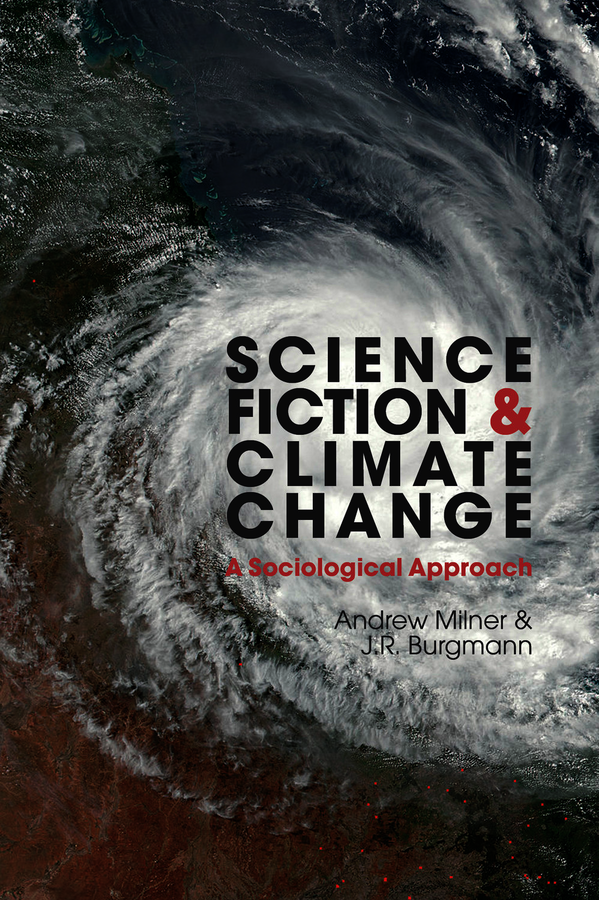
Andrew Milner and J.R. Burgmann. Science Fiction and Climate Change: A Sociological Approach. Liverpool UP, 2020. Liverpool Science Fiction Texts and Studies 63. Hardcover. 248 pg. $120.00. ISBN 9781789621723.

Andrew Milner and J.R. Burgmann’s Science Fiction and Climate Change: A Sociological Approach adds some vitally needed critical rigor to the burgeoning subgenre of SF literature and media Daniel Bloom has labelled “cli-fi,” that is, climate fiction. Some of the crucial distinctions the book contributes to scholarship include the distinction between theogenic (god-caused), geogenic (geology-caused), and anthropogenic (human-caused) climate fiction, the lattermost being only of recent vintage. Another useful categorization that Milner and Burgmann neatly add to the critical cli-fi conversation is the taxonomizing of works into ones that variously anticipate the fertile biosphere into the barren landscapes of a frozen world, a burning world, or a drowned world. Likewise, Burgmann and Milner divide their fourth and fifth chapters, on “classical” and “critical” dystopias (in Tom Moylan’s influential terminology), into cogent analyses of specific climate-fiction novels as exponents of a spectrum of ideological positions: namely, denial, mitigation, negative adaption, positive adaptation, and Gaia. There are also separate chapters on base reality climate fiction, fatalism in dystopian climate fiction, and a chapter on climate fiction as conjured in popular sonic and visual media.

A signal contribution of this timely book is its inclusion of a well-researched and globally oriented (if still primarily Western and European in origin) archive of climate fiction to illustrate this essential schema. Hence denialist climate fiction, i.e. fiction that avows skepticism about climate science, is exemplified through Sven Böttcher Prophezeiung (2011) as much as Ian McEwan’s Solar (2010). Mitigation climate fiction, or fiction that espouses techno-fixes and geo-engineering to address climate change, discusses Arthur Herzog’s Heat (1977) as well as Dirk Fleck’s MAEVA! (2011). Negative adaptation, that is, the minimizing of the deleterious consequences of climate change, is shown through Michel Houellebecq’ La The Possibility of an Island (2005) and Will Self’s The Book of Dave (2006). Positive adaptation, fiction that exploits opportunities afforded by climate change, is explored through Bernard Besson’s Groenland (2011) as much as Paolo Bacigalupi’s The Water Knife (2015). Gaian climate fiction, i.e. fiction that depicts the planet as operating according to a self-regulating balance, as theorized famously by James Lovelock, is typified via Jean-Marc Ligny’s climate trilogy of Exodes (2012), Semences (2015), and AquaTM (2006)as much as Brian Aldiss’s Helliconia trilogy (1982-1985). Burgmann and Milner discuss fatalistic cli-fi novels through the close reading of test cases of Antti Tuomainen’s Parantaja (2010) as well as Jeanette Winterson’s The Stone Gods (2007). In addition to a rich panoply of close readings of other miscellaneous climate fiction, this book also includes a long chapter that is labelled “Theoretical Interlude,” and which seeks to classify climate fiction broadly, according to excurses on Raymond Williams’s cultural materialism, Pierre Bourdieu’s sociology of culture, and Franco Moretti’s world-system theory.

There are three primary ways the theoretical interlude that underwrites the whole conceptual framework of this otherwise fascinatingly researched and critically valuable book are less than satisfying. Firstly, the blanket attacks on ecocriticism as damningly postmodern, ethereally post-structuralist, or covertly neoliberal seem rather skeletal and unconvincing, especially since the loose term “ecocriticism” has been so variably construed in literary scholarship over the last quarter of a century as to be rendered almost meaningless. The book could have benefited, for instance, from less tilting at these windmills and more direct and sustained engagement with the recent proliferation of literary criticism and ecocritical theory, loosely labelled, that does indeed engage with climate change as an environmental phenomenon, both in terms of science fiction and literary fiction and cultural politics more broadly. 

For instance, Timothy Morton’s theory of climate change as a baffling, contradictory “hyperobject,” even if rejected as flawed theorizing, might have added some more supple dimensions to the perhaps overly uncomplicated ideal typologies discussed in this book. Indeed, the absence of any sustained discussions of ecocriticism at all seems like a glaring critical gap given that the proliferation of discussions of climate change have been a bone of contention of much literary, cultural, and philosophical scholarship on the so-called Anthropocene. Secondly, some of the specific readings of climate fiction seem tendentious on a more basic interpretative level: taxonomizing Michael Crichton’s State of Fear (2004)as denialist is only fitting and well-marshalled; however, reading Cixin Liu’s hard-SF Remembrance of Earth’s Past (2008-2010) trilogy as “denialist” and symptomatic of a defunct communist Chinese ideological opposition to climate science jarringly stands out as an ungainly leap. Perhaps Cixin Liu in this trilogy does indeed cryptically and unreflectively endorse an anti-environmentalist message of hysterical crackdown, reinforcing a presumptive repression directed at radical deep ecology; however, not enough cogent evidence is provided to induce assent to this unconventional historicist reading of texts that never explicitly suggest this ideology, especially given that the passages in question found early in Cixin Liu’s trilogy seem on a surface level to be a stirring elegy of ecological dissent and even subversion, especially given the draconian publishing context. 

Lastly, and perhaps more substantively, the deeper theoretical assumption here is that literary fictional entertainment in general must conspicuously wear on its sleeves all its social and political positions, not to mention offer readers plausible predictions, explicit extrapolations, and realizable speculations to be ranked as serious or legitimate in its addressing of climate issues. Likewise, the assumption that it is the reductively didactic agenda of a work of fictional entertainment to provide a plausible template of pragmatic solutions to climate change saddles on often subtle literary texts outrageous expectations of literal forthrightness that can never be adequately met by even the most socially progressive writer or politically activist of audiences. Hence the critiques of works like Kim Stanley Robinson’s Green Earth (2015), 2312 (2012), Aurora (2015),or New York 2140 (2017) as absurdly unrealistic, or “utopian in the pejorative sense of hopelessly impractical” (165), deliberately overlook more granular allegorical interpretations of the novels as germinating an inchoate utopian impulse or unfulfilled fictive yearning for ecological change manifested in the complex problematics of the fictional scenarios. Such utopian allegory does not need to be taken as straightforward mimetic blueprint or programmatic recipe for lasting revolution to function effectively as an aesthetically and conceptually satisfying experience of counterhegemonic dissent and speculative-fantastic resistance. 

To be fair, and not to put too fine a point on this minor criticism, Milner and Burgmann do admit that this charge of “impracticality is a purely textual matter” (168), arguing that an otherwise sophisticated writer like Robinson, in these specifically discussed texts, as opposed to the more authentically turbulent changes depicted, for instance, in Margaret Atwood’s eco-dystopian Maddaddam trilogy (2003-2013), simply fail at representing a genuinely green revolution coherently and compellingly in the delimited space of the novels themselves. This line of analysis may be lucid and reasonable from its own particular sociological premises and critical perspectives, not to mention subjective reading experiences, and certainly represents some important scholarly responses to these climate-change fictions. The provocative critique only lacks enough theoretical insight and precise textual evidence to be persuasive for the larger argument that Milner and Burgmann are making about the intractability of either the nebulously nihilistic sentiments or the inanely sanguine tendencies of climate fiction. Milner and Burgmann themselves devoutly desire the publication of a deeply pessimistic climate-fiction equivalent of what Nevil Shute’s On the Beach (1957) was for anti-proliferation nuclear activists and that would have “practical effects on both elite leaderships and oppositional activists across the world” (191). Challenging the rote dismissal of uncritical dystopian fiction as unhelpful in galvanizing social movements, they earnestly conclude perhaps climate fiction will reach a critical mass of bleak and pessimistic representations of the ongoing climate apocalypse, and no singular landmark book is needed.

Milner and Burgmann therefore suggest that mitigation and adaptation novels, as much as Gaian, base-reality, or denialist climate fiction, are more or less uniformly prone to ingrained ideological blinkers in representing climate-change solutions, with Robinson’s utopian blindness being repeatedly invoked as exemplary in its refusal to depict “the organized working class as a social force most likely to prevent anthropogenic global warming” (192). However, even the test case for such a large and unwieldy generalization (Robinson’s own individual output is prolific) remains at best resistant to such sweeping interpretations, given the writer’s consistently nuanced depictions of splintering revolutionary factions of socialist-affiliated, labor-identified, and anti-capitalist organizations and the bewildering proliferation of micropolitical rivalries depicted in his densely ecopolitical novels. One idly wonders what Milner and Burgmann would make of Robinson’s more recent Ministry of the Future (2020), for instance, which depicts a perhaps more working-class radical and sociologically messier green revolution in response to climate change than his also clearly socialist earlier books. Regardless, Milner and Burgmann’s more evaluative, less taxonomizing views are not without their own merit or substance; Robinson’s science fiction, and perhaps mitigation and geoengineering novels in general, do indeed rely on carefully curated techniques of extrapolation (and perhaps as well the corresponding acts of reifying “world-reduction,” in Jameson’s famous phrase), and his critical utopian impulses certainly lay themselves open to complaints from skeptical readers who challenge such science-based speculations as naive and overoptimistic. To counter such irrational exuberance, a clarion call of relentlessly dystopian climate fiction may indeed be called for as a political-cultural bulwark against the equally dystopian rising tide of the world’s oceans.

Jerome Winter, PhD, is a full-time lecturer at the University of California, Riverside. His first book, Science Fiction, New Space Opera, and Neoliberal Globalism, was published by the University of Wales Press as part of their New Dimensions in Science Fiction series. His second book, Citizen Science Fiction, will be published in 2021. His scholarship has appeared in The Oxford Handbook of Science Fiction, Extrapolation, Journal of Fantastic and the Arts, the Los Angeles Review of Books, Foundation, SFRA Review, and Science Fiction Studies.   


Review of Jordan Peele’s Get Out: Political Horror


SFRA Review, vol. 52, no. 3

Nonfiction Reviews


Review of Jordan Peele’s Get Out: Political Horror

Rebecca Hankins

Dawn Keetley, ed. Jordan Peele’s Get Out: Political Horror. The Ohio State UP, 2020. New Suns: Race, Gender, and Sexuality in the Speculative. Paperback. 254 pg. $29.95. ISBN 9780814255803.

Dawn Keetley’s edited volume Jordan Peele’s Get Out: Political Horror is the best advertisement for the blockbuster debut film. The book provides viewers with a manual to investigate all of the film’s nuances, not only the overt but especially the hidden meanings elucidated throughout the sixteen essays. Keetley introduces the reader to the film’s storyline that centers on Chris Washington, a young Black man who encounters the family of his white girlfriend Rose Armitage. This encounter is the catalyst for the horror or, as Peele designates it, “social thriller” about race, racism, and society that inevitably leads to violence. Peele notes that those who wield power in society are often the purveyors of terror and horror, especially to those without power. As Stokely Carmichael notes, “If a white man wants to lynch me, that’s his problem. If he’s got the power to lynch me, that’s my problem.”[1] Peele’s Get Out represents an archetype of humans wielding power represented in the Armitage family and the Coagula Society, which becomes the horror for those without power, Black people generally and Chris Washington specifically.

Keetley situates the film in the long tradition of horror films in which humans are the monsters, e.g. The Texas Chain Saw Massacre (1974), American Psycho (2000), Hostel (2005), The Purge franchise (2013-18), and many others. The debate over whether human monsters depicted in political horror films, as opposed to a nonhuman monster, can be called horror continues. Keetley and Peele argue forcefully that his work is an extension of the social and political commentary that adds a layer of racial critique to this genre of horror. Following in the footsteps of social, political, and racial horror are the three films that Peele acknowledges were influences for Get Out, specifically Rosemary’s Baby (1968), Night of the Living Dead (1968), and The Stepford Wives (1975), each a critique of “societal structures-whether it be patriarchy or racism…-as the monster.” (4) 

The themes of the essays include those that influenced Peele’s film, e.g. zombies, body snatching, and a new Black gothic tradition that recognizes that “violence remains a part of everyday Black life” (120). Sarah Ilott’s “Racism that Grins: African American Gothic Realism and Systemic Critique” (Chapter 8) is reflective of those themes that allude to Georgina, Walter, and Logan’s “mask that grins” (Paul Lawrence Dunbar, “We Wear the Mask,” qtd on page 169).  Each of these characters has already endured the Coagula brain transformation, their bodies already snatched, but conversely, they continue to retain a fading recognition of their former selves.

There are also connections to contemporary themes such as gentrification, rural v. urban, and neighborhoods as place. The Armitage home represents the gothic plantation of the South, but Peele turns this notion on its head by locating the home in the liberal bastion of Upstate New York. There are a number of essays that discuss what Robin Means Coleman and Novotny Lawrence describe in their essay “A Peaceful Place Denied: Horror Film’s “Whitopias” (Chapter 3) as places where Black people feel conspicuously out of place. Andre Hayworth succinctly labels the setting as a “creepy ass suburb” (56) before he is snatched. These essays are particularly prescient for our current times with Trump’s recent tweet to those “living their Suburban Lifestyle Dream” that they will no longer have to be bothered by low income housing intruding in their neighborhoods as he rolls back another President Obama-era program designed to reduce racial segregation in American suburbs. For Trump it is the Whitopia that is “often prized for its segregation and homogeneity” (47).

Another group of chapters discuss Get Out’s connection to other historical and contemporary figures that include Othello, W. E. B. DuBois, Ira Levin (author of both Rosemary’s Baby and the Stepford Wives), and James Baldwin. Particularly noteworthy is Robert Larue’s “Holding onto Hulk Hogan: Contending with the Rape of the Black Male Psyche” (Chapter 12), which compares Missy Armitage’s hypnotizing Chris to police officer Darren Wilson’s explanation of his fatal 2014 encounter with teenager Michael Brown in Ferguson, Missouri. For Missy and Wilson, Black men are never children, they are always scary and in need of subduing. This chapter adds to our understanding of the Black male as vulnerable and targeted. We see that vulnerability as the camera focuses on Chris’s eyes as he is rendered into the Sunken Place, unable to move and awash in tears.

Another group of chapters, under the heading “The Horror of Politics,” includes Todd K. Platts’s and David L. Brunsma’s “Reviewing Get Out’s Reviews: What Critics Said and How Their Race Mattered” (Chapter 9), a chapter that offers some revelatory contrasts between how white reviews and reviews by people of color focus on very different elements of the film.  Other essays speak of scientific racism in how Coagula Society members poke, feel, and prod Chris, rarely discussing his intelligence or accomplishments. Their only interest is as it relates to his abilities, his stamina, his athleticism, and physical characteristics, their ultimate motive to learn his body’s suitability for the brain transplant.

The other essay that stands out is Kyle Brett’s “The Horror of the Photographic Eye” (Chapter 13),” which discusses “the eyes of horror” (188), both physical eyes and the white gaze that sees Chris as a vessel. The other “eyes of horror” are represented by the mechanical through the use of Chris’s camera phone. Brett discusses the white gaze of the Coagula Society’s Jim Hudson who covets Chris’s eyes to replace his blindness.  Chris uses his camera at the Armitages’ party to hide his uneasiness with the attention he receives. It is through his lens that he recognizes the Coagulated Logan and attempts to communicate their shared Blackness, but it is only after his camera accidentally flashes Logan that he screams at Chris to “Get Out.” It is also his camera phone that saves him after he flashes Walter, who shoots Rose and then commits suicide. This essay has relevance to our current state of police killings of Black men and women, e.g. George Floyd, Trayvon Martin, Breonna Taylor, Tamir Rice, Botham Jean, Eric Garner, and Mike Brown, and many more. It is this “horror” that is now captured on anyone’s cell phone and shareable worldwide that too often represents an exploitation of their deaths, but also an awareness that has resulted in investigations that would not have been possible in the past.

Keetley has compiled an excellent collection of essays on Jordan Peele’s Get Out. The book captures all of Peele’s influences and nuances; from his choice of music to his use of camera angles, every aspect has been theorized, imagined, speculated, and critiqued as horror, social horror and/or thriller, from its opening scene through to its conclusion. This book is an excellent text for graduate level film studies students. Scholars and students of Africana, Women’s and Gender Studies will be discussing the meaning, the methodology, the comparisons, and the film’s influence on new films that explore social horror or social thrillers for years to come. Can’t wait for the critique of Peele’s recent film US!


NOTES

[1] https://www.goodreads.com/quotes/7802915-if-a-white-man-wants-to-lynch-me-that-s-his

Rebecca Hankins is the Wendler Endowed Professor and certified archivist/librarian at Texas A&M University. United States President Barack Obama (2008-2016) appointed Hankins to the National Historical Publications and Records Commission (NHPRC), where she served from 2016-2020. She is an affiliated faculty and liaison in the Africana Studies, Women’s & Gender Studies, and Religious Studies programs. She has published widely in journals and book chapters and has presented all over the world.  Her most recent work is titled “Reel Bad African Americans Muslims,” published in Muslim American Hyphenations, edited by Dr. Mahwash Shoaib, 2021.


Review of Harry Potter and Beyond: On J. K. Rowling’s Fantasies and Other Fictions


SFRA Review, vol. 52, no. 3

Nonfiction Reviews


Review of Harry Potter and Beyond: On J. K. Rowling’s Fantasies and Other Fictions

Kristin Noone

Tison Pugh. Harry Potter and Beyond: On J. K. Rowling’s Fantasies and Other Fictions. University of South Carolina Press, 2020. Paperback. 168 pg. $19.99. ISBN 9781643360874. EBook ISBN 9781643360881.

Tison Pugh’s Harry Potter and Beyond explores not only J.K. Rowling’s worldwide phenomenon of the Harry Potter series, but extends the discussion of Rowling’s influence by engaging with her non-Potter works such as the Cormoran Strike detective series and the literary fiction The Casual Vacancy (2012). Pugh argues that Rowling’s work transcends any single category such as children’s fiction, and reveals both an engagement with and reformulation of the established genres of fantasy, the school story, bildungsroman, mystery, and allegory to ultimately create “a fresh hybrid form of literature” (19). These genres provide the structure for Pugh’s chapters, which offer an expansive and accessible discussion of Rowling’s literary works, genre definitions and critical responses, the role of the author, reader and fan responses, multimedia adaptation, and the role of literature in exploring human mortality, morality, and community.

Harry Potter and Beyond opens by considering the relationship of author to text in the persona of “J.K. Rowling” and the popular if not entirely accurate rags-to-riches narrative arc of her story, providing a detailed biographical overview and noting connections and references found in her writing. Pugh notes Rowling’s literary influences, history of charity work, and support of multiculturalism as well as the ways in which “many readers have found Rowling’s treatment of race, ethnicity, gender identity, sexual orientation, and other related issues sharply limited” (7), especially in light of her recently revealed views on the rights of trans people; this context is useful for acknowledging the complicated impact of Rowling’s influence, and the complexity of audience responses to her work and to her authorial persona. Pugh’s introduction thus also examines questions of literary theory, critical approaches, and popular culture engagement, providing larger scope and scholarly breadth. Finally, Pugh examines existing critical responses to Rowling, as well as the growing genre of YA literature and the difficulties inherent in defining such, and the ways in which the lines between literary and genre fiction have always been blurry. This final discussion sets up the central chapters of Harry Potter and Beyond, each of which reads Rowling’s work in the context of an established literary genre.

Each of Pugh’s chapters provides a succinct overview of the genre in question, while examining Rowling’s work as both an example of and a reformulation of established generic tropes. Chapter One uses the work of influential theorists of fantasy, myth, and fairytale (e.g. Jackson, Jameson, Mendlesohn, Campbell) to discuss the ways in which the Harry Potter series embraces and experiments with the tropes of fantasy, including the relationship of the mundane to the fantastic, the quest, the traditionally male mythic hero and gendered assumptions, and British identity, particularly in terms of chivalry and Arthuriana. Chapter Two continues this exploration of identity, especially British identity, in the school story tradition, which centers the protagonist’s maturation throughout the challenging experiences of the boarding school; Pugh again provides a useful overview of the history and major theorists of the genre, as well as an extended commentary on Rowling’s work as relying on and playing with genre convention: if the school story genre traditionally helps readers develop an ethical code, then “Rowling’s Hogwarts encourages students to aspire to more radical forms of knowledge based on the contingencies of experience” (43), and Pugh’s discussion of ethnicity and social class distinctions in Rowling’s work opens up fertile ground for future exploration.

Building on the themes of maturation in the school story, Chapter Three explores Rowling’s novels as bildungsroman, first establishing genre definitions (e.g. those by Alden and Buckley) and expectations, emphasizing the ways young protagonists learn to confront the social norms of their world, and productively applying this concept of identity formation to examine Rowling’s Wizarding World through a postcolonial lens, highlighting ethical sensibilities and ethical lapses.

Chapter Four shifts modes to the mystery novel genre, which, as Pugh points out, is often dismissed as “genre fiction” yet has a history of extensive overlap with many other genres, such as the bildungsroman in children’s and YA detective stories. As in previous chapters, Pugh provides an easy-to-follow overview of the history and major scholarship in the mystery novel genre, as well as emphasizing Rowling’s influences in and affection for the genre, and the interconnected nature of these fuzzily separated genres, grounded in a detailed close reading of the ways in which Rowling both employs and ignores key tropes thought to define the genre, such as the role of the hero as active investigator and “fair play” with reader expectations.

Chapter Five also considers Rowling’s expectations of readers and (sometimes versus) reader expectations, as Pugh explores the role of allegory and the genre of allegorical writing in Rowling’s work. Allegorical texts, as Pugh suggests here, “demand perceptive interpretations of that which they do not clearly state” (73) and thus invite multiple and potentially contradictory readings; Pugh focuses here on two particular allegorical readings, that of Christian sacrifice and salvation, and historical commentary on World War Two. Both of these allegories deal with themes of violence, Otherness, and communities under threat; Pugh offers a compelling reading of Rowling’s work as concerned with ways that escapist literature can productively open up discussions of morality and mortality, consequently arguing for the importance of genre fiction overall.

Chapter Six turns to the ever-evolving Potter canon, given the previous context of evolution and growth and genre interconnectedness; Pugh situates this discussion in the scholarly contexts of canonicity, collaboration, fanfiction and transformative works, adaptation (films, theater, fan productions) and paratexts (Rowling’s personal website, Twitter, Pottermore), and queerness (especially in the responses of queer fans and readers to canonical representation or lack thereof), considering this version of distributed authorship through the lens of Henry Jenkins’ concept of convergence culture and an increasingly participatory world.

Finally, Chapter Seven expands these themes beyond the Wizarding World, exploring how Rowling “seeks to dismantle artificial boundaries between genre fiction and literary fiction” (107) in The Casual Vacancy and the Cormoran Strike mysteries (the latter written under her Robert Galbraith pen name). In these novels, Pugh argues, Rowling “demonstrates her fluency with a wide range of literary genres and historical traditions, thus further testifying to her ecumenical influences and her reformulations of the British literary legacy” (108), but the more mixed critical and fan reception to these works also demonstrates the difficulties and “limitations” of her approach to genre. As in the Harry Potter novels, Pugh concludes, Rowling undermines simple distinctions of genre and “high” or “low” culture in order to emphasize themes of identity, family, community, morality, mortality, and resilience; thus, Rowling’s body of work overall reflects her desire to both acknowledge and move beyond established distinct categorizations.

Harry Potter and Beyond includes a well-organized multi-section bibliography, which will be useful for scholars working in any of the genres discussed, as well as scholars of more general literary criticism, narrative structure, and canonicity; the writing is both expert and approachable, accessible for established scholars and newer students embarking on research into these fields. Pugh provides a concise, informed, and compelling reading of Rowling’s body of work as both engaged in and demonstrative of inter-generic connections and influences, and ultimately emphasizes the appeal, hopefulness, and possibilities of playing with genre.

Kristin Noone is an English instructor and Writing Center faculty at Irvine Valley College; her research explores medievalism, adaptation, heterotemporalities, fantasy, and romance. In 2018 and 2019 she received the National Popular Culture Association’s Two-Year College Faculty Award, as well as the Kathleen Gilles Seidel Award, administered by the International Association for the Study of Popular Romance, for travel and research support in Australia. She is the editor of the essay collections Terry Pratchett’s Ethical Worlds (2020) and Welsh Mythology and Folklore in Popular Culture (2011),  and has published on subjects from Neil Gaiman’s many Beowulfs to depictions of witchcraft in Terry Pratchett’s Discworld to Arthurian references in World of Warcraft. She is currently working on a book-length study of Star Trek tie-in novels as sites of cross-media and cross-genre contact.


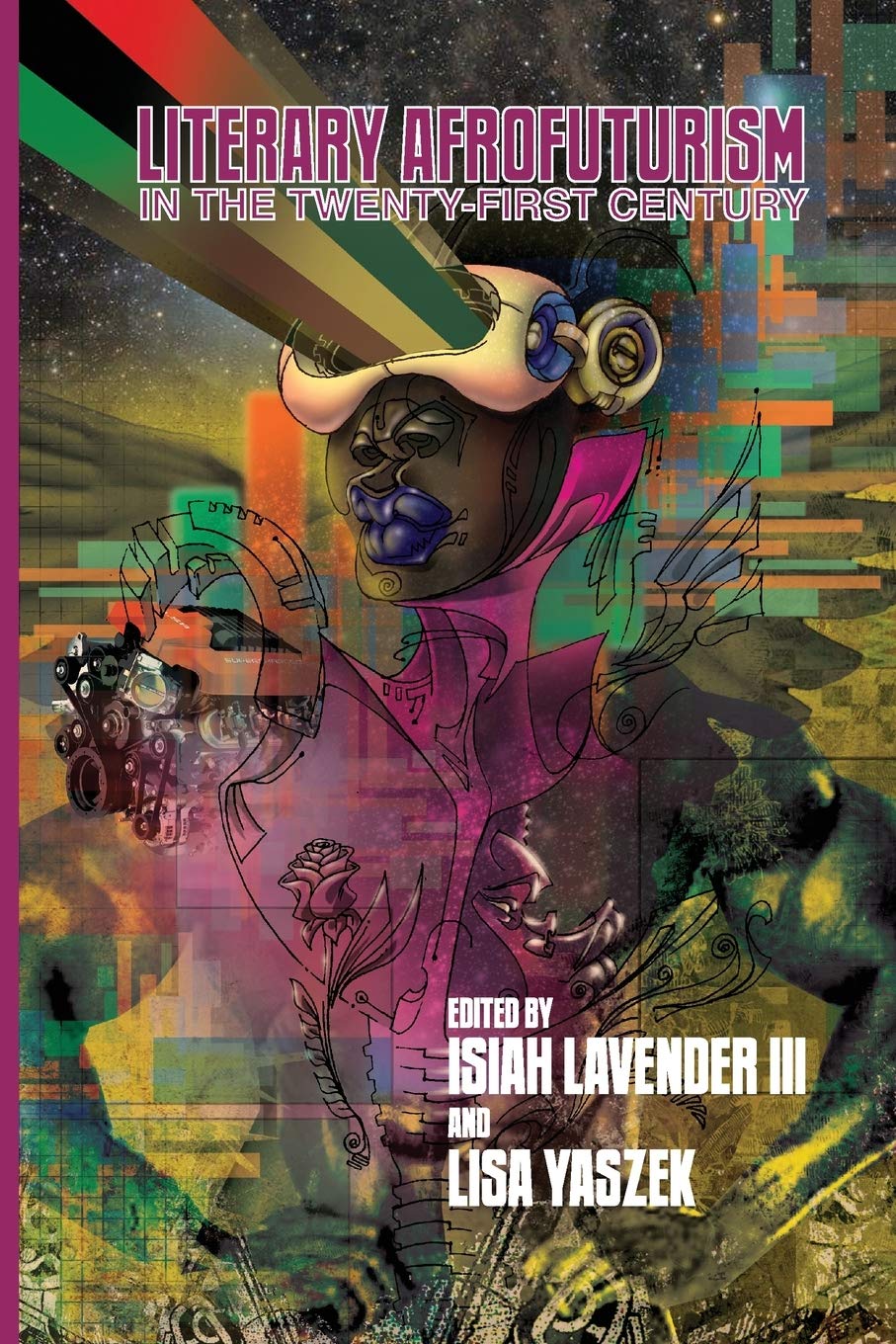
Review of Literary Afrofuturism in the Twenty-First Century


SFRA Review, vol. 52, no. 3

Nonfiction Reviews


Review of Literary Afrofuturism in the Twenty-First Century

Michael Pitts

Isiah Lavender III and Lisa Yaszek, editors. Literary Afrofuturism in the Twenty-First Century. The Ohio State UP, 2020. New Suns: Race, Gender, and Sexuality in the Speculative. Hardcover. 248 pg. $99.95. ISBN 978-0-8142-1445-9.

Literary Afrofuturism in the Twenty-First Century is designed, as explained by editors Isiah Lavender III and Lisa Yaszek, “to introduce readers to Afrofuturism as an aesthetic practice that enables artists to communicate the experience of science, technology, and race across centuries, continents, and cultures” (2). Made up of contributions from fourteen influential scholars, the collection is divided into four key “conversations” concerning contemporary aesthetics, literary history, cultural history, and the relationship of Afrofuturism to Africa. The first section is made up of conversations with creators of Afrofuturist works, beginning with a roundtable discussion with Bill Campbell, Minister Faust, Nalo Hopkinson, N.K. Jemisin, Chinelo Onwualu, Nisi Shawl, and Nick Wood. Including alongside this roundtable discussion an analysis by Sheree R. Thomas, editor of the revolutionary and influential Afrofuturist anthology Dark Matter: A Century of Fiction from the African Diaspora (2000), of the past, present, and future of this aesthetic movement, this first segment of the collection makes “space for the voices of artists who explore the intersection of science, technology, and race in their own work” (23). Made up of analyses of disparate speculative works gathered under the intersecting categories of SF and black Atlantic authors, the second section of this collection, Afrofuturism in Literary History, illustrates “how Afrofuturism produced by” such writers “enriches our understanding of contemporary science fiction” (11). The third segment of the anthology, Afrofuturism in Cultural History, applies the cultural studies lens to this genre, and considers how Afrofuturist texts provide insight to black culture and history. Lisa Dowdall’s “Black Futures Matter: Afrofuturism and Geontology in N.K. Jemisin’s Broken Earth Trilogy,” for example, highlights the experiences of black, female SF writers within fandom by considering the reception and interpretation of N.K. Jemisin’s novels, which Dowdall shows are grounded in geology, as scientifically unsophisticated and overly focused upon social justice. The text concludes with a final collection of essays, Afrofuturism and Africa, that considers “the complex relations of Afrofuturism as literary practice and Africa as both a source of artistic inspiration and a space for the production of black SF itself” (14). The analyses making up this final section disrupt narratives of technological development as uniquely Eurowestern, demonstrate how black SF writers use narratives “set in Africa to expose the colonial and postcolonial assumptions that have long driven environmental SF written from globally Northern perspectives” and add nuance to representations of Africa, and considers the importance of including African SF writers in a new iteration of the Afrofuturist genre (14). This anthology is a valuable resource due to its close examinations of the ways black speculative works impact the SF genre, shape and are shaped by the culture in which they are produced, and draw upon the African continent as a source of inspiration and a site for producing these narratives. It is additionally pivotal because of the questions it raises about the future of Afrofuturism as a global genre that will continue to link the creative works of pan-African, contemporary black Atlantic, and historic African American in fascinating ways.

This edited collection continues the work of scholars interested in Afrofuturism as a powerful aesthetic mode that emphasizes the intersection of race, science, and technology. Like Adilifu Nama’s Black Space: Imagining Race in Science Fiction Film (2008), Sandra Jackson and Julie E. Moody-Freeman’s The Black Imagination: Science Fiction, Futurism, and the Speculative (2011), Ytasha L. Womack’s Afrofuturism: The World of Black Sci-Fi and Fantasy Culture (2013), and Reynaldo Anderson and Charles E. Jones’s Afrofuturism 2.0: The Rise of Astro-Blackness (2015), Literary Afrofuturism in the Twenty-First Century examines the history of this aesthetic mode and traces its generic boundaries. Unique to this collection—in addition to its interest in new and overlooked artists, its exploration of how a burgeoning pan-African literary tradition possibly connects with Afrofuturism, and its opening with a roundtable discussion that centers the thoughts and considerations of black speculative writers—is its specific focus upon the literary output of this aesthetic practice. This emphasis upon the manifestation of Afrofuturism specifically in speculative literature differentiates this collection from the aforementioned texts, which include analyses of this artistic style in other media such as music, visual art, architecture, and film. Like André Carrington’s Speculative Blackness: The Future of Race in Science Fiction (2016), Literary Afrofuturism in the Twenty-First Century illuminates the impact of genre conventions upon popular conceptions of blackness but focuses specifically upon literary Afrofuturism. It is a significant resource for scholars due to its comprehensive examinations of Afrofuturist literature and its impact upon SF and cultural studies.

Emphasizing the far-reaching nature of the Afrofuturist genre, this collection is ideally suited for researchers desiring a guiding resource through this cultural terrain or scholars seeking a helpful companion for undergraduate or graduate courses focused on this topic. Moving beyond a simple overview of key Afrofuturist literature, the scholars in this anthology utilize diverse critical perspectives to interrogate the nature and boundaries of the genre. Importantly, these scholars also make crucial connections between Afrofuturist narratives and social and political activism. The collection makes “conscious the utility of Afrofuturism as a critical term in the battle to stake claims for people of color—and people of all colors—in the future imaginary,” a battle growing in intensity due to the resurgence of white supremacist political action (231). Literary Afrofuturism in the Twenty-First Century additionally offers young scholars and students theoretical tools for applying Afrofuturist concepts to their own readings and analyses of speculative fiction. This anthology therefore enables young scholars and students seeking an entry point into discussions surrounding this reimagining of the future through a black lens and its commentary on identity in 21st-century societies. Literary Afrofuturism in the Twenty-First Century is a valuable collection for the undergraduate and graduate classroom as well as for developing scholars seeking a broad understanding of this cultural phenomenon.

Michael Pitts is assistant professor at the University of South Bohemia. He specializes in masculinity studies, queer theory, SF studies, and utopian studies. His articles have been published in Extrapolation and The European Journal of American Studies and his first monograph, Alternative Masculinities in Feminist Speculative Fiction: A New Man, was published by Lexington Books in 2021. 


Review of Imagining the Unimaginable: Speculative Fiction and the Holocaust


SFRA Review, vol. 52, no. 3

Nonfiction Reviews


Review of Imagining the Unimaginable: Speculative Fiction and the Holocaust

Jeremy Brett

Glyn Morgan. Imagining the Unimaginable: Speculative Fiction and the Holocaust. New York: Bloomsbury Academic, 2020. Hardcover. 214 pg. $120.00. ISBN 9781501350542.

In a world much brighter than our own, the Nazi Holocaust would have occurred only within the fevered dreams (or Iron Dreams, to get Spinradian) of science fiction authors who sought to create the darkest, most dystopian alternate histories of which the mind could conceive. Unfortunately, we reside in this world, where millions of innocent people were murdered between 1933-1945 through the unholy combination of virulent hatred, pseudoscience, and the processes of modern industrial society. As a result, the Holocaust for us is an undoubted, unwelcome fact, one with which we grapple in many realms, including the literary.

Literary analysis of the Holocaust is a tricky business. As Glyn Morgan notes, “[m]any representations of the Holocaust in fiction draw upon the implicit assumption that the traumatic experience cannot, and perhaps should not, be conveyed through art” (1).  Theodore W. Adorno famously said in 1949 that “to write a poem after Auschwitz is barbaric”—forever misquoted as “it is impossible to write poetry after Auschwitz.” Whether impossible, or merely barbaric, the Holocaust has had the invocation of silence laid upon it since 1945, and although discussion of it has actually been vast, its legacy has been the convention that the Holocaust is an ultimately inexplicable, unknowable, and unimaginable event, beyond literature (certainly beyond genre literature). With this book, Morgan convincingly makes the case that, in fact, speculative fiction is ideal for expressing the inexpressible –” [w]e are routinely confronted by language which tells us that the Holocaust is Other as an environment of death, survivors and victims are Other in their suffering, and perpetrators are Other in their evil. What is called for, therefore, is a literature intimately associated with describing the Other.” (11). Morgan argues that “the ultimate achievement of SF Holocaust fiction is to allow us to learn something about the Holocaust, to come closer to understanding it, while maintaining the Otherness (estrangement) which the topic insists upon” (13). He gives particular focus in this study to the SF subgenres of alternate history and dystopia as vehicles for carrying out SF’s traditional role of examining the dark and difficult aspects of the human condition through futuristic or fantastical lenses.

Although Morgan references a library’s worth of titles, he focuses on a small group of works (his “key texts”) in particular to explore the various ways that the genre has chosen to confront the Holocaust. He begins with precursor texts, early works that predate both the actual occurrence of the Holocaust and its “rediscovery” in the popular mind brought on by the 1960 trial of Adolf Eichmann. The most significant (even prescient) of these was the 1937 feminist novel Swastika Night (by Katherine Burdekin, under the pseudonym ‘Murray Constantine’), an alternate future history set 700 years in the future. Nazi Germany (with Imperial Japan) has long since conquered the world; its empire is a feudal society in which women have been stripped of all rights and been intensely Othered by the misogynistic Nazi regime. History has been doctored into a legend of a knightly and heroic Hitler and his knights; all records to the contrary were long ago destroyed. The novel is striking for its premonitions about the dehumanization of victims of Nazi terror and, as Morgan notes, “more than any other Anglo-German war novel its imagery and narrative can be found reverberating through post-1945 literature in the works of a wide range of authors of dystopian fiction and alternate history” (24). And a novel that features a government that succeeds by making use of a cultlike reverence for a Leader, the widespread use of ruthless violence, resurgent nationalist feelings, and the deliberate elimination of truth… well, it would be hard to argue that Burdekin’s work lacks contemporary relevance.

Three alternate histories are highlighted by Morgan to show how SF Holocaust fiction has been used to counter the predominant cultural notion that the Holocaust was, and is, “the ultimate manifestation of humanity’s potential for evil, and thus its designers and instigators were the ultimate agents of that evil” (41). That idea renders the Holocaust as close to unapproachable as a subject of comparative history, and history itself something that reaches some kind of final nadir with the Nazi genocide. Morgan, however, notes three works that, in postulating different outcomes to the Holocaust and World War II, problematize this fixed notion of history. In doing so, they “undermine faith in the notion of an absolute evil and call into question issues of historicity, morality, and a hierarchy of suffering” (42). Philip K. Dick’s classic The Man in the High Castle (1962) is no doubt the most famous of all the works Morgan examines in his entire book—set in a conquered United States divided between Germany and Japan, High Castle involves, as do many of Dick’s works, the questioning and perception of our reality and what we believe to be true. Multiple realities exist, suggests Dick, and in every one is the potential, indeed the likelihood, for fascism to triumph: this puts paid to the idea that the Holocaust was a one-time expression of humanity’s capacity for limitless evil. The reality Dick describes in High Castle is one where the Holocaust was not only ultimately successful but committed on an even more terrible scale: not only Jews and Roma have been eliminated but the genocide has spread to Africa, where the continent has been emptied of its natives by a triumphant Germany. History is problematized by Dick’s contention that things could have actually been even worse (a common thread in the alternative history subgenre).

In Robert Harris’ alternative history thriller Fatherland (1992), the Holocaust has occurred but been hidden from history by a victorious Germany, assisted by the willful ignorance of the people of the Reich and the normalization of German fascism in a conservative American government (led here in 1964 by President Joseph P. Kennedy). Based around the work of a Berlin police detective to uncover a murder conspiracy tied to the Holocaust, Fatherland is a work of SF Holocaust fiction that, like High Castle, calls our understanding of received history into question, by “challenging our expectations about the truth and validity of our own historical narrative” and by placing the Holocaust and its perpetrators onto a “relative scale of morality” (53) that, again, questions the Holocaust as the far and unapproachable end of history. Morgan also discusses Stephen Fry’s 1996 novel Making History in this vein: a time travel story gone wrong, Fry’s work depicts a world where an attempt to stop Hitler from being born results in a new timeline wherein a man named Rudolf Gloder arose to replace Hitler. The historical circumstances that produced Hitler remained, and removing him from the equation did not remove the Germany that Hitler made his own, nor the Germans that would follow him. The Holocaust under the smarter and more stable Gloder was perhaps less brutal, but even more horribly complete: mass sterilization wiped out the entire European Jewish community in a single generation. Again, Morgan demonstrates how SF Holocaust fiction not only presents worlds worse than our own, but in doing so forces us to ask whether Hitler is truly the Ultimate Evil of History or our Holocaust the worst possible outcome, shocking as either case might be to consider.

Morgan takes another group of novels as the centerpiece for discussing how SF Holocaust fiction has viewed the Holocaust through alternatives to the historically saved and the destroyed. The Boys from Brazil (Ira Levin, 1976) and The Portage to San Cristobal of A.H. (George Steiner, 1981) look, in very different ways, at worlds where Hitler escaped the justice of history—literally, in Steiner’s case, with an aging Hitler being captured by an Israeli commando team after having escaped to South America; and figuratively by Levin, where a refugee Dr. Mengele is genetically engineering clones of Hitler that can one day take up his mantle and secure his legacy. Both these works problematize the idea of justice and deserved culpability, just as Dick, etc. did so for the very notion of received history. Morgan also talks about Michael Chabon’s 2007 alternate history The Yiddish Policeman’s Union, set in an Alaska where Jews fleeing Europe before World War II were allowed by the US government to settle. In this world, the Allies won the war (in part thanks to a nuclear bombing of Berlin) and the Holocaust was what Morgan terms “a diminished catastrophe” (89). Chabon uses this alternative situation to compare and contrast the treatment of the Jews to that of the real-world Palestinians and Native Americans and to “place the Holocaust among the realms of other atrocities, and so highlights the extent to which the promotion of the Holocaust’s exceptionalism influences the world” (96).

In his last chapter, Morgan considers several texts that use the Holocaust and alternative histories to shine lights on contemporary fears, and to show that the horrors of Nazi Germany might easily be enabled or copied by allies, bystanders, and hypocritical politicians. Philip Roth’s 2002 The Plot Against America deals not explicitly with the Holocaust but, as so often in Roth’s work, the American Jewish experience. In this case, Roth dramatizes the growth and danger of domestic American right-wing politics by giving the reader a 1940 where Charles Lindbergh defeats Franklin D. Roosevelt for the Presidency. Lindbergh, in addition to instituting a neutral policy in Europe, launches an effort to uproot urban Jews and resettle them in rural locations across America, ostensibly to make them more “American.” Conflicts lead to a brief but tyrannical police state in the US, though the book ends happily (clumsily so, both Morgan and I would argue). In Jo Walton’s murder mystery Farthing (2006), the British (thanks to Rudolf Hess) negotiate a 1941 peace with Nazi Germany, and by 1949 the UK is a soft fascist state governed by the pro-Nazi British establishment and infected with quiet, “acceptable” anti-Semitism. Walton wrote Farthing (and its two sequels) in emotional response to the eruption of the Iraq War and the US/UK aggression in the Middle East. Lavie Tidhar’s beautifully clever A Man Lies Dreaming (2014) gives us an alternate Hitler, working as a private detective in London after fleeing there following a Nazi loss to the Communists in the 1936 German elections. Hitler’s London is one in which he and the reader hear echoes of the anti-Semitism and nationalism of his lost Germany and which are growing worrisomely louder in our own time.  (That potential for renewed racist and nationalist feeling is reinforced in Howard Jacobson’s 2014 J.)  Bringing attention to the dangers of our own age through examinations of our fictional or alternative pasts is, as Morgan notes, a key achievement of these works.

Morgan’s remarkable achievement with Imagining the Unimaginable has been to show that SF Holocaust fiction is not only a real possibility, but a rich subgenre of speculative literature that escapes the paradox of a historical event so vast that it “cannot be spoken of” yet is written about in countless literary works. What this kind of fiction, as Morgan frames it, does is “demonstrate that speculative fiction in its alternative approach to the Holocaust, less burdened by the critical discourses associated with realism, brings a much-needed diversity to the literature of trauma and genocide” (159). That is a valuable project indeed: the Holocaust is an event that demands repeated evaluation and attempts to make sense of it. Science fiction through its history has been invaluable for helping us to understand the mind and the life of the Other—let that legacy continue here, and be directed towards granting us a better understanding, however incomplete, of this event, its perpetrators, and the millions of innocents destroyed by it.

Jeremy Brett is an Associate Professor at Cushing Memorial Library & Archives, where he is both Processing Archivist and the Curator of the Science Fiction & Fantasy Research Collection. He has also worked at the University of Iowa, the University of Wisconsin-Milwaukee, the National Archives and Records Administration-Pacific Region, and the Wisconsin Historical Society. He received his MLS and his MA in History from the University of Maryland – College Park in 1999. His professional interests include science fiction, fan studies, and the intersection of libraries and social justice.


Review of Ms. Marvel’s America: No Normal


SFRA Review, vol. 52, no. 3

Nonfiction Reviews


Review of Ms. Marvel’s America: No Normal

Michael Dittman

Jessica Baldanzi and Hussein Rashid, editors. Ms. Marvel’s America: No Normal. UP of Mississippi, 2020. Paperback. 280 pg.  $30.00. ISBN 9781496827012.

In the late 1970s, American comic book company Marvel introduced the Ms. Marvel character: the alter-ego of Carol Danvers, who was first a United States Air Force officer and then an editor at Women Magazine. Although seen as a progressive and feminist character at the time, Danvers had the form of a traditional female superhero caught in the male gaze. She was tall, blonde, and possessed of a Barbie doll figure shrink-wrapped in a revealing costume.

Danvers would go on to be treated shamefully in storylines in the 1980s and 1990s. Her rape and addiction were treated as throwaway plot points. However, by 2012, the character’s treatment had improved with her assumption of the mantle of Captain Marvel. Meanwhile, in 2013, the title of Ms. Marvel passed on to Kamala Khan, a second-generation immigrant born to Pakistani-American parents. Khan is a young, female, Muslim superhero who fits into the Peter Parker/Spider-Man trope of a teenaged hero struggling to balance the pulls of responsibility and youth. While Muslim superheroes existed before Kamala Khan, Khan is the first Muslim superhero to headline her own title and, notably, the first hero created and written by two Muslim-American women. Ms. Marvel would go on to win Eisner and Hugo awards in 2015.

Ms. Marvel’s America: No Normal, edited by Jessica Baldanzi and Hussein Rashid, is the first collection of criticism to take on, in an interdisciplinary way, the success and impact of Ms. Marvel. The book effectively makes the point that Kamala Khan and Ms. Marvel provide a rich ground for interpretation of America’s relationship with Islam, gender, race, and diversity in mainstream comics. 

While including dense literary theory, the book also includes approachable articles for a general audience (especially Aaron Kashtan’s “Wow, Many Hero, Much Super, Such Girl: Kamala Khan and Female Comics Fandom,” which addresses the fan community and its interaction with Khan and her status as a fan-fic writing superfan of other heroes within the world of her comic). The interdisciplinary nature of the collection is one of its strengths. The collection has an encompassing breadth including chapters from literature, religious studies, pedagogy, and communications scholars including José Alaniz, Jessica Baldanzi, Eric Berlatsky, Peter E. Carlson, Sika A. Dagbovie-Mullins, Antero Garcia, Aaron Kashtan, Winona Landis, A. David Lewis, Martin Lund, Shabana Mir, Kristin M. Peterson, Nicholaus Pumphrey, Hussein Rashid, and J. Richard Stevens.

The book is divided into an introduction and five sections. The introduction focuses on Ms. Marvel’s challenging of character tropes. The introduction also raises a point to which other authors in the collection will return: Khan’s place and symbolism (limited to the first 19 issues of Ms. Marvel) within the continued anti-Muslim American rhetoric especially evident during the Trump administration. The first section focuses on precursors to Khan’s Ms. Marvel character including Dust, another notable Marvel Muslim character. Whereas Khan is seen as a step towards a more realistic attempt at depicting an Islamic superhero, Dust’s presentation is much more problematic and tends to fulfill more Orientalist tropes. The second section, “Nation and Religion, Identity and Community,” is the longest section in the text and deals extensively with the iconography of the Khan character and the friction against stereotypes both religious, gender-based, and fan-based. The third section is called “Pedagogy and Resistance” and asks how Khan fits into classrooms and conventions. The fourth section, “Fangirls, Fanboys and the Culture of Fandom,” deals with Ms. Marvel’s disruption of the traditional fan and creator communities. 

The collection concludes with a wide-ranging interview between gender studies scholar Shabana Mir and Ms. Marvel author and cocreator G. Willow Wilson. This choice of including an interview with the creator is a strong one. Wilson, from her insider’s perspective, makes points such as that the suppositions of what will sell (white cisgender male heroes) and what won’t sell (solo comics with women or minority characters) have more to do with the economics of comics and their antiquated exclusionary distribution system rather than with what people want to read. A point such as this one (and the idea that there is a limit to what can be done progressively with a character owned by a mega-corporation such as Disney and written by a revolving cadre of artists and writers) is more likely to be made by someone involved in the business and is an idea which, by itself, is worth the inclusion of the interview. Mir also encourages Wilson to comment directly on some of the theses of the included critical chapters which leads to a valuable dialogue between subject and critic.

Additional standout essays include “Mentoring Ms. Marvel: Marvel’s Kamala Khan and the Reconstitution of Carol Danvers” wherein J. Richard Stevens, while analyzing the poor treatment of the Danvers character over the years, stresses the point that while the presentation of Khan’s religion is new in the comics, she is an old type of Marvel Character: “The People With Problems” that Stan Lee popularized in the 1960s. These are heroes who struggle with personal problems to make the character seem to be relatable. Stevens leaves room for further thinking about this point, especially as part of Khan’s “problem” is presented as her religion and her struggle with it. 

Several of the essays address that the locus of Khan’s character is symbolized by her superhero power. Khan is a polymorph: “Her very body represents her conception of being American”, writes Hussein Rashid (also one of the editors of the collection) in his “Ms. Marvel Is An Immigrant” (47).While she can control the size and shape of her appearance while fighting evil, she also struggles with comparing herself to her peers like blonde popular schoolmate Zoe (like Carol Danvers, another tall, willowy blonde in Khan’s life with whom she has a difficult relationship). Khan’s ability to morph, combined with her wish to adapt to be the “right” person, Rashid suggests, reflects a desire of many immigrants who feel left out or conflicted in their identity and its place in the older culture.    

Sika A. Dagbovie-Mullins and Eric Berlatsky continue to delve into the symbolism between Khan’s polymorphism and the fluidity of the immigrant existence in “The Only Nerdy Pakistani-American Slash Inhuman in the Entire Universe – Post Racialism and Politics in the New Ms. Marvel.” These authors continue to make the argument that Ms. Marvel doesn’t acknowledge the discrimination and surveillance of both federal forces and “concerned citizens” that colored the American Muslim experience post 9/11 (occurring when Khan would have been three years old). American drone strikes in Pakistan, for instance, are never mentioned. Police are seen as uniformly helpful. All of these ideas make the argument that the comic, overall, is “politically deracialized” while Ms. Marvel is racialized through familiar and comfortable tropes (75). To read Khan as a Muslim superhero instead of a superhero who is Muslim, Rashid reminds us, “flattens her character and misunderstands the way that she does important work” (61).

That important work of understanding Khan’s place in the mediation of self and culture is typified in “Hope and the Sa’a of Ms. Marvel,” by A. David Lewis. As a female teen Muslim superhero, she is a marginalized person who, in the comic event Secret Wars, is on the margins of the apocalypse. Lewis shows how Islamic eschatology (Lewis defines sa’a as “the appointed hour of the eschaton leading to resurrection”) is explained through Kahn’s decision to spend the possible last moments of Earth 616 in Jersey City rather than heading off with other heroes to defend the world against an encroaching alternate universe (128). In doing so, Khan occupies a familiar space with the readers. Her important work becomes protecting her friends and families and providing them with a symbol of hope even as the world comes to end.

 Although the collection casts a wide net, historical grounding of Muslim comic characters and Khan’s place in that pantheon starting with someone like Elliot Publishing’s Golden Age hero, Kismet, Man of Fate, to show the stereotypical and sometimes buffoonish way that Muslims characters have been (and in many cases continue to be) portrayed would help to ground the discussion of Khan’s evolutionary portrayal even more. This desire may be nit-picking, however. This collection is an opening, not a final word. Since the book covers only the first 19 issues of Ms. Marvel, it plows the ground for a fertile new field of scholarship and opens up lanes of discourse for the continued discussion of the character and the reader’s response to her. After all, comics, Rashid writes in the collection, can act as an agent of social change by participating in the parasocial contrary hypothesis and creating a dialogic dissonance between what the comic reader expects and what the comic reader finds. This interaction can create an environment wherein the reader and the critic are more accepting of exploring new visions of American immigration in old mediums.

Michael Dittman is a Professor of English at Butler County Community College (PA).  A former small press comix creator, his books include Jack Kerouac: A Biography and Masterpieces of the Beat Generation


Review of Plants in Science Fiction: Speculative Vegetation


SFRA Review, vol. 52, no. 3

Nonfiction Reviews


Review of Plants in Science Fiction: Speculative Vegetation

Nora Castle

Katherine E. Bishop, David Higgins, and Jerry Määttä, eds. Plants in Science Fiction: Speculative Vegetation. University of Wales Press, 2020. New Dimensions in Science Fiction. Hardback. 272 pg. $82.00. ISBN 9781786835598.

As Heather Sullivan warns us, “if the vegetal fails, we fail” (7). Not only do plants produce the air we breathe and the crops we eat, but they also form the basis of a variety of objects (clothing, medicine, fuel, etc.) that have allowed for the development of human culture. The biological and cultural evolution of humans has always been deeply intertwined with that of plants; as Atul Bhargava and Shilpi Srivastava attest, the development of agriculture through the domestication of plants was “a major turning point in both the environmental and cultural history of human beings” (6), one that “is marked by changes on both sides of the mutualistic relationship, as both partner populations, over time, become increasingly interdependent” (11). Plants are also much more “alive” than previously thought, as has been demonstrated by a number of advances in plant biology. Yet, despite our interdependence, “Plants seem to inhabit a time-sense, a life cycle, a desire-structure, and a morphology,” explains Randy Laist, “that is so utterly alien that it is easy and even tempting to deny their status as animate organisms” (12). How can this gap be bridged, between the vital importance of plant life on the one hand, and the inability of humans to “see” (both literally and metaphorically) plants—a phenomenon that James H. Wandersee and Elisabeth Schussler call “plant blindness” (3)—on the other?

Following on the heels of the so-called “animal turn” (Ritvo 119), a “vegetal turn” (Hall x) in the Humanities has emerged which attempts to address this very question. While, as Catriona Sandiland notes, “the vegetal has been ‘turning’ for a long time” (Cielemęcka and Szczygielska  4), particularly in Indigenous and feminist contexts, there has certainly been an uptick in the type of plant-focused scholarship now referred to as Critical Plant Studies. This field, which “challenges the privileged place of the human in relation to plant life” (Stark 180), coalesced in the early 2010s primarily in the field of philosophy (with a major assist from the work of philosopher Michael Marder), but a series of literary-focused works have since emerged which expand its purview. Perhaps the most well-known of these is Randy Laist’s edited collection, Plants and Literature: Essays in Critical Plant Studies (2013), through which Laist argues for sustained inquiry by literary theorists into the ontological status of plants. Other examples include Plant Horror: Approaches to the Monstrous Vegetal in Fiction and Film (2016), ed. by Dawn Keetley and Angela Tenga, Plants in Contemporary Poetry: Ecocriticism and the Botanical Imagination (2017) by John C. Ryan, and Novel Cultivations: Plants in British Literature of the Global Nineteenth Century (2019) by Elizabeth Hope Chang.

Plants in Science Fiction: Speculative Vegetation (2020), edited by Katherine E. Bishop, David Higgins, and Jerry Määttä, is the latest in this lineage of works, and one of the first to turn its vegetal gaze toward science fiction. Slightly pre-empted by Natania Meeker and Antónia Szabari’s Radical Botany: Plants and Speculative Fiction, which lists 2020 as its publication year but in fact was available in December 2019, Plants in Science Fiction nevertheless remains the first edited collection on the topic. The rationale for its consideration of plants in science fiction, argued for convincingly by Katherine E. Bishop in the introduction, is simple: “One of the greatest boons of sf is the way it allows us to confront that which is alien to us – worlds, thoughts, experiences, desires and lives that are not our own. […] And what alive is more alien to humans than plants?” (3). Not only is there a similarity between human consideration of plants and SF tropes of literal aliens, but also plants sometimes become the “alien” threat in these works, depicted as more disruptive and more alive than they appear in everyday life. The cognitive estrangement of SF is an effective method of combating plant blindness, forcing plants and their unwieldy, overgrowing, unknowable otherness directly into view.

Plants in Science Fiction consists of an introduction followed by ten chapters divided into thematic streams. These chapters address the alterity of plants as well as the “commonalities, hybridities, and mutual forms of growth” (5) between plants and humans in a range of sf narratives from the late 19th to the 21st century. They take a variety of theoretical tacks, from new materialism to postcolonialism to queer theory to posthumanism. All engage in some way with Critical Plant Theory, with some—like T.S. Miller’s, which references Elaine P. Miller’s The Vegetative Soul: From Philosophy of Nature to Subjectivity in the Feminine (2002)—even working to recontextualize it. While the volume is uneven in places, with a few chapters which don’t quite come together, it is overall an important and exciting addition to both SF and critical plant scholarship. Its common themes include boundary slippages, hybridization, and the ability of animate plants to illuminate other fears, such as those connected to colonial violence or the transgression of sexual boundaries.

The book’s alliterated streams, Abjection, Affinity, and Accord, each address a different theoretical aspect of plant-human encounters. The first, Abjection, focuses on narratives that interrogate notions of human superiority through the invocation of the monstrous vegetal. This section includes Jessica George’s “Weird Flora: Plant Life in the Classic Weird Tale,” Jerry Määttä’s “‘Bloody unnatural brutes’: Anthropomorphism, Colonialism and the Return of the Repressed in John Wyndham’s The Day of the Triffids,” and Shelley Saguaro’s “Botanical Tentacles and the Chthulucene.” George’s chapter uses a mixture of thing theory and historical evolutionary theory to argue that plants in short stories by Algernon Blackwood, Arthur Machen, and H. P. Lovecraft epitomize the resistance of objects and entities in the “weird tale” to being fully known by humans. Through its invocation of the vegetal, the weird tale ultimately gestures towards a non-anthropocentric worldview but can never quite achieve it. The chapter seems to take a more rhizomatic approach to analysis, branching out in a number of directions, which at times undermines its argument. George’s is one of a number of chapters that address the Weird and New Weird, including Saguaro’s and Alison Sperling’s.

Määttä’s chapter, one of the shining stars of the collection, conducts a compelling investigation of Wyndham’s well-known work, The Day of the Triffids (1951). Määttä draws on extensive archival and comparative research, examining the author’s intertextual influences as well as various iterations of the text, including a holographic manuscript and differences across UK and US versions, while simultaneously situating the work within Wyndham’s contemporary colonial context. Määttä argues that the novel depicts “a political fear masked as an evolutionary one” (48); the triffids stand in for Britain’s colonized subjects, who are enacting their revenge on the British mainland. Simultaneously, the text highlights “the connection between colonialism and vegetation” (44), such as that on plantations, by “conflating the exploitation of plants and people” (44). This “dual oppression” (44) is part of the reasoning for the usefulness of the concept of the Plantationocene—though the author does not use this term—as an alternative to the now-ubiquitous Anthropocene (see Mittman 6). Saguaro’s chapter, drawing on Donna Haraway and China Miéville, likewise focuses on The Day of the Triffids, alongside H. P. Lovecraft’s At The Mountains of Madness (1936) (also mentioned in George’s chapter) and John Boyd’s The Pollinators of Eden (1969) (also discussed in T.S. Miller’s chapter). She describes the monstrous hybridity of the tentacular plants in these works, arguing that the properties of these creatures which invoke such horror for authors like Lovecraft are precisely the ones most generative for the “multi-species efflorescence” (75) for which critics like Haraway advocate. The reference to monstrous hybridity calls back to George’s chapter, and in fact resonates throughout much of the volume.

The second stream in the volume, Affinity, includes Brittany Roberts’s “Between the Living and the Dead: Vegetal Afterlives in Evgenii Iufit and Vladimir Maslov’s Silver Heads,” T.S. Miller’s “Vegetable Love: Desire, Feeling and Sexuality in Botanical Fiction,” and Elizabeth Heckendorn Cook’s “Alternative Reproduction: Plant-time and Human/Arboreal Assemblages in Holdstock and Han.” This section focuses on narratives that explore “qualities often thought of as solely human from a vegetal perspective” (6). Perhaps the offering with the most unique theoretical focus, Roberts’s chapter starts off this section by exploring the connections between Necrorealism and vegetal life through a close reading of the Russian language film Silver Heads (1998). She argues that Necrorealism, which developed in the 1970s in opposition to the Soviet state, is intertwined with plants not only because of its origins in forest fistfights, but also because the ideology’s embrace of “bare life” was, in a way, an embrace of “becoming-plant.” Necrorealists reject rationality, opting instead for irrationality and “living death” (83) as “non-corpses,” making it more difficult for them to be interpellated as political subjects of the state. Roberts finds parallels between this “living death” and plant life, both in that they occupy a similar ontology and that they both “make death visible” (89), and traces these connections, among others, through a close reading of the film.

The next chapter in this section is Miller’s, which focuses on vegetal-sexual politics in The Pollinators of Eden, Pat Murphy’s short story “His Vegetable Wife” (1986), and Ronald Fraser’s novel Flower Phantoms (1926). Extending Michael Marder’s call to consider plant-thinking, Miller argues for a consideration of plant-desiring, and his chosen texts are all ones in which human sexuality encounters and intertwines with that of plants. Miller’s masterful chapter is supported by his extensive background researching botanical fiction – and in fact, his “Lives of the Monster Plants: The Revenge of the Vegetable in the Age of Animal Studies” (2012) is referenced numerous times elsewhere in the volume. Importantly, he connects his discussion to feminist theory, arguing that “a teeming site of resistance to the subordination of plants lies in recent feminist discourses” (116). Similarly to Määttä’s argument regarding the dual subjugation of colonized bodies and plants, Miller reads in texts like Murphy’s, “not merely a metaphor for a woman under patriarchy, rape culture, capitalism and/or colonialism, but also of plants under the hierarchies of being that have historically subordinated them as insensate, disposable, beneath ethical consideration of any kind” (116). Rounding off this section is Cook’s chapter on human/arboreal assemblages and temporality. She focuses on readings of Robert Holdstock’s Lavondyss: Journey to an Unknown Region (1988) and Han Kang’s “The Fruit of My Woman” (1997) and The Vegetarian (2007), incorporating Lee Edelman’s concept of “reproductive futurism.” Each work “plays with plant-time” (132), a temporality that operates differently from human timescales. Cook reads the works as proposing “new hybridized ways of being and becoming human” (129). The chapter perhaps over-ambitiously incorporates discussions of reproduction, sexuality, gender, and sexual violence alongside its discussion of temporality, hybridity, and becoming-plant. Ultimately, it turns to new materialism to argue that human/arboreal assemblages such as those in Han and Holdstock’s work can for the basis for a new type of ethics.

The final stream of the book, Accord, incorporates chapters that “trac[e] the hyphen in human-plant relations” (6). It includes Yogi Hale Hendlin’s “Sunlight as a Photosynthetic Information Technology: Becoming Plant in Tom Robbins’s Jitterbug Perfume,” Graham J. Murphy’s “The Question of the Vegetal, the Animal, the Archive in Kathleen Ann Goonan’s Queen City Jazz,” Alison Sperling’s “Queer Ingestions: Weird and Sporous Bodies in Jeff VanderMeer’s Fiction,” and Katherine E. Bishop’s “The Botanical Ekphrastic and Ecological Relocation.” Hendlin’s chapter focuses on the connection between plants and scent in Jitterbug Perfume (1984). Scent, Hendlin argues through a reading of the novel, is central to plant communication but is “the least attended to of the senses for the contemporary human organism” (151). With more attention paid to this sense, humans can access their “plant aspect” (153), thereby giving greater value to this form of plant-knowing. The strands of analysis in this chapter tend to diverge, and its invocation of magical realism is not contextualized within the volume’s focus on science fiction.

Graham J. Murphy’s chapter, which focuses on Queen City Jazz (1994), will be of particular interest to those wishing to bridge the gap between animal and plant studies, as he argues that the novel “reinforces the question of the vegetal and the question of the animal as fundamentally the same question because vegetal and animal are part of a larger organic network that relies upon species reciprocity, an inter-dependency central to the natural world” (180). Murphy deftly weaves together these questions of the vegetal and the animal with an analysis of the archive, particularly in the shadow of techno-utopic infrastructure as registered in the novel’s Flower City. He argues that the novel critiques the politics of the archive, which informs cultural frameworks and categories, instead advocating for a kind of posthuman thinking that moves beyond merely categorizing the non-human world in a way parallel to “dead information” (186).

Sperling’s chapter focuses on Jeff VanderMeer’s “This World is Full of Monsters” (2017), “Corpse Mouth and Spore Nose” (2004), and The Southern Reach Trilogy (2014). Circling back to the (New) Weird, she explores the agential nature of spores as they intersect with and change concepts of human embodiment through Mel Y. Chen’s concept of “queer ingestion.” The queerness of plants articulated here was hinted at in both Cook’s and Miller’s chapters. Likewise, Sperling’s observation that “many plants’ rooted networks of inter-species dependence and communication provide models of living communally and entangled with others” (198) resonates throughout the volume. The collection ends on a high note, with Bishop’s chapter on botanical ekphrasis in Algernon Blackwood’s “The Man Whom the Trees Loved” (1912), Jeff VanderMeer’s Annihilation (2014), Ursula K. Le Guin’s “The Diary of the Rose” (1974) and William Gibson’s “Fragments of a Hologram Rose” (1977). Of all the chapters, Bishop’s is the one that refers most frequently to other chapters in the volume, which is fitting considering her status as editor. She argues, through a series of excellent close readings, that ekphrasis is “a pedagogical moment in which the reader is informed how to see in step with the dominant ideologies surrounding them” (228-229) but which also allows “the viewer to reject self-perpetuating systems of power by refracting the quotidian” (229). The use of this literary device in speculative fiction, particularly when its gaze is turned on plants, can reveal unexpectedly animated and agential vegetal life.

Plants in Science Fiction, as a whole,argues that “plant life in sf transforms our attitudes towards morality, politics, economics, and cultural life at large, questioning and shifting many traditional parameters” (4-5). Its chapters span numerous themes, countries, and (sub)generic boundaries, making significant strides in addressing the plant blindness that can characterize SF scholarship. In her authoritative introduction, Bishop also articulates the volume’s omissions, issuing a call to action for additional explorations of plants in non-Western texts and a variety of other genres (poetry, video games, etc.), as well as of terraforming, plants in space, and plant technology. Nevertheless, the volume as it stands is a much-needed intervention uniting Critical Plant Studies and science fiction studies. As one of the first to stake a claim for the importance of plants in science fiction, it will undoubtedly serve as a touchstone for the exciting work on the topic that is yet to come.

WORKS CITED

Bhargava, Atul, and Shilpi Srivastava. 2019. “Human Civilization and Agriculture.” In Participatory Plant Breeding: Concept and Applications, edited by Atul Bhargava and Shilpi Srivastava, 1–27. Singapore: Springer Singapore. https://doi.org/10.1007/978-981-13-7119-6_1.

Bishop, Katherine E., David Higgins, and Jerry Määttä, eds. 2020. Plants in Science Fiction: Speculative Vegetation. Cardiff: University of Wales Press.

Cielemęcka, Olga, and Marianna Szczygielska. 2019. “Thinking the Feminist Vegetal Turn in the Shadow of Douglas-Firs: An Interview with Catriona Sandilands.” Catalyst: Feminism, Theory, Technoscience 5 (2). https://doi.org/10.28968/cftt.v5i2.32863.

Hall, Matthew. 2011. Plants as Persons: A Philosophical Botany. SUNY Series on Religion and the Environment. New York: State University of New York Press.

Laist, Randy. 2013. “Introduction.” In Plants and Literature: Essays in Critical Plant Studies, edited by Randy Laist, 9–17. Amsterdam & NY: Rodopi.

Mittman, Gregg. 2019. Reflections on the Plantationocene: A Conversation with Donna Haraway and Anna Tsing. Madison, WI: Edge Effects Magazine.

Ritvo, Harriet. 2007. “On the Animal Turn.” Daedalus 136 (4): 118–22.

Stark, Hannah. 2015. “Deleuze and Critical Plant Studies.” In Deleuze and the Non/Human, edited by Jon Roffe and Hannah Stark, 180–96. London: Palgrave Macmillan UK. https://doi.org/10.1057/9781137453693_11.

Sullivan, Heather I. 2019. “Petro-Texts, Plants, and People in the Anthropocene: The Dark Green.” Green Letters: Studies in Ecocriticism, August, 1–16. https://doi.org/10.1080/14688417.2019.1650663.

Wandersee, James H., and Elisabeth Schussler. 2001. “Plant Science Bulletin” 47 (1): 2–8.

Nora Castle is a PhD candidate at the University of Warwick, UK. Her project focuses on food futures and environmental crisis in contemporary science fiction. Nora’s recent publications include “In Vitro Meat and Science Fiction: Contemporary Narratives of Cultured Flesh” in Extrapolation (forthcoming), as well as book chapters on Sixth Extinction cannibalism novels (in Interdisciplinary Essays on Cannibalism, Routledge, 2021) and on food technology and ecofeminism (with Esthie Hugo, in Technologies of Feminist SF, Palgrave, forthcoming).