Review of The Peripheral, season 1


Review of The Peripheral, season 1

Ian Campbell

The Peripheral, season 1. Amazon Prime, 2022.

Amazon Prime has done a very good, though not masterful, job at something I’d long thought next to impossible: adapting a William Gibson novel for the screen. They accomplish this by essentially turning the novel inside out, giving us the same story but filming the bits that Gibson leaves implied in the text and leaving out much of what Gibson focuses on. It’s a remarkable exercise in adaptation, and it very much does what Gibson clearly wants to do in the 2014 novel: to show how the seeds of the “Jackpot”, the looming and multi-pronged anthropogenic disaster facing us, are already present, and what of our humanity must be sacrificed in order to survive.

The remainder of this review will contain spoilers for both book and show. The essential structure of the story remains the same from novel to series: communication is established between a parallel-world early 2100s London and what is said to be our own world in Appalachia of 2032. A somewhat less openly toxic faction of the klept, Gibson’s word for the mostly-Russian mafia that dominate the future, makes use of the video-game skills of Flynne Fisher (Chloë Grace Moretz) for what seems to be a trivial job; other factions discover this and try to dominate Flynne’s world, which they view as a “stub”, ripe for exploitation; Flynne and her friends prevail upon what remains of humanity in the first faction to help them defend themselves. The 2030s characters “travel” to the future by means of inhabiting android bodies through “quantum entanglement”: these bodies are the titular peripherals.

Showrunner Scott B. Smith and his team deserve our attention and praise for transforming a long prose poem into television compelling enough to deserve a renewal for Season 2, to be aired in early 2024. [EDIT: on 18 August, the series was cancelled due to the ongoing writers’ and actors’ strike.] The production, settings, acting and episodic structure are all remarkably well-done. Especially notable is Moretz, who is a fantastic actress: she uses an entirely different set of body language and facial microexpressions when she plays Flynne in 2032 and when she plays Flynne inhabiting the peripheral in 2100, even though the peripheral is a direct copy of Flynne in appearance—even better, she plays the uninhabited peripheral on standby in a different manner. 2032 Flynne is looser and has a much greater range of expression than the inhabited peripheral, which is much more poised, and the uninhabited peripheral, which is nearly robotic. The effect of this is to subtly underline the inhumanity of the future: everything we see in 2100 is very beautiful—though much of this is in fact illusion—but has been stripped of its human warmth by the adjustments necessary to survive the Jackpot.

Nearly all the particulars of the story have been changed, however, and this is where the show and its adaptation of the novel become most interesting. In the novel, Aelita West is murdered because Wilf Netherton wants to impress her sister Daedra by giving her access to Flynne’s world; in the show, Daedra is entirely missing and Aelita and Wilf grew up together as orphans in the worst of the Jackpot. Aelita is a socialite in the novel, but works for the Research Institute in the show—its existence, like so much else, is only implied in the novel—before stealing access to Flynne’s world in order that it not be used as fodder for experimental drugs or warfare. In the novel, the threat to Flynne and her friends in their own world is shadowy, corporate and unclear; in the show, the threat is concrete, in the form of a human assassin hired by the Research Institute (and played very well and creepily, by Ned Dennehy). Local drug lord and car dealer Corbell Pickett (Louis Herthum) is mostly an implied menace in the novel, but very present in the show, and his wife Mary (India Mullen) is a welcome presence. Deputy Tommy Constantine (Alex Hernandez) gets his own plotline instead of being only a supporting character, and his romance is with Flynne’s friend Billy Ann Baker (Adelind Horan) rather than with Flynne herself. The effect of all this is to concretize what Gibson leaves implied: the novel gives us everything in 2032 from Flynne’s perspective, whereas in the show, she’s much more part of a group that has already organized for self-defense in a collapsing society and is thus prepared to defend itself from an incursion from an alternate future.

Whereas Gibson focuses his prose on details not germane to the plot such as what’s embedded in the resin coating the inside of Burton’s Airstream trailer as a means of showing the passage of time, the show drops most of this and introduces the technological changes between 2022 and 2032 directly. For example, in the book, we’re told that Burton and Conner were in Haptic Recon, and left to infer most of what that might mean; in the show, at the first opportunity we’re shown that Burton, Conner and their other friends have enhancements that allow them to access one another’s perceptions. In the novel, we’re left mostly to infer the political structure of the 22nd century; in the show, this is spelled out explicitly as a duumvirate between klept and Research Institute, with the Metropolitan Police as mediator/enforcer. The most moving chapter of the book, “The Jackpot”, tells the story of the catastrophe, but through multiple filters: the narrator summarizes what Wilf, through a screen and between universes, is telling Flynne. All of this has the effect of rendering it something of a fairy tale, as a way of showing how removed Flynne currently is from something that will affect her and everyone else she knows. In the show, by contrast, Flynne in her peripheral is taken to a cemetery in London where the events are shown to her. These events are much more specific than they are in the book, as well. Much of this rather different formation of “show, don’t tell” is quite effective and just as moving, but with the added advantage of being easier to access for viewers unaccustomed to SF, unfamiliar with the looming catastrophe—I should note that I write this on the fourth consecutive day announced as the world’s hottest day in 125,000 years—or with Gibson’s poetic and challenging writing style.

What the show does best is focus on how empty the post-Jackpot world is. In the novel, like so much else, we’re left to infer this, but one of the first things Flynne says in the show when she visits 2100 is “Where are all the people?” Nearly everything is silent in the future; nearly everyone is an autonomous peripheral; Lev’s house seems homey because there are at one point five actual humans in it. All of this is allowed to hit home well before Flynne is shown what the Jackpot was (will be) like.

Nearly everyone reading this review is going to have spent most of their life reading SF, likely including at least Neuromancer from Gibson’s œuvre, so we’re accustomed to having to sort our way through the words on the page to get to what’s really going on behind the scenes, and we don’t always take into account how difficult this actually is. There are points where the show goes a little too far in the other direction: the final episode’s depiction of how Flynne cuts off access to her own “stub” borders on deus ex machina, for example. Yet Smith and Amazon have provided us with an adaptation that has the potential both to bring far more people into contact with the scope of the Jackpot we’re all about to experience and also with SF as a genre.


Ian Campbell is the editor of SFRA Review.

Review of Everything Everywhere All at Once


Review of Everything Everywhere All at Once

Jeremy Brett

Everything Everywhere All at Once. Directed by Daniel Kwan (關家永) and Daniel Scheinert, A24, 2022.

Since premiering on March 11, 2022, Everything Everywhere All at Once (EEAAO) crushed all critical and popular expectations by becoming, according to IGN, the most awarded film of all time, with over 150 accolades that put it far ahead of the previous winner, The Lord of the Rings: The Return of the King. Furthermore, it was afterthat figure was announced that EEAAO won seven Academy Awards, including Best Picture, Best Director, Best Actress (Michelle Yeoh), Best Supporting Actor (Ke Huy Quan), Best Supporting Actress (Jamie Lee Curtis), and two additional honors. Moving from a small independent film into a phenomenon so global that the film seemed to be fulfilling the promise of its title, this was no small achievement for a film that defies easy explanation, analysis, or traditional linear progression. We could easily imagine somewhere out in the multiverse, a world in which a fantastical film with an almost entirely Asian-led cast, one that mashes science fiction, fantasy, surreal imagery, martial arts, and an immigrant mother-daughter emotional conflict at its heart, would be released, spend a few weeks as a curiosity, and then sink into the box office depths.

But we live in this particular reality, where the film hit a number of deep emotional chords with a wide range of viewers, not least, perhaps, because at the movie’s core is an intensely widespread concern—the weight and outcomes of decision. The multiplicity of timelines featured throughout the movie all spring from individual decisions made by Evelyn Wong (Yeoh) at one time or another in her life, and, as the film demonstrates, these decisions have universe-changing consequences. All our fates touch each other, as they, and we, can be everything, everywhere, and all at once. The film is an important addition to the sf canon that involves the multiverse concept, not least because it centers on the idea of choice as a determinant in creating alternative timelines. Of course, the multiversal concept is not a new one in sf: the idea of infinitely overlapping and concurrent parallel worlds was brought into the modern day by Michael Moorcock in his expansive sf/fantasy cycle, taking on new imaginative life by Marvel Comics and DC Comics in their ongoing attempts to give structure to over eight decades of competing storylines, occurring recently in the anarchic nihilism of Rick & Morty, and lately becoming the movie buzzword of the moment with the introduction of the multiverse to the Marvel Cinematic Universe. Where EEAAO is singular is in adding an additional layer of emotional complexity these earlier instances lack, namely the presence of both regret and curiosity about one’s life and the choices one makes in determining the course of that life.

Evelyn is the stressed, un-notable matriarch of a Chinese-American immigrant family in Los Angeles, running a laundromat, having trouble relating to her depressed lesbian daughter Joy (Stephanie Hsu), and facing possible divorce from her loving-yet-frustrated husband Waymond (Quan). Like many immigrants, Evelyn exists in a liminal space between worlds (explicitly signified in the film by her and Waymond’s switching—and code-switching—back and forth between Chinese and English), struggling to get by without really living (Evelyn’s emotional distance from Joy and Waymond is palpable). In addition, she faces a loss of her usual taut self-control and position as director of events when the family is called to the local IRS office for a business audit. The water is rising ever up above her head, when she suddenly comes into collision with the realization that both she and the universe are bigger than she could ever have imagined. The multiverse is in existential peril because of a choice that a different Evelyn made, and the entire film follows from that individual choice. The Evelyn from what the film terms the ‘Alphaverse’ was a brilliant scientist who discovered a way to access unique skills from alternative selves, but in doing so she released the film’s adversary Jobu Tupaki, an agent of pure chaos seeking to destroy the multiverse. In a world where multiversal media tends to focus on the weirdness or humor of superficial surface differences between worlds (look at films like Doctor Strange and the Multiverse of Madness or the J.J. Abrams Star Trek reboot series), EEAAO instead examines the power of people to effect significant life-altering changes for themselves and others—though the consequences can and often are dire, the film is ultimately positive in its depiction of an empathic humanity and of the strength of familial bonds.

The intersecting and myriad timelines of the film make the plot challenging to recount; suffice it to say that Alpha Waymond makes Evelyn aware of the looming multiversal catastrophe and provides her with the technology necessary to jump universes and access skills and knowledge needed to fight Jobu—much humor, by the way, is mined from the lunatic triggers often required by verse-jumpers to obtain this knowledge. In an ironic twist that reflects the inherent power of choice, Alpha Waymond has chosen Prime Evelyn as the one best suited to stop Jobu because she has “failed” in so many other universes to live the life she wants, that she now has a surfeit of untapped potential. In the course of the film, as Evelyn moves towards her ultimate confrontation with Jobu, we watch her experience a number of variant lives, many of which contribute to her defensive arsenal of skills—a mystical kung fu master, an international film star (both of these, of course, being riffs on Yeoh’s real-life career), a sign spinner for a restaurant, a singer, the loving domestic partner of IRS agent Deirdre (Curtis) in a world where everyone has hotdog fingers, a chef, and even a rock existing alongside Rock Jobu in a moment of calmness and peace on a lifeless Earth. Many of these lives provide Prime Evelyn with cinematically exciting things like fighting abilities, but along the course of her journey these alternate worlds give her moments of emotional wisdom that help her to realize her true empathic self. This is the self that will save the universe from the chaos she brought into being—the film turns on the revelation that the superpowered, reality-manipulating Jobu is, in fact, Alpha Joy (Hsu), who had been pushed by her mother to explore the multiverse and whose mind became hopelessly fractured by the infinitude of possibilities.

Jobu’s appeal to existential despair causes Prime Evelyn to waver in her course, to lash out at the people in her various lives and to nearly join Jobu in the latter’s plan to end everything and finally bring peace. But before the multiverse can collapse, Prime Evelyn takes to her heart the voice of Waymond, who combats Jobu’s bleak nihilism with a cry from the heart—across multiple lifetimes—to human goodness and love. In the film’s pivotal scene, two Waymonds make that argument (the first one to Film Actor Evelyn, the second to Prime Evelyn and the verse-jumpers seeking to take her and Jobu down) in an alternating chorus:

Alternate Waymond: When I choose to see the good side of things, I’m not being naive. It is strategic and necessary. It’s how I’ve learned to survive through everything.

Prime Waymond: I don’t know. The only thing I do know… is that we have to be kind. Please… be kind… especially when we don’t know what’s going on.

The appeal to empathy works, and Prime Evelyn makes her final choice, to embrace Jobu with caring and kindness and to fight for the connections between people that unite us as human beings. In her final exchange in the film with Joy, she says:

Maybe it’s like you said. Maybe there is something out there, some new discovery that will make us feel like even smaller pieces of shit. Something that explains why you still went looking for me through all of this noise. And why, no matter what, I still want to be here with you. I will always, always, want to be here with you.

And when Joy responds: “So what? You’re just gonna ignore everything else? You could be anything, anywhere. Why not go somewhere where your daughter is more than just this? Here, all we get are a few specks of time where any of this actually makes any sense”, Evelyn responds simply and beautifully, “Then I will cherish these few specks of time.”  It is a moment of sublime connection, a quiet moment of beauty that caps a wild multiversal ride.

Everything Everywhere All at Once is a singular film in the multiversal sf subgenre in presenting the multiverse both as a learning opportunity and an arena for exploring the complex range of human emotion: from mutual mother-daughter love and frustration, to husband-wife estrangement, to daughter-father exasperation, to the fear and confusion generated by immigrants trying to cope with American government bureaucracy, to the unexpected reach and ultimate power of empathy as a refuge and safety. That all goes a long way towards explaining much of the film’s popular, runaway appeal. The best genre films, like EEAAO, touch the heart and mind alike, and call into question our preconceptions about who and what we are and the world in which we live. They make us imagine different and better futures, whether in this universe or another.

Jeremy Brett is an Associate Librarian at Cushing Memorial Library & Archives, where he is both Processing Archivist and the Curator of the Science Fiction & Fantasy Research Collection. He has also worked at the University of Iowa, the University of Wisconsin-Milwaukee, the National Archives and Records Administration-Pacific Region, and the Wisconsin Historical Society. He received his MLS and his MA in History from the University of Maryland – College Park in 1999. His professional interests include science fiction, fan studies, and the intersection of libraries and social justice.

Review of Andor


Review of Andor

Jamie Woodcock

Andor. Dir. Tony Gilroy. Lucasfilm, September 2022.

Andor is the fourth Star Wars live-action television series, continuing the development of the franchise following the purchase by Disney. The first season (released so far) takes place across a single year, while the second season is expected to cover a further four years leading up to the events in the film Rogue One. Broadly speaking, the series follows the early stages of the rebellion against the Galactic Empire. In particular, it follows Cassian Andor (Diego Luna) as he becomes a revolutionary, leading up to his death in Rogue One while stealing the plans of the Death Star.

The series ties directly into the later film, meaning the audience already knows the end before the first episode starts. From the very beginning, it is clear that this series is a different kind of Star Wars. In the first episode, we see Cassian shoot two corporate security guards. There is no question, unlike in Star Wars: Episode IV – A New Hope’s multiple remasterings, of who shot first. From here, the plot first follows Cassian as he tries to sell stolen Imperial technology and then becomes embroiled in a heist and later the rebellion. Second, it follows Syril Karn (Kyle Soller) as he tries to trace Cassian for the murders and then comes into contact with the Imperial Security Bureau (ISB). The first season follows the early stages of the rebellion, the lives of those living under the Empire, as well as those trying to suppress opposition.

Andor takes a notably darker tone than either The Mandalorian (2019-present), Obi-Wan Kenobi (2022), or The Book of Boba Fett (2021-2022). The other three take more of a space-Western setting, covering the outskirts of the galaxy. In Andor, the focus conveys an impression of a franchise less driven by Grogu (“Baby Yoda”) merchandise sales. The closest to product placement we get in Andor is the Kalashnikov-inspired blasters of the rebels.

Andor goes in a much more deliberate political direction. Instead of the usual themes of Star Wars, it is much more about the work of imperialism and the rebellion against it. There are no lightsabers or Jedi superheroes ready to fight the Empire. On both sides of the rebellion, there is a sharp focus on the daily lives of people in Star Wars. As Tony Gilroy explained in an interview: “If you think about it, most of the beings in the galaxy are not aware of Jedi, and have never seen a lightsaber [… ] It’s like, there’s a restaurant and we’re in the kitchen. This is what’s going on underneath the other stuff” (quoted in Hiatt). There are scrap metal workers on Ferrix dismantling ships, prison labour, and the secret work of starting a rebellion—both with the organisation of a heist, as well as the manoeuvring of Mon Mothma (Genevieve O’Reilly) in the Senate.

Similarly, there are no visible Sith Lords seen running the empire. Instead, there is the bureaucracy of the ISB. The staff meetings focus on reports and following orders, not taking initiative. They are also an arena in which ISB supervisors Dedra Meero (Denise Gough) and Blevin (Ben Bailey Smith) go up against each other. They clash over protocols, a power struggle that is more Kafkaesque office politics than a Sith punishing failure with a force grip.

The significance of this is that Andor draws attention to the life and activities of the rank-and-file: those trying to rebel, the ISB and the army against them, and those caught in the middle. Andor has, given the name of the series, the potential to focus on Cassian’s actions. However, Cassian is often not the person leading the action, nor could he (or anyone else for that matter) do it alone. The hero’s journey, even when it involves trying to overthrow a totalitarian government, can often reinforce conservative themes. For example, in films like In Time, Equilibrium, and Dune, there is one special person (and it often is a young man) who leads everyone else to victory.

Andor subverts this hero’s journey. Cassian runs away from Ferrix after being pursued for the killing of two Pre-Mor Security Officers. The Imperial Army establishes a garrison and occupies Ferrix. Early in the season, there is evidence of collective organising in the community, with the banging of pots and pans to warn of the Pre-Mor tactical team. At Maarva (Cassian’s mother)’s (Fiona Shaw) funeral, she posthumously gives a speech via holorecording calling for the people of Ferrix to revolt against the empire. Maarva had been part of an organisation called the Daughters of Ferrix and there is further evidence of organising behind the uprising. Cassian uses this as cover for a rescue, neither inciting nor leading the action.

The first season also later features Cassian being imprisoned on Narkina 5. The representation of prison labour is another departure from the usual Star Wars. Here, the series shifts to a direct portrayal of the Empire’s power. In summary fashion, Cassian is sentenced and shipped off to a penal colony. It is a criticism of the prison-industrial complex, with prisoners making parts for the future Death Star. However, the prison is also part of the Empire’s attempts to maintain order. Knowledge of the prison is kept from the general population, providing a way to both suppress dissidents and information. The prison itself is designed to prevent collective organising, and is overseen with repressive technologies, internal competition, and separation from other prisoners. This is organising against all the odds, with a panopticism that Foucault would have been impressed with. However, inmates find a way to overcome this, with Kino Loy (Andy Serkis) turning from floor manager to worker militant.

The Star Wars franchise has, of course, been concerned with many of these themes before. The original film trilogy reflected on the Vietnam War and Nixon’s presidency. George Lucas modelled the Empire on both the British and American Empires, drawing on Nazi imagery to reinforce the criticism. The story follows the rebellion, albeit focusing on the hero’s journey of Luke Skywalker and other characters. The Prequel films address the rise of fascism and the collapse of democracy. These are more firmly space operas, providing social commentary alongside them. However, subsequent entries in the Star Wars series have not moved this critique much further, other than perhaps the focus on average citizens found in The Clone Wars and Star Wars: Rebels.

This different vision of rebellion and Empire is in part due to Tony Gilroy’s background in spy thrillers as well as his interest in history—and particularly historical revolutions. For example, Gilroy explains the heist subplot was inspired by an account of Stalin’s bank robbery in 1907 (Hiatt). The series often focuses on the dirty work needed for a rebellion. The representation of the rebels themselves is not as clear-cut as in earlier Star Wars. There are political divisions and tensions with a heavy emphasis on the need for sacrifice. There are powerful examples of this throughout including the climax of the prison break with Kino revealing he cannot swim, Luthen Rael (Stellan Skarsgård)’s speech to keep his ISB source in line, as well as Cassian’s future death which looms over the series. This is not a straightforward hero’s journey.

Andor refreshes Star Wars as a social commentary on authoritarianism, empire, and the possibility of rebellion—if not revolutionary change. It is a much more politicised entry into the Star Wars canon, which at the same time centres on the lives of ordinary people. Andor takes Star Wars in a new direction which raises avenues for further academic research on the politics of rebellion, organising, and social change.

WORKS CITED

Hiatt, Brian. “How ‘Andor’ Drew from… Joseph Stalin? Plus: Inside Season 2 of the Revolutionary Star Wars Show.” Rollingstone.com. 10 November 2023.

Review of Defekt


Review of Defekt

Yimin Xu

Cipri, Nino. Defekt. Tor Books, 2021.

Nino Cipri is a queer and trans/nonbinary writer and editor. They are a graduate of the Clarion Writing Workshop and the University of Kansas’s MFA program. They are the author of the award-winning debut fiction collection Homesick (2019) and the novella Finna (2020). Cipri´s Defekt is a winner of the British Fantasy Award. The narration takes places in an unknown time in a fictional corporate group, LitenVärld, an interesting Swedish name that means “little world” in English. As the narration reveals, the protagonist, Derek, is a humanoid working machine (Cipri’s narration does not specify Derek’s species) and the most loyal employee for LitenVärld. However, Derek’s diligent working schedule is interrupted one day when he suffers from concerning physical conditions: a nose bleed and bloody cough.

This marks an ironic narrative turn, for one would assume a working machine will not suffer from physical weakness, which in return, foreshadows the company’s overwhelming exploitation of its employees. But more ironic is that only by then is Derek informed that LitenVärld employees are entitled to sick leave. Thus, he asks for one day off; yet, unbeknownst to him, this single off day invites troubles with the company, in that his manager refuses to believe his reason for being absent and calls his loyalty into question.

Therefore, after returning to work, Derek is tasked with one special obligation: to eliminate the defects or ¨defekta¨ from other pocket universes. It is through the demystification of defekta and of pocket universes that we can catch a shivering insight into the company’s exploitative supply chains. Through blackholes, LitenVärld opens portals to other, smaller universes with cheaper labor – hence, pocket universes – and delivers requested products back to LitenVärld for assembly. However, when requested products go through blackholes, there is a chance of mutation owing to gravitational pulls, so that these lifeless products may be transformed “into animate, murderous, mutant furniture. Corporate calls them defectives, or defekta in Swedish” (74).

Here, behind the seemingly science-fictional motifs in his narration—black holes and animated objects—what the author presents to us is rather a realistic concern about modern-day globalization, rooted in Marxist political-economic insight concerning the estrangement of labor:

This fact expresses merely that the object which labor produces—labor’s product—confronts it as something alien, as a power independent of the producer. The product of labor is labor which has been embodied in an object, which has become material: it is the objectification of labor. Labor’s realization is its objectification. Under these economic conditions this realization of labor appears as loss of realization for the workers; objectification as loss of the object and bondage to it; appropriation as estrangement, as alienation.” (40)

To Marx, private ownership of production material produces the alienization of labor, in that under the capitalist mode of production, a worker is separated from his/her/their own products. In the era of globalization, this estrangement is furthered by geo-economic distances between developing countries where products are manufactured, and developed countries that claim most profits from production. Similarly, in the narration, Cipri manages to re-represent such an alienating process through a shift of locus from the pocket universes to the major universe containing LitenVärld.

Moreover, the estrangement of labor results in the deprivation of a worker’s significance, in that Marx argues that “man (the worker) only feels himself freely active in his animal functions – eating, drinking, procreating, or at most in his dwelling and in dressing-up, etc.” (42). In the novel, this alienized human nature manifests itself first and foremost in the protagonist’s inhuman identity as a human-made working machine and further in his loss of self-identification outside of his position at LitenVärld: “He always felt naked without his uniform, and the feeling was more acute with mirror was coming in handy” (21-22).

To Marx, the solution to this lies in the class struggle between the bourgeois and proletarians, led by a collective entity of the working class, the Communist Party in his The Communist Manifesto (1848). Cipri conducts an inward, but perhaps not less violent, search for such a solution. In particular, in the nightly inventory shift, Derek encounters the other four team members – his doppelgängers. Dirk is an earlier, masochist version of him whose dominating ego suppresses empathy, whereas Darkness represents the queer side of Derek, as demonstrated by the use of the non-binary pronoun “they.” The remaining two persona of Derek, Delilah and Dux, on the other hand, result from an industrial misfunction, in that Derek’s kinds are set to be adult men, while Delilah is a woman and Dux a teen. Led by the self-elected team leader Dirk, the five Ds set out to exterminate defekta in the inventory.

It is interesting to note how the five Ds form a small-scale patriarchy inside the small world of LitenVärld. It is more interesting to note an implicit connection between (conventionally-defined) masculinity and royalty to the company. Among them, Dirk is the most faithful one, whereas the rest of the four’s fidelity declines along with their waning manhood. This evokes how patriarchy, represented by Dirk in the novel, and capitalism, signified by LitenVärld, can be intertwined with each other, as Engels explores in The Origin of the Family, Private Property and the State (1902).

While others are searching for defekta, Derek realizes he can communicate with the outlaws. Sympathizing with them, Derek decides to show mercy, making himself a de-facto defekta in the eyes of Dirk. The two soon brawl with each other, carrying strong symbolism in the novel. As demonstrated earlier, the four Ds represent a unique persona of Derek himself, which makes the fight not only over fidelity to the company, but over the controlling of Derek’s self-identification – either with the capitalist corporate company or with himself. With the help of the other three, Derek murders Dirk and launches a revolution inside the little world by negotiating with the company at the end of the novel. The finale serves more than as closure for Cipri’s narrative arc but rather an indicator that capitalism and patriarchy can be overthrown by not only the unified working class, but the unified queering group. Here, I do not limit my understanding of queer to simply sexuality, but rather return to its archaic meaning, as in weird and marginalized. The two lexicons remind us of identity politics that draw attention to “the unjust squandering of resources on the less deserving – on migrants, people of color and queer people…. In this sense, identity politics is positioned in a variety of Marxist frameworks as ineffectual; as a politics founded on difference, it is inherently incapable of building the broad-based movement needed to destabilize capitalism” (Kumar et.al, 5-8). However, at the novel’s conclusion, we see a possibility or at least an attempt, albeit at the fictional level, of reconciliating identity politics with the Marxist paradigm of redistribution. The novel finishes with an email where the other four Ds demand that the company increase employee social welfare benefits. Moreover, the last chapter, titled “Changing the World, One Room at a Time,” foreshadows a potentially more radical and broader-based movement against capitalism. In this sense, identity politics proffers another possibility, as an analytical tool, of unifying the marginalized groups to co-sabotage capitalism.

WORKS CITED

Kumar, Ashok, et al. “An Introduction to the Special Issue on Identity Politics Introduction.” Historical Materialism: Research in Critical Marxist Theory, vol. 26, no. 2, 2018, pp. 3–20, https://doi.org/10.1163/1569206X-00001776.

Marx, Karl. Economic & Philosophic Manuscripts of 1844. Neeland Media, 2014.

Yimin Xu is a Ph.D. student in the School of Humanities and Languages at UNSW Sydney. Her research interest is gender in Chinese science fiction, Chinese fantastical literature and Chinese popular culture in general. Her current PhD project focuses on the modernity rhetoric behind gender representations in contemporary Chinese science fiction and the resurfacing of the late 19th-century national memory of Western semi-colonization in current Chinese science fiction writing. With her project, she hopes to contribute her own part to the great effort of de-colonization studies in China. In addition to this research, she is the country representative of Australia for the Science Fiction Research Association.

Review of Africa Risen: A New Era of Speculative Fiction


Review of Africa Risen: A New Era of Speculative Fiction

Jeremy Brett

Thomas, Sheree Renee, Oghenechovwe Donald Ekpeki, and Zelda Knight, eds. Africa Risen: A New Era of Speculative Fiction. Tordotcom, 2022.

The increasing exposure to the Western world of narrative traditions, subjects, and cultures outside its traditional worldview is one of the brightest trends in science fiction and fantasy today. These traditions have always existed and been a part of the human penchant for storytelling, of course, but for so long they remained, at best, occasional adjuncts by most readers and critics to the “standard” literary products of the Western sf/f traditions. However, African and Afro-Diasporan creators are moving more and more to the forefront, thanks in large part to recent collections such as Sheree Renee Thomas’ pioneering Dark Matter: A Century of Speculative Fiction from the African Diaspora (2000) and its follow-up Dark Matter: Reading the Bones (2005), Bill Campbell and Edward Austin Hall’s Mothership: Tales from Afrofuturism and Beyond (2013), Nisi Shawl’s World Fantasy Award and BFA-winning New Suns: Original Speculative Fiction by People of Color (2019, 2023), Zelda Knight and Oghenechovwe Donald Ekpeki’s BFA-winning Dominion: An Anthology of Speculative Fiction from Africa and the African Diaspora (2020), and so many others; to newer online venues like FIYAH Magazine of Black Speculative Fiction; and Black-led publishing ventures such as MVmedia. Writers from Africa and the African Diaspora such as Ekpeki, Nnedi Okorofor, Tade Thompson, Tochi Onyebuchi, Sofia Samatar, Wole Talabi, Tloto Tsamaase, Eugen Bacon, and Namwali Serpell exponentially enrich the experience of encountering sf/f. 

So, then, the arrival of Africa Risen is less unprecedented and more another reminder – expressed as a wildly varied package of beautifully created content – that African and Afro-Diasporan voices demand and deserve wider exposure as well as a greater portion of sf readers’ and publishers’ attention, that there have always been multiple, not to say infinite, creative possibilities for examining our shared human future, and that African speculative fiction is, in fact, here and has always been with us. As the editors note in the collection’s introduction, “[r]emember that this is a movement rather than a moment, a promising creative burgeoning. Because Africa isn’t rising – it’s already here” (4). The book presents its readers with thirty-two highly individual visions of where African sf is going, not limited by age, or gender, or national borders, or life experience. In doing so, the editors have produced a work that provides an impressive and multifaceted introduction for new readers looking to explore those aforementioned creative possibilities, and if, in the process, African and Afro-Diasporan speculative fiction can achieve wider ranges of reader attention and enthusiasm, that is truly all to the good and bodes well for future instances of creative richness in the genre.

Certainly, no readable review of any collection can provide detailed descriptions of every story in it, so I restrict myself here to highlighting several of the ones I think are the most interesting (well-written is not the defining factor here, since all the stories contained therein are worthy of praise for their style and writing quality—a tribute not only to the writers themselves but to the collection’s editors for their judicious powers of content selection). Several of the stories involve intimate connections with the electronic world: Steven Barnes’ “IRL” has particular value in these days of increased online presences, in its story of young Shango, who spends much of his time in the Void (a virtual Earth of fantasy kingdoms where ordinary people can exercise outsized, dramatic influence on their fellows) but who ultimately manipulates that fantasy world to affect his real emotional and financial existences. With “A Dream of Electric Mothers,” Wole Talabi gives us a future Oyo State where governance is directed by the collective memory of generations of ancestors preserved in a national data server and accessed through induced REM sleep. The story is a beautiful meditation on the power of memory and the advantageous necessity of political consensus.  In Ada Nnadi’s lively and humorous “Hanfo Driver,” the beleaguered Fidelis, grubbing for freelance employment in Lagos, finds himself roped into his friend Oga Dayo’s latest scheme and driving a hoverbus of dubious condition through Lagos traffic. In a story of much grander scale, “Biscuit & Milk” by Dare Segun Falowo relates the chronicle of a pan-African ship fleeing into space to escape a dying Earth, finding instead a long journey of deep struggle and new definitions of home. And the collection’s opening tale, “The Blue House” by Dilman Dila, skillfully charts an artificial person working through the central human question of identity.

A number of the stories here concern the struggles of the ordinary or the small, in worlds both fantastical and futuristic. Many of these stories see people grappling with particular issues of social, economic, or political injustice. In Tananarive Due’s heartwrenching story “Ghost Ship,” the sadly relevant issue of the exploitation of migrants is spotlit in the tale of Florida, an American expatriate obliged by her crushing debts to smuggle a mysterious cargo by sea from South Africa to the United States (a dystopian US in which millions of nonwhites have fled to avoid racism and police violence). The dark evil of American racism is noted in another story, “Ruler of the Rear Guard” by Maurice Broaddus, concerning American student Sylvonne, who flees the horrors of her home country for a Ghana that has led the way towards welcoming home the people of the African Diaspora. Resistance to hatred and unjust power is seen in tales as disparate as WC Dunlap’s “March Magic,” which sees a group of righteous witches coming together with soul magic to bring dreams of racial progress into reality; Joshua Uchenna Omenga’s fabulistic folktale “The Deification of Igodo,” where a brutal ruler seeking to become a god faces deserved and dire consequences from divine entities; Tobias S. Buckell’s “The Sugar Mill,” where centuries of white injustices have soaked the land with ghosts and angry memories; “Mami Wataworks” by Russell Nichols, a tale of a terrible future in which increasingly scarce water becomes a weapon that the powerful use to hold down the ordinary and the innocent, but which is poised for radical change via the intelligence and creativity of clever Amaya; and Tlotlo Tsamasse’s visceral, searing “Peeling Time (Deluxe Edition),” which strikes a blow against the objectification and easy disposal of women in our human society, where trauma and toxic masculinity take on monstrous forms.

Beauty and the intensity of life and human existence abound throughout the collection, in stories of spaceships, spirits, and bodily transformations. The sheer variety and scope, combined with the geographical and cultural diversities on display, give a real richness to Africa Risen that makes it an excellent introduction for both scholars and casual readers of African and Afro-Diasporan traditions and demonstrates (though of course no proof is actually required) the robustness of the A + A-D speculative presence.

Jeremy Brett is an Associate Librarian at Cushing Memorial Library & Archives, where he is both Processing Archivist and the Curator of the Science Fiction & Fantasy Research Collection. He has also worked at the University of Iowa, the University of Wisconsin-Milwaukee, the National Archives and Records Administration-Pacific Region, and the Wisconsin Historical Society. He received his MLS and his MA in History from the University of Maryland – College Park in 1999. His professional interests include science fiction, fan studies, and the intersection of libraries and social justice.

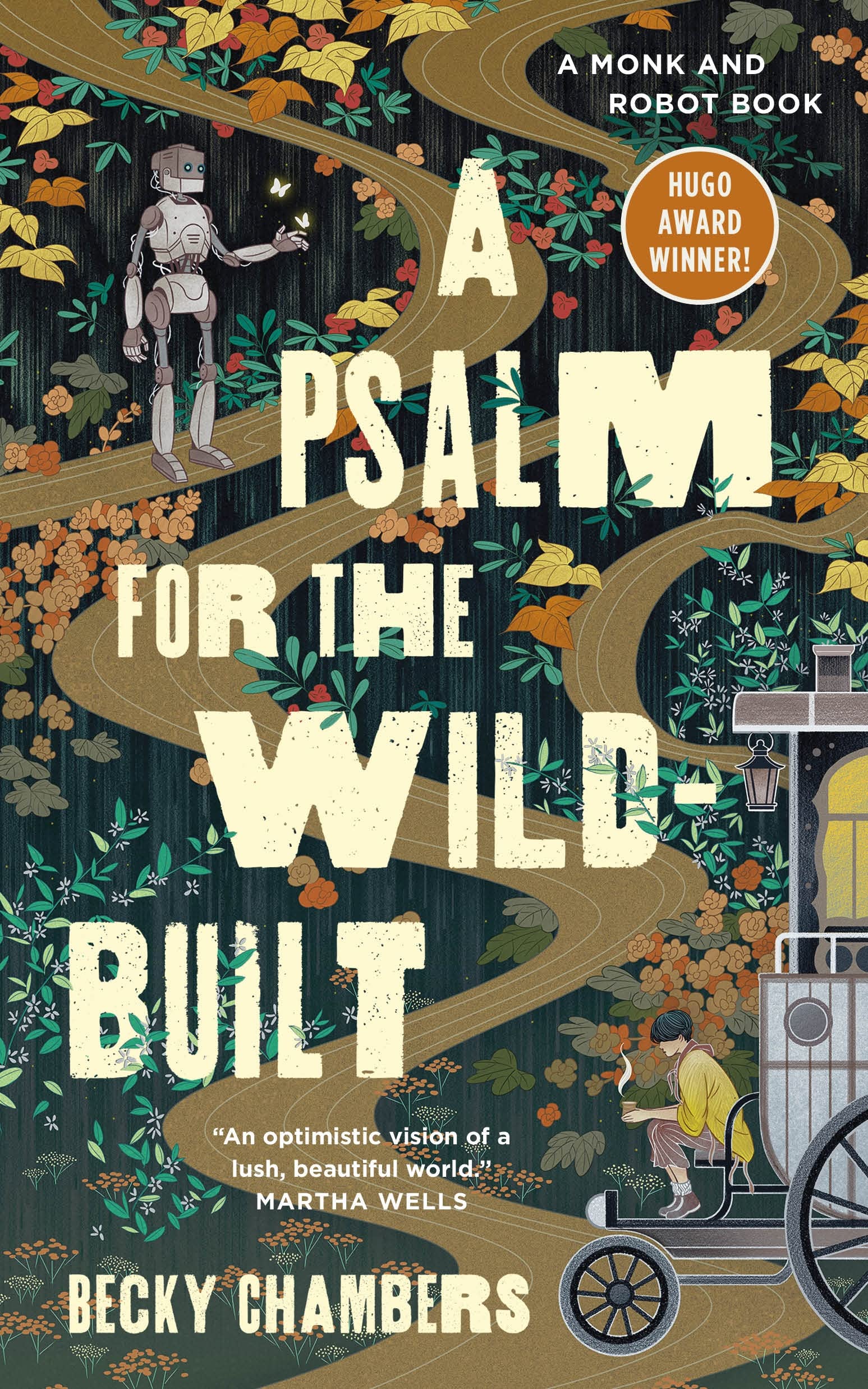
Review of A Psalm for the Wild-Built


Review of A Psalm for the Wild-Built

Brianna Best

Chambers, Becky. A Psalm for the Wild-Built. Tor Books, 2021.

A Psalm for the Wild-Built, published by Tor, arrived in the hands of readers in 2021. Becky Chambers’ first foray into softer sci-fi, Psalm speaks to both readers’ need for comfort in the middle of the COVID-19 pandemic and our alienation from the structures of “normal” daily life. Psalm for the Wild-Built offers a vision of what a different kind of life might look like. Sitting at the junction of science fiction and fantasy, the novella asks important questions about what a future built on sustainability and care might look like.

Psalm for the Wild-Built takes its audience on a journey into the far future, after an event called the “Awakening.” The “Factory Age” has long collapsed and the world that emerges from the rubble is one in which humans strive, as much as they can, to allow the natural world to heal from the damaging effects of the past. In the catalyst to this worldview shift, the Awakening, robots gained sentience. Offered the choice to stay or to create their own society, the robots decided to go off into the forest “so that we may observe that which has no design—the untouched wilderness” (2).

We follow two characters. Dex is a nonbinary monk whose job it is to travel from village to village to offer tea service; feeling that something is missing from their life, they decide to travel off the well-worn paths of Panga—their world—to an old hermitage ruin. On the road, the robot Mosscap walks out of the forest to introduce itself.

When they meet, Mosscap reveals it has been sent on a mission by the robot community to answer the question “What do humans need?” It offers Dex an exchange: Mosscap will help Dex get to the hermitage ruins and in return, Dex will teach it all about human customs and culture. The book follows this meeting of first contact between robot and human and examines the unlikely yet tender friendship that forms between the two. Both must answer questions that get to the heart of being in the world: what do humans need? And, for Dex at least, what makes a life fulfilling and driven by purpose? As the series continues, these questions become inextricably tangled together.

Psalm for the Wild-Built explores speculative fiction’s role in addressing our political and climate crises: how might the future look if we manage to survive? What can we build from the ruins? And how might speculative fiction build worlds to strive for?

Psalm for the Wild-Built draws on a recent trend in speculative fiction that focuses not on the future of technology or space travel but rather on the ecological consequences of decades of striving toward these things. The culture created by Chambers in the novella does not rely on technology; it avoids the trap of declaring technology itself as the root of all past evil and exploitation. For instance, Psalm takes seriously the question of artificial intelligence, though perhaps it would be better to call it “mechanical consciousness.” My preference here lies in the distinction between “intelligence” and “consciousness.” Will Douglas Heaven writes for the MIT Technology Review that “intelligence is about doing, while consciousness is about being” (Heaven). The decision made to go out and observe the untouched wilderness exemplifies what it means to be concerned with being rather than doing. And I opt for “mechanical” in place of “artificial” because artificial implies an opposing “natural.” “Mechanical” represents the vessel of Mosscap’s consciousness, its mechanical body, without having to imply that its consciousness is unnatural next to Dex’s. Chambers imagines a world where humans exist only as one part of a vast network of both human and non-human species that work collaboratively toward all their survival.

What seems maybe the most significant about this book is the tenor of its emotion. The world-building is idealistic. Everyone in this world has food and shelter. Money does not exist anymore. The preservation of animal life and the environment is the top priority on Panga. And people are nice. For some readers this is a weakness of the text. Talking to a friend of mine recently, I was surprised by his critique of the idealism in the novella.

I am reminded of conversations that I have had over the past few years concerning the idea that any sort of belief in the inherent goodness of things is naive and therefore escapist or unrealistic. This is not just a conversation in Science Fiction Studies, but I am reminded here of Suvin’s distinction between science fiction, which often has important conversation about ethics and society, and fantasy, which offered only escapism from society. But I am wary of the idea, too, that sincerity and escapism do not have a place as useful rhetorical modes in literature or that they are inherently uncritical. The low stakes of the novella may not draw some readers in, but for me they provide almost a meditative refuge in the act of reading–a moment of leisure that provides an escape from the seemingly never-ending drive to work and produce work.

And the novella does offer some concrete ideas about building a sustainable future that we might test against our current everyday experiences. The novel asks important questions about how science fiction can respond to the crisis of climate change and late capitalism without resorting to the same types of liberal humanist ideals about progress that got us here in the first place. The novel also imagines a world that is delightfully queer and accepting. Even if it may seem too good to be true, Psalm for the Wild-Built offers a mode of speculation that allows us, while reading, to exist in a world that we might one day wish to create for ourselves.

I am planning on teaching this text in the fall 2023 semester in a class designed to look at how recent speculative fiction imagines possible futures. I am pairing this text and Catherynne M. Valente’s novella The Past is Red because they offer two distinct ideas of what the future may hold. The Past is Red offers what might be considered the “more realistic” version of the future we are headed towards—a planet full of garbage and ruin and greed. Psalm for the Wild-Built, on the other hand, offers a world in which the impulse to care for each other and live sustainably becomes the dominant way of life. Is this naive? Or do such imaginings of worlds enable us to realize that they might also be possible for us?

WORKS CITED

Heaven, Will Douglas. “What an Octopus’s Mind can Teach Us about AI’s Ultimate Mystery.” MIT Technology Review, https://www.technologyreview.com/2021/08/25/1032111/conscious-ai-can-machines-think/. Accessed 24 April 2023.

The SF in Translation Universe #17


The SF in Translation Universe #17

Rachel Cordasco

Welcome back to the SF in Translation Universe! This summer promises a fascinating and diverse line-up of SFT from Japan to Sweden and everywhere in-between. Here you’ll find mythical creatures, people turning into trees, space elevators, and much more, so read on.

June brings us SFT from Japan (New Directions) and Korea (Restless Books). In Ryunosuke Akutagawa’s Kappa (tr. Lisa Hofmann-Kuroda and Allison Markin Powell), the eponymous folklore monster (who drags toddlers to their deaths in rivers) is spotted by Patient No. 23, who pursues it to its lair. There, 23 finds a whole world of Kappas, whose culture and society mirror that of Japan in terms of morals, the law, economics, and romantic relationships. His return to the human world is difficult and he finds himself irritated by humanity (leading to his confinement in an asylum, thus “Patient No.23”). With parallels to Alice in Wonderland and Gulliver’s Travels, Kappa is a fascinating modern-day morality tale. Korean author Jeong-Hwa Choi’s The White City Tale (tr. Janet Hong) also explores society and social hierarchies, only this time the protagonist is a man fighting against inequalities in a quarantined city.

The three works of SFT out in July are all by women- one Russian, the other two Korean and Japanese. Counterweight (tr. from the Korean by Anton Hur) is the latest text in English by Djuna (of which little is known). A story about corporate intrigue, politics, and one company’s destructive attempts to build the first space elevator, this promises to be yet another excellent work in the growing canon of modern Korean science fiction.

Unlike Counterweight, Darya Bobyleva’s Village at the Edge of Noon and Maru Ayase’s The Forest Brims Over fall into the surrealist camp. Village (tr. from the Russian by Ilona Chavasse) is about a settlement that suddenly finds itself cut off from the world. Voices call from the river, people start thinking strange thoughts, and the forest seems to be moving closer. Only one women seems to realize what’s going on. Meanwhile Ayase’s Forest (tr. from the Japanese by Haydn Trowell) also takes up this theme of humans in close relation to the natural world, only here it is a woman literally turning herself into a force of nature. When a woman becomes resentful of her husband, who uses her as the subject of his novels, she eats a bowl of seeds and starts sprouting buds and roots. Her husband tries to keep her in an aquaterrerium, but she breaks out, turns into a forest, and begins to take over the city.

I’m especially excited about August because it means a new John Ajvide Lindqvist novel! Having read his “Places” horror trilogy, I know that whatever else he’s written will be high quality. The Kindness (tr. Marlaine Delargy?) forces us to consider just how little it would take for people to turn against one another. A mysterious shipping container is dumped near a Swedish port town, and along with its horrifying cargo of twenty-eight dead refugees, there’s a strange black sludge that seeps into the water. This sludge somehow imbues the inhabitants of the town with dread, after which they start acting out violently against one another.

Staying in Scandinavia a bit longer, we can look forward to Juhani Karila’s Fishing for the Little Pike (tr. Lola Rogers). Winner of the Jarkko Laine Literature Prize, Fishing tells the story of one woman’s annual trip to her home in Lapland to catch a pike. Pretty soon, we meet mythical creatures, a murder detective, and a deadly curse.

Finally, we have Polish author Rafal Kosik’s Cyberpunk 2077: No Coincidence (tr. by ?), the latest in a video-game-to-print series that started with Andrzej Sapkowski’s Witcher books. CD Projekt Red was also behind the Witcher computer games, and here they’ve partnered with Kosik to tell a story about a group of people who “discover that the dangers of Night City are all too real” as they pull off a heist for a mysterious boss.

I’m sure I’m missing some SFT, so please let me know what else should be on this list. Thanks for reading, and I’d love to hear what you’re reading now and what you’re looking forward to: rachel@sfintranslation.com. Until next time in the SFT Universe!


Afrofuturist Women of the Water : Mami Wata, Sirens, Predators, Deities, Metamorphosis, and Survival


Afrofuturist Women of the Water : Mami Wata, Sirens, Predators, Deities, Metamorphosis, and Survival

Gina Wisker

Women of the water play several roles in African-originated mythology and folklore, and latterly in Afrofuturism. They draw their energies from the beautiful seductive female water deity Mami Wata, who brings possibilities of wealth and longevity to those who engage with her, offering her gifts (although sometimes she responds with the opposite of positive experiences). They also draw their mixed energies from mermaids who, like the sirens of Greek mythology, appear in international folklore as dangerously seductive creatures born perhaps of the imagination, loneliness, and desperation of those long at sea.

These women of the water also have other roles in African and African American women’s horror, the contemporary Gothic, and in Afrofuturism, which recalls and recreates magical histories, sometimes as a warning and sometimes to recuperate the damaged negative past, turning stories of enslavement into ones of agency and freedom.

While Tananarive Due notes, “I needed to address my fear that I would not be respected if I wrote about the supernatural” (2002), it is arguably through the supernatural and fantasy that we can interpret behaviours and events, and only then imagine otherwise.

Afrofuturism

In the “outro” to Octavia’s Brood (Brown and Imarisha, 2015), Adrienne Maree Brown outlines a dynamic, forward-looking message of statutes or tools: one recognizing the power of science fiction, the other of agency in working to take forward different representations and actualized modes of being. They characterize afrofuturist work as challenging, visionary fiction, which:

explores current social issues through the lens of sci-fi; is conscious of identity and intersecting identities; centers those who have been marginalised; is aware of power inequalities; is realistic and hard but hopeful; shows change from the bottom up rather than the top down; highlights that change is collective; and is not neutral – its purpose is social change and societal transformation. The stories we tell can either reflect the society we are part of or transform it. If we want to bring new worlds into existence, then we need to challenge the narratives that uphold power dynamics and patterns. We call upon science fiction, fantasy, horror, magical realism, myth, and everything in between as we create and teach visionary fiction. (Brown and Imarisha, 2015, 279)

Others argue for the power of science fiction and Afrofuturism in creating alternative histories and futures (Bould, 2014, 2015; Csicsery-Ronay, 2012). Their emphasis is on values, imaginative expression, and action, stressing the social justice work that these related forms of writing should engage with. The figure of Mami Wata and those of merpeople are used to explore historical, lingering and contemporary social issues as both a warning or an imaginative celebratory way forward.

Mami Wata

Mami Wata (‘mother water’) the water spirit, is seductive, rewarding, worshipped, and dangerous. At once beautiful, protective, seductive and dangerous, Mami Wata is celebrated throughout much of Africa and the African Atlantic and is believed to have overseas origins in both European-originated mermaids and Hindu gods. She “is often portrayed as a mermaid, a snake charmer or a combination of both …She is not only sexy, jealous and beguiling but exists in the plural as part of a school of African water spirits” (“Who is Mami Wata?”).

Wikipedia elaborates on her seductive activities abducting travellers, who then benefit financially and through enhancements to their looks through their interaction with her. Because of this, they and others return and leave her capital goods. She is persuasive and possibly ruthless, and seems to have much of the illusory promise accorded to mermaids as traditions tell “of the spirit abducting her followers or random people whilst they are swimming or boating. She brings them to her paradisiacal realm, which may be underwater, in the spirit world, or both. She might keep them there if she allows them to leave, they return home wealthier, and in dry clothing. These returnees often grow wealthier, more attractive, and more easygoing after the encounter” (Wikipedia).

There are many stories of river travellers coming across her grooming herself (like mermaids combing their hair) while admiring herself in a mirror. She will usually dive into the water, leave her possessions behind to be stolen by the traveller, then appear to the thief in his dreams demanding the return of her goods. She next demands he be sexually faithful to her and, if he agrees, he obtains riches. She has groups of worshippers but also prefers to interact with individuals, and has priests and mediums dedicated to her in Africa, the Americas, and in the Caribbean. Mami Wata is a powerful, lovely woman who seeks beautiful gifts “of delicious food and drink, alcohol, fragrant objects (such as pomade, powder, incense, and soap), and expensive goods like jewellery” (Wikipedia). Nowadays, she likes designer jewelry and Coca Cola. The picture painted is of a manipulative goddess who rewards her followers with money and looks. Finally, we are told she wants her followers to be healthy, wealthy, and her men faithful.

However, she’s not represented as only seductive; she is also seen as dangerous and is blamed for all sorts of misfortune. In Cameroon, for example, Mami Wata is blamed for causing a strong undertow that kills swimmers. This will become important when we look at Tananarive Due’s “The Lake” (2013). Mami Wata is a complex figure to read, at once beautiful and rewarding but also controlling, dangerous and mean. The figures of merpeople who appear in and carry the imaginative dark or liberating messages of several fantastic texts by African American women writers can be seen to grow from this powerful, energetic figure of Mami Wata as it is based in West African lore. However, while Mami Wata appears as seductive, dangerous, materialistic, just as traditionally are sirens and mermaids, and is developed in this fashion by some African American women’s work, Afrofuturist writing takes both Mami Wata and the mermaid into new waters, rewriting negative histories, and reconfiguring both as powerful figures of female freedom.

Mami Wata appears in a range of African and African American writing, so in Nnedi Okorafor‘s 2014 speculative fiction novel, Lagoon, an alien spaceship appears beneath the waters of Lagos Lagoon and the new arrivals cause transformations in the natural and human world. When the first alien ambassador sets foot on Bar Beach in human female form, then disappears into the sea, a local boy compares her to Mami Wata. Later, an antagonist interprets another alien in female form as Mami Wata and surrenders to her seduction, accompanying her into the sea to be transformed.

Mami Wata also appears in Nnedi Okorafor’s Akata Warrior (2017).

She has been understood also as La Sirène, a Haitian siren figure like the ancient Greek sirens who tried to lure Odysseus onto the rocks to perish. Water dominates Haitian life, and there are many religious beliefs based on it. In Haitian lore, the Lord of the Water is Agwé (see Hopkinson’s Agway the merchild, in The New Moon’s Arms, 2007) and his consort is la Sirène, portrayed as a beautiful woman with a fish’s tail, holding a mirror that acts as a portal between our mundane world and the mystical realm. Because she lives at the border (between the ordinary and the magical, between the world of land and the world of the ocean), la Sirène is the keeper of occult wisdom. She has a beautiful voice, is known as the Queen of the Choir, and owns a golden trumpet (anyone discovering it will live a life of wealth). While her image brings good luck particularly for sailors, and is frequently used on homes, on ships, and at lottery drawings, she is also demanding, and if people don’t worship her reverently or they fail to pay their debts, she uses her physical and vocal beauty to lure them to an early grave. She is also reported to kidnap babies to raise them in her underwater lair.

La Sirène, whose number is 7 and whose bird is the dove, is a great ally and a terrifying enemy worshipped in Vodou ceremonies. She sounds as materialistic as Mami Wata, as her favourite offerings are cigarettes, seashells, desserts, and perfume. As a figure, la Sirène goes beyond mere reportings of mermaids, deepening the lore behind them and standing out as one of the most comprehensive and well recorded images of a mermaid. Annie in Tananarive Due’s short story “The Lake” (2013), herself half French, resembles Mami Wata and also the legendary Haitian figure of la Sirène.

Mermaids, or more generally merpeople, are variously represented as the Other, alluring because different, free and powerful, of the water but also meant to be trapped, kept as trophies, deprived of freedom, kept for the use of others and displayed like sea creatures in some form of artificial ocean. This model of dichotomous representation lies behind the tales of their dangerous allure, their containment as objects for observation, and finally their metaphorical use as figures of transformation and empowerment, an imaginative movement forward through rewriting a negative past and creating a free, transformed future. They are fascinating and diverse in themselves but are also used by writers to engage with issues of rewriting troubled histories of enslavement and dehumanization, so while some tales are more interested in the seductive side of Mami Wata or mermaids, others combine this with both exposure of the dark past and of slavery, imprisonment, and then move on to express the vitality and power of escape, self- actualization, rewriting the damaged past, speculating for a positive future through Afrofuturism.

The Water Phoenix Bola Ogun

Mermaids, Mami Wata, and la Sirène are linked with transformations (not always for the best) and latterly with Afrofuturism’s rich focus on rewriting the damaged past, imagining a positive diverse future through escape into alternative modes of being. In “The Water Phoenix,” being imprisoned for others’ entertainment almost costs the mermaid her life. The film “The Water Phoenix” ( 2017 ), written, directed and starring herself as this dazzling sea creature, is a triumph for Bola Ogun, who expressed great frustration on trying to get films made as a marginalized person, as herself—a first generation Nigerian-American filmmaker. She turned to crowdfunding to get some of the funds needed for this short film to be completed and uploaded to Vimeo (by 2019), where in 2019 she reported 750,000 views. The synopsis begins: “When an imprisoned mermaid is betrayed by her caretaker, she must find a way to escape the aquarium alone.” It is actually her lover, rather than caretaker, who not only betrays her, but sells her out to an unscrupulous oceanarium owner. But it is ultimately a tale of escape and empowerment as are those by Nalo Hopkinson, which follow.

Tananarive Due and Nalo Hopkinson

Both Tananarive Due and Nalo Hopkinson reinvigorate these powerful, sometimes alluring and freeing but sometimes dangerous female water figures, Mami Wata, La Sirene, merpeople and mermaids in their work. Tananarive Due,named after the French for Antananarivo, the capital of Madagascar, wasborn in Tallahassee, Florida, the oldest of three daughters of civil rights activist Patricia Stephens Due and civil rights lawyer John D. Due, Jr. Due gained a B.S. in journalism from Northwestern University’s Medill School of Journalism and an M.A. in English literature, focusing on on Nigerian literature at the University of Leeds, UK.

In Tananarive Due’s Ghost Summer (2013), in the haunted and magical context of Gracetown, Florida, all are warned to stay away from the lake in summer since in its waters lurks a dark energy, a legacy from the town’s history of slavery. All the tales center around the lake, but two in particular focus on dangerous water creatures/people. In “Free Jim’s Mine,” for example, a collusive freed slave mine owner transforms into a terrifying underground river creature to try and prevent the escape of his two young enslaved relatives. In “The Lake,” Tananarive Due lets loose her predatory mermaid. Annie seems to transform into Mami Wata.

Gracetown, the small town in Ghost Summer (2015), perhaps (ironically) named after Elvis’s home or Paul Simon’s song, is a central location charged with the ghosts of slavery, plantation brutality, localized pain, and death, all of which act as a microcosm for a broader cultural history of inequality, brutality, and suffering, both publicly and privately suppressed. Water is central to Ghost Summer and Gracetown, with its dark histories and its dubious transformative powers. Summer visitors are told to stay away from the lake, but it invades their day and night lives. The water is alive , stirring uneasily with its deadly past. Most of the community histories are those of slavery and its legacies (Wisker, 2019). The traumatic past of the town leaks out from the lake, out from the earth, burrowing through lost tunnels and up the mineshaft of Free Jim’s mine, taking the form of demonic creatures, bodily invasion, or re-enacting historical slave escapes played out in ghostly sight and sound. The geography of a haunted past infuses the lives of those who live there and all who visit family in the summer, at the most dangerous time.

This is a collection of ghost stories and, in Democracy’s Discontent (1996), Michael J. Sandel emphasises the social justice function of ghost stories, commenting on the power of storying our condition that, “Political community depends on the narratives by which people make sense of their condition, and interpret the common life they share” (350). Ghost stories return the undead in order to expose and preferably right historic, suppressed wrongs. Those wrongs of an enslaved past are central to Ghost Summer. Gracetown’s lands, barns, houses and especially its constantly disturbed and disturbing lake are variously upset by property development and unthinking visitors. Also disturbed are complacencies and suppressed histories, revealing dark secrets, exposing historical cover ups, and enabling the marginalised and silent to have a voice. The hidden, violent past is exposed in these stories, which are largely set in the 21st century, with some during slavery (“Free Jim’s Mine”) that are engaged, political, driven by social justice and the unquiet brutal past of slavery. This small town is in the middle of a drained swamp, where boundaries exist between land now owned by African Americans and that owned by the McCormacks, the descendants of Scottish slave owners who, themselves immigrants, benefitted historically from forcibly imported, transported slaves. Both lake and swamp invade and trouble the lives of generations of children and adults. Swamp leeches invade babies who become suddenly well-behaved, bodies of escaping slaves are dug up on farmland. The older generation keep the secrets:

 ‘I wasn’t going to say anything to you kids – but there’s bodies buried over on that land across the street, out beyond Tobacco Road. McCormack’s land…. the university folks say they were black.’

It was the coolest thing Grandma had ever said. (67)

Children and pre-teens spending family holiday summers round the lake in Gracetown become sensitive to the past. They sense and somehow invite back those neighbours and relatives, children long dead, enabling their stories to be disinterred.

Free Jim’s Mine

One tale concerns two young escaped slaves, who hide overnight in Jim, a relative’s, mine, but in the dark night waters of the mine, this historically collusive relative transforms into a monstrous frog to try and hunt them down. Jim warns the runaways of their unlikely success:

“It always goes wrong, girl,” Uncle Jim said. “Don’t get it into your heads that you’ll both make it up to North Carolina – and then what? Philadelphia? You’re fools if you think this ends well. You never should’ve come. Think of the last words you want to say to each other, and be sure to say ‘em quick. You won’t both survive the night.” (P.140) Of course he knows the reason why but at least warns them about the water creature which will find and finish them off “As a boy,” he said quietly, “I heard stories about Walasi. A giant frog. My mother told me, her mother told her, her mother’s mother, through time. To the beginning.” (142)

At night, the two young people have no choice other than to hide in the flooded mine, but as it gets later, they are not alone.

Ripples fluttered in the lamplight. Then a frothy splashing showered them. Lottie screamed, but did not close her eyes. She wanted to see the thing. A silhouette sharpened in the water, like giant fingers stretching or a black claw. Her hands flew to cover her eyes, but she forced her fingers open to peek through. The creature churned the water, tossing its massive body. A shiny bulging black eye as large as her open palm broke the water’s plane, nestled by brown-green skin. Lottie screamed.

The creature flipped, its eye gone. (143)

They lash out at the massive creature and survive the night, however, and when Free Jim reappears in the morning and reaches for Lottie, “his two gold rings flared like droplets from the sun. His pinkie finger, a bloodied crust, was freshly sliced away” (146). Jim is clearly free because of his collusion with those who would recapture escaped slaves, and perhaps his transformation into the violent, disgusting Walasi is a curse upon him for that collusion. Whatever the real story, the two survive the water creature’s attack and continue their escape.

“The Lake” is a Mami Wata Tale

Abbie, the lithe, attractive teacher with an unexplained dark past takes a job in Gracetown. The other staff question her about her origins but she is reticent, aware this is an intrusive exploration both about being Black and her speaking French (she has Haitian origins). But also we begin to consider, perhaps, that there are problematic stories in her background. The visiting children and everybody in Gracetown knows that it is dangerous to swim in the lake, but no one mentions why. Although warned about swimming in the lake, Abbie takes to it like a fish to water, initially barely noticing how she can stay under for longer, how her feet are becoming webbed as her body becomes stronger and more muscular. She spends longer and longer in the water after work, and while questioning her adaptation to her new habitat, primarily feels empowered, pleased, and invested.

She did not hesitate. She did not wade. She dove like an eel, swimming with an eel’s ease. Am I truly awake, or is this a dream?

Her eyes adjusted to the lack of light, bringing instant focus. She had never seen the true murky depths of her lake, so much like the swamp of her dreams. Were they one and the same? Her ribs’ itching turned to a welcome massage, and she felt long slits yawn open across her skin, beneath each rib. Warm water flooded her, nursing her; her nose, throat and mouth were a useless, distant memory. Why hadn’t it ever occurred to her to breathe the water before? (20-21)

As Abbie adapts, she is responding to a drive within her, a recognition of a different self, a different place where she came from, a place where she is one with the water. As she transforms into a creature part human part mercreature, part Sirene or Mami Wata, so she frees up her instincts to hunt as well as to seduce. An alligator is her first prey: “An alligator’s curiosity brought the beast close enough to study her, but it recognized its mistake and tried to thrash away. But too late” (20-21).

Her friendly relationships with her teenage boy students who come over to help with rebuilding the house become more inappropriate, sinister, yet not quite fully seductive until they become her prey. While the boys fix things Abbie takes another lake swim, allowing free rein to her developing watery self, freeing it from the moral restraints of the land world, becoming something else:

As the water massaged her gills, Abbie released her thoughts and concerns about the frivolous world  beyond the water. She needed to feed, that was all. She planned to leave the boys to their bickering and swim farther out, where the fish were hiding.

But something large and pale caught her eye above her.

Jack, she realized dimly. Jack had changed his mind, swimming near the surface, his ample belly like a full moon, jiggling with his breaststroke.

That was the first moment Abbie felt a surge of fear, because she finally understood what she’d been up to – what her new body had been preparing her for. Her feet betrayed her, their webs giving her speed as she propelled towards her giant meal. Water slid across her scales. (27)

Abbie might realize her metamorphosis into her true self, but she is powerless and probably unwilling to stop the trajectory as it brings her directly to her next meal, Jack. Ghosts, frogs, invasive swamp leeches, and transformed human/water creatures with anti-social appetites have something to tell the people in Gracetown, which is a liminal space, a crossroads of time, lives, and spaces. The histories of brutal erasure of Indigenous and African American children at its core are now more widely known (McGreevy, 2021; Eligon, 2019) and have entered Tananarive Due’s own family history:

This story and the previous one, “Summer”, are a kind of odd prophecy: In 2013, I received a call from the Florida Attorney General’s office informing me that my late mother, Patricia Stephens Due, had an uncle, Robert Stephens, who was probably among dozens of children buried on the grounds of the Dozier School for Boys, a reform school in Marianna, Florida, where boys were tortured and killed for generations. I had never heard of the Dozier School, buried children, Robert Stephens, my great-uncle who died there in 1937, aged fifteen. (127)

African American Gothic shocks and upsets any sense of settled history, of shared reality, exposing the deeply disturbing psychological insecurity of all that seems comfortably real. But while much of this revelation is disturbing, it is also potentially the start of a new healthy way forward. This rewriting, re-understanding, and reinterpreting is also part of a forward movement and a characteristic of Afrofuturism (Hopkinson and Mehan, 2004; Lavender and Yaszek, 2020; Delaney; Hopkinson and Mehan, 2004), that rewriting of the past and speculation into a positive future.

In Afrofuturism, history is reconceptualized, rewritten from a positive African American perspective and positive futures imagined (Wisker Contemporary Women’s Ghost Stories: Spectres, Revenants and Ghostly Returns, 2022).

Nalo Hopkinson

Mami Wata also appears in Nalo Hopkinson’s The Salt Roads (2003), while in her Afrofuturist The New Moon’s Arms (2007), merpeople are part of a life-affirming celebratory metamorphosis, a positive re-telling of the horrific brutal drowning of transported enslaved people thrown overboard to die because they were sick or considered worthless, from the slave ship the Zhong, bound from Africa to the Caribbean. In this latter novel, middle- aged Chastity’s/Calamity’s reignited self-worth is aligned with her returned magical powers. Afrofuturism in this tale reclaims a magical positive reading as it also reaffirms a positive version of women’s vital self worth: “you can’t find something if you don’t know you’ve lost it” (Hopkinson, The New Moon’s Arms, 115). Nalo Hopkinson’s Afrofuturist, speculative fictions explore experiences and worldviews as divisive, dangerous reminders of a troubled past, and simultaneously they also conjure up culturally intertwined, positive new futures. In The New Moon’s Arms, Torontonian/Trinidadian/Jamaican Hopkinson uses strategies of the postcolonial/African diasporan literary Gothic and speculative fiction to explore some of the tensions and potential riches of the liminal spaces of identity, aging, and cultural hybridity.All of these comments highlight the role that writing has to speak truth to power, and offer ways forward. Speculative fictions–and particularly Afrofuturism–enable the critique, expose the illegitimate, biased representations, and construct and celebrate alternative voices and ways forward.

The novel opens on middle-aged Calamity’s father’s funeral—a fellow mourner bursts her drawers, a brooch falls, it is reclaimed as Calamity’s. The carnivalesque, bawdy comic causes a breach of order in the everyday and a breach in a constrained narrative. The moment is a liminal space, one of loss that also opens up the opportunity of a new energy, and most of all, the power of finding what was lost, re-thinking, reclaiming and revitalizing what was suppressed, and moving forward. This is a carnival version of the spirit of Afrofuturism–reclamation, new understandings, new life and vision, reimagining the past and the future.

Marvellously energetic and creative, The New Moon’s Arms focuses on Calamity and the fictional Caribbean island of Dolorosse. Calamity, who befriends a merchild when herself a child, now rescues a boy from the sea, understanding his name to be Agway (for Agwe the Haitian sea god), and cares for him until he is healthy and ready to return to his parents. Not everyone knows, but Calamity knows that around the coast of Dolorosse are a community of merpeople and, as the island struggles with toxic waste in the waters, the overbuilding of hotels reducing the bat population, the sea and seabird damage for the desalination plant so they are threatened but also a part of a potential recuperation, parallel to Calamity’s own recovery of her historical magical powers as a ‘finder’ and the magical return of her father’s orchard–this is a rich novel of damaged histories and transformed lives, reimagined positive futures for Calamity for the merpeople, and for the island itself.

The foundational source of the potential for a positive transformed future lies in remaining, rewriting, and re-understanding the past, and here Hopkinson (like Rivers Solomon after her), reimagines and reclaims a terrible dark and real moment in African American and Caribbean history. Historically, the transported slaves on the Zhong (1781), were brutalized, dehumanized, and thrown overboard (captains could claim compensation for those drowned at sea; the sick or damaged were, in monetary terms, considered worthless). During their crossing, instead of being brutalized further, the slaves on Hopkinson’s imagined ship chose instead to jump in the sea, swimming free, transforming, seizing agency, and becoming merpeople. The merpeople represent a creative transformational response to an intolerable death. Their origins lie with those who escaped from the Zhong, morphing into hybrid survivors flourishing in the new medium of water:

The sailors would remove the dead and dying. The more that died the more space for the remaining. The dada-hair lady was heartsick at the relief she felt when another body was removed. The Igbo sailor described how they threw the dead bodies over the side, how large fish with sharp teeth were following the ship now, waiting for their next meal.

The young woman takes power: “We are leaving now!” she shouted in Igbo.

The people’s arms flattened out into flexible flippers. The shackles lipped off their wrists. The two women who had been chained to her flopped away, free, but the dada-hair lady remained unchanged and shackled. The little boy in her arms was transforming, though. He lifted one hand and spread his fingers to investigate the webbing that now extended between them. Some of the people who had been forced back into the holds were making their way out, now that their shackles had slid off. The hips was so far tilted that they didn’t have to climb; just clamber up the shallow incline that led to the hatch. The people’s bodies grew thick and fat. Legs melted together. The little boy chuckled, a sound she’d not heard from him before this. The chuckle became a high-pitched call. The people’s faces swelled and transformed: round heads with snouts. Big liquid eyes. (316)

Afrofuturism, as creative story-telling, has the power both to reimagine the damaged past positively, reclaiming power in doing so, and positively will the transformed future into being. Nalo Hopkinson’s merpeople, descendants of the self-freed slaves, are part of the new magically enriched future on Dolorosse, where not only does the magical orchard return along with Calamity’s powers as a finder, but there will be a united response against the damage done to creatures, water, and people to move towards a positively transformed future.

The Deep by Rivers Solomon (2018)

In The Deep, brutally jettisoned slaves also transform into a form of merpeople: water-breathing descendants of African slave women tossed overboard who have built their own underwater society. While this is a short novel, it is a highly creative piece made up of different inputs and responses, some building over others or misheard – so that without indication of a single owner, it becomes a co-owned piece, developing creative voices in different forms. As a result, The Deep emerges as a joint creative enterprise between a network of people, some acknowledged at the end. It grew from the practice of ‘artistic telephone’ insofar as the way phrases are transformed when shared over time and space–a series of new interactions of telling of The Deep. These tellings were started as a game by the Detroit techno-electro duo of Drexciya-James Stenson and Gerald Donald, with their mainly instrumental music and many collaborators, from ‘the Underground Resistance’ and ‘the Aquanauts’ taking from the original mythology behind the world of the music and of the text. They further developed the spare elliptical world-building tactics of the story from Drexciya and first made Splendor and Misery, a 2016 concept album in which the ‘The Deep’ was defined as a song. Next, three people then wrote The Deep, avoiding first-person pronouns, and Rivers Solomon then continued the work, developing:

their misheard whisper to the chain, filling out our song’s narrative with their particular concerns, politics, infatuations, and passions.’ Rivers fixed on the refrain ‘y’all remember’ to avoid ’I’ and created Yetu which focused the tale ‘the immediate and visceral aim inherent in passing down past trauma’ (The Deep p 160-161) There is also more music focusing on merpeople. (Drexciya)

Conclusion

These African American stories are ghost stories, some horror, all Afrofuturism, each a fluid blend of genres. Each takes from and evolves from tales of mythical historical water goddesses, sirens, mermaids, and merpeople, to expose terrible histories, inherited selfish cruelties and deadly threats, and, in some instances, to dig back into a reimagined history in order to push forward, rewriting tales and histories of dehumanisation and death as positive, as escape, transformation, re-empowerment, and imagining forward into celebration of rich active diverse lives. In these contemporary tales, the figures of mermaids, mercreatures, and of Mami Wata, the African water deity, are reconfigured and revitalised to rewrite negative histories; explore potential, individual, community and sexual freedoms; and freedom from the terrible deadly oppressions of an enslaved past and, through the energies of Afrofuturism, create a magical, agentic, positive future.


WORKS CITED

Adejunmobi, Moradewun. “Introduction.” Cambridge Journal of Postcolonial Literary Inquiry, Cambridge University Press, vol. 3, no. 3, September 2016.

Bould, Mark. “Africa SF: Introduction.” Paradoxa, vol. 25, 2014, pp. 7-15.

—. “African Science Fiction 101.” SFRA Review, vol. 311, Winter, 2015, 11-18.

Brown, Adrienne Maree and Walidah Imarisha, eds. Octavia’s Brood: Science Fiction Stories from Social Justice Movements. AK Press, 2015.

Chang, Jeff. Octavia’s Brood: Science Fiction Stories from Social Justice Movements, edited byAdrienne Maree Brown and Walidah Imarisha. AK Press, 2015.

Csicsery-Ronay Jr., Istvan. “What Do We Mean When We Say ‘Global Science Fiction’? Reflections on a New Nexus.” Science Fiction Studies, vol. 39, no. 3, 2012, 481.

Drexciya.‘The Deep.’ https://pan-african-music.com/en/hear-the-rap-song-inspired-by-drexciyas-afrofuturist-myth/.

Due, Tananarive. Ghost Summer. Prime Books, 2013.

—. Interview. March 17, 2002. http://www.tananarivedue.com/interview.htm, accessed 19/09/02.

—. “The Only Lasting Truth.” Octavia’s Brood: Science Fiction Stories from Social Justice Movements, edited by Adrienne Maree Brown and Walidah Imarisha. AK Press, 2015.

Hampton, Gregory Jerome. Octavia’s Brood: Science Fiction Stories from Social Justice Movements, edited byAdrienne Maree Brown and Walidah Imarisha. AK Press, 2015.

Harris, Wilson. History, Fable & Myth in the Caribbean and Guiana. National History and Arts Council, 1981.

Hopkinson, Nalo. The New Moon’s Arms. Grand Central Publishing, 2007.

Hopkinson, Nalo and Uppinder Mehan. “Introduction.” So Long Been Dreaming: Postcolonial Science Fiction & Fantasy. Vancouver: Arsenal Pulp Press, 2004.

LaFleur, Ingrid.  Afrofuturism: The World of Black Sci-fi and Fantasy Culture, edited by Ytasha L. Womack. Lawrence Hill Books, 2013.

Langer, Jessica. Science Fiction and Postcolonialism. Palgrave Macmillan, 2011.

Lavender, Isiah III. Afrofuturism Rising : The Literary Prehistory of a Movement. Ohio State UP, 2019.

Magalí, Armillas-Tiseyra. “Afronauts: On Science Fiction and the Crisis of Possibility.” Cambridge Journal of Postcolonial Literary Inquiry, Cambridge University Press, vol. 3, no. 3, September 2016, pp. 273-290, 2016. doi:10.1017/pli.2016.14.

Mclain, Carrie “The Water Phoenix.” On Narratives About Female Agency & Black Mermaids. 2020. https://carriemcclain.medium.com/the-water-phoenix-on-narratives-about-female-agency-black-mermaids-5b56b97f4462.

Morrison, Toni. Black Women Writers: Arguments and Interviews, edited by Mari Evans. Pluto Press, 1985.

—. “Telling our Story.” Interview with Andrea Stuart. Spare Rib, April 1988.

—. Beloved. Alfred A. Knopf, 1987.

Mosley, Walter. Meditations and Ascensions: Black Writers on Writing, edited by Brenda M. Green and Beauford. Third World Press, 2008.

Okorafor, Nnedi. Lagoon. Hodder and Stoughton, 2014.

—. Akata Warrior. Viking Children’s Books, 2017.

Ogun, Bola (dir). The Water Phoenix, 2017.

Raja, Masood Ashraf et al., editors. The Postnational Fantasy: Essays on Postcolonialism, Cosmopolitics and Science Fiction. McFarland, 2011.

Solomon, Rivers. The Deep. Hodder, 2020.

Suvin, Darko. Metamorphoses of Science Fiction: On the Poetics and History of a Literary Genre. Yale University Press, 1979.

—. “Estrangement and Cognition.” Strange Horizons, no. 24, November 2014, http://strangehorizons.com/non-fiction/articles/estrangement-and-cognition/.

Thrasher, Steven W. “Afrofuturism: Reimagining Science and the Future from a Black Perspective.” 2015, https://www.theguardian.com/culture/2015/dec/07/afrofuturism-black-identity-future-science-technology

“Who is Mami Wata?” https://africa.si.edu/exhibits/mamiwata/intro.html.

Wikipedia. “Mami Wata.” https://en.wikipedia.org/wiki/Mami_Wata.

Wisker, Gina. Key Concepts in Postcolonial Literature. Palgrave Macmillan, 2007.

—. “Middle Age, Mer People and the Middle Passage: Nalo Hopkinson’ Afrofuturist Journeying in The New Moon’s Arms.” Afrofuturism in Time and Space, edited by Isaiah Lavender III and Lisa Yascek, Ohio State UP, 2018.

—. “Ghost Summer.” Horror a Companion, edited by Simon Bacon.Peter Lang, 2019.

—. “Crossing Liminal Spaces: Teaching the Postcolonial Gothic.” Pedagogy, vol. 7, no. 3, 2007, pp. 401-425

—. Contemporary Women’s Ghost Stories: Spectres Revenants and Ghostly Returns. Palgrave, 2021.

Womack, Ytasha L. Afrofuturism: The World of Black Sci-fi and Fantasy Culture. Lawrence Hill Books, 2013.

Yascek, Lisa and Isiah Lavender III. Literary Afrofuturism in the Twenty-First Century. New Suns: Race, Gender, and Sexuality. Ohio State UP, 2020.

Gina Wisker is a full professor who researches, writes and teaches contemporary and postcolonial Gothic and fantastic literature, mostly by women, and also researches higher education, doctoral studies and supervision. She teaches ‘Realism and Fantasy’ for the Open University while at the University of Bath, she supervises  doctoral students, and at the University of the Arctic, Tromso works with supervisors. She is a Professor Emeritus at the University of Brighton, where she was Professor of Higher Education & Contemporary Literature and Head of the Centre for Learning & Teaching, and had a similar role previously at Anglia Ruskin University, Cambridge. She has published 26 books (some edited) and 140 + articles, including: Key Concepts in Postcolonial Literature (2007); Horror Fiction: An Introduction (2005); Margaret Atwood, an Introduction to Critical Views of Her Fiction (2012); Contemporary Women’s Gothic Fiction (2016); Contemporary Women’s Ghost Stories: Spectres, Revenants and Returns( 2022); The Postgraduate Research Handbook (2001; 2nd ed. 2007); The Good Supervisor (2005, 2012); Getting Published (2015); and The Undergraduate Research Handbook (2nd ed, 2018). She is a National Teaching Fellow, Principal Fellow of the HEA, SFEDA, FRSA and FEA. She was chair of the Contemporary Women’s Writing Association and is one of an editor trio for Palgrave’s Contemporary Women’s Writing series, and on the editorial board for Palgrave’s Gothic series, and Anthem’s Gothic series. She coedits the online dark fantasy journal Dissections (since 2006) and Spokes poetry magazine (since the 1990s). She hosts the ‘words and worlds’ readings for ICFA.


Nnedi Okorafor’s Lagoon: Queer Ecogothic Africanfuturism


Nnedi Okorafor’s Lagoon: Queer Ecogothic Africanfuturism

Luke Chwala

Africanfuturism: A Model for Change

Around and below him the clear ocean waters roiled with strange, impossible sea life. What looked like a giant bright-red-and-white flat snake undulated by not three feet below. ‘What have you done to the ocean?’ Agu asked the manatee. Were the monsters attacking the oil rig and the supply vessel, too? These were Ayodele’s people and earthly allies? Ayodele was not only a shape-shifter, she was a liar. She hadn’t come in peace at all. He heard the sea cow’s response in his head, like a child’s voice through a mobile phone. ‘You will see,’ it said. (100)

The passage above is from Chapter 21, “The Sea Cow,” of Nnedi Okorafor’s 2014 novel, Lagoon. It is a short half-page chapter that utilizes the gothic trope of the monster to draw attention to an issue plaguing the Anthropocene. Agu asks why monsters are attacking an oil rig and supply vessel, an indication of the pollution threatening the Atlantic Ocean’s ecosystems off the coast of Lagos, the Gulf of Guinea. ‘Lagos’ is Portuguese for lagoon and refers to the body of water that flows into the ocean in the Nigerian capital city’s harbor. While Lagos’s lagoon is a habitat for a plethora of aquatic organisms, it has an infamous history of being polluted by urban and industrial waste. Pollution is at the root of the conflict of the novel. Extraterrestrials that appear monstrous to Lagosians have in part come to remedy this pollution. The so-called monsters in Lagoon appear as queer hybrids and sometimes shapeshifters, lifeforms produced via alien sea life evolutions, and sometimes mythological beings that manifest themselves in and interact with the material world. Led by the shapeshifting alien peacekeeper, Ayodele, who calls herself a space ambassador, a marine biologist (Adaora), Nigerian soldier (Agu), and a Ghanaian hip-hop artist (Anthony) collaborate to awaken the humans of Lagos to their monstrous treatment of one another, other lifeforms, ecosystems, and their endangerment of the Earth. These extraterrestrials seek symbiosis with Earth’s lifeforms to correct humanity’s unsustainable ways of living and being. This imagined future thus demands significant adaptation and change for sustainability, a society cognizant and respectful of biodiversity, and the dismantlement of distinctions and boundaries. Importantly, this futurity is steeped in Nigerian culture, history, mythology, and point-of-view. Lagoon is part of a genre Okorafor calls Africanfuturism, a term coined in her 2019 blog, Africanfuturism Defined. There, Okorafor writes,

Africanfuturism is similar to ‘Afrofuturism’ in the way that blacks on the continent and in the Black Diaspora are all connected by blood, spirit, history and future. The difference is that Africanfuturism is specifically and more directly rooted in African culture, history, mythology and point-of-view as it then branches into the Black Diaspora, and it does not privilege or center the West. Africanfuturism is concerned with visions of the future, is interested in technology, leaves the earth, skews optimistic, is centered on and predominantly written by people of African descent (black people) and it is rooted first and foremost in Africa (qtd. in Talabi).

Okorafor’s Africanfuturism puts Nigeria’s capital Lagos front and center as the setting for a story that challenges readers to ponder fears about both difference and the future, a future escalating towards unsustainable ecologies. Through an examination of the way that the novel utilizes a queer ecological framework, I argue that Okorafor’s Lagoon can be read as an ecogothic text in the way that it utilizes the monstrous, the uncanny, and the supernatural to resolve pressing environmental crises. Lagoon offers a rich commentary on queer agency, Gothic ecologies, and Africanfuturism—what I call queer ecogothic Africanfuturism. Before turning to my critique, I will first provide a brief overview of the queer Gothic, the ecogothic, and queer ecology. The intention is to clarify how these theoretical frameworks inform my analysis of queer ecogothic Africanfuturism.

Queer (Gothic) Ecologies

In Queer Gothic (2006), George E. Haggerty reminds readers that the Gothic “offers a historical mode of queer theory and politics: transgressive, sexually coded, and resistant to dominant ideology” (2). The Gothic is political. The Gothic is often queer. Gothic tropes have been used to explore fears and anxieties not only about queer difference but also ecologies and Nature. Though there are literal queer characters in Lagoon, ‘queer’ also acts as a metaphor for the monstrous Other. The Gothic trope of the monster (and monstrosity itself) has a long history with not only human and nonhuman ecologies, but also with queerness and queer identity in the ways that the monster and monstrousness work through fears and anxieties. Okorafor’s protagonists’ supernatural powers are in part queered as the novel’s plot evolves to resolve its conflict. Alien lifeforms are also queered as both Other and hybrid lifeforms that Lagosians perceive as a threat. The novel moreover literally showcases queer characters being subjected to hate and violence, such as the eventually murdered cross-dressing character, Jacobs, as well as other members of the LGBT student group called The Black Nexus. Many of the fears and anxieties permeating Lagos are rooted in what is different, what is unusual, and what is queer, and this perspective offers rich possibilities for a queer Gothic critique of the novel.

Additionally, Lagoon can be read through an ecogothic lens because of the ways it mitigates anxieties about sustainability. Andrew Smith and William Hughes posit in their introduction to Ecogothic (2013) that the Gothic appears to be a form well placed to provide a culturally significant point of contact between literary criticism, ecocritical theory, and political processes because of the Gothic’s ability to capture and reveal human anxieties (8). Writing about ecofeminism in this volume, Emily Carr argues that “women’s Gothic fiction has undermined fictions of the human and nonhuman, the natural and unnatural by creating worlds in which the everyday is collapsed with the nightmarish” (qtd. in Smith and Hughes 12). Carr posits that in much Gothic fiction written by women, “distortion, dislocation and disruption become the norm, and [in] the domestic and grotesque, the alluring and terrible coexist” (qtd. in Smith and Hughes 12). Okorafor’s Lagoon uses an alien invasion plot to not only undermine fictions about the human and nonhuman (via the monstrous) and the natural and unnatural (via the concept of queerness) by collapsing the everyday with the nightmarish, for instance, in the ways that the novel uses the Gothic motifs of terror and horror to showcase corruption, violence, patriarchal hypermasculinity, and the exploitation of resources as problems plaguing Lagos, but the extraterrestrials also importantly come to Lagos to offer the Earth solutions to these problems that are reminiscent of queer ecologies, namely to embrace difference through coalition, symbiosis, transformation, change, and adaptation.

Catriona Mortimer-Sandilands (2016) notes that queer ecology aims to “reimagine evolutionary processes, ecological interactions, and environmental politics in light of queer theory” to highlight “the complexity of contemporary biopolitics” by drawing “important connections between the material and cultural dimensions of environmental issues” and insisting “on an articulatory practice in which sex and nature are understood in light of multiple trajectories of power and matter.” Put simply, queer ecology asks us to abandon biophobia and embrace biophilia, or what Edward O. Wilson defines as “the urge to affiliate with other forms of life” (85) in order to understand interconnections that include but are not exclusionary to sexual, gender, and racial diversity. In sum, queer ecology insists that life is sociobiopolitical and further emphasizes that coalitions are urgent for sustainability. Queer ecology offers a unique lens through which one can examine the Gothic in Okorafor’s Lagoon. For example, though most humans in Lagoon see the alien invaders as monsters, and, in turn, fear and persecute them for their queerness, it is the aliens who offer humanity sustainable ecologies. By embracing difference and respecting interconnectivity, the novel’s aliens posit that humans can best learn to empathize with and sustain life. A framework of queer ecologies might then examine symbiotic relationships through the ways that biodiverse lifeforms realize interdependent, empathetic coalitions based upon affinity, adaptation, and collaboration to sustain ecosystems. Okorafor’s Lagoon, I posit, showcases solutions invested in both an ecogothic and queer ecological framework that work in tandem. The monstrous, the uncanny, and the supernatural, for instance, act as plot devices that resolve the novel’s conflict of unsustainability as the novel features extraterrestrials that offer coalitions, symbiosis, transformation, adaptation, and change as solutions. Lagoon is a novel that leads readers to ponder a need for sustainable ecologies, and it does so with Gothic tropes often used to examine queerness (the monstrous, the uncanny, and the supernatural). It is to these Gothic tropes I now turn.

Gothic Monsters, Symbiotic Becomings

“Here there be Monsters.”

This phrase appears twice in Okorafor’s Lagoon, first in Chapter 44, narrated by Udide Okwanka, the giant spider trickster narrator aka master weaver of tales from Igbo folklore, and secondly as the title of Chapter 48, a chapter that showcases a giant alien-swordfish hybrid, among other sea creatures attacking a boat envoy of superhuman ambassadors to the Nigerian President and the alien ambassador Ayodele, as they attempt to meet the alien Elders on the waters (228-229, 241-247). In the first instance, the monsters referred to are sea creatures, alien hybrids, and the humans who perpetuate mayhem above ground and out of the sea. In the second instance, the monsters referred to are solely the angry antagonists of the sea (the creatures of the sea that have endured human toxins and mistreatment). Extraterrestrials are an obvious form of the monster showcased in the novel. However, Nigerian folklore and mythical entities (often read as monstrous, queer figures) also surface to remedy the novel’s conflict, a conflict that has influenced Earth’s unsustainable ecologies. Unique among Okorafor’s monsters are the Road Monster that calls itself the Bone Collector, a sentient stretch of the Lagos-Benin highway that attacks humans; the subterranean Igbo spider narrator, Udide Okwanka; and the Yoruba trickster god of language and the crossroads, Legba, who is recast as a technological 419 internet scammer expert (but also features as the spirit form of Papa Legba from Nigerian folklore). The novel’s four protagonists are also cast as monstrous in that they are supernatural and/or have superhuman abilities not unlike those that characterize Marvel’s X-Men. Ayodele shapeshifts from Nigerian human forms to a monkey, a sea creature, and a miasma, gas, or mist, which is in the end inhaled by the inhabitants of Lagos. The marine biologist, Adaora, who Lagosians often refer to as a “marine witch,” can create a shield around herself and breath under water through gills that form as needed. The Nigerian soldier, Agu, has superhuman strength that can result in an incredible force that can kill upon impact. The Ghanaian hip-hop artist, Anthony, has a voice that can project deadly vibrations and sounds (a gift referred to in the novel as The Rhythm). These attributes are used to save Lagos from itself and to realize symbiosis with Ayodele’s alien species.

The novel moreover alludes to several staple Gothic monsters that include witches, zombies, ghosts, vampires, bats, spiders, and sea creatures, some of which are alien hybrid shapeshifters much like the protagonist Ayodele herself. There are clearly Gothic tropes at play in Lagoon, many of which one can argue are queered attributes, but the important takeaway from Okorafor’s use of monstrous tropes is that they are used to remedy an ecological crisis and other human monstrosities such as murder, rape, theft, corruption, and further violent acts that are often committed by religious leaders through acts of homophobia or transphobia. Adaora, Agu, Anthony, and, eventually, Nigeria’s president, form a coalition with Ayodele and her alien species. Together, they offer symbiosis and change.

The uncanny is also utilized to draw attention to queered characters that promote adaptation, symbiosis, and change. The Gothic has a long history with the uncanny. There are several uncanny tropes in the novel varying from the alien invasion trope to human/nonhuman/alien hybrids to shapeshifting lifeforms and animated objects. These tropes evoke a sense of the uncanny while at the same time serving as plot devices that move the story towards the Ecocene. Perhaps the most obvious example is that of Ayodele herself. Adaora notes a physical resemblance between herself and Ayodele, and Adaora’s character and identity also bears a striking resemblance to Ayodele. Furthermore, though Ayodele appears in human form as a Nigerian woman, her physical attributes are strangely reminiscent of a spider. In some ways, Adaora and Ayodele are like doppelgangers because of the ways they bear a similar phenotype, possess supernatural powers, and are chastised by Lagosians as demons and/or witches. Ayodele comes as an ambassador for the extraterrestrials that seek to resolve Earth’s existential crises set in motion by humanity’s violent and unsustainable ways of life, but Lagosians believe these aliens have invaded Earth because they seek harm. This could not be further from the truth.

These extraterrestrials have been watching the Earth and humans for quite some time, living as hybrid creatures beneath the sea and perhaps even producing the shapeshifting lifeforms that the novel showcases in its protagonists, Adaora, Agu, and Anthony. Indeed, Adaora, Agu, and Anthony do not realize their full supernatural abilities until after initial contact, and several characters emerge only as a result of the conflict that these extraterrestrials seek to resolve—that is, the conflict produced by the Anthropocene. At one point, Adaora, Agu, and Anthony are transformed underwater into animal-human hybrids in transit to take the Nigerian President to The Elders (the alien leaders sent to resolve Earth’s conflict). These transformed selves are both uncanny and queer, yet are used to realize peace and symbiosis. Moreover, the Bone Collector (constructed of a highway), Udide Okwanka (who resembles a spider), and Legba are uncanny figures whose purpose is to tell the novel’s story and see the realization of its plot. The novel insinuates that though the Bone Collector, Udide Okwanka, and Legba have always been watching over Lagos unseen, their purpose has always been for this very moment (to resolve the novel’s conflict of the unsustainable present). While these uncanny (often supernatural) characters in the novel are feared as monsters, they actually stand in as metaphors for the real monstrosities perpetuated by human beings, as humans rampage, murder, persecute one another, and pollute the sea with toxins.

The supernatural is utilized to showcase transformation, but also enables the novel’s resolution. Queer agency, coalitions, biodiversity, symbiosis, transformation, change, and adaptation are all aspects of queer ecology that are realized through the supernatural. While Ayodele is frequently admonished for her supernatural abilities and often labeled a witch or demon, she consistently reinforces and promotes adaptation as well as the aliens’ purpose as change. When Father Oke, a character who routinely uses Christianity to persecute anyone outside of what he perceives as normative, asks Ayodele if she is a witch, she responds, “I am not a witch; I am alien to your planet; I am an alien. . . . We change. With our bodies, and we change everything around us” (46). The mantras “I am change” and “We are change” are often-repeated phrases in the novel, and these phrases are both literal and metaphoric. Ayodele’s shapeshifting is a literal form of her change, as when she transforms into objects and lifeforms. She says, “We take in matter . . . What we can find. Dust, stone, metal, elements. We alter whatever substance we find to suit us” (38). However, what her species promotes most is overarching change. When Agu asks Ayodele if it is a coincidence that all four protagonists that have been brought together have names that begin with the letter “A,” she indicates that it is not a coincidence, stating, “We are change. . . . The sentiments were already there. I know nothing about those other things” (39). As the novel progresses and Ayodele is endlessly targeted for her queered essence and supernatural abilities, this essence and these abilities are what enable her and the other protagonists to promote transformation of Earth from an age of the Anthropocene to the Ecocene via an alien-human coalition that will value biodiversity. Endangered ecosystems are to be respected. Extinct animals will live once again. Alien-human and alien-nonhuman hybrids will remain. The fossil fuel-driven society that has contributed to much of Lagos’s pollution (and that of the entire Earth) will cease to exist. The extraterrestrials will provide Earth with a new technology to remedy its existential crises. The world must become symbiotic.

Conclusion

Okorafor’s Lagoon utilizes the monstrous, the uncanny, and the supernatural to critique the queer, the human and nonhuman, and the natural and unnatural through the ways that it collapses the everyday with the nightmarish to capture and reveal human anxieties about difference, hierarchy, and sustainability. In these ways, Lagoon is not only quite Gothic but also traverses the queer ecogothic. Okorafor’s novel juxtaposes queered Nigerian humans and aliens, scientific thought and Christian evangelism, and the Capitalocene and Ecocene in a postcolonial Nigeria brimming with a laundry list of Gothic elements, including power, corruption, patriarchal hypermasculinity, religious violence, terror and horror, the monstrous, the uncanny, and the supernatural, in order to bring to the forefront and remedy postcolonial and ecological crises. Aliens have often been utilized as metaphors for difference, for instance in tales of reverse colonization or as queered characters that challenge humans to change. Yet, Okorafor’s tale utilizes Gothic tropes in a unique way, both to showcase the dangerous future into which humans stray and to offer a solution—symbiosis. Symbiosis is an instrumental tenet of queer ecology. Queer ecologies offer a framework for queering the ecogothic that enable the resolution of issues plaguing the Anthropocene as humans collectively turn toward the Ecocene. Nnedi Okorafor’s Lagoon utilizes a queer Gothic ecology to showcase an Africanfuturism that moves towards an investment in the Ecocene. Lagoon shows how Gothic elements such as the uncanny, the supernatural, and the monstrous can be utilized to imagine positive change. Importantly, Okorafor’s Ecocene envisions a coalitional future of biodiverse, symbiotic becomings that are invested in African culture, history, mythology, and point-of-view. Here African identity empowers queer agency, which in turn enriches Gothic ecologies. Queer Ecogothic Africanfuturism promotes Ayodele’s mantra, “I am change.” To move towards the Ecocene, humans must not fear but embrace fluidity, queerness, transformation, and adaptation.


WORKS CITED

Carr, Emily. “The riddle was the angel in the house: towards an American ecofeminist Gothic.” Ecogothic, edited by Andrew Smith and William Hughes, Manchester UP, 2013, 160-176.

Haggerty, George E. Queer Gothic. U of Illinois P, 2006.

Okorafor, Nnedi. Lagoon. Saga Press, 2014.

Sandilands, Catriona. “Queer Ecology.” Keywords for Environmental Studies, edited by Joni Adamson, William A. Gleason, and David N. Pellow, NYU Press, 2016.

Smith, Andrew, and William Hughes. “Introduction: defining the ecoGothic.” Ecogothic, edited by Andrew Smith and William Hughes, Manchester, UP, 2013, 1-14.

Talabi, Wole. Introduction. Africanfuturism: An Anthology, edited by Wole Talabi, Brittle Paper, 2020.

Wilson, Edward O. Biophilia. Harvard UP, 1984.

Dr. Luke Chwala is Assistant Professor of Humanities and Culture at Union Institute and University in the PhD Interdisciplinary Studies program. He specializes in nineteenth-century British literature and culture, as well as decolonial and transatlantic queer studies from the nineteenth through the twenty-first century. He has a PhD in Literature and Criticism from Indiana University of Pennsylvania, an MA in English from the City University of New York, Brooklyn College, and an MA in Public Communications from Fordham University. His most recent work proposes what he has coined as decolonial queer ecologies as a reparative reading strategy of colonial-themed transatlantic Gothic and speculative fiction. He has published work in queer, postcolonial, race, and Gothic studies, including eTropic and the Victorian Review. He is co-editor of the University of Wales Press new series, Queer and Trans Intersections.


Not Another Cog in the Biopolitical Machine: K. Ceres Wright and Afrofuturist Cyberfunk


Not Another Cog in the Biopolitical Machine: K. Ceres Wright and Afrofuturist Cyberfunk

Graham J. Murphy

The cyberpunk movement has a well-documented history [1] that I’ll gloss over as an introduction to this paper. First, although there are plenty of literary precursors to the movement’s emergence in the early-1980s, including (but not limited to) Samuel Delany, Harlan Ellison, J. G. Ballard, John Brunner, James Tiptree, Jr., Joanna Russ, Philip K. Dick, and Thomas Pynchon, cyberpunk’s oft-cited core is the quintet of William Gibson, Bruce Sterling, Rudy Rucker, Lewis Shiner, and John Shirley. Thanks in part to such editors as Ellen Datlow, Gardner Dozois, and Stephen Brown, these newcomers’ writings brought them into one another’s orbit and the impact of their fictional output was quickly irrefutable, particularly after Gibson’s Neuromancer (1984) became the first novel to win the Philip K. Dick Award (1984), Hugo Award (1985), and Nebula Award (1985) for Best Novel. Print-based cyberpunk soon expanded its roster, chiefly thanks to the marketing savviness of Bruce Sterling and his edited collection Mirrorshades: The Cyberpunk Anthology (1986). Meanwhile, cyberpunk’s dominant visual splendor—i.e., the simultaneously sprawling but also vertical cities; the overlay of virtual and ‘real’ worlds; the proliferation of cyborgs, virtual entities, and artificial intelligences; etc. [2]—was codified by a trifecta of Hollywood films: TRON (dir. Steven Lisberger, 1982), Blade Runner (dir. Ridley Scott, 1982), and Videodrome (dir. David Cronenberg, 1983). In his coverage of Blade Runner, Scott Bukatman remarked that “cyberpunk provided the image of the future in the 1980s […] the aesthetic of cyberpunk was almost defined by Blade Runner (58:50), although Scott admits he inherited this aesthetic in part from the visual stylings of French cartoonist Jean “Moebius” Giraud, particularly his illustrations for Dan O’Bannon’s “The Long Tomorrow” published in Métal Hurlant #7 and #8 (1976) before being republished in English in Heavy Metal #4 and #5 (1977). [3] Finally, Brian Ruh writes that “Japanese elements permeate many of this mode’s foundational texts, and Japan continues to produce many important cyberpunk examples that push the ideas and concepts central to this mode, particularly as the synthesis of human and machine so central to cyberpunk’s core becomes more and more a part of our quotidian realities” (401). It is this quotidian reality—i.e., a reality (or realities) that many (including myself) have argued looks increasingly cyberpunk-ish—that fuels not only the ongoing engagement with cyberpunk motifs by successive waves of (literary, cinematic, acoustic, and so forth) artists but the adaptation and evolution of these motifs to suit contemporary conditions. It is within these cyberpunk currents that we can locate sf newcomer K. Ceres Wright.

As per her online bio, Wright “received her master’s degree in Writing Popular Fiction from Seton Hill University and her published cyberpunk novel, Cog [2013], was her thesis for the program” (“About”). In addition to Cog, she has written a handful of short stories for various anthologies and she recently founded the Diverse Writers and Artists of Speculative Fiction (DWASF), an educational group appealing to “underrepresented creatives in the genres of science fiction, fantasy, horror, and all of their related subgenres.” She is currently the organization’s president. Finally, as she has remarked to the Midwest Black Speculative Fiction Alliance, cyberpunk has been foundational to her craft: she first encountered Gibson’s Neuromancer in the early 2000s, and Cog was a deliberate attempt to write in a Gibsonian vein, although she is by no means merely copying Gibson’s work, either then or now (“Interview”).

Let me circle back to why I’m focusing on Wright, and it has to do with what Isiah Lavender III has written about Steven Barnes, whose contributions to cyberpunk have “gone largely overlooked, in part because of the mode’s monochromatism” (14). Specifically, writing on Barnes’s Streetlethal (1983), Lavender positions Barnes as “the only Black cyberpunk writer working in the heyday of [cyberpunk’s] first iteration” (14). More to the point, however, Barnes’s work foreshadowed “Afrocyberpunk or cyberfunk, recent divergences made by black writers from cyberpunk’s norms” (Lavender, “Critical” 308). Wright epitomizes these recent divergences in her Afrofuturist cyberpunk, although I’ll come back to that term in a minute. In the meantime, consider her short story “Talismaner” (2021) which is set on the planet Yemaya, named after the Ocean Mother Goddess in Santería, an Afro-Caribbean religion practiced around the world whose roots stretch to the Yoruba religion (Snider). The story follows Tala, who is scrabbling to pull herself and her family out of the slums of Waneta, and in so doing she turns to techno-biological implants so she can become a shamhack, someone who can hack  into the planet’s atmospheric waves and siphon energy, albeit illegally and with inconsistent reliability. After her implants, however, Tala learns she is a Talismaner, a once-in-a-lifetime shamhack who can not only draw forth energy but pull objects through energy conduits and even move people through space. Of course, her abilities draw the attention of the powerful socio-economic elites, and although Tala’s life is threatened, she also portends a brighter future because she can make meaningful change for those disenfranchised by the current socio-economic cleavages that define Yemaya’s social fabric.

Meanwhile, in Wright’s story “Mission: Surreality,” the protagonist is Concordat, an information broker, street hustler, and nascent rebel who lives in the City, a sprawling urban city made of “20 million souls, 1500 different species all crammed together in plascrete and biosteel” (Davis, “Welcome”). Tellingly, every person in the City is implanted with the Tell, a series of subdermal techno-organic implants that allow Cityzens to access a cyberspatial network called the Wave; unfortunately, the Tell also allows Watchers to monitor Cityzens to ensure compliance with the City’s rules. When a Cityzen named Shai Gea learns how to synthesize something called Ooze that will purge all traces of the Tell from a person’s body, Concordat is tasked with brokering the funding that will allow Gea to start mass production and distribution. And, as might be expected, Concordant’s actions in this enterprise bring her to the attention of Watchers that threaten to derail the entire venture.

“Mission: Surreality” was first published in The City: A Cyberfunk Anthology, edited by Milton J. Davis and published in 2015, followed by a soundtrack made available on Spotify in 2019; “Talismaner,” meanwhile, was published in 2021 in Davis’s edited anthology Cyberfunk!. The promotional material for cyberfunk describes it as “a vision of the future with an Afrocentric flavor. It is the Singularity without the Eurocentric foundation. It’s Blade Runner with sunlight, Neuromancer with melanin, cybernetics with rhythm” (Cover). And, if you recall from a few paragraphs ago, Afrocyberpunk or cyberfunk are “recent divergences made by black writers from cyberpunk’s norms” (Lavender, “Critical” 308). In fact, Wright observes that contemporary cyberpunk trends “toward settings in the far future, on distant planets, where the landscape is not quite as bleak, where corporations do not dominate every aspect of life, and where characters have sunny dispositions” (“Cyberpunk”). Although Wright never uses the term cyberfunk in this description, her Afrofuturist cyberpunk is perhaps better described as cyberfunk: a modern articulation of cyberpunk that finds “old beliefs […] juxtaposed against futuristic inventions” (Wright, “Cyberpunk”).

Cyberfunk is a very provocative term because there is a play of contrary dispositions: first, cyber is a reference to the intimate feedback loops involved in information processing, but it also evokes what has been called cyber-capitalism, [4] which “does not signal a utopian postindustrial, post-Fordist world characterized by creativity and global cooperation. Such neoliberal notions […] simply mask the exploitative nature of the labor that underlies cyber-capitalism as with all capitalist formations” (English and Kim 223). Similarly, funk calls to mind the Afrofuturist soundscapes of, among others, Sun Ra, who, as per Ytasha L. Womack, “believed that music and technology could heal and transform the world” (53). At the same time, in the common vernacular, funk is a state of unhappiness, depression, or outright despair. We can therefore see in the term cyberfunk both a cybernetically infused transformative potential organized around a communal identity and a cybernetically infused despair organized arising from the failures of a utopian postindustrial, post-Fordist world. Wright’s cyberfunk expertly navigates this complicated terrain.  

Consider Wright’s short story “Of Sound Mind and Body” (2017). The story follows Dara Martin, a woman who, thanks to an experimental treatment, can transform herself on a cellular level at will, although not without a fair amount of gradually intensifying pain. Dara is an undercover agent with Homeland Intelligence, and in her disguise as Chyou Sòng she has spent the past five months trying to learn what China’s Minister of Commerce Enlai Chin is planning regarding upcoming trade talks, a mission that has had her flirting and now going on a date with Yuan Chin, the Minister’s brother. She also crosses paths with the suspicious Githinji Diallo, and Dara’s research into this character’s personal history is where Wright provides a very brief overview of “Little Africa,” a very real community in the heart of the city of Guangzhou that is heavily populated by African and African-Chinese immigrants and citizens. Relaying her suspicions about Githinji to her handler, deputy station chief Rona Huang, Dara learns Githinji is also an agent, although he has a separate (and secretive) mission: he is an assassin, and after killing the Minister of Commerce following Dara’s successful extraction of trade information, Githinji turns his sights on Dara who, unfortunately, drowns while trying to escape. The story ends with Rona talking to Jim Roberts, Counselor at the US embassy, who is seemingly unaware that Rona had ordered Githinji to kill Dara after the successful completion of her mission. Rona reveals to Jim “there’s a new program the [US] government’s overseeing. Downloadable consciousness. We may be able to transfer her personality and memory to another body and start over.”

These ideas of recordable experiences, transferable consciousness, and/or the swapping of bodies, coupled with the exploitation of labor that underlies cyber-capitalism, are consistent throughout Wright’s cyberfunk. For example, “A Change of Plans” (2020) is set in Addis Ababa, circa 2070, and it follows Dani, a streetwise girl who is living as an information broker to the criminal class, a life very reminiscent of Concordant from “Mission: Surreality.” Dani discovers illicit technological chips are making their way out of Kaliti Prison. Much like the Tell from “Mission: Surreality” that allows Watchers in the City to monitor Cityzens, the chips in “A Change of Plans” not only enable surveillance but also moderate behaviour which, in turn, fuels a black market: “The guards torture the prisoners and record their brain scans throughout. Then they transfer those memories and reactions to a chip and sell them to people who buy kink robots and want an authentic experience.” Unlike Dara’s experience in “Of Sound Mind and Body,” however, Dani can extricate herself from her trouble, all while reconnecting with her estranged mother and carving off a more hopeful future for herself, including joining and contributing to a women’s monastery that gives assistance to a local children’s home.

The idea of exploiting the laboring class and generating profits from society’s dispossessed and/or most vulnerable informs Wright’s debut novel, Cog. Published before the aforementioned short stories, Cog is arguably the cog that turns the gears on these later stories because many of the motifs and conceptual issues in the short fiction are already nascent in this novel. The novel’s chief antagonist (even if his role in the events isn’t revealed until later) is William ‘Wills’ Ryder, the heir apparent to Geren Ryder’s American Hologram corporate empire, at least until the arrival of a previously unknown older brother, Perim Nestor, complicates the family dynamics. One of Wills’s R&D projects is consciousness transference as well as using a downloaded personality to achieve brain wave parity with a subject to effectively control their mind, albeit on a more subconscious level. And, as part of the beta trials, Wills is investigating the development of clone bodies to achieve consciousness transference, though in the meantime, his most viable candidates are medically fragile comatose patients who effectively have no use for their bodies anymore.

Given the brevity of this paper, I can only gesture towards where this nascent article is heading once it turns into a full-fledged piece, and it has to do with the transhuman condition and what Sherryl Vint calls the biopolitics of epivitality. In Biopolitical Futures in Twenty-First Century Speculative Fiction, Vint explains that the biopolitical implications and ramifications of biotechnological advances in the 21st century have created the condition of epivitality; specifically, “neoliberalism and biotechnology demands new ways of thinking about the ongoing reinvention of the idea of life and the living” (2). In other words, biotechnological advances mean that the flow of “capital becomes interested in humans less for their capacity to provide labour-power and more for their capacity as biological entities” (5). For example, consider the end of the story “Of Sound Mind and Body”: Dara Martin, the undercover agent, is dead but her handler, Rona, tells Jim Roberts, the counselor at the US embassy, that the promising new program of consciousness transference will likely allow Homeland Intelligence to effectively resurrect Dara. When Jim asks Rona if resurrection in a new body is what Dara would have wanted, Rona coldly responds: “Doesn’t matter what she wants. She signed a contract. Her body parts are ours.” Dara’s worth according to the age of epivitality is in her role as what Vint calls the immortal vessel, the technological advances organized around “the fetish of preserving and valuing life beyond any limits” that, in turn, is “part of the ongoing reinvention of ‘life itself, enabling a view of living as something that might be engineered, created in the lab” (26). While Dara’s labor is valued while she is alive, her true worth is quite literally in her role as a biological organism. Thus, in this biopolitical age of epivitality, “Of Sound Mind and Body” painfully shows that life is reconfigured “as merely a resource for capital accumulation, as easily liquidated as any other asset” (29); in other words, what is valuable is the human body, not the human body.

Similarly, consider the suffering prisoners in “A Change of Plans” or, for that matter, the comatose patients in Cog who are the vessels for Wills Ryder’s experiments in transferable consciousness. These figures align with what Vint calls the living tool of biopolitics. They throw into sharp relief “the real subsumption of life by capital” by revealing “ways that the gap between organism and thing has decreased, perhaps even collapsed” (47). While Vint turns to the association between robot and slave in science fiction as emblematic of the living tool, the conditions of prisoner and comatose patient aren’t far off the mark: their value is as nothing more than an object or raw material in service to the needs of capital. The prisoners in the story help fuel an illicit sex kink trade for wealthy clients while the comatose patients offer the uber-wealthy the opportunity to live in the form of the transhumanist posthuman. In both cases, the reduction of the human to object-status fuels neoliberal profits and economic exploitation.

In closing, Wright is heavily invested in Afrofuturist practices and politics and her cyberfunk is deeply problematic, at least if we understand problematic as, to quote Carl Freedman, providing “critical traction to a conceptual framework within which further research and analysis can be conducted.” As I’ve gestured in this conference paper that will most certainly require later development, Wright’s cyberfunk engages with a conceptual framework that is our biopolitical age of epivitality, an age fostered out here in our quotidian reality saturated by the techno- and biological transformations we see currently taking place all around us. In focusing on those who are the exploited, the disenfranchised, the medically vulnerable, and so forth, Wright demonstrates in her cyberfunk fiction that in this age of epivitality our worth is increasingly shifting from the labour we exert in service of neoliberalism to the body we sacrifice to the neoliberal machinery. And, in drawing our attention to these fraught conditions, Wright’s cyberfunk stresses the importance of fighting to make sure there is more to living than simply as cogs in the biopolitical machine.


NOTES

[1] See Murphy’s “Cyberpunk and Post-Cyberpunk” for a detailed overview of the movement.

[2] See Schmeink’s “Afterthoughts” for details.

[3] For details about Moebius’s influence upon cyberpunk, see Labarre.

[4] See Tumino for an early exploration of cyber-capitalism.

WORKS CITED

Bukatman, Scott. Blade Runner. 2nd ed., Palgrave Macmillan, 2012.

Cover copy. Cyberfunk!, edited by Milton J. Davis, Kobo ed., Mvmedia, LLC, 2021.

Davis, Milton J. “Welcome to the City.” The City: A Cyberpunk Anthology, edited by Milton J.

Davis, Kobo ed., ‎Mvmedia, LLC, 2015.

English, Daylanne K. and Alvin Kim. “Now We Want Our Funk Cut: Janelle Monáe Neo-Afrofuturism.” American Studies, vol. 52, no. 4, 2013, pp. 217-30.

Freedman, Carl. Critical Theory and Science Fiction. Wesleyan UP, 2000.

Murphy, Graham J. “Cyberpunk and Post-Cyberpunk.” The Cambridge History of Science Fiction, edited by Eric Carl Link and Gerry Canavan, Cambridge, UP, 2019, pp. 519-36.

Labarre, Nicolas. “Moebius [Jean Giraud].” Fifty Key Figures in Cyberpunk Culture, edited by Anna McFarlane, Graham J. Murphy, and Lars Schmeink, Routledge, 2022, pp. 118-22.

Lavender III, Isiah. “Critical Race Theory.” The Routledge Companion to Cyberpunk Culture, edited by Anna McFarlane, Graham J. Murphy, and Lars Schmeink, Routledge, 2020, pp. 308-16.

—. “Steven Barnes.” Fifty Key Figures in Cyberpunk Culture, edited by Anna McFarlane, Graham J. Murphy, and Lars Schmeink, Routledge, 2022, pp. 14-18.

Ruh, Brian. “Japan as Cyberpunk Exoticism.” The Routledge Companion to Cyberpunk Culture, edited by Anna McFarlane, Graham J. Murphy, and Lars Schmeink, Routledge, 2020, pp. 401-07.

Schmeink, Lars. “Afterthoughts: Cyberpunk’s Engagements in Countervisuality.” Cyberpunk and Visual Culture, edited by Graham J. Murphy and Lars Schmeink, Routledge, 2018, pp. 276-87.

Snider, Amber C. “The History of Yemaya, Santeria’s Queenly Ocean Goddess Mermaid.” Teen Vogue, 8 July 2019, https://www.teenvogue.com/story/the-history-of-yemaya-goddess-mermaid.

Tumino, Stephen. Cultural Theory After the Contemporary. Palgrave Macmillan, 2011.

Vint, Sherryl. Biopolitical Futures in Twenty-First-Century Speculative Fiction. Cambridge UP, 2021.

Womack, Ytasha L. Afrofuturism: The World of Black Sci-Fi and Fantasy Culture. Lawrence Hill, 2013.

Wright, K. Ceres. “About.” K. Ceres Wright Blog, http://kceres.net/about/. Accessed 23 June 2023.

—. “A Change of Plans.” Chosen Realities, no. 1, Summer 2020, Kindle ed., Diverse Writers and Authors of Speculative Fiction.

—. Cog. Dog Star, 2013.

—. “Cyberpunk Remastered: Or How I Learned to Stop Worrying and Love Postmodernism.” Many Genres, One Craft: Lessons in Writing Popular Fiction, edited by Michael A. Arnzen and Heidi Ruby Miller, Kindle ed., Headline, 2012.

—. Interview by Midwest Black Speculative Fiction Alliance. 19 Dec. 2017, https://midwestbsfa.wordpress.com/2017/12/19/interview-with-k-ceres-wright-this-months-blackscifibookclub-author/. Accessed 23 June 2023. 

—. “Mission: Surreality.” The City: A Cyberpunk Anthology, edited by Milton J. Davis, Kobo ed., ‎ Mvmedia, LLC, 2015.

—. “Of Sound Mind and Body.” Sycorax’s Daughters, edited by Kinitra Brooks and Linda D. Addison, Kobo ed., Cedar Grove, 2017.

—. “Talismaner.” Cyberfunk!, edited by Milton J. Davis, Kobo ed., Mvmedia, LLC, 2021.

Graham J. Murphy is a Professor with the School of English and Liberal Studies at Seneca Polytechnic (Toronto). His publications include co-editing Fifty Key Figures in Cyberpunk Culture (2022), The Routledge Companion to Cyberpunk Culture (2020), Cyberpunk and Visual Culture (2018), and Beyond Cyberpunk: New Critical Perspectives (2010), as well as authoring such recent book chapters as “Feminist-Queer Cyberpunk: Hacking Cyberpunk’s Hetero-Masculinism” for The Routledge Companion to Gender and Science Fiction (2023) and “Cyberpunk and Post-Cyberpunk” for The Cambridge History of Science Fiction (2019). While he is working on a variety of ongoing projects, his most imminent release is the book chapter “Indigenous Young Adult Dystopias” for the forthcoming The Routledge Handbook of CoFuturisms.