Review of Absent Rebels: Criticism and Network Power in 21st Century Dystopian Fiction


Review of Absent Rebels: Criticism and Network Power in 21st Century Dystopian Fiction

Ben Eldridge

Annika Gonnermann. Absent Rebels: Criticism and Network Power in 21st Century Dystopian Fiction. Narr Francke Attempto, 2021. Print. 352 pg. €68.00. ISBN 9783823384595.
We live in dystopian times, at this early stage of the twenty-first century. Against a backdrop of environmental disaster and increasingly violent geopolitical manoeuvrings, a raging viral pandemic continues to exacerbate long-developing global inequalities. Meanwhile, dystopian fiction has also become inescapable. Novels such as George Orwell’s Nineteen Eighty-Four (1949) are once again topping global bestseller charts, television series including 오징어 게임 (Squid Game) (2021-) have come to dominate on-demand streaming services, and film adaptations like The Hunger Games franchise (2012-2023) continue to break various box-office attendance records. Annika Gonnermann’s Absent Rebels: Criticism and Network Power in 21st Century Dystopian Fiction (henceforth Absent Rebels) responds directly to this booming popular cultural embrace of dystopia, but makes a further seemingly provocative claim: such “classical” (12) fictional dystopias are effectively meaningless for the current age. Gonnermann argues that this type of dystopian fiction (which she identifies as material containing a “focus on political entities” [17], primarily totalitarian regimes) – particularly as such works increasingly infiltrate mainstream channels – cannot act as a subversive critique of its cultural status quo, but can exist only as a commodity that offers light, somewhat anachronistic, entertainment. While Big Brother is certainly still watching, Big Brother is also being watched, in record numbers.

Absent Rebels posits that the commodification of dystopia is a direct result of the economic milieu that engulfs contemporary Western culture: neoliberalism—that most highly aggressive and unchecked form of capitalism—functions by flattening, incorporating, and ultimately commodifying everything, even its own potential critique. According to Gonnermann, this leaves classical dystopias neither adequate nor appropriate for representing—much less challenging—contemporary forms of political organisation, because “the state’s monopoly of power” (18) is now subsidiary to the logistical and financial networks that underpin globalized capital. Gonnermann proceeds to claim that a “new relentless bleakness” (304) is evident in certain exemplary contemporary dystopian texts – her selection consists of David Eggers’s The Circle (2013), Margaret Atwood’s The Heart Goes Last (2015), M.T. Anderson’s Feed (2002), David Mitchell’s Cloud Atlas (2004), and Kazuo Ishiguro’s Never Let Me Go (2005)—and is beginning to “rejuvenate” ( 19) the genre in order to “spell out the inevitability of free-market capitalism” (304) and its attendant violent social impacts. Presented by Gonnermann as “especially progressive and subversive” (18), she argues that her chosen texts are identifiable by their lack of “rebels and dissidents,” (19) which means that they “urge readers to explore the possible alternatives to the dystopian world presented to them on their own” (19, emphasis in original). For Gonnermann, the lack of protagonists who can challenge the economic system that they are depicted as existing within reflects the truncated possibility of meaningful resistance in a more broadly networked society that features no clearly identifiable antagonists. The texts thus act as “phenotypes of a neoliberal economic system” (241), and function to “map out the contradictions of contemporary neoliberal capitalism” (19). Absent Rebels, then, is a timely and sometimes innovative contribution to the field of dystopian studies and is impressive for its ambition, even if it is rather frustrating to witness this ambition only inconsistently realised across the text.

The limitations are unfortunately apparent from the opening of Absent Rebels, which does read rather like a postgraduate dissertation, desperate to prove its bona fides in an overdetermined manner: the early definitional sections are laboured, and the literature review of canonical dystopian literature and literary history that comprises the first major chapter of the book is rather cumbersome, as are the frequent and extended footnotes that addend the text.[1] More problematically, however, Absent Rebels is underlain by a number of somewhat problematic assumptions that remain completely unchallenged. Take Gonnermann’s starting point, for instance:

What makes dystopia so fascinating is its ability to capture cultural anxieties and voice them in literary terms, so that it acts as a mouthpiece and tool of diagnosis and critique for social, political and economic developments… dystopian fiction is always meant as a normative criticism of the socio-historical and historical characteristics of its own origins. (38; 40 emphasis in original)

Claiming an invariable one-to-one correspondence between textual representation and societal critique is a basic misjudgement, because it presumes, amongst other things, that critique is in fact the raison d’etre of all dystopian texts: a highly dubious presumption given the cynically populist manner in which many such texts are written, produced and marketed.[2] But there is an even more fundamental supposition that informs Gonnermann’s claim: in positioning dystopia as a literary expression of extratextual criticism, and claiming that “the aim of any criticism is a transformation of the status quo” (45), she explicitly aligns dystopian texts with their authors’ attempts to engage in real-world revolutionary change. At its most fundamental, then, the premise about the essential function of dystopian literature is naïve in Absent Rebels: there is simply no necessary relationship between any specific piece of cultural production and extraliterary political effect or social reform. In this and other areas, and to its detriment, Absent Rebels repeatedly fails to distinguish between the fictional representations found within the pages of its selected texts and the external reality in which readers and writers live.

Relatedly, much of Absent Rebels understands its primary texts as predominantly, and oftentimes solely, didactic and veers, sometimes headfirst, into intentional fallacy. Take, for example, Gonnermann’s following rumination:

The challenge authors are faced with is to develop an appropriate imagery or language to capture neoliberal thought in its essence while avoiding the fallacies of methodological individualism, i.e. blaming individuals for systemic problems. (175)

What remains unclear is why—or even if—such innovations in form, theme or style are intended in the first instance, and, more crucially, why authorial intention matters in any case. The above quotation is indicative of a general trend by which Absent Rebels simply presumes the accuracy of each of its theoretical speculations, and frequently does not bother offering simple things like evidential substantiation. Indeed, the repeated blind profession of opinions on behalf of a hypothetical reader and the constant moralising throughout Absent Rebels can become fairly overbearing, even to a reader that is already sympathetic to its ideological starting point.

Credibility is further strained in Absent Rebels by the indiscriminate application of its central thesis to its primary texts. By reducing each of its focal texts simply to their relationship with “globalised predatory neoliberal mechanisms” (206), Gonnerman leaves any other themes that arise in the respective novels almost entirely adrift.

For all these problems, however, Absent Rebels does make some insightful observations on both a large and small scale. The foregrounding of theory – particularly in positioning capitalism as a kind of “hyperobject” (Morton 2013, 1) that is “almost impossible to criticise directly” (Gonnermann 66) – is highly productive, and some of the close readings of the primary texts are relatively compelling, particularly in the later chapters.[3] Indeed, Absent Rebels should be applauded for its serious exploration of contemporary texts and social systems. All in all, Absent Rebels is a book that demonstrates a lot of promise, but is heavily flawed on both a theoretical and a formal level. The fairly frequent errors with grammar and spelling are frustrating, and combine to undermine the text’s clarity and coherence in their own right, but also cause further issues with phrasing and stridency (for example, a claim that a text “obviously references” a specific event shifts to merely “hinting at” that event later in the same paragraph [152]). The latter issue is also likely responsible for some arguments being at odds with the evidence provided, instances of further dubious foundational bases provided for the claims being made, and occasional outright misrepresentation of some secondary source content.


NOTES

[1] The copyright page reads “Zugleich Dissertation an der Universität Mannheim,” (translation: “At the same time dissertation at the University of Mannheim”) so this may be an unrevised thesis. I do hasten to note that this is a good, interesting and somewhat innovative dissertation, but that fact alone does not necessarily translate directly into a wholly convincing academic publication.

[2] Gonnermann herself makes precisely this point, in fact: “novels in general, and dystopias, struggle to maintain their integrity as channels of criticism [because t]hey are always products of a neoliberal market policy and are produced as commodities by publishing houses and marketing departments to satisfy consumer demand for the highly popular dystopian genre” (2021, 67). Accordingly, it is one of the constant frustrations of Absent Rebels that Gonnermann seems unable to consistently maintain her own argumentative line(s).

[3] Morton describes hyperobjects as “things that are massively distributed in time and space relative to humans” (2013, 1).

WORKS CITED

Morton, Timothy. Hyperobjects: Philosophy and Ecology after the End of the World. Minneapolis: University of Minnesota Press, 2013.

Petrozza, Mille (Kreator). “Terrible Certainty.” Terrible Certainty. Berlin: Noise Records N 0342-2, compact disc. 1987.

Ben Eldridge an early career researcher of Literatures in Englishes & the current Vice-President of the Association for Canadian Studies in Australia and New Zealand (ACSANZ), who lives and works primarily on unceded Darug and Gadigal land. If not performing the exploitative, unpaid labour that is intrinsic to the functioning of the modern neoliberal ‘academic’ sector, Eldridge can be found either denouncing technocratic management or—like his personal avatar, the Canada goose (Branta canadensis)—honking eternally into the void of existential despair. This, he realises, may be a tautological claim.

Review of Middle-earth, or There and Back Again


Review of Middle-earth, or There and Back Again

James Hamby

Łukasz Neubauer, ed. Middle-earth, or There and Back Again. Walking Tree, 2020. Paperback. 156 pg. $19.45. Cormarë Series. ISBN 9783905703443.

Łukasz Neubauer’s edited collection Middle-earth, or There and Back Again covers an eclectic array of works from J. R. R. Tolkien’s oeuvre. Four of the six essays focus on Tolkien’s Middle-earth legendarium while the other two discuss The Fall of Arthur and The Story of Kullervo. Each essay focuses on the texts that influenced Tolkien’s world-building, examining the ways in which Tolkien took themes, characters, and even worldviews from earlier mythologies and changed, elaborated, or otherwise recapitulated them in order to create his own mythopoeic texts. In all, this collection leaves the reader with a deeper understanding of just how fertile Tolkien’s familiarity with ancient and medieval literature was for his writing.

Neubauer’s own contribution to the volume, “‘You cannot pass’: Tolkien’s Christian Reinterpretation of the Traditional Germanic Ideals of Heroism and Loyalty in The Lord of the Rings”, is the most notable essay in the collection. Neubauer argues that the scene in The Lord of the Rings in which Gandalf battles the Balrog in the depths of Moria was inspired by Beorhtnoth’s actions in The Battle of Maldon. Both texts envision a battle against formidable foes where a leader’s followers come to his aid, as well as a setting where the enemies must cross a bridge in order to engage in battle. The major difference between the two texts, Neubauer argues, is that while Beorhtnoth allows the Vikings to cross in a hubristic desire to increase the glory of a supposed victory, thus allowing his followers to die needlessly, Gandalf positions himself on the bridge to prevent the Balrog’s passing and refuses help from his company, thus sacrificing himself for the greater good. As Neubauer comments, Tolkien’s “understanding of what truly defines heroism goes well beyond the somewhat narrow and oversimplified framework of the oft-examined Germanic ‘heroic ideal’” (34). In this way, Tolkien takes an older story and reimagines it to adhere to his Catholic worldview, transforming what had been a story of warrior heroism into a parable of heroic sacrifice.

In the same vein, Michał Leśniewski in “Tolkien and the Myth of Atlantis, or the Usefulness of Dreams and the Methodology of Mythmaking” examines the influence of Plato’s tale of Atlantis on Tolkien’s creation of Númenor. While scholars elsewhere have made this connection between these two doomed societies before, Leśniewski emphasizes how the fallen nature of the Edain constitutes a significant theme throughout the Middle-earth mythos. As Leśniewski observes, “the Edain are … inclined to make the same mistakes, over and over again” (17). This, Leśniewski argues, also falls in line with Plato’s thinking, as “Tolkien appears to share Plato’s pessimistic view concerning the fallible character of human nature” (17). Plato’s influence on Tolkien’s legendarium therefore extends beyond just the tale of a civilization doomed by punishment for its wickedness, it also inspires a paradigm for all human actions on Middle-earth and the way in which its history unfolds.

Barbara Kowalik’s essay, “Tolkien’s Use of the Motif of Goldsmith-craft and the Middle English Pearl: Ring or Hand?,” offers a fascinating look at how one of Tolkien’s favorite medieval poems influenced his creation of the Ring of Power. While previous scholarship has largely focused on how Tolkien was inspired by the rings from Niebelungenlied and Plato’s “Ring of Gyges,” Kowalik instead convincingly argues that Pearl provides the model for the One Ring. Yet, as in the essays discussed above, it was not inspiration merely for one object; rather, it offered an entire framework of beliefs around rings that Tolkien used throughout his Middle-earth Legendarium. Kowalik notes how the symbolism of precious metals and gems found in Pearl are recapitulated in The Silmarillion and The Lord of the Rings. Kowalki points out that both works contain “a story of attachment and loss, and of regret, pain, and quest for a jewel” (48). In addition to similarities in plot, Kowalki demonstrates that these works both contain similar themes, such as how the jewels “must not be isolated to please a single individual” (53) because “isolation is shown to be at the root of … evil-doing” (54), that “personal dignity and goodness is preserved through acknowledging authority” (53), and that the circular shape of the rings “suggest both perfection and entrapment” (59), amongst others. Tolkien scholars have long noted how Tolkien’s interest in medieval literature affected his creation of Middle-earth, and Kowalki’s essay should bring more critical attention to Pearl as source material for Tolkien’s mythos.

The final essay that focuses on Middle-earth, “The Wisdom of Galadriel: A Study in the Theology of J. R. R. Tolkien’s The Lord of the Rings” by Andrzej Wicher, looks at the many influences that Tolkien drew upon to construct Galadriel, from Saint Paul’s Epistles to John Ruskin’s ideals of womanhood.Wicher’s interpretation of Galadriel focuses on how she is “an unlikely heroine of the struggle with Sauron” (128) because she herself took part in Fëanor’s rebellion against the Valar. This, however, gives her wisdom and helps her understand humanity’s sinful nature, making her, as Wicher says, into a character “through whom many Biblical echoes reverberate” (128).

The two essays that focus on Tolkien’s works outside of his Middle-earth legendarium, “The Mythical Model of the World in The Story of Kullervo” by Andrzej Szyjewski and “J. R. R. Tolkien’s The Fall of Arthur in the Context of the Medieval Tradition of Romance” by Bartłomiej Błaszkiewicz, both look at Tolkien’s direct adaptations of older mythic cycles. Szyjewski’s assessment of The Story of Kullervo is that while composing this work Tolkien honed his skills in creating new languages and pantheons, thus teaching him the principles of mythopoeic creation that would ultimately result in his tales of Middle-earth (110). Błaszkiewicz explicates Tolkien’s adaptation of the Arthurian language and likewise argues that Tolkien’s experiences in writing this poem contributed to his creation of Middle-earth (81).

This volume provides a valuable overview of some of the sources Tolkien was familiar with as a medievalist and that he used to create his own literary works. While readers of the Cormarë series may expect a more focused theme for an edited collection, these essays are connected (even if somewhat loosely) by their explorations of how Tolkien reworked medieval and ancient literature into his own writings. These essays provide important studies of Tolkien’s sources and, as with all the other volumes put forth in the Cormarë series, this collection makes a valuable contribution to Tolkienian scholarship.

James Hamby is the Associate Director of the Writing Center at Middle Tennessee State University, where he also teaches courses in composition and literature. He currently serves as the editor for The Incredible Nineteenth Century: Science Fiction, Fantasy, and Fairy Tale, and he previously held the position of Associate Book Reviews Editor for Journal of the Fantastic in the Arts. He has written book reviews for many different journals, and recently published an article on Dickens’s Holiday Romance with Dickens Studies Annual.

Review of According to Jack Kirby


Review of According to Jack Kirby

Dominick Grace

Michael Hill. According to Jack Kirby: Insights Drawn from Interviews with Comics’ Greatest Creator. Lulu Publishing, 2021. Paperback. 348 pg. $19.95. ISBN 9781667133072.

Michael Hill’s title here—the subtitle especially—tells you much of what you need to know about this book. This self-published study is evidently a labor of love by a self-identified Kirby fan, and it wears its admiration of Kirby on its sleeve. Hill’s contention is straightforward and clear: the history of Marvel Comics, certainly the official Marvel history, exaggerates Stan Lee’s role and criminally downplays Kirby’s in the creative explosion of the early 1960s from which most of Marvel’s major characters emerged. I think it is fair to say that Hill’s is an uncontroversial position; certainly, I have believed Kirby was the primary architect of Marvel’s early superhero line for decades—and indeed, Hill relies on interviews that are decades old as the basis of much of his argument. Two features make this book stand out. First, it takes a fairly absolutist view of the question, essentially accepting both Kirby’s claims to have created almost everything and Kirby’s dismissals of Stan Lee. Second, it offers a comprehensive tour through an enormous number of interviews with Kirby and others to make its case. One key point Hill makes, and demonstrates, is that Kirby’s story remained consistent across decades, whereas Stan Lee’s did not, which one can easily see as damaging Lee’s credibility. Hill also lands hard on two financial arguments. First, he argues, persuasively, that the so-called “Marvel Method,” whereby artists produced pages from plot summaries rather than from full scripts, really meant that the artists actually did most of the heavy lifting on the books. Hill cites artists other than Kirby who assert that Lee often provided no actual plot at all, leaving the artist to create the story; Lee then took the writing credit, leaving the art credit only for the artist. Hill’s argument is that this practice allowed Lee to exploit the artists by claiming not only the writing credit but also the payment for writing. Second, he argues, perhaps somewhat less persuasively, that Lee’s shift to asserting that he was the creator of all the early Marvel superheroes coincided with the takeover of the company so was part of a scheme to confirm company ownership of all of its lucrative characters. These are arguably the book’s core points, and they are good and important ones. They are not, however, news to those already well-versed in this long-standing controversy. Many other commentators have largely accepted Kirby’s claims, though not as thoroughly as Hill does, as is evident from Hill’s critiques of earlier researchers in this area.

Furthermore, the book suffers from limitations. First of all, Hill’s criticisms of the hagiographic way Lee has been viewed may sound valid given that Kirby has been so overlooked, but they also seem ironic, as Hill is engaged in his own hagiographic depiction of Kirby. This is not an academic study, so its fannish style is to be expected, but Hill’s strongly anti-Lee perspective, understandable (and valid, in my opinion) as it may be, means that he is unlikely to win over anyone not already on his side of the debate. His decision to give Kirby the same benefit of the doubt that he argues has always been given to Lee’s claims leads him not to question Kirby’s own claims, thereby correcting (from his point of view) the different standards of credibility Lee and Kirby have received in the past, but also thereby letting all of Kirby’s claims go essentially unchallenged. The critical consensus is that Kirby did indeed play a far greater role than the partisan official history grants him, but it also and legitimately recognizes that Kirby’s own claims need to be evaluated rather than simply accepted. Interestingly, Abraham Josephine Reisman’s biography of Stan Lee, True Believer: The Rise and Fall of Stan Lee, also published in 2021, essentially supports Kirby’s claims over Lee’s, without Hill’s propensity for partisanship in Kirby’s favor.

Second, and more problematically, the book’s structure is confused and repetitive. The book consists of two sections. Part one is derived from Hill’s chronological examination of the Lee-Kirby controversy for the Jack Kirby Museum and Research Center’s web page in 2015, produced because a promised treatment of the same subject in the magazine The Jack Kirby Collector had been cancelled. As Hill reports, that special issue “was quietly added back to the schedule” (x) for the magazine after his piece appeared. Part two of this book comprises Hill’s point by point and exhaustive response to that special issue. Consequently, part one and part two cover much of the same territory, and in a great many instances say essentially the same thing, even using the same quotations. Multiple quotations appear twice (or more) in the book, and many repeat the same information. While documenting different occasions on which Kirby said essentially the same thing does support Hill’s argument that Kirby’s story stayed consistent, the extensive repetition of information, whether verbatim or in multiple similar quotations, unnecessarily pads the book and weakens its coherence. Hill could have combined his two separate accounts into one linear narrative, though doing so would have required considerably more reshaping of the material than has evidently been done.

Those unfamiliar with the Kirby side of the story, and even Kirby enthusiasts, might find value here, the uninitiated simply because the book provides a corrective to the Marvel version, and enthusiasts because Hill’s thoroughness means that many difficult-to-find interviews are referenced and cited, and because other rare documents are also reproduced. However, this book does need to be read with a critical lens, and those interested in the long history of the Lee vs Kirby argument would do well to consult other sources, perhaps especially those Hill cites and criticizes. Unfortunately, though, Hill does not provide a bibliography of works consulted, only an index of the interviews referenced. Comprehensive comics libraries might want to add this book, but more selective collections can pass it by.

Dominick Grace is the author of The Science Fiction of Phyllis Gotlieb: A Critical Reading and of numerous articles. He has co-edited several books covering topics such as comics, television, and Canadian speculative fiction.

Review of To Each This World


Review of To Each This World

Dominick Grace

Julie E. Czerneda. To Each This World. DAW, 2022. Trade paperback. 480 pg.$18.00. ISBN 9780756415426. EBook ISBN 9780756415433.

Julie E. Czerneda is a prolific author of SF and fantasy, having written over twenty (usually long) novels and multiple shorter works over the last quarter-century. Most of her novels are parts of series, but To Each This World is one of her rare stand-alones. Nevertheless, it revisits territory Czerneda has explored before. The novel is a space opera in which New Earth has an alliance (called a Duality) with the alien Kmet, which becomes complicated—and deadly—due to biological imperatives and communication problems.

Czerneda has a lot of balls in the air in this novel. New Earth is now, as far as our main characters know, the only place inhabited by humans, with Earth Original (one of many instances of Czerneda’s clunky writing in this book) lost or destroyed—what happened is never made clear—, the six sleeper ships sent out hundreds of years earlier to colonize other worlds lost, and New Earth now eschewing space travel except via the Kmet portals, which allow for instantaneous travel from one destination to another but are used solely for commercial ends. Kmet technology has allowed for the creation of polymorphic AIs, one function of which is to serve as aides; the AI Flip is a major character. Communication with the Kmet is handled primarily by the Arbiter, Henry, who is one of our three main characters. Human pilots work with the Kmet to control the Portals, giving us Killian, a second main character. However, humans never go to space in their own bodies any more, instead uploading their consciousnesses into epitomes, or clones (I assume; how the epitomes are grown is not clear); should the epitome be threatened with destruction, the consciousness can be returned to the hibernating “real” body. (And if you think that this is going to hit a snag at a critical point, well, you know your SF.) Furthermore, tech allowing the projection of “oneirics,” or humans who serve as advisors to our main characters, into the receiver’s mind while in a sort of trance state, means that Henry and Killian have access to assistance from New Earth-bound folk no matter where they are—the tech evidently allowing for instantaneous linkage across space. The plot catalyst is the receipt of a message from one of the evidently lost sleeper ships and the Kmet’s concomitant concern about humans being anywhere other than New Earth, as another alien race, the Dividers, represent an existential threat. The action of the bulk of the novel, then, takes Henry and Killian with a Kmet on a quest ultimately to seven other worlds to try to find human settlers/survivors and return them to New Earth. So: multiple alien species; substitute human bodies; complex AI; projected consciousnesses; sleeper ships; a space quest—this is a lot to manage, which might explain the fact that the book is almost 500 pages long.

Sadly, that makes the book too long, though paradoxically, not long enough. Though some of the planets visited on the quest are uninhabited (or no longer existing), our heroes encounter three different human colonies they must convince to evacuate within days. None of these are adequately developed, and Czerneds mainly waves her hands at the logical and psychological complexities that would be involved in such an endeavour, even for relatively small populations. On the other hand, Czerneda’s character-focused approach with her protagonists fails to be compelling because there is little sense of character growth or development. Killian, for instance, spends the novel with a chip on her shoulder, without ever really developing (or, to be frank, becoming tolerable). While one of the points of the novel is the difficulty of communication even among humans, never mind with aliens, the character conflicts here seem largely constructed for dramatic effect rather than being organic. Furthermore, while Czerneda is usually quite good at depicting plausibly alien aliens, there is little sense of depth or complexity to the Kmet, and when we do finally encounter them, the Dividers are an enigma at best. Indeed, at times what is even going on, let alone what motivates the characters, is a challenge to parse.

Czerneda does touch on interesting subjects, such as the morality of using “alternative facts,” one might say, to convince people to do what is in their best interest—at least insofar as those presenting the “facts” think. The intricacies of the insides of the Portals are fascinating, as well, owing something to the Gothic tradition, with plenty of hidden passages and concealed corpses, keys to find, and even a sort of ghost in the machine. Czerneda also requires the reader to consider the important question of whether the Kmet are evil because their actions are inimical to human survival. There is also a profound and fruitful irony in the human distrust of the Kmet, given that the novel makes clear that the humans have deceived the Kmet in various ways (e.g., by not letting them know about the substitute bodies or the oneirics, as these would violate the Kmet’s rules). Indeed, while the novel eschews any sort of overt political commentary, its depiction of politics governed by paranoia, betrayal, and Machiavellianism obviously resonates with our contemporary reality. Czerneda even nods to pronoun use, creating specific pronouns for the Kmet (kmeth) and the AIs (alt), though oddly, and despite depicting queer characters, she never (that I noticed) uses any pronouns for humans other than he and she.

In short, this is an entertaining albeit overlong space opera. It does not really expand or transcend the genre, and its length makes it an unlikely choice for classroom use.

Dominick Grace is the Non-Fiction Reviews editor for the SFRA Review. His primary area of scholarly interest is the Canadian fantastic across media.

Review of Ursula K. Le Guin: Collected Poems


Review of Ursula K. Le Guin: Collected Poems

RB Lemberg

Le Guin, Ursula K. Ursula K. Le Guin: Collected Poems. Library of America, 2023. Hardcover. 850 pg. $28.73. ISBN 1598537369.

Overview of the Collection

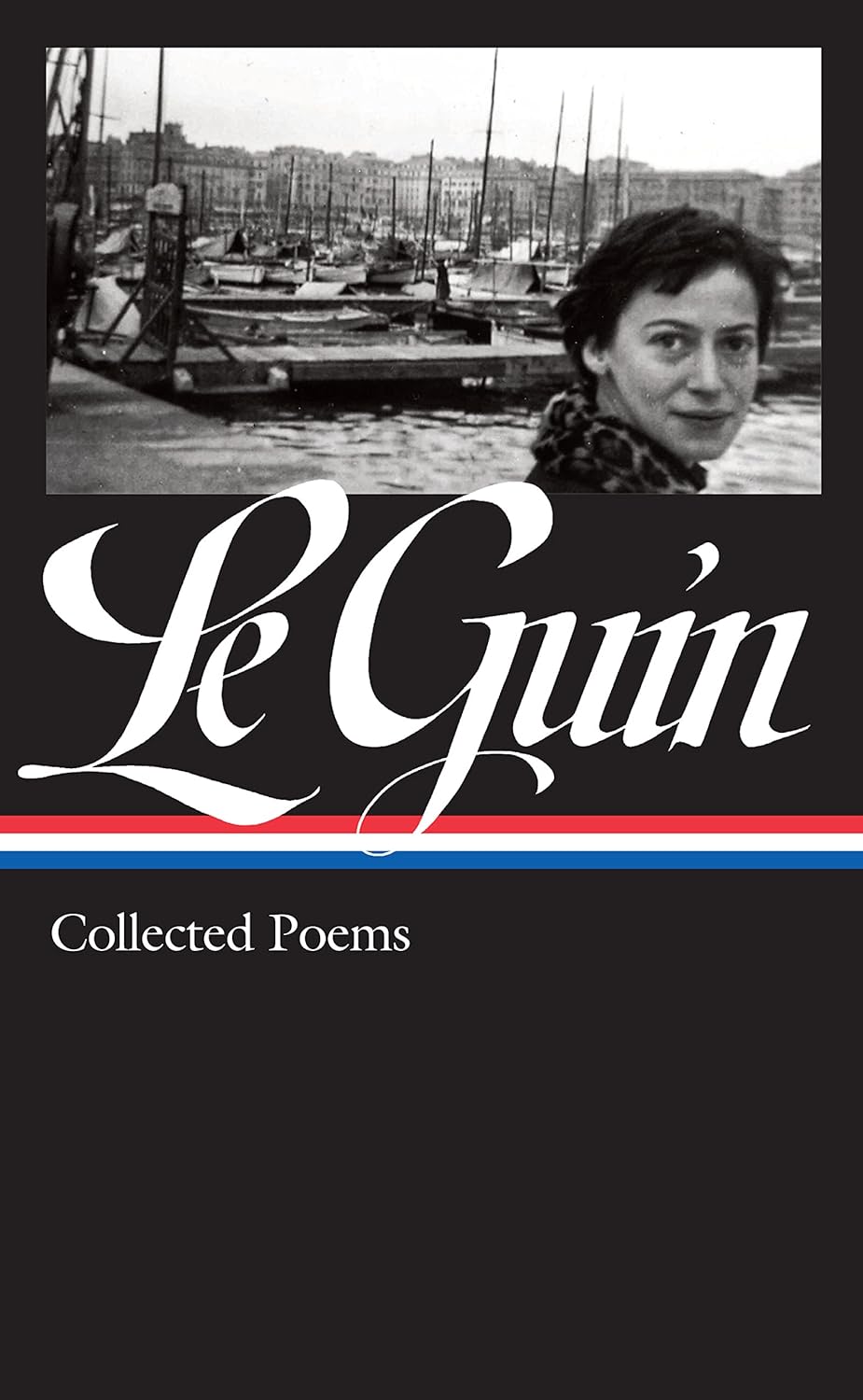
Ursula K. Le Guin was one of the world’s most renowned science fiction authors, but her poetry is rarely discussed. Yet, poetry was a constant in Le Guin’s life. She began writing it at age five (Collected Poems 569); her first published work was a poem, “Songs of Montayna Province” (Collected Poems 647). She finalized her last book, a collection of poetry titled So Far, So Good, a mere week before she passed away. It was published posthumously in October 2018. Le Guin the prose writer remains famous for her lyrical, evocative style, which can be described as “a poet’s prose” (Collected Poems, xl). Le Guin’s poems are windows into her emotional life, her relationships with family and friends, and her deep and abiding love of the natural world.

Despite the importance of poetry in Le Guin’s life and writing, her poetic legacy remains largely unknown. Ursula K. Le Guin: Collected Poems is thus an important addition to many bookshelves. This book will help Le Guin readers gain a deeper understanding of her fiction through these poignant and intimate works; it will appeal in general to lovers of poetry and to readers of regional literature who are attracted to intricate and powerful writing about the Pacific Northwest. Le Guin’s writing is arboreal, and readers who delight in nature-inspired poetry will find many wonderful works in this book. Le Guin is, of course, a powerful feminist figure, and this collection will appeal to readers of feminist literature, broadly construed. Finally, this text is also an invaluable source for researchers.

Ursula K. Le Guin: Collected Poems reprints all nine of Le Guin’s major poetry collections, beginning with her wonderful Capra Press chapbook Wild Angels (1974), and ending with So Far, So Good (2018). In addition to the nine poetry collections, Collected Poems includes her translation of the Tao Te Ching and poems from chapbooks and collaborations such as No Boats (chapbook), The Uses of Music in the Uttermost Parts (poems set to music by Elinor Armer), and Out Here: Poems and Images from Steens Mountain Country (a collaboration with photographer Roger Dorband). The book also includes an important selection of Le Guin’s published but uncollected poems, including her very first publications from 1959 and 1960. I would have loved to know more about how the “Selected Uncollected Poems” were selected, and if anything was left out.

The supplementary material consists of an introduction by series editor Harold Bloom, a chronology of Ursula’s life and accomplishments, a bibliography, and an index of titles and first lines. The book also offers a handy section of notes explaining references in individual poems, such as various mythical figures (Ariadne, Anansi, Tlaloc), specific geographic locales (Oasis of Mara, Kishamish), and translations of words that appear in languages such as Welsh, Latin, Spanish, and Le Guin’s own constructed language, Kesh. In addition to Le Guin’s poetry, the book includes seven pieces of her nonfiction: two essays, two prefaces to books of poetry, a foreword, an afterword, and finally an interview focused on poetry.

A few words about what the book does not contain: while the Selected Uncollected Poems section reprints some of the poems that originally appeared in other books, such as Buffalo Gals: And Other Animal Presences (1987), it does not include all of the poems published in Le Guin’s non-poetry books. For example, her novel Always Coming Home (1985) contains many striking poems, which were not included here. Collected Poems does not include the collaborative translation with Diana Bellessi, The Twins, The Dream / Las Gemelas, El Sueño, perhaps because many of Le Guin’s poems published in that volume were also reprinted elsewhere and thus ultimately included as a part of other books (more on this collaboration below). The supplementary material supplies bibliographic information for the uncollected poems, but does not provide information about the first publication of individual poems from the nine collections – this would be good information to have, especially for the poems that were reprinted, rather than originally published, in the nine collections.

Collected Poems also does not include, or mention, Le Guin’s unpublished poems, such as those I have discovered in her archives (I plan to discuss them in my manuscript on Le Guin’s poetry).

Despite these minor qualms with some of the supplementary materials and editorial choices, I am extremely happy that this book exists and is available to readers. While Ursula K. Le Guin: Collected Poems is not an exhaustive volume, it contains most of her poetry—certainly the vast majority of her published poetry—and a good taste of her poetry-adjacent work.

The Introduction

As a scholar of Le Guin’s poetry and a poet myself, I confess that I was not satisfied with Harold Bloom’s introduction. Bloom looms large in the world of American literary criticism, but in this case, I would have appreciated a lot less looming, which is to say, less of a focus upon Bloom himself. For example, he highlights a poem on Le Guin’s long marriage to Charles Le Guin because he, Harold Bloom, has also enjoyed a long marriage. At times, the introduction reads as condescending in tone—he talks about Le Guin’s “intuitive poetics” (Collected Poems xlvi) and calls her “primordial” (Collected Poems xlvi) despite Ursula’s meticulous attention to matters of craft and her extensive knowledge of it, some documented in this book’s nonfiction sections. When discussing a single poem Le Guin wrote about Lorca, Bloom remarks that he feels that there is “a daemon speaking in and through Ursula K. Le Guin” (Collected Poems xliii). Her feminism is mentioned, but not discussed at all; at one point Bloom writes about “her Taoism, anarchism, ‘feminism,’ literary aesthetic” (Collected Poems li)—but Le Guin’s feminism does not need the assistance of scare quotes.

And while it was heartwarming for me to imagine two such prominent octogenarians corresponding, I would have much preferred to read an introduction by a different person—perhaps an SFF author who is both a prose writer and a poet (Amal El-Mohtar immediately comes to mind, or Sofia Samatar), or alternatively a writer-scholar and/or a biographer who could help connect the poetry to Le Guin’s life and larger body of work (like Lisa Tuttle or Sandra J. Lindow). Judith Barrington, a feminist author, friend, and collaborator, would be another fantastic choice. I wished for the introduction to highlight Le Guin the poet’s significant contributions to feminist letters, to nature writing, and to regional / Pacific Northwest writing, and I did not find much of it in this text.

In addition to ultimately finding the introduction unsatisfying, I also dispute the inclusion of Le Guin’s Tao Te Ching translation in this volume and the simultaneous exclusion of her translations of Gabriela Mistral and Diana Bellessi. Perhaps just Le Guin’s introduction to her translation of Mistral could have been included (Mistral xix-xiii).

Le Guin’s translation/version of the Tao Te Ching relies on Paul Carus’s translation and transliteration (“The Feminine and the Tao”). Le Guin herself explains that her version is “a rendition, not a translation. I do not know any Chinese” (Collected Poems, 290). Regarding the inclusion of the Tao Te Ching, Bloom highlights and immediately dismisses any concerns: “Scholars tell me that her work is disputable, but I see nothing to dispute” (Collected Poems li). Translating without understanding the original is a practice specifically perpetuated by white translators, often involving the East Asian literary tradition. Ezra Pound engaged in exactly such a practice with regards to Classical Chinese poetry, and this remains a topic of criticism and debate in translation studies (Williams; Yeh). This important issue continues to be discussed in the field (specifically concerning the practice of “bridge translation,” see Calleja and Collins; Wang).

Since the Tao Te Ching translation was included, I was surprised not to see any of Le Guin’s other poetry translations. I am especially concerned with the exclusion of The Twins, The Dream / Las Gemelas, El Sueño, a brilliant volume of co-translations with the Argentinean poet Diana Bellessi. Le Guin held translation close to her heart and engaged in it throughout her lifetime, but the practice of translating from a language one does not know at all is problematic. On the other hand, The Twins, The Dream / Las Gemelas, El Sueño is a beautiful collaboration between two feminist poets (Bellessi and Le Guin), who corresponded, exchanged translations, discussed and corrected each other’s work—certainly a much more intimate and thoughtful process, which honors the principles of feminist translation (Eshelman). Since the Tao Te Ching translation was included, these excluded translations warrant a discussion.

Walking with Ursula

With 700-odd pages of poems alone, it would not be possible for me to present a broad overview of Le Guin’s poetic work in a book review—although I refer the readers to my earlier essay in Climbing Lightly through Forests (Lemberg), which surveys all nine of Le Guin’s major collections. For this review, I will discuss a single aspect of her poetry—a theme of walking, and an echoing and recurring approach.

 Ursula K. Le Guin was an avid walker. She went on walks everywhere she went, in some cases repeatedly, sometimes, over the span of years. These intimate walks reflect the poet’s personal journeys. Most of these walking poems are not speculative, but perhaps one can think of them as speculative-adjacent: these earthly landscapes are transformed and reappear or reverberate through her fantastical worlds.

Ursula’s early and privately printed chapbook Walking in Cornwall (1976), reprinted in her second collection, Hard Words, is an example of such a walk, in which the poet reflects on the enduring power of togetherness, and of women’s labor:

It was home, once, Chysasuster village was.
Nine families, their cattle, their heartfires.

O small cold hearths, so old, so old,
Yet you could light a fire in them tonight.
It would be the same fire.
We don’t need very much:
water and warmth and walls, the flickering ring of faces
. (73)

There are three long poems in Walking in Cornwall. The second and third poem both end with an almost identical line: “and the wind is sweet as honey in the mouth” / “and the wind as sweet as honey in the mouth,” which reflect one of Ursula’s favorite poetic devices, repetition, an echoing return to places and thoughts that evoke the senses.

After the cataclysmic eruption of Mount St. Helens in 1980, Le Guin returns repeatedly to the desolate landscape, writing four poems originally published in the chapbook In the Red Zone (1983), later reprinted in her third poetry collection, Wild Oats and Fireweed (1988) and included in Collected Poems:

The earth fell on the earth. It looked like cloud
but it was dirt: the planet turning on itself.

Rock, slag, dust, earthgas, earthfire, earthwork.

A column of boiling stone. Ponderous.

From a distance thunderblue, but in itself earthdark,
grey, brown, black: a mountain inside out.

And the lightning struck, and struck, and struck.
Dancing like a hopjack strung up on the groundcloud,
the stoneplume, jagging between earth and earth,
the lightning struck, and struck, and struck.

The forest was dead in the first five minutes. (98-101)

Three decades after the explosion of Mount St. Helens, Le Guin returns to the same spot in “Summer Morning on the Volcano,” originally published in Finding my Elegy (2012):

The mist lifts off the little lake down there,
way down, across a gulf of shining air.

The upward spiral song of Swainson’s thrush,
a white-crown’s teedle-eedle in the hush:

there is this music in the morning, where
was only silence, and grey dust, and ash.

“We are her children, we are in her care,
our destroyer-mother,” sings the mountain thrush. (497)

In her collaboration with the photographer Roger Dorband, Blue Moon over Thurman Street (1993), Le Guin writes about walking the street for decades: “To walk a street is to be told a story. Through the years that I have lived in Portland, as I walked up and down my street, Thurman Street, it kept telling me its story. … When we started working on this book, I had lived on Thurman Street for over twenty-five years” (6-9).  A poem from that book, “The Aching Air,” was later collected in Finding my Elegy (2012) and in Collected Poems (863). In this resonant and heartbreaking piece, Le Guin narrates how a gorgeous chestnut tree, a neighborhood fixture for all the years she lived there, was cut down by neighbors who thought trees—and their companions, birds—were dirty:@font-face {font-family:”Cambria Math”; panose-1:2 4 5 3 5 4 6 3 2 4; mso-font-charset:0; mso-generic-font-family:roman; mso-font-pitch:variable; mso-font-signature:-536870145 1107305727 0 0 415 0;}@font-face {font-family:Calibri; panose-1:2 15 5 2 2 2 4 3 2 4; mso-font-charset:0; mso-generic-font-family:swiss; mso-font-pitch:variable; mso-font-signature:-536859905 -1073697537 9 0 511 0;}p.MsoNormal, li.MsoNormal, div.MsoNormal {mso-style-unhide:no; mso-style-qformat:yes; mso-style-parent:””; margin:0in; mso-pagination:widow-orphan; mso-hyphenate:none; font-size:12.0pt; font-family:”Calibri”,sans-serif; mso-ascii-font-family:Calibri; mso-ascii-theme-font:minor-latin; mso-fareast-font-family:Calibri; mso-fareast-theme-font:minor-latin; mso-hansi-font-family:Calibri; mso-hansi-theme-font:minor-latin; mso-bidi-font-family:Calibri; mso-bidi-theme-font:minor-bidi; mso-font-kerning:1.0pt; mso-ligatures:standardcontextual;}.MsoChpDefault {mso-style-type:export-only; mso-default-props:yes; font-family:”Calibri”,sans-serif; mso-ascii-font-family:Calibri; mso-ascii-theme-font:minor-latin; mso-fareast-font-family:Calibri; mso-fareast-theme-font:minor-latin; mso-hansi-font-family:Calibri; mso-hansi-theme-font:minor-latin; mso-bidi-font-family:Calibri; mso-bidi-theme-font:minor-bidi; mso-font-kerning:1.0pt; mso-ligatures:standardcontextual;}.MsoPapDefault {mso-style-type:export-only; mso-hyphenate:none;}div.WordSection1 {page:WordSection1;}

Where the most beautiful
horsechestnut held up deep branches
in a cathedral
full of wings and voices
and a golden light,
and the tall, rose-white flowers
smelled like the bread of heaven,
and eyes praised upraised,
being blest by seeing:where the tree was
the air’s empty. (683)

In this book and elsewhere, Le Guin’s abiding love for nature is tinged with a deep concern for the scope of environmental destruction perpetuated by humans—corporations and individuals.

Nature poems are abundant in the collection, but they are far from the only kind of poems one finds in Collected Works. Some of Le Guin’s poems focus on family; others remark on current events and engage with feminist themes, especially women’s rights. Some poems deal with Le Guin’s personal experiences (she discusses her abortion in a number of poems throughout her life). Many poems feature animals—Le Guin was especially fond of cats; some of the poems are humorous, such as the delightful “A Palindrome I Do not Want to Write” (Collected Poems 698). With a few notable exceptions such as the 1982 Rhysling-winning “The Well of Baln” (Collected Poems 80-81), Le Guin’s poems do not offer us much speculative / science fictional material. Instead, these pieces are glimpses into Le Guin’s life and her interests, and her incessant and enduring attention to the natural world, to the trees perhaps most of all, but also to animals, rocks, mountains—in the Pacific Northwest and beyond.

To read these poems is to become immersed in Le Guin’s world: a world of quiet wonder and great intricacy, of mythic grandeur, with wonderful flashes of humor and play. Ursula K. Le Guin: Collected Poems invites us to take many long walks with her. This book will become a staple for many readers, as well as scholars of Le Guin’s work—including myself.

WORKS CITED

Calleja, Jen, and Sophie Collins. “She Knows Too Much: ‘Bridge Translations,’ ‘Literal Translations,’ and Long-Term Harm.” Asymptote Journal. Accessed 8 August 2023.

Eshelman, David J. “Feminist Translation as Interpretation.” Translation Review, vol. 74, no. 1, 2007, pp. 16-27.

Le Guin, Ursula K. Always Coming Home. Harper & Row, 1985.

—. Buffalo Gals and Other Animal Presences. Capra Press, 1987.

—. Finding My Elegy: New and Selected Poems. Houghton Mifflin Harcourt, 2012.

—. Hard Words, and Other Poems. HarperCollins Publishers, 1981.

—. Lao Tzu: Tao Te Ching: A Book About the Way and the Power of the Way. A New English Version by Ursula K. Le Guin. Shambhala, 1998.

—. So Far, So Good: Final Poems 2014-2018. Copper Canyon, 2018

—. and Diana Bellessi. The Twins, The Dream / Las Gemelas, El Sueño. Arte Publico Press, 1997.

—. Wild Angels. Capra Press, 1975.

—. Wild Oats and Fireweed: New Poems. Harper Perennial, 1988.

—. (text), and Elinor Armer (music). The Uses of Music in the Uttermost Parts. Koch International Classics, 1995.

—., and Roger Dorband. Out Here: Poems and Images from Steens Mountain Country. Raven Studios, 2010.

Lemberg, R.B. “The Poetry of Ursula K. Le Guin: A Retrospective.” Climbing Lightly Through Forests, edited by R.B. Lemberg and Lisa M. Bradley, Aqueduct, 2021, pp. 101-150.

Mistral, Gabriela. Selected Poems of Gabriela Mistral. University of New Mexico Press, 2003.

Peterson, Brenda. “The Feminine and The Tao: An Interview with Ursula K. LeGuin [sic].” Embrace the Moon, https://embracethemoon.com/ursula-k-leguin/. Accessed 7 August 2023.

Wang, Yilin. “Barriers, Privileges, and Invisible Labor: A Sino Diaspora Translator’s Perspective.” Words Without Borders, https://wordswithoutborders.org/read/article/2021-06/june-2021-queer-barriers-privileges-and-invisible-labor-yilin-wang/. Accessed 8 August 2023.

R. John Williams. “Modernist Scandals: Ezra Pound’s Translations of ‘the’Chinese Poem.” Orient and Orientalisms in American Poetry and Poetics, edited by Sabine Sielke and Christian Kloeckner, Peter Lang GmbH, 2009, pp. 145-165.

Yeh, Michelle Mi-Hsi. “The Chinese Poem: The Visible and the Invisible in Chinese Poetry.” Manoa, vol. 12, no. 1, 2000, pp. 139-146.

R.B. Lemberg is a 2020 Le Guin Feminist Fellow and a scholar of SFF, LGBTQIA+ studies, and translation studies. As R.B. Perelmutter, they are a Professor of Jewish Studies and Slavic, German, and Eurasian Studies at the University of Kansas. R.B.’s literary work has been shortlisted for the 2023 Le Guin Prize for fiction, and was a finalist for the Nebula, Ignyte, Locus, World Fantasy, and other awards. Their novel The Unbalancing (Tachyon) and short story collection Geometries of Belonging (Fairwood) were published in 2022.

The SFRA Review Seeks a Social Media Manager


SFRA Review, vol. 53, no. 3

From the SFRA Review


The SFRA Review Seeks a Social Media Manager

The Editorial Collective


The SFRA Review seeks a dedicated Social Media Manager to develop and grow the journal’s social media presence and connect more effectively with contemporary scholars and audiences. This is a new position that will work closely with the Managing Editor and Fiction and Nonfiction Editors. Prior social media experience is not essential, but it is desirable.

The Social Media Manager will primarily be responsible for:

  • regularly circulating the SFRA Review’s CFPs (both across social media and in SF-specific listservs)
  • updating social media platforms in the leadup to new issues and after these issues have been published
  • spotlighting individual feature articles
  • engaging with readers and followers
  • developing a more robust and interconnected online community across various platforms and organizations
  • reporting on user engagement regularly to the SFRA Review editorial team

The ideal Social Media Manager will post at least several times (3+) a week across Twitter, Facebook, Bluesky, Mastodon, and other social media platforms. Qualified applicants may also create and maintain a Discord server.

The SFRA Review is an open-access journal, published four times a year by the Science Fiction Research Association (SFRA). It is devoted to surveying the contemporary field of speculative fiction, media, and scholarship as it develops, bringing in-depth reviews with each issue, as well as longer critical articles highlighting key conversations in sf studies, regular retrospectives on recently passed authors and scholars, and reports from members of the SFRA Executive Committee. The Social Media Manager will be joining an interdisciplinary volunteer team dedicated to science fiction and speculative scholarship and should, as a result, have a long-standing interest in the field, as well as making speculative scholarship freely available.

To apply for the position of Social Media Manager, interested applicants should send a short statement (~100-200 words) that covers why they are interested in the position and their qualifications, as well as their CV, to the SFRA Review Managing Editor, Virginia L. Conn, by August 31st, 2023, at vconn@stevens.edu.

From the Vice President


SFRA Review, vol. 53 no. 3

From the SFRA Executive Committee


From the Vice President

Ida Yoshinaga

Dear fellow Science Fiction Research Association members:

With your hearty responses to our call for papers and our registration deadline—adding up to 300+ participants!—“Disruptive Imaginations” looks to be one of the largest academic meetings of our organization ever [thanks also to our co-sponsor, German fantasy-studies research group GFF (https://fantastikforschung.de/en) , which agreed to share our two conferences’ venues and content].

In addition to the current themes covered by conference paper sessions as well as by the splendid German cultural studies events put together by dedicated TU Dresden organizers Julia Gatermann and Moritz Ingwersen (and team), several Executive Committee-sponsored events on speculative-fiction studies, can be attended by registrants virtually or in person (the following is all in Central European Time):

Wed. 8/16, 9:30-11 a.m. (Panel 7, ABS/E11 Auditorium & online): “Early Career Scholar Event: Diffrakt on Nourishing Imaginative SF/F Thought-Making, Artistry, Community” featuring members of thr German speculative-arts collective “diffrakt: centre for theoretical periphery” (http://diffrakt.space/en) Moritz Gansen and Hannah Wallenfels share how Diffrakt combines inventive pedagogy with sf theory and other intellectual discourses, to create a community-engaged arts practice. Thanks to SFU’s Ali Sperling for helping make the contact with this group and for suggesting their session in the first place!

Wed. 8/16, 16:30-18:00 (p.m.) (ABS/E11 Auditorium & online): “SFRA Business Meeting.”

Thur. 8/17, 15:30-17:00 (p.m.) (Panel 44, ABS/E08 & online): “SFRA: Equity/Diversity/ Inclusion Event: Indigenous Futurism in Latin America—The Case Study of the Aymara in El Alto, Bolivia” featuring Aymara Ph.D. student Ruben Darío Chambi Mayta of LMU Munich’s Indigeneities in the 21st Century Project, who’ll share his research on how a Native Bolivian group has responded to settler colonialism including the state’s “Buen Vivir” (“Living Well”) campaign which extracts culture from Aymara protest history and struggles (https://www.indigen.eu/projects/core-projects/indigeneity-beyond-buen-vivir-the-aymara-case-in-bolivia). Thanks to UFL’s Libby Ginway for serving as discussant!

Fri. 8/18, 09:30-11:00 a.m. (Panel 46, ABS/E11 Auditorium & online): “[SFRA Early Career Scholars Roundtable] SF on the Market: Advice from Early Career Researchers in Pursuing an SF Studies Career” will feature global Ph.D. students and postdocs participating in a vibrant conversation & audience Q&A about concerns, strategies, and issues about being on the academic job market, including Patrick Brock Nora Castle, Reem Mansour, Yilun Fan, Candice Thornton, Andrew Erickson, Rose Moreno, and Uchechi Anomachi. Their expertise collectively spans the breadth of today’s sf/fantasy studies, from Afrofuturism, to film and visual studies, to translation and literary studies, to ethnic and cultural speculative works (and so on!). Thanks to SFRA Secretary Sarah Lohmann for chairing and organizing!

These events evolved from feedback received from participants during last year’s Oslo (2022) EC-sponsored Diversity, Equity, and Inclusion session. We’ll similarly survey those who attend this year’s EC sessions; please provide feedback then to that instrument, or directly to Hugh (hugh.oconnell@umb.edu) or me (ida@hawaii.edu), on what you’d like to see in the future as well as how the sessions went.

Questions about the TU Dresden conference?: Please contact Moritz and Julia at disruptiveimaginations@tu-dresden.de.


From the President


SFRA Review, vol. 53 no. 3

From the SFRA Executive Committee


From the President

Hugh O’Connell

The dreaded date of August 1st looms heavy. That period when time compression kicks in, and all those research projects and new syllabi that we had “all summer” to work on will now be crammed into the final waning weeks and days of summer break. However, amongst the scramble to finish that work we swore that we wouldn’t put off—again—this year, we can look forward to the upcoming combined SFRA/GFF “Disruptive Imaginations” conference at TU-Dresden. Along with all of the research presentations and special events organized by the fantastic team of Julia Gatermann and Moritz Ingwersen, everyone should check out Vice President Ida Yoshinaga’s column in this issue for a rundown of the special panels and events sponsored by the SFRA Executive Committee (including programming that specifically addresses early career scholars and Equity/Diversity/Inclusion).

And perhaps this is a good time to offer some other calendrical reminders. Typically, at this point in August, I’d be using this President’s column to reflect on the end of the conference. However, following the theme of this year’s conference in Dresden, “disruption” is working its way through the usual SFRA calendar. The SFRA’s annual conference traditionally takes place in mid-to-late June, after many of us have turned in final grades and projects and are looking for a well-deserved break and chance to catch up with our friends and colleagues. However, this is a reminder that not only this year’s but also next year’s conferences are bucking this tradition as we continue to partner with some of our European colleagues. So, while it may feel odd since we haven’t had our 2023 conference yet, we should however also be planning for a quick turnaround, as the 2024 conference has been penciled in for the second week of May. This may be a difficult time for some of us in the US to get away (a quick look reveals that it coincides with my last week of spring classes), but it will certainly be worth it. While we will hopefully be presenting more details about this timing at the Dresden conference, part of the reason for this earlier 2024 conference date is to coincide with the “Futures Better and Worse” literary festival, which features a number of events and writers that will be of interest to the SFRA membership. So, please be on the lookout for more information at the conference and then through the usual lists and social media sites!

Speaking of events that are of interest to SFRA members, if you have an event that you’d like the SFRA to distribute through its email lists or social media sites, or you have other ideas or concerns about the work the organization is doing, please don’t hesitate to reach out to me at hugh.oconnell@umb.edu. I’d love to hear from you.


Summer 2023


SFRA Review, vol. 53 no. 3

From the SFRA Review


Summer 2023

Ian Campbell

Welcome to the coolest summer of the rest of our lives. As I write this, doctors in Phoenix, Arizona, have announced new protocols for how to treat burn injuries that result from people falling or lying on the sidewalk; the ocean temperature off the Florida coast is now warmer than a typical hot tub; the Mediterranean is now at its warmest temperature ever; signs have emerged that the thermohaline cycle in the North Atlantic is on the verge of collapse; the Republican Party has called for more fossil fuel burning.

One purpose of SF is to use the future to estrange the present, but the future’s already here, and in no way is it evenly distributed. There are many works of SF that pose future environmental changes as the catalyst for societal changes, but comparatively little that deal directly with our most pressing problem: the vast and powerful oligarchy-controlled media machine that’s still trying to persuade us that this is all just some natural climactic cycle. Nothing to worry about here: get back to pumping up the economy. What’s going to astonish most of us is how quickly the whole thing turns on a dime from “climate change is a hoax” to “climate change is god’s punishment upon us for letting queer people exist”. If you’re sleeping too much and want to give yourself a reason to stay up at night worrying, go look up “effective altruism”, the new philosophical darling of cryptocurrency and tech bros.

Subsequent issues of SFRA Review will likely address the sheer inhumanity of the post-catastrophe future: for now, however, we have the usual palette of reviews and feature articles. But keep in mind that SF is only literature, and the power of literature accrues to the reader, not the writer. There’s only so much we can do about ideas and critique being stolen and repurposed, usually for the benefit of the oligarchy, other than to create more ways to estrange what’s being done to us.


Review of Neptune Frost


Review of Neptune Frost

Özgür Çalışkan

Neptune Frost. Dir. Uzeyman, Anisia & Williams, Saul. Swan Films, 2021.

Neptune Frost is often described in reviews as an afrofuturist musical science fiction film. Opening the door to a fascinating world where art, technology, and revolution merge, the visually and narratively stunning film, directed by visionary duo Anisia Uzeyman and Saul Williams, is an exciting production that defies convention and immerses audiences in an afro-futurist dreamscape. In the ever-expanding and prominent world of Afrofuturist cinema, this film shines as a visual, poetic, and aural jewel weaving black identity, gender, and cosmic wonder. The narrative unfolds nonlinearly, seamlessly blending elements of science fiction, magical realism, and social commentary. Neptune Frost explores the boundaries of gender and sexuality, the power dynamics between oppressor and oppressed, and the potential for technology to be a liberating or controlling force.

Neptune Frost tells the story of the journey of two bereaved characters and the crossing of their paths after their journey. Matalusa (Bertrand “Kaya Free” Ninteretse), after the death of his brother Tekno in the coltan mine, embarks on a journey and decides to go to the city and questions his identity from a class perspective with the death of his brother. On the other hand, twenty-three-year-old Neptune (Cheryl Isheja and Elvis Ngabo) embarks on a journey to resolve her sexual identity confusion after the death of his aunt. Both characters’ journeys are patterned with obstacles. The dreams the two characters encounter for the first time, equipped with cables and illuminated with neon lights, where time-space is complicated, fuel the transformation of both characters. Through Matalusa and Neptune, the film explores the tension between digital existence and the longing for worldly human connections. This exploration raises profound questions about the role of technology in shaping our identities and the need to strike a delicate balance between progress and the preservation of cultural heritage.

Digitaria, where the journeys of the two characters reach, is the place of those who try to stay out of the political and world conflict and rebel against exploitation. The film’s other characters, Innocent (Dorcy Rugamba), Memory (Eliane Umuhire), and Psychology (Trésor Niyongabo), finally come together. Neptune brings power, energy, electricity, or whatever is missing to Digitaria because in a world where television, radio, and the Internet are cut off, access to them is a right. This idea is embodied in the phrase “we mine, but we do not own what we dig,” closely linked to the unchanging history of colonialism. The people of Digitaria, pondering concepts such as oligarchy, patriarchy, tolerance, wisdom, self-control, ignorance, and understanding, manage to hack into the world system through connections with Neptune’s ability and gain access to the Internet. As a result, all these social and political abstract concepts are concretised in a revolutionary struggle.

Neptune Frost unfolds in a neo-African society where the tangible and the virtual merge seamlessly. Uzeyman and Williams bring to life a world where Afrofuturistic elements are intertwined with ancient mythology, where tradition and technological innovation merge in an enigmatic environment. One of the most important factors in creating this environment is the aural space of the film because the soundscape is as vital as the visuals.

The film’s haunting and ethereal soundtrack, composed by Saul Williams himself, envelopes the audience with the fusion of electronic Afrobeats, African rhythms, spoken words, and experimental sounds, creating a mesmerizing sonic landscape that mirrors the film’s otherworldly setting. The music serves as a conduit, connecting the audience to the characters’ emotions with evocative lyrics and the film’s larger themes, elevating the film to a transcendent realm where sound becomes its language.

The film’s directors stated that the film’s influences date back to 2016 and events like the conflict between ethnic groups in Rwanda, student protests in Burundi, the Arab Spring, and hacker movements. These influences explain why the plot and layered narrative of the film combine different subjects. The subtext of the film’s story is a powerful exploration of cultural resurgence and the preservation of African identity in an increasingly globalized and technologically driven society. By elegantly weaving together the wisdom of the past, folklore, and the struggles of a community, the film paints a vivid picture of a people reclaiming their heritage and resisting cultural erasure. It does so by taking Afrofuturism beyond mere aesthetics, utilizing the genre’s core themes of identity, empowerment, and cultural preservation to present a narrative of hope and reclamation where Afrofuturism and technology collide. The film transcends the constraints of earthly conventions by embracing the cosmic diaspora of identities that exist beyond binary structures.

Compared to other Afrofuturist films, Neptune Frost uses a more vernacular and interrogative language and exemplifies the multifaceted evolution of storytelling as a source of inspiration that echoes the timeless legacy of the Afrofuturist and Afrosurrealist works that came before it. Different than the earlier examples such as Space Is the Place (John Coney, 1974), Daughters of the Dust (Julie Dash, 1991), The Last Angel of History (John Akomfrah, 1996), or recent ones such as Black Panther (Ryan Coogler, 2018), Sorry to Bother You (Boots Riley, 2018), and A Wrinkle in Time (Ava DuVernay, 2018), Neptune Frost ventures into new territory, combining technology and heritage to illuminate the rich tapestry of black identity and techno-centric resistance. Neptune Frost charts the path of its resistance, adding a new chapter to the genre’’s ongoing cosmic symphony.


WORKS CITED

Uzeyman, Anisia. “Neptune Frost, the Afrofuturist Musical Imagining Life Beyond Capitalism.” Interview by Xuanlin Tham. AnOther, 03 Nov 2022. https://www.anothermag.com/design-living/14495/neptune-frost-afrofuturist-musical-anisia-uzeyman-saul-williams-interview.  Accessed 14 Dec 2022.

Williams, Saul. “Neptune Frost, the Afrofuturist Musical Imagining Life Beyond Capitalism.” Interview by Edson Burton. The Bigger Picture, 26 Oct 2022. https://www.the-bigger-picture.com/articles/when-traditional-myths-and-afro-futurism-combine-an-interview-with-neptune-frost-director-saul-williams/.  Accessed 14 Dec 2022.

Özgür Çalışkan, Ph.D., completed his BA degree at Bahçeşehir University, Department of Cinema and Television with a full scholarship, MA degree at Digital Culture Program, Jyvaskyla University in Finland, and Ph.D. at Anadolu University, Department of Cinema and Television, where he has been working since 2012 and is currently an assistant professor. Çalışkan has participated in exchange programs at the University of Ulster and the University of Ljubljana and has been a guest lecturer at the Polytechnic University of Valencia. Since 2012, he has been a member of the Executive Board of the International Eskişehir Film Festival. He publishes and lectures on cinematic narrative, screenwriting, film genres, science fiction, identity, and digital technologies. His most recent work is Retro Dystopia in Turkish Cinema: A Mouthless Girl in the Shadows Speaks Through the Antenna, published in Science Fiction Film and Television.