Fractured Fairy Tales: A Mirror Mended


Review of Fractured Fairy Tales: A Mirror Mended

Michelle Anya Anjirbag

Harrow, Alix E. Fractured Fairy Tales: A Mirror Mended. Tor, 2022.

Version 1.0.0

In A Mirror Mended, Zinnia Gray returns five years after the events of A Spindle Shattered, or as she puts it, 48 or 49 stories and happy endings, or five years of missed appointments regarding her chronic illness later. At 26, she is still running from story to story, giving other “Sleeping Beauties” other options than the stories that they were written into, always fleeing into another version just before the final resolution of happily ever after plays out in front of her. But when she gets pulled into a completely different fairy tale marked by apples and mirrors, by a queen who found out how her story is supposed to end and wants a different option, she has to figure out more than just her way back into her own story: Zinnia needs to figure out where it is that she belongs, while also challenging some of her own preconceptions about other fairy-tale figures and characters.

In a preface to the omnibus edition, Harrow states that this duology was born out of a ‘fairy tales go multiverse’ idea that sparked for her after seeing Spiderman: Into the Spiderverse (Persichetti, Ramsey, and Rothman, 2018). While this is certainly not the first take on colliding fairy tales or fairy-tale realms (see: Once Upon a Time [ABC, 2011-2018], The 10th Kingdom [NBC, 2000], for example) or even interlocking stories (Disney’s Villains novelization series plays with this idea with specifically Disney IP, as do a variety of fairy-tale mash up and remix series for children and young adult readers), Harrow’s duology wields both fairy-tale scholarship and an intimate knowledge of multiversal worldbuilding in a way that stands out from other fairy-tale interpolations. A Mirror Mended surpasses its predecessor in terms of tapping into the impulses of multidimensionality that underpin the way characters move between worlds, while also playing with the latent potentials embedded in the multivocal plurality of the fairy tale form as generated in European traditions of retelling the literary fairy tale.

Harrow’s protagonist is framed as not only a “sleeping beauty” but as a folklorist in her own right, and so her engagement in fairy-tale worlds is not a matter of wishes and wonder but a knowledgeable foray underpinned by an understanding of the ways that stories can resonate with or even against each other. Through this construction, and the eventual problems of world-jumping that Zinnia is forced to confront, Harrow challenges assumptions about fairy-tale interventions, what it means to save people from their fates in unique ways. A Mirror Mended, in particular, complicates the resolution found at the end of A Spindle Shattered.

The two volumes together would make for interesting case studies in a graduate class, especially considered alongside recent scholarship that considers justice and reimagines how the world could be conceived alongside disability scholarship, two recent  impulses in scholarly work that echo in the field of fairy tale and folklore studies Brian Attebery’s conceptual questions about “how does fantasy mean” (Fantasy: How it Works, 2022) as well as what the “affordances of fantasy” (“Affordances of Fantasy,” Attebery 2024) might be. For example, the work of Heidi Kosonen, Veronica Schanoes, and Marek Oziewicz, among other essays, in the collection Just Wonder: Shifting Perspectives in Tradition (2024) edited by Pauline Greenhill and Jennifer Orme, could provide interesting points of departure for discussion. A Mirror Mended also invites considerations of villainy and agency, and the continued role of gendered constructions in tales even when they are being actively remade from within the context of the larger narrative. While there might have been a tacit recognition that the postmodern fairy tale has already been fully explored, as well as gendered biases within these stories, Harrow’s Zinnia and other characters such as Zellandine, Eva, Charm, and Primrose complicate how we do see these figures: as characters or as symbolic echoes who cannot escape proscribed roles. A seminar might explore how having the majority of agentic, speaking character roles belonging to not just women but queer women might complicate the larger conception of contemporary fairy-tale adaptation.

Short fantasy or fairy-tale adaptation is almost a relief in a publishing marketplace of mega-novels, trilogies, and extended volumes, and short fantasy done deftly and with complete narratives and skillful, complex worldbuilding is simply a joy to read. Harrow’s A Mirror Mended and the Fractured Fairy Tales make up a masterclass in genre-bending while once again remaking these stories for new generations of both readers and critics.

Michelle Anya Anjirbag is an affiliated researcher at the University of Antwerp where she completed a postdoctoral fellowship with the Constructing Age for Young Readers project. Her research interests include adaptation, fairy tales and folklore, Disney, magical libraries, the intersection of literature, media, and culture, representations of gender and age, and cross-period approaches to narrative transmission across cultures and societies. Her work has appeared in a variety of journals and edited collections. She currently teaches a course on the intersections between fantasy media and sociological questions for international study abroad students in London.

Babel, Or the Necessity of Violence: An Arcane History of the Oxford Translators Revolution


Review of Babel, Or the Necessity of Violence: An Arcane History of the Oxford Translators Revolution

Joseph Ironside

Kuang, R.F. Babel, Or the Necessity of Violence: An Arcane History of the Oxford Translators Revolution HarperCollins, 2022.

Version 1.0.0

Most readers of SFRA Review have surely formed their own opinions about Babel since its publication in 2022. The same is likely true for a much larger readership; on the day that I started this review, 409 people were in the queue at the Portland, Oregon public library for its several electronic, audio, or paper versions. The popularity is easy to understand.  Babel is fast paced, has compelling characters, and, at least for American readers, offers the enticement of an Oxford setting. It also has familiar plot lines: an orphan slowly taking control of his life, a group of misfits who band together at school, and a political thriller in which a secret society tries to undermine imperial Britain.

Kuang deftly introduces two interweaving themes just six pages in. Robin Swift is the son of a Chinese mother and a prominent Englishman who has swooped in to pluck Robin from plague-ravaged Canton (Guangzhou). Professor Richard Lovell is a preeminent translator who sees Robin as an experiment in selective upbringing—a tool to be sharpened rather than a son.  To test the eleven-year-old’s grasp of English, Lovell asks him to read a passage from The Wealth of Nations. Robin is too young to understand what he is reading, but Kuang tells her readers in a footnote that Smith is arguing against colonialism. Lovell then hands Robin a silver bar with Chinese characters on one side and an English phrase on the other. When he reads the words in sequence, he generates a physical result by activating the stress that is always involved in translation. So, Babel is a book about power, both the economic and military power of imperial Britain and the power of language to express and perpetuate power relations.

Kuang deftly knots together her three plot lines. Robin’s education, moral formation, radicalization, and attempt to become the hero of his own life run from the first pages when he is a child cast among strangers to his end as a suicide bomber.  After a long prologue covering Robin’s lonely adolescence learning Greek and Latin under the cold eye of Professor Lovell, the schooldays plot takes center stage when Robin arrives in Oxford to study at the Royal Institute of Translation and meets the three other members of his cohort.  The political story builds intermittently behind the scenes of university life and then bursts forward to dominate the last half of the novel.  

Kuang departs from our consensus history by positing that silver has an innate power that can be released by the right pair of words and transmitted at a distance. Oxford’s skilled translators inscribe an English word on one side of a bar of silver and a closely related word from another language on the other. The tension in translation, the gaps and overlaps in meaning between the two words, can be tuned to affect the material world. Bars of inscribed silver can make gardens brighter, wagon loads lighter, and cannons more deadly. They can bolster the foundations of buildings and drive ships faster than wind alone. The steam engines of the silver-industrial age need silver more than coal, translators more than engineers. England did not discover the power of silver—Emperor Charles V established Secretaría de Interpretación de Lenguas in 1527 to capitalize on the flow of silver from the mines at Potosi—but it has used its economic and military power to amass the most silver and train the largest cadre of nineteenth-century translators. In a sense, Kuang’s speculation is a thought experiment about an alternative energy source for the industrial revolution.  

The book centers on four outsiders who come to Oxford already groomed to hone their skills as translators, but who also face a cultural translation gap among themselves.  Ramiz Rafi Mirza, from Bengal, Victoire Desgraves, from Haiti via Paris, and Robin, from Canton via England, all understand their subordinate position in the British racial hierarchy, the impacts of European domination on their homelands, and the necessity of solidarity. They eventually reject the tempting option of being a well-paid but disrespected cog in the machinery of British imperialism. The fourth classmate is Letitia Price, whose personal story is one of tenacious efforts to break free of restrictive English gender roles, but who is still English to the core, unable to comprehend the problem with benevolent imperial uplift that is so obvious to others. She cannot bridge the translation gap between her imbedded cultural assumptions and the insights of the others. Nor does she share the same sense of history. She thinks a future dominated by the British Empire is inevitable; Robin thinks that it is malleable by individual decisions and actions.

The full title of Babel gives away the plot, promising a violent revolution by, most likely, the secret Hermes Society, which recruits Robin in his first year at Oxford and eventually embroils all four friends. The second half awkwardly incorporates some standard suspense novel plot twists and accelerates toward the seizure of the Institute of Translation (popularly the Babel Tower), where Robin and the others have been studying and where the power of silver is concentrated. Robin accepts the necessity of violence through increasingly drastic sabotage that climaxes in the destruction of London’s Westminster Bridge. When the revolution fails to spread beyond some barricaded streets in Oxford, he finally brings down the Babel Tower itself around his head (“let me die with the Philistines” cried Samson in the Temple of Dagon).

What sort of history is this “arcane history?” We are supposed to think, at least in part, that it is based on the chronicle that one of the revolutionaries compiles in the last days in the Babel Tower. He wants an insiders’ record to counter the official narrative that is sure to come when the revolution fails. The notebook is smuggled out on the last day that the tower stands, presumably including something of Robin’s own memories and thoughts. Kuang fills in the inevitable blanks in the written record with the novel’s nearly unfailing focus on Robin’s thoughts and actions. 

Babel is a historical novel set in a parallel world. Canton and England of the 1830s are carefully portrayed. The England in which Robin Swift finds himself is pulled between imperial and industrial expansion and political reform. The nation is still shocked by the Peterloo Massacre of 1819 and still absorbing the effects of the Reform Act of 1832 that extended the vote to many middle-class men. The Chartists are a rising voice for further political change, but the British establishment tolerates the immiseration of industrial workers (Friedrich Engels was yet to write The Condition of the Working Class in England in 1844). Like many historical novelists, Kuang places invented characters in situations that match our understanding of the historical record. The bellicose Lord Palmerston is Foreign Secretary. Lin Zexu is Special Imperial Commissioner sent to deal with the British at Canton. William Jardine and James Matheson head the powerful British trading firm that wants an unfettered opium trade. Kuang teases her readers with footnotes meant to assure them that many minor points in the Babel world are also part of our consensus reality.

Babel embeds its fictional characters in this real world and allows them to interact with actual historical figures like Commissioner Lin. And like much historical fiction, a pivot comes with the imagined interaction between the fictional and real worlds, in this case when Robin decides to go beyond his duty as a translator for British interests in China and tell Commissioner Lin the truth about British intentions. His decision prompts Lin to send confiscated opium up in flames and set in motion the First Opium War of 1840.

If Babel is a parallel history, is it also an alternate history? We do not know, because the potential turning point occurs at the very end of the book rather than at some distance in the past (Philip K. Dick, The Man in the High Castle), at the beginning of the narrative (Kim Stanley Robinson, Years of Rice and Salt), or part way through (Greg Benford, The Berlin Project). We simply do not know what happens after Robin brings down the Babel Tower. Do translation centers in Cambridge and Edinburgh have the capacity to stabilize England? Will France fill the imperial void? Will England descend into chaos with the loss of its main energy sources? In our own history that the Babel world closely parallels, 1840 is premature for a proletarian revolution—the liberal risings of 1848, the Paris Commune of 1871, and other partial or failed revolts are yet to come. A short epilogue that follows Victoire after her escape from Oxford suggests that the crash of the tower has not fundamentally changed the structure of power, since she anticipates needing to continue the struggle in places beyond Europe.

In detail, we also do not know if the Hermes Society managed to achieve its goal to avert the Opium War.  In our timeline, the vote in the House of Commons to accept the use of military force against China was a narrow 271 to 262, so the moderate insurgents might conceivably have had a chance to swing the vote if others had not escalated the violence. Robin is convinced that bringing down the Tower will at least delay military action, perhaps long enough for China to better prepare or for British politics to shift, but we will never know.

We contrast Babel with more explicit efforts to use alternate history to imagine the undoing of colonialism. Francis Spufford’s Cahokia Jazz (2024) offers a North America in which Native nations have partially fended off European colonizers and maintain several independent or semi-independent states alongside the United States in the 1920s. Nisi Shawl in Everfair (2016) depicts a long, successful struggle of Africans against Belgian exploitation of the Congo and their establishment of an independent state. In A Master of Djinn (2021) P. Djèlí Clark introduces an element of magic to make Egypt the industrial and military equal of Britain. And a generation earlier, Terry Bisson in Fire on the Mountain (1988) imagined John Brown’s raid as the catalyst for a war of Black independence that leads to an African and African American renaissance. These are all optimistic novels where history has been altered to reduce the power of European colonizers over non-Europeans. They are also novels in which the desired outcome results from concerted group action rather than individual heroics.

Babel leaves readers hoping, perhaps, but not knowing that the future of Robin’s world might have been better. It also suggests a lesson about political change. The Hermes Society relies on agitation and discrete acts of sabotage before a frustrated Robin turns to domestic terrorism. What is absent is systematic organizing to link the grievances of British workers to the anticolonial struggle and build the political movement necessary for revolutionary change.

Carl Abbott is a historian and Emeritus Professor of Urban Studies and Planning at Portland State University. He has published articles about science fiction in Science Fiction Studies, Extrapolation, Strange Horizons, Los Angeles Review of Books, Public Domain Review, and CityLab and is the author of Frontiers Past and Future: Science Fiction and the American West (Kansas) and Imagining Urban Futures: Cities in Science Fiction and What We Might Learn from Them (Wesleyan). Not surprisingly, he is interested in the ways in which the speculative imagination riffs on the history of our consensus timeline.

Ursula K. Le Guin’s A Wizard of Earthsea: A Critical Companion


Review of Ursula K. Le Guin’s A Wizard of Earthsea: A Critical Companion

Joseph Ironside

Timothy S. Miller. Ursula K. Le Guin’s A Wizard of Earthsea: A Critical Companion. Palgrave Macmillan, 2023. Palgrave Science Fiction and Fantasy: A New Canon. Ebook. XIII, 98 pg. $39.99. ISBN 9783031246401.

Version 1.0.0

This book is part of Palgrave’s Science Fiction and Fantasy ‘New Canon’ series, which attempts to “destabilise” the literary canon, scrutinizing the privileges and power dynamics which intertwine such institutions (iv). So, what better author to cover than Ursula K. Le Guin? She is herself part of the canon, but an author who scrutinised privilege and power from the beginning of her career. T.S. Miller, in this instalment of the series, focuses on A Wizard of Earthsea (1968), Le Guin’s opening book of the much read and celebrated Earthsea series.

Miller, over six chapters, analyses the contribution to and impact of Le Guin’s novel on fantasy literature and its role within the canon, exploring the ways in which Le Guin challenged and changed the genre. Chapter one contextualises Le Guin’s original publication of Wizard, examining her contemporaries, the budding state of secondary world fantasy, and the influence her parents’ anthropological background had on her work. Miller marks the various aspects of fantasy heritage which are laced throughout Wizard’s construction, touching upon Tolkien, Arthurian legend and ‘the Magician’s apprentice’ motif. Alongside this, Miller emphasises how Le Guin’s pioneering of the now commonplace subgenre of magical pedagogy and the inspiration she took from indigenous folktales help form the unique novel she created.

Chapters three and five explore race and gender respectively, marking Le Guin’s progressive use of representation and characterisation. Miller paints a compelling picture of the—for the time—groundbreaking portrayal of race in her secondary world and how it “decenters whiteness” (34). Le Guin’s subtle yet deliberate racialisation of her characters is well detailed. The argument for the presentation of women is perhaps less convincing: Wizard celebrates women “in spite of the novel’s limitations” (65), yet this celebration largely consists of small scenes which “exalt domesticity” (96). 

The fourth chapter covers the parallels with and influences of Daoism and Jungian psychology on the novel, examining both their relationships with Le Guin’s writings and the subsequent critical responses to her work. Le Guin’s engagement with Daoist concepts is illustrated,  specifically the presence of “Doing not-doing” in Ged’s journey, a demonstration of the Daoist principle of inaction (56). Conversely, Miller makes clear that while Le Guin was not influenced by Jung when she wrote the novel, Jungian interpretation lends itself well to Ged’s conflict with his shadow-self.

Miller ties together these ranging subjects with the theme of Le Guin’s critical approach to fantasy. Her deliberate divergence from the tropes and (often problematic) trends of fantasy literature can be seen to be grounded in a fiercely critical eye which was applied as rigorously in the 2000s as it was in the 1960s. Le Guin’s awareness of fantasy literature’s lacks and prejudices is essential to her contributions and can clearly be seen in Wizard. Miller further highlights the extent of the genre’s failings as he details Le Guin’s ongoing battle with publishers and production companies to whitewash and tame Wizard, even forty years after its original publication.

Le Guin is a much-covered author, her methods and motives having been thoroughly explored over the last fifty years. Miller does a good job of evaluating much of the existing work, and Le Guin’s response to it, and highlighting the core ways in which Wizard made an original contribution and impact on the fantasy genre. Chapter six concludes by demonstrating the distinct ways in which Wizard’s influence can be seen, specifically in the rise of the wizarding school as a motif.

Miller finally argues that Le Guin scholarship’s “major weakness” lies in its reliance on Le Guin’s own “interpretive protocols” (82). It is an intriguing provocation for future Le Guin scholarship, and can also be understood as, in part, a self-reflection: Le Guin’s voice certainly contributes to Miller’s presentation. There is a clear and consistent attempt to include Le Guin in these chapters, as her voice is present throughout. We are regularly treated to Le Guin’s own thoughts on her works and those of her contemporaries, as well as her reception of the approaches to and interpretations of her works.

If one was to look for any downside to this text it would not be the presence of Le Guin’s voice, but rather its tight scope. This is appropriate for this Palgrave series focused on individual canonical texts; nonetheless, at times Wizard feels slightly isolated, especially as Miller raises key points which change drastically across the Earthsea series. Miller is aware of this and highlights the change in gender representation in later works, yet this is seemingly done to lighten the criticism of the absence of gender critique in Wizard. Le Guin appears well-aware of this absence and clearly acknowledges and challenges the patriarchal world of Wizard in the later instalments of Earthsea. However, Le Guin has also recontextualised several other aspects of the world laid out in Wizard which Miller does not address.

The philosophy of Daoist inaction is heavily scrutinized by Le Guin as the series progresses, becoming a symbol of stagnation and maintenance of the status quo. Instead, we see an arguably much stronger theme of a call to action, as our protagonists must change the world of Earthsea and topple the inactive School on Roke. This does not undermine the role of Daoism in Earthsea, yet, as with gender representation, these aspects of Le Guin’s work would benefit considerably from contextualisation within the wider series, especially for aspects which Le Guin herself clearly became critical of. Racial representation also shifts considerably in the later novels. Although it is clear how Wizard subverts the whiteness of traditional fantasy, racial hierarchy still very much exists in Earthsea, with polarities of good and evil, civilised and savage, being clearly reinforced, merely flipped. Le Guin’s later alteration to her presentation of the different races in the second trilogy of the Earthsea series, in which such senses of racial hierarchy are thoroughly dismantled, also indicates the limitations of Wizard. The exclusion of such details would be more forgivable if the later texts were not used to qualify the limitations of Wizard on the topic of women.

Regardless, Miller’s text effectively explores much of Wizard and the scholarship surrounding it in a very concise and clarifying way. It functions very well as a summative text and should be valuable addition to Palgrave’s series.

Joseph Ironside is a PhD candidate at the University of Sussex in the field of English Literature, researching and writing on fantasy literature and its relationship to the fascistic. He has BA in History and English from Oxford Brookes University, an MA in Literary Theory from the University of Stockholm and over four years’ experience working as a proofreader and editor.

A City on Mars: Can We Settle Space, Should We Settle Space, and Have We Really Thought This Through?


Review of A City on Mars: Can We Settle Space, Should We Settle Space, and Have We Really Thought This Through?

Bruce Lindsley Rockwood

Michael Walton. Prepare for Zombies, Survive a Flood: Natural Disaster Lessons from Undead Cinema. McFarland, 2023.  Paperback. 185 pg. $ 29.95. ISBN 9781476693866.

Version 1.0.0

Anyone familiar with Kim Stanley Robinson’s Mars trilogy (Red Mars, Green Mars, and Blue Mars, 1992, 1993, 1996 respectively), or the Expanse SF series of novels attributed to two authors writing under the pen name James S.A. Corey (for information about the series, see https://en.wikipedia.org/wiki/The_Expanse_(novel_series)), or much of all the golden age “space opera” SF, knows one of the fundamental premises of SF is that exploration, settlement, and colonization of the Moon (see, Robert Heinlein, The Moon is a Harsh Mistress, 1966)  and Mars are inevitable and likely to occur in our own lifetime, or at least that of our children. And that they will occur not without risks and tragedy but will at least ensure that humanity in some form will survive in and beyond our own planet and solar system.

Authors Kelly and Zach Weinersmith gently question these assumptions, debunk some of the major arguments for near-term permanent settlements in space, and by combining a thoughtful analysis of the challenges and choices facing such settlements with wry humor and illustrations, lay out what amounts to a game plan both for our own space policy makers (both private and public), and for any plausible future SF set in the coming decades or next century. It will simply not be possible to write anything about settlement on the Moon or Mars and beyond that is not viewed as pure fantasy if it does not deal with and respond to the evidence and arguments raised in this book. (Another skeptical assessment of humans’ potential for living in space is: Sarah Scoles, “Why We’ll Never Live in Space.” Scientific American 329.3, October, 2023, pp. 22-29).

The Weinersmiths’ book has 20 chapters divided into an introduction, “A Homesteader’s Guide to the Red Planet” and Chapter 1, a “Preamble on Space Myths,” followed by six parts. Part I is ”Caring for the Space Faring” (physiology, space sex, psychology). Part II, “Spome, Spome on the Range,” investigates where and how humans might practically survive and thrive on (or under) the Moon or Mars, or in orbiting space habitats that might provide some gravity, protection from radiation, and/or a place for human births to safely occur off-earth. An historic interlude on “Rocketry” discusses the sad tale of the efforts of Hermann Oberth to build a rocket to help Fritz Lang make a film, The Woman in the Moon, in 1928. They wryly comment: “If you’ve ever wondered what happens when you take liquid oxygen and pour gasoline on top, we can tell you that in at least this one case, you get exploded across a room, burst an eardrum, and have your left eye damaged. Then, if you are enthusiastic enough about rockets, you get right back to work” (114). An example of the risks of space science on Earth, and implicitly how they would be magnified in space.

Part III, “Pocket Edens,” explores ecosystem design for initial space habitats, from space toilets (173-176) to food (176-182), including the difficulty of using Martian soil to grow anything (181), and to the likelihood that the only space “ranching” will be for insects (182).  One expert they consulted suggested “plants might be grown for spices, but that otherwise we should create our meals from fundamental food building blocks, like fats and amino acids” (182). There is an interesting and not altogether dismissive discussion of experiments with closed ecosystems on earth, such as Biosphere 2, which they see as not entirely a failure and which, if properly scaled up in multiple experimental efforts, could provide a foundation for any real, long term space colonization (183-191). But not in the short or even medium term, is their bottom line. Chapter 10 goes into detail on how to build space habitats, addressing energy sources, shielding, size, and optimal locations on the Moon or Mars (192-210).

Optimal location raises the many issues of who (and how they) could obtain title, if not sovereignty, to settlements in space, and thus the importance of space law, from the benefits and limitations of the Outer Space Treaty (OTS)  and its several amendments dating from the 1970s, the failure to ratify the Moon Treaty, and its possible value as a source for or evidence of what might become “customary international space law,” much as the UN Convention on the Law of the Sea (UNCLOS) has become “customary law of the sea” even for nations (like the United States) that have yet to ratify it.  This is all explored in Part IV: “Space Law for Space Settlements, Weird, Vague, and Hard to Change” (217-275). The authors are concerned that the safety of space settlements in the future will depend on first reaching agreements on all of this on Earth—that peace in space will depend on our first establishing peace on Earth, a tall order but one that should be a worthy goal of anyone truly interested in humanity’s ultimate survival on, and beyond, Earth.

In Part V, the Weinersmiths explore the case for treating space as a commons. They think this can be made to work with buy-in from the nations and the various private interests currently vying for private space ventures, from Elon Musk to Jeff Bezos or their future competitors (277-308). Chapter 16 does a good job of exploring the definition of a state in the Montevideo Convention of 1933 (310-311), analogizing how new states are created from old on Earth, to how they might emerge on Mars or elsewhere in the future, and the risks of these emerging through less than peaceful means:

[I]f you want an independent space nation, you’ve got to have something like a harmonious Earth. Given how long it is likely to be until large Mars settlements are possible, pursuing a regime that avoids conflict is probably better than trying to cram through space nations as fast as possible. (327)

Part VI: “To Plan B or Not to Plan B: Space Society, Expansion, and Existential Risk” (333-377) revisits and explores in some detail the pros and cons of labor and population issues, whether space settlements would protect human rights, and the risks of war on Earth being enhanced by rogue players in space—reminding me of one of the story lines in the Expanse novels. Chapter 20 discusses the proposal of Dr. Daniel Deudney, unpopular with “space geeks” they have interviewed, that the best option is not to “create a major human presence in space,” just do research, “science, environmental monitoring and communication” (376-377). If you can’t accept that, or if one day space settlement becomes at least more plausible than it is now, the Weinersmiths’ bottom line is that we should wait until we’ve done the necessary research to keep real humans really alive in space or on Mars, and then “go big” to ensure we have a realistically large enough population and genetic pool to make it survivable if indeed contact with Earth is lost or too remote (380-388).

The book concludes with detailed chapter notes (391-399), a partial bibliography (401-420), and an index (421-436). It is well written, clear to the layperson yet detailed and informative to people interested in the subject and in particular in its excellent explication of the relevant domestic and international legal issues that will underlie any realistic efforts to move humankind into space. Policy makers and science fiction authors should take note, and this belongs in any university library as well as SF writers’ workshops.

Bruce Lindsley Rockwood, Emeritus Professor of Legal Studies at Bloomsburg University, Pennsylvania, is a long-time member of SFRA, having served as Vice President (2005-2006), and regularly writes reviews for SFRA Review from his retirement home in Midcoast Maine. A member of the American Society of International Law (ASIL), he has taught and published on law, literature, climate change and science fiction, and attends SFRA and WorldCon with his wife Susan when possible (most recently in Montreal, Spokane, and recent virtual sessions of the SFRA.

Prepare for Zombies, Survive a Flood: Natural Disaster Lessons from Undead Cinema


Review of Prepare for Zombies, Survive a Flood: Natural Disaster Lessons from Undead Cinema

Emma Austin

Michael Walton. Prepare for Zombies, Survive a Flood: Natural Disaster Lessons from Undead Cinema. McFarland, 2023.  Paperback. 185 pg. $ 29.95. ISBN 9781476693866.

Version 1.0.0

Michael Walton begins this book with two personal inspirations: first, his experiences in emergency preparedness, fostered in his rural upbringing and later in volunteering with a Community Emergency Response team; and second his love of zombie films. In this, he follows the established pattern of academic and fan authors setting up the personal stakes in their argument, framed by the understanding that as horror fans we all are happy to share our own “what-if” survival scenarios.

Prepare for Zombies, Survive a Flood: Natural Disaster Lessons from Undead Cinema follows this fan predilection for imagining scenarios by establishing a pattern of chapters following limited ‘zombie’ (read natural disaster) events that occur over defined time periods—up to 72 hours, 2 weeks and 4 weeks. These are matched from specific zombie films such as Night of the Living Dead (Romero, 1968) and 28 Days Later (Boyle, 2002) and later the popular television series The Walking Dead (Darabont, Mazzara, Gimple, Kang, 2010-2022). These film and television texts are summarised in relation to their scenarios of zombie disaster at the start of the main chapters, to establish Walton’s key concern: preparation for self-reliance during emergency situations. These are framed by an initial chapter overall on preparedness, with an emphasis on access to communication and official emergency warnings, planning ahead as a family/group unit, and storage of important documentation. The final chapter discusses decision-making about travelling or leaving shelter during or after an emergency. A useful checklist at the end of the book also supports the overall key themes of planning and preparation. This is not a scholarly or fictional book: it is a practical guide.

The book is concerned only with a North American context, which makes sense given the author’s own experiences. Interestingly, he is not the first to use the framework of a fictional zombie apocalypse to alert people to the need for preparation. The American federal agencies the CDC (Centres for Disease Control and Prevention) and FEMA (Federal Emergency Management Agency) created media releases and documents to help inform the general public on planning and preparation needs. The CDC’s 2011 “Preparedness 101: zombie pandemic” used a comic book format to highlight preparation, while reassuring readers of the CDC’s responsiveness, while FEMA’s 2019 public awareness campaign tied into the release of Zombieland: Double Tap (Fleischer, 2019), using footage created by Sony, on the need for emergency planning. Therefore, Prepare for Zombies is part of an ongoing preoccupation with using popular fictional templates to attract interest to more practical, real-world concerns.

This is the strongest aspect of Walton’s book: offering a coherent building-up of plans and needs for scenarios that may be faced. In each main chapter, he repeats core information from the preceding one and then offers more detail so that aspects which would not perhaps be a core concern in a 72-hour period are then developed for a 4-week period—for  example, considerations of hygiene, maintaining shelter integrity, and community. Overall the chapters show that the scale of consideration is mostly limited to immediate areas and social concerns: the neighbourhood, the core family or social group. Prepare for Zombies is an inherently domestic, ground-level consideration of factors, with only brief mentions of national or federal agencies. As Walton clearly states, this book is not intended as a ‘preppers’ guide, for those anticipating the overall collapse of society. Indeed, he makes sure that he reiterates how unlikely zombie apocalyptic scenarios are.

As an analysis of zombie texts, then, the book is quite limited. Apart from the scenarios developed from Walton’s summaries of plots, there is little here for the zombie fan or reader interested in a focus on how fictional narratives depict or construct these scenarios and debates over survival. For those interested in speculative fiction dealing with survival and preparedness in a zombie context, the works by Max Brooks such as The Zombie Survival Guide (2003), which includes some practical preparedness tips along with its imaginative zombie scenario, are worth investigating. For more scholarly discussions of how and why zombie media offer certain interpretations of disaster, and how to survive (and the moral and ethical issues inherent in this), there is a wide variety of academic sources on this – more than can be covered in this review. As a guide to basic preparation and planning however, Prepare for Zombies, Survive a Flood offers reassurance and skills which are adaptable to many different situations, well beyond the symbolic threat of the zombie masses.

Dr Emma Austin is the Course Leader for Film Studies at the University of Portsmouth, teaching across a variety of subject areas but with particular interests in global popular media and film, particularly horror texts. Her PhD thesis was on zombies in cinematic culture, and her current research projects are on horror texts that move across different media platforms notably in comics, video games and film.

J.R.R. Tolkien’s Utopianism and The Classics


Review of J.R.R. Tolkien’s Utopianism and The Classics

Mariana Rios Maldonado

Hamish Williams. J.R.R. Tolkien’s Utopianism and The Classics. Bloomsbury Academic, 2023. Classical Receptions in Twentieth-Century Writing. eBook. 210 pg. $90.00.  ISBN 9781350241473.

Version 1.0.0

At first glance, the concept of “utopia” and the Graeco-Roman world may not seem to hold any obvious connections to J.R.R. Tolkien or his Middle-earth narratives beyond Tolkien’s education in the Classics. However, in his monograph J.R.R. Tolkien’s Utopianism and The Classics, Hamish Williams showcases how potentiating a conversation between Classical antiquity and Tolkien’s literary production can lead to insightful and exciting scholarly avenues in Tolkien studies. Indeed, Williams had already driven this point home in his edited collection Tolkien and the Classical World (2021). As for this study, Williams declares that Tolkien’s “utopianism” lies in his defamiliarization of “physical space for the sake of exploring and evaluating an ideal” (6). The author’s purpose is therefore to examine “forms of ‘utopias’ in Tolkien’s writing” by placing the focus “on a diverse range of idealised topoi: sociopolitical communities, the individual, mundane home and vistas of the natural world” (Williams 5-6).

Williams’s monograph is divided into an introduction, three chapters, and an epilogue. In the first chapter, “Lapsarian Narratives: the Decline and Fall of Utopian Communities in Middle-earth,” not only does Williams argue that “two important, interconnected human communities in Tolkien’s world—Númenor and Gondor—closely receive and rewrite ancient lapsarian narratives” such as Atlantis and Rome, respectively, but he also explores how narrative traditions about utopian communities contribute to the restoration of ideals (21). The monograph’s second chapter, “Hospitality Narratives: The Ideal of Home in an Odyssean Hobbit,” analyses different forms of hospitality put forth by Tolkien’s The Hobbit (1937) via the Odyssey, in order to reflect on the roles of host and guest, reciprocity, and what Williams calls ethical dimension that makes a home “good” or “bad” (61). His final chapter, “Sublime Narratives: Classical Transcendence in Nature and beyond in The Fellowship of the Ring,” studies episodes in which experiences of the “transformative, transcendental sublime … are afforded when entering into and existing within certain natural places” depicted in in the first volume of The Lord of the Rings (Williams 103).

The scope of William’s monograph is highly ambitious—so much so that the ideas he either covers or gestures to could easily provide material for further monographs, therefore constituting an approach that will continue to be innovative in the field. The strongest sections of this work are three: first, the conclusions Williams draws from his analysis in the first chapter, in which the author establishes a conversation between Tolkien’s literary production and modern lapsarian narratives, both in literature and in film; second, the network of connections Williams sketches between the Graeco-Roman worldview, Jacques Derrida’s philosophy on hospitality, and Tolkien’s literary production in the second chapter, which provide a very welcome addition to increasing scholarship on the relationship between the self and the Other in Tolkien studies, as exemplified by Jane Chance’s Tolkien, Self, and Other: This Queer Creature (2016) and the edited collection Tolkien and Alterity (2017); and third, the intricate examination the author achieves on the concept of the sublime in the monograph’s final chapter. Furthermore, Williams’s extensive knowledge of Classical texts, of previous work undertaken to address Classical influences in Tolkien’s literary production, and of comparative exercises that bridge the gap between Middle-earth and Classical antiquity, shines forth as unparalleled.

Where the monograph stumbles is in its occasional, unbalanced focus between the reading of Tolkien’s texts through a Classical lens and a clear acknowledgement of the nuances of Tolkien’s worldbuilding project. A detailed examination of how Williams applies this perspective reveals missed opportunities on a further elaboration for how Tolkien’s literary production either departs or reinvents the “classical ideals and values” signalled by Williams, how specific characters actively embody and transform them, and the contextualisation of specific events in the wider history of Middle-earth (xi). Several examples can be provided to this effect: from not fully elaborating on the implications of the intradiegetic criticism Tolkien places on the idealisation of places like Númenor and the Shire; to the manifestation of evil not only as destruction, but as the pursuit to dominate the Other; or the complex ethical conflicts and aporias characters face individually and collectively—like the hobbits, dwarves, and even Old Man Willow, especially when placed into context with the help of the wider legendarium and which thus make them multidimensional figures. Perhaps adding to this impression is the absence in a comparative study of this magnitude of a much more direct engagement with primary and secondary sources on the level of the study’s main corpus, as opposed to hundreds of references placed at the end of his analysis. At the same time, Williams’s reiterated emphasis on well-known religious and Christian interpretations of Tolkien’s Middle-earth narratives wrests attention away from his own original contributions rather than supporting his own findings. Williams’s considerations of how the divine, magical, otherworldly, paradisiac, pious, religious, and supernatural are distinctly presented and perceived in Middle-earth, in Tolkien’s life, and how Tolkien considered them to manifest in his own work require much more precise detailing, as these concepts hold individual, crucial implications for the reading and reception of Tolkien’s fictional construct. Finally, the use of the concept of “orientalism” throughout this monograph could have greatly benefited from a much more profound consideration of other instances in which orientalism is potentially observed in Tolkien’s Middle-earth narratives—especially in The Lord of the Rings, which Williams only mentions in passing—as well as scholarship dealing with the implications of orientalism and the representation of race in Tolkien’s literary production, such as Roger Echo-Hawk’s Tolkien in Pawneeland (2013).

There is no doubt that Williams’s study successfully expands the breadth and depth of what Tolkien Studies is today and what it can look forward to in the future, as this work continues to pave to way for coming studies that connect the Classical world with Tolkien{s Middle-earth narratives. Despite its occasional weaknesses, this monograph is a worthy reinterpretation of Tolkien’s oeuvre.

Mariana Rios Maldonado holds a PhD in Comparative Literature from the University of Glasgow. Her research focuses on philosophy and Otherness in Tolkien’s literary production as well as Germanophonic fantastic literature between the 19th and 20th centuries. Her most recent chapter was published in the edited collection The Romantic Spirit in the Works of J.R.R. Tolkien (2024). Mariana is the Officer for Equality and Diversity at Glasgow University’s Centre for Fantasy and the Fantastic and part of the editorial team for Mallorn, the Tolkien Society’s academic journal. She is the Research Impact Adviser for Glasgow’s Research and Innovation Services.

Thirty Years Later: Sacred Scripture, Ghost in The Shell, and Our Lady of Perpetual Cyberpunk


Thirty Years Later: Sacred Scripture, Ghost in The Shell, and Our Lady of Perpetual Cyberpunk

Despite its initial commercial underperformance and lukewarm critical reception, Mamoru Oshii’s Ghost in the Shell (1995) experienced a cult renaissance in the years following its release due to home video sales. It made a hard connection with a  highly influential group of filmmakers such as the Wachowski Sisters, Steven Spielberg, and James Cameron, who publicly described Oshii’s film in The Guardian as “a stunning work of speculative fiction . . . the first to reach a level of literary excellence” (Rose). The interest in Oshii’s film has not waned as a live-action remake of Ghost in the Shell was released in 2017, and a 4K limited rerelease ran in select IMAX theaters in the U.S. in 2021. In addition to its paradoxical use of cyberpunk trappings to tell a story that resists the usually grim outlook of technological proliferation within the genre, Oshii makes use of uniquely Western Christian archetypes for meaning and metaphor rather than spectacle, as is the usual norm in anime. Oshii’s visual symbols are often religious and distinct from the use of Christian symbols in contemporary works such as Neon Genesis Evangelion (1995–96, Shinseiki Evangerion) which serves no authentic story-telling purpose as Brian Ruh argues in Stray Dog of Anime (54-55). However, the usual interpretation of the film, and perhaps even an interpretation through a Christian framework, falls short of describing the fullness of Oshii’s use of the Christian mythos in Ghost in the Shell. To interpret Oshii’s symbolism as solely Christian is too broad a description for there is a denominational distinction becausewithin that overarching Christian framework, exist older and more telling motifs, the severity and specificity of which can only be described as uniquely Catholic. Oshii employs these Christian and specifically Catholic symbols, as this paper will how, to explore the near-universal desire for evolution, transcendence, and, ultimately, some semblance of an answer to the eternal questions.

Neon Genesis Evangelion is a contemporary to Ghost in the Shell due to its release date and overlap in genre. Neon Genesis Evangelion also uses Christian symbolism, biblical allusions, elements of Shintoism, Judaism, and even creature names such as “Adam” as parts of a universe in order to create an entertaining, high-fantasy mythos. Ghost in the Shell goes much further in developing these motifs by embracing a singular Catholic vision as the central theme and metaphor in a speculative cyberpunk universe. This metaphor serves to sustain Oshii’s argument for the redemptive and even divine qualities of technology as a forceful contrast to the fundamental cynicism of the cyberpunk and tech-noire genres.

Certain Catholic rather than simply Christian clues emerge from Oshii’s life that bring clarity to the director’s enigmatic use of religious tools of expression. Richard Suchenski writes in Senses of Cinema that Oshii at one point seriously considered entering a seminary to become a priest. Brian Ruh, meanwhile, maintains that Oshii’s consideration of seminary was only to study religion (8). Oshii himself stated in a 2004 interview: “When I was in college, I was always interested in Christianity and religion… I even thought of transferring to a Christian seminary… It’s really the phenomena created by religion that I’m most interested in, rather than religion itself” (Mays). This fascination permeates Oshii’s body of work. However, a merely Christian reading of a work is too easily perceived as a default Protestant reading to a Western audience whereas one must take into account the flavor of the Christian framework from Oshii, the would-be priest. While the tiny percentage of Japan’s population identifying as Christian is approximately evenly divided between those identifying as Protestant or Catholic, to a Japanese audience, the difference between the two sub-categories is an irrelevancy, argues Ishikawa Akito, Professor of Religion at Momoyama Gakuin University. In the West, however, the distinction between Catholic and Protestant is of grave importance, and the Catholic distinction is critical in Oshii’s Christian framework, especially to an American audience. In the case of Ghost in the Shell, Oshii’s use of Christianity is founded upon a Catholic rather than Protestant reading of the Christian mythos and is employed accordingly in his filmography—a non-distinction for a Japanese audience, as Akito argues, but a serious one for the Western viewer.

The hardboiled skepticism from other 80s and 90s tech-noir media conveys a general caution about humanity’s relationship with technology, but Oshii resists this trend by elevating technology to a divine position through interlacing technology’s place within the Holy Family of Catholic teaching: Jesus, Joseph, and Mary. Oshii employs this trinity of the Holy Family to affirm humanity’s push towards technological advancement and hybridization, as opposed to the “criticism of the extreme enthusiasm of mankind about science and technology” found in Neon Genesis Evangelion and other tech-noir/cyberpunk media (Napier 89). The Catholicism of Ghost in the Shell, therefore, becomes a sustaining metaphor throughout instead of an avant-garde ambiguity; it is not an undeveloped, cross-shaped explosion as spectacle, or a high-fantasy original creature casually named “Adam.” Instead, Oshii uses the Holy Family metaphor to describe the potential divinity of technology in Ghost in the Shell, with Batou as the chaste St. Joseph the Protector, Major Kusanagi as the Virgin Mary, and the Puppetmaster-Kusinagi hybrid as the newborn Messiah. The Messiah’s body serves not only as a representation but is, within the universe of Ghost in the Shell, the nexus of humanity and divinity, the higher order of technology as humanity’s saving grace. Oshii uses the tools of Catholicism in a secular though highly spiritual manner to perpetuate his tradition of “[alluding] to religion to say something deeper about the human condition” (Ruh 55). Ghost in the Shell can be seen as an example of how Japanese content producers use the images and writings of Christianity; for instance, Kusanagi and the Puppetmaster repeat, almost verbatim, in two separate points in the film, the language of Paul the Apostle in 1 Corinthians 13:11-12: “When I was a child, I talked like a child, I thought like a child, I reasoned like a child. When I became a man, I put the ways of childhood behind me. For now, we see only a reflection as in a mirror; then we shall see face to face.” But it is also a distinctly Catholic work which makes use of the Holy Family of Catholic doctrine and iconography to offer a secular yethopeful image of the future using metaphors typically reserved for the spiritual realm. Despite all the blood and violence (in the film and in the history of Catholicism), the image Oshii produces is an optimistic theory and suggested map of the next stage of human evolution where technology is not only a boon to ease humanity’s temporal suffering but, from the images of descending angels and mysterious recitations of the Epistles, a divine path forward towards apotheosis.

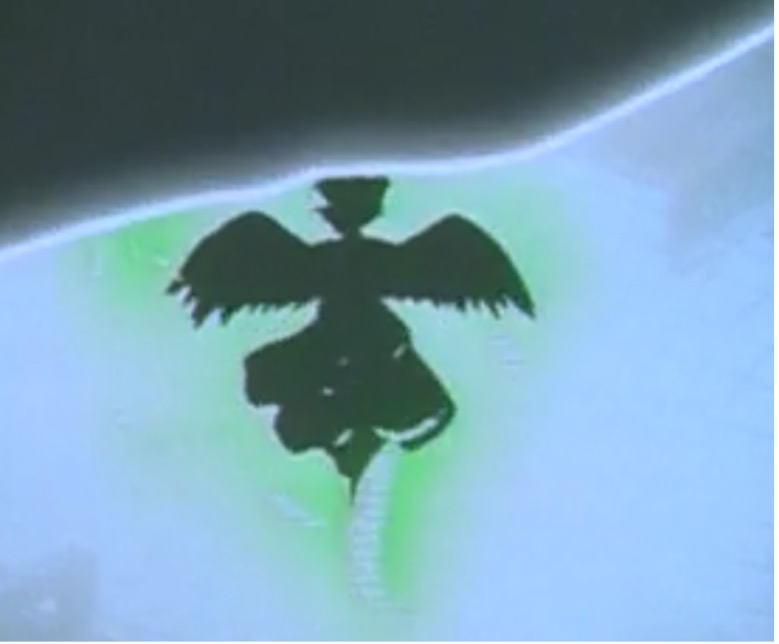
The trinity of the Holy Family of Catholicism is manifest in the three major characters of Ghost in the Shell. First, Major Kusanagi’s chaste nakedness recalls the Virgin Mary, the mother of Christ. Second, Batou fills the role of St. Joseph the Protector in his platonic relationship with Kusanagi. Third, the Christ child at the end of the film, conceived from this higher power, is preceded by the visiting angel, Gabriel (see Fig. 1). It is not the conventional Christian symbolism employed by typical directors; it is instead the intensely violent and bloody Catholic imagery that unlocks these ancient archetypes and makes Ghost in the Shell a counterclaim for the transcendent potential of technology super-imposed upon a grim tech-noir, cyberpunk context.

Fig. 1. Descending Angel from the Major’s perspective (Oshii 1:13:37)

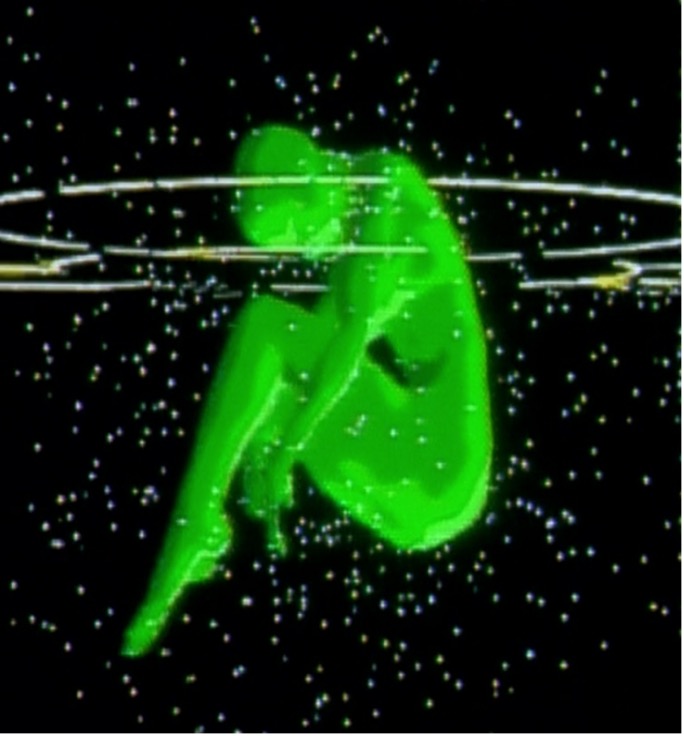
Major Kusanagi’s nakedness functions as fan service on one level, but more importantly, Oshii emphasizes the nudity to convey a statement on sexuality or, in this case, the lack thereof; the Major has no sex organs. The cyborg is drawn seamlessly around the hips. This is not a loophole to bypass Japanese censors. Oshii chooses to make a point of slamming the viewer in the face for the first ten minutes of the movie with a torso with no visible sex organs. However, despite this lack of an opening, and despite the fact that Kusanagi herself states, “I cannot bear children” (1:11:43-44), she is given a full set of breasts. Due to the lack of sex organs, it is reasonable to conclude that the Major is a virgin. One could argue that, if the Major had once been human before receiving her cybernetic body, perhaps she was not a virgin; however, that objection is irrelevant since, in keeping with a Catholic reading, the Major immaculately receives a new body as demonstrated at the beginning of the film (see Fig. 2). A tension also exists within the popular consensus, as reported by fan wikis, that the Major may, in fact, be solely cyborg, her memories of an original body as artificially constructed as the poor ghost-hacked truck driver in the first half of the film. At one point in the film, she even speculates, “Maybe there never was a real me in the first place, and I’m completely synthetic like that thing” (0:42:36-41). The Major’s chaste nakedness in the film contrasts with the almost hyper-sexuality of the Kusanagi of the manga source material, but this departure from source material is a matter of course for Oshii.

The presence of breasts, the means of nursing, in the assassination scene before the beginning credits, contrasted with the lack of exposed sex organs, indicates a being not of carnal sexuality but rather of sexless motherhood like the Virgin Mary; the Major bears the means of nursing but not the gifts of sexual pleasure, sexual union, or procreation in any typical sense. Oshii denies Major Kusanagi even the chance of traditional sexual agency, thus maintaining her virginity. Like Mary, Major’s motherhood is a gift from a higher force; she is meant for union with this higher force of technological divinity because carnal or human sexuality is too base to give birth to the new creature who emerges at the end of the film. Therefore, Kusanagi is equipped with neither the urge nor the ability for sensual pleasure or physical reproduction but a far more substantial motherhood—a divine motherhood explained through the metaphor of high technology.

Fig. 2. The Major’s Cybernetic Body Creation (Oshii 0:06:16)

Major’s consent to the Puppetmaster for a generative union is a parallel to Mary’s Fiat in Luke 1:38: “May it be done to me according to your word.” Susan Napier states that “it is [Kusanagi’s] body, standing at the nexus between the technological and the human, that can best interrogate the issues of the spirit” (107). The vision of technology as not only good but divine in Ghost in the Shell takes up residence in the womb of a cyborg, for in such an affirmation of technology Kusanagi is already connected to this world as Napier’s nexus. This conception manifests the Catholic teaching that the Virgin Mary was without sin before, during, and after the conception of the Messiah through the Marian dogma of the Immaculate Conception. As the nexus, Kusanagi already has a foot in the world of the divine/technological, but this important presence in the world of sinlessness loses meaning for a Protestant Christian framework which is either hostile to or unconcerned with the Marian doctrine of Immaculate Conception and her perpetual virginity: however, it gains momentum when seen from the Catholic perspective. The doctrine of the Immaculate Conception, as promulgated in the 1854 Ineffabilis Deus states that Mary was free from original sin, a teaching rejected by Protestants (Elwell 595-596). Just as Mary was without sin, the Major is “full of grace” and, as Napier’s nexus, simultaneously occupies the divine space of the technological, manifested in the image of the descending angel, as well as the familiar physical space of flesh and blood; Batou says to Kusanagi, “You’ve got human brain cells in that titanium shell of yours” (42:42-45). She is thus uniquely worthy to participate in the birth of the Messiah.

Kusanagi’s own Immaculate Conception at the beginning of the film shows the Major receiving her new body. The Major assumes a fetal position (Fig. 2) within the water-filled womb from which she emerges, taking on the divine technology within and upon her ghost so that she may be ready to accept the gift from on high. Though born into the baseness of flesh, both Major and Mary’s bodies are literally reconstructed in the image of the divine, a technological Imago Dei and, most importantly, without the essential sin that comes with a humanity bound to its flesh. The Major is reborn through the technologically divine intervention of Oshii’s Immaculate Conception—in this case a divinely digital one, and Kusanagi, the nexus, is now ready to carry the seed within her redeemed womb of sacred wires, holy circuits, and metal (Fig. 2).

Batou has a sexual tension with the Major that he does not indulge, even internally. For example, Batou struggles with this tension on screen, as he winces when he sees the Major unzip her dive-suit in the boat (Fig. 3). He turns away in embarrassment while gritting his teeth (Fig. 4), for he is ashamed that he, as St. Joseph, would even consider the Major in a manner outside of her divinely appointed role; even Batou’s eyes are unequipped for carnal desire, being artificial inserts with a range of tactical filters.

Fig. 3. Batou Reacts to the Major Undressing (Oshii 0:29:52–0:29:52)
Fig. 4. Batou Looks Away (Oshii 0:29:53–0:29:54)

Batou is the chaste St. Joseph, the adoptive father of Christ and the protector of the Holy Family in Catholic doctrine. It is Batou, who later arrives with his self-described “standard-issue big gun” (1:06:12-14), who saves the Major from being crushed by a tank. Though this dynamic may appear to be a muted sexism where the damsel must be rescued, it is vital that Batou fulfill this role within the Holy Family as St. Joseph, the Protector. It is Batou who takes the bullet into his own flesh for the Major in the ending scene, giving her more time to do her great work. It is Batou who cares for the new child at the end of the movie, even though the child is not his biological offspring. It is Batou who covers Major Kusanagi’s nakedness when she must shed her clothing during the employment of thermo-optic camouflage (Fig. 5). This chaste feature of Batou parallels St. Joseph’s own story within the Holy Family. St. Joseph’s relationship with Mary and  Batou’s relationship with the Major are chaste ones; a feature that separates the Catholic vision of the Holy Family from a Protestant one.

Fig. 5. Batou Covers a Naked Major Kusanagi with His Coat (Oshii 0:24:20)

“The Protector” has been St. Joseph’s role in Catholic tradition since the beginning but became official in 1882 when Pope Leo XIII declared him so. In the Bible, when Herod searches out the children to be killed, Joseph takes Mary and the newborn Christ to Egypt (Mathew 2:16–18); when the Major, the Puppet Master, and the new being they create are likewise ordered to be killed, Batou protects them with his own body (1:13:39), and he leads them away to his hiding place. When Batou has hidden away the Major (and the new child of whom she is part) in his own safe house, it parallels St. Joseph the Protector who “…did as the angel of the Lord had commanded him and took his wife into his home” without hesitation or objection (Matthew 1:20).  Batou takes his place within the Holy Family, acting with an uneasy obedience to this higher force and in agreement with the Fiat of the Major. It is his role to stand by, keep watch, and protect while the Major and this entity from beyond work to redeem the world.

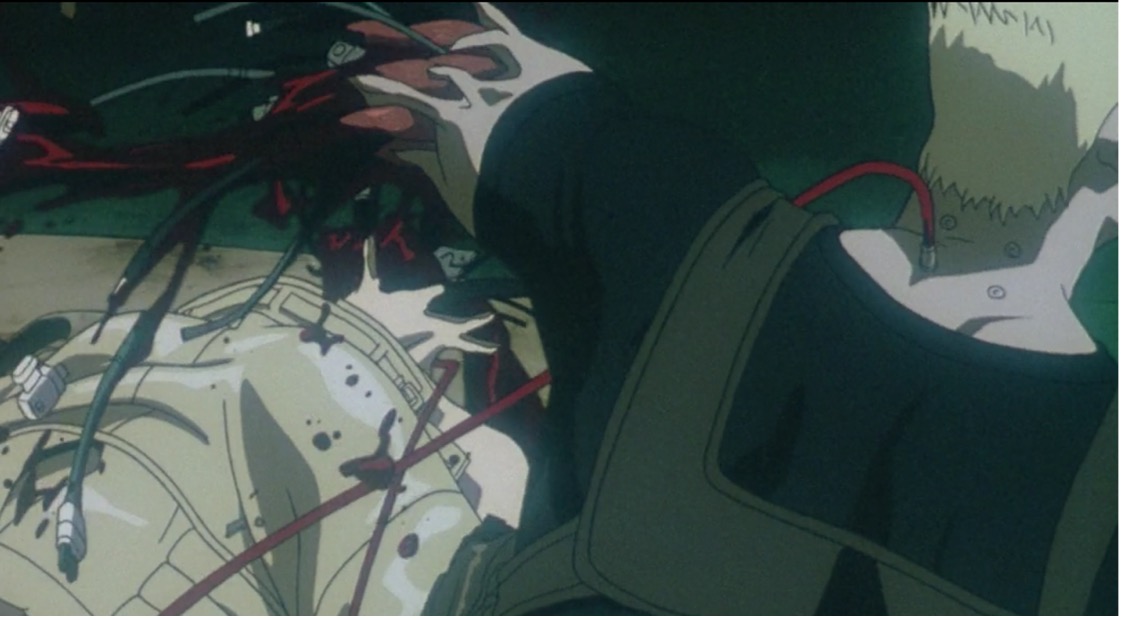
Even more overt than Oshii’s interjection of scriptures is the robed, glowing angel with feathered wings descending from the light near the end of the film (Fig. 1). The vision of the angel in question functions on three levels, but only one of these is complementary to the Holy Family of Roman Catholic doctrine. The first interpretation of the angel’s descent and the accompanying cascade of feathers fits Oshii’s use of Catholic teaching: this otherworldly creature, as a Christian figure, serves effectively as a secular symbol to represent a being of higher order. Its appearance communicates to the audience and to Kusanagi that she is about to make contact with this higher order, and some kind of transcendence is about to occur. A second interpretation, and the one which explains the presence of the child at the end, is that the angel is Gabriel, the messenger angel (Luke 1:26–35). The angel is descending to announce to the Major that she is to conceive a child with the help of a great and otherworldly force. Then, in the following scene, in a hailstorm of bullets, bodies are destroyed and ripped apart in the throes of the labor pangs (Fig. 7). Despite even Batou’s best efforts to shield her (Fig. 8), Major’s body is eventually pierced by the bullets from the helicopters above, just as Mary’s soul was pierced as foretold by St. Simeon in Luke 2:35: “And a sword will pierce your very soul”The helicopters approach bearing modified snipers; when they come into position, the vehicles unfurl the segmented wings of a dragon with glowing red eyes (Fig. 6), the same dragon from Revelation who follows the pregnant virgin into the desert waiting to devour the child at its moment of birth (Revelation 12:2–4).

Fig. 6. Helicopter Unfurls Metallic Wings as Snipers Prepare to Fire (Oshii 1:07:09)
Fig. 7. Major’s Body Is Ripped Apart (Oshii 1:05:25)
Fig. 8. Batou’s Arm Is Shot Off as He Seeks to Protect the Prone Major Kusanagi (Oshii 1:13:39)
Fig. 9. Red Eyes and Tails of the Helicopters (Oshii 1:11:24)

Nearby, the entire hierarchy of evolution leading to “hominis” as the pinnacle form of natural selection is shown on the engraving of the tree (see Fig. 10). It is a tree similar to the one found in Oshii’s Angel’s Egg (1985) with its cross-carrying soldier and retelling of Noah’s Ark, but this tree is riddled with bullet holes from the tank’s auto-cannons, foreshadowing the disturbance of the natural order that must occur, for this next step will not be a linear and incremental natural selection; it is a disruptive leap into the unknown.

Fig. 10. Tree Engraving Shot by Tank (Oshii 1:04:21)

Batou takes the Major away, sparing her the indignity of the incoming soldiers out to fulfill their orders from King Herod. In the following scene, we see the child. This child bears the face of the Major, for indeed, it is appropriate that the savior carries one half of its mother’s DNA. This is the savior with a foot firmly planted in both worlds. It is the Emmanuel whose arrival has been foretold by the descending angel in the film. It is totally singular and made substantial only through the Major’s Fiat; therefore, it bears her face and her voice.

Through these Catholic archetypes, Oshii does not anticipate a slow incrementalism, for his view of the next step of human evolution involves violent, painful birth and perhaps even a savior to emerge in the divine light of unhindered technological pursuit. His bloody and Catholic symbolism is fulfilled and sustained far more than the casual Christian imagery of a Protestant nature. However, Oshii’s Catholic framework does not serve as one-to-one allegory for the purpose of religious evangelism. Rather, its purpose is that of technological evangelism; the film makes use of the deeply held preexisting Catholic archetypes to convey the image of the next stage of human evolution. It will happen all at once, and it will be the most destructive force of our creative potential. Oshii affirms this new creation, despite the death and pain of metamorphosis, as the new creature asks aloud to itself, “And where does the newborn go from here? The net is vast and infinite” (1:17:35–42).

Oshii does not draw a traditionally Catholic conclusion in his Platonic journey from the Cave; this “net” is not Heaven. As Napier argues, it is “a reference not only to cyberspace but to a kind of non-material Overmind . . . which does not offer much hope for [the] organic human body” (105). Ultimately, Ghost in the Shell suggests “that a union between technology and the spirit can ultimately succeed” (114), and in Oshii’s universe, technology has taken on divine status. To communicate this prophetic statement, Oshii adopts the Catholic metaphor of the Holy Family. The nexus cyborg Major Kusanagi, who is full of grace due to the wires and microchips embedded in her flesh, gives birth to the new creature that is half of Kusanagi but also half of something else so much more. In Ghost in the Shell, Oshii has appropriated the symbols of Catholic theology to state his hypothesis of a secular transcendence. This transcendence is an alternative answer to the visions of heaven and salvation promised by the Abrahamic faith traditions and an alternative to the dire warnings of the cyberpunk genre where technology becomes the means of humanity’s salvation rather than destruction.          


WORKS CITED

Akito, Ishikawa. “A Little Faith: Christianity and the Japanese.” nippon.com, May 30, 2020. https://www.nippon.com/en/japan-topics/g00769/a-little-faith-christianity-and-the-japanese.html

Catholic Church. Catechism of the Catholic Church, 2nd ed. Vatican City: Libreria Editrice Vaticana, 2019.

Elwell, Walter A. Evangelical Dictionary of Theology. Grand Rapids, MI: Baker Academic, 2001.

Faxneld, Per. “Blavatsky the Satanist: Luciferianism in Theosophy, and its Feminist Implications.” Temenos 48, no. 2 (2012): 203–30.

Ishikawa Akito, “A Little Faith: Christianity and the Japanese,” nippon.com, May 30, 2020.

Leo XIII. “Pope Leo XIII: Prayer to Saint Joseph.” udayton.edu. University of Dayton, 2022. https://udayton.edu/imri/mary/p/pope-leo-xiii-prayer-to-saint-joseph.php#:~:text=Blessed%20Joseph%2C%20husband%20of%20Mary,him%20from%20danger%20of%20death

Mays, Mark. Machine Dreams A talk with visionary Japanese animator Mamoru Oshii about his new film Ghost in the Shell 2. Other. Nashvillescene.com. Nashville Scene, September 16, 2004. https://www.nashvillescene.com/arts_culture/machine-dreams/article_b50d24f8-5092-55ff-a567-6c1bc6c243ac.html

McCloud, Scott. Understanding Comics: The Invisible Art. Burnaby, BC: Simon Fraser University Library, 2018.

Meehan, Paul. Tech-Noir: The Fusion of Science Fiction and Film Noir. Jefferson, NC: McFarland, 2018.

“Motoko Kusanagi: Ghost in the Shell Wiki.” Fandom. Last modified June 2, 2021. https://ghostintheshell.fandom.com/wiki/Motoko_Kusanagi.

Napier, Susan. Anime from “Akira” to “Princess Mononoke”: Experiencing Contemporary Japanese Animation. New York: Palgrave, 2001.

Oshii, Mamoru. Ghost in the Shell. 1995; Beverly Hills, CA: Anchor Bay Entertainment, 1998. DVD, 82 min.

Rayhert, Konstantin. “The Postmodern Theology of ‘Neon Genesis Evangelion’ as a Criticism.” Doxa no. 2 (30) (2018): 161–70. doi:10.18524/2410-2601.2018.2(30).146569.

Rose, Steve. “Hollywood is haunted by Ghost in the Shell.” The Guardian, October 19, 2009. https://www.theguardian.com/film/2009/oct/19/hollywood-ghost-in-the-shell.

Ruh, Brian. Stray Dog of Anime: The Films of Mamoru Oshii. 2nd ed. New York, NY: Palgrave, 2013.

Suchenski, Richard. “Oshii, Mamoru.” Senses of Cinema, July 2004. https://www.sensesofcinema.com/2004/great-directors/oshii/.

Brian DeLoach, PhD, is an instructor of composition and independent researcher. He has been published in various political publications, outdoor magazines, journals of education, and has been a contributor to the best-selling Teacher Misery series of books. He lives in Cleveland, Tennessee.

Savannah Welch is an artist and student at Polk State College, where she tutors her peers in writing at the Teaching and Learning Center on campus.


Three Tastings of the Delicacy


Three Tastings of the Delicacy

Baoshu
Translated by Xueting C. Ni

1. The Sumptuous Banquet

The provocative little waitress wheeled the serving cart over, on which, a dish sat covered with a gleaming, radiant cloche that looked like it had been made of pure gold.

Smiling, the waitress maneuvered the cart directly in front of the guest, and then carried the dish, still with the lid on, to the table.

Just as she was about to reveal its contents, the diner gently pushed her delicate, jade-like hand away: “One moment, I have something to say.”

Across from him, the host gestured, indicating “please, continue.”

The guest spoke unhurriedly: “Although I haven’t mentioned my name, you all know who I am. My photograph has often been featured at the top of the rich lists, and even for the ordinarily wealthy, this million RMB private sifang1 experience would be beyond their means.”

The host nodded, indicating that they knew exactly the man’s name and status.

The tycoon spoke again: “beautiful women, fast cars, luxury mansions—all hold little interest for me, nor do I have ostentatious hobbies, such as space travel or deep-sea exploration. My only passion is eating. I built my fortune from nothing, but right from the start, any time I had earned even a little money, I would invariably treat myself to a meal of something I had never eaten before. It’s a dilemma that, after all these years, I have exhaustively worked through the gourmet cuisines from every part of the world, and my tastes have become increasingly demanding. Recently, no matter how delicious, or how rare the delicacies I have found, none of them have been able to pique my interest. My friend told me that you serve an incredible feast here, and his mysterious avoidance of details convinced me to come and give you a try. I have yet to see anything either good or rare. These half naked girls you have serving me are as laughable a gimmick as the pure gold tableware. I am truly disappointed. I’m sure these tricks work well on the tuhao2, who’ve yet to experience the real state of gourmandise, but quite honestly? Seeing these things has already killed my interest. I therefore bid you goodnight, though I assure you, I shan’t expect my one million back.” With that, the tycoon stood up and prepared to leave.

Still smiling, the host urged: “please wait a moment longer. Even if you don’t eat, there’s no harm in taking a look, is there? Aren’t you even a little curious about what’s under the cover? Perhaps a peek may convince you to change your mind?”

The tycoon pondered this, nodded, and returned to his seat: “fine, let’s see what cure you’ve got in your gourd,” and reaching out, he lifted the golden dome.

He was a seasoned connoisseur, but what he saw still left him stunned.

Presented on a wide crystal platter was an odd black helmet.

It took a good while for the tycoon to formulate any sort of action. He picked it up and carefully examined it, and, ascertaining that the helmet was in no way edible, his anger instantly flared: “what’s the meaning of this?!”

“Just as you said,” the host spoke leisurely, “having tasted all the rare and unusual delicacies of the world, what could satiate your appetite? Nothing. So, the search for anything new would be fruitless. However, if those sensations, caused by enjoying good food, from another person could be transmitted into your brain, then naturally you would be able to experience the sweetness, the richness, the aromatic taste of food, all afresh.”

The tycoon snorted: “And this helmet can do that? I’m a businessman and have seen more than my fair share of con artists, so don’t even think about trying to swindle me.”

“Well, then you should be able to see that I’m no swindler. I am, in fact, a scientist, not a chef. I can’t even cook a simple dish of fried egg and tomato. I was initially a researcher at a university, developing a long-distance project to read brain waves, but unfortunately, it failed, and the higher-ups cut my funding. However, there was a by-product from my many years of research, and it’s that helmet. That is why I opened this ‘Taste of Herz” sifang experience, hoping to raise enough funding to allow me to continue with my original research.”

“So you’re saying, that this fancy bucket can collect people’s brainwaves when they’re eating?” The tycoon’s demeanour changed to one of curiosity.

“The headset is only a transmitter; the actual mechanism behind it is in the back. It’s about two or three storeys tall. Humanity’s most basic desire is their appetite for food, and the hunt for the gourmet is the highest form of this desire, so of course it will generate the most intense of brainwaves, which can easily be recorded by the apparatus, and almost as easily transmitted to others. Put it on, and you’ll have the full sensory experience of the subject as they enjoy their food. Taste, scent, textures and temperature, pain… Everything, of course, except auditory and visual recordings so as to, technically, not invade their privacy.”

“Interesting,” mused the tycoon, now fully engrossed. “Well, let’s give it a try.”

“Wait,” said the host, “let me clarify the function. There are seven levels, categorised according to the intensity of pleasure received by this helmet. Each level allows you to experience a random signal. Think of it as blind ordering. However, with regards to the final level… being that this represents the most intense transmission of brainwaves, at the moment we cannot guarantee it would not cause damage to the brain, so please do not select that level. If anything were to happen to you, it would make international news.”

The tycoon indicated his agreement and pulled on the helmet.

“In that case, bon appetit,” the host courteously replied, before withdrawing with the female attendants.

An hour later, the tycoon rang the bell, summoning the host.

“I haven’t felt this way for a very long time!” the tycoon gushed excitedly. “It was all so delicious, so infinitely evocative!”

“Did you try every level?” asked the host.

The tycoon nodded.

“Would you mind recounting the experiences to me? So I can record it for the sake of my research?”

The tycoon closed his eyes, savoured his culinary memories, and slowly began to speak:

“The first level was very spicy, with a fresh xian3 taste and an aromatic sensation. Probably mapo doufu at some Sichuanese restaurant. Not particularly interesting, so I quickly skipped it.”

“The second level tasted rich, tender, sweet, and buttery, melting as soon as it entered the mouth. That should have been high quality Snowflake beefsteak,4 but for me, it’s an everyday meal, so I didn’t stay for long.”

“The third level, I experienced an exceedingly ravishing xian, smooth and tender taste, mingled with the scent of sea breeze. It was actually very familiar to me. Fruit de mer. Good quality lobster, abalone, and such.”

The host smiled and commented: “but for you, this wasn’t anything new.”

“No,” said the tycoon, “but from the fourth level onwards, it was different. That kind of pure, light, yet rich and crisp taste, with the elegance of fresh vegetables, the exquisite delicacy of young meat, and the rich aroma of mushrooms, all combined into one, yet distinguishable in layers…” as he spoke, his mouth began watering in response.

“Do you know what the dish is?”

“An excellent broth baicai,5” the tycoon answered without hesitation. “The taste and texture were just right, state banquet quality. I tried it once ten years ago, but the chef passed away, and I have never again tasted broth baicai made to quite the same standard again. Where did that cast come from? Can you check?” 

“Of course.” The host opened their laptop, and pulled up the log.  “It came from a small town in Sichuan; the precise location is—”

“Please, just send it to me after the session,” interrupted the tycoon, whose enthusiasm was still focused solidly on his dining experiences. “Let me tell you about the fifth level. That was a type of chocolate; tasted like it was from Mexico. It was more bitter than the usual chocolate, and even a bit savoury, but at the end, it became something infinitely more relishable in its nectar and fragrance. Of course, the taste itself was nothing special…but in that sweetness, there was like a kind of…joy and a jubilation that lifts the soul…I think, it must be chocolate given by a lover. It felt full of that passion. It made me think of my first wife. It’s a shame we divorced, and she left with a billion of mine.”

“But enough of this, let’s talk about level six, which was just…water! I have no idea what kind of water, but it was almost like nectar. Such a pure, bright taste. I’d never tasted anything so delicious as this water; not even the celestials’ ambrosia could be better than this! I drank it down so desperately, as if my life depended on it, but never felt like I had drunk enough…what kind of water could do that?”

“Let me check the location…” replied the host. “The location…is…an oasis in the Taklamakan Desert. It must be a desperate, dehydrated traveller who found the water source there and drank to their heart’s content.”

“Makes sense!” The tycoon slapped his thigh. “I wondered how simple water could taste so good! That sounds about right. OK, so in the seventh level—”

“Wait!” interrupted the host, flustered by this. “Did I not make it very clear that you should not access the machine’s seventh level? It’s incredibly dangerous!”

“I’m sorry,” said the tycoon, a little embarrassed, “but level six was so fiercely satisfying, and knowing the seventh must be even better, I really couldn’t resist…luckily, nothing’s happened.”

“Okay then,” the host sighed, feeling it was no use protesting further. “What did you experience, precisely?”

The tycoon savoured it, as if reliving the memory of eating in his mind, before replying: “It was a kind of roast meat, a little like roast piglet, but a hundred times more mouth-watering! Just smelling it alone made my soul tremble. I only got to taste a piece or two; it was burning hot and had a charred crunch, as though it had just been pulled out of the fire, but the sensation of putting it in my mouth… I felt like I was being consumed by fire myself, and then reborn from the ashes! Just what kind of meat is this? And where was it eaten?”

“From the coordinates…” mumbled the host, as he browsed the logs, “should be…” he gave an awkward, unfamiliar place name.

“Oh,” said the tycoon, “I know there’s a lot of rare birds and beasts there, but they’re all protected species. I’ve never had a chance to taste them so…perhaps it’s some kind of monkey or sloth? But how could it taste so good?”

The host shrugged, indicating he had no way of finding out.

“Wait, it’s been a warzone there for months. The conflict has caused a huge famine, and there’s been no way for international aid to reach them. Thousands of people starving to death… they’d probably eat anything now. Who cares about protecting animals when you’re starving? But the conflict’s been going on for over six months…so what’s there left for those people to eat now? What else…but…”

The tycoon’s face changed, his lips continued to twitch a few more times, before he bent double and was violently sick.

2. The AppetAid Service

Some years later.

“A steak meal, please,” said the youth sitting at one of the tables in a small restaurant to the welcoming orderbot, which was rolling towards him.

“Certainly, sir, and will you be requiring the AppetAide service?” the synthesised voice asked.

“Of course,” said the customer, without hesitation.

In this restaurant, a steak cost 40 RMB, whilst AppetAide, at 35 RMB, was almost as costly as a dish. However, ordering it meant that the taste could be improved severalfold, giving even an ordinary dish the taste and impact of a high-end banquet for its user, so it could be said to be well worth the cost.

“Then please choose your zuocanshi.[1]” Rows of profile pictures began scrolling across the wafer-thin screen on the orderbot’s chest, the majority of which were pretty-looking women of every body type, some as voluptuous as Concubine Yang of Tang, others as slender as Queen Zhao of Han, each beautiful in their own way. The rest were elegantly handsome or earnest-looking men. 

Without even lifting his head, the youth replied straight away: “the usual please, Number 88.”

Number 88 hadn’t even been displayed, but her beautiful face was already present in the young man’s mind. For the past year, whenever possible, he would pick number 88 as his zuocanshi. In fact, he had built his whole order according to the schedule that Number 88 had announced ahead of time: when she said she was eating steak, he would pick steak, when she was eating seafood, he would pick seafood. Her lucid and elegant features, her slight but shapely figure captivated him, but more importantly, it was that tiny mouth of hers, and the incomparable taste buds it contained. Abundant, refined, and dynamic. Every meal with her was like the most splendid of symphonies, sending him head over heels, unable to extract himself from the sensations.

As the meal began, Zuocanshi88 materialised at the table holographically, as if she were facing the diner. Lifting her fork, she gave the youth a small smile, her dimples seemed to light up the whole room.

It was a shame that he wasn’t the only one Number 88 was smiling at, as today, he wasn’t the only one dining with Zuocanshi88 in the restaurant. He could clearly see a bucktoothed, acne-scarred man sitting diagonally across from him, who had also ordered steak and Number 88, and she was simultaneously flashing her brilliant smile at him.

The coincidence was unfortunate, and whilst there were probably several thousand people across the country all being serviced by Number 88’s AppetAide right now, it was unusual to meet a “fellow fan” at the same restaurant.

If he had enough money, the youth thought, he would love to buy Zuocanshi88’s exclusive services and enjoy the one-to-one dining experience, but the price for that was astronomical. Remembering his ever-emptying e-wallet, the youth reluctantly angled his head away, so he didn’t have to look at the ugly simp who still sat diagonally across from him.

“Darling, I’m all turned on and ready to go. Come on, let’s do it together!” Said 88 with a smile. With the gleaming steak knife, she deftly cut off a piece of rosy, succulent, red Matsusaka beef, medium-rare, before skewering it with her fork and placing it between her enticing cherry lips.The youth put a piece of steak into his own mouth, and began to chew. Of course, his standard flank steak that cost a mere 40RMB was coarser and tougher, and was much harder to slice, so his actions could not completely synchronise with those of his Zuocanshi. However, when he placed the steak in his mouth, the stimulation of his taste buds activated the brainwave reception functions of his neuro-implant for taste and smell, and 88’s dining sensation came flooding through the transmission.
 
Delicate and distinct sensations he had rarely experienced in real life flooded his mouth, such aromatic fragrances, smooth tenderness, warmth, and the xian piquancy, all came swirling around the tip of his tongue, forming a complex and beautiful vortex.
 
The transmission and reception of “FlavorWave” and AppetAide had been in development for over a decade, and had long attained greater commercial value than the simple sensation-stealing helmet it originated from (which was still embroiled in a slew of legal issues). No matter how fantastic the gourmet tastes the helmet allowed users to experience, they could not rely on absorbing electric brainwaves to provide them actual sustenance, and those who got used to eating ‘brainwave meals’ found everyday dishes dull, which led to problems not only with daily living, but also of survival. Therefore, many restaurants began adopting the technology, transmitting it into their customers’ brains as an accompaniment to dining through the “AppetAide,” thus improving their dining experience immensely and guaranteeing that they would enjoy the food with absolute satisfaction. As the FlavorWave augmentation service became increasingly popular with customers, it rapidly became a common service, available at exclusive restaurants and dive diners alike. With this, many related companies and organisations were formed, but Taste of Herz, the company that pioneered the technology, remained one of the biggest players in the industry.

The only pitfall was that there had yet to be any development in an apparatus for storing and replaying these brainwaves, so the whole experience relied on live-streaming. Despite this, the receptor and transmission devices had already been simplified to a microchip that could be implanted into the brain, so there was no longer the need for clumsy, heavy devices like the helmet. Along with all of this came the birth of a new profession: the AppetAide Zuocanshi. 

Zuocanshi would be able to taste all the most exquisite haute cuisines, prepared by the most masterful chefs and, simultaneously, transmit their gourmet experience to diners who are only able to afford ordinary fare. Though this sounded like an enviable profession, not everyone could become a verified AppetAide partner. The oral and olfactory sensitivity required by this trade was exceptionally high, and had even become the new threshold for all professional sommeliers. To maintain the optimum conditions, the Zuocanshi’s tastebuds, mouth, olfactory receptors, and nasal cavity must be maintained to the highest of standards, with regular examinations by a doctor to ensure the best perception and optimum oral sensation during dining. Furthermore, a Zuocanshi’s presentation and appearance was also an important factor to consider. Of course, rather than brainwaves of indeterminate origin, people much preferred to share the gourmet experience with a beloved figure they could see seated in front of them, who could provide them with all kinds of other delectable associations.

Zuocanshi88 sipped the red wine and then picked up another morsel of beef, chewing carefully and slowly for a good while, her posture and deportment eternally impeccable. Such deportment was said to be the dining etiquette of the British monarchy. The youth knew that her line of work was not an easy one. It was said that, in order to produce the most vibrant of dietary experiences, Zuocanshi need to starve themselves for days beforehand, becoming so hungry they could eat a whole cow. However, in order to maintain their eating etiquette, they must dine without letting that desperation show. It was vital to avoid accidentally biting their own tongue or lips. In the early years, there was a Zuocanshi who was so starved that, in a ravenous frenzy, they almost bit their tongue clean off, transmitting that sensation of pain to countless recipients, generating wretched howls simultaneously across hundreds of cities and thousands of restaurants.

This was, of course, a mistake that Number 88 would never make. Her dining techniques were the best. It was not just the gracefulness of her posture, the delicacy of her feelings, but the fact that the food seemed to take on a magical quality as soon as it reached the tip of her tongue. Steak, sauces, asparagus, wine, even bread: the sensory quality of each was at its apex. Main, supplementary, and base notes – the jun chen zuo shi7 of tastes, flavours, and textures, combined and separate, creating countless amalgams of exquisite and blissful moments. The youth felt as if he was surfing on a sea of roiling waves, constantly bringing him to the climax of desire.

Suddenly, 88 slowed her chewing, letting her eyelids drop a little, displaying an expression of intoxication, as if engrossed in the incomparable flavours. There was an indescribable charm and loveliness in her expression, which, combined with the delectable steak, provided the utmost enjoyment.

But something in this scene made the young man pause. The expression on the face in front of him gave him a strong sense of déjà vu. He felt sure he had seen that exact look before. This shouldn’t be a surprise, having already “dined” with her so often over almost a year, he would have seen a similar expression from Zuocanshi88 countless times. But this manner and expression was still giving him an uncanny sense of familiarity.

Why was this?

Being in the midst of his gourmet experience, he let it pass and thought no more of it. However, as the dining continued, similar feelings rose in him, again, and again, and again.

Half an hour later, when Zuocanshi88 had completed her synchronised dining, she stood up, curtsied sweetly, and disappeared.

The youth paid the bill and wandered out of the restaurant. Number 88’s expressions and movements throughout the meal were fresh in his mind, but he repeatedly had the feeling that something was not quite right.

“Bring up the recording of my dining experience today.” Back home, the youth instructed the AI assistant on his chip to access the video. Because of his infatuation with 88, he would use a camera in his glasses to record the visuals of her AppetAide session, every time, often playing them back to savour the moment.

Yet this time, when the Zuocanshi’s enticing, smiling figure was projected before him, the youth had no capacity to enjoy it. He scrubbed forward to the moment he’d initially felt déjà vu, and then instructed his AI to “make a search through Zuocanshi88’s channel for all similar images.”

In the past year, he’d made over 270 recordings of 88, and from them, the AI found over 1500 images with similar postures. However, the youth added some more selective criteria, refining by the same outfits, same foods, and so forth.

Very quickly, that number of similar images had fallen to nineteen. The youth browsed through the first two pages before stopping on the third: one of the thumbnails was exactly the same as the scene he had just experienced at the restaurant. The placement of the food, the pose of the person, it was exactly the same. Identical down to the intricate pattern of creases in her outfit.

“Overlap the two images,” he commanded.

The AI overlapped the two images, and even though the background was different, every visual element related to Zuocanshi88 and the dish overlapped perfectly, with no point of distinguishment.

That had been an AppetAide service from four months ago.

Hoping that it was just a wild coincidence, he spent a few minutes comparing the full footage from the two experiences and found that, although the two were not exactly the same, for around one minute before and after this image, 88 made exactly the same movements. Undeniably, at least this part was a recording.

“Those bastards have cracked FlavorWave storage! What a fucking cheat, keeping it secret and still pretending it’s a live stream,” raged the youth between gritted teeth.

The clever young man quickly unravelled the ruse: if they made FlavorWave storage public knowledge, then people would want to purchase the stored experiences and enjoy their dining on their own, just using those recordings repeatedly, so how would Zuocanshis get any more business? The whole AppetAide industry had insidiously concealed the truth, remixing the same recordings to disguise them as live casting, thus lowering their costs, deceiving the public, and exploiting everyone for their own explosive profits!

Poor Zuocanshi88. Perhaps after she had made those recordings, she had already been dropped by these unscrupulous companies!

With this thought, any hesitation in the young man’s head vanished, and he began writing up his findings at a tremendous speed. Trimming up and processing the two clips, he uploaded it to every social media site he could. With the two different backgrounds and the date stamps, it was very easy to prove that the 3D recording was made at different times. The ironclad evidence was as irrefutable as the mountains.

The young man was not wanghong,8 so he had no net-celebrity, and for the first couple of days, his post languished, with only a few of his friends sharing it. But after all, this concerned the AppetAide network, a technology that millions of people relied on in their daily lives, so eventually, it was bound to catch someone’s attention.

After three days, the number of reposts began to snowball until, finally, it went viral across every platform.

Overnight, it received over a million reposts. The video was watched over 10 million times.

Immediately, a representative from Taste of Herz stepped forward to dispel the rumours, stating that there was absolutely no such thing, that the video was made by a malicious image manipulator, and further demanding that the rumourmongers step forward and take legal responsibility for their defamation. For a time, they even seemed to manage to quell the story.

However, the power of the masses had been activated, and soon, people across the internet began searching for their own evidence. After another day, a whole new round of similar recordings began to emerge across the internet, and the truth of the matter could no longer be denied.

Aside from the recording scenario imagined by the youth, people began hypothesising other frightening possibilities, such as these companies presenting pretty or handsome models as the “faces” of the experience, whilst transmitting the Zuocanshi experiences of crusty old men who liked to pick their feet or withered old ladies with hairy chins. This would be a hundred times worse than just pre-recorded streams.

Given the serious nature of the accusations and public sentiment growing more and more contentious, the police eventually stepped in to formally investigate the issue.

A month later, the truth came out, and what a truth! It’s said that the truth often exceeds conjecture, but that day, when the youth saw the headlines, he almost passed out.

CEO of renowned dining experience and live-casting company Taste of Herz, Dongguan Hurton, and numerous high-ranking personnel have been arrested and detained by the police. The police revealed that Taste of Herz has been exposed for illegally breeding and keeping several hundred Tugou dogs and Yorkshire Saddleback pigs and for transmitting the “FlavorWaves” generated by feeding them via the AppetAide Service to hundreds and thousands of customers around the globe, whilst simultaneously employing digital deepfake technology and A.I. tracking to generate “human” disguises for these subjects. With gustatory and olfactory senses far exceeding those of humans, the brainwaves provided by the canine Zuocanshi have proved extremely popular. This hair-raising hoax has been perpetrated over a period of at least three years. According to certain sources, many other companies have also been perpetrating similar clandestine operations …

3. The Last Meal

Some years later.

The launch event for Taste of Herz Dining Experience Group’s new product was about to begin. Already, over a million people had registered their participation online, and some important guests had been invited to the Experience Centre itself to attend it in person.

The VIPs gathered. Champagne glasses clinked.

An elderly gentlemen sat down by a middle-aged man, and when their eyes met, there was instant recognition.

“Hello…you’re that tycoon!” said the middle-aged man excitedly. “One of the earliest diners to enjoy the FlavorWave system! They say that was the time when you tasted the world’s most forbidden–”

The old tycoon laughed loudly to interrupt him. “Those are unreliable rumours, and the truth was nowhere near as sensational. But back then, when I had invested a few billion in Taste of Herz, there were all kinds of rumours about me. It was inevitable really…but, if I’m not mistaken, you’re the young kid who first exposed the Herz Live Experience scam, yes?”

 “I’m more of an ‘old kid’ now,” said the erstwhile youth rather bitterly, “but I never expected that after that, things would take a path like this…”

After being exposed for the scandal of transmitting FlavorWaves from dogs, and even pigs, to humans, the entire industry imploded, taking companies large and small with it.

However, this turned out to be nothing but a temporary setback. Customers who had grown used to the enhanced sensory brainwaves of the animals and to the much sharper, more sensitive, and abundant stimulation they provided to the tongue, found that  returning to the FlavorWaves of human Zuocanshi no longer satisfied their appetites. But as it’s those with courage who reach the headiest of heights, many people quickly broke through that mental block: justifying to themselves that, since we happily consumed the bodies of animals already, why not consume their experiences too?

Despite there still being waves of objections, including religious figures and thinkers, who decried “the degeneration of humanity” till they were blue in the face, a new market, providing animal FlavorWaves rose from the ashes, and with it, the almost expired Taste of Herz Group rose again like a phoenix, its business expanding further and further.

“Had you not poked a hole through that paper window, it would have taken many years to transform the market,” the old tycoon smiled. “Who’d have thought that, after the story broke of our use of animal FlavorWaves, the public would be clamouring for a whole new world of gourmet experiences. And us old taotie9 would be reaping the benefits!”

The younger man had to agree: “when they first used animals, they were just trying to save the costs of human labour, and so needed the eating experience to be at least comparable to that of humans for the scam to work and satisfy the customers, but after it went public, people couldn’t help but dig into the experiences of thousands of rare and unusual predators, expanding our menu enormously…that is, I should say, expanding our ‘Gourmet Sensory Spectrum.’  It’s fascinating.”
 
 “It sounds like you’ve tried a few yourself?”
 
 “Yes, over the last few years, I have tasted the xian of fresh grass in the mouths of cows and goats, the sweetness of bamboo leaves enjoyed by giant pandas, and the wonderful delight felt by a kitten’s first taste of fish…you must have experienced these yourself?”

“Not only these, but so much more…have you ever experienced the lion’s thrill when it digs a warthog out of the mud and cracks its skull in a single bite, so the brains explode into its mouth? Or the chewiness of a giant squid when a sperm whale dives into the depths and tears it apart? Or the interwoven icy cold and blazing heat when a polar bear on the glacier bites into a tender, young, blubbery seal pup?” The old tycoon rolled each experience off as if they were familiar delicacies.

“I have to say, I’ve never tasted those. They’re all premium experiences, reserved for the super-rich. The FlavorWaves of these rare, wild animals are hard to capture; each experience must cost a few billion at least?” The middle-aged man mused, salivating, before smacking his lips and swallowing repeatedly. 

“But experiences such as these are worth any amount of money. Look, why don’t you come and see me another day, and I’ll treat you to a proper banquet!” the old tycoon suggested with largess.

“Well…then thank you. Thank you very much! But, on the subject of banquets…do you have any idea what today’s experience might be?”

“Well, it has to be some new development in animal AppetAide,” the old tycoon shrugged, “but these people, there’s nothing they haven’t already come across, so I really don’t know what this new thing this could—”

“Esteemed guests, welcome to the Taste of Herz Dining Experience New Development Press Conference Live!” The CEO of Taste of Herz appeared on stage, interrupting the tycoon.

After a short introductory speech, he finally revealed the mystery: “in today’s event, we will be introducing the world to a whole new Gourmet Sensory Experience! Initially, we could only transmit, receive, and interpret human brainwaves that were related to eating, before being able to extend this to different kinds of mammals. As for other organisms, due to the difference in their inherent biological make-up, which was far too distanced from that of humans, their brainwaves took entirely different forms. And this barrier was one we were unable to break through for a very long time. But recently, our scientists have cracked the code, and successfully interpreted the corresponding brainwaves of reptiles, in a manner where their brains could connect with those of humans. Today, the FlavorWaves that everyone will be enjoying come directly from…crocodiles!

“Crocodiles?” The middle-aged man was a little disgusted. “Those dull, dirty creatures? What could be so special about their experience? Don’t they have brains, like, the size of an egg?”

“Perhaps,” the old tycoon said, patting him on the shoulder, “but still, all life is full of wonders, and the unique flavours that animals on the hunt experience have given me many delightful culinary surprises. For instance, when I was receiving the ’waves of an anteater whose tongue was stuck deep into a nest of ants, the ants crawling all over it felt sweet and active, like a mouthful of popping candy…quite unforgettable!”

“OK. That makes me want to try it less…” The middle-aged man frowned.

But still, he activated the receive function on his implant.

Under the anticipation of thousands of people in the venue and the millions viewing online, a magnificent landscape appeared on the giant screen before them.

The scene was split into left and right sides, each side bisected between top and bottom. The top part of both sides showed what looked like sky, snowy mountains, and woods; the bottom half was a dark green world strewn with floating algae. The host informed everyone that this was the world as seen through the eyes of an 18-foot-long Nile crocodile, floating on the water. ToH workers had anesthetised the beast and implanted a FlavorWave transmitter chip into its brain. Of course, the crocodile was completely unaware of any of this.

The Nile crocodile stayed motionless in the waters for a long time. The host said it could spend the whole day waiting like this by the water’s edge, but just then, as a herd of bison appeared in the distance (driven, of course, by the staff), the Nile crocodile began to respond, at which point, the audience began to receive its FlavorWaves.

This was an exceptional feeling. Clearly it had not yet eaten anything, but there was already an intangible thrill stimulated in its mouth, like humans salivating when they look at food, imagining its taste the food before eating it—but this feeling was much fiercer than simple salivation.

This kind of aperitif thrill drove the Nile crocodile to make its move. Slowly, it swam towards the herd, coiling its body and gathering momentum to strike.

Although it had no ‘eating’ to transmit, the middle-aged man was already feeling the extraordinarily fierce excitement of the predator. It wasn’t a desire to eat, but rather the impulse to launch his entire body, wrap it around the prey, and become one with it! It surpassed even the strongest of his sexual urges.

The bison began wading through the river, and a moment later the crocodile suddenly lashed out, snapping its jaws around the leg of a young calf! With a biting force of around 5000 pounds, the bite penetrated the tough skin and tight flesh, delivering the marvellous sensation of blood doufu. That fresh warm blood flowed into its mouth, tasting sweet through the metallic tang, and like a taste bomb, exploded in the mouth of every diner!

In an instant, the middle-aged man felt as if he had become one with the crocodile, a fierce thrill transmitted to all parts of his body. He chomped the air, roared, clenched his fists, and as the crocodile performed its signature ‘death roll,’ thrashed around in his seat. He could see that the old tycoon and the other diners were making similar movements. If he were an onlooker, he might have found it comical, but in the moment, he could only marvel at it. How awesome! How stimulating! Every movement of his body was accompanied by an invigorating freshness and delicacy of taste that he had never experienced before, on an entirely different plane of eating sensations than that of humans, or any other mammal. In pleasurable and comfort it was more comparable to sex. If Zuocanshi88 had ever really existed, she would be a joke compared to this.

After a series of flips and rolls, tearing and biting, the young calf stopped struggling underwater and quickly became a mess of bloody and broken meat. The Nile crocodile dragged this back to its cavernous nest and began to enjoy its catch. Each great mouthful was unusually fresh, fatty, and satisfying, stretching out and relaxing each and every armour-like scale on its body. 

The whole experience had been faithfully transmitted to every diner. In reality, the waiting staff had delivered thick slices of fresh steak, but the silverware remained untouched–that would only have ruined this extremely marvellous experience.

The crocodile’s appetite was surprisingly large, and in no time at all, the entire baby bison was in its stomach. That joy of a full stomach, followed by a deep, deep sense of satisfaction, was felt by every diner, who now felt as though that they too had eaten an entire bison. There had never before been such a fulfilling dining experience!

“I’ve never felt this way before! How could it be so….so good?” The middle-aged man struggled to find the words to describe it.

“Interesting,” said the old tycoon thoughtfully. “I think it’s because reptiles are cold-blooded animals, who are far less active than mammals. Their usual states are almost completely stationary; they expend most of their vitality in just those rare occasions of hunting, mating, or fighting for their lives. It’s precisely the lure of a wonderful meal that send their bodies into momentary explosiveness. It could be said that they devote their entire bodies, no, their entire lives, to eating! They are the world’s most profound epicures! How marvellous!”

Yet even more marvellous things were yet to come.

The next day, very little of that deep feeling of satisfaction had dissipated. The old tycoon hardly wanted to move, nor could he bring himself to eat. Unsettled by this, he enquired of the other guests, and found that they were having a similar reaction.

Discussions began across the internet. Some people started researching crocodiles, and soon discovered a terrible truth that, after eating a large meal, they could go for months, even a year, without needing to feed again! That Nile crocodile had faithfully transmitted its experiences into the press conference, so even if its FlavorWaves were no longer being received, the minds of those who attended the event were retaining the state induced by these brainwaves.

The old tycoon was shocked to find that his appetite had totally vanished, soon realising he not eaten anything for two whole days. Very quickly he began to rely on injections of nutrients to keep himself alive.

According to statistics collected shortly thereafter, among the first batch of people who participated in the experience of crocodile FlavorWaves, these symptoms had manifested themselves in as many as 85% of them.

It was a relief that this condition didn’t actually last for a whole year. After three days, appetites returned. One morning, the old tycoon woke up feeling ravenous. He leapt out of bed and, without even getting dressed, rushed to the nearest bakery stall, picked up the first ham roll he could find, and devoured it as if it were the best thing he had ever eaten. The old man breathed a sigh of relief that he seemed to be returning to health.

He had no idea that this was only the beginning.

Soon after, the old tycoon realised that he now no longer needed the stimulation of AppetAides and could enjoy even quite basic food with hearty abandon and pleasure. Every time he ate, he was consuming several times his usual fare, filling his stomach to its absolute fullest. After eating his fill, he would slip into a profound contentment and exhaustion, not wanting to move a muscle. Even his thoughts were beginning to grind to a halt. He could lie or sit like that for hours on end, his mind a total blank, not even moving a finger.

It wasn’t until a day or two after, when the food had been completely digested, that his brain resumed its basic abilities, and with the cravings of a drug addict, he would go about looking for his next meal.

He became less and less communicative, and after a month, struggled to even string a whole sentence together.

In other words, like several other million people, he had started to live the life of a crocodile.

Soon, all the attendees were taken into hospitals, but there was nothing that the doctors could do.

Later, medical research discovered that the Nile crocodile’s FlavorWaves had activated a dormant reptilian cortex deep within the human brain, causing an appetite that had been suppressed by centuries of evolution to awaken, fundamentally—and permanently—altering the body’s functioning.

Although Taste of Herz had performed a minimal number of experiments previously, to test the technology they had used the more common Chinese alligator and certain species of fish, the side effects from which were naturally not as strong. When they had just begun the clinical trials of the Nile crocodile, Taste of Herz discovered that their competitors were about the announce similar dietary experiences, and so pressed ahead with the launch before tests were completed, resulting in this tragedy that brought disaster upon millions of people.

As for the old tycoon and the man who broke the story? They did not feel miserable. After losing most of their human thoughts and behaviours, they could at long last live in the eternal world of the epicurean, and focus on becoming one with their beloved food, without any other distractions.

Perhaps, then, this is the most profound meaning of the gourmet: I eat, therefore I am.


NOTES

  1. Sifang – traditionally sifang cai are the most exclusive of dining experiences. The dishes are served in private mansions. They are not open to the public, nor advertised, nor is there a menu. They are cooked by the host themselves from secret recipes passed down through the family for generations.
  2. Tuhao – a derogatory term meaning “earth rich,” referring to the nouveau riche from China’s rural areas.
  3. Xian – Chinese term for umami.
  4. Snowflake beef is a premium category of wagyu beef.
  5. Broth baicai – kaishui bacai, an haute cuisine of Sichuan and one of its greatest classic dishes, created by an imperial chef named Huang Jingjin, consisting of Chinese leaf vegetables skilfully cooked in chicken or pork bone broth supplemented by pieces of tender meat.
  6. Zuocanshi – “master appetite enhancer.” In Chinese cuisine, a zuocan dish is traditionally a food or drink accompaniment, such as a sauce, a dish of pickles, or wine, that supplements the main dish and improves its taste and the diner’s appetite.
  7. Jun chen zuo shi – “ruler, minister, aide, envoy,” originally meaning those that govern the country. They also represent the principles for TCM (traditional Chinese medicine) prescriptions, the “ruler” herbs being the ones that nourish vitality, the “minister” and “aide” components doing most of the treating, supplemented by the “envoy” herbs. Here, the idiom is extended to oral sensations.
  8. Wanghong: social media influencers
  9. Taotie – the terms means “ravenous gluttony” and refers to a mythical beast, one of the Four Fiends, that is cursed with an all-consuming hunger.

Baoshu, science fiction author, translator, member of the China Science Fiction Literature Association, and scholar of the China Berggruen Institute. His well-known works include novels such as The Thinking Verse and The Ruins of Times. He has published over one million words in multiple novellas. He has won major categories in the Chinese Galaxy and Nebula Awards, and many of his works have been translated into English, Japanese, Italian, German and other languages. He has also been editor-in-chief of collections such as Chinese History in Science Fiction. His translations include The Cold Equations and the Star Maker. This short story was originally published as a Galaxy’s Edge exclusive.

­Xueting C. Ni was born in Guangzhou, during China’s re-opening to the West. Having spent a childhood living in cities across China, she emigrated with her family to Britain, where she continued to be immersed in Chinese culture, alongside her British education, realising ultimately that this gave her a unique a cultural perspective in bridging her Eastern and Western experiences. After graduating in English Literature from the University of London, she began a career in the publishing industry, whilst creating works of non-fiction and literary translations. Since 2010, Xueting has written extensively on China’s cultures and its place in the Western consciousness, working with companies, institutions and festivals, to help improve understanding of China’s heritage and innovations, and introduce its wonders to new audiences. Xueting has contributed to the BBC, Tordotcom and the Confucius Institute. Her non-fiction works include From Kuanyin to Chairman Mao: An Essential Guide to Chinese Deities (Weiser Books), Chinese Myths (Amber Books). Her curated fiction in translation includes Sinopticon: A Celebration of Chinese Science Fiction (Solaris) and Sinophagia: A Celebration of Chinese Horror. Xueting is currently working on a range of projects, including a book on wuxia culture. She lives just outside London with her partner and their cats, all of whom are learning Mandarin.