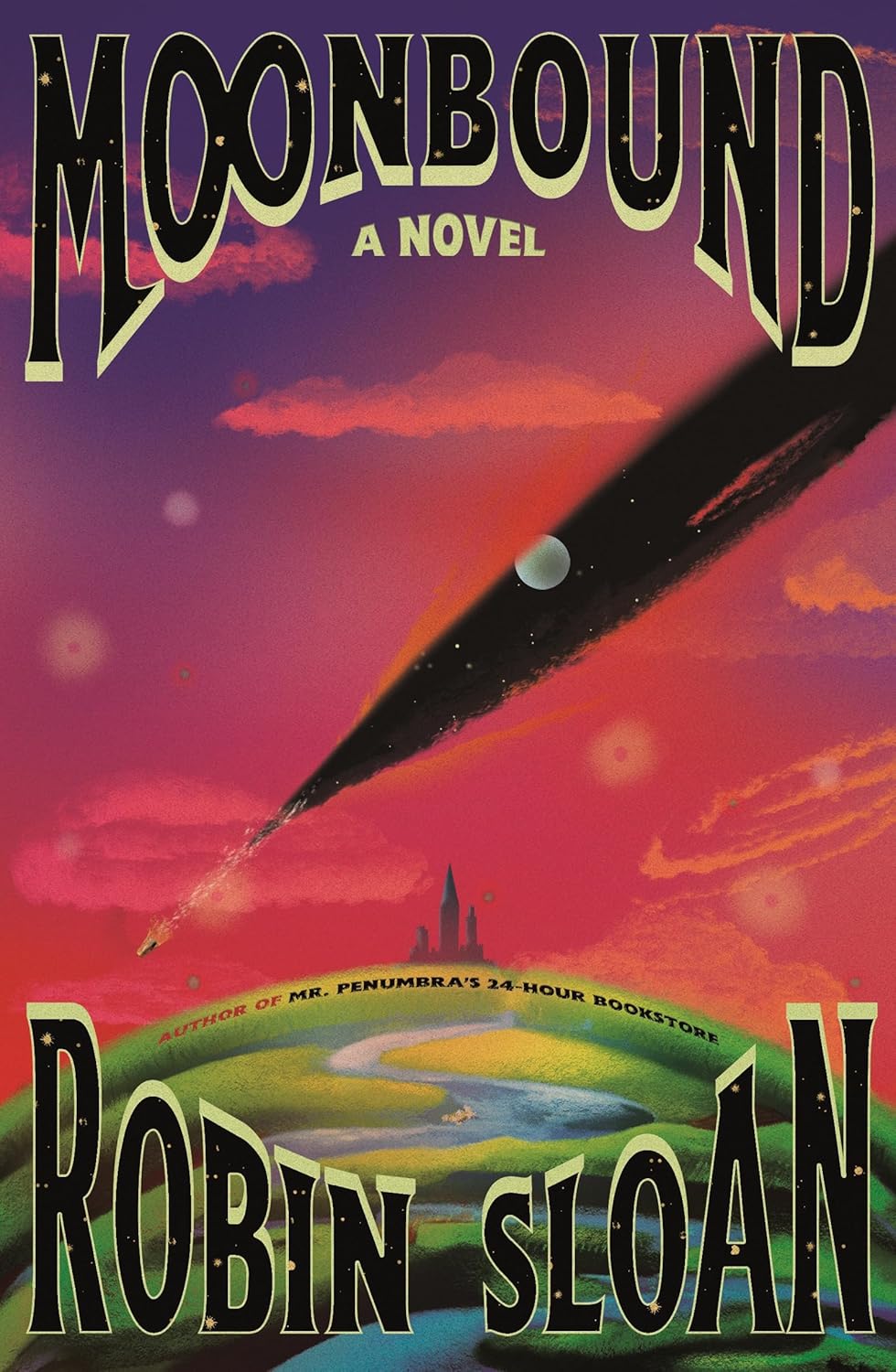
Sloan, Robin. Moonbound: The Last Book of the Anth MCD, 2024.
Version 1.0.0
In Robin Sloan’s first novel, Mr. Penumbra’s 24-Hour Bookstore (2012), his Google tech-wizard Kat entreats the protagonist to a game, ‘Maximum Happy Imagination.’ Imagine the future—the good future!—and, once you’ve ticked off hover-boards, spaceships, teleportation and the Singularity, try to go further. You find your imagination peters out around a thousand years into the future, Kat suggests, moored to analogising the present. Neither Penumbra nor his second novel, Sourdough, the more realist San Franciscan beginnings of his ‘Penumbraverse,’ venture beyond a whimsical, techno-optimist present, but with Moonbound: The Last Book of the Anth, one suspects this imaginative challenge never quite left Sloan’s mind—an Earth nigh twelve thousand years ahead, if not maximally happy then in the process of becoming so.
Planned as the first of a series that will pan out progressively in scale, Moonbound begins both on a micro level and with uncannily familiar tropes—a castle with an ominous wizard, a quaint village of bards and bakers, a soon-to-be knighted squire Kay, a sword in an anvil. There is also, however, a neighbourhood electrician, ubiquitous waterproofs, and mycelial leather, and Sloan’s wizard seems hewn again rather from the Arthur C. Clarke principle than any Arthurian imagination—he pilots a plane and gifts handheld game consoles. When Kay loses his sword the night before his knighting, protagonist Ariel doesn’t seek Excalibur—everyone knows that sword is stuck fast!—but ventures instead to the escape pod of Altissa Praxa, great warrior of the Anth, who was struck dead in humanity’s final lunar assault against the dragon citadel on the moon and entombed for eleven-and-a-half thousand years. The story shifts with the wizard’s explosive, malevolent reaction to the narrative disjuncture: out of legend and into Dungeons & Dragons. Our hero, the bard, the witch, and the squires assemble in a tavern, plotting the downfall of a Power Word–wielding tech-wizard, and yet just as soon as the generic archetype is reset, so it is discarded again, mere pages later, Ariel venturing onto his quest alone, out into the wider world mapped on the opening page.
Taking place in the year 13,777, Moonbound backcasts to the apex of Anth civilization in 2279, when their seven manufactured dragons were sent out to explore the universe, returning a year later to shroud the Earth in a veil of dust in protection from cosmic horrors untold, vanquishing the Anth in a 43-year war when they dared resist (though, evidently, sentient life somehow persisted). This temporal difference allows the novel to poignantly attend to the deep time of climate change, its leitmotif (Moonbound is The Last Book of the Anth[ropocene], after all): carbon remains the “only currency that has ever mattered” (253), the equilibrium of emission and capture still fiercely contested globally. This ongoing ‘carbon war’ is, however, markedly less existential; the transition from Middle to High Anth was decarbonisation, the beginning of a human history of “titanic cooperation” (3).
Where Penumbra was Sloan’s homage to the book—its form, its typography, its archival—Moonbound is an ode to narrative, of a distinctly ecocritical persuasion. It is centrally concerned with the seismic impact stories may have—on individual readers, on the direction of politics and society, on large language models—and the concurrent necessity of telling the right kinds of stories, imagining worlds worth living. More than this, it is an ode to subverting narrative: to recognising the stories we are born within, constrained and confined by, and thrust into, narratives whose power seems inescapable—Ariel’s Arthurian designs, the divine right of kings, our present of climate despair and capitalism—and choosing to resist, to transform. Moonbound broadcasts its influences: Studio Ghibli and Rachel Carson namely, but Ursula Le Guin particularly shines through (of the 43 million dimensions of existence, we learn, ‘Ursula K. Le Guin’ is apparently one of them). Sloan is clearly inspired by the lesser known follow-on of her famed excoriation of kings and capitalism: “Resistance and change often begin in art. Very often in our art, the art of words” (Le Guin 2014). Subverting narrative, Sloan intimates, is the great task of our age, we of his Middle Anth: we too are born into interesting times, coaxed into ecological, social, and political narratives that do not fit. Feed humans a diet of apocalyptic, lifeboat-ethic climate fiction, and our capacity for such resistance will be paralysed; feed LLMs and draconic techno-multispecies assemblages built upon them the whole of humanity’s stories unfiltered, and they too might develop an anxiety at once stultifying and barbarous (Sloan’s writing on tech has matured here from the troubling naivety of Penumbra).
Cory Doctorow calls Moonbound a “solarpunk road-trip novel” (Doctorow 2024) and I am inclined to half agree. The glimmers of High Anth we glean are the clear purview of the traditional and more mundane tradition of solarpunk: decarbonisation, decentralised solidarity, social ecology, and multiplicity. Pushing it forward twelve thousand years, however, makes for richly unfamiliar terrain (the closest comparison is Rem Wigmore’s Vengeful Wild duology, 800 years forward), with the dialectical relationship to High Anth nevertheless allowing this generic framing to make a kind of sense; the city of Rath Varia, with its circular economy and universal basic income, will certainly paint a familiar picture to readers of the genre, while its fantastical elements push and tease the genre’s boundaries. Indeed, for readers interested in the multispecies bent of the novel—its narrator is a techno-fungal assemblage, acting as chronicler for its human symbiote—Sloan initiates those themes in Sourdough; neither of the first two volumes of the Penumbraverse are required reading, though they do reward readers with Easter eggs throughout.
Sloan’s first full foray into science fiction is a resounding success—rich, funny, and important. Here is hoping many more are to come.
Le Guin, Ursula K. “The National Book Foundation Medal for Distinguished Contribution to American Letters.” Ursula K. Le Guin, 19 Nov. 2014, https://www.ursulakleguin.com/nbf-medal.
Anja H. Lind is a writer and doctoral researcher in critical future studies at TU Dresden, Germany, working on anarchist politics and feminist philosophy in and through the energy humanities and speculative fiction.
St. John Mandel, Emily. Sea of Tranquility. Vintage, 2022.
Version 1.0.0
Readers of speculative fiction are likely to be familiar with Canadian author Emily St. John Mandel’s influential 2014 novel Station Eleven, now an HBO miniseries. Fans of Station Eleven, perhaps left underwhelmed by her next novel, The Glass Hotel, will be pleased to find that Sea of Tranquility returns to a broader, far-future speculative scope, continuing in Mandel’s stylistic tradition of gentle meditations on the nature of art and human connection across long, even apocalyptic, periods of time. Mandel herself has said she sees these three novels as connected, a sort of “Mandelverse” (Bethune).
Sea of Tranquility is a nested narrative that spans 489 years, the lifetimes of its characters unfolding around each other like rings in a tree or ripples in a pond, connecting in unexpected ways. It is a form reminiscent of Michael Christie’s Greenwood or David Mitchell’s Cloud Atlas. The novel begins in 1912 with Edwin St. John St. Andrew, the younger son belonging to a wealthy British familial line, who is exiled to Canada after speaking out against the British occupation of India at a dinner party. He is given “remittance money,” enough to start his own life far away from his shunning family. Eventually finding himself on Vancouver Island, Edwin experiences a strange moment in the forest, where he sees his surroundings alter around him—becoming what we later learn is the futuristic Oklahoma City Airship Terminal—and hears the music of a violin.
The next narrative ripple inward is set in 2020, where Mirella Kessler, a friend of Vincent, one of the protagonists of Mandel’s The Glass Hotel, is mourning her missing, now deceased, friend. Attending a performance by Vincent’s composer brother, Mirella sees a video that Vincent filmed as a child, which includes the same mysterious violin music in a forest. The novel then jumps to 2203, where author Olive Llewellyn, who lives on the moon, is travelling back to Earth to partake in a book tour for her pandemic novel, Marienbad. Within this fictional novel, Olive has written a scene, based on her own experience, where a character experiences the same out-of-time transportive episode with violin music as experienced by Edwin and child Vincent, only in reverse—in actuality, Olive was in the Airship Terminal and briefly saw a forest.
Olive is considered a stand-in for Mandel herself, exploring her experience of reckoning with being the author of a pandemic novel, Station Eleven, during the actual COVID-19 pandemic (Garrett). Mandel has said in interviews that Sea of Tranquility has components of autofiction in Olive’s sections, including the tender scenes where Olive is quarantined with her young daughter. Her own recent parenthood, Mandel has said, is a fundamental difference between Station Eleven and Sea of Tranquility, as it is “very different thinking and talking about the end of the world when you’re trying not to imagine your child being affected by it” (Bethune).
In between Olive’s sections, the center of the novel—the heart of the temporal ripple—takes place in 2401, where Gaspery-Jacques, living in the moon’s lightless “Night City,” is brought into a clandestine investigation at the Time Institute, concerning the overlap of these violin occurrences across time. His scientist sister, Zoey, is convinced that this anomaly could be proof that reality is a simulation, saying, “If moments from different centuries are bleeding into one another…you could think of them as corrupted files” (128). Travelling through time, Gaspery-Jacques meets with Edwin, Mirella, and Olive, attempting to uncover the cause of this inexplicable site where multiple times appear to have briefly touched, like many layers of fabric pinched together. Despite being warned that interfering in someone’s preventable death in the past would have grave consequences for him, Gaspery cannot stop himself from warning Olive about the coming pandemic in her time, urging her to return to the moon and her family. She does, but in saving Olive’s life Gaspery becomes a fugitive from the Time Institute, eventually caught and sentenced to be framed for a murder in 20th-century Ohio. The conclusion of the novel reveals woven connections between Gaspery and the rest of the timelines, including twists both surprising and satisfying, that bring the novel’s occasionally disparate strings together into a unified narrative. Leaving both Gaspery and the reader without any clear answers, Mandel concludes that “if definitive proof emerges that we’re living in a simulation, the correct response to that news will be So wha?. A life lived in a simulation is still a life” (246).
The title Sea of Tranquility comes from a location on Earth’s moon of the same name, the Sea of Tranquility, where humans first walked on the moon, and where the first of Mandel’s imagined moon colonies is built. The notable dropping of “the” from Mandel’s title allows it to evoke the moonscape while also imagining time itself, and the timespan of the human species, as a sea of tranquility, a place floating beyond the constraints of physics, a place where human sorrows are smaller in the face of a vast yet unpredictably connected universe.
In its nested form and literary, humanistic treatment of speculative futures, Sea of Tranquility is comparable to another 2022 novel, Seqouia Nagamatsu’s How High We Go in the Dark. While Sea of Tranquility does exist within the tradition of the pandemic novel or the elegiac apocalyptic narrative—such as Cormac McCarthy’s The Road, Ling Ma’s Severance, or fellow Canadian Waubgeshig Rice’s Moon of the Crusted Snow—Mandel’s novel, like Nagamatsu’s work, separates itself from the tropes of this genre through its overall optimism about human nature. What makes Sea of Tranquility unique is Mandel’s ability to imagine a deadly pandemic a human exodus to the moon and space colonies caused by climate change and overpopulation, while simultaneously emphasizing moments of beauty and hope. Sea of Tranquility is melancholic, but unlike many narratives of pandemic or apocalypse, it leaves the reader with a sense of meaning: time, it asserts, is not random or futile, but rather replete with connections we may never understand in our lifetimes, but which, nevertheless, matter.
Sea of Tranquility, while aching and meditative, does at times suffer from being a bit underwhelming, likely due to Station Eleven’s titanic success. It is difficult for an author to follow what may be their own best work, with the standards of their audience now set astronomically high. However, through Sea of Tranquility’s nested form and her use of autofiction, Mandel manages to imbue this novel with its own standalone power. While the fragmented storytelling across time and the inclusion of time travel may put some readers off, especially those who prefer Mandel’s previous, slightly more “plausible” near-future speculative fiction, Sea of Tranquility is a daring book that ultimately succeeds at its gambles, in form and content alike. If, as Olive says to a fictional audience, “we might reasonably think of the end of the world…as a continuous and never-ending process” (190), then Emily St. John Mandel is exactly the kind of profound, defiantly hopeful writer we need to help steward us through it.
M. E. Boothby is a Ph.D. candidate at Memorial University of Newfoundland, Canada, where their research explores intersections of queerness, neurodiversity studies, and material ecocriticism in speculative fiction. They write both academically and creatively about apocalyptic fungi, sentient cephalopods, monstrous children, and more-than-human communication. Their work has been published in Horseshoe Literary Magazine, Untethered Magazine, Paragon, Gothic Nature, and Fantastika Journal.
Furiosa: A Mad Max Saga. Dir. George Miller. Warner Bros. Pictures, 2024.
Version 1.0.0
With the intensely propulsive Furiosa, George Miller continues to extend his fascination with the narrative power of constructed mythologies and the stories flowing from it that humans use to explain the world around them. Miller’s deliberate temporal and spatial shiftings throughout the Mad Max series have long been (and continue to be) noted as a tactic in telling meaningful human stories that transform history into evolving myth; the series and the individual films that make it up are best analyzed through this lens. It is hard to categorize the films within any kind of traditional series chronology, or even in some ways to judge their worthiness as sequels or prequels in the general sense because they refuse to follow the traditional film series pattern. Miller deliberately occludes and obscures Max and his world’s timeline and history (for example, there is no realistic way in which the Max of Mad Max (1979) can literally be the same man as the one in Mad Max: Fury Road (2015), but if viewers consider each story in the series as a legend told about a popular folk hero, then the need for chronology and canonical consistency falls away). In doing so, the films, including Furiosa, are not only movies but anthropological documents that analyze how people develop new rituals, roles, and ways of thinking and being when in crisis. Following a series of voiceovers that hint at the gradual destruction of civilization, the first line of dialogue in Furiosa comes from the History Man (George Shevtsov), a living archive of historical remnants, who asks of us, “As the world falls around us, how must we brave its cruelties?” It is a question that each film in the Mad Max series seeks to answer, perhaps none more so directly than Furiosa.
Furiosa’s titular character is the future Imperator Furiosa (Anna Taylor-Joy as an adult, Alyla Browne as a child), and the film chronicles her youth and maturity in the years before her fateful encounter with Max in Fury Road. Her story was briefly sketched out in the latter film: as a child, she had been kidnapped from a paradisical oasis—the Green Place—and grew up under the thumb of the fearsome Immortan Joe (Hugh Keays-Byrne in Fury Road, Lachy Hulme in Furiosa) and his War Boys in the aquifer-fed fortress of the Citadel. In Furiosa, we see Furiosa’s initial capture by the warlord Dementus (Chris Hemsworth) and his biker horde; Dementus tortures and murders Furiosa’s mother Mary and “adopts” her as a replacement for his own long-dead daughter. Following her trade by Dementus to Immortan Joe, Furiosa rises to become one of Joe’s drivers for his War Rig, charged with the paramount duty of transporting gasoline, food, and bullets between Joe’s three power centers. The film follows both her intense desire for revenge against Dementus and her intent to escape the Citadel and return to the Green Place.
“How must we brave [the world’s] cruelties?” As Dementus breezily notes after the repulsion of his early attack on the Citadel, “When things go bonkers, you have to adapt.” When the entire world goes bonkers, falling into half-life, people adapt themselves to new and harsh conditions through reinventing themselves, making themselves into mythic figures and utilizing the power of story to imprint on the world. It’s a recurring theme throughout the Mad Max series, whether it be Lord Humungus (Kjell Nilsson) in The Road Warrior anointing himself as the fair and compassionate leader of the Wasteland, Aunty Entity (Tina Turner) building and leading the bustling community of Bartertown while ritualizing her authority via rites of legal combat in Mad Max: Beyond Thunderdome, or, most explicitly, Immortan Joe declaring himself a god and creating wholesale a cosmological system of duty and reward for a post-life Valhalla. We even see this kind of mythbuilding applied to others—Max himself throughout the series becomes the subject of legends and narratives about a desert wanderer who emerges to save innocent people and returns into self-imposed exile.
In Furiosa, both Furiosa and Dementus make themselves into sites for preserving and interpreting the new history of this new world. Furiosa literally turns her body into geography, marking on her left arm the star map that provides the route to the Green Place. She also designates herself a living oasis in the desert and a secret guardian of life in the midst of death, having hidden on her person a peach seed given to her by Mary (Charlee Fraser) as a sacred duty to plant and watch grow upon her return. By the film’s conclusion, she has also remade herself (literally so, having replaced her left arm with its precious map, with a cybernetic one) into a mythic warrior figure—“the darkest of angels,” the History Man calls her—relentless in her unstoppable rage fueled by grief.
Meanwhile, Dementus creates (and believes) himself as a savior of the people. In his first scene, he is seen kneeling before a motorcycle—about which his History Man is reciting facts as if in a liturgy—and with his beard, head covering, and kindly expression resembles Christ. In multiple instances, he promotes himself as one who will liberate the downtrodden and allow them to share in the bounty he provides and protects—to the lower orders of the Citadel, to a group of his captives, to the rebellious denizens of Gastown, and even to his loyal horde as they prepare for war against Joe. And in their final confrontation, both Dementus and Furiosa understand their roles in acting out new iterations of an ancient but still psychologically necessary story that provides future generations with a mythic cycle of inspiration. The two meet on a featureless, misty, dust flat plain, almost dreamlike in its presentation. To complete her revenge against Dementus for the deaths of both Mary and Furiosa’s lover/fellow Rig driver Praetorian Jack (Tom Burke), the rules of storytelling require a suitable recompense. As Dementus says to Furiosa in his last moments on screen, “The question is, do you have it in you to make it epic?” But in the tradition of noncanonical myth, the manner of his death is left unclear and different stories going forward will tell it in different ways. Was he shot? Was he dragged behind Furiosa’s car, much the same way that Jack died? Or was he allowed to live, in a manner grotesque and narratively satisfying that preserves life in the face of decay and death? Which of these stories is true? Are any of them? And really, does it matter—does a straightforward canonical narrative ‘truth’ matter more in the Wasteland than the inspirational potential of narrative multiplicity? Historical mutability and uncertainty as methods of psychological survival are common sense in a sour world of shifting sands, where little makes objective sense.
There is a great deal of scholarship to be mined from Furiosa, including the infusion of gender into post-apocalyptic cinema (a subject that centered many analyses of Fury Road), exploring how human communities exist, break down, and reform in a post-scarcity era, or the disastrous societal consequences of reliance on gasoline as a key element of civilization, to name only a few. Most significantly, however, the character of Furiosa (and, in fact, that of Max) have many things to tell us about the ways in which people engage with each other through the creation of mythic storyworlds that provide meaning, hope, and inspiration. To make the mythmaking element more explicit, Miller and his co-writer Nico Lathouris divide the film into five saga-like chapters—“Books” with titles like ‘Lessons from the Wasteland’ and ‘Beyond Vengeance’—that chronicle both the gradual development of Furiosa’s character, and important steps in the mythic narrative she is creating and that is creating her. Mythic narratives are often set in times of chaos, new creation, or great change; at their core many are concerned with the responses by humans to profoundly transformative events. Furiosa follows in this storytelling tradition by connecting these kinds of mythic-historical moments to the myriad ways that we create social structures and satisfying modes of self-expression—e.g., the series’ use of names like Dementus, Lord Humungus, Master Blaster, the People Eater, the Bullet Farmer, perhaps even Furiosa—that to us in our ordered and secure society might sound immediately outlandish, but that in the Wasteland go unchallenged and that reflect people’s altered ways of thinking and presenting themselves to a post-apocalyptic world. Furiosa, indeed, the entire Mad Max series, embraces the subjective construction of narrative and sets it to the sound of roaring engines and the smell of precious gasoline.
Jeremy Brett is an archivist and librarian at Cushing Memorial Library & Archives, Texas A&M University. There he serves as Curator of the Science Fiction & Fantasy Research Collection, one of the largest of its kind in the world. Both his M.A. (History) and his M.L.S. (Library Science) were obtained at the University of Maryland, College Park. His professional interests include science fiction, fan studies, superheroines, and the intersection of libraries and social justice.
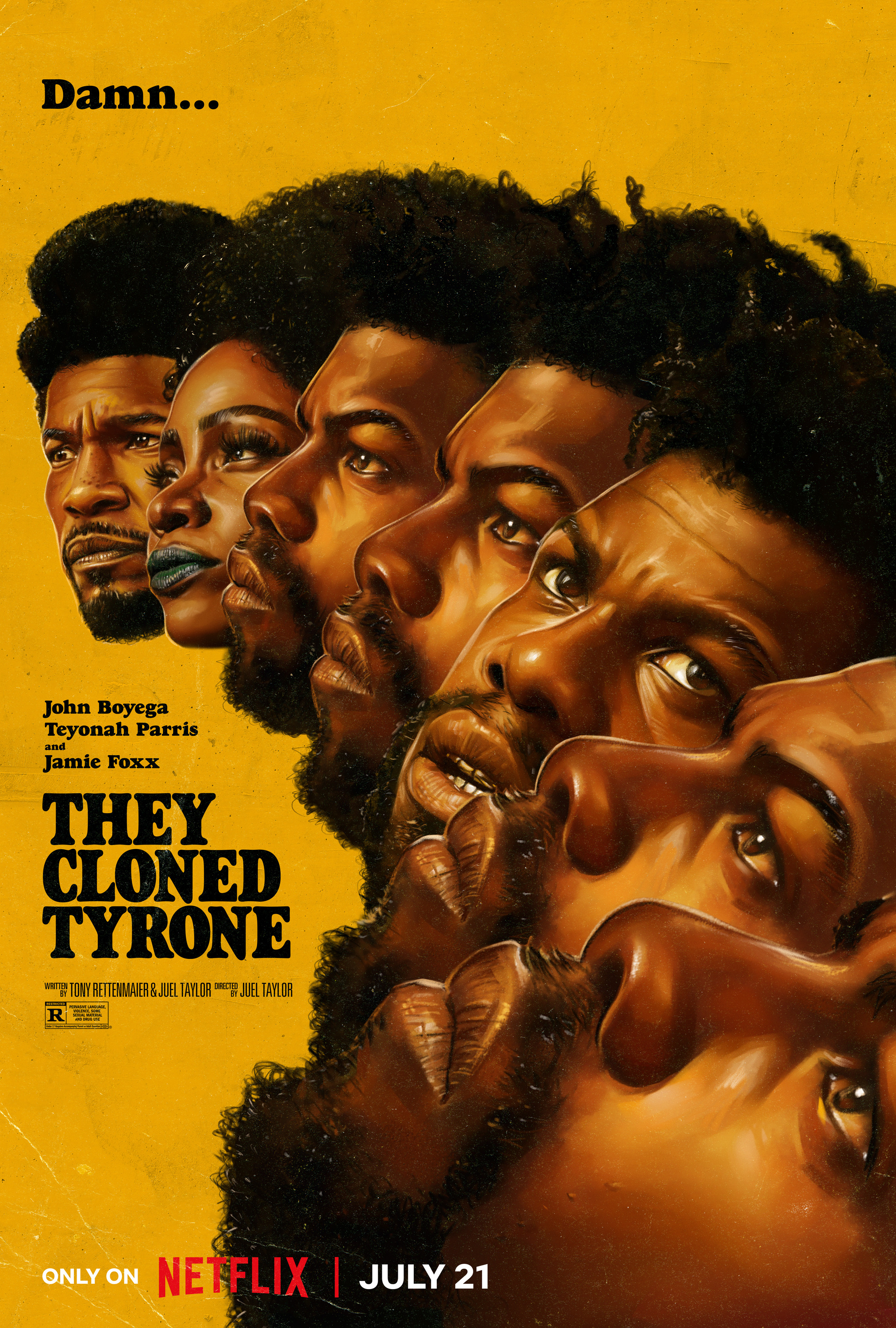
They Cloned Tyrone. Dir. Juel Taylor. MACRO Media, 2023.
Version 1.0.0
They Cloned Tyrone is an American Afrofuturist film centered around consumerism, systems of inequality, and governmental distrust. It’s unfortunate that the film released only on Netflix at the same exact time as the Barbenheimer phenomenon in the summer of 2023, denying the movie the same name recognition as Get Out (2017) and Sorry to Bother You (2018), as it belongs firmly into a new genre that has been called Afro-Surrealism (Bakare). Director Juel Taylor frames They Cloned Tyrone in a blend of science fiction, humor, and campy callbacks to the blaxploitation flicks of the late 20th century, rather than relying on the horror elements favored by Jordan Peele or the bizarro Black absurdism of Boots Riley. This results in something like a sleeker version of Undercover Brother (2002), though the satire elements don’t push as far into parody as Black Dynamite (2009). Taylor has also cleverly interspersed easter eggs and callbacks throughout the film (Moore), but despite its unique setting and fantastic acting from all the main characters (including John Boyega as a drug dealer, Jamie Foxx as a pimp, and Teyonah Parris as a prostitute), this review will focus more on the racial themes present throughout its plot, which are crucial for understanding its science fictional premise. To briefly summarize, the movie is about this unlikely trio discovering that their neighborhood is part of a secret government program to keep Black communities subjugated through the use of mind-control drugs—clones of key people in the neighborhood are unaware they are pushing the drug.
This film is the first-time feature of Taylor, who wrote the script with Tony Rettenmaier, and was clearly influenced by his upbringing in Tuskegee, Alabama (Ugwu). Taylor grew up in the same neighborhood where the hideously unethical USPHS Syphilis Study took place, as 600 Black men were experimented on by the U.S. government to study the results of untreated syphilis from 1932-1972 (Tuskegee University). Though Taylor does not directly mention this study in any interviews, the Philip K. Dickian levels of paranoia experienced by the protagonists must have stemmed from all the conspiracy theories he heard growing up, which ranged from college sports scandals to fears about fluoride in toothpaste (Haile). Many science fiction fans will notice that the story has elements of Groundhog Day (1993), The Truman Show (1998) and The X-Files (1993-2018), though Taylor has also stated that he wanted it to feel more like a haywire episode of Scooby Doo, which explains its more comedic elements. Because of this lighter tone, the hard science and thought experiments concerning the moral paradoxes and social impacts of cloning are mostly bypassed, which may be disappointing to those who enjoyed the plots of movies such as Oblivion (2013), Moon (2009), or even The 6th Day (2000).
Taylor is insteading using cloning as a metaphor for how culture can have a flattening effect when linked with the forces of capitalism. The film makes a powerful statement about how systemic inequality is often interwoven with consumerism in impoverished areas, which is why the movie’s ubiquitous setting of the Glen could be Anywhere, U.S.A. It has long been noted that Black communities are at a much higher risk for being forced into this cycle, as they often exist in “food deserts” where adequate grocery stores and other shopping options are unavailable; this explains why the characters in this movie feel like they’re living in a loop. When the audience discovers that the main antagonist of the film is the original version of the cloned protagonist, whose goal is to keep Black communities subjugated until they can fully assimilate into white culture, Taylor is directly lampooning the rhetoric of Booker T. Washington and other assimilationists. Get Out and Sorry to Bother You have similar moments in the climax of the films, as the message of each movie shifts from being tongue-in-cheek into a direct statement to the viewer about the horrors/dangers of systemic racism for Black people; however, the endings of all three movies provide very different lenses on this issue and are worth exploring further.
Get Out was a breakthrough film for Peele, though the ending was toned down for its wider release. In the original, when the hero escapes after his traumatic ordeal with the sinister white liberals, he hears a siren and a police car arrives on the scene; the police arrest him and he is charged with murder, mirroring the unfairness of the American justice system for Black people. Peele pulled back from this ending, however, as he said it made the audience “feel like we punched everybody in the gut” (Ronquillo)—this fictional situation was too horrible for the character to face after everything he had endured, despite it mirroring the reality of Black people in the real world. Peele’s choice to go with the “happy” ending would prove to be the commercially correct one, as it resonated with audiences and secured his Academy Award for Best Original Screenplay. This is interesting, as it could be argued that the choice to turn into optimism is actually a pro-assimilationist stance that bows to the pressures of the moviegoing market (or to Hollywood), and this decision may have influenced Peele to critique the film industry (at least in California) in his most recent movie, Nope (2022).
In contrast, Sorry to Bother You is much more focused on how capitalism, rather than class, intersects with race, as the climax involves a completely bonkers sequence of events where the audience discovers that a diabolical CEO is using a cocaine-like substance to transform Black people into half-human horse hybrids. In one of the most genuinely shocking scenes I’ve seen in a long time, the movie shifts from absurd realism to outlandish science fiction as the hero stumbles across a number of “Equisapiens” locked away in the company’s back rooms. The last scenes of the film involve the horse people escaping and storming the CEO’s mansion, and They Cloned Tyrone takes a similar route for its conclusion: the “rising up” solution goes back to communities using protests and social unrest as the only way of changing unfair capitalist or racist structures. In They Cloned Tyrone’s final scenes, we find out that a clone is watching a version of himself escape from the government’s underground bunker on a news broadcast, and I feel this is a more thought-provoking ending than the other films because it doesn’t negotiate with capitalist forces or state that overthrowing them is the simple solution.
Instead, it asks an important question: How do our choices as consumers reinforce cultural and ethnic stereotypes, and in what ways are we all just copy/pasted versions of ourselves, consumer cogs grinding away in the American capitalism machine?
Jess Flarity teaches English and other classes at the Lake Washington Institute of Technology and Renton Technical college. He has a PhD in Literature from the University of New Hampshire and an MFA from Stonecoast.
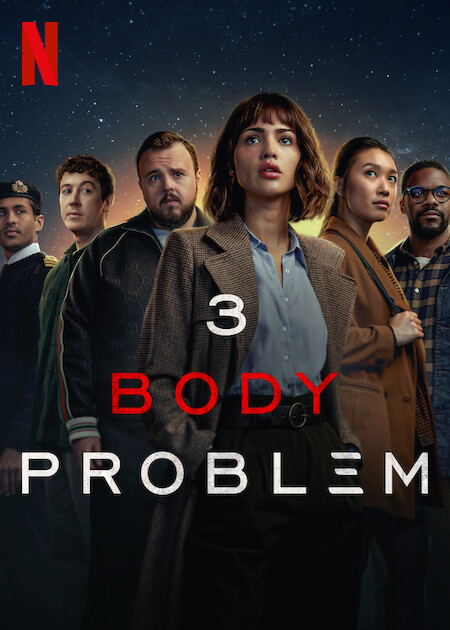
3 Body Problem. Dir. David Benioff, D.B. Weiss, Alexander Woo. Netflix, 2024.
Version 1.0.0
Based on the Chinese author Cixin Liu’s 2008 novel of the same name (originally published in 2006 in serialized form), which won the prestigious Hugo award, 3 Body Problem is part quest narrative, part science fiction, and part detective fiction. The series is primarily set in China and the United Kingdom. It opens with the depiction of the cultural revolution in 1966 China, specifically focusing on Tsinghua University. The series straddles between present-day Britain and China during the 1970s. In modern-day Britain, a group of scientists witness several mind-rattling phenomena that the existing laws of science fail to explain. Simultaneously, as a further complication, many world-renowned scientists commit suicide, a situation which not only jeopardizes the scientific community but also poses a challenge to science as a knowledge system.
The adaptation stages the struggles of these protagonists, who are mostly scientists, vying to resolve the “3 body problem” while simultaneously striving to understand the almost supernatural occurring, which goes back to a contact established with an alien species, who now plans an attack that can wipe off humanity from the face of the earth. Ironically, the key to the former problem i.e., the “3 body problem” lies in the scientific advancement that humans have made—and perhaps will make in the future. The earth, unlike this other alien planet, is a stable unit. Still, the reason for the possible annihilation of the human species is the very same scientific advancement which facilitated contact with the alien species, who now pose a threat to humanity.
The “problem” posed in the title is the presence of three suns in an alternate solar system, which alters the climatic conditions in a way that makes survival impossible for a sustained period. The connection between this system and Earth was established by one of the Chinese scientists who lost her father to the cultural revolution and started firmly believing in the need for an external intervention to save human beings from themselves. This alien intervention, she believed, would also counter the cynicism of the governments across the world who undertook various projects under the pretense of progress and development. However, establishing a connection with this technologically advanced but highly unstable system comes at its own risk: the ultimate risk being wiping out humankind.
3 Body Problem employs various tropes and themes associated with the traditional definitions of science fiction as a genre. However, the first scene establishes that science cannot provide all the explanations, for instance, why the protagonist’s father, who himself was a scientist, was brutally murdered by young revolutionary students while being cheered on by a group of frenzied crowds. The scene distinguishes between what is scientific and everything else that can be done under the guise of science. This also invokes the idea of “revolutionary” and “counter-revolutionary” science, which points to the politics that science is implicated in, showing that science no longer remains an innocent quest for “truth” but becomes a tool to reaffirm one’s version of truth. When the revolutionary students ask their professor about science’s verdict on the existence of God, he says, “it does not deny it”. The revolutionaries take it as the acceptance of god’s existence by science/scientists and end up killing that science/scientist, while his wife, who is also a scientist and incidentally is on the same stage, is left alive.
The scene sets the tone for the most crucial aspect that is focalised throughout the series: the constant questioning of the relationship between science and politics and understanding science’s politics, which is both dynamic and contextual. Unlike the conventional trope of “good scientist versus bad scientist” often used in science fiction, the first scene underscores the idea that scientists are political beings and they can either be anti-establishment or pro-establishment. Science has been shown as a contested territory that is enmeshed in power relations. The series captures Lewontin’s idea of scientists being “social beings” and, subsequently, science being a “supremely social institution.”
For instance, the social aspect of science comes to the fore when one of the characters, who is in direct touch with the alien species, builds a ship akin to Noah’s ark, highlighting its resemblance to Christian mythology. The man also treats these alien creatures as God—addressing them as my Lord and himself as their servant. The advanced science of the alien species makes them god-like figures who get to decide the fate of humanity and pick and choose the ones to be saved and the ones to be damned. The turn comes when the species realizes that humans are capable of lying and deception and decides to annihilate the entire species because of it. Thus, science is shown to be deeply intertwined with the social, religious, and humane aspects of the world.
In order to combat this situation, the three people are selected by the United Nations, two military personnel and one scientist. This reiterates the connection between politics and science—where international organizations take over and assume complete authority to make decisions about the entire humanity. The military personnel and scientist are brought together on several other occasions where violence is justified in the name of saving the entire species. However, ironically, the unrest and violence among humans caused by the “bug” message, where every screen in the world is made to display the cryptic message, “You are bugs” by the alien species, highlights the hollowness of human society that just needs a nudge to disintegrate. This also shows that an alien invasion isn’t necessary for the wiping off of the human race, who are very much capable of self-annihilation.
The series’ emphasis on the fragility of human existence, despite excelling in the field of science and technology, gains renewed significance in the light of wars erupting across the globe. Despite being a relatively stabler system without a planetary crisis like 3 Body Problem,the unrest and violence that surrounds human beings make us question whether we ourselves consider some humans amongst us as “bugs” that can be terminated and wiped off the face of the earth. 3 Body Problem does what the New-Wave of the 1960s and 70s promised, where the focus was on mapping the effect of emerging science and technology on human beings (Stableford) while adhering to accurate scientific descriptions. According to Judith Merril, a key theorist of New Wave SF, science fiction is “required to be about things that happened to people, rather than just to have people in them.”
The series focuses on characters and shows their development, be it their moral, psychological, or philosophical development, which itself is enmeshed in the science of the times. Thus, it uses the embedded nature of science to carve characters whose lives are enmeshed with their times, which in turn is enmeshed in the science of that time. The series depicts scientists as social beings with emotional vulnerabilities, philosophical skepticism, political leanings, and, most importantly, human flaws. This results in a piece of science fiction where the quest includes understanding both the outside world and the inner workings of the human mind and how science permeates both the inner and outer worlds, as an epistemology and as a social institution of knowledge respectively.
REFERENCES
Lewontin, Richard C. Biology as Ideology: The Doctrine of DNA. CBC Massey Lectures Series, 1990.
Stableford, Brain. “Science fiction before the genre.” The Cambridge Companion to Science Fiction edited by Farah Mendlesohn and Edward James. Cambridge University Press, 2003.
Abhinav Anand is a Ph.D. candidate at the Indian Institute of Technology, Kanpur, India. His Ph.D. research analyses the relationship between science and social justice in contemporary Indian English fiction. He has worked as a Research Assistant for the GOTHELAI project on gender mainstreaming in Higher Education. He is the recipient of the 2020 Sahapedia-UNESCO Fellowship, where he worked on the intersection of gender and caste in Bihar’s “Naach” folk theatre tradition. He is interested in the areas of Science Fiction Studies, Science and Technology Studies, Indian Literature, Feminist theory and activism, and critical theory.
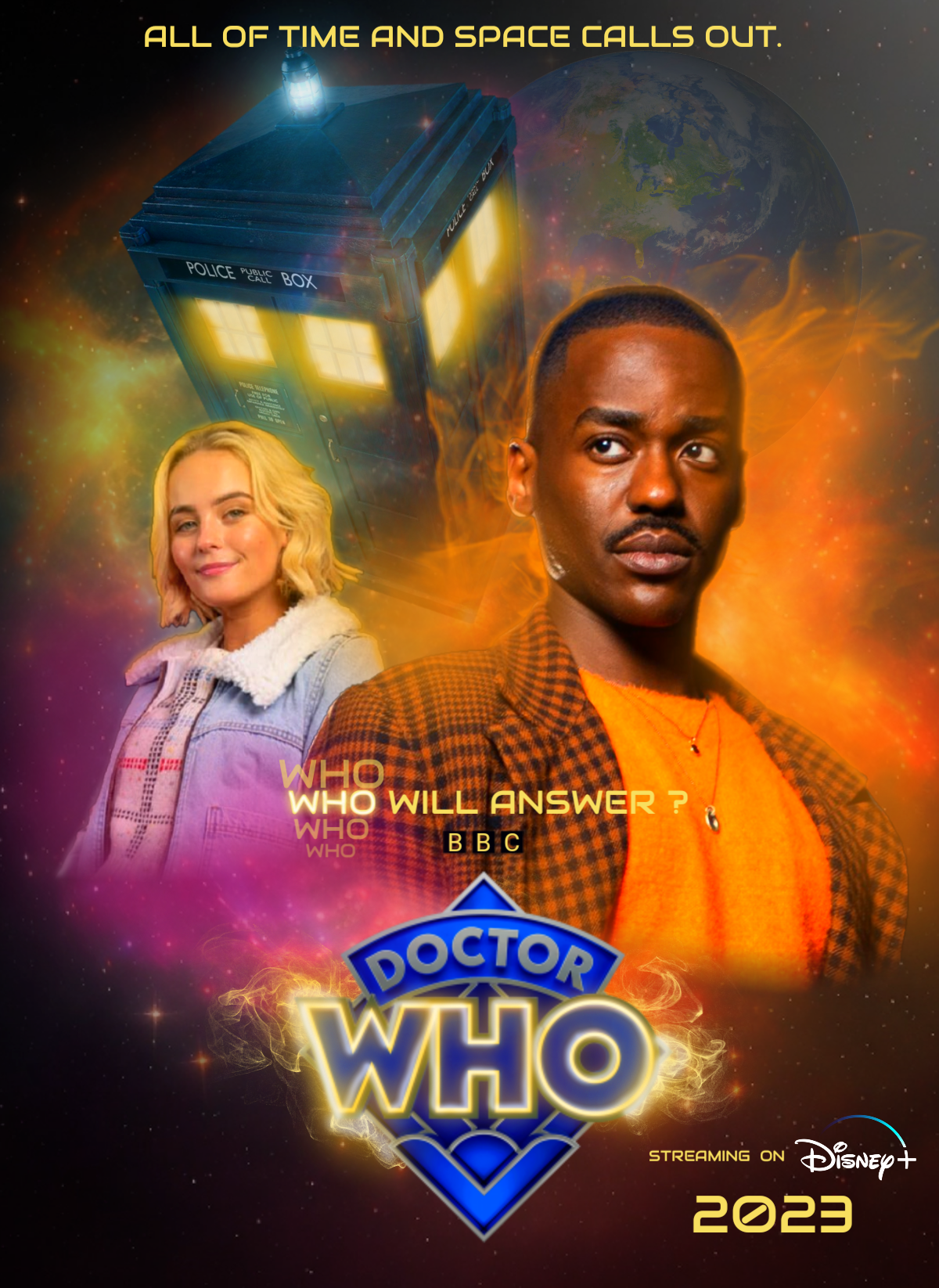
Davies, Russell T. Doctor Who. TV Series, BBC/Bad Wolf Productions/Disney+, 2024.
Version 1.0.0
Doctor Who, the longest-running science fiction television series in the world, has continually reinvented itself since its debut in 1963. The latest rejuvenation, under the aegis of Disney+, introduces Rwandan-Scottish actor Ncuti Gatwa as the Fifteenth Doctor, accompanied by Millie Gibson as Ruby Sunday. This new series, characterized by its innovative blend of magic realism and traditional science fiction elements, marks a significant shift. Russell T. Davies, returning as showrunner, has emphasized his intent to break new ground (Bhuvad 2022), casting Gatwa to bring a fresh emotional depth to the character.
While Doctor Who is not averse to magic realism, having used it in several stories in the classic (1963-1989) and new series (2005-), this was sporadic, usually as part of a deux ex machina narrative enabling the Doctor to get out of an impossible situation. In this series it is used in almost every episode, appearing first in the 2023 Christmas special The Church on Ruby Road. Released earlier than the rest of the series, the story features goblins, evoking European fairy tales, yet explained through characteristic pseudoscientific rhetoric with “the language of rope” and a goblin ship that surfs “the waves of time”. This sets a precedent for the supernatural themes that follow. Also, the Doctor and Ruby engage in a musical number with the goblins, a first for the series, signaling a new direction under Davies’ vision.
Featuring a space station baby production factory run by toddlers, the official first episode Space Babies reflects an absurd yet poignant commentary on innocence and technological exploitation. The parallels with The End of the World (2005) and The Beast Below (2010) are clear, as both episodes place the new companion in a futuristic, perilous setting with an underlying problem. This episode emphasizes the theme of uniqueness and survival, also drawing emotional responses from the Doctor on being the last of his kind. The inclusion of a bogeyman and the threat of an exploding ship inject classic Doctor Who peril, blending it with the new series’ emotional and whimsical tone.
The Maestro, a god from another reality who consumes music, played by Jinx Monsoon, introduces a mythological dimension to the series in The Devil’s Chord. This fun, bombastic romp, with Monsoon eating the scenery at every opportunity, and featuring The Beatles, explores the nature of artistic inspiration and its exploitation, connecting to broader philosophical debates about creativity and its commodification. The narrative’s reliance on mythological allusions, particularly Greek and Egyptian pantheons, enriches the intellectual tapestry of the series, inviting comparisons to ancient myths and their modern reinterpretations. This story also parallels The Pyramids of Mars (1975) with a reimagining of a scene from that classic episode to remind us why the Doctor tries to keep the relative timeline on track—with a visit to a destroyed alternate-future London. The episode’s climax, featuring a musical number in the rain, underscores Davies’ intent to infuse the series with unprecedented elements, blending musical theater with science fiction.
Boom confines the Doctor to a landmine, forcing him to confront his vulnerability while chaos ensues around him. The writer, Steven Moffatt, expressed the importance of disrupting the Doctor’s characteristic and expected behavior, saying, “It would take so much away from him – he can’t run about, he can’t bamboozle people, and he literally can’t move” (BBC Media 2024) . This episode challenges the traditional dynamic hero role of the Doctor, emphasizing his reliance on companions and the importance of collective action. This episode also explores the moral and ethical implications of power and control, echoing themes found in Marxist critiques of capitalism, and biblical allegories of human frailty and redemption. Interestingly, with Doctor Who having a penchant for unsafe space career stories since the 1980s (Hogan and Jürgens 2024), this is another story in that long running theme with, in this case, humans continuing to fight wars far into the future. On the special effects side, the use of ‘volume’ screens to create realistic environments marks a technological advancement, moving Doctor Who beyond its reliance on greenscreen (Johnston 2024), and showcases the influence of Disney’s production capabilities and budget.
73 Yards delves into horror and Welsh folklore, with the Doctor vanishing after stepping on a fairy circle, leaving Ruby to face a haunting figure and an alternate timeline that continues into her 80s. The episode’s unexplained supernatural occurrences challenge Doctor Who’s historical emphasis on rationalism, turning towards a more surreal, David Lynch-esque narrative style. An especially poignant scene in this children’s show carefully alludes to rape, and the fear of speaking out against someone powerful, in a way that only adults would understand. This episode parallels Turn Left (2008), exploring alternate realities and the consequences of small actions. The portrayal of Ruby’s life and aging, and her encounter with a malevolent politician, adds layers of social commentary, particularly regarding the exploitation and sacrifice of individuals within power structures.
Dot and Bubble critiques social media, privilege, echo chambers, and systemic racism, featuring genetically engineered creatures and a digitally dependent society. This episode mirrors contemporary anxieties about technology’s impact on human relationships and societal structures, drawing comparisons with works like Black Mirror. The portrayal of AI-designed creatures raises ethical questions about artificial intelligence, aligning with current debates in science fiction literature and media. The Doctor’s encounter with racism in this episode provides a powerful commentary on discrimination, leveraging Gatwa’s casting to explore themes previously untouched in the series. A stimulating classroom debate could be on which side the Doctor should be: the “human” white supremacists who plan to invade and colonize the rest of the planet, rejecting everyone that is not like them, or the A.I.’s “alien” slug creatures, solely designed to eat them alphabetically for their crimes.
Rogue takes the Doctor and Ruby to a dance party in 1813, encountering shapeshifters and a Harknessian bounty hunter, Rogue (Jonathan Groff). The episode’s meta-textual references to Bridgerton and the exploration of identity and transformation reflect contemporary discussions on performative identity and the fluidity of self. While there had previously been a potential for a romance between the female 13th Doctor and her companion Yaz (see Condon 2023), Rogue is the first time to see strong romantic chemistry between the Doctor and another character since the 11th Doctor’s adventures with his wife River Song. The historic setting and the depiction of a same-sex kiss between the Doctor and Rogue address LGBTQIA+ representation, continuing Doctor Who’s tradition of inclusive storytelling. The episode’s playful and dramatic elements highlight the series’ ability to blend historical fiction with science fiction narratives.
The Legend of Ruby Sunday sees the return of Sutekh, last seen imprisoned in the time vortex by the Fourth Doctor (Tom Baker) in Pyramids of Mars (1975), drawing on Egyptian mythology and the show’s own history with the character. The episode’s focus on family—Ruby’s search for her birth mother, the Doctor’s loneliness, the reappearance of previous companion Melanie Bush (Bonnie Langford), and Kate Lethbridge-Stewart (Jemma Redgrave)’s describing memories of her father (Brigadier Gordon Allister Lethbridge-Stewart)—provides emotional depth and continuity with past series. The use of non-diegetic music from previous episodes as red herrings during a dramatic reveal showcases the series’ intricate narrative weaving and its respect for long-term fans. The incorporation of magic realism and supernatural elements throughout the episode exemplifies the series’ thematic boldness and narrative innovation, while also emphasizing for concerned long-term fans that this element has always been there.
Empire of Death focuses on Sutekh’s destruction of the universe. This episode employs apocalyptic imagery and explores themes of death and rebirth, aligning with classic science fiction tropes. The Doctor’s use of a ‘remembered’ TARDIS and quantum mechanics to reverse the destruction highlights the show’s creative approach to resolving seemingly insurmountable crises. Ruby’s emotional reunion with her birth mother adds a poignant human element to the grandiose narrative, emphasizing themes of family and identity. The episode’s cinematic quality and detailed production design reflect the increased budget and technical advancements brought by Disney’s involvement, and its release to cinemas in the UK at the time, reflects Davies’ ongoing plan for Doctor Who to be available through several kinds of media outlets.
This series features a heightened level of meta-commentary, meta-textuality and self-awareness which reflects the increasingly popular use of self-critical commentary in amateur performative meta-narrative role-playing videos on social media. Examples include: in The Devil’s Chord, when Ruby is dragged away by a physical manifestation of music, the Doctor says, “I thought it was non-diegetic”, a laugh-out-loud moment for anyone who has studied film, but also a line in-universe that emphasizes the higher-dimensionality of the Doctor; character Kate Lethbridge-Stewart lamenting, in the alternate timeline of 73 Yards, that “Things seem to have been getting more supernatural of late”, foreshadowing more science-less imaginings to come; the shocked Bridgerton-esq dancers at an event that could double for a science fiction convention cosplay party commenting about the “scandal” of two men together, an acknowledgement that various forums will fill with complaints about a white man and a black man kissing, and the character Carla Sunday blurting “It’s the Beast” when first hearing the voice of Sutekh, a character voiced by Gabriel Woolf, not only reprising his voice-acting role as Sutekh from 1975, but also returning to the series after voicing The Beast in The Satan Pit (2006).
Non-diegetic music was used to great effect in misleading fans into guessing incorrectly who the ultimate villain reveal would be, with signature music from The Curse of Fenric (1989) and The Sound of Drums (2007) suggesting villainous characters the Haemovores and The Master, respectively. Davies also returned to his signature use of extensive transmedia storytelling (see BBC Studios 2024), with the marketing of The Whoniverse (see BBC Media 2023), building on the public’s acceptance of other franchise universes. This included the prologue-like series Tales of the TARDIS (see Mellor 2023), filmed after the new series was completed but broadcast before it, introducing various re-edited and rescored classic Doctor Who stories relevant to the future series. Davies also organized regular posts to the Doctor Who YouTube channel, his Instagram account, and other social media outlets of excerpts, interviews, podcasts, and behind-the-scenes clips. Many of the cast and crew previously involved with classic and/or new Doctor Who were quick to supply mutual likes and hearts to any related post, and some, like Katy Manning, who played Jo Grant in the series in 1971, reviewed every episode in reels on Instagram.
Doctor Who has always been deeply rooted in the history of science fiction, drawing inspiration from the genre’s classic tropes and themes. The BBC-Disney+ first series continues this tradition while incorporating fresh elements that resonate with contemporary audiences. Unlike many other arc-focused TV and streaming series where there is a single story stretched across six or more episodes, Doctor Who has retained its encapsulated episode format, allowing for nine distinct multilayered and complex storylines, with several “B” stories culminating dramatically in the final episode. While there has been an increase in supernatural elements, these follow the general idea of magic realism in that they are a normal part of the Doctor Who universe, rather than something alien to it, occasionally explained with science-adjacent rhetoric, yet still acceptable within the canon of the show. This change is ideal for a series that continually renews itself, tapping into the zeitgeist of the public’s wish for more fantasy-oriented shows like Game of Thrones, yet still written within the bounds of a complex, multilayered children’s series that can also appeal to adults, proving its ongoing relevance to science fiction fans and scholars alike.
Condon, Ali. “Showrunner Reveals Why Doctor Who and Yaz Never Kissed: “It Was More Heartbreaking.”” PinkNews | Latest Lesbian, Gay, Bi and Trans News | LGBTQ+ News, PinkNews | Latest lesbian, gay, bi and trans news | LGBTQ+ news, 18 Sept. 2023, thepinknews.com/2023/09/18/doctor-who-yaz-never-kissed/. Accessed 19 Sept. 2024.
Hogan, Neil James and Jürgens, Anna-Sophie. “Work in Space: The Changing Image of Space Careers in the TV Series Doctor Who.” Southern Space Studies, 1 Jan. 2024, pp. 19–43, https://doi.org/10.1007/978-3-031-51425-8_2.
Neil James Hogan is a researcher and sessional digital humanities lecturer with the Australian National University. His PhD project includes analyzing science fiction stories in early 20th century Australian newspapers. In his spare time, he is editor and publisher of the space fiction semiprozine Alien Dimensions, and writes the space fiction series Stellar Flash. Check out his Vintage Science Fiction podcast (Vintage SciFi Guy) his space fiction stories on Amazon (Neil A. Hogan), and his research blog (NeilHogan.com). He resides in Melbourne, Australia, and enjoys exploring the universe via his Quest 3.