Review of Monstrous Women in Comics


Review of Monstrous Women in Comics

Brianna Anderson

Samantha Langsdale and Elizabeth Rae Coody, eds. Monstrous Women in Comics. University Press of Mississippi, 2020. Horror and Monstrosity Studies Series. Paperback. 296 pg. $20.99. ISBN 9781496827630.

Monsters have played a pivotal role in comics across genres and throughout time, with strange, boundary-crossing creatures and people populating the panels of pulp, superhero, and even romance comics. Creators frequently code these monsters as female, provoking important questions about the intersections of ability, femininity, maternity, race, and sexuality with representations of monstrosity and the Other in comics. In Monstrous Women in Comics, editors Samantha Langsdale and Elizabeth Rae Coody assemble fifteen essays that take up these pressing topics, focusing particularly on the ways that depictions of female monsters in comics contribute to the dehumanization, marginalization, or empowerment of women. As Langsdale and Coody note in their introduction, the chapters “explore not only the ways monstrous women evoke damaging cultural norms in patriarchal contexts, but also how constructions of woman as monster contain within them the potential to destroy the systems of thought that are productive of such norms” (5). The collection covers an impressive array of transnational comics, with analyses of popular Western characters like Batgirl and Harley Quinnappearing alongside readings of Bolivian, Chinese, and Japanese graphic narratives. Despite this expansive scope, each chapter follows a similar structure, beginning with a rigorous text-critical analysis of a comic or a selection of comics “in order to ask how the monster makes meaning within the text(s) and what it means for the monster to be coded as a woman” (5). Building on these close readings, the chapters interrogate how monstrous women connect to broader social and cultural anxieties and discourses surrounding gender and sexuality. Prominent feminist and monster studies scholars like Barbara Creed, Jeffrey Jerome Cohen, Julia Kristeva, and Margrit Shildrick serve as common touchstones for many of the analyses, and the richly interdisciplinary collection also draws on critical race studies, disability studies, queer studies, and other disciplines. Langsdale and Coody organize the essays thematically into five sections that explore different facets of female monstrosity: power, embodiment, childbearing, childhood, and performance.

Part One, “The Origins, Agency, and Paradoxes of Monstrous Women,” posits that female monsters evoke fear and unease in (often male) comics audiences due to their paradoxical nature. Langsdale and Coody note the characters examined in this section “actively choose monstrosity and exhibit agency that rejects normative femininity” and “are neither wholly empowered nor entirely disenfranchised” (6). Coody’s contribution, “Rewriting to Control: How the Origins of Harley Quinn, Wonder Woman, and Mary Magdalene Matter to Women’s Perceived Power,” contends that the “multivocal”—or repeatedly rewritten—origin stories of Harley Quinn and Wonder Woman reveal shifting cultural and patriarchal discomforts surrounding empowered, boundary-crossing women. Coody extends her analysis to the biblical figure Mary Magdalene, demonstrating the trans-disciplinary possibilities of her approach.  In “Exploring the Monstrous Feminist Frame: Marvel’s She-Hulk as Male-Centric Postfeminist Discourse,” J. Richard Stevens similarly addresses monstrous women in superhero comics, surveying representations of female empowerment and feminist discourses in over 800 appearances of She-Hulk in comics published between the 1980s and 2015. While comics fans and scholars have frequently lauded She-Hulk as a “feminist ideal,” Stevens reveals that the character engages only superficially with other female characters and second-wave and third-wave feminism, a fact that the author attributes to her mostly male creators and readers (31). As a result, Stevens concludes that She-Hulk “articulates the paradoxes and challenges of female agency in a hypermasculine public sphere,” namely the superhero comics industry (31). Finally, in “‘There is More to Me Than Just Hunger: Female Monsters and Liminal Spaces in Monstress and Pretty Deadly,” Ayanni C. H. Cooper analyzes the connections between abjection, beauty, and violence in the two titular comics. She argues that the monstrous heroines challenge conventional ideas of “acceptable femininity” through their liminal positionality and paradoxically gain empowerment through abjection. Together, these chapters highlight the complexities of monstrous femininity and demonstrate how audience expectations, artwork, and larger cultural movements shape representations of monstrous women.  

The chapters included in Part Two, “The Body as Monstrous,” focus on the intersections of disability, embodiment, and sexuality with female monstrosity. Stefanie Snider’s chapter “The (Un)Remarkable Fatness of Valiant’s Faith” examines the radical potential and limitations of heroine Faith Herbert/Zephyr’s fatness. Media outlets promoted Faith as the first fat superhero, yet her fatness largely goes uncommented on in the first sixteen issues of the 2016 series. Snider contends that Faith’s fatness somewhat challenges stereotypical representations of superheroines as able-bodied, conventionally attractive, and feminine, but the comic’s failure to explicitly address her visible fatness “can induce a normalization that makes invisible the power of representation and resistance that comes from her body size and shape” (80). The chapter encourages readers to envision the transformative potential of comics that would celebrate fat bodies instead of normalizing or stigmatizing them. Next, in one of the book’s most compelling chapters, “New and Improved? Disability and Monstrosity in Gail Simone’s Batgirl,” Charlotte Johanna Fabricius explores representations of able-bodiedness and disability in the first six issues of Gail Simone’s controversial New 52 Batgirl run, which cured Barbara Gordon/Oracle’s paralysis. Fabricius contends that the comic perpetuates harmful narratives about disability by portraying the villains as disabled monsters who Barbara must defeat. Moreover, Barbara’s victories over these villains parallel her own road to recovery as she transforms from a paralyzed woman to the able-bodied Batgirl. As a result, Fabricius argues that the comic’s “promise of monstrosity as disruptive remains unfulfilled, and the coding of disability as monstrous and other remains uncontested” (95). Finally, in “Horrible Victorians: Interrogating Power, Sex, and Gender in InSEXts,” Keri Crist-Wagner draws on queer theory, quantitative frequency, and visual rhetoric to analyze the relationship between gender, power, queerness, and violence in Marguerite Bennett’s horror comic InSEXts. The series centers on two queer Victorian women who transform into monstrous insects and enact violent vengeance on men who harm women. Crist-Wagner creates two tools, a “Diamond of Violence” and a “Scale of Escalating Romance,” to evaluate how the women’s “twofold monstrousness”—their physical insect transformations and their queerness—“allows them to cause material impact and damage to the patriarchy and to change their world and circumstances, almost completely without punishment” (110-111). By closely analyzing monstrous female bodies through several disciplinary lenses, these chapters highlight how monstrosity can unsettle power structures, while also demonstrating how these narratives can reinforce harmful stereotypes about aberrant bodies.

Part Three, “Childbearing as Monstrous,” explores the abject horrors of maternity and pregnancy. In “Kicking Ass in Flip-Flops: Inappropriate/d Generations and Monstrous Pregnancy in Comics Narratives,” Jeannie Ludlow explores how comics about abortion, childbearing, and motherhood can challenge or reinscribe binary notions of birth and pregnancy. For instance, she criticizes Leah Hayes’s Not Funny Ha-Ha: A Handbook for Something Hard for depicting abortion as always traumatic and shameful, perpetuating the stigmatization of abortion and ignoring the positive experiences of many real women. By contrast, A. K. Summers’ graphic novel Pregnant Butch: Nine Long Months Spent in Drag disrupts notions of normalcy and appropriateness by depicting pregnant queer bodies. By analyzing several texts from different genres, Ludlow demonstrates how comics can use grotesque and monstrous representations to promote more nuanced views of reproductive choices. Next, Marcela Murillo’s chapter “The Monstrous Portrayal of the Maternal Bolivian Chola in Contemporary Comics” analyzes representations of chola mothers in three Bolivian comics: Corven Icenail and Rafaela Rada’s La Estrella y el Zorro, Álvaro Ruilova’s Noche de mercado, and Rafaela Rada’s Nina cholita Andina. Murillo provides a detailed historical overview of political and structural discrimination suffered by cholas, indigenous Aymara or Quechua women who have historically occupied a marginalized position in Bolivia. Though Bolivia has recently adopted pro-indigenous policy changes, the three analyzed comics negatively portray chola mothers as monstrous and subaltern. Moreover, Murillo reveals how the comics use similar visual and narrative strategies to juxtapose the monstrosity of the cholas with the European femininity of their offspring, revealing larger anxieties surrounding gender and indigeneity in Bolivia. In the section’s final chapter, “The Monstrous ‘Mother’ in Moto Hagio’s Marginal: The Posthuman, the Human, and the Bioengineered Uterus,” Tomoko Kuribayashi discusses representations of posthuman femininity in Moto Hagio’s science fiction manga Marginal. The manga’s biologically engineered heroine, Kira, and her relationships with her male lovers invite readers to consider “whether the posthuman future will bring with it a radical reorganization or even total erasure of sexual differences and of gender roles and dynamics” (155). Despite this radical proposition, Kuribayashi concludes that the manga ends on a less empowering note by depicting Kira as reliant on her male partners, suggesting that men will continue to control and exploit posthuman women and their fertility. This section effectively illustrates both the transformative potential and limits of monstrous maternity, which can expand or trouble binary notions of childbirth and pregnancy.

Part Four, “Monsters of Childhood,” centers on comics that feature female monsters who reject conventional associations of women as devoted caretakers of children. In the fascinating chapter “SeDUCKtress! Magica De Spell, Scrooge McDuck, and the Avuncular Anthropomorphism of Carl Barks’s Midcentury Disney Comics,” Daniel F. Yezbick contends that the shapeshifting, villainous duck Magica De Spell threatens both the privileged protagonist Scrooge and, by extension, the larger patriarchal structures of Barks’s comic universe. Examining Magica’s abject monstrosity, hyper sexualization, possible queerness, and transgressive behavior, Yezbick argues that the character demonstrates Barks’s ambiguous attitudes toward women and, by extension, the larger Disney empire that owns his creations. In “On the Edge of 1990s Japan: Kyoko Okazaki and the Horror of Adolescence,” Novia Shih-Shan Chen and Sho Ogawa analyze representations of adolescent anxieties, female sexuality, and monstrosity in three of Kyoko Okazaki’s manga: Pink, River’s Edge, and Helter Skelter. Though Okazaki’s representations of monstrous women potentially “reinforce the nexus between monstrosity and women’s sexuality,” her characters also productively “allow us to interrogate the capitalist construction of femininity and reproduction in 1990s Japan” (205). Lastly, in “Chinese Snake Resurfaces in Comics: Considering the Case Study of Calabash Brothers,” Jing Zhang traces the historical development of the transgressive figure of the snake woman in Chinese culture and then provides a close reading of Snake Woman, the monstrous antagonist who terrorizes the child protagonists of Shanghai Animation Film Studio’s animation and comic series Calabash Brothers. Zhang links Snake Woman to larger traditions in Buddhism, Confucianism, and Taoism and insists that the character “is not a simple force of monstrous evil; she is a complex character with roots in traditional Chinese folklore and medicine, and a more sympathetic interpretation is possible” (218).

Finally, Part Five, “Taking on the Role of the Monster,” explores how women can embrace their monstrosity to resist patriarchal social norms. In “Monochromatic Teats, Teeth, and Tentacles: Monstrous Visual Rhetoric in Stephen L. Stern and Christopher Steininger’s Beowulf: The Graphic Novel,” Justin Wigard draws on adaptation, monster theory, and visual rhetoric to examine shifting visual representations of Grendel’s mother in Beowulf retellings. Closely analyzing Stern and Steininger’s phallic depiction of the woman’s body, Wigard argues that the comic reveals enduring heteronormative anxieties about empowered women, concluding, “Ultimately, the text suggests that even with one thousand years of progress, insidious patriarchal fears about female sexuality, power, and agency still pervade the human consciousness as modern adaptors perpetuate a cycle of monstrous (visual) rhetoric” (224). In “Beauty and Her B(r)east(s): Monstrosity and College Women in The Jaguar,” Pauline J. Reynolds and Sara Durazo-Demoss contend that The Jaguar’s animal-like monstrosity reinforces the marginalization that the Latina superheroine experiences as an international college student in troubling ways. Finally, in “UFO (Unusual Female Other) Sightings in Saucer Country/State: Metaphors of Identity and Presidential Politics,” Christina M. Knopf reveals how Mexican American heroine Arcadia Alvarado resists the monstrous othering that occurs in both American politics and the science fiction genre. This concluding section provides nuanced readings of the complexities of female monstrosity, which can serve as both a source of resistance and oppression.

Together, the fifteen chapters provide an expansive exploration of representations of monstrous women in graphic narratives from a diverse range of cultures and genres. Comics, feminist, and monster studies scholars alike will find valuable insights in the volume, and the collection serves as a strong model of effective interdisciplinary, transnational scholarship.


Brianna Anderson is a PhD candidate in the Department of English at the University of Florida. She is currently writing a dissertation that examines representations of environmental issues and youth environmental activism in children’s and young adult comics and zines. Her research has appeared in Studies in Comics and The Lion and the Unicorn and is forthcoming in The Comics Grid.

Review of Fighting for the Future: Essays on Star Trek Discovery


Review of Fighting for the Future: Essays on Star Trek Discovery

Vincent M. Gaine

Sabrina Mittermeier and Mareike Spychala, eds. Fighting for the Future: Essays on Star Trek Discovery. Liverpool UP, 2020. Hardback. 352 pg. $130.00. ISBN ‎9781789621761.

Star Trek is one of the world’s longest running science fiction franchises, yet it has attracted relatively little academic attention considering its longevity and transmedia presence. Fighting for the Future: Essays on Star Trek Discovery is the first critical study of Star Trek: Discovery, the franchise’s first small screen output in over a decade. The essays in this volume cover the show’s first two seasons, across four themed sections that offer studies on the role of Discovery within the Star Trek franchise, different forms of storytelling both in canon and fanon, the negotiation of otherness, and queer readings of the show. It is especially useful that this collection considers Discovery within the larger franchise as well as a specifically post-network Star Trek. Valuable points are made on this topic by Michael G. Robinson, who identifies key aspects of Discovery in relation to its contemporaries in sci-fi television. Robinson’s essay, “These are the Voyages?: The Post-Jubilee Trek Legacy on the Discovery, the Orville, and the Callister,” performs an in-depth industrial analysis of Discovery’s production, distribution, and consumption, and makes an effective comparison between Discovery, The Orville (2017-) and the Black Mirror episode “Callister” (2017) in terms of which is most “Trek,” identifying their various complexities.

Other highlights in the collection include Will Tattersdill’s “Discovery and the Form of Victorian Periodicals,” which compares Discovery’s serialized structure with that of Victorian periodicals, featuring strong references to wider generic and narrative tendencies as well as consumer understanding. Another insightful discussion of consumer engagement comes from editors Sabrina Mittermeier and Mareike Spychala, who in “Never Hide Who You Are: Queer Representation and Activism in Star Trek: Discovery,” analyze queer representation and advocacy. Their succinct yet detailed argument of queer representation across Star Trek contributes to multiple debates by taking account of the tensions between representation, the overall tenets of Star Trek and the commercial demands of television, as well as the interplay between product and fandom, including the voices of actor activists (“actorvists”).

Several essays in the collection critique the ostensibly liberal humanist politics of Star Trek, illuminating entrenched attitudes and beliefs both in the franchise and American popular culture more widely. In “‘Into A Mirror Darkly’: Border Crossing and Imperial(ist) Feminism in Star Trek: Discovery,” Judith Rauscher gives an astute analysis of how Star Trek deploys and reinforces stereotyping and imperialism, with particular attention to the seduction of feminism by imperialist fantasy. Torsten Kathke gives a similarly insightful discussion of liberalism and its problems throughout Star Trek in “A Star Trek About Being Star Trek: History, Liberalism and Discovery’s Cold War Roots.” One of the strongest chapters in the collection is Henrik Schillinger and Arne Sonnichsen’s “The American Hello: Representations of U. S. Diplomacy in Star Trek: Discovery.” Their discussion of how Discovery confronts and complicates diplomacy in Star Trek is contextualized with a history of US diplomacy, especially in the 21st century. This complex analysis of contradictory elements leads to a critical and nuanced discussion of how Discovery utilizes notions of diplomacy to explore the values and ethics of the Federation, and by extension, the United States.

While much of the collection is strong, there are some shortcomings. Multiple typos throughout the book suggest rushed copy-editing, and the multiple riffs on “boldly going where no [INSERT NOUN] has gone before” get a bit tiresome. More specifically, several of the essays offer superficial and unconvincing arguments. Sarah Bohlau’s chapter, “‘Lorca, I’m Really Gonna Miss Killing You’: The Fictional Space Created by Time Loop Narratives,” offers some interesting links to PTSD within the context of Discovery’s time loop episode but is overall rather descriptive. Lisa Meinecke discusses Discovery’s device of a spore drive as a metaphor for connections and posthuman identity in “Veins and Muscles of the Universe: Posthumanism and Connectivity in Star Trek: Discovery,” and while Meinecke synthesizes an impressive array of theories, the chapter largely describes the show’s narrative and misses the opportunity for an in-depth analysis of posthumanism. Another missed opportunity is “To Boldly Discuss: Socio-Political Discourses in Star Trek: Discovery Fanfiction” by Kerstin-Anja Munderlein. Munderlein argues that the reflection of Star Trek’s socio-political content in fan fiction is inextricable from the show, but the analysis is excessively quantitative and appraising rather than critical. Perhaps most troubling is “The Conscience of the King Or: Is There in Truth No Sex and Violence?” in which John Andreas Fuchs performs a rather superficial analysis of sex and violence in Discovery and other Star Trek instalments. Various inconsistencies in Fuchs’ chapter suggest inadequate care, a problem further compounded by a lack of nuance and context as well as a condescending tone.

Due to the limited content of Star Trek: Discovery, there is some overlap in terms of what the authors discuss. The Mirror Universe comes up more than once, as Andrea Whitacre’s “Looking in the Mirror: The Negotiation of Franchise Identity in Star Trek: Discovery” analyzes Discovery’s reworking / reiterating of Star Trek’s tension between inclusion and exclusion. Whitacre delivers particular insight into how the Mirror Universe works as a place to work out alternatives to and problems with the ethos normally presented in Star Trek. In a similar vein, Ina Batzke’s chapter “From Series to Seriality: Star Trek’s Mirror Universe in the Post-Network Era” identifies the importance of the Mirror Universe as a device of seriality which allows for the problematization of Star Trek in the post-network context.

Another recurring feature is a focus on particular characters, especially Michael Burnham (Sonequa Martin-Green), with various chapters discussing the identity politics of race, gender, and sexuality. Amy C. Chambers highlights that “Star Trek Discovers Women: Gender, Race, Science, and Michael Burnham,” in her discussion of the under-representation of black women in science fiction and scholarship, with an insightful focus on the figure of the woman scientist and the ideas of gendered science. Another perceptive commentary on Discovery’s protagonist is the “Interview with Dr. Diana A. Mafe on ‘Normalizing Black Women as Heroes,’” who identifies the representative strategies embodied by Burnham as well as how she is negotiated with other female characters on the show. Female roles within the structures of Starfleet and Star Trek are also the focus of Mareike Spychala’s “Not Your Daddy’s Star Trek: Exploring Female Characters in Star Trek: Discovery.” Spychala notes that Discovery goes further than previous iterations did with gender and gender relations through close attention to presentation and costume and persuasively argues for the show’s new forms of femininity, such as new roles for mothers.

Whit Frazier Peterson uses Afrofuturism to critically interrogate the philosophy of Discovery in “The Cotton-Gin Effect: An Afrofuturist Reading of Star Trek: Discovery.” While Peterson’s overall approach to technology as an intrinsic tool of oppression is interesting, the final argument that draws a parallel between the cotton-gin and Discovery’s spore drive is too rushed to be persuasive. A similar problem occurs with Si Sophie Pages Whybrew’s “‘I Never Met A Female Michael Before’: Star Trek: Discovery between Trans Potentiality and Cis Anxiety,” which identifies Discovery’s problematic framing of non-cisheteronormativity as alien and therefore Other, but offers a rather stretched argument over the character(s) of Ash Tyler/Voq (Shazad Latif) being a metaphor for trans-gender identity. More persuasively, Sabrina Mittermeier and Jennifer Volkmer also discuss Tyler/Voq in “‘We Choose Our Own Pain. Mine Helps Me Remember’: Gabriel Lorca, Ash Tyler, and the Question of Masculinity.” Mittermeier and Volkmer persuasively link Discovery’s construction of masculine identity to contemporary practices of masculinity as well as trauma studies and make excellent use of interviews to illustrate actors’ approaches to characters.

Whit Frazier Peterson uses Afrofuturism to critically interrogate the philosophy of Discovery in “The Cotton-Gin Effect: An Afrofuturist Reading of Star Trek: Discovery.” While Peterson’s overall approach to technology as an intrinsic tool of oppression is interesting, the final argument that draws a parallel between the cotton-gin and Discovery’s spore drive is too rushed to be persuasive. A similar problem occurs with Si Sophie Pages Whybrew’s “‘I Never Met A Female Michael Before’: Star Trek: Discovery between Trans Potentiality and Cis Anxiety,” which identifies Discovery’s problematic framing of non-cisheteronormativity as alien and therefore Other, but offers a rather stretched argument over the character(s) of Ash Tyler/Voq (Shazad Latif) being a metaphor for trans-gender identity. More persuasively, Sabrina Mittermeier and Jennifer Volkmer also discuss Tyler/Voq in “‘We Choose Our Own Pain. Mine Helps Me Remember’: Gabriel Lorca, Ash Tyler, and the Question of Masculinity.” Mittermeier and Volkmer persuasively link Discovery’s construction of masculine identity to contemporary practices of masculinity as well as trauma studies and make excellent use of interviews to illustrate actors’ approaches to characters.

Although the perspectives and critical approaches vary, the reader may wish there was more material to talk about. The problem of limited material is most apparent in the section on Queering Star Trek. While it is valuable to highlight the dearth of queer representation in Star Trek, the three essays overlap in their discussions of the same few episodes. Season 3 of Discovery would have offered more material, and the writers and editors may have rejoiced or bemoaned the further forms of representation in that season. Perhaps ironically for a book entitled Fighting for the Future, it might have been improved by waiting for that future to arrive.

Despite these shortcomings, the essays of this collection are insightful and diverse and indicate a promising critical future for Discovery and Star Trek as a whole. It is likely to be of use to scholars interested in Star Trek and post-network television as well as various forms of narrative and representation. As Discovery and indeed Star Trek as a whole continues to develop, the reader may find themselves hoping for a second edition of this volume that explores the subsequent seasons as well as further iterations of this ongoing and continually rich science fiction mythos.


Dr Vincent M. Gaine is an academic, film critic and podcaster based at Lancaster University. His monograph, Existentialism and Social Engagement in the Films of Michael Mann, is published by Palgrave. He has published further articles and book chapters on filmmakers and genres in the Journal of Cinema and Media StudiesEuropean Journal of American Culture and Journal of the Fantastic in the Arts, as well as reviews and interviews for the websites the Critical Movie Critics, the Geek Show and Moving Pictures Film Club, and also discusses film and media on the podcast Invasion of the Pody People. He specialises in the intersection of globalisation, liminality and identity politics in media, and is currently researching spies, superheroes and Boston.

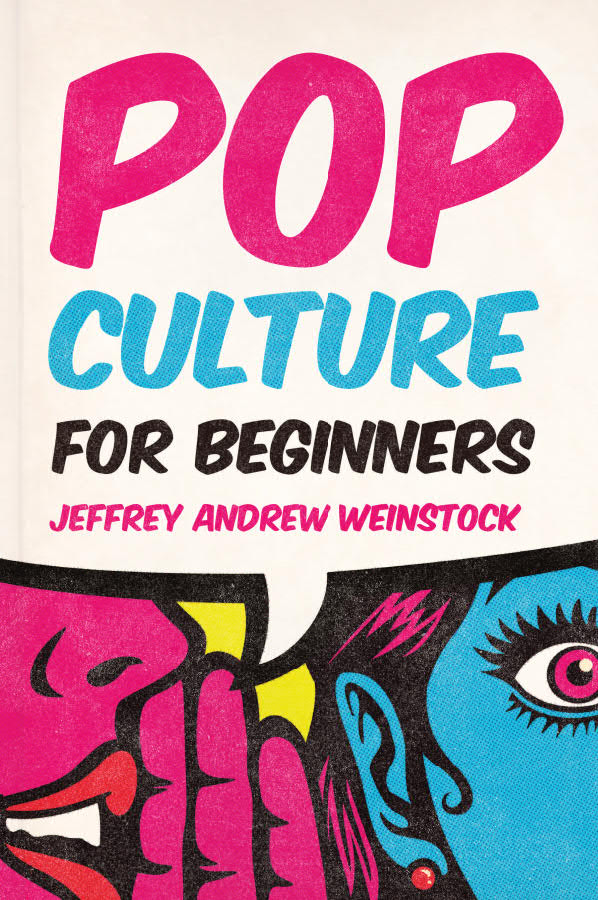
Review of Pop Culture for Beginners


Review of Pop Culture for Beginners

Kania Greer

Jeffrey Andrew Weinstock. Pop Culture for Beginners. Broadview Press, 2021.  Paperback. 310 pg. $46.92.  ISBN: 9781554815657 (paperback) 9781770488113 (PDF)

Asking someone to define pop culture is like asking someone to define what a dog is: meaning that depending on who you ask, you may get a very scientific answer or something more general in terms of what a dog looks like or types of dogs. The same is true for pop culture. Some people will define it based on current trends or ideations while others will focus on the more esoteric assumptions of the genre. As a result, the understanding of and study of pop culture becomes a difficult task, especially for those new to the field. Jeffrey Weinstock’s book, as the title suggests, provides the reader with a great primary resource which could be useful to beginning scholars and those needing a refresher.  For both beginning teachers and  seasoned scholars of pop culture the foundational lens which Weinstock brings serves to break apart the mystery of pop culture and make it relatable, understandable, and accessible to all.

Most people, by the time they reach higher education (and especially the further they go up the education ladder), become far removed from what originally brought them to pop culture, namely entertainment. Academics tend to become focused on the meaning of pop culture and thereby are often seen as taking the entertainment and joy out of it. This is where Weinstock’s book can help. By getting back to basics, Weinstock acknowledges the fast paced, ever changing face of pop culture but also encourages one to dive deeper into what pop culture is and what it means, both individually and for groups. 

The book is divided into two sections: The Pop Culture Toolbox (Chapters 1-4), which I refer to as the “academic” chapters, and The Pop Culture Units (Chapter 5-10) or what I refer to as the “practitioner” chapters. In Chapter 1, Weinstock hooks us in by trying to define pop culture but also making us rethink what we understand pop culture to be. For example, he starts Chapter 1 with the statement that pop culture as a definitive term is “elusive…of a single, clear definition” (pg. 4).  From here he goes on to address the myriad of influences that make up pop culture, ultimately landing on “pop culture [being] something people seem to know when they see it” (pg. 11).  While this may leave some people shaking their heads and wondering if there will be a definition, rest assured it is in there. However, what is beneficial is the periodic breaks in information he scatters throughout the chapters to ask the reader questions. Titled as “Your Turn”, he stops the flow of information to ask the reader to reflect on what they have read. Weinstock appears to understand how people learn and that they need time to digest and process information. His questions are designed to be examined from an individual perspective in order to acknowledge one’s own influences, tastes, biases, and lens. This element takes this chapter (and others) to a higher level of understanding as I was no longer reading for information but rather reading for understanding and decoding of my own perspective.

Chapter 2 takes us on a more academic journey helping us to understand the way culture is formed and how we signify information (signs). This semiotic approach is further broken down into not only our own connotation of what we see but also the denotation of those same signs. To better understand this approach, Weinstock uses common everyday signs like tattoos to further illustrate his meanings, making the concepts relatable and easy to process. Chapter 3 takes us into theories of viewing culture and examines the perspective by  which culture can be examined (post-colonial, feminist, critical race, etc.) but does so in such a way as to remind the reader of the lens by which each of these theories views culture. Weinstock’s purpose here is to inform the reader that each pop culture offering can be viewed through multiple approaches and each of these becomes part of a larger understanding. Through this chapter he succeeds in breaking down these theories into relatively easy to understand bite sized pieces to shed light on differing viewpoints. This is perhaps one of the best chapters in the book as it takes the theories back to basics and serves to define and give substance to some theories I had created my own meaning for rather than fully understanding.   

Chapter 4 is the last of what I call the “academic” chapters, in terms of chapters imparting information. This chapter really looks at pop culture in terms of authenticity, appropriation, structure, and subcultures. For example, as Weinstock puts it there is an almost “cultural imperative to ‘be yourself’” (pg. 87), but even this can cause dissonance when we consider which self to be: work self, spouse self, friend self, etc. The challenge is determining what is meant by authentic to each person. In relation to this is the idea of cultural appropriation and how members of one culture can appropriate (or misappropriate) another culture. This creates lines which are “murky” (pg. 90) between appreciation and misappropriation. When thinking about subculture, Weinstock challenges the reader to dive deep into cultural nuances. What makes one science fiction fan different from another? Don’t all punk rockers like the same music?  Examples can be found in subcultures of “subversive” (pg. 104) groups like “bikers, skaters, punks, goths…” (pg. 104) who can be categorized as anti-culture, but each holds its own in terms of representation. Just as valid, however, are other subcultures including science fiction subcultures like “Potterheads… Trekkies, and so on” (pg. 105). In this way subculture becomes even more specialized and an “expression of personal taste” pg. 105). At the end of each of the “academic” chapters, there are suggested assignments which could be easily incorporated into classrooms. Each of the assignments serves to help students examine pop culture from their own lens but also encourages students (and faculty) to think outside of their preferred focus to examine how culture is viewed by others. 

The “practitioner” chapters (5-10) break down the sub-genres of pop culture and dive deeply into their influences and meanings. From television to fandom each chapter details what is meant by the sub-genre, asks questions throughout, and then gives a sample essay at the end.  This breakdown gives equal weight to most sub-categories of pop culture and allows students to focus in on their favorite, for deeper study, or to take a little-known sub-genre and investigate it. These essays are beneficial for driving home the points made throughout the chapter. I found these essays some of the most enjoyable reading throughout the book. While Weinstock acknowledges the “term-limits” (my words) of the pop culture references in these essays, I believe they can be valuable in helping students and faculty rethink pop culture for many years. As with chapters 1-4, there are suggested assignments in each chapter and suggested readings.  Lastly, there is Chapter 11, which challenges readers to ”extend the approach adopted [in the book] to a different popular form” (pg. 277). Readers can use the book as scaffold to develop their own questions which challenge interpersonal thinking and viewpoints on culture.

Weinstock does a great job of introducing and reintroducing pop culture and does so in a relatable, humorous, and enjoyable way; in fact, I often forgot I was reading a textbook. While he presents an academic study of pop culture, he does so without abandoning the mystique and enjoyment most people find in pop culture. He challenges readers/students to examine their own cultural lens while encouraging us to think outside of the story presented to develop larger meanings. This book would be an excellent introductory book for pop culture studies (or really any studies) as it is easy to digest, thought-provoking, and just plain fun. Having said that, I study the intersection of science fiction and science interest (how does science fiction draw people to science), and I found this book a nice refresher and reminder of the broader contexts I am researching. Therefore, I recommend it to all academics, from those just starting to those who have been in the field for a while.

Kania Greer currently serves as the Coordinator for the Center for STEM Education at Georgia Southern University.  She studies the intersection of science fiction and science fact by people who attend science fiction conventions.

Review of The Modern Myths: Adventures in the Machinery of the Popular Imagination


Review of The Modern Myths: Adventures in the Machinery of the Popular Imagination

Jack Durant

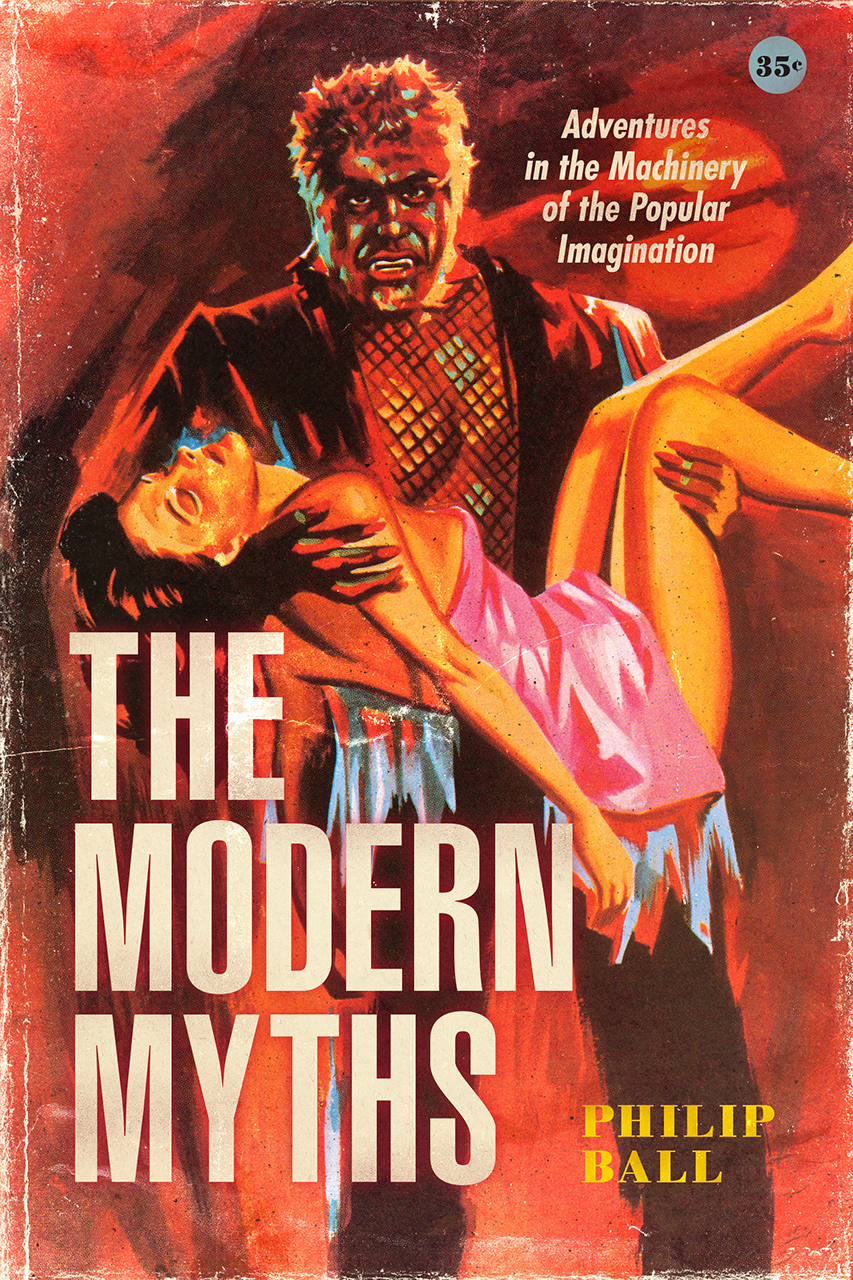
Philip Ball. The Modern Myths: Adventures in the Machinery of the Popular Imagination. Chicago UP, 2021. Hardcover. 426 pg. $30.00. ISBN 9780226719269.

In The Modern Myths: Adventures in the Machinery of the Popular Imagination, Philip Ball argues that “the Western world has, over the past three centuries or so, produced narratives that have as authentic a claim to mythic status as the psychological dramas of Oedipus, Medea, Narcissus, and Midas” (3). These stories, “which everyone knows without having to go to the trouble” of reading them, have “seeped into our consciousness, replete with emblematic visuals, before we reach adulthood” (2). Modern myths—of which Ball identifies seven, starting with Robinson Crusoe and ending with Batman—are not, despite their origins in specific texts, so much singular narratives as “evolving web[s] of many stories—interweaving, interacting, contradicting each other”—but with one thing in common: “a rugged, elemental, irreducible kernel charged with the magical power of generating versions of the story” (9). This fecund capacity to produce new narratives is what allows these myths to do their “cultural work”: they “erect a rough-hewn framework on which to hang our anxieties, fears and dreams” (16).

This summary suggests the level of analysis the book sustains: this is not a theoretical study or ideological critique of myth, along the lines of Roland Barthes’s classic Mythologies (1957) or the work of Claude Lévi-Strauss (critics mentioned only a half-dozen times, mostly in passing). Rather, The Modern Myths is an old-fashioned literary anatomy, in the mold of John Cawelti’s classic Adventure, Mystery, and Romance: Formula Stories as Art and Popular Culture (1976). What the book lacks in terms of theoretical claims it more than makes up for with its detailed close readings and rich historical contextualizations. Seven long chapters carefully lay out Ball’s mythic archetypes: Crusoe, Frankenstein, Jekyll and Hyde, Dracula, Martian invaders (à la Wells’s War of the Worlds), Sherlock Holmes, and Batman. As this list suggests, the coverage is heavy on British, mostly Victorian, examplars, a bias Ball seems a bit defensive about, though he argues effectively that the “British character of much of the modern mythopoeia” has led to an emphasis in modern pop culture on themes of class and empire (20). Ball’s mythic canon is also exclusively male (though the origin text of the Frankenstein myth was written by a woman), and it is unclear why he did not select a female archetype to analyze, since pop culture is filled with compelling femmes fatales, such as Sheridan Le Fanu’s Carmilla and Rider Haggard’s Ayesha. Perhaps Ball felt that this tradition was too diverse, not focused on a singular figure. In any case, he is quite frank about the biases informing his pantheon, and the individual chapters searchingly explore the cultural implications of the Anglophone and masculinist orientation of these various myths.

Each of the seven chapters devoted to a specific myth takes basically the same form. First, Ball traces the origins of the figure to a particular work of literature (or core collection of stories, as in the case of Sherlock Holmes) that has been abidingly popular. Yet, as he shows, the development of the myth over time has involved a process of adaptation and mutation that leaves the author’s intent far behind. A myth, Ball asserts, “is not identical to its founding text”; rather, myths “are the work of a culture” (14). The figures that have proven enduringly resonant are those reducible to key kernels of meaning that can be elaborated and adjusted over and over again. In the case of Frankenstein, for example, that kernel is the potential for Promethean overreaching built into the modern scientific enterprise, the possibility that “knowledge injudiciously applied” might “generate an entity too large and unruly to control” (129). Having thus distilled down the original text, Ball then pursues the pop-cultural career of this kernel or theme over decades of cultural production, from direct adaptations (e. g. James Whale’s classic 1931 film of Frankenstein) to various offshoots and allusions (e. g.. stories about rampaging robots and disobedient computers). These seven chapters are marked by extensive primary research and imaginative extrapolation, and Ball writes with an easy grace that is refreshingly free of jargon.

The volume concludes with two chapters that pan back from a focus on specific myths to offer more sweeping speculations about the nature of the “mythic mode” and the possibility of new myths emerging. These final chapters are somewhat less sure-footed, in part because they are so speculative; thus, Ball argues that the zombie may be an emergent myth, the first to be generated by the cinema rather than by a literary text—an assertion that, on the one hand, tends to ignore the literary lineage of the modern zombie (cf. Roger Luckhurt’s Zombies: A Cultural History [2015]), while on the other hand slighting mythic figures that are even more deeply rooted in a filmic corpus, such as the hardboiled private eye of modern noir. The capping chapter on the “mythic mode” of storytelling is a hodgepodge of tentative conclusions that is too short (barely 10 pages) to offer a synoptic perspective encompassing the diverse archetypes that the earlier chapters have spent so much time exploring (the chapter on Dracula alone runs almost 60 pages). It is these seven long chapters that form the core of Ball’s book, and they are all solid, well-researched, and unfailingly interesting studies that any student of modern pop culture will have much to learn from.

Jack Durant is a long-time reviewer of SF literature and criticism. He was a stalwart of the late Fantasy Review magazine and published a number of reviews in The Science Fiction and Fantasy Book Review Annual

Review of Extreme Fabulations: Science Fictions of Life


Review of Extreme Fabulations: Science Fictions of Life

Mattia Petricola

Steven Shaviro. Extreme Fabulations: Science Fictions of Life. Goldsmiths Press, 2021. Hardcover. 192 pg. $24.95. ISBN 9781912685882.

According to its author, Extreme Fabulations is “a thought experiment” (1). More precisely, this experiment unfolds as an attempt to establish a dialogue between science fiction and the hermeneutical tools developed by modern and contemporary philosophy. Thus, Extreme Fabulations further develops the lines of inquiry that Shaviro inaugurated in his 2016 monograph Discognition. However, whereas Discognition explored the notions of consciousness, thought, and sentience, Extreme Fabulations focuses—as the title suggests—on how we can conceptualise, perceive, and reimagine the very idea of “life.” Shaviro’s argument starts from a compelling definition of science fiction as “counter-actual” rather than “counter-factual,” in the sense that “it offers us a provisional and impossible resolution, suspended in potentiality, of dilemmas and difficulties that are, themselves, all too real” (2). An “extreme fabulation” can thus be seen—even if Shaviro does not provide a clear definition of this expression—as a narrative that pushes the limits of our understanding of what “life” is while tackling the dilemmas that spring from this cultural and cognitive reconfiguration.

Each of the eight chapters that make up Extreme Fabulations investigates such dilemmas through an in-depth study of a single work of science fiction. More specifically, Shaviro provides close readings of Charles Harness’ 1950 short story “The New Reality”(chapter 1), Adam Roberts’ 2015 novel The Thing Itself (chapter 2), Clifford Simak’s 1953 short story “Shadow Show” (chapter 3), Ann Halam’s 2002 novel Dr. Franklin’s Island (chapter 4), Nalo Hopkinson’s 2005 short story “Message in a Bottle” (chapter 5), Chris Beckett’s 2012 novel Dark Eden (chapter 6), a 2016 concept album by the hip hop group clipping. entitled Splendor and Misery (chapter 7), and Gwyneth Jones’ 2017 novella Proof of Concept (chapter 8). Since each chapter is a perfectly self-contained whole that can be read independently from the others, Extreme Fabulations resembles an essay collection rather than a monograph. The presence of a conclusion would have probably made Shaviro’s argument somewhat better-rounded; on the other hand, the book’s structure makes it easily accessible to scholars and students who are specifically interested in one or more fictional works among those examined by Shaviro.

Chapters 1 and 2 focus on what Shaviro calls “Kantian science fiction” (21), that is, on works that defy the ontology of life (in other words, the conceptualisation of what life is) as elaborated by Kant in his Critique of Pure Reason (1781). “The New Reality” and The Thing Itself provide Shaviro with an opportunity for discussing the difficult and somewhat marginal position of ontology in contemporary thought (which devotes much more attention to phenomenology and epistemology) and, more importantly, for exploring how science fiction can allow us to “poke around outside” (29) the categories that, according to Kant, structure human cognition and perception.

Chapters 3 and 4 shift the focus to science as a Foucauldian power-knowledge system and to how it conceptualises, controls, and policies life. Shaviro’s readings of “Shadow Show”and Dr. Franklin’s Island represent valuable contributions to both posthuman theory and monster theory, since they investigate how science fiction can thematise and challenge our conception(s) of the human. Shaviro is particularly interested in how the two texts shatter the old vitalist view of life as a ‘spark’ in favour of a non-anthropocentric view of life as a pervasive process of animation involving both human and non-human beings, as wells as in how they deconstruct the idea of the ‘great chain of being’ while moving towards an anti-hierarchical and networked conception of life.

In chapters 5 and 6, the ‘dilemma’ of life is approached from the perspectives of aesthetics and anthropology. Shaviro’s study of “Message in a Bottle”—an Afrofuturist story about an art exhibition that will take place in the storyworld’s remote future—is centred on the idea of futurity and interrogates how we can conceive of life as something that extends beyond the present and into a future that can be imagined, questioned, and colonised. Dark Eden, on the other hand, is read as a work of “speculative anthropology” (116). In his analysis, Shaviro discusses the notion of ‘speculation’ by comparing its applications in science fiction and in evolutionary psychology, ultimately arguing that the former are far richer and more complex than the latter.

Chapters 7 and 8 draw from the arguments developed in the previous chapters and apply them to the speculative representation of social oppression. More specifically, Shaviro interprets the narrative developed in the album Spendor and Misery in the light of Kim Stanley Robinson’s notion of ‘anti-anti-utopia’, thus arguing that “it is better […] to ’set up a random course’ into the unknown than to stay with what is reliably oppressive and deadly” (147). The study of Proof of Concept finally interrogates the continued presence of capitalist realism in a future society and how speculative fiction can imagine alternative scenarios in a world that cannot be reformed.

Throughout his essays, Shaviro consistently adopts a twofold argumentative strategy. The fictional texts chosen as case studies are both compared with earlier science/speculative fiction narratives and read in the light of specific concepts drawn from modern or contemporary philosophy. Extreme Fabulations thus deploys an extensive hermeneutical toolkit ranging from the aforementioned Kant’s Critique and Foucault’s biopower to Quentin Meillassoux’s correlationism and Maurice Blanchot’s limit-experiences, from Eugene Thacker’s notion of ‘dark pantheism’ to Deborah Levitt’s concept of ‘animal apparatus,’ from the speculative realist philosophy of Graham Harman to Lee Edelman’s queer theory. This toolkit is further enriched by the presence of notions derived from physics (Einstein, Schrödinger, and two interpretations of quantum mechanics), biology, and finance. This complex theoretical framework, however, never makes the reader feel overwhelmed. No in-depth knowledge of philosophy is required to enjoy the essays, and every new concept is introduced with clarity and conciseness. As regards the comparison with other works of science/speculative fiction, one of the aspects that makes reading Extreme Fabulations from cover to cover particularly compelling is the fact that it proposes, in a series of arguments disseminated throughout the book, many elements for what could be called an anti-Lovecraftian monster theory. More specifically, this theory aims to demonstrate that “[i]f we want to get away from anthropocentrism […] we need to give up our Lovecraftian visions of the implacable coldness, emptiness, and unconcern of the universe” (38).

To sum up, Extreme Fabulations provides a stimulating and refreshingly original perspective on the conceptualisation of life in science fiction that will offer new ideas and lines of inquiry to both students and scholars working on science fiction, the posthuman, and monster theory. It would be fascinating, for example, to further explore the idea of ‘Kantian science fiction’ and find other works that might fit this category, or to understand how Shaviro’s arguments could be adapted to media other than literature and music and to works outside the anglophone world.

Mattia Petricola received his PhD in comparative literature in 2019 from the University of Bologna and has been a postdoc research fellow in comparative literature at the University of L’Aquila (Italy). His research interests sit at the crossroads of speculative/fantastic fiction, thanatology, intermedial studies, and queer theory. He has published articles on Philip K. Dick, Peter Greenaway, the notion of spectrality in media studies, and queer theory. In 2021 he edited a dossier entitled What do we Talk about when we Talk about Queer Death? for Whatever. A Transdisciplinary Journal of Queer Theories and Studies.

Review of New Blood: Critical Approaches to Contemporary Horror


Review of New Blood: Critical Approaches to Contemporary Horror

Jonathan W. Thurston-Torres

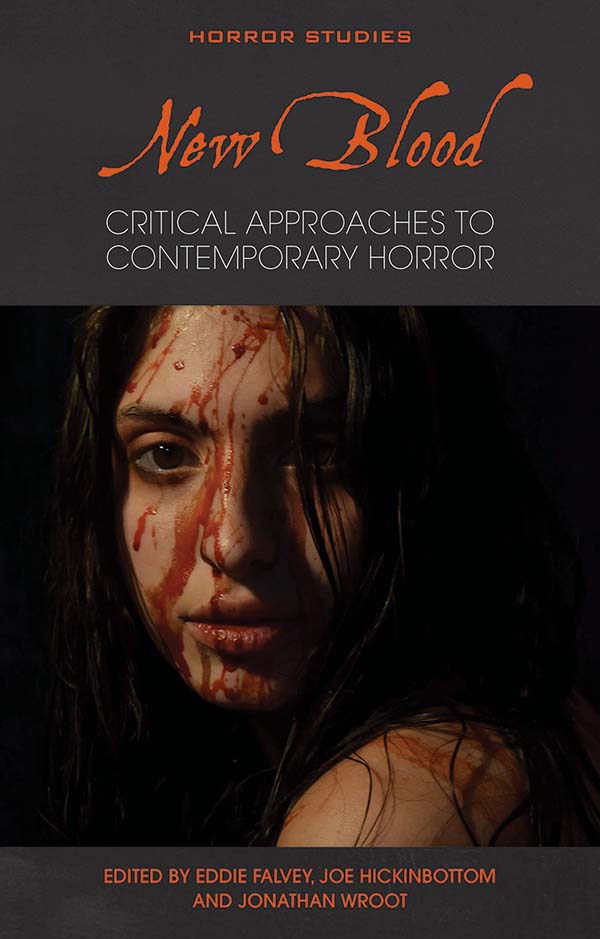
Eddie Falvey, Joe Hickinbottom, and Jonathan Wroot, eds. New Blood: Critical Approaches to Contemporary Horror. U of Wales P, 2021. Horror Studies. Paperback. 288 pg. $60. ISBN 9781786836342. eBook ISBN 9781786836359.

New Blood is a collection of essays examining recent works of horror film. Separated into four parts, the book largely acts as a defense for analyzing new horror films through a scholarly lens. Some of the essays are invested in reception studies and production methods, while others engage more in theory and interpretive analyses. Ultimately, many of the chapters seem to fall short of the book’s intent, functioning more as an elevated film review than a work of serious scholarship. However, many chapters would be effective in teaching undergraduate classes in horror so could be included on syllabi for such courses.

The editors present a kind of defense of modern horror cinema as worthy of critical study in their introduction. What struck me here was that the defense was framed as a list of horror films, claiming that there have been both remakes and original films, an argument that generally should go without saying. Indeed, the editors seem to try to defend whythe genre is popular more than why it is worthy of scholarly attention. We constantly see phrases such as, “some horror franchises have proven so popular that…” and “To understand the genre’s enduring popularity…” (2, 3). The introduction continues to state the obvious: “Critical acclaim has been given in many cases – but whether praised or derided, horror has carried on regardless” (4). As a result of this set-up, it seems very unclear who the audience for the book really is. People who think horror stopped being a film genre in the 90s? Beginning horror scholars who are looking for definitive proof that the genre is indeed popular? After defining what the editors call “revisionist horror” (5) and talking further about the commercial aspects of the genre, they outline the various case studies of the book.

In “Apprehension Engine: The New Independent ‘Prestige Horror,’” David Church engages with “artsy” horror of the past couple of decades through the label “prestige horror” (16), discussing the sub-genre in terms of reception studies, critical acclaim, and cultural studies. What is compelling about Church’s arguments is his discussions of indie “alternative” prestige films and the ways that many horror fans appreciate the art and poetry of films over the commercial scare factor. My greatest concern with Church’s work is the limit of his scope. What he calls indie-art films are reasonably commercial successes as well, such as It Follows (2014), Saw (2003), and The Witch (2015). There does not appear to be much room for horror shorts on YouTube or the much more indie films released only on Shudder.

The next essay, by Steve Jones, “Hardcore Horror: Challenging the Discourses of ‘Extremity,’” seeks to give definition to the eponymous terms “hardcore horror” and “extremity.” Jones focuses on market and critical definitions for “extremity,” noting that a store’s willingness to stock a horror film contributes to the market definition, as an example. The strength of this chapter is in its ability to give several specific cases, such as mother! (2017) and A Serbian Film (2010), while also acknowledging and giving room to the slippages of meaning of “extremity.” Even tackling a bias toward extreme horror texts in academic publishing, Jones approaches the concept from so many angles I could see myself easily teaching this chapter alone alongside some horror films.

Continuing the focus on specific audiences, Xavier Mendik approaches cult horror festivals in “From Midnight Movies to Mainstream Excess.” Mendik blends the personal with the critical effectively as he situates his experiences with a university horror film festival in the larger commercial industry of horror film. Like Church, Mendik is invested in terms like “prestige” and “success,” although his scope is limited more narrowly to these specific film festivals.

Starting the book’s second section, Joe Hickinbottom’s “A Master of Horror?: The Making and Marketing of Takashi Miike’s Horror Reputation” is more of a fan’s defense of Miike as a “horror auteur” than a work of serious critical inquiry. It even goes so far as to answer the titular question in just the first couple of pages, rendering the rest of the chapter uninteresting. This chapter might have been better placed as an introduction to a volume just on Miike. Asian horror continues with “Bloody Muscles on VHS: When Asia Extreme Met the Video Nasties” by Jonathan Wroot. Easily one of the sharpest chapters in the book, Wroot’s conducts a reception studies and comparatist reading of J-horror film Bloody Muscle Body Builder in Hell (2014). What impressed me with this chapter was the vast amount of research Wroot conducted: into VHS production history, the trends of VHS nostalgia in the 21st century, and the theory behind J-horror’s reception.

Thinking about film in the 21st century, one, of course, cannot forget the popularity of streaming services like Netflix, as Matt Hills notes in “Streaming Netflix Original Horror: Black Mirror, Stranger Things, and Datafied TV Horror.” Like Wroot, Hills brings in considerable theory, focusing on postmodern readings of what he calls the “flagships” of “datafied horror” (125): Stranger Things and Black Mirror. He excels at analyzing concepts unique to Netflix, discussing “bingeing on fear” and the distinctions of genre bubbles that separate Netflix from something specifically geared toward horror fans like Shudder (130).

The next part, focused on subgenres of modern horror, begins with Jessica Balanzategui’s chapter, “The digital gothic and the Mainstream Horror Genre: Uncanny Vernacular Creativity and Adaptation.” Balanzategui is invested in exploring the collaborative efforts that go into Creepypasta stories and the gothic elements that appear in them. This chapter would be really beneficial for introductory students of horror, showing them that even those stories they read online “count” as genuine literature. However, I wish Balanzategui integrated more Gothic theory and scholarship into the chapter, making that bridge between academic theory and popular fiction more apparent. Abigail Whitall envisions “rethinking subgenres and cycles” in “Nazi Horror, Reanimated” (167). In this chapter, Whitall makes the basic argument that Nazi horror should be considered a subgenre rather than a cycle. While convincing, the argument seems very simple and easily defensible to scholars who would be reading this book.

The final subgenre explored is the “desktop film” in “Digital Witness: Found Footage and Desktop Horror as Post-cinematic experience,” by Lindsay Hallam. In discussing the subgenres of found footage films here, Hallam integrates not only directors’ quotations but actually really strong affect theory and social media theory, making the chapter shine for its integration of scholarship alongside its analysis of primary texts. This chapter could serve as the basis of an entire course syllabus. Eddie Falvey then discusses feminine monstrosity in “Revising the Female Monster: Sex and Monstrosity in Contemporary Body Horror.” When I first read the chapter, I was frustrated with its survey nature. I had hoped there would be something more in-depth here. However, the chapter excels at being just that: a captivating survey. This chapter would be great for undergraduates to read, as it opens up many compelling conversations about sex, gender, disability, and even STDs in horror.

The political theme continues with Thomas Joseph Watson’s “The Kids are Alt-Right: Hardcore Punk, Subcultural Violence and Contemporary American Politics in Jeremy Saulnier’s Green Room.Green Room (2015) is certainly a horror film worthy of academic analysis. However, aside from the occasional quotation here and there, this chapter felt like an extended film review that summarized what a lot of other critics have said about the film. The last chapter is “Twenty-first-century Euro-snuff: A Serbian Film for the Family,” by Neil Jackson. In contrast to the previous chapter, this one thrives on literary theory to analyze a film that many would dismissively call “torture porn.” Jackson relies on affect theory and allegorical interpretations to derive new meaning from the film. The film thus becomes a site of investigation and critical inquiry that opens the way for other scholars (whether they are established researchers or undergraduates).

On the whole, the book seems conflicted. Half of it consists of simple arguments such as, “This is a film I enjoy, and here’s why,” and “This film is popular”; the other half actually engages in productive film theory and academic discourse. For those strong chapters, I would highly recommend the book to instructors teaching undergraduate horror courses. Those chapters really open the floor for productive discussions of the genre and showcase what that kind of horror analysis can look like.

Jonathan Thurston-Torres (they/them) is a PhD candidate at Michigan State University, specializing in Animal Studies, early modern literature, and horror literature. Their work has led them to edit MSU’s new volume in The Animal Turn series, Animals & Race. Outside of their academic work, they are a local activist in HIV destigmatization, recently putting out a TEDx Talk, Being Positive.

Review of Fantasies of Time and Death


Review of Fantasies of Time and Death

Maria K. Alberto

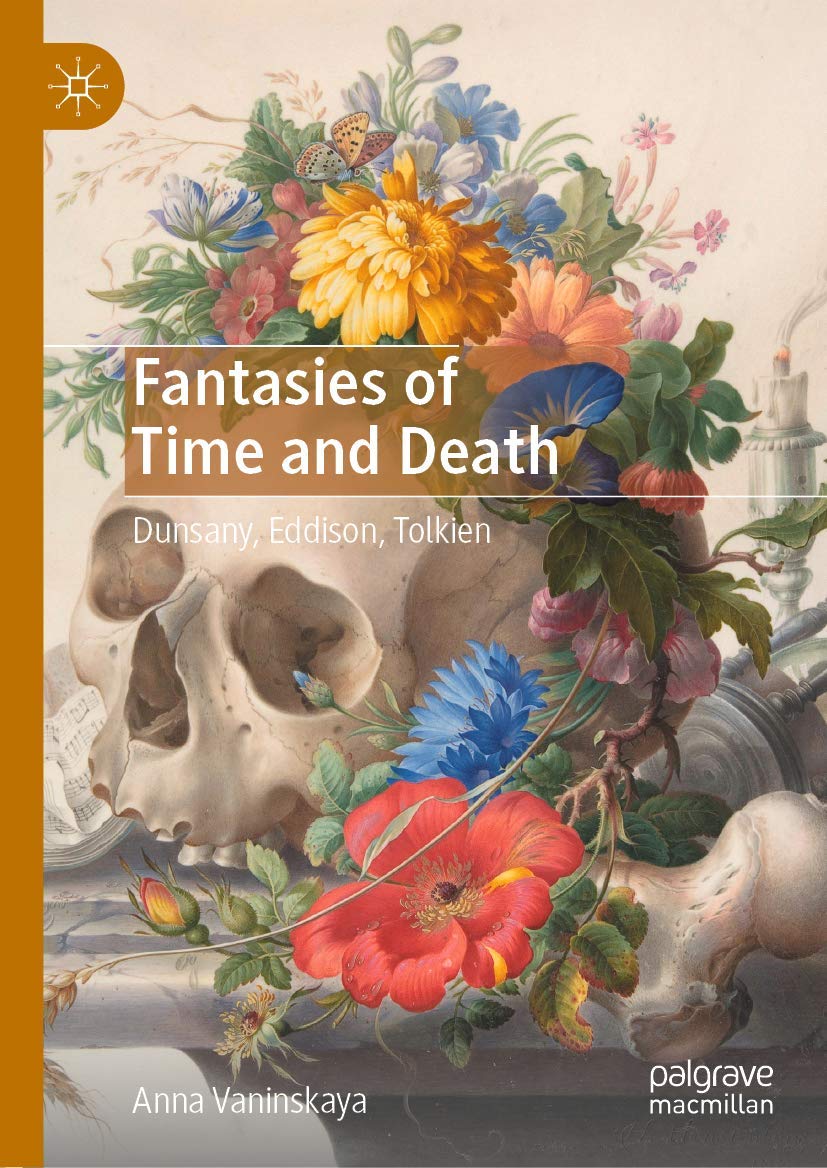
Anna Vaninskaya. Fantasies of Time and Death: Dunsany, Eddison, Tolkien. Palgrave Macmillan, 2020. Hardback. 262 pg. $159.99. ISBN 9781137518378.

Anna Vaninskaya’s Fantasies of Time and Death is nothing short of a remarkable achievement: reading it, I could see immediately why it won the Mythopoeic Scholarship Award in 2021. In this monograph, Vaninskaya ably draws together three major authors whose works are not often compared at such length, and she explores how each uses fantasy—a complex, retroactive term that she does not take for granted, either—to explore “shared thematic preoccupations” (4) regarding “temporality, mortality and eternity: with process, event and state” (7). Such a project entails in-depth knowledge of three dense, elaborate bodies of work, as well as the capacity to draw, discuss, and compare relevant details from each one, but Vaninskaya does this spectacularly. Moreover, her writing style is richly poetic—and frankly, gorgeous—in ways that academic scholarship does not often allow itself to be, and the end result is a work that feels thematically and technically well-matched with its subjects.

In a move that could have been risky, but that Vaninskaya pulls off very well, Fantasies of Time and Death opens right on the knotty topic of canon creation, reviewing how reader demand and publisher choices both played a critical role in the creation of fantasy as a genre, well after these three authors’ own times. Beginning here offers important historical context and demystification, and further strengthens Vaninskaya’s reasoning to group Lord Dunsany, E.R. Eddison, and J.R.R. Tolkien on the basis of shared textual preoccupations: specifically, their various interests in “cosmopoiesis… the creation myth… [and] a multi-generic universe” (7) rather than the kinds of cohesive narrative more typical among both their predecessors and peers. The remainder of this introduction offers more focused introductions to each author and his oeuvre, then looks briefly to other writers now considered fundamental to the fantasy genre before returning to that shared interest in transience, time, and death.

Following this introduction, Vaninskaya offers a chapter apiece focused on the works, interests, and approaches of Dunsany, Eddison, and Tolkien. With Lord Dunsany, she calls attention to how he saw himself as a poet writing “a species of prose poetry” (25), which led to a “patterning impulse” (26) evident across his shorter works in particular. Subsections in this chapter are devoted to, variously, the ravages of time, the chill of space, and the uncertainty of the universe, as depicted in Dunsany’s fantasy. Across these three axes, Vaninskaya maintains, Dunsany’s fictional worlds are “literally a-gnostic. There are no epiphanies, no ultimate truths, the mythology is an anti-revelation” (44), and divine power may be glimpsed but is never fully explicated or revealed. Oftentimes, she contends, these preoccupations connect Dunsany’s works more than any shared fictional setting or returning cast of characters.

Next, Vaninskaya turns to a chapter on E.R. Eddison, and specifically his complex, unfinished Zimiamvia trilogy, in which multiple characters are incarnations of the male and female parts of God, most unaware of their divine identities. Pointing out how this work is driven by “intertextual and interlingual bricolage” (69), Vaninskaya maintains that—despite the vast universe visible here and the multifaceted pantheon driving it—readers must be willing to wade through reams of uncredited quotations and ideas. These extend well beyond poetic and prose allusions, on into a deep preoccupation with seventeenth-century philosophy: Eddison, Vaninskaya demonstrates, engages with paradoxes of God’s existence and perfection as set out by Descartes, Spinoza, and Leibniz (115). And while the full intricacies of these readings will be at least partly lost upon those not familiar with Eddison’s sprawling work, Vaninskaya does an admirable job of summarizing this complex trilogy and drawing readers’ attention to its most startling features, whether philosophical, theological, or genre-driven.

And from here we come to the chapter that first drew my attention to Vaninskaya’s work: her discussion of Tolkien. Because Fantasies of Time and Death is not a survey, but instead looks to the foundation of each author’s oeuvre, Vaninskaya focuses here not on Tolkien’s most famous work The Lord of the Rings (1954), but instead on the natures and fates of Elves and Men as developed across his entire legendarium. Thus, this chapter deals primarily with the collection of stories, some published posthumously, called The Silmarillion, and draws specifically from the Ainulindalë (creation account of the world that includes Middle-earth), the Athrabeth (philosophical exchange between a human woman and an Elven prince), and the Akallabêth (the story of the island kingdom Númenor). Vaninskaya revisits these particular portions of Tolkien’s legendarium to argue that knowledge of time and death differs according to Elves and Men, and in fact, becomes a sort of “psychological trauma” when the world’s ultimate antagonist Melkor spreads corrupted information about them (164). Some of the connections that Vaninskaya draws outward from Tolkien’s work, such as to Augustine and Aquinas for the Catholic doctrine of mankind’s “happy fault” (173), have been more well-trod in existing scholarship than others, but overall, her discussion here is still fresh and fascinating.  

Despite their evocative prose and obvious expertise, there are a few stumbling blocks to these chapters. For one thing, the authors they are dealing with can be challenging in their own right: though each one might, as Vaninskaya suggests, be creating a single, genre-spanning universe in their fiction, the coherency and accessibility of these various universes differ quite widely. Dunsany creates a variety of short works that may or may not reference one another directly; Eddison is author of a grand, sprawling trilogy that remained unfinished at his death; and Tolkien’s work is scattered across several drafts, many of them organized by his son and published posthumously in an attempted semblance of Tolkien’s larger plans. Vaninskaya herself switches between multiple texts with commendable, indeed enviable, ease, but does not always signal her intent when doing so, which could leave readers less familiar with those texts lost in a sea of references. Even this is not entirely a criticism, though, because she has a knack for summarizing and drawing out relevant pieces from these complex writings that will carry readers along regardless. All told, Vaninskaya’s work is a commendable undertaking. It can be a dense read, and one that will be made significantly more difficult without some knowledge of the source works; but it is absolutely worth it all the same.

Maria K. Alberto is a PhD candidate in the Department of English at the University of Utah, where she is currently working on her dissertation examining canons in popular culture texts. Her research interests include digital storytelling, transformative fanworks, and genre literature of the 20th and 21st centuries. She has written several pieces on Tolkien and adaptations of his legendarium. 

Review of The Contemporary Post-Apocalyptic Novel


Review of The Contemporary Post-Apocalyptic Novel

Nathaniel P. Doherty

Rachel Swirsky. January Fifteenth. Tordotcom, 2022. Paperback. 239 pg. $15.99. ISBN 978-1-250-19894-6.

The Contemporary Post-Apocalyptic Novel: Critical Temporalities and the End Times, by Diletta De Cristofaro, is encyclopedic in its approach to contemporary Anglophone literature. At its center of critical focus is the engagement of contemporary Anglophone fiction of the U.S., Canada, and Great Britain with the logic of apocalypse. De Cristofaro traces this oppressive logic deftly from Biblical roots to every bud of current dominant power structures. This book is the author’s first monograph in an otherwise extensive body of work, and she uses this opportunity to cast a wide, interdisciplinary net of referenced fiction around the foci of each chapter. Each chapter focuses on one high profile novel and one that is under-recognized, according to De Cristofaro.

The novel theoretical insight offered by De Cristofaro is “critical temporality” (De Cristofraro 1). In short, critical temporality is a feature whereby texts contradict or otherwise undermine apocalyptic conceptions of time. De Cristofaro identifies this critical mode as a resistance to, or commentary upon, legacies of traditional Christian apocalypticism, especially as it has been appropriated by a range of oppressive and/or exploitative systems dominating global policy and popular ways of knowing. The introduction sketches out critical temporality and establishes the monograph’s critical underpinning. It also provides a brief but useful introduction to the history of apocalyptic narratives in Western culture.

Chapter One focuses on Sam Taylor’s The Island at the End of the World (2009) and The Book of Dave (2006), by Will Self. In both texts, apocalypse functions to justify, after the fact, theocratic systems that are both misogynist and sexist. In both texts, in different ways, the theocracies are all but immune to reform or escape because of their deployment of sanctity as a means to control both public narrative and history. The novels’ critical temporality undermines these systems with parody. De Cristofaro’s critical lens is primarily occupied with a critique of oppressive, overt, Christian power structures.

Chapter Two focuses on Cormac McCarthy’s The Road (2006) and The Pesthouse (2007),by Jim Crace. De Cristofaro analyzes what she refers to as “American ideologies,” specifically Manifest Destiny and American exceptionalism, within these two novels’ narratives (14). Specifically, she identifies how these narratives invert the traditional mythology of the American ‘open road’ and the related narratives of limitless self-reinvention as their critical temporalities. The chapter also notes critiques of the ‘creative’ destruction inherent in the U.S.’s claims to correct and perfect European civilization.

David Mitchell’s Cloud Atlas (2004) and Jeanette Winterson’s The Stone Gods (2007) form the core of Chapter Three’s analysis. De Cristofaro focuses on the role played by apocalyptic logic in the post-facto justification and sustenance of exploitative colonialism and neo-colonialism. Both novels cover vast spans of fictional history. Linear narrative is associated in the chapter with Biblical, “Revelation”-style apocalypticism, and thus De Cristofaro focuses on non-linear narratives as the ‘critical temporalities’ of both novels. In both cases, narrative time becomes critical via textual reflections of nonfictional capitalist, (neo)colonial structures and histories. This chapter also contains the monograph’s closest consideration of eco-critical themes.

Chapter Four centers on variations of denarration in novels critiquing stagnation in neoliberalism’s framing of history. The central texts are Emily St. John Mandel’s Station Eleven (2014)and Douglas Coupland’s Player One (2010). De Cristofaro reads denarration and monotony in both as associating the apocalypse with symbols of global capitalism. More specifically, the chapter takes aim at claims that neoliberalism represents the ‘end of history.’ De Cristofaro spends more time on the initial contextual interpretations, which includes Colson Whitehead’s Zone One (2011) and Karen Thompson Walker’s The Age of Miracles (2012). The modes of rendering temporality in the novels of this chapter are characterized by slowing, monotony, and variations of denarration that parody neoliberalism’s perpetual, changeless present.

The Contemporary Post-Apocalyptic Novel’s conclusion focuses on Lidia Yuknavitch’s The Book of Joan (2017) and the employment of the body as a vehicle for historical narrative resisting official archives. The temporal dimension of this embodied archive constitutes this section’s approach to critical temporality through its opposition to the apocalyptic chronology of the official archive. De Cristofaro revises Derrida’s “Archive Fever” as a drive within post-apocalyptic fiction to imagine the preservation of narratives through the apocalypse (1995). She interprets these archives as evidence of the novelists’ faith in the power of narrative to resist contemporary tendencies driving towards global catastrophe, an implicit nod to speculative fiction’s preoccupation with extrapolation.

The critical lenses employed by De Cristofaro are feminist as well as postmodernist and post-structuralist. Further, a Marxist-inflected critique of global capitalism undergirds most of her interventions. Religious, or pseudo-religious, support for misogyny and sexism is a focus of the first chapter, and high-profile postmodernists or post-structuralists (there’s some debate about who counts as what) are cited directly in the introduction and referenced throughout. This grouping includes Baudrillard, Derrida, Haraway, Lyotard, and Linda Hutcheon, among others. Timothy Morton’s Hyperobjects (2013) also makes an appearance when De Cristofaro turns towards eco-critical considerations. As a result, there is a case for identifying a post-humanist facet to De Cristofaro’s work as well.

This monograph is a valuable interdisciplinary intervention that provides a convincing and timely approach as well as detailed references to many texts capable of supporting a broad range of scholarship. The Contemporary Post-Apocalyptic Novel has the potential to be a resource for scholars working on contemporary literature, posthumanism, gender studies, and eco-criticism, at least. Its contents are especially relevant to contemporary SF studies. De Cristofaro’s thorough catalogue of related texts in each chapter means the book itself functions like an archive. Thus, it has the potential to support a range of contemporary literature courses, given that most of the texts referenced transcend the dubious distinction between literary and speculative fiction. The Pesthouse section of Chapter Two is particularly notable for making extensive and interesting use of research into Crace’s personal papers stored at the Harry Ransom Center at the University of Texas at Austen. The use of the Crace papers provides an example of archival scholarship applicable to both undergraduate and graduate students. De Cristofaro has given us that rare work that functions on an advanced theoretical level while also nonetheless being applicable to many classroom contexts.

Nathaniel Doherty has worked as a writer, instructor, and etc. in many capacities throughout post-secondary education. Currently he works in instructional design at Chadron State College, in Chadron, NE. Technically, it’s still the frontier out here. Besides advocacy for learner-centered teaching, his professional focus is late-20th and 21st-century U.S. fiction and gender studies. He has a predilection for genre writing.

Review of Re-Enchanted:The Rise of Children’s Fantasy Literature in the Twentieth Century


SFRA Review, vol. 52, no. 4

Nonfiction Reviews


Review of Re-Enchanted:The Rise of Children’s Fantasy Literature in the Twentieth Century

Lenander

Marie Sachiko Cecire. Re-Enchanted: The Rise of Children’s Fantasy Literature in the Twentieth Century. U of Minnesota P, 2019. 336 pg. $108. ISBN 9781517906573. $27.00. Paper ISBN 9781517906580

Apparently an attempt to popularize and expand upon a flawed 2011 dissertation, The Oxford School of Children’s Fantasy Literature: Medieval Afterlives and The Production of Culture (Oxford University), this book begins with a shorter reprise of that work. Cecire believes that the work of J.R.R. Tolkien and C.S. Lewis in establishing an Oxford University English curriculum that focused on pre-Nineteenth Century English, and drew upon their scholarship in Old, Middle and Early Modern English literature, resulted in shaping an “Oxford School” of writers of “medievalist children’s fantasy” (4). Besides Tolkien and Lewis, in some of their work for children, this includes the writers Susan Cooper, Diana Wynne Jones, Kevin Crossley-Holland and Philip Pullman.

The discussion of Tolkien and Lewis, including their academic interests and their use of aspects of ‘medieval’ literary antecedents, particularly in their own fiction, is good. But it mostly revisits what many other critics, historians and biographers have had to say.  Cecire does provide some discussion of the curriculum at Oxford, including such details—new to me—as brief descriptions of some of the questions presented to students to write their final exams. Later, she offers some careful readings of scenes from her ‘school’ writers, tracing motifs and themes from some of the medieval texts that were part of the reading program at Oxford. This is well-done, and Cecire demonstrates her own familiarity with some of these medieval sources. It seems reasonable that writers who read Malory or Chaucer might indeed have been influenced when they went on to write their fantasy stories for children. But Cecire fails to account for the similar approaches and achievements of other writers drawing upon such medieval texts without the ‘shaping’ of the Oxford curriculum. She also fails to consider other medieval influences on her writers, for example via Diana Wynne Jones’s marriage to the prominent medievalist, John Burrow—though he, too, studied the English curriculum at Oxford—or Crossley-Holland’s extensive career as a medievalist, both in translating and editing Beowulf and other Anglo-Saxon texts, and as a professor of English for many years before writing his Arthur Trilogy (2000-2003).

Many other writers, beginning well before Tolkien and Lewis, and continuing up through the twentieth century, have written what can only be described as work similar to the Oxford school ‘medievalist children’s fantasy’ without direct recourse to that Oxford curriculum, or even influence from its fiction. Indeed, the impact of this school cannot be much felt in broader children’s fantasy until the second half of the century—besides the outlier, Tolkien’s The Hobbit (1937), not terribly influential though respected in the forties, fifties and sixties, the Narnia stories don’t appear until the second half of the century, when Tolkien’s adult romance, The Lord of the Rings (1954-55), was also published. The influence of these works on other fantasy can hardly be seen until the publishing phenomena of the 1970s, mostly in adult fantasy and science fiction, and the other Oxford school writers only begin to impact the literary scene in the later 1970s.  The fantasy by Crossley-Holland and Pullman discussed by Cecire was not even published until the end of the 1990s (1995-2003).

As far as discussion of the works of these writers go, Cecire does not really attempt to differentiate their ‘medievalist fantasy’ from that written by other Twentieth Century writers, such as Henry Treece, Alan Garner, Lloyd Alexander, Mollie Hunter, or many others. She does offer a straw-man attack on T.H. White’s The Sword in the Stone (1938), as a “Cambridge fantasy” (114), but is unclear about what other texts might fit into this alternative school. She suggests that the comic and ironic tone of White’s narrative is modernist, against and counter to the Oxford school, which is anti-modernist and thus free of irony and comedy.  This is due to the roots in that medieval heritage that Tolkien and Lewis introduced into the Twentieth Century.

This is absurd on the face of it, ignoring the comic and ironic work of Tolkien (not only in The Hobbit and sections of The Lord of the Rings, but in Farmer Giles of Ham [1949] and The Father Christmas Letters [1976], among other texts), and in C.S. Lewis’s The Screwtape Letters (1942), but also the later work of Susan Cooper (the fine Boggart trilogy [1993-2018]), and Diana Wynne Jones (practically everything she ever wrote, but consider The Tough Guide to Fantasyland [1996]). Even Cecire doesn’t attempt to argue that Pullman isn’t ironic but explains his irony as a direct response to and dialogue with Tolkien and Lewis. Nor does Cecire attempt discussion of the majority of these writers’ work which is not so clearly displaying ‘medieval’ tropes. In arguing that Tolkien and Lewis are anti-modernist, Cecire is not very careful to describe what she intends, with the consequence that when she starts employing these distinctions and arguing that Lewis and Tolkien channel racism and imperialism and sexism from the medieval texts that they study, one must suppose that she is contrasting this with the modernist writers—but to attempt to see T.S. Eliot, Ezra Pound, James Joyce, Virginia Woolf, and other modernists as free of medieval influence and of racism, sexism and so forth requires a difficult squint in perspective. Similarly, although many other critics of the Inklings have seen them as anti-modernist, citing for instance Lewis’s ironic send-up of Eliot’s “The Love-Song of J. Alfred Prufrock” (cited by Cecire, p. 53), this overlooks the clear modernism of much of the Inklings’ work in response to their war experience, as well as the familiarity of Eliot and other writers with the medieval heritage. Not to mention friendly interactions between the Inklings and Eliot and other Modernist writers.

But Cecire adds a significant writer to her ‘school’ without any account of exposure to the Oxford curriculum, or particular literary influence from medieval writers, or from the other Oxford school writers. This is J.K. Rowling, who didn’t begin publishing her Harry Potter books until the last couple of years in the Twentieth Century.  Linking Rowling to her Oxford school is a serious flaw in Cecire’s dissertation, and it is not further explained or defended here. Rowling acknowledges reading Tolkien’s fiction, and probably Lewis’s Narnia stories at least, but only along with the work of many other writers. The ostensible evidence that Cecire cites for Rowling’s inclusion in the ‘Oxford school’ even more than writers who attended Oxford and wrote medievalist children’s fantasy, such as Alan Garner or Katherine Briggs, is the Oxford-like school setting in the stories, even though it’s a twentieth-century Oxford, and there is little medievalism in the stories. (Interestingly, Rowling has described her Harry Potter as an heir not of Bilbo or Frodo, but of modernist T.H. White’s Wart, in The Sword and the Stone). Indeed, Rowling and her works come in for rather more attention than the actual medievalist in her Oxford School second generation writers, Kevin Crossley-Holland, who receives about three pages of discussion. There is no discussion of his extensive scholarly work as a professor and translator-editor of Beowulf, and other medievalist studies, his opera libretti, or even his Carnegie winning children’s book, Storm (1985). The work that Cecire only briefly discusses, his Arthur trilogy, was actually published in the twenty-first century.

The next phase of Cecire’s argument is hinted in her dissertation, but developed, or rather, sketched out in this book.  Unlike the earlier, more careful and documented work on Lewis and Tolkien and medieval roots in some of the fiction of the later writers, Cecire claims that her Oxford school writers—including Rowling—are the key writers in the whole of twentieth century fantasy, and that they ultimately dominate fantasy more generally, not only in books but in television and film and online discourse for adults, such as Game of Thrones (2011-19) and Lev Grossman’s Magicians (2015-2020), and thanks to the pop psychology of the ‘Inner Child,’ have a huge influence on popular culture and on channeling or focusing medieval roots of imperialism, racism, anti-semitism and sexism in Anglo-American and European culture, through the Tolkien-Lewis anti-modernist pedagogy. Cecire offers some acute critique of Lewis’s imperialism in Voyage of the Dawn Treader (1952), and some interesting views not only of other Oxford School writers but of American fantasy in general, including (apparently) Ursula K. Le Guin’s “Earthsea,” and Tamora Pierce, and especially J.K. Rowling, but offers otherwise very sketchy discussions and odd emphases and readings of other critics.

For instance, besides citing Le Guin’s famous “The Child and the Shadow” essay (1975) exactly backwards in details (though, in fairness, not necessarily wrongly in making her point), she finds in Brian Attebery a justification for dispensing with all non-Tolkienien fantasy as apart from the center of the main stream of fantasy. But this is a bizarre mis-reading of Attebery’s insight, that in the wake of Kathryn Hume’s magisterial discussion of Fantasy as a mode in Fantasy and Mimesis (1984), Attebery offered a powerful image of fantasy as a genre typified in “fuzzy sets”—radiating from multiple centers of exemplar texts, and Attebery playfully offers a mock scientific polling to settle on Tolkien’s Lord of the Rings as a starting point—but significantly, over the course of his book (Strategies of Fantasy [[1992]) Attebery discusses many other texts which depart from that model or establish alternative streams.  (James Gifford’s A Modernist Fantasy [2018] develops an alternative strain focusing on Modernist anarchist fantasy, traced from Morris through Peake and Mirrlees and Treece up through Poul Anderson to Samuel Delany, and Neil Gaiman—the latter two writers that Cecire also mentions and would seem to bizarrely claim into her Tolkien-Rowling axis).

But Cecire is not just tracing one line of fantasy development, examining one alternative “fuzzy set,” setting some of these Inklings fantasies as her ’starting place,’ but arguing that her Oxford school is the primary descent for a medieval heritage that bypasses interim fantasy to flower in contemporary culture and superseding all other previous fantasy to affect culture much more broadly. To make this argument, she needs the Rowling publishing success in addition to the Tolkien and ‘Tol-clone’ publishing.

For an illustration of how this argument goes wrong, consider Cecire’s discussion of the 2012 Olympic Opening Ceremony (19-22). After carefully limiting the ‘Oxford School’ fantasy writers to six who will be considered in this book, the text describes how in this television event “medievalist children’s fantasy grows out of and is reinscribed in major national and cultural institutions” (19). Following a breathless paean to “children’s fantasy [as] one of Britain’s most important exports and gifts to the world” (20), the production, “Isles of Wonder,” is described.

J. K. Rowling reads from an early Twentieth Century fantasy story, Barrie’s Peter Pan (1911), leading to a dramatic sequence with characters from Alice in Wonderland (1865), Smith’s (and Disney’s) The Hundred and One Dalmations (1956—film 1961), Rowling’s own “Harry Potter” stories (1997-), and finally a “squadron of Mary Poppinses” (21) who shoo away threatening characters and deliver a rescue from scary threats, assisted by Doctors and nurses from the NHS, and a giant, inflated baby that represents Scottish advances in obstetric ultrasound technology.

Nowhere in this scenario is there any appearance by Bilbo Baggins or Prince Caspian, Jones’s Chrestomanci, or Pullman’s Lyra. All of the works and their writers mentioned in this description have indeed played a role in the development of Children’s Fantasy, but clearly Barrie, Carroll, Smith, and Travers were not much influenced by Tolkien or Lewis. So, Cecire shoehorns in the ‘Oxford School’ by reading its influence into Rowling’s participation. The status of Rowling’s books, as medievalist fantasy, “thanks to the traditions of the Oxford School” (20), is based on elements such as the flowing black cloaks of Tolkien’s Ringwraiths, and the “Green and Pleasant Land” of the Hobbits’ Shire.

It is likely that Rowling was influenced by the works of Tolkien and Lewis, but unlikely that she was much influenced by the Oxford English curriculum established in the 1930s. Furthermore, it’s pretty clear that flowing black cloaks on villains or even ambiguous characters, such as Drosselmayer in The Nutcracker (1892), or the SouthWest Wind in Ruskin’s “The King of the Golden River” (1841) and right through countless mustached figures in stage melodrama, are not specific to the Oxford School. The very phrase “Green and Pleasant Land” is not from Tolkien but from Blake’s introduction to “Milton” (1808). Though of course, it may have contributed to Tolkien’s vision of Hobbiton and The Shire, far more influenced by 18th and 19th and 20th Century literature and Tolkien’s own experience in England than any medieval manuscripts.

It is likely that Rowling was influenced by the works of Tolkien and Lewis, but unlikely that she was much influenced by the Oxford English curriculum established in the 1930s. Furthermore, it’s pretty clear that flowing black cloaks on villains or even ambiguous characters, such as Drosselmayer in The Nutcracker (1892), or the SouthWest Wind in Ruskin’s “The King of the Golden River” (1841) and right through countless mustached figures in stage melodrama, are not specific to the Oxford School. The very phrase “Green and Pleasant Land” is not from Tolkien but from Blake’s introduction to “Milton” (1808). Though of course, it may have contributed to Tolkien’s vision of Hobbiton and The Shire, far more influenced by 18th and 19th and 20th Century literature and Tolkien’s own experience in England than any medieval manuscripts.

Cecire moves through an outline of fantasy permeating US and internet popular culture, and pretty much leaves children’s fantasy behind—busy with grand pronouncements about shaping western culture through television and the wider cultural impact of Game of Thrones and other adult works.  Then, suddenly, she finds that somehow the overall sweep of cultural development has empowered new writers to move beyond the sexism and racism to a post-ironic children’s fantasy in writers like Nnedi Okorafor. This is perhaps a welcome idea, but it has nothing to do with her starting point with Tolkien and Lewis’s introductions from medieval literature. It is also a poorly developed idea, in that she barely discusses the works she is praising, and even her ideas of post-irony, apart from citing an inspiring critic, Lee Konstantinou, aren’t well explained. One might expect her to tie this back to the ‘ironic’ Cambridge school of medievalist children’s fantasy, but this is not again discussed.

Cecire also discusses the darker sexism, imperialism, racism and anti-semitism that she finds in Tolkien and Lewis. To a limited degree, she also describes this as a dark side of medievalism, and cites some medieval portrayals of the Saracen, and the like. She finds some parallels in later writers such as Cooper, Pierce, Rowling and Pullman, and describes her own analysis as similar to work being done by Helen Young (Race and Popular Fantasy Literature [2015]) and Ebony Elizabeth Thomas (The Dark Fantastic [2019]). However, the work of these critics is far more convincing and extensive, with Cecire’s approach twisted by her failure to consider the broader context from the Nineteenth and earlier Twentieth Century writers of children’s and adult fantasy.

Being so focused on Tolkien’s medievalism is also a mistake in this and other regards—if fairly common in many other Inklings-focused critical works that approach their work too much from the perspective of medieval studies. Though it’s fair to recognize Tolkien’s scholarship in Old and Middle English, he was a man of his age as well, growing up reading E. Nesbit, George MacDonald, and all of the great Victorian writers and poets, as well as many Twentieth Century writers of even science fiction. His own prose in The Lord of the Rings owes far more to H. R. Haggard than to the Pearl Poet. Likewise, C.S. Lewis read everything, and (while I am always more reminded of John Gower reading his prose than of Haggard) he was also a writer of his time, and he saw himself in dialogue with SF pulp writers and novelists such as Olaf Stapledon and Arthur C. Clarke. They didn’t exclude the nineteenth century from their English syllabus because they didn’t expect their students to read such literature, but because they didn’t think it was necessary to include it when their students had the necessary foundation in earlier literature to read it on their own. The ‘sources’ of imperialism, sexism and racism in medievalism are almost lost in the flood of influences from post-1650 writers. As in this book, exaggerating the importance of Lewis and Tolkien and their work results in missing other achievements in Children’s and other fantasy from the Nineteenth through the Twentieth centuries.

It seems problematic that the Oxford School doesn’t exist apart from Cecire’s description. The four younger writers might well have acknowledged their common debts to their Oxford reading (though both Crossley-Holland and Pullman did not do well as undergraduates, and only later came to appreciate the medieval literary heritage—and neither had direct contact with the Lewis or Tolkien lectures), but they never worked together or even shared the same social circles while at University. This is discussed at much greater depth in Four British Fantasists: Place and Culture in the Children’s Fantasies of Penelope Lively, Alan Garner, Diana Wynne Jones, and Susan Cooper, by Charles Butler (2006). Cecire avoids discussion of this fine earlier study of two of her writers, which offers far more in-depth discussions of their work, and a much more thoughtful and nuanced discussion of “Oxford Fantasies” in its first chapter, even giving Philip Pullman some attention. Butler offered consideration of the work of these writers in the context of the second golden age of children’s fantasy that Cecire mostly ignores. Perhaps Cecire avoids discussing Butler’s book because it contradicts many of her own premises. Cecire only cites Butler directly once (123), and as a secondary source in quoting Cooper, who was quoted in Butler’s book. But Cecire’s own description of ‘medievalist children’s fantasy,’ apart from attributing it to her Oxford School, and vaguely including some other writers, notably Rowling, is remarkably thin in definition—it’s very difficult to figure out just what other children’s fantasy might be included or excluded.

This actually reflects a curious practice in this book—although studded with citations of critical work and studies, some of them literary criticism or history, mostly the book does not explicate how these authorities and sources are being cited. Often, their use seems intended to support vague assertions that are not defended—but, in some cases the sources are at variance with the assertion at hand. Some of these unsupported assertions may be critical to the overall sweep of Cecire’s tour through children’s and adult fantasy in popular reception, via television spectaculars and series like Game of Thrones. It may be that in some cases Cecire means for the reader to find a contrary opinion by consulting a particular work, but mostly she seems to cite these works as not only inspiring her observation, but establishing facts of cultural and social science in support of such observations and assertions.

Cecire’s discussions of Cooper and Wynne Jones can be fine, but they’re really part of a discussion of Children’s fantasy in the late Twentieth Century, and the discussion of Pullman—and even Rowling—is really opening discussion for the next century, and ties into the developments with new writers.  Cecire totally ignores Cooper’s work in the new century, and indeed, the discussions of the earlier work of these writers really need more context in that many things she asserts apply to other Twentieth Century writers.  The roots of most of this writing in Children’s Fantasy of the twentieth century don’t owe that much to Tolkien, Lewis or their Oxford curriculum. They probably owe more to the broad Nineteenth and earlier Twentieth Century sweep of Children’s Literature, and particularly fantasy.  In the Twentieth Century the dominant influences are such classic writers as Nathaniel Hawthorne, Lewis Carroll, Rudyard Kipling, E. Nesbit, L. Frank Baum, and John Masefield, on up through such contemporaries of Lewis as Philippa Pearce, Edward Eager, Walter R. Brooks, and contemporaries of Cooper (whose first novel was undertaken in homage to E. Nesbit, not Tolkien or even Malory) such as Alan Garner, Natalie Babbit, Jane Yolen, Maurice Sendak, Margaret Mahy, Patricia McKillip, Mollie Hunter, Jane Langton, Lloyd Alexander, Penelope Lively, Robert Westall, and William Mayne. 

When Cecire attempts to broaden the strands of medievalist study to sweeping conclusions about children’s fantasy, and more broadly fantasy in adult and non-literary forms, ignoring the development of the broader context leaves her critical approach incapable of considering developments in response to that broad stream which begin much earlier than the ‘post-ironic,’ antiracist new fictions of the 2020s. And these new developments deserve a much more careful and critical description than a mere listing of important new writers.

In the relatively few places where Cecire settles in to discuss the actual fiction of Oxford school writers, I very much appreciate her close attention to the text and sensitive discussion. For instance, her critical analysis of racism in the Narnia stories, or her appreciation of Pullman as a critic of ‘his’ Oxford school, but also her critical observation about Pullman’s own, and Cooper’s time-bound myopias, compared with the enlightened 2020s. Her discussions of Christmas scenes in Cooper and Crossley-Holland are penetrating and sensitive. At the same time, the overall implicit argument presented here seems to be that the Oxford school is responsible for bringing Christmas stories to the Twentieth century, brought forth from such medieval traditions as the story of Sir Gawaine and the Green Knight, taught by Tolkien and Lewis at Oxford.

Certainly, the tradition of Christmas stories was carried forward by the great Nineteenth Century writers in such a poem as Tennyson’s “The Epic/Morte D’Arthur” as presented in the 1842 English Idyls and Other Poems, or Dickens’s various Christmas stories, or many, many others. I think that Tolkien himself was following this tradition in part in his Father Christmas Letters (curiously, ignored by Cecire).  These Oxford writers are not really introducing anything new, and if their “Medieval” focus is unique, Cecire has not explained how.

Most of Jones’s work is similarly ignored in these discussions, perhaps because it’s less ‘medieval’? If so, though, the constant discussion of Rowling is curious, insofar as her ‘medieval’ antecedents are pretty slender in writing these school stories with more debt to a tradition that supersedes the Oxford school as well—C.S. Lewis barely dips his pen into this stream in Prince Caspian (1951) or The Silver Chair (1953), and even he acknowledges E. Nesbit, directly in The Magician’s Nephew (1955)—an actual twentieth century writer who anticipates nearly all Children’s Fantasy in the century, providing some foundational ideas to Tolkien, as well, but who is not even in Cecire’s index.

Perhaps if Cecire had omitted her discussion of the Oxford School, and focused instead on the overall response to implicit racism and imperialism and sexism in Children’s Fantasy writers of the recent decades this book could have been a valuable addition to scholarship.  Certainly, a critique of and response to issues in Tolkien’s and Lewis’s children’s fantasy might be found in many writers, but she might broaden this to looking at responses to many other writers as well.  The writers she praises in her final chapters, including Gaiman, Junot Díaz, Catherynne Valente, and Nnedi Okorofor, are not responding only to her Oxford school writers, but to a much broader context.  Omitting that dimension in the way that she does is confusing. Increasingly as the book progresses, Cecile also blurs the distinction between children’s and adult fantasy. This is not explained or justified along the way, and the result is a very confused narrative.

It would truly be fine to see a discussion of fantasy and its development that includes children’s literature, but if she is to specifically limit her discussion to children’s fantasy—as implied in early chapters and even her book title, her extensive discussion of Lev Grossman’s “Magicians” series seems out of bounds, as it clearly was written for adult readers. In fact, in her extended discussion of these novels, she never even acknowledges the curious aspect of writing an adult novel which largely responds to children’s stories (also to Rowling’s Harry Potter stories). Alternately, and despite suggesting that critique of Oxford School fantasy was largely absent earlier, she might have considered the 1960s work of Carol Kendall, whose three children’s fantasy novels implicitly critique Tolkien in a remarkably thoughtful and acute narrative for children (see particularly, The Whisper of Glocken [1965]). A more careful and comprehensive discussion of “The Problem of Susan” (as a critical theme preceding the Neil Gaiman story by that title, which focuses on the issue) and other responses to the Narnia books would also be worthwhile, and it might give context to Cecire’s insufficient (though worthwhile) discussions of work by Pullman and Grossman. Such a discussion would have to consider also Laura Miller’s Magician’s Book (2009), Gaiman’s story, and books such as The Light Between Worlds (2018), by Laura E. Weymouth.

Jamie Williamson’s The Evolution of Modern Fantasy (2015) discussed the often overlooked categories of verse fantasy, and children’s fantasy—at least in the earlier overview. A Modernist Fantasy, by James Gifford (2018), includes some consideration of E. Nesbit’s and Henry Treece’s children’s books, appropriate to his historical Modernist and Anarchist authors’ circles.

Speaking of Henry Treece, and so many other writers who evoke and draw from the medieval period in their fantasy, Cecire also never explainshowthe treatment of this material from the Oxford School is different from that by other authors. If the comedic and ironic treatments of his subjects by T.H. White are antithetical to the Oxford School, how do irony and comedy in the Oxford writers’ works differ? How are Susan Cooper’s wonderful stories of a Boggart to be differentiated from William Mayne’s Hob stories, or Katherine Briggs’s Hobberdy Dick (2009)? (Briggs might be an interesting case with her history of study at Oxford both before and after the English curriculum was reformed, though I think her path was not through either English curriculum, and as a student in a woman’s college in the 1920s, her exposure to the regular students and faculty may have been much more circumscribed than the later study there by Jones and Cooper. Still, she may have heard Lewis and Tolkien lecture when pursuing her doctorate in the 1950s). Mayne and Alan Garner and Mollie Hunter and L.M. Boston are certainly acclaimed as among the finest writers of children’s fantasy; how are their treatments of medieval subjects different from the handling by Lewis or Crossley-Holland?  Maybe even more significantly, how is Rowling more a member of the ‘Oxford School’ than Garner, or Jane Yolen (with her earlier wizards’ school story, Wizard’s Hall [1991]).

Cecire offers belabored expositions of why Children’s Fantasy is important (many pages are unnecessarily devoted to defending the genre from dismissals as insignificant), and citations of sociological and popular cultural books celebrating the ‘Inner Child,’ and the like in support—she might have cited C.S. Lewis and Eleanor Cameron and left it at that—certainly by the time of Stephen Prickett’s Victorian Fantasy, in 1979, this was no longer necessary, and Butler also included a brief discussion that directly rebuts Cecire’s suggestions. This approach undermines confidence that, apart from several cited critical histories, she is really all that familiar with a very broad genre, featuring hundreds of writers and thousands of texts in the Twentieth Century. Could this be the reason for such breath-takingly mistaken observations as, “Following the publication of The Lord of the Rings and The Chronicles of Narnia in the 1950s, the shape and texture of most fantasy landscapes remained remarkably similar until the start of the twenty-first century. . .” (12).

From this book, one really wonders if Cecire has even read most of Diana Wynne Jones’s books, or the later work of Susan Cooper. Focusing on a few writers in her dissertation made sense, but I am far more confident that author Gregory Maguire is conversant with this genre in his 1990 dissertation, Themes in English Language: Fantastic Literature for Children, 1938-1988, which discusses hundreds of books intelligently, and in his fiction and criticism which displays a wide familiarity with critical approaches, literary history and appreciation of children’s books. In so many ways, that is missing in this book. As far as the acceptance of fantasy in ‘mainstream’ or academic circles, discussions such as Stephen Prickett’s (cited in her dissertation) or Ruth Berman’s 1979 U of MN dissertation, Suspending Disbelief, have certainly traced some of this history of criticism in the 19th Century. By the 1950s, Children’s Fantasy had certainly come into its own, with many awards and attention from critics in Education and Library Science. Admittedly, regular English departments would be slower to follow C.S. Lewis’s call to consider children’s literature alongside adult literature. But by 2020, I suspect that there are few English departments that don’t routinely offer classes in the sub-field, and PhD dissertations are prepared on many children’s writers.

Then again, in a book cheerleading for popular culture, and celebrating Rowling and Game of Thrones and other television and cultural events, perhaps Children’s Fantasy Literature is no more than a mounting block, beyond which Cecire hopes to leap to some apotheosis of a television Olympic spectacular. I did appreciate the spotlight on the new work being done that Cecire praises in her final chapters, and which is well worth the attention. Yet, it seems little related to the two hundred pages that have gone before, and in the end, apart from Junot Díaz—again, not really writing for children—most of these writers receive little more than appreciative mention. An exploration of the achievements of these books would be a far more worthwhile 350 pages, and Cecire demonstrates in some passages that she can capably and insightfully illumine such texts, and in consistently smooth and often sparkling prose.

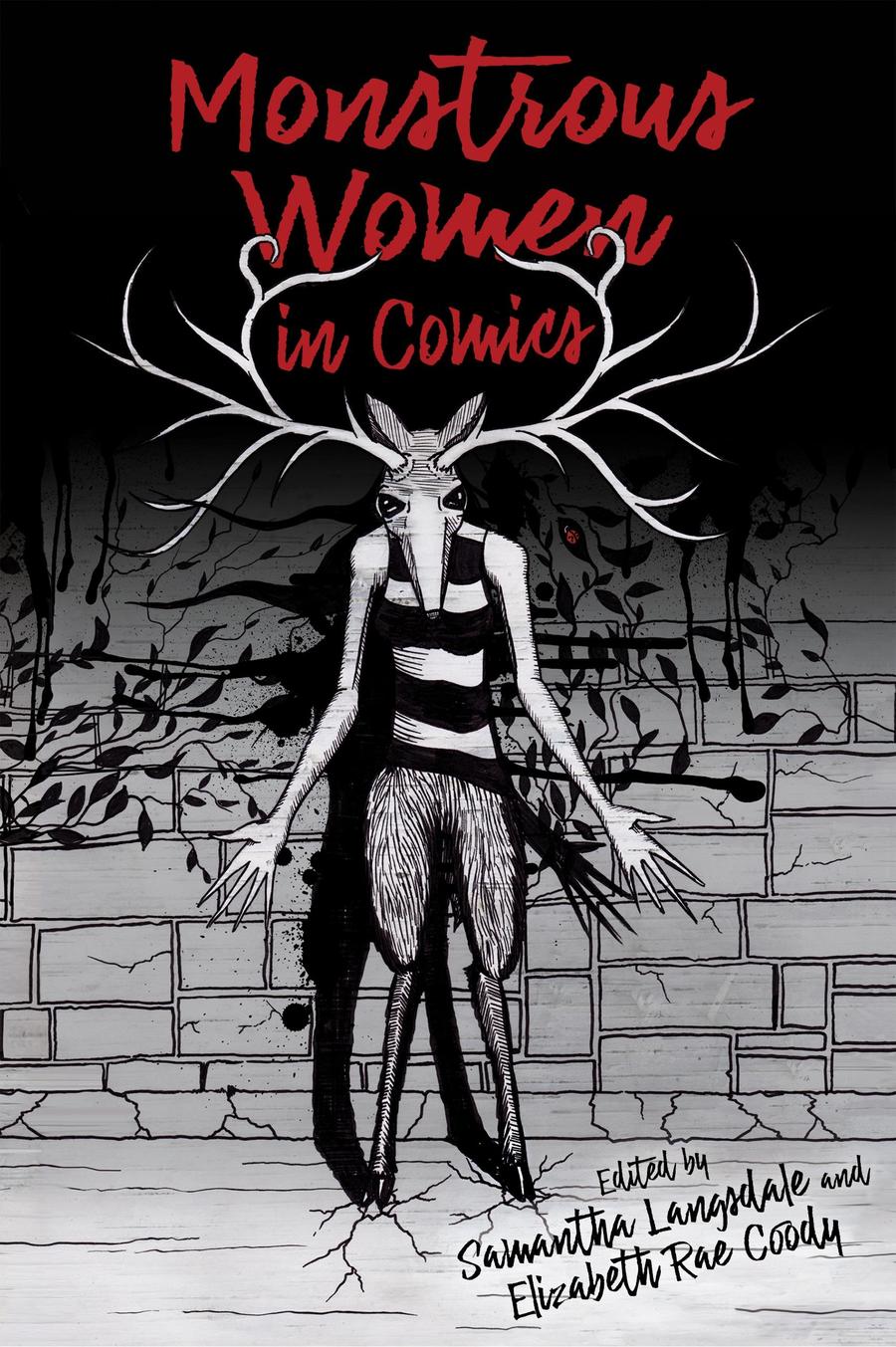
Review of Fantasy


SFRA Review, vol. 52, no. 4

Nonfiction Reviews


Review of Fantasy

Audrey Taylor

Lucie Armitt. Fantasy.Routledge, 2020. The New Critical Idiom. Paperback. 208 pg. $22.95. ISBN 9781138677029.

Fantasy scholarship has developed rapidly over the past half-century, and a well-informed discussion that grapples with the wide range of current research is certainly more than welcome. Lucie Armitt’s attempt at such a discussion in Fantasy, part of The New Critical Idiom series,is unfortunately not quite successful. However, before I begin my review in full, I feel I should give a warning. I opened this book expecting something entirely different, and this colored my reaction to it. Armitt was the first critic I discovered who took fantasy literature seriously, and so it was with delight that I dove into her latest book, over ten years after first encountering her work. The book I was expecting was an overview of the fantasy genre, particularly literature, as it stands two decades into the 21st century. There are probably other books offering such an overview, but this is not that book. This book takes a very broad look at the concept “fantasy” and explores it in a much wider cultural context, far beyond literature, or indeed, the 21st century. If you treat Fantasy as a book about the non-mimetic in a very broad sense, then you will likely have a very different, more positive, experience with this text. Armitt offers keen analyses and makes some interesting points. It is a shame that few of them concern the fantasy genre as it is commonly understood today.

Armitt begins with some of the, today, quite old-fashioned arguments about fantasy the genre as a whole and fantasy literature particularly. She brings up a number of points in her introduction that she follows with “as we will see throughout the book” (9), but I was generally hard pressed to find them more than sporadically hinted at. Her overall argument seems to be that “fantasy” is the driver for narratives and feelings across genres, and is in opposition to the real. The book contains five main chapters and a very brief conclusion. Though loosely bound by theme, the chapters tend to be collections of miniature arguments, but the structure or overarching argument is often fairly vague. This means that good points are sometimes buried in descriptive passages and details rather than holding the argument together.

Armitt’s introduction runs through several, older, definitions of fantasy before she makes her own claim. Her contention that “the key aspect of any fantasy narrative is the mechanism whereby the reader is permitted entry into another world” (10) was extensively argued by Mendlesohn in Rhetorics of Fantasy (2008). Rhetorics is only mentioned after several pages of Armitt’s own argument, but it is never made clear that Mendlesohn argued the same thing more than ten years ago. Mendlesohn is then left behind without real engagement.

In chapter 2, an overview of the fantastic from “Ovid to Game Boy,” Armitt makes a short argument for Ovid as fantasy. Discussions of Ovid quickly make way for Orpheus and his tale (without any explanation for why this particular story and not one of the many others in Ovid’s oeuvre), on to the operas staged from that story, and then to the problem of how to theatricalize fantasyland, all in a couple of pages. Some of the connections she makes are intriguing, while others are tenuous at best. For example, linking Puck’s ability to move quickly in A Midsummer Night’s Dream (1595/96) to Harry and Hermione’s trip back in time in Harry Potter and the Prisoner of Azkaban (1999) (42) is less than convincing. Connecting The Nutcracker Suite (1892) with the movie Chitty Chitty Bang Bang: The Magical Car (1968) might have been interesting, but the discussion is cut too short for it to be more convincing.

The third chapter concerns animal fantasy. Mickey Mouse is discussed without much notice of his “animalness,” however, and the brisk tour of Fantasia (1940) includes bits of plot and music but little real analysis of the other animal characters found throughout. Places where more research would have been welcome include Armitt’s assertion that “animated animal characters hold a particular attraction for child readers and viewers of film and television fantasy is clear” (62) or when she states that “in their identification with fantasy animals, children are clearly working through their fears in relation to adult humans” (63). She spends far more time “reminding” (63) the reader that not all animal stories are fantastic—Black Beauty (1877) and War Horse (1982) are her cases in point—than on explaining what animal fantasy is.

Chapter 4 is “Fantasy Quests.” This includes a quick dive through various quests—King Arthur’s quests, quests for knowledge, and others— without any detailed examination of any particular quest types. Armitt discusses The Lion, The Witch and the Wardrobe (1950), but only from the point where Edmund and Peter have different perspectives on a greening Narnia, leaving me wondering about the quest connection. Armitt’s point that there are horizontal as well as vertical quests is a valuable contribution to fantasy quest scholarship, but is unfortunately buried among sidelines and minutiae. This could have been the chapter’s central theme, but coming as it does after a meander about Robert Graves’s The Golden Fleece (1944) and King Arthur, it loses much of its impact. She engages here with Freud and Frasier but not with Mendlesohn or other, newer fantasy critics working with portals and quests.

Chapter 5 deals with politics and fantasy, and it was the chapter in which I was the most sorry for Armitt’s broad and vague use of “fantasy.” It begins with a brief look at three texts that have caused controversy, The Water-Babies (1863), Babar (1931), and some of Enid Blyton’s books. It then moves on to comics and a quick comment that superheroes can be tied to the rise of fascism. What troubles me here is that very little of this chapter seems to be about fantasy and its uses to fight for political causes, rather than fantasy as reactionary, conservative, or useless daydreaming, as is often argued outside of fantasy scholarship. I also failed to understand her choice of sub-categories. The same could be argued for Nineteen Eighty-Four (1949). Her reasoning is that she is discussing what happens within the text to Winston, that he “layers” fantasy around himself (123). It is unfortunate that with the escapist bad press the fantasy genre receives generally Armitt could not have found more titles that are explicitly fantasy, rather than science fiction, anime, or other genres. Her more intriguing claim that political fantasy, as she calls it, “typically operates as much through defamiliarization as invention” (127) is largely buried in pieces of plot and discussions of Nineteen Eighty-Four’s protagonist. Other points are similarly buried in examples from texts usually considered science fiction (The Handmaid’s Tale [1985], Oryx and Crake [2003], and more).

“Fantasy and the Erotic” is the rather bold title of Armitt’s last chapter. She argues in the beginning that “whenever critics write ‘seriously’ about sex and the erotic in fantasy, it is surprising how coy or full of obfuscation they become” (140). Armitt begins the chapter with a welcome discussion of her terminology and argument. She contends that all fantasy has an element of the sensual and vice versa, but does not, for this reader at least, convince. She argues that all erotic thought and writing is a form of fantasy, as it takes place in, or is produced by, the mind (142). She admits that sample texts “are recounted through narrative realism and this raises one key difficulty for a book on fantasy,” but her justification that “the relationship between fantasy and narrative realism is complicated by the erotic content” (143) is especially thin. Armitt’s overall points about the erotic, and particularly women’s place both within the erotic (as more than the object of desire) and the critical (as having worthwhile, un-phallocentric things to say), are intriguing; however, I would have liked to have seen them brought to bear on more overtly generic fantasy texts. The fantastic genre, in literature, movies, and more, certainly has texts that bring eroticism to the fantasy (Anne Bishop’s books, or the movie series Twilight [2008-2012] for example), and thus their absence here is doubly disappointing.

Given her lavish use of citations and research in some places, it is obvious that Armitt put a lot of time into research. However, the weaknesses in the text cluster around two main problems. The first is Armitt’s tendency to include everything under her loose definitions, and the second is the curious use of assertions rather than research in some areas, and a concurrent lack of depth in others. It feels as though one has but just landed on an idea or train of thought before being whisked away to the next. The literary and critical sources that Armitt uses are often quite dated. Calling Miss Peregrine’s Home for Peculiar Children “one of the freshest recent examples of portal fantasy” (15) is especially odd for a book published in 2011, at the point of this review ten years ago. She also continually returns to fantasy as the realm of the child, and the child-like, something that fantasy has been trying to move away from at least since Tolkien’s “On Fairy-stories” (1947), if not before.

One of the key challenges that the book is unable to overcome is that almost everything gets its chance to be considered, leaving little room for discussion of that which is usually considered genre fantasy. Armitt includes comics without a qualm, for example, a medium that is usually considered on its own generic terms, or, in the case of superheroes, is almost expressly presented as science fiction, not fantasy.

Unchallenged assumptions abound. For example, in a discussion of the first Gormenghast book, Armitt asserts, “If we, as readers, feel a sense of one-to-one identification with a walking protagonist, how much more closely do we hold our breath as Steerpike ascends slowly, fingertip by fingertip, stone by stone, until safely sitting astride the apex roof” (93). This assumes the reader has any wish to identify with Steerpike, and given his nasty personality, this is not the given Armitt seems to think it.

Fantasy appears uncertain about what it wants to achieve, and for whom. There is little newness there: the critical idiom Armitt outlines is sadly outdated in terms of fantasy scholarship; much of the criticism and theory produced in the last thirty years is missing. A general scholar of literature would gain a strange impression of the fantasy field as a whole, and certainly not a particularly accurate description of how it stands in terms of criticism, or even definitions, in 2021. Armitt certainly makes several thought-provoking and valuable points regarding a range of texts, but regrettably, these points alone are not enough to support the implied claim of the title.

Audrey Isabel Taylor is Assistant Professor of English at Sul Ross State University, Rio Grande College. Her first book, Patricia A. McKillip and the Art of Fantasy World-Building, came out in 2017, and she is at work on a second on science fiction author Anne McCaffrey.