Review of Alfred Bester’s The Stars My Destination: A Critical Companion


Review of Alfred Bester’s The Stars My Destination: A Critical Companion

Michael Pitts

D. Harlan Wilson. Alfred Bester’s The Stars My Destination: A Critical Companion. Palgrave Macmillan, 2022. Palgrave Science Fiction and Fantasy: A NewCanon. Hardcover. 135 pg. $49.99. ISBN 978-3030969455.

The Palgrave Science Fiction and Fantasy: A New Canon series sets out, as described by its editors, to rethink science fiction and challenge traditional “notions of the canon, so long associated with privilege, power, class, and hegemony” (v). In pursuit of these goals, the series posits two key questions in relation to the specific texts under consideration: “Why does this text matter to SFF? and “Why does (or should) this text matter to SFF readers, scholars, and fans” (v-vi). D. Harlan Wilson’s contribution to the series, a critical companion to Alfred Bester’s The Stars My Destination (1956), skillfully answers these guiding questions through its focus upon Bester as a pivotal figure in the development of the New Wave and cyberpunk movements. As Wilson argues, Bester’s commitment to pushing science fiction beyond its pulp roots was fundamental to the development of the former subgenre while the particular novel in question acts as an early landmark of proto-cyberpunk fiction. In this way, Wilson’s critical companion emphasizes the radical impact of The Stars My Destination, which propelled the canon past the frequently childish inclinations of its earliest works and towards new terrain, including complex analyses of privilege, power, class, and hegemony.

Wilson’s critical companion centers upon the thesis that Bester’s novel “mapped new terrain in postwar SF” and that it “accomplishes what pre-1950s SF novels failed to do in terms of style, structure, and attitude” (17). It is divided into sections covering the author’s career and the novel’s historical context, intertextual relationships with earlier and later science fiction works, and the text’s coded commentary on class, gender, race, and religion. The first chapter focuses upon the inspiration and resulting legacy of Stars, provides a biography of Bester, illuminates his role as both a critical writer of SF and a harsh critic of its contributors, and underscores the recurring tropes of Bester’s fiction. After a synopsis of the novel in Wilson’s second chapter, chapter three explores the literary influences that shaped Bester’s writing style, which Wilson characterizes as dominated by literary tropes and allusions. It additionally considers how Bester’s fiction hints at the future of the genre. Focusing narrowly upon the intertextual parallels existing between the novel and Mary Shelley’s Frankenstein (1818), chapter four considers these novels’ mutual interest in “charismatic monsters and meta-referentially point to the inherent mad scientism of Shelley’s and Bester’s authorship as well as narrative itself” (17). The most pivotal of Wilson’s contributions in this chapter is his analysis of Stars as a palimpsest under which lie multiple undertexts whose relationships to Bester’s novel are worthy of consideration, including, in addition to Shelley’s novel, the archetypal monomyth and H.G. Wells’s The Island of Dr. Moreau (1896) (70).

Moving past these intertextual considerations, Wilson focuses his fifth and sixth chapters upon the commentary Bester includes in the subtext of his novel upon identity markers and religious belief. “Architectures of Psyche, Power, and Patriarchy” considers Bester’s social views and his encoding of them in Stars. Analyzing specifically the novel’s treatments of gender, race, and class, Wilson complicates readings of the text as simply conservative or, on the other hand, radically progressive. Through a careful analysis of the future Bester imagines and the ways the novel’s protagonist, Gully Foyle, embodies both this society’s values and capability of evolving, Wilson introduces welcomed nuance to his analysis of the novel’s subtext. As Wilson outlines, his key argument in this chapter is that Bester “was more evolved than his contemporaries and made strides toward greater equality despite his own construction and entitlement as a white male author” (75). In this way, he presents a balanced critique of Bester as a patriarchal reflection of the culture within which he wrote and as a writer who at times radically subverted widely accepted, conservative perspectives on race, class, and gender.

In the final chapter of Wilson’s text, he considers the pervasive nature of religion within the encoded message of Bester’s novel. In one particularly insightful segment of this analysis, Wilson outlines the textual and extratextual implications of Bester’s encoded critiques of religion as they relate to language. As the title of the chapter, “Speaking in Gutter Tongues,” signals, Wilson illuminates an important connection binding language and religion in Stars. More specifically, he illuminates how dialect and other linguistic elements signal religious affiliation in this imagined society. The protagonist’s “lower-class gutter tongue,” for example, underscores his lack of anti-religious identity (101). But, as Wilson keenly observes, this connection between religion and language works simultaneously as a reflection of Bester’s extratextual desires and intentions as a science fiction writer. Specifically, Bester, Wilson contends, takes on the religious mantle of an exorcist, a mantle similarly taken on by Foyle in the novel. Both Bester and his protagonist aspire to positively reshape “their respective worlds—one from the violence of upper-class tyranny and prejudice, the other from the limitations of SF writers who fail to live up to the genre’s great potential” (101). According to Wilson, language and religion remain, therefore, entwined both within and immediately outside of the novel. This underscoring of Bester’s commentary connecting language and religion within the novel’s plot and Bester’s perceived role as a linguistic exorcist of sorts makes up a pivotal strength of Wilson’s critical companion.

Alfred Bester’s The Stars My Destination: A Critical Companion is overall a valuable critical tool for a wide audience. It is well-suited both for students seeking a broad guide to Bester’s novel and scholars in search of an in-depth introductory analysis of its key themes, tropes, and encoded messages. Moving beyond a simple overview of Stars, Wilson utilizes theoretically sound and sophisticated critical approaches to interrogate the novel’s significance and impact upon the science fiction genre. With its emphasis upon the ways Stars challenged science fiction’s trajectory and conservative political messaging, Wilson’s critical companion is a strong addition to Palgrave’s New Canon series.


Michael Pitts is lecturer at the University of New York in Prague. His first monograph, Alternative Masculinities in Feminist Speculative Fiction: A New Man, was published by Lexington Books in 2021. His research interests are positioned at the intersection of gender theory, speculative fiction, and utopian studies.

Review of Gendered Defenders: Marvel’s Heroines in Transmedia Spaces


Review of Gendered Defenders: Marvel’s Heroines in Transmedia Spaces

Jeremy Brett

Bryan J. Carr & Meta G. Carstarphen, eds. Gendered Defenders: Marvel’s Heroines in Transmedia Spaces. New Suns: Race, Gender, and Sexuality. Columbus, OH: The Ohio University Press, 2022. Paperback. 216 pg. $36.95. ISBN 9780814258521.

Scholarly, analytical works such as Gendered Defenders demonstrate that, despite opinions in some quarters (including the already tiresome Internet hot takes about being “so exhausted by all the comic book movies”), superheroes have significant cultural value. They produce emotional attachments among their readers and viewers, and they truly do mean something to people. For generations, media consumers have seen their own desires for heroism and goodness reflected in Superman, their own psychological darknesses and conflicts in Batman, their identities as social outcasts and misfits in the X-Men, their belief in love and justice triumphant and the power of a female warrior in Wonder Woman, their frustration with the foibles and troubles of everyday living in Spider-Man, their joy and pride in the heroic Black experience in Black Panther. Whatever their origins, Earthly or cosmic, superheroes are part of our shared human identity. Carr and Carstarphen quote comic writer Grant Morrison in their book’s introduction, noting that Morrison speculates “that the superhero (regardless of gender) holds significant psychic resonance in a world without an optimistic view of the future, providing the reader a surrogate ‘spiritual leadership’; the best superheroines, for all their supernatural exploits, are connected to universal human experiences” (4). One of those experiences is that of gender, and thus Gendered Defenders was brought into being to examine how the Marvel Cinematic Universe has dealt with this most fundamental of human conditions and identities. The fact that the MCU does so, and that its varying treatment of superheroines has produced high levels of both dizzying excitement and high dudgeon (much of the latter inspired by Internet trolls), suggests the ongoing relevance of superhero media to the lived experiences of people. As the editors note, “[p]opular culture has value and power because it can be a conduit through which an individual adapts and forms their own identity…as well as a means of finding commonality and relationships with others and metaphors that provide strength and catharsis in one’s own life” (5).

The MCU looms particularly large in this ongoing phenomenon because of its highly visible and entrenched cultural presence. The MCU is one of the grandest examples of what Henry Jenkins calls ‘transmedia storytelling,’ a form of media production that involves using multiple channels of adaptation (films, comic books, novels, cartoons, games, and other tie-in products) to tell the integrated story of an integrated fictional world across both overlapping and separate narratives. (The editors note that the MCU, of course, is more problematic than traditionally reinvented and reimagined worlds such as the Arthurian cycle, because it is a wholly corporate owned- and directed product geared towards market share and profits at least as much as towards telling new or reinterpreted stories.) How the MCU portrays female characters has significant cultural impact, and—in the book’s core conceit—the evolution of Marvel superheroines over time “mirrors the development, struggles, and triumphs of women in the real world” (7). The MCU does not stand apart from the greater movements of human society, but gives us a reimagined mythology through which to view their evolution. There is great importance in that, and Carr and Carstarphen, in bringing together scholarly essays of thoughtfulness and deep social consideration, demonstrate that superheroines are not mere cultural confections or vehicles for selling toys, but are windows through which we might view ourselves and our treatment of gender.

The book’s opening section, with three essays by the editors, sets the stage, presenting the overall thesis as well as necessary context for understanding how Marvel has portrayed women in its past, and a call to examine Marvel heroines through the lens of a trans/linear feminism (a conceptual model coined by Carstarphen that allows for female agency to pass beyond traditional constraints in progressive personal journeys, obviating the old style master linear narrative). With all these considerations in mind, the majority of the essays in the book involve examinations and critiques of specific Marvel heroines and their relationships to expressions and emanations of power. J. Richard Stevens and Anna C. Turner analyze Carol Danvers (Captain Marvel), the first MCU heroine to be the center of her own film; the essay notes Carol’s evolving image (and problematic portrayals at times) over the decades in comics and her reworking into a figure of positive feminism in the 2019 film (and the comic books beyond, as part of the MCU transmedia experience) in which Carol takes control of her own past and her own identity. The book’s final essay also concerns Carol, examining her character via feminist trauma theory and characterizing her film as a trauma narrative that carries her from trauma to recovery to empowerment. Kathleen M. Turner Ledgerwood looks at the character of Agent Peggy Carter (the first MCU heroine to lead a television show) through the analytical lens of ‘standpoint feminist theory,’ that is, the framework that examines society from the points of view of women (as a marginalized group) in their everyday worlds and the ways in which women socially construct those worlds – it’s a particularly relevant frame for looking at Peggy, a character we see navigating her way through the white male-dominated and intensely gender-divided workplaces of the 1940s and evolving to connect viewers to subsequent waves of feminist thought and action. Amanda K. Kehrberg studies the complicated figure of Jessica Jones and the ways in which Jessica visually and vocally subverts and refuses not only the traditional hero role but the traditional binary concept of gender, particularly through her use (or NON-use) of the superhero costume.

In her essay, Rachel Grant examines the character of Shuri, T’Challa’s sister and the leader of her native Wakanda’s scientific endeavors. Shuri is an active example of an Afrofuturist counternarrative that prioritizes the heroism of intelligence and future thinking and promotes anti-colonialist (very explicitly, in Shuri’s case—viewers of Black Panther in the theater will well recall the many excited responses by audience members to her use of the term “colonizer” when speaking to white CIA agent Ross) structures and viewpoints. Grant notes that Shuri “defies gender stereotypes of Black women” and is “a role model that empowers women to be smart and innovative in fields dominated by the patriarchy” (102). Maryanne A. Rhett deftly analyzes Kamala Khan (Ms. Marvel) as a new type of cosmopolitan, even global, heroine, who embodies multiple and overlapping identities (woman, Muslim, teenager, feminist, daughter), none of which dominate her character but all of which define her in different ways. In an unusually constructed piece, Stephanie L. Sanders uses the character of police officer and cyborg Misty Knight to represent the possibilities for Black women to be change agents in dismantling unjust systems and presents Misty herself as a source of intersectionality “where gender, race, and power relations are hypervisible” (132).

Julia A. Davis and Robert Westerfelhaus look at the character of Natasha Romanoff (Black Widow), the first MCU heroine, her status as an “outsider” hero (as a Slav on a primarily American team of heroes and as a hero operating within a secret world of espionage) and her sometimes problematic depiction as a physically objectified figure. Mildred F. Perrault and Gregory P. Perrault examine Pepper Potts, her evolving role/increased presence in the MCU across a close reading of multiple examples of Marvel transmedia (films, animated TV, comics, video games), and how her gender and gender roles have been performed in these various media. And Carrielynn D. Reinhard presents a careful and complex analysis of the character Squirrel Girl (who has not yet appeared in an MCU film, though I remain hopeful) that centers on the various ways in which transmedia storytelling can affect and complicate the development and portrayal of a character. Squirrel Girl is a positive character, promoting dialogue over confrontation and friendly diplomacy over fighting, and who focuses on intelligence, friendship, and female empowerment. In doing so she embodies multiple iterations of feminism and the contradictions therein, but Reinhard suggests that the nature of her corporate transmedia existence allows her to reflect and express feminist values but never truly seek to subvert systems of power.

Gendered Defenders is a wonderfully varied collection of thought on a wonderfully varied collection of heroines, and it is a welcome addition to the body of scholarly study of superhero media. [I do admit that I was surprised not to see an essay on Wanda Maximoff, whose journey from Avengers: Age of Ultron through WandaVision, I think, would make for a fascinating examination of female trauma and power.] If it suffers at all, it is only because, of course, it must inevitably fall behind as the MCU marches on and characters continue to grow and change, and new ones to be introduced. It would be interesting to see how some of the writers might change their conclusions in light of new MCU developments: for example, Peggy Carter becoming an alternate Captain America, or Shuri becoming the new Black Panther. New series like Hawkeye (featuring Kate Bishop) or She-Hulk (with Jennifer Walters) have brought new iterations of superheroines to our attention and express new directions that Marvel is moving in with respect to its female heroes. A sequel to this volume—a Gendered Defenders 2­—would not only be thematically appropriate to studying a transmedia universe fueled by sequels but would provide new and welcome insights into the continuing evolution of the vitally significant cultural figure of the superheroine.


Jeremy Brett is an Associate Librarian at Cushing Memorial Library & Archives, where he is both Processing Archivist and the Curator of the Science Fiction & Fantasy Research Collection. He has also worked at the University of Iowa, the University of Wisconsin-Milwaukee, the National Archives and Records Administration-Pacific Region, and the Wisconsin Historical Society. He received his MLS and his MA in History from the University of Maryland – College Park in 1999. His professional interests include science fiction, fan studies, and the intersection of libraries and social justice.

Review of Science Fiction: Toward a World Literature


Review of Science Fiction: Toward a World Literature

Michael Larson

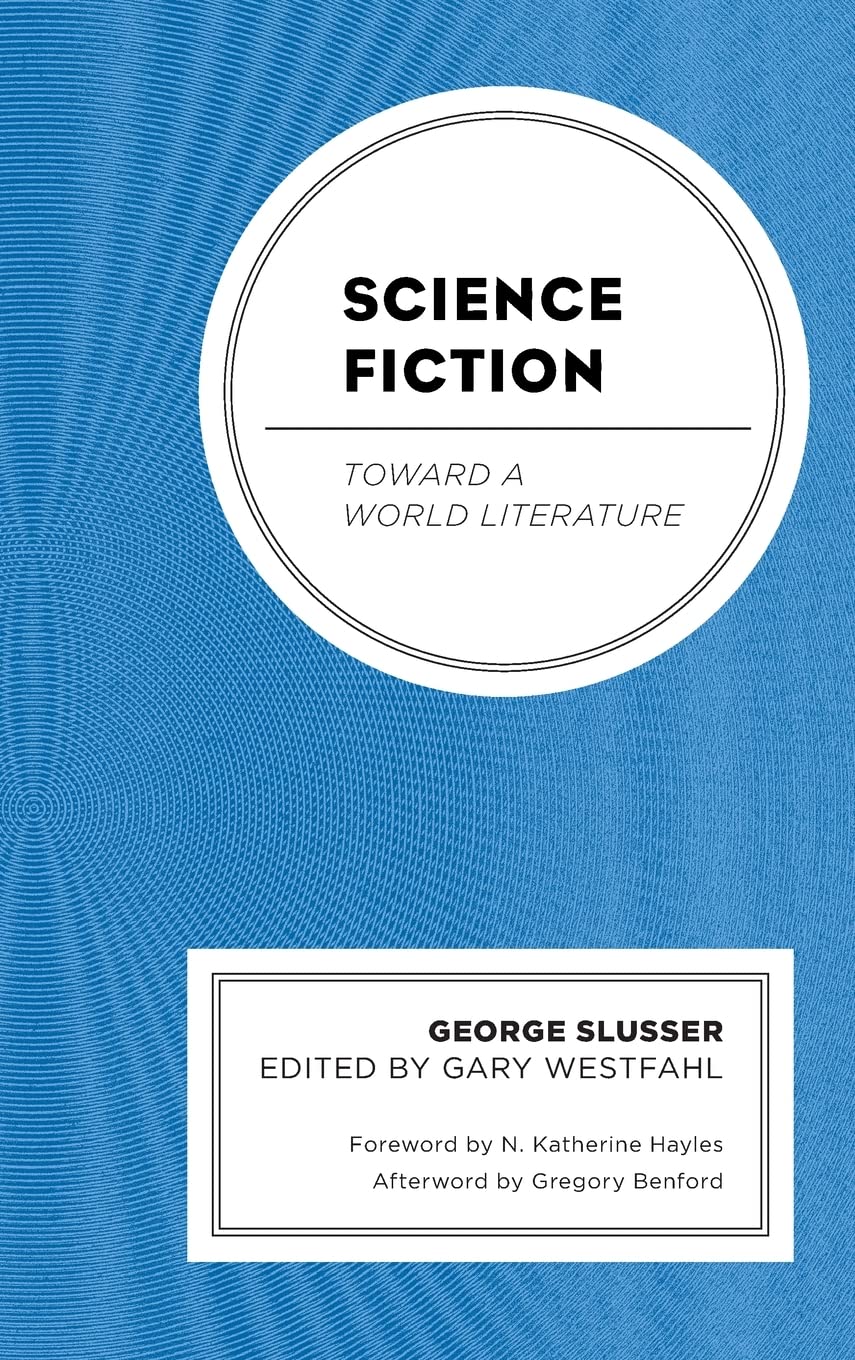
George Slusser. Science Fiction: Toward a World Literature. Edited by Gary Westfahl. Lexington Books, 2022. Hardcover. 350 pg. $120.00 ISBN 9781666905359.

            The eminent science fiction critic and long-time curator of the Eaton Collection of Science Fiction and Fantasy George Slusser died in 2014, leaving behind multiple versions of a manuscript about the history and development of science fiction. Gary Westfahl, Slusser’s former colleague at the University of California, Riverside, compiled and revised these materials into this posthumous volume, which, barring any major archival discoveries, marks Slusser’s final contribution to the field he dedicated his career to.

Like Adam Roberts’s The History of Science Fiction (2006) and Brian W. Aldiss and David Wingrove’s Trillion Year Spree: The History of Science Fiction (1973), this project aims not merely to define science fiction in a new way, but to locate the historical origins of the genre. After a brief introduction, the first chapter traces the emergence of science fiction, and, although Slusser does not go back as far as Roberts, who sees even Greek epics as a kind of proto-science fiction, both critics understand the Reformation as a key moment in the development of the genre.

Employing Isaac Asimov’s definition of science fiction as a “branch of literature which is concerned with the impact of scientific advance upon human beings” (“Social Science Fiction”), Slusser identifies a series of scientific revolutions that swept across Europe and the United States beginning in the 17th century, which would go on to shape key proto-science fiction texts. For Slusser, the story begins in France, where the anti-clerical rationalism of François Rabelais passes through Michel de Montaigne to René Descartes, whose Discourse on the Method (1637) represents the first of a series of scientific paradigm shifts. Slusser argues that this advancement had an impact on French writing, producing a unique form of fiction, first visible in Blaise Pascal’s Pensées (1670), with its fictional concepts of the “human condition” and the “thinking reed,” which Slusser identifies as “the first genuine works of science fiction” (25). From there, we move to Germany, where the paradigm shift brought about by Immanuel Kant’s influence, especially his “synthetic a priori,” influenced E.T.A. Hoffman’s “Der Sandmann” (1815). Interestingly, it is only after identifying these Continental origins that Slusser turns to British literature.

Unlike many English-language critics, Slusser sees British literature as reflecting the impact of Francis Bacon’s “new science” at a relatively late moment. Mary Shelley’s Frankenstein; or, the Modern Prometheus (1818), which is often cited as the first work of science fiction, is brushed aside for taking a posture that is “quite traditional in stigmatizing science” (39). Instead, Slusser identifies H.G. Wells’s The Time Machine (1895) as the first British work of fiction that shows science—in this case, the evolutionary theory of Charles Darwin’s Origin of Species (1859)—impacting human activity. The final paradigm shift occurs in the United States, stemming from the philosophical innovations of Ralph Waldo Emerson, although this is only arrived at toward the end of the text, after the key characteristics of science fiction have been investigated.

The middle chapters take up particular themes and markers of the genre. For Slusser, key attributes include the scientist as protagonist, a quest for intellectual liberty, seminal objects or inventions that play a key role in the narrative, and a story in some way concerned with humanity’s advancement towards a transcendent transhumanism, best exemplified by J.D. Bernal’s The World, the Flesh, the Devil: An Enquiry into the Three Enemies of the Rational Soul (1929). As with Roberts, Slusser sees space travel as a key setting for science fictional narrative, although his treatment of this subject primarily serves to underline the difference between the Anglo and French science fiction traditions, the latter of which he sees as bound up with the Cartesian conception of the cogito; although French travelers board rocketships and submersibles, just like their British counterparts, more often than not their journeys are actually explorations of a mental space that is simply reflected in the res extensa.

Throughout these investigations, Slusser does not shy away from controversy, and a number of established theorists and traditions come in for a heaping of criticism. Donna Haraway’s “A Cyborg Manifesto” (1985) can only “conjure the old specter of the human form grotesquely distorted, stillborn” (211), while China Miéville’s work is “a personal form of urban fantasy whose purpose, it seems, is to confound genre readers while delighting critics” (288). Marxism and Marxist theory are viewed in a skeptical light, and deconstructionism is frowned upon.

Of course, a critical lens can be also applied to Slusser’s text, and when it is, one begins to wonder about the meaning of “world literature,” a term that seems to define the manuscript even as it is never itself defined. A reader might be forgiven for observing that a series of national, European, science fiction traditions are interrogated, with minimal description of the significant interactions between them until the final chapters. In addition, some readers might echo the criticism of the original reviews of the manuscript, which Westfahl reports requested extensive revisions because the book “was devoting too much attention to authors and texts that were not really part of the genre of science fiction” (xi). Although Westfahl sees exactly this as Slusser’s innovation, some scholars may question the usefulness of giving so much attention to certain classics of European literature and philosophy—Descartes, Pascal, Kant, Aristotle, Balzac—in a study of science fiction.

However, on balance, even scholars who are not prepared to sign onto Slusser’s account of the history of science fiction are likely to find his efforts to understand the genre from a more international perspective to be worthwhile. Slusser’s thorough examination of non-Anglo traditions, especially French science fiction, will be edifying for those who are accustomed to thinking of science fiction as an exercise primarily conducted in English. Crucially, in the book’s conclusion, Slusser engages fruitfully with writing from India, China, Israel, East Germany, Romania, and other terrains of “Global SF” (286). Along with the aforementioned volumes by Roberts and Aldiss and Wingrove, Science Fiction: Toward a World Literature makes a valuable contribution to the critical understanding of science fiction’s origins and is a worthy capstone to a vaunted career.


Michael Larson is a visiting assistant professor at Keio University. He completed his PhD at the University of Wisconsin-Milwaukee and received a Fulbright Grant to research the 2011 Tohoku Earthquake and Tsunami in Japan, later writing a nonfiction account of the disaster When the Waves Came: Loss, Recovery, and the Great Tohoku Earthquake and Tsunami (Chin Music Press 2020). His current research focuses on science fiction and utopian studies and has been published in Poetics Today and Utopian Studies. In 2020, he received a three-year Young Researcher Grant from the Japan Society for the Promotion of Science.

Review of Equipping Space Cadets: Primary Science Fiction for Young Children


Review of Equipping Space Cadets: Primary Science Fiction for Young Children

Bruce Lindsley Rockwood

Emily Midkiff. Equipping Space Cadets: Primary Science Fiction for Young Children.  UP of Mississippi, 2022. Childrens Literature Association Series. Hardcover. 218 pg. $99.00, ISBN 9781496839022. Paperback. 218 pg. $30.00, ISBN‎ 9781496839015. Kindle E-Book. 211 pg. $30.00. ISBN 1496839013.

        At a time when disputes—whether political, cultural, or merely pedagogical—are growing over what literature should be available to children in pre-K through primary school, and the very idea of encouraging librarians, teachers (and parents) to read aloud from, teach with, or make available to children picture books and early readers that challenge or encourage interest in science (much less science fiction!), especially for girls and diverse readers, Emily Midkiff has undertaken an arduous effort to address this challenge. Her goals are straightforward: to identify categories of picture books and early readers that exemplify ‘quality’ sf; assess how widely sf is available and read by or to children in our schools; to show how young readers are ready for, and appreciate, what she seeks to identify as “quality primary” age sf; and to encourage writers, publishers, and acquisitions professionals in the value of the production and promotion of quality primary sf. (5-8) Wider availability of such texts will better prepare younger readers to transition to more complex sf texts when they reach and exceed the storied “golden age” of 12 so often referred to in superficial discussions of who is “ready for” the genre. (18)

In her introduction, Midkiff discusses the example of a publisher’s initial reluctance to have Jon Scieszka include “too much science” in his sf series that starts with book 1, Frank Einstein and the Antimatter Robot (2014). (3-4) She points out that the book’s text and detailed illustrations include “the sort of plausible explanations found in sf for adults.” (3) Usefully, her close reading of this text includes excerpts from the illustrations in this book (6) and examples of intertext references contained in the story that will ring true to adult readers and primary age children who are exposed to movies, television, and other cultural markers of sf themes. For example Frank is shown “reading a copy of Asimov’s I, Robot when Grampa Al asks to know what he is working on” (4).

Midkiff argues that “sf for preadolescent children… is often approached with the belief… that scientific extrapolation and speculation in fiction are beyond most children’s abilities or interests” (5). Her book argues in essence that this is not true, and she supports this assertion with three interdisciplinary case studies (Chapter 4) to show that primary sf does exist, much of it fits her definition of quality, is appreciated when available, can provoke lively reactions and discussions when presented to small groups of children, and deserves wider acceptance and promotion. Her argument is that the “dismissal of primary sf is fueled by largely ungrounded beliefs about children, science, and genre.” (5)  The case studies are a School Library circulation survey of books checked out in all fields, as coded by Midkiff from records submitted (105-117), which tends to show that primary sf while underrepresented in collections, is more likely to be checked out multiple times than other fiction; a survey of librarians and teachers, 59 of whom responded to the survey request concerning whether they recommended or made us of primary sf in class; (117-129) and a small group read-aloud exercise of several stories where she read to children with parental consent, recorded the event and analyzed the responses of the children to the texts and each other’s comments (130-151).

Chapter 1 of the book commences with a review of two related questions: “What is Children’s Literature?” (9-12) and “What is Science Fiction?”(12-16), followed by an integration of the two: “What is Primary Science Fiction?” (17-27), and a “Guide” to identifying primary sf (27-30). This is applied to “The Case of Robots” (30-35), with a close textual analysis of Rian Sias’s Zoe and Robot: Let’s Pretend (2011). Midkiff usefully compares claims, arguments and examples from Brian Aldiss,  John Clute, Istvan Csicsery-Ronay, Grace Dillon, A. Waller Hastings, and in particular Farah Mendlesohn’s The Intergalactic Playground (2009) to lay out the scholarly critical background for her investigation of her theme, the value of primary sf.

She condenses this chapter into a three-part test to determine whether primary sf can be said to be ‘quality’: “1. Is there a speculative ‘what if’ question or extrapolative ‘if this, then what?’ question to the story?  2. Does the ending imply that something has changed in the world or that new possibilities have opened due to the events of the story, however small? 3. Would the story’s plot, themes or lesson be different if you replaced the sf components of the story with something realistic or magical?” (30)

Chapter 2 addresses the  general question of how readers read and interpret science fiction generally, discusses the “processes and protocols of reading sf” (37-42), and applies them to the forms of early childhood literature such as board books, popup books, picturebooks, early readers and so forth. She applies the “reader response theory of reading first described by Louise Rosenblatt” to how children read sf  (37), and cites the work of Darko Suvin, Orson Scott Card, and David Hartwell to discuss how the “sf intertext includes far more than just books” and provides a cultural foundation to facilitate children understanding and appreciating the themes and stories of sf texts (38-39). Her investigations show that “widely consumed reboots of Star Trek, Star Wars, Doctor Who” and more prepare young children to successfully read and relate to sf (39) As for all reading instruction, Midkiff notes that “high-quality primary sf offers support—-or ‘scaffolding’—for young readers, ensuring that sf is accessible to children of various skill levels and backgrounds,” citing the work of Jerome Bruner and Lev Vygotsky (42). She applies a close reading of Chris Gall’s There’s Nothing to Do on Mars (2008), showing how the pictures provide context and meaning that challenges the text, and how the book “pushes back against the idea that sf and children’s fiction have conflicting patterns, and the text/picture tension is critical to that message.” (50-51) As another example she cites David Wiesner’s picturebooks Flotsam (2006) and June 29, 1999 (1992) (51-53), the latter one of the books she used in her read-aloud case study to assess how children react to a text in real time (132-145).

Chapter 3 focuses on “Reading Representation,” addressing the various ways in which primary sf, and particularly early childhood sf, tends in recent decades to provide more representation of, and opportunity for self-recognition of themselves, in girls and diverse communities than in children’s literature generally. She cites Lisa Yaszek’s observation that sf has always been “naturally compatible with the project of Feminism” (70).  Midkiff notes the conservative complaints about the Hugo awards to N.K. Jemesin for her Broken Earth trilogy, which was perceived as somehow a threat to genre sf  (70), but argues that primary sf is “in the direst need of attention to diversity” (71). Using the Cooperative Children’s Book Center (CCBC), https://ccbc.education.wisc.edu/ , as a resource, she shows the low percent of the 4035 children’s books of all sorts published in 2019 that feature Black/African, Asian, Latinx, Pacific Islanders, Arab, or Indigenous  characters. Female characters are also underrepresented. Her own research shows that “High-quality, diverse primary sf books already exist, but they are not getting nearly enough critical attention or support” (72), citing the 357 primary sf books she identified in her study (87). Appendix A identifies the 357 primary sf books from the 1920s to the 2010s to support her analysis (157-178). Pros and cons of several representative stories are discussed, including Deborah Underwood and Meg Hunt’s Interstellar Cinderella (2015) : “The mechanical engineering  aspect of the story is sidelined in favor of the fractured fairy tale” (74). In contrast, Ben Hatke’s Zita the Spacegirl (2010) is seen to “satisfy several girl-friendly aspects in conjunction with speculation” (75). She reprints several pages of illustrations from the book to illustrate her explanation (76-77). Other examples include A Wrinkle in Time: The Graphic Novel (2015), and Ryan Sias’s Zoe and Robot: Let’s Pretend! (2011)

Midkiff then discusses “Alternative Futurisms and Primary Science Fiction” (83-91), exploring the potential for more diverse primary sf, acknowledging a few positive representative examples, while acknowledging their limitations. She explains: “To examine the extent of diversity in these books, I coded them into two categories proposed by Lee Galda et.al. in Literature and the Child: painted faces and culturally rich.” The former refers to a story that offers “visual cues of diversity” which may not otherwise impact the story line, while culturally rich stories have “a nonmainstream culture or identity… integral to the story.” (87)  She argues it is not enough to have “painted faces” representing diverse characters in illustrations, the stories themselves should be culturally rich to enhance young readers of all backgrounds engagement with the text (87-88).  One positive if rare example given is Cathy Camper and Raul the Third’s graphic novel Lowriders in Space (2014), discussed in detail with reprinted illustrations. (89-93)  The only primary sf discussed in her data set that features a Native American character is Adam Rex’s hybrid novel The True Meaning of Smekday (2007) (97-100). There is a Pearson statistical analysis of the correlation of gender, diversity and sf quality in the books in Midkiff’s data set (91 and Appendix A) which shows “quality is slightly correlated with female characters and not reliably correlated with diversity” (91).  I appreciate the attempt here to provide statistical rigor to what is essentially an impossible task, and the effort here provides  a template for future scholarship in the field.

The book concludes with two Appendices providing documentation of her sources and evaluations. Appendix A describes and lists the 357 texts she “read and analyzed for this study” covering works from the 1920s to the present (157-178). Books included were limited in three ways: they had to meet the definition of sf she provides in Chapter 1; be significantly illustrated to meet her emphasis on early primary readers as the target of her research; and her decision that there could be no more than 3 books in the same series (157). Books were grouped as Picturebooks, Early Readers, Comic Books, Graphic Novels, or Hybrid Novels. Each was evaluated for quality (Yes/No: was  Speculation and/or Extrapolation encouraged by the text?); whether they had female primary characters; and whether they promoted diversity by either of the broad categories discussed in Chapter 3: “painted face,” “culturally rich,” or none (161). Appendix B (179-186) contains a list of suggested recommended quality sf texts in the age appropriate categories she identifies. The book concludes with end notes (187-190), works cited (191-199) and an index (201-206).

Having read aloud a great many board and picture books over 50 years, many of them fantasy or sf, to our four children and our grandchildren, and as the son of one librarian and being married to a children’s librarian/early childhood educator, I was initially inclined to doubt her hypothesis that primary sf is not widely available or promoted. I thought of earlier Jon Scieszka books such as The Time Warp Trio series, with its own t.v.series spin-off,  https://www.timewarptrio.com/, The Enormous Egg by Oliver Butterworth (1956), The Wonderful Flight to the Mushroom Planet (1954) by Eleanor Cameron, and the Danny Dunn series of adventures by Raymond Abrashkin and Jay Williams, all of which have useful illustrations, are aimed at younger readers, and address science fiction tropes, as a few examples not mentioned in her book. And then there are, in addition to school libraries, other means of exposing children to sf she might explore to expand her sense of the contemporary reach of primary sf, such as the Bruce Coville and other books many children are offered in Scholastic Books Club newsletters and school book fairs over many years. See: https://clubs.scholastic.com/home [Although censorship of their offerings is creeping into what schools in some states can now offer; see: https://www.npr.org/2023/10/17/1206219484/scholastic-book-fair-diversity-book-bans and https://www.nytimes.com/2023/10/25/us/scholastic-book-fair-race-gender.html?smid=nytcore-ios-share&referringSource=articleShare ] The omission of some of these authors and potential resources suggests that there is more sf (quality or otherwise) available to younger children than Midkiff may realize. On the other hand, school and town libraries have limited space and budgets, and books get worn out and deaccessioned, so some of the books I’m familiar with, as well as those discussed by Midkiff, may not be readily available. We are agreed that there is a need for more willing and eager young readers, and that this can be supported by more quality primary sf being written and published. Midkiff’s book should be included in the libraries of schools of education, and considered by public and school librarians as they review their acquisition policies and make more invitations to authors to visit for book talks in the children’s room. It matters.


Bruce Lindsley Rockwood, Emeritus Professor of Legal Studies at Bloomsburg University, Pennsylvania, is a long-time member of SFRA, having served as Vice President (2005-2006), and regularly writes reviews for SFRA Review from his retirement home in Midcoast Maine. He has taught and published on law, literature, climate change and science fiction, and attends SFRA and WorldCon with his wife Susan when possible (most recently in Montreal, Spokane, and the June 2021 virtual SFRA).

Review of Rendezvous with Arthur C. Clarke: Centenary Essays


Review of Rendezvous with Arthur C. Clarke: Centenary Essays

Jerome Winter

Andrew M. Butler and Paul March-Russell, eds. Rendezvous with Arthur C. Clarke: Centenary Essays. Gylphi Limited, 2022. SF Storyworlds: Critical Studies in Science Fiction Series. Paperback. 306 pg. $40.00. ISBN  9781780241081.

Andrew M. Butler and Paul March-Russell, the editors of this new collection by leading scholars of Arthur C. Clarke, begin with a riposte to the still pervasive marginalization of genre work in literary studies and culture at large. In a 1998 article for The Village Voice, Jonathan Lethem, a supremely genre-savvy writer, famously offered a broadside in which he characterized Arthur C. Clarke’s Rendezvous with Rama as “reactionary SF as artistically dire as it was comfortingly familiar” (qtd. in Butler and Russell 1). If Rendezvous with Rama had lost its Nebula Award to Thomas Pynchon’s also-nominated Gravity’s Rainbow in 1973,Lethem facetiously conjectures that, then, the New Wave experiments of the SF genre would have at last escaped their commercial straitjackets, and the SF genre as a basic category of fiction would have evaporated with a collective sigh of “good riddance.”

Butler and March-Russell bristle at Lethem’s tendentious dismissal of Clarke’s brand of hard-SF fiction, but, more substantively, they challenge the equally unquestioned conventional binary that seeks to oppose a virtuosic genre-hybridizing and postmodern writer such as Thomas Pynchon to a less flamboyant innovator like Arthur C. Clarke who wrote, at least superficially, from within genre constraints. Indeed, with this impressively informed and diverse collection of essays that began at a 2017 centenary conference memorializing Clarke’s birth in 1917, Butler and March-Russell make a convincing case that the broad range and intricate subtlety of Clarke’s deep veins of literary-SF ore have yet to be critically assayed, let alone sufficiently mined. In their introduction, Butler and March-Russell argue that it is impossible not to read Clarke as a “homo duplex, a perpetually two-sided and enigmatic figure” (7). Indeed, the deeper and more carefully a reader looks, the more the lucid simplicity of Clarke’s career concerns seems to be, on closer reflection, a mysterious bundle of contradictions.

One of the overlooked ways in which Pynchon and Clarke are surprisingly likeminded is their obsession with fictively overcoming the inexorable laws of physics, such as gravity or entropy. Noting that the Overlords in Childhood’s End (1953) both fly and manipulate gravity, Thore Bjørnvig traces Clarke’s literary pedigree to the long tradition of eschatological and apocalyptic writing that levitates the future of humanity upward to disruptive visions of radical progress. Jim Clarke then picks up this fundamental paradox of Clarke’s rational-fantastic fiction to explore Clarke’s debt to what Clarke himself called his own unique blend of “crypto-Buddhist” metaphysics. Likewise, in “Clarkaeology,” Patrick Parrinder argues that even though Clarke’s fiction seems to be “strikingly forward-looking” (35), it also evinces a powerful sense of “belatedness,” betraying a keen interest in archeological theories about the diffusion of cultures, especially in the fascination with megaliths and obelisks.

Developing this critical analysis of Clarke’s unique twists on future histories, co-editor Paul March-Russell, in his own contribution to the collection, performs a close reading of The City and the Stars (1956) to argue that Lee Edelman’s notion of queer futurity can help readers understand how Clarke subtly subverts the common assumption that this prototypically hard-SF writer implicitly champions technological and imperial (galactic) progress. Similarly, connecting Clarke to Robert Heinlein’s movie tie-in Destination Moon (1950), the Russian SF writer Pavel Klushantsev, and the British SF writer E.C. Tubb, Andy Sawyer’s chapter argues that Clarke avoids straightforward propagandizing for Cold War ideology. Sawyer, though, cautions that Clarke wrote for an audience composed largely of technocrats and fans, and Clarke therefore soberly appeals to the power of scientific explanations and regularly evokes the sublimity of the cosmos, even if he also undercuts these semi-heroic gestures.       

   Another chapter that concerns itself with excavating the queerness in Clarke’s oeuvre would be Mike Stack’s “Clarke Dare Speak Not Its Name,” which explores the futuristic normative bisexuality of Imperial Earth (1975) against the illuminating historical backdrop of the partial decriminalization of homosexuality in the UK. In an essay that is equally attentive to textual details, co-editor Andrew Butler, drawing on theories of Freud, Heidegger, Haraway, and Derrida, explicates Clarke’s representations of tools in 2001: A Space Odyssey (1968) and 2010: Odyssey Two (1982)as not only empowering prosthetic enhancements but also as unsettling posthuman transformations. With an emphasis on Clarke’s uncertain mixture of skeptical deflation and heady enthusiasm entirely in keeping with this nuanced volume, Helen M. Rozwadowski discusses Clarke’s writings and life of active undersea diving to show how Clarke probes the limits the frontier analogy for both sea and space.

This collection also incisively focuses on Clarke’s legacy with one chapter by Lyu Guangzhao on Clarke’s influence on Liu Cixin and contemporary Chinese SF, and one chapter by Joseph S. Norman on Clarke’s influence on Iain M. Banks and New Space Opera. Nick Hubble’s final chapter on the history of the Clarke Award and how the award has become more controversially unpredictable and less narrowly restrictive in its selective criteria over the years suggests the more or less consensus view today, in China Mieville’s clever pronouncement, that “any sufficiently advanced science fiction is indistinguishable from literature” (qtd. in Hubble 236). This chapter is a fitting conclusion to the volume as it revisits the dismantling of the problematic binary between SF and mimetic literature that the other important contributions to Clarke scholarship contained in this collection also consistently upend. This wide-ranging, insightful, and often scrupulously evenhanded collection would serve equally well SF novitiates, veteran Clarke scholars, and those interested more broadly in the contested boundaries between genre and mainstream fiction.            


Jerome Winter is an SF scholar who studies literary space opera, citizen science, and pedagogy. His most recent published book is a critical introduction to the Mass Effect videogame series as an innovative iteration of space-opera narrative.   

Review of Frank Herbert’s Dune: A Critical Companion


Review of Frank Herbert’s Dune: A Critical Companion

Leigha High McReynolds

Kara Kennedy. Frank Herbert’s Dune: A Critical Companion. Palgrave Macmillan, 2022. Palgrave Science Fiction and Fantasy: A New Canon. Hardcover. xi + 113 pg. $34.99. ISBN 9783031139345.

Many of us who read and write for this publication probably have the following in common: science fiction (and related genres) helps us think through abstract ideas, including literary theory. And I’d bet that many of us also share another common experience: we learned those literary theories from instructors who were themselves not familiar with science fiction, definitely not as a field of scholarship and maybe not even as fans. Kara Kennedy’s most recent book, Frank Herbert’s Dune: A Critical Companion, is the kind of book we needed, and I’m glad that now science fiction students and scholars will have access to this resource. 

This companion was published as part of the relatively new series Palgrave Science Fiction and Fantasy: A New Canon, edited by Sean Guynes and Karen Omry. The series’ goal is that “the books will provide an understanding of how students, readers, and scholars can think dynamically about a given text.” Given the combination of Dune’s reputation in science fiction history, broad disciplinary appeal, and allure for teen and young adult readers, offering this kind of companion text to the novel seems particularly apt.

What immediately stands out about the book is its accessibility. The writing style and language choices are straightforward and jargon-free: easily understood by an undergraduate reader, or even advanced high school students. Although it provides a comprehensive overview of the novel’s themes, the book is short, less than 100 pages if you don’t count the bibliography and index, making it less daunting for readers as well as more likely that they will take in the breadth of information covered. To facilitate that brevity and clarity, the book covers only the 1965 novel Dune, so potential readers do not feel as if they need to have read and watched a whole franchise. In addition, there are six original color illustrations by Arthur Wheelan, which lend a delightful whimsy to a discussion of a text that is often taken very seriously. 

The structure of the book is also audience centered: it is divided into seven sections of about fifteen pages in length. Each section provides an overview of a related group of themes of the novel and begins with an abstract and list of keywords. All of this would allow a novice scholar or lay-reader to easily read the whole text or find what might be useful to help them engage with the novel. Topics covered include: historical and biographical context, political and religious institutions, ecology and environmentalism, and women’s agency. Two of the middle chapters stand out as offering attention to aspects of the novel that are under-theorized and misunderstood, respectively. Chapter Four analyzes the novel’s attention to mind and consciousness, dramatized through access to hyperaware characters’ interiority, in a world that, without computers, relies on heightened human consciousness. Chapter Five explores the protagonist Paul Atreides’s complicated relationship to the heroic archetype and traditional masculinity. Kennedy explains that Paul’s limitations and failures are part of Herbert’s critique of charismatic leaders. This chapter is especially important for readers who have not continued with the series to understand one of Dune’s central messages. The final chapter suggests avenues for future scholarship and exploration including translation studies, psychoanalysis, and postcolonial theory: it’s a call for future readers and scholars to create a robust body of knowledge that reflects the complexities and depth of the novel. At the end of the book is an extensive bibliography valuable for any Dune scholars, containing all significant works published on Dune up through 2022, and including several listed as forthcoming that were published after this book went to print.

If the book has a unifying claim, it’s that Dune played a significant role in the science fiction genre’s shift from stories driven by technology to a focus on people and the institutions they create. This is a result of the complexity of Herbert’s world-building, which is unpacked through the seven chapters. Ultimately, the book highlights the continued relevance of Dune’s themes and world-building to current life.

Given the book’s accessibility and its work to overview, rather than make an argument about, Dune, it’s ideal for undergraduate and graduate students, and advanced high school students, preparing to work on the novel for the first time: particularly for students working with the novel outside of a science fiction studies class. However, the overview could be useful to experienced readers and scholars looking to consider the many facets of the novel and possible directions scholarship might take. Teachers getting ready to teach Dune could find it valuable both as a preparatory and a secondary assigned source.

Kara Kennedy’s Frank Herbert’s Dune: A Critical Companion is part of an exciting larger trend in Dune scholarship which likely gained momentum from the 2021 Villeneuve film adaptation. This includes Kennedy’s previous book Women’s Agency in the Dune Universe in 2021; the first edited collection of academic work on Dune, Discovering Dune, in 2022; and a second Dune and Philosophy, also out in 2022. And we can expect another round of publications with Villeneuve’s Dune: Part 2 scheduled for release in November 2023 as the movies bring more attention to the source material. Given this revival, Kennedy’s Critical Companion will fill an important role in bringing new readers and scholars into the conversation. While the choice to focus only on the 1965 novel is an asset, I hope we will eventually see a critical companion volume like this for the franchise, potentially including the screen adaptations.


Leigha High McReynolds, PhD is currently an Assistant Clinical Professor for the University Honors Program at the University of Maryland, College Park where she teaches classes on genetics and disability in science fiction. Most recently, she published a chapter on eugenics in Dune in Discovering Dune (McFarland 2022). You can also read her work at LARB, Ancillary Review of Books, and Tor.com. She offers classes on speculative fiction for the local D.C. bookstore, Politics and Prose and is a regular presenter at WorldCon. You can find her on LinkedIn and Twitter @LeighaMcR.

Review of Black Panther: Interrogating a Cultural Phenomenon


Review of Black Panther: Interrogating a Cultural Phenomenon

Jeremy Brett

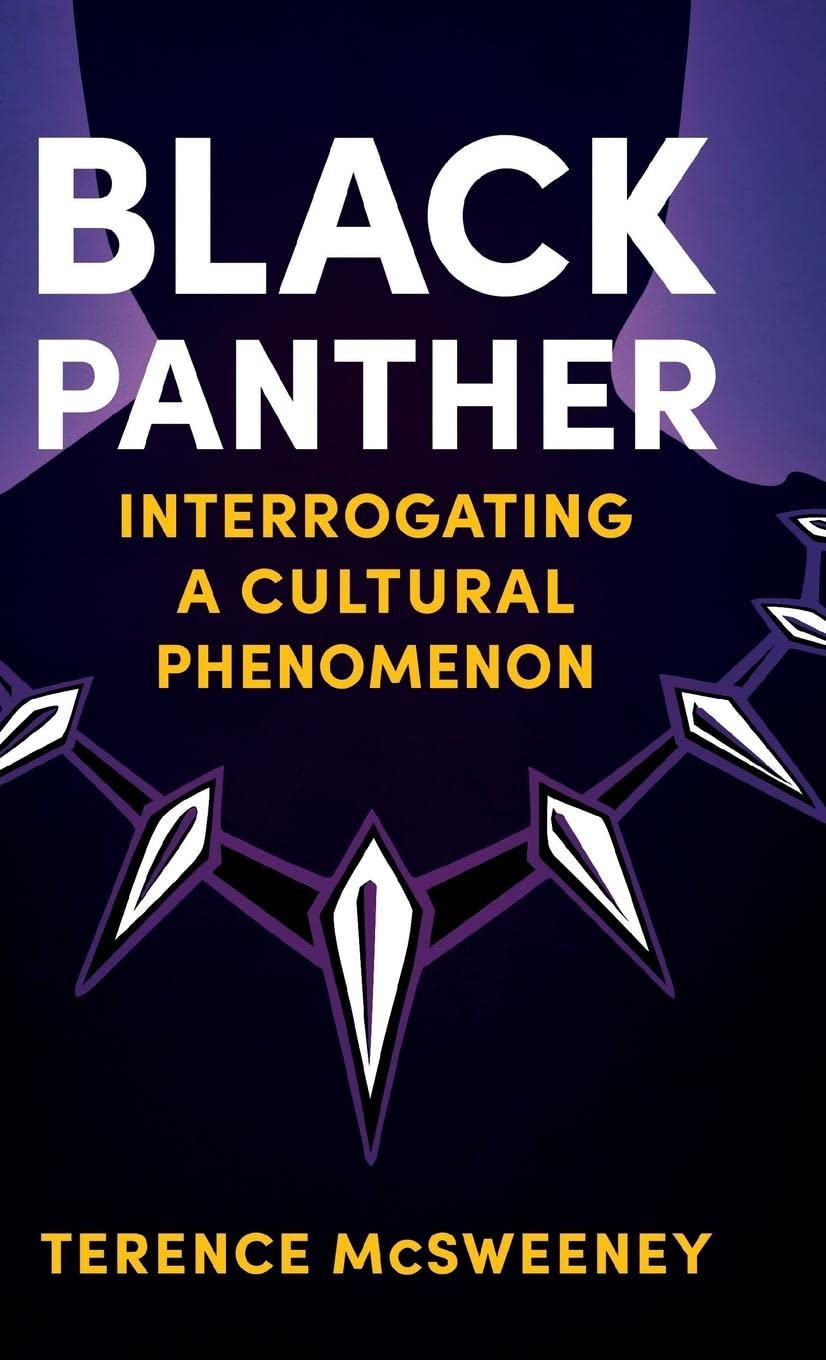
Terence McSweeney. Black Panther: Interrogating a Cultural Phenomenon. Jackson: University Press of Mississippi, 2022. Paperback, 254 pg. $20.00. ISBN 9781496836090.

An analysis or examination of the 2018 Marvel Cinematic Universe film Black Panther is a difficult proposition, since Black Panther is not simply another film: as Terence McSweeney tells us in the very subtitle of his study, it is an ongoing popular phenomenon that has touched the lives and hearts of millions of moviegoers. McSweeney opens his text with a quote from Carvell Wallace of The New York Times, in which Wallace states, “Black Panther is a defining moment for Black America” (3). That is no small thing for any cultural production, and a great deal of weight for a single film to bear. [It will be interesting to watch what happens now that the film’s sequel, Black Panther: Wakanda Forever, has been released, sans the sadly late Chadwick Boseman as T’Challa, to see whether the BP franchise can sustain the first film’s level of personal and societal impact.]

However, as McSweeney makes clear, Wallace’s comment is more than justified, not just by the countless numbers of ecstatic and joyful comments from Africans and people of the African diaspora all around the world, nor by the fact that a massive cinematic franchise/cultural touchstone finally centered a film on a Black superhero, but by the complex societal layerings that constitute the film. As McSweeney states, “[t]his book places Black Panther alongside these texts” [other seminal films that have had a significant impact on the ways in which viewers react and respond to culture] “despite the fact that it is just a superhero film, proposing it should be considered first and foremost as a richly cultural artifact in ways similar to them, each of which have resonated with audiences and found themselves both embedded into and impacted on cultural discourse” (italics in original, 21). In a world in which superhero-centered media is (still!) frequently regarded as somehow less compared to other film genres, or as not “real” cinema (most prominently and infamously, perhaps, suggested by film legend Martin Scorsese), McSweeney makes a powerful case that Black Panther does not transcend superhero films as much as demonstrate those films’ capacity—given the proper combination of script, director, actors, and cultural considerations—to be sources of significant psychological and cultural resonance. Just as importantly, they may become sites in which viewers, especially those neglected or misrepresented in the past by studios, can see themselves, their cultures, and their humanity represented accurately and on center stage. This new concentration on diverse representation of people has accelerated in the MCU in recent years, as Marvel Studios has been giving more prominence to female characters (Captain Marvel, Black Widow, WandaVision, She-Hulk), Muslims (Ms. Marvel), Native Americans (Echo in Hawkeye), Asians and Asian-Americans (Shang-Chi and the Legend of the Ten Rings) and LGBT characters (The Eternals), for example. However, arguably none of these efforts have had the same emotional resonance as Black Panther, and part of McSweeney’s valuable study involves identifying the singular nature of BP in relation to American, African American, and African cultures. In the process, he also provides a well-constructed and thoughtful example of the scholarly value of analyzing a popular cultural text, especially one demonstrated to have lasting and powerful cultural impact.

One of the striking features of McSweeney’s study is its structure. He rarely repeats himself or describes the film in a recursive fashion, returning to the same scene or scenes again and again. Instead, he manages the admirable feat of detailing several important themes while proceeding in a more-or-less straight fashion from the beginning of the movie to its conclusion. It’s a refreshing method of writing a critical text that mirrors filmic chronology and, I think, lets insight build upon insight until the work’s conclusion, where the totality of the critical observations really makes itself felt.

McSweeney tackles a number of facets of BP’s production and influence that taken together demonstrate with convincing arguments the cultural significance of the film. The study’s first chapter explores the nature of Wakanda, placing BP firmly in the aesthetic and narrative traditions of Afrofuturism and African Futurism and showing how the film’s creators and designers carefully (although some might argue superficially) work to present Wakanda as a diverse and earnest exploration of various African cultures and practices. (I appreciate also McSweeney’s note that Wakanda is a powerful rebuke to white historians of the past who decried Africa as a place without history or civilization. One of the reasons for Black Panther’s emotional resonance has been its visual expression of a powerful and technologically advanced African nation, with a proud history and lively culture.) A second chapter looks at what might be an overlooked aspect of the film, namely its interaction with MCU and real-world geopolitics; again, he notes that Wakanda occupies a unique place in movie history. Black Panther “is a film that centralizes African culture, traditions, and characters in a way that no large-scale American film about the continent has ever done. Wakanda is a paradoxical construct in many ways: it is fictional, but it has real borders and relationships with other actual countries; it is not real, but its culture, architecture, and style are drawn from authentic African nations; and, finally, it is an imaginary creation, but this did not prevent it from possessing a tangible and affective symbolic power when the film was released in February 2018” (57). But in all the kudos for the film’s groundbreaking nature, McSweeney takes care to point out the problematic features of the film, many of which reflect its American origins—these include the positive portrayal of CIA officer Everett Ross (Martin Freeman), a jarring character choice considering the real-life CIA’s covert and undemocratic interference in the affairs of African nations. (One of the book’s most thought-provoking observations, something I recall noticing when I originally saw the film, was that the movie makes the interesting choice to make a white American intelligence operative one of the film heroes while making an African American (N’Jadaka, aka “Killmonger” [Michael B. Jordan]) whose stated desire is to empower Black people everywhere the ruthless villain. Black Panther is an interestingly layered movie from a racial point of view, and these sorts of dramatic decisions make the championing of the film more compellingly complex.McSweeney tackles a number of facets of BP’s production and influence that taken together demonstrate with convincing arguments the cultural significance of the film.

McSweeney devotes an entire chapter to N’Jadaka (and I note his decision to use the character’s given Wakandan name as a general rule, rather than referring to him as Killmonger, which is at once N’Jadaka’s nickname given him by his fellow US Army warriors and the name by which the character is called in countless reverent memes), seeking to analyze the fascination that much of the filmgoing audience has had with him. N’Jadaka is one of the most compelling and developed villains in the MCU, which accounts for much of his popularity. Betrayed as a young boy by his uncle T’Chaka (then the king of Wakanda), his story arc throughout the film is one of bitterness and revenge against the Wakandan royal family, but he is also driven by the desire to break Wakanda out of its self-isolation and take the lead in supporting Black people everywhere. (Is this policy ultimately a selfish, self-benefiting one, that ignores Wakandan responsibility to fellow Black people? It’s a question that the film leaves open to discussion, though it ultimately comes down on the side of increased Wakandan engagement as T’Challa appears before the United Nation to pronounce his nation’s arrival on the world stage.) McSweeney ably examines N’Jadaka’s contradictions (his attacks on colonizers while himself having the mentality of one, for example). At the same time, though, he points out the problematic point of Black Panther that “[i]n a genre that revels in violent altercations – indeed, one founded with violence as righteous and just – not only is Black Panther unable to endorse violence as emancipation for oppressed people all over the globe but it portrays the two men who would advocate it as villains, showing one to be in league with a terrorist like [Ulysses] Klaue and the other a sociopath that targets women on numerous occasions and will later advocate killing children” (113). The film’s relationship to “unacceptable” Black radicalism makes its image as a progressive film a bit muddier; this is not necessarily a criticism. In fact, these kinds of contradictions that McSweeney discusses in the book make Black Panther less a collection of flaws than a multidimensional production subject to numerous and equally valid reinterpretations. As McSweeney puts it, “[w]hat is clear is that Black Panther came to mean fundamentally paradoxical things to different individuals and groups, which, for some, might be regarded as evidence of its vacancy, but for others, of its fecundity” (177). The exploration of those opposing views and varying intensities of popular reception makes McSweeney’s very readable study particularly useful for film and popular culture scholars.


Jeremy Brett is an Associate Librarian at Cushing Memorial Library & Archives, where he is the Curator of the Science Fiction & Fantasy Research Collection as well as Interim Curator of the Women’s & Gender Studies and Area Studies Collections. He has also worked at the University of Iowa, the University of Wisconsin-Milwaukee, the National Archives and Records Administration-Pacific Region, and the Wisconsin Historical Society. He received his MLS and his MA in History from the University of Maryland – College Park in 1999. His professional interests include science fiction, fan studies, and the intersection of libraries and social justice.

Review of Lesbian Potentiality & Feminist Media in the 1970s


Review of Lesbian Potentiality & Feminist Media in the 1970s

Sarah Nolan-Brueck

Rox Samer. Lesbian Potentiality & Feminist Media in the 1970s. Duke UP, 2022. A Camera Obscura Book. Paperback. 304 pg. $28.95. ISBN 9781478018025.

Rox Samer’s Lesbian Potentiality & Feminist Media in the 1970s opens a window in time. A mix of literary, cultural, and material history gives this book a uniquely solid structure—reading it, I felt as though I could write a letter to Joanna Russ, and she would answer. I imagined James Tiptree, Jr./Alice B. Sheldon moving between typewriters and crafting a gendered persona beyond the narrow categories of male and female. These impulses stay with me, months after a first read. Lesbian Potentiality vibrates with energy, reminding us that the feminist passion of the past is not lost—but it is being recalibrated.

This ability to draw together diverse histories rests in Samer’s construction of “lesbian potentiality,” or the way the lesbian in the 1970s signaled “the potential that gendered and sexual life could and would someday be substantially different, that heteropatriarchy may topple, and that women would be the ones to topple it” (4). This potentiality, Samer argues, gives us a way to draw critical tools from a “too-close past, the 1970s and its liberation movements [that] are not queer enough to get us to the queerness that is not yet here” (8). The lesbian, then, became a symbol for a reconstructed future, in which women could move beyond definition in male terms, and restriction by male edicts. In an era of theory that attempts to transcend these gendered categories, Samer’s construction makes such a symbol relevant, while acknowledging that for some, it has lost some of its applicability and weight.

Samer brings many threads of “lesbian potentiality” into conversation in their expansive chapters. The first examines the national women’s film circuit, which allowed feminist media workers in the 1970s to build connections amongst themselves, to “meet the media-making desires of their local feminist communities,” and to produce activist works covering vast ideological ground (40). Samer discusses the deconstructionist methods of these creators, who sought to “demystify” the male-dominated industry and form (42). This flows seamlessly into the next chapter, which focuses on the role of documentary in women’s prison activism; this consciousness-raising (CR) action “refused prison’s demands for gender-conforming passivity” by demanding freedom for imprisoned women and foregrounded an intersectional feminism that “contends that freedom for Black women would mean freedom for all” (92, 93). Chapter 3 moves to a similarly collaborative, but less inclusive form of CR: the explosion of feminist influence in science fiction and the creation of a “counterpublic” in feminist SF fandom which “has not survived new generations but adapted with them”—a vital element that Samer tracks specifically through the ways in which the feminist science fiction convention (Wiscon) has expanded since its founding (140, 178). Lastly, their fourth and final chapter takes another look at the complex and frankly titillating history of Tip/Alli, or James Tiptree, Jr./Alice B. Sheldon, the SF author who famously wrote with a male pseudonym, and was “outed” as a woman, to much general/generic astonishment. Samer seeks to expand our understanding of how the author’s gendered self-perception slips easy categorization and contemporary terminology, making Tip/Alli’s narrative a fitting last chapter in a book that searches for more gender-inclusive tools to examine a moment characterized by identity-based organizing.

Despite the varied topics, Samer writes from an inside view—but not in the traditionally academic, separatist voice; Samer’s narrative emerges from the archive, from a personal investment in SF fandom, and from the establishment and evolution of institutions surrounding that fandom, like Wiscon and the Otherwise Awards. Their connection to their subject and their ability to draw together manifold elements into a cohesive study reveal a powerful investment into the materials and communities they describe. Scholars interested in discovering how to bridge the often wide gap between research and praxis, academia and activism, will find conceptual models in Samer’s text.

Lastly, Samer’s work is, above all, accessible and attractive to a broader audience. This book was not written for a select few; it is a celebration of a specific and fruitful era of lesbian potentiality, and a cautionary look at the dangers of clinging too tightly to a specific mode in an evolving cultural framework. Their writing is direct and clear, making complex concepts easy to parse. Samer’s work is some of the most accessible, refreshing, and pressing scholarship I’ve ever read. As Samer states, “potentiality, no longer lesbian but still oriented toward freedom, regenerates” (215). Their book is a call both to remember the strength and passion of a feminist, lesbian past, and to work toward an expanding, promising, and radical future in activism—toward a more open gendered future for all.

Sarah Nolan-Brueck is a PhD candidate at the University of Southern California, where she studies how science fiction interrogates gender. In particular, she examines the many ways SF authors question the medicolegal control of marginalized gendered groups in the United States, and how SF can support activism that refutes this control. Sarah is a graduate editorial assistant for Western American Literature. She has been previously published in Femspec, Huffpost, and has an article forthcoming in Orbit: A Journal of American Literature.

Review of The History and Politics of Star Wars: Death Stars and Democracy


Review of The History and Politics of Star Wars: Death Stars and Democracy

Dominic J. Nardi

Chris Kempshall. The History and Politics of Star Wars: Death Stars and Democracy.  Routledge, 2022. Routledge Studies in Modern History. Paperback, Ebook. 252 pg. $44.95. ISBN 9781032318875.

Despite claims from some parts of the fandom that Star Wars should not be “political,” decades of scholarship have shown that George Lucas used Star Wars to comment on political controversies, from the Vietnam War to the Patriot Act. However, most scholarship focuses on the Star Wars films, overlooking the hundreds of novels, comics, games, and other stories through which fans engage with the franchise. Chris Kempshall’s The History and Politics of Star Wars is the first work to examine historical parallels and political themes across the entire Star Wars franchise, including Expanded Universe (EU) tie-in materials and recent TV shows on Disney+. This scope allows Kempshall to deliver fresh insights about Star Wars and politics, even to readers familiar with the existing literature. Indeed, the speed and relatively low cost of publishing makes tie-in novels an important vehicle for the franchise to engage with new political developments in a timely manner.

The first chapter of The History and Politics of Star Wars focuses on how depictions of the Empire have evolved since the Original Trilogy (1977-83), which borrowed heavily from Nazi iconography. During the 1990s, Star Wars novels began to reimagine the Empire as a flailing superpower like post-Soviet Russia with weapons of mass destruction and sometimes allied with the New Republic/United States. Some authors even created sympathetic Imperial characters who had honorable reasons for siding with the Empire. After Disney reset the canon in 2014, the Star Wars franchise returned to depicting Imperials as space Nazis with little moral ambiguity.

By contrast, Chapter 2 argues that the franchise’s pessimism about democracy has remained consistent across Star Wars media. Although Obi-Wan Kenobi described the Old Republic as a “more civilized age,” the Prequel Trilogy (1999-2005) revealed that the Senate suffered gridlock and corruption long before Palpatine seized power. Democracy fared no better after the Rebellion won. In tie-in novels published during the 1990s, the New Republic’s weak government was constantly torn by sectarian conflict, perhaps reflecting fears that the collapse of communism would lead to instability. During the Disney era, tie-in materials for the Sequel Trilogy (2015-19) continued to depict the New Republic as ineffectual, mostly because—in another echo of World War II—it refused to take the threat of fascism seriously.

Chapter 3 explores how the Star Wars franchise incorporates popular understandings—often based on Hollywood movies—of real-world warfare into its storytelling. Kempshall—a historian of World War I—notes that these popular understandings sometimes diverge from the reality. For example, in romanticizing the Vietnam War as a struggle between a technological superpower and a noble underdog, Lucas overlooked the importance of political ideology, perhaps explaining why the Rebellion lacked a clear vision for political and social change. Star Wars usually sanitizes warfare, but Kempshall points out that newer tie-in novels, such as Alphabet Squadron (2019), have begun to depict the personal and psychological costs of war.

Next, Chapter 4 explores the tensions between the Jedi adherence to the Force and their allegiance to the Senate. Kempshall compares Qui-Gon Jinn’s reluctance to overstep the Republic’s jurisdiction to free slaves in The Phantom Menace (1999) with the United Nations’ failure to stop genocide in Srebrenica. Just as popular culture became more morally ambiguous after the 9/11 attacks, the Jedi of The Clone Wars increasingly used unethical means—including torture—to stop their enemies. Kempshall suggests that the key difference between Jedi—and, by implication, America—and their adversaries is that the they took no pleasure from such harsh methods. He also points out the disturbing lack of accountability Jedi faced for their recklessness, or even falling to the Dark Side.

Finally, Chapter 5 addresses ethnic and gender representation in Star Wars media. Kempshall’s approach is more nuanced than most scholarship on this topic. He carefully weighs allegations that Jar Jar Binks and other Prequel characters embodied racist stereotypes, but then explains why some fans and scholars have defended those characters. This chapter also explores the franchise’s treatment of alien cultures and droid rights. More so than in the other chapters, Chapter 5 discusses fan reception of and engagement with Star Wars, concluding with the backlash to diverse representation in the Sequel Trilogy.

Kempshall wisely avoids debates about the “accuracy” of the franchise’s politics compared to real-world history, recognizing that Star Wars is more an exercise in mythmaking than in detailed world-building. Instead, he uses history as a lens through which to examine the political ideas, themes, and tensions within the Star Wars franchise. In addition, the book does not try to prove—as Harry Potter and the Millennials (2013) did—that Star Wars shaped the political views of its fans. As such, The History and Politics of Star Wars is best suited for scholars already interested in Star Wars and who want to better understand its political content, rather than readers skeptical of the franchise’s political relevance.

Just weeks after the publication of The History and Politics of Star Wars, Disney+ released the live-action TV show Andor (2022-), which both complicates and confirms Kempshall’s analysis about the Empire. One of the actors in the show explicitly compared the Imperial crackdown to the erosion of freedoms under rightwing populism.[1] To some extent, this is a central thesis of the book: Star Wars continually responds to and engages with new political developments. No matter what stories Star Wars tells next, Kempshall’s book will be an important starting point for years to come for future research into the historical influences and political themes of the franchise.


NOTES

[1] Ben Travis, “Andor Is Star Wars’ ‘Scurrilous Take On The Trumpian World,’ Says Fiona Shaw – Exclusive Image,” Empire (August 2, 2022), https://www.empireonline.com/tv/news/andor-star-wars-take-trumpian-world-fiona-shaw-exclusive/.

Dominic J. Nardi, PhD, is a political scientist who has worked as a research analyst on human rights in Southeast Asia and China. He coedited The Transmedia Franchise of Star Wars TV (Palgrave) and Discovering Dune (McFarland). His paper about political institutions in Lord of the Rings won a Mythopoeic Society award for best student paper in 2014 and was published in Mythlore. In addition, he has written about ethnic identity in Blade Runner 2049 and international relations in Star Trek: Deep Space Nine.

Review of Disputing the Deluge: Collected 21st-Century Writings on Utopia, Narration, and Survival


Review of Disputing the Deluge: Collected 21st-Century Writings on Utopia, Narration, and Survival

Ada Cheong

Darko Suvin. Disputing the Deluge: Collected 21st-Century Writings on Utopia, Narration, and Survival. Edited by Hugh C. O’Connell. Bloomsbury Publishing, 2022. Paperback. 376 pg. $55.95. ISBN 9781501384776.

The most recent crises of the capitalocene need little restatement. We are living through the global aftermath of COVID-19 and its uneven violence; sieges on democracy in the US (January 6th, the overturn of Roe vs. Wade, shooting and police brutality) and the UK (strikes and the absolute disintegration of social fabric in the UK with a government incapable of leading the country); and the Russia-Ukraine war and global supply chain disruptions, most accurately reflected in energy systems (both food and fuel).

Suvin’s warning, in his latest book, against this “new beast slouching toward Bethlehem: Global Capitalism without a Human Face” (101), then, takes on a profound urgency. The violent and uneven unfolding of the capitalist-climate crisis gives credence to the ultimatum that animates the collection: “Socialism or barbarism” (40). “Utopia or bust” (chapter 23). “There is no alternative” (343).

More in-depth arguments about the mechanism of sf and sf texts/authors take up a relatively slight percentage of the collection, with many of the same longstanding arguments reflected since Metamorphoses of Science Fiction (MOSF): the false value of popular fantasy (chapter 2), a rejection of Orwell (chapter 22), the esteem of Ursula K. le Guin’s fiction (chapter 11), the cultural force of science and Darwinism (chapter 14), as well as militarist sf (Chapter 9). While the chapters are presented and numbered in chronological order, Suvin groups them into 4 categories: (1) narratology and epistemology, (2) the political context and prospects or potentialities of SF, Utopia/nism and Fantasy, (3) extensive probes in and for these two last years, and (4) short incidentals or paralipomena.

As a whole, Suvin’s intellectual meditations on the role of sf and criticism today in this book are more condensed, arguably more accessible, but no less powerful. The collection takes stock of our current situation and the dialectical relationship that sf has with this socio-historical reality. The two key questions Suvin asks are, “Where are we?” (290) and “What are we doing wrong?” (294).

The answer to the first centers on the deluge, focused most clearly in the last two chapters of the collection, in which Suvin tackles the crises of the capitalocene and COVID-19 pandemic. The flood has become an increasingly resonant late-capitalist metaphor, surfacing in the most incisive critiques of the climate-capitalist crisis (Naomi Klein’s Shock Doctrine [2007], Junot Diaz’s post-Haitian Earthquake “Apocalypse” [2010], and again in Philip Wegner’s preface to Defined by a Hollow, “Emerging from the Flood in Which We Are Sinking: Or, Reading with Darko Suvin (Again)” [2010]). Suvin likewise describes the capitalocene as an “overwhelming antiutopian tsunami we are drowning in, swimming desperately each and every moment to take hold of a bit of sustaining jetsam and flotsam or even to come within sight of an island” (290). The two foci he identifies within the capitalocene, “war and ecocide” (291), are particularly striking in a book published a month before the Russian invasion of Ukraine.

Suvin emphasises, however, that the crisis of our time is also a cultural one: the global culture industry has been inundated with works which present visions of pseudo- or antiutopia. He writes that “one of the greatest tricks that global late capitalism ever pulled is to cloak its own exploitative practices in the guise of utopia” (5). The flood of supposedly utopian books, films and TV series is instead characterised by nihilism, escapism, or naive optimism in capitalist technoscience. This deluge represents a withering of our utopian imagination, signalled by an inability to imagine the transition to a radically different future. The book is concerned, then, with the urgent task of combating antiutopian forces within world-capitalist ideology and mass culture industries.

In answering the second question, “What are we doing wrong?” Suvin provides a twofold response. Foremost, he returns to the inherently utopian impulse of sf’s formal mechanism. He is one of the most prolific dialectical, Marxist, historicist critics dealing with sf and Utopia, and his establishment of the inseparability of the two, calling the latter the “sociopolitical subgenre of science fiction” (76) in Metamorphoses of Science Fiction (MOSF), has been widely affirmed by scholars including Fredric Jameson, Philip Wegner, and Tom Moylan.

However, instead of unfolding traditionally academic, detailed arguments around sf as a socio-historical literary genre, the book consists of an assemblage of sources that offer brief but powerful summaries of what sf does. Indeed, the familiar concepts of cognition, estrangement and the novum do not, in this collection, receive the same depth of treatment as they do in Suvin’s earlier writings. In MOSF Suvin asserted the relevance and connection that the form of sf has with the reader’s own socio-historical reality. The great detail of his argument was necessary to the end of claiming a space for literary criticism in a discourse that had up till then (the 1970s) treated utopia as a political program.

In Disputing, however, these concepts receive little exposition, mentioned only briefly in his treatment of other themes and their political relevances in the 21st century (see chapter 9 on militarism, 128) or summarised in shorter discussions (see chapter 5 library questionnaire response, 91). These engagements with sf texts are situated within each piece amongst wider reflections around global politics or musings of a more personal note.

Suvin’s chimeric book thus reads as a hybrid between a political manifesto, autobiography, and a book on utopian form—rather than a theoretical book exploring sf’s utopian impulse. The collection of works in Disputing makes it collage-like, a form that Jameson describes as characterising our late-capitalist age. The “sequence of qualities or styles… becomes in itself a kind of narrative structure opened up to some properly allegorical investment” (Allegory 320); it transforms the “structural function of the author himself” (Archaeologies 263) and the work of interpretation.  Like the truly new Novum Suvin describes, one that is “by definition yet unknown, strange, and risky”, the revision that Suvin suggests for criticism in this book is “not only more like a ball of yarn or amoeba rhizomatically reaching here and there, it is uncertain and open” (21) in a time when the “primacy of linear plot is to be spurned” (21).

Through the varied collection, then, Suvin argues that literary theory and criticism in the 21st century need to move beyond what and how we read. Situating his treatment of sf amidst a more general, urgent critique of capitalocenic ideology, Suvin refines the goal of literary criticism to centre political epistemology as a key goal.

The result of this dialectical, historicist method that Jameson and Suvin share results in an understanding of culture in which the limitations of our own historical and ideological positions mean that true utopia, or radical difference, feels impossible to perceive. Yet in Disputing, Suvin defines quite clearly the antiutopia we find ourselves in, and even sketches a minimum and maximum utopian program of a post-COVID-19 future (chapter 24). On the one hand, there is capitalism and all that accompanies its “GOD imperative (Harvey, “Grow or Die”)” (291): violence (333), fascism, and animality (308). On the other, there is socialism/democracy (91), freedom (339), sensual bodily experience (15) and care (333).

Overall, the explicit call to arms in Disputing is partly a response to the times we find ourselves in and the need to find means of survival. Suvin insists that criticism today must involve “not only writing about fiction” (123) but also looking towards “an integral epistemological rethinking… for which the tools have (yet) to be invented” (123). The urgency with which Suvin writes about Utopia is also accompanied, however, by a sense that he is settling into the long sunset of his prolific career. Suvin himself admits that Disputing “may well be (his) final one on SF and utopia” (20), and the collection contains reflections on the passing of his peers and colleagues (chapters 10, 19), as well as his career (chapter 6, chapter 7 “Autobiography 2004,” chapter 16).

What tasks, then, does Suvin leave us?

The most obvious one is to vigilantly guard the line between “useful and harmful” (248) fictions. This has always sat uncomfortably with post-Suvin critics. In the face of climate breakdown, Suvin’s heuristics provides limited mileage in analysing bad utopias at best, and disregards a huge proportion of cli-fi works at worst. Eric Smith also points out the risks of policing the distinctions between high and mass culture, in a time when our discipline is dismantling the canon and including an increasing number of works from the Global South.


WORKS CITED

Diaz, Junot. “Apocalypse”. Boston Review, 1 May 2011, https://bostonreview.net/articles/junot-diaz-apocalypse-haiti-earthquake/.

Jameson, Fredric. Allegory and Ideology. Verso Books, 2019.

—. Archaeologies of the Future: The Desire Called Utopia and Other Science Fictions. 2005. Verso Books, 2007.

Klein, Naomi. The Shock Doctrine: The Rise of Disaster Capitalism. Penguin Books, 2014.

Moylan, Tom. Scraps of the Untainted Sky: Science Fiction, Utopia, Dystopia. Westview Press, 2000.

Smith, Eric. Globalization, Utopia, and Postcolonial Science Fiction. Palgrave Macmillan, 2012.

Suvin, Darko. Defined by a Hollow: Essays on Utopia, Science Fiction and Political Epistemology. Preface by Philip Wegner. Ralahine utopian studies vol. 6, Peter Lang, 2010.

—. Metamorphoses of Science Fiction. 1977. Edited by Gerry Canavan. Peter Lang, 2016.

Wegner, Philip. “Utopianism”. The Oxford Handbook of Science Fiction, ed. Rob Latham, Oxford UP, 2014, pp. 573-584. https://doi.org/10.1093/oxfordhb/9780199838844.013.0045.

Ada Cheong (she/her) is a PhD candidate based at the University of Exeter. She is fascinated by the alimentary anxieties surrounding the world-food-system, and the ways in which issues such as industrial meat, ultra-processed foods, GM technology etc. register culturally in sf works from the 1970s onwards. Her research more generally concerns the politics and culture of the Capitalocene, and critically engages with the fields of the Energy Humanities and world-ecological literary studies. She is also a communicator and writer for the Food, Farming and Countryside Commission.