Kassia Krone’s Hollywood’s Monstrous Moms exposes the long-term stigma against mothers with mental illness in Hollywood horror films. Her study demonstrates a troubling pattern in the film industry of villainizing mothers with mental illness. Her book also identifies a research gap that hasn’t been fully explored at the intersection of disability studies, women, and mental illness. Disability studies in film has increasingly focused on representations of physically disabled bodies, arguing that their representation challenges the dominant able-bodied cinematic narrative. While there is some attention to cinematic characters with mental disorders, the one-dimensional characters make the discussion lack complexity. Even within feminist disability studies which critically examine the stereotypes about women with disabilities, women with physical disabilities or chronic illnesses are often central in discussions about the female body, beauty standards, and medical treatment as opposed to the experiences of women who are mentally ill. However, Krone’s research follows a feminist approach while adding the focus on mental disabilities.
The scope of Krone’s research includes classic horror films such as Carrie (1976), Mommie Dearest (1981), and Rosemary’s Baby (1968); slasher films such as Friday the 13th (1980) and Scream 2 (1997), as well as other more recent films such as The Sixth Sense (1999), Us (2019), Things Heard & Seen (2021), and so on. Her research also examines prestige horror films such as Hereditary (2018) and The Babadook (2014) to address the new trend. Krone’s scope is large, but all these films portray women with mental illness, which also illustrates how their images are rendered as a horror trope by the film industry. As Krone argues, these tropes vilify disability and gender together, especially motherhood. These depictions are also harmful to those in the disability community who fight for justice and equal rights.
Krone mainly examines female characters with mental illness from the following perspectives: women’s liberation movements and the film industry backlash; the representation of disability tropes; medical and social models of disability; and mother-child relationships. This approach draws her research into conversation with the gender inequality in Hollywood, disability tropes in films, and the narrative of female madness. Dating back to the Victorian period, women with mental illnesses were viewed as moral failures or as inherently emotionally fragile, which successfully constructed female madness as something stigmatizing and distorted. Krone’s analysis persuasively argues that these discriminations are also ubiquitous in contemporary cultural products.
Chapter One discusses classic horror films such as Carrie, Rosemary’s Baby and Mommie Dearest, in which mentally ill mother characters serve as a horror response to the emerging independent women. Their mental illness is used as a metaphor for punishment, suggesting that their progress is “detrimental to their mental health or stability” (22). Chapter Two analyses the films The Others (2001), Mama (2013), and Things Heard and Seen to illustrate how mental health facilities or haunted houses impact women’s mental condition and dehumanize them. This discussion is also addressed to the history of women who are diagnosed with hysteria, showing the long history of the medical narrative inclined to stigmatize them as ‘mad women’ without questioning the reason and truthfulness and then imprison them into isolated spaces (45). In these films, these female characters become ghosts after their suicide and haunt their children in the house. These depictions also complicate Jay Timothy Dolmage’s “kill or cure” trope for disability representation in film, as these mentally ill women “are already dead” and need to be banished again (57). Chapter Three focuses on the female killers in the slasher films Scream 2 and Friday the 13th. They are labelled as psychotic, driven to seek revenge for their sons’ death, a characterization reinforced by the slasher film narrative to emphasize their ‘craziness’ while ignoring their grief and emotional trauma over losing their children.
Moreover, these harmful portrayals are also linked to other forms of discrimination, such as racism and medical bias. Krone’s discussion situates these elements within the concept of intersectional feminism, which recognizes overlapping oppression rather than focusing solely on sexism. Chapter Four shifts the focus to mentally ill Black women in the horror films Ma (2019), Barbarian (2022), and Us. Even when Black women are present, the film industry often commodifies them through fixed tropes or stereotypes, such as the “Black villain” (96) and the “Black female vixen” (97). Their mental health is often overlooked by medical professionals and the film narrative, especially when they encounter racism and ableism at the same time: “blackness” is sometimes regarded as a form of disability within horror film narratives (108). Chapter five discusses the representation of mothers with Munchausen syndrome by proxy (MSP) in films The Sixth Sense, Fragile (2005), Love You to Death (2019), and Run (2020). It is implied that mothers who have mental illnesses are unfit to raise children.
However, this does not mean that all contemporary horror films are trapped in this representational dilemma. As readers might be aware, horror films are also constantly evolving, responding to the growing concern regarding approaches to disability and gender. Krone examines Things Heard and Seen in Chapter Two to argue that it provides an unconventional ending that resonates with contemporary feminist movements by foregrounding female solidarity. The film emphasizes the collaborative efforts among spectral moms to break the cycle of domestic abuse. Chapter Six shows that Hereditary and The Babadook portray the female protagonists who navigate their mental struggles with resilience which challenges stereotypes linking their mental illness with villainy. These depictions also embody the potential to understand the mentally ill in another way: to sympathize with them. This change mirrors the rising of “prestige horror” in the film industry (149); these films juxtapose mental illness with societal issues and call for greater attention to people’s spiritual world. In the films Hereditary and The Babadook, the mothers are portrayed as “three-dimensional” characters, with their mental illness symbolically linked to themes such as religion, family grief, and personal trauma (149). Krone posits that these films also “present mental illness as more of an allegory or symbol through the use of the supernatural” (176). In this way, they complicate the trope of mental illness in horror cinema, rather than solely using it to characterize villains. However, the thematic direction expressed by the creators and the audience’s perception can be vastly different. Krone argues that Hereditary expresses compassion toward mentally ill characters, especially the mother character Annie. However, I see the film as reinforcing a fear of mental illness, particularly through its title, which indicates that mental disorders are inevitably passed down through generations. This implication could further deepen societal fear and misunderstanding of mental illness. Thus, Krone’s interpretation also needs to be supported by further evidence.
Krone is, however, correct when she argues that an often-overlooked issue in horror films that we rarely reflect on is the negative impact of depicting mentally ill characters as villains. Audiences tend to accept these terrifying portrayals as natural. Furthermore, Krone points out that Hollywood rarely casts actors with disabilities in disabled roles. This reiterates the need for more diverse representations in horror films. I believe this book could explore its connection with the Victorian tradition of depicting female madness in literary works, a topic not fully explored in this study. At the same time, this book can also be integrated with queer theory, as this theory similarly challenges the narrative of “normality,” creating intersections with both disability studies and feminist scholarship. Scholars interested in horror cinema, feminist disability studies, and mad studies will likely find this book valuable.
Shiqing Zhang is a PhD candidate at Newcastle University, where she studies children’s literature. In particular, she does research on Ursula K. Le Guin and how her work challenges the conventions of YA literature. She acknowledges the support of the China Scholarship Council (CSC) for funding her research in the UK.
Review of Decoding Digital Culture with Science Fiction
Nanditha Krishna
Alan N. Shapiro. Decoding Digital Culture with Science Fiction: Hyper-Modernism, Hyperreality, and Posthumanism. Bielefeld: transcript Verlag and New York: Columbia University Press, 2024. Paperback. 374 pages. €50.00. ISBN 9783837672428.
Version 1.0.0
When I completed my Master’s degree in English Language and Literature in July 2024, I found myself increasingly drawn to the question of how science fiction (SF) can help us think critically about the digital and technological futures we now inhabit. Many of the speculative worlds I explored during my degree – once purely imaginative, especially in the late 20th century – no longer feel like distant possibilities. They feel less like fiction and more like our lived reality. Surveillance systems, pervasive data collection, algorithmic control and governance, and artificial intelligence are no longer abstract concepts. They are already here, shaping everyday life in profound ways.
Science fiction has evolved beyond simple prediction or foresight; it has become a practical method, a way to decode the complex digital cultures around us. This shift is at the heart of Alan N. Shapiro’s Decoding Digital Culture with Science Fiction, a book that blends cultural theory, media studies, and futures thinking to explore how science fiction (SF) helps us understand and even shape emerging technologies. I wish I had discovered the book earlier, particularly during my thesis research. Still, it has since become a key influence in my current role as a Fellow in the Young Future Maker Fellowship Program, run by Future Days (Portugal), the Copenhagen Institute for Futures Studies (Denmark), and Media Lab Bayern (Germany).
During my fellowship, I have been applying many of the ideas that Shapiro discusses: using literary and science-fictional thinking to analyze digital futures, especially around themes of surveillance, privacy, and algorithmic governance. My work focuses on utilizing cultural texts (literary studies) to address real-world challenges, collaborating with futures and media experts to explore how stories and technologies intersect. For instance, in preparing for my Future Days 2025 fellowship presentation, I used his concept of science fiction as a critical lens and methodological tool—an applied iteration of the Literary Futures method by Rebecca Braun and Emily Spiers—to analyze not only the stories we tell about technology but also the algorithms and systems that structure our digital lives. This book hasn’t just been a background reference; it has directly influenced my practice-based research, showing how theory can guide creative, future-oriented work. Shapiro’s framework has profoundly shaped my approach to projects that bridge narrative, technology, and futures thinking. The book has helped me frame projects that bring literature into dialogue with foresight practices, culminating in recent presentations at the Future Days Conference (2025) Garden Gallery in Estufa Fria, Lisbon, Portugal.
Shapiro’s book explores the deep entanglement of science fiction, digital technologies, and cultural theory, arguing that SF is no longer just a storytelling genre. Instead, it has become a shaping force, influencing both the design of new technologies and the ways in which society understands them. The text is divided into three interconnected sections: Hyper-Modernism, Hyperreality, and Posthumanism, progressing from analysis to critique and ultimately to proposals for transformation.
In Part 1, Shapiro introduces Hyper-Modernism, an intensification of postmodernism driven by algorithmic systems that now organize culture and everyday life. Drawing on theorists such as Fredric Jameson and Gilles Lipovetsky, he shows how science fiction has evolved from mere storytelling to a force that actively influences technological development. Through examples like Black Mirror and Star Trek, Shapiro demonstrates SF’s dual function: it both inspires technological innovation and provides critical commentary on its consequences. This section particularly resonated with me, as it highlights why SF deserves serious study within the humanities and beyond.
Part 2 engages with Jean Baudrillard’s theory of hyperreality, where simulations and images replace reality itself. Shapiro argues that in today’s digital, algorithm-driven world, Baudrillard’s ideas are more relevant than ever, but they need to be updated. Platforms such as social media, VR, and AI have pushed hyperreality to new extremes, eroding the distinction between the real and the virtual. This section also addresses post-truth politics and the algorithmic shaping of perception, connecting Baudrillard’s theories to contemporary debates. What I appreciated most here was Shapiro’s insistence that we are not powerless: by “re-coding” digital systems, we can resist and reconfigure the structures of hyperreality. His use of The Matrix as a metaphor for this kind of critical engagement was especially compelling.
Part 3 moves toward transformation, focusing on Creative Coding and Posthumanism. Drawing on N. Katherine Hayles’ How We Became Posthuman, Shapiro critiques the traditional, abstract conception of code as purely functional. Instead, he envisions coding as a creative, embodied, and collaborative practice. This has profound implications for computer science, which he argues should become more transdisciplinary, connecting technology, art, and the humanities. Creative Coding, as Shapiro presents it, can resist algorithmic capitalism, generate art, and decenter human authorship through collaboration with AI. While this section was inspiring, I found myself wishing for more detailed, practical, and concrete examples of Creative Coding, as this concept feels especially promising for education and futures studies. It would have been valuable to see specific examples of how these ideas could be applied in classrooms, labs, and workshops.
Shapiro situates his work within a rich theoretical tradition. His arguments draw on thinkers such as Michel Foucault (panopticism and power), Donna Haraway (Informatics of Domination), Cornelius Castoriadis (The Imaginary Institution of Society), Jean Baudrillard (hyperreality and simulation), and Gilles Deleuze (rhizomatic thought and networks). By engaging these foundational ideas, Shapiro provides a strong intellectual grounding for his claim that science fiction is not only a cultural artifact but also a methodological tool for decoding digital life.
In this sense, Shapiro’s work sits alongside other major texts in digital culture and futures studies. For example, while Shoshana Zuboff’s The Age of Surveillance Capitalism examines the economic and political dimensions of the surveillance economy, Shapiro goes further by showing how narrative and imagination can decode and critique these systems. Similarly, where Hayles explores the evolution of posthuman subjectivity, Shapiro provides a practical, future-facing perspective, demonstrating how SF can actively shape our responses to technological change.
One of the most compelling chapters in the book is “Science Fiction Heterotopia: The Economy of the Future.” In the section “Similar Technologies in the Real World Today,” Shapiro draws striking parallels between fictional worlds and actual technologies. He weaves together Foucault’s panopticon, Zuboff’s surveillance capitalism, and science-fiction narratives to explore the politics of surveillance and power in the digital age. These intersections between theory, technology, and narrative are where the book truly shines, showing how science fiction can act as both a mirror and a map for our future.
The book’s greatest strength lies in its interdisciplinary reach. It speaks to literary scholars interested in speculative fiction, digital humanists exploring the links and intersections of narrative and technology, and futures practitioners seeking frameworks to guide foresight projects. Its ideas could enrich courses in literary studies, cultural theory, media studies, and futures education, helping students and researchers think critically about how stories and technologies co-evolve.
From a personal perspective, this book has been transformative for my fellowship work. It provided not just theoretical insight but also a practical philosophy for using science fiction as a tool in real-world futures work. Shapiro’s approach reaffirmed my belief that fiction is not just meant to be read or interpreted, but to be applied—as a way of anticipating, critiquing, and reshaping the future. This understanding has guided my collaborations with media experts and informed public presentations, where science fiction acts as a bridge between storytelling and systems thinking.
If there is one area where the book could be expanded, it would be its treatment of Creative Coding. Shapiro’s vision of coding as an artistic and philosophical practice is compelling, but I found myself wanting more concrete examples and teaching strategies. Given the rapid growth of computational creativity and generative AI, this topic deserves more attention. While I would have liked to see a deeper dive into Creative Coding, this does not diminish the book’s impact. For me, it has been more than just an academic text: it has become a practical tool and a source of inspiration. In an era when algorithms and simulations define so much of our world, Shapiro’s call to “decode” digital culture feels both urgent and empowering.
Decoding Digital Culture with Science Fiction is more than just a book about literature or technology; it is a call to action. By positioning science fiction as both a critical lens and a creative practice, Shapiro urges readers to move beyond passive story consumption and toward active engagement with digital systems. For educators, scholars, and practitioners across philosophy, literary studies, digital humanities, and futures thinking, this book offers an essential framework for navigating our algorithmic age. It has been pivotal in my own work, highlighting that science fiction is not just a genre but a method for creating better futures. As our world becomes increasingly shaped by algorithms, simulations, and automated decisions, Shapiro’s work feels urgent and necessary. It is a book that should be read widely, not only for its intellectual depth but also for its potential to change how we teach, create, and imagine digital futures. Overall, Decoding Digital Culture with Science Fiction offers a critical yet hopeful vision of our technological future. This is a book I strongly recommend to anyone seeking to understand, critique, and reimagine our technological futures.
Nanditha Krishna graduated in 2024 with a Five-Year Integrated Master’s (M.A.) degree in English Language and Literature from Amrita Vishwa Vidyapeetham (Amritapuri, India). She is a Future Days 2025 Fellow (Copenhagen Institute for Futures Studies, Media Lab Bayern, and Future Days). Previously, she was a virtual research intern at the Australian Research Centre for Interactive and Virtual Environments (University of South Australia), contributing to projects on interactive narratives, news games, digital art, virtual reality (VR), and creativity in immersive performance. From 2021 to 2023, she was a HASTAC Scholar and a research intern at the Empathic Computing Lab (University of Auckland). Her interests span speculative fiction, media studies, and futures studies, exploring how digital technologies shape culture and society.
Cassandra L. Jones. Black Speculative Feminisms: Memory and Liberated Futures in Black Women’s Fiction. The Ohio State University Press, 2024. E-book. 122 Pages. $29.95 ISBN 9780814283776.
Version 1.0.0
In Black Speculative Feminisms, Cassandra Jones explores how Black women authors use science fiction, fantasy, and speculative fiction to challenge linear notions of time by drawing on Afrocentric concepts. The work positions itself within a larger effort to excavate and highlight the power of Black women’s history and its implications for the future. Jones emphasizes “attention to record-keeping as an ongoing antiracist intervention” (2) and introduces key hashtags such as #ListenToBlackWomen, #BlackWomenArtTheFuture, and #CiteHerWork as part of Black Twitter’s tradition of disrupting the erasure of Black women’s contributions.
The book distinguishes Afrofuturist feminism from broader Afrofuturism (speculative fiction, science fiction, fantasy, and futuristic literature written about and by Africans and African Americans), defining it as a literary tradition where “people of African descent and transgressive, feminist practices born of or from across the Afro-diaspora are key to a progressive future” (5). Central to Jones’s analysis, and repeated throughout the book, is the concept of “restorative critical fabulation” – not simply mythologizing a great African past but creating imaginative works that humanize Black women and breathe life into historical records, shifting our relationship with traumatic histories. Jones further notes that this concept of restorative fabulation “recognizes the emotional labor of the author and serves as a balm for reckoning with those histories of trauma” (8).
In Chapter 1, Jones examines Tananarive Due’s TheGoodHouse (2003) and Nalo Hopkinson’s TheNewMoon’sArms (2007) to illustrate how memory serves as an instructive device for identifying threats to Black people, a concept she defines as rememory. These repressed memories can be transformed into healing when dealing with generational traumas from the past. She notes that rememory is similar to what we are currently experiencing in political circles with the attacks on Black history and Black studies; how learning, remembering, and sharing of this history is determined to be dangerous and traumatic. Jones examines rememory through the figure of Due’s conjure woman, Angela, and Hopkinson’s Calamity, both of whom celebrate the power and promise of an African past, using memory to resolve historical horrors and transform that trauma into healing.
The chapter examines how the strength of Black women is often pathologized, referencing destructive narratives, such as the Moynihan Report (https://www.dol.gov/general/aboutdol/history/webid-moynihan). This 1965 study by sociologist and, at the time of the report, Assistant Secretary of Labor Daniel Patrick Moynihan proposed that the high rate of Black families headed by single mothers was a major obstacle to Black progress towards equality. Rather than focusing on systemic racism, the report pathologized Black women as the cause of the deterioration of the Black family. In contrast, both novels reclaim Black women as figures who celebrate them, emphasizing love over pain, a healing that is rooted in giving oneself over to a restorative fabulation that engages and adds to Dr. Sadiyah Hartman’s methodology called critical fabulation. Hartman’s method requires that we interrogate the historical record through the lens of the marginalized and the aftereffects of the institution of slavery. Both frameworks of Jones and Hartman enable the recall of a familiar history that is critical, restorative, and finally, celebratory.
The Conjure woman has also been demonized and stigmatized as an evil force, but these two novels reclaim Conjure women as bearers of ancestral knowledge that is important and continuously present. In Due’s book, it is the entity titled the Baka that represents the colonial past; the desire to suppress memories and the horrors they experienced that devours Black people. Through this analysis of works featuring spiritual possession, Jones demonstrates how surrendering oneself to memory can facilitate healing by connecting it with the transformative power of love from departed family members. This remembering is used to fight against the Baka, an evil force and horror that forces characters to kill others or themselves. One of the main characters, Tariq, is used as the metaphor for how the embrace of toxic masculinity, homophobia, and the rejection of the wisdom of the ancestors makes him vulnerable. That vulnerability causes Tariq to succumb to the Baka. It is through Angela, the Conjure woman, the figure that unites the past and future into a singular moment, that she can defeat the baka. More importantly, she can connect “ancestral memory and love…this healing a step further to physically rewrite the world, restoring Corey and all those killed by the baka to life” (26).
The chapter also examines Hopkinson’s The New Moon’s Arms, which centers on a Caribbean woman, Calamity, as she nears menopause. Her hot flashes bring back familiar memories and items from her past, and the recurring theme of good/bad mothers and communal rememory that Jones discusses throughout the book. These themes are combined in Calamity’s story with the repression of sexuality, which traumatizes Black people throughout their lives. In the novel, this sexual repression is often done through religious adherence that embraces the compulsory heterosexuality and homophobia of Calamity’s Christian upbringing, which has traumatized her since childhood. The hot flashes force her to trust her body and to accept her role as matriarch and the vessel for communal rememory. Calamity confronts the disappearance of her mother, who she believes drowned in the sea, and her memories connect to the trans-Atlantic slave trade and the sea creatures, seals and merpeople (mermaids/mermans), which in these narratives are often depicted as the descendants of enslaved Africans who escaped into the sea rather than submit to slavery. “Calamity’s horror in Hopkinson’s novel is not only tied to a fear of the supernatural unknown, but also deeply tied to a fear that repressed memories and stories from her past kept from her by her parents might reemerge” (33). It is the ability of these women, Angela and Calamity, to connect to the past that guarantees their futures and those of their ancestors.
Chapter 2, “Memory and African Traditions”, examines how memory functions in novels to imagine futures that incorporate African traditions, rather than simply reinforcing Western modernity. Jones pushes back against criticism of science fiction/fantasy as “white” literature, noting that these forms have always been part of African-centered storytelling traditions. This perspective is particularly important as Jones challenges conventional genre boundaries and demonstrates throughout the book how African narratives naturally feature “beings from space, seers, talking animals and sentient plants” (36) that communicate morality and tradition across the continent.
Jones’s analysis of Nnedi Okorafor’s Lagoon (2014), in which aliens invade Nigeria, explores how the novel critiques Christian traditions that foster self-hatred, addressing the complex interplay of ideological and physical influences in the postcolonial, neocolonized world. Jones examines how the novel challenges neocolonialism, which frames Africa as perpetually in need of Western intervention, and highlights how African intellectuals have sometimes been complicit in perpetuating cultural imperialism. This approach resonates with other significant works of Black speculative fiction, such as esteemed lawyer Derrick Bell’s “Space Traders” (1992), a story about aliens coming to America and requesting that all Black people be sent to their spaceship. In return for sending them all the African Americans, they offer the United States riches, clean air and water, and overall prosperity. Both Okorafor’s and Bell’s work confronts Black self-hatred while demonstrating how anti-Blackness has been complicit in propagating Western cultural imperialism, revealing that holding on to these ideas ultimately offers no protection.
The variety of protagonists that are central to Okorafor’s story include Father Oke, who represents anti-Blackness and misogyny; Adaora, the marine biologist who introduces the aliens; Ayodele the alien ambassador; Mami Wata, the water deity who destroys Father Oke; and Legba, whose use of the Nigerian Prince, also called the 419 scam, is rehabilitated after his encounter with the aliens. Through these diverse characters, Okorafor illustrates how the aliens serve as agents of transformation. Upon the aliens’ arrival in Lagos, Nigeria, they not only destroy the internet cafes that facilitated these scams but, as Okorafor notes, “the invasion’s dramatic ability to unseat Western discourses by strengthening the existing power of resistance” (46). Toppling multiple social hierarchies and cleansing the oceans, these shapeshifting aliens, who proclaim themselves catalysts of change, inspire nationalist pride and expel the lasting influences of colonialist rule.
The novel’s use of animals and mythological figures exemplifies how “animals hold a place of extreme importance in African storytelling and mythology” (43), serving as messengers of gods or living incarnations of deities in Ashanti, Igbo, and Yoruba traditions. This is particularly evident in Okorafor’s portrayal of Mami Wata as a powerful water deity who represents traditional African spiritual forces resisting colonial impositions. Through these elements, Jones demonstrates how “restorative fabulation employs the tropes of science fiction to restore indigenous beliefs and cultures,” using alien contact narratives to explore both anti-African sentiment and the cultural beauty and power of African cultures (51). Ultimately, the chapter reveals how Black women authors such as Okorafor use speculative fiction not merely as entertainment but as a powerful vehicle for cultural preservation and decolonization of the imagination.
In Chapter 3, Jones introduces the concept of “Sankofarration,” derived from “Sankofa,” meaning “it is not taboo to fetch what is at risk of being left behind” (56). She examines how Black authors employ narrative and writing to reclaim and preserve memory, drawing on what was left behind. The chapter contrasts how Black Studies tends to focus on the past, while Afrofuturism looks to the future, revealing how Black speculative fiction uniquely bridges these temporal orientations to recover non-Western concepts of history and time.
The chapter analyzes Octavia Butler’s Kindred (1979), showing how it connects memory, trauma, and time travel as an act of decolonization. “Decolonizing time becomes an additional approach to recognizing and healing this trauma” (53). Drawing on Butler’s archives housed at the Huntington Library in San Marino, California, Jones illuminates how the novel’s time travel mechanics connect to Igbo cosmology, demonstrating Butler’s deliberate engagement with African philosophical traditions. Kindred exemplifies “imaginative thinking that cannot change the past but can breathe life into the historical record and shift our relationship with the past” (57). Through this lens, Jones reveals how Butler attempts to spark emotion and create empathy in readers by demonstrating that racism is not merely individualized but deeply systemic, requiring a cross-temporal understanding to comprehend its enduring impacts fully.
Butler’s Wild Seed (1980) serves as another powerful example of restorative fabulation, creating “a world in which characters reckoning with chattel Slavery are not yoked to realist history” (58). This narrative approach offers readers the opportunity to shift their perspective and relationship to historical trauma without diminishing its significance. By transcending conventional temporal boundaries, Butler creates spaces where Black women can imagine alternatives to oppressive systems while acknowledging the weight of historical memory.
Jones also analyzes Rasheedah Phillips’ novella “Telescoping Effect” (2017), which borrows its central concept from psychiatry to portray memory as an economically exploitable resource. The term refers to cognitive temporal displacement where one’s understanding of linear time is disrupted, creating what Phillips sees as “an undiscovered scientific possibility that time might be collapsed in order to achieve contact between the past, present and the future” (66). Phillips argues that this “collapsing of time” that women experience in the novella serves to “decolonize our memory” (66), positioning the relationship between temporality and memory as a site for Black critical imagination and the creation of future possibilities.
What makes Phillips’ work particularly significant is her development of Black Quantum Futurism as both a theoretical framework and a practical community resource, as evident in her website and series. Unlike many academic theorists, Phillips begins with community engagement before presenting her ideas in academic spaces, thereby inverting the traditional flow of knowledge from institutions to communities. Her innovative work on metaphysics, ontology, and epistemology—areas traditionally dominated by scholars in the social sciences and humanities—represents a radical shift in how we might understand time, memory, and Blackness outside of Western paradigms. This approach demonstrates how Black women speculative writers are not merely creating entertaining fiction but developing comprehensive philosophical systems that challenge fundamental assumptions about reality, time, and historical knowledge.
Chapter 4 examines Octavia Butler’s ‘Patternists’ series (Patternmaster [1976], Mind of My Mind [1977], Survivor [1978], Wild Seed, and Clay’s Ark [1984]) as a complex exploration of memory, power, and historical consciousness that transcends conventional chronology. These interconnected novels create what Jones describes as “lieux de memoire” (sites of memory) – concentrated nodes of spontaneous public memory that function fundamentally differently from ‘official’ historical narratives, which accrue power to particular perspectives. She contrasts institutional history with living memory that incorporates “legends, folklore and other forms of storytelling” (71-72), demonstrating how Butler’s work exists in this more fluid, communal space of memory-making.
The chapter centers on Jones’s nuanced analysis of Anyanwu, the immortal shape-shifter who serves as the moral anchor and disruptive force throughout the series, particularly in Wild Seed. As a character whose existence spans centuries, Anyanwu embodies collective memory itself, defying historical amnesia and functioning as a voice of resistance whose memory offers revolutionary potential against oppressive systems. Through Anyanwu, Butler creates not just a character but a living archive of resistance that persists across temporal boundaries.
Jones masterfully dissects the power dynamics between the series’ central characters. Doro, the body-snatching immortal who builds a breeding program for psychically gifted individuals, represents the colonizer’s mindset: consuming others while justifying his actions through claims of progress and protection. Mary, who eventually defeats Doro in Mind of My Mind by creating the telepathic Pattern, initially appears to represent liberation; however, she ultimately establishes an oppressive hierarchy that mirrors Doro’s regime. Both Doro and Mary function as vampiric forces, though Mary refuses this comparison, creating a society where non-telepathic ‘mutes’ are treated as lesser beings without agency. Jones notes how both rulers create “official histories… that functions as an accounting of past events that has sedimented into layers of narrative, repeating only the ‘official’ narrative, accruing power to a certain people or nations through this shared narrative and those creators authorized to contribute layers of history, denying the ability to create legitimate narratives to the general populace” (71). Doro and Mary justify their behavior, mirroring real-world colonial and post-colonial power transitions.
What makes Jones’s analysis particularly powerful is her examination of how Anyanwu serves as the true revolutionary force throughout the series. Unlike the dramatic power struggles between Doro and Mary, Anyanwu’s resistance operates through the preservation of memory and quiet subversion. She “acts as a site of memory in multiple crucial movements,” using her historical knowledge to critique not only Doro’s horrific acts but also highlights what “E. Frances White reminds us about the problems that came from accepting a false unity during the decolonization phase that has led to the transfer of local power from an expatriate elite to an indigenous one” (88). As the embodiment of the people’s disruptive power, Anyanwu recognizes what others cannot: that Mary is becoming indistinguishable from Doro despite her claims of difference.
The chapter draws important connections between Butler’s fictional worlds and real historical processes, highlighting Butler’s interest in Igbo culture as a repository of memory and a reminder of alternative social organizations. Jones quotes Butler directly: “I don’t think it would be wise…for any black person…to forget” (82), underscoring the political dimension of memory-keeping in Black communities. Through her concept of ‘critical fabulation,’ Jones shows how Butler conjures fully realized characters that conventional historical archives often fail to document, creating speculative figures who participate in North American slavery without changing its factual record. This approach enables emotional and psychological explorations of historical trauma that traditional historical accounts often cannot access, demonstrating the unique power of speculative fiction as a tool for historical recovery and healing.
Jones concludes her analysis by connecting the theoretical frameworks she has developed throughout the book to pressing contemporary issues, including the COVID-19 pandemic, the overturning of Roe v. Wade, accelerating ecological disasters, the persistence of white supremacy, and the genocide of Palestinians in Gaza. These current crises serve as stark reminders of why speculative fiction by Black women isn’t merely entertainment but rather essential cultural work that helps us imagine alternative futures while processing traumatic histories.
While acknowledging science fiction’s visionary potential, Jones emphasizes that “understanding the past and how we remember it are equally important in any project that aims to ‘save ourselves from ourselves’” (89). She points specifically to Butler’s prescient novels, Parable of the Sower (1993) and Parable of the Talents (1998), as warnings particularly relevant to our troubled times, challenging readers to question societal priorities—whether lavish space exploration should take precedence over sustaining democratic systems and addressing fundamental human needs. The Black women authors showcased throughout Jones’s analysis demonstrate how “an understanding of the past and how we remember it are just as important in any project that purports to save ourselves from ourselves” (90), positioning memory work as essential to survival rather than merely as an academic exercise.
Jones draws urgent connections between her literary analysis and contemporary political movements aimed at suppressing collective memory, particularly highlighting anti-critical race theory legislation and voter suppression laws that echo earlier Jim and Jane Crow policies. These connections reveal the high stakes of memory work in an era where historical amnesia is being deliberately cultivated through institutional means. Against these forces, Jones advocates for public and activist scholarship that moves beyond the academy, positioning restorative fabulation as “a praxis for acting in the world” (90) rather than merely a literary technique.
The conclusion extends beyond literary analysis to consider the practical applications of Afrofuturist principles, highlighting how Black and Indigenous agricultural practices provide concrete insights as a component of Afrofuturist activism. This connection between speculative imagination and practical environmental knowledge demonstrates how restorative fabulation can inform concrete solutions to contemporary crises. Jones ultimately argues that restorative fabulation draws attention to temporality and our understanding of history, transcending the anthropocentric view of time and progress, and refusing “to reject our human emotional response to work in ways that according to patriarchal models, render us weak and overly feminine” (93).
In her final synthesis, Jones positions the worlds created by Black women speculative fiction writers as vital spaces “for respite from our horrors, a place to refresh, and a place to consider our options in responding to injustices and threats to our existence as we learn about our past and imagine our potential futures” (93). This conclusion powerfully articulates the therapeutic, political, and revolutionary potential of Black women’s speculative fiction as not just literary artifacts but as living technologies of resistance, healing, and possibility in increasingly uncertain times.
This book is an excellent text for undergraduate and graduate students in the academy. It offers a varied reading list of works for a wider public consumption, including works not critiqued by the author. Scholars of Africana Studies, English/Literature, Physics, and Women’s & Gender Studies will find that this book provides a wealth of opportunities for lively discussions and further study.
Rebecca Hankins is a full professor in the Department of Global Languages and Cultures in the College of Arts and Sciences at Texas A&M University. She has been at the University since 2003. She researches and teaches courses in Africana and Religious Studies. She has a substantial publication portfolio of peer-reviewed works and has presented at national and international conferences, most recently in Barcelona, Spain; Doha, Qatar; and Berlin, Germany.
Review ofTolkien, Enchantment, and Loss: Steps on the Developmental Journey
Dani Tardif
John Rosegrant. Tolkien, Enchantment, and Loss: Steps on the Developmental Journey.Kent State University Press, 2022. Hardcover. 224 pg. $55.00. ISBN 9781606354353.
Version 1.0.0
John Rosegrant is a clinical psychologist and psychoanalyst whose main interest is to help people live a full life integrating creativity and fantasy. He is also a Tolkienist and a creative author who has written many young adult fantasy novels. His scholarly work has been published both in psychology journals and in Mythlore: A Journal of JRR Tolkien. This dual perspective puts him in a unique position to write this book: a psychoanalytic and literary analysis of Tolkien’s relationship with loss and enchantment, both in his early developmental life and in his writing. To do this, Rosegrant mobilizes throughout the book concepts from three main psychoanalysts: Winnicott, Kristeva, and Freud. Instead of writing Tolkien’s biography and then exploring its meaning in the text or vice-versa, Rosegrant subdivides the book by themes. The book consists of a series of scholarly articles that seems to have been organized to recreate the hero’s journey schema. This structure works well to make apparent unconscious relationships between objects, affects, and ideas. However, it also brings its own issue: the reading is sometimes repetitive, as important events in Tolkien’s life are referenced repeatedly throughout the book.
Rosegrant’s main thesis is that “For Tolkien, enchantment remains always in sight but always threatened” (2), and that this unresolvable tension between enchantment and disenchantment “was so important in Tolkien’s creativity because it grew out of a psychological strain that he himself struggled with throughout his life” (5). Rosegrant adds, “By writing an enchanting story about the dialogue between enchantment and disenchantment, Tolkien gave us ‘product and vision in unflawed correspondence’” (174).
Themes of enchantment and loss are both well-explored in fantasy. Indeed, James Gifford proposes that “As a genre, [fantasy] does not direct attention toward the utopian speculation on what might be, but rather fuels the disappointment with what is ” (2018, 252). Here, the analysis focuses on the unresolved quality of this ambiguity: “The deepest truth lies not in resolving the ambiguity, but in the process of looking at the ambiguity directly and honestly” (111). Rosengrant notes: “What Tolkien uniquely and crucially adds is the twist that destroying the dark enchantment will also inevitably destroy good enchantment as well” (16). This way of reflecting on Tolkien’s legendarium makes me think of Tom Moylan’s critical utopia (Demand the Impossible, 1986) or Larissa Lai’s insurgent utopia (“Insurgent Utopias: How to Recognize the Knock at the Door,” 2018), works that discuss utopian impulses and dystopian consequences without resolving the tension that exists in their conversation.
Rosegrant argues convincingly that early life development (the loss of his estranged father at the age of four and the loss of his mother at 12) shaped Tolkien’s worldview and poetic explorations. Without defining Tolkien, Rosengrant suggests that these early experiences might have made him more vulnerable to subsequent loss (friends during WW1, his wife) and making him especially sensitive to the feeling of the loss of a “comforting and beautiful world” (17) and the “disenchantment of the world” (174). I particularly appreciated the discussions around how creativity can be a way for authors and readers to enter “transitional experiences”; a concept by Winnicott that describes an “experience that is transitional between the experience of Me and the experience of Not-Me” (20). Rosengrant is not necessarily implying that art is therapeutic, although I think he would argue it could be, but rather that there are some ways to engage with the experience of art that can make us travel between the realm of the Faerie and real-world responsibilities, helping us with the tasks of “developing as separate individuals and integrating […] into a world much larger than themselves” (22).
Le Guin critiqued psychological analyses of fantasy that were looking for rational answers while removing elements specific to fantasy: “The purpose a fantasy serves may be as inexplicable, in those terms, as is a dragon” (Le Guin 86). She argues that “to such interpreters the spell is a spell only if it works to heal or reveal” (86). Fantasy, is rather, to her, “creation meaning” (86). Rosegrant, while reading Tolkien through a psychological lens, does a wonderful job of taking faery and fantasy seriously and claiming their inherent importance in adulthood: imagination, play, creativity. In doing that, he honors beautifully Tolkien’s life work.
Rosengrant’s presentation is very convincing, which is both a strength and a weakness of the text. After the first chapter, the book starts to feel repetitive. The overexemplification feels anecdotical at times, as if we are collecting proofs through a rhizomatic thread instead of journeying toward a larger argument. Some chapters are better integrated than others, while some could have been left as standalone articles. Moreover, some parts can feel obtuse to folks who are not Tolkienist experts; if you haven’t read every story he ever wrote, you won’t find summaries of Tolkien’s work here. Furthermore, the shift in tone between literary and psychoanalytical analysis is better executed in some sections than others.
Le Guin has often said that she tells stories not for their resolution, but for their process; for her, they are “thought-experiments” (Le Guin in Lai, 2020, 30) that she conceptualizes as “heavy magic bags” (30), far removed from the straight, hard lines of traditional male heroism. Reading Le Guin, I always assumed she thought of Tolkien when she wrote about male heroism—and honestly I still think she might have—but I believe that further research on Tolkien’s view of what constitutes power and heroism, the internal fight against evil (fascism), based on Rosengrant’s work, would be very interesting.
WORKS CITED
Gifford, James, A Modernist Fantasy: Modernism, Anarchism, & the Radical Fantastic. ELS Editions, 2018.
Lai, Larissa, “Insurgent Utopias: How to Recognize the Knock at the Door.”Exploring the Fantastic: Genre, Ideology, and Popular Culture, Edited by I. Batzke, E. C. Erbacher, L.M. Heß, and Corinna Lenhardt. Verlag, 2018. pp. 91–113.
Le Guin, Ursula K., “The Critics, the Monsters, and the Fantasists.”, The Wordsworth Circle, vol. 38, no. 1/2, 2007, pp. 83–87, http://www.jstor.org/stable/24043962.
—, The Carrier Bag Theory of Fiction. Cosmogenesis, 2019 [1986].
Moylan, Tom, Demand the Impossible: Science Fiction and the Utopian Imagination, Peter Lang, 2014 (1986). Ralahine Utopian Studies, vol. 14.
Dani Tardif is a québécois (french-canadian) non-binary queer artist and anthropologist, working across various mediums including video, sound, and both oral and written storytelling. Their practice blurs the boundaries between fiction and ethnography, magic and politics, exploring themes of vulnerability, grief, desire, and the interplay between the individual and the collective. They are now completing a creative writing MA at UQAR (Rimouski, Québec) exploring how fantasy and speculative fiction worldbuilding can be used to tell nuanced stories of conflicts and lateral violences in queer communities.
Review of Cloverfield: Creatures and Catastrophes in Post-9/11 Cinema
Leah Olson
Steffen Hantke. Cloverfield: Creatures and Catastrophes in Post-9/11 Cinema. The U P of Mississippi, 2023. Reframing Hollywood. Paperback. 232 pg. $20.00. ISBN 9781496846754.
Version 1.0.0
Steffan Hantke’s Cloverfield: Creatures and Catastrophes in Post-9/11 Cinema asserts that J. J. Abrams’s Cloverfield franchise is a particularly well-suited cultural artifact through which to analyze the political, social, and formal influences of the 9/11 terrorist attacks on blockbuster entertainment in The United States through to the present day.
Hantke titles his introduction “Some Thing Has Found Us,” making immediate the connection to monster films that Cloverfield invites while also suggesting that the “thing” can be read metaphorically, such as the speed of cultural currency in entertainment, cinematic authorship, reimagining originality and conventionality, domestic and international war, and capitalist and colonial critiques. The analysis draws upon a variety of methodologies, mirroring Hantke’s argument that Cloverfield is a multi-genre piece of media that cannot be assessed through singular means. He first invokes Thomas Pynchon’s Gravity’s Rainbow (1973), suggesting that “the visceral experience in Cloverfield felt like the cinematic equivalent of the nightmare [of war] in Gravity’s Rainbow” (3). Cloverfield’s affective register, specifically “the sense of complete absorption in the moment and that of self-conscious familiarity underneath,” is the unifying center of Hantke’s analysis from which he then historicizes the diverse cinematic tradition (both in terms of audience reception and formal techniques) Cloverfield draws upon, the political and social complexity in which Cloverfield—released seven years after the events of 9/11—and its audience exists within.
The work begins by establishing the narrative and, by extension, social function of giant monsters throughout cinema history, complicating a surface level-reading of Cloverfield. Hantke argues that “there comes a point in the growth process of a giant creature when its size exceeds even the wildest flights of extrapolative fancy,” and it is at this point that it becomes accessible as and through metaphor (33). What that metaphor is, however, is highly contextualized. Thus, the first chapter is heavily invested in demonstrating that, on a formal level, Cloverfield is highly aware of its position in cinematic history and utilizes the visual language of the form to provide audiences with initial tools for engagement that are then upended with unsolved questions, placing the onus on the fans to assemble the pieces themselves.
Chapters 2 and 3 are dedicated to parsing out the film’s context as a post-9/11 blockbuster and the narrative tools it uses to offer narrative space for critiquing or engaging with the implications of a highly militarized American response to the attacks and its effect on civilian lives without making any sweeping statements itself. Hantke argues that Cloverfield “was not coy” about using imagery that was “immediately recognizable iconography of terror” (55). Part of this is made possible using found footage as the visual framing of the film (entirely viewed by the audience through the conceit of a handheld camera operated by several of the main characters) that draws upon war footage of the era. Hantke ends these chapter with the core of his project: “the heritage of 9/11 is not war of nation against nation, but the cognitive paradox of not knowing anything while having all the facts at our command and responding to this conundrum with a vague yet not less powerful and pervasive sense of paranoia” (100). The use of found footage also draws attention away from the propagandized visions of nationhood or other such organizing narratives towards a very private and personal site of meaning making. Private joys are positioned not as a means by which to defeat the giant monster but to understand its effects.
That vagueness allows for the visceral effect that Hantke identifies in the introduction and, as he explores in chapters 4 and 5, that forms the foundation for the franchise itself. For Hantke, the “elliptical nature” of Cloverfield is both the means of its success as well as its end (101). Because Cloverfield offers few to no answers to audience questions, it leaves space for subsequent narratives that will draw the audience’s interest. In these chapters, it becomes necessary to parse out the role of the showrunner or producer, in this case J. J. Abrams, as a sort of authorial center to which audiences are likewise drawn. Hantke argues that Abrams’s model of franchise relies on “ellipsis and fragmentation, incoherence, and uncontrollably proliferating complexity” where other serial storytellers would view such techniques as a sign of a failing creation (133). And yet, because each subsequent film becomes further and further removed from the original context of a post 9/11 viewership and must maintain the fragmentation, there are no unifying characters or locations that bind the films together. Thus, Hantke argues that the third and final installment, The Cloverfield Paradox, “leaves viewers with little else to talk about than its relationship to the preceding two films in the franchise” (123). Interestingly, this is similar to Fran Hoepfner’s review of Alien: Romulus (2024) in which she states that while the Alien films share similar formulas, “their goopy scares still delight and disgust” largely because of their familiarity.
Hantke’s work offers a thorough close reading of Cloverfield both as a text and a franchise through which his impressive knowledge on cinema, post-9/11 history, and Hollywood’s innerworkings are on full display. However, in what could be seen as attempts to legitimize dedicating an academic text such as this to a popular culture artifact, Hantke makes vague and repetitive references to literary traditions such as the literary gothic, the nineteenth-century bildungsroman, and Gravity’s Rainbow without fully fleshing out or making explicit their usefulness to his argument or to the field(s) he is engaging with. What could have been a very informative integration of literary and film studies reads more like a haphazard space filler at worst and a weak or tangential argument at best.
The strengths of Hantke’s Cloverfield lie in its accessibility. Hantke’s illuminating close readings pair well with the heavily researched (and thoroughly footnoted) complex histories that he is very familiar with. It would be easy to become lost in the sheer number of references, and yet Hantke has structured his argument in such a way as to make it easily readable. The most compelling and useful part of his argument is, perhaps, the analysis of J. J. Abrams’s views on franchising and their influence on American blockbuster entertainment. Hantke offers a frame of analysis beyond Cloverfield itself and the content of this chapter remains potentially fruitful for additional research.
WORKS CITED
Hantke, Steffen. Cloverfield: Creatures and Catastrophes in Post-9/11 Cinema. University Press of Mississippi, 2023. Print.
Leah Olson is a PhD student at The University of Nevada, Las Vegas in English Literature where she holds a graduate assistantship. She holds a master’s degree in English Literature from Claremont Graduate University, with a certificate in Preparing Future Faculty. Her research focuses on nineteenth-century American literature, apocalypse/post-apocalypse, and visual narratives. She is particularly interested in the relationship between realism and speculative fiction across genres and time periods.
Review of Midnight Rambles: H. P. Lovecraft in Gotham
Martijn J. Loos
David J. Goodwin. Midnight Rambles: H. P. Lovecraft in Gotham. Fordham UP, 2024.Empire State Editions. Hardcover. 287 pg. $29.95. ISBN 9781531504410.
Version 1.0.0
Any account of Lovecraft’s life stands in the shadow of S. T. Joshi’s comprehensive biographical work—A Life in 1996 and I Am Providence in 2010—and will hence either need to be argumentative or opt to take a specific approach to add to Joshi’s work. David J. Goodwin chose the latter and wrote a micro-biography, a “thorough telling of his [Lovecraft’s] relationship with New York City” (15), starting in 1921 and ending in 1926. This approach is largely successful: the sharp delineation enables Goodwin to explore specific aspects of Lovecraft’s life in-depth; taking a short period of his life allows for a closer analysis of Lovecraft’s day-to-day activities than a biography of his entire life could achieve. As a result, Goodwin recreates entire days of Lovecraft’s life in New York, substantiating this with exhaustive research in the form of close readings of Lovecraft’s sent and received letters, complemented by historical research to reconstruct the city as it was in the 1920s.
Midnight Rambles primarily concerns Lovecraft’s changing view on the city; as a concomitant, Goodwin barely focuses on Lovecraft’s admittedly small literary output of the period. After moving to New York in 1924, Lovecraft quickly accrued a circle of intellectual and literary friends—the Kalem Club—with whom he would embark on the titular midnight rambles. Just after moving, Lovecraft was enthralled by the city. This captivation soured over the years, as his marriage to Sonia Greene cooled, he failed to accrue a stable income, he moved from Flatbush to the lower-class Brooklyn Heights, and, perhaps most significantly, he was exposed more regularly to the city’s immigrant population. He ultimately left the city and returned to his native Providence, dubbing the former “the pest zone” (179). Goodwin analyses this changing—and oftentimes ambivalent—relationship while tracking Lovecraft’s circle of friends, daily occupations, and opinions of the city as expressed in his letters and as extrapolated from his activities.
Goodwin advances the argument that Lovecraft, enamored of the city’s colonial heritage, “pictured himself sauntering through New York of the late eighteenth century—a city decidedly constructed on a human scale, still existing alongside the natural world, and notably devoid of an appreciable number of non-English-speaking immigrants,” a “lost New York City, one in which he believed he might have thrived” (84, 94). This serves to explain why Lovecraft’s rambles were mostly at night; it is easier to envision a bygone, sanitized New York when there are fewer people on the street (99-100). This argument deftly weaves together two significant aspects of Lovecraft’s personality and life: his antiquarian interests and indelible racist opinions. This ambivalence towards the city runs parallel to “the complexity inherent in Lovecraft’s choice of friends” (37), such as the Jewish Sonia Greene and Samuel Loveman, or the liberal James F. Morton. Goodwin’s psychologizing approach to Lovecraft’s relationships with the city and its inhabitants—supported by meticulous research—pays dividends in sketching a picture of a complex man, not only warm to his friends and relentless in his rambling, but also an unrepentant racist. This conundrum is central to Lovecraft studies, and Goodwin handles it deftly and thoroughly.
Further innovations to the field are novel analyses of aspects of Lovecraft’s personality. Goodwin convincingly shows that Lovecraft was well in the know about cultural trends (90) and contemporary popular culture (127), repudiating the often-promulgated image of Lovecraft as a man out of time. Despite Lovecraft’s own misgivings about the term, Goodwin dubs him a bohemian, as Lovecraft aspired to earning “a living as a writer and keeping company exclusively with intellectuals, booksellers, and authors” (156), a far cry from the image of Lovecraft as a conservative recluse (171). In a similar vein, Goodwin suggests that Lovecraft might not have been the sexually disinterested prude he is often imagined as, contradicting popular and scholarly opinion (74-74, 150). Here, again, Goodwin’s approach pays off: the micro-biography format allows him to closely scrutinize Lovecraft’s engagement with pop culture in the city and his marriage with Greene, substantiating his innovative claims about Lovecraft’s personality.
The focus on Lovecraft’s life places his fiction in the background. Goodwin briefly mentions the stories drafted or written during Lovecraft’s New York years—“The Horror at Red Hook” (137-141), “He” (143), “Cool Air” (158-161), and the beginnings of the famous “Call of Cthulhu” (146)—but sparsely reads them. Instead, Goodwin briefly touches on how the city influenced the writing of these stories, keeping with the subject of the book: the relationship between Lovecraft and New York.
A scholar of Lovecraft’s tales in isolation from his life will have little use for Midnight Rambles. Those who are interested in Lovecraft’s habits, marriage, changing views on New York, antiquarian interests, stubborn adherence to his racist views, personality, or the Kalem Club, will find this book of great interest. Those in the middle, searching for the connections between fiction and man, will recognize a work invested in the idea that New York intimately shaped Lovecraft’s literary vision, allowing him to mature into the critically acclaimed later phase of his writing after his return to Providence in 1926 (170-172). Goodwin convincingly argues this point, all the while decisively showing the value of the micro-biography format to the field and beyond.
Martijn J. Loos is a Dutch PhD candidate at New York University’s department of Comparative Literature. He works at the intersection of science fiction and philosophy, having published on, amongst others, H. P. Lovecraft, Octavia E. Butler, Ray Bradbury, and Ted Chiang. He enjoys Belgian beers and anything with laser guns.
Penelope Ingram. Imperiled Whiteness: How Hollywood and Media Make Race in “Postracial” America. UP of Mississippi, 2023. Paperback. 392 pg. $30.00. ISBN: 9781496845504.
Version 1.0.0
Imperiled Whiteness examines how “seemingly progressive narratives” (23) in speculative fiction (SF) “consistently reproduced historically racist imagery” (23) and were “reinforced by concomitant political and social media narratives concerning race and race relations that stoke out-group hostility” (23). To do this, author Penelope Ingram examines how connections between media events, fictions, and real life—what she terms “convergence culture” (24)—can make it impossible to discern the differences between reality and fictional representation. Integral to this convergence culture was a Covid-era proliferation of “zombie movies… where ‘good’ people must defend themselves against murderous, rapacious, undead ‘bad’ people” (4) within a broader media ecosystem, contributing to increasing real-life social and political polarization.
Ingram’s methodology draws on various area studies, specifically cultural studies, media studies, postcolonial and race studies, philosophy, and film studies to elucidate the ongoing and longstanding success of white SF franchises. Ingram reads three extremely successful and profitable franchises, the Walking Dead, the Star Trek reboots, and Planet of the Apes, as produced during the Obama administration, through the increasing racial polarization of US politics. Ingram chose to analyze franchises, as opposed to individual works, to read across multiple texts, media, and the decades-long histories of Planet of the Apes and Star Trek. For contrast, she discusses well-recognized, profitable, and popular work by “Black SF creatives” (14) Jordan Peele and Ryan Coogler that forms a counterpoint to “Black life as it is represented in realist films” (27). Of particular interest to Ingram is how convergence culture “turned whiteness into a commodity that was packaged and disseminated to a white populace” (9) by leveraging the idea of outside attack and ongoing peril faced by white people. Ironically, this peril can be depicted in the SF media ecosystem “precisely because it disseminates the notion that racism and indeed, race itself, are seemingly obsolete” (9).
The book is divided into six parts: an introduction and conclusion that provide and wrap up the overall framework for analysis just summarized, three sections that consider the broad themes of contagion, animality, and monstrosity as they play out in three very popular and highly profitable white SF multimedia franchises, and a section that offers a contrasting perspective on the SF works of Peele and Coogler. The three sections on white SF each illustrate how a specific theme (contagion, monstrosity, or animality) functions metaphorically on a franchise level and in specific works to reinforce a sense that white people are imperiled by outside others. The work concludes with an alternative vision for rehumanizing racial others.
Ingram’s stated grounding in specific area studies—cultural studies, media studies, postcolonial and race studies, philosophy, and film studies—is generally solid. The film and media studies framework is especially strong. Ingram provides excellent readings of the Star Trek, Walking Dead, and Planet of the Apes franchises, related Hollywood and independent films, social media posting, and the role of commodity fetishism in ongoing discourses of race that reinforce the idea that white people are imperiled. Less clear is how work like Coogler’s Black Panther films function on a franchise level as a counterpoint to ‘white’ SF, given origins that, quite arguably, could be seen as at the very least seamlessly continuous with such productions. For instance, Coogler adapts a character first created by Stan Lee and Jack Kirby, who are not mentioned in this monograph.
For a work analyzing race in speculative fiction, some important contextual gaps bear mentioning. Most noticeable is a lack of work in speculative fiction and science fiction studies, even very foundational work by Donna Haraway, whose ‘cyborg manifesto’ set the stage for future readings of race, class, gender, and posthumanity (or the relationships between humans, animals, and machines) in cultural studies, media studies, and film studies. Posthuman readings could have benefitted Ingram’s thoughtful focus on the convergence of multiple media and their material effects on lived reality. John Rieder’s work on colonialism and science fiction would have been another helpful addition, as would techno-orientalism as figured by David Roh, Betsy Huang, and Greta Niu. These works analyze the role of race, otherness, and racialization in science fiction and fantasy. African futurism, which finds its focus outside the United States, would also provide some ballast and helpful context. Another helpful grounding text—at least as a mention—might have been John Clute’s work on “fantastika” as a genre category. Another gap that seems odd, given the inclusion of both Walking Dead and Black Panther franchise elements, is an absence of work in comics studies. As it stands, Ingram reinvents approaches to SF studies, SF texts, and comics rather than engaging much valuable existing scholarship.
Overall, Imperiled Whiteness is an interesting and worthwhile read. As a teaching tool, it would most likely benefit faculty and students in media studies as its especial strength is in reading current events, social media, commodity culture, and speculative fictions as they converge within, impact, and create culture. For scholars and students of SF, comics, or graphic narrative, this work has an important gap insofar as it does not meaningfully engage with the existing scholarship of these fields. This is not to say that teachers or scholars should avoid the work, but that they will need to provide their own grounding in that scholarship to make much use of this text.
Lisa DeTora is Professor of Writing Studies and Rhetoric at Hofstra University in the United States. Her scholarship in health humanities, comics, and popular culture examines embodiment, quantum states, and posthumanity. Lisa’s paper on The Windup Girl and embodied identity appeared in Diasporic Italy in 2022. Lisa co-organized panels on comics at SFRA (Dresden, 2023 with Umberto Rossi), and a seminar at Framing the Unreal a conference about intersections between science fiction and graphic narrative (Venice, 2024 with Alison Halsall).
Review of The Arrival of the Fittest: Biology’s Imaginary Futures, 1900-1935
Paul March-Russell
Jim Endersby. The Arrival of the Fittest: Biology’s Imaginary Futures, 1900-1935. The University of Chicago Press, 2025. Paperback. 424pg. $37.50. ISBN 9780226837567.
Version 1.0.0
One of the key aspects of Jim Endersby’s magnificent study is the emphasis he places upon ‘participatory culture’: the extent to which different audiences reinterpreted and made use of the new—and as yet incomplete—theory of mutations, generating cultural meanings that went beyond its initial formulation in 1901 by the Dutch botanist Hugo de Vries. As a result, Endersby’s analysis foregrounds the historical moment in which these reinterpretations and new uses were made. His book, though, is itself a participant, and an intervention, in the history of mutation theory which, as Endersby clarifies, has had a long, enduring afterlife even though de Vries’s account was largely discredited by 1930. Reading this book now, in the current context of neo-eugenics; demands for racial and sexual purity; the dismantling of the state in the name of efficiency; technological boosterism; and the distorting media effects of celebrity and propaganda, it is hard not to have a sense of déjà vu. History, by itself, does not repeat, but those who do not read history—who regard it, like the high prophet of efficiency Henry Ford, as ‘bunk’—are condemned to repeating its mistakes (usually at other peoples’ expense). The salutary effect of Endersby’s book, as detailed and as comprehensive as it is, is that it goes beyond a mere historical account and addresses concerns that are vital to the culture in which we currently participate. By revealing how contentious, unstable and, in many respects, downright wrong scientific knowledge was in the early twentieth century, Endersby compels us to also question the supposed certainties that are currently being trumpeted in the age of the ‘tech-bro.’
Joshua Glenn, on behalf of his series of MIT Press reprints, has dubbed the period 1900 to 1935 ‘the Radium Age.’ Yet, as Endersby convincingly argues, it should really be called ‘the Mutation Age,’ so powerfully did de Vries’s theory capture the public imagination. At the heart of its meteoric rise, dramatic decline and trailing iridescence was a single question: how did new species emerge? Although Charles Darwin’s theory of natural selection, still hotly contested and disputed by biologists at the start of the twentieth century, had indicated how certain species survived, it failed to explain how new species arrived. Since the process of natural selection was incalculably slow, how could new variants take hold without being swamped by the dominance of pre-existing biological forms? The apparent failure of Darwin’s theory to explain this discrepancy suggested that, if Darwinism was not totally wrong, it was seriously flawed, and open to new or resistant theories.
This space generated not only competing versions of Darwinism—alongside Darwin himself, there was still the legacy of Jean-Baptise de Lamarck’s theory of inherited characteristics as well as the work of Darwin’s contemporaries such as Francis Galton, Ernst Haeckel, T.H. Huxley, Herbert Spencer, Alfred Russel Wallace, and August Weismann—but also contested definitions and usages of keywords, most notably, that of ‘evolution’ itself. Endersby pays particular attention to the concept of ‘experimental evolution’: that the process of evolution could not only be studied by experiment but also intervened in and accelerated. In a rebuff to historians of science, Endersby shows, both in his main text and the appendices that examine the contents of over 150 science textbooks published between 1900 and 1932, experimentalism was not primarily associated with the rediscovery of the work of Gregor Mendel. Mendelism, and the realization that the answer to the question of how new species arrived was a new theory of heredity based upon Mendel’s focus on hybrids and Darwin’s natural selection, only gradually took hold after T.H. Morgan’s work on fruit flies in the 1910s. As Endersby notes, even as late as the mid-1920s, biologists such as Julian Huxley were still conflating Morgan’s discoveries with de Vries’s theory of mutations: something that even Morgan and his colleagues did themselves.
However, the other key factor in de Vries’s greater popularity was that his work was simply more exciting and sensationalistic than Mendel’s plodding and seemingly esoteric observations with pea plants. Into the space opened up by the irresolution of Darwin’s theory poured the new journalistic literature, hungry for attention-grabbing novelties. Endersby draws extensively upon concepts such as bricolage, familiar from fan and subcultural studies, to show how ideas, still contested and unproven within the scientific community, slid into popular discourse and became entangled with other cultural and political ideologies. In a further critique of his own discipline, Endersby demonstrates that a narrow focus on the work of scientists, as evidenced by the elite readerships for scientific papers and academic journals, offers a drastically one-sided account of how scientific knowledge was popularly understood. Instead, although de Vries’s description of apparently spontaneous plant mutations was not translated until the 1910s, the idea was appropriated by US magazines a decade earlier. In an era of mass circulation and limited copyright laws, the thrilling concept of sudden mutations was rapidly disseminated, often in apocalyptic terms that declared the end of Darwinism and the revelation of how the evolutionary principle could be seized and manipulated. Whilst on the one hand, mutation theory seemed to offer the possibility of developing new foods at the expense of Malthusian fears of overpopulation, on the other hand (as Endersby shows), the apocalyptic rhetoric enmeshed with both theosophical ideas and the peculiarly Californian pseudo-religion of ‘New Thought’ in claiming that scientific discoveries, such as those by de Vries, could revive the occult knowledge of Chaldean wisdom and presage a new developmental stage in human consciousness. Although Endersby’s focus is on biology, his analysis dovetails with how physics and mathematics were also viewed in the same period as part of a spiritual awakening, for example, the role of theosophy again in Mark Blacklock’s 2018 account, The Emergence of the Fourth Dimension.
This odd mix of American can-do and mystical otherworldliness was embodied by Luther Burbank. Endersby compares Burbank’s experiments with new plant species with his near-contemporaries, fellow botanist Lewis Hyde Bailey and electrical inventor Thomas Edison. Bailey, unlike Burbank, retained a pastoral view of nature: that the natural world was inherently good and morally sustaining, but that humanity’s role was to work with nature and cultivate it for the greater good of human need. Consequently, although Endersby portrays Bailey as a more conservative figure than Burbank, he nonetheless embodies what Endersby calls the ‘biotopian’ tone of the popular literature: a forward-looking view in which nature is not there to be managed but actively intervened in and reshaped for the progress of human society.
Burbank, like Bailey, was portrayed as a simple folksy figure—sensitive, caring, even maternal—but in his ruthless destruction of aborted experiments, Burbank also appeared to be indifferent to the natural world except as a vessel for human needs. His relentless approach led Burbank to being compared with Edison, the epitome of the engineer paradigm, as Roger Luckhurst has argued in relation to pulp SF, but (like Edison) Burbank was also called a ‘wizard’: the very folksiness attributed to him also seemed to describe a mystical wisdom, an ancestral knowledge that came from working with the very processes of natural development. Although such descriptions were patently false (one of Burbank’s chief proponents was Garrett P. Serviss, author of the Wellsian rip-off, Edison’s Conquest of Mars [1898]), Burbank was nevertheless content to go along with them. Again, like Edison, he was a ruthless and talented self-promoter, riding the wave of boosterism that was a keynote of the popular journalism. Whereas de Vries also attempted to promote himself through the same channels, he was hampered not only by his non-US identity but also by his academic background; Burbank’s lack of formal training was actually an advantage by playing up to his public image as an untutored, supposedly natural genius. In fact, as Endersby drily observes, nearly all of Burbank’s results were disasters, but that didn’t stop US governmental departments throwing lucrative contracts in his direction or academic institutions falling over themselves to be associated with him (although Burbank’s idiosyncratic and undisciplined approach proved a nightmare for his more professional colleagues). Who knows what might have happened if Theodore Roosevelt or W.H. Taft, so impressed by Burbank’s vaunted skills, had offered him a place in their administration, maybe heading up a department of national efficiency? Instead, as Endersby deftly describes, Burbank’s rhetoric of weeding out undesirable elements and cultivating previously unsophisticated ones neatly overlapped with the racialist discourse surrounding the contemporaneous US invasion of the Philippines.
As Burbank’s fame eclipsed de Vries’s initial popularity, calling into question public understanding of what constitutes ‘science’ or a ‘scientist,’ whilst also extending the biotopian impulse afforded by mutation theory, a very different trajectory emerged in Britain. Endersby takes as his starting point T.H. Huxley’s Evolution and Ethics (1894), arguing that while Huxley rejected the idea of nature as innately good and viewed it instead as a plastic, material resource for human need, he was constrained by the Malthusian reinterpretation of original sin: that humans were inherently competitive and destructive. How could nature, on the one hand, be repurposed and improved at the expense, on the other hand, of the human desire for violence and conflict? Was it possible to not only intervene in the natural world but also human nature, if the ends justified the means?
As Endersby concedes, Huxley’s exploration of this ethical dilemma was inconclusive, but in the process, he outlined not only the terms of the argument to be taken up by his successors but also supplied a science-fictional (and residually Christian) imaginary: the bio-engineered future as a new Eden; a planned and cultivated garden that complemented the visions of Bailey and Burbank. This garden imagery, though, is profane rather than sacred, populated with artificially grown hybrid species. In describing the perversity of this biotopian nature, Endersby slightly misses a trick by not also noting the contemporaneous imagery of the hothouse flower that runs through the Decadent writing of the same period or, indeed, Arthur Symons’s description (only a few months before Huxley) of Decadence’s ‘spiritual and moral perversity’ as ‘a new and beautiful and interesting disease.’ H.G. Wells’s The Time Machine (1895), to which Endersby turns, is also in dialogue with the Decadent movement—the Eloi as lotus eaters, the Morlocks as vampiric predators—whilst Men Like Gods (1923), a central text for Endersby, fully embraces the artificial paradise favored by both Huxley and Symons. Endersby also glosses over the post-WW1 context of Men Like Gods, a vitriolic riposte to such apocalyptic novels as Edward Shanks’s The People of the Ruins (1920) and Cicely Hamilton’s Theodore Savage (1922), but convincingly sets it alongside such key speculative essays as J.B.S. Haldane’s Daedalus (1924) and J.D. Bernal’s The World, the Flesh and the Devil (1929). One of the most important aspects of Endersby’s analysis is the extent to which he troubles the blanket use of ‘eugenics’ to describe these writings. Whilst Wells’s infamous winnowing of African and Asian peoples in his essay Anticipations (1902) embodies some of the worst aspects of negative eugenics, both Men Like Gods and the essays of Bernal and Haldane either switched to more positive forms of eugenics or rejected the pseudo-science altogether, famously proposing, for example, the uses of artificial reproduction.
Both Bernal and Haldane had published in the pioneering pamphlet series To-day and Tomorrow, which sought to communicate both a world of ideas and competing visions of the future to a curious general audience. This democratization of scientific thought is also explored through Endersby’s extensive analysis of science textbooks, to which Wells contributed via The Science of Life (1929), his collaboration with his son G.P. and Julian Huxley. Besides detailing how The Science of Life offers a non-fictional counterpart to Men Like Gods, Endersby convincingly demonstrates how textbooks not only kept alive the now discredited theory of mutations but also preserved its authority by setting it alongside the more accepted theories of Darwinism, Mendelism and heredity.
Textbooks and pamphlets, seemingly more temperate than the hyperbole of popular journalism yet nonetheless infused with the same biotopian vision, were an important interpreter for political activists. Whilst Darwinism, in the form of social conservatives such as Galton, Haeckel and Spencer, seemed to offer a biological justification for the status quo, its emphasis upon the perversity and mutability of nature also lent succor for those seeking the overthrow of capitalism or patriarchy. Yet, the gradualism of natural selection, although approved by reformers such as Ramsey MacDonald, was anathema to more radical campaigners. Consequently, de Vries’s mutation theory, by declaring the spontaneity of change, seemed like a gift, and it rapidly became recommended reading (in one or other popularized form) for those on the revolutionary Left. Endersby pays particular attention to Charlotte Perkins Gilman’s Herland (1915) as both a feminist and socialist utopia which, unlike Edward Bellamy’s Looking Backward (1888) or William Morris’s News from Nowhere (1890), actively argues for the re-engineering of nature. Although Endersby examines the Darwinian roots for Gilman’s racism, he balances this ideological blemish by stressing the extent to which she viewed gender as a cultural category and (like other turn-of-the-century feminists, it might be added) appropriated Darwin’s concept of sexual selection as a means of female intervention.
Another demographic for the textbooks were the young, predominantly but not exclusively male, readers of the early pulp SF magazines such as Amazing Stories. Just as he deftly alludes to fan and subcultural studies as part of his interdisciplinary approach, Endersby makes respectful use of critics such as Samuel R. Delany and Paul Kincaid to consider pulp SF as a discourse that effectively rehearses many of the themes that preoccupy his earlier chapters. In a survey of writers from David Keller and Jack Williamson to John Michel and Clare Winger Harris, Endersby explores not only how the concept of mutation was reinterpreted as part of an exciting series of optimistic technological visions but also how it informed the participatory culture of First Fandom: the so-called ‘backyard’ of the letter pages overlapped with Hugo Gernsback’s encouragement for readers to pursue their own ‘backyard science’ like miniature clones of Burbank. There is more that could be said here about Gernsback’s support of technocracy—a 1930s movement that has acquired contemporary relevance thanks to the fascist sympathies of Elon Musk’s maternal grandfather—but Endersby wisely leaves that for other writers to investigate.
Endersby contrasts the emergent pulp SF with the post-Wellsian scientific romances of J.D. Beresford, Julian Huxley and Olaf Stapledon. However, whilst Stapledon’s Last and First Men (1930) clearly utilized the speculative visions of Bernal and Haldane, Endersby also observes how Stapledon’s work, alongside Wells’s Star Begotten (1937), influenced its US counterparts. To that end, Endersby pays close attention to how Huxley’s ‘The Tissue-Culture King’ (1926) was reframed within the pages of Amazing Stories, and how Beresford inserted a scientific dialogue into The Hampdenshire Wonder (1911) for its US publication, so as to clarify the origins of the mutant prodigy. (I will admit I was unaware of the details of this addition when I wrote about the novel in my own Modernism and Science Fiction; equally though, Endersby pays less attention than he might to Beresford’s usage of Henri Bergson’s ‘creative evolution.’) Leaping forward to such movie franchises as the X-Men, Endersby astutely observes that it is SF which has kept the folk-science of mutation alive long after the original theory’s demise; an observation that could have been developed further by noting how Stapledon’s concept of homo superior passed into the wider culture via David Bowie’s song ‘Oh! You Pretty Things’ (1971).
In his conclusion, Endersby addresses the elephant in the room, Aldous Huxley’s Brave New World (1932), but does so by emphasizing that what Huxley offers is not a eugenic but a bio-engineered future, coupled to Pavlovian conditioning, which critically reflects the optimistic visions of Wells, Haldane, Bernal and his own brother Julian. Endersby tends to downplay, though, Huxley’s own complicity in these same ideologies which adds greatly to (at least for this reader) the unpleasant ambiguity of his novel. However, in noting that Brave New World is ultimately a satire on the Americanization of modern life, Endersby observes that it can also be read as a critique of the hollow promises of Luther Burbank (albeit written by an elite English intellectual). Despite these criticisms, though, Huxley tended to side with the burden of ancestral heredity, the dilemma that his grandfather had contended with, rather than the potential of speculative heredity as proposed by his brother. Endersby concludes that the cultural effect of novels such as Brave New World is to dissuade us from intervening in nature—that nature, somehow, knows best—whereas existential crises such as climate change dictate that intervention, in recognizing and embracing the perversity of nature, may actually be the right course of action.
Lavishly illustrated, engagingly written, and beautifully packaged by the University of Chicago Press, The Arrival of the Fittest is a substantial achievement. Its capacious approach to the subject is testament to both the generosity and humility of its author. This is interdisciplinary research of the highest order: it transforms our understanding of the period into more complex and subtle forms whilst also setting a high bar for those to follow. Meeting that challenge would be the perfect response for a work that dramatically alters how we view the cultural field of the early twentieth century.
Paul March-Russell is editor of Foundation: The International Review of Science Fiction and co-commissioning editor for Gold SF (Goldsmiths Press). His most recent book, J.G. Ballard’s Crash (Palgrave Macmillan), was shortlisted for the BSFA Awards in 2025.
Review of Fantastic Cities: American Urban Spaces in Science Fiction, Fantasy, and Horror
David K. Seitz
Stefan Rabitsch, Michael Fuchs, and Stefan L. Barndt. Fantastic Cities: American Urban Spaces in Science Fiction, Fantasy, and Horror. UP of Mississippi, 2022. Paperback. 322 pg. $35.00. ISBN 9781496836632.
Version 1.0.0
MANTIS (1994-5) is perhaps best remembered for having brought one of the first Black superheroes to American television. Starring Carl Lumbly as the scientist turned vigilante Miles Hawkins, MANTIS piqued my interest as a child with a burgeoning interest in geography due to its memorable vision of security and surveillance in the dystopian metropolis of Port Columbia. In “The Eyes Beyond,” Hawkins must overthrow the City Eye, a fascistic, panoptic supercomputer, whose spherical lair made inventive use of the iconic dome of Vancouver, British Columbia’s Science World as a filming location. To this day, the booming voice of the City Eye, voiced by Malachi Throne, still occasionally haunts my dreams, perhaps summoned by the police helicopters I regularly hear overhead living in downtown Los Angeles.
Cities provoke fantasy, and speculative fiction has long been a powerful site for both reiterating and interrupting ideological common sense about relationships between urban space, race, class, violence, and power. Yet it is only recently that the city of speculative fiction has been afforded the sustained collective attention it deserves as an object of analysis in its own right. Originating in a 2014 American studies conference in Europe, Fantastic Cities gathers sixteen essays from scholars of film, literature, history, and urban studies examining visions of the urban in science fiction, fantasy, and horror, with a principal, though not altogether exclusive, focus on cities in the United States.
The volume opens with a first-rate theoretical essay by editors Stefan Rabitsch and Michael Fuchs that surveys cities’ seeming ubiquity and recurrence in speculative fiction and enumerates some recurring characteristics of the Fantastic City. Understanding cities’ imagined incarnations, they argue, matters because fantasy is so constitutive of “the world we know”. (14) Shaped by conventions, but assembling and juxtaposing forms of life in sometimes-unexpected configurations, Fantastic Cities are at once national and transnational, vertical and horizonal, and simultaneously bounded, expansive, and mobile.
Perhaps most crucially, Rabitsch and Fuchs contend, Fantastic Cities are palimpsestic, “in perpetual flux of (de)construction and (re)development, constantly redefined”. (25) This invocation of the figure of the palimpsest is an important early indication of this volume’s potential interest to critical geographers as well as literary and film scholars, as the physicality of the palimpsest’s persistent traces accords well with contemporary human geography’s materialist approach inquiry into the contested production of urban space. To undertake a palimpsestic inquiry into fantastic urban space is also a necessarily ethico-political project, requiring an openness to being haunted by remainders, ghosts whose presence is never fully erased.
The editors of Fantastic Cities are to be commended for the consistent standard of rigor and accessibility met by all the contributions, which are organized into sections on imagination, apocalypse, freedom, and ecology. Yet the volume’s most successful chapters are arguably those that embrace the palimpsestic approach outlined in the introduction, holding in consistent tension cities’ simultaneously material and fantastic dimensions, and remaining in meaningful dialogue with the normative and critical as well as descriptive aims of contemporary American studies as a field that has been revolutionized by critical political economy, a postnationalist turn, and the rise of critical ethnic studies.
Carl Abbott’s contribution, for instance, persuasively explicates Kim Stanley Robinson’s critical optimism about cities—which are so often troped in speculative fiction as spaces of alienation and anomie—as sites of experimental coalitions and provisional solidarities across race and class. From Washington, D.C. to Orange County to New York City to Mars, Robinson figures cities as places where people make do amidst the quotidian emergencies of climate change, capitalist development, and an overgrown military-industrial complex. In such perilous places and times, Abbott observes, Robinson nevertheless holds out hope and imaginative space for forms of urban “community animated by vigorous democracy”. (75) Chris Pak’s chapter, on visions of terraforming in the work of Robinson, Arthur C. Clarke, and Frederick Turner, takes a complementary angle, considering how fantastic cities can give rise to human relationships to nonhuman nature on terms that exceed capitalist and anthropocentric logics.
Though its source material hardly shares such optimism, Jacob Babb’s treatment of Colson Whitehead’s novel Zone One (2011) is equally sophisticated. For Babb, Whitehead’s zombified New York is at once apparently “postracial” and brutal in its treatment of both zombies and the workers tasked with “clearing” the city of them. In such a grim scenario, Babb speculates, “Whitehead seems to be telling us that the only hope… is to abandon hope and face the bleakness”. (99) Jeffrey Andrew Weinstock’s chapter, on the vampire films Only Lovers Left Alive (2013) and A Girl Walks Home Alone at Night (2014), likewise finds considerable bleakness in extractive urban capitalist landscapes. That both films present sympathetic protagonists who eke out nourishment, beauty, enchantment, and pleasure however they can, Weinstock astutely suggests, renders “the vampiric taking of blood… preferable to the capitalist creation of human misery”. (115)
Three other chapters distinguish themselves in their theoretically rigorous dialogues with postnational and hemispheric visions of American Studies. María Isabel Pérez Ramos brings the cutting-edge decolonial criticism of Walter Mignolo to bear on dystopian visions of desert cities in the U.S. Southwest, praising writers like Leslie Marmon Silko and Rudolfo Anaya, who turn to Indigenous and Chicanx ancestral knowledges for viable alternative visions of eco-futurity. J. Jesse Ramírez’s interpretation of Peruvian American director Alex Rivera’s dystopian film Sleep Dealer (2008) intervenes in longstanding debates on alienation in Marxist science fiction criticism, rightly insisting that cognitive estrangement is always relative, and materially anchored in specific histories and geographies of race, class, and nation. And James McAdams finds in Samuel Delany’s novel Dhalgren (1975) experimental, innovative, and radical visions of social selfhood that become possible only in a postnational urban America—an American city in which “the social mythology America has created for itself [is] removed”. (192)
As an urban geographer and American studies scholar with a foot (or at least a few toes) in science fiction studies, I read Fantastic Cities with great interest. The book’s accessibility makes its eminently teachable. In fact, I began referring undergraduate students to it before I had even finished it. Although not every chapter excited me as much as those foregrounded in this review, as is perhaps inevitably the case for anyone reading an edited volume cover-to-cover, the volume fully succeeds in bringing the city from the background to the foreground of speculative fiction studies, and will no doubt be an important touchstone for subsequent research.
David K. Seitz is Associate Professor of Cultural Geography in the Department of the Humanities, Social Sciences, and the Arts at Harvey Mudd College in Claremont, California and extended faculty in the Cultural Studies Department at Claremont Graduate University. He is the author of A Different ‘Trek’: Radical Geographies of ‘Deep Space Nine’ (University of Nebraska Press, 2023) and essays on Star Trek published in the Los Angeles Review of Books, Jacobin, Science Fiction Film and Television, Geopolitics, The Geographical Bulletin, and Psychoanalysis, Culture, and Society. He lives in Los Angeles.
Jerome Winter. Bioware’s Mass Effect. 1st ed. Palgrave Macmillan, 2023. Palgrave Science Fiction and Fantasy: A New Canon. Hardcover, Ebook. 96 pg. $44.99. ISBN 9783031188756. eBook ISBN 9783031188763.
Version 1.0.0
Bioware’sMass Effect is an unexpected but welcome entry in this Palgrave series on canonical texts in science fiction and fantasy. Jerome Winter’s book achieves Palgrave’s stated goal of “destabilizing” traditional notions of the canon by placing the videogame franchise alongside more traditional classics of the genre such as Frank Herbert’s Dune (1965). Winter focuses on the first three Mass Effect games—released between 2007 and 2012 (and remastered in 2021)—in which players control Commander Shepard using third-person shooter and roleplaying mechanics to rally the galaxy against Lovecraftian space monsters known as Reapers. Winter explores the thematic and narrative elements of this trilogy, but also focuses on how the unique interactivity of videogames enhances and complicates the storytelling.
Winter situates the Mass Effect trilogy within the “well-worn conventions of the SF genre, specifically the familiar subgenre of space opera” (2). Yet, while he notes that space opera has influenced videogames since at least 1962, the trilogy stands out as unique both for its embrace of genre tropes and its subversion of those tropes. Mass Effect echoes the pulp sensibilities of authors such as E.E. “Doc” Smith, and indeed contains direct allusions to those texts, but rejects their “cardboard characters, black-and-white morality, torturous plotting, and dated ideological baggage” (4). Instead of retreading the pulp-era trope of human colonization of exotic planets, humanity in Mass Effect is a junior partner in an established galactic civilization.
The first chapter of BioWare’sMass Effect focuses on the text’s unique features as a videogame, combining analysis of the skill-driven shooting gameplay and narrative agency afforded by the player’s ability to choose dialogue options. Indeed, the game’s binary morality options—in which players can choose ‘paragon’ or ‘“renegade’ responses at critical points in the story—bestows meaningful agency on players by allowing them to exercise their unique political, social, and personal values. Mass Effect uses this mechanic to force players to engage with problematic space opera tropes, such as the implicit xenophobia in how these stories depict insectoid alien species. Winter pushes back against the perennial moral panic about videogames by citing BioWare data showing that 92% of players chose paragon options (17).
Winter then examines the Mass Effect trilogy’s treatment of politics, which he interprets as a “blistering satire of modern war” and “neo-missionary economic colonialism” (29-30). Unlike most military shooter videogames, Mass Effect does not glamorize violence as the only or necessary response to threats. Indeed, depending on the player’s choices, some of the nonplayer characters’ arcs undercut traditional justifications for vigilante justice. The story even underscores the importance of diplomacy, righting historical wrongs, and overcoming bigotry as the player must build an alliance of alien species against the Reaper threat. Mass Effect also points out the economic injustices caused by corporate exploitation in ways its pulp-era predecessors rarely did.
This chapter provides a helpful corrective to stereotypes about the politics of videogame storytelling, but perhaps overstates the extent to which Mass Effect subverts genre tropes. The Citadel Council, the story’s equivalent to a galactic government, refuses to heed Shepard’s warnings about the Reaper threat, leading the player character to join the human-supremacist militant group Cerberus in the second game to continue the fight. The final game clearly rejects Cerberus’ worldview and requires the player to defeat the group, but continues to perpetuate genre tropes depicting soldiers as uniformly honorable and political institutions as untrustworthy or ineffectual. The human representative to the Council even ends up betraying the player character and the anti-Reaper alliance in the third game.
The third chapter of BioWare’sMass Effect covers one of the most celebrated aspects of the Mass Effect trilogy, namely its commitment to diversity and inclusion. Players can choose the gender of their character, with a female version of Commander Shepard that challenges the default straight white male option in military shooters. Winter situates this version of Shepard in the tradition of female science fiction action heroes such as Ellen Ripley in Aliens (1986). The game also has homosexual characters and LGBTQ-coded romance options, allowing players either to roleplay based on their own sexual identity or to explore sexualities different from their own. Importantly, Winter notes that players still confront story content dealing with sexuality and discrimination even if they choose to play as a straight white male Shepard.
The book concludes by showing how Mass Effect incorporated contemporary real-world extrasolar planetary science into its world-building, making it a vehicle to educate players about astronomy. The later games have options to scan planets for mineral resources, which provides scientifically plausible information about the planet’s atmosphere and geology. The games leverage this scientific research to inform the evolution of the aliens that populate the galaxy. These exotic planets and species have the defamiliarizing effect typical in science fiction, while the scientific plausibility helps maintain the player’s suspension of disbelief.
Other books in this Palgrave series typically start with biographical information about the author and historical context of the canonical text, but the Mass Effect trilogy is the product of a corporation with a team of writers and developers. Winter spends little time in chronicling the history of the BioWare studio or its staff. This approach is probably necessary for analyzing a text with so many creators, especially as no single auteur had creative control over the whole story (the lead writer left midway through the series). Bioware’s Mass Effect engages more with authorship in the chapter about representation, where Winter quotes several BioWare writers who defended the studio’s commitment to LGBTQ representation against backlash.
Winter’s decision to cover only the original Mass Effect trilogy is understandable for a Palgrave series focused on individual canonical texts, but it does have the effect of overlooking key texts in the franchise that would complicate his analysis. The fourth game, Mass Effect: Andromeda, revives the older colonialist and discovery genre tropes that Winter claims the trilogy eschewed. The player character goes to a new galaxy to terraform planets for human habitation while rescuing the Angara, an alien species coded as ‘noble savages.’ At the same time, the game also builds on the trilogy’s then-groundbreaking LGBTQ representation with more options for same-sex romances, including five bisexual characters. Both the pulp-era tropes and LGBTQ representation were controversial with players at the time, albeit for different reasons. Winter’s brief treatment of two tie-in novels to the game suggests fascinating possibilities to interrogate genre tropes and settings. A coda to Bioware’s Mass Effect that engaged with Andromeda and other tie-in media would have been appreciated and helped clarify the extent to which Winter’s analysis of the original trilogy applies to the rest of the franchise.
Bioware’s Mass Effect is a concise and persuasive argument for treating the videogame trilogy as part of the science fiction canon—the only interactive media so far covered in this Palgrave series. Readers unfamiliar with Mass Effect might be surprised to learn about its thematic depth, subversion of genre tropes, and engagement with sexual identity. Those familiar with the games might learn how Mass Effect draws from and challenges a long tradition of space opera.
Dominic J. Nardi received his PhD in Political Science from the University of Michigan and teaches about human rights at George Washington University. He coedited The Transmedia Franchise of Star Wars TV (Palgrave, 2020), Discovering Dune (McFarland, 2022), and Studio Ghibli Animation as Adaptations (Bloomsbury, 2025). He has written academic articles about politics in Blade Runner and Lord of the Rings, and has been a guest on various podcasts to discuss science fiction. He has played through the Mass Effect trilogy twice.

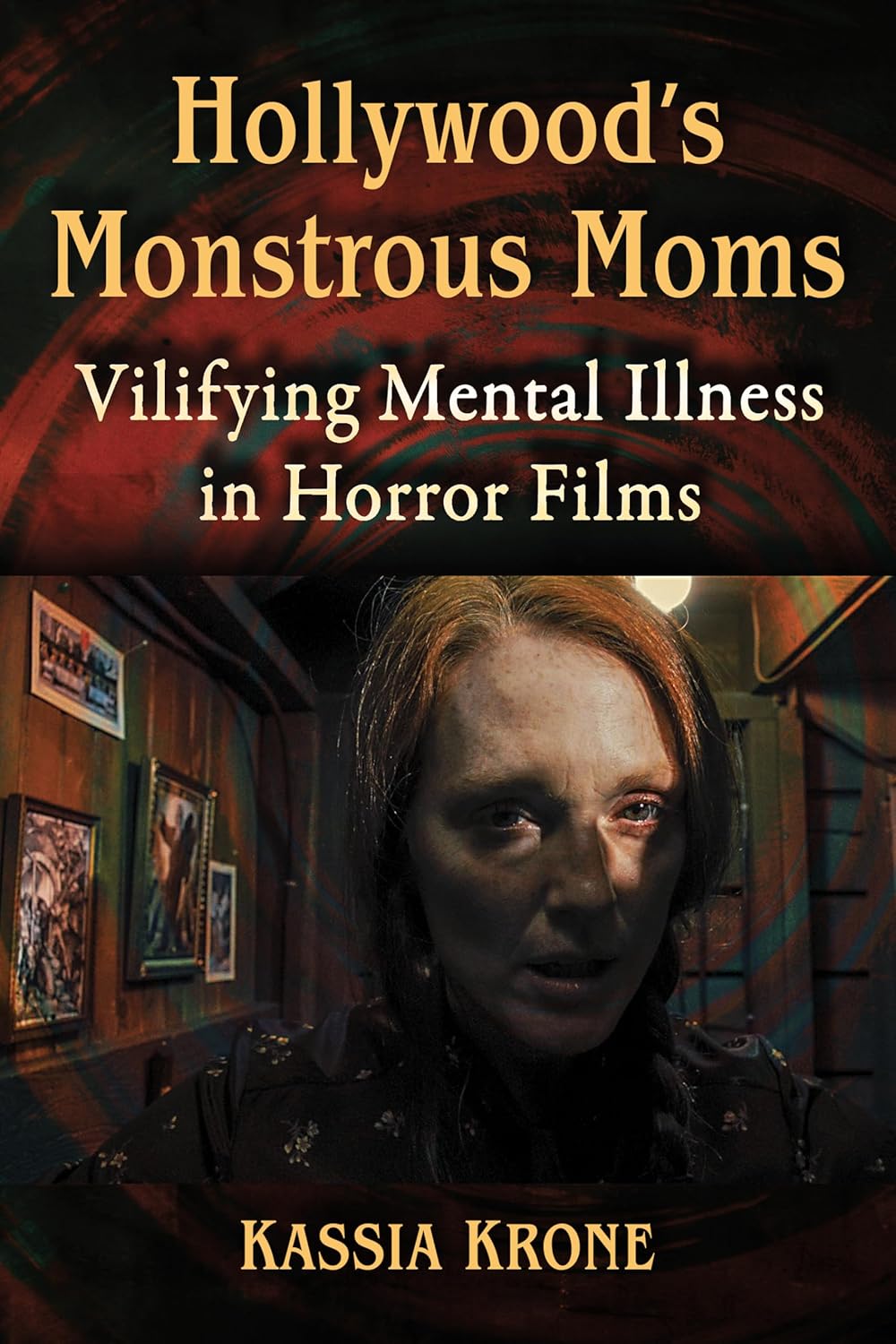
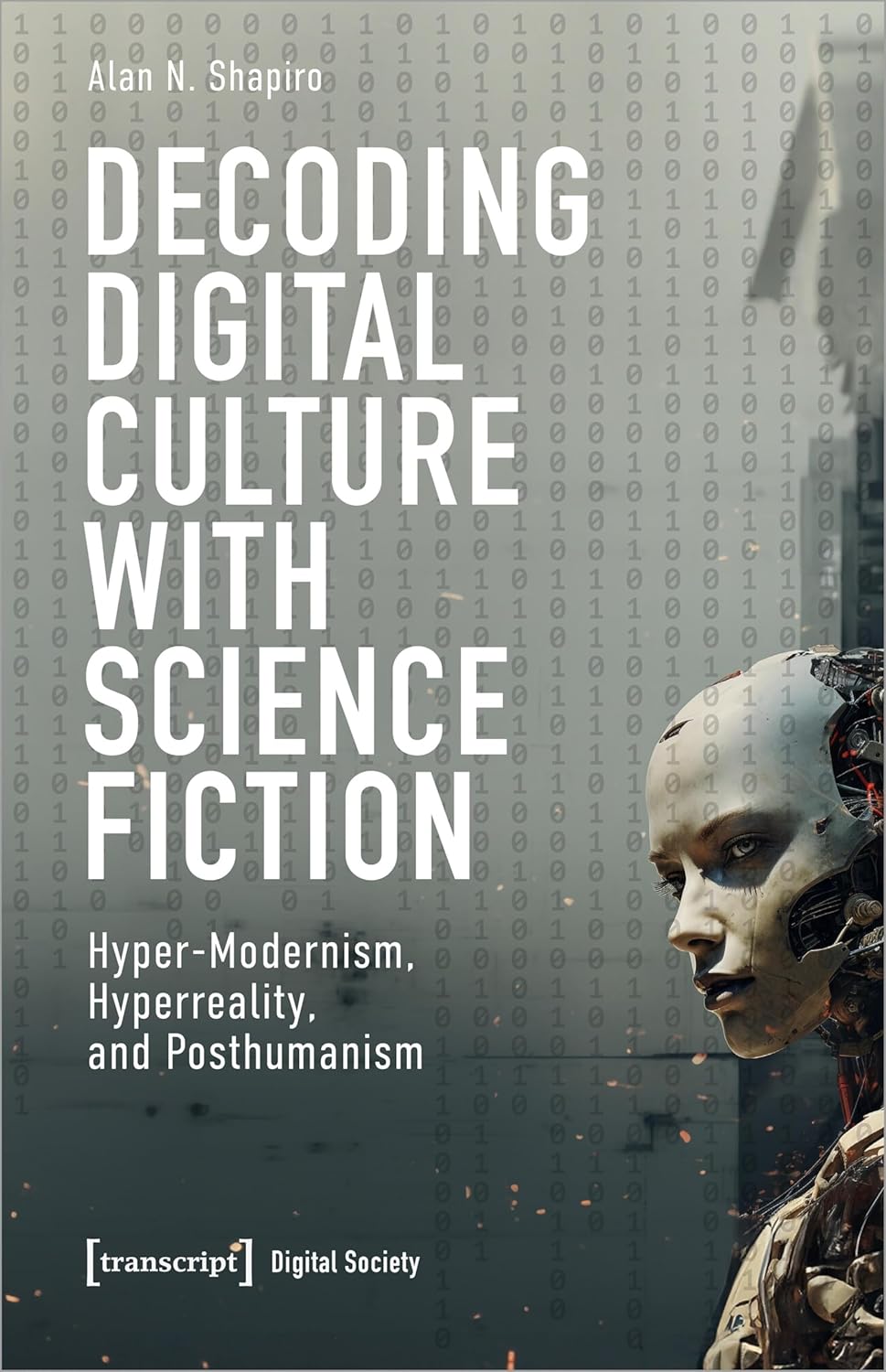
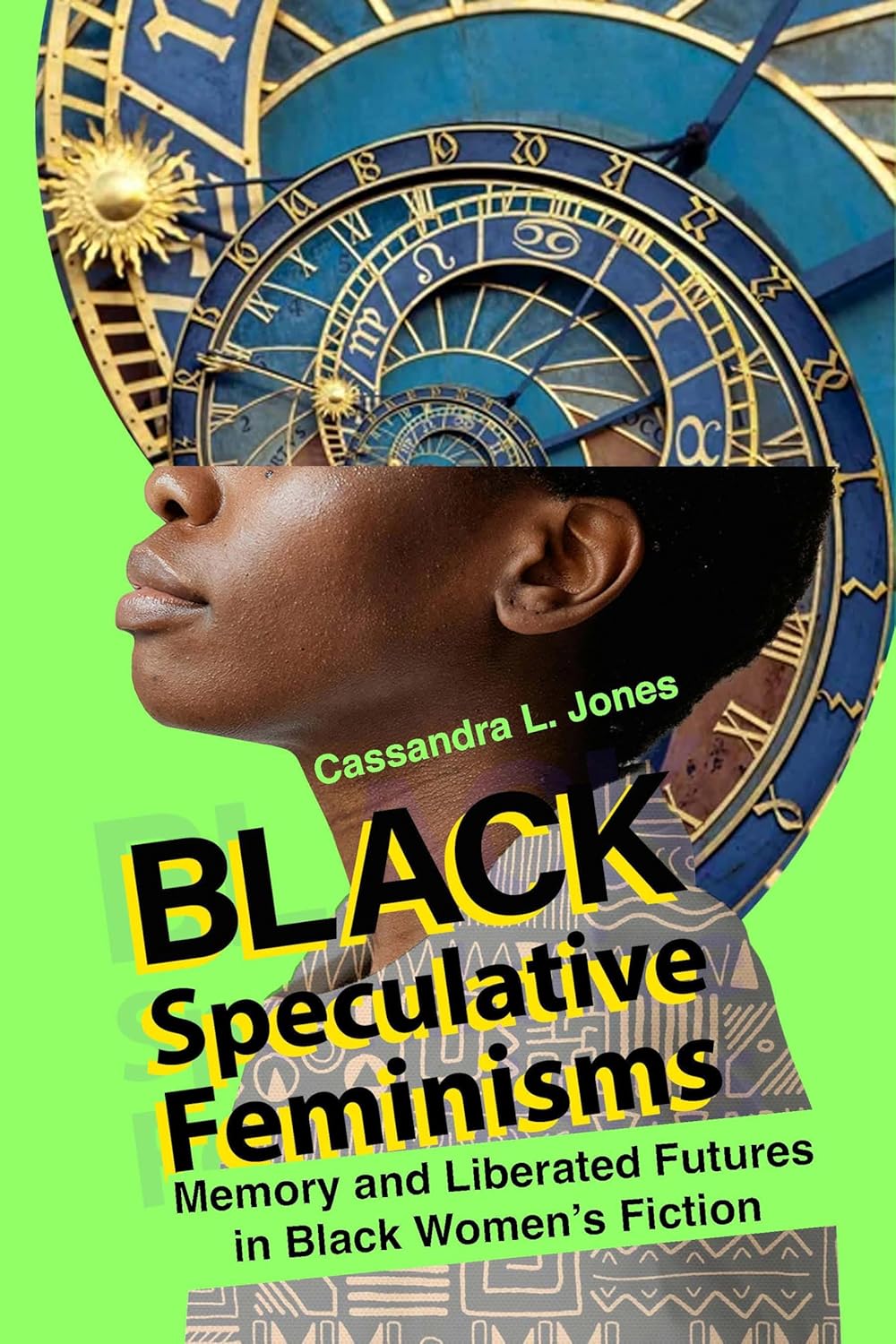
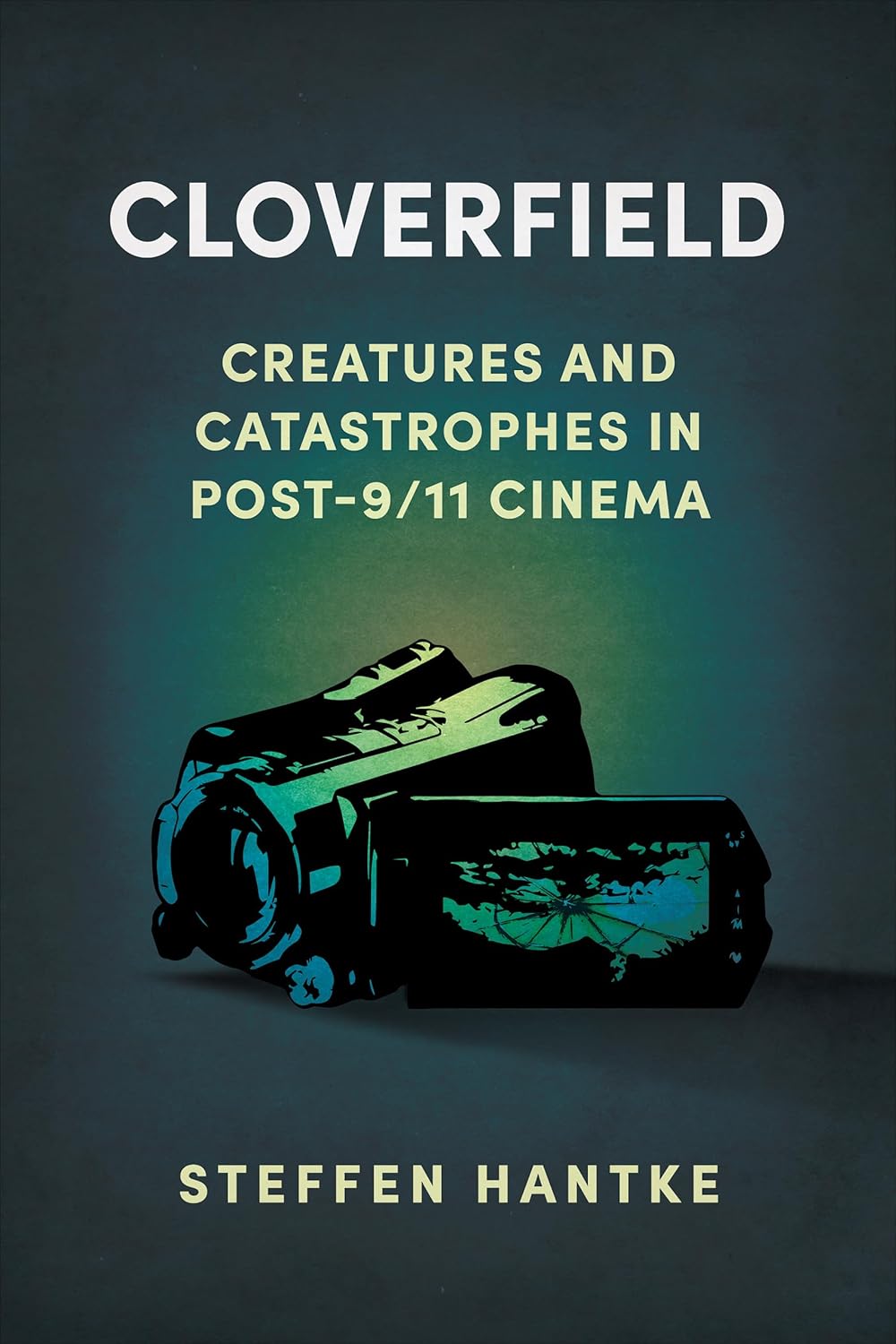
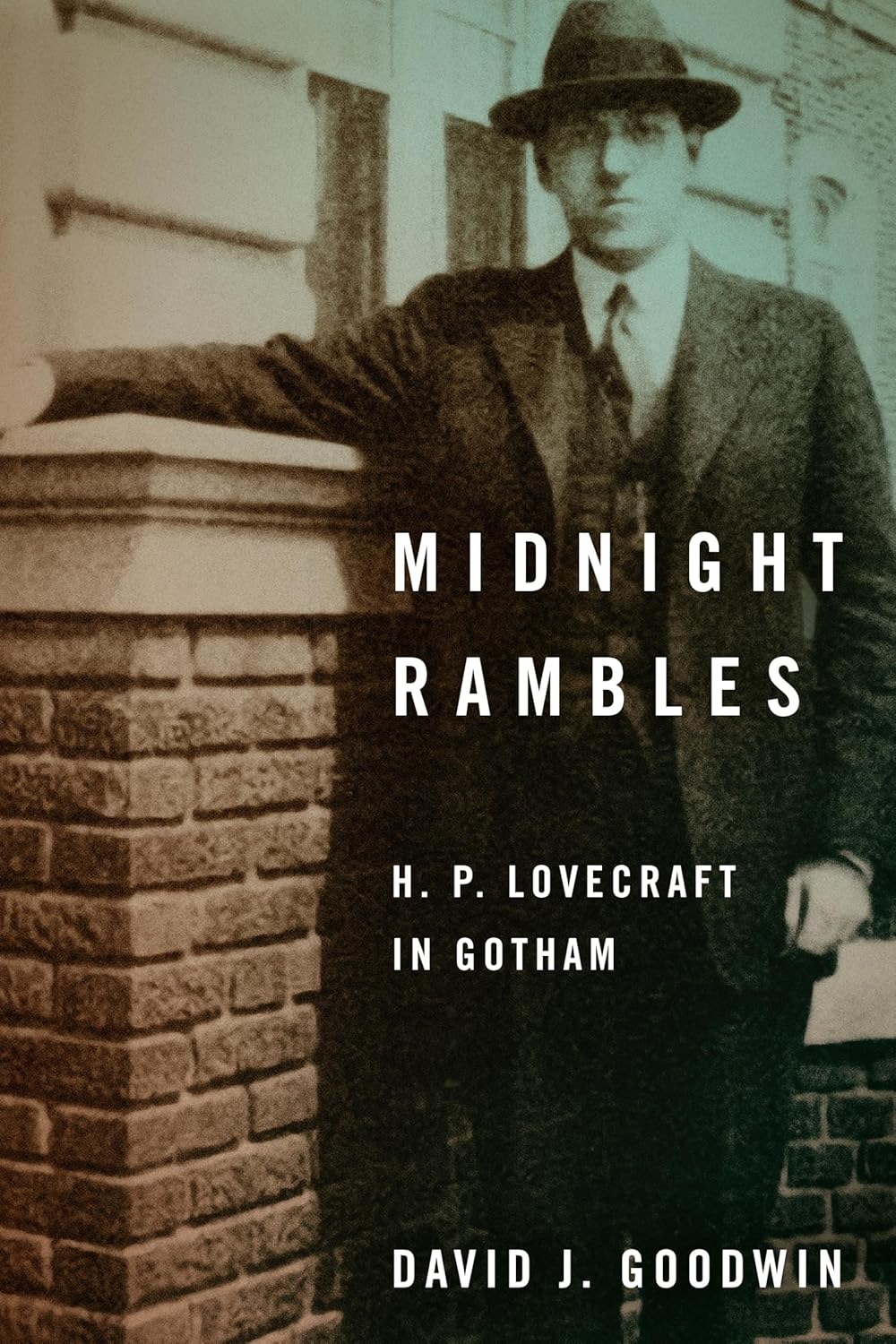
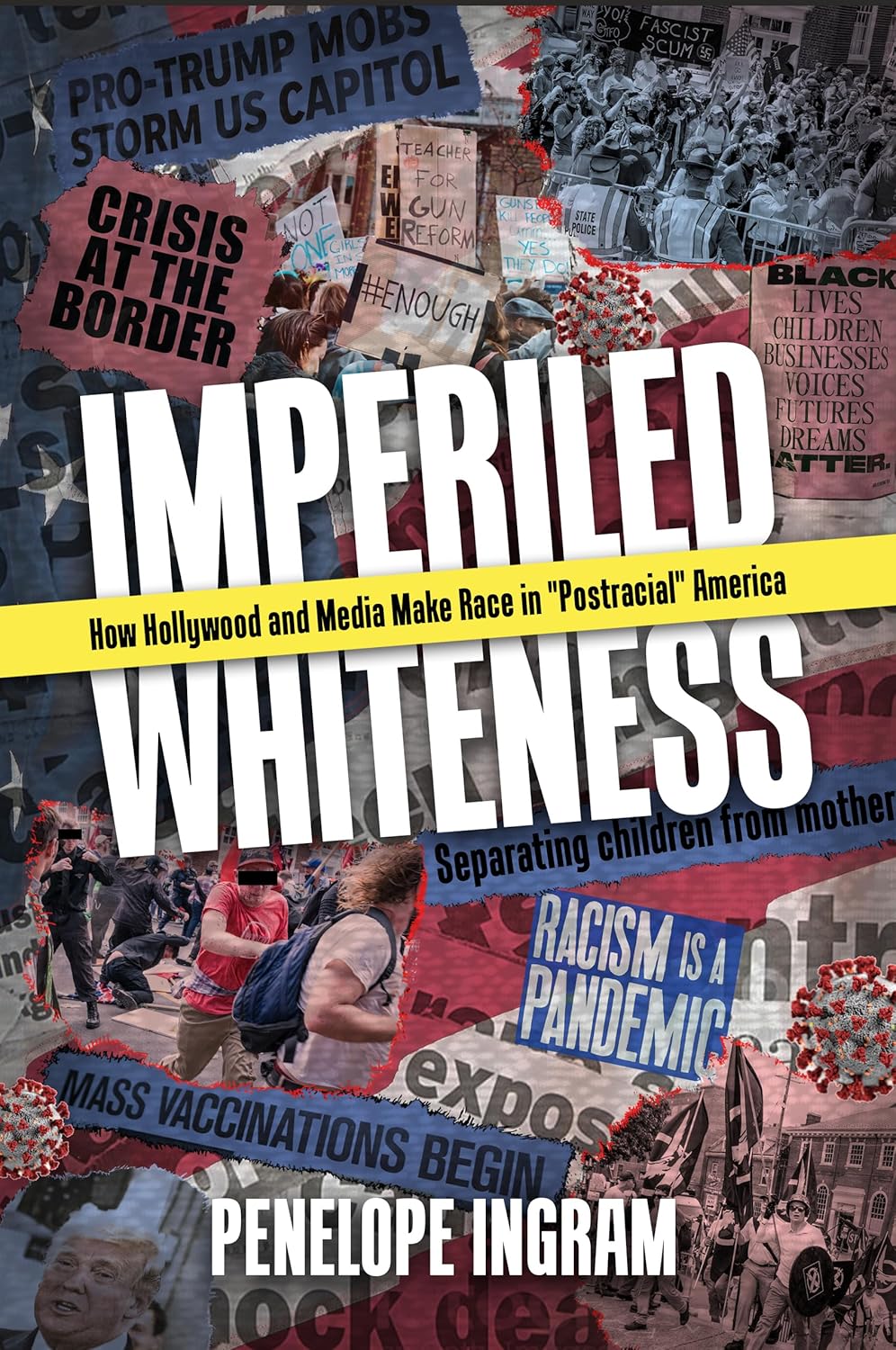


 SFRA Review