Dune: Part Two


Review of Dune: Part Two

Mark McCleerey

Dune: Part Two. Dir. Denis Villeneuve. Warner Brothers/Legendary, 2024.

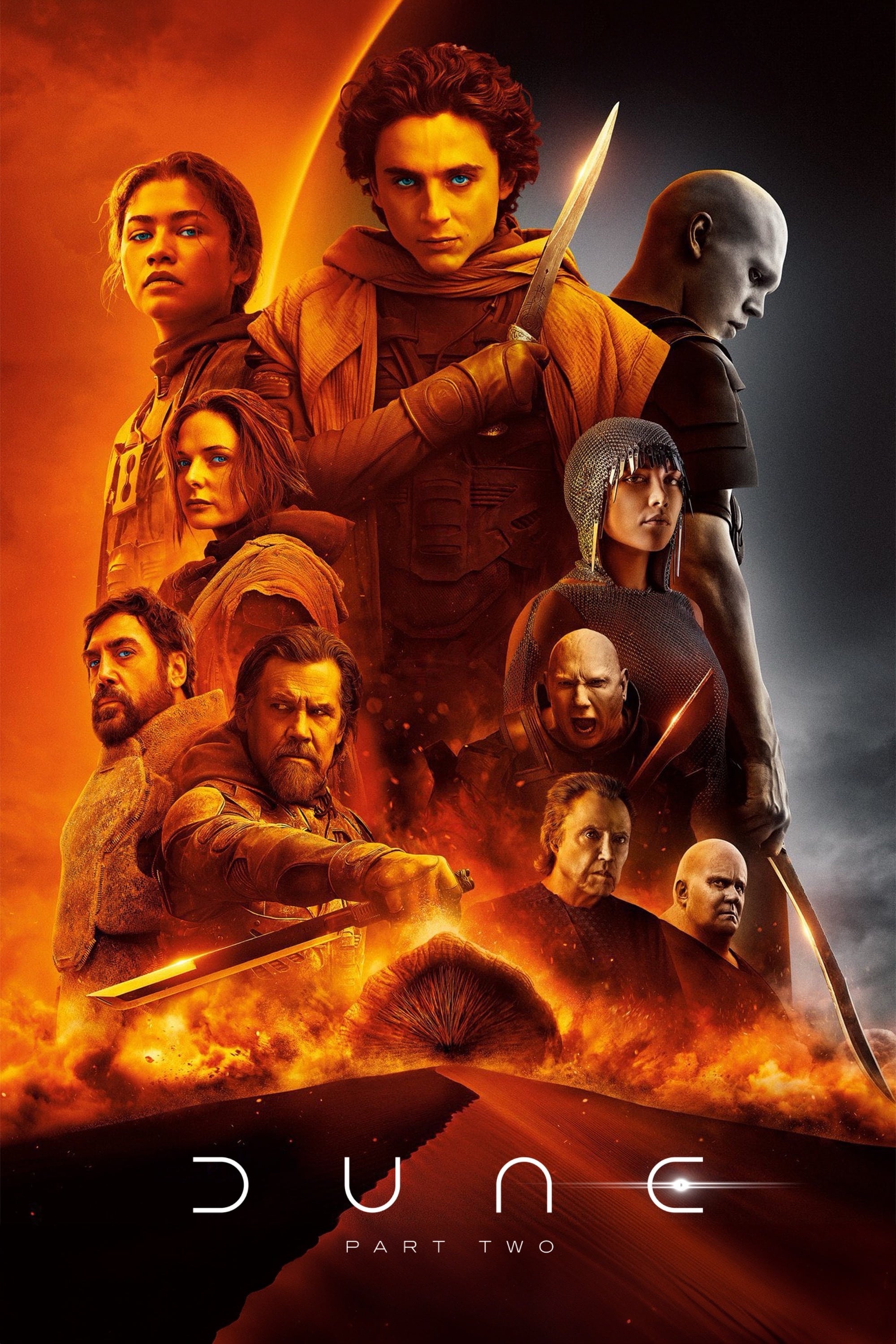
Denis Villeneuve’s eagerly awaited second half of his adaptation of Frank Herbert’s novel Dune lives up to the anticipation. Like his first Dune (2021), Part Two combines captivating images and sounds with equally compelling thematic content. I will present here a broad synopsis of it, along with some remarks about what it has to say about the history of colonialism, and then consider the film’s engagement with religion, particularly messianic faiths.

Villeneuve’s first Dune, set thousands of years in the future, traces the arrival of House Atreides on the planet Arrakis to take over the mining of its enormously valuable spice. This leads to the House’s fall and near-annihilation at the hands of traitors, including the Emperor (Christopher Walken). The Atreides’ scion, Paul (Timothée Chalamet), and his mother, Jessica (Rebecca Ferguson), survive—aided by Fremen Fedaykin, the formidable warriors of the wasteland. Dune: Part Two picks up the story shortly afterwards. Paul and Jessica help the Fremen fend off and destroy a platoon of Harkonnen troopers, the latter House having re-taken control of mining operations.

With this sequence, the movie aligns itself with science fiction films that advance certain perspectives on a specific aspect of Western colonialism. The difference between the combat methods in Part Two, here and in other scenes, strongly evokes the French and U.S. failures in Vietnam to subdue resistance fighters from the 1950s to the early 1970s. We see this clearly in the contrast between the Harkonnens’ overreliance on technology, including full body armor, and the natives’ superior guerilla tactics, rooted in intimacy with their environment. Other films have similarly reconstructed this, including Return of the Jedi (Richard Marquand 1983) and Avatar (James Cameron 2009). Peter Verhoeven’s Starship Troopers (1997) touches on it too, albeit with a satirical bent: The film indicates in its conclusion that the overequipped imperialists will ultimately triumph. Such metaphorical constructions of past wars in movies are not uncommon; more broadly, many films “provide allegorical representations that interpret, comment on, and indirectly portray aspects of an era” (Kellner 14). The Vietnam War in particular has left a complicated legacy, within both U.S. culture at large (Isserman and Kazin 67) and science fiction cinema.

Afterwards, Paul and Jessica join the Fremen community of Sietch Tabr, one of many Fremen underground redoubts. Jessica succeeds the sietch’s Bene Gesserit reverend mother by surviving a dangerous ritual. In time, the Harkonnens find themselves continually thwarted by further Fremen attacks—even more so after Paul, now known as a messianic prophet called Muad’Dib, becomes the Fedaykin’s chief strategist.  Eventually, Paul cements his status as the Fremen’s messiah at a formal gathering of sietch leaders. Exploiting newly acquired powers of historical and prescient vision, he declaims himself the supreme ruler of Arrakis. Alarmed at the disruption of spice flow, the Emperor comes to Arrakis, as do representatives of the other Great Houses. The Fremen defeat the Emperor’s troops and Paul ascends to the throne. As the other Great Houses refuse to accept this forced succession, the Fremen Fedaykin prepare to attack them as an act of holy war (the word “jihad” appears frequently in the novel). Paul’s last words in the film are the chillingly ironic “Take them to paradise.”

SFRA Review editor Ian Campbell has argued that the 2021 Dune’s critique of the white savior narrative is, although admirable, not especially noteworthy: Even mainstream commentators easily discerned it. As I agree with this, I will mention only that Part Two continues this worthwhile critical interrogation. I will, however, offer some thoughts about a related yet more compelling dimension of the film: its strong critique of messianic religion. Villeneuve takes this from the novel andbuilds on it in several ways, three of which I will briefly explore.

The first is Paul’s prescient visions of a future jihad that will spread throughout the galaxy and claim billions of lives in his name. These begin in the first Dune and become more vivid and terrifying in Part Two. The key moment comes when the survivors of a Harkonnen assault on Sietch Tabr prepare to seek safety in the south, and Paul refuses to accompany them—knowing that to do so will be to invite the genocide of his visions. He later relents, and the jihad begins shortly afterwards. The power of messianic thinking and its appeal to the messianic figures themselves, even an enlightened one such as Paul, is overwhelming.

The appeal is not so great to Chani (Zendaya), Paul’s Fremen mentor and lover, which leads us to a second way in which Part Two challenges messianic faith. Early on, the film establishes Chani’s skepticism toward the prophesies, and she remains steadfast. Moreover, her skepticism flows logically from one of the most notable improvements that Villeneuve and co-screenwriter Jon Spaihts have made to Herbert’s novel. Though the book paints Chani as a skilled and ruthless warrior in her right, she nevertheless submits almost completely to Paul’s will once the two begin their personal relationship. Villeneuve’s films, however, endow her with far more agency—which includes, among other things, adamant resistance to Paul’s status as the Fremen’s messianic leader. She expresses nothing but contempt for the very notion of the Lisan al-Gaib, the “voice from the outer world.” She insists that the Fremen must free themselves from their oppressors, should never rely on help from any outsider.

Not even Stilgar (Javier Bardem), the leader of Sietch Tabr, can convince her. For example, when he adduces Jessica’s success in the reverend mother ritual as partial fulfilment of the Fremen’s messianic prophecy, Chani angrily rejoins, “Her people wrote that!” Later she remarks, “You want to control people? You tell them a messiah will come. Then they’ll wait…for centuries!” She maintains this resistance to the end of the movie—indeed, to the very last shot. The film bolsters all this with other Fremen’s skepticism; for example, one of the elders admonishes Stilgar, “Your faith is playing tricks on you.”

Finally, Part Two critiques messianic faith in a third way with its compelling (if somewhat oblique) integration of the novel’s Missionaria Protectiva, an ancient Bene Gesserit program designed to plant myths and prophesies on worlds throughout the Imperium with the goal of making their populations receptive—and vulnerable—to the Bene Gesserit’s grand designs for humanity. Although never mentioned by name, both of Villeneuve’s Dune movies allude to it, via several characters, including the Emperor’s daughter Irulan (Florence Pugh), Paul, the Bene Gesserit Reverend Mother Mohiam (Charlotte Rampling), and Chani. The latter’s aforementioned claim (“her people”) is an example of this. Another example comes when Paul, speaking to Jessica, refers to “your Bene Gessert propaganda.” By using this element of the novel in conjunction with Chani’s and other characters’ skepticism, and with Paul’s visions, Dune: Part Two positions messianic faith as a dangerous and manipulative falsehood.

In sum, Dune: Part Two joins the tradition of science fiction cinema’s discursive interaction with human history—specifically, with explorations of Western colonialism and certain forms of religion. If Villeneuve makes a third Dune film, it too will be highly anticipated, due in part to how he might expand on all this.

WORKS CITED

Isserman, Maurice, and Michael Kazin. America Divided: The Civil War of the 1960s. 2nd ed., New York, Oxford UP, 2004.

Kellner, Douglas. Cinema Wars: Hollywood Film and Politics in the Bush-Cheney Era. Chichester, Wiley-Blackwell, 2010.


Mark McCleerey is a Visiting Lecturer at Indiana University Bloomington.

Scavengers Reign


Review of Scavengers Reign

Phoenix Alexander

Sofia Samatar. The Practice, the Horizon, and the Chain. Tordotcom, 2024. Trade paperback. 128 pg. $18.99 Print, $4.99 EBook. ISBN 9781250881809. EBook ISBN 9780756415433.

Scavengers Reign marks an exciting and all-too-seldom new arrival in science fiction television: one that enfolds DNA from familiar SF narratives to create something fresh, and vibrant, and unsettling. The twelve-part series follows a group of survivors from the Demeter, a damaged cargo ship, who find themselves stranded on a planet populated by creatures that resemble the love-children of the imaginations of Salvador Dalí and Moebius. The trope of stranded colonists is a familiar one, but Scavengers Reign distinguishes itself through strong visual storytelling that manages to avoid the sometimes exposition-heavy world-building of science fiction, as well as through its convoluted and at times grotesque ecology. Boundaries are porous in this world; everything can and may be used as fuel, or food, or an aid to traverse the diverse environs of Vesta—that is, unless it kills you first.

The cast of characters is strong and manages to avoid clichés. Azi (Wunmi Mosaku) and Levi (Alia Shawkat), an automaton, try to maintain a self-sufficient encampment on Vesta. However, Levi’s circuitry becomes infiltrated with rhizomatic organic matter that begins to affect their behavior in odd ways (they bury a spanner in the opening episode: a small act that has a wonderful pay-off, later). Another pair, Sam (Bob Stephenson) and Ursula (Sunita Mani), are attempting to contact the still-orbiting Demeter to bring it down to the planet, and are similarly adept at using the flora and fauna, often in quite gruesome ways, to their advantage.

The show is not without its antagonists;  as well as the predatory and bizarre lifeforms of Vesta, the characters find themselves in a race against time to reach the Demeter before Kamen (Ted Travelstead)—a pitiful figure responsible for the fate of the ship, and one who falls under the sway of  the ‘Hollow,’ a malevolent telekinetic creature—and Kris (Pollyanna McIntosh), a ruthless mercenary. Indeed, after the first few episodes that introduce the ecology of Vesta, the drama wisely centers on the always-compelling human characters. As their storylines converge, the series starts to show its influences more nakedly in a largely satisfying manner—right up to the resolution, wherein the creators shy away from the murderous dream-logic of their world-building.

The surreal visuals (and discordant and often startling sound design) owe much to the disturbing classic from René Laloux, La Planète Sauvage, as well as the technicolor marvels and gentle ecological subtexts of Spirited Away or Princess Mononoke. These influences do not always work harmoniously. The resolution of Kamen and the ‘Hollow’s’ storyline, for instance, is particularly jarring, and feels disingenuous to the brutality of the world-building established in the former half of the show. Kamen’s and the creature’s redemptions feel odd, and unearned, almost exactly paralleling the character of ‘No Face’ in Spirited Away, wherein a monstrous, gluttonous creature finds peace and rehabilitation. There, it worked because the creature is a spirit; in the SF universe of Scavengers Reign, the conceit falls a little flat. Lurching from violence to rehabilitation seemingly for the sake of it, the narrative here starts to unsettle the integrity of Vesta and raises questions such as: Are its creatures truly malevolent, or are they just inscrutable? What do they ‘want?’ Why does everything function so symbiotically, on the one hand, and so violently on the other? Why do some human characters die, while others are changed?      

These questions bring to mind yet another science-fiction/horror text: Jeff VanderMeer’s Annihilation. There, again, ambiguity is maintained more successfully, with Area X seeming a truly alien intelligence (both in the novel and its cinematic adaptation) that nonetheless operates with parameters and rules that both viewers and the in-world characters are not privy to. Scavengers Reign plays with similar themes but loses some of its ambiguity, and thematic consistency, as the episodes progress.

It’s a problem exaggerated by the short film the series started life as. ‘Scavengers’ (2015) sees an unnamed (and unspeaking) man and woman manipulate alien lifeforms in increasingly elaborate and convoluted ways that culminates in an orb of blue liquid excreted from a flying titan; upon submerging their heads in it, the characters experience powerful visions of something I won’t spoil here. Whereas the ecology of the series-length Scavengers Reign is far more convincing, it still at times comes across as science fictional Tetris, drawing attention to visual pattern and interplay in a way that is deeply satisfying on a sensory, if not a narrative, level.

If I’m seeming overly critical, it’s because I truly do love Scavengers Reign and the genres it combines (the epilogue hints at a larger and more terrifying universe, and promises to shift the show, should it have a second season, into a far different tonal register). Make no mistake: this is first-rate science fiction and top-tier animation, of any standard: one that manages to synthesize its references into something truly unique. It has much to say about the labor of space, for instance, in the way that Alien is tale of ‘truckers in space’ and their concomitant mis/treatment as expendable capital by world-spanning organization (the opening of Scavengers Reign sees a tense, but brief, exchange between the larger fleet, remorsefully leaving the stricken Demeter to its fate as an acceptable loss) In contrast, the world of Vesta shows us that nothing is truly lost, in strikingly un-Capitalist and irrational logic. Nothing is wasted: it is ingested, transfigured, or consumed. If the series doesn’t quite reach the nihilism of something like Joanna Russ’s We Who Are About To…, which fiercely refuses any and all attempts of human life trying to situate itself and flourish in unfamiliar kingdoms, it also avoids the anti-colonial message of something like The Word for World is Forest. Instead, it poses a challenge: by all means, make contact with other, make planetfall—just know that the colonizer/colonized dynamic is short-circuited, here, and if the characters want to survive on Vesta, they will have to make peace with the undoing of categories of every kind (the biological and the mechanical, the living and the dead, the hostile and the peaceful).A love letter to the genre (the final episode alone contains references to Aliens and 2001:A Space Odyssey), Scavengers Reign will, I hope, lean further into the uniqueness of its vision as it continues, making landfall on new, and stranger, worlds.


Phoenix Alexander is a queer, Greek-Cypriot author and curator of SF/F. He stewards the Eaton Collection of Science Fiction and Fantasy at the University of California, Riverside—one of the world’s largest collections of genre materials—and also serves as the Editor-in-Chief of Vector: the Journal of the British Science Fiction Association. His fiction and academic writing has been published in The Magazine of Fantasy and Science Fiction, Escape Pod, Beneath Ceaseless Skies, and the Journal of Fantasy and Science Fiction, among others. He is represented by Angeline Rodriguez at WME Books.

Review of Nope


Review of Nope

Victoria Carl

Tesh, Emily. Some Desperate Glory, Tor Publishing Group, 2023.

Nope is, at first glance, a classic alien invasion/abduction movie. Jordan Peele, in an interview with GQ, described his intent as being to create a “summer blockbuster spectacle film” that reflected his perspective on the genre (Kennedy).While Nope’s critical and commercial success qualify it as a blockbuster, its categorization as an “alien invasion,” “alien abduction,” or even just an alien movie is less straightforward. Nope draws on tropes from these SF subgenres, consciously engaging with prior alien works and themes, but resists categorization assuch a movie, subverting expectations by revealing its alien icons as artifice and deception—costumes whose similarity to the SF conceptualization of the alien is exploited by the movie’s characters for the sake of spectacle. In doing this, Peele builds out of the legacy set by prior SF works and criticism but defines a new space for Nope. It’s a movie with the aesthetic of an alien invasion narrative, but with the plot of a creature feature flick.

Nope is Jordan Peele’s third film as director, released in the summer of 2022. There are three POV characters: Otis Jr (OJ) and Emerald (Em) Haywood, played by Daniel Kaluya and Keke Palmer respectively, who have inherited the family business, Haywood Hollywood Horses, after their father’s untimely death; and Ricky “Jupe” Park, a traumatized child star turned mini-theme park owner portrayed by Steven Yeun. There are two storylines: the primary plot follows OJ and Em in their attempts to capture compelling footage of a UFO—specifically one that OJ has witnessed—to sell for fame and fortune and stabilize Haywood Hollywood Horses. The secondary plot is much shorter and features Jupe—first, as a child aboard the set of sitcom Gordy’s Home, on the day that one of the chimps who played Gordy, snapped and attacked the rest of the cast; and second, in the present day, as he unveils a new, special show called the “Star Lasso Experience” at the mini-theme park he owns, Jupiter’s Claim.

In general, Nope is a movie that’s very conscious about alien tropes and its place in science fiction. Only, in Nope, these familiar icons are never what most audiences would be      expecting; they’re always something else, wearing the familiar SF icon as a deception. The movie wants its audience to think they’re watching another alien invasion or alien abduction movie, something so known as to now be tameable, and then it twists that expectation back on the viewer. The “little green men” in the movie are only Jupe’s sons, dressed in costumes. The flying saucer is not a spaceship, nor is it piloted by an “alien species…call[ed] the Viewers” as Jupe is convinced. Instead, it is a creature, an animal, as we can tell from the way the Gordy’s Home subplot parallels the current-day encounter between the Haywoods and Jean Jacket. Both the characters and the movie recontextualize that UFO icon as animal, like Gordy, rather than alien.

Themes of exploitation and spectacle are also central to Nope, and this self-consciousness of genre allows the movie to meditate on how these familiar SF icons have been exploited and reduced to mere spectacle over time. It would make for an interesting study of how SF tropes came to be, and how our views of these tropes have changed over time, especially paired with War of the Worlds—especially the original novel and its 1953 and 2005 film adaptations—and Close Encounters of the Third Kind. These movie pairings provide a way into contemporary perspectives of the alien, the monstrous, and colonialism/postcolonialism. Nope provides a clearexample of contemporary Western culture reckoning with these tropes and their histories, attempting to contextualize and revision them into something new and useful for the post-Internet, post-COVID world.

Animal studies scholars and monster theorists would also find interesting fruit here. Joan Gordon wrote about the potential for greater collaboration between animal studies and SF studies in The Routledge Companion to Science Fiction, and Nope is well-situated to consider the relationship between monster, “creature,” and “animal” in SF more broadly. Jean Jacket is a fictional creature, dressed to look like an alien spaceship, explicitly contextualized as behaving like an animal. Jupe and Holst both refuse to see Jean Jacket as an animal instead of as an alien or, even better, as a spectacle, and that fact gets them both killed. On the other hand, Em and OJ survive and succeed because they recognize Jean Jacket’s behaviors as animalistic and adjust accordingly; this dichotomy could be seen as the movie endorsing Em and OJ’s behavior and condemning Jupe and Holst’s. Of course, they are still using Jean Jacket, exploiting its novelty and resemblance to SF conceptions of UFOs and aliens for their own benefit, i.e., for spectacle. The movie ends before it can explore the consequences, if any, of this last exploitation. Nope’s interrogation and representation of the “alien” creature is complex and ambitious and presents interesting avenues for further research to those interested in the intersection between the Alien, the Animal, and the Other in SF.

The critical takeaways from Nope aren’t as clear cut as those from War of the Worlds or Get Out, but the movie is nonetheless rich with meaning to mine for. It’s not “just another alien invasion movie,” and its reflective take on both the alien and the Alien will appeal to scholars across science fiction studies.


WORKS CITED

Gordon, Joan. “Animal Studies.” In The Routledge Companion to Science Fiction, edited by Mark Bould, Andrew M. Butler, Adam Roberts, and Sherryl Vint, Routledge, 2009, pp. 331-340.

Kennedy, Gerrick D. “Jordan Peele and Keke Palmer Look to the Sky.” GQ, 20 July 2022, www.gq.com/story/gq-hype-jordan-peele-and-keke-palmer. Accessed 21 April 2024.

Review of The Sandman, season 1


Review of Star Trek: Strange New Worlds, season 2

Ian Campbell

The Sandman. Neil Gaiman, Davis S. Goyer, and Allan Heinberg. Netflix, 2023.

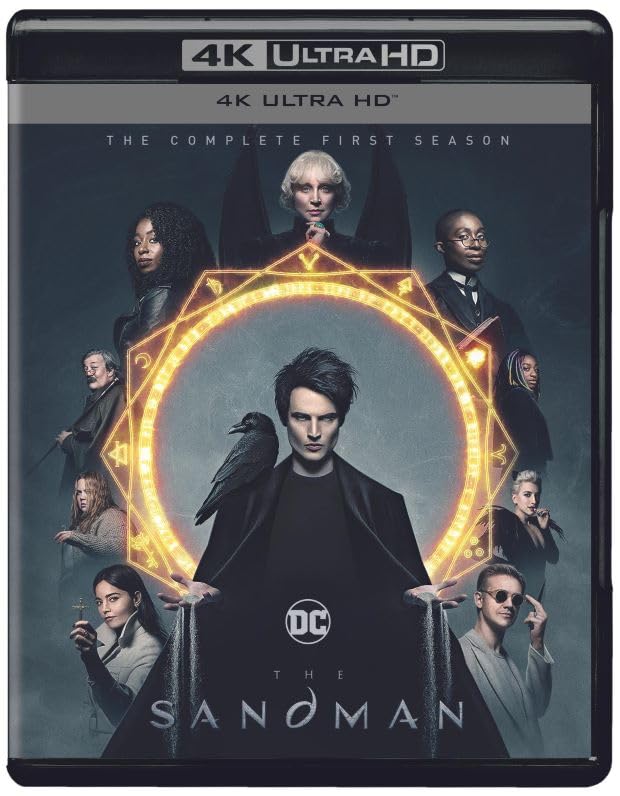
Netflix and the creative team behind the television adaptation, including executive producer Neil Gaiman, who wrote the story that was published in comic book form (1989-1996), deserve every ounce of praise for The Sandman, especially given the long interval and many false starts at presenting a television series—attempts to adapt the story go all the way back to 1991. Season 1 of the series adapts the first two arcs of the comics: these were published in collected volumes as Preludes and Nocturnes and The Doll’s House. The adaptation is entirely faithful to the spirit of the comics and often hews quite literally to the events and characters therein, with only minor deviations, nearly all of which improve upon the story. The adaptation is a tour de force in essentially every aspect and should be held up as the gold standard by which television versions of well-regarded fantasy and SF literature can be judged.

The story of season 1 begins just after World War I, when an English magus, Roderick Burgess (Charles Dance), conducts a ritual that seals Morpheus (Tom Sturridge), the incarnation of Dream, into a glass prison for a century. When Morpheus finally manages to free himself, he has to first seek out the tools that were stolen from him upon his imprisonment, then rebuild the Dreaming, his realm, and track down those among the dreams and nightmares who escaped into the real world during his absence. Once this is accomplished, he has to deal with a “dream vortex”, a mortal whose powerful dreaming ability threatens both the Dreaming and the real world. The theme running through this is that whereas the Morpheus who was first imprisoned was cold, distant, and not so much deliberately cruel as indifferent to the suffering caused by the actions he felt necessary, the freed Morpheus becomes somewhat more humane. During the season, we are given some of the information necessary to understand that Morpheus is the third of the seven siblings called the Endless; we meet his elder sister Death (Kirby Howell-Baptiste) and his younger twin siblings Desire (Mason Alexander Park) and very briefly Despair (Donna Preston). We do not meet his eldest brother Destiny nor his youngest sister Delirium, and only see a blank rectangle where the middle brother Destruction might be: as we will likely find out in season 2 or 3, Destruction has quit his job and left the family.

There are a number of deviations from the comics in the series, but they all improve upon the story. The timeframe of the story has been bumped from the late 1980s to the 2020s. Brute and Glob are replaced by Gault (Ann Ogbomo), a much better character with a real arc of her own; within the same storyline, it is Jed (Eddie Karanja) rather than Hector who is deluded into thinking he’s the real Sandman. Ethel Cripps (Joely Richardson), Burgess’ lover and Dee’s mother, gets a character arc of her own, linking Dee much more closely to the story of Dream’s tools. The Corinthian is more present as an antagonist throughout the season. It is rather clearer from the start that Desire has it out for Dream and is trying to ensnare or destroy him: this will become a central feature of the overall plot.

There are also a number of casting decisions that created controversy as the show was filming. Notably, when Howell-Baptiste was cast as Death, who in the comics is mostly portrayed as a very pale goth girl, the sort of bottom-feeders who use “woke” as a pejorative pitched a fit about it, with their usual delicacy and respect for others. It’s true that the original image of Death was based off of a white woman, Cinamon Hadley (d. 2020), but few outside the right-wing outrage machine believed the fig leaf that casting a black woman for the role was somehow disrespectful to the memory of Hadley. Gaiman provided a model for how to deal with such trolls, by being forthright yet humane in the face of a barrage of hate and death threats. Several other of the characters are played by actors of different races than those of the comics: Jed, Rose (Vanesu Samunyai) and Unity (Sandra James-Young) are all black rather than white, and Lucien, the Dreaming’s librarian, who is a white man in the comics, is played by a black woman, comedian Vivienne Acheampong, and the character is now Lucienne. If you’ve not read the comics, you won’t notice, and if you have read the comics and aren’t a bottom-feeding right-wing troll, you won’t care: as I said above, the acting and writing is top-notch.

One of the ongoing themes across the long series of comics is that the Endless are eternal manifestations of the principles whose names they share: their task is to embody these principles as a means of guiding, punishing or serving as inspiration for mortals. This is done well in season 1, especially in a pair of scenes where Shakespeare (Samuel Blenkin) becomes of interest to Dream because he wants to tell great stories, which is Dream’s magisterium. As the comics progress, it becomes more clear that each of the Endless has a personality that’s more or less opposite to their function: Destiny is clueless, Death perky, Dream a sober realist, Desire firmly unwantable, etc. None of this much manifests in the first two volumes that season 1 adapts, but I’m interested to see what happens as the show goes forward. The contrast between personality and function, and what this does to the Endless—especially Dream, Destruction and Delirium—and how they cope with it, becomes part of the central plotline as the story progresses.

From an academic perspective, two avenues open for consideration of the show in research and teaching. Its take on mythology and the oddly constrained lives of the (semi-)divinely powerful is worth exploration, notably in how Morpheus gradually goes from filling his function because that is what he’s supposed to do all the way to understanding the incompatibility between his humanity and filling his function. The other avenue is to consider how it is that some adaptations, like this one, are so very good, and others, such as Amazon Prime’s versions of The Wheel of Time, which comprehensively botches both the spirit and the letter of the novels, and of a few paragraphs of Tolkien’s notes for the absolute fiasco that is Rings of Power, are so very bad. It’s not related to network: Prime did a great job with The Expanse and Lee Child’s Reacher novels. What choices are made that enable one adaptation to be genuinely moving and others cringeworthy, and to what extent are these artistic decisions and to what extent are they related to business? These are all commercial productions, intended to make money, and no matter how much we might wish for art unencumbered by business, that’s not possible now and never truly has been.

Ian Campbell is the editor of SFRA Review.

Review of Star Trek: Strange New Worlds, season 2


Review of Star Trek: Strange New Worlds, season 2

Jeremy Brett

Goldsman, Akiva; Kurtzman, Alex; and Lumet, Jenny, creators. Star Trek: Strange New Worlds, Season 2, CBS Television, 2023.

One of the high emotional moments in the second season of Star Trek: Strange New Worlds comes near the end of its strangest event, the musical episode “Subspace Rhapsody” (2.09). Communications officer Nyota Uhura (Celia Rose Gooding), experiencing the heightened emotions that by the Laws of Musicals mandate powerful expression through song, laments her intense loneliness and her sadness over the death of her family, only to proclaim a newfound sense of purpose and belief in the necessity of human connection:

How come everywhere
That I go, I’m solo?
Am I at my best unaccompanied?
My whole life has been “Fix this” and “Save you”
I’ll light the path
And keep us connected
[…]
I absorb all the pain, mm-hmm
I hear everyone’s voice calling my name
Building systems, I strengthen ties that bind
So no one has to be alone.
      

Uhura’s self-realization is amplified one number later, where she sings to the entire U.S.S. Enterprise crew—in an intervention/finale to prevent the destruction of the Federation and half the Klingon Empire—that:

We’re all rushing around
We’re confused and upended
Let’s refocus now
Our bond is imperative
Let’s bring our collective together
As we fight for our lives
      

Followed by the crew’s unified response of:

We know our purpose is
To protect the mission
Our directive
Cause we work better
All together
We overcome
Our obstacles as one. 
     

It is a moment that completes the process by which the show has, over two seasons, transformed both the Enterprise and Starfleet into places of real and secure community in a hostile universe.

The musical is a touchstone for the sentiment surrounding the entire season, centered as it is on characters who, as Uhura sings, build systems—external and internal—to strengthen the ties that bind together individuals living in the dark and vast reaches of space. That sense of community as a bulwark against both an unremittingly dangerous cosmos and deeply buried inner trauma gives SNWa particular emotional resonance that sets it apart from previous iterations of ST. It represents a newfound franchise maturity in its plausible preservation of a particular inter-universe complexity, one that balances the traditional progressive and exploratory spirit of STwith recognition of some of the darker aspects of humanity (and its alien analogues), together with a keen appreciation of the ways in which humor can serve ST as a natural part of the human experience.

Obviously, humor is subjective, but SNW’s comic aspects to me strike a much more natural tone than many of the oft-painful attempts at humor that the original series, The Next Generation, or Voyager attempted. In the episode “Charades,” (2.05) for example, Spock (Ethan Peck) is temporarily deprived of his Vulcan genetic code, rendering him completely human at the worst possible time for his future married life and giving him the explosive temperament of a pubescent teenager. Spock’s exploration of the full range of human emotions has a number of funny and farcical moments, but these are artfully and realistically mixed with turmoil at his complicated romantic feelings for Nurse Christine Chapel (Jess Bush) and a newfound understanding of the isolation and rejection that Vulcan culture inflicted on his human mother Amanda. The construction of new personal and relational understandings means the building of these connective systems among the crew of the Enterprise.

Trauma goes hand in hand with past legacies in SNW season 2, leaving few characters untouched. In fact, the title of the second episode, “Ad Astra Per Aspera” (2.02) (Latin for “Through Hardship to the Stars”) could justifiably serve as the theme for the entire season. That episode shows the fallout from the arrest of Enterprise first officer Una Chin-Riley (Rebecca Romijn) for the ‘crime’ of being a genetically altered Illyrian and hiding that fact from Starfleet. Her subsequent trial reveals the unjust and disastrous consequences of a policy made by the Federation out of fear and internalized trauma caused by the Eugenics Wars. That fear resulted in bigotry and forced cultural assimilation towards Illyrians and a most un-Federation conviction that we must be forever what we are born to be. Una was a prisoner of that policy and the chains of secrecy it laid on her, until the idealistic image of unity that Starfleet represents drives her into the hazardous act of passing—Una takes risks because,

     [i]f all those people from all those worlds can work together, side by side, maybe I could, too. Maybe I could be a part of something bigger than myself. Starfleet is not a perfect organization, but it strives to be. And I believe it could be … Ad Astra per Aspera.

SNW posits that we will not reach our human potential among the stars unless we risk exposing who and what we are and, through that adversity, reach a place of healing and transformative change. In a remarkably poignant coda in “Those Old Scientists” (2.07), Una at last receives vindication for her journey of optimistic hardship when, of all people, Lower Decks ensign/ultimate ST fanboy Brad Boimler (Jack Quaid) and fellow ensign Beckett Mariner (Tawny Newsome) cross over from their own series to inform Una that in their time—her future—the motto that inspired Una to create a new life has become Starfleet’s recruitment slogan and Una herself its literal poster child. In Star Trek there is always hope of a better tomorrow and of societal and human progress.    

The trauma of the past has dramatic impact on other characters as well. SNWis set in the (fairly) early aftermath of the horrific Federation-Klingon War, and Starfleet is heavily populated by veterans of that conflict, among them Chapel, Doctor M’Benga (Babs Olusanmokun), and Lt. Erica Ortegas (Melissa Navia). All three suffer both from bitter feelings towards their former adversaries as well as serious post-traumatic stress: one particularly harrowing episode—”Under the Cloak of War” (2.08)—deals heavily in flashbacks to the war in which Chapel and M’Benga both served in a field hospital under fire, watching young officers die horribly and (in M’Benga’s case) committing brutal atrocities in a conflict full of them. The two are united in their inability to explain to outsiders the nature of their ongoing psychological injuries and the isolation they produce; they hurt, and they hurt profoundly enough that it warps their relationships with others. However, they, too, recognize that, as Uhura and M’Benga sing during “Subspace Rhapsody”, “I look around and everyone I see/The pinnacle of guts and resiliency/Death threats are nothing new to us/It takes monumental strength and trust”, and Chapel in a solo song proclaims her joy and readiness at being free to pursue new successes that may provide psychic healing: “The sky is the limit/My future is infinite/With possibilities/It’s freedom and I like it/My spark has been ignited/If I need to leave you [Spock]/I won’t fight it/I’m ready.”

But personal traumas carry their own weight even when intergalactic war is not involved: Captain Christopher Pike (Anson Mount) suffers under the knowledge that he is destined to suffer a critical injury that will leave him paralyzed and disfigured, yet he makes the choice to build a system around acknowledging and welcoming present relationships, including fellow captain Marie Batel (Melanie Scrofano). He will likely always be struggling with the knowledge of his fate, but forming emotional bonds becomes a critical way of coping. Once again, Boimler steps in with surprising pathos, asking Pike, who is planning to celebrate his birthday alone in part to muse over his failure to reconcile with his deceased father, “I’m sorry about your dad. But I wonder, if someday you’re not around anymore, how many people on this ship would wish they had another day to talk to you?” It is a doubly emotional moment because Boimler, of course,  being from the future knows as a matter of history Pike’s final fate but cannot say anything for fear of changing the timeline.

Similarly, security officer La’an Noonien-Singh (Christina Chong) faces emotional difficulties on multiple levels—as the survivor of imprisonment by the Xenomorph-like/reptilian Gorn, she subsumes her own scarring PTSD. As a descendent of the infamous Khan Noonien-Singh, she worries that she, too, is a monster doomed by her genetic heritage—confiding this to Una’s defense attorney, the lawyer replies that, 

They looked down at us [Illyrians] for so long that we began to look down at ourselves. Genetics is not destiny despite what you may have been taught. […] You were not born a monster; you were just born with a capacity for actions, good or ill, just like the rest of us.

The severe and buttoned-up La’an gains a newfound self-confidence, and her emotional range expands even more after confessing to James T. Kirk (Paul Wesley) her feelings for him based on an attraction to an alternate timeline version of Kirk (in “Tomorrow and Tomorrow and Tomorrow” (2.03)). Though he gently turns her down, La’an sees both truth and beauty in the resulting sadness, noting that “I’m glad I took that chance. Maybe I could be someone who takes chances more often.” La’an, as do so many of SNW’s characters, develops newfound emotional maturity in the process of solidifying human connections and building systems of trust and fellowship.

Season 2 of Strange New Worlds centers on the understanding that humans are rife with deep internal conflicts that accompany them into space and inevitably inform their reactions to the universe around them. It asks the audience to consider what baggage we carry around with us as thinking and feeling beings, the realizations we come to about ourselves, and the value of forming found families within which are preserved love, loyalty, and newfound purpose. As ever with the best of ST, and indeed, science fiction in general, what is most human in us is what we carry to the stars and beyond.

Jeremy Brett is a Librarian at Cushing Memorial Library & Archives, where he is both Processing Archivist and the Curator of the Science Fiction & Fantasy Research Collection. He has also worked at the University of Iowa, the University of Wisconsin-Milwaukee, the National Archives and Records Administration-Pacific Region, and the Wisconsin Historical Society. He received his MLS and his MA in History from the University of Maryland – College Park in 1999. His professional interests include science fiction, fan studies, and the intersection of libraries and social justice.

Review of The Wandering Earth II


Review of The Wandering Earth II

Mehdi Achouche

The Wandering Earth II. Dr. Frant Gwo, China Film Group Corporation, 2023.

In January 2019, China soft-landed the first lunar probe on the far side of the moon. The next month, The Wandering Earth (Frant Gwo) was released in Chinese theaters and made more than $700 million U.S. dollars at the box office, remaining to this day the 5th largest box office success in Chinese cinema and the first major homegrown science fiction production. That the two events should happen almost simultaneously was far from a coincidence, as the nation’s push in the science and technology fields has been accompanied by the dramatic rise of Chinese science fiction, dreaming of even more spectacular technological feats in the near or far away future. The genre in China has been spearheaded since the early 2000s by the works of novelist Liu Cixin, the Hugo recipient author of the eponymous short story (2000) loosely adapted for the screen by Gwo. Judging by the enormity of the means deployed by Chinese authorities to welcome the 81st World Science Fiction Convention in Chengdu, Sichuan, last October (a ceremony attended by both Liu and Gwo), the genre is taken very seriously by the government. It might, after all, help provide the means “to grow China’s cultural soft power and the appeal of Chinese culture,” in the words of Xi Jinping, the Chinese leader, earlier that month (Xinhua).

It should be noted, however, that both The Wandering Earth and its 2023 sequel, are as much disaster films as they are science fiction features, drawing largely from their U.S. counterparts, especially the Roland Emmerich variety. The “imagination of disaster” so elegantly described by Susan Sontag in the 1960s is at full work in these two films, as audiences can leisurely contemplate the wholesale destruction of entire metropolises and parts of the globe. This is especially the case in The Wandering Earth II, which is narratively a prequel taking place decades before the events of the first film and which can therefore focus on the cataclysms themselves rather than, like the first installment, on their aftermath. However, far from a pessimistic vision of the future, The Wandering Earth II, like its predecessor, is first a celebration of the technological marvels and possibilities that the future seems to hold, allowing humanity and China to overcome all the imaginable and unimaginable obstacles in their path. Although the film revels in destroying, it is first and foremost, as Jenifer Chao writes of the first film, an attempt at building the country’s national image, rebranding it as a technological superpower associated not with a long, glorious past but with a triumphant future (Chao).  

Whereas the first film was set in the 2070s and focused on the Earth’s near destruction in the vicinity of Jupiter, the sequel takes place in the 2040s and 2050s, presenting itself as the chronicle of humanity’s early attempts at saving itself. The world governments have only recently become aware of the fact that the sun was rapidly expanding and would engulf the Earth within the next century. They have started work on what will become known as the Wandering Earth Project—the construction of 12,000 fusion-powered engines which will stop the Earth’s rotation and thrust it out of the Sun’s orbit and into deep space, in search of a new home. In due course, audiences are treated to giant waves engulfing New York City (featuring the now traditional shot of the Statue of Liberty being almost immersed in water) or meteors streaming across the globe and destroying various landmarks in the process. Urban ruins are also offered to audiences, as the panorama of a frozen Shanghai and its iconic towers recalls similar shots in A.I. Artificial Intelligence (Spielberg, 2001), for instance. This is essentially a demonstration of the newfound expertise of Chinese cinema at employing special effects that are up to par with Hollywood—cinema as essentially a technological apparatus, a cinema of attractions that doubles as a demonstration of Chinese technical prowess. If the disaster genre is “a supreme, basic and fundamental example of what cinema can do,” in the words of Stephen Keane in his study of the genre, here it also demonstrates everything that Chinese cinema can now do (5).

At the same time, The Wandering Earth II, even more than its predecessor, largely ignores some of the genre’s stereotypical characters—the greedy businessman, the cowardly stepfather—to focus instead on cooperation and unity. The old-fashioned H.G. Wells dream of a world government is resurrected in the form of a United Earth Government under the clear auspices of China. Anytime (which is often) a Western representative at the United Nations (most notably the U.S. and British ones) doubts the validity of the project and is ready to quit and accept defeat, the wise, old Chinese delegate has sensible words to remind the world of the necessity of global partnership. While careful never to hit the jingoistic tones of a film like Independence Day (Roland Emmerich, 1996), or of even recent Chinese blockbusters like Wolf Warriors (which shares with The Wandering Earth II its lead, Wu Jing), The Wandering Earth II is hard at work highlighting the merits of Chinese leadership. When terrorist attacks threaten the project and lead every other country to give up, China is left alone to heroically finish construction of the prototype engines. While we learn at one point that the U.S. Senate is preparing to opt out of the international partnership, the Chinese delegate addresses the General Assembly and reminds the world that civilization is about helping each other and mending what is broken: “In times of crisis, unity above all.” Shots of the U.N. building in New York always highlight the beauty of the structure or are careful to show the famous knotted gun sculpture and visually associate it with the Chinese delegation. China, we are assured, has the power, the know-how, the motivation and the wisdom to look after the world, contrary to the U.S.

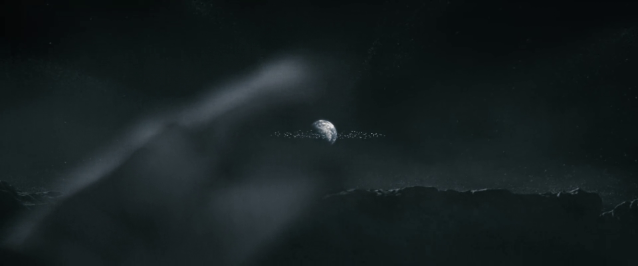
One of the similarities between the disaster film and the war narrative is their focus on the theme of sacrifice, and the film puts it to good use repeatedly. The climax of the film (which really consists in an unrelenting series of crises and climaxes) sees hundreds of senior astronauts from seemingly every nation bringing the world’s entire arsenal of nuclear weapons (no more wars) to the moon and blowing themselves up one by one to destroy the satellite and prevent it from crashing into the earth. This moment is perhaps one of the most emotionally effective in the film, and one of the most interesting visually. Before they arrive on the Moon, their approaching flotilla is visualized through a revealing frame within a frame: the film’s hero is holding a hex nut, through which he is framing the entire earth, making it look like a tiny little atom in the distance and emphasizing its fragility (fig. 2). Before the focus switches from the foreground (the nut) to the background (the earth and the approaching flotilla), we are given time to read the inscription on the edge of the nut: “made in China” (fig. 1). That a single shot can convey so much meaning (the nut is also an ironic stand in for the ring the hero could never hand to his love interest, symbolically making humanity as a whole his new love interest) is a testament to the director’s capacity to offer great visuals that do not simply feed the audience’s presumed thirst for mayhem and destruction.

Figure 1: The Earth as seen through the frame of Chinese technology
Figure 2: The Earth as “a tiny, fragile speck in the cosmic ocean”

The Wandering Earth II offers interesting avenues for the comparative study of science fiction and disaster films from the U.S., China as well as other countries (South Korea’s 2023 The Moon, for example) and their close connection to nation branding and soft power. The first film has already been largely discussed from such a perspective, but the sequel offers an even stronger case study. 2023 also saw the release of Tencent’s 30-episode TV adaptation of Liu’s Three Body Problem (available in many countries on Tencent’s YouTube channel), while Netflix will unveil its own version in the spring of 2024. This offers the potential for further comparative studies of differing perceptions and problematizations of scientific and technological progress across East and West, especially as their respective space programs kick into higher gear in the coming years.


WORKS CITED

Chao, Jenifer. The visual politics of Brand China: Exceptional history and speculative future, Aug 30, 2022, Vol. 19, 305-316, https://link.springer.com/article/10.1057/s41254-022-00270-6

Keane, Stephen. Disaster Movies: The Cinema of Catastrophe. Columbia University Press, 2006 (2nd ed.).

NASA, “Voyager 1’s Pale Blue Dot,” https://science.nasa.gov/resource/voyager-1s-pale-blue-dot/, last accessed Jan 10, 2024.

Thomala, Lai Lin. “The most successful movies of all time in China 2023,” Dec 13, 2023, https://www.statista.com/statistics/260007/box-office-revenue-of-the-most-successful-movies-of-all-time-in-china/, last accessed Jan 10, 2024.

Wall, Mike. “China Makes Historic 1st Landing on Mysterious Far Side of the Moon,” space.com, Jan 3, 2019, https://www.space.com/42883-china-first-landing-moon-far-side.html, last accessed Jan 10, 2024.

Xinhua News Agency. “Xi Jinping Thought on Culture put forward at national meeting,” Oct 9, 2023, https://www.chinatoday.com.cn/China/202310/t20231009_800344309.html, last accessed Jan 10, 2024.

Mehdi Achouche is an Associate Professor in Anglophone Film and TV Studies at Sorbonne Paris Nord University. He works on the representations of techno-utopianism, transhumanism and ideologies of progress in science fiction films and TV series. He is currently working on a monograph on such representations in films and series from the 1960s and 1970s.

Review of Executive Order


Review of Executive Order

Alfredo Suppia

Executive Order (Medida Provisória). Dir. Lázaro Ramos and Flávia Lacerda. Lereby Produções; Lata Filmes; Globo Filmes; Melanina Acentuada, 2020.

One of the most meaningful parables to date against the structural racism deep-rooted in Brazilian society and the historical social and economic debt to African-Brazilians publicly appeared in 2021 as a feature-length film that conveys an alarming dystopian tale. Directed by Lázaro Ramos in collaboration with Flávia Lacerda (co-director), Executive Order is set in a near-future Rio de Janeiro, when the Brazilian government is sued by the young, successful lawyer Antônio Gama (Alfred Enoch) and condemned to pay massive reparations to all citizens descending from enslaved Africans. The authorities see the just reparation as the State’s utter financial collapse. Thus, the authoritarian government responds by decreeing the exile of all black citizens (now addressed as “accentuated-melanin citizens”, a term used almost verbatim in Shalini Kantayya’s documentary Coded Bias, 2020) to Africa as an alternative to repaying the debts of slavery—this operation immediately reveals itself as a new wave of eugenics with the “desirable” whitening of Brazilian society. Citizens are measured by their skin color, captured, and sent to Africa against their will. While the army and police enforce the law, Antonio gets involved in a personal drama as he, his uncle André Rodrigues (Seu Jorge), and his wife Capitu (Taís Araújo) become victims of the authoritarian State, along with millions of other people. Capitu, a doctor, goes missing after a hospital shift amid the announcement of the decree and the beginning of the find-and-capture operation. She eventually finds an underground resistance movement known as the “Afrobunker.” The trio fights the madness that has taken over the country and joins the resistance that inspires the people.

This nationwide state operation is not free from opposition. Many “accentuated-melanin citizens” refuse to be banished, and “partisan” cells begin to appear. The most significant being the  underground Afrobunker community, shaped after the old Brazilian quilombos that provided free life and safety for runaway enslaved people. As a “neoquilombo”, the Afrobunker is the most exciting and stimulating fictional premise within Executive Order. It is a place of resistance that once served as a get-together for lovers and Carnival partygoers (as the authoritarian State has forbidden Carnival). In the wake of the decree, the Afrobunker stirs a peaceful communal strategy for resistance reminiscent of the long-lasting “institution” of Brazilian Carnival, the quilombos, and even contemporary favelas and urban “occupations.” Note that black people in Executive Order do not handle firearms with ease, contrary to the notion that guns are a usual item in their daily lives as shown in countless other films set in favelas with black actors as drug dealers. This is highlighted by Lázaro Ramos (Medida Provisória: Diário do Diretor. Rio de Janeiro: Cobogó, 2022, 78) and does make a difference. The Afrobunker and the main characters’ acts of resistance are primarily peaceful and not driven by revenge.

Above all—and this can be seen in a pivotal scene towards the end of the film, set in the Afrobunker—the characters’ choice is for civilization instead of brutality, collective engagement, empathy, and solidarity as a more profound and successful response to state authoritarianism and the long-lasting history of racial inequality. The trio of main characters performs a final scene that stresses this choice, eventually resorting to ingenuity instead of violence. The film’s ending remains open to further speculation with a clear nod at a promising future that encompasses a sort of national epiphany.

As told by Lázaro Ramos, Executive Order derived from his experience as director of Aldri Assunção’s play “Namíbia, No!”. Excited with the play’s reception and potential, Ramos decided to adapt it into a feature-length film along with Aldri Assunção, Lusa Silvestre, and Elísio Lopes Jr., co-authors of the screenplay. The film entered the production stage in 2019, before the outbreak of Covid-19 and during the first months of Jair Bolsonaro’s government. As Lázaro Ramos explains, the film was never meant to attack the Bolsonaro administration overtly: “Yet, if some of the attitudes of this government bear similarity to our story, the problem is not fictional, it’s reality” (76). Ramos (2022) and film critics often mention Black Mirror and The Handmaid’s Tale while addressing Executive Order. However, it is worth recalling more radical, experimental cinematic approaches to near-future utopias/dystopias, such as Lizzie Borden’s Born in Flames (1983) or Peter Watkins’s Punishment Park (1971).

Executive Order was completed at the beginning of 2020 and prepared for theatrical release. But Covid-19 had a tremendous impact on the film’s future. By the time the world’s film festivals and film markets had adapted to the pandemic, bureaucratic problems involving the National Film Agency and the Federal Court of Accounts further delayed Executive Order’s Brazilian premiere. The press and public expressed fear and suspicions about possible censorship imposed by the Bolsonaro administration. Executive Order’s avant-premiere took place at the South by Southwest Film Festival in Austin, Texas, in March 2020.

If, on the one hand, the pandemic was highly unfavorable to the film’s release, it may have, on the other hand, made Executive Order seem even more “attached” to reality. For instance, due to budgetary restraints, Ramos decided to reduce the number of police officers involved in the operation against African-Brazilians. The director imagined a future in which all law enforcers work masked, optimizing the reduced number of actors playing these agents (69). This visual motif is reminiscent of previous cinematic dystopias (e.g., George Lucas’s 1971 film THX-1138) and simultaneously addresses the reality of the pandemic.

Executive Order can be seen as a thought-provoking parable that may also illustrate, involuntarily or not, some of Sílvio Almeida’s main concepts in his book Structural Racism (Racismo Estrutural. São Paulo: Jandaíra, 2020). Almeida’s book revolves around two main arguments. First, contemporary society still cannot be fully understood without the concepts of race and racism. Second, to fully understand race and racism, it is crucial to master social theory. In other words: “the institutions are racist because the society is racist” (2020, 47). Almeida pragmatically considers racism as a “technology” which is instrumental to modern States under capitalism throughout its colonial and imperialist stages. Such “technology” still impregnates judicial systems and state administrations worldwide, justifying governments’ reproduction of violence and guaranteeing the economic elites’ hegemony.

Indeed, structural racism as a theory is far more complex than any single film. Executive Order is one of many cinematic representations that partially address the issue. Ramos’s film could be added to a “galaxy” of Brazilian shorts and feature-length films that revolve around this problem, in part or integrally. To name just a few: Sabrina Fidalgo’s Personal Vivator (2014), Eduardo and Marcos Carvalho’s Chico (2016), Diego Paulino’s Negrum3 (2018), Grace Passô’s República (2020), and the Netflix streaming series 3%. Films like Juliano Dornelles and Kléber Mendonça Filho’s Bacurau (2019), and Kléber Mendonça Filho’s Cold Tropics (Recife Frio, 2009), both tackle structural racism, yet under a white director’s perspective. The extrapolative dystopia of Executive Order, though, is remarkably familiar, as if the story might have happened in Brazil just “the day after tomorrow” during the Bolsonaro era. Fortunately, that era is gone—for the time being.

WORKS CITED

Almeida, Sílvio. Racismo Estrutural. São Paulo: Sueli Carneio/Ed. Jandaíra, 2020.

Alfredo Suppia is an Associate Professor at the Universidade Estadual de Campinas (Unicamp), Brazil, where he teaches film history and theory, science fiction cinema and new media art at the Department of Multimeios, Media and Communications. He also coordinates the Graduate Program in Social Sciences at the same university.

Review of Westworld, season 4


Review of Westworld, season 4

Lisa Meinecke

Westworld. Nolan, Jonathan, and Lisa Joy, creators. HBO Entertainment, 2016-2022.

Season four of Westworld opens with a seven-year time jump after the events of season three, which allows the series to start its new narratives from an almost blank slate. The series’ characters and their allegiances are shuffled in new ways: Charlotte Hale (Tessa Thompson), radicalized after the loss of her family in season three, tries to create a perfect world for the hosts at the expense of the humans. She keeps William a.k.a. the Man in Black (Ed Harris) imprisoned and uses his host copy as enforcer for her world domination project. Maeve (Thandiwe Newton) and Caleb (Aaron Paul) reunite in opposition to Hale. Bernard (Jeffrey Wright) returns from the Sublime with knowledge of possible futures. Dolores (Evan Rachel Wood) has lost her memory and has to regain her own identity.

Many of the themes of previous seasons are picked up in season four, including open ontological questions about the consciousness and agency of both the artificially created “hosts” and humans, as well as competing ideologies of determinism and free will. These questions gain additional urgency as it turns out that season four is about nothing less than the end of the world. The long-standing conflict between humans and hosts we have watched unfold over the course of the series has morphed into an inescapable global war, leading to the inevitable eradication of all intelligent life on the planet.

Here, Westworld is remarkably reminiscent of Karel Čapek’s play R.U.R. (1920), which famously introduced the word “robot” to the world. Like in Westworld, humanity’s artificially sentient creations rise up violently against their makers. The robots in R.U.R. realize too late that they need the humans to give them purpose and meaning, because they are created as a labor force for a human world. The hosts also have to grapple with this problem (both practically and metaphysically) after Hale leads them to victory over the humans. Another significant parallel is that in the end of the play and the series respectively, the extinction of both species cannot be averted, effectively ending sentient life on Earth. However, there is a crucial difference between R.U.R. and Westworld. The human protagonists in R.U.R. are trapped and helpless; all attempts to fight the oncoming robot apocalypse are always already pointless or comically misguided. In contrast, both sides of the conflict in Westworld are forces to be reckoned with and worthy opponents to each other. This sets up a spectacular showdown between those who work to destroy humanity—Hale and William—and those who fight on behalf of all intelligent life on earth—Maeve, Caleb, Bernard, and Dolores.

The central conflict of the series has shifted away from the familiar “robots rise up against their makers” tropes in favor of more complex grievances, motives, and alliances between the characters. Here, contested (re-)configurations of liberal humanism remain the main battle ground. Hale’s hatred of and disgust with humanity result in a radicalized posthumanism. She perceives embodiment as confinement and loathes her human-like host body to the point of destructive self-harm; she wishes to transcend her body to realize her full posthuman potential. Westworld thus echoes transhumanist ideas of the technological singularity, but the series does not engage with some of the more critical, challenging, or emancipatory aspects of posthumanist thought, such as a focus on overcoming individual subjectivity through hybrid identities.

Where Hale seeks to build a new world at any cost, William just wants to see it burn. In past seasons, he has played the role of the main antagonist because of his disdain for anything and anyone getting in his way, as well as his cruelly detached violence. At the climax of the fourth season, William has shed the last remnants of any consideration for anything but his own violent urges and sets off the end of the world by taking control over humans and hosts, causing them to mindlessly turn on each other in a global excess of violence and death. The radical violence of Hale’s increasingly unhinged posthumanism is thus finally eclipsed in William’s brutal nihilism.

In contrast, traditionally humanist values are sources of power for those fighting for life, humankind, and free will. Maeve and Caleb draw strength from their friendship and from their families, both biological and chosen, and are motivated by love for their respective daughters. In the bleak circumstances on the cusp of human extinction, love, hope and empathy are nevertheless revealed to be as futile as they are fragile. Instead, much of the opposition to all the nihilism in Westworld seems to be rooted in experiences of self-awareness and enlightenment. For Dolores in particular, the theme of the season may very well be summarized as a Kantian sapere aude[1].  After completing her journey of self-realization, it is Dolores herself, and not Hale, who reaches transcendence into the virtual paradise world of the Sublime.

After showcasing the inherent violence and depravity of human nature throughout the series in interesting ways, Westworld here fails to commit to a coherent posthumanist critique and instead falls back to fairly conventional genre-typical narratives rooted in liberal humanism. Westworld season four certainly merits further academic attention to investigate this further. The discursive space created between these contested ideologies of humanism and posthumanism is worth exploring in more detail, as well as the manifold intertextual connections and references situating Westworld in the wider SF genre.

Westworld is, all the graphic violence aside, both poetic and cerebral. I personally appreciated season four for the stunning cinematography, but especially for the stellar performances of the actors. A fifth season was planned, but the show was canceled before it could be filmed. After the end of season four the show feels slightly unfinished. Whether Dolores will save the last surviving form of sentient life in the Sublime remains unanswered and leads to a bleakly ambiguous ending to the series.


[1]Loosely: “dare to be wise” or “have courage to use your own reason”

Lisa D. Meinecke is a doctoral candidate and lecturer with the America Institute at LMU Munich. Her thesis “Degrees of Freedom: Conceptualizing the technicized Other in North American Popular Fiction” (working title) analyzes the boundaries between personhood and technology as imagined in popular culture. In 2022, Lisa was awarded the Junior Visiting Fellowship for Digital Humanism at IWM Vienna. She also was a research manager at the Fraunhofer-Gesellschaft and TUM Munich, working with MCTS and the EU robotics project ECHORD++.

Review of She-Hulk: Attorney at Law


Review of She-Hulk: Attorney at Law

Jeremy Brett

She-Hulk: Attorney at Law. Jessica Gao, creator. Marvel Studios, 2022.

Here’s the thing, Bruce. I’m great at controlling my anger. I do it all the time. When I’m catcalled in the street. When incompetent men explain my own area of expertise to me. I do it pretty much every day because if I don’t I will get called emotional or difficult or might just literally get murdered. So I’m an expert at controlling my anger because I do it infinitely more than you.            

Soon into the opening episode of She-Hulk: Attorney at Law, Los Angeles lawyer Jennifer Walters (Tatiana Maslany) begins coming to grips with her transformed life as a superhuman—specifically, a Hulk, a green-skinned giant fueled by rage like her Avenger cousin Bruce Banner (Mark Ruffalo). In Bruce’s kindly sensei-esque attempts to guide Jen into her new existence, he warns her repeatedly about the costs of giving into powerful triggers such as anger or fear (to which Jen replies dryly, “Those are, like, the baseline of any woman’s just existing.”); their exchanges are some of only the most visible representations of the series’ concern with women and the societally-imposed necessity of female self-control. The issue of control and its overlapping layers lies at the heart of the MCU’s surprisingly deep, complex, and intensely meta superhero-cum-legal workplace comedy. Beneath layers of winking insouciance, the series exercises a number of important thematic impulses that range from female autonomy, to the culturally acceptable role of women both as figures of authority and as superheroes, to the struggle of ownership and input between creators and fans that plagues not only the MCU but fan culture and genre media more broadly. 

One particularly interesting strand involves how the presence of superhumans in the world impacts the law. In both comic book and show, Jen is a lawyer who deals expressly with superhuman clients or defendants—throughout the series, we note how current law is ill-equipped to deal readily with the increasing numbers of superpowered beings. How does the legal system apply to (or punish) a shapeshifting Asgardian Light Elf—pretending to be Megan Thee Stallion—who is accused of fraud by a former lover? If Sorcerer Supreme Wong (Benedict Wong) uses a mystical portal to free a man from a high-security prison, how can the law legislate that from happening? If a man with the power of immortality commits serial marriage by legally being “dead” for seconds, how can his misdeeds be quantified or brought to justice? Attempts by the regular world to instill legal control over the supranormal are many in the show, and provide numerous moments of Ally McBeal-style levity. They also reflect an ongoing evolution in the MCU, from a setting in which superheroes are a small corps of godlike other-beings, making brief and frequently destructive impacts on nonpowered populations, into one where supranormal people are not only more frequent, but engage in more street-level, intimate, even everyday situations with people.

But as the quote above from the show’s debut episode notes, the control of women, whether by themselves or by societal pressures and assumptions, is a paramount subject of inquiry. Most visibly and repeatedly we watch as Jen attempts to maintain control throughout the series of her own life and career in the face of obstacles both standard and superheroic. From the show’s opening scene, in which Jen is rehearsing for her colleagues a speech for an upcoming trial and facing down patronizing criticism from a male colleague (and, notably, unwavering support from paralegal and close friend Nikki Ramos [Ginger Gonzaga], whose relentlessly upbeat nature adds to the show’s sense of female solidarity and unity), Jen’s journey involves overcoming wrongful, even hostile, perceptions of her abilities and power. Her familiarity with maintaining heroic levels of self-control is signified in her new identity as She-Hulk—from the character’s comic debut in 1979, Jen has always been distinct from Bruce in the retention of her intelligence and emotional control following a transformation, in contrast to the rage-driven monster that Bruce usually becomes when Hulking out.

Jen from the outset is much more like the “Smart Hulk” that Bruce took years and multiple films to evolve into through careful practice and design. What we see in this series is that Jenneeds to exercise that control in every part of her life or face the inevitable rhetorical backlash of being termed “difficult” or a “typical” woman. Becoming She-Hulk does not change this; it only extends it into this new part of her life, with the public amplification and enhanced visibility that a superheroic career brings. Jen’s colleague Mallory Book (Renee Elise Goldsberry) at several points in the series warns Jen that she cannot afford to be angry, or be seen as rageful, because Mallory, an African-American woman in a highly white male world, knows all too well what such an episode would mean for people’s perceptions to change. 

On both macro- and microlevels, Jen seeks to control the narrative of her own life and wrest it away from outside forces who imprint their own wants, hates, and inadequacies onto her. In this, she perfectly mimics the very show itself, which brilliantly takes the step of preempting its own inevitable trollish critics by weaving them into the story as adversaries. The ultimate enemy in the series is not, as first glance would have it, former adversary-turned-sensitive New Age motivational coach Emil Blonsky/Abomination (Tim Roth), who like Bruce has conquered his baser destructive impulses, but a shadowy Internet collection of toxic masculinity calling itself Intelligencia. Through the course of the show, Intelligencia and its leader, billionaire tech genius/douchebro Todd Phelps (Jon Bass), seek to undermine Jen for what they perceive as her undeserved power, her usurping of the Hulk title from Bruce, and her assumption of a place they feel rightfully belongs to male heroes. Through barrages of Internet comments, death threats, and attempts to publicly humiliate Jen, the men of the wrongfully named Intelligencia echo trollish criticism from the real world about Marvel’s “wokeism” and its supposed focus on identity politics and diversity rather than on “real” heroes, who are almost universally male and white. She-Hulk brilliantly steals the empty thunder from the dull misogynistic posters that the writers and actors know from sad experience will inevitably appear to attack it, and instead proactively fires the first narrative shot against them.

The show’s final episode (whose title, “Whose Show Is This?”, reflects the struggle over cultural ownership and both creator and fannish entitlement to an intellectual property) takes this meta-ness even further by having Jen literally step out of the narrative to confront Marvel Studios on its own ground and force them to change the story. Instead of the predictable mishmash of a final fight (a common criticism of the MCU and superhero movies in general), Jen insists from her creators a new ending that takes into account her own personal stakes, and that reflects her own life and the changes made to it. It is a breathtakingly hilarious-yet-poignant moment, in which Jen demands, and receives, a conclusion where no male hero (like Bruce) arrives to save her, where Todd is not punched into submission but punished with a lawsuit and Jen’s use of her hard-won legal expertise, and where she may reunite romantically with her very satisfying one-night stand and fellow lawyer/hero Matt Murdock/Daredevil (Charlie Cox).

As Jen notes in an exchange with the all-powerful AI K.E.V.I.N. (a wink at MCU mastermind Kevin Feige) currently in control of her story,

The Marvel Cinematic Universe is known for its big spectacles and high-stakes plotlines, but it’s often said that Marvel movies all end the same way…

K.E.V.I.N.: Wait, who’s saying that?

Jen: Perhaps this is a result of following some unwritten rule that you have to throw a bunch of plot, and flash, and a whole blood thing that seems super suspiciously close to Super Soldier Serum at the audience in the climax. I propose we don’t have to do that…It distracts from the story, which is that my life fell apart right while I was learning to be both Jen and She-Hulk. Those are my stakes, K.E.V.I.N.

Jen is conscious of her role as a character (which carries over from her comic incarnation and tendency to break the fourth wall), and in a winking nod to the Marvel fanbase acts as a conduit for fan concerns, noting aloud how often MCU heroes seem to have “daddy issues” and asking when the X-Men will be appearing in the MCU. In this episode, and in the series as a whole, we see that Jennifer is the hero that meets our current superhero media moment. One who is acutely conscious of the nonsensical swirl of misogyny and bad takes that surrounds every female hero nowadays, from Wonder Woman to Carol Danvers to Barbie. One who understands and grapples with fannish feelings of ownership and the ways in which the immediacy of the online environment promotes increased producer-consumer interactions. One who understands that, although the stakes in She-Hulk may be small on the cosmic scale (no Thanos-level enemies to fight, no mention of the coming Multiverse War), to a single individual the stakes are high indeed. Jen fights for the autonomy and freedom to express herself and make her own way in the world. It is a fight equally as heroic as any the Avengers have fought over the years, and for female MCU fans in particular, I imagine, even more personally relatable. Scholars of media studies and reception, and of women in genre media, will find a rich mine of insight in studying She-Hulk on multiple levels.

Jeremy Brett is an Associate Librarian at Cushing Memorial Library & Archives, where he is both Processing Archivist and the Curator of the Science Fiction & Fantasy Research Collection. He has also worked at the University of Iowa, the University of Wisconsin-Milwaukee, the National Archives and Records Administration-Pacific Region, and the Wisconsin Historical Society. He received his MLS and his MA in History from the University of Maryland – College Park in 1999. His professional interests include science fiction, fan studies, and the intersection of libraries and social justice.
Review of Neptune Frost


Review of Neptune Frost

Özgür Çalışkan

Neptune Frost. Dir. Uzeyman, Anisia & Williams, Saul. Swan Films, 2021.

Neptune Frost is often described in reviews as an afrofuturist musical science fiction film. Opening the door to a fascinating world where art, technology, and revolution merge, the visually and narratively stunning film, directed by visionary duo Anisia Uzeyman and Saul Williams, is an exciting production that defies convention and immerses audiences in an afro-futurist dreamscape. In the ever-expanding and prominent world of Afrofuturist cinema, this film shines as a visual, poetic, and aural jewel weaving black identity, gender, and cosmic wonder. The narrative unfolds nonlinearly, seamlessly blending elements of science fiction, magical realism, and social commentary. Neptune Frost explores the boundaries of gender and sexuality, the power dynamics between oppressor and oppressed, and the potential for technology to be a liberating or controlling force.

Neptune Frost tells the story of the journey of two bereaved characters and the crossing of their paths after their journey. Matalusa (Bertrand “Kaya Free” Ninteretse), after the death of his brother Tekno in the coltan mine, embarks on a journey and decides to go to the city and questions his identity from a class perspective with the death of his brother. On the other hand, twenty-three-year-old Neptune (Cheryl Isheja and Elvis Ngabo) embarks on a journey to resolve her sexual identity confusion after the death of his aunt. Both characters’ journeys are patterned with obstacles. The dreams the two characters encounter for the first time, equipped with cables and illuminated with neon lights, where time-space is complicated, fuel the transformation of both characters. Through Matalusa and Neptune, the film explores the tension between digital existence and the longing for worldly human connections. This exploration raises profound questions about the role of technology in shaping our identities and the need to strike a delicate balance between progress and the preservation of cultural heritage.

Digitaria, where the journeys of the two characters reach, is the place of those who try to stay out of the political and world conflict and rebel against exploitation. The film’s other characters, Innocent (Dorcy Rugamba), Memory (Eliane Umuhire), and Psychology (Trésor Niyongabo), finally come together. Neptune brings power, energy, electricity, or whatever is missing to Digitaria because in a world where television, radio, and the Internet are cut off, access to them is a right. This idea is embodied in the phrase “we mine, but we do not own what we dig,” closely linked to the unchanging history of colonialism. The people of Digitaria, pondering concepts such as oligarchy, patriarchy, tolerance, wisdom, self-control, ignorance, and understanding, manage to hack into the world system through connections with Neptune’s ability and gain access to the Internet. As a result, all these social and political abstract concepts are concretised in a revolutionary struggle.

Neptune Frost unfolds in a neo-African society where the tangible and the virtual merge seamlessly. Uzeyman and Williams bring to life a world where Afrofuturistic elements are intertwined with ancient mythology, where tradition and technological innovation merge in an enigmatic environment. One of the most important factors in creating this environment is the aural space of the film because the soundscape is as vital as the visuals.

The film’s haunting and ethereal soundtrack, composed by Saul Williams himself, envelopes the audience with the fusion of electronic Afrobeats, African rhythms, spoken words, and experimental sounds, creating a mesmerizing sonic landscape that mirrors the film’s otherworldly setting. The music serves as a conduit, connecting the audience to the characters’ emotions with evocative lyrics and the film’s larger themes, elevating the film to a transcendent realm where sound becomes its language.

The film’s directors stated that the film’s influences date back to 2016 and events like the conflict between ethnic groups in Rwanda, student protests in Burundi, the Arab Spring, and hacker movements. These influences explain why the plot and layered narrative of the film combine different subjects. The subtext of the film’s story is a powerful exploration of cultural resurgence and the preservation of African identity in an increasingly globalized and technologically driven society. By elegantly weaving together the wisdom of the past, folklore, and the struggles of a community, the film paints a vivid picture of a people reclaiming their heritage and resisting cultural erasure. It does so by taking Afrofuturism beyond mere aesthetics, utilizing the genre’s core themes of identity, empowerment, and cultural preservation to present a narrative of hope and reclamation where Afrofuturism and technology collide. The film transcends the constraints of earthly conventions by embracing the cosmic diaspora of identities that exist beyond binary structures.

Compared to other Afrofuturist films, Neptune Frost uses a more vernacular and interrogative language and exemplifies the multifaceted evolution of storytelling as a source of inspiration that echoes the timeless legacy of the Afrofuturist and Afrosurrealist works that came before it. Different than the earlier examples such as Space Is the Place (John Coney, 1974), Daughters of the Dust (Julie Dash, 1991), The Last Angel of History (John Akomfrah, 1996), or recent ones such as Black Panther (Ryan Coogler, 2018), Sorry to Bother You (Boots Riley, 2018), and A Wrinkle in Time (Ava DuVernay, 2018), Neptune Frost ventures into new territory, combining technology and heritage to illuminate the rich tapestry of black identity and techno-centric resistance. Neptune Frost charts the path of its resistance, adding a new chapter to the genre’’s ongoing cosmic symphony.


WORKS CITED

Uzeyman, Anisia. “Neptune Frost, the Afrofuturist Musical Imagining Life Beyond Capitalism.” Interview by Xuanlin Tham. AnOther, 03 Nov 2022. https://www.anothermag.com/design-living/14495/neptune-frost-afrofuturist-musical-anisia-uzeyman-saul-williams-interview.  Accessed 14 Dec 2022.

Williams, Saul. “Neptune Frost, the Afrofuturist Musical Imagining Life Beyond Capitalism.” Interview by Edson Burton. The Bigger Picture, 26 Oct 2022. https://www.the-bigger-picture.com/articles/when-traditional-myths-and-afro-futurism-combine-an-interview-with-neptune-frost-director-saul-williams/.  Accessed 14 Dec 2022.

Özgür Çalışkan, Ph.D., completed his BA degree at Bahçeşehir University, Department of Cinema and Television with a full scholarship, MA degree at Digital Culture Program, Jyvaskyla University in Finland, and Ph.D. at Anadolu University, Department of Cinema and Television, where he has been working since 2012 and is currently an assistant professor. Çalışkan has participated in exchange programs at the University of Ulster and the University of Ljubljana and has been a guest lecturer at the Polytechnic University of Valencia. Since 2012, he has been a member of the Executive Board of the International Eskişehir Film Festival. He publishes and lectures on cinematic narrative, screenwriting, film genres, science fiction, identity, and digital technologies. His most recent work is Retro Dystopia in Turkish Cinema: A Mouthless Girl in the Shadows Speaks Through the Antenna, published in Science Fiction Film and Television.