Review of Bunjevac’s Bezimena


Review of Bacurau

Dominick Grace

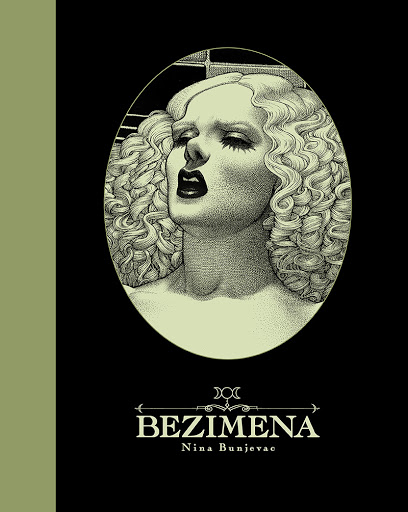
Bunjevac, Nina. Bezimena. Fantagraphics, 2019.


Before I get to specifics, readers should be warned that this graphic novel includes explicit sexual imagery and disturbing themes: it focuses on issues of sexual violence and consent. It tells the story of a young man who follows a woman home after finding her lost sketch book. When he discovers that the sketchbook includes graphic depictions of him engaging in sex with her and with others, he enacts the scenarios. By the end of the book, we are told that, in fact, the sketchbook belonged to a young girl who was sexually assaulted and murdered, along with two other girls, apparently by our protagonist. Readers who find this subject matter distressing should beware, and anyone should think carefully about whether this is an appropriate book for classroom use.

Bezimena, Nina Bunjevac’s third graphic novel, is an extended surreal narrative in which the line between reality and fantasy is not so much blurred as obliterated. Bunjevac identifies the myth of Artemis and Sipriotes, the gender-bending tale of Sipriotes being punished for an attempted rape by being transformed into a woman, as an inspiration. The book also echoes the myth of Diana and Actaeon, the voyeur transformed into a stag and torn apart by his own hunting dogs after seeing the naked Diana bathing in a pool. The fable of the king who puts his face into a bowl of water, finds himself in another world and another body, living another life until he removes his face from the water and is restored to himself, is also a clear inspiration. Fairy tales, especially ones such as Little Red Riding Hood, also inform the action. The work is dense, complex, and allusive—as well as elusive—requiring readers to try to make sense of the story themselves, rather than spelling it out.

The work’s obliqueness is evident from the beginning, in the frame device of two disembodied voices—the only voices to speak in the entire text—whose dialogue consists of the story we read as told by one to the other. The voices manifest as word balloons on black pages, one speaking from “below” the page (the tale-teller) and “above” the page (the auditor). We know almost nothing about who they are or what their relative locations mean. The tale teller recounts the story of a priestess who indulges in the habit of “perpetual and needless suffering” until Bezimena thrusts her face into the pool (or perhaps river—again, readers are left to judge, and how one interprets the moment may vary depending on what sort of body of water one assumes this is) by which she has prostrated herself. This act causes her spirit to separate from her body and to be reborn into a male infant in an entirely different environment, an uncannily detailed yet unidentified European city in what appears to be the early twentieth century. The boy, Benny, is an obsessive voyeur and masturbator whose childish fixation with fellow classmate “White Becky” re-emerges when, as a young man working at the zoo, he sees a woman he is sure is “White Becky.” The similarity of the names Benny and Becky, and the overt symbolic implications of the epithet “White,” are among the many ambiguities of this text that invite readerly. It is her notebook that “Becky” perhaps loses (or perhaps deliberately abandons) that serves as the catalyst for the tale. Impossibly, the sketchbook depicts events before they have happened—sexual fantasies involving voyeurism, bondage and arguably non-consensual sex—that Benny feels compelled to act out exactly as they are illustrated.

Here, perhaps, is the book’s most overtly metafictional and fantastical conceit. Bunjevac’s art is meticulously detailed, using heavy stippling to create an almost photographic effect. Most of the pages feature single images, and all the pages with pictures are devoid of words: the narrative voice occupies the verso pages, otherwise black, while the accompanying pictures appear on the recto pages, though there are occasional wordless, two-page spreads. The illustrations also frequently frame or enclose the figures, foregrounding our recognition that they are pictures, even as they depict events. Though the pictures depict actions, they are also frequently designed to appear staged and static—as drawings, rather than as depictions of life. The line between the sketchbook Benny finds and the story we are reading largely vanishes as we read.

Even the blurred reality thereby created is further compromised with the narrative twist that occurs when Benny is arrested on suspicion of murder, and the sketchbook suddenly transforms into one filled with a child’s drawings, not with the explicit sexual images Benny has seen and used to enact his fantasies. All evidence to support Benny’s version of events disappears, in effect, and readers are left to determine whether he has fantasized the whole thing, rationalizing his murders with his elaborate scenario, or whether he has been victimized by some inexplicable force. The frame narrative of the priestess apparently being punished for her self-inflicted needless suffering, the unidentifiable disembodied voices sharing the tale, and the various myth and folk echoes certainly invite readerly speculation.

Indeed, the most intriguing thing about this book, perhaps, is its interpretive openness—though that is arguably also its most disturbing characteristic. In an afterword, Bunjevac offers a personal account of two sexual assaults she suffered, inviting readers to contextualize what they have read in light of real-world sex crimes. However, the book is far from a dogmatic or polemical critique of rape culture, Instead, it raises troubling questions about desire and gender. What one is to make of the fact that the putative rapist/murderer is represented as being the spirit of a female in a male body remains open. How one is to read White Betty—a virginal victim, a temptress who takes pleasure in the transgressive sex imaged in her sketchbook, a femme fatal who leads Benny to his doom—remains open. How we are to read Benny—victim of primal urges he cannot control, monster, victim of external manipulation and scapegoat for crimes he has not really committed (facing certain conviction for his crimes, Benny hangs himself and finds himself back in the priestess’s body)—remains open. The book is simultaneously intriguing and disturbing. It is an exceptional achievement, refusing to offer pat or even palatable answers to the questions it raises. It could engender fruitful discussions about several different discussions, but students would need to be warned in advance about what they were being asked to read.

Review of Bacurau


Review of Bacurau

Joe Brace

Bacurau. Dir. Juliano Dornelles, Kleber Mendonça Filho, 2019.


Set “a few years from now” in the sertão or caatinga, an arid region in Brazil’s northeast of xeric shrubland and thorn forests, Bacurau is a lush, hyperreal sci-fi Western about a community under siege. In the eponymous village of the title, named after the nightjar, a community has drawn together to mourn the loss of its matriarch and wise woman Carmelita. Some, like granddaughter Teresa, have travelled a long way to be there. Her journey through the surrounding outback demonstrates the extent to which her home has been isolated, the dirt roads lead past rusted police cars and collapsed school buildings. In Bacurau itself however the inhabitants are thriving, a well-attended school and bustling market defy the attempts of the state to strangle the settlement by cutting off its water supply. The arrival of a vote-hunting local politician, Tony Jr, demonstrates the immutable contempt of the inhabitants for their would-be leaders. Forewarned of the encroaching caravan of political lackeys and bodyguards, the inhabitants go to ground, hiding anything worth stealing and transforming their vibrant town-centre into a ghost town. Worse is to come however when a group of heavily armed Americans arrive and begin picking off the villagers. To face this existential threat, they are forced to turn to Lunga, a heavily made-up, androgyne bandit and his gang of outcasts to help defend their home.

In setting up the conflict between this homogenous, white, heterosexual kill-team of Americans and the racially, sexually and gender diverse inhabitants of Bacurau the film evokes the battle-lines drawn up in Jair Bolsonaro’s Brazil, which has seen the wealth and privilege of the coastal cities explicitly pitted against minorities and the interior of the country. The assassinations, which are performed with the state’s collusion (the Americans’ local fixers turn out to be Assistant Federal Judges) immediately recall the 2018 murder of gay, black politician Marielle Franco as well as the worst excesses of the military dictatorship. The “day after tomorrow” setting of the film suggests less a worsening of the social contract in Brazil and more of an uninterrupted continuation of the power relations that have existed since colonial times. Bacurau’s museum contains weapons and photographs from the time of the cangaceiros, autonomous bandits from the early 20th century who, for a time, defied the government and affected a violent and carnivalesque form of wealth distribution in the sertão. A photograph of the severed heads of cangaceiro folk heroes Lampião and Maria Bonita presages the revenge that their spiritual heir, Lunga, will take on the Americans in the museum itself. Afterwards, as the blood is mopped out the front door, the curator instructs the cleaning team to leave the bloodied handprints on the walls and they become part of the permanent display, the museum is an active site able to assimilate and process new history, recalling Michael Taussig’s ideal of a museum that “combine[s] a history of things with a history of people forced by slavery to find their way through these things,” in total contrast to the “dead and even hostile places, created for a bored bourgeoisie.”

The appearance of a flying saucer, the casual dream-like way the villagers come together in sexual congress and the wild alien landscape of the caatinga might, in another film, suggest the exoticizing lens of a “magical realism,” an absurdist “New World” fantasy-land where anything is possible and where, to quote Robert Kolker, the viewer is “assur[ed] that meaning need not upset assumptions or endanger tranquillity.” This illusion is thrust aside by the film’s desire to communicate the practicalities of how Bacurau survives, how it gets its water and the dismissal of the UFO by the gardener Damiano as a drone in disguise. In fact, the inhabitants are hyper alert to the reality of their situation. The Americans by contrast, are disturbed by the bloodstained clothes of villagers they have already killed hung prominently on a washing line, they shake their heads at this vulgar allusion to the violence that has gone before and brand them “savages.”

The Americans have in fact misunderstood the situation, perceiving the withering away of the state from the village as a situation passively accepted by the villagers rather than one they actively connive in. Like the Malagasy “almost rebellion” described by David Graeber in Lost People, the community has simply become self-sufficient and ignores all but the most invasive attempts from the state to make contact. The Americans are so complacent about the ease with which they will extirpate their “prey” that they have devised a point-system just to keep the killing interesting. On the other hand, the villagers, though distraught, are quickly able to assimilate events into their understanding of the world. The mass taking of psychotropic seeds (presumably morning glory) before the final showdown, allows them to circumvent the externally imposed “logic” of the state and the Americans and defy the presupposed outcome of the encounter. When the cringing Tony Jr. is captured, he tries to appeal to reason, telling them that now they have “got themselves into deep trouble.” “We have taken a powerful psychotropic drug,” replies the schoolteacher, “and you are going to die.”

The violence in the film, sanguinary but never sadistic, links the narrative both to the mass state reprisals of the 19th century in Brazil (including the punitive expeditions against escaped slave settlements, or mocambos, and the utter destruction of egalitarian, separatist communities like Canudos) and to the contemporary cohesion of state and organised criminal violence, described by Sayak Valencia in Gore Capitalism as “necroempowerment.” The film offers a cathartic imaginary counterpoint to this violence in the form of the bawdy, horizontalist and autonomous community in Bacurau. Other than this it offers no direct political message, where one might expect an evocative textual postscript describing the current situation in Brazil the merely notes that, “this production created 800 jobs.”

By deliberately unrooting the story temporally (whenever the film is watched, it will always be set “a few years from now”) the film speaks to a continuing set of conditions in Brazil rather than simply projecting a critique of today’s politics into tomorrow’s world. This detemporality allows the film to offer a vision of radical resistance that is not tied to a specific set of conditions. Bacurau is not about Bolsonaro’s Brazil, or it is but only as much as it is about Lampião’s Brazil, the Brazil of the runaway slaves, or the Brazil of the coming water crisis. Setting a piece of science fiction in a specific future is the surest way to defang its message and turn it into a wry milestone for nostalgic audiences. Bacurau, by contrast, is forever possible, forever just around the corner.


WORKS CITED

Taussig, Michael. My Cocaine Museum. U of Chicago P, 2004.

Kolker, Robert. A Cinema of Loneliness. Oxford UP, 2011.

Graeber, David. Lost People: Magic and the Legacy of Slavery in Madagascar. Indiana UP, 2007.

Valencia, Sayak. Gore Capitalism. The MIT Press, 2010.