Midnight Rambles: H. P. Lovecraft in Gotham


Review of Midnight Rambles: H. P. Lovecraft in Gotham

Martijn J. Loos

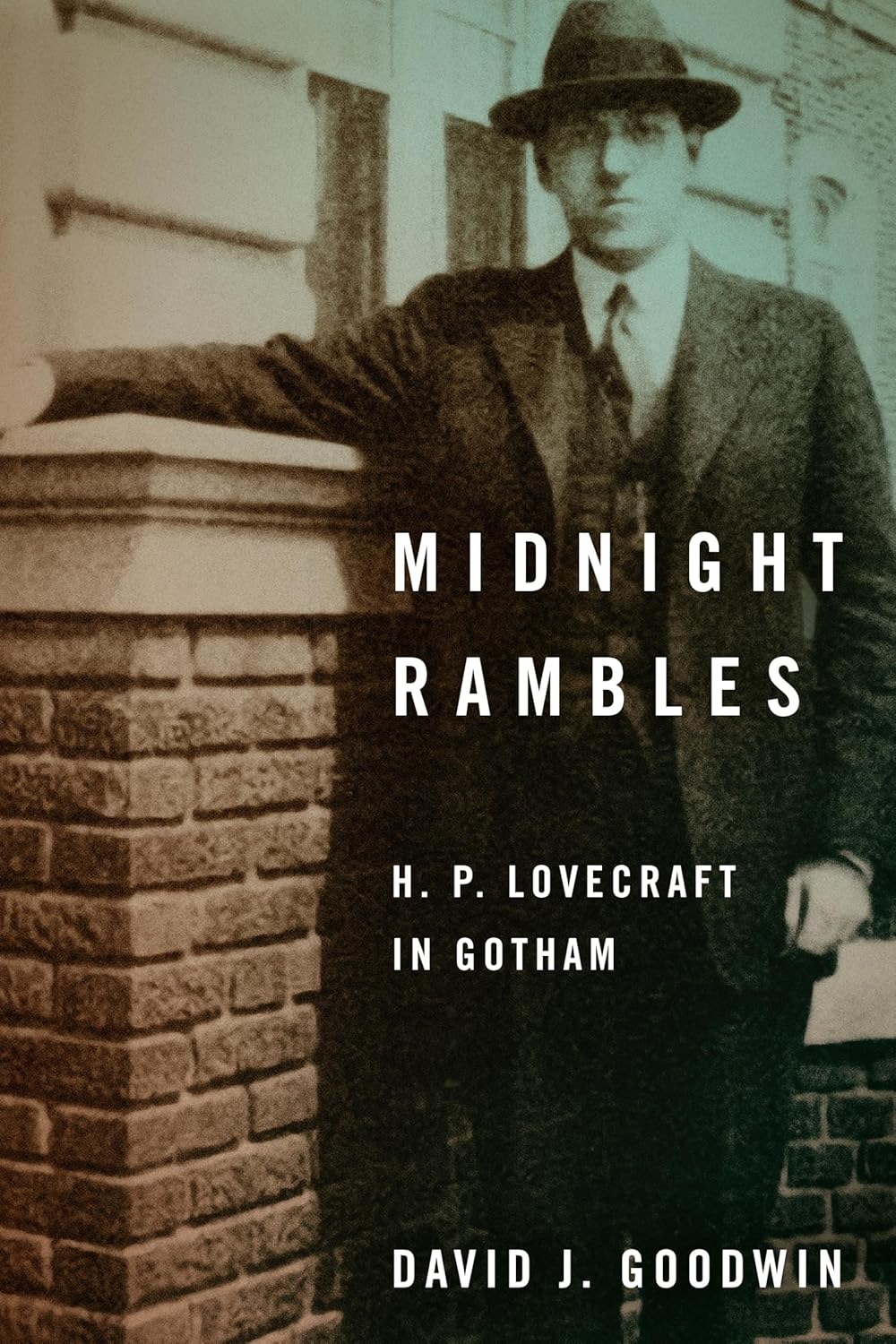
David J. Goodwin. Midnight Rambles: H. P. Lovecraft in Gotham. Fordham UP, 2024.Empire State Editions. Hardcover. 287 pg. $29.95. ISBN 9781531504410.
Version 1.0.0

Any account of Lovecraft’s life stands in the shadow of S. T. Joshi’s comprehensive biographical work—A Life in 1996 and I Am Providence in 2010—and will hence either need to be argumentative or opt to take a specific approach to add to Joshi’s work. David J. Goodwin chose the latter and wrote a micro-biography, a “thorough telling of his [Lovecraft’s] relationship with New York City” (15), starting in 1921 and ending in 1926. This approach is largely successful: the sharp delineation enables Goodwin to explore specific aspects of Lovecraft’s life in-depth; taking a short period of his life allows for a closer analysis of Lovecraft’s day-to-day activities than a biography of his entire life could achieve. As a result, Goodwin recreates entire days of Lovecraft’s life in New York, substantiating this with exhaustive research in the form of close readings of Lovecraft’s sent and received letters, complemented by historical research to reconstruct the city as it was in the 1920s.

Midnight Rambles primarily concerns Lovecraft’s changing view on the city; as a concomitant, Goodwin barely focuses on Lovecraft’s admittedly small literary output of the period. After moving to New York in 1924, Lovecraft quickly accrued a circle of intellectual and literary friends—the Kalem Club—with whom he would embark on the titular midnight rambles. Just after moving, Lovecraft was enthralled by the city. This captivation soured over the years, as his marriage to Sonia Greene cooled, he failed to accrue a stable income, he moved from Flatbush to the lower-class Brooklyn Heights, and, perhaps most significantly, he was exposed more regularly to the city’s immigrant population. He ultimately left the city and returned to his native Providence, dubbing the former “the pest zone” (179). Goodwin analyses this changing—and oftentimes ambivalent—relationship while tracking Lovecraft’s circle of friends, daily occupations, and opinions of the city as expressed in his letters and as extrapolated from his activities.

Goodwin advances the argument that Lovecraft, enamored of the city’s colonial heritage, “pictured himself sauntering through New York of the late eighteenth century—a city decidedly constructed on a human scale, still existing alongside the natural world, and notably devoid of an appreciable number of non-English-speaking immigrants,” a “lost New York City, one in which he believed he might have thrived” (84, 94). This serves to explain why Lovecraft’s rambles were mostly at night; it is easier to envision a bygone, sanitized New York when there are fewer people on the street (99-100). This argument deftly weaves together two significant aspects of Lovecraft’s personality and life: his antiquarian interests and indelible racist opinions. This ambivalence towards the city runs parallel to “the complexity inherent in Lovecraft’s choice of friends” (37), such as the Jewish Sonia Greene and Samuel Loveman, or the liberal James F. Morton. Goodwin’s psychologizing approach to Lovecraft’s relationships with the city and its inhabitants—supported by meticulous research—pays dividends in sketching a picture of a complex man, not only warm to his friends and relentless in his rambling, but also an unrepentant racist. This conundrum is central to Lovecraft studies, and Goodwin handles it deftly and thoroughly.

Further innovations to the field are novel analyses of aspects of Lovecraft’s personality. Goodwin convincingly shows that Lovecraft was well in the know about cultural trends (90) and contemporary popular culture (127), repudiating the often-promulgated image of Lovecraft as a man out of time. Despite Lovecraft’s own misgivings about the term, Goodwin dubs him a bohemian, as Lovecraft aspired to earning “a living as a writer and keeping company exclusively with intellectuals, booksellers, and authors” (156), a far cry from the image of Lovecraft as a conservative recluse (171). In a similar vein, Goodwin suggests that Lovecraft might not have been the sexually disinterested prude he is often imagined as, contradicting popular and scholarly opinion (74-74, 150). Here, again, Goodwin’s approach pays off: the micro-biography format allows him to closely scrutinize Lovecraft’s engagement with pop culture in the city and his marriage with Greene, substantiating his innovative claims about Lovecraft’s personality.

The focus on Lovecraft’s life places his fiction in the background. Goodwin briefly mentions the stories drafted or written during Lovecraft’s New York years—“The Horror at Red Hook” (137-141), “He” (143), “Cool Air” (158-161), and the beginnings of the famous “Call of Cthulhu” (146)—but sparsely reads them. Instead, Goodwin briefly touches on how the city influenced the writing of these stories, keeping with the subject of the book: the relationship between Lovecraft and New York.

A scholar of Lovecraft’s tales in isolation from his life will have little use for Midnight Rambles. Those who are interested in Lovecraft’s habits, marriage, changing views on New York, antiquarian interests, stubborn adherence to his racist views, personality, or the Kalem Club, will find this book of great interest. Those in the middle, searching for the connections between fiction and man, will recognize a work invested in the idea that New York intimately shaped Lovecraft’s literary vision, allowing him to mature into the critically acclaimed later phase of his writing after his return to Providence in 1926 (170-172). Goodwin convincingly argues this point, all the while decisively showing the value of the micro-biography format to the field and beyond.

Martijn J. Loos is a Dutch PhD candidate at New York University’s department of Comparative Literature. He works at the intersection of science fiction and philosophy, having published on, amongst others, H. P. Lovecraft, Octavia E. Butler, Ray Bradbury, and Ted Chiang. He enjoys Belgian beers and anything with laser guns.
Imperiled Whiteness


Review of Imperiled Whiteness

Lisa M. de Tora

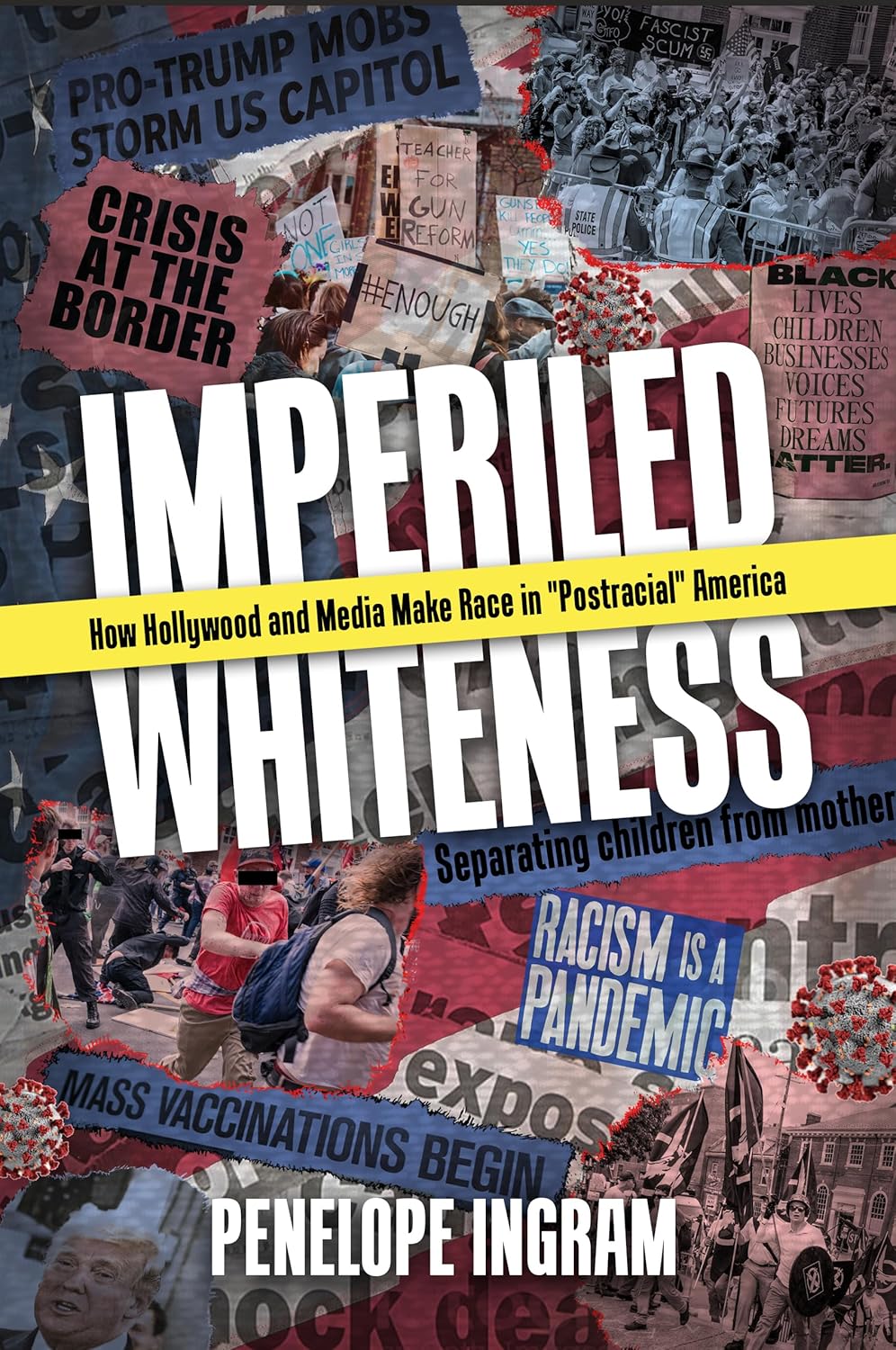
Penelope Ingram. Imperiled Whiteness: How Hollywood and Media Make Race in “Postracial” America. UP of Mississippi, 2023. Paperback. 392 pg. $30.00. ISBN:  9781496845504.

Version 1.0.0

Imperiled Whiteness examines how “seemingly progressive narratives” (23) in speculative fiction (SF) “consistently reproduced historically racist imagery” (23) and were “reinforced by concomitant political and social media narratives concerning race and race relations that stoke out-group hostility” (23).  To do this, author Penelope Ingram examines how connections between media events, fictions, and real life—what she terms “convergence culture” (24)—can make it impossible to discern the differences between reality and fictional representation. Integral to this convergence culture was a Covid-era proliferation of “zombie movies… where ‘good’ people must defend themselves against murderous, rapacious, undead ‘bad’ people” (4) within a broader media ecosystem, contributing to increasing real-life social and political polarization. 

Ingram’s methodology draws on various area studies, specifically cultural studies, media studies, postcolonial and race studies, philosophy, and film studies to elucidate the ongoing and longstanding success of white SF franchises. Ingram reads three extremely successful and profitable franchises, the Walking Dead, the Star Trek reboots, and Planet of the Apes, as produced during the Obama administration, through the increasing racial polarization of US politics. Ingram chose to analyze franchises, as opposed to individual works, to read across multiple texts, media, and the decades-long histories of Planet of the Apes and Star Trek. For contrast, she discusses well-recognized, profitable, and popular work by “Black SF creatives” (14) Jordan Peele and Ryan Coogler that forms a counterpoint to “Black life as it is represented in realist films” (27).  Of particular interest to Ingram is how convergence culture “turned whiteness into a commodity that was packaged and disseminated to a white populace” (9) by leveraging the idea of outside attack and ongoing peril faced by white people. Ironically, this peril can be depicted in the SF media ecosystem “precisely because it disseminates the notion that racism and indeed, race itself, are seemingly obsolete” (9). 

The book is divided into six parts: an introduction and conclusion that provide and wrap up the overall framework for analysis just summarized, three sections that consider the broad themes of contagion, animality, and monstrosity as they play out in three very popular and highly profitable white SF multimedia franchises, and a section that offers a contrasting perspective on the SF works of Peele and Coogler. The three sections on white SF each illustrate how a specific theme (contagion, monstrosity, or animality) functions metaphorically on a franchise level and in specific works to reinforce a sense that white people are imperiled by outside others. The work concludes with an alternative vision for rehumanizing racial others.

Ingram’s stated grounding in specific area studies—cultural studies, media studies, postcolonial and race studies, philosophy, and film studies—is generally solid. The film and media studies framework is especially strong. Ingram provides excellent readings of the Star Trek, Walking Dead, and Planet of the Apes franchises, related Hollywood and independent films, social media posting, and the role of commodity fetishism in ongoing discourses of race that reinforce the idea that white people are imperiled. Less clear is how work like Coogler’s Black Panther films function on a franchise level as a counterpoint to ‘white’ SF, given origins that, quite arguably, could be seen as at the very least seamlessly continuous with such productions. For instance, Coogler adapts a character first created by Stan Lee and Jack Kirby, who are not mentioned in this monograph.

For a work analyzing race in speculative fiction, some important contextual gaps bear mentioning. Most noticeable is a lack of work in speculative fiction and science fiction studies, even very foundational work by Donna Haraway, whose ‘cyborg manifesto’ set the stage for future readings of race, class, gender, and posthumanity (or the relationships between humans, animals, and machines) in cultural studies, media studies, and film studies. Posthuman readings could have benefitted Ingram’s thoughtful focus on the convergence of multiple media and their material effects on lived reality. John Rieder’s work on colonialism and science fiction would have been another helpful addition, as would techno-orientalism as figured by David Roh, Betsy Huang, and Greta Niu. These works analyze the role of race, otherness, and racialization in science fiction and fantasy. African futurism, which finds its focus outside the United States, would also provide some ballast and helpful context.  Another helpful grounding text—at least as a mention—might have been John Clute’s work on “fantastika” as a genre category. Another gap that seems odd, given the inclusion of both Walking Dead and Black Panther franchise elements, is an absence of work in comics studies. As it stands, Ingram reinvents approaches to SF studies, SF texts, and comics rather than engaging much valuable existing scholarship.

Overall, Imperiled Whiteness is an interesting and worthwhile read. As a teaching tool, it would most likely benefit faculty and students in media studies as its especial strength is in reading current events, social media, commodity culture, and speculative fictions as they converge within, impact, and create culture.  For scholars and students of SF, comics, or graphic narrative, this work has an important gap insofar as it does not meaningfully engage with the existing scholarship of these fields.  This is not to say that teachers or scholars should avoid the work, but that they will need to provide their own grounding in that scholarship to make much use of this text.

Lisa DeTora is Professor of Writing Studies and Rhetoric at Hofstra University in the United States. Her scholarship in health humanities, comics, and popular culture examines embodiment, quantum states, and posthumanity. Lisa’s paper on The Windup Girl and embodied identity appeared in Diasporic Italy in 2022.  Lisa co-organized panels on comics at SFRA (Dresden, 2023 with Umberto Rossi), and a seminar at Framing the Unreal a conference about intersections between science fiction and graphic narrative (Venice, 2024 with Alison Halsall).