SFRA Awards Presented at the 2024 “Transitions” Conference at The University of Tartu


SFRA Review, vol. 54 no. 4

From the SFRA Executive Committee


SFRA Awards Presented at the 2024 “Transitions” Conference at The University of Tartu

SFRA Awards Presented at the 2024 “Transitions” Conference at The University of Tartu

Student Paper Award
The Student Paper Award is presented to the outstanding scholarly essay read at the annual conference of the SFRA by a student.


The winner of the 2024 award is Vicky Brewster for their paper “Simulated Worlds and Digital Disruptions: Gothic Glitch in The Tenth Girl

Mary Kay Bray Award
The Mary Kay Bray Award is given for the best review to appear in the SFRA Review in a given year.

This year’s awardee is David Welch for his “Review of Hades” (SFRA Review 53.1)

SFRA Book Award
The SFRA Book Award is given to the author of the best first scholarly monograph in SF, in each calendar year.

This year’s winner is Mingwei Song, for Fear of Seeing: A Poetics of Chinese Science Fiction

Thomas D. Clareson Award
The Thomas D. Clareson Award for Distinguished Service is presented for outstanding service activities-promotion of SF teaching and study, editing, reviewing, editorial writing, publishing, organizing meetings, mentoring, and leadership in SF/fantasy organizations.

This year’s awardee is Jeffrey Andrew Weinstock.

SFRA Innovative Research Award
The SFRA Innovative Research Award (formerly the Pioneer Award) is given to the writer or writers of the best critical essay-length work of the year.

This year’s awardee is Rebekah Sheldon for her essay, “Generativity without reserve: Sterility apocalypses and the enclosure of life-itself,” published in Science Fiction Film and Television 16.3 (2023).

SFRA Award for Lifetime Contributions to SF Scholarship
Originally the Pilgrim Award, the SFRA Award for Lifetime Contributions to SF Scholarship was created in 1970 by the SFRA to honor lifetime contributions to SF and fantasy scholarship. The award was first named for J. O. Bailey’s pioneering book, Pilgrims through Space and Time and altered in 2019. This year’s awardee is Lisa Yaszek.


AWARD COMMITTEE STATEMENTS

Student Paper Award, outgoing chair: Kania Greer

Out of this year’s strong field, the committee has selected Vicky Brewster’s “Simulated Worlds and Digital Disruptions: Gothic Glitch in The Tenth Girl” as the winner.  The paper offered a sophisticated argument for the incorporation of technology into gothic horror.  We were particularly excited about their focus on multiple disciplines including media studies and game studies within the horror genre. The paper brings the classic gothic horror genre together with a modern twist of “a malfunction of digital equipment” leaving the reader with “a sense of unease”. Brewster’s paper firmly plants the glitch into the Gothic. The committee would like to congratulate Brewster on this inspired piece and look forward to seeing more of their scholarship in the future.

Mary Kay Bray Award, outgoing chair: Zeeshan Siddique

With meticulous detail and a discerning critical acumen, David Welch’s review of Hades makes this classics-based video game from Supergiant Games a must-play for audiences. His review captures the game’s various ludo narratological qualities: game design, replayability, and mythological overtones, particularly as embedded within its art direction, music, vocal performances, and writing. Welch’s appreciation for literary and digital craftsmanship alike makes this review especially striking. Moreover, his analysis tackles the popularity of Hades as it relates to classical reception studies and the game’s use of Greek myth. David Welch is worthy of the 2023 Mary Kay Bray Award for such a productive and insightful analysis

Book Award, chair: Chris Pak

This year, we saw an increase from the last in the number of titles that we received, which I take to be an indication that the post-Covid publishing recovery is well on its way. This year’s candidates included a good number of monographs that address sf from around the world. Alongside titles on print sf, film and TV, I was pleased to see a good number of studies focussed on gaming and comics. Utopian scholarship was well-represented, as were studies about climate sf. It was challenging to narrow down on a winner, and I’d just like to thank our two committee members, Sean Guynes and Karen Hellekson, for the impressive work that they committed to throughout the year.

But settle on a winner we did. The committee selected one monograph that represented a major and worthwhile contribution to the field. This work impressed us with its theorisation of an emergent poetics of sf, its timeliness, and its ability to communicate the excitement that comes with expanding our awareness about something utterly important to the future of the field. As one committee member commented, ‘at a time when Chinese science fiction is ascendent in the global sf marketplace, this comes as a welcome study for understanding the political, social, and literary nature of the twenty-first century’s “new wave” of Chinese sf.’

A quote from the book’s prologue imagines Chinese sf as a ‘mysterious weapon’ that’s excavated by an awed future generation: it reads, ‘SF itself, like what it depicts, is the wonder invisible now and here, staying outside the continuum of the perceivable reality’ (8). This year’s SFRA Book Award winner is Mingwei Song, for his monograph Fear of Seeing: A Poetics of Chinese Science Fiction.

Thomas D. Clareson Award for Distinguished Service, outgoing chair: Jonathan P. Lewis

This year the committee recognizes Jeffrey Weinstock of Central Michigan University for his work on the gothic, horror, weird fiction, and particularly conceptions of the monstrous in American culture.

Weinstock received his Ph.D. from George Washington University and joined Central Michigan in 2001; he has since served as horror editor at The Los Angeles Review of Books and has authored and edited more than twenty-five books on the monstrous including works on ghosts and vampires, chief among them Spectral America: Phantoms and the American Imagination (2004), Scare Tactics: Supernatural Fiction by American Women (2008), and The Vampire Film: Undead Cinema (2012) which won the 2013 International Association of the Fantastic in the Arts Lord Ruthven Assembly Award for Best Nonfiction Title.

Additionally, Dr. Weinstock’s interest in pedagogy includes editing such publications as The Pedagogical Wallpaper: Teaching Charlotte Perkins Gilman‘s “The Yellow Wall-paper” (2003), The Monster Theory Reader, The Mad Scientist’s Guide to Composition (both 2020) and co-editing with Anthony Magistrale Approaches to Teaching Poe’s Prose and Poetry (2009). Notable publications include work on the films of Tim Burton and M. Night Shyamalan, gothic music traditions, and Critical Approaches to Welcome to Night Vale: Podcasting Between Weather and the Void (2018). His interests and publications are often focused on how the monstrous, weird, and otherwise “different” inform our senses of what can and cannot transgress conceptions of what is “normal” and “American” building on the work of such theorists as Edward Said, Jacques Derrida, and Jacques Lacan among others.

One of Jeffries colleagues writes that although Jeffrey has long been involved with the IAFA (especially when he worked as reviews editor for JFA), my closest association with him has been since he stepped in as the associate editor for all things related to horror and the gothic for the speculative fiction team of the Los Angeles Review of Books. Since he joined our team, he has tirelessly worked to curate reviews from brilliant scholars writing about a richly diverse array of horror novels with special attention to authors from underrepresented communities. He’s thoughtful, professional, and a joy to work with — and he’s a truly excellent editor! 

Thinking back further, it was also truly special when he helped us bring Jeffrey Jerome Cohen to ICFA as a guest of honor. Cohen and Weinstock are monster scholars of the highest caliber

While another writes, that given the volume of work published under this name, it would be entirely understandable if Jeffrey Andrew Weinstock was, in fact, a pen name for a small but fiercely productive cabal of talented academics. Alas, Jeffrey is one person and the breadth of his knowledge combined with an enviable ease with which he communicates his ideas are absolutely stunning. From vampires and Lovecraft to cult films and Goth music to podcasts and Twin Peaks, he has written it all in the ways which are both illuminating and highly original. There are really few other scholars who have contributed more to the scholarship on the fantastic across genres and media. And he shows no signs of slowing down. 

The Clareson Award Committee takes great pleasure in presenting this award to the 2024 winner, Jeffery Weinstock.

Innovative Research Award, chair: John Rieder

First of all, I want to thank my fellow committee members, Hugh O’Connell and Sumeyra Buran, for their hard work reading, evaluating, and judging the many excellent essays nominated for this award. And I want to thank everyone who nominated an essay for their participation in the process. Without that participation this award could not happen. Also I want to emphasize the high quality of the essays overall, and acknowledge the work of the editors of some of the remarkable collections that contained the nominated work. During our discussion, we wished we had a separate prize for them.

We all agreed, however, that one essay stood out from all the rest as deserving this yearʻs Innovative Research Award, Rebekah Sheldon’s “Generativity Without Reserve: Sterility Apocalypses and the Enclosure of Life-itself.”

“Generativity Without Reserve” explores the fantasy behind depictions of sterility in science fiction film and television, focusing on Blade Runner 2049, Orphan Black, and Children of Men. It positions climate change and the extractive logic of racial biocapitalism within an emergent biopolitics of reproduction that seeks to enclose the living labor of the body, not just at the level of the cell or tissue but at the source of generativity itself, figured in these texts as sexual reproduction.

For an essay that is conceptually dense and steeped in complex theory, “Generativity Without Reserve” is not only admirably clear, but truly engaging to read. It is marked by a conversational tone that takes the reader through a series of intellectually deepening twists and turns. Sheldon starts by posing a series of questions about an important speech in the central text, Blade Runner 2049, makes clear why the speech elicits those questions and why the questions matter, and works her way to an answer by a series of readings in which a wealth of theoretical insight is allowed to emerge. These readings combine the economics of biopolitical production, the history of chattel slavery, the figure of miraculous birth, and the genre of the sterility apocalypse, all of which are put to work unravelling the implications of the matrix of religious, agricultural, and colonial tropes in that key speech in Blade Runner 2049. Sheldon’s readings elucidate the way the sterility apocalypse repetitively offers a fantastic solution—which she names the enclosure of reproduction—to the impossible problem posed by capitalism’s reliance on natural increase. The myriad twists and turns—we could even say, the plot twists—of Sheldon’s readings are therefore excellent examples of working one’s way through the hermeneutic circle, shuttling between an understanding of a whole text, or in this case, a whole genre, by analysis of its parts, and the dependency of an understanding of the parts on grasping the significance of the whole.

Sheldon’s essay keeps reaching beyond, resisting each theoretical or narrative closure that it seemingly arrives at. Rather than culminations, such endings are really generative conditions of new problems, as the essay itself suggests. In this sense, what begins as an approach to a common contemporary sf narrative – the sterility apocalypse –ultimately pushes the theory in new directions, revealing surprising connections between capitalist enclosures, sterility, “miraculous” generativity, and the inexorable drive towards commodification. The result is the best kind of cultural criticism, in which the theory and the texts simultaneously transform each other, pushing us toward what Fredric Jameson calls a new problematic, “not a set of propositions about reality, but a set of categories in terms of which reality is analyzed and interrogated.” Rather than an essay to simply be read and digested for its point, it is an essay to think with and through, one that is innovative – and generative – for sf studies, feminist science studies, and critical theory alike.

Lifetime Contributions to SF Scholarship, outgoing chair: Veronica Hollinger

It is our pleasure and privilege to present the 2024 Award for Lifetime Contributions to Science Fiction Scholarship to Lisa Yaszek, Regents Professor of Science Fiction Studies in the School of Literature, Media, and Communication at Georgia Tech—and a past president of the SFRA. Dr. Yaszek’s research engages a flexible breadth of subject areas with rigorous critical depth and an acute capacity to make connections. Her recent work has contributed to the ongoing development of Afrofuturist theory and criticism; at the same time she has maintained the incisive focus on women, feminism, and gender of her earlier projects.

            Lisa has long been invested in the reclamation and celebration of early sf by women writers. In 2005 she won the SFRA Innovative Research Award for her essay “The Women History Doesn’t See: Recovering Midcentury Women’s SF as a Literature of Social Critique.” Her work since has ranged from the eye-opening analysis of her critical monograph, Galactic Suburbia: Recovering Women’s Science Fiction (2008), to her 2016 co-edited (with Patrick Sharp) volume of stories by early women writers, Sisters of Tomorrow: The First Women of Science Fiction, to her more recent work as editor of two volumes of sf stories by women published by the Library of America: The Future Is Female! 25 Classic Science Fiction Stories by Women, from Pulp Pioneers to Ursula K. Le Guin (2018) and The Future Is Female! Vol. 2: The 1970s: More Classic Science Fiction Stories by Women (2022). Galactic Suburbia encouraged us to revise our ideas about the kinds of sf women were writing before the feminist explosion of the 1970s. The Future is Female volumes present us with first-hand proof of the quality and diversity of women’s sf from the pulp era through the 1970s.

            Lisa is also co-editor—with Sonja Fritzsche, Keren Omry, and WG Pearson—of the impressively wide-ranging Routledge Companion to Gender and Science Fiction, which was published last year. Her own contributions to this project—apart from the non-stop work that such a project entails for all concerned—include both the historical introduction that opens the collection and the introduction to the section on theoretical approaches.

            Lisa has brought eight books and edited volumes into being, and she has published numerous journal articles and book chapters. Her recent collection Literary Afrofuturism in the Twenty-First Century, co-edited with Isiah Lavender III, is aimed at “imagining futures in full color” (to quote the great title of their introduction). Lisa’s shorter writings range across diverse topics and appear in top-tier journals, bleeding-edge platforms, and in sf reference resources both within and outside of the academic community.

            As we recognize Lisa today for her significant contributions to science fiction scholarship, we want to emphasize the dynamic reach of that scholarship into the future. Not surprisingly, Lisa has won awards for her pedagogy (as well as for her service to the profession). Her writing, teaching, and mentoring consistently engage pedagogy, often explicitly. Her inquiries and breakthroughs come bundled with resources for larger collective projects and objectives. Please join us in applauding Dr. Lisa Yaszek for her innovative and influential contributions to the crucial multi-discipline of science fiction.

Awardee Statements:

SFRA Book Award: Mingwei Song

I feel honored and humbled by this award. I am most grateful to the selection committee for choosing my book from so many excellent volumes of scholarly work in the field of science fiction studies. I consider this award not only an acknowledge of my own research, but a recognition of the emerging subfield in Chinese science fiction studies, which has been created by not just me, but all of us, including many colleagues who have made a collective effort to study, promote, and theorize what is new in the genre’s current revival in China and the larger Chinese-speaking world. I feel grateful to the association for recognizing Chinese science fiction’s importance in the field.

Fear of Seeing is a book that I spent more than a decade to write. I was fortunate enough to witness the new wave Chinese SF’s breakthrough in 2010, and my book traces the origin and development of the genre in the context of China’s long twentieth century all the way to its sudden rise in the second decade of the twenty-first century. In this book, I do not only study the thematic and political components of the genre, but try my best to theorize the unique aesthetics created by authors such as Liu Cixin, Han Song and others. I summarize this aesthetics as the poetics of the invisible, which is profoundly relevant to China’s political and cultural context, because the genre makes it possible for some writers to catch the deeper truth that is hided or forbidden by the fabric of a reality produced by mass media and propaganda machine. I admire the courageous pioneers of the new wave who dare to look into the abysmal darkness that is otherwise unspeakable in literature fiction that more or less follows the rules of mimesis. Science fiction, on the other hand, is literarily metafictional by its design of world-building as well as philosophically subversive with its other-worldly speculation. From here, I aspire to take Chinese science fiction as a method to engage the lofty ideas associated with modernity, dismantling dualist thinking and creating thought-provoking holes and folds in the otherwise smooth surface of the fabricated “reality.” In a word, it inspires people to think beyond what is allowed and ready-made. In China, it is a method for resisting the limitations of walls, metaphorically and ideologically.

At the same time, I also try not to read Chinese science fiction only from the political perspective. Liu Cixin and Han Song both illuminate aspects of China’s hideous politics. But I do see in these writers a poetic heart, which, in Liu Cixin’s case, counterbalances the dark forest mind-set that resonates with contemporary political thinking among some Chinese intellectuals, and in Han Song’s case, inspires a wishful transcendence over the endless repetitions of catastrophic events that have happened again and again, like karmic retribution imposed to the entire nation. As Liu Cixin says in his postscript to the English version of The Three-Body Problem, he writes about the worst possible universe, but he also keeps alive the best possible hope for a better world. In current political situation, that hope is not easy to interpret, but I do not think it’s only serving a political interest, but more related to an immensely unsettling imagination that shatters the ground of everything that we are taught to take for granted.

I spent long enough time to write this book, so I finished it during the recent pandemic. By that time, I was able to recognize a newer generation of Chinese and Sinophone science fiction writers, who have, in my mind, made a second breakthrough for the genre by finding a new path toward a nonbinary universe. For these writers, mostly female, the world that was built by theories and systems, such as Cartesian dualism and the Hegelian dialectics, which defined human race’s modern experience, has neared its collapse. For these new authors, mostly still in their twenties and thirties, they are looking beyond the horizon of the monstrous history of the twentieth century. They are imagining new wonders of a nonbinary world that is based on undifferentiated difference. I feel particularly lucky that I could conclude my book at a moment when this new hope emerges, a hope that Liu Cixin and Han Song’s generations were mostly alien to, but so natural for the younger people who lived upon and recognized the ruins of modernity, the failure of ideological wars, and the disasters human have made toward all living creatures on our planet. They are the first generation growing up with planetary consciousness, and to them, the world has unfolded again and showed its unbound newness, like it did to the travelers who first brought stories about strange lands and imaginary creatures back home, in ancient Egypt, Sinhdu, Greece and Rome, Arabia, Maya, Polynesian islands, and the East Asian world. This new generation, like their American, European, and African counterparts, are making history by imagining differently. I hope there will be more attention paid to this generation—those young women and nonbinary writers living in China, Taiwan, and the Chinese diaspora. Fear of Seeing has become a less dark book because of them.

Thank you.


Thomas D. Clareson Award for Distinguished Service: Jeffrey Andrew Weinstock

To the members of the SFRA: I’m deeply honored to receive this award and sorry that I cannot be with you in person to receive it and participate in the conference.

When Hugh O’Connell emailed me the news about the Clareson award, I was so stunned that I must have sat open-mouthed and teary-eyed for several minutes in front of the computer screen—because the news started me thinking:

As academics, we’re an unruly lot. With a nod toward Monty Python, I’m tempted to say that we’re all non-conformists here. But there is one other thing that we share aside from an independent streak: We are, all of us, on some level, masochists.

We apply for jobs, for fellowships, for postdocs, for grants, for tenure, for promotion, for various awards and recognitions. We submit conference proposals, book proposals, journal articles, and book manuscripts—and then wait, sometimes for many months, for a verdict and often anonymous feedback.

When I was in college, a group of friends had what they called their “wall of shame” where they posted rejection letters resulting from job and graduate school applications—and I think to myself today that I could wallpaper my house with the number of “Thank you but I’m sorry to report…” letters I’ve received over the years.

But that’s not all. Not only are we forced to contend with the dreaded “reviewer #2,” but we must navigate diminishing institutional resources and declining public support for the humanities at the same time, constantly defending the value of what we do and fighting for every cent. Not to mention “student opinion surveys” completed by students we don’t recognize because they haven’t attended all semester and online yelp-like evaluation sites offering venues for anyone with an ax to grind to opine on our teaching.

And let’s not get started on all the uncompensated labor we are expected to perform!

University life certainly has its pleasures—we are in many ways lucky people in that we get to think about and engage deeply with subject matter we find stimulating and important; however, it is often solitary work and the forces aligned against us can seem formidable.

And this is why I was so incredibly moved to get Hugh’s email about this service award from the SFRA. To be recognized by one’s peers means to be part of a community of “like-minded non-conformists.” And it means that one’s efforts have been noticed and valued. I am glad to have had the chance to promote so many deserving books and to shepherd so much excellent scholarship into print—editorial work has been a significant part of my life for a long time. Your recognition here tonight is both humbling and immensely gratifying and takes center stage on my small but important “wall of praise.” Thank you!


Innovative Research Award: Rebekah Sheldon

Thank you, John, and thanks to the SFRA for this surprising but very welcome recognition. As a belated addendum to my first book, this essay was very much the product of conversations with the science fiction studies community – in the reception at the 2018 SFRA where I delivered it as one of the keynote talks, in sharing drafts with Sherryl Vint, David Wittenberg, David Higgins, and other dear friends, and in the helpful comments from the editorial board and reviewers at SFFTV. And here I want to thank Gerry Canavan in particular. I had more or less abandoned the essay as unpublishable after an unhelpful review from a non-SF journals until Gerry nudged me to maybe give it a chance where it belonged to begin with. 

Thinking about the way this essay developed and found its path to publication, I am struck by the generosity of our community, the thoughtfulness we show to each other, our ecumenical approach to modes of scholarship, and what I want to call our disdain for (or even constitutional insensitivity to) the kinds of prestige politics that could make something like an award feel different than it does here. In the past, I have been guilty of joking, only semi-humorously, about how we compensate for our history of marginalization by creating ever more conferences, societies, journals, anthologies, and readers. (Seriously, so many.) In some ways, of course, this is just us being enthusiasts, in line with the more encompassing history of SF fandom, the same delightful nerdery and sincere affection that makes a 19-hour trip seem worth it so that we can spend a couple days together. Recently, however, this tendency of ours has appeared differently to me. In light of the mounting obstructions put in the way of our work by the collusion of neoliberal administrators and extremist politicians in the US, I have begun to think of the service work we do as a species of worldbuilding: conferences generate a shared space; anthologies give us a past; journals, a future; awards, a collective memory. Academic infrastructure as communizing. And as things get harder in our professional situations, for those few of us who have professional situations in the university, I want to call on us all to think even more directly about how we might support each other so we can keep doing the work that supports the worlds that support the careful cultivation of our continued kinships. And not just reactively. I want to take seriously the monastic roots of university life and borrow from other models — from convents and communes to guilds and workmen’s halls – that might help us to imagine how to maintain these worlds, if not after the end of the university, then after our own time in it is over.


Lifetime Contributions to SF Scholarship: Lisa Yaszek

Thank you for the SFRA Award for Lifetime Contributions to SF Scholarship (henceforth the LCSFS Award); this really means a lot to me. Some of the people I admire most are past winners of this award. To be recognized alongside the authors and scholars who created science fiction studies is an incredible honor. Of course, I didn’t get here alone.

First, I want to specifically thank the previous LCSFS award winners who have made my work as a feminist science fiction scholar and editor possible. My parents were big fans of New Wave science fiction and our bookshelves were stuffed with the novels of LCSFS award winners Joanna Russ, Samuel Delany, and Ursula K. Le Guin—so much so that it was quite a surprise to me when I got older and realized that science fiction was not all written by women and people of color! These authors wrote stories big enough for my imagination and later, when I started reading their nonfiction, they gave me a vocabulary big enough to explain why I was drawn to such stories. Even so, I spent half a decade in graduate school wandering through the postmodern wilderness and only came back to science fiction when I read the work of LCSFS award winners Frederic Jameson and Donna Haraway, both of whom speak passionately and eloquently about science fiction artists as the premiere storytellers of technoscientific modernity. Later, as an aspiring historian and editor of women’s science fiction, I was inspired by LCSFS award winner Pamela Sargent’s Women of Wonder series, and as a young science fiction studies professor I was thrilled to develop a friendship with LCSFS award winner Marleen Barr, whose groundbreaking Future Females! anthologiesintroduced me to feminist science fiction studies. Marleen, once upon a time you told me that someday I’d be giving my own acceptance speech for what we used to call the Pilgrim Award; I was awed by your faith in me then and I’m still blown away right now by the fact that you were right.

Next, I want to recognize my wonderful colleagues at Georgia Tech! I accepted my postdoc in School of Literature, Media, and Communication at Tech in 1999 because I was excited to be part of a school had not one, but two science fiction scholars: feminist technoscience expert Ann Balsamo and early SFRA member Irving “Bud” Foote. At that point I was writing about science fiction, but largely from the perspective of postmodernism. It had never even occurred to me that science fiction studies was its own discipline and that you could do it full time!  When I got to Tech, I learned that Bud had retired and Ann had moved on to an IBM think tank, but I am eternally grateful that both generously took time away from their new life adventures to teach me the ways of the SF scholar, and in 2000 I delightedly accepted one of the tenure-line positions left open by their departure. Since then, I’ve been fortunate to work with LMC school chairs Ken Knoespel, Jay Telotte, Richard Utz, and Kelly Ritter, all of whom have been truly committed to fostering science fiction studies at Georgia Tech; with my dear friend Kathy Goonan, our first science fiction professor of the practice at Tech; and with my sisters of tomorrow Amanda Weiss, Ida Yoshinaga, and Susana Morris; together we are building an exciting interdisciplinary science fiction community at Tech and, if I dare say it, keeping the future fabulously female. The other great thing about doing science fiction research at Tech is that it really is a cross-campus labor of love; to that end I want to thank Georgia Tech librarians Mathew Frizzell, Catherine Manci, and Alison Reynolds for managing the speculative fiction resources and events that are essential to our work; IAC communications officer Mike Pearson for always being the first to spread the good word about our community; and all the brilliant students who have helped carry out research projects in the Sci Fi Lab while preparing to become the next generation of science fiction creators and scholars themselves; I am excited to have two of them, Max Mateer and Killian Vetter, with us today. Finally, want to shout out to my dear LMC colleagues Narin Hassan and Aaron Santesso who are also here with us today; they are not science fiction studies people themselves, but most excellent friends and sci-fi-curious allies.

The only place where I feel perhaps an even greater sense of community is in the SFRA itself. In short, you are the best colleagues ever! What other academic group embraces its artists, editors, scholars, and fans with equal passion? Where else can you hold serious debates about the post capitalist values of hope punk while learning risqué filk songs from legendary science fiction artists?  What other scholarly organization would have the audacity to co-host a major public event with a “kilt formal” dress code? Where else will you ever have the pleasure of drinking wine and debating science fiction theory in a public fountain at 5 am, even though you know you’ll only have an hour or two to sleep it off before you and all your pals are back in the front row of that 8:30 am panel you absolutely don’t want to miss? Where else can you co-host discussions between scholars and artists that result in award-winning publications for both? In my experience? Nowhere else. There is nothing quite like the SFRA. In fact, when I was pulling together my notes for this speech, I realized that every co-edited project I’ve ever worked on involves members of our community. So, let me express particular appreciation for Karen Hellekson, Craig Jacobson, Patrick Sharp, Sonja Fritzsche, Keren Omry, WG Pearson; Sherryl Vint; and of course, my brother from another mother, Isiah Lavender III. I’ve learned so much from all of you and I hope that shows in my own work.

Finally, I want to thank my husband and SFRA colleague Doug Davis. Doug and I started our personal and professional lives together in 2003, when we married and attended our first SFRA conference together in a span of two months. It’s particularly cool to win this award today, because it’s actually our 21st wedding anniversary. I can’t wait to see where the next 21 years takes the two of us—and where it takes the SFRA as a whole.

Thanks again to all of you.
From the Vice President


SFRA Review, vol. 54 no. 4

From the SFRA Executive Committee


From the Vice President

Ida Yoshinaga

Dear members, colleagues, and friends:

Dear science-fiction studies colleagues,

As a lifelong feminist and supporter of gender equality, I’m excited about 2025’s annual meeting, which Dr. Stefanie Dunning of The Susan B. Anthony Institute (The Program for Gender, Women’s and Sexuality Studies), and her team at the University of Rochester, are co-sponsoring from July 30-Aug. 3.

With the bold theme, “‘Trans People are (in) the Future’: Queer and Trans Futurity in Science Fiction,” Dr. Dunning and The Susan B. Anthony Institute’s conference organizing committee are tackling frightening national and global trends towards fascism, as well as celebrating queer, especially trans, contributions to speculative arts and narrative.

We are thrilled by their courage and political vision which parallels those of organizers of the GATE Global Trans Conference, Columbia U’s Trans Disruptions, Moving Trans History Forward, The Watson Conference, QT Con (A Queer and Trans Conference), and other gatherings which reveal the organizing power of this diverse community while facing unimaginable legislative and institutional violence.

You can still submit a proposal in time for the November 15 deadline (to SFRARochester@gmail.com)

As you know, this is the first SFRA in several years to be held stateside, and the Executive Committee is in conversation to not only cohost another meeting in the continental US for our 2026 gathering, but also to expand our global meetings to new regional venues beyond Europe (while keeping with our hybrid format so as to remain accessible to scholars, researchers, artists, librarians, students, and teachers in a range of economic situations). We will notify you of these arrangements once confirmed.

In the meanwhile, does your institution have the resources to host an annual SFRA conference or even a one-off event? What might that conference/event look like—we would again like to encourage members to think outside of the box in how the organization might evolve going forward to recruit and retain members and creating academic events. For example: If you feel that one of the main purposes of an academic-professional group is networking, then might we consider putting on regular events, semi-formally structured, to offer that opportunity?  [I am thinking of the Society for Media and Cinema Studies’ annual December online meetings held by its various Special Interest Groups and Caucuses.] This need has been expressed by junior faculty and early-career researchers in recent years.

Also, what does it mean that, with several European meetings in the past years, we are now more international than ever? How to build on these regional membership gains in our growing, collective knowledge of speculative/fantastic fiction—the conscientious, artful deployment of which feels so critical at this point in world history?  Let us know, as we expand the core Executive Committee and newer roles and responsibilities for its members.

Please don’t hesitate to contact SFRA President Hugh O’Connell, me, or any member of the EC with your ideas. I will remain your Veep through the end of 2025, after 3 years of service, but hope to help the organization long after.


From the President


SFRA Review, vol. 54 no. 4

From the SFRA Executive Committee


From the President

Hugh O’Connell

As we head into the late fall, this is just a reminder that the SFRA website goes into hibernation mode, and we shut down new memberships and membership renewals until January 1st. However, while the site goes into hibernation, much of the organization’s work kicks into high gear: committees will be starting up work to consider the best student presentation at the last conference; most innovative essay, best review in the SFRA Review, and best first sf-related monograph published in the last year; and lifetime awards for service to the field and to research for this year’s conference awards banquet. There’s also plenty of behind the scenes planning for the upcoming conference and talks with potential hosts for future conferences. So, while we may a little quiet in terms of communications with the membership, we are all working away on the things that keep us running!

Speaking of keeping us running, we also have elections coming up we have for the Vice President and Treasurer. You can see their statements in this issue or on the website. Voting will open on December 1st and close on December 30th (members in good standing will receive a reminder email when the voting officially opens). Finally in related news, I’m very excited to announce that we have a new Web Director: David Shipko. So we’re almost back up to full operational status!

Upcoming Events:

Looking ahead, the 2025 conference in Rochester, New York hosted organized by Stefanie Dunning and Hosted by the Susan B. Anthony Institute: The Program for Gender, Women’s and Sexuality Studies is shaping up to be a fantastic return to North America for the SFRA. It’s hard to believe that the last conference in North America was in 2019 (Hawai’i) and the last conference in the continental US was 2018 (Milwaukee). Stefanie is planning some pretty unique events for this conference, including a student sf film competition focused on the conference theme, a keynote by Ryka Aoki and another exciting keynote that we’ll hopefully be able to announce soon, a student sf short film contest, and a masquerade/costume/LARP ball for the penultimate night of the conference. So plan for a pretty unique conference as we return stateside for the first time in five years! On a similar note, the Executive Committee will soon start work on organizing the SFRA-sponsored early career and DEI panels; please feel free to contact us with any suggestions for things that you’d like to see in these panels. Looking even further ahead, we’re hoping to be in the US for 2026 as well (we’ve had productive conversations with 2026 hosts), and to return to a more stable three year cycle of two North American conferences followed by a non-North American conference.

Finally, if you have an event that you’d like to bring to rest of the SFRA membership’s attention through its email lists or social media sites, or you have other ideas or concerns about the work the organization is doing, please don’t hesitate to reach out to me at hugh.oconnell@umb.edu or our new(ish) Outreach Officer, Anastasia Klimchynskaya (anaklimchynskaya@gmail.com). We’d love to hear from you.


Fall 2024


Fall 2024

Ian Campbell

Living in the USA right now feels like the backstory to an SF novel, where in less than a week, some mad scientist is going to pull the quantum lever that sends different versions of each of us off into two different universes, one with a decent and hard-working government that at least attempts to do something to bring us closer to a equitable and inclusive future—though in fact it won’t likely be all that equitable—marked by technological innovation and at least an attempt to mitigate the great Jackpot of climate change, and another future that has concentration camps.


What I never would have thought in all my years reading SF as a child and young adult is that something close to half of Americans want to live in the future with concentration camps.


Many people fear modernity, whether because they’re used to privilege so equality feels like oppression, or whether they’re constitutionally anxious and have a hard time dealing with change. Many people look at the increasingly clear signs of climate change and become reactionaries not out of hatred but out of wishful thinking: maybe they could pull their own quantum lever and go back in time to where it wasn’t quite so hot and loud and fast. In America at least, power has been maintained by the gentry since colonial times by telling downscale white people that no matter how much of their money gets funneled to the gentry, they’ll still have people who don’t count as human to kick down on.


Just imagine the SF novel written about this: some ambiguously hot Special Circumstances agent and her wisecracking drone companion standing there agog, when a white man who misses the days of segregated lunch counters explains that they don’t mind poverty and abjection so long as they get to be gleeful about others’ having it worse.


We don’t have that in this issue of the Review, but we do have a really interesting look at feminized robots and our usual spread of nonfiction, fiction and media reviews. Enjoy them all, while I and half of my compatriots sit around wringing our hands waiting to find out which way that quantum lever sends us. I’m really hoping it’s the future where I don’t get more fake special privilege for being a white guy. Write me at icampbell@gsu.edu.


Comics and/or Graphic Novels


Review of Comics and/or Graphic Novels

Dominick Grace

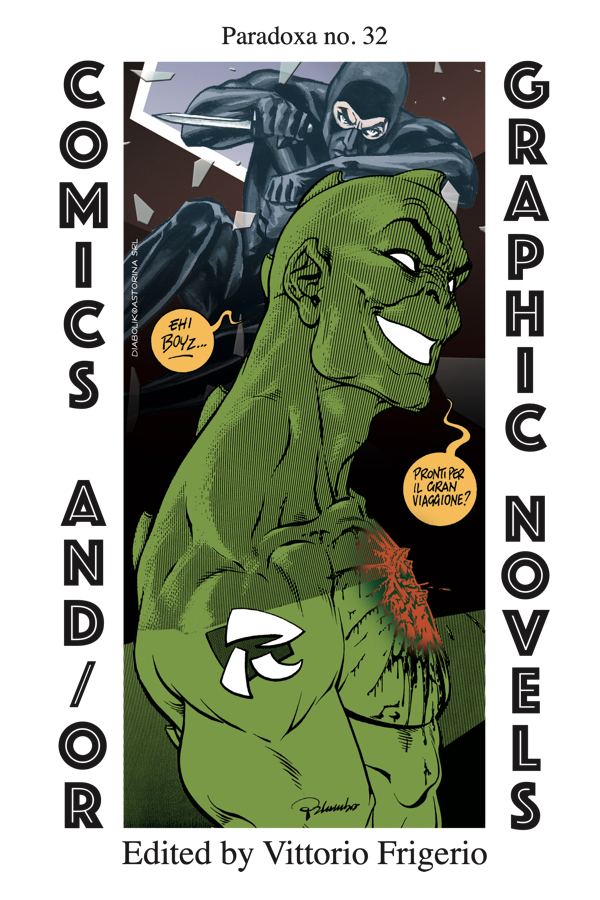
Vittorio Frigerio, ed. Comics and/or Graphic Novels. Paradoxa 32. Paradoxa, 2021. Paperback. 338 pg. $48.00. 9781929512447.

Version 1.0.0

Paradoxa number 32 focuseson Comics and/or Graphic Novels as the issue title announces. Editor Vittorio Frigerio brings together an eclectic collection of essays with an international focus. Indeed a key strength of this collection is that it continues the encouraging trend of bringing scholarly attention to regions and traditions that have hitherto been largely ignored (most notably here in Zak Waipara’s consideration of Indigenous comics from New Zealand). The pieces are consistently interesting and often provide valuable connection across national lines. For instance, Carlo Gubitosa considers comics journalism in American, Italian and French contexts, and Justin Wadlow provides insight into the unlikely connections between American artist Craig Thompson and French artist Edmund Baudoin. Spanish-language comics, however, receive special attention, in often enlightening ways. For instance, I was completely unaware that R. F. Outcault’s Buster Brown had been appropriated/pastiched as the basis of a Brazilian strip, Aventuras de Chiquinho. Marcia Esteves Agostinho discusses this strip, probably not widely-known outside of Brazil, in terms of its depiction of racial relations in Brazil.

Like this one, the articles here are consistently fascinating. However, they are for the most part of little interest to scholars of literature of the fantastic. Only one article, Felipe Gómez ‘s “Will it be possible? Apocalypse and Resistance in Latin American Graphic Novels,” focuses on a science fictional topic. Frigerio also interviews Guiseppe Palumbo, who has worked on genre strips such as Diabolik.  In addition, he reviews Gébés’ post-apocalyptic Letter to Survivors. There is, therefore, some content that pertains to the interests of SFRA Review subscribers, but not enough, I think, to justify purchase of this whole collection. The Paradoxa website does allow purchase of individual chapters for $10.00 (https://paradoxa.com/no-32-comics/), so those interested might economically check out the relevant material. Comics scholars, however, will very likely find this a worthwhile book to possess.

Dominick Grace is the Nonfiction Reviews Editor for SFRA Review.

Transparent Minds in Science Fiction: An Introduction to Accounts of Alien, AI and Post-Human Consciousness


Review of Transparent Minds in Science Fiction: An Introduction to Accounts of Alien, AI and Post-Human Consciousness

Ane B. Ruiz-Lejarcegui

Paul Matthews. Transparent Minds in Science Fiction: An Introduction to Accounts of Alien, AI and Post-Human Consciousness. Open Book, 2023. Paperback. 144 pg. $23.95. ISBN 9781805110460.

Version 1.0.0

Paul Matthews’ Transparent Minds in Science Fiction, as its title aptly suggests,delves into nonhuman consciousness representation in science fiction (sf), addressing its potential to explore what cognitive science shows us about consciousness through models of cognition particular to subjectivities which vastly differ from that of humans.

In a clear nod to Dorrit Cohn’s narratological work on fictional consciousness representation, Transparent Minds (1978), Matthews cleverly engages with previous literature pertaining to the area of research known as cognitive literary studies. While there are discrepancies regarding the official name for the field, as there is no unification among scholars, cognitive literary studies seems to be the broadest term which encompasses the research done by Matthews and the authors he mentions, i.e., that of the integration of cognitive science with literary disciplines, Matthews also engages other fields of expertise such as neuroscience and cognitive science,. to illustrate a fully-fledged and interdisciplinary image of what constitutes a consciousness, both in our empirical reality and in its fictional counterpart. In doing so, this monograph attempts to fill a research gap in a field which has predominantly limited itself to analysing non-speculative literature of the Anglocentric and Eurocentric canon. Thus, Matthews takes on the task of compiling examples of depictions of nonhuman consciousness spanning more than a hundred years of sf literary production. From foundational texts by Shelley, Lem, and McCaffrey to the more recent and likewise acclaimed additions of Jemisin, Ishiguro, and Leckie, to name but a few, Matthews thoroughly illustrates how extremely unfamiliar modes of perceiving and experiencing the world have been conceptualised.

From the beginning, Matthews endeavours to defend the potential of literature as a whole, and sf in particular, as a tool to engage in a rich imaginative exercise: firstly, as a means through which to conceive scientifically accurate and innovative cognitive models which subvert preestablished anthropocentric sf tropes regarding the nonhuman; and, secondly, through the formation and interpretation of metaphorical networks and systems of meaning brought about by our own cognitive system when interacting with fiction. As a result, Matthews emphasises the collaborative nature of meaning-creation, claiming that it consists of “author intention, reader understanding and mediation through the norms of the genre” (105). Hence, while stressing the role of authorial intent, this monograph deeply resonates with Reception Theory principles, as stated by Iser’s phenomenological account, whereby a literary work is created through the reader’s participation of filling in “gaps” or “blanks” in the text (6).

Chapter 2 is devoted to authors’ motivations for choosing nonhuman characters as the focus of their fiction, as well as the specific symbology and narrative techniques used to guarantee an adequate text-reader interaction, i.e., to avoid alienating the reader, such as merging alienness with animal iconography. Here, Matthews seems to greatly value authors’ scientific knowledge in fields such as neuroscience and biology, as he deems the plausibility of the nonhuman to be vital to merge the familiar and unfamiliar, particularly in the cases of potential future sentience, such as human-made A.I. and extended or enhanced consciousness.

In chapter 3, Matthews thoroughly explains the process of consciousness emergence, that is, the starting point of sentience, as posited by several neuroscientific, biological, philosophical, and psychological approaches. In perhaps the most theoretical chapter of the monograph, Matthews conscientiously takes the reader through an exhaustive yet accessible explanation of the different hypotheses delineating the so-called ‘awakening’ of sentience, from the development of senses and perception of oneself as different from the rest, to the identification of a goal and, with it, the motivation to accomplish it and obtain agency.

He then moves on to provide literary examples of non-human sentience which depict (parts of) these processes, dividing the next three chapters according to specific consciousness features: the individual mind, including terrestrial and alien non-human sentience, human-made A.I. and the extended human; the collective hive and distributed minds; and, lastly, the posthuman. In these chapters, Matthews presents a wide array of case studies to illustrate how the umwelt of a consciousness is shaped by sensory, cognitive, and emotional-motivational aspects of the self’s embodiment, and how there is an interplay of familiar and unfamiliar narrative elements to balance the psychological distance between reader and character. Matthews also pays close attention to the power dynamics involved in self-definition when the consciousness is collective, seen mostly as unequal manipulation or, sometimes, as an egalitarian gestalt relationship.

In his explanation of posthuman consciousness, however, one finds a slight inconsistency, as the definition of extended humans and the enhanced posthumans, in chapters 4 and 6 respectively, seem to overlap, making their classification as separate contradictory. One of the greatest achievements of the text is arguably the non-anthropocentric undertone of the research which aligns itself with posthumanist sensibilities. This can be seen in Matthews’ understanding of both experience and the act of reading as embodied and embedded, his conception of the possible and valid nonhuman umwelt(s), and the absence of anthropocentric and imperialist interpretations of nonhumans mainly found before ‘new wave’ sf, in favour of what he, perhaps rather vaguely, names “fine examples” of other-than-human consciousness representation (11). Therefore, the definition of enhanced posthumans only as transcended consciousness seems at odds with Matthews’ knowledge of posthumanism, as it indicates an inclination towards the ‘posthuman’ definition endorsed by transhumanists, that of a further step in humanity’s evolutionary history. This is even implied by the title of chapter 6, “Supercedure,”—the act of replacing the old and inferior with the new and superior, in other words, embracing transcendence, whereas critical posthumanism holds that posthuman consciousness can exist without transcendence.

Although the monograph does, in earnest, accomplish its goal, providing an extensive account of non-human consciousness representation in sf, certain in-depth linguistic and literary analyses seem to be lacking, which would have added to its mostly descriptive and expository nature. Additionally, the phenomenological approaches mentioned before could have benefitted from Caracciolo’s concept of “consciousness-enactment,” which shares Matthews’ reader-response tenets but to a different, non-materialist degree, understanding fictional consciousness not as an object to be represented, but rather experienced and enacted by the reader when engaging with literature (43).

Transparent Minds in Science Fiction delivers a highly accessible introduction to non-human sentience in the genre, with particular interest for literary scholars willing to embark on an interdisciplinary study of fictional consciousness and seeking a succinct overview of empirical studies on human and animal consciousness. Similarly, the opposite is likewise valid, as scholars in cognitive science may find the exposition of nonhuman characters here useful for a literary application of their research. All in all, I’d conclude that its case study of the unfamiliar nonhuman provides valuable insight into how our cognitive system works, particularly when engaging in acts of imagination.

WORKS CITED

Caracciolo, Marco. “Fictional Consciousnesses: A Reader’s Manual.” Style, vol. 46, no. 1, 2012, pp. 42-65. JSTORhttp://www.jstor.org/stable/10.5325/style.46.1.42.

Ane B. Ruiz-Lejarcegui is a PhD candidate in Comparative Literature and Literary Studies from the University of the Basque Country (UPV/EHU), Spain, and a member of the research group REWEST: Research in Western American Literature and Culture. In 2022, she was awarded a competitive grant by the Basque Government to carry out her thesis on hybrid identity-construction and power asymmetries in contemporary American space opera. Her research interests also include critical posthumanism, cognitive narratology, critical discourse analysis and, as the focus of her previous research, H.G. Wells and Victorian science fiction.

The Routledge Handbook of CoFuturisms


Review of The Routledge Handbook of CoFuturisms

Jerome Winter

Taryne Jade Taylor, Isiah Lavender III, Grace L. Dillon, and Bodhisattva Chattopadhyay, eds. The Routledge Handbook of CoFuturisms. Routledge, 2023. Hardback. 716 pg. $280.00. EBook $ 53.09. ISBN 9780367330613. EBook ISBN 9780429317828.

Version 1.0.0

Consisting of approximately seven hundred pages, compiled by four editors, including roughly sixty contributing scholars and articles, and a bewildering array of theoretical perspectives, discursive territories, and primary texts, this new, indispensable handbook is a dauntingly monumental scholarly undertaking and a capacious reference resource for students, scholars, and general readers invested in pushing the boundaries of what gets included in discussions of the global sf genre. The structure of the handbook ambitiously spans the world in its geographical reach, with four major parts, each consisting of approximately fifteen articles, devoted respectively to Indigenous futurisms, Latinx futurisms, Asian, Middle Eastern and Asian, and African and African-American futurisms. For scholarly genre criticism that regularly bemoans the lack of global perspectives in even the most theoretical endeavors, this handbook, then, is a sorely needed corrective and a propitious sign, if one was needed, that the sf genre is indeed at a transformative stage of transition.

The editor Taryn Jade Taylor’s brief “Introduction” to the volume deftly lays out the holistic focus of the handbook in clear but expansive terms that the numerous and disparate individual articles then amply support and articulate. The titular argument is that the idea of plural, fluid, and multiple “co-futurisms,” as opposed to solely alternative or critical futurisms, challenges the ritual straitjacketing of global identity and its troubling consignment of vast swaths of the globe to the so-called “margins” or “periphery.” Whether viewed as resistant or hegemonic, such a monolithic representation of divergent global voices in stark and singular categories defined by the so-called metropolitan, imperial “center” or “core” has plagued the development of compelling cosmopolitan perspectives for centuries. Co-futurism, on the contrary, implies the envisioning of a collective global future and conceives a broadening sense of inclusiveness pluralistically and in a multitude of ways not exclusively dictated by the global North or perceived restrictively as an obverse image of the Western imagination.

One discursive area of overlap that many essays have in common, then, is how works involved with what is broadly labelled the emergent literature and media of co-futurism recover from the “apocalypse (2) of colonialism” situated in the actual historical past and not necessarily the counterfactual imagined future. And one consequence of a broad-tent conception of co-futurism is what happens when readings, as those advanced by Lysa Rivera, use a particular under-explored lens, such as that of “Chicanafuturism,” to interrogate the technocultural representation of marginalized people in texts not traditionally viewed as science-fictionally oriented, such as Ana Castillo’s So Far from God (1993) and Cherrie Moraga’s The Hungry Woman: A Mexican Medea (1995). Another consequence of conceiving such cultural productions as co-futurism is the coupling of diverse localized communities together under common, strategically allied banners, such as those proposed by Kristina Andrea Baudemann’s article on Darcie Little Badger’s (Lipan Apache) “Ku Ko Né Ä” story series, which shows how these sf stories present the importance of sustainable ancestral homelands for a shared notion of indigenous futurisms.

Aside from its wide-ranging global reach and broadly construed understanding of under-represented speculative literature and media, co-futurism also speaks to the problem of internal colonization and the long-term project of de-colonizing not only the pervasive and ongoing neo-colonial systems of material, social, and military inequities and injustices but also contemporary postcolonial cultural, psychological, and literary outlooks and attitudes as well. The Somali-American Sofia Samatar, for instance, draws on the foundational work of Aimé Césaire and Frantz Fanon to analyze Ayi Kwei Armah’s The Beautyful Ones Are Not Yet Born (1968) and Ousmane Sembène’s Xala (1973) for their vivid postcolonial visions of nightmarish abjection and transgressive waste. And far from valorizing disruptive otherness as inherently technologically progressive or utopian, the handbook also draws repeated attention to the way the discrepant visions of the future offered by the de-colonized global cultures are not necessarily salutary or sustainable, such as Shadya Radhi’s contribution that contrasts the corrosively oil-driven and reactionary world of what Sophia Al-Maria calls “Gulf Futurism,” which decisively contrasts with the counter-hegemonic viewpoints of what Sulaïman Majali calls “Arabfuturisms.”

Similarly, Virginia L. Conn and Gabriele de Seta mine centuries-long discourses of “sinofuturism,” including contemporary Chinese science fiction by the likes of Liu Cixin, Xia Jia, Hao Jingfang, and Chen Qiufan, to argue that such literature and media both replicates and undermines pervasive techno-Orientalist anxieties and promises. Likewise, Catherine S. Ramírez’s discussion of Alex Rivera’s short film Why Cyberaceros? (1997), Alejandro Morales’s novel The Rag Doll Plague (1991), and Guadalupe Maravilla’s performance Walk on Water (2019), explores the fantasies and nightmares of foreign labor that shape the global imaginary, especially as it pertains to Latinx migrants in the United States, and the impact such intensely charged discourses have on the vulnerable and displaced plight of undocumented transnational migrants and refugees denied citizenship protections and that countries both disavow and depend on.

Hence, although all the essays uniformly underscore the urgent need for collaborative and collective visions of better global tomorrows, most essays also wrestle, additionally, with the complicated idea that reclaiming marginality and championing inclusive futures paradoxically hazards reinforcing neocolonial hierarchies between global core and periphery rooted in the very same narratives of development, modernization, and socio-economic advancement or sectarian nationalism. One innovative strategy out of this ideological cul-de-sac that many essays take, then, is to trace the cultural work that texts perform when they eschew progressive or future-driven narratives and imagine timelines that return to the worldviews of the past conceived a nonlinear pluriverse of reborn possibilities. Joy Sanchez Taylor, for instance, invokes an influential concept from one of the editors, namely, Grace Dillon’s “biskaabiiyang”—an Anishinaabemowin term that connotes the ritual healing of a cultural homecoming or return to self—to analyze Carlos Hernandez’s The Assimilated Cuban Guide to Quantum Santeria (2016), and its hybrid mixture of both particle physics and Afro-Caribbean religion, for its dismantling of the Eurowestern addiction to investing in disruptive futures that are increasingly insecure and precarious.  

Given the length constraints of this short review, the discussion above is only a fragmentary snapshot that has skimmed the surface of the mountainous research contained in this volume. I apologize for such omissions, but I know I for one gratefully look forward to regularly consulting the diverse riches of this handbook for years to come. As such a reference source, this handbook will be a necessity for academic libraries that wish to carry cutting-edge sf scholarships in the future.

Jerome Winter, PhD, is a full-time continuing lecturer at the University of California, Riverside. His first book, Science Fiction, New Space Opera, and Neoliberal Globalism, was published by the University of Wales Press as part of their New Dimensions in Science Fiction series. His second book, Citizen Science Fiction, was published in 2021. His upcoming book is on the depictions of the global imaginary in the sf oeuvre of Ian McDonald.  His scholarship has appeared in The Oxford Handbook of Science Fiction, Extrapolation, Journal of Fantastic and the Arts, the Los Angeles Review of Books, Foundation, SFRA Review, and Science Fiction Studies.       

The Rebirth of Utopia in 21st-Century Cinema: Cosmopolitan Hopes in the Films of Globalization


Review of The Rebirth of Utopia in 21st-Century Cinema: Cosmopolitan Hopes in the Films of Globalization

Sarah Nolan-Brueck

Martín, Mónica. The Rebirth of Utopia in 21st-Century Cinema: Cosmopolitan Hopes in the Films of Globalization. Peter Lang, 2023. Ralahine Utopian Studies. Paperback. 240 pg. $60.95. ISBN 9781800794429.

Version 1.0.0

Mónica Martín has seen every Anglophone film made in the past two decades. At least, that’s the feeling one gets while reading this encyclopedic accounting of films which depict her formulation of global cosmopolitan utopianism. In this, her first book, Martín expands on themes of intersectional feminism, environmental concerns, and the political potential of film—themes that fill her previous publications in venues such as Utopian Studies and Atlantis. The Rebirth of Utopia in 21st-Century Cinema is the first monograph in Peter Lang’s “Ralahine Utopian Studies” Series to focus on film, greatly expanding the scope of collection. Martín interacts with the work of other utopian thinkers like Tom Moylan, Ruth Levitas, and Fredric Jameson, putting their theories in conversations with scholars of globalization such as Zygmunt Bauman, Gerard Delanty, and Ulrich Beck, and utopian film scholars such as Richard Dyer, Peter Fitting, and Celestino Deleyto.

In a post-pandemic era when “dystopia” feels too much like a contemporary descriptor, Martín argues, utopian thought is experiencing a needed resurgence. She states, “[t]his book contends that twenty-first-century cinema illustrates the rebirth of utopia, conceived as an open method grounded in cosmopolitan worldviews and aspirations” (2). By “open method,” Martín refers to stories which gesture toward egalitarian futures without attempting to forward a specific agenda or provide a blueprint for how such a society should operate. Rather, “[e]cocritical film spaces, caring protagonists, and cooperative networks” encourage viewers to imagine utopia as “a cosmopolitan method of critical resistance and transformative action, and also as a moral obligation toward future generations” (3).

Following the introduction, the text has four parts. The first, “The Art of Envisioning Life Otherwise: Utopia and Cinema,” sets up the framework for understanding Martín’s cosmopolitan, utopian filmic lens. Martín examines the ways in which film has become a form par excellence for depicting utopian possibilities, even though it has “been traditionally relegated to a secondary place within utopian studies in comparison to literary works” (32). Each subsequent section begins with a chapter which provides an in-depth discussion of the critical conversation surrounding the section’s focus, followed by a wide-ranging look at many films that exemplify this focus, and then a close reading of a film which showcases the focus through both plot and cinematic device.

The second part, “Hope amidst the Ashes: Cosmopolitan Horizons in Contemporary Post-apocalyptic Cinema,” begins with a chapter that discusses how “in social theories of globalization, threats, and negative consequences (like growing economic inequalities), cohabit with progress and opportunities (such as the emergence of transnational communities and ideologies)” (50). Martín examines post-apocalyptic films to consider their impulses toward either apartheid or cosmopolitan spatial solutions; she then provides a close reading of the plot and cinematic devices of The Children of Men (2006), which begins in an apartheid mode, and eventually opens into cosmopolitan interrelations and movement.

Part three, “Reformed Ontologies: Cinematic Philosophies of Hope and Care in Global Times of Crisis,” focuses on shifting global philosophy away from neoliberalism and individual gain, and toward “womb-informed nurturing dialogics” which encourage viewers to look to the future “with the eyes of those who need care and need to care for the world and others” (105). This section’s filmic overview focuses on films that depict marginalized characters surviving in worlds inimical to their well-being. Martín argues that these “survivors—with racial, gender, or class traits that lie on the margins of what counts as mainstream Hollywood—perform modes of heroic resistance that put forward inclusive imaginaries” (108). To illustrate this inclusive imaginary of survival, Martín turns to a reading of The East (2013), in which the main character, Jane Owen, discovers a new way of living by rejecting both her role as a member of the neoliberal establishment and a new opportunity to become part of an eco-militant collective. Rather, the protagonist becomes conscious of both ecological and social concerns, rejecting the violence her company helps visit on the earth, and the violence her new friends seek to visit on others to protect it.

The final part, “Intersectional Politics: Egalitarian Cultures Occupy the Streets and Movies,” takes a practical look at recent intersectional, global movements, and then examines how films “are engaging in political conversations that…contest hegemonic political models and cultures” by proposing their own “alternative paradigms” (151). In her final case study of The Hunger Games series, Martín reads Katniss as a boundary-crossing feminist hero: “Katniss’s political agency challenges the divides between identity and class politics, the personal and the political, the local and the cosmopolitan, the ecological and the social, the moral and the political”—an agency that is echoed, Martín states, in the real-life work of activists such as Greta Thunberg (180). Martín then provides a short concluding section, in which she describes cosmopolitan film as giving us a challenge: “to hope for the best and work together to see it happen” (188).

The Rebirth of Utopia in 21st-Century Cinema is unique for its willingness to engage with multiple genres, finding the cosmopolitan utopian vision in realist and science fictional narratives alike. The collection of works demonstrates a dedication to crossing boundaries—of genre, of nationality, and of narrative. Represented in this work is an incredible range of films which depict coalitional relationships between diverse peoples and celebrate moments of freedom and hope in otherwise bleak landscapes. At a time when the dystopian genre and realism can feel as though they are collapsing into each other, Martín’s restorative readings provide an archive of cinematic tools for imagining a better future.

Sarah Nolan-Brueck  Sarah Nolan-Brueck is a PhD candidate at the University of Southern California, where she studies how science fiction interrogates gender. In particular, she examines the many ways SF authors question the medicolegal control of marginalized gendered groups in the United States, and how SF can support activism that refutes this control. Sarah is a graduate editorial assistant for Western American Literature. She has been previously published in Femspec, Huffpost, and has an article forthcoming in Orbit: A Journal of American Literature.

Hyperspace to Hypertext: Masculinity, Globalization, and Their Discontents


Review of Hyperspace to Hypertext: Masculinity, Globalization, and Their Discontents

Sara Martín

Christopher Leslie. From Hyperspace to Hypertext: Masculinity, Globalization, and Their Discontents. Palgrave Macmillan Singapore, 2023. Hardcover, xxxii, 514 pages. €124.79. ISBN 9789819920266.

Version 1.0.0

Christopher Leslie is an independent scholar with extensive international experience in the field of science and technology studies. He offers in his volume From Hyperspace to Hypertext: Masculinity, Globalization, and Their Discontents a triple perspective articulated by his work in STS, but also informed by science fiction studies and gender studies. Leslie retells the history of science fiction between the 1920s and the 1970s as a chronicle of how a narrow-minded coterie of white men constrained the genre. Feminist SF scholarship has provided ample evidence of this manipulation, but Leslie’s main merit is that he integrates in a single volume his detailed exposé of the entitled manipulators with a no less detailed exploration of the alternatives.

Leslie’s main thesis is that the consolidation of SF as a recognizable genre relied excessively on the paradigm by which white masculinity was presented as the only guarantor of civilized techno-scientific progress (implicitly imperialist), which prevented a more inclusive version of SF to emerge. His volume, subdivided into three main parts, considers the roles as masculinist gatekeepers of Hugo Gernsback and John W. Campbell, then, in the third part, the alternative, far more progressive work, of author and editor Judith Merrill. As the book blurb announces, the volume aims at showing how a STEM education can be “enhanced by adding the liberal arts, such as historical and literary studies, to create STEAM.” Above all, Leslie invites SF readers and scholars to reconsider the roots of the genre’s official history. His book might be described as a speculative reading of speculative fiction, since Leslie asks readers to consider how much richer SF could have been if its main editors, authors, fans, and historians had been persons with a far more open-minded outlook, instead of sexist, racist, and imperialist white men.

            Leslie has carried out very intensive, solid research for his volume, which is certainly fascinating, though—it must be noted—overlong. Most academic books run today to about 250/300 pages, and it is unusual to find one which is 514 pages long (526 with the introductory notes). This is a consequence of Leslie’s enthusiasm with his research and his method. He announces in the preface that he wishes to use close reading as an ethical tool, to offer proof of how the power-hungry alliance between imperialism, masculinism, and whiteness dominated SF and of the existence of valuable alternatives. However, the long segments on women authors such as Claire Winger Harris, Leslie F. Stone, L. Taylor Hansen, C.L. Moore, Leigh Brackett, or Judith Merrill, while excellent examples of close reading, are too extensive for the purposes of the volume. An additional problem is that although the volume appears to be a chronicle, it often goes back to earlier periods already discussed, slowing down the pace of the main argument. It is, besides, doubtful, whether the title adequately describes the volume. Leslie explains in the preface that ‘hyperspace’ (a term apparently invented by John W. Campbell for his 1931 novel Islands of Space) and ‘hypertext’ (coined in 1965 by Theodore Nelson) are convenient bookends, but this is not obvious. Readers might welcome a more direct title in which keywords such as ‘whiteness,’ ‘masculinity,’ ‘civilization,’ ‘engineering,’ and ‘science fiction’ were visible, and ‘globalization’ (which is not really addressed) absent.

The section on the Gernsback era is focused on destroying the myth of the pioneering editor of Amazing Stories, to present Gernsback instead as a man who endorsed an obsolete model of individualistic science, based on the 19th century gentleman amateur. The appeal of this old-fashioned model, which Gernsback marketed as an editor between 1926 and 1936, was that it opposed the development of corporate science during the so-called Second Industrial Revolution. The young men being drafted into techno-scientific establishments as mere cogs in the machine, or being educated in the new engineering degrees, Leslie argues, found comfort in the stories of isolated geniuses found in the plots of Gernsback’s authors.

Women, Leslie notes, were not specifically excluded, but their “paucity” as “editorial advisors and inventors reflects a new effort by science and engineering experts to create a masculine domain” (21), which colonized most of 1920s and 1930s SF. Gernsback promoted an SF that showed male readers how to be men, naturalizing the “adaptable autodidact” as a man “capable of action in disparate contexts,” who is “most effective” (21) wherever the rational mind prevails. For Leslie, Gernsback’s main sin is that he espoused obsolete science that smacked of long-rejected Lamarckian and social Darwinist tenets, selling in the process a white supremacism that most male authors and readers embraced. Far from being a force for progress, Gernsback rejected any alternative visions provided by women authors, and backed male authors such as E.E. ‘Doc’ Smith, whose inventive space opera lacked scientific accuracy and promoted racial pseudoscience.

This hypocritical lack of a solid scientific foundation and the dubious gender and race politics persisted under Campbell’s long reign, from 1938 to 1971, when he died. The Campbell era, which Leslie analyzes in Part II, only ended for good in 2019, when he was finally outed as a bigoted racist and misogynist and his name taken out of the distinction Analog was awarding to honor him since 1973. Leslie explains that Campbell’s fierce control of his authors and their fiction lowered standards, by imposing a model basically derived from boys’ adventures, which he had surreptitiously used in his own fiction. “His work,” Leslie writes, “squarely fits into mainstream ideas about manliness and civilization, directly connecting the burgeoning field of science fiction to the discourse about adolescents, who will be the backbone of a new global civilization” (192), specifically in Cold War times.

Leslie devotes in this Part II a whole chapter to Isaac Asimov, arguably Campbell’s main discovery together with Robert A. Heinlein. Leslie chastises Asimov because, despite being a Jewish man who had endured plenty of anti-Semitism, his own sexism and personal misconduct toward women became obstacles in the necessary transformation of SF into a far more inclusive field, particularly from the 1960s onward. As an editor, Leslie maintains, Asimov could have done much more to promote women authors but his self-presentation as an open-minded man actually masked a deep misogyny, which was not overtly questioned until the early 1970s.

Lacking the ingrained prejudices of men like Gernsback, Campbell or Asimov, Leslie argues, Judith Merrill opened up SF to new authors and readers, selecting for her yearly anthologies, published between 1955 and 1968, authors usually excluded by her male predecessors and colleagues (such as Samuel R. Delany). Although Merrill has been neglected in the official history of SF, Leslie claims, she did plenty to make the genre accessible to a mainstream readership and helped to open it up beyond the link between masculinity and technology, welcoming themes that eventually constituted the core of the New Wave. Instead of the individualism of Cold War masculinity, she promoted community, taking her political protest against the USA to the point of self-exile to Canada in 1969. According to Leslie, “Today’s effort to make science fiction more inclusive can be traced back to Merril’s” (408), and though this may be an exaggerated claim, there are indeed many reasons to celebrate this admirable woman as author and editor.

Part III concludes with chapter 9, “Science Fiction and the University,” in which Leslie openly criticizes how the new Science Fiction Studies of the 1970s relied, essentially, on the same masculinist discourse that Gernsback and Campbell had built. He complains that “It would have saved some time if science fiction’s entry into the university had been better informed about the genre” (500) and if the “filtering effect of fans infatuated by masculinist thinking” (500) had been counteracted much earlier with the identity politics and feminist scholarship that only flourished in the 1990s.

Leslie is adamant that “the false narrative” (488) by which men claimed that women were not interested in science or in science fiction is taking too long to dismantle and he is clearly disappointed that SF has not done more to disassemble it. The pity is that whereas SF offers the possibility of writing alternate history, in Science Fiction Studies we cannot build a wholly different version of the history of the genre. As Leslie does, and as countless feminist scholars have done before him, the version we have can be amended at particular points and corrected in its overall narrative arc, but we will never have an SF that started as a fully inclusive genre and that avoided the white masculinist pitfalls that Leslie describes so well. At least we can hope for a better future for the genre and its readers.

Sara Martín is Senior Lecturer in English Literature and Cultural Studies at the Universitat Autònoma de Barcelona. Dr Martín specializes in Gender Studies, particularly Masculinities Studies, and in Science-Fiction Studies. Her most recent books are American Masculinities in Contemporary Documentary Film (2023) and Detoxing Masculinity in Anglophone Literature and Culture (2023, co-edited with M. Isabel Santaulària). Dr. Martín is the translator of Manuel de Pedrolo’s Catalan masterpiece Mecanoscrit del segon origen (Typescript of the Second Origin, 2018). 

Un-American Dreams: Apocalyptic Science Fiction, Disimagined Community, and Bad Hope in the American Century


Review of Un-American Dreams: Apocalyptic Science Fiction, Disimagined Community, and Bad Hope in the American Century

Pedro Ponce

J. Jesse Ramírez. Un-American Dreams: Apocalyptic Science Fiction, Disimagined Community, and Bad Hope in the American Century. Liverpool University Press, 2022. Liverpool Science Fiction Texts and Studies. Paperback. 264 pg. $39.99. ISBN 9781835537718. eISBN 9781800854475.

Version 1.0.0

An alternate title for J. Jesse Ramírez’s provocative study of 20th century apocalyptic narratives could arguably be Apocalypse: This Time It’s Personal.  Ramírez refers to himself as “a child of apocalypse” in the preface: “I was born on the east—that is to say, brown—side of San José, California, when it wasn’t just the Capital of Silicon Valley but also the PCP Capital of the World. It was the beginning of Reagan’s Morning in America and the last decade of the Cold War” (ix-x, x). Reflecting on his own recurring dreams of apocalypse, Ramírez asks a question that will haunt each subsequent chapter and its reckoning with American end-time pop culture: “Why, then, do I always come back?” (ix).

The short answer is that for the apocalyptic dreamer, apocalypse is beside the point. Apocalypse, in its current usage, is impossible to imagine and represent because it requires knowledge of a world in which humanity as we understand it no longer exists. Put another way by historian Paul Boyer, “‘The only adequate television treatment of nuclear war […] would be two hours of a totally blank screen’” (207). Ramírez’s real focus is pseudo-apocalypses, which he defines in his introduction on “The Uses of Pseudo-Apocalypse” as “speculative negations of the postwar United States that situate the reader and viewer in relation to what cultural producers think America is and can—and cannot—become” (8). The selection of primary texts spans the years 1945 to 2001, corresponding to what some identify as the American Century, from postwar triumph to post-9/11 homeland. These are also the years when, in Ramírez’s assessment, science fiction became a staple of American popular culture, no longer limited to the niches of pulps and comic books. “For apocalyptic sf was the shadow cast by the brilliance of American superpower,” the author writes, “the bad conscience of the shift from ‘empire’ to ‘century,’ the negative that gestated like an alien parasite in the gut of the positive” (5).

Ramírez devotes much of Chapter 1, “The Last American: Earth Abides, Speculative Anthropology, and Settler Utopianism,” to the titular novel by Berkeley English professor George R. Stewart. Critical reception of Earth Abides, published by Random House in 1949, reflected a growing respect for science fiction after its futuristic fantasies turned to reality with the dropping of atomic bombs on Hiroshima and Nagasaki in 1945. Praised by The New Yorker, Stewart’s novel tracks the human survivors of a deadly plague. The plague disrupts a human world overtaken by technology and thoughtless consumption, “the definitive flaw in the national character whose speculative transcendence is motivated by pseudo-apocalypse” (45). But digging more deeply, Ramírez discerns the persistence of racial hierarchies within Stewart’s ostensibly post-racial utopia: his white protagonist Isherwood “Ish” Williams sees his mixed-race wife Emma more as a pragmatic resource than an equal in this new world order, and this order itself depends on erasing the Indigenous past from the land that Ish hopes to resettle with his “Tribe,” the name used to designate Ish’s surviving group. Writes Ramírez, “the novel’s concluding image of the plague survivors as a tribe of white Indians proves that it’s easier to imagine the end of civilization than the end of the white desire to ‘go native’” (49).

In Chapter 2, “The Revelation of Philip K. Dick,” Ramírez assesses Dick’s status as an apocalyptic author by considering three of his novels: Dr. Bloodmoney, or, How We Got Along after the Bomb (1965), Do Androids Dream of Electric Sheep? (1968), and VALIS (1981). While popularly associated with dystopian films like Blade Runner (1982—adapted from Androids)and Minority Report (2002—adapted from his short story), Dick emerges here as something of a utopian. The World War III of Dr. Bloodmoney features survivors who eschew corporate capitalism for the more modest prosperity of small business. “Dick doesn’t roll history all the way back to pre-capitalist modes of production, as George Stewart does,” Ramírez notes, “but his hope is equally damaged, equally bastardized by a capitalist realism that can imagine the future only as the sacrificial return to a ‘regular’ and outmoded past” (98). And the religion of Mercerism, so central to Androids, connects with Dick’s own personal relationship to Christianity, which informs his later work and spirituality. While acknowledging that “Dick’s presentation of Mercerism is far from uncritical,” Ramírez also observes, “It was the Pauline spirit of reformation that activated Dick’s sense that another Christianity, one beyond the neo-fundamentalisms of the evangelicals and the tired orthodoxies of the churches, was possible” (101).

Ramírez turns to film in Chapter 3, “National Insecurity in Night of the Living Dead.” The influence of George A. Romero’s classic (1968) can still be felt by fans of zombie films today. According to Ramírez, Romero’s influences included an unlikely source: American Cold War civil defense: “the national security state’s project to reeducate and train the US population for the ever-present possibility of nuclear war was itself a speculative fiction that peddled the illusion that nuclear war is survivable because it’s basically the same as conventional war” (115). But the resilience required for disaster preparedness does not account for the racial tensions between survivors captured by Romero. The presence of Ben, a black survivor of the zombie apocalypse, reveals the blind spot in what Ramírez calls “national security sf, which, like civil defense itself, took the white suburban family as its model and segregated African Americans in the cities that would have been targeted first in a nuclear war” (126). Ben’s exclusion from civil defense is made clear when he is killed by a member of a white rescue party. “Whereas national security sf celebrates the defeat of the un-American and the return to normality,” Ramírez writes, “Night implicates this bad hope in the renewal and preservation of an American Century whose security is founded on racist violence” (136).

Chapter 4, “How to Bring Your Kids up Alien: Octavia Butler’s Xenogenesis Trilogy,” considers its subject in the context of the Reagan years. Science fiction blockbusters like Star Wars (1977)and E.T. the Extra-Terrestrial (1982) reflected the values behind Ronald Reagan’s successful presidential campaign: “Reaganite hegemonizing mobilized popular-cultural representations of Americanness that fused neoliberal economics with traditionalist ideologies of family and race” (142). The Reagan campaign’s sanguine attitude toward nuclear weapons inspired Butler to compose her trilogy of novels—Dawn (1987), Adulthood Rites (1988), and Imago (1989)—in which the survivors of a nuclear war must breed with aliens in order to survive. Ramírez observes, “pseudo-apocalypse gives Butler an alibi for speculating about whether sexual reproduction with a radically different form of life can alter the otherwise intractable hierarchy that founds Reagan’s America” (147). While Butler today is credited with building sf worlds that are more inclusive than those of her more canonical peers, Ramírez engages with her complex legacy as an apocalyptic dreamer who seems to connect hope for humanity’s future on traditional reproduction: “Butler never fully overcomes reproductive futurism. Xenogenesis’s bad hope is in some ways anti-queer, a heteronormative wish fulfillment that makes homosexuality and other antinormative desires useless and unthinkable. On the other hand, the radical otherness of alien sex serves as a pretext in Xenogenesis for speculation about queer sexualities and futures after the American Century” (148-149).

Chapter 5, “Waiting for the Martians: Independence Day and the Second American Century,” tackles one of the most iconic sf blockbusters of the 1990s. Ramírez credits director Roland Emmerich with imbuing the 1996 film with “global Americana” (184). When an alien invasion threatens the entire globe, our heroes unite under an inclusive banner that looks suspiciously like American imperial hegemony:

The aliens are represented as an undifferentiated horde with dark skin, oval eyes, unintelligible forms of communication, and blatant disregard for national borders. Second, human international unity is represented as an extension of America’s internal racial harmony. This second unity grounds the first; the United States can represent universal humanity because it’s already a nation of nations, the united races of America. (194)

Readers of Ramírez’s meticulous ideological autopsy will never hear the film’s signature speech—when President Thomas J. Whitmore (Bill Pullman) equates alien defeat with “our” independence day—in the same way again.

In his conclusion, “Pseudo-Apocalypse after the American Century,” Ramírez uses 9/11 as a kind of test case for the ideas in his previous chapters. This is by no means a trivializing thought experiment; for some witnesses, the scale of the attacks could only be processed in terms of Hollywood. “September 11 was movielike,” Ramírez reflects, “not simply because the attacks were visually similar to disaster movies; more importantly, our déjà vu was rooted in apocalyptic sf’s rituals of disimagined community. […] And in the event’s aftermath, when the attacks became a pretext for the United States to wage wars of imperial renewal in Afghanistan and Iraq, 9/11 repeated apocalyptic sf’s utopian motivation” (206).

While not necessarily a book only for specialists, the curious generalist should have a solid command of theory, Marx and Lacan in particular. It’s tempting to invite the general reader into this dense but rewarding study of sf apocalypse. Americans continue their apocalyptic dreaming, if the post-pandemic “normal” and the 2024 election cycle is any indication. The persistence of this dream—the apparent impossibility of imagining a future without it—suggests that, far from being a divided nation, we aren’t divided enough.

Pedro Ponce teaches writing and literary studies at St. Lawrence University. His latest publication is The Devil and the Dairy Princess: Stories (Indiana University Press), winner of the Don Belton Fiction Prize and a finalist for the 2021 Big Other Book Award for Fiction. His reviews have appeared recently in the Journal of the Fantastic in the Arts, and in Foundation: The International Review of Science Fiction.He is the 2024 winner of The Tom La Farge Award for Innovative Writing, Teaching and Publishing.