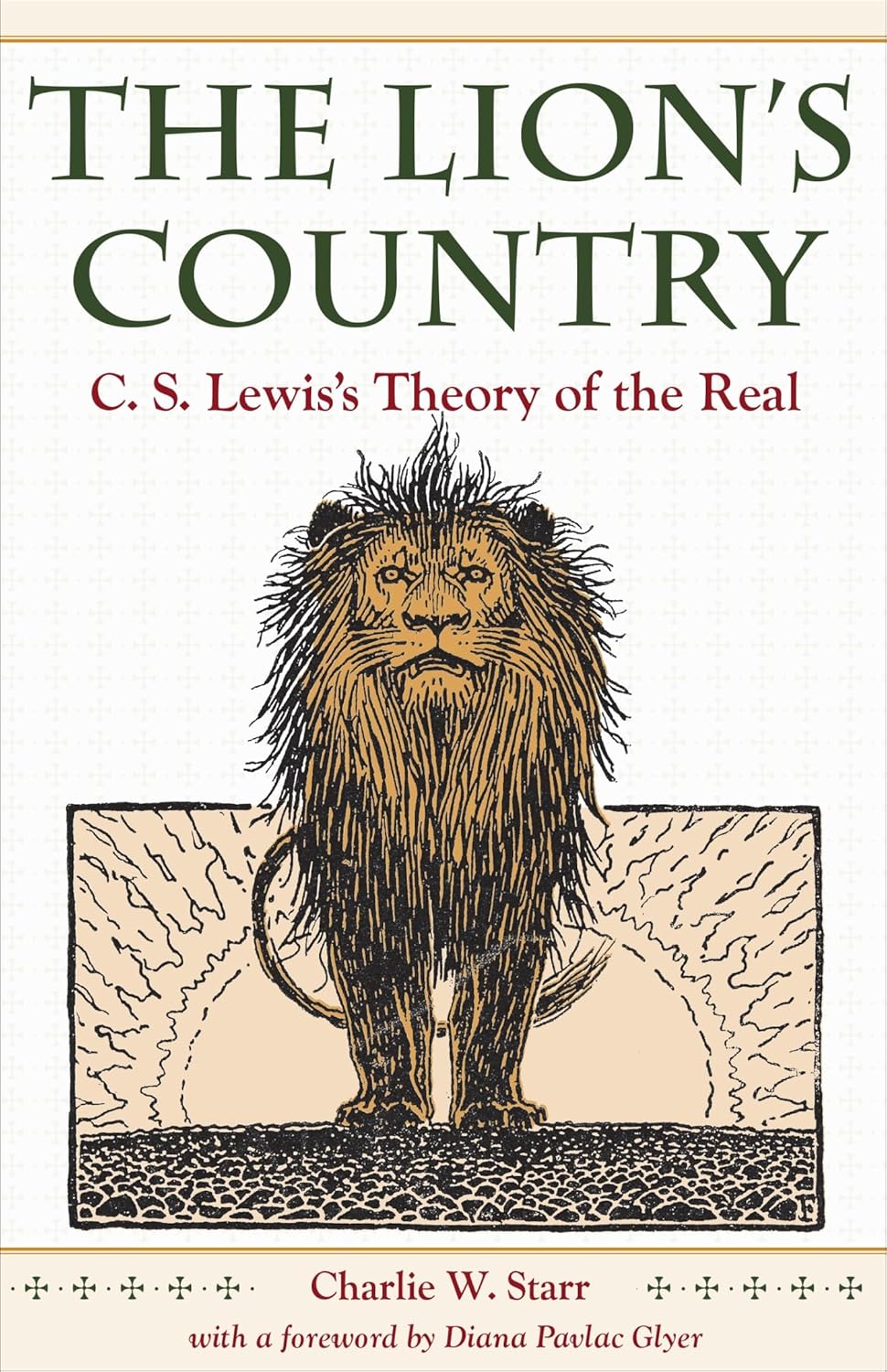
The Lion’s Country: C. S. Lewis’s Theory of the Real


Review of The Lion’s Country: C. S. Lewis’s Theory of the Real

James Hamby

Charlie W. Starr. The Lion’s Country: C. S. Lewis’s Theory of the Real. Kent State UP, 2022. Paperback. 160 pg. $18.95. ISBN 9781606354537.

.

The works of C. S. Lewis are often discussed through the lens of Christian apologetics, but Lewis was influenced by more than just theology. In his study The Lion’s Country: C. S. Lewis’s Theory of the Real, Charles W. Starr examines the philosophical influences, particularlyIdealism, that Lewis incorporated into his fiction. Starr traces Lewis’s development from a materialist atheist to an idealist theist and finally to an orthodox Christian. Central to both this progression and to Lewis’s fiction is the question of what constitutes reality. The relationship between God and humanity, the meaning of experiences in the material world, and the nature of the afterlife illustrate Lewis’s theories of the real. Starr’s assessments offer a nuanced understanding of the progression of Lewis’s thought through the decades of his writing career.

The book is organized into ten chapters, each focusing on a particular component of Lewis’s concept of the real. Chapters include subjects such as desire, mystery, and transposition,  amongst other topics, and each chapter touches in some way on the development of Lewis’s thought. The book concludes with a never-before published manuscript by Lewis, a collection of notes for a book that was never completed entitled “Prayer Manuscript” that describes Lewis’s vision of what it is like for humans to gradually experience reality.

It is a commonplace in Lewis biographies to note that Lewis was an atheist as a young man, but Starr focuses more on Lewis’s materialism than his atheism at this point in his life. Starr observes that “Lewis the atheist makes himself visible in his earliest use of the term fact. In 1916, the young C. S. Lewis had been an atheist for several years and had become a demythologizer” (28). The word “fact,” Starr argues, is of central importance to Lewis, because it is synonymous with “reality” (23). Limiting his concept of reality to mere fact, however, was not enough for Lewis. Starr says that Lewis’s longing for something he could not quite understand made him seek something beyond fact: truth. This led to Lewis’s turn towards Idealism and theism (29). Convinced that Idealism would explain his longings, Lewis began to believe there was something beyond the material world. Starr says, “The move from Atheism to Idealism was no less than a recognition of the existence of spiritual reality—something really there that transcended the physical” (29). Yet, as Starr points out, what Lewis ultimately rejected about this viewpoint was his belief that all matter is evil. Once Lewis converted to Christianity, he saw a connection between the spiritual and the physical that suggested not only that matter was not evil, as he had previously thought, but that there was a hierarchy of reality. Starr suggests that “Lewis abandoned his own brand of idealism (which saw spirit as good and matter as evil) when he became a theist, thus adopting the third view “that there is a reality beyond nature” (87). Starr also notes Lewis’s change in thought concerning materialism when he says, “This younger Lewis is very different from the Christian convert who described transcendent reality as the most concrete existence there is. Lewis’s previous philosophical war with the flesh was not a part of his Christian way of thinking” (109).

One of the most important concepts in Lewis’s beliefs is the notion that there are different levels of reality. Starr points out this concept in his analysis of The Great Divorce. In this novel, the closer one gets to heaven, the more “real” things become. Conversely, as Starr explains, “Hell (the farthest place from God) is smaller than a pebble on Earth and smaller than an atom in heaven” (121). In contrast to the beliefs of his youth, the Christian supernaturalist Lewis sees the material world as the lowest part of a progression that eventually leads to the ultimate reality, God. Starr explains that in this core image of Lewis’s belief system, “heaven and heavenly beings are more solid than are we and the Earth we live on. We are ghosts and shadows and our world but a cheap copy of the heavenly one to come, like a landscape painting compared to the real place” (121). These same ideas may be seen in The Last Battle when the heroes of Narnia, after their deaths, keep going further up and further in to Narnia, thus discovering different layers of that magical land, each more real than the last. Starr comments that “each reality is hierarchically more real, somehow larger than the ones without” (89).

Using these biographical and philosophical backdrops, Starr discusses Lewis’s works. He typically comments on several of Lewis’s works in each chapter, and the books he most frequently references include The Silver Chair, The Last Battle, Mere Christianity, The Problem of Pain, A Grief Observed, The Screwtape Letters, The Great Divorce, and Till We Have Faces. Starr’s engagement with these texts is thoughtful and engaging, and his observations would certainly be helpful for both scholars and general readers. Starr’s tone wavers a bit between academic and conversational, and in some places he drops scholarly objectivism and speaks instead from a position of faith, making the book have more the feel of a popular religious book than an academic work. And though Starr clearly demonstrates his familiarity with both philosophy and Lewis scholarship, more engagement with both of these fields would have lent more weight to his discussion of Lewis’s texts. Incorporating more material on Idealist philosophers, particularly those who influenced Lewis’s thought as a young man, would have been enlightening. Furthermore, placing Lewis in conversation with these theorists would have blunted criticism that is sometimes made against Inkling scholarship that the field is too insular and does not connect the Inklings to other movements or authors. Additionally, the scholarship on Lewis that Starr does cite, while useful, is often too briefly considered and feels more like name-checking than genuine engagement. Since this is a relatively brief volume, adding more secondary sources would have fleshed out Starr’s discussion and made important connections.

This work is nevertheless a valuable contribution to Lewis studies. With engaging prose, Starr ably explains the difficult philosophical concepts behind Lewis’s fiction. Both scholars and general readers interested in Lewis should find this book appealing. This volume not only provides insight into Lewis’s world-building, but it also serves as a wonderful demonstration of how fantasy can be used to express the complexity of human experience.

James Hamby is the Associate Director of the Writing Center at Middle Tennessee State University, where he also teaches courses on composition and literature, including Victorian Science Fiction, Fantasy, and Fairy Tale. His dissertation, David Copperfield: Victorian Hero, explores how Charles Dickens created a new hero for the Victorian Age by reconceiving his own life through the prism of myths and fairy tales.

Robert Holdstock’s Mythago Wood


Review of Robert Holdstock’s Mythago Wood

Elizabeth Heckendorn Cook

Paul Kincaid. Robert Holdstock’s Mythago Wood. Palgrave, 2022. Palgrave Science Fiction and Fantasy: A New Canon. Ebook. 91 pg. $34.99. E-ISSN 2662-8570. ISBN 9783031103742.

I began drafting this review from a treefarm in the Salish Sea that used to be part of a vast swath of Pacific Coast temperate rain forest. Like much of the Pacific Northwest, the land was logged over at the beginning of the last century, grazed for several decades, then left alone aside from occasional selective harvesting. It’s now an expanse of same-aged 90-to-120-foot-high conifers, traversed by footpaths and a few dirt roads, with widely spaced, even-sized treeboles; light and rain filter down to low brush at the forest floor.

How different from Robert Holdstock’s impenetrably dense, insanely haunted, and topologically and chronotopically esheresque Ryhope Wood, composed of “primeval” woodland, “untouched forest from a time when all of the country was covered with deciduous forests of oak and ash and elder and rowan and hawthorn” at the end of the last ice age.1 Plugging into the fantasy topos of an unknown space that is impossibly bigger inside than outside, Ryhope Wood is also, as John Clute memorably termed it, an “abyssal chthonic resonator”: it generates—in psychic collaboration with the individuals who enter it—avatars of basic story patterns and experiences that are, in Jungian terms, universal among human beings—among which is surely the attraction to and fear of forests.2 Though my own experience of woodland, probably like that of many of Holdstock’s readers, is no more chthonic than the tree farm I’ve just described, his vision of a mysterious, unmappable, actively rebarbative wildwood in the heart of darkest Herefordshire is compelling.

Paul Kincaid has produced a concise but valuable companion to Mythago Wood (1984), the prize-winning first volume of the Mythago Wood series, with an introduction, three thematic chapters, and very brief coda. Given the dizzyingly nonlinear and recursive temporal structures of the narrative (not to mention how these are repeated and complicated in four subsequent novels), rather than attempting to offer a definitive interpretation or universal theory of Holdstock’s work(s), Kincaid sets himself an appropriately circumscribed goal: to suggest “something of the originality, the importance, and the downright strangeness” of the text.3 The novel’s complexities, recursivities, and echoic intertexts are derived from the premise that basic story patterns are immanent in every human consciousness; in the psycho-generative spaces of Ryhope Wood they play out differently for each traveler based on individual cultural contexts and memories, but they are recognizably familiar plots driven by such figures as the absent father, the quarreling siblings, the rescued child, the supernatural hunters, the hero’s journey to restore the Land.

Kincaid documents Mythago Wood’s impact and influence on fantasy-writing in the last decades of the twentieth century, noting that itwon both the British Science Fiction Award and the World Fantasy award and “has consistently been named as one of the best and most important works of fantasy from the twentieth century” (4). In 2012 the British Fantasy Society renamed their top prize the Robert Holdstock Award, in recognition, Kincaid asserts, of his “entirely new way of writing fantasy” (4). What’s new is Holdstock’s play with narrative temporality. Having explored time travel in earlier science-fiction novels, Holdstock brought to the fantasy genre a more complex model of narrative temporality that changed the kinds of stories it could engage. Before Holdstock, fantasy was associated with the ‘there and back again’ structure of the quest, in which time and the narrative move forward to the resolution of the hero’s journey:

… the structure of time commonly plays little or no part … : past and present are consistent, practically static. The idea that time might be layered, that the same myths might take radically different shapes, that the past might interpenetrate the present and the present might interpenetrate the past, has no part to play in stories of the rightful heir being restored and evil being defeated. (3)

With a new level of temporal complexity, Kincaid claims, “Mythago Wood remakes fantasy from the perspective of science fiction” (3) and effects “a reimagining of the whole fantasy landscape” (4).4 The impacts for both plot and character are significant: in Holdstock’s novel, “there is no return from [the] quest, the land is not healed, the hero is not restored,” and “there is no true hero just as there is no villain”; each character “is transformed utterly, and so everyone becomes both hero and villain of their own story, and neither” (4). In consequence, the narrative remains endlessly open: “what healing there is, is not the end of this story but rather the beginning of another story, a story which also cannot be ended” (8). The focus of the novel—as the reader gradually realizes—is the power and agency of the Wood as it collaborates with the traveler in shaping the story and transforming the teller. The Wood is the figure and engine of transformation.I offer here a brief summary of the novel to confirm Kincaid’s assessment of the work’s radical weirdness.

Part I: the narrator, Steven, returns from WWII service to his family’s home at the edge of Ryhope Wood. His distant, preoccupied father has died and his older brother Christian has developed a weird relationship to the Wood, which has never been surveyed or mapped. Christian has been pursuing their father’s research into the wood’s capacities to generate avatars of folklore and myths: the Night Hunters, Robin Hood, the warrior woman, Arthur, the shaman. Christian explains the basic premise in a useful expositional brain-dump:

“The old man believed that all life is surrounded by an energetic aura – you can see the human aura as a faint flow in certain light. In these ancient woodland, primary woodlands, the combined aura forms something far more powerful, a sort of creative field that can interact with our unconscious. And it’s in the unconscious that we carry what he calls the pre-mythago – that’s myth imago, the image of the idealized form of a myth creature. … The form of the idealized myth, the hero figure, alters with cultural changes, assuming the identity and technology of the time.” (original emphasis; 53-54)

The mythago emerges where a culture is under threat, fading when the hero figure is no longer needed but remaining “in our collective unconscious, [to be] transmitted through the generations” (53-54). Seeking to penetrate the Wood’s mysterious heart, the brothers encounter a huge boar/man in the Wood who clearly intends to kill them; Steven realizes this is, somehow, both a prehistoric demiurge and their father.

In Part II, Christian leaves to explore the Wood. Steven studies his father’s notes and maps and hires a fellow vet to attempt an aerial survey of the wood (blocked by bizarre winds). The Wood begins to grow into the house clearing, as if “a pseudopod of woodland” was “trying to drag the house itself into the aura of the main body” (95).5 Steven receives strange emissaries from the wood, including the avatar of Guiwenneth, a young red-haired woman-warrior who was raised by the Night Hunters.6 Different avatars of Guiwenneth had had relationships with Steven’s father and older brother, and now Christian re-emerges from the wood, almost entirely unrecognizable in his transformation into a violent warrior leader who appears to be decades older. His fighters seize Guiwenneth and disappear.

In Part III, Steven and his pilot friend plunge into the Wood to trace Christian and recover Guiwenneth. Christian had once imagined that if he could make it to the ‘heartwood,’ the icebound area behind the wall of fire called Lavondyss—the place of origin and possibly rebirth for the mythagos—he could emerge on its other side and return to ordinary life. But as Steven moves deeper into the Wood, he realizes from talking with different people they encounter that he and his brother are now part of a story that they don’t control—the story of a Kinsman who must kill his rogue relative, the Outsider destroying the land. As Kincaid writes, he must “abandon any hope of shaping his own story” (12): “there is no real world for [the brothers] to return to; they are both mythagos now, and mythagos cannot leave the wood” (13). In the final confrontation of the brothers, Steven believes he must kill Christian, according to the myth they are enacting, but Christian asks that they suspend the clash. He will use a shamanic ritual to pass through the fire and, he hopes. return to his previous life. Intending to send him a talisman for this journey home, Steven knocks him into the fire where, we infer, he dies. Guiwenneth arrives at the stone that marks her father’s grave, but she has been mortally wounded and dies in Steven’s arms. The father-monster re-appears and seems to tell Steven that Guiwenneth will return, before carrying her corpse into the fire. Two story-patterns are completed here—that of Cain and Abel and that of the kidnapped child—but the novel ends in a suspension: Steven settles in by the tomb of Guiwenneth’s father to await her return.

Kincaid’s single-word chapter titles, “War,” “Time,” and “Myth”, suggest his broadly thematic approach. “War” briefly discusses the WWI service of Holdstock’s grandfather, then turns to explore what it means that conflict is how mythagos are generated. George’s journal asserts that mythagos are formed at the intersections of conflicts between the cultures “of the invader, and the invaded”: “mythagos grow from the power of hate, and fear” (MW 51). Kinkaid concurs and points out the narrative implications: since mythagos “emerge from war and exist for no other reason than war …. (t)he hero figure, whatever hero might mean in this context, is a personification of the hate and fear of an invasion, and the cruelty of those invading” (25). On his reading, the end of the novel resolves the cycle of violence: “it is a novel in which war is what shapes and drives everything, but it is a novel in which peace and reconciliation is the only possible outcome” (30). Yet the end of the conflict does not allow Steven, any more than Christian, the ‘back again’ of the fantasy quest: instead, he will spend ‘the long years to come’ in a nearby village of “Neolithic peoples,” waiting for Guiwenneth to return.

In “Time,” Kincaid links Mythago Wood’s temporality to Holdstock’s earlier science fiction novels, which explored the fluidity and irregularity of time: “Time is, in a sense, the only continuing character in Holdstock’s work, yet it is never consistent” (34). Kincaid notes that the Wood is “not just … a confusion of all time; it is actively antagonistic to time as it is measured outside the wood” (41): Harry’s watch breaks when he enters the Wood; a reverse Rip Van Winkle effect ages Christian by decades more than his brother. Even as Steven encounters a kind of historical pageant of people who suggest the prehistoric past, Saxon England, the Middle Ages and Civil Wars, time is shown to be “a psychological rather than an ontological reality, working its changes and being changed by the imagination, by the very human force of story” (37). Kincaid borrows Stefan Ekman’s coinage “mythotopes” to describe the different time-space zones associated with different mythagos, and some readers have used these to create speculative maps of the wood, but the zones are unfixed and permeable, and the figures associated with them can turn up in other places and in other times.7 Poignantly, Christian imagines that if he can traverse the heartwood, he might be able to recover the time he has lost and the damage that has been done to his body, but the novel doesn’t confirm this possibility; nor do we find out whether, as the father-monster promises, Guiwenneth eventually returns to Steven. Carefully gathering up scattered narrative threads, Kincaid traces out the brain-bending temporal paradox of Mythago Wood: the prehistoric people tell Steven stories of the earliest mythagos, but these stories reflect the specific manifestations of the avatars that have been shaped by his own family’s engagement with the Wood. So which came first? Holdstock refuses to answer.
In “Myth,” Kincaid connects the “science fantasy” aspects of Mythago Wood with the cultural politics of early-twentieth-century (pseudo-)sciences. George’s journals employ a metabolic vocabulary of energies, vibrations, ley matrices, and auras to be mapped and measured. Alfred Watkins (1855-1935), the ley-line hunter, visits to show George his maps of the invisible tracks connecting spiritual power sites.8 The device George and his Oxford research pal create to boost his mythago-projecting abilities is “a sort of electrical bridge which seems to fuse elements from each half of the brain” (MW 55), involving a “curious” mask and “electric gadgetry” (MW 81) that Steven describes as “paraphernalia out of Frankenstein” (MW 83). Through these allusions, George is “plug[ged] directly into the conservative network of interwar archaeologists and folklorists” who longed to recover a glamorous national deep past (53). But Kincaid emphasizes that far from re-creating an English Golden Age of chivalrous knights and Merry Men, Mythago Wood “is deliberately designed to counter the familiar nationalist story” by highlighting the brutality and violence of the past and the indifference of Nature (55): it’s cold, dark, and nasty in there.

What’s more, once you go in, you can never come out. Steven’s friend Harry returns to the chicken/egg question: “If we do become legends to the various historical peoples scattered throughout the realm … [w]ill we somehow have become a real part of history? Will the real world have distorted talks of Steven and myself, and our quest to avenge the Outsider’s abduction?” (MW 225). As Kincaid points out, there can never be an answer to Harry’s question, because none of the characters ever return to life outside the wood. The implications for questions of agency and ethical responsibility are dissolved, not resolved, in the hallucinatory efflorescence of the narrative: although Kincaid asserts that Steven’s decision to wait for his lover’s return, “to become a part of the story of the valley ‘where the girl came back through the fire’” (67), is an act of free will, it’s hard to see how this decision is ontologically or ethically distinct from any actions he has taken since entering the Wood.

Kincaid’s exploration of Mythago Wood’s radical paradoxes culminates with his salute to Donald Morse’s proposition that Ryhope Wood, like the planet of Ursula K. Le Guin’s “Vaster than Empires” or our current nightmares about AI, is a self-aware agential entity—a “dream creature [that can] dream other creatures into being” (71).9 Turning the screw of indeterminacy to its extremest tension, Kincaid even suggests that in returning again and again to the stories of Mythago Wood, Holdstock as author was “as trapped … as George and Christian and Steven.” However, this “productive entrapment” (71) is what enables the series’ “startling intellectual examination of the very nature of story” (78). If after reading Holdstock via Kinkaid you are not convinced that a clutch of archetypes exists that all humans can recognize, at least it will mean that you will never see that grove of trees in your local park in quite the same way again.


NOTES

  1. Holdstock, Mythago Wood (Orb Edition, 1984), p. 27. Further page references are given in the text of the review.
  2. Clute, John. Look at the Evidence: Essays & Reviews (Liverpool University Press, 1995), p. 111.
  3. Kincaid, Robert Holdstock’s Mythago Wood, p. 13. Further page references are given in the text of the review.
  4. Holdstock’s science-fiction novel Where Time Winds Blow was published in 1981, the same year as the prize-winning novella “Mythago Wood,” which forms Part I of the novel Mythago Wood (1984).
  5. This detail is one of the reasons Farah Mendelson classifies MW as an Intrusion Fantasy rather than a Portal Fantasy in her taxonomy of fantasy types: yes, the Wood is an entrance into a mystery zone, but the Wood rather than the humans controls what happens: “In the portal fantasy the protagonist retains the upper hand over the otherworld. … In this novel, all the power is with the wood. It reaches out, disrupts; when it does draw the characters in, it is for purposes of its own” (Rhetorics of Fantasy, Wesleyan UP, 2008, p. 154). While MW may seem to be “resolving into a portal fantasy in the last third” of the novel, even then Steven and Christian are never the heroes: “[t]he protagonists and the reader are nakedly at the mercy of the intrusion, not in notional command of the adventure” (p. 156).
  6. As readers hear more about this attractive avatar with superb weapon skills, they may be reminded of Terry Pratchett’s parodies of 1980s sword-and-cape fantasy warrior women (Herrena the Henna-Haired Harridan; Conina, daughter of Cohen the Barbarian, etc.). In Lavondyss: Journey to an Unknown Region (1988), the second in the Mythago Woods series, Holdstock imagines a female character encountering Ryhope Wood.
  7. Ekman, Stefan. “Exploring the Habitats of Myths: the Spatiotemporal Structure of Ryhope Wood.” In The Mythic Fantasy of Robert Holdstock: Critical Essays on the Fiction (eds D. E. Morse & K. Matolcsy), McFarland, 2011, pp. 46-65.
  8. Watkins was a lifelong resident of Herefordshire.
  9. Morse, Donald E. “Introduction: Mythago Wood – ‘A Source of Visions and Adventure’” in The Mythic Fantasy of Robert Holdstock: Critical Essays on the Fiction (eds D. E. Morse and K. Matolcsy), McFarland, 2011, pp. 3-11.

Elizabeth Heckendorn Cook: I write about environmental ethics and early modern fictions exploring human / arboreal relations, and I teach courses on ecofictions and eighteenth-century literature in the English Department at the University of California, Santa Barbara. My article on Holdstock’s Lavondyss and Han Kang’s The Vegetarian, “Alternative Parturitions: Plant-Thinking and Human-Arboreal Assemblages in Holdstock and Han,” appears in Plants in Science Fiction: Speculative Vegetation, eds. Katherine E. Bishop, David Higgins, and Jerry Määttä (University of Wales Press, 2020). I visit the Salish Sea area whenever I can.

Life, Rescaled: The Biological Imagination in 21st-Century Literature and Performance


Review of Life, Rescaled: The Biological Imagination in 21st-Century Literature and Performance

Zak Breckenridge

Liliane Campos and Pierre-Louis Patoine, editors. Life, Rescaled: The Biological Imagination in 21st-Century Literature and Performance. OpenBook Publishers, 2022. Ebook. 418 pg. Open Access. ISBN 9781800647510.  Hardback. $52.95. ISBN 9781800647503.

The pervasive crises of our current historical moment unfold across many scales. Think of the two most prominent global crises of recent years: climate change and the COVID-19 pandemic. Both are difficult to understand and respond to, in part, because of their scalar complexity. On the one hand, they are global in scope, crossing national and ecological barriers to touch the lives of all humans (and many non-humans). On the other hand, these massive crises are driven by physical, chemical, and biological processes below the threshold of perception: the release of carbon molecules and other pollutants in the case of climate change, and the spread of viral microorganisms in the case of COVID-19. A new collection of scholarly essays—Life, Rescaled: The Biological Imagination in 21st-Century Literature and Performance, edited by Liliane Campos and Pierre-Louis Patoine—takes an expansive, multi-disciplinary, and multi-genre approach to the scalar dislocations of the present. Made up of contributions from an international cohort of European and North American scholars, the collection examines the complex interchanges between scientific knowledge and cultural production in the effort to represent contemporary human and nonhuman life across a range of aesthetic forms. The essays place mycology, ecology, epidemiology, neurology, demography, and geology in dialogue with novels, comics, and performances in order to grapple with the epistemological and ethical challenges of the Anthropocene. The climate crisis and the COVID-19 pandemic provide the collection’s organizing context; together, the essays inquire into the representational strategies we need in a rapidly changing world of many complex scales.

Life, Rescaled intervenes, broadly, in scholarly conversations about the relationship between scientific knowledge and literary representation. Previous science and literature scholarship has examined the rich interchanges between biology and literature in the Romantic and Victorian periods,1 but Campos and Patoine’s collection extends these investigations to the contemporary moment. The editors note in their introduction that biology’s central narrative and imaginary tropes have shifted in recent decades; the evolutionary tree and the double-helix of DNA, which dominated the twentieth-century biological imagination, have been displaced by the “wood-wide web” of mycelial networks and the spiky COVID-19 molecule, to name a few prominent examples. What representational strategies, the contributors ask, have artists in a range of media developed to grapple with the new images and narratives furnished by recent science? However, Campos and Patoine caution us against the tendency to assume that influence flows only in one direction, from sciences to the arts. Drawing from N. Katherine Hayles, they encourage us to attend to the “cross-currents” that move between science and artistic practice. Rather than tracing how science influences art, the collection explores “interdiscursivity and the cross-fertilizing of imaginaries between contemporary artistic work, popularizations of the life sciences, and philosophy” (5). Culture responds to changes in science and science is shaped, in part, by cultural concerns.

 “Science fiction” is therefore not a central term in Life, Rescaled, although several of the essays analyze works with “speculative” elements. Derek Woods reads current representations of fungal life through Jeff VanderMeer’s Annihilation (2014); Pieter Vermeulen examines the current “population unconscious” through Emily St. John Mandel’s Station Eleven (2014); and Rishi Goyal considers representations of empty pandemic cities through Ling Ma’s Severance (2018). The editors make it clear that the contributions do not privilege any particular genre; they do “not find one genre more suited to multi-scalar aesthetics than another. Rather than which genre, the key question is which forms may best attend to heterogeneous scales of life…and their disparate temporal scales” (21). Each essay attends to a particular interface between aesthetic form and biological scale. While some of the artworks under consideration speculate about future or alternative worlds, the collection’s unifying concern is faithful representation of the empirical world’s complexity. The works tend to be experimental, or to inhabit the limits and boundaries of established genres, as they grapple with the scalar conundrums of our crisis-ridden world.

The collection’s greatest strength is the range of geographies, genres, media, and scientific fields with which it engages. While no one reader will be riveted by every single essay, it has something to offer any scholar with even a passing interest in the environmental, medical, or scientific humanities. Life, Rescaled may be of the most interest to teachers because it gathers a wide range of texts, from speculative novels to popular-science comics and experimental performances. Collectively, the essays provide an illuminating cross-section of ecologically engaged contemporary cultural production in many genres and from many countries. The strongest essays—such as Woods’s analysis of fungi and Annihilation and Goyal’s exploration of pandemics through Severance—bring together pressing scientific problems and nuanced textual interpretations in ways that illuminate ongoing cultural conversations. The collection’s weaker entries, in contrast, can feel like catalogs of relevant artworks, such that analysis gets buried in summary. These essays may offer inspiration for a teacher constructing a syllabus, but they are thin on insight and interpretation. Most readers will probably find themselves hopping between the essays that interest them most, rather than reading the book from start to finish. Despite its few weak points, Life, Rescaled showcases the wide range of aesthetic responses to climate change, the COVID-19 pandemic, and recent scientific innovations. It will expand any reader’s range of reference.


NOTES

  1. See, for instance, Denise Gigante, Life: Organic Form and Romanticism and Gillian Beer, Darwin’s Plots: Evolutionary Narrative in Darwin, George Eliot, and Nineteenth-Century Fiction.

Zak Breckenridge is a Ph.D. candidate in English at the University of Southern California in Los Angeles, where he teaches in the Thematic Option Honors Program. His dissertation project approaches the twentieth-century environmental movement through the history of science and the sociology of literature. His other research interests include documentary film, science fiction, and the history of materialist thought. His writing has previously appeared in The Common, Colloquium Magazine, and The Salt Lake Tribune.

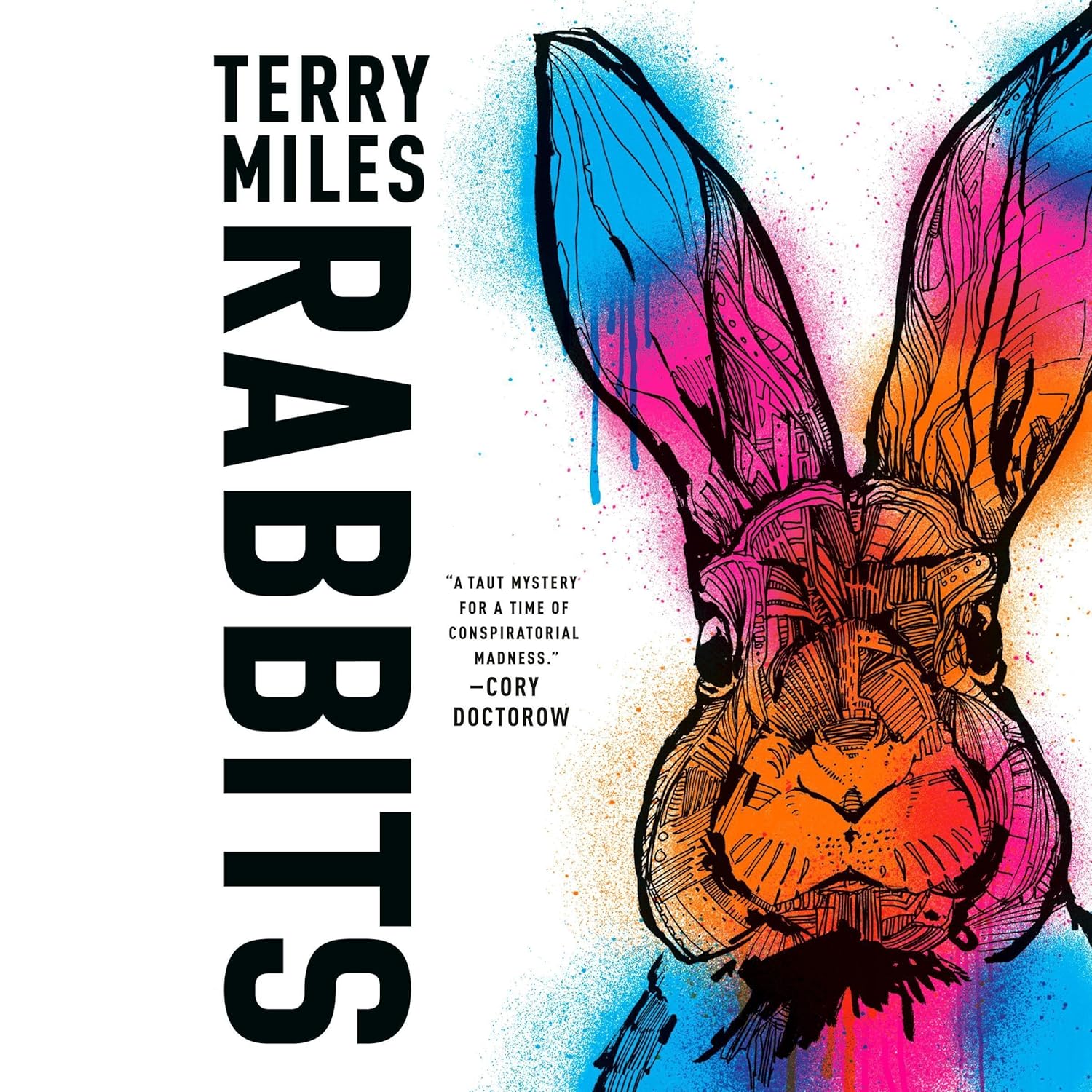
Rabbits


Review of Rabbits

Brianna Best

Miles, Terry. Rabbits. Del Rey, 2021. Hardcover. 432 pg. $9.49. ISBN-10 1984819658.

Rabbits by Terry Miles builds off Miles’ podcast by the same name, picking up where the podcast ends: at the beginning of a new iteration of a recurring alternate reality name, or ARG. This ARG, unofficially known as Rabbits, involves finding patterns in the world that supposedly allow the player to see the true texture of the universe. While the book is technically a standalone addition to the world of Rabbits, it’s probably better to come to it after listening to the two seasons of the podcast. The novel features a cast of characters who already know a bit about the game and there is somewhat of a presumption that the reader will, too. In the first scene, our main character K is hosting a Q&A about Rabbits in an arcade; the first sentence of the book is a question K poses to the audience: “What do you know about the game?” (5). This is also a direct address to the reader: are you new, or do you already know what’s going on here? While there is some exposition, it’s hard for me to say whether someone completely unfamiliar with the podcast would find the introduction to the world sufficient.

As the novel begins, the game has been dormant for years, since the tenth iteration ended. At least that’s what K thinks. At the end of this Q&A, they are approached by Alan Scarpio, a billionaire rumored to have won the sixth iteration of Rabbits. He asks for their help because he believes something is wrong with the game. After this meeting, and after conveniently promising K more information “tomorrow,” Scarpio is declared missing. K only has Scarpio’s phone to figure out what has happened to him.

So how do you play the game? You find patterns and follow them until it starts to seem like the very threads of reality are unraveling. After K gets hold of Scarpio’s phone, they start to follow the trail: the wallpaper on Scarpio’s phone is a dog, but Scarpio is allergic to dogs, so they suspect this picture is a clue. While examining the photo, K notices that the tag on the dog’s collar says “Rabarber,” rhubarb in Danish. This reminds K that during their first meeting, Scarpio ate rhubarb pie and referenced an audio file on the phone of rhubarb growing. The file on the phone seems to be a complete dead end at first. There are no hidden messages in the audio itself. However, when they transfer the file to K’s laptop, they realize that it is larger than it should be for what it is. They find a hidden, extracted video that beings with the text “Jeff Goldblum does not belong in this world,” and then goes on to depict a gruesome event that, according to everyone they subsequently interview, did not and could not have happened in this world (67). Now, they are playing Rabbits. Oscillating between present-day events and flashback narration, Rabbits takes its characters on a search for the ultimate truth. Rabbits is for those who want to take off the blindfold and see the truth of reality, the universe, everything.

While the novel and the world of Rabbits is addictive, it suffers from the same narrative problem as Miles’ podcasts. Like the others, The Black Tapes and Tanis particularly, Rabbits asks what deep, ancient, unknowable mysteries really exist under the veneer of everyday reality. These texts set up intriguing mysteries that promise world-shattering answers. But all three also fail to deliver a satisfying answer. In this case, the end of the book is a confounding mess of events that may or may not have happened. Because the answer to the questions pitched in the very first episode of the podcast has to do with the meaning and structure of the universe, each text either has to defer the answer or revisit the same answers repeatedly. The novel, while offering a couple of small resolutions to the larger mystery, does the same. The sequel to Rabbits, The Quiet Room, does finally offer some satisfying concrete resolutions. You will eventually get answers there. Maybe not all of them, but maybe enough.

So, what keeps fans coming back? The alluring thing about Rabbits is the game and the conspiracies that it spawns. K says in the very first few pages, “This was the thing that itched your skull, that gnawed at the part of your brain that desperately wanted to believe in something more. This was the thing that made you venture out in the middle of the night in the pouring rain to visit a pizza joint-slash-video arcade….You came because this mysterious ‘something’ felt different” (5). There is something about a mystery, particularly one that promises to reveal the truth behind the curtains, that draws people in. These texts speak to the deep disconnect that many people feel with modern, everyday life and come from a desire to find something more meaningful underneath it all. In the case of Rabbits, we see a text that is preoccupied with the idea that there must be some underlying pattern underneath the seeming randomness of existence.

On the surface, Rabbits may not seem traditionally science fictional. It takes place in the present day and mostly venerates older, not newer, technology, but it asks the same questions that other science fiction texts ask: is there some ultimate truth about the universe and what else is out there just beyond our perception? What technology might be needed to get to that other place? What is the relationship between past, present, and future? Despite its flaws, it is an intriguing world precisely because it promises the discovery of something bigger than us, some mechanism underneath it all that works tirelessly to keep the world turning.  You must make it to the end of The Quiet Room to get the closure you want, but it’s a fun ride all the way there. R U playing?

Brianna Best is a PhD candidate at Indiana University, Bloomington. They are an associate editor with Mapping the Impossible: Journal of Fantasy Research and an editor of the science writing blog ScIU: Conversations in Science at Indiana University. They are also a reader for fiction and poetry at Indiana Review. They are currently writing a dissertation on myth/storytelling in contemporary speculative fiction.

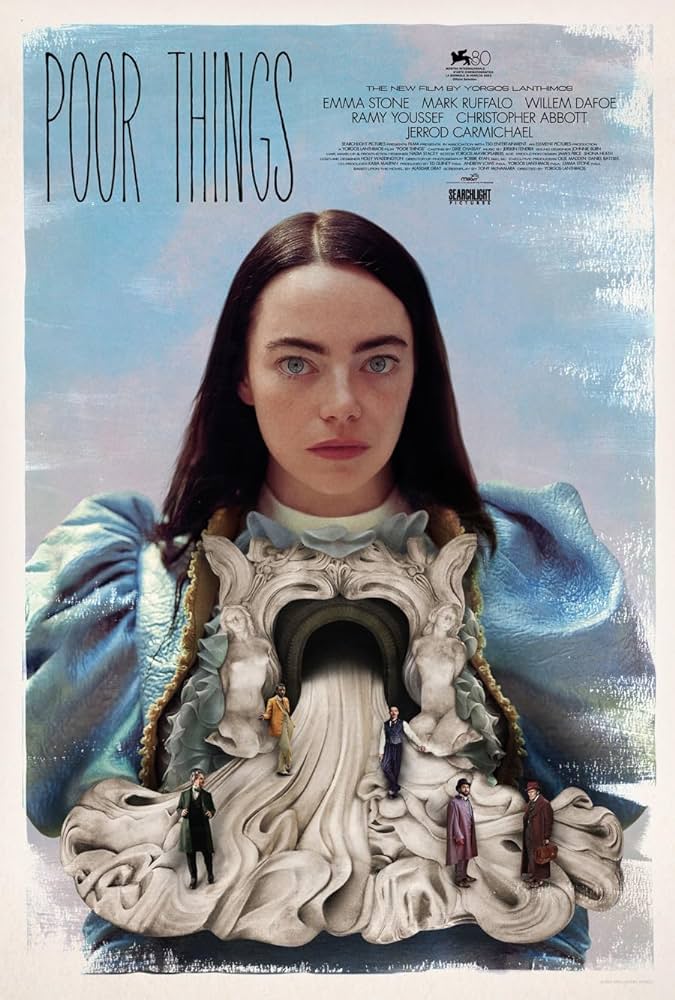
Poor Things


Review of Poor Things

Jess Maginity

Poor Things. Dir. Yorgos Lanthimos. Searchlight Pictures, 2023

Version 1.0.0

Yorgos Lanthimos’s Poor Things offers a rich field of possibilities for scholars of science fiction, especially when considering the film alongside the novel from which it was adapted. Both are interested in the question of perspective and narrative framing; both thoughtfully interrogate the relationship between gender, power, and science; both are engaged with the history of speculative genres and with gothic tropes and Victorian scientific culture in particular. The film would be an interesting object of analysis for projects about the history of science fiction as a genre or a mode or the relationship between contemporary science fiction and history. In the classroom, looking at Poor Things as an adaptation would provide the opportunity to think through the aesthetic strategies each artist uses to convey similar thematic concerns in different media, in particular the different toolkits that novels and films have to shape narrative around a distinct perspective or set of perspectives. It could work particularly well in a class dedicated to adaptations of gothic fiction, or even specifically Frankenstein adaptations.

The story begins when mad scientist Dr. Godwin Baxter (Willem Defoe) fishes the corpse of the pregnant Victoria Blessington from a river and implants the fetus’s brain into her skull. This procedure creates Bella Baxter (Emma Stone). As Bella’s brain rapidly grows into its adult body, we watch her learning how to be a person by following the scientific model of her father-figure, which demands a radically open mind and a willingness to endure socially uncomfortable or even physically painful experiences for the sake of knowledge. This is important as a gendered commentary on the history of science, where women have been explicitly considered objects of scientific inquiry and not itssubjects. This scientific mindset often sets her at odds with the irrational patriarchal expectations of the men in her life who both love and seek to imprison her to varying degrees, from the paternal imprisonment of Dr. Baxter to the ineffective policing of her social and sexual behavior by her lovers (Ramy Youssef and Mark Ruffalo) to the ultimately murderous marital imprisonment of Alfie Blessington (Christopher Abbott). The focus follows Bella as she expands her world and experiences it freely in the face of all this attempted male control and finally decides to follow in the footsteps of her more-or-less creator and become a doctor herself.

The movie is adapted from the 1992 novel of the same name by Scottish author Alasdair Gray. The crucial difference between the two is perspective. In a self-conscious nod to a longstanding convention of the genre, the book channels its story through multiple levels of framing which support or contradict each other on the authority derived from social standing, scientific authority, and lived experience. Poor Things is “edited” by Alisdair Gray against the wishes of the local historian he’s been working with and “written” by Archibald McCandless against the wishes of his wife. The historian invoked in the introduction validates the perspective of Victoria McCandless, whose afterword informs the reader (to the protestations of the “editor”) that the entire story (whose events are essentially the same as those in the movie) consists of lies and gross exaggerations. Essentially, Gray hints to his reader that the story is a male fantasy, gives the reader said male fantasy, and then has the female protagonist inform the reader that this was indeed a male fantasy. The formal structure interestingly mirrors that of its Romantic foremother: the framing narrative (“editor” and “author”) is sympathetic with the scientist-creator while the authorial framing is ultimately sympathetic with the “creation” by giving the “creation” a chance to demonstrate that in fact she creates herself and to cast doubt on the self-importance of the scientist figure (afterword).

The movie accomplishes the same critical orientation towards male scientific authority using cinematic rather than structural techniques. Whereas the book questions science’s (and scientists’) ability and inclination to liberate society from arbitrary or oppressive social protocols by undercutting the pulpy, fantastical narrative framing, the movie is able to make the same critical intervention while investing even more deeply in the fantastical by taking on the perspective of Bella and using a set of tools unique to film. Lanthimos explains that in the novel, “she’s basically seen through other people’s eyes, and she’s described by other people” and in order to give the driving narrative agency to Bella, the film would need a world embellished from our own (Ari Aster & Yorgos Lanthimos 24:31-25:17). The evolution of the color palette over the course of the film, from its black and white beginning to its hypersaturated middle to its photorealistic conclusion, and the elaborately constructed sets and painted backdrops (inspired by the grand painted backdrops of midcentury films like The Red Shoes) are a mode of presenting the story from Bella’s perspective. The film’s sense of reality evolves with Bella’s.

The book asks its reader to think about the politics of gender, authority, and objectivity in the context of science fiction; the movie asks its viewer to think about the politics of gender, power, and science in the construction of a self. As an adaptation, the movie participates in the history of science fiction as a political genre, a genre thinking about the place of science in society and whether it makes us more or less free. As a standalone example of science fiction cinema, it modifies and innovates cinematic conventions of gothic science fiction, taking the potential of the fantastic to deal with the human condition very seriously.

REFERENCES

Ari Aster & Yorgos Lanthimos. Variety, 2023, https://www.youtube.com/watch?v=BXYD3UISwCs.

Gray, Alisdair. Poor Things. Mariner Books, 2023.

Jess Maginity (they, zi, he) is a PhD candidate at the University of Delaware. They research science fiction (particularly in the twentieth and twenty-first centuries, and particularly by either marginalized or highly politicized authors), Indigenous studies, and Right-Wing Studies and they teach classes about writing, literature, genre, and politics. Their dissertation project looks comparatively at right-wing and American Indian speculative fiction on the theme of violence and civilization, highlighting the centrality of settler-colonialism to the continued flare-up of global (but particularly, American) right-wing extremism.

Ms. Marvel


Review of Ms. Marvel

Jeremy Brett

Ali, Bisha K., creator. Ms. Marvel, Marvel Studios, 2022

Version 1.0.0

Let’s be honest. It’s not really the brown girls from Jersey City who save the world. But let’s be truly honest; despite what Kamala Khan posits, it sometimes is. Therein lies the fundamental value and purpose of the Marvel limited series Ms. Marvel, which introduced fan favorite Kamala to the Marvel Cinematic Universe. Kamala (Iman Vellani), a high-spirited Muslim high school student, Pakistani-American and child of immigrants, Avengers fangirl, and a living legacy of familial survival of devastating historical trauma, isa hero unlike any other the MCU has produced. I submit that Kamala is the beautifully positive heroic definition of the MCU going forward, her own experiences, character, and set of ethical values corresponding with her infectious enthusiasm for being a superpowered person, as Tony Stark and Steve Rogers were the guiding and shaping forces of superheroic identity in the MCU’s first phases.

It is altogether fitting in this modern multidimensional world, that we move from white male billionaires and blond blue-eyed soldiers as the central poles around which the first generation of Avengers revolved, into a new iteration of heroes marked by youth in all its insecurity, impulsiveness, and confidence, and by the existential dilemma of grappling with world-shattering events and personalities. They face this struggle while still enmeshed in the complex processes of physical, mental, and emotional maturing. Kamala’s journey signifies new approaches to televised superhero media, and her introduction to the MCU suggests a definite break with its traditional frame of superhero origins and evolutionary development.

What makes Kamala, and by extension Ms. Marvel, different from previous examples of MCU heroes is, above all, her youth and her position at a particular point in time and societal space—Kamala is a young woman who has come of age in a world where superhumans are not only known to exist but frequently interact with society at large beyond the occasional cataclysmic Earth-threatening event. Superpowers are increasingly normalized in these later phases of the MCU, and we start to see the commodification of superheroes not only as pop cultural worship but as sources of attainable merch.

Shots of Kamala’s room reveal her devotion to Carol Danvers/Captain Marvel, marked not only by her own fan art but by professionally made posters and other objects; Carol, like her fellow Avengers, has become less a god-like being wielding incredible abilities and more a high-level human celebrity with all the mundane fan devotion fueled by social media that modern fame inspires. It’s a bringing down to Earth of powerful people, a new imagining of them, and the formation of new social communities based around their popularity. It’s something we see frequently in our reality, and which carries on the Marvel tradition of “real-worlding” heroes and instilling in them human concerns and problems in a realistic New York City.  It also reinforces the more sobering societal phenomenon that everything in our modern lives is subject to commercialization and leveraging for somebody’s profit, though if we accept the idea that the heroes we make reflect our values, that frame seems sadly appropriate.

In the show’s first episode, “Generation Why”, we see this new level of popular, more intimate interaction with heroes when Kamala and her genius friend Bruno (Matt Lintz) travel to AvengerCon, a fannish event where fans cosplay as their favorite heroes, merch of all kinds is sold, and fans engage in discussions about different Avengers. Kamala’s powers of energy projection reveal themselves at the con—fittingly, while she is dressed as Captain Marvel for a cosplay contest—and the response by congoers is less fear and awe and more instant online popularity through recording on cellphones and uploads to social media. These kinds of responses to heroes have been normalized in the MCU by this point in time, and Kamala herself reacts with enthusiasm to her new abilities. One of the great charms of the series is Vellani’s charismatic performance as Kamala, infused with infectious joy and excitement at her new world, which mirrors the actress’ own identity as a Marvel fangirl. Vellani’s performance defines and centers the series in a way that few other MCU efforts have.

Kamala’s singular presence in the evolving MCU is also marked by her identity as a Muslim and a member of an active religious and cultural community. Her interactions with her family, faith, and the ummah at large form important parts of the series and her own heroic journey, in a way that most other MCU heroes have not. They tend to, rather, stand isolated from society at large and not utilize their families (with exceptions such as T’Challa, Sam Wilson, Scott Lang, and Jennifer Walters) as sources of strength and support. Ms. Marvel, though, is marked by caring and loving (sometimes lovingly adversarial) relationships between Kamala, her parents Yusuf and Muneeba (Mohan Kapur and Zenobia Shroff), older brother Aamir (Saagar Shaikh), and friends Bruno and Muslim feminist Nakia (Yasmeen Fletcher), as well as her fellow community members and her kindly imam Sheikh Abdullah (Laith Nakli).

Ms. Marvel signals a new familial and multicultural focus for superheroes as active members of the local communities they serve rather than powerful forces standing aloof, apart and above. A good deal of the series involves the daily life of the Jersey City Muslim community in which Kamala lives and performs her early heroics—important scenes take place during a Muslim wedding, during a street festival at Eid, and in and around the local mosque. And family connections are crucial to Kamala’s heroism—the climactic battle against Department of Damage Control (DODC) agents at her high school is accomplished not by Kamala alone, but by cooperating with her friends and brother. Ms. Marvel opposes the tradition of the lone hero, instead choosing to embrace the idea of heroic collaboration and the sharing of intellectual and emotional resources. It is a conceptual strand we see in Kamala again in the 2023 film The Marvels, where she excitedly adopts the prospect of allying with Carol Danvers and Monica Rambeau. There is a good deal of research potential in Ms. Marvel for exploring the intersection of Islam and popular culture as well as how family and community dynamics play out in      superhero media specifically as well as in the larger sphere of Western sf film and television—which so often focuses on individual heroic achievement rather than cooperative problem solving.

As a superheroine of color, a member of a cultural community frequently targeted for hate crimes and state harassment, Kamala becomes invariably entangled in the sociopolitical concerns of the world around her, and those, in turn, become entangled with her sense of identity. Much of the series, in fact, turns on the question of identity and the creation of self. Above all, teenage Kamala is at a stage of life where she starts deciding who and what she will become and constructing an independent identity (note how in the first episode Kamala stands in front of her mirror dressed as Carol Danvers, but in one of her final scenes, we see her at the mirror in the same pose, this time clad in her new costume that reflects her origins and new sense of heroic selfhood).      

Kamala is unable and unwilling to hide her ethnic origins—the mask she wears cannot hide her skin color, and even before her superhero career has truly begun she is racially profiled by DODC, which under obsessed Agent Deever (Alysia Reiner) launches an assault on the civil liberties of the community. The neighborhood is blocked off by government agents, and Deever and her thugs disrespect the mosque leaders with both contempt and warrantless raids, a clear reflection of the American post-9/11 environment and an increasingly surveilled society. Kamala is in and of the world around her in a way that other nonwhite MCU heroes thus far are not. Without, for example, downplaying the hope and inspiration that Black Panthers T’Challa and Shuri create in viewers from Africa and the African Diaspora, it should be noted that they live in a fictional country that deliberately isolated itself from the historical legacies of Western colonialism, avoiding the sorts of harmful outcomes of hostility and prejudice that Kamala and her community must exist within and alongside.    

Historical legacy is another vital aspect tothe series and to Kamala’s identity and character development, again in a way that differs from previous iterations of MCU heroes. Kamala’s life and the revelation of her powers (which are channeled through a mysterious bangle passed down from her great-grandmother Aisha (Mehwish Hayat), a ‘Clandestine’ or ‘djinn’—an exile from the Noor Dimension) are tied intimately to the experiences of her family during the displacements of the 1947 Indian Partition, that drove Kamala’s grandmother Sana and Sana’s human father from their Indian home to the newly created Muslim state of Pakistan. Their escape via a train station jammed with fleeing refugees results in Aisha’s death at the hands of her fellow Clandestine Najma (Nimra Bucha), who is desperate to use Aisha’s bangle to return home. The series captures well the long shadow of generational trauma that Partition produced, and which resulted in separated families, dead innocents, and lasting religious and political enmities. A rich mine of potential research exists that could use the series as an example of the ways in which pop culture integrates historical events into story.

Kamala is a recipient of this specific historical fallout, not only in her existence as a Muslim whose family came from Karachi to America and whose grandmother still bears intense memories of Partition, but also in the nature of her powers. The bangle she inherits from Sana lets Kamala wield her abilities through access to the Noor, but Bruno discovers that Kamala possesses a genetic mutation that may lie at the foundation of those abilities. Thus, Kamala’s powers are likely innate to her as the living product of a union between human and Clandestine, a union forged in the context of a significant historical event. She is tied to her roots, heritage, and community experiences in a unique way, and Ms. Marvel sets the stage for a new conception of heroism that considers the multicultural world in which we live and utilizes the lives and values of underrecognized cultures or those traditionally unrepresented in superhero media. As it turns out, brown girls from Jersey City can, and do, save the world.

Jeremy Brett is a librarian at Cushing Memorial Library & Archives, where he is, among other things, the Curator of the Science Fiction & Fantasy Research Collection. He has also worked at the University of Iowa, the University of Wisconsin-Milwaukee, the National Archives and Records Administration-Pacific Region, and the Wisconsin Historical Society. He received his MLS and his MA in History from the University of Maryland – College Park in 1999. His professional interests include science fiction, fan studies, and the intersection of libraries and social justice.

Fallout, season 1


Review of Fallout, season 1

Mehdi Achouche

Fallout. Wagner, Graham and Geneva Robertson-Diworet, creators and showrunners. Amazon Prime Video, 2024.

Version 1.0.0

Although Fallout is based on a successful series of role-playing video games (the first one launched in 1997), no prior knowledge of the franchise is necessary to watch the highly enjoyable TV adaptation of the same name. Set within the same narrative continuity but based on an original story, the series takes place (mostly) in the post-apocalyptic year 2296 (farther than any of the games has reached so far), 219 years after a nuclear war wiped out most of humanity. The plot follows three different protagonists as they amble along the customary radioactive, mutant-infested wasteland, each on a quest for the same gruesome object—a severed head—which holds a mysterious secret and will be the opportunity for them to cross paths. 

Since their ascension to prominence in the late 1960s, post-apocalyptic narratives have become a fully-fledged genre in their own right, with literally hundreds of films and TV series (not least of which 2023’s The Last of Us, also based on a video game) released since 2020 alone (the pandemic might have helped boost the genre, although it hardly needed the encouragement). Despite this crowded context, Fallout manages to feel both different and fresh, notably because of its self-reflective nature as well as its highly unsettling tonal shifts. The show’s trademark might in fact be the way it unexpectedly veers from poignant character drama to sardonic comedy to surrealistic, slow-motion musical flourishes, sometimes within the same scene, as exemplified in the opening of the first episode.

The presence of Jonathan Nolan and Lisa Joy, the brains behind Westworld, as executive producers (and as the director of the first three episodes in the former’s case), partly explains both the tone and the metafictional nature of the show, along with its complex network of storylines weaving interrelated stories across differing timelines. Like Westworld, the TV adaptation borrows heavily from both science fiction and the Western genres (with ghouls and zombies for good measure), and like them and much of Nolan and Joy’s work, it interrogates, in a macabre but highly entertaining manner, the nature of our relationship to science, technology and utopianism.

A series of flashbacks interspersed in each of the eight episodes of season one brings us back to a uchronic 21st century society that looks a lot like a retrofuturistic 1950s America. This is the show’s main opportunity to give full expression to its satirical take on “the American Way of Life,” as a Clint Eastwood-like Western actor is hired by a major conglomerate for their latest advertising campaign. The (soon to be revealed evil) corporation is selling fallout shelters designed as self-enclosed micro-societies (projects that were actually proposed in the 1950s and 1960s) in which its customers can survive and thrive when the nuclear Armageddon inevitably occurs.

What Fallout builds from this premise is a thoughtful commentary not so much on the evils of capitalism (“the spirit of competition” is equated to corporate-friendly Social Darwinism) but on the nature of technological utopianism. As described by Howard P. Segal in his classic study of this ideology, technological utopianism consists of “the belief in the inevitability of progress and in progress precisely as technological progress […] equat[ing] advancing technology with utopia itself” (Segal, p. 1). The essentially capitalistic and consumerist nature of such a belief is slowly deconstructed by the show, which implicitly contrasts the marketing cant of the pre-apocalyptic past (the show uses witty parodies of 1950s TV ads in the same way as the game) with the reality of the post-apocalyptic Wasteland and its ruined billboards. Typically for the genre, utopian intentions are equated with murderous results and with the advent of elitist underground communities masquerading as subterranean utopias (a staple of the genre since the 1970s).

One of the protagonists, Lucy McLean (Ella Purnell), lives in such a sheltered community, Vault 33, a community governed by scientists where homely, uniformed dwellers’ belief in science, technology and the need “to keep the candle of civilization lit” makes them feel straight out of a Gene Roddenberry TV series (including the post-apocalyptic show he tried to produce in the early 1970s, Genesis II). But because this is 2024, the association of technology and the need to create “the perfect conditions for humanity”, as another character puts it, is a strongly ironic one that
can only foreshadow disaster.

This is also made clear by the visual association of the shelter with a typical suburban community, where conformity and a naïve belief in science and progress prevail. Likewise, the camera often films the characters in front of retro-looking propaganda posters, while their ideal pastoral world is soon revealed to be an image screened from a video projector. The series is full of such ideas, inviting audiences to make sense of its deconstruction of techno-utopianism on their own. 

The fact that this clanky subterranean world is so close to yet another recent post-apocalyptic TV show, 2023’s Silo, again shows how omnipresent the genre and its themes have become in cinema and on television. But few TV series have managed to offer such an ambitious, thoughtful and hilarious reimagining of the genre as Fallout. The series, which has been renewed for a second season, offers fascinating avenues to study the popularity of post-apocalyptic narratives (and their evolution since the 1960s), the combination of different genres (including the so-called Weird Western) as well as the treatment of nuclear-age techno-utopianism—or utopianism in general—
in our anti-utopian times. The future of the post-apocalypse has never looked (radioactively) brighter.


Mehdi Achouche is an Associate Professor in Anglophone Film and TV Studies at Sorbonne Paris Nord University. He works on the representations of techno-utopianism, transhumanism and ideologies of progress in science fiction films and TV series. He is currently working on a monograph on such representations in films and series from the 1960s and 1970s.

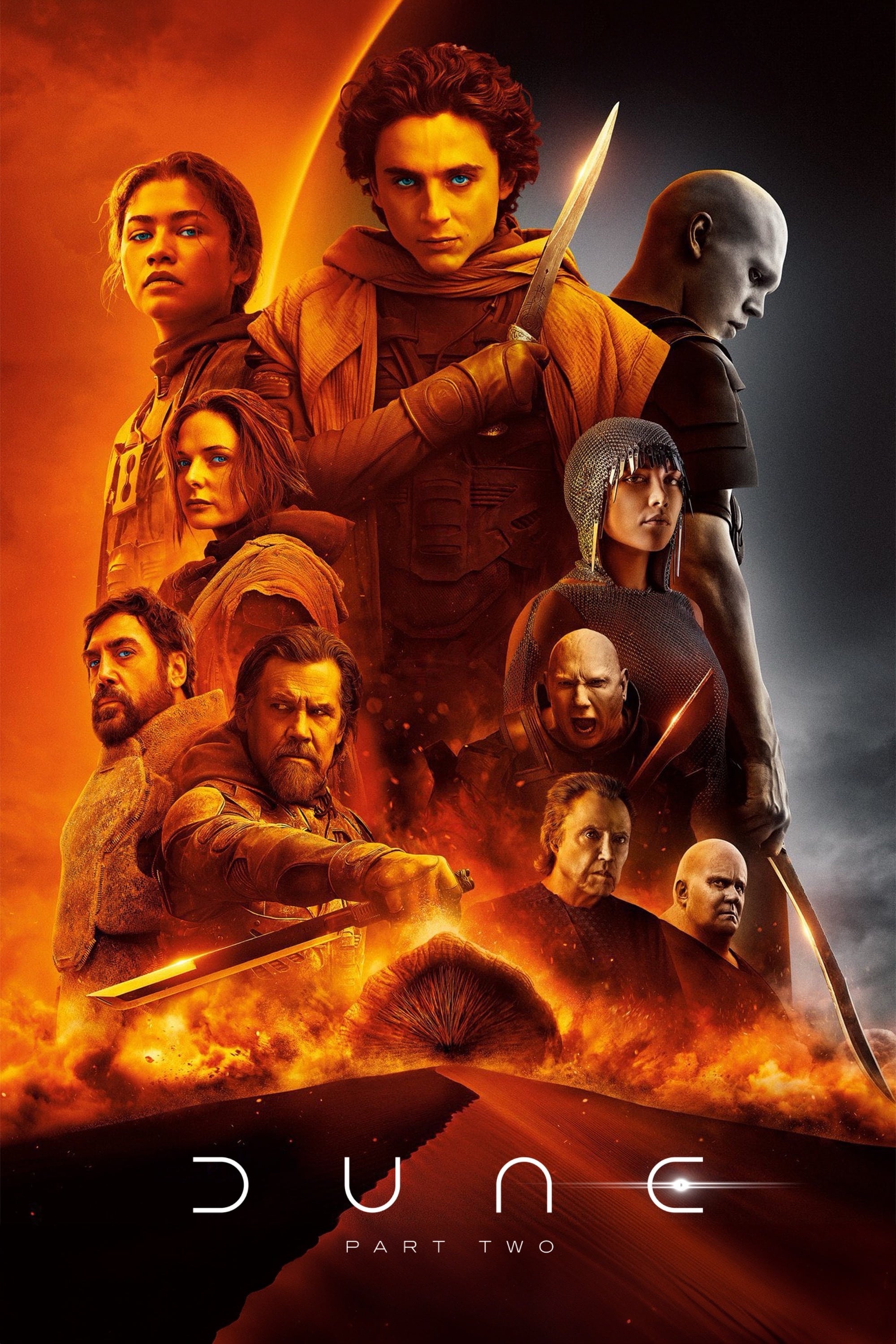
Dune: Part Two


Review of Dune: Part Two

Mark McCleerey

Dune: Part Two. Dir. Denis Villeneuve. Warner Brothers/Legendary, 2024.

Denis Villeneuve’s eagerly awaited second half of his adaptation of Frank Herbert’s novel Dune lives up to the anticipation. Like his first Dune (2021), Part Two combines captivating images and sounds with equally compelling thematic content. I will present here a broad synopsis of it, along with some remarks about what it has to say about the history of colonialism, and then consider the film’s engagement with religion, particularly messianic faiths.

Villeneuve’s first Dune, set thousands of years in the future, traces the arrival of House Atreides on the planet Arrakis to take over the mining of its enormously valuable spice. This leads to the House’s fall and near-annihilation at the hands of traitors, including the Emperor (Christopher Walken). The Atreides’ scion, Paul (Timothée Chalamet), and his mother, Jessica (Rebecca Ferguson), survive—aided by Fremen Fedaykin, the formidable warriors of the wasteland. Dune: Part Two picks up the story shortly afterwards. Paul and Jessica help the Fremen fend off and destroy a platoon of Harkonnen troopers, the latter House having re-taken control of mining operations.

With this sequence, the movie aligns itself with science fiction films that advance certain perspectives on a specific aspect of Western colonialism. The difference between the combat methods in Part Two, here and in other scenes, strongly evokes the French and U.S. failures in Vietnam to subdue resistance fighters from the 1950s to the early 1970s. We see this clearly in the contrast between the Harkonnens’ overreliance on technology, including full body armor, and the natives’ superior guerilla tactics, rooted in intimacy with their environment. Other films have similarly reconstructed this, including Return of the Jedi (Richard Marquand 1983) and Avatar (James Cameron 2009). Peter Verhoeven’s Starship Troopers (1997) touches on it too, albeit with a satirical bent: The film indicates in its conclusion that the overequipped imperialists will ultimately triumph. Such metaphorical constructions of past wars in movies are not uncommon; more broadly, many films “provide allegorical representations that interpret, comment on, and indirectly portray aspects of an era” (Kellner 14). The Vietnam War in particular has left a complicated legacy, within both U.S. culture at large (Isserman and Kazin 67) and science fiction cinema.

Afterwards, Paul and Jessica join the Fremen community of Sietch Tabr, one of many Fremen underground redoubts. Jessica succeeds the sietch’s Bene Gesserit reverend mother by surviving a dangerous ritual. In time, the Harkonnens find themselves continually thwarted by further Fremen attacks—even more so after Paul, now known as a messianic prophet called Muad’Dib, becomes the Fedaykin’s chief strategist.  Eventually, Paul cements his status as the Fremen’s messiah at a formal gathering of sietch leaders. Exploiting newly acquired powers of historical and prescient vision, he declaims himself the supreme ruler of Arrakis. Alarmed at the disruption of spice flow, the Emperor comes to Arrakis, as do representatives of the other Great Houses. The Fremen defeat the Emperor’s troops and Paul ascends to the throne. As the other Great Houses refuse to accept this forced succession, the Fremen Fedaykin prepare to attack them as an act of holy war (the word “jihad” appears frequently in the novel). Paul’s last words in the film are the chillingly ironic “Take them to paradise.”

SFRA Review editor Ian Campbell has argued that the 2021 Dune’s critique of the white savior narrative is, although admirable, not especially noteworthy: Even mainstream commentators easily discerned it. As I agree with this, I will mention only that Part Two continues this worthwhile critical interrogation. I will, however, offer some thoughts about a related yet more compelling dimension of the film: its strong critique of messianic religion. Villeneuve takes this from the novel andbuilds on it in several ways, three of which I will briefly explore.

The first is Paul’s prescient visions of a future jihad that will spread throughout the galaxy and claim billions of lives in his name. These begin in the first Dune and become more vivid and terrifying in Part Two. The key moment comes when the survivors of a Harkonnen assault on Sietch Tabr prepare to seek safety in the south, and Paul refuses to accompany them—knowing that to do so will be to invite the genocide of his visions. He later relents, and the jihad begins shortly afterwards. The power of messianic thinking and its appeal to the messianic figures themselves, even an enlightened one such as Paul, is overwhelming.

The appeal is not so great to Chani (Zendaya), Paul’s Fremen mentor and lover, which leads us to a second way in which Part Two challenges messianic faith. Early on, the film establishes Chani’s skepticism toward the prophesies, and she remains steadfast. Moreover, her skepticism flows logically from one of the most notable improvements that Villeneuve and co-screenwriter Jon Spaihts have made to Herbert’s novel. Though the book paints Chani as a skilled and ruthless warrior in her right, she nevertheless submits almost completely to Paul’s will once the two begin their personal relationship. Villeneuve’s films, however, endow her with far more agency—which includes, among other things, adamant resistance to Paul’s status as the Fremen’s messianic leader. She expresses nothing but contempt for the very notion of the Lisan al-Gaib, the “voice from the outer world.” She insists that the Fremen must free themselves from their oppressors, should never rely on help from any outsider.

Not even Stilgar (Javier Bardem), the leader of Sietch Tabr, can convince her. For example, when he adduces Jessica’s success in the reverend mother ritual as partial fulfilment of the Fremen’s messianic prophecy, Chani angrily rejoins, “Her people wrote that!” Later she remarks, “You want to control people? You tell them a messiah will come. Then they’ll wait…for centuries!” She maintains this resistance to the end of the movie—indeed, to the very last shot. The film bolsters all this with other Fremen’s skepticism; for example, one of the elders admonishes Stilgar, “Your faith is playing tricks on you.”

Finally, Part Two critiques messianic faith in a third way with its compelling (if somewhat oblique) integration of the novel’s Missionaria Protectiva, an ancient Bene Gesserit program designed to plant myths and prophesies on worlds throughout the Imperium with the goal of making their populations receptive—and vulnerable—to the Bene Gesserit’s grand designs for humanity. Although never mentioned by name, both of Villeneuve’s Dune movies allude to it, via several characters, including the Emperor’s daughter Irulan (Florence Pugh), Paul, the Bene Gesserit Reverend Mother Mohiam (Charlotte Rampling), and Chani. The latter’s aforementioned claim (“her people”) is an example of this. Another example comes when Paul, speaking to Jessica, refers to “your Bene Gessert propaganda.” By using this element of the novel in conjunction with Chani’s and other characters’ skepticism, and with Paul’s visions, Dune: Part Two positions messianic faith as a dangerous and manipulative falsehood.

In sum, Dune: Part Two joins the tradition of science fiction cinema’s discursive interaction with human history—specifically, with explorations of Western colonialism and certain forms of religion. If Villeneuve makes a third Dune film, it too will be highly anticipated, due in part to how he might expand on all this.

WORKS CITED

Isserman, Maurice, and Michael Kazin. America Divided: The Civil War of the 1960s. 2nd ed., New York, Oxford UP, 2004.

Kellner, Douglas. Cinema Wars: Hollywood Film and Politics in the Bush-Cheney Era. Chichester, Wiley-Blackwell, 2010.


Mark McCleerey is a Visiting Lecturer at Indiana University Bloomington.

Scavengers Reign


Review of Scavengers Reign

Phoenix Alexander

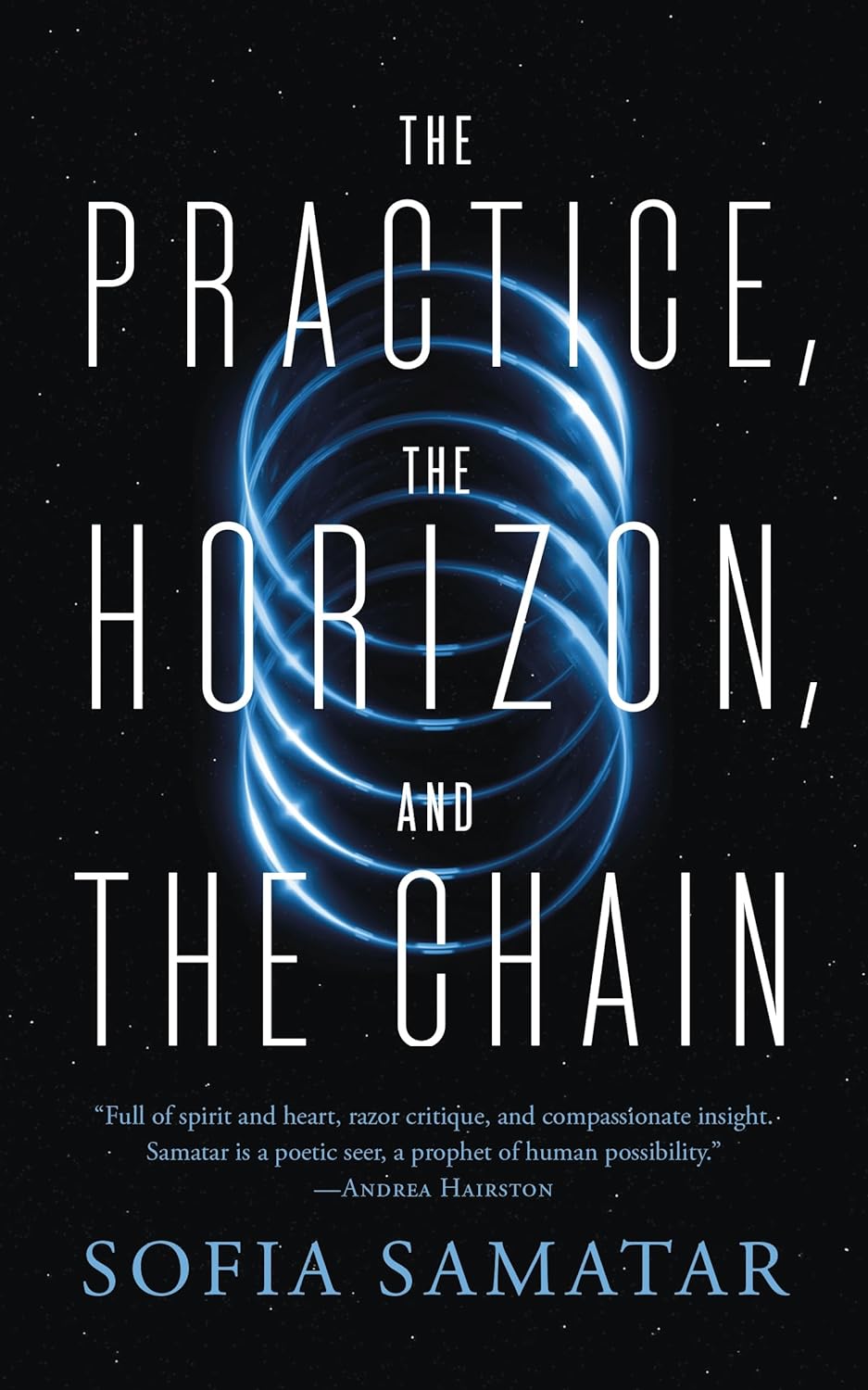
Sofia Samatar. The Practice, the Horizon, and the Chain. Tordotcom, 2024. Trade paperback. 128 pg. $18.99 Print, $4.99 EBook. ISBN 9781250881809. EBook ISBN 9780756415433.

Scavengers Reign marks an exciting and all-too-seldom new arrival in science fiction television: one that enfolds DNA from familiar SF narratives to create something fresh, and vibrant, and unsettling. The twelve-part series follows a group of survivors from the Demeter, a damaged cargo ship, who find themselves stranded on a planet populated by creatures that resemble the love-children of the imaginations of Salvador Dalí and Moebius. The trope of stranded colonists is a familiar one, but Scavengers Reign distinguishes itself through strong visual storytelling that manages to avoid the sometimes exposition-heavy world-building of science fiction, as well as through its convoluted and at times grotesque ecology. Boundaries are porous in this world; everything can and may be used as fuel, or food, or an aid to traverse the diverse environs of Vesta—that is, unless it kills you first.

The cast of characters is strong and manages to avoid clichés. Azi (Wunmi Mosaku) and Levi (Alia Shawkat), an automaton, try to maintain a self-sufficient encampment on Vesta. However, Levi’s circuitry becomes infiltrated with rhizomatic organic matter that begins to affect their behavior in odd ways (they bury a spanner in the opening episode: a small act that has a wonderful pay-off, later). Another pair, Sam (Bob Stephenson) and Ursula (Sunita Mani), are attempting to contact the still-orbiting Demeter to bring it down to the planet, and are similarly adept at using the flora and fauna, often in quite gruesome ways, to their advantage.

The show is not without its antagonists;  as well as the predatory and bizarre lifeforms of Vesta, the characters find themselves in a race against time to reach the Demeter before Kamen (Ted Travelstead)—a pitiful figure responsible for the fate of the ship, and one who falls under the sway of  the ‘Hollow,’ a malevolent telekinetic creature—and Kris (Pollyanna McIntosh), a ruthless mercenary. Indeed, after the first few episodes that introduce the ecology of Vesta, the drama wisely centers on the always-compelling human characters. As their storylines converge, the series starts to show its influences more nakedly in a largely satisfying manner—right up to the resolution, wherein the creators shy away from the murderous dream-logic of their world-building.

The surreal visuals (and discordant and often startling sound design) owe much to the disturbing classic from René Laloux, La Planète Sauvage, as well as the technicolor marvels and gentle ecological subtexts of Spirited Away or Princess Mononoke. These influences do not always work harmoniously. The resolution of Kamen and the ‘Hollow’s’ storyline, for instance, is particularly jarring, and feels disingenuous to the brutality of the world-building established in the former half of the show. Kamen’s and the creature’s redemptions feel odd, and unearned, almost exactly paralleling the character of ‘No Face’ in Spirited Away, wherein a monstrous, gluttonous creature finds peace and rehabilitation. There, it worked because the creature is a spirit; in the SF universe of Scavengers Reign, the conceit falls a little flat. Lurching from violence to rehabilitation seemingly for the sake of it, the narrative here starts to unsettle the integrity of Vesta and raises questions such as: Are its creatures truly malevolent, or are they just inscrutable? What do they ‘want?’ Why does everything function so symbiotically, on the one hand, and so violently on the other? Why do some human characters die, while others are changed?      

These questions bring to mind yet another science-fiction/horror text: Jeff VanderMeer’s Annihilation. There, again, ambiguity is maintained more successfully, with Area X seeming a truly alien intelligence (both in the novel and its cinematic adaptation) that nonetheless operates with parameters and rules that both viewers and the in-world characters are not privy to. Scavengers Reign plays with similar themes but loses some of its ambiguity, and thematic consistency, as the episodes progress.

It’s a problem exaggerated by the short film the series started life as. ‘Scavengers’ (2015) sees an unnamed (and unspeaking) man and woman manipulate alien lifeforms in increasingly elaborate and convoluted ways that culminates in an orb of blue liquid excreted from a flying titan; upon submerging their heads in it, the characters experience powerful visions of something I won’t spoil here. Whereas the ecology of the series-length Scavengers Reign is far more convincing, it still at times comes across as science fictional Tetris, drawing attention to visual pattern and interplay in a way that is deeply satisfying on a sensory, if not a narrative, level.

If I’m seeming overly critical, it’s because I truly do love Scavengers Reign and the genres it combines (the epilogue hints at a larger and more terrifying universe, and promises to shift the show, should it have a second season, into a far different tonal register). Make no mistake: this is first-rate science fiction and top-tier animation, of any standard: one that manages to synthesize its references into something truly unique. It has much to say about the labor of space, for instance, in the way that Alien is tale of ‘truckers in space’ and their concomitant mis/treatment as expendable capital by world-spanning organization (the opening of Scavengers Reign sees a tense, but brief, exchange between the larger fleet, remorsefully leaving the stricken Demeter to its fate as an acceptable loss) In contrast, the world of Vesta shows us that nothing is truly lost, in strikingly un-Capitalist and irrational logic. Nothing is wasted: it is ingested, transfigured, or consumed. If the series doesn’t quite reach the nihilism of something like Joanna Russ’s We Who Are About To…, which fiercely refuses any and all attempts of human life trying to situate itself and flourish in unfamiliar kingdoms, it also avoids the anti-colonial message of something like The Word for World is Forest. Instead, it poses a challenge: by all means, make contact with other, make planetfall—just know that the colonizer/colonized dynamic is short-circuited, here, and if the characters want to survive on Vesta, they will have to make peace with the undoing of categories of every kind (the biological and the mechanical, the living and the dead, the hostile and the peaceful).A love letter to the genre (the final episode alone contains references to Aliens and 2001:A Space Odyssey), Scavengers Reign will, I hope, lean further into the uniqueness of its vision as it continues, making landfall on new, and stranger, worlds.


Phoenix Alexander is a queer, Greek-Cypriot author and curator of SF/F. He stewards the Eaton Collection of Science Fiction and Fantasy at the University of California, Riverside—one of the world’s largest collections of genre materials—and also serves as the Editor-in-Chief of Vector: the Journal of the British Science Fiction Association. His fiction and academic writing has been published in The Magazine of Fantasy and Science Fiction, Escape Pod, Beneath Ceaseless Skies, and the Journal of Fantasy and Science Fiction, among others. He is represented by Angeline Rodriguez at WME Books.

The Practice, the Horizon, and the Chain


Review of The Practice, The Horizon, and the Chain

Timothy S. Miller

Sofia Samatar. The Practice, the Horizon, and the Chain. Tordotcom, 2024. Trade paperback. 128 pg. $18.99 Print, $4.99 EBook. ISBN 9781250881809. EBook ISBN 9780756415433.

To describe Sofia Samatar’s carefully crafted new book as a “campus novel in space” would risk misleading potential readers into expecting a lighthearted romp through sci-fi versions of the satirical scenarios typical of the genre. Yet it is not not a campus novel in space, even though it reads quite differently from those earthbound satires of academe. David Lodge’s exemplars of that genre are taking place just out of sight, on a different starship, at a different social echelon. There is a satirical dimension to The Practice, as in the book’s bitter and not so comical critique of higher education’s self-satisfaction with superficial DEI initiatives. As the story unfolds, well-meaning allies prove not so well-meaning after all, and institutionally-sponsored celebrations of “Multiplicity” ring hollow because they change nothing fundamental about broken systems continuing to do real violence. In Samatar’s narrative world, as in ours, it is difficult to accomplish genuine justice work when our institutions rest on a foundation of exploited labor and inequalities of obscene proportions.

The Practice uses its science fictional novum to literalize those labor relations and social inequalities into a three-tiered caste system that governs life aboard a fleet of mining ships trawling the universe for minerals to sustain human life indefinitely. The book therefore also belongs to the generation ship subgenre of SF. While interstellar ark novels can be sprawling in terms of their worldbuilding and their page count, this one is spare; Kim Stanley Robinson’s hefty Aurora (2015) is more typical. What is strikingly different about Samatar’s premise is the absence of the lofty collective goal that propels most generation ship narratives: colonizing an untamed planet, or seeking a new home for humanity after some tragic fate has befallen Earth. We do learn from an aside in The Practice that Earth has suffered from rising sea levels, perhaps to the point of uninhabitability, but the book nevertheless holds out no hope for a new Eden: the ships are all we have, recalling the 2019 film Aniara with its accidental interstellar ark. The goal of Samatar’s fleet of generation ships is more suggestively tied to profit, and certainly not collective profit, as wealth still funnels to families associated with the mining company that runs the vessels. The Practice relies on a reader’s understanding of the basic parameters of a generation starship narrative without belaboring any details, ultimately in order to turn the premise sideways in pursuit of now defamiliarized but all too familiar subjects. In this sense, the narrative operates much like Ursula K. Le Guin’s ecofeminist antiwar parable The Word for World Is Forest (1972), which drew on the planetary colonization plot of so much “Golden Age” SF to critique the Vietnam War and other engines of destruction. The two books are also comparably short, and yet there are depths to both, as well as an urgency.

Below the new interstellar aristocracy imagined in The Practice are two oppressed castes, the lowest compelled to labor in deplorable conditions in the darkness of the Hold, literally chained to one another, effectively enslaved, and treated as nonpersons. In the middle is the protagonist’s caste, made up of people who live in fresher air and wider open spaces with the mining class, but have limited career and education options, and must wear an ankle bracelet that functions as an only slightly less obtrusive chain. The ankleted know that they are only a single misdemeanor away from the Hold themselves: they know to be grateful and have internalized rationalizations for their place. Our unnamed protagonist is one of the few ankleted professors at the ship’s university and also the daughter of one of the only Chained ever to have been raised up to ankleted status via a scholarship. Both the ankleted and the Chained are defined by their past participles, what has been done to them: only members of the upper caste are treated as individuals with names worth recording. Samatar traces some intricacies of this new social order, giving us glimpses into interactions among the classes that resonate with but are rarely fully mappable onto the complexities of our own social systems. For example, the ankleted do not have access to smartphones, and we hear that one of the professor’s colleagues “never liked to use it in front of the woman, a sensitivity she appreciated” (16). Another less-liked colleague shows no such restraint, but we might wonder whether the former colleague’s “sensitivity” is really a demonstration of tact, or instead a result of embarrassment about his privilege, or some other combination of emotions and social dynamics. The phones, as a symbol of class and power differential, also carry additional layers of significance, we later learn.

The plot centers on the (nominally) successful outcome of what is effectively a DEI program in space, the relocation of a Hold laborer with a talent for drawing to become an ankleted university student. The woman has expended an extraordinary degree of effort to revive this lapsed “University Scholarship for the Chained,” and such details attest to Samatar’s deep familiarity—and frustration—with the workings of academic bureaucracy and the realities of academic precarity, along with difficult colleagues, unequal access to university resources, time-consuming committee work that never seems to amount to anything, and the threat of burnout as the inevitable reward for caring about one’s work and one’s students. The story of The Practice, then, is the story of a woman trying to do something meaningful within the systems of power that seem to exist precisely in order to prevent her from doing anything of the sort and in the end attempting to learn new strategies for collective survival and flourishing. It is also the story of the boy who is acted upon by this scholarship program; the first sentence of the novel deploys the passive voice in a way that speaks to the treatment of persons in the Hold as objects: “The boy was taken upstairs without warning” (9). In the “outside” world above, he must endure the indignities and mockeries that come with being the scholarship kid, and from peers and professors alike, including “the insult of being taught about himself […] in anthropology class” (24), and learn how to perform to expectations: “Dr. Angela’s particular demand was for an easy camaraderie and warmth” (67). He is supposed to be grateful, of course, for this rare opportunity. He is supposed to make it okay that the rest of the Chained are still chained down below.

Increasingly aware of all of this and increasingly sensitive to the institutional forces curtailing her efforts to effect change, multiple times the woman asks herself the direct question that has been on many of our own academic minds here in 2024, “Can the University be a place of both training and transformation?” (63). The narrative voice directly answers that question in the negative, but eventually finds hope in a mantra that centers individuals rather than institutions: “Start with one” (94). That imperative, however, does not simply endorse the scholarship plan to uplift the boy, that single Chained student. Samatar rejects vertical metaphors entirely, especially the verticality inherent in the idea of “upward mobility,” that promise of so-many DEI initiatives, the education system more broadly, and the American Dream itself: “It seemed to him that up was their favorite word” (29). It emerges over the course of the story that the concept known as “the Practice” is tied to image of “the Horizon” from unremembered Earth, the horizon framed as a challenge to such vertical thinking: “to gaze on it was to look neither up nor down” (57). Instead, the book encourages horizontal thinking, a reclamation of that image of “the Chain” linking you to your fellows. The book’s underclasses are united in their marginalization, united even by the chains that link them together, and especially by those chains. The anklets — and even the literal iron chains — link, connect, and unite those bound by them. That is not what the chains or anklets are intended for, but it is something that they do. Because, we learn, the anklets are networked with one another, the ankleted can feel the presence of others through that network, and it turns out that technologies used to dominate and discipline can also be used in other ways.

At various times The Practice seems to be about social inequality in general: prisons and for-profit prisons in particular (“Look, the Hold is a business, get it?” [102]), the Middle Passage and its reverberations (the chain links the living to each other but also to the past and to the dead), higher education and its promises both kept and unkept, and institutions and state violence of all kinds. In the end, though, it is likely about solidarity above all else, forging links on a different kind of chain. It is about solidarity and also education, but education rethought beyond something that occurs only within institutional settings. Samatar dedicates the book to her teachers and her students, and the story affirms the duality inherent in the word education itself. We see the professor’s education of others, but also her own education, as she learns from the boy and from his own first teacher, a character known as the prophet who never leaves the Hold. From them the woman learns to grasp after “an outside knowledge” beyond the different ways that academic disciplines have sought to carve up human understanding (104). After the woman secures permission to visit the prophet as part of a “community engagement project,” the uplifted academic and the immiserated subaltern, along with their student from the next generation, work together to build a common language that transcends what any one of them could have achieved alone.

Professionally, the woman is a professor of “design” who specializes in the study of play, and we are treated to snippets of her research on children’s folk games featuring inventive uses of “castoff” or garbage, always framed with the appropriate academic jargon that she has mastered despite her yearning for a different kind of language: “it was necessary to set up her argument with theories familiar to the discipline, to couch her work in terms her audience knew” (41). The book takes a keen interest in castoff, garbage, “the potential of abandoned things” (103), and abandoned people. When meeting in the Hold with the prophet, the professor drops the jargon and defines design’s capacity to rearrange “the things that were” to create “a new way of being.” The prophet identifies this ambition with the concept he calls “the Practice” (66). If the Practice is “the longing for understanding” (29), as the boy thinks of it, it has some kind of affinity with the academic enterprise—the non-institutional part—and also with art, which he experiences when drawing as “the desire to breathe and know and live” (36). Together the three of them talk and think, and sometimes play those children’s games, “building imagined castles in the gloom” (66), a fair summation of the book’s own ambitions to hope for change against a rather grim backdrop (in the future, in the present).

The most extended explication of what exactly Samatar’s title means appears in a page-long aside positioned near the book’s center. This passage likely occupies a central position only because, in this view of the world, everything is a potential center, a node in the reconceptualized chain that has even rewritten the verticality of the Great Chain of Being: “the Chain of Being is not up and down” (64). Literally and metaphorically, too, “The Hold was in the center” (70). Throughout the book, Samatar evinces the complexities of space, temporality, and the metaphors and ways of thinking they engender. The Acknowledgments reference Stefano Harney and Fred Moten’s The Undercommons: Fugitive Planning and Black Study, as well as the work of Christina Sharpe and Dionne Brand, and their collective influence definitely shows. The syllabus practically writes itself, and The Practice, the Horizon, and the Chain is vital new reading for scholars and students of all kinds.


Timothy S. Miller teaches both medieval literature and contemporary speculative fiction as Assistant Professor of English at Florida Atlantic University, where he contributes to the department’s MA degree concentration in Science Fiction and Fantasy. He is the author of the books Ursula K. Le Guin’s A Wizard of Earthsea: A Critical Companion and Peter S. Beagle’s The Last Unicorn: A Critical Companion. Both belong to the series “Palgrave Science Fiction and Fantasy: A New Canon,” which he now co-edits with Dr. Anna McFarlane.