Call for Papers: Alternative Governance in Science Fiction


SFRA Review, vol. 54 no. 3

From the SFRA Review


Call for Papers: Alternative Governance in Science Fiction

The Editorial Collective

Among the many attractions of speculative fiction is its ability to envision a world different from our own, whether this be a distorted reflection of our own world or something entirely new. Especially in recent decades, many works of speculative fiction take a social rather than strictly technological approach to examining human society.

One aspect of these sorts of alternative worlds takes the form of different visions of governance. Many of the canonical works of SF have tended to imitate historic examples of governments, such as totalitarian empires, democratic republics, and hereditary monarchies. Especially in past decades, these governments serve as little more than set dressing for a story to take place, rather than being critically engaged with to explore the consequences of and alternatives to these systems. Now, however, we increasingly see in SF alternative systems of government both as a consequence of developing technology and as a distorted/distorting mirror through which to view our own systems.

This CFP seeks to broaden understanding of government in SF both within and beyond its typical bounds. We invite papers that reflect upon the issue of governance in SF as it can be, not necessarily how it is. Why and how does a given work depict a particular system of government? What is this system’s relationship to new technologies, whether these technologies be physical, digital or social? How and why is this system intended to estrange our own understanding of governance in the here and now?

The SFRA Review invites submissions that focus on the depiction or criticism of speculative, utopian, dystopian, alternative, or futurological systems of governing. Topics may include (but are not limited to):

  • Governments
  • Elections
  • Monarchies
  • Empires
  • Dictatorships
  • Republics
  • Democracies
  • Theocracies
  • Utopias
  • Dystopias

We invite proposals of ~250 words and short author bios by 15 September 2024. Contributors will be notified if their essays are selected for inclusion by 30 September 2024, and full essays of 4000-5000 words will be requested by 30 November 2024. Editing and revision will take place over the next few weeks, and final submissions will be due on 15 January 2025. Edited articles will appear in the Spring 2025 (01 Februrary) issue. Submissions should be sent to (jamesjknupp@gmail.com) and CCed to (vconn@stevens.edu). We look forward to hearing from you.

SFRA Awards Presented at the 2024 “Transitions” Conference at The University of Tartu


SFRA Review, vol. 54 no. 3

From the SFRA Executive Committee


SFRA Awards Presented at the 2024 “Transitions” Conference at The University of Tartu

Student Paper Award
The Student Paper Award is presented to the outstanding scholarly essay read at the annual conference of the SFRA by a student.

The winner of the 2024 award is Vicky Brewster for their paper “Simulated Worlds and Digital Disruptions: Gothic Glitch in The Tenth Girl

Mary Kay Bray Award
The Mary Kay Bray Award is given for the best review to appear in the SFRA Review in a given year.

This year’s awardee is David Welch for his “Review of Hades” (SFRA Review 53.1)

SFRA Book Award
The SFRA Book Award is given to the author of the best first scholarly monograph in SF, in each calendar year.

This year’s winner is Mingwei Song, for Fear of Seeing: A Poetics of Chinese Science Fiction

Thomas D. Clareson Award
The Thomas D. Clareson Award for Distinguished Service is presented for outstanding service activities-promotion of SF teaching and study, editing, reviewing, editorial writing, publishing, organizing meetings, mentoring, and leadership in SF/fantasy organizations.

This year’s awardee is Jeffrey Andrew Weinstock.

SFRA Innovative Research Award
The SFRA Innovative Research Award (formerly the Pioneer Award) is given to the writer or writers of the best critical essay-length work of the year.

This year’s awardee is Rebekah Sheldon for her essay, “Generativity without reserve: Sterility apocalypses and the enclosure of life-itself,” published in Science Fiction Film and Television 16.3 (2023).

SFRA Award for Lifetime Contributions to SF Scholarship
Originally the Pilgrim Award, the SFRA Award for Lifetime Contributions to SF Scholarship was created in 1970 by the SFRA to honor lifetime contributions to SF and fantasy scholarship. The award was first named for J. O. Bailey’s pioneering book, Pilgrims through Space and Time and altered in 2019.

This year’s awardee is Lisa Yaszek.


From the President


SFRA Review, vol. 54 no. 3

From the SFRA Executive Committee


From the President

Hugh O’Connell

The strange rhythms of the academic “summer break” seem to compel me to continuously turn in these Janus-faced reports: at once looking back to the last conference, now fading into the past, while simultaneously looking ahead to the new academic year and the next conference on the horizon.

First up, looking backwards.

It’s hard to believe that the “Transitions” SFRA 2024 conference in Tartu, Estonia was nearly three months ago. It was great to see so many of our sf colleagues online and in-person, and it’s a tribute to the hosts, presenters, and special guests that I still feel like I’m living in the ideas that we workshopped and discussed together. With that in mind, I’d like to take this opportunity to once again thank Jaak Tomberg, Lisanna Lajal, the students that ran the tech, and the university administration for all of their support and for making us feel so welcome, digitally and personally, in Tartu. The conference brought together over 175 participants from all over the globe in a series of a highly successful, fully hybrid panels and presentations. It was a stunning example of the global reach that sf studies fosters and the recent tech developments that help bring such a global undertaking to fruition. While I didn’t envy some of my more far-flung colleagues joining panels at 4am their local time, it was remarkable how well integrated the hybrid panelists and attendees were.

I also want to offer my congratulations to this year’s award winners: Lisa Yaszek, Rebekah Sheldon, Jeffrey Andrew Weinstock, Mingwei Song, David Welch, and Vicky Brewster. I hope that everyone will take a couple of minutes to look at the awards sections of this issue of the SFRA Review.

Next up, looking ahead.

If you were at the conference, or paying attention to SFRA social media accounts, you probably caught wind that we announced that the SFRA conference will be returning to North America for 2025 (somewhat unbelievably for the first time, practically speaking, since 2018!). I have some bad news and some good news on this front. Unfortunately, due to administrative issues beyond their control, our organizers at the University of Delaware recently learned that they would have to pull the plug on the previously announced “Material Futures” conference for SFRA 2025. Given the amount of planning that they had already put into the conference, the Ex Com want to thank Ed and Siobhán for all of their hard work on the SFRA’s behalf.

On a brighter note, we were lucky that a new host was able to come in at the last minute and make sure that we have a location for the conference. SFRA 2025 will now be hosted and organized by Stefanie Dunning, the Director of the Susan B. Anthony Institute: The program for Gender, Women’s and Sexuality Studies at the University of Rochester in New York. More details will be coming soon, but the theme is set to be: “‘Trans People are (in) the Future’: Queer and Trans Futurity in Science Fiction,” with the conference to take place in late July or early August 2025. We are very excited for this theme, which we know resonates powerfully for our membership. Indeed, Stefanie remarked that one of the reasons that she was so keen on hosting the conference is because sf studies is at the forefront of many of these issues.

Finally, if you have an event that you’d like to bring to rest of the SFRA membership’s attention through its email lists or social media sites, or you have other ideas or concerns about the work the organization is doing, please don’t hesitate to reach out to me at hugh.oconnell@umb.edu or our new Outreach Officer, Anastasia Klimchynskaya (anaklimchynskaya@gmail.com). We’d love to hear from you.


Meeting Futures in the Face of An Age-Diverse Academic Labor Market


SFRA Review, vol. 54 no. 3

From the SFRA Executive Committee


Meeting Futures in the Face of An Age-Diverse Academic Labor Market

Ida Yoshinaga

This summer, while catching up with my sf-film viewing, the image of a crusty Dr. Henry Walton Jones, Jr., grumping at the young’uns during Indy’s own university retirement party—after decades of navigating both archaeology and tomb-raiding, adventures which somehow didn’t prepare him for the brave new world of a changeful 1960s!—struck me as prescient for our current era of inter-generational, academic knowledge and job succession.

As we Baby Boomers and older GenXers—perhaps the last PhDs who as a cohort could expect to land full-time, tenure-track jobs with traditional professorial benefits and economic security in the North American – (and part of) Western European academic markets—push back retirement past our 60s, into the 70s and even beyond, especially in the wake of financial anxieties brought about by post-COVID COLA rises (Anft 2023 5-6), new waves of scholars including Gens Y, Z, and Alpha face less certain, if decidedly more inventive, career pathways towards a sustainable academic life. The contingent-labor market is marked particularly by researchers and hybrid scholar-creatives who’re gender and race diverse (for instance, women and marginalized community members strongly characterize the adjuncting pool; see Anft 7; Colby 2023, 2 and 5-6).

Universities, colleges, and other institutions of higher education are adapting to labor-market shifts and their related inequalities—some creating relatively stable, non-tenure-track positions aka “contract-renewable” jobs (usually full-time non-tenure-track; see Colby 1 for data on this type of contingent labor); others offering long tenured faculty buy-outs to retire or choose phased retirement options (Anft 12-15) to as to make space for hiring new (often contingent) faculty; with a few schools even mandating that adjuncts participate in 401Ks (Anft 21).

What does an age- and life-stage-diverse community of science-fiction-studies scholars look like, with its powerful intersectional implications of class, gender/sexual, and race/nation inequality? How do we socialize, share disciplinary or subfield info, network, train, debate, and professionally advance ourselves alongside our colleagues—in short, community-build as we grow the field, in this era? How do we run conferences, assess the work of scholars and artists/writers for speculative-fiction awards, initiate exciting new projects?

We are interested in hearing from those of you with ideas on how we best facilitate members to meet, exchange ideas, and build lasting intellectual relationships with each other, going forward? What does a mid-21st-century academic meeting look like, in other words? And what other types of activities and support can we offer?

You can reach me at ida@hawaii.edu, but—pending President Hugh O’Connell’s announcement of it—I may also show up in person to talk with you at SFRA 2025, which we hope will be held stateside again.

WORKS CITED

Colby, Glenn, “Data Snapshot: Tenure and Contingency in US Higher Education,” AAUP Reports and Publications, March 2023, pp. 1-8, https://www.aaup.org/article/data-snapshot-tenure-and-contingency-us-higher-education.

Anft, Michael, for the AAUP (co-sponsored by the Teachers Insurance and Annuity Association of America), “Preparing for a Graceful Exit: The Faculty-Retirement Landscape,” Chronicle.com, 2023, pp. 1-24, https://connect.chronicle.com/rs/931-EKA-218/images/Retirement_TIAA_InsightsReport.pdf.


Summer 2024


SFRA Review, vol. 54 no. 3

From the SFRA Review


Summer 2024

Ian Campbell

I’ve long felt that the timeline where friends got both David Bowie and Prince to the doctor in time back in 2016 is the control universe, and we’re living in the experimental one, and that sometime around (let’s say) 06 January 2021, the researchers grew bored and put their collective thumb on the fast-forward button. But I was incorrect, I think: when Golden Toilet almost took a bullet and then a very effective incumbent dropped out of the race, I came to understand that what we now live in is the Black Swan universe. Anything goes, folks: buckle up, or don’t.


SF, among other things, enables us to run experimental universes: to say “what might happen were X true”, whether X be faster-than-light travel, or colonizable planets, or sentient aliens who just want to party. SF lets us look at what the consequences of those developments might be, and also to use those hypothetical universes as distorted reflections upon our own here and now. In this issue of the SFRA Review, our Managing Editor Virginia L. Conn brings us a set of articles about SF and socialism: what a collective approach to solving problems or rebooting our society might look like. We hope that you find these articles, as well as our usual palette of reviews, to be food for thought. Imagine an experimental universe where money did not count as free speech.


The two hottest days in recorded human history were reached last week, breaking a record set last month, which broke a record set last year. I’m beginning to sound like a broken record, but our climate change future is already here: it’s just very unevenly distributed. It reminds me of William Gibson’s work in The Peripheral and Agency, where the background plot revolves around a non-white woman elected to the US presidency around this time and then either assassinated, or not, depending on the timeline. Imagine an experimental universe where the open undermining of democracy led to actual sanctions. Write me at icampbell@gsu.edu.


The Hundred Greatest Superhero Films and TV Shows


Review of The Hundred Greatest Superhero Films and TV Shows

Dan Brown

Zachary Ingle and David Sutera. The 100 Greatest Superhero Films and TV Shows. Rowman & Litttlefield, 2022. Hardcover. 328 pg. $45.00. ISBN 9781538114506.


.

With a title like The 100 Greatest Superhero Films and TV Shows, it’s easy to imagine this new volume by Zachary Ingle and David M. Sutera is the kind of resource diehard comic fans would keep on hand to settle heated barroom squabbles.

“Hey, what’s the best superhero movie ever? I say it’s 1989’s Batman with Michael Keaton.”

“No way! Obviously, Superman from 1978 is a superior film and Christopher Reeve is a hero for the ages.”

“Let’s see what Ingle and Sutera have to say. They’ll know.”

But this is not a Guinness Book of Superhero Movie World Records. Heck, the co-authors don’t even present the motion pictures and TV shows they discuss in numerical order from best to worst, so those readers looking for a Comic Book Resources-type of extended listicle are bound to be disappointed. Instead, what the two experts provide is a perceptive account of the major superhero releases since the advent of talkies, plus a rationale for how each individual film fits within that larger history. Stated in a word, this book is foundational. It belongs on the bookshelf of every serious superhero scholar.

This 311-page tome goes way beyond rehashing superhero trivia, most of which is well-known by now anyway, and well into the realm of thoughtful cultural analysis. Ingle and Sutera explain at the outset their shared project is “to lay the foundation to encourage more critical discourse on the historical, social, aesthetic, cultural, technological and economic elements of the superhero film” (8). They endeavour to show how properties such as Angel (1999-2004), Captain America: Civil War (2016), and Watchmen (2009) have been shaped by, and have helped shape, global pop culture from the era of Hollywood serials to our current age of streaming. They succeed. And in doing so, this book ups the ante for all researchers following in their footsteps. This compendium is a masterwork for one simple reason: The co-authors take superhero culture, in all its manifestations, seriously.

It’s true comic books were once read mainly by children, but those days have been gone a long time, even though when your local newspaper bothers to cover comics or fan conventions there are inevitably interjections like “Zap!” and “Pow!” in the headlines. Some may be reluctant to face the fact that, with new Marvel properties debuting seemingly every few weeks, superheroes have moved into the mainstream of our society (even as comics themselves have become the preserve of a niche, aging audience). Today’s young superhero fans don’t want to read about a character like Batman, they want to BE Batman, which they can do easily on their cell phones.

All of that said, there is certainly room to quibble with the works the writers deem worthy of discussion. For example, both the Bob Burden-derived Mystery Men (1999) and the Kurt Russel film Sky High (2005) are included here only as honourable mentions. Yet there’s an argument to be made that every superhero adaptation being made in 2023 is a parody, so those little-seen efforts are crucial because they paved the way to the current widespread ironic posture regarding costumed do-gooders. Why the short shrift? Would Deadpool have even been possible on the big screen without those early experiments at squeezing laughs out of the genre’s conventions. Ingle and Sutera also place special emphasis on the Fox X-Men series of movies. While it’s true films such as X-Men (2000) and X2 (2003) are historically important, some would argue they are objectively bad works of art—which isn’t the only consideration for inclusion in The 100 Greatest Superhero Films and TV Shows, but surely how crappy they are as entertainments bears mentioning?

Perhaps a better title would have been Why Superhero Films and TV Shows Matter. As mentioned, the book doesn’t include a numbered ranking (chapters are organized alphabetically by title), so it encourages the reader to do more than skim each entry, thus moving toward a fuller understanding of why certain adaptations landed the way they did. The authors also grapple with the… strangeness of some of these franchises. They look at superhero films and TV programs with fresh eyes by setting aside the conventional wisdom that has developed about each character in the intervening years or decades. It’s also true that this volume, released in 2022, was destined to be out-of-date the moment it came out, given the breakneck pace of superhero releases. The DC filmic universe, for instance, was in a much different place 12 months ago than today, having effectively been brought to a conclusion with the Ezra Miller Flash movie last summer, Superheroes are important to our culture. There’s a lot to be learned from this thought-provoking history, and with more superhero movies and shows on the way a second volume is not only warranted but would also be welcomed.

Dan Brown has covered pop culture as a journalist for more than 30 years for organizations like the CBC, the Globe and Mail, and National Post. He is a graduate of three Ontario universities and wrote his M.A. thesis on antidetection in the short fiction of Alice Munro. He teaches arts journalism at Western University and is the “mentor on staff” at the Western Gazette, the school’s student-owned and -operated newspaper.

Supernatural: A History of Television’s Unearthly Road Trip


Review of Supernatural: A History of Television’s Unearthly Road Trip

Dominck Grace

Erin Giannini. Supernatural: A History of Television’s Unearthly Road Trip. Rowman & Littlefield, 2021. Hardcover. 238 pg. $36.00. ISBN 9781538134498. EBook. $21.50. ISBN 9781538134504.


.

Cult TV phenomenon Supernatural, which ran for fifteen seasons (the longest run for a genre TV show, Giannini insists, though the definition she is using of “genre” would seem to narrow the concept to the fantastical, since westerns Gunsmoke [1955-1975] and Death Valley Days [1952-1970] both had longer runs and produced significantly more episodes—and one also would need to exclude medical dramas and crime shows from the “genre” category to give Supernatural the nod), has received a remarkable amount of critical attention, from monographs to essay collections, from scholarly studies to books for general audiences. Giannini’s history of the show has scholarly heft but a style that makes it accessible to general readers, and at a mere $36.00 for a hardcover book is also priced for a non-scholarly audience. It would probably be accurate (and I do not do so pejoratively) to describe Giannini as an aca-fan, engaging in serious study of a TV show she evidently loves. Features such as her “Highly Subjective List of 30 Must-See Supernatural episodes” in the Appendix speak as much to fandom as scholarship (and the fact that I would have weighted my own such list more heavily in favor of earlier seasons should make clear my own aca-fan propensities.

Giannini traces the genesis of the show in her introduction by contextualizing its origin in 2005 in the historical events of the time, and then devotes the first three chapters, in a section called “In the Beginning,” to the earlier television stew from which show creator Eric Kripke fished out ingredients and to the genesis of the show specifically, from Kripke’s own personal and work history. Part of the show’s richness can be traced to the diverse influences that shaped its development. Though Supernatural can be categorized as horror (as Giannini notes, always a tough sell on network TV, given the restrictions of the graphic and transgressive elements endemic to the genre), its influences are diverse, and perhaps thanks to the show’s fifteen-year run, it was able (sometimes gleefully) to employ a lot of generic slippage into its run. Indeed, Supernatural developed into a remarkably self-conscious show, including overtly meta episodes and ultimately a protracted and plot-central meditation on the complexities of the creative process and the relationship between fans, artists, and art itself. These chapters are especially useful for their careful and thorough grounding of the show in its historical and social context, a topic Giannini continues to explore in more detail in the balance of the book, as she tracks the show’s development across its fifteen-year run. This unit concludes with an overview of the show’s main characters, as well as of significant characters who appeared less frequently.

Part two consists of four chapters, under the section title “The Supernatural World.” The first of these chapters revisits somewhat the historical context elements of the preceding unit. Indeed, a feature of this book is a fairly modular construction, with individual chapters evidently designed to be read easily as single units. This does lead to some repetition. However, here Giannini makes some interesting interventions. Her detailed consideration of the show in relation to Buffy the Vampire Slayer (1997-2003), though strong in its own right, is hardly surprising. Surprising, and insightful, is Giannini’s subsequent detailed discussion of Supernatural in relation to Roseanne (1988-1997), as shows representing blue-collar life on screen. The other chapters delve into Supernatural’s other major influences, such as folklore and religion, throughout its run. Early seasons often built on urban legends, myths, and folk tales; later seasons created extended narrative arcs in which the Judeo-Christian god (primarily; others also appear) is central. The final chapter in this section considers the complex and shifting perspectives on politics across the show’s run, offering interesting readings of how the show’s politics shifted under different show-runners.

The final section, “’People Watch This?’ Supernatural’s Cultural Impact,” steps away from the show proper to consider its influence. The book therefore neatly turns from exploring what Supernatural emerged from to considering what has emerged from it. Giannini begins with a recap of the history of how television has been marketed and consumed, providing perhaps more detail than is really needed for her purpose, but she nevertheless offers useful insights into how the show capitalized on emerging technologies such as streaming to broaden its audience and develop a passionate fan base—and therefore to become a “tentpole” show for the CW, used to help grow audiences for other CW offerings The final chapter focuses on fandom and perhaps downplays the complexities and conflicts therein. Supernatural’s passionate fans have not always seen eye to eye, as Giannini’s chapter title suggests: “Beyond ‘Sam’ and ‘Dean’ Girls” refers to the division among fans of each of the two lead characters. Nevertheless, Supernatural fandom has been active in positive ways, to which Giannini draws appropriate attention. This real-world influence is perhaps a more important legacy than Supernatural’s status as “one of the texts that ushered in a golden age of television horror” (156) or as possibly one of the last long-form serials on TV (if one excludes shows such as soap operas, anyway); “its legacy, from content to distribution, continues to resonate” (156), Giannini concludes. One could do worse.

Dominick Grace is the Non-Fiction Reviews Editor for SFRA Review. He is co-editor, with Lisa Macklem, of Supernatural Out of the Box: Critical Essays on the Metatextuality of the Series (2020) and A Supernatural Politics: Essays on Social Engagement, Fandom and the Series (2021).

Women, Science and Fiction Revisited


Review of Women, Science and Fiction Revisited

Sarah Nolan-Brueck

Debra Benita Shaw. Women, Science and Fiction Revisited. Palgrave Macmillan, 2023. Palgrave Studies in Literature, Science and Medicine. Hardcover. 181 pg. $119.99. ISBN9783031251702. eBook ISBN 9783031251719. $89.00.

.

Debra Benita Shaw’s Women, Science and Fiction Revisited is an updated version of the author’s 2000 work, Women, Science, and Fiction: The Frankenstein Inheritance. Key differences between the volumes include the removal of some chapters focused on short stories that are now out of print, the reworking and addition of new commentary to others, and the addition of chapters on texts which were released since the original publication. Each chapter focuses on a main text or textual pairing; Shaw examines Charlotte Perkins Gilman’s Herland (1915), Katharine Burdekin’s Swatiska Night (1937), C. L. Moore’s “No Woman Born” (1944), James Tiptree, Jr.’s “Your Haploid Heart” (1969) and Ursula K. Le Guin’s The Left Hand of Darkness (1969), Margaret Atwood’s The Handmaid’s Tale (1985 novel and still-running 2017 TV show), Naomi Alderman’s The Power (2015), and finally, N. K. Jemisin’s The City We Became (2020). These texts, Shaw argues, showcase representative critiques that American, British, and Canadian female authors made of popular feminist ideas and contemporary trends in thinking around technology—hence the title, Women, Science and Fiction, rather than women in Science Fiction.

Shaw’s most radical claim is that “the time of sf is over” (9). She writes, “the criteria that distinguished the genre and which governed the mode in which extrapolation functioned are now no longer sustainable” (9).  In this assertion, Shaw is following a critical pathway to its extreme; while many have claimed that, in our age of technological intensification, the boundaries between the speculative and the real are breaking down, Shaw takes this contention to its logical end. Though she does not imagine SF to be dead, she does claim that the forms of SF which we’re most familiar with are no longer viable, and that the most productive speculative works are now those that trouble a traditional view of how SF operates; in other words, works that push at the boundaries of genre in a self-referential fashion. Further, Shaw sees the need to define SF in opposition to other, less logically ordered genres as the hanger-on of colonialism, and “the taxonomic ordering of the world which structured scientific imperialism” (9). This contention is most clear in Shaw’s discussions of The Left Hand of Darkness and The Handmaid’s Tale. Shaw argues that in our contemporary moment, both have taken on new resonances that change their narratives from extrapolations into allegories for our current crises of climate and bodily legislation, respectively.

As with genre, Shaw challenges her reader to forgo the distracting exercise of erecting rigid gendered definitions and boundaries. In her introduction, Shaw writes, “The question of who or what is a ‘woman’ and who is authorised to speak for and to women seems to be overwhelming the more important work of challenging the patriarchal social structures which, fundamentally, have defined these terms in the first place” (1). The more pressing mission, then, is avoiding definition in opposition to masculine ideals in general, which can lead to unintentional collusion in patriarchal projects of ideological, legal, and physical control. Shaw is careful to challenge ideas of essentialism that align the female figure with “Nature.” In chapter four, Shaw discusses Donna Haraway’s “The Cyborg Manifesto” as a response to a branch of feminism which equates women with nature—a dangerous conflation, Shaw states, because it gives patriarchy a powerful tool to align women with reproduction and commodify the female body. This formula is best articulated in a line Shaw uses to describe Swastika Night: “Hence the text extrapolates the appropriation of separatist consciousness and ecofeminist mythology by a patriarchal regime happy to collude with the idea that the future of the planet and the future of women are inherently linked” (117). Throughout, Shaw denies the proposal that a world made of women would be one without problems, or that a society built on unequal power dynamics could lead to equality.

Shaw’s work makes a strong case for the contemporary relevance of each text discussed, and for the ways that political and environmental changes have altered the way we read and understand several older texts. In marking this shift, Shaw turns to N. K. Jemisin’s The City We Became, which she seesas part of the “rise of the new weird,” a less “hopeful” and “naïve” turn which recognizes and challenges “the limitations of genre fiction” (172). Given that The City We Became is a fantastical, surrealist novel, which does not seem to engage with more traditional science fiction elements, its purported role as sign of development or shift in generic boundaries is somewhat questionable. In other words, I remain unconvinced that Jemisin’s novel is the best example for Shaw’s argument. The contention, however, that the execution and goal of extrapolation has been fundamentally altered does offer conceptual tools for examining fiction in a post-Trump, post-Covid-19, rise-of-AI era, in which future shock has taken on a whole new meaning. Shaw’s proposed shift in SF raises important questions as to how SF has served or challenged feminist ideologies in the past, and how these ideologies and their fictional outgrowths can remain critically relevant in an age when science fiction seems to be morphing into science fact with terrifying speed.

Sarah Nolan-Brueck is a PhD candidate at the University of Southern California, where she studies how science fiction interrogates gender. In particular, she examines the many ways SF authors question the medicolegal control of marginalized gendered groups in the United States, and how SF can support activism that refutes this control. Sarah is a graduate editorial assistant for Western American Literature. She has been previously published in Femspec, Huffpost, and has an article forthcoming in Orbit: A Journal of American Literature.

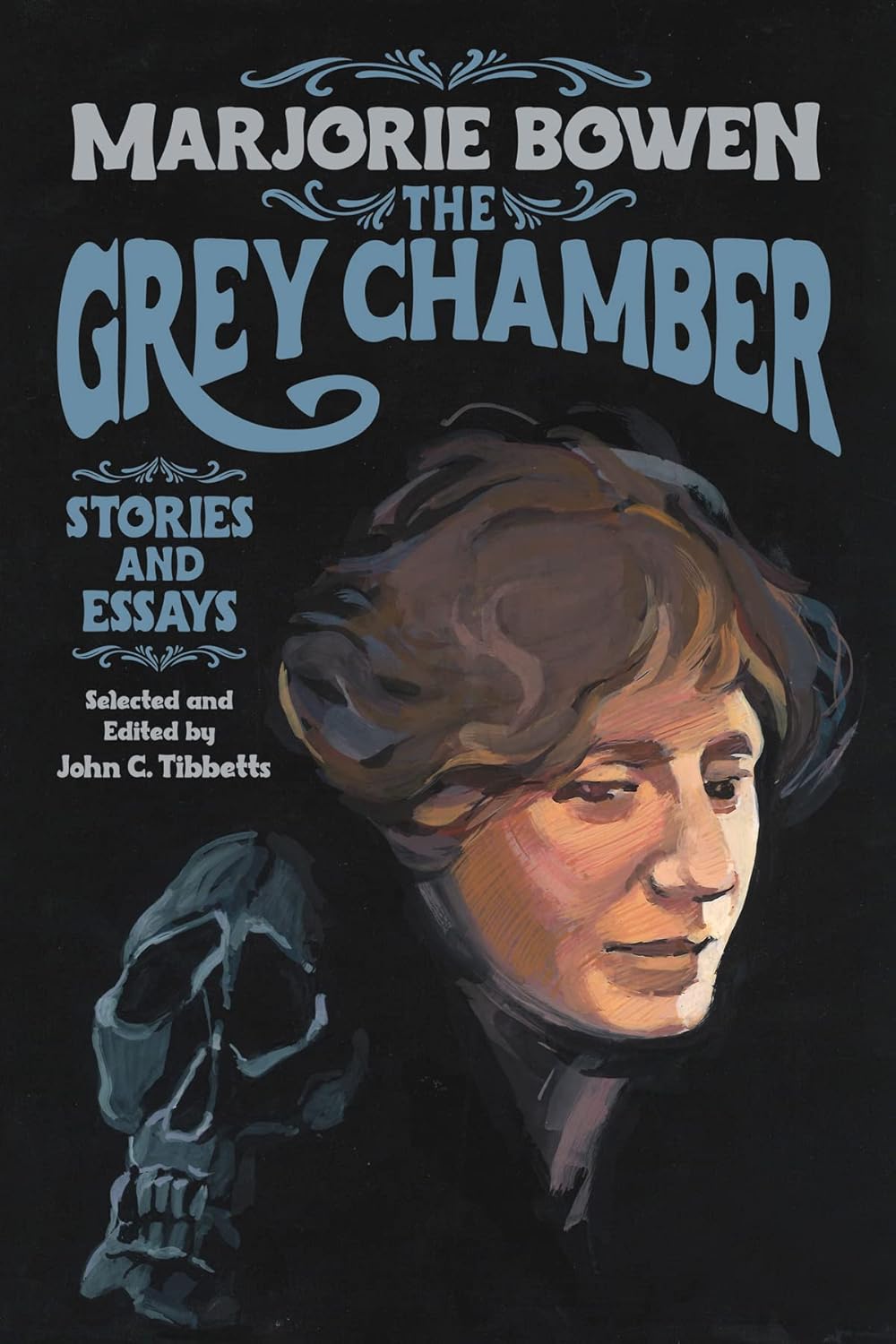
The Grey Chamber: Stories and Essays


Review of The Grey Chamber: Stories and Essays

Indu Ohri

José Alaniz. Resurrection: Comics in Post-Soviet Russia. Ohio State UP, 2022. Studies in Comics and Cartoons. Ebook. 248 pg. $37.95. ISBN: 9780814281925.

.

In Marjorie Bowen’s short story “A Famous Woman,” the protagonist, Tellow, grows fascinated with a statue of Gabrielle Buzot that he notices in a French village, but her history remains frustratingly unexplained to him. Tellow wonders, “surely among all those books there was some information about Gabrielle Buzot? A famous woman! What could she have been, what have accomplished to become famous? A beauty, a heroine, a great lover, a fearless patriot, a poetess?” (239). In a self-referential move, Margaret Gabrielle Vere Long—aka Marjorie Bowen—bestowed one of her names on a fictional woman whose claim to fame has been forgotten.

Like Gabrielle Buzot, Bowen’s accomplishments have been overlooked for decades, even though she published 150 novels and 200 short stories during a successful career spanning from 1906 to 1952. The result of five years of research into Bowen’s life, career, and oeuvre, John C. Tibbetts’s collection of her short stories and nonfiction, The Grey Chamber, is meant to demonstrate the versatility of her writing while still emphasizing her Weird Tales. Tibbetts has also released the first full-length scholarly study on Bowen, The Furies of Marjorie Bowen (2019), and the recent collection The Devil Snar’d: Novels, Appreciations, and Appendices (2023), which covers Bowen’s novels and critical reception. As the foremost expert on Bowen’s life and work, he builds on previous Bowen scholarship by Michael Sadleir, Edward Wagenknecht, and Jessica Amanda Salmonson in his collection. Overall, I think The Grey Chamber fulfills Tibbetts’s two goals of persuasively arguing for the recovery of Bowen’s literary works and exhibiting her writing in a variety of genres. Bowen’s modest description of her literary talents as “an inexhaustible fund of invention, a fluent and easy style, a certain gift for colour and drama, and such a passionate interest in certain periods of history that I was bound, in reproducing them, to give them a certain life” (307) holds true throughout the collection.

In the introduction, Tibbetts provides a biographical account of Bowen’s upbringing as an impoverished child with an unstable family life; despite these hardships, she succeeded through her persistence, hard work, and self-education. Bowen was a prolific author who wrote to support different family members at various times throughout her life: her abusive mother, sickly first husband, mysterious second husband, and three sons. Her works proved so popular that her historical fiction and true crime novels were adapted multiple times into well-regarded films. Along with outlining Bowen’s biography, the introduction offers literary background about her short stories and essays that Tibbetts repeats in the two forwards to each section, “Part One: Selected Short Stories” and “Part Two: Selected Essays.” Instead of repeating information found elsewhere, the introduction could have situated Bowen’s work and long career in the broader social, cultural, and historical contexts of her day. That being said, Tibbetts’s edition includes valuable paratextual materials such as a headnote before each nonfictional work, informative footnotes, and a timeline of Bowen’s life.

Part One features eighteen of Bowen’s short stories in different genres, among them ghost stories, contes cruels, social satires, historical fiction, and crime stories. Tibbetts deems her entire canon of short stories a “colossal achievement” that is “nothing less than Bowen’s own La Comédie Humaine. I can think of none of Bowen’s contemporaries—who can boast such an extensive, learned, and varied output” (32). His selections show the diversity of Bowen’s work across the aforementioned genres as well as the supernatural fiction for which she is remembered today. While the collection contains Bowen’s widely anthologized Weird Tales, I want to draw attention to her stories written in other genres. In the dreamlike fantasy “The Sign-Painter and the Crystal Fishes,” two eccentric characters are locked in mortal combat over a pair of magical fish. The dowager widower in “Madame Spitfire” evokes the ruthless women of Bowen’s true crime novels as she schemes to foil the romance between her late husband’s illegitimate daughter and her tenant. Finally, “An Initial Letter” displays Bowen’s gifts for writing historical fiction and comedy through its portrayal of members of John of Gaunt’s court (including Chaucer) as a cast of colorful medieval characters like those that inhabit the prologue of the Canterbury Tales.

Part Two presents Bowen’s essays on subjects such as Modernist women’s novels, Queen Elizabeth I’s astrologer John Dee, English royal coronations, William Hogarth’s artistry, Bowen’s unorthodox religious views, and her literary career. The essays nicely balance out the short stories in Part One by supplying her wide-ranging and unconventional opinions on different issues. The inclusion of both literary forms allows for a rich dialogue to emerge between Bowen’s views on topics such as the Weird and her representation of them in the short stories. For example, the autobiographical writings detail her childhood fear of ghosts, demons, and haunted houses, which likely explains why she often wrote about these entities in her later supernatural fiction. In her study of John Dee, Bowen observes that his communications with angels through a dubious medium, Edward Kelley, “might have been written today at any séance, save the language is more beautiful and the thought more noble than that usually employed or expressed by modern seekers after psychic knowledge” (324). Readers can trace how Bowen’s childhood fears and cultural movements such as Spiritualism shaped her Weird Tales such as “Scoured Silk,” “The Crown Plate Derby,” and “Florence Flannery.”

A comparison of the two sections uncovers a surprising contrast between the portrayal of female characters in Bowen’s short stories and her nonfictional reflections on being a woman writer in a male-dominated literary industry. This disparity suggests her complex attitude toward women’s rights: skepticism of political feminism’s effectiveness and yet sympathetic attunement to female oppression. In her memoir The Debate Continues (1939),Bowen recalls how her mother—a failed author—discouraged her from pursuing a literary career because Bowen’s first novelwas violent and tragic, which made it unsuitable for a female writer. Her stories “The World’s Gear,” “Scoured Silk,” “Madame Spitfire,” and “A Famous Woman” critique the social, financial, and professional inequities that women negotiated in the past and in Bowen’s day. The essay “Women in the Arts” celebrates Modernist women’s novels for “reveal[ing] with delicate precision the woman’s point of view, and analys[ing] with a tenderness, and yet a realism that no man could achieve, the woman’s heart, mind, and soul” (314-315). At the same time, Bowen claims that female authors such as Virginia Woolf, Dorothy Richardson, and Rosamond Lehmann lack the best male authors’ “genius.” She also insists that these authors should join the general Modernist revolt against human folly, rather than opposing the once-proclaimed wrongs of women” (316).

Instead of remaining obscure like Gabrielle Buzot’s history, Bowen’s life, short stories, and nonfiction writings, as carefully selected and contextualized by Tibbetts, evince that her work is worth rediscovering and will reward further scholarly inquiry. This collection does a superb job of recognizing her fame as a writer of Weird Tales and highlighting her achievements in other genres. It will make Bowen’s works easily accessible to students, general readers, and scholars so that they can learn more about this once “famous woman.”

Indu Ohri is a lecturer of Humanities in the College of General Studies at Boston University. Her current book project examines how the ghosts in women’s supernatural fiction reflect various unspeakable social concerns of late Victorian and early twentieth-century Britain. Her research and teaching interests include Victorian and Edwardian women’s ghost stories, Victorian authors of color across the British Empire, and the intersection between digital humanities and pedagogy. Her work appears in Victorians Institute Journal Digital AnnexPreternatureThe Wilkie Collins JournalVictorian Studies, and European Romantic Review

Resurrection: Comics in Post-Soviet Russia


Review of Resurrection: Comics in Post-Soviet Russia

Oskari Rantala

José Alaniz. Resurrection: Comics in Post-Soviet Russia. Ohio State UP, 2022. Studies in Comics and Cartoons. Ebook. 248 pg. $37.95. ISBN: 9780814281925.

.

In his conclusion to Resurrection: Comics in Post-Soviet Russia, José Alaniz cites Alexander Kunin, the director of Moscow’s Center for Comics and Visual Culture. “We live in Russia,” Kunin says. “Here you never know what’s going to happen tomorrow” (210). Indeed, the same month Resurrection came out, a Russian tank column was approaching Ukraine’s capital, and young educated Russians were scrambling to get out of their home country.

The cover image of Resurrection, a collage artwork of the invasion’s architect, became accidentally more poignant than planned. In one of the panels, Putin stares coldy at the reader in front of Kremlin. In another one, he is clad in nationalistic white-blue-red superhero garb complete with the double-headed eagle—the imperial colors and emblems that replaced the communist ones in post-Soviet Russia. Next, we see Putin’s face covered by a colorful balaclava in the style of Pussy Riot and protesters marching with rainbow flags. Since then, demonstrations have been crushed and Russian courts have declared rainbow flags symbols of “an extremist organization”.

Putin is a good choice for the simple reason that he personifies the profound changes which Russia and Russian society have undergone in the past twenty years. Before his reign, there was no viable comics industry in a semi-developed country with close to 150 million literate people. Granted, comics were not a special case in the chaotic 1990s, and Russia lacked quite a few other viable industries as well. A number of interesting and innovative comics were being produced, but publishing them and making a living out of it was a near impossibility. This is where Alaniz’s last book on the subject, Komiks: Comic Art in Russia (2010), ended. With Resurrection, he takes the reader through the three post-Soviet decades of Russian comics.

He takes a closer look especially at Bubble, a company which succeeded in launching a profitable Russian mainstream comics line with a western business model: superpowered action characters sharing the same universe, multi-title crossover events, basing creative decisions on sales figures, and ultimately aiming to develop their properties for film deals. Alaniz offers an intriguing peek at the dynamics of the Russian comics field as he provides room for both the Bubble founder Artyom Gabrelyanov as well as the company’s critics.

Between the camps of art/indie and mainstream/superhero comics, there are some tensions which seem ultimately not very different than what is found in western comics circles, even though the debates might seem more heated in Russia. A similar point could be raised about the infamous Medinsky quote above. Comments along the same lines were common in the first half of the 20th century when comics caused moral panic on both sides of the Atlantic. There seems to be something universal in the ways in which literary cultures adopt visual narratives. For many readers, Russian society might seem quite alien, but on closer inspection the cultural currents are not that unfamiliar.

Resurrection is a scholarly but theory-light book. Most of it is perhaps best categorized as cultural history, but the concluding chapters on masculinity in superhero comics and representations of disability deal more with comics analysis. Both are interesting takes on multifaceted and diverse comics in a culture that is hyper-masculine and dominated by strong and capable men. At the same time, there are disabled comics artist producing innovative works about their own experiences, superhero Putin parodies, and mainstream comics that are almost impossible to distinguish from what is published for the American market.

As far as the cultural history side is concerned, Alaniz at times brings up bits of information that are not something that a foreign layperson would consider very significant: a letter published in a newspapers or something that one of his friends active in the comics scene has told him. As there are over 20,000 newspapers in Russia, what does it actually tell us if one of them publishes a letter holding some kind of a position on comics? My first reaction as a reader is “not very much,” and I would have appreciated a bit more convincing, even though there’s nothing suspect about the main arguments Alaniz puts forward. It is one of the strengths of the book that Alaniz has access to people who have had a major role in the Russian comics scene. In some instances, it is obvious that they are personal friends of the author, and another writer could have discussed their opinions through a more critical lens.

Alaniz places the moment when comics began “to matter” in Russia near the Victory Day celebrations on 2015 when it turned out that some bookstores had removed Maus from their shelves due to the swastika on the cover of Art Spiegelman’s anti-fascist masterpiece. According to Alaniz, comics had “earned the right to be banned” (xvi), even though it was not so much a case of censorship as an outright silly decision by bookstore staff. However, the incident was good for the sales and publicity of Maus—perhaps not what one would expect to happen in an authoritarian country.

Alaniz does not discuss to what extent the emergence of a comics industry and more organized comics fandom is connected to the modern nerd culture in general. Science fiction, urban fantasy, postapocalyptic narratives, and video games seem to be major cultural forces in Russia, judging by the success of authors such as Dmitry Glukhovsky and Sergei Lukyanenko or game franchises S.T.A.L.K.E.R. and Metro 2033 which have expanded into other media as well. Should Russian comics be thought of as a part this wider culture? That is a question that would have interested many speculative fiction scholars.

Oskari Rantala is working on their doctoral thesis in the University of Jyväskylä, Finland, researching medium-specific narrative strategies and medial self-awareness in the comics of Alan Moore. Their research interests include medium-specificity, (inter)mediality, comics and speculative fiction. Currently, Rantala is also the chair of Finfar, The Finnish Society for Science Fiction and Fantasy Research.