Review of The World We Make


Review of The World We Make

Sreelakshmy M

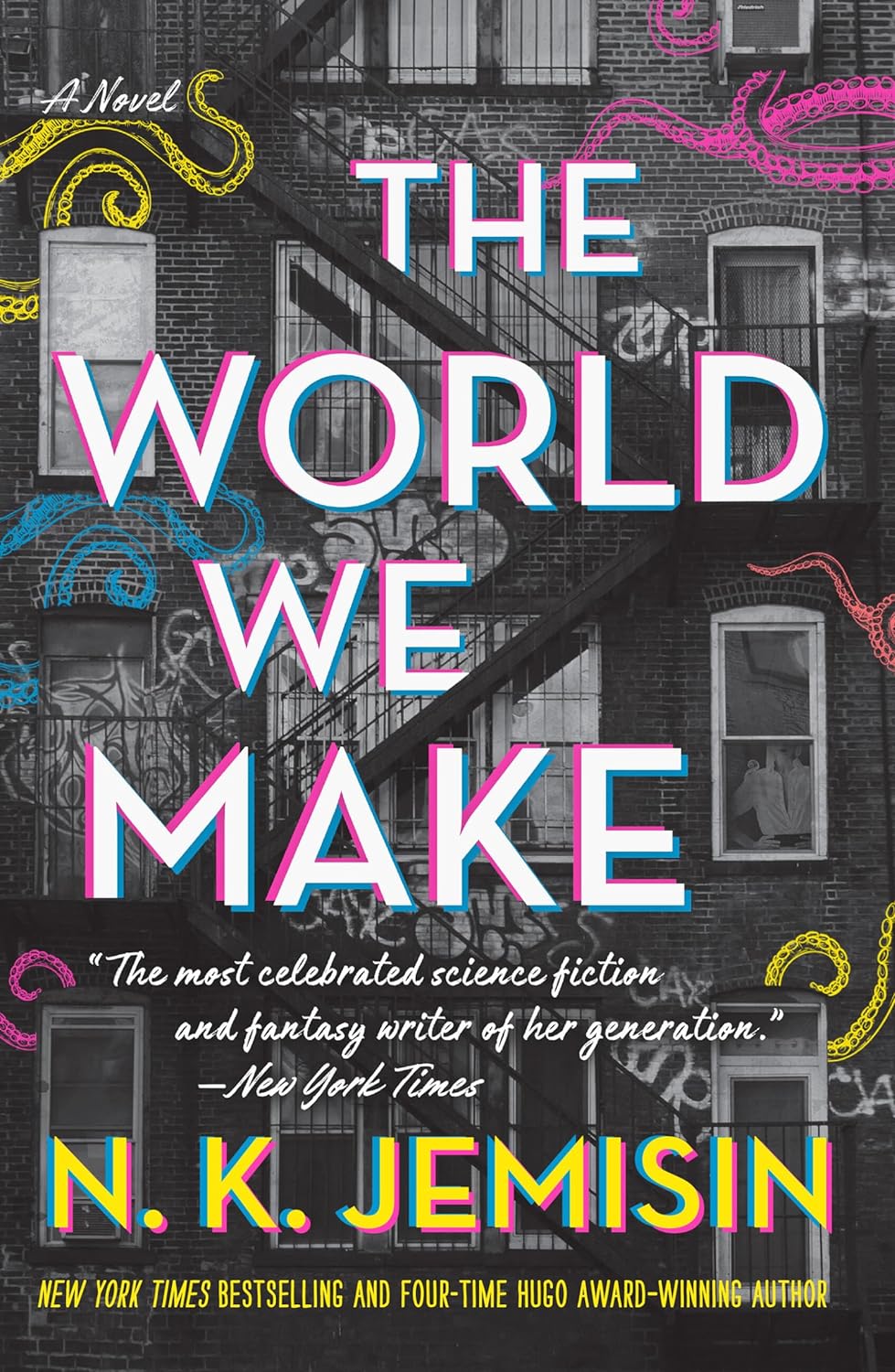
Jemisin, N.K. The World We Make. Orbit, 2022.

The trope of the city as a literal living, breathing entity is not new: it appears in the weird sci-fi of H. P. Lovecraft (whom Jemisin mentions in The City We Became) and Jeff VanderMeer to Jorge Luis Borges and Italo Calvino’s postmodernist narratives. However, what makes Jemisin’s cities stand out are their manifest avatars—human beings. Her Great Cities duology, The City We Became and The World We Make, is set in contemporary New York. It revolves around New York/Neek and his boroughs/avatars as they try to take back control of the city from an extraterrestrial entity that threatens to consume New York.

N. K. Jemisin is a multiple Hugo and Nebula award-winning sci-fi and fantasy author, best known for her Broken Earth trilogy. Her protagonists are trapped within a constant struggle against alien power structures that are usually thwarted via the use of fantastical elements. Great Cities is then comparable to a dystopic world ruled by utter chaos, anarchy, and totalitarianism that the Other entities try to impose upon New York and the rest of the world. The human manifestations of the boroughs must now wage a war for a normal world order free of surveillance and xenophobia. The juxtaposition of the alien world onto New York can be read as the literal descend of a totalitarian regime.

The first part of the duology ends in a promising note as the boroughs struggle and almost succeed at keeping “the Woman in White” at bay. The second part, however, is where things spiral as four of the boroughs—Manhattan, The Bronx, Brooklyn, and Queens—and New Jersey are forced to encounter the Woman who strives to get rid of them one by one. The novel follows the first-person narratives of each of them, and of Staten Island, which is exiled in The City We Became and subsequently aligns with the antagonists in their personal and multi-versal fights. The World We Make is Jemisin’s attempt at creating a world that lives and breathes on its own, full of cities that are constantly born and reborn with the help of their human manifestations. Employing the usual trope of good vs. evil, Jemisin stages a fight against xenophobia and gender inequality as the cities must fight with an alien entity that threatens to literally consume the earth.

Being a Butler scholar, Jemisin has always expressed a deep interest in Octavia E. Butler’s fiction. The premise of The World We Make, for instance, is comparable to Butler’s 1977 novel Mind of My Mind where Butler imagines an interconnected world in which telepaths are connected to each other via threads and patterns, constantly drawing energies from each other. It is this kaleidoscopic world that determines the future of humanity, a telepathic network that exists because of intricate mental connections and is ultimately controlled by a “patternmaster” who can mentally control/kill each of the participants. Jemisin’s avatars, then, behave in a similar fashion. They draw energy from abstract concepts such as mathematical equations or rap music or from concrete phenomena such as credit cards and souvenirs in order to amass enough power to fight their common enemy.

By creating a world that functions on proximity and the need to connect and cohere, Jemisin proposes the need for communication and community in our real world. This is not to say that Jemisin’s cities are free of racism, sexism, misogyny, and patriarchy. She advocates a world where multiversal corporate companies that enforce deep rooted misogyny and xenophobia can be fought with the help of goodwill and community. For instance, the extraterrestrial entity appears in the form of an impeccably dressed white woman who inadvertently captures human beings by attaching a small, white, fleshy tentacle into their bodies. Once you have this tentacle sprouting out of your body, you are under the absolute control of the “Woman in White” (Jemisin does not shy away from using conspicuous tropes of race and surveillance here).

Though she employs fantasy and speculation, Jemisin’s novel is steeped in realistic representations of the world. Neek notes at one point,

Periodically R’lyeh [Woman in White] sends forth a hollow, tooth-aching, atonal song that echoes across the whole city. The song’s a problem; listen to it for more than a few minutes and you start thinking Mexicans and birth control are what’s really wrong with the world, and maybe a nice mass shooting would solve both problems. (10)


WORKS CITED

Butler, Octavia E. Seed to Harvest. Grand Central Publishing, 2007.

Sreelakshmy M is Visiting Faculty (Assistant Professor) at the Department of Humanities & Social Sciences, National Institute of Technology, Warangal, India. She recently submitted her doctoral thesis titled “Reproduction, (M)Othering and Multispecies Community: A Study of Octavia E. Butler’s Select Fiction” at the Department of English, University of Hyderabad. Her areas of interest are speculative fiction, Afrofuturism, and fantasy studies. She has published in the Journal of Literary & Cultural Disability Studies (JLCDS).

Review of Light from Uncommon Stars


Review of Light from Uncommon Stars

Yen Ooi

Aoki, Ryka. Light from Uncommon Stars. Tor, 2021. Hardcover. 384 pg. $19.82. ISBN 1250789060.

The winner of the 2021 Otherwise Award (previously known as the Tiptree Award) that “celebrates science fiction, fantasy, and other forms of speculative narrative that expand and explore our understanding of gender,” and a nominee for the 2022 Hugo Award for Best Novel, Light from Uncommon Stars was published at the end of September 2021. The breathtaking cover design, with an elegant koi fish swimming in space, sets the reader up for an unexpected science fictional journey.  

In the beginning, we meet Katrina Nguyen, a young trans woman running away from trauma and abuse. Then quickly, in a parallel story, we meet Shizuka Satomi. We know little about her other than the fact that in comparison with Katrina, she is privileged and lives in a comfortable neighbourhood in Monterey Park, Los Angeles with Astrid who looks after her. This little introduction of both characters frames chapter one, and already, we are treated to perspectives of Asian-American communities—the big white Asian bus system, convergence of Asian languages, pentatonic folk songs, and more—that are very rarely seen in science fiction. But is Light from Uncommon Stars science fiction?

Soon after we meet the two main characters, we learn that Shizuka needs to find a seventh prodigy to be trained and have their soul delivered to the devil—she has already delivered six!—to escape damnation. On a drive, she gets lost in her own thoughts and finds herself needing the restroom, having missed several exits on the highway in San Gabriel Valley. She pulls off the next ramp, but comes to a residential area with only a big donut peeking over the trees. It is at Starrgate Donut that Shizuka meets Lan Tran, a retired alien starship captain, interstellar refugee, and mother of four. And it is afterwards, by a pond that is within walking distance from the donut shop that Shizuka meets Katrina, shares half a donut with her, and hears her play the violin for the first time.

In a Barnes & Noble interview with Miwa Messer, Ryka Aoki explains that these three women characters, she feels, would not normally have met, but when she throws them together on the page, they find companionship, unexpected family, and love, even though they might not feel they deserve it. The chance encounters are what propels the story forward, and each character questions not only their goals, but also their limitations: how they have limited their dreams in what they wanted to do. As they learn this of themselves and each other, it drives them to be more.

Light from Uncommon Stars is a story of relationships and of relationalism, as introduced by zoetology—the philosophy derived from ancient East Asian teaching that is grounded in the knowledge that association is a fact (Ames 87). These women—all heroes—are not portrayed as binary heroes. They are full characters who are aware that there is no end to the end, where the story doesn’t stop once they have reached their goals. Aoki describes this as a trait of the women she admires who have a realism with them. Ambition becomes much more nuanced because they realise that it is always balanced by repercussions, or damage one might do to the world, or even just remembering that even if they climb Everest, after they come down, they will still need to wash dishes (Messer).  

This associativeness explored through the characters’ journeys that are full of love, kindness, hardship, and difficulties, flows deeper yet into the core of the story itself as it balances genre-defying juxtapositions with the devil and a curse, aliens, interstellar travel, classical music, and American fast food as prominent features. Readers used to mainstream science fiction that provides clear binary storytelling, might question whether the book best belongs to fantastika, encompassing science fiction, fantasy, fantastic horror and their various subgenres. Or it might even be perceived to be kitsch. However, the onslaught of concepts is there to show us that there is a world (and indeed, our world is one of them) that can be a loving home to such diversity. It is crucial for creating the space to make the story work. Borrowing Seo-Young Chu’s informal definition of science fiction as “a representational technology powered by a combination of lyric and narrative forces that enable SF to generate mimetic accounts of cognitively estranging referents,” Light from Uncommon Stars’s cognitively estranging referents create such a distracting scene that it forces us to accept the Asian characters, transgender narrative, even the classical music theme, as the realism needed to ground the mimetic accounts (73). This goes beyond its representation of minority communities: it normalises the reality of these communities’ lives.

In A Stranger’s Journey: Race, Identity, and Narrative Craft in Writing, David Mura points out that “for most Asian Americans, American culture provides two unsatisfactory identities”: 1) one that is “perpetually foreign”; 2) a second described as the “model minority”, and a third that allows Asian Americans to understand that their “experiences are far more complicated than white Americans understand, and, indeed, than even [they themselves] may understand” (11).

Aoki sees writing as a public act; as an introvert—she is usually a very private person—it is a way for her to take part in society (Messer). With this skill, she deftly spins these complicated experiences into the story that is Light from Uncommon Stars because of, and for, her own experiences as an Asian American trans woman growing up in San Gabriel Valley.I am a British East and Southeast Asian woman, a classically-trained musician, a migrant, a teacher, a writer, a geek, and more. When I finished reading the book, I cried. I felt acknowledged, loved, and seen, not realising that these were things that I have been craving. Light from Uncommon Stars is a wonderfully entertaining, heartfelt, and wholesome novel, and if you give it more time and space, you will find yourself learning from it. Learning, as Aoki tells us, involves facing parts of the world that we are not able to change, and we might not be able to experience things the way we wish them to be (Messer):

‘When you’re trans, you’re always looking and listening,’ Katrina explained later. ‘It’s following, but it’s more than that. You need to see what might be coming, hear the next danger ahead.’

Shizuka nodded. So it wasn’t merely follow – it was follow and predict. Perhaps even follow and perceive.

This was an entirely different level of skill. (Aoki 130)


WORKS CITED

Bartter, Martha A. “Nuclear Holocaust as Urban Renewal.” Science Fiction Studies, vol. 13, no. 2, 1986, pp. 148-58.

Anders, Charlie Jane. “Ryka Aoki with Charlie Jane Anders / Light from Uncommon Stars.” YouTube, uploaded by The Booksmith, 28 October 2021, https://www.youtube.com/watch?v=bsCI7jjIX6k.

Chu, Seo-Young. Do Metaphors Dream of Literal Sleep? A Science-Fictional Theory of Representation. Harvard University Press, 2010.

Messer, Miwa. “#PouredOver: Ryka Aoki on Light from Uncommon Stars.” YouTube, uploaded by Barnes & Noble, 4 August 2022, https://www.youtube.com/watch?v=ze_thqxXNdY.

Mura, David, A Stranger’s Journey: Race, Identity, and Narrative Craft in Writing. University of Georgia Press, 2016.

Yen Ooi is a 2023 Hugo Awards finalist writer-researcher whose works explore East and Southeast Asian culture, identity, and values. Her projects aim to cultivate cultural engagement in our modern, technology-driven lives. She is currently completing her PhD at Royal Holloway, University of London looking at the development of Sinophone science fiction by East Asian diaspora writers and writers from Chinese-speaking nations. Yen is narrative director and writer on Road to Guangdong, a narrative-puzzle driving game. She is author of Rén: The Ancient Chinese Art of Finding Peace and Fulfilment (non-fiction), Sun: Queens of Earth (novel), and A Suspicious Collection of Short Stories and Poetry (collection). She is also co-editor of Ab Terra, Brain Mill Press’s science fiction imprint. When she’s not got her head in a book, she lectures, mentors and plays the viola. www.yenooi.com

Review of Lesbian Potentiality & Feminist Media in the 1970s


Review of Lesbian Potentiality & Feminist Media in the 1970s

Sarah Nolan-Brueck

Rox Samer. Lesbian Potentiality & Feminist Media in the 1970s. Duke UP, 2022. A Camera Obscura Book. Paperback. 304 pg. $28.95. ISBN 9781478018025.

Rox Samer’s Lesbian Potentiality & Feminist Media in the 1970s opens a window in time. A mix of literary, cultural, and material history gives this book a uniquely solid structure—reading it, I felt as though I could write a letter to Joanna Russ, and she would answer. I imagined James Tiptree, Jr./Alice B. Sheldon moving between typewriters and crafting a gendered persona beyond the narrow categories of male and female. These impulses stay with me, months after a first read. Lesbian Potentiality vibrates with energy, reminding us that the feminist passion of the past is not lost—but it is being recalibrated.

This ability to draw together diverse histories rests in Samer’s construction of “lesbian potentiality,” or the way the lesbian in the 1970s signaled “the potential that gendered and sexual life could and would someday be substantially different, that heteropatriarchy may topple, and that women would be the ones to topple it” (4). This potentiality, Samer argues, gives us a way to draw critical tools from a “too-close past, the 1970s and its liberation movements [that] are not queer enough to get us to the queerness that is not yet here” (8). The lesbian, then, became a symbol for a reconstructed future, in which women could move beyond definition in male terms, and restriction by male edicts. In an era of theory that attempts to transcend these gendered categories, Samer’s construction makes such a symbol relevant, while acknowledging that for some, it has lost some of its applicability and weight.

Samer brings many threads of “lesbian potentiality” into conversation in their expansive chapters. The first examines the national women’s film circuit, which allowed feminist media workers in the 1970s to build connections amongst themselves, to “meet the media-making desires of their local feminist communities,” and to produce activist works covering vast ideological ground (40). Samer discusses the deconstructionist methods of these creators, who sought to “demystify” the male-dominated industry and form (42). This flows seamlessly into the next chapter, which focuses on the role of documentary in women’s prison activism; this consciousness-raising (CR) action “refused prison’s demands for gender-conforming passivity” by demanding freedom for imprisoned women and foregrounded an intersectional feminism that “contends that freedom for Black women would mean freedom for all” (92, 93). Chapter 3 moves to a similarly collaborative, but less inclusive form of CR: the explosion of feminist influence in science fiction and the creation of a “counterpublic” in feminist SF fandom which “has not survived new generations but adapted with them”—a vital element that Samer tracks specifically through the ways in which the feminist science fiction convention (Wiscon) has expanded since its founding (140, 178). Lastly, their fourth and final chapter takes another look at the complex and frankly titillating history of Tip/Alli, or James Tiptree, Jr./Alice B. Sheldon, the SF author who famously wrote with a male pseudonym, and was “outed” as a woman, to much general/generic astonishment. Samer seeks to expand our understanding of how the author’s gendered self-perception slips easy categorization and contemporary terminology, making Tip/Alli’s narrative a fitting last chapter in a book that searches for more gender-inclusive tools to examine a moment characterized by identity-based organizing.

Despite the varied topics, Samer writes from an inside view—but not in the traditionally academic, separatist voice; Samer’s narrative emerges from the archive, from a personal investment in SF fandom, and from the establishment and evolution of institutions surrounding that fandom, like Wiscon and the Otherwise Awards. Their connection to their subject and their ability to draw together manifold elements into a cohesive study reveal a powerful investment into the materials and communities they describe. Scholars interested in discovering how to bridge the often wide gap between research and praxis, academia and activism, will find conceptual models in Samer’s text.

Lastly, Samer’s work is, above all, accessible and attractive to a broader audience. This book was not written for a select few; it is a celebration of a specific and fruitful era of lesbian potentiality, and a cautionary look at the dangers of clinging too tightly to a specific mode in an evolving cultural framework. Their writing is direct and clear, making complex concepts easy to parse. Samer’s work is some of the most accessible, refreshing, and pressing scholarship I’ve ever read. As Samer states, “potentiality, no longer lesbian but still oriented toward freedom, regenerates” (215). Their book is a call both to remember the strength and passion of a feminist, lesbian past, and to work toward an expanding, promising, and radical future in activism—toward a more open gendered future for all.

Sarah Nolan-Brueck is a PhD candidate at the University of Southern California, where she studies how science fiction interrogates gender. In particular, she examines the many ways SF authors question the medicolegal control of marginalized gendered groups in the United States, and how SF can support activism that refutes this control. Sarah is a graduate editorial assistant for Western American Literature. She has been previously published in Femspec, Huffpost, and has an article forthcoming in Orbit: A Journal of American Literature.

Review of The History and Politics of Star Wars: Death Stars and Democracy


Review of The History and Politics of Star Wars: Death Stars and Democracy

Dominic J. Nardi

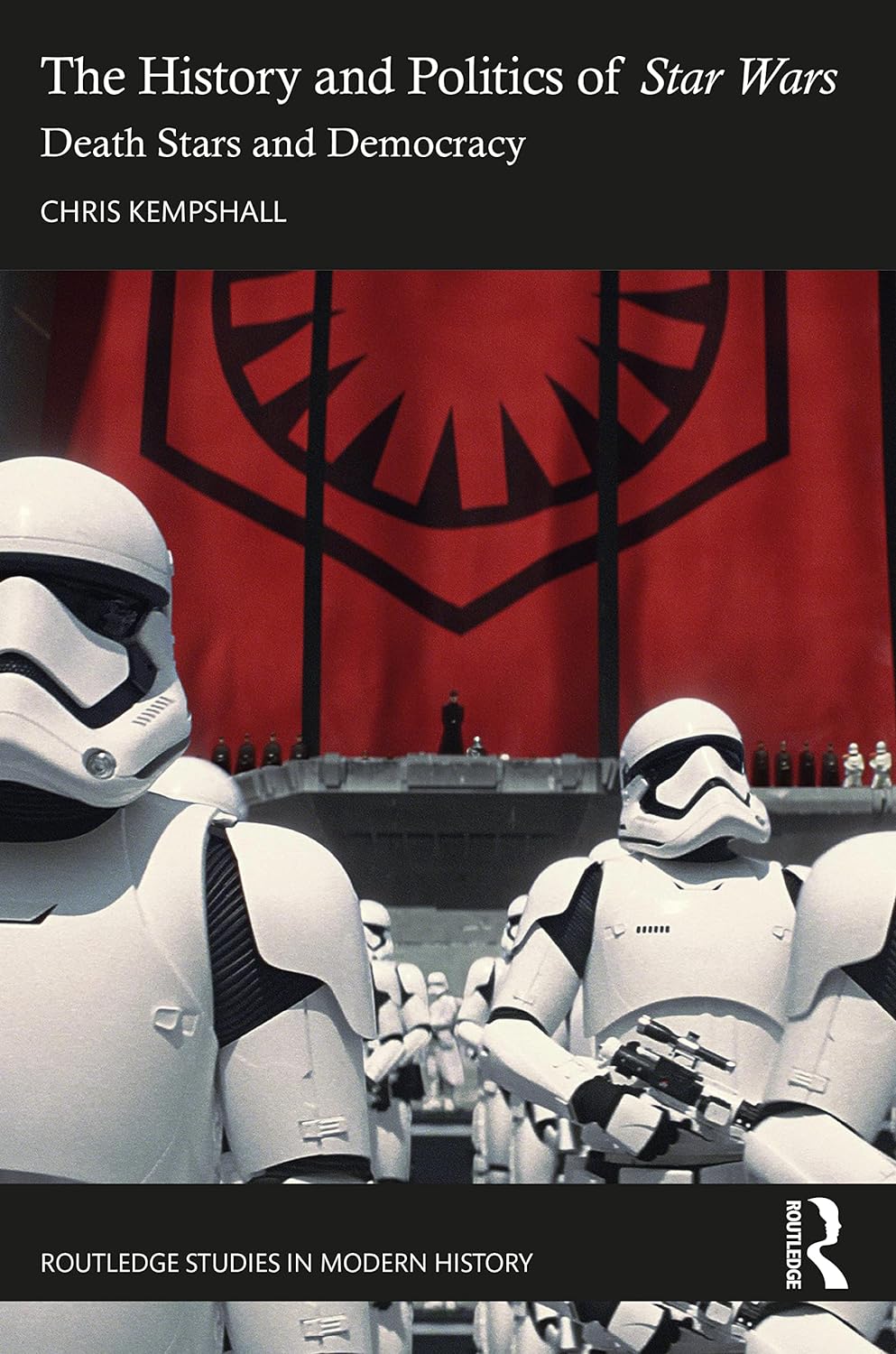
Chris Kempshall. The History and Politics of Star Wars: Death Stars and Democracy.  Routledge, 2022. Routledge Studies in Modern History. Paperback, Ebook. 252 pg. $44.95. ISBN 9781032318875.

Despite claims from some parts of the fandom that Star Wars should not be “political,” decades of scholarship have shown that George Lucas used Star Wars to comment on political controversies, from the Vietnam War to the Patriot Act. However, most scholarship focuses on the Star Wars films, overlooking the hundreds of novels, comics, games, and other stories through which fans engage with the franchise. Chris Kempshall’s The History and Politics of Star Wars is the first work to examine historical parallels and political themes across the entire Star Wars franchise, including Expanded Universe (EU) tie-in materials and recent TV shows on Disney+. This scope allows Kempshall to deliver fresh insights about Star Wars and politics, even to readers familiar with the existing literature. Indeed, the speed and relatively low cost of publishing makes tie-in novels an important vehicle for the franchise to engage with new political developments in a timely manner.

The first chapter of The History and Politics of Star Wars focuses on how depictions of the Empire have evolved since the Original Trilogy (1977-83), which borrowed heavily from Nazi iconography. During the 1990s, Star Wars novels began to reimagine the Empire as a flailing superpower like post-Soviet Russia with weapons of mass destruction and sometimes allied with the New Republic/United States. Some authors even created sympathetic Imperial characters who had honorable reasons for siding with the Empire. After Disney reset the canon in 2014, the Star Wars franchise returned to depicting Imperials as space Nazis with little moral ambiguity.

By contrast, Chapter 2 argues that the franchise’s pessimism about democracy has remained consistent across Star Wars media. Although Obi-Wan Kenobi described the Old Republic as a “more civilized age,” the Prequel Trilogy (1999-2005) revealed that the Senate suffered gridlock and corruption long before Palpatine seized power. Democracy fared no better after the Rebellion won. In tie-in novels published during the 1990s, the New Republic’s weak government was constantly torn by sectarian conflict, perhaps reflecting fears that the collapse of communism would lead to instability. During the Disney era, tie-in materials for the Sequel Trilogy (2015-19) continued to depict the New Republic as ineffectual, mostly because—in another echo of World War II—it refused to take the threat of fascism seriously.

Chapter 3 explores how the Star Wars franchise incorporates popular understandings—often based on Hollywood movies—of real-world warfare into its storytelling. Kempshall—a historian of World War I—notes that these popular understandings sometimes diverge from the reality. For example, in romanticizing the Vietnam War as a struggle between a technological superpower and a noble underdog, Lucas overlooked the importance of political ideology, perhaps explaining why the Rebellion lacked a clear vision for political and social change. Star Wars usually sanitizes warfare, but Kempshall points out that newer tie-in novels, such as Alphabet Squadron (2019), have begun to depict the personal and psychological costs of war.

Next, Chapter 4 explores the tensions between the Jedi adherence to the Force and their allegiance to the Senate. Kempshall compares Qui-Gon Jinn’s reluctance to overstep the Republic’s jurisdiction to free slaves in The Phantom Menace (1999) with the United Nations’ failure to stop genocide in Srebrenica. Just as popular culture became more morally ambiguous after the 9/11 attacks, the Jedi of The Clone Wars increasingly used unethical means—including torture—to stop their enemies. Kempshall suggests that the key difference between Jedi—and, by implication, America—and their adversaries is that the they took no pleasure from such harsh methods. He also points out the disturbing lack of accountability Jedi faced for their recklessness, or even falling to the Dark Side.

Finally, Chapter 5 addresses ethnic and gender representation in Star Wars media. Kempshall’s approach is more nuanced than most scholarship on this topic. He carefully weighs allegations that Jar Jar Binks and other Prequel characters embodied racist stereotypes, but then explains why some fans and scholars have defended those characters. This chapter also explores the franchise’s treatment of alien cultures and droid rights. More so than in the other chapters, Chapter 5 discusses fan reception of and engagement with Star Wars, concluding with the backlash to diverse representation in the Sequel Trilogy.

Kempshall wisely avoids debates about the “accuracy” of the franchise’s politics compared to real-world history, recognizing that Star Wars is more an exercise in mythmaking than in detailed world-building. Instead, he uses history as a lens through which to examine the political ideas, themes, and tensions within the Star Wars franchise. In addition, the book does not try to prove—as Harry Potter and the Millennials (2013) did—that Star Wars shaped the political views of its fans. As such, The History and Politics of Star Wars is best suited for scholars already interested in Star Wars and who want to better understand its political content, rather than readers skeptical of the franchise’s political relevance.

Just weeks after the publication of The History and Politics of Star Wars, Disney+ released the live-action TV show Andor (2022-), which both complicates and confirms Kempshall’s analysis about the Empire. One of the actors in the show explicitly compared the Imperial crackdown to the erosion of freedoms under rightwing populism.[1] To some extent, this is a central thesis of the book: Star Wars continually responds to and engages with new political developments. No matter what stories Star Wars tells next, Kempshall’s book will be an important starting point for years to come for future research into the historical influences and political themes of the franchise.


NOTES

[1] Ben Travis, “Andor Is Star Wars’ ‘Scurrilous Take On The Trumpian World,’ Says Fiona Shaw – Exclusive Image,” Empire (August 2, 2022), https://www.empireonline.com/tv/news/andor-star-wars-take-trumpian-world-fiona-shaw-exclusive/.

Dominic J. Nardi, PhD, is a political scientist who has worked as a research analyst on human rights in Southeast Asia and China. He coedited The Transmedia Franchise of Star Wars TV (Palgrave) and Discovering Dune (McFarland). His paper about political institutions in Lord of the Rings won a Mythopoeic Society award for best student paper in 2014 and was published in Mythlore. In addition, he has written about ethnic identity in Blade Runner 2049 and international relations in Star Trek: Deep Space Nine.

Review of Disputing the Deluge: Collected 21st-Century Writings on Utopia, Narration, and Survival


Review of Disputing the Deluge: Collected 21st-Century Writings on Utopia, Narration, and Survival

Ada Cheong

Darko Suvin. Disputing the Deluge: Collected 21st-Century Writings on Utopia, Narration, and Survival. Edited by Hugh C. O’Connell. Bloomsbury Publishing, 2022. Paperback. 376 pg. $55.95. ISBN 9781501384776.

The most recent crises of the capitalocene need little restatement. We are living through the global aftermath of COVID-19 and its uneven violence; sieges on democracy in the US (January 6th, the overturn of Roe vs. Wade, shooting and police brutality) and the UK (strikes and the absolute disintegration of social fabric in the UK with a government incapable of leading the country); and the Russia-Ukraine war and global supply chain disruptions, most accurately reflected in energy systems (both food and fuel).

Suvin’s warning, in his latest book, against this “new beast slouching toward Bethlehem: Global Capitalism without a Human Face” (101), then, takes on a profound urgency. The violent and uneven unfolding of the capitalist-climate crisis gives credence to the ultimatum that animates the collection: “Socialism or barbarism” (40). “Utopia or bust” (chapter 23). “There is no alternative” (343).

More in-depth arguments about the mechanism of sf and sf texts/authors take up a relatively slight percentage of the collection, with many of the same longstanding arguments reflected since Metamorphoses of Science Fiction (MOSF): the false value of popular fantasy (chapter 2), a rejection of Orwell (chapter 22), the esteem of Ursula K. le Guin’s fiction (chapter 11), the cultural force of science and Darwinism (chapter 14), as well as militarist sf (Chapter 9). While the chapters are presented and numbered in chronological order, Suvin groups them into 4 categories: (1) narratology and epistemology, (2) the political context and prospects or potentialities of SF, Utopia/nism and Fantasy, (3) extensive probes in and for these two last years, and (4) short incidentals or paralipomena.

As a whole, Suvin’s intellectual meditations on the role of sf and criticism today in this book are more condensed, arguably more accessible, but no less powerful. The collection takes stock of our current situation and the dialectical relationship that sf has with this socio-historical reality. The two key questions Suvin asks are, “Where are we?” (290) and “What are we doing wrong?” (294).

The answer to the first centers on the deluge, focused most clearly in the last two chapters of the collection, in which Suvin tackles the crises of the capitalocene and COVID-19 pandemic. The flood has become an increasingly resonant late-capitalist metaphor, surfacing in the most incisive critiques of the climate-capitalist crisis (Naomi Klein’s Shock Doctrine [2007], Junot Diaz’s post-Haitian Earthquake “Apocalypse” [2010], and again in Philip Wegner’s preface to Defined by a Hollow, “Emerging from the Flood in Which We Are Sinking: Or, Reading with Darko Suvin (Again)” [2010]). Suvin likewise describes the capitalocene as an “overwhelming antiutopian tsunami we are drowning in, swimming desperately each and every moment to take hold of a bit of sustaining jetsam and flotsam or even to come within sight of an island” (290). The two foci he identifies within the capitalocene, “war and ecocide” (291), are particularly striking in a book published a month before the Russian invasion of Ukraine.

Suvin emphasises, however, that the crisis of our time is also a cultural one: the global culture industry has been inundated with works which present visions of pseudo- or antiutopia. He writes that “one of the greatest tricks that global late capitalism ever pulled is to cloak its own exploitative practices in the guise of utopia” (5). The flood of supposedly utopian books, films and TV series is instead characterised by nihilism, escapism, or naive optimism in capitalist technoscience. This deluge represents a withering of our utopian imagination, signalled by an inability to imagine the transition to a radically different future. The book is concerned, then, with the urgent task of combating antiutopian forces within world-capitalist ideology and mass culture industries.

In answering the second question, “What are we doing wrong?” Suvin provides a twofold response. Foremost, he returns to the inherently utopian impulse of sf’s formal mechanism. He is one of the most prolific dialectical, Marxist, historicist critics dealing with sf and Utopia, and his establishment of the inseparability of the two, calling the latter the “sociopolitical subgenre of science fiction” (76) in Metamorphoses of Science Fiction (MOSF), has been widely affirmed by scholars including Fredric Jameson, Philip Wegner, and Tom Moylan.

However, instead of unfolding traditionally academic, detailed arguments around sf as a socio-historical literary genre, the book consists of an assemblage of sources that offer brief but powerful summaries of what sf does. Indeed, the familiar concepts of cognition, estrangement and the novum do not, in this collection, receive the same depth of treatment as they do in Suvin’s earlier writings. In MOSF Suvin asserted the relevance and connection that the form of sf has with the reader’s own socio-historical reality. The great detail of his argument was necessary to the end of claiming a space for literary criticism in a discourse that had up till then (the 1970s) treated utopia as a political program.

In Disputing, however, these concepts receive little exposition, mentioned only briefly in his treatment of other themes and their political relevances in the 21st century (see chapter 9 on militarism, 128) or summarised in shorter discussions (see chapter 5 library questionnaire response, 91). These engagements with sf texts are situated within each piece amongst wider reflections around global politics or musings of a more personal note.

Suvin’s chimeric book thus reads as a hybrid between a political manifesto, autobiography, and a book on utopian form—rather than a theoretical book exploring sf’s utopian impulse. The collection of works in Disputing makes it collage-like, a form that Jameson describes as characterising our late-capitalist age. The “sequence of qualities or styles… becomes in itself a kind of narrative structure opened up to some properly allegorical investment” (Allegory 320); it transforms the “structural function of the author himself” (Archaeologies 263) and the work of interpretation.  Like the truly new Novum Suvin describes, one that is “by definition yet unknown, strange, and risky”, the revision that Suvin suggests for criticism in this book is “not only more like a ball of yarn or amoeba rhizomatically reaching here and there, it is uncertain and open” (21) in a time when the “primacy of linear plot is to be spurned” (21).

Through the varied collection, then, Suvin argues that literary theory and criticism in the 21st century need to move beyond what and how we read. Situating his treatment of sf amidst a more general, urgent critique of capitalocenic ideology, Suvin refines the goal of literary criticism to centre political epistemology as a key goal.

The result of this dialectical, historicist method that Jameson and Suvin share results in an understanding of culture in which the limitations of our own historical and ideological positions mean that true utopia, or radical difference, feels impossible to perceive. Yet in Disputing, Suvin defines quite clearly the antiutopia we find ourselves in, and even sketches a minimum and maximum utopian program of a post-COVID-19 future (chapter 24). On the one hand, there is capitalism and all that accompanies its “GOD imperative (Harvey, “Grow or Die”)” (291): violence (333), fascism, and animality (308). On the other, there is socialism/democracy (91), freedom (339), sensual bodily experience (15) and care (333).

Overall, the explicit call to arms in Disputing is partly a response to the times we find ourselves in and the need to find means of survival. Suvin insists that criticism today must involve “not only writing about fiction” (123) but also looking towards “an integral epistemological rethinking… for which the tools have (yet) to be invented” (123). The urgency with which Suvin writes about Utopia is also accompanied, however, by a sense that he is settling into the long sunset of his prolific career. Suvin himself admits that Disputing “may well be (his) final one on SF and utopia” (20), and the collection contains reflections on the passing of his peers and colleagues (chapters 10, 19), as well as his career (chapter 6, chapter 7 “Autobiography 2004,” chapter 16).

What tasks, then, does Suvin leave us?

The most obvious one is to vigilantly guard the line between “useful and harmful” (248) fictions. This has always sat uncomfortably with post-Suvin critics. In the face of climate breakdown, Suvin’s heuristics provides limited mileage in analysing bad utopias at best, and disregards a huge proportion of cli-fi works at worst. Eric Smith also points out the risks of policing the distinctions between high and mass culture, in a time when our discipline is dismantling the canon and including an increasing number of works from the Global South.


WORKS CITED

Diaz, Junot. “Apocalypse”. Boston Review, 1 May 2011, https://bostonreview.net/articles/junot-diaz-apocalypse-haiti-earthquake/.

Jameson, Fredric. Allegory and Ideology. Verso Books, 2019.

—. Archaeologies of the Future: The Desire Called Utopia and Other Science Fictions. 2005. Verso Books, 2007.

Klein, Naomi. The Shock Doctrine: The Rise of Disaster Capitalism. Penguin Books, 2014.

Moylan, Tom. Scraps of the Untainted Sky: Science Fiction, Utopia, Dystopia. Westview Press, 2000.

Smith, Eric. Globalization, Utopia, and Postcolonial Science Fiction. Palgrave Macmillan, 2012.

Suvin, Darko. Defined by a Hollow: Essays on Utopia, Science Fiction and Political Epistemology. Preface by Philip Wegner. Ralahine utopian studies vol. 6, Peter Lang, 2010.

—. Metamorphoses of Science Fiction. 1977. Edited by Gerry Canavan. Peter Lang, 2016.

Wegner, Philip. “Utopianism”. The Oxford Handbook of Science Fiction, ed. Rob Latham, Oxford UP, 2014, pp. 573-584. https://doi.org/10.1093/oxfordhb/9780199838844.013.0045.

Ada Cheong (she/her) is a PhD candidate based at the University of Exeter. She is fascinated by the alimentary anxieties surrounding the world-food-system, and the ways in which issues such as industrial meat, ultra-processed foods, GM technology etc. register culturally in sf works from the 1970s onwards. Her research more generally concerns the politics and culture of the Capitalocene, and critically engages with the fields of the Energy Humanities and world-ecological literary studies. She is also a communicator and writer for the Food, Farming and Countryside Commission.

Review of Fantasy and Myth in the Anthropocene


Review of Fantasy and Myth in the Anthropocene

T.S. Miller

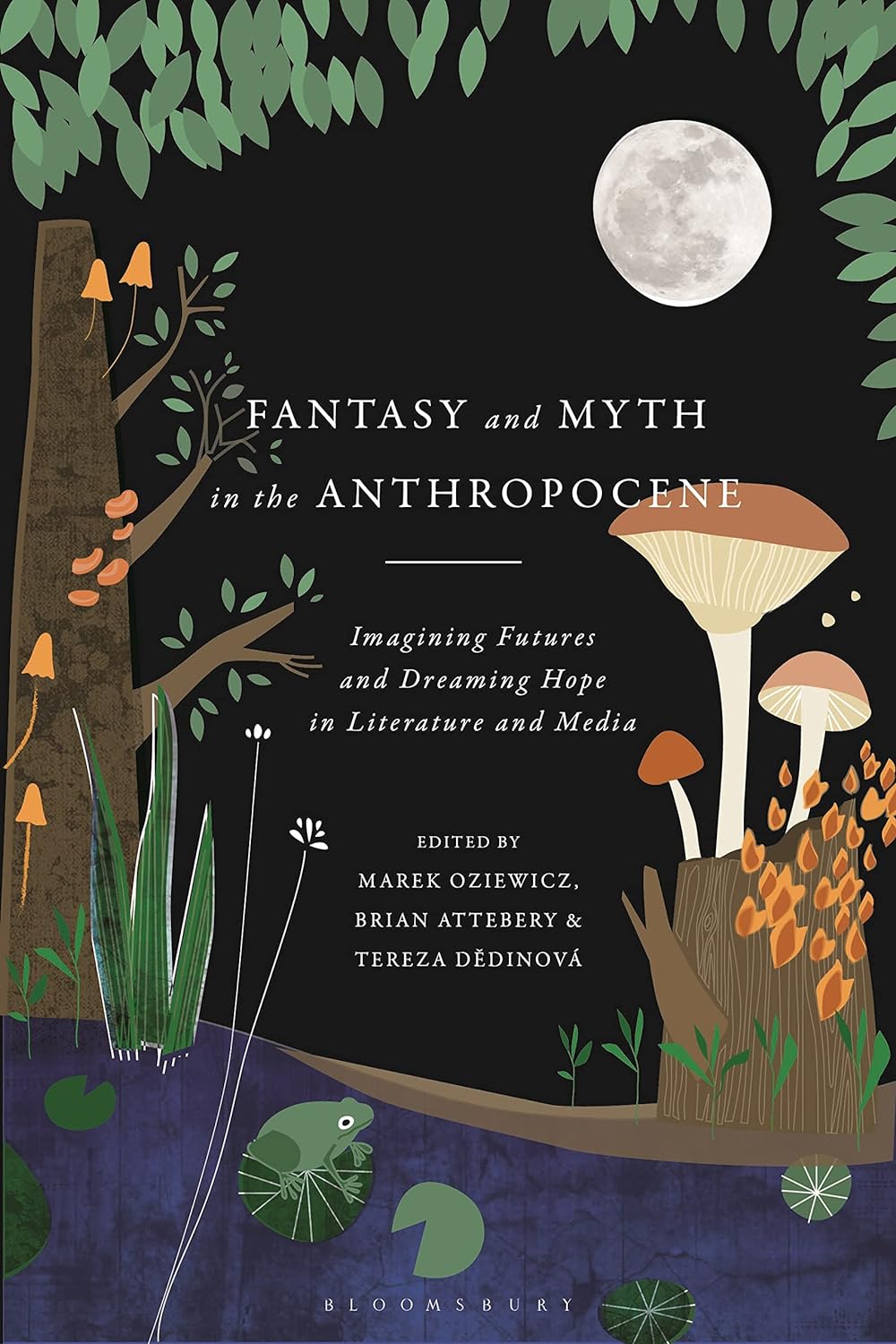
Marek Oziewicz, Brian Attebery, and Tereza Dědinová, eds. Fantasy and Myth in the Anthropocene: Imagining Futures and Dreaming Hope in Literature and Media. New York: Bloomsbury Academic, 2022. Paperback. 272 pg. $34.95, ISBN 9781350204164.

Fantasy and Myth in the Anthropocene represents a major and overdue intervention in fantasy studies: in contrast to the long presence of ecocriticism and environmentalist thought within science fiction studies, fantasy has received only sporadic and admittedly often superficial attention from such critical perspectives over the past few decades. At the same time, the book is also not a typical collection of academic essays, its highly heterogenous contents including, among many other surprises, a number of pieces of visual art; poetry from both Native storyteller Joseph Bruchac and Katherine Applegate of Animorphs fame; and short fiction by both leading scholar of Indigenous futurisms Grace Dillon and magisterial fantasy scholar Brian Attebery, the latter also being one of the book’s three editors. Attebery joins Czech scholar Tereza Dědinová—herself also a co-editor of the 2021 collection Images of the Anthropocene in Speculative Fiction: Narrating the Future—and noted scholar of literature for young people Marek Oziewicz, whose 2008 monograph One Earth, One People: The Mythopoeic Fantasy Series of Ursula K. Le Guin, Lloyd Alexander, Madeleine L’Engle, and Orson Scott Card broke considerable ground in bringing insights from ecocriticism to the study of genre fantasy. The three members of this editorial team obviously bring very different perspectives that have enhanced the range and depth of the collection, which as a whole pays more attention to children’s and young adult literature than we might expect, and—while covering mainly Anglophone literature—also works to move beyond Anglo-American traditions and conceptions of the fantastic, particularly via Indigenous imaginaries, a vital move for a project that aims to advocate for truly “planetarianist” thinking, to use one of Oziewicz’s key terms (58). While some of its individual essays naturally articulate more substantial or more compelling arguments than others, the collection deserves to be read by anyone interested in how non-realist genres have risen to the challenge of imagining other worlds in the shadow cast by human industrial civilization.

The volume contains 16 conventional academic essays by scholars and an even greater number of short contributions from artists and authors of ecofictional works—including Jane Yolen, Nisi Shawl, and Shaun Tan—which may take the form of poems and/or brief reflective essays. I should note at the outset that the different academics contributing to the book find the concept of the Anthropocene itself more or less useful to think with, often preferring one of the many alternative terms in ecocritical discourse that do not center the human (such as Donna Haraway’s Cthulhucene), or no such term at all; for example, Kim Hendrickx’s chapter “On Monsters and Other Matters of Housekeeping: Reading Jeff VanderMeer with Donna Haraway and Ursula K. Le Guin” concludes that “the ecology and story of the Southern Reach make a case against the Anthropocene as a concept to think with beyond its geological designation” (230). Oziewicz’s introduction likewise explains the editorial perspective: “In this book we invoke the Anthropocene at once as a synecdoche of human supremacist worldview and as a humbling recognition that the planet has been irrevocably altered by human activities” (3). Overall, Fantasy and Myth in the Anthropocene showcases a diversity of perspectives on a diversity of texts, although a few common points of reference soon emerge: Donna Haraway’s Staying with the Trouble (2016); Attebery’s own Stories about Stories (2014); Ursula Le Guin in her capacity as both theorist of fantasy and storyteller; N. K. Jemisin; Jeff VanderMeer; Rebecca Roanhorse; and even John Crowley’s Ka (2017), among other authors and texts referenced in more than one essay. Notable, too, is the near-absence of Tolkien, the fantasy author to have attracted the bulk of the existing scholarly attention when it comes to environmentalist concerns in the genre: more recent fantasies take pride of place here, and often those explicitly engaging with climate change, extraction, and other specific features of our own world’s Anthropocene.

Glancing through the index, one will in fact notice that among the longest entries are not individual authors or works, but abstractions such as “hope” and “responsibility,” the second often tied to Haraway’s concept of “response-ability.” (Haraway’s work occupies a place of such prominence in this book that one wonders if its blending of academic discourse, poetry, and parable emulates Haraway’s own inclusion of “The Camille Stories” in Staying with the Trouble.)Oziewicz’s polemical introduction and his later chapter most clearly articulate his own vision of a “fantasy for the Anthropocene” that might “assist us in the transition to an ecological civilization,” a kind of “applied hope articulated through stories” (64), but similar conceptions of fantasy as a technology of hope appear throughout the collection. Jacob Burg, for one, finds in fantasy and fantasy scholarship the potential for “the makings of an ideological resistance starter kit […] to conceptualize and, more importantly, act upon the Anthropocene” (209). Although its editors thus intend the collection as in part a celebration of fantasy’s capacity to imagine alternatives to and ways out of Anthropocenic and otherwise ecocidal patterns of thought and action, individual contributions prove perfectly willing to critique the limitations of some of the genre’s most beloved texts and authors in this arena, both historically (Tolkien) and much more recently (China Miéville in Un Lun Dun [2007] and even Jemisin herself).

By way of illustration, Derek J. Thiess’s “Convert or Kill: Disanthropocentric Systems and Religious Myth in Jemisin’s Broken Earth,” sure to be the book’s most controversial chapter, approaches Jemisin’s trilogy quite skeptically and understands it very differently from Burg, who frames it as a radical kin-making project at odds with Thiess’s assessment of its limitations: in Thiess’s reading, “by privileging our society’s dominant religious myths,” the novels “subvert their own disanthropocentrism and reinforce a Christian exclusionary religio-politics” (195). Burg’s chapter, by contrast, praises the works of four 21st-century fantasy authors, including Jemisin’s Broken Earth books, as “myths of (un)creation” that “adopt a salvaging spirit by articulating possibilities of life outside of the Anthropocene’s linear progress narratives and teleological thought” (208). While I personally find Burg’s analysis much more persuasive and am not certain that I would arrive at quite the same conclusions as Thiess—that for instance the novels run the risk of “re-entrenching the very divisions drawn in the colonial project” and “recreate mythic structures indistinguishable from the missionary Christian beliefs that have informed colonialism for centuries” (202, 205)—I agree with him that the relationship between Jemisin’s works (as well as other contemporary fantasies) with “mythic” Christian narrative structures merits more attention. More generally, this kind of against-the-grain reading strategy is one we need more of in fantasy studies, and also serves as but one example of how the collection as a whole does not engage in naïve or otherwise Pollyannaish polemic positioning of fantasy as some simple solution to the climate crisis. Burg articulates very well the more modest but still optimistic perspective that characterizes the book: “Of course, fantasy is not a magical balm for all of our planetary woes, but its ability to combat crisis comes just as much, paradoxically, from its ethical and imaginative failures as from its rich store of environmental symbols” (209).

Burg’s chapter also capably covers four authors and a substantial body of theoretical material in an impressively efficient manner, as, I came to notice, do so many of the other chapters. I suspect that the editors restricted contributions to a fairly tight word count, but the authors typically make excellent use of the length they have been allotted, whether their chapters require, for example, an explication of Indigenous epistemological frameworks alongside analysis of two contemporary retellings of niuhi mo‘olelo, or traditional stories about Hawaiian shark shapeshifters (Caryn Lesuma’s chapter); or an examination of a transhistorical, transcultural tradition of imagining “oceanic-chthonic hybrids” (150) spanning, among many more, Hans Christian Andersen’s version of “The Little Mermaid” (1837),Hayao Miyazaki’s Ponyo (2008),and Guillermo del Toro’s The Shape of Water (2017). In the latter case, Prema Arasu and Drew Thornton argue compellingly that “these films are part of the contemporary search for re-entangling humans with other forms of life, including those despised or monsterized” (150), although their chapter does represent an instance where I would have appreciated another thousand words or so in which the authors could have covered the contemporary fishman’s less sympathetic precursors, such as H. P. Lovecraft’s Deep Ones. As written, the chapter can mention Lovecraft’s name but little more, and the shadow of “Innsmouth” looms large over this otherwise excellent piece. Sometimes the challenge the contributors face is simply covering a big book in the depth it requires in a relatively short space, a challenge to which John Rieder’s unexpected piece on Kim Stanley Robinson’s New York 2140 (2017) rises particularly well. The inclusion of this notably realist piece of hard science fiction under the umbrella of fantasy and therefore in this volume may perplex, but Rieder examines how the novel “engages in rewriting one of Western culture’s founding myths, the myth of the Flood” (137), and argues that it concerns itself with the fantasies of capitalism and capitalism’s possible counter-fantasies, such that “its main thrust is counter-fantastic, not so much in its realistic detail as in its overarching project of undermining the fantastic inevitability of the neoliberal capitalist status quo” (146).

Other chapters cover a multitude of texts and subjects, including: the striking resonance between Terry Pratchett’s Tiffany Aching series and the principles of permaculture; a complex but finally misdirected critique of extraction as a driver of climate change in Disney’s Moana (2016); Nnedi Okorafor’s Akata Witch series (2011- ) and how both play and YA might address the crises of the Anthropocene; New Zealand YA author Margaret Mahy’s tree-filled fantasies from the perspective of critical plant studies; the “hopescapes” of the Harry Potter franchise and how we might understand even the theme parks to provide, in a limited way that I think I ultimately find yet more limited than the author does, “opportunities for ecological literacy” (103, 110); and the emergence of a fundamentally “queer ecology” in recent television shows that “model queer ecologies for their young viewers to learn from,” namely Steven Universe (2013-2020, She-Ra (2018-2020)­, and The Legend of Korra (2012-2014) (116-117). I would also highlight Alexander Popov’s chapter “Staying with the Singularity: Nonhuman Narrators and More-than-human Mythologies” as especially illuminating: with a charming narratological penchant for diagrams, Popov argues that some modern fantasies have begun processing the Anthropocene “by shifting nonhuman perspectivization and focalization from the supernatural to the natural” (41), a maneuver that allows works such as Crowley’s Ka to explore “the very possibility of inhabiting shared semiotic worlds” beyond the human (45). The collection also finishes strong with Markus Laukkanen’s valedictory chapter “Literalizing Hyperobjects: On (Mis)representing Global Warming in A Song of Ice and Fire and Game of Thrones.” Laukkanen deftly avoids simplistic readings of George R. R. Martin’s series that would declare it some kind of direct climate change allegory, instead mobilizing Timothy Morton’s concept of the hyperobject very persuasively in order to demonstrate that what the books may suggest about climate change they accomplish through a broader thematic emphasis on phenomena at the same incomprehensible scale: “[T]he books incorporate the logic of hyperobjects and thus render global warming available for representation and understanding” (242). Laukkanen judges the HBO adaptation to be increasingly less invested in such tremendous elemental forces in favor of the anthropocentric political intrigue to which its own new title gestures. While Attebery’s opening chapter on Ka and the variously anthropocentric and disanthropocentric trajectories of genre fantasy writ large matches Laukkanen’s well as the other solid bookend for the collection—and Attebery’s series of framing elemental parables interspersed throughout provide this collection with a productively disorienting character—it is Oziewicz’s writing that is finally the most forceful and indeed moving in its emphasis on what he diagnoses as “the ecocidal unconscious” and how fantasy might defuse it (58). His concept of “planetarianism,” defined as “at once, a biocentric philosophical commitment to standing up for the planet and an applied hope articulated through stories” stresses the need for a “hope-oriented imagination” to move us towards a biocentric future (58-59). If he is correct in his hope that “fantasy for the Anthropocene can disrupt the fantasy of the Anthropocene” (58), fantasy authors and fantasy scholars alike may have a larger role in bringing about a more just and inhabitable future than we think.

Review of Existential Science Fiction


Review of Existential Science Fiction

Jess Flarity

Ryan Lizardi. Existential Science Fiction. Lexington Books, 2022. Hardback. 170 pg. $95.00. ISBN 9781793647351. Ebook. $45.00. ISBN 9781793647368.

Ryan Lizardi’s Existential Science Fiction is an ambitious book with a misleading title, as the focus is on recent science fiction cinema with a brief two chapters on video games. A better title might be 21st Century Existential Science Fiction, and Lizardi inserts a self-critique in the introduction pointing out this discrepancy:

It is a weighting of sorts, as the two historical chapters each cover roughly fifty years of science fiction media content and the lion’s share of the rest of the book covers ten years, from 2010 to present. Any researcher who was so inclined could write an exploration of existential science fiction media and flip this imbalanced script… I embrace that criticism… (xii).

This book represents a single constellation of existential fiction when there’s a whole night sky to explore, but it could still be useful for those focusing on the major works covered: Solaris (1972, 2002), Gravity (2013), Ad Astra (2019), Interstellar (2014), Arrival (2016), Annihilation (2018), Legion (2017–19), Westworld (1973 movie and 2016–present tv series), and the video games Assassin’s Creed (2007–2020), BioShock (2007 –2013), SOMA (2015), and Death Stranding (2019). There is a logical underpinning to these selections, though a weakness inherent in existentialism is that it can be perceived in anything, as best evidenced by the dark hilarity of the comic strip Garfield Minus Garfield. Another issue with Lizardi’s approach is that he is applying a philosophy historically dominated by white men to a group of narratives largely by and about white men; even in places that lead to obviously more feminist interpretations, such as in Gravity and Annihilation, Lizardi ignores questions related to gender, as well as race, to focus on aspects of “human” responses. Intersectionalism has taught us that we need to be careful with such a universal flattening of experiences, as too often they are skewed towardness maleness and whiteness.

The book’s first chapter fast forwards past any mention of Kierkegaard or Nietzsche and gets immediately to the heart of Lizardi’s primary focus, film theory, starting with the existential themes in 1902’s A Trip to the Moon and 1927’s Metropolis. He quotes heavily from Bradley Schauer’s Escape Velocity: American Science Fiction Film 1950 – 1982 (2017) throughout this section, using Schauer’s arguments to highlight the 1951 film Destination Moon as the progenitor of modern science fiction movies, as he states it is “important to examine for its semantic genre elements and its syntactic existential characteristics,” and it has a “heavy reliance on verisimilitude and science over action and otherworldly antagonists” (8) which he proposes is a critical element of existentialist science fiction. After a brisk whirl through the cinema of the 1950’s, the second chapter posits 1968’s 2001: A Space Odyssey as the next major film in the existential megatext, as we well as both versions of Solaris (1972, 2002)and Blade Runner (1982, 2017), while discussing how other forms of non-human (alien, AI) intelligences create an existential crisis for humans. Lizardi is well-researched throughout this chapter; he balances direct evidence from the films, statements from their directors, and academic essays, in order to draw comparisons across decades of Hollywood cinema.

Jean-Paul Sartre finally makes his appearance in the third chapter on Gravity and Ad Astra, where Lizardi asserts one of his main theses: “I would also argue that this contrast [between the harsh reality of outer space and the precarity of life] is sometimes the most crucial element of existential science fiction, as it allows audiences to focus more intently on the philosophical elements without the distracting sensational and implausible action so prevalent in early science fiction media” (37). He uses Sartre to posit that the environment of outer space puts the human subject in an atheistic state of crisis, considering they are literally beyond the Earth but not in any kind of heaven or afterlife, and Lizardi convincingly claims that the astronaut symbolizes humanity at the edge of the technological sublime. However, it should be noted that he does not use time-stamp notations for any of his references throughout the entire book, so those looking to pinpoint specific moments in the films will have to look them up themselves.

The following chapter analyzes Arrival and Interstellar as the recent “smart” science fiction films; Lizardi theorizes their existentialist themes could not coexist with more traditional movie plots. He writes, “Their emphasis, however, is not on the antagonism present in so many other science fiction media that encounters other planets and aliens, but instead is on a deep dive into science” (49). Lizardi then compares Arrival to the film Contact (1997) while contrasting it to Independence Day (1996),and he has many useful observations relating to the Sapir-Whorf hypothesis in how these films approach communication with aliens. He also uses evidence from the original source material, Ted Chiang’s novella “Story of Your Life” (1998), something he doesn’t do with the earlier chapters, pointing out the existentialist themes related to the awareness of death in both mediums. He continues this approach in the next chapter on Annihilation, using sections from Jeff VanderMeer’s Southern Reach trilogy (2014) along with personal interviews from director Alex Garland, who used a unique method of adapting the book into the movie by purposefully incorporating ambiguity throughout the entire process.

The next chapter on the tv series Legion feels out of place compared to the previous ones, as the show is sourced from the X-Men comics and employs a much more slippery type of “comic book logic” than even mainstream sci-fi, yet it doesn’t really fit with his later video game chapters, either. The streaming revolution has launched dozens of science fiction tv series with notable existentialist themes in the past decade—several different shows from the same time period would have made more sense for analysis here—notably Orphan Black (2013-2017), Altered Carbon (2018-2020), Black Mirror (2011-2019), Humans (2015-2018), The Expanse (2015-2022), Stranger Things (2016- ), or Sense8 (2015-2018). Fortunately, Lizardi gets back on track with the following chapter on Westworld because he ties it to the existentialist themes in the original film while adding to his earlier observations on the uncanniness of artificial intelligence.

The final two chapters are on video games; the chapter on SOMA and Death Stranding is much more compelling and thematically appropriate than the one on Assassin’s Creed and BioShock. The latter two games are types of Alternative History, and Lizardi focuses on these games while ignoring related media and novels, such as the The Man in the High Castle (1962, 2015-2019), making the chapter feel like it belongs in a different book altogether. Also, while the earlier BioShock games are very atmospherically existentialist because of the post-apocalyptic, claustrophobia-inducing underwater setting, Lizardi’s arguments begin to break down into long sequences where he is doing little more than summarizing the game’s plot and providing casual observations. An example of this is from pages 116-121, where he goes into extensive detail surrounding the final installment of BioShock Infinite (2013) and the related downloadable (DLC) content, but he does not directly quote from the game or bring in the works of other scholars. This lack of rigor unfortunately causes the book to end in a wandering state of confusion rather than in a satisfying, Nietzschean cosmic apotheosis, but perhaps this makes it even more existential, after all? It is up to the reader to construct their own “bad faith” argument here.

In summation, Existential Science Fiction will be useful for anyone interested in tracing the genealogy of some modern existential science fiction films, but the inclusion of the tv series and videogames makes the latter half feel disjointed.

Jess Flarity is a fourth-year PhD candidate in Literature at the University of New Hampshire. His dissertation is tentatively titled The Splintered Man and seeks to track the fracturing of masculine identities in American and British fiction throughout the 20th century.

Review of Star Warriors of the Modern Raj: Materiality, Mythology and Technology of Indian Science Fiction


Review of Star Warriors of the Modern Raj: Materiality, Mythology and Technology of Indian Science Fiction

Jahnavi Gupta

Sami Ahmad Khan. Star Warriors of the Modern Raj: Materiality, Mythology and Technology of Indian Science Fiction. University of Wales Press, 2021. New Dimensions in Science Fiction. Ebook. 258 pg. $70.00. eISBN 9781786837639.

Sami Ahmad Khan’s Star Warriors of the Modern Raj was published in June 2021, and is, by its own admission, “a fan’s alternative,” “a beginner’s guide,” and “a critical catalogue” of twenty-first-century Indian Science Fiction originally written in English (ISFE) for the uninitiated with “SF, in general, and Indian SF in English, in particular” (xiii). The “catalogue” spans an impressive breadth of contemporary ISFE and abstains from engagement with the questions of aesthetics and literariness of ISFE as its “critical” focus is to lay bare the ideological/material, mythological, and technological forces that the 21st-century ISFE is imbricated in and engages with. Deeply conscious of the plurality that ISFE itself hosts and the “congruences and conflicts” (xiii) generated in transposing global SF structures onto India’s SF output, Khan not only “flits across [theoretical] vantage points that arise out of markedly different contexts” (xiv) but also offers an “IN situ Model” that frames his manuscript. The model and its three theses—“transMIT thesis,” “antekaal thesis” and “neoMONSTERS thesis”—are explained in text and through a flowchart in the second chapter of the introductory first section. Khan primarily employs the “transMIT thesis” in this monograph, which also informs its three core divisions—(Ideology/)Materiality, Mythology, Technology; these are bookended by a forty-page introduction and a short concluding chapter.

The first of the five sections is called SF-101 and has three chapters that lay the groundwork for the central three sections of the book. The first chapter, titled “Whoever Loses, SF Wins,” comprehensively charts the longstanding global debates about and difficulties in defining the genre of SF. It shows how the conversations have moved from understanding SF as a genre with fixed boundaries to a mode where the “actants” and “communities of practice” of SF keep it fluid and mutating (15). This chapter is quotation heavy but seamlessly woven together largely from Western critics’ works, contributions from Bodhisattva Chattopadhyay being the exception, to trace the movements and oscillations of SF criticism.

Chapter 3, “Prayers in the Rain,” employs reworked metaphors from Indian metaphysics (atman, paramatman, Vaikuntha), philosophy (dualism, manifestations, transcendence), and math (kilo, mega, yotta) in an attempt to define ISFE by identifying its various distinct features while also searching for its core/soul. The riot of metaphors in this short chapter demonstrates that the constituent components of ISFE—India, science, science fiction, and the English language—are themselves changing, contested, and escape easy definitions. Further, in a convoluted fashion, he recasts Roger Luckhurst’s argument in “The Many Deaths of Science Fiction: A Polemic” that Anglo-American science fiction is ashamed of its pulp origins and wishes to be legitimised by being accepted in the mainstream literary canon; Luckhurst calls this SF’s death wish. Khan expands Luckhurst’s argument by activating the metaphors of atman and paramatman and Plato’s theory of forms to state that all tangible manifestations of regional, national, and global SF aim to be merged with a higher transcendental conception/spirit of World Literature—essentially all SF, including ISFE, desires to leave its generic identity behind to meet and be validated by global literary standards.

The second section of the book, Materiality, has three chapters. This part outlines his classification of the three orders of Others/alterity that ISFE works with. Grade III, or the Civilizational Other, is an amalgam of India’s religious, political, and national threats outside the border; Grade II, or the Social Other, is the overlap of the internal class and caste structures; and Grade I, or the Gender(ed) Other, is constituted by the concerns raised in the sphere of sex and orientations. The three chapters in this section examine various ISFE texts and how these Others are “(re)interpreted and (re)created” (45).

The third section, Mythology, begins with Khan’s three portrayals of god(s) in ISFE—gods as extraterrestrials (from other planets), gods as socio-political indictments (from other temporal locations), and gods as hyperintelligences (from other technological axes) —and the first three of the four chapters of the section discuss ISFE texts relevant to these depictions.

The five chapters in the fourth section, Technology, deal with the broad areas of emerging technological advancement that occupy the Indian science fictional imagination and their varied uses in the selected narratives: genetic engineering; cyber threats; chemical, biological, radiological, and nuclear weapons; alien hyperintelligences; and global climate change.

The concluding chapter, “ISFE: A New Hope,” ties together the previous three sections, demonstrating that the post-2000 ISFE is conscious of and responding to the networks of power and discourses they are embroiled in. Despite having his transMIT thesis attested, Khan alerts readers against any essentialising qualities of ISFE and admits that many ISFE might not have any immediate political entanglements. 

The book’s three main sections progress in an orderly fashion, and their larger pattern of organisation becomes immediately perceptible to the reader. The chapters in these three sections include detailed summaries of the texts being discussed, enabling the readers to follow the argument. Broadly, too, the book is accessible, at times because of and at other times in spite of its easy gliding through SF theoretical terms and frames, Indian lexicon, popular western SF, and math and scientific references. Khan neatly delivers what he promises and additionally gives an overview of an indigenous critical framework for Indian SF, even though his incessant application of “science to SF criticism” (4) can be befuddling. His critical survey of Indian SF and its broad recurring themes is a timely and meaningful addition to the recent flood of the body of works on Indian SF, such as Shweta Khilnani and Ritwick Bhattacharjee’s Science Fiction in India: Parallel Worlds and Postcolonial Paradigms (2022), Urvashi Kuhad’s Science Fiction and Indian Women Writers (2021), Suparno Banerjee’s Indian Science Fiction: Patterns, History and Hybridity (2020), and Upamanyu Pablo Mukherjee’s Final Frontiers: Science Fiction and Techno-Science in Non-Aligned India (2020). Khan’s extant corpus of fictional and critical writings blooms with this work and will be a great beginning resource for readers and researchers looking to orient themselves with regard to twenty-first-century ISFE and its thematic engagements.


WORKS CITED

Luckhurst, Roger. “The Many Deaths of Science Fiction: A polemic.” 1994. Science Fiction Criticism: An Anthology of Essential Writings, e-book, edited by Rob Latham, Bloomsbury Academic, 2017, pp. 59-73.

Jahnavi Gupta is an M.Phil. graduate (awaiting viva) in literatures in English from the University of Delhi, India. Her research interests include speculative fiction, women’s writings, young-adult literature, and graphic novels. She has previously published in Guwahati University’s (India) journal Margins and in All About Ambedkar. Over the past two years, she has taught language and literature courses at various Indian universities and is currently working as an English Language Instructor at IIT Jammu, India.

Review of Out of This World: Speculative Fiction in Translation from the Cold War to the New Millennium


Review of Out of This World: Speculative Fiction in Translation from the Cold War to the New Millennium

Sara Martín

Rachel Cordasco. Out of This World: Speculative Fiction in Translation from the Cold War to the New Millennium. University of Illinois Press, 2021. Hardcover. 316 pg. $60.00. ISBN 9780252043987.

Rachel S. Cordasco’s Out of This World: Speculative Fiction in Translation from the Cold War to the New Millennium is an exceptional volume that can be at the same time overwhelming even for readers with a sound knowledge of speculative fiction. Reading Cordasco’s volume is proof that not even the most committed reader has a good grasp of the vast international dimension of an already enormous field, even if we think only of its Anglophone version.

Cordasco, an experienced writer, editor, reviewer and translator, has been running the website Speculative Fiction in Translation (https://www.sfintranslation.com/) since 2016 because, as she writes in the “About” section, “Speculative fiction offers us a unique perspective on the different peoples who call this planet home, and translation is itself a way of turning the alien into the familiar.” Her website continues the work done by Israeli SF author Lavie Tidhar in the World SF blog (2009-2013, https://worldsf.wordpress.com/), which he started, as he explains in his final post (“A Last Word”)  “partly as an excuse to promote my then-forthcoming anthology of international speculative fiction, The Apex Book of World SF—but mostly out of what can only be described as an ideological drive, a desire to highlight and promote voices seldom heard in genre fiction.” The impact of English-language original speculative fiction is massive (in this and in most genres), and both Cordasco and Tidhar set out to try to offer a more panoramic, truly cosmopolitan, vision. Cordasco’s website presents reviews, interviews, and, most interestingly the section SFT Source Language Lists (https://www.sfintranslation.com/?page_id=11605) which offers constantly updated bibliographies of SF translated into English from fifty-seven languages. This is a truly formidable task, and one must marvel that a single person can carry it out, even assuming she has many collaborators.

The website lists are the origin of Out of This World, which offers chapters for fourteen of these fifty-seven languages: Arabic, Chinese, Czech, Finnish, French, German, Hebrew, Italian, Japanese, Korean, Polish, Russian, Spanish and Swedish. These are the languages with a minimum of ten volume-length texts translated into English since the 1960s, the criteria Cordasco has followed, as she explains. In the “Introduction” Cordasco presents Out of This World as a reference volume and a guide, and warns that she is extending the field covered in her website to speculative fiction (rather than only SF), fantasy, and horror. Each chapter has an introduction by a guest writer from the linguistic area presented, who briefly surveys the history of SF, fantasy, and horror in their language. This is followed by a second survey by Cordasco of the texts translated into English, briefly describing their contents. Finally, each chapter offers a bibliography of translated primary sources in chronological order by original publication date, notes, and a bibliography of secondary sources.

Cordasco’s volume is, no doubt, a gem, and it cannot be sufficiently praised. At the same time, it is, as noted, a daunting book since it requires a type of reader willing to take in a torrent of information, or to use the volume as a guide to a years-long (if not decades-long) process of becoming familiar with other traditions. There is, besides, the doubt of whether the SFT Source Language Lists already mentioned fulfil the same purpose in better ways. The online lists lack the very helpful introduction or the insightful comments on each of the translated texts that the book chapters offer, being pure bibliography. Yet, I remain personally mystified by our insistence to publish as print or digital volumes information that might work best as an online resource, perhaps a database, or even an app.

Cordasco stresses that her purpose is to guide Anglophone readers curious about how their favorite genres work in other languages; though, of course, she is also helping non-native readers of English to reach other speculative fiction traditions. Cordasco supposedly wants readers to check her volume whenever they wish to read foreign authors unknown to them rather than read the book from beginning to end, just as nobody (or almost nobody) reads dictionaries. Yet, perhaps what is missing is a basic beginner’s list with, for example, just one work from each of the fourteen languages selected. Or clearer instructions about how to use the volume. Reference books are not reader-friendly and, arguably, cannot be so because of their very nature. In that sense, it is interesting to see how the website Worlds without End has transformed David Pringle’s popular guide Science Fiction: The 100 Best Novels into a user-friendly webpage (see https://www.worldswithoutend.com/novel.asp?id=8146).

Pringle’s selection, additionally, is based on a round figure, which is more or less manageable for a committed reader in small steps. In contrast, Cordasco’s volume mentions hundreds of books. It must be acknowledged, at any rate, that at least these books are mentioned because they are available in English. In contrast, Dale Knickerbocker’s equally excellent edited volume, Lingua Cosmica: Science Fiction from around the World (2018), also published by the University of Illinois Press, whets an appetite that often cannot be satisfied because of the lack of the corresponding translation into English. It is, in fact, advisable to read both volumes together to fully understand how much brilliant speculative fiction is still in need of translation into English and whether what is available is sufficiently representative.

To conclude, please give Rachel Cordasco’s Out of This World a warm welcome in your personal or college library, for it deserves it. Her invitation to enjoy the riches of many diverse speculative fiction traditions needs to be accepted, both regarding the fourteen languages dealt with in the volume or the fifty-seven of the website. It is actually very good news that her volume is so formidable, for this means that there are countless treasures in speculative fiction to be discovered by anyone who can read English. And if any publisher gets hold of the book, hopefully they will receive the message that the presence of the other traditions still underrepresented in English needs to be urgently increased.

Sara Martín is Senior Lecturer in English Literature and Cultural Studies at the Universitat Autònoma de Barcelona. Dr Martín specializes in Gender Studies, particularly Masculinities Studies, and in Science-Fiction Studies. Her most recent books are American Masculinities in Contemporary Documentary Film (2023) and Detoxing Masculinity in Anglophone Literature and Culture (2023, co-edited with M. Isabel Santaulària). Dr. Martín is the translator of Manuel de Pedrolo’s Catalan masterpiece Mecanoscrit del segon origen (Typescript of the Second Origin, 2018).

Review of American Cities in Post-Apocalyptic Science Fiction


Review of American Cities in Post-Apocalyptic Science Fiction

Allan Weiss

Robert Yeates. American Cities in Post-Apocalyptic Science Fiction. UCL Press, 2021. Modern Americas. Hardcover. 212 pg. $70.00. ISBN 9781800081000.

Robert Yeates’s study of the image of the American city is an ambitious book. It endeavors to analyze how American urban spaces are portrayed in science fiction, and not just in prose fiction but in various media: radio drama, film, comics, games, and the “transmedia franchise” (works that began in one medium and then have been adapted for others), as well as magazine fiction. Each chapter traces the depiction of the city in one or a few texts that Yeates treats as representative of the genre and the medium.

The book’s ambition is both its strength and its weakness, however. After an introduction laying out his theoretical foundations, and explaining why he moves beyond consideration of fiction alone, Yeates devotes about 150 pages to the texts themselves. There is good reason to look at how the various media treat the theme, especially given how much post-apocalyptic science fiction in the twenty-first century is in the form of movies and games, but it is quite a challenge to deal adequately with all this material in such a short study. The effort is certainly admirable, but practical considerations mean that in some cases only one or two texts must stand for many more that may or may not fit Yeates’s claims for the genre or medium as a whole.

Furthermore, some of Yeates’s textual choices are debatable, to say the least. Until film, games, and television came to greater prominence in post-apocalyptic SF, prose fiction offered numerous and varied visions of life after the near-end of humanity in both short stories and novels over a long period. Yeates shows some familiarity with early texts in the field, but provides a somewhat brief and derivative history of apocalyptic science fiction. He relies heavily on some sources, particularly W. Warren Wagar’s Terminal Visions, while not mentioning Martha Bartter’s important article “Nuclear Holocaust as Urban Renewal” at all in his literature review and only incorporating her insights in Chapter 3, where he discusses film. Giving prose fiction just one chapter gives short shrift to all that material from Mary Shelley’s The Last Man (1826) to current cli-fi. He focuses only on magazine fiction—that is, short stories—and of all the choices available he chose to look at Jack London’s hardly representative “The Scarlet Plague” (1912). The story undeniably deserves more attention than it has received, but what about Stephen Vincent Benét’s “By the Waters of Babylon” (1937) or Harlan Ellison’s “A Boy and His Dog” (1969), to name only two? Yeates discusses London’s story in the context of the pulps, but while it was published during the days of general-interest pulp magazines, it predates the science fiction pulp era and it first appeared in a British large-circulation magazine.

Other textual choices are equally questionable. In looking at radio drama he analyzes, in addition to original scripts, adaptations of stories like Ray Bradbury’s “There Will Come Soft Rains” (1950) and “Dwellers in Silence” (1949), both of which were later published in The Martian Chronicles (1950); one cannot help wondering why he did not study the original stories instead. More curiously, when he turns to film he devotes most of his chapter to two adaptations of novels by H. G. Wells on which George Pal worked, The War of the Worlds (1953) and The Time Machine (1960). While the first moves the action to Los Angeles, the second remains set in London, putting it well outside Yeates’s scope. He also discusses Things to Come (1933) more briefly—another film based on Wells and, as he acknowledges, set in London. Many more films could have been analyzed instead, including ones he names, like The World, the Flesh, and the Devil (1959) and Panic in the Year Zero! (1962) among the earlier nuclear-holocaust films by and about American cities, and innumerable later ones dealing with both nuclear and non-nuclear apocalyptic events. On the other hand, he does an excellent job of laying the theoretical groundwork for the study of visual representations of disaster and the post-apocalyptic city. He analyzes the way Los Angeles appears in Blade Runner (1982), although less in the original film than in the transmedia adaptations of it. 

There are some other gaps that he might have been filled in. For instance, the chapters seem somewhat disconnected; while some common motifs, like ruins and their effects on the audience, are traced through the various media, each chapter seems to offer a distinct argument, and less attention is paid to how the aural and visual media perpetuated tropes that had been established elsewhere. Also, a more comprehensive account of the city in fiction, as constituting the site of both corruption in tales going back centuries, and utopia in Plato and then the Renaissance and later, might have contextualized the science fiction better.


WORKS CITED

Bartter, Martha A. “Nuclear Holocaust as Urban Renewal.” Science Fiction Studies, vol. 13, no. 2, 1986, pp. 148-58.

Benét, Stephen Vincent. “By the Waters of Babylon.” Miller and Greenberg, pp. 240-52.

Blade Runner. Directed by Ridley Scott. Warner Brothers, 1982.

Bradbury, Ray. The Martian Chronicles. Doubleday, 1950.

Ellison, Harlan “A Boy and His Dog.” Miller and Greenberg, pp. 335-73.

London, Jack. The Scarlet Plague. Mills & Boon, 1915.

Miller, Jr., Walter M., and Martin H. Greenberg, editors. Beyond Armageddon: Twenty-One Sermons to the Dead. Donald I. Fine, 1985.

Panic in the Year Zero! Directed by Ray Milland. American International, 1962.

Shelley, Mary. The Last Man, edited by Anne McWhir, Broadview, 1996.

Things to Come. Directed by William Cameron Menzies. United Artists, 1933.

The Time Machine. Directed by George Pal. MGM, 1960.

Wagar, W. Warren. Terminal Visions: The Literature of Last Things. Bloomington: Indiana UP, 1982.

The War of the Worlds. Directed by Byron Haskin. Paramount, 1953.

The World, the Flesh, and the Devil. Directed by Ranald MacDougall. MGM, 1959.

Allan Weiss is Professor of English at York University in Toronto. His monographs The Routledge Introduction to Canadian Fantastic Literature and The Mini-Cycle appeared in 2021, and he is the author of articles and has given conference papers on Canadian and fantastic literature. He has been Chair of the biennial Academic Conference on Canadian Science Fiction and Fantasy since 1996, and has edited three volumes of proceedings from the conference. He has also published three short story collections, Living Room (2001), Making the Rounds (2016) and Telescope (2019), and stories in various journals and anthologies.