Review of Memory’s Legion


Review of Memory’s Legion

Robert J. Creedon

Corey, James S.A. Memory’s Legion Orbit, 2022.

.

Memory’s Legion is a compilation of the novellas and short fiction of the Expanse universe of James S.A. Corey. The Expanse consists of a series of books and short stories, a role-playing game, and a television program. Small parts of Memory’s Legion make up a collection of shorter fiction that was produced for other media. Each is available through other means, but together they are placed in a chronological order related to the main series of books. For someone who only knows the TV series and RPG game, Memory’s Legion expands upon the worlds, characters, and periods of the series. This collection isan amazing introduction to the many elements of the Expanse universe and series. I accessed this text through Audible, which additionally provides authors’ notes (spoken by the authors) and allows the listener to hear the correct pronunciation of names and places. This review will try not to reveal any spoilers but only hint at their existence.     

“Drive” is the first short story. It covers the technological advancement that makes space travel more profitable and accessible in this universe. The Expanse is set 200 years into the future. This story, set 150 years before the main plotline of the series, follows Solomon Epstein as he invents the Epstein Drive to allow faster space travel. The drive enables humankind to venture throughout the solar system, including the Outer Belt and the moons of outer planets. It is a wonderful blend of hard soft science as the authors “show” rather than tell in this story of the first flight. Although theory, it gives a wonderfully detailed explanation of the related theoretical physics. Solomon Epstein reflects upon his past as we learn what this new technology does to him, the pilot. It is a very skillful tribute to this fictional inventor that sets off the entire “expanse” or colonization of the solar system.  

The next three stories are all interconnected as they cover the main zones and characters of the series. “The Butcher of Anderson Station” introduces Colonel Fred Johnson and the Belters with the theme of political strife between governments, corporations, and the Belters. We see how Johnson evolves and observe the living conditions of the people of the Belt and Outer Planets. “The Churn” introduces the background of a major character from Earth with a surprise twist. The hidden twist helps the reader to focus on a wonderful story of the lives of the common people of Earth, demonstrating how the lives of people on Earth are shaped by their high population numbers. We see things like “Basic” Universal Income, free mass transit, and underground economies of the average citizen without looking at only the elites. Once the twist is revealed, it makes a lot more sense. From the TV series, the actor is subdued and only hints at what the character is experiencing, which can be felt from his performance. After reading this, you will have a greater appreciation for elements of his performance and backstory. Finally, “Gods of Risk” continues the story of Bobbie Draper and introduces us to common life on Mars. Mars is colonized and seems to be very much like a modern-day Earth in lifestyle and opportunity. Each of these stories establishes the political environment of their cultures through a personal story that draws in the reader. Each gives its flavor to a crime story of sorts but that just is the medium for these great character stories. Much of the jargon and flavor of each world is conveyed so this makes a great introduction to the cultures for both reading the series and playing the RPG version. 

“The Vital Abyss” covers a discovery and technological development that was not explored well in the series. The story presents a very interesting argument in ethics and philosophy wrapped into a weird story of an unusual situation. I now see that there was really no place for this in the main series, but it is a very deep story that is a pleasure to experience. Strangely, this story also introduces the reader to a theme or element of the Expanse universe that might be missed. A major character has a diverse education that bridges ideas and concepts from many sciences within the story. This mirrors the biological education of one of the authors that adds layers to many of the stories. We also see the higher education skill of secondary fields like philosophy from the author notes or interview at the end of the Audible reading. This does support that any beginning writer should read or listen to this collection with interviews as a lesson on the importance of diverse personal skills and techniques in world building.

“Strange Dogs” reads simply as a horror story but has many layers. We have advanced forward into time to the colonizing of the planet, Laconia, within the Expanse universe. We meet a young girl named Cara who is growing up on the world as part of what was supposed to be just a five-year mission. She is being raised with rules from Earth on a world where most of those rules do not apply. She is a young, responsible girl trying to do the right thing, but all the rules have changed. The authors say that this is a story of immigrants. The first generation tries to live by their rules from home, but Cara develops through her learning of the rules of the planet. Within this horror story, we see that the planet has different technologies and abilities. I do not see it as horror even though it ends very horror like. It has more of a colonization / immigrant edge to it as two cultures experience conflict. As a Canadian who works in a First Nation community, I recognize a familiar misunderstanding between the Laconians and humans as they try to help. It reminds me of the Westerns where a young child becomes part of tribe or the Star Trek NG episode “Suddenly Human” where the child is reintroduced to humans after being raised by an alien culture. This is a much more interesting way of dealing with the bridging of two different cultures by a person. The total distrust of the events due to human-centered beliefs causes the horror but what would have happened if the characters connected as Cara does, accepting the gifts and knowledge of the “Strange Dogs”? What are we learning from the Indigenous peoples now that we are actually listening and trying to understand? “Strange Dogs” therefore prompts the reader to carefully consider these pivotal topics.

“Auberon” is a story filled with political intrigue. This is due largely to its plot, which focuses upon the aftermath of the Laconian Empire’s takeover of the universe and its subsequent placing of governors on its planets. Strangely, it opens with a wonderful speech about how change is constant and that there is therefore a dire need to learn new rules quickly. There are definite connections to “The Churn” and the recurrence of the social political emphasis in the Expanse universe. We see how a governor deals with a very corrupt planet with limited trusted forces and how the criminal underworld adapts and survives. We learn about the problems of winning a war. What really gets me is how this story is so perfect as a teaser for the series without giving anything away. There is even a reference to “Strange Dogs” linking them. The author’s notes additionally enrich this section. For these reasons, it is a short story that prompts the reader to explore the rest of the series.

“Sins of the Father” tells the tale of one of the characters and how this character ends up wrapped in a very strange fate. A major event happens in the universe, so we see the effects on a group of colonists. Once you read this story, you will also see a strange karma in the fate of the main character, but what struck me was how Earth is being destroyed and we look at the stars and science for solution. Between “Strange Dogs” and this story, we are told it is not a guarantee. There is a secondary lesson in the stories of the Expanse about life on this planet and possible outcomes. This might not be an intentional theme, but I picked up on the possibilities. Not everything turns out, especially for 400 with no way home and no chance of rescue.

The short stories and novellas in this collection are a wonderful gateway into the Expanse universe, whether it is for a reader of the books, a watcher of the TV series, or a gamer interested in the RPG. This also carries great weight for the aspiring writer to see the craftsmanship and diversity of knowledge necessary for creating a realistic universe. We see biology, politics, and philosophy as major viewpoints for the writing. The Expanse universe was also used for a campaign for a roleplaying game by the author. One thing many tabletop or Role Playing Games do is incorporate elements of different fictional worlds. Many read the works of the authors to get the flavor of the universe in which they are playing. The authors of the Expanse do well in explaining the science and technology involved in these stories and exploring the culture of both the leaders and the common folks, especially those of the underworlds. There is even new terminology like “goldilocks planets” and “living on basic” to explain concepts in this view of the universe. 

This collection allows the players to jump off many places for their own games and campaigns through this long story arc. This is a wonderful piece of writing as both an introduction and teaser to the Expanse books or TV series. The Audible package also includes the author’s notes in an interview format after each story, which, by providing the authors’ comments directly, greatly enriches the text. It is a nice package to give clarity plus it provides great insight into the writers and the process. Those author’s notes are very informative to both readers and future writers. For those watching the TV series, these stories are linked in as titles and more. Reading or listening to the stories provides a depth and scope unavailable to consumers solely of the television series. The quality of the reader in the Audible recording is great as there are those voice changes that help the listener understand who is speaking. Additionally, it is read at a great pace and is clearly spoken. Overall, this book and its format are top quality and worth your time whether you be an avid fan or someone looking for a mind-opening piece of science fiction. It provides escapism, provokes important ideas, and introduces strong characters, culminating in a great reading or listening experience. 


Robert Creedon is an intermediate and high school teacher in the Canadian First Nation community.  With backgrounds in emergency services, sociology, and teaching, he has cultivated an interest in science fiction through tabletop role playing games, film, media, and books for over 40 years.  This is his first review of fiction, but he has reviewed books on popular culture and philosophy before.  Robert has also participated in over 50 productions of theater and media.   
Review of A Master of Djinn


Review of A Master of Djinn

Ian Campbell

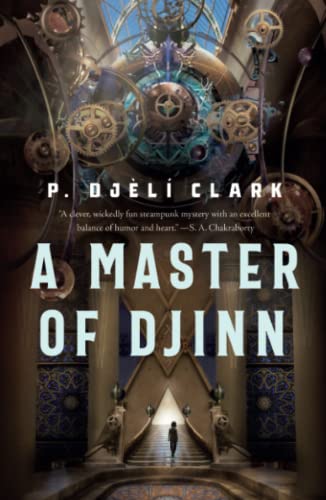
P. Djéli Clark. A Master of Djinn. Tordotcom, 2021. Hardcover. 400 pg. $18.59. ISBN 978-1250267689.

.

Clark’s debut novel won the Nebula Award for Best Novel in 2021, and in 2022 won the Compton Crook Award for Best Novel and the Locus Award for Best First Novel. It was also nominated for the Hugo Award for Best Novel in 2022. The work depicts an alternate steampunk-esque Cairo of the 1910s, where the technical innovations are the work of the djinn or the result of their influence. There are many social innovations, as well, more on which below. The timelines split in the 1870s, when in our world Egypt was nominally independent but in practice dominated by the British and French: the proximate cause of this was Egypt’s vast indebtedness to those countries, partially due to the cost of the Suez Canal. In Clark’s world, a mystic going by the name al-Jahiz was able to open the door between our world and what Clark refers to as the Kaf, the world of the djinn. The irruption of mystical force into the world enabled Egypt to leapfrog the Western powers both technolgically and socially; this irruption spread to other colonized lands, enabling those societies to throw off their Western oppressors via their cultures’ particular sorts of sorcery and magical beings.

This alternate history provides the background for a police procedural that becomes an epic struggle for power through control of the djinn. Fatma el-Sha’rawi is a senior agent with the Ministry of Alchemy, Enchantments and Supernatural Entities, which is itself part of a highly modernized and efficient Egyptian government. When a British man with ties to the colonial past, who is also the leader of an esoteric brotherhood devoted to al-Jahiz, is murdered along with his whole brotherhood in a clearly sorcerous manner, Fatma is called in to solve the mystery: her main companions in this quest is her new partner, Agent Hadia, and Fatma’s lover Siti, whose heritage proves crucial. The McGuffin here is the Seal of Solomon, which has the power to bind the djinn in service: a villain cosplaying as al-Jahiz returned needs to re-open the gateway between worlds in the service of their own will to power. A Master of Djinn builds upon a previously-published novella and novelette, whose events are summarized in the text of this work. I should note that I have not read these earlier works, on the premise that the novel should be understood as a thing unto itself.

The novel has much to admire. Its world is vivid and particular: Clark has a good picture of Cairo and uses it to his advantage in structuring its steampunk alter. The world is also internally consistent. The novel is quickly-paced and an easy read. The central plot is well-structured, even if its sudden reveal is telegraphed much too clearly. Its version of the 1910s is startlingly modern in terms of social mores, above and beyond the overturning of colonialism: most contemporary readers will appreciate its feminism, queer relationships and other details.

What A Master of Djinn best represents, however, is the hollowing-out of the publishing industry and the vast disservice this does to both writers and readers. Clark is a first-time novelist, and it shows: there are clunky bits of exposition, even including a couple of instances that verge on “As you know, Bob,” and minor infelicities of language here and there. A caring editor would have had him cut down the number of descriptions of clothing, spaced out the introductions of some of the characters, etc. For example, djinn is the group plural and the name of the race of beings. The singular is djinni, yet “djinn” is used in the singular throughout the text; also, there are repeated mentions of masjid, which does mean “mosque”, but it’s singular and the word is consistently used in the plural, where it should be masájid. These infelicities should have been addressed in the editing process, but clearly were not. It’s a testament to Clark’s skill at keeping the story moving and portraying a vivid alternate universe that the novel won the awards it has—but this recognition comes despite, not with the help of, Tor and its editors.

The infelicities are sometimes grating but ultimately trivial—and again, I want to emphasize that my critique here is not of Clark, who’s done a great job as a first-time novelist. More problematic is the glaring lacuna that anyone familiar with the literary tradition in Arabic will find at the heart of A Master of Djinn: his portrayal of djinn very much goes against their nature.

Structurally, the djinn occupy a space in Muslim culture very similar to that of the fey in Celtic-influenced northwestern Europe. The djinn predate humanity—and often predate upon humanity. They are very diverse in form, and fall into groups based on similarity of form. They have great sorcerous power and live far beyond the mortal lifespan. They are arrogant, lack empathy and are often cruel, but are honorable in their generally Lawful Evil way. They can be bargained with, but will obey the bargain only to its literal word and will do what they can to make those words misleading. Some are more curious than actively malevolent; a very, very few are intrigued by humanity and might even verge on the benevolent. The primary structural difference between fey and djinn is that while Christianity is inimical to the former, the djinn are fully imbricated in the Muslim tradition—though the djinn existed in the cultures of the region prior to the advent of Islam. The djinn were created first, and from fire; when god created humans from earth, he demanded the djinn bow down to the first humans. Some refused, while others obeyed. Some djinn became Muslims, while others did not.

The djinn of A Master of Djinn have all the superficial characteristics of the traditional djinn, and many of the powers. They certainly look like djinn: Clark, like many new writers, spends a great deal of space giving us physical descriptions of characters, and the descriptions of the very different physical forms (and outfits) of the djinn go a great deal toward the vividness of his world. The djinn have the same broad variety and particularity in the novel as they do in the literary tradition. Some of them act like djinn, whether their words and actions be arrogant, oblique, opaque or esoteric.

Yet Clark has humanized the djinn, and it takes away from the power and innovation of his world, in a way that might not be evident to those unfamiliar with the djinn. Partway through the text, Fatma sees an English woman reading from a luridly-illustrated book of 1001 Nights-esque tales. She responds to this by directly lampshading, anachronistically, the concept of Orientalism, first articulated by Edward Said in 1978, six decades after the novel’s setting. Fatma is right to sneer at the book she sees, but A Master of Djinn performs the opposite trope upon most of its djinn. The djinn are not human, and their djinn-ity is being done something of a disservice by the text. The novel is full of djinn who, despite their baroque appearance and habits, have opinions and take actions that make them seem like 21st-century progressives. Since the advent of the djinn, every hierarchy has been overturned: colonized and colonizers, democrats and authoritarians, men and women. The novel makes it clear that the djinn are the causal factor here: for example, the USA has banned the supernatural, and due to this it remains a backward land drenched in Jim Crow. While I personally am very much on the side of upending hierarchies, there’s a real issue of willing suspension of disbelief, here.

When presented with an alternate world, most readers of SF demand to know by what plausible set of circumstances that world arrived at its current state, but how the djinn caused a progressive revolution is the lacuna at the center of this novel. The technological revolution is clearly backstopped: it arises due to the djinn’s knowledge and sorcerous power, and this conforms to the nature and role of djinn in the literary tradition. With respect to social issues, however, the nature and role of djinn in the literary tradition is to preserve traditional hierarchies. They are for the very most part contemptuous of humans, and deeply resent having had to bow down to us. There are next to no female djinn in the tradition, and the male djinn have no more interest in feminism than do most of the human characters: the 1001 Nights is full of people of both sexes in drag, and notable female characters like Princess Budur who take on a man’s role, but none of it is feminist in the sense of saying that women should have the equal political, economic and social rights as men that they have mostly achieved via the djinn in Clark’s Egypt. The text states several times that while things aren’t yet perfect in Egypt of the 1910s, women have it rather better than their Western sisters. Yet the Egypt of 1870, before the timelines split, was socially conservative to a degree modern readers could hardly understand.

There was in fact a real-world Egyptian feminist movement in the 1910s, though not in the 1870s: it was instrumental in removing the British from direct rule. One of its chief leaders was Huda Sha’rawi (1879-1947), who is best-known for publicly throwing away her headscarf and thereby starting the period between 1922 and the 1990s when Egyptian women of the middle and upper classes did not veil. Fatma el-Sha’rawi is repeatedly said in Clark’s text to be from a downscale background and also a Sa’idi: someone from Upper (southern) Egypt, whose people are darker-skinned, regarded as hayseeds and come under a great deal of racist oppression in the real Egypt of then and even now. It’s a strange re-use of a last name, with the implication of making Egyptian feminism not only somehow djinn-driven but also populist as opposed to being entirely driven by a narrow upper class. The sort of reforms the real Sha’rawi advocated for were incremental, nothing like the openly queer relationship Fatma practices. I’m not advocating against feminism or queer relationships in SF novels: I’m arguing that A Master of Djinn doesn’t explain how any of this happened, and it’s a real distraction from an otherwise engaging story. I’m absolutely willing to suspend disbelief about the presence of the djinn in the novel, because it’s SF and the novum, and it’s cool. But they have to be djinn, and this novel for the most part transforms them into progressive humans. While this isn’t Orientalism, it is a little problematic to take this very well-documented aspect of another literary tradition and adapt the form but not the function.

Again, I’m not critiquing Clark, who deserves next to none of the blame for any of these lacunae: I’m blaming Tor. It would have taken the bare minimum of professionalism on their part to work with him to edit through the small infelicities, and only a little more to have someone familiar with the literary tradition in Arabic read the manuscript and explain where and how the djinn come across as counter to their nature as expressed in that tradition. Clark is clearly blessed with creative talent: I rather doubt it would have taken him long to articulate how the djinn became progressive and to integrate it smoothly into the novel’s additional chapters, and then to perform some minor redjinnification of some of the characters. His story and world are compelling, and I do hope that Clark continues to refine his voice and expand upon what he’s created.


Ian Campbell is the editor of SFRA Review.

Review of The 2084 Report


Review of The 2084 Report

Ada Cheong

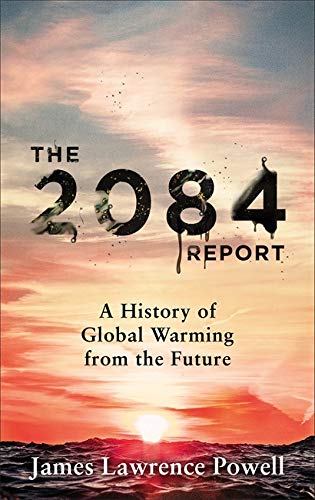
Powell, James Lawrence. The 2084 Report: An Oral History of the Great Warming Simon and Schuster, 2020.

.

The 2084 Report is the only work of fiction written by James Lawrence Powell, an American geochemist who has written books on climate science, the Grand Canyon, the Colorado River and the extinction of dinosaurs. The novel is an authoritative chronicle of the effects of climate breakdown as experienced across the globe in an imagined near future. Composed of interviews collected and published in the year 2084 by an unnamed oral historian, it is organised thematically around specific, albeit overlapping, phenomena: droughts and fire, flooding, the rising of sea levels, melting glaciers and permafrost, resource struggles, fascism and xenophobia, death, and nonhuman extinctions. 

Powell’s book plays into a major trope within the cli-fi genre, one which features a future historian interpreting and documenting the errors, failures, and sometimes demise of contemporary life in the Capitalocene. The 2084 Report begins with a preface by a historian, dated Dec 31 2084 in Kentucky. He describes his methods to produce the book, “knowing that it will be read mostly by friends and family” (preface). Like works such as The Age of Stupid, World War Z, and The Collapse of Western Civilization, it conjures what Pieter Vermeulen describes as the “posthumous readability” (880) of climate breakdown and human extinction, evoking “a ravaged future in order to serve as a warning for its present readers” (869).

As is expected of works within this subgenre, Powell’s book is elegiac in tone, as ecological beauty vanishes, and communities lose their lands and livelihoods in the near future. Displaying the vivid speculative prowess of fictional prose, it details the eventual demise of cities and communities in both the Global North and South, as their water resources disappear, from Bangladesh and the Netherlands to Peru and Phoenix. The book features the “ghostly skeleton of some monstrous, dissected sea creature” that the Great Barrier Reef has become (part 8), and the demise of tropical glaciers—a miraculously beautiful “contradicción frágil” (part 4). As ecosystems are torn asunder, so too are monuments of civilisation: China’s Three Gorges Dam is destroyed when a “giant wall of water washed down the Yangtze, sweeping away everything before it” (part 2), and the Statue of Liberty meets a similar demise as “one giant wave toppled her” (part 2).

The novel thus offers a glimpse into what Greg Garrard calls disanthropy, “the world as it is when we are not looking… at once alluring and frighteningly indifferent” (942). Such an aesthetic centres around the downplaying of human agency and exceptionalism in the face of seemingly cosmological and uncontrollable anthropogenic climate phenomena. Vermeulen likewise suggests that works within this subgenre are “sustained exercises in abandoning human life to a geological gaze that is rigorously uninterested in understanding human exceptionality” (880), allowing contemporary readers to “begin facing up to the increasingly inescapable fact of human species finitude” (872). To critics like Garrard and Vermeulen, then, trope performs an important cultural function, one which leans towards a stoic acceptance of climate breakdown rather than action and activism in averting such a future.

Yet, Powell’s book suggests an alternate function that narratives and fiction have to play in the climate crisis. While such texts commonly employ a narrative temporality in which “the present is always also the object of a future memory” (Vermeulen 872), producing “an imagining of the future as if it were already past” (Vermeulen 872), The 2084 Report is slightly different in its temporal inflection. Rather than a book that mourns the future as foregone, it is very much present-oriented, focussed on human agency and the ability to avert a future-without-humanity.

The depth of knowledge that Powell possesses of climate science accurately brings to life the socio-political impacts that the impending ecological fallouts will create. It provides first-hand accounts of the creation and displacement of “25 million Bangladeshi climate refugees” (part 2), the “seemingly endless human chain (that) filled the roads” (part 4) when glacier meltwater dries up, the slow violence of water rations in Phoenix (part 1), and wars within the Arab nations over water (part 5). It is concerned with making real both the slow and dramatic consequences of climate breakdown, drawing strong causal links between climate phenomena and the subjective lives of different human beings. Despite its strong scientific focus (its range of interviewees invariably cite climate statistics), it grapples with both the slow, Nixonian violences of climate breakdown, and its large-scale catastrophes. The 2084 Report thus enables us to approach the material—and affective—reality of our near future.

Unlike the disanthropic works described by Vermuelen and Garrard, however, Powell’s book takes this as the first step towards tackling the climate crisis. As Energy Humanists like Imre Szeman and Dominic Boyer suggest, the climate crisis is not just a technological or scientific problem, but an imaginative and cultural one (Szeman and Boyer 3). Books such as Powell’s novel allow readers to begin properly understanding the affective and cultural consequences of climate breakdown and thus to act to avert it.

Its final two chapters are, perhaps, the most obvious example of this urgent aspiration towards the possibility of steering the planet away from climate catastrophe. While the book largely maintains that climate breakdown within the story has become irreversible, past the “point of no return” (part 9), it also insists on the ability to imagine a different future. The narrator, speaking to two professors in energy production and politics, reiterates:

you are saying that several countries, including Canada, France, and Sweden, had shown that an expansion of nuclear power production could have cut fossil-fuel emissions enough between 2020 and 2050 to keep the global temperature rise under 3.6 ° F [2 ° C] and to eliminate fossil-fuel use. More than two dozen countries, including the U.S., China, Russia, and India, had the necessary experience and controls. And yet it was not done. (Look to Sweden I)

The overarching question of the book, then, is not just “why, back in the first few decades of this century, before time had run out, people did not act to at least slow down global warming” (part 0)—but what are our last possible options in averting large-scale climate catastrophe?

In looking urgently towards the options we have at present, Powell’s book is closer in tenor to Kim Stanley Robinson’s The Ministry for the Future. Instead of a nihilistic reckoning with a world without us, it is occupied with the political and ecological cascade of actions and consequences that branch from our contemporary moment.

The book remains, ultimately, largely driven by facts, even as it colours in the subjective and affectual experiences of the immediate future. The interviewees presented are voices of authority (politicians/journalists) and scholars who are experts in energy politics, geology, engineering, anthropology and more—with the exception of an indigenous native of Brazil (part 1) and a native of the island of Tuvalu, off the coast of New Zealand (part 3). While the glaringly elitist selection of voices does make space for emotions, with characters feeling “terribly sad” (part 2) or remembering how their favourite beaches grew narrower (part 2), the book’s seemingly limited affective scope is not simply a result of its privileging of science over culture as in the age-old disciplinary distinction.

Rather, it recounts the chaotic, messy fallout of climate breakdown through an incongruously neat aesthetic. Beyond the cataloguing of its interviews by theme and didactic questioning, the prose of the book is largely rational, easy and authoritative. It is at odds with the structure of feeling that has come to characterise the Capitalocene in the 21st-century, one which Fredric Jameson describes as a fundamental break, a “situation where discontinuity has become more fundamental [MP1] than continuity” (318). The overwhelming, discombobulating nature of this simultaneously planetary and unevenly specific fate is unsatisfactorily conveyed by the oral historian’s curated and complete recounting of the near future. The neat sorting of climate phenomena into themes and the narration of the violence wrought by climate breakdown captures the content, but not form, of the experiences to come.

Rather, it recounts the chaotic, messy fallout of climate breakdown through an incongruously neat aesthetic. Beyond the cataloguing of its interviews by theme and didactic questioning, the prose of the book is largely rational, easy and authoritative. It is at odds with the structure of feeling that has come to characterise the Capitalocene in the 21st-century, one which Fredric Jameson describes as a fundamental break, a “situation where discontinuity has become more fundamental than continuity” (318). The overwhelming, discombobulating nature of this simultaneously planetary and unevenly specific fate is unsatisfactorily conveyed by the oral historian’s curated and complete recounting of the near future. The neat sorting of climate phenomena into themes and the narration of the violence wrought by climate breakdown captures the content, but not form, of the experiences to come.

Ultimately, The 2084 Report manages to turn “science faction” into a compliment, suggesting key ways in which narratives and fiction intervene in shaping conceptualisations of the climate crisis. While unable to convincingly pull it off through the quality of its prose, Powell’s book points authoritatively towards the shape of the troubles facing us.


WORKS CITED

Garrard, Greg. “World without Us: Some Types of Disanthropy.” Substance, vol. 41, 2007, pp. 40–60.

Jameson, Fredric. Allegory and Ideology. Verso, 2019.

Szeman, Imre and Dominic Boyer, editors. Energy Humanities: An Anthology. JHU Press, 2017.

Vermeulen, Pieter. “Future Readers: Narrating the Human in the Anthropocene.” Textual Practice, vol. 31, no. 5, 2017, pp. 867-885.


Ada Cheong (she/her) is a PhD candidate based at the University of Exeter. She is fascinated by the alimentary anxieties surrounding the world-food-system, and the ways in which issues such as industrial meat, ultra-processed foods, GM technology etc. register culturally in sf works from the 1970s onwards. Her research more generally concerns the politics and culture of the Capitalocene, and critically engages with the fields of the Energy Humanities and world-ecological literary studies. She is also a communicator and writer for the Food, Farming and Countryside Commission.

Review of New Gods: Yang Jian


Review of New Gods: Yang Jian

Yimin Xu

The Last of Us. HBO, 2023.

.

New Gods: Yang Jian (hereafter New Gods) is a Chinese 3D animation movie that tells the story of Yang Jian (Wang Kai), a legendary Chinese deity. Taking place in a Ragnarök-alike fictional universe where most gods have lost powers, Yang Jian, the former God of War, now works as a bounty hunter on his steamboat. On his way to a mission, however, Yang encounters his lost nephew Chen Xiang (Li Lanling). Together, Yang and Chen embark on a journey and uncover the truth behind the Yang family’s tragedy—Yang Jian’s mentor Master Yuding (Li Lihong), who sacrifices the Yang family for his own achievements.

The movie draws its inspirations from two related 17th century traditional Chinese novels, 封神演义 (Fengshen Yanyi, Investiture of the Gods) and 西游记 (Xi You Ji, Journey to the West). Together, the two novels exemplify a unique Chinese speculative genre—神魔 (shenmo, gods and demons), with the terminology derived from modern Chinese scholar and literary historian Lu Xun. As Lu Xun points out, shenmo fiction features a dynamic theological and philosophical background of Confucianism, Taoism and Chinese interpretation of Buddhism (104). Shenmo fiction arranges gods and demons in the following orders: celestial court for deity, mortal world for humans and underworlds for demons, echoing to a Confucian power hierarchy of 君 (jun, ruler) and 臣 (chen, subject).

Moreover, shenmo fiction often concentrates on the contradiction between deity and demons, but this opposition is not strictly dichotomous, due to the Taoist yin-yang philosophy. The yin and yang concepts can be understood as any set of opposites, including dark and light, female and male, good and evil. However, the yin and yang are not seen as in a dichotomy, but instead “in constant interaction, yin merging with yang and yang with yin in endless dynamism” (Kam and Edwards, 139). Therefore, in shenmo fiction, a god can transform into a demon and vis-à-vis.

In Journey to the West, Yang Jian is said to be the nephew of 玉帝 (Yu Di, Jade Emperor) the highest ruler of the celestial court. His mother, after having affairs with a mortal man and violating the Confucian power hierarchy, is confined to Mountain Tao. As he grows up, Yang Jian becomes the God of War and splits the mountain to free his mother. Despite his seemingly rebellious behavior, Yang Jian is portrayed as a guardian of celestial court order in Investiture of the Gods.

In the film, the director explores a new matriarchal god order by externalizing the rebellious spirit coded in Yang Jian from the original texts. Unlike his cruel maternal uncle Jade Emperor from Journey to the West, film-Yang Jian assumes a caring and nurturing role as a maternal uncle and mentor to his nephew, Chen Xiang. Such a familial relation evokes of what Bertrand Russel describes in his Marriage and Morals that:

in a matrilineal society a man inherits from his maternal uncle; the functions which we naturally attribute to the father are divided in a matrilineal society between the father and the maternal uncle, affection and care coming from the father, while power and property come from the maternal uncle (28).

With no reference to Chen Xiang’s father throughout the movie, Yang Jian is the sole provider of both affection and power to Chen Xiang, reinforcing the matriarchal discourse in the movie. Moreover, they become more bound to each other through their shared loss of mothers. As the film unfolds, we learn more about the Yang family. Yang Jian and his younger sister Yang Chan (Qiu Qiu) come from a matriarchal deity family, whose female members are burdened with the task of settling down evil forces for the sake of humanities. Therefore, their mother, the first-generation of matriarchal god, sacrifices herself and following their mother’s footsteps, Yang Jian’s younger sister, (Chen Xiang’s mother), the second generation of matriarchal deity, dies in the same manner.

The movie ends shortly after Yang Jian regains mighty power and defies Master Yuding, who is not only responsible for the Yang family’s tragedy, but as the movie narrative implies, related to the fall of the deity. Moreover, the morally corrupt Master Yuding embodies a transformation from a god to a demon, reenforcing my earlier statement. Yang Jian’s deifying Master Yuding, therefore, foreshadows the overthrow of the entire collapsing patriarchal god order in the movie’s sequel, and replaces it with a new matriarchal one, as suggested by the title New Gods.

The movie points out a potential new direction in re-representing traditional Chinese fantasies on modern-day big screen: gender. Significantly, this necessity of a gender perspective applies to broader speculative genres across languages. Indeed, as Veronica Hollinger points out “although sf has often been called ‘the literature of change’, for the most part it has been slow to recognize the historical contingency and cultural conventionality about gendered behaviour and about the ‘natural’ roles of women and men” (126). Yang Jian’s role as a maternal uncle, not as a father or a sexual partner of others, challenges the audience to rethink the often taken-for-granted family concept in speculative literature and film that a family must consist of a couple bounded by sexual relations.

Moreover, the Taoist yin-yang philosophy embedded in the movie can help to diversify, in particular, Anglo-American fantasy and science fiction movie industry. We have seen Hollywood’s efforts to increase diversities in recent years, for instance, Marvel Studios’ Shang-Chi and the Legend of the Ten Rings features a superhero from Chinese background. Despite their efforts, however, we still see, at least, one of problematic dualism that Donna Haraway pinpoints in A Cyborg Manifesto: technology/nature.In Hollywood-made superhero movies, the technology/nature dichotomy is often associated with an implicit orientalist discourse that represents the non-West others as mysterious and supernatural. In Marvel’s case, American-born heroes, including Ironman and Captain America, are often equipped with high-tech weaponry. The Chinese protagonist Shang-chi, however, attains his super-human abilities from “mysterious” ten-rings. This dichotomy is more evidenced in James Cameron’s Avatar 2: The Way of Water, in which the human colonists, primarily white Americans, use high-tech powers to occupy the planet, whereas the indigenous habitants of Pandora utilize natural resources to defend themselves: extra-terrestrial animals and weaponry made out of wood.

In the film New Gods, the director intentionally blurs the boundary between technology and nature and other dichotomies. Yang Jian, as we see earlier, operates a Western-style steamboat that runs on 混元气 (hunyuan qi, mixed energy), an essentially Taoist element of nature. I should also call attention to Yang Jian’s look here, in that he has three eyes, with the third on his forehead. The three eyes represent 天 (tian, celestial court), 地 (di, underground) and 人 (ren, humans). Thus, the character himself carries a sense of non-binary seeing-it-all. Additionally, the character development of Master Yuding highlights the delicate balance between evil and goodness.

Granted, increasing racial representation, to certain extent, does introduce a different voice to the dominating English-speaking speculative literature and movies. However, that does not necessarily challenge the many problematic dichotomies that distort the representation of the other and will continue to do so. In this sense, the yin-yang philosophy provides another mode of thinking that goes beyond the Westernized binary-mode and transforms “‘Western’” science and politics—the tradition of racist, male-dominant capitalism; the tradition of reproduction of the self from the reflections of the other” (7).

WORKS CITED

Haraway, Donna J. Manifestly Haraway. University of Minnesota Press, 2016. ProQuest Ebook Central, http://ebookcentral.proquest.com/lib/warw/detail.action?docID=4392065.

Hollinger, Veronica. “Feminist Theory and Science Fiction.” The Cambridge Companion to Science Fiction, edited by Edward James and Farah Mendlesohn, Cambridge University Press, 2003, pp. 125–136.

Lu, Xun. Zhongguo Xiaoshuo Shilüe [The Brief History of Chinese Fiction]. Shanghai Guji Chubanshe, 1998.

Louie Kam and Louise Edwards. “Chinese Masculinity: Theorizing Wen and Wu.” East Asian History, 1994, no.08, pp.135-148. https://www.academia.edu/892144/Chinese_Masculinity_Theorizing_Wen_and_Wu.

Russell, B.  Marriage and Morals. Allen & Unwin, 1929.


Yimin Xu is a Ph.D. student in the School of Humanities and Languages at UNSW Sydney. Her research interest is gender in Chinese science fiction, Chinese fantastical literature and Chinese popular culture in general. Her current PhD project focuses on the modernity rhetoric behind the gender representations in contemporary Chinese science fiction and the resurfacing of the late 19th century national memory of Western semi-colonisation in current Chinese science fiction writing. With her project, she hopes to contribute her own part to the great effort of de-colonisation studies in China. besides her works, she is also the country representative of Australia for the Science Fiction Research Association.

Review of The Last of Us


Review of The Last of Us

Lúcio Reis-Filho

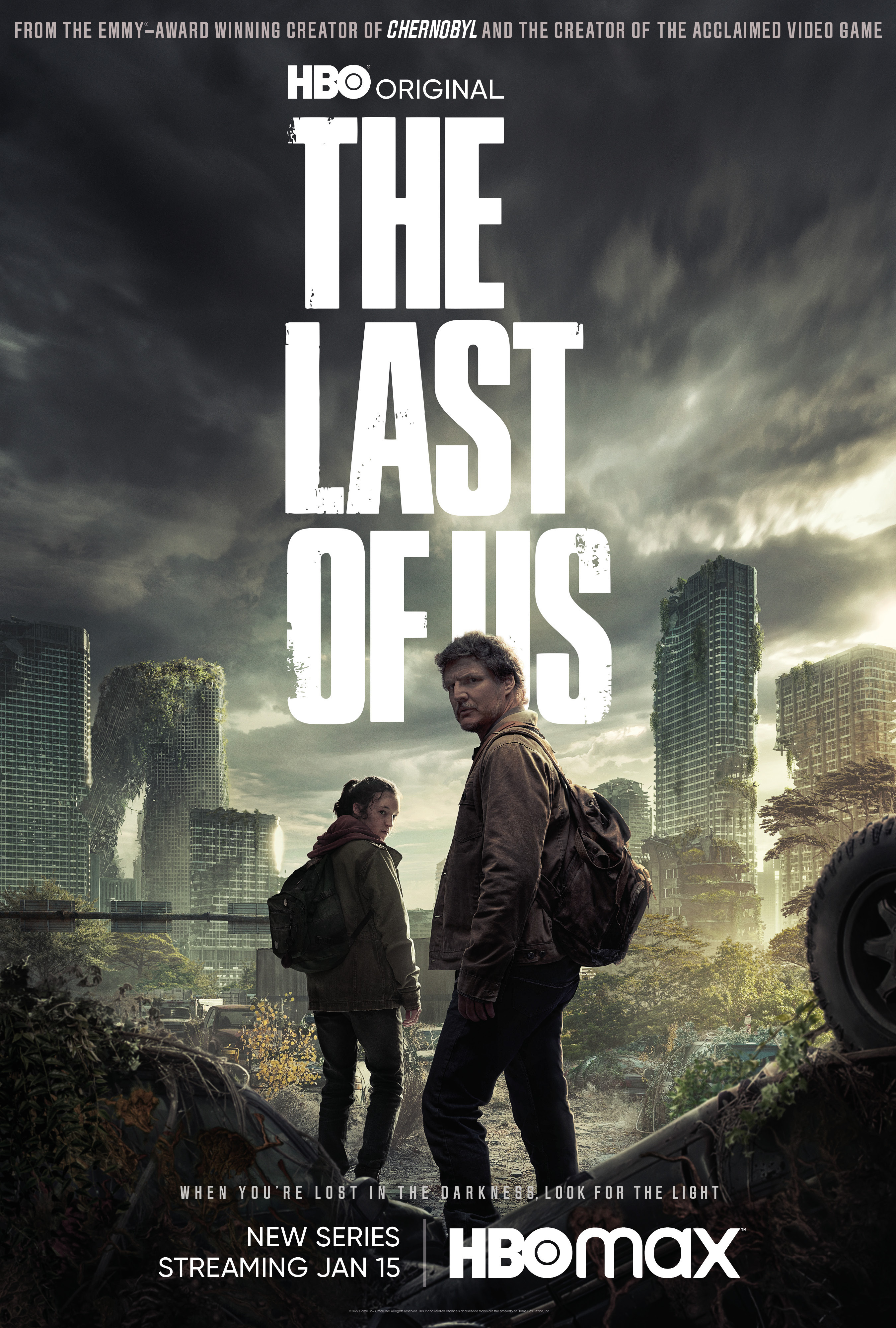
The Last of Us. HBO, 2023.

.

The Last of Us is a TV adaptation of the eponymous 2013 video game by PlayStation Studio’s Naughty Dog, which has garnered numerous awards and a massive fan base over the last decade. Its success culminated in an ambitious sequel in 2020 and in the TV series in 2023. The HBO adaptation follows the game’s storyline and revolves around the hero Joel (Pedro Pascal), who navigates through a dystopic version of the United States escorting the young girl Ellie (Bella Ramsey), who holds the key to the future of humanity. As the only known person immune to the fungal illness that ravaged the world, Ellie is the pivotal character and a coveted asset in the search for a cure. Among the ruins, however, nature has had a rampant comeback, evidenced by the proliferation of green spaces that literally overgrow the urban areas. In many contemporary eco-dystopias, as Roland Hughes and Pat Wheeler suggests, “Technological progress means both a movement away from and simultaneously a movement into or towards nature” (1). This is certainly the case with The Last of Us.

The HBO adaptation delves deeper into the themes of horror and science fiction that were already present in the original game, which was notable for its immersive gameplay experience that seamlessly integrated action, adventure, and drama. The prologue of the series provides a global perspective on the fungal outbreak, which taps into the quintessential “what if?” question that characterizes apocalyptic fiction in general and has gained renewed relevance, since the game’s plot has only become more gripping in the wake of COVID-19 pandemics. For instance, the prologue in episode 1 (“When You’re Lost in the Darkness”) reinforces the idea of a global outbreak, although the full-range scale of the event is not deepened throughout the series.

The Last of Us also draws from conventions once established by notable works of zombie fiction. Richard Matheson’s I Am Legend (1954), adapted for the screen three times, popularized the concept of “the last man on Earth,” while George Romero’s Night of the Living Dead (1968) played a pivotal role in shaping the contemporary zombie. Resident Evil (1996) introduced viral epidemics and genetic mutations to the mix, and Danny Boyle’s 28 Days Later (2002) gave rise to athletic, more vicious zombies that relentlessly pursue their prey. Similar to these works, The Last of Us presents an unknown disease that spreads rapidly, ultimately leading to the collapse of society. As denizens succumb, they transform into monstrous beings that attack and bite others primarily to spread their condition, as is the case with the zombies in the Resident Evil franchise, whose two first games are eventually referred to in the series. In episode 1, for instance, the camera angle and the close-up shot on the face of an infected elderly woman recreate the iconic scene of the first zombie ever seen in a Resident Evil game in 1996. Additionally, the explosion that separates Joel and his brother in the city streets echoes the prologue of Resident Evil 2 (1998) when something quite similar happens, opening up two distinct narrative lines for Leon S. Kennedy and Claire Redfield. Like most zombie stories, the infected in The Last of Us are limping, mindless, and violent wanderers with tattered clothes and decaying figures. However, it is a fungal infection rather than a viral one that causes its condition to change. As a result, the infected show a distinctive appearance, with their bodies covered in mold and scaly polyps. By attributing the outbreak to the Cordyceps fungus, which has contaminated wheat and its byproducts, the series sheds light on present-day debates about sustainability, nature conservancy, and the dangers of pesticide poisoning in crops.

Another example on this subject is a noteworthy departure from the game counterpart. The idea of a fungal network and the ubiquitous link between the infected, as seen in the series, highlight the potential impact of human activity on the environment, since the contagion has spread to the soil, causing even minor contact with the fungus mycelium to attract an entire horde in a matter of seconds. Thus, rather than single individuals, the infected become a collective with swarm behavior and a “hive mind”, a concept reminiscent of the zombies in World War Z and the Borg from the Star Trek franchise. In this sense, the infected may embody the revenge of nature, which attempts to restore itself after centuries of depletion by human hands. Although the series does not elaborate on this idea beyond episode 1, it significantly changes the zombies’ character and further emphasizes the eco-criticism. According to Gerald Farca and Charlotte Ladevèze, The Last of Us goes in direct extrapolation from our times, since it shows “a marvelous place where nature has reclaimed the planet and where the old order of a bureaucratic consumer capitalism has literally corroded” (5). The sequence of giraffes wandering serene through the ruins is a poetic example of this.

WORKS CITED

Dendle, Peter. The Zombie Movie Encyclopedia. Jefferson, North Carolina: McFarland, 2010.

Farca, Gerald; Charlotte, Ladevèze. The Journey to Nature: The Last of Us as Critical Dystopia. Proceedings of the First International Joint Conference of DiGRA and FDG Dundee, Scotland: Digital Games Research Association and Society for the Advancement of the Science of Digital Games, v. 13, no. 1, August 2016, DiGRA/FDG, http://www.digra.org/digital-library/publications/the-journey-to-nature-the-last-of-us-as-critical-dystopia/. Accessed 25 Mar. 2023.

Hughes, Rowland; Wheeler, Pat. “Introduction: Eco-dystopias: Nature and the Dystopian Imagination.” Critical Survey, v. 25, no. 2, 2013, pp. 1–6. JSTOR, https://www.jstor.org/stable/42751030. Accessed 25 Mar. 2023.

Russell, Jamie. Book of the Dead: The Complete History of Zombie Cinema. FAB, 2005.


Lúcio Reis Filho is a Ph.D. in Media Studies, film critic, filmmaker and historian specializing in the intersections between cinema, history and literature, with focus on the horror and science fiction genres. He writes book, film and game reviews, and is coordinator of Projeto Ítaca (https://projetoitaca.com.br/), a Brazilian educational website devoted to the tropes and representations of mythology in the media. His research and academic interests are essentially interdisciplinary, as they cover Cinema, Visual Arts, History, Comparative Literature and Game Studies.

Review of Prey


Review of Prey

Jeremy Brett

Prey. Directed by Dan Trachtenberg, 20th Century Studios, 2022.

.

It is delightful to view a science fiction story that, in genre tradition, explores the strangeness and peril inherent in sudden interaction with the Other and wraps that in an exciting, well-paced, thoughtful film deeply concerned with the vagaries of human interaction. Although the action, suspense, and multiple instances of gruesome and violent death welcome obvious comparisons of Prey—a Predator franchise prequelto the Alien cinematic franchise, echoes of Denis Villeneuve’s much quieter and less bloody sf film 2016 Arrival are also apparent. Both films involve (though Prey less so overtly) the inability of different cultures to communicate and the resulting mutual Othering; whereas Arrival centers around the gradual development of communication between human and heptapod, Prey cleverly makes use of the inability to understand the Other to explicitly signify how foreign and how alien two vastly different cultures seem to one another.

The pivotal scene stressing this communicative gulf takes advantage of Prey’s creators’ decision regarding language. In the film, the Native American characters speak English from the audience’s perspective, though they are meant to be speaking Comanche in-universe; in one scene, Native American warrior Naru (Amber Midthunder) is fleeing an alien pursuer when she is abducted by a band of French traders. She is caged and threatened, angry, and anxious upon hearing the barking of her captured dog. Her disorientation is made exponentially worse when the traders speak to her. Their French is not translated or subtitled, leaving the audience as confused as Naru about what these alien beings are saying to her and why. It is a truly troubling moment in the film, where we as viewers are made sympathetic to Naru in failing to understand what is happening. The traders are shot and lit as otherworldly monsters themselves, shadowed by firelight and wearing furs that give them an animalistic appearance, jabbering in an unknown language. Indeed, relief only comes when one of the trading party, Raphael Adolini (Bennett Taylor), reveals his ability to speak Comanche and brings comprehension to Naru.

Science fiction narratives are often concerned with humanity’s response to alien life, but Prey reaffirms that it is the way in which humans relate to each other that can be more jarring, more tragic, and more savage than any extraterrestrial encounter. Note, for example, that the Predator (Dane DiLiegro), though brutal, kills swiftly and seemingly without true malice, generally focusing on targets that provide a challenge or pose a direct threat to it; in stark contrast, the French traders use cruel steel traps to capture animals, and at one point bleed Naru’s captured brother Taabe (Dakota Beavers) and then tie them both to a tree as staked bait for the Predator. The subtext is so obvious as to be practically text, given real-life Native American history, in a situation where an alien life form suddenly and violently inserts itself into the midst of a Native American culture.

Naru is trained as a healer, yet longs to become a warrior and follow her brother Taabe. During a hunt, she becomes convinced of a new and powerful threat, eventually encountering a Predator that slaughters many of her companions before she manages to bring it down using a combination of craft, wiles, and sheer bloody-mindedness. Another aspect of contact with the Other in many sf narratives is the realization (whether overtly referenced by the characters themselves, or in the case of Prey via reader/viewer observation) that between one and the other there lie numerous similarities as well as differences. Humanity is defined by our relationships and reactions to others and the world around us; how we behave provides insights into who we are.

Ironically, in many ways Naru is closer—linked by powerful warrior spirit and skill—to the Predator hunting her and her fellows than she is to the Frenchmen cruelly and wantonly laying waste to the land around them. This plays out in their behavior as well: as the Predator hunts with advanced weaponry, so does Naru not only learn to use a gun but cleverly constructs an ax that can be thrown and pulled back on a string, allowing for quicker repeated use. Both Naru and the Predator avoid helpless prey, setting themselves against targets that provide challenges rather than trapping them like cowards. And at the film’s end, the victorious Naru returns to her village, wearing green Predator blood on her face as war paint and carrying the alien’s head as a symbol of victory, looking for all the world like a Predator herself after a successful trophy hunt. Naru, already a skilled hunter who puts her cleverness to use for the service of the tribe, is no Predator (who hunts, as far as the viewer can tell, for mere sport), but throughout the film we watch her resemble it in a newfound ruthlessness and willingness to adapt. As she says to the last surviving trapper, whom she uses as bait the way he did to her and Taabe, “You bled my brother. So now you bleed. You think that I am not a hunter like you. That I am not a threat. That is what makes me dangerous. You can’t see that I’m killing you. And it won’t either.” The trapper, of course, cannot understand what Naru is saying to him, stressing once more the disorienting menace that linguistic alienation can present. The film’s title ultimately, we see, can apply equally to Naru or the Predator, as the cycle of hunting turns round and round. In this relationship of similarities, the viewer comes to reevaluate what is alien, what is Other, and what factors in our behaviors and cultures separate us or make us more like another.

Prey is a significant milestone in the production of cinematic Indigenous Futurism, where Indigenous peoples, long ignored or abused by mainstream Western culture, have existence and agency, and where they resist their traditional exclusion from the speculative fiction narrative. Scholars of the Indigenous Futurism movement may find in Prey both a speculative exploration of colonial encounters not seen before in film, and a story whose focus on the emotional power of linguistic estrangement has much to say about the role of language in our cultures and our relationships with others. It also presents a necessary counternarrative to the old saw (spoken by a million Hollywood producers and executives, as well as the occasional SF publisher or editor) that people—white people—need to see themselves centered in the story if they are to relate to the film at all. On the contrary, Prey (and its critical and box office success) demonstrate that stories, if well-crafted and well-acted, can transcend the assumed tribalisms of skin color or race.


Jeremy Brett is an Associate Professor at Cushing Memorial Library & Archives, where he is both Processing Archivist and the Curator of the Science Fiction & Fantasy Research Collection. He has also worked at the University of Iowa, the University of Wisconsin-Milwaukee, the National Archives and Records Administration-Pacific Region, and the Wisconsin Historical Society. He received his MLS and his MA in History from the University of Maryland – College Park in 1999. His professional interests include science fiction, fan studies, and the intersection of libraries and social justice.

Review of Renegades and Rogues: The Life and Legacy of Robert E. Howard


Review of Renegades and Rogues: The Life and Legacy of Robert E. Howard

William Perpétuo Busch

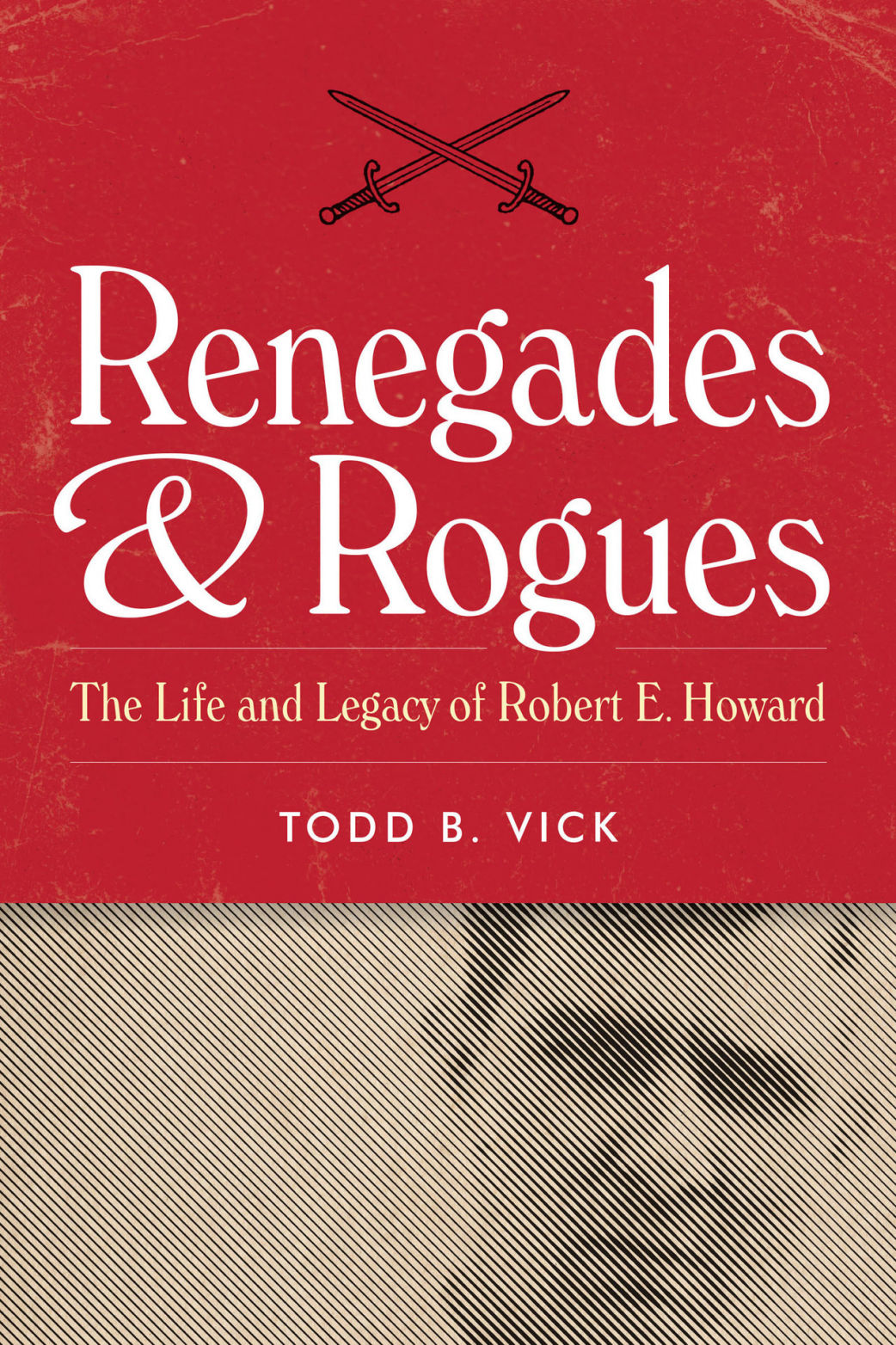
Vick, Todd B. Renegades and Rogues: The Life and Legacy of Robert E. Howard. University of Texas Press, 2021. Hardcover. 266 pg. $29.95. ISBN 9781477321959. Ebook ISBN  9781477321973.

.

In this book, Todd B. Vick manages to offer a biography of Robert E. Howard that marks a new phase for academic scholarship about Howard. Previously, the main reference for Howard’s life was the biography written by L. Sprague de Camp, Catherine Crook de Camp, and Jane W. Griffin, Dark Valley Destiny: The Life of Robert E. Howard (1983), which was problematic for a number of different reasons. Mark Finn’s book about Howard, Blood and Thunder (2006), pointed out the mistakes of the early biographers and how they tried to fit Howard into a psychoanalytic narrative that justified their own interpretations. Vick’s work extends the road that was paved by Finn, but this is not done with just the addition of a mere series of events that are described. On the contrary, Vick employs a vast array of sources to establish the details of Howard’s life. This is the strong point of the book, as Vick does not try to hide his own interpretation of Howard’s work. The narrative is sensitive to the interaction between context and the literature. Organized in 14 chapters, the book starts with Howard’s mother and father’s life and recounts how they were constantly moving and traveling. This documentation of Howard’s early life as one of constant movement allows the reader to understand how Texas was important in the development of Howard’s personality and literature. In the second chapter, Vick reveals how Howard’s later stories were inspired by the lives and experiences of people that told him their stories when he was young. Two of these were former slaves: Mary Bohannon and Arabella Davis.

The first twelve chapters explore Howard’s life; the final two explore its aftermath and Howard’s father organizing the material left by his son. Vick posits an amateur phase (1919-1923) for Howard’s career that was mostly reconstructed from Howard’s correspondence with a small circle of friends. The defining element of this phase is the circulation of his stories in school newspapers. The second phase covers his early fiction (1924-1928), in which Howard experimented with different genres in a moment where most of his work was rejected by the more prestigious magazines, or the slicks. Swift acceptance into the pulps was achieved with “Spear and Fang” for Weird Fiction in 1925 and opened the way for a new market.

The third phase (1928-1932) opened with the creation of characters such as Solomon Kane and Kull of Atlantis, as Howard’s fantasy worlds converged, sharing a similar historical and mythological background. The correspondence with H. P. Lovecraft that started in 1930 revealed their shared interest in history while at the same time served to connect Howard with other authors and editors. From this new network, Howard managed to establish a position as a writer and gradually expanded his stories to the final period (1932-1936), where adventure fantasy would slowly open the way for the production of westerns. The transition point was “Beyond the Black River” (1935). Vick identifies the development of this western story with a barbarian as the main character as advancing Howard’s argument that barbarism was not negative but the final triumph and the natural state of man.

After the twelve chapters close with the aftermath of Howard’s death, the following chapter offers an analysis of some stories. Since most of the material was already covered in the book, it’s interesting to see the development of Vick’s interpretations. However, the problem is the final chapter, as it tries to deal with a different question that demands by itself a whole new book. The chapter centers on the circulation, publication, editing and appropriation of Howard’s work by other authors (including de Camp), and also the adaptations of the stories to different types of media. Different from the rest of the book where the literature was understood with a sensibility to the context of its production, the shift is dramatic.

Robert E. Howard was a racist. Vick acknowledges that by showing how Howard’s views were different from those of Novalyne Price, who was a teacher of English in Cross Plains High School and a writer. Price confronted Howard, revealing his racist and sexist view of society. This brings into focus the early comments about the impact of Bohannon and Davis, the former slaves from whom Howard heard stories. The story “Black Canaan” that appeared in Weird Tales (June 1936) was racist and revealed Howard’s view that slavery was wrong because it was responsible for practices of miscegenation that produced a “mongrel race.” However, Howard’s racism is contextualized by pointing out that Howard was born into a racist society. Vick tries to discuss the topic of race by pointing out that racist stereotypes are common in stories of the period.

It’s important to point out that Vick doesn’t want (or try) to justify Howard’s racism. His objective is to propose the relevance of Howard’s work to American Literature. However, because he does not face the issue of racism on the first page, the result is problematic. The names of Bohannon and Davis serve as tokens that put into evidence the problem of how a white man created a narrative from black experiences and didn’t credit them in public. Howard’s racism was central in his network of relations and played an important role (the case of Novalyne Price is exemplary), but Vick avoids it. This implies that there is not a very deep exploration of how Howard’s racism changed (if it did) in his works. This could serve as a connection to the material of the final chapter—when Howard’s work influenced the rest of the twentieth century, did this racist content change? Does Conan in the magazines and movies share these stereotypes? How have they impacted the constitution of the genre of sword-and-sorcery? I ask these questions as a Brazilian scholar—from a country that structured itself by reacting to the process of miscegenation with a eugenic politics of “branqueamento” [whitening] that lead to the reinforcement of structural racism. In Howard’s view, I’m the “mongrel.” So these are not “political correctness” inquiries but ones not only important to the future of Howard’s scholarship but also that must be answered.


Willian Perpétuo Busch is a Brazilian Ph.D. Candidate in Universidade Federal do Paraná working on the history of Science Fiction in American Academia.

Review of The Culture of “The Culture”


Review of The Culture of “The Culture”

Jeremy Brett

Joseph S. Norman. The Culture of “The Culture”: Utopian Processes in Iain M. Banks’s Space Opera Series. Liverpool, UK: Liverpool University Press, 2021. Hardcover. 272 pg. $120.00. ISBN 9781789621747.

On the face of it, the Culture of Iain M. Banks’ acclaimed star-spanning series of novels and short stories is one of the most attractive social systems in science fiction. Who wouldn’t want to live in a post-scarcity civilization, where money doesn’t exist (nor the need to work for it); where one has essentially unlimited freedom over one’s body, destiny, and physical environment; and where immensely powerful AIs do all the behind-the-scenes work of governance and keeping civilization running? Aside from the occasional encounter with hostile aliens, it sounds a complete dream, the very epitome of the word utopian. Joseph Norman in his new study of Banks’ Culture refuses, however, to let that simple contention lie and provides a thoughtful uncovering of the ways in which the Culture meets and sometimes transcends the common understanding of a utopia, as well as a deep analysis of Banks’ evolution of the Culture over time in response to world events of the 1970s (the first work in the series, the poem “Zakalwe’s Song” was written in 1973) through the early 2000s (The Hydrogen Sonata was published in 2012).

Norman also posits that the Culture as a whole avoids easy textual and critical interpretation, as an active and ever-evolving system, or, as Norman defines it, “a collective philosophy, an identity, a shared way of living” (3). One of Norman’s foci, in fact, concerns the singular ways in which the Culture is nontraditional in its utopian nature and self-conception. The Culture—unlike other SF “utopias” such as the bureaucratic and govermentalized Federation of Star Trek—is based around a common idea and shared practice of the way things should be:

The Culture is a collection of artificial environments, whose inhabitants are linked primarily by shared achievements, practices, and customs, worldviews, behaviours, liked by and representative of a shared utopian culture. The Culture is something that you do, as well as somewhere you live…The Culture is fractal and twelve tonal because its fundamental values and philosophies run through it at every level, forming a broader, inter-locking utopian system. (261) 

It’s a continually evolving and changing practice of living, not a political state, existing above and beyond the various troublesome features of our own world that prevent us from experiencing full freedom—political divisions, religion, economic inequality, late-stage capitalism, racism, etc.

Norman’s book is, in brief, a study of many of the various aspects of the Culture that make it what it is. Norman offers a valuable and comprehensive introduction that describes the Culture generally; positions the writing of the Culture series alongside geopolitical events that inspired Banks’ thought (such as the Cold War, Thatcherism, and the growth of right-wing neoliberalism); and sets Banks’ work within the greater context of the New Space Opera phenomenon that reformulated and subverted the traditional space operas of writers like Smith and Heinlein. Norman also examines the ongoing critical debate over the utopian nature of the Culture, as a step in framing his own contention that the Culture is indeed a “kind of utopia” in the sense of being (quoting Ruth Levitas) “the expression of desire for a better way of living and of being.” (30). The remainder of Norman’s study is geared towards reaffirming and explicating the ways in which Banks expresses this utopian desire, as a series of processes rather than focusing upon some definitive end result. It’s a fruitful method of argument which I think is perfectly designed to reflect the complex and myriad series of shifting modes of behavior and decision-making that constitute the Culture throughout the series.

Subsequent chapters in the book examine the Culture through a number of thematic lenses. Norman analyzes the problematic, even contradictory nature of the Culture’s interventionist impulse (expressed in the series primarily through its agency devoted to relations with outsiders known as Contact and Contact’s undercover arm Special Circumstances). How does a utopia intervene in galactic affairs and maintain its fundamental nature without assuming the burdens and identity of empire? It is a vital question, one Norman asks in the context of Csicsery-Ronay’s concept of the technologiade—that is, the process of humanity’s creation of a ‘technoutopia’ by which they might master the physical world through the use of incredibly advanced technology. Norman also looks at the Culture’s post-scarcity economic system, noting the ways in which such a state frees human behavior from political and social limitations; and the tension between human and post-human nature existing in a universe where humans have eschewed or radically put off things like poor health, aging, and death. How do humans visualize the body in such a system, and how does the extension of life affect how they live that life? As the Culture in its drive towards utopia has eliminated class differences and age/generational differences, so too does it equalize its citizens in terms of gender and religion. In subsequent chapters Norman discusses Banks’ expansion of gender identity and the ways that expansion frees Culture citizens to explore themselves (though he makes note of Banks’ limited conceptions of queer and  trans identities), the role of humanism in Culture thought and practice, and, very intriguingly, how art and the artistic impulse are expressed in a utopian state like the Culture. All in all, Norman provides a deep, thorough overview of the complex world of the Culture and the ways in which it both fulfills and belies our assumptions about a utopian society.

One of the book’s most important achievements is demonstrating that the Culture is not merely utopian within the context of the series itself, but also provides a hopeful direction forward for us as the readers. Norman notes the dark times in which we live, but finds hope in Banks’ own sense of hope, his hope “in the near limitless horizon of technology and science, tempered by a core belief in humankind’s potential for compassionate thinking, collective action, and reasoned logic.” (260) That optimism drives Banks’ work, and it goes far in explaining why the Culture sequence remains not only eminently and beautifully readable but an emotional necessity for this historical moment.


Jeremy Brett is an Associate Professor at Cushing Memorial Library & Archives, where he is both Processing Archivist and the Curator of the Science Fiction & Fantasy Research Collection. He has also worked at the University of Iowa, the University of Wisconsin-Milwaukee, the National Archives and Records Administration-Pacific Region, and the Wisconsin Historical Society. He received his MLS and his MA in History from the University of Maryland – College Park in 1999. His professional interests include science fiction, fan studies, and the intersection of libraries and social justice.

Review of Diverse Futures: Science Fiction and Authors of Color


Review of Diverse Futures: Science Fiction and Authors of Color

C. Palmer-Patel

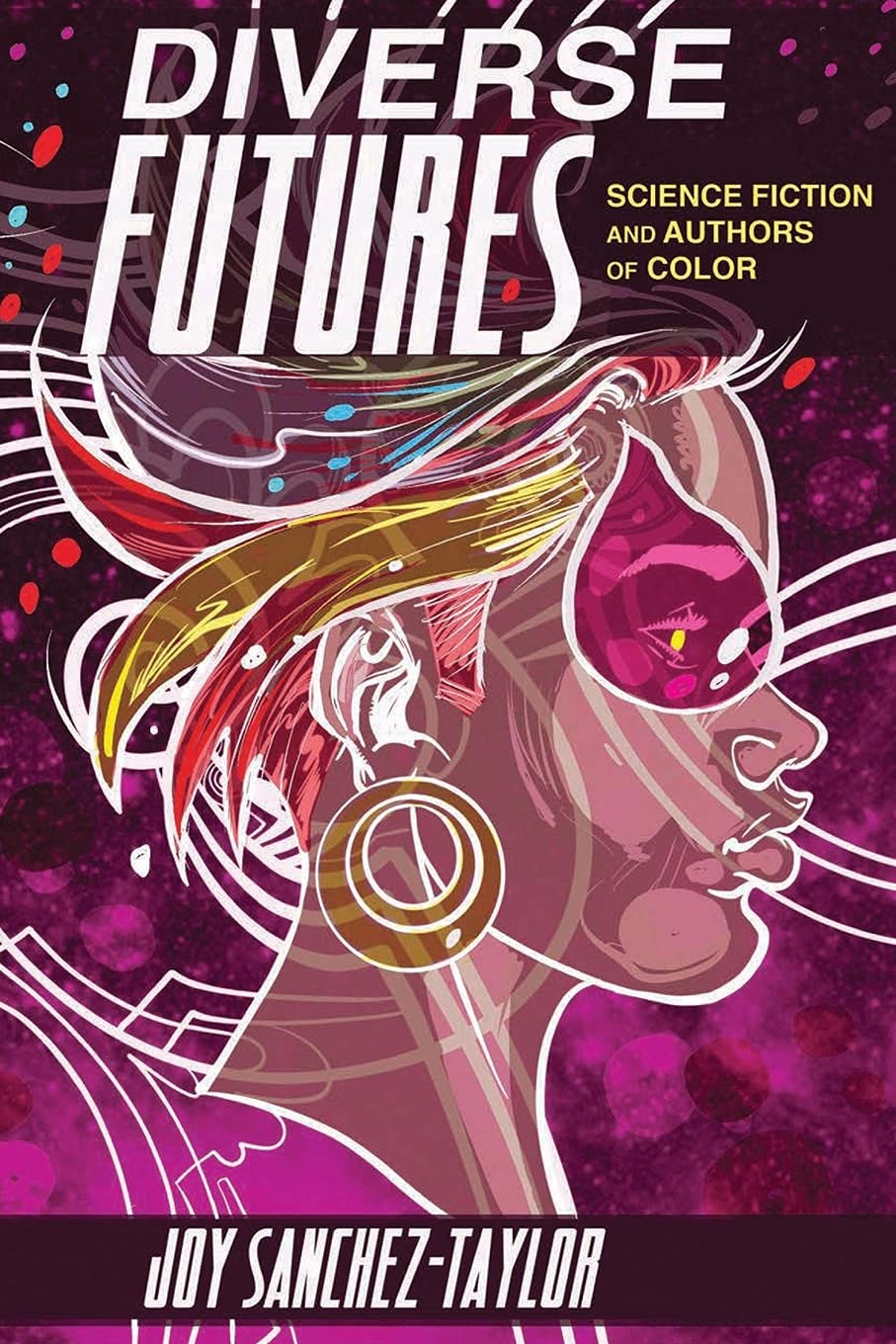
Joy Sanchez-Taylor. Diverse Futures: Science Fiction and Authors of Color. Ohio State UP, 2021. New Suns: Race, Gender, and Sexuality in the Speculative. Paperback. 188 pg. $29.95. ISBN 9780814257975.

By probing works of science fiction by authors of color, Joy Sanchez-Taylor’s Diverse Futures addresses an incredibly necessary missing facet of science fiction literature and criticism. While there have been a number of critical works that focus on specific cultures and locales, Sanchez-Taylor takes on the incredible task of finding common ground between narratives from a variety of different cultures and racial identities (all published in the US and Canada in the English language). Rather than taking a survey approach, Sanchez-Taylor focuses on themes that decenter a Eurowestern perspective on science fiction. She approaches this undertaking deftly and sensitively. It would have been easy for an academic to conflate connections and thereby homogenize cultures, but Sanchez-Taylor avoids this pitfall with a notable hesitancy throughout the book. While a hesitant tone is not usually a quality to aspire to in a scholarly text, I use this assessment here not as a critique, but in praise: her tone serves as a useful model to other scholars who may be examining identities with which they themselves may not identify; rather than authoritatively sweeping these gaps under the rug, Sanchez-Taylor recognizes her own limitations and biases in a conscientious way.

The monograph begins with an introduction that acknowledges that the act of defining science fiction itself is charged with Eurocentric overtones, as the demarcation of ‘science’ and ‘rationality’ are generally taken from a Eurowestern point of view. This problem of definitions continues as Sanchez-Taylor expounds on debates of more culturally specific genre labels such as Afrofuturism alongside considerations of nomenclatures of peoples and cultures themselves, such as Latinx. In a footnote, Sanchez-Taylor clarifies, “I recognizes that any catch-all descriptor comes with issues, so I am choosing the term that is, to date, the most contemporary and inclusive term available” (16). This remark not only exemplifies Sanchez-Taylor’s care towards her chosen subject, but also an awareness of the ways that language and subtext may shift in the future.

The meat of the monograph is spread over four chapters which arguably may be read out of order, with each chapter further divided into sectioned themes and motifs. As a result, the text would work well in the classroom as sections can be selected to suit the topic of discussion at hand. For instance, chapter 1, “Space Travel and First Contact Narratives,” is sectioned into alien invasions, first contact and colonial relations, interplanetary diaspora and adaptation, and decentering the human. Overall, the chapter focuses on the inevitable colonization themes of space exploration and alien contact narratives. Sanchez-Taylor presents several authors of color who further the boundaries of these themes by complicating the role of alien as Other, focusing on examples that pose the alien as benevolent or malevolent colonizer/explorer rather than as a colonized entity mistreated by humans. Chapter 2, “Race, Genetics, and Science Fiction,” turns to considerations of how narratives of science and technology can be used to perpetuate race discrimination. Here and throughout all four chapters, Sanchez-Taylor effectively integrates close reading of fictional texts with examinations of real-world historical narratives, critical theories, and legal factoids. Spanning a range of examples from nineteenth century Social Darwinism to more recent trends such as genealogy and common sites such as AncestryDNA, these examples are set alongside reflections on documented medical apartheid, experimentation without consent, and eugenics, all of which demonstrate the ways in which scientific language has been historically used to justify the subjugation of peoples of color. This seamless blending of fictional analysis with real-world politics is one of the main strengths of the monograph, as it leads the reader away from hypothetical thought and theory into making connections with the experiences and mistreatment of real people and cultures.

The references to real events throughout also place the text as a valuable contribution to science fiction studies, as it situates and contextualizes many science fiction texts that are too often read in a vacuum. For instance, in chapter 3, “The Apocalypse Has Already Come: Post-Apocalyptic Landscapes,” Sanchez-Taylor begins with illustrations of colonial history and how “Eurowestern colonizers justified their colonization of peoples […] based on the argument that “certain races and ethnicities were more prone to criminal behaviors” (86). She uses the example of the Criminal Tribes Act of 1911; grounding race crimes in such legal history then allows Sanchez-Taylor to provide additional context for the ongoing interrogations of citizen and resident rights and freedoms, raising the issue of the culture of surveillance and containment in the U.S, which she then parallels in her exploration of dystopic fiction. Sanchez-Taylor then moves to zombie narratives, presenting another form of the supernatural Other but this time as a means to question the characters’ (and thus the audience’s) human superiority. Reminding the reader that “[t]he zombie figure was born of colonial slave violence” (107), Sanchez-Taylor presents the zombie as a sanctioned fantasy of racial violence and argues that these narratives force the audience to evaluate their own parallels with both human and zombie. The ongoing theme of decentering the Eurocentric view is expanded in Chapter 4, “‘Our Knowledge Is Not Primitive’: Indigenous and Eurowestern Science,” which continues the conversation begun in the introduction, that of the problems of defining science fiction—and science itself—through a Eurowestern lens. Here Sanchez-Taylor presents an important and timely global issue, that of climate change, by considering the global-connectedness views of Indigenous peoples with the more anthrocentric approach of Eurowestern scientists. The chapter thus adds further nuances to analyses of climate fiction, focusing as it does on the ways in which primarily Westernized science and technology has contributed to the climate crisis.

There are few moments throughout the monograph which could have benefitted from early signposting of the connections between racial disparities and problems of gender, sexuality, and class struggles. A reader familiar with science fiction criticism (presumably the target audience of the book) would have immediately made these connections themselves before Sanchez-Taylor draws her arguments to include these considerations. But this criticism is one I make as a content editor, and it does not detract from the strength and value of the overall monograph. Indeed, if I have one quibble with the text, it is of an opportunity lost: while the monograph is an absolute essential for science fiction students and scholars—especially as universities move globally to decolonize the classroom—the book would also have been equally valued, if not more, if aimed at postcolonial critics. Diverse Futures: Science Fiction and Authors of Color is not simply a book that recognizes and acknowledges important contributions of peoples of color in the science fiction genre (as the subtitle might indicate), but instead highlights how each text contributes to a meaningful and impactful examination of postcolonial or diasporic struggles and identities. Consequently, Sanchez-Taylor misses a golden chance to promote critical considerations of science fiction literature in more traditional ‘literary’ fields, a goal that might have been easily accomplished through minor repacking. That said, while the monograph is not overtly pitched toward postcolonial critics, it would still make a meaningful addition to a postcolonial module or courses dedicated to discussions of global literatures and identities. And, of course, it should also be on the recommended reading list for any science fiction module, as it serves as a fantastic primer for any scholar of science fiction who wishes to approach the genre with postcolonial conscientiousness.


Charul (“Chuckie”) Palmer-Patel is founder of Fantastika Journal (www.fantastikajournal.com), a journal that brings together the genres of Fantasy, Science Fiction, Gothic Horror, among others. Her first monograph, The Shape of Fantasy (Routledge 2020) investigates the narrative structures of Epic Fantasy, incorporating ideas from science, philosophy, and literary theory. The monograph has been shortlisted for the Mythopoeic Award twice. Her next research project, The Mother-Hero, interrogates power structures depicted in contemporary American Fantasy Fiction, specifically investigating the place of women within these structures. You can find out more about Palmer-Patel at www.doc-fantasy.com.

Review of Fear and Nature: Ecohorror Studies in the Anthropocene


Review of Fear and Nature: Ecohorror Studies in the Anthropocene

Jonathan W. Thurston-Torres

Christy Tidwell and Carter Soles. Fear and Nature: Ecohorror Studies in the Anthropocene. Pennsylvania State UP, 2021. AnthropoScene SLSA Book Series. Cloth. 300 pg. $109.95. ISBN 9780271090214.

Ecohorror is a long-standing genre in film and literature that is both immensely popular and woefully under-analyzed by academia. Christy Tidwell and Carter Soles’s edited collection Fear and Nature: Ecohorror Studies in the Anthropocene is an attempt to remedy that dearth of scholarly criticism. What I love most about this book is the scaffolding that happens for young scholars here as well as the intellectual inquiry that naturally (pun intended) comes from many of these essays. The introduction helps to develop a language for discussing ecohorror. The early chapters work on showing the versatility of ecohorror. The later chapters showcase more specific applications of the theory earlier in the book. It is a book meant to be read from start to finish, and that is a rare treat in these edited collections. That scaffolding makes many of these topics approachable for rising scholars. And again, many of these chapters left me thinking for days and even weeks after reading. I will never see a bathroom scene in a horror film the same way again. I will never read Junji Ito without looking for an ecohorror implication. And I am confident I will have an excellent book to teach when next I teach an ecohorror lit class.

The editors spend much of the book’s introduction in defending the title. In defining “ecohorror,” a central term throughout the book, they examine the multiple ways that the book’s authors approach ecohorror: “We fear science and its attempts to control the natural world; we fear the natural world and the way it exceeds our control. We also value science as a way of understanding the world, however, and return to it repeatedly in these narratives; we value the natural world and fear its loss at least as much as we fear nonhuman nature itself” (7). Clearly, “fear and nature” have a complex relationship in ecohorror, and this book works to unpack at least some of those complexities. What is perhaps more compelling than Tidwell and Soles’s explication of ecohorror is their analysis of extant ecohorror scholarship. They examine each of the “four full-length critical works on ecohorror to date” and show the limits of those works (8). Tidwell and Soles envision Fear and Nature as adding to the discourse an “ecohorror-as-mode approach… a cross-generic and cross-media mode” (10). This interdisciplinarity is explored in four parts throughout the book. The first part, “Expanding Ecohorror,” focuses on “new types of ecohorror and seek[s] out connections between ecohorror and other types of horror” (10). The next section, “Haunted and Unhaunted Landscapes,” prioritizes readings of the environment as literary landscape in ecohorror. “The Ecohorror of Intimacy,” the third section, centers on “horror located in the home and/or family” (12). And the final part of the book, “Being Prey, Being Food,” “examines narratives of food and predation between human and nonhuman in ecohorror texts” (13). Together, these sections work to explore the boundaries of both ecohorror and ecohorror scholarship.

The first essay, “Tentacular Ecohorror and the Agency of Trees in Algernon Blackwood’s ‘The Man Whom the Trees Loved’ and Lorcan Finnegan’s Without Name,” by Dawn Keetley, argues that one type of ecohorror that does not get much attention is “tentacular ecohorror, which describes the terrifying encounter with a nonhuman nature that reaches out to grab and entangle the human” (24-25). She claims that the two titular works exemplify this narrative of facing alterity and the human being transformed by it. The essay excels in seating acute close reading inside comparatist contexts, comparing this kind of ecohorror to Friday the 13th (1980) or The Texas Chainsaw Massacre (1974). The writing alone would be a great model to rising scholars.

The final essay in the section, “‘The Hand of Deadly Deca’: The Rotting Corpse, America’s Religious Tradition, and the Ethics of Green Burial in Poe’s ‘The Colloquy of Monos and Una,’” by Ashley Kniss, examines a rare example of buried-alive stories, “The Colloquy” by Poe. Kniss claims that, in its resistance of the religious resurrection narrative or typical horror of this kind of story, “The Colloquy” acts as a “mediation of the binary tension between ecophobia and ecophilia,” rather than perpetuating either in isolation (71). What I found most compelling as Kniss’s departure from Sara L. Crosby, arguing that the body’s decomposition indicates an “actual physical merger with the nonhuman Other” rather than Kniss’s claim that it signifies a “pretended merger with the other” (71). Due to the specificity of the text, however, and the lack of comparatist work, it is probably one of the least applicable or interesting-to-teach essays unless you happen to be teaching this one specific story.

The next part begins with Keri Stevenson’s “The Death of Birdsong, the Birdsong of Death: Algernon Charles Swinburne and the Horror of Erosion.” Stevenson characterizes Swinburne’s poetry of erosion as “disanthropic,” “‘distinguished [from misanthropic] by [man’s] absence from the future he envisages’” (93). As Stevenson later says, “time and the sea have destroyed only the human portions of the garden,” noting that weeds, less romanticized birds, and thorns survive easily throughout the works (97). This focus on disanthropy is productive in considering ecohorror largely, so, even though the essay lingers on one author with whom the average reader might not be familiar, the reader can walk away with useful tools for analyzing ecohorror here.

In “An Unhaunted Landscape: The Anti-Gothic Impulse in Ambrose Bierce’s ‘A Tough Tussle,’” Chelsea Davis argues that some fictional landscapes “actively refuse to absorb, echo, or respond to us,” and these “rejections might take the form of a parody, a hoax, or an empiricist dismissal of ghosts in the wilderness” (111). I immediately thought of the ways the recent film The Witch (2015) did not make these rejections; just in a few pages, Davis’ work challenges you to find examples and counterexamples. And then, she moves on to her own main case study, Bierce’s “A Tough Tussle.” Her analysis covers comparatist and historicist readings that move almost into philology and cultural studies by the end. I can easily envision teaching this chapter and this story in a class just on literary studies, as it takes from these different methodologies and weaves them together in provocative ways.

Bridgitte Barclay’s “The Extinction-Haunted Salton Sea in The Monster That Challenged the World” is the final essay in the section and focuses on the titular SF horror film. While there is not much in the way of close reading, I appreciate the interdisciplinarity of the essay, with its work in both natural history and scientific history, which advocates for a specific way of reading ecohorror that is productive. Overall, this section of the book is easily one of the strongest just because it has that interdisciplinary feel that makes it great for modeling to students and allows for multiple ways to approach ecohorror as a genre worthy of literary analysis.

The third part, focusing on “the ecohorror of intimacy,” begins with “From the Bedroom to the Bathroom: Stephen King’s Scatology and the Emergence of an Urban Environmental Gothic,” by Marisol Cortez. Definitely one of the more interesting titles in the book, this essay was also one of the more interesting ones to read. The essay begins with an in-depth defense of scatology in ecohorror studies. Cortez moves from an examination of “bathroom horror,” starting with the original film Psycho, and uses theory to back up a reading of the toilet in these kinds of films not as just a fear of generally gross things but as a fear specifically of bodily functions, what goes on inside the body, and therefore a subset of ecophobia. Cortez then takes this well-established theory and situates it within King’s It (1986) and Dreamcatcher (2001), focusing on the sewers in the former and the bathroom moments in the latter. The essay is cogent due to its structure, close reading, and practical application of theory. Despite its odd subject matter, this is an essay that will have you thinking long after reading.

Brittany R. Roberts’s “‘This Bird Made an Art of Being Vile’: Ontological Difference and Uncomfortable Intimacies in Stephen Gregory’s The Cormorant” focuses on ethical relationships and responsibilities in the titular 1986 ecohorror novel. Roberts reads into the tensions and anxieties of the novel underlying concerns about our relationships with pets. One major weakness the essay has, though, is its narrow focus. Most of the essay is in-depth close reading, and the author does not do much to try to make any takeaways applicable outside of this relatively obscure text.

The last chapter in this section is “The Shape of Water and Post-pastoral Ecohorror” by Robin L. Murray and Joseph K. Heumann. They generally provide a genre reading of del Toro’s film, explicating the ways the film blurs and blends the genres of fairy tale pastorals and horror stories. Unfortunately, the essay does not have much depth to it. The first section of the piece is background: What is the film? Why did del Toro make it? What kinds of films does del Toro generally make? Then, it moves on to a defense of what makes the film horror, then what makes it a fairy tale, and finally what makes it “post-pastoral ecohorror” (205) This last section is the most useful of the chapter, providing a new way to look at the film, “suggesting that embracing our interdependent relationships with nonhuman nature may save us all” (205). The essay as a whole felt like it had too easy or obvious of an argument, and it could have been a bit longer to give more depth to that final section.

The final section, “Being Prey, Being Food,” begins with Kristen Angierski’s “Superpig Blues: Agribusiness Ecohorror in Bong Joon-ho’s Okja.” I was immediately enchanted by Angierski’s pivotal questions about ecohorror and veganism: “What is the relationship between ecohorror, vegan studies, and critical animal studies? How can the context of the slaughterhouse productively interrogate ecohorror’s definition of resistance—of what counts” (219)? These are, of course, rather large questions, and Angierski seats them in a “close reading of the film’s arguably most emotional denunciations of factory farming” (221). However, by that point, we are already a third into the chapter, and most of what follows feels less like a close reading and more like a comparative literature reading, one second going from a close reading of a quotation from a Mirando employer to a holistic reading of the film to biological journals to Peter Singer. The close reading never dives deep enough, and it constantly zooms out to talk about larger theories and systems, and then the essay is done far too soon! There are great questions being asked here, and the theory that is brought in is useful. However, the chapter is just too short and does not engage in the quality close reading promised at the one-third mark in the chapter.

Zoo: Television Ecohorror On and Off the Screen,” by Sharon Sharp, showcases everything that can be productive from a film studies paper. She takes on adaptation studies, reception studies, close reading, and film technology studies, all while bringing in the key theoretical aspects of animal studies and ecohorror studies. Her approach in this chapter is artful: the sections naturally weave together, so you don’t experience any theory whiplash here, and you feel very fulfilled in reading it. If—when—I teach my next ecohorror class, I’ll definitely be teaching Zoo, if only because of the case Sharp has made for it as the source of theoretical inquiry.

The book’s final essay, “Naturalizing White Supremacy in The Shallows,” by Carter Soles, deserves to have appeared far earlier in the book. It has always been a personal pet peeve of mine for editors to put the “diversity” chapters near the end of the book. (I would note though that this could have been a move on Soles’s part since he was one of the co-editors to put other authors before himself out of humility.) The chapter excels at close reading the film The Shallows in terms of the white Final Girl and the racial vision suggested by the end. The reading is thorough and left me thinking about other similar films, too. My only critique here is that Soles spends a significant amount of time comparing what was happening in this film to other non-aquatic films, such as Alien (1979), Halloween (1978), and even First Blood (1982), that it felt more circumstantial that this happened to be an ecohorror film, and that the claims made here could have applied to a number of non-ecohorror horror films. That said, I am excited to read more of Soles’ work!

For the most part, this book provides a lot of food for thought. The chapters here open up new dialogues, new ways of thinking of and analyzing ecohorror texts. The book as a whole would be an essential text for any course on ecohorror and would appeal to both undergraduate and graduate students. For the most part, too, many of the essays here would serve as great models for academic writing. This book is definitely going to be one of the more authoritative texts in the field for a while, due to its sharp, language-building introduction, the chapters’ wide applications of ecohorror theory, and the scholars’ tendency to use their work to open up conversations rather than simply proving a statement and walking away.


Jonathan W. Thurston-Torres is a PhD candidate in English and Animal Studies at Michigan State University. Their edited collection Animals & Race is coming out through MSU Press’ Animal Turn series in 2022, and they also have a chapter forthcoming in Palgrave’s Spenser and Animals. Their HIV work has appeared in TEDx, Weasel Press’ Blood Criminals, and Fenris Publishing’s HIV isn’t poetic.