From the President


SFRA Review, vol. 52, no. 4

From the SFRA Executive Committee


From the President

Gerry Canavan

It’s hard to believe this is my final President’s Note! As challenging and chaotic as the last three years have been in some ways, they also seem to have passed by in the blink of an eye. I look back on what we have accomplished, including two successful annual meetings with previously unprecedented virtual formats and the first major revision of the organization’s bylaws in many years, with gratitude and pride, and I want to thank everyone who has contributed to the (mostly) smooth running of this organization over my term as president of SFRA, especially the elected members of the two executive committees I’ve worked with (Keren, Sonja, Ida, Sean, Hugh, Jess, and Tim) and the organizers of the recent and upcoming annual conferences (De Witt, Rebekah, Graham, Bodhi, Moritz, Julia, and Jaak), as well as everyone who has taken on extra work to serve on a policy or awards committee. I really look forward to supporting the group in my new role as Immediate Past President, and trust that you’ll be hearing from me again when it comes time for populating election slates and committees next year.

Keren Omry recently sent out the candidate statements for the next election, which will take place in mid-December. You can find those at the SFRA website, or elsewhere in this issue. As a reminder, here is what the new bylaws say about elections:

The immediate past president, in consultation with the Executive Committee, shall submit a slate of candidates for each position to be filled at least 60 days prior to the election day. These candidates will be nominated by current members (self-nominations and nomination by current members of the Executive Committee will be allowed). The immediate past president shall notify the membership in the SFRA Review, and all other appropriate and available electronic and social outlets, of this slate of candidates. Within 30 days of the publication of this slate of candidates in the SFRA Review, additional candidates may be nominated by submission of a petition signed by at least five persons of the membership in good standing entitled to vote in the election to the secretary of the association. At the end of this 30-day period nominations shall be closed and the ballot shall be prepared.

We have crossed that 60-day threshold and are fast approaching the 30-day threshold, after which the ballot will be closed; if you would like to supplement this slate of candidates with a new name, please, do so soon!

As always, reach out to me if you have any questions or concerns, or if you would like me to promote anything on SFRA’s social media. Thanks so much for entrusting me with the responsibility of leading this group for a time, and I look forward to seeing you all in Dresden next year.


From the Vice President


SFRA Review, vol. 52, no. 4

From the SFRA Executive Committee


From the Vice President

Ida Yoshinaga


Aloha, SFRA members,

As we, the networks of Earth, flow towards mid-twenty-first century singularity from a wide spacetime perspective and we enter yet another holiday season from the smaller sense of human affective momentum, I find myself thinking about my own, small-f “futurisms.” Perhaps for the first time ever—very odd for a lifetime learner in science-fiction studies.

The collective that taught me how to think will turn into a “majority-minority” society in another 22 years, so I envision myself in Future Georgia, watching my students from this semester evolve into full persons, enchanting what’s been red and purple into a deep indigo-like blue in another 10.

The collective of my ancestors will spin its centuries of modernist love for artificiality, commerce, and form into a line of pleasingly mannered, sentient and multi-gendered, service workers. They’ll be facing that classical Nipponese dilemma—order and pleasure, or discomforting revolution—in another 80 (crossing into the twenty-second’s threshhold).

And I will labor at my present factory, the STEMmy mothership, tirelessly, relentlessly, until my favorite organ crepes into spotted curtains draped from my elbows and tailbone. I’ll drain my spirit turning human storytelling into one of those new monsters, a growling electrical beast who can generate fables and novels and screenplays autonomously. Like the scientist in the story, I will be shocked when the creature turns on me, on humanity. In another 30.

But mostly, a week before we take out the costumes and for the first time since the virus, join in on the parades…Before our souls homecome to family and community with three rounds of seasonal fantasy make-pretend (ghosts, unpredatory colonial settlers, Klaus)…I’m looking back. As part of my small-f futurism; otherwise, how can one grasp the meaning, the impact, of the flow towards all these someday-presents?

So: Thank you, Jessica Fitzpatrick, for your attention to detail, conscientious and necessary financial work, positive demeanor and imaginative orientation, and for doing what’s probably the second-hardest job (next to Gerry’s) in our Executive Committee.

Thank you, Sean Guynes, whose egoless service to SFRA of course eclipses the minute and diligent secretarial duties you’ve offered up these past years. I see you: your systematic and long-term questions, fixes, quiet administrative contributions.

Mahalo, Keren Omry, who along with Sean and Gerry, ushered me into this association. Global feminist leadership modeled; now the IAFA is fortunate to benefit from your hefty organizational smarts.

Crushingest of kaiju-sized hugs to Gerry Canavan, whose stewardship has honestly felt a little like that of the mythical space captain in that syndicated live-action series I’d watched as a child on Maui in the ‘70s. Intuitive, action-oriented when needs be, thinking always of crew and community. Funny on occasion (albeit not in a Shatneresque way). I know you hate the term praxis, so let’s simply ignore that you’re the embodiment of the best of this. Very glad you’re still on board. I’m here for another few.


Review of Moon Knight


Review of Moon Knight

Jeremy Brett

Slater, Jeremy, creator. Moon Knight, Marvel Studios, 2022.

It is interesting to watch the Marvel Cinematic Universe begin to explore the wider cosmologies that undergird the franchise’s framework. Generally speaking, it wasn’t until the introduction of Dr. Stephen Strange and Dormammu’s Mirror Dimension in 2016 and then T’Challa’s visions of Wakanda’s Ancestral Plane in Black Panther (2018) that audiences started seeing how the MCU consists of overlapping dimensions populated by what we would refer to as gods, magic-users, and vast alien entities, combining into a boundless cosmology humans experience through radical shifts in reality. The most intriguing example of the MCU’s cosmological perspective and its relationship to human existence comes with the Disney+ series Moon Knight. The series is also a fascinating exploration of the ways in which humans, emotionally broken and scattered, construct their own identities and realities as crucial survival strategies. Moon Knight’s central conceit, in fact, involves the physical and psychological impact of clashing perceptions of reality—on an intimate personal level as well as a multidimensional universal one.

Moon Knight is fascinating in part because of its cosmological infusion with elements of Egyptian mythology that in the MCU form an actual dimensional plane of reality. The Ennead are the Egyptian pantheon, and include the moon god Khonshu. Khonshu has adopted American mercenary Marc Spector (Oscar Isaac) as his avatar and dispenser of justice—his Moon Knight. Overtly, the series pits Spector/Khonshu against cult leader Arthur Harrow (Ethan Hawke): Harrow seeks to revive the goddess Ammit, who balances a person’s virtues against their sins and directs their posthumous fate accordingly. However, a far deeper conflict is at work, giving the series a much more complex and profound dramatic richness. The show features another chief protagonist, Steven Grant (also Isaac), a humble museum gift shop employee. Before too long, we see Steven and Marc are separate personalities sharing Marc’s body at different moments. Radically different personalities, in fact—Steven is bumbling and nonviolent, Marc effortlessly physical and a skilled fighter. They even appear as Moon Knight differently – Marc as the classic comic book image of Moon Knight (a caped, cloaked Batman-like figure) while Steven is dapper in a snow-white suit.

The MCU’s new emphasis on structural cosmic complexity is skillfully mirrored in the series’ dramatic demonstration of human psychological complexity. It is interesting to note how Steven and Marc both work at self-definition through the establishment of distinct identities—particularly Steven, who until the series’ conclusion strenuously defines himself in opposition to Marc. Convinced of the truth of his own values and personal history, Steven insists on his existence as an independent being with autonomy. His experiences may resonate with viewers conscious of the personal and psychological importance of controlling and defining their own identities and the ways in which they present themselves to the world at large. Moon Knight may not become an icon for gender identity, but his/their struggle with their own sense of being will be familiar to those needing such an icon.

On a grander level, the struggle for the world plays out on two distinct levels in the series. The last episode makes this explicitly visible in the series’ final fight, where Ammit and Khonshu battle each other unseen on one plane of existence while Marc/Steven and Marc’s wife Layla (May Calamawy) fight Harrow and his devotees in the “real” physical streets of Cairo. It is a concrete expression of the ways in which reality is perceived differently at different moments by different people. On an emotional level, however, this struggle for a fair and workable reality is much more poignant in reference to Marc’s character evolution. We find that Marc, as a child, suffered grievous emotional and physical abuse at the hands of his unbalanced mother, who blamed Marc for the death of his younger brother. The traumatized Marc created Steven as a psychological shield to insulate the best parts of himself from his mother’s abuse. The intimate battle at the series’ heart – the work that Marc and Steven do to, if not reunite, then reconcile themselves and their realities to one another—is what gives Moon Knight its emotional complexity. Indeed, this struggle is made most manifest when, during the hallucinatory journey via boat towards the Duat (the afterlife), Steven sacrifices himself to save Marc, leading Marc towards the realization that the two need each other to be whole, that each gives to and supports the other in ways that make them into a full human being together. Marc confesses to Steven, frozen and dead outside the Gates of Osiris, “You are the only superpower I ever had.” Shared realities can give strength and endurance where a single reality cannot do the job.

Moon Knight complicates the issue of perceiving reality by presenting Steven and Marc as holding drastically opposing emotions, worldviews, and life experiences. Which of their realities is “true” if both individuals are experiencing vastly different lives? Moon Knight asks its viewers to question our relationships to the world around us and the complicated connection between mind and body. Of course, that last connection has long been a part of humanity’s relationship to its various conceptions of the divine—when we touch the metaphysical, how much of our experience is tangible and how much an intangible projection of our inner selves? As the series progresses, we see an ongoing deepening of the levels of existence through which humanity moves day-to-day, as well as continuing evidence of the MCU’s new focus on the relationship between humans and the divine, or at least the multidimensional beings identifying as “divine.” (I appreciate, speaking of this, the reveal that Marc is Jewish—the first identified Jewish superhero in the MCU.)

Jeremy Brett is an Associate Professor at Cushing Memorial Library & Archives, where he is both Processing Archivist and the Curator of the Science Fiction & Fantasy Research Collection. He has also worked at the University of Iowa, the University of Wisconsin-Milwaukee, the National Archives and Records Administration-Pacific Region, and the Wisconsin Historical Society. He received his MLS and his MA in History from the University of Maryland – College Park in 1999. His professional interests include science fiction, fan studies, and the intersection of libraries and social justice.

Review of “The Conquest of Gola” and Other Stories by Leslie F. Stone


Review of “The Conquest of Gola” and Other Stories by Leslie F. Stone

Sue Smith

Weinbaum, Batya, editor. “The Conquest of Gola”: and Other Stories by Leslie F. Stone. JustFiction, 2021.

In her edition of “The Conquest of Gola” and Other Stories, Batya Weinbaum convincingly argues for a closer critical evaluation of the work of Leslie F. Stone, a Jewish-American woman author who wrote during science fiction’s pulp and golden ages. In brief, Weinbaum’s intent is to highlight Stone’s contributions to science fiction written from a Jewish female perspective and understood from within the context of 1930s America. According to Weinbaum, the value of exploring Stone’s work in this period is to acknowledge and appreciate her unspoken political view and desire for a more inclusive world. For Weinbaum, Stone’s political outlook can be found in her science fiction work in a subtext of race and gender that presents a complex negotiation between insider-outsider identities vying for acceptance and ultimately, assimilation. This recurring theme in Stone’s work, according to Weinbaum, presents the plight of the Jewish immigrant in alien form at a time when Jews were persecuted and viewed with suspicion in America. As Weinbaum argues, sensitive to the Jewish predicament, the key theme in Stone’s stories is the Jewish desire for Americanization, a goal pursued by both first- and second-generation Jews.

To give an overview of the collection, the edition begins with a preface, an introduction and five main stories, which are bookended by two short pieces of writing. The first is titled “Letters of the Twenty Fourth Century” (1929) and the second is the appendix, which is titled, “Day of the Pulps” (1997). To give a brief overview of these works, “Letters of the Twenty Fourth Century” features a male narrator who produces an up-beat letter to a friend about life in a bright new technological future. “Day of the Pulps” is Stone herself addressing a contemporary readership in 1997. In this address, Stone provides commentary about her writing career during the 1930s alongside her expressed desire to restart her career in later years. In a more sombre tone, Stone also includes in her discussion the reason for exiting science fiction at the end of World War II. As Weinbaum points out in her comment on the final piece, it was Stone’s Jewish beliefs in Kaballahism, in which words are believed to give life to what they describe, that brought Stone to the idea that it was her writing of science fiction that contributed to America’s decision to use nuclear weapons to end the conflict with Japan.

Situated between Stone’s initial optimism for the future and final dismay at the technological turn in WWII are the five main stories that showcase her utopian ideas of acceptance and the assimilation of diverse populations. At the start of each story, there is Weinbaum’s supporting explanation of cultural trends in science fiction alongside the social and historical events at the time, which help to foreground the relevance of Stone’s work. To sum up briefly: the five main stories are in chronological order and map out Stone’s science fiction that covers common themes of evolution, eugenics, sex, and race by using the trope of the human-alien encounter. In “Men with Wings” (1929) and “Women with Wings” (1930), two stories that focus on genetic engineering and the evolution of the human species, humans have progressed by evolving and developing the ability to fly. To ensure their survival, social progress depends on cooperation between the sexes by accepting human and alien alike in order to create a single species of winged human founded on a mutual respect for species diversity and racial difference. In contrast, “The Conquest of Gola” (1931) presents a battle-of-the-sexes scenario as an all-female society fights off a male invasion. “The Conquest of Gola” explores the limitations placed on women by an American patriarchal society as formidable female aliens refuse to be assimilated by their male counterparts. Instead, they, as a species, remain intact, and with their knowledge of science, keep their power and independence. Finally, in “The Fall of Mercury” (1935) and “The Human Pets on Mars” (1936), Stone turns to the tale of the space pioneer as humans from Earth meet aliens on Mercury and Mars. Again, it is the human-alien that Weinbaum argues reflects anxiety felt at the time over the Jewish presence in America. While the key idea in these stories is to promote similarities between species in order to establish a common ground in which to gain acceptance and find agreement, it is, as in “The Fall of Mercury,” the niggling persistence of the “foreign body” that threatens the stability of identity in these opposing societies.

Weinbaum’s academic quest to collect Stone’s writing into a single volume is motivated by a desire to let the voice of a Jewish-American woman writer be heard. Indeed, Weinbaum’s passion and choice to focus on Stone is a worthy project offering insight into one woman’s response to the precarity of gender and race between the two World Wars. Although Weinbaum makes it clear that Stone often wrote from the perspective of a male character, Weinbaum’s insight into cultural trends in science fiction, which she thoughtfully interweaves into the social and historical events of the time, provides a rich context within which to read Stone’s work from a Jewish feminist perspective.

Sue Smith has an interest in feminist science fiction with a focus on cyborgs, disability and gender. She has published articles on disability and cyborg fiction in FEMSPEC (2010), David Bolt’s edited book, Changing Social Attitudes Towards Disability (2014), BMJ: Medical Humanities (2016), Journal of Literary and Cultural Disabilities Studies (2017-2020); Journal of Transcultural Psychiatry (2020); and she has provided book reviews for a range of journals.

Review of The People’s Republic of Everything


Review of The People’s Republic of Everything

Sébastien Doubinsky

Mamatas, Nick. The People’s Republic of Everything. Tachyon Publications, 2018.

Nick Mamatas (born 1972) is an award-nominated American fantasy, horror and speculative fiction and non-fiction writer, known for his anarchist political commitment. His most well-know works are the novels Move Under Ground (2005), I am Providence (2016), Second Shooter (2021) and his non-fiction book, Starve Better: Surviving the Endless Horror of the Writing Life (2011).

The People’s Republic of Everything is his fourth short stories collection. It is comprised of 14 short stories and Under My Roof, a novella-length story. It draws upon multiple genres, from political steampunk (“Arbeitskraft”) to science fiction (“Walking with a Ghost”), social-realism (“North Shore Friday”) and dystopian fiction (“Under My Roof”). Although there is no real narrative nor thematic unity in the volume, Mamatas’s peculiar irony and political views can be seen as the red thread connecting the stories.

We can, however, loosely regroup them under three main categories: political, realistic and poetic. The works making up the first of these categories are “Arbeitskraft”, “The People’s Republic of Everything,” “The Glottal Stop,” “We Never Sleep,” and “Under My Roof.” Under the banner of “realistic” are “Tom Silex, Spirit Smasher,” “The Phylactery,” “North Shore Friday,” “A Howling Dog,” and “Lab Rat”. Finally, “Walking with a Ghost,” “The Great Armored Train,” “Slice of Life,” “The Spook School,” and “The Dreamer of the Day” form the poetic corpus.

The stories that are contained in the political category perfectly illustrate Nick Mamatas’s anarchistic views. “Arbeitsskraft,” for example, imagines Engels, Marx’s friend and co-author, as a Frankenstein-inspired steampunk character set on creating a collective, revolutionary mind based on dialectal materialism with the help of cyborg-like match girls. In the same manner, “We Never Sleep” features Rudolf Diesel, the inventor of the fuel bearing his name, as a crazy scientist living in an underground laboratory in a parallel world setting and creating a brand new ideology with the help of a pulp writer. In these stories, Mamatas uses his anarchist position to make fun of and criticize both capitalism’s and communism’s positivist ideology, putting them back-to-back in their dangerous delusion. With the novellaUnder My Roof”, Mamatas turns to a more Pynchonesque or Vonnegutian style of story, in which family man Daniel Weinberg builds a nuclear weapon in his basement with the help of his son and secedes from the United States by founding the free state of “Weinbergia.” Beyond the wacky humoristic narration, Mamatas tackles the notions of nation, freedom, and domestic politics in a way reminiscent of Hunter S. Thompson’s political writings.

The realistic stories uncover a lesser-known and more personal aspect of Mamatas’s narratives. Although they more or less belong to the noir, speculative fiction or weird horror genres, they stand out as being built on more personal aspects of Mamatas’s life. It is an interesting choice of works and it pushes the collection towards a fictional self-portrait of the author that we could definitely link with some Philip K. Dick’s works. “The Phylactery,” for instance, is based on Greek traditions and family anecdotes before moving into specific territory. It also gives the traditional Mamatas reader or a newcomer insight into how his fiction can be built on personal references and how it is transmogrified in the stories. Obvious non-genre references that come to mind are Jack Kerouac’s Dr. Sax, which is a pulp horror tale combined with childhood memories told in stream-of-consciousness style, or William S. Burroughs’s series of novels, which blend first-hand experiences and nightmarish visions. In that way, Mamatas seems to be continuing the Beat tradition and pointing at creative possibilities in their wake, an echo of what he did with his 2005 Beat and Cosmic Horror novel, Move Under Ground.

Finally, we come to a set of stories that moves away from classical genre definitions and that could fall into the “poetic” field in the largest sense possible. In “Walking with a Ghost”, the main character, Melanie, creates a virtual version of Lovecraft, which has become sentient. By blending the figure of the founder of cosmic horror into a speculative fiction A. I. narrative through anecdotes linked to Melanie’s life, Mamatas displaces the traditional tropes of horror and future technology to the periphery of the story, and chooses to focus instead on the strange relationship between his main character and Lovecraft, creating a strangely poetic moment. The same can be said of “The Great Armored Train”, in which Leon Trotsky is confronted by a supernatural phenomenon during the 1917 Russian Revolution, more precisely the ability of a young woman to transform into a lethal owl. Here, by leaving the truth undecided (is the transformation real, or, as Trotsky is convinced, just an illusion?), Mamatas manages to suspend the reader’s disbelief, which is one of the essences of poetry. Once again, Mamatas proves his reluctance as a writer to be easily categorized and the fact that a genre cannot be reduced to a list of tropes and styles.

If The People’s Republic of Everything is not a truly coherent collection, it will nonetheless be of interest to the classic Mamatas readers precisely because of its wide range of styles and stories and for any reader because of the multiple influences that one can find within or behind their constructions. It also questions many definitions of genres (from horror to speculative fiction, and even steampunk, for that matter), as it chooses to veer towards the literary instead of the usual plots and structures. Yevgueny Zamyatin, Karel Čapek, Kurt Vonnegut, Jack Kerouac and William Burroughs are more obvious references than, say, Michael Moorcock, H.P. Lovecraft, Philip K. Dick and Vernor Vinge. The People’s Republic of Everything is therefore a bit of a side-track in Nick Mamatas’ works, but interesting precisely because of its undefinable and undefining nature

Seb Doubinsky is a bilingual French dystopian writer and poet. He is the author of the City-States Cycle, comprising, among others, The Babylonian Trilogy, The Song Of Synth, Missing Signal, The Invisible, and Paperclip. Missing Signal, published by Meerkat Press, won the Bronze Foreword Reviews Award in the Best Science-Fiction Novel category in 2018. He lives in Denmark with his family and teaches literature, history and culture in the French department of Aarhus University.

Review of Re-Enchanted:The Rise of Children’s Fantasy Literature in the Twentieth Century


SFRA Review, vol. 52, no. 4

Nonfiction Reviews


Review of Re-Enchanted:The Rise of Children’s Fantasy Literature in the Twentieth Century

Lenander

Marie Sachiko Cecire. Re-Enchanted: The Rise of Children’s Fantasy Literature in the Twentieth Century. U of Minnesota P, 2019. 336 pg. $108. ISBN 9781517906573. $27.00. Paper ISBN 9781517906580

Apparently an attempt to popularize and expand upon a flawed 2011 dissertation, The Oxford School of Children’s Fantasy Literature: Medieval Afterlives and The Production of Culture (Oxford University), this book begins with a shorter reprise of that work. Cecire believes that the work of J.R.R. Tolkien and C.S. Lewis in establishing an Oxford University English curriculum that focused on pre-Nineteenth Century English, and drew upon their scholarship in Old, Middle and Early Modern English literature, resulted in shaping an “Oxford School” of writers of “medievalist children’s fantasy” (4). Besides Tolkien and Lewis, in some of their work for children, this includes the writers Susan Cooper, Diana Wynne Jones, Kevin Crossley-Holland and Philip Pullman.

The discussion of Tolkien and Lewis, including their academic interests and their use of aspects of ‘medieval’ literary antecedents, particularly in their own fiction, is good. But it mostly revisits what many other critics, historians and biographers have had to say.  Cecire does provide some discussion of the curriculum at Oxford, including such details—new to me—as brief descriptions of some of the questions presented to students to write their final exams. Later, she offers some careful readings of scenes from her ‘school’ writers, tracing motifs and themes from some of the medieval texts that were part of the reading program at Oxford. This is well-done, and Cecire demonstrates her own familiarity with some of these medieval sources. It seems reasonable that writers who read Malory or Chaucer might indeed have been influenced when they went on to write their fantasy stories for children. But Cecire fails to account for the similar approaches and achievements of other writers drawing upon such medieval texts without the ‘shaping’ of the Oxford curriculum. She also fails to consider other medieval influences on her writers, for example via Diana Wynne Jones’s marriage to the prominent medievalist, John Burrow—though he, too, studied the English curriculum at Oxford—or Crossley-Holland’s extensive career as a medievalist, both in translating and editing Beowulf and other Anglo-Saxon texts, and as a professor of English for many years before writing his Arthur Trilogy (2000-2003).

Many other writers, beginning well before Tolkien and Lewis, and continuing up through the twentieth century, have written what can only be described as work similar to the Oxford school ‘medievalist children’s fantasy’ without direct recourse to that Oxford curriculum, or even influence from its fiction. Indeed, the impact of this school cannot be much felt in broader children’s fantasy until the second half of the century—besides the outlier, Tolkien’s The Hobbit (1937), not terribly influential though respected in the forties, fifties and sixties, the Narnia stories don’t appear until the second half of the century, when Tolkien’s adult romance, The Lord of the Rings (1954-55), was also published. The influence of these works on other fantasy can hardly be seen until the publishing phenomena of the 1970s, mostly in adult fantasy and science fiction, and the other Oxford school writers only begin to impact the literary scene in the later 1970s.  The fantasy by Crossley-Holland and Pullman discussed by Cecire was not even published until the end of the 1990s (1995-2003).

As far as discussion of the works of these writers go, Cecire does not really attempt to differentiate their ‘medievalist fantasy’ from that written by other Twentieth Century writers, such as Henry Treece, Alan Garner, Lloyd Alexander, Mollie Hunter, or many others. She does offer a straw-man attack on T.H. White’s The Sword in the Stone (1938), as a “Cambridge fantasy” (114), but is unclear about what other texts might fit into this alternative school. She suggests that the comic and ironic tone of White’s narrative is modernist, against and counter to the Oxford school, which is anti-modernist and thus free of irony and comedy.  This is due to the roots in that medieval heritage that Tolkien and Lewis introduced into the Twentieth Century.

This is absurd on the face of it, ignoring the comic and ironic work of Tolkien (not only in The Hobbit and sections of The Lord of the Rings, but in Farmer Giles of Ham [1949] and The Father Christmas Letters [1976], among other texts), and in C.S. Lewis’s The Screwtape Letters (1942), but also the later work of Susan Cooper (the fine Boggart trilogy [1993-2018]), and Diana Wynne Jones (practically everything she ever wrote, but consider The Tough Guide to Fantasyland [1996]). Even Cecire doesn’t attempt to argue that Pullman isn’t ironic but explains his irony as a direct response to and dialogue with Tolkien and Lewis. Nor does Cecire attempt discussion of the majority of these writers’ work which is not so clearly displaying ‘medieval’ tropes. In arguing that Tolkien and Lewis are anti-modernist, Cecire is not very careful to describe what she intends, with the consequence that when she starts employing these distinctions and arguing that Lewis and Tolkien channel racism and imperialism and sexism from the medieval texts that they study, one must suppose that she is contrasting this with the modernist writers—but to attempt to see T.S. Eliot, Ezra Pound, James Joyce, Virginia Woolf, and other modernists as free of medieval influence and of racism, sexism and so forth requires a difficult squint in perspective. Similarly, although many other critics of the Inklings have seen them as anti-modernist, citing for instance Lewis’s ironic send-up of Eliot’s “The Love-Song of J. Alfred Prufrock” (cited by Cecire, p. 53), this overlooks the clear modernism of much of the Inklings’ work in response to their war experience, as well as the familiarity of Eliot and other writers with the medieval heritage. Not to mention friendly interactions between the Inklings and Eliot and other Modernist writers.

But Cecire adds a significant writer to her ‘school’ without any account of exposure to the Oxford curriculum, or particular literary influence from medieval writers, or from the other Oxford school writers. This is J.K. Rowling, who didn’t begin publishing her Harry Potter books until the last couple of years in the Twentieth Century.  Linking Rowling to her Oxford school is a serious flaw in Cecire’s dissertation, and it is not further explained or defended here. Rowling acknowledges reading Tolkien’s fiction, and probably Lewis’s Narnia stories at least, but only along with the work of many other writers. The ostensible evidence that Cecire cites for Rowling’s inclusion in the ‘Oxford school’ even more than writers who attended Oxford and wrote medievalist children’s fantasy, such as Alan Garner or Katherine Briggs, is the Oxford-like school setting in the stories, even though it’s a twentieth-century Oxford, and there is little medievalism in the stories. (Interestingly, Rowling has described her Harry Potter as an heir not of Bilbo or Frodo, but of modernist T.H. White’s Wart, in The Sword and the Stone). Indeed, Rowling and her works come in for rather more attention than the actual medievalist in her Oxford School second generation writers, Kevin Crossley-Holland, who receives about three pages of discussion. There is no discussion of his extensive scholarly work as a professor and translator-editor of Beowulf, and other medievalist studies, his opera libretti, or even his Carnegie winning children’s book, Storm (1985). The work that Cecire only briefly discusses, his Arthur trilogy, was actually published in the twenty-first century.

The next phase of Cecire’s argument is hinted in her dissertation, but developed, or rather, sketched out in this book.  Unlike the earlier, more careful and documented work on Lewis and Tolkien and medieval roots in some of the fiction of the later writers, Cecire claims that her Oxford school writers—including Rowling—are the key writers in the whole of twentieth century fantasy, and that they ultimately dominate fantasy more generally, not only in books but in television and film and online discourse for adults, such as Game of Thrones (2011-19) and Lev Grossman’s Magicians (2015-2020), and thanks to the pop psychology of the ‘Inner Child,’ have a huge influence on popular culture and on channeling or focusing medieval roots of imperialism, racism, anti-semitism and sexism in Anglo-American and European culture, through the Tolkien-Lewis anti-modernist pedagogy. Cecire offers some acute critique of Lewis’s imperialism in Voyage of the Dawn Treader (1952), and some interesting views not only of other Oxford School writers but of American fantasy in general, including (apparently) Ursula K. Le Guin’s “Earthsea,” and Tamora Pierce, and especially J.K. Rowling, but offers otherwise very sketchy discussions and odd emphases and readings of other critics.

For instance, besides citing Le Guin’s famous “The Child and the Shadow” essay (1975) exactly backwards in details (though, in fairness, not necessarily wrongly in making her point), she finds in Brian Attebery a justification for dispensing with all non-Tolkienien fantasy as apart from the center of the main stream of fantasy. But this is a bizarre mis-reading of Attebery’s insight, that in the wake of Kathryn Hume’s magisterial discussion of Fantasy as a mode in Fantasy and Mimesis (1984), Attebery offered a powerful image of fantasy as a genre typified in “fuzzy sets”—radiating from multiple centers of exemplar texts, and Attebery playfully offers a mock scientific polling to settle on Tolkien’s Lord of the Rings as a starting point—but significantly, over the course of his book (Strategies of Fantasy [[1992]) Attebery discusses many other texts which depart from that model or establish alternative streams.  (James Gifford’s A Modernist Fantasy [2018] develops an alternative strain focusing on Modernist anarchist fantasy, traced from Morris through Peake and Mirrlees and Treece up through Poul Anderson to Samuel Delany, and Neil Gaiman—the latter two writers that Cecire also mentions and would seem to bizarrely claim into her Tolkien-Rowling axis).

But Cecire is not just tracing one line of fantasy development, examining one alternative “fuzzy set,” setting some of these Inklings fantasies as her ’starting place,’ but arguing that her Oxford school is the primary descent for a medieval heritage that bypasses interim fantasy to flower in contemporary culture and superseding all other previous fantasy to affect culture much more broadly. To make this argument, she needs the Rowling publishing success in addition to the Tolkien and ‘Tol-clone’ publishing.

For an illustration of how this argument goes wrong, consider Cecire’s discussion of the 2012 Olympic Opening Ceremony (19-22). After carefully limiting the ‘Oxford School’ fantasy writers to six who will be considered in this book, the text describes how in this television event “medievalist children’s fantasy grows out of and is reinscribed in major national and cultural institutions” (19). Following a breathless paean to “children’s fantasy [as] one of Britain’s most important exports and gifts to the world” (20), the production, “Isles of Wonder,” is described.

J. K. Rowling reads from an early Twentieth Century fantasy story, Barrie’s Peter Pan (1911), leading to a dramatic sequence with characters from Alice in Wonderland (1865), Smith’s (and Disney’s) The Hundred and One Dalmations (1956—film 1961), Rowling’s own “Harry Potter” stories (1997-), and finally a “squadron of Mary Poppinses” (21) who shoo away threatening characters and deliver a rescue from scary threats, assisted by Doctors and nurses from the NHS, and a giant, inflated baby that represents Scottish advances in obstetric ultrasound technology.

Nowhere in this scenario is there any appearance by Bilbo Baggins or Prince Caspian, Jones’s Chrestomanci, or Pullman’s Lyra. All of the works and their writers mentioned in this description have indeed played a role in the development of Children’s Fantasy, but clearly Barrie, Carroll, Smith, and Travers were not much influenced by Tolkien or Lewis. So, Cecire shoehorns in the ‘Oxford School’ by reading its influence into Rowling’s participation. The status of Rowling’s books, as medievalist fantasy, “thanks to the traditions of the Oxford School” (20), is based on elements such as the flowing black cloaks of Tolkien’s Ringwraiths, and the “Green and Pleasant Land” of the Hobbits’ Shire.

It is likely that Rowling was influenced by the works of Tolkien and Lewis, but unlikely that she was much influenced by the Oxford English curriculum established in the 1930s. Furthermore, it’s pretty clear that flowing black cloaks on villains or even ambiguous characters, such as Drosselmayer in The Nutcracker (1892), or the SouthWest Wind in Ruskin’s “The King of the Golden River” (1841) and right through countless mustached figures in stage melodrama, are not specific to the Oxford School. The very phrase “Green and Pleasant Land” is not from Tolkien but from Blake’s introduction to “Milton” (1808). Though of course, it may have contributed to Tolkien’s vision of Hobbiton and The Shire, far more influenced by 18th and 19th and 20th Century literature and Tolkien’s own experience in England than any medieval manuscripts.

It is likely that Rowling was influenced by the works of Tolkien and Lewis, but unlikely that she was much influenced by the Oxford English curriculum established in the 1930s. Furthermore, it’s pretty clear that flowing black cloaks on villains or even ambiguous characters, such as Drosselmayer in The Nutcracker (1892), or the SouthWest Wind in Ruskin’s “The King of the Golden River” (1841) and right through countless mustached figures in stage melodrama, are not specific to the Oxford School. The very phrase “Green and Pleasant Land” is not from Tolkien but from Blake’s introduction to “Milton” (1808). Though of course, it may have contributed to Tolkien’s vision of Hobbiton and The Shire, far more influenced by 18th and 19th and 20th Century literature and Tolkien’s own experience in England than any medieval manuscripts.

Cecire moves through an outline of fantasy permeating US and internet popular culture, and pretty much leaves children’s fantasy behind—busy with grand pronouncements about shaping western culture through television and the wider cultural impact of Game of Thrones and other adult works.  Then, suddenly, she finds that somehow the overall sweep of cultural development has empowered new writers to move beyond the sexism and racism to a post-ironic children’s fantasy in writers like Nnedi Okorafor. This is perhaps a welcome idea, but it has nothing to do with her starting point with Tolkien and Lewis’s introductions from medieval literature. It is also a poorly developed idea, in that she barely discusses the works she is praising, and even her ideas of post-irony, apart from citing an inspiring critic, Lee Konstantinou, aren’t well explained. One might expect her to tie this back to the ‘ironic’ Cambridge school of medievalist children’s fantasy, but this is not again discussed.

Cecire also discusses the darker sexism, imperialism, racism and anti-semitism that she finds in Tolkien and Lewis. To a limited degree, she also describes this as a dark side of medievalism, and cites some medieval portrayals of the Saracen, and the like. She finds some parallels in later writers such as Cooper, Pierce, Rowling and Pullman, and describes her own analysis as similar to work being done by Helen Young (Race and Popular Fantasy Literature [2015]) and Ebony Elizabeth Thomas (The Dark Fantastic [2019]). However, the work of these critics is far more convincing and extensive, with Cecire’s approach twisted by her failure to consider the broader context from the Nineteenth and earlier Twentieth Century writers of children’s and adult fantasy.

Being so focused on Tolkien’s medievalism is also a mistake in this and other regards—if fairly common in many other Inklings-focused critical works that approach their work too much from the perspective of medieval studies. Though it’s fair to recognize Tolkien’s scholarship in Old and Middle English, he was a man of his age as well, growing up reading E. Nesbit, George MacDonald, and all of the great Victorian writers and poets, as well as many Twentieth Century writers of even science fiction. His own prose in The Lord of the Rings owes far more to H. R. Haggard than to the Pearl Poet. Likewise, C.S. Lewis read everything, and (while I am always more reminded of John Gower reading his prose than of Haggard) he was also a writer of his time, and he saw himself in dialogue with SF pulp writers and novelists such as Olaf Stapledon and Arthur C. Clarke. They didn’t exclude the nineteenth century from their English syllabus because they didn’t expect their students to read such literature, but because they didn’t think it was necessary to include it when their students had the necessary foundation in earlier literature to read it on their own. The ‘sources’ of imperialism, sexism and racism in medievalism are almost lost in the flood of influences from post-1650 writers. As in this book, exaggerating the importance of Lewis and Tolkien and their work results in missing other achievements in Children’s and other fantasy from the Nineteenth through the Twentieth centuries.

It seems problematic that the Oxford School doesn’t exist apart from Cecire’s description. The four younger writers might well have acknowledged their common debts to their Oxford reading (though both Crossley-Holland and Pullman did not do well as undergraduates, and only later came to appreciate the medieval literary heritage—and neither had direct contact with the Lewis or Tolkien lectures), but they never worked together or even shared the same social circles while at University. This is discussed at much greater depth in Four British Fantasists: Place and Culture in the Children’s Fantasies of Penelope Lively, Alan Garner, Diana Wynne Jones, and Susan Cooper, by Charles Butler (2006). Cecire avoids discussion of this fine earlier study of two of her writers, which offers far more in-depth discussions of their work, and a much more thoughtful and nuanced discussion of “Oxford Fantasies” in its first chapter, even giving Philip Pullman some attention. Butler offered consideration of the work of these writers in the context of the second golden age of children’s fantasy that Cecire mostly ignores. Perhaps Cecire avoids discussing Butler’s book because it contradicts many of her own premises. Cecire only cites Butler directly once (123), and as a secondary source in quoting Cooper, who was quoted in Butler’s book. But Cecire’s own description of ‘medievalist children’s fantasy,’ apart from attributing it to her Oxford School, and vaguely including some other writers, notably Rowling, is remarkably thin in definition—it’s very difficult to figure out just what other children’s fantasy might be included or excluded.

This actually reflects a curious practice in this book—although studded with citations of critical work and studies, some of them literary criticism or history, mostly the book does not explicate how these authorities and sources are being cited. Often, their use seems intended to support vague assertions that are not defended—but, in some cases the sources are at variance with the assertion at hand. Some of these unsupported assertions may be critical to the overall sweep of Cecire’s tour through children’s and adult fantasy in popular reception, via television spectaculars and series like Game of Thrones. It may be that in some cases Cecire means for the reader to find a contrary opinion by consulting a particular work, but mostly she seems to cite these works as not only inspiring her observation, but establishing facts of cultural and social science in support of such observations and assertions.

Cecire’s discussions of Cooper and Wynne Jones can be fine, but they’re really part of a discussion of Children’s fantasy in the late Twentieth Century, and the discussion of Pullman—and even Rowling—is really opening discussion for the next century, and ties into the developments with new writers.  Cecire totally ignores Cooper’s work in the new century, and indeed, the discussions of the earlier work of these writers really need more context in that many things she asserts apply to other Twentieth Century writers.  The roots of most of this writing in Children’s Fantasy of the twentieth century don’t owe that much to Tolkien, Lewis or their Oxford curriculum. They probably owe more to the broad Nineteenth and earlier Twentieth Century sweep of Children’s Literature, and particularly fantasy.  In the Twentieth Century the dominant influences are such classic writers as Nathaniel Hawthorne, Lewis Carroll, Rudyard Kipling, E. Nesbit, L. Frank Baum, and John Masefield, on up through such contemporaries of Lewis as Philippa Pearce, Edward Eager, Walter R. Brooks, and contemporaries of Cooper (whose first novel was undertaken in homage to E. Nesbit, not Tolkien or even Malory) such as Alan Garner, Natalie Babbit, Jane Yolen, Maurice Sendak, Margaret Mahy, Patricia McKillip, Mollie Hunter, Jane Langton, Lloyd Alexander, Penelope Lively, Robert Westall, and William Mayne. 

When Cecire attempts to broaden the strands of medievalist study to sweeping conclusions about children’s fantasy, and more broadly fantasy in adult and non-literary forms, ignoring the development of the broader context leaves her critical approach incapable of considering developments in response to that broad stream which begin much earlier than the ‘post-ironic,’ antiracist new fictions of the 2020s. And these new developments deserve a much more careful and critical description than a mere listing of important new writers.

In the relatively few places where Cecire settles in to discuss the actual fiction of Oxford school writers, I very much appreciate her close attention to the text and sensitive discussion. For instance, her critical analysis of racism in the Narnia stories, or her appreciation of Pullman as a critic of ‘his’ Oxford school, but also her critical observation about Pullman’s own, and Cooper’s time-bound myopias, compared with the enlightened 2020s. Her discussions of Christmas scenes in Cooper and Crossley-Holland are penetrating and sensitive. At the same time, the overall implicit argument presented here seems to be that the Oxford school is responsible for bringing Christmas stories to the Twentieth century, brought forth from such medieval traditions as the story of Sir Gawaine and the Green Knight, taught by Tolkien and Lewis at Oxford.

Certainly, the tradition of Christmas stories was carried forward by the great Nineteenth Century writers in such a poem as Tennyson’s “The Epic/Morte D’Arthur” as presented in the 1842 English Idyls and Other Poems, or Dickens’s various Christmas stories, or many, many others. I think that Tolkien himself was following this tradition in part in his Father Christmas Letters (curiously, ignored by Cecire).  These Oxford writers are not really introducing anything new, and if their “Medieval” focus is unique, Cecire has not explained how.

Most of Jones’s work is similarly ignored in these discussions, perhaps because it’s less ‘medieval’? If so, though, the constant discussion of Rowling is curious, insofar as her ‘medieval’ antecedents are pretty slender in writing these school stories with more debt to a tradition that supersedes the Oxford school as well—C.S. Lewis barely dips his pen into this stream in Prince Caspian (1951) or The Silver Chair (1953), and even he acknowledges E. Nesbit, directly in The Magician’s Nephew (1955)—an actual twentieth century writer who anticipates nearly all Children’s Fantasy in the century, providing some foundational ideas to Tolkien, as well, but who is not even in Cecire’s index.

Perhaps if Cecire had omitted her discussion of the Oxford School, and focused instead on the overall response to implicit racism and imperialism and sexism in Children’s Fantasy writers of the recent decades this book could have been a valuable addition to scholarship.  Certainly, a critique of and response to issues in Tolkien’s and Lewis’s children’s fantasy might be found in many writers, but she might broaden this to looking at responses to many other writers as well.  The writers she praises in her final chapters, including Gaiman, Junot Díaz, Catherynne Valente, and Nnedi Okorofor, are not responding only to her Oxford school writers, but to a much broader context.  Omitting that dimension in the way that she does is confusing. Increasingly as the book progresses, Cecile also blurs the distinction between children’s and adult fantasy. This is not explained or justified along the way, and the result is a very confused narrative.

It would truly be fine to see a discussion of fantasy and its development that includes children’s literature, but if she is to specifically limit her discussion to children’s fantasy—as implied in early chapters and even her book title, her extensive discussion of Lev Grossman’s “Magicians” series seems out of bounds, as it clearly was written for adult readers. In fact, in her extended discussion of these novels, she never even acknowledges the curious aspect of writing an adult novel which largely responds to children’s stories (also to Rowling’s Harry Potter stories). Alternately, and despite suggesting that critique of Oxford School fantasy was largely absent earlier, she might have considered the 1960s work of Carol Kendall, whose three children’s fantasy novels implicitly critique Tolkien in a remarkably thoughtful and acute narrative for children (see particularly, The Whisper of Glocken [1965]). A more careful and comprehensive discussion of “The Problem of Susan” (as a critical theme preceding the Neil Gaiman story by that title, which focuses on the issue) and other responses to the Narnia books would also be worthwhile, and it might give context to Cecire’s insufficient (though worthwhile) discussions of work by Pullman and Grossman. Such a discussion would have to consider also Laura Miller’s Magician’s Book (2009), Gaiman’s story, and books such as The Light Between Worlds (2018), by Laura E. Weymouth.

Jamie Williamson’s The Evolution of Modern Fantasy (2015) discussed the often overlooked categories of verse fantasy, and children’s fantasy—at least in the earlier overview. A Modernist Fantasy, by James Gifford (2018), includes some consideration of E. Nesbit’s and Henry Treece’s children’s books, appropriate to his historical Modernist and Anarchist authors’ circles.

Speaking of Henry Treece, and so many other writers who evoke and draw from the medieval period in their fantasy, Cecire also never explainshowthe treatment of this material from the Oxford School is different from that by other authors. If the comedic and ironic treatments of his subjects by T.H. White are antithetical to the Oxford School, how do irony and comedy in the Oxford writers’ works differ? How are Susan Cooper’s wonderful stories of a Boggart to be differentiated from William Mayne’s Hob stories, or Katherine Briggs’s Hobberdy Dick (2009)? (Briggs might be an interesting case with her history of study at Oxford both before and after the English curriculum was reformed, though I think her path was not through either English curriculum, and as a student in a woman’s college in the 1920s, her exposure to the regular students and faculty may have been much more circumscribed than the later study there by Jones and Cooper. Still, she may have heard Lewis and Tolkien lecture when pursuing her doctorate in the 1950s). Mayne and Alan Garner and Mollie Hunter and L.M. Boston are certainly acclaimed as among the finest writers of children’s fantasy; how are their treatments of medieval subjects different from the handling by Lewis or Crossley-Holland?  Maybe even more significantly, how is Rowling more a member of the ‘Oxford School’ than Garner, or Jane Yolen (with her earlier wizards’ school story, Wizard’s Hall [1991]).

Cecire offers belabored expositions of why Children’s Fantasy is important (many pages are unnecessarily devoted to defending the genre from dismissals as insignificant), and citations of sociological and popular cultural books celebrating the ‘Inner Child,’ and the like in support—she might have cited C.S. Lewis and Eleanor Cameron and left it at that—certainly by the time of Stephen Prickett’s Victorian Fantasy, in 1979, this was no longer necessary, and Butler also included a brief discussion that directly rebuts Cecire’s suggestions. This approach undermines confidence that, apart from several cited critical histories, she is really all that familiar with a very broad genre, featuring hundreds of writers and thousands of texts in the Twentieth Century. Could this be the reason for such breath-takingly mistaken observations as, “Following the publication of The Lord of the Rings and The Chronicles of Narnia in the 1950s, the shape and texture of most fantasy landscapes remained remarkably similar until the start of the twenty-first century. . .” (12).

From this book, one really wonders if Cecire has even read most of Diana Wynne Jones’s books, or the later work of Susan Cooper. Focusing on a few writers in her dissertation made sense, but I am far more confident that author Gregory Maguire is conversant with this genre in his 1990 dissertation, Themes in English Language: Fantastic Literature for Children, 1938-1988, which discusses hundreds of books intelligently, and in his fiction and criticism which displays a wide familiarity with critical approaches, literary history and appreciation of children’s books. In so many ways, that is missing in this book. As far as the acceptance of fantasy in ‘mainstream’ or academic circles, discussions such as Stephen Prickett’s (cited in her dissertation) or Ruth Berman’s 1979 U of MN dissertation, Suspending Disbelief, have certainly traced some of this history of criticism in the 19th Century. By the 1950s, Children’s Fantasy had certainly come into its own, with many awards and attention from critics in Education and Library Science. Admittedly, regular English departments would be slower to follow C.S. Lewis’s call to consider children’s literature alongside adult literature. But by 2020, I suspect that there are few English departments that don’t routinely offer classes in the sub-field, and PhD dissertations are prepared on many children’s writers.

Then again, in a book cheerleading for popular culture, and celebrating Rowling and Game of Thrones and other television and cultural events, perhaps Children’s Fantasy Literature is no more than a mounting block, beyond which Cecire hopes to leap to some apotheosis of a television Olympic spectacular. I did appreciate the spotlight on the new work being done that Cecire praises in her final chapters, and which is well worth the attention. Yet, it seems little related to the two hundred pages that have gone before, and in the end, apart from Junot Díaz—again, not really writing for children—most of these writers receive little more than appreciative mention. An exploration of the achievements of these books would be a far more worthwhile 350 pages, and Cecire demonstrates in some passages that she can capably and insightfully illumine such texts, and in consistently smooth and often sparkling prose.

Review of Fantasy


SFRA Review, vol. 52, no. 4

Nonfiction Reviews


Review of Fantasy

Audrey Taylor

Lucie Armitt. Fantasy.Routledge, 2020. The New Critical Idiom. Paperback. 208 pg. $22.95. ISBN 9781138677029.

Fantasy scholarship has developed rapidly over the past half-century, and a well-informed discussion that grapples with the wide range of current research is certainly more than welcome. Lucie Armitt’s attempt at such a discussion in Fantasy, part of The New Critical Idiom series,is unfortunately not quite successful. However, before I begin my review in full, I feel I should give a warning. I opened this book expecting something entirely different, and this colored my reaction to it. Armitt was the first critic I discovered who took fantasy literature seriously, and so it was with delight that I dove into her latest book, over ten years after first encountering her work. The book I was expecting was an overview of the fantasy genre, particularly literature, as it stands two decades into the 21st century. There are probably other books offering such an overview, but this is not that book. This book takes a very broad look at the concept “fantasy” and explores it in a much wider cultural context, far beyond literature, or indeed, the 21st century. If you treat Fantasy as a book about the non-mimetic in a very broad sense, then you will likely have a very different, more positive, experience with this text. Armitt offers keen analyses and makes some interesting points. It is a shame that few of them concern the fantasy genre as it is commonly understood today.

Armitt begins with some of the, today, quite old-fashioned arguments about fantasy the genre as a whole and fantasy literature particularly. She brings up a number of points in her introduction that she follows with “as we will see throughout the book” (9), but I was generally hard pressed to find them more than sporadically hinted at. Her overall argument seems to be that “fantasy” is the driver for narratives and feelings across genres, and is in opposition to the real. The book contains five main chapters and a very brief conclusion. Though loosely bound by theme, the chapters tend to be collections of miniature arguments, but the structure or overarching argument is often fairly vague. This means that good points are sometimes buried in descriptive passages and details rather than holding the argument together.

Armitt’s introduction runs through several, older, definitions of fantasy before she makes her own claim. Her contention that “the key aspect of any fantasy narrative is the mechanism whereby the reader is permitted entry into another world” (10) was extensively argued by Mendlesohn in Rhetorics of Fantasy (2008). Rhetorics is only mentioned after several pages of Armitt’s own argument, but it is never made clear that Mendlesohn argued the same thing more than ten years ago. Mendlesohn is then left behind without real engagement.

In chapter 2, an overview of the fantastic from “Ovid to Game Boy,” Armitt makes a short argument for Ovid as fantasy. Discussions of Ovid quickly make way for Orpheus and his tale (without any explanation for why this particular story and not one of the many others in Ovid’s oeuvre), on to the operas staged from that story, and then to the problem of how to theatricalize fantasyland, all in a couple of pages. Some of the connections she makes are intriguing, while others are tenuous at best. For example, linking Puck’s ability to move quickly in A Midsummer Night’s Dream (1595/96) to Harry and Hermione’s trip back in time in Harry Potter and the Prisoner of Azkaban (1999) (42) is less than convincing. Connecting The Nutcracker Suite (1892) with the movie Chitty Chitty Bang Bang: The Magical Car (1968) might have been interesting, but the discussion is cut too short for it to be more convincing.

The third chapter concerns animal fantasy. Mickey Mouse is discussed without much notice of his “animalness,” however, and the brisk tour of Fantasia (1940) includes bits of plot and music but little real analysis of the other animal characters found throughout. Places where more research would have been welcome include Armitt’s assertion that “animated animal characters hold a particular attraction for child readers and viewers of film and television fantasy is clear” (62) or when she states that “in their identification with fantasy animals, children are clearly working through their fears in relation to adult humans” (63). She spends far more time “reminding” (63) the reader that not all animal stories are fantastic—Black Beauty (1877) and War Horse (1982) are her cases in point—than on explaining what animal fantasy is.

Chapter 4 is “Fantasy Quests.” This includes a quick dive through various quests—King Arthur’s quests, quests for knowledge, and others— without any detailed examination of any particular quest types. Armitt discusses The Lion, The Witch and the Wardrobe (1950), but only from the point where Edmund and Peter have different perspectives on a greening Narnia, leaving me wondering about the quest connection. Armitt’s point that there are horizontal as well as vertical quests is a valuable contribution to fantasy quest scholarship, but is unfortunately buried among sidelines and minutiae. This could have been the chapter’s central theme, but coming as it does after a meander about Robert Graves’s The Golden Fleece (1944) and King Arthur, it loses much of its impact. She engages here with Freud and Frasier but not with Mendlesohn or other, newer fantasy critics working with portals and quests.

Chapter 5 deals with politics and fantasy, and it was the chapter in which I was the most sorry for Armitt’s broad and vague use of “fantasy.” It begins with a brief look at three texts that have caused controversy, The Water-Babies (1863), Babar (1931), and some of Enid Blyton’s books. It then moves on to comics and a quick comment that superheroes can be tied to the rise of fascism. What troubles me here is that very little of this chapter seems to be about fantasy and its uses to fight for political causes, rather than fantasy as reactionary, conservative, or useless daydreaming, as is often argued outside of fantasy scholarship. I also failed to understand her choice of sub-categories. The same could be argued for Nineteen Eighty-Four (1949). Her reasoning is that she is discussing what happens within the text to Winston, that he “layers” fantasy around himself (123). It is unfortunate that with the escapist bad press the fantasy genre receives generally Armitt could not have found more titles that are explicitly fantasy, rather than science fiction, anime, or other genres. Her more intriguing claim that political fantasy, as she calls it, “typically operates as much through defamiliarization as invention” (127) is largely buried in pieces of plot and discussions of Nineteen Eighty-Four’s protagonist. Other points are similarly buried in examples from texts usually considered science fiction (The Handmaid’s Tale [1985], Oryx and Crake [2003], and more).

“Fantasy and the Erotic” is the rather bold title of Armitt’s last chapter. She argues in the beginning that “whenever critics write ‘seriously’ about sex and the erotic in fantasy, it is surprising how coy or full of obfuscation they become” (140). Armitt begins the chapter with a welcome discussion of her terminology and argument. She contends that all fantasy has an element of the sensual and vice versa, but does not, for this reader at least, convince. She argues that all erotic thought and writing is a form of fantasy, as it takes place in, or is produced by, the mind (142). She admits that sample texts “are recounted through narrative realism and this raises one key difficulty for a book on fantasy,” but her justification that “the relationship between fantasy and narrative realism is complicated by the erotic content” (143) is especially thin. Armitt’s overall points about the erotic, and particularly women’s place both within the erotic (as more than the object of desire) and the critical (as having worthwhile, un-phallocentric things to say), are intriguing; however, I would have liked to have seen them brought to bear on more overtly generic fantasy texts. The fantastic genre, in literature, movies, and more, certainly has texts that bring eroticism to the fantasy (Anne Bishop’s books, or the movie series Twilight [2008-2012] for example), and thus their absence here is doubly disappointing.

Given her lavish use of citations and research in some places, it is obvious that Armitt put a lot of time into research. However, the weaknesses in the text cluster around two main problems. The first is Armitt’s tendency to include everything under her loose definitions, and the second is the curious use of assertions rather than research in some areas, and a concurrent lack of depth in others. It feels as though one has but just landed on an idea or train of thought before being whisked away to the next. The literary and critical sources that Armitt uses are often quite dated. Calling Miss Peregrine’s Home for Peculiar Children “one of the freshest recent examples of portal fantasy” (15) is especially odd for a book published in 2011, at the point of this review ten years ago. She also continually returns to fantasy as the realm of the child, and the child-like, something that fantasy has been trying to move away from at least since Tolkien’s “On Fairy-stories” (1947), if not before.

One of the key challenges that the book is unable to overcome is that almost everything gets its chance to be considered, leaving little room for discussion of that which is usually considered genre fantasy. Armitt includes comics without a qualm, for example, a medium that is usually considered on its own generic terms, or, in the case of superheroes, is almost expressly presented as science fiction, not fantasy.

Unchallenged assumptions abound. For example, in a discussion of the first Gormenghast book, Armitt asserts, “If we, as readers, feel a sense of one-to-one identification with a walking protagonist, how much more closely do we hold our breath as Steerpike ascends slowly, fingertip by fingertip, stone by stone, until safely sitting astride the apex roof” (93). This assumes the reader has any wish to identify with Steerpike, and given his nasty personality, this is not the given Armitt seems to think it.

Fantasy appears uncertain about what it wants to achieve, and for whom. There is little newness there: the critical idiom Armitt outlines is sadly outdated in terms of fantasy scholarship; much of the criticism and theory produced in the last thirty years is missing. A general scholar of literature would gain a strange impression of the fantasy field as a whole, and certainly not a particularly accurate description of how it stands in terms of criticism, or even definitions, in 2021. Armitt certainly makes several thought-provoking and valuable points regarding a range of texts, but regrettably, these points alone are not enough to support the implied claim of the title.

Audrey Isabel Taylor is Assistant Professor of English at Sul Ross State University, Rio Grande College. Her first book, Patricia A. McKillip and the Art of Fantasy World-Building, came out in 2017, and she is at work on a second on science fiction author Anne McCaffrey.

Review of Futuristic Cars and Space Bicycles: Contesting the Road in American Science Fiction


SFRA Review, vol. 52, no. 4

Nonfiction Reviews


Review of Futuristic Cars and Space Bicycles: Contesting the Road in American Science Fiction

Fred Motson

Jeremy Withers. Futuristic Cars and Space Bicycles: Contesting the Road in American Science Fiction. Liverpool UP, 2020. Hardcover. 256 pg. $120.00. ISBN 9781789621754.

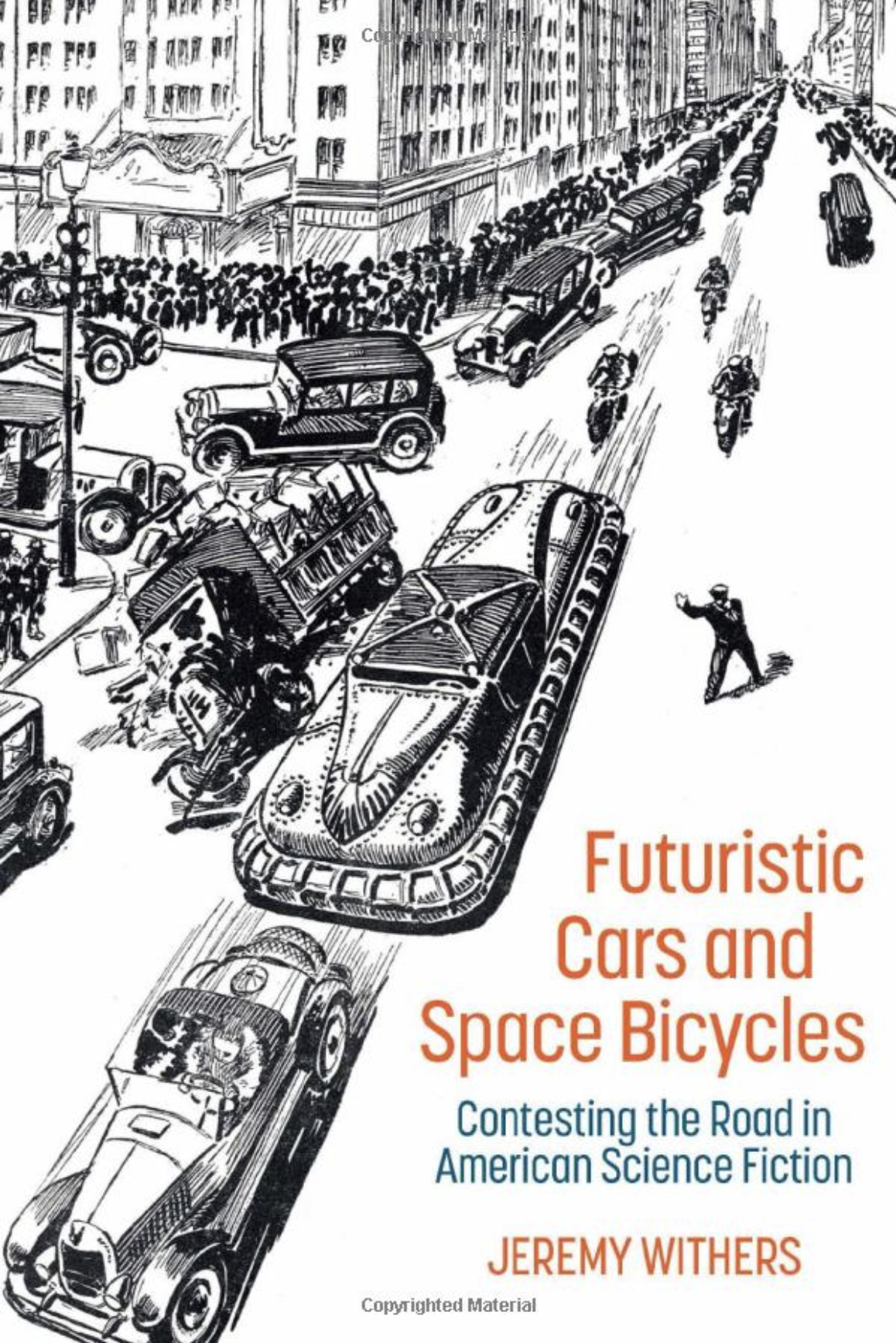
As technology continues to advance, it can increasingly feel as though the (first) world is coming ever closer to transportation methods from “science fiction.” Jeremy Withers’ Futuristic Cars and Space Bicycles: Contesting the Road in American Science Fiction provides a timely and wide-ranging survey of how many methods of transportation, but most predominantly the car and the bicycle, have been portrayed in the past century of speculative fiction.

Withers identifies six eras of speculative fiction, each of which has produced works which include representations of cars and/or bicycles. These eras are identified by Withers as: the pulp era (c. 1926-40); the ‘Golden Age’ of sf in the 1950s; the New Wave era (c. 1960-1975); postcyberpunk in the 1990s; and in recent times both postapocalyptic cli-fi and 1980s-nostalgia sf. For each of the six eras, Withers focuses on three exemplar works. The majority of the authors selected will be familiar to the sf enthusiast, although the specific works identified are not necessarily their best-known texts. Thus authors such as Hugo Gernsback, Ray Bradbury, Ursula K. Le Guin and William Gibson are represented, with a roughly even split in the texts examined between short stories and books. The final chapter goes beyond the written word to also consider film and television works.

In the introduction, Withers stresses the multidisciplinary nature of his studies, and while the theme of transportation vehicles is present throughout, it is difficult to categorise the book as belonging to a particular discipline. Withers himself suggests that it sits between ecocriticism, environmental humanities, and mobility studies. I would not underestimate the sociohistorical elements of the book either. Much of the discussion expressly draws connections between wider social concerns and the perspective taken in the texts discussed. This is done particularly well in relation to authors’ individual and often ill-fated histories with automobiles. Many of the authors examined in the book were avowed non-drivers, albeit for a wide range of reasons (Bradbury saw a shocking and gory car accident as a teenager; Octavia Butler was prevented by her dyslexia). Most shockingly of all, Hugo Gernsback’s three-year-old daughter was struck and killed by a taxi in 1928. The two factors which seem to arise again and again are the physical dangers of automobiles (especially to pedestrians) and their environmental impact.

As this might suggest, Withers’ own view is clear. “Two wheels good, four wheels bad” is perhaps an unfair reduction of the argument that pervades the book, but this is very much a critique of the automobile rather than a simple exploration of its portrayal. The methodical structure maintained throughout the book does mean that it is of considerable value in tracking how (some) sf has represented and interpreted the (futuristic) car and bicycle over time; but it should always be borne in mind that the author has chosen the examples to support the argument.

It is usually a mark of good writing when a reviewer would have appreciated a fuller treatment of the subject. Both elements of that sentence apply here. The book is engagingly-written and was an ideal companion for post-lockdown trips to the coffee shop: trips usually followed by a search for some of the lesser-known short stories discussed in the book (although do be aware that the discussion does contain plot spoilers). My one regret is that during the author’s necessarily limited tour of a hundred years of sf, there was not space for a little more reflection on the wider literary context of each era. As the book progressed, so did the scope, as skateboards, airships and tanks enter the scene. I felt that at times the narrative broadened to a more general comparison of ‘harmful’ and ‘benign’ (again, in the sense of safety and particularly environmental impact) methods of transport – an interesting discussion but arguably one better explored in a further book. A similar point could be made about the final substantive chapter relating to the increasingly iconic 1980s nostalgia trope of “kids on bikes.” Withers discusses these recent texts with some authority and raises some interesting points, particularly related to gender, but the chapter feels a little disconnected from what has come before. This is perhaps at least in part due to the fact that the bikes and cars involved in these texts are nostalgic representations of what was (at least in a certain idealised America) rather than futuristic representations of what may be.

Futuristic Cars and Space Bicycles is a valuable contribution to a wide range of fields which touch on transport and imagined futures. From my own legal perspective, I found sections on how regulation of various forms of futuristic transport has been portrayed in sf particularly interesting, especially given the ongoing debate as to how the law should react and adapt to advances such as autonomous vehicles and e-scooters. I would suggest that the book is of interest to a wide academic audience and while the (seemingly inevitable) price point of a hardback specialist academic work places it outside the budget of the general sf enthusiast, hopefully library access and perhaps a future paperback edition might ensure the book receives a deserved wider audience.

Fred Motson is a Lecturer in Law at the Open University, UK. Fred’s research interests include sports law, property law and environmental law. He has a particular interest in the intersection between law and technology, both in how technology can shape or change the practice of law and in how law responds to technological advances. Fred has a number of forthcoming projects exploring how representations of the law in sf can inform legal policy today.

Review of Reality, Magic, and Other Lies: Fairy-Tale Film Truths


SFRA Review, vol. 52, no. 4

Nonfiction Reviews


Review of Reality, Magic, and Other Lies: Fairy-Tale Film Truths

Megan Spring

Pauline Greenhill. Reality, Magic, and Other Lies: Fairy-Tale Film Truths. Wayne State University Press, 2020. Paperback. 268 pg. $32.99. ISBN 9780814342220.

In her book Reality, Magic, and Other Lies, Pauline Greenhill posits that while the terms “fantasy and reality,” and “magic and science” might seem mutually exclusive and at odds, the two sets of ideas should be considered, at times, synonymous. Greenhill equates the English verb lie as synonymous with “story, fairy tale, and folklore” in order to expose the nuance between how individuals perceive deceit and how they might perceive narrative in the form of fairytale and folklore (Greenhill 13). She plays on the conception of truth as it is revealed through fictional fairy stories—stories that require the audience to engage with some type of “lie” perpetuated by the creator in both film and book in order to attain truth.

Greenhill’s book is divided into two parts containing a total of eight chapters. Part one, “Studio, Director, and Writer Oeuvres,” discusses films with fairy tale-esque elements, each chapter dwelling explicitly on the relationship between the fantastic and the real world, always exposing the intersectionality between the two. In chapter two, Greenhill closely analyzes four films from LAIKA entertainment studios (Coraline [2009], ParaNorman [2012], The Boxtrolls [2014], and Kubo and the Two Strings [2016]), discussing the symbolic overlap between stop-motion animation and the malleable nature of human beings. She ultimately comes to the conclusion that “the linking of animation with reality also thematically connects it to real-world concepts—how films instantiate hegemonic or anti-hegemonic viewpoints, and sometimes both…” (65), thus nuancing her thesis that while fantastical in nature, fairytales speak more truth to the “real world” and its power structures than perhaps participants actually functioning in the real world.  In chapter three, she again highlights the intersectionality between the fantastic and reality. Greenhill progresses from animation to focus on live-action media (The Fall [2006], Mirror Mirror [2012], and Emerald City [2017]) by Tarsem. Greenhill focuses more specifically on the intersectionality of magic and science in this chapter, referring to claims she introduced early in the book that magic and science can be synonymous. Building upon her argument in chapter two, in which she posits the relationship between animation and reality as a means to express the relationship between fantasy and reality, in chapter 3 Greenhill presents issues of heterospatiality and heterotemporality as they are manifested in The Fall and Mirror Mirror respectively, in order to convey a synonymous relationship between magic and reality.  Similarly, she uses Emerald City as a means to further her initial claim that depending on one’s situated history, science can be seen as magic or vice versa, appealing to her argument that fantasy and reality are foundationally rooted together. Chapter four functions as Greenhill’s linchpin as she moves from animation to live-action and then finally includes herself in the action through a pseudo-autoethnographic study of Luc Picard’s work (Babine [2008] and Ésimésac [2012]), as she travels to Saint-Élie-de-Caxton to record and experience the real life and fictional aspects of Picard’s films, who quite literally creates fantastic tales based upon real people and events.

In part two, “Themes and Issues from Three Fairy Tales,” chapters five through seven shift from analysis of specific films to use of queer, feminist, and critical race theory to analyze modern renditions of the popular fairy tales “Hansel and Gretel,” “The Juniper Tree,” and “Cinderella,” respectively. Greenhill furthers her argument by looking at perpetuated narrative as a means to decode how reality is represented. Through her readings of the tales, she equates reality (manifested through accepted norms) with a type of fantasy in and of itself. She asserts that accepted reality exists as a means to deceive, as it perpetuates the fantasy of hetero, patriarchal, and Eurocentric norms. Her reading using the aforementioned literary theory adds another perspective to the fairytales, again muddying the line between fantasy and reality even further and, thus, evidencing her initial claim regarding the intersectionality between fantasy and reality, magic and science, deceit and truth. This section of the book answers the call put forth in the title to address the “Other Lies” perpetuated throughout society manifested through the relationship between fantasy and reality.

While no doubt the generally curious would benefit from reading this book, the text is best suited to those with an interest and background in folkloric studies, as some of the jargon and theory (especially in the second half) would require substantial supplementary reading for the lay reader. In addition, while the concept of narrative as fluid irrespective of medium furthers her argument regarding the transcendence of magic, some of Greenhill’s nuance could be lost on those not at least somewhat familiar with the films and stories presented throughout the book, even with her ritual plot synopses.

These synopses leave Greenhill’s style paradoxically brilliant and mundane, perhaps purposefully so, as her argument is founded on the paradoxically synonymous nature of the fantastic and reality. The self-referential nature of her overarching structure combined with the repeating structure within the actual chapters (she introduces the primary film/story, offers context, then plot summary, and concludes with analysis) serves to represent the repeated formula of fairy tale. While Greenhill’s writing can appear formulaic at times and, as a result, become a tad monotonous to wade through, the formulaic structure also serves to facilitate her argument rather brilliantly. Siphoned into two parts (each part containing three subsections) with an introductory and concluding chapter, Greenhill’s book essentially mirrors itself—an homage to her cover, which features a shallow pool reflecting the pictured landscape. She quite literally reflects her argument through her structure—fairytale reflects reality…or is it reality that reflects fairytale? Regardless of the question Greenhill leaves the reader to answer, one can conclude the two are the same. Her autoethnographic journey exploring a remote town in Canada in chapter four poses this question, as it symbolically functions as a portal, a “through the looking glass” scenario where the second half of the book mirrors the first, thus structurally mirroring her argument regarding the blurred boundaries between fantasy and reality, fiction and truth as she moves from animation to actual participant and scholar, getting closer to the fantasy she writes about and the questions she poses.

Megan Spring is a PhD student in Florida Atlantic University’s Comparative Study Program with a concentration in the intersectionality of language, literature, and culture. Her research interests include the dualistic binary that exists between folklore and literature, ghostlore and possession in American culture, and narrative structure within American literature. Megan’s creative contributions appear in the Cedarville Review. 

Review of Bradbury Beyond Apollo


SFRA Review, vol. 52, no. 4

Nonfiction Reviews


Review of Bradbury Beyond Apollo

Rafeeq O. McGiveron

Jonathan R. Eller. Bradbury Beyond Apollo. U of Illinois P, 2020.  Hardcover. 376 pg.  $34.95. ISBN 9780252043413. eBook ISBN 9780252052293.

Jonathan R. Eller’s Bradbury Beyond Apollo completes a biographical trilogy begun a decade ago. The 2011 Becoming Ray Bradbury took us through the early 1950s, and the 2014 Ray Bradbury Unbound actually does touch upon the Apollo era and even Bradbury’s 2012 death, but it is the 2020 Bradbury Beyond Apollo that truly delves into Ray Bradbury’s work and life from the 1960s to the end. The tale is a wide-ranging and sometimes a frustrating and even sad one, told in detail with authority and with compassion and yet also with a true scholar’s evaluation and critical judgment. As with Eller’s previous two installments, the approach here falls somewhere between, say, that of the more theoretical and bibliographically encyclopedic 2004 Ray Bradbury: The Life of Fiction by Eller and William F. Touponce and that of a more popularly oriented biography such as Sam Weller’s 2005 The Bradbury Chronicles: The Life of Ray Bradbury.

The book is divided into five sections, each of which comprises easily approachable chapters generally between five to ten pages each. Part I, “The Inherited Wish,” covers the period of the late 1960s through the late 1970s, from Bradbury’s awe and joy at NASA’s crewed lunar landings through the Viking I robotic mission to Mars and the publication of Long After Midnight. “Beyond Eden” runs from 1977 through the mid-1980s, including Bradbury’s deepening friendship with Federico Fellini and his work on Disney’s EPCOT. Part III, “1984 Will Not Arrive,” discusses the period of the early 1980s through the early 1990s, in which Bradbury spent a great deal of effort on, among other projects, often-abortive film work, Death Is a Lonely Business, and cable television’s The Ray Bradbury Theater. “Graveyard for Lunatics” covers 1990 through the late ’90s, with projects such as the sequel to Bradbury’s previous mystery novel and Green Shadows, White Whale (1992), and ever more effort for non-print media, along with further NASA honors. “Closing the Book,” the last section, takes us from the late 1990s until Bradbury’s death in 2012, including further awards and honors, the author’s final novels, and ever more story collections as well.

No one can deny the wide-ranging creativity of Ray Bradbury’s efforts in many different genres across seventy-odd years. Certainly Bradbury’s name looms huge, not just in the fantasy and science fiction genres but in broader culture as well. Sought out by NASA “as a validating witness and celebrant—and also perhaps as a talisman”—during “key moments of exploration” (9), reprinted in his own “perennially popular collections” (104) and in school textbooks as well, and lauded with honors from awards for his writing to the naming of sites on the Moon (7) and Mars (1) and even of an asteroid (218), the difficult-to-pigeonhole Bradbury is remembered widely in a way that most other contemporary SF and fantasy greats are not. Three volumes of biography indeed may be necessary. And, Eller reminds us, this volume, like the previous two, covers not only familiar events of Bradbury’s life and career but also “a number of adventures that the public knows little about; yet these were things that he cared a great deal about, whether they succeeded in grand fashion or failed to reach the public eye at all” (2-3).

It is this unevenness of Bradbury’s output and the changes in trajectory of his creativity—a “story…so complex and so full of unrelenting (and sometimes uneven) creativity” (2), as Eller puts it—in the second half of his life that are perhaps the most eye-opening here. On the one hand, despite certain “significant” (3) and “enduring works” (308) appearing in these later decades, “the stories and fables that define Ray Bradbury’s twenty-first-century legacy were almost all written during the first two decades of his seventy-year career” (3). On the other hand, “Bradbury’s pace of writing never slowed, but most of his time at the typewriter was devoted to new adaptations of his stories for stage, television, and film. Newer versions of older adaptations inevitably involved a great deal of new writing as well” (41). Even pieces released brand-new to the public, though, nevertheless still “were often nourished from the safe harbors where he had crafted his earliest stories of fantasy and suspense” (308). Alongside “isolated but significant achievements” of the later part of Bradbury’s career, such as “The Toynbee Convector,” various essays, and The Ray Bradbury Theater (309), after all, stand “late-life fulfillments of major prose projects mapped out half a lifetime earlier, such as From the Dust Returned [2001], Farewell Summer [2006], Somewhere a Band Is Playing [2007], and Leviathan 99 [2013]…” (3).

For any reader or critic of Bradbury’s art, Eller’s investigation is well worthwhile. Bradbury Beyond Apollo is impressively comprehensive, covering not only print works but also “the constant parade of lectures, creative consultancies, and adaptations for stage, television, and films that bled off his once broad channel of original short story production” (308), along with personal and business dealings with a host of famous names throughout the United States and Europe as well. And at the same time that Eller through his thoroughgoing and meticulous research can detail with insight and appreciation the various topics like no other, he is no uncritical panegyrist. Whether it is with a judgment of “Bradbury’s sometimes unreasonable ego” (55) or of the fact that the author “was not always the best judge of his own stories” and in later collections often picked personal favorites “that lacked the tight, emotionally powerful plots of his best work” (105), or with an acknowledgement of the “blunt” critiques, to put it mildly, from “various experts” of the Air & Space section of the Smithsonian Institution to Bradbury’s proposal for a planetarium show (109) or of Thomas Disch’s scathing review of The Stories of Ray Bradbury (105-106), this text puts Bradbury’s work into perspective rather than on a pedestal.

Bradbury’s “true trajectory in the final four decades of his life,” we are told, “would be that of a visionary, asked over and over again to tell us why we desire to explore, why we should go to the stars, and what we might become when we get there” (310). For a widely renowned author whose “unusual brand of science fiction—powerfully emotional studies of the human heart and mind mounted on a barely perceptible armature of science and technology—had inspired many scientists, engineers, and astronauts” (9) right along with countless ordinary readers, this was a worthy undertaking. So, too, was the writing of Jonathan R. Eller’s Bradbury Beyond Apollo.

Rafeeq O. McGiveron has published articles, chapters, and reference entries on the works of authors ranging from Robert A. Heinlein and Ray Bradbury and George Orwell to Willa Cather and Truman Capote and Shakespeare.  His edited collections include Critical Insights: Fahrenheit 451 (2013), Critical Insights: Robert A. Heinlein (2015), and Critical Insights: Ray Bradbury (2017) from Salem Press.  His novel, Student Body, was released in 2014, and Tiger Hunts, Thunder Bay, and Treasure Chests: A Memoir of the Path to Fatherhood was published in 2020.