Review of Science Fiction and Climate Change: A Sociological Approach


SFRA Review, vol. 52, no. 3

Nonfiction Reviews


Review of Science Fiction and Climate Change: A Sociological Approach

Jerome Winter

Andrew Milner and J.R. Burgmann. Science Fiction and Climate Change: A Sociological Approach. Liverpool UP, 2020. Liverpool Science Fiction Texts and Studies 63. Hardcover. 248 pg. $120.00. ISBN 9781789621723.
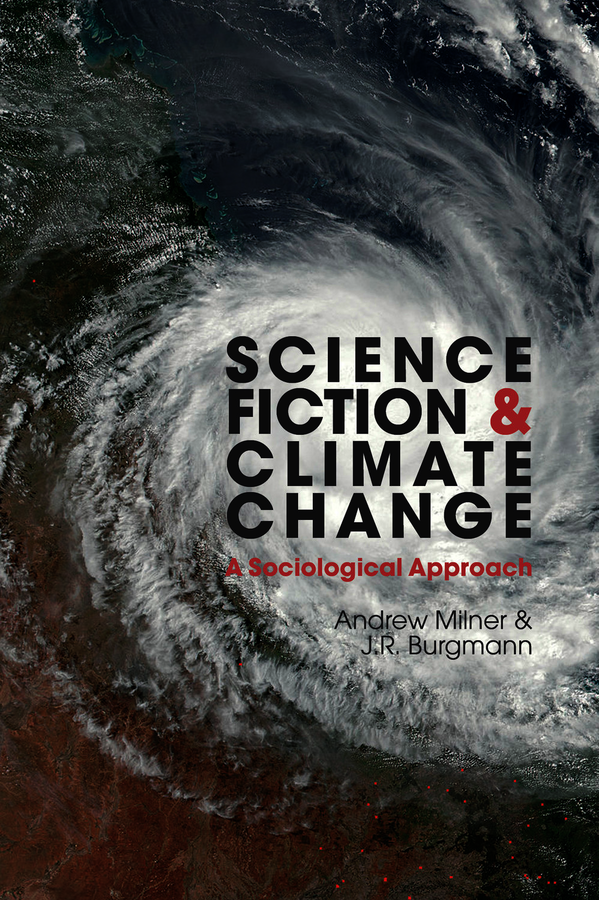
Andrew Milner and J.R. Burgmann’s Science Fiction and Climate Change: A Sociological Approach adds some vitally needed critical rigor to the burgeoning subgenre of SF literature and media Daniel Bloom has labelled “cli-fi,” that is, climate fiction. Some of the crucial distinctions the book contributes to scholarship include the distinction between theogenic (god-caused), geogenic (geology-caused), and anthropogenic (human-caused) climate fiction, the lattermost being only of recent vintage. Another useful categorization that Milner and Burgmann neatly add to the critical cli-fi conversation is the taxonomizing of works into ones that variously anticipate the fertile biosphere into the barren landscapes of a frozen world, a burning world, or a drowned world. Likewise, Burgmann and Milner divide their fourth and fifth chapters, on “classical” and “critical” dystopias (in Tom Moylan’s influential terminology), into cogent analyses of specific climate-fiction novels as exponents of a spectrum of ideological positions: namely, denial, mitigation, negative adaption, positive adaptation, and Gaia. There are also separate chapters on base reality climate fiction, fatalism in dystopian climate fiction, and a chapter on climate fiction as conjured in popular sonic and visual media.

A signal contribution of this timely book is its inclusion of a well-researched and globally oriented (if still primarily Western and European in origin) archive of climate fiction to illustrate this essential schema. Hence denialist climate fiction, i.e. fiction that avows skepticism about climate science, is exemplified through Sven Böttcher Prophezeiung (2011) as much as Ian McEwan’s Solar (2010). Mitigation climate fiction, or fiction that espouses techno-fixes and geo-engineering to address climate change, discusses Arthur Herzog’s Heat (1977) as well as Dirk Fleck’s MAEVA! (2011). Negative adaptation, that is, the minimizing of the deleterious consequences of climate change, is shown through Michel Houellebecq’ La The Possibility of an Island (2005) and Will Self’s The Book of Dave (2006). Positive adaptation, fiction that exploits opportunities afforded by climate change, is explored through Bernard Besson’s Groenland (2011) as much as Paolo Bacigalupi’s The Water Knife (2015). Gaian climate fiction, i.e. fiction that depicts the planet as operating according to a self-regulating balance, as theorized famously by James Lovelock, is typified via Jean-Marc Ligny’s climate trilogy of Exodes (2012), Semences (2015), and AquaTM (2006)as much as Brian Aldiss’s Helliconia trilogy (1982-1985). Burgmann and Milner discuss fatalistic cli-fi novels through the close reading of test cases of Antti Tuomainen’s Parantaja (2010) as well as Jeanette Winterson’s The Stone Gods (2007). In addition to a rich panoply of close readings of other miscellaneous climate fiction, this book also includes a long chapter that is labelled “Theoretical Interlude,” and which seeks to classify climate fiction broadly, according to excurses on Raymond Williams’s cultural materialism, Pierre Bourdieu’s sociology of culture, and Franco Moretti’s world-system theory.

There are three primary ways the theoretical interlude that underwrites the whole conceptual framework of this otherwise fascinatingly researched and critically valuable book are less than satisfying. Firstly, the blanket attacks on ecocriticism as damningly postmodern, ethereally post-structuralist, or covertly neoliberal seem rather skeletal and unconvincing, especially since the loose term “ecocriticism” has been so variably construed in literary scholarship over the last quarter of a century as to be rendered almost meaningless. The book could have benefited, for instance, from less tilting at these windmills and more direct and sustained engagement with the recent proliferation of literary criticism and ecocritical theory, loosely labelled, that does indeed engage with climate change as an environmental phenomenon, both in terms of science fiction and literary fiction and cultural politics more broadly. 

For instance, Timothy Morton’s theory of climate change as a baffling, contradictory “hyperobject,” even if rejected as flawed theorizing, might have added some more supple dimensions to the perhaps overly uncomplicated ideal typologies discussed in this book. Indeed, the absence of any sustained discussions of ecocriticism at all seems like a glaring critical gap given that the proliferation of discussions of climate change have been a bone of contention of much literary, cultural, and philosophical scholarship on the so-called Anthropocene. Secondly, some of the specific readings of climate fiction seem tendentious on a more basic interpretative level: taxonomizing Michael Crichton’s State of Fear (2004)as denialist is only fitting and well-marshalled; however, reading Cixin Liu’s hard-SF Remembrance of Earth’s Past (2008-2010) trilogy as “denialist” and symptomatic of a defunct communist Chinese ideological opposition to climate science jarringly stands out as an ungainly leap. Perhaps Cixin Liu in this trilogy does indeed cryptically and unreflectively endorse an anti-environmentalist message of hysterical crackdown, reinforcing a presumptive repression directed at radical deep ecology; however, not enough cogent evidence is provided to induce assent to this unconventional historicist reading of texts that never explicitly suggest this ideology, especially given that the passages in question found early in Cixin Liu’s trilogy seem on a surface level to be a stirring elegy of ecological dissent and even subversion, especially given the draconian publishing context. 

Lastly, and perhaps more substantively, the deeper theoretical assumption here is that literary fictional entertainment in general must conspicuously wear on its sleeves all its social and political positions, not to mention offer readers plausible predictions, explicit extrapolations, and realizable speculations to be ranked as serious or legitimate in its addressing of climate issues. Likewise, the assumption that it is the reductively didactic agenda of a work of fictional entertainment to provide a plausible template of pragmatic solutions to climate change saddles on often subtle literary texts outrageous expectations of literal forthrightness that can never be adequately met by even the most socially progressive writer or politically activist of audiences. Hence the critiques of works like Kim Stanley Robinson’s Green Earth (2015), 2312 (2012), Aurora (2015),or New York 2140 (2017) as absurdly unrealistic, or “utopian in the pejorative sense of hopelessly impractical” (165), deliberately overlook more granular allegorical interpretations of the novels as germinating an inchoate utopian impulse or unfulfilled fictive yearning for ecological change manifested in the complex problematics of the fictional scenarios. Such utopian allegory does not need to be taken as straightforward mimetic blueprint or programmatic recipe for lasting revolution to function effectively as an aesthetically and conceptually satisfying experience of counterhegemonic dissent and speculative-fantastic resistance. 

To be fair, and not to put too fine a point on this minor criticism, Milner and Burgmann do admit that this charge of “impracticality is a purely textual matter” (168), arguing that an otherwise sophisticated writer like Robinson, in these specifically discussed texts, as opposed to the more authentically turbulent changes depicted, for instance, in Margaret Atwood’s eco-dystopian Maddaddam trilogy (2003-2013), simply fail at representing a genuinely green revolution coherently and compellingly in the delimited space of the novels themselves. This line of analysis may be lucid and reasonable from its own particular sociological premises and critical perspectives, not to mention subjective reading experiences, and certainly represents some important scholarly responses to these climate-change fictions. The provocative critique only lacks enough theoretical insight and precise textual evidence to be persuasive for the larger argument that Milner and Burgmann are making about the intractability of either the nebulously nihilistic sentiments or the inanely sanguine tendencies of climate fiction. Milner and Burgmann themselves devoutly desire the publication of a deeply pessimistic climate-fiction equivalent of what Nevil Shute’s On the Beach (1957) was for anti-proliferation nuclear activists and that would have “practical effects on both elite leaderships and oppositional activists across the world” (191). Challenging the rote dismissal of uncritical dystopian fiction as unhelpful in galvanizing social movements, they earnestly conclude perhaps climate fiction will reach a critical mass of bleak and pessimistic representations of the ongoing climate apocalypse, and no singular landmark book is needed.

Milner and Burgmann therefore suggest that mitigation and adaptation novels, as much as Gaian, base-reality, or denialist climate fiction, are more or less uniformly prone to ingrained ideological blinkers in representing climate-change solutions, with Robinson’s utopian blindness being repeatedly invoked as exemplary in its refusal to depict “the organized working class as a social force most likely to prevent anthropogenic global warming” (192). However, even the test case for such a large and unwieldy generalization (Robinson’s own individual output is prolific) remains at best resistant to such sweeping interpretations, given the writer’s consistently nuanced depictions of splintering revolutionary factions of socialist-affiliated, labor-identified, and anti-capitalist organizations and the bewildering proliferation of micropolitical rivalries depicted in his densely ecopolitical novels. One idly wonders what Milner and Burgmann would make of Robinson’s more recent Ministry of the Future (2020), for instance, which depicts a perhaps more working-class radical and sociologically messier green revolution in response to climate change than his also clearly socialist earlier books. Regardless, Milner and Burgmann’s more evaluative, less taxonomizing views are not without their own merit or substance; Robinson’s science fiction, and perhaps mitigation and geoengineering novels in general, do indeed rely on carefully curated techniques of extrapolation (and perhaps as well the corresponding acts of reifying “world-reduction,” in Jameson’s famous phrase), and his critical utopian impulses certainly lay themselves open to complaints from skeptical readers who challenge such science-based speculations as naive and overoptimistic. To counter such irrational exuberance, a clarion call of relentlessly dystopian climate fiction may indeed be called for as a political-cultural bulwark against the equally dystopian rising tide of the world’s oceans.

Jerome Winter, PhD, is a full-time lecturer at the University of California, Riverside. His first book, Science Fiction, New Space Opera, and Neoliberal Globalism, was published by the University of Wales Press as part of their New Dimensions in Science Fiction series. His second book, Citizen Science Fiction, will be published in 2021. His scholarship has appeared in The Oxford Handbook of Science Fiction, Extrapolation, Journal of Fantastic and the Arts, the Los Angeles Review of Books, Foundation, SFRA Review, and Science Fiction Studies.   


Review of Jordan Peele’s Get Out: Political Horror


SFRA Review, vol. 52, no. 3

Nonfiction Reviews


Review of Jordan Peele’s Get Out: Political Horror

Rebecca Hankins

Dawn Keetley, ed. Jordan Peele’s Get Out: Political Horror. The Ohio State UP, 2020. New Suns: Race, Gender, and Sexuality in the Speculative. Paperback. 254 pg. $29.95. ISBN 9780814255803.

Dawn Keetley’s edited volume Jordan Peele’s Get Out: Political Horror is the best advertisement for the blockbuster debut film. The book provides viewers with a manual to investigate all of the film’s nuances, not only the overt but especially the hidden meanings elucidated throughout the sixteen essays. Keetley introduces the reader to the film’s storyline that centers on Chris Washington, a young Black man who encounters the family of his white girlfriend Rose Armitage. This encounter is the catalyst for the horror or, as Peele designates it, “social thriller” about race, racism, and society that inevitably leads to violence. Peele notes that those who wield power in society are often the purveyors of terror and horror, especially to those without power. As Stokely Carmichael notes, “If a white man wants to lynch me, that’s his problem. If he’s got the power to lynch me, that’s my problem.”[1] Peele’s Get Out represents an archetype of humans wielding power represented in the Armitage family and the Coagula Society, which becomes the horror for those without power, Black people generally and Chris Washington specifically.

Keetley situates the film in the long tradition of horror films in which humans are the monsters, e.g. The Texas Chain Saw Massacre (1974), American Psycho (2000), Hostel (2005), The Purge franchise (2013-18), and many others. The debate over whether human monsters depicted in political horror films, as opposed to a nonhuman monster, can be called horror continues. Keetley and Peele argue forcefully that his work is an extension of the social and political commentary that adds a layer of racial critique to this genre of horror. Following in the footsteps of social, political, and racial horror are the three films that Peele acknowledges were influences for Get Out, specifically Rosemary’s Baby (1968), Night of the Living Dead (1968), and The Stepford Wives (1975), each a critique of “societal structures-whether it be patriarchy or racism…-as the monster.” (4) 

The themes of the essays include those that influenced Peele’s film, e.g. zombies, body snatching, and a new Black gothic tradition that recognizes that “violence remains a part of everyday Black life” (120). Sarah Ilott’s “Racism that Grins: African American Gothic Realism and Systemic Critique” (Chapter 8) is reflective of those themes that allude to Georgina, Walter, and Logan’s “mask that grins” (Paul Lawrence Dunbar, “We Wear the Mask,” qtd on page 169).  Each of these characters has already endured the Coagula brain transformation, their bodies already snatched, but conversely, they continue to retain a fading recognition of their former selves.

There are also connections to contemporary themes such as gentrification, rural v. urban, and neighborhoods as place. The Armitage home represents the gothic plantation of the South, but Peele turns this notion on its head by locating the home in the liberal bastion of Upstate New York. There are a number of essays that discuss what Robin Means Coleman and Novotny Lawrence describe in their essay “A Peaceful Place Denied: Horror Film’s “Whitopias” (Chapter 3) as places where Black people feel conspicuously out of place. Andre Hayworth succinctly labels the setting as a “creepy ass suburb” (56) before he is snatched. These essays are particularly prescient for our current times with Trump’s recent tweet to those “living their Suburban Lifestyle Dream” that they will no longer have to be bothered by low income housing intruding in their neighborhoods as he rolls back another President Obama-era program designed to reduce racial segregation in American suburbs. For Trump it is the Whitopia that is “often prized for its segregation and homogeneity” (47).

Another group of chapters discuss Get Out’s connection to other historical and contemporary figures that include Othello, W. E. B. DuBois, Ira Levin (author of both Rosemary’s Baby and the Stepford Wives), and James Baldwin. Particularly noteworthy is Robert Larue’s “Holding onto Hulk Hogan: Contending with the Rape of the Black Male Psyche” (Chapter 12), which compares Missy Armitage’s hypnotizing Chris to police officer Darren Wilson’s explanation of his fatal 2014 encounter with teenager Michael Brown in Ferguson, Missouri. For Missy and Wilson, Black men are never children, they are always scary and in need of subduing. This chapter adds to our understanding of the Black male as vulnerable and targeted. We see that vulnerability as the camera focuses on Chris’s eyes as he is rendered into the Sunken Place, unable to move and awash in tears.

Another group of chapters, under the heading “The Horror of Politics,” includes Todd K. Platts’s and David L. Brunsma’s “Reviewing Get Out’s Reviews: What Critics Said and How Their Race Mattered” (Chapter 9), a chapter that offers some revelatory contrasts between how white reviews and reviews by people of color focus on very different elements of the film.  Other essays speak of scientific racism in how Coagula Society members poke, feel, and prod Chris, rarely discussing his intelligence or accomplishments. Their only interest is as it relates to his abilities, his stamina, his athleticism, and physical characteristics, their ultimate motive to learn his body’s suitability for the brain transplant.

The other essay that stands out is Kyle Brett’s “The Horror of the Photographic Eye” (Chapter 13),” which discusses “the eyes of horror” (188), both physical eyes and the white gaze that sees Chris as a vessel. The other “eyes of horror” are represented by the mechanical through the use of Chris’s camera phone. Brett discusses the white gaze of the Coagula Society’s Jim Hudson who covets Chris’s eyes to replace his blindness.  Chris uses his camera at the Armitages’ party to hide his uneasiness with the attention he receives. It is through his lens that he recognizes the Coagulated Logan and attempts to communicate their shared Blackness, but it is only after his camera accidentally flashes Logan that he screams at Chris to “Get Out.” It is also his camera phone that saves him after he flashes Walter, who shoots Rose and then commits suicide. This essay has relevance to our current state of police killings of Black men and women, e.g. George Floyd, Trayvon Martin, Breonna Taylor, Tamir Rice, Botham Jean, Eric Garner, and Mike Brown, and many more. It is this “horror” that is now captured on anyone’s cell phone and shareable worldwide that too often represents an exploitation of their deaths, but also an awareness that has resulted in investigations that would not have been possible in the past.

Keetley has compiled an excellent collection of essays on Jordan Peele’s Get Out. The book captures all of Peele’s influences and nuances; from his choice of music to his use of camera angles, every aspect has been theorized, imagined, speculated, and critiqued as horror, social horror and/or thriller, from its opening scene through to its conclusion. This book is an excellent text for graduate level film studies students. Scholars and students of Africana, Women’s and Gender Studies will be discussing the meaning, the methodology, the comparisons, and the film’s influence on new films that explore social horror or social thrillers for years to come. Can’t wait for the critique of Peele’s recent film US!


NOTES

[1] https://www.goodreads.com/quotes/7802915-if-a-white-man-wants-to-lynch-me-that-s-his

Rebecca Hankins is the Wendler Endowed Professor and certified archivist/librarian at Texas A&M University. United States President Barack Obama (2008-2016) appointed Hankins to the National Historical Publications and Records Commission (NHPRC), where she served from 2016-2020. She is an affiliated faculty and liaison in the Africana Studies, Women’s & Gender Studies, and Religious Studies programs. She has published widely in journals and book chapters and has presented all over the world.  Her most recent work is titled “Reel Bad African Americans Muslims,” published in Muslim American Hyphenations, edited by Dr. Mahwash Shoaib, 2021.


Review of Harry Potter and Beyond: On J. K. Rowling’s Fantasies and Other Fictions


SFRA Review, vol. 52, no. 3

Nonfiction Reviews


Review of Harry Potter and Beyond: On J. K. Rowling’s Fantasies and Other Fictions

Kristin Noone

Tison Pugh. Harry Potter and Beyond: On J. K. Rowling’s Fantasies and Other Fictions. University of South Carolina Press, 2020. Paperback. 168 pg. $19.99. ISBN 9781643360874. EBook ISBN 9781643360881.

Tison Pugh’s Harry Potter and Beyond explores not only J.K. Rowling’s worldwide phenomenon of the Harry Potter series, but extends the discussion of Rowling’s influence by engaging with her non-Potter works such as the Cormoran Strike detective series and the literary fiction The Casual Vacancy (2012). Pugh argues that Rowling’s work transcends any single category such as children’s fiction, and reveals both an engagement with and reformulation of the established genres of fantasy, the school story, bildungsroman, mystery, and allegory to ultimately create “a fresh hybrid form of literature” (19). These genres provide the structure for Pugh’s chapters, which offer an expansive and accessible discussion of Rowling’s literary works, genre definitions and critical responses, the role of the author, reader and fan responses, multimedia adaptation, and the role of literature in exploring human mortality, morality, and community.

Harry Potter and Beyond opens by considering the relationship of author to text in the persona of “J.K. Rowling” and the popular if not entirely accurate rags-to-riches narrative arc of her story, providing a detailed biographical overview and noting connections and references found in her writing. Pugh notes Rowling’s literary influences, history of charity work, and support of multiculturalism as well as the ways in which “many readers have found Rowling’s treatment of race, ethnicity, gender identity, sexual orientation, and other related issues sharply limited” (7), especially in light of her recently revealed views on the rights of trans people; this context is useful for acknowledging the complicated impact of Rowling’s influence, and the complexity of audience responses to her work and to her authorial persona. Pugh’s introduction thus also examines questions of literary theory, critical approaches, and popular culture engagement, providing larger scope and scholarly breadth. Finally, Pugh examines existing critical responses to Rowling, as well as the growing genre of YA literature and the difficulties inherent in defining such, and the ways in which the lines between literary and genre fiction have always been blurry. This final discussion sets up the central chapters of Harry Potter and Beyond, each of which reads Rowling’s work in the context of an established literary genre.

Each of Pugh’s chapters provides a succinct overview of the genre in question, while examining Rowling’s work as both an example of and a reformulation of established generic tropes. Chapter One uses the work of influential theorists of fantasy, myth, and fairytale (e.g. Jackson, Jameson, Mendlesohn, Campbell) to discuss the ways in which the Harry Potter series embraces and experiments with the tropes of fantasy, including the relationship of the mundane to the fantastic, the quest, the traditionally male mythic hero and gendered assumptions, and British identity, particularly in terms of chivalry and Arthuriana. Chapter Two continues this exploration of identity, especially British identity, in the school story tradition, which centers the protagonist’s maturation throughout the challenging experiences of the boarding school; Pugh again provides a useful overview of the history and major theorists of the genre, as well as an extended commentary on Rowling’s work as relying on and playing with genre convention: if the school story genre traditionally helps readers develop an ethical code, then “Rowling’s Hogwarts encourages students to aspire to more radical forms of knowledge based on the contingencies of experience” (43), and Pugh’s discussion of ethnicity and social class distinctions in Rowling’s work opens up fertile ground for future exploration.

Building on the themes of maturation in the school story, Chapter Three explores Rowling’s novels as bildungsroman, first establishing genre definitions (e.g. those by Alden and Buckley) and expectations, emphasizing the ways young protagonists learn to confront the social norms of their world, and productively applying this concept of identity formation to examine Rowling’s Wizarding World through a postcolonial lens, highlighting ethical sensibilities and ethical lapses.

Chapter Four shifts modes to the mystery novel genre, which, as Pugh points out, is often dismissed as “genre fiction” yet has a history of extensive overlap with many other genres, such as the bildungsroman in children’s and YA detective stories. As in previous chapters, Pugh provides an easy-to-follow overview of the history and major scholarship in the mystery novel genre, as well as emphasizing Rowling’s influences in and affection for the genre, and the interconnected nature of these fuzzily separated genres, grounded in a detailed close reading of the ways in which Rowling both employs and ignores key tropes thought to define the genre, such as the role of the hero as active investigator and “fair play” with reader expectations.

Chapter Five also considers Rowling’s expectations of readers and (sometimes versus) reader expectations, as Pugh explores the role of allegory and the genre of allegorical writing in Rowling’s work. Allegorical texts, as Pugh suggests here, “demand perceptive interpretations of that which they do not clearly state” (73) and thus invite multiple and potentially contradictory readings; Pugh focuses here on two particular allegorical readings, that of Christian sacrifice and salvation, and historical commentary on World War Two. Both of these allegories deal with themes of violence, Otherness, and communities under threat; Pugh offers a compelling reading of Rowling’s work as concerned with ways that escapist literature can productively open up discussions of morality and mortality, consequently arguing for the importance of genre fiction overall.

Chapter Six turns to the ever-evolving Potter canon, given the previous context of evolution and growth and genre interconnectedness; Pugh situates this discussion in the scholarly contexts of canonicity, collaboration, fanfiction and transformative works, adaptation (films, theater, fan productions) and paratexts (Rowling’s personal website, Twitter, Pottermore), and queerness (especially in the responses of queer fans and readers to canonical representation or lack thereof), considering this version of distributed authorship through the lens of Henry Jenkins’ concept of convergence culture and an increasingly participatory world.

Finally, Chapter Seven expands these themes beyond the Wizarding World, exploring how Rowling “seeks to dismantle artificial boundaries between genre fiction and literary fiction” (107) in The Casual Vacancy and the Cormoran Strike mysteries (the latter written under her Robert Galbraith pen name). In these novels, Pugh argues, Rowling “demonstrates her fluency with a wide range of literary genres and historical traditions, thus further testifying to her ecumenical influences and her reformulations of the British literary legacy” (108), but the more mixed critical and fan reception to these works also demonstrates the difficulties and “limitations” of her approach to genre. As in the Harry Potter novels, Pugh concludes, Rowling undermines simple distinctions of genre and “high” or “low” culture in order to emphasize themes of identity, family, community, morality, mortality, and resilience; thus, Rowling’s body of work overall reflects her desire to both acknowledge and move beyond established distinct categorizations.

Harry Potter and Beyond includes a well-organized multi-section bibliography, which will be useful for scholars working in any of the genres discussed, as well as scholars of more general literary criticism, narrative structure, and canonicity; the writing is both expert and approachable, accessible for established scholars and newer students embarking on research into these fields. Pugh provides a concise, informed, and compelling reading of Rowling’s body of work as both engaged in and demonstrative of inter-generic connections and influences, and ultimately emphasizes the appeal, hopefulness, and possibilities of playing with genre.

Kristin Noone is an English instructor and Writing Center faculty at Irvine Valley College; her research explores medievalism, adaptation, heterotemporalities, fantasy, and romance. In 2018 and 2019 she received the National Popular Culture Association’s Two-Year College Faculty Award, as well as the Kathleen Gilles Seidel Award, administered by the International Association for the Study of Popular Romance, for travel and research support in Australia. She is the editor of the essay collections Terry Pratchett’s Ethical Worlds (2020) and Welsh Mythology and Folklore in Popular Culture (2011),  and has published on subjects from Neil Gaiman’s many Beowulfs to depictions of witchcraft in Terry Pratchett’s Discworld to Arthurian references in World of Warcraft. She is currently working on a book-length study of Star Trek tie-in novels as sites of cross-media and cross-genre contact.


Review of Literary Afrofuturism in the Twenty-First Century


SFRA Review, vol. 52, no. 3

Nonfiction Reviews


Review of Literary Afrofuturism in the Twenty-First Century

Michael Pitts

Isiah Lavender III and Lisa Yaszek, editors. Literary Afrofuturism in the Twenty-First Century. The Ohio State UP, 2020. New Suns: Race, Gender, and Sexuality in the Speculative. Hardcover. 248 pg. $99.95. ISBN 978-0-8142-1445-9.

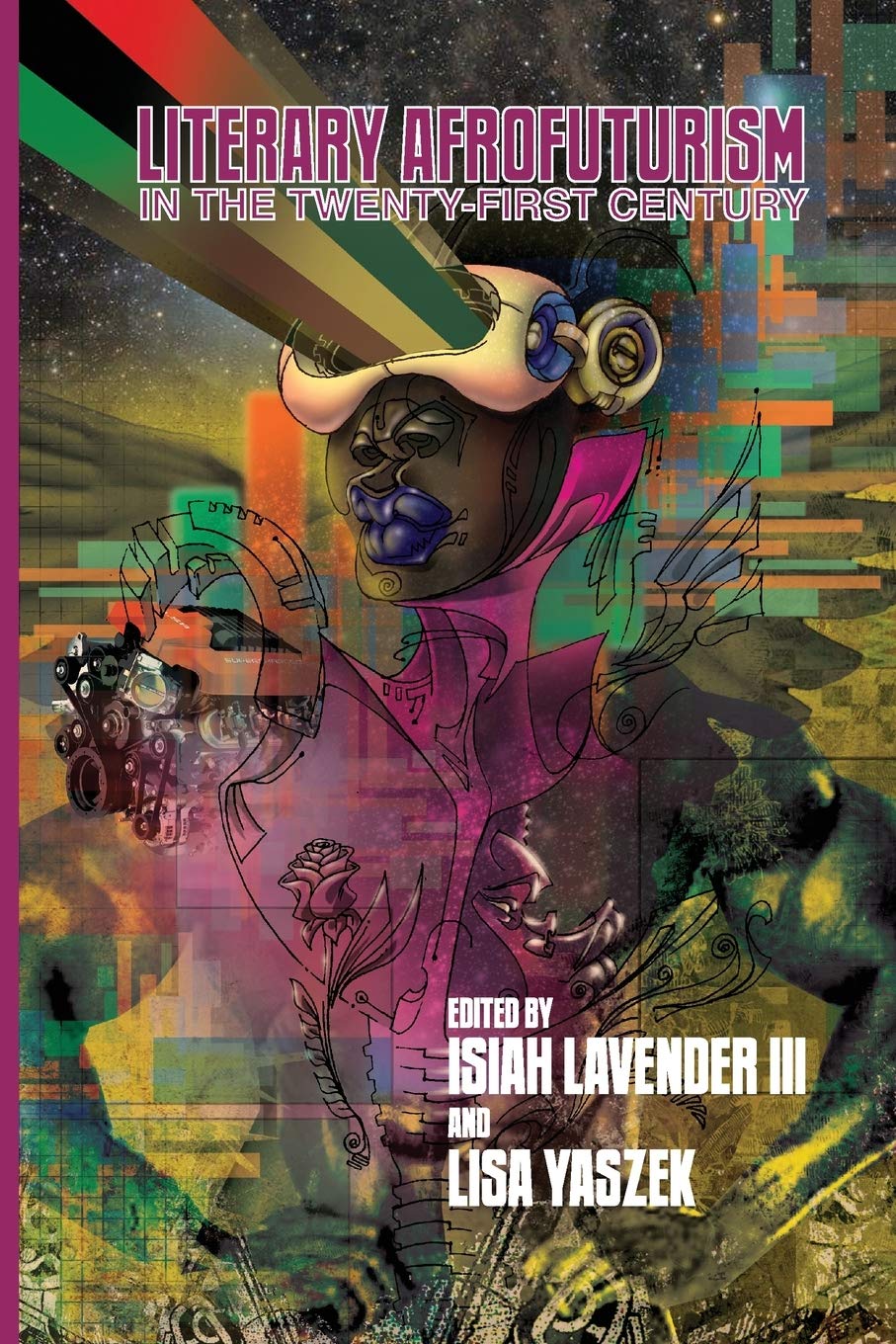
Literary Afrofuturism in the Twenty-First Century is designed, as explained by editors Isiah Lavender III and Lisa Yaszek, “to introduce readers to Afrofuturism as an aesthetic practice that enables artists to communicate the experience of science, technology, and race across centuries, continents, and cultures” (2). Made up of contributions from fourteen influential scholars, the collection is divided into four key “conversations” concerning contemporary aesthetics, literary history, cultural history, and the relationship of Afrofuturism to Africa. The first section is made up of conversations with creators of Afrofuturist works, beginning with a roundtable discussion with Bill Campbell, Minister Faust, Nalo Hopkinson, N.K. Jemisin, Chinelo Onwualu, Nisi Shawl, and Nick Wood. Including alongside this roundtable discussion an analysis by Sheree R. Thomas, editor of the revolutionary and influential Afrofuturist anthology Dark Matter: A Century of Fiction from the African Diaspora (2000), of the past, present, and future of this aesthetic movement, this first segment of the collection makes “space for the voices of artists who explore the intersection of science, technology, and race in their own work” (23). Made up of analyses of disparate speculative works gathered under the intersecting categories of SF and black Atlantic authors, the second section of this collection, Afrofuturism in Literary History, illustrates “how Afrofuturism produced by” such writers “enriches our understanding of contemporary science fiction” (11). The third segment of the anthology, Afrofuturism in Cultural History, applies the cultural studies lens to this genre, and considers how Afrofuturist texts provide insight to black culture and history. Lisa Dowdall’s “Black Futures Matter: Afrofuturism and Geontology in N.K. Jemisin’s Broken Earth Trilogy,” for example, highlights the experiences of black, female SF writers within fandom by considering the reception and interpretation of N.K. Jemisin’s novels, which Dowdall shows are grounded in geology, as scientifically unsophisticated and overly focused upon social justice. The text concludes with a final collection of essays, Afrofuturism and Africa, that considers “the complex relations of Afrofuturism as literary practice and Africa as both a source of artistic inspiration and a space for the production of black SF itself” (14). The analyses making up this final section disrupt narratives of technological development as uniquely Eurowestern, demonstrate how black SF writers use narratives “set in Africa to expose the colonial and postcolonial assumptions that have long driven environmental SF written from globally Northern perspectives” and add nuance to representations of Africa, and considers the importance of including African SF writers in a new iteration of the Afrofuturist genre (14). This anthology is a valuable resource due to its close examinations of the ways black speculative works impact the SF genre, shape and are shaped by the culture in which they are produced, and draw upon the African continent as a source of inspiration and a site for producing these narratives. It is additionally pivotal because of the questions it raises about the future of Afrofuturism as a global genre that will continue to link the creative works of pan-African, contemporary black Atlantic, and historic African American in fascinating ways.

This edited collection continues the work of scholars interested in Afrofuturism as a powerful aesthetic mode that emphasizes the intersection of race, science, and technology. Like Adilifu Nama’s Black Space: Imagining Race in Science Fiction Film (2008), Sandra Jackson and Julie E. Moody-Freeman’s The Black Imagination: Science Fiction, Futurism, and the Speculative (2011), Ytasha L. Womack’s Afrofuturism: The World of Black Sci-Fi and Fantasy Culture (2013), and Reynaldo Anderson and Charles E. Jones’s Afrofuturism 2.0: The Rise of Astro-Blackness (2015), Literary Afrofuturism in the Twenty-First Century examines the history of this aesthetic mode and traces its generic boundaries. Unique to this collection—in addition to its interest in new and overlooked artists, its exploration of how a burgeoning pan-African literary tradition possibly connects with Afrofuturism, and its opening with a roundtable discussion that centers the thoughts and considerations of black speculative writers—is its specific focus upon the literary output of this aesthetic practice. This emphasis upon the manifestation of Afrofuturism specifically in speculative literature differentiates this collection from the aforementioned texts, which include analyses of this artistic style in other media such as music, visual art, architecture, and film. Like André Carrington’s Speculative Blackness: The Future of Race in Science Fiction (2016), Literary Afrofuturism in the Twenty-First Century illuminates the impact of genre conventions upon popular conceptions of blackness but focuses specifically upon literary Afrofuturism. It is a significant resource for scholars due to its comprehensive examinations of Afrofuturist literature and its impact upon SF and cultural studies.

Emphasizing the far-reaching nature of the Afrofuturist genre, this collection is ideally suited for researchers desiring a guiding resource through this cultural terrain or scholars seeking a helpful companion for undergraduate or graduate courses focused on this topic. Moving beyond a simple overview of key Afrofuturist literature, the scholars in this anthology utilize diverse critical perspectives to interrogate the nature and boundaries of the genre. Importantly, these scholars also make crucial connections between Afrofuturist narratives and social and political activism. The collection makes “conscious the utility of Afrofuturism as a critical term in the battle to stake claims for people of color—and people of all colors—in the future imaginary,” a battle growing in intensity due to the resurgence of white supremacist political action (231). Literary Afrofuturism in the Twenty-First Century additionally offers young scholars and students theoretical tools for applying Afrofuturist concepts to their own readings and analyses of speculative fiction. This anthology therefore enables young scholars and students seeking an entry point into discussions surrounding this reimagining of the future through a black lens and its commentary on identity in 21st-century societies. Literary Afrofuturism in the Twenty-First Century is a valuable collection for the undergraduate and graduate classroom as well as for developing scholars seeking a broad understanding of this cultural phenomenon.

Michael Pitts is assistant professor at the University of South Bohemia. He specializes in masculinity studies, queer theory, SF studies, and utopian studies. His articles have been published in Extrapolation and The European Journal of American Studies and his first monograph, Alternative Masculinities in Feminist Speculative Fiction: A New Man, was published by Lexington Books in 2021. 


Review of Imagining the Unimaginable: Speculative Fiction and the Holocaust


SFRA Review, vol. 52, no. 3

Nonfiction Reviews


Review of Imagining the Unimaginable: Speculative Fiction and the Holocaust

Jeremy Brett

Glyn Morgan. Imagining the Unimaginable: Speculative Fiction and the Holocaust. New York: Bloomsbury Academic, 2020. Hardcover. 214 pg. $120.00. ISBN 9781501350542.

In a world much brighter than our own, the Nazi Holocaust would have occurred only within the fevered dreams (or Iron Dreams, to get Spinradian) of science fiction authors who sought to create the darkest, most dystopian alternate histories of which the mind could conceive. Unfortunately, we reside in this world, where millions of innocent people were murdered between 1933-1945 through the unholy combination of virulent hatred, pseudoscience, and the processes of modern industrial society. As a result, the Holocaust for us is an undoubted, unwelcome fact, one with which we grapple in many realms, including the literary.

Literary analysis of the Holocaust is a tricky business. As Glyn Morgan notes, “[m]any representations of the Holocaust in fiction draw upon the implicit assumption that the traumatic experience cannot, and perhaps should not, be conveyed through art” (1).  Theodore W. Adorno famously said in 1949 that “to write a poem after Auschwitz is barbaric”—forever misquoted as “it is impossible to write poetry after Auschwitz.” Whether impossible, or merely barbaric, the Holocaust has had the invocation of silence laid upon it since 1945, and although discussion of it has actually been vast, its legacy has been the convention that the Holocaust is an ultimately inexplicable, unknowable, and unimaginable event, beyond literature (certainly beyond genre literature). With this book, Morgan convincingly makes the case that, in fact, speculative fiction is ideal for expressing the inexpressible –” [w]e are routinely confronted by language which tells us that the Holocaust is Other as an environment of death, survivors and victims are Other in their suffering, and perpetrators are Other in their evil. What is called for, therefore, is a literature intimately associated with describing the Other.” (11). Morgan argues that “the ultimate achievement of SF Holocaust fiction is to allow us to learn something about the Holocaust, to come closer to understanding it, while maintaining the Otherness (estrangement) which the topic insists upon” (13). He gives particular focus in this study to the SF subgenres of alternate history and dystopia as vehicles for carrying out SF’s traditional role of examining the dark and difficult aspects of the human condition through futuristic or fantastical lenses.

Although Morgan references a library’s worth of titles, he focuses on a small group of works (his “key texts”) in particular to explore the various ways that the genre has chosen to confront the Holocaust. He begins with precursor texts, early works that predate both the actual occurrence of the Holocaust and its “rediscovery” in the popular mind brought on by the 1960 trial of Adolf Eichmann. The most significant (even prescient) of these was the 1937 feminist novel Swastika Night (by Katherine Burdekin, under the pseudonym ‘Murray Constantine’), an alternate future history set 700 years in the future. Nazi Germany (with Imperial Japan) has long since conquered the world; its empire is a feudal society in which women have been stripped of all rights and been intensely Othered by the misogynistic Nazi regime. History has been doctored into a legend of a knightly and heroic Hitler and his knights; all records to the contrary were long ago destroyed. The novel is striking for its premonitions about the dehumanization of victims of Nazi terror and, as Morgan notes, “more than any other Anglo-German war novel its imagery and narrative can be found reverberating through post-1945 literature in the works of a wide range of authors of dystopian fiction and alternate history” (24). And a novel that features a government that succeeds by making use of a cultlike reverence for a Leader, the widespread use of ruthless violence, resurgent nationalist feelings, and the deliberate elimination of truth… well, it would be hard to argue that Burdekin’s work lacks contemporary relevance.

Three alternate histories are highlighted by Morgan to show how SF Holocaust fiction has been used to counter the predominant cultural notion that the Holocaust was, and is, “the ultimate manifestation of humanity’s potential for evil, and thus its designers and instigators were the ultimate agents of that evil” (41). That idea renders the Holocaust as close to unapproachable as a subject of comparative history, and history itself something that reaches some kind of final nadir with the Nazi genocide. Morgan, however, notes three works that, in postulating different outcomes to the Holocaust and World War II, problematize this fixed notion of history. In doing so, they “undermine faith in the notion of an absolute evil and call into question issues of historicity, morality, and a hierarchy of suffering” (42). Philip K. Dick’s classic The Man in the High Castle (1962) is no doubt the most famous of all the works Morgan examines in his entire book—set in a conquered United States divided between Germany and Japan, High Castle involves, as do many of Dick’s works, the questioning and perception of our reality and what we believe to be true. Multiple realities exist, suggests Dick, and in every one is the potential, indeed the likelihood, for fascism to triumph: this puts paid to the idea that the Holocaust was a one-time expression of humanity’s capacity for limitless evil. The reality Dick describes in High Castle is one where the Holocaust was not only ultimately successful but committed on an even more terrible scale: not only Jews and Roma have been eliminated but the genocide has spread to Africa, where the continent has been emptied of its natives by a triumphant Germany. History is problematized by Dick’s contention that things could have actually been even worse (a common thread in the alternative history subgenre).

In Robert Harris’ alternative history thriller Fatherland (1992), the Holocaust has occurred but been hidden from history by a victorious Germany, assisted by the willful ignorance of the people of the Reich and the normalization of German fascism in a conservative American government (led here in 1964 by President Joseph P. Kennedy). Based around the work of a Berlin police detective to uncover a murder conspiracy tied to the Holocaust, Fatherland is a work of SF Holocaust fiction that, like High Castle, calls our understanding of received history into question, by “challenging our expectations about the truth and validity of our own historical narrative” and by placing the Holocaust and its perpetrators onto a “relative scale of morality” (53) that, again, questions the Holocaust as the far and unapproachable end of history. Morgan also discusses Stephen Fry’s 1996 novel Making History in this vein: a time travel story gone wrong, Fry’s work depicts a world where an attempt to stop Hitler from being born results in a new timeline wherein a man named Rudolf Gloder arose to replace Hitler. The historical circumstances that produced Hitler remained, and removing him from the equation did not remove the Germany that Hitler made his own, nor the Germans that would follow him. The Holocaust under the smarter and more stable Gloder was perhaps less brutal, but even more horribly complete: mass sterilization wiped out the entire European Jewish community in a single generation. Again, Morgan demonstrates how SF Holocaust fiction not only presents worlds worse than our own, but in doing so forces us to ask whether Hitler is truly the Ultimate Evil of History or our Holocaust the worst possible outcome, shocking as either case might be to consider.

Morgan takes another group of novels as the centerpiece for discussing how SF Holocaust fiction has viewed the Holocaust through alternatives to the historically saved and the destroyed. The Boys from Brazil (Ira Levin, 1976) and The Portage to San Cristobal of A.H. (George Steiner, 1981) look, in very different ways, at worlds where Hitler escaped the justice of history—literally, in Steiner’s case, with an aging Hitler being captured by an Israeli commando team after having escaped to South America; and figuratively by Levin, where a refugee Dr. Mengele is genetically engineering clones of Hitler that can one day take up his mantle and secure his legacy. Both these works problematize the idea of justice and deserved culpability, just as Dick, etc. did so for the very notion of received history. Morgan also talks about Michael Chabon’s 2007 alternate history The Yiddish Policeman’s Union, set in an Alaska where Jews fleeing Europe before World War II were allowed by the US government to settle. In this world, the Allies won the war (in part thanks to a nuclear bombing of Berlin) and the Holocaust was what Morgan terms “a diminished catastrophe” (89). Chabon uses this alternative situation to compare and contrast the treatment of the Jews to that of the real-world Palestinians and Native Americans and to “place the Holocaust among the realms of other atrocities, and so highlights the extent to which the promotion of the Holocaust’s exceptionalism influences the world” (96).

In his last chapter, Morgan considers several texts that use the Holocaust and alternative histories to shine lights on contemporary fears, and to show that the horrors of Nazi Germany might easily be enabled or copied by allies, bystanders, and hypocritical politicians. Philip Roth’s 2002 The Plot Against America deals not explicitly with the Holocaust but, as so often in Roth’s work, the American Jewish experience. In this case, Roth dramatizes the growth and danger of domestic American right-wing politics by giving the reader a 1940 where Charles Lindbergh defeats Franklin D. Roosevelt for the Presidency. Lindbergh, in addition to instituting a neutral policy in Europe, launches an effort to uproot urban Jews and resettle them in rural locations across America, ostensibly to make them more “American.” Conflicts lead to a brief but tyrannical police state in the US, though the book ends happily (clumsily so, both Morgan and I would argue). In Jo Walton’s murder mystery Farthing (2006), the British (thanks to Rudolf Hess) negotiate a 1941 peace with Nazi Germany, and by 1949 the UK is a soft fascist state governed by the pro-Nazi British establishment and infected with quiet, “acceptable” anti-Semitism. Walton wrote Farthing (and its two sequels) in emotional response to the eruption of the Iraq War and the US/UK aggression in the Middle East. Lavie Tidhar’s beautifully clever A Man Lies Dreaming (2014) gives us an alternate Hitler, working as a private detective in London after fleeing there following a Nazi loss to the Communists in the 1936 German elections. Hitler’s London is one in which he and the reader hear echoes of the anti-Semitism and nationalism of his lost Germany and which are growing worrisomely louder in our own time.  (That potential for renewed racist and nationalist feeling is reinforced in Howard Jacobson’s 2014 J.)  Bringing attention to the dangers of our own age through examinations of our fictional or alternative pasts is, as Morgan notes, a key achievement of these works.

Morgan’s remarkable achievement with Imagining the Unimaginable has been to show that SF Holocaust fiction is not only a real possibility, but a rich subgenre of speculative literature that escapes the paradox of a historical event so vast that it “cannot be spoken of” yet is written about in countless literary works. What this kind of fiction, as Morgan frames it, does is “demonstrate that speculative fiction in its alternative approach to the Holocaust, less burdened by the critical discourses associated with realism, brings a much-needed diversity to the literature of trauma and genocide” (159). That is a valuable project indeed: the Holocaust is an event that demands repeated evaluation and attempts to make sense of it. Science fiction through its history has been invaluable for helping us to understand the mind and the life of the Other—let that legacy continue here, and be directed towards granting us a better understanding, however incomplete, of this event, its perpetrators, and the millions of innocents destroyed by it.

Jeremy Brett is an Associate Professor at Cushing Memorial Library & Archives, where he is both Processing Archivist and the Curator of the Science Fiction & Fantasy Research Collection. He has also worked at the University of Iowa, the University of Wisconsin-Milwaukee, the National Archives and Records Administration-Pacific Region, and the Wisconsin Historical Society. He received his MLS and his MA in History from the University of Maryland – College Park in 1999. His professional interests include science fiction, fan studies, and the intersection of libraries and social justice.


Review of Ms. Marvel’s America: No Normal


SFRA Review, vol. 52, no. 3

Nonfiction Reviews


Review of Ms. Marvel’s America: No Normal

Michael Dittman

Jessica Baldanzi and Hussein Rashid, editors. Ms. Marvel’s America: No Normal. UP of Mississippi, 2020. Paperback. 280 pg.  $30.00. ISBN 9781496827012.

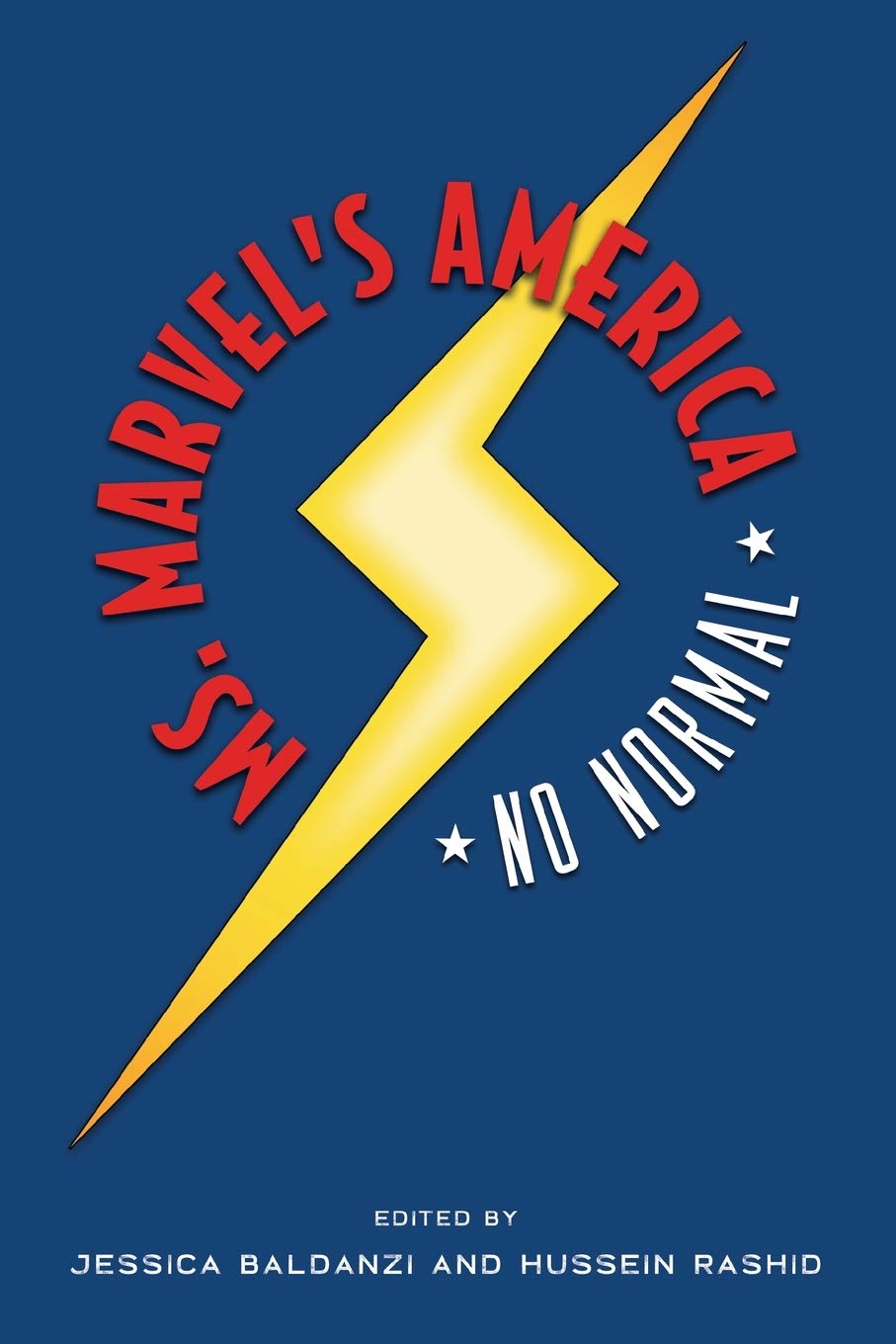
In the late 1970s, American comic book company Marvel introduced the Ms. Marvel character: the alter-ego of Carol Danvers, who was first a United States Air Force officer and then an editor at Women Magazine. Although seen as a progressive and feminist character at the time, Danvers had the form of a traditional female superhero caught in the male gaze. She was tall, blonde, and possessed of a Barbie doll figure shrink-wrapped in a revealing costume.

Danvers would go on to be treated shamefully in storylines in the 1980s and 1990s. Her rape and addiction were treated as throwaway plot points. However, by 2012, the character’s treatment had improved with her assumption of the mantle of Captain Marvel. Meanwhile, in 2013, the title of Ms. Marvel passed on to Kamala Khan, a second-generation immigrant born to Pakistani-American parents. Khan is a young, female, Muslim superhero who fits into the Peter Parker/Spider-Man trope of a teenaged hero struggling to balance the pulls of responsibility and youth. While Muslim superheroes existed before Kamala Khan, Khan is the first Muslim superhero to headline her own title and, notably, the first hero created and written by two Muslim-American women. Ms. Marvel would go on to win Eisner and Hugo awards in 2015.

Ms. Marvel’s America: No Normal, edited by Jessica Baldanzi and Hussein Rashid, is the first collection of criticism to take on, in an interdisciplinary way, the success and impact of Ms. Marvel. The book effectively makes the point that Kamala Khan and Ms. Marvel provide a rich ground for interpretation of America’s relationship with Islam, gender, race, and diversity in mainstream comics. 

While including dense literary theory, the book also includes approachable articles for a general audience (especially Aaron Kashtan’s “Wow, Many Hero, Much Super, Such Girl: Kamala Khan and Female Comics Fandom,” which addresses the fan community and its interaction with Khan and her status as a fan-fic writing superfan of other heroes within the world of her comic). The interdisciplinary nature of the collection is one of its strengths. The collection has an encompassing breadth including chapters from literature, religious studies, pedagogy, and communications scholars including José Alaniz, Jessica Baldanzi, Eric Berlatsky, Peter E. Carlson, Sika A. Dagbovie-Mullins, Antero Garcia, Aaron Kashtan, Winona Landis, A. David Lewis, Martin Lund, Shabana Mir, Kristin M. Peterson, Nicholaus Pumphrey, Hussein Rashid, and J. Richard Stevens.

The book is divided into an introduction and five sections. The introduction focuses on Ms. Marvel’s challenging of character tropes. The introduction also raises a point to which other authors in the collection will return: Khan’s place and symbolism (limited to the first 19 issues of Ms. Marvel) within the continued anti-Muslim American rhetoric especially evident during the Trump administration. The first section focuses on precursors to Khan’s Ms. Marvel character including Dust, another notable Marvel Muslim character. Whereas Khan is seen as a step towards a more realistic attempt at depicting an Islamic superhero, Dust’s presentation is much more problematic and tends to fulfill more Orientalist tropes. The second section, “Nation and Religion, Identity and Community,” is the longest section in the text and deals extensively with the iconography of the Khan character and the friction against stereotypes both religious, gender-based, and fan-based. The third section is called “Pedagogy and Resistance” and asks how Khan fits into classrooms and conventions. The fourth section, “Fangirls, Fanboys and the Culture of Fandom,” deals with Ms. Marvel’s disruption of the traditional fan and creator communities. 

The collection concludes with a wide-ranging interview between gender studies scholar Shabana Mir and Ms. Marvel author and cocreator G. Willow Wilson. This choice of including an interview with the creator is a strong one. Wilson, from her insider’s perspective, makes points such as that the suppositions of what will sell (white cisgender male heroes) and what won’t sell (solo comics with women or minority characters) have more to do with the economics of comics and their antiquated exclusionary distribution system rather than with what people want to read. A point such as this one (and the idea that there is a limit to what can be done progressively with a character owned by a mega-corporation such as Disney and written by a revolving cadre of artists and writers) is more likely to be made by someone involved in the business and is an idea which, by itself, is worth the inclusion of the interview. Mir also encourages Wilson to comment directly on some of the theses of the included critical chapters which leads to a valuable dialogue between subject and critic.

Additional standout essays include “Mentoring Ms. Marvel: Marvel’s Kamala Khan and the Reconstitution of Carol Danvers” wherein J. Richard Stevens, while analyzing the poor treatment of the Danvers character over the years, stresses the point that while the presentation of Khan’s religion is new in the comics, she is an old type of Marvel Character: “The People With Problems” that Stan Lee popularized in the 1960s. These are heroes who struggle with personal problems to make the character seem to be relatable. Stevens leaves room for further thinking about this point, especially as part of Khan’s “problem” is presented as her religion and her struggle with it. 

Several of the essays address that the locus of Khan’s character is symbolized by her superhero power. Khan is a polymorph: “Her very body represents her conception of being American”, writes Hussein Rashid (also one of the editors of the collection) in his “Ms. Marvel Is An Immigrant” (47).While she can control the size and shape of her appearance while fighting evil, she also struggles with comparing herself to her peers like blonde popular schoolmate Zoe (like Carol Danvers, another tall, willowy blonde in Khan’s life with whom she has a difficult relationship). Khan’s ability to morph, combined with her wish to adapt to be the “right” person, Rashid suggests, reflects a desire of many immigrants who feel left out or conflicted in their identity and its place in the older culture.    

Sika A. Dagbovie-Mullins and Eric Berlatsky continue to delve into the symbolism between Khan’s polymorphism and the fluidity of the immigrant existence in “The Only Nerdy Pakistani-American Slash Inhuman in the Entire Universe – Post Racialism and Politics in the New Ms. Marvel.” These authors continue to make the argument that Ms. Marvel doesn’t acknowledge the discrimination and surveillance of both federal forces and “concerned citizens” that colored the American Muslim experience post 9/11 (occurring when Khan would have been three years old). American drone strikes in Pakistan, for instance, are never mentioned. Police are seen as uniformly helpful. All of these ideas make the argument that the comic, overall, is “politically deracialized” while Ms. Marvel is racialized through familiar and comfortable tropes (75). To read Khan as a Muslim superhero instead of a superhero who is Muslim, Rashid reminds us, “flattens her character and misunderstands the way that she does important work” (61).

That important work of understanding Khan’s place in the mediation of self and culture is typified in “Hope and the Sa’a of Ms. Marvel,” by A. David Lewis. As a female teen Muslim superhero, she is a marginalized person who, in the comic event Secret Wars, is on the margins of the apocalypse. Lewis shows how Islamic eschatology (Lewis defines sa’a as “the appointed hour of the eschaton leading to resurrection”) is explained through Kahn’s decision to spend the possible last moments of Earth 616 in Jersey City rather than heading off with other heroes to defend the world against an encroaching alternate universe (128). In doing so, Khan occupies a familiar space with the readers. Her important work becomes protecting her friends and families and providing them with a symbol of hope even as the world comes to end.

 Although the collection casts a wide net, historical grounding of Muslim comic characters and Khan’s place in that pantheon starting with someone like Elliot Publishing’s Golden Age hero, Kismet, Man of Fate, to show the stereotypical and sometimes buffoonish way that Muslims characters have been (and in many cases continue to be) portrayed would help to ground the discussion of Khan’s evolutionary portrayal even more. This desire may be nit-picking, however. This collection is an opening, not a final word. Since the book covers only the first 19 issues of Ms. Marvel, it plows the ground for a fertile new field of scholarship and opens up lanes of discourse for the continued discussion of the character and the reader’s response to her. After all, comics, Rashid writes in the collection, can act as an agent of social change by participating in the parasocial contrary hypothesis and creating a dialogic dissonance between what the comic reader expects and what the comic reader finds. This interaction can create an environment wherein the reader and the critic are more accepting of exploring new visions of American immigration in old mediums.

Michael Dittman is a Professor of English at Butler County Community College (PA).  A former small press comix creator, his books include Jack Kerouac: A Biography and Masterpieces of the Beat Generation


Review of Plants in Science Fiction: Speculative Vegetation


SFRA Review, vol. 52, no. 3

Nonfiction Reviews


Review of Plants in Science Fiction: Speculative Vegetation

Nora Castle

Katherine E. Bishop, David Higgins, and Jerry Määttä, eds. Plants in Science Fiction: Speculative Vegetation. University of Wales Press, 2020. New Dimensions in Science Fiction. Hardback. 272 pg. $82.00. ISBN 9781786835598.

As Heather Sullivan warns us, “if the vegetal fails, we fail” (7). Not only do plants produce the air we breathe and the crops we eat, but they also form the basis of a variety of objects (clothing, medicine, fuel, etc.) that have allowed for the development of human culture. The biological and cultural evolution of humans has always been deeply intertwined with that of plants; as Atul Bhargava and Shilpi Srivastava attest, the development of agriculture through the domestication of plants was “a major turning point in both the environmental and cultural history of human beings” (6), one that “is marked by changes on both sides of the mutualistic relationship, as both partner populations, over time, become increasingly interdependent” (11). Plants are also much more “alive” than previously thought, as has been demonstrated by a number of advances in plant biology. Yet, despite our interdependence, “Plants seem to inhabit a time-sense, a life cycle, a desire-structure, and a morphology,” explains Randy Laist, “that is so utterly alien that it is easy and even tempting to deny their status as animate organisms” (12). How can this gap be bridged, between the vital importance of plant life on the one hand, and the inability of humans to “see” (both literally and metaphorically) plants—a phenomenon that James H. Wandersee and Elisabeth Schussler call “plant blindness” (3)—on the other?

Following on the heels of the so-called “animal turn” (Ritvo 119), a “vegetal turn” (Hall x) in the Humanities has emerged which attempts to address this very question. While, as Catriona Sandiland notes, “the vegetal has been ‘turning’ for a long time” (Cielemęcka and Szczygielska  4), particularly in Indigenous and feminist contexts, there has certainly been an uptick in the type of plant-focused scholarship now referred to as Critical Plant Studies. This field, which “challenges the privileged place of the human in relation to plant life” (Stark 180), coalesced in the early 2010s primarily in the field of philosophy (with a major assist from the work of philosopher Michael Marder), but a series of literary-focused works have since emerged which expand its purview. Perhaps the most well-known of these is Randy Laist’s edited collection, Plants and Literature: Essays in Critical Plant Studies (2013), through which Laist argues for sustained inquiry by literary theorists into the ontological status of plants. Other examples include Plant Horror: Approaches to the Monstrous Vegetal in Fiction and Film (2016), ed. by Dawn Keetley and Angela Tenga, Plants in Contemporary Poetry: Ecocriticism and the Botanical Imagination (2017) by John C. Ryan, and Novel Cultivations: Plants in British Literature of the Global Nineteenth Century (2019) by Elizabeth Hope Chang.

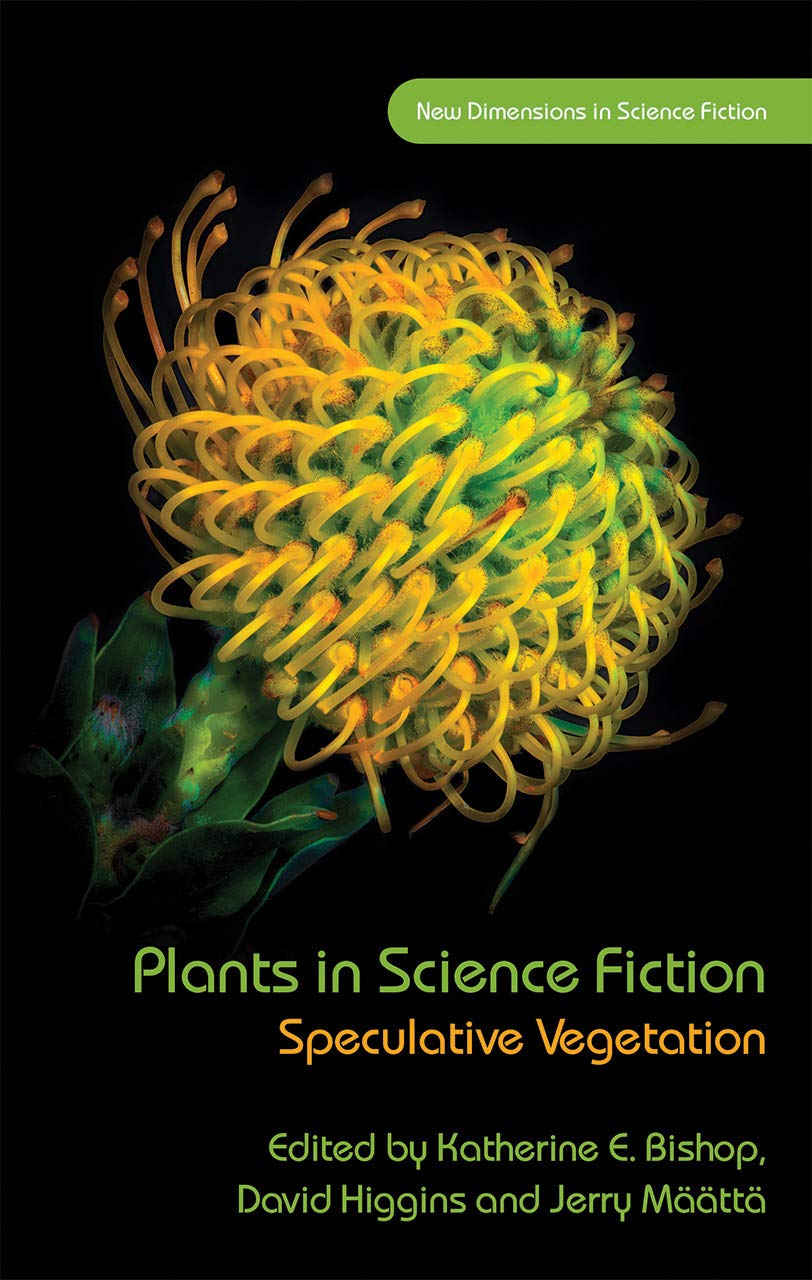
Plants in Science Fiction: Speculative Vegetation (2020), edited by Katherine E. Bishop, David Higgins, and Jerry Määttä, is the latest in this lineage of works, and one of the first to turn its vegetal gaze toward science fiction. Slightly pre-empted by Natania Meeker and Antónia Szabari’s Radical Botany: Plants and Speculative Fiction, which lists 2020 as its publication year but in fact was available in December 2019, Plants in Science Fiction nevertheless remains the first edited collection on the topic. The rationale for its consideration of plants in science fiction, argued for convincingly by Katherine E. Bishop in the introduction, is simple: “One of the greatest boons of sf is the way it allows us to confront that which is alien to us – worlds, thoughts, experiences, desires and lives that are not our own. […] And what alive is more alien to humans than plants?” (3). Not only is there a similarity between human consideration of plants and SF tropes of literal aliens, but also plants sometimes become the “alien” threat in these works, depicted as more disruptive and more alive than they appear in everyday life. The cognitive estrangement of SF is an effective method of combating plant blindness, forcing plants and their unwieldy, overgrowing, unknowable otherness directly into view.

Plants in Science Fiction consists of an introduction followed by ten chapters divided into thematic streams. These chapters address the alterity of plants as well as the “commonalities, hybridities, and mutual forms of growth” (5) between plants and humans in a range of sf narratives from the late 19th to the 21st century. They take a variety of theoretical tacks, from new materialism to postcolonialism to queer theory to posthumanism. All engage in some way with Critical Plant Theory, with some—like T.S. Miller’s, which references Elaine P. Miller’s The Vegetative Soul: From Philosophy of Nature to Subjectivity in the Feminine (2002)—even working to recontextualize it. While the volume is uneven in places, with a few chapters which don’t quite come together, it is overall an important and exciting addition to both SF and critical plant scholarship. Its common themes include boundary slippages, hybridization, and the ability of animate plants to illuminate other fears, such as those connected to colonial violence or the transgression of sexual boundaries.

The book’s alliterated streams, Abjection, Affinity, and Accord, each address a different theoretical aspect of plant-human encounters. The first, Abjection, focuses on narratives that interrogate notions of human superiority through the invocation of the monstrous vegetal. This section includes Jessica George’s “Weird Flora: Plant Life in the Classic Weird Tale,” Jerry Määttä’s “‘Bloody unnatural brutes’: Anthropomorphism, Colonialism and the Return of the Repressed in John Wyndham’s The Day of the Triffids,” and Shelley Saguaro’s “Botanical Tentacles and the Chthulucene.” George’s chapter uses a mixture of thing theory and historical evolutionary theory to argue that plants in short stories by Algernon Blackwood, Arthur Machen, and H. P. Lovecraft epitomize the resistance of objects and entities in the “weird tale” to being fully known by humans. Through its invocation of the vegetal, the weird tale ultimately gestures towards a non-anthropocentric worldview but can never quite achieve it. The chapter seems to take a more rhizomatic approach to analysis, branching out in a number of directions, which at times undermines its argument. George’s is one of a number of chapters that address the Weird and New Weird, including Saguaro’s and Alison Sperling’s.

Määttä’s chapter, one of the shining stars of the collection, conducts a compelling investigation of Wyndham’s well-known work, The Day of the Triffids (1951). Määttä draws on extensive archival and comparative research, examining the author’s intertextual influences as well as various iterations of the text, including a holographic manuscript and differences across UK and US versions, while simultaneously situating the work within Wyndham’s contemporary colonial context. Määttä argues that the novel depicts “a political fear masked as an evolutionary one” (48); the triffids stand in for Britain’s colonized subjects, who are enacting their revenge on the British mainland. Simultaneously, the text highlights “the connection between colonialism and vegetation” (44), such as that on plantations, by “conflating the exploitation of plants and people” (44). This “dual oppression” (44) is part of the reasoning for the usefulness of the concept of the Plantationocene—though the author does not use this term—as an alternative to the now-ubiquitous Anthropocene (see Mittman 6). Saguaro’s chapter, drawing on Donna Haraway and China Miéville, likewise focuses on The Day of the Triffids, alongside H. P. Lovecraft’s At The Mountains of Madness (1936) (also mentioned in George’s chapter) and John Boyd’s The Pollinators of Eden (1969) (also discussed in T.S. Miller’s chapter). She describes the monstrous hybridity of the tentacular plants in these works, arguing that the properties of these creatures which invoke such horror for authors like Lovecraft are precisely the ones most generative for the “multi-species efflorescence” (75) for which critics like Haraway advocate. The reference to monstrous hybridity calls back to George’s chapter, and in fact resonates throughout much of the volume.

The second stream in the volume, Affinity, includes Brittany Roberts’s “Between the Living and the Dead: Vegetal Afterlives in Evgenii Iufit and Vladimir Maslov’s Silver Heads,” T.S. Miller’s “Vegetable Love: Desire, Feeling and Sexuality in Botanical Fiction,” and Elizabeth Heckendorn Cook’s “Alternative Reproduction: Plant-time and Human/Arboreal Assemblages in Holdstock and Han.” This section focuses on narratives that explore “qualities often thought of as solely human from a vegetal perspective” (6). Perhaps the offering with the most unique theoretical focus, Roberts’s chapter starts off this section by exploring the connections between Necrorealism and vegetal life through a close reading of the Russian language film Silver Heads (1998). She argues that Necrorealism, which developed in the 1970s in opposition to the Soviet state, is intertwined with plants not only because of its origins in forest fistfights, but also because the ideology’s embrace of “bare life” was, in a way, an embrace of “becoming-plant.” Necrorealists reject rationality, opting instead for irrationality and “living death” (83) as “non-corpses,” making it more difficult for them to be interpellated as political subjects of the state. Roberts finds parallels between this “living death” and plant life, both in that they occupy a similar ontology and that they both “make death visible” (89), and traces these connections, among others, through a close reading of the film.

The next chapter in this section is Miller’s, which focuses on vegetal-sexual politics in The Pollinators of Eden, Pat Murphy’s short story “His Vegetable Wife” (1986), and Ronald Fraser’s novel Flower Phantoms (1926). Extending Michael Marder’s call to consider plant-thinking, Miller argues for a consideration of plant-desiring, and his chosen texts are all ones in which human sexuality encounters and intertwines with that of plants. Miller’s masterful chapter is supported by his extensive background researching botanical fiction – and in fact, his “Lives of the Monster Plants: The Revenge of the Vegetable in the Age of Animal Studies” (2012) is referenced numerous times elsewhere in the volume. Importantly, he connects his discussion to feminist theory, arguing that “a teeming site of resistance to the subordination of plants lies in recent feminist discourses” (116). Similarly to Määttä’s argument regarding the dual subjugation of colonized bodies and plants, Miller reads in texts like Murphy’s, “not merely a metaphor for a woman under patriarchy, rape culture, capitalism and/or colonialism, but also of plants under the hierarchies of being that have historically subordinated them as insensate, disposable, beneath ethical consideration of any kind” (116). Rounding off this section is Cook’s chapter on human/arboreal assemblages and temporality. She focuses on readings of Robert Holdstock’s Lavondyss: Journey to an Unknown Region (1988) and Han Kang’s “The Fruit of My Woman” (1997) and The Vegetarian (2007), incorporating Lee Edelman’s concept of “reproductive futurism.” Each work “plays with plant-time” (132), a temporality that operates differently from human timescales. Cook reads the works as proposing “new hybridized ways of being and becoming human” (129). The chapter perhaps over-ambitiously incorporates discussions of reproduction, sexuality, gender, and sexual violence alongside its discussion of temporality, hybridity, and becoming-plant. Ultimately, it turns to new materialism to argue that human/arboreal assemblages such as those in Han and Holdstock’s work can for the basis for a new type of ethics.

The final stream of the book, Accord, incorporates chapters that “trac[e] the hyphen in human-plant relations” (6). It includes Yogi Hale Hendlin’s “Sunlight as a Photosynthetic Information Technology: Becoming Plant in Tom Robbins’s Jitterbug Perfume,” Graham J. Murphy’s “The Question of the Vegetal, the Animal, the Archive in Kathleen Ann Goonan’s Queen City Jazz,” Alison Sperling’s “Queer Ingestions: Weird and Sporous Bodies in Jeff VanderMeer’s Fiction,” and Katherine E. Bishop’s “The Botanical Ekphrastic and Ecological Relocation.” Hendlin’s chapter focuses on the connection between plants and scent in Jitterbug Perfume (1984). Scent, Hendlin argues through a reading of the novel, is central to plant communication but is “the least attended to of the senses for the contemporary human organism” (151). With more attention paid to this sense, humans can access their “plant aspect” (153), thereby giving greater value to this form of plant-knowing. The strands of analysis in this chapter tend to diverge, and its invocation of magical realism is not contextualized within the volume’s focus on science fiction.

Graham J. Murphy’s chapter, which focuses on Queen City Jazz (1994), will be of particular interest to those wishing to bridge the gap between animal and plant studies, as he argues that the novel “reinforces the question of the vegetal and the question of the animal as fundamentally the same question because vegetal and animal are part of a larger organic network that relies upon species reciprocity, an inter-dependency central to the natural world” (180). Murphy deftly weaves together these questions of the vegetal and the animal with an analysis of the archive, particularly in the shadow of techno-utopic infrastructure as registered in the novel’s Flower City. He argues that the novel critiques the politics of the archive, which informs cultural frameworks and categories, instead advocating for a kind of posthuman thinking that moves beyond merely categorizing the non-human world in a way parallel to “dead information” (186).

Sperling’s chapter focuses on Jeff VanderMeer’s “This World is Full of Monsters” (2017), “Corpse Mouth and Spore Nose” (2004), and The Southern Reach Trilogy (2014). Circling back to the (New) Weird, she explores the agential nature of spores as they intersect with and change concepts of human embodiment through Mel Y. Chen’s concept of “queer ingestion.” The queerness of plants articulated here was hinted at in both Cook’s and Miller’s chapters. Likewise, Sperling’s observation that “many plants’ rooted networks of inter-species dependence and communication provide models of living communally and entangled with others” (198) resonates throughout the volume. The collection ends on a high note, with Bishop’s chapter on botanical ekphrasis in Algernon Blackwood’s “The Man Whom the Trees Loved” (1912), Jeff VanderMeer’s Annihilation (2014), Ursula K. Le Guin’s “The Diary of the Rose” (1974) and William Gibson’s “Fragments of a Hologram Rose” (1977). Of all the chapters, Bishop’s is the one that refers most frequently to other chapters in the volume, which is fitting considering her status as editor. She argues, through a series of excellent close readings, that ekphrasis is “a pedagogical moment in which the reader is informed how to see in step with the dominant ideologies surrounding them” (228-229) but which also allows “the viewer to reject self-perpetuating systems of power by refracting the quotidian” (229). The use of this literary device in speculative fiction, particularly when its gaze is turned on plants, can reveal unexpectedly animated and agential vegetal life.

Plants in Science Fiction, as a whole,argues that “plant life in sf transforms our attitudes towards morality, politics, economics, and cultural life at large, questioning and shifting many traditional parameters” (4-5). Its chapters span numerous themes, countries, and (sub)generic boundaries, making significant strides in addressing the plant blindness that can characterize SF scholarship. In her authoritative introduction, Bishop also articulates the volume’s omissions, issuing a call to action for additional explorations of plants in non-Western texts and a variety of other genres (poetry, video games, etc.), as well as of terraforming, plants in space, and plant technology. Nevertheless, the volume as it stands is a much-needed intervention uniting Critical Plant Studies and science fiction studies. As one of the first to stake a claim for the importance of plants in science fiction, it will undoubtedly serve as a touchstone for the exciting work on the topic that is yet to come.

WORKS CITED

Bhargava, Atul, and Shilpi Srivastava. 2019. “Human Civilization and Agriculture.” In Participatory Plant Breeding: Concept and Applications, edited by Atul Bhargava and Shilpi Srivastava, 1–27. Singapore: Springer Singapore. https://doi.org/10.1007/978-981-13-7119-6_1.

Bishop, Katherine E., David Higgins, and Jerry Määttä, eds. 2020. Plants in Science Fiction: Speculative Vegetation. Cardiff: University of Wales Press.

Cielemęcka, Olga, and Marianna Szczygielska. 2019. “Thinking the Feminist Vegetal Turn in the Shadow of Douglas-Firs: An Interview with Catriona Sandilands.” Catalyst: Feminism, Theory, Technoscience 5 (2). https://doi.org/10.28968/cftt.v5i2.32863.

Hall, Matthew. 2011. Plants as Persons: A Philosophical Botany. SUNY Series on Religion and the Environment. New York: State University of New York Press.

Laist, Randy. 2013. “Introduction.” In Plants and Literature: Essays in Critical Plant Studies, edited by Randy Laist, 9–17. Amsterdam & NY: Rodopi.

Mittman, Gregg. 2019. Reflections on the Plantationocene: A Conversation with Donna Haraway and Anna Tsing. Madison, WI: Edge Effects Magazine.

Ritvo, Harriet. 2007. “On the Animal Turn.” Daedalus 136 (4): 118–22.

Stark, Hannah. 2015. “Deleuze and Critical Plant Studies.” In Deleuze and the Non/Human, edited by Jon Roffe and Hannah Stark, 180–96. London: Palgrave Macmillan UK. https://doi.org/10.1057/9781137453693_11.

Sullivan, Heather I. 2019. “Petro-Texts, Plants, and People in the Anthropocene: The Dark Green.” Green Letters: Studies in Ecocriticism, August, 1–16. https://doi.org/10.1080/14688417.2019.1650663.

Wandersee, James H., and Elisabeth Schussler. 2001. “Plant Science Bulletin” 47 (1): 2–8.

Nora Castle is a PhD candidate at the University of Warwick, UK. Her project focuses on food futures and environmental crisis in contemporary science fiction. Nora’s recent publications include “In Vitro Meat and Science Fiction: Contemporary Narratives of Cultured Flesh” in Extrapolation (forthcoming), as well as book chapters on Sixth Extinction cannibalism novels (in Interdisciplinary Essays on Cannibalism, Routledge, 2021) and on food technology and ecofeminism (with Esthie Hugo, in Technologies of Feminist SF, Palgrave, forthcoming). 


Review of Science Fiction


SFRA Review, vol. 52, no. 3

Nonfiction Reviews


Review of Science Fiction

Jack Durant

Dan Byrne-Smith, ed. Science Fiction. MIT Press, 2020. Documents of Contemporary Art. Paperback, 240 pp., $24.95, ISBN 978-0-262-53885-5.

This odd and eclectic anthology is part of a series called “Documents of Contemporary Art” co-published, since 2006, by MIT Press and London’s Whitechapel Gallery; aside from a volume on The Gothic, it is the only entry devoted to an aesthetic—mainly literary—genre, as opposed to a concept (Time, Memory, Sexuality), a practice (Craft, Translation, Exhibition), or an institution (The Studio, The Market, The Archive). The format is simple: a brief introduction laying out the terrain is followed by a handful of thematic sections (here, four, called “chapters” by the editor) that sort several dozen individual pieces (here, 48). Given the brevity of the volumes, these pieces are necessarily short, usually abridged from longer works (the shortest entry here is half a page, the longest 12 pages); these works take a variety of forms—theoretical essays, critical reviews, interviews, and manifestoes—and cover some substantial temporal span (the earliest piece here is from 1962, though the vast majority, 42, hail from the past two decades). The goal of the series is to provide, in each volume, a “source book” to “a specific body of writing that has been of key influence in contemporary art generally,” featuring “a plurality of voices and perspectives defining a significant theme or tendency” (5).

It’s a peculiar remit but of a piece with a number of recent series, such as Reaktion Books’ “Focus on Contemporary Issues” and Columbia UP’s “No Limits”, that pursue selected issues or concepts. The difference here is the purported “source book” function: rather than wandering topical essays that cohere around a central idea, the MIT/Whitechapel volumes propose to gather cohesive “bod[ies] of writing” tracing “key influence[s] in contemporary art”—which presumably means representative samplings of material that make some pretense to comprehensiveness. But that is not exactly what Science Fiction is either, since the temporal span, as noted, is rather too constrained: only three items from the ’60s and ’70s, a period when New Wave SF was engaged in potent dialogue with avant-garde trends in the arts. The problem isn’t that editor Dan Byrne-Smith, a Senior Lecturer in Fine Art Theory at Chelsea College of Arts in London, doesn’t know this history, since he summarizes it efficiently in his introduction: the aesthetic appeal of Surrealism and Pop Art for J.G. Ballard and Brian Aldiss, and their reciprocal influence on major conceptual artists like Robert Smithson (12-13). Yet that important moment is represented here solely by a three-page excerpt from a 1971 interview in Studio International magazine featuring Ballard and Italian Surrealist Eduardo Paolozzi. The dialogue is fascinating, like most of the public utterances of those charming provocateurs, but it’s so clipped and condensed that it barely captures the excitement of the genre’s conversation with contemporary art in the New Wave era.

Perhaps the problem is with my use of the terms “genre” and “contemporary.” As Byrne-Smith says in his introduction, “science fiction” can be conceived as much more than an aesthetic genre. Rather, the term can refer, variously, to “forms of practice, complex networks, or a set of sensibilities”; to a certain “field, a space of metaphor, or a methodology”; or to the dominance of specific ideas, such as technological and social change (12). The reader gets the sense that the volume purports to cover all this ground in differing measure, though Byrne-Smith never says this precisely. What is clear is that he wants to abandon the limitations of a genre conspectus, especially the knotty issues of definition such overviews entail.

Though he inevitably includes a brief excerpt from Darko Suvin’s Metamorphoses of Science Fiction (1979) postulating the genre as a mode of cognitive estrangement, he ultimately plumps for Sherryl Vint’s later (2014) revisionist view that SF refers not to “an inherent or fixed set of properties” but rather a “network of linked elements” (14). Such an anti-essentialist “definition” potentially frees the editor up from the constraints of a standard overview since what “science fiction” means shifts depending on its use within specific historical, social, and institutional contexts. A focus on the broader artistic influences exerted by the SF genre is, then, only one of many possible configurations, and there is certainly some, but not much, of that sort of coverage here: e.g., a Ted Chiang story that was produced as the textual accompaniment to a 2014 video installation; a text written for a 2018 London exhibition that riffed on the dystopian future E.M. Forster envisioned in his 1909 story “The Machine Stops.”

The term “contemporary” may also be up for grabs, given the volume’s chronological bias towards work produced since the turn of the millennium. The editor himself says as much: “This volume responds to intensifications in engagement between art and science fiction in the early decades of the twenty-first century,” as SF has emerged as a global form capable of confronting pressing issues (12). From such a viewpoint, previous engagements, such as the New Wave’s with Pop Art and Surrealism, count as “historical precedents” (12) rather than currently vital debates. This is fair enough, I suppose; certainly, the issues the volume canvasses have emerged, over the past two decades, as compelling multidisciplinary points of focus for writers and artists. While the third and fourth sections, on “Posthumanism” and “Ecologies,” begin with brief excerpts from important “precursors” (e.g., Donna Haraway, Rachel Carson), they are dominated by more recent voices (addressing, e.g., body modification, climate change). Even the earlier, seemingly more traditional sections, on “Cognitive Estrangement” and “Futures,” are driven by postmillennial interests and concerns, especially the supercession of white Western models of futurity by “a broader range of perspectives, struggles and traditions,” such as Afrofuturism (15-16).

Within its self-imposed constraints of subject matter and chronology, I do think this is a provocative and potentially useful volume, especially in undergraduate classes (e.g., on SF and visual culture), where the bite-sized chunks of theory can be washed down with audiovisual supplements (the book, alas, has no images). Given how very small these chunks are, however, I don’t think it’s reasonable to call this an anthology; a mosaic of fragments is more apt, or, better yet, a critical montage. The individual pieces tend to blur together: it’s hard to meaningfully discriminate among so many different voices (more than 50 overall, since several items are coauthored) when they all are speaking so briefly on the same set of subjects. This isn’t helped by the fact that the introduction, itself so short (barely eight pages), is the only editorial apparatus to speak of: there are no section headers, much less headnotes to the individual pieces. It thus really helps if one has some prior acquaintance with the relevant issues and debates, which of course rather vitiates the book’s utility as a survey for undergrads, unless instructors can provide the missing context via lectures. But more serious researchers in the field (whether SF studies or art history) would likely prefer to access the arguments in undiluted form.

Jack Durant is a long-time reviewer of SF literature and criticism. He was a stalwart of the late Fantasy Review magazine and published a number of reviews in The Science Fiction and Fantasy Book Review Annual


Review of Eco-Vampires: The Undead and the Environment


SFRA Review, vol. 52, no. 3

Nonfiction Reviews


Review of Eco-Vampires: The Undead and the Environment

Mihaela Stoica

Simon Bacon. Eco-Vampires: The Undead and the Environment. McFarland, 2020. Paperback. 215 pg. $45.00. ISBN 9781476676227. EBook ISBN 9781476639604.

Vampires of cinema, literature, and folklore have generally populated narratives of doom as malignant forces of destruction driven by a singular need for survival and jeopardizing the very existence of humanity. Traditional representations of the vampire have reflected our own fears and anxieties. Whether these fears were basic reactions to death as a misunderstood natural process of life, or reactions to an overwhelming and fast developing industrial world, stories have positioned the vampire as the quintessential immortal evil force. But depending on the medium vampires inhabit, images of them have also shifted to reflect an ambivalent enemy on the cusp of adapting to the anxieties of a humanity faced with an increasingly complex and everchanging lifestyle spurred on by industrial and technological discoveries.

Simon Bacon’s Eco-Vampires harnesses the ambivalence to differentiate between the many images of the vampire by looking at ways in which narratives and films “express the eco-friendly credentials of the undead” (1). Bacon’s angle on the eco-vampiric version of Dracula is tantalizing as it surprisingly positions the everlasting bloodsucker at the intersection of contemporary eco-studies and the politics of consumerism to suggest that the vampire is an essential part of a global system which does not tolerate globalization and consumerism. Thus, the vampire’s reaction to the increasing climate crisis, he suggests, despite the vampire being seen as a plague on humankind, is expressed as being that of a potential savior and eco-warrior of a desperate planet Earth in need of saving.

The image of Dracula, or any other vampiric character in literature or cinema, going green for the sake of the planet may be challenging for the skeptics to accept. But a closer look at the argument Bacon undertakes reveals the connection between nature and the undead as part of a symbiotic relationship with the ecosystem. In his attempt to overthrow the popular image of the vampire as a demonic force bent on destruction, Bacon points to the European tradition as a source for his green-fanged version. Indeed, the many case studies and field collected texts of Eastern European vampirism catalogued by Jan Louis Perkowski and Agnes Murgoci (see Perkowski’s “The Romanian Folkloric Vampire” and Murgoci’s “The Vampire in Roumania” in The Vampire. A Casebook, edited by Alan Dundes, WI UP, 1998) are a rich ground from which the creature can transmogrify into the eco-warrior Bacon professes it represents. As these early testimonials depict the vampire’s close connection to nature, the environment, and its elements, it is not far-fetched to imagine the jump to ecocritical studies as a base for Bacon’s argument. Ecocriticism emerged in the 1980s as an environmental movement that not only brought into focus the relationship between literature and the physical world but also emphasized the interdisciplinary aspect of the new field. Furthermore, Bacon’s eco-vampire concept makes use of intersectionality to bring forth a new type of marginalized, fallen hero in need of redemption. As an analytical framework, intersectionality looks at all aspects that relate to an individual in combination rather than in isolation. In this case, it emphasizes the vampire as “doppelganger of humankind, representing both a dark mirror image of humanity’s own vampiric characteristics, and actively trying to destroy/neutralize the forces of consumerism/technological progress” (8), which can further substantiate Bacon’s argument. Such redemption, it seems, is not sought out by the creature itself but by our own need to redefine what it means to be the eco-warrior our planet needs and deserves in our current crisis.

Bacon succinctly summarizes the vampiric history of European tradition to argue towards the connection with nature as he points out early correlations between vampires and other creatures such as, dogs, cats, and bats. These early examples see the vampire as an integral part of the environment. Whether because of climate, landscape, societal, or political environments, the vampire becomes a way of understanding, as being part of the land, of the cosmology that explains the environment, and a part that also remembers the past in a changing world (2). This underpins the transition from “real” vampire bats to literary ones and the ongoing synergy between the undead and the ecosystem (2). The first admittedly documented jump from the folkloric vampire to the literary version is Polidori’s 1819 The Vampyre,whose protagonist exhibits a deep connection to the moon, which paves the way to facilitating the identity formation of Bacon’s eco-vampire. The proliferation of novels with vampiric subjects during this period, such as LeFanu’s Carmilla (1874), Florence Marryat’s Blood of the Vampire (1897), H.G. Wells’s War of the Worlds (1897), and Bram Stoker’s Dracula (1897), establishes the connection and the bond between the undead, the animals, and the land to which they belong. The vampire, especially Dracula, the author argues, becomes a manifestation of an environment trying to protect itself from humanity and the increasing industrialization and destruction of the ecosystem (4). Bacon articulately establishes the connection between vampires, environment, and eco-activism with a quick nod to the relatively new fields of Ecogothic and Ecohorror, or plant-horror. This short detour into ecophobia turns out to be essential in expanding the field of inquiry. By looking at how ideas in the ecogothic and ecohorror literature and cinema work, he shows how vampires are the expression of an ecosystem at war using its own biological weaponry: the vampire plague (8).

The book is divided into five chapters, and each chapter analyzes five pairings of films or texts reflective of the section’s topic. What follows is a compendium of mainly cinematic sources exploring images of the eco-vampire. While many films are familiar to the fans of the genre, others are less so. Several examples, Bacon warns, are purposely provocative. Even though some of the films do not have vampires as protagonists, the vampiric influence and performativity is an underlying aspect of the narrative to give credence to the reading of the vampire as eco-warrior. The examples do not follow chronologically the order of the films’ releases, but they are chosen to represent thematically each chapter’s topic. In Chapter 1, “Dracula the Environmentalist: The Land Beyond the Forest,”Bacon explores the strong connection between the vampire and its natural environment, going as far as showcasing the creature as untamable nature, master of weather and animal life, and as “biological weapon released by the ecosystem to destroy the growing forces of technology” (9). Except for Stoker’s novel, Bacon’s celluloid choices range from the earliest and admittedly most faithful to the novel, such as Murnau’s 1922 Nosferatu, to Garland’s 2018 Annihilation. The types of environment rising to battle humanity are also varied: the American desert, the snow-covered lands of Alaska and Northern Europe, the woodlands, and rural locations.

Chapter 2, “Vampiric Sustainability: The Undead Planet,” focuses on how parts of the ecosystem take on vampiric qualities to protect themselves and the wider environment from human incursion (9). The discussion centers on the vampire’s interconnectedness with its environment to the point where it takes on forms of its fauna, or it brings forth manifestations of the fauna. The most obvious case is the connection between vampire and vampire bats. Thus, the undying ecosystems depicted in this chapter manifest themselves as various types of lifeforms as a means to defend themselves against the human invaders that have entered or threatened their domain. The examples reflect ways by which the ecosystem attempts to protect itself and maintain its balance by unleashing vampiric forces upon human incursion and enacting a battle between past and present to recreate a time when humanity had a more respectful and symbiotic relationship with its environment (82).

Chapter 3, “Undead Eco-Warrior. The End of the World as We Know It,” looks at apocalypse and those moments when the planet unleashes vampiric plagues against humanity in an effort to restore the ecosystem. Without dwelling on present-day pandemics, this chapter explores similar circumstances of doom, despair, and cataclysmic scenarios portraying vampires as planetary pest-controllers and humanity as the plague of which nature rids itself in the end to restore an ecological balance. Chapter 4, “The End of the End. Consumerism will Eat Itself,” explores how consumerism and industrialization become sources of their own demise while the vampires they inadvertently create ultimately assist in restoring the ecosystem they were trying to exploit. Scholarship about vampires after the 19th century reveals them as obvious manifestations of consumerism, namely the voracious consumer that must possess and consume until there is nothing left. But it also gives shape to the idea of never-ending consumption as a form of immortality. The films analyzed in this chapter reveal how a world governed by laws of consumerism will literally eat itself to extinction. Finally, Chapter 5, “Vampire Ecosystems. It Came from Outer Space,” looks at how narratives about vampiric invasions from outer space often work as a metaphor illustrating the self-protective qualities of the ecosystem or as a galactic idea of self-protection. Among the protagonists are transient vampires roaming outer space looking for sources of sustenance and acting as cosmic ecological regulators.

I appreciated each chapter’s prefatory opening sentence which facilitates the reader’s immediate immersion with the material. The book is very explicit and clear in its organization and is a must-have for any scholar or student interested in vampire and gothic studies, ecocriticism, and the many ramifications that these fields combine. The many examples used to explore each chapter’s main theme make this book a rich addition to the library of cinematic vampire lore and a robust resource for any media or film studies course.

Mihaela Stoica is senior assistant in the political science department at DePaul University, editor of the PSC Chronicle, and a research team member for Reading Chicago Reading, a digital humanities project studying the impact of the Chicago Public Library’s “One Book” program’s literary events. Her research focuses on the intersectionality of science fiction, the Gothic, sociology, digital humanities, and the politics of feminism. Her MA thesis, “Gender Ambivalence, Fragmented Self, and the Subversive Nature of James Tiptree, Jr’s Science Fiction,” was awarded Distinction. She is the author of Shepherd (2001), a novel inspired by the 1989 Romanian political turmoil.


Review of J.R.R. Tolkien: A Guide for the Perplexed


SFRA Review, vol. 52, no. 3

Nonfiction Reviews


Review of J.R.R. Tolkien: A Guide for the Perplexed

Audrey Isabel Taylor

Toby Widdicombe. J. R. R. Tolkien: A Guide for the Perplexed. Bloomsbury Academic, 2020. Guides for the Perplexed. Paperback. 208 pg. $24.95. ISBN 9781350092143. Ebook ISBN 9781350092150.

Toby Widdicombe’s J. R. R. Tolkien: A Guide for the Perplexed does what it says it will: it answers questions about Tolkien and his work from a hypothetical (perplexed) reader. The book examines a range of themes and content across Tolkien’s work and life and brings them together in a tidy package. Widdicombe has done a fine job across the book as a whole.

J.R.R. Tolkien consists of a foreword, introduction, and six chapters, followed by an afterword largely devoted to The Fall of Gondolin (2018), which was published when Widdicombe’s book was nearly ready for print. There are also three useful appendices. The first lists Tolkien’s sources, including names, dates, languages/sources, as well as brief notes on significance. To those who are teaching Tolkien, this information is particularly valuable. The other two appendices cover the Films of the Legendarium, and, more briefly, Scholarship on Tolkien. There is also a helpful reference list and an index. Widdicombe comments in chapter five that “I will focus on the major works (The Silmarillion, The Hobbit, The Lord of the Rings), but my portrait will be fleshed out by my understanding of other, less-well-known Tolkien works” (107-8), but this could be said for all his chapters.

Chapter One: Tolkien’s Life and Art, provides a quick overview of the basic biography of Tolkien and how his life influenced his work. Chapter Two, Tolkien’s Legendarium, showcases one of Widdicombe’s strengths, making a complex topic clear. He lays out the complicated history of Tolkien’s legendarium in a straightforward way (or as straightforward as could be done). In Chapter Three, Tolkien and His Languages, Widdicombe points out how Elvish, in its incompleteness, intentionally parallels natural languages (47). This chapter gives a good overview while also making clear the complex, recursive nature of Tolkien’s work on and with languages, leaving plenty of room for further scholarship or interest. 

Chapter Four looks at Tolkien on Time. This chapter presents a series of interesting points, for instance, that Tolkien “suggests the events have a reality beyond his ability to control them” (97), as well as how time is “less about the broad strokes of history [and more about how] friendship lasts even until the inevitable end” (102). There is also a useful timeline included with some comments about what events being in which place on the timeline might mean (98-101). Widdicombe notes in comments on Year 2 of the Third Age, for example, that “If the Second Age began with a burst of creation…so does the Third Age, for it is in this year that Isildur ‘plants a seedling of the White Tree in Minas Anor’” (98). These facts combined with editorial comments provide the reader insight into both events and their significance in time.

Chapter Five is Tolkien on Peoples, which examines the peoples and creatures of Tolkien’s work. Widdicombe also has a good approach to a big chapter like Chapter Six, Tolkien’s Themes. In Chapter Six he discusses themes he and his students found important, but also those put forward by other scholars, and points out that “Any discussion of themes is just a means to an end: to stimulate discussion of the meaning and relevance of Tolkien’s legendarium” (129). This includes a beautifully concise summary of Tolkien’s take on death: “In the same section of The Silmarillion as that in which Ilúvatar talks of elvish immortality as a sorrow, Tolkien contrasts that quality with the brevity of human life and considers this brevity to be akin to a sort of freedom ‘to shape their life, amid the powers and chances of the world’” (111-112).  My only quibble with this chapter is that although thorough, a list of themes at the beginning of the chapter might have been useful, particularly as there does not really seem to be an order to the themes, or not one I saw explained.

Although Widdicombe’s focus is largely on “bigger picture” items, he does include fascinating tidbits of close reading—a  discussion of the “queer sign” on Bilbo’s door from The Hobbit for example (48), or the thought-provoking point in Chapter Three about how Tolkien is rarely praised for “his attention to role and context, and his humorous extension of the fiction of the epic’s frame story,” demonstrated for instance when he frames his own work as only that of an editor or translator (61). Widdicombe reads beyond the surface, and is able to make connections within not only Tolkien’s work, but his life as well. 

There are elements that do not quite work. Widdicombe does not always manage to be as clear as one would like—the section on writing for example (pp. 59-60) left me confused rather than less-perplexed. Nor does he quite round out his point in the themes chapter about technology. He ends with a “good” use of technology after a long discussion of instances of its misuse, but unlike other cases he does not speculate about why, or how, this changes other readings (156-7). And though he looks at the lack of women with agency in Tolkien, he does not tackle the racism inherent in the Southrons (black men) (113), which is presumably something a modern audience of students might react strongly to.

Who the hypothetical reader of this book might be is a slightly thornier question than its general value to Tolkien studies. Widdicombe explains, “It is not my intent to be exhaustive; it is my intent to provide enough information to make engaging with Tolkien’s world as rich an experience as I can for the enthusiast” (107), thus indicating that this is for someone already an enthusiast on Tolkien. Widdicombe comments a great deal about what readers think or feel about Tolkien and his work based on his own experience with his students, but this seems rather limited. Further, to understand Widdicombe’s text, a good knowledge of Tolkien prior to reading Widdicombe is helpful, perhaps even necessary. Widdicombe obviously loves Tolkien’s work, but this does not occlude the critical, or interfere with J.R.R. Tolkien: A Guide for the Perplexed’s principal mission: to elucidate Tolkien.

Audrey Isabel Taylor is Assistant Professor of English at Sul Ross State University, Rio Grande College. Her first book, Patricia A. McKillip and the Art of Fantasy World-Building, came out in 2017, and she is at work on a second on science fiction author Anne McCaffrey.