Review of Hunting by Stars


Review of Hunting by Stars

Jeremy Carnes

Dimaline, Cherie. Hunting by Stars. Abrams, 2021.

Content Warning: This novel and review discuss Residential Schools in Canada, which may be distressing or triggering for some readers. It also contains some spoilers for The Marrow Thieves by Cherie Dimaline.

Hunting by Stars is the highly anticipated follow up to Cherie Dimeline’s (Métis) 2017 novel The Marrow Thieves. Both novels tell the story of a dystopian Canada after people lose the ability to dream. A lack of dreams eventually leads to a lack of sleep and, by extension, a fundamentally changed society. However, in the midst of collapse, settlers in Canada learn that Indigenous people are still actively dreaming; in an effort to determine why Indigenous peoples still have access to their dreams, the Canadian government develops centers to imprison, study, and experiment on Indigenous individuals. The system is based on the residential schools common in the 19th and 20th centuries, where Indigenous youth were separated from their communities and cultures, had their hair cut, and were violently “educated” according to Western cultural standards. In fact, the Native characters throughout both books refer to each of these centers as schools; some of them were built atop the bones of the old residential schools, themselves covering the bones of Indigenous youths. Settler society and systems of power repeat themselves again.

While The Marrow Thieves introduces its readers to a cadre of characters that comprise a found family as they run from recruiters, soldiers sent to capture Indigenous people to take them to the schools, Hunting by Stars focuses more on the violent settler system itself. In many ways, this is a book about the ways settler colonial education extends tendrils into young Indigenous minds in an effort to drive out their communities and cultural ontologies. Of course, it is equally about the violence enacted upon Indigenous peoples in general to extract seemingly necessary resources, in this case dreams.

In The Marrow Thieves, readers follow Frenchie, a Métis teenager, as he watches his brother get kidnapped by recruiters. That same brother, Mitch, returns in Hunting by Stars as a brainwashed worker for the settlers in the schools. As Frenchie continues to resist the violent invasions into his mind and body, Mitch continually reminds him of the ways that the school’s program helped him and how it will help Frenchie and others. After all, as Mitch admits, it’s better to be working for the schools than to be killed in them. Throughout the novel, Frenchie must toe the line between working for the schools as an act and becoming conditioned to believe the worst in his communities because of the school’s violent indoctrination, a balancing act made poignant by his found family outside the school and his brother inside urging him toward assimilation.

The school, the stand-in for the systemic oppression of Indigenous communities, doles out violence again and again as the program works to keep “residents” calm and obedient. In some of the most difficult passages from either book, Hunting by Stars describes torture designed to claw into the psyche of “residents” and consume them from the inside out. As Frenchie undergoes much of this torture, his hopes and dreams, fears and desires are laid bare as he confronts the traumas he’s faced and the utter loneliness he is made to feel through complete isolation. The system and the individuals who design and run it understand that a central goal of the program must be driving a wedge between “residents” and their families and communities. Many of Frenchie’s strengths in The Marrow Thieves are found in his family; his weaknesses are exploited in Hunting by Stars when he is separated from them.

While Frenchie’s perspective was the sole one in The Marrow Thieves, Hunting by Stars cycles through the perspectives of various characters, many of whom readers already know. Miigwans (Miig), the stand-in father figure for Frenchie and his partner Isaac take the found family away from the recruiters to protect the others while Rose, Frenchie’s love interest, begins the journey to the nearest school to try to rescue Frenchie. For tension’s sake, she is accompanied by Derrick, another boy around her age who is also vying for her affections.

Thus, much like its predecessor, Hunting by Stars is a book about communal connection. It examines the search for connection against the power of huge systems: settler colonialism, capitalism, and nationalism. It explores the fallout of violently forced disconnection. In all of this, it never forgets that systems are maintained by people and people are blinded by systems. In as much as systems are maintained, they are often done so through a process of blinding: a skewing of knowledge or understanding, a cloaking of truth, a redirection of desire. Oppressed communities then come to serve the larger system that continually keeps them oppressed; this is most clear in the character of Mitch.

Throughout these broad conversations that examine the social systems dictating our lives, Hunting by Stars considers local levels of relationality and oppression. From alliances found in the most unexpected of places to the appropriation of Indigenous cultures by New Agism in the time of dreamlessness, Dimaline takes particular care to show that love and demoralization both come in the closest of spaces. She also makes sure that we continually remember that loss happens here as well–marking it as personal, bodily as much as it is communal and collective.

While this particular novel, and its predecessor, might see most use in Indigenous literature or science fiction courses, there is applicability broadly through the analogous ways this novel gestures toward the historical backdrop of settler colonialism in Canada and the United States. One of the best pedagogical applications lies in the central metaphor of the novel itself—residential schools in Canada. Both The Marrow Thieves and Hunting by Stars are young adult novels that circle around the generational trauma caused by the residential school system and the ways by which Western education has had deleterious effects on Indigenous communities broadly. From the specifics of the residential school system to the broader connections across settler colonial policies, Indigenous language revitalization, and communal ceremony and connection, Hunting by Stars could play a pivotal role in many different cultural or historical studies courses.

At its very foundation, then, Hunting by Stars is a book about resistance and remembering. As Miig notes, “They never win when we remember.” The act of remembering and connecting is both about resisting and building a world that looks better than the one that Frenchie, Rose, and the others are living in now. Centrally, the book returns to the responsibility of ancestors—those that came before and will come after. Dimaline returns to the central mantra: “Sometimes you risk everything for a life worth living, even if you’re not the one who’ll be alive to live it.” In the end, community, language, and land are what matter fundamentally.

Jeremy M. Carnes is a recent graduate from the University of Wisconsin-Milwaukee and a postdoctoral fellow at the University of Central Florida. He is working on his first book on comics by Indigenous creators and the affordances of comics as a visual medium for considering land-based practices by Indigenous communities. He is also co-editing a collection titled The Futures of Cartoons Past: The Cultural Politics of X-Men: The Animated Series with Nicholas E. Miller and Margaret Galvan. He is reviews editor for Studies in American Indian Literature.

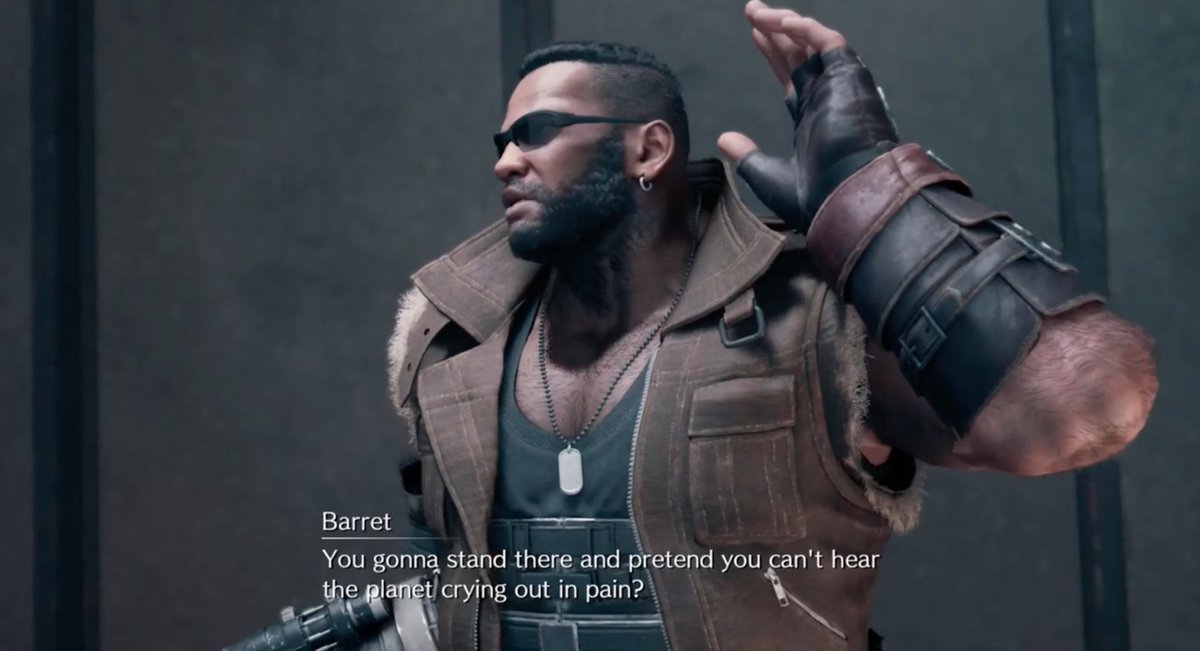
Review of Final Fantasy VII Remake


Review of Final Fantasy VII Remake

Lúcio Reis-Filho

Final Fantasy VII Remake. Square Enix, 2020.

Fifteen years after first being announced at the Electronic Entertainment Expo (E3) and twenty-three years after the original game’s debut, the long awaited Final Fantasy VII Remake was released. The classic FFVII is considered groundbreaking as it paved the way for other JRPGs outside of Japan, and it was responsible, along with anime, for making local pop culture take off in the global market. According to Matt Alt, FFVII injected “a megadose of Japanese sensibilities” into the American mainstream, including the characters with big eyes and spiky hair, the manga-style melodrama, the androgynous heroes, and the very idea that games could be profound in so many ways.

FFVII was remarkably innovative in the late 1990s, as Pablo González Taboada’s book on the franchise and the Vol. 2 of Dark Horse’s Final Fantasy Ultimania Archive both recall. The game’s basic concept, drawn from the cyberpunk subgenre, presents an industrial world of highly advanced technology in contrast to deep inequality and humanity in decline. With high-tech vehicles, garments, locales and other cyberpunk motifs, the city of Midgar lays its roots in Fritz Lang’s Metropolis (1927) and later futuristic urban landscapes as depicted in Blade Runner (1982) and Akira (1988). An exponent of cyberpunk storytelling, FFVII addresses late capitalism, existential dilemmas, psychological disorders, identity crisis, climate change, and class struggle. There are also nods to steampunk retrofuturism from previous games in the franchise, all reshaped for a more dieselpunk version. Biopunk themes are also relevant, such as the plot of the genetic modification that Shinra’s soldiers undergo.

Since its debut, FFVII has inspired countless other games, spin-offs, animated shorts, and a CGI film. What fans wanted most, however, was a remake, which was finally released in 2020. Far beyond introducing FFVII to new generations, the main goal of the project was to create a “new and nostalgic” experience for longtime fans. Thus, the Remake captures a broader sense of nostalgia in a context where a range of disparate cultural texts return to be explored for their intrinsic nostalgic value; at the same time, it rebuilds game systems to fit contemporary tastes.

Being the first installment in a series focused on recreating the classic game, the Remake only covers FFVII’s first act. The premise is the same: a group of heroes tries to save the world from capitalist exploitation. Players control the mercenary Cloud Strife, who joins the eco-terrorist group AVALANCHE in its resistance against Shinra, a megacorporation that is harvesting the planet’s energy to feed an industrial society and generate cutting-edge technology. However, the Remake deepens characters’ development, recreating them with updated visuals. The new model for Cloud has more nuance, with the handsome, androgynous, sensitive hero reframing and deconstructing the heteronormative masculinity archetype. Cloud’s effeminate features echo the archetypal images of androgynous male beauty, which Yumiko Iida relates to the visually attractive male idols of contemporary Japanese youth culture. This topic invites scholarly discussion on the “feminization of masculinity” and the androgynous male ideal of JRPG (and anime) heroes, especially in the Final Fantasy franchise.

Social criticism converges with climate justice in both FFVII and the Remake. According to Stephen K. Hirst, the classic game has inspired an entire generation of climate activists, including members of Greenpeace. It harshly denounces the savage jaw of capitalism, the power and monopoly of megacorporations, environmental degradation, and social inequality. More than two decades after FFVII’s debut, the criticism has not lost its relevance and is gaining momentum as a driving force in the environmentalism agenda in times of global warming. The Comic Book Resources noted how the social issues raised by the game are even more relevant today than they were in 1997. Following this argument, Dani Di Placido has drawn parallels between the game’s events – Shinra as a predatory force and the meteor’s approaching – and contemporary issues such as climate change, environmental catastrophes, economic collapse, and the COVID-19 pandemic. As a critique of the Anthropocene, Final Fantasy VII Remake could be of scholarly interest to environmental fiction and climate fiction scholars, since they often intersect in speculative fiction studies.

WORKS CITED

Alt, Matt. Pure Invention: How Japan Made the Modern World. New York: Crown Publishing Group, 2020.

Final Fantasy Ultimania Archive. Vol. 2. Milwaukie: Dark Horse Comics, 2018.

Gramuglia, Anthony. “Final Fantasy VII’s Story Is More Meaningful Today Than in 1997”. Comic Book Resources, June 22, 2019. Accessed 6 July 2022.      https://www.cbr.com/final-fantasy-viis-story-relevant-today/

Iida, Yumiko. “Beyond the ‘feminization of masculinity’: transforming patriarchy with the ‘feminine’ in contemporary Japanese youth culture”. Inter-Asia Cultural Studies, v. 6, 2005, pp. 56-74. Accessed 10 July 2022. https://www.tandfonline.com/doi/abs/10.1080/1462394042000326905

Hirst, Stephen K. “How Final Fantasy VII radicalized a generation of climate warriors”. Ars Technica, 29 July 2021. Accessed 6 July 2022. https://arstechnica.com/gaming/2021/07/how-final-fantasy-vii-radicalized-a-generation-of-climate-warriors/

Placido, Dani Di. “In Our Sci-Fi Dystopia Of 2020, ‘Final Fantasy VII’ Feels More Timely Than Ever”. Forbes, April 5, 2020. Accessed 6 Jul. 2022. https://www.forbes.com/sites/danidiplacido/2020/04/05/in-our-sci-fi-dystopia-of-2020-final-fantasy-vii-feels-more-timely-than-ever/

Taboada, Pablo González. Final Fantasy: la leyenda de los cristales. Palma de Mallorca: Dolmen, 2013.

Lúcio Reis-Filho is a Ph.D. in Media Studies, film critic, filmmaker and historian specializing in the intersections between cinema, history and literature, with focus on the horror and science fiction genres. He writes book, film and game reviews, and is coordinator of Projeto Ítaca (https://projetoitaca.com.br/), a Brazilian educational website devoted to the tropes and representations of mythology in the media. His research and academic interests are essentially interdisciplinary, as they cover Cinema, Visual Arts, History, Comparative Literature and Game Studies.

Review of Don’t Look Up


Review of Don’t Look Up

Steven Holmes

McKay, Adam, director. Don’t Look Up. Netflix, 2021.

“Dr. Mindy, I hear you. I hear you,” President Orlean (Meryl Streep) says after Dr. Randall Mindy (Leonardo DiCaprio) emphasizes that a comet racing toward earth will be an apocalyptic event. This scene is a critical point in both the film and audience reception of the film, as Streep’s Orlean seems indebted to the trappings of the Trump presidency, even though this specific line seems to more evoke the Bush presidency. The line echoes Bush’s “I hear you” line during the Bullhorn Speech at ground zero after 9/11. In such a moment, the film clashes between Saturday Night Live-style direct political commentary, and the attempts of the film to push its critique and satire into a broader reflection on 21st century political norms and discourse.

Adam McKay’s apocalyptic black comedy set records for streaming on Netflix. Apocalyptic black comedy has become its own sub-genre, with iterations going back at least to Dr. Strangelove (1964). Like Shaun of the Dead (2004), Don’t Look Up acts as a comment on capitalism, complacency, and the power of denial and indifference. But the closest tonal analogue may be 2013’s This is the End, an apocalyptic black comedy that used as its chief form of irony the discord between celebrity personas and actual personality. Don’t Look Up is particularly focused on the interplay between celebrity persona and personal politics both in the dramatic narrative and in the production of the film. The individual conflict and character arcs for the film protagonists—DiCaprio’s Dr. Mindy and PhD candidate Kate Dibiasky (Jennifer Lawrence)—centers around these scientists suddenly being thrust into the limelight, and the differing ways they respond to their newfound celebrity. This is contrasted with bit parts, such as the arc of celebrity Riley Bina (Ariana Grande) who goes from overshadowing the comet in the news with her personal life to encouraging people to “look up” through her songs. Behind the scenes, lead actor Leonardo DiCaprio had significant control over the script of the film;      DiCaprio, who produced and promoted the film Before the Flood (2016), a documentary on climate change, has used his celebrity status to actively advocate on behalf of the issue of climate change. Don’t Look Up is a meditation on the role of celebrity in shaping political issues, starring an actor who uses their celebrity to shape political issues.

This is not the first narrative to use a comet or celestial body as a foil for political reflection. In H. G. Wells’“The Star” (1896), the near-miss of a comet forges a new brotherhood among men. In W. E. B. Du Bois’ “The Comet” (1920) the cataclysm of New York serves as a pretext to explore race relations. The narrative overtones of these stories seem in line with many apocalyptic narratives, where dramatic disturbances in organized human life allow for the re-examination or re-organization of human society. But the narrative that Don’t Look Up most directly evokes is the 1998 film Armageddon, with its celebration of heroic blue-collar oil drillers who absurdly end up more fitted for saving the world than astronauts. Don’t Look Up is not a direct parody of Armageddon (indeed, it also is drawing heavily from Deep Impact [1998]), but it doeshave a brief arc where it telegraphs the Armageddon plot structure. Orlean brings in Benedict Drask (Ron Perlman), a casually racist parody of Bruce Willis’s hero of Armageddon, to pilot a spaceship and use nukes to blow up the comet. That is, until the plot is foiled by Peter Isherwell (Mark Rylance), an amalgam of Elon Musk and Mark Zuckerberg, who in trying to profit off the comet dooms earth to annihilation.

Despite its viewpoint characters both being scientists, Don’t Look Up is not interested in the science behind astronomy or astrophysics. The locus of its exploration of technology is less on the exigence of the comet, spaceships, and nukes, and more on the capacity to exchange in rational-critical debate and the functionality of the state. Unlike Deep Impact, where nukes are detonated but fail to completely offset the comet (only for a spaceship to fly in and use even more nukes to save the day), it seems like in Don’t Look Up the original plan to offset the comet would have succeeded had the plan not been undermined by Isherwell and his desire to profit off the comet. In turn, President Orlean’s capitulation to Isherwell highlights the extent that greed and corruption can lead to the full-scale agency capture of the state by privatized interests. In essence, the film suggests that the mechanical technology to solve largescale problems may exist, but it is the social technologies of democratic government and public discourse that are failing.  

Although the comet is a metaphor for climate change, the discourse surrounding it has clear parallels in the Covid-19 pandemic. In a historical survey, Don’t Look Up could be positioned as one of the most direct comments on the Covid-19 pandemic (and state responses to the pandemic) that was written, produced, and released during the pandemic itself. It is probable that in creating literary histories both of science fiction and apocalyptic narrative, Don’t Look Up serves as a compelling touchstone piece indicating at least some of the concerns of the post-pandemic era: collective denial in populism, the capacity of institutions to handle emergent issues, the agency capture of state institutions by privatized interests, and the totality of the warping of popular discourse around celebrity. Likewise, the strength of the film is encapsulated in the conceit of its title, where the president begins to advocate the public “don’t look up” (don’t acknowledge the comet) in a way that evokes how conspiratorial ideas can be intermixed and interwoven with both political and financial interests. Furthermore, in its interplay with Armageddon, Don’t Look Up emphasizes the cynicism and hopelessness of contemporary mass media entertainment in one of the sharpest possible contrasts to the optimism of the 1990s. To that extent, Don’t Look Up is a film that is highly productive when considered in relief to historical and literary histories.

Dr. Steven Holmes is a lecturer at the University of Hawai’i at Mānoa, where he is currently finishing a book project entitled Exploding Empire: Imagining the Future of Nationalism and Capitalism. His publications include articles in Studies in the Fantastic, The Written Dead: The Zombie as a Literary Phenomenon, War Gothic in Literature and Culture, and Gender and Sexuality in Contemporary Popular Fantasy. He teaches classes on argumentative writing, science fiction, fantasy literature, digital art, and Shakespeare.

Review of The Witcher, Season 2


Review of The Witcher, season 2

Cait Coker

The Witcher (Season 2). Created for television by Lauren Schmidt Hissrich, based on the novels by Andrzej Sapkowski. Sean Daniel Company, 2021.

The Netflix television series The Witcher is primarily based on the novels by Andrzej Sapkowski (published in Poland from 1994 to 1999, and translated to English from 2007 to 2017), though the second season abruptly introduces elements from the popular video games created by CD Projekt Red from 2007 to 2015. The books are a political parable of Eastern European history; they utilize the language of eastern European genocide and the Holocaust—pogroms, concentration camps, political putsches, etc.—to discuss genocide, totalitarian and fascist governments, and political resistance bluntly and unsparingly. The games keep certain plot elements but scale back the political context significantly while greatly expanding character stories and arcs, thus making the television series its own unique hybrid creation. (Incidentally, and with Sapkowski’s participation, Netflix has also created a prequel anime film, The Witcher: Nightmare of the Wolf (2021), and a forthcoming prequel miniseries, The Witcher: Blood Origin (2022) to expand further on the world of the franchise.)

The second season of The Witcher picks up shortly after the first season concluded, with the dual protagonists Geralt of Rivia and Ciri finally meeting. Geralt is a Witcher, a genetically modified and mutated (and sterile) human trained to hunt and slay monsters, with an extended lifespan and enhanced healing, strength, and agility. Ciri is a refugee princess in hiding after the violent invasion of her kingdom by the Nilfgaardians, an expanding imperial force, and the murder of her family, as well as a cursed figure of prophecy. The first season of the television show revolved around the question of monstrosity: what indeed, is a monster, and when must it be killed? The eight episodes return to this question repeatedly, and often with the answer that humans are worse monsters to one another than creatures of magic ever can be. Season two returns to this question by digging into the political parables of the novels, with plots touching on revisionist histories, genocides historical and contemporary, and modes of political resistance. The character of Jaskier, for instance, Geralt’s troubadour friend and a figure of comic relief in both books and games, becomes a tortured political prisoner after running an underground operation to spirit people to safety from the violent rule of the Nilfgaardians. His role of the poet speaking truth with popular songs that put him in prison speaks to a long tradition of Polish poetry specifically as well as to the ways that art makes its own records of war and abuses. Geralt rescues him from prison, putting Geralt himself—who, as a Witcher, is ostensibly nonpolitical—into the fray as well. This is an interesting shift from the books, where Jaskier’s popular prestige usually lands him in safe space; both texts emphasize that it is the bard’s own choice to put himself in danger for his friends and their cause.

A frequent criticism of the first season was the confusing narrative structure: its eight episodes were narrated using nonlinear storytelling (effectively foreshadowing much later events in the books, should Netflix choose to renew the series for enough seasons), a trait which is alluded to in a joke about Jaskier’s singing storytelling in episode four. This second season is much less episodic as it adapts much of the material of Blood of Elves, the first novel in the series pentology (the first season being primarily drawn from the short stories collected in The Last Wish), which details Geralt’s training of Ciri and their eventual reunion with the sorceress Yennefer, sometime lover of Geralt and eventual mentor to Ciri. It also introduces the characters of the Voleth Meir, a Baba Yaga-esque demon original to the show, and the Wild Hunt, spectral figures from the games. The “Conjunction of the Spheres” that is often referenced in all franchise texts is not elaborated on in the novels, but explicated here as the specific traveling of beings across multiple worlds via interdimensional portals. Humans, then, are not just invaders of a new continent as a metaphor for real world colonization and conflicts, but they are invaders of a whole new world.

Geralt is always presented as other, as is Ciri, despite their able white bodies. In the second episode of the season, Ciri and Geralt discuss the history of the Witchers; she asks, anxiously, if he was attacked because he was “different.” Difference lies at multiple intersections here: the genetics that set them apart—Geralt being genetically-engineered while Ciri carries “the blood of Elves” that makes her both magically powerful and socially persecuted—and the social structures that endorse hierarchies of social and cultural value with nonhumans (whether Elves or Dwarves) at the bottom. Elves are coded both as indigenous peoples native to lands that are being encroached upon by human invaders and as Jewish, with scenes that invoke Passover, including a city filled with the anguished cries of families finding their magically murdered babies. Ciri is also structured as sexually different with her imitations of the sorceress Triss, foreshadowing the queer relationships that appear in the novels. The sorceress Yennefer, too, is coded as monstrous through her own sterility and the often selfish choices that she makes. All three characters are socially punished for their differences, but consistently prove themselves to better people than the humans who choose to torment them.

It is worth noting that Andrzej Sapkowski is the second most-translated SFF author after Stanisław Lem. If Lem’s work is preoccupied with failures of communication, memory, and trauma, then Sapkowski’s work finds itself in found families amid immense geopolitical unrest. Geralt, Ciri, Yennefer, and Jaskier are a chosen family trying to survive a world that is evocative of the worst parts of the Holocaust, World War II, and the Cold War. Airing only weeks before the uproar over the censorship and book banning of Art Spiegelman’s Maus in Tennessee as well as Russia’s invasion of Ukraine, The Witcher presents its viewers with stories that grapple with these newly hot-button issues, showing that history not only repeats itself but is only as fantastical as the next retelling.

Cait Coker is Associate Professor and Curator of Rare Books and Manuscripts at the University of Illinois at Urbana-Champaign. Her work is located at the intersections of gender, genre, and publishing, and her essays have appeared in journals such as Foundation, Transformative Works and Cultures, and The Seventeenth Century, among others.

“You telling me my ass isn’t a werewolf”: Science fiction ontology and representing queerness in Gail Carriger’s Parasolverse


“You telling me my ass isn’t a werewolf”: Science fiction ontology and representing queerness in Gail Carriger’s Parasolverse

Jack Murray

This paper is the result of a number of questions about how representation functions within SF works that construct complex worlds with mechanisms that change how they are understood through their own internally consistent logic. I approach this through the lens of queerness as a way to describe slippery and hard-to-define subject positions and by placing it alongside Gail Carriger’s Parasolverse. I then describe an approach to reading science fiction that I refer to as “science fiction ontology” by drawing on Seo-Young Chu’s lyrical mimesis as a way to understand how science fiction performs the work of representation. Science fiction ontology demonstrates the ways that representation occurs through the internal structures of the fictional world that determine how characters understand themselves as subjects in that world. This differs from allegorical representations which shift the world to be understood primarily from the external perspective of the readers. I read the narrative arc of Biffy the reluctant werewolf alpha, a side plot within Carriger’s Parasolverse, through the framework of science fiction ontology to show how queerness exists within Carriger’s work and how it can be read as a blueprint for queer masculinity. 

Gail Carriger’s Parasolverse is a collection of science fiction novels set in an alternate steampunk version of Victorian England. The series consists of three major multibook arcs and several standalone stories that take place between 1850 and the turn of the twentieth century. Within the Parasolverse supernatural elements have influenced the social, cultural, and imperial development of Carriger’s British Empire. The supernatural set is made up of ghosts, vampires, and werewolves, each being a form of the afterlife enabled by the presence of excess soul. When someone with excess soul dies the remaining soul tethers the spirit to their body until the body decomposes and the tether dissipates. Vampires and werewolves, on the other hand, preempt this through a kind of ceremonial death. New vampires are created through the bite of a vampire queen and new werewolves from that of an alpha werewolf, and they become a member of the hive or pack respectively. Carriger positions representations of monstrous beings alongside the social intricacies and romance of Victorian London steeped in science fiction world-building that tends towards the “harder” end of the genre. Representing queerness is complicated in the Parasolverse by the presence of characters whom readers would already understand as queer alongside monsters that are often used allegorically to stand in for queer subjects. Troubling the process of representation also raises questions about how to read representations of queerness in science fiction and fantasy. 

Identifying what does and does not count as queer within science fiction literature is particularly difficult due to the inherent ambiguity of the term; the word “queer” expresses a variety of different ideas and performs a variety of linguistic functions. Queer as an identity category gestures towards a multitude of possible gender, sexual, and other identity categories. As Hannah McCann and Whitney Mongahan observe, “queer theory finds its radical potential as a term to challenge, interrogate, destabilize and subvert” (1). The implication is that queer theory is a way of talking about the things that resist definition, description, or otherwise exist outside structural boundaries. Constructing “queer” as a political identity that is “inclusive of all those who stand on the outside of the dominant constructed norm of state-sanctioned white middle- and upper-class heterosexuality”(Cathy Cohen 411) is at the core of queer theory’s critical praxis. Cathy Cohen explains that queerness is necessarily an intersectional analytic that “recognizes how numerous systems of oppression interact to regulate and police the lives of most people”(411) which subsequently expands what it means to be queer. Queer theory identifies structures such as desire and sexuality, then asks how power relations determine what and who get to count as “normal.” Anyone outside of the normative determinations can be said to be queer. Queerness describes an ontological position couched in acknowledging difference while also attending to the concerns about sexuality and gender that give rise to queerness, or as Bo Ruberg poetically puts it, queerness is “a way of being, doing, and desiring differently” (7).

The second part of the question stems from how representation is approached in science fiction and fantasy. If queerness is a question of ontology, then representation is a question of epistemology. That is to say, there is a tension between how we come to know a world and how a diegetic world is known within itself. In a world where the conditions of existence differ radically from ours, how is queerness understood differently? The supernatural and steampunk elements in Carriger’s work disrupt an otherwise familiar Victorian London that would cause a fundamental difference in the characters’ understanding of their world compared to our understanding as readers. After all, how might conceptions of queerness change for a culture where supernatural metamorphosis, monstrous transformation, and definitive proof of the soul’s impact on one’s afterlife is an accepted and commonly acknowledged faction of reality? 

Reading the text from our frame of knowledge might approach vampires and werewolves as allegorical for “race, gender, sexuality, our perception of difference, our tolerance towards its expression” (J. J. Cohen 52). Monster theory describes this plethora of intensely transdisciplinary approaches to mapping our own semiotic interpretations onto monstrous bodies. Indeed, part of the appeal of using monsters as signifiers, as queer readings are wont to do, is “the realization that meaning itself runs riot” (Halberstam, Skin Shows 2). This type of analysis is useful for examining many themes and anxieties regarding cultural, racial, queer, and othered bodies (J. J. Cohen; Wright; Bildhauer; Creed; Asma; Puar and Rai) as well as positive possible potentialities related productive conceptions of monsters (Lioi; Haraway; MacCormack). These readings are almost always focused on the relationship between the self and underlying queerness or an unknowable other. But what does it mean for monsters to represent queer people, when they also already exist and are actively present in the narrative? Instead, could we use monsters to understand the ontological structures of queerness in Carriger’s world? 

These questions propose a method of approaching representation that differs drastically from approaches to reading gothic horror and other fiction genres that frequently address the monstrous. Genre boundaries are points of contention and working through this methodology of reading representation in fiction will necessitate describing how I approach science fiction. Indeed, one could rightly describe Carriger’s novels as fantasy, yet I have been primarily referring to them as science fiction. I turn to Seo-Young Chu’s conception of science fiction as “a mimetic discourse whose objects of representation are nonimaginary yet cognitively estranging” (3), a definition that synthesizes broader discourse within the science fiction community. Chu’s use of mimesis refers to the propensity of art to imitate or represent the real world, a definition which preempts the complex history of mimesis and postulates “the capacity of language to reflect a reality ontologically prior to representation” (2). In many ways I accept the idea that science fiction operates at a level beyond mimetic representations of the real world because science fiction worlds must be ontologically distinct before signification can occur. Allowing a work to create its own internally consistent ontology functions similar to mythology, in that the ontology of a myth exists prior to what it is attempting to represent and allows meaning to emerge through the act of reading within extended contexts. In the previous examples from monster theory, the object being interpreted points to any number of possible objects. Similarly, myths read as parables rely heavily on the storytelling process to influence the production of meaning. This is possible because fiction exists on a spectrum of mimetic intensities that is bounded by a work’s referents’ capacity to be comprehended. On one end are works that are interested in representing concrete objects “ highly susceptible to understanding and amenable to representation”; on the other hand are “referents virtually unknowable, referents that all but defy human language and comprehension” (Chu 6). Chu positions genres of realism at the low intensity end of the mimetic spectrum, while science fiction and fantasy tend towards higher intensity. A text’s position on the spectrum is determined by the relative difficulty of their representational tasks and the difficulty of representation is a function of is the property of referents to be “impossible to represent in a straightforward manner” yet “absolutely real” (Chu 3), what Chu describes as cognitive estrangement. Cognitive estrangement is borrowed from Darko Suvin’s definition of SF as a genre of cognitive estrangement induced through imaginative frameworks that differ from the author’s actual material reality. In contrast to Suvin’s claims that SF’s form of representation as non mimetic and purely imaginative, Chu suggests that “all reality is to some degree cognitively estranging” (7) because it is impossible to completely know and understand a referent. The implication is that all works of representation are, at some intensity, science fiction. Affective vertigo is a similar concept to cognitive estrangement in that each “calls into question (their, anyone’s) epistemological worldview, highlights its fragmentary and inadequate nature, and thereby asks us . . . to acknowledge the failures of our systems of categorization” (Mittman, qtd. in Weinstock 3). The difference is that one precedes the other. Inducing affective vertigo is necessary to conceptualize a cognitively estranging referent. Science fiction as outlined here relies on a literalization of figurative formations within a narrative ontology. 

Queerness induces affective vertigo by design and as such, queer subjects are often associated with monsters or the monstrous. Characters are forced to confront queer subjects or their own queer subjectivity through their relationship to the monstrous. Fiction is well suited to the task of representing queer identities, while representing the already slippery concept of queerness which necessitates understanding of being within the work of fiction. What I propose is reading a system of mimesis in a way that draws on extensive worldbuilding to understand how cognitively estranging referents are understood from within the story world. Admittedly this method of reading a text or group of texts is most effective with more expansive collections or texts that have a strong interest in world building. The text can more easily represent the unrepresentable by codifying the rules of the world and ensuring they function consistently. This has the added bonus of allowing the author to subvert or break the rules for dramatic, narrative, or moralizing effect. Being a work of fiction, the author’s episteme impacts the production of the narrative and subsequently its ontology as well as our reading of it. This method and traditional methods are not mutually exclusive. Traditional readings of representation cannot and should not be abandoned; rather, the two approaches supplement one another to encompass a wider scope of analysis. 

My interest in Carriger’s Parasolverse is twofold. First, the presence of werewolves seeks to induce an affective vertigo, which Carriger leans into by disrupting understandings of werewolf monstrosity by embedding them within the veneer of high class Victorian Culture, a move that corresponds to contemporary monster theory’s focus on how “subjects are ‘monsterized’ and the implications of this process” (Weinstock 25). Specifically I am interested in the process of metamorphosis via death and how queer desire, affect, and power interact within pack dynamics and London high society. Second, Carriger’s inclusion of a diegetic scientific approach the monstrous and its ability to represent queerness as function of science fiction’s “capacity to perform the massively complex representational and epistemological work necessary to render cognitively estranging referents available both for representation and for understanding” (Chu 7). As noted earlier, the epistemological underpinnings of queerness are predicated on disrupting and upsetting interpretative and cognitive categories. Just as Weinstock identifies the emergence of the monster as “the catch-all conceptual category for things that don’t fit” at the moment of affective vertigo (Weinstock 2), queerness comes into being at the moment it is identified as queer. Queerness emerges in relation to nonnormative ways of being, knowing, and desiring that destabilize dominant systems of categorization. Werewolves represent affectively destabilizing subjects and their presence in the world of Carriger’s science fiction comes to represent a construction of queerness.

This analysis will draw on Biffy’s story beginning in the five-book Parasol Protectorate arc as a minor character and then continues through to the follow-up series, The Custard Protocol, and into a number of standalone novellas where he takes on a more central role. In Soulless, Biffy is described as a dandy with extensive espionage training, a marked preference for men, a penchant for women’s fashion—hats in particular—and lover to flamboyant vampire Lord Akeldama. In Blameless, Biffy is kidnapped as part of a hostile vampire plot and is rescued by Lord Maccon and Professor Lyall, the London Pack’s Alpha and Beta, respectively. During the rescue Biffy is fatally shot, and to prevent him from dying Lyall convinces Lord Maccon to metamorphose Biffy into a werewolf. Biffy’s successful change causes friction between the pack and Lord Akeldama. In Heartless we get glimpses of Biffy’s struggle to reconcile the loss of his potential future as a vampire alongside Lord Akeldama with his new place as a werewolf within the London Pack. In Parasol Protectorate book 5, Timeless, it is discovered that Biffy has the traits of an Alpha werewolf and plans are made for Biffy to replace Lyall—who has also become Biffy’s new paramour— and become Lord Maccon’s Beta before taking eventually over as pack Alpha when the strain of holding the pack together eventually forces Lord Maccon to retire. This replacement occurs during the second book of the Custard Protocol series after which Biffy and the London Pack’s stories are picked up in the standalone novellas Romancing the Werewolf and How to Marry a Werewolf. 

Werewolf metamorphosis is a literalization of becoming-wolf as Deleuze and Guattari describe it: when man and wolf are made from matter shifted into different configurations, an individual’s relationships with social assemblages and desire is fundamentally restructured. Desire is “never separable from complex assemblages” and “results from a highly developed, engineered setup rich in interactions” (Deleuze and Guattari, A Thousand Plateaus 251). The restructuring of desire comes at the expense of previously existing social flows (Deleuze and Guattari, Anti-Oedipus). In becoming-werewolf, Biffy’s shifting conceptualization of death fundamentally alters his relationship with desire and social subjectivity. Carriger provides insight into the precarious nature of mortal and immortal desire through Biffy’s reflection on changed relationships with mortal friends and newfound empathy for his former lover, 

Lord Akeldama’s love, such as it was, was always transient and shared. Now Biffy understood why. True, Biffy was a young immortal, but he was almost fifty, and he’d seen his mortal friends grow old while he had not. Or die in the attempt to become like him. He wasn’t yet old enough to have grown the protective thickness around his heart, the one that made Lord Akeldama’s smiles brittle, but Biffy knew why it was there. (Carriger, Romancing the Werewolf 21)

Desire is a productive force with real, tangible effects (Deleuze and Guattari, Anti-Oedipus). Another way of expressing this idea is to think of desire according to Eve Sedgwick’s definition: “the affective or social force, the glue, even when its manifestation is hostility or hatred or something less emotively charged, that shapes an important relationship” (Sedgwick). Sedgwick uses this framing to describe homosociality as the desiring relationship that invests men in the affairs of other men as a way to uphold forms of masculinity. 

Carriger’s werewolf packs disrupt the common conception of normative homosociality with a queer homosociality centered on a politics of care where pack members are attuned to each other’s emotional wellbeing. In keeping with wolf tropes, status within the pack outwardly seems to be determined via physical capability; however, Carriger’s world building shows status based on affective capacity and emotional sensitivity to the pack. The tethers that effervesce from the soul remaining post metamorphosis are a literalization of the relationships between pack werewolves. The network itself centers on a tripartite relationship between the pack’s Alpha, Beta, and Gamma described by Carriger as:

The balance of the pack, the rule of three. Alpha for the head, evolving, shifting, holding too many tethers, burning brighter than the rest of the pack until he snuffed himself out in madness. Beta for the heart, beating a steady rhythm of care, love, resilience, ever steadfast. Gamma for the strength in arms, the warrior, the challenger, the weapon, to remind the pack of what they really were – hunters, trackers, fighters. (Carriger, How to Marry a Werewolf 159)

Biffy’s conceptualization of the dynamic of the pack is somewhat incomplete as a result of the impromptu nature of his metamorphosis. As Alpha he recognizes his duty to keep his pack anchored without fully comprehending the bidirectional nature of the relationship. Professor Lyall explains to Biffy, “when you became Alpha of this pack, you tethered to them, to each and every member. Your tether is the last of your soul, so in a way the pack becomes the Alpha’s soul. And you are theirs” (Carriger, Romancing the Werewolf 102), indicating that while the Alpha provides a stabilizing presence, they also rely on the connection of the pack to stay grounded. Biffy’s metamorphosis is a total disassembly of his prior social assemblage and as a result his integration into the pack goes poorly. The multidirectional flows of affect are demonstrated as Lord Maccon and Lyall bring Biffy into a stabilizing relationship with the pack through his participation in investigations related to the pack’s overall wellbeing as well as the gradual romantic connection between Biffy and Lyall. As Biffy settles into the pack, his capacity for sensing the flow of affect ultimately identifies him with Alpha werewolf potential (Carriger, The Parasol Protectorate, Volume One; Carriger, The Parasol Protectorate, Volume Two). 

The mechanics of the soul and its relationship to supernatural metamorphosis and pack dynamics is the focus of the Parasol Protectorate. Excess soul is assumed to be the primary determinant in surviving metamorphosis. The only known indication of excess soul is an individual’s penchant for creativity, though the correlation is presented as speculative at best. Throughout the Parasol Protectorate there are elements of an anti-supernatural cadre of scientists attempting to determine a way of measuring one’s soul for the purpose of identifying those who have supernatural potential. The readings of queer identities are very made very apparent. The efforts to measure soul echo the ways Foucault identifies scientific pathologizing deviant sexuality (63-70) and the way that Halberstam describes medicine’s domain over gender identify categories (Trans* 24-29). Scientific measurement of the soul is an attempt to identify and discipline non-normative bodies. However, the science fiction ontology of Carriger’s world represents queerness as cognitively estranging, something that produces affective vertigo in characters who exist within the narrative world. Rather than representing sexual orientation or gender identity, the politics of the soul represent anxieties around the possibility of being otherwise and the fear associated with being preyed upon by those who exist or desire in non-normative ways. This theme is also present in Biffy’s initial resentment and resistance to becoming a werewolf. The possibility of escaping normative structures following death is perhaps one of the prime draws for metamorphosis as “Werewolves, like vampires, have always been less bound by the limits humans pose on their own desires” (Carriger, Romancing the Werewolf 136). The London Pack is never shown to be interested in maintaining normative sexual desires as long as “Both parties [are] agreeable and willing, and capable of undertaking an informed decision” (136), a view that reflects the same values held in regard to the process of metamorphosis that necessitates education in Pack protocol through serving as a claviger. Many pack members and clavigers can be identified as being what we understand as queer, while the protocols themselves represent queer homosociality predicated on ethics of care. 

Scientifically foreclosing the possibility of transformation with the threat of permanent death is a mechanism by which power attempts to retain its influence. This functions in a manner that preys upon a natural fear of loss and death. Where queer desire is subsumed by a desire for oppression. This is not to ideate suicide as a liberatory alternative. Suicide, or the act of desiring one’s own death (Deleuze and Guattari, A Thousand Plateaus), is a tool of what Achille Mbembe identifies as necropolitics that sees power incorporate death into the assemblages of biopower (83-92). Instead, in the Parasolverse, becoming-werewolf is a drastic destruction of the social via embracing queerness that, as Lee Edelman says, “must redefine such notions as ‘civil order’ through a rupturing of our foundational faith in the reproduction of futurity” (17). The immortality of werewolves is a fundamental rejection of “the death drive of the dominant order” (17) in the most literal sense. However, the werewolf does not reject the possibility of futurity, instead they “represent a mode of being and feeling that was not quite there” (Muñoz 9) that remains to embrace José Esteban Muñoz’s queer potentiality that is “spawned of a critical investment in utopia” (Muñoz 12). The werewolf metamorphosis and pack dynamic based on desire represents the slippery, cognitively estranging idea of queerness in a way that is useful to queer theory because “power centers are defined much more by what escapes them” (Deleuze and Guattari, A Thousand Plateaus 254). The literal becoming-wolf of Carriger’s werewolves “contains blueprints and schemata of a forward-dawning futurity” (Muñoz 1) which places the subjects in a new relation to the structure of normative power by placing one outside the structures and instead positions them within networks centered on an ethic of care. 

Biffy allows us to understand queerness from within his frame of reference as he exists in the world. Treating science fiction worlds as ontologically distinct allows for representation that exist beyond the purely allegorical, opening rendering the unrepresentable visible within the expansive body of a text. By reading the Parasolverse as a science fiction ontology, the werewolf pack is tasked with representing a diagram of queerness that escapes structures of normative power and reimagines the how individuals exist in relation to one another. Using this method of reading ontological representations of queerness in conjunction with allegorical representation and direct representations of queerness allows us to interrogate who gets to be queer, what it means to be queer, and how we understand queerness in relation to the narrative elements of a work of fiction. 

WORKS CITED

Asma, Stephen T. “Monsters and the Moral Imagination.” A Monster Theory Reader, edited by Jeffrey Andrew Weinstock, U of Minnesota P, 2009, pp. 289-94.

Bildhauer, Bettina. “Blood, Jews, and Monsters in Medieval Culture.” A Monster Theory Reader, edited by Jeffrey Andrew Weinstock, U of Minnesota P, 2003, pp. 192–210.

Carriger, Gail. How to Marry a Werewolf (in 10 Easy Steps). 2018.

—. Romancing the Werewolf. 2017.

—. The Parasol Protectorate. Volume One. SFBC Fantasy, 2011.

—. The Parasol Protectorate. Volume Two. 2012.

Chu, Seo-Young. Do Metaphors Dream of Literal Sleep? A Science-Fictional Theory of Representation. Harvard UP, 2010.

Cohen, Cathy J. “Punks, Bulldaggers, and Welfare Queens: The Radical Potential of Queer Politics?” GLQ: A Journal of Lesbian and Gay Studies, vol. 3, no. 4, Jan. 1997, pp. 437-65. DOI.org (Crossref), https://doi.org/10.1215/10642684-3-4-437.

Cohen, Jeffery Jerome. “Monster Culture (Seven Theses).” A Monster Theory Reader, edited by Jeffrey Andrew Weinstock, U of Minnesota P, 1996, pp. 37-59.

Creed, Barbara. “Horror and the Monstrous-Feminine: An Imaginary Abjection.” A Monster Theory Reader, edited by Jeffrey Andrew Weinstock, U of Minnesota P, 1999, pp. 211-25.

Deleuze, Gilles, and Félix Guattari. A Thousand Plateaus: Capitalism and Schizophrenia. Bloomsbury Academic, 1987.

—. Anti-Oedipus: Capitalism and Schizophrenia. Translated by Robert Hurley et al., Bloomsbury Academic, 2019.

Edelman, Lee. No Future: Queer Theory and the Death Drive. Duke UP, 2004.

Foucault, Michel. The History of Sexuality Vol. 1. Translated by Robert Hurley, Vintage Books ed, Vintage Books, 1990.

Halberstam, Judith. Skin Shows: Gothic Horror and the Technology of Monsters. Duke UP, 1995.

—. Trans*: A Quick and Quirky Account of Gender Variability. U of California P, 2018.

Haraway, Donna. “The Promises of Monsters: A Regenerative Politics of Inappropriate/d Others.” A Monster Theory Reader, edited by Jeffrey Andrew Weinstock, U of Minnesota P, 1997, pp. 459-521.

Lioi, Anthony. “Of Swamp Dragons: Mud, Megalopolis, and a Future for Ecocriticism.” A Monster Theory Reader, edited by Jeffrey Andrew Weinstock, U of Minnesota P, 2007, pp. 439-58.

MacCormack, Patricia. “Posthuman Teratology.” A Monster Theory Reader, edited by Jeffrey Andrew Weinstock, U of Minnesota P, 2012, pp. 522-40.

Mbembe, Achille. Necropolitics. Duke UP, 2019.

McCann, Hannah, and Whitney Monaghan. Queer Theory Now: From Foundations to Futures. 2020.

Muñoz, José Esteban. Cruising Utopia: The Then and There of Queer Futurity. NYU Press, 2009.

Puar, Jasbir K., and Amit S. Rai. “Monster, Terrorist, Fag: The War on Terrorism and the Production of Docile Patriots.” A Monster Theory Reader, edited by Jeffrey Andrew Weinstock, U of Minnesota P, 2002, pp. 374–402.

Ruberg, Bonnie. Video Games Have Always Been Queer. NYU Press, 2019.

Sedgwick, Eve Kosofsky. Between Men: English Literature and Male Homosocial Desire. 30th anniversary edition, Columbia UP, 2016.

Weinstock, Jeffrey Andrew. “Introduction: A Genealogy of Monstory Theory.” A Monster Theory Reader, edited by Jeffrey Andrew Weinstock, U of Minnesota P, 2020, pp. 1-36.

Wright, Alexa. “Monstrous Strangers at the Edge of the World: The Monstrous Races.” A Monster Theory Reader, edited by Jeffrey Andrew Weinstock, U of Minnesota P, 2013, pp. 173-92.

Jack Murray is a Ph.D. Candidate in the Texts and Technology Program at the University of Central Florida. He received a B.S. Software Engineering and a M.A. in arts, technology, and emerging communication from the University of Texas at Dallas. His research interests include critical game studies, emergent storytelling, and narrative systems.  Jack’s current research is focused on the intersection of analog and digital games. He is a frequent collaborator with the Narrative Systems Research Lab,  Studio for Mediating Play, and the Center for Humanities and Digital Research @ UCF.


Same As It Ever Was?: Portrayals of Appalachia in William Gibson’s The Peripheral


Same As It Ever Was?: Portrayals of Appalachia in William Gibson’s The Peripheral

Jennifer Krause

This paper will investigate representations of Appalachia and Appalachian communities in William Gibson’s The Peripheral. In his novel, Gibson sets one of two alternative futures in Appalachia, though he does not clearly name it as such. Yet instead of leaning into one-note depictions of backwoods drug dealers and fundamentalist preachers preying on rural white trash, Gibson presents a complicated picture of the region that views Appalachia as an internal colony within the United States. He also layers his near future Appalachia within a second layer of colonialism, a colonialism defined by the far future reaching into the past to monetize and manipulate alternate versions of history. This layering allows Gibson to create an intriguing commentary about place-specific stereotyping and the need to create communities that insulate themselves from critique. I therefore posit that by presenting Appalachia as an internal colony within the United States and emphasizing the idea that place matters, The Peripheral complicates and questions both the colonialism more overtly present in the relationship between the different timelines in the novel, as well as the usefulness of colonial models for understanding such complicated and paradoxical relationships. 

To begin such an analysis, we need to look into Gibson’s ties to the mountains. Gibson was born on the coast of South Carolina, but lived most of his early life in Wytheville, Virginia. As Gibson mentions in his autobiographical essay “Since 1948,” his experiences in southwest Virginia influenced his own interest in things not of this world. He notes, “I’m convinced that it was this experience of feeling abruptly exiled, to what seemed like the past, that began my relationship with science fiction” (Gibson, Distrust 22). In a question-and-answer session during a book signing in 2015 at Joseph-Beth Booksellers in Lexington, Kentucky, someone in the audience asked Gibson where the book was set. Gibson answered that he had originally thought the book was set in southern Ohio, somewhere rural, but the more he thought about it, the more he suspected that the book was set very close to Wytheville, where he grew up (“Questions”). In an earlier interview for Tor.com in 2014, Gibson is less willing to point to Wytheville as the setting of the novel, however. He mentions that he wanted the setting to be in Pennsylvania, “right across the Virginia line” (“Gibson on Urbanism”). Yet Gibson goes on to say, “But inevitably, in spite of my wanting that, I think what happened was that my experience of my own childhood colored it all. And so it feels more like a southern small town than anything else. [. . .] There’s a kind of inadvertent generic quality to it that stems from that idea I had that I could make it kind of Everytown. But in the end I guess it’s not really.” Interestingly, all the locations Gibson mentions fall within the traditional boundaries of Appalachia, so even if the novel does not take place in Wytheville exactly, it is still affected by its location somewhere in Appalachia. And though, as Steve Fisher notes in a discussion of Appalachian cultural identity and political activity, “many use the term ‘Appalachian’ in a way that glosses over the diversity of the region and some ugly parts of its history,” there is still a cultural (mis)understanding of the region that allows readers to pick up The Peripheral and know exactly where it takes place (Fisher 58-59). The main character’s hometown may not be Wytheville exactly, but its feel, its undercurrents, and its customs reflect an Appalachian way of life, even if its geography doesn’t. 

We must therefore next tackle an understanding of how popular notions of Appalachia and Appalachian stereotypes play out, in scholarship concerning the region as well as in popular adaptations, including Gibson’s novel. The Appalachian way of life most readers will pick up on is usually based on very specific stereotypes. In a discussion of stereotypes in Appalachia, Barbara Ellen Smith mentions that “within the national imaginary, Appalachia is a land of backward, inbred (always implicitly white) hillbillies whose very degradation—in the manner of most binary oppositions—functions to valorize the intelligence and culture of the normative, middle-class American, who is decidedly not from Appalachia” (54). The hillbilly, as a representation of all who live and work and function in Appalachia, is therefore the opposite of everything America stands for, yet still resides within the limits of American culture: worth less than the rest of country, but still white; and deserving of poverty and ridicule and hopelessness perhaps because of their rejection of the rules and strictures they are supposed to live up to. 

To combat this view of Appalachia, Helen M. Lewis and Edward E. Knipe suggest the colonialism model as a way to understand Appalachian social, cultural, and economic structures. This model:

describes the Appalachians as a subsociety structurally alienated and lacking resources because of processes of the total economic political system. Those who control the resources preserve their advantages by discrimination. The people are not essentially passive; but these ‘subcultural’ traits of fatalism, passivity, etc. are adjustive techniques of the powerless. They are ways by which people protect their way of life from new economic models and the concomitant alien culture. (15)

Viewing Appalachians as native inhabitants attacked by alien invaders calls into question multiple assumptions made by the stereotypes projected onto the region by both internal and external sources.

In their study, Lewis and Knipe therefore turn to a definition of colonialism, specifically internal colonialism, first introduced by Robert Blauner in a 1969 study of African Americans in the inner city. Blauner’s definition includes multiple steps in the ongoing act of colonization, including “a forced, involuntary entry,” “rapid modifications in values, orientation, and the way of life of the colonized,” “a relationship by which members of the colonized group tend to be administered by representatives of the dominant group,” and finally, “a condition of racism” (Lewis and Knipe 16). A comparison between the situation of African Americans in the late 1960s and inhabitants of the Appalachian region is overtly problematic, on multiple levels, yet the introduction of a social model that considers issues of colonization in the region have been fruitful and provide a useful way to think about how Appalachia is often seen. 

So how does all this come together in the novel itself? To begin my analysis, we first need a quick overview of the novel’s plot. In the introduction to an interview with Gibson, Tasneem Raja quips, “The new book, meanwhile, stars a bunch of downtrodden trailer park residents who get caught up in the deadly games of some time-warping elites from 70 years hence” (61). Though this description sums up the plot quickly, it also reveals inherent biases. Yes, the novel’s heroes are rural and poor and trapped by a society that has no use for them, but the main characters don’t live in a trailer park, nor are they as downtrodden as the word implies. The stereotypes in such a description highlight the ways in which place matters in the text. A better description of the plot might read: “The book follows a woman, Flynne, and her community as they deal with the impact of what happens when a group of time travel hobbyists from seventy years in the future decide to meddle with the past. Flynne witnesses a murder in the future, though she thinks she is playing a video game. This leads to two rival powers from the future using her present as a gameboard for their ongoing feud. Flynne must therefore travel to the future through the use of a peripheral body, which allows her to live in her world but interact with theirs, in order to personally identify the murderer and stop the violence that rages in her own timeline.”

This is where a reading of the text from an Appalachian studies perspective becomes useful. If we read Flynne’s hometown as doubly colonized, invaded by the future and internally ostracized by the rest of the United States, we can begin to understand not only how we are supposed to react to her world, but also how we are supposed to reflect revelations within her world back onto our own society. The far future’s colonial attitudes toward the near future are introduced very clearly in a conversation between three main characters. No one knows much about this time-travel hobby, so Lev, a prominent hobbyist, tries to explain it. He says, “The act of connection produces a fork in causality, the new branch causally unique. A stub, as we call them” (Gibson, Peripheral 103). Lowbeer, a high ranking member of what amounts to a police force in the future, asks, “But why do you? [. . .] Call them that. It sounds short. Nasty. Brutish. Wouldn’t one expect the fork’s new branch to continue to grow?” (103). Lev replies, “We do [. . .] assume exactly that. Actually, I’m not sure why enthusiasts settled on that expression” (103). In response to this confusion, one of Lev’s employees interjects, “Imperialism [. . .] We’re third-worlding alternate continua. Calling them stubs makes that a bit easier” (103). This conversation very clearly introduces an imperialist, colonialist agenda into the novel’s use of time travel. Thinking back to the definition of internal colonization Lewis and Knipe use, we can read this as “a forced, involuntary entry,” one recognized as blatantly capitalist and hypocritical by onlookers who are not enthusiasts (16). 

This becomes all the more complex if we view the near future, Flynne’s world, as an internal colony within greater U.S. culture. We can see that internal colonization within the fabric of Flynne’s community even before it is touched by Lev’s hobby. The “forced, involuntary entry” in this case is not coal companies that Lewis and Knipe highlight in their study, but drug manufacture, a clear reference to the opioid crisis in rural America. In an assessment of the economy in Flynne’s timeline, one of Lev’s employees in far future London states, “County’s economy is entirely about manufacturing drugs” (Gibson, Peripheral 108). Tommy, a cop in Flynne’s world, explains to Flynne that building drugs is the only way to make real money in their community: “if we all woke up one day and [. . .] that building economy had been taken up to heaven, after a few weeks most people around here wouldn’t have any money for food” (233). The drug trade therefore serves as a mechanism of colonization, bringing a type of predatory capitalism into the region that, like coal, doesn’t actually boost the economy or bring any development for the region or investment in the people. 

For Lewis and Knipe, the second step of internal colonization is “rapid modifications in values, orientation, and the way of life of the colonized” (16). We can see this second step both within Flynne’s world before the intervention of far future London as well as through that intervention. Flynne’s community reflects these modifications, as the novel contrasts her childhood home and the homeplace feel of much of the countryside with the modernization and capitalist neglect of the town and its drug dealer leaders. Flynne’s world, though ruled by technology in some respects, is grounded in its sense of place: the endless fields, the rushing creeks, the wind in the trees. This closeness with nature is contrasted by one of the novel’s villains, Corbell Pickett, a politician and community celebrity who also runs the local drug syndicate. His power serves as a reference to the third aspect of internal coloniality that Lewis and Knipe also reference: “a relationship by which members of the colonized group tend to be administered by representatives of the dominant group” (16). When characters drive to Pickett’s home, they pass “a long stretch of white plastic fence, fabbed to look like somebody’s idea of Old Plantation” (Gibson, Peripheral 291). As for the house itself, “They’d painted everything white, she guessed to tie it together, but it didn’t. Looked like somebody had patched a factory, or maybe a car dealership, onto a McMansion, then stuck an Interstate chain restaurant and a couple of swimming pools on top of that” (292). All of these details speak to Pickett’s status as both a colonizer and a representative of the effects of colonization. Pickett’s home, like Pickett himself, reflects a different worldview than Flynne’s homeplace. While Flynne’s family has been in their home for over a century, and that home reflects its connections to the past and to family ties, this is obviously a new building, frankensteined together out of consumerist kitsch. The influence of the drug trade is stark here, revealing the paradox of the region: the modifications the drug trade has made to the community and the power money has over everything else. 

The interaction between far-future London and Flynne’s world only deepens the us versus them mentality set up against Flynne and her community. The changes in their way of life, as well as the implication that Flynne’s world is not actually in charge of what is going on, is most clearly obvious in a conversation Flynne has with Macon, a friend of Flynne’s who is one of the first know that they are dealing with interference from the future. Macon asks:

“Know what ‘collateral damage’ means?”
“People get hurt because they happen to be near something that somebody needs to happen?”
“Think that’s us,” he said. “None of this is happening because any of us are who we are, what we are. Accident, or it started with one, and now we’ve got people who might as well be able to suspend basic laws of physics, or anyway finance, doing whatever it is they’re doing, whatever reason they’re doing it for. So we could get rich, or get killed, and it would all still just be collateral.”
(Peripheral 279)

Flynne, her brother, her friends, her family, all have to deal with the reality of this situation. They are part of this plot not because of who they are, but because they were originally preyed upon by Lev and his hobby. All of this randomness leads to Flynne and Macon and all the rest being collateral damage, for good or ill. 

This is also where an understanding of Appalachia and the internal colonial model reveals a more nuanced reading of the text. This model creates an intriguing picture of insider versus outsider and what that means for how we can read communities and citizens who have been stereotyped as backward and dispossessed and downtrodden. Barbara Ellen Smith and Steve Fisher lay out why such a model is so enticing for Appalachian scholars, even as it is also problematic. They note:

The analytical power and emotional appeal of the internal colony model lie in its capacity to interrelate spatial or place-based exploitation (Appalachia as dispossessed region) with cultural degradation (Appalachia as America’s Other). It thereby creates Appalachia as a regional collectivity, no longer pathologized but oppressed, and enables us to situate ourselves within a shared cultural geography that recognizes all residents as heirs to a special, place-based identity. Although [. . .] this depiction obscures internal class processes and relationships (along with much else), the stark invocation of thievery, arrogance, and smug condescension by outsiders draws an undeniably powerful line between innocent victims inside the region and profiteering elites on the outside. (Smith and Fisher 76)

The internal colony model allows citizens of the region to create a narrative that sets them not as the Other, but as the protagonist in a plot aimed against them. This understanding of self, founded on a place-based myth of righteousness against outside aggressors, gives Appalachians a way to see themselves as heroes, innocent victims, and righteous underdogs. 

Within that context, we can begin to understand why it is so easy for readers to side with Flynne and her community against outside forces, be those forces internal colonizers or colonizers from the far future. Flynne’s identity as part of an already marginalized group helps us to understand her plight and allows us to easily see her as capable and heroic, even if she does live in a place and time that most would consider backwards and primitive. Interestingly, Gibson’s description of his inspiration for The Peripheral echoes these sentiments. In an interview in Mother Jones, Gibson says:

I’m interested in how we came to automatically think of the inhabitants of the past as having been rubes. [. . .] The people in my 22nd century initially assume that anyone they’re dealing with back in 2025 or whenever is just kind of a hick” (Raja 62)

Just like the inhabitants of Appalachia, the inhabitants of the past are much more than they seem, and the internal colony model reinforces the agency, intelligence, and resourcefulness of people who have normally been overlooked or underestimated. 

This doubled coloniality in the novel bolsters how we might view the end of the story, too. The final two chapters of the book present a conclusion that seems a bit too easy. The story jumps several years ahead, presenting Flynne happily married to Tommy, with a child on the way. Most of Flynne’s family and friends seem to have paired off nicely, and everyone lives together in new buildings in and around Flynne’s original homeplace. Several critics, scholars, and reviewers have called it a happy ending and left it at that. Others, however, see it as rather more sinister. This ending—which Gibson himself has said, “gave me the creeps!” (“Gibson on Urbanism”)—becomes that much more creepy when read from the vantage of a doubled coloniality . In explaining his rationale for being disturbed with how the novel ends, Gibson continues, “Really, its potential for not being good is really, really high. [. . .] I mean, she’s lovely, but what are they building there? It’s got all kinds of weird third-world bad possibilities. . . . I wasn’t expecting that actually, and it completely weirded me out, and I still haven’t really gotten my head around it” (“Gibson on Urbanism”). Gibson’s reference to “third-world bad possibilities” brings Flynne and her community back to where they started, in a sense, though they are no longer the poor denizens of Appalachia just trying to make some money and get ahead. Now, Flynne and her people have joined the colonizers, both in the future and in their own society. We want to root for Flynne because she is an underdog, one of the oppressed workers in Appalachia, but once she crosses the line and can no longer be seen as an underdog, we must question what we think of her and her future. 

This becomes especially apparent if we read the end through an Appalachian studies lens. One of the major arguments against the internal colonial model is that it hides what Smith and Fisher call internal exploiters. They note:

[B]laming “outsiders” for regional economic problems is an over-simplification, if not outright distortion. When we focus on where people are from as the main problem, we run the risk of exonerating everyone in the region as good and implying that we who live here are, in this most fundamental respect of residence, all the same in our righteousness. Race, class, gender, sexual orientation—all are secondary to our zip code. Perhaps most important, this perspective conceals and exonerates internal exploiters [. . .] without whose actions the exploitation of Appalachia would not be possible. (47)

From this perspective, using the internal colony model to help understand Gibson’s text, Flynne and her family can seem to have a happy ending, and we can feel good for them because their potential for chaos and harm is hidden from view by the assumption that where they are from defines who they are. Their hillbilly-ness, their rural ways and Appalachian values, mask the possibility that they could be something else, something far more in keeping with their own colonizers than anyone, including the reader, would want to acknowledge. 

Place is therefore of utmost importance in this novel, even if that place is never clearly stated outright. Flynne’s world, as both situated in a version of the past that is our near future, as well as situated in an Appalachia eerily similar to today’s, is ruled by multiple colonialities. This doubled coloniality questions both temporal and geographical stereotypes because of the way Gibson approaches his characters and their places in both time and space. The complex nature of the internal colonial model, however, causes us, as readers, to make certain assumptions about the characters. We see them as capable, intelligent individuals, but they are also flattened because they are defined by place in a way that homogenizes them, ignoring the complex intersectionalities of the region as well as the lived reality of people who are there right now. The internal colonial model that seems to be written into the cosmology of the text therefore also affects our understanding of how the future looks back at the past. Whether or not Flynne’s community is able to save themselves, they still have to rely on the future for security, money, and power. The colonial model in that scenario flattens them as well, creating temporal myths that counteract stereotypes but also build a future that is probably going to look very much like the one they are trying to avoid. Saving the world probably doesn’t actually save the world. The Peripheral, then, asks us to pay attention to how place matters in the text. It also asks us to interrogate the usefulness of colonial models, not only for understanding place-based marginality, but also for expressing the complexities of communities that can’t and shouldn’t be defined by just one thing. 

WORKS CITED

Fisher, Steve. “Claiming Appalachia—and the Questions That Go with It.” Appalachian Journal, vol. 38, no. 1, Fall 2010, pp. 58-61.

Fisher, Steve, and Barbara Ellen Smith. “Internal Colony—Are You Sure? Defining, Theorizing, Organizing Appalachia.” Journal of Appalachian Studies, vol. 22, no. 1, Apr. 2016, pp. 45-50. JSTOR, https://doi.org/10.5406/jappastud.22.1.0045.

Gibson, William. Distrust That Particular Flavor. Putnam, 2012.

—. Question and Answer Session. Joseph-Beth Booksellers, Lexington, Ky.

—. The Peripheral. Putnam, 2014.

—. “William Gibson on Urbanism, Science Fiction, and Why The Peripheral Weirded Him Out.” Interview by Karin L. Kross, 29 Oct. 2014, Tor.com, https://www.tor.com/2014/10/29/william-gibson-the-peripheral-interview/.

Lewis, Helen M., and Edward E. Knipe. “The Colonialism Model: The Appalachian Case.” Colonialism in Modern America: The Appalachian Case, Appalachian State University, 1978, pp. 9-31, https://www.jstor.org/stable/j.ctt1xp3n1t.5.

Raja, Tasneem. “William Gibson’s Peripheral Vision.” Mother Jones, vol. 39, no. 6, 11 Dec. 2014, pp. 61-63.

Smith, Barbara Ellen. “Transforming Places: Toward a Global Politics of Appalachia.” Appalachia in Regional Context, edited by Dwight B. Billings and Ann E. Kingsolver, University Press of Kentucky, 2018, pp. 49-68. JSTOR, https://doi.org/10.2307/j.ctt1z27j0k.6.

Smith, Barbara Ellen, and Steve Fisher. “Reinventing the Region: Defining, Theorizing, Organizing Appalachia.” Journal of Appalachian Studies, vol. 22, no. 1, Spring 2016 2016, pp. 76-79. MLA International Bibliography with Full Text, https://doi.org/10.5406/jappastud.22.1.0076.

Jennifer Krause is an assistant professor in the English Department at Emory & Henry College in southwest Virginia. Her research interests include cyberpunk, the New Weird, dystopian fiction, and posthumanism.


Understanding the Modern Episteme through H. G. Wells


Understanding the Modern Episteme through H. G. Wells

Noah Slowik

At its core, H. G. Wells’s novel, The Island of Dr. Moreau (1896) is a story about scientific ethics. Specifically, it asks how far scientists should be allowed to go to make their contributions successful, even if it causes harm to either animals or humans in the process. One figure in particular whom Wells seemed to be directly addressing is Charles Darwin. The obvious parallels between Moreau and Darwin push the reader to consider the aforementioned ethical question as they read the novel. When put in comparison, Moreau seems like a more malicious figure than Darwin was, but that is part of the artistic liberty Wells takes in this small science fictional island-world he creates. Certainly, the overexaggerated dystopian tone of the novel highlights the way literature offers a distinct opportunity for audiences to make sense of the fragmentation of the real world. Michel Foucault, in The Order of Things: An Archaeology of the Human Sciences (1966), wrote at length about the power dynamics of what he referred to as the modern episteme. Instilled within Foucault’s epistemology are questions that revolve around the validity of potentially oppressive concepts like evolution. As Wells examined in his novel, however, sometimes the ideas in and of themselves are not dangerous, but it is the means as well as what we do with the knowledge that can become problematic. Therefore, I explore in this paper how Wells’s The Island of Dr. Moreau is an exemplary representative of the modern episteme as defined by Foucault in The Order of Things.

Foucault saw Darwin as one of the most important figures of the modern episteme because he was using pre-existing natural sciences to create new ways of thinking about the world. In this way, Darwin was a positive figure because of his subsequent impact on science. On the other hand, exactly like Moreau, his logical conclusions have potentially racist implications, exemplified by the survival of the fittest mentality of social Darwinism. As an illustration of this influence, one need not look further than the diction employed by Darwin and Wells. Much work has been done on the impact that SF language has had on vocabulary used in the actual sciences. [1] When thinking about what words to use for a certain theory or material in science, literature offers a good starting point because of its creativity. The science fiction canon—Wells undoubtedly included—would be one place to look for this linguistic influence. In the words of Foucault, “What civilizations and peoples leave us as the monuments of their thought is not so much their texts as their vocabularies, their syntaxes, the sounds of their languages rather than the words they spoke . . . the discursivity of their language” (87). Taking this one step further, literature influences science just as much as science influences literature. Based upon this logic from Foucault, one might wrongfully assume that Wells was the one influencing Darwin, but Darwin died when Wells was still only a teenager. Building upon Foucault’s point, there is a crucial element of the recursiveness of language here, in addition to the discursivity.

According to Foucault, there was a logical line of thinking that led humans to believe they gradually became stronger and smarter over time. In other words, it makes sense that a figure like Darwin emerged during the modern episteme. Interestingly, Foucault did not necessarily see the superiority of humans over other animals as the deciding factor; rather, he saw the connectedness of humanity to nature as the driving force. Foucault wrote, “‘evolutionism’ is not a way of conceiving of the emergence of beings as a process of one giving rise to another; in reality, it is a way of generalizing the principle of continuity and the law that requires that human beings form an uninterrupted expanse” (152). He acknowledges progress as a fundamental force of the modern episteme. What he fails to mention, however, is the cost of such progress—enter Wells’s The Island of Dr. Moreau and other dystopian science fiction. Wells conveyed that humanity’s power over the natural would eventually lead to civilization’s demise in a way that Foucault did not. Through mad scientist figures like Moreau or even Victor Frankenstein, literature posits representations of the simultaneously positive and negative contributions to science for the real-world example of Darwin. Foucault wrote, “The quasi-evolutionism of the eighteenth century seems to presage equally well the spontaneous variation of character, as it was later to be found in Darwin” (153). We can see how the theories of Darwin are necessitated by the line of thought Foucault lays out. Subsequently, it makes sense that a person like Wells would come along to produce Moreau as a mediating character to help the reader make sense of Darwin. In short, important past contributions to science cannot be ignored no matter what means it took to attain them. It seems, however, that Foucault is too complacent with the problematic nature of Darwin, whereas Wells did not shy away from the horror and the terrible implications to follow.

Wells highlights the madness of Moreau through contrast with the degeneration of the protagonist, Edward Prendick. When Prendick is picked up early in the story in a little dinghy somewhere near the Galapagos in the Pacific Ocean, he makes it clear that he is familiar with the dominance of science as a field having studied under T. H. Huxley, but it is not his area of expertise. He says, “I told him my name, Edward Prendick, and how I had taken to natural history as a relief from the dulness of my comfortable independence.” Prendick goes on to explain, “He was evidently satisfied with the frankness of my story, which I told in concise sentences enough—for I felt horribly weak,—and when it was finished he reverted presently to the topic of natural history and his own biological studies” (Wells 11). This being said, Wells is establishing that there is going to be a metacognitive awareness of arts and sciences in the novel. In other words, by Prendick drawing attention to his familiarity with both natural history and biological studies from the start, he is revealing that they  will eventually be central components addressed throughout the story. In the context of Foucault’s The Order of Things, it is also interesting to think about the development of science as a concrete subject originating around the Renaissance roughly aligned with what he refers to as the Classical age. Talking about conducting surface-level analysis versus a truly formal one, Foucault wrote, “one is limiting one’s view of language to its Classical status. In the modern age, literature is that which compensates for (and not that which confirms) the signifying function of language” (44). Like what was discussed above with the influence of SF on real science vocabulary, one may see a way in which Wells is capitalizing on the linguistic sophistication of scientific terms over time. The fact that Wells is demonstrating this sequence of thought articulated in language is part of what makes it a perfect representative of the modern episteme. In addition to discursivity, Foucault clearly saw intertextuality as one of the indicative markers of the thought from this time—more so than times preceding—especially as it pertains to looking backward for informing future progress. While the titular character, Moreau, is the most obvious subject that comes to mind when thinking about a comparison to Foucault’s modern episteme, Prendick shows how Moreau’s work can be dangerously influential in an everyday philosophy.

Given the interconnectedness of thought in the modern episteme, Prendick is plagued by an uncanny feeling of remembrance when he first meets Moreau. It is as if the figure of Moreau was inevitably going to become naturally actualized regardless of whether it was Moreau himself  or someone else. To highlight how far back Moreau is reflecting in history, Prendick notices texts from antiquity while Montgomery, the stereotypical evil henchman, is showing him around their little island’s base hut: “He called my attention . . . to an array of old books, chiefly, I found, surgical works and editions of the Latin and Greek classics—languages I cannot read with any comfort” (Wells 32). Drawing upon the aforementioned epistemological nature of Foucault’s project, this is no surprise because one would expect Moreau to be well-versed in ancient teachings since a compilation of previous knowledge is one of the central elements of the modern episteme. Once again, however, the reader’s attention is pulled toward Prendick’s interpretation of Moreau as opposed to prompting us to come up with an objective judgment of the mad scientist ourselves. From the outset, we see the amount of respect the stranded visitor has for Moreau, and this is something that he toils with throughout the novel. While Prendick really wants to believe there is some scientific benefit behind Moreau’s creations, he cannot look past the immoral means of achieving such advancements. At any rate, this dilemma is evident from the first utterance of his name: “‘Moreau,’ I heard him [Montgomery] call, and for the moment I do not think I noticed. Then as I handled the books on the shelf it came up in consciousness: where had I heard the name of Moreau before?” (Wells 32). As the first mention of Moreau’s name mostly functions to foreshadow the eerily despicable actions to come, it also serves the purpose of showing how the scientist is somewhat of a universal character representing the many dangers of modern science. Just because something—like vivisection, for example—could be possible does not mean that we should experiment and find out, but that desire is the inescapable drive of the modern episteme.

Like Darwin, a significant figure of the modern episteme, Moreau draws upon past scientific practices to inform his own. Foucault understood the importance of implementing revolutionary methods unlike anything that has been conducted before for the purposes of generating new knowledge. Moreau, explaining to Prendick the origin of his experiments, notes, “mediaeval practitioners who made dwarfs and beggar cripples and show-monsters; some vestiges of whose art still remain in the preliminary manipulation of the young mountebank or contortionist. Victor Hugo gives an account of them in L’Homme qui Rit” (Wells 72). This line of thinking is representative of the modern episteme because Foucault acknowledged that people were conceptualizing science and engineering epistemologically in a way that has never been done before, hence the emergence of groundbreaking technological movements during the Industrial Revolution. Wells’s novel is getting at the heart of a crucial question of whether innovative scientific ideas can be executed without malicious acts. For example, Moreau references other manipulative, deformative sciences that inspire his Beast People: “creatures as the Siamese Twins . . . And in the vaults of the Inquisition. No doubt their chief aim was artistic torture, but some at least of the inquisitors must have had a touch of scientific curiosity . . .” (Wells 72). Interestingly, these examples Moreau references are only possible through the colonization of vulnerable populations. Again, that makes the novel a perfect representative of the modern episteme because it takes a postcolonial world to make scientific discoveries like Darwin did, something Foucault recognized. While Moreau enlisted the corporeality of the Kanakas (native Hawaiians) as slaves to help him create his Beast People, the accomplishment of his abominations is still impressive. If anything, the colonial element of The Island of Dr. Moreau is what sets it apart as more representative of the modern episteme than, for example, Mary Shelley’s Frankenstein (1818). Victor Frankenstein’s monster was made using the body of a white man combined with animals, whereas Moreau abuses the labor of the colonized to make his creations. Embedded within Moreau’s philosophy, therefore, is a dense history of exploitation never before represented in this manner.

Prendick’s adoption of Moreau’s interdisciplinary approach to life and science at the end of the novel exemplifies Foucault’s use of multiple disciplines to represent the modern episteme. After Prendick eventually makes it back home off the island and re-enters normal, civilized society, one might expect him to commune with others given the traumatic experience of interacting with Moreau, the henchman Montgomery, and the Beast People. On the contrary, Prendick returns to a life of seclusion and study not dissimilar to the lifestyle he observed by Moreau: “I have withdrawn myself from the confusion of cities and multitudes, and spend my days surrounded by wise books, bright windows in this life of ours lit by the shining souls of men” (Wells 131). This hermetic existence goes to show that the problem with Moreau did not lie in his approach to science—in actuality, Moreau is a terrible but accomplished doctor the same way Voldemort is a terrible but great wizard. When Prendick decides to live his life similar to how Moreau lives after his adventures on the island, it reinforces Foucault’s emphasis on the ability of concentrated effort in a single discipline influenced by many to produce substantive, positive change: “What new modes of being must they have received in order to makes all these changes possible, and to enable to appear, after scarcely more than a few years, those now familiar forms of knowledge that we have called, since the nineteenth century, philology, biology, and economics?” (Foucault 220). To put it simply, Prendick represents everything that is good about the modern episteme while Moreau represents everything that is bad. The difference between the two of them lies in their sets of ethics that they implement in their approaches to scientific practice. Therefore, the last lines of the novel beg the reader to speculate whether Prendick will go on to make great contributions to science given everything he has learned: “There it must be, I think, in the vast and eternal laws of matter, and not in the daily cares and sins and troubles of men, that whatever is more than animal within us must find solace and its hope” (Wells 131). There is potential in all knowledge to change the world for the better, but it is entirely dependent on what is done with said knowledge. To a certain extent, Moreau is a perfect example of a modern scientist because he saw a gap in the research and praxis, and he then went on to perform experiments that he thought would fill that gap based upon his area of expertise. The problem was in his horrific use of animal brutality through vivisection with the enslaved labor of Indigenous peoples. In other words, the ends are not problematic for Moreau, but the means through which he arrives at those ends are. As Wells suggested at the end of the novel, and as Foucault wished for the modern episteme, Prendick and other real-world scientists like him should be able to arrive at those desired ends without the use of such malicious means.

NOTES

[1] See, for example, B.L. King’s “Is That From Science or Fiction? Otherworldly Etymologies, Neosemes, and Neologisms Reveal the Impact of SF on the English Lexicon.”

WORKS CITED

Foucault, Michel. The Order of Things: An Archaeology of the Human Sciences. 1970. Translated by Alan Sheridan, Vintage Books, 1994.

King, B. L. “Is That From Science or Fiction? Otherworldly Etymologies, Neosemes, and Neologisms Reveal the Impact of SF on the English Lexicon.” SFRA Review, vol. 51, no. 3, 2021, https://sfrareview.org/2021/07/20/is-that-from-science-or-fiction-otherworldly-etymologies-neosemes-and-neologisms-reveal-the-impact-of-science-fiction-on-the-english-lexicon/. Accessed 12 July 2022.

Wells, H. G. The Island of Dr. Moreau. 1896. Penguin Classics, 2005.

Noah Slowik (he/him) is a second-year English M.A. student at the University of Vermont, a graduate research assistant for the Writing in the Disciplines Program, and a consultant for the Graduate Writing Center. His thesis is on the biopolitics of H. G. Wells’s utopian science fiction, advised by Sarah Alexander. He worked as a teaching assistant for a Geology, Physics, Philosophy, and Literature interdisciplinary Extraterrestrial Life course. Next fall, Noah is taking an independent study, “Science Fiction Film,” with Todd McGowan. Lastly, he will be presenting his project, “Taking the Multiverse Seriously in Everything Everywhere All at Once” at the Midwest Popular Culture Association (MPCA) Conference on the panel, “A Critical Analysis into the Popularity of A24 Films.”


“But the planet’s what matters, right?”: The Entangled Environmentalism of Three Final Fantasy VII Remake Communities


“But the planet’s what matters, right?”: The Entangled Environmentalism of Three Final Fantasy VII Remake Communities

Andrew Barton

An evil corporation siphons energy from the planet, slowly converting natural resources into money as the world slowly suffers and dies. The corporation, intent only on generating profits, disregards any environmental concerns from the general public, leaving vocal citizens limited avenues in which to redress complaints against the corporation. Such is the world of late stage capitalism. This is Shinra, the megacorporation-turned-world-government featured in Final Fantasy VII. But it could also describe Square Enix, the publishers of the game, who recently announced their intention to sell NFTs as an additional revenue stream. Within the game, a team of disaffected youths join together to stop Shinra and save the bioenergy of their planet, often engaging in violence and ecoterrorism to advance their cause. Similarly, fans of the game have condemned Square’s embrace of environmentally devastating technology and noted the company’s hypocrisy in the endeavor, though they have yet to endorse violence in support of the environment. As such, the team within the game, the fans of the game, and the publisher create three communities with different outlooks on environmentalism. This entangled environmentalism of these three communities demonstrates how video games, despite largely being produced by huge multinational corporations, can metatextually provide opportunities for fans to engage in critiques of capitalist ventures, especially/in particular in FF7 as they relate to the desolation, destruction, etc. of the natural world.

Cloud, the player character in Final Fantasy VII, is hired as a mercenary to help a group called AVALANCHE stop Shinra’s abuse of nature. Slowly, Cloud (and the player) become embroiled in AVALANCHE’s politics. Despite his aloofness, Cloud finds himself supporting his new teammates, and actively works to support their goals out of genuine interest, not merely for his paycheck. Barret, the leader of the local chapter of AVALANCHE, is more radicalized than the larger organization, and orchestrates an act of ecoterrorism: destroying a reactor to limit Shinra’s ability to convert mako, an energy source connected to the planet’s health, into electricity. Barret and the rest of the player’s party members frequently engage in similar violent tactics, attacking Shinra soldiers and destroying its infrastructure. 

Cloud and his party illustrate the strained relationship that often occurs in late capitalism between a concerned, politically active group and megacorporations. Nick Dyer-Witheford and Grieg de Peuter refer to this as a conflict between “activists” and a “multinational conglomerate” that operates as a “weapons developer” turned “world government” which “cause[s] massive ecological destruction” (236). Here, we should recognize AVALANCHE’s status as activists rather than ecoterrorists. Dyer-Witheford and de Peuter validate the party’s stance with this tacit approval. Activism downplays the violence of AVALANCHE’s methods, and condones their actions as an appropriate response to the damage caused by Shinra. In contrast, Shinra’s description emphasizes the facelessness and ultimately violent nature of the company. Shinra’s recognition here focuses on its role in weapons manufacturing rather than their efforts at city-building, modernization, and the supply of electricity to a city of millions of people. Here, Shinra is cast as the violent one and the player’s party is innocent, or at least absolved of any implication of instigating violence. Shinra is the guilty party, and with the megacorporation’s monopoly on violence, the player is forced into violent actions as the only remaining resort. Thus, the player and their party are validated: destroying power reactors is an acceptable choice when faced with a potential biological collapse. The locus of violence is clearly situated with Shinra and not the AVALANCHE cell. Within this conflict, the small collection of individuals is heroic, and the corporation-governmental entity is antagonistic.

We should note that the ecopolitics of the player’s party are made all the more appealing by their depiction as cool, attractive people who want to better the world in which they live. Dyer-Witheford and de Peuter refer to the party as “fantastically good-looking ideal characters” and “disaffected youth” fighting against a “multinational conglomerate [. . .] whose attempt to drain the planet’s vital energy sources makes it both a world government and the cause of massive ecological destruction” in “a saga that strangely connects the postnuclear legacy of the dissident shin jinrui to today’s anticorporate movements” (17). Shin jinrui, which here translates to new breed or new generation, references a youth movement of dissident politics and engagement that roughly corresponds chronologically with the punk movement in the United States. Games critic Jessica Howard echoes this analysis, claiming Final Fantasy VII is “an extremely punk game, abundant with political sentiments,” (Howard) and the party members certainly resemble that aesthetic, with their machine-gun hands, exposed hardware sticking out of their armor, and wild spiky haircuts. The party embraces punk; their angry, disaffected edge makes them relatable to young players of the game. Their status as righteous ecowarriors only enhances the cool: they care, and so should the player, because that is the only way things can change.

The game channels the party’s cool energy and desire for change into the conflict with Shinra, and we must recognize that this conflict originates from a capitalistic desire to extract profits from natural resources. Dyer-Witheford and de Peuter connect mako to Foucault’s concept of biopower: by harnessing a substance that sustains all life on the planet, Shinra asserts control over all the people—or all the living creatures—in its domain (236). In this way, access to mako enables Shinra to reach otherwise unattainable levels of power to regulate and control any biological entities within their influence. Mako provides Shinra with significant riches, granting a capitalistic power to the corporation, and also allows the company to tap into the metaphysical life force of the planet, so that Shinra’s reach extends beyond economic power and into a mystical control of not just humanity but indeed all forms of life. Shinra dictates who lives, who dies, what occupations are available to individuals, and even conducts experiments on citizens. Possession of mako energy is thus significantly valuable along multiple avenues of control, and ties to its position as a natural resource. Shinra’s control of mako is a severe environmental concern. This is why the player’s first mission in the game is to destroy the mako reactor: AVALANCHE intends to cause significant loss of capital to Shinra, and simultaneously deny the corporation the ability to consume as much mako, thus protecting the planet’s life force. In retaliation, Shinra flexes its biopower by destroying a section of the city, killing thousands of people, and blames the attack on AVALANCHE, calling it a second terrorist attack. Shinra is able to use this as a pretense to assume tighter political control over the populace, enhancing their biopower. All these exertions of influence, control, and even the conflict between Shinra and the player’s party are expressions of how the exploitation of natural resources can be used to create biopower. 

The heroic representation of the party in Final Fantasy VII as plucky underdog ecowarriors in a noble fight to save the natural world has had a profound effect on the fanbase of the series. In his focused discussion on how fans react to game narratives, Mattias van Ommen suggests that an affective component plays a crucial role in connecting the players with the characters and world of Final Fantasy VII, asserting “[t]his narrative approach towards emotions can help clarify why certain games, featuring narratives in which the player guides forth the growth of characters over the course of many hours and play sessions, may be more successful in producing a longer-lasting affective relationship between player and game world than games in which each play session concludes a mini-narrative” (24). Jessica Howard reinforces van Ommen’s analysis when she calls a member of the player’s party a “childhood friend of mine,” and demonstrates how this game “abundant with political sentiments and messages regarding the distribution of power, our treatment of the environment, and the evil found in complicity” ultimately speaks to her. Hence, game narratives, especially longer ones, hold a special ability to elicit affective reactions in their players, and, as van Ommen recognizes, Japanese Role-Playing Games often take a distinctly narrative-forward approach, which indicates that Final Fantasy VII engenders a stronger affective relationship with its players than many other games in different genres that feature shorter narrative elements. In this way, players may respond affirmatively toward narrative decisions made by party characters that are nonetheless out of the player’s control; the affective relationship between player and party encourages the player to view characters just as they would friends, supporting their actions and adopting their ideological outlook.

Moreover, we should note that such connections are not limited by the narrative components of the game, but rather that the ludic mechanics also contribute to strong affective responses with players. Gameplay structures within Final Fantasy VII induce a deep emotional association within players, who are allowed to customize the various party members and experience a steady growth of character statistics, which rewards the player for significant investment of time and engenders a sense of ownership over the characters. Such customization may, for example, take the form of equipped weapons, magical augmentations called materia, how the player chooses to respond to in-game questions, or even whether or not to indulge in side quests. As van Ommen observes, “statistical progression and creative customization are often at the core of creating a personalized experience, which has the potential to generate affective relationships with character worlds that are simultaneously intimately personal as well as shared with other fans” (23). This personalized experience invokes an even deeper affective connection to the in-game characters and world than may be otherwise possible. By tailoring the various characters to their personal whims and desires, the player forms an affective bond with the party. Personal stylings through equipment and upgrades, as well as minor choices in gameplay, such as how Cloud answers questions, do not affect the narrative at all, and yet gives the player a sense of ownership over their gaming experience, inextricably drawing the player in closer to the characters and the world. In this way, the affective response here is made all the stronger through the gameplay mechanics. Players thus feel invested in the party’s success within the narrative, and this affective association may help the players adopt some of the party’s ideology, such as with friendships and relationships, mental health, or, most aptly, environmentalism. As Stephen K. Hirst recognizes, “the game’s radical environmental themes and Shinto-tinged philosophies wound up influencing a generation of environmentalists,” specifically pointing out multiple high-ranking officers of environmental organizations such as Tyler Kruse, the senior communications director at Greenpeace (Hirst). These examples point to the depth of resonance that players feel with the game’s narrative; investment of time and energy into the characters and narrative fosters a strong affective relationship with the game and its outcomes. The Final Fantasy VII fan community has embraced a position of environmental concern and activism, largely influenced by the affective response from the game. 

It is with this fanbase that, toward the end of 2021, Square Enix announced it would incorporate NFT technology into its games. NFTs, or non-fungible tokens, are units of cryptographic data stored on a blockchain, which acts as a deregulated ledger of ownership, and allows for the sale of data stored on the blockchain. However, because of the computational energy required to process transactions on the blockchain, it has been condemned as an environmentally devastating waste of energy consumption, which some scholars have estimated to be equivalent to that of a small nation in order to process only a few transactions (Das and Dutta). Despite these concerns on the ecological impact of blockchains and NFTs, Square Enix already incorporated the technology into several smaller games, and in November of 2021, suggested an interest in pursuing blockchain gaming with a more “robust entry,” according to games industry analyst Daniel Ahmad (@ZhugeEx). This mirrors other large corporations within the gaming industry, such as Ubisoft, who incorporated NFTs into their popular Ghost Recon series in late 2021; EA, whose president Andrew Wilson called NFTs “an important part [. . .] of the future of our industry” (qtd. in Makuch); Take-Two, whose president Strauss Zelnick is a self-described “big believer” in NFT technology (qtd. in Makuch); or smaller publisher Team-17, who famously announced support of NFTs and then backtracked less than 24 hours later after backlash from fans. In short, Square is just one more company searching for an additional revenue stream—one they can exploit to generate significant profits with comparatively little labor. Square’s interest in NFTs and blockchain gaming indicates a capitalistic desire to extract wealth rather than some sort of artistic pursuit.

In its declarations of interest in NFT and blockchain technology, Square has yet to acknowledge the environmental impact this technology may have. In his “A New Year’s Letter from the President,” Square Enix’s President Yosuke Matsuda redoubles the company’s desire to incorporate NFTs and blockchain gaming, specifically noting different incentives to engage new kinds of players, differentiating between the so-called “play to earn,” “play to have fun,” and a new “play to contribute” (Matsuda). Matsuda equates the first with the third, suggesting “explicit incentives” could be used to encourage players to develop user-generated content, with the understanding that we may see “advances in token economies [result] not only in greater consistency in [players] motivation [to contribute], but also creating a tangible upside to their creative efforts.” In essence, Matsuda sees these players as a potential expansion of the workforce, who may be rewarded with a percentage ownership of any NFT generated as a result of the content they create. Matsuda’s view here is explicitly capitalistic. He doesn’t speak on any artistic value or merit in the technology, he neglects to point toward any user-generated content he finds to be particularly compelling, and he never mentions any creative innovation in game mechanics, art design, or narrative structures that could arise from incorporating NFTs or blockchain. Matsuda dismisses “play for fun” immediately after mentioning that as an option; their objection to these new technologies are “reservations,” and Matsuda never elaborates on how these trends will enhance the experience for “play to have fun” players. Any interest expressed by Matsuda in NFT and blockchain technology is couched solely in the financial. Square is in this to make money.

Despite (or perhaps because of) Square’s gleeful interest in the capitalistic side of NFTs, fan response has been less enthusiastic. Final Fantasy VII primes its audience to be receptive toward environmental politics, and when ecological concerns entered a realm the players felt secure in—that is, the gaming industry—they were ready to act. Stephen Duncombe claims gamers get “intense pleasure” from a game because it “offers power, excitement, and room to explore” in ways that political involvement often doesn’t (72). Thus, if politics can offer similar avenues of pleasure, gamers may become more politically active. Duncombe continues to suggest several methods through which play can be used to recruit gamers, but sometimes, players have the propensity to mobilize themselves. Square’s announcement of its decision to invest in NFTs triggered a perfect storm for players: a political issue that the players had been taught to care about was entering an arena they were passionate for, all because of the hypocrisy of a corporation betraying the themes of a beloved game. Now, they could bring play to politics.

And play they did. Across social media, players have denounced Square Enix’s enthusiasm for NFTs, trolled official company accounts, mocked the decision, threatened piracy in response, and even gone so far as to weaponize Square’s own games against them. Twitter user @TheIshikawaRin declares the company is “sinking lower and lower” because of “the NFT scam” before ending with the very declarative “Fuck you Square-Enix [sic]” (@TheIshikawaRin). @Nicodemus82 says “if you start putting NFT’s [sic] in your games, I’m gonna pirate every single game you put out going forward. Sincerely, A fan” (@Nicodemus82). Other responses attached screenshots from the game featuring the characters, turning these examples of Square’s capitalism into tools that point out the company’s hypocrisy. Such images often feature Barret, perhaps the most outspoken critic of Square’s—I mean, Shinra’s—exploitation of the natural world. One such screenshot features the dialogue subtitled at the bottom of the screen, “You gonna stand there and pretend you can’t hear the planet crying out in pain?,” drawing the viewer’s eye toward Barret’s machine gun-arm. Crying out in pain indeed. Another features an altered screenshot of the original game, featuring an early moment in which Barret addresses Cloud, and therefore the player. The original dialogue reads “The planet’s dyin’, Cloud!” to which has been appended “And these crypto-fuckers are trying to get us to burn down half the rainforest for [a] damn JPEG?” These examples, and countless others, speak to the passion of the fan response. Players have enthusiastically rejected NFTs in gaming more broadly, but Square’s interest seems to be an especially brutal betrayal because of the environmental themes of Final Fantasy VII, which holds a special place in many players’ hearts. And yet, despite this, and despite the retractions made by many other game companies, Square has yet to change course.

Screenshots of Final Fantasy VII: Remake featuring Barret. The screenshot is often reposted in fan communities as support of environmental activism, with undertones of violence. The second image has Barret’s dialog altered to incorporate what fans believe the character would have thought of cryptocurrency and NFTs.

This is where we stand as of this writing. Square remains committed to incorporating NFTs into games, and fans remain committed to making fun of them for doing so. But I think the important takeaway for now is rather the mobilization of game fans. Often, video game fans have experienced negative portrayals in popular media, are castigated by public officials, and have become a go-to example of the lazy and aimless. However, the situation around Final Fantasy VII demonstrates exactly how that negative image is incomplete—how games can be a positive force on players. Because of the experiences, both narrative and ludic, in Final Fantasy VII, many players find themselves politically aware and engaged. They learn that it’s okay to be passionate about issues that may be minimized by other people. And, by incorporating a sense of play in political action, we may see a growing involvement of game players. Their new passion can even be directed at the company behind this original lesson, showing the depth of their commitment to the cause. After all, as AVALANCHE member Biggs asks Barret after the party successfully blows up the mako reactor, “But the planet’s what matters, right?”

WORKS CITED

@Nicodemus82. “@SquareEnix I love you, and have been buying your games for the past 25_ years, but if you start putting NFT’s in your games, I’m gonna pirate every single game you put out going forward. Sincerely, A fan. #keepthatshitoutofgames” Twitter, 31 December 2021 10:07 p.m., https://twitter.com/Nicodemus82/status/1477129452832317443?ref_src=twsrc%5Etfw%7Ctwcamp%5Etweetembed%7Ctwterm%5E1477129452832317443%7Ctwgr%5E%7Ctwcon%5Es1_&ref_url=https%3A%2F%2Fwww.itechpost.com%2Farticles%2F108550%2F20220103%2Fsquare-enix-loves-nft-games-metaverse-fans-hate.htm

@TheIshikawaRin. “Wow, Square-Enix really do keep sinking lower and lower. First it was the Epic Games exclusivity stuff, then it was the ridiculous pricing of said exclusive games. Now it’s getting it on the NFT scam? Fuck you Square-Enix.” Twitter, 1 January 2022 7:51 a.m., https://twitter.com/TheIshikawaRin/status/1477276328265199622?ref_src=twsrc%5Etfw%7Ctwcamp%5Etweetembed%7Ctwterm%5E1477276328265199622%7Ctwgr%5E%7Ctwcon%5Es1_&ref_url=https%3A%2F%2Fwww.itechpost.com%2Farticles%2F108550%2F20220103%2Fsquare-enix-loves-nft-games-metaverse-fans-hate.htm

@ZhugeEX. “Square Enix is also looking into entering the blockchain and NFT games segment. – Shi‐San‐Sei Million Arthur mobile was proof of concept. – Believes games are expanding from centralised to decentralised formats – Expect to benefit as NFTs and token economies take hold.” Twitter, 5 November 2021 4:16 a.m., https://twitter.com/ZhugeEX/status/1456551027168137216

Das, Debojyoti and Anupam Dutta. “Bitcoin’s energy consumption: Is it the Achilles heel to miner’s revenue?” Economics Letters, vol. 186, no 1, 2020.

Duncombe, Stephen. Dream: Re-imagining Progressive Politics in an Age of Fantasy. The New Press, 2007.

Dyer-Witheford, Nick and Greig de Peuter. Games of Empire. U of Minnesota P, 2009.

Final Fantasy VII. SquareSoft, 1997.

Final Fantasy VII Remake. Square Enix, 2020.

Hirst, Stephen K. “How Final Fantasy VII radicalized a generation of climate warriors.” Ars Technica, https://arstechnica.com/gaming/2021/07/how-final-fantasy-vii-radicalized-a-generation-of-climate-warriors/. Accessed 1 June 2022.

Howard, Jessica. “Final Fantasy VII Is A Timeless Tale of Hope, Growth, and Love.” Gamespot, https://www.gamespot.com/articles/final-fantasy-7-is-a-timeless-tale-of-hope-growth-and-love/1100-6500280/. Accessed 1 June 2022.

Makuch, Eddie. “GTA and EA Executives Are Big Believers in NFTs.” Gamespot, https://www.gamespot.com/articles/gta-and-ea-executives-are-big-believers-in-nfts/1100-6497712/. Accessed 1 June 2022. 

Matsuda, Yosuke. “A New Year’s Letter from the President.” Square-Enix, https://www.hd.square-enix.com/eng/news/2022/html/a_new_years_letter_from_the_president_2.html. Accessed 1 June 2022. van Ommen, Mattias. “Emergent affect in Final Fantasy VII and Japanese role-playing games.” Journal of Gaming & Virtual Worlds, vol. 10, no. 1, 2018, pp. 21-39.

Andrew Barton is a lecturer in the Department of English at Texas State University, where he graduated with a Master’s in literature. His research centers on medieval literature and medievalism in popular culture, especially in Game Studies and speculative fiction. His particular areas of interest include the interplay between narrative and ludic elements in games, ecocriticism, and gender studies. Current projects Andrew is working on include an examination of fan studies and environmentalism in games like Final Fantasy VII Remake and Death Stranding, as well as a study of gender, representations of feminism, and fan response in The Legend of Zelda: Ocarina of Time, in which he argues that the game’s depiction of women is better than most others in games media, yet work remains to be done within the game.


Productive Bodyminds in Samuel R. Delany’s Babel-17


SFRA Review, vol. 52, no. 3

Medical Humanities and the Fantastic


Productive Bodyminds in Samuel R. Delany’s Babel-17

Leigha McReynolds

Author’s Note: This is a cleaned-up transcript of a presentation that represents my initial foray into this project.

Introduction: Delany and Disability

The goal of this paper is to discuss how Samuel R. Delany’s 1966 science fiction novel Babel-17 disrupts traditional categories of mind and body to offer us a vision of how human variation and bodily interdependence can promote cooperation and excellence. If you were to do a straightforward, as much as that’s possible, summary of Babel-17, you would probably focus on the protagonist Rydra Wong and her search to discover the secret of Babel-17: the eponymous language of the novel. However, much of the novel, alongside that quest, focuses on her search for a spaceship crew and the technical and social interactions between the crew members. One of the key things that Delany does here, along with giving us a variety of bodies and minds functioning together as part of a connected unit, is encourages us to think about how we might redefine productivity and labor if we allow different kinds of bodyminds [1] to access productive spaces and labor in new ways that might not be available to “normal” humans. Today, I’ll be presenting you with my initial thoughts on the text, shaped by my readings in disability studies.

The conversation around Delany, at least in terms of his presence in science fiction scholarship, is perhaps not as robust as we might expect given his stature in the field. What we do see is a lot of consideration of Delany in the context of queerness and race, which should not be surprising given those are major identity categories that he represents in science fiction that are generally underrepresented, and there are some discussions of his work in terms of utopia. There is also significant scholarship on Delany in the intersecting disciplines of queer and disability studies, but those scholars often do not address his science fiction. Babel-17 is a text where we can bring those conversations together.

Most scholarly discussions of Babel-17 focus on language, not surprisingly: it is named after the secret language that moves the plot of the book forward. But there are other things going on that we can tune into. I want to acknowledge the work of Joanne Woiak and Hioni Karamanos in their chapter “Tools to Help You Think” in the collection Disability and Science Fiction for their help in grounding my analysis. They’ve done what I think is the only disability reading formally published of Delany’s science fiction work where they looked at The Einstein Intersection. [2] Essentially, they offer a disability studies reading of The Einstein Intersection. If you’ve read The Einstein Intersection and Babel-17 you’ll note that the role of bodily difference is much more pronounced in the former, which was published in 1967. However, in 1966, when Delany published Babel-17, I think we can still see a lot of the things that he will develop more explicitly in The Einstein Intersection, butinstead of being the explicit focus of the text, they’re implicit and underline the larger action.

One of the concepts that I took from the Woiak and Karamanos chapter is their identification of The Einstein Intersection as “thematically inclusive of disability” (19), which is helpful because there are not traditionally disabled characters in either The Einstein Intersection or Babel-17. Woiak and Karamanos explain, “The story examines notions of bodies that are ‘different,’ but it does not signal that difference according to any single, familiar category” (20). And by filling the text with these different bodies, The Einstein Intersection “examines, models, and invites the reader to participate in the process of generating new cultural scripts about the lived experience of difference” (20). So, when I talk about the variety of bodyminds in Babel-17, it’s not that I’m identifying a character and saying they have this disability or that they manifest neurodivergence in this way, but rather that the way the characters’ bodies and minds in Babel-17 disrupt key categories and key assumptions that we make about complete or autonomous bodies is “thematic of disability” and allows us to productively look at the text in that way. While The Einstein Intersection engages with this thematic of disability in an explicit way, working through scripts of bodily difference is central to that narrative; in Babel-17, on the other hand, this thematic is omnipresent in the background, and can be teased out through a consideration of the spaceship crew.

Moving into the novel itself, one reason to focus on disability in terms of productivity and labor is that the world-building that Delany offers us underneath the surface of the larger story is a labor-based world. We’re in a far future scenario where there’s been a war going on for a long time, and it appears that the key way people identify themselves is by their jobs, whether they are what’s called “Customs” or “Transport” or military. This is not something that’s explicated in the novel, but it shows up in key moments. For example, we meet a character at the beginning, “Danil D. Appleby, who seldom thought of himself by his name—he was a Customs Officer” (27) — note that he thinks in the capital letters — who comments when he has to go out with Rydra, “‘I don’t walk around Transport Town at night’” (27). So, we have these mental and physical separations between Customs people and Transport people that draw our attention to the role of labor and the way people interact in this text and the way that they define themselves.

The Spaceship Crew: Productive Bodyminds

Continuing with these ideas of labor and productivity, one effective way to think through the thematic disability in this text is to look at the characters and the crew that Rydra builds to work on her spaceship. First, I’ll look at the role of the spaceship pilot. It is necessary to note that one of the things that we learn early on in the novel is that there is a wide prevalence of what is called cosmetisurgery, particularly among the Transport. And this is a theme that we see throughout Delany’s work: for example, there is a lot of this in Triton and some in Stars in My Pocket Like Grains of Sand. Delany consistently imagines a future with significant, universal, practical, and aesthetic body modification. In Babel-17 one of the ways this manifests is that spaceship pilots are heavily modified to the point that, for example, the Pilot of Rydra’s ship, Brass, looks like a tiger: “ivory saber teeth glistening with spittle, muscles humped on shoulders and arms; brass claws unsheathed six inches from yellow plush paws. Bunched bands on his belly bent above them. The barbed tail beat on the globe’s wall. His mane, sheared to prevent handholds, ran like water” (35). So he’s been modified to the point where he’s now more tiger than he is human; although it’s very clear from context that he started out as a human. On the one hand there is an aesthetic component to this—people are modifying their bodies in order to own them and control the way that their bodies look—but there’s also a sense in which this is absolutely required because a spaceship pilot has to be heavily modified in order to pilot the spaceship. We see this in a scene where Rydra watches Brass wrestle before hiring him:

You can really judge a pilot by watching him wrestle?” the officer inquired of Rydra.

She nodded. “In the ship, the pilot’s nervous system is connected directly with the controls. The whole hyperstasis transit consists of him literally wrestling the stasis shifts. You judge by his reflexes, his ability to control his artificial body. An experienced transporter can tell exactly how he’ll work with hyperstasis currents.” (40)

We have this dynamic where someone is required to become different from a “normal” human in order to do this job. Our character in the novel happens to be a tiger. There’s one who is a dragon, so there’s a lot of different options, but characters have to take on an extreme animalistic embodiment in order to be a pilot. And so if you want a captain for your spaceship you have to go find someone who has been appropriately modified.

One of the other roles in the spaceship is Navigator, and of course all of us who are familiar with science fiction tropes are used to seeing a Navigator on the board of the spaceship. But in Babel-17, Navigator is a role that is taken up by three people, and these people are not just linked professionally, they’re linked personally and sexually through the relationship they call the “triple.” In this, we see that conventional notions of bodily boundaries are complicated by the fact that first there is a job that three people have to do together—they have to enmesh in such a way that they can complete this labor—and second, this requires a queer, polyamorous relationship. Triples don’t only exist as part of the Navigator relationship; it turns out that the protagonist Rydra Wong was also in a triple at one point, but it’s a necessary component of the Navigator role. The relationship is defined in the novel as “a triple, a close, precarious, emotional, and sexual relationship with two other people” (43), and then it’s justified by one of the three Navigators explaining, “There’re some jobs . . . you just can’t give to two people alone. The jobs are too complicated” (43). And that’s not really explicated for us anywhere, as that’s not the focus of the novel—Delany doesn’t walk us through how the Navigators work—but we get this sense that there’s a way in which autonomous bodies are not helpful, and there needs to be some level of interdependence and connection in order to achieve this key spaceship function.

It is important to note that Delany is not proposing an unproblematic queer utopia in this novel. With the introduction of the triple, we see the division between Transport and Customs surfacing again, when one of the Navigators reacts to the Custom Officer’s judgment: “‘Perverts,” [Ron] said. ‘That’s what you Customs all really think . . . can’t understand why you would want more than one lover’” (93).

We get another tripartite relationship with the Eye, Ear, and Nose. I will try to explain this clearly to the best of my ability, but one of the key ways in which Delany in Babel-17 disrupts our fundamental categories is that we have both discorporate persons and bodily persons. Bodily persons are all of us people walking around just like we might expect every day, and discorporate people are people who have chosen to leave their bodies. They’ve chosen not to go through with a “normal” death. They’ve chosen to discorporate from their body, and they live in their own sector. [3] When you need to fly a spaceship, you need three discorporate people to be your Eye, your Ear, and your Nose, respectively. This results in some interesting synesthetic writing, which is not the point of this paper, but I do recommend it for the language. The key concept is that these discorporate people can do jobs that “normal” people can’t. And the explanation echoes what we hear about the triple: “There’re some jobs . . . you just can’t give to a live human being . . . Like the Eye, Ear, and Nose. A live human scanning all that goes on in those hyperstasis frequencies would— well, die first and go crazy second” (42). So not only do we need different types of physical bodies, but we need different types of people in ways that don’t even fit our fundamental categories of alive and dead.

As I wrap up this paper, I want to be sure to mention the protagonist of the novel, Rydra Wong. She is the glue that brings all of these people together, and she’s also a linguist: hence her role in this story about revealing a secret language. In addition to the above-discussed representation of bodies and relationships, the novel’s preoccupation with language, and the way that changed speech results in minds that function in different ways, [4] suggests that varied ways of thinking are just as ubiquitous and necessary as varied ways of being. But one of the key roles that Rydra plays in this novel is not just that she’s the star linguist that’s going to decipher this language, but that she is a spaceship captain, and not everyone can be a spaceship captain. As someone talking to Rydra describes it: “You’re not the most stable person in the world. Managing a spaceship crew takes a special sort of psychology which—you have” (24). So there’s this sense in which the way her mind works is not “normal,” she’s psychologically different in some way, but that is actually the required thing in order for success to happen at this job. She’s also got some markers of traditional neurodivergence and disability: she has some savant-like qualities, such as total verbal recall and perfect pitch, and at one point in the novel she’s actually called “near-autistic” (9), which is the closest Delany ever gets to a traditional recognition of disability or neurodivergence in this story. But there’s definitely a sense in which the way her mind works is what makes her special.

Conclusion

As a preliminary conclusion, I offer that, ultimately, Delany imagines the spaceship as a kind of communal, workplace “criptopia” [5] where specialized bodies and minds working together can accomplish feats beyond normal humans. As I continue working on this project, I hope to flesh out my argument and really bring forward this interesting representation of different bodyminds that occurs before the disability rights movement. It may not be something that we always consider bringing into the conversation, but Delany’s use of thematic disability throughout his work offers a valuable and innovative way for us to think about how bodyminds might function differently. 

NOTES

[1] I came to the term “bodyminds” through Sami Schalk’s book Bodyminds Reimagined. Schalk takes the term from Margaret Price (5). Although I do not use the term often in this version of the piece, the broader concept encourages us to resist a body/mind duality in thinking about disability and difference.

[2] It’s a fabulous chapter; I really recommend that you check it out if you can, especially if you’d like an introduction to the work that disability studies can do for science fiction scholars.

[3] There’s an interesting thing going on with geographic divisions of people alongside labor in this book.

[4] In writing Babel-17, Delany was inspired by the Sapir-Whorf Hypothesis, which suggests that language determines the ideas we can have.(https://plato.stanford.edu/entries/linguistics/whorfianism.html)

[5] A space where accessibility is the norm, enabling full participation of different bodyminds in society. (https://newmobility.com/criptopia/)

WORKS CITED

Allan, Kathryn, editor. Disability in Science Fiction: Representations of Technology as Cure. Palgrave Macmillan, 2013.

Byzek, Josie. “Criptopia.” New Mobility, 1 Aug 2013, https://newmobility.com/criptopia/. Accessed 10 June 2022.

Delany, Samuel R. Babel-17. 1966. Vintage Books, 2001.

Schalk, Sami. Bodyminds Reimagined: (Dis)ability, Race, and Gender in Black Women’s Speculative Fiction. Duke University Press, 2018.

“Whorfianism.” Stanford Encyclopedia of Philosophy, https://plato.stanford.edu/entries/linguistics/whorfianism.html. Accessed 10 June 2022.

Woiak, Joanne, and Hioni Karamanos. “Tools to Help You Think: Intersections between Disability Studies and the Writings of Samuel R. Delany.” Disability in Science Fiction: Representations of Technology as Cure, edited by Kathryn Allan, Palgrave Macmillan, 2013, pp. 19-34.

Leigha McReynolds is currently an Assistant Clinical Professor in the University Honors Program at the University of Maryland, College Park where she teaches classes on genetics, disability, and science fiction. She received a Ph.D. in English literature from The George Washington University. She has published chapters on disability and science fiction in the edited collection Disability in Science Fiction and the forthcoming Discovering Dune. She serves as the Science Fiction and Fantasy Area Chair for the Mid-Atlantic Popular and American Culture Association, and is the Managing Editor for the Association’s online, open-access, peer-reviewed journal Response: The Journal of Popular and American Culture, located at responsejournal.net. You can find her on Twitter @LeighaMcR, or hire her writing consultation and coaching services through mcreynoldsphd.com.


“City of Unseen Steps”: Blindness and Palimpsestual Sensory Impressions in Jonathan Dark or the Evidence of Ghosts


SFRA Review, vol. 52, no. 3

Medical Humanities and the Fantastic


“City of Unseen Steps”: Blindness and Palimpsestual Sensory Impressions in Jonathan Dark or the Evidence of Ghosts

Sarah Neef

Urban fantasy literature provides invaluable political and social criticism. This is hardly surprising, given the fact that critical reflections on everyday cultural discourses, especially surrounding contemporary urban spatial practices and identity, are the very fabric that these texts are made of. Although urban fantasy literature frequently depicts marginalised and disadvantaged individuals (cf. Ekman 453) such as the homeless or ethnic minorities, A. K. Benedict’s Jonathan Dark or the Evidence of Ghosts serves as a rare example of urban fantasy literature depicting disability.

As I will demonstrate, the novel employs blindness as a narrative strategy to create an urban palimpsest consisting of a cacophony of different sensory impressions and to juxtapose the characters’ diverging perceptions of the city. The depiction of blindness is also part of an attempt to provide a diverse set of characters and to challenge homogeneous concepts of urban identities and space. However, as a closer analysis reveals underlying power imbalances that suggest an inherent perpetuation of both gender stereotypes and ableism, the text can also serve as a cautionary tale highlighting the power that such popular literary genres possess to strengthen the very shackles they seek to break.

The novel follows DI Jonathan Dark as he seeks to solve a case surrounding a stalker threatening Maria, a young blind woman. To be more precise, Maria used to be blind. However, capitulating to the incessant outside pressure from others—especially from her former partner—she undergoes surgery to restore her vision. Since Maria grew up blind and is used to experiencing her surroundings by means of touch, smell, sound, and taste, she does not want her impression of the capital to be tainted by vision, which she considers a more superficial and undesirable sense. For this reason, she wears a blindfold at all times, rendering her de-facto blind.

The narrative is told from the point of view of various focaliser-characters (including Maria, Ed the stalker, and the police officer Jonathan) to create a juxtaposition of divergent perspectives on the urban setting. Applying Bakhtin’s terminology, we can refer to this juxtaposition of a range of unmerged narrative perspectives as polyphony (cf. Bakhtin 6). For Bakhtin, this points towards a dialogic concept of truth, meaning that the truth is not a fixed, disembodied reality, but something that requires a multitude of different perspectives or forms of consciousness (cf. Robinson n.p.). This narrative strategy allows Benedict to uncover the way in which Western societies give precedence to vision and consider it to present a fixed truth, thus disregarding the fact that all impressions of urban space—be they of a visual or any other sensory nature—are in fact highly subjective. Consequently, our understanding of urban space is not merely subject to, but also contributes to, contemporary socio-cultural and political discourses. This explains the popularity of dialogic narrative forms in urban fantasy literature, as these texts put great emphasis on the diversity of urban space, culture, and society. Choosing a narrative situation that dismisses homogeneous concepts clearly contributes to this endeavour. In this particular case, the narrative style lends a voice to underrepresented and marginalised individuals such as Jonathan, a police officer who likes to cross-dress, and Maria, a blind woman. The text portrays Maria’s way of sensing the urban space as one of many other ways of doing so—all of which need to be considered valid and equal. This exemplifies urban fantasy’s tendency to employ multiperspectivity in order to represent the diverse and multi-faceted nature of the postmodern city.

On the intratextual level, Maria’s layered approach to decoding the urban environment contributes to this challenge of homogeneous representations of urban space. Her blindness is a core narrative strategy for conveying the palimpsestual nature of urban space and society. Jonathan referring to Maria’s blindness as “a gift, not a disability” (Benedict 135) summarises the novel’s stance on disability. It is continually portrayed as an advantage over other able-bodied characters, as Maria’s ability to read and navigate the city far exceeds any other character’s knowledge and skills (cf., e.g., Benedict 134). The novel also attempts to do away with common misconceptions surrounding blindness, as the following quote written from Maria’s perspective reveals: “Neither of the men replies. Maybe they’d thought she couldn’t hear: some people believe that since her sight is out of action, her other senses are as well; others that alternative senses compensate. Disability is a city of myths” (Benedict 22). This quotation, which also establishes a clear connection between the city and Maria’s body and identity, alludes to the misconception that one sense is merely replaced by a number of other senses. On the contrary, for Maria, all of the senses mix: “Her world is complete, she doesn’t need to see: her city gleams like the notes on a glockenspiel; her Thames is the colour of the way plums taste and she wants it to stay that way” (Benedict 6). This synesthetic experience presents the urban setting as a hyper-complex web of different overlapping and interconnected sensory layers. To reflect this spatial complexity, I propose to introduce the term ‘meta-palimpsest,’ suggesting an extension of the term ‘palimpsest’: in addition to the palimpsestual layers created by the combination of numerous senses, each of these senses in turn consists of various impressions or layers, as Maria for example smells or hears a multitude of things simultaneously.

In this way, Maria is in a superior position to Jonathan, who gives clear precedence to visual impressions. When she convinces him to wear a blindfold to perceive London in the same way she does, he remarks:

‘[there] were lots of images . . . [but] they were ones that I’d seen with my eyes. Even taking away my sight for an hour intensifies everything but I can’t get near your experience. You have no visual pictures to reference. I can’t imagine how fascinating your world must be.’ (Benedict 134)

In other words, he can only replace visual impressions with memories of the same kind, thus his perception is pre-fabricated and inflexible. Similarly, the general public is accustomed to vision as their primary sense of orientation, as the following quote reveals:

‘Three lamp-posts in from the beginning of the street. Here we are,’ Maria says as she dives into a doorway. Maria’s map is such a different version of the same city. ‘Every time a council decides to cut its spending and take away a street light I have to rethink the city again.’ ‘And the police receive more reports of crime. Which costs the council more in the long term. It is short-sighted.’ (Benedict 135)

This demonstrates the novel’s awareness for the politics of space, as even inanimate objects—here the lamp-posts—possess the agency to discriminate against people like Maria who perceive the urban space in a manner that does not conform to the norm. Once again, the text portrays the urban space not as a fixed, non-negotiable truth, but instead reveals its heterotopic nature: the same part of the city embodies entirely different meanings for different individuals. While the DI’s reply in this quotation reveals a focus on the visual city, for Maria, the lamp-posts’ ability to reveal potential dangers is of minor importance, as she employs them as haptic clues and thus as a source of orientation. Hence, the text criticises authorities’ lack of awareness for the diversity of urban citizens and their individual needs.

The dominant vision-based perception of the urban setting (here exemplified by Jonathan) is of a one-dimensional, nature and thus only offers restricted insights into a much more complex reality. By contrast, the impression of the city that originates from Maria’s blindness may at times be chaotic and disorienting, but it is ultimately represented as preferable and more truthful, due to its multidimensional and complex nature. This reveals that alongside the narrative perspective, Maria’s de-facto blindness is one of the key means by which the novel accomplishes a dialogic, palimpsestual depiction of the setting that gives room to all layers and subjective truths of the contemporary metropolis. This representation of urban space is employed to reveal subconscious mundane spatial practices and biases and to challenge homogenous concepts of urban space and identity.

The novel adds another type of spatial layer to the aforementioned sensory meta-palimpsest, namely body politics. In her essay “Bodies—Cities,” Elizabeth Grosz argues that the city is “the most immediate and concrete locus for the production and circulation of power” (48-49). In Jonathan Dark or the Evidence of Ghosts, such space-related power imbalances centre around gender and disability. The text pits Maria’s blindness against the other characters’ prejudiced perception of her disability. Despite her extraordinary ability to read the city, the choices Maria makes regarding her own body never cease to be contested—especially by the male characters. As they are unable to adapt their pre-existing perception of blindness to her lived reality, they attempt to impose their ideology onto her. Her own former partner, when trying to urge her to undergo regenerative surgery, even goes as far as to insinuate that her rejection of vision turns her into a monster (cf. Benedict 107), thus demonstrating how the disabled body is Othered. In addition, her inability to see others is juxtaposed with their incessant gaze. The unchecked male gaze, most prominently represented by the stalker, makes her feel threatened and ultimately leads to her no longer being permitted to leave her home. While this is in order to protect her, it renders her blindness—formerly described as a gift—a disability. She is subjugated by a socio-cultural system that marks her as inferior to the male, able-bodied criminal. In other words, the novel presents vision as a more powerful sense which endows the owner with more agency than all of the other senses combined.

It is via the stalker Ed that the male gaze is taken to an extreme, as he eroticises Maria’s disability. In addition, the free indirect discourse presenting Ed’s interior monologue introduces another aspect that is interconnected with this theme of body politics and agency, namely the gendering of senses:

What would making love be like for Maria? She certainly is interested in sex. Maybe it doesn’t matter that she’s blind. Women aren’t supposed to be as visual as men. He’s also heard that they have better imaginations but that is not good. When they close their eyes you don’t know who they are thinking of. (Benedict 186)

Here, the stalker clearly describes vision as an inherently masculine sense. In accordance with this view, the characters’ gender does indeed determine their way of sensing the city: as mentioned above, Maria perceives the city with all of her senses alongside mental images or maps. Meanwhile, both the stalker’s gaze and Jonathan’s initial spatial practice represent male vision and the masculine urban experience. Jonathan’s initial way of perceiving the city hints at the aforementioned gender-based power dynamics:

Walking through London at night used to make him feel better . . . . He’s been strolling through the dark city since he was a teenager, walking from Wandsworth to the Wapping streets he grew up on, taking an alleyway rather than a brightly lit street, searching out a road he’s never gone down before and drifting along it. It used to feel that he was having an affair with the Night City, the one that lets slip a shoulder of moon through the clouds to see him through, that held his hand from the South Bank to Camberwell to Nunhead and back, that made him want to learn its every line and dimple and for it to know him. (Benedict 55)

Jonathan’s masculinity and vision empower him to walk potentially dangerous streets in a flâneur-like, idle manner and to perceive the urban space as a female entity, an object of male desire that is to be explored and conquered. In other words, the city is a passive agent in a network that is dominated and controlled by male individuals. Yet, as the novel progresses, this traditional masculinity and dominance over the urban space gradually diminishes. As Maria teaches him to perceive the additional sensory layers of space, Jonathan becomes increasingly disoriented, until eventually, “the world is not as he thought a day, a week, a year ago. . . . Everything he thought he could rely on has changed” (Benedict 196). His increasing spatial disorientation demonstrates how the characters’ development is closely tied to their perception of the urban space. While his original sense of space is put into question, he simultaneously raises questions relating to his (sexual) identity. London is used as a metaphor to give expression to his non-binary identity: “It’s a misleading description—transvestite, cross-dresser—as if gender were two opposing riverbanks: if that is to be the way, for now, he would rather swim between them” (Benedict 210). The fact that it takes a woman to introduce him to the additional sensory layers of London needed to solve his case further adds to his emasculation. Jonathan’s departure from traditional masculinity thus coincides with a decreased focus on vision and a decline in agency, thus confirming the stalker’s concept of vision as a predominantly male sense. Consequently, Jonathan’s new identity and Maria represent the novel’s attempt to include non-hegemonic urban spatial practices and identities, whereas the stalker alongside Jonathan’s previous identity represents traditional gender roles, homogeneous spatial practices, and ableist ideologies. The novel thus oscillates between traditional perspectives on urban identities and space on the one hand, and a demand to better integrate and understand disabled citizens and their individual needs on the other. While urban fantasy commonly features social criticism surrounding issues such as racism and classism, Benedict’s novel extends the genre’s political reach to include additional facets of body politics and politics of space.

However, the novel’s ending puts this progressive venture into question. Not only does it take a male, able-bodied character to save the disabled damsel in distress—despite her independence and extraordinary skills—the text also concludes with a conventional ending, namely the romantic relationship between the protagonists. This happy ending is, however, only possible once Jonathan’s gender identity and spatial disorientation allow him to understand Maria’s sense of the world. This is reminiscent of a canonical literary depiction of blindness. Much like Rochester’s loss of vision in Charlotte Brontë’s Jane Eyre, it establishes an equilibrium between the protagonists and is thus a prerequisite for their liaison.

The novel’s ending, which further underscores its underlying ableist and misogynist tendencies, is not redeemed by Benedict’s choice to include female solidarity and revenge, either. Tanya, who plays a major role in the stalker’s death, appears as a ghost and states, “I watch him. I’ve been in his apartment” (Benedict 212). The roles of victim and perpetrator have been inverted, as Tanya—a woman and former victim of his—tails the male, former stalker in the final scenes of the novel, while he suffers from his inability to escape:

Ed runs towards Maria and Jonathan. Tanya is behind him. She is always behind him. She walks slowly yet never more than a few metres away. . . . Ed wishes the Thames would take him far away from Tanya; from what he has done; from this city of unseen steps. It won’t. He can’t get away. Death has no sequel. (Benedict 262)

While on the surface this can be read as a cathartic outcome that re-establishes justice, the underlying message cannot be ignored: not only does Tanya have to die and swap her former human shape for an existence as a ghost, i.e., a supernatural being with elevated powers compared to the human counterparts, in order to be able to prevail over Ed, but she also has to commit the exact same crimes by killing him (cf. Benedict 243-244) and then stalking his supernatural remains.We can thus conclude that true gender equality, in this novel, is only feasible between ghosts, not humans. Nonetheless, the two characters’ actions are judged in entirely different ways. While Ed’s motive is left largely unexplored, Tanya’s act of revenge is presented as a justified act of female empowerment and solidarity. Furthermore, it is implied that the Thames helps complete Tanya’s murder of Ed by “[rushing] in and [reaching] for his legs” before it “closes in around him, fills his throat, taking him for its own, taking him on his own journey” (Benedict 243-244). This deus ex machina solution allows the author to alleviate Tanya of any potential guilt or judgement, as the final steps of the murder are carried out not by her but by the force of nature.

In conclusion, Benedict’s novel employs both blindness and polyphonic narration as strategies to achieve two goals. First, it creates a palimpsestual sensory representation of the contemporary metropolis that does justice to the contemporary city’s hypercomplex and heterotopic nature and challenges homogenous concepts of urban space. Second, it employs the dialogic sense of truth that it achieves in this way to represent the diversity of the city’s inhabitants and to do justice to the neurodiversity and divergent spatial practices that this broad range of identities encompasses. Nonetheless, in doing so it succumbs to literary tropes that perpetuate the same gender stereotypes, power imbalances, and ableist tendencies that it tries to eradicate as part of its ambitious political intention.

WORKS CITED

Bakhtin, Mikhail. Problems of Dostoevsky’s Poetics. 1984. University of Minnesota Press, 1999.

Benedict, A. K. Jonathan Dark or the Evidence of Ghosts. 2015. Orion Books, 2016.

Ekman, Stefan. “Urban Fantasy: A Literature of the Unseen.” Journal of the Fantastic in the Arts: JFA, vol. 27, no. 3, 2016, pp. 452-469.

Grosz, Elizabeth. “Bodies—Cities.” Feminist Theory and the Body: A Reader, edited by Janet Price and Margrit Shildrick, Routledge, 2010, pp. 381-387.

Robinson, Andrew. “In Theory. Bakhtin: Dialogism, Polyphony and Heteroglossia.” Ceasefire Magazine, 29 July 2011, https://ceasefiremagazine.co.uk/in-theory-bakhtin-1/. Accessed 10 February 2022.

Sarah Neef is a Ph.D. candidate at TU Dortmund University, Germany, carrying out research on “The Palimpsestual City: Representations of Urban Space in British Urban Fantasy.” She holds a master’s degree in British and American literary and cultural studies. Her research interests include literary geography, the cultural geography of the city, urban fantasy and the new weird. Since 2017 she has worked as a research assistant in British literary and cultural studies at TU Dortmund University, where she teaches classes on topics such as “British Urban Fantasy,” “Dual Urban Settings in Postmodern Fantastic Literature,” and “The Polyphonic City.” She is currently co-organising the 13th annual conference of the association for the research in the fantastic (Gesellschaft für Fantastikforschung) on the topic of “Fantastic Geographies.”