Review of Planet Auschwitz: Holocaust Representation in Science Fiction and Horror Film and Television


SFRA Review, vol. 52, no. 2

Nonfiction Reviews


Review of Planet Auschwitz: Holocaust Representation in Science Fiction and Horror Film and Television

Vibeke R. Petersen

Brian E. Crim. Planet Auschwitz: Holocaust Representation in Science Fiction and Horror Film and Television. Rutgers University Press, 2020. Paperback. 280 pg. $37.50. ISBN 9781978801608. EBook ISBN 9781978801622.

Planet Auschwitz joins the many estimable works on the representation of the Holocaust, and it adds to the discussion about how to approach and partake in the grim repertoire of Holocaust imagery. The volume traces conversations among Holocaust scholars and survivors, particularly those that focus on the representations of the Holocaust, while it produces its own arguments grounded in thorough film and TV analyses. One of the unspoken questions Crim addresses in this work is “Who owns the Holocaust?” i.e. who can represent it?—a question that deserves much more attention than it commonly gets considering the pervasive use of its imagery.

Eli Wiesel acquiesced that media was indeed needed to educate future generations, but warned that the Holocaust was un-representable. Crim is of the opinion that integrating Holocaust imagery into genres of popular culture may be instrumental in engaging those audiences previously intimidated by the historical Holocaust (6), facilitating a useful reflection and discussion among non-witnesses.

Planet Auschwitz establishes early on that Weimar Culture was the fertile ground for Nazi anti-Semitism and that its films (Metropolis [1927] and Nosferatu [1922], in particular), created a repository of images for future uses. Crim is a historian, and the volume is about history—a particular part of history—and how its representations take on different shapes according to the current context.

The volume consists of an introduction, six chapters, a conclusion, notes, a bibliography, and an index. The first four chapters examine horror cinema and television and look at the way Holocaust imagery has been employed in plots that incorporate historical trauma and address injustice and great acts of cruelty.  In zombie movies like The Walking Dead (2010-), Crim employs Primo Levi’s concept of “Muselmann”—a camp prisoner whose humanity was systematically and deliberately rooted out—as a trope of the collapse of civilization and its rules. The Muselmann and the Holocaust appear as the lingering proof of trauma and violence in Sidney Lumet’s 1964 film The Pawnbroker, that is set in a society ignorant of and indifferent to the Holocaust—a returning accusation from Crim. HBO’s series The Leftovers (2014-17) is analyzed as a meditation on survivors’ guilt and discloses how historic traumas are mapped on the representation of survivors. Chapter Three, entitled “Nazi Monsters and the Return of History,” is a very convincing demonstration of the cross-fertilization between our un-mastered past, modernity’s complacency about this past, and our Holocaust-beset popular culture. The FX channel’s American Horror Story (2011- ) series is the example here. Characters lifted out of the Holocaust’s own horror stories, based on Josef Mengele, Ilse Koch, or SS officers, intersect with a passive humanity suffering from history amnesia. Many “heroes” are camp survivors or victims of similar atrocities. Nazi vampires are sentient monsters driven to turning the globe into a wasteland.

Obstinately persisting images of Third Reich horrors indicate that evil forces are lurking in the periphery of a seemingly restored world. According to Planet Auschwitz, American horror films such as The Omen (1976), Rosemary’s Baby (1968), and The Shining (1980) suggest that structural forces and institutions that supported the Third Reich are alive and well through our own complacency, powerlessness, and complicity (125). The end of the horror section presents us with an interesting reading of The Shining as Kubrick’s “ongoing struggle with the Holocaust” (140).

The final section of the volume, Chapters Five and Six, examines science fiction film and TV narratives, among them Starship Troopers (1997), the Star Wars franchise (1977- ), and The Man in the High Castle (Amazon 2015- ). These works demonstrate Astrofascism, that is, highly functional societies that have adopted fascist aesthetics and ideology (142). Crim proposes that science-fictional fascism often functions as “the other” (141), thus propping up the actual capitalist status quo, and he asks what consequences the consumption of fictional fascism may have. For example, Star Wars’s Empire perpetrates Holocausts as a matter of course, but it looks seductively good doing it.

Crim uses the Blade Runner and Terminator movies, Battlestar Galactica (2004-09) and Westworld (2016- ) TV series to explore humanity’s troubled and mediated relationship with cyborgs. It is perhaps the darkest of all the chapters, because it buttresses what his previous analyses have gradually made clear: humanity and whatever it shapes in its image, cannot, or perhaps even does not want to, escape its enduring legacies of slavery, colonialism, racism, and genocide.

There are few weaknesses in this volume. Not all of Crim’s analyses are equally convincing. I am thinking here of the section on Westworld. Moreover, there are too many extensive plot lines for this reviewer’s liking, and one finds a strangely unkind and out-of-character remark about Rosa Luxemburg on page 177. That apart, Planet Auschwitz is a decidedly timely work, appearing at a time when neo-fascist and neo-Nazi discourses are again circulating through Western culture, often, regrettably, unconstrained and with impunity. It tells a cautionary tale when it demonstrates, like other works on the same theme, that many users of Holocaust imagery are seduced by its spectacularity and monumentalism and prefer to cut the images off from their historical context. In most of the examined texts, Crim is quick to point out that what accompanies the monumentalism of the parades, uniforms, art, etc. is also an undressing of our current culture’s lack of compassion, absence of investment and accountability, and an always present racism—which brings us back to whether the Holocaust is representable at all. Crim’s insistence that Holocaust images, when embedded in popular culture, can facilitate cognizance of an event that otherwise just becomes a metaphor for horror is clearly laid out in this first-rate volume. His research is up-to-date and meticulous, demonstrating his long familiarity with the complexities and vicissitudes of modern German culture.

Dr. Vibeke Rützou Petersen (PhD German Studies, NYU, 1985) is Professor Emerita of Women’s Studies at Drake University. She has presented and  published extensively in areas of Weimar culture, German literature, New German Cinema, and German science fiction.


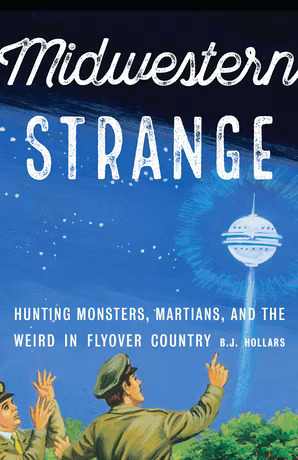
Review of Midwestern Strange: Hunting Monsters, Martians, and the Weird in Flyover Country


SFRA Review, vol. 52, no. 2

Nonfiction Reviews


Review of Midwestern Strange: Hunting Monsters, Martians, and the Weird in Flyover Country

Mark Soderstrom

B. J. Hollars. Midwestern Strange: Hunting Monsters, Martians, and the Weird in Flyover Country. U of Nebraska Press, 2019. Paperback. 224 pg. $19.95. ISBN 9781496215604.

I fell in love with the title of B. J. Hollars’s book Midwestern Strange, and am glad to review it as I also hail from the Midwest. Among other things, it’s the land of the big roadside attractions—the Corn Palace; the Largest Ball of Twine; and pop culture debutantes like the giant Paul Bunyan featured in the movie Fargo (1996) or the House on the Rock shown in Neil Gaiman’s American Gods (2001). Hollars here spins a charming narrative travelogue of his “year of living strangely” (1) detailing his visits to and researches into sites of the strange throughout the Midwest.

The book is divided into three sections: Monsters, UFOs, and The Weird. Each section is again divided into three case studies set up in procedural investigatory fashion. They include such tales as Oscar the Turtle, the Minot UFO sighting, and the grandaddy of Midwest controversies (one that divides families and actually has its own museum), the Kensington Runestone. Each case study provides historical context, a travelogue to the strange site in question, interviews with local informants and experts, as well as the author’s personal connection to the event. These personal memoirs are perhaps the most endearing aspect of the book. Here Hollars describes his childhood fear of Oscar the Turtle:

[By] the time I turned five I knew to fear northern Indiana’s murky lakes[…] . Where others saw nothing, I saw the dark and impenetrable water. And within it, an antediluvian monster, dead-eyed and licking his lips[…] . While my friends all believed their monsters lived under their beds, I knew mine lived just below the waterline. (37-38)

The personal memories and travel narratives restore to the reader the sense of wonder in the strange and unknowable. Similarly, the use of the prosaic Midwest as the site for fieldwork pokes gentle fun at the history of anthropology and exploration narratives. The author’s familial self portrait, with the author behind binoculars, his young son in a monster t-shirt, and younger daughter in swim goggles, is a gentle parody of the self portraits of the figurative “heroic colonial explorer” in the “native wilds.”

The sections are not equal in strength. The UFO section is the weakest, while the section on monsters and the finale of the Runestone were the strongest. It is not a coincidence that the strongest sections were those in which the local communities used the strange incidents to develop what public historian Tammy Gordon calls community and vernacular exhibitions: Turtle Days in Churubusco, Indiana; The Mothman Museum in Point Pleasant West Virginia (which Hollars admits is a bit far afield for those of us who are Midwestern purists); the appearance of the Hodag as a community icon in Rhinelander, Wisconsin; and the Runestone Museum in Alexandria, Minn. In the words of some of Hollars’s informants, these community celebrations of their respective strange heritages give their towns “a dot on the map.” (49) Hollars provides wonderful examples of community heritage practices and the process of memory and identity creation that are easily the book’s best folklife chapters.

The less compelling chapters are built around UFOs. The participants’ desire to prove UFOs’ existence and their desire to be taken seriously are less narratively gripping. Describing the followers of The X Files’ Mulder is not as engaging on the written page as showing them was on TV. Hollars’s wonderful wit is not as evident (save when he is joking about space pancakes). And unfortunately, some of Hollars’s larger assertions here about the nature of knowledge and science are troubling. While it is true that the communities of UFO adherents and other paranormal investigators engage in behaviors that are often similar to the practices of scientists (publishing, peer critique, conference presentations), such similarities do not necessarily make them “outsider” scientists. While a few years ago I might have been more charmed by the assertions that paranormal investigators are just unappreciated scientists yearning for recognition, in these days of anti-vaxxers, doubletalk defending disingenuous practices in COVID-19 prevention, and QAnon, I am calling on my knowledge of Thomas Kuhn, whose The Structure of Scientific Revolutions leads me to recognize that understanding scientific change and different knowledge paradigms does not make every such paradigm equal in scientific status or utility.

Still, Hollars’s observations on why we find the strange so compelling and how our embrace of curiosity and capacity for belief enhance our humanity are inspiring. In a book filled with tales about oddities such as a disappearing dinner-table-sized turtle, a reader might not expect such lofty observations on human nature and capacity.

The interdisciplinary nature of this project is its greatest strength. It is part history, part popular cultural studies, part folklore—it partakes in the forms of travel narrative, memoir, creative nonfiction, journalism, and ethnography. As someone who teaches in an interdisciplinary program, I admired its freedom and boldness in crossing boundaries. I will shelve this book with other authors like Sven Lundqvist, Tom Engelhardt, and Carol Spindel, whom I recommend as examples for my students wanting to do creative nonfiction/memoir projects.


Review of Pluriversal Politics: The Real and the Possible


SFRA Review, vol. 52, no. 2

Nonfiction Reviews


Review of Pluriversal Politics: The Real and the Possible

Pedro Ponce

Arturo Escobar. Pluriversal Politics: The Real and the Possible. Translated by David Frye. Duke UP, 2020. Cloth. 232 pg. $99.95. ISBN 9781478007937. Paper ISBN 9781478008460.

I was disappointed to learn that Arturo Escobar’s Pluriversal Politics is not a handbook for accessing alternate worlds—at least not in the familiar sense. Obliquely, this might be Escobar’s point. From Continuum (2012-2015) to 12 Monkeys (movie 1995; TV series 2015-2018) to The Man in the High Castle (2015-2019), the focus on narratives navigating multiple realities is searching for the right world, or the struggle to restore characters to their original place and time. Escobar begins with the assumption that we already inhabit a “pluriverse,” “the idea of multiple worlds but also to the idea of life as limitless flow” (26). If we fail to perceive this flow, it’s because alternate possibilities for existing are obscured by anthropocentrism, colonialism, and the manufactured needs of capitalism. While Escobar’s vision of co-existing, autonomous worlds never leaves Earth, readers will nevertheless be taken on a philosophical journey that will leave them sobered, at times perplexed, yet quite possibly inspired.

Escobar begins with a fundamental question: “are we really the autonomous individuals we imagine ourselves to be?” (5). Certainly, this is how many have learned to see the world. Development and progress, as global values, are predicated on individual choice—of work, living space, and products to consume. Over the course of subsequent chapters, Escobar convincingly demonstrates how modern individualism, far from being an innate condition of contemporary reality, is rather one possibility among many that has prevailed only because it forecloses other worldviews:

What does “being realistic” mean? It means believing that in the final analysis there is a single correct way to see and understand things (based on rationality and science); believing that these (our) universal truths must prevail against all others, which in our view are less correct, or false; being convinced that we live in a world made of a single world, and being shocked by the opposite possibility; and being sure that the truth of this single (usually Western) reality—which obviously we all share, as we should!—is the space from which we ought to promote our projects (whether they be for becoming very rich or for resisting capitalism). (6)

The problems we face as a planet, in other words, cannot be solved using the frameworks and practices that caused them in the first place. It’s not enough to resist if resistance is merely exchanging one form of individualism for another.

There are certainly precedents for thinking outside the individualist box. In Buddhism, for instance, there is no self, only being in relation to everything else: “nothing exists intrinsically; everything is mutually constituted” (19; Escobar’s italics). Other examples cited by Escobar implicate technology and the theorizing of Western knowledge. Cybernetics troubled the separation of observer and observed, implicating both in systemic relation: “This conclusion still remains at the center of debates about the real: to know is to transform yourself and the unfolding universe” (22). The developing field of political ontology “provides a space for studying the relationships between worlds, including the conflicts that result when different ontologies or worlds strive to preserve their existence in their interactions with other worlds, under asymmetric conditions of power” (25). And Foucault—an essential companion on this trip—discerned a fundamental structure to discourses, and in doing so illuminated possibilities beyond those that prevail, as in the example of discourse around Third World “development”: “What does it mean to assert that development began to function as a discourse; that is, that it created a space in which only certain things could be said or even imagined?” (51).

Ultimately, the precursors that most inform Escobar’s study/manifesto go all the way back to the beginnings of humanity as we know it:

inhabiting (habitar) can be defined as the recurrent associational interaction between living things and their environment, creating the conditions for well-being. For a good portion of their history, humans knew how to practice this form of inhabiting the habitats they found. This ethos began to crack with the Greek polis, with its geometrical forms and layouts, conceived by humans who had begun to think of themselves as superior to and apart from the natural world. Here began the long civilizational journey of the Western ontology of separation and dominion over the natural world; the habitat is transformed into ‘an out-of-focus, scarcely noticed background’ to the polis and its function of inhabiting. (154)

This prevailing ontology is contrasted with the knowledge it suppresses in order to circumscribe what passes for reality, what Escobar calls “the cosmovisions of the original peoples in many parts of the world” (15). These include groups in northwestern Colombia who practice “a relational ontology based on the idea that territories are living beings with memories, spaces in which the sacred and the everyday are lived experiences, possessing their own rights, which embody their relationships with other beings and the ways they interrelate with them” (16). In a narrative set piece, Escobar imagines a father and daughter navigating the Colombian rain forest via the Yurumanguí River, in a canoe made from the mangrove tree, using knowledge of the river’s tides, and traversing an environment rich in other species on their way home: “Ethnographers of these worlds describe it in terms of three contiguous worlds (el mundo de abajo, or infraworld; este mundo, or the human world; and el mundo de arriba, or spiritual/supraworld). There are comings and goings between these worlds, and particular places and beings connecting them, including ‘visions’ and spiritual beings” (71). Rather than treat such knowledge as an object of curiosity or “enlightened” dismissal, Escobar sees it as another form of ontology that calls instead for engagement, one pluriversal link among many that potentially impacts our collective history, politics, and culture. In contrasting one possible way of life with another, Escobar’s intent is not to romanticize these cultures, which is merely another form of centering modernity: “those who defend place, territory, and the Earth are neither romantics nor ‘infantile.’ They represent the cutting edge of thought, for they are attuned to the Earth and to justice, and they understand the central issue of our historical moment: the transitions to other models for living, toward a pluriverse of worlds” (44-45).

 (North) American readers may read Escobar with skepticism. If you’re reading this in the midst of 2021’s ongoing pandemic and political division, you might understandably have a problem with a scholar who encourages readers to think outside of science and the rational. In response, Escobar might remind us of what a pluriverse is: distinct worlds that co-exist as part of the same system. He might also respond with a simple question about our current state of individuality and consumption: How’s that working out for you?

Pedro Ponce is the author of The Devil and the Dairy Princess (Indiana University Press), winner of the 2020 Don Belton Fiction Prize. He teaches writing and literary theory at St. Lawrence University.


Review of Science Fiction and Catholicism: The Rise and Fall of the Robot Papacy


SFRA Review, vol. 52, no. 2

Nonfiction Reviews


Review of Science Fiction and Catholicism: The Rise and Fall of the Robot Papacy

Dominick Grace

Jim Clarke. Science Fiction and Catholicism: The Rise and Fall of the Robot Papacy. Gylphi, 2019. SF Storyworlds. Paperback. 292 pg. $29.99. ISBN 9781780240848.

Jim Clarke tackles an ambitious topic in Science Fiction and Catholicism; though he notes that “this study […] tracks a series of historical narratives about how Anglophone literary sf has dealt with Catholicism in the late twentieth century” (4), he in fact traces the overlap between Catholicism and SF back to the Middle Ages and provides a formidably-researched analysis of how ideological conflicts between Catholicism and Protestantism have (mis)informed the treatment/representation of Catholicism in SF. (He also considers a few texts that are arguably earlier than the “late twentieth century” framework.) His assertion in his conclusion, that Catholics, rather than representatives of other religions, have featured more prominently than representatives of other religions as rigid antagonists of irrational revelation is because of the “role which faux Catholicism has played in sf as the genre’s Other, a role foisted upon actual Catholicism by an anti-Catholic literary tradition which dates back to the post-Reformation pamphlet wars” (251). He argues that “Catholicism, perhaps of all the world’s faiths, has demonstrated the most interest in topics close to sf interests, most specifically the possibility of alien life. In return it has been rewarded with a significant though largely malign presence within the corpus of sf works” (251). While these might seem like tendentious claims—and indeed, Clarke has nothing to say about how non-Catholic manifestations of Christianity (e. g. the Gileadean regime in Atwood’s The Handmaid’s Tale [1985], to name but one example) also are common in SF—Clarke’s extensive exploration not only of SF but also of the history of the Catholic Church provides strong support for his arguments. The overlap between those deeply conversant with SF traditions and those with deep knowledge of European intellectual history is perhaps smaller than it should be. Those already well-steeped in both will not be surprised by much that Clarke says, but for those lacking such twin expertises, this is an eminently useful book.

Especially important here are Clarke’s introduction and the first chapter, “Critical Mass: How Catholicism Became Science Fiction’s Counter-Narrative,” which between them take up close to a quarter of the book, and in which he builds a well-researched and thorough exploration of how an understanding of the Reformation’s influence on how Catholicism came to be represented in literature (not only in SF but more generally, including in important antecedent genres such as the Gothic) lies beneath recurrent patterns in how Catholicism is treated in SF. Readers who know the SF but not the history will find these chapters extremely useful. Clarke follows with three further chapters, each focusing on a particular popular SF subject and considering examples of how Catholic perspectives on those issues have figured in SF, and how those perspective compare (or contrast) with what the Catholic Church has actually had to say on these subjects. Again, Clarke’s contextualization of SF representation with the Catholic Church’s actual positions is often very illuminating because his focus is not just on works of SF but on how they can be seen in dialogue (or debate) with actual Catholicism.

Chapter two provides the book’s subtitle: “The Rise and Fall of the Robot Papacy: Catholicism and Machine Intelligence.” Chapter three looks at “Missionaries to Alien Utopias: Exotheology and Catholicism in Science Fiction.” Chapter four, “Unwriting the Reformation: Anti-Catholic Uchronias in Science Fiction,” explores alternate versions of or analogues to the Catholic Church in alternate worlds narratives such as John Brunner’s Times without Number (1969), Keith Roberts’s Pavane (1968), Kingsley Amis’s The Alteration (1976), and most intriguingly, Robert Charles Wilson’s Julian Comstock: A Story of 22nd Century America (2009), among others. His discussion of Wilson is perhaps the most intriguing element of his book, as he sees in the novel “what may be a new juncture for sf—the depiction of a future made up entirely of allied or warring conservatisms” (247). For Clarke, Julian Comstock is a novel that “actively turns its back on the Enlightenment, progressive science and political liberalism, and additionally, rejects sf’s characterization of itself as a product of the Enlightenment in opposition to conservative Christianity” (248). Time will tell as to whether Clarke’s bold claim about how this novel may have established a new paradigm going forward for how SF deals with Catholicism plays out, but it makes for a rousing final argument in this insightful and readable book.

Libraries with extensive SF holdings should acquire a copy of this book. Teachers of courses on the intersection between SF and religion will find it a valuable resource. Scholars interested in the topic will also find much worth careful thought here, as well—and possibly, a few more SF books to add to their to-read pile. I know I did.

Dominick Grace is Professor of English at Brescia University College in London, Ontario. His main area of research interest is popular culture, especially comics and Science Fiction.


Review of American Utopia: Literature, Society, and the Human Use of Human Beings


SFRA Review, vol. 52, no. 2

Nonfiction Reviews


Review of American Utopia: Literature, Society, and the Human Use of Human Beings

Adam McLain

Peter Swirski. American Utopia: Literature, Society, and the Human Use of Human Beings. New York: Routledge, 2020.  Paperback, 256 pg. $44.95. ISBN-13: 978-0367144340. EBook ISBN-13: 9780429032004.

Peter Swirski’s American Utopia: Literature, Society, and the Human Use of Human Beings is a whirlwind journey through the many aspects of “utopia.”  Along with literature, Swirski brings in history, psychology, sociology, and economics to ground America’s long-lived utopian fantasy. Early in the book, Swirski introduces the authors on whom he focuses, his proclaimed four horses of the utopian apocalypse, as the authors “take on the mantle of social reformers by diagnosing the pitfalls of social reform” (39). Those authors are Thomas Disch, Bernard Malamud, Kurt Vonnegut, and Margaret Atwood.

The book is divided into five parts with each part consisting of three chapters. Part One: Utopia, Eutopia and Youtopia covers the history of the concept of “utopia” from Thomas More’s 16th century book to modern real world examples of utopian attempts, examines the history of utopia in America with a special focus on the 1960’s, and lays out the book’s thesis statement and the author’s methodology going forward. Swirski sees utopia as a diagnostic tool for society and not a prognostic tool as others in the past have treated it. In other words, utopia is a question for how society might function when various types of social engineering are applied, and not the answer to those experiments. His methodology is to ask questions regarding human nature vs. nurture, whether humans can be bioengineered to be better, and how Big Data might work with utopia in the 21st century. 

The remaining four parts of the book are each focused on one author. Each of the four authors serve as a different critique of utopia, starting with Disch’s social engineer who becomes Malamud’s social engineer stymied by biology. Vonnegut reverse-engineers humans, and Atwood bioengineers an entirely new species and abandons humans altogether. Within each of these sections, the first chapter is devoted to a biographical sketch of the author and a focused reading of a key work using utopia as a lens. The second chapter positions the work within its own literary context, highlighting influences and shared tropes. Finally, the third chapter of each section moves into the present by looking at current (or at least recent) American socio-political trends with the author’s work serving as a framework. 

Part Two: Dischtopia looks at Thomas Disch’s work 334 (1972). Swirski uses Disch’s utopia to highlight utopia’s often used trope of social engineering via education. Then he takes an interesting turn in the third part of the section when he ties social engineering to Big Data. It’s an unexpected examination of how the age of Big Data is successfully social engineering Americans on a large scale in a way that education has been unable to. Swirski argues that Big Data will eventually remove choice, or the need for choice, because an algorithm will decide everything, a type of utopian hedonism. Swirski sees the loss of decision-making agency as both utopian (the algorithm is never wrong because the data is the data) and hedonism (people are no longer tasked with making decisions for themselves) that could lead to a reduction in critical thinking and critical activity by privileging passive consumption. From here Swirski discusses what he sees as the fallacy of Universal Basic Income versus a Utopian Basic Income. A Universal Basic Income allows room for social engineering due to existing wage gaps, something akin to the Chinese Social Credit System.  A Utopian Basic Income would be based on a more equitable redistribution of wealth throughout all social classes that would remove wage gaps.  Finally, Swirski talks about how the US is the current example of the undemocratic democracy of Athens and that the US democracy is based on income inequality which adversely affects the happiness of the population. The discussion here is adventurous and highly enlightening.

Part Three: Pantopia introduces the reader to Bernard Malamud’s God’s Grace (1982). Here Malamud’s utopia examines the tribalism that is inherent when one pits social engineering against biology. To connect this to current America, Swirski discusses cultural memory and proverbs. Swirski’s interest in proverbs lies in their lasting power and how that longevity runs counter to our Snapchat world. Swirski posits that religion might be a by-product of adaptive biology in the brain. He further points out that the United States has a high level of religious participation and that a high level of religious engagement might be one of the causes of the extensive social problems plaguing the country because the human brain seeks to find agency, even supernatural agency, to explain away phenomena. Of the author discussions, this one might be the weakest. While the connections to proverbs and the novel are solid, it’s less clear how God’s Grace completely relates to American utopia.

Part Four: Uchronia focuses on Kurt Vonnegut’s Galapagos (1985) while also touching on Timequake (1997) and Cat’s Cradle (1963). It’s not always clear which novel Swirski is discussing, which could be very confusing for someone who isn’t well-versed in Vonnegut. Vonnegut’s utopia is about reverse engineering evolution in order to inspect the quality of the human brain. Swirski takes this opportunity to explore the tension between the individual and society at large. In order to facilitate the discussion, game theory is posited as the opposite of decision theory as a means of understanding the irrational versus rational when it comes to decision making. To further elucidate his discussion, Swirski introduces the game Prisoner’s Dilemma to highlight strategic give and take.  Players in the Prisoner’s Dilemma can work against one another or attempt to cooperate depending on the scenario. In terms of utopia, it becomes clear that cooperation is the best way to establish a utopia, but in America we undervalue niceness and tend to wield capitalism like a boot to the throat. While this does not make cooperation impossible, it makes it difficult. It is the way the country has evolved.

Part Five: Biotopia concentrates on Margaret Atwood’s Oryx and Crake (2003). Whereas Vonnegut reverse engineers evolution, Atwood’s utopia results in bioengineering an entirely new species. Not surprisingly, Swirski connects this to current technologies such as CRISPR, genetically modified food, clones, genetically modified animals, and humans pushing evolution. Part of Swirski’s point in this chapter is that we are unaware of the potential side-effects we may sow as we play with genetics, especially considering the history of eugenics. Humans are the agency for change and human nature will dictate the success or lack of success that a utopia might reach.

Overall, American Utopia: Literature, Society, and the Human Use of Human Beings is a fast-paced, highly informative read. The connections Swirski makes between the literary texts, utopia, and current American society are fascinating and varied. One minor quibble is that some of the section titles within the chapters can be confusing. Many of them are tongue-in-cheek literary references that aren’t explained in the context of the chapter or section. This book should appeal to those interested in the specific authors as well as those who are interested in utopia and utopia’s place in American culture.

Jennifer Kelso Farrell is an Associate Professor at the Milwaukee School of Engineering. She has degrees from the University of Montana, Montana State University, and Louisiana State University. Her writing has appeared in the Journal of Popular Culture and Foundations. Her book Lewis Carroll, Linguistic Nonsense, and Cyberpunk: An Alternate Genealogy for Science Fiction was published in 2008. Currently she resides in Milwaukee, WI with her husband and their three-legged cat, Bomba, who is a survivor of the Beirut explosion.


Review of Invoking Hope: Theory and Utopia in Dark Times


SFRA Review, vol. 52, no. 2

Nonfiction Reviews


Review of Invoking Hope: Theory and Utopia in Dark Times

Adam McLain

Phillip E. Wegner. Invoking Hope: Theory and Utopia in Dark Times. University of Minnesota Press, 2020. Paperback. 264 pg. $28.00. ISBN 9781517908867.

The hope of this review of Phillip E. Wegner’s Invoking Hope: Theory and Utopia in Dark Times, or rather this non-reading of Invoking Hope, is to not fall into the trap of the review, or the anti-reading, as the author states in his introduction: the moralizing criticism “aimed either at dissuading engagements on the part of later readers or, at least, narrowing and directing the avenues down which any future non-reading might travel” (9). Indeed, approaching a book that is so interwoven with theory and utopia can be rather daunting, for in reviewing such a delightfully dense and enjoyably ensconced text, I will most assuredly not touch on all the positive aspects of the project nor critique and construct as many future narratives and critical impositions as are possible. The main takeaway I have from Wegner’s work is that those interested in utopia, reading, or the world in general should read it; it is a book that crosses academic boundaries and allows us to refocus our efforts on striving for a better, even utopian, world.

As Wegner is very clear about in his introduction, Invoking Hope is written as a response to a(n) (un)certain time and a (non-)specific event: the 2016 inauguration of a media and real estate mogul as the President of the United States. Wegner does not necessarily make his book an anti-Trump text; instead, he weaves together a series of essays, split into two parts, that shows readers how to use utopia to (non-)read and then (non-)reading utopia through disparate texts. He wishes to show how an act of reading can be a utopian act that subverts and overcomes—by living through—even the darkest of times.

Wegner’s approach to utopia and the current moment is theoretical and philosophical rather than historical or practical (meaning a step-by-step instruction guide). This methodology is seen beautifully in the first chapter, in which he outlines a Greimas semiotic square, realized through the work of (and Wegner’s work on the work of) Fredric Jameson, to approach the Chicago school of New Critics; he then uses this approach to read with Alain Badiou’s Plato’s Republic (2013), itself a translation and re-reading (or re-writing/non-reading) of Plato, and collectively shows that one of the fundamental problems with democracy, especially in the United States, is its emphasis on individual economic prosperity rather than collective political good. Wegner, then, creates the theoretical apparatus needed to show how, with semiotic square and Lacanian orders mapped onto each other, he is able to read, or rather non-read, utopian genres in order to invoke hope.

Having established a semiotic approach to utopia, he further engages in this conundrum in chapter two by arguing for the art of non-reading, as formulated by Pierre Bayard and his reviewers. Non-reading, for Wegner, is what people do when they approach a text through literary criticism; they are at both times reading the text and remembering the text as they write their own text. He then proceeds to non-read More’s Utopia (1516) to show that “utopia is located in Utopia, More’s book itself, and most particularly in the figure of a dialogue it offers us” (84). This non-reading of Utopia echoes through the rest of the book as Wegner approaches texts as utopian inside and as the text itself, rather than attempting to create or formulate a utopian mindset or utopian way of approaching the world around them.

Establishing this practice of non-reading allows Wegner to move beyond an ethical reading, which he does in the subsequent chapters. Instead of trying to read morality out of a text, then, he is attempting to non-read utopia through the text. This effort is seen in his recapitulation of the Henry James–H. G. Wells debate during the modernist period, in which James considered novels to need strict rules, while Wells was open to more fluid motion within a text. While James, for some time, won this debate, which led, in Wegner’s argument, to the rise of ethical reading and the New Criticism discussed in the first chapter, he shows how his non-reading can overcome this approach to four specific genres: the universal history, the kunstlerroman or artist’s story, the comedy of the (re-)marriage, and the science fiction. He concludes that utopia is “never no-where, an imagined perfected future, but in fact always already potentially exists in the concrete now-here, in our collective fidelity to the project of making a world we so desire rather than a world we fear” (218): indeed, the hope of utopia that is invoked in the use of theory in the book is the striving toward the future that comes from non-reading, as Wegner shows as he non-reads such unique and seemingly unconnected texts as Du Bois, “Babette’s Feast” (1950), 50 First Dates (2004), 2312 (2013), and Cloud Atlas (2004).

While the theory in the book is astute, diverse, and vast, much of the book is rooted in and heavily relies on the work of Fredric Jameson. This reliance makes sense: Wegner’s career has been focused on Jameson’s work as the central thinker with whom he engages. And yet, it seemed as if Jameson had something to say about every single topic in which Wegner engaged. In this way, then, parts of the book feel to be utopia and theory through Jameson rather than through Wegner. Thus, I read Invoking Hope as a new and innovative text that synthesizes many literary and utopian schools of thought in brilliant ways, and it is a part of Wegner’s project, seen through his other work (Imaginary Communities [2002], Life Between Two Deaths [2009], Shockwaves of Possibility [2014], and Periodizing Jameson [2014]), that continues to develop Jameson’s (and Wegner’s) thinking together. The book does invoke the hope needed during dark days that have passed and the dark days of the future as we collectively move toward utopian ideals and theoretical advancements.

Adam McLain researches and writes on dystopian literature, legal theory, and sexual ethics. He is currently a Harvard Frank Knox Traveling Fellow, studying twentieth-century dystopian literature and the legal history of sexual violence in the UK. He has a bachelor’s degree in English from Brigham Young University and a master of theological studies from Harvard Divinity School.


The Representation of Otherness in Contemporary Hungarian Urban Fantasy


SFRA Review, vol. 52, no. 2

On the Edge: The Fantastic in Hungarian Literature and Culture


The Representation of Otherness in Contemporary Hungarian Urban Fantasy

Eva Vancsó

After the regime change (1989), urban spaces gained ground in genre literature, and the city became a common imaginary environment mainly in post-apocalyptic/dystopian science fiction novels, such as in Kiálts Farkast (Cry Wolf, [1990]) by András Gáspár, Hiperballada (Hyperballad [2005]) by László Zoltán, Szintetikus álom (Synthetic Dream [2009]) by Tamás Csepregi, Feljövök érted a város alól (I am coming up to get you from under the city [2015]) by Zoltán Pék, and Acélszentek (Steel Saints [2016]) by Kristóf Szöllösy.  It should be noted here that none of the novels mentioned in my article is available in English; the titles, names, and quotations are my translations.

The field grew at an explosive rate from the early nineties onwards, but urban fantasy did not become widely read—or written. Among the earliest Hungarian examples of the genre are two anthologies, A Cetkoponyás ház (The House of the Whale Skull, edited by Lajos Hüse, Cherubion Könyvkiadó [2001]) and Erioni Regék (Tales of Erion, edited by András Gáspár, Valhalla Páholy [1998]). Those short stories are set in imaginary cities created initially for role-playing games (Hegedüs 94). The re-imagination of Budapest (or any other Hungarian city) in urban fantasy remained absent until Egyszervolt by Zoltán László (Onceupon [2013]) was published. In this traditional intrusive fantasy, inspired by Neil Gaiman’s Neverwhere, the protagonist becomes aware of a secret Budapest that lies under the surface and starts exploring this secondary world. More recently, Egyszervolt was followed by less traditional urban fantasy works, such as Pinky by László Sepsi (2016), where the nameless city, which might as well be Budapest or New York, has its hidden secrets and streets populated by elves, werewolves, or vampires. Csudapest (Wonderpest [2020]) by Fanni Sütő can also be considered as urban fantasy, consisting of short stories, blog entries, and poems with one common feature: they all describe Budapest as simultaneously familiar and magical.  

In my essay, I analyze two award-winning contemporary Hungarian urban fantasy novels, Irha és bőr (Fur and Skin) by Anita Moskát and Az ellopott troll (The Stolen Troll) by Sándor Szélesi, which were both published in 2019. The stories unfold in an alternative Budapest where non-humans live (or at least try to live) together with the humans, and my examination focuses on the intersection of the urban and fantasy milieus, which lends itself quite well to explore the problem of otherness through certain genre conventions and clichés. 

The Genre Tradition 

Fur and Skin talks about the new ‘creation’ when animals begin to turn into humans all around the world. The animals pupate, initiating a transition in which human limbs and organs replace the animal parts. When the transformation does not end in death, it results in hybrid creatures. Moskát’s novel revolves around these creatures’ fight for social and political acceptance. The Stolen Troll concerns a detective, Bercel Tóth, who is the only human at the Department of Magical Creatures at the Budapest Police Headquarters. The troll living at the foot of Margit Bridge goes missing—probably kidnapped—and through Bercel’s investigation the novel offers an insight into the daily life of the unusual world in which magical creatures make up about 20 percent of the city’s population. 

Both novels play extensively with the tradition of urban fantasy, and I highlight the generic features that contribute to exploring otherness. According to Irvine, “the element most common to all urban fantasy is a city where magical or supernatural events occur” (200). Kenneth Zahorski and Robert Boyer give a more restrictive definition of urban fantasy: a fantastical narrative that is “set in the conventional here and now” (56). Fur and Skin and The Stolen Troll are both placed in a contemporary urban environment, more specifically, in an existing city that has become magical because of its inhabitants. I use the term ‘magic’ or ‘magical’ in a broad sense to describe very different worlds, creatures, and phenomena that expand the limits of urban fantasy. 

In Fur and Skin, the magical or supernatural event is a metamorphosis of animals into humans without rational reason or explanation, so it can be considered magic. The transition process is incomplete in most of the cases, with animal parts remaining, the novel thus introduces creatures that are neither animal anymore nor fully human. Their very existence is supernatural/magical, or unnatural, and humans believe that the sudden appearance of the creatures challenges the natural and divine order. The Stolen Troll, in contrast, describes a fictional world in which the magical creatures of Hungarian folklore are integrated into our contemporary world and society. The text introduces both fictional, and widely (dragons, witches, and sorcerers) or lesser known (fairies, dwarfs) characters from Hungarian mythology whose names and attributes derive from the folktales. Moreover, the novel also builds on the narrative structures of the folktales, for example featuring an old king with three daughters or a magic whistle to call for help. These different folkloric elements pervade the quotidien and seem natural to both humans and magical creatures.

In Rhetorics of Fantasy, Farah Mendlesohn grouped fantasy texts into four categories: portal-quest, intrusion, immersive and liminal fantasies. According to her taxonomy, both The Stolen Troll and Fur and Skin belong to the category of immersive fantasy, in which the characters (to varying degrees but) “take for granted the fantastic elements with which they are surrounded; they must exist as integrated with the magical (or fantastic) even if they themselves are not magical” (20). At the same time, the reader doesn’t have to discover this primary magical world because it is already familiar, the urban areas are identical to Budapest and Kistarcsa. Therefore, the novels continuously challenge our understanding of normal and not-normal, familiar and unfamiliar, or one could say, the other and the “not-other.” In addition, the sense of intrusion is present in both novels due to the urban fantasy setting, with the dragons flying over the famous bridges on the Danube or deerpeople running down the existing streets of Kistarcsa. In that case, real and fantastic do not collide within the text, but in the readers’ minds. This form of intrusion generates threats or problems that are not resolved in the text in a certain way but require the readers’ efforts to consider different possibilities, and to avoid (over)simplification.  

Otherness: Segregation or Integration 

The creatures of Fur and Skin are built on the literary tradition of the chimeras, being half-human like us, yet still animals. The denomination used in the novel, “fajzat,” reflects on the creatures’ liminal position, being a word used here in a new context to express that they are a non-human species, at the same time indicating disdain. Terms and names are central to the narrative as a form of speciesism, and the creatures fight for the name chimera, considering that it “Nincs negatív felhangja, nyoma sincs a gúnynak. Egzotikus, ősi, rejtélyes” [“It has no negative overtones, and there is no sign of mockery. Exotic, ancient, mysterious”] (Moskát 91). Interestingly, humans are called “sapiens” by the chimeras, suggesting the same disdain in reverse. 

By their nature, the chimeras of Fur and Skin embody the other and humans feel threatened: “A fajzatokhoz első asszociációként az összes felmérés szerint a félelem kötődött” [“According to all surveys, in connection with the creatures, the first association is fear”] (37). Chimeras are fearsome because they disrupt the duality of humans and animals; their birth is unnatural, as a character points out: “Az emberek születnek, van anyjuk, van apjuk. A fajzatok, mi, állatokból keletkezünk” [“People are born, they have a father and a mother, the creatures, we, come into being from an animal”] (65). Secondly, the transition is inexplicable and unpredictable; it can happen to a deer in the forest or to the family’s beloved pet. Moreover, the number of chimeras seems to grow, raising philosophical-theological questions about humanness and causing a series of socio-political problems. 

Chimeras call into question what people perceive to be human, yet Fur and Skin does not want to answer this—though the text inevitably proposes a solution. In the novel, human and animal are not mutually exclusive categories, their relationship is rather an axis that has two ends, the animal and the human. The chimeras are creatures in between; some are closer to humans, like one of the three protagonists, August, who is practically perceived to be human. Pilar, the badger-girl, and Kirill, the deer-man, possess more animal traits, and many of the chimeras are further to human on the above-mentioned axis. 

The duality is mirrored in the chimeras’ position in society and the humans’ attitude towards them. In the Hungary of the novel, chimeras, in a certain sense, are perceived as humans, more precisely disabled humans, as their remaining animal body parts are considered a disability that makes many creatures still unable to do ordinary human things, such as holding a mug, buttoning buttons, or tying up shoelaces. Their disabilities need to be remedied, therefore antlers and horns, for example, are muffled up in foam or an artificial finger, a fork and a hook is inserted into the hoofs. Besides the body modifications, chimeras are also expected to suppress their animalistic instincts and perform civilized human behavior. The “creation” itself is followed by a period in the Socialization Centre, which is responsible for integrating the chimeras into the world of humans, claiming that “Már nem vagytok állatok . . . Meg kell tanulnotok emberként élni” [“You are not animals anymore . . . You have to live as humans”] (Moskát 44). During this education—or I would call it forced anthropomorphization—the chimeras are required to be non-aggressive, learn to speak, wear clothes, and try to eat with cutlery. However, it is declared that “Nem minden állat válik civilizálttá” [“Not all the animals become civilized”] (47); some feel “városkór” [“citysickness”](49) and refuse (or are unable) to imitate the behavior of the humans. 

On the other hand, in Hungary—and this is a crucial point—chimeras are regarded as inferior to humans, even treated like animals. Their education does not result in their integration into society; they are segregated, lack human rights, and must have a legal guardian to leave the ghetto, which resembles a zoo where humans visit on safari buses to look around and take photos. Moreover, in the blog entries of Kirill, we read short stories about the brutal violence against chimeras that often results in their deaths.  

Pilar represents the concept of voluntary assimilation; to her, the goal is to become human, or at least be indistinguishable from them. To this end, “Minden állati maradvány csak hiba, amely a bebábozódáskor keletkezett. Itt az idő kijavítani őket” [“The animal remnants are mistakes that occurred during the pupation. It’s time to erase them”] (Moskát 72). In contrast, Kirill refuses assimilation, saying that “Kevés dolog megalázóbb, mint imitálni a sapienseket.” or “Nem kell utánoznunk őket. Nekünk is lehetnek saját fajzatdolgaink.” (“Only a few things are more humiliating than imitating the sapienses” or “we don’t have to imitated then. We can have our creature-things too”] (64). Other characters in the ghetto hold a more radical opinion on assimilation, namely that chimeras are not to conform to human norms and expectations as they are not disabled human beings. According to this opinion, otherness is a problem of majority and minority: “Matematika. Azért uralkodnak rajtunk, mert ők a többség, hétmilliárd a százmillió ellen” [“It’s mathematics. They rule us, because they are the majority, seven billion against seven hundred thousand”] (243). In this situation, the Other is, by definition, a minority and subordinate, thus cannot prescribe his own norms and is subject to the practices of the dominant group. This line of thought leads to the conclusion that the situation will only change “Ha mi lennénk többen . . . mi hoznánk a törvényeket, mi alakítanánk a kultúrát” [“if we were the majority . . . we would write the rules, we would shape the culture”] (244). In other words, they determine what is normal and other, and then “a hétmilliárd sapiensből rácsok mögött mutogatott látványosság lenne” [“the seven billion sapienses would be a spectacle behind bars”] ( 244).

The third character, August, is approaching the problem of otherness from a human standpoint, having been regarded as human all his life. He intends to secure human rights for chimeras, as they have in other countries, where they have the right to elect their representatives. In his opinion, human rights are the first step towards an equality that takes the differences into account; as he points out in his political statement “Egy vagyok közületek [emberek közül]” [“I am one of yours [humans]”] (40), but unlike Pilar, he doesn’t deny the differences: “ember és fajzat közt a különbséget a külső jelenti” [“The only difference between human and creature is in their appearance”] (40).  

Nevertheless, the novel raises no false hopes that the chimeras will be accepted as normal in the foreseeable future. Regardless of her efforts, Pilar is rejected and laughed at for imitating a human. After she is re-created by a team of hairdressers, make-up artists, and stylists, her transition seems to be accepted, but when she stands in front of people under different circumstances, the audience sees a creature on the stage, mocking and humiliating Pilar in public. Should the chimeras become the majority, it would only reverse the roles and would not provide a real solution; as we learn from the examples of other countries, despite the human rights and the liquidation of ghettos, chimeras remain marginalized in society. They cannot change humans’ attitude, and apparently, as a conclusion, the novel suggests that there is no place for the other with biological differences in society, as protagonists end up in prison or choose self-imposed exile.  

In The Stolen Troll, we find different “others” and a more positive attitude towards otherness. Magicians and magical creatures are a common trope of fantasy that embodies the other among humans and the attitude towards their otherness varies from dread or disdain to admiration. Szélesi’s novel describes an alternative Hungary populated by humans and a wide variety of magical creatures from Hungarian folklore, no less than fifteen different magical species live together. In this exceptionally diverse world, the other is considered a normal member of society; the coexistence is even if not unproblematic but based on acceptance. Ordinary humans represent the majority of the population, followed by humans born with magical abilities, like shamans (“sámán,” who is connected to the spiritual world and able to use magic of nature), magicians (“mágus,” who possess magical objects and is able to use different forms of magic), witches (“szépasszony,” whose magic also derives from nature but they are only able to cast smaller spells) and sorcerers (the figure of the “táltos” is unique to Hungarian mythology; their power derives from a direct connection to God). In addition to humans and different magicians, magical creatures like trolls, siegbarstes, giants, werewolves, fairies account for about ten percent of the society. 

We can distinguish between visible and invisible otherness. Contrary to Fur and Skin, where the chimeras are visibly different from humans in most cases, the magicians and witches do not differ from humans in their appearance, yet they are associated with the magical other. This duality is mirrored in the attitude towards them, as on the one hand they are not perceived as fundamentally different. Answering the question “Hogyan viszonyulsz a varázslényekhez?” [“How do you feel about magical creatures?”], Bercel replies that “Nincs veletek gondom” [“I don’t have a problem with you”] (Szélesi 20). Contrary to Fur and Skin, in Szélesi’s novel, integration is present in every aspect of life, including education (mixed nurseries and schools) and jobs (the protagonist works together with a werewolf, a shaman, a magician, and other creatures), in the private sphere, “inter-species” relationships and families are accepted, though uncommon. Certain magical creatures live apart from humans, but that is usually a consequence of the different body sizes; giants prefer to live on the top of the beanstalk, and tiny fairies (called “pilinkó” in Hungarian folklore) tend to hide in the forests. 

The novel does not give a detailed description of the society’s structure but the investigation of Bercel Tóth leads to higher and higher places, revealing the hierarchy of the fictional world. In the novel, Hungary is a kingdom, the king is a human, and the parliament is the highest legislative authority, made up of the Upper House and the Lower House. The members of parliament, and most importantly, the aristocracy, are equally composed of humans and magical creatures, yet, the highest positions, like the Home Secretary, the Minister of Human and Magical Resources, the Minister of Security, are held by highly qualified magicians. Apparently, magical abilities are not a basis of discrimination or an obstacle to overcome, but rather an advantage in public or political life. 

Various forms of otherness are acknowledged, accepted, and even appreciated in the novel, in both political and social terms. However, delving deeper into the text, we see the humans (and magical creatures) struggling with otherness in everyday life because invisible alterity is more fearsome than visible otherness. Examples can be found for distrust or fear of magic, or we could say distrust and fear of the magical other and their superhuman abilities. The protagonist, Bercel Tóth, wears an amulet to be protected from curses and spells and automatically assumes that his partner of magical abilities, Krisztina Hanga, is reading his mind or uses magic to bewitch him (Szélesi 79, 113). Bercel is not the only one who does not entirely trust magical creatures, the aversion of a “magicolist” is expressed in an outburst: “Egy boszorkányt hozott a házamba . . . Úristen!” [“You brought a witch to my house? Oh my God!”] (22). Krisztina Hanga articulates the problem from the opposite point of view, saying:

Integrált oktatás, hogyne. Minden varázstudó gyerek rémálma. A többiek félnek tőlünk, nem fogadnak be minket, kinéznek maguk közül. Az a varázstudó, aki nem védi meg magát, azt zaklatják. Ha megvédi, akkor beárulják, hogy agresszív és antiszociális.” 

[“Integrated education, of course. It is every magician’s worst nightmare. The others are afraid of us, do not accept us, even ostracize us. The ones who don’t defend themselves are bullied. And if you defend yourself, you are told to be aggressive and antisocial.”] (78)

Moreover, despite their human and political rights, some non-human magical creatures are still objectified in certain situations. The title, the “stolen troll” addresses the problem of objectification, and it derives from the law: “A lopás szót használom a rablás helyett, és nem rasszizmusból, hanem, mert a büntetőjogban a kőből álló varázslényekre még mindig így tekintenek” [“I use the word stolen instead of kidnapped, and it’s not racism, because according to criminal law, magical creatures made of stone are regarded as objects”] (7). In other situations, magical creatures despise humans for the lack of magical abilities, such as a goblin (called “pörtmandli” in Hungarian folklore, a magical creature unable to lie and susceptible to magic) declares to the protagonist that “Maga csak egy ember” [“You are just a human”] (6). The novel’s antagonist, a magician, points out that humans are the same and worthless: “Az egyik emberizink olyan mint a másik . . . Tizenkettő egy tucat. . . . A szaporodáson kívül másra nem képesek!” [“One human is like the other . . . They are a dime a dozen. . . . They can only reproduce”] (192). His view, however, is not generally accepted and he is called an “abilist,” a word created by analogy with racist from ability. The term suggests a form of ableism according to which the lack of magical abilities is a disability from the magical creatures’ point of view. We can draw a connection between the two novels, as they both connect otherness to the concept of disability that limits the others’ opportunities in society.

Like Fur and Skin, names and denominations reflect on the attitude towards otherness, though it is only a question of political correctness in The Stolen Troll’s world. Following Bercel’s question to Krisztina: “Maga boszorkány?” [“Are you a witch?”] (11), the detective is reminded to be politically correct, at least concerning the terminology. But as the quotation in the previous paragraph reveals, not only the magical creatures are called insulting nicknames, but humans are mocked as “emberizink,” an archaic word, meaning little, both in body and abilities. The world and society described in The Stolen Troll reveals that the integration of the magical other into the society is not without conflicts and certain forms of distinction are still at play.

The world is designed for humans”

     The setting is central to the definition of urban fantasy, and fantasy scholars are taking different approaches to the characteristics of the city, predominantly based on its location in a primary or secondary world (Elkman 457). Irvine proposes the distinction (or rather an axis) of urban fantasy or fantasy urban, referring to texts in which “urban” is a descriptor applied to fantasy and those in which fantasy modifies the urban milieu (200). On the one hand, both Fur and Skin and The Stolen Troll belong to the category of urban fantasy, in which the city is recognizably taken from our contemporary world. However, as Irvine points out, this kind of narrative involves contact with some magical realm, and the story revolves around the magical coming into collision with the urban milieu (201). In the novels discussed, the fantastic does not come in contact with reality, but is intrinsically part of it from the first pages, being a component of the urban milieu. Talking about the urban environment, Kirill points out that “a világot sapiensekre tervezték” [“The world is designed for sapiens”] (Moskát 46). It is worth examining this remark in the light of accepting or rejecting otherness and to what extent the urban spaces are transformed because of their magical inhabitants. 

Despite the different attitudes towards otherness, both novels depict cities that mostly remain unchanged compared to our known reality, and the texts refer to real objects of the urban landscape. In Fur and Skin, the NFSZ (International Organization for Creatures) headquarters at Kálvin Square is in the modern glass tower with a view of Szabadság-bridge and Danube (Moskát 80), the visitors travel to the ghetto in Kistarcsa by the local railway (13). At the same time, the cohabitation of the other and the human in a common space is not a given. Concrete walls and barbed wire separate the spaces of the humans and that of the chimeras, and within the walls, we find a city in the city, more precisely another urban environment that mirrors the chimeras’ otherness in two ways. 

Firstly, it highlights the creatures’ physical differences from humans, expressed through their incompatibility with the urban environment. The city of the humans is a constant threat: “akárhányszor kimerészkedtek otthonról, az életükre tört” [“Whenever they dared to venture out, it tried to kill them”] (Moskát 13), being cold, silent, dirty, and full of glass and steel compared to nature where the chimeras’ partly belong. Contrary to the humans’ world, the ghetto is inhuman in two senses. The creatures live in an area that the humans abandoned; they occupy houses and multi-storey buildings that were family homes. The ghetto is characterized by decay without humans; the walls are ruined, the furniture is broken, the windows are covered with cardboard, and there are no public utilities. Among the houses, huge tents are set up. However, those also only provide inhumane refugee camp-type living conditions of shared camp beds, common facilities, and strict rules. The ghetto is the inferior, ruined version of the human urban spaces, mirroring the chimeras’ inferior position in society.

The Stolen Troll likewise describes a city almost identical to the real Budapest, and magic is not apparent in the construction of urban spaces. The narrator spends much time detailing the routes and places of Bercel’s investigation, mentioning dozens of reference points, including Margit Island, the bridges over the Danube, the building of the police headquarters at Teve Road, and Jégbüfé, a famous patisserie at the Square of the Franciscans. The only mentioned difference between the real Budapest and the fictional one lies in the name of Andrássy Avenue that bears the name Avenue of Equal Constitution and in the presence of a Broom Store that sells traditional Hungarian brooms to witches. Re-naming the avenue, the novel also reflects on the continuous change of the street names according to the political changes, throughout Hungarian history Andrássy Avenue also wore the name Avenue of People’s Republic (Népköztársaság útja). We could say that the difference between the real Budapest and the imaginary one is as invisible or subtle as the difference between magicians and humans, and the nonhumans are not represented at all in the cityscape. In short: magical creatures are integrated into the world, but the urban environment remains of and for humans. 

The parallels drawn between the two novels and the city landscapes reveal that Kirill’s comment is not only correct, but the same applies to The Stolen Troll despite the different attitude towards otherness. Irrespective of the level of integration, the use of urban spaces suggests a human-centered approach, in which the other can live in the humans’ world yet can’t remake it in their image. 

Conclusion

In his study, Ekman argues that urban fantasy is the genre of the unseen that offers the possibility to “discuss and discover” what we usually do not or do not want to see (466). I would add that the combination of the primary-world setting, the contemporary environment, and the immersive fantasy in Fur and Skin and The Stolen Troll can be called (sub-)genre of otherness. As we have seen, the novels display otherness in different ways, yet have one crucial common motif: the other is no longer something hidden in the dark, outside our world and our society but walks amongst us in the familiar streets. Therefore, this form of urban fantasy, on one hand, mirrors what we think about ourselves and our society, and at the same time, invites us to think about the situation of the other. The discussed novels explore the reactions of society to otherness, and, in this regard, they can be considered as steps of a process from rejection to almost complete acceptance of otherness. The characters focus on the differences between humans, chimeras and magicians, and the novels depict internal social tensions, raising the question whether complete acceptance is possible. Only one chimera, a nameless, ancillary character, addresses the problem from a different point of view: “Ugyanazt szeretnénk, mint minden élőlény a Földön: legyen biztonság, legyen meleg, legyen mit enni. És mellettünk legyenek azok, akik szeretnek” [“We all just want the same things as all the living things on Earth: to be safe, to keep warm, and have enough to eat. And we want the ones we love to be there for us”] (Moskát 153). The comment applies equally to humans, chimeras, and magicians, and suggests focusing on similarities rather than differences. In other words, not only others can be the unseen, but the differences that make them the other.

WORKS CITED

Szélesi, Sándor. Az ellopott troll. Metropolis Média, 2019. 

Ekman, Stefan. “Urban Fantasy: A Literature of the Unseen.” Journal of the Fantastic in the Arts. vol. 27, no. 3, 2016,pp. 452-469.  

Hegedűs, Norbert. “Az urban fantasy klisérendszerei.” Partitúra Irodalomtudományi folyóirat, vol. 10, no. 1, 2015, pp. 93-102. 

Irvine, Alexander C. “Urban Fantasy.” The Cambridge Companion to Fantasy Literature, edited by Edward James and Farah Mendlesohn, Cambridge University Press, 2012, pp. 200-2 13.

Mendlesohn, Farah. Rhetorics of Fantasy. Middletown, Wesleyan University Press, 2008. 

Moskát, Anita. Írha és Bőr. Gabo, 2019. 

Sárdi, Margit. Magyarország- és Budapest-képek a két világháború között. Előadás a Magyar Írószövetség Sci-fi szakosztályában, 2011. sites.google.com/site/scifitort/tanulmanyok/magyarorszag–es-budapest-joevokepek-a-ket-vilaghaboru-koezoett?authuser=0.

Zahorski, Kenneth J. and Robert H. Boyer. “The Secondary Worlds of High Fantasy.” The Aesthetics of Fantasy Literature and Art, edited by Roger C. Schlobin. University of Notre Dame Press, 1982, pp. 56-81. 

Éva Vancsó is a Ph.D. student at Eötvös Lóránd University in the Modern English and American literature and culture program. Her main research area is utopian tradition in American science fiction television series, focusing on the representation of women in the imagined worlds. She has published articles on Hungarian utopian science fiction novels and short stories, exploring the characteristics of the utopian (mostly dystopian) societies. Alongside her research, Éva has translated sixteen SFF novels and short stories from English and Spanish; edited three fantasy anthologies. She is also the secretary of the Department of Speculative Fiction of the Hungarian Writers’ Association.


The Hungarian Way of Science Fiction


SFRA Review, vol. 52, no. 2

On the Edge: The Fantastic in Hungarian Literature and Culture


The Hungarian Way of Science Fiction

Sándor Szélesi
Translated by Gergely Kamper

As early as forty years ago, those meddling in the world of speculative fiction in Hungary often joked that defining science fiction is a favoured indoor sport among their ranks. It seemed like a nice joke, and it was at least as true as it was funny, although in those days few really grasped this.

Science fiction is a genre of British and American origins which was shaped by the scientific and social changes as much as by literary trends of the twentieth century. Defining it would not be easy even if it could be described by formal or content-related criteria like other genres, but the fact that these have been changing along the way makes the task even more difficult.

In the 1970s attempts at forming a definition originated from three different sources: academic literary studies, commercial book and magazine publishing, and communities of practice. That decade is the period when the first theoretical works appeared, and although it was a formalistic approach that first found a way to a definition, a new theory also surfaced emphasizing a historical aspect in the system of genres. Partly motivated by this paradigm shift, SF, still in its infancy, started to seek out its literary antecedents.

Nevertheless, this approach—like the formalistic one—did not result in an unequivocal definition. As a matter of fact, neither answered the question of what science fiction really was. In Hungary not only theoretical research—similar to what was going on in the United Kingdom or the United States—was lacking at the time but there was no de facto SF publishing, either. The authors of  sporadic speculative works were either practitioners of young adult literature—Péter Tőke, Miklós Rónaszegi, Péter Bogáti—or came from ‘high literature’ and only took a short trip to the genre—Péter Lengyel, Dezső Tandori, Gyula Hernádi. Every now and then a scientist—like astronomer György Kulin or biologist Tibor Dévényi—signed on, but their works never received the SF label. They also did not relate to the then-canonized British and American science fiction (not to the current topics let alone the institutions of publishing) or the works of the contemporary authors coming from a world of class struggles and positivistic technology—although educational policies explicitly required the transmission of socialist ideals for the coming generation. (Examples are Földrengések szigete (1957) by Klára Fehér or Endre László’s series Szírusz kapitány, which first found its way to audiences in the form of a radio drama.)

It was high time that a new collection of books labelled as SF came to life. It finally got the go-ahead in 1969 and interestingly enough is associated with the poet Péter Kuczka. The well-connected and pragmatic Kuczka found a market gap he could fill in Hungarian literature. He was fortunate, not only because he got the backing of the socialist cultural leadership, but also because communities of practice similar to those in the United States had not been formed yet, and literary science found SF unworthy to deal with, which meant that Kuczka did not have these two to comply with.

Three years later Kuczka raised the bar attached to the books and created a more extensive project: an SF anthology, Galaktika. At first, to gain proper intellectual and financial backing, they intended to present the roots of the genre, thus proving the literary legitimacy of science fiction (academics remained silent on the issue). The definition was imported from overseas. The formalistic approach of Serbian-Canadian Darko Suvin was adopted. He defined SF as “the genre of cognitive estrangement, a literary genre whose necessary and sufficient conditions are the presence and interaction of estrangement and cognition, and whose main formal device is an imaginative framework alternative to the author’s empirical environment” (8-9).

Helikon, a periodical dealing with world literature, devoted a whole issue to SF. Besides Kuczka and Suvin, contributors included Stanislaw Lem, Yuly Kagarlitsky, and Philip K. Dick, thus giving international legitimacy to the genre. The above definition presented to socialist cultural leadership imported a formalistic view and later, a historical approach was added to that. This combination allowed the community to search for the first work that could be labelled as SF in the distant past. That leads to some theories calling the Epic of Gilgamesh the first example of science fiction in the world. Going back to ancient times for the roots of SF was no more than an absurd interlude; still, it persevered amongst devotees of the genre. Indeed, it was also accepted by Hungarian persona publica just to legitimise it. With this 1972 definition, Péter Kuczka, who supervised SF publishing, raised a wall around the genre. He let in works that were supposed to improve the literary standing of science fiction (e.g., The Circular Ruins by Borges), at the same time filtering out many of the American works with a basis in popular culture.

Kuczka’s concept also meant the seclusion of the newly defined genre, which included shutting out all domestic works that were not regarded as high literature. Hungarian authors could only publish in Galaktika or appear in the series “Kozmosz Fantasztikus Könyvek” if they were specifically invited by the editor. Nevertheless, they were not seen as science fiction writers—all they had was knowledge of previous works in the genre. Checking out domestic authors besides the heavily screened British and American writers we find the same categories. Literary giants like Mór Jókai, Frigyes Karinthy, Géza Laczkó; poets or belletrists like Endre Darázs, Lajos Mesterházy, Gyula Fekete, Péter Szentmihályi Szabó, György Gera; or authors of young adult literature like Zoltán Csernai. The esoteric writing of Mária Szepes is a peculiar addition, although her presence strengthens rather than weakens tendencies. Interestingly enough, none of the domestic publishers thought of contributing to the education of SF writers or editors. The literary training in the SF Division of the Hungarian Writers’ Association was more like a PR project than anything more.

During its eighteen years of existence, Móra Publishing House’s “Kozmosz Fantasztikus Könyvek” series published seven books a year on average. This meant seven SF books a year plus five Galaktika anthologies (also published by Móra), that was all. When British and American science fiction was well into its second golden age—the new wave—and the genre started to carve itself a growing slice of cinema, in Hungary these were the only two places where science fiction par excellence could come out.

But why would anyone have wanted to expand the definition of the genre in a country or a language area where science fiction literature meant the stories in Galaktika magazine or the novels in the attached book series and nothing else? Considering the then-status of the genre, we could simply say that SF was whatever appeared in the anthology and in the series of books. Who needed a new, different definition?

By the end of the seventies, a new participant of the ‘institutional network’—well-known from overseas—appeared: the community aiming at playing an active role in the shaping of SF. Dozens of clubs were established in Budapest and other cities which then contacted one another. These communities of various sizes, while exploring their own identities, expanded the notion of science fiction and started to push the boundaries with their periodical fanzines. These fanzines (Kvark, Metamorf, Supernova, etc.) published one hundred, maybe five hundred, copies by these scattered clubs with the permission of the local city councils and provided several amateur writers an opportunity to appear in print.

Though it remained unsaid, their presence and new approaches threatened the official position. Should SF acquire a different definition, it might be able to separate from the official position, which neither the cultural establishment nor Péter Kuczka, who was very particular about his status, were willing to allow. Ironically, the very existence of Galaktika was speeding up this process, but the publisher did not support any of these communities (even though many of the clubs were actually named after the anthology). The underlying reason was probably the fact that Kuczka saw the power of these organizations. He had written in Helikon recalling the golden age in America: “As early as with the first magazines, so-called ‘fanzines’ appeared created by volunteering fans. In these small mags so proud of their independence, marketing angles were cast aside, and theoretical work began, as serious aestheticians, literary historians or critics had not acknowledged the existence of science fiction for decades—not even as part of popular culture.” In spite of this, Galaktika dissociated itself from the clubs even though its monopoly (along with Kozmosz Fantasztikus Könyvek) in publishing was not threatened at the least in those days.

So the change—just like in the United States much earlier—came from the fans in Hungary, too. Véga, Hungarian SF Society’s publication of works by amateur authors, was the first to penetrate the impenetrable looking political force field around Galaktika. These publications did not only reach readers on HungaroCon, a nationwide convention held from 1980, or via mail but were also distributed in book shops. Véga attempted to lift the amateurs in the clubs from the periphery to the high waters of publishing.

Galaktika then went on the counteroffensive and started its annual convention, Gagarin SF Days—hosted by the House of Soviet Culture and Science—and organised its own community, Galaktika Friends. The former hardly survived a few years and the latter basically operated as a book club during its eight years of existence. Starting the periodical Robur for the youth did not help, either, as only sixteen issues were ever printed. Galaktika was turned into a monthly, which brought along a conversion of format—more graphical elements appeared at the expense of the written content.

In the end, this battle of David and Goliath had no real winner, as in the eighties a third combatant emerged which subdued both the gigantic Galaktika and the feeble, dying Véga. Popular culture was beginning to gain ground and as the socialist era was coming to an end and the party-state was losing its grip, it was easier to publish light literature that could be sold in greater numbers. And there was a demand for science fiction, which Népszava Publishing House attempted to fulfil with the novels of István Nemere.

By the end of the decade, the public recognized three authors whose work was mostly in the field of science fiction: the independent István Nemere, and László L. Lőrincz and Péter Zsoldos under the wings of Galaktika. Nemere and Lőrincz were the first representatives of popular culture who started to tear down the wall of socialist cultural policy from the inside. After the change in the political system had brought along market economy in the book industry, though, there was a higher demand for novels in other genres, and both pushed science fiction to the background. Today, István Nemere is the most prolific Hungarian writer with his eight hundred books (a negligible percentage of which is science-fiction), and László L. Lőrincz built a reputation primarily with his crime novels.

Péter Zsoldos is a different story, though; in this context he is the exception that proves the rule. Zsoldos’s first science fiction novel came out in 1963 with Móra, the last one in 1988 with Háttér Publishing House. After the political changes, he never published again. He did not come from literature but from a different segment of culture: he worked as a music editor at the radio. With his exceptional and high-standard oeuvre, he raised SF to the level of high literature, although he did not even think of himself as an author. He was unique in the history of Hungarian science fiction. His intellectual impact and legacy is indisputable; nevertheless, he never had a chance to make an impact on a practical level during the decades when he contributed to literature.

So after the political changes, Nemere and Lőrincz headed in different directions, whereas Péter Zsoldos stopped writing altogether with no one to follow in his tracks. At the same time, the spreading of popular culture and the free market had a murderous impact on Galaktika, whose prevalent position on the market had already faltered. What Kuczka had been afraid of transpired. Suvin’s cognitive estrangement as the grounding notion of publishing was lost without a trace in the melting pot of the domestic market, which now encompassed everything that could go down as speculative fiction in the wildest possible sense: from ufology to esoterica to heroic fantasy books. Finally, Galaktika was discontinued in 1995, along with Móra’s SF book series and Galaktika Friends. In the mid-nineties, everything around Hungarian science fiction literature had to be rebuilt from scratch.

To recall the (re-)birth of independent Hungarian science fiction we have to check back to clubs of the early eighties, the times before Véga. Like glowing embers beneath the ash, amateur authors survived after the changes, alone and with no opportunities—the age of fanzines declined with the death of the clubs. Several initiatives were launched in the field of science fiction magazines (Vénusz, Birodalom, Nexus and X-Magazin with its record fifteen issues) but these were all discontinued after only a few releases. The most (in)famous publisher with domestic authors on its roster, Walhalla, later Valhalla Lodge, was more of a fortune hunter than a diligent engineer on the book market. Other than the ‘unofficial’ Star Wars and Alien vs. Predator series written by Hungarian authors under Anglophone pen names, it is linked to the role-playing game M.A.G.U.S. and the connected fantasy book series. The latter still runs today, but during its two and a half decades of existence heavy with legal disputes and lawsuits, a special circle of authors have worked within its bounds and they hardly touch on science fiction.

Finally, a one-time Debrecen clubber and his Cherubion genre publisher played a major role in rounding up Hungarian science fiction writers (something similar had happened sixty years earlier in the United States). István Nemes and the authors around him had known each other from these earlier communities. This Cherubion team of writers operated as a kind of incubator for amateur writers, although science fiction only complemented fantasy, which gained ground lightning fast in the nineties. Authors only wrote sci-fi to supplement their portfolio.

In the end, influenced by the market, the genre produced its first authors; nevertheless, they came up with a practical approach: anthologies and novels were mostly adventure stories where the scientific background was only part of the setting. All that mattered was the publisher’s angle on what was going on in popular culture, therefore the Cherubion team never even thought of attempting to define sci-fi. Their main task was to set the genre apart from fantasy and to do that they conveyed a simple rule of thumb for readers: “sci-fi has spaceships, fantasy has magic.”

The transition to the next phase was instigated by a group from outside publishing circles: in 1997 Avana Hungarian SF Society established the Zsoldos Award, which in spite of the ongoing debates gave a huge boost to domestic science fiction. Avana, though, did not consider training Hungarian SF authors as one of its tasks. Defining science fiction was not really an issue during the formative years of the prize. That is the reason why the genre (and sometimes the quality) of some of the winners is questionable. The shift in attitude, which prioritised the definition in the process of evaluation, was first instigated by Margit S. Sárdi in 2005.

This was a lucky break as academic literary theory met the intentions of a science fiction community. The only definition since 1972 is ascribed to ELTE Institute of Hungarian Literature and Cultural Studies, namely a seminar led by Sárdi (which, in turn, gave rise to Magyar Scifitörténeti Társaság). The concept follows Suvin and reads science fiction along formalistic lines while adopting an approach by Lem. As Sárdi writes in  “Műfaj-e a sci-fi?” [Is SF a Genre?]: “Science fiction is a branch of fiction which deals with as of now non-existent or non-recognised problems, offering sensible solutions; or the other way round, it deals with existing, recognised problems offering non-existent but sensible solutions.” However, this definition by the seminar at ELTE is far from flawless. It works fine in the sterile environment of a university (and for the purposes of the decision process for the Zsoldos Award) but it rules out plenty of writings (though still fewer than Darko Suvin’s definition) from the genre which are considered sci-fi by writers, publishers, distributors, readers, critics, and other members of the public.

And now we return to the third branch of science fiction’s institutional network. Almost fifteen years after the political change, SF publishing managed to recover. Finally, contemporary Hungarian writers had the opportunity to publish explicitly SF works. The first attempt at this was Átjáró SF&F Magazin. Átjáró attempted to fill the void after the discontinuation of Galaktika. Along with translated international works, it published short stories by Hungarian authors and reviews of their books. The editors used existing contacts to publish the writings of several Cherubion authors. Some of István Nemes’s writers found other publishers for their novels and at that moment in time it seemed that Hungarian science fiction as such would be a thing. 

A few publishers embraced the genre, up to the economic crisis quite resolutely, after that in a more restrained fashion. Nagual Publishing (later Metropolis Media) resurrected Galaktika in 2004, but Animus, Deltavision, and Tuan also published domestic SF. Around this time Avana took over the anthology Új Galaxis [New Galaxy], which was created by Kódex Press, and only deals with domestic authors, although it is only able to provide amateur authors with an opportunity to publish.

Having said that, in the 2010s Hungarian science fiction still had no established canon. Metagalaktika 11 by Metropolis Media summarised the history of Hungarian SF, but no serious theoretical work was conceived in the field. We can name a book, or an author or two, but the genre is not really better off than it was at the turn of the 1980s and 1990s. The debate is still going on about what should be considered science fiction while the old boundaries are long lost. Without a mutually agreed upon working definition the active participants of this segment of Hungarian popular culture are unable to communicate the genre of the works towards the market. During the past years, for publishers bringing out domestic SF—Ad Astra, Agave, Főnix, Gabó—it is a matter of vital importance how they position themselves for the readers. The latest attempts to influence the market concentrate on the trends in British and American mainstream SF, using their literary prizes (Hugo, Locus, Nebula, etc.) as reference points. There is no such standout reference point for Hungarian authors.

The more than twenty-year-old Zsoldos Award has been detached from Avana and now fantasy and weird novels can also be nominated. Avana’s recently established Monolit Prize is taking turns to find the best Hungarian SF short story and the best novel in alternating years. The few Hungarian anthologies attached to different teams of authors do not represent the diversity of domestic SF; thus all we have left are sporadic publications that are not defined as SF by familiar authors, like Tibor Fonyódi (Harrison Fawcett), Botond Markovics (Brandon Hackett), and Anita Moskát. New talents fostered by some publishers also appear, but often they don’t find their readers. Könyvmolyképző Publishing House invests a lot of energy to discover new talents, nevertheless, the novels of their first book authors are not published as sci-fi but as parts of a so-called ‘hard selection’ series. Even their resident author, Bea Varga (On Sai) writes her science fiction novels in ‘fine selection’ series marked with a red or gold dot. A perfect example of the disturbance in positioning is what happened to Imre Bartók’s three novels. Libri looking for high literature in SF or postmodern in high literature did not indicate the genre on book covers (what genre are they after all?), so hopeful readers ended up like Soviet soldiers in Hungary in 1956 when they tried to find the Suez Canal. It resulted in total confusion at the receiving end.

As of now, SF is dominated by selective traditions within (!) the genre and this could only be helped by the finding of a general introspective definition. The time has come to look beyond the unsuccessful attempts of SF communities and publishers, the sluggish stirrings of domestic literary science with which they turn to science fiction. Scholars still have an aversion to the genre. For instance, the seminar in ELTE’s Institute of Hungarian Literature and Cultural Studies never had the term “sci-fi” in its name but was advertised as a literary review seminar smuggling SF to the curriculum through the methodology. To come up with an up-to-date understanding of the genre we should step outside the traditional paradigm to approach science fiction through popular culture. We must also realise that science fiction is a uniquely interdisciplinary genre. In view of this fact, American scholars in the field have been trying to come up with a new approach. They consider science fiction (and other genres) “fluid and tenuous constructions made by the interaction of various claims and practices by writers, producers, distributors, marketers, readers, fans, critics and other discursive agents” (Rieder quotes Marc Bould and Sheryl Vint) If anything, this is definitely true about SF. The genre withstands structural and historical definitions, as these attempts are all static and there are no robes you can force on the corpus of science fiction. 

On the other hand, if we look upon the genre as the dynamic cooperation and connection of publishers, critics and communities with constantly changing boundaries sooner or later every participant may find their place within, even in Hungary. Should this happen, a circle might emerge which will not shy away from putting the SF tag on book covers and the different groups could come to an agreement, which in turn may lead to the establishment of a Hungarian SF canon with authors writing within its bounds.

WORKS CITED

Rieder, John. “On Defining a Genre or Not.” Science Fiction Studies, vol. 37, no. 2, 2010, pp. 191-209. 

S. Sárdi, Margit. “Műfaj-e a sci-fi?” [Is sci-fi a genre?]. Szépirodalmi Figyelő, no. 1, 2013, pp. 28-36.

Suvin, Darko. Metamorphoses of Science Fiction. On the Poetics and History of a Literary Genre. Yale University Press, 1979.

Sándor Szélesi (Anthony Sheenard) is a multi-award-winning Hungarian SFF and crime fiction writer, screenwriter, and editor, and the head of the Hungarian Writer’s Alliance’s SF Division since 2018. He is the author of over thirty novels and over a hundred short storie