Interview with Csilla Kleinheincz


SFRA Review, vol. 52, no. 2

On the Edge: The Fantastic in Hungarian Literature and Culture


Interview with Csilla Kleinheincz

Csilla Kleinheincz is a Hungarian-Vietnamese SFF writer, author of the Ólomerdő [Leaden Forest] trilogy, and co-editor of Az ​év magyar science fiction és fantasynovellái [The Best Hungarian Science Fiction and Fantasy of the Year] for Gabo publishing house. Her short stories A Drops of Raspberries, After Midnight, Before Dawn, Rabbits, Last Service Line and A Single Year have been published in translation in various magazines and anthologies such as Expanded Horizons, Black Petals, Interfictions, The Apex Books of World SF, Heiresses of Russ, and Sunspot Jungles.

Guest Editors Vera Benczik and Beata Gubacsi: How do you see the development of the Hungarian fantastic over the past ten years? The 2017 launch and continued popularity of the Best Hungarian Science Fiction and Fantasy of the Year anthology series you’ve been co-editing with Gábor Roboz is undoubtedly a significant part of this. Could you reflect on the origins of the projects and how it has shaped your own perspective of Hungarian SF?

Csilla Kleinheincz: The development of the Hungarian fantastic and fantastic fiction available on the market are inextricably bound together. Since fantastic literature, like any other literature, does not exist in a separate space, there’s been a shift toward publishing more translated fiction from contemporary authors and relatively new titles, sometimes only a few months after the international publication, and also publishing works that have won some kind of award and therefore are considered the “best,” as opposed to the previous practice of leaning heavily on classics and/or franchise literature lead to an opening horizon for Hungarian authors as well, not all of whom read in English. Mainstream and literary fiction also have had a great impact on Hungarian SF writers, and the publishers have been also more open to experimental and unconventional fiction, seeking unique visions and voices.

The Best Hungarian Science Fiction and Fantasy of the Year anthology project stemmed from the realization that such new voices need to be heard, and that there are few open (and paying) anthologies or magazines that are not organized around a specific theme or that gather only authors of a particular publishing house or circle. The first time we opened the submissions to the public we were amazed at the diversity of topics and styles, and as the years passed, the ratio of unique and daring visions just increased—I like to think because, by selecting interesting ideas and exciting narratives the writers felt encouraged to experiment.

Guest Editors: How does the Hungarian fantastic incorporate and/or subvert the themes and tropes of Anglo-American fantastic tradition? Do you think there’s a pressure to follow international trends?

Csilla Kleinheincz: There is certainly a pressure, if by pressure we mean that Hungarian SF has to compete with translated works (dominantly Anglo-American) on the market, and readers compare Hungarian sci-fi and fantasy to award-winning titles.

I think it is important to mention here that while my colleague Gábor Roboz and several other editors in the field are advocates of the “new Hungarian SF,” and encourage writers to diverge from mainstream science fiction and fantasy, other editors or publishing houses have different preferences and are more open to SF that resemble successful imported story types. This is especially true for YA, heroic fantasy, and space opera, and Hungary has its own kind of RPG literature as well. [Editor’s note: The M.A.G.U.S roleplaying handbooks were first published in 1993 by Valhalla Páholy publishing house, and the latest one came out in 2007.]

What Hungarian SF can offer is its own unique blend of the fantastic that could be written only by Hungarian authors, reflecting on our own cultural and historical influences and leaning on our own surroundings. Hungarian weird fiction is especially strong nowadays, perhaps because our history and our present are so rich in grotesque and dystopian elements and also because a small but very active creative community has formed around the main publisher of weird fiction, The Black Aether.

The trending topics of science fiction also find their way into Hungarian SF: artificial intelligence and uploaded consciousness, climate change, biohacking and the future of current power structures, and entertainment media. These global phenomena can all be viewed through the lens of our small, central-European country and I think this angle can be really interesting. Although there are plenty of Hungarian SF works that follow Anglo-American traditions, even using American characters and settings, or copying story structures seen in Hollywood films, the exciting part is where Hungarian writers find ways to utilize their own personal experiences, living here to bring about something new and refreshing.

Guest Editors: Hungarian folklore seems to inspire a whole new generation of Hungarian SF writers; your own fantasy novels draw upon this rich tradition. How does the uniquely Hungarian storytelling appear in the Hungarian fantastic, and how does the fantastic as a mode itself aid and amplify the Hungarian perspective?

Csilla Kleinheincz: Fairy tales and myths always had a strong presence within fantasy, and it was only a matter of time until Hungarian writers realized the immense possibilities in Hungarian folklore. Many of the classical fantasy stories are based on Celtic, Anglo-Saxon, and Germanic mythologies so it is easy to forget that these are not required to be incorporated into a fantasy novel just so it can be considered “fantasy.” Archetypes and mythical symbolism provide a great structure to tell new stories about ourselves and our place in the world, and the familiar mythology brings these stories closer to the readers. My own Ólomerdő trilogy is based loosely on Hungarian fairy tales. Túlontúl by Ágnes Gaura and A látszat mesterei by Krisztina Tímár both draw upon Hungarian folklore while Kukoricza by Csaba Csurgó retells and modernizes one of the most famous epic poems of Hungarian literature. Also, Hungarian folk tales provide a rich basis for weird and horror stories stemming from local legends and mythological creatures (like Túlpart by Zsolt Jónás, or Attila Veres’s many short stories, for example).

The unique position and historical background of Hungary within Europe provide advantage in the genres that are so interested in the Other. As someone with mixed nationality I am perhaps not the most authentic person to talk about the soul of the Hungarian people, but this otherness, this feeling of not quite fitting into the tapestry of our surrounding countries is very close to the sense of alienation and strangeness that is permeating the fantastic.

Guest Editors: In the field of Anglo-American SF, generic boundaries have become increasingly porous, and experimenting with different genre-bending practices has been encouraged and celebrated. How do you think fantastic genres appear in Hungarian fantastic literature and culture? How do you think this might affect your own writing?

Csilla Kleinheincz: While genre-bending works definitely exist within Hungarian literature, most of these are not traditionally published by genre publishers. The magical realist stories of Ervin Lázár, László Darvas, and György Dragomán, or the magical historical novel of Zsolt Láng (Bestiárium Transylvaniae) and several short stories that could be considered fantastic, are published by literary publishers and magazines and are marketed as literary or mainstream fiction. This distinction makes reader orientation difficult and creates a rift between “traditional” and “literary” fantasy.

Even so, I see a shift in the perception of fantasy in Hungary, and works by, for example, Anita Moskát, László Sepsi, and Attila Veres serve both as bridges and are amalgams of many literary and fantastic influences.

As for myself, I find my own writing changing. Not so much because of the trends but because I have gained the necessary confidence to freely experiment and write what I want, to use the fantastic as a finely honed tool, and I don’t let myself be restricted by what I perceive as “what is expected of fantasy writers.” Fortunately publication of unconventional fantasy is easier than it had been even ten years ago, and readers acquired a taste for the unexpected and the unique. Or rather, they were always hungry for it, just didn’t get it before in this quantity.

Guest Editors: Based on your work as co-editor of The Best Hungarian Science Fiction and Fantasy of the Year anthology, what aspects do you consider the strengths of the Hungarian fantastic?

Csilla Kleinheincz: What came as a surprise to us was how many well written weird and dark stories we get. The dominance of science fiction is a thing of the past—truly, we struggle to find enough science fiction short stories to merit the title . . . Fantasy is in abundance, and stories are no longer limited to tolkienesque fantasy or spaceships and robots, but most of them have strong Hungarian elements in them as well. Many works reflect on the socialist era of our history, bringing a “retro” feel, but also indicating that this part of our history is still not fully processed within the fantastic.

The city/countryside polarization of the Hungarian nation is also represented in the stories we read. The sociological aspects of this distinction find their way into the SF and the specific neuroses associated with what living in Budapest or in the country power these dark stories. The fabric of Hungarian society leaves its imprint on the fantastic as well, and the symbols of the fantastic can capture our everyday struggles perfectly.

Another important revelation was the high percentage of women within the fantastic. Compared to the SF publications of the nineties it is very refreshing to see the number of women who produce high quality, innovative and exciting stories, and I very much hope we will see more novels by them also. The knee-jerk reaction of “women can’t write SF” starts to wear out, and women’s perspectives enrich the Hungarian SF.

Guest Editors: Anglo-American SF has become the site and source of exploring women’s experiences and role in socio-political and economic systems, which appears in your own writing as well. How do you see the position of women’s SF and YA in the field of the Hungarian fantastic? How does the fantastic itself negotiate women’s experiences and social discussions around gender roles?

Csilla Kleinheincz: Feminism and the discussion about gender has taken a different road in Hungary than in the US, and feminist science fiction and fantasy were mostly imported, with only a few Hungarian SF stories here and there. The great Hungarian SF boom was mostly run by male writers and editors, and for a long time, women were mainly portrayed only as love interests or sexy enemies. The romantic fantasy genre has always been dominated by women, but its readership was not open to other kinds of fantasy (and certainly not to science fiction), and “traditional” fantasy readers considered disdainfully romantic fantasy as a completely different genre.

After 2000, I see a turn in Hungarian SF as more women wrote and published short stories and novels. I think Raana Raas’s (Etelka Görgey) Csodaidők series was a paradigm-shifting endeavor that completely changed the way Hungarian science fiction viewed women and families. Written by a Hungarian pastor, the series explored the role of traditions and faith in a futuristic setting and had a huge impact: it introduced science fiction to a great mass of readers who never would have discovered the genre otherwise. The women readers stayed and voted for SF stories that were written by and for women. The market expanded and soon more and more women began to publish at the bigger publishing houses.

Exploration of women’s experiences and gender roles brought a fresh breeze into Hungarian SF as well. I think the most important, groundbreaking novel was Anita Moskát’s Horgonyhely, a dystopian fantasy set in a world where everybody was bound to the place they were born, and only pregnant women could travel. It’s a violent, dark story about gender roles and dominance that can be compared to Naomi Alderman’s The Power.

YA fantasy and science fiction is dominated by women in Hungary, probably because the readers, the editors and publishers of YA are also mostly women. I would say writers of YA SF now have every opportunity to be published, although publisher’s expectations can be more restrictive as in the case of “adult” SF, and there is a greater tolerance for formulaic stories.

Guest Editors: Considering current trends in the production and consumption of fantastic literature and media, how is the Hungarian fantastic likely to change in the future? What new directions do you think are possible? How do you think the anthology can affect and showcase these changes?

Csilla Kleinheincz: Based on my experiences with the anthology and what is published at other publishing houses, the two genres where I expect the greatest changes and the most buzzing are the weird, the slipstream and the unconventional fantasy, and many of the new writers will be women. They are already present with their short stories, and soon novels will follow, and of course the leading Hungarian writers of today will also bring new visions.

Interview with István “Steve” Szabó


SFRA Review, vol. 52, no. 2

On the Edge: The Fantastic in Hungarian Literature and Culture


Interview with István “Steve” Szabó

Translated by Beata Gubacsi

István Zoltán “Steve” Szabó is the founding editor-in-chief of Próza Nostra, a literary journal dedicated to fantastic literature. He received his doctorate in comparative literature at the University of Szeged for his work on the role of technology in William Gibson’s novels. His research interests are technology, deconstruction and postmodern American prose. He is a lecturer at the University of Szeged, and “off duty” a technical writer at an American IT company. 

The interview was conducted in writing in the summer of 2021, and translated by Beata Gubacsi. 

Guest Editors Vera Benczik and Beata Gubacsi: How do you see the development of Hungarian fantastic since the 1980s? What aspects do you consider the strengths of the fantastic in Hungarian literature and culture? How can you see these changes through Próza Nostra?

Steve Szabó: This can be approached from different directions. The first thing that comes to my mind is the sheer number of new authors who have appeared on the scene of the Hungarian fantastic since the 2010s. I would highlight two of them, Anita Moskát and Attila Veres, who could be considered the most important debut authors. A number of new publishers specialising in fantastic literature have entered the market, and the field has expanded. There are also more thematic calls for manuscripts year after year. The increasing numbers, however, do not necessarily mean an improvement in quality. I do think that as time goes by, publishers and authors are giving us so much that it is becoming more difficult to survey the field, and see the big picture without getting lost among all the texts. 

Próza Nostra has never claimed to serve as a catalogue and report on everything. In this way, it does not reflect all the changes in the scene, and I think this is fine.  Our team is seeking to filter and introduce books we deem worthy of the readers’ attention via reviews and review essays, through the lens of literary criticism. We want them to be noticed. 

Guest Editors: How does the Hungarian fantastic incorporate and/or subvert the themes and tropes of Anglo-American fantastic tradition? 

Steve Szabó: This is really hard to answer because when you say “Hungarian fantastic,” it sounds like some kind of a homogenous entity, but this is not the case. Hence there is no straightforward answer. The readers’ expectations for the fantastic for quite some time have been no more than getting pretty much the same thing as well-known Anglophone texts. I’m mostly thinking about fantasy here. The situation of science fiction is a lot more complicated since it follows a completely different tradition, and the weird and horror are, again, another beast.  

If we stay with fantasy for now, Anglophone themes and stylistic features have dominated the field for a long time. There was a huge demand for fantasy but at the same time a kind of resistance toward Hungarian authors of fantasy. In the 1990s it was common practice to publish Hungarian fantasy authors’ work under Anglo-American pen names because that is what readers would pick up from the shelves. Nowadays, this is not the case, but the writers still active today have kept their nom de plume. Good examples would be Botond Markovics (Brandon Hackett) or István Nemere (John Caldwell), among others. It’s interesting to note that Botond Markovics’s—one of the most important contemporary authors—writing career is as a science fiction writer, but at the beginning of his career similar SF authors faced similar expectations, meaning that they could not use a Hungarian name. The reason for this being that Soviet and Eastern European SF became less relevant after 1989 for a while.  

The themes and motives of the Anglophone fantastic have appeared obligatorily in these books—but with modifications—because the author’s cultural background would inevitably seep into the texts. As fantasy started to gain momentum in Hungary this process became more conscious, and there was a greater demand and appreciation for it. At the same time the elements or even clichés of Anglophone fantasy are sometimes still noticeable in the contemporary fantastic. And that’s fine. A literary tradition has been adopted, then adapted, shaped by our own cultural traditions.    

Guest Editors: How does the uniquely Hungarian storytelling appear in the Hungarian fantastic, and how does the fantastic as a mode itself aid and amplify the Hungarian perspective? 

Steve Szabó: This question logically follows from the previous one but it is more exciting. The main strands of the fantastic—I’m primarily talking about fantasy, science fiction, horror/weird, and their various subgenres—are naturally encouraging writers to integrate their own cultural and historical backgrounds, folklore, mythology, and archetypal stories into their fiction. There are plenty of examples for this in recent years in the field of the Hungarian fantastic. Just to mention a few, Csilla Kleinheincz’s Ólomerdő [Leaden Forest, own translation] trilogy or Mónika Rusvai’s debut novel Tündöklő [Shimmer, own translation] come to mind. These novels rely heavily on traditional Hungarian folk tales. They amalgamate the rich tradition with fantasy, a genre with Anglo-American roots. Yet, they don’t feel like experimental “crossovers,” but rather like genuine Hungarian fantasy. 

However, at the same time, not every aspect of fantastic poetics and rhetoric support the integration and representation of the Hungarian folk tradition, or at least not without difficulties. There seems to be a trend in contemporary fantasy that worldbuilding allows the use of fantastic elements, but it also requires a certain level of realism. This approach couldn’t be further from the traditions of Hungarian folk and fairy tales and generally genres originating from oral storytelling, so merging these thematic and aesthetic trends is no easy feat.  

This issue is apparent in other genres, as well, not just the fantastic ones, where a given genre predominantly draws on Anglo-American culture, and so Hungarian authors find it difficult to come up with a believable story within the Hungarian cultural context. I would refer to an example here that Attila Veres brought up at a literary event in Szeged. Crime fiction is a difficult genre in Hungarian literature because—despite the end of the Soviet regime—people still distrust the police as they used to be seen as part of an oppressive force. Consequently, in Hungarian crime fiction, if someone approaches the police with trust, Hungarian readers will be thrown off, feeling that something is not quite right. 

Horror has also been looking for its typically Hungarian form before it flourished. To do so, initiatives like The Black Aether fanzine and its fanbase, a group of readers and writers, have been vital. When it comes to fantastic genres, they can’t be defined as culturally homogenous. Finding those entry points where they can be cracked open to let in specific cultural representations is a huge and incredibly exciting mission. We’ve seen many wonderful examples in the past decade. 

Guest Editors: In the field of Anglo-American SFF generic boundaries have become increasingly porous, and experimenting with different genre-bending practices has been encouraged and celebrated. How do you think fantastic genres appear in Hungarian fantastic literature and culture? What is the role of Próza Nostra in representing genres and generic hybrids? 

Steve Szabó: I’m not a fan of labels. Genres are undoubtedly useful: literary critics can describe complex ideas through them fairly easily, in the bookstore we know which section has the books we are looking for, and they are also useful in dividing passionate readers, and beyond this there are other practical uses. Yet, reading reviews one gets the feeling as if genre and its characteristics were more important than the actual text. I think it’s more exciting to read fantasy than an essay trying to disentangle the subgenres of fantasy. These categories have become increasingly hybrid. Of course, you can find buzz words to render texts to certain categories. I’m glad we can allow these genres to blend on a theoretical level as well. 

It would be hypocritical to start talking about what’s happening to the principal fantastic genres in Hungary and how they could mix and match. I would still suggest—even if it means putting some of the above thoughts in brackets—that weird/horror and fantasy typically blend well with Hungarian themes. While there’s a significant tradition of combining typically science fiction and horror elements—not only in literature—I can see fewer examples of this in the field of the Hungarian fantastic. 

The criticism of the Hungarian fantastic definitely suffers from genre fetish, and Próza Nostra is no exception, not really. The website’s tags are based on generic labels so the readers can quickly find what they are most interested in.  This is a good example to show how we think of texts, systematically. Criticism observes and thematizes hybrid genres and crossover texts, and the entanglements of their characteristics. So, while we celebrate this kind of experimentation, using the same labels we simply reinforce the genres’ taxonomy. 

Guest Editors: What aspects do you consider the strengths of the fantastic in Hungarian literature and culture, and how could they be supported?

Steve Szabó: The greatest strength seems to be—and I’m thinking about the outstanding texts that will be considered milestones as we look back at them in a few years—is that they can be topical without losing their global perspective. The majority of fantastic fiction, including the international scene, as far as I can see, is not like that. What I mean is that the way they reflect on current socio-political issues puts an expiry date on them. 

Literature and the arts have to reflect the world but I still think this is done most successfully when it does not remain mundane and it can reflect something of the human condition. From where I stand, the fantastic engages with contemporary issues in a way that it uses genre features to convey a message metaphorically, so the fantastic itself is just a shell. I can’t say this trend can’t be seen in the Hungarian fantastic, or that this is exclusive to fantastic literature, but I still think the biggest achievement of the Hungarian fantastic is that it can reflect on the problems honestly and uniquely in a timeless way. 

Guest Editors: How do you see the development of fan communities in Hungary? How do they shape and reflect changes the fantastic is going through?

Steve Szabó: In the past decade, quite a few new communities have formed that remained and developed further. I don’t know the statistics, but I feel like these groups are massively influential. They are instrumental in spreading information quickly, and through them readers can find books easily; they make it much simpler for writers to enter the market. The work of these vibrant communities comes to fruition. 

Just to mention my own journal first, Próza Nostra has had several offline events in Szeged and Budapest as well. We’ve got book launches, meet and greets, Q&As, conferences. We also have an active role in organising the inaugural convention ViTA or Világok Találkozása [Wor(l)ds Collide]. These events create their own communities.

I’ve already mentioned Black Aether. It began as a fanzine, supplying niche demands, warranting scepticism whether it’s got a future in the digital age. Yet, it was capable of reaching the fans of Lovecraftian horror, and readers of horror and weird in general. The above-mentioned Attila Veres debuted in the fanzine, and Balázs Farkas and Zoltán Komor also published there. The community surrounding the magazine has founded the Hungarian Lovecraft Society, which is equally visible in this field. 

The Facebook group, F.I.O.K.—Fantasztikus Irodalmi Olvasó Kör [Reading Group for Fantastic Literature], includes several writers, readers, editors, and publishers in their ranks as active community members.  The Spekulatív Zóna [Speculative Zone] is one of the most important resources when it comes to the fantastic scene. Bence Bukta’s podcast, Booktár [Bookhoard], specialises in the fantastic. These are all grassroot projects, they’re not backed by a publisher, it’s just a few passionate people who love fantastic genres. 

This is, of course, not a comprehensive list but I think it shows that these literary communities not just follow the changes in the field of the fantastic but also shape it, make it more accessible with the intellectual material they accumulate. 

Guest Editors: Considering current trends in the production and consumption of fantastic literature and media, how is the Hungarian fantastic likely to change in the future? What new directions do you think are possible?

Steve Szabó: Someone in publishing should be able to provide a more accurate picture since they see the commercial data. Looking at the current trends, I would say the weird and horror are going to become more prominent. This would be great since there are fewer books published by Hungarian authors compared to other strands of the fantastic. At the same time, there’s considerable interest in the genre, so I can definitely see the increase of debut novels in the field. I also hope we are going to see more volumes that reach back to Hungarian myths, folklore, and storytelling traditions. This might be wishful thinking, though. I firmly believe, however, that unless there’s a huge global crash that changes everything, I can’t see the Hungarian fantastic become tepid or irrelevant. It’s definitely coming up, strongly. 


Interview with Margit Sárdi


SFRA Review, vol. 52, no. 2

On the Edge: The Fantastic in Hungarian Literature and Culture


Interview with Margit Sárdi

Translated by Beata Gubacsi

Margit Sárdi is a literary historian, specialising in seventeenth- and eighteenth-century Hungarian historiography and women’s writing. In the 1990s she began offering a regular science fiction course at Eötvös Loránd University—the first and only available at the time. Her dedication to science fiction studies led to the foundation of the Magyar Scifitörténeti Társaság [Society for the History of Hungarian SF]. 

The interview was conducted online in the summer of 2021, and translated by Beata Gubacsi. 

Guest editors Vera Benczik and Beata Gubacsi: How do you see the development of Hungarian fantastic from the 1980s? What aspects do you consider as strengths of the fantastic in Hungarian literature and culture? How can you see these changes through the Magyar Scifitörténeti Társaság [Society for the History of Hungarian SF]?

Margit Sárdi: Hungarian science fiction (or fantastic literature as a whole) has been on a wild roller coaster ride for the past few decades. Following a brief period of flourishing in the 1980s, in the 1990s writers and publishers fell into a difficult situation. There were fewer opportunities: book publishers were suddenly facing a competitive market, and magazines and series ceased to exist alongside the small fanzines SF readers and their communities had created and supported. The majority of accomplished authors began writing in other genres. The 2000s was a period of stabilisation; of the few communities and organisations that survived this murky phase, publishers and magazines were able to begin operating with greater security, providing a platform for new groups of predominantly young writers. Compared to these shifts, the changes in 2010s have been less transformative. I think these cliques continue to be relevant: it’s easier to publish if you belong to one or the other community, so it’s harder for new talent and creative practices to emerge. At the same time, there’s a growing discontent among “outsider” readers and writers, who dislike current, leading forums and organisations, and who wish to see a greater variety and diversity of writing. In the past few years, the Society has mostly felt difficulties caused by the pandemic: due to the lack of regular meetings and events, we can’t really see how Hungarian SF is currently changing. 

Guest Editors: How does the Hungarian fantastic incorporate and/or subvert the themes and tropes of Anglo-American fantastic tradition? 

Margit Sárdi: First of all, I have to admit that I don’t read in English; I encounter Anglo-American fiction in translation, so my knowledge of it is sporadic. As a researcher I regard my call to be unearthing and documenting the history of Hungarian SF (and so does the Society). 

As a literary historian, I believe that SF, just as other literary genres, is embedded in its era and responds to it, but science fiction uses a completely different set of “codes.” (This is why we often refer to SF as “hidden literature.”) The influence of Anglo-American literature has gradually increased over the past two decades. However, the Hungarian fantastic remains predominantly concerned with and responding to specifically Hungarian issues, so there might be huge differences. For instance, overpopulation, increasing crime rates, urban alienation, and artificial environments are not pivotal concerns in Hungary, so these provide little inspiration for writers; cyberpunk, steampunk and dieselpunk themes and aesthetics are mostly utilised by small groups to express their identities. Hungarian authors are more partial to the topics of soft SF. Depictions of diverse human and sentient non-human groups in future societies and civilisations is quite common, but even among these trends Botond Markovics’s (Brandon Hackett) engagement with transhumanism, the range of biological and augmented humans, or the biologically enhanced non/humans in Zoltán László’s fiction feels exciting and innovative.

Guest Editors: How does the uniquely Hungarian storytelling appear in the Hungarian fantastic, and how does the fantastic as a mode itself aid and amplify the Hungarian perspective? 

Margit Sárdi: A peculiar characteristic of early science fiction writing in Hungary is that compared to other genres’ spatial journeys, they tend to focus on time travel or exploring the future. This can be explained by the possibilities utopia can offer: in the nineteenth and twentieth centuries, political factions of both sides would use the rhetoric of utopia for expressing their views (and for propaganda purposes). Utopia as a genre needed the toolkit of SF to be able to imagine the future and depict a utopian society for which the present has no blueprint, and which thus remains unattainable. This literary tradition is still strong, however, these days you mostly see dystopias in Hungarian SF, and this seems to be true for the other strands of the fantastic as well. It is no surprise that these imagined futures tend to be inspired by the future of humanity’s relationship with the environment, and as a result, an apocalyptic or post-apocalyptic scenario. 

Guest Editors: In the field of Anglo-American SF, generic boundaries have become increasingly porous, and experimenting with different genre-bending practices has been encouraged and celebrated. How do you think fantastic genres appear in Hungarian fantastic literature and culture? 

Margit Sárdi:  Mixing different genres and tones can be seen in the earliest SF authors, from the mid-nineteenth-century (SF and transcendent worlds, SF and crime fiction, see Miklós Jósika), or the twentieth century (Mária Szepes, András Gáspár). In the past two decades genre-blending has become increasingly present, especially with new SF authors. Yet, perhaps the most outstanding examples for these experiments would be more accomplished writers who work in a wide range of modes (Sándor Szélesi, Tibor Fonyódi). It’s worth mentioning that the Hungarian SF readership is not considerable enough to be able to maintain continuous support for a variety of approaches. For this reason, publishers are more inclined to group together works with different genres and tones, which doesn’t help readers to navigate these differences. 

Guest Editors: What aspects do you consider the strengths of the fantastic in Hungarian literature and culture and how could they be supported?

Margit Sárdi: Hungarian SF is often concerned with future societies, and the relationship of people and power. (This seems to be a common Eastern-European concern). Twentieth-century Hungarian SF often blends into social satire. Since many traumatic events of Hungarian history have not been dealt with, they’re still painful and present in everyday conflicts; it is understandable that FF writers are drawn to alternate histories, where they can envision positive outcomes to real, tormenting issues. So much so that our time travel narratives are never concerned with the theoretical/technological aspects of time travel—they are a chance to resolve the sins of the past, committed by us or by others, even on historical scales. It is perhaps another typical Hungarian thing that short fiction has developed and reached a higher aesthetic quality than long-form prose, and short fiction is still a distinguished form, with well-known writers embracing it and using it as their first line of experimentation. 

Guest Editors: How do you see the development of fan communities in Hungary? How do they shape and reflect changes the fantastic is going through?

Margit Sárdi: In the 1980s and 1990s small SF fan communities played an important role in rural areas and universities; their fanzines represented modernity and a chance for renewal. Current laws regulating the foundation and operation of societies and small organisations complicate things, and in the past decade several SF communities have ceased operating. Websites and the fan communities attached to them took their place, with the intent of influencing SF writers and publishers with their critical engagement and reviews. The significance of their impact was especially felt during the discussions surrounding the only existing SF award, the Zsoldos Award, which resulted in the award being split. 

Guest Editors: Considering current trends in the production and consumption of fantastic literature and media, how is the Hungarian fantastic likely to change in the future? What new directions do you think are possible?

Margit Sárdi: Whatever I say here, it won’t be more than fortune telling. It’s hard to see how social circumstances will change, and what direction the trends building upon them will take. The situation of fantastic fictions will remain to be impacted by the publishing industry and the respectively small readership, the readers’ and writers’ disorganisation, the isolation of these communities due to the pandemic, which has, for example, affected the Hungarian Writer’s Alliance’s SF Division, as well as the regular meetings and events they organised. There’s still a lack of expert criticism, and I think for a long time, we won’t see critical, literary historical surveys or public databases, which could showcase the directions and values of the Hungarian fantastic. 


Review of The Seep


Review of The Seep

Lucy Nield

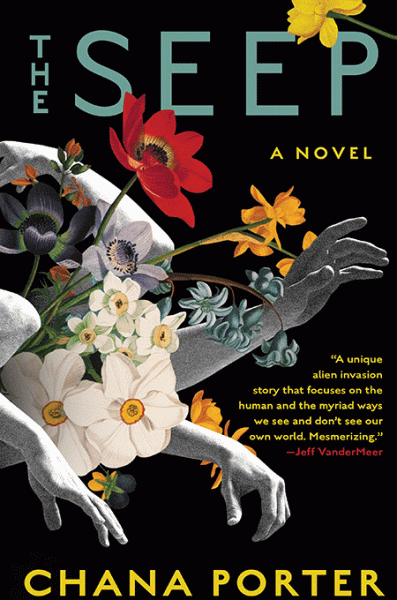
Chana Porter. The Seep. Soho Press, 2020. Hardcover, 216 pg. $20.99. ISBN 978-1-6412-9-0869.

Chana Porter’s debut novel The Seep is a vibrant and colourful piece of fiction. Often called a Utopian novel, Porter’s science fiction explores the deepest depths of ‘being human,’ freedom, and what matters to the ‘individual.’ The Seep appear to be an alien hive-mind-esque species who slowly take over the world and use human beings as hosts. The world abruptly changes around the humans who choose to live through this invasion. Those who remain can either accept and embrace the Seep, fight against them, or escape to the Compounds which are void of the Seep’s influence. Those who welcome the Seep begin to change, resulting in the human condition becoming something malleable and unstable. Concepts of mortality, death, love, grief, and sadness all come as part of the package deal of ‘being human,’ but the Seep challenge this and strive to remove the more difficult human attributes from everyone they encounter. Porter’s almost phantasmagorical narrative explores humanity, loss and the ever-changing world in which we live in. In using the unusual guise of “The Softest invasion” by all-loving aliens who want to suffocate all pain and unhappiness out of the world, Porter forces the reader to confront the knowledge that mortality and grief are built into the very fabric of who we are (3). The Fantasy Hive rightly notes that Porter’s novel ‘marks the emergence of a crucial new voice in speculative fiction,’ as this striking novel delves deep into ‘what it means to be human.’ Porter certainly does this and more; through her exploration of humanity in her speculative fiction, she also reaches into the realms of the individual. From the marginalized, the silenced and the ignored, Porter offers every individual a voice that can be heard, leaving no one behind.

The novel is set slightly in the future, in a society not completely different from our own. Humans are concerned with longevity, relationships and affairs influenced by capitalism; the difference is that the Seep are here, and intend to stay, and so the world will never be the same. The novel begins by telling us that “The Seep had already infiltrated their city’s water supply. They were already compromised, already bodily hosts to our new friends” (9). We are introduced to our characters at a dinner party, because during the initial alien invasion “throwing a dinner party was all Trina and Deeba could think to do,” surrounding themselves with like-minded people and old friends to watch the apparent end of the world, as it was engulfed by the Seep (7).

Quickly, the novel has familiar echoes of other omnibenevolent-alien-invasion narratives. A distinct similarity unites the Seep of Porter’s novel with Yivo, a sentient tentacle monster from Futurama’s “The Beast of a Billion Backs” (2008). Yivo loves all humans and wants only love in return. Before contact, characters in the year 3,000 are terrified of Yivo, but once contact is made, all fear of the tentacle fades away, with love and unity in its place: “thou shalt love the tentacle.” This distinct change of attitude of the humans, towards the sentient species that has come to Earth, is also seen in The Seep: “Eventually, everyone understood that those who had already made contact with the aliens felt fine about the extraterrestrial invasion, while those who had not felt no shortage of panic, despair, rage, and powerlessness” (11).

The reaction to this abrupt attitude change indeed fuels several of the concerns that linger throughout the narrative, without any drastic crescendo. Concerns and issues flicker throughout this novel, such as societal constructs and ideology, freedom, ethics, theories of reality, and the trustworthiness of human perception. The whole novel flickers with uncanniness and uncertainties that help the narrative thrive and encourage you to push on through the unfamiliar territory. At the beginning of the novel, characters at Trina’s dinner party question life and the numbness of it all, leading Trina to question her own reality: “what did Trina believe in with total certainty? [..] what was more mutable than her own perceptions?” (7). There seems to be a thin layer of ideological suggestions painted throughout the novel’s pages, which add to the uncertainty and questionable sanity surrounding the behavior of everyone in the novel.

After several years of The Seep taking over, Trina is unhappy as everything is different. The Seep know this an constantly harass Trina, trying to get inside her to remove all the sadness, “We are revealing the sadness you carry around you like a coat, like a skin. Let us in, let us in, let us in…” (151). The world has completely changed; the Seep have removed war, famine, and disease. Capitalism has fallen. The Seep “took away money and illness, the sickness of the land, the poison in the water and the air,” and can provide humans with anything they desire (177). Now humans can do whatever they choose; they do not have to work and can choose longevity and immortality; once you have connected with the Seep death becomes “an opt-in procedure,” one that you can choose to participate in or not (44). Human experience has been augmented and manipulated by the Seep, into something distant and unrecognizable. The Seeped human experience has familiar elements of the intoxicated aesthetic quality found in Jeff Noon’s Vurt, in which humans long to remain in a drug-like state of adventure or euphoria brought on by Vurt-feathers. Individuals choose to drink Seeped punch and release Seep into the air to make their music more enjoyable, enter into euphoric and aggressive orgies, or change themselves somehow. Once connected with The Seep, humans can feel the pain of buildings of stone, can choose to grow antlers, or be young forever. But they can never, ever be alone.

Whilst many may call this text a Utopia, I would push to label this text, as Margaret Atwood might, as an Ustopia. As Atwood states, Ustopia is a combination of “utopia and dystopia—the imagined perfect society and its opposite—because […] each contains a latent version of the other. In addition to being, almost always, a mapped location, Ustopia is also a state of mind, as is every place in literature of whatever kind.” Atwood uses examples such as ‘Hell’ as a place and a concept in Marlowe’s Doctor Faustus, because “In literature, every landscape is a state of mind, but every state of mind can also be portrayed by a landscape. And so, it is with Ustopia.” Atwood’s definition of an Ustopia describes Porter’s novel appropriately due to the uncertainty within the novel and the clear and defined binaries we are confronted with throughout the text.

The uncertainty of the novel does not only refer to the Seep themselves, their agenda, and the dramatic changes society is embracing (or rejecting), but also the uncertainty of what is “real,” in many of the scenes. Often, it is uncertain whether the places Trina visits are a memory, artificial, or reality and many occurrences are described in such a drunken-dreamlike way it is difficult to know whether one is reading about a real-time event in a mapped location or being taken on a walk-through of Trina’s mind. The defined binaries I mention refer to the drastic attitude changes characters have, from mortal fear to a deep respect and love, calling the Seep “our greatest teachers” as the abuses of the Seep simultaneously occur (25). Some use the Seep knowledge for the good of mankind, such as in the medical field, whilst other’s use the Seep to excess, forcing groups of people into hordes of orgy-like frenzies or stealing other people’s faces and wearing them. Porter acknowledges that even in a utopian future swaddled by sentient and benevolent aliens, there will always be a darker, dystopian underbelly.

Whilst this novel is a speculative piece that focuses on pain, mortality, and grief as vital human attributes, Porter also explores the physicality of the human and individual perceptions of the human body. By centering human characters that desire to change their bodies or become something nonhuman altogether, the novel acknowledges that part of who we are is retained in the core of our bodies and trapped beneath our very skin: “Our bodies may be containers, but they still carry specific histories. And these histories are still meaningful. Of course, The Seep doesn’t understand that – they’re amorphous beings with no physical bodies!” (36).  Whilst this is acknowledged, there is also mixed attitudes surrounding identity and the body: “everyone who has been joined even once with The Seep knows that we’re all the same. We’re all of the same essences, all layers of identity are just that, layers, and you can play with them just as we play with our appearances…” (35). This attitude upsets Trina sometimes. As a Trans woman before the Seep, Trina had faced difficulties in her life trying to obtain the body she felt was truly hers, and now that people can change whatever they want with the Seep, she is not tempted to change again: “But Trina had labored for this body! She’d fought and kicked and clawed to have her insides match her outsides, and now people changed their faces as easily as getting a haircut” (145).

The novel explores and confronts these contemporary struggles and concepts of identity in a way that dramatically fuels the rest of the narrative, making the novel ‘Powerful, beautiful, moving and uncompromising’ (The Fantasy Hive). This novel is a haunting but mesmerizing take on the alien invasion and Utopian, or Ustopian, or Dystopian visions of Future Earth. Posthumanism drips off the page at every opportunity, but more than that the concept of the human is questioned, unpicked, pulled apart, then reconstructed again and again, because “With The Seep, anything is possible” (35).

WORKS CITED

Atwood, Margaret. “Road to Ustopia.” The Guardian, www.theguardian.com/books/2011/oct/14/margaret-atwood-road-to-ustopia. Accessed 11 March 2022.

Futurama. “The Beast of a Billion Backs”. Directed by Peter Avanzino, Rough Draft Studios, 2008.

Noon, Jeff. Vurt. Tor, 2014.

Thornton, Jonathan. “The Seep by Chana Porter.” The Fantasy Hive, fantasy-hive.co.uk/2021/02/the-seep-by-chana-porter-book-review/. Accessed 21 March 2022.

Lucy Nield is a PhD student and GTA in the Department of English Literature at the University of Liverpool. Her research interests include Dog-culture, animal studies, speculative fiction, posthumanism and anthropomorphism within Science Fiction. She is an organizer for the Current Research in Speculative Fiction conference at the University of Liverpool (@CRSFteam), co-editor for the Ariadnes Thread Journal (@Ariadnesthrd) and regular contributor to The Fantasy Hive (@TheFantasyHive). Lucy has also been published for fiction and poetry by University of Liverpool Press and Pandoras Box, and has been published in Foundation Science Fiction Review (2021) and SFRA Review (2019).


Review of Machine


Review of Machine

Ian Campbell

Elizabeth Bear. Machine. Saga Press, 2020. Trade paperback, 482 pg. $16.99. ISBN 978-1-5344-0302-4.

Elizabeth Bear, a master of the craft of SF, released Machine as the second novel in her White Space series. It is a direct follow-up to 2019’s Ancestral Night, also an excellent read: the events of Ancestral Night form part of the backdrop to Machine. The novel is a complex and sympathetic depiction of a seriously disabled person who is enabled to function at the much higher level she desires through the intervention of an empathetic social democratic government and technology developed by and among a diverse society. It is also a sustained critique of the utopian impulse, both directly and in its presentation of the conflict between an imperfect society still more utopian than our own and those whose wish to purify it puts that society at serious risk.

White Space is a universe in which humans crashed Earth’s ecology and their own society before learning to work together, whereupon they were contacted by the mostly benevolent and very diverse galactic society of the Synarche; after a few centuries, humanity has integrated into shared governance with other “syster” species and the advanced AIs that run starships and facilities. Machine takes as its setting the enormous, multispecies, multienvironment teaching hospital Core General; it is told from the perspective of Brookllyn “Llyn” Jens, who grew up on a backwater human planet to serve first as an officer in the Synarche’s law enforcement apparatus, then as an ER physician at Core General.

Llyn’s current job as the point person for a medical rescue team affiliated with the hospital leads her to a derelict human sublight generation ark, drifting in space far from where it should be and filled with the corpsicles of humans who fled Earth as things were collapsing, and thus represent the very bad past for Llyn. This encounter leads to the infection of Core General’s AIs with a virus; Llyn’s investigations lead her to discover that Core General is a corrupt institution that in a proudly egalitarian society allows wealthy individuals a form of immortality that crosses a real line in the Synarche, all in order to fund its services, including Llyn’s rescue team. Sorting out what is happening and how those she holds dear have manipulated her first into discovering the corruption, then having to work to ameliorate it is deeply wrenching for Llyn. She is a true believer in the benevolence of Core General and the Synarche, who have taken her from someone defined by her disability on a nasty backwater planet to someone everyone else regards as an action hero.

The plot is significantly more complicated than this, but Machine is well worth not further spoiling. Let us rather consider the novel’s presentation of history, disability and utopia. Llyn is pleased, and proud, and very vocal, about how the modern humanity that was able to solve most of its problems benefitted still more from contact with and integration into the Synarche. She frames this as the human species reaching “adulthood”:

Adulthood begins when you look at the mess you’ve made and realize that the common element in all the terrible things that have gone wrong in your life is you. The choices you have made; the shortcuts you have taken; the times you have been lazy or selfish or not taken steps to mitigate damage; or have neglected to care for the community. As a species, the immature decisions we made contributed to the collapse of our own population and the radical alteration of our biosphere. Running away to space at sublight speeds was a desperate move. It made more sense and was more sustainable in the long run to fix the evolutionary issues in our own psyches that led us into irrational, hierarchal, and self-destructive choice? (131)

The metaphor here is to compare an individual’s development to a society’s; the estrangement is of course to cast our own society as children, the implicit defining feature of which is to be so psychically damaged as to take shortcuts, or to neglect to care for the community. Llyn grew up, and became an adult and a self-admittedly very bad parent, in a society she considers not fully adult; she underwent therapy/medication, which Machine refers to as “rightminding”, to rid herself of selfish tendencies. Like most human adults in the Synarche, Llyn also has a “fox” or computer implanted and networked into her brain: at moments of high anxiety, she or her ship AI use the fox to moderate her brain chemistry. It is clear from the text that “rightminding” can be coercive and is widely used as a means of disciplining those deemed too selfish or who damage the community; it is less clear whether direct manipulation of brain chemistry is similarly imposed. Llyn is a big fan of rightminding, and preaches its virtues just often enough to point to how we as readers ought to pay attention to just how much free will is involved in rightminding and being a part of the Synarche. Her own less-rightminded birth society was something she escaped as soon as she could; she is apprehensive because the corpsicles might exhibit all sorts of the behavior she calls “socipathological”, and intelligent enough to be amused by her own shock that the one thawed corpsicle she spends meaningful time with turns out to exhibit nothing but communitarian, “adult” values when things become dire.

A primary reason Llyn is so enthusiastic about the Synarche is that it enables her. Llyn suffers from chronic pain and a never clearly defined autoimmune condition whose inflammatory response often nearly immobilizes her. She implies late in the text that her condition is hereditary, introduced into the human genome as one of many mostly idiopathic autoimmune conditions that sprung up in the wake of environmental catastrophe on Earth. Rightminding and tuning her brain chemistry help ameliorate, but never eliminate, her chronic pain, but the main gift of the Synarche is her exoskeleton. This is not a metal frame like the one Ripley puts on in Aliens, but rather a much more subtle assembly of nanotubes and the like: Llyn is of course hyperaware of the exoskeleton, but the text implies that someone unfamiliar with Llyn and viewing her while clothed might not know that she’s wearing it. With the exoskeleton, she can leap out of spaceships into the void and rescue the injured; without it, as happens once in the text when she outranges its battery life, even something as simple as walking can be fraught. From the perspective of the plot, Llyn’s disability is relevant only insofar as she loves the Synarche for providing her the means to become an action hero; otherwise, she is simply a disabled person who sometimes has to make time to tend to herself. It’s a complex and nuanced and sympathetic portrayal of a disabled person who is neither defined by her disability nor has to overcome or transcend it as a sort of personal growth: we can only hope that other writers of SF will look to Bear’s example as a model for disabled characters.

Llyn’s enthusiasm for the Synarche, and her despair and then determination when she finds it to be more corrupt than she’d believed, serves as the perspective for Bear’s estrangement of utopias and the utopian impulse. The Synarche is Bear’s own invention, but it’s also pretty clearly a critical read of Iain M. Banks’ “Culture” novels and the conditions of existence for a galaxy-spanning utopia: the hinge point here are the lovingly silly names the AI ships give themselves. The Culture is whatever “pan-human” might be; the Synarche contains alien species ranging from supercold methane breathers to the inhabitants of superhot Venus-like environments. The Culture is uniformly high-development and primarily based on enormous starships and created mini-Ringworlds; the Synarche has backwater planets that are clearly not economic or social utopias, and the particular sort of FTL technology it uses prevents ships from growing too large. Banks handwaves a great number of things to get where he wants to be; Bear interrogates how something like Core General might come to exist. Whereas Banks directly states in Consider Phlebas that resources are effectively unlimited in the Culture, Bear has resource allocation become a direct problem in Machine; due to a previous crisis, funds to Core General were cut before Llyn’s time.

The limitation of resources leads the AIs and systers who run Core General to cut corners, accepting an unpleasant tradeoff in return for the funds needed for its operation. Inequality persists in White Space: the very wealthy are treated to special privileges in a private wing of the hospital. Because this breach of ethics is intolerable to some, they engage in a grand conspiracy to expose it, manipulating Llyn to do some of their dirty work. To give more detail would again be to spoil a work I encourage you to read, but the crux of the story is whether Llyn will side with those who accept some corruption and those who want purity at any cost. The Culture novels handwave how they get to utopia because they are concerned with how utopia imposes itself upon others and what happens to people who are unhappy even within utopia. Bear, by contrast, is encouraging us to consider how the utopian impulse is itself as destructive as it can be constructive: the corruption at Core General doesn’t affect its ability to deliver services, and in fact even helps it to do so, while those who would expose that corruption in the name of true equality would impede its function. It’s a fast-paced, entertaining, fun and plausible read that has far more than it seems going on beneath its surface—and it’s got three different giant talking bugs.

Ian Campbell is the editor of SFRA Review.


Review of Flyaway


Review of Flyaway

Jeremy Brett

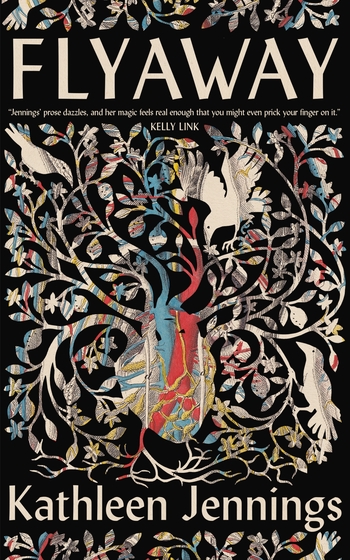
Kathleen Jennings. Flyaway. Tor.com, 2020. Hardcover. 175 pg. $19.99. ISBN 978-1-250-260049-9.

Author and illustrator Kathleen Jennings has accomplished something wonderful – at least to my American eyes – with her graceful, evocative novella Flyaway. In bringing a fairytale sensibility and ethos to her native Australia (the story is set in the Outback of western Queensland, or, as Jennings poetically opens, “somewhere between the Coral Sea and the Indian Ocean but on the way to nowhere, there was a district called – oh, let’s call it Inglewell.”), she demonstrates the generality of that sensibility (11). The lessons of fairytales, their tropes, their internal constructions, their stories of mysterious and profound transformation – these are the common property of humanity and know no geographical boundaries. We’ve seen, of course, fairytales before that take place both from and in settings far and away from the traditional woods of Mitteleuropa, but Flyaway beautifully reinforces the universality of the fairytale. Leaving aside the beauty of the writing, the novella would be a powerful resource for scholars looking to explore not only Australian fantasy but the commonalities of the fairytale genre as a whole.  

At once Jennings establishes a powerful, immediate sense of fantastical place and mood, with her indeterminate and airy description. Her opening chapter “All That Was” describes Inglewell, and its central town of Runagate, in terms of their distance, their ephemerality in the face of harsh reality, and their underlying endurance that betrays the existence of a more lasting order of things.

It was a fragile beauty: too east to bleach with dust and history, to dehydrate with heat,     rend with the retort of a shotgun or the strike of a bullbar, blind with sun on metal. Easy to turn from it, disgusted and afraid. But if you got out of a car to stretch your legs and instead were still, if you crouched down and waited, it would find you, nosing among the grass like the breeze. The light and loveliness would get into your bones, into your veins. It would beat in your blood like drumming in the ground.

Memory seeped and frayed there, where ghosts stood silent by fenceposts. (12-13)

And the story is deeply rooted in the slipperiness of memory. The novella’s protagonist is young Bettina Scott, troubled by her inability to recollect key elements of her past, including the whereabouts of her missing father and brothers. Her fellow Runagate denizens (who are rife with suspicions and hatreds about one another’s families) seem to know more about Tina’s life and past than she does. There is a Gothic horror-style unease in Tina’s memory gaps, especially when combined with her mother’s unnerving need for reassurances about every aspect of their lives. Something is clearly askew, not right, not the way things are supposed to be. And so, Tina embarks on a quest of sorts, complete with companions, visits to mysterious places, and interwoven stories. As she notes, “It could be my dad, I thought, rustily – I’d so carefully not thought that. If all those stories mean anything, they mean sometimes people do just disappear. And maybe they can be found” (121).’

Along with the unreliability of memory comes the exploration of loss. Things and people go missing all the time in Flyaway, despite attempts to bind them. A repeating theme is Tina’s friend/enemy Gary Damson, who is also seeking to solve the mysteries of various disappearances and whose family builds fences in the district. The Damsons are concerned with maintaining order and balance in the face of wildness: his family is one of the ones who “know what’s going one…It’s what my gran says. We’re charged with keeping things on an even keel” (161). In the most dramatic instance, an entire school in the town of Woodwild vanishes forever beneath creeping lantern-bush, taking with it most of the town’s children in an Australian Outback turn on the Pied Piper tale. Order and civilization (and memories) fall beneath the power of mystery and disorder and loss.

The world forgot we’d ever had a school. In Woodwild, it felt as if the vines had grown inside our skulls. We’d never get past them. No kiss could fix that…The police investigated. They went into steep country and gullies. They found dying stands of lantern-bush, sheep bones, cattle bones, rusting carcasses of cars. They went right into the caves. I heard a rumor they found a cavern nearly beneath the school, the stone white in light filtering down through knotted roots. Nothing else (113).

In the end, however, the encroaching power of loss is belied by liberation. As in the old stories, the quest is completed, the riddle solved, the lost found. (Not to give away the ending but suffice it to say that the novella’s title becomes quite literal by the book’s conclusion.) This is all too appropriate, given Flyaway’s deep immersion in the power and impact that stories can have. Stories can be embodied and given life – literally here, this being a fairytale. “The schoolchildren of Woodwild, David Spicer, Linda Aberdeen, all who went before and alongside and after them: they are trapped by the stories that made them and dragged them in; they are caught and held by town and road and lantern-bush and trees.” (158) Jennings artfully weaves the power of story into the whole of the novella: people tell stories, people become stories, people’s absences form their own stories in turn, and so on. Stories reflect the mysteries and randomness we encounter in our lives, and in Jennings’ tale, they often cause them as well. The true heart of Flyaway comes about halfway through the book, when that view is explicitly noted. It gives additional weight to Flyaway’s value as a profound work of modern folklore that carries on the hallowed fairytale tradition of exploring the human experience through the fantastical lens of story.

“There aren’t any stories except the ones we bring with us,” Trish Aberdeen used to say, stamping into the long grass after school, as if she wanted it to be true (as if she didn’t keep thinking she’d seen wolves and tigers stalking her in the scrub). Gary Damson, who knew better, who suspected Trish knew better too, would hold his tongue.

Because even if she were right, something had to happen to all the stories no one wanted. Histories and memories that had been taken into the trees, beyond the fences and roads – those seams of the world from which reason and civilization leak – and abandoned.

They must have outnumbered all the living populations of Inglewell. Stories that had belonged to the people who lived there before the Spicers established Runagate Station…. Battles, massacres, murder; bushrangers and lonely revenge; tales of whose last stand was on this knob of land, of what will catch the toes of children swimming unattended, of witches in the scrub waiting for the unwary, of loping beats and whispering megarrities. Then there were the stories of those who had simply…gone. (48-49)

Jeremy Brett is an Associate Professor at Cushing Memorial Library & Archives, where he is both Processing Archivist and the Curator of the Science Fiction & Fantasy Research Collection. He has also worked at the University of Iowa, the University of Wisconsin-Milwaukee, the National Archives and Records Administration-Pacific Region, and the Wisconsin Historical Society. He received his MLS and his MA in History from the University of Maryland – College Park in 1999. His professional interests include science fiction, fan studies, and the intersection of libraries and social justice.


Review of The Supervillain Reader


SFRA Review, vol. 52, no. 2

Nonfiction Reviews


Review of The Supervillain Reader

Jeremy Brett

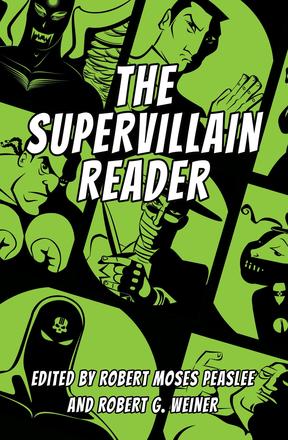
Robert Moses Peaslee and Robert G. Weiner, eds. The Supervillain Reader. University Press of Mississippi, 2019. Paperback. 432 pg. $30.00. ISBN 9781496826473.

A work like The Supervillain Reader, in today’s superhero-obsessed popular culture, essentially sells itself. After all, as the book’s introduction notes with its title, “It’s All About the Villain.” More specifically, Stephen Graham Jones states in the Foreword that “[w]ithout supervillains, there can be no superheroes. This is an axiom in the world of capes and tights – it’s going to be a boring comic book if there’s no one to fight – but it goes for the world at large, too, since forever, which you can trace out baddie by baddie throughout the course of this book” (xii). Villains fascinate us with their, as Moses Peaslee, Weiner, and Duncan Prettyman put it, “beguiling sociopathy” (xiv). We find compelling, even tempting, their willingness to break apart the social order (a structure that superheroes by definition tend to support) for motivations that we can easily understand – revenge, power, money, even (in the cases of so-called “antivillains” like Magneto) the desire to effect real structural change. (One of the more thought-provoking essays in the book is Ryan Litsey’s “The Kingpin: A ‘Princely’ Villain for Social and Political Change,” which contextualizes the Marvel Netflix version of the Kingpin in light of his particularly Machiavellian type of virtue that uses chaos to ultimately stabilize societal order. It’s a prime example of the intellectual creativity of which this collection, all previously published work, is capable.)

Because we find superheroes so entrancing, as our heroic fantasies and as personifications of hopes in a world where justice inevitably prevails, it follows logically that we find endlessly rich the opposites—the supervillains—that define them, give them motivation, and set their character traits into proper relief. To me, likewise, the most interesting pieces in Supervillain Reader examine this dichotomy in the context of comic books and related media, the sources of so much colorful and dramatic supervillainy. However, the Reader does not limit itself to explorations of comic book figures like the Joker, Lex Luthor, and Doctor Doom, but takes several deep dives into the supervillain concept as it has developed over millennia of human culture. These are not always successful or convincing to me, but taken as a collective they do demonstrate that the image of the villain has always been with us, whether as a mirror into which the hero and we as readers gaze to see the inversion of our accepted societal values, or as an instigator of events that require a hero to rise and fulfill their role as a champion of those values.

Although I would argue that as media consumers, we essentially know the supervillain when we see one—they’re not the bank robber, the terrorist, the insider trader, the petty thief; they’re the one with the private army of henchmen, the world-spanning criminal syndicate, the volcano lair, the grandiose dreams of world domination—the first section of the Reader builds on this innate knowledge, and is usefully and comprehensively devoted to exploring and defining the various identities of the supervillain. The centerpiece for me of Section 1 is comics studies scholar Peter Coogan’s analysis “The Supervillain,” which methodically charts out the various aspects that comprise a supervillain—their powers, their motives, their identities, their relationships with the hero that opposes them. This essay is not only analytical but demonstrates the book’s value as a creative and prescriptive text that allows readers interested in creating their own stories to build a better bad guy themselves. Most of the section is dedicated to establishing a moral taxonomy for supervillains in relation to social and moral philosophy as well as dramatic structure. Both Coogan’s piece and Robin S. Rosenberg’s “Sorting Out Villainy” are useful for dissecting the supervillain image into its raw materials, while in “Dividing Lines: A Brief Taxonomy of Moral Identity,” A.G. Holdier breaks down the spectrum of moral identities into which supervillains may be sorted (i.e., the “antihero”). Holdier’s piece is particularly effective at erasing the simplistic and reductive “supervillains = absolute evil 24-7” model.

The book’s second section takes the historical view, looking at various instances of the supervillain (or at least the proto-supervillain) from ancient myth (starting with Angulimala, a powerful figure of evil redeemed in Buddhism) forwards. The section examines villains from Shakespeare, including a powerful piece from Jerold J. Abrams, “Shakespeare’s Supervillain: Coriolanus,” that analyzes the generally-underlooked “man of steel” Coriolanus within the supervillain framework; Satan from Paradise Lost (1667); Captain Ahab; and Voldemort, to name a few. To me this section is the weakest of the entire work, containing as it does several pieces that seem tangential to the book’s overall thesis. Even allowing for an expansive definition of “supervillain” (and allowing for the fine quality of the essays in isolation), I’m not sure what value an exploration of midwives-as-witches, or a comparison between Irene Adler and Catwoman have to the project overall.

Section three concerns the role of supervillains in broadcast media: given that supervillains have such visible presences in film and television today, this section seems especially apropos to the interested scholar. Case studies of specific supervillains and their relationship make for deep reading about characters who benefit from quality textual analysis, including Dr. Caligari, Godzilla (in “Destructive Villain or Gigantic Hero? The Transformation of Godzilla in Contemporary Popular Culture,” Stefan Danter provides an interesting case, in the iconic Godzilla, of the transformative nature of supervillains, and of their ability to cross traditional villain-hero boundaries as popular sentiment evolves), Harley Quinn, Darth Vader, and the aforementioned Kingpin. The final section of the Reader delves into comic books and animation, the traditional sources for supervillains as we generally understand them. Of particular note here, I found Jose Alaniz’s thoughtful essay on disability and physical deformities as traditional, and ableist, markers of the villainous in Silver Age comic books, “Disability and Silver Age Supervillain,” to be fascinating in its uncovering of a system of prejudice that marked this era in comics publishing. Equally intriguing is Phillip Lamaar Cunningham’s ”The Absence of Black Supervillains in Mainstream Comics,” that explores the general lack of Black supervillains, finding this absence rooted in bigotry, limited imagination, and in narrative conventions placed on Black superheroes that spread to villains. W.D. Phillips’ analysis of the DC Comics alternate story Superman: Red Son, “Where Did Superman’s White Hat Go? Villainy and Heroism in Superman: Red Son,”is a well-written piece using that notable story arc as an example of the heroism-villainy inversion from the traditional model.

The Supervillain Reader exists because as human beings and as cultural consumers, we crave villains as parts of our ultimate fantasies. As Randy Duncan notes in the book’s Afterword, “We all have a bit of the villain in us. The shadow, the id, whatever you want to call it – there is a part of each of us that wants to break the rules imposed by civilization. But most of us do not…And that’s why we’re attracted to villains. They break the rules. They do what we dare not do. Isn’t that also true of superheroes? They do things we cannot do and might not dare, even if we could” (372). That attraction has a deep imaginative power, one worth exploring as a fundamental part of our cultural makeup. By analyzing what makes our supervillains who and what they are, we get a more full sense of our own moral limitations and boundaries. What supervillains will break free of society’s bonds and attempt to impose their wills and desires on the planet next, and what will those say about us?

Jeremy Brett is an Associate Professor at Cushing Memorial Library & Archives, where he is both Processing Archivist and the Curator of the Science Fiction & Fantasy Research Collection. He has also worked at the University of Iowa, the University of Wisconsin-Milwaukee, the National Archives and Records Administration-Pacific Region, and the Wisconsin Historical Society. He received his MLS and his MA in History from the University of Maryland – College Park in 1999. His professional interests include science fiction, fan studies, and the intersection of libraries and social justice.


Review of Furious Feminisms: Alternate Routes on Mad Max: Fury Road


SFRA Review, vol. 52, no. 2

Nonfiction Reviews


Review of Furious Feminisms: Alternate Routes on Mad Max: Fury Road

Gabriella Colombo Machado

Alexis L. Boylan, Anna Mae Duane, Michael Gill, and Barbara Gurr. Furious Feminisms: Alternate Routes on Mad Max: Fury Road. University of Minnesota Press, 2020. Forerunners: Ideas First, Volume 40. Paperback. 70 pg. $10.00. ISBN 9781517909192.

Furious Feminisms is both a collection of essays and a collaborative text. The book is the latest addition to the Forerunners series published by the University of Minnesota Press. As the title indicates, the guiding framework of the book is feminist theory. However, the authors do not presuppose a singular or unifying conception of what this feminism is, or how it should operate as a critical tool. Moreover, they use feminism in conjunction with other theories, like disability studies or visual arts, to engage with the movie in unique ways. The authors come from different fields, which means that the disciplinary approaches contained in the book are varied. While each of the four essays can stand on its own, each also references and expands on the others. The result is a rich dialogue between disciplines and theories that enlightens readers to the myriad ways one can analyze a single cultural artifact: Mad Max: Fury Road (2015).

The first chapter is by Barbara Gurr, a sociologist with an emphasis on women’s and gender studies. Her essay, “Just a Warrior at the End of the World,” posits white hegemonic masculinity as the cause of the apocalypse in the Mad Max universe. As Gurr notes, race in the movie is present through absence, since only white bodies seem to survive the apocalypse. The same white masculinity that killed the world remains unscathed in the seat of power in the figure of Immortan Joe. For Gurr, Fury Road then constructs men as killers and women (in the figures of Furiosa, the Wives, and the Vuvalini) as saviors of the world. Gurr concludes that this dualism is essentialist and as dangerous as the forces that provoked the apocalypse in the first place.

Michael Gill, a disability studies scholar, follows. His essay, entitled “Is the Future Disabled?” is interested in the disabled bodies at the margins of the movie, who testify to the continued inequalities of the post-apocalypse. Gill points out that disabled bodies, today and in the apocalypse, are seen as non-productive and therefore expendable. He argues that the same hegemonic masculinity that created the apocalypse continues to contribute to the suffering of the environment and its people by maintaining in place systems of oppression that generate disablement.

The third essay is by Anna Mae Duane, an American literature scholar. It focuses on the white slavery narrative of Fury Road. Duane demonstrates the similar rhetoric between the white slave narratives that deemed White women “incapable of making the decision to place themselves in the market” (37), thus needing saving, and the immaculate Wives of Fury Road, who are chaperoned by Max and Furiosa through the Wasteland. The defeat of their captor and the takeover of the Citadel seems like a feminist triumph, but Duane underscores that the women seem to be no wiser than Immortan Joe since they let the waters flow freely and ultimately be wasted on the floors of the desert.

Finally, the collection closes with Alexis L. Boylan’s essay about post-post-post beauty. As an art historian, Boylan argues the movie is “a new call for beauty, a new call for some kind of purpose, politics, solidity, and social justice from art and aesthetics” (54). The possibility of this new beauty arises when the War Boys demand that their sacrifice be witnessed. Boylan sees their cries to “Witness me” as radical decentering of the self that can catalyze social meaning and spirituality.

The conclusion to the collection presents itself at once as a collaborative text, an interview, and a dialogue. The authors ask themselves questions and each individually answers them as a way to expand and interact with the other scholars and their ideas. As they explain, this unconventional conclusion is “an invitation to pull our ideas forward and reformulate them as the reader(s) see fit” (59). Ultimately, the innovative format brings out the efforts of the authors to transform the individual pursuit of academic knowledge and writing into a truly collective endeavor.

This book is essential to anyone interested in Mad Max: Fury Road. However, as the authors themselves explain, they are not film scholars and do not wish to contribute to this specific type of scholarship. Thus, film scholars might find this lack of engagement with the medium itself frustrating. Another point of (potential) disappointment for readers looking for more in-depth discussions is that the essays in the collection are rather short, which is a feature of the Forerunners series. Therefore, some arguments are not as fully developed as they could be. The upside of this format is that the text is well-suited for undergraduates who are either studying the movie or writing on it. The essays use approachable language that avoids unnecessary jargon, which makes the book a good choice for students of all levels.

Gabriella Colombo Machado has earned a PhD in English Studies from the University of Montreal. Her dissertation is on the politics of female friendship in contemporary speculative fiction across media. She has earned an MA in Comparative Literature from Western University, and an MA in Literatures in English from VU University Amsterdam. Her research interests are feminist theory, care ethics, science fiction, and graphic novels.


Review of Science Fiction and Psychology


SFRA Review, vol. 52, no. 2

Nonfiction Reviews


Review of Science Fiction and Psychology

Sue Smith

Gavin Miller. Science Fiction and Psychology. Liverpool UP, 2020. Liverpool Science Fiction Texts and Studies 62. Hardback. 304 pg. $120.00. ISBN 9781789620603.E-Book ISBN 9781789624717.

In Science Fiction and Psychology, Gavin Miller explores the intersection of science fiction and psychological discourses as they change and shift across different historical moments. Starting with the late nineteenth century and the emergence of “science fiction as a type” and “psychology as a discipline” and ending with the “‘psychologicalization’ of Western society” in the 1990s, when the rise of neuroscience marked the “decade of the brain” (13-14), Miller covers five key schools of psychological thought and asks: what is psychology doing in science fiction, and conversely, what is science fiction doing in psychology? Within this framework of inquiry, Miller explores the importance of understanding the place of psychology in science fiction literature as well as the potential role of science fiction to narrativize psychology theory and practice (39). As Miller argues, it is science fiction’s kinship with psychology and its process of “cognitive estrangement” that the convergence of the two is crucial for realizing the impact of social oppression and its practices on human differences, such as gender and race (40).

Structured to cover the emergence and development of both disciplines, Science Fiction and Psychology consists of an Introduction and five chapters: Chapter 1 “Evolutionary Psychology,” Chapter 2 “Psychoanalytic Psychology,” Chapter 3 “Behaviourism and Social Constructionism,” Chapter 4 “Existential Humanistic Psychology,” Chapter 5 “Cognitive Psychology,” and finally the Conclusion, “Science Fiction in Psychology.” Testimony to Miller’s expertise in the field of psychology and science fiction, the Introduction carefully outlines the book’s purpose, which is to introduce and juxtapose dominant narratives of psychology with their alternative counter-narratives as they appear in science fiction. Miller explains that his book does not offer a comprehensive overview of the subject matter but should be treated as a starting point to stimulate further research. Chapters are sequenced in chronological order “in relation to each school as they emerged over time, from proto-psychologies to psychology as a newly emerging science” (41). 

The first chapter covers evolutionary psychology and references John Tooby and Leda Cosmides’s work on human selfishness, aggression, and survival of the fittest of the 1980s. Miller also looks to earlier schools such as Social Darwinism and socio-biology to examine the anti-utopian thread found in works such as H.G. Wells’s The Time Machine (1895) and Octavia Butler’s The Parable of the Talents (1998). Examined in these two texts is human progress hampered by a re-activated dormant evolutionary mechanism that destroys any hope for an idealised vision of a civilised society in the future. To offer a contrast to this view, Miller turns to Naomi Mitchison’s book, Memoirs of a Spacewoman (1962), whose take on evolutionary biology draws upon John Bowlby’s “attachment theory” to offer a “renewed feminist ethic of compassion” for “estranging our dominant ethical systems” (42). As Miller explains, Mitchison’s feminist interpretation offers a more hopeful vision of a human society that is open to others.

In the second chapter, Miller turns to the school of psychoanalytic psychology and Freud’s anti-utopian, Nietzschean idea of civilization as a thin fragile veneer “concealing displaced instinctual gratification” (42). Here Miller explores the edict that the human mind is incompatible with society as the psychological drive is to break free from social constraints to access unfettered desire (81). The science fiction works chosen for analysis are Barry N. Malzberg’s The Remaking of Sigmund Freud (1985), Ursula K. Le Guin’s The Word for World is Forest (1972), and Daniel Keyes’s Flowers for Algernon (1966) (42). In his analysis of these three narratives, Miller discusses the shift from Freud’s anti-utopian vision of humanity and the inability to change, to exploring the creative imagination of the collective consciousness in Le Guin’s Jungian text of connection and transformation. Finally, Miller focuses on Keyes’s examination of the social values attached to cognitive difference and intelligence in Flowers for Algernon and the consideration of the existential potential of being and becoming(81–123). At this point, Miller reveals how science fiction does not faithfully adopt psychology as it is presented in society but creatively sifts through and adapts elements for its own narrative purposes, challenging the discursive authority of Freud’s pessimistic prognosis of society (126).

In Chapter 3, “Behaviourism and Social Constructionism,” Miller discusses how science fiction is informed by two psychological paradigms that insist on the malleability of human psychology. Examining behaviourism, Miller explores B.F. Skinner’s near-future utopian novel, Walden Two (1948). Also questioning Skinner’s behaviourist model, Miller turns to Anthony Burgess’s A Clockwork Orange (1962), Ursula K. Le Guin’s The Lathe of Heaven (1971), and William Sleator’s House of Stairs (1974). Next, in considering social constructionism, Miller examines the issue of contingency and unpredictability alongside science fiction’s tendency to allow the experimental thought of dissolving present psychological and cultural givens into an alternate future scenario. Texts that typify such a thought experiment are Joanna Russ’s The Female Man (1975), Edmund Cooper’s 1972 novel Who Needs Men?, and Naomi Mitchison’s Solution Three (1974). As Miller explains, the three texts chosen explore utopian and dystopian reconstructions of gender relations, but remain troubled by issues of nature and cultural diversity (43).

In Chapter 4, Miller looks to “Existential-Humanistic Psychology” and its anti-systematic school of psychological thought that questions behaviourism and psychoanalysis for its reductionist accounts of humans governed by biological and instinctual drives. Miller’s discussion draws on the work of Viktor Frankl and Abraham Maslow to examine proto-discourses such as Vincent Hugh’s I Am Thinking of My Darling (1943), which critiques an “emerging ideal of personal authenticity” to question “the American Dream” in 1940s New York (44). A later postwar example that Miller examines is Marge Piercy’s Woman on the Edge of Time (1976), which critiques the instrumental tendencies of mainstream psychology.

In Chapter 5, “Cognitive Psychology,” Miller examines the founders of cognitive theory in psychology and science from George Miller and Noam Chomsky to Ulrich Neisser in order to look at Jack Finney’s Invasion of the Body Snatchers (1955), which uses earlier proto-cognitivist discourses to contend that “the mind as machine” operates like “a biased, limited capacity information processor” (44, 205). Looking further at science fiction texts that unsettle ideas about everyday perception, Miller analyses Ian Watson’s The Embedding (1973), Samuel R. Delany’s Babel-17 (1966), and Ted Chiang’s “Story of Your Life”(1998). The aim of focusing on these texts is to explore how science fiction has asked broader questions about “the nature and accessibility of ultimate reality” (44). In this chapter, Miller examines science fiction that asks whether we ever have access to an authentic reality or whether it is always in a process of construction and prone to faulty perception (203-204).

Finally, in the conclusion, “Science Fiction in Psychology,” Miller discusses the potential of deploying science fiction tropes within official psychological literature at a popular and scholarly level.  In particular, Miller examines the way science fiction can be exploited in psychology as a didactic tool, as he cites psychologists such as Sandra and Daryl Bem, Randy Thornhill and Craig Palmer, and Steven Pinker, who readily use speculative narratives of the future to “legitimate their particular psychological claims” (44).

To sum up, Science Fiction and Psychology is a rich, densely-argued study in how science fiction and psychology overlap and share the critical power to examine the human condition through the lens of historically situated psychological discourses and science fiction’s key concepts of the novum (plausible innovations) and cognitive estrangement.  It is a book for an academic audience, for students studying medicine and literature and/or the medical humanities and science fiction, as well as those interested in popular science fiction culture. Science Fiction and Psychology is incredibly detailed and painstakingly outlined in its aims and goals, which is to initiate an inquiry into the fruitful intersection of science fiction and psychology. Importantly, Miller’s work is perceptive about the potential of science fiction to foreground the shifting attitudes that accompanied new movements in psychology during different historical moments. In his account, science fiction does not slavishly adopt accepted views of psychology but instead, intended or not, Miller demonstrates how science fiction uses psychology in thought experiments that either reveal the inherent contradictions of social formations in modern society or plainly work to question and oppose them. As Miller affirms, “Wittingly, or unwittingly, psychology allows the telling and performance of narratives based on supposedly real, or imminent, psychological technologies–stories that, like those of literary science fiction, take the reader to an estranged, critically distanced, version of their own reality” (258).                  

Sue Smith’s interest is in disability in cyborg fiction.  She has written articles that primarily intersect the cyborg soldier, disability and medicine.  Her most recent article is an essay on Imperator Furiosa that features in JLCDS’s Science Fiction Special (14:4).


Review of Radical Botany: Plants and Speculative Fiction


SFRA Review, vol. 52, no. 2

Nonfiction Reviews


Review of Radical Botany: Plants and Speculative Fiction

Kelli Shermeyer

Natania Meeker and Antónia Szabari. Radical Botany: Plants and Speculative Fiction. Fordham UP, 2020. Paperback. 314 pg. $32.00. ISBN: 9780823286638.

For Natania Meeker and Antónia Szabari, plants are “engine[s] of social critique and speculation” (16), always already exceeding human categories and ways of being. In their argument, vegetality and speculative fiction share a foundational characteristic: a strangeness that both withdraws from human systems of meaning and fuels our imaginations, enabling us to contemplate possible futures.

The authors’ comparative archive, too, evades traditional categories of scholarly study, as they read texts across time, language, and medium, looking at cultural productions from early modern libertines, experimental filmmakers, critical theorists, and contemporary novelists. Meeker and Szabari uncover a genealogy of what they call “radical botany” that begins in the seventeenth century, demonstrating how the posthuman is already present in the early modern.

From radical departures from standard taxonomical orthodoxy to a reimagining of Romantic vitalism, the first several chapters of Radical Botany trace an emergent modernity anchored, as Meeker and Szabari argue, in shifts in the vegetal imaginary. The first chapter, “Radical Botany: An Introduction,” outlines the shape of their inquiry and how it relates to previous scholarship in critical plant studies, including that of Michael Marder, Jeffrey Nealon, and Natasha Myers, among other areas of critical theory. Meeker and Szabari argue that while theories and representations of “vegetal beings” (13) are significant to the rise of Western modernity, their influence has often been overlooked in favor of the animal model—hungry and desiring—that has dominated our perception of the modern subject.

The second chapter, “Libertine Botany and Vegetal Modernity,” demonstrates how Guy de La Brosse and Cyrano de Bergerac imagine plants as useful figures for a humankind that is now, post-Copernicus, coming to terms with the fact that it is not the center of the universe. For these writers, plants both undermine anthropocentric narratives and inspire curiosity (and, in the case of Cyrano’s work, enable various erotic encounters). Plants also activate utopian speculation, as Meeker and Szabari argue in Chapter Three, “Plant Societies and Enlightened Vegetality,” through the intermingling of science and fiction in eighteenth-century fictions that use plant life as “a basis for imagining a better human existence” (56). The authors find a nascent biopolitics embedded in Ludvig Holberg and Charles-François Tiphaigne de La Roche’s fictions, especially in the writers’ portrayals of natural and biological processes, including reproduction, as “objects of social control” (69). Plants in these fictions offer suggestive models for human society; however, their preoccupation with cultivation, growth, and manipulation engenders new forms of violence, as well.

Chapter Four, “The Inorganic Plant in the Romanic Garden,” crosses the pond to find in the work of Edgar Allen Poe and Charlotte Perkins Gilman an alternative to Romantic vitalism and its accompanying veneration of the garden as the model for interconnectedness and political community. In the Romantic garden, plants are essentially animalized and thus understood as containing some interior desire that draws them into economies of human sympathy and identification. In contrast, Poe’s “Fall of the House of Usher” (1839), the chapter’s primary focus, explores the horror of the inorganic plant, vegetal sentience utterly indifferent to humans yet capable of transforming our consciousness.

Rather than view the possibilities of vegetal vitality with horror, filmmakers Jean Epstein and Germaine Dulac, whose work is explored in the fifth chapter, “The End of the World by Other Means,” look with excitement toward how plants can be powerful tools for transforming audiences. For Epstein and Dulac, the plant is an avatar of modernity (139), a figure for cinema’s “alien logic” (116), or an embodiment of a queer perception, and (nonhuman) bodily geometry (138). The filmmakers share with writer Collette an interest in the time-lapse films of Jean Comandon, such as “La germination d’un grain de blé” (ca. 1922), which makes the germination of a grain of wheat perceptible to the human eye—at least through the mediation of the camera lens, which itself creates a hybrid of human/nonhuman points of view. In contrast to Epstein and Dulac, Collette sees horror in the instrumentalization of time-lapsed images of plants, which she argues removes them from the realm of human identification and “poetry” (142).

Collette’s ambivalence leads into Chapter Six, “Plant Horror: Love Your Own Pod,” which looks at Don Siegel’s and Philip Kaufman’s versions of Invasion of the Body Snatchers (1956 and 1978). Instead of reading the films as representations of paranoia about authoritarianism and standardization (146), Meeker and Szabari argue that they are connected to a longer speculative tradition that attributes to plants an inorganic vitality that cannot be captured by animal models of being.  The pods in both versions of Invasion bring about homogenization, but also, especially in Siegel’s version, allow us to explore desire outside of the bounds of the human and experience a “vegetal striving” that connect to plants’ capacity for proliferation. Here the authors return to Chapter Three’s interest in biopolitics, examining how plants can become “representatives of neoliberalism” (163) as the ability to intervene in the reproduction of life itself gives rise to economies focused on limitless growth. (Perhaps this point links Radical Botany to Rebekah Sheldon’s somatic capitalism, though the authors don’t cite her work). Despite that reading, the authors conclude that the Invasion films gesture toward a model of ecological thinking that postdates them—one where separations between self and other, or natural object and human subject, no longer organize our relationship to the world.

The final chapter, “Becoming Plant Nonetheless,” examines the way that thinkers, artists, and writers employ the plant to spur on feminist politics and a critique of capitalism: modes of inquiry ready and willing to challenge (if not dispose of) models of the self that reveal inherent sexism and heteronormativity. What if plants destabilize our world-making efforts rather than augment them? The chapter’s objects of study range widely and include Deleuze and Guattari’s rhizome as a radical botanical figure, artwork by Jessica Rath, and feminist speculative plant fictions by Anne Richter (“Un Sommeil de plante” [1967]), Ursula K. Le Guin “(Vaster than Empires and More Slow” [1971], The Word for World is Forest [1972]), and Han Kang (The Vegetarian [2007]). Meeker and Szabari conclude by reflecting on how the vision of hybridity that Jeff VanderMeer renders in his Southern Reach trilogy (2014) affirms ecologically committed, feminist, and antiracist political projects (200). Plants are, finally, our “guide to the end of the world” (201), ushering us toward political and social possibilities yet uncharted.

One of the book’s earliest moments—a discussion of the tension between plants’ apparent passivity and their ability to participate in the world—suggests a road not taken, or possible extension, for Radical Botany’s argument. Here Meeker and Szabari are in conversation with the field of performance and ecology, particularly with artist-activists like Beth Stephens and Annie Sprinkle (“Ecosex Manifesto”), and Genevieve Belleveau and Themba Alleyne, whose eco-fetishism shares Radical Botany‘s interest in the oscillation between plant agency and passivity. The relevance of Radical Botany to performance studies underscores one of my favorite aspects of Meeker and Szabari’s work: their rich and flexible archive that connects science, theories of art, visual and textual media, historical periods, and literary traditions and colorfully illustrates their vision of vegetal beings as enticing partners in lived experience that always retain an uncanny liveliness, never fully assimilable into human economies of meaning and desire.

This varied archive and the genealogy of speculative botanical texts it uncovers are the book’s most distinctive contributions to plant studies. The idea that nonhuman beings are both relevant to human world-imagining and a kind of impersonal materiality withdrawn from human concerns is not a new argument in posthuman theory, nor is the idea that speculative texts can aid us in imagining better worlds; however, the braid of speculative fiction, botanical texts, and the emergence of modernity is a compelling one and makes the book well worth reading and thinking with.  

Kelli Shermeyer is the visiting assistant professor of dramaturgy at the University of Oklahoma. Her current research focuses on the nonhuman in contemporary theater and performance.