Review of Heller’s Strange Stars: David Bowie, Pop Music, and the Decade Sci-Fi Exploded


Review of Strange Stars: David Bowie, Pop Music, and the Decade Sci-Fi Exploded by Jason Heller

Nathaniel Williams

Jason Heller. Strange Stars: David Bowie, Pop Music, and the Decade Sci-Fi Exploded. Melville House, 2018. Hardcover. 254 pp. $26.99. ISBN 9781612196978.
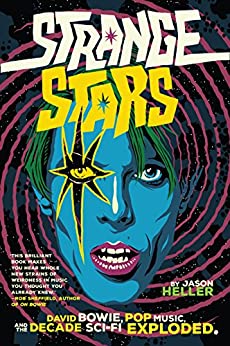

Jason Heller’s Strange Stars: David Bowie, Pop Music, and the Decade Sci-Fi Exploded covers the synergy between science fiction and popular music during the 1970s, and it comes at an important point in SF history. More on that last bit later. First, let me cover a few representative factoids the book presents:

  • David Jones—before changing his last name to Bowie and penning the song “Starman”—read Robert Heinlein voraciously, including the author’s 1953 juvenile novel coincidentally(?) titled Starman Jones
  • Pre-teen Jimi Hendrix was such an SF-media fan he insisted on being called “Buster,” after Buck Rogers and Flash Gordon serial star, Buster Crabbe.
  • The Byrds loved Arthur C. Clarke and composed their song “Space Odyssey” when they learned that would be the title of a film adaptation of Clarke’s “The Sentinel.” 
  • A 1968 song mocking American astronauts, Bonzo Dog Doo-Dah Band’s “I’m the Urban Spaceman,” was produced by “Apollo C. Vermouth,” a pseudonym that hid its actual producers–the Beatles’ Paul McCartney and Gus Dudgeon, who went on to produce Bowie’s “Space Oddity.” 

These insights are from just the first 14 pages of Strange Stars, and it’s a fair accounting of the rest of the book’s contents. About every third page offers some remarkable, obscure fact about science fiction touching rock history or vice versa. Readers fascinated by such moments will have a blast reading Strange Stars.

But Heller’s book is more than just a cornucopia of hipster trivia. It’s a compelling, comprehensive work that invites us rethink two of the twentieth century’s most influential pop cultural creations. Heller skillfully uses David Bowie’s career as a through line, which prevents the book from simply becoming a list of neat coincidences. Moreover, he focuses exclusively on the 1970s, which may disappoint readers interested in more recent SF/pop artists, but nevertheless provides the book a much-needed focus. The 1970s gave us both Devo’s Island of Dr. Moreau (1896)-inspired album Are We Not Men? and Meco’s Star Wars-inspired disco music; Heller joins these dissimilar stories into an intelligent whole.

The highlights you’d expect are here: Michael Moorcock collaborates with the band Hawkwind; Heinlein’s Stranger in a Strange Land (1961) inspires David Crosby’s ode to threesomes, “Triad”; Paul Kantner and Jefferson Starship get a 1971 Hugo nomination for their concept album Blows Against the Empire; etc. Heller, however, also covers many lesser-known acts, such as the synth band Lem (named for Solaris author Stanislaw) and French group Heldon, who composed an entire album inspired by Frank Herbert’s Dune (1965). Heller also recognizes heroines like Nona Hendryx, who used her interest in SF to influence the song content and fashion design of funk band Labelle. 

Bowie—who inspired many SF-related bands, praised them in the press, and hired their members as backing musicians—ties to the book’s chronological structure and its thesis. He enters the 1970s known primarily for “Space Oddity,” the quintessential SF subject-matter song. He quickly assumes his Ziggy Stardust persona, embodying the science-fiction character on his eponymous album. He ends the 1970s having left behind Ziggy’s overtly sf narrative lyrics (“I’m a space invader”!) in favor of synthesizer-driven, atmospheric albums like Low (1977), a whole different kind of otherworldliness. Heller states, “Like his new friends in Kraftwerk, [Bowie] had come to eschew singing about science fiction. Instead he was science fiction” (148). This figures into Heller’s argument that there are really several strains of science fiction music. One is primarily narrative (think Rush’s 1976 album 2112). Another appropriates SF’s imagery (think guitar/starships on Boston’s album covers). Artists who encompass all those strains—like Bowie, Gary Numan, and P-Funk’s George Clinton, who built from Sun Ra’s Afrofuturist template—deservedly get the most coverage from Heller. 

It’s not perfect. Direct artistic influences can be notoriously hard to prove. Heller relies on “likely inspired,” “plausibly,” and similar phrases a little too often, although he’s admirably honest when a perceived influence isn’t 100% verifiable. His consistent use of “sci-fi” rather than SF may frustrate grumpier scholars. My only other quibble is the book’s index; a work that drops this many names needs a more complete one. 

Strange Stars offers a canon of SF music and also beckons readers to seek out older SF that influenced musicians. Heller includes a discography of major SF-related songs at the book’s end that will satisfy audiophiles. Just as interesting, however, are moments when specific works pop up more than once. Heller reveals that Moorcook’s novel The Fireclown (1965) inspired musical tributes by both Pink Floyd and Blue Öyster Cult. Maybe it’s time to (re)read The Fireclown? Similarly, Heller recounts how Philp José Farmer’s 1957 novel Night of Light brought the term “purplish haze” to Jimi Hendrix’s attention, and how Kantner used Eric Frank Russell’s The Wasp (1957) for inspiration. There’s a whole, neglected sub-canon of 50s and 60s SF that inspired musicians. Instructors who regularly teach New Wave-era SF could conceivably look to Strange Stars for new syllabus material. 

Finally, the SF community needed a book like Strange Stars. In 2013, we lost Paul Williams, the Philip K. Dick scholar and founder/editor of Crawdaddy!, one of rock journalism’s earliest major periodicals. David Hartwell (to whom the book is dedicated) began his career writing for Crawdaddy! and became one of SF’s leading editors before his death in 2016. The individuals who were at Ground Zero for the SF/rock ‘n’ roll explosion—who loved both phenomena and understood their interconnectedness at a cellular level—are leaving us. Spurred on by those deaths, as well as Bowie’s in 2016, Heller understands that these stories needed to be documented while their sources still live. Some of the book’s more rushed moments seem attributable to this sense of urgency. Strange Stars probably isn’t for every science fiction scholar or fan, but for anyone who cares about SF’s conversation with twentieth-century pop culture, it’s indispensable.
Review of Drew Magary’s Portal B (a teleportation love story)


Review of Portal B (a teleportation love story) by Drew Magary

Jonathan P. Lewis

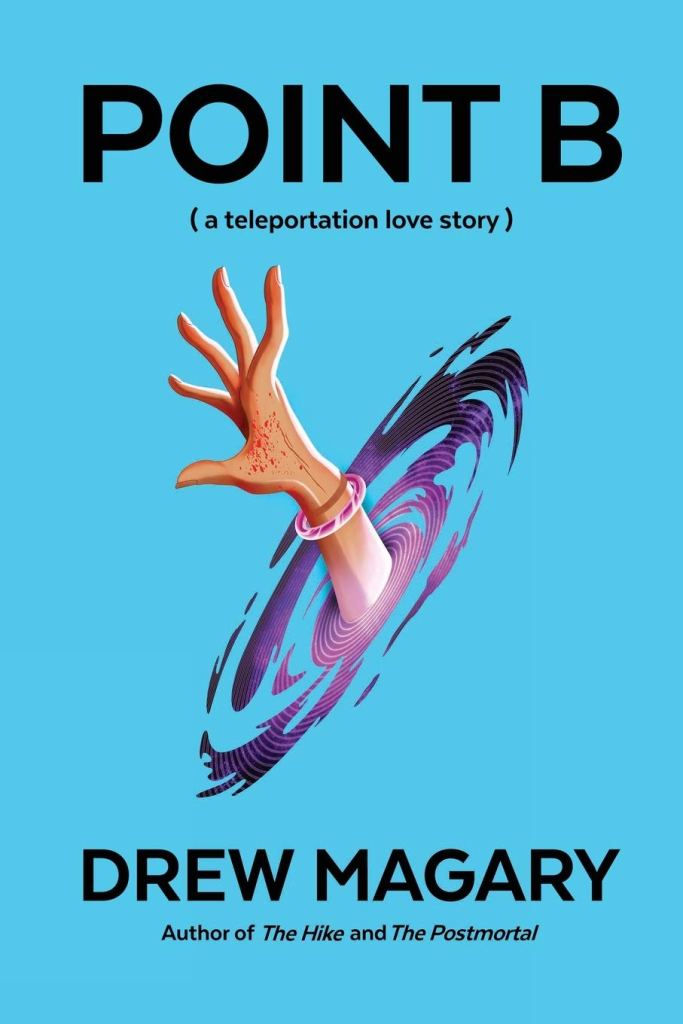
Drew Magary. Point B (a teleportation love story). Independently Published, 2020. 461 pp. Paperback. $13.99. ISBN 9798637737680.


Drew Magary’s voice in his SF novels The Postmortal, The Hike, and now Point B, remains steadfastly blunt: he hammers and harrows his characters and his readers with to-the-point prose and blistering dialogue. He recently told me that “there’s a LOT of dialogue in Point B, because I had written a couple of novels already that were more spare in dialogue and wanted to go the other way. Dialogue is a blast to write.” Coming from the sports blogosphere into popular SF, Magary follows the long tradition in his fiction of posing interesting questions about the possibilities of technological revolution, and then measuring the fall-out of such novums as the end of disease and instant travel through space-time.

Magary, formerly of Deadspin, GQ, and other outlets, now writes for GEN, Medium’s cultural magazine, Vice, and SFGate where he can hurl bile at the inequities and cruelty of our contemporary world. But ultimately, Magary is a humanist in the Vonnegut tradition, looking at how bad actors will always pursue money and power at any cost to human lives, and Point B is a strong novel for the strange times we find ourselves in. 

Because of breakthroughs in “anti-hydrogen,” the novel tells us, people can use their smartphones to instantly teleport from nearly anywhere on Earth to nearly anywhere else on Earth—China, e.g. has locked down the country and so there is no access in or out—but while the tourism business booms for popular destinations, whole industries such as car manufacturing and airline travel have completely tanked. Global climate change is solved because who needs to burn fossil fuels to move about? Whole cities such as Cleveland are abandoned for who needs to live in Cleveland when work opportunities are everywhere and anywhere—temporary housing is easy to come by and travel costs are negated.

Point B follows the adventures of 17 year old Anna Huff as she enters Druskin, an elite preparatory school in New Hampshire. An accomplished diver and pianist, Huff is awarded a full scholarship to the school and finds herself rooming with the daughter and half-sister of the novel’s respective antagonists, Emilia and Jason Kirsh. Huff becomes quickly enamored of Lara Kirsh, but Lara leaves Druskin after just a few days after the girls are caught in a late-night swimming excursion in the on-campus river. Finding friends in two boys named Burton and Bamert, Huff tries to survive her time in detention as a test subject for Jason Kirsh’s attempts to broaden transportation weight-limits from 2 kilograms to 3 in teleportation. Kirsh is a sociopath who, Anna learns, tortured her sister into suicide by using secret teleportation protocols to stalk Sarah.

Point B has a great deal to say about stalking, sovereignty, security, and other techniques of domination in our seemingly always connected world and much of it should give us pause. Magary’s best moments in The Postmortal and The Hike asked us to consider the Faustian bargains we make every day in the name of convenience and connectivity and of life without disease or introspection that can rob us of real meaning. In Point B, when a boy dies on Everest because he can port near the summit without any mountaineering experience, most in the novel’s world take it as a dumb stunt gone awry—the thrill seeker getting his just deserts. But Magary takes it a step further, looking at how the boy’s death leaves a hole in his family and how his mother’s quest for truth leads her to be, the novel suggests, another of Jason Kirsh’s victims who asked too many questions of the purveyors of so-called easy happiness and infinite, instant, once-in-a-lifetime experiences.

Point B also asks us to consider the impact and limits of education—especially elite educational state apparatuses—in creating responsible citizens when anyone, can step past the old velvet ropes and create Insta-stories formerly only available to the ultra-rich and powerful. How will the powerful set up new boundaries to keep the plebes out? Why spend time in a school when nearly anywhere in the world can be seen and experienced first-hand and what will those who run such powerful institutions as Druskin do to keep their privilege? For the novel, the answer is nearly anything—the Kirshes, mother and son, donate huge amounts of money to the school to buy access not just to power but to control how the powerful continue to exist at all. Magary further uses that cliché of prep school life, the monied dandy with a drinking problem at 17 because Daddy doesn’t love him, to look at the toxic values institutions like Druskin can promote and sustain. (For the record, I also went to a New England prep school and knew a few Bamerts who bounced from school to school with fine minds who only used them to scheme their way into securing alcohol and hiding their Kodiak addictions because why bother studying when the path to financial success was already set in stone through family connections?)

Overall, I recommend Point B and am surprised that Penguin, Magary’s publisher for The Hike and The Postmortal, passed on the novel. It’s a good diversion in these trying times, and like the best of mainstream SF, has a great deal more to say than celebrating a novum like teleportation and what it might offer to us.

Review of Ford and Mitchell’s Apocalyptic Visions in 21st Century Films


Review of Apocalyptic Visions in 21st Century Films by Elizabeth A. Ford and Deborah C. Mitchell

Michele Braun

Elizabeth A. Ford and Deborah C. Mitchell. Apocalyptic Visions in 21st Century Films. McFarland, 2018. Paperback. 237 pp. $49.95. ISBN 9781476672731.


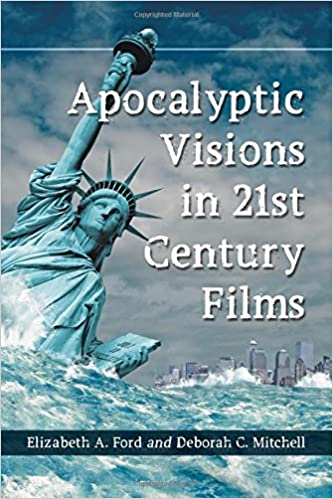
Introducing Apocalyptic Visions in 21st Century Film, Elizabeth Ford and Deborah Mitchell contextualize their study by hypothesizing that the “American bedrock shifted” (2) after September 11, 2001 and that human beings process reality, fear and angst through art. The central premise is that 9/11 introduced new apocalyptic themes into filmmaking. This cultural contextualization offers potential as a unifying theme within the volume, but, disappointingly, its application is uneven across the chapters that follow. 

The first chapter, “Envisioning the Apocalypse,” states it will address some of the texts that do not fit in the remainder of the volume. It describes apocalyptic film as grounded in a climate change-induced fear of tsunamis, zombie-infected cities, and the contrast between the loveliness of ordinary life and the desolation of post-apocalyptic landscapes. It reads as an attempt to use filmic features, like special effects, setting, and light and color, to lay the book’s groundwork, though it never explicitly says so. 

Another organizing chapter, “Hollywood’s Doomsday-Prepper Backpacks” suggests that apocalyptic film produces character types such as the Apocalyptic Denier, the Unselfish Pragmatist, the Romantic Moralist, the Lotus Eater, and the Fetishist, by drawing from Neville Shute’s 1953 On the Beach and its 1959 film adaptation. The reader expects these to serve as models for 21st century apocalyptic film, but is instead offered additional types, which leaves one wondering the purpose of establishing the On the Beach reference.

The bulk of the book’s remaining chapters chronicle the post 9/11 effect on subgenres of apocalyptic narrative. Young adult film is rife with apocalyptic imagery, and the analysis of WALL-E‘s (2008) social commentary and warning is insightful as it focuses on narrative, in the chapter “Coming of Age in Post-Apocalyptic Worlds.” The post-apocalyptic landscape of WALL-E contrasts with the optimism and joy that WALL-E extracts from his work and encounter with Eve, producing a film that suggests it’s not too late to reconnect with each other and prevent apocalypse by environmental disaster. 

“Speaking to Them, Speaking to Us” traces the changing social context for two iconic apocalyptic films: War of the Worlds (2003) and The Day the Earth Stood Still (2008). The authors argue that the isolationist, survivalist approach of Ray Ferrier (Tom Cruise) in Spielberg’s War of the Worlds is an analog for the fearful response post 9/11 to arm oneself and only worry about oneself and one’s family. This contrasts with the final chapter of the volume, “The New Superhero Dynamic,” which suggests that the upsurge of superhero movies in the last two decades reflects a turn to community and cooperation as a means of saving us from irresponsible leadership, fragmented communities, and social problems like poverty, racism, and crime in a post-911 landscape. It’s difficult to reconcile these two approaches to apocalypse, and the fantastical nature of the superhero genre would suggest it is idealistic while the isolationist approach is the more realistically viable one. 

The answer to why “Why Super 8 Can’t be E.T.” lies firmly in the thesis of the book: that 9/11 changed the collective American imagination of apocalypse and our attitudes towards aliens (and alien encounters). A friendly and harmless E.T. is replaced in Super 8 (2011) by an alien treated by the military like a high-value terrorist. The introduction of “terrorist” into the American lexicon after 9/11 transforms the alien from curious lost traveller to threat. This chapter does lead nicely into the next, “The Difficulty of Framing a Real Apocalypse,” though the exploration of film that directly references 9/11 oddly pairs Stephen Daldry’s Extremely Loud and Incredibly Close (2011) with Martin Scorsese’s Hugo (2011), using trauma to link the fatherless children at the center of each narrative. The parallels between the texts are numerous (as critics have already noted), though the traumatic connection is about parental loss rather than experience of apocalypse per se and thus is limited in its contribution. 

The brief discussion of Warm Bodies (2013) at the end of “The Apocalyptic Landscape of Love” explores the hope inherent in R’s gradually reawakening heart, suggesting that a zombie apocalypse does not need to be the end. The hopeful ending of the other texts analyzed in the chapter, the Twilight films and Beautiful Creatures (2013), however, is a result of individual triumph over evil, which creates an apocalypse of two, which is more limited than the usual conception of apocalypse as an event that destroys whole civilizations.

This liberal reimagination of apocalypse continues in the next chapter. While the authors admit that the films discussed in “Emmerich’s Apocalyptic Visions of Shakespeare” may not be obviously apocalyptic, they explain that Emmerich’s Anonymous (2011), which suggests that Shakespeare didn’t write the plays and poems credited to him, reflects the dystopian ethos of the 21st century, an age of questioning everything. They draw parallels between the contested identity of Shakespeare as presented in Anonymous and the birther movement in the U.S. that sought to discredit Barack Obama’s presidency by contesting his nationality, though how either fictional or real contested identity is apocalyptic is not made clear. 

There are some excellent insights into 21st century American films in this volume that make it worth reading. However, the connection of these texts to each other and to apocalypse is often tenuous. The challenge with linking 9/11 and apocalypse is that together they inscribe only a small slice of an overlapping Venn diagram whose totality is much larger. Additionally, the repeated references to the home state of the authors (Ohio) and their country provide local examples for a global thesis about 21st century apocalypse. The nature of this relationship between the local and the global is never clear, and one gets the sense that many of the chapters may have stood better on their own than forced into a book with a theme of apocalyptic film.

Review of Nancy Kress’s Sea Change


Review of Sea Change by Nancy Kress

Jeremy Brett

Nancy Kress. Sea Change. Tachyon, 2020. Paperback. 191 pp. $15.95. ISBN 9781616963316.


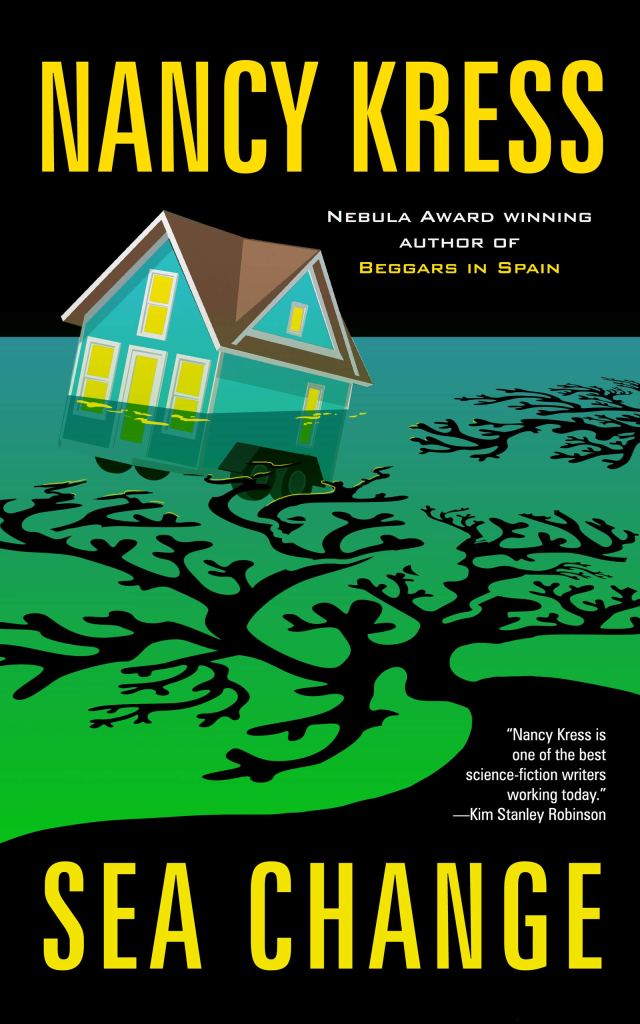
It’s a singular book that begins with a runaway self-driving house, and Nancy Kress has mastered the art of the opening line. Sea Change begins with the words “The house was clearly lost.” It’s a funny, yet at the same time jarring, line that instantly tells the reader that something has clearly shifted in the world. And so it has. Kress gives us a United States where normal life is increasingly rare as the effects of climate change and man-made environmental collapse encroach more and more on society. Of course, in our age of climate change this is not groundbreaking in itself, but Kress puts a unique spin on it by avoiding a simple “Us (environmentalists) vs. Them (the government, or Big Business, or terrorists)”. Instead, in Sea Change Kress presents a bio-thriller with a multifaceted setting in which environmental groups battle the government but also compete amongst themselves with different agendas and tactics. The tendency of humanity to fracture runs deep through Kress’s book; however, just as strong is humanity’s endurance in the face of catastrophe. As protagonist Renata notes:

Most of all, I felt fear. Not for myself but for the organization that always hovered between detection and ineptitude, the organization made of dedicated amateurs up against both law-enforcement professionals and a stupid public, the organization that I would protect with everything in the world until we’d succeeded in our quixotic attempt to save that—probably unworthy—world from itself, whether it wanted that or not.

Sometimes the world doesn’t know what’s best for it.

17

Climate change fiction faces unique challenges. It’s easy and even seductive to simply write an apocalyptic dystopia where we’re all going to die and where humans in the last days of civilization carve out meager or desperate existences by feeding on others. That kind of dark pessimism has run through science fiction since its beginnings, carrying into the Cold War with its numberless tales of nuclear holocaust through the environmental disasters chronicled by Brunner and Harrison, into today’s endless, increasingly tiresome zombie apocalypses. However, writers like Kress are also finding a space in their climate change fiction for hope. We need hope, if we are to survive the existential and psychological crisis that climate change represents. We need stories in which humanity actively works to slow or repair the damage it has caused. We need them so very desperately, and as readers we are fortunate enough to have a cadre of hopeful authors such as Kim Stanley Robinson, Kelly Robson, L.X. Beckett, Neil Stephenson, and others who chronicle our drive to be better, to do better, to fix what we have broken. 

Sea Change is such a work, wrapped in the fabric of a well-paced biothriller. Kress chronicles a world suffering in the aftermath of “the Catastrophe”: a widespread drug is infected by a genetically modified bacterium that picks up a lethal gene; hundreds of children die as a result. In the aftermath, worldwide protests—many of them violent—against genetically modified organisms (GMOs) cause deaths, widespread economic collapse, and government overstrain and neglect. In Kress’s new world, GMOs are outlawed, their ban heavily enforced by the US government (through a powerful new Department of Agricultural Security), with the result that massive food shortages are endemic. And underground organizations fight back. Renata is a member of the Org, a resistance group working, as she says, “to restore genetic engineering to a country that had rejected it, and so feed the United States and the world as climate change, desertification, and rising seas changed the face of the globe” (71). One of the ways the Org fights back is through a covert, fragmented network of isolated farms that use engineered crops. It’s an unusual resistance strategy and one of the things that makes Kress’s book so unique. 

Quiet, determined resistance is the hallmark of Sea Change (although the book certainly has its share of more dramatic actions, much of it hinted at or appearing ‘offscreen’, as it were). Renata moves forward in the face of unspeakable personal tragedy, including the death of a child, caused ultimately by effects of climate change. She and her compatriots operate an underground group, that seeks to change the world, not violently, but rather through the distribution of scientific achievement and accurate information. They operate with a hopeful belief that change is possible.

Near the end of the novel, following a massive pro-GMO information dump across cyberspace by different environmental groups, Renata notes that “seeds had been planted, and the harvest of changed perceptions might grow” (183). Here is Kress’s optimism, here is the hope that people can change their minds for the better, that they can overcome their fears and their distrust to make a potentially better future. This is not easy; Kress expertly and simply delineates what a society permeated by fear and suspicion looks like, and it is not an easy one to escape. But recall that the term ‘sea change’, taken from Shakespeare’s The Tempest, denotes a substantial change in one’s perceptions. If the change comes, as the Catastrophe did, it must be large-scale and it must produce a long-lasting alteration in people’s behavior. The future of the Earth demands it. Sea Change is a welcome addition to the growing subgenre of climate change fiction that bursts with hope. If nothing else, if we ignored Kress’s clever worldbuilding and her engaging characterizations, that belief in hope makes it worthy.

Review of Lavie Tidhar’s The Violent Century


Review of The Violent Century by Lavie Tidhar

Jeremy Brett

Lavie Tidhar. The Violent Century. Tachyon, 2019. (Originally published Hodder & Stoughton, 2013.) Paperback. 316 pp. $16.95. ISBN 9781616963163.


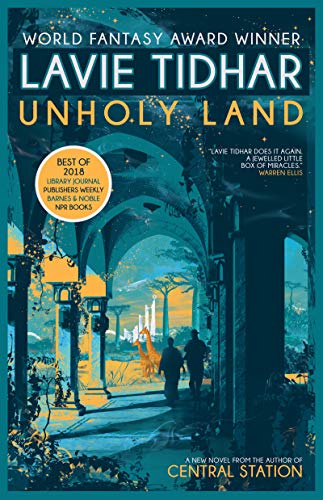
Tachyon’s reissuing of older works (as well as the publication of new ones) by Israeli-British author Lavie Tidhar is an incredibly welcome gift. Tidhar’s concern with shifting perceptions of history is increasingly relevant in an age where an objective chronicle of facts seems increasingly like an outdated product of a more innocent age. In his 2011 World Fantasy Award-winning novel Osama, he told the story of a world in which the 9/11 mastermind is a fictional character. In the masterful 2014 A Man Lies Dreaming, World War II never happened because Adolf Hitler was never made Chancellor of Germany and fled to Great Britain, where he ekes out a noirish life as a ratty private detective. Tidhar’s most recent novel, Unholy Land (2018), is set in a Jewish state planted in East Africa (reminiscent of the real-life Uganda Plan of the early 1900s) where settlers clash with the natives they have violently displaced and which turns out to be only one of multiple potential realities. In Tidhar’s hands, history is a set of alternatives and reality is fluid; it’s an atmosphere that seems downright sensible, even oddly comforting, in a world where many of us would welcome potential different avenues for history to take.

Tidhar is certainly one of our more noirish sf writers working today, given his concern with investigating dark conflicts carried out in the shadows of the world (Dark both literally and metaphorically—the first line in the novel is “A gunshot in the fog,” and one of the opening scenes features a man walking along London’s South Bank, alone on a foggy night, in search of an obscure, out-of-the-way pub: quite noir, indeed). This also might very well earn him the title of SF’s John Le Carre, especially with The Violent Century, which has all the hallmarks of a Le Carre work—espionage carried out by world-weary veterans, shifting loyalties, and desperate attempts to remain human in a tense atmosphere of clashes among faceless international powers. Part of Le Carre’s genius has always been to show the deeply human, deeply ordinary side of espionage, and Tidhar matches him well in Violent Century (adding a dollop of superheroism to give it some spice).

The Violent Century is almost entirely set (except for a few flashbacks and a few scenes set in the present day) in an alternate World War II, fought in the aftermath of a 1932 experiment by German scientist Dr. Joachim Vomacht. That quantum experiment resulted in the creation, all across the world, of people imbued with superpowers. Naturally enough these heroes (or Ubermenschen) are brought into the worldwide conflict by the warring powers, fighting both on open battlefields and in the shadow realm of wartime espionage. This situation may seem similar to, for example, that depicted in the DC comic book series Watchmen (and its 2019 television sequel) or the George R.R. Martin-created and co-edited Wild Cards shared universe, both of which depict the political and social effects of superheroes on a “real” world. And those similarities are, indeed, present. However, those works—despite their frequent moments of bitterness and cynicism—are still rooted in a very American sense of colorful costumed personalities battling each other and who are larger than the ordinary lives around them. Tidhar’s protagonists, though, are, despite their powers, small people rooted very much in the ordinary.

The novel’s ‘heroes’ are British operatives who work for an MI6-like agency called the Bureau for Superannuated Affairs (no Avengers or Justice League here!). British superheroes are dull, with aliases that are stunning in their uncreativity. The two main characters are given the names Fogg (his power is, shockingly, generating fog) and Oblivion (whose power is to negate things and make them vanish forever); their colleagues include Spit (who emits saliva that can fly strong and hard like a bullet), Blur (super speed), and Tank (big and strong). The names are direct and uninspired, as gray as the declining British Empire they serve. By contrast, American heroes are right out of comic books, with bright costumes and names like Whirlwind, Tigerman, and the Green Gunman; Soviet heroes bear equally dramatic names like the Red Sickle and Rusalka, and German ones are called Schneesturm (Snowstorm) and Der Wolfsmann (The Wolf Man).

This very British understatement is part of the plan: as Fogg’s superior ‘the Old Man’ says to him, “We need men like you. Do not be tempted by the Americans, the loudness, the colour. We are the grey men, we are the shadow men, we watch but are not seen” (134). The word shadow is telling, and it recurs throughout the novel: Fogg and his colleagues are “the shadow men of a shadow war” (106). Fogg is called “the shadow man” by his great love, a German woman named Clara (which means “clear” or “bright”) whose power is to, essentially, bring things into the light. And the postwar period is only a pale reflection of that shattering conflict: “Everything else is a shadow of that war” (229). Tidhar’s use of the word stresses that his characters are only obscured reflections of some deeper reality, unlike traditional comic book heroes and villains that bring light and noise and thunder to their worlds. While they will never be mistaken for merely human, Tidhar’s characters are nothing but.

And therein lies the sadness and the fear at the heart of The Violent Century. Why is the century so violent? Because regular human beings have made it so, without the need for superheroes, who are almost afterthoughts to the struggles of real people. Because, as Cory Doctorow notes in his introduction to the novel, “[t]hat’s the real terror, after all: that our lives are tossed around not by the brilliant, all-powerful supermen, but rather by people whose pettiness, fears, and weaknesses are as bad as our own” (v). The real Hitler, the real Mengele, are more monstrous than any supervillain, and the inhumanity that ordinary men can wreak on each other is more powerful than any superpower. That may seem cliché, but it is no less true, as Tidhar works to make clear.

The traditional comic book hero has little place in Tidhar’s world, as the traditional James Bondian superspy has no place in Le Carre’s. There is a wonderfully meta scene set during Vomacht’s 1964 trial (based on Adolf Eichmann’s real-life 1962 trial), in which an American historian of superheroes, Joseph Shuster (in real life the co-creator of Superman), testifies to the definition of a hero, in the process setting apart characters like Fogg and Oblivion from Tigerman and Whirlwind.

Those of us who came out of that war, he says. And before that. From pogroms and persecution and to the New World. To a different kind of persecution, perhaps, But also hope. Our dreams of heroes come from that, I think. Our American heroes are the wish-fulfilment of immigrants, dazzled by the brashness and the colour of this new world, by its sheer size. We needed larger-than-life heroes, masked heroes to show us that they were the fantasy within each and every one of us. The Vomacht wave did not make them. It released them. Our shared hallucination, our faith. Our faith in heroes. This is why you see our American heroes but never their British counterpart. Ours is the rise of Empire, theirs is the decline. Ours seek the limelight, while their skulk in shadows…We need heroes. 

227

It is a beautiful, heartfelt statement about the importance of heroes. However, as Tidhar shows, it is also completely wrong. American heroes help the CIA conduct its secret war in Laos and Vietnam. Russian heroes succumb to alcoholism and are considered abominations by the mujahedeen in Afghanistan who fight Soviet occupation. Former Nazi ubermenschen are reborn in the US as advertising shills for children’s breakfast cereals. And no hero anywhere flies out of the sky to stop the crashing of two planes into the World Trade Center on September 11, 2001. “That day we look up to the sky and see the death of heroes” (229). The Violent Century recognizes the very human emotional need for superheroes but hammers home the idea that those same heroes ultimately have little effect on history’s onrush. In the latter part of the novel, Tidhar provides brief passages concerning historical events: despite the existence of heroes, nothing really changes. Atomic bombs are dropped on Japan, the Vietnam War grows and rages, the Berlin Wall is built, the Soviet Union invades Afghanistan. In a particularly telling passage, the comic book industry establishes the Comics Code Authority in 1954—just as it did in our world—which chains the very notion of superheroes to suburban, middle-class respectability. In any world, it seems, heroes can be tamed. Someone from our world dropped into Tidhar’s universe would see very little difference between the two.

The Violent Century, like much of Tidhar’s output, is an excellent addition to the literature of shifting perceptions of reality, most obviously represented by Philip K. Dick. It is also an effective counterexample to the artificiality of “genre”—the novel is at once an alternate history, a spy novel, a story of superheroes, and a war novel. Fitting many boxes and at the same time none at all, Tidhar’s novel (indeed, his entire literary career) demonstrates the imaginative power of fluidity to give us insights into the complex nature of our historical reality.

Review of Lavie Tidhar’s Unholy Land


Review of Unholy Land by Lavie Tidhar

Amandine Faucheux

Lavie Tidhar. Unholy Land. Tachyon, 2018. Paperback. 264 pp. $15.95. ISBN 9781616963040.


The protagonist of Lavie Tidhar’s Unholy Land, Lior Tirosh, is a science fiction/detective fiction pulp writer who leaves his home in Berlin to visit his sick father in Palestinia, the Jewish state nestled between Uganda and Kenya, before getting involved in an increasingly complex plot of parallel universes. The story’s narrator, gradually revealed to be Special Investigator Bloom, addresses a mysterious second-person character named Nur, who turns out to be an agent trained to move in between the worlds. Bloom follows both Tirosh and Nur from afar, although at times the narrator takes on omniscient powers, as it becomes clear that in travelling from Europe Tirosh has crossed more than international borders, but the border to another world.

The novel’s mirror frame—an author-surrogate protagonist to whom Tidhar attributes his own novels, including Osama (2011) and Unholy Land itself—invites the reader to lose herself into its composite worldbuilding, in which walls and borders and identities both possess the same meaning they do in the real world, and at the same time don’t. Tidhar bases his what-if thought experiment in a real historical moment, the early 20th century Uganda Program, which proposed to create a Jewish nation in East Africa (a land “unholy” but a land all the same), but in his novel, like in the best sf stories, it is our own world’s reality that suddenly appears strange. Like Tirosh, the reader must follow along without ever being securely anchored in either reality or fantasy, history or alternate history, the past or the present. In this country, too, Palestinians (a noun Tidhar no doubt uses ironically) erect a wall to keep out the indigenous people that were forcibly removed from the land; in this story, too, the PDF (Palestinian Defense Force) brutally harasses refugees and uses surveillance against young revolutionaries. But this is also a story in which ‘only’ a “Small Holocaust” happened (since European Jews moved to Palestinia before the rise of the Third Reich) and in which Hitler was assassinated in 1948. Tidhar’s incredibly vivid worldbuilding unveils a wealth of intriguing details: Palestinians speak Judean (at the end a character calls modern Hebrew “archaic” by comparison); old European Jewish families have become diamantaires; children read the story of the Judean Tarzan. 

This is also a novel that, at least when it focuses on Tirosh, develops complex and piercing emotional realities. Throughout the story, Tirosh is haunted by the (never quite described) death of his young son Isaac. His constantly resurfacing grief through memories of simple moments with the toddler showcases the talent of Tidhar’s prose. This is not the only thing that haunts Tirosh. His brother Gideon was killed in the war; his father is ailing and Tirosh is so reluctant to visit it only happens at the end of the novel; his niece Deborah is missing and her mysterious disappearance drives the action; and Tirosh’s memories are also increasingly conflicted as the story progresses.

Tidhar’s novel is a powerful, labyrinthine story reminiscent of China Miéville The City and The City (2009) and, in a much more subtle and controlled way, some of the best of Philip K. Dick. With its careful and intelligent treatment of some of the most difficult questions arising from the Israel-Palestine conflict, it will undoubtedly become a staple of postcolonial science fiction courses. Its straightforward prose and short format will provide for a productive introduction to discussions about border conflicts, nationality, nationalism, and imperialism while also allowing teachers to outline some of the key features of the best of sf. As Tirosh himself explains during a reading at a bookstore: “What we do [when writing stories of alternative realities] is literalise the metaphor…We construct a world of make-believe in order to consider how our own world is constructed, is told.” (113-4). 

Some of the novel’s shortcomings could come from Tirosh’s own pulp detective stories. When Bloom ceases to be the narrator in the background and acts as a character especially, the plot turns cartoonish and awkward. To give an example, when Bloom and fellow soldiers storm a refugee camp and harass a family, Bloom reflects to himself: “I did not enjoy humiliating [the woman]. I was merely carrying my duties. I was a professional” (148). The missing-girl plotline of Deborah, with its stereotypical mobster characters, ends up leading nowhere. It is actually quite hard to pinpoint, even by the end of the novel, why certain scenes took place (like the different assassination attempts on Tirosh or his search for the theodolite) or why some characters are introduced (like Melody, a woman who seems to be here simply for Tirosh to sleep with). Overall, Tidhar’s beautiful, almost poetic prose and the fascinating worldbuilding propel the reader to keep reading on in spite of some of the story’s somewhat vulgar plot points, and some of the transition scenes between the worlds have a Ubik-esque quality that I will not forget any time soon.

Review of LOVE DEATH + ROBOTS, season 1 (2019, TV)


Review of LOVE DEATH + ROBOTS, season 1

Michael Pitts

LOVE DEATH + ROBOTS. Blur Studio, distributed by Netflix, 2019.


Currently in production of its second season, LOVE DEATH + ROBOTS is an anthology series produced by Netflix. Bringing together the talents of different casts and creative teams, the series consists of standalone episodes exploring diverse themes of the science fiction genre. These episodes, which do not exceed 20 minutes in length, reflect disparate genres such as cyberpunk, alternate history, and dystopia while covering themes from AI and transhumanism to colonization. They raise, for example, questions concerning the future of humankind, the destructive consequences of colonial expansion and capitalism, the threat of a nuclear holocaust, the privatization of space travel, and the dilemmas of robotic consciousness. Yet, while the series offers some interesting explorations within each of these fields of interest, it is problematic in its traditional framing of issues related to sex and, more specifically, its catering to the male gaze.

A re-imagining of Tim Miller and David Fincher’s initial plan to remake the animated science fiction anthology film Heavy Metal (1981), Love, Death & Robots continues its predecessor’s efforts of legitimizing adult-oriented animation and genre fiction. Like Heavy Metal, it utilizes advanced and diverse animation techniques, pushing the genre into new territory. Led by Miller’s Blue studio, which is known for its hyper-realistic, video-game style aesthetics, and produced using a variety of animation tools, the show is characterized by vivid, realistic details and cutting-edge animation. Uniting the disparate aesthetic styles of the episodes is their depiction of tropes common to the underground comics of the 1970s, which in turn influenced the production of Heavy Metal. Like the 1970s adult-oriented graphic fiction that skirted censorship rules, LOVE DEATH + ROBOTS centers explicit content including sexuality and violence.

It is this intermingling of sex and violent content that makes the series, like its comics and Heavy Metal predecessors, problematic. Like Heavy Metal, the program caters to heteronormative male viewers through its presentation of sex and the female body. Though it occasionally presents non-normative sexuality, for example, these portrayals of queer characters frame female bodies within patriarchal conceptions of desirability. Each female character populating these episodes acts, as Laura Mulvey puts it in her influential essay “Visual Pleasure and Narrative Cinema,” “as an erotic object for the spectator within the screen story, and as erotic object for the spectator within the auditorium” (62). Women in LOVE DEATH + ROBOTS are therefore predominantly portrayed in accordance with the desires of a heteronormative male audience. Also, like Heavy Metal, the program frequently depicts violence towards women and emphasizes gratuitous sexual and violent details. Female characters, for example, are brutally hunted and murdered, such as in “The Witness,” or brutalized and mutilated, such as in “The Secret War.” Other episodes, such as “Beyond the Aquila Rift,” are suddenly interrupted by sex scenes clearly developed and included to appease heterosexual male viewers. While the program caters to the male gaze and includes toxic portrayals of women and violence, a few episodes do divert from this patriarchal framing of sex and gender. “Good Hunting,” for example, follows the plight of a female huli jing or fox spirit as she escapes sex slavery and mounts an attack upon the patriarchy in early 20th-century Hong Kong. Another episode, “Helping Hand,” similarly diverts from this catering to heteronormative male viewers in its centering of a female protagonist who demonstrates incredible courage and strength in the face of eminent danger. Overall, however, though it includes these limited, non-patriarchal presentations of female characters, Love, Death & Robots problematically frames women, sex, and violence.

To a limited extent, the show also comments on other issues such as colonialism and capitalism. “Good Hunting,” for example, emphasizes the legacy of colonization and its effect upon women through its portrayal of women sold as sex slaves as a result of colonialism. “Suits,” on the other hand, undermines traditional stories of American individualism and self-reliance by revealing that the farmers upon which the episode centers are actually colonizers attacking the indigenous alien species of the planet they desire to control. “Helping Hand” imagines the consequences of corporate space exploration upon astronauts whose labor is exploited at great cost. As these examples illustrate, the series builds upon pre-existing trends and themes of science fiction and occasionally offers interesting insights into topics pivotal to the future of humankind such as environmental concerns, space travel, labor practices, the expansion of human civilization, and transhumanism. Overall, then, while LOVE DEATH + ROBOTS offers occasional commentary on issues common to science fiction, the brevity of its episodes, its patriarchal framing of issues related to sex and violence, and its catering to the male gaze limit its potential as an innovative work of SF.


WORKS CITED

Mulvey, Laura. “Visual Pleasure and Narrative Cinema.” Feminism and Film Theory, edited by Constance Penley, Routledge, 1988, pp. 57-68. 

Review of Another Life, season 1 (2019, TV)


Review of Another Life, season 1

Marta F. Suarez

Another Life, season 1. Halfire Entertainment, distributed by Netflix, 2019.


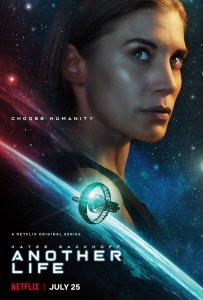
Another Life is a Netflix series currently awaiting the release of its second season. Its first season, released in 2019, consisted of ten 60-minutes episodes. The plot is quite straightforward and moves between a narrative on Earth and a narrative in space. In an unspecified year in the future, a mysterious alien device arrives on Earth and settles on an open field in the US. Six months later, the scientists are still looking for the purpose of the artifact, only establishing that it emits code to Pi Canis Majoris. Not wanting to wait any longer, the government sends an interstellar ship to the signal’s objective, hoping to make direct contact with the alien civilization. The expedition is led by Niko Breckinridge (Katee Sackhoff), newly appointed captain of the Salvare. Meanwhile, on Earth, her husband Erik Wallace (Justin Chatwin), continues to lead the research to decipher the code.

The series often nods to other sci-fi screen media, moving between echoing popular scenes, emulating genre styles, and replicating familiar narratives. Its serialised structure converges with an episodic approach that gives the series a pastiche feeling. Whereas the overall plot has striking similarities with the decoding plot of Contact (1997), Interstellar (2014), and Arrival (2016), the individual episodes approach a variety of styles, narratives, and sub-genres. For example, nods to sci-fi horror take inspiration from the aesthetics of Nightflyers (2018) and Prometheus (2012), including arachnids reminiscent of those in Starship Troopers (1997) or Lost in Space (1998). Alien (1979) is echoed several times throughout the series. Not only is the chestburster scene almost replicated, but the first scenes in the Salvare evoke those in the Nostromo, yet with a darker atmosphere. If in Alien the crew wakes up in a quiet and serene ship, emphasized by the soundtrack and long shots (as if not to disturb), in the Salvare, Niko wakes up alone and weakened, in close-ups that emphasise the discomfort and dutch angles that suggest that not all is well. As it turns out, the ship is not where it should be and the events will only take it further from Earth in a plot reminiscent of Event Horizon (1997), Star Trek: Voyager (1995-2001), Stargate Universe (2009-2010), or Lost in Space (2018-). By the end of the season, Niko discovers that the alien race who sent the artifact, the Achaia, are decimating civilizations and implanting chips into hosts, connecting with core elements of The Mind Snatchers (1972) and the Goa’uld in the Stargate universes. The references are many and varied, making the series a kind of kaleidoscope where well-known tropes change shape but are still recognizable.

The originality of the series does not come from the plot. Indeed, some of it might result in clichés, and some of the characters are flat archetypes, with minimal internal conflict or character evolution except for Niko, Eric and the ship’s AI, William (Samuel Anderson). One of the key differences between this and other sci-fi crews assembled to go into space is their very young age, their diversity and the YA feel to the character-driven drama that they create. If in The 100 (2014-) the choice to depict younger characters is supported by the plot, in Another Life this decision brings a level of incoherence to the narrative, which suffers for it. The explanation, although given, contrasts with other aspects of the narrative. A member affirms that they have been chosen because their youth gives them the readiness to act, as opposed to a cautious disposition, which would characterize older crews. For the same reasons, space crews have abandoned uniforms, seen as outdated, and now are able to make their own fashion choices. Nevertheless, on Earth the military is still wearing uniforms, and all decision-makers are significantly older, which in a way contradicts the provided reasoning. It is also unclear why the crew only meet each other for the first time upon embarking on their voyage or why the former captain of the Salvare is part of the crew when he clearly is resentful of the change. The crew always questions the captain’s decisions, and actions are often rushed or merely illogical. The audience is left to wonder why the government has sent such an inexperienced group to make first direct contact with the alien life, whose intentions are unclear. The series’s focus on young and attractive characters and their interpersonal conflicts create narratives conventional in YA fiction, which contrasts with the space given to the internal conflicts of older characters.

The only other older member of the crew is First Officer Ian Yerxa (Tyler Hoechlin), the previous captain of the Salvare, who is killed almost immediately and replaced by his girlfriend, Cas Isakovic (Elizabeth Faith Ludlow). Michelle Vargas (Jessica Camacho) is the Communications Officer. Meanwhile, the engineering team is composed of lead engineer August Catawnee (Blu Hunt), Oliver Sokolov (Alex Ozerov) and computer engineer Javier Almanzar (Alexander Eling). The Salvare’s medic is Zayn Petrossian, a non-binary member of the crew portrayed by JayR Tinaco. Joining him in the medical bay is microbiologist Bernie Martinez (A.J. Rivera). Finally, accompanying the crew as a diplomat is the son of the US Secretary of Defence, Sasha Harrison (Jake Abel). On Earth, Eric looks after their daughter, Jana Breckinridge-Wallace (Lina Renna), and is often seen working alongside Dr Nani Singh (Parveen Dosanjh). The journalist Harper Glass (Selma Blair) provides conflict and creates tension. Overall, the characters among the young crew lack the depth of characterization that we see in Eric, Harper, Niko, or William. The dynamics between the latter two are probably the best element of the show at the narrative level. Designed not only to feel but also to combine the characteristics most appreciated by Niko, William becomes affectionate towards the captain in a relationship evocative of Her (2013). The dynamics in this relationship leads William to create another AI in search of love, complicating the matter further. For the rest of the crew, we are given little to no background story, being mostly differentiated by the way they dress and speak. There is a tendency to exposition and the dialogue often lacks subtext, breaking the script-writing rule of “show, don’t tell”. However, some of these characters have great potential. The show engages with issues of diversity, sexuality and gender in almost every episode. The guilt of the absent mother permeates Niko’s reflections about family, the engineers soon become a threesome, the non-binary medic has sexual relationships with the microbiologist, and questions of love and free will are part of a critical sub-plot with the ship’s AI. The ethnicity and cultural background of the characters is diverse, and although this does not materialize (yet) beyond the character design and into the plot, it is undoubtedly promising.

Audiences looking for a series with a robust scientific approach might be disappointed. The plot has some basic inaccuracies from the start. For example, they indicate that they miscalculated the distance to the objective because of dark matter, shown on screen as a dense thick grey cloud. Using high radiation in the ship kills alien life but is said to only impact the crew with infertility. Other elements that might feel incongruent relate to the dynamics in the ship, particularly concerning compliance to rules and following authority. The episodic structure puts the characters in situations that, for the most part, are a consequence of their own wrongdoings. We see members of the crew starting a mutiny, removing helmets in alien caves, smoking alien plants, or not using hazmat suits because the air is breathable. Because the transgressions towards leadership and regulations are so common and widespread, the audience might be left wondering how they have all been chosen for such a critical mission.

The series, therefore, is eclectic in its influences and genre, combining elements of sci-fi space travel, sci-fi horror, and teen drama, though it has issues regarding narrative coherence and scientific background. Nonetheless, the episodes could be used in a classroom environment for discussions surrounding race and gender representation, the portrayals of authority (and its failures), and moral “what would you do?” situations, of which there are plenty. For research purposes, the series might be of interest to those working on intertextuality, the portrayal of the female action hero, the ambiguity of the alien other, the fear of the unknown, reflections over the humanity of AI, the dangers of AI, and the intersections of gender and sexuality. Another Life is due to release its second season in Summer 2020. While receiving very low reviews for its narrative incoherence, these issues might yet be addressed in the new episodes. Maybe, after all, Another Life will get itself another life.

Review of Rick and Morty, season 4


Review of Rick and Morty, season 4

Max Suechting

Rick and Morty, season 4. Adult Swim, 2019–2020.


The least interesting thing to say about season 4 of Rick and Morty is that it is, generally, both good and bad in the ways that the show’s previous seasons have been good and bad. At its best, it is smart, tightly-written, and searingly funny, alternately experimenting with and lampooning the devices of science-fiction and advancing simple but compelling characters along a series of wildly imaginative conflicts. The breadth of literary and cultural history it simultaneously draws from and skewers is impressive and probably as enjoyable for the seasoned SF stalwart as the novice or newcomer, with this season variously digesting Indiana Jones, Ernest Hemingway, Batman-esque acid vats, Akira!, heist movies, Edge of Tomorrow, and more. At worst, the season is so loaded with references it becomes difficult for even the conscientious viewer to piece each episode together. Luckily, though, the episodes move at such a breakneck pace that this turns out mostly not to matter very much. Once the viewer settles into the experience, Rick and Morty becomes a kind of gamified television, unspooling familiar or almost-familiar references every few seconds.

Of course, this referentiality has been the series’ all-but-explicit subject matter since its inception. Rick and Morty has always been self-consciously about itself—or rather, about its own reflexive relationship with science fiction as a genre as well as the conventions of medium, character, plot, and so forth. The formula of a typical episode goes something like this: begin with a well-known media property or fictional trope, jam it together with a handful of other references, lay them out along an archetypal SF plot, and season heavily with complex, depressive, and/or fourth-wall-breaking metahumor. If the show’s aesthetic architecture is an improvisatory jumble of pastiche, reference, and imitation, its narrative engine is fueled by recursion, repetition, and intertextuality. Indeed, much of Rick and Morty’s charm comes from its celebration of its own intellectual indebtedness, genially rearranging its own source code with the bottomless delight of a child immersed in a Lego-and-Erector-set playworld. The result is a show which delights in endlessly plumbing its own increasingly reflexive relationship to its forebears, obsessively showing its work while at the same time acknowledging that work as at least partially meaningless.

What is novel about this season in particular, however, is that its metafictional churn is applied most strenuously not only to SF as a genre but also to the show itself—or, more specifically, to the tension between its status as both a piece of art and a commercial media product. For example, the season’s sixth episode, “Never Ricking Morty,” finds the titular pair trapped aboard a “Story Train” running along an endlessly looping track—a direct reference to series co-creator Dan Harmon’s famous story circle. While aboard the metaphor, the pair must puzzle their way through a variety of literalized narrative devices to “break the fifth wall” with their “story potential.” The episode concludes with grandpa and grandson happily zapped back to the Smith family home, entranced with what we see now to be not an extradiegetic prison but rather a simple toy train Morty purchased for Rick, who rhapsodizes:

You did the most important thing: you bought something. . . . Your only purpose in life is to buy and consume merchandise, and you did it. You went into a store, an actual honest to God store. … And you bought something. You didn’t ask questions or raise ethical complaints. You just looked straight into the bleeding jaws of capitalism, and said, “Yes daddy, please.” I’m so proud of you. I only wish you could’ve bought more.

But when the suddenly train derails, Rick’s mood sours:

Didn’t you hear what I said?! Consume, Morty! Nobody’s out there shopping with this fucking virus!

The episode thus concludes with an elaborately-constructed meditation on the relationship between commodity status, narrative logic, and audience satisfaction—with a character all but shouting the conclusion at the audience in the final thirty seconds—built atop an impossibly contemporary reference.

Such moments are par for the Rick and Morty course: speedrun absurdism maintaining its forward momentum by ruthlessly undercutting its own sentiment. Of course, it is not surprising that an “adult cartoon” should aim to soothe its audiences’ own neuroses by layering bleak cynicism, one-degree-shy-of-treacly moralizing, and wide-ranging pop culture knowledge (BoJack Horseman works in much the same way). Yet, despite its restless oscillation between desire and disdain for true feeling, Rick and Morty mostly manages to remain entertaining and lighthearted rather than slipping into pointless nerd solipsism.

This is not to say that solipsism is absent, of course, although it’s less a property of any specific part of the show itself and more the cumulative impression the series leaves on your brain. In the show’s best and most pleasurable moments, it plays like a hyperdrive version of A Thousand and One Nights (a comparison which the characters all but make themselves). Four seasons in, however, Harmon’s relentless equation of anti-social cynicism with sophistication and intelligence has started to wear through the show’s adventure-of-the-week format in a way that is harder and harder to ignore. In those moments, Rick and Morty feels less like a lighthearted romp through SF history and more like asymptotically performative snark, an affectation which unfortunately registers less as scandalous or risqué and more as vaguely annoying. (For instance, the season’s fourth episode includes an incestuous dragon-powered “ten-slut soul-orgy,” a phrase which is as tiresome to comprehend as it was to write.)

When all is said and done, however, the show’s most important assets aren’t its willingness to offend or the breadth of its references, but rather its creators’ pairing of witty inventiveness with a complex take on media and intertextuality. Hopefully Harmon and his collaborators can keep drawing from them for years to come.

Review of The Platform (2020, film)


Review of The Platform

Emrah Atasoy

The Platform. Directed by Galder Gaztelu-Urrutia, Basque Films, distributed by Netflix, 2019.


The Spanish director, Galder Gaztelu-Urrutia’s Spanish-language thriller on Netflix, The Platform (El Hoyo, 2019) is set in a dystopian future in a “Vertical Self-Management Center.” It is a prison-like building referred to as “The Hole,” consisting of over 300 levels, with two inmates to a cell. A platform full of food descends every day from the highest level to the bottom to feed these incarcerated inmates, which is closely concerned with food distribution and rationing. The inmates at the highest level get to decide whatever and how much they desire to eat, after which the food is taken one level down. The leftovers of the inmates above become the food those below. People are randomly moved to another level after each month. The film illustrates the protagonist, Goreng’s physical and metaphorical journey which gradually reveals the brutal reality behind the Hole through his experiences with his cellmates and other people in the prison.

The movie has numerous dystopian characteristics, which may lead one to label it a dystopian movie, whereas some others may categorize it as a horror movie or science fiction horror thriller. Generically speaking, it bears certain similarities to the structural pattern of literary dystopias or dystopian movies. The film starts in medias res, as we find the protagonist Goreng (Ivan Massague) waking up on Level 48 in his cell, staring at his inmate, Trimagasi (Zorion Eguileor), an old man imprisoned due to his accidental murdering of an immigrant. The main character is initially confronted with the foil, Trimagasi, who expounds on how the system in the Hole functions, which starts his transition from a state of naivety to a state of knowledge and experience. He is gradually exposed to the reality of the system through external factors such as Trimagasi, Miharu, and other inmates. Miharu, whose name stands for “open one’s eyes wide” plays a significant role in his journey (Ishida 106).

The dystopian protagonist starts to comprehend the internal mechanics of the system and resists against the system. Goreng, who takes Cervantes’s book, Don Quixote with him as his only item, struggles hard both to understand how the Hole works and to promote fair food rationing so that everyone can have something to eat. When the protagonist does not find support from other characters, his determination is partially vitiated. The protagonist manages to stay alive and reach the symbol of hope, a girl in this case. The girl who is implied to be Miharu’s daughter ultimately becomes the token of hope that may have the potential to change the current structure. Although the blame is not explicitly put on a political body, or rather, there does not exist a political body suppressing its citizens on a holistic level, the projected world remains highly dystopian.

It is possible to approach the movie from numerous perspectives that relate to the larger intellectual and philosophical questions and concerns raised. With its strong dystopian undertones, the movie engages itself with themes such as suppression, greed, cannibalism, corruption, surveillance, empathy, self-centrism versus altruism, violence, survival, Maslow’s hierarchy of needs, control, loss of individualism, social class, inequality, capitalism, the fluidity and fragile nature of borders in between different social classes, socialism, and racism. The Platform highlights how people do serious harm to others in order to survive and to climb up the ladder before them—a strong critique against capitalism. These points, illustrated on differing levels in the movie, can be introduced as relevant to research on science fiction films, dystopian films, science fiction in literature and media, as well as utopian and dystopian narratives and their cinematographic representations.

It is no surprise that The Platform has immediately become one of the most viewed movies in Netflix during the time of COVID-19. It has many similarities to the current pandemic and the new “normal” lifestyle it has brought, as social distancing and individual physical existence seem to occupy an instrumental role in both situations (emphasis added). Survival becomes the chief objective of inmates in the pit, which is followed by the desire to be on the level above, creating a dichotomy between those below and those above. Although there may be the possibility that food is sufficient for everyone, inmates eat as much as they wish instead of rationing. Therefore, people on the lower levels resort to cannibalism when they are unable to feed themselves. The self-centered approach has become clear and palpable even within the context of the COVID-19 pandemic, the concrete parallel of which can be people’s hoarding toilette papers, not caring for the needs of others.

In conclusion, The Platform with its unique texture, rich content and idiosyncratic characteristics suggests avenues for analysis from numerous angles in the light of its themes and features, argumentation, and scholarly discussions. It represents topics that can be discussed within the context of various disciplines, suitable for the interdisciplinary nature of dystopian studies. The search for an ideal system, the nature of humans, and the need to disrupt dichotomous thinking in order to engender a non-binary approach would further discussion within literature, political science, and environmental humanities, which all reflect the strong potential of the movie in contributing to scholarly, academic and pedagogical approaches.


WORKS CITED

Ishida, Priscilla. “Corpus Data and the Treatment of Idioms in Japanese Monolingual Dictionaries.” Research on Phraseology in Europe and Asia, edited by Joanna Szerszunowicz, Bogusław Nowowiejski, Takaaki Kanzaki, Katsumasa Yagi, University of Bialystok Publishing House, 2011, pp. 101-127.