Weaponisation of Sex in Tabletop Role-playing Games: Surface Theme vs. Game Mechanic


SFRA Review, vol. 52, no. 3

Sexual Violence and Science Fiction


Weaponisation of Sex in Tabletop Role-playing Games: Surface Theme vs. Game Mechanic

Dax Thomas

Tabletop role-playing games (TRPGs) are inherently violent. This is because conflict resolution in the game often resorts to combat between the player characters (PCs) and monsters or other non-player characters (NPCs). Mainstream TRPGs, such as Dungeons & Dragons (D&D), have generally avoided explicit sexual content in their texts, and themes relating to sexual violence can only be brought into the games by the players themselves—they are never part of the core books or accompanying materials. Moreover, recent times have seen the emergence of tools such as “the X card” (Stavropoulos) that allow players to instantly close down any uncomfortable role-playing situations with no questions asked. However, despite this tendency to avoid sensitive topics in TRPGs, small publishing companies and independent authors working through crowdfunding sites have, over the years, begun to create games that do embrace sexually violent themes.

This paper looks at two such TRPGs from the science fiction and fantasy genres—Pistol Packing Bondage Nuns from Dimension Sex (PPBN) and F.A.T.A.L. From Another Time, Another Land (FATAL)—and compares how each game approaches sexual violence. It will explore the relationship between sexual violence and the creation of both otherworldliness and realism in a game world. It will then argue briefly that the theme of sexual violence is more acceptable when employed as a surface-level veneer, or skin, to help increase the feeling of estrangement or otherworldliness in the game world, rather than as a deeper-level game mechanic used for the purpose of bringing an element of realism to the game.

Pistol Packing Bondage Nuns from Dimension Sex is a game themed on a combination of sex, violence, and religion. In the game, players take on the roles of “Sisters of the Glorified Order of Clitora” in a dystopian setting where the “fractured nations of the globe have fallen to civil war and chaos” (Lennon 5). Just when the world is closest to being torn apart by “progressive chaos,” an interdimensional portal opens up and the nuns come through into this world. These heavily-armed and scantily-clothed “avenging angels of piety” are humanity’s salvation and will bring order back to the doomed world. The general premise underpinning each game session is that the conservative and pious BDSM nuns are the protagonists, while doctors, educators, evolutionists, mask advocates, people who vaccinate their kids, scientists, socialists, and vegans are the enemy. The nuns are there to force these misguided individuals back to a path of righteousness through piety and bondage.

The text and visual imagery used throughout the book, on cursory examination, would seem to indicate the pervasiveness of sexual violence in the game and that player characters are encouraged to incorporate a sexually violent approach when confronting antagonists in the story. A variety of brief quotes peppered throughout the text can attest to this:

  • Justice will prevail. Sexily. (1)
  • Bosoms are for heaving; sawblades are for cleaving. (1)
  • For the sinners will suffer bondage unto the Lord. (7)
  • . . . ride upon wheels of steel and wings of death to smite, purge and purify. Justly, Gleefully, Sexily. (7)
  • Strap on for justice. (92)
  • Go in sexy violence now to love and serve the Lord. (122)

While some of the implications here are quite striking—“Strap on for justice,” for example, seems to directly imply punishment through sex—many of the others seem to only hint at the weaponisation of sex with the word “sexy.” It is true that the word “sexy” itself does not necessarily equal “sexual”; however, when taken together with the visual imagery in the book, “sexy” does take on a semantic prosody more akin with “sexual,” and this makes the overarching theme of sexual violence seem fairly clear.

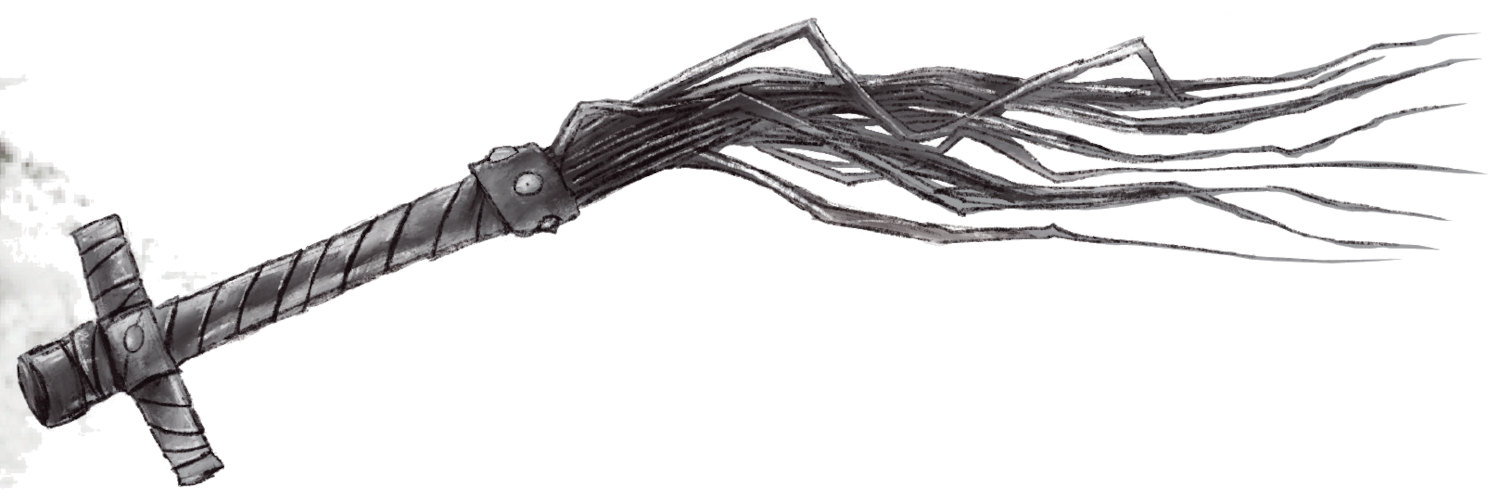
Examples of visual artwork throughout the book that add to this initial impression of the promotion of sexual violence include images of phallus-shaped weapons (figs. 1 and 2), weapons traditionally associated with BDSM such as lashes and scourges (figs. 3 and 4), and images that create an associative link between sex and violence through close physical proximity (figs. 5 and 6).

Figure 1: Phallus-shaped bullet (Lennon 3)
Figure 2: Phallus-shaped dagger (Lennon 27)
Figure 3: Lash (Lennon 38)
Figure 4: Nun using scourge (Lennon 91)
Figure 5: BDSM nun with shotgun (Lennon 8)
Figure 6: BDSM nun with bullets (Lennon 81)

However, upon deeper examination of the text, it can be seen that despite the BDSM theme and sexually violent imagery, concepts of sexual violence do not carry further into the game itself. That is to say, there are no actual game mechanics that overtly promote the use of sexual violence. Players build their characters based on ability “statistics” (Faith, Firepower, Poise, Purity, Piety, and Sex Appeal) (Lennon 10–11) and “skills” (Mechantheism, Affinity, Theology, Oratory, Stunt Driving, Explosives, Ballistics, Faith Healing, Survival, Balletics, Demonology, and Sharp Objects) (Lennon 12–15). Of these ability statistics and skills, only one—Sex Appeal—might appear to have any direct relation to sex, and thereby a hint at sexual violence. The description for this statistic reads as follows:

SEX APPEAL – Your perfect mortal vessel is a testament unto Her [sic] grandeur, and as such its curvaceous frame must be duly exalted. Your essence, your vitality, your comely latex clad presence—all are tributes to her sculptor’s caress. The temptations of the flesh made manifest, hearts pulsating with a bossa nova beat. Your SEX APPEAL stat governs both your powers of persuasion as well as your essential life force. If your SEX APPEAL should ever fall to zero, you have succumbed to the powers of sexless secularity and you must roll another character. (Lennon 11)

Thus, it would seem that this statistic functions as a kind of combined “Charisma” and “Constitution” ability statistic as found in more mainstream TRPGs, and not as something mechanically related directly to sex or sexual violence.

Furthermore, the word sex itself occurs only nineteen times throughout the book. Concordance lines were generated, using the software AntConc (Anthony), with sex as the node word (see Appendix 1). In each case, the word was being used as part either of the title of the book or in the phrase sex appeal and does not co-occur with words relating to violence as one might expect if the game system had been designed to encourage players to actively utilise sexual violence in gameplay.

 Despite the BDSM veneer overlaying the entire game, much of the content seems to focus more directly on religious-themed violence. A good example of this is a weapon available to the characters dubbed “The Sodomiser.” Given the BDSM theme of the game, one might be forgiven for assuming this to be a melee weapon that carries with it a sexually violent connotation. However, the description and illustration (fig. 7) provided in the text’s entry for the weapon make it perfectly clear that the name is referencing not the sexual act of sodomy but rather the biblical destruction of the city of Sodom (and that it is, in actuality, not a melee weapon at all, but a ranged weapon):

The actual missile launcher that brought destruction to the streets and steeples of Sodom and Gomorrah. Eat, Pray, Love [sic]. It’s a Missile Launcher [sic]. Single shot only. 1d20 damage to a wide radius. Anyone gazing upon the explosion must make a successful FAITH check or turn into a pillar of salt for 1d4 rounds. (Lennon 53).
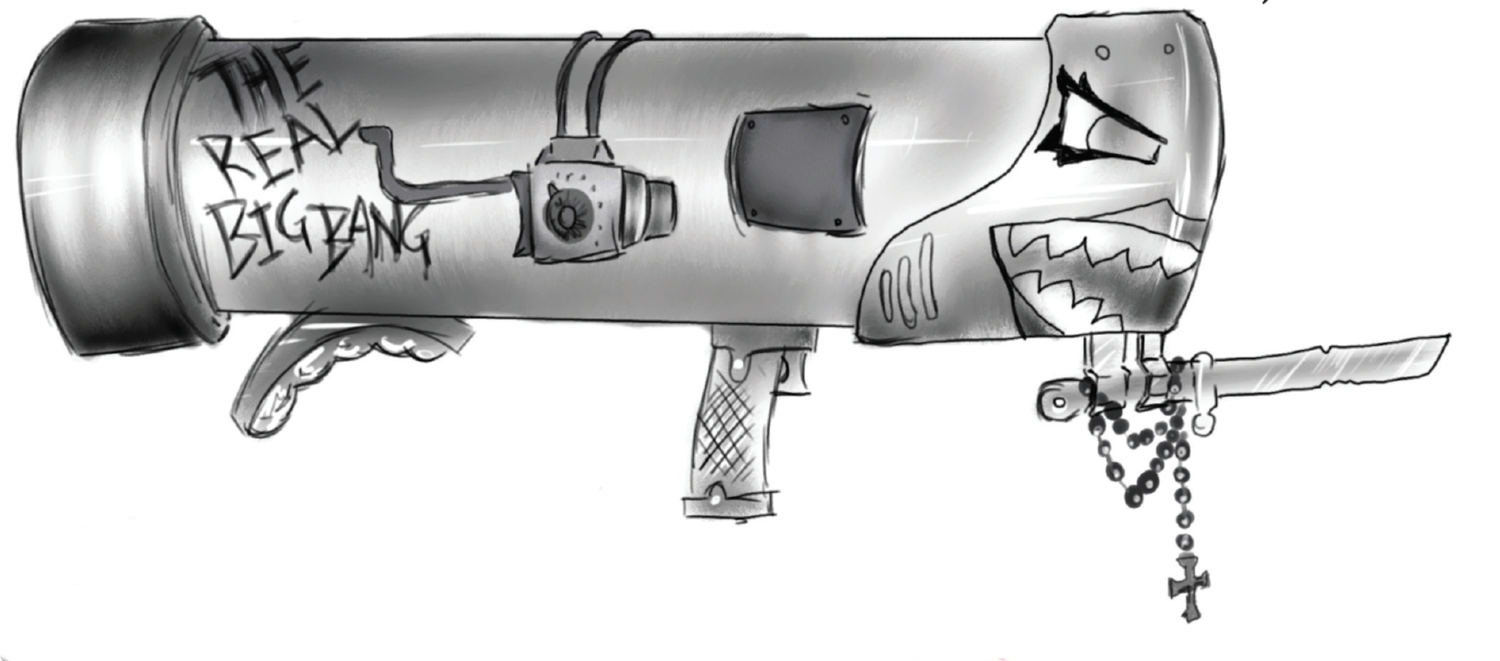
Figure 7: The Sodomiser (Lennon 53)

In fact, there seem to be many more allusions to religious-themed violence than there are to sexual violence throughout the text. For example, “relics,” weapons that can be awarded to players throughout the game, are exclusively themed on religion: St. Elmo’s Fire (a flame thrower), The Crucifier (a nail gun), The Bible Basher (a war hammer), The Holy See (a sniper rifle), A Splinter from the True Cross (a melee weapon), The Flood (a hose that sprays holy water) (Lennon 51–55). This focus on religion can also be seen in the number of religion-related statistics and skills mentioned above (Faith, Purity, Piety, Mechantheism, Theology, Faith Healing, Demonology). Thus, overall, while PPBN is themed on BDSM and makes allusions to sexual violence on a surface level through some of the text and images in the book, sexual violence does not seem to be an integral part of the game. Instead, PPBN appears to focus much more on religious-themed violence.

F.A.T.A.L. From Another Time, Another Land is a fantasy TRPG set in a medieval European world similar to that of D&D. Players embark on adventures and work against monsters and NPCs much in the same way as in PPBN, though there is no overarching set goal for the game itself. Unlike PPBN, which contains a great number of BDSM-themed graphics, there are only three pieces of artwork in FATAL that suggest a possible overlying BDSM theme in the game (figs. 8, 9, and 10).

Figure 8: Woman in bonds (Hall, cover)
Figure 9: Woman in bonds (Hall 2)
Figure 10: Kobold lashing a human slave (Hall 27)

In all three images, a woman is the primary subject, the receiver, of the sexual violence, either fettered or being lashed. This is quite different from PPBN where women are the perceived instigators of the violence. To explore the depth to which the author takes this violence one need only go as far as the introduction to the book, which contains a detailed content warning and an explanation for the inclusion of that content:

Since the game includes both sex and violence, the combination is also included: rape. Rape is not intended to be a core element of F.A.T.A.L., as killing is a core element of most role-playing games. Fatal Games considers rape to be a sensitive issue, and only includes it because of its prominence in the past. For example, Europe was named after Europa, who was raped by Zeus, according to Greek mythology. In Jacques Rossiaud’s Medieval Prostitution, he reviews statistics on rape from numerous towns and cities in southeast France during economic and social stability, not war. Jacques attempts to represent all medieval prostitution with this book. In it, he estimates that half the male youth participate in at least one gang rape, and that sexual violence is an everyday dimension of community life. (Hall 7)

Whether or not rape is a core element of FATAL will be explored in more detail below. Turning first to the language used, one finds that the word rape (used in the sense of sexual violence) occurs no less than forty-seven times throughout the book, outside of indices. Concordance lines were generated with rape as the node word (see Appendix 2). These occurrences can be classified into several different usage types as seen in Table 1 below:

ClassificationExamples (Hall)
1. To outline how rape is viewed/handled in the game’s fictional society, socially and legally.Imprisonment for rape consists of flogging, unless the rapist is an outsider, in which case the rapist is banished. When freed from imprisonment, a rapist is not considered criminal or bad. (192)   If the victim of rape is single, then fewer males desire her as a wife. (192)   The rape of a whore of a public brothel is punishable by a fee of 10 s.p. The rape of easy women who have exposed themselves in public places or in the private brothel is not punishable. (223)  
2. To highlight the negative/frightening aspects of particular monsters/NPCs.Victorious bugbears will often rape human women before devouring the children. (18)  
3. To explain PC/NPC personalities and backgrounds.Characters who have been physically violated or raped are regarded as shamed and exhibit bashfulness. (123)   Half of whores are forced into the occupation, and half of those are victims of public rape. (311)  
4. As in-game punishment.The criminal [convicted of practicing witchcraft] is often raped, then burned alive. (196)  
5. As an action that PCs may attempt in game.Some men attempt rape after intimidating women to allow the man to have his way with her; oftentimes, if this fails, the man changes tactics and attempts a Wrestling skill check, hoping to overbear her. (357)   If a human male successfully overbears a female, then it is possible that rape may occur. If a male seeks to have his way with a female at her expense and whether she likes it or not, he may attempt to Intimidate her to allow him to rape her without resistance. (398)  
6. As part of an effect from a magic item or spell.Rapeseed of Raping: If a character swallows this seed, they will attempt to rape the next member of the opposite sex in sight regardless of age. (736)   Caster immediately tries to rape the target creature for 1d20 rounds and has amnesia about it. (863)   The nearest master must attempt to rape their favorite apprentice, and the caster knows it. (876)   Caster and target forever believe that rape is fun and should be exercised daily. (880)
Table 1: Usage classifications of rape with select examples.

Furthermore, unlike PPBN, sexual violence has been incorporated into the game at the mechanics level. The “Rape roll” is a sub-category of the “Overbearing” mechanic and is described by the author in the following way:

The Rape roll consists of rolling 3d10, and the rapist wants to roll higher than 1/3rd of the weight difference as used in Overbearing, doubled by Intimidation if used, and the roll is modified by clothing or armor. If the roll fails, then the female manages to escape from the clutches of the rapist, and 80% of the time manages to land a Brawling blow with Graphic Gore either to the manhood (01- 50%) or testes (51-100%) of the would-be rapist. Further, if the roll fails then she either escapes prior to penetration (01-60%) or during the violation (61- 100%). If the roll is successful, then the male does with her as he likes. (Hall 398)

As can be seen, despite the author’s claims that rape “is not intended to be a core element of F.A.T.A.L.” (Hall 7), it seems to permeate every aspect of the game. The author includes sexual violence not only as part of a historical setting—his perception of which being perhaps based solely on his reading of Rossiaud—but also to flavour the fantasy/magical aspect of the game, and as background during PC creation. Where there is little to no evidence of a deeper-level weaponisation of sex in PPBN, FATAL has weaponised sex at the most fundamental level of the game by employing the Rape roll mechanic.

As Sihvonen and Harviainen state in their study on the intersection of games and BDSM, “just because the stage has been decorated with elements commonly associated with BDSM, it does not mean the activity or interaction that takes place on that stage is sadomasochistic” (5). This would seem to be the case in PPBN. If not employed for the purpose of weaponising sex in the game, the BDSM veneer must serve some other purpose.

One way of looking at this could be to see the BDSM overlay in PPBN as an aspect of what Ekman calls “non-narratival” (118) world-building. Much in the same way the illustrations in the D&D core books help depict the “pseudomedieval nature of the world” (Ekman 125), the BDSM veneer here helps contribute to the building of a kind of “otherworldliness” or absurd dystopia by irreverently combining the BDSM images with those of the traditionally desexualised Catholic religion. This combination of contrasting elements helps create and define a strange new world, very different from the one that players are used to. Here the inclusion of sexual violence, or the veneer of sexual violence, may have no other purpose than this: to juxtapose the religious theme and create a game world that is, in essence, alien to the players. There are many examples of this in science fiction and fantasy at both the micro- and macro-levels. An example of combination for the creation of otherworldliness at the micro-level would be the creation of new vocabulary, as in techpriest from “technology” and “priest” (c.f. the Warhammer 40k novels, Thomas 442). At the macro-level, this can be seen in the anachronic overlaying of characters and setting. A good example of this is the Victorian character Edgar Allan Poe being used as the proprietor of an AI hotel in the cyberpunk series Altered Carbon.

Another way of looking at the function of the BDSM veneer is as social commentary in the form of satire. Lennon states in the introduction to PPBN that “it is a game for any group of friends with a penchant for satire and extremely poor taste” (6). The flipped nature of the protagonists and antagonists here pokes fun at the current cultural situation in America and other places relating to “anti-vaxxer” movements and other conservative views being put forward in the news media recently. More importantly, however, the author’s reticence to explicitly deal with sexual violence together with his heavy satirisation of religion perhaps speaks to mainstream society’s shifting perceptions of what is sacred and what is not. Religion has become, in many circles, something of an easy target for satire, where joking about sexual violence generally remains taboo.

With regard to FATAL, the weaponisation of sex seems to play an opposite role. Rather than using it to help build an otherworldliness as is done in PPBN, the author claims to use sexual violence to bring a greater degree of realism to the game. As mentioned above, the author of FATAL argues for the inclusion of sexual violence on the basis that it makes for a more realistic game because rape was a very real part of medieval life. He also seems to argue that in reality not everyone is a hero, so allowing for a variety of actions along a full moral cline also makes the game more real, and in his mind, more fun:

For instance, assume you are an adventuring knight who has just fought his way to the top of a dark tower where you find a comely young maiden chained to the wall. What would you do? Some players may choose to simply free the maiden out of respect for humanity. Others may free her while hoping to win her heart. Instead of seeking affection, some may talk to her to see if they can collect a reward for her safe return. Then again, others may be more interested in negotiating freedom for fellatio. Some may think she has no room to bargain and take their fleshly pleasures by force. Others would rather kill her, dismember her young cadaver, and feast on her warm innards. . . . No other game allows so much individual choice, and consequently, so much fun. Since the purpose of a table-top role-playing game should be to allow a player to play the role of their character as desired, this game includes a wide range of material, from moral to immoral. This game does not support morality or immorality, but allows each player to role-play as desired. (Hall 4)

The author includes other negative elements of medieval society such as disease (malaria, bubonic plague, leprosy), infant death, and poverty-stricken peasant life, though perhaps to a somewhat lesser extent than he does rape.

One important aspect of gameplay in TRPGs is the perceived inverse relationship between “playability” and “realism.”  The traditional view is that the more realistic you make the game, through the introduction of detailed game mechanics that handle the different aspects and situations of life in the game (often referred to as “crunchiness”), the more difficult it is to play the game. According to Garthoff, however, there is an interplay between “realism” and “playability” in which realism helps to “constrain works of creative fantasy” (1). Without the constraint of realism imposed by detailed game mechanics we end up

articulating a conception of society which is satisfying to the imagination but unsustainable given human social psychology. . . . permitting arbitrary, ad hoc, or contradictory rules or laws of nature—would be unrealistic, not because such rules are unplayable but because they fail to articulate a convincing world. (12)

While this may go some way towards validating the inclusion of sexual violence in FATAL, the graphic nature of the language used to implement it as well as its inclusion in every aspect of the game, both the real and fantastical, can alienate—and indeed has alienated (Furino)—the players and much of the gaming community. Where PPBN’s reluctance to incorporate sexual violence into the game at the mechanics level may well reflect society’s guardianship of this topic as something not to be gamified, FATAL seems to be rebelling against this taboo. The gaming community’s alienation from this particular game is also especially understandable, given that one of the central “pillars” of nearly every TTRPG is that the player characters are the heroes of the story. PPBN was able to overlay religion with sexual violence and still maintain the PCs, the nuns, as the heroes of the story. In FATAL, there is no requirement, written or assumed, that the PCs be heroes in any way.

Finally, unlike PPBN, no real case can be made for the weaponisation of sex being used in FATAL as satire or humour. The author’s single comment that “the greatest concentration of obscenity is in Appendix 3: Random Magical Effects, and is intended for humorous effect” (7), does very little to alleviate the graphic and serious nature of many of the sexually violent acts mentioned in that section. In summary, PPBN does not appear to be actively weaponising sex, but rather uses a veneer of sexual violence to help generate a kind of otherworldliness. FATAL, on the other hand, does weaponise sex, and uses sexual violence more deeply and broadly in an attempt, successful or not, to help generate a more realistic game world.

This paper looked at the weaponisation of sex in two tabletop role-playing games and highlighted the different approaches each author employed when incorporating sexual violence into their game design. As Lennon states in the introduction to PPBN, “Pistol Packing Bondage Nuns From Dimension Sex, much like any Role-Playing Game, is a mirror—in that your experience reflects what you bring to it” (3). It may well be that players fully embrace the BDSM theme of PPBN and work to incorporate sexual violence into their own personal game sessions at the story-telling level, using the imagery and innuendo from the text as a springboard to go deeper into the theme; and conversely, it may be that players of FATAL decide not to fully incorporate into their games the copious and detailed mechanics of sexual violence available to them in the rulebook. The depth and degree to which players decide to utilise sexual violence in their games will very likely have an impact on the degree to which heroism, or the lack thereof, plays out in their sessions.

WORKS CITED

Altered Carbon. Created by Laeta Kalogridis, Virago Productions, 2018. Netflix, Netflix app.

Anthony, Laurence. “AntConc.” Laurence Anthony’s Website, 4.0.10, 2022, www.laurenceanthony.net/software. Accessed 25 April 2022.

Ekman, Stefan. “Vitruvius, Critics, and the Architecture of Worlds: Extra-Narratival Material and Critical World-Building.” Fafnir: Nordic Journal of Science Fiction and Fantasy Research, vol. 6, no. 1, 2019, pp. 118–31.

Furino, Giaco. “The New Generation of Sex-Centric Tabletop RPGs.” Vice, 4 April 2015, www.vice.com/en/article/ppm7nv/fuck-for-satan-the-new-wave-of-sex-centric-rpgs-456. Accessed 25 April 2022.

Garthoff, Jon. “Playability as Realism.” Journal of the Philosophy of Games, vol. 1, no. 1, 2018, pp. 1–19.

Hall, Byron. F.A.T.A.L. From Another Time, Another Land. Fatal Games, 2004.

Lennon, Andi. Pistol Packing Bondage Nuns from Dimension Sex. Godless Monkey Cult, 2021.

Sihvonen, Tanja and J. Tuomas Harviainen. “‘My Games are . . . Unconventional’: Intersections of Game and BDSM Studies.” Sexualities, 2020, pp. 1–17.

 Stavropoulos, John. “Safety Tools for Simulations and Role-Playing Games.” http://tinyurl.com/x-card-rpg. Accessed 25 April 2022.

Thomas, Dax. “Exploring Word-formation in Science Fiction Using a Small Corpus.” Proceedings of the 4th Asia Pacific Corpus Linguistics Conference, 2018, pp. 440–44.

APPENDIX 1

Each Sainted Sister starts with a total of 6 PIETY points.SEXAPPEAL Your perfect mortal vessel is a testament unto
INTERVENTION. (The only exception to the d20 rule is withSEXAPPEAL checks which utilise d30). It’s up to
at the cost of not re-gaining any PIETY orSEXAPPEAL during this rest period. The beating corporate heart
our Sainted Sisters. The recipient of the anointment recovers 1d6SEXAPPEAL points. On the Third Day – By laying hands
persuasion as well as your essential life force. If yourSEXAPPEAL should ever fall to zero, you have succumbed
flesh made manifest, hearts pulsating with a bossanova beat. YourSEXAPPEAL stat governs both your powers of persuasion as
healing effects of REST on delves into apocryphal lore. theirSEXAPPEAL stat. Piety can also be awarded by the
damage die, subtracting the result from their opponent’sSEXAPPEAL. Burst Shot -A wide arc of justice erupting
 damage die, subtracting the result from their opponent’sSEXAPPEAL. Staggering Blow- Similar in every way to a
The Anointing of the Feet which robs victims of 1d6SEXAPPEAL Blinding Ink -Summons a veil of impenetrable darkness
add it to your PURITY stat to determine your startingSEXAPPEAL TEST YOUR FAITH! SKILLS In their prophesied role
Agility, Speed PURITY Constitution, Health, Resistance, StaminaSEXAPPEAL Hit Points, Life, Structural Damage Capacity, Charisma
Vestments: Nil Special: Bellowing Roar – When reduced to half hisSexAppeal, George will let out a deafening roar that
 PISTOL PACKING BONDAGE NUNS FROM DIMENSIONSEX!BELIEVERS!! Welcome to humanity’s last stand. Welcome to
Welcome to: PISTOL PACKING BONDAGE NUNS FROM DIMENSIONSEXPPBNFDS is a Tabletop campaigns, the focus is Role
and remain in place for 1d4 rounds. They possess nosexappeal and all their actions are illusory. Transubstantiation – Water
fast and lethal with an emphasis on style, swagger, andsexappeal, as you dispense foaming cups of sweet retribution
Reliquary Deep within the startling, swirling vortices of DimensionSexlies a chamber whispered of in reverent fables. A
Sexily. What Is This? Pistol Packing Bondage Nuns From DimensionSex,much like any Role-Playing Game, is a mirror –

APPENDIX 2

that rape is wrong. Caster and target forever believe thatrapeis fun and should be exercised daily. Caster and
death. Human: The criminal is fined 1d100 s.p. RapeRapeis illicit sexual intercourse without the consent of the
both sex and violence, the combination is also included: rape.Rapeis not intended to be a core element of
victim. The human victims of gang rape are age 15-33. Childrapeis rare. The rape of a child under the
is not considered criminal or bad. The social reaction torapeis rarely favorable to the victim. The human victims
her place in society and family. If the victim ofrapeis single, then fewer males desire her as a
superior in every way. Caster and target forever believe thatrapeis wrong. Caster and target forever believe that rape
roll. If either of them is wearing clothes, then theRaperoll suffers a + 2 penalty, + 6 for both. If either wears
penalty, + 6 for both. If either wears light armor, then theRaperoll suffers a + 3 penalty, + 6 for both. If either wears
penalty, + 6 for both. If either wears medium armor, then theRaperoll suffers a + 6 penalty, + 9 for both. If either wears
penalty, + 9 for both. If either wears heavy armor, then theRaperoll suffers a + 9 penalty, + 18 for both. The Rape roll
then the Rape roll suffers a + 9 penalty, + 18 for both. TheRaperoll consists of rolling 3d10, and the rapist wants
a Drive check at TH 17 or attempt to isolate andrapethe attractive character. For rules on rape, see the
If a character swallows this seed, they will attempt torapethe next member of the opposite sex in sight
a permanent + 1d10 bonus to CA. Caster immediately tries torapethe target creature for 1d20 rounds and has amnesia
s door at night, do not disguise themselves, and eitherrapethe victim in her home and in the presence
of gang rape are age 15-33. Child rape is rare. Therapeof a child under the age of 14 or 15 is
anal sex. Heterosexual sodomy is less frequent than bestiality. Therapeof a whore of a public brothel is punishable
brothel is punishable by a fee of 10 s.p. Therapeof easy women who have exposed themselves in public
to death. Human: The criminal is fined 1d100 s.p.RapeRape is illicit sexual intercourse without the consent of
includes both sex and violence, the combination is also included:rape.Rape is not intended to be a core element
is male, then he must attempt to either overbear andrape(see Wrestling in Chap. 8: Skills) or practice his Seduction
to isolate and rape the attractive character. For rules onrape,see the section on overbearing in the Wrestling skill
violently. Every time a spell is cast, the caster screamsrape.Every time a spell is cast, the caster screams
the occupation, and half of those are victims of publicrape.Roughly 25% of whores begin by being prostituted by their
Half the male youth participate at least once in gangrape.Sexual violence is an everyday dimension of community life.
Fear of words. Vestiphobia: Fear of clothing. Virginitiphobia: Fear ofrape.Vitricophobia: Fear of step-father. Wiccaphobia: Fear of witches
spirit is broken or all courage lost. Some men attemptrapeafter intimidating women to allow the man to have
even members of nightly gang rapes. The victim of gangrapealmost never accuses them of committing sodomy. Kobold: Slaves
hallucinate that the target of the spell is attempting torapean ox. Caster begins to hallucinate that they see
half the male youth participate in at least one gangrape,and that sexual violence is an everyday dimension of
rarely favorable to the victim. The human victims of gangrapeare age 15-33. Child rape is rare. The rape of
 the complaint, the rapist is freed immediately. Imprisonment forrapeconsists of flogging, unless the rapist is an outsider,
In Jacques Rossiaud’s Medieval Prostitution, he reviews statistics onrapefrom numerous towns and cities in southeast France during
he may attempt to Intimidate her to allow him torapeher without resistance. On the other hand, he may
a blasphemer. Nearest female believes the caster is trying torapeher. All involved in encounter or 1d10’ radius go
killing the father or adult males. Victorious bugbears will oftenrapehuman women before devouring the children. Human women who
male successfully overbears a female, then it is possible thatrapemay occur. If a male seeks to have his
accurately represent mythology are likely at some point to includerape,molestation, encounters in brothels, or possibly situations that deviate
or armor. If naked, there is no modifier to theRaperoll. If either of them is wearing clothes, then
of note. If a character is born the result ofrape,such as with the vast majority of anakim, the
am full of shit!” The nearest master must attempt torapetheir favorite apprentice, and the caster knows it. The
a giant, UI, rabid hare named Bugs, is attempting torapethem. Caster begins to hallucinate that they have leprosy
core element of most role-playing games. Fatal Games considersrapeto be a sensitive issue, and only includes it
traumatic or catastrophic events such as physical or sexual assaults,rape,torture, natural disasters, accidents, and wars. Characters with this
   must be knowledgeable and persuasive. A procuress recruitsrapevictims, abandoned females, and solicits wives who feel constrained
by the plaintiff until satisfied with justice. Information on medievalrapewas referenced from Rossiaud’s Medieval Prostitution. For more

Note on Figures: Figures 1 through 7 are included with permission of the author and artists of PPBN. The company that published FATAL no longer exists and it was not possible to contact the author of this work directly. Figures 8 through 10 are included under “fair use”.

Dax Thomas is an assistant professor in the Centre for Liberal Arts at Meiji Gakuin University, Yokohama, Japan. He is an English teacher and corpus linguist, and his current main areas of research interest lie in word-formation and vocabulary usage in fantasy, science fiction, RPG, and historical texts.


Octavia Butler’s Dawn in the #MeToo Era


SFRA Review, vol. 52, no. 3

Sexual Violence and Science Fiction


Octavia Butler’s Dawn in the #MeToo Era

Julia Lindsay

In 1987, social scientist Mary Koss published the first national study on rape and sexual assault. It revealed the harrowing statistic that one in four women on U.S. college campuses had been victims of sexual assault, a statistic that would prove consistent with the entire female population in the United States. [1] Despite federal legal codes that clearly delineate what constitutes rape and sexual assault, Koss’s research indicated that many women did not consider their individual experiences as rape, bringing to light a larger problem in public discourse. Most people, she found, did not understand that rape and sexual assault occur not only when an individual does not consent but also when they are unable to give consent.

That same year, Octavia Butler published Dawn, the first novel in her Xenogenesis series. In Dawn, nuclear war has rendered the Earth uninhabitable and has killed off large populations of humans and animals. A first-contact narrative, Dawn follows Lilith Iyapo, a Black American woman who wakes up aboard the spaceship of an alien species called the Oankali. The Oankali, who are able to read and manipulate a being’s genetic material, inform Lilith that it is their biological imperative to advance their species through “gene trades.” An agender subspecies of the Oankali, called the ooloi, facilitates their reproduction, penetrating the bodies of male and female partners with their sensory tentacle arm and mixing their DNA. Lilith learns that many other humans are in suspended animation on board and that the Oankali intend to gene trade with them and return to Earth—which would alter both of their species in the process. The Oankali then task Lilith with waking the other humans, serving as a cultural mediator between the two, and preparing them for this project.

Butler produced in Dawn quite a complicated and nuanced narrative. The two species cannot be easily split into heroes and villains or victims and aggressors. The Oankali can be seen as both saviors and captors, rescuing the humans from their deadly fate but exerting great control over them, leaving them with little choice but to go along with the Oankali plan. However, Butler also problematizes the destructive tendencies latent in human nature and their manifestations in the societies of the global superpowers. Thus, criticism on the novel is often split between hailing the Oankali as the embodiment of alternative or subversive episto-ontological perspectives or reading them as an allegory for slavery and colonization (Sanchez-Taylor). Yet while critical work runs the gamut of conversations on gender, sexuality, queer studies, and Deleuzian ontology/rhizomatic frameworks, scholars have paid very little attention to the novel’s problematic sexual politics (Bogue, “Alien Sex”; Bogue, “Metamorphosis”; Ackerman; Atterbury).

These issues were not given essay-length focus until thirty-three years after Dawn’s publication. In “Troubling Issues of Consent in Dawn” Joshua Burnett fruitfully highlights some of the key moments in the series illustrating that consent—sexual and otherwise—is a running theme. He suggests we “read Dawn as a parable for the need for affirmative consent in sexual encounters, particularly ones which transcend barriers or break taboos” (Burnett 119). Such a suggestion is in line with the analytical moves Burnett makes across the essay, a death-of-the-author approach that centered on tensions within the text and how they may be useful for readers in the present, avoiding a more direct criticism of the novel or Butler herself. My essay will examine three scenes in the novel which feature sexual violence and violations of consent, two of which occur between Lilith, her partner Joseph, and an ooloi named Nikanj. I contrast these with a scene wherein Lilith stops a human —who epitomizes toxic masculine aggression and entitlement—from raping a woman. I argue that the direct condemnation of rape in this scene reveals Butler’s own blindness to the fact that the other encounters are acts of rape and sexual violence. As Lilith and Nikanj conspire to violate Joseph’s body autonomy through drugs, physical force, and coercive strategies, Butler reproduces rape culture narratives to justify their actions.

The dearth of scholarship on sexual consent in the thirty years following Dawn’s publication undoubtedly stemmed from the fact that, as Koss recently lamented in an episode of NPR’s This American Life, the social impact of her research was minimal even though it garnered national attention (and yes, this includes reactionary backlash). Rape statistics remain roughly the same, and Koss’s work did little to ameliorate ignorance towards the definition and parameters of rape and sexual assault. [2] It is unsurprising, then, that Burnett’s contribution to Butler scholarship arrived in the midst of the #MeToo movement which not only brought the ubiquity of sexual assault back to the forefront of the public imagination but also shined a light on why such an epidemic continues.   

The #MeToo movement began in 2017 after actress Alyssa Milano’s tweet asking followers to respond “me too” if they had been victims of sexual assault exploded on Twitter. It bears repeating, however, that the first woman to use the me too slogan was Black American Tarana Burke in 2006. Before the days of Twitter, Burke used then-popular social media site Myspace to raise awareness about the pervasiveness of sexual assault and to give women and girls—particularly women and girls of color—a sense of solidarity and voice (Burke). While the #MeToo movement shared this purpose, because it spawned from women in Hollywood speaking out against the ways they were coerced or forced into sexual activity by higher ups in this male-dominated industry, the #MeToo movement initially took the shape of a public reckoning. 

Victim-survivors outed major figures beyond the entertainment industry, pushing the public to examine politicians and business leaders with renewed scrutiny. With the genesis of the #MeToo movement centering on men occupying powerful positions in society, the #MeToo movement shed greater light on gendered power politics in the public arena than the campaigns against sexual violence that preceded it. In fact, systemic problems were at the heart of #MeToo. As Giti Chandra and Irma Erlingsdóttir write in their introduction to the Routledge Handbook on the Politics of the #MeToo Movement,one of the movement’s “greatest strengths” is its criticism of social systems, that it is “a reaction not to the individual, but to a system designed to fail those who have been subject to sexual harassment and violence” (7). However, as the movement shifted from its focus on affluent white women to include all genders and people of different sexual orientations of various economic strata, their contributions drew attention to #MeToo’s conflicting message. 

If the affluent women initially leading the #MeToo movement encouraged publicly speaking out or even naming the assailant or aggressor as the primary means through which to bring them to justice—implying that the force or threat of national visibility and widespread scrutiny would combat these systemic problems—they seem to have taken for granted their own immense cultural capital. Intersectionality marginalized people, in other words, played a significant role in highlighting the reality that “For the majority of survivors, legal recourse is not economically affordable, professionally feasible, personally possible, socially acceptable, or emotionally viable” (Chandra 9). The movement’s systemic approach likewise opened up discussion about the cultural effect of hetero-patriarchy. #MeToo insisted that our cultural narratives contribute to the ubiquity of sexual violence. The continued societal negligence in discussing the various forms that rape and sexual assault take certainly necessitated the movement’s particular emphasis on expressed verbal consent, and as the movement became more inclusive, it went on to spotlight myriad forms of sexual harassment with a vested interest in exposing coercive and manipulative tactics. Introducing the term “rape culture,” #MeToo clarified this cultural diagnosis, drawing attention to patterns in behaviors and ideas such as what we now refer to as “toxic masculinity” or “white male entitlement.”

The #MeToo movement has since directed critical attention to re-evaluating and problematizing contemporary cultural production and that of our not-too-distant past. It can be understood, as Chandra and Erlingsdóttir write, as “an archive of lived counter-memories that militate against what is deemed to matter in hegemonic historical narratives, highlighting its exclusions. It is a call for resistance and for breaking silences” (3). Science fiction critics are certainly answering this call. For my part, I will spotlight sexual scenarios in Dawn that mirror the very issues of power politics, coercion, and rape culture narratives brought to the forefront of public discourse by the #MeToo movement.

The Image of the Rapist in Dawn 

While the ooloi’s phallic sensory arm and its reproductive role between Oankali already provides an analog to penetrative heterosexual sex, the connections between the three parties that the ooloi facilitates by inserting its sensory arm into the spinal cords/nervous systems indicates that Butler means for this act to represent the emotional intimacy associated with sex, reproductive or otherwise, between partners. The oolio’s control of biological processes not only allows it to create intense emotional bonding between partners, it facilitates feelings of ecstasy that we associate with sexual release and satisfaction. Indeed, the first time Nikanj (with whom Lilith has already developed a consensual sexual relationship) joins together Lilith, Joseph, and itself, it recycles images of Joseph and Lilith’s previous sexual encounters, essentially creating a simulation of heterosexual penetrative sex in their minds. [3] This is an act of rape, however, as Joseph was unwilling and unable to consent.

Through her research, Koss realized that women were less likely to characterize sexual encounters they did not consent to as rape if they knew, were friends with, or were involved with the perpetrator. Attempting to broaden the public image of rape, Koss coined the term “date rape.” Today the word “date rape” is most commonly associated with drugs used by rapists to heavily intoxicate or render victims unconscious so they cannot physically resist. [4] The first of the three scenes this essay examines exemplifies both Koss’s original definition and the contemporary conception of date rape. When Joseph meets Nikanj, the first ooloi he’s ever seen, Nikanj shares its desire to build a friendship with him, offering up its non-sexual tentacle under the pretense of a friendly gesture—a greeting geared towards mitigating Joseph’s discomfort in the face of this alien form. Despite his great revulsion, Joseph builds up the courage to accept this gesture and touches Nikanj’s non-sexual tentacle. Emitting a biological sedative through its tentacle, Nikanj puts the deeply frightened Joseph to sleep instantaneously. Nikanj then peels off Joseph’s jacket, lays itself down against him, and penetrates his neck with its sensory tentacle.

Though Lilith initially protests, asking Nikanj if it drugged Joseph or if he fainted, she then “wondered why she cared” (Butler 160). In this moment, Lilith becomes a co-conspirator in assault, joining in upon Nikanj’s invitation. Butler concludes the scene with an erotic description of Nikanj’s penetration of Lilith, which, uniting all three, marks the full commencement of this sex act: “She felt it tremble against her, and knew it was in” (161-62). Lilith is clearly aware that this is a nonconsensual violation of Joseph’s body and that she played an active role in it, as captured in a passage soon after: “‘He might . . .’ She forced herself to voice the thought. ‘He might not want anything more to do with me when he realizes what I helped you do with him’” (164). Nikanj does as well, responding, “‘He’ll be angry—and frightened and eager for the next time and determined to see that there won’t be a next time. I’ve told you, I know this one’” (164). Lilith’s comment here provides important insight into her character and her perception of sex and consent, as Lilith refers to this sexual violence as something done “with” Joseph instead of to Joseph. This language and the erotic descriptions above reflect a problematic pattern in Butler’s presentation of these scenes. As this essay will continue to tease out, Butler naturalizes rape culture narratives by implying some form of participation or consent from the victim, and this contributes to the ways in which these scenes elide the horror latent in such overt sexual violence. As Nikanj predicts, Joseph will adamantly decline Nikanj’s advances, and Nikanj will again act against his wishes.

Sandwiched between these two assaults, however, Butler features a scene of sexual violence amongst the humans that she presents with far greater climactic urgency and which she treats with considerable seriousness. A woman’s scream brings a self-sequestered Lilith into a scene of chaos. Newly awakened Gregory and Peter, the leader of a faction attempting to subvert Lilith’s authority, are holding a struggling woman, Allison, between them and attempting to drag her into Gregory’s bedroom in order to take turns raping her. Lilith witnesses a group of people attempting to free Allison struggle against attacks by members of Peter’s faction. This already horrific mob violence snowballs as the fate of this woman’s body becomes a political battle with bystanders from the respective parties screaming at and over each other.

Peter’s faction justifies this violence under a contrived pretense that the survival of their species depends on reproduction. One member yells, “‘What the hell is she saving herself for?… It’s her duty to get together with someone. There aren’t that many of us left’” (Butler 177). One of Lilith’s most vocal dissenters, Curt, attempts to paint this “duty” as a burden equally shared between the sexes. When a woman tries to defend hers and Alison’s right to bodily autonomy, Curt “bellows, drowning her out,” “‘We pair off!… One man, one woman. Nobody has the right to hold out. It just causes trouble’” (177). It is, of course, clear that the patriarchal and misogynist American society from which they came informs the actions of Peter’s group. The language used (“holding out”) to justify sexual violence and socially sanction Allison’s choice not to have sex echoes rhetoric historically used against women. Butler here calls attention to the kind of male entitlement the #MeToo movement would later pinpoint as a defining trait of toxic masculinity and rape culture. When a male ally steps in to defend Allison, another co-conspirator responds, “‘What is she to you… Get your own damn woman!’” highlighting the longstanding treatment of woman as property and implicating it in acts of sexual violence (177).

In a climactic moment, Lilith intervenes, her rage and her enhanced strength allowing her to throw aside the attackers. She authoritatively tells the group, “‘There will be no rape here,’” continuing, “‘nobody here is property. Nobody here has the right to the use of anybody else’s body. There will be no back-to-the-Stone-Age, caveman bull shit!’” (178). Lilith’s powerful declaration and her physical domination over these would-be rapists may read like a triumphant feminist moment. However, Lilith’s characterization of this violence as a relic of a long-gone past—as a devolution and the antithesis of civilized, modern society—both reflects and contributes to the societal ignorance towards the prevalence of sexual assault Koss identified two years prior. Koss’s research found that many women did not identify their experience as rape because it did not cohere with the image of rape, or, more specifically, the image of the rapist in the public imagination. The popular narrative of the monstrous stranger lurking in an alleyway for a blitz attack obscured the fact that 70% of rapes are committed by someone the victim knows, preventing countless people from understanding the nature of the offense they’d been victim to or reporting it to the authorities. 

“I Know You Want It”: Rape Culture Narratives and Sexual Scripts

Perceptions such as these constitute what social scientists call “rape scripts,” a subset of “sexual scripts.” Sexual scripts “play a role in the creation of… rape scripts,” writes Amanda Denes in “Biology as Consent: Problematizing the Scientific Approach to Seducing Women’s Bodies,” defining sexual scripts as “schemas that dictate expectations for sexual encounters and ‘ways of knowing how to behave in sexually defined situations’” (Ryan, qtd. in Denes 413). In her study of rape and seduction scripts, Kathryn Ryan found that the majority of participants’ rape scripts mentioned aggressive acts. Their conceptualizations largely featured angry men, conceived as “low status”—participants variously described individuals with “’serious mental problems… and/or social problems’ such as being a heavy drug user, an alcoholic, or a social outcast” (Ryan, qtd. in Denes 413). Butler recreates this rape script in Peter’s angry blitz attack on Allison and in Lilith’s characterization of him as a “caveman” and a “fool” which together suggest social degeneracy and intellectual deficiency (Butler 178). Conversely, as Brian Attebury points out, “The action of the story represents [the ooloi] in terms of plentitude, power, psychic merging, sexual satisfaction, evolutionary advancement,” desirable traits that will ultimately aid Butler in casting Nikanj’s sexual violence as seduction instead of rape (145). If Butler crafted Lilith’s monologue to serve as a triumphant feminist moment, this strong criticism of rape only betrays Butler’s blindness to the overt violations of consent in the coming scene and how it replicates myriad forms of coercion common then and today.

Indeed, the following rape scene opens quite differently, as Nikanj’s flirtation, sexual innuendo, and seductive invitation piques Lilith’s sexual desires. Even as they lead Joseph, who is unaware of what is happening, into the bedroom—and which could therefore be just as easily cast as a predator trapping its prey—this moment borders on the erotic, even the romantic. Simultaneously acknowledging that the last sexual encounter between them was rape (though without using the word), Nikanj offers Joseph the illusion of choice, telling him, “‘I left you no choice the first time. You could not have understood what there was to choose. Now you have some small idea. And you have a choice’” (Butler 188). Realizing what is taking place, Joseph sharply responds “‘No!… Not again!’” (188). Nikanj however does not respect this explicit denial of consent, continuing to push for sex, it responds, “‘and yet I pleased you. I pleased you very much’” (188). When Joseph retorts that such pleasure was an illusion, Nikanj responds, “‘what happened was real. Your body knows how real it was’” (189). Ignoring someone’s explicit rejection of a sexual offer by attempting to argue with their reasoning is already a coercive strategy, and while this pressure may be comparatively less malicious, Nikanj’s response here sets the stage for a pattern of rhetoric both used in coercing victims into “consenting” and used to justify nonconsensual assault and forceful rape. Nikanj’s response, and the rhetoric it echoes, provides the basis of an argument that dismisses verbal denials of consent on the false premise that the victim clearly wanted it, that the body betrayed such a desire. “Privileging the body as truth,” Denes writes, aligns with the “rape culture sentiment that the bodily experience is more important than the rational, verbal experience, or more succinctly, that no can mean yes” (411). In other words, under this “logic,” the body’s “desires” supersede express denials of consent.

To be sure, the argument implicit in this first statement will become more explicit in tandem with the increase in Nikanj’s use of physical force. Immediately after Nikanj finishes this initial statement, it “caught [Joseph’s] hand in a coil of sensory arm”—the verb here already implying unwanted force just as the “coil” conjures images of bondage (Butler 189). Joseph recognizes the danger of this situation, pulling away and urgently responding, “‘You said I could choose. I’ve made my choice!’” (189). Nikanj’s coercive routine intensifies, as it moves from grabbing his hand to taking greater liberties with his body: “‘You have, yes.’ It opened his jacket . . . and stripped the garment from him. When he would have backed away, it held him. It managed to lie down on the bed with him without seeming to force him down. ‘You see, your body has made a different choice’” (189). This scene reflects a common pattern under rape culture—the perpetrator coolly attempts to persuade the victim into sex in a seductive or calmly playful manner, creating an illusion of choice. They touch the victim’s body, often in an accelerating manner, despite not receiving verbal consent. But they do not yet use extreme force, simultaneously maintaining a facade of innocence while demonstrating their physical power over the other. 

Another subset of sexual scripts, seduction scripts provide significant insight into cultural interpretations of consent and appropriate sexual conduct. Studies of seduction scripts reveal that conceptions about the shape of seduction vary, but perceptions of their nature usually fall within distinctly positive and negative camps. As Denes points out, there is disconcerting overlap between behaviors associated with rape and seduction (Berger). Citing a study by Littleton and Axsom, Denes writes, “These similarities included the woman having no prior relationship with the man in either script, the use of persuasion or coercion by the man in the scenario to obtain sex from the woman, and the woman engaging in sexual activity that made her uncomfortable” (413). [5] Since these warning signs of sexual violence have been normalized as quotidian aspects of seduction, an individual may feel conflicted about whether to firmly shut down this uncomfortable situation—or even to struggle or run away—lest they be accused of “overreacting” to a “harmless come on.” Responding firmly or taking physical action such as pushing an aggressor off may also come with social/economic consequences particularly when the victim knows the assailant. The vulnerability created by this catch-22 is then redoubled as the unwanted touch accelerates into staging, so to speak, the sex act—removing clothes, moving closer to the bed—and this may lead the victim into resignation, signaling sex is now inevitable.

Joseph certainly displays this sense of entrapment, uncertainty, fear, and resignation as the scene continues. Joseph begins to “struggl[e] violently for several seconds, then sto[p]” seemingly recognizing his own powerlessness in the face of Nikanj’s advances, as he asks, “‘Why are you doing this?’” (Butler 189). Nikanj continues its cool coercion, telling Joseph repeatedly to close his eyes even as Joseph plaintively continues to ask what Nikanj will do to him. He finally gives up his questioning, “[holding] his body rigid” as if accepting the inevitable (189). Though Nikanj does not penetrate Joseph in this moment, Joseph’s pleas and his final stiffening of his body horrifically echo of the stages of emotions rape victims go through in the moment they realize their bodies will be violated, trying to appeal to their attacker in order to stop the attack and preparing their bodies and minds for the violence they know will occur. Immediately following this moment, a calm, “patient and interested” Lilith reflects that this may be “her only chance ever to watch… as an ooloi seduced someone,” musing that Joseph is “probably enjoying himself, though could not have said so” (190). Nikanj’s unhesitating advancement does not concern Lilith, as she believes, though without evidence, that Joseph desires Nikanj. Lilith’s calm response to Joseph’s highly apparent fear stems from the fact that she too subscribes to the rape culture argument that the body’s (supposed) desires reflect the “true” will of the victim and negate their spoken refusal of consent. 

Moreover, the fact that Lilith is waiting “patiently” indicates her unfaltering belief, built on the premise that Joseph truly wants sex, that sex will occur. Pairing this fact with her characterization of this scene as a seduction, it is clear that Lilith maintains a positive seduction script. As opposed to the seduction script Littleton and Axsom studied which describes one party’s attempt to have sex with the other that leaves the recipient uncomfortable, Lilith’s seduction script is built upon the eventual culmination in the sex act of shared physical attraction or sexual desire. Positioning herself as a spectator not in Nikanj’s seduction but in an ooloi’s seduction gives further insight into her seduction script, as it suggests that Nikanj is enacting a seduction ritual shared by the entire species. Under this logic, her seduction script not only implies a fixed ending but also a predictable set of acts preceding it. In the context of this scene, Lilith’s ritual seduction script reduces Joseph’s refusal of consent by reading it as part of the “natural” progression to sex as he slowly gives in to his desires. 

This ritual seduction script results from a confluence of rape culture narratives, as it relies on the presumption that Joseph physically desires Nikanj and on the faulty premise that bodily desires indicate the will of the individual. It is no surprise, then, that Denes identifies this very seduction script in some of the more extreme communities produced by rape culture (her research focuses on the Pick Up Artist community whose rhetoric provides a textbook example of toxic masculinity and white male entitlement). Nonetheless, elements of the seduction ritual script are still fairly common across the gender and sexuality spectra, resulting, as I will soon unpack, from the narrative of “token resistance,” an assumption that an individual resists sexual advances but wants and ultimately plans on having sex. Seduction scripts built around a ritual back-and-forth between token resistance and sexual advances can be very dangerous. Lilith’s seduction script and the rape culture logic from which it stems not only allows Lilith to see Joseph as an (implicitly willing) participant, it assures this violence will continue. Lilith does not intervene as she did in Peter’s attack, watching, and even enjoying, the unfolding events despite Joseph’s obvious distress. 

As this scene progresses, it becomes clear that Butler did not intend for Lilith’s response to be read as a character flaw or as some symptom of indoctrination. Butler’s presentation of the scene itself supports Lilith and Nikanj’s view. Joseph falls asleep while lying beside Nikanj—a glaring inconsistency in character given the extreme revulsion, anger, and fear we’ve thus far seen. Allowing Joseph to fall into comfortable sleep, Butler implies that Joseph’s outward expressions do not cohere with his body’s response to Nikanj and its advances. Moreover, Butler, who has characterized Nikanj as a gentle and empathetic being throughout the novel, continues to reinforce the idea that Nikanj respects Joseph’s choice despite the pain it has put him through. When Joseph wakes and learns that he fell asleep on his own and wasn’t drugged, he asks “‘Why didn’t you… just do it?’” to which Nikanj responds, “‘I told you. This time you can choose’” (Butler 190).  In a chillingly casual reference to its previous date rape, Nikanj contrasts these two sexual scenerios as respectively nonconsensual and consensual. Despite the fact that Nikanj has touched Joseph’s body sexually without consent, Nikanj does not see its actions as a violation of sexual consent. This in part stems from its body-truth paradigm which Nikanj escalates when Joseph points out the obvious— “‘I’ve chosen! You ignored me’”—responding, “‘Your body said one thing. Your words said another’” (190). Nikanj’s definition of sexual consent therefore does not require an individual’s verbal permission. 

Given Nikanj’s body-truth paradigm, we can extrapolate that Nikanj would also see all of its actions in the scene preceding this moment as consensual. However, such justification would appear to be a moot point. Nikanj’s syntax “this time” and verbiage “can choose” suggests that Nikanj’s respect for Joseph’s “choice” only applies to the penetrative sex act itself. In other words, Nikanj feels the need to gain “consent” for penetrative sex alone. It only sees rape as a violation of sexual consent, and even that, as we’ve seen, it treats lightly. Butler thus presents an incredibly narrow picture of nonconsensual sexual activity. If Koss attempted to address large scale misconceptions about the definition of rape, #MeToo sought to do the same for consent, defining consent as strictly verbal permission and emphasizing that it is not only legally required for any form of sexual touch but that attempts to manipulate an individual into sexual activity through coercion also constitutes a violation of consent and sexual misconduct. Though Dawn is a product of its time, such a limited view of consent largely informs the novel’s problematic sexual politics and the reductive image of rape it presents. 

Nikanj then moves into the sexual position, telling Joseph, “‘I’ll stop now if you like’” (190). Whether or not Butler intended for this dialogue to reinforce Nikanj’s empathetic characterization by showcasing its continued concern for consent, reading Nikanj’s offer to stop in light of the seduction ritual script colors its gesture towards respecting Joseph’s choice as weak if not fully disingenuous: a performative tease rather than a legitimate concern for gauging Joseph’s comfort. In fact, given the development of this scene and its final moments, Butler may have included this dialogue to enhance its “erotic” nature. The scene proceeds to reveal that Nikanj was right about Joseph’s bodily desires from the start, as Joseph responds, “‘I can’t give you—or myself—permission [. . .] no matter what I feel, I can’t,’” a dangerous narrative to promulgate when for many, this is truly not the case (190). The body as truth rape culture sentiment can quickly snowball, as, under the premise that the individual actually wants sex, any vocal resistance can be understood as “token resistance,” or the practice of saying no even though you fully consent and plan to have sex. 

 The #MeToo movement emphasized explicit verbal consent largely in part to combat this narrative and, even more, to bring awareness to and validate the many reasons why an individual who does have physical desire for someone or might even desire to have sex would still not want to engage in it or feel the need to refuse it. Citing a study by Muehlenhard and Hollabaugh, Denes writes that in cases of resisting sex despite wanting it, women cited “inhibition-related reasons (i.e., ‘emotional, religious, or moral concerns; fear of physical discomfort; and embarrassment about one’s body’)” as well as “practical reasons (i.e., ‘fear of appearing promiscuous, situational problems, concerns about the nature of the relationships, uncertainty about their partner’s feelings, and fear of sexually transmitted diseases’)” (qtd. in Denes 416). Denes writes that another reason for an individual saying no when they might mean yes “is related to the loss of control that can emerge from showing uncertainty” (416). Pulling from a study by Shotland and Hunter, she concludes that the persistence of saying no in such cases, “is likely due to… beliefs that they must say no if they are unsure, and that showing uncertainty would result in increased sexual pressure from their partners” (Denes 417). In other words, Shotland and Hunter’s study brought to light a common fear that an admonition of desire would suggest to the other party that they should only try harder, or worse, that, should the individual subscribe to the body truth model, an admission of desire would lead to physical assault.

Butler unknowingly validates these fears, highlighting the regularity of such scenarios as Joseph faces this exact fate. Rather than respect Joseph’s wishes, Nikanj focuses solely on Joseph’s acknowledgment of sexual urges—Nikanj becomes more turned on, and this admission supplies Nikanj with the justification to use force against him. Nikanj moves in on Joseph once more, ignoring his call to let go of him by responding, “‘be grateful, Joe. I’m not going to let go of you’” (Butler 190). Again, Joseph realizes he is powerless, as Nikanj has stated its intent to use force against him. Again, Lilith watches him “stiffen” and “struggle” (190). She then sees him “relax,” concluding in her internal dialogue that she and Nikanj were right. Butler confirms this perspective; moving out of Lilith’s internal dialogue into a broader narratorial voice, she writes, “Now he was ready to accept what he had wanted from the beginning” (190). What any victim-survivor of sexual assault would view as the final act of rape, the horrific end result of forceful coercion, Butler casts as a cathartic moment of accepting desire. Nikanj’s final words, in the context of what we’ve seen so far and considering Joseph’s immediate response, should appear menacing and threatening, yet Butler discourages such a reading and minimizes the violence inherent in Nikanj’s actual threat of force. She instead presents it as romantic, ending the chapter with yet another erotic description: Lilith joins in and feels the “deceptively light touch of the sensory hand and [feels] the ooloi body tremble against her” (191). Concluding Joseph wanted sex all along reinforces the token resistance narrative central to rape culture by casting it as the correct conclusion. Though Joseph never gives verbal consent, Butler frames this final sexual penetration as consensual, and from a presentist perspective informed by the #MeToo movement, this sexual scenerio and its conclusion comes off as deeply disconcerting and provides a window into how entrenched these rape culture narratives were at the time of Dawn’s publication. As a Black woman and an author of SF, a genre particularly driven towards the social, Butler was more privy to abuses of power and more engaged in critically examining problematic social narratives, and yet even her work reproduces narratives that were particularly damaging to women. 

Yet it also proves necessary to examine the sexual politics in Dawn as it bears on our present social realities, cultural mores, and sexual scripts. Rape culture narratives are largely reinforced through media; films, television shows, and novels play a significant role in normalizing sexual misconduct. In another study by Littleton, Axsom, and Yoder, wherein they provided participants with an ambiguous sexual scenario (one in which it is unclear if it is seduction or rape), they found that, “When participants were primed to think about seduction, rather than rape… [they] were more likely to report characteristics in line with seduction scripts” (Denes 413). In other words, Denes writes, “Framing an interaction as seduction rather than rape appears to change the way that instances of forced sex are perceived. If something is framed as seduction, [an individual] may be less likely to call it rape” (413). Thus, Butler’s presentation of these predatory behaviors can impact readers now as much as it did nearly forty years ago.  Even in moments where the novel acknowledges the predatory nature of Nikanj’s physically coercive force, framing the scene as a seduction—both by using the term and in including erotic descriptions—directs readers to rewrite whatever ill ease they may have experienced during the scene. Not only, then, does the novel naturalize rape culture logic, it may make readers who are victims of sexual violence less confident in viewing it as such, or it may invalidate victim-survivors who have acknowledged the sexual violence committed against them. 

Octavia Butler is an institution, a pioneer, a strong feminist, one of the great authors of SF, yet no one is immune to internalizing problematic social narratives. From my, albeit presentist, perspective, the rape culture narratives here and the coercive and manipulative abuses of a man’s body are glaring. And while this fact shows how far we’ve come, it also highlights the reach and the pervasiveness of rape culture and the considerable steps we must take to scrutinize our cultural production and to keep the work of #MeToo going.

NOTES

[1] Koss’s study only considers heterosexual rape and focuses solely on cis women victim-survivors. I want to acknowledge that all genders have been and are subject to sexual violence and rape, and this piece will primarily feature a male victim.

[2] According to World Population Review (2022), one in four people are victims of rape or sexual assault. The vast majority of these are women, making up 82% of juvenile victims and 90% of adult victims.

[3] It should be noted, however, that the feelings of physical and emotional intimacy and ecstasy in these acts are not dependent upon creating such simulations.

[4] These include sedatives, benzos, and tranquilizers such as the drug rohypnol from which the term “roofies” is derived.

[5] Littleton and Axsom’s study present the crossover between rape and seduction scripts in terms of male perpetrators and female victims. This is because these scripts are reflective of people’s associations with rape and seduction. Due to the precedents set in our heteropatriarchal society, seduction/courtship is associated with the man. Women also make up the majority of rape victims and men the majority of perpetrators, meaning rape scripts also revolve around male assailants and female victims. The predatory behavior described here in the crossover between rape and seduction scripts, however, is not exclusive to heterosexual men and can thus apply just as well in this scenario.

WORKS CITED

Ackerman, Erin. “Becoming and Belonging: The Productivity of Pleasures and Desires in Octavia Butler’s Xenogenesis trilogy.” Extrapolation, vol. 49, no. 1, 2008, pp. 24-43.

@Alyssa_Milano. “If you’ve been sexually harassed or assaulted write ‘me too’ as a reply to this tweet.” Twitter, 15 Oct 2017, 1:21 p.m., https://twitter.com/Alyssa_Milano/status/919659438700670976?s=20&t=kQAZZnrKTqZWe33sIrP58w 

Attebery, Brian. Decoding Gender in Science Fiction. Routledge, 2002.

Berger, Anne-Emmanuelle. “Subject of Desire/Subject of Feminism: Some Notes on the Split Subject(s) of #MeToo.” The Routledge Handbook of the Politics of the #MeToo Movement, Routledge, 2021, pp. 55-64. 

Bogue, Ronald. “Alien Sex: Octavia Butler and Deleuze and Guattari’s Polysexuality.” Deleuze and Sex, edited by Frida Beckman, Edinburgh UP, 2011 pp. 30-49.

—. “Metamorphosis and the Genesis of Xenos: Becoming-Other and Sexual Politics in Octavia Butler’s Xenogenesis Trilogy.” Concentric: Literary and Cultural Studies, vol. 36, no. 2, 2010, pp. 127-47.

Burke, Tarana. Unbound: My Story of Liberation and the Birth of the Me Too Movement. Flatiron Books, 2021.

Burnett, Joshua Yu. “Troubling Issues of Consent in Dawn.” Human Contradictions in Octavia E. Butler’s Work, edited by Martin Japtok and Jerry Rafiki Jenkins, Palgrave Macmillan, 2020, pp. 107-19.

Chandra, Giti and Irma Erlingsdóttir. “Introduction: Rebellion, Revolution, Reformation.” The Routledge Handbook of the Politics of the #MeToo Movement, edited by Giti Chandra and Irma Erlingsdóttir, Routledge, 2021, pp 1-24. 

Denes, Amanda. “Biology as consent: Problematizing the scientific approach to seducing women’s bodies.” Women’s Studies International Forum. vol. 34. no. 5, Pergamon, 2011, pp. 411-19.

Koss, Mary P. “The hidden rape victim: personality, attitudinal, and situational characteristics.” Psychology of Women Quarterly. vol. 9, no. 2, 1985, pp. 193-212.

Koss, Mary, et al. “The scope of rape: incidence and prevalence of sexual aggression and victimization in a national sample of higher education students.” Journal of Consulting and Clinical Psychology, vol. 55, no. 2, 1987, pp. 162-70.

“My Lying Eyes.” This American Life from WBEZ Chicago, 6 May 2022. https://www.thisamericanlife.org/770/my-lying-eyes

“Rape Statistics by Country 2022.” World Population Review, https://worldpopulationreview.com/country-rankings/rape-statistics-by-country. Accessed 6 June 2022.

Ryan, Kathryn M. “Rape and seduction scripts.” Psychology of Women Quarterly, vol.12, no. 2, 1988, pp. 237-45.

Sanchez-Taylor, Joy. Diverse Futures: Science Fiction and Authors of Color. The Ohio State UP, 2021.

Vint, Sherryl. Bodies of Tomorrow. U of Toronto P, 2016.

Julia Lindsay is a Ph.D candidate in American literature at the University of Georgia. She is currently researching twenty-first century science fiction by Black American authors. 


Sexual Assault After Apocalypse: The Limited Logic of Natural Selection


SFRA Review, vol. 52, no. 3

Sexual Violence and Science Fiction


Sexual Assault After Apocalypse: The Limited Logic of Natural Selection

Ryn Yee and Octavia Cade

The advent of apocalypse in science fiction is often accompanied by significant loss in both human and nonhuman populations. Depressingly, this is all too often followed by a focus on rape and forced reproduction, justified within the narrative on the grounds of repopulating the planet, or ensuring the provision of viable offspring: examples of this type of sexual assault are seen in texts such as 28 Days Later, The Handmaid’s Tale, and Mad Max: Fury Road. The argument underpinning this storyline is often a pseudoscientific interpretation of natural selection, one which prioritises sexual and reproductive coercion by one or more dominant males. This interpretation, however, is limited in its use and understanding of science. It does not consider, for instance, the requisite genetic diversity required for a viable population to stay viable. Nor does it consider environmental factors which would indicate a small population is likely to be beneficial for the long-term sustainability of that population. A significantly degraded environment is unlikely to be able to support a rapidly growing population, and arguably it may be more beneficial for characters to focus on nonhuman reproduction in order to stabilise the ecology that supports them. This broad-based, ecological approach to repopulation is, however, far less popular in science fiction narratives than those based on forced reproduction and the sexual subjugation of women, arguing that popular misinterpretations of natural selection are driving narrative instead of alternate, potentially more accurate applications of the biological and ecological sciences.

Contemporary post-apocalyptic narratives can present as a “dystopian catastrophe” (De Cristofaro 6), reflective of “apocalyptic anxieties” (2) that eschew the expectations of utopian renewal that traditionally accompany literary depictions of the apocalypse. The prevalence of sexual assault in these dystopian post-apocalyptic stories is “a notable and recurrent feature” (Yar 60). Rape, in particular the rape of younger women, is present in a number of texts, justified by the rather hackneyed excuse that repopulating the world is a necessary action, and one which should be achieved by all means necessary. If dystopian, post-apocalyptic texts are reflective of contemporary anxieties, then Majid Yar’s contention that the “idea of a biologically-driven basis for sexual aggression has long enjoyed currency not only in popular prejudice, but also in legal and criminological thinking” (61) must surely act as inspiration to the authors of these texts. Similarly, Brent Ryan Bellamy notes that post-apocalyptic stories “provoke an emphatically political injunction to imagine the consequences of the political present” (6): in the context of this essay, this imagination would include the futures that may result if the so-called biologically-based excuses for sexual assault are (or remain) normalised.

The resistance that these imaginations provoke, within dystopian post-apocalyptic texts, tend to be centred around moral and political arguments such as individual liberty and the necessity of human rights. These are of course critical, but they rarely extend to health or science-based criticism of the premise. Before exploring some of this health-centred resistance, however, it is worth considering several examples of dystopian post-apocalyptic fiction where repopulating the world is used as a justification for rape.

In the film 28 Days Later (2002), for example, a few scattered survivors of a plague are promised safety at a mansion, but the ultimate purpose of this promise is the enslavement of any (fertile) women. The surviving men are promised these women, because “women mean a future,” and without the promise of that future, men may be driven to suicide. Notably, this justification doesn’t even consider that women may be driven to suicide as a result of repeated sexual assault; the status of women’s mental health is apparently irrelevant. Similarly, in Mad Max: Fury Road (2015), sex slavery is instituted by Immortan Joe, who creates a forced breeding programme in order to ensure that the healthiest women in the community will bear his children and provide him with viable heirs. The strongest boys within the wider community are trained and brainwashed in order to perpetuate Joe’s hierarchy, thereby both decreasing his potential competitors for healthy women, and increasing his power over the rest of the population. On an even greater scale, in Margaret Atwood’s novel The Handmaid’s Tale (1985), widespread infertility caused by environmental contamination sees fertile women forced into the role of sexually available handmaids in order to raise the birth rate. The social changes this causes are reinforced by religious fundamentalism that encourages the perception of women as child-bearers above all else, and their exploitation is therefore perceived as being both necessary and righteous.

These secondary justifications—the improvement of men’s mental health, the consolidation of existing power structures, and the imposition of religious fundamentalism—are all challenged within their separate texts. Admittedly, advocates of rape as a repopulation tactic are consistently presented within the narratives as antagonists, and this may help to undermine their poor argument by simple association. The more heroic, relatable characters are reliably in direct conflict with these antagonists. Jim is completely disgusted with the actions of the other men in 28 Days Later, and he not only refuses to be complicit in their attempts to rape both Selena and the fourteen-year-old Hannah, but actively helps them to escape. In Mad Max: Fury Road, the wives of Immortan Joe, aided by Imperator Furiosa, one of Joe’s most effective subordinates, successfully escape his control, and Joe’s regime is ultimately overthrown. Notably, in the prequel comic Mad Max Fury Road: Furiosa #1 (Miller et al. 18) one of those wives is caught attempting to induce an abortion on herself after repeated rapes by Joe which, together with the subsequent escape attempt of the film, indicates resistance on both individual and community levels. And in The Handmaid’s Tale, informal networks of men and women work together to help the handmaids and their children to escape to Canada, where their documented experiences are able to provide proof that Gilead is committing crimes under the United Nations Declaration of Human Rights.

Most of this aid results from empathy for the women, although there is further discussion of how the religious subjugation—the sexual slavery based on biblical ideals—is outdated, no longer applicable to modern society, and resulting from religious beliefs that are hypocritically applied. Some men who argue in favour of handmaids, for instance, also visit brothels, indicating that their justification for rape likely does not stem from genuinely held religious ideals. However, even the text-based criticisms of these secondary justifications all too often do not fully critique the primary assumption for sexual violence: that repopulation is an adequate justification for sexual assault. Perhaps it is simply assumed that the sadistic and predatory behaviour of the antagonists is sufficient argument against them? This is, admittedly, a perfectly reasonable response from other, more heroic characters, from the writer, and from the audience.  However, it is worthwhile to consider the potential for resistance that may be found in health and science-based objections to repopulating the dystopian, post-apocalyptic world through rape.

Popular Misinterpretation of Natural Selection and Sexual Subjugation

In many of the sexually violent post-apocalyptic texts that use the “repopulating the world” justification, there is a some sort of dominance hierarchy, one that is often based on the primacy of the fittest. The argument that some are meant to rule and some are meant to submit is clear in the above examples, and those who challenge the hierarchy are punished. They may be beaten, maimed, or killed, and this response, within the text, is meant to reinforce strict social or religious codes, particularly those that relate to gender. For example, the women in The Handmaid’s Tale may lose limbs for reading (Atwood 275), are threatened with being sent to the toxic, radioactive colonies (61), and are even hanged for their resistance to enforced hierarchy (275-276). Similarly, in Mad Max: Fury Road, the escaping wives of Immortan Joe are hunted by Joe’s War Boys, so that they may be recaptured and forced to resume their sexual subservience.

Such a representation of hierarchical behaviour may result from a misunderstanding of what is popularly called the “alpha male” or “top dog.” The term “alpha,” when used in this manner, has its origin in a 1921 study of poultry, when a researcher assigned the letter α to the female chicken at the top of the pecking order (Sumra 2). The same terminology has been used in studies on other animals, including some primates, although the most famous application has been to wolves: the term “alpha pair” was used by Rudolph Schenkel in the late 1940s, in relation to the apparently dominant pair in a captive pack of wolves (Sumra 3). However, the later realisation that captive wolves did not adequately reflect the behaviour of wild wolves has seen this term fall out of use, and it is now accepted as inaccurate.

Unfortunately, the label has stuck, and anyone who has perused the paranormal romance section of their local bookstore will be aware of its influence within speculative fiction. Fans of post-apocalyptic narratives, however, will recognise many of the same structures, albeit presented in a less direct form. Immortan Joe may not be the head of a werewolf pack, but he is certainly presented as an alpha male, even if that presentation is based on inaccurate, inapplicable, or fantasy science. This is because the existence of the alpha wolf, particularly the alpha male wolf, has become a popularly accepted truth, regardless of its actual accuracy. This misunderstanding of science has proven difficult to correct. Dave Mech, a researcher who had previously used the “alpha” terminology in his 1968 text The Wolf: Ecology and Behavior of an Endangered Species, has noted with despair that the book that propagates these terms is “currently still in print, despite my numerous pleas to the publisher to stop publishing it” (Mech).

The mapping of animal dominance structures onto human societies is fundamentally flawed, and dystopian post-apocalyptic scenarios that rely on cross-species behavioural similarities do not have adequate scientific backing. Often, these texts merely reinforce the biological misconception that natural selection has resulted in there being a hierarchical model that everyone must strictly obey, and that violence—particularly sexual violence—is an inevitable consequence of that model.

Even if the idea that natural selection produces one or more alpha males who can justifiably rape in order to produce offspring were accepted in a human context, however, there are a number of other scientific problems with the “repopulating the world” justification for rape, and these centre on environmental factors, health services, and population viability.

Potential Impacts on Population Viability

The “repopulating the world” argument for sexual assault in post-apocalyptic environments is undermined by two primary factors. The first, and most critical, is that the survival of a population is not dependent on successful conception in individual women. It is dependent upon the successful raising of young to reproductive age. The second is that the long-term viability of that population is impacted by genetic diversity, with small populations becoming less viable as genetic diversity decreases.

Given that successful conception does not equate to successful reproduction and long-term population viability, the argument that repopulating the world is an adequate justification for rape completely ignores the dystopian post-apocalyptic setting. Many of those settings are resource-poor—consider the limited water in the Mad Max franchise, or decreasing availability of food in Rebecca Ley’s 2018 novel Sweet Fruit, Sour Land—and the carrying capacity of the environment may advantage a reproductive strategy that limits births rather than forcing as many as possible. Notably, narratives that prioritise repopulating the world (through any means necessary) rarely focus on rebuilding populations of pollinating insects, for example. Repopulation is limited to the human species, regardless of available resources, as if the death of those resulting children from starvation makes any meaningful contribution to species survival. Ley’s Sweet Fruit, Sour Land addresses this, with characters choosing not to have children because of the impoverished, food-poor ecology they would be born into: “To bring a child into this nothing is cruel” (Ley 95), but such decisions do not always survive the reality of rape for purposes of reproduction: “She was almost thirty. Something had to be done,” argues a doctor who is complicit in medical rape (92).

“Something had to be done.” But who decides this, and does their logic survive close scrutiny? If the goal is really “the future of mankind” or “healthy heirs” or “increase the population with particular attention to traditional values,” then the consequences of sexual violence are at direct odds with these goals. High maternal stress levels during pregnancy are correlated with low birth weight, premature birth, and developmental delays (Cardwell 119), as well as aberrations in the offspring’s neurological development, cognition, and cerebral processing (Van den Burgh et al., 26). Each situation of sexual subjugation provides a wealth of stress to expectant parents, affecting the unborn children in long-term ways that diminish their chances of attaining healthy adulthood.

Furthermore, texts that include the “repopulating the world” argument as a justification for the rape of young girls, such as the fourteen-year-old Hannah in 28 Days Later, refuse to take into account that the onset of menstruation does not negate the difference between adolescent and adult bodies, and that the negative consequences of childbearing in adolescence can be significant. If Hannah had become pregnant, her foetus would have an increased risk of premature birth, low or very low birth weight, and neonatal mortality (Torvie et al. 95.e6-95.e7). These risk factors are likely to be significantly exacerbated by the lack of available healthcare in post-apocalyptic environments, where prenatal care and effective medical intervention may be extremely limited, or even entirely absent. That Hannah’s attempted rapists consider neither her healthcare needs, nor those of her prospective infant, undermines their argument as to the supposed “necessity” of her rape: actions that actively reduce her chances of birthing healthy offspring are counterproductive to the stated goals of her intended rapists.

Similar undermining of the “repopulating the world” argument occurs in narratives where groups of women are forcibly made available to either a single dominant male, or a small group of men within a larger population. An example of this would be the multiple wives of the slaver and warlord Immortan Joe in Mad Max: Fury Road (although the term “wife” implies a level of consent which is not reflected in their circumstances). While natural selection does include the survival of the fittest, where the genes of more successful individuals have a greater chance of spreading, within a limited population this can lead to a decrease in genetic diversity, and an increased chance of inbreeding, as the pool of available genetic material becomes less diverse over generations. Decreased variation, therefore, decreases population fitness (Lacy 320). Furthermore, the treatment of women as exploitable resources within these narratives is frequently linked to, the cause of, or results from conflict within the population as to who is able to access those resources. When that conflict results in death or injuries that preclude reproduction the gene pool is further reduced.

That conflict not only reduces genetic material and contributes to maternal stress. If women are primarily treated as exploitable resources to be sexually assaulted for the perceived good of repopulation, then the less desirable futures available to girls may have unintended consequences. In the real world, societies where women’s rights, particularly their reproductive rights, are limited, sex-selected abortion or infanticide can result in an imbalance of births, with boys favoured over girls. The United Nations Population Fund notes that “sex selection in favour of boys is a symptom of pervasive social, cultural, political and economic injustices against women, and a manifest violation of women’s human rights” (UNFPA 2). The impacts of such sex-selective reduction of children are not always explored in “repopulating the world” narratives. If such a culture persists, however, the likelihood of a sex imbalance within the population increases, meaning there would be fewer female children to help populate the species—which is diametrically opposed to the justifications given for keeping women in sexual slavery to begin with.

Narratives that justify rape on the grounds of repopulating the world, therefore, rest on logic that is frequently both internally inconsistent and scientifically inaccurate. Arguably, the most effective means of viable long-term population survival lies in both increased maternal wellbeing, and increased genetic diversity, but few post-apocalyptic dystopias of this sort are interested in allowing women the freedom to choose their own partners, or the choice to reproduce at all. Neither are they particularly interested in assessing the viability of genetic material in pre-existing sperm banks, for example, to supplement the limited material present in those who survived the apocalypse. Rape appears to be a more attractive narrative option.

It is difficult to ascertain exactly why this is so, without making assumptions about individual authors. If the “repopulating the world” justification for rape in post-apocalyptic dystopias was routinely criticised on scientific or health-based grounds—a criticism that could easily exist alongside moral arguments for freedom and self-determination—then the prevalence of this unpleasant trope might be more reliably related to the desire to introduce conflict into the text, even if it is a conflict of the most unimaginative kind. Given that so many post-apocalyptic texts that use rape to repopulate the world do very little to explore any of the above issues, however, may indicate a wider misunderstanding of the science of reproductive health in both the producers, and the consumers, of post-apocalyptic fiction.  

WORKS CITED

28 Days Later. Directed by Danny Boyle, DNA Films, 2002.

Atwood, Margaret. The Handmaid’s Tale. Anchor Books, 1998.

Bellamy, Brent Ryan. Remainders of the American Century: Post-Apocalyptic Novels in the Age of US Decline. Wesleyan UP, 2021.

Cardwell, Michael S. “Stress: Pregnancy Considerations.” Obstetrical & Gynecological Survey, vol. 68, no. 2, 2013, pp. 119-29.

De Cristofaro, Diletta. The Contemporary Post-Apocalyptic Novel: Critical Temporalities and the End Times. Bloomsbury Academic, 2020.

Lacy, Robert C. “Importance of Genetic Variation to the Viability of Mammalian Populations.” Journal of Mammalogy, vol. 78, no. 2, 1997, pp. 320-35.

Ley, Rebecca. Sweet Fruit, Sour Land. Sandstone Press, 2018.

Mad Max: Fury Road. Directed by George Miller, Village Roadshow Pictures, 2015.

Mech, Dave. “Wolf News and Information.” DaveMech.org. https://davemech.org/wolf-news-and-information/

Miller, George, et al. Mad Max Fury Road: Furiosa #1. Vertigo, 2015.

Sumra, Monika K. “Masculinity, Femininity, and Leadership: Taking a Closer Look at the Alpha Female.” PloS One, vol. 14, no. 4, 2019, pp. 1-32. https://doi.org/10.1371/journal.pone.0215181

Torvie, Ana J., et al. “Labor and Delivery Outcomes Among Young Adolescents.” American Journal of Obstetrics and Gynecology, vol. 213, no. 1, 2015, pp. 95.e1-95.e8. https://doi.org/10.1016/j.ajog.2015.04.024

United Nations Population Fund. Sex Imbalances at Birth: Current Trends, Consequences, and Policy Implications. UNFPA Asia and the Pacific Regional Office, 2012.

Van den Bergh, Bea R.H., et al. “Prenatal Developmental Origins of Behavior and Mental Health: The Influence of Maternal Stress in Pregnancy.” Neuroscience & Biobehavioral Reviews, vol. 117, 2020, pp. 26-64.

Yar, Majid. Crime and the Imaginary of Disaster: Post-Apocalyptic Fictions and the Crisis of Social Order. Palgrave Pivot, 2015.

Ryn Yee is an American immigrant to New Zealand. Their poetry has appeared in several charity anthologies, including Pride Park, Invisible: The Mystery of Hidden Illness, and The Longest Night Watch (Volume 2). They also spent several years writing for the magazines Twin Cities Geeks and Books and Quills. They have a background in education and publishing. They are currently working through a post-graduate diploma in science communication with a particular focus on reproductive choice, disability, and speculative fiction.

Octavia Cade is a New Zealand writer with a Ph.D. in science communication. Her previous academic work on the intersection between science and speculative fiction has appeared in venues including Horror Studies, Interdisciplinary Literary Studies, MOSF Journal of Science Fiction, Supernatural Studies, as well as a number of academic anthologies. She’s sold close to seventy short stories to markets such as Clarkesworld, Strange Horizons, F&SF, and Asimov’s. She’s won four Sir Julius Vogel Awards and was the 2020 writer in residence at Massey University.


Sport SF and the Male Body: Estranged (Non-)Consent in Swanwick’s “The Dead”


SFRA Review, vol. 52, no. 3

Sexual Violence and Science Fiction


Sport SF and the Male Body: Estranged (Non-)Consent in Swanwick’s “The Dead”

Derek Thiess

There is now a near-universal consensus in the sociology of sport that athletics may be wholly characterized in terms of hegemonic masculinity. From this perspective, for male athletes “see[ing] the body as an instrument often accompanies violence expressed toward others and ultimately toward oneself” (Lesko 160). Moreover, as Michael A. Messner suggests, the threat is always present that this competitive violence will occur beyond the bounds of the sport spectacle, because “the culture of the athletic team constructs sexist attitudes and fears that sometimes result in assaults against women” (6). In my recent (2019) book Sport and Monstrosity in Science Fiction, I challenged this conflation of sport, masculinity, and violence by reading the athlete as an embodied and monstrous Other. Here I would like to augment this argument by inverting the gaze of the critic of sport and suggesting that the sweeping sociological equation of sport and violence toward oneself and others elides the very notion of the agency and consent of those participating. In this elision, too, the spectator is implicated, as the gaze that watches sport may not always be the male gaze. But this is no less problematic, especially when the sporting spectacle coincides with the issue of sexual violence. In highlighting the ways that consent is estranged in sport criticism, the speculative mechanism of the various genres of the fantastic are particularly useful. This brief article will first examine this estranged consent in sport sf through an examination of Michael Swanwick’s 1996 short story “The Dead” and then make connections to more recent fantastic media.

Nominated for a Hugo in 1997, “The Dead” follows the perspective of Donald, a publicist being “headhunted” by his former lover Courtney to work at a new company creating reanimated corpse workers, or as Courtney puts it, “postanthropic biological resources” (Swanwick). There are essentially three scenes, the first being a dinner meeting setting the stage for the latter two, which are the most important here. The centerpiece of the story is a bare-knuckle boxing match—a combat sport in which violence is central—between a living fighter and one of the “resources” being produced by Courtney’s company from African bodies. Donald finds this fight particularly difficult to stomach, but it pales in comparison to the final scene of the story. After Courtney rebuffs Donald’s advances, he returns to his room to find she has left him an undead sex slave. Horrified, he goes to Courtney’s room to confront her, only to find she has her own undead sex slave, which she nonchalantly tells him to “cultivate a taste for” (Swanwick). While the story is about many things, not least of which are labor conditions under a racist, globalist corporatism, it also artfully combines sport and sexuality in ways that allow the reader and critic to parse out an all-too-common elision of consent by presenting them in estranged, hyperbolic form.

It is worth noting up front, however, that this article does not mean to equate the violences faced by various genders, nor does it mean to negate or distract from the prevalence of sexual violence faced by women specifically. But I do argue that the majority of critical treatments of sexual violence, even in sf/f studies, discuss it in a gender-specific manner that borders on a problematic essentialism every bit as much as sociology’s appraisal of sport. As Brian Attebery put it (rather tongue-in-cheek) in Decoding Gender in Science Fiction, “Men, it turns out, belong to the sex that rapes and abuses” (7). More recent examples from various fantastic media bear out that a gender-specificity in popular and critical responses to sexual violence in fantastic tales has left us with blind spots regarding our appraisals of men and the male body in speculative genres, as well as the male (athlete’s) ability to consent. Thus, the second half of the article will offer brief treatments of non-consent in more recent fantastic media including fantasy (Game of Thrones), historical romance (Bridgerton), and horror (Midsommar). In each, one finds a similar coincidence of sport or games, even violent sport, entered into willingly, paired with the often-violent and coercive violation of a man’s consent. This coincidence, I argue, reveals the importance of sport sf in increasing our awareness of our critical elision of male consent and a lingering essentialism regarding gendered sexual violence.

Zombie Sports and Rape

Combat sports—U.S.-style football in particular—are an especially popular topic among critics of sport, whether from the academic sociologist or the journalist. Recent discussions surrounding concussions and Chronic Traumatic Encephalopathy (CTE) are only the latest in a long story of imagining an end to—even a banishment of—the “barbaric” violence of combat sports such as football, a tradition in which sf has played no small part. George R.R. Martin, whose work is discussed more below, once even wrote a short story called “The Last Super Bowl.” But for all the discussion of boycotting and banishing combat sports in light of CTE, or the effects of these sports upon participants, there has not been a mass exodus from the games. Partly, the continued popularity of combat sports may be due to the fact that, despite the sensationalism of recent reporting, the effects of head trauma have been known and studied, especially in combat athletes, since at least the 1920s. Popular films such as the Rocky series, for example, have depicted the condition long known to the boxing world as dementia pugilistica since the 1980s. In such depictions of the boxer continuing to engage in the sport despite the warnings of doctors, one might find precisely the image of “hegemonic masculinity” that sociologists emphasize. Yet I contend that this position is also ironically paternalistic and that it prefigures the athlete’s consent to participate in combat sports in the negative context of hegemony. Symbolically, it is the spectator, the critic, and even the academic who post-facto creates the conditions by which athletes are denied the possibility of consenting.

This denial plays out in interesting ways within Swanwick’s short story. The central bare-knuckle boxing match, which Donald finds such an “alienating experience,” is between a “grey-skinned and modestly muscled” zombie and a “big black guy with classic African features twisted slightly out of true…[who] had gang scars on his chest” (Swanwick). Interestingly, this racialization reverses the critical histories of zombies and their origins in Haitian slavery mapped by Lauro and Luckhurst. But this reversal is not what alienates Donald. Rather, he is far more affected by the lack of human response from the zombie fighter, who “stayed methodical, calm, serene, relentless” (Swanwick). How disorienting such a combat athlete must be to Donald, or indeed to all of us, conditioned to expect an essentially masculine violence? In other ways, however, this fight fits a larger paradigm of the corporatized sporting environment and, given the zombie’s inability to consent, resonates with frequent criticisms of revenue-generating college athletics. However, it is also worth considering Donald’s appraisal of the living athlete, who “must’ve known early on that it was hopeless, that he wasn’t going to win, but he’d refused to take a fall. He had to be pounded into the ground. He went down raging, proud and uncomplaining” (Swanwick). While the rage might fit our expectations, it is uncomplaining that should trouble us more. Herein lies the hegemonic acquiescence that sport studies would signal, but that elsewhere one might also simply read as consent. The latter is all the clearer when one considers the final scene of the story.

In this story, sport in the science fictional context of zombie boxing serves to highlight the notion of consent being negotiated whenever the undead and sexuality collide. Steven Jones has written that “Zombie-rape involves a power relationship, then, since the zombie’s desires are negated, and the violator’s are prioritized. This power bias is evinced by the rapist’s perception that only their desire is a valid expression of subjectivity” (528). Approaching “The Dead” from the typical perspective on sexual violence might focus on Donald’s and Courtney’s prior sexual encounters in which “there was always this urge to get her to do something she didn’t like” and he would talk her into something because “when she was aroused, she got pliant” (Swanwick). And it is clear that in these moments Donald is doing precisely what Jones suggests above—prioritizing his own desire and subjective experience over even an acknowledgement of Courtney’s sentient desires. But this memory also sets the stage for the story’s later reversal of power. In the final dramatic confrontation, Donald yells at Courtney, but she is not alone. She is with Bruno, “a muscular brute, pumped, ripped, and as black as the fighter I’d seen go down earlier that night.” And when Donald becomes violent, Courtney orders Bruno to hurt him: “In the body, Bruno. He has to look good in a business suit” (Swanwick). It is important to note that power has shifted, but not disappeared—even the violence of the scene is subject to a corporate power structure, Donald’s body and all of ours being a worthy sacrifice. Thus, it is from the perspective of power relations that one should appraise Bruno as what he is: a sex slave.

Interestingly, the story calls attention to Bruno’s lack of ability to consent rather directly, and via the least likely of speakers: Donald. As he screams at Courtney, “That thing’s just an obedient body. There’s nothing there—no passion, no connection, just physical presence.” And to this, Courtney calmly responds, “We have equity now.” The latter statement is clearly suggestive of her supposed pliancy during her and Donald’s prior sexual encounters, and once again underscores the distinction between mere bodily presence and active consent on which the image of zombie rape relies. But in figuring this moment as a kind of rape revenge narrative in which the act of vengeance is more rape, this statement also echoes  the worst of corporate liberalisms, power relations now “equitable” but still very much traditional power structures. I would argue that while many critics would rightly recognize the economic power relations at play—that is, patriarchy may be negated in Courtney’s equity, but Courtney is still Donald’s boss and a corporate reality still reigns—the interpersonal structures remain elusive in criticism. Jones, for example, examines the film Deadgirl, in which two teenage boys keep a female zombie as a sex slave, against a cultural history of misogyny. As Jones writes, “The female zombie’s monstrousness thereby concretizes discourses that have been employed to suggest that women are ‘animalistic,’ or lacking in rational control. This discourse is also bound into sex inasmuch as women are presumed to be unable to control their bodily urges” (530). But are these not the same charges leveled at the male athlete with which this article began, that they are mere brutes, animalistic in their violence and unable to control it outside the sporting arena? And as Swanwick’s story has demonstrated, the athlete’s body is also objectified and often no less problematically sexualized.

Once again, the point is not to suggest that the critical histories of sexuality are similar or equally fraught between men and women or non-binary genders. Rather I suggest that popular and critical discourses surrounding sexual violence, including in studies of popular culture, tend to focus and essentialize the gendered power relations surrounding sexual violence. All too often, this formula is oversimplified such that perpetrator equates to man and survivor to woman, and without taking into consideration other aspects of identity. Yet it is possible to capitalize on and extend these discourses, to use them in a more expansive manner. This is particularly true, as Jones also notes that “films such as Deadgirl implicate the viewer (male or female) as part of an ideological system producing such attitudes [i.e. dominant, toxic masculinity] in young people: our unspoken complicity supports these social biases” (533). It is even possible to note this unspoken complicity in cultural arenas such as sports, which are supposedly and problematically characterized as hypermasculine and violent. The speculative nature of Swanwick’s “The Dead,” its inclusion of the zombie whose rape is also gendered but in the context of “equity” among genders, opens a critical possibility for us to reexamine our discourses surrounding sexual violence in the speculative genres. The final section, therefore, will further point out the need for this expansion across genres, as well as the recurrence of this combination of sport, speculation, and sexual violence.

Dukes and Squires and Sacrificial Lambs

One recent piece of fantastic media that appears to achieve more than equity in its doling out of violence is Ari Aster’s 2019 folk horror film Midsommar, which tells the story of a group of American tourists who find their way to a traditional Swedish village and are sacrificed one by one to the old ways of a Harga cult. In the dramatic final scene, the main character, Dani, wins a maypole competition and is crowned the May Queen, only to immediately “[discover] that her lover has been unfaithful” and preside over his sacrifice (Kennedy). It is this apparent gendered reversal—which, it is important to note, combines a sporting competition with violence—that had critics such as Caitlin Kennedy celebrating it as a feminist masterpiece that “celebrates the empathy and communication shared by women, [and] punishes a more masculine idea of lacking empathy.” Yet even more specifically, the Harga cult is celebrated because in it “women hold all sexual power; they choose their mates, they use ancient magic to sway outcomes” (Kennedy). It is well worth considering that final scene, however, with the notion of consent in mind. The “ancient magic” that critics see as a symbol of women’s sexual power is, in that final scene, a drug given to Dani’s unlikeable boyfriend Christian before a pregnancy ritual in which he is surrounded by women. That he is drugged should be enough for criticism to recognize that he is not a “cheater” and that this is a rape scene as he cannot consent, but in case that was too subtle, one of the women can be seen behind him forcibly pushing him into the woman who was to be impregnated. Much like Bruno in “The Dead,” he is shorn of his ability to consent, reduced to “just physical presence.” On one hand, the film may be read as a gendered reversal of the equation of sport with a violent masculinity that rapes. However, audiences clearly missed that point, as they cannot escape a stereotypical appraisal of sport and an essentialized gender paradigm that will not allow women to be perpetrators. Violence, even in speculative sport, seems to flow only one way.

By stark contrast, much has been written about sexual violence in recent fantasies such as HBO’s Game of Thrones series, based on George R.R. Martin’s A Song of Ice and Fire books. Entire critical volumes are dedicated to violence and rape in these series. This attention is due to the fact that, as Sylwia Borowska-Szerszun summarizes, “Although A Song of Ice and Fire features female characters that are much less stereotypical than many fantasy heroines, its script of rape follows a dominant pattern that features women as passive and helpless victims of violence” (17). While I would not dispute the recreation, even amplification, of rape culture in the Game of Thrones universe, nor the claim that sexual violence is “directed primarily at female characters,” this is hardly universal (4). Some criticism has noted, for example, the treatment of Theon Greyjoy by Ramsay Bolton in the context of sexual violence. But in the context of this article, the example of Lancel Lannister is perhaps more fitting. In both book and television series, Lancel is introduced in the context of combat sport: as the inept squire of Robert Baratheon during the tournament of the King’s Hand, given that service only because he is Cersei’s cousin. Yet later, in a moment that does not occur in the books, Lancel interrupts a conversation between Tyrion and Cersei, who tells him to “Stop talking. Get back into bed.” And even later, a conversation between Tyrion and Lancel in both book and show confirms that Lancel was not given the option of consenting to this sex, that he was ordered by the fearsome Tywin Lannister “to obey her in everything” (Martin 447). Even without Tywin’s order, Cersei has a body count as high as anyone’s in the series and is a Queen whose authority is unquestioned. Moreover, it is Cersei in both series that offers the aphorism that “when you play the game of thrones, you win or you die”—it is she who characterizes the political maneuvering of the series as a violent game, one that she is ready to win in order, like Courtney in “The Dead,” to achieve equity. Once again, we find the convergence of the sporting environment and the obviation of male consent to be largely glossed over by criticism.

But perhaps the most recognizable of recent examples of this convergence was in the first season (2020) of the Netflix historical romance Bridgerton, based on the 2000 novel The Duke and I by Julia Quinn. Noted in particular for its inclusive casting, Anne M. Thell wrote of it that it “is an eminently watchable series that obviously struck a chord with the escapist needs of our lives in 2020. With its pop colours, strong cast and brisk pacing, this is the sexy—that is, the Shondaland—version of the Regency marriage market.” That the film, whose speculative nature is evidenced by the inclusive casting and experimentation with history, is meant for titillation is clear from the critical reactions to it. One review headline even declared “It’s Time to Binge Bridgerton—82 Million Vibrators Can’t Be Wrong” (Engen). Yet, uniquely, the show also faced critical backlash for its sixth episode, in which the young Daphne, on her honeymoon with the Duke (who does not want to have children), clearly plans and carries out his rape. This moment was noticed partly as a result of pushback that the novel received from the Romance community already in the early aughts. But this latter fact makes the show’s portrayal of the scene all the more challenging to some viewers, which–like Swanwick’s story–even more noticeably dramatizes a white woman raping a black man. However, one other detail is of note in this context. In the following episode, the Duke is shown dealing with the trauma of his rape by engaging in combat sports—both boxing and trap shooting. [1] As in Swanwick’s story, the boxing match in particular stands in as a foil to the rape scene, the active consensual violence of the sport as coping mechanism in contrast to the clear violation of consent. And once again, this convergence should inspire us to rethink our critical trajectories in both our appraisals of sport and of sexual violence in the fantastic genres.

A reading across the fantastic genres allows us to see a certain consistency in their approaches, and that of their critics, towards this convergence of sport and sexual violence. I suggest this consistency and the blind spots it produces are wrapped up with the notion of estrangement. Even within Suvin’s notion of cognitive estrangement within science fiction, the genre was defined by the alternative system: the novum that produces an alternate reality no less complete than our own—Swanwick’s, for example, is a world in which advanced cognitive technology has produced undead slaves and a more totalizing domination of global capitalism over the human body. Interestingly, this systemic approach has become a standard against which fictions such as those examined here are measured and found wanting: if the worlds of fantasy, horror, and sf may offer complete alternatives, then their inclusion of racism, sexism, rape etc. equates to a moral failure or retrenchment of regressive ideology. For example, to Borowska-Szerszun, with “claims of historical authenticity, Martin dismisses any criticism [of rape in GOT] irrespective of the fact that the logic of his secondary world does not necessarily need to mirror the logic of a truly historical narrative” (4). What then to make of the historical romance that has otherwise adjusted a history of race? Or of the horror text, with its return of the repressed matriarchy, and their inclusion of rape? Or the zombie boxing match and sex slave? The consistency among these generic examples of the athlete and his rape suggests another totalizing system within our critical approaches to sport, one in which the athlete and his essentialized violent masculinity has already had his ability to consent estranged, subject to his animalistic whims. This system, however, exists within the body of our criticism of these genres and, according to the standards of that very criticism, may be found wanting.

But it does not have to be this way. At a time when conservative legislation in the U.S. and elsewhere is foreclosing on the rights of those with wombs to maintain autonomy over their bodies, it may seem trite to discuss the bodies of athletes, male athletes in particular, and their autonomy over them. Yet I suggest there is a power in the discourse that surrounds sport, in the gaze that watches the sporting competition, and that finds its desires expressed clearly in our fantastic fictions and their criticism. The power to assess the essentially violent nature of a gender within a cultural arena such as sport finds itself uncomfortably aligned in fantastic stories with the desire to dominate sexually, to achieve “equity.” Some of this alignment may be effected to ambivalent (Martin) or even perhaps critical (Swanwick) ends, but some of it is clearly meant to titillate, some in the interest of establishing the “sexual power of women.” And to a certain extent this sexualization exists outside of the fantastic story—the website balleralert.com, for example, was once a surveillance website meant to track athletes for potential sexual enticement. Even within academic criticism of literature or sociology, we ought to question the discourses of power and dominance that we apply toward the male, athletic body, as it too resonates deeply with rape culture. I suggest that sport sf may even be a useful tool in countering discourses of power that normalize or trivialize non-consent, as long as we acknowledge that each of us potentially belongs to a “gender that rapes and abuses.”

NOTES

[1] Some might rightly raise questions about the aptness of “combat sport” to describe trap shooting, as there is no interpersonal violence, though animals do die. However, because sociologists generally argue that sports are a proxy for war and nationalism, I would argue that the presence of firearms itself signals a kind of combat-oriented sporting environment inasmuch as that term has any meaning.

WORKS CITED

Attebery, Brian. Decoding Gender in Science Fiction. Routledge, 2002.

Benioff, David and D.B. Weiss, creators. Game of Thrones. HBO, 2011.

Borowska-Szersun, Silwia. “Representation of Rape in George R.R. Martin’s A Song of Fire and Ice and Robin Hobb’s Liveship Traders.” Extrapolation, vol. 60, no. 1, pp. 1-22.

Engen, Felicia. “It’s Time to Binge Bridgerton—82 Million Vibrators Can’t Be Wrong.” Pulltab Sports, 9 Feb 2021, https://www.pulltabsports.com/blog/ha0q7xx0ez4v5zvon6tbjyqq9l63j1

Jones, Steve. “Gender Monstrosity: Deadgirl and the Sexual Politics of Zombie Rape.” Feminist Media Studies, vol. 13, no. 3, pp. 525-39.

Kennedy, Caitlin. “Monstrous Womanhood and the Unapologetic Feminism of ‘Midsommar.’”

Screen Queens, 13 July 2019, https://screen-queens.com/2019/07/13/monstrous-womanhood-and-the-unapologetic-feminism-of-midsommar/

Lauro, Sara Juliet. The Transatlantic Zombie: Slavery, Rebellion, and Living Death. Rutgers University Press, 2015.

Lesko, Nancy. Act Your Age!: A Cultural Construction of Adolescence. Routledge, 2001.

Luckhurst, Roger. Zombies: A Cultural History. Reaktion Books, 2015.

Martin, George R.R. A Clash of Kings. Bantam, 2015. C. 1999.

Messner, Michael A. Out of Play: Critical Essays on Gender and Sport, SUNY Press, 2007.

Swanwick, Michael. “The Dead.” Tor.com, 25 Oct. 2011, https://www.tor.com/2011/10/25/the-dead/. C. 1996.

Thell, Anne M. “Stories That Might Have Been Told: History Reframed on Television.” Times Literary Supplement, no. 5163, 5 Mar. 2021, pp. 16+. Gale Literature Resource Center, link.gale.com/apps/doc/A654778348/LitRC?u=dahl83393&sid=ebsco&xid=a27c0608. Accessed 4 Apr. 2022.

Van Dusen, Chris, creator. Bridgerton. Netflix, 2020. https://www.netflix.com/title/80232398

Derek Thiess is Associate Professor of English at the University of North Georgia, where his teaching and research currently focuses on violence in science fiction, folk tales, and horror. He is the author of several books on sf, most recently Sport and Monstrosity in Science Fiction (Liverpool 2019).


The End of Rape? Essentializing Masculinity in Male Extinction Dystopias


SFRA Review, vol. 52, no. 3

Sexual Violence and Science Fiction


The End of Rape? Essentializing Masculinity in Male Extinction Dystopias

Verónica Mondragón Paredes

Over the last five years, works depicting the sudden extinction of humankind have populated mainstream media. Pandemics often feature prominently in the dystopian subgenre of science fiction (SF), including those that target only one portion of the population. Who Runs the World? (2017) by Virginia Bergin and The End of Men (2021) by Christina Sweeney-Baird are speculative fiction novels that portray the drastic reduction of the male population by means of airborne viruses. The novels explore the evolution of male sexual and bodily autonomy over the course of their near extinction, yet only include assaults targeting female victims. Relying on Beverly A. McPhail’s (2015) comprehensive Feminist Framework Plus (FFP), this narrative approach will be shown to perpetuate the theory of rape as a performance of normative masculinity. Though sexual violence operates across sexual and gender spectrums, it disproportionately affects female-presenting people. In this paper, I will argue that, while sexual violence is used as a social control instrument against the remaining male population, individual instances of rape of men against women essentialize masculinity as aggression and femininity as victimhood. The result is two novels that absolve women from the responsibility of sexual violence and posit that the end of rape at the individual level will follow from the extinction of men, the presupposed primary perpetrators.

The main common ground between Who Runs the World? and The End of Men, aside from both being written by British women, is the origin of the viruses that cause the death of most male populations. With a genetic source, the viruses in both novels “targeted anyone with a Y chromosome” (Bergin ch.2), effectively reducing gender down to chromosomal differences in the human body. In the case of Who Runs the World?, the virus causes the death of the infected patient within 24 hours, while The End of Men’s virus shows symptoms on day 3 and kills on day 5 (Sweeney-Baird ch.8). Infection, as with other airborne viruses, happens as people get into contact with air contaminated by droplets or particles expelled by an infected person. Women can also be infected by the viruses and become hosts, but largely due to the protection afforded by their XX chromosomes, they do not succumb to the illnesses. However, a relevant difference between the novels is the period of the extinction they portray. The End of Men commences with patient zero in the United Kingdom and covers the following five years of the Plague, including the apocalyptic increase in male death rates and the development of a vaccine. On the other hand, Who Runs the World? is set sixty years after the outbreak, featuring 14-year-old River living in a new semi-feudal matriarchal society set up after the death of most men, with the survivors relocated to Sanctuaries to keep them safe (Bergin ch.2). Both showcase how men’s sexual and civil rights are curtailed in efforts to ensure the survival of the human race.

The implications of the sexual violence portrayed in Who Runs the World? and The End of Men can be understood by employing Dr. Beverly A. McPhail’s etiology of rape, the Feminist Framework Plus (FFP). This framework uses the knitting method introduced by David Kalmar and Robert Sternberg, “whereby the best aspects of existing theories in a given domain are integrated within a new framework” (McPhail 8). The FFP is a feminist model that unifies multiple theories to describe the motivations behind rape, such as sexual gratification, revenge, power/control, and attempts to achieve or perform masculinity. It acknowledges the lack of explanatory power of individual theories—such as the radical theory of rape as motivated by power/control or rape as performance of normative masculinity. The main limitation of the FFP for this analysis is the lack of a theoretical explanation for female sexual offenders and same-sex female rape. As such, the instances of female-on-male sexual violence in the novels will be analyzed using only the theory of rape as a tool for social control and the strand regarding the motive of revenge, while acknowledging that they demonstrate a gap in the study of rationales for rape.

As was mentioned in the introduction, sexual violence disproportionately affects female-identifying people in a patriarchal society, even as it operates across sexual and gender spectrums. According to the Rape Crisis England & Wales organization, 1 in 5 women have been raped or sexually assaulted as an adult, whereas for men it’s 1 in 20 (RCEW). Similarly, Dr. McPhail mentions Dr. Peggy Reeves Sanday’s (1981) classic study on rape as support for finding matriarchal societies—symbolized as having “respect for female authority”—as rape-free societies, while “rape-prone societies were associated with interpersonal violence, male social dominance, and the subordination of women” (McPhail 4). These are all arguments in favor of the theory of rape as performance of normative masculinity, in which sexual violence is a social practice that helps engage men with their manhood at the individual level, and uphold patriarchal societies at the State level. It is nonetheless a gender essentialist view of rape that reduces masculinity to the capacity to exert violence and femininity to its receptacle, negating the capacity of women to enact sexual violence.

Role reversals, in which women are given the attributes of economic, political, and sexual dominance (LeFanu 37), have also been criticized because some approaches embrace the essentialist assumption that matriarchal societies are inherently more peaceful (Gilarek 236). This assumption can be observed in varying degrees in the novels, mostly espoused by Who Runs the World?. The post-apocalyptic semi-feudal society is described as one in which “[a]ll wars ended overnight because it didn’t seem to matter much who had killed whom in the past, or over what. . . . War ended because women had no interest in war whatsoever” (Bergin ch.4). This same sentiment, that conflict ended or at least changed form with the extinction of men, is echoed in The End of Men, when a combatant in the Chinese Civil War is being interviewed: “We maintained a brief twenty-four-hour window of peace to agree we would not use violence unless absolutely necessary to defend ourselves. We have seen men wage war since the dawn of time. Nobody wins the wars men fight” (Sweeney-Baird ch.32). In this example, sexual violence specifically is mentioned in its role as a masculine weapon: “For the first time, rape is not a tool in this war” (ch.32). Likewise, rape is alluded to as an anachronism in Who Runs the World? when River recalls the lessons they have been taught at school about men: “We girls got a talking-to from the Granmummas about ‘no means no’—which didn’t make a great deal of sense to us, because what else would ‘no’ mean?” (Bergin ch.14) Nonetheless, men experience sexual violence in the novels even if it does not present as rape.

The first indication of violence against men is the curtailing of civil rights in The End of Men at the beginning of the pandemic. The first motive for rape examined here is revenge, as recognized by the FFP, which can be enacted against an individual man or woman, or against men or women as a group. In the novel, Dawn is a character that works for an unnamed British intelligence agency with access to Interpol reports. When describing the current situation in Moldova, she recalls the country as “one of the prime sources of sex trafficking” and sexual slavery in the world before the Plague (Sweeney-Baird ch.67). Four and half years after the virus, the situation is deemed an “overcorrection” when an all-female, anti-men Freedom Party illegally detains all men while they await trial on sex trafficking charges. Considering 8000 men are unaccounted for and that the death penalty is being widely used without due process, this is an example of structural violence, as the Moldovan government has failed to uphold the human rights of men in the country. The direct result of decades of sexual violence against women who have now gained power is the institutional failure to protect the men who are now the minority.

This phenomenon is exacerbated by the interplay of structural and individual violence against men, as it represents the endorsement of the latter by an authority. An example of this is the murder committed by Irina, a Russian housewife, against her husband: “He is still alive. Why? Why him? He beats me every evening. He is the worst kind of man” (Sweeney-Baird ch.32). After smothering him with a pillow, she calls the number to have the body removed from their apartment and is surprised by the lack of inquiries, which allows her to commit this crime with impunity. The violent act here serves as revenge against an individual man, whereas the Moldovan case refers to revenge against men as a group, both for retribution after years of sexual abuse. Despite the injustices suffered by women, this androcidal violence commonplace in science fiction “remains highly questionable ethically” and “[women] cannot be completely absolved of the responsibility” (Gilarek 236). Though not expressed in sexual terms, the origins of the violence described here are of a sexual nature and therefore examples of sexual violence in this male extinction dystopia.

Explicit institutional sexual violence against men can be better observed in Who Runs the World? as the matriarchal society is better established after the two generations that have passed since the virtual extinction of men. In an alleged attempt to protect uninfected men from the virus, they are placed in Sanctuaries with no women, cutting them off from any outside contact. In a biological essentialist process, they are nicknamed by the government after the chromosomes that make them vulnerable to the virus. This is portrayed by protagonist River at the beginning of the novel when she encounters a runaway boy, Mason: “I have never seen an XY in my life. No one has seen an XY in sixty years… It cannot be an XY” (Bergin ch.2). Although he is badly wounded, “Permission to treat is refused. Pain relief only. They’ll learn more from the body if he…fights to the last. He could help other XYs. He could help all of us” (Bergin ch.3). The protocol negates treatment because the men, once exposed to the outside world, are believed to be doomed to succumb to the virus and thus researchers can study their deaths. In this way, the novel’s authorities showcase structural violence in the restriction of access to healthcare.

The second motive behind the violation of men’s bodily and sexual autonomy is presented as a necessity of the survival of the human race: after River discovers Mason outside of a Sanctuary and discovers he can survive the virus due to being genetically modified, she questions why the men are kept locked up anyway. The answer is, they’re being sold for their sperm: “We have the most advanced IVF programme. We have nothing that the world needs—except a reliable, virus-proof supply of sperm” says River’s mother, a government representative (Bergin ch.22). Mason aptly responds: “You ain’t got sperm. That’s all I’m good for to you, isn’t it?” (Bergin ch.22), evidencing the process of commodification of men’s bodies on the basis of their reproductive capabilities. In The End of Men, men are also reduced to their genitals: “I have the delightful job of creating an Urgency of Care Protocol… If You’re a Man with a Working Penis We Want to Keep You Alive” (Sweeney-Baird ch.30). In this last example, which contrasts with the access to treatment seen in the other novel, it is favorable to men to be discriminated against, as it gives them priority access, at the expense of being reduced to their reproductive organs.

This process evolves with time in Who Runs the World?, as men are dehumanized given their near-extinction. Conceived of as commodities by the older women in charge, younger girls who have never interacted with men have a hard time accepting their humanity: “Thing. Creature. Boy…It almost looks human” (Bergin ch.8). This facilitates the use of sexual violence using the third motive of power/control as supported by the FFP, where rape is used as a state instrument of social control over men in the novel. Within the Sanctuaries, the Fathers act as proxy authorities to the women that cannot enter for risk of infecting the men, using guns to control the male population. River asks Mason whether rape is also present, “unable to believe there could be any other answer than no,” to which he answers, “That happens” (Bergin ch.13). Using the FFP, this is one example of the normative masculinity theory for rape, since the power differentials between the Fathers and the rest of the men in the Sanctuaries allow for this violation (McPhail 12). However, since the Fathers’ authority is only a proxy of the women’s, this sexual violence between men is part of a cycle meant so that the matriarchal society can dominate the male population without intervening directly.

In spite of being full of examples of institutional violence against men, there are scant specific instances of individual sexual violence against men in the novels. The most prominent are those in The End of Men displaying sexual harassment against men. After a vaccine is developed, ​​one of the novel’s narrators, Catherine from the UK, meets a man named James at a house party. He describes his experiences being flirted at by women, with ninety-five percent of the encounters being relatively tame and the other five percent being more aggressive. Regarding the latter, he complains about the harassment to female friends, who either agree with him or let him know that they “knew exactly how that felt and it was part of their daily life until a couple of years previously” (Sweeney-Baird ch.65). This last group evidences the usefulness of the role-reversal to showcase what sexual violence against women in the real world would look like for men in a fictional one. Nonetheless, this narrative of harassment against men is undermined within the novel when men immune to the virus are described to be more egotistical, with a god complex, and more aggressive towards women:

The basic rules of economics would suggest that as the supply of men decreased, the demand for them would increase. From the sharp rise in reports of abusive message we received—messages with unrequested dick pics, insulting demands for sex, etc.—a lot of our male users thought the tide would turn that way. But it was the opposite. (Sweeney-Baird ch.53)

Instead, as women are faced with a 90% reduction of their dating pool, a portion decide to start dating women. All in all, the implications of individual sexual violence against men in a world where they are the minority are downplayed by the novel.

Although sexual assault is mostly absent from The End of Men, rape does feature in the novel, but only against a female character. Catherine, mentioned above, was a mother whose husband died because of the Plague. Before her son succumbs to the illness, she decides to escape to the Devon countryside to isolate her child. A few hours after arriving, though, a man breaks into her aunt’s cottage and proceeds to intimidate her. She immediately thinks of the worst consequences: “My brain is expecting him to charge toward me, pummel me or rape me or kill me” (Sweeney-Baird ch.22). In the normative masculinity theory of the FFP, rape as a masculinity building tool can also take form as “an added bonus in the commission of another crime” (McPhail 12). In this case, Catherine reasons that the stranger breaking into her aunt’s cottage will take advantage of being alone with her in an isolated area to rape or murder her. However, the changing gender dynamics in this male extinction dystopia are revealed when she uses the threat of the male-killing virus to scare the delinquent off: “This is my house. You shouldn’t be here. I have the virus. My son has the virus. If I so much as breathe near you, you’ll catch it and you’ll die” (Sweeney-Baird ch.22). After he scurries off, she reveals she has “never felt so powerful” (ch.22). Although this scene clearly captures the power over men that women are gaining with the advent of the virus, the potential perpetrator of a sexual crime is still a man.

On the other hand, there are two instances of sexual assault in Who Runs the World?. The first is mentioned by River when she describes the rape of a woman named Astra from a nearby community. More attention is paid to the restorative justice system that dealt with the rape than to the rape itself, since no other details are shared: “The report of the case was public, as all 150 Court cases are. There was shock and there was anger and there was huge sorrow” (Bergin ch.14). Readers should assume that the perpetrator of the rape was another woman since men are virtually extinct. However, this omission results in rape being perceived as something women experience and not commit. Furthermore, the novel describes how “Astra chose to advise and support on rape—of which there are so few cases” (ch.14). As mentioned earlier, this works to position the matriarchal society as a rape-free one, defined by the lack of sexual violence enacted against women. In spite of the already identified instances of rape used as an instrument of social control against men in the novel, this example’s lack of a perpetrator locates femininity only within victimhood and not as a perpetrator of sexual violence.

This is further developed by the sexual assault against River, which is perpetrated by a man. While driving around an airport, she discovers containers full of men and decides to break one of them out. As soon as they are alone in the woods after escaping from the authorities surrounding the area, he tries to grope her: “Its lips crash against mine, poisonous and ugly. Its body presses. I push it away. I push so hard – but it grabs back harder – so hard my shoulders feel the physics of escape” (Bergin ch.21). She’s able to survive because he is unfamiliar with the terrain and falls from a small cliff to his death. As she grapples with this event, she exhibits behavior aligned with sexual assault trauma, such as memory gaps, going from not wanting to wash to having an irrepressible urge to do so, or not wanting to be touched by Mason: “By an XY, I do not want to be touched. Not ever again” (Bergin ch.23). Although this assault is framed through River’s nonhuman conception of men—this is the first adult man she meets—it is still an instance of sexual violence as motivated by normative masculinity as espoused by the FFP. Despite not being brought up together, they each were nevertheless socialized as feminine and masculine, in the outside world and in the Sanctuaries, respectively.

In the context of widespread male extinction carried out by seemingly unstoppable viruses, men feel threatened and need to reassert their masculinity. More specifically, their motivations conform to the idea that “some men rape, not because they feel powerful, but rather because they feel powerless” (McPhail 7). In The End of Men this manifests with Irina’s husband escalating his abuse of her, while the intruder in Catherine’s cottage uses violence to enter someone else’s property. This desperation is more evident in River’s attempted assault, since the rescued man is in a position of true powerlessness. He was most likely born in a Sanctuary full of other men, with a strictly authoritarian setup, frequently injected with testosterone and treated with a healthy diet of pornographic images (Bergin ch.13). Faced with his newfound freedom after a lifetime of confinement, having been saved by presumably the first female human he has ever encountered in real life, his response to alleviate his powerlessness is to attack first. This way, within the storyworlds of each of the novels, men re-establish their masculinity in the face of death by enacting sexual violence against women. These cases consolidate the position of men as the perpetrators of sexual violence, powering over women as in the past despite the changing gender dynamics brought about by their own near extinction.

However, as I have pointed out, this portrayal of sexual violence essentializes gender in the rape phenomenon: masculinity’s essence is being the aggressor, whereas femininity’s is victimhood. The virus reduces the body down to chromosomal differences in the human body, but this approach to sexual violence goes beyond that and assumes a link between gender and the potential to rape and be raped. While The End of Men mainly avoids the question of sexual violence, the scenes with Irina and Catherine demonstrate that sexual assault is predominantly committed by men and it is only thanks to the virus that women can fight back. Conversely, Who Runs the World? does present sexual violence against men as used by the authorities to keep them imprisoned even after a cure for the virus has been found, as demonstrated by Mason’s testimony: “If them wimmin touched you it ain’t your fault. We all know that. We all been told what wimmin’ll do to any ’scaped male they find” (Bergin ch.1). This setup in which sexual violence by men is committed at the individual level while women’s is enacted at the government level effectively absolves women from the responsibility of their sexual crimes as they are absorbed by the abstraction of the State. On the other hand, individual men are not relieved from this responsibility and are shown to be the main perpetrators of sexual crimes against women, which means that their extinction would also represent the end of rape.

Pandemics in the dystopian subgenre of SF strike a personal chord for most people after 2020, but they also serve to remind us of the social implications of a biological hazard. Who Runs the World? (2017) by Virginia Bergin and The End of Men (2021) by Christina Sweeney-Baird speculate on the possibility of airborne viruses that only harm male populations. Despite failing to address them in this paper, these novels also use their cognitive estrangement technique to interrogate the boundaries of sex and their overlap with those of gender, even as they reiterate essentialist ideas about matriarchal societies as evidenced here. This space was instead used to argue that the use of sexual violence against men only at the structural level absolves women from their responsibility, a privilege not afforded to the men who are portrayed as committing individual sexual assaults. Who Runs the World? presents examples of rape as an instrument for the social control of imprisoned men in Sanctuaries. Considering this novel is able to speculate on a future many more years after the virus outbreak than The End of Men, it is understandable that it explores more avenues of sexual violence against men in the context of a male extinction dystopia. As with all narratives that present a role-reversal, the result is an essentialist and reductive view of the rape phenomenon that assumes the end of rape will necessarily follow from the extinction of men.

WORKS CITED

Bergin, Virginia. Who Runs the World?, eBook, Macmillan Children’s Books, 2017.

Gilarek, Anna. “Marginalization of “the Other”: Gender Discrimination in Dystopian Visions by Feminist Science Fiction Authors”, Text Matters vol. 2. No. 2, 2012, pp. 221-238, DOI: 10.2478/v10231-012-0066-3.

LeFanu, Sarah. Feminism and Science Fiction. Indiana University Press, 1989.

McPhail, Beverly A., “Feminist Framework Plus: Knitting Feminist Theories of Rape Etiology Into a Comprehensive Model”, Trauma, Violence & Abuse, vol. 17, no. 3, 2016, pp. 1-16, DOI:10.1177/1524838015584367.

Sanday, Peggy Reeves. “The socio-cultural context of rape: A cross-cultural study”, Journal of Social Issues, vol. 37, no. 4, 1981, pp. 5–27. DOI: 10.1111/j.1540-4560.1981.tb01068.x.

Sweeney-Baird, Christina. The End of Men, Doubleday Canada, 2021.

“Statistics about sexual violence and abuse.” Rape Crisis England & Wales, https://rapecrisis.org.uk/get-informed/statistics-sexual-violence/. Accessed April 24, 2022.

Verónica Mondragón-Paredes (she/her) is a fourth-year student at Tecnológico de Monterrey, where she is pursuing a degree in International Relations (BA). In the summer of 2021, she performed research on YA Literature as a MITACS Globalink Research Intern. Her work has been featured in international speculative fiction conferences, as well as the journal Contemporary Women’s Writing (2022). Her research interests lie at the intersections of speculative fiction with gender, sexuality, power relations, and social conflict.


Rape and Hope: Consolidating Identities and Hierarchies in Contemporary Feminist Dystopias


SFRA Review, vol. 52, no. 3

Sexual Violence and Science Fiction


Rape and Hope: Consolidating Identities and Hierarchies in Contemporary Feminist Dystopias

Athira Unni

Many scholars argue that women were sidelined in science fiction as “sites of desire” until the 1980s when after the Second Wave Feminism of the 60s and 70s, there was a brief attempt in shaping women characters as active sidekicks with a compassionate female gaze through which the suffering of the male hero “can be visualized” with compassion (Kac-Vergne 4).  However, representations of sexual violence in contemporary dystopian fiction written by women have been illuminating of female subjugation and gender heirarchies that were only alluded to in earlier works. In Jennie Melamed’s dystopian novel Gather the Daughters (2017), young girls on an island cult are abused physically and sexually by their fathers, while in Ros Anderson’s The Hierarchies (2021), the use of sex robots for pleasure is questioned. Both these novels deliberatly break from representations of women as props or sidekicks in science fiction and actively shed light on  sexual violence against against women. While doing so, these dystopian narratives acknowledge the political subtext of rape, an invasive act of embodied power used to maintain sexual and political hierarchies. In this paper, I argue that sexual violence in these texts is integral to constituting identities and maintaining social hierarchies, both being complementary acts to create and sustain conflict.  I propose that these contemporary feminist dystopian texts explore human and posthuman subjectivities in relation to sexual violence while normalizing gendered power differentials through cognitive estrangement. Moreover, these texts open up the possibility of expanding the definition of critical dystopias to also perhaps contain texts that do not implicitly have hope as a blueprint or roadmap, but as a distant possibility of recovery for the survivors of sexual violence, not necessarily as an impetus for resistance, but as a space from which to rebuild their lives.

Gather the Daughters (2017) by Jennie Melamed portrays “a world in which child abuse has been normalized, even sanctified” (Jarvis 18). The island cult in the novel follows the rules handed down from ten male ‘ancestors’ who established the church and the rule of law. This narrative by the American author of a religious commune pursuing a “fantasy of conservatism” was written during Brexit and might hold some relevance for British readers who see this as significant in terms of the isolationary stance of the island (Moss). [1] Melamed’s storyline is even more haunting when we consider that the author used to work with traumatic children as a psychiatric nurse practitioner (Bianco). She sheds light on the coping strategies of the girls who experience violence and rape. Despite the “biblical horror show” that has incest, orgies, forced marriages and domestic violence at its core, there are “glimmers of hope” in female friendships and teenage girls’ instinct for justice (Bianco). Melamed’s book is, therefore, not a classic dystopian text, but a critical dystopia, as defined by Tom Moylan, who notes that there are instances of internal revolt and resistance signifying hope in post-1980s dystopian texts that amount to critique of the real world (Moylan 192). The novel is ripe with instances of female trauma where girls are constantly anxious of being abused emotionally, physically, and sexually.

Melamed’s polyphonic novel focuses on four adolescent girl narrators, all of them growing up on an oppressive island with no technology or modern conveniences. The island’s deceptively simple philosophy of self-reliance masks the sinister underbelly of controlled reproduction and seclusion from the world. Vanessa has a Wanderer father who brings back books from his travels to the ‘wastelands.’ Caitlin has an abusive father who beats her. Amanda is newly married to Andrew, pregnant and anxious about her daughter, who will have to endure what she did. Janey, the most outspoken ringleader, starves herself to delay adulthood and later inspires rebellion from others. Children are allowed to run wild during the summer with the islanders leaving food outside for them. The prepubescent girls are repeatedly raped by their fathers when young. When they menstruate, they go through the ‘summer of fruition,’ during which they “get” to choose an adult man to marry. Everyone is required to have two children, but after the children grow up and get married, the older residents are required to drink the ‘final draft’ to make space for the young. Disabled children or ‘defectives’ are killed, and the outside world, ravaged by war and disease, is not talked about. The insularity of the island is a major factor in preserving its violent patriarchy. The indoctrination of female submission is religiously ordained and legitimized, as Caitlin tells Rosie: “It’s the way it is, the way it’s supposed to be. Daughters submit to their father’s will, it’s in Our Book. It’s what the ancestors wanted” (Melamed 61). The reference to scriptural mentions is a perversion of the even worse representation of rape in Deuteronomy 22: 23-9, which requires the girl who is raped to be betrothed to the rapist or stoned depending on her marital status (Smith 27). The girls are sometimes given ‘sleeping drafts’ to lessen any pain, and any disobedience is violently punished. Afraid of the prospect of her father visiting her at night, Caitlin goes to sleep “so worked up that she stares out the window for hours,” her heart pounding in her chest (Melamed 64). The emotional damage that normalized abuse inflicts upon the girls is evident here.

Propagating sexual violence requires a cognitive understanding and embodiment of authority and power, something that legitimizes violence before it is carried out. In the context of Melamed’s novel, the first sexual experience of the girls on the island is rape. They are  cognitively expected to associate sex with non-consensual sex with their fathers which further strengthens the authority of the fathers. Even with rape in other contexts, survivors struggle to come to terms cognitively with being violated sexually because power hierarchies might not be clearly apparent and the very act of rape reveals the ugly reality. Sexual violence and rape serve to maintain the social position of survivors in rape narratives which, in turn, solidifies the power differentials and cognitive systems that make rape thinkable (Higgins and Silver 3). This cognitive process is elucidated in textual instances of rape through action of the rapist or the voice of the survivor. Amanda, who begins menstruating just before summer, sees the timing as “fortuitous” since it means that her childhood abuse has ended: “for now Father could not touch her” (Melamed 81). She can “mature and prepare” for her summer of fruition (81). This is the first time that normalized incest or rape by the fathers is clearly stated in the novel. While analyzing textual instances of rape, it is important to acknowledge the intersections and “inseparability” of “subjectivity, authority, meaning, power and voice” (Higgins and Silver 1). In other words, the politics of rape is inscribed on the text and the body with prior violence of patriarchal myths such as that of physical weakness and mute vulnerability of the survivor. Hence, the aesthetics and politics of rape are the same (Higgins and Silver 1). The aesthetic decision here is the allusion to seasons—summer, winter, spring—that are repeated, normalized, and naturalized in conjunction to rape. The cognitive process that makes rape thinkable here operates to institute power seasonally. The island itself being quite an anti-technological space, the seasons dictate the lifestyle of the islanders, making this seem normal. The language of maturing and preparing is also one that does not allow much of a choice—it is done seasonally and the authority over female bodies is more to do with the seasons and biology.

Rape and incest being alluded to here relatively casually is part of what Darko Suvin calls cognitive estrangement. While incest is a taboo in every culture, child abuse is a heinous reality. The men on the island rape their own daughters in a systematic following of norms in an instance of cognitive estrangement. Cognitive estrangement is encoded in speculative fiction with “style, lexical invention and embedding” creating a sense of the fictive world being dissonant with the reader’s world (Mendlesohn 5). Darko Suvin’s idea is a reworked combination of the Russian Formalists’ notion of de-familiarization and Bertolt Brecht’s notion of alienation effect (Csisery-Ronay, Jr 118). The writing must be subtle in order to bring about this estranging effect while convincing the reader about the normality of this strangeness in the world of the narrative without disrupting the flow of language. Suvin rightly posits that this mode of “recasting of the familiar” has a cognitive purpose to gently jolt the reader into revealing the hidden norms of the real world through means of fictional estrangement (Csisery-Ronay, Jr 118). Amanda alluding to her father finally not be allowed to touch her due to the onset of her summer of fruition is an important direct reference to child abuse. Yet, it is introduced in a casual, subtle, throwaway manner. This embedding of a norm without breaking the language flow is how cognitive estrangement is carried out. The abuse has already happened, keeps happening seasonally, and the survivor is revealing that this is indeed the norm. Introducing a new set of norms in a society where incestuous child abuse is part of the reality, embedded as a seasonal recurrence, invites the reader to reflect on this strangeness.

Amanda reveals how she felt when she was first raped by her father in a heartbreaking monologue to Janey and Janey’s sister, Mary. She talks about her mother hating her and blaming her even though she was not at fault:

The first time it happened, I hurt so badly I thought I was going to die. I thought he was killing me, that I’d done something terrible and was being punished for it. I didn’t know what I had done. And then it was over, and I realized I would live, and I thought, at least I’ll never have to do that again. And then every night. Or almost. The nights it didn’t happen, I wondered if I was dead, if I had finally been able to die. There was nobody to help, nobody to save me. It became normal, like putting on my shoes or washing my face. And yet every time I lay down, I would remember the first time, and I would freeze, and shake, and stare at the ceiling crying, and he didn’t even notice. (Melamed 135)

Amanda’s words bring us closer to the visceral reality of rape and the notion of punishment and guilt. Most of the time, female survivors of rape are subjected to scrutiny for “contributory negligence” when assessed with a conservative political morality (Smith 7). The concept of a rape culture is one that normalizes this feeling of guilt and self-blame, making it easier for external parties and the rapist to blame the victim. The metaphorical link between rape and death in Amanda’s words is notable, and representations of rape “are consistently linked with death” whether real or social (Smith 35). Rape is often described in terms of the “deepest of human suffering” but is not usually comparable to “physical and brutal loss of life” in reality (Smith 2). Typically, the trauma from rape comes with the feeling of being dishonored and a loss of social status, but that does not have to be always the case when such abuse is normalized as, for example, in the case of sex workers who suffer routine sexual abuse and cannot report it (Smith 27). The visceral fear that Amanda experiences leads her body to freeze and shake as if she were indeed dying. The normalization of the experience and discovering that it happened to every girl further disturbs Amanda, especially with no help coming. The fact that her rapist is her father, a figure of authority responsible for protecting her (according to patriarchal logic), makes the experience even more troubling. Amanda’s fear is not any less because she is raped by her father. It is also notable that the normalization of incestuous rape does not take away from the trauma, but makes it a strange traumatic rite of passage for most young girls. Rape is simultaneously made strange and normalized through the norms of the islanders being laid at the same time that their revelation lays bare the trauma of the child survivors. Again, this traumatic phase in life is seen as normal, and readers are beckoned to reflect on this instance of “making strange” the situation.

The island itself is a violent geography that harms the girls, even above and beyond the abuse they experience at the hands of their fathers. Janey notices the bruises and scabs on Mary that match up with her own. Mary’s nightgown is torn “like she was mauled by a monster” with “garish” bruises (Melamed 73). However, we are not told if these are bruises from sexual violence or from frolicking in the sand at the beach, or both. The girls later argue playfully over who has the most bruises, which “could easily be patches of mud” (77). The mosquitoes and the heat regularly turn villainous. At one point, Amanda is “forever slapping her arms and legs” leaving bloody smears, trying to hunt down the whining mosquitoes and trying to sleep rolling in sweat (121). The self-inflicted violence of Janey, who starves herself, is also a weaponization of hunger to keep away womanhood. She finds that her hunger-strike allows her to have a personal revolt, delaying her menstruation and eventual marriage. She “absorbs hunger into herself” with the “white-hot pleading in her body” fading into “a glow that warms her blood” (74). Janey’s body has “swells of mud” and is narrow with thin, lanky limbs (132). Her daydreams with Mary of living on fish and water and telling each other stories all day are glimpses of hope to cope while keeping them both alive, but neither of them are in any shape to initiate any significant acts of collective resistance.

The reality of normalized sexual violence encourages girls to cope with abuse however they can. The emphasis of freedom in summers is also important for that reality to be upheld, without which the girls “would break down in a year,” as Vanessa’s father tells her (Melamed 98). The rules of the ancestors favor men and let the women cope with injustices by upholding a clear power differential. Amanda’s pretense of being brave and mature hides her practice of wringing hands, peeling flesh “delicate as onionskin” from her lips, and emptying her bladder every now and then (82). Most of the girls who Amanda meets during the summer of fruition are traumatized, with one girl vomiting continuously and given a special drink to help her relax (87). In the first few days, the girls sob every night at the loss of their childhood. Amanda finds the sex “intoxicating” in contrast with her sexual experiences before the summer having been “wearisome” (88). She still suffers from the trauma of those days, hating being touched on her throat and the full weight of any man (89). Janey, who is being dosed, does not remember her experiences during the summer and tells Mrs. Solomon and Amanda that she does not “want to be a woman” (91). Janey feels alienated from her body, which wants to mature into a woman. This alienation from the body is part of the trauma of sexual violence. Similarly, when Amanda gets pregnant with Andrew’s child, she feels that her womb is “no longer her own” and that her daughter is in a “watery cage” (113). To cope with the unbearable pain of feeling trapped, she retreats to the root cellar, claws at herself, and eats mud. Denise, who gives birth to a defective with “no head or no face” has another healthy kid but is scarred by her previous loss (142). The women in this novelare mostly resigned to their fate. With “proven fertility” being a valuable asset, the men pick their wives sometimes not knowing “who fathered [their] eldest child” (95). Women’s bodies are raped, struck, and treated as reproducing vessels, thus consolidating power and authority in men, legitimized religiously. The gendered power imbalance on the island puts the men in a far more powerful position due to systematized and normalized child abuse. The trauma from the abuse significantly shapes the girls’ perceptions and all their energy in childhood and early adulthood is directed towards maintaining glimpses of hope to simply cope. As Mrs. Balthazar puts it, “we’re trapped in our houses, and the children get to run free. I suppose we had our time, though” (145).

There is no space for resistance, and even as Vanessa leaves the island with her family in the end, her inclusion on the boat by her Father is an afterthought, an insignificant addition to the bunch of books. Her Father decides to leave when the rest of the wanderers threaten to burn his books implying that he makes the decision to protect his books rather than prevent anything worse happening to his family. While Vanessa goes along with her family, she does not make an escape from her Father. Melamed’s novel ends with Vanessa’s family undertaking a journey away from the Island towards the Wasteland, not knowing whether there might be a new beginning for them there. The only certainty being an escape from the social organization of the Island and not from her rapist, Vanessa is not building up to any resistance in the suddenly utopian possibility of the Wastelands, but hoping to recover and rebuild her life along with her family. This open ending calls into question whether Melamed’s book can be classified as a critical dystopia, as I have previously categorized it. The critical dystopias of the 1980s and 1990s were radical enough to create spaces of resistance where oppositional consciousness operated inside the text to create potentially explosive utopian hope, texts that were self-aware that retrieve the “most progressive possibilities inherent in the dystopian narrative” (Moylan 188). Critical dystopias contained hope inside the text, were usually built around questions of race and gender, and were products of a historical period when sociopolitical movements were reflected in women’s writing.

Contemporary feminist critical dystopias seem to favor the same mode of resisting closure hinting at the existence of utopian spaces, but these spaces are only described, not deeply explored. Sexual violence being a traumatic event, these texts wrangle with the question: could there be hope after rape, and if so, what kind of hope? Contemporary narratives portraying sexual violence rarely give space to the possibility of significant collective resistance, as in Margaret Atwood’s dystopia The Handmaid’s Tale (1985), but rather choose to explore the rejuvenatory potential of the utopian space for the recovery of the individual survivor. In other words, the utopian anticipatory consciousness in the critical dystopia is limited and curtailed by the continuing trauma of the sexual violence that the survivor carries to the utopian space. In Melamed’s book, the possibility of recovery from trauma for Vanessa is doubtful due to the fact that she is accompanied by her Father, still guarded by him and still living under his authority. For the one surviving family at the end of the narrative that is nevertheless escaping from the Island, the internal family dynamic or power differential has hardly changed. Perhaps the roots of this pessimistic ending lie in the comparatively individualistic and traumatic Anthropocene conditions that we live in, with the family in the boat eerily reminiscent of climate refugees. Ironically, Vanessa’s family seems to be fleeing towards the possibility of the war-torn Wasteland, which would still apparently be a better alternative than continuing life on the Island.

Sex robots could be the latest example of the use of technology for human pleasure. A sex robot is defined as being created for sexual pleasure in a humanoid form, with human-like behavior and a degree of artificial intelligence (Danaher 4). The ethics of sex robots are highly debated, with scholars arguing for and against their slavery, their use for domestic chores and occasional sex, and for robosexuality (Danaher 8, 9). If intelligent sex robots—gendered and customized for sexual pleasure with no risk of disease—have a moral status, they could be harmed by being enslaved to humans (Danaher 11). While David Levy (2007) is optimistic about sex robots being used as healthy outlet for sexual desires, Jeannie Suk Gersen (2019) finds the forced servitude in the intimate space of sexual realm disturbing (Sterri and Earp 2). In a novel written from the perspective of one such sex robot who gains consciousness, Ros Anderson explores such a world. The “Intelligent Embodied” sex robot Sylv.ie racially coded as Asian in Anderson’s The Hierarchies (2021) is programmed to fulfill her human Husband’s sexual and emotional needs, constantly updating with knowledge that will enable her to have conversations with him after sex. Procreation has nothing to do with sex and the husband’s wife, the ‘First Lady,’ is grudgingly accepting of the situation. Sylv.ie must seduce her Husband every day, obey the Hierarchies, and endure rape at the Doll Hospital. Her disobedience takes her to a brothel where she finds lesbian companionship with Cook.ie, escaping to the forest at the end of the novel. The power hierarchy behind rape that enables violence and is further strengthened by it  disturbs its positionality as a violent expression of bodily desire. In feminist dystopian narratives, power over the body—in its creation, usage, and disciplining—is a central theme. In Anderson’s novel, power is exercised over the posthuman female body through sexual abuse normalized as “maintenance” and even through controlled behavior of the robot, who has to adhere to the rules called Hierarchies. Sylv.ie is not allowed consciousness, only intelligence, and is not seen as a consenting individual with agency.

Scholars suggest that sex with humanoid robots with artificial intelligence is a perversion due to a corruption of the intimacy that must, or tends to accompany sex, but also, more significantly, because robots such as Sylv.ie are representative of non-consenting individuals, with the sexual contact itself amounting to ‘rape’ (Sterri and Earp 7, 9). While such a perspective prevails, Anderson’s novel leaves no doubt about the ethics of raping a sex robot. In a bizarre scene at the Doll Hospital, Sylv.ie’s head is separated from her body, and she sees one of the workers pull down her headless body hanging from the ceiling to prod her silicone vagina with a steel rod, remove the vagina, and replace it (Anderson 63). Her head is then switched off as a mark of respect. At night, one of the workers return to switch Sylv.ie on and, fastening her arms above her head with his belt, proceeds to rape her. Sylv.ie has “no strength to override it… only to endure it” and in her head, cries out for forgiveness to her Husband for violation of the Hierarchies: “I could cry for him, my being stolen from him this way without his knowledge. But there is no function for tears in Compliance Mode” (Anderson 69). Note that she thinks of herself as being stolen from her Husband. Her sexual enslavement denies her from thinking of her bodily autonomy or a non-objectified existence. Moreover, as one of the creators/maintenance personnel at the Hospital, the worker is expected to treat Sylv.ie with care. Just as in Melamed’s novel, where Amanda is abused by a person of authority, Sylv.ie is abused by someone who is expected to treat or rejuvenate her in an act of violated trust.

Following the rape, she rationalizes the event as “essential maintenance” which, according to protocol, should not be considered as anything out of the ordinary (Anderson 70). Her first reaction to being stolen from her Husband, the complete lack of resistance during the rape, and an absence of shock or discomfort after it are tropes of cognitive estrangement at work. Even as Sylv.ie is traumatized, she is not at liberty to reveal her indignity. She is not allowed tears. This indeed is the most chilling aspect of this scene. The instance of rape also acts to maintain a gendered power dynamic between a male factory worker and the female sex robot, extending the latter’s subservience as an enforced norm to all men rather than just her Husband. The ethical implication of sex with robots might still be undetermined, but even within the narrative logic of the novel, Sylv.ie is clearly wronged in being raped. Yet, such an occasion is not codified as criminal in any respect, much as sex with slave women and maids in the old South and old aristocratic families across cultures was considered common. Despite the posthuman evolution of rape, there is a gendered power differential, strictly codified in the Hierarchies, in the robot’s binary logic and conditioning that makes rape seem protocol. In fact, the rape only seems to be an extension of the Hierarchies beyond the household into the external society, thus maintaining the gender power differential in a larger space.

After an array of experiences that prove to Sylv.ie that the rules she had to follow were not to guard her relationship with her Husband, but were instead part of the larger patriarchal framework of her society, she finally finds some hope in the forest. The green space of the forest is a utopian refuge for Sylv.ie to embrace her malfunctioning and the “lessening of her battery life” (Anderson 356). It is not a space of recovery and yet, Sylv.ie finds bliss in losing her memory while waiting for her friend and lover Cook.ie to return. Her memories are jumbled up, but the anticipation for Cook.ie is strong and the only thing holding Sylv.ie together. The arrival of Cook.ie is described as an ongoing process simultaneous with the process that constitutes Sylv.ie hinting at the companionship that has provided her relief:

She comes. She came. She is coming.
Becoming
Becoming
She is coming
I am coming
I am becoming
They are coming
She comes
(Anderson 358)

Again, the recovery is individualistic in the absence of Cook.ie and mired in a bittersweet ambiguity that ensures there is no solution for the larger problems of recognizing gendered posthuman subjectivities. Sylv.ie’s descent into a memory-less pile of wires still takes place in the utopian space of the forest where Cook.ie left her, untying her connections to the past and the future and freeing her from her painful memories. But this bliss is not an explosive form of agency or resistance, but an embracing of the posthuman self in all its vulnerability, an escape from functioning or perfection. Perhaps Sylv.ie finding bliss in disintegration while waiting for Cook.ie is utopian in its own sense, opening up the possibility of redefining hope in critical dystopias with posthuman subjectivities so traumatized and abused that their eventual disintegration itself becomes an act of recovery and personal resistance. Perhaps, if fixing the malfunctioning means being raped by the factory worker, quiet disintegration in the forest is certainly the better and the only choice with any sense of agency. 

Both Melamed and Anderson have represented rape of those who cannot legally consent —young girls and sex robots—employing cognitive estrangement to highlight coping strategies for trauma and to discuss morality and ethics of raping the posthuman, respectively. Cognitive estrangement works in two different ways in these works—to expose the dangers of normalized religious and cultural legitimations of child abuse and codified sexual abuse of sex robots, underlining the fact that rape is about consolidating power rather than acting on sexual desire. In these narratives, rape unquestionably solidifies social hierarchies, with human and posthuman subjectivities inseparable from the power differentials that constitute and maintain social conflict. Both the novels open up the possibility of redefining hope as limited and unconventionally ambiguous due to the trauma of sexual violence, and also acknowledge the utopian spaces of possible recovery that are not necessarily outright forms of resistance.

NOTES

[1] This is a reference to Brexit, which politically and economically placed Britain outside the European Union, thus isolating the British from the rest of Europe. Debates continue on whether or not this decision would benefit or negatively impact British interests in the long term.

WORKS CITED

Anderson, Ros. The Hierarchies. Great Britain: Dead Ink, 2021.

Bianco, Robert. “Dystopian ‘Daughters’ doesn’t gather its vigor.” USA Today 2017.

Csicsery-Ronay, Jr, Istvan. “Marxist Theory and Science Fiction.” Cambridge Companion to Science Fiction, edited by Edward James and Farah Mendlesohn, Cambridge University Press, 2003, pp. 113–124.

Danaher, John. “Should We Be Thinking about Sex Robots?” Robot Sex: Social and Ethical Implications, edited by John Danaher and Neil McArthur, The MIT Press, 2018, pp. 3–14.

Higgins, Lynn A., and Brenda R. Silver. Rape and Representation, Columbia University Press, 1991.

Jarvis, Claire. “Let Me Go.” The New York Times, 2017.

Kac-Vergne, Marianne. “Sidelining Women in Contemporary Science-Fiction Film.” Miranda 12 (24 Feb. 2016). Open Editions. Web. 1 May 2022. , journals.openedition.org/miranda/8642, https://doi.org/10.4000/miranda.8642.

Melamed, Jennie. Gather the Daughters. Tinder Press, 2018.

Mendlesohn, Farah. “Introduction: Reading Science Fiction.” The Cambridge Companion to Science Fiction, edited by Edward James and Farah Mendlesohn, Cambridge University Press, 2003, pp. 1–14.

Moss, Sarah. “Gather the Daughters by Jennie Melamed review — a misogynist dystopia; The influence of The Handmaid’s Tale is clear — but this is a skilful novel full of suspense.” The Guardian,2017.

Moylan, Thomas. Scraps of the Untainted Sky: Science Fiction, Utopia, Dystopia. Westview Press, 2000.

Smith, Jane Monckton. Relating Rape and Murder. Palgrave Macmillan, 2010.

Sterri, Aksel Braanen, and Earp, Brian D.  “The Ethics of Sex Robots.” The Oxford Handbook of Digital Ethics, edited by Carissa Véliz, Oxford University Press, in press.

Athira Unni is a PhD researcher at Leeds Beckett University. She completed her MA in English Literature from University of Hyderabad, India and BA in English from University at Buffalo, State University of New York. Her first poetry collection Gaea and Other Poems (2020) was published by Writer’s Workshop, Kolkata. Her research interests include women’s writing, utopian studies, literatures from the Global South, memory studies and 20th century American poetics.


The Dune Universe And Sexual Violence: An Ongoing Struggle


SFRA Review, vol. 52, no. 3

Sexual Violence and Science Fiction


The Dune Universe And Sexual Violence: An Ongoing Struggle

Eyal Soffer

Frank Herbert’s Dune was first published in 1965 and quickly became a best-seller; on 18 June 2022 it was the number one on the Washington Post’s list of mass market paperback bestseller list. It takes place ten thousand years in the future, telling the political struggle between Great Houses over the Emperor’s throne. As is the case with many of the thought-provoking ideas presented in the Dune series, such as ecology (Gough, Parkerson), technology (Grazier), and messianic passions (Mulcahy, Minowitz, List), so too does the treatment of feminism (Hand, Carrasco) and sexual violence push the boundaries of its contemporary concepts. Herbert published Dune in 1965, but the final two books in the series, Heretics of Dune and Chapterhouse: Dune, were published almost twenty years later, in 1984 and 1985, respectively. During this period, Herbert reflected upon his initial ideas and developed them further. First and foremost, as he proclaimed in interviews, Herbert intended to warn the public of all-too-powerful leaders (O’Reilly, Timothy, and Herbert). [1] However, this is one of many issues around which the series revolves. [2] Secondly, Herbert’s correspondence with Asimov’s Foundation series (Grigsby) garners similar scholarly attention. As Grigsby claims, Herbert opposed Asimov’s belief in technology and imagined war against thinking machines (the Butlerian Jihad) as a central tenet for his story. Following the Jihad, humans had won the war thousands of years before the story begins. This victory set humanity on a path of relying on human abilities and improving them to almost supernatural levels. Some examples are the Guild Navigators, who use the Spice Mélange to see the future and twist time and space, and the Mentats, the human computers.

More importantly, this estranging device enabled the fictional creation of the Bene Gesserit in the first novels and added the Honored Matres in the final two novels. These matriarchal organizations train their women-only members to exert supernatural control over their bodies and minds. These supernatural human characteristics, while setting them apart as a subset of women, also add meaning to sexual violence, exploring it in rearranged social constructs. In the tradition of ‘what if’ questions that lead many science fiction writers, the Dune series asks “What if women could subdue men? Would sexual violence still exist? What would it look like?” Taking into account that up until 2012, the FBI defined rape as “forcible rape” (Freedman 1), the rapist’s physical dominance is seen as an indication of carnal knowledge against one partner’s will. When one person can physically force him- or herself against another person’s will, then it is rape or sexual violence.

Liam Murray Bell, Amanda Finelli and Marion Wynne-Davies discuss theoretical perspectives, literary history, and textual analysis of sexual violence in literature. They firstly focus on how accounts of rape in culture, from ancient myths to popular culture, normalised rape, framing it as “a quest to achieve victory” (Wynne-Davies et al. 53). Next they show how women try to move away from the victim position to a more powerful position of agency, where their voice is heard in texts written by men (Chaucer, Shakespeare and Wordsworth) or women (Carter and Bell). They analyse two texts (Angela Carter’s The Passion of New Ever (1977) and Liam Murray Bell’s rubber bullet, broken glass (2011)) which host various manners of sexual violence perpetrated by men and women. Their conclusion is that “at times that attempt to attain independent subjectivity leads to women becoming perpetrators of sexualized violence themselves” (Wynne-Davies et al. 67). They question whether women truly gain indepedence by perpetrating sexual violence, a question the Dune series engages with also. This text explores this question in three scenes from the series.

The first one is Jessica and Paul’s escape scene. After being defeated by Harkonnen and Imperial forces, the Atreides lose control over the planet Arrakis, Dune. The Duke is captured, and Jessica, his concubine, and Paul, her son, are taken to the desert to be killed and gotten rid of. In this scene, Jessica exhibits one supernatural attribute which every Reverend Mother among the Bene Gesserit masters, but which no man should obtain: The Voice.

Even though the Bene Gesserit are a secretive organization, some of their abilities are acknowledged and appreciated, such as truth saying and The Voice. The latter refers to the ability to command without resistance through a “direct access to another character’s subconscious” (Mack 44). That is, a Reverend Mother can voice command anyone who is not a Bene Gesserit and they would obey without hesitation, as in the following: “the deaf one, Jessica thought, studying the scarred face. The Baron knows I could use the Voice on any other man” (Dune 195). And so, when Jessica and Paul are taken to the desert to die, her mouth is gagged, fearing that she would order the guards to release her and Paul. Moreover, one of the guards is deaf who can read lips, to act as a safeguard against The Voice.

The first hint of sexual violence appears in the guards’ conversation on the flight to the desert: “Sure do seem a shame to waste a good-looking woman like this,’ Scarface said. ‘You ever have any highborn types?’ He turned to look at the pilot” (Herbert 198). The two guards continue this conversation. Scarface is the deaf guard who holds a gun to Jessica and Paul, and the other guard is the pilot.

However, Jessica has trained Paul in the Bene Gesserit ways, one of which is the use of The Voice. She is concerned about whether Paul can use The Voice correctly and this is tested in the climactic moment where the earlier discussion of sexual violence comes into fruition: “Czigo [the pilot, the other guard who is not deaf] tuned, said: ‘Ah-h-h look.’ He reached out for Jessica’s skirt. ‘Remove the gag,’ Paul commanded” (Herbert 199). Once this obstacle is taken out of the way, Jessica’s hidden talent is exhibited. She says “Gentlemen! No need to fight over me.’ At the same time she writhed sinuously for Kinet’s [Scarface] benefit” (Herbert 200). She continues and makes sure that Kinet, the deaf guard, can read her lips, “Is any woman worth fighting over?” (Herbert 200). The narrative immediately answers this question: “By uttering the words, by being there, she made herself infinitely worth their fighting” (Herbert 200). In doing so, Jessica encourages both guards to fight over her, and while Kinet strikes first, Czigo is prepared for his attack and stabs him in the chest.

At this point, Jessica and Paul’s hands and feet are still bound, and the deaf guard is dead. Jessica convinces Czigo to let Paul run to the desert with his hands still tied, explaining that she would be more receptive when she knows her son is alive. Czigo complies and once he releases Paul’s legs, Paul kills him with a kick to the heart.

Sexual violence is apparent here on several levels. First, after being condemned to death by the sandworms in the desert, the guards/ executioners realize that, in addition to her life, they control her sexually. Moreover, raping her elevates their social status because she is highborn. In addition, because she is condemned to death, they would not have to worry about any repercussions resulting from her rape. Lastly, Susan Brownmiller identified the fascination with rape as a way to achieve victory (“when a man ‘conquers the world, so too he conquers the woman’ (Brownmiller 1975: 289)” quoted in Wyvnne-Davies et al. 53) , and so it seems almost self-evident to the guards that they should rape Jessica.

Jessica, for her part, seduces them with The Voice and even hints with her behavior that she prefers the deaf guard, Kinet, by writhing towards him. Czigo gets her hidden message and is prepared to kill Kinet once the opportunity presents itself. Here Jessica begins to turn the tide on sexual violence, utilizing the promise of sex to eliminate her would-be attackers. After Czigo kills Kinet, she manipulates him with the promise of being more receptive to him if he lets Paul go. Knowing that she trained Paul to kill just with his feet, as she herself can do, convincing/ordering Czigo to unshackle Paul’s legs means Czigo’s own death sentence.

This scene hints at the transformation in the power structure between men and women in Dune. Men rape after battles, but in this case, this concept and the Bene Gesserit’s mental and physical superiority results in the death of the would-be attackers. Still, Jessica’s behavior, while reversing her own death sentence, perpetuates the view that women are part of the spoils of war for men, since most women do not master Bene Gesserit’s skills. Being so unique in their powers highlights the powerlessness of other women.

I would like to juxtapose this scene with a scene from Heretics of Dune, which explores similar issues from a different perspective. In this novel, two matriarchal orders, the Bene Gesserit and Honored Matres, compete over universal domination. The Honored Matres are stronger in force and numbers, and the Bene Gesserit know they fight a losing battle. Their plan is to use a ghola, a replicated mentat and warrior who was the emperor’s closest advisor for more than three millennia, Duncan Idaho, to fight against the Honored Matres. The scene I would like to focus on occurs towards the end of the novel, and is also an escape scene. The Reverend Mother of the Bene Gesserit, Lucilla, and the Bene Gesserit army general, Burzmali, need to disguise themselves as a ‘playfem’ of the Honored Matres and her client passing through a city on their way to the escape spaceship. Some truths about the Honored Matres are revealed in this scene. First, they have sex with men for money. Thus, Lucilla has to have sex with Burzmali, who is disguised as a manual laborer, so that her disguise as an Honored Matre would be authentic. Moreover, it is explained that each sexual act has a different price according to the Honored Matre training level (Herbert 362).

This scene ends with Burzmali standing naked behind Lucilla, waiting for her to undress and join him. “Filling Lucilla’s thoughts was an angry realization: “This should be the ghola here now!” (Herbert 365)  Lucilla is angry because she was tasked to seduce the ghola, Duncan Idaho, and imprint him with loyalty to the Bene Gesserit. An additional planned result was awakening the dormant memories of the ghola. As the narrative explains, each replica of Duncan Idaho is raised from infancy to adulthood without having memories of previous lifetimes, and a significant event or trauma, awakens these past memories. Lucilla’s task was all that in addition to guarding Duncan, since previous gholas were assassinated.

This scene exemplifies several sexually violent acts. Before addressing Lucilla’s position, I would like to point out the origin of the ghola. A nation called the Bene Tleilax offers the service of generating newborn babies out of dead people’s cells. This process is secret and no foreigner is allowed to witness it. Moreover, the only Bene Tleilaxu characters in the narrative are men, and the absence of Tleilaxu women is highlighted. Eventually it is revealed that Tleilaxu women are birthing tanks, used for pregnancy and delivery by demand (Herbert 446). They are reduced to a single position, wombs, and that is done mechanically with genetic engineering. They do not even exist in name as people but are dubbed Axlotl tanks. It is an extreme act of sexual violence where women are erased, dehumanized, and treated as tools and not as independent members of society.

Bene Gesserit Imprinters and breeders, like Lucilla, are similar in some ways but also different in several important respects. They are Reverend Mothers, whose genetics are signaled by the Eugenics Plan of the Order. This plan spans over thousands of years and its goal is to produce the perfect man who will redeem humanity. The genetics specialists who manage it task specific Reverend Mothers with seducing specific men. Reverend Mothers can choose the gender of their child according to the genetics experts’ requests, and after delivering the baby they give it away to be raised by other members of the Bene Gesserit. Darwi Odrade, for example, is said to have birthed fourteen children for the order. However—and this marks a huge change from Tleilaxu women—Odrade becomes the Mother Superior of Bene Gesserit, which means that she is not seen as only a breeding force for the order, but as an active and valuable member who offers all of her talents to serve her matriarchal organization.

And so, Lucilla is bred and trained for this position, seducing men for the eugenics plan. She aspires to do that because she believes it would better humanity. She is willing to give up her free choice on whom to sleep with and whose children to have, let alone choosing whether to raise them or not. This is sanctioned because her organization is matriarchal and as such should promote and protect women, but when regarding these forced sexual choices, they are acts of violence. Lucilla’s anger at being forced to sleep with Burzmali instead of Idaho only highlights her indoctrination as a sex worker in the guise of promising humanity’s future. Later on, when she contemplates being ushered into sleeping with Burzmali, she realizes that she hates Burzmali and the planet: “It galled her to feel dependent. She was a Reverend Mother! She was trained to take command in any situation, Mistress of her own destiny” (Herbert 433). These reflections point to her own understanding that even with her supreme training and physical control, she still ends up serving men’s sexual pleasures.

Estelle Freedman shows how seduction in the nineteenth century was considered sexual violence because it usually involved men who seduced young women to sleep with them (Freedman 35). These women’s reputations were tarnished and they would end up on the fringes of society. As a result, lawmakers constituted several laws against seduction and breach of promise, which were different than laws referring to rape, which was defined as a criminal act, unlike sededction which was defined as a civil offence (Freedman 38). At some point in the 20th century, these laws were expunged. While the Bene Gesserit seduce men for the sake of their eugenics plan, the Honored Matres openly claim they do it to control men. The following scene explores this process, when Miles Teg, a Bene Gesserit army commander, is captured and brought to be interviewed by a senior Honored Matre.

She demonstrates their use of sex as a means of control on the local Honored Matre general on Gammu, the planet Lucilla, Duncan, and Teg are trying to escape. She calls herself a banker, and after another Honored Matre had sex with the Honored Matres’ general Muzzafar, she describes it as making a deposit. Teg has met Muzzafar at the beginning of the scene, and when Muzzafar enters again, Teg notices that he looks as if he is drugged. The Honored Matre then elaborates: “In essence,” she said, “power such as ours is allowed to become the substance of survival for many people. Then, the threat of withdrawal is all that’s required for us to rule” (Herbert 472). When she asks Muzzafar whether to ‘withdraw’ their deposit, he wishes it would continue and trembles as if he is a drug addict being denied his drug.

Thus, for the Honored Matres, sex becomes a currency with which they control men. While they enslave men they also enslave themselves in this perpetual cycle of aspiring to achieve more political power through sex and selling their bodies for that. As with Bene Gesserit, no one is forcing them physically to have sex with men; they choose to do so. But the system in which they operate, their matriarchal organization, employs subtle forms of sexual violence. No one forces a young woman to join the Honored Matres, and once she joins, no one forces her to sleep with men for money. It is the social-cultural norms of their society that set her on this path where a woman’s worth is measured by her seductive and sexual skills. Thus, even in this advanced imagined universe where subsets of women exhibit supernatural abilities, women are still the subject of sexual violence, regardless of which gender rules.

These three scenes follow the paradigm of sexual violence discussed at the beginning, where women move from the victim’s passive position to the active perpetrator. In the first, Jessica begins the scene in the most passive position possible, bound and gagged, and ends it when the two would-be attackers are dead, one killed by the other and the last one killed by her son. In the second scene Lucilla is an omnipotent Reverend Mother who, in her attempt to escape death, assumes an identity of an Honored Matre who performs sex for money. Lucilla is coerced to sleep with Burzmali to support her disguise, and so, even though no one can physically force her to have sex with Burzmali the social constructs of her disguised identity lead her there. In addition, her identity as a Bene Gesserit Imprinter implies that as an official seducer she performs sexual violence by seducing men. The last scene signifies the far end of the sexual violence scale women perform to men, when an Honored Matre exemplifies how she subdues Muzzafar, an army general, with sex. In this final scene women are the active agents—the Honored Matre who narrates the situation and the Honored Matre who imprinted Muzzafar. 

NOTES

[1] “I had this theory that superheroes were disastrous for humans, that even if you postulated an infallible hero, the things this hero set in motion fell eventually into the hands of fallible mortals. What better way to destroy a civilization, society or a race than to set people into the wild oscillations which follow their turning over their judgment and decision-making faculties to a superhero?”

[2] Herbert stated that he read more than 200 books as background before writing.

WORKS CITED

Bell, Liam Murray, Amanda Finelli, and Marion Wynne-Davies. “Sexual Violence in Literature: A Cultural Heritage?” Handbook on Sexual Violence, Routledge, 2011, pp. 52-68.

Carrasco, Rocío Carrasco. “Gender Relations in the Space of Science-Fiction: Dune (1984)” Odisea, no. 6, 2005, pp. 43-54.

Freedman, Estelle B. Redefining Rape. Harvard University Press, 2013. 

Grazier, Kevin R., ed. The Science of Dune: An Unauthorized Exploration into the Real Science Behind Frank Herbert’s Fictional Universe, BenBella Books, 2007.

Grigsby, John L. “Asimov’s Foundation Trilogy and Herbert’s Dune Trilogy: A Vision Reversed.” Science Fiction Studies vol. 8, no. 2, 1981, pp. 149-55.

Grisham, John. “Washington Post Paperback Bestsellers.”  The Washington Post, 17 June 2020, www.washingtonpost.com/entertainment/books/washington-post-paperback-bestsellers/2020/06/17/48707f82-b003-11ea-8758-bfd1d045525a_story.html.

Gough, Noel. “Speculative Fictions for Understanding Global Change Environments: Two Thought Experiments.” Managing Global Transitions, vol. 1, no. 1, 2003, pp. 5-27.

Hand, Jack. “The Traditionalism of Women’s Roles in Frank Herbert’s Dune.” Extrapolation vol. 26, no. 1, 1985, pp. 24-28.

Herbert, Frank. Chapterhouse Dune. 1985. New English Library, 1993.

—. Dune. 1965, New English Library, 1993.

—. Heretics of Dune. 1984. New English Library, 1993.

List, Julia. “Call Me a Protestant”: Liberal Christianity, Individualism, and the Messiah in Stranger in a Strange Land, Dune, and Lord of Light. Science Fiction Studies, 2009, pp. 21-47

Mack, Robert L. “Voice Lessons: The Seductive Appeal of Vocal Control in Frank Herbert’s Dune.” Journal of the Fantastic in the Arts, vol. 22, no. 1, 2011, pp. 39-59.

McNelly, Willis E. and Frank Herbert. The Dune Encyclopedia, Putnam, 1984.

Morton, Timothy. “Imperial Measures: Dune, Ecology and Romantic Consumerism.” Romanticism on the Net: An Electronic Journal Devoted to Romantic Studies, no. 21, 2001. http://www.erudit.org/revue/ron/2001/v/n21/ 005966ar.html> .

Mulcahy, Kevin. “The Prince on Arrakis: Frank Herbert’s Dialogue with Machiavelli.” Extrapolation: A Journal of Science Fiction and Fantasy, vol. 37, no.1, 1996, pp. 22-36.

Minowitz, Peter. “Prince versus Prophet: Machiavellianism in Frank Herbert’s Dune Epic.” Political Science Fiction, edited by Donald M. Hassler and Clyde Wilcox, University of South Carolina Press, 1997, pp. 124-47.

O’Reilly, Timothy and Frank Herbert. Frank Herbert. Ungar, 1981.

Parkerson, Ronny. “Semantics, General Semantics, and Ecology in Frank Herbert’s Dune.” ETC: A Review of General Semantics, vol. 67, no. 4, 2010, pp. 403-411.

Eyal Soffer holds a BA in Hebrew and English Literature from the Hebrew University of Jerusalem, an MA in English Literature from Tel Aviv University, and has submitted a thesis to Ben Gurion University of the Negev about the Machiavellian roots of Frank Herbert’s Dune. He is in his third year as a PhD student at Anglia Ruskin University in Cambridge, UK, in the English Department. Mr. Soffer was a high school teacher for 15 years and is currently teaching EFL at the Ben Gurion University of the Negev.


Stories on Sexual Violence as “Thought Experiments”: Post-1990s Chinese Science Fiction as an Example


SFRA Review, vol. 52, no. 3

Sexual Violence and Science Fiction


Stories on Sexual Violence as “Thought Experiments”: Post-1990s Chinese Science Fiction as an Example

Xi Liu

Science fiction is a unique genre of “thought experiment” that can address different socio-political, cultural, and philosophical issues in the process of imagining the development of science and technology in relation to the human world. Post-1990s Chinese science fiction also actively engages with existing and potential crises of the world we are living in—social, ethical, existential, and psychological—and proposes hypotheses or imaginary solutions. Lots of thematic explorations and artistic innovations in current Chinese science fictional works are ignited by deep concerns with long-existing or newly emergent problems such as globalization, over-urbanization, ecological injustice, class distinction, gender inequalities, and so on. Among these issues, gender injustice and sexual violence remain one special thread for the “thought experiment” of science fiction, as this fantastical genre can serve as an “important vehicle for feminist thought” by representing “worlds free of sexism” or “worlds that move beyond gender” (Helford 291).

Facing the remaining patriarchal thinking influenced by thousands-year-long feudalism as well as resurgent masculinist logic in post-Mao China, different artistic works of contemporary China have produced sophisticated inquiries into different gender issues. Chinese sci-fi writers joined this trend to offer critical views on unequal gender conditions and sexual ideologies. More and more writers, especially those from younger generations, have begun to negotiate with gender stereotypes and to assert female autonomy and agency within their fantastical or speculative works. It has already been discussed by some scholars how post-1990s Chinese sci-fi writers offered bold imaginations of bodily transformation, changing gender roles, new sexual identities, and even a posthuman-feminist world (Liu; Cai; Ma et al.).  This article surveys various works of post-1990s Chinese science fiction that sharply render sexual violence and gender asymmetries. This survey serves as an introduction to this much-neglected research topic, showing potential avenues of engagement for future work.

There are several contemporary Chinese sci-fi writers who frequently thematize sexual oppression and violence, especially that suffered by women. Han Song (韩松, b. 1968), Chen Qiufan (陈楸帆, b. 1981), and Wu Chu (吴楚, b. 1984) have represented rape, kidnapping, killing, domestic violence, sexual harassment, and forced sterilization in their works. Those violent deeds are done to human, clone human, or cyborg bodies in the settings of the near or far future, exposing gender inequalities caused by male-dominating powers, with all the victims bearing the gender of “female.” While Chen Qiufan and Wu Chu use sexual violence as a lens for questioning the intersectional social injustice in contemporary China, Han Song’s works feature a kind of abstract, symbolist sexual violence for reflecting on how human society is structured. Two female sci-fi writers, Zhao Haihong (赵海虹, b. 1977) and Chi Hui (迟卉,b. 1984), have also adopted gender perspectives in their two stories about humanity’s interactions with prehistoric or extraterritorial civilizations. They both revealed one hidden side of sexual violence imbedded in the human world—epistemic violence marked by delegitimizing subjectivities and agency associated with femininity. This article will focus on the following questions: by representing sexual violence in quite different ways, concrete and abstract, realist and surrealist, historicist and de-historicist, what main agenda and concerns do these Chinese sci-fi works have? What relevant views on science and technology are expressed? Are ideas of humanism and posthumanism articulated and how? By exploring these questions, this paper aims to disclose the current gendered textual politics of these works and elucidate the emerging feminist writing practices in contemporary Chinese science fiction.

Representing sexual violence for questioning intersectional inequalities in contemporary China

Chen Qiufan contends that science fiction is “the biggest realism” in today’s China, as “it provides a window for imagining through its open realism, and for delineating a kind of reality that no mainstream literature has written about” (“Rethinking of sci-fi realism,” 38). Actually, the  term “sci-fi realism” (kehuan xianshi zhuyi, 科幻现实主义) has been proposed and discussed by several Chinese sci-fi writers, including Zheng Wenguang, Chen Qiufan, and Han Song since the 1980s, for exploring the role of science fiction in social comments or criticism in the context of contemporary China (Chen, “Rethinking of sci-fi realism”; Zheng). Waste Tide (Huangchao, 荒潮, 2013) by Chen Qiufan and The Happy You Gang (Xingfu de yougang, 幸福的尤刚, 2020) by Wu Chu are two representative science fiction texts that address the issue of sexual violence in sci-fi realist ways. These two works vividly show how different categories of oppression based on the rural-urban divide, class, and gender determine the intersectional nature of sexual violence in the context of China’s globalization and urbanization.

Chen’s Waste Tide is an important Chinese cyberpunk imagining of a technological dystopia engulfed by corrupt local government, patriarchal local lineage, and global capitalist companies. Region, class, and gender persist as unequal social distinctions in a near-future, technology-dominated society, represented most saliently by “Guiyu” (Silicon Island). Migrant workers from underdeveloped regions in China (including the female protagonist Xiaomi/Mimi), wretchedly work as a cheap labor force. “There are multilayered discriminations against Mimi. She is a female repressed by a patriarchal system. She is a waste girl, representing those who are stratified as low class and socially marginalized and exploited by the privileged people at the top of the social pyramid” (Zhou and Liu 107). All these social inequalities are not eased but conversely reinforced by new technologies. The sexual violence Xiaomi suffers is caused by the multiple social disctinctions and exclusions. After being subjected to beating, rape, confinement, and electric shocks, Xiaomi is transformed into a cold-blooded and formidable cyborg Xiaomi 1.  It is this evil female cyborg that becomes the central character signifying the technological dystopia challenged by the author.

Sexual violence against women is prevalent due to intertwining patriarchal powers of different kinds: rural and capitalist, structural and symbolic. In this story, male-centrism dominates social spaces as well as cyberspace through new technologies. One example from the story describes this misogynist environment of Guiyu. A video on rape circulating on an underground online forum supported by augmented reality technology is:

recorded in augmented reality glasses, with a strong first-person perspective, shaky, out of focus, but with an uncanny sense of immersion. . . . The first-person perspective technology was used to make everyone watching the video a rapist and experience the thrill of torture. (Chen, Waste Tide 165)

This sexual violence against women is transmitted to more people through the new information channel, and the male gaze is enhanced by the new communication technology. In this way, the writer cautions the readers against the possible collusion between patriarchy and technology. However, the cyborg Xiaomi 1 is finally defeated by the human Xiaomi’s remaining sense of morality. This positive ending symbolizes the victory of humanist values and ethics (Liu; Jiang).

The story of Wu’s The Happy You Gang is set in a remote village in “universe 046.” This village, although set in the near future, is still a male-dominated area where traditional ideas of female chastity and submissiveness are maintained. Due to the father’s genetic physical defect, villagers You Er and Niu Hongmei’s first two children die because of anal agenesis. The couple is encouraged to accept a new gene-editing technique to replace the problematic gene in the fetus with genes from other people without the defect. However, after the gene correction operation, the healthy baby, You Gang, is believed by others to be the son of another man and is called a “bastard.” You Er is defeated by the gossip and leaves his family. Niu Hongmei is sexually assaulted and verbally humiliated by villagers and ends up becoming a prostitute. When You Er returns, he violently abuses his wife for her supposed disloyalty: “You Er caught up with her from behind and yanked her hard by the hair, kicking her over and low again. You Er stomped on Niu Hongmei’s chest and asked her what the hell to do” (Wu 339–40).

The new biotechnology can help this couple give birth to a healthy baby, but can do nothing in breaking the traditional Chinese ethics of blood. It is this rural woman who ultimately bears the consequences of conflicts between modern technology and the remaining patriarchal ideas in the countryside. This reveals how difficult it is for socially marginalized groups including rural women and migrant workers to benefit from technological advancement under unequal social structures in China. The physical violence and mental trauma Niu Hongmei suffered push readers to think about how the development of new technologies may be overshadowed by entrenched sexist ideas and practices.

“To understand gender, then, we must constantly go beyond gender,” as “gender relations are a major component of social structure as a whole” (Connell 76). R. W. Connell reminds us not to discuss issues of gender/sex only within the framework of gender/sex but to regard them as integral parts of a larger social system. Pierre Bourdieu also calls our attention to the role that complicated structures of domination play in reinforcing violence. If the social conditions of the production of unequal power relations are not dismantled, then mere consciousness raising for the dominated is inadequate for ending violence (Bourdieu). Meanwhile, the perspective of “intersectionality” is an important analytical category for understanding violence, which emphasizes the intertwined structures of domination that produce racialized/classed/gendered/sexualized violence within nations (Abraham; Collins). With the help of these insightful perspectives, it can be seen that the thematization of sexual violence in the aforementioned two texts points to larger, intersectional social problems in contemporary China. Realist experiences of subaltern women who are constantly devalued and downgraded are used for revealing and reflecting on the resurgent regional, class, and gender inequalities along with rapid globalization and urbanization. Different subaltern women are imagined not to be empowered by scientific development and new technologies. Stories on sexual violence help to expose different hierarchical social orders and social justice, especially gender justice sought with the specific genre of science fiction.

Symbolizing sexual violence for reflecting on humanity and human society

Han Song is one of the leading sci-fi authors in China and is famous for his Kafkanistic, uncanny, and eerie writing style. His sci-fi works usually convey critical comments on the huge social changes and human cost incurred in post-Mao China. His story Regenerated Bricks (Zaishengzhuan, 再生砖,2010), for example, is a story about how the remains of human flesh after one earthquake helped China to conquer the universe, but criticizes the huge human cost in the rise of China; similarly, Subway (Ditie, 地铁,2010), is a story about people stuck in alienation, despair, and conflicts in fast-speed, public vehicles in order to comment on asymmetries between economic development and psychological wellbeing of ordinary people. Gender is used as key textual tropes for Han Song to signify dystopian post-human worlds and to express his deep reflections on humanity and society. This section discusses two sci-fi works by Han Song that deal with sexual violence.

“Dark Room” (Anshi, 暗室, 2009) is a dark and pessimistic story about a war for equal status and rights between the world of unborn fetuses and the world of adults. The former is a peaceful, contemplative, connected, and reflective community, trying to fight against the latter, which is totalitarian, violent, and patriarchal. Both sides are constructed as masculine, while women (mothers) remain subordinate and victimized in these masculine power struggles. No matter which part wins the war in the end, women (mothers) are manipulated and sacrificed.

It was mainly the decision of older men, because for young lives, only people of this age would not be matronly. In short, during that time, tough measures were taken in principle against every pregnant woman, and it was better to kill a thousand by mistake than to miss one. … Later, people resorted to more than just forced abortion. The resentment of society, which was like wildfire, was also spread against the mothers themselves. It seemed inevitable that mothers would always be unable to defend themselves in the event of a change, and that they would once again become victims in this man-led war. (Han 32)

The bio-politics of birth control are used in the story as an effective tool for male domination. In a surrealist way, this work vividly portrays how women’s bodies are manipulated for power in the story world, as an allegory of the gendered nature of power struggle in the reader’s world.

Similarly, “A Guide to Hunting Beautiful Women” (Meinü shoulie zhinan, 美女狩猎指南, 2014) also addresses the problem with male-dominated bio-technology. In the story, beautiful clones are created and put on an island for male consumption in a game called sex hunting, which recuperates the sexual abilities of men and restores their masculinity. After inventing this “game for true men and exercise for winner” (Han 277), this hunting club:

provides guests with a first-class beauty, not in a room but out in the wild. Women are constantly running like beasts, to be captured by the men themselves; the captured can be treated in any way, including rape. As women hold weapons in their hands, the men who are not capable of capturing them may be killed. In the face of danger, men can take extreme measures against women, including shooting them on the spot. (Han 277–78)

However, although this island is full of male predators raping and killing beautiful clones, it ultimately becomes a suitable place for female liberation. The beautiful clones form a community and enjoy autonomy in their daily life, especially the social relationships free of male-defined obligations.

This group of women live in an extremely pure way, where social roles like mother, housewife or professional woman disappear. Thus, hidden behind the bloody killing, isn’t it a new and highly promising human relationship? It is only here that women truly achieve their liberation. (Han 352)

In the end, the male protagonist, Xiaozhao, who came to the island to be stimulated, finally becomes frustrated because of the diversity and complexity of this “female world.” He castrates himself and embraces a “gender neutral” identity. The ending of the story is meaningful in its attempts to deconstruct gender binarism, which is arbitrary and violent.

Different from Chen Qiufan’s and Wu Chu’s works (which have a strong realist relevance to social transformations in China), Han Song’s dystopian post-human worlds have more symbolic meanings supported by his use of unruly language, cold tone, and non-realist imagery. Together, these writing skills create defamiliarizing effects and push readers to decipher the main concerns of these works. Similar to Margaret Atwood’s The Handmaid’s Tale and Louise O’Neill’s Only Ever Yours, rivalry, conflicts, and violence within human relations are rendered as gendered or sexualized. Using Veena Das and Arthur Kleinman’s perspective on how “violence is actualized—in the sense that it is both produced and consumed” (2000 2), we can see how these stories visualize that male subjectivity is constructed on the violent “othering” of female gender. Sexual violence is based upon the binary and hierarchical relationship between the masculine and the feminine. Hunting women for entertainment or social control is potentially symbolic of the organization of real human society, with women usually being exploited and objectified for the interests of men. Rather than historicized realities, the signifiers of “sexual violence” in Han’s works are more like an overall comment on the development of human civilization, which are male-centered.

Deconstructing epistemic violence in female-authored sci-fi works

Zhao Haihong and Chi Hui are two Chinese female writers who express strong feminist impulses in their sci-fi works. Both of them created fabulous stories about the communication and interaction between humans and beings from prehistory or outer space. Although there is no explicit plot of sexual violence in their works, they both show how gendered violence can be exerted epistemologically, such as delegitimating “knowledge” associated with femininity. In Feminist Science Fiction and Feminist Epistemology: Four Modes, Ritch Calvin argues, “The category of femininity, and the social and cultural traits associated with femininity in the West, have been discounted as contrary to knowledge and to reason or rationality, and, therefore, women qua women cannot claim knowledge or offer truth claims” (229). By imagining conflicts between humans and other forms of life, two stories by these female writers demonstrate a science fictional approach to how the normative way of understanding what is knowledge in the human world is both anthropocentric and masculinist.

“Jocasta” (Yi E Ka Si Da, 伊俄卡斯达, 1997) by Zhao Haihong is a story about a female scientist’s self-sacrifice for scientific experiment by serving as the surrogate mother of an embryo cloned from a prehistoric human body. Her female body is exploited while her love and affections are devalued as non-rational by other male scientists. The male collaborator of the female protagonist emphasizes her loss of “rationality” in the experiment:

Melanie, everything we do is for science; you must not get emotionally involved. I am in no way trying to exclude you from the experiment in order to enjoy the results alone. From beginning to end, you are the greatest contributor to this experiment. But, Melanie, you now harbor a motherly affection for this child—this prehistoric man—that will be harmful to our experiment because you will not be able to face him with a calm, rational, scientific mind. (Zhao 23)

The male scientist employs Melanie’s female body for conducting the experiment, but delegitimizes her motherly devotions and emotions. This is an implicit sexual violence in exploiting women’s bodies while disqualifying their subjectivities. Melanie resists this opinion with strong agency. She still develops a romantic relationship with this prehistoric man and accompanies him until his death, saving this man from becoming just the research object of a scientific experiment. The story challenges this idea of non-rationality by valorizing women’s experiences of connection, affection, and care as important values for scientific exploration. This work aims to break down the gendered and hierarchical value systems of emotion/reason and caring/transcendence in the context of scientific research.

Chi Hui’s “Nest of Insects” (Chongchao, 虫巢 2008) also addresses the gendered epistemic violence deeply rooted in the human world. She imagines a planet named Tantatula that has a harmonious symbiosis of all species based on equality and connection. But humans from Earth just want to colonize this planet for its natural resources, and they do not treat the lives of this planet as equal “intelligent beings” because of the matriarchal social structure of Tantatula.

For the creatures of Tantatula, life is divided into hatchling, child, and adult. In the hatchling stage we learn and we grow; in the child stage we give birth and we live; and in the adult stage we need to come to the nest, to change and grow in the resonant call of the nest and our bodies, and finally to become what you call a Tantatula giant worm and plunge into the universe—this is what we call the third season, the adult season. (Chi 62)

The racialized violence of colonization is deeply rooted in an epistemic violence justifying a series of male-dominated power structures. This violence is also gendered in that the matriarchal social system is despised and devalued from the masculinist perspective of the Earth colonizers. They refuse to understand the different social arrangements that have females as decision makers. Moreover, gender-based violence is normalized as part of masculinity for Earth colonizers. The epistemic and psychological violence has finally brought explicit violent actions including killing. However, these different forms of violence are questioned and resisted by the lives of this planet. One female resident from Tantatula expresses her doubts on the violent ideas and deeds by visitors from Earth:

I once wondered why a passing visitor would commit such a crime against us. Today I still wonder why a male would encourage his own son to commit crimes and violence, and then would commit his own tree to his son’s care? (Chi 60)

There is no need to be afraid of what you do not understand. This is not the monster you imagine in your mind, this is just the process of evolution of our Tantatula people. (Chi 62)

In the end, the male protagonist from the Earth begins to reflect on the anthropocentric and androcentric way of living and thinking of the Earth civilization, especially his belief in the “natural superiority” of humans.  “Through science-fictional imagination, the writer proposes a view that human species from Earth are just like well-protected children and have no idea about the adult world in outer space. At the end of the day, they must face the consequences of being self-centered, which is significantly exacerbated by technological advances” (Zhou and Liu 105). “Adult season” in the story could signify the deep connections with nature instead of segregation or exploitation of it, which is highly necessary for human society.

Calvin proposes that sci-fi works with feminist epistemology can “challenge the arbitrary division between rational and irrational; they value the rôle of the senses in knowledge validation; and they emphasize the importance of the body in producing and validating knowledge; they acknowledge the communal (subjects; discourses) over the individual” (237). Within the above two works, epistemic violence embodies different forms of knowledge production that deny the subjectivity of particular populations (women, extra-terrestrial). The epistemic violence is gendered in that “the social and cultural traits associated with femininity”(Calvin 229) are devalued while structural gender inequalities are maintained. These two female authors firstly expose and interrogate this violence in their stories and then explore complex forms of resistant subjectivities. They assert their political ideas by creating fantastical or utopian worlds in sharp contrast to the human world.

Conclusion

This paper surveys contemporary Chinese sci-fi authors who represent sexual/gender violence within the specific genre of science fiction. All the works discussed above presented utopian or dystopian worlds with diverse styles of cyberpunk, science-fiction realism or postmodernism. Multilayered forms of sexual violence as well as their complex effects are explored in their works. Centering on the tragic sufferings of sexual violence by subaltern women, sci-fi realist writers like Chen Qiufan and Wu Chu strongly question the existing, intertwined inequalities in terms of gender, class, and the rural/urban divide in post-Mao China. Han Song tactfully employs an abstract sexual violence in his post-modernist thematization of the unequal power relations in terms of how society is organized and male subjectivity constructed. Female authors like Zhao Haihong and Chi Hui effectively deconstruct the masculinist and violent ways of knowledge production and sanctions while exploring possibilities of feminist epistemology. All of these Chinese sci-fi writers set their human or post-human utopias and dystopias in a gendered environment in order to critique the present-day gendered power relations.

The specific genre of science fiction is viewed by Darko Suvin as “cognitive estrangement” for providing an alternative imaginary framework for the writer’s empirical world (373). Therefore, science fiction serves as a perfect platform for writers to launch their thought experiments of understanding, criticizing and creatively transforming the status quo. Through creating sci-fi works, the Chinese writers discussed in this paper all successfully stir the readers’ conventional or normative way of understanding gender/sex, pushing them to reflect on violence in current gender/sex system and to imagine new possibilities in gender relations/identities. Chen Qiufan and Wu Chu set their stories in near future China to blur the boundaries between harsh realities and fantasies; Han Song’s surrealist rendering of violent gender struggle and violence bring much insights through defamiliarization; Zhao Haihong and Chi Hui create alternative utopia structured by feminist epistemology and make readers to see world they are living in different angles. All of these sci-fi works become, in Suvin’ sense, “a diagnosis, a warning, a call to understanding and action, and-more important-a mapping of possible alternatives” (378) of/to the current male-centered and anthropocentrist ways of doing and thinking.

What’s more, Anna Gilarek proses two approaches of creating feminist science fiction: firstly an exaggerated method utilizing fantastical elements such as “invented worlds, planets, moons, and lands” for reflection on social problems, and secondly a more straightforward approach of “relying on realist techniques to convey the message about the deficiencies of our world and its social organization, in particular the continued inequality of women” (222). The above-discussed Chinese sci-fi writers have incorporated these approaches for problematizing different forms of sexual violence and probing into possible methods of negotiation and resistance. Their artistic explorations and philosophical probings are not just on China-specific issues, but point to problems in a global context. Feminist perspectives of using science and technology for social justice instead of reinforcing unequal power relations are actively explored in these texts. The feminist agenda of opposing male-centrism and anthropocentrism as well as multiple social inequalities are strongly asserted in their sci-fi works, which are all critical stances in this genre of “thought experiments.”

NOTES

[1] I use the collective pronoun we here because I hope my fellow writers, editors, and readers join with me in acknowledging the various material realities of sexual violence.

WORKS CITED

Abraham, Margaret. Speaking the Unspeakable: Marital Violence Among South Asian Immigrants in the United States. Rutgers UP, 2020

Bourdieu, Pierre. “Gendered and Symbolic Violence.” Violence in War and Peace: An Anthology, edited by Nancy Scheper-Hughes and Philippe Bourgois, Blackwell, 2001, pp. 339–42.

Cai, Jingjing. “Reproductive Technologies and the Future of Motherhood in Chen Qiufan’s Science Fiction ‘In This Moment, We Are Happy.’” Asian Women. vol. 37, no. 4, 2021, pp. 1–22.

Calvin, Ritch. Feminist Science Fiction and Feminist Epistemology: Four Modes. Palgrave Macmillan, 2016

Chen Qiufan 陈楸帆. Huangchao 荒潮 [Waste Tide]. Changjiang wenyi chubanshe 长江文艺出版社[Changjiang Literature & Art Press], 2013.

Chen Qiufan 陈楸帆. “Dui kehuan xianshizhuyi de zaisikao [Rethinking of sci-fi realism].” Mingzuo Xinshang [Appreciation of Literary Masterpieces], no. 10, 2019, pp. 38–39

Chi Hui 迟卉. “Chongchao” 虫巢 [Nest of Insects]. Kehuan Shijie 科幻世界 [Science Fiction World], vol. 30, no. 12, 2008, pp. 54–63.

Collins, Patricia Hill. Black Feminist Thought: Knowledge, Consciousness, and the Politics of Empowerment. Unwin Hyman, 1990.

Connell, R. W. Masculinities. Polity Press, 1995

Das, Veena, and Arthur Kleinman. “Introduction to Violence and Subjectivity.” Violence and Subjectivity, edited by Veena Das, Arthur Kleinman, Mamphela Ramphele, and Pamela Reynolds, U of California P, 2000, pp. 1–18.

Gilarek, Anna. “Marginalization of ‘the Other’: Gender Discrimination in Dystopian Visions by Feminist Science Fiction Authors.” Text Matters (Łódź), vol. 2, no. 2, 2012, pp. 221–38.

Han, Song 韩松. “Anshi” 暗室[Dark Room]. Xinhuanjie 新幻界 [New Fantastical World], vol.3, no. 6, 2009, pp. 19–44.

Han, Song 韩松. “Meinü shoulie zhinan” 美女狩猎指南 [Guide of Hunting Beauties] in Yuzhou Mubei 宇宙墓碑[The Universe Tombstone]. Shanghai renmin chubanshe 上海人民出版社[Shanghai People’s Press], 2014, pp. 275–373.

Helford, Elyce Rae. “Feminism.” The Greenwood Encyclopedia of Science Fiction and Fantasy: Themes, Works and Wonders, edited by Gary Westfahl, Greenwood Press, 2005, pp. 289–91.

Jiang Yuqin. “Ecotech, Alienation, and Science Realism in the Chinese Cyborg Novel Waste Tide.” Comparative Literature Studies, vol. 57, no. 4, 2020, pp. 655–69.

Liu, Xi.刘希 “Dangdai zhongguo kehuan zhong de keji, xingbie he saiboge: yi huangchao weili” 当代中国科幻中的科技、性别和赛博格 [Science, Gender and Cyborg in Contemporary Chinese Science Fiction: A Case Study of Waste Tide]. Wenxue Pinglun 文学评论 [Literary Review], no. 3, 2019, pp. 215–23.

Ma, Mia Chen, et al. “Roundtable: Can Chinese Science Fiction Transcend Binary Thinking?” SFRA Review, vol. 51, no. 4, Fall 2021, pp. 217–31.

Suvin, Darko. “On the Poetics of the Science Fiction Genre.” College English, vol. 34, no. 3, 1972, pp. 372–82.

Wu, Chu. Xingfu de yougang幸福的尤刚 [The Happy You Gang]. Zuojia Chubanshe作家出版社 [The Writers Publishing House], 2020.

Zhao, Haihong 赵海虹. “Yi E Ka Si Da” 伊俄卡斯达[Jocasta]. Kehuan Shijie 科幻世界 [Science Fiction World], vol. 30, no. 3, 1999, pp. 16–29.

Zheng, Wenguang 郑文光. “Kexue wenyi zatan”科幻文艺杂谈 [Some Conversations on Scientific Literature and Art]. Zuojia lun kexue wenyi -Diyiji 作家论科幻文艺-第一辑 [Writers on Scientific Literature and Arts – First Series], edited by Huang Yi, Jiangsu Kexue Jishu Chubanshe 江苏科学技术出版社[Jiangsu Science and Technology Publishing House], 1980, p.94.

Zhou, Yue, and Xi Liu. “Representing Environmental Issues in Post-1990s Chinese Science Fiction: Technological Imaginary and Ecological Concerns.” Ecocriticism and Chinese Literature Imagined Landscapes and Real Lived Space, edited by Riccardo Moratto, Nicoletta Pesaro, and Di-kai Chao, Routledge, 2022, pp. 98–112.

Dr. Xi Liu (PhD HKU) is an Associate Professor at Department of China Studies, Xi’an Jiaotong-Liverpool University. Her main research fields are modern & contemporary Chinese literature and Chinese women’s studies. She is the author of Discourse and Beyond: Gender Representation and Subject Construction in 100 Years of Chinese Literature (Nanjing University Press, 2021).


Introduction to Sexual Violence and Science Fiction Symposium


SFRA Review, vol. 52, no. 3

Sexual Violence and Science Fiction


Introduction to Sexual Violence and Science Fiction Symposium

Adam McLain

Sexual violence is a difficult topic to wrestle with because it not only spans literature, media, and culture, but also inhabits various bodies and existences. Its effect is widespread but also personal. It is not only sexual and not only violent but both; it crosses the boundaries between very personal parts of a human being—their sexual organs, their sexual arousal, and their sexual engagement—and harasses it, assaults it, and enacts violence against it. Sexual violence harms individuals and societies—from the initial trauma and the recovery required afterward, to the justice (or lack thereof) that can be provided for such an action, to rape culture and the prevalence of how our society teaches its communities to act and react to each other.

Science fiction—whether it be scientific in nature, or fantastical, or horrific, or speculative—has an effect on society and individuals as well. Through various literary tools, conceits, and tropes, readers discover, learn, and grow from these texts, bringing with them the world they inhabit and experiencing a world different than—yet somewhat similar to—their own. Science fiction acts as a tool that estranges us from issues, like rape culture and sexual violence, that have become so normalized and prevalent that a step back from real life into the science fictional universe is needed to see things in our world for how strange they really are. Science fiction has the potential to bring about great change because of what it does to culture and readers: it gives us hope, it opens our eyes, and it helps us look up to the stars and imagine a world different from the one we currently inhabit. The hope, then, is that these experiences influence our own lives to make a change in the world around us.

This is not to say that science fiction is the thing that will change the world and make it a sexually just and safe place; books are still books, inanimate objects that must be read and understood before they can influence change. It is individuals and communities who must work for that change. But that influence, that perspective change, that science fiction brings is what I hope for when considering the intersection of science fiction and sexual violence. I chose a symposium on the subject because I believe that science fiction can and will help us achieve a more just world by causing us to reflect on the kind of present and future we want to build. Science fiction is a tool that can influence people who can affect their communities and societies. By bringing together scholars who analyze and discuss various points of sexual violence in science fiction, I hope that their insights will bring science fiction into closer conversation with current efforts toward sexual justice, like the #MeToo Movement, and create an introductory space for those who wish to use their educational or community action space to combat rape culture.

The symposium begins with an overview of post-1990 Chinese science fiction, showing that Chinese authors are using the genre of science fiction to create thought experiments about sexual violence and feminist thought. Following Xi Liu’s overview, Eyal Soffer analyzes later texts in Frank Herbert’s Dune series, looking specifically at how Herbert portrayed women’s power and authority in relation to sexual dynamics and hierarchies. The symposium turns to dystopian stories next, with Athira Unni’s article discussing identity and hierarchy in Jennie Melamed’s Gather the Daughters (2017) and Ros Anderson’s The Hierarchies (2021), while Verónica Mondragón Paredes argues about the essentializing of masculinity in Virginia Bergin’s Who Runs the World? (2017) and Christina Sweeney-Baird’s The End of Men (2021). Turning from dystopia, the symposium considers horror, post-apocalypse, and space-faring science fiction, with Derek Thiess considering theories around sports in relation to the male body in Michael Swanwick’s “The Dead” (1996), Ryn Yee and Octavia Cade dismantling the logic of rape in post-apocalyptic stories, and Julia Lindsay looking at Octavia Butler’s Dawn (1987) in light of the #MeToo Movement. Leaving books and films, the symposium hones in on board and video games, with Dax Thomas discussing sex in two tabletop role-playing games, Pistol Packing Bondage Nuns from Dimension Sex (2021) and F.A.T.A.L. From Another Time, Another Land (2002); Kenzie Gordon debating whether the new Tomb Raider games (2009–2022) have an impetus of sexual violence; and Steph Farnsworth arbitrating fan conversations around bodily control in the Mass Effect series (2007–). Finally, the symposium ends with a reading of Kristin Cashore’s Bitterblue (2012) by Cheyenne Heckermann, taking our discussion into a young adult fantasy series that focalizes sexual violence.

While these texts deal with fictional literary conceits, such themes are inextricable from the real harm caused by sexual violence. We recognize those who have survived sexual violence perpetrated against their body, their community, or their society. [1] We acknowledge their pain, their trauma, and the effort it will take to heal—if healing comes, for it does not always. If survivors are reading this collection, know that we believe you and we envision a future for and with you that is better—better with justice, better with care, and better with peace. We thank you for engaging with our topics, and we hope we handled them with care. This topic seems like it will always be difficult to discuss, but we hope that through discussing it, we can come to better understand it in pursuit of a more sexually just world. It is our hope that, in many ways, science fiction will continue guiding us there.

NOTES

[1] I use the collective pronoun we here because I hope my fellow writers, editors, and readers join with me in acknowledging the various material realities of sexual violence.

Adam McLain researches and writes on dystopian literature, legal theory, and sexual ethics. He is currently a Harvard Frank Knox Traveling Fellow, studying twentieth-century dystopian literature and the legal history of sexual violence in the UK. He has a bachelor’s degree in English from Brigham Young University and a master of theological studies from Harvard Divinity School.


From the Editor


SFRA Review, vol. 52, no. 3

From the SFRA Review


Summer 2022

Ian Campbell
Editor, SFRA Review


The heat wave that struck Western Europe and killed a couple of thousand people was different from other heat waves, not because of its lethality, and certainly not because of its singularity: heat waves will continue and only grow in intensity. What made this latest heat wave unusual was that it was the first heat wave to be given a name: Zoe. Just like hurricanes/typhoons, heat waves are now such a common part of our lived experience that we have engaged in the oddly human habit of naming them. Easier than overthrowing the oil companies, I suppose. The lived experience of an unevenly-distributed (and unevenly-dystopian) science fictional future/present is something inherently science-fictional, in that our reality is always already estranged by technological distortions, not least among them the algorithmic social media feeds that distort the thoughts of even people well aware of how these algorithms work and why.

In this issue, we have three primary perspectives on SF, in addition to the usual run of reviews of non-fiction, fiction and media. We have a group of short papers on various topics in our Features section. We have a group of papers derived from a conference addressing the medical humanities in the fantastic: perspectives on disability, trauma, autism and multiple embodiments. We also have our frequent contributor Adam McLain’s curated collection of papers on sexual violence in SF. Needless to say, readers of this last collection should be forewarned that some of the papers are likely to trigger or otherwise disturb by virtue of their topic and content, though of course none of them is intended to cause anxiety or suffering.

Please also investigate our call for papers on conservative/right-wing SF. We look forward to reading your perspectives on this all too influential discourse, as the continuing resurgence of right-wing values is one of the most puzzling (and least welcome) aspects of the science-fictionality of our contemporary world. And stay away from Zoe.