Review of New Blood: Critical Approaches to Contemporary Horror


Review of New Blood: Critical Approaches to Contemporary Horror

Jonathan W. Thurston-Torres

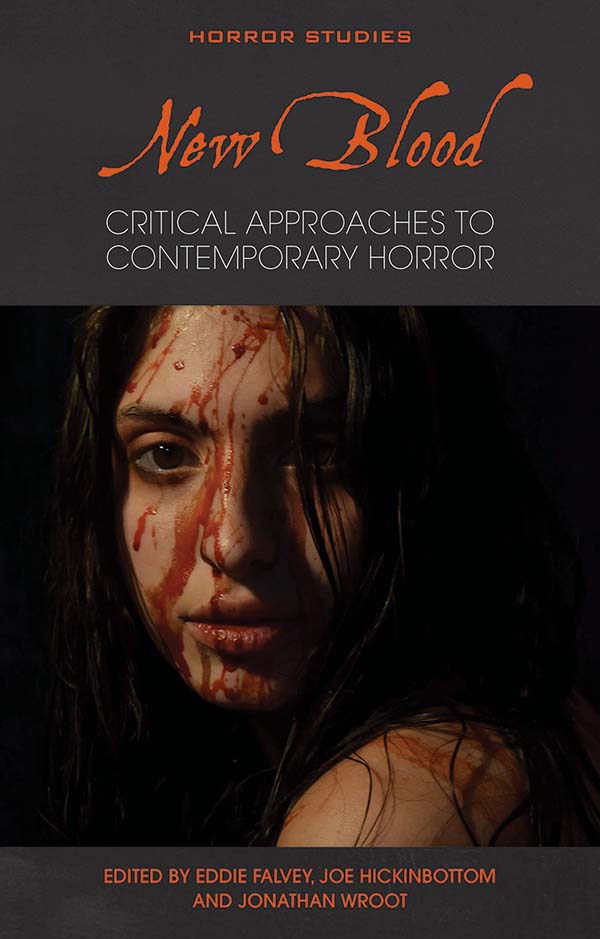
Eddie Falvey, Joe Hickinbottom, and Jonathan Wroot, eds. New Blood: Critical Approaches to Contemporary Horror. U of Wales P, 2021. Horror Studies. Paperback. 288 pg. $60. ISBN 9781786836342. eBook ISBN 9781786836359.

New Blood is a collection of essays examining recent works of horror film. Separated into four parts, the book largely acts as a defense for analyzing new horror films through a scholarly lens. Some of the essays are invested in reception studies and production methods, while others engage more in theory and interpretive analyses. Ultimately, many of the chapters seem to fall short of the book’s intent, functioning more as an elevated film review than a work of serious scholarship. However, many chapters would be effective in teaching undergraduate classes in horror so could be included on syllabi for such courses.

The editors present a kind of defense of modern horror cinema as worthy of critical study in their introduction. What struck me here was that the defense was framed as a list of horror films, claiming that there have been both remakes and original films, an argument that generally should go without saying. Indeed, the editors seem to try to defend whythe genre is popular more than why it is worthy of scholarly attention. We constantly see phrases such as, “some horror franchises have proven so popular that…” and “To understand the genre’s enduring popularity…” (2, 3). The introduction continues to state the obvious: “Critical acclaim has been given in many cases – but whether praised or derided, horror has carried on regardless” (4). As a result of this set-up, it seems very unclear who the audience for the book really is. People who think horror stopped being a film genre in the 90s? Beginning horror scholars who are looking for definitive proof that the genre is indeed popular? After defining what the editors call “revisionist horror” (5) and talking further about the commercial aspects of the genre, they outline the various case studies of the book.

In “Apprehension Engine: The New Independent ‘Prestige Horror,’” David Church engages with “artsy” horror of the past couple of decades through the label “prestige horror” (16), discussing the sub-genre in terms of reception studies, critical acclaim, and cultural studies. What is compelling about Church’s arguments is his discussions of indie “alternative” prestige films and the ways that many horror fans appreciate the art and poetry of films over the commercial scare factor. My greatest concern with Church’s work is the limit of his scope. What he calls indie-art films are reasonably commercial successes as well, such as It Follows (2014), Saw (2003), and The Witch (2015). There does not appear to be much room for horror shorts on YouTube or the much more indie films released only on Shudder.

The next essay, by Steve Jones, “Hardcore Horror: Challenging the Discourses of ‘Extremity,’” seeks to give definition to the eponymous terms “hardcore horror” and “extremity.” Jones focuses on market and critical definitions for “extremity,” noting that a store’s willingness to stock a horror film contributes to the market definition, as an example. The strength of this chapter is in its ability to give several specific cases, such as mother! (2017) and A Serbian Film (2010), while also acknowledging and giving room to the slippages of meaning of “extremity.” Even tackling a bias toward extreme horror texts in academic publishing, Jones approaches the concept from so many angles I could see myself easily teaching this chapter alone alongside some horror films.

Continuing the focus on specific audiences, Xavier Mendik approaches cult horror festivals in “From Midnight Movies to Mainstream Excess.” Mendik blends the personal with the critical effectively as he situates his experiences with a university horror film festival in the larger commercial industry of horror film. Like Church, Mendik is invested in terms like “prestige” and “success,” although his scope is limited more narrowly to these specific film festivals.

Starting the book’s second section, Joe Hickinbottom’s “A Master of Horror?: The Making and Marketing of Takashi Miike’s Horror Reputation” is more of a fan’s defense of Miike as a “horror auteur” than a work of serious critical inquiry. It even goes so far as to answer the titular question in just the first couple of pages, rendering the rest of the chapter uninteresting. This chapter might have been better placed as an introduction to a volume just on Miike. Asian horror continues with “Bloody Muscles on VHS: When Asia Extreme Met the Video Nasties” by Jonathan Wroot. Easily one of the sharpest chapters in the book, Wroot’s conducts a reception studies and comparatist reading of J-horror film Bloody Muscle Body Builder in Hell (2014). What impressed me with this chapter was the vast amount of research Wroot conducted: into VHS production history, the trends of VHS nostalgia in the 21st century, and the theory behind J-horror’s reception.

Thinking about film in the 21st century, one, of course, cannot forget the popularity of streaming services like Netflix, as Matt Hills notes in “Streaming Netflix Original Horror: Black Mirror, Stranger Things, and Datafied TV Horror.” Like Wroot, Hills brings in considerable theory, focusing on postmodern readings of what he calls the “flagships” of “datafied horror” (125): Stranger Things and Black Mirror. He excels at analyzing concepts unique to Netflix, discussing “bingeing on fear” and the distinctions of genre bubbles that separate Netflix from something specifically geared toward horror fans like Shudder (130).

The next part, focused on subgenres of modern horror, begins with Jessica Balanzategui’s chapter, “The digital gothic and the Mainstream Horror Genre: Uncanny Vernacular Creativity and Adaptation.” Balanzategui is invested in exploring the collaborative efforts that go into Creepypasta stories and the gothic elements that appear in them. This chapter would be really beneficial for introductory students of horror, showing them that even those stories they read online “count” as genuine literature. However, I wish Balanzategui integrated more Gothic theory and scholarship into the chapter, making that bridge between academic theory and popular fiction more apparent. Abigail Whitall envisions “rethinking subgenres and cycles” in “Nazi Horror, Reanimated” (167). In this chapter, Whitall makes the basic argument that Nazi horror should be considered a subgenre rather than a cycle. While convincing, the argument seems very simple and easily defensible to scholars who would be reading this book.

The final subgenre explored is the “desktop film” in “Digital Witness: Found Footage and Desktop Horror as Post-cinematic experience,” by Lindsay Hallam. In discussing the subgenres of found footage films here, Hallam integrates not only directors’ quotations but actually really strong affect theory and social media theory, making the chapter shine for its integration of scholarship alongside its analysis of primary texts. This chapter could serve as the basis of an entire course syllabus. Eddie Falvey then discusses feminine monstrosity in “Revising the Female Monster: Sex and Monstrosity in Contemporary Body Horror.” When I first read the chapter, I was frustrated with its survey nature. I had hoped there would be something more in-depth here. However, the chapter excels at being just that: a captivating survey. This chapter would be great for undergraduates to read, as it opens up many compelling conversations about sex, gender, disability, and even STDs in horror.

The political theme continues with Thomas Joseph Watson’s “The Kids are Alt-Right: Hardcore Punk, Subcultural Violence and Contemporary American Politics in Jeremy Saulnier’s Green Room.Green Room (2015) is certainly a horror film worthy of academic analysis. However, aside from the occasional quotation here and there, this chapter felt like an extended film review that summarized what a lot of other critics have said about the film. The last chapter is “Twenty-first-century Euro-snuff: A Serbian Film for the Family,” by Neil Jackson. In contrast to the previous chapter, this one thrives on literary theory to analyze a film that many would dismissively call “torture porn.” Jackson relies on affect theory and allegorical interpretations to derive new meaning from the film. The film thus becomes a site of investigation and critical inquiry that opens the way for other scholars (whether they are established researchers or undergraduates).

On the whole, the book seems conflicted. Half of it consists of simple arguments such as, “This is a film I enjoy, and here’s why,” and “This film is popular”; the other half actually engages in productive film theory and academic discourse. For those strong chapters, I would highly recommend the book to instructors teaching undergraduate horror courses. Those chapters really open the floor for productive discussions of the genre and showcase what that kind of horror analysis can look like.

Jonathan Thurston-Torres (they/them) is a PhD candidate at Michigan State University, specializing in Animal Studies, early modern literature, and horror literature. Their work has led them to edit MSU’s new volume in The Animal Turn series, Animals & Race. Outside of their academic work, they are a local activist in HIV destigmatization, recently putting out a TEDx Talk, Being Positive.

Review of Fantasies of Time and Death


Review of Fantasies of Time and Death

Maria K. Alberto

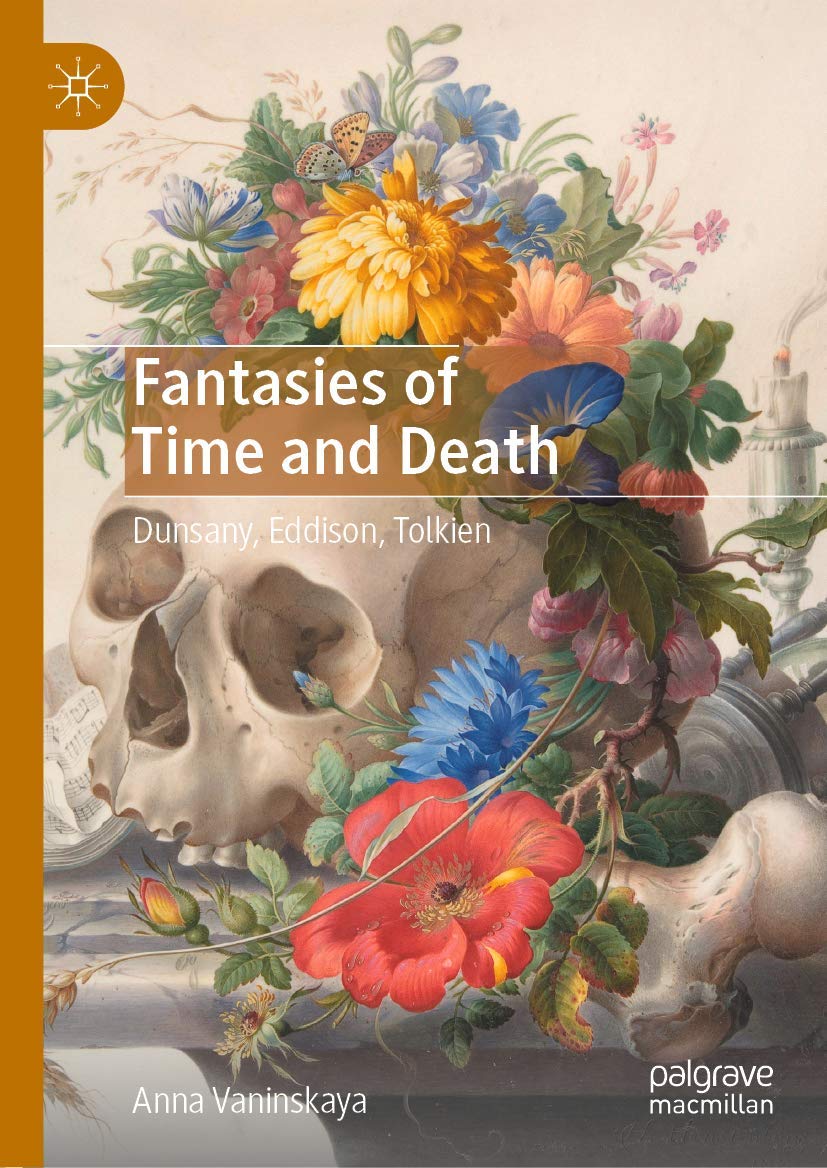
Anna Vaninskaya. Fantasies of Time and Death: Dunsany, Eddison, Tolkien. Palgrave Macmillan, 2020. Hardback. 262 pg. $159.99. ISBN 9781137518378.

Anna Vaninskaya’s Fantasies of Time and Death is nothing short of a remarkable achievement: reading it, I could see immediately why it won the Mythopoeic Scholarship Award in 2021. In this monograph, Vaninskaya ably draws together three major authors whose works are not often compared at such length, and she explores how each uses fantasy—a complex, retroactive term that she does not take for granted, either—to explore “shared thematic preoccupations” (4) regarding “temporality, mortality and eternity: with process, event and state” (7). Such a project entails in-depth knowledge of three dense, elaborate bodies of work, as well as the capacity to draw, discuss, and compare relevant details from each one, but Vaninskaya does this spectacularly. Moreover, her writing style is richly poetic—and frankly, gorgeous—in ways that academic scholarship does not often allow itself to be, and the end result is a work that feels thematically and technically well-matched with its subjects.

In a move that could have been risky, but that Vaninskaya pulls off very well, Fantasies of Time and Death opens right on the knotty topic of canon creation, reviewing how reader demand and publisher choices both played a critical role in the creation of fantasy as a genre, well after these three authors’ own times. Beginning here offers important historical context and demystification, and further strengthens Vaninskaya’s reasoning to group Lord Dunsany, E.R. Eddison, and J.R.R. Tolkien on the basis of shared textual preoccupations: specifically, their various interests in “cosmopoiesis… the creation myth… [and] a multi-generic universe” (7) rather than the kinds of cohesive narrative more typical among both their predecessors and peers. The remainder of this introduction offers more focused introductions to each author and his oeuvre, then looks briefly to other writers now considered fundamental to the fantasy genre before returning to that shared interest in transience, time, and death.

Following this introduction, Vaninskaya offers a chapter apiece focused on the works, interests, and approaches of Dunsany, Eddison, and Tolkien. With Lord Dunsany, she calls attention to how he saw himself as a poet writing “a species of prose poetry” (25), which led to a “patterning impulse” (26) evident across his shorter works in particular. Subsections in this chapter are devoted to, variously, the ravages of time, the chill of space, and the uncertainty of the universe, as depicted in Dunsany’s fantasy. Across these three axes, Vaninskaya maintains, Dunsany’s fictional worlds are “literally a-gnostic. There are no epiphanies, no ultimate truths, the mythology is an anti-revelation” (44), and divine power may be glimpsed but is never fully explicated or revealed. Oftentimes, she contends, these preoccupations connect Dunsany’s works more than any shared fictional setting or returning cast of characters.

Next, Vaninskaya turns to a chapter on E.R. Eddison, and specifically his complex, unfinished Zimiamvia trilogy, in which multiple characters are incarnations of the male and female parts of God, most unaware of their divine identities. Pointing out how this work is driven by “intertextual and interlingual bricolage” (69), Vaninskaya maintains that—despite the vast universe visible here and the multifaceted pantheon driving it—readers must be willing to wade through reams of uncredited quotations and ideas. These extend well beyond poetic and prose allusions, on into a deep preoccupation with seventeenth-century philosophy: Eddison, Vaninskaya demonstrates, engages with paradoxes of God’s existence and perfection as set out by Descartes, Spinoza, and Leibniz (115). And while the full intricacies of these readings will be at least partly lost upon those not familiar with Eddison’s sprawling work, Vaninskaya does an admirable job of summarizing this complex trilogy and drawing readers’ attention to its most startling features, whether philosophical, theological, or genre-driven.

And from here we come to the chapter that first drew my attention to Vaninskaya’s work: her discussion of Tolkien. Because Fantasies of Time and Death is not a survey, but instead looks to the foundation of each author’s oeuvre, Vaninskaya focuses here not on Tolkien’s most famous work The Lord of the Rings (1954), but instead on the natures and fates of Elves and Men as developed across his entire legendarium. Thus, this chapter deals primarily with the collection of stories, some published posthumously, called The Silmarillion, and draws specifically from the Ainulindalë (creation account of the world that includes Middle-earth), the Athrabeth (philosophical exchange between a human woman and an Elven prince), and the Akallabêth (the story of the island kingdom Númenor). Vaninskaya revisits these particular portions of Tolkien’s legendarium to argue that knowledge of time and death differs according to Elves and Men, and in fact, becomes a sort of “psychological trauma” when the world’s ultimate antagonist Melkor spreads corrupted information about them (164). Some of the connections that Vaninskaya draws outward from Tolkien’s work, such as to Augustine and Aquinas for the Catholic doctrine of mankind’s “happy fault” (173), have been more well-trod in existing scholarship than others, but overall, her discussion here is still fresh and fascinating.  

Despite their evocative prose and obvious expertise, there are a few stumbling blocks to these chapters. For one thing, the authors they are dealing with can be challenging in their own right: though each one might, as Vaninskaya suggests, be creating a single, genre-spanning universe in their fiction, the coherency and accessibility of these various universes differ quite widely. Dunsany creates a variety of short works that may or may not reference one another directly; Eddison is author of a grand, sprawling trilogy that remained unfinished at his death; and Tolkien’s work is scattered across several drafts, many of them organized by his son and published posthumously in an attempted semblance of Tolkien’s larger plans. Vaninskaya herself switches between multiple texts with commendable, indeed enviable, ease, but does not always signal her intent when doing so, which could leave readers less familiar with those texts lost in a sea of references. Even this is not entirely a criticism, though, because she has a knack for summarizing and drawing out relevant pieces from these complex writings that will carry readers along regardless. All told, Vaninskaya’s work is a commendable undertaking. It can be a dense read, and one that will be made significantly more difficult without some knowledge of the source works; but it is absolutely worth it all the same.

Maria K. Alberto is a PhD candidate in the Department of English at the University of Utah, where she is currently working on her dissertation examining canons in popular culture texts. Her research interests include digital storytelling, transformative fanworks, and genre literature of the 20th and 21st centuries. She has written several pieces on Tolkien and adaptations of his legendarium. 

Review of The Contemporary Post-Apocalyptic Novel


Review of The Contemporary Post-Apocalyptic Novel

Nathaniel P. Doherty

Rachel Swirsky. January Fifteenth. Tordotcom, 2022. Paperback. 239 pg. $15.99. ISBN 978-1-250-19894-6.

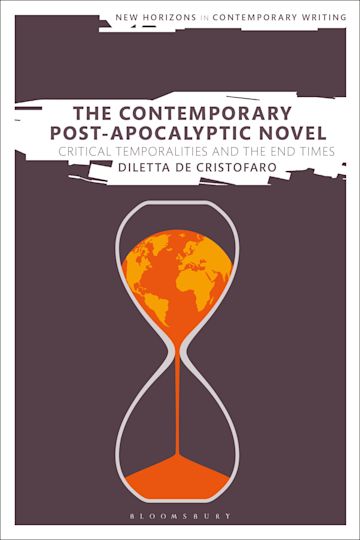
The Contemporary Post-Apocalyptic Novel: Critical Temporalities and the End Times, by Diletta De Cristofaro, is encyclopedic in its approach to contemporary Anglophone literature. At its center of critical focus is the engagement of contemporary Anglophone fiction of the U.S., Canada, and Great Britain with the logic of apocalypse. De Cristofaro traces this oppressive logic deftly from Biblical roots to every bud of current dominant power structures. This book is the author’s first monograph in an otherwise extensive body of work, and she uses this opportunity to cast a wide, interdisciplinary net of referenced fiction around the foci of each chapter. Each chapter focuses on one high profile novel and one that is under-recognized, according to De Cristofaro.

The novel theoretical insight offered by De Cristofaro is “critical temporality” (De Cristofraro 1). In short, critical temporality is a feature whereby texts contradict or otherwise undermine apocalyptic conceptions of time. De Cristofaro identifies this critical mode as a resistance to, or commentary upon, legacies of traditional Christian apocalypticism, especially as it has been appropriated by a range of oppressive and/or exploitative systems dominating global policy and popular ways of knowing. The introduction sketches out critical temporality and establishes the monograph’s critical underpinning. It also provides a brief but useful introduction to the history of apocalyptic narratives in Western culture.

Chapter One focuses on Sam Taylor’s The Island at the End of the World (2009) and The Book of Dave (2006), by Will Self. In both texts, apocalypse functions to justify, after the fact, theocratic systems that are both misogynist and sexist. In both texts, in different ways, the theocracies are all but immune to reform or escape because of their deployment of sanctity as a means to control both public narrative and history. The novels’ critical temporality undermines these systems with parody. De Cristofaro’s critical lens is primarily occupied with a critique of oppressive, overt, Christian power structures.

Chapter Two focuses on Cormac McCarthy’s The Road (2006) and The Pesthouse (2007),by Jim Crace. De Cristofaro analyzes what she refers to as “American ideologies,” specifically Manifest Destiny and American exceptionalism, within these two novels’ narratives (14). Specifically, she identifies how these narratives invert the traditional mythology of the American ‘open road’ and the related narratives of limitless self-reinvention as their critical temporalities. The chapter also notes critiques of the ‘creative’ destruction inherent in the U.S.’s claims to correct and perfect European civilization.

David Mitchell’s Cloud Atlas (2004) and Jeanette Winterson’s The Stone Gods (2007) form the core of Chapter Three’s analysis. De Cristofaro focuses on the role played by apocalyptic logic in the post-facto justification and sustenance of exploitative colonialism and neo-colonialism. Both novels cover vast spans of fictional history. Linear narrative is associated in the chapter with Biblical, “Revelation”-style apocalypticism, and thus De Cristofaro focuses on non-linear narratives as the ‘critical temporalities’ of both novels. In both cases, narrative time becomes critical via textual reflections of nonfictional capitalist, (neo)colonial structures and histories. This chapter also contains the monograph’s closest consideration of eco-critical themes.

Chapter Four centers on variations of denarration in novels critiquing stagnation in neoliberalism’s framing of history. The central texts are Emily St. John Mandel’s Station Eleven (2014)and Douglas Coupland’s Player One (2010). De Cristofaro reads denarration and monotony in both as associating the apocalypse with symbols of global capitalism. More specifically, the chapter takes aim at claims that neoliberalism represents the ‘end of history.’ De Cristofaro spends more time on the initial contextual interpretations, which includes Colson Whitehead’s Zone One (2011) and Karen Thompson Walker’s The Age of Miracles (2012). The modes of rendering temporality in the novels of this chapter are characterized by slowing, monotony, and variations of denarration that parody neoliberalism’s perpetual, changeless present.

The Contemporary Post-Apocalyptic Novel’s conclusion focuses on Lidia Yuknavitch’s The Book of Joan (2017) and the employment of the body as a vehicle for historical narrative resisting official archives. The temporal dimension of this embodied archive constitutes this section’s approach to critical temporality through its opposition to the apocalyptic chronology of the official archive. De Cristofaro revises Derrida’s “Archive Fever” as a drive within post-apocalyptic fiction to imagine the preservation of narratives through the apocalypse (1995). She interprets these archives as evidence of the novelists’ faith in the power of narrative to resist contemporary tendencies driving towards global catastrophe, an implicit nod to speculative fiction’s preoccupation with extrapolation.

The critical lenses employed by De Cristofaro are feminist as well as postmodernist and post-structuralist. Further, a Marxist-inflected critique of global capitalism undergirds most of her interventions. Religious, or pseudo-religious, support for misogyny and sexism is a focus of the first chapter, and high-profile postmodernists or post-structuralists (there’s some debate about who counts as what) are cited directly in the introduction and referenced throughout. This grouping includes Baudrillard, Derrida, Haraway, Lyotard, and Linda Hutcheon, among others. Timothy Morton’s Hyperobjects (2013) also makes an appearance when De Cristofaro turns towards eco-critical considerations. As a result, there is a case for identifying a post-humanist facet to De Cristofaro’s work as well.

This monograph is a valuable interdisciplinary intervention that provides a convincing and timely approach as well as detailed references to many texts capable of supporting a broad range of scholarship. The Contemporary Post-Apocalyptic Novel has the potential to be a resource for scholars working on contemporary literature, posthumanism, gender studies, and eco-criticism, at least. Its contents are especially relevant to contemporary SF studies. De Cristofaro’s thorough catalogue of related texts in each chapter means the book itself functions like an archive. Thus, it has the potential to support a range of contemporary literature courses, given that most of the texts referenced transcend the dubious distinction between literary and speculative fiction. The Pesthouse section of Chapter Two is particularly notable for making extensive and interesting use of research into Crace’s personal papers stored at the Harry Ransom Center at the University of Texas at Austen. The use of the Crace papers provides an example of archival scholarship applicable to both undergraduate and graduate students. De Cristofaro has given us that rare work that functions on an advanced theoretical level while also nonetheless being applicable to many classroom contexts.

Nathaniel Doherty has worked as a writer, instructor, and etc. in many capacities throughout post-secondary education. Currently he works in instructional design at Chadron State College, in Chadron, NE. Technically, it’s still the frontier out here. Besides advocacy for learner-centered teaching, his professional focus is late-20th and 21st-century U.S. fiction and gender studies. He has a predilection for genre writing.

Review of January Fifteenth


Review of January Fifteenth

Jeremy Brett

Rachel Swirsky. January Fifteenth. Tordotcom, 2022. Paperback. 239 pg. $15.99. ISBN 978-1-250-19894-6.

There is so very much to examine about our present right now, but ironically, a crucial issue that concerns us all has been generally overlooked in recent science fiction. The issue is economic inequality, a subject of serious concern and equally serious implications for both the future of humanity and the planet. It brings suffering and misery and hardship to countless people, and all the forces of greed and corruption seem arrayed to support it.

There’s great dramatic potential offered by an issue with such grave planetary and societal import, yet I see few stories that try to grapple with it, except as background dressing (or as an aspect and outcome of post-apocalyptic disaster). This to me represents a missed opportunity, because some of the greatest literature in any genre is that which, first, has something to say about ourselves and the human condition when subjected to immense stress and second, describes what happens when people attempt to solve vital problems. I believe the genre would greatly benefit from more stories in which people apply similar degrees of resources, thought, or effort to economic inequality. Acting with narrative boldness to counter the seeming inevitability of capitalism’s continued dominance may seem as science fictional (fantastical, even) as it gets, but the limitless reach of SF’s imagination should not preclude us from envisioning possible solutions or alternate economic pathways for ourselves, even if, as Rachel Swirsky demonstrates in her intelligent novella January Fifteenth, the consequences aren’t predictable or even, sometimes, just.

Set in a near-future United States, the novella takes place over the course of a single day, the day every American receives their yearly Universal Basic Income payment (“UBI” is defined by the Basic Income Lab at Stanford University as “a periodic cash allowance given to all citizens, without means test to provide them with a standard of living above the poverty line.” From that basic definition there are all manner of differing opinions on what qualifies as UBI or who should receive it.). Swirsky’s novella benefits from timeliness, certainly, since UBI as a method of reducing economic inequality has become a part of the national economic conversation in the USA over the last few years, with debates involving people as disparate as Andrew Yang, Hillary Clinton, economist Thomas Piketty, Bernie Sanders, and Mark Zuckerberg weighing in. It is an idea that appeals to many, and it is no wonder that Swirsky has turned her narrative gifts towards a fictional exploration of its potential impact on the complicated lives of human beings.

The novella centers four women, each from a vastly different stratum of American society and each impacted by UBI in a vastly different manner. Although the four never interact, Swirsky’s story amounts to a kind of mosaic, where the different lives and fates of the central characters come together as diverse bits making up a greater whole—the overall societal picture of UBI and the ways, great and small, that it impacts people and society. In upstate New York lives Hannah Klopfer and her two small boys—for Hannah, January 15th is a day less about economic security and opportunity and more about trauma. It is the anniversary of the day she took her boys and fled her abusive, mentally unbalanced, former wife—now stalker—Abigail. Hannah is on the run and living as quietly as she can; picking up her UBI check is a time to be watchful and scared of discovery by Abigail.

In Chicago, Janelle, a freelance reporter in a post-journalism world, scrounges at the request of news aggregator services every January 15th for man-on-the-street interviews of people and their opinions on UBI. For Janelle, an orphan who raises her 14-year-old sister Neveah alone, the day is one of predictable banalities and arguments with her firebrand liberal sister over the injustices of UBI. The story moves west into Colorado, where Olivia is a freshman in college and the child of great wealth; for her and her friends in Aspen, January 15th is “Waste Day,” where the fabulously rich compete to see who can burn through their UBI in the most dramatic and flamboyant manner. And last, there is pregnant teenager Sarah, a “sister-wife” in Utah whose “family” travels the long route on foot through Utah to pick up their UBI payments in person.

What makes Swirsky’s novella so intriguing is not that it lays out the details of a UBI-based society, nor that it explores the traditional arguments about UBI (freedom vs. dependency), but that it instead concentrates on how traumas, abuses, and everyday circumstances “affect our lives. They affect our happiness. They certainly affect how and why Universal Basic Income could change our circumstances” (Author’s Note). In the United States of the novella, UBI fails to actually solve any of the characters’ individual problems on its own, but it provides avenues and opportunities for people to evolve and change. It also, like anything else, can be a negative force: Sarah notes that “the prophet’s wives and children trekked on foot every year to protest the state’s requirement that they go in person to receive their benefits. The state claimed that it was to mitigate ‘abuses of the system,’ but everyone knew it was just another way to harass them for having different beliefs” (35). Meanwhile, the yearly UBI gives license to Olivia’s friends to be crushed under the weight of their own decadence and insecurities. And darker elements are hinted at—at one point, Janelle hears rumors of Native women being sterilized or else having their UBI withheld, and people being forced to sign loyalty oaths to receive their money. As Swirsky notes, money does not solve everything, and it can not necessarily correct injustices in an already problematic system.

The imperfections and limits of UBI are important themes of the novella, in fact. At one point, Janelle and Neveah argue over the history of the program, Neveah appealing to Janelle’s youthful liberalism. In this scene, the compromises and betrayals and hidden motives that accompany any reform are laid bare:

[Nevaeh] added, “I don’t believe you’ve really changed everything you think.”

“What I think – and what I thought – is that UBI is better than having nothing.”

Neveah started to respond. Janelle held up her hand.

Janelle continued, “What I think – and what I thought – is that we had an extraordinary moment of political will after Winter Night. The whole country was breathing a sigh of relief. We weren’t just trying to get ourselves back on track; we were trying to figure out what kind of track to get on. It was like we had this dream together of improving the world.”

“Right? So- “

“What I said was that it would be a one-shot deal. We had one sure arrow to fire from that bow. And whatever we didn’t make sure to fix then, it probably wasn’t going to get fixed for a long time.”

“You were right!”

“Yeah, I was….UBI is definitely better than having nothing.”

“But you were right about everything,” Neveah said. “You called it patchwork legislation…you said once the opposition realized UBI was definitely happening, they were going to try to make it hard to collect. Like drumming up paranoia about bank breaches to make us use checks and the mail. You said they’d start saying states needed the right to make their own rules, but they’d really mean states should be able to make people jump through hoops. You said it was ‘enshrining unequal access.’”

Janelle shrugged. “And now the law’s been written.” (55-56)

Through a single day in the lives of four wildly disparate women, each bearing their own particular emotional burdens and life experiences, January Fifteenth provides a smart and thoroughly realized series of proofs that the human element is vital to the outcome of any attempts at economic or societal restructuring. It shows how narratives of economic inequality, no matter the genre, cannot be simplistic if they are to be either remotely realistic or conducive to imaginative considerations of real-life reform. Society is complicated, people and their relationships are complicated, and realistic stories about this kind of inequality—stories we need to tell—will be complicated, too. Economic inequality is a corrosive phenomenon that threatens us all with an ever-more uncertain future, and Rachel Swirsky has done us all a great service in writing a story that thoughtfully explores the human impact of attempts to reduce it.

WORKS CITED

“What is Basic Income?” Stanford University, 5 Jan. 2023, https://basicincome.stanford.edu/about/what-is-ubi/.

Jeremy Brett is an Associate Professor at Cushing Memorial Library & Archives, where he is both Processing Archivist and the Curator of the Science Fiction & Fantasy Research Collection. He has also worked at the University of Iowa, the University of Wisconsin-Milwaukee, the National Archives and Records Administration-Pacific Region, and the Wisconsin Historical Society. He received his MLS and his MA in History from the University of Maryland – College Park in 1999. His professional interests include science fiction, fan studies, and the intersection of libraries and social justice.

Review of The Galaxy, and the Ground Within


Review of The Galaxy, and the Ground Within

Gabriela Lee

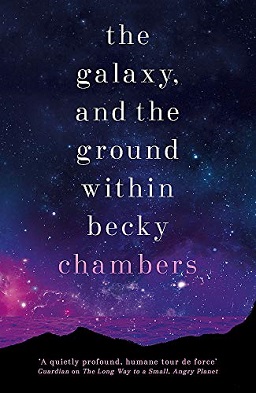
Chambers, Becky. The Galaxy, and the Ground Within. Harper Voyager, 2021.

Stepping back into the world of Becky Chambers’ Wayfarers series is a comfort. Beginning with the first novel, A Long Way to a Small, Angry Planet, and culminating in the fourth and final novel, The Galaxy, and the Ground Within, Chambers creates a vibrant, messy universe where humans are just a footnote in galactic history. In fact, in the Wayfarers universe, it is the humans who need to be saved by the other alien species with superior technology; it is the humans whose status as an independent and legal species needs to be acknowledged by the Galactic Commons, the parliamentary system that governs most of the known, traveled universe.

But Chambers is not concerned with the big picture of the galaxy—she is interested in the stories of the individuals who simply live their lives, and how they navigate a world in which people (and when I say “people” I mean all the sapient beings in this universe, not just humans) travel halfway across the galaxy through what is essentially traffic-controlled wormholes but still struggle with ordinary, everyday problems. In fact, one could say that Chambers is preoccupied with the personal, and it is through the personal that she is able to connect to the universal.

It is this particular preoccupation that makes The Galaxy, and the Ground Within approachable, despite the fact that it is the only book in the series in which none of the protagonists are humans. Instead, the novel focuses on four different beings stranded on Gora, an unassuming planet in the middle of what is essentially an intersection of five busy highways in space. Because of the interstellar traffic that passes through Gora and the wait time it takes to traverse the interspatial tunnels from one part of the galaxy to the other, many businesses spring up in the area to cater to travelers waiting to cross to other parts of the galaxy, including restaurants, bath houses, and travelers’ inns. One of them is the Five-Hop One-Stop, a kitschy intergalactic bed and breakfast that welcomes all visitors, no matter the species.

The novel’s plot is fairly simple: during a routine visit to the Five-Hop One-Stop while waiting for their turn in the queue to make their space jump, three guests are stranded when a major communication satellite malfunctions in Gora airspace, rendering the transportation hub inert. While the Galactic Commons Transit Authority and Goran officials scramble to repair the satellites and get the transportation tunnels back in order again, everyone is ordered to stay at their respective habitats, effectively stranding the three guests at the Five-Hop.

One of them is an Akarak named Speaker, who is described as small and stunted, with her arms ending in hooks that allow her to swing from one pole to another. The Akaraks are considered a fringe species, existing in the margins of the civilized universe without a home planet of their own and unable to live in more civilized spaces because of their unique biological needs; namely, they breathe methane instead of oxygen and are therefore unable to live outside of mechanical suits. Another guest is the exiled Quelin, Roveg, a designer of artificial simulations for entertainment and education. The Quelin, a monolithic society that despises change and insists on the enduring permanence of their own culture, branded Roveg a traitor after he was identified as the creator of narrative simulators that challenged Quelin ideology. Though he has since recuperated his career and finances, he is still permanently cut off from his family and home. The final guest is the Aeluon military cargo captain Pei, a character we briefly meet in the first book, as she heads to a secret rendezvous with her human lover. The Aeluons are considered one of the “Big Three” species that established the Galactic Commons and are generally considered one of the most advanced species in the universe. However, because of biological and social expectations, such as a declining birth rate, Aeluons are generally discouraged from romantic relationships with other species. Rounding out the cast of characters are Ouloo and her offspring, Tupo, a Laru mother-and-child who run the transit stop. Ouloo struggles with raising her child with a wealth of options while at the same time trying to figure out her place in the wider galaxy; similarly, the adolescent Tupo struggles to figure out their place in the world while they grow into their body and gender identity. The Laru are described as long-necked and fur-covered, are in part identified by their strange gaits—commonly alternating their walking style between two and four limbs—and are widespread across the galaxy, so much so that they no longer have any meaningful or traditional ties to their own home world.

The enforced proximity of the five characters reveals lines of tension. For instance, Pei’s work in a military-adjacent career is constantly challenged by Speaker, whose entire species was almost wiped out during a planet-side war generations ago, but the effects are still being felt in the present. Roveg’s exile also becomes a sore subject for him, especially when he confronts his own prejudices against Speaker and Pei, as well as his own personal philosophy of maintaining neutrality at the expense of everything else. However, the manufactured closeness also unveils intersections of commonality between everyone. Speaker’s reluctance at revealing her worry for her missing sister, Tracker, changes as Roveg and Ouloo attempt to help her find alternative means of communication outside the habitat. Pei’s frustration at the way by which her species are discouraged from entering relationships outside of their people boils over when she is faced with the choice of whether to be a mother, and though Aeluon motherhood is nothing like human motherhood, the choice still remains. Even Ouloo is challenged by the extended presence of visitors in her habitat and how their needs clash with the needs of her son.

Unlike many SF novels, Chambers smoothly gets around the thorny problem of exposition and explaining how the world works by utilizing short intermission pages that occur between chapters. They take the shape of planetwide bureaucratic announcements from the Galactic Commons Transit Authority that update the shelter-in-place policies around Gora. This allows readers to follow both the passage of time as well as provide ongoing updates of the events happening outside the Five-Hop. Similarly, Chambers uses the character of Tupo as a reader intermediary: as the youngest character, Tupo can easily shift between the four adults and ask questions, thereby expanding on our understanding of how each character sees each other and themselves. Although she consistently reminds the readers of the significant differences between the five protagonists—especially during the denouement of the novel, in which Pei, Roveg, Speaker, and Ouloo all have very different approaches and actions towards Tupo’s accidental poisoning—the novel seamlessly integrates their characters through constant interactions within each chapter.

In fact, it is very easy to forget that one is reading a story in which there are minimal mentions of humans or humanity. Chambers’ writing shines as she writes through the complexities of imagined species and cultures and touches on our own complex cultures as well. Though some may consider The Galaxy, and the Ground Within a slow novel in which nothing of note happens (which is a valid critique, especially if one expects a science fiction novel to be full of action) I would argue instead that the novel refracts and defamiliarizes genre tropes in SF and provides an alternate way of thinking about belonging and alienation in an unfamiliar space. It is to Chambers’ credit that The Galaxy, and the Ground Within welcomes the wayfaring reader with open arms.

Gabriela Lee teaches creative writing and children’s literature at the Department of English & Comparative Literature at the University of the Philippines. Her second collection of SF short stories, A Playlist for the End of the World (University of the Philippines Press, 2022), was just released. She recently received a National Children’s Book Award in the Philippines for her children’s book, Cely’s Crocodile: The Story and Art of Araceli Limcaco Dans (Tahanan Books, 2020). She is currently a PhD student in the English Department at the University of Pittsburgh. You can learn more about her and her work at http://www.sundialgirl.com.

Review of Black Sun


Review of Black Sun

Athira Unni

Roanhorse, Rebecca. Black Sun. Saga Press, 2020.

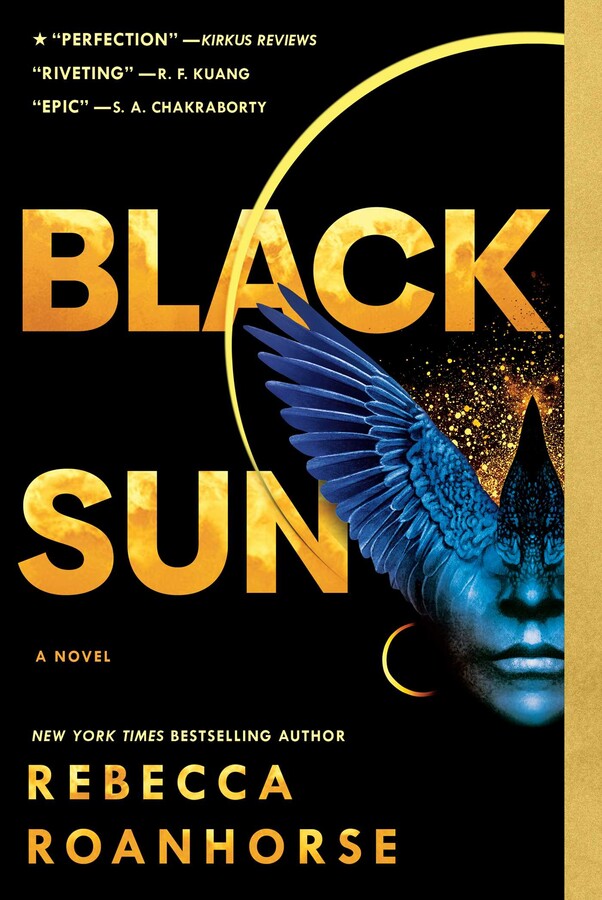
Rebecca Roanhorse’s epic fantasy novel Black Sun (2020) was received fondly by readers and won the Hugo Award for Best Novel in 2021. The book is the first part of the Between Earth and Sky series with its sequel Fevered Star (2022) already out. Drawing upon Polynesian and pre-Columbian American cultures, the novel explores the theme of embracing one’s destiny and ideas of celestial balance, sacrifice, vengeance, and justice. In a thrilling story that invokes a fresh, magical world, Xiala, a sea captain belonging to a mermaid-race, oversees the transportation of Serapio, the Crow God, across time for a celestial event called the Convergence in the city of Tova. Serapio was ritually blinded by his mother and trained by three capable tutors to prepare him for what awaits him in Tova. Xiala’s crew must be convinced of their mission with half-truths and she does not know Serapio’s true power until the very end.

Guided by the watchers and the sun priest, the people of Tova are not expecting the reborn Crow God to land on their shores. The four Sky Made clans of Tova—the Golden Eagle, the Water Strider, the Winged Serpent, and the Carrion Crow—exist mostly in peace except for the mournful Carrion Crow clan who have not forgotten the Night of Knives, a massacre of its members by the priesthood that led to the rise of Serapio as the Crow God. Naranpa, the sun priest who has raised herself from poverty to the highest echelons of the priesthood, and Okoa, the warrior prince of the Carrion Crow clan, are the other two major characters in the narrative.

The political intrigue in the fantasy world that Roanhorse builds makes the story interesting. The conflicting interests of the Sky Made Clans, Naranpa’s feeling of alienation inside the priesthood, and Serapio’s ambiguity towards his own power drive the narrative. The character of Serapio is a fantasy archetype, but he is an unlikely villain consumed as much by a thirst for vengeance as he is by a similar desire for justice: “…vengeance can be for spite. It can eat you up inside, take from you everything that makes you happy, makes you human” (350). Serapio considers himself to be the Crow God, commanding his flock of crows to attack, serve, and intimidate anyone who crosses him. Serapio’s loss of eyesight grants him a greater vision with the help of ‘star pollen,’ which he relies upon just as Xiala relies on her song to calm the seas and influence men. As a seafaring Teek, Xiala is good at leading her crew but is treated as an outsider because of her race. The character of Xiala makes readers confront their prejudices, overturning gendered expectations. There are other women in the story such as Naranpa and the Matrons of the Sky Made Clans who serve as leaders, while men serve as warriors or ‘knives.’ Such characters help readers understand the otherness felt by marginalised groups to some extent.

The landscapes in the novel extend from the Obregi Mountains to the Crescent Sea, and to the Cities of Cuecola and Tova. The descriptions of the places are sparse but are fleshed out in conversations and some illuminating phrases. At the beginning of each chapter, the location of action and days in relation to the Convergence is mentioned, situating the narrative for the reader. The Convergence is an eclipse event that takes place when three suns align in a single line and are obscured by the moon completely. Members of the priesthood undertake ritualised practices, including the Day of Shuttering when they strictly stay indoors. The title of the novel itself invokes this solstice event in which the sun disappears during a period of cosmic alignment. The indigenous way of narrating is to place it alongside temporal and regional markers populating the story world. Roanhorse does this with ease and an elegance that makes the novel immersive.

Compared to N.K. Jemisin’s Broken Earth trilogy, Roanhorse’s first novel allows for magical thinking that does not centre the apocalyptic tone too prominently. Jemisin’s novels carry the weight of a post-apocalypse, but Roanhorse crafts vivid characters and an exciting narrative with the Convergence revealing Serapio’s true power. The vengeful destruction that Serapio unleashes can be seen in two ways. The massacre of the Night of the Knives can be seen to justify Serapio’s anger, but Serapio does not feel like he belongs to the Carrion Crow clan at all, having been brought up as a weapon. With an anti-hero at the centre of the narrative, Roanhorse weaves a memorable story that can be taken forward in interesting ways. The ambiguity of Serapio’s character compares to Jemisin’s female protagonist in her trilogy, although the latter is a much more complex character due to her maternal role, and her duty in saving/re-making the ‘broken’ earth.

The characters of Serapio and Xiala are set up as binary opposites in terms of the powers they wield. While Serapio summons the shadow into him, Xiala casts her song out into the world. These oppositional forces allow for a balance in the narrative and an interesting juxtaposition that is also gendered. Xiala’s queer sexuality and Serapio’s chosen celibacy allow for their companionship to develop in a striking way. Towards the end of the novel, Serapio’s destiny is realized in some sense, with consequences, and Xiala is left to wonder at his power. Roanhorse sets up the two characters to respond to each other and their conversations reveal the differences in how they think about their respective journeys. While Serapio feels like he has been brought up for a purpose, Xiala lives from day to day with a mission to get her crew across the Crescent Sea to Tova and reap the rewards of such a journey. Roanhorse’s novel also invokes the idea of befriending pain in relation to training the mind and the body, with Serapio’s tutors teaching him that sacrifice is essential to fulfill one’s destiny.

The novel is a good example of speculative fiction that values diversity of characters in terms of race, gender, and sexuality. In a world that increasingly recognizes the importance of inclusive thinking and representation, Roanhoarse’s novel makes for a satisfying read that shows us how indigenous life can be portrayed in a fascinating manner. The fantastical world that Roanhorse developed is sure to inspire more speculative fiction writers to come up with similar works that will show how various indigenous people have lived in conjunction with the natural world, with knowledge of celestial events and clans that protected and fought for their kin.

Athira Unni is a PhD candidate at Leeds Beckett University, UK. Her PhD thesis is on dystopian and utopian fiction from South Asia and the Caribbean. Her research interests include women’s writing, utopian studies, postcolonial studies, studies of the Anthropocene, memory studies and 20th-century American poetics.

Review of Hades


Review of Hades

David Welch

Hades. Nintendo Switch version, Supergiant Games, 2020.

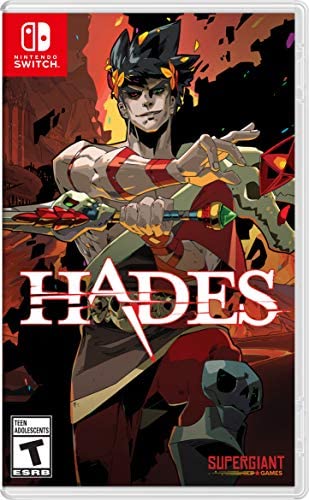
Hades is a rogue-like dungeon crawler from developer Supergiant Games in which the player takes on the role of Zagreus, son of the titular Hades. The plot centers around Zagreus’ attempts to escape the underworld after learning that he had hitherto-unknown family—the Olympian gods—on Mount Olympus eager to meet him. Zagreus’ discovery of this extended family, as well as the realization that his true parentage had been concealed from him for his whole life, motivate these escape attempts and drive the story forward, while also allowing for strong character development via conversations between Zagreus and the other residents of the underworld.

There is not much I can say about Hades as a game that hasn’t already been said; critically, it has been incredibly well-received for its art direction, gameplay, music, vocal performances, and writing. While none of this is new for Supergiant Games, all four of whose games have been critically acclaimed, Hades broke into the mainstream in a way that the others did not. One underappreciated aspect of this game, however, and one which I believe contributed to its success in a more significant way than it gets credit for, is its incorporation of the ancient Greek mythology which underlies its setting. Hades’success as a work of classical reception—the way it modernizes the setting and characters, while simultaneously respecting the source material—deserves the same degree of notoriety as its technical successes.

A problem that any work of classical reception has to deal with is balancing the antiquity of the subject matter against the modernity of its audience. Much classical reception has fallen prey to embracing its antiquity too tightly and feeling, so to speak, dusty, though this has certainly been less of a problem in recent decades. Hades, falling in line with this progress,tells a story that feels acutely modern without ever deviating too far from the ancient materials that define its setting. Dionysus, for instance, remains the god of wine and revelry, holding the staff (specifically, the thyrsus) which was his symbol in antiquity, but he has become something of a Tommy Chong figure, calling Zagreus “Zag, man,” and encouraging him to hurry to Olympus so they can party together. Hades preserves the core character of each figure as traditionally conceived, including the various (and at times complicated) interpersonal dynamics among them all, but makes the whole ensemble feel more akin to that of a modern sitcom than the serious drama that adaptations of antiquity often become.

The lighthearted attitude of these interactions, though, does not prevent Hades from including more esoteric references to ancient material. Early in the game, Zagreus asks Hypnos, the divine embodiment of sleep, to put everybody in the house of Hades into a magical slumber so that he can sneak into his father’s office—no background knowledge is needed to understand what is going on, and Zagreus’ decision to ask Hypnos for sleep-related help is an obvious one. Those more familiar with the ancient canon, though, will see here an allusion to the fourteenth book of the Iliad, in which Hera asks Hypnos to put Zeus to sleep, so that she can sneak behind his back and aid the Greeks in their struggles against the Trojans. Hades is full of such references that, while they are not integral to an understanding of the game’s plot and as such will not detract from the experience of those who don’t catch them, nonetheless allow those with some familiarity with ancient mythology to see how much work the writers put into creating a faithful representation of the classical material.

In addition to its deep engagement with the ancient literary sources, Hades demonstrates a knowledge of contemporary trends in classical scholarship as well. The modern push against Eurocentrism in academic discussions of the ancient Mediterranean, the most well-known example of which might be Bernal’s Black Athena (see McCoskey 2018 for discussion of the legacy of this work), is reflected in the varied skin tones of the game’s characters. This includes that of Athena, whose skin, alongside that of her half-brother Ares, is darker than that of any of the game’s other characters and may be a direct homage to Black Athena and its impact on modern discussions of race in antiquity.

There is, for me, one respect in which Hades as a work of reception missed the mark, however, and that is the game’s ending. Early on, Zagreus learns that his mother is in fact Persephone, who left the underworld for unknown reasons and never returned. As the plot advances, the circumstances surrounding Persephone’s initial departure from Olympus and her eventual withdrawal to the underworld are made clear, and they deviate from the traditional telling of her story. Hades exists in a modern environment in which several works of classical reception, such as Madeline Miller’s Circe, reclaim agency for the many women of ancient mythology who in the original versions of the stories had very little (see Scott 2019 for an overview of the topic); Persephone’s departure from Olympus, which in the ancient accounts was due entirely to her abduction by Hades, is made into her own decision in Hades. Her motivation for doing so, though, is placed partly on the shoulders of her mother, Demeter, for being too controlling of her daughter. While the reclamation of Persephone’s agency is admirable, the reassignment of blame from her male abductor to another woman is disappointing. Up to this point in the game, the explicit alterations of traditional narrative and visual representations had been quite progressive. What a disappointment it was, then, to reach the conclusion to the mystery of Persephone’s fate, only to learn that her male captor, who is traditionally held responsible for her disappearance, had been supplanted, in what could be read as a decidedly anti-feminist turn, by another woman in Demeter.

The absolution of Persephone’s traditional, male captor and his replacement with Demeter was disappointing in its own right, but the accompanying transformation in Demeter’s attitude toward Persephone’s disappearance compounded the issue. In the Homeric Hymn to Demeter, she immediately senses that something has gone awry with her daughter, scours the earth for nine straight days in search of her, and spends years wandering the earth in sorrow in the guise of an old woman, neglecting her duties to the earth and its harvests and nearly destroying the human race as a result. When mother and daughter are finally joyously reunited, Demeter shudders in terror at the realization that Hades has bound Persephone to spend one third of the year in the underworld for the rest of time, though yields to its necessity. In Hades, however, Demeter reacts with no more than idle curiosity when she learns of her daughter’s fate. Persephone’s disappearance is said to have turned her cold and vengeful, rather than grief-stricken; humanity is, like in the Hymn, almost wiped out as a result of her actions, but here it is retaliation for humanity’s perceived culpability, rather than grief, that drives her. After learning that Persephone is alive and well, it is Demeter who proposes that her daughter split her time between dwelling in the underworld and on Olympus, rather than begrudgingly accepting her unavoidable fate. The loving and heartbroken Demeter has been sacrificed and replaced with a cold spirit of vengeance, all in service of elevating Persephone; one is left wondering why both women could not have emerged from the narrative in a better place than their traditional portrayals would have them.

All in all, Hades is an outstanding example of a work of classical reception. It modernizes the material, providing a charming and accessible point of entry into the world of classical mythology, but never deviates too far from the source material. It treats its plot no more seriously than it needs to and, but for one misstep, seamlessly incorporates present-day ideas about classical antiquity. The game is at moments deeply learned, but that erudition never becomes burdensome or obtrusive. This combination of characteristics makes it an extremely appealing prospect for use as an educational tool—the amount of information that finds its way into Zagreus’ conversations with the game’s other characters, which are legitimately enjoyable in their own right, is considerable. The fact that this educational material is presented over the course of the standard gameplay (unlike something like the Discovery Tour mode in some of the more recent Assassin’s Creed games, which disposes of all gameplay and allows the player to walk through game’s setting as if in a museum) creates a situation in which an instructor might feel like they are ‘tricking students into learning.’ With Hades, Supergiant Games has found an extremely satisfying balance between being informative and entertaining.

REFERENCES

McCoskey, Denise Eileen. “Black Athena, White Power: Are We Paying the Price for Classics’ Response to Bernal?” Eidolon, 15 Nov. 2018. https://eidolon.pub/black-athena-white-power-6bd1899a46f2. Accessed 20 December 2022.


Scott, Aimee Hinds. “Rape or Romance? Bad Feminism in Mythical Retellings,” Eidolon, 3 Sep. 2019, https://eidolon.pub/rape-or-romance-1b3d584585b8. Accessed 20 December 2022.

David Welch is a PhD candidate in Classics at the University of Texas, Austin, where he is finishing a dissertation that explores the intermedial relationship between Julius Caesar’s Commentaries and the Roman triumphal procession. He received his MA in Classics from the University of Kansas in 2014. In addition to intermediality and Roman historiography, his research interests include language pedagogy and receptions of classical antiquity in modern SF.

Review of The Orville: New Horizons


Review of The Orville: New Horizons

Jeremy Brett

MacFarlane, Seth, creator. The Orville: New Horizons, Fuzzy Door Productions and 20th Television, 2022.

The third season of The Orville arrived with a brand-new subtitle—New Horizons—a signal from show creator and star Seth MacFarlane that the series would initiate a renewed concentration on the ship’s exploratory mission and questing spirit. However, what viewers received instead was, rather, a season-long study of the contradictions, emotional bonds, and injustices that define the human condition (or perhaps, the “sentient” condition, since these same interactions play out among various alien species as well—as with Orville’s spiritual predecessor Star Trek, alien species tend to serve as analogs for humans, whose behavior is presented as the “sentience default” galaxywide). Only one episode of New Horizons, “Shadow Realms,” centers on the exploration of unknown space; the remainder focus instead on the exploration of psychological and societal inner space and on characters’ attempts to find meaning for themselves as well as a secure place in their world for themselves and their loved ones. The Orville: New Horizons, far more than previous seasons, demonstrates the truth of Trek writer David Gerrold’s oft-quoted observation that “the final frontier is not space. The final frontier is the human soul. Space is merely the arena in which we shall meet the challenge.” (The World of Star Trek, 1973) It is likely no coincidence that, while still leavened with humor, this new season of the show is much less reliant on jokes; like the ship and its crew, the series itself has emerged into a new maturity, tempered by trauma and existential fear.

At the conclusion of the second season, the crew of the Orville and the Planetary Union      were living in the long shadow newly cast by the massive Kaylon invasion. That invasion, led in large part by Kaylon and Orville crew member Isaac (Mark Jackson), caused the deaths of thousands of Planetary Union members and their reptilian Krill allies-of-convenience, as well as the destruction of numerous ships. The season’s first episode, “Electric Sheep,” sets the psychological tone for the series, opening with an expansive recap of the desperate battle, which we find is a flashback-cum-dream experienced by Marcus Finn (BJ Tanner), the older son of Orville medical officer Claire Finn (Penny Johnson Jereld). As Marcus awakes violently from his PTSD-fueled dream of the battle and Isaac’s betrayal, the Orville itself is seen berthed in an orbiting spacedock, being refitted—symbolically reborn for a new age of unprecedented conflict. Ongoing conflict between past and present is depicted as Isaac walks the decks of the ship in an atmosphere of deep distrust after his betrayal, much of it coming from new ensign Charlie Burke (Anne Winters). Burke herself, like Marcus, suffers from righteous anger at Isaac, having barely escaped the destruction of her ship and witnessed the death of her friend/secret love. This first episode, and much of the season, is concerned with attempts to psychologically heal from grievous wounds, inflicted not only by outside invaders but by supposed allies.

Even one’s own culture can do great harm to those within it; much of this season centers on the issue of what we owe to our culture (or state, or planet) versus what we owe to each other and those we love. One of New Horizons’ most important characters is Topa, the child of  Lt. Commander Bortus (Peter Macon) and his husband Klyden (Chad L. Coleman), both members of the Moclan species. Topa (Imani Pullum) was born female in season 1—a supposed “rarity” and source of deep shame to the one-gender Moclan culture—and she was surgically altered to male at Klyden’s insistence. Season 3’s most emotionally devastating episode, “A Tale of Two Topas,” sees Topa experiencing gender dysphoria and suicidal depression, trapped between her own feelings and Klyden’s determination to honor his cultural traditions (determination fueled by self-loathing) and maintain Topa’s forced masculinity. Bortus, encouraged by Topa’s compassionate mentor/Orville first officer Kelly Grayson (Adrienne Palicki), chooses, at last to eschew the mores and strictures of his own home culture to preserve Topa’s life and emotional well-being, and she is returned to female form. The viewer is left heartbroken in watching Klyden angrily leave Bortus and Topa, declaring that he wished Topa had never been born, while Bortus then proclaims his own undying love for her. It is moments like this that give New Horizons significant emotional resonance and demonstrate SF’s ongoing capacity for viewing our own social struggles through a fantastical future lens. In a follow-up episode, “Midnight Blue,” the Planetary Union makes a similar fateful choice, choosing to expel the Moclans from the Union for their brutal treatment of female Moclans. For the Union to stand so strongly in favor of  universal personal autonomy (which in another context might simply be termed “human rights”) is a profound ethical moment, since the loss of the arms-producing Moclans exposes the Union to greater risk of Kaylon annihilation. It’s a choice that spirals into other far-reaching consequences when the expelled Moclans ally themselves with the Krill, creating a new threat that must be countered with an uneasy Union alliance with their deadly enemies the Kaylon. This new world showcases characters cautiously exploring new modes of thinking and renegotiating their relationships to the universe around them. The series’ final episode, “Future Unknown,” explicitly presents new ways of beings coming together, as Claire and Isaac consummate their romantic relationship with a formal marriage, heralding a momentous change for both human and Kaylon futures.

Other characters explore themselves and their impact on the world around them during the season as well. In “Gently Falling Rain,” Captain Ed Mercer (MacFarlane) learns that he has a daughter named Anaya (Charlie Townsend), conceived with undercover Krill operative-turned coup plotter and new Krill Chancellor Teleya (Michaela McManus). This revelation causes Ed to reevaluate his relationship to the Krill and leaves him determined to find a way to reestablish an alliance with the Krill and Teleya to protect Anaya. Previous seasons of The Orville proved that MacFarlane has always been skilled at understanding the complexities of human emotion that give the Star Trek franchise its particular resonance and relatability, but here in New Horizons we really see that understanding flower and the series as whole dramatically shift from the story of humans aboard an exploration vessel to humans themselves as exploration vessels. It adds a new and surprising dimensionality to a series that began life as a reasonably simple Star Trek pastiche driven by MacFarlane-style humor. We see this newfound maturity on full display in the episode “Twice in A Lifetime,” which centers on helmsman Gordon Malloy (Scott Grimes), who in previous seasons has served as the series’ primary quip machine. New Horizons, as it does with other characters, takes Malloy to a new level of emotional maturity and depth; in “Twice,” Malloy is accidentally thrust back two hundred years in time to 2020s Earth and believed lost. In the years (from his POV) before the Orville mounts a temporal rescue, Malloy marries and starts a family. Against Union law, he is determined to stay in his deeply satisfying roles of devoted husband and father, having discovered in himself new reserves of emotion and familial love.

The Orville: New Horizons provides viewers with gripping, thoughtful, emotionally fraught stories, which represent the natural evolution of a series when that series is not content to navel gaze into its past. Instead, New Horizons continues to mirror the development of its original Trek inspiration (as well as the long legacy of Trek-influenced sf media), moving from the typical exploration narrative towards a greater dramatic multidimensionality.

Jeremy Brett is an Associate Professor at Cushing Memorial Library & Archives, where he is both Processing Archivist and the Curator of the Science Fiction & Fantasy Research Collection. He has also worked at the University of Iowa, the University of Wisconsin-Milwaukee, the National Archives and Records Administration-Pacific Region, and the Wisconsin Historical Society. He received his MLS and his MA in History from the University of Maryland – College Park in 1999. His professional interests include science fiction, fan studies, and the intersection of libraries and social justice.

Introduction to Conflicting Masculinities and Science Fiction


SFRA Review, vol. 52, no. 4

Conflicting Masculinities and Science Fiction


Introduction to Conflicting Masculinities and Science Fiction

Michael Pitts

This special issue on masculinity and science fiction is in many ways timely. Current popular discourse surrounding sex, sexuality, and gender frequently hits upon the ongoing so-called crisis of masculinity. Every segment of society is plagued with heated discussions surrounding the future and validity of contrasting masculinities. In global politics there has been a return of the “strong man” persona as authoritarian leaders utilize patriarchal gender scripts to appeal to their voter bases. Online social platforms capitalize upon the supposed crisis, funneling aimless young men into ever more dangerous corners of the internet where pick-up artists offer their male listeners misogynistic strategies for seducing women, and other groups such as Men Going Their Own Way (MGTOW) and Men’s Rights Activists (MRA) foment anger into real social and political action. From this side of the aisle arise accusations of anti-male bias in contemporary society. Men, it is argued, face historical levels of criticism simply for behaving “like men.”

Yet, there is a simultaneous, opposing push to broaden the borders of masculinity and disrupt traditional conceptualizations of gender. Such efforts are bolstered by sociological accounts of the crisis as one resulting not from some lost essence of masculinity but rather from patriarchal entitlement. Dan Cassino and Yasemin Besen-Cassino note the centrality of male aggrievement to the crisis, which they define as “the tension between how men view their own roles at home, at work, and in society, and the reality of a society in which their privilege is being reduced. Men still enjoy a lot of advantages in our society, but those advantages—especially for white men in working-class jobs—are not as great as they used to be” (1). The crisis of masculinity is, therefore, not a legitimate response to supposedly anti-male societies but rather a dispute over how men must approach gender in a changing world. As the social advantages afforded men dwindle, they face the options of either reevaluating their beliefs concerning gender or of fortifying and intensifying their original, patriarchal conceptions of masculinity. The study of masculinity is therefore vitally important to this particular moment in history since as a discipline it provides tools and avenues for men to recognize the ideological underpinnings and real-world repercussions of their gender performances and it grants them, through the rethinking of gender, a new, better way to express and fully realize their identities.

This rethinking of gender incorporates the theoretical apparatuses established since the inception of masculinity studies as an organized subset of feminist theory in the 1990s. Originating in the 1970s in opposition to the anti-feminist men’s right movement, critical men’s studies initially focused predominantly upon normative masculine gender identities in the United States and Europe. Such approaches were problematic in the way they overlooked important factors such as race and sexuality and did not analyze the experiences of men marginalized according to these and other non-normative identity elements. What followed in the 1990s was the introduction of complexity and nuance to the burgeoning field. Notable texts such as Raewyn Connell’s Masculinities (1995), for example, consider the connection of cultures and masculinity, tracing links between patriarchal gender identities and a greater system of power or gender order. Recent scholars build upon Connell’s efforts to trace such pivotal connections between masculinity and power. Todd Reeser, for example, theorizes about the gendered nation, which normalizes particular, often patriarchal, gender identities to preserve its current networks of power. Eduardo Bonilla-Silva and Evelyn Nakano Glenn, broadening the scope of this analysis, illuminate how white men in North America and Europe buttress social constructs that work to legitimize their power over, among other groups, nonwhite and economically disadvantaged men. Building upon this scholarship, the scholars contributing to this symposium apply the sociological apparatus developed within masculinity studies to SF narratives in order to determine how these texts work to either normalize or challenge disparate masculine gender identities.

Such an application of masculinity studies to literary analysis is ideally suited to SF, a genre that enables the imagining of new societies, human interactions, and identities and which is therefore uniquely equipped to critique and rethink gender. In the introduction of Gender and Environment in Science Fiction (2018), Bridgitte Barclay and Christy Tidwell note this suitability of SF texts for gender readings since such “texts often ask questions such as where is nature, what is natural, and who is equated with nature” (ix). SF is certainly capable of normalizing patriarchal gender norms. Since its inception, the genre has played host to the aforementioned crisis of masculinity. Fearing the loss of a mythologized, essentialized man, adherents to traditional ideals of manhood have contributed speculative works that attempt to stabilize essentialist, patriarchal views of manliness. Yet, SF may also call into question traditional, essentialist understandings of femininity and masculinity. Writers across the eras of SF have contributed diverse works united by their socially-situated, radical presentations of masculinity. The close analyses of gender in speculative texts making up this special issue of the SFRA Review illuminate how the genre enables writers to both normalize and in turn marginalize contrasting masculine gender identities.  

The suitability of the genre to host such conflicting views on masculinity is a recurring theme in my own research. In my examinations of golden age SF, I, for example, consider the super man character and his role as a central symbol of masculinity. I posit that such characters, empowered and emboldened by newfound or developed supernatural abilities, act both as idealized, hegemonically gendered figures and, in other, fewer narratives, as challengers of patriarchal masculinity. Such a divergence of masculinities illustrates once more how central the so-called crisis of masculinity has been to SF historically and the ways by which the genre acts as a battleground for opposing perspectives on gender. My research has likewise led me to the feminist utopias of the 1970s and 1980s and the alternative approaches these narratives take, essentialist or materialist, in framing masculine behavior. In Alternative Masculinities in Feminist Speculative Fiction: A New Man (2021) I, for example, consider how integrationist feminist utopias rethink masculinity as part of the larger project of imagining the better society. What unites my own research and the work of the scholars making up this symposium on the conflicting masculinities of SF is our mutual interest in how the genre uniquely allows writers to comment upon the crisis of masculinity.   

This special issue seeks broadly then to understand how masculinity, presented as divorced entirely from or inextricably linked to biological sex, is negotiated in speculative fiction. Accordingly, the articles in this issue seek to complicate the history of science fiction and illuminate conflicts between its competing portrayals of masculinity. Brad Congdon, for example, traces important connections between the character of Conan in Robert E. Howard’s fiction and the racist nationalism prominent in eugenic thought of the time. As Congdon illustrates, Howard’s Conan narratives and specifically the protagonist’s gender performance acted as cultural tools by which patriarchal understandings of gender were disseminated and fortified. Similarly, R.B. Lemberg considers what Arkady and Boris Strugatsky’s The Snail on the Slope (1965) reflects about Russian society and theories of masculinity in the mid-twentieth century. Through a careful analysis of four characters central to the novel, Lemberg considers the ways the novel presents their various traits, including complacency, determination, and absence, and models gendered behaviors specific to the Soviet era.

Similarly considering connections binding the nation and gender, Rachel Harrison examines separatist and integrationist feminist utopias of the 1970s and 1980s and the transformations of masculinity they present as central to the utopian project. Somasree Santra considers non-traditional portrayals of male characters, analyzing the protagonist of A.S. Byatt’s The Biographer’s Tale (2001) as a transgressor of the traditional gender line. Through her examination of two contemporary novels, Sara Alegre Martín illustrates how SF as a genre uniquely enables writers to examine and critique traditionally masculine overcommitments to work and careers. Jordan Etherington, like Brad Congdon, examines patriarchal texts, three novels under the Warhammer 40K banner, possessing a mutually constitutive relationship to hegemonic masculinity. As Etherington explains, these novels, though presented as satirical, reinforce problematic notions of masculinity. Concluding the issue by shifting its focus onto military masculinities, Ezekiel Crago emphasizes the manner by which the recent television program The Expanse problematizes such gendered behavior, which stabilizes patriarchal networks of power.

Each of these contributions illustrates the instability of masculinity, which shifts across geographic space and time, responds to outside social and political pressures, and may act as a tool both of hegemony and subversion. As this scholarship emphasizes, the crisis of masculinity is hardly new. In reality, it has been a fixture of SF since its inception.

Michael Pitts is the Fiction Reviews Editor for SFRA Review. He is a lecturer at the University of New York in Prague.


Expanding the Possibilities of Manhood: Competing Masculinities in The Expanse


SFRA Review, vol. 52, no. 4

Conflicting Masculinities and Science Fiction


Expanding the Possibilities of Manhood: Competing Masculinities in The Expanse

Ezekiel Crago

Originally produced by the SyFy channel but picked up in its second season by Amazon Prime Video, The Expanse is a hard SF TV show. It is based on a series of books by James S.A. Corey and Ty Franck, and imagines a possible future of space exploitation that contrasts with the utopian leanings of a softer SF show like Star Trek. As a hard SF narrative, the show is presented as realistically as possible with the only novum—that part of a SF story that departs from current history—being the colonization of the entire solar system and extraction of its resources for Earth and Mars. This is made possible via a super-efficient spaceship thrust technology discovered by accident. The contract the genre of hard SF makes with its audience requires that any future technology presented be based on real science and engineering as we know it presently. For example, the show has no artificial gravity or faster-than-light travel. This mode of realism changes when scientists discover an extra-solar substance on Saturn’s moon, Phoebe, which they dub the “protomolecule.” The protomolecule seems capable of defying the known laws of physics and becoming anything, hijacking organic material like human bodies in the process. This toxic molecule is not the only danger in the show; rather, its danger primarily lies in the ambitions of men who want to use it in their own personal quests to consolidate power over the solar system.

The Expanse follow a primary storyline of a ship crew working around the asteroid belt and outer planets who find themselves caught up in a clandestine struggle for control over the protomolecule. This is supplemented by an intrigue-based plot concerning the solar politics of the Earth’s governing body, The United Nations, and the Martian governing council, factions always on the brink of war. The asteroid belt and outer planets become a contested space in this struggle, which can be usefully seen as an analogue of Afghanistan, casting the Belters as third-world workers and victims used by both major powers, who label the Belter liberation army, the Outer Planet Alliance (OPA), a terrorist organization. These liberationists do indeed resort to guerilla and terrorist tactics, as these are their only available strategies of resistance without a fleet of warships of their own. [1] The show is explicitly about power.

All of this political violence, both state-sanctioned and otherwise, is examined in the show through a network of competing masculinities, with some being shown as “healthier” than others. This ordering of gender performance does not “exalt one conception of masculinity above others” but rather devalues other masculinities as not suitable for “real men” (Griffin 377). Ultimately, the space of this show’s narrative is dominated by military masculinity, a form of manhood usually centered around the warrior archetype, but often in the practice of state violence depicted as a peacekeeper who only uses force when necessary to be a “helpful hero” (Wegner 8). This military masculinity is shown to be necessary for the governance of the system, much like the ways that “political elites wield military gendered ideal types to justify the use of violence internationally” in the real world (Wegner 6). The Expanse foregrounds this model of manhood, problematizing it while simultaneously showing its utility to those in power. The show troubles and questions what acts are morally justified by “helpful heroes.”

This article examines two of the characters’ performances in the show as case studies problematizing masculine hegemony: James Holden (Steven Strait) and Amos Burton (Wes Chatham). The show continually reminds viewers how vulnerable all of the people are, both physically, due to the dangers of vacuum and high-gravity maneuvers through a war zone, and emotionally, via caring about the welfare of others.

Helpful Heroes and Hegemony

The concept of hegemonic masculinity describes the historically situated naturalization of patriarchal power, a system that dominates women and those masculine models that do not fit the currently accepted model through “subordination, complicity [with the hegemonic ideal] and marginalization” (Griffin 379). Nicole Wegner argues that the trope of the helpful hero, the current hegemonic model of military masculinity, obfuscates the use of violence by employing signs of helpfulness (7). This model lives in an “ongoing social construction of masculinity in the military that defines the ‘ideal soldier,’ an archetype that reflects the perceived gendered identity of the nation/state” (Wegner 7). Thus, this masculine ideal is established as hegemonic for a nation. The ideal soldier has varied over time and place, but always takes the role of performing state violence and making it lawful. “Characteristics of strength, toughness, rationality, and aggression have been historically associated with militarized masculinity” (Wegner 8). Thus, thinking of a soldier as a “peacekeeper” is problematic in this regard because it is contradictory. The helpful hero archetype not only obscures the negative aspects of violence; it makes the application of force for power seem good for those it is being used against, and as a hegemonic ideal it defines a “real” man.

Hegemony itself is a complex topic. Raymond Williams observes that it “supposes the existence of something which is truly total, which is not merely secondary or superstructural […] but which is lived at such a depth, which saturates the society to such an extent […] that it corresponds to the reality of social experience” (1428). Hegemonic masculinity, first suggested by R.W. Connell almost 40 year ago, not only posits what a “real man” looks like, but also, crucially, naturalizes patriarchal power (Griffin 379). Challenging hegemony challenges social reality as such, but only within the “communication communities” that circulate the hegemonic discourse, the habitus of a certain milieu, like the military (Griffin 385). This is how hegemonic masculinity varies by class, race, region, and sexuality. It defines a set of structured dispositions available to certain privileged men, and, due to the vicissitudes and contradictions of actual existence, meeting its standards is impossible for most others (Griffin 393).

Since before SF was what we would call “science fiction,” beginning with Lost World novels in the 19th-century as documented by John Rieder in Colonialism and the Emergence of Science Fiction (2008), it has been a masculine melodrama. This melodrama often occurs in a military context, to the point that we now have a sub-genre of “military sf.” As the last century progressed and feminism made strides—especially during the 1970s with its wave of feminist science fiction—more SF work was published by women about women, but also crucially about men. [2] Even though at first glance it appears to be just a spectacular CGI-infused SF show that celebrates the manhood on display, The Expanse enters the discussion of manhood initiated by feminist authors such as Ursula K. Le Guin and Marge Piercy in the last century and works against the naturalization of patriarchal dominance by making it strange and obvious.

James Holden, the Quixotic Hero

We first see James Holden (Steven Strait) in the nude, displaying a muscular, largely hairless torso. Concurrent dialogue with his girlfriend establishes him as a sensitive company man who refuses leadership because he does not want the responsibility. We later learn he is an ex-navy officer who had moral apprehensions about his job in the military, setting him up in opposition to military masculinity, and his later alliance with the Belters positions his individual manhood as being subordinate to the military of Mars and Earth. He cannot help responding when he hears the recorded voice of Julie Mao in a distress beacon, and this need to respond to another in need leads to the destruction of his ship, the Canterbury, and all of his coworkers except those with him on the rescue mission. These survivors become his new family, placing him in the role of reluctant captain/patriarch.

As a helpful hero, Holden contrasts with the warrior masculinity of other soldiers and characters in the show. At first, he just wants revenge for his lost shipmates, but soon he is trying to save every human being alive against the threat of the protomolecule. In the seventh episode of season one, we meet his mother and learn that he was raised on a commune, composed of the genetic mix of all the adults there. He is not the typical son. His birth was a ploy to help them save their land, and he left because he failed to be their savior, but he never leaves behind the urge to save others. He was raised to speak truth to power and say “no” when morality dictates, and he acts as a moral center for the show’s narrative. This impulse, however, rests on his entitlement as helpful hero and white Earth man.

Holden is narratively linked to Don Quixote through the naming of their ship, the Rocinante (Quixote’s horse), and his need to fight giants and take on lost causes. He is challenged in this role by Amos in episode seven as they repair the ship. In contrast to Holden, Amos is pragmatic about death and violence, only resorting to it to protect himself or others, but willing to use lethal force when necessary. He calls their predicament “the churn,” a time “when the rules of the game change.” This could be taken as a reference to gender politics in our current society. The discourse over pronouns, the inclusion of non-binary genders, and media attention to “toxic masculinity” are a few examples of this. Much of the ire that the debate over gender engenders in our society comes from how queering gender challenges the old rules. When Holden asks him what the game is, he simply replies, “The only game, survival.” Holden later tells Naomi, “Whatever leash you had him on, get him back on it,” as if his “toxic masculinity” needs to be contained. Naomi, who usually functions as a figurehead for stating important truths in the show, reminds him that Amos is not her dog.

In addition to performing the helpful hero role, Holden performs “other guy” masculinity. The other guy is the hegemonic masculine model for a liberal discourse community. Derrick Burrill notes that “hegemonic masculinity” is a negotiation between “power and powerlessness” in the gender order (32). In this power game, the “other guy” maintains power through being helpful and available. Burrill explains, “Other guys are always trying to be real. Real with their feelings, real with their actions” (37). They are “keenly aware of their relationship to power edifices large and complex, including how they remain interwoven with ideologies of traditional masculinity” (Burrill 38). The other guy is at-odds with warrior “alpha males” as well as father figures, vying for hegemonic status instead (Burrill 38). But he is also “at-odds with his own at-odds-ness even though his anxieties and desires are still front and center” (Burrill 92). He is an ironic answer to patriarchal power. Holden gets by with help from his friends and is not afraid to ask for help, but he is always calling the shots. In episode six of the second season, he says, “We’re all in this together, otherwise we’re all lost.” This solidarity is something that Amos values in him and which Amos tries to emulate.

Holden and another character, Miller, compete when they first meet because Holden’s idealism clashes with Miller’s cynicism, and they argue the merits of justice versus revenge. As the second season begins, we see Holden helping Naomi fix things. He keeps trying to fix things in a larger metaphorical sense throughout the narrative. He also has moments of rage, like in episode three of the second season when he nearly kills Miller, whose life is only saved when Amos is physically restrained. He often, instead of fixing things, makes them worse. Amos, on the other hand, tries to fix himself. In this regard, Amos concerns himself with becoming more fully human by becoming more humane while Holden acts as savior in an inhumane world.

Amos Burton, the Recovering Sociopath

Violence permeates Amos’s performance of manhood, as this was his learned survival practice. He displays his large, muscular, tattooed arms most of the time, as a warning and threat, but does not go around trying to dominate people. We first meet him as the sidekick of ship engineer Naomi Nagata (Dominique Tipper). As they fight for their survival in the show’s second episode after their ship is destroyed and they must salvage another, he follows her orders. He later follows Holden’s directives as well. We soon learn that he has poor impulse control and has difficulty making moral choices, relying on Naomi and others to do this for him. He is aware of his sociopathic tendencies and looks at her with affection, which is unlike how he gazes at others, sizing them up as possible threats. After she loses his confidence by lying to him, he finds similar solace in his friend “Peaches” (aka Clarissa Mao, played by Nadine Nicole). Fred Johnson (Chad L. Coleman) calls him “quick to trigger, slow on the uptake” like he is only a brute. But the more we learn about him, the more complex Amos becomes.

He was not born this way. In episode six, we learn that he is a former prostitute, a position he describes as an “honest living, more honest than most.” His mother was similarly employed, and he grew up on the streets of Baltimore, which is even worse off in the future than it is currently. This is where he learned to wear his character’s metaphorical armor, as both his “hard” body and rigid personality, for protection and in order to fight and kill to survive.  Amos also helps Naomi fix things, even volunteering to repair the ship in the second episode of season two when it places his life in danger, but his relationship with her demonstrates his goal of fixing himself with her help. He wants to be a “good man.” In season five, episode two, we see a flashback to his childhood and his first mentor, a woman named Lydia (Stacey Roca), explaining, “When someone hurts you, it is easy to hurt them back. It takes strength to not.” She leads him in his process of trying to be a better person by caring about and for others, and the episode demonstrates this effect by showing him risk his life to save Lydia’s widower from being thrown out of his home, someone Amos never met before.

While the crew are recovering on Tycho station, he sees a doctor about magnetic treatment that might reverse his sociopathy, but finds that it only works the other way, making scientists sociopaths so they act as better scientists. The process is irreversible. Amos is able to use this to his advantage when he interrogates one of these altered scientists, identifying with his instrumental reasoning and lack of empathy or remorse. He explains to another character, Alex, in episode six of season two that “there’s only three kinds of people: bad people, those you follow, those you protect” but  his attempts to make moral choices on his own indicates that he wants to be a fourth kind, someone who protects those who need it, like Holden.

The rhetoric of disease and health employed in discourses of toxic masculinity posits manhood as an illness men have, positioning them as victims contaminated by testosterone rather than moral agents (Waling 368). “Masculinity is reified as the cause rather than the product of social relations,” obfuscating and naturalizing it (Waling 368). It also tends to reduce intersectional differences down to an essential masculinity practiced by all. It also disregards masculine behaviors that are helpful, like the times when it is necessary to put emotions aside to act in dire situations. It erases the historical causes of masculine crisis while also allowing men to blame their behavior on an abstract cause. Such rhetoric still devalues women. If being vulnerable and emotional are considered “healthy” then men could be encouraged to be more feminine, valuing femininity as a social good, rather than enclosing these traits as masculine.  

When Ceres Station has a refugee crisis after the war begins on Ganymede, Alex is shown cheering up kids, but Amos just hands out rations, repeating “one each!” In an altercation, he meets a dirty refugee boy that reminds him of himself as a child; the scene is shown in slow motion with music rising above the sound effects. He looks around and we see POV shots of the rest of the crew smiling and laughing. He walks away not smiling at all. Later, he tells the sociopathic scientist that the “boy looked at me like I was a monster.” The scientist tells him, “Love gets in the way of progress,” but the look in Amos’s eyes indicates that he needs love like every human and has no wish to be a monster. The scientist tells him, “You want to be that real boy again,” but Amos says he cauterized that part of himself after the world broke him. He has no idea how many people he has killed to stay alive, but he explains to Miller in episode ten of season two, “I’m not a homicidal maniac.” He simply believes that “some people deserve to be punished” if they dominate others.

Season three shows Amos trying to be better without Naomi’s help. He works with a botanist who has joined the crew, learning gardening and nurturing nature. The botanist becomes his new best friend. In the second episode of the season, he risks his life to save him and encourages him to keep searching for his lost daughter. This search for the girl is a major plot line in the season, and Amos becomes invested in it because there is a parallel drawn between her and him. She is being held by another sociopathic scientist who is developing a human hybrid with the protomolecule as a tool of war. Amos wants to save her from being changed into a dangerous weapon, the way his childhood already did to him.

This personal odyssey changes him, allowing him to adopt more healthy behavior, but he does not accomplish this through self-control. He accomplishes this goal via help from others like Naomi, the botanist, and Peaches. Through his gradual transformation over the course of several seasons, the show demonstrates how a man performing warrior masculinity can become something else by confronting his behavior, owning its consequences, and seeking help. That being said, the show struggles to pass Burrill’s masculine “Bechdel Test,” which borrows from Bechdel’s model for testing the feminist message of a film. Burrill’s masculine “Bechdel Test,” by contrast, posits that a film cannot be considered feminist in its depiction of men if it does not meet these criteria:

  1. It must have at least one positive male role
  2. That communicates without ever resorting to violence
  3. In a way that promotes gender and sexual parity. (145)

The only characters who meet this are ancillary men who either die, like Avasarala’s husband, or disappear from the show after the story arc of their crisis of fatherhood ends, like the botanist and a Belter father in season four. Amos tries to be better, and the show demonstrates his struggle to do this, which is a step in the right direction as it problematizes hegemonic masculinities and the gender order they maintain. In contrast to Holden as an ideal masculinity, Amos displays the nuance of what it might mean to confront masculine performance as a personal and political problem instead of as an answer to humanity’s problems.


NOTES

[1] See Elizabeth Pearson’s article, “Extremism and Toxic Masculinity: The Man Question Re-posed” in International Affairs 95:6 (2019) pp. 1251-1270 for more on this subject as it regards manhood.

[2] See Alternative Masculinities in Feminist Speculative Fiction: A New Man (2021), by Michael Pitts for details.

WORKS CITED

Burrill, Derek. The Other Guy: Media Masculinity Within the Margins. Peter Lang, 2014.

The Expanse. Amazon Prime, 2015-2021.

Griffin, Ben. “Hegemonic Masculinity as a Historical Problem.” Gender and History, vol. 30, no. 2, July 2018, pp. 377-400.

Rieder, John. Colonialism and the Emergence of Science Fiction. Wesleyan UP, 2008.

Waling, Andrea. “Problematizing ‘Toxic’ and ‘Healthy’ Masculinity for Addressing Gender Inequalities.” Australian Feminist Studies, vol. 34, no. 101, 2019, pp. 362-375.

Wegner, Nicole. “Helpful Heroes and the Political Utility of Militarized Masculinities.” International Feminist Journal of Politics,vol. 23, no. 1, 2021, pp. 5-26.

Williams, Raymond. “Base and Superstructure in Marxist Cultural Theory.” The Norton Anthology of Theory and Criticism Second Edition,edited by Vincent B. Leitch, WW Norton & Co., 2010, pp. 1423-1436.