
Non-Fiction Reviews
Review of Decoding Digital Culture with Science Fiction
Nanditha Krishna
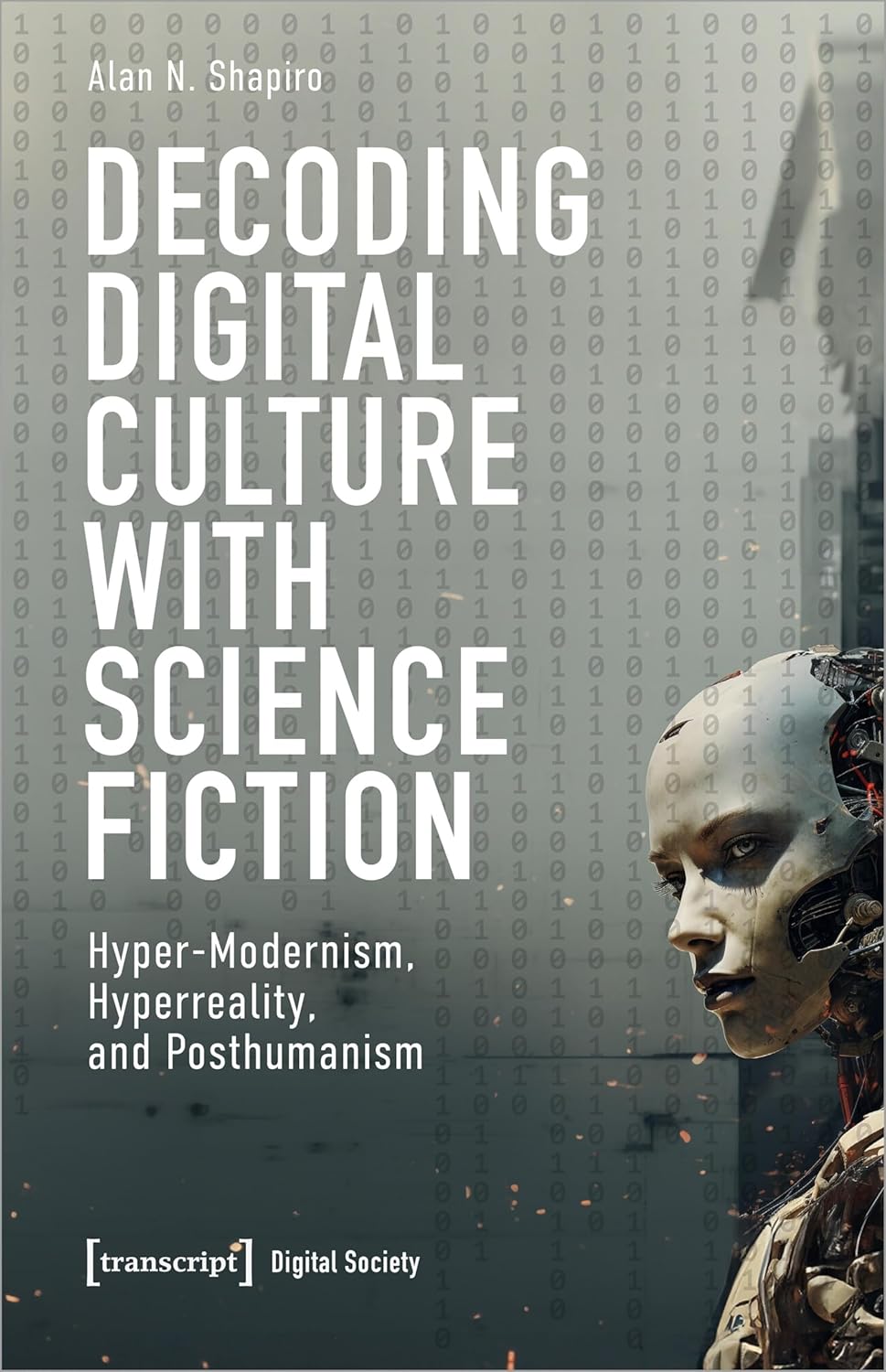
Alan N. Shapiro. Decoding Digital Culture with Science Fiction: Hyper-Modernism, Hyperreality, and Posthumanism. Bielefeld: transcript Verlag and New York: Columbia University Press, 2024. Paperback. 374 pages. €50.00. ISBN 9783837672428.
When I completed my Master’s degree in English Language and Literature in July 2024, I found myself increasingly drawn to the question of how science fiction (SF) can help us think critically about the digital and technological futures we now inhabit. Many of the speculative worlds I explored during my degree – once purely imaginative, especially in the late 20th century – no longer feel like distant possibilities. They feel less like fiction and more like our lived reality. Surveillance systems, pervasive data collection, algorithmic control and governance, and artificial intelligence are no longer abstract concepts. They are already here, shaping everyday life in profound ways.
Science fiction has evolved beyond simple prediction or foresight; it has become a practical method, a way to decode the complex digital cultures around us. This shift is at the heart of Alan N. Shapiro’s Decoding Digital Culture with Science Fiction, a book that blends cultural theory, media studies, and futures thinking to explore how science fiction (SF) helps us understand and even shape emerging technologies. I wish I had discovered the book earlier, particularly during my thesis research. Still, it has since become a key influence in my current role as a Fellow in the Young Future Maker Fellowship Program, run by Future Days (Portugal), the Copenhagen Institute for Futures Studies (Denmark), and Media Lab Bayern (Germany).
During my fellowship, I have been applying many of the ideas that Shapiro discusses: using literary and science-fictional thinking to analyze digital futures, especially around themes of surveillance, privacy, and algorithmic governance. My work focuses on utilizing cultural texts (literary studies) to address real-world challenges, collaborating with futures and media experts to explore how stories and technologies intersect. For instance, in preparing for my Future Days 2025 fellowship presentation, I used his concept of science fiction as a critical lens and methodological tool—an applied iteration of the Literary Futures method by Rebecca Braun and Emily Spiers—to analyze not only the stories we tell about technology but also the algorithms and systems that structure our digital lives. This book hasn’t just been a background reference; it has directly influenced my practice-based research, showing how theory can guide creative, future-oriented work. Shapiro’s framework has profoundly shaped my approach to projects that bridge narrative, technology, and futures thinking. The book has helped me frame projects that bring literature into dialogue with foresight practices, culminating in recent presentations at the Future Days Conference (2025) Garden Gallery in Estufa Fria, Lisbon, Portugal.
Shapiro’s book explores the deep entanglement of science fiction, digital technologies, and cultural theory, arguing that SF is no longer just a storytelling genre. Instead, it has become a shaping force, influencing both the design of new technologies and the ways in which society understands them. The text is divided into three interconnected sections: Hyper-Modernism, Hyperreality, and Posthumanism, progressing from analysis to critique and ultimately to proposals for transformation.
In Part 1, Shapiro introduces Hyper-Modernism, an intensification of postmodernism driven by algorithmic systems that now organize culture and everyday life. Drawing on theorists such as Fredric Jameson and Gilles Lipovetsky, he shows how science fiction has evolved from mere storytelling to a force that actively influences technological development. Through examples like Black Mirror and Star Trek, Shapiro demonstrates SF’s dual function: it both inspires technological innovation and provides critical commentary on its consequences. This section particularly resonated with me, as it highlights why SF deserves serious study within the humanities and beyond.
Part 2 engages with Jean Baudrillard’s theory of hyperreality, where simulations and images replace reality itself. Shapiro argues that in today’s digital, algorithm-driven world, Baudrillard’s ideas are more relevant than ever, but they need to be updated. Platforms such as social media, VR, and AI have pushed hyperreality to new extremes, eroding the distinction between the real and the virtual. This section also addresses post-truth politics and the algorithmic shaping of perception, connecting Baudrillard’s theories to contemporary debates. What I appreciated most here was Shapiro’s insistence that we are not powerless: by “re-coding” digital systems, we can resist and reconfigure the structures of hyperreality. His use of The Matrix as a metaphor for this kind of critical engagement was especially compelling.
Part 3 moves toward transformation, focusing on Creative Coding and Posthumanism. Drawing on N. Katherine Hayles’ How We Became Posthuman, Shapiro critiques the traditional, abstract conception of code as purely functional. Instead, he envisions coding as a creative, embodied, and collaborative practice. This has profound implications for computer science, which he argues should become more transdisciplinary, connecting technology, art, and the humanities. Creative Coding, as Shapiro presents it, can resist algorithmic capitalism, generate art, and decenter human authorship through collaboration with AI. While this section was inspiring, I found myself wishing for more detailed, practical, and concrete examples of Creative Coding, as this concept feels especially promising for education and futures studies. It would have been valuable to see specific examples of how these ideas could be applied in classrooms, labs, and workshops.
Shapiro situates his work within a rich theoretical tradition. His arguments draw on thinkers such as Michel Foucault (panopticism and power), Donna Haraway (Informatics of Domination), Cornelius Castoriadis (The Imaginary Institution of Society), Jean Baudrillard (hyperreality and simulation), and Gilles Deleuze (rhizomatic thought and networks). By engaging these foundational ideas, Shapiro provides a strong intellectual grounding for his claim that science fiction is not only a cultural artifact but also a methodological tool for decoding digital life.
In this sense, Shapiro’s work sits alongside other major texts in digital culture and futures studies. For example, while Shoshana Zuboff’s The Age of Surveillance Capitalism examines the economic and political dimensions of the surveillance economy, Shapiro goes further by showing how narrative and imagination can decode and critique these systems. Similarly, where Hayles explores the evolution of posthuman subjectivity, Shapiro provides a practical, future-facing perspective, demonstrating how SF can actively shape our responses to technological change.
One of the most compelling chapters in the book is “Science Fiction Heterotopia: The Economy of the Future.” In the section “Similar Technologies in the Real World Today,” Shapiro draws striking parallels between fictional worlds and actual technologies. He weaves together Foucault’s panopticon, Zuboff’s surveillance capitalism, and science-fiction narratives to explore the politics of surveillance and power in the digital age. These intersections between theory, technology, and narrative are where the book truly shines, showing how science fiction can act as both a mirror and a map for our future.
The book’s greatest strength lies in its interdisciplinary reach. It speaks to literary scholars interested in speculative fiction, digital humanists exploring the links and intersections of narrative and technology, and futures practitioners seeking frameworks to guide foresight projects. Its ideas could enrich courses in literary studies, cultural theory, media studies, and futures education, helping students and researchers think critically about how stories and technologies co-evolve.
From a personal perspective, this book has been transformative for my fellowship work. It provided not just theoretical insight but also a practical philosophy for using science fiction as a tool in real-world futures work. Shapiro’s approach reaffirmed my belief that fiction is not just meant to be read or interpreted, but to be applied—as a way of anticipating, critiquing, and reshaping the future. This understanding has guided my collaborations with media experts and informed public presentations, where science fiction acts as a bridge between storytelling and systems thinking.
If there is one area where the book could be expanded, it would be its treatment of Creative Coding. Shapiro’s vision of coding as an artistic and philosophical practice is compelling, but I found myself wanting more concrete examples and teaching strategies. Given the rapid growth of computational creativity and generative AI, this topic deserves more attention. While I would have liked to see a deeper dive into Creative Coding, this does not diminish the book’s impact. For me, it has been more than just an academic text: it has become a practical tool and a source of inspiration. In an era when algorithms and simulations define so much of our world, Shapiro’s call to “decode” digital culture feels both urgent and empowering.
Decoding Digital Culture with Science Fiction is more than just a book about literature or technology; it is a call to action. By positioning science fiction as both a critical lens and a creative practice, Shapiro urges readers to move beyond passive story consumption and toward active engagement with digital systems. For educators, scholars, and practitioners across philosophy, literary studies, digital humanities, and futures thinking, this book offers an essential framework for navigating our algorithmic age. It has been pivotal in my own work, highlighting that science fiction is not just a genre but a method for creating better futures. As our world becomes increasingly shaped by algorithms, simulations, and automated decisions, Shapiro’s work feels urgent and necessary. It is a book that should be read widely, not only for its intellectual depth but also for its potential to change how we teach, create, and imagine digital futures. Overall, Decoding Digital Culture with Science Fiction offers a critical yet hopeful vision of our technological future. This is a book I strongly recommend to anyone seeking to understand, critique, and reimagine our technological futures.
Nanditha Krishna graduated in 2024 with a Five-Year Integrated Master’s (M.A.) degree in English Language and Literature from Amrita Vishwa Vidyapeetham (Amritapuri, India). She is a Future Days 2025 Fellow (Copenhagen Institute for Futures Studies, Media Lab Bayern, and Future Days). Previously, she was a virtual research intern at the Australian Research Centre for Interactive and Virtual Environments (University of South Australia), contributing to projects on interactive narratives, news games, digital art, virtual reality (VR), and creativity in immersive performance. From 2021 to 2023, she was a HASTAC Scholar and a research intern at the Empathic Computing Lab (University of Auckland). Her interests span speculative fiction, media studies, and futures studies, exploring how digital technologies shape culture and society.

 SFRA Review