
Non-Fiction Reviews
Review of Black Speculative Feminisms
Rebecca Hankins
Cassandra L. Jones. Black Speculative Feminisms: Memory and Liberated Futures in Black Women’s Fiction. The Ohio State University Press, 2024. E-book. 122 Pages. $29.95 ISBN 9780814283776.
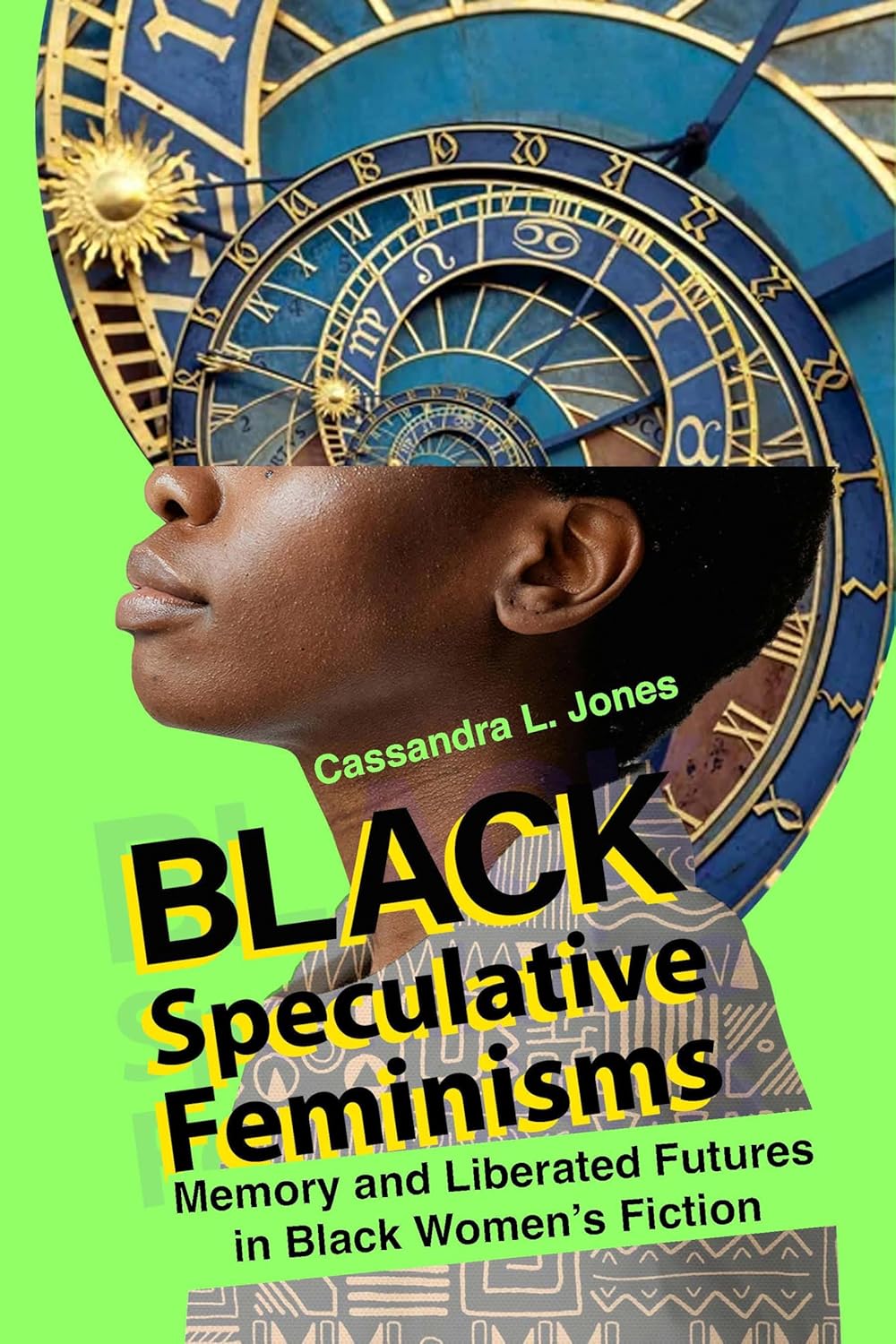
In Black Speculative Feminisms, Cassandra Jones explores how Black women authors use science fiction, fantasy, and speculative fiction to challenge linear notions of time by drawing on Afrocentric concepts. The work positions itself within a larger effort to excavate and highlight the power of Black women’s history and its implications for the future. Jones emphasizes “attention to record-keeping as an ongoing antiracist intervention” (2) and introduces key hashtags such as #ListenToBlackWomen, #BlackWomenArtTheFuture, and #CiteHerWork as part of Black Twitter’s tradition of disrupting the erasure of Black women’s contributions.
The book distinguishes Afrofuturist feminism from broader Afrofuturism (speculative fiction, science fiction, fantasy, and futuristic literature written about and by Africans and African Americans), defining it as a literary tradition where “people of African descent and transgressive, feminist practices born of or from across the Afro-diaspora are key to a progressive future” (5). Central to Jones’s analysis, and repeated throughout the book, is the concept of “restorative critical fabulation” – not simply mythologizing a great African past but creating imaginative works that humanize Black women and breathe life into historical records, shifting our relationship with traumatic histories. Jones further notes that this concept of restorative fabulation “recognizes the emotional labor of the author and serves as a balm for reckoning with those histories of trauma” (8).
In Chapter 1, Jones examines Tananarive Due’s The Good House (2003) and Nalo Hopkinson’s The New Moon’s Arms (2007) to illustrate how memory serves as an instructive device for identifying threats to Black people, a concept she defines as rememory. These repressed memories can be transformed into healing when dealing with generational traumas from the past. She notes that rememory is similar to what we are currently experiencing in political circles with the attacks on Black history and Black studies; how learning, remembering, and sharing of this history is determined to be dangerous and traumatic. Jones examines rememory through the figure of Due’s conjure woman, Angela, and Hopkinson’s Calamity, both of whom celebrate the power and promise of an African past, using memory to resolve historical horrors and transform that trauma into healing.
The chapter examines how the strength of Black women is often pathologized, referencing destructive narratives, such as the Moynihan Report (https://www.dol.gov/general/aboutdol/history/webid-moynihan). This 1965 study by sociologist and, at the time of the report, Assistant Secretary of Labor Daniel Patrick Moynihan proposed that the high rate of Black families headed by single mothers was a major obstacle to Black progress towards equality. Rather than focusing on systemic racism, the report pathologized Black women as the cause of the deterioration of the Black family. In contrast, both novels reclaim Black women as figures who celebrate them, emphasizing love over pain, a healing that is rooted in giving oneself over to a restorative fabulation that engages and adds to Dr. Sadiyah Hartman’s methodology called critical fabulation. Hartman’s method requires that we interrogate the historical record through the lens of the marginalized and the aftereffects of the institution of slavery. Both frameworks of Jones and Hartman enable the recall of a familiar history that is critical, restorative, and finally, celebratory.
The Conjure woman has also been demonized and stigmatized as an evil force, but these two novels reclaim Conjure women as bearers of ancestral knowledge that is important and continuously present. In Due’s book, it is the entity titled the Baka that represents the colonial past; the desire to suppress memories and the horrors they experienced that devours Black people. Through this analysis of works featuring spiritual possession, Jones demonstrates how surrendering oneself to memory can facilitate healing by connecting it with the transformative power of love from departed family members. This remembering is used to fight against the Baka, an evil force and horror that forces characters to kill others or themselves. One of the main characters, Tariq, is used as the metaphor for how the embrace of toxic masculinity, homophobia, and the rejection of the wisdom of the ancestors makes him vulnerable. That vulnerability causes Tariq to succumb to the Baka. It is through Angela, the Conjure woman, the figure that unites the past and future into a singular moment, that she can defeat the baka. More importantly, she can connect “ancestral memory and love…this healing a step further to physically rewrite the world, restoring Corey and all those killed by the baka to life” (26).
The chapter also examines Hopkinson’s The New Moon’s Arms, which centers on a Caribbean woman, Calamity, as she nears menopause. Her hot flashes bring back familiar memories and items from her past, and the recurring theme of good/bad mothers and communal rememory that Jones discusses throughout the book. These themes are combined in Calamity’s story with the repression of sexuality, which traumatizes Black people throughout their lives. In the novel, this sexual repression is often done through religious adherence that embraces the compulsory heterosexuality and homophobia of Calamity’s Christian upbringing, which has traumatized her since childhood. The hot flashes force her to trust her body and to accept her role as matriarch and the vessel for communal rememory. Calamity confronts the disappearance of her mother, who she believes drowned in the sea, and her memories connect to the trans-Atlantic slave trade and the sea creatures, seals and merpeople (mermaids/mermans), which in these narratives are often depicted as the descendants of enslaved Africans who escaped into the sea rather than submit to slavery. “Calamity’s horror in Hopkinson’s novel is not only tied to a fear of the supernatural unknown, but also deeply tied to a fear that repressed memories and stories from her past kept from her by her parents might reemerge” (33). It is the ability of these women, Angela and Calamity, to connect to the past that guarantees their futures and those of their ancestors.
Chapter 2, “Memory and African Traditions”, examines how memory functions in novels to imagine futures that incorporate African traditions, rather than simply reinforcing Western modernity. Jones pushes back against criticism of science fiction/fantasy as “white” literature, noting that these forms have always been part of African-centered storytelling traditions. This perspective is particularly important as Jones challenges conventional genre boundaries and demonstrates throughout the book how African narratives naturally feature “beings from space, seers, talking animals and sentient plants” (36) that communicate morality and tradition across the continent.
Jones’s analysis of Nnedi Okorafor’s Lagoon (2014), in which aliens invade Nigeria, explores how the novel critiques Christian traditions that foster self-hatred, addressing the complex interplay of ideological and physical influences in the postcolonial, neocolonized world. Jones examines how the novel challenges neocolonialism, which frames Africa as perpetually in need of Western intervention, and highlights how African intellectuals have sometimes been complicit in perpetuating cultural imperialism. This approach resonates with other significant works of Black speculative fiction, such as esteemed lawyer Derrick Bell’s “Space Traders” (1992), a story about aliens coming to America and requesting that all Black people be sent to their spaceship. In return for sending them all the African Americans, they offer the United States riches, clean air and water, and overall prosperity. Both Okorafor’s and Bell’s work confronts Black self-hatred while demonstrating how anti-Blackness has been complicit in propagating Western cultural imperialism, revealing that holding on to these ideas ultimately offers no protection.
The variety of protagonists that are central to Okorafor’s story include Father Oke, who represents anti-Blackness and misogyny; Adaora, the marine biologist who introduces the aliens; Ayodele the alien ambassador; Mami Wata, the water deity who destroys Father Oke; and Legba, whose use of the Nigerian Prince, also called the 419 scam, is rehabilitated after his encounter with the aliens. Through these diverse characters, Okorafor illustrates how the aliens serve as agents of transformation. Upon the aliens’ arrival in Lagos, Nigeria, they not only destroy the internet cafes that facilitated these scams but, as Okorafor notes, “the invasion’s dramatic ability to unseat Western discourses by strengthening the existing power of resistance” (46). Toppling multiple social hierarchies and cleansing the oceans, these shapeshifting aliens, who proclaim themselves catalysts of change, inspire nationalist pride and expel the lasting influences of colonialist rule.
The novel’s use of animals and mythological figures exemplifies how “animals hold a place of extreme importance in African storytelling and mythology” (43), serving as messengers of gods or living incarnations of deities in Ashanti, Igbo, and Yoruba traditions. This is particularly evident in Okorafor’s portrayal of Mami Wata as a powerful water deity who represents traditional African spiritual forces resisting colonial impositions. Through these elements, Jones demonstrates how “restorative fabulation employs the tropes of science fiction to restore indigenous beliefs and cultures,” using alien contact narratives to explore both anti-African sentiment and the cultural beauty and power of African cultures (51). Ultimately, the chapter reveals how Black women authors such as Okorafor use speculative fiction not merely as entertainment but as a powerful vehicle for cultural preservation and decolonization of the imagination.
In Chapter 3, Jones introduces the concept of “Sankofarration,” derived from “Sankofa,” meaning “it is not taboo to fetch what is at risk of being left behind” (56). She examines how Black authors employ narrative and writing to reclaim and preserve memory, drawing on what was left behind. The chapter contrasts how Black Studies tends to focus on the past, while Afrofuturism looks to the future, revealing how Black speculative fiction uniquely bridges these temporal orientations to recover non-Western concepts of history and time.
The chapter analyzes Octavia Butler’s Kindred (1979), showing how it connects memory, trauma, and time travel as an act of decolonization. “Decolonizing time becomes an additional approach to recognizing and healing this trauma” (53). Drawing on Butler’s archives housed at the Huntington Library in San Marino, California, Jones illuminates how the novel’s time travel mechanics connect to Igbo cosmology, demonstrating Butler’s deliberate engagement with African philosophical traditions. Kindred exemplifies “imaginative thinking that cannot change the past but can breathe life into the historical record and shift our relationship with the past” (57). Through this lens, Jones reveals how Butler attempts to spark emotion and create empathy in readers by demonstrating that racism is not merely individualized but deeply systemic, requiring a cross-temporal understanding to comprehend its enduring impacts fully.
Butler’s Wild Seed (1980) serves as another powerful example of restorative fabulation, creating “a world in which characters reckoning with chattel Slavery are not yoked to realist history” (58). This narrative approach offers readers the opportunity to shift their perspective and relationship to historical trauma without diminishing its significance. By transcending conventional temporal boundaries, Butler creates spaces where Black women can imagine alternatives to oppressive systems while acknowledging the weight of historical memory.
Jones also analyzes Rasheedah Phillips’ novella “Telescoping Effect” (2017), which borrows its central concept from psychiatry to portray memory as an economically exploitable resource. The term refers to cognitive temporal displacement where one’s understanding of linear time is disrupted, creating what Phillips sees as “an undiscovered scientific possibility that time might be collapsed in order to achieve contact between the past, present and the future” (66). Phillips argues that this “collapsing of time” that women experience in the novella serves to “decolonize our memory” (66), positioning the relationship between temporality and memory as a site for Black critical imagination and the creation of future possibilities.
What makes Phillips’ work particularly significant is her development of Black Quantum Futurism as both a theoretical framework and a practical community resource, as evident in her website and series. Unlike many academic theorists, Phillips begins with community engagement before presenting her ideas in academic spaces, thereby inverting the traditional flow of knowledge from institutions to communities. Her innovative work on metaphysics, ontology, and epistemology—areas traditionally dominated by scholars in the social sciences and humanities—represents a radical shift in how we might understand time, memory, and Blackness outside of Western paradigms. This approach demonstrates how Black women speculative writers are not merely creating entertaining fiction but developing comprehensive philosophical systems that challenge fundamental assumptions about reality, time, and historical knowledge.
Chapter 4 examines Octavia Butler’s ‘Patternists’ series (Patternmaster [1976], Mind of My Mind [1977], Survivor [1978], Wild Seed, and Clay’s Ark [1984]) as a complex exploration of memory, power, and historical consciousness that transcends conventional chronology. These interconnected novels create what Jones describes as “lieux de memoire” (sites of memory) – concentrated nodes of spontaneous public memory that function fundamentally differently from ‘official’ historical narratives, which accrue power to particular perspectives. She contrasts institutional history with living memory that incorporates “legends, folklore and other forms of storytelling” (71-72), demonstrating how Butler’s work exists in this more fluid, communal space of memory-making.
The chapter centers on Jones’s nuanced analysis of Anyanwu, the immortal shape-shifter who serves as the moral anchor and disruptive force throughout the series, particularly in Wild Seed. As a character whose existence spans centuries, Anyanwu embodies collective memory itself, defying historical amnesia and functioning as a voice of resistance whose memory offers revolutionary potential against oppressive systems. Through Anyanwu, Butler creates not just a character but a living archive of resistance that persists across temporal boundaries.
Jones masterfully dissects the power dynamics between the series’ central characters. Doro, the body-snatching immortal who builds a breeding program for psychically gifted individuals, represents the colonizer’s mindset: consuming others while justifying his actions through claims of progress and protection. Mary, who eventually defeats Doro in Mind of My Mind by creating the telepathic Pattern, initially appears to represent liberation; however, she ultimately establishes an oppressive hierarchy that mirrors Doro’s regime. Both Doro and Mary function as vampiric forces, though Mary refuses this comparison, creating a society where non-telepathic ‘mutes’ are treated as lesser beings without agency. Jones notes how both rulers create “official histories… that functions as an accounting of past events that has sedimented into layers of narrative, repeating only the ‘official’ narrative, accruing power to a certain people or nations through this shared narrative and those creators authorized to contribute layers of history, denying the ability to create legitimate narratives to the general populace” (71). Doro and Mary justify their behavior, mirroring real-world colonial and post-colonial power transitions.
What makes Jones’s analysis particularly powerful is her examination of how Anyanwu serves as the true revolutionary force throughout the series. Unlike the dramatic power struggles between Doro and Mary, Anyanwu’s resistance operates through the preservation of memory and quiet subversion. She “acts as a site of memory in multiple crucial movements,” using her historical knowledge to critique not only Doro’s horrific acts but also highlights what “E. Frances White reminds us about the problems that came from accepting a false unity during the decolonization phase that has led to the transfer of local power from an expatriate elite to an indigenous one” (88). As the embodiment of the people’s disruptive power, Anyanwu recognizes what others cannot: that Mary is becoming indistinguishable from Doro despite her claims of difference.
The chapter draws important connections between Butler’s fictional worlds and real historical processes, highlighting Butler’s interest in Igbo culture as a repository of memory and a reminder of alternative social organizations. Jones quotes Butler directly: “I don’t think it would be wise…for any black person…to forget” (82), underscoring the political dimension of memory-keeping in Black communities. Through her concept of ‘critical fabulation,’ Jones shows how Butler conjures fully realized characters that conventional historical archives often fail to document, creating speculative figures who participate in North American slavery without changing its factual record. This approach enables emotional and psychological explorations of historical trauma that traditional historical accounts often cannot access, demonstrating the unique power of speculative fiction as a tool for historical recovery and healing.
Jones concludes her analysis by connecting the theoretical frameworks she has developed throughout the book to pressing contemporary issues, including the COVID-19 pandemic, the overturning of Roe v. Wade, accelerating ecological disasters, the persistence of white supremacy, and the genocide of Palestinians in Gaza. These current crises serve as stark reminders of why speculative fiction by Black women isn’t merely entertainment but rather essential cultural work that helps us imagine alternative futures while processing traumatic histories.
While acknowledging science fiction’s visionary potential, Jones emphasizes that “understanding the past and how we remember it are equally important in any project that aims to ‘save ourselves from ourselves’” (89). She points specifically to Butler’s prescient novels, Parable of the Sower (1993) and Parable of the Talents (1998), as warnings particularly relevant to our troubled times, challenging readers to question societal priorities—whether lavish space exploration should take precedence over sustaining democratic systems and addressing fundamental human needs. The Black women authors showcased throughout Jones’s analysis demonstrate how “an understanding of the past and how we remember it are just as important in any project that purports to save ourselves from ourselves” (90), positioning memory work as essential to survival rather than merely as an academic exercise.
Jones draws urgent connections between her literary analysis and contemporary political movements aimed at suppressing collective memory, particularly highlighting anti-critical race theory legislation and voter suppression laws that echo earlier Jim and Jane Crow policies. These connections reveal the high stakes of memory work in an era where historical amnesia is being deliberately cultivated through institutional means. Against these forces, Jones advocates for public and activist scholarship that moves beyond the academy, positioning restorative fabulation as “a praxis for acting in the world” (90) rather than merely a literary technique.
The conclusion extends beyond literary analysis to consider the practical applications of Afrofuturist principles, highlighting how Black and Indigenous agricultural practices provide concrete insights as a component of Afrofuturist activism. This connection between speculative imagination and practical environmental knowledge demonstrates how restorative fabulation can inform concrete solutions to contemporary crises. Jones ultimately argues that restorative fabulation draws attention to temporality and our understanding of history, transcending the anthropocentric view of time and progress, and refusing “to reject our human emotional response to work in ways that according to patriarchal models, render us weak and overly feminine” (93).
In her final synthesis, Jones positions the worlds created by Black women speculative fiction writers as vital spaces “for respite from our horrors, a place to refresh, and a place to consider our options in responding to injustices and threats to our existence as we learn about our past and imagine our potential futures” (93). This conclusion powerfully articulates the therapeutic, political, and revolutionary potential of Black women’s speculative fiction as not just literary artifacts but as living technologies of resistance, healing, and possibility in increasingly uncertain times.
This book is an excellent text for undergraduate and graduate students in the academy. It offers a varied reading list of works for a wider public consumption, including works not critiqued by the author. Scholars of Africana Studies, English/Literature, Physics, and Women’s & Gender Studies will find that this book provides a wealth of opportunities for lively discussions and further study.
Rebecca Hankins is a full professor in the Department of Global Languages and Cultures in the College of Arts and Sciences at Texas A&M University. She has been at the University since 2003. She researches and teaches courses in Africana and Religious Studies. She has a substantial publication portfolio of peer-reviewed works and has presented at national and international conferences, most recently in Barcelona, Spain; Doha, Qatar; and Berlin, Germany.

 SFRA Review