
Non-Fiction Reviews
Review of Tolkien, Enchantment, and Loss: Steps on the Developmental Journey
Dani Tardif
John Rosegrant. Tolkien, Enchantment, and Loss: Steps on the Developmental Journey.Kent State University Press, 2022. Hardcover. 224 pg. $55.00. ISBN 9781606354353.
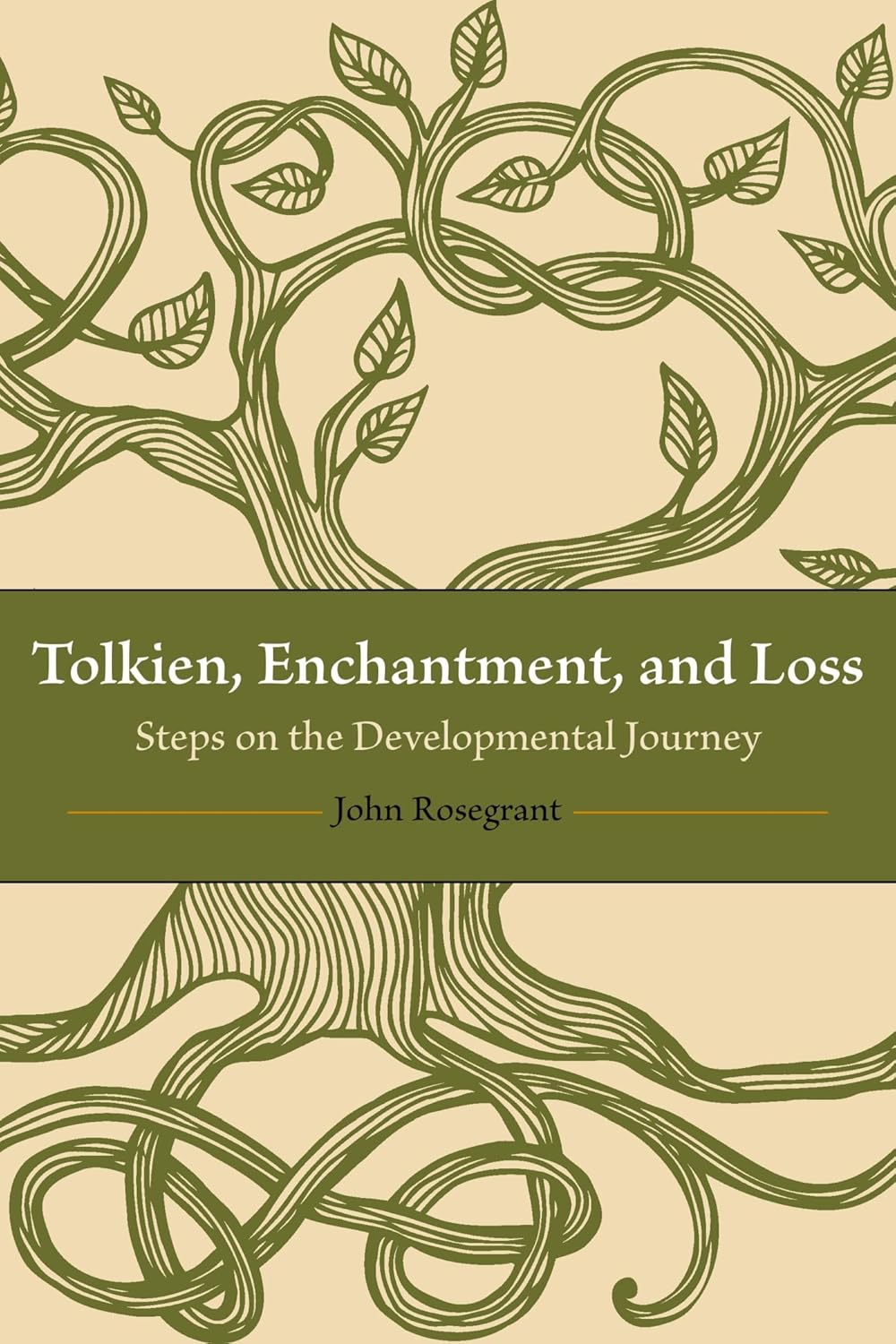
John Rosegrant is a clinical psychologist and psychoanalyst whose main interest is to help people live a full life integrating creativity and fantasy. He is also a Tolkienist and a creative author who has written many young adult fantasy novels. His scholarly work has been published both in psychology journals and in Mythlore: A Journal of JRR Tolkien. This dual perspective puts him in a unique position to write this book: a psychoanalytic and literary analysis of Tolkien’s relationship with loss and enchantment, both in his early developmental life and in his writing. To do this, Rosegrant mobilizes throughout the book concepts from three main psychoanalysts: Winnicott, Kristeva, and Freud. Instead of writing Tolkien’s biography and then exploring its meaning in the text or vice-versa, Rosegrant subdivides the book by themes. The book consists of a series of scholarly articles that seems to have been organized to recreate the hero’s journey schema. This structure works well to make apparent unconscious relationships between objects, affects, and ideas. However, it also brings its own issue: the reading is sometimes repetitive, as important events in Tolkien’s life are referenced repeatedly throughout the book.
Rosegrant’s main thesis is that “For Tolkien, enchantment remains always in sight but always threatened” (2), and that this unresolvable tension between enchantment and disenchantment “was so important in Tolkien’s creativity because it grew out of a psychological strain that he himself struggled with throughout his life” (5). Rosegrant adds, “By writing an enchanting story about the dialogue between enchantment and disenchantment, Tolkien gave us ‘product and vision in unflawed correspondence’” (174).
Themes of enchantment and loss are both well-explored in fantasy. Indeed, James Gifford proposes that “As a genre, [fantasy] does not direct attention toward the utopian speculation on what might be, but rather fuels the disappointment with what is ” (2018, 252). Here, the analysis focuses on the unresolved quality of this ambiguity: “The deepest truth lies not in resolving the ambiguity, but in the process of looking at the ambiguity directly and honestly” (111). Rosengrant notes: “What Tolkien uniquely and crucially adds is the twist that destroying the dark enchantment will also inevitably destroy good enchantment as well” (16). This way of reflecting on Tolkien’s legendarium makes me think of Tom Moylan’s critical utopia (Demand the Impossible, 1986) or Larissa Lai’s insurgent utopia (“Insurgent Utopias: How to Recognize the Knock at the Door,” 2018), works that discuss utopian impulses and dystopian consequences without resolving the tension that exists in their conversation.
Rosegrant argues convincingly that early life development (the loss of his estranged father at the age of four and the loss of his mother at 12) shaped Tolkien’s worldview and poetic explorations. Without defining Tolkien, Rosengrant suggests that these early experiences might have made him more vulnerable to subsequent loss (friends during WW1, his wife) and making him especially sensitive to the feeling of the loss of a “comforting and beautiful world” (17) and the “disenchantment of the world” (174). I particularly appreciated the discussions around how creativity can be a way for authors and readers to enter “transitional experiences”; a concept by Winnicott that describes an “experience that is transitional between the experience of Me and the experience of Not-Me” (20). Rosengrant is not necessarily implying that art is therapeutic, although I think he would argue it could be, but rather that there are some ways to engage with the experience of art that can make us travel between the realm of the Faerie and real-world responsibilities, helping us with the tasks of “developing as separate individuals and integrating […] into a world much larger than themselves” (22).
Le Guin critiqued psychological analyses of fantasy that were looking for rational answers while removing elements specific to fantasy: “The purpose a fantasy serves may be as inexplicable, in those terms, as is a dragon” (Le Guin 86). She argues that “to such interpreters the spell is a spell only if it works to heal or reveal” (86). Fantasy, is rather, to her, “creation meaning” (86). Rosegrant, while reading Tolkien through a psychological lens, does a wonderful job of taking faery and fantasy seriously and claiming their inherent importance in adulthood: imagination, play, creativity. In doing that, he honors beautifully Tolkien’s life work.
Rosengrant’s presentation is very convincing, which is both a strength and a weakness of the text. After the first chapter, the book starts to feel repetitive. The overexemplification feels anecdotical at times, as if we are collecting proofs through a rhizomatic thread instead of journeying toward a larger argument. Some chapters are better integrated than others, while some could have been left as standalone articles. Moreover, some parts can feel obtuse to folks who are not Tolkienist experts; if you haven’t read every story he ever wrote, you won’t find summaries of Tolkien’s work here. Furthermore, the shift in tone between literary and psychoanalytical analysis is better executed in some sections than others.
Le Guin has often said that she tells stories not for their resolution, but for their process; for her, they are “thought-experiments” (Le Guin in Lai, 2020, 30) that she conceptualizes as “heavy magic bags” (30), far removed from the straight, hard lines of traditional male heroism. Reading Le Guin, I always assumed she thought of Tolkien when she wrote about male heroism—and honestly I still think she might have—but I believe that further research on Tolkien’s view of what constitutes power and heroism, the internal fight against evil (fascism), based on Rosengrant’s work, would be very interesting.
WORKS CITED
Gifford, James, A Modernist Fantasy: Modernism, Anarchism, & the Radical Fantastic. ELS Editions, 2018.
Lai, Larissa, “Insurgent Utopias: How to Recognize the Knock at the Door.”Exploring the Fantastic: Genre, Ideology, and Popular Culture, Edited by I. Batzke, E. C. Erbacher, L.M. Heß, and Corinna Lenhardt. Verlag, 2018. pp. 91–113.
Le Guin, Ursula K., “The Critics, the Monsters, and the Fantasists.”, The Wordsworth Circle, vol. 38, no. 1/2, 2007, pp. 83–87, http://www.jstor.org/stable/24043962.
—, The Carrier Bag Theory of Fiction. Cosmogenesis, 2019 [1986].
Moylan, Tom, Demand the Impossible: Science Fiction and the Utopian Imagination, Peter Lang, 2014 (1986). Ralahine Utopian Studies, vol. 14.
Dani Tardif is a québécois (french-canadian) non-binary queer artist and anthropologist, working across various mediums including video, sound, and both oral and written storytelling. Their practice blurs the boundaries between fiction and ethnography, magic and politics, exploring themes of vulnerability, grief, desire, and the interplay between the individual and the collective. They are now completing a creative writing MA at UQAR (Rimouski, Québec) exploring how fantasy and speculative fiction worldbuilding can be used to tell nuanced stories of conflicts and lateral violences in queer communities.

 SFRA Review