
Non-Fiction Reviews
Review of Midnight Rambles: H. P. Lovecraft in Gotham
Martijn J. Loos
David J. Goodwin. Midnight Rambles: H. P. Lovecraft in Gotham. Fordham UP, 2024.Empire State Editions. Hardcover. 287 pg. $29.95. ISBN 9781531504410.
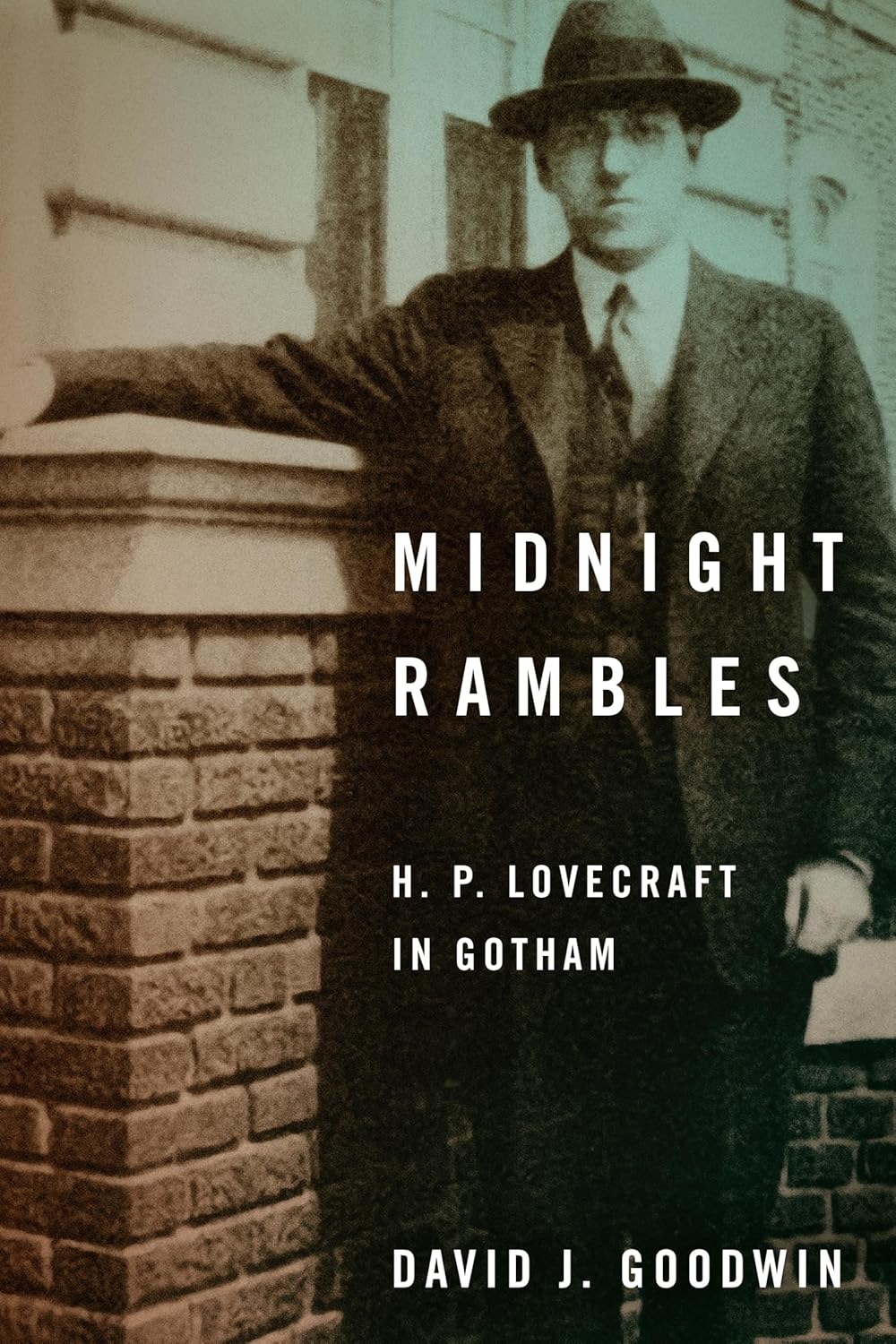
Any account of Lovecraft’s life stands in the shadow of S. T. Joshi’s comprehensive biographical work—A Life in 1996 and I Am Providence in 2010—and will hence either need to be argumentative or opt to take a specific approach to add to Joshi’s work. David J. Goodwin chose the latter and wrote a micro-biography, a “thorough telling of his [Lovecraft’s] relationship with New York City” (15), starting in 1921 and ending in 1926. This approach is largely successful: the sharp delineation enables Goodwin to explore specific aspects of Lovecraft’s life in-depth; taking a short period of his life allows for a closer analysis of Lovecraft’s day-to-day activities than a biography of his entire life could achieve. As a result, Goodwin recreates entire days of Lovecraft’s life in New York, substantiating this with exhaustive research in the form of close readings of Lovecraft’s sent and received letters, complemented by historical research to reconstruct the city as it was in the 1920s.
Midnight Rambles primarily concerns Lovecraft’s changing view on the city; as a concomitant, Goodwin barely focuses on Lovecraft’s admittedly small literary output of the period. After moving to New York in 1924, Lovecraft quickly accrued a circle of intellectual and literary friends—the Kalem Club—with whom he would embark on the titular midnight rambles. Just after moving, Lovecraft was enthralled by the city. This captivation soured over the years, as his marriage to Sonia Greene cooled, he failed to accrue a stable income, he moved from Flatbush to the lower-class Brooklyn Heights, and, perhaps most significantly, he was exposed more regularly to the city’s immigrant population. He ultimately left the city and returned to his native Providence, dubbing the former “the pest zone” (179). Goodwin analyses this changing—and oftentimes ambivalent—relationship while tracking Lovecraft’s circle of friends, daily occupations, and opinions of the city as expressed in his letters and as extrapolated from his activities.
Goodwin advances the argument that Lovecraft, enamored of the city’s colonial heritage, “pictured himself sauntering through New York of the late eighteenth century—a city decidedly constructed on a human scale, still existing alongside the natural world, and notably devoid of an appreciable number of non-English-speaking immigrants,” a “lost New York City, one in which he believed he might have thrived” (84, 94). This serves to explain why Lovecraft’s rambles were mostly at night; it is easier to envision a bygone, sanitized New York when there are fewer people on the street (99-100). This argument deftly weaves together two significant aspects of Lovecraft’s personality and life: his antiquarian interests and indelible racist opinions. This ambivalence towards the city runs parallel to “the complexity inherent in Lovecraft’s choice of friends” (37), such as the Jewish Sonia Greene and Samuel Loveman, or the liberal James F. Morton. Goodwin’s psychologizing approach to Lovecraft’s relationships with the city and its inhabitants—supported by meticulous research—pays dividends in sketching a picture of a complex man, not only warm to his friends and relentless in his rambling, but also an unrepentant racist. This conundrum is central to Lovecraft studies, and Goodwin handles it deftly and thoroughly.
Further innovations to the field are novel analyses of aspects of Lovecraft’s personality. Goodwin convincingly shows that Lovecraft was well in the know about cultural trends (90) and contemporary popular culture (127), repudiating the often-promulgated image of Lovecraft as a man out of time. Despite Lovecraft’s own misgivings about the term, Goodwin dubs him a bohemian, as Lovecraft aspired to earning “a living as a writer and keeping company exclusively with intellectuals, booksellers, and authors” (156), a far cry from the image of Lovecraft as a conservative recluse (171). In a similar vein, Goodwin suggests that Lovecraft might not have been the sexually disinterested prude he is often imagined as, contradicting popular and scholarly opinion (74-74, 150). Here, again, Goodwin’s approach pays off: the micro-biography format allows him to closely scrutinize Lovecraft’s engagement with pop culture in the city and his marriage with Greene, substantiating his innovative claims about Lovecraft’s personality.
The focus on Lovecraft’s life places his fiction in the background. Goodwin briefly mentions the stories drafted or written during Lovecraft’s New York years—“The Horror at Red Hook” (137-141), “He” (143), “Cool Air” (158-161), and the beginnings of the famous “Call of Cthulhu” (146)—but sparsely reads them. Instead, Goodwin briefly touches on how the city influenced the writing of these stories, keeping with the subject of the book: the relationship between Lovecraft and New York.
A scholar of Lovecraft’s tales in isolation from his life will have little use for Midnight Rambles. Those who are interested in Lovecraft’s habits, marriage, changing views on New York, antiquarian interests, stubborn adherence to his racist views, personality, or the Kalem Club, will find this book of great interest. Those in the middle, searching for the connections between fiction and man, will recognize a work invested in the idea that New York intimately shaped Lovecraft’s literary vision, allowing him to mature into the critically acclaimed later phase of his writing after his return to Providence in 1926 (170-172). Goodwin convincingly argues this point, all the while decisively showing the value of the micro-biography format to the field and beyond.
Martijn J. Loos is a Dutch PhD candidate at New York University’s department of Comparative Literature. He works at the intersection of science fiction and philosophy, having published on, amongst others, H. P. Lovecraft, Octavia E. Butler, Ray Bradbury, and Ted Chiang. He enjoys Belgian beers and anything with laser guns.

 SFRA Review