
Non-Fiction Reviews
Review of Imperiled Whiteness
Lisa M. de Tora
Penelope Ingram. Imperiled Whiteness: How Hollywood and Media Make Race in “Postracial” America. UP of Mississippi, 2023. Paperback. 392 pg. $30.00. ISBN: 9781496845504.
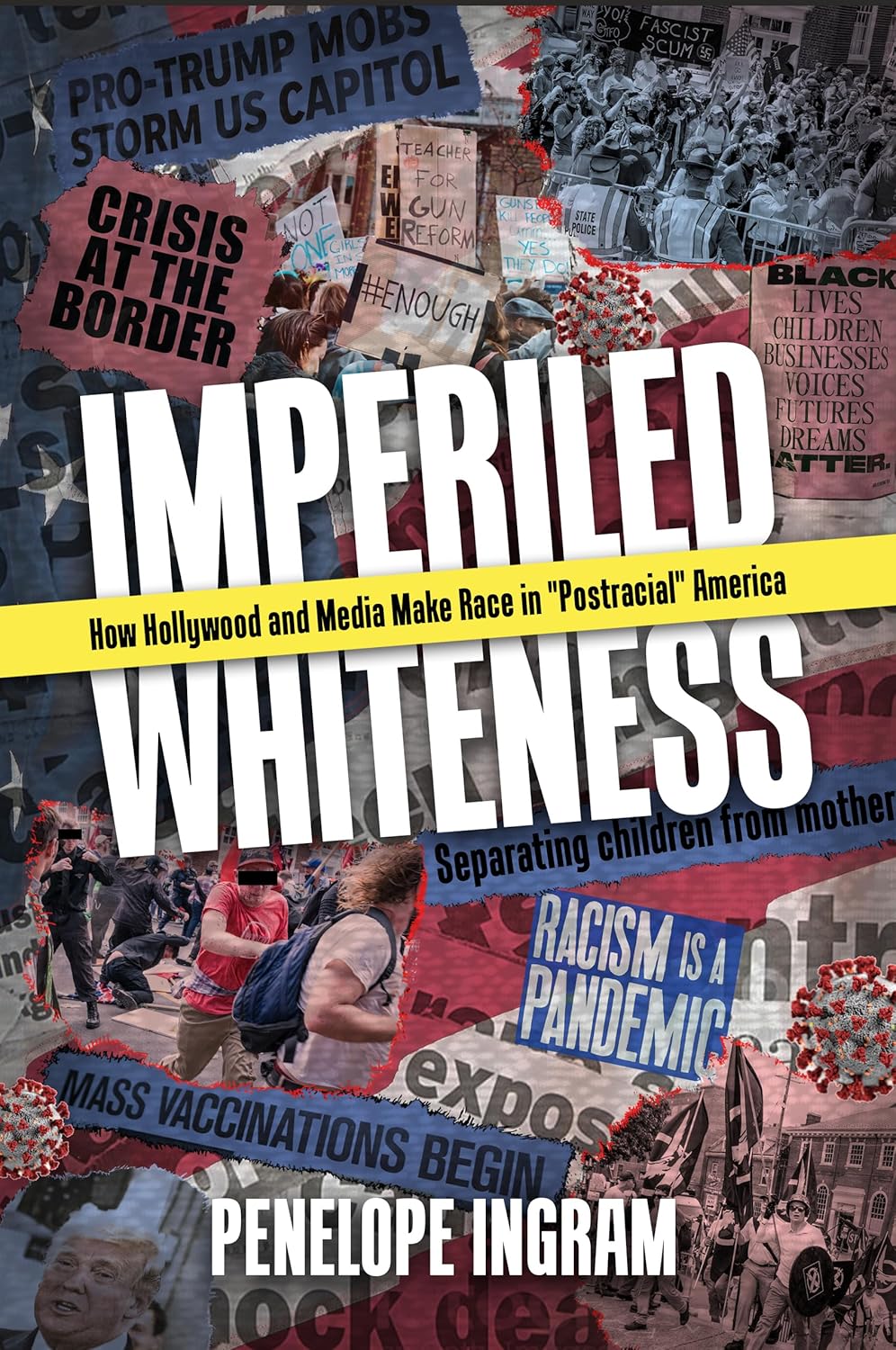
Imperiled Whiteness examines how “seemingly progressive narratives” (23) in speculative fiction (SF) “consistently reproduced historically racist imagery” (23) and were “reinforced by concomitant political and social media narratives concerning race and race relations that stoke out-group hostility” (23). To do this, author Penelope Ingram examines how connections between media events, fictions, and real life—what she terms “convergence culture” (24)—can make it impossible to discern the differences between reality and fictional representation. Integral to this convergence culture was a Covid-era proliferation of “zombie movies… where ‘good’ people must defend themselves against murderous, rapacious, undead ‘bad’ people” (4) within a broader media ecosystem, contributing to increasing real-life social and political polarization.
Ingram’s methodology draws on various area studies, specifically cultural studies, media studies, postcolonial and race studies, philosophy, and film studies to elucidate the ongoing and longstanding success of white SF franchises. Ingram reads three extremely successful and profitable franchises, the Walking Dead, the Star Trek reboots, and Planet of the Apes, as produced during the Obama administration, through the increasing racial polarization of US politics. Ingram chose to analyze franchises, as opposed to individual works, to read across multiple texts, media, and the decades-long histories of Planet of the Apes and Star Trek. For contrast, she discusses well-recognized, profitable, and popular work by “Black SF creatives” (14) Jordan Peele and Ryan Coogler that forms a counterpoint to “Black life as it is represented in realist films” (27). Of particular interest to Ingram is how convergence culture “turned whiteness into a commodity that was packaged and disseminated to a white populace” (9) by leveraging the idea of outside attack and ongoing peril faced by white people. Ironically, this peril can be depicted in the SF media ecosystem “precisely because it disseminates the notion that racism and indeed, race itself, are seemingly obsolete” (9).
The book is divided into six parts: an introduction and conclusion that provide and wrap up the overall framework for analysis just summarized, three sections that consider the broad themes of contagion, animality, and monstrosity as they play out in three very popular and highly profitable white SF multimedia franchises, and a section that offers a contrasting perspective on the SF works of Peele and Coogler. The three sections on white SF each illustrate how a specific theme (contagion, monstrosity, or animality) functions metaphorically on a franchise level and in specific works to reinforce a sense that white people are imperiled by outside others. The work concludes with an alternative vision for rehumanizing racial others.
Ingram’s stated grounding in specific area studies—cultural studies, media studies, postcolonial and race studies, philosophy, and film studies—is generally solid. The film and media studies framework is especially strong. Ingram provides excellent readings of the Star Trek, Walking Dead, and Planet of the Apes franchises, related Hollywood and independent films, social media posting, and the role of commodity fetishism in ongoing discourses of race that reinforce the idea that white people are imperiled. Less clear is how work like Coogler’s Black Panther films function on a franchise level as a counterpoint to ‘white’ SF, given origins that, quite arguably, could be seen as at the very least seamlessly continuous with such productions. For instance, Coogler adapts a character first created by Stan Lee and Jack Kirby, who are not mentioned in this monograph.
For a work analyzing race in speculative fiction, some important contextual gaps bear mentioning. Most noticeable is a lack of work in speculative fiction and science fiction studies, even very foundational work by Donna Haraway, whose ‘cyborg manifesto’ set the stage for future readings of race, class, gender, and posthumanity (or the relationships between humans, animals, and machines) in cultural studies, media studies, and film studies. Posthuman readings could have benefitted Ingram’s thoughtful focus on the convergence of multiple media and their material effects on lived reality. John Rieder’s work on colonialism and science fiction would have been another helpful addition, as would techno-orientalism as figured by David Roh, Betsy Huang, and Greta Niu. These works analyze the role of race, otherness, and racialization in science fiction and fantasy. African futurism, which finds its focus outside the United States, would also provide some ballast and helpful context. Another helpful grounding text—at least as a mention—might have been John Clute’s work on “fantastika” as a genre category. Another gap that seems odd, given the inclusion of both Walking Dead and Black Panther franchise elements, is an absence of work in comics studies. As it stands, Ingram reinvents approaches to SF studies, SF texts, and comics rather than engaging much valuable existing scholarship.
Overall, Imperiled Whiteness is an interesting and worthwhile read. As a teaching tool, it would most likely benefit faculty and students in media studies as its especial strength is in reading current events, social media, commodity culture, and speculative fictions as they converge within, impact, and create culture. For scholars and students of SF, comics, or graphic narrative, this work has an important gap insofar as it does not meaningfully engage with the existing scholarship of these fields. This is not to say that teachers or scholars should avoid the work, but that they will need to provide their own grounding in that scholarship to make much use of this text.
Lisa DeTora is Professor of Writing Studies and Rhetoric at Hofstra University in the United States. Her scholarship in health humanities, comics, and popular culture examines embodiment, quantum states, and posthumanity. Lisa’s paper on The Windup Girl and embodied identity appeared in Diasporic Italy in 2022. Lisa co-organized panels on comics at SFRA (Dresden, 2023 with Umberto Rossi), and a seminar at Framing the Unreal a conference about intersections between science fiction and graphic narrative (Venice, 2024 with Alison Halsall).

 SFRA Review