
Non-Fiction Reviews
Review of Cloverfield: Creatures and Catastrophes in Post-9/11 Cinema
Leah Olson
Steffen Hantke. Cloverfield: Creatures and Catastrophes in Post-9/11 Cinema. The U P of Mississippi, 2023. Reframing Hollywood. Paperback. 232 pg. $20.00. ISBN 9781496846754.
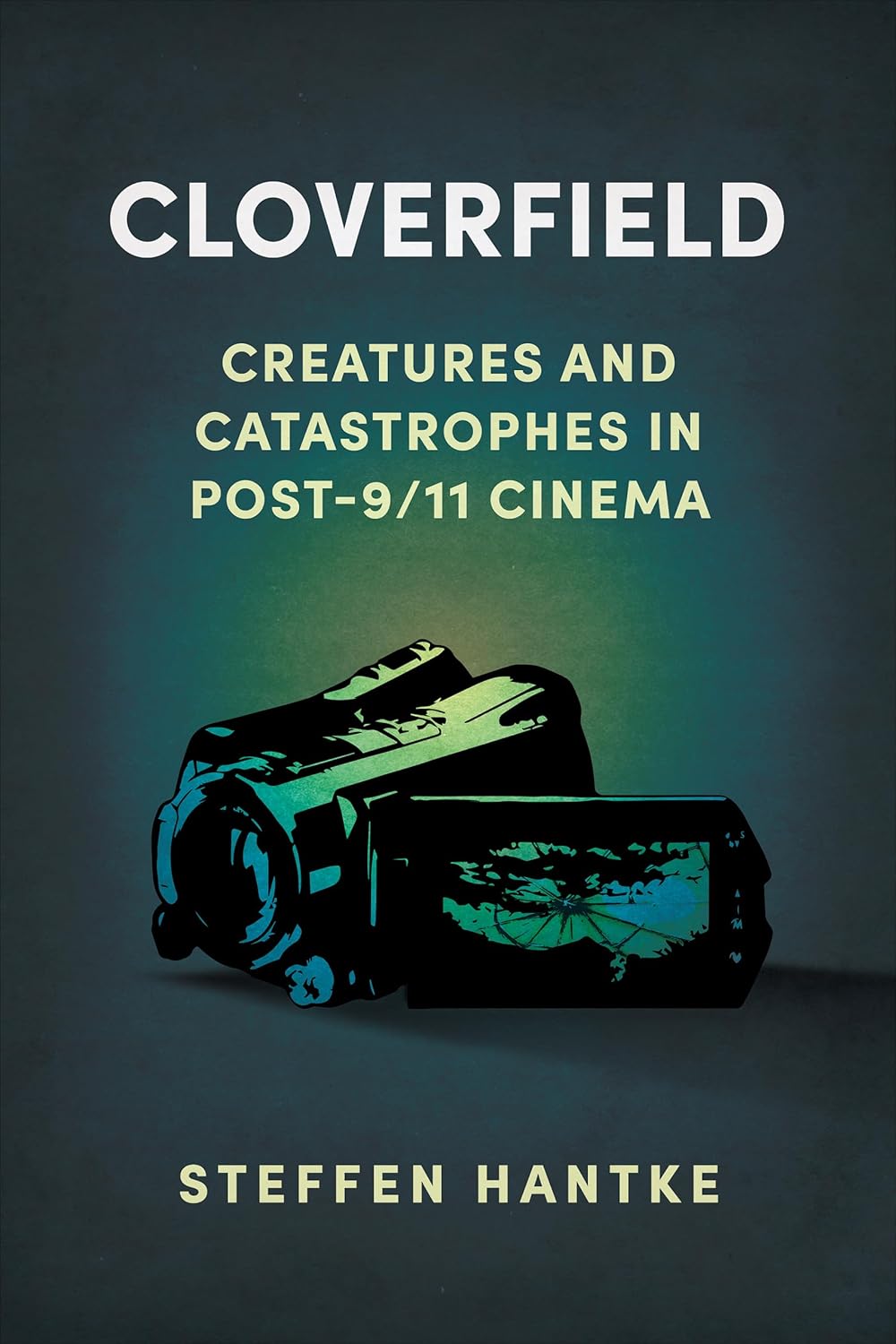
Steffan Hantke’s Cloverfield: Creatures and Catastrophes in Post-9/11 Cinema asserts that J. J. Abrams’s Cloverfield franchise is a particularly well-suited cultural artifact through which to analyze the political, social, and formal influences of the 9/11 terrorist attacks on blockbuster entertainment in The United States through to the present day.
Hantke titles his introduction “Some Thing Has Found Us,” making immediate the connection to monster films that Cloverfield invites while also suggesting that the “thing” can be read metaphorically, such as the speed of cultural currency in entertainment, cinematic authorship, reimagining originality and conventionality, domestic and international war, and capitalist and colonial critiques. The analysis draws upon a variety of methodologies, mirroring Hantke’s argument that Cloverfield is a multi-genre piece of media that cannot be assessed through singular means. He first invokes Thomas Pynchon’s Gravity’s Rainbow (1973), suggesting that “the visceral experience in Cloverfield felt like the cinematic equivalent of the nightmare [of war] in Gravity’s Rainbow” (3). Cloverfield’s affective register, specifically “the sense of complete absorption in the moment and that of self-conscious familiarity underneath,” is the unifying center of Hantke’s analysis from which he then historicizes the diverse cinematic tradition (both in terms of audience reception and formal techniques) Cloverfield draws upon, the political and social complexity in which Cloverfield—released seven years after the events of 9/11—and its audience exists within.
The work begins by establishing the narrative and, by extension, social function of giant monsters throughout cinema history, complicating a surface level-reading of Cloverfield. Hantke argues that “there comes a point in the growth process of a giant creature when its size exceeds even the wildest flights of extrapolative fancy,” and it is at this point that it becomes accessible as and through metaphor (33). What that metaphor is, however, is highly contextualized. Thus, the first chapter is heavily invested in demonstrating that, on a formal level, Cloverfield is highly aware of its position in cinematic history and utilizes the visual language of the form to provide audiences with initial tools for engagement that are then upended with unsolved questions, placing the onus on the fans to assemble the pieces themselves.
Chapters 2 and 3 are dedicated to parsing out the film’s context as a post-9/11 blockbuster and the narrative tools it uses to offer narrative space for critiquing or engaging with the implications of a highly militarized American response to the attacks and its effect on civilian lives without making any sweeping statements itself. Hantke argues that Cloverfield “was not coy” about using imagery that was “immediately recognizable iconography of terror” (55). Part of this is made possible using found footage as the visual framing of the film (entirely viewed by the audience through the conceit of a handheld camera operated by several of the main characters) that draws upon war footage of the era. Hantke ends these chapter with the core of his project: “the heritage of 9/11 is not war of nation against nation, but the cognitive paradox of not knowing anything while having all the facts at our command and responding to this conundrum with a vague yet not less powerful and pervasive sense of paranoia” (100). The use of found footage also draws attention away from the propagandized visions of nationhood or other such organizing narratives towards a very private and personal site of meaning making. Private joys are positioned not as a means by which to defeat the giant monster but to understand its effects.
That vagueness allows for the visceral effect that Hantke identifies in the introduction and, as he explores in chapters 4 and 5, that forms the foundation for the franchise itself. For Hantke, the “elliptical nature” of Cloverfield is both the means of its success as well as its end (101). Because Cloverfield offers few to no answers to audience questions, it leaves space for subsequent narratives that will draw the audience’s interest. In these chapters, it becomes necessary to parse out the role of the showrunner or producer, in this case J. J. Abrams, as a sort of authorial center to which audiences are likewise drawn. Hantke argues that Abrams’s model of franchise relies on “ellipsis and fragmentation, incoherence, and uncontrollably proliferating complexity” where other serial storytellers would view such techniques as a sign of a failing creation (133). And yet, because each subsequent film becomes further and further removed from the original context of a post 9/11 viewership and must maintain the fragmentation, there are no unifying characters or locations that bind the films together. Thus, Hantke argues that the third and final installment, The Cloverfield Paradox, “leaves viewers with little else to talk about than its relationship to the preceding two films in the franchise” (123). Interestingly, this is similar to Fran Hoepfner’s review of Alien: Romulus (2024) in which she states that while the Alien films share similar formulas, “their goopy scares still delight and disgust” largely because of their familiarity.
Hantke’s work offers a thorough close reading of Cloverfield both as a text and a franchise through which his impressive knowledge on cinema, post-9/11 history, and Hollywood’s innerworkings are on full display. However, in what could be seen as attempts to legitimize dedicating an academic text such as this to a popular culture artifact, Hantke makes vague and repetitive references to literary traditions such as the literary gothic, the nineteenth-century bildungsroman, and Gravity’s Rainbow without fully fleshing out or making explicit their usefulness to his argument or to the field(s) he is engaging with. What could have been a very informative integration of literary and film studies reads more like a haphazard space filler at worst and a weak or tangential argument at best.
The strengths of Hantke’s Cloverfield lie in its accessibility. Hantke’s illuminating close readings pair well with the heavily researched (and thoroughly footnoted) complex histories that he is very familiar with. It would be easy to become lost in the sheer number of references, and yet Hantke has structured his argument in such a way as to make it easily readable. The most compelling and useful part of his argument is, perhaps, the analysis of J. J. Abrams’s views on franchising and their influence on American blockbuster entertainment. Hantke offers a frame of analysis beyond Cloverfield itself and the content of this chapter remains potentially fruitful for additional research.
WORKS CITED
Hantke, Steffen. Cloverfield: Creatures and Catastrophes in Post-9/11 Cinema. University Press of Mississippi, 2023. Print.
Hoepfner, Fran. “Humans Are Killable. The Alien Franchise Isn’t.” The Atlantic, Atlantic Media Company, 16 Aug. 2024, www.theatlantic.com/culture/archive/2024/08/alien-romulus-review/679479/.
Leah Olson is a PhD student at The University of Nevada, Las Vegas in English Literature where she holds a graduate assistantship. She holds a master’s degree in English Literature from Claremont Graduate University, with a certificate in Preparing Future Faculty. Her research focuses on nineteenth-century American literature, apocalypse/post-apocalypse, and visual narratives. She is particularly interested in the relationship between realism and speculative fiction across genres and time periods.

 SFRA Review