
Non-Fiction Reviews
Review of The Triumph of Babylon 5: The Science Fiction Classic and Its Long Twilight Struggles
Bruce Lindsley Rockwood
Baz Greenland. The Triumph of Babylon 5: The Science Fiction Classic and Its Long Twilight Struggles. McFarland, 2024. Softcover. 250 pg. $49.95. ISBN 9781476692401; Ebook. $29.99. ISBN 9781476651446.
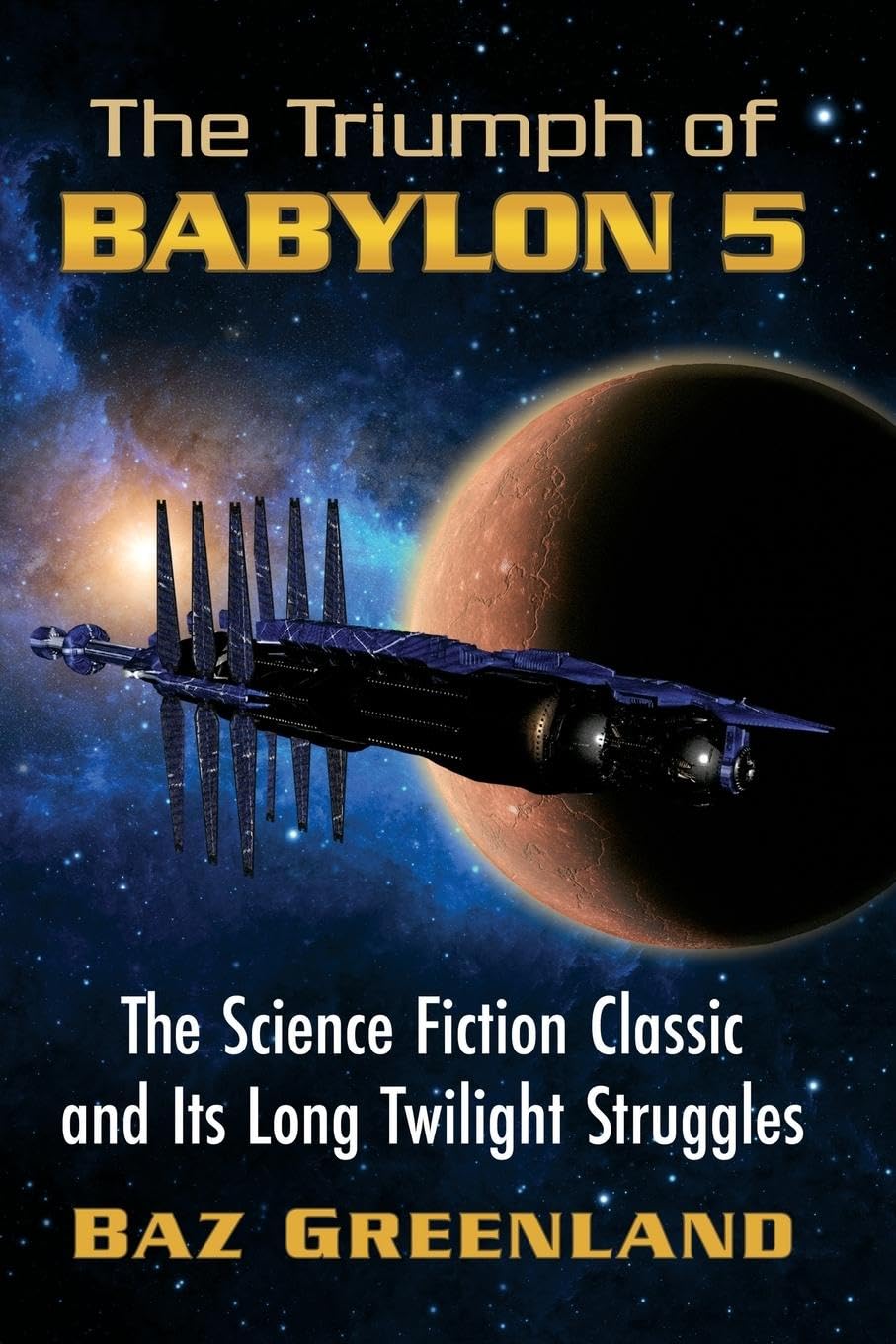
Baz Greenland is a podcaster and long-time fan of the television series Babylon 5, whose deep understanding of the show and its aborted spin-offs comes from the standpoint of a British viewer who heard of the show in his youth after its initial broadcast in the United States and who has watched and rewatched it ever since for over thirty years. He comments in his book, “The show’s inception, the struggles during production, and the attempts to continue the Babylon 5 story are almost as epic a tale as the fight against the Shadows and the battle to save Earth” (4). He has written widely and on-line about the series, https://www.threads.net/@greenlandbaz, interviewed surviving cast members, and has a podcast about it: https://podcasts.apple.com/us/podcast/a-dream-given-form-a-babylon-5-podcast/id1611981020. Now he has produced a book aimed at exploring the parallel stories of the show’s narrative plot, and the attempts to revive and extend it.
He notes his early enthusiasm for the show:
Babylon 5 stayed with me. I caught late night reruns on Channel 4, finally seeing what life was like under Commander Sinclair in season one. I bought all the seasons on VHS. On my A-Levels results day, I treated myself by popping into the video store and spending a whole $100.00 on the complete season three box set. . . . I introduced new friends to Babylon 5. I got the TV movies. I stuck through Crusade. (2)
His reaction was much like my son’s, who bought an extra DVD set of the first season when it came out to share with friends at school, something I have seen duplicated since only with the single season of Firefly! (2002-2003)
The book has 26 chapters, starting with a discussion of “The Legacy of Babylon 5” in Chapter 1, followed by an overview of SF “Story Arcs” in Chapter 2. Greenland notes:
The Oxford English Dictionary defines legacy as ‘a situation that exists now because of events, actions, etc. that took place in the past.’ The story of Babylon 5 as a TV show can certainly be viewed through the prism of that definition. The narrative structure of the show is built on the events of the past. The horrors of the last great Shadow War left scars on the Minbari and the Narn. The rise of Valen a thousand years ago shaped Minbari culture, most significantly the character of Delenn. The Vorlon manipulation of other races and the creation of telepaths saw the show revisiting the trauma of the past, most fundamentally in the show’s final season. (6)
He argues that J. Michael Straczynski’s creation of Babylon 5 opened the door and set the standard for long-form story telling and multi-season story arcs that enabled subsequent television shows, from the reboot of Battlestar Galactica (2004-2009), to more recent iterations of Star Trek, such as Discovery (2017-2024) and Picard (2020-2023) (7-18).
Chapter 3 focuses on how Straczynski came to develop Babylon 5, making use of his comments on the rec.arts.sf.tv.babylon5.moderated message board back in 1995, when he emphasized the need to have a reasonable budget, treat SF seriously in story-telling, and make use of the kind of sagas he admired in the genre. “As a lifelong fan of grand science fiction sagas like Foundation, Childhood’s End, The Lord of the Rings and Dune, he kept wondering: why hadn’t someone done this for TV?” (19-20). Chapter 4 explores how cast changes and the collapse of the Prime Time Entertainment Network (PTEN) lead to revisions of the original five year story plan and his proposed follow-up series Babylon Prime. (26) See: https://en.wikipedia.org/wiki/Prime_Time_Entertainment_Network and https://www.themoviedb.org/network/211. The original combined ten year story arc would have been very different from the show as it was produced, perhaps more dark and less exciting: “The final version of the TV show certainly appears to be the more thrilling option of the two” (29).
Further chapters discuss the development of the series, the back and forth debate about the relationship between Star Trek Deep Space Nine (1993-1999) and Babylon 5 (Chapter 6), and interesting interviews with cast members Peter Jurasik, Marshall Teague, and Patricia Tallman. Chapter 7, “Making ‘The Lord of the Rings in Space’ a Reality,” discusses the financial and technological obstacles to making grand SF films, and the literary influences on Straczynski’s story arc, including the poem “Ulysses” (1833; 1842) by Alfred, Lord Tennyson, as well as Childhood’s End (1953), Dune (1965), and The Lord of the Rings (1954) (50-53). Chapter 9, “JMS’s Character Trapdoors,” shows how Straczynski planned character switches and exits to allow continuity despite unexpected challenges, while Chapter 10 explores his efforts at introducing diversity in race, religion, gender, and sexual relationships that were not always fully realized but significant for the era (74-76). Chapters 12 through 16 deal with each of the five seasons of Babylon 5, including comparisons of alternate viewing orders of Season 1 (97-98), Season 2 (109-110), and in subsequent seasons, as they relate to building the mythos of the show. Subsequent chapters explore the TNT Movies, the single season of Crusade (1999), and other attempts to extend the detailed universe created by JMS.
The book includes Chapter Notes, a Bibliography, and an Index. It makes extensive use of The Lurker’s Guide to Babylon 5, available at http://www.midwinter.com/lurk/. Anyone familiar with (or new to) the series will value the detailed discussion of the making (and unmaking) of the original five-year story arc, Greenland’s commentary on each of the five seasons, and discussion of the innovations made by Straczynski that set the template for much of 21st century SF production. Greenland explores attempts to extend or reboot the series, and his enthusiasm, commentary, and interviews with the cast make this a valuable resource for conducting further research on the series, which remains one of my favorites.
Bruce Lindsley Rockwood, Emeritus Professor of Legal Studies at Bloomsburg University, Pennsylvania, is a long-time member of SFRA, having served as Vice President (2005-2006), and regularly writes reviews for SFRA Review from his retirement home in Midcoast Maine. He has taught and published on law, literature, climate change and science fiction, and attends SFRA and WorldCon with his wife Susan when possible (most recently in Montreal, Spokane, and recent virtual sessions of the SFRA.

 SFRA Review