
Non-Fiction Reviews
Review of The Kaiju Connection: Giant Monsters and Ourselves
Amber A. Logan
Jason Barr. The Kaiju Connection: Giant Monsters and Ourselves. McFarland, 2023. Paperback. 210 pg. $39.95. ISBN 9781476693514.
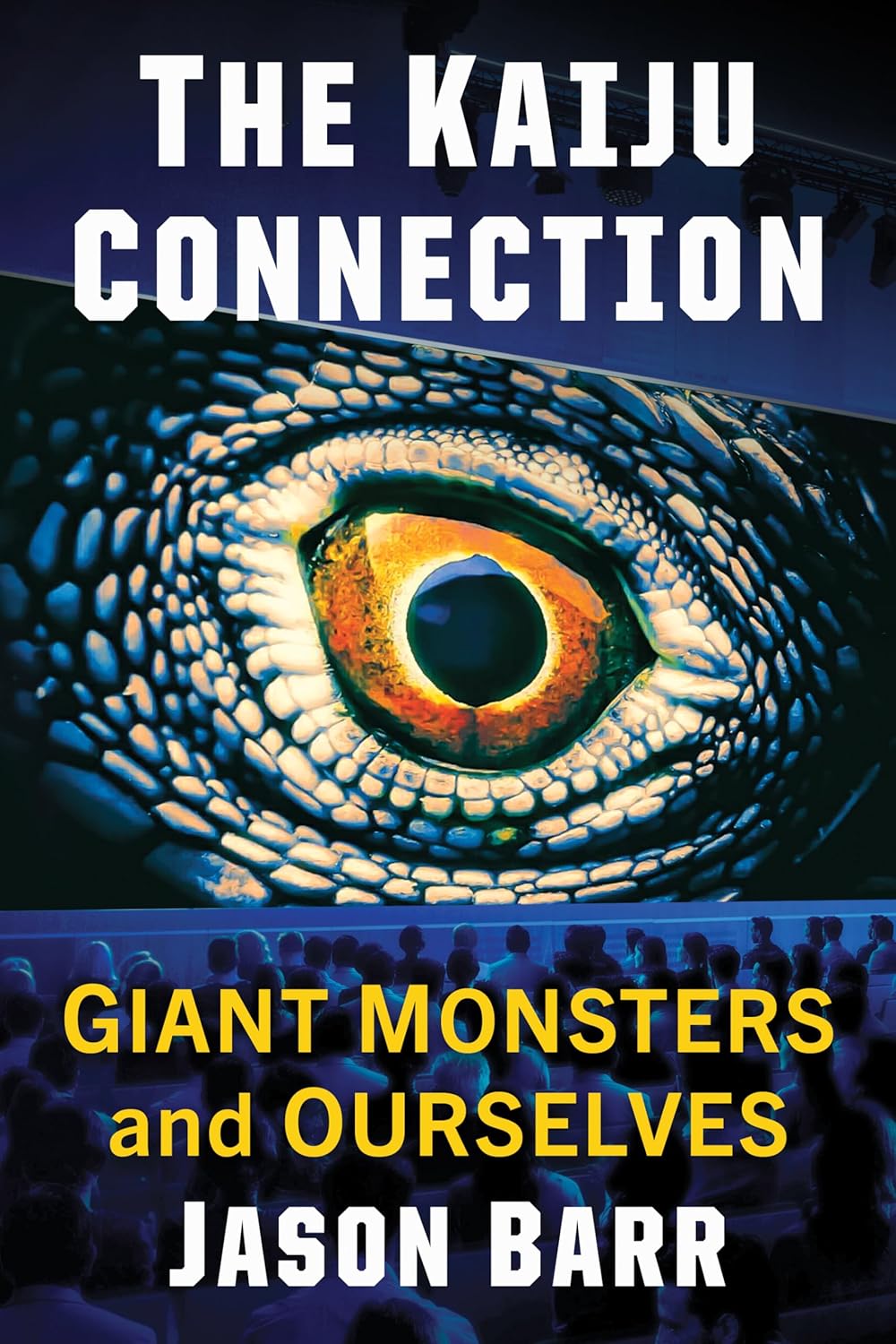
The Kaiju Connection is a short work focusing on the questions: what makes a kaiju a kaiju, and why are we, as humans, so intrigued by them? This isn’t Barr’s first foray into kaiju discourse, but this volume focuses more on recent kaiju films and the existential questions associated with the genre. With a refreshingly conversational (and sometimes humorous) tone, Barr isn’t afraid to pull metaphorical punches, curse, or paraphrase Homer Simpson in his evaluation of kaiju films, ranging from the serious and philosophical to the campy. Barr even states that this book isn’t an academic text in the strictest sense, but perhaps “more of an apologia for the continued study of the kaiju film” (3).
Barr suggests that society continues to be intrigued by kaiju films because the fascination with kaiju is an (at least tacitly) acceptable extension of a childhood fascination with dinosaurs. While not being particularly female-forward (few kaiju films, with the exception of Colossal [2016], have strong female protagonists—or, even, side characters), kaiju films do have strong masculine vibes and odd tie-ins with professional wrestling—which, admittedly, goes a long way to explaining the suspension of disbelief afforded some of the more comical and unconvincing rubber suits found in lower-budget kaiju films. Beyond gender dynamics, Barr argues that kaiju films can be legitimately studied in terms of political commentary (from the original 1954 Godzilla’s clear connections to post-war nuclear trauma to the 2016 Shin Godzilla, which can be read as a critique of the Japanese government’s response to the Daichii Fukushima disaster) and social commentary (evidenced in the evolving sense of “the Other” found across kaiju film franchises). Barr also argues that the more recent trend for American film makers to downplay Godzilla’s original nuclear origins has strong implications, arguing that they manipulate the story to give Americans a “pass” for the nuclear bombs dropped on Japanese soil during WW2 in order to make the story more palatable to their targeted American audience, thereby co-opting a character originally about a collective national trauma by the nation who caused the trauma. Recasting Godzilla as a ‘force of nature’ rather than a product of human violence and cruelty certainly reframes the narrative. However, Japanese filmmakers are not immune to the concept of spinning the popularity of Godzilla in order simply to make a quick buck; Barr also delves into the trend of some Japanese film companies to turn Godzilla from a serious message about humanity’s hubris into a kid-friendly “big monsters fighting” type of Saturday morning entertainment—the type of low-budget films that Barr bemoans as having watered down the reputability of the genre as a whole in the eyes of the general public.
Beyond Barr’s arguments for why kaiju and the genre of kaiju films are worthy of study, one of the most interesting parts of this book is its continual probing of the boundaries of the kaiju film genre. Barr convincingly argues that determining what ISN’T a kaiju film can be just as enlightening as determining what IS. Can a giant ape be a kaiju? What about a giant human? When does a creature change from being merely an oversized animal, to being a monster, to being a full-blown kaiju? Where those lines are drawn can arguably say a great deal about our perceptions of what constitutes humanity, and what we can sympathize with and relate to. Barr argues that the most solidly-kaiju kaiju are ultimately giant monsters (usually with Japanese origins, or at least nods toward a Japanese origin) who hold up a mirror to humanity and teach us something about ourselves. Barr proposes four “types” of kaiju or kaiju-adjacent films (authentic kaiju films; knockoff kaiju films; big, familiar creature films; and human kaiju), but perhaps the use of “fuzzy logic” is best applied when determining whether a film is a “kaiju film” or not, allowing the judger to decide how close the film in question approaches the beating heart of the kaiju film exemplars.
As Barr readily admits, it would be difficult to call The Kaiju Connection an academic tome, but it arguably has merit for scholarly research, particularly for those interested in the more philosophical, ethical (the costs of human life are often skimmed over in favor of watching two kaiju battle it out on the streets of major cities), and existential questions raised by the more ‘serious’ kaiju films. Casual fans of the kaiju film genre will find enlightening topics and much to enjoy (as well as much to skim over), but hardcore kaiju film junkies will delight in the depth into which Barr delves regarding specific recent films, characters, and even associated merchandise. Overall, The Kaiju Connection is a valuable addition to the kaiju film discourse.
Dr. Amber A. Logan is a university professor, freelance editor, and author of speculative fiction. In addition to her degrees in Psychology, Liberal Arts, and International Relations, Amber holds a PhD in Creative Writing from Anglia Ruskin University in Cambridge, England. Her thesis “Men Who Lose Their Shadows: from Hans Christian Andersen to Haruki Murakami” examined the intersection of fairy tales and near-future speculative fiction, and her debut novel The Secret Garden of Yanagi Inn was published in November 2022

 SFRA Review