
Fiction Reviews
Review of The Lion’s Country: C. S. Lewis’s Theory of the Real
James Hamby
Charlie W. Starr. The Lion’s Country: C. S. Lewis’s Theory of the Real. Kent State UP, 2022. Paperback. 160 pg. $18.95. ISBN 9781606354537.
.
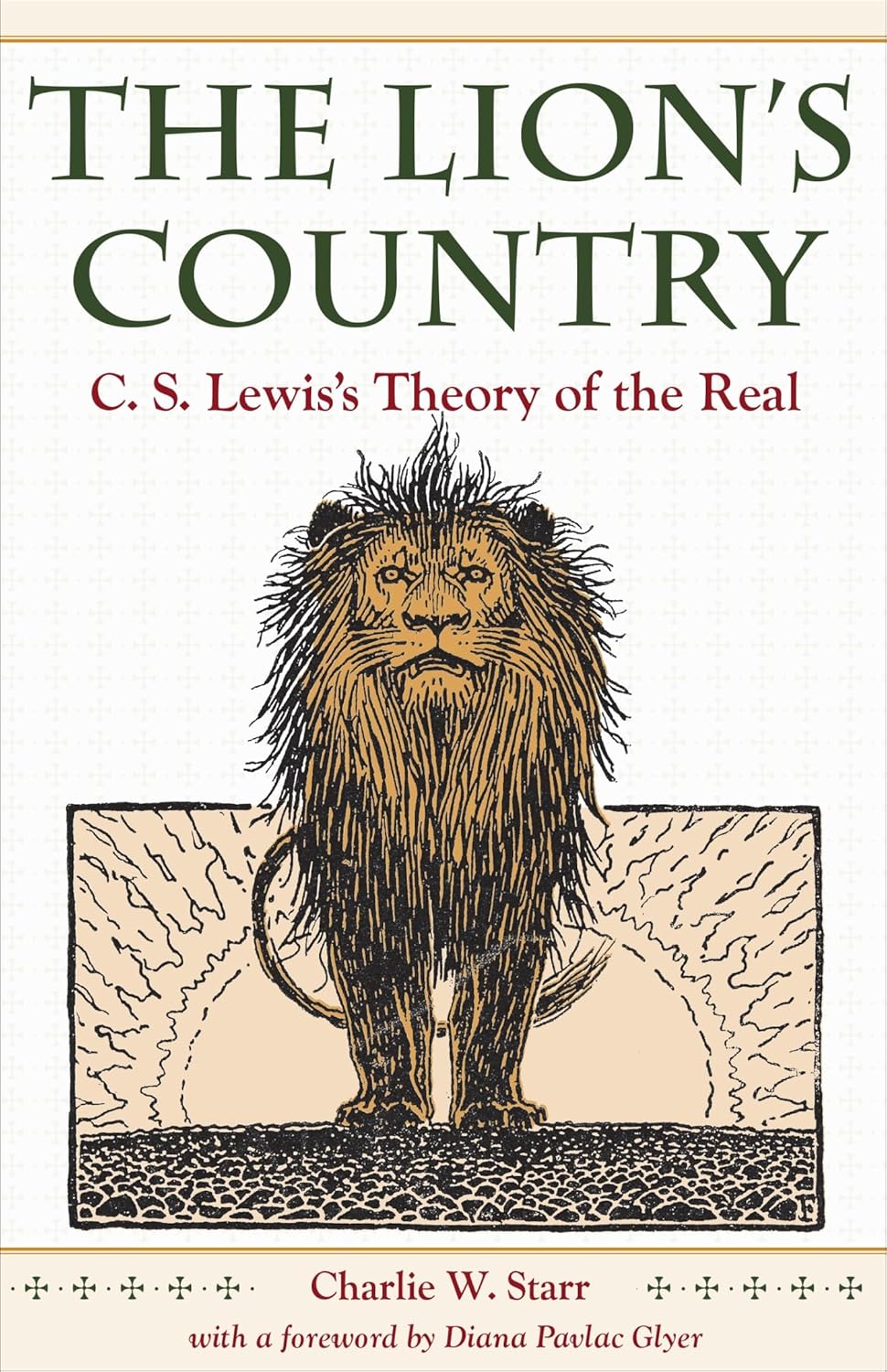
The works of C. S. Lewis are often discussed through the lens of Christian apologetics, but Lewis was influenced by more than just theology. In his study The Lion’s Country: C. S. Lewis’s Theory of the Real, Charles W. Starr examines the philosophical influences, particularlyIdealism, that Lewis incorporated into his fiction. Starr traces Lewis’s development from a materialist atheist to an idealist theist and finally to an orthodox Christian. Central to both this progression and to Lewis’s fiction is the question of what constitutes reality. The relationship between God and humanity, the meaning of experiences in the material world, and the nature of the afterlife illustrate Lewis’s theories of the real. Starr’s assessments offer a nuanced understanding of the progression of Lewis’s thought through the decades of his writing career.
The book is organized into ten chapters, each focusing on a particular component of Lewis’s concept of the real. Chapters include subjects such as desire, mystery, and transposition, amongst other topics, and each chapter touches in some way on the development of Lewis’s thought. The book concludes with a never-before published manuscript by Lewis, a collection of notes for a book that was never completed entitled “Prayer Manuscript” that describes Lewis’s vision of what it is like for humans to gradually experience reality.
It is a commonplace in Lewis biographies to note that Lewis was an atheist as a young man, but Starr focuses more on Lewis’s materialism than his atheism at this point in his life. Starr observes that “Lewis the atheist makes himself visible in his earliest use of the term fact. In 1916, the young C. S. Lewis had been an atheist for several years and had become a demythologizer” (28). The word “fact,” Starr argues, is of central importance to Lewis, because it is synonymous with “reality” (23). Limiting his concept of reality to mere fact, however, was not enough for Lewis. Starr says that Lewis’s longing for something he could not quite understand made him seek something beyond fact: truth. This led to Lewis’s turn towards Idealism and theism (29). Convinced that Idealism would explain his longings, Lewis began to believe there was something beyond the material world. Starr says, “The move from Atheism to Idealism was no less than a recognition of the existence of spiritual reality—something really there that transcended the physical” (29). Yet, as Starr points out, what Lewis ultimately rejected about this viewpoint was his belief that all matter is evil. Once Lewis converted to Christianity, he saw a connection between the spiritual and the physical that suggested not only that matter was not evil, as he had previously thought, but that there was a hierarchy of reality. Starr suggests that “Lewis abandoned his own brand of idealism (which saw spirit as good and matter as evil) when he became a theist, thus adopting the third view “that there is a reality beyond nature” (87). Starr also notes Lewis’s change in thought concerning materialism when he says, “This younger Lewis is very different from the Christian convert who described transcendent reality as the most concrete existence there is. Lewis’s previous philosophical war with the flesh was not a part of his Christian way of thinking” (109).
One of the most important concepts in Lewis’s beliefs is the notion that there are different levels of reality. Starr points out this concept in his analysis of The Great Divorce. In this novel, the closer one gets to heaven, the more “real” things become. Conversely, as Starr explains, “Hell (the farthest place from God) is smaller than a pebble on Earth and smaller than an atom in heaven” (121). In contrast to the beliefs of his youth, the Christian supernaturalist Lewis sees the material world as the lowest part of a progression that eventually leads to the ultimate reality, God. Starr explains that in this core image of Lewis’s belief system, “heaven and heavenly beings are more solid than are we and the Earth we live on. We are ghosts and shadows and our world but a cheap copy of the heavenly one to come, like a landscape painting compared to the real place” (121). These same ideas may be seen in The Last Battle when the heroes of Narnia, after their deaths, keep going further up and further in to Narnia, thus discovering different layers of that magical land, each more real than the last. Starr comments that “each reality is hierarchically more real, somehow larger than the ones without” (89).
Using these biographical and philosophical backdrops, Starr discusses Lewis’s works. He typically comments on several of Lewis’s works in each chapter, and the books he most frequently references include The Silver Chair, The Last Battle, Mere Christianity, The Problem of Pain, A Grief Observed, The Screwtape Letters, The Great Divorce, and Till We Have Faces. Starr’s engagement with these texts is thoughtful and engaging, and his observations would certainly be helpful for both scholars and general readers. Starr’s tone wavers a bit between academic and conversational, and in some places he drops scholarly objectivism and speaks instead from a position of faith, making the book have more the feel of a popular religious book than an academic work. And though Starr clearly demonstrates his familiarity with both philosophy and Lewis scholarship, more engagement with both of these fields would have lent more weight to his discussion of Lewis’s texts. Incorporating more material on Idealist philosophers, particularly those who influenced Lewis’s thought as a young man, would have been enlightening. Furthermore, placing Lewis in conversation with these theorists would have blunted criticism that is sometimes made against Inkling scholarship that the field is too insular and does not connect the Inklings to other movements or authors. Additionally, the scholarship on Lewis that Starr does cite, while useful, is often too briefly considered and feels more like name-checking than genuine engagement. Since this is a relatively brief volume, adding more secondary sources would have fleshed out Starr’s discussion and made important connections.
This work is nevertheless a valuable contribution to Lewis studies. With engaging prose, Starr ably explains the difficult philosophical concepts behind Lewis’s fiction. Both scholars and general readers interested in Lewis should find this book appealing. This volume not only provides insight into Lewis’s world-building, but it also serves as a wonderful demonstration of how fantasy can be used to express the complexity of human experience.
James Hamby is the Associate Director of the Writing Center at Middle Tennessee State University, where he also teaches courses on composition and literature, including Victorian Science Fiction, Fantasy, and Fairy Tale. His dissertation, David Copperfield: Victorian Hero, explores how Charles Dickens created a new hero for the Victorian Age by reconceiving his own life through the prism of myths and fairy tales.

 SFRA Review