
Nonfiction Reviews
Review of Science Fiction: Toward a World Literature
Michael Larson
George Slusser. Science Fiction: Toward a World Literature. Edited by Gary Westfahl. Lexington Books, 2022. Hardcover. 350 pg. $120.00 ISBN 9781666905359.
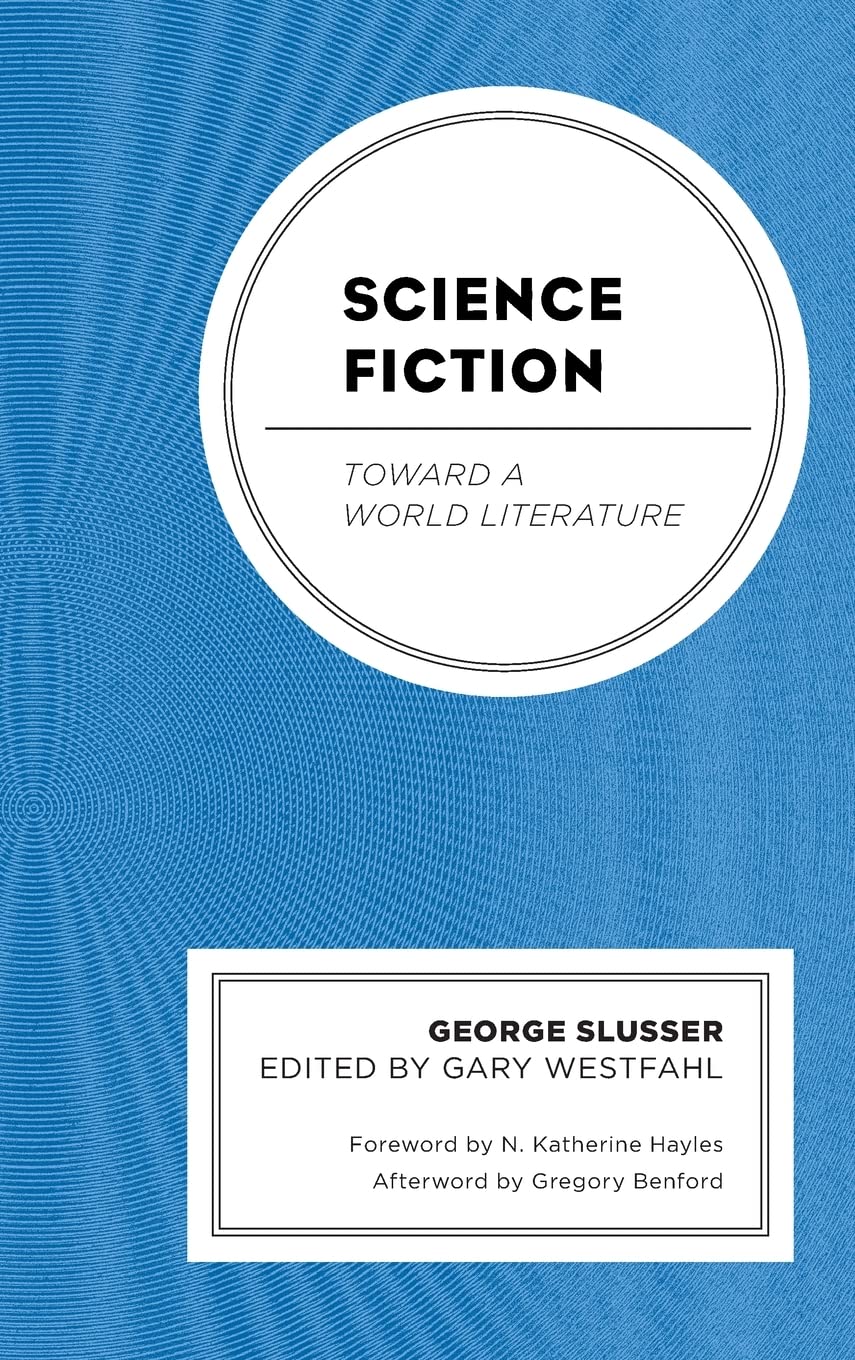
The eminent science fiction critic and long-time curator of the Eaton Collection of Science Fiction and Fantasy George Slusser died in 2014, leaving behind multiple versions of a manuscript about the history and development of science fiction. Gary Westfahl, Slusser’s former colleague at the University of California, Riverside, compiled and revised these materials into this posthumous volume, which, barring any major archival discoveries, marks Slusser’s final contribution to the field he dedicated his career to.
Like Adam Roberts’s The History of Science Fiction (2006) and Brian W. Aldiss and David Wingrove’s Trillion Year Spree: The History of Science Fiction (1973), this project aims not merely to define science fiction in a new way, but to locate the historical origins of the genre. After a brief introduction, the first chapter traces the emergence of science fiction, and, although Slusser does not go back as far as Roberts, who sees even Greek epics as a kind of proto-science fiction, both critics understand the Reformation as a key moment in the development of the genre.
Employing Isaac Asimov’s definition of science fiction as a “branch of literature which is concerned with the impact of scientific advance upon human beings” (“Social Science Fiction”), Slusser identifies a series of scientific revolutions that swept across Europe and the United States beginning in the 17th century, which would go on to shape key proto-science fiction texts. For Slusser, the story begins in France, where the anti-clerical rationalism of François Rabelais passes through Michel de Montaigne to René Descartes, whose Discourse on the Method (1637) represents the first of a series of scientific paradigm shifts. Slusser argues that this advancement had an impact on French writing, producing a unique form of fiction, first visible in Blaise Pascal’s Pensées (1670), with its fictional concepts of the “human condition” and the “thinking reed,” which Slusser identifies as “the first genuine works of science fiction” (25). From there, we move to Germany, where the paradigm shift brought about by Immanuel Kant’s influence, especially his “synthetic a priori,” influenced E.T.A. Hoffman’s “Der Sandmann” (1815). Interestingly, it is only after identifying these Continental origins that Slusser turns to British literature.
Unlike many English-language critics, Slusser sees British literature as reflecting the impact of Francis Bacon’s “new science” at a relatively late moment. Mary Shelley’s Frankenstein; or, the Modern Prometheus (1818), which is often cited as the first work of science fiction, is brushed aside for taking a posture that is “quite traditional in stigmatizing science” (39). Instead, Slusser identifies H.G. Wells’s The Time Machine (1895) as the first British work of fiction that shows science—in this case, the evolutionary theory of Charles Darwin’s Origin of Species (1859)—impacting human activity. The final paradigm shift occurs in the United States, stemming from the philosophical innovations of Ralph Waldo Emerson, although this is only arrived at toward the end of the text, after the key characteristics of science fiction have been investigated.
The middle chapters take up particular themes and markers of the genre. For Slusser, key attributes include the scientist as protagonist, a quest for intellectual liberty, seminal objects or inventions that play a key role in the narrative, and a story in some way concerned with humanity’s advancement towards a transcendent transhumanism, best exemplified by J.D. Bernal’s The World, the Flesh, the Devil: An Enquiry into the Three Enemies of the Rational Soul (1929). As with Roberts, Slusser sees space travel as a key setting for science fictional narrative, although his treatment of this subject primarily serves to underline the difference between the Anglo and French science fiction traditions, the latter of which he sees as bound up with the Cartesian conception of the cogito; although French travelers board rocketships and submersibles, just like their British counterparts, more often than not their journeys are actually explorations of a mental space that is simply reflected in the res extensa.
Throughout these investigations, Slusser does not shy away from controversy, and a number of established theorists and traditions come in for a heaping of criticism. Donna Haraway’s “A Cyborg Manifesto” (1985) can only “conjure the old specter of the human form grotesquely distorted, stillborn” (211), while China Miéville’s work is “a personal form of urban fantasy whose purpose, it seems, is to confound genre readers while delighting critics” (288). Marxism and Marxist theory are viewed in a skeptical light, and deconstructionism is frowned upon.
Of course, a critical lens can be also applied to Slusser’s text, and when it is, one begins to wonder about the meaning of “world literature,” a term that seems to define the manuscript even as it is never itself defined. A reader might be forgiven for observing that a series of national, European, science fiction traditions are interrogated, with minimal description of the significant interactions between them until the final chapters. In addition, some readers might echo the criticism of the original reviews of the manuscript, which Westfahl reports requested extensive revisions because the book “was devoting too much attention to authors and texts that were not really part of the genre of science fiction” (xi). Although Westfahl sees exactly this as Slusser’s innovation, some scholars may question the usefulness of giving so much attention to certain classics of European literature and philosophy—Descartes, Pascal, Kant, Aristotle, Balzac—in a study of science fiction.
However, on balance, even scholars who are not prepared to sign onto Slusser’s account of the history of science fiction are likely to find his efforts to understand the genre from a more international perspective to be worthwhile. Slusser’s thorough examination of non-Anglo traditions, especially French science fiction, will be edifying for those who are accustomed to thinking of science fiction as an exercise primarily conducted in English. Crucially, in the book’s conclusion, Slusser engages fruitfully with writing from India, China, Israel, East Germany, Romania, and other terrains of “Global SF” (286). Along with the aforementioned volumes by Roberts and Aldiss and Wingrove, Science Fiction: Toward a World Literature makes a valuable contribution to the critical understanding of science fiction’s origins and is a worthy capstone to a vaunted career.
Michael Larson is a visiting assistant professor at Keio University. He completed his PhD at the University of Wisconsin-Milwaukee and received a Fulbright Grant to research the 2011 Tohoku Earthquake and Tsunami in Japan, later writing a nonfiction account of the disaster When the Waves Came: Loss, Recovery, and the Great Tohoku Earthquake and Tsunami (Chin Music Press 2020). His current research focuses on science fiction and utopian studies and has been published in Poetics Today and Utopian Studies. In 2020, he received a three-year Young Researcher Grant from the Japan Society for the Promotion of Science.

 SFRA Review