
Nonfiction Reviews
Review of Black Panther: Interrogating a Cultural Phenomenon
Jeremy Brett
Terence McSweeney. Black Panther: Interrogating a Cultural Phenomenon. Jackson: University Press of Mississippi, 2022. Paperback, 254 pg. $20.00. ISBN 9781496836090.
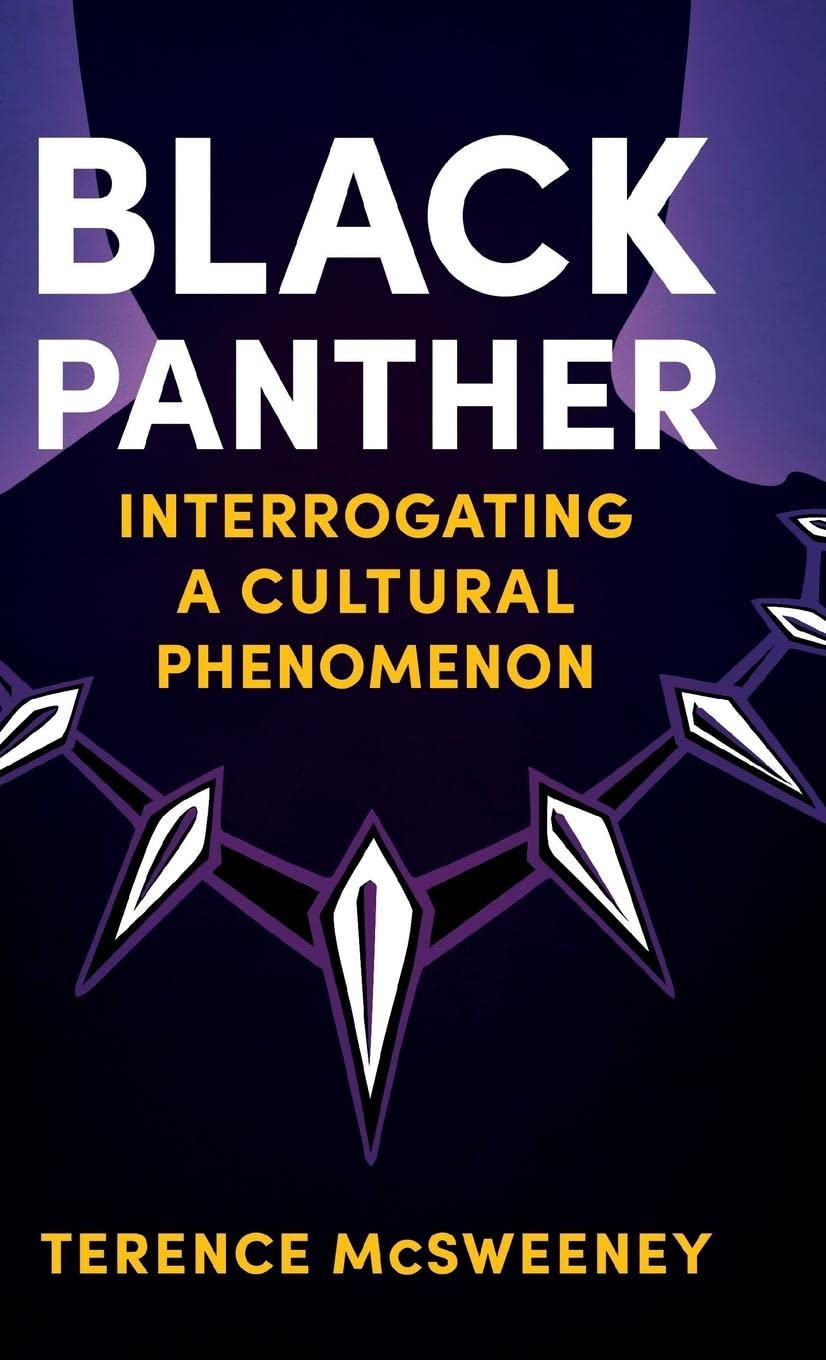
An analysis or examination of the 2018 Marvel Cinematic Universe film Black Panther is a difficult proposition, since Black Panther is not simply another film: as Terence McSweeney tells us in the very subtitle of his study, it is an ongoing popular phenomenon that has touched the lives and hearts of millions of moviegoers. McSweeney opens his text with a quote from Carvell Wallace of The New York Times, in which Wallace states, “Black Panther is a defining moment for Black America” (3). That is no small thing for any cultural production, and a great deal of weight for a single film to bear. [It will be interesting to watch what happens now that the film’s sequel, Black Panther: Wakanda Forever, has been released, sans the sadly late Chadwick Boseman as T’Challa, to see whether the BP franchise can sustain the first film’s level of personal and societal impact.]
However, as McSweeney makes clear, Wallace’s comment is more than justified, not just by the countless numbers of ecstatic and joyful comments from Africans and people of the African diaspora all around the world, nor by the fact that a massive cinematic franchise/cultural touchstone finally centered a film on a Black superhero, but by the complex societal layerings that constitute the film. As McSweeney states, “[t]his book places Black Panther alongside these texts” [other seminal films that have had a significant impact on the ways in which viewers react and respond to culture] “despite the fact that it is just a superhero film, proposing it should be considered first and foremost as a richly cultural artifact in ways similar to them, each of which have resonated with audiences and found themselves both embedded into and impacted on cultural discourse” (italics in original, 21). In a world in which superhero-centered media is (still!) frequently regarded as somehow less compared to other film genres, or as not “real” cinema (most prominently and infamously, perhaps, suggested by film legend Martin Scorsese), McSweeney makes a powerful case that Black Panther does not transcend superhero films as much as demonstrate those films’ capacity—given the proper combination of script, director, actors, and cultural considerations—to be sources of significant psychological and cultural resonance. Just as importantly, they may become sites in which viewers, especially those neglected or misrepresented in the past by studios, can see themselves, their cultures, and their humanity represented accurately and on center stage. This new concentration on diverse representation of people has accelerated in the MCU in recent years, as Marvel Studios has been giving more prominence to female characters (Captain Marvel, Black Widow, WandaVision, She-Hulk), Muslims (Ms. Marvel), Native Americans (Echo in Hawkeye), Asians and Asian-Americans (Shang-Chi and the Legend of the Ten Rings) and LGBT characters (The Eternals), for example. However, arguably none of these efforts have had the same emotional resonance as Black Panther, and part of McSweeney’s valuable study involves identifying the singular nature of BP in relation to American, African American, and African cultures. In the process, he also provides a well-constructed and thoughtful example of the scholarly value of analyzing a popular cultural text, especially one demonstrated to have lasting and powerful cultural impact.
One of the striking features of McSweeney’s study is its structure. He rarely repeats himself or describes the film in a recursive fashion, returning to the same scene or scenes again and again. Instead, he manages the admirable feat of detailing several important themes while proceeding in a more-or-less straight fashion from the beginning of the movie to its conclusion. It’s a refreshing method of writing a critical text that mirrors filmic chronology and, I think, lets insight build upon insight until the work’s conclusion, where the totality of the critical observations really makes itself felt.
McSweeney tackles a number of facets of BP’s production and influence that taken together demonstrate with convincing arguments the cultural significance of the film. The study’s first chapter explores the nature of Wakanda, placing BP firmly in the aesthetic and narrative traditions of Afrofuturism and African Futurism and showing how the film’s creators and designers carefully (although some might argue superficially) work to present Wakanda as a diverse and earnest exploration of various African cultures and practices. (I appreciate also McSweeney’s note that Wakanda is a powerful rebuke to white historians of the past who decried Africa as a place without history or civilization. One of the reasons for Black Panther’s emotional resonance has been its visual expression of a powerful and technologically advanced African nation, with a proud history and lively culture.) A second chapter looks at what might be an overlooked aspect of the film, namely its interaction with MCU and real-world geopolitics; again, he notes that Wakanda occupies a unique place in movie history. Black Panther “is a film that centralizes African culture, traditions, and characters in a way that no large-scale American film about the continent has ever done. Wakanda is a paradoxical construct in many ways: it is fictional, but it has real borders and relationships with other actual countries; it is not real, but its culture, architecture, and style are drawn from authentic African nations; and, finally, it is an imaginary creation, but this did not prevent it from possessing a tangible and affective symbolic power when the film was released in February 2018” (57). But in all the kudos for the film’s groundbreaking nature, McSweeney takes care to point out the problematic features of the film, many of which reflect its American origins—these include the positive portrayal of CIA officer Everett Ross (Martin Freeman), a jarring character choice considering the real-life CIA’s covert and undemocratic interference in the affairs of African nations. (One of the book’s most thought-provoking observations, something I recall noticing when I originally saw the film, was that the movie makes the interesting choice to make a white American intelligence operative one of the film heroes while making an African American (N’Jadaka, aka “Killmonger” [Michael B. Jordan]) whose stated desire is to empower Black people everywhere the ruthless villain. Black Panther is an interestingly layered movie from a racial point of view, and these sorts of dramatic decisions make the championing of the film more compellingly complex.McSweeney tackles a number of facets of BP’s production and influence that taken together demonstrate with convincing arguments the cultural significance of the film.
McSweeney devotes an entire chapter to N’Jadaka (and I note his decision to use the character’s given Wakandan name as a general rule, rather than referring to him as Killmonger, which is at once N’Jadaka’s nickname given him by his fellow US Army warriors and the name by which the character is called in countless reverent memes), seeking to analyze the fascination that much of the filmgoing audience has had with him. N’Jadaka is one of the most compelling and developed villains in the MCU, which accounts for much of his popularity. Betrayed as a young boy by his uncle T’Chaka (then the king of Wakanda), his story arc throughout the film is one of bitterness and revenge against the Wakandan royal family, but he is also driven by the desire to break Wakanda out of its self-isolation and take the lead in supporting Black people everywhere. (Is this policy ultimately a selfish, self-benefiting one, that ignores Wakandan responsibility to fellow Black people? It’s a question that the film leaves open to discussion, though it ultimately comes down on the side of increased Wakandan engagement as T’Challa appears before the United Nation to pronounce his nation’s arrival on the world stage.) McSweeney ably examines N’Jadaka’s contradictions (his attacks on colonizers while himself having the mentality of one, for example). At the same time, though, he points out the problematic point of Black Panther that “[i]n a genre that revels in violent altercations – indeed, one founded with violence as righteous and just – not only is Black Panther unable to endorse violence as emancipation for oppressed people all over the globe but it portrays the two men who would advocate it as villains, showing one to be in league with a terrorist like [Ulysses] Klaue and the other a sociopath that targets women on numerous occasions and will later advocate killing children” (113). The film’s relationship to “unacceptable” Black radicalism makes its image as a progressive film a bit muddier; this is not necessarily a criticism. In fact, these kinds of contradictions that McSweeney discusses in the book make Black Panther less a collection of flaws than a multidimensional production subject to numerous and equally valid reinterpretations. As McSweeney puts it, “[w]hat is clear is that Black Panther came to mean fundamentally paradoxical things to different individuals and groups, which, for some, might be regarded as evidence of its vacancy, but for others, of its fecundity” (177). The exploration of those opposing views and varying intensities of popular reception makes McSweeney’s very readable study particularly useful for film and popular culture scholars.
Jeremy Brett is an Associate Librarian at Cushing Memorial Library & Archives, where he is the Curator of the Science Fiction & Fantasy Research Collection as well as Interim Curator of the Women’s & Gender Studies and Area Studies Collections. He has also worked at the University of Iowa, the University of Wisconsin-Milwaukee, the National Archives and Records Administration-Pacific Region, and the Wisconsin Historical Society. He received his MLS and his MA in History from the University of Maryland – College Park in 1999. His professional interests include science fiction, fan studies, and the intersection of libraries and social justice.

 SFRA Review