
Non-Fiction Reviews
Review of The History and Politics of Star Wars: Death Stars and Democracy
Dominic J. Nardi
Chris Kempshall. The History and Politics of Star Wars: Death Stars and Democracy. Routledge, 2022. Routledge Studies in Modern History. Paperback, Ebook. 252 pg. $44.95. ISBN 9781032318875.
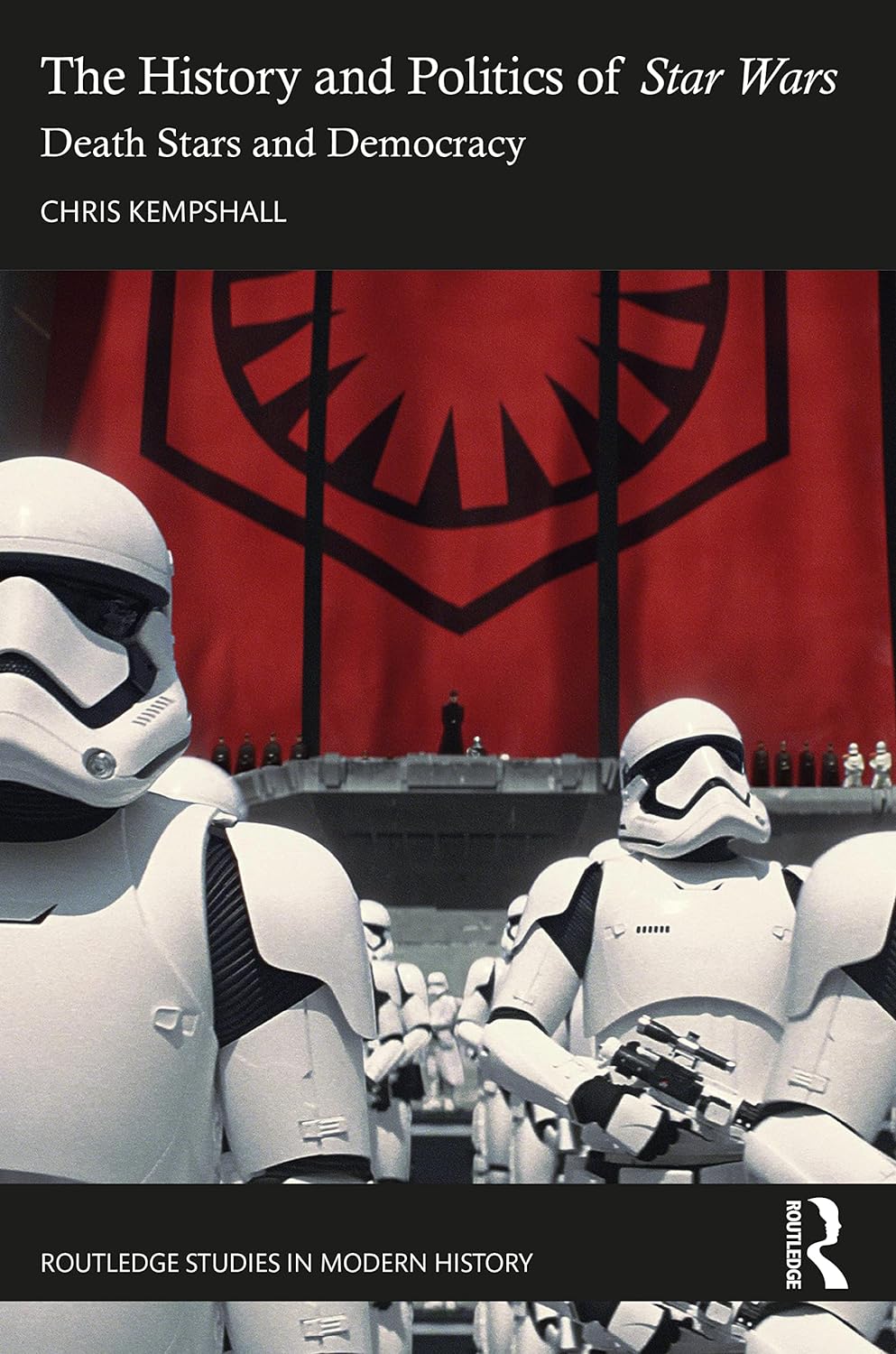
Despite claims from some parts of the fandom that Star Wars should not be “political,” decades of scholarship have shown that George Lucas used Star Wars to comment on political controversies, from the Vietnam War to the Patriot Act. However, most scholarship focuses on the Star Wars films, overlooking the hundreds of novels, comics, games, and other stories through which fans engage with the franchise. Chris Kempshall’s The History and Politics of Star Wars is the first work to examine historical parallels and political themes across the entire Star Wars franchise, including Expanded Universe (EU) tie-in materials and recent TV shows on Disney+. This scope allows Kempshall to deliver fresh insights about Star Wars and politics, even to readers familiar with the existing literature. Indeed, the speed and relatively low cost of publishing makes tie-in novels an important vehicle for the franchise to engage with new political developments in a timely manner.
The first chapter of The History and Politics of Star Wars focuses on how depictions of the Empire have evolved since the Original Trilogy (1977-83), which borrowed heavily from Nazi iconography. During the 1990s, Star Wars novels began to reimagine the Empire as a flailing superpower like post-Soviet Russia with weapons of mass destruction and sometimes allied with the New Republic/United States. Some authors even created sympathetic Imperial characters who had honorable reasons for siding with the Empire. After Disney reset the canon in 2014, the Star Wars franchise returned to depicting Imperials as space Nazis with little moral ambiguity.
By contrast, Chapter 2 argues that the franchise’s pessimism about democracy has remained consistent across Star Wars media. Although Obi-Wan Kenobi described the Old Republic as a “more civilized age,” the Prequel Trilogy (1999-2005) revealed that the Senate suffered gridlock and corruption long before Palpatine seized power. Democracy fared no better after the Rebellion won. In tie-in novels published during the 1990s, the New Republic’s weak government was constantly torn by sectarian conflict, perhaps reflecting fears that the collapse of communism would lead to instability. During the Disney era, tie-in materials for the Sequel Trilogy (2015-19) continued to depict the New Republic as ineffectual, mostly because—in another echo of World War II—it refused to take the threat of fascism seriously.
Chapter 3 explores how the Star Wars franchise incorporates popular understandings—often based on Hollywood movies—of real-world warfare into its storytelling. Kempshall—a historian of World War I—notes that these popular understandings sometimes diverge from the reality. For example, in romanticizing the Vietnam War as a struggle between a technological superpower and a noble underdog, Lucas overlooked the importance of political ideology, perhaps explaining why the Rebellion lacked a clear vision for political and social change. Star Wars usually sanitizes warfare, but Kempshall points out that newer tie-in novels, such as Alphabet Squadron (2019), have begun to depict the personal and psychological costs of war.
Next, Chapter 4 explores the tensions between the Jedi adherence to the Force and their allegiance to the Senate. Kempshall compares Qui-Gon Jinn’s reluctance to overstep the Republic’s jurisdiction to free slaves in The Phantom Menace (1999) with the United Nations’ failure to stop genocide in Srebrenica. Just as popular culture became more morally ambiguous after the 9/11 attacks, the Jedi of The Clone Wars increasingly used unethical means—including torture—to stop their enemies. Kempshall suggests that the key difference between Jedi—and, by implication, America—and their adversaries is that the they took no pleasure from such harsh methods. He also points out the disturbing lack of accountability Jedi faced for their recklessness, or even falling to the Dark Side.
Finally, Chapter 5 addresses ethnic and gender representation in Star Wars media. Kempshall’s approach is more nuanced than most scholarship on this topic. He carefully weighs allegations that Jar Jar Binks and other Prequel characters embodied racist stereotypes, but then explains why some fans and scholars have defended those characters. This chapter also explores the franchise’s treatment of alien cultures and droid rights. More so than in the other chapters, Chapter 5 discusses fan reception of and engagement with Star Wars, concluding with the backlash to diverse representation in the Sequel Trilogy.
Kempshall wisely avoids debates about the “accuracy” of the franchise’s politics compared to real-world history, recognizing that Star Wars is more an exercise in mythmaking than in detailed world-building. Instead, he uses history as a lens through which to examine the political ideas, themes, and tensions within the Star Wars franchise. In addition, the book does not try to prove—as Harry Potter and the Millennials (2013) did—that Star Wars shaped the political views of its fans. As such, The History and Politics of Star Wars is best suited for scholars already interested in Star Wars and who want to better understand its political content, rather than readers skeptical of the franchise’s political relevance.
Just weeks after the publication of The History and Politics of Star Wars, Disney+ released the live-action TV show Andor (2022-), which both complicates and confirms Kempshall’s analysis about the Empire. One of the actors in the show explicitly compared the Imperial crackdown to the erosion of freedoms under rightwing populism.[1] To some extent, this is a central thesis of the book: Star Wars continually responds to and engages with new political developments. No matter what stories Star Wars tells next, Kempshall’s book will be an important starting point for years to come for future research into the historical influences and political themes of the franchise.
NOTES
[1] Ben Travis, “Andor Is Star Wars’ ‘Scurrilous Take On The Trumpian World,’ Says Fiona Shaw – Exclusive Image,” Empire (August 2, 2022), https://www.empireonline.com/tv/news/andor-star-wars-take-trumpian-world-fiona-shaw-exclusive/.
Dominic J. Nardi, PhD, is a political scientist who has worked as a research analyst on human rights in Southeast Asia and China. He coedited The Transmedia Franchise of Star Wars TV (Palgrave) and Discovering Dune (McFarland). His paper about political institutions in Lord of the Rings won a Mythopoeic Society award for best student paper in 2014 and was published in Mythlore. In addition, he has written about ethnic identity in Blade Runner 2049 and international relations in Star Trek: Deep Space Nine.

 SFRA Review